Flashback : Dallas

A Miscellany: History, Ads, Pop Culture

Category: 1890s

The Old Union Depot in East Dallas: 1897-1935

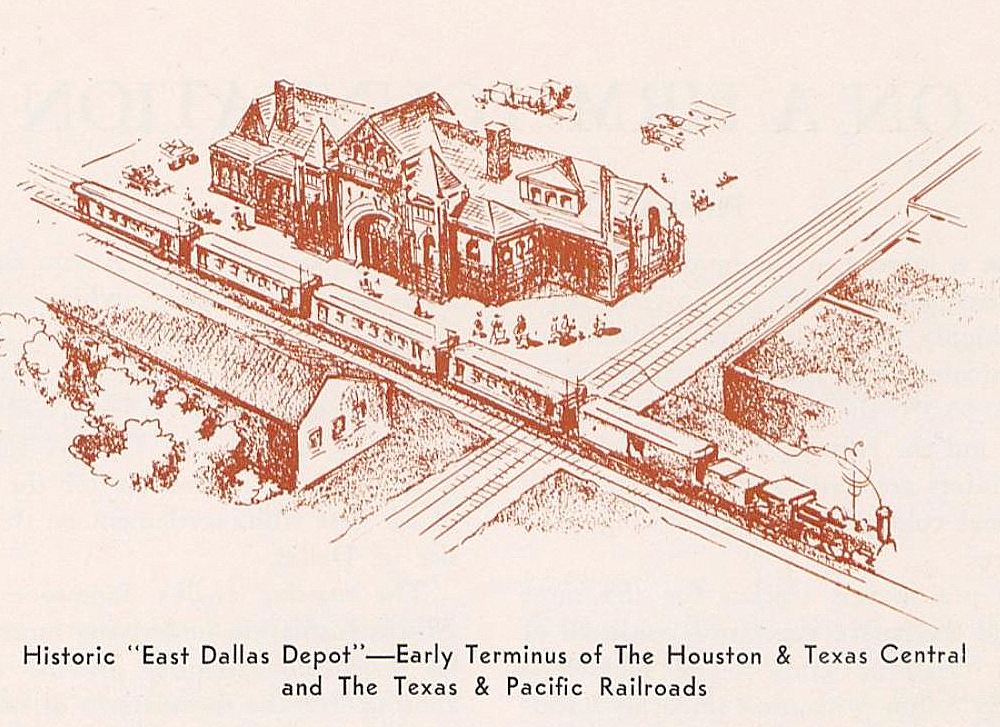
east-dallas-depot_rendering_art-hoffmanFrom the collection of Art Hoffman (click for larger image)

by Paula Bosse

I saw the above rendering of the old East Dallas rail depot posted recently in a Dallas history group. It was bought several years ago by Art Hoffman who was told it had belonged to a former employee of the Houston & Texas Central Railroad (which, along with the Texas & Pacific, served this station). It’s an odd thing for an architect to sketch — a boarded-up railroad depot. I couldn’t find anything on E. L. Watson, the architect who did the rendering (perhaps a member of the Watson family who were prominent Dallas contractors?), and I couldn’t find any connection between the depot and the F. J. Woerner & Co. architectural firm. The drawing might have been done in 1931, with what looks like “31” next to the artist’s signature. Could the drawing have been done merely as a study for E. L. Watson’s portfolio?

But back to the building itself. It was referred to by all sorts of names: Union Station, Union Depot, East Dallas Depot, Old Union Station, etc. With all these permutations, it took considerable digging to determine exactly when it had been built and when it had been demolished.

A couple of stations had previously occupied this site (about where Pacific Avenue and Central Expressway would cross), the first being built in 1872 at the behest of William H. Gaston who was developing the area, well east of the Dallas city limits. Due to the presence of the railroad, the area grew quickly, and in 1882, it was incorporated as the city of East Dallas. It thrived and continued to grow and on January 1, 1890 it was annexed and became part of the city of Dallas.

dallas-map-ca1900Location of depot in red — map circa 1890-1900 (click to enlarge)

The depot pictured in the drawing above was built in 1897. The previous station, a woefully inadequate and outdated “shanty,” was, by early 1897, being nudged toward demolition in order to remain competitive with the new Santa Fe depot then under construction. In the Feb. 10, 1897 edition of The Dallas Morning News, it was referred to as “the present eye-sore in East Dallas” which would be better off “abandoned and used for kindling wood.”

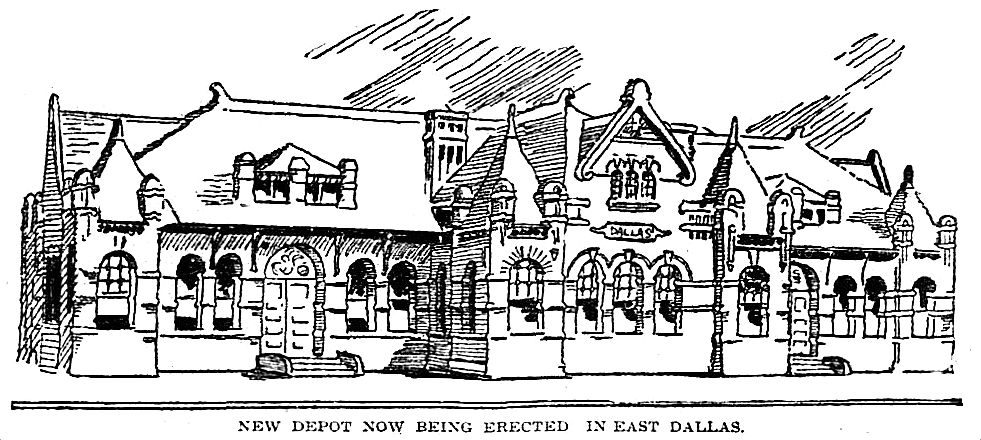
On April 4, 1897, it was reported that plans for a new Texas & Pacific passenger depot were nearly completed. By the beginning of June, the shanty had been torn down, and on June 6, 1897, the drawing below appeared in the pages of the Morning News, giving the people of Dallas a first look at what the much grander station would look like when completed. (It’s unfortunate that the actual architectural rendering was not used, but, instead, a more rudimentary staff artist’s version was printed.) The accompanying information revealed that the new depot had been designed by Mr. O. H. Lang, an architect who worked in the engineering department of the Texas & Pacific Railroad. This was an exciting tidbit to find, because I had wondered who had designed the structure but had been unable to find this elusive piece of information. And it was Otto Lang! Eight years after designing this railroad depot, Lang and fellow architect Frank Witchell would form the legendary firm of Lang & Witchell, and they would go on to design some of Dallas’ most impressive buildings.
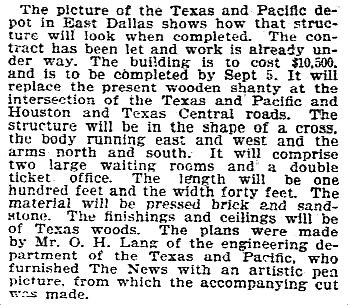
east-dallas-depot_dmn_060697-DRAWING

east-dallas-depot_dmn_060697-TEXTDallas Morning News, June 6, 1897

The building was completed fairly quickly, and its official opening was announced on Oct. 12, 1897.
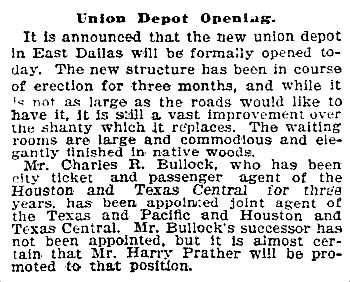
east-dallas-depot_GRAND-OPENING_dmn_101297DMN, Oct. 12, 1897

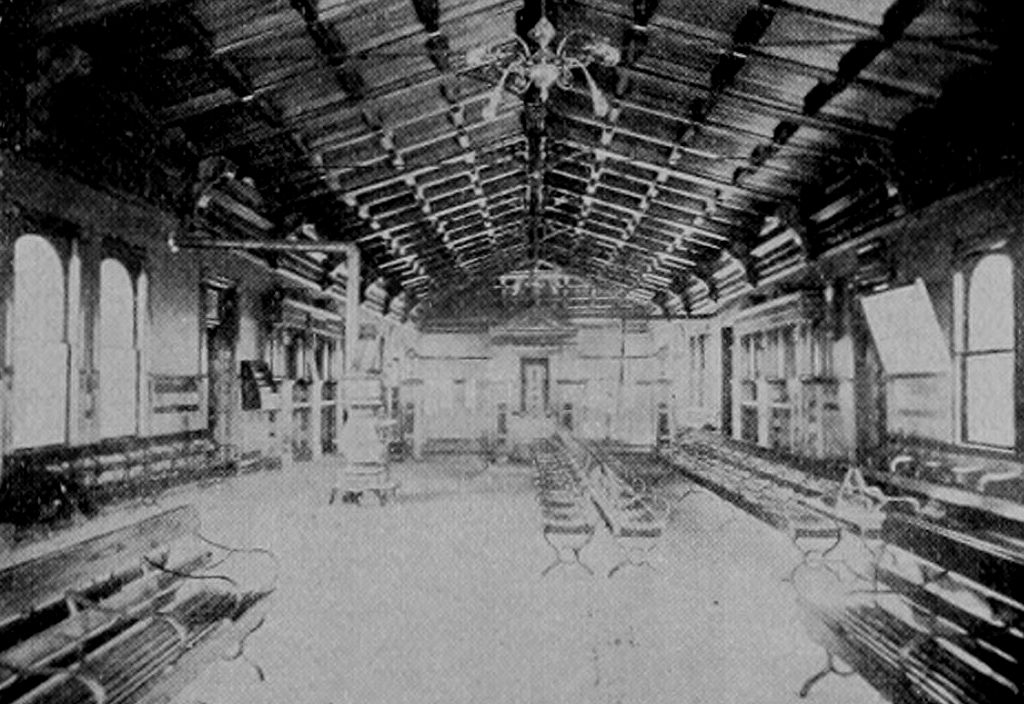
Here’s what the station looked like soon after it opened for business, from an 1898 Texas & Pacific publication (click for larger images):
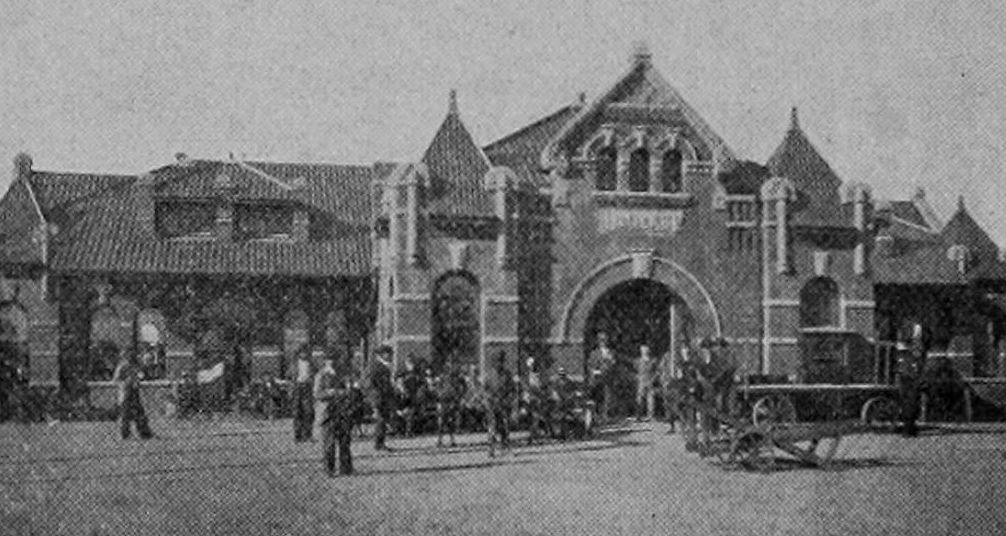
east-dallas-depot_ext_tx-pac-rr_1898

east-dallas-depot_int_tx-pac-rr_1898

Much better than a shanty!

union-depot_flickr_coltera

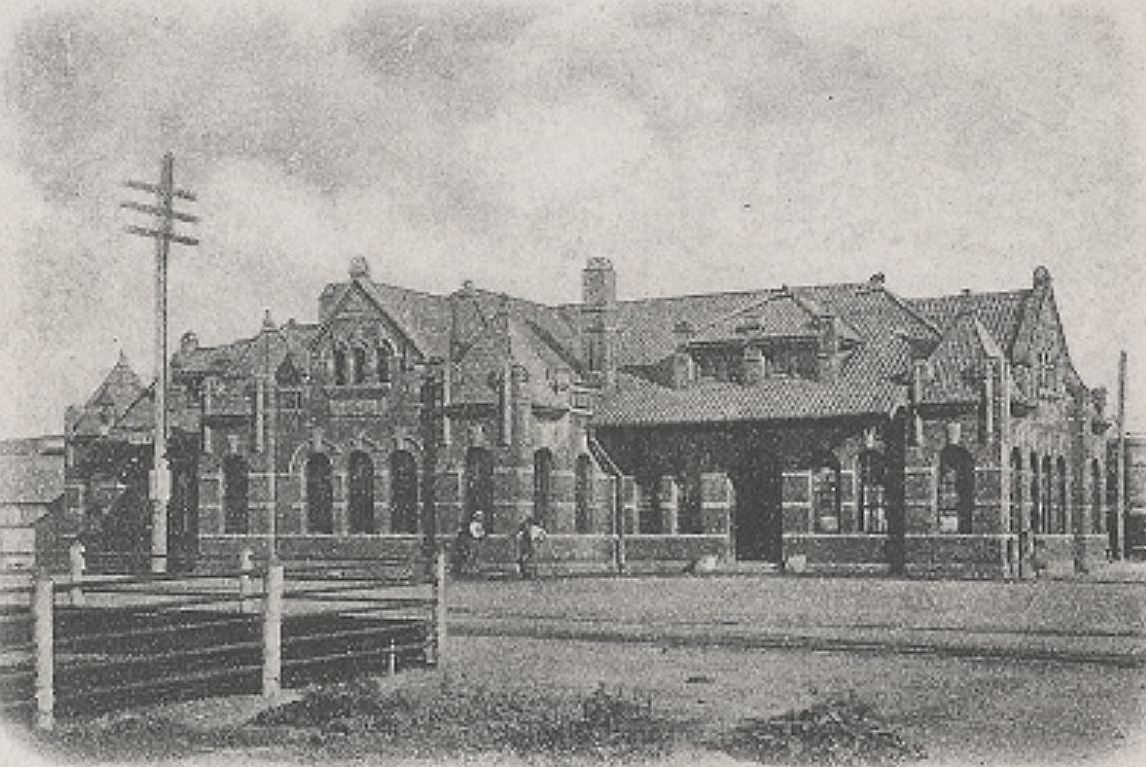
Below in another early photo of the depot:

east-dallas-depot_c1890_dallas-redisc_DHS

Can’t pass up an opportunity of zooming in on a detail:
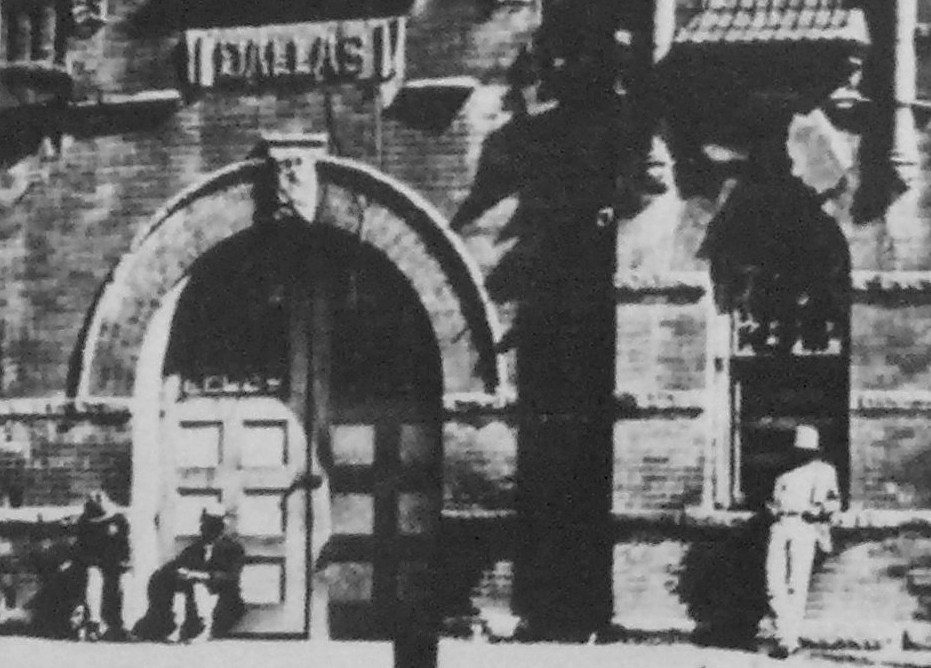
east-dallas_c1890_dallas-redisc_DHS-det

Here it is around 1910, a hotbed of activity, now with the addition of automobiles:
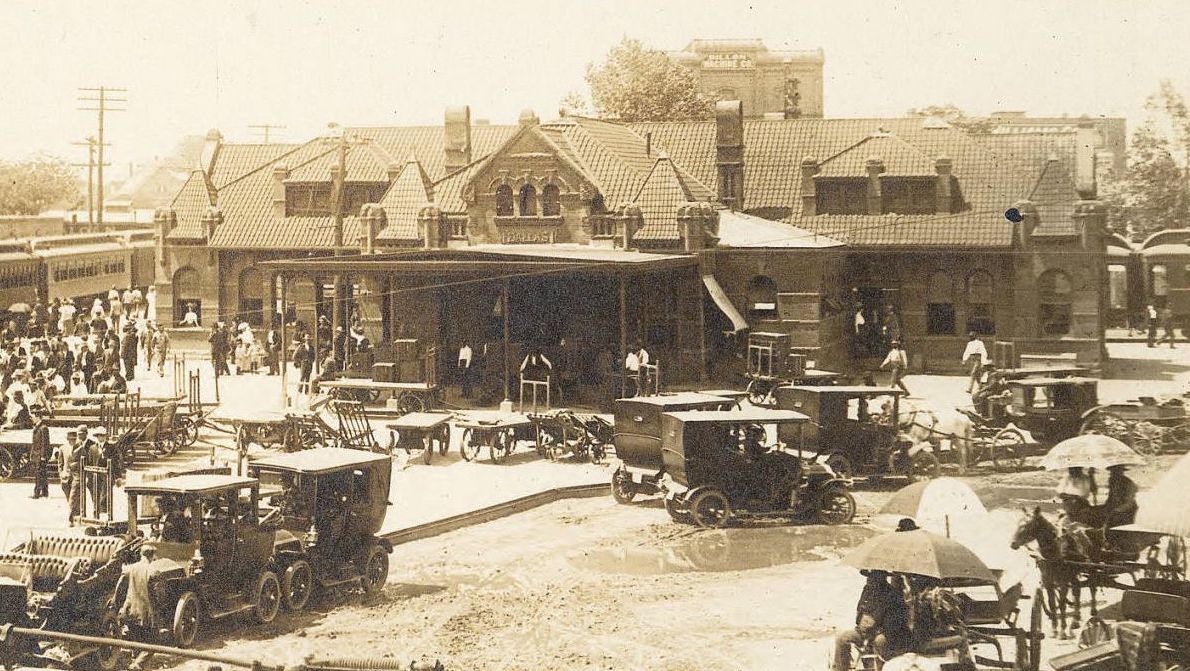
old-union-depot_degolyer_ca1910-det

The station served an important role in the growth of (East) Dallas and in the everyday lives of its residents for almost twenty years, but in 1916 the many “independent” passenger and freight depots that had been spread out all over town were shuttered, per the Kessler Plan’s directive to consolidate and run all the rail lines in and out of the new Dallas Union Terminal. (This was when the word “old” began appearing ahead the East Dallas station whenever it was mentioned.)
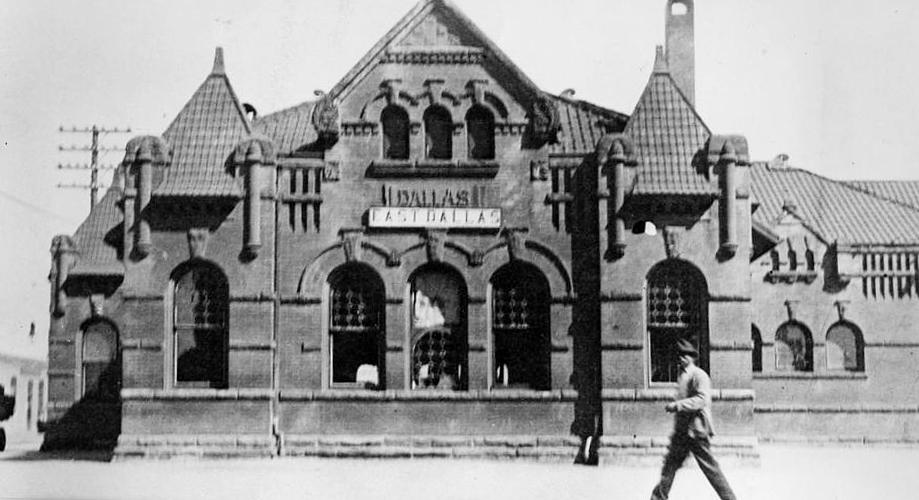
east-dallas-depot_1916-portal(circa 1916)

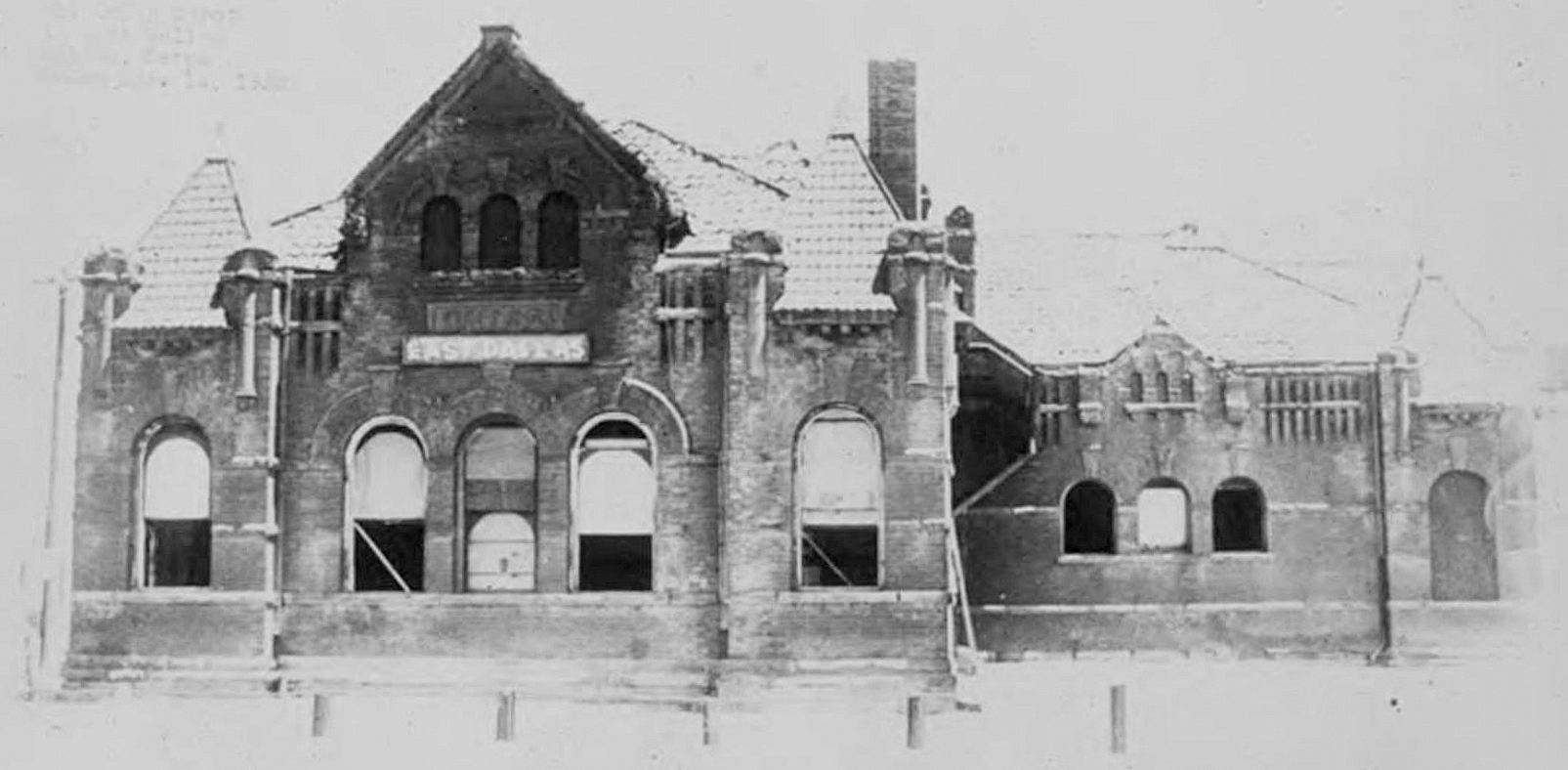
So what became of the East Dallas depot? From “Relic of City of East Dallas Being Demolished,” a Dallas Morning News article from Jan. 20, 1935:

Last use of the depot for railroad purposes came in 1933 when it was abandoned as a freight station in August of that year. After that it was used as a station for interviewing destitute clients for the relief board but for several months has been boarded up.

So that original rendering may not have been done in 1931 after all (unless it was a high-concept architect’s vision of what the depot would look like one day all boarded up…).

At some point it was determined that the station would be torn down. It may have been one of those beautify-the-city projects done in preparation for the Texas Centennial Exposition the next year, but it was probably time for the building to come down. It was January of 1935, at the height of the Great Depression, and  not only did the city make it a point to hire laborers on relief to assist in the demolition, but it also approved the use of salvaged materials from the site to be used in building homes for “destitute families.”

Relief Administrator E. J. Stephany received approval Saturday of a project to get men to tear down the old structure and use the materials in building homes for destitute families and work is expected to start immediately. (“East Dallas Station To Be Torn Down and Converted Into Homes,” DMN, Jan. 13, 1935)

Demolition of the depot — which The News called “The Pride of the Gay Nineties” — began on January 18, 1935. The first solemn paragraph of an article reporting on the razing of the landmark is below.

Shorn of all the dignity it possessed for years as the East Dallas Union Depot, the old red structure near the intersection of Central and Pacific avenues began crumbling beneath the blows of wrecking tools wielded by laborers from the Dallas County relief board Friday.” (“Relic of City of East Dallas Being Demolished,” DMN, Jan. 20, 1935)

The red stone slabs bearing the word “Dallas” (3 feet long, 18 inches thick) were offered to the Dallas Historical Society “for safekeeping.”
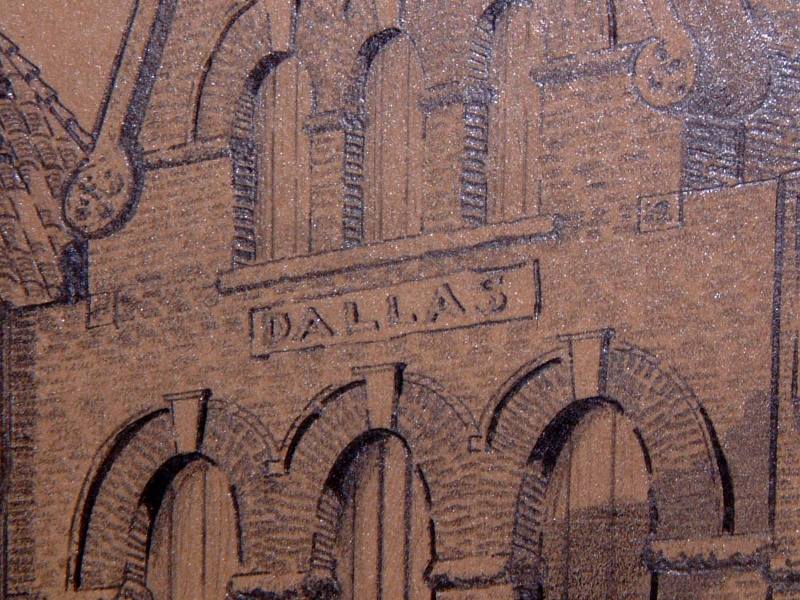
east-dallas-depot_rendering_dallas_Art-Hoffman_sm

So did that relief housing get built? Sort of. All I could find was an article from June, 1935, which states that one little building was constructed with some of the brick and stone from the razed depot. It wasn’t a house for the needy but was, instead, headquarters for relief caseworkers in donated park land in Urbandale. Presumably there was housing built somewhere, but all that brick and stone salvaged from the old depot may not have been used for its intended purpose. BUT, there is this tantalizing little tidbit:

As a reminder of the historic antecedent, the new structure [in Urbandale Park] has as a headpiece for its fireplace the large carved stone bearing the name Dallas. (“Relief Structure Made of Materials From Razed Depot,” DMN, June 20, 1935)

Does this mean that the Dallas Historical Society might still have the second slab? If not, what happened to it?

I checked Google Maps and looked at tiny Urbandale Park at Military Parkway and Lomax Drive, just east of S. Buckner, but I didn’t see anything, so I assume the building came down at some point. (UPDATE, 3/20/16: Finally got around to driving to this attractive park. Sadly, the little building is no longer there.)

It would have been nice if that little bit of the old depot had survived — a souvenir of an important hub of activity which sprang to life when memories were still fresh of East Dallas being its own separate entity — the “David” Dallas to its neighboring “Goliath” Dallas. I would love to learn more about what might have happened to that “Dallas” sign which, for a while, hung over the fireplace of an odd little building in an obscure park in southeast Dallas where it lived out its days in retirement.

**

Since I keep adding photos of the depot to this post, I’m going to just start putting new additions (with captioned and linked sources) here:

east-dallas-union-depot_degolyer-lib_SMUDeGolyer Library, SMU

union-depot_east-dallas_1933_degolyer-lib_SMUDeGolyer Library, SMU

union-depot_your-dallas-of-tomorrow_1943_portal
“Your Dallas of Tomorrow” (1943), Portal to Texas History

***

Sources &  Notes

Original rendering of the old Union Depot at East Dallas by E. L. Watson is from the collection of Art Hoffman, used with his permission.

More on architect Frank J. Woerner (who designed, among other things, the Stoneleigh Hotel), here (see p. 10 of  this PDF).

History of Old East Dallas (and the city of East Dallas), here and  here.

More on architects Lang & Witchell here, with an incredible list of some of the buildings designed by their firm here.

1898 photos of the depot’s exterior and interior from Texas, Along the Line of the Texas & Pacific Ry. (Dallas: Passenger Department of the Texas & Pacific Railway, [1898]).

Photo immediately following the photos from the T & P book is from a postcard, found on Flickr, here.

Photo (and accompanying detail) immediately following that is from Dallas Rediscovered by William L. McDonald (Dallas: Dallas Historical Society, 1978). (McDonald identifies the photo as being “c. 1890” — well before the station was built in 1897.) From the collection of the Dallas Historical Society.

Photo of the depot with automobiles is a detail of a larger photograph from the collection of George A. McAfee photographs in the DeGolyer Library, Central University Libraries, Southern Methodist University. The original can be seen here.

Photograph dated 1916 from The Museum of the American Railroad, via the Portal to Texas History site, here.

More information in these Dallas Morning News articles:

  • “East Dallas Station To Be Torn Down and Converted Into Homes” (DMN, Jan. 13, 1935)
  • “Relic of City of East Dallas Being Demolished” (DMN, Jan. 20, 1935) — very informative
  • “Historical Society Will Be Given Slabs of Former Station” (DMN, Jan. 31, 1935)
  • “County Gets Land To Install Relief Depot; Later Park” (DMN, Feb. 27, 1935
  • “Relief Structure Made of Materials From Razed Depot; Station Occupies Land in Urbandale Donated to County For Park” (DMN, June 20, 1935)
  • “Salvaged Materials Go Artistic” (DMN, June 20, 1935) — photo of “relief structure” which accompanied above article

More photos of this immediate area can be found in these posts:

  • “The Union Depot Hotel Building, Deep Ellum — 1898-1968,” here
  • “The Gypsy Tea Room, Central Avenue, and the Darensbourg Brothers,” here

Many of the pictures and articles can be clicked for larger images.

*

Copyright © 2014 Paula Bosse. All Rights Reserved.
 

The Marsalis House: One of Oak Cliff’s “Most Conspicuous Architectural Landmarks”

marsalis_sanitarium_oak-cliffThe fabulous Marsalis house in Oak Cliff (click for larger image)

by Paula Bosse

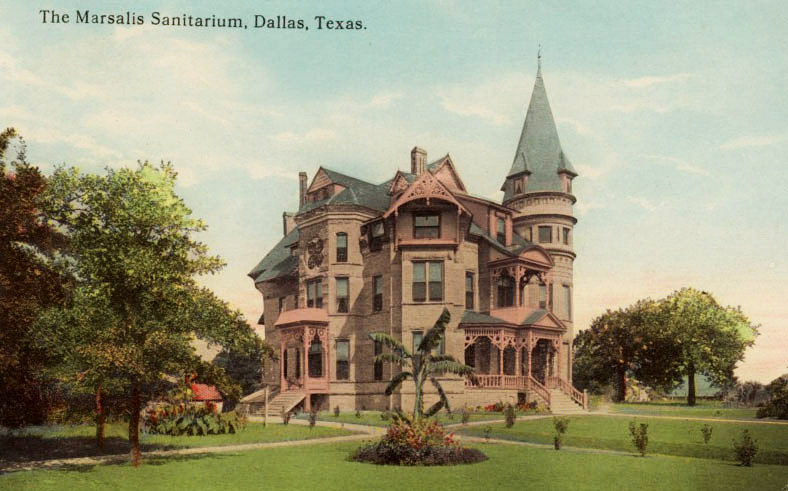
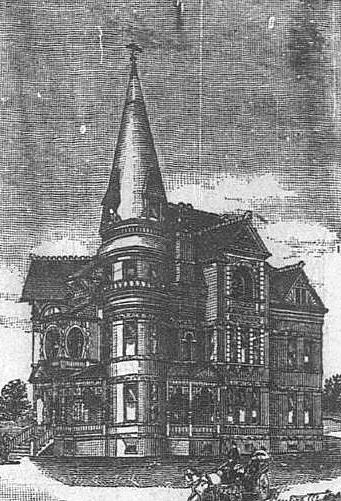
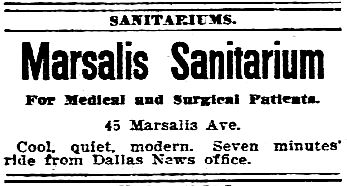
The Marsalis Sanitarium was a 15-bed private surgical and convalescent hospital in Oak Cliff, established in 1905 by Dr. J. H. Reuss and his partner, Dr. James H. Smart. Whether or not that building was actually pink (and I certainly hope that it was!), it was most definitely a show-stopper — one of those stunning structures that one doesn’t expect to see in and around Dallas because almost none of them still stand.

This grand home was built by Oak Cliff promoter and developer Thomas L. Marsalis in about 1889 as his personal residence at a reported cost of $65,000 (the equivalent of more than $1,750,000 in today’s money). It was located at what is now the southwest corner of Marsalis Avenue and Colorado Boulevard. The house was apparently never occupied. Supposedly, Marsalis’ wife did not want to live there because it was “too far from town” (!), but Marsalis’ financial distress throughout this time was probably more to blame.

marsalis-house_drawing
Dallas Morning News

Marsalis’ insolvency resulted in the foreclosure of the house in the early 1890s and its ultimate sale at public auction in 1903. The winning bidder at that auction was Dr. Reuss, and the house became the Marsalis Sanitarium soon after.

marsalis-sanitarium_tx-state-journal-medical-advertiser_dec-1905_portal
1905 ad (click for larger image)

marsalis_sanitarium_dmn_010109DMN, Jan. 1, 1909

marsalis-sanitarium_worleys-1909
Worley’s City Directory, 1909

Sometime after 1909 it became a girls’ seminary, and then in 1913 it fell into private hands. On August 10, 1914 the poor house burned to the ground. The headlines the next day read:

“Oil Starts Oak Cliff Early Morning Fire; Fisher Asserts Some One Set Old Building Ablaze; Firemen Find Structure Completely Enveloped in Flames and Interior Roaring Furnace.”

marsalis-house-fire_dmn_081114DMN, Aug. 11, 1914

Such a sad ending for such a beautiful house!

marsalis-home

***

Sources & Notes

1905 ad for the Marsalis Sanitarium from the December 1905 issue of the Texas State Journal of Medicine, found on the Portal to Texas History, here.

Black and white photograph of the Marsalis home in 1895 from the article in Legacies magazine, “Where Did Thomas L. Marsalis Go?” by James Barnes and Sharon Marsalis (which can be read here); photo from the collection of the Dallas Public Library.

For a biography of the family of Dr. Joseph H. Reuss, proprietor of the Marsalis Sanitarium, see here.

Click pictures for larger images.

*

Copyright © 2014 Paula Bosse. All Rights Reserved.
 

Jordan Moore

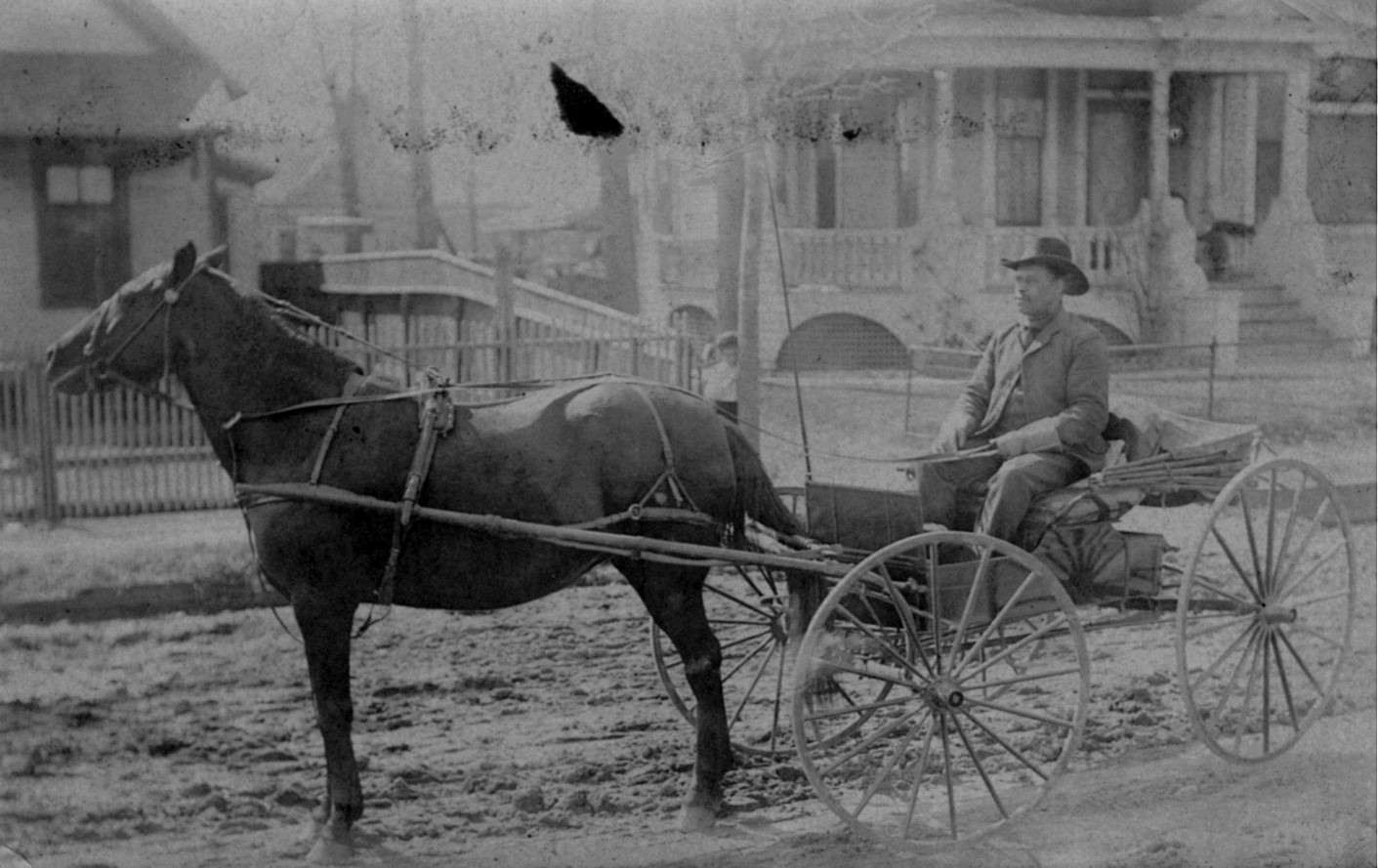
jordan-moore-buggy_c1905Jordan Moore, about 1905 (click for larger image)

by Paula Bosse

When wandering around the internet, one often encounters arresting images. Like the one above. There’s something about that photograph that grabs your attention. The stoic man in the buggy, the stiff, straight-standing horse, the child hiding behind the pole, the partial view of the porch of a fancy house, and the horrible, horrible condition of that street. The description reads simply: “Photograph of Jordan Moore seated in a horse-drawn carriage. Houses are visible in the background.” I wondered if I should know who Jordan Moore was, because the name wasn’t familiar. The photograph was in the collection that had been donated to the Dallas Historical Society by J. L. Patton, a prominent African-American educator. I found a few more photos of Mr. Moore in Patton’s collection, but I still had no idea who Jordan Moore was. So I did a little research.

Jordan Moore was born in Virginia in 1863. At some point he made it to Texas, perhaps in the early 1880s, and then to Dallas a few years later. By 1893 he was working for Mrs. Miranda Morrill, who had moved to Dallas in 1886, following the death of her husband, Judge Amos Morrill. Though born in Tennessee, Mrs. Morrill had moved to Texas as a child in 1834 and had strong ties to the state (one of her uncles was a signer of the Texas Declaration of Independence). When she arrived in Dallas, she built an imposing mansion at Ross and Harwood and, as she had no children, she and her servants (as they were listed on census forms) had that huge house to themselves to ramble around in. Mrs. Morrill was a prominent mover-and-shaker in town, devoting her time and money to a host of worthy social causes. In her employ was Jordan Moore, who is listed variously as her coachman and yardman, and who resided on the property. He worked for her until she died in 1906 at the age of 80.

(Mrs. Morrill’s obituary is interesting for many reasons, but particularly because amongst her surviving family members were her half-brothers R. L. Moore and S. J. Moore, sons of Mrs. Morrill’s stepfather. I don’t know if Jordan Moore was born into slavery and was owned by members of Mrs. Morrill’s family, but it’s interesting that he shared a surname with his employer’s family.)

In 1907, after Mrs. Morrill’s death, Mr. Moore had moved to rooms elsewhere and went to work as a porter for the very large, very successful Huey & Philp Hardware Company at Griffin and Elm. Below are a couple of photographs of Moore and co-workers on the loading docks. He does not look very happy. He stayed at the job for 11 years but moved around from rooming house to rooming house — from Ross to Cochran to N. Harwood to Masten. (One of the captions on these photos states that Mr. Moore purchased a house on Cochran St. in 1900. I don’t think that’s correct. If he did buy a house, he doesn’t appear to have ever lived in it.)

Jordan Moore died on January 22, 1918, from complications of  diabetes. He was 54. He never married and had no children, and the friend he had been staying with when he died offered scant and approximate guesses as to dates and places when asked to supply them for the official death certificate.

I wondered why all these photos of a man who apparently left no family and had lived a fairly commonplace life had made their way into the personal collection of J. L. Patton, a principal at Booker T. Washington High School and a pioneer in education for African-American students in Dallas. And then I noticed that the name of the “informant” on the death certificate was Samuel Stanton, a long-time friend with whom Moore had been staying in his last days. Moore was the godfather of Mr. Stanton’s daughter, and Mr. Stanton’s daughter was Mr. Patton’s mother. Patton would have been 12 when Moore died, and he would certainly have remembered him — and one hopes he had fond memories of him.

Jordan Moore was buried in Alpha Cemetery, one of the few “negro” cemeteries of the time, near the old freedmen’s town of Alpha, near present-day Preston and Alpha Road. Below are more photographs of Mr. Moore, now in the collection of the Dallas Historical Society.

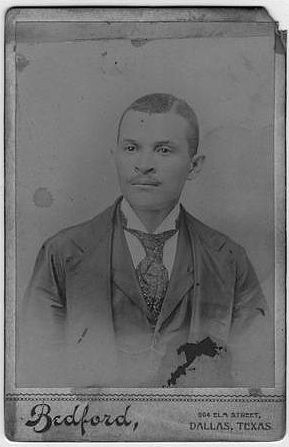
jordan-moore-portrait_18901890

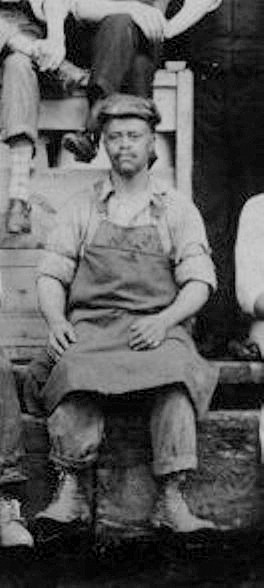
moore-loading-dock_c1905Mr. Moore (seated, second from left), Huey & Philp loading dock, ca. 1907

moore-det

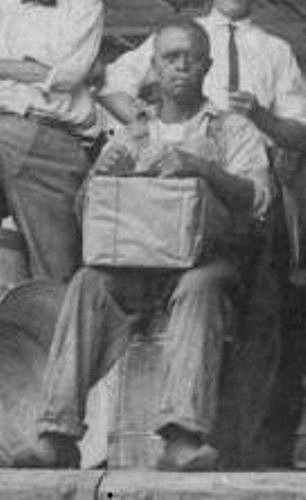
moore-with-box_loading-dock_c1910Mr. Moore (seated, with box), Huey & Philp loading dock, ca. 1910-15

moore-box-det

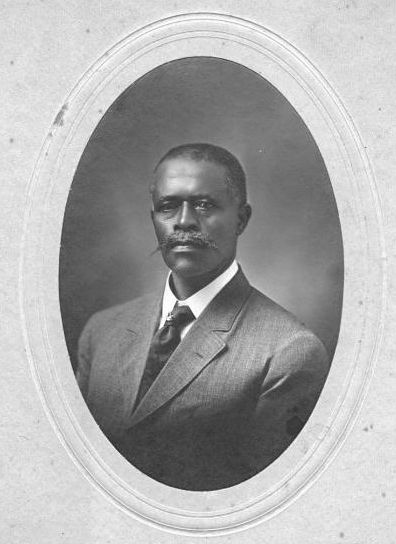
jordan-moore-photo_c1910sca. 1910-15

morrill-house_1898Mrs. Morrill’s house at Ross & Harwood, 1894

morrill-house_lost-dallas_doty_dmnThe Morrill house — next stop: demolition, 1920

huey-philp_19091909 ad

huey-philp_1913_dmn_080212Huey & Philp Hardware Co., at Griffin and Elm — ca. 1913

***

Sources & Notes

Photos of Jordan Moore from the Dallas Historical Society’s J. L. Patton Collection, once viewable at UNT’s Portal to Texas History website. Top photo, c. 1905.

The first photo of Mrs. Morrill’s house at Ross and Harwood is from Clifton Church’s book Dallas, Texas Through a Camera (Dallas, 1894). (As an interesting aside, Church was married to Morrill’s niece.) In the book Dallas Rediscovered, the house is described thusly: “Mrs. Miranda Morrill’s dark, brooding residence, completed in 1886 by A. B. Bristol at the southwest corner of Harwood, was leveled in 1920 for construction of the First United Methodist Church.”

The second photo of the Morrill house is from Mark Doty’s book Lost Dallas (Charleston: Arcadia Publishing, 2012).

Huey & Philp Hardware Co. ad from Worley’s 1909 Dallas directory.

Lang & Witchell drawing of the Huey & Philp building is from a Dallas Morning News blog post by Steve Brown, here.

More on the accomplishments of J. L. Patton from the Handbook of Texas, here.

*

Copyright © 2014 Paula Bosse. All Rights Reserved.


Need a Studebaker? We Got You Covered

ad_studebaker_1912

by Paula Bosse

Studebaker Bros. have got you covered!

ad_studebaker_souv-gd_1894

Whatever you need, Studebaker has it: horseless carriage or … just … well … carriage.  “A complete line of vehicles.”

***

Top ad from 1912; lower ad from 1894.

Studebaker info here.

*

Copyright © 2014 Paula Bosse. All Rights Reserved.
The San Jacinto School — Frittering Away the Gay Nineties, Stuck in a Classroom

san-jacinto-school_1893_shorpy1893 class photo, Ross Avenue

by Paula Bosse

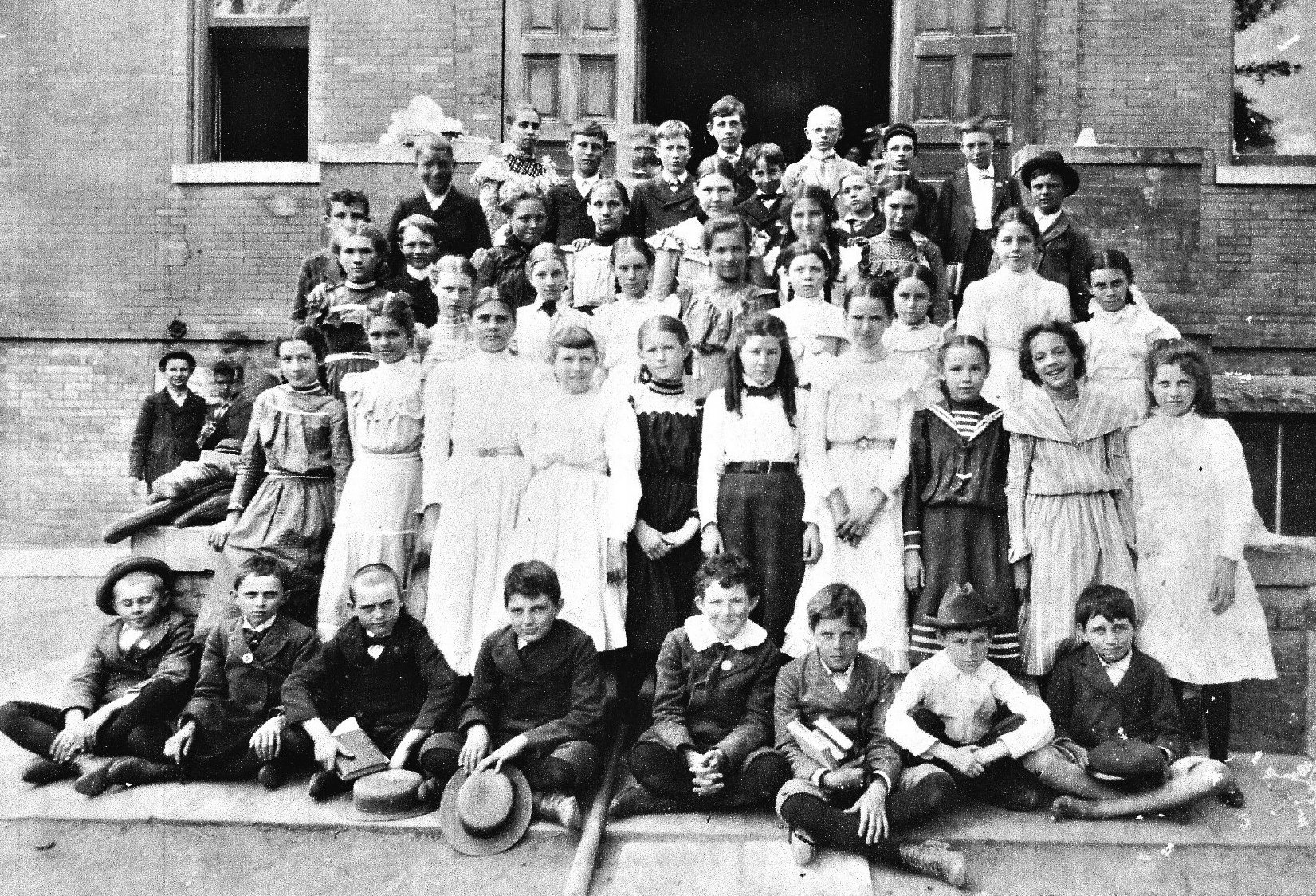
Above, fourth graders lined up in 1893 on the steps of the San Jacinto School, once located at Ross and Washington (now the site of the DISD Administration Building). All seem fairly glum. (At least they’re not toiling in factories like many other children of this period.)

Below, the sixth-grade class of 1899 seems slightly less bummed-out, perhaps because they’re on the brink of the much-anticipated 20th century. Those boys (and sadly probably only the boys) might well have been among the city’s business and political leaders during Dallas’ most explosive period of growth just a few short years later.

san-jacinto-school_6th-grade_1899-1900

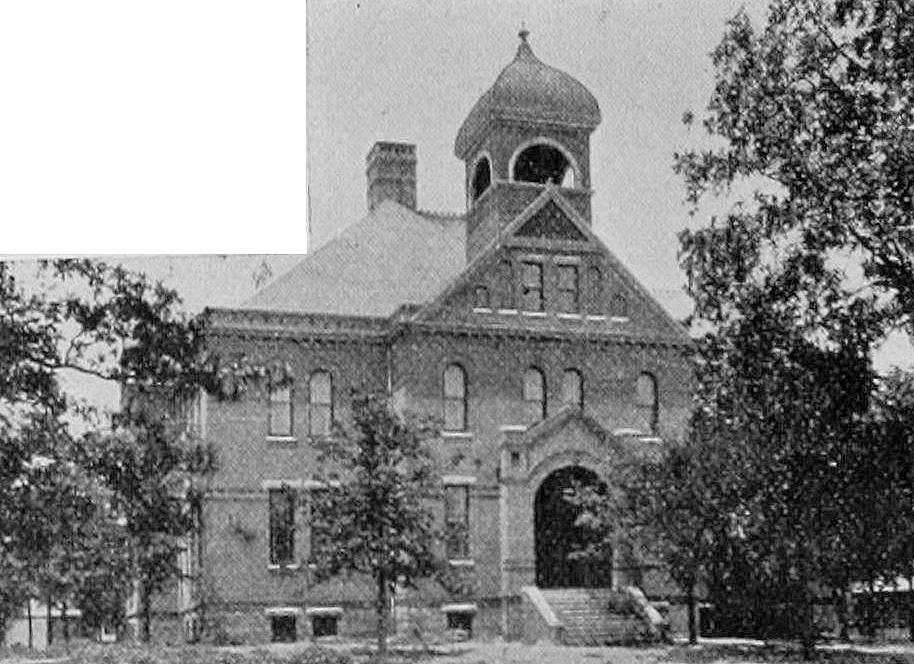
The San Jacinto School was designed by James E. Flanders and built in 1891 on two acres at the corner of Ross Avenue and Washington. It was demolished in 1948 to make way for the somewhat more severe (and perhaps a bit more interesting) DISD Administration Building.

san-jacinto-school_tx-and-pac-rr_1898

san-jacinto-school_dhs

***

Sources & Notes

Top photo is from the wonderful historical photo blog Shorpy, and can be found here.

First photo of the school building is from Texas: Along the Line of the Texas & Pacific Ry. (Dallas: Texas & Pacific Railway, n.d. [1898]).

Last photo is from a website devoted to “Dallas’ First Architect,” James Edward Flanders.

*

Copyright © 2014 Paula Bosse. All Rights Reserved.

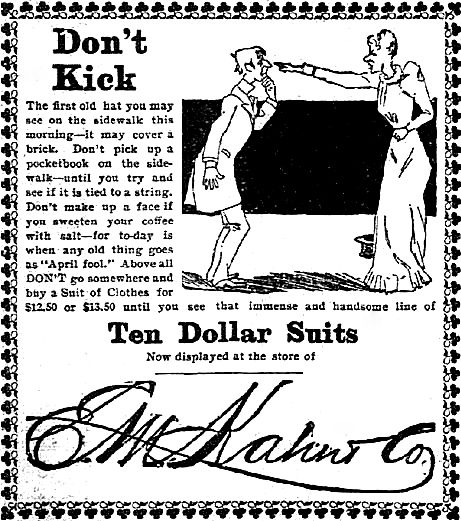
Do Not Become an April Fool: Tips from E. M. Kahn & Co. — 1898

by Paula Bosse

Pranks in 1898 were high-larious.

Do NOT be a fool and pass up that ten-buck suit, man, or you’ll have hell to pay with the missus.

***

Ad appeared in The Dallas Morning News, April 1, 1898.

*

Copyright © 2014 Paula Bosse. All Rights Reserved.

Phrenology by Mail! — 1894

by Paula Bosse

Distance matters not to this Main Street medium. Prof. A. Henry was, verily, a man of many talents. (In case you do not know what phrenology is, see this. It’s probably not something one can do easily via mail.)

***

Sources & Notes

From A Souvenir Guide of Dallas, 1894.

*

Copyright © 2014 Paula Bosse. All Rights Reserved.

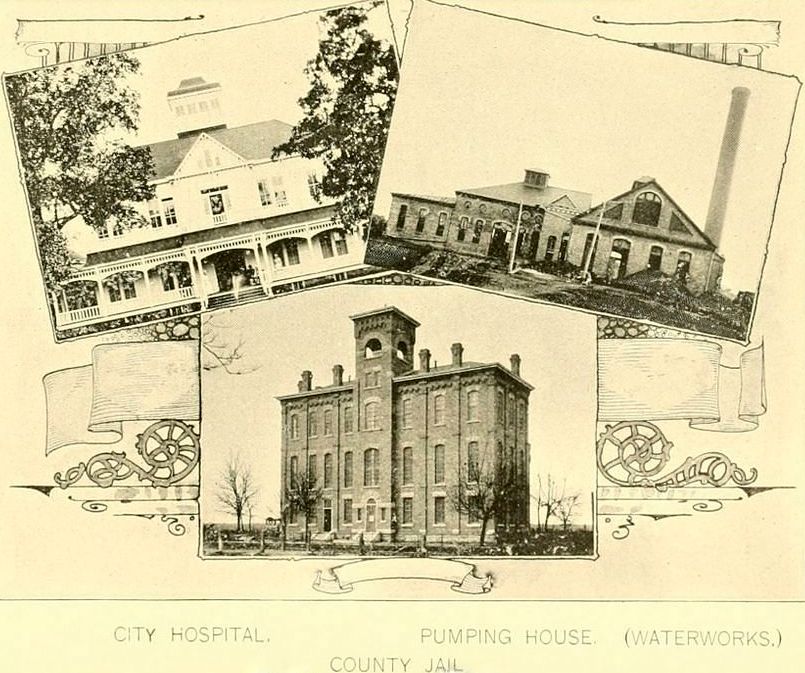
City Hospital, a Pump Station, and the County Jail — 1894

Hospital, pump house, jail (click for larger image)

by Paula Bosse

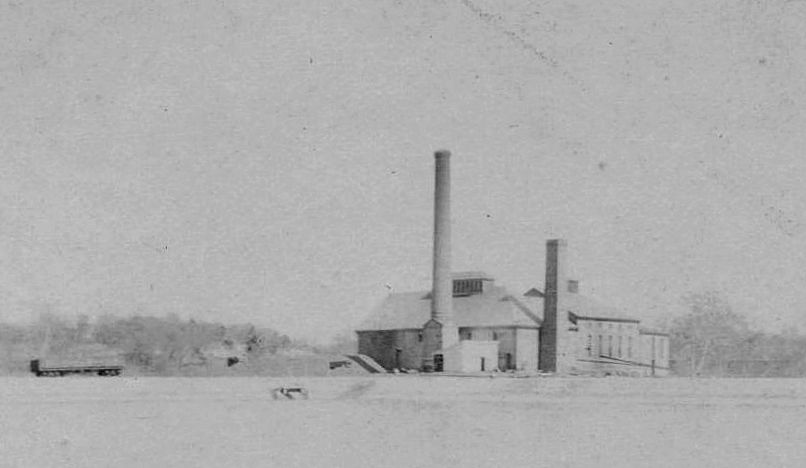
From 1894, an odd grouping of buildings: the City Hospital, a Dallas Waterworks Pumping House, and the Dallas County Jail. From a distance of 120 years, they’re all rather pleasant-looking, a word that would never be used to describe their 21st-century institutional counterparts. I wondered how many of the buildings had made it to the 20th century. Happily, they all did.

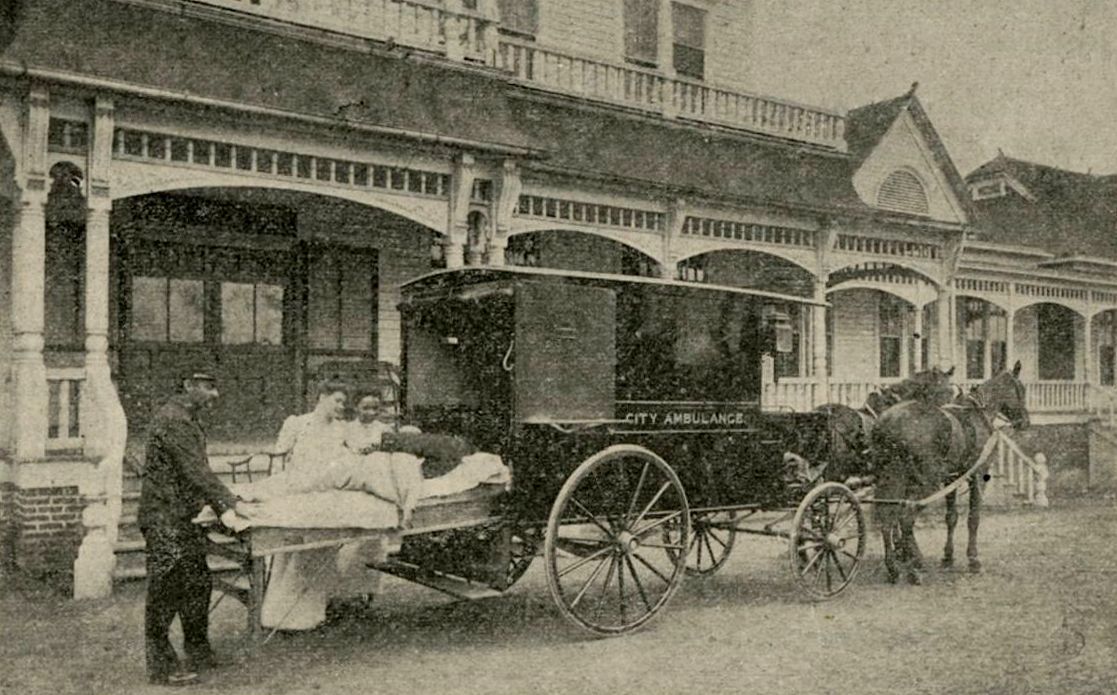
City Hospital opened in May of 1894 at Maple and Oak Lawn (it later became known as Parkland Hospital, the name coming from the 17 acres of land it occupied that had originally been planned as a city park). Here it is in about 1903, as a patient arrives in a horse-drawn ambulance. This wooden building was replaced in 1913 by the brick building that — yay! — still stands (in amongst its recent expansion and expansion and expansion by real estate mogul Crow the younger).

I looked all over for a later photograph of the “pumping station” but was unable to find a definite photo. I knew that it was built after the original pump house at Browder’s/Browder Springs in City Park and before the one now housing the Sammons Center for the Arts and the one at White Rock Lake. I think it might be this one, the Turtle Creek station, shown above during the devastating 1908 flood. If this is the same pump station, it looks as if there was quite a bit of expansion to this structure, too.

Dallas Morning News, Feb. 4, 1914

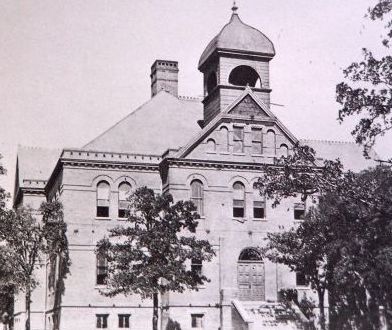
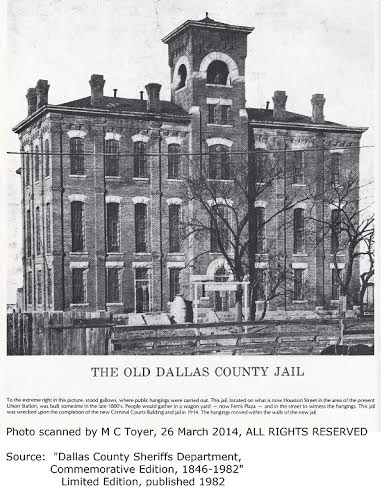
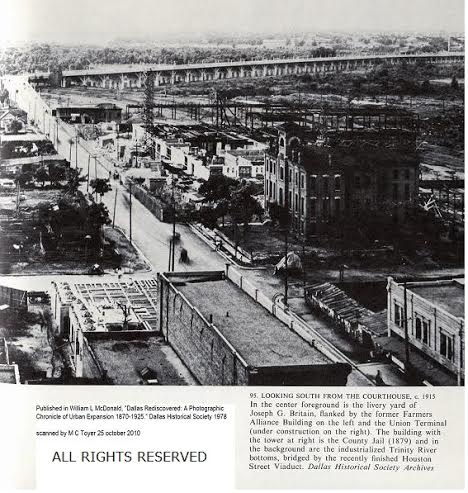
The building that changed the most from the pristine structure in the original 1894 photo was the Dallas County Jail, which was located at Houston and Jackson streets. Built in 1881, it was 13 years old in the original photograph. By the time it was 33 years old, it was almost unrecognizable, as can be seen (…sort of) in this photo, even with the horrible resolution. The jail had to keep expanding to keep up with demand and became a hulking mess. In the first decade of the century, reports began to appear in the newspapers of the deplorable conditions of the old jail and demands were made to improve conditions for prisoners. A new jail was built and the old one was auctioned off to the the Union Terminal Company which demolished the building in 1916, as the finishing touches were put on its Union Station, mere steps away from the former jail.

DMN, May 23, 1916

UPDATE: Thanks to reader M.C. Toyer, I have a couple of really great photos of the Old County Jail!

I’m not sure of the date of the one above, but the one below (such a great photo!) is dated 1915, the year the Old County Jail was finally emptied of its inmates, and a year before it was demolished.

Thanks for the great photos, MC!

***

Original photograph of the three buildings is by Clifton Church and appeared in his wonderful book Dallas, Texas Through a Camera (Dallas, 1894).

The photo of the ambulance in front of City Hospital is from the UT Southwestern Archives, with another photo of the same period here. A collection of newspaper articles on the hospital’s early history is here. An article on the City Hospital that pre-dated this one, with some harrowing descriptions of medical care in Dallas in 1875 is here.

The flooded Turtle Creek pump station is from the Dallas Municipal Archives. Other photos of this station can be seen here.

Bottom two photos of the Old County Jail sources are as captioned.

For more photos on the Dallas Waterworks/Turtle Creek Pump Station/Water Filtration Plant, see a later post of mine, here.

Click photos to enlarge.

*

Copyright © 2014 Paula Bosse. All Rights Reserved.

Nicholas J. Clayton’s Neo-Gothic Ursuline Academy

ursuline_postcard-color

by Paula Bosse

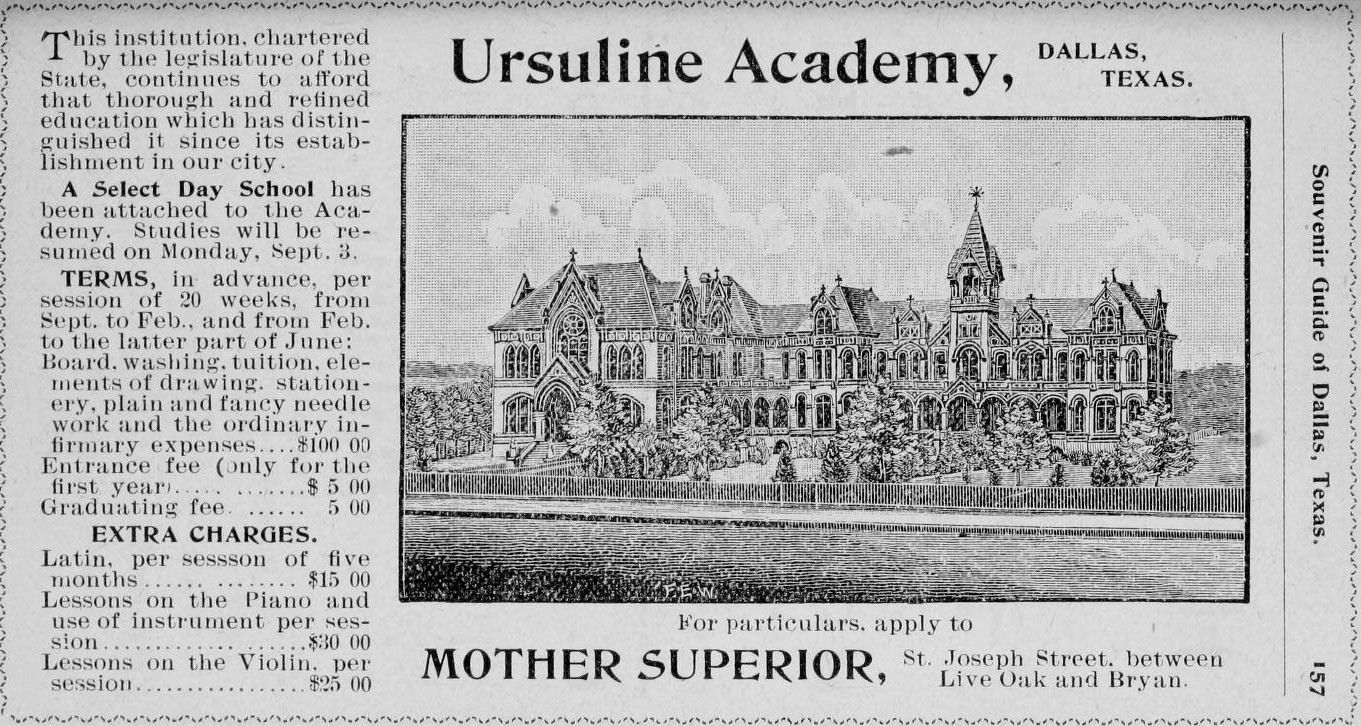
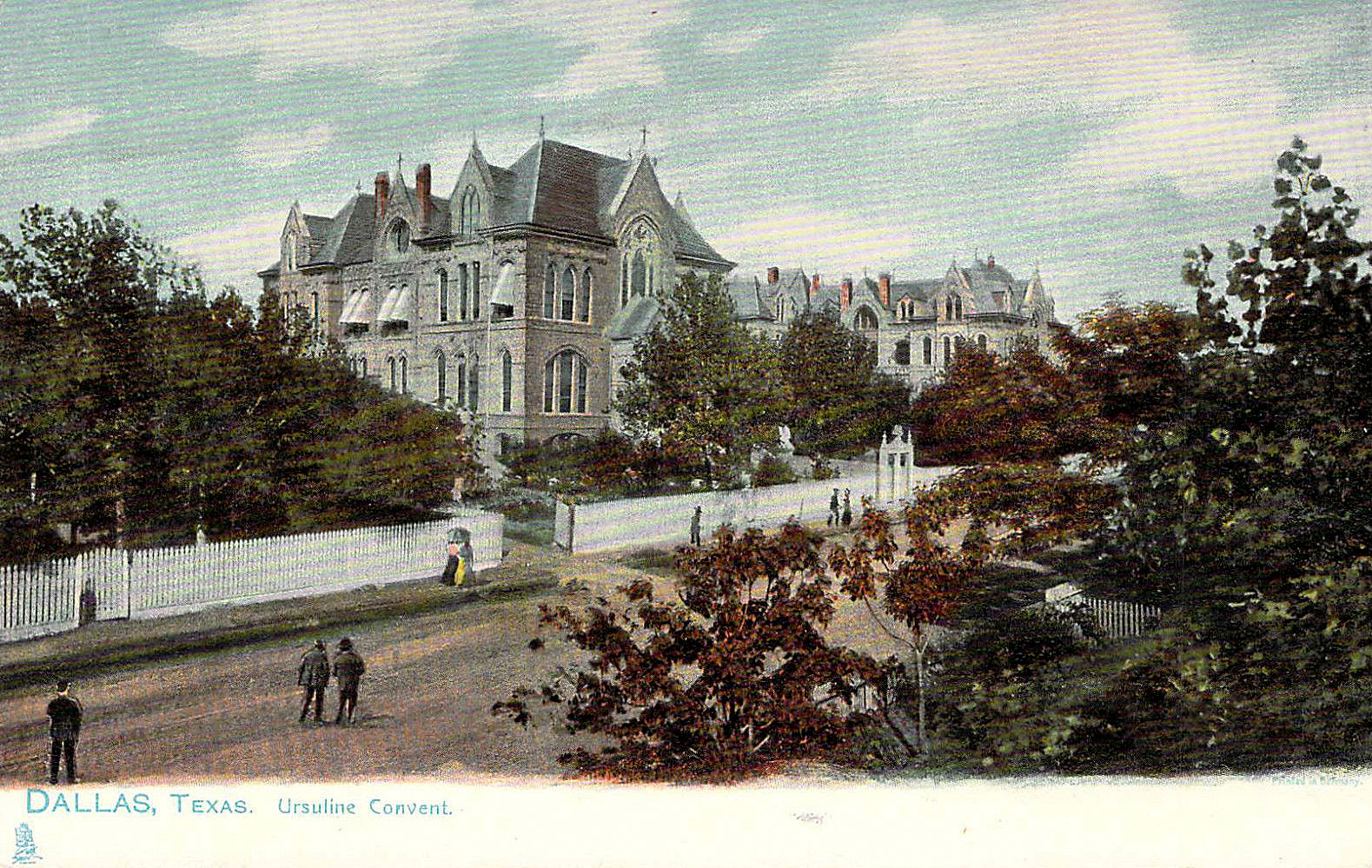
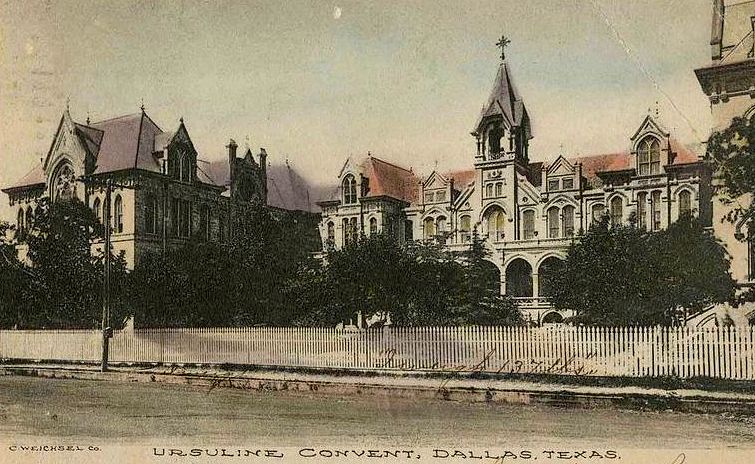
Over the years, Dallas has been the site of dozens and dozens of beautiful educational campuses, almost none of which still stand — such as the long-gone Victorian-era Ursuline Academy, at St. Joseph and Live Oak streets (near the current site of the Dallas Theological Seminary). The buildings, which began construction in 1882, were designed by the Catholic church’s favorite architect in Texas, Nicholas J. Clayton of Galveston. Such a beautiful building in Dallas? It must be demolished!

ursuline_first_bldg
Six Ursuline Sisters, sent to Dallas from Galveston, established their academy in 1874 in this poorly insulated four-room building (which remained on the Ursuline grounds until its demolition in 1949). When they opened the school, under tremendous hardship, they had only seven students. But the school grew in size and reputation, and they were an academic fixture in East Dallas for 76 years. In 1950 the Sisters moved to their sprawling North Dallas location in Preston Hollow where it continues to be one of the state’s top girls’ prep schools. After 140 years of educating young women, Ursuline Academy is the oldest continuously operating school in the city of Dallas.

clifton-church_ursuline_1894Construction took a long time. (ca. 1894)

ad-ursuline_souv-gd_1894When Latin cost extra. (1894) (Click for larger image.)

ursuline_1906_largeIt even had a white picket fence. (ca. 1906)

ursuline-flickr1908-ish

ursuline_worleys_1909_det_LARGE1909 city directory

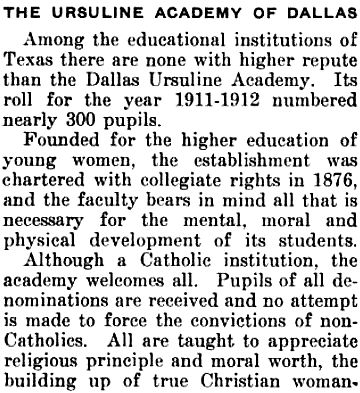
ursuline-academy_tx-mag_1912b1912 (click for large image)

After a year and a half on the market, the land was sold in 1949 for approximately $500,000 to Beard & Stone Electric Company (a company that sold and serviced automotive electric equipment). The property was bounded by Live Oak, Haskell, Bryan, and St. Joseph — acreage that would certainly go for a lot more these days (according to the handy Inflation Calculator, half a million dollars in 1949 would be the equivalent in today’s money of about five million dollars). A small cemetery was on the grounds, in which the academy’s first chaplain and “more than 40 members of the Ursuline order” had been buried. I’m not sure how these things are done, but the cemetery was moved.

ursuline_aerial_cook-colln_degolyer_smu

From a November, 1949 Dallas Morning News article on the vacated buildings’ demolition:

A workman applied a crowbar to a high window casing of the old convent and remarked: “I sure hate to wreck this one. It’s like disposing of an old friend. My father was just a kid when this building was built in 1883.” (DMN, Nov. 13, 1949)

And one of East Dallas’ oldest and most spectacular landmarks was gone forever. Looking at these photographs, it’s hard to believe it ever existed at all.

ursuline_cook-colln_degolyer_smu

*

Where was it? In Old East Dallas, bounded by Live Oak, Haskell, Bryan, and St. Joseph. See the scale of the property in the 1922 Sanborn map, here (once there, click for full-size map). Want to know what the same view as above looks like today? If you must, click here.

ursuline_today_bing-map
Bing Maps

***

Sources & Notes

Photo of the school’s first building is from the Ursuline Academy of Dallas website here. A short description of the early days of hardship faced by the Sisters upon their arrival in Dallas is here.

The photograph, mid-construction, is by Clifton Church, from his book Dallas, Texas Through a Camera (Dallas, 1894).

1894 ad is from The Souvenir Guide of Dallas (Dallas, 1894).

1912 text is from an article by Lewis N. Hale on Texas schools which appeared in Texas Magazine (Houston, 1912).

Aerial photograph from the George W. Cook Dallas/Texas Image Collection, DeGolyer Library, Southern Methodist University, here. Bottom image also from the Cook Collection, here.

Examples of buildings designed by Nicholas J. Clayton can be seen here (be still my heart!).

DMN quote from the article “Crews Begin Wrecking Old Ursuline Academy” by William H. Smith (DMN, Nov. 13, 1949).

Another great photo of the building is in another Flashback Dallas post — “On the Grounds of the Ursuline Academy and Convent” — here.

Many of the images are larger when clicked.

*

Copyright © 2014 Paula Bosse. All Rights Reserved.

Munger’s Improved Continental Gin Company

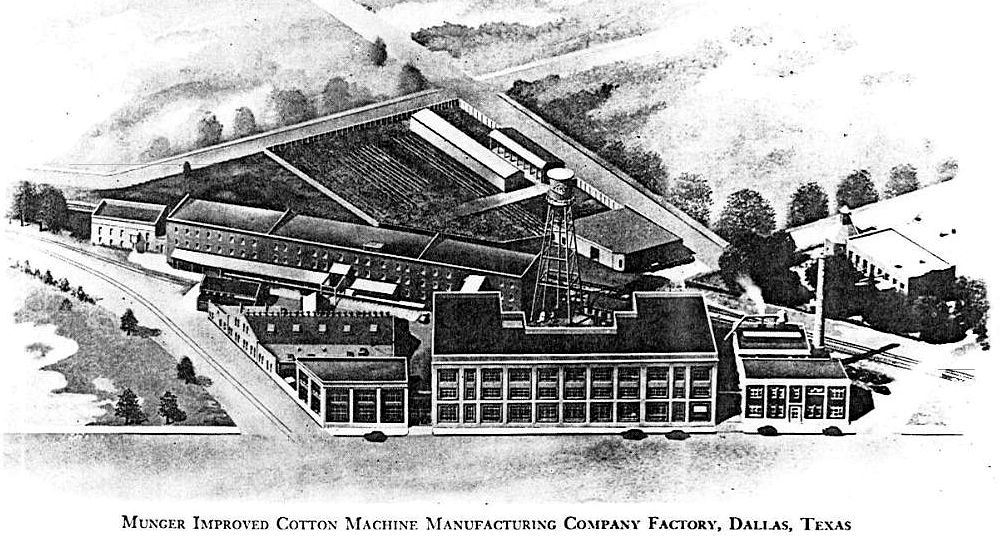
continental-gin_munger-from-natl-reg-appA Dallas landmark… (click for larger image)

by Paula Bosse

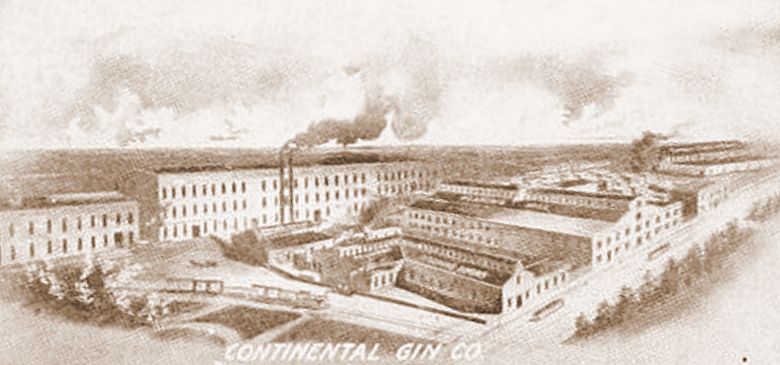
The Continental Gin Co. complex of buildings at Elm and Trunk is a Deep Ellum fixture which was successfully petitioned by the city in 1983 to be added to the National Register of Historic Places. No longer a manufacturing hub, it is now home to artists’ studios and residential lofts. The earliest of the buildings still standing were built in 1888 and the latest ones (the ones closer to Elm) were built in 1914. The company was incredibly successful, which was no surprise when one realizes that fully ONE-SIXTH of the world’s cotton grew within a 150-mile radius of Dallas at the time! It’s no wonder that Dallas was a hotbed of cotton gin manufacturing.

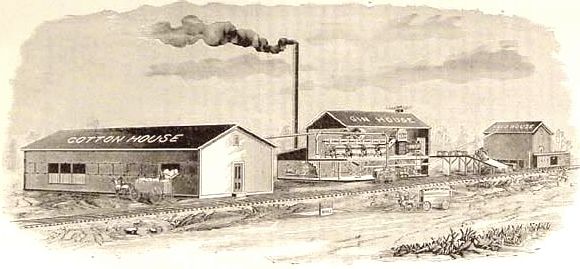
continental-gin_munger-drawing_Munger Catalogue and Price List, 1895

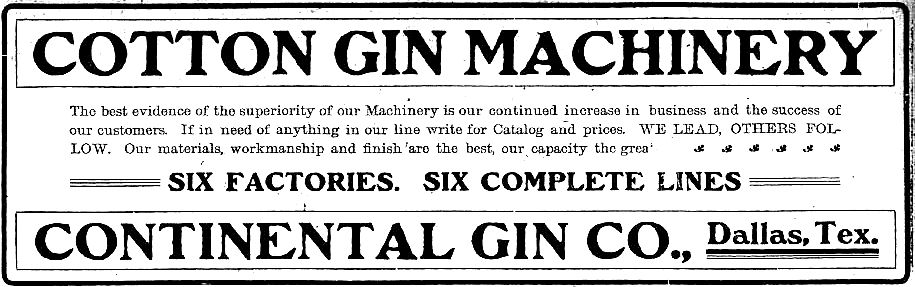
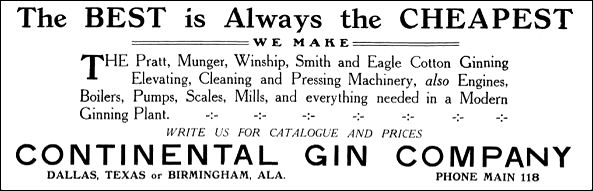
Robert S. Munger (yes, that Munger) patented several inventions that improved the cotton ginning process, and in 1888 he built a large manufacturing plant for his Munger Improved Cotton Machine Company. In 1900, after several extremely successful years, his company and several other companies that held important industry patents were absorbed by the Continental Gin Co. of Birmingham, Alabama, and, practically overnight, the Continental Gin Co. became the largest manufacturer of cotton gins in the United States. Munger retained a financial interest in the company, but he left the running of the business to his brother, S.I. Munger. R.S. Munger turned his creative talents to real estate and developed the exclusive Munger Place neighborhood. The Continental Gin Co. closed in 1962.

continental-gin-co_1912The Standard Blue Book of Texas, 1912-1914

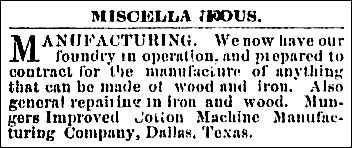
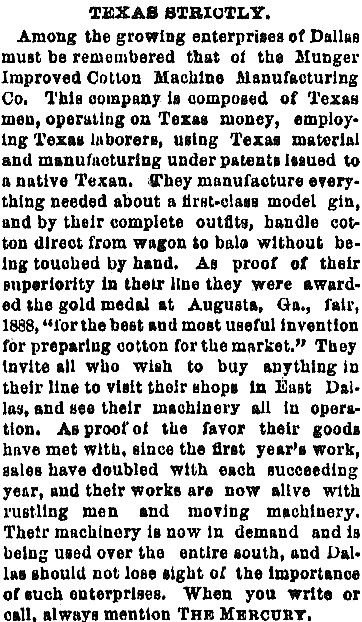
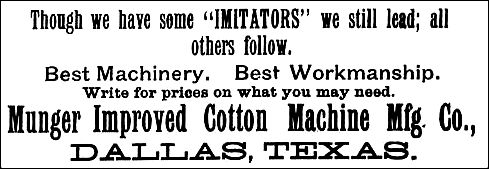
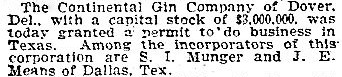
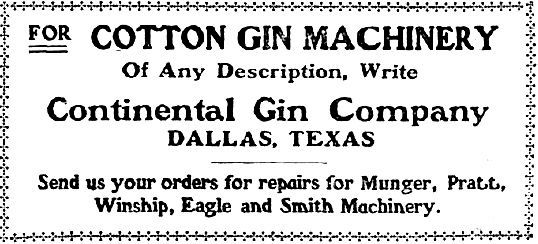
A few newspaper items regarding the Munger Improved Cotton Machine Company and the Continental Gin Company.

munger_dal-herald_101387The Dallas Herald, Oct. 13, 1887

munger_merc_053089The Southern Mercury, May 30, 1889

munger_merc_072892The Southern Mercury, July 28, 1892

munger_merc_041393The Southern Mercury, April 13, 1893

continental-gin_dmn_072600Change is imminent. (Dallas Morning News, July 26, 1900)
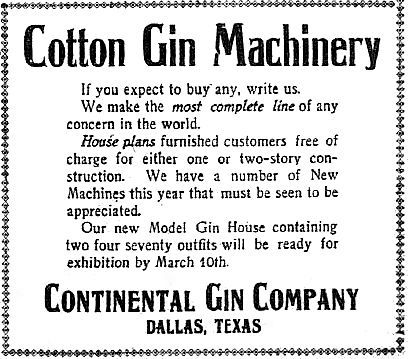
continental-gin_dmn_042001FIVE HUNDRED TONS! (DMN, Apri 20, 1901)

continental-gin_dmn_032203DMN, March 22, 1903

continental-gin_dmn_082005DMN, Aug. 20, 1905

continental-gin_dmn_060107DMN, June 1, 1907

continental-gin_worleys_1909Worley’s Dallas Directory, 1909

continental-gin_ad_dallas-police_1910Dallas Police, 1910

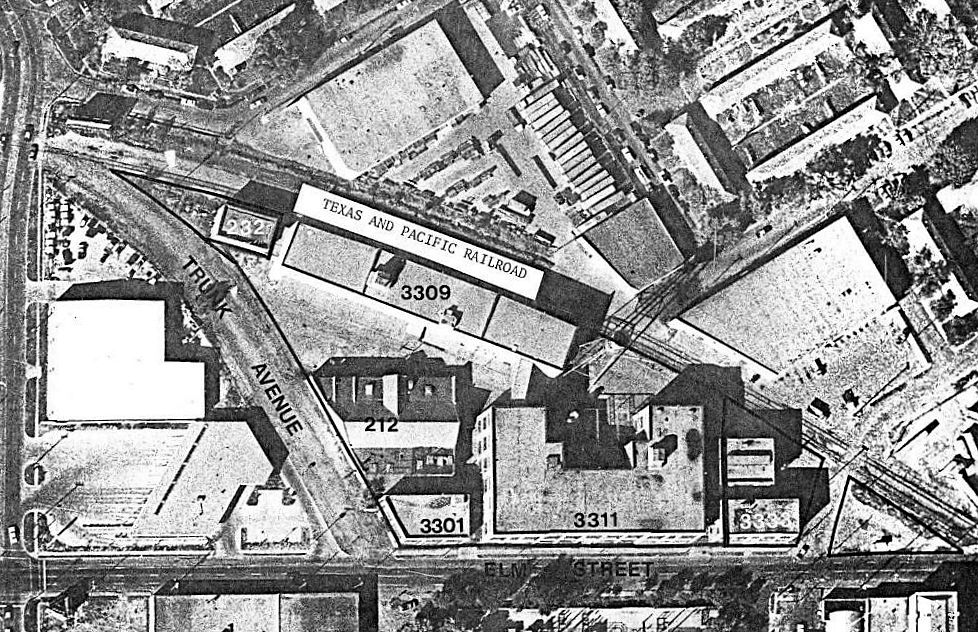
continental-gin-aerial-natl-reg-appPhotograph that accompanied the application to the National Register of Historic Places regarding the structures under consideration: 3301-3333 Elm St. and 212 & 232 Trunk Ave. (Landis Aerial Photography, 1980)

***

Sources & Notes

Handbook of Texas biography of Robert Sylvester Munger (1854-1923) is here.

The top image (which, by the way, took me FOREVER to find, is labeled as the Munger company, but the expansion would seem to indicate that this is the Continental Gin Company, after 1914. Whatever the case, it’s a great image!

That image and the aerial photograph of 1980 are included in the city’s application to have the complex included in the National Register of Historic Places, submitted in 1983. The detailed application — as a Texas Historical Commission PDF — can be accessed here.

The second image, of the early days of the Munger Improved Cotton Machine Company is from a bookseller’s online listing for Munger’s 13th Annual Catalogue and Price List (1895) — the item may still be available for a mere $435 and can be found here.

See an aerial view of what the area looks like today, via Google, here.

To see an incredible 1914 photograph of the buildings and the residential area to the north, see my post “The Continental Gin Complex — 1914,” here.

More on Robert S. Munger and more early company ads can be found in the post “R. S. Munger’s Cotton Gin Manufactory,” here.

*

Copyright © 2014 Paula Bosse. All Rights Reserved.