Flashback : Dallas

A Miscellany: History, Ads, Pop Culture

Category: 1910s

Get Your “Flying Merkel” at the Texas Motorcycle Co. — 1911

tx-motorcycle-co_flying-merkel_dallas-high-school_yrbk_1911“All shaken to pieces?”

by Paula Bosse

I might have bought a Flying Merkel in 1911 for the name alone.

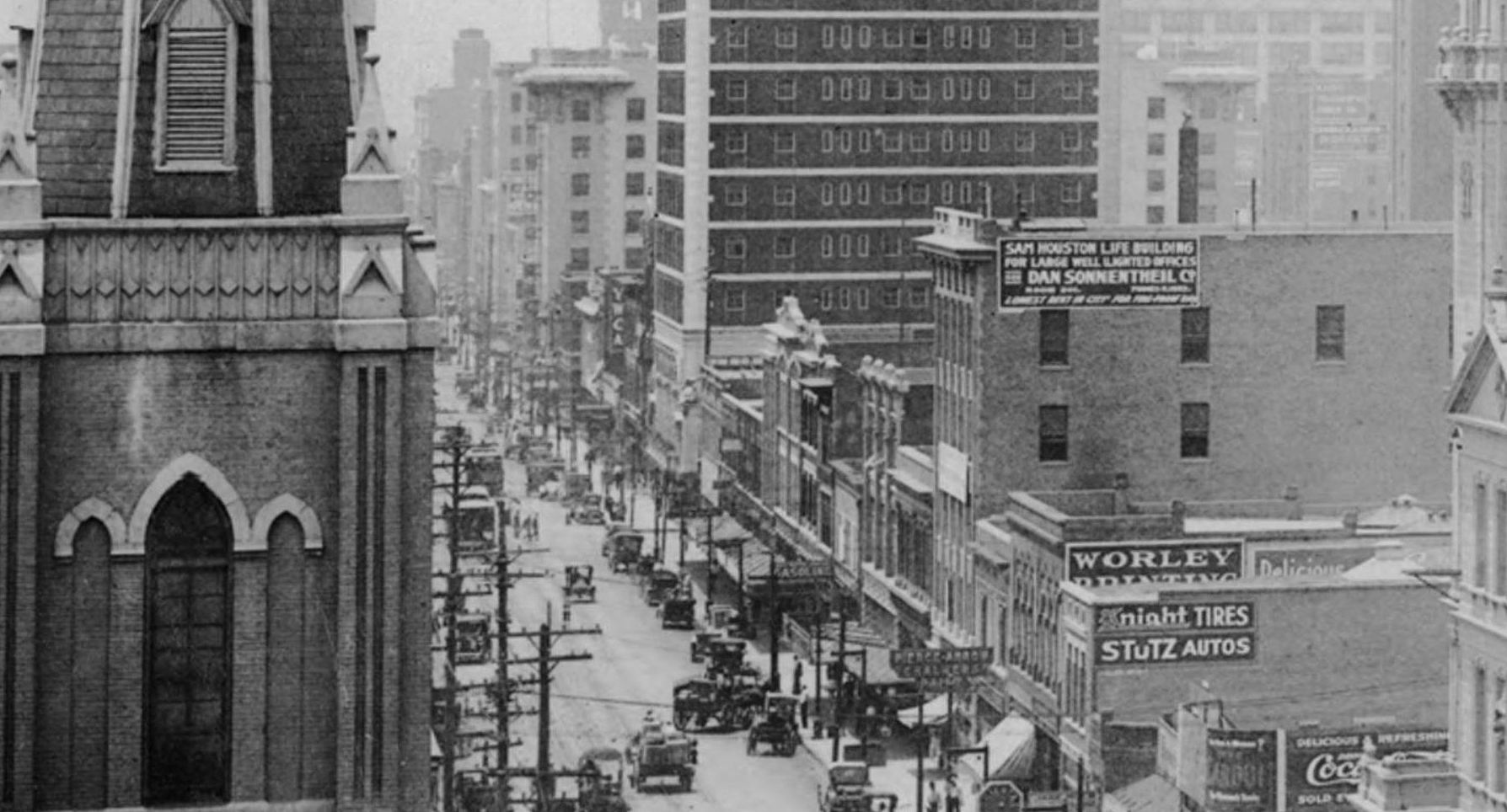
The Texas Motorcycle Company was at 1605 Commerce. This ad is from 1911, but see what that block of Commerce looked like two years later in the detail of a larger photo, below. The motorcycle company was next to Worley’s, in the building with the Knight Tires/Stutz Auto signs.

2-traffic-skyline-1

Imagine two years before: Commerce would have been filled with Flying Merkels on test drives, zipping in and out of traffic!

***

Sources & Notes

Ad from the 1911 Dallas High School yearbook.

Photo is a detail from a larger photo contained in my earlier post “Horses, Carriages, Horseless Carriages — Commerce Street, 1913,” here.

Read about the 1911 Flying Merkel, here.

One of these bikes recently sold for more than $200.000!

1911-flying-merkel

Click pictures to see larger images.

*

Copyright © 2015 Paula Bosse. All Rights Reserved.

Winnetka Congregational Church, Org. 1914

winnetka-congregational-church_tulane-universityThe Oak Cliff church’s first pastor? (click for larger image)

by Paula Bosse

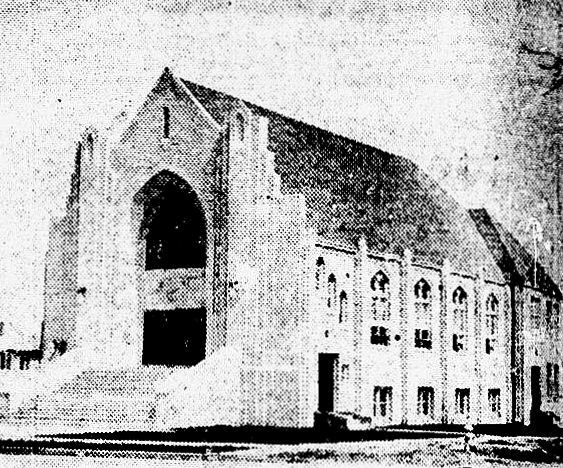
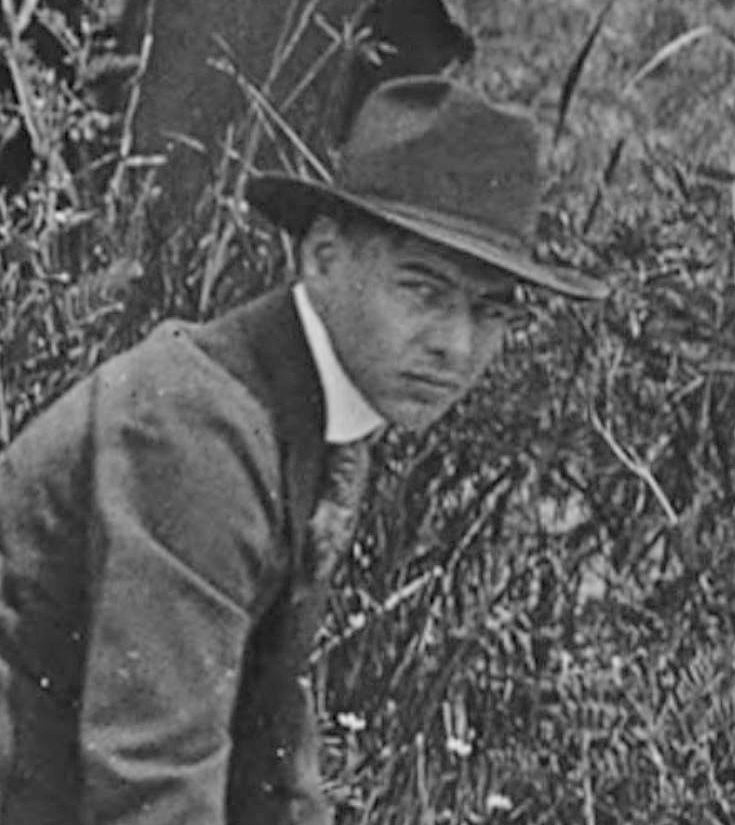
I stumbled across this photograph tonight and was really taken with it. It shows a man standing in front of the Winnetka Congregational Church in Oak Cliff, located at W. Twelfth and S. Windomere streets — on land now part of the property of the W. E. Greiner school. The church was organized in 1914, but by 1925 they were making plans to expand. A new church was built in 1929, just across W. Twelfth, facing Windomere.

winnetka-congregational-church

The new building still stands, but Winnetka Congregational Church doesn’t seem to have made it past the 1950s.

Nice though that newer church is, I think I prefer the smaller one from 1914 with the uncomfortable-looking man standing in front of it.

***

Sources & Notes

Top photo from the Tulane University Digital Library (with the name of the church misspelled as “Winnietka”), here.

I love Sanborn maps. Here’s one from 1922 which shows what the neighborhood looked like then. The original small wood frame church can be seen just north of a neighborhood completely undeveloped, except for the Winnetka School. Check out the very large map, here.

Background on the church can be found on the Oak Cliff Yesterday blog, here.

If you REALLY want to learn about this church’s history, there is a book, History of Winnetka Congregational Church, Dallas, Texas by Sarah E. Johnson (1935). Looks like the Dallas Public Library has a copy, here.

And, lastly, here’s what the church built in 1929/1930 looks like today. (The original church was built in the area seen in the background, now part of the Greiner campus.)

*

Copyright © 2015 Paula Bosse. All Rights Reserved.


Dallas High School’s 1915 Basket Ball Season

basketball_dallas-high-school_1915-girls-photo_dhs-yrbk
A winning season for the girls!

by Paula Bosse

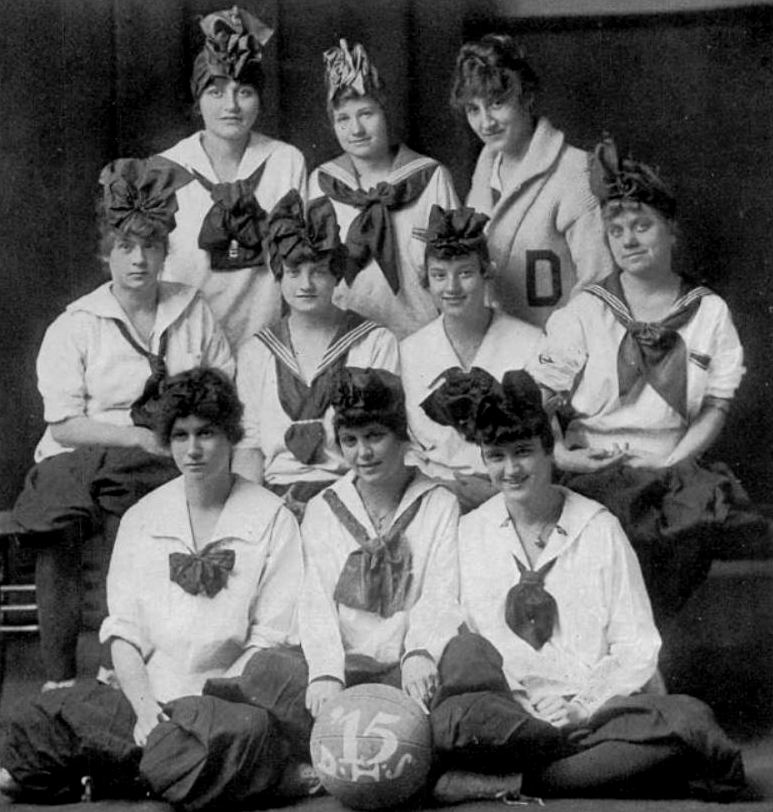
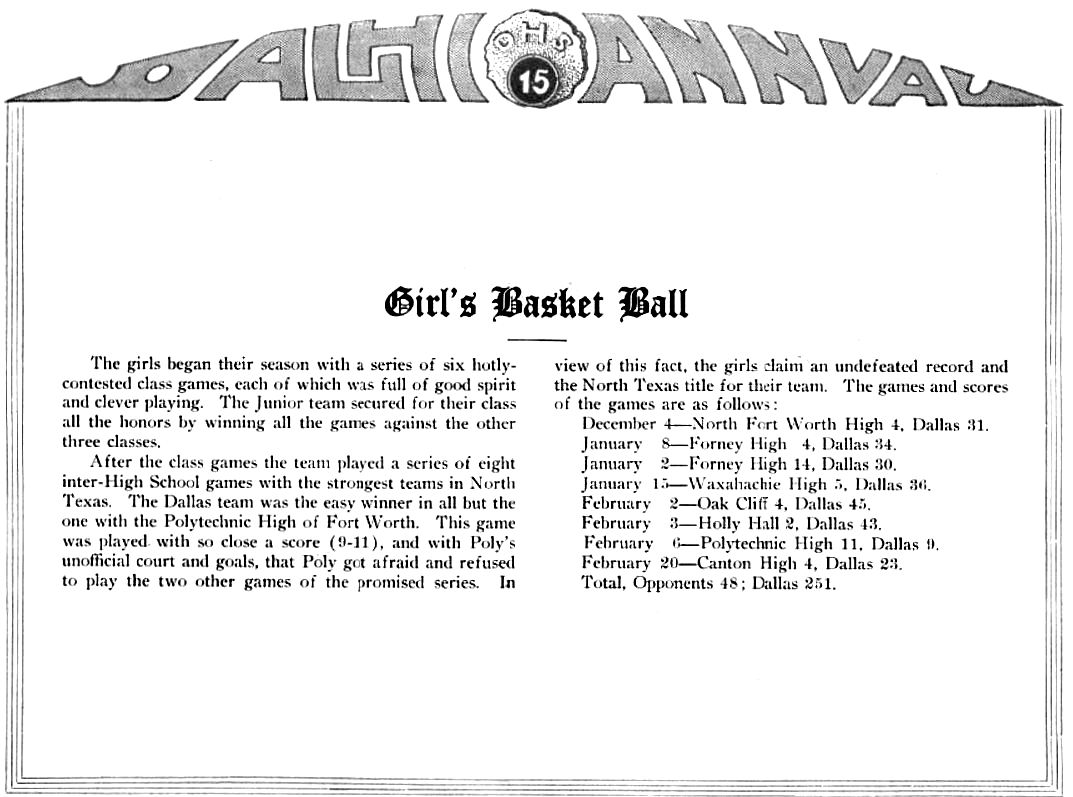
The girls’ basketball (or “basket ball”) team of Dallas High School (later known as Crozier Tech) had a great season in 1915! They won 7 of their 8 games, losing only to Fort Worth’s Polytechnic High (by one measly basket). Most of their opponents were trampled by the DHS team, several managing to score  no more than a mere 2 or 4 points (!). And, let’s face it, without the drag caused by those elaborate and cumbersome uniforms and … um … headgear, DHS would no doubt have scored even higher.

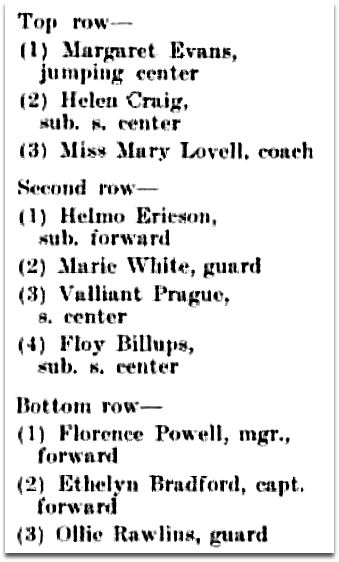
Below, the roster (containing some great names like Helmo, Valliant, Floy, and Ollie).

girls-basketball-team_dhs_1915

And the wrap-up of the season, from the yearbook, with more than a hint of bitterness toward the Fort Worth team:

basketball_dallas-high-school_1915-girls_text_dhs-yrbk

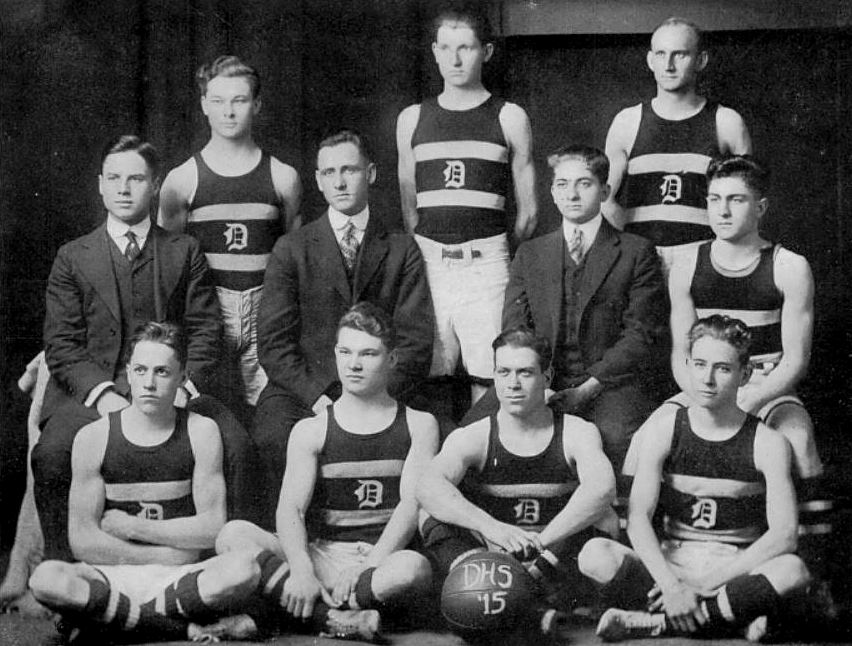
And the boys’ team? Oh dear. They won only 4 out of 8 games. But at least their uniforms were better suited to the sport.

basketball_dallas-high-school_1915-boys_dhs-yrbk

basketball_dallas-high-school_1915-boys_text_dhs-yrbk

dallas-high-school_1915

***

Sources & Notes

From the pages of the 1915 Dallas High School yearbook — the “Dal-Hi” annual.

*

Copyright © 2015 Paula Bosse. All Rights Reserved.

“Work and Play in Telephone Land”

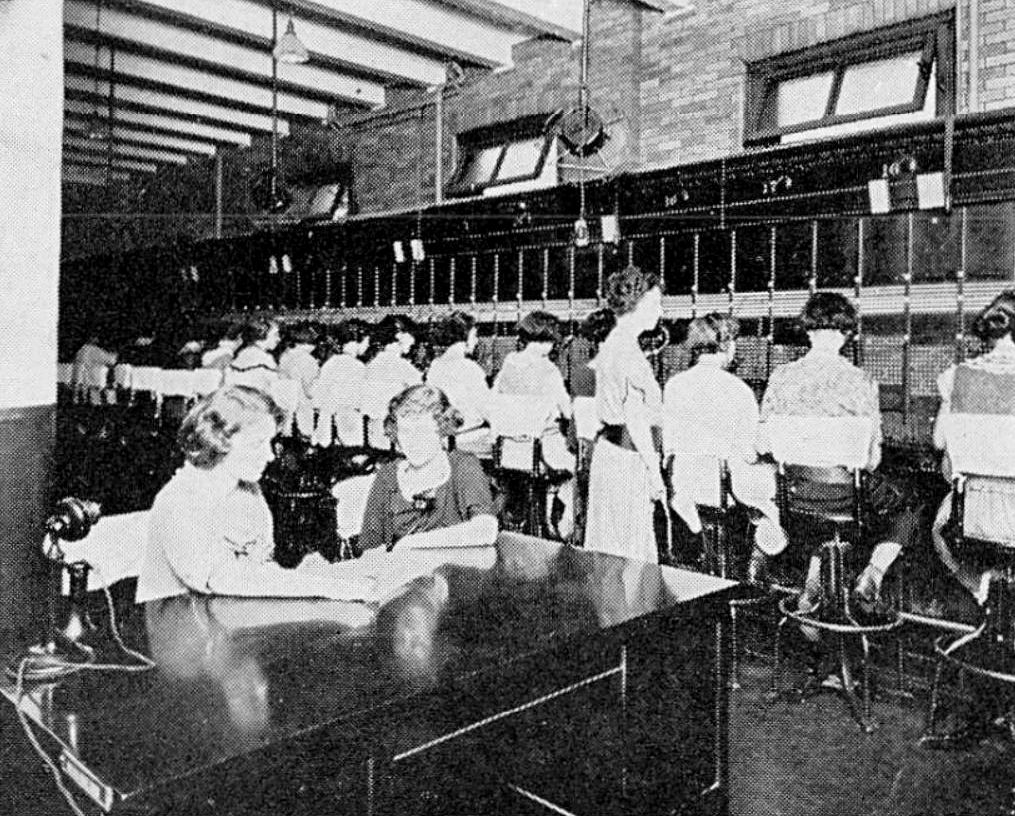
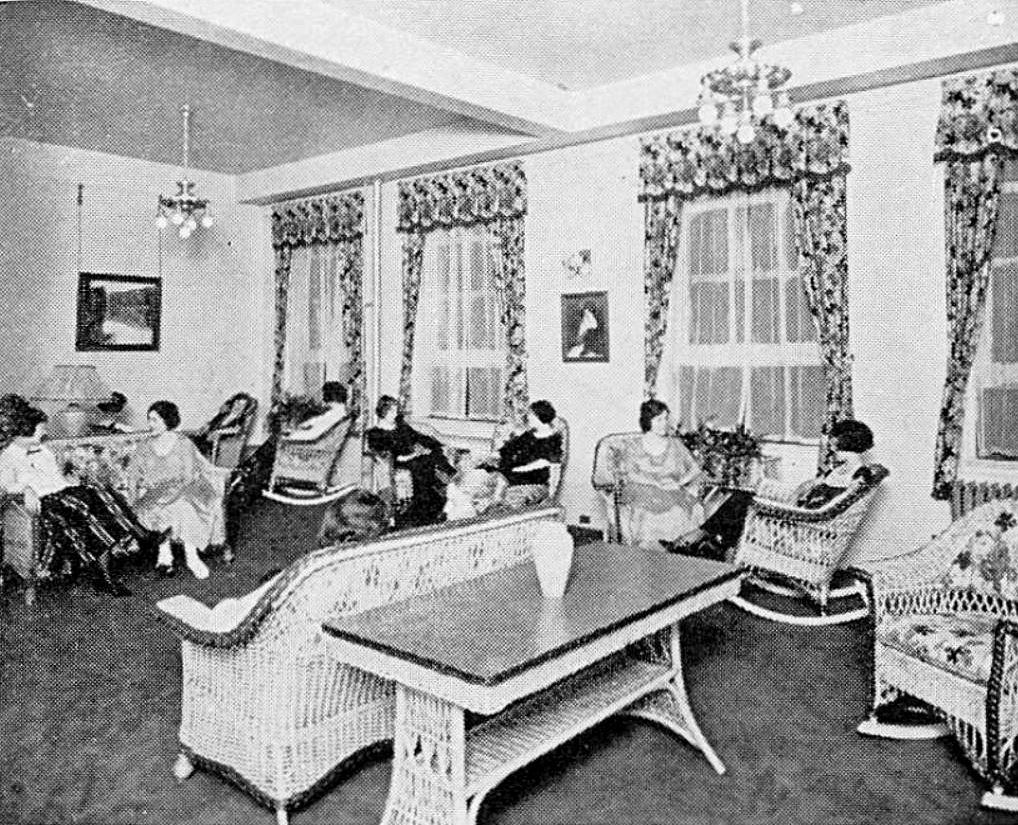
sw-bell-telephone_oak-cliff-high-school-yrbk_1925aDallas women at work, 1925 (click for larger image)

by Paula Bosse

Today at look at two ads seeking “young women of high ideals and ambition” to become telephone operators, one of the few careers open to women exclusively.

First, an ad from 1911 for the Southwestern Telegraph & Telephone Company (click for larger image — transcription below).

ad-telephone-company_dmn_052911-lg1911

COMFORT and CONVENIENCE

The new building is equipped with every comfort and convenience for the operators. The entire third floor is set aside to their use, and there are the cafe, the rest room and roof garden. Taken all together the building is a model, designed and planned with the one purpose: That of the helpfulness of service. Representatives of the company feel that environment has much to do with the attitude of the employees.

The Southwestern Telegraph &  Telephone Company offers exceptional advantages to young women of high ideals and ambition. The way is open by which a PROFESSION may be mastered under the most pleasant and auspicious circumstances. You earn while you learn.

For information, apply to the principal of the operating school at the “Main” exchange, corner of Akard and Jackson streets, or “Edgewood” exchange on Harwood street, near Grand avenue.

*

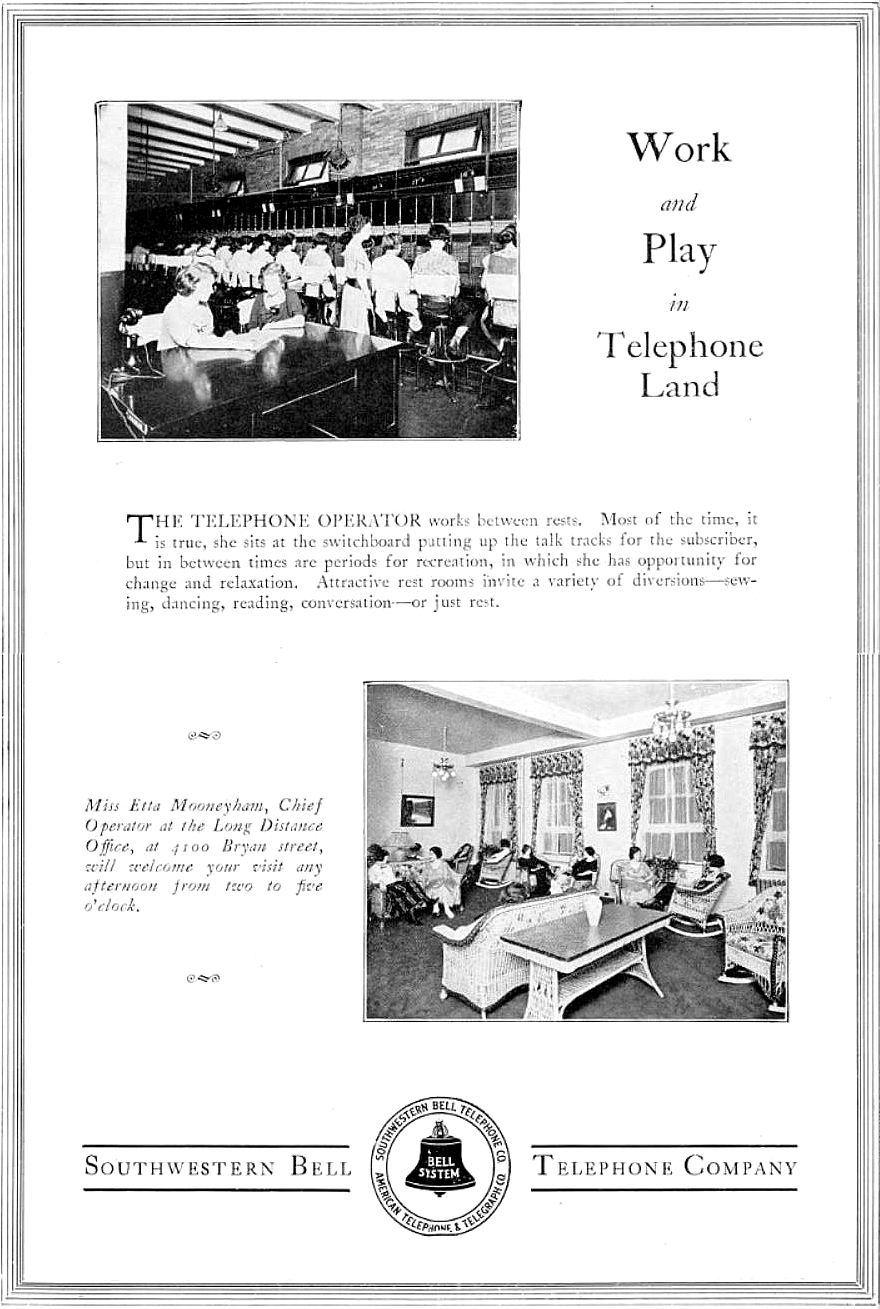
Here’s an ad from 1925 for Southwestern Bell Telephone Company, really pushing the idea that working as a switchboard operator is mostly rest and “a variety of diversions — sewing, dancing [!], reading, conversation”... more play than work, really!

sw-bell-telephone_oak-cliff-high-school-yrbk_19251925

WORK AND PLAY IN TELEPHONE LAND

The telephone operator works between rests. Most of the time, it is true, she sits at the switchboard putting up the talk tracks for the subscriber, but in-between-times are periods for recreation, in which she has opportunity for change and relaxation. Attractive rest rooms invite a variety of diversions — sewing, dancing, reading, conversation — or just rest.

Miss Etta Mooneyham, Chief Operator at the Long Distance Office, at 4100 Bryan street, will welcome your visit any afternoon from two to five o’clock.

If you’re lucky, maybe Miss Mooneyham will ask you to dance.

sw-bell-telephone_oak-cliff-high-school-yrbk_1925bRelaxing in one of the “attractive rest rooms” (1925)

***

Sources & Notes

1911 ad appeared in the Dallas Morning News on May 29, 1911; 1925 ad (containing the photos at the top and bottom) appeared in the 1925 edition of “The Oak,” the yearbook of Oak Cliff High School (later renamed Adamson High School).

I’ve  been fascinated by telephone operators my whole life. Ever wonder why operators have historically always been women? Watch an entertaining 5-minute video about why women took over the profession, here.

Also, read an interesting New York Times article about “telephone girls” (June 11, 1899), here.

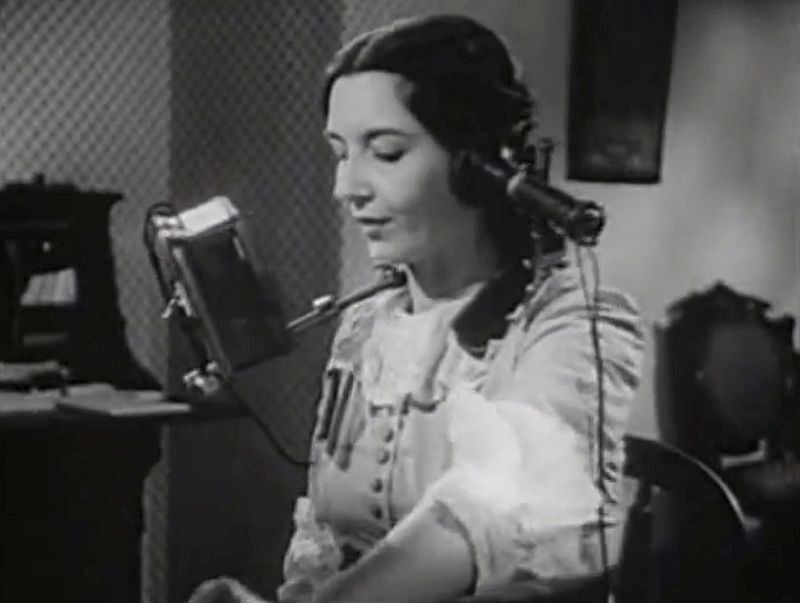
Lastly, because I really want to post this ridiculous screenshot of what 19th-century operators apparently wore at some point, an AT&T industrial film called “The Nation at Your Fingertips”can be viewed here. (The few seconds showing this operator who surely would have experienced crippling next pain for the rest of her life begins at the 3:43 mark.)

operator_whoa_nation-at-your-fingertips

See an earlier, related post — “Telephone Operators Sweating at the Switchboard — 1951” — here.

Click pictures for larger images.

*

Copyright © 2015 Paula Bosse. All Rights Reserved.

Turn-of-the-Century Maple Avenue

maple-ave_colteraHope this wasn’t between McKinney & Cedar Springs…

by Paula Bosse

When the fashionable and wealthy began to move their residences north from the downtown area, they built their homes along Maple Avenue, between McKinney and about where the Stoneleigh Hotel now stands. This exclusive neighborhood of imposing houses hit its stride in the first decade of the 20th century.

One of the well-to-do families who lived on Maple at this time was that of G. B. Dealey, founding editor of The Dallas Morning News. His son Ted Dealey wrote at length about all of his boyhood neighbors in his very entertaining book, Diaper Days of Dallas. Rather ominously, though, these amusing and colorful childhood memories end with this paragraph:

I hate to write this paragraph because some people may think I had a pernicious influence on the neighborhood. But there were five men living on Maple between McKinney and Cedar Springs who committed suicide in the 1900s. Not all in one day, or one week, or one month, of course, but over a period of years.

Wow. The distance between McKinney Avenue and Cedar Springs is only two-tenths of a mile!

Beautiful houses, though!

***

Postcard from Flickr, here.

Paragraph from Diaper Days of Dallas by Ted Dealey (Nashville: Abingdon Press, 1966), p. 39.

Click postcard to see larger image.

*

Copyright © 2015 Paula Bosse. All Rights Reserved.

Selling Kidd Springs Heights, 1909-1910

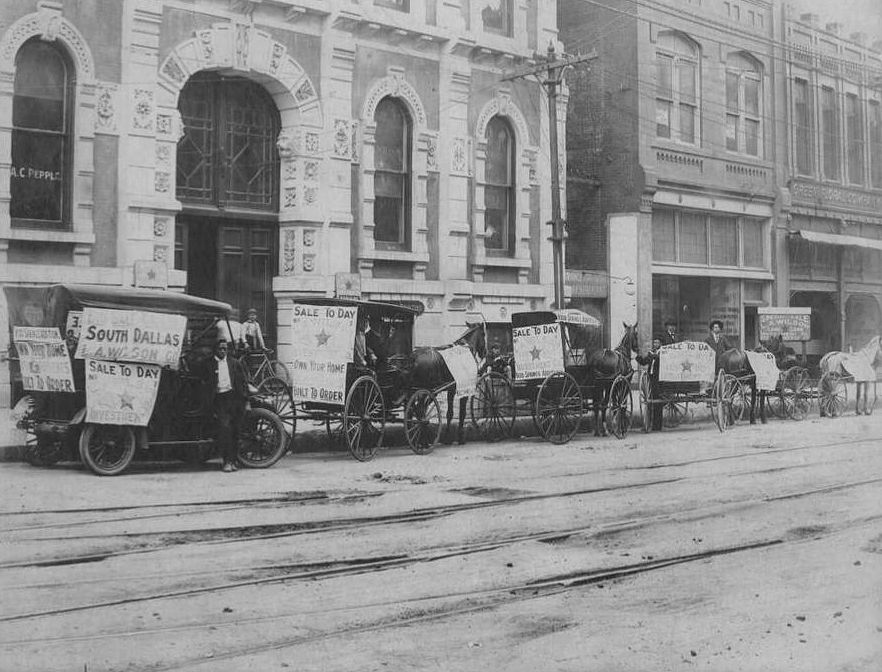
gaston-bldg_1910_cook-degolyerThe L. A. Wilson Co. is having a sale! (photo: SMU)

by Paula Bosse

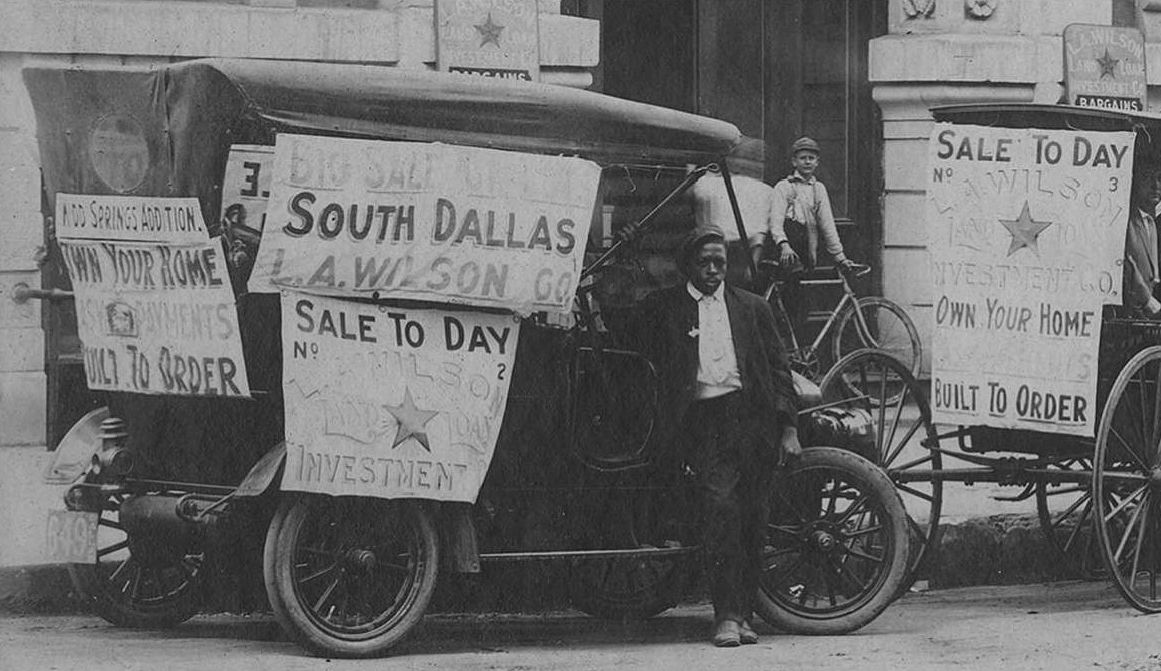
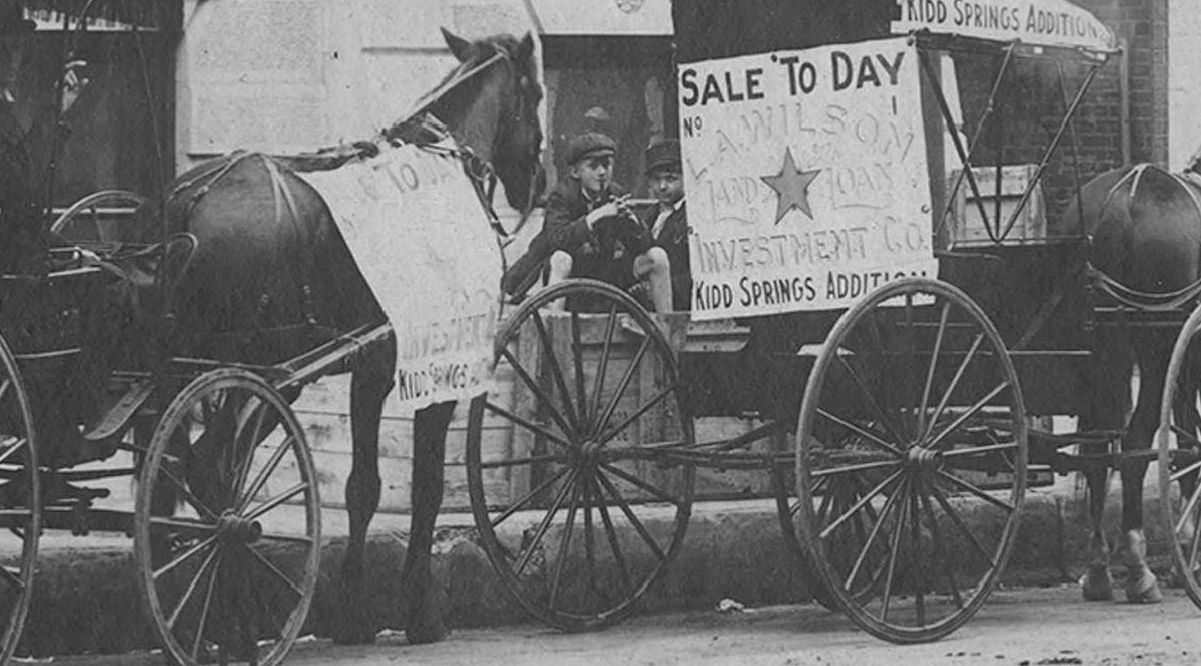
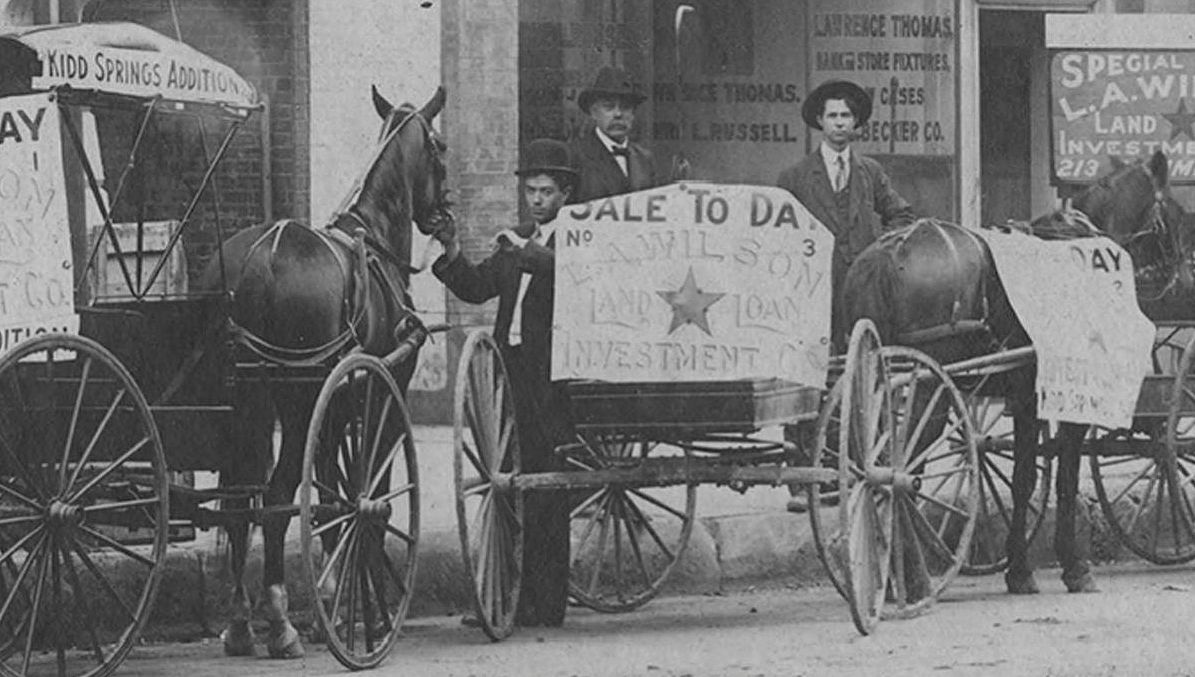
The above photo shows a car-and-buggy convoy belonging to the L. A. Wilson Land, Loan & Investment Company, stretched out in front of the Gaston Building at Commerce and S. Lamar. There’s a “Sale To Day” and they’re really pushing property in the Kidd Springs Addition in Oak Cliff. The date “April 20, 1910” is written on the back of the photo, and if that’s true, the big show here might be rooted more in desperation than in enthusiasm. The Wilson company began selling the 30-or-so lots in the new Kidd Springs Heights neighborhood in July of the previous year. An ad that appeared seven months before this photo was taken announced that there were only ten lots left. It looks like this was an impassioned display to make Kidd Springs seem more exciting and move that remaining property. People love parades.

(This is another great photo to zoom in on to see the details. All images are larger when clicked.)

gaston-bldg_1910_cook-degolyer-det1

gaston-bldg_1910_cook-degolyer-det4

gaston-bldg_1910_cook-degolyer-det5

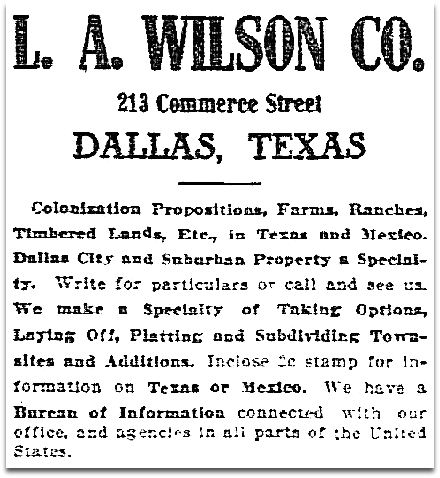
The L. A. Wilson Co. was a fairly large real estate company founded by Missouri-born Lewis A. Wilson (1851-1926); at the time of this photo, the company’s offices were in the Gaston Building at 213 Commerce. (In the photo immediately above, I think the man with the moustache is Mr. Wilson.)

wilson_dmn_070409-detDallas Morning News, July 4, 1909 (ad detail)

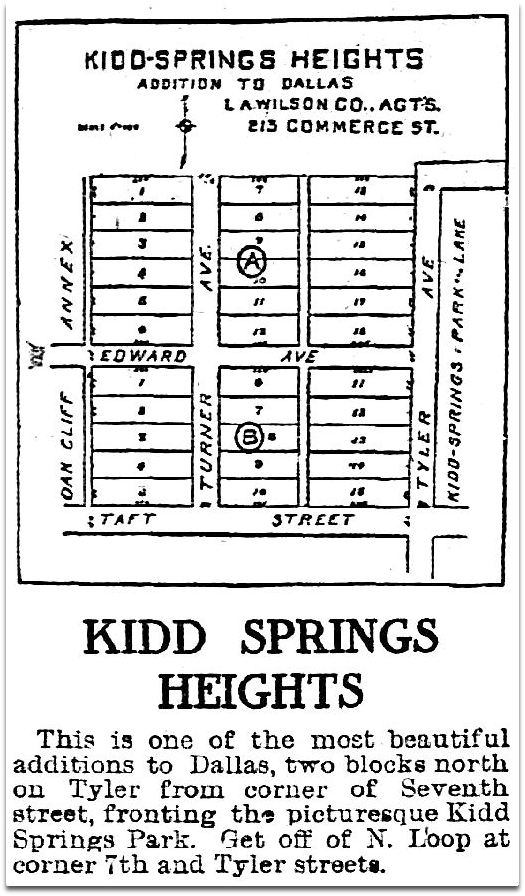
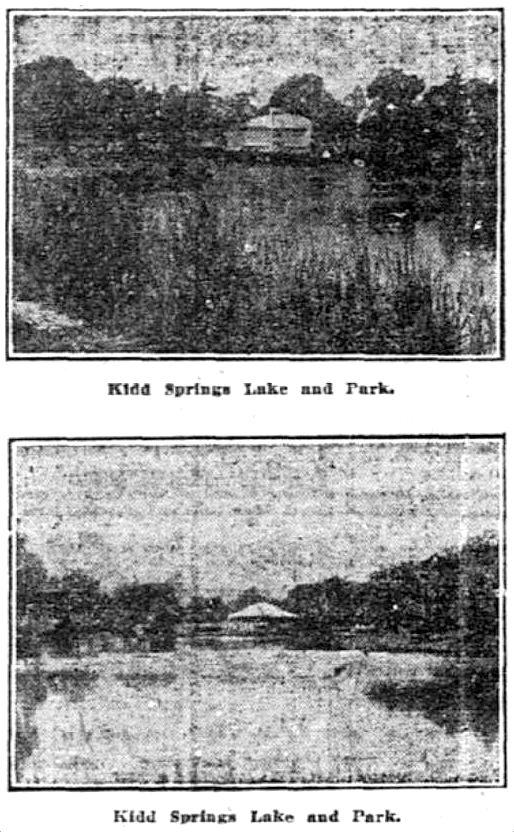
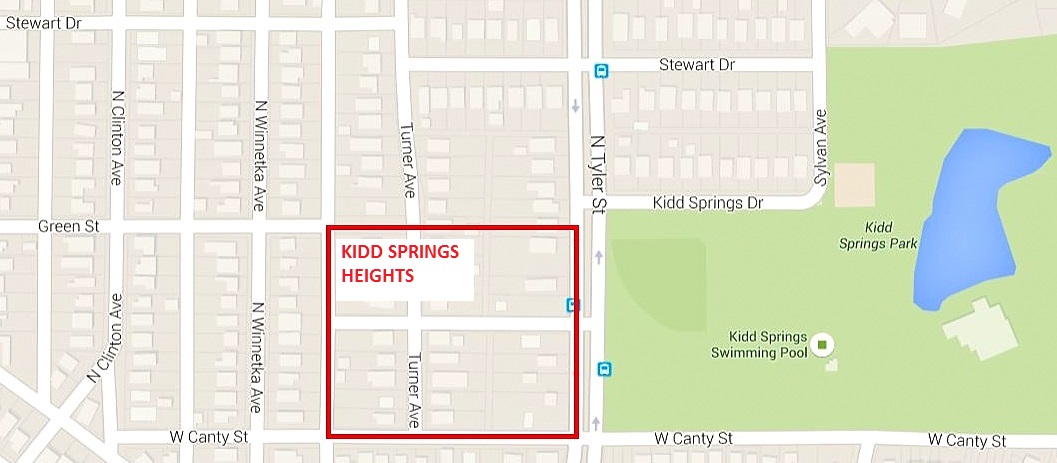
The first ad announcing the sale of lots in the Kidd Springs Heights area of Oak Cliff appeared on July 4, 1909. It included the two blocks north of what is now W. Canty, bounded by Turner Ave. on the west and N. Tyler (and Kidd Springs Park) on the east.

ad-wilson_dmn_070409-text

ad-wilson_dmn_070409-photosDMN, July 4, 1909

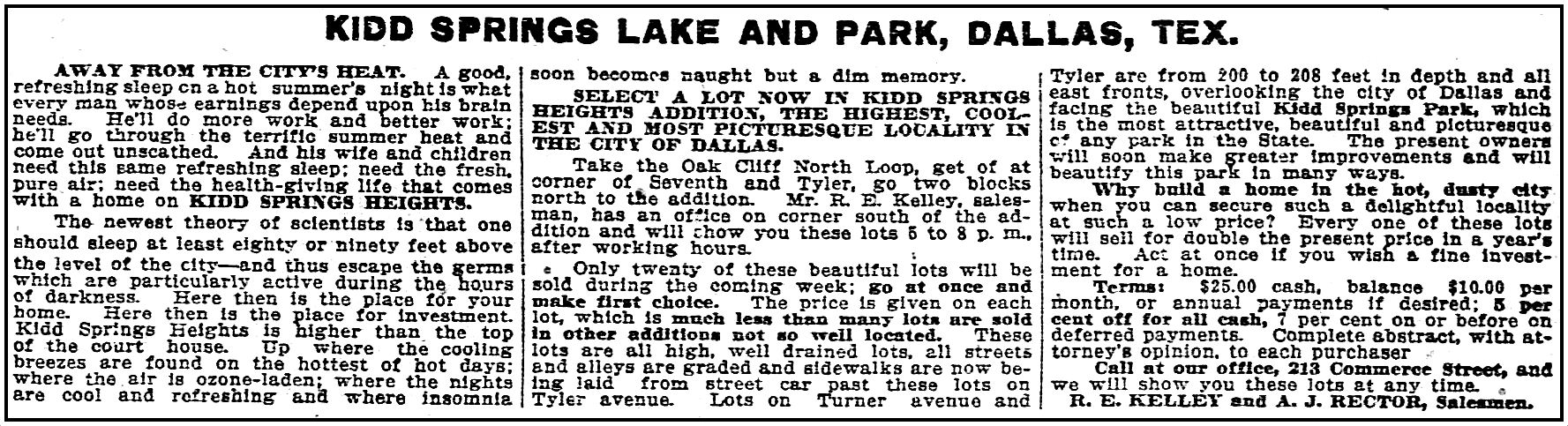
Four weeks later, a huge half-page ad ran in The Dallas Morning News, full of wonderful reasons why life would be better in Kidd Springs Heights:

The newest theory of scientists is that one should sleep at least eighty or ninety feet above the level of the city – and thus escape the germs which are particularly active during the hours of darkness. Here then is the place for your home. Here then is the place for investment. Kidd Springs Heights is higher than the top of the court house. Up where the cooling breezes are found on the hottest of hot days; where the air is ozone-laden; where the nights are cool and refreshing and where insomnia soon becomes naught but a dim memory.

The effusive sales copy is definitely worth a read (click ad below to read the full sales pitch).

wilson_kidd-springs-heights_dmnn_090109DMN, Aug. 1, 1909

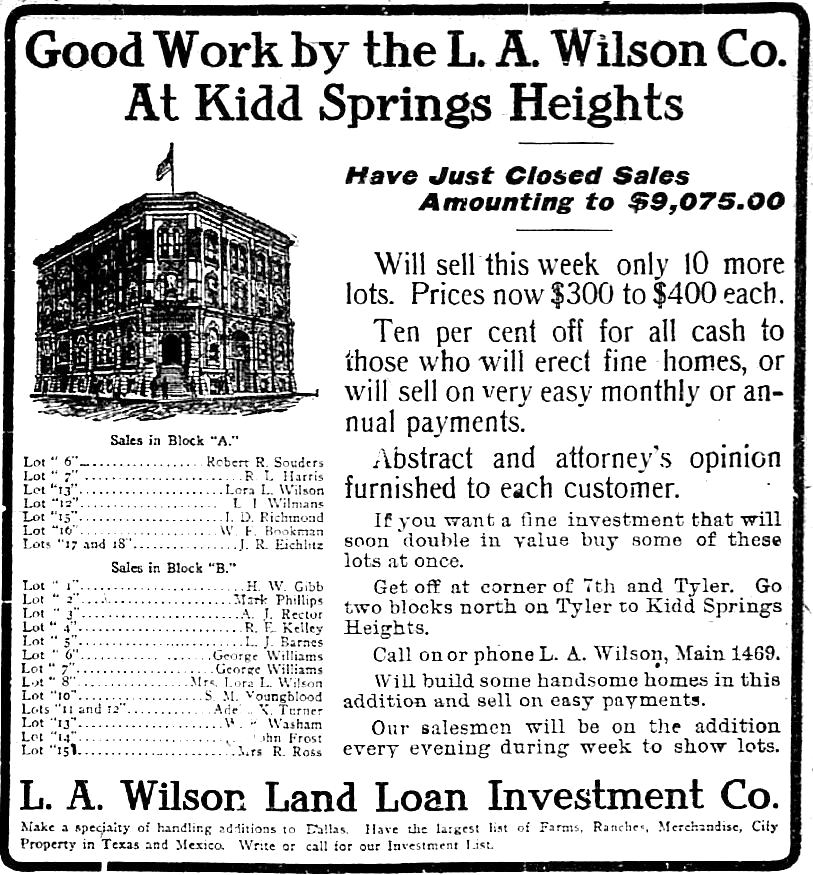
Six weeks later the following self-congratulatory ad appeared. (It’s interesting to note that of the twenty lots sold, two of them had been sold to Mrs. L. A. Wilson, and one each had been sold to the two salesmen. The next year’s telephone directory showed that the Wilsons lived on Live Oak, and the two salesmen lived in boarding houses.)

wilson-kidd-springs_dmn_091209DMN, Sept. 12, 1909

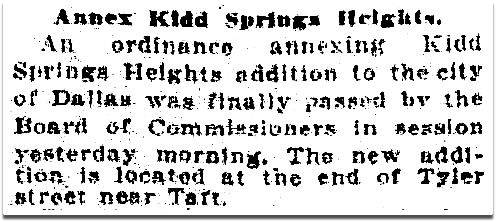
It wasn’t until 1921 that the tiny little Kidd Springs Heights was annexed to the city of Dallas.

annexed_dmn_051421DMN, May 14, 1921

Things may be different today, but in 1909, these were the boundaries of Kidd Springs Heights.

kidd-springs-heights_google_2015

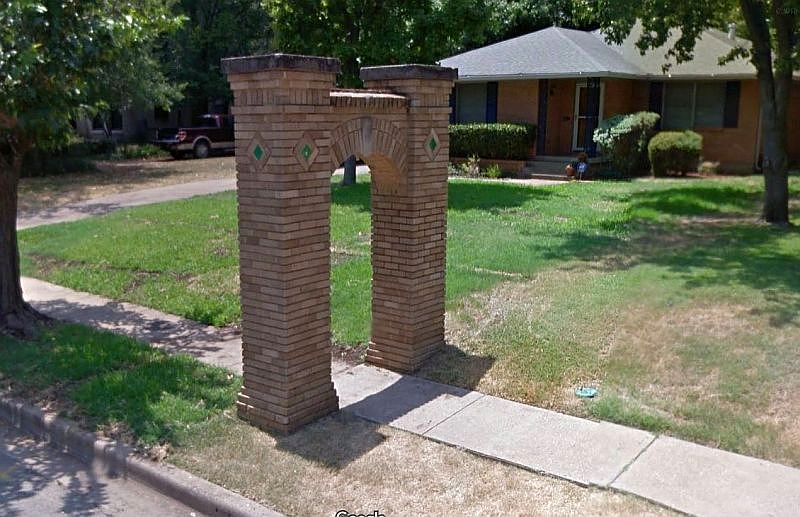
The most interesting odd thing about Kidd Springs Heights? There appear to be two brick archways placed (very awkwardly) across Turner Avenue from one another — each spanning the sidewalk. I can’t find any information about these, but it looks as if they were set right at the northern boundary of the Kidd Springs Heights Addition. Old maps (such as this one from 1919) show no development to the north of this boundary up into at least the ’20s (it doesn’t look as if this addition is even in Oak Cliff proper), so I guess they were there before those sidewalks and served as a welcoming gateway to a new development where germs did not dwell after nightfall.

arch_google
900 block of Turner Avenue (Google Street View)

(Check out both of these markers on Google Street View, here. It’s pretty strange-looking.)

If anyone has information on these markers, please pass it along!

***

Sources & Notes

Top photo is titled “L. A. Wilson Land Loan Investment Company, Gaston Building, Commerce Street” — the photographer’s name and the date are written on the back: W. R. Lindsay, April 20, 1910. It is from the George W. Cook Dallas/Texas Image Collection, DeGolyer Library, Central University Libraries, Southern Methodist University, and it can be viewed here. I have adjusted the color.

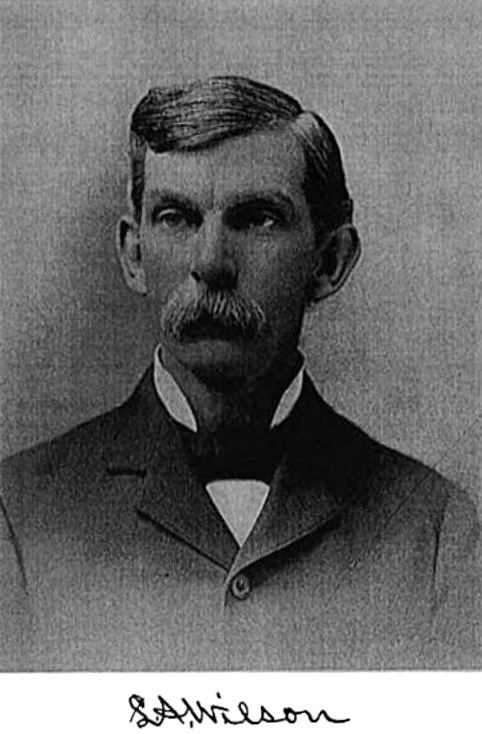
Lewis A. Wilson’s biography can be read in A History of Greater Dallas and Vicinity (1909), here. His photo:

wilson_hist-greater-dallas

The Kidd Springs Wikipedia entry is here.

The Sanborn map from 1922 showing this tiny neighborhood at about the middle of the page on the right can be found here. Note how few lots actually have houses built on them. (Taft is now W. Canty; Edwards is now Everts.)

The Murphy & Bolanz map can be seen here. (If the link doesn’t work, you may need to download the plug-in — information on how to do that is here.)

*

Copyright © 2015 Paula Bosse. All Rights Reserved.

“Tough ‘Ombres on Main Street” — WWI Victory Parade, 1919

tough-ombres_flickr90th Infantry Division, 1500 block of Main Street (click for larger image)

by Paula Bosse

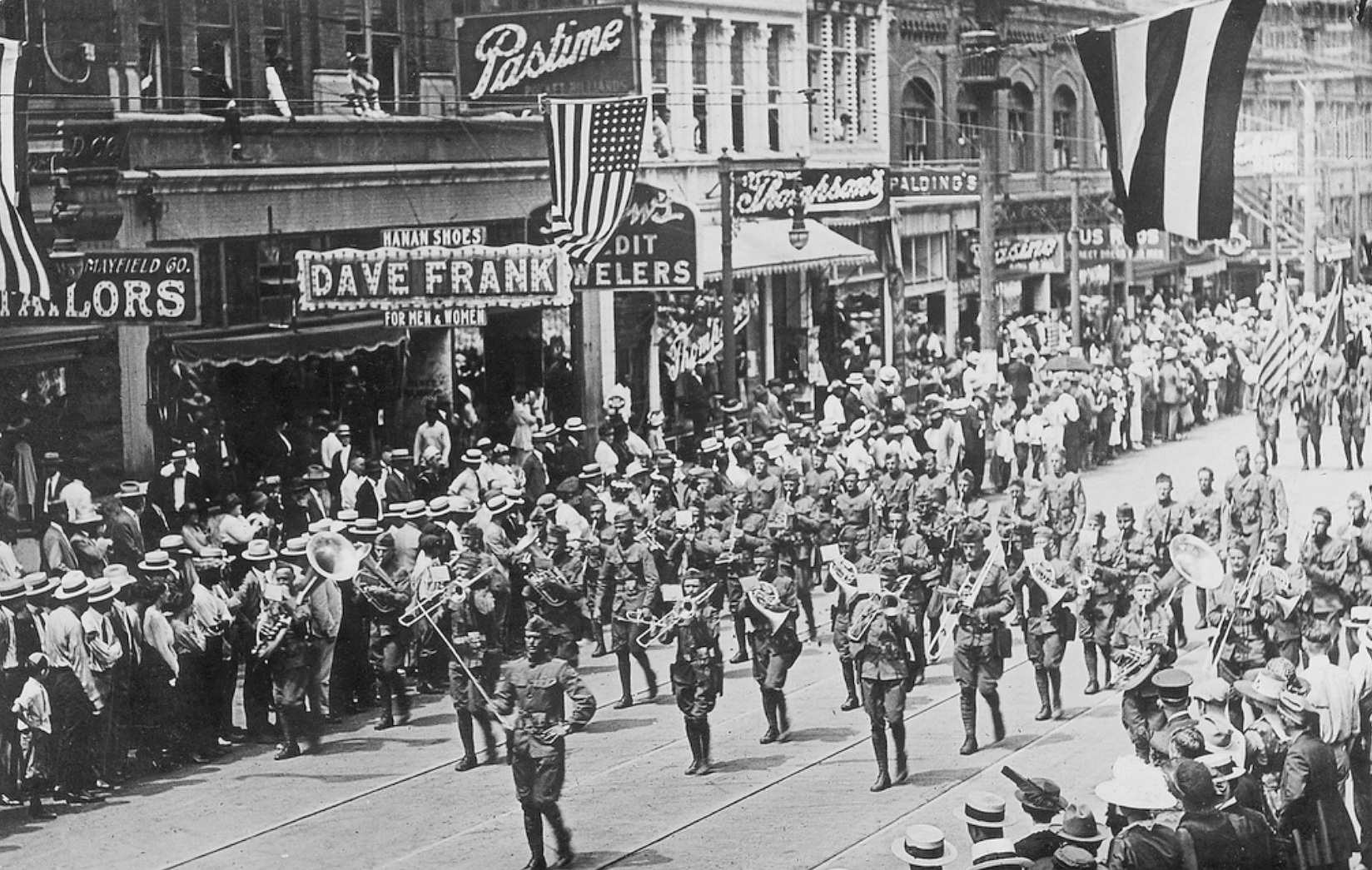
In my previous post “From the Vault: Armistice Day! — 1918” (seen here), commenter “Not Bob” linked to the above photo which was taken from almost the exact same vantage point as the photo I had posted previously. This one is much better! It shows the U.S. Army’s 90th Infantry Division (known as the “Tough ‘Ombres”), just back from Europe, marching past the 1500 block of Main Street, heading east. The white building in the center (“Thompson’s”) appears to be the same building currently occupied by Iron Cactus, at 1520 Main.

Great picture — thanks, Not Bob!

***

Sources & Notes

This photo was posted by Bob Swanson on Flickr, here. The comments are very interesting and explain why this infantry division was marching in various Texas cities.

More on the 90th Division here and here.

My post “Armistice! — 1918” contains another parade photo taken at the same spot, here.

*

Copyright © 2015 Paula Bosse. All Rights Reserved.


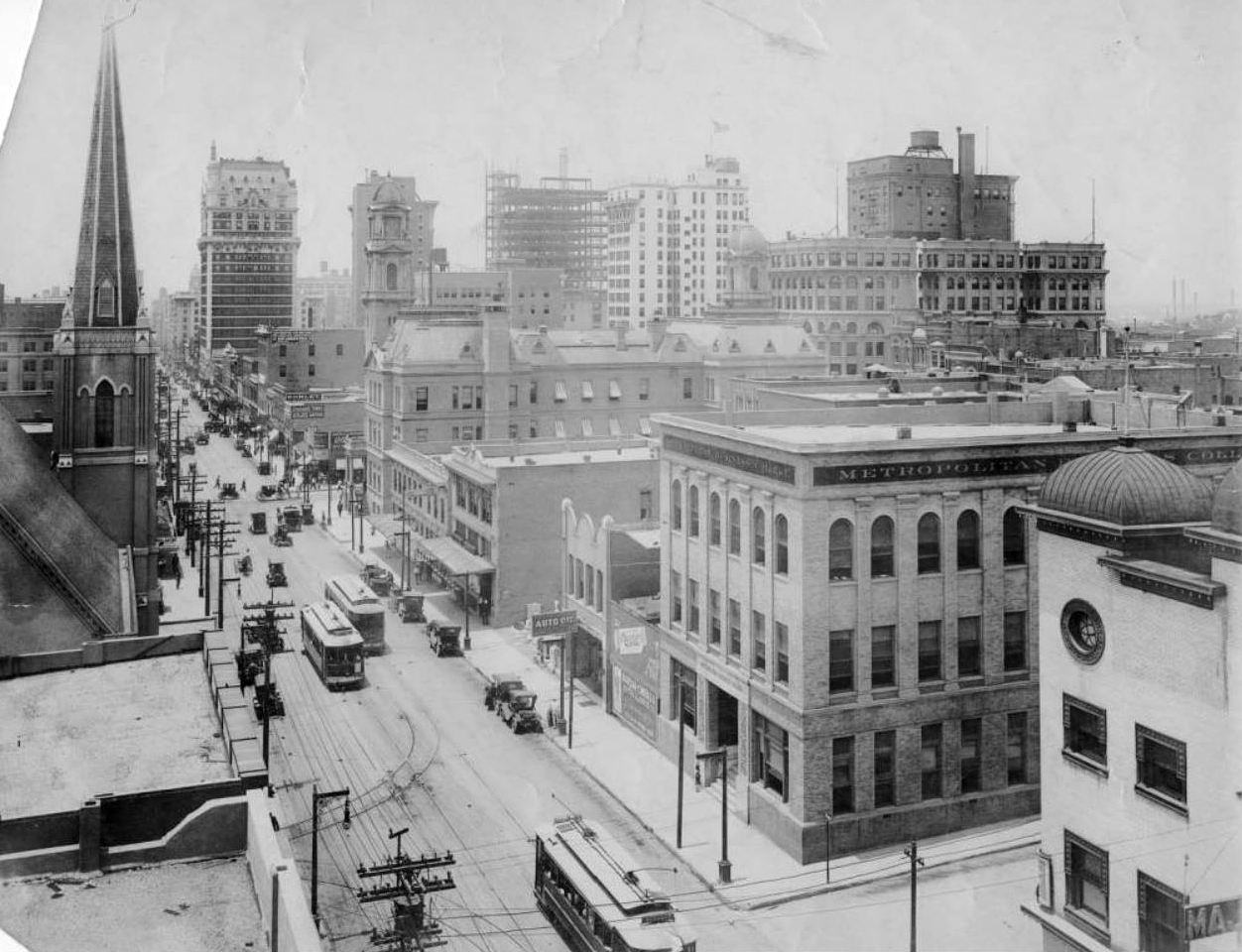
Horses, Carriages, Horseless Carriages: Commerce Street — 1913

new-skyline_c1912_degolyer_smuWest on Commerce, from about St. Paul (click for larger image) / SMU

by Paula Bosse

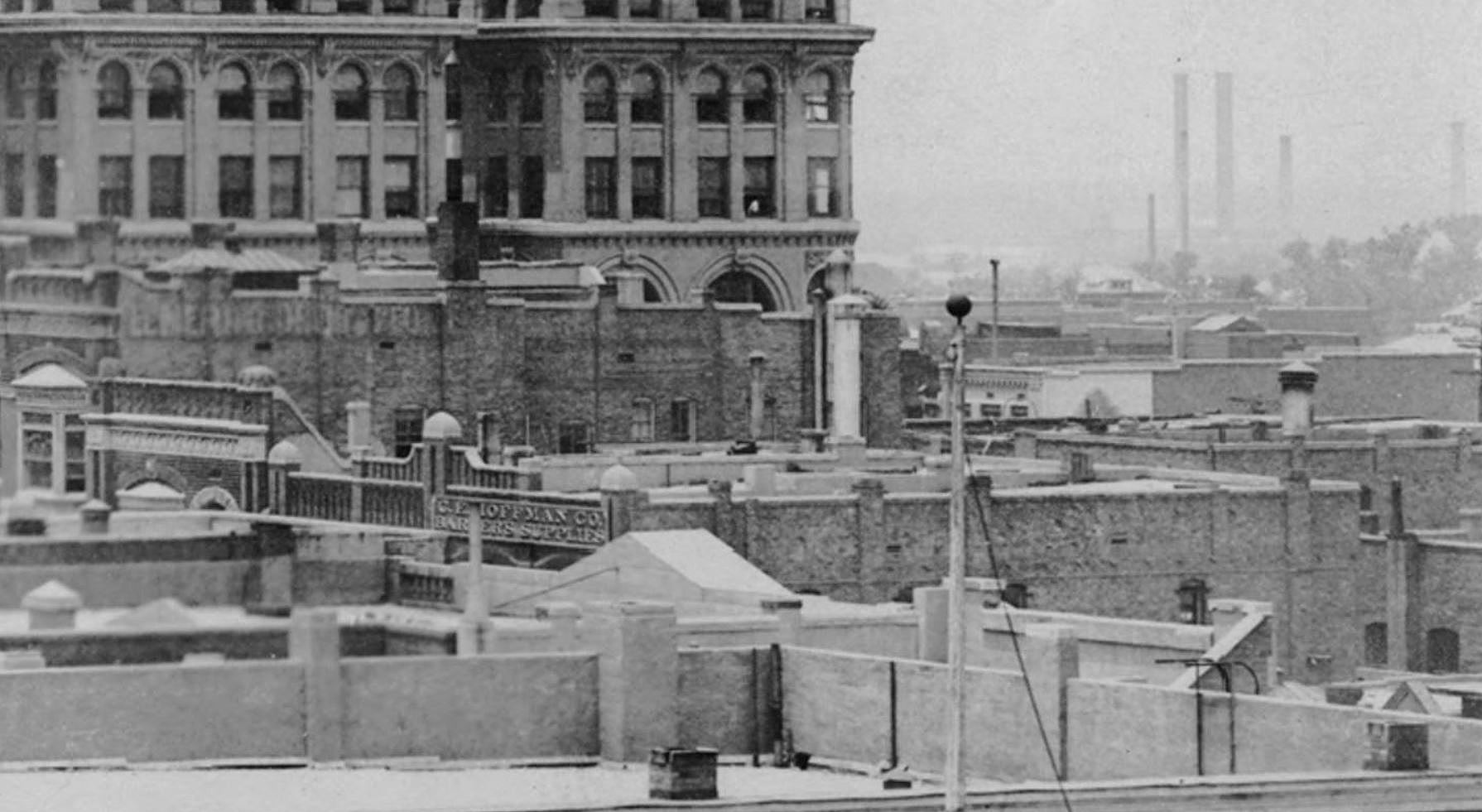
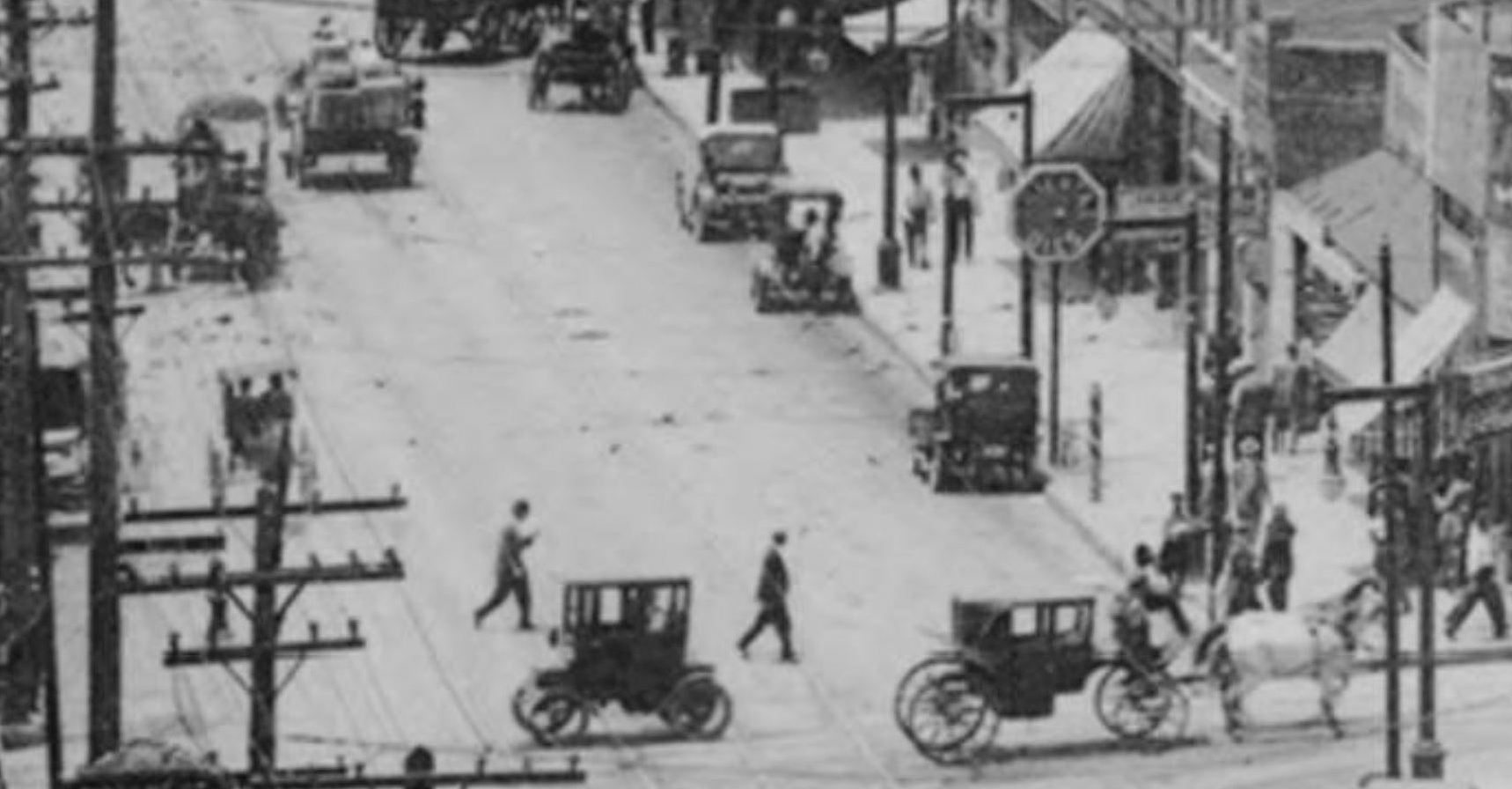
The photo above is from the indispensable collection at SMU’s DeGolyer Library. It shows a very busy Commerce Street in 1913, taken from the top of the YMCA building at St. Paul, looking west. The two landmarks at either end of Commerce are the first location of the Majestic Theatre at 1901 Commerce (northeast corner of Commerce and St. Paul), seen in the bottom right corner, and the Adolphus Hotel at the top left. I love this photo, mostly because it shows horse-drawn conveyances and automobiles sharing the streets in an already car-crazy Dallas, something that might not be that noticeable at first glance until you start zooming in to see magnified details. Let’s zoom in. Way in. (All images much larger when clicked.)

1-rooftops-skyline

2-traffic-skyline-1

Dallas has begun to look like a big city.

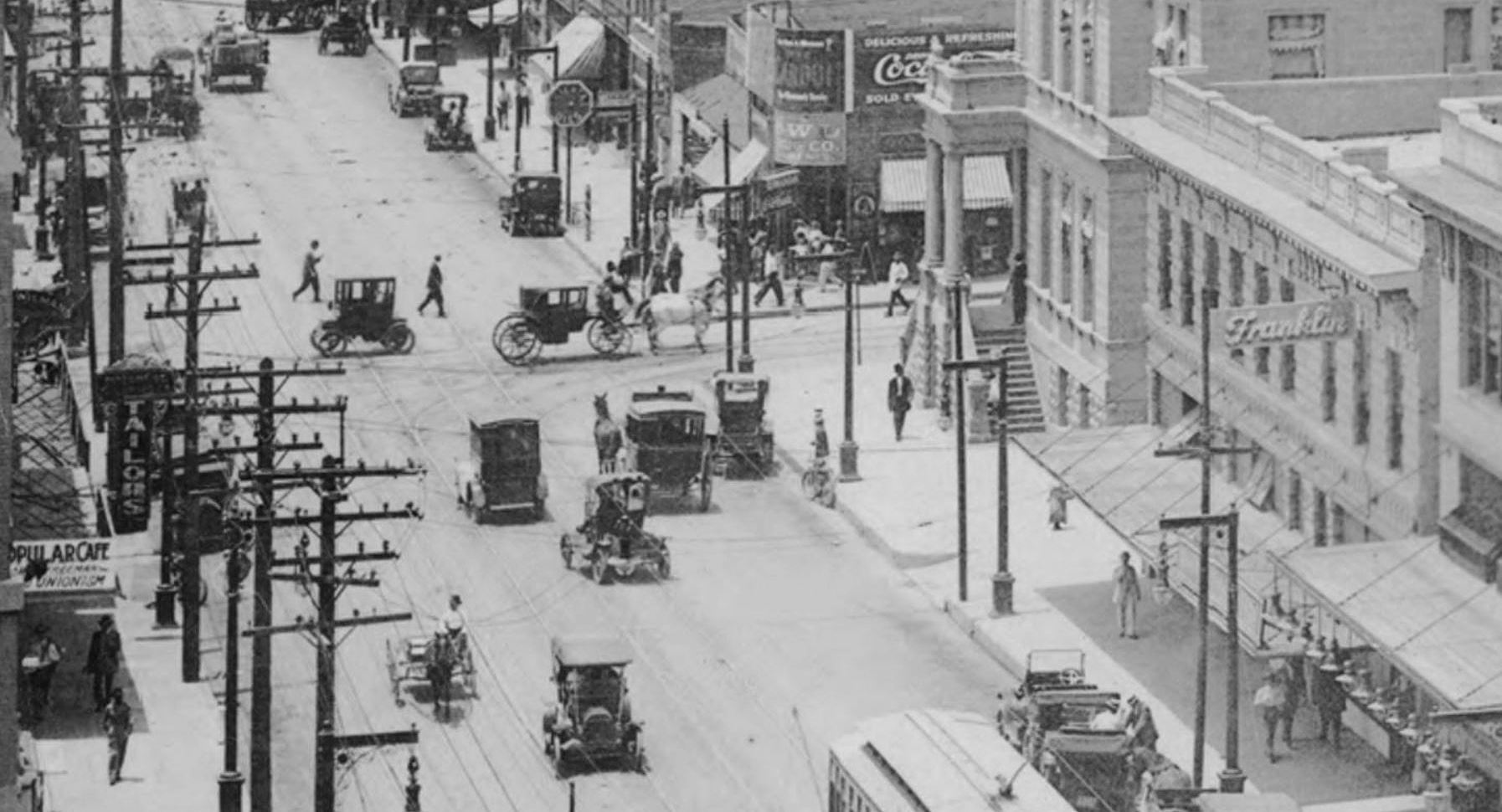
3-traffic-skyline-2

Below, the building on the right with the steep steps is the old Post Office/Federal Building at Ervay. The Mercantile Bank Building was built on that site in 1942.

4-traffic-skyline-3

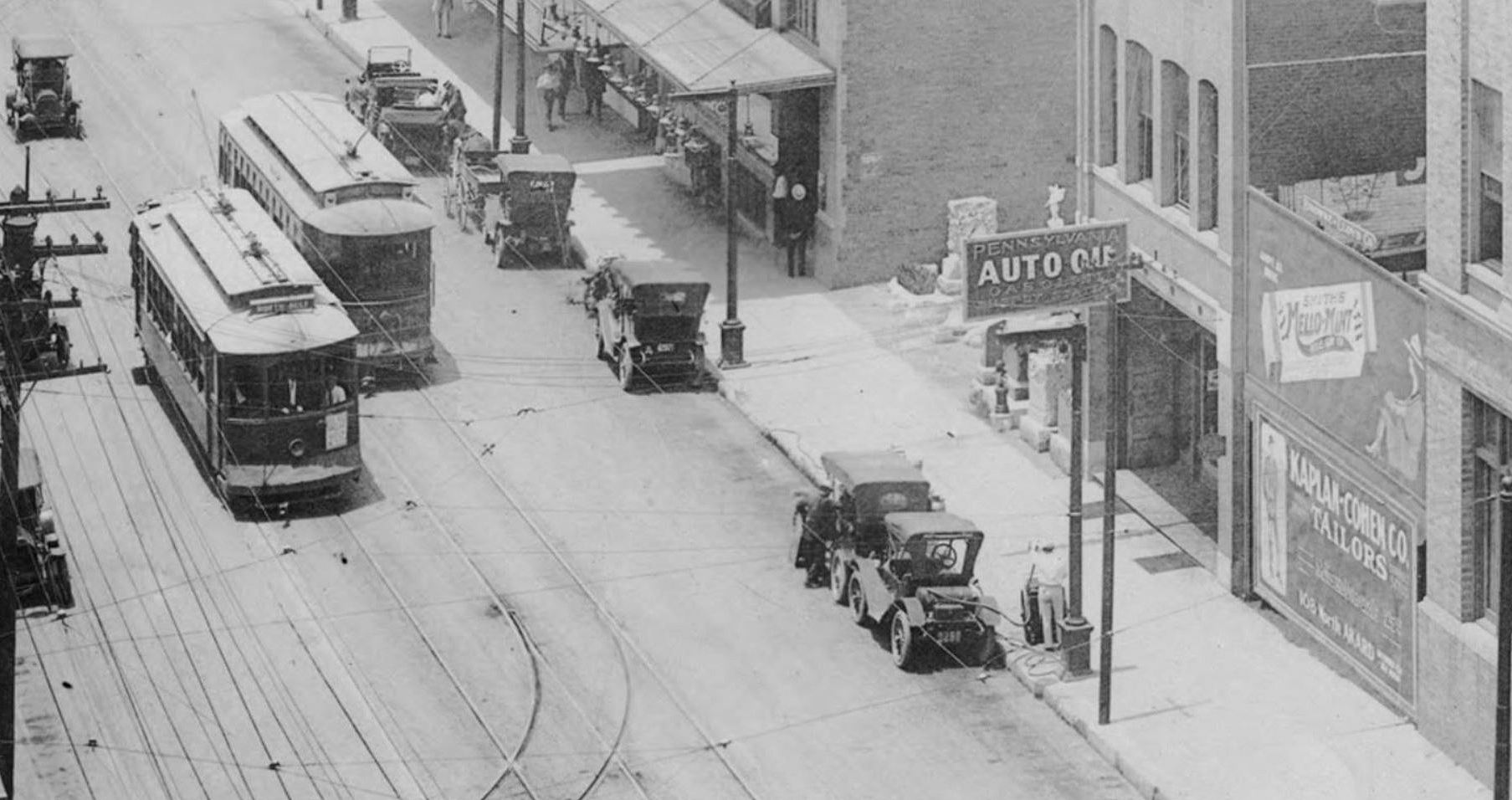
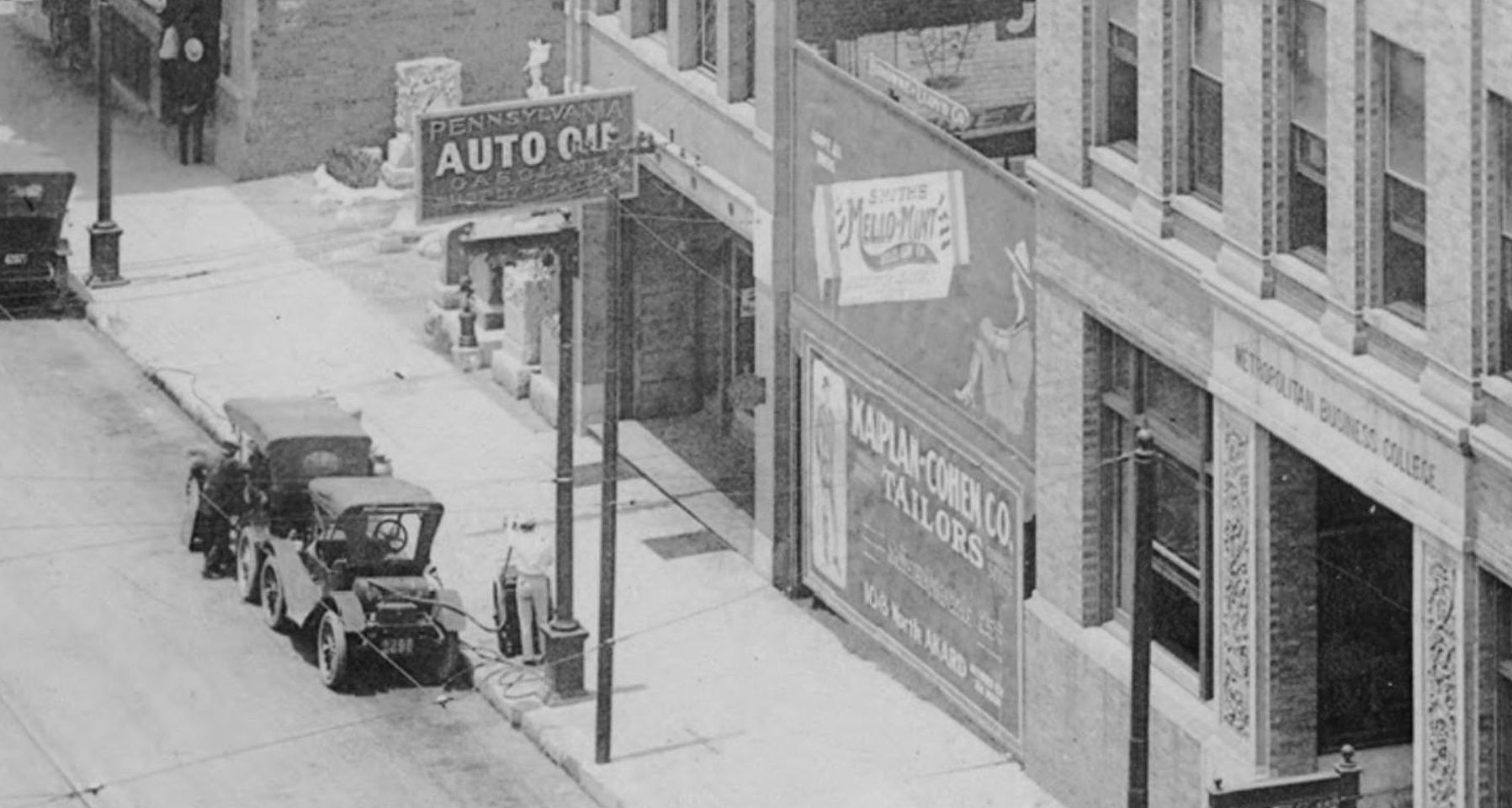
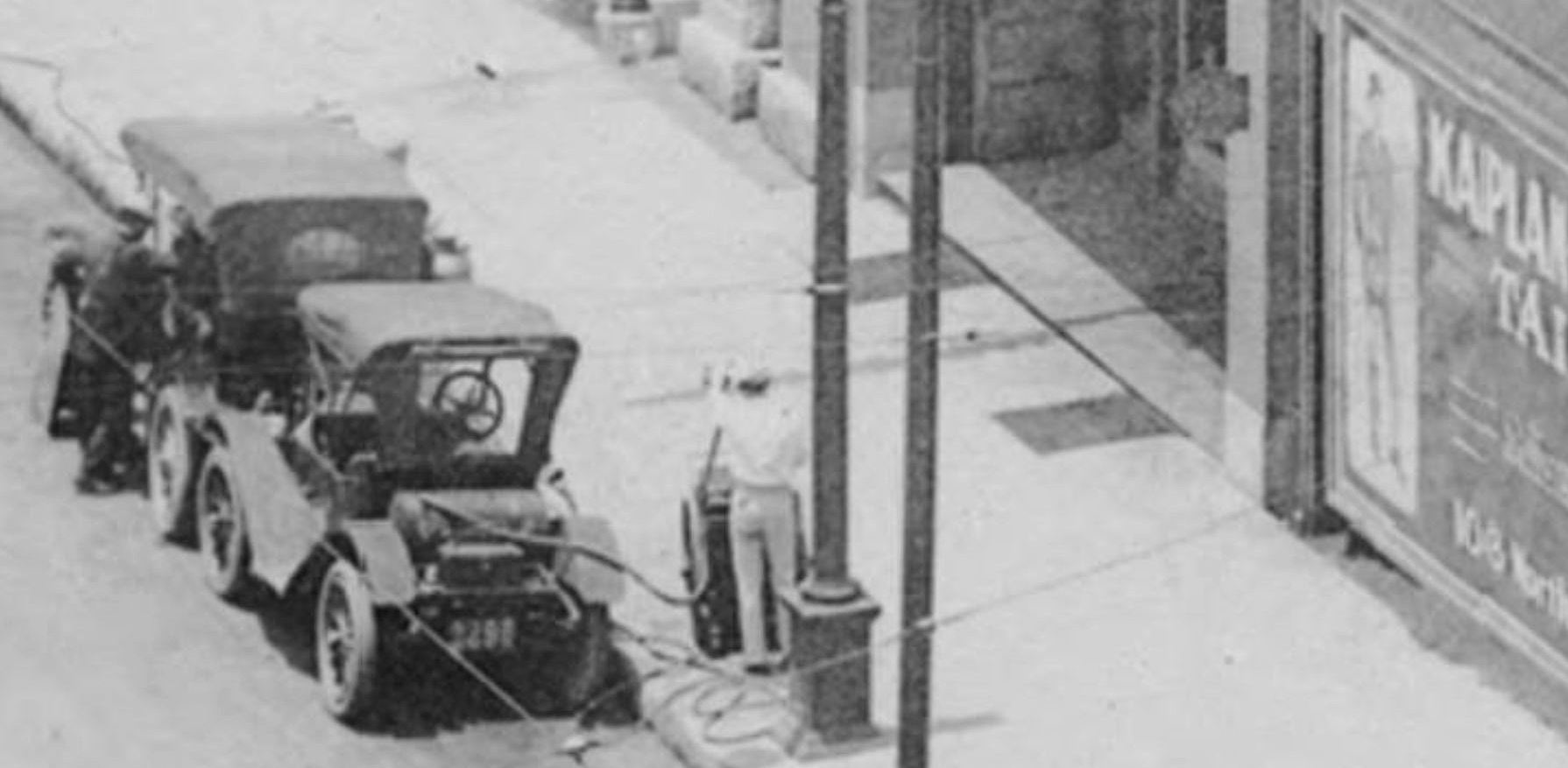
I love the detail below for a couple of reasons: first, the car at the curb at the lower right is parked next to what is purported to be the first gas pump in Dallas (the sign next to it that looks like a stop sign says “Oriental Oils” — more below); secondly, the ratio of cars to horses is pretty even.

5-traffic-skyline-4

A block east of the Oriental Oil gasoline feuling station is the Pennsylvania Oil Company feuling station, at 1805 Commerce. When I first saw this last year, I was so excited to discover this seemingly mundane little detail that I wrote an entire post about these early curbside gas pumps (read “Oriental Oil Company: Fill ‘er Up, Right There at the Curb” here).

7-gas-skyline-1

And a couple more close-ups of this exotic thing which I still find inexplicably fascinating.

8-gas-skyline-2

9-gas-skyline-3

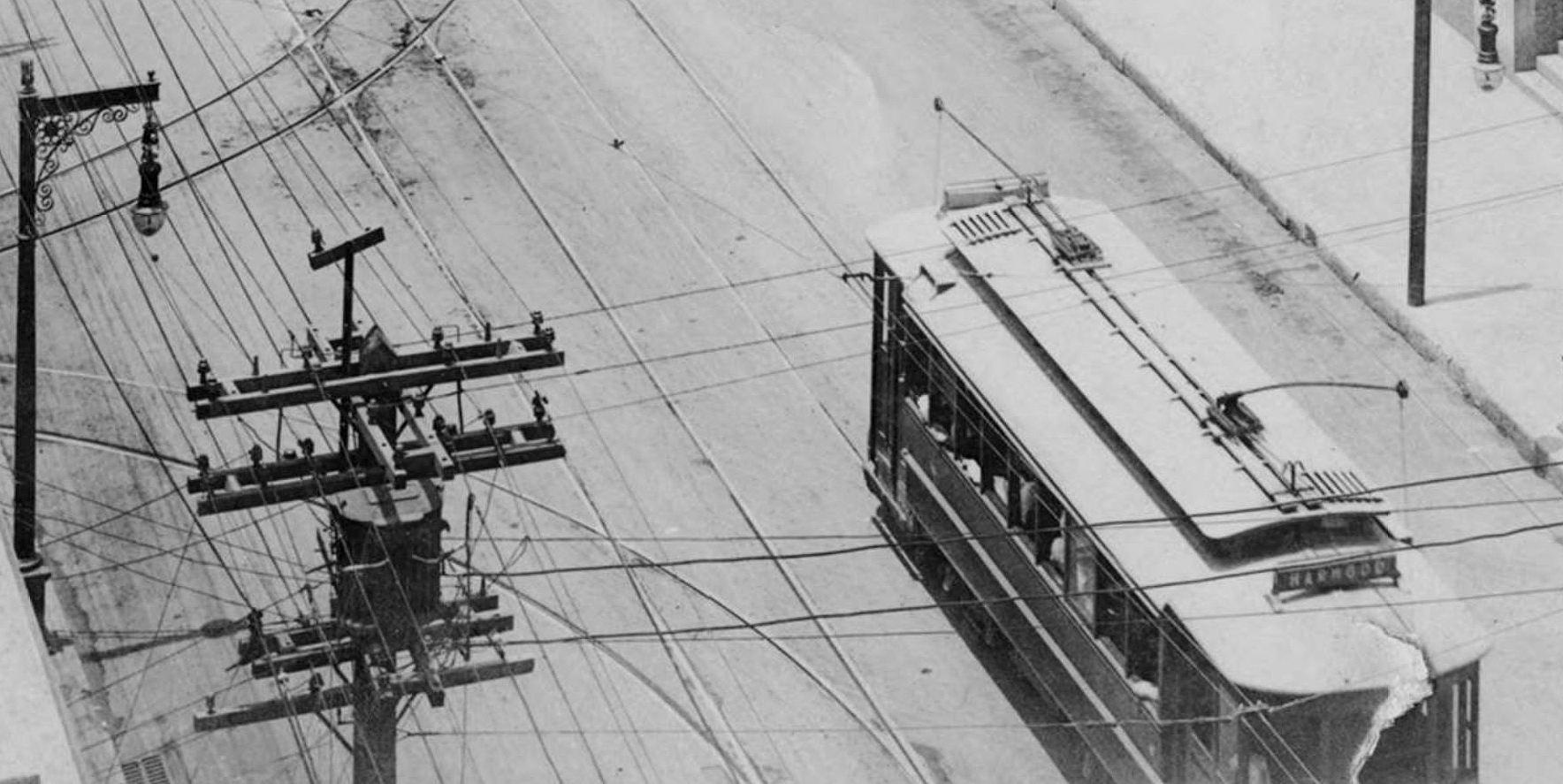
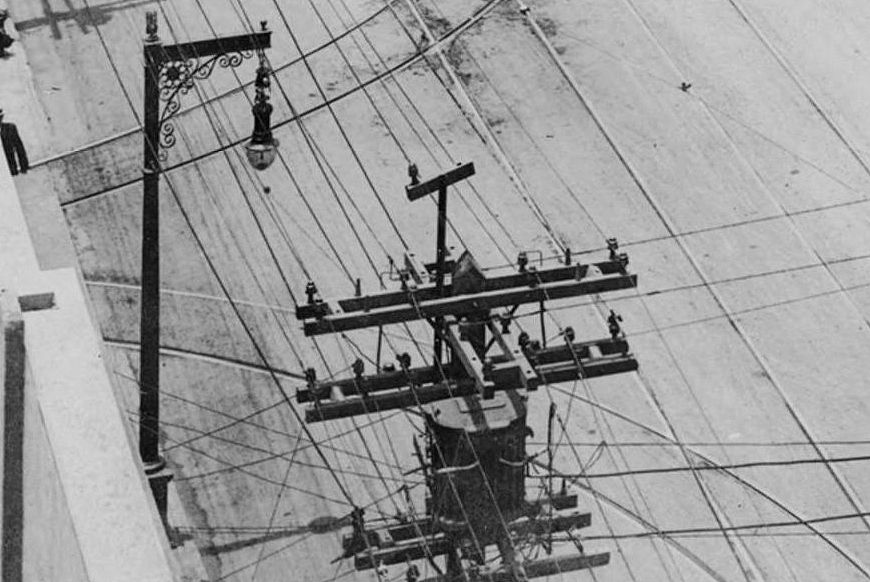
So many wires, and tracks. The Harwood streetcar is cool, but that streetlight is cooler.

10-lamp-skyline-1

11-lamp-skyline-2

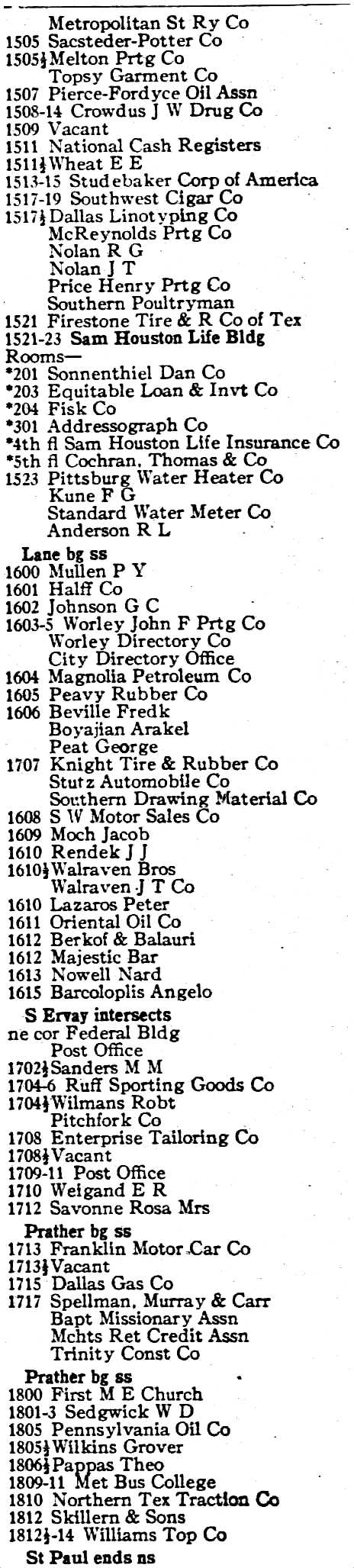
Below, a listing of most of the businesses seen along this stretch of Commerce, from the 1913 Dallas directory.

commerce-street_1913-directory***

Original photo is titled “New Skyline from Y.M.C.A., 1912 & 1913,” taken by Jno. J. Johnson, from the DeGolyer Library, Central University Libraries, Southern Methodist University; it can be viewed here. I have corrected the color.

The current Google Street View of Commerce looking west from St. Paul can be seen here. Very different.

UPDATE: This photograph is from 1913. The Busch Building (later the Kirby Building) began construction on the steel superstructure of the building at the end of December, 1912. The building had reached 13 stories by May, 1913 and was completed in November or December, 1913. I have updated the title from “ca. 1912” to “1913.”

All of these images are really big. Click them!

*

Copyright © 2015 Paula Bosse. All Rights Reserved.

The Terrill School — 1914

terrill-school_tx-almanac_1914-detThe Terrill School, 4217 Swiss Avenue

by Paula Bosse

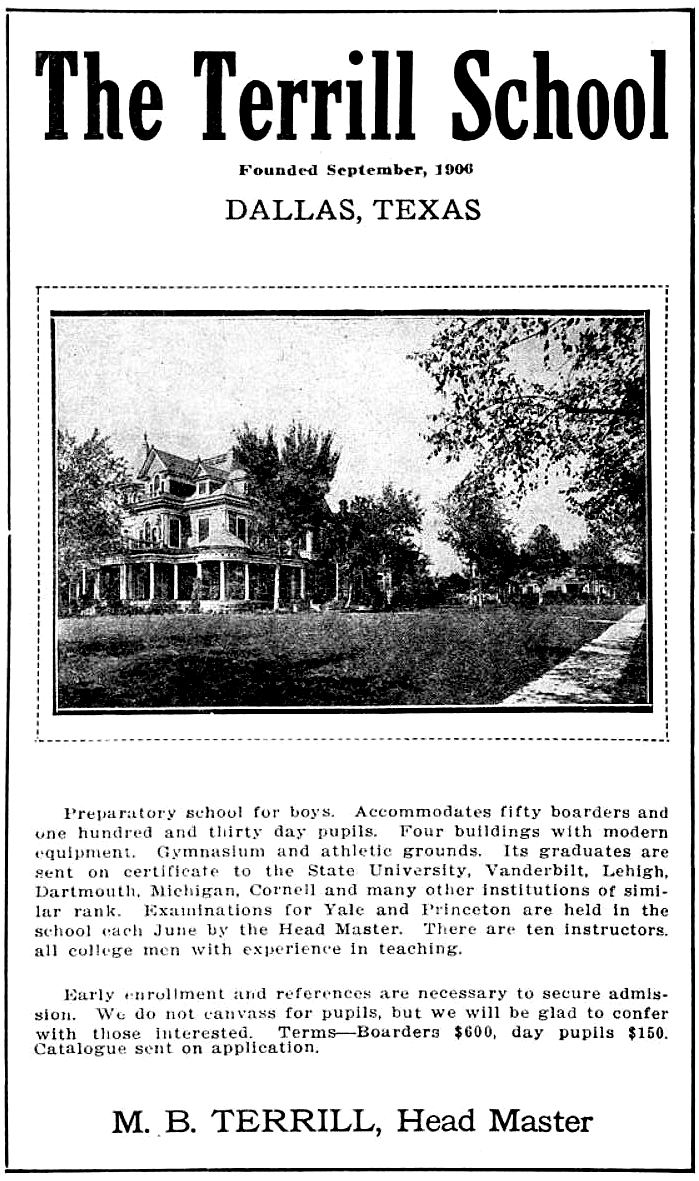
The Terrill School was for many years THE top prep school for boys in Dallas. Founded in 1906, it was located at the corner of Swiss and Peak in Old East Dallas until a move to Ross Avenue in the early ’30s. After a series of mergers over a span of years, it eventually became St. Mark’s School of Texas. Below, an ad that appeared in the 1914 edition of The Texas Almanac. (Click for larger image.)

terrill-school_tx-almanac_1914

I’m never sure how accurate The Inflation Calculator is, but when those numbers are run through it, in today’s money, parents would be forking over $14,000 a year if their sons lived on the campus, or $3,500 a year if they were students who lived at home.

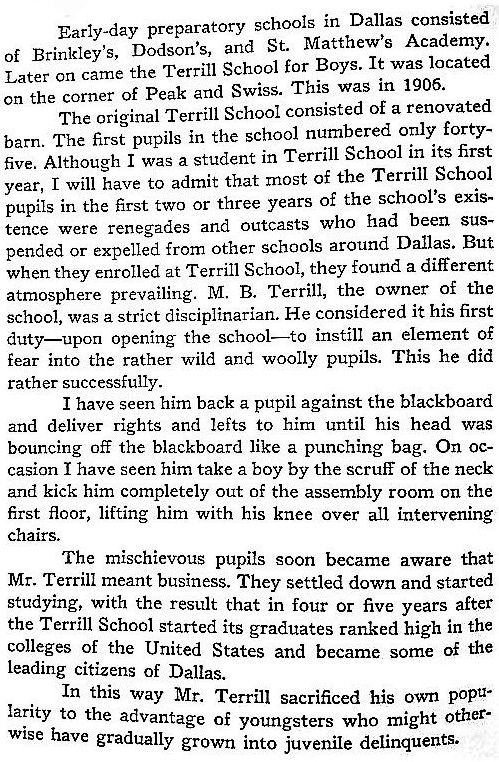
Hundreds, if not thousands, of successful businessmen and civic leaders spent time at the Terrill School. According to an eyebrow-raising account of life at Terrill — written by Dallas Morning News publisher Ted Dealey — those early days sounded more like a reform school than a prestigious prep school. One can only hope the practices he describes below did not last very long.

terrill_dealey_p28from “Diaper Days of Dallas” by Ted Dealey (1966)

Seems to have turned Ted Dealey around!

***

Sources & Notes

Ad from the 1914 edition of The Texas Almanac.

The passage by Ted Dealey is from his (highly recommended!) book, Diaper Days of Dallas (Nashville: Abingdon Press, 1966), p. 28.

More photos and background on The Terrill School can be found in the post “George Cacas, The Terrill School’s Ice Cream Man — 1916,” here.

*

Copyright © 2015 Paula Bosse. All Rights Reserved.

An Afternoon Outing with SMU Frat Boys & Their Dates — 1917

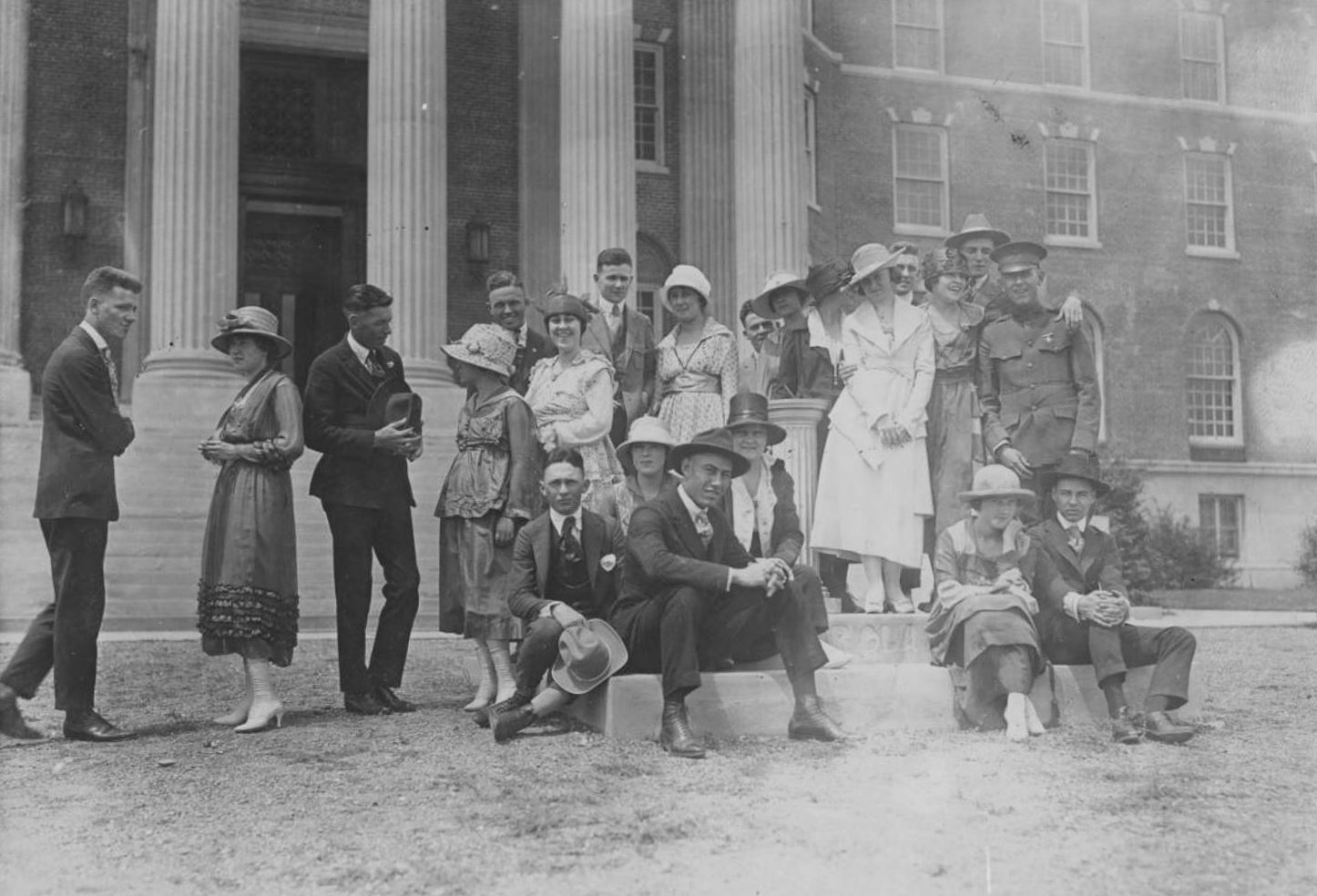
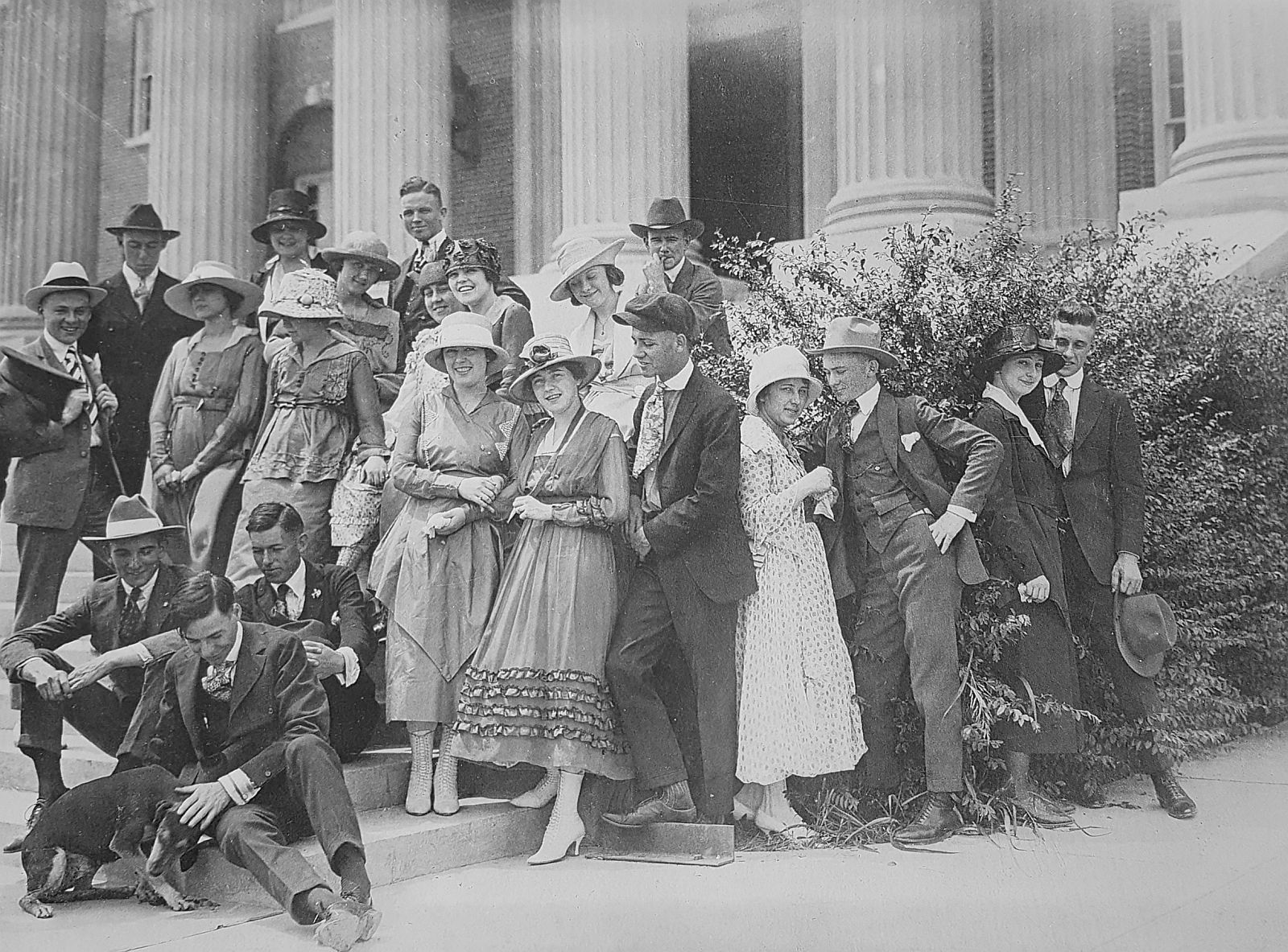
smu_omega-phi_dallas-hall_1917_degolyerCampus couples, 1917

by Paula Bosse

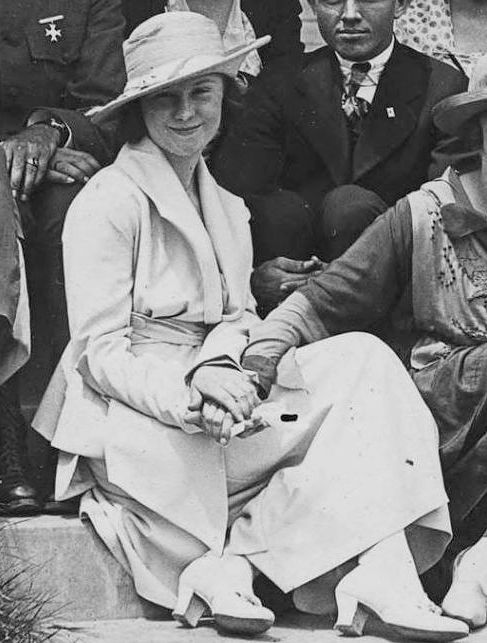
I came across three wonderful World War One-era photos in the SMU archives while I was looking for something else. You know how you can become enthralled by the charm of old photos and sit for long stretches of time staring at every little detail and wondering about the lives of the unidentified people who populate them? That happened to me with these. There is one particular young woman who stands out more than anyone else. Not only is she the best-dressed person in the photos, she also seems calm, collected, and serene. She looks friendly. She was probably very pleasant to have around.

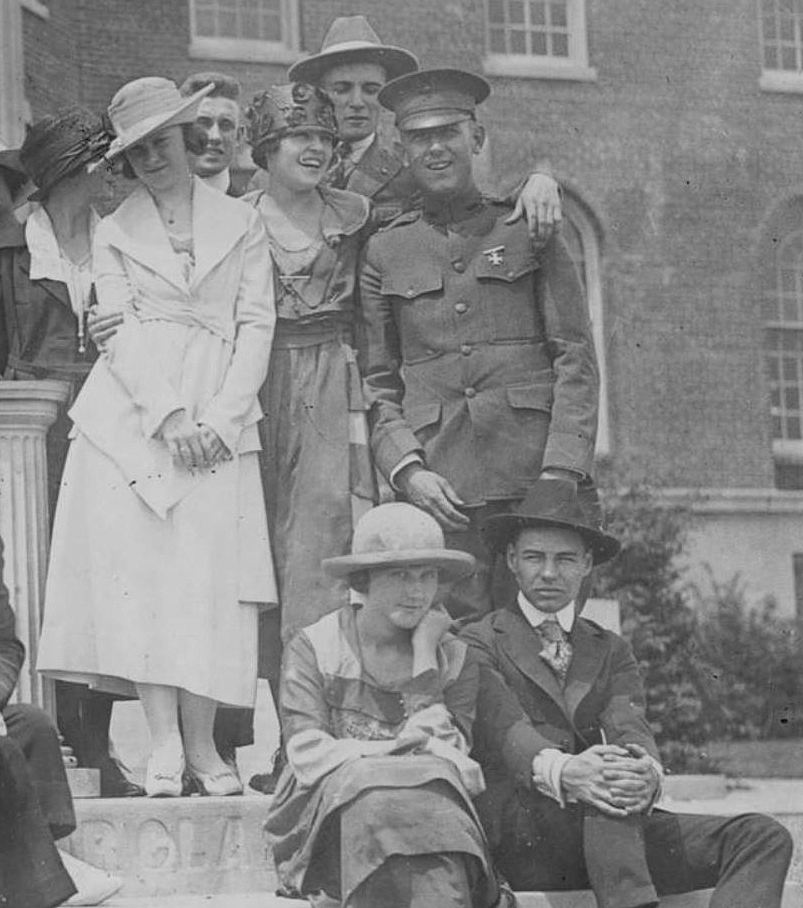
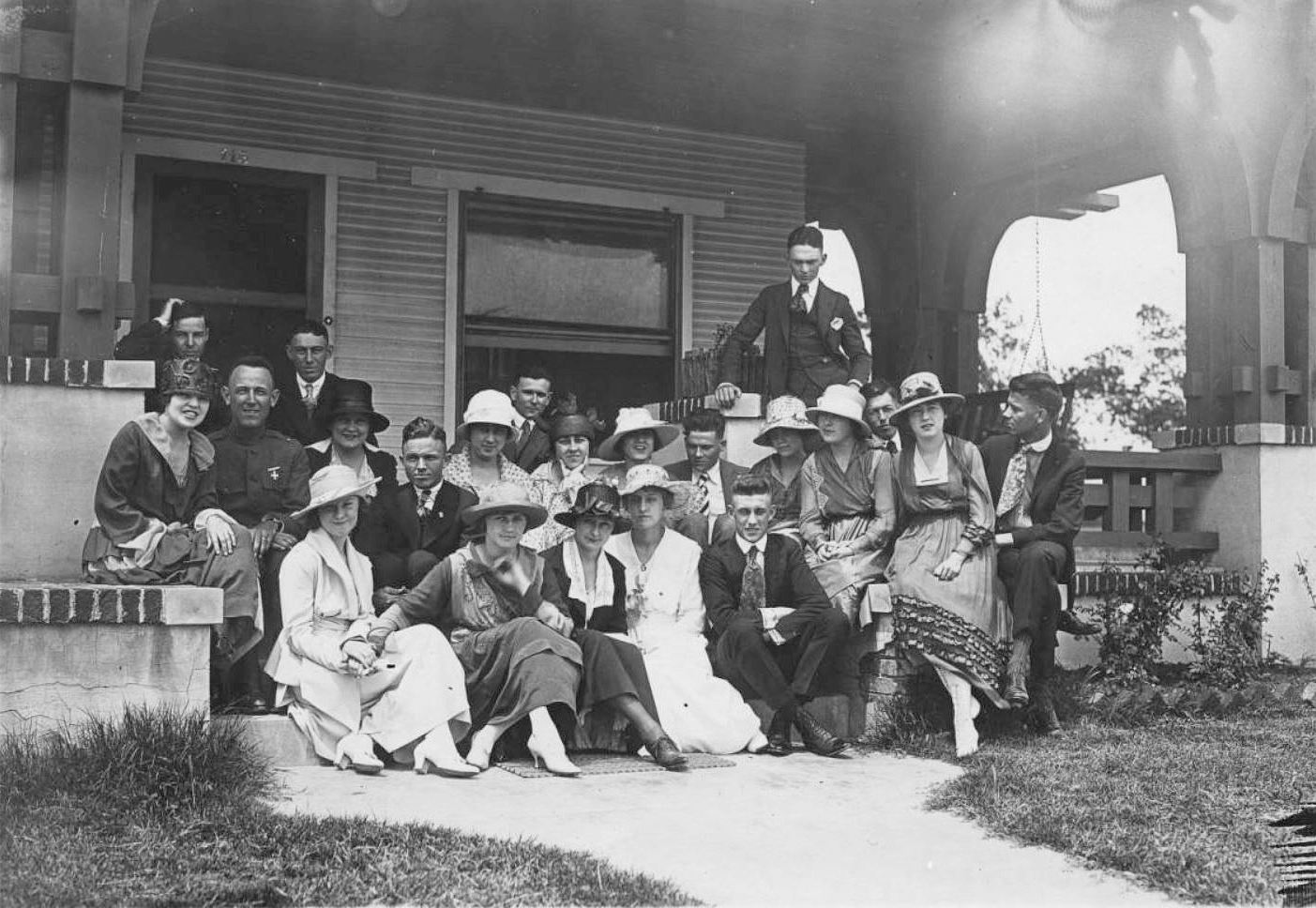
These three photographs show a group of ten young couples and a pair of chaperones spending a beautiful sunny day together, with the highlight of the day being a trip to Highland Park’s Exall Lake. The men are SMU students, identified only as members of the Omega Phi fraternity. The women are identified merely as “dates,” but I’m sure that some of them were also SMU students. The photograph above shows the crowd gathered on campus in front of Dallas Hall. The woman in white looks like she’s on a pedestal, glowing in a spotlight. Below, a closer look at her stylish outfit (as well as a look at the young be-medaled WWI soldier next to her).
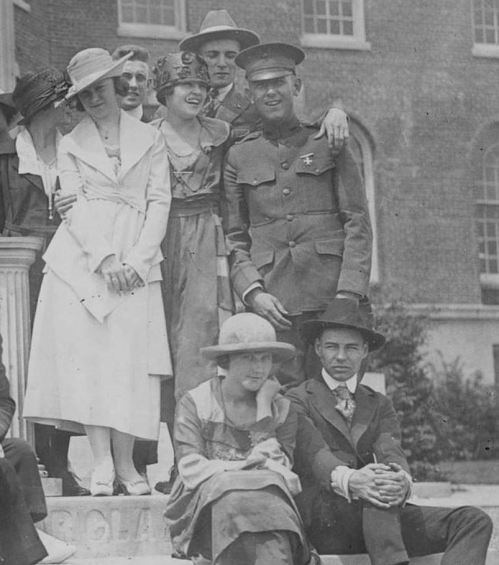
smu_omega-phi_dallas-hall_1917_degolyer-det1

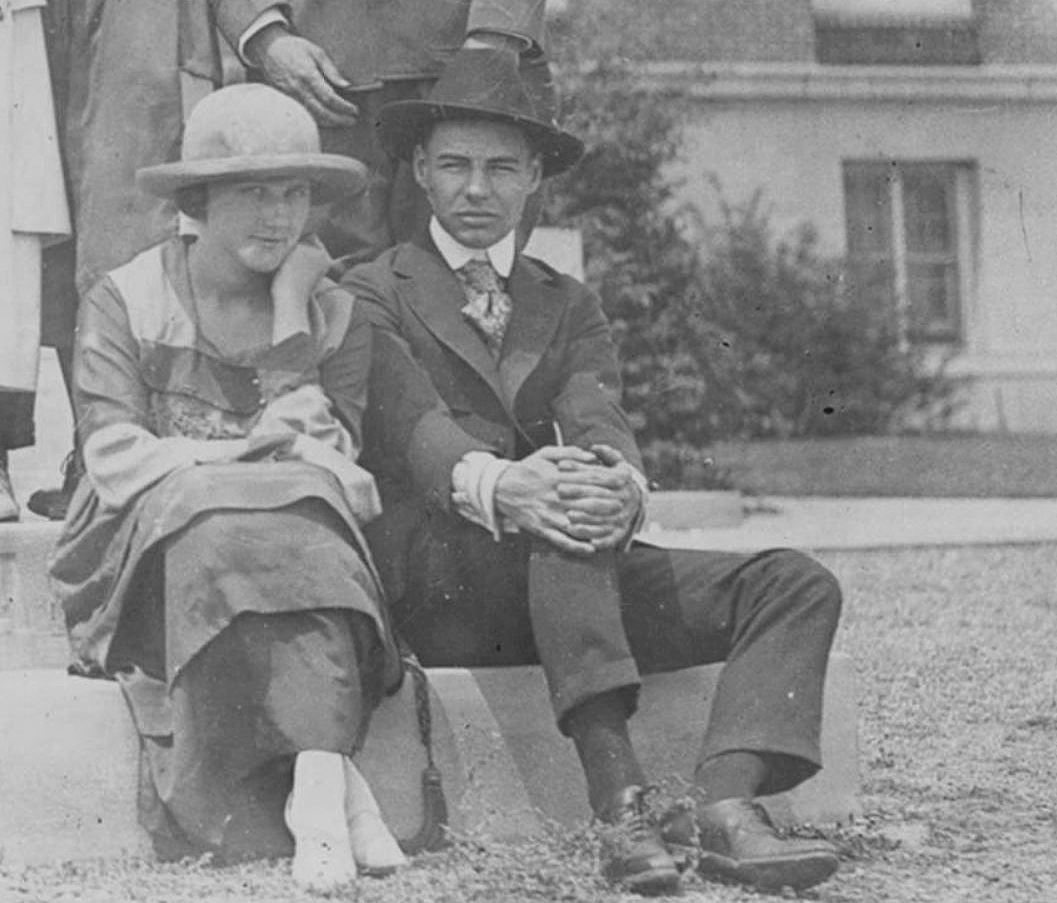
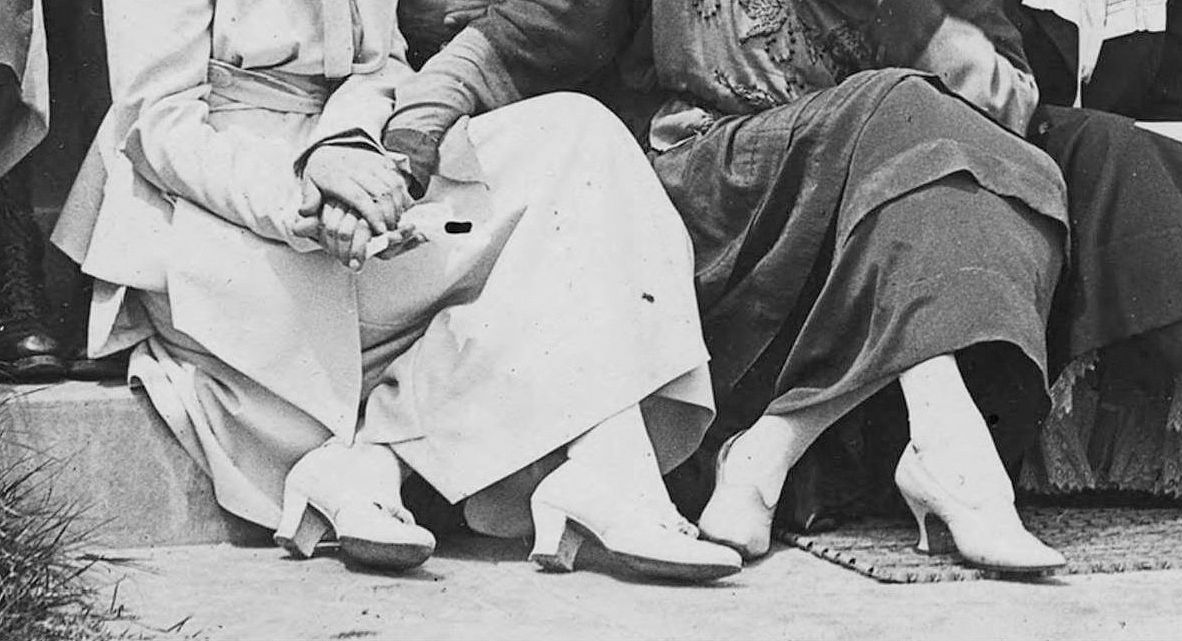
And, below, a similar detail, but this one showing the daintily crossed ankles of another pretty girl, seated beside a sour-looking companion.
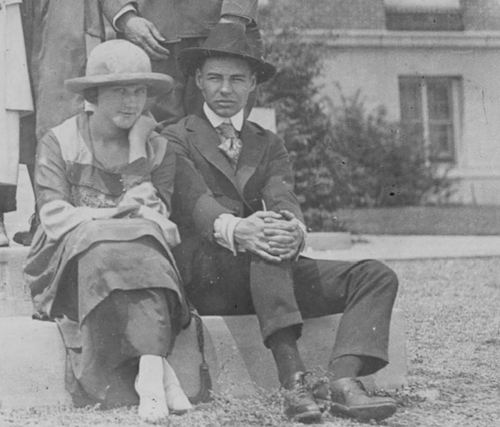
smu_omega-phi_dallas-hall_1917_degolyer-det2

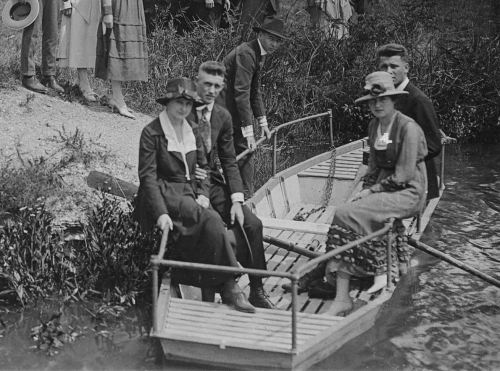
And here’s the gang on the idyllic banks of Exall Lake. Diane Galloway included this photograph in her book The Park Cities, A Photohistory with this caption:

At one time a bridge crossed Exall Lake near the Cary house, shown in the distance. The photographer was standing on the bridge to capture this picture of well-dressed SMU students going boating on the lake. A trip to Lakeside Drive was one of the few off-campus excursions permitted in 1917.

I love this photo. If I didn’t know what the Turtle Creek area looked like, I’d be hard-pressed to identify this as Dallas!
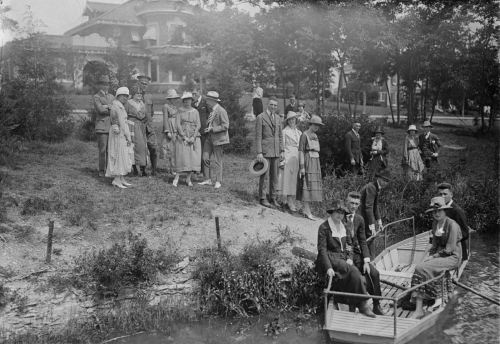
smu_omega-phi_exall-lake_1917_degolyer

Here’s a close-up of the beatific, smiling woman in white. I like the kid lurking in the background.
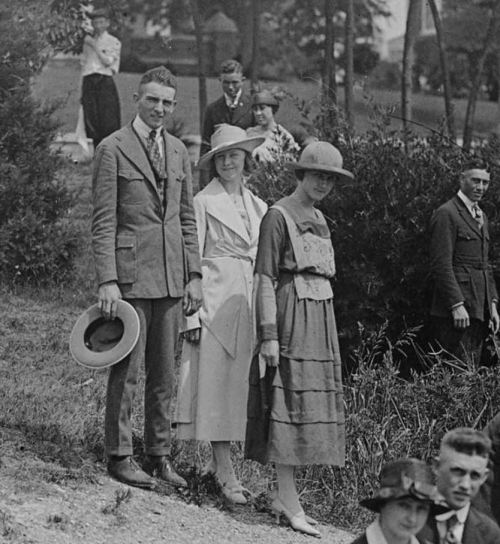
smu_omega-phi_exall-lake_1917_degolyer-det1

And the boat.

smu_omega-phi_exall-lake_1917_degolyer-det2

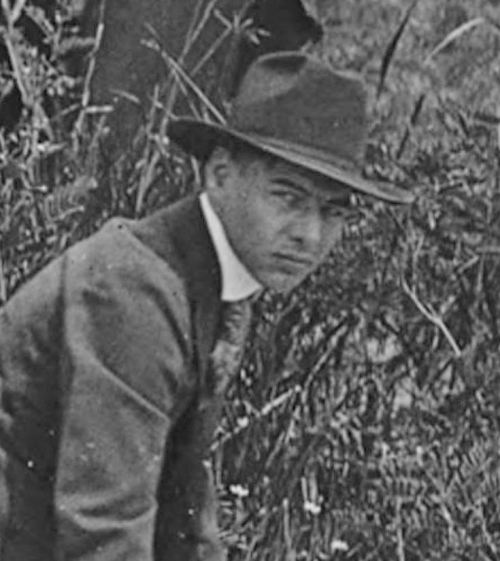
And the sour-looking guy again, looking even more annoyed than before.
smu_omega-phi_exall-lake_1917_degolyer-det3

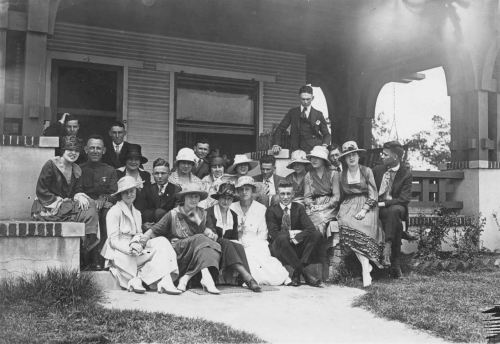
And here’s the crowd sitting on the steps of the frat house (which was located at Haynie and Hillcrest). The personnel has changed a little bit (they gained a woman and lost a man), but (almost) everyone seems pretty happy.
smu_omega-phi_porch_1917_degolyer

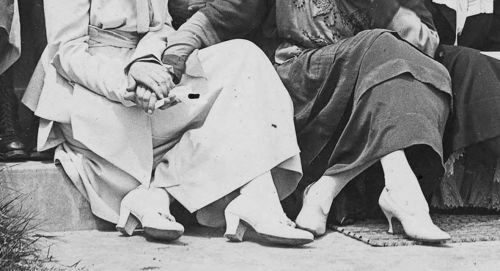
And, below, my very favorite detail from these three photos.
smu_omega-phi_porch_1917_degolyer-det1

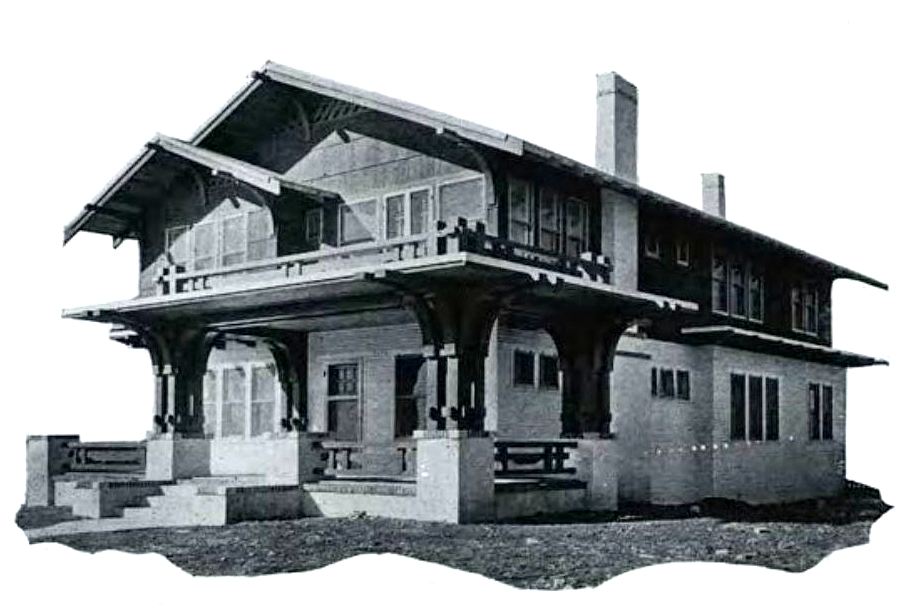
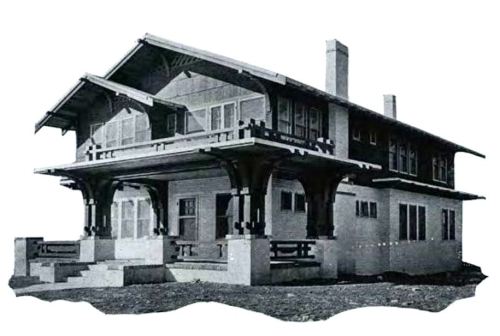
After a bit of sleuthing, I found a picture of the house at the time these photos were taken. It was actually a residence which was, I think, being rented out to the small group of Omega Phis. They had a proper fraternity house built several years later.
omega-phi-house_rotunda_1917

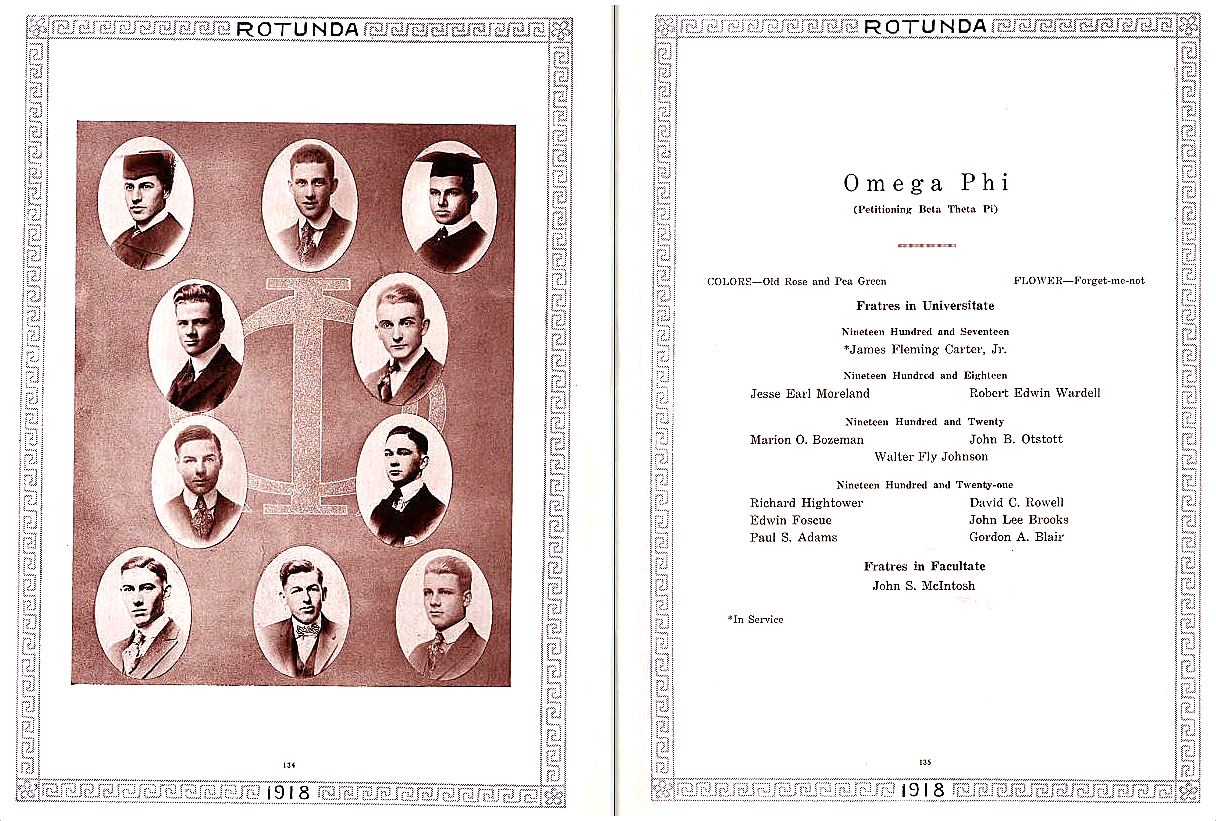
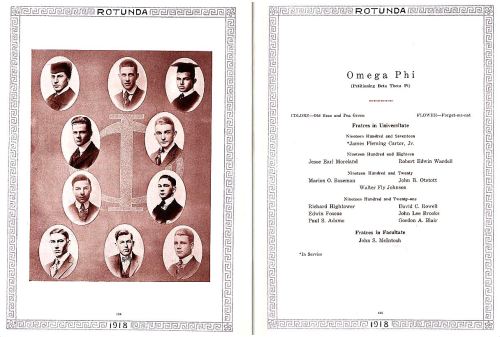
The top photo had “1917” written on the back, so I checked SMU’s Rotunda yearbooks from around that time. Here’s a look at the men who were members of Omega Phi in 1918. Several of these faces match the ones in the photos of the afternoon outing.
omega-phi_rotunda-1918

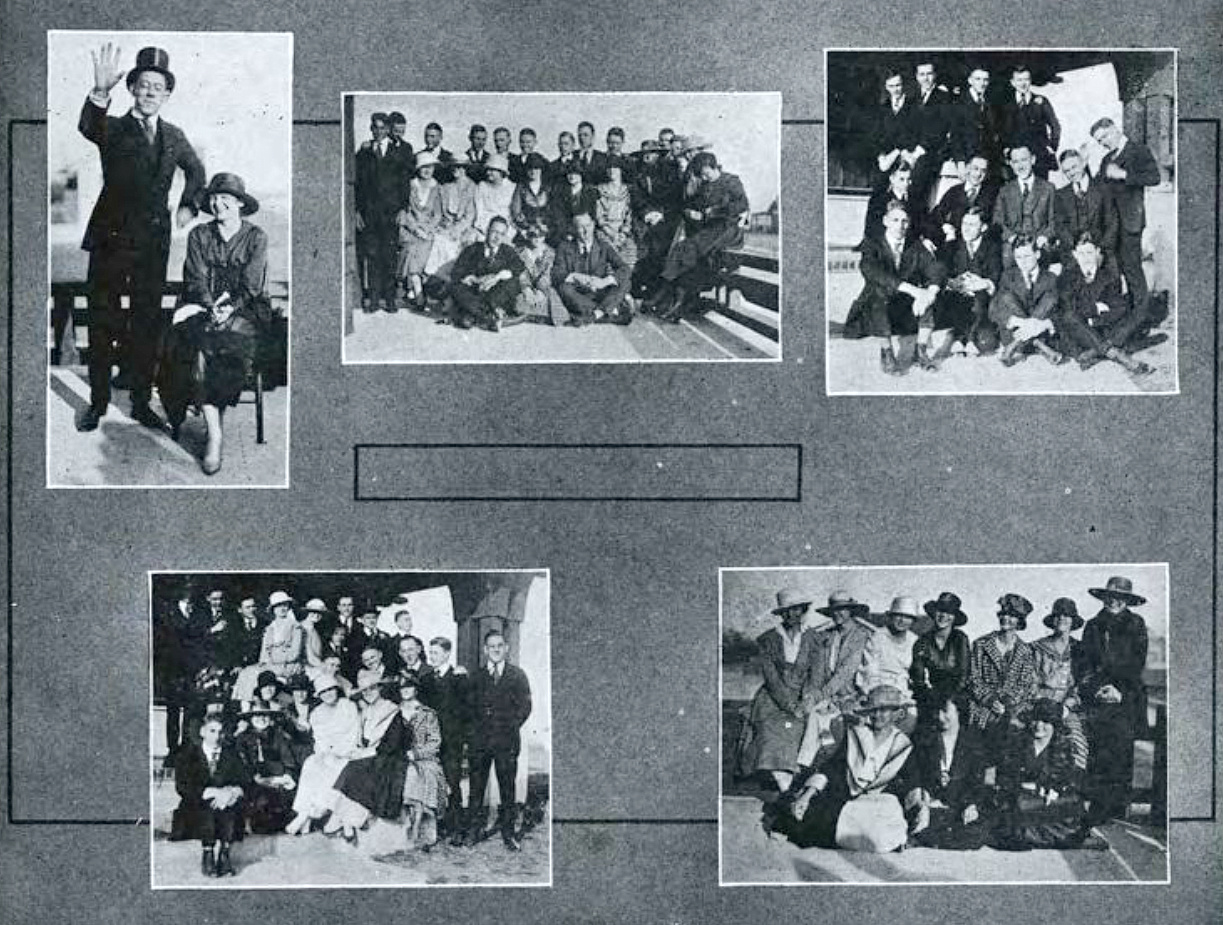
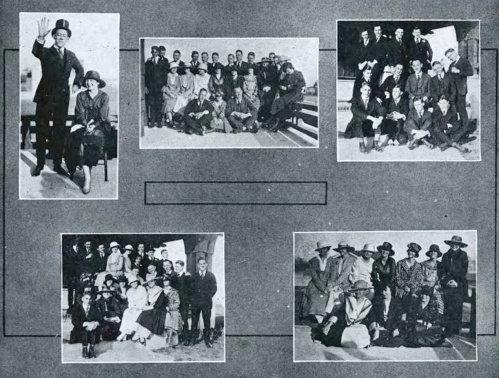
And, below, a photo collage from the Omega Phi page of the 1917 Rotunda. Several of the women look familiar. I see the Woman in White in at least one of these snapshots.
omega-phi_photos_rotunda_1917

And here she is, close up. I hope she was as happy, intelligent, and confident in her real life as she appears to be in these photos.
smu_omega-phi_porch_1917_degolyer-det2

***

Sources & Notes

The three photos of the afternoon outing all come from the collection of the DeGolyer Library, Central University Libraries, Southern Methodist University:

  • “Omega Phi Fraternity members and their dates in front of Dallas Hall” is here.
  • “Omega Phi Fraternity member outing to Exall Lake” is here.
  • “Omega Phi Fraternity members and their dates on porch” is here.

The quote from Diane Galloway comes from her FANTASTIC book, The Park Cities, A Photohistory (Dallas: Diane Galloway, 1989), p. 24.

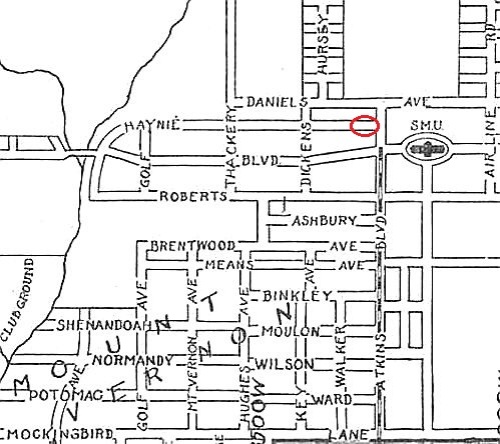
The ersatz Omega Phi fraternity house was located at 115 Haynie Avenue, just west of Atkins (now Hillcrest). (The photo of the exterior of the house is from the 1917 SMU Rotunda yearbook.)
omega-phi_map_19191919 map (detail), Portal to Texas History

I have absolutely no idea how college fraternities work, but it seems that when they formed on the SMU campus in 1915, the Omega Phi group was not actually affiliated with a national fraternity. They “petitioned” to be chartered by national groups, but they finally stopped trying after 11 years of, I guess, being repeatedly turned down — in 1926 they declared themselves to be an “independent society.” But one year later, they were granted a charter by the national Kappa Sigma fraternity. In the Dallas Morning News article announcing the news, this sentence was included: “The local chapter will be known as Delta Pi chapter.” I have no idea what any of that means, but if you’re really into these things, read the DMN article “Kappa Sigmas Grant Charter” (Sept. 26, 1927), here.

As for the identities of the women in the photos, it’s a mystery. I would assume, though, that at least some of them were the women mentioned in this little article about a cozy winter get-together at the Haynie Ave. house:
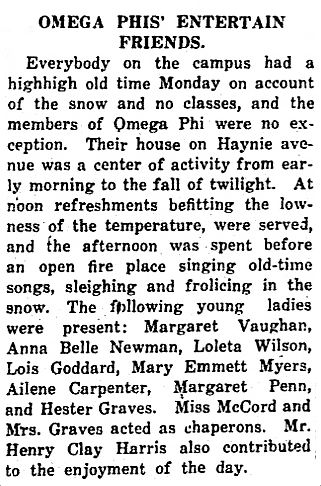
omega-phi_smu-campus_011917DMN, Jan. 19, 1917

If you’re not familiar with beautiful Exall Lake, you can watch a short, minute-long video of the lake’s history, produced to celebrate the 100th anniversary of Highland Park, here.

For other posts featuring photos I’ve zoomed in on to reveal interesting little vignettes, click here.

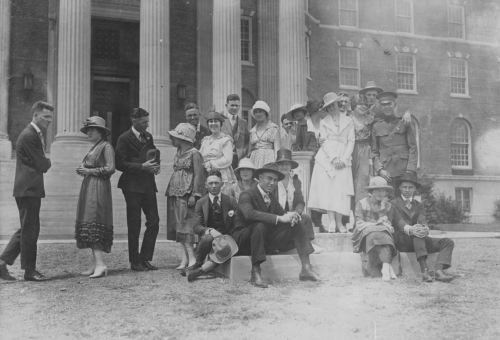
UPDATE: I stumbled across another photo of this group, from Diane Galloway’s book The Park Cities, A Photohistory:
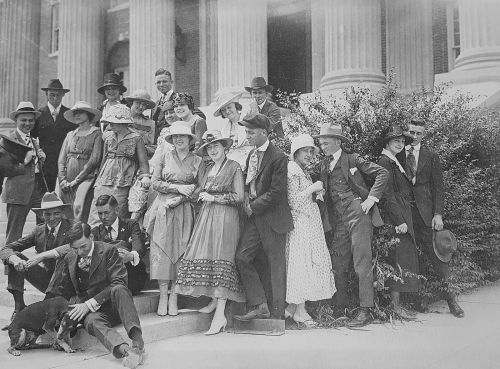
smu_group-date_park-cities-photohistory_galloway

*

Copyright © 2015 Paula Bosse. All Rights Reserved.