Flashback : Dallas

A Miscellany: History, Ads, Pop Culture

Category: 1920s

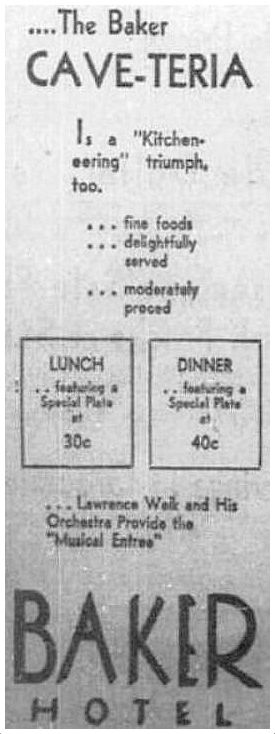
The Caveteria: “Marvelous Food at Moderate Prices”


caveteria_ebay
The finest in downtown basement dining (click for larger image)

by Paula Bosse

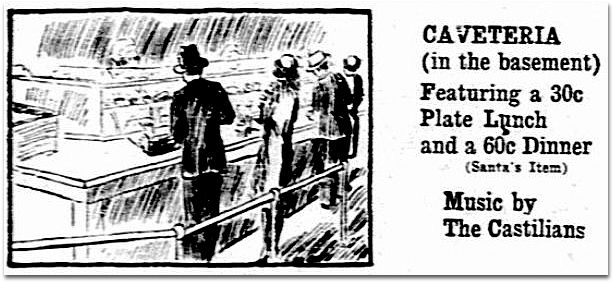
How could you NOT want to dine in a restaurant called a “Caveteria”? It was a cafeteria in the basement — the cave — of the swanky Baker Hotel, and it looks like it was a nice cheap place to grab a quick lunch downtown in the 1920s and 1930s.

caveteria_baker-hotel_postcard_ebay

*

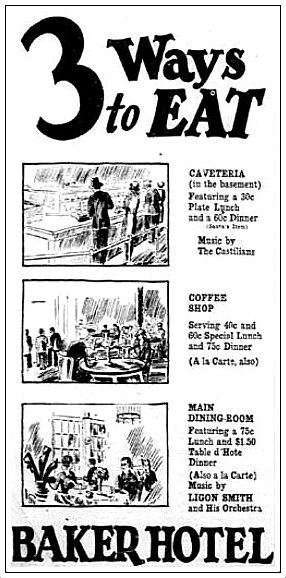
The Baker Hotel had “3 ways to eat”: one could eat cheap in the basement Caveteria (where, according to the Inflation Calculator, a 30-cent lunch in 1927 was the equivalent of about four bucks today), eat sort of cheap in the probably street-level coffee shop (lunch was about $6.75 there), and eat not cheap in the main hotel dining room (where lunch was over $10.00). (There was also the Peacock Terrace night club, well beyond reach of basement-dwelling diners.)

caveteria_dmn_120427

caveteria_dmn_120427-det1927

*

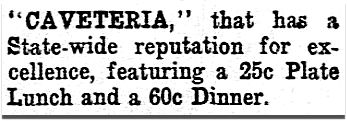
The price actually went down to a quarter by 1931 and had a “State-wide reputation for excellence.”

caveteria_dmn_020131DMN, Feb. 1, 1931

*

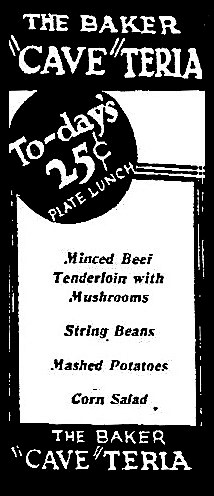
A year later the price was holding at 25 cents and it seems like a pretty good deal.

caveteria_dmn_021532DMN, Feb. 15, 1932

*

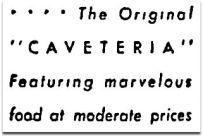
“The Original ‘Caveteria'” — accept no imitations! At least one other hotel in the Baker chain — the Gunter, in San Antonio — had a “Caveteria,” but apparently Dallas’ was first. In fact, the word and the hotel made their way into H. L. Mencken’s The American Language, Supplement One (see here).

caveteria_corsicana-daily-sun_031632Corsicana Daily Sun, Mar. 16, 1932

*

Oh yeah — live bands played while you ate your hearty meal of minced beef tenderloin. Even Lawrence Welk settled in for a stint as the “musical entree” in 1934.

caveteria_dmn_022234-lawrence-welkFeb., 1934

*

In 1942, the space once occupied by the Caveteria was turned over to the USO:

The Baker Hotel has provided the USO with what used to be the Caveteria in the basement of the hotel. It will be known as USO Club in the Cave. The entrance will be through the Akard Street entrance of the hotel.  (Dallas Morning News, Jan. 27, 1942)

*

And there it is — another place I wish I’d been able to visit.

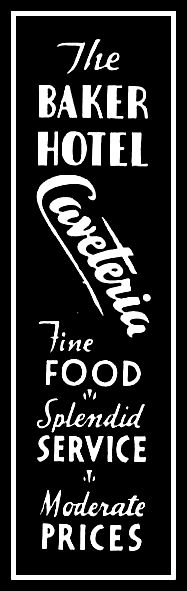
“Fine food. Splendid Service. Moderate prices.”

ad-baker-hotel-caveteria

***

Sources & Notes

Color postcards found on eBay.

The Baker Hotel opened in 1925 at Commerce & Akard on the site where the Oriental Hotel had previously stood, catty-corner from the Adolphus.

*

Copyright © 2015 Paula Bosse. All Rights Reserved.


Movie Houses Serving Black Dallas — 1919-1922

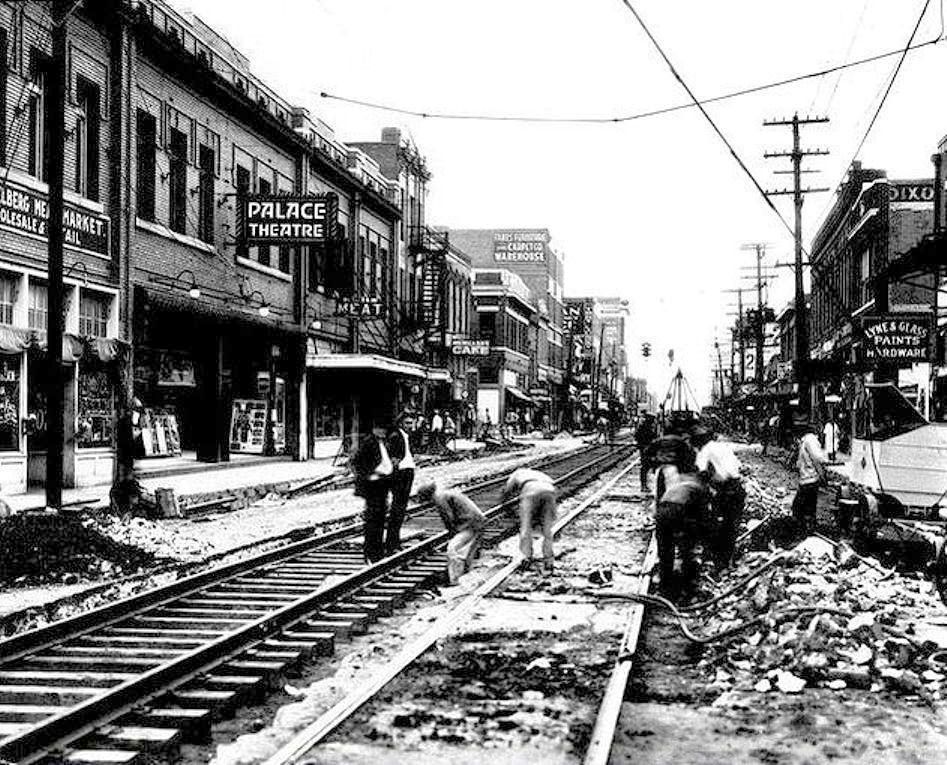
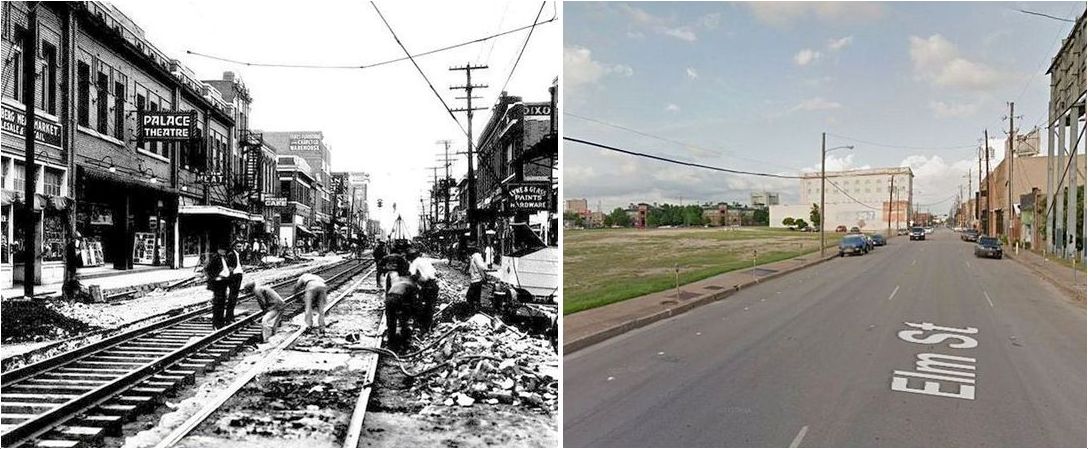
palace-theatre_elm-st_1922-dplThe Palace Theatre, Elm St., Deep Ellum, 1922 (click for larger image)

by Paula Bosse

In 1920, movie theaters — like most places in Dallas at the time — were segregated. If black customers were allowed at all in the downtown white vaudeville and movie houses, they had separate entrances and restricted seating areas (generally in the balcony). But Dallas’ African-American community had their own popular theaters, run by enterprising and energetic men who endlessly promoted their jam-packed and constantly-changing bills.

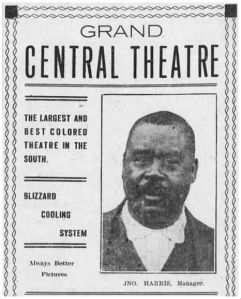
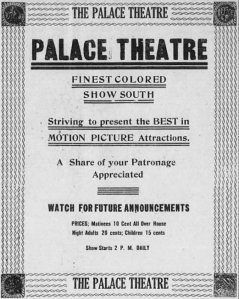
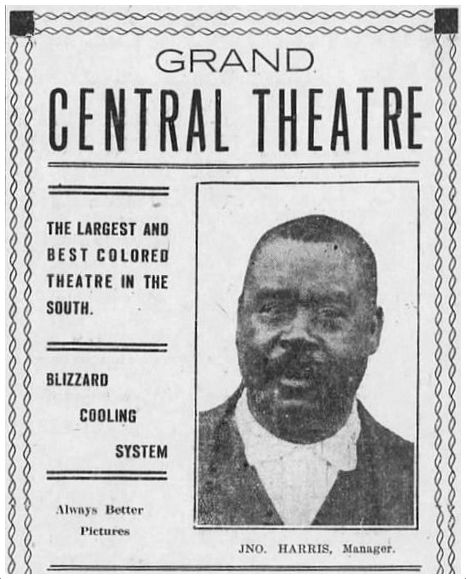
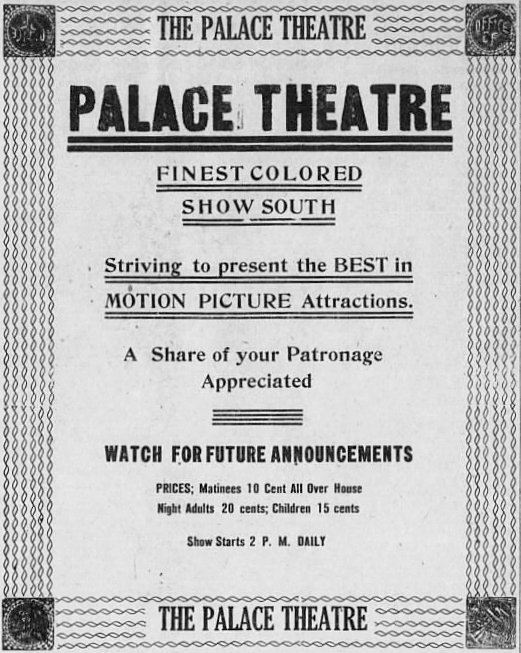
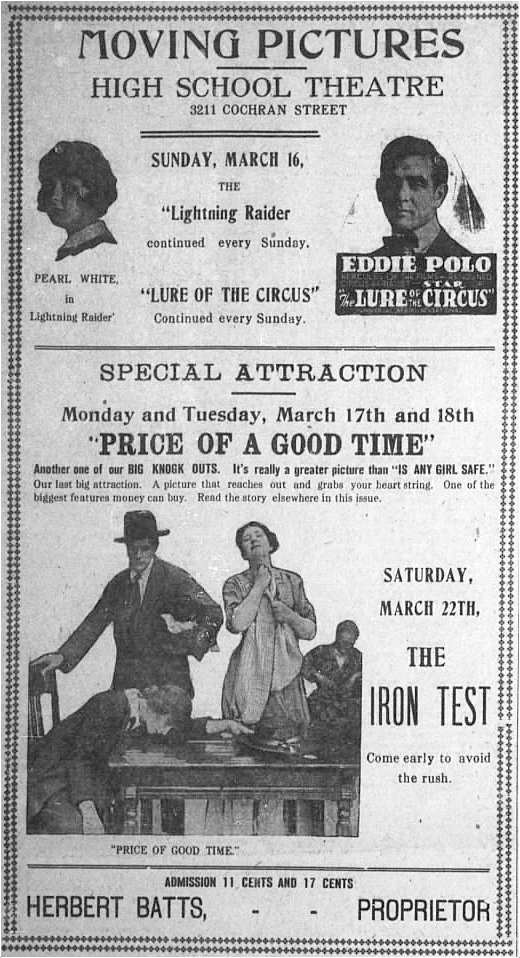
Judging by the amount of ad space purchased in the black-owned and operated Dallas Express, there were four main movie theaters catering to black Dallasites around 1920: the Grand Central Theatre, run by John Harris, the Mammoth Theatre, run by Joe Trammell, the Palace Theatre, run initially by Felix Moore, and the High School Theatre, run by Herbert Batts; the first three of these houses were in Deep Ellum, the last one was in what was then called “North Dallas.’ The theaters played both “white” films and films with “all-Colored casts.” The advertising for these theaters is great — far more ad space was available in the tiny Express to publicize the movies, the popular but now-forgotten Silent Film stars of the era, and the proprietors themselves than was available to the theaters on the other end of Elm Street in the much larger, white-owned News, Journal, or Times Herald. Sometimes it’s good being the big fish in the little pond — absolutely everybody knows who you are.

*

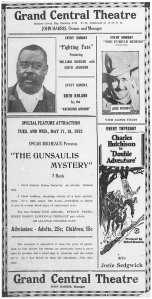
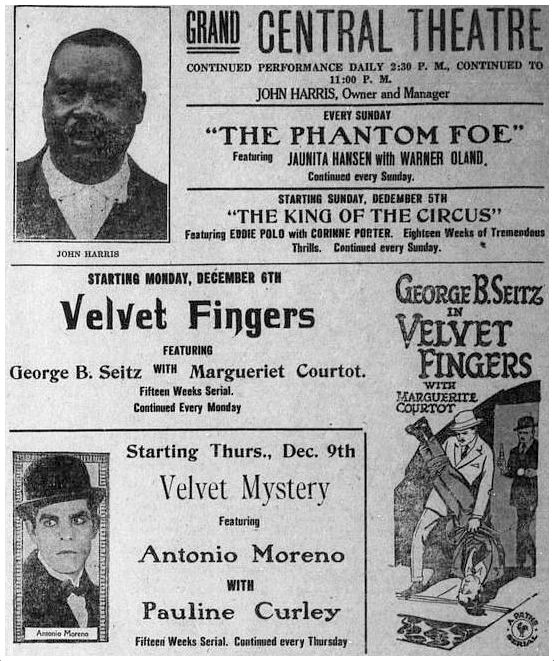
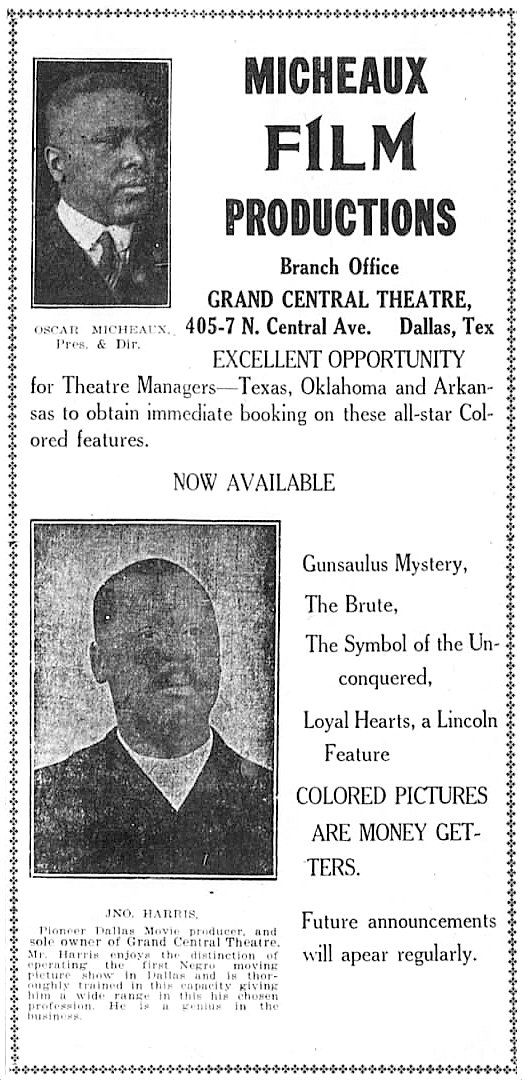
The Grand Central Theatre was at 405-407 N. Central Ave. (which later became Central Expressway), between Swiss and Live Oak on the outer northern edge of Deep Ellum. John Harris, the owner, put himself in practically all of his ads. He included this autobiographical sketch in one of them:
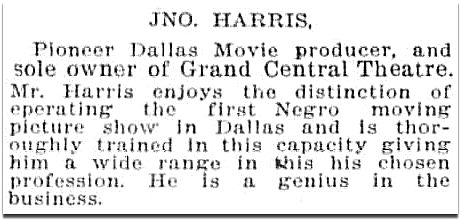
micheaux-grand_dallas-express_052821-detDallas Express, May 28, 1921

I’m not sure if he operated “the first Negro moving picture show in Dallas,” but I wouldn’t doubt it — the man was a dynamo who possessed not only a bold self-confidence, but he also seems to have had an unlimited promotional budget. UPDATE: The first appearance of a theatrical enterprise by John Harris shows up in the 1913 city directory (directories generally collected their information the previous year, so he was probably in business in 1912). Harris is listed under the “Amusements” section at the same address as the Grand Central Theatre, a name which came later. The same 1913 directory also lists the Star Theatre, which later became the Palace (see below). These are the only two theatres designated as “colored.” It’s unclear whether the theaters hosted live performances or showed movies. Or both.

The Grand Central advertised relentlessly. (Click ads to see larger images.)

grand-central-theatre_dal-express_120420Dec. 4, 1920

grand-central-theatre_dal-express_051421May 14, 1921

grand-central-theatre_dallas-express_080621Aug. 6, 1921

Below, an ad showing one of the offerings to be a Ben Roy Motion Picture Corp. movie called “My Baby” which was “made in Dallas, featuring William Lee and All Colored Cast.”
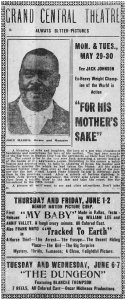
grand-central-theater_dal-express_052722May 27, 1922

Harris was connected with the legendary black filmmaker Oscar Micheaux. Not only did he regularly run his films, but he also seems to have been working as a booker, promoter, and distributor of Micheaux’s films and ran the Micheaux Film Productions branch office out of the Grand Central. “Colored Pictures are Money-Getters.”
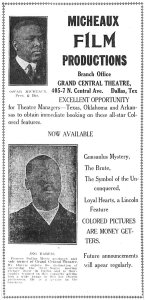
micheaux_dallas-express_051421May 14, 1921

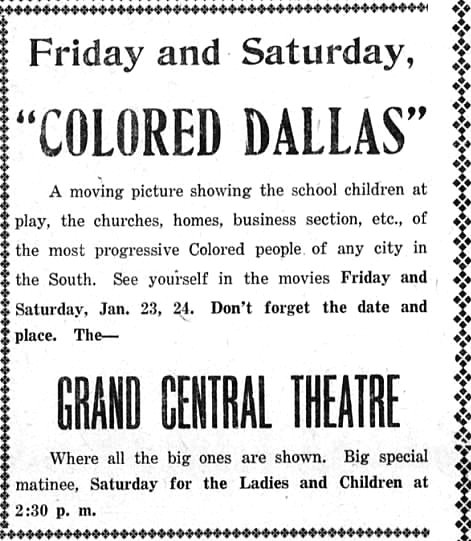
One ad that caught my attention was this one, for a locally-shot film called “Colored Dallas.” I really, REALLY want to see this, but the possibility of an extremely minor, 95-year-old silent film having survived into the 21st century is slim.

colored-dallas_dallas-express_012420Jan. 24, 1920

*

The Mammoth Theatre was located at 2401 Elm Street, between Central and Hawkins. It opened in late 1919 — the run-up to the opening was publicized in this Dallas Express item.
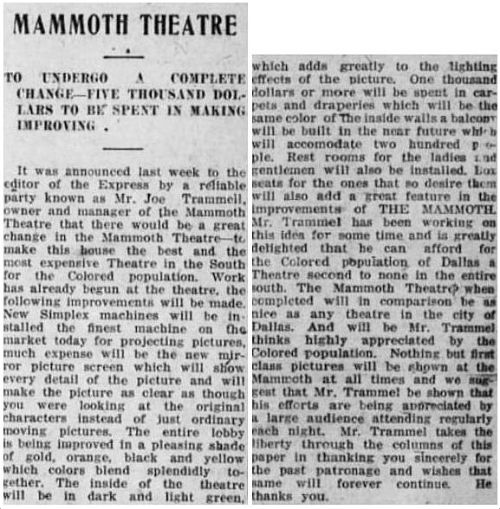
mammoth_dallas-express_112219Nov. 22, 1919

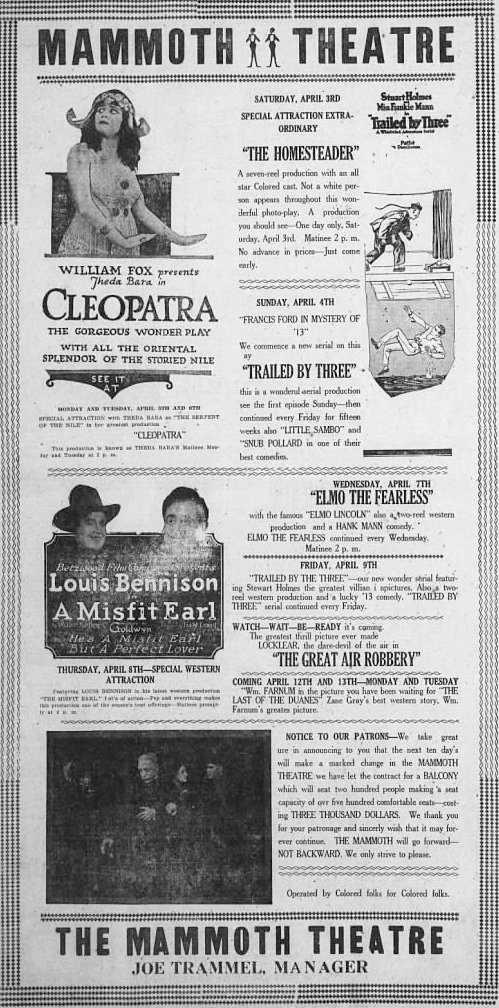
The Mammoth might not have advertised quite as much as the Grand Central did, but it frequently took out splashy full-page ads. Full-page! I bet that royally irked John Harris. Below, a Mammoth ad from 1920.
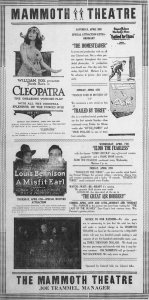
mammoth_dallas-express_040320April 3, 1920

Two details from the above ad:
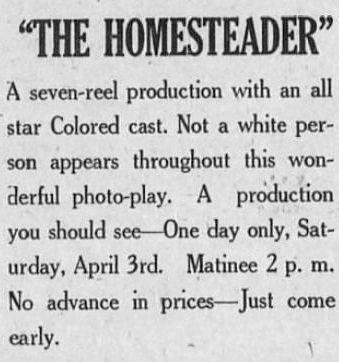
mammoth_dallas-express_040320-det-2

mammoth_dallas-express_040320-det
“Operated by Colored folks for Colored Folks.”

The owner, Joe Trammell, seems to have had an inexhaustible source of money for advertising — those frequent full-pagers (unusual for the time) must have cost a pretty penny. I couldn’t find much information about any of these men, but I stumbled across this photo of Trammell, tacked on to one of his … um … mammoth ads.

mammoth_joe-trammell_dallas-express_021221Feb. 12, 1921

*

The Palace Theatre, seen in the photo at the top, was at 2407 Elm Street, just a couple of doors down from the Mammoth. (This Palace is not to be confused with the “white” Palace Theatre, the stalwart of Theater Row at the other end of Elm.) It opened in 1920 in the remodeled space formerly occupied by the Star Theatre,
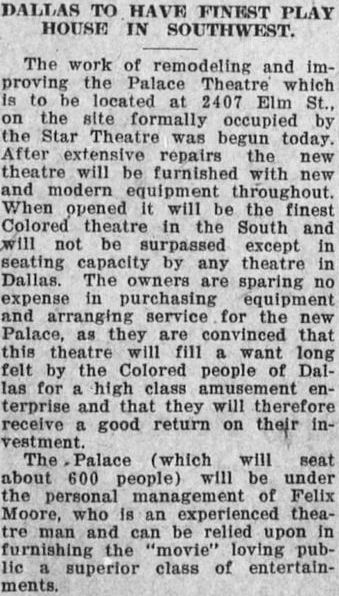
palace_dallas-express_030620March 6, 1920

palace_dallas-express_050820May 8, 1920

*

Lastly, moving up to North Dallas, we find the High School Theatre, located at 3211 Cochran, between Central and N. Hall Street. The reason for its name was its close proximity to the Colored High School (the only high school for African-American students at the time — it would soon merge with and relocate to the new Booker T. Washington High School a short distance away). The following businesses were in this same block: the High School Cold Drink Stand, the High School Cafe, the High School Shine Parlor, and the High School Tailor Shop. Location, location, location.
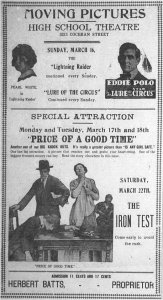
high-school-theater_dallas-express_031519March 15, 1919

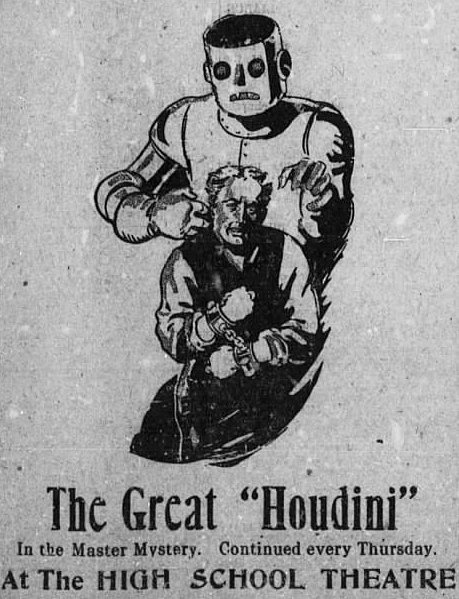
My favorite High School Theatre ad is this one, touting a serial called “The Master Mystery” starring Houdini … one of the screen’s first appearances of a robot! (Check out a scene featuring both Houdini and the robot/automaton, here.)
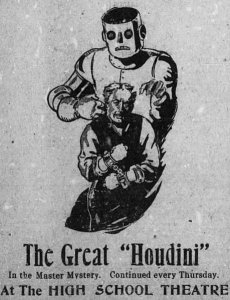
houdini_dallas-express_031519March 15, 1919

*

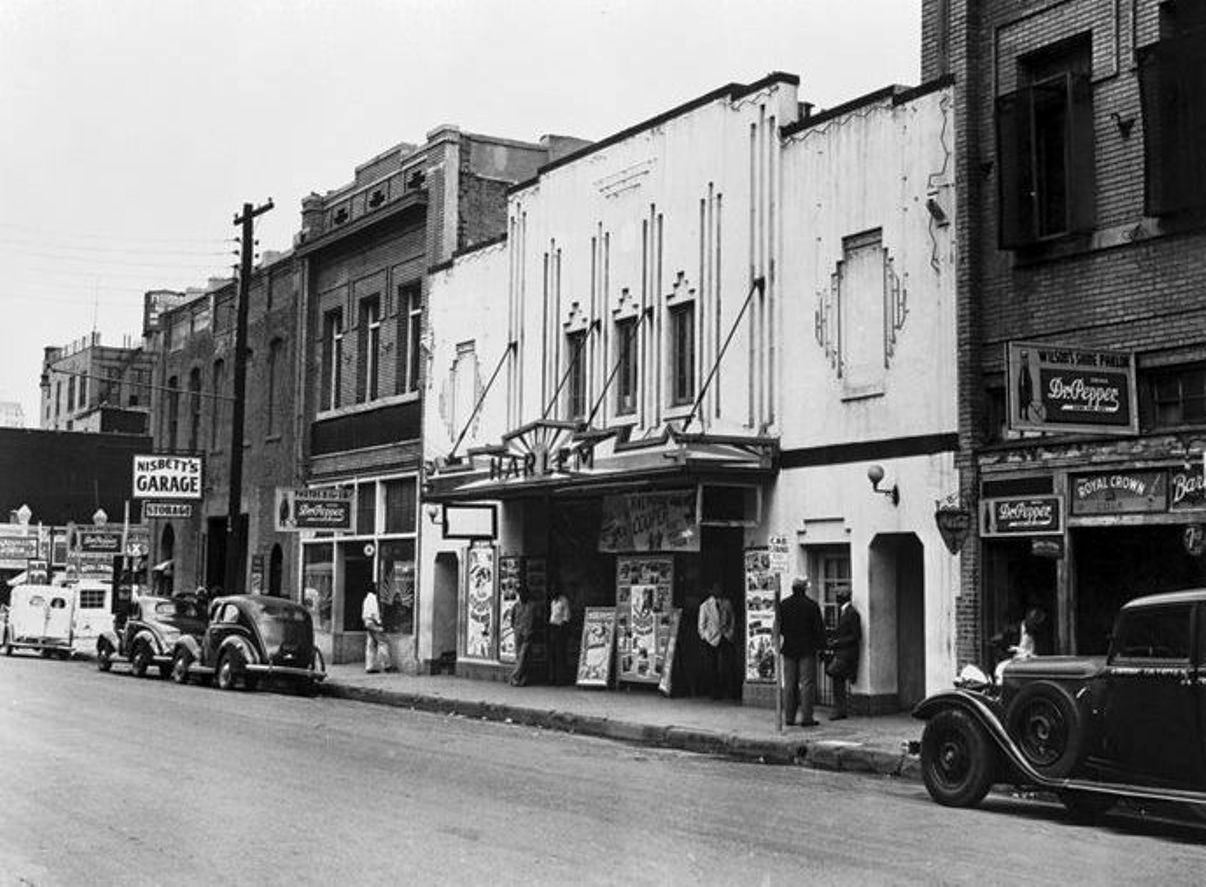
The only one of these theaters still in business in 1930 was the Palace. by 1937, the Palace had become the Harlem Theatre.
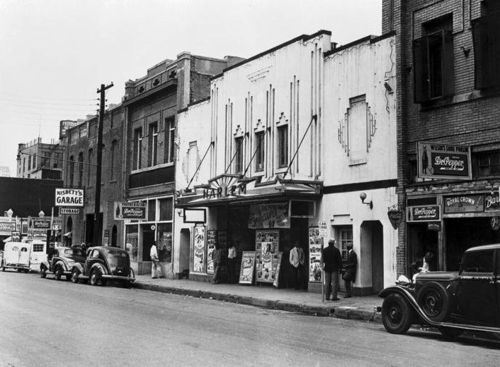
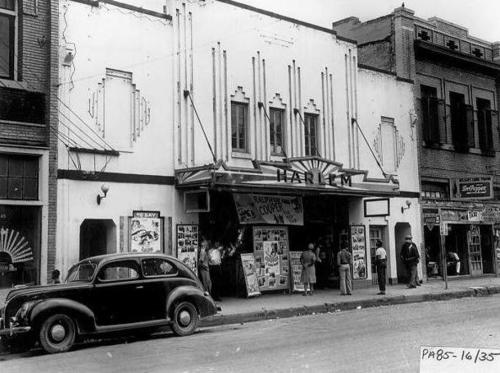
harlem-theatre_deep-ellum

harlem-theatre_dpl

***

Sources & Notes

Top photo showing Elm Street and the Palace Theatre and the bottom two photos showing the Harlem Theatre are from the Texas/Dallas History & Archives Division, Dallas Public Library. The upsetting view of what that stretch of Elm looks like now can be seen on Google Street View, here. Below, side-by-side, 1922 and 2015 — Elm St. looking east to Deep Ellum, the Knights of Pythias temple in both images down the street on the left. Look what we’ve lost.

elm-looking-east_1922-2015

All ads and clippings from The Dallas Express, as noted. A few years’ worth of this important newspaper, which served Dallas’ African-American community, can be accessed here.

More on Oscar Micheaux, here.

Another Flashback Dallas post on a theater serving the black community is “Oak Cliff’s Star Theatre — 1945-1959.”

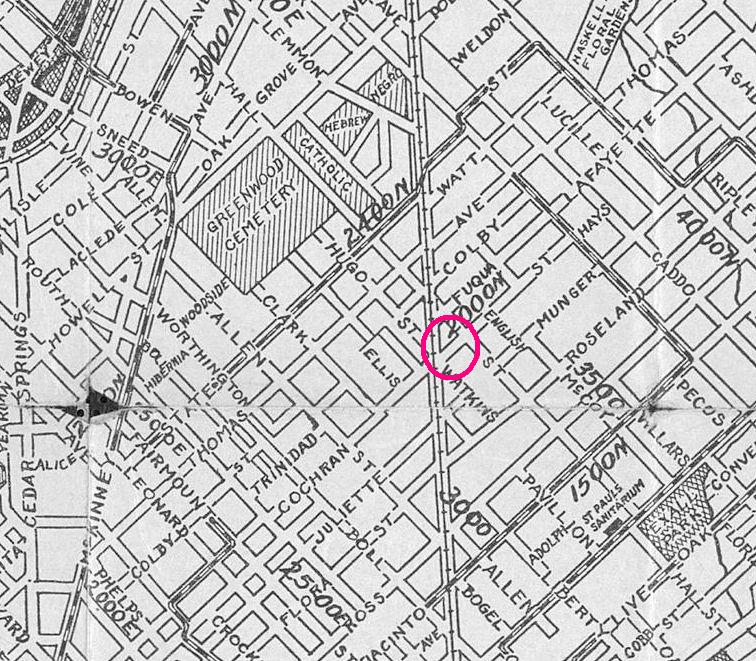
A 1919 map from UNT’s Portal to Texas History shows the location of the Grand Central Theatre (red square), the Mammoth (blue), and the Palace (yellow).

black-cinemas_ca1920_deep-ellum

The High School Theatre — up in “North Dallas” (adjacent to present-day Uptown) — is seen on a different portion of the same map, below.
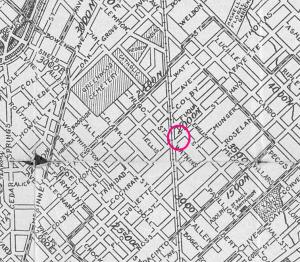
black-cinemas_ca1920_north-dallas

Most images are larger when clicked.

*

Copyright © 2015 Paula Bosse. All Rights Reserved.

Dazzling Neon, Theater Row — 1929

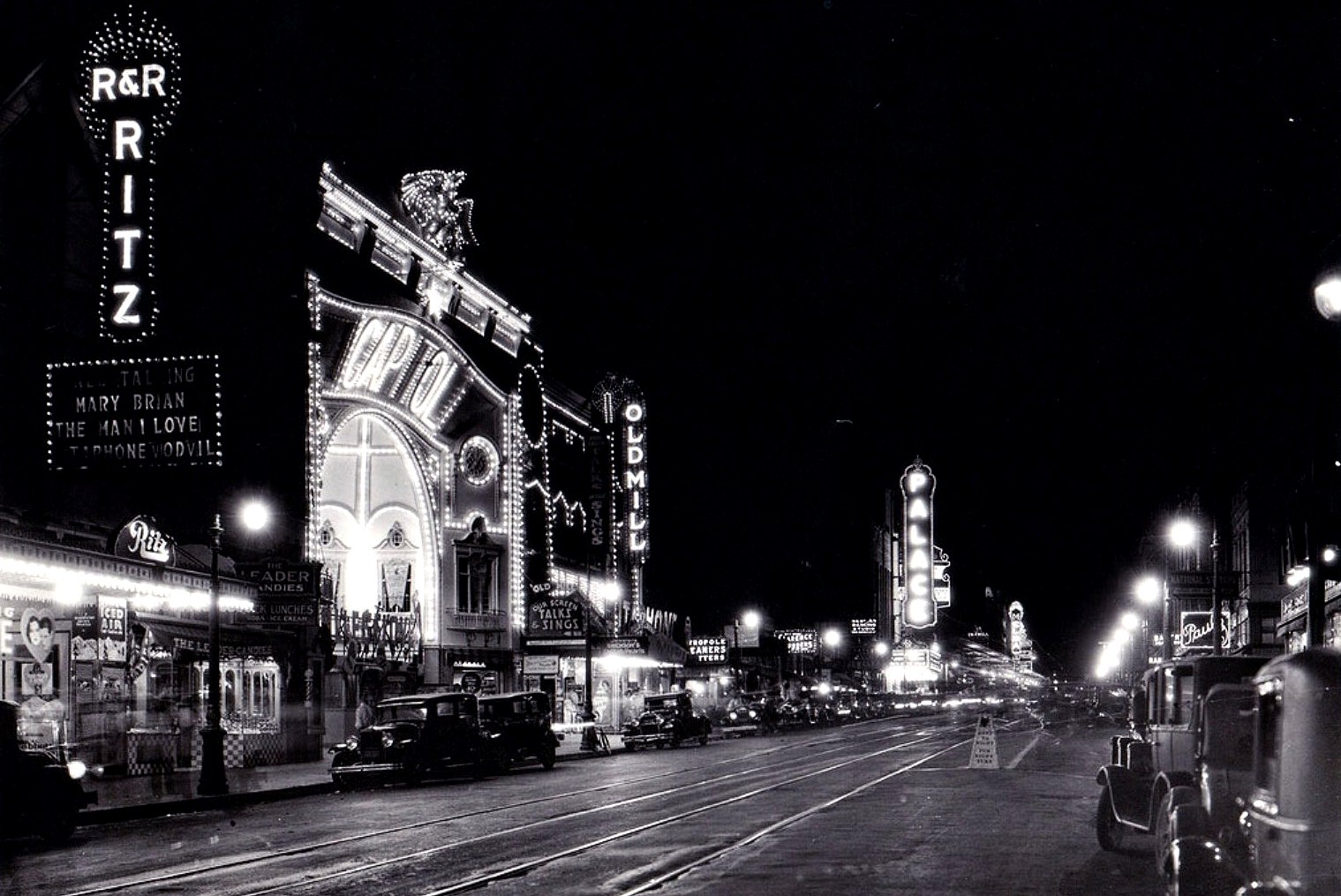
elm-st-night_capitol-old-mill_1929_shorpy“The lights are much brighter there…”

by Paula Bosse

Whoa. Elm Street in the ’20s.

The Ritz. The Capitol. The Old Mill. The Palace. The Melba. Iced air. Paul’s Shoes. What I wouldn’t give to have walked down Elm when it looked like this.

***

Sources & Notes

Photo from Shorpy.com, here.

Highlights from the 1929 and 1930 street directory (from about Akard, heading east):

  • 1517 Elm: Ritz Theatre
  • 1519: Leader Candy Co.
  • 1521: Fooshee’s Barber Shop
  • 1521-23: Capitol Theatre
  • 1525-27: Old Mill Theatre
  • 1600: Paul’s Shoes
  • 1601: Metropole Cleaners
  • 1603: Elm Pacific Arcade
  • 1605: Lontos Cafe
  • 1623-25: Palace Theatre
  • 1911-15: Melba Theatre
  • 1912-29: Majestic Theatre

 *

Copyright © 2015 Paula Bosse. All Rights Reserved.

“A Perfect Auto Tent” — 1921

ad-dallas-tent-awning_dmn_061221-smRemember to turn off engine before retiring for the night…

by Paula Bosse

Personally, I don’t understand why anyone would want to be outside when it’s 157 degrees, but for those of you who are insistent campers who might be heading out for a sweaty and bug-filled weekend in the wilderness, might I direct your attention to the “automobile tent,” ready for purchase in 1921 at the Dallas Tent and Awning Co. at 2620 Main Street, in the heart of Deep Ellum. Adjusted for inflation, the cost of this admittedly charming-looking “car tent” would be the equivalent of about $200.

My weekend? I will be camped out in a blissfully air-conditioned house — shades drawn, blinds closed — with an iced tea in hand, moving slowly, and not smelling like insect repellent.

*

Copyright © 2015 Paula Bosse. All Rights Reserved.

Neon Refreshment: The Giant Dr Pepper Sign

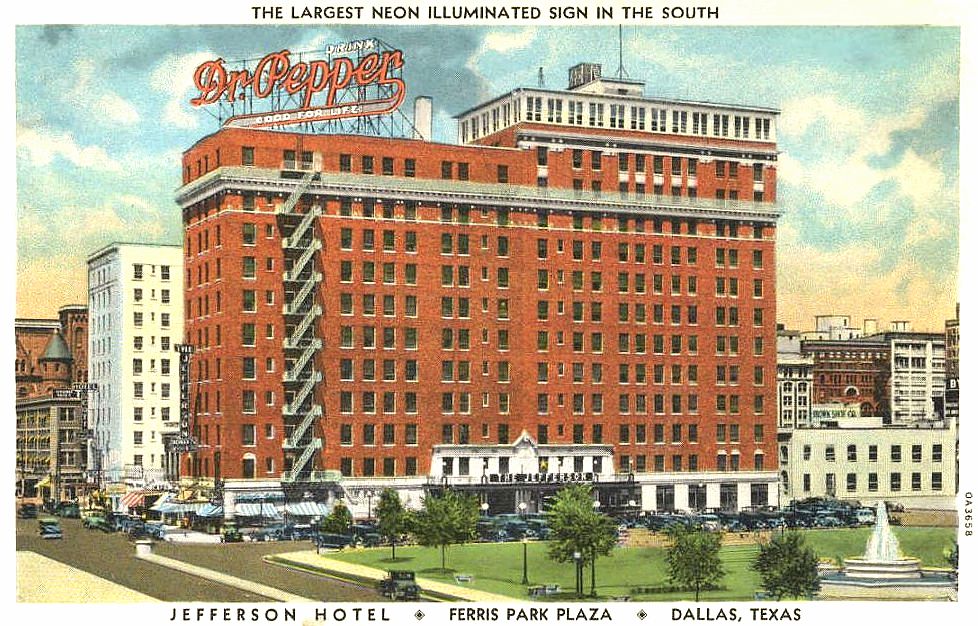
hotel-jefferson_neon-dr-pepper_cook_degolyer_SMU_ca1945

by Paula Bosse

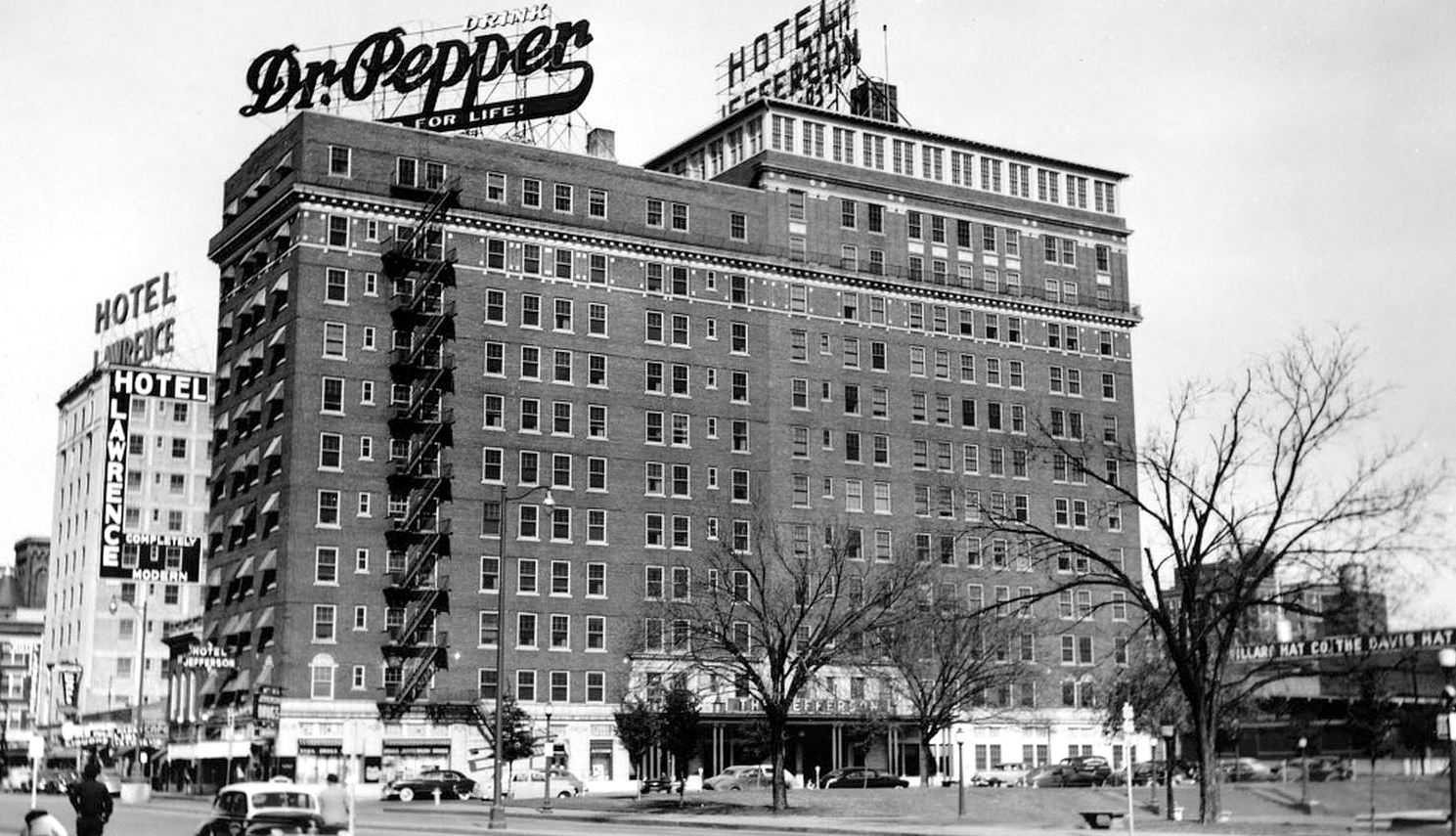
The Jefferson Hotel probably made some serious money leasing out rooftop acreage to the Dr Pepper people who erected a huge neon sign there. The hotel was located across from Union Station and a couple of blocks from the Old Red Courthouse. For people approaching the city from the southwest, there was absolutely nothing between them and that refreshing beacon rising tantalizingly above S. Houston and Wood streets.

hotel-jefferson_neon-dr-pepper_cook_degolyer_ca1945-verso

jefferson-hotel_hotel-lawrence_dr-pepper-sign_dmn-tumblr

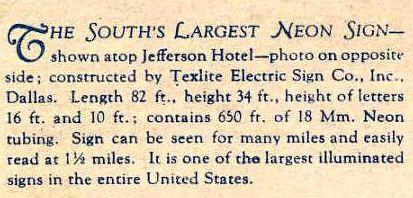
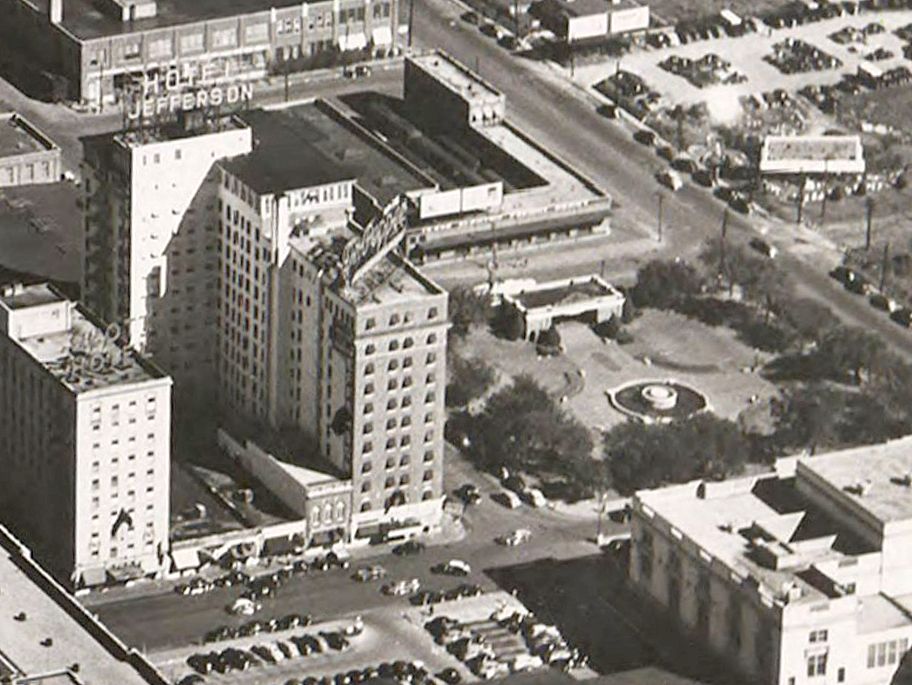
Texlite — the Dallas company that made the sign — was the first company in the Southwest to build and sell neon signs. Their first neon in Dallas advertised a shoe store in 1926 or 1927. (Texlite is best known as the company that built the red neon Pegasus and installed him on top of the Magnolia Petroleum Building in 1934.) My guess is that this Dr Pepper sign went up sometime between 1927 and 1934. It was up there for quite some time. Below is a detail from a photo taken sometime after 1943, and that DP sign was still there, continuing to make people subliminally thirsty

hotel-jefferson_dp_foscue-det(click for larger image)

It’s surprising Dallas didn’t have more neon back then. With a pioneering hometown neon company, the Dallas skyline should have been lit up like a Christmas tree 24 hours a day!

***

Sources & Notes

Postcard is from the George W. Cook Dallas/Texas Image Collection, Central University Libraries, Southern Methodist University; it can be viewed here.

First black-and-white photo was purchased at an antique mall or flea market, origin unknown; found here.

The 1940s-era aerial photo is a detail of a larger photo, “Downtown Dallas looking east (unlabeled)” by Lloyd M. Long, from the Edwin J. Foscue Map Library, Central University Libraries, SMU; the full photo can be viewed here.

A great photo of the hotel and sign can be seen in Sam Childers’ Historic Dallas Hotels, here. Childers writes that the Dr Pepper sign came down when the Jefferson was sold and became the Hotel Dallas in 1953. 20-some-odd years for a sign like that to remain in one place is a pretty good run.

The Jefferson Hotel (or as it’s sometimes identified, “Hotel Jefferson”) was at 312 S. Houston St. The building was demolished in 1975. It is now a hotel-shaped parking lot.

See what other clever thing once occupied the roof of the Jefferson Hotel in the Flashback Dallas post “The Jefferson Hotel and Its ‘Wireless Telegraph’ Rooftop Tower — 1921.”

*

Copyright © 2015 Paula Bosse. All Rights Reserved.


The Magnolia Building, Pre-Pegasus — 1920s

magnolia-bldg_pre-pegasus_RPPC_smBeautiful!

by Paula Bosse

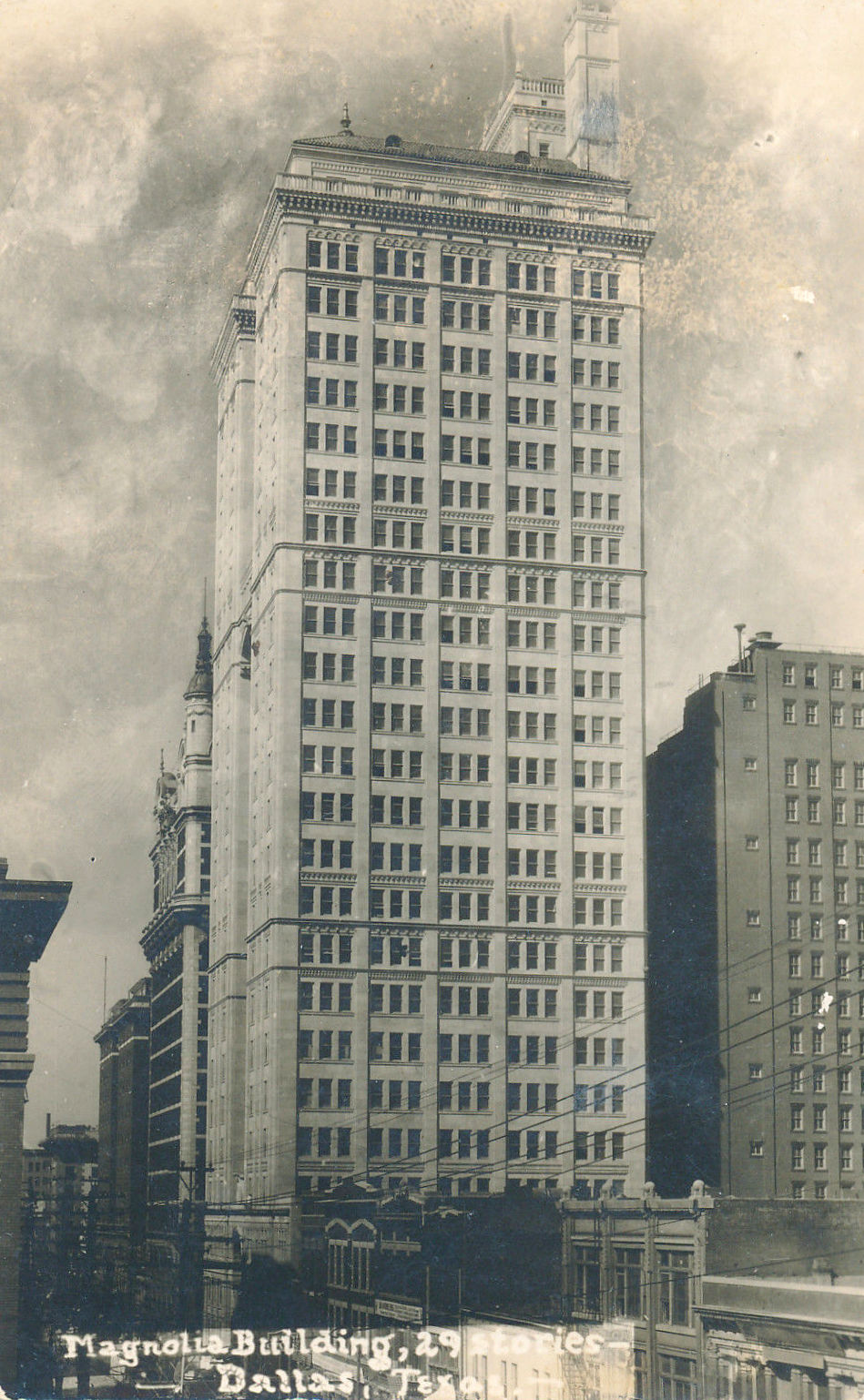
This is such a wonderful photo of the Magnolia Petroleum Building — even without Pegasus on top of it! When it opened in 1922, it was the tallest building in the state — all 29 stories of it. (It was so tall, apparently, that the photographer couldn’t get the whole building in the shot!) It certainly looks impressive — and impressively ominous — in this photograph. An added bonus is the beer-stein-shaped turret of the Adolphus Hotel peeking around at the left. Fantastic photo!

***

Sources & Notes

Photograph from a postcard found on eBay; written on the back is this message to folks back home in Oklahoma City: “Arrived at 11:30 PM. in this burg. It’s some big place, believe me.”

Brief history of what is now the Magnolia Hotel, is here. (Pegasus was not placed on top of the building until 1934.)

Some more Flashback Dallas posts featuring my favorite views of the Magnolia Building (with and without Pegasus):

  • here — photos showing the major change in the skyline between 1929 and 1939
  • here — incredible photo of the skyline taken from The Cedars, by Alfred Eisenstaedt
  • here — the Magnolia Bldg. lit up at night, with the Mercantile Bank Bldg. in the background
  • here — one of my favorite postcards of Dallas, showing the city at night, with Pegasus the highest point on the horizon

*

Copyright © 2015 Paula Bosse. All Rights Reserved.

Radio Broadcasting, 1922-Style

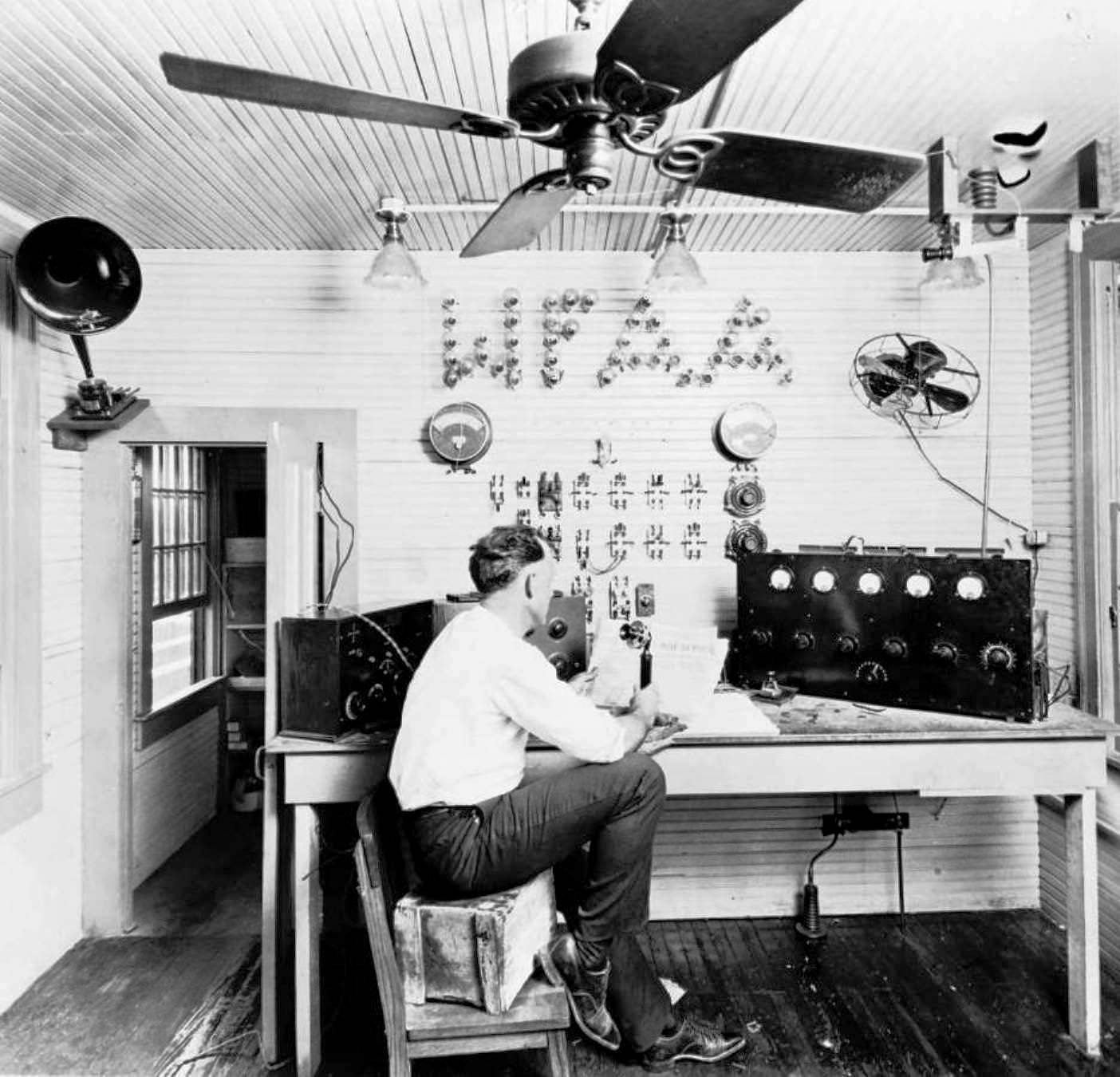
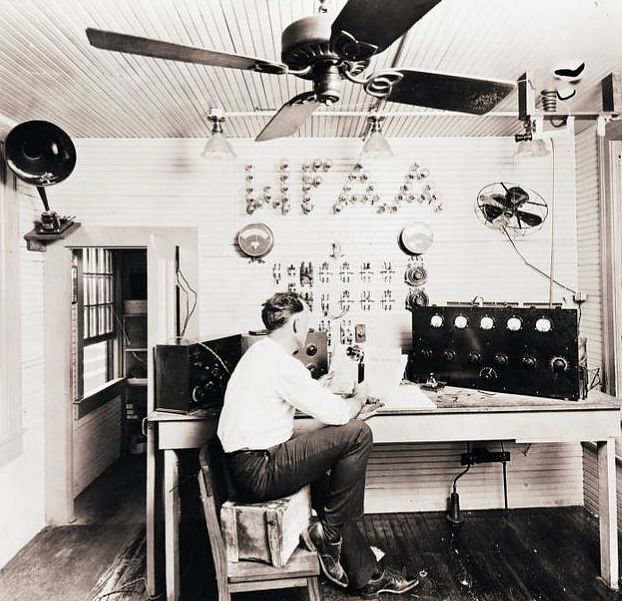
wfaa-control-room_belo_smu_1922WFAA “newsreader,” 1922 (click for larger image) Belo Collection, SMU

by Paula Bosse

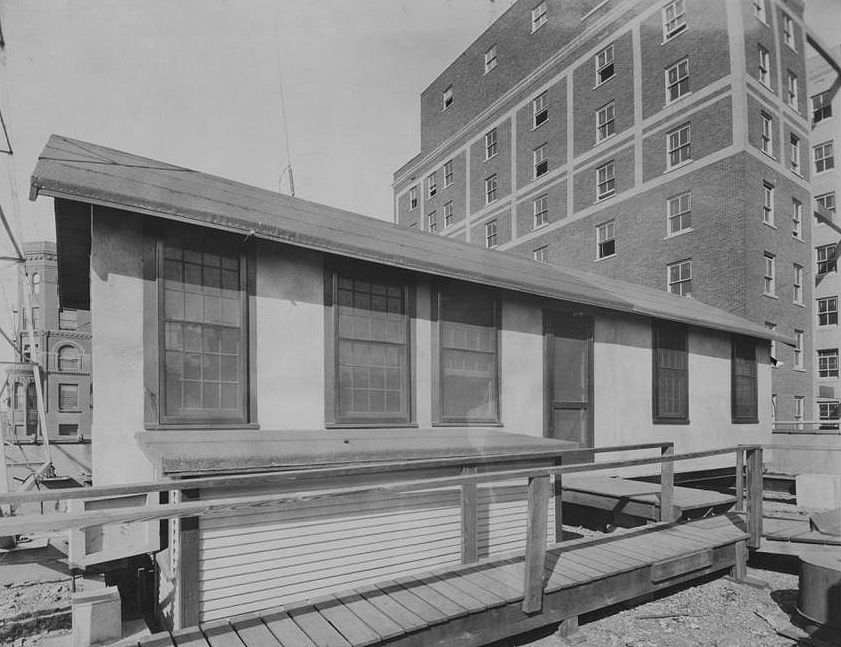
This fantastic photo shows the interior of a little shack-like building on top of the old Dallas Morning News building at Commerce & Lamar, soon after WFAA radio had begun broadcasting in the summer of 1922. There are so many things I love about this photo. Let’s explore the details. (All pictures are larger when clicked.)

*

The Magnavox speaker/monitor.

wfaa-control-room_belo_smu_det1

*

The booster seat and the shoes that need a shine.

wfaa-control-room_belo_smu_det2

*

The announcer at work. (I’m assuming this telephone was being used as an early microphone?) The newspaper is The Dallas Journal, sister publication of The Dallas Morning News which owned WFAA radio. The headlines appear to be about the nationwide railroad and coalminers’ strikes, both of which had been getting more and more violent throughout July of 1922 (violence surrounding the railroad strike led to Texas Governor Pat Neff declaring martial law in Denison that month).

wfaa-control-room_belo_smu_det3

*

The control panel (which has its own fan).

wfaa-control-room_belo_smu_det4

*

And an open window around the corner, in the supervisor’s office. Cross-ventilation and oscillating fans might not have been hugely effective in keeping operators and machinery cool in the summertime.

wfaa-control-room_belo_smu_det5

*

Here’s another view of the “Operating Room,” as published in the DMN on June 25, 1922, the day before WFAA began broadcasting.

wfaa_operating-room_dmn_062522DMN, June 25, 1922

***

Photo titled “WFAA Radio Original Control Panel” from the Belo Papers collection, DeGolyer Library, Central University Libraries, Southern Methodist University; it can be viewed here.

A companion post to this, “WFAA’s ‘Altitudinous Antenna System'” — which contains a background of WFAA’s debut and several photographs — is here.

Other Flashback Dallas posts on Dallas Radio and TV are here.

Click pictures for larger images.

*

Copyright © 2015 Paula Bosse. All Rights Reserved.

WFAA Radio’s “Altitudinous Antenna System”

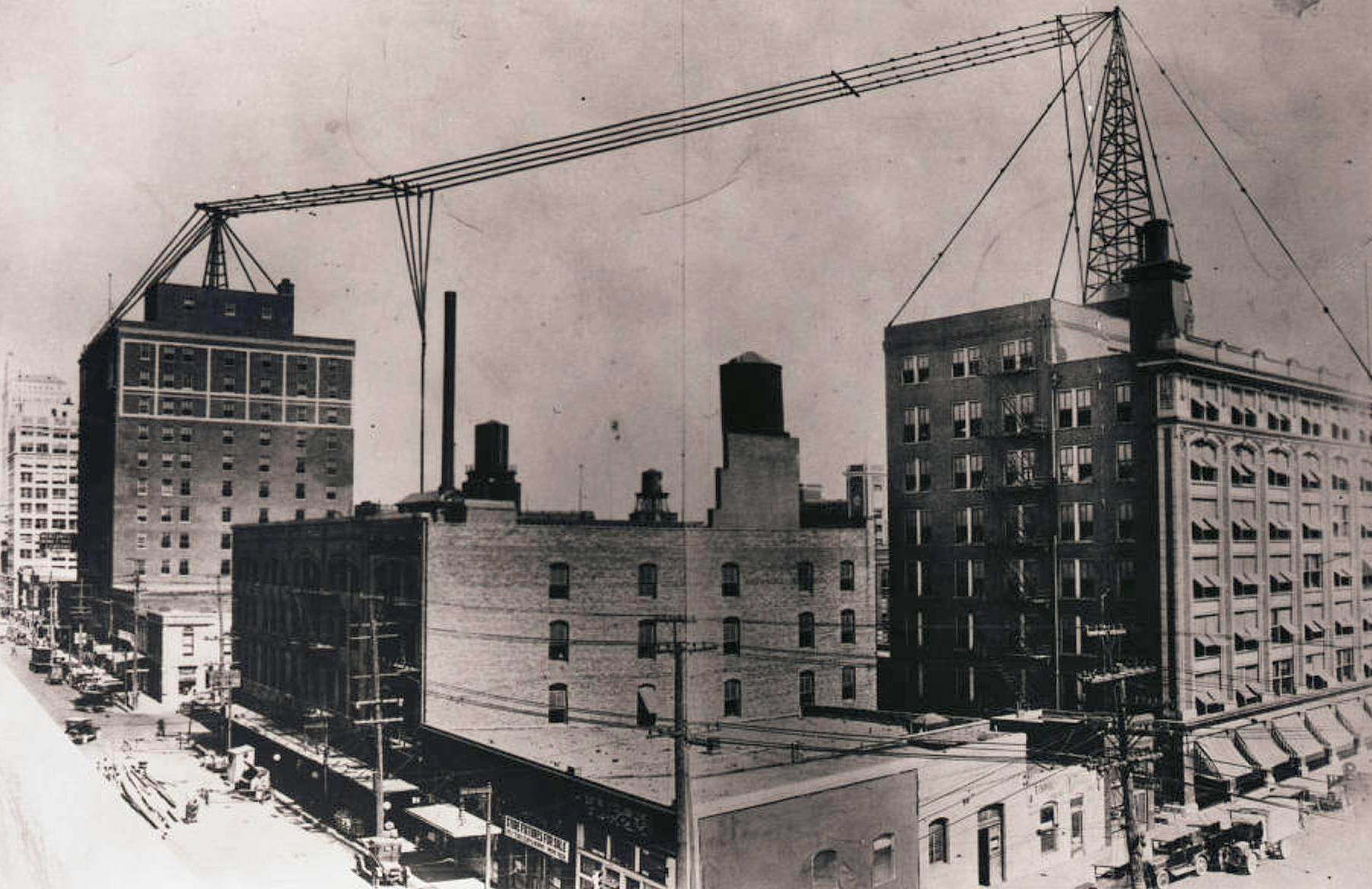
wfaa_towers_1920s_belo-coll_degolyerSeems … “busy” … (click for larger image) Belo Collection, SMU

by Paula Bosse

Broadcast radio was very, very, very new when WFAA radio went on the air in June, 1922; it was Dallas’ second radio station, but it was the city’s first commercial station, and its debut was a BIG deal. (WRR had preceded WFAA, but it was mainly used for city business.) Figuring out where to place towers and aerials and antennae (which may all be the same thing, for all I know) was a major problem, with not a lot of precedents. So why not just do what they did in the photo above?

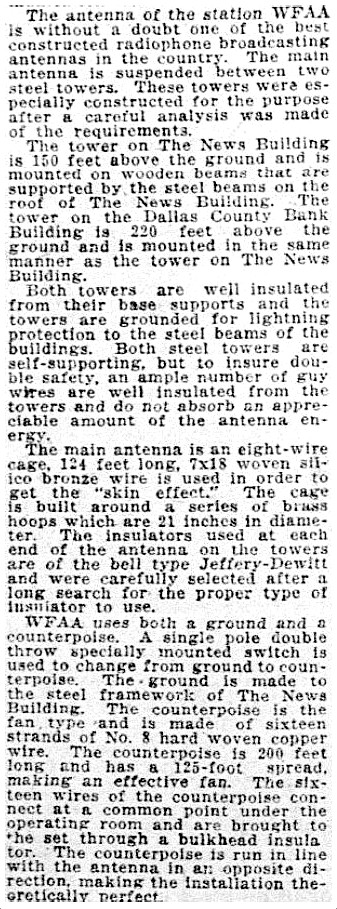
WFAA began broadcasting at 12:30 p.m. on June 26, 1922, and the day before that, a giddy and surprisingly technical article appeared in The Dallas Morning News (which owned WFAA). The full article is linked below, but this is the specific passage devoted to those towers/aerials/antennae:

wfaa-towers_dmn_062522DMN, June 25, 1922

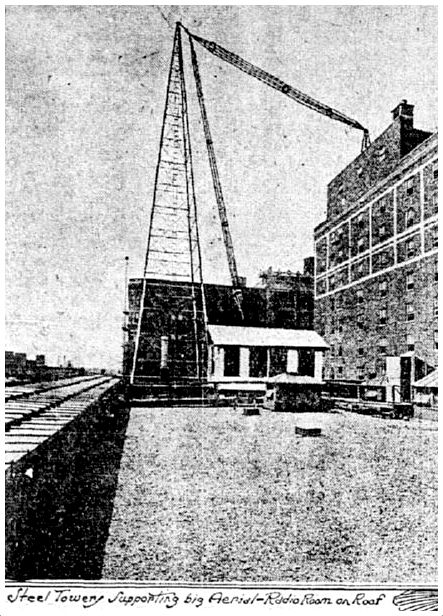
I’m not sure if the photo at the top was from these first days (it appeared, undated, in the DMN in 1927), but here is a photo that accompanied the above article from 1922:

wfaa_tower_dmn_062522

Is that a little building? Why, yes it is.

WFAA. It began as a 50-watt station. Its studios occupied all of a 9×9-foot shack on top of the old Dallas Morning News Building. Its antennae were strung from a water tank on the The New building to a 20-foot mast on top of the Texas Bank Building. (DMN, May 21, 1950)

When WFAA began, it broadcast from inside of and on top of the old Dallas Morning News building, which was located at Commerce and Lamar. By 1927, it had moved its studios to swankier digs in the Baker Hotel. Below, another description of how the rooftop aerial situation — the “altitudinous antenna system” seen at the photo at the top of this post — functioned at this time.

One of the big towers is on top of the lofty Dallas Mercantile Bank Building, while the other is atop the high Missouri-Kansas-Texas Railway Building. The wires are connected with the WFAA operating room on the roof of the Dallas Morning News Building between the two other structures. (DMN, Feb. 20, 1927)

But back to that little shack. Let’s see it a bit closer. Here’s the exterior.

wfaa_rooftop-broadcasting-room_belo-degolyerBelo Collection, SMU

And here’s the interior.

wfaa-studio_ca1922_belo-degolyerBelo Collection, SMU

The generator and battery room.

wfaa_generator-battery_dmn_062522DMN, June 25, 1922

And the supervisor’s office.

wfaa_supervisors-office_dmn_062522DMN, June 25, 1922

And Dallas broadcasting never looked back from its humble beginnings.

*

ad-white-electric-co-detail_dmn_062522Advertising detail, June 25, 1922

*

wfaa-logo_dmn_062522

***

Sources & Notes

Photographs from the Belo Records Collection, DeGolyer Library, Central University Libraries, Southern Methodist University. Top photo can be accessed here; rooftop “broadcasting room” (exterior) is here; “broadcasting room” (interior) is here. More photos here. (The interior and exterior shots of the studio seem to be from 1922. The announcer is reading from the DMN’s sister publication, The Dallas Journal, which contains an article about a subject hot in the news in July, 1922 — a strike by Kentucky coal miners.)

A Belo photo identified as showing the room containing the “Transmitter on top of The Dallas Morning News building, 1924” is here.

To read the article describing how WFAA (which, by the way, at some point stood for “Working For All Alike”) was put together — how it was literally put together — see the Dallas Morning News article “Most Complete Radio Station in the Southwest to Begin Broadcasting” (June 25, 1922), written by R. M. Lane, here, and the accompanying photos here.

See the companion Flashback Dallas post, “Radio Broadcasting, 1922-Style,” here.

Other Flashback Dallas posts on WFAA radio can be found here.

Other Flashback Dallas posts on Dallas Radio & TV can be found here.

*

Copyright © 2015 Paula Bosse. All Rights Reserved.

A Dip in the HP Pool — 1924

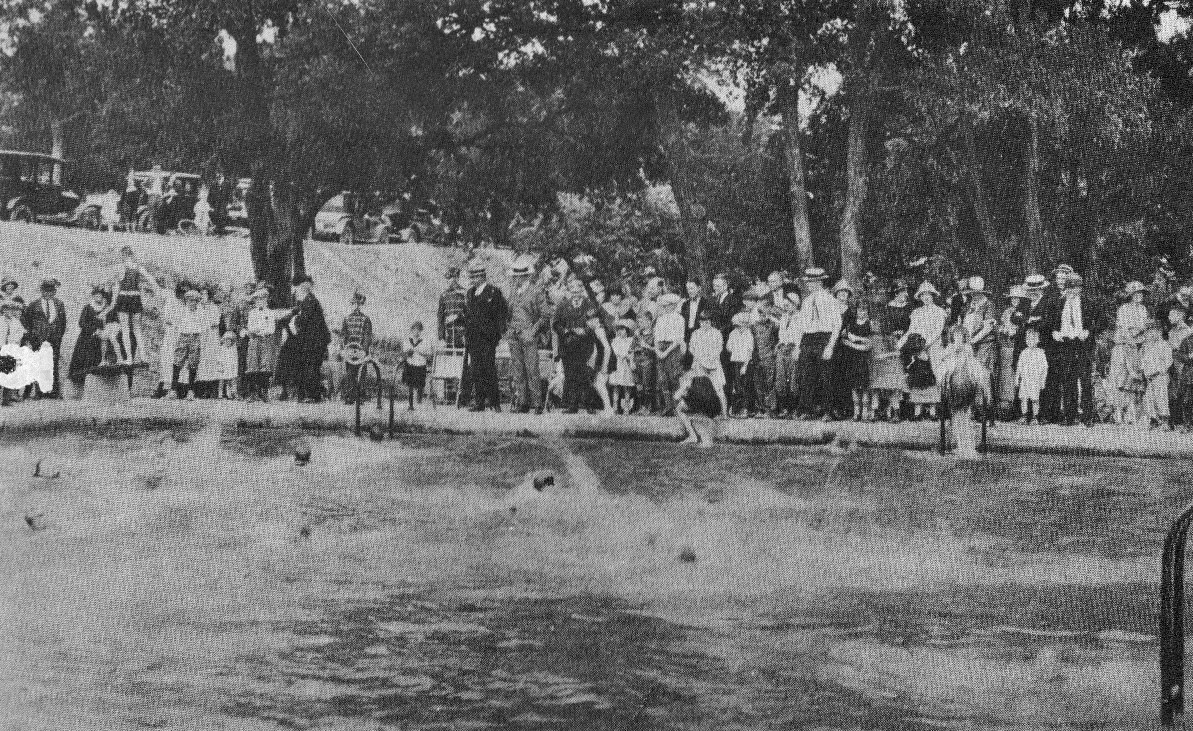
hp-pool_aDedication & formal opening of the HP pool, 1924

by Paula Bosse

Even though “municipal pool” and “Park Cities” don’t really seem to belong in a sentence together, the still-going-strong pool in Highland Park is over 90 years old. The photo above shows crowds gathered at the formal opening of the brand new Highland Park swimming pool, dedicated on May 17, 1924. The caption of this photo which ran in The Dallas Morning News on May 18, 1924 reads: “The above shows the group of Highland Park citizens gathered at the new municipal swimming pool Saturday afternoon for the formal opening exercises. Mayor Frank M. Smith is seen standing in the middle of the group. Seated by his side is former mayor Henry L. Davis in whose administration the movement for the installation of the pool was started.”

Oh, to have witnessed the fabulously wealthy (or near-fabulously wealthy) sashaying down the street toward the pool, dressed in their mandated bathrobes and swimsuits. Or their raincoats and swimsuits. (“[Regulations governing use of the pool require that] swimmers must dress at home in their bathing suits, but may come through the streets to the pool so clad if they wear a raincoat or a bathrobe over their swimming garb.” — Dallas Morning News, May 18, 1924)

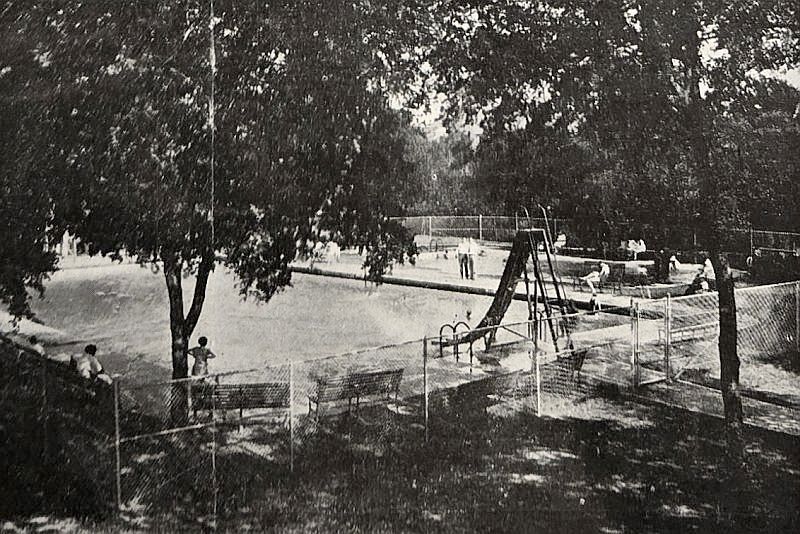
The municipal pool is in Davis Park on the south side of Lexington Avenue, in the “natural amphitheater” between St. Johns and Drexel. The 50 x 100-foot pool (reduced somewhere along the way from the original plan of a 60 x 140-foot pool) cost about $10,000 when it was built with municipal funds in 1924. The pool was very popular amongst Highland Park residents, and, as can be seen in the photos, it was located in one of the prettiest settings in Dallas.

hp-pool_highland-park-paper_june-1927_DPL

***

Sources & Notes

Top photo is from a postcard issued as part of the Park Cities Bank “Heritage Series” in the 1970s; the credit line on the postcard reads “Donated by Mr. Burton Gilliland.” Thanks to the Lone Star Library Annex Facebook group for use of the image. (The printed description of the postcard has an incorrect date of 1923.)

Bottom photo is from Highland Park (an interesting newspaper published by developers Flippen-Prather), June 1927, Periodicals Collection, Dallas History and Archives, Dallas Public Library.

More on the pool’s opening can be found in the Dallas Morning News article “Highland Park Pool Dedicated Saturday” (May 18, 1924).

Official site of the HP pool? Here it is.

*

Copyright © 2015 Paula Bosse. All Rights Reserved.

“They Shall Not Pass” — Acme Screen Co. Ad (1924)

ad-acme-screen-co_terrill-yrbk_1924“Its in Dallas” (click for larger image)

by Paula Bosse

“Ding it!”

Send those pests packing!

***

Ad from the 1924 Terrill School yearbook, The Terrillian.

*

Copyright © 2015 Paula Bosse. All Rights Reserved.