Flashback : Dallas

A Miscellany: History, Ads, Pop Culture

Category: 1920s

SMU’s School of Engineering, Chemistry Dept. Building, and School of Commerce — 1925

smu-engineering_1925-smBleak campus, cool cars (click for larger image)

by Paula Bosse

I’m afraid my updating here has fallen by the wayside a bit as I am STILL plowed under from my recent big move. Today I will finally unpack my books! So, time for a just a quick post. Here’s a photo of some quaint little temporary buildings on the SMU campus, still in its first decade. Below is the description of this image, written in the early 1970s:

“The parking lot in the foreground and the curving driveway are basically still the same today, but the rest of the picture has changed drastically since 1925 when it was taken.

“On the left is the Southern Methodist University Engineering School with the Chemistry Department Building in the middle and the School of Commerce on the right. The smaller building was a construction shack used for carpentry work.

“Not shown, but just to the right of this location was Dallas Hall — still a landmark. Today, the Fondren Science Building has replaced the temporary buildings pictured.

“In the background to the right and left are rows of bois d’arc trees along Airline and Daniels — planted in those days as fences.”

***

Sources & Notes

Photo from a postcard issued as part of the Park Cities Bank “Heritage Series” in the 1970s; the credit line on the postcard reads “Donated by Stanley Patterson.” Thanks to the Lone Star Library Annex Facebook group for use of the image.

*

Copyright © 2015 Paula Bosse. All Rights Reserved.

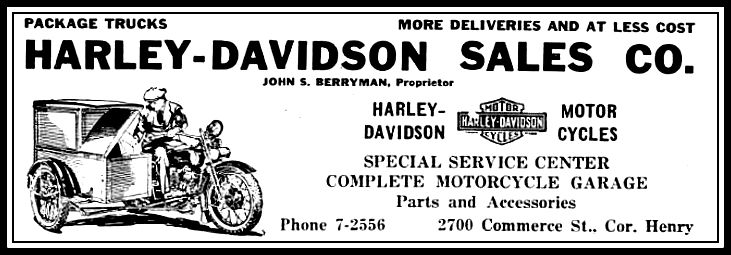
Harley-Davidson Sales Co. Ad — 1929

ad-harley-davidson_directory_1929-smBeyond sidecars…

by Paula Bosse

I have to say, I love this delivery vehicle!

***

Advertisement from the 1929 city directory. Harley-Davidson — 2700 Commerce Street, at Henry — was in Deep Ellum, in the same block currently occupied by Angry Dog.

Click picture for larger image.

*

Copyright © 2015 Paula Bosse. All Rights Reserved.

“Experimental” Bus Trip to White Rock Lake — 1925

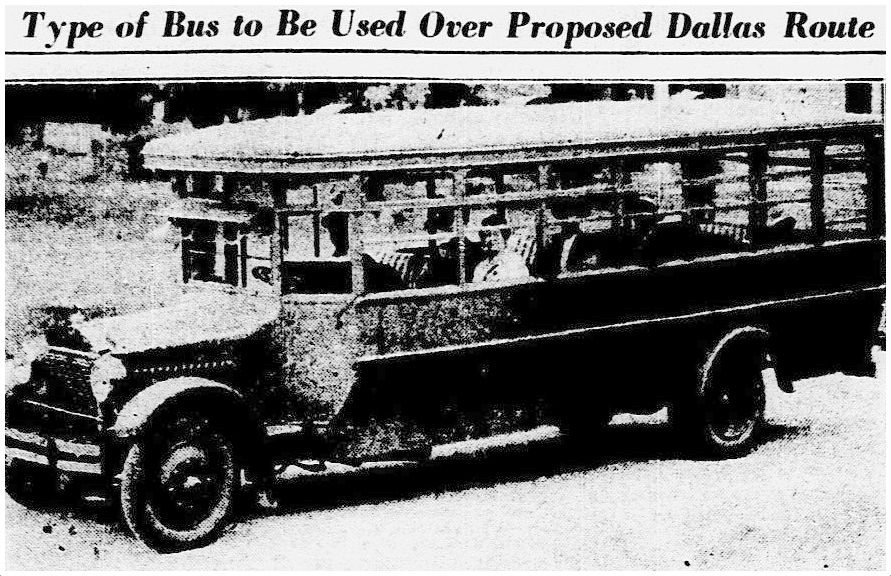
white-rock-bus_dmn_071625Next stop: White Rock Lake

by Paula Bosse

In the 1920s, White Rock Lake was becoming a popular nearby recreation area and beauty spot. It was a bit of a drive to get out there, though. Bus operators were wangling to get the contract to transport tired and pale Dallasites to a nice day out at the lake. The caption accompanying the above photo:

“This city type bus will make an experimental trip to White Rock with city officials, applicants for bus franchise and newspaper men to test adaptability of various routes to bus line operation. Busses [sic] of this type, said C. D. Cain, who has been voted the White Rock franchise informally by the City Commission, will be run on the line when the franchise is formally granted.”

***

Sources & Notes

Photo and caption from The Dallas Morning News, July 16, 1925.

*

Copyright © 2015 Paula Bosse. All Rights Reserved.

Elm Street, Looking West from Griffin

elm-west-from-griffin_UTA-special-collThe 1000 block of Elm Street: small-business central

by Paula Bosse

A really incredible view of Elm Street, probably from the late-teens to the early-20s. (Almost all of the businesses seen in this photo were listed in the 1922 city directory.) The landmark businesses seen here — all founded in the 19th century — would be Huey & Philp Hardware, Charles Ott (gunsmith) (the sign can be seen just above the Huey & Philp sign at the right), and down the street on the corner of Lamar, the beautiful 8-story Sanger Bros. department store (now part of El Centro). I know it’s a like hearing a broken record, but I really wish downtown Dallas still had some of this old, quirky flavor. (Click picture for larger image.)

And here’s a shot of the same view, but street-level:

elm-street_UTA

***

Sources & Notes

Photos from the Fort Worth Star-Telegram Collection, Special Collections, University of Texas at Arlington.

If you want to see what the same view looks like today, click here. Personally, I prefer the “before” to the “after.” I’m generally a fan of tall buildings, but all those skyscrapers absolutely decimated street-level businesses, which, sadly, seem to be gone for good. You can’t undo a skyscraper.

*

Copyright © 2015 Paula Bosse. All Rights Reserved.

Clyde Barrow In a Sailor Suit

clyde-barrow_sister_1925_utsa_smClyde Barrow & his sister Nell

by Paula Bosse

Behold, a teenage Clyde Barrow in a sailor suit. Bonnie & Clyde lore has it that Clyde attempted to join the United States Navy but was rejected because of lingering problems from a childhood illness, but on a quick sprint across the internet, I’ve been unable to find any specifics about Clyde’s having tried to enlist in the Navy. But he was certainly pro-navy: not only does he appear to have enjoyed wearing the sailor’s outfit, but he apparently also had a “USN” tattoo.

But what about this outfit? It certainly looks like a navy uniform. Is it an actual navy uniform? Maybe a relative’s? Is it a costume? Is it some sort of facsimile someone whipped up for him so he could slip into it whenever he felt like it? Is he play-acting? Dressing up for a party? And what about that “medal”?

clyde-barrow_sister_1925_utsa-det

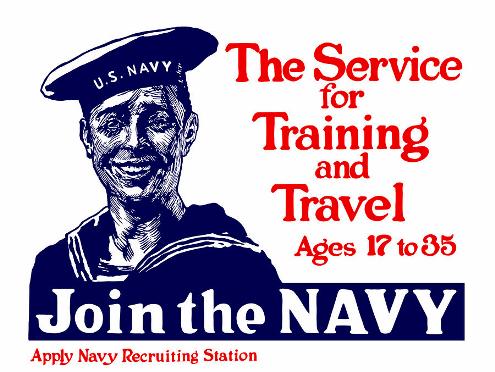
The back of this photo reads “Nell Barrow and Clyde / 1925.” Could it have been 1926 instead? On his birthday in 1925, Clyde (who was born on March 24, 1909) would have turned 16 years old. The minimum age for enlistment in the U.S. Navy jumped back and forth between 17 and 18 years old, but by the time his birthday rolled around in March of 1926, the enlistment age was 17. By the end of that year Clyde had been arrested for stealing a car, and even though charges were eventually dropped, this police record may have been enough to prevent him from enlisting even if he hadn’t failed a physical. Whatever the case, if he DID want to join the navy, he had a very limited window in which to do it: from his 17th birthday on March 24, 1926 to his first arrest on December 3, 1926.

Imagine how different things would have been if Clyde Barrow had joined the navy and sailed the Seven Seas instead of hooking up with Bonnie Parker and terrorizing the Southwest?

navy-recruiting-poster

***

Sources & Notes

Photo, titled “Clyde Barrow and sister Nell Barrow, Dallas, Texas,” is from the University of Texas at San Antonio Libraries Special Collections, and is accessible here. Photo loaned to UTSA by Henry J. Williams (other photos from Mr. Williams’ collection are dated 1926, some of which I used in my previous post “Babyface Barrow — 1926” here).

If anyone has more information about Clyde’s uniform in this photo, I’d love to hear from you. Similar uniforms can be seen here.

Just to be ruthlessly detailed, if Clyde Barrow visited the United States Navy recruiting office in Dallas, it was on the second floor at 206 ½ Browder Street, at Commerce, its new headquarters as of June, 1925; station physician was Lieut. Jack Terry. (Wonder if Lieut. Terry was the one who gave Clyde his walking papers? If so, I wonder if he ever knew?)

A list of requirements to join the U.S. Navy — published in The Scranton Republican on Feb. 10, 1927 — can be found here.

For previous Flashback Dallas posts on Bonnie and Clyde, click here.

*

Copyright © 2015 Paula Bosse. All Rights Reserved.

A Proposed Trinity River Boulevard Connecting Dallas and Fort Worth — 1924

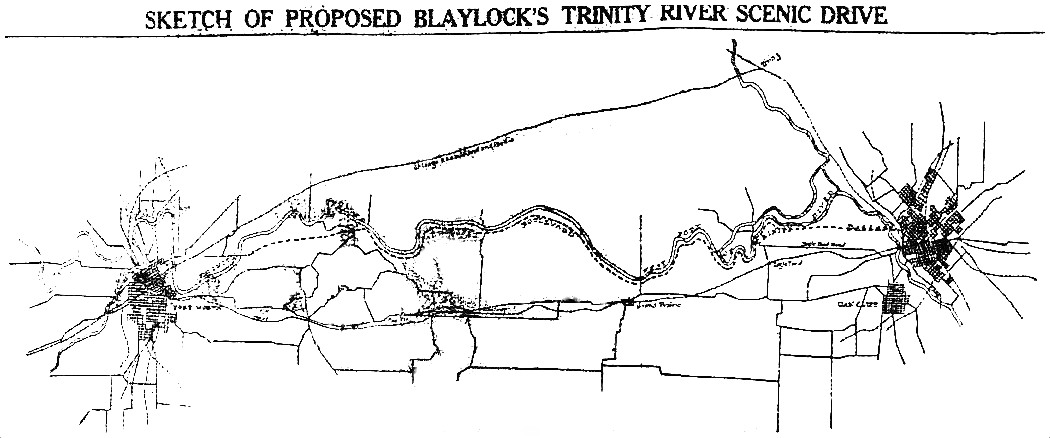
trinity-river-scenic-drive_dmn-110224The mayor’s plan for a scenic highway… (click for larger image)

by Paula Bosse

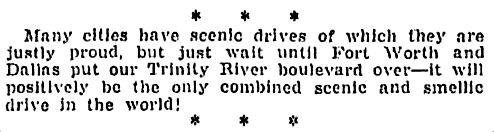
In 1924, Dallas Mayor Louis Blaylock proposed a new route between Dallas and Fort Worth which would closely follow the course of the Trinity River. Not only would this new road relieve congestion of the highway already in heavy use by trucks, business vehicles, and “speeding jitneys,” but it would also provide a more sedate and scenic thoroughfare, intended for use by the citizens of Dallas, Fort Worth, and the mid-cities who enjoyed taking their “pleasure vehicles” out for a stress-free Sunday drive.

The following text and the above chart appeared in The Dallas Morning News on Nov. 2, 1924:

Sketch of Proposed Blaylock’s Trinity River Scenic Drive

Mayor Louis Blaylock’s proposed scenic highway between Dallas and Fort Worth would follow the course of the West Fork of the Trinity River between the two cities. The above sketch was made in the office of E. A. Kingsley, city engineer of Dallas.

Last week the Dallas Mayor advanced the suggestion that the “necessary new road to Fort Worth” be planned along these lines. Both Mayor Blaylock and Mayor Willard Burton of Fort Worth have offered $5,000 each toward the new enterprise if nine other citizens in both places donate like sums.

Mayor Blaylock said Saturday that such a project would be impracticable without adequate flood control, and when the matter reaches the conference stage around Jan. 1 a system of locks, dams and levees will be discussed. A boat canal between Dallas and Fort Worth and an irrigation system for the intermediate farming country are among the possibilities, said Mayor Blaylock.

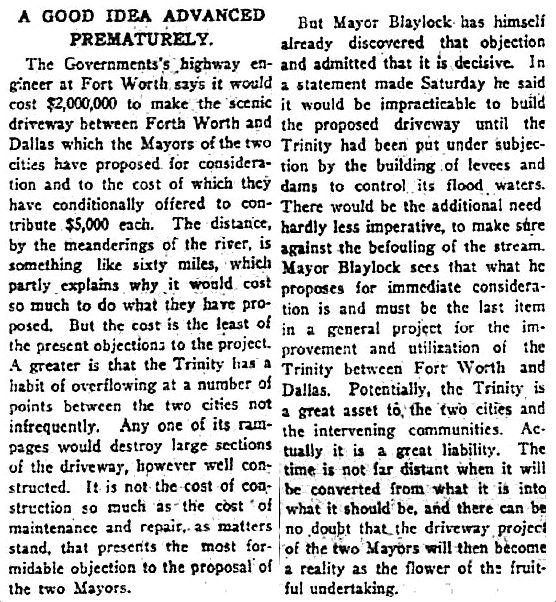
A few days earlier, a sarcastic editorial about the plan (in which the Dallas mayor’s name was misspelled throughout) appeared in The Fort Worth Star-Telegram (click for larger image):

trinity-highway_FWST_102924FWST, Oct. 29, 1924

Even though Dallas and Fort Worth had long engaged in a (mostly) friendly rivalry, it was Fort Worth’s mayor, Willard Burton, who, rather surprisingly, stepped up to offer financial support for the Dallas mayor’s plan. Saying that it was unfair to further burden the taxpayers, he chipped in $5,000 toward the funding of the new road and suggested that he could persuade nine other civic-minded Fort Worthians to do the same. Blaylock may have been forced by mayoral peer pressure to dig deep and follow suit, but he also pledged $5,000 and said he’d get nine flush Dallasites to fork over five thou, too.

trinity-highway_dmn_103124DMN, Oct. 31, 1924

I’m not sure how either thought a 60-mile road could be built between Dallas and Fort Worth for only $100,000 (slightly less than 1.5 million dollars in today’s money). As it turned out, it couldn’t. An engineer with the U.S. Bureau of Roads estimated it would cost closer to $2,000,000 (about 27.5 million dollars in today’s money — a veritable BARGAIN!).

trinity-highway_dmn_110124-costDMN, Nov. 1, 1924

In less than a week of giddy conversations about the Trinity River fantasy boulevard, the plan was pretty much dead when everyone accepted the fact that it was not economically feasible.

trinity-highway_dmn_110424DMN, Nov. 4, 1924

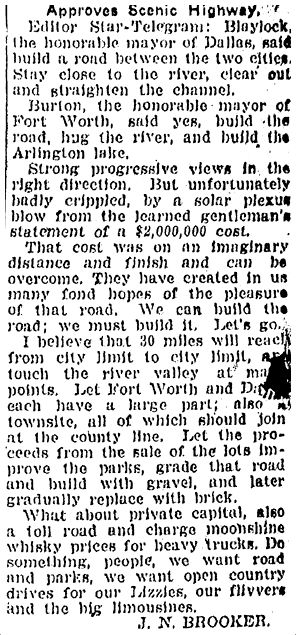
There must have been many sad souls in Dallas in the fall of 1924. But some still insisted it could be built and should be built. Prominent Fort Worth resident J. N. Brooker wrote an impassioned letter to the Star-Telegram, with a few helpful suggestions:

scenic-drive_FWST_112124FWST, Nov. 21, 1924

A toll road that charges “moonshine whiskey prices” — there you go!

***

Sources & Notes

Top image from The Dallas Morning News, Nov. 2, 1924 (apologies for the poor resolution!).

More on Mayor Louis Blaylock (1849-1932) from The Handbook of Texas, here.

Lastly, a couple of amusing snide remarks from the pages of Amon Carter’s Fort Worth Star-Telegram:

scenic-drive_FWST_110324FWST, Nov. 3, 1924

scenic-drive_FWST_111124FWST, Nov. 11, 1924

Most images larger when clicked.

*

Copyright © 2015 Paula Bosse. All Rights Reserved.

DP&L’s Twin Smokestacks

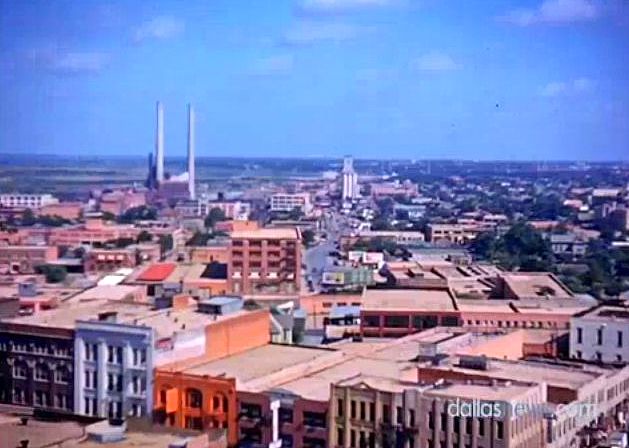
downtown_color_1939
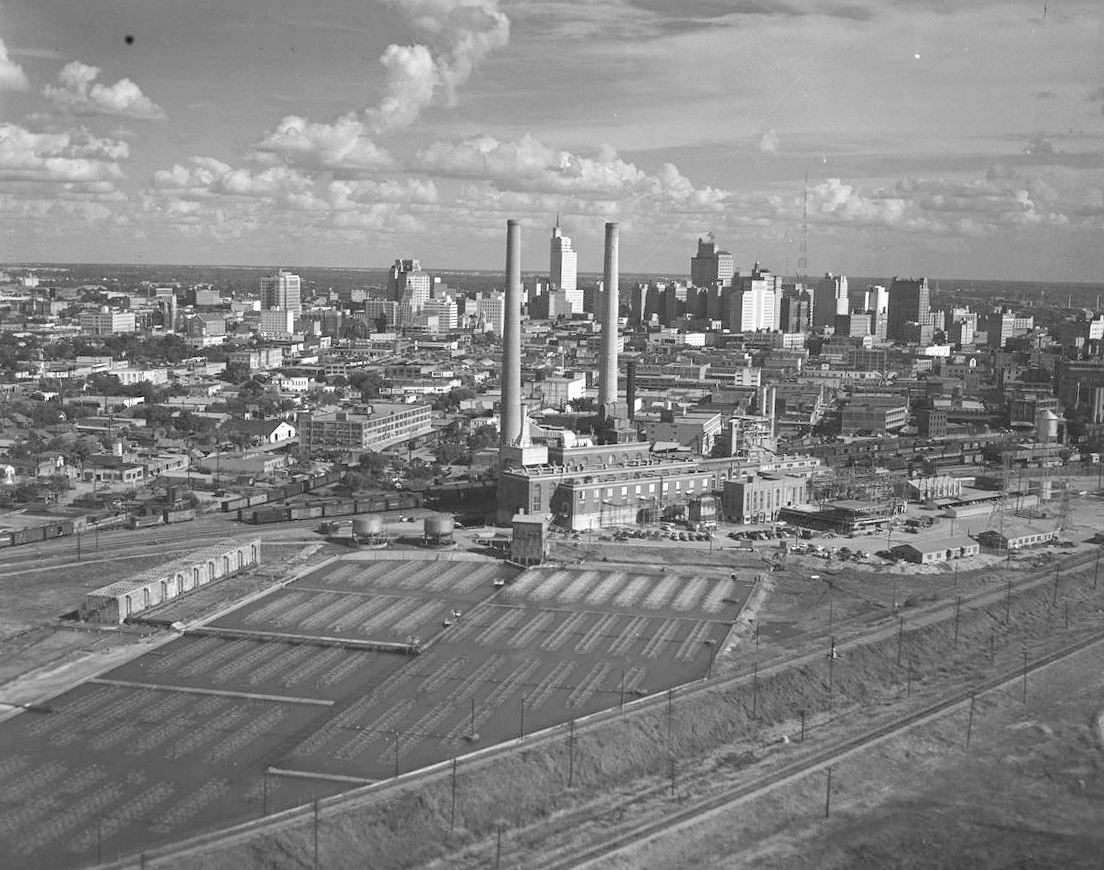
An unusual view of the smokestacks from 1939 — in color!

by Paula Bosse

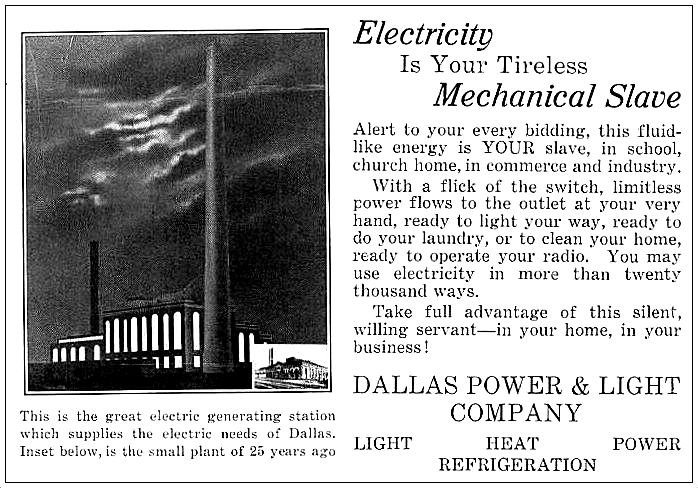
I got to thinking about those two smokestacks that used to be such an important part of the Dallas skyline when I came across this rather forceful 1928 Dallas Power & Light Company ad:

ad-dpl_terrill-yrbk-1928
(click for larger image)

“More than twenty thousand ways” to use electricity, “your tireless mechanical slave”! (To see a larger image of the ad’s illustrated inset, click here.)

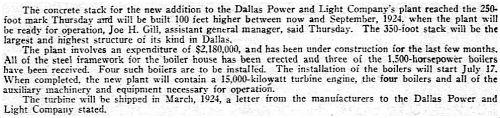
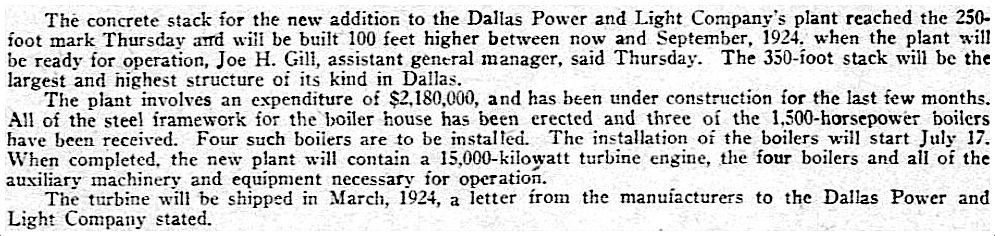
According to The Dallas Morning News, the Dallas Power & Light Company power plant had been in use at the location at “at the foot of Griffin Street … since 1890, with additions in 1905, in 1912 and in 1914. In 1922 work started on the most recent addition, which when completed will cost over $2,000,000, and will provide additional generating capacity of furnishing 20,000 kilowatts” (DMN, Oct. 14, 1923).

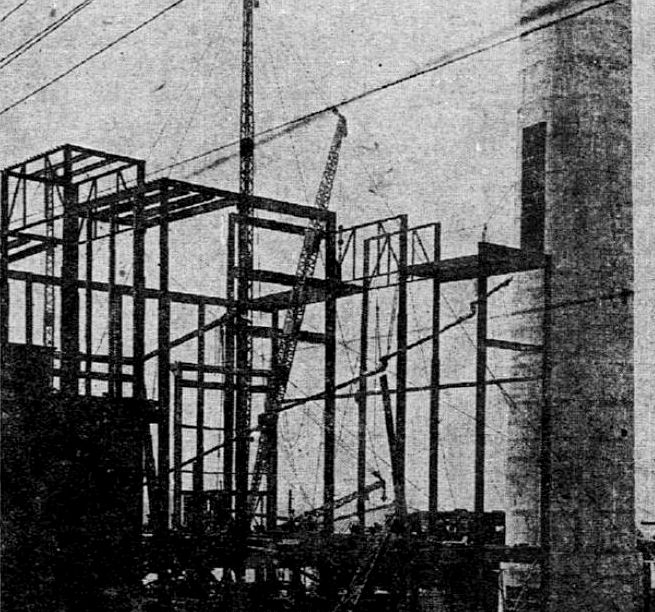
Construction on the new addition — including the first of the two new smokestacks — began in the summer of 1922.

dpl_dmn_FWST_072822Fort Worth Star-Telegram, July 28, 1922

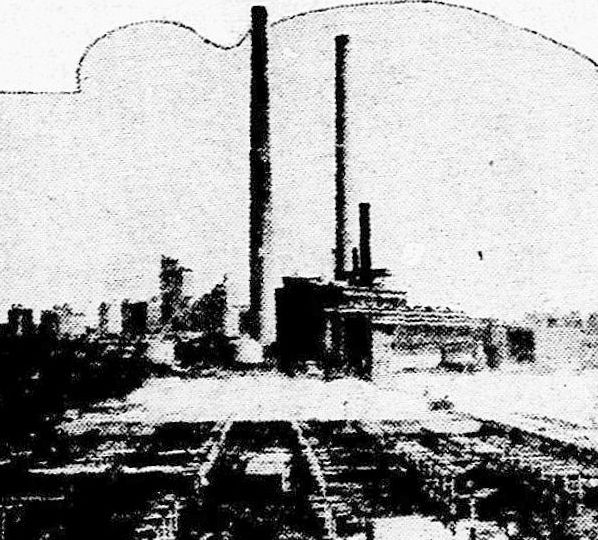
By the summer of 1923 the first smokestack was partially built.
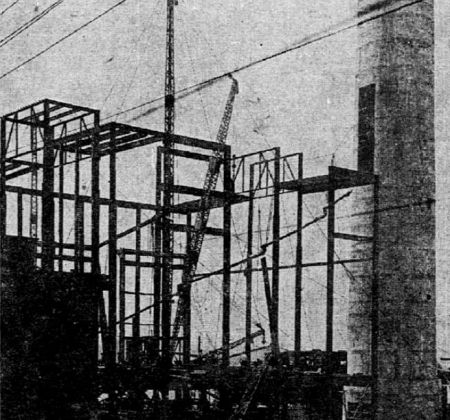
smokestack_dmn_071323smokestack_dmn_071323-captionDMN, July 13, 1923 (click for larger images)

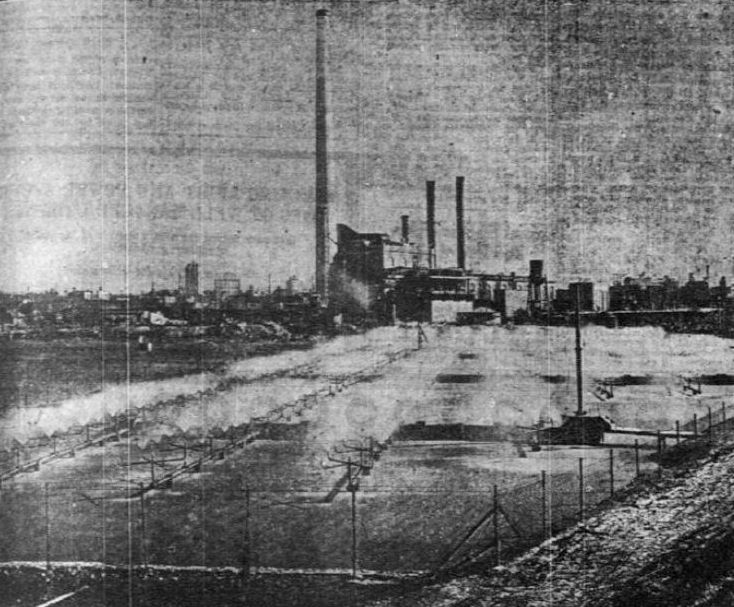
The new addition was completed in 1924 (although improvements and construction were constantly ongoing). The new giant smokestack can be seen in this photo, alongside the old and new parts of the generating plant:

dpl_dmn_101224_photo2DMN, Oct. 12, 1924

And, another view, this one with the 8-acre “spray pond” in the foreground:
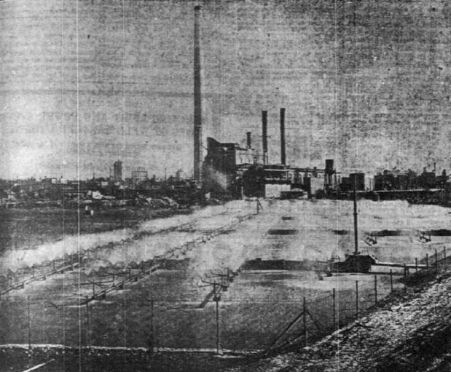
dpl_dmn_101224_photoDMN, Oct. 12, 1924

In 1928 DP&L announced that it needed a further addition:

Another large chimney or smokestack, a new boiler room and other plant enlargements will be required in the North Dallas generation plant to house the new addition. (DMN, Oct. 20, 1928)

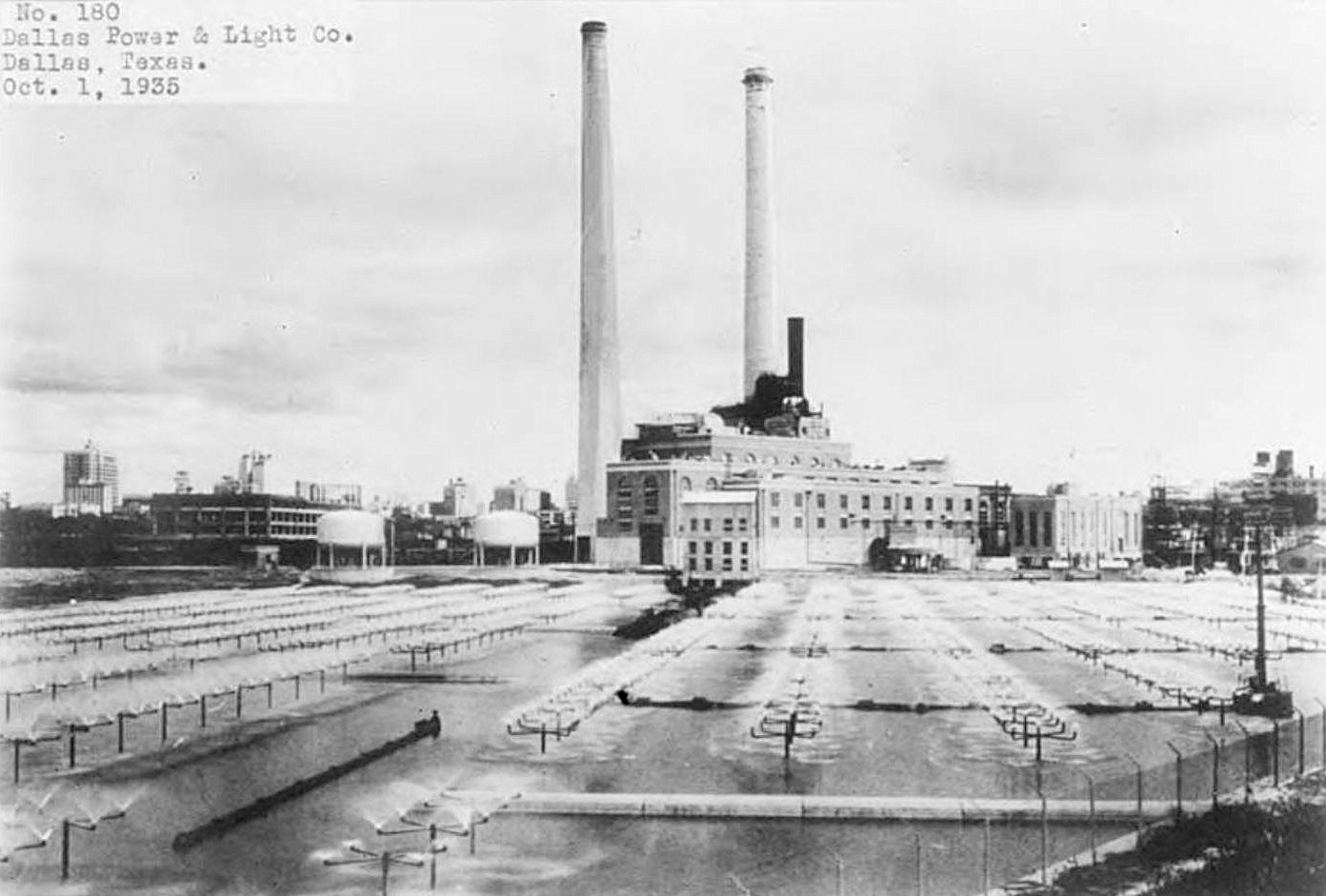
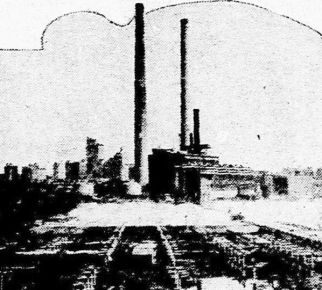
And in 1929 … voilà — the second smokestack!
dpl_steamstacks_1929
1929

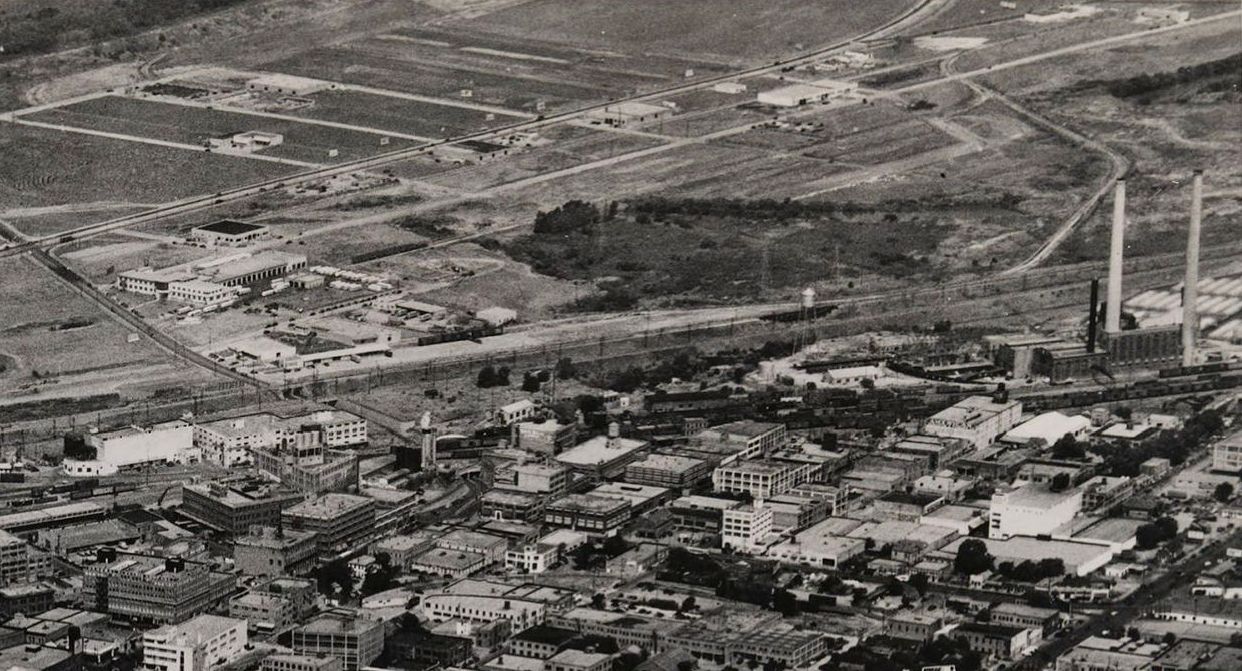
Those two smokestacks (which actually emitted steam rather than smoke) were almost as much a part of the iconic Dallas skyline as Pegasus. You’ll see them in any wide shot of the skyline taken between 1929 and the late 1990s, when the plant was demolished to make way for the American Airlines Center (the design of which actually is reminiscent of the building it replaced). You could see those smokestacks from miles away, and, even though they’ve been gone for more than 15 years, I still expect to see them standing there. RIP, smokestacks!

*

dallas-power-and-light_degolyer-lib_SMU1930s, via DeGolyer Library, Southern Methodist University
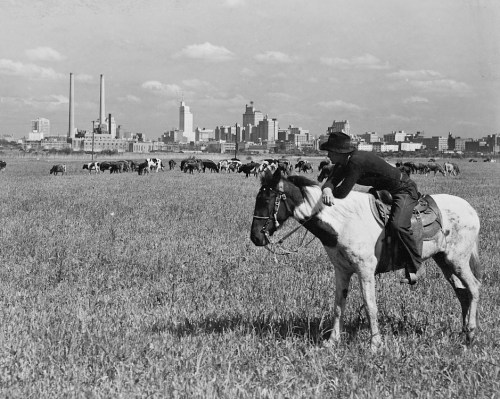
langley_skyline-horseback_c1945_LOCPhoto by William Langley, 1945 (with the twin stacks AND Pegasus)
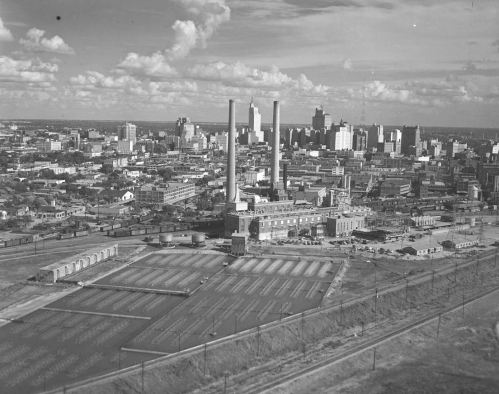
dpl-plant_towers_squire-haskins_UTAvia Squire Haskins Collection, University of Texas at Arlington

smokestacks_long_foscue_ca1948-detAerial photo by Lloyd M. Long, 1948 (detail)

dpl_steamstacks

***

Sources & Notes

Color image is a screengrab from the short 1939 color film of Dallas which you can watch in full, here.

Ad is from the 1928 Terrillian, the Terrill School yearbook.

William Langley photo of the cowboy on horseback is from the Library of Congress, used previously here.

Lloyd M. Long aerial photo is a detail of a photo cataloged as “Downtown Dallas — looking west,” from the Edwin J. Foscue Map Library, Central University Libraries, Southern Methodist University; the full photo and its details are accessible here.

For an unexpectedly enthusiastic essay about the design and cultural/aesthetic significance of the plant and its smokestacks, architecture critic David Dillon’s “Getting Up a Head of Steam: DP&L’s Power Station, Recalling an Urban Past, Is a Function of Triumph” (Dallas Morning News, Sept. 7, 1983) is well worth searching for in the Dallas Morning News archives. This is the first paragraph:

The Dallas Steam Electric Station on Stemmons is nearly a century old and for most of that time it has been a commanding presence on the downtown skyline, its soaring white smokestacks rivaling anything that modern skyscraper designers have come up with. In Pittsburgh or Detroit such a structure might pass unnoticed but in Dallas, never a factory town, it stands out as a romantic symbol of our earliest industrial aspirations.

(My favorite piece of trivia from Dillon’s article is the revelation that the “tapering white shafts and gold caps [were] touched up every few years by daredevil painters lowered from a helicopter…” (!)).

More about this plant (and how it lives on in the design of the American Airlines Center which now stands on the same land) can be found in the Flashback Dallas post “A New Turbine Power Station for Big D — 1907,” here.

As always, most images are larger when clicked. When in doubt … CLICK!

*

Copyright © 2015 Paula Bosse. All Rights Reserved.


The Adolphus & Its Annex

adolphus_lang-witchell_arch-yrbk_1922The Adolphus Hotel and its annex, circa 1922 (click for larger image)

by Paula Bosse

Built in 1912, the ornate and luxurious Barnett, Haynes, and Barnett-designed Adolphus Hotel (which was modeled on/inspired by the Plaza Hotel in New York) quickly became THE hotel in Dallas. It was so successful that in only four years an expansion was already underway. The 12-story “Annex” (seen above, just to the left of the original building) was designed by preeminent Dallas architects Otto Lang and Frank Witchell. The so-called “Junior Adolphus” was built around 1916/17 and added 229 rooms to Dallas’ most glamorous hotel. A third addition (“Adolphus III”) came along in the 1920s.

Below, a few views of the Adolphus complex at different stages of its growth. (Click photos for larger images.)

*

adolphus-construction_dallas-then-and-nowBuilt at the northwest corner of Commerce and Akard streets, the Adolphus Hotel was built on the spot previously occupied by the City Hall. This photo, looking northeast, shows the site’s excavation by Vilbig Brothers Construction.

*

1913-pano-2In this detail from an April 1913 panoramic photograph of the city’s skyline, the Adolphus can be seen just six months after its opening at the end of 1912. (A previous post devoted to the full panoramic photo can be accessed here.) The Oriental Hotel, with its rounded topknot, can be seen across Commerce from its sister hotel (both were built by beer king Adolphus Busch). Seen in the background is the Praetorian Building — once the tallest structure in Dallas (it is the tall building, second from the right).

*

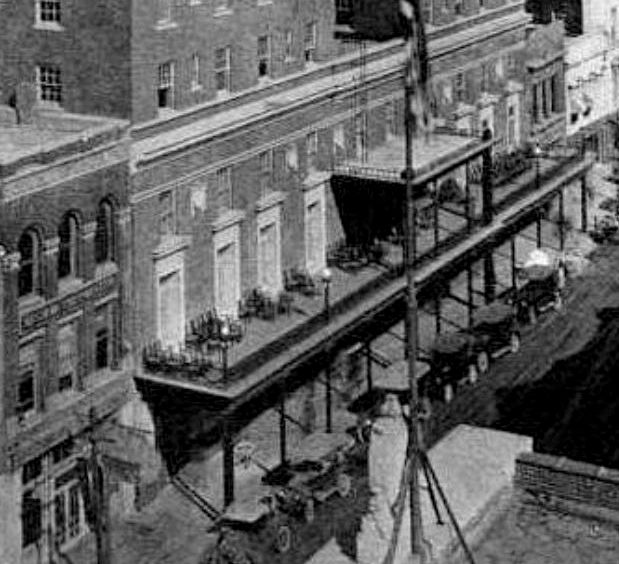
adolphus_lang-witchell_arch-yrbk_1922-detThe the Lang & Witchell-designed annex came along around 1916/17 (see top photo). My favorite detail is what looks like an open-air terrace, with tables and chairs, overlooking Commerce Street.

*

adolphus-annex_dallas-hotelsAnother view, showing the hotel and annex in 1924.

*

adolphus-annex_dallas-hotels-detA closer look shows that the terrace is now enclosed.

*

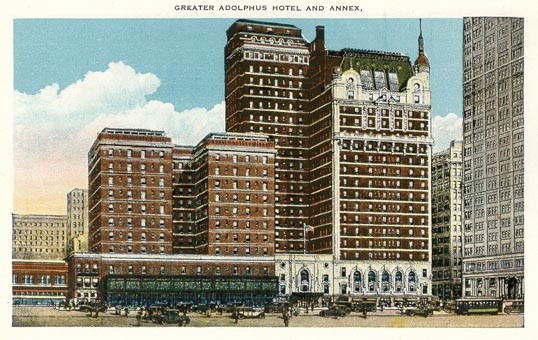
adolphus-hotelA few years later, a further, taller addition was built.

***

Top photo from the 1922 Yearbook of the Dallas Architectural Club.

Photo of the excavation from Dallas Then and Now by Ken Fitzgerald (San Diego: Thunder Bay Press, 2001); photograph from the Texas/Dallas History and Archive Division of the Dallas Public Library. A similar photo can be seen on the fascinating history page of the Vilbig & Associates website, here.

Detail of 1913 panoramic photo from the Jno. J. Johnson photo in the Library of Congress. (For more info, see previous post, “‘New Dallas Skyline’ — 1913,” here.)

Photo of the Adolphus with the Coca Cola sign in the lower left from Historic Dallas Hotels by Sam Childers (Charleston: Arcadia Publishing, 2010). The author’s extremely informative caption can be read here.

See a wonderful pictorial history of the Adolphus Hotel on the Dallas Morning News website here.

The official website for the Adolphus Hotel is here.

Click photos for larger images.

*

Copyright © 2015 Paula Bosse. All Rights Reserved.


Easter Egg Hunt at City Park — 1924

Hunters and their patrons, 1924…

by Paula Bosse

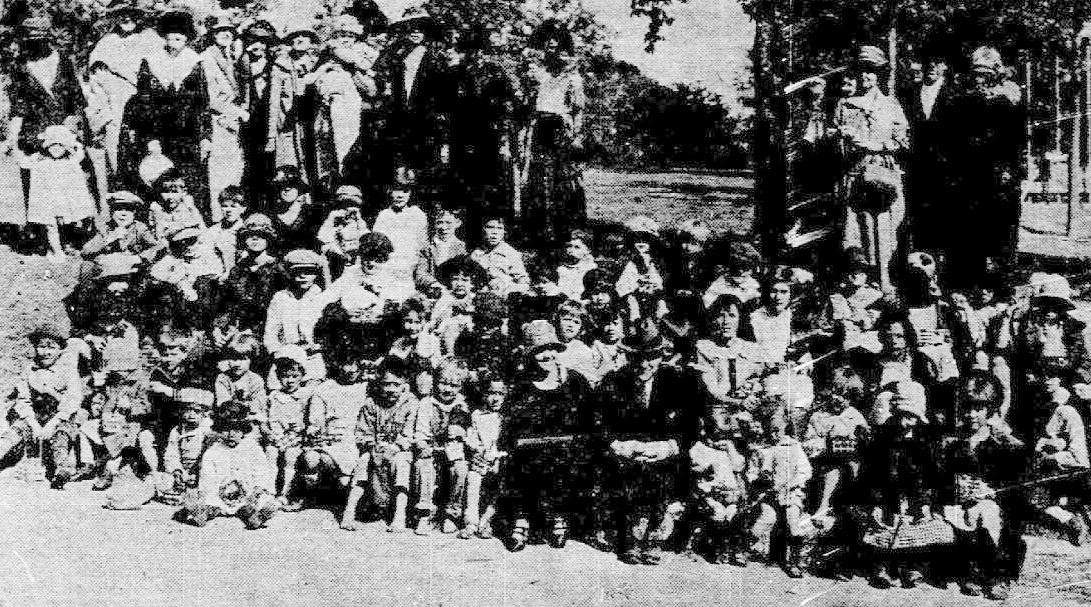
Happy Easter! Here’s what was going on at about this time, 91 years ago.

*

Osteopathic Clinic Fetes Children With Easter Egg Hunt

The church committee of the free osteopathic clinic at the First Unitarian Church, Ervay and St. Louis streets, entertained seventy-five children of the clinic at an Easter egg hunt in City Park Friday afternoon. Real Easter eggs were hidden by the ladies of the committee about the park, and where the close-cropped grass did not provide good hiding places about the tree trunks, nests were made in the sand.

After the youngsters had been released to hunt, they pursued the quest vigorously, to the accompaniment of shrill cries of delight, until all the eggs were found, the members of the committee distributed Easter baskets filled with candy eggs for the children to eat. Later they were taken to the church, where refreshments were served.

***

Sources & Notes

Photo and caption from The Dallas Morning News, April 19, 1924.

*

Copyright © 2015 Paula Bosse. All Rights Reserved.

Dallas’ Kosher Delis — 1921

fram_passover_jewish-monitor_040821

by Paula Bosse

Dallas once had a lot of mom-and-pop Jewish delicatessens and markets. Would that that were true today….

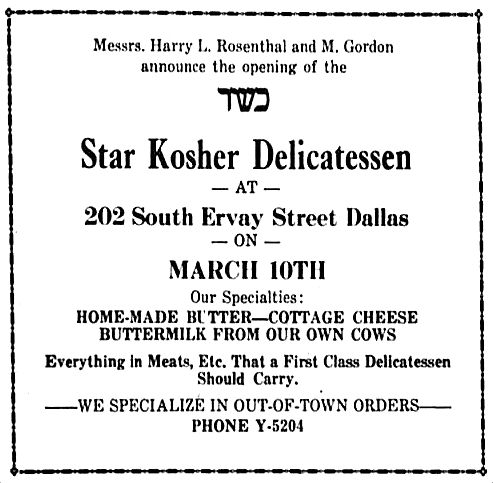
Here are a few ads from the pages of the Fort Worth-based Jewish Monitor (the “Leading Jewish Journal of the Great Southwest”) from April, 1921, published in the lead-up to Passover.

chicago-deli_jewish-monitor_040821

sterns-deli_jewish-monitor_040821

star-deli_jewish-monitor_040121

goldin-meat-mkt_jewish-monitor_040821

***

All ads from The Jewish Monitor, April 8, 1921 (except for the Star Kosher Delicatessen ad, which was from the April 1, 1921 edition). The April 8 edition of the paper can be viewed in its entirety at the Portal to Texas History site, here.

As this is Passover, my previous related post, “The Margules Family’s Passover Seder,” can be read here.

*

Copyright © 2015 Paula Bosse. All Rights Reserved.