Flashback : Dallas

A Miscellany: History, Ads, Pop Culture

Category: 1940s

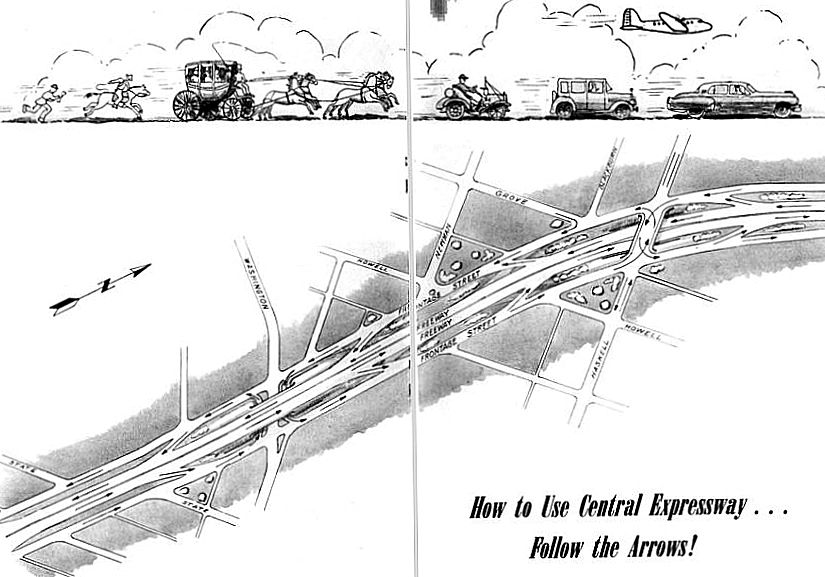
“How to Use Central Expressway” — 1949

by Paula Bosse

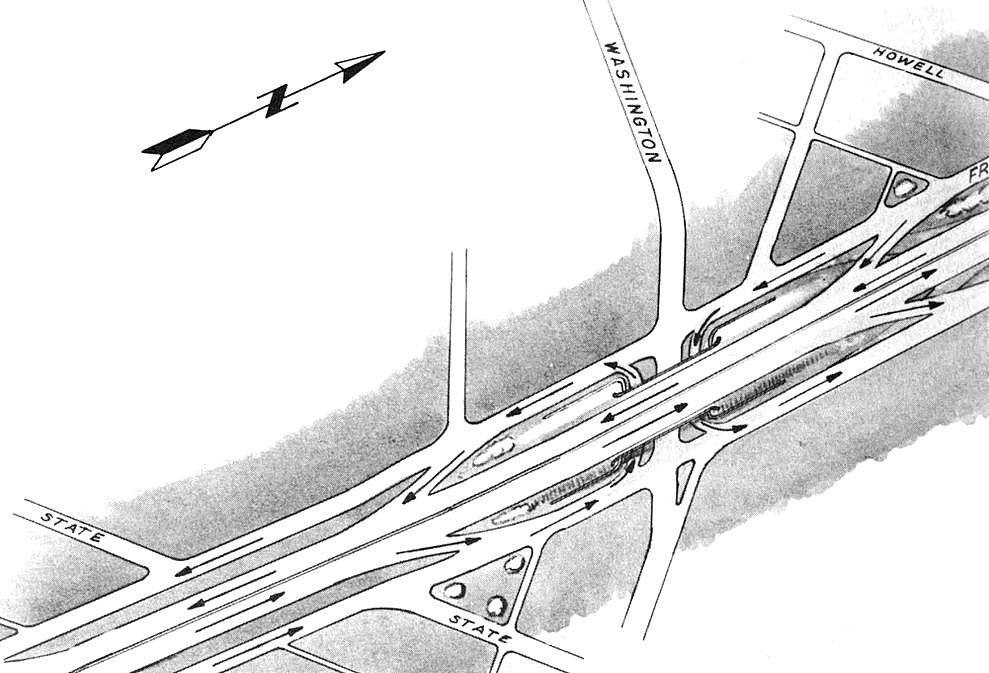
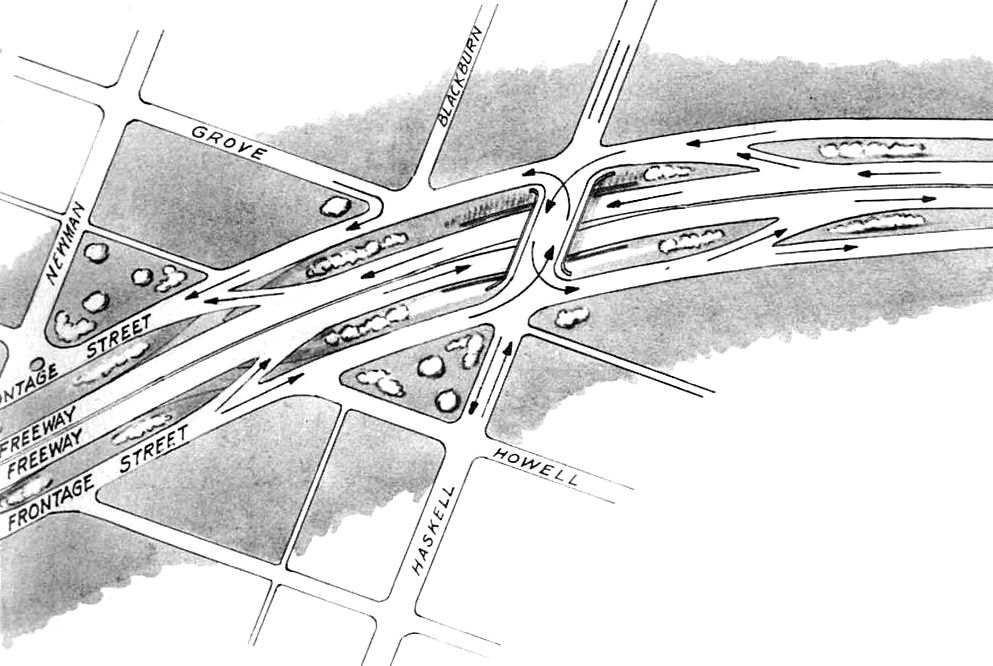
It got only to Fitzhugh from downtown at this point, but the freeway concept was new enough that Dallas drivers needed some instruction on how to use Central Expressway. Cute.

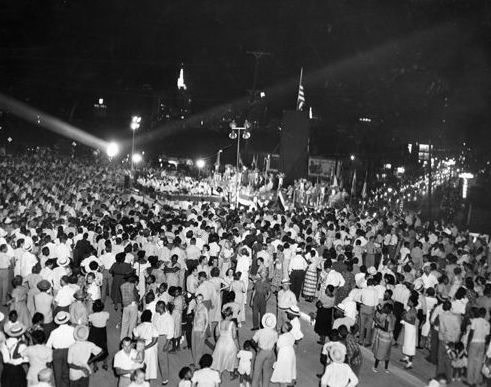
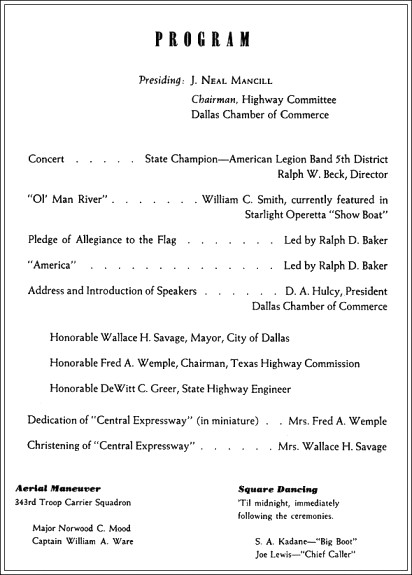
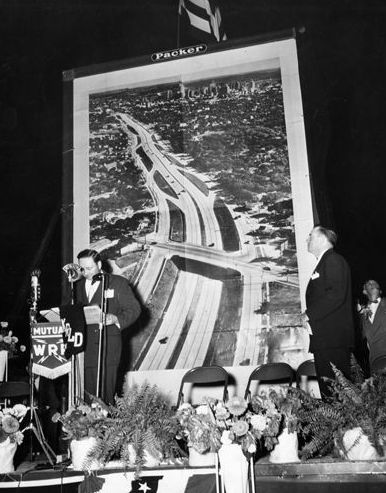
Cuter still, the dedication ceremony. It included the singing of — what else? — “Old Man River,” the Pledge of Allegiance, some sort of aerial fly-over, and, of course, square dancing (two square dances, one for white dancers, one for black). Oh, and the mayor’s wife christened the expressway with a bottle of cologne. (How much more Dallas can you get?) (Many of the images and articles below are larger when clicked.)

The opening ceremonies were covered extensively by the local papers. My favorite tidbit from the coverage was a quote by Mayor Wallace Savage on how the new highway will psychologically benefit the city’s drivers. His hope and expectation is that driving along Central Expressway will make drivers “more relaxed when they get home from the office, and in a better mood when they get to the office from home.” Again, cute.

*

central_opening_haskins_briscoe-ctr1

Above, Neal Mancill, Chairman of the Highway Committee of the Dallas Chamber of Commerce. Photo by Squire Haskins.

central_opening_haskins_briscoe-ctr2

The segregated celebration had black celebrants in one area and white celebrants in another. Photo by Squire Haskins.

central_opening_haskins_briscoe-ctr3

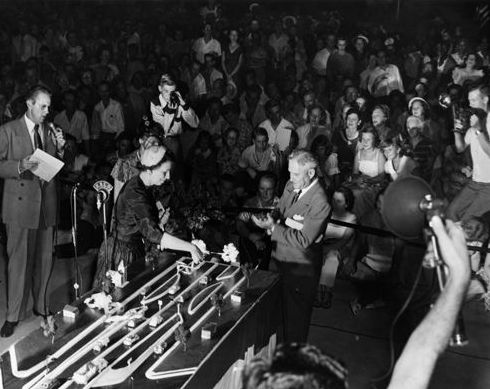
Mrs. Fred Wemple, wife of the Chairman of the Texas Highway Commission, cutting the ribbon on a miniature replica of Central Expressway. Photo by Squire Haskins.

*

But back to the lesson. THIS is how you use Central Expressway — just follow the arrows! The two halves of the larger map above are here magnified (click!) to more easily facilitate wistful inspection of an artifact from a simpler time when the city looked forward to experiencing a calm, restful, non-stop drive along the Central Expressway.

ht-use-central-1

ht-use-central-2

central-expressway

***

To peruse the entire pamphlet titled Central Expressway… San Jacinto to Fitzhugh, Dedication August 19, 1949 (Dallas: Dallas Chamber of Commerce, 1949), click here.

Photos by Squire Haskins from the Dolph Briscoe Center for American History.

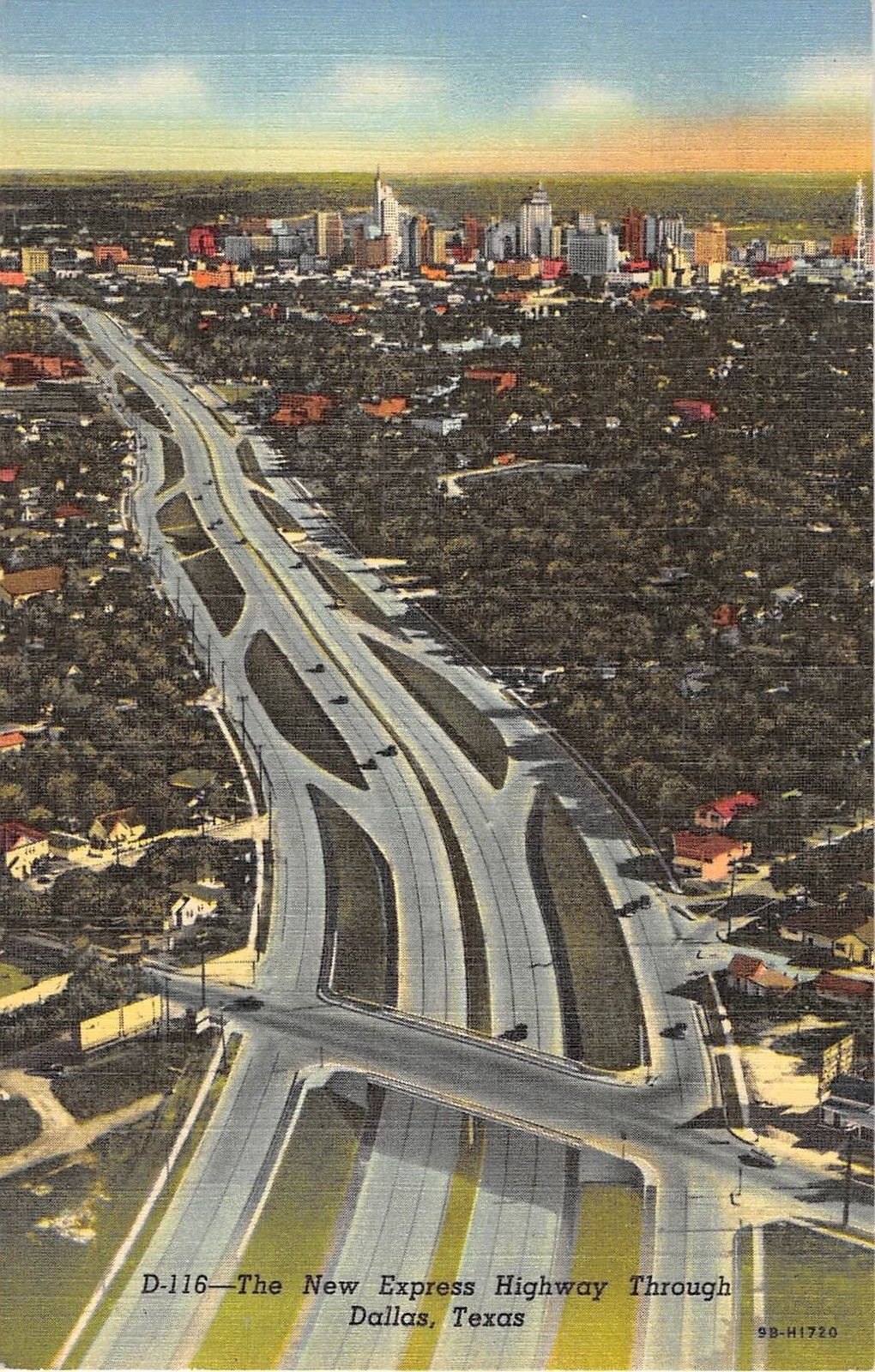
Postcard from a photo by Squire Haskins (click to see GIGANTIC image).

When in doubt, click pictures to see if images are larger.

*

Copyright © 2014 Paula Bosse. All Rights Reserved.

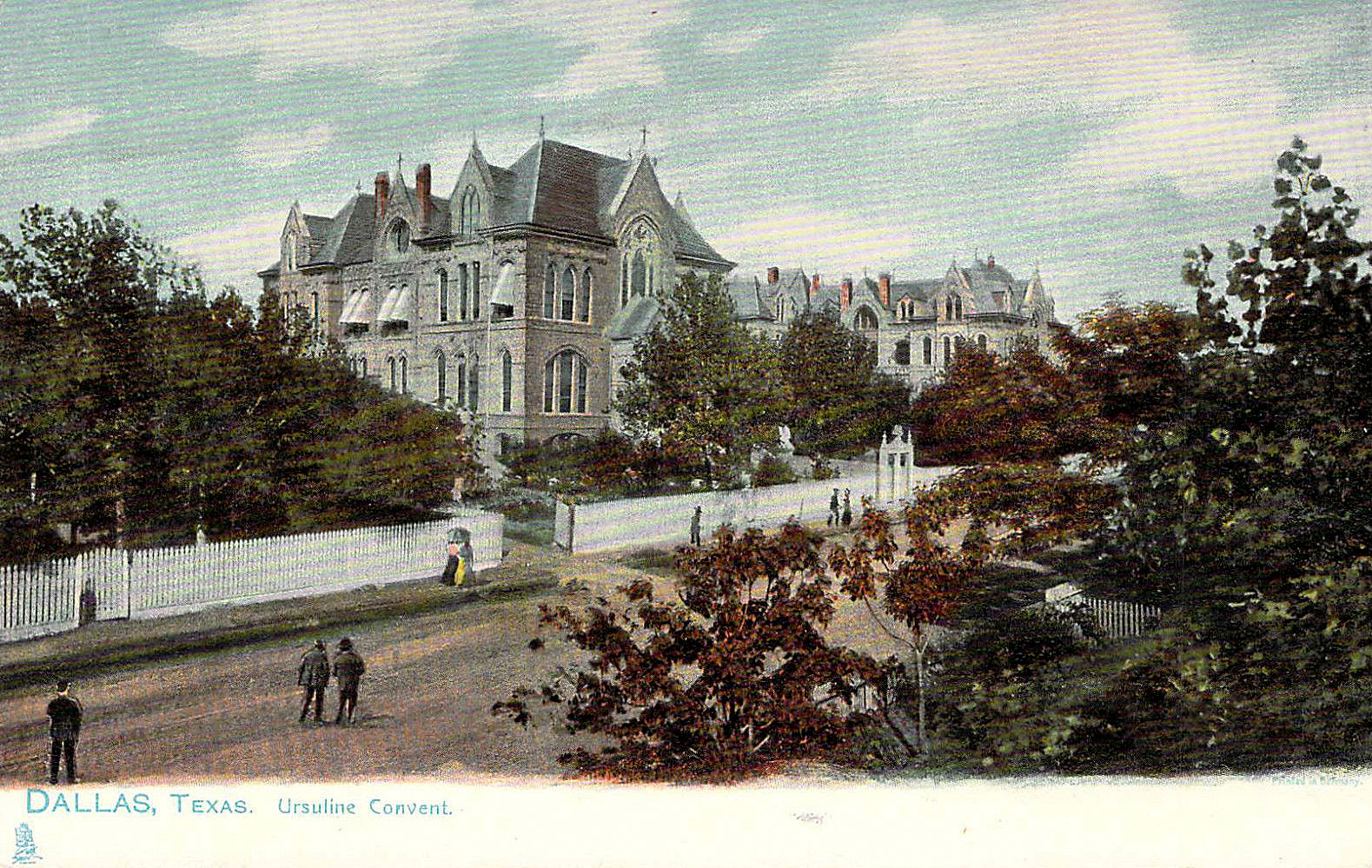
Nicholas J. Clayton’s Neo-Gothic Ursuline Academy

ursuline_postcard-color

by Paula Bosse

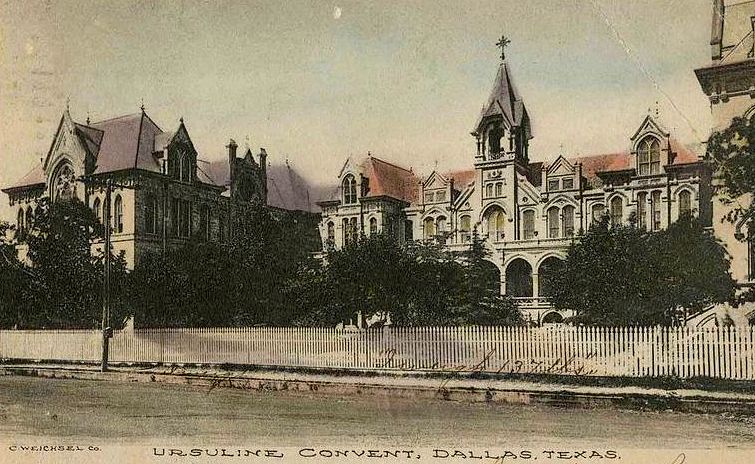
Over the years, Dallas has been the site of dozens and dozens of beautiful educational campuses, almost none of which still stand — such as the long-gone Victorian-era Ursuline Academy, at St. Joseph and Live Oak streets (near the current site of the Dallas Theological Seminary). The buildings, which began construction in 1882, were designed by the Catholic church’s favorite architect in Texas, Nicholas J. Clayton of Galveston. Such a beautiful building in Dallas? It must be demolished!

ursuline_first_bldg
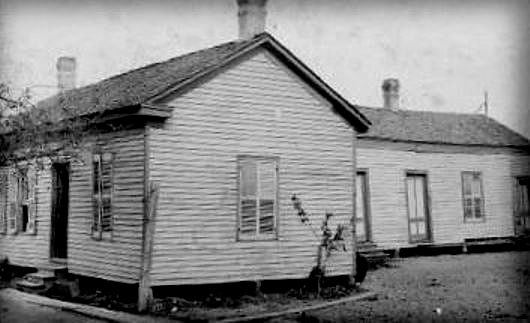
Six Ursuline Sisters, sent to Dallas from Galveston, established their academy in 1874 in this poorly insulated four-room building (which remained on the Ursuline grounds until its demolition in 1949). When they opened the school, under tremendous hardship, they had only seven students. But the school grew in size and reputation, and they were an academic fixture in East Dallas for 76 years. In 1950 the Sisters moved to their sprawling North Dallas location in Preston Hollow where it continues to be one of the state’s top girls’ prep schools. After 140 years of educating young women, Ursuline Academy is the oldest continuously operating school in the city of Dallas.

clifton-church_ursuline_1894Construction took a long time. (ca. 1894)

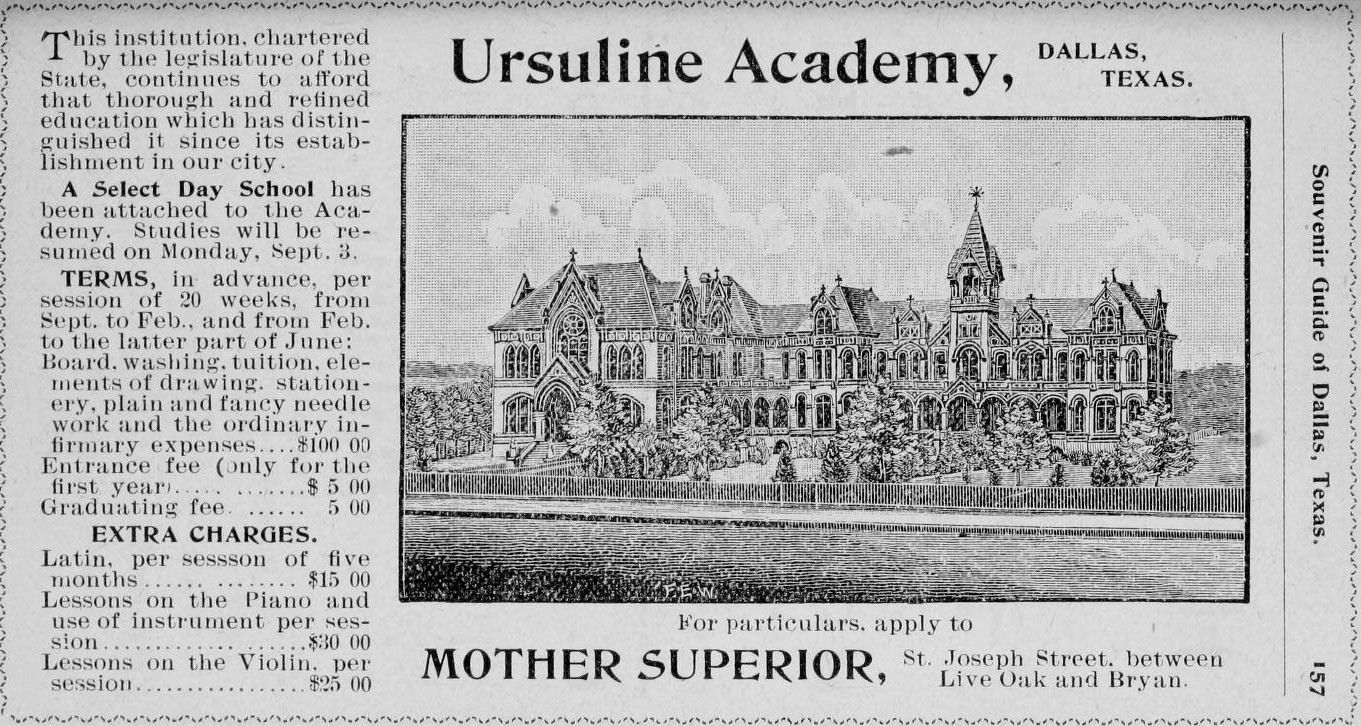
ad-ursuline_souv-gd_1894When Latin cost extra. (1894) (Click for larger image.)

ursuline_1906_largeIt even had a white picket fence. (ca. 1906)

ursuline-flickr1908-ish

ursuline_worleys_1909_det_LARGE1909 city directory

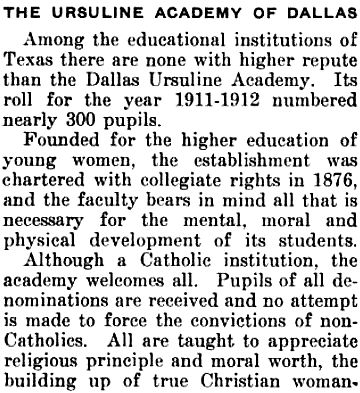
ursuline-academy_tx-mag_1912b1912 (click for large image)

After a year and a half on the market, the land was sold in 1949 for approximately $500,000 to Beard & Stone Electric Company (a company that sold and serviced automotive electric equipment). The property was bounded by Live Oak, Haskell, Bryan, and St. Joseph — acreage that would certainly go for a lot more these days (according to the handy Inflation Calculator, half a million dollars in 1949 would be the equivalent in today’s money of about five million dollars). A small cemetery was on the grounds, in which the academy’s first chaplain and “more than 40 members of the Ursuline order” had been buried. I’m not sure how these things are done, but the cemetery was moved.

ursuline_aerial_cook-colln_degolyer_smu

From a November, 1949 Dallas Morning News article on the vacated buildings’ demolition:

A workman applied a crowbar to a high window casing of the old convent and remarked: “I sure hate to wreck this one. It’s like disposing of an old friend. My father was just a kid when this building was built in 1883.” (DMN, Nov. 13, 1949)

And one of East Dallas’ oldest and most spectacular landmarks was gone forever. Looking at these photographs, it’s hard to believe it ever existed at all.

ursuline_cook-colln_degolyer_smu

*

Where was it? In Old East Dallas, bounded by Live Oak, Haskell, Bryan, and St. Joseph. See the scale of the property in the 1922 Sanborn map, here (once there, click for full-size map). Want to know what the same view as above looks like today? If you must, click here.

ursuline_today_bing-map
Bing Maps

***

Sources & Notes

Photo of the school’s first building is from the Ursuline Academy of Dallas website here. A short description of the early days of hardship faced by the Sisters upon their arrival in Dallas is here.

The photograph, mid-construction, is by Clifton Church, from his book Dallas, Texas Through a Camera (Dallas, 1894).

1894 ad is from The Souvenir Guide of Dallas (Dallas, 1894).

1912 text is from an article by Lewis N. Hale on Texas schools which appeared in Texas Magazine (Houston, 1912).

Aerial photograph from the George W. Cook Dallas/Texas Image Collection, DeGolyer Library, Southern Methodist University, here. Bottom image also from the Cook Collection, here.

Examples of buildings designed by Nicholas J. Clayton can be seen here (be still my heart!).

DMN quote from the article “Crews Begin Wrecking Old Ursuline Academy” by William H. Smith (DMN, Nov. 13, 1949).

Another great photo of the building is in another Flashback Dallas post — “On the Grounds of the Ursuline Academy and Convent” — here.

Many of the images are larger when clicked.

*

Copyright © 2014 Paula Bosse. All Rights Reserved.

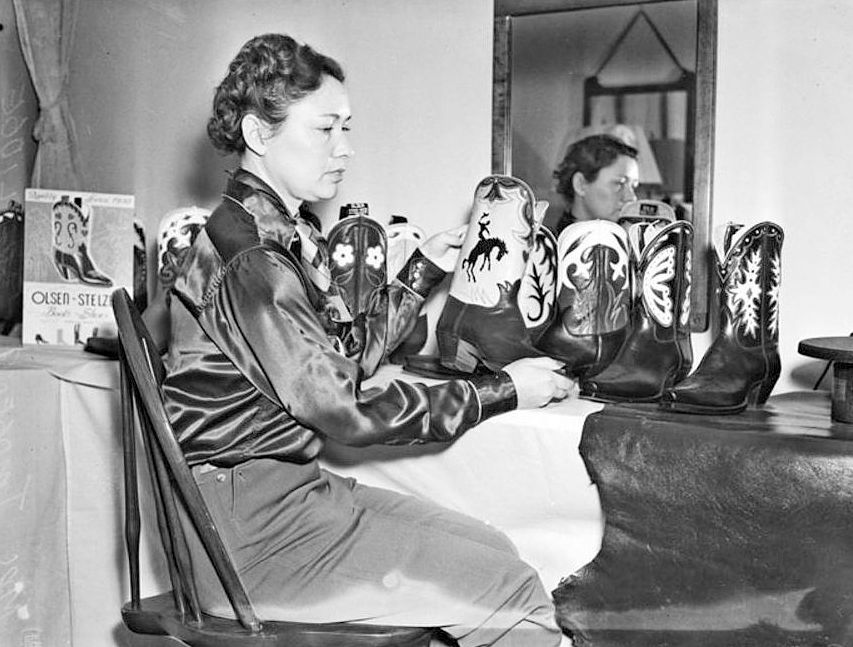
Olsen-Stelzer Cowboy Boot Saleslady — 1939

Portrait with boots…

by Paula Bosse

Above, Dallas resident Imogene Cartlidge is seen at a shoe retailers’ convention in San Antonio in 1939. Cartlidge was an employee of the Olsen-Stelzer boot company in Henrietta, Texas, and she was said to be “the only woman boot salesman on record.” I’m a big fan of cowboy boots of this period, and I have to say that I am ashamed that I was unaware of the famous Olsen-Stelzer company, which lasted from 1900 until the 1980s. The company is back in business again, led by Tom Cartlidge, whose parents began selling the boots in 1938 — Imogene is his mother. I wish them all the best of luck, because the world needs as many great-looking cowboy boots as it can get!

olsen-stelzer_dmn_120146

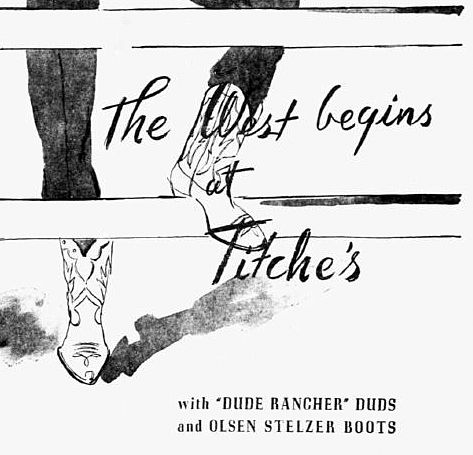
“The West begins at Titche’s”? First I’m hearing of this. Who knew? Nice ad, though.

olsen-stelzer_dmn_120146det

olsen-stelzer_dmn_103055

olsen-stelzer_1941

Best of all is this absolutely fantastic video from 1956 about the company:

olsen-stelzer-logo

olsen-stelzer-box

***

Sources & Notes

Photo of Imogene Cartlidge is from the San Antonio Light Photograph Collection, University of Texas San Antonio Libraries Special Collections, Institute of Texan Cultures.

Titche’s ad from 1946.

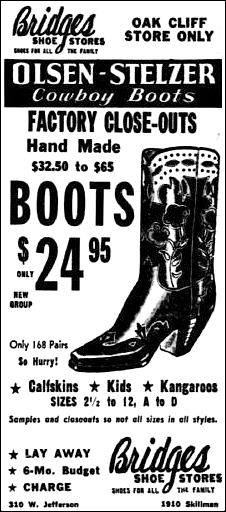
Bridges Shoe Store ad from 1955. (Bridges seems to have been the only place in Dallas where the boots were regularly sold — or at least regularly advertised. And you could get them ONLY IN OAK CLIFF!) (I hear the West begins at Oak Cliff….)

The video can be found on the home page of the Olsen-Stelzer website here.

The last image is the lid of an Olsen-Stelzer boot box, which belongs to my aunt — she keeps Christmas ornaments in it. (Sadly, no sign of the boots!)

The history of the company (and, again, that great video) can be found here.

*

Copyright © 2014 Paula Bosse. All Rights Reserved.

3800 Main: Fritos Central — 1947

by Paula Bosse

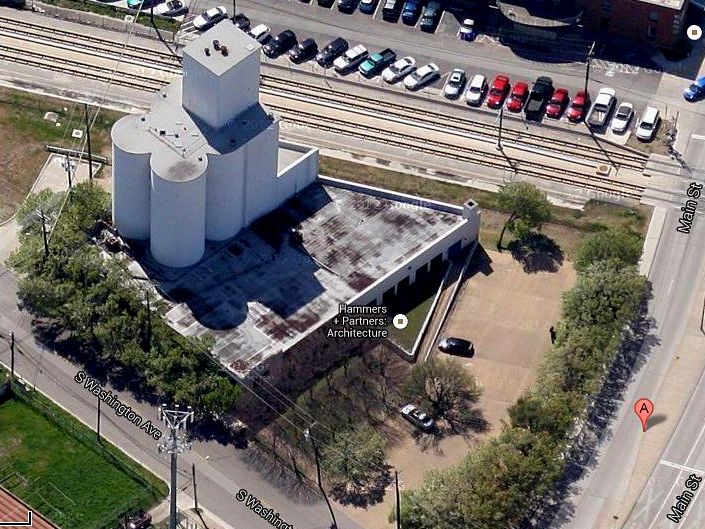
Last week I came across the above photo of old cars parked in front of a Fritos building of some sort, and I wondered where it had been. After a little bit of digging, I found out that it was near Fair Park — in the 3800 block of Main, between Washington and Exposition, on land right next to the railroad tracks. The building in the foreground appears to be gone  now, but I recognized the white, rounded towers behind it — I never knew what that building was, but I now know that it is the Frito company’s former grain elevator. And it’s still standing. Which I’m thankful for (and a bit surprised by) since it’s always been one of my favorite buildings in the area.

The Frito company (now Frito-Lay) has had its headquarters in the Dallas area since 1933. In the ’40s, its corporate offices were on Cedar Springs and its manufacturing plant was over near Fair Park, on Main Street. By 1947, the ever-expanding company had grown so much and had become so successful that it spent half a million dollars to build a whopping new grain elevator. The Dallas Morning News was there for a sneak-peek:

The extra-tough volcanic stones in the adjacent factory Monday will begin grinding corn supplied from a spanking new, ten-story white building just off the 3800 block of Main Street. […] The tall square gleaming structure is a $515,000 thoroughly modern elevator. […] Air-conditioned and equipped with the latest design apparatus, the elevator has storage capacity for 90,000 bushels of corn. It will supply the grain to the company’s factories in Dallas, San Antonio, Houston, Denver, Tulsa, and two plants in Los Angeles.

The new Frito elevator, weather proofed on the outside and weather controlled inside, was designed by Eugene Davis, architect. Huge grain cleaners which remove all chaff and foreign matter by shaking and air blast, occupy the second floor. Spray machinery gives the grain a thorough treatment to prevent infestation — the ‘buga-boo’ of grain products manufacturers. (DMN, Aug. 10, 1947, “Corn: $515,000 Elevator Latest Chapter in Corn-Chip Saga”)

Fifty-one boxcar loads of “select corn” — sans chaff and infestation — could be stored in that gleaming state-of-the-art grain elevator, designed by Eugene Davis (who a few years earlier, had designed another building for the Frito people, a small building at Wall and Corinth which housed the Pork Skin Chip Company).

In 1947, 3800 Main appears to have been something of a corn-chip Hyannisport — a self-contained compound in which all aspects of chip-production were seen to. As Kaleta Doolin (daughter of company founder C. E. Doolin) wrote in her book Fritos Pie:

Mr. Davis was the architect of all the various parts of the Frito plant in Dallas. The plant included the company’s grain elevator, where all the corn was stored; the machine shop (which my uncle Earl was in charge of); the food processing area; and the shipping warehouse, all built by Mr. Davis in 1947.

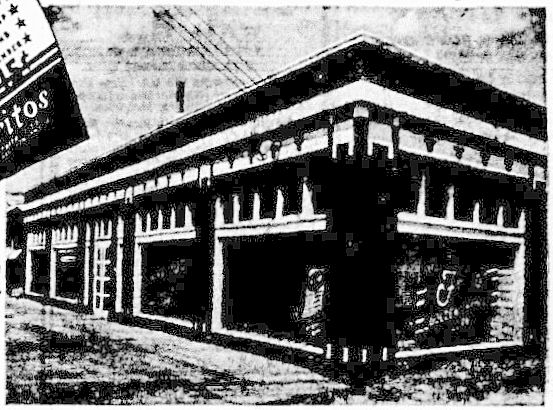
But that building in the top photo… that one had been there for years. 3800 Main Street had been the home of two or three car dealerships in the decades before Frito moved in. In 1929, as this photo shows, it was the location of the long-lived Ford dealership, Lamberth Motor Company.

lamberth-ford_1929

And here’s the same building in 1947, Frito-ized.

And the side of the building, taken from across the railroad tracks, then and now.

Another old building survives! What a relief that Dallas doesn’t tear down EVERY cool old building!

***

Sources & Notes

Can’t find a source for the top photo. It looks as if someone took a photo of a framed picture which is probably hanging on the wall of a person who feels a great kinship to old Dallas. Or to Fritos. Or to snacks.

Quote about the various parts of the plant is from Fritos Pie: Stories, Recipes, and More by Kaleta Doolin (College Station: Texas A & M University Press, 2011), p. 45.

The two 1947 photos of the Frito building are insets from a series of logrolling ads in which Frito thanks Texas Bank & Trust for all the money they’ve helped Frito make, and Texas Bank & Trust thanks Frito for all the money they’ve helped Texas Bank & Trust make. The take-away? There sure is a lot of money to be made in fried food.

The bottom two photos are from Google maps: the first looking toward the old granary from the railroad tracks, and the second looking down from the unblinking Google eyeball in the sky.

Lastly, a current photo of the building, now renovated and occupied by Hammers + Partners Architecture (whose daily business affairs are probably always accompanied by the faint smell of fried corn wafting past), can be seen here. (What must that building look like inside?!)

Click pictures for larger images.

*

Copyright © 2014 Paula Bosse. All Rights Reserved.


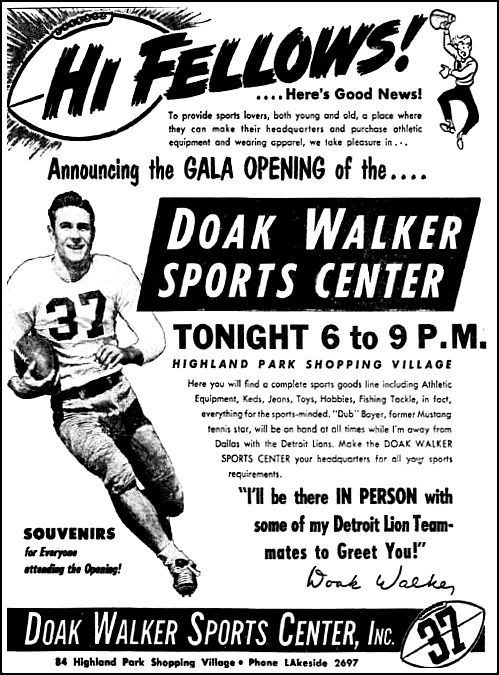
The Store That Doak Built

doak-walker-sport-center

by Paula Bosse

Doak Walker, the Heisman-winning superstar football player for SMU from 1945 to 1949, was, for a good forty-odd years, a partner in a successful sporting goods business that bore his name: the Doak Walker Sports Center. When it opened in Highland Park Village on August 23, 1951, the 24-year old — then playing pro ball with the Detroit Lions — was a bona fide celebrity, both locally and nationally. Predictably, the grand opening drew large crowds of sports fans eager to see their homegrown hero and check out the new place in town to get tennis balls and baseball bats (and, who knows, there might even have been some who showed up to see those unnamed Lions teammates the ads said he’d bring with him). The promise of “souvenirs for everyone!” was merely icing on the cake.

At the same time that the Sports Center was opening, Doak’s name was also on a Gulf station that he and former Mustangs teammate Raleigh Blakely owned on Hillcrest across from the SMU campus. And while both of those business concerns were chugging along, he was also appearing in local and national ads for everything from chewing gum to Vitalis (with a name like “Doak” you’re going to have instant name recognition). Oh, and he was also playing football. Doak Walker was a force to be reckoned with — on the field, on Madison Avenue, and in the dang Park Cities.

*

doak-walker_sports-ctr_opening_dmn_082351

***

Postcard of Doak Walker Sports Center from the Boston Public Library Tichnor Brothers Postcard Collection on Flickr, here.

Life magazine from Sept. 27, 1948. The cover story on Doak Walker and the SMU team can be accessed here.

Signed issued of Sport magazine is currently available for sale here.

Triangle Motors ad from a 1951 program for an SMU-Rice game at the Cotton Bowl.

Doak Walker bio on the Pro Football Hall of Fame website is here.

*

Copyright © 2014 Paula Bosse. All Rights Reserved.

Mr. Blandings Builds His Dream House … In Preston Hollow — 1948

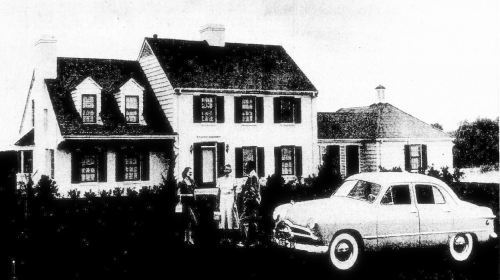
blandings_preston-hollow_dallas_dream-houseThe Blandings Dream House in Preston Hollow… (click for larger image)

by Paula Bosse

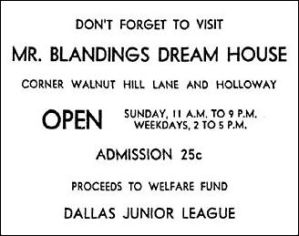
I watch a lot of old movies, and one of my favorites has always been Mr. Blandings Builds His Dream House, the 1948 comedy about the trials and tribulations of home renovation and construction starring Cary Grant, Myrna Loy, and Melvyn Douglas. It wasn’t until fairly recently that I learned there had been a nationwide promotion in which replicas of the “dream house” were built in cities around the country. And, to my surprise, one of those houses was built in Dallas! To be exact, in Preston Hollow. To be precise, at 5423 Walnut Hill Lane (the northwest corner of Walnut Hill and Hollow Way). Sadly, when I went looking for it last week, I found an empty lot. (Figures.) The photo above shows the house in September, 1948 when it (and, not so coincidentally, the movie) opened to the public.

Ahead of the movie’s release, Selznick Studios approached local builders around the country and provided them with architectural plans, asking that they build houses as near to the specifications of the movie house as conditions would permit. The studio contracted Dallas builder A. Pollard Simons and supervising architect Lucien O’Brien to work on the Dallas dream house, seen below in a rendering (all images are larger when clicked).
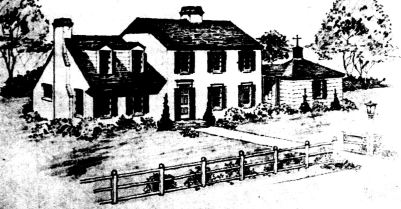
blandings_a-pollard-simons_rendering

Simons greatly increased the size of the original two-story, three-bedroom house quite a bit (of course he did!), and he allowed the Junior League to raise money by selling 25-cent tickets to curious dream-house-wanters clamoring to wander through the house and gawk at its plush interior and its state-of-the art appliances. Afterwards, Simons put the completely furnished house on the market (in some cities the houses were put up as raffle prizes), and life, presumably, returned to normal for all concerned.

It was a clever way to promote the movie, and, as most of the contractors rushed to boast of their participation by taking out large ads (likely bought in conjunction with studio money), it was also an advertising bonanza for local newspapers. In amongst such ads I discovered that the company owned by my mother’s uncle and my grandfather — Fred Werry Electric Co. — did all the electrical work for the house!

Below are some of those ads that appeared at the time — and, trust me, this was just the tip of the iceberg. The ads were non-stop. This was a huge campaign, going far beyond traditional Hollywood promotion — and it certainly paid off. I’m fairly certain that most Dallasites who read the paper during that time were aware of the house (and the movie), even if they had absolutely no interest in houses (or movies). It was that that unavoidable. (Scroll to the bottom of this post to listen to a FABULOUS commercial-slash-PSA made by actor Melvyn Douglas at a local radio station during a trip to Dallas to tour the Preston Hollow house.)

There were other Texas “Dream Houses” built in Fort Worth (still standing, see link at bottom of page), Austin, Houston, and Amarillo. I only wish Dallas still had its “Dream House,” but I fear a tasteful-but-puny, little ol’ 3,000-square-foot house would not meet today’s definition of a “dream house” in ultra-swanky Preston Hollow.

*
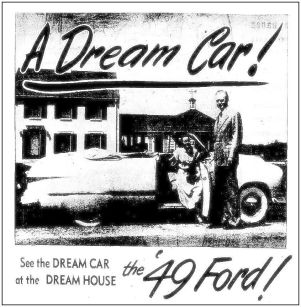
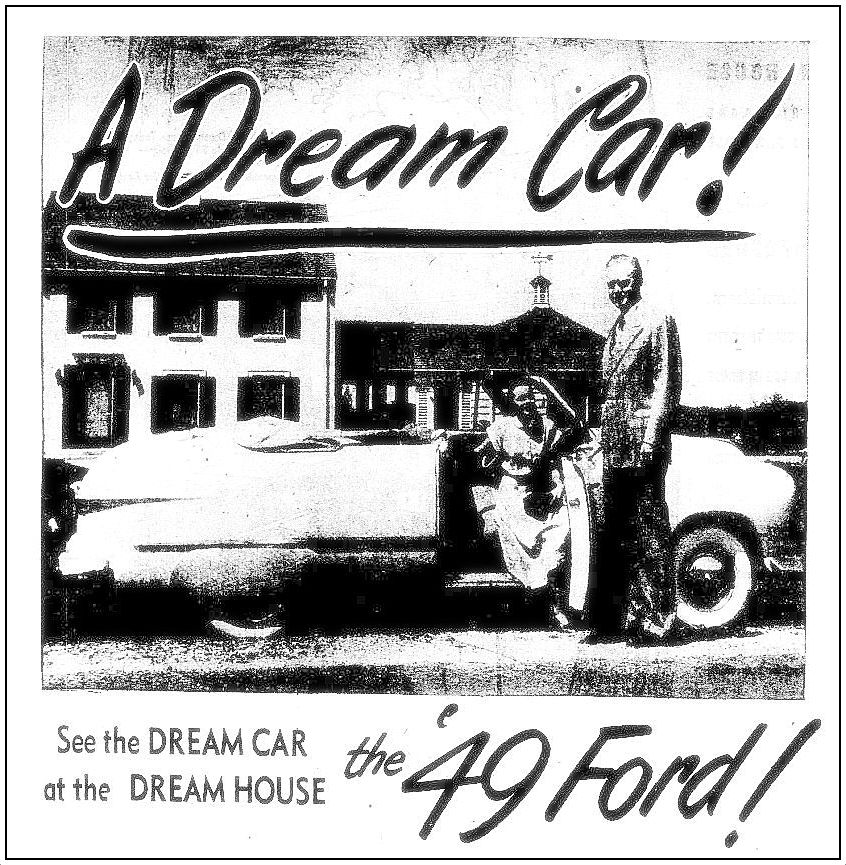
ad-blandings_dallas-ford-dealers_sept-1948The Ford people got into the advertising. This appears to be have been taken in front of the Dallas house.
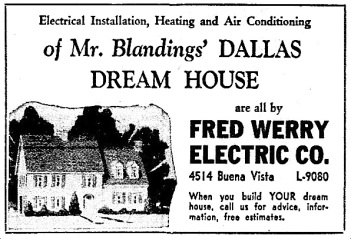
ad-blandings_werry-electric_sept-1948My great-uncle and grandfather! I can now claim my six degrees of separation (LESS!) from Cary, Myrna, and Melvyn.
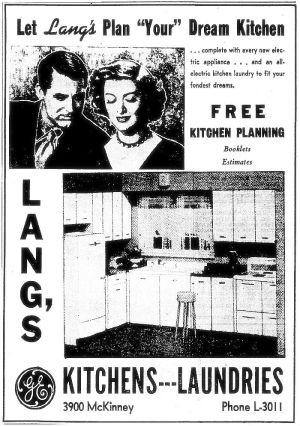
ad-blandings_langs_sept-1948Kitchen porn from Lang’s.

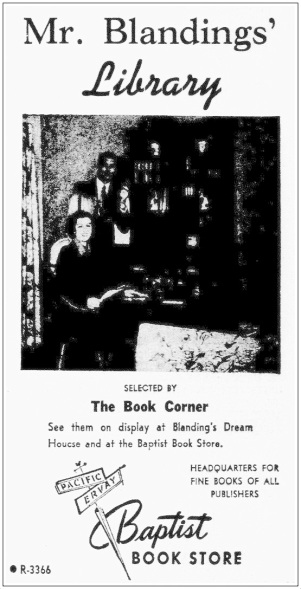
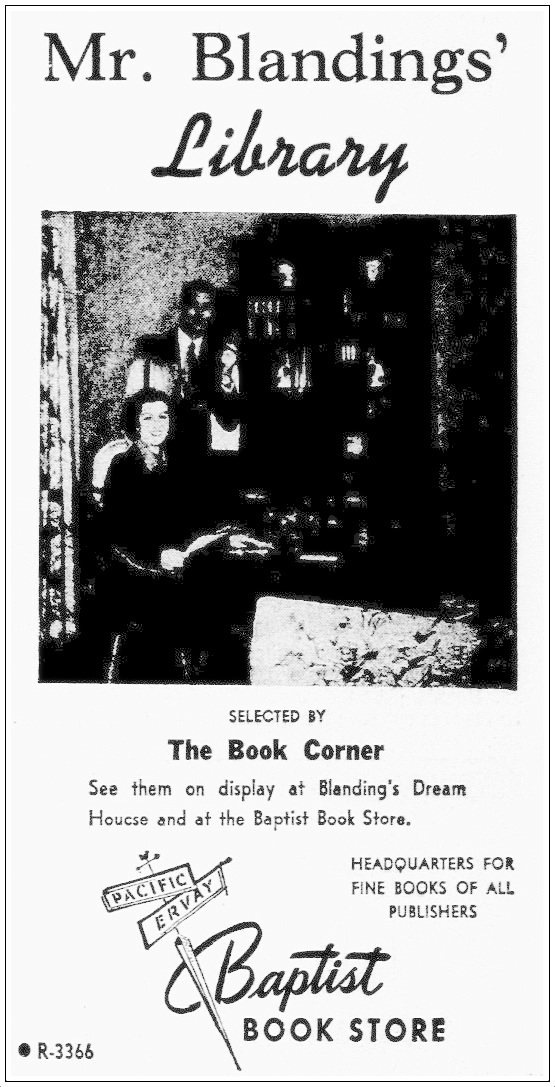
ad-blandings_baptist-book-store_sept-1948The Baptist Book Store stocked the shelves of the Blandings library!

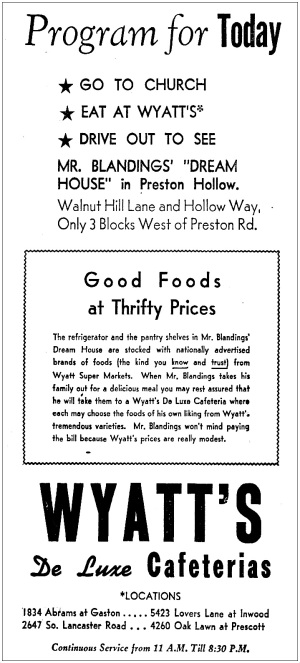
I really like the Wyatt’s Cafeteria ad below, which begins with an itinerary. “Program for today: go to church, eat at Wyatt’s, drive out to see the Mr. Blandings’ ‘Dream House’ in Preston Hollow.” This cafeteria ad sneaked in a mention of the Wyatt’s grocery stores by informing the reader that they had supplied the food for the Dream House’s refrigerator and pantry shelves. But this was my favorite part: “When Mr. Blandings takes his family out for a delicious meal you may rest assured that he will take them to a Wyatt’s De Luxe Cafeteria where each may choose the foods of his own liking from Wyatt’s tremendous varieties. Mr. Blandings won’t mind paying the bill because Wyatt’s prices are really modest.” If Cary Grant was going to be dining at a Dallas cafeteria, I only hope he was choking down large slabs of Wham.
ad-blandings_wyatts_sept-1948

*

The original “dream house” from Mr. Blandings Builds His Dream House — cute, but much smaller than its Dallas counterpart.

***

Sources & Notes

All ads relating to the Dallas Dream House appeared throughout September, 1948.

A nice look at the still-standing Fort Worth Dream House can be found in “Standing at the Corner of Hollywood and Cowtown,” here.

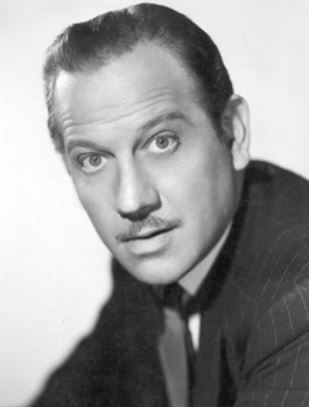
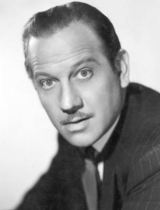
A short radio promo about the Preston Hollow Dream House was recorded on Aug. 10, 1948 by the wonderful Melvyn Douglas, one of the stars of the film (who, by the way, went on to win an Oscar for his role as the family patriarch in the brilliant — and iconically Texan — film Hud in 1963). It was recorded when he visited Dallas in August, 1948 at station KIXL (in which he was an investor), and it can be heard here. (By permission of the great Dallas DJ and broadcasting archivist, George Gimarc.) I LOVE THIS! Thank you, George!
melvyn-douglas

UPDATE: I wrote this post in 2014, and at the time I could find no information about this Dallas Blandings house outside contemporary newspaper archives. Which is the only reason I took some small amount of credit for the house showing up in a Preston Hollow-centric mural in 2015 at the then-new Trader Joe’s at Walnut Hill and Central. I took the photo below in 2015, but, sadly, this tribute to Mr. Blandings and his Dallas dream house is no more. Last time I stopped in, it had been painted over. But here it lives on!
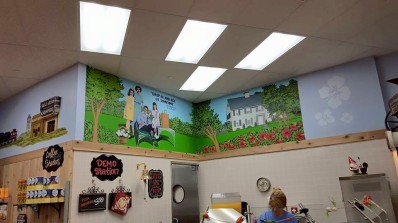
blandings_trader-joes-walnut-hill_PEB_2015Trader Joe’s, Walnut Hill, Dallas (photo by Paula Bosse, 2015)

*

Copyright © 2014 Paula Bosse. All Rights Reserved.

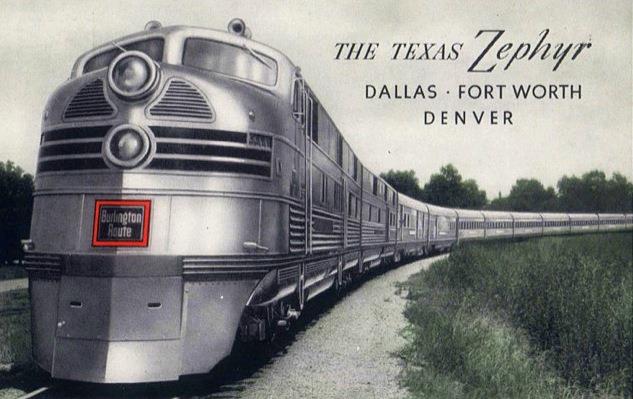
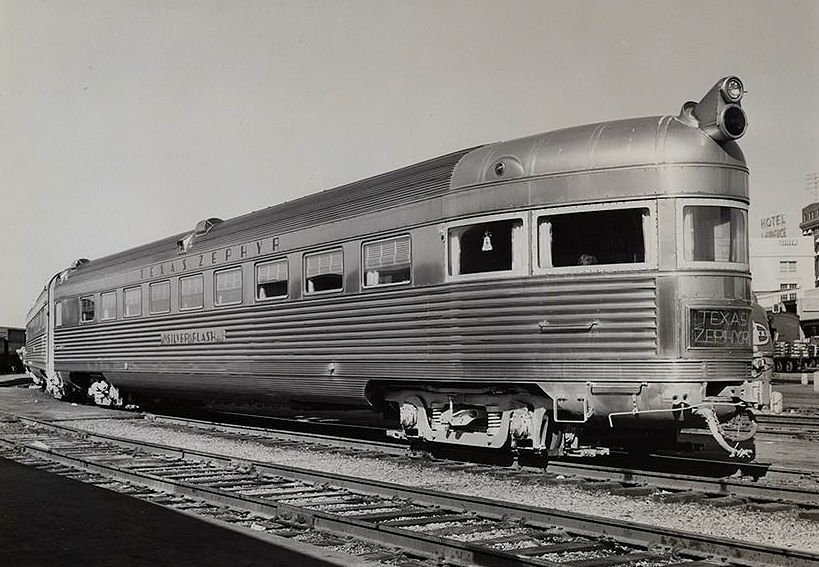
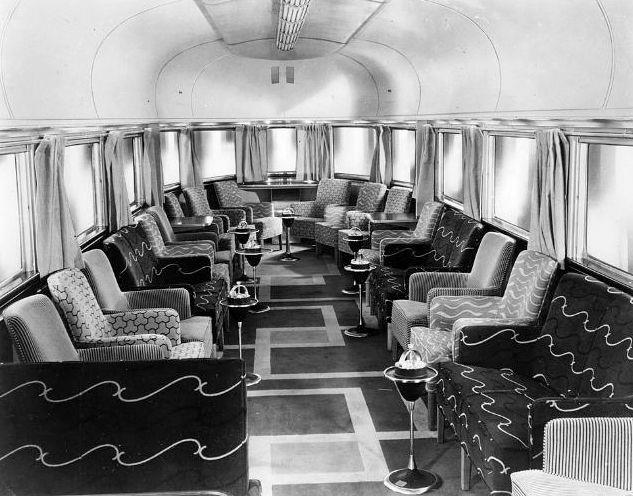
The Texas Zephyr — Streamlined Luxury Train Travel

Dallas — Fort Worth — Denver

by Paula Bosse

From the golden age of train travel. …I was born in the wrong era.

***

Sources & Notes

Second photo showing the exterior of the “Silver Flash” passenger car on the tracks at Union Station in Dallas is from the DeGolyer Library, Central University Libraries, Southern Methodist University; it was taken by Everett L. DeGolyer Jr. in 1960; more information on this photo is here.

Top and bottom images are from the wilds of the internet.

More on the Texas Zephyr here.

*

Copyright © 2014 Paula Bosse. All Rights Reserved.
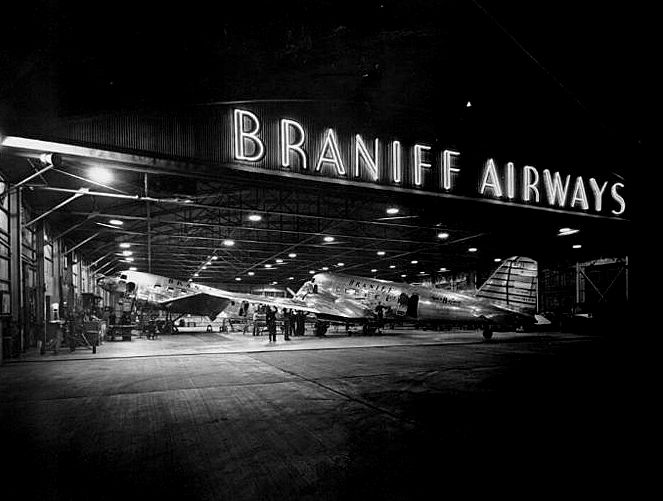
Braniff Hangar, Love Field — 1940s

by Paula Bosse

Overnight maintenance. Beautiful sign.

Photo caption:

Night maintenance at the Braniff hangar, main entrance on Roanoke Drive at Dallas Love Field, early 1940s.

Planes being serviced include a DC-2 and DC-3.

*

Copyright © 2014 Paula Bosse. All Rights Reserved.
Motel Skyline / Skyline Motel — “The Motel of Distinction” (1947)

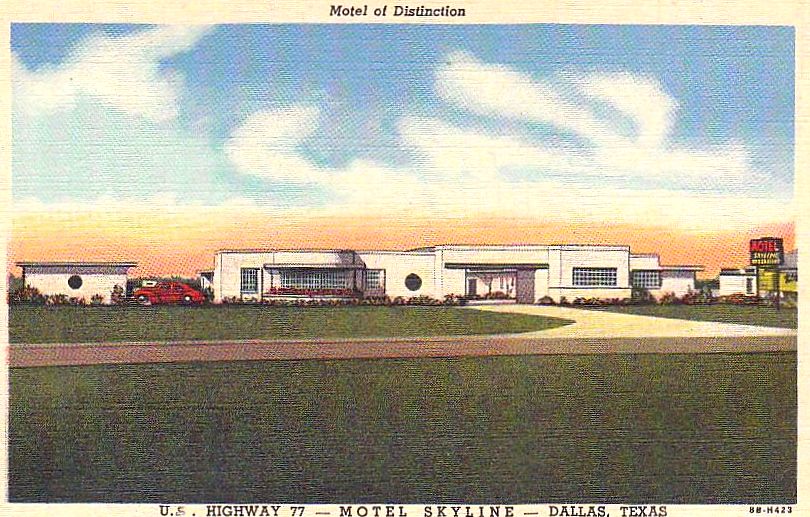
motel-skyline_postcard

by Paula Bosse

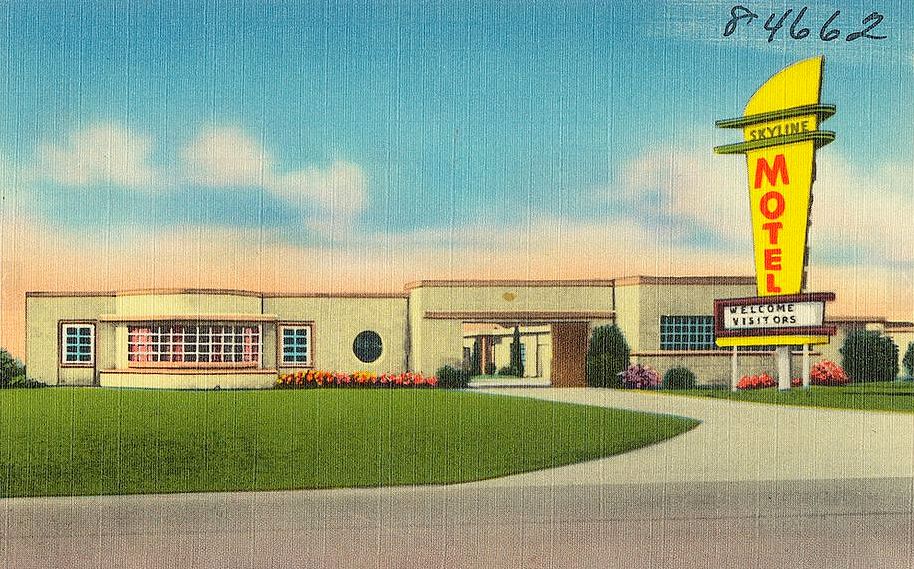
THIS is a great, great-looking motel. I only hope it looked half as sleek in real life. It was, rather surprisingly, designed in 1947 by the architect George Marble who was known for his large Tudor-revival homes in the pricier areas of Dallas (particularly Highland Park and Lakewood), so this is a major divergence in style. 1947 seems a little late for something this Deco-looking, but, no matter — this is just a fantastic building.

The “Motel Skyline” (or “Skyline Motel” as it was being referred to in ads not long after it opened in September, 1947) was located at 6833 Harry Hines, near West Mockingbird, just past Love Field. It’s not a great neighborhood these days, but perhaps it was better 60-some-odd years ago, when Harry Hines was the route that the old Hwy. 77 followed. The 30-unit “motor hotel” was built at a cost of $250,000 — it boasted year-round air conditioning and “mattresses of fiberglass.” 

I don’t know how long the place lasted — perhaps until the mid- or late-’60s, when advertising petered out and by which time the probably no-longer-so-sleek motel seems to have started catering to customers paying by the week and by the month. It might not have gotten as seedy as I fear it might have, as I saw only a couple of fairly run-of-the-mill appearances on the police blotter (cash stolen from a sleeping customer and a likely suicide in one of the rooms). Still, I shudder to think of that once-beautiful building ending its days cheek-by-jowl with modern-day Harry Hines.

It’s nice to know Dallas once had this wonderful building, if only for a little while. If anyone has photographs of the actual building, I’d love to see them, even though I know I would probably be disappointed.

*


1962 ad

***

Check out the kind of architectural design that George N. Marble is actually known for (residential, palatial), here.

Second postcard from the absolutely fantastic Boston Public Library Tichnor Brothers Postcard Collection on Flickr, here.

Matchbook from Flicker, here.

Click postcards for larger images. It’s worth it.

*

Copyright © 2014 Paula Bosse. All Rights Reserved.
2400 McKinney Avenue — 100+ Years and Counting

by Paula Bosse

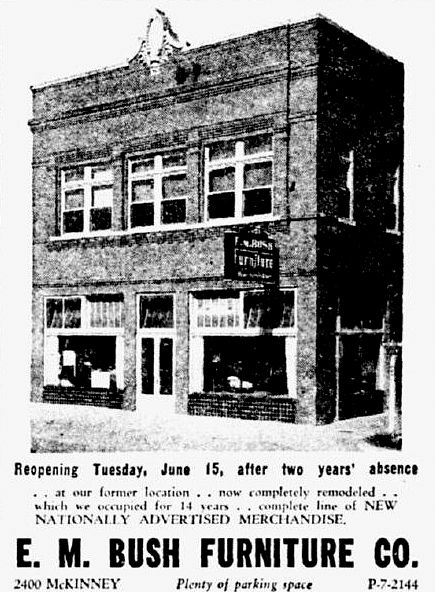
I came across this ad and wondered just where on McKinney Avenue this building had been. The ad was from 1948, but the building certainly looked older than that. I’m not sure when the building was built (update: it was built in 1909), but by at least 1929 the Hughes Auction Market was conducting furniture auctions there. An ad from 1929 invites the public to attend the regular auctions in which their two floors were packed to the gills with furniture and household goods that “positively must sell.” Prospective buyers were promised a large parking lot and a “comfortable, cool building.”

In the summer of 1933, a longtime Dallas furniture salesman, E. M. Bush, opened his retail business in the building and remained there for many years, perhaps until 1958 when he moved to Snider Plaza.

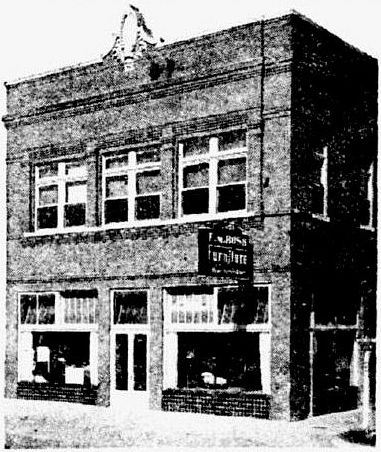
I wondered what’s at 2400 McKinney these days, and, I have to say … I’m shocked to find that the building is actually still there! On McKinney Avenue! And it looks very much the same as it does in the photo above (and, presumably, since it was built) — a little more elegant, perhaps, as it’s now part of the fabulous Hotel ZaZa — but the building looks pretty much the same. The building has survived! I feel like crying.

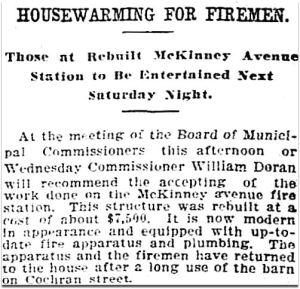
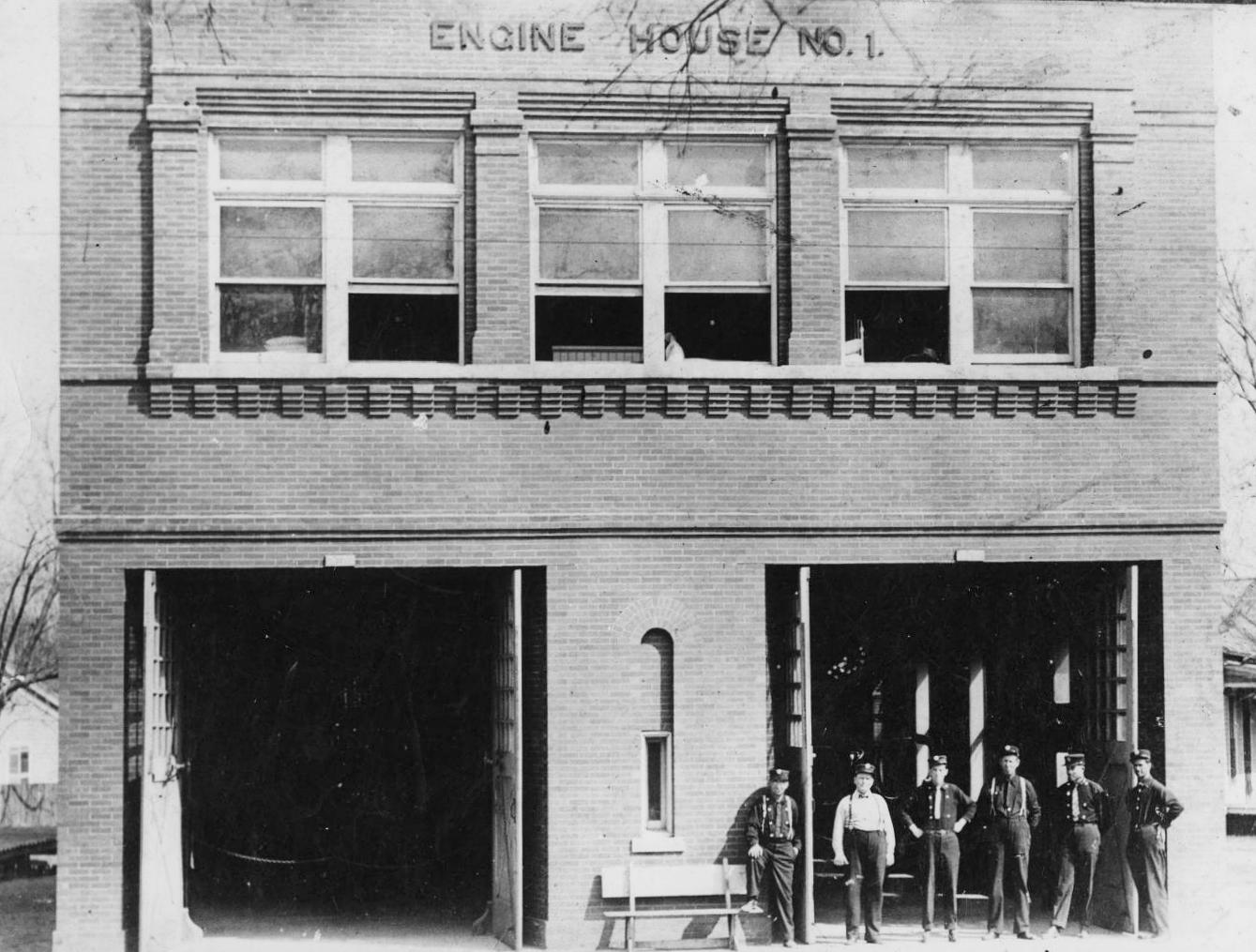
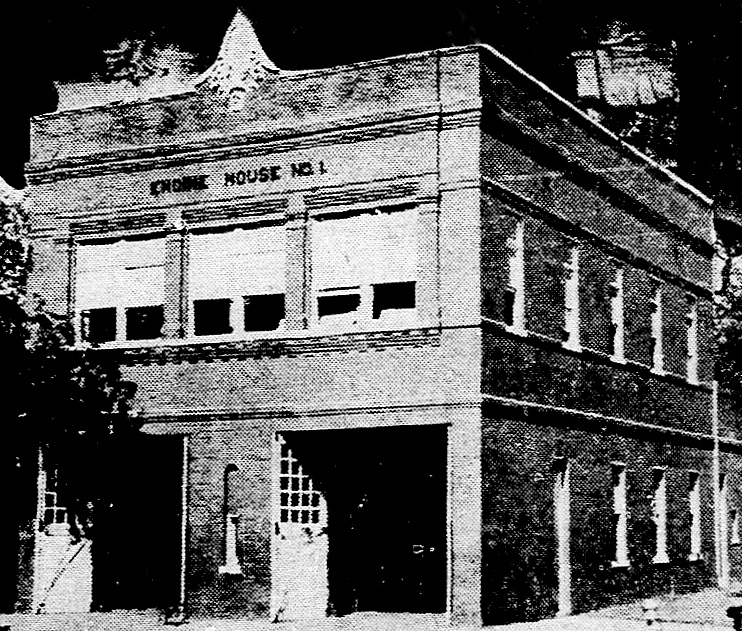
But wait, there’s more. What was this building originally? It was a firehouse! More specifically, it was Engine House No. 1, in use until 1928. The fire station that originally occupied this location was built in 1894 (see what it looked like in 1901 here, third photo down). By 1909, automobiles were placing horse-drawn fire engines, one of many reasons the station house needed to be modernized. Newspaper articles from 1909/1910 used the words “rebuilt” and “remodeled” almost interchangeably, so it’s unclear whether the original building was completely, or only partially demolished and then rebuilt, using materials from the original structure. The “new” engine house re-opened in January, 1910.

rebuilt_dmn_012510
Dallas Morning News, Jan. 25, 1910

Here’s a photo from its early days:

engine-house-no-1_mckinney

And from the 1920s:

fire-dept_mckinney-leonard-photo_1920s

The city ordered the building sold in 1928 when plans had been made to move personnel and equipment from McKinney and Leonard to a new station at Ross and Leonard.

To have a 100-plus-year-old building still standing in “newer-is-better” Dallas — and in Uptown — is quite a feat!

***

Sources & Notes

E. M. Bush Furniture Co. ad from 1948.

Photo of Stay ZaZa Art House and Social Gallery from the Hotel ZaZa website.

Firehouse photo from The Dallas Firefighters Museum. More on this station here.

Most images are larger when clicked.

*

Copyright © 2014 Paula Bosse. All Rights Reserved.