Flashback : Dallas

A Miscellany: History, Ads, Pop Culture

Category: 1940s

Titche-Goettinger, Fashions for the Chic Dallas Woman — 1940s

titches_newton-elkin-shoes_1944_my-vintage-vogue

by Paula Bosse

Just a few 1940s ads for fashions available at Titche-Goettinger, one of many of Dallas’ nicer department stores which made the city a fashion meccas for the chic Texas woman.

Above, a 1944 ad featuring the latest in shoes from Newton Elkin (“two new shoe shades: Tanbark — Cedar Green”): “the sling-back pump with perforated Cleopatra vamp” and “Vicki in brown lizard” (which I sincerely hope someone uses as a song title).

Below, a newspaper ad from 1945 featuring other Newton Elkin shoes, these dressier, with fancy paillettes (sparkly decorations). Perfect to wear with the matching black silk turban. (Click to see a larger image.)

titche-goettinger_nov-19451945

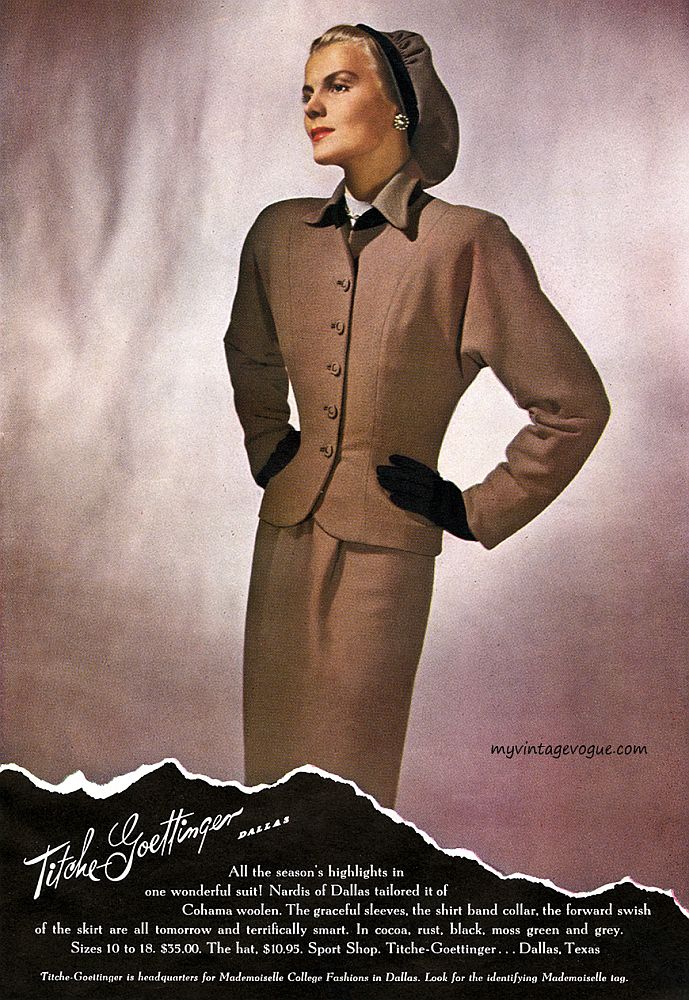
A “Nardis of Dallas” wool suit from 1945, “tomorrow and terrifically smart… in cocoa, rust, black, moss green, and grey.”

titches_nardis-of-dallas_suit_1945_my-vintage-vogue1945

Another “Nardis of Dallas” suit from 1945, this one in “superlative” gabardine: “a suit you’ll wear from swivel chair to swizzle stick… platinum, aqua, lime, red, brown.” Sold separately: a matching hat and slacks (!). “Men prefer it.”

titches_nardis-of-dallas_1945_my-vintage-vogue1945

Speaking of hats: “Sally Victor creates the ‘Big and Little Filly’ for Titche-Goettinger.” …There’s a lot going on up there. (1947)

titche-goettinger_1947_ebay_hats1947

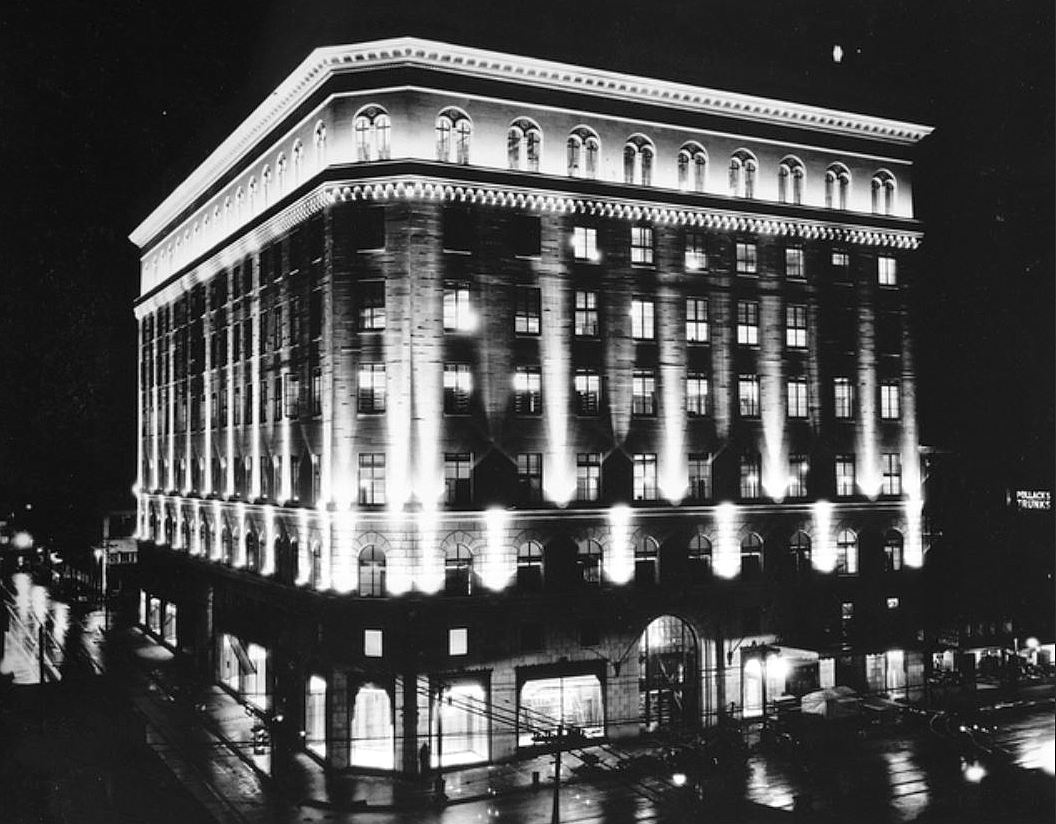
The still-standing Titche’s building at Main and St. Paul was designed by George Dahl in 1929 and was expanded in the 1950s. The women buying these clothes in the 1940s would have shopped at the smaller — though still elegant — store, which looked like this:

titches_unvisited-dallas_jeppsonNoah Jeppson/Unvisited Dallas

When shopping was more sophisticated.

titches-logo_1945

***

Sources & Notes

All color ads from the FABULOUS website My Vintage Vogue, here, here, and here.

Sally Victor ad found on eBay, here.

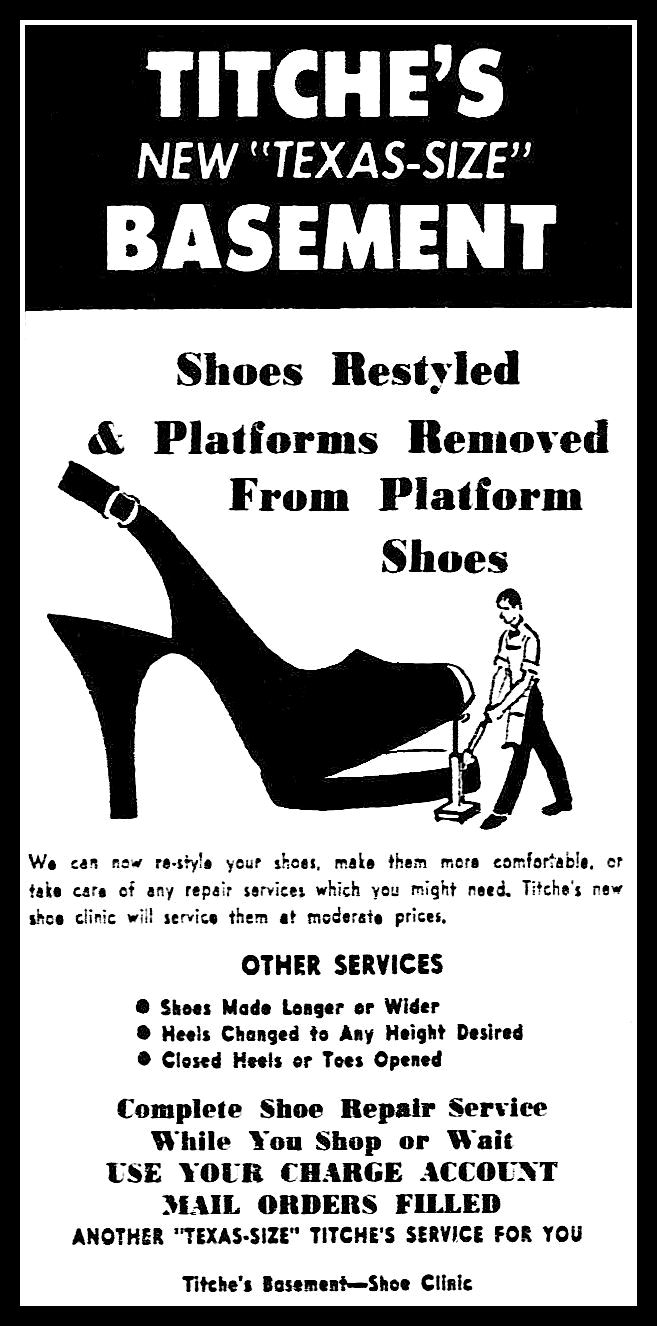
This doesn’t really fit into the 1940s, but I’ve had this 1955 ad for the Titche’s Shoe Clinic kicking around for a few years — this seems like a good place to slip it in. Platforms removed! Open toes closed! Closed toes opened! Pop down to the basement for all your shoe repair and restyling needs.

ad-titches_shoe-clinic_19551955

Check out other Flashback Dallas posts on Titche’s, here.

Flashback Dallas posts on Nardis of Dallas can be found here and here.

All images are larger when clicked.

*

Copyright © 2018 Paula Bosse. All Rights Reserved.

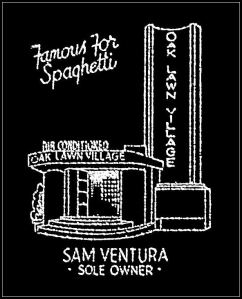
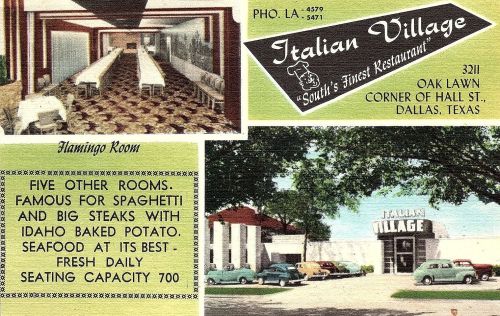
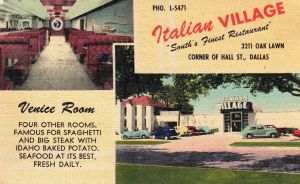
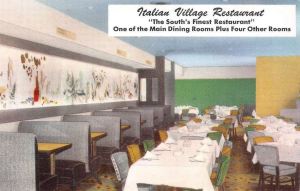
Sam Ventura’s Italian Village, Oak Lawn

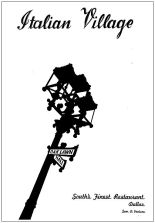
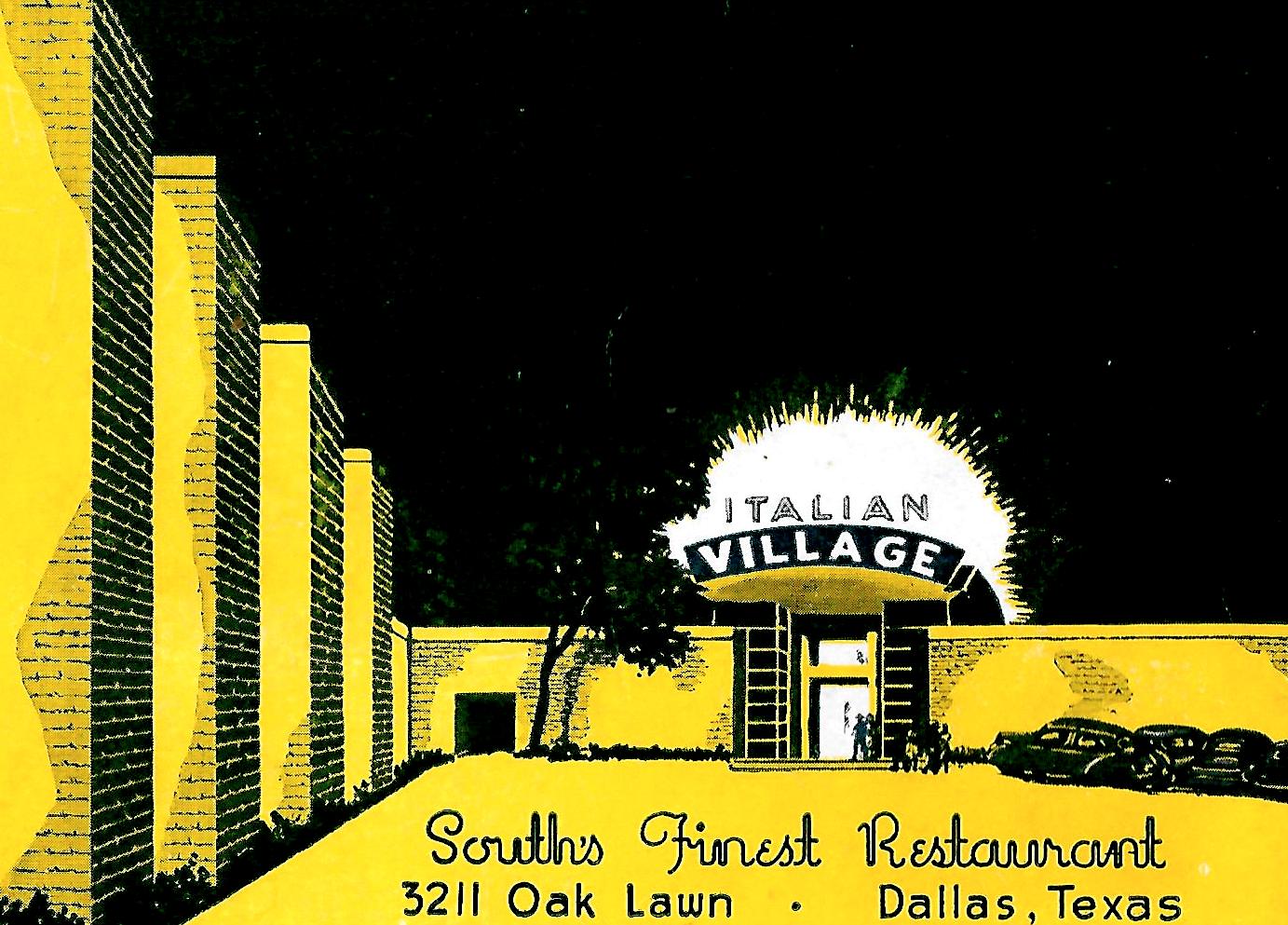
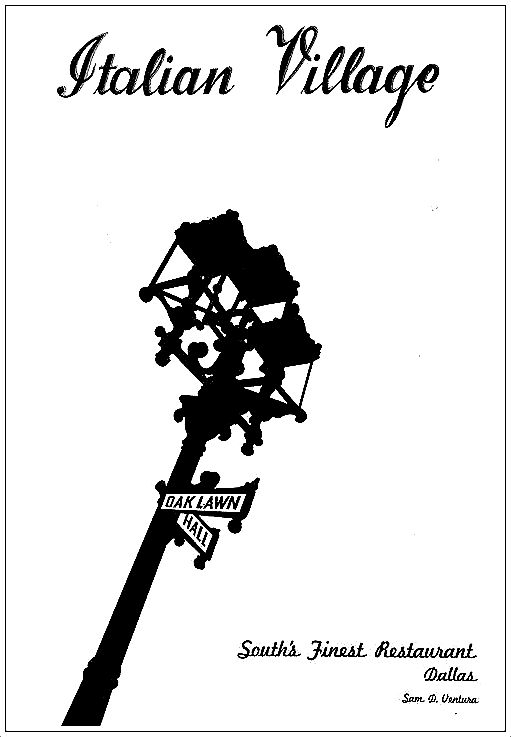
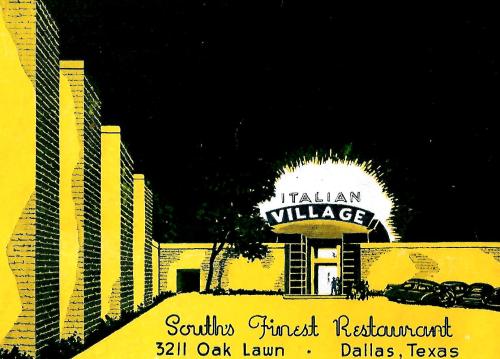
italian-village_photo-holder_PEB

by Paula Bosse

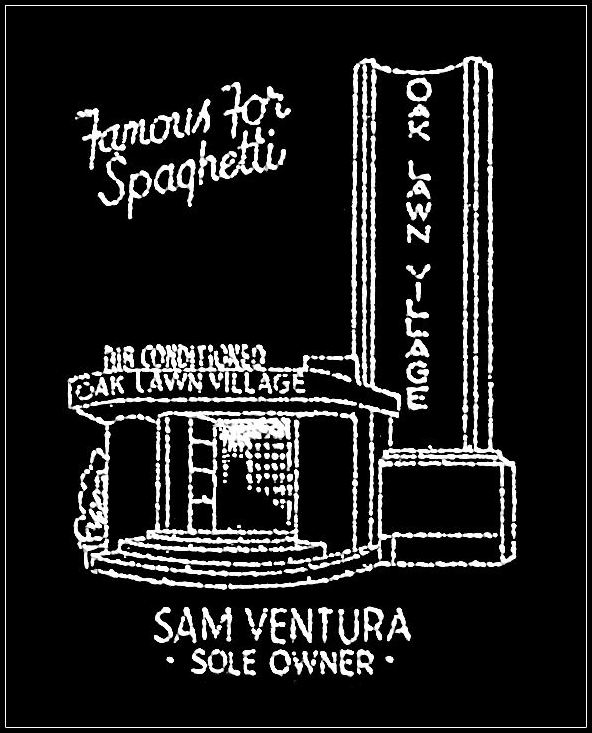
In amongst photos and belongings of my mother’s aunt, I recently came across this wonderful graphic of Oak Lawn’s Italian Village (3211 Oak Lawn, at Hall). It was on the cover of one of those cardboard photo holders which contained photos of diners and club-goers captured by photographers wanting to memorialize celebrants’ special occasions — they would take your photo and you would later purchase prints, which would be tucked inside the souvenir folder. (I don’t recognize any of the people in the photo which was  inside — the photo is here.)

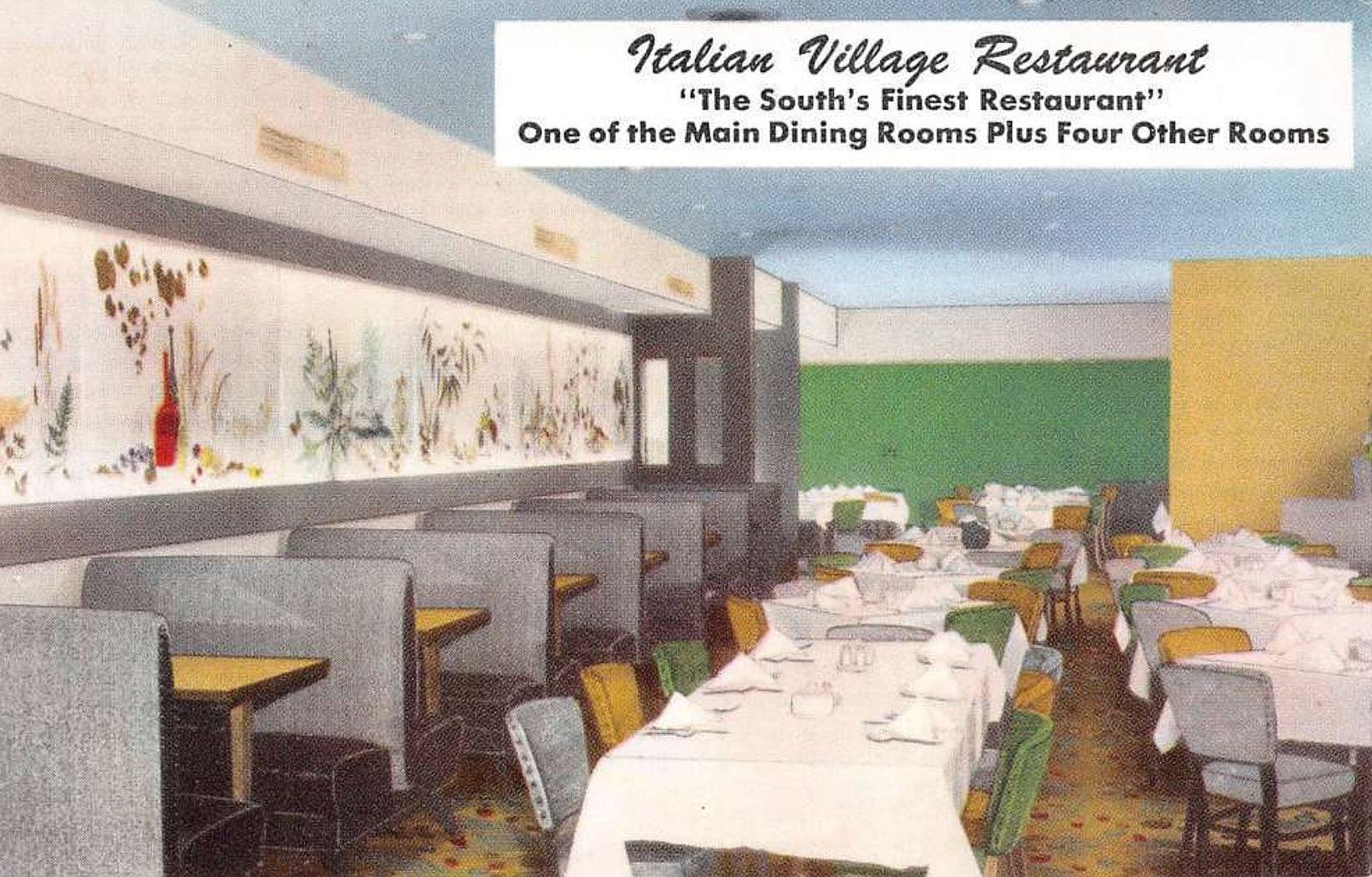
The Italian Village complex (which contained all its various tangential enterprises over he years) was an Oak Lawn fixture for over 45 years — it was apparently still around during my lifetime, but I have no memory of ever seeing it. But by the time I would have been aware of it, things had begun to get a little weird and its profile had definitely dipped. (More on that later.)

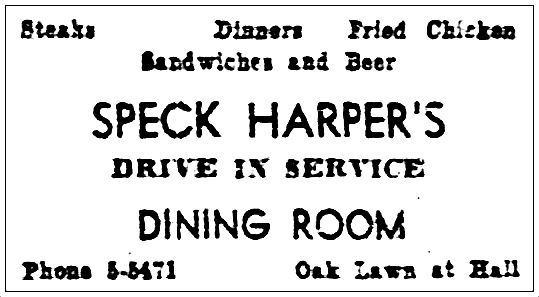
Italian Village began its life in 1934 when Sam Ventura (1907-1997) bought a popular drive-in restaurant in Oak Lawn from a man named Levi F. “Speck” Harper. In Ventura’s obituary in The Dallas Morning News, his wife said: “He bought it from a man named Speck Harper who told him, ‘Give me $250 and my hat, and you’ll never see me again.’ Sam had to go and borrow the money.” (DMN, June 1, 1997) ($250 in today’s money would be about $4,700.)
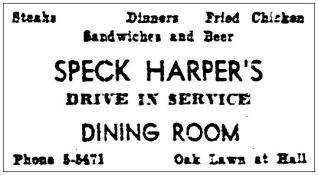
speck-harper_july-1934July, 1934

Not only did $250 start Ventura on a very successful career as a restaurateur, it also assured him ownership of what would quickly become a primo piece of real estate. (Ventura dabbled in real estate and, in 1937, along with fellow restaurant man Sam Lobello, he purchased land at Preston Road and Northwest Highway which would one day become Preston Center.) (It might be worth noting here that Sam Ventura was not affiliated with the very popular Sammy’s restaurants, run by Dallas’ Messina family.)
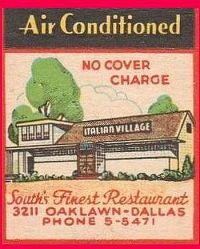
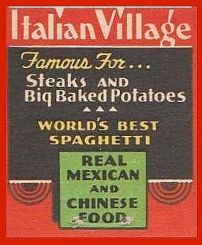
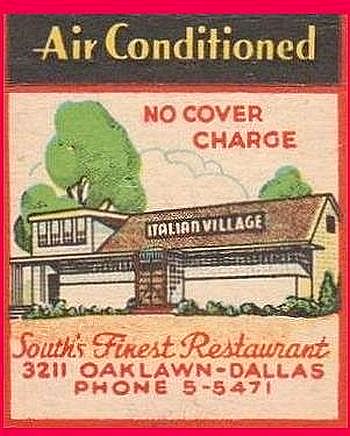
italian-village_matchbook_front_ebay        italian-village_matchbook_back_ebay
Matchbook, via eBay

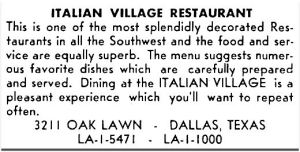
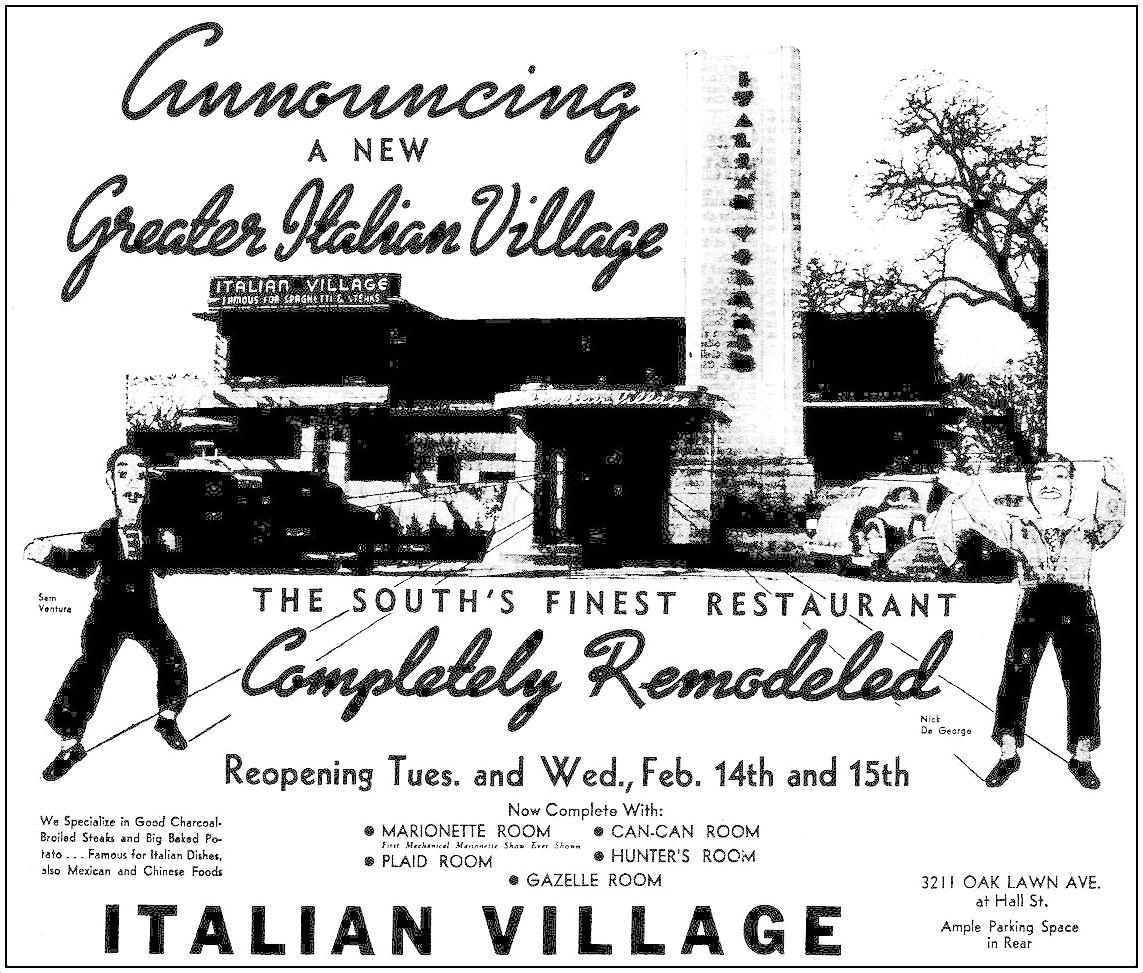
Italian Village — a restaurant which operated for many years as a private club in order to sell liquor — was originally co-owned by brothers-in-law Sam Ventura and Nick DeGeorge (DeGeorge was later married to Ventura’s sister Lucille). By the time the ad below appeared in 1939, the place had been newly remodeled and was on its ninth (!) expansion. There were lots of new “rooms”: the Can-Can Room, the Plaid Room, the Hunter’s Room, the Gazelle Room, and the Marionette Room, the latter of which featured entertainment in the form of a marionette show with puppets made in likenesses of the owners. (All images are larger when clicked.)
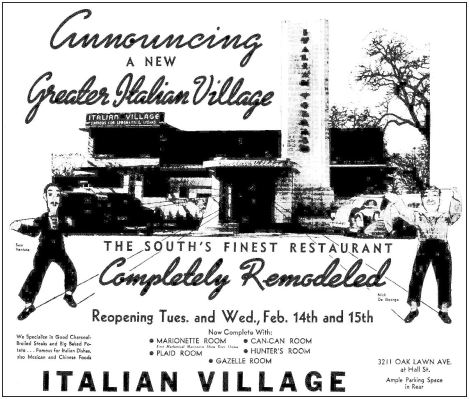
1939_italian-village_feb-1939Feb., 1939

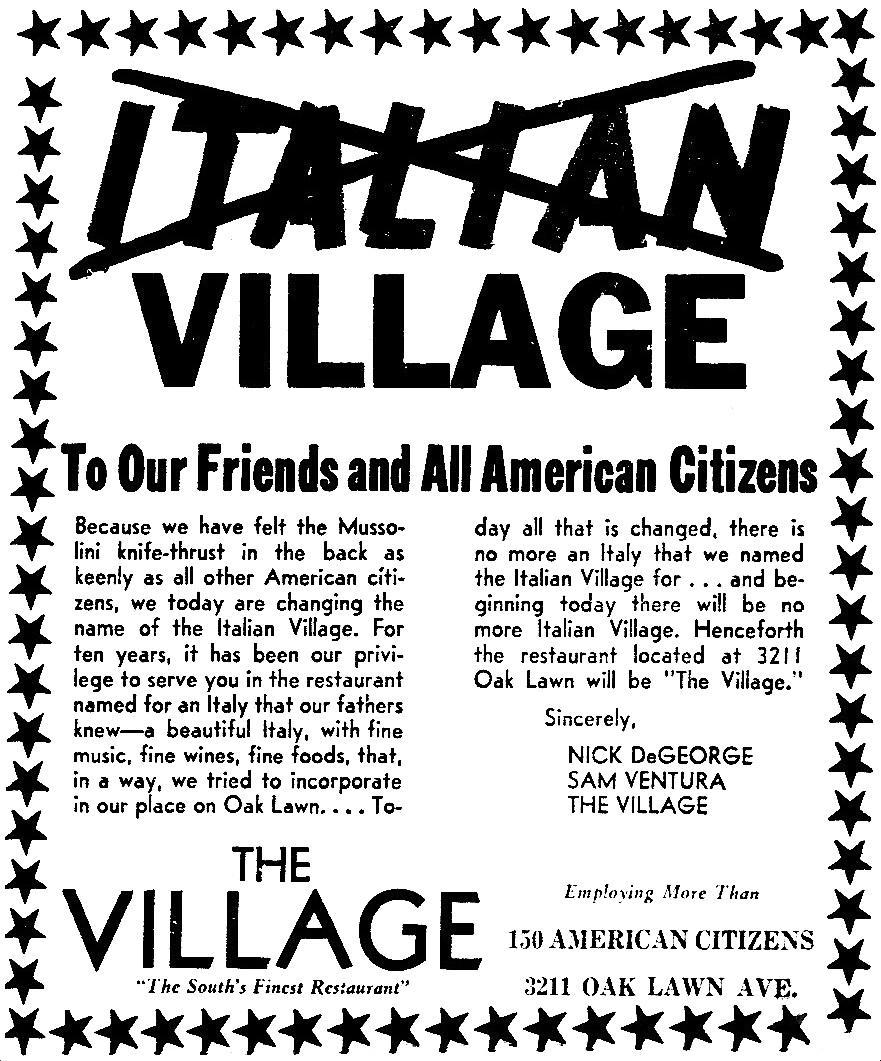
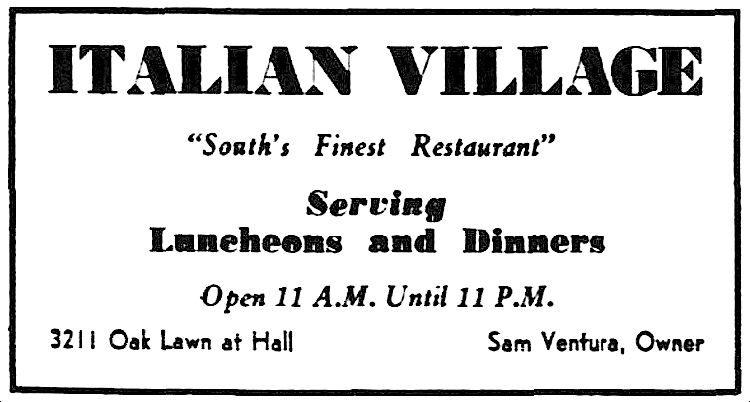
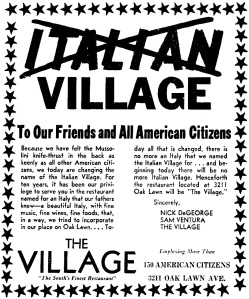
In June, 1940, Italy entered the War in Europe as a member of the Axis forces. As a result, Ventura and DeGeorge immediately asserted their patriotism and their American-ness (both were born in the United States to Italian immigrants) by changing the name of their restaurant: arrivederci, Italian Village, hello, Oak Lawn Village. The owners placed an ad in Dallas newspapers explaining their decision (see ad below) — this made news across the country, garnering both positive national publicity as well as fervent local support.
italian-village_ad_june-1940
June, 1940

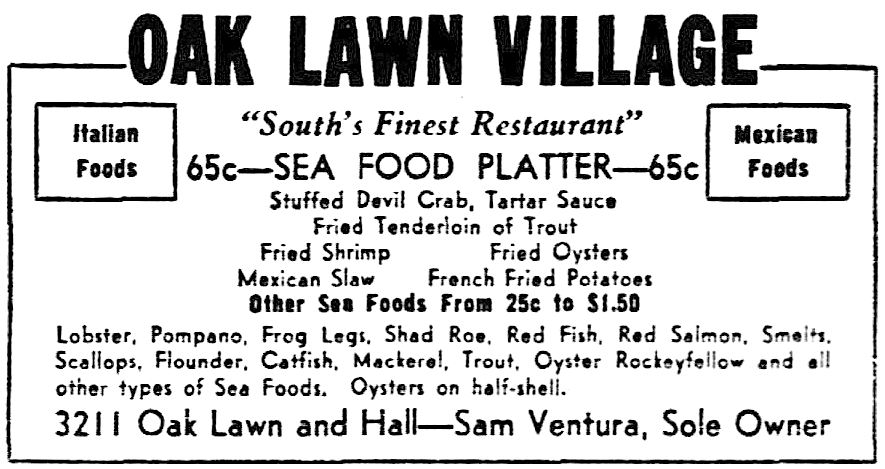
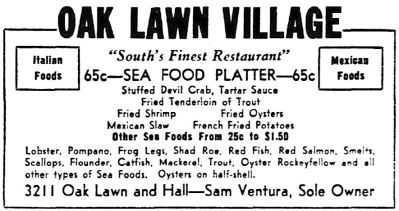
Not only did the restaurant’s name change in 1940, so did its ownership. Nick DeGeorge and his wife (the sister of Sam Ventura) embarked on a very lengthy, very bitter divorce (newspapers reported that Nick and Lucille were each on their fourth marriages). The result of this marital split spilled over and also caused a business split: Ventura became the sole owner of Italian Oak Lawn Village, and DeGeorge left to start his own (very successful) restaurant career (DeGeorge’s, Town & Country, etc.). Sam announced that he was “sole owner” in a September, 1940 ad. (I hope Nick at least got custody of his mini-me marionette….)
1940_oak-lawn-village-ad_sept-1950Sept., 1940

oak-lawn-village_matchbook_flickr-coltera
Oak Lawn Village matchbook cover, via Flickr

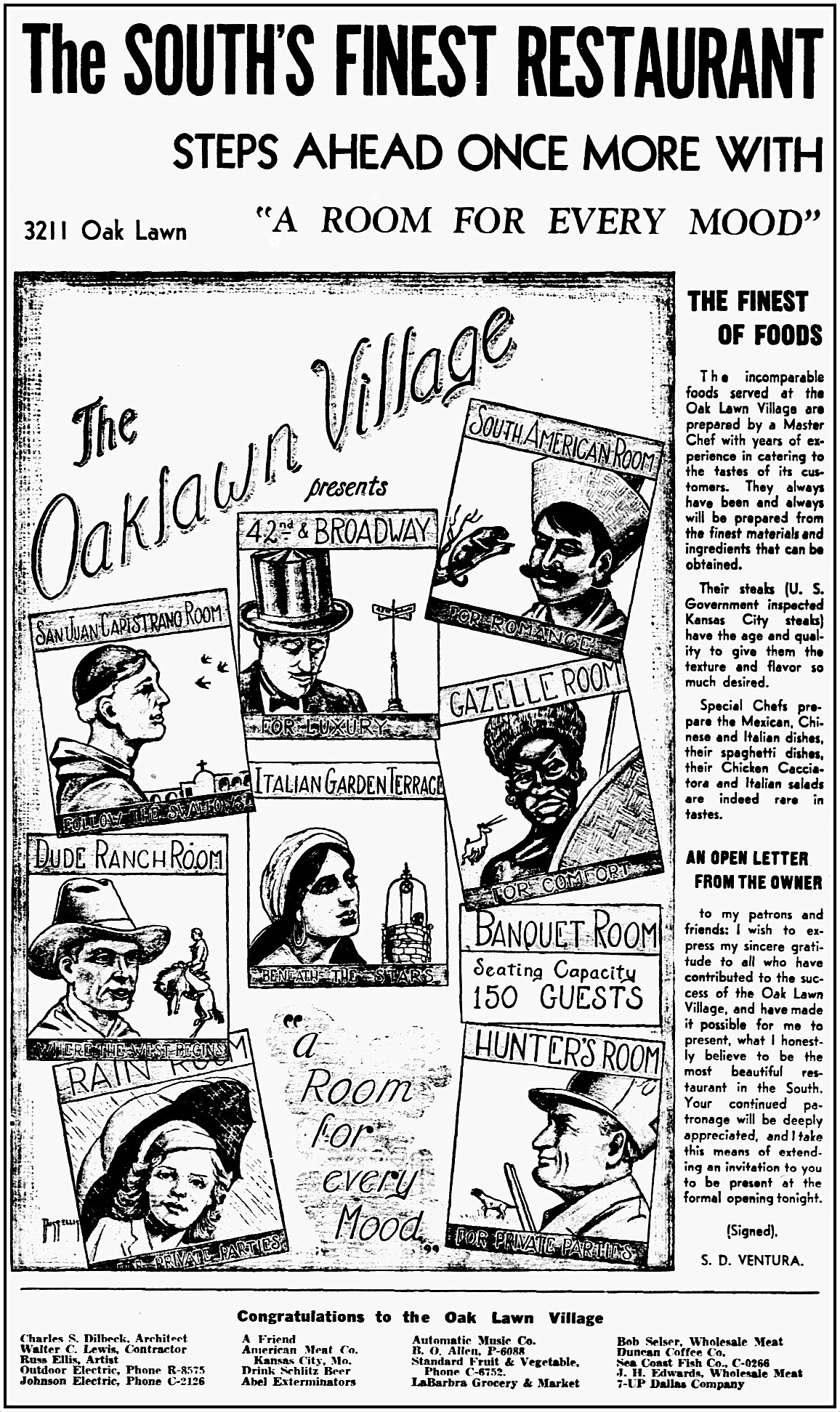
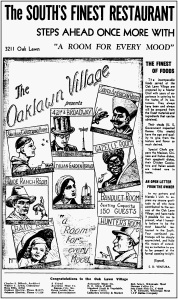
In June, 1941 yet another remodeling/expansion was announced, with architectural design by longtime friend of Ventura and DeGeorge, Charles Dilbeck, and murals by Russ Ellis. In addition to the Gazelle Room (“for comfort”) and the Hunter’s Room (“for private parties”), there was now the San Juan Capistrano Room (“follow the swallows”), the 42nd & Broadway Room (“for luxury”), the South American Room (“for romance”), the Dude Ranch Room (“where the west begins”), the Rain Room (“for private parties”), the Banquet Room (“seating capacity 150 guests”), and an outdoor Italian Garden Terrace (“beneath the stars”).
1941_oak-lawn-village_dmn_june-41June, 1941

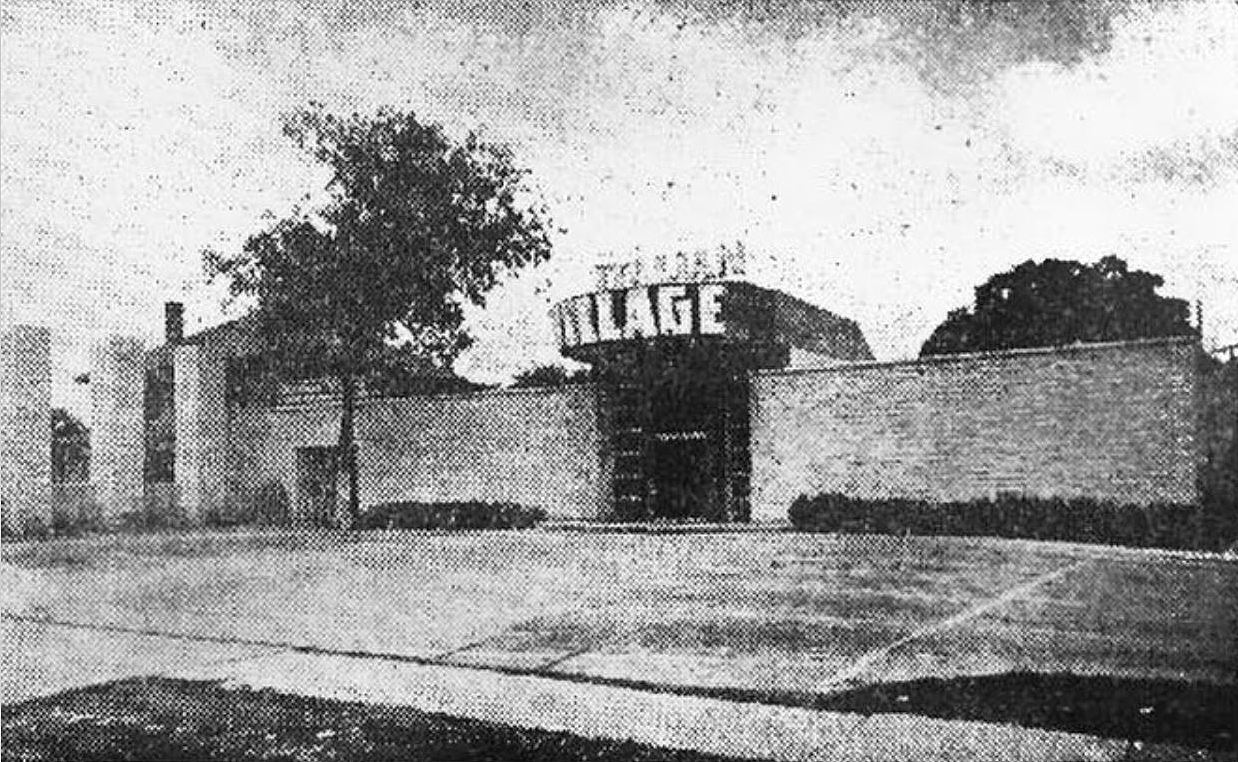
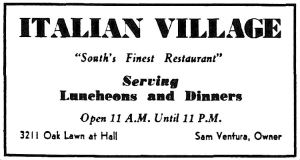
That $20,000 remodel (which would have been equivalent to about $350,000 in today’s money) went up in smoke — literally — in April, 1944, when the restaurant was “virtually destroyed” by fire. Ventura said he would rebuild when war-time government regulations would permit him to do so. At the end of the year he announced that he would build a new restaurant, of shell stone and marble construction, lit in front by decorative tower lights. The new place was built and in full swing — and back with its original name — in the summer of 1945.
1945_italian-village_aug-1945Aug., 1945

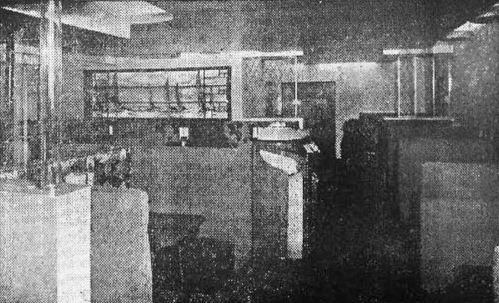
An ad for Dallas’ S. H. Lynch & Co.’s Seeburg Scientific Sound Distribution system appeared in the Aug. 10, 1946 issue of Billboard magazine, showing photos of Sam Ventura, the exterior of the new building, and an interior shot showing a Seeburg jukebox. (See full ad here.)
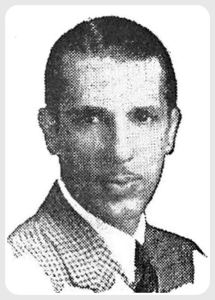
1946_italian-village_billboard_081046_ad-det-1Sam D. Ventura, 1946 (ad detail, Billboard magazine)
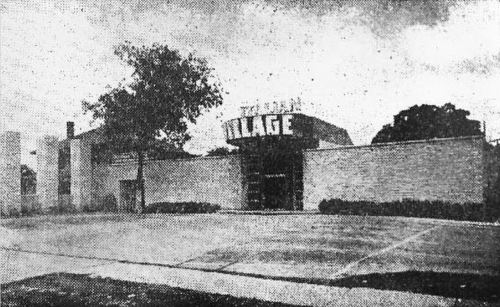
1946_italian-village_billboard_081046_ad-det-2

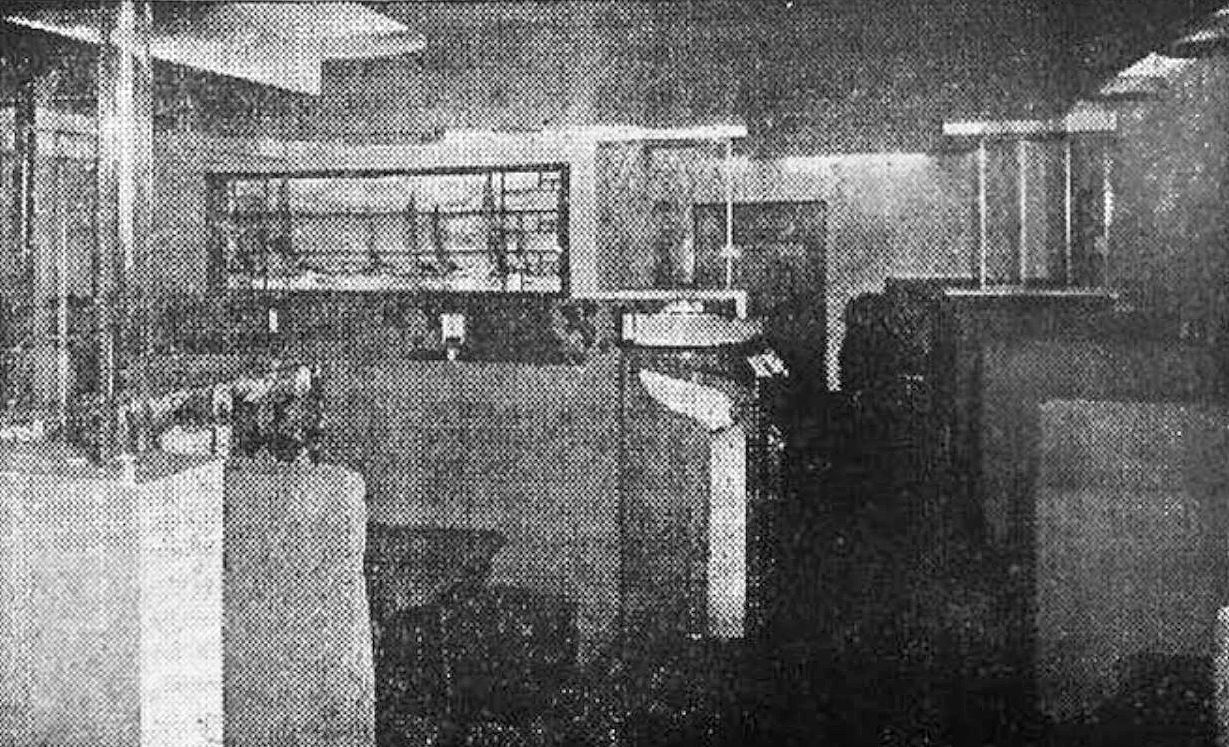
1946_italian-village_billboard_081046_ad-det-3Italian Village exterior and interior, 1946 (ad detail, Billboard magazine)
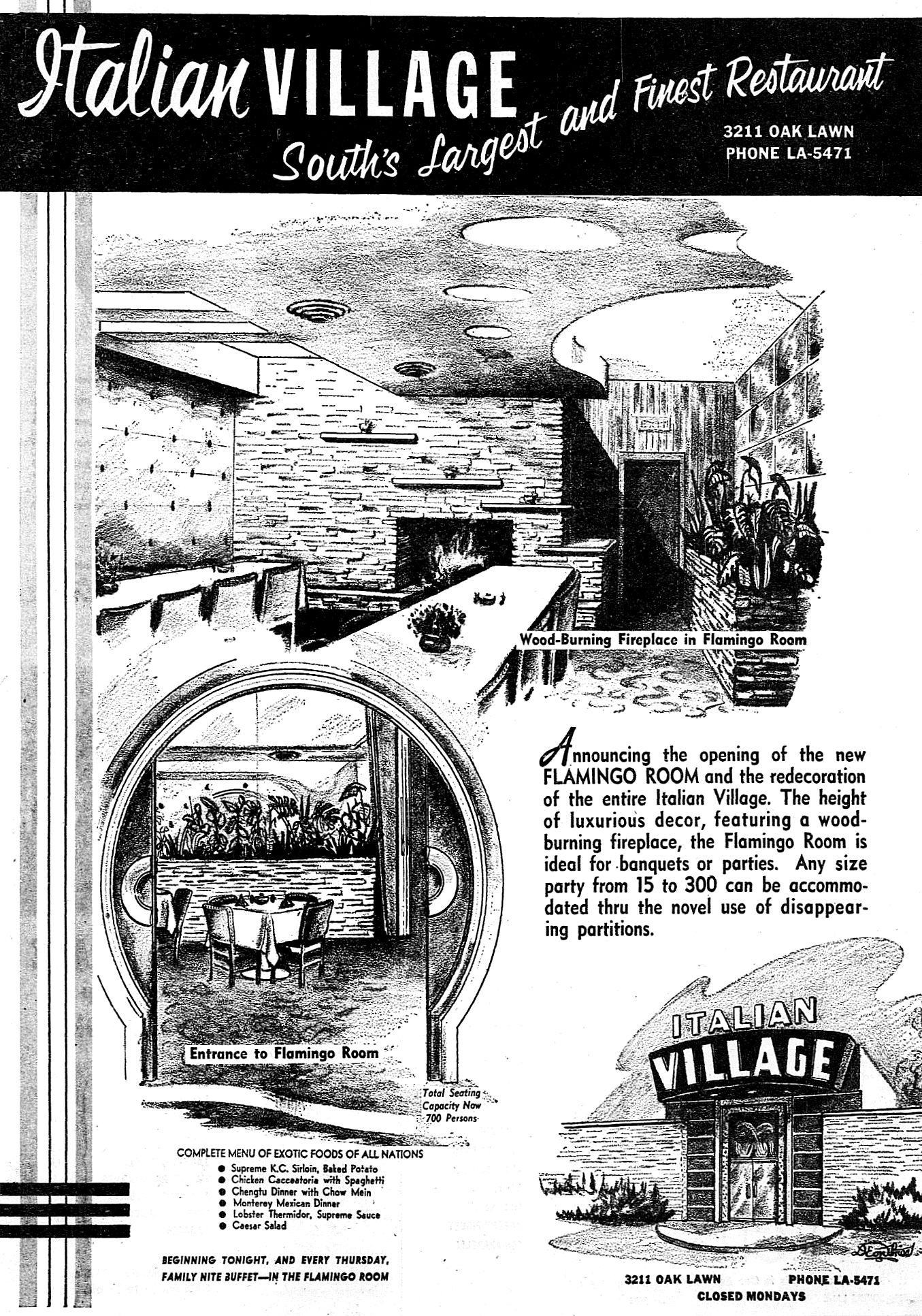
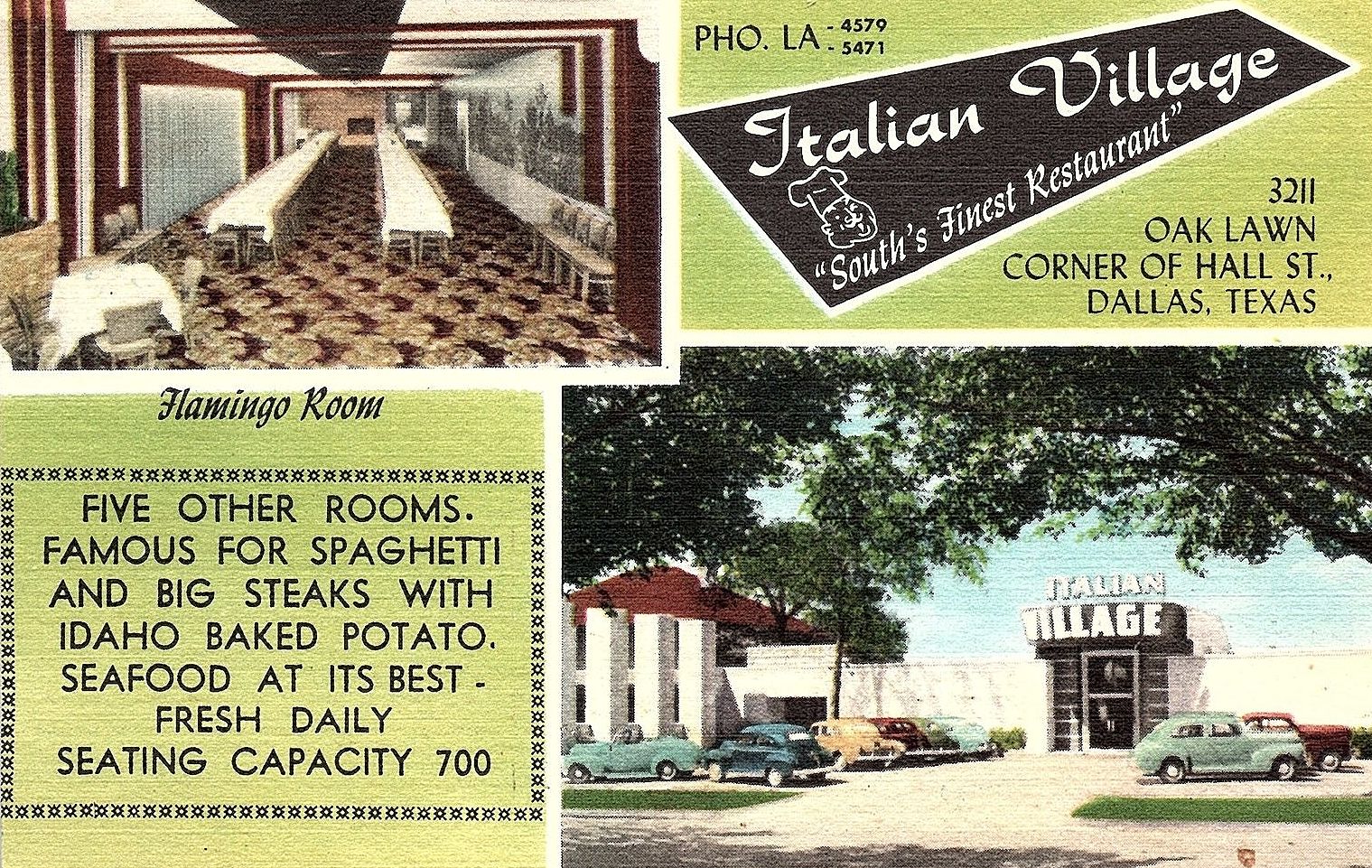
In January, 1951 another remodeling (to the tune of $75,000!) introduced the 300-seat Flamingo Room, which meant the entire Italian Village now had a seating capacity of more than 700 (Ventura had said that the original post-Speck’s restaurant seated only 40 or 50 people). The “modernistic styling” was the work of architect J. N. McCammon.
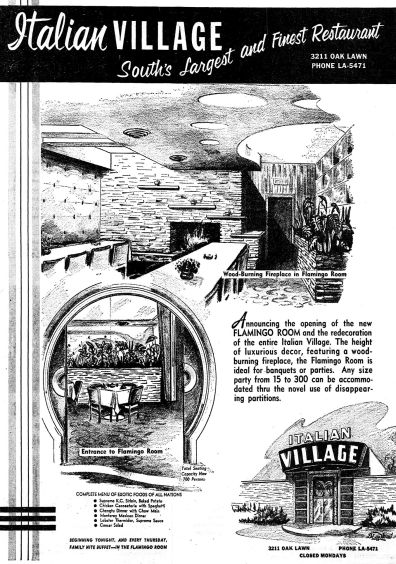
1951_italian-village_flamingo-room_jan-1951Jan., 1951

italian-village_postcard_flamingo-room_ebay

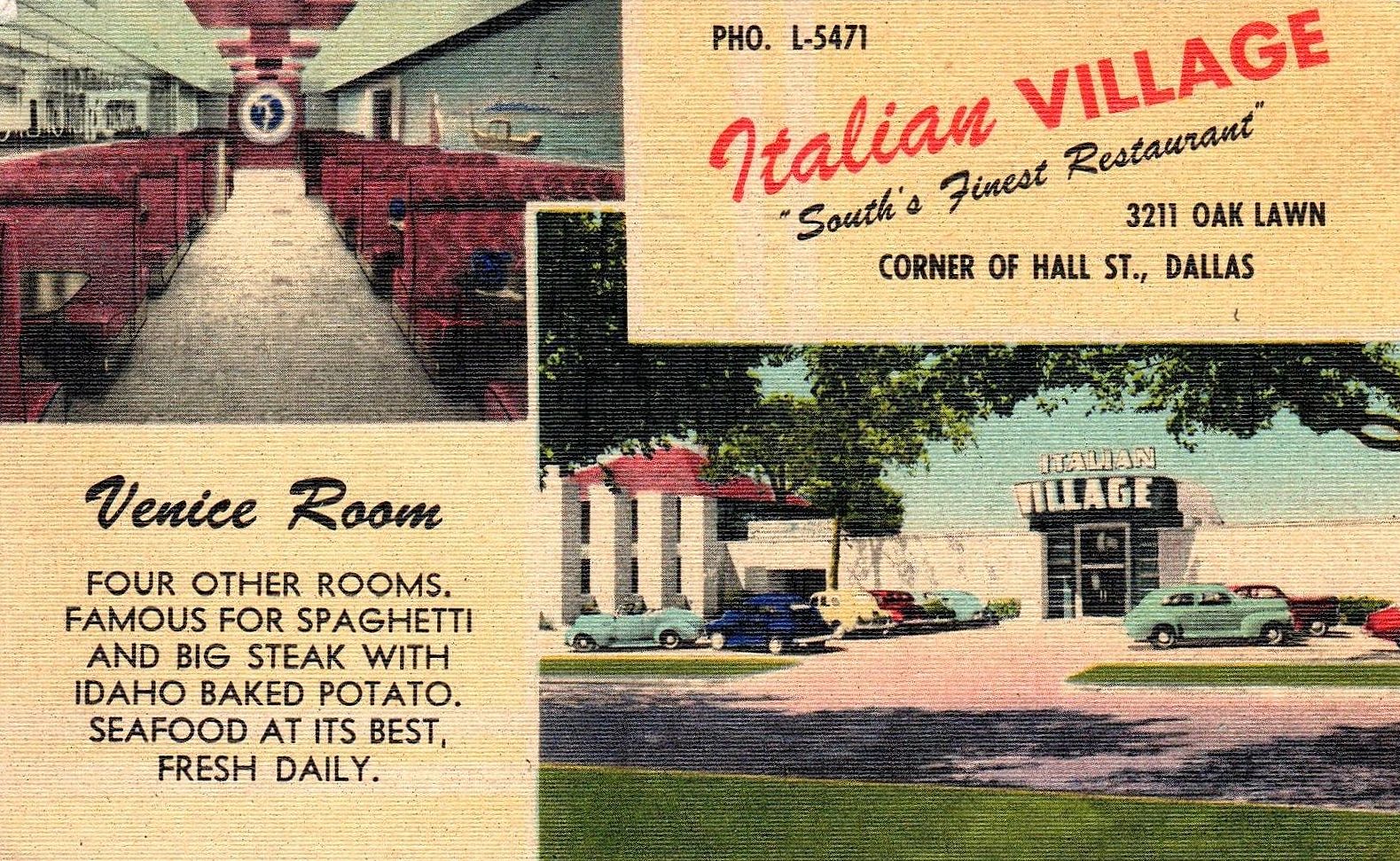
italian-village_postcard_yellow_ebay

italian-village_postcard_interior_ebay

italian-village_postcard_interior_caption_ebay

italian-village_menu_ebay_1     italian-village_menu_ebay_4
Front and back of 1955 menu, via eBay

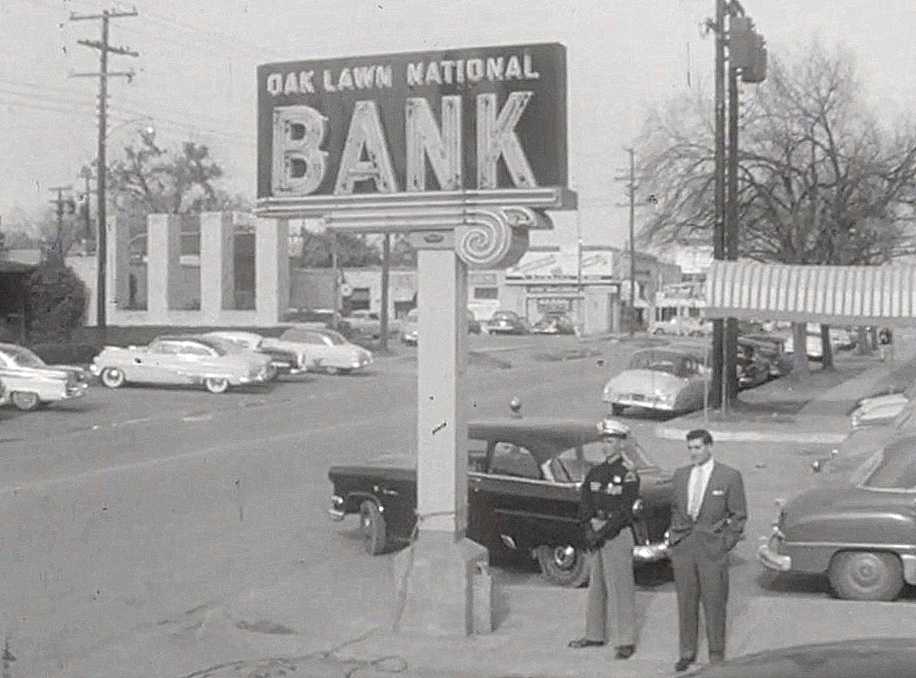
Below, a shot of the Italian Villa’s four odd brick structures seen from across the street (in a screen capture from unrelated January 1955 news footage).
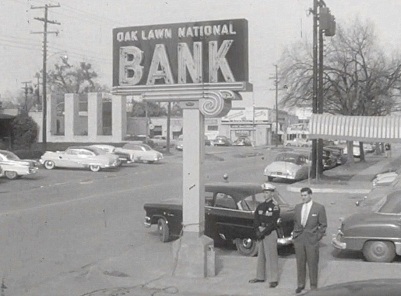
italian-village_oak-lawn-natl-bank_wbap-news_012355-portalKXAS-NBC 5 News Collection, UNT

Further changes came to 3211 Oak Lawn in the fall of 1954 with the arrival of the Village Club, which featured live entertainment (including a rotating piano) and shared a kitchen with Italian Village. It was also a “private locker club” with personal liquor lockers available to members to keep their bottles in at a time when it was not legal for restaurants in Dallas to sell liquor-by-the-drink — “set-ups” were sold and the demon alcohol was poured from the member’s stash (or, more likely, from the communal stash).

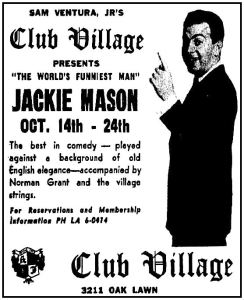
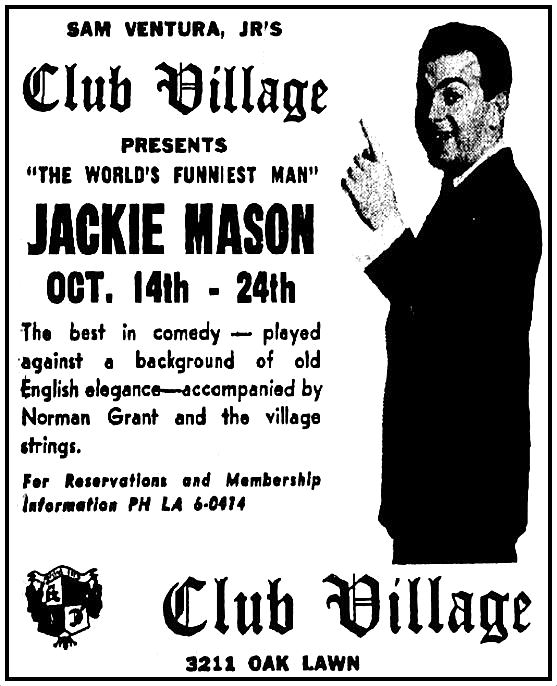
In 1961 there was yet another remodel, which enlarged the club — now called Club Village — and shrank the restaurant. The swanky new club was designed by Charles Dilbeck and had a sort of Olde English theme (and, for some reason, featured a waterfall, a glass cage behind the bar containing live monkeys, and two live flamingos named Lancelot and Guenevere).
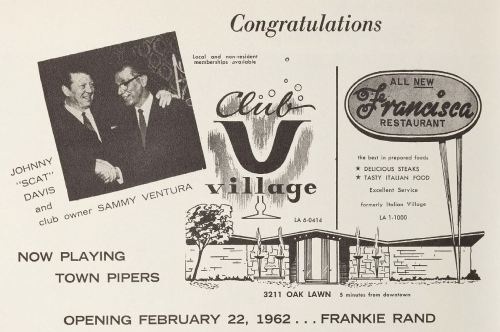
italian-village_dallas-entertainment-awards_1961_SMUvia DeGolyer Library, SMU

1965_club-village_oct-1965Oct., 1965

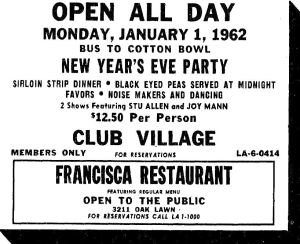
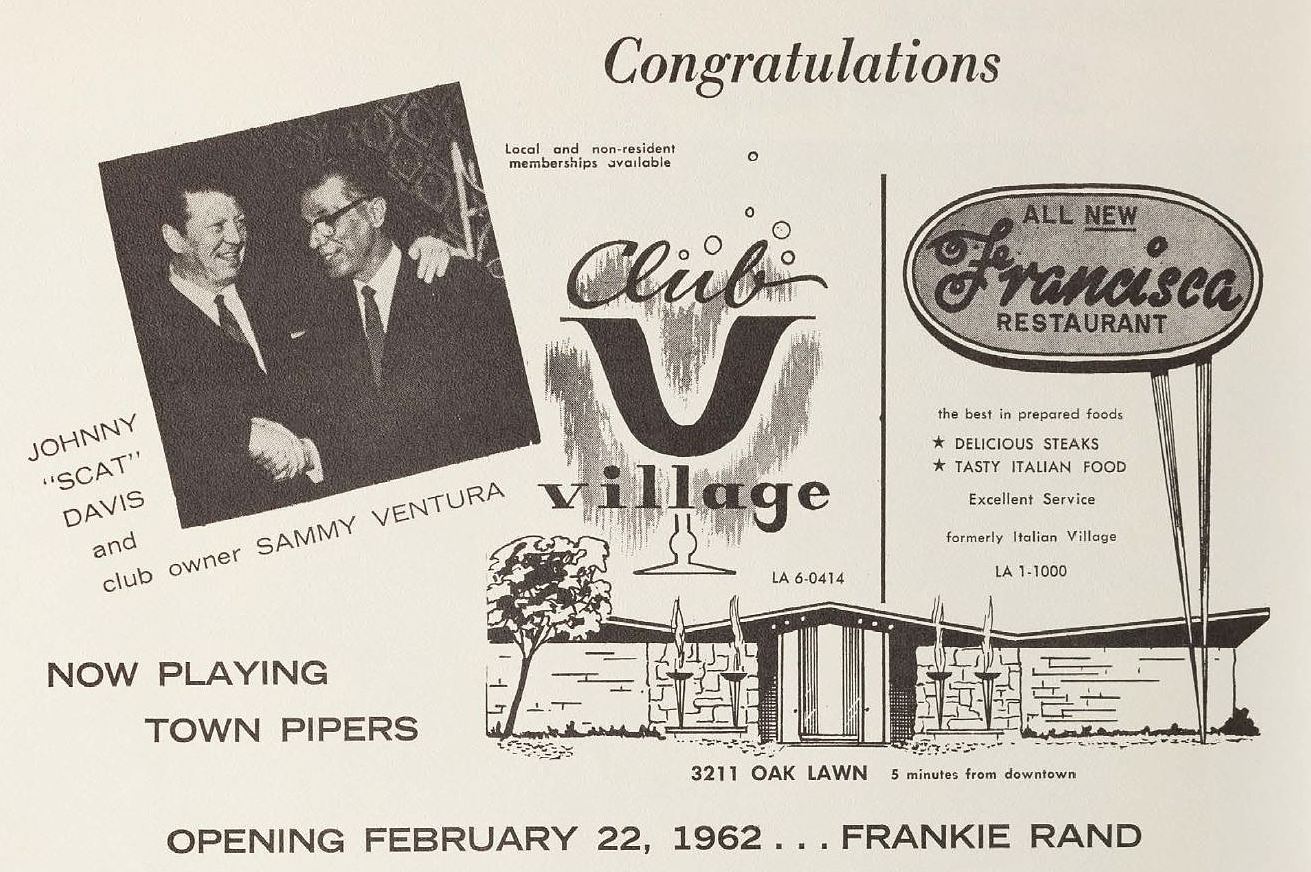
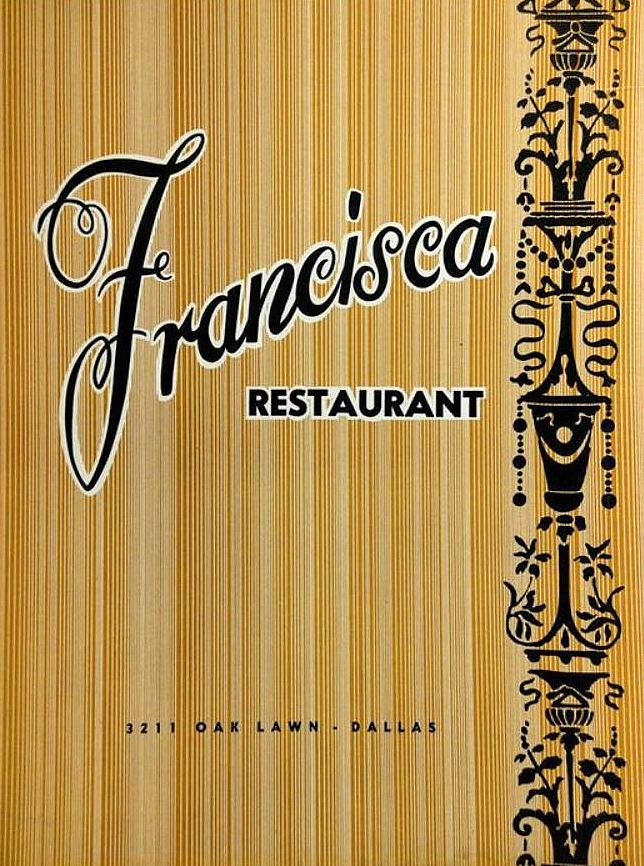
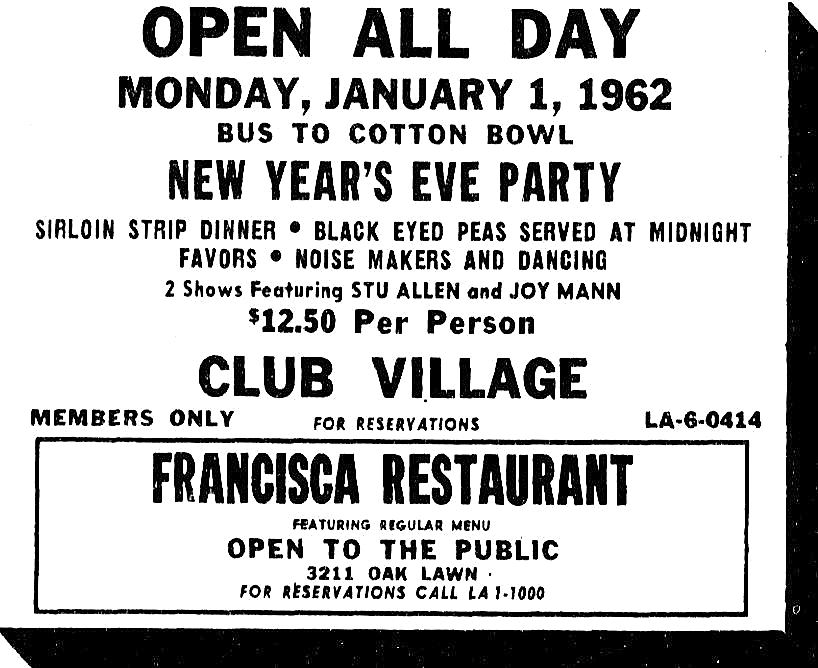
Around this time the (apparently short-lived) Francisca Restaurant appeared.
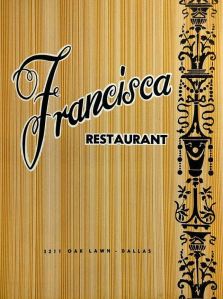
francisca-restaurant_menu_1961_ebayvia eBay

club-village_francisca_new-years-eve_dec-1961New Year’s Eve, Dec., 1961

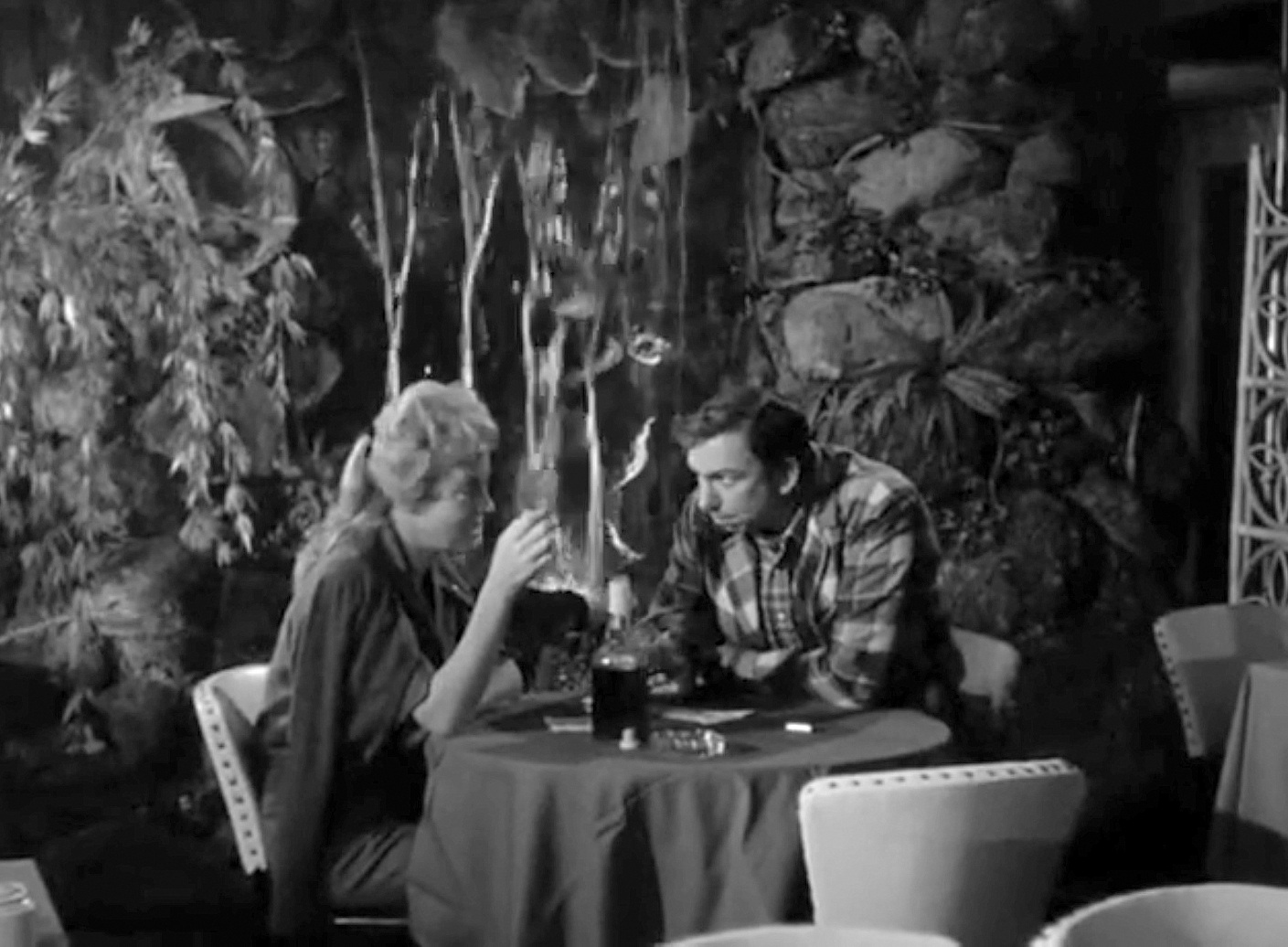
1961 also marked the club’s debut on national television, appearing in scenes of the hit show Route 66, which were filmed in November. Below is a screen-capture from the episode “A Long Piece of Mischief,” with the waterfall in the background. (The entire episode, shot around the Mesquite Rodeo, can be watched on YouTube here — the two Club Village scenes begin at the 26:42 and 38:15 marks.)
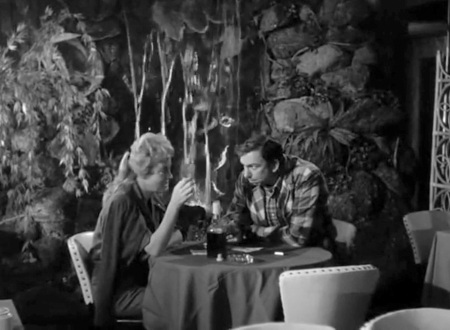
1961_club-village_route-66Route 66 (screen capture) — Nov., 1961

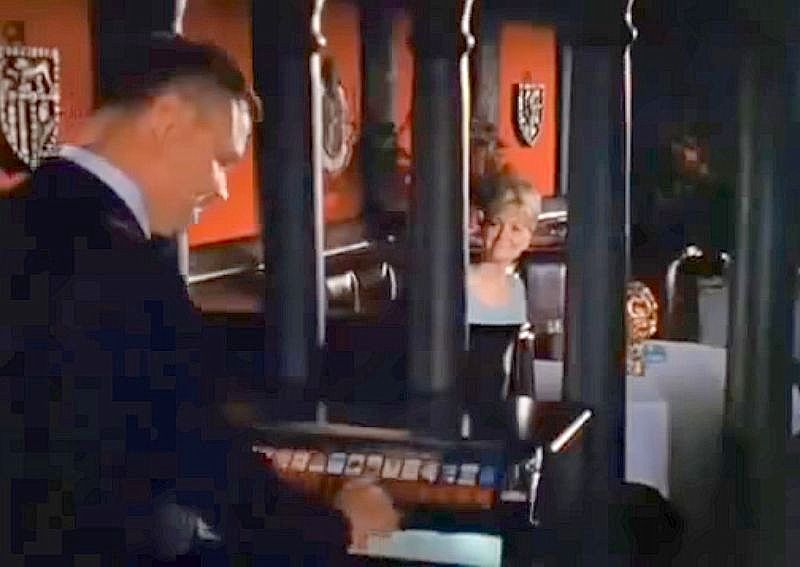
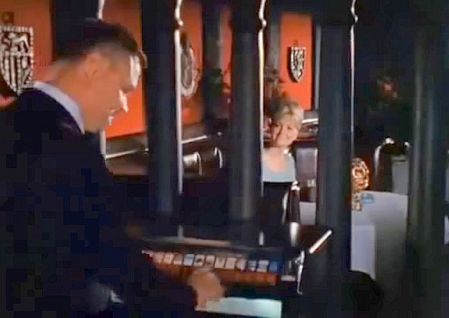
In late 1966, Dallas filmmaker Larry Buchanan shot his cult classic Mars Needs Women in various locations all over town. I’m pretty sure one of the very first scenes was shot inside the club, after yet another remodel. (Incidentally, see what the lively neon-ified corner of Oak Lawn and Lemmon, a couple of blocks away, looked like in Buchanan’s film, here.)
1966_club-village_mars-needs-women
Mars Needs Women (screen capture) — 1966

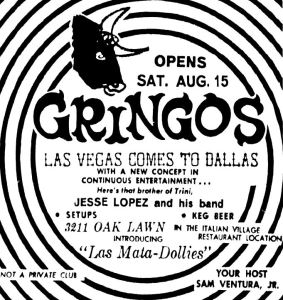
In August, 1964 a new club opened: Gringos (sometimes spelled Gringo’s). This public club, featuring mostly rock bands, was the brainchild of Sam Ventura, Jr. (who said in an interview that he had rather brazenly sprung the whole thing as a big surprise on his father, who had been out of town on a lengthy vacation — luckily, the club was a hit and Sam, Sr. was pleased). Club Village continued as a private club, but from newspaper accounts it seems that the new discotheque displaced the Italian Village and/or Francisca restaurant completely. So now on one side you had the long-running “sophisticated” private club, and on the other side, the “new concept in continuous entertainment,” with its Mexican-themed decor and Watusi-dancing waitresses (“Las Mata-Dollies…”), which catered to a younger set. The Fort Worth Star-Telegram described Gringos thusly:

Newest “port of call” for Dallas revelers on the bistro beat is the just-opened and lavishly-done Gringos Club on Oak Lawn Ave. near the Melrose Hotel and in the location formerly occupied by the Italian Village Restaurant and Village Club. Open to the public, this night time Camelot with Mexican decor features, among other flings, Jesse (brother of Trini) Lopez and his handful of musical consorts on the bandstand and a covey of revealing young handmaidens called “Las Matta-Dollies” [sic], sort of Spanish-type Playboy Bunnies who are worthy of your scrutiny. (Chris Hobson, FWST, Aug. 27, 1964)
1964_gringos_aug-1964Aug., 1964

In May, 1967, Sam Ventura, Jr. (“Sammy,” who had taken over the family business when Sam, Sr. retired in 1966) declared that Gringos was dead: “There will be absolutely no rock-and-roll in this room anymore. It’s dead. Our whole concept [now] is for sophistication, for adult entertainment” (DMN, May 24, 1967). So adios, Gringos, hello an even bigger Club Village. (In 1968 a club described as a “new” Gringos  opened a block away, at 3118 Oak Lawn — it’s unclear whether this was affiliated in any way with the Ventura family.)

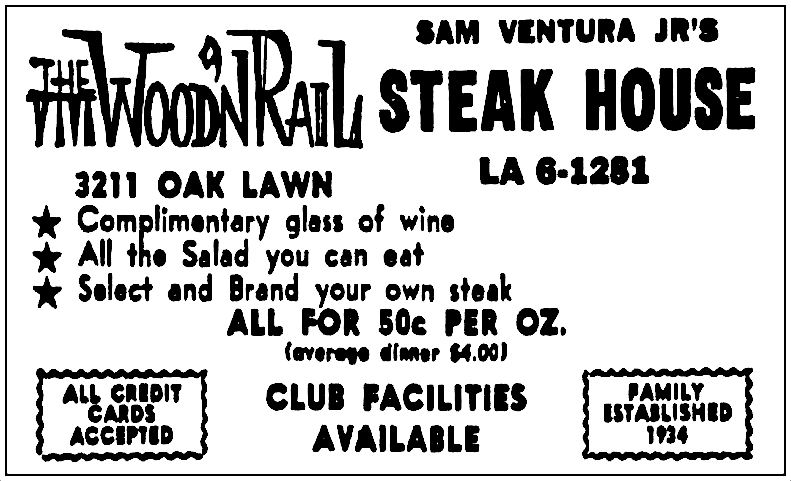
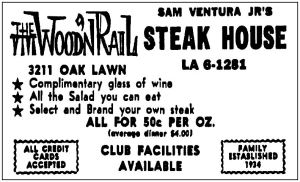
In June, 1968, the never-ending improvements, remodelings, and reconfigurings of 3211 Oak Lawn continued with Sammy’s announcement of a new (public) restaurant, the Wood ‘N Rail. This steakhouse featured a revolving “ice bar” (the old revolving piano bar, repurposed), which contained a display of raw meat — from this, customers would choose whichever cut of beef called to them, and before the meat was escorted into the kitchen, the patron would sear his or her initials into it with a “red-hot branding iron.” The restaurant’s slogan was “Personalized Beef.” The unstoppable Club Village continued as a private club and restaurant in the adjoining complex.
1968_wood-n-rail_oct-1968Oct., 1968

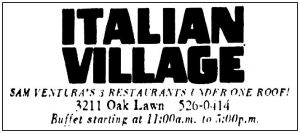
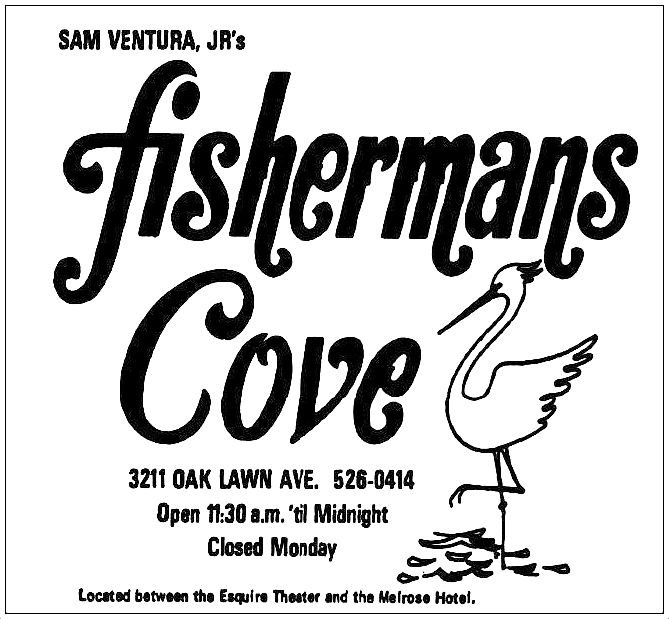
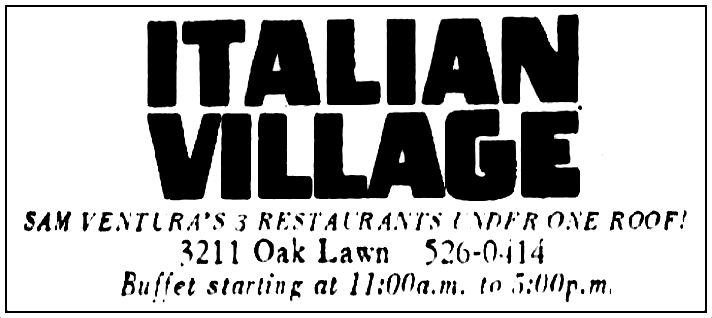
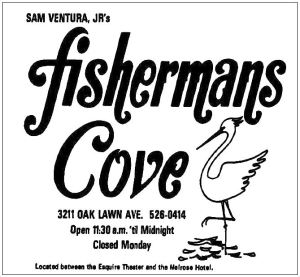
1971 began with a fire. The (once) unstoppable Club Village was destroyed. The adjacent Wood ‘N Rail emerged unscathed. So, yes, more remodeling! By 1972, 3211 Oak Lawn boasted three (three!) restaurants at one address: the continuing Wood ‘N Rail (steakhouse), Fisherman’s Cove (seafood), and — hey! — the return of Italian Village. As the ads said: “3 RESTAURANTS UNDER ONE ROOF!”
1972_fishermans-cove_march-1972March, 1972

1972_three-restaurants_may-1972May, 1972

Also big news in 1971: it finally became legal to order liquor and mixed drinks in bars and restaurants — the whole “private club-membership” thing in order to get around liquor laws was mostly a thing of the past (unless you lived in a dry area of the city…).

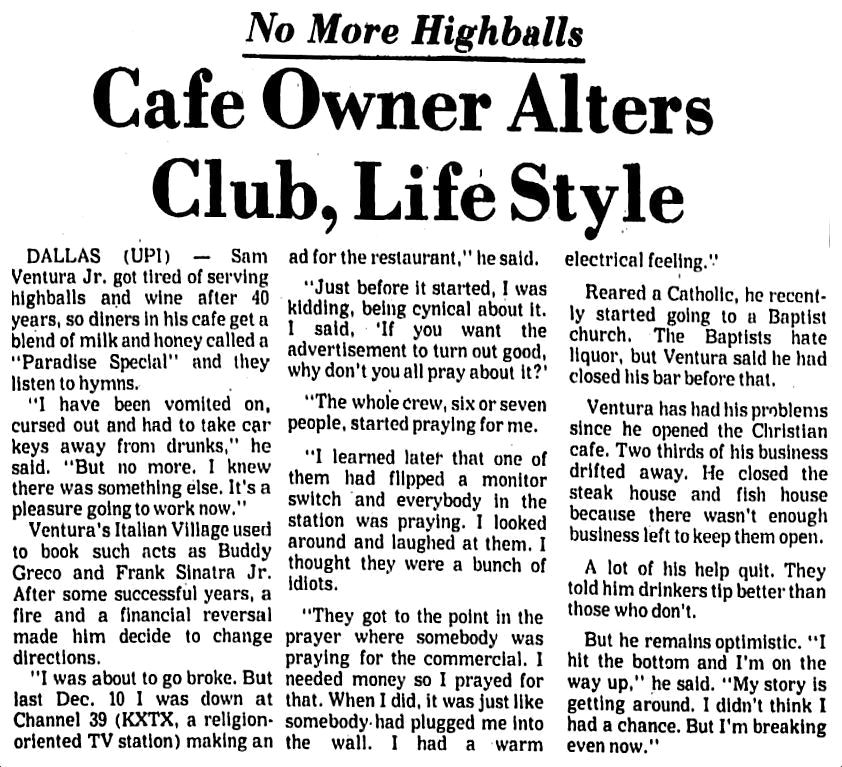
Then, in 1974, things really changed. After a “profound religious conversion,” Sammy Ventura stopped all sales of alcohol and told the TABC he didn’t need or want that ol’ liquor license. This made news around the country.
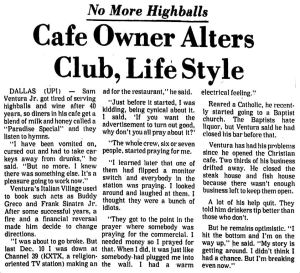
1974_kings-village_panama-city-FL-news-herald_081274UPI wire story, Panama City [FL] News Herald, Aug, 1974

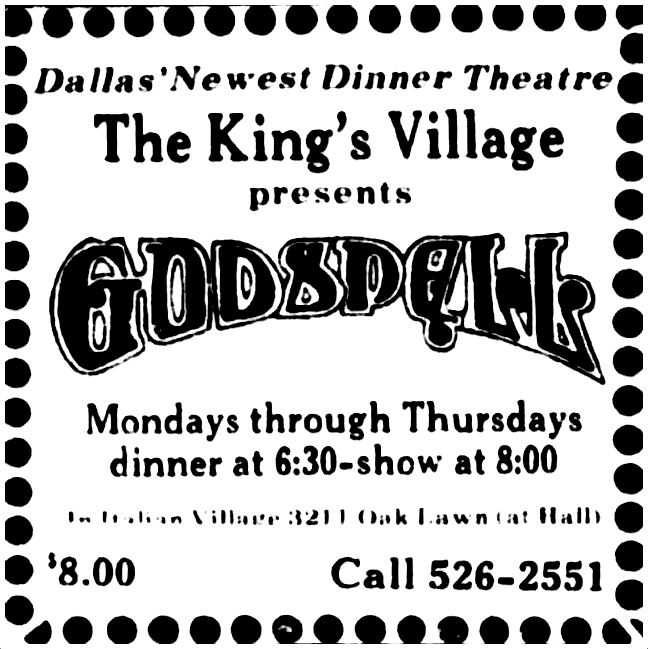
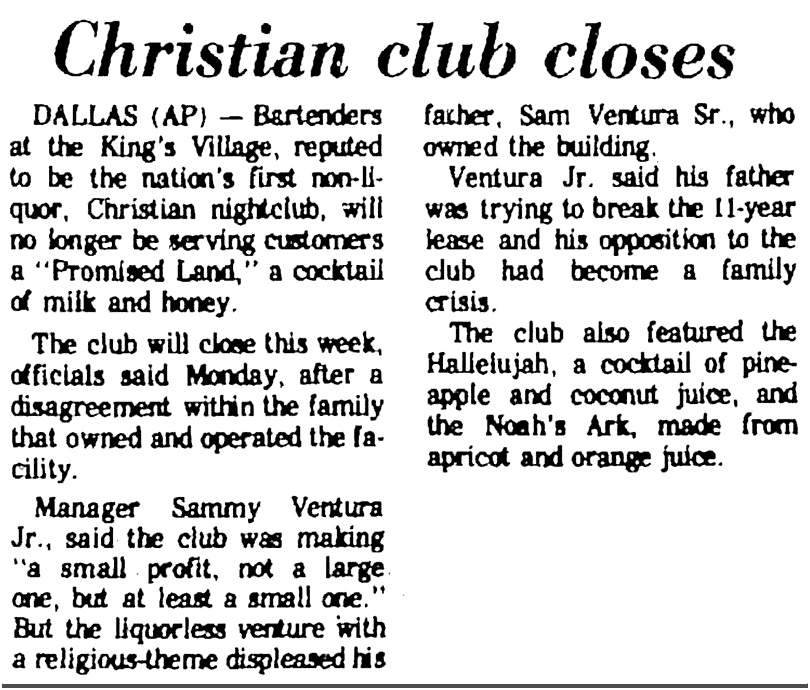
Unsurprisingly, business plummeted. Two of the three restaurants closed. Italian Village continued to limp along, even weathering the introduction of the King’s Village, “Dallas’ first Christian dinner theater.”
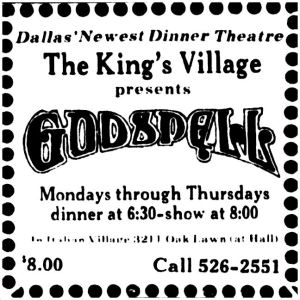
1976_kings-village_june-1976June, 1976

This change in direction of the the 40-plus-year-old family business caused a huge rift between Sammy and his father. Sam, Sr. put his foot down, and The King’s Village (“the nation’s first non-liquor, Christian nightclub”) closed in June, 1977.
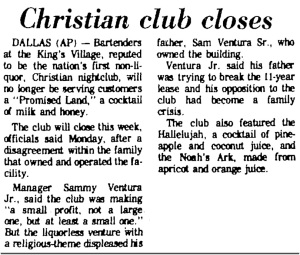
1977_kings-village_pampa-daily-news_062177
AP wire story, Pampa Daily News, June 21, 1977

Oak Lawn’s decades-old Italian Village was no more (although Sammy appears to have opened his own Italian Village restaurant in Richardson’s Spanish Village for a while). The last mention I found of Italian Village was in Feb., 1979:

After 45 years, the Italian Village restaurant has changed to another venture, the Crazy Crab. Sam Ventura opened the Italian Village in 1934 and the last event before the changeover was a surprise birthday party honoring Sam. (DMN, Feb. 23, 1979)

It’s a shame Italian Village’s last incarnation was a mere shadow of its former go-go glory, but it’s almost unbelievable that a restaurant in Dallas was in business for 45 years. Sam Ventura’s $250 gamble in 1934 paid off very, very well.

***

Sources & Notes

Top image is the front cover of a cardstock photo-holder (with linked photo by the Gilbert Studios, 4121 Gaston); collection of Paula Bosse.

All clippings and images are larger when clicked.

*

Copyright © 2018 Paula Bosse. All Rights Reserved.

The Last Traces of Vickery Park Are Now Definitely Gone

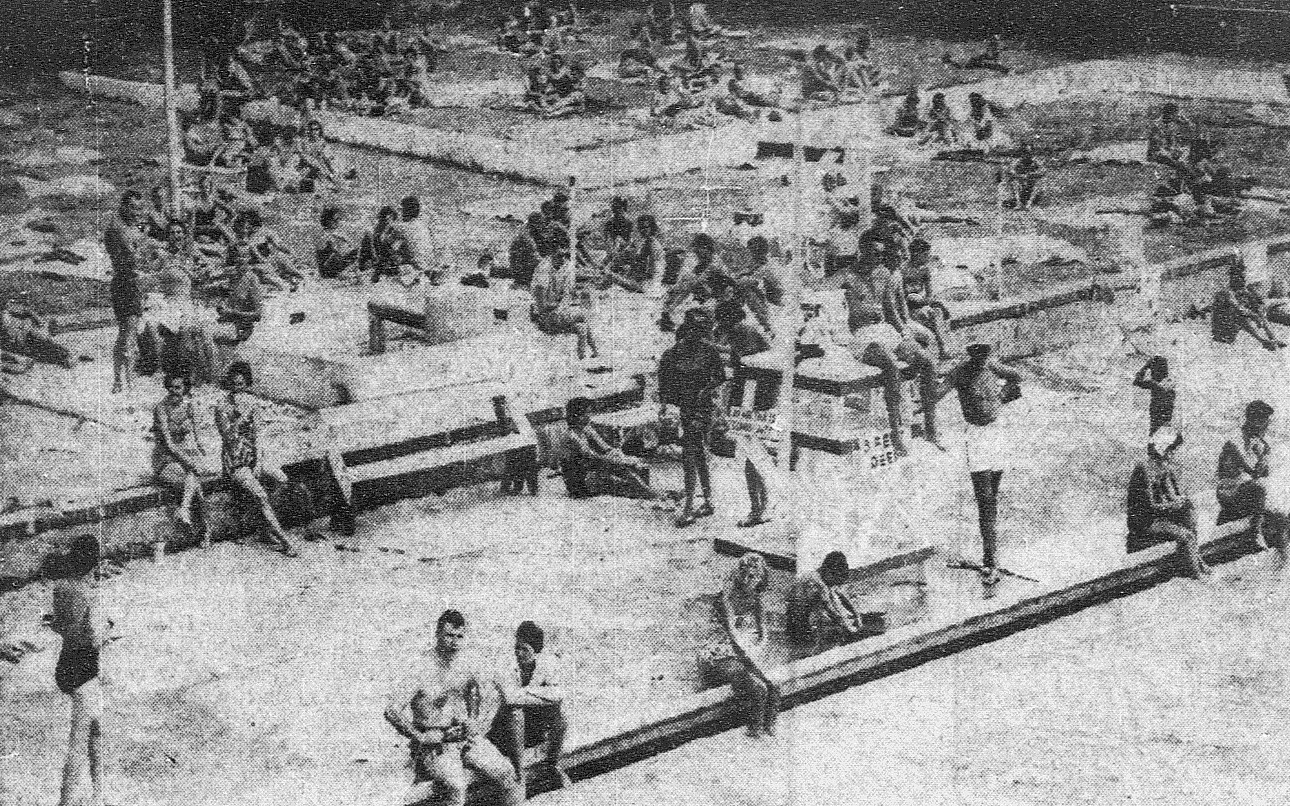
vickery-park_demo_062118_d_PEBThe last vestige of a one-time summer destination…

by Paula Bosse

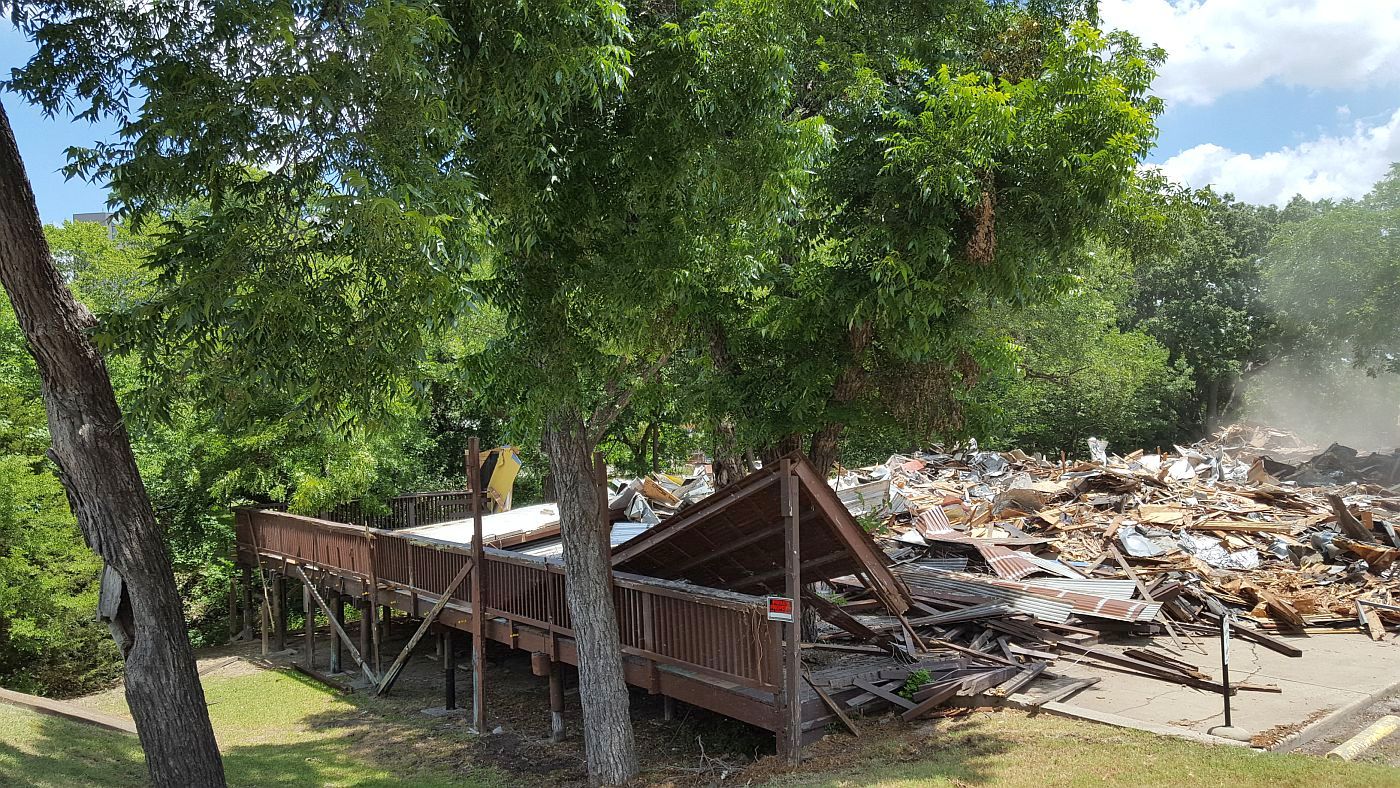
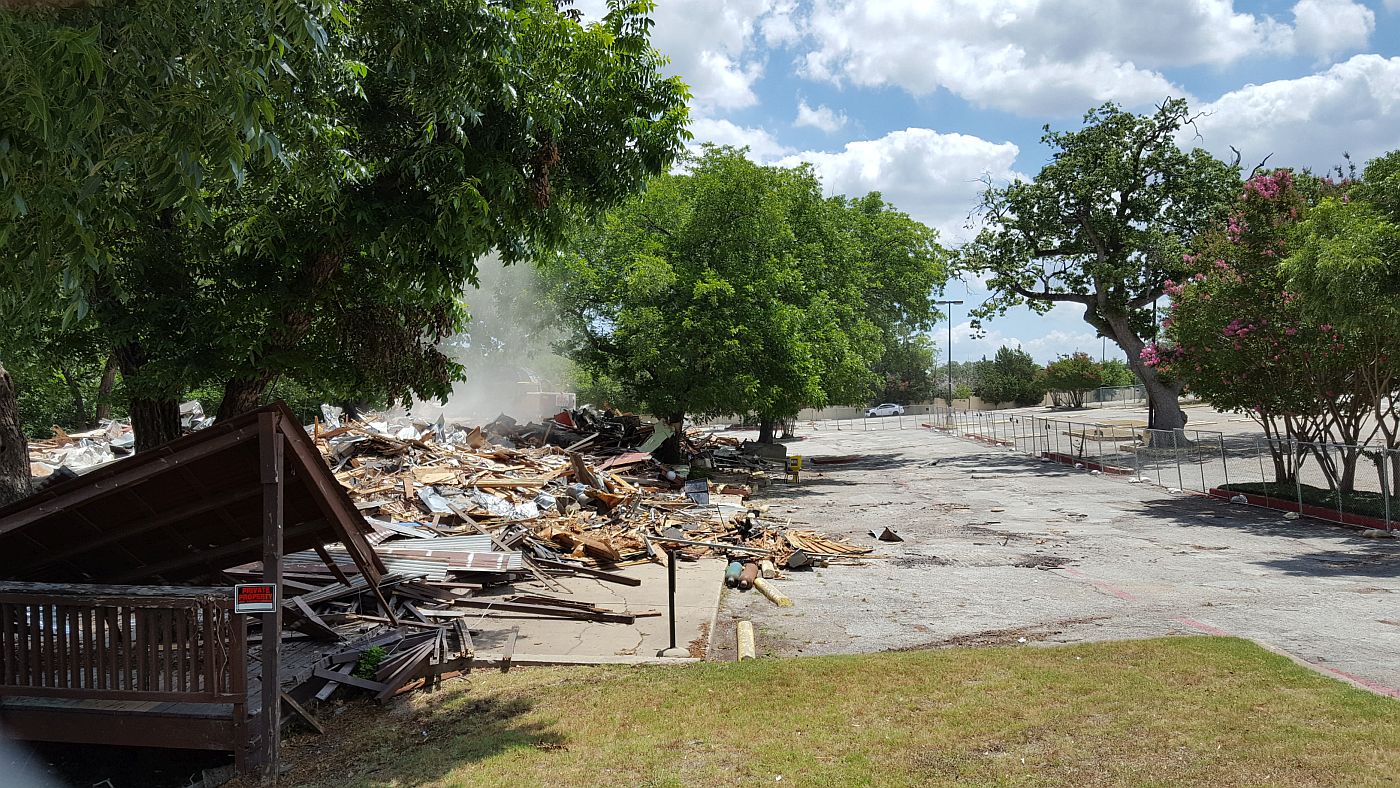
Driving along Greenville Avenue this morning, I noticed a pile of rubble where Vickery Park once stood (just south of Walnut Hill, across from Presbyterian Hospital). It seemed sadly ironic that the land which was once occupied by a fondly-remembered swimming pool and picnic area was heaped with demolished buildings on the first day of summer.

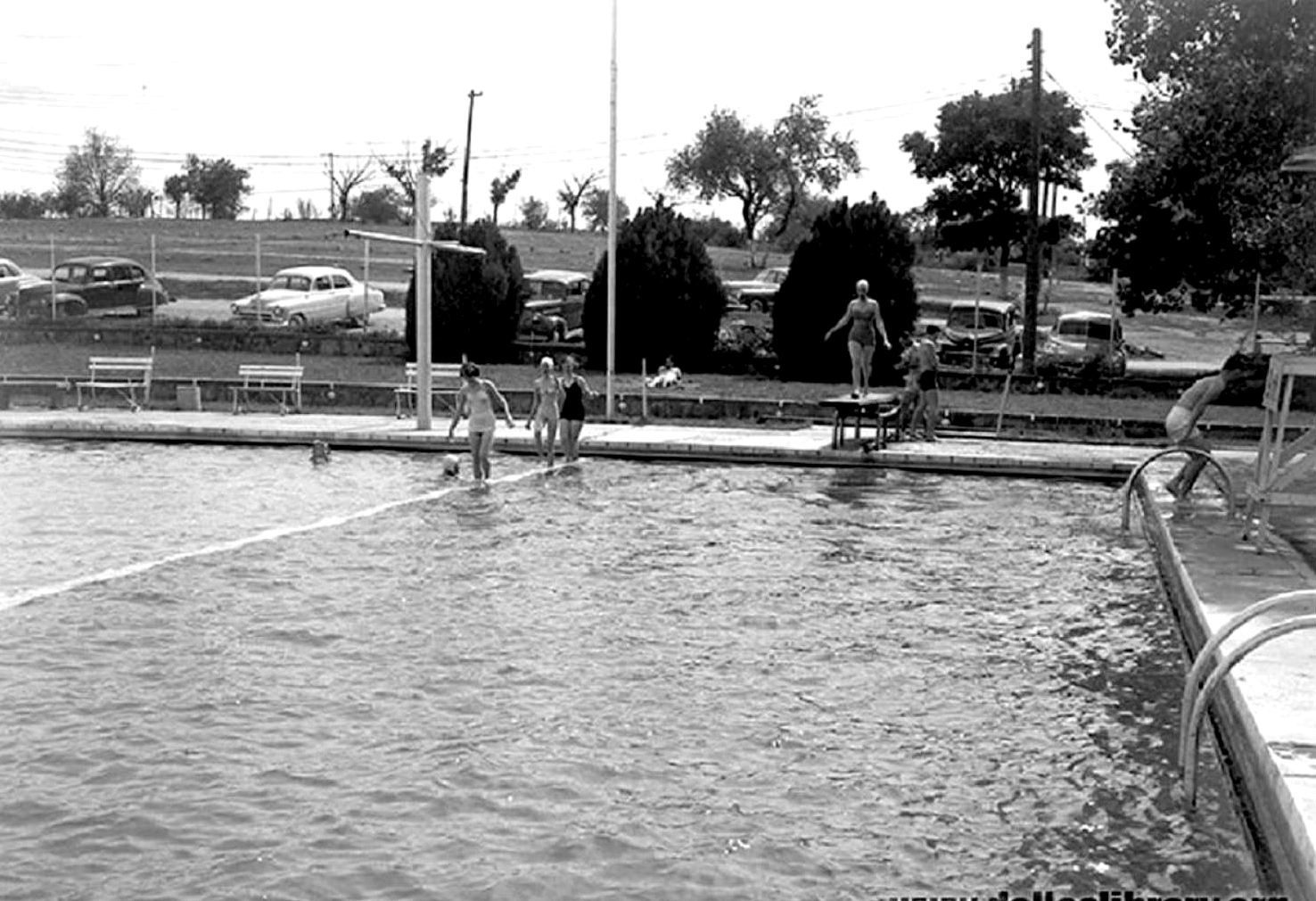
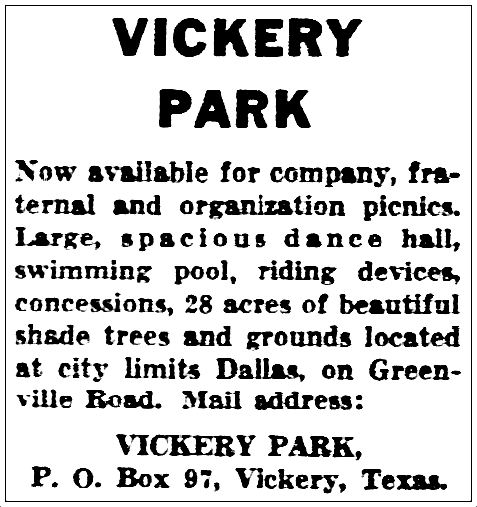
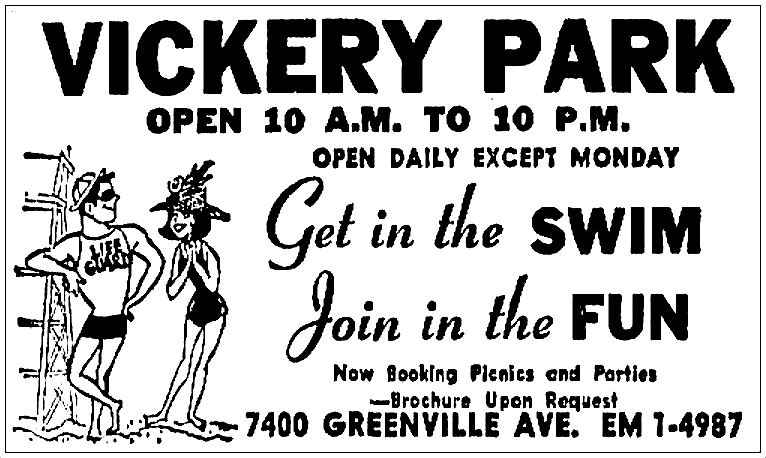
I never saw the huge swimming pool myself, but from everything I’ve read about it over the years, it seems to have been very, very popular with generations of Dallasites. It was built in the then-rural community of Vickery as far back as the 1930s (well before Vickery was annexed by the city of Dallas), and it was still open at least through the ’60s.

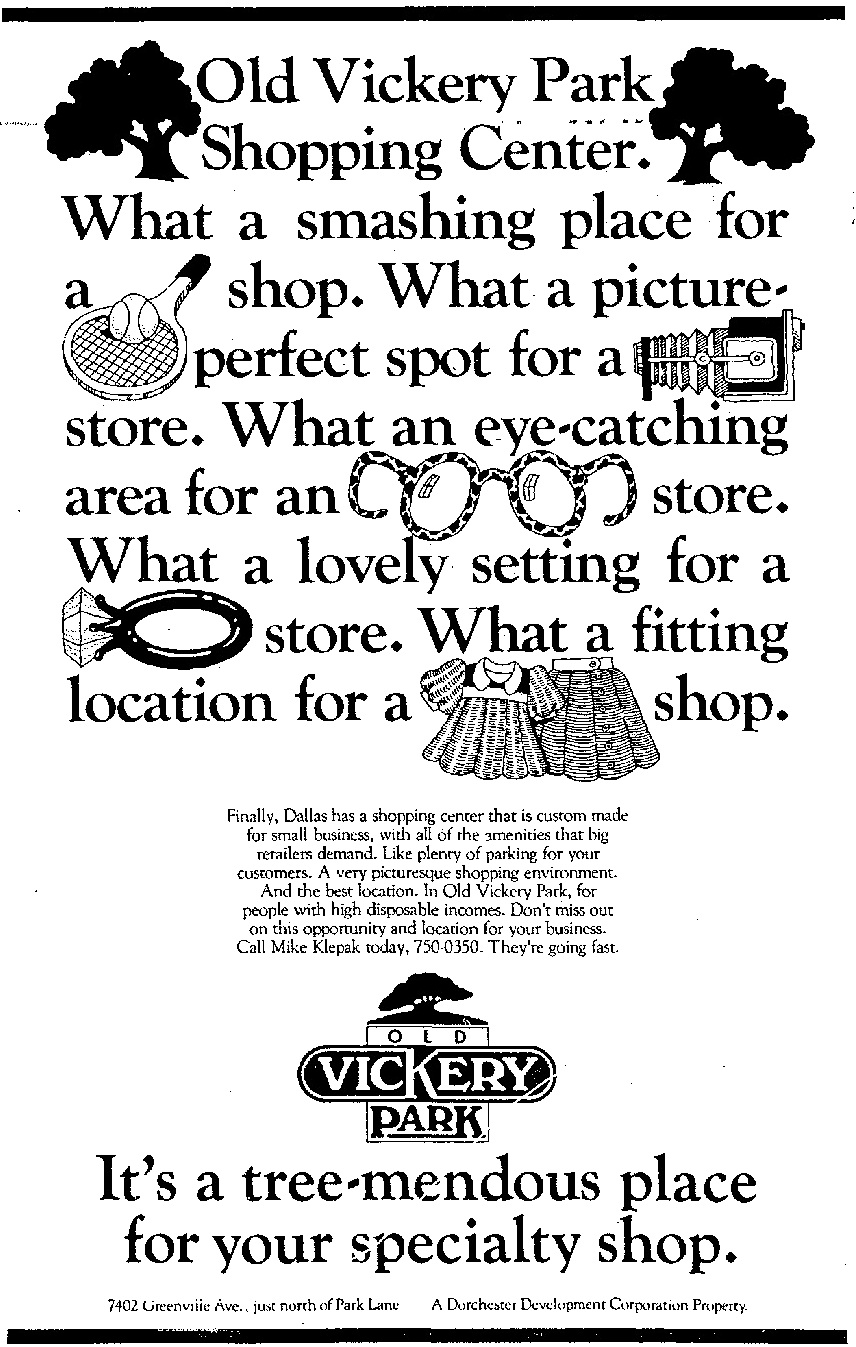
The pool and amusement park were long gone when the (now-demolished) small shopping and restaurant area was built in the mid-1970s on a very pretty wooded site alongside White Rock Creek. Initially, the developer envisioned lots of quaint little boutiques and cafes (similar to those found in the Quadrangle) dotting the banks of White Rock Creek, creating Dallas’ version of San Antonio’s River Walk. …No one has ever accused real estate developers of dreaming small.

It’s sad to see this anachronistic, funky little area go away. My vague memories of childhood games of miniature golf in the ’70s are about to get vaguer.

vickery-park_demo_062118_a_PEB

*

vickery-park_demo_062118_b_PEB

I’ve never known exactly where the pool was, but I think it might have been at the back right of the photo above, just off Pineland.

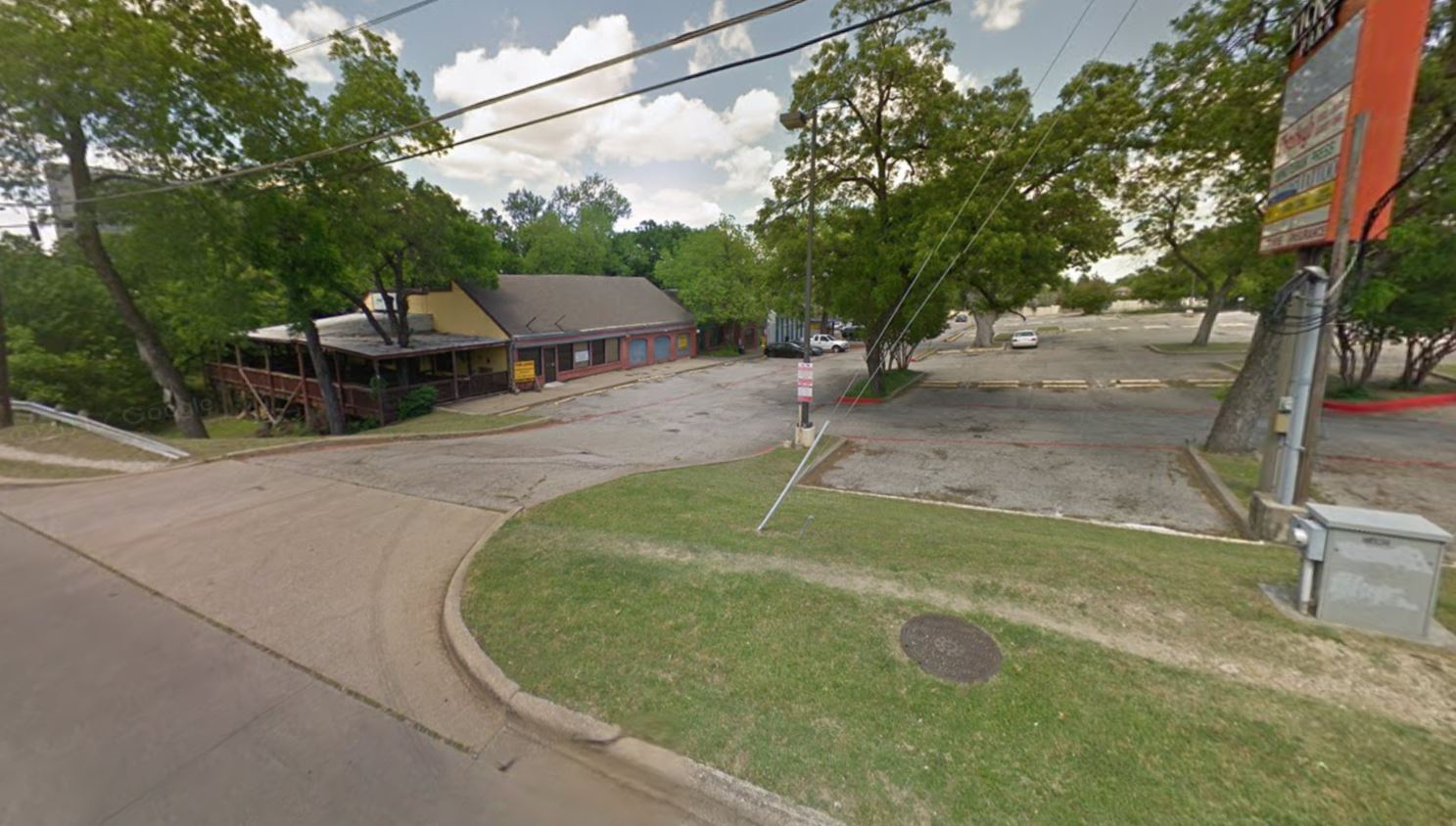
vickery-park-pool_dpl_pinterest

vickery-park-swimming-pool_1950s

vickery-park-swimming-pool_legacies_fall-2002

vickery-park-pool_19461946

swim_vickery-park_19651965

1978_vickery-park_sept-1978Sept., 1978

vickery_google_may-2017Google Street View

Above is a Google Street View from May, 2017. If you’d like to take a little virtual “drive” through the parking lot, hie yourself over to Google, here.

*

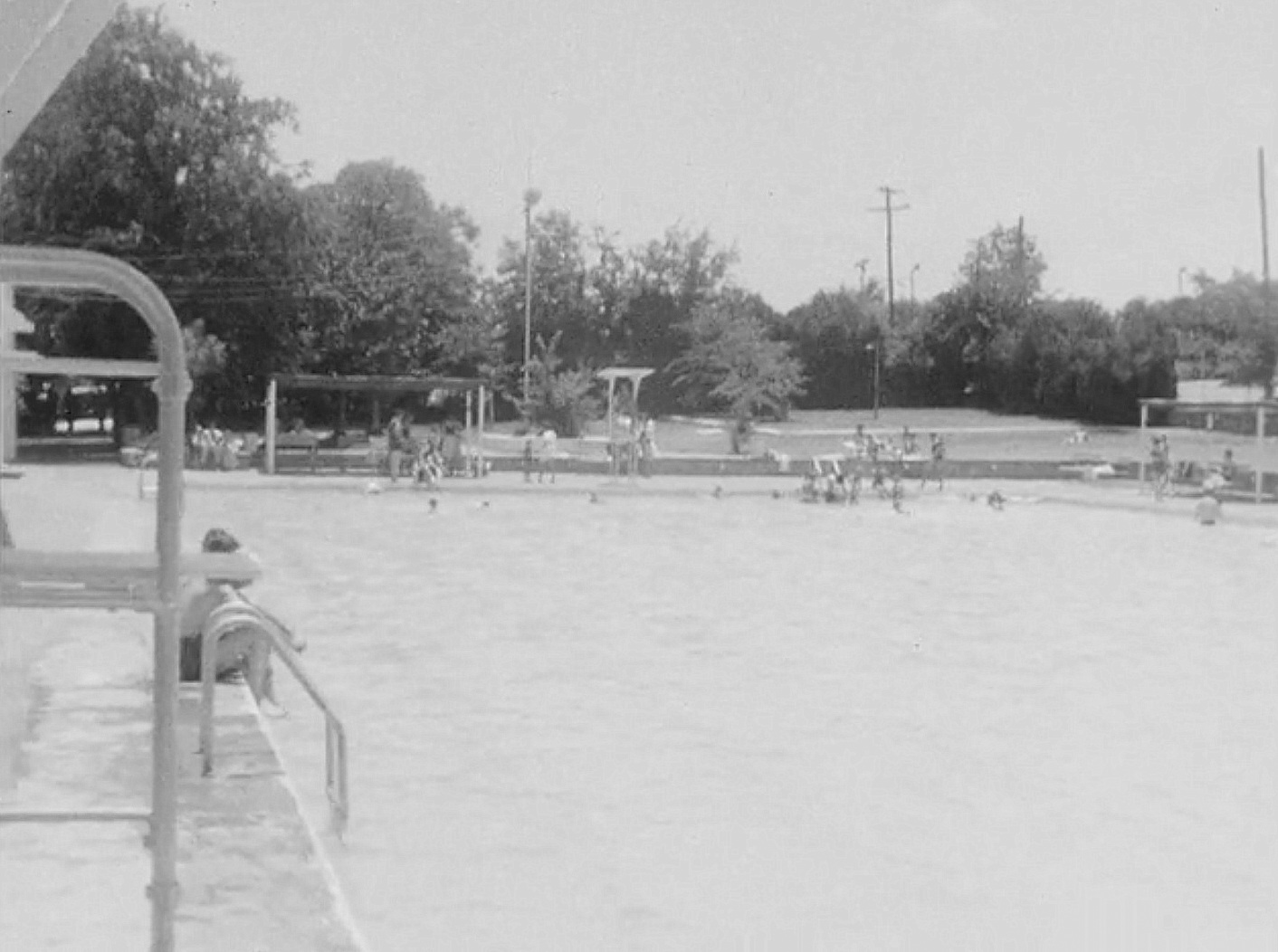
Here are two pieces of film footage showing the pool. The first one is from June, 1964 and is (silent) news footage shown on WBAP Channel 5. It’s a little unsettling, as it shows a boy being rushed off by ambulance after an accident, but it does have some interesting shots of the pool and the park, which I’ve certainly never seen before. I am unable to embed the video, but you can watch it here. (The script for the story is here.) (Footage is from the WBAP-TV News collection, UNT Libraries Special Collections.) Here is a screen capture:

vickery-pool_WBAP_portal_062364

The second is undated, but the clips are from home movies.

***

Sources & Notes

Rubble photos taken by me on June 21, 2018 — construction was underway. And it was extremely HOT.

The first historic photo appears to be a Dallas Public Library photo, with most of the watermark cropped off. I found it on Pinterest, here.

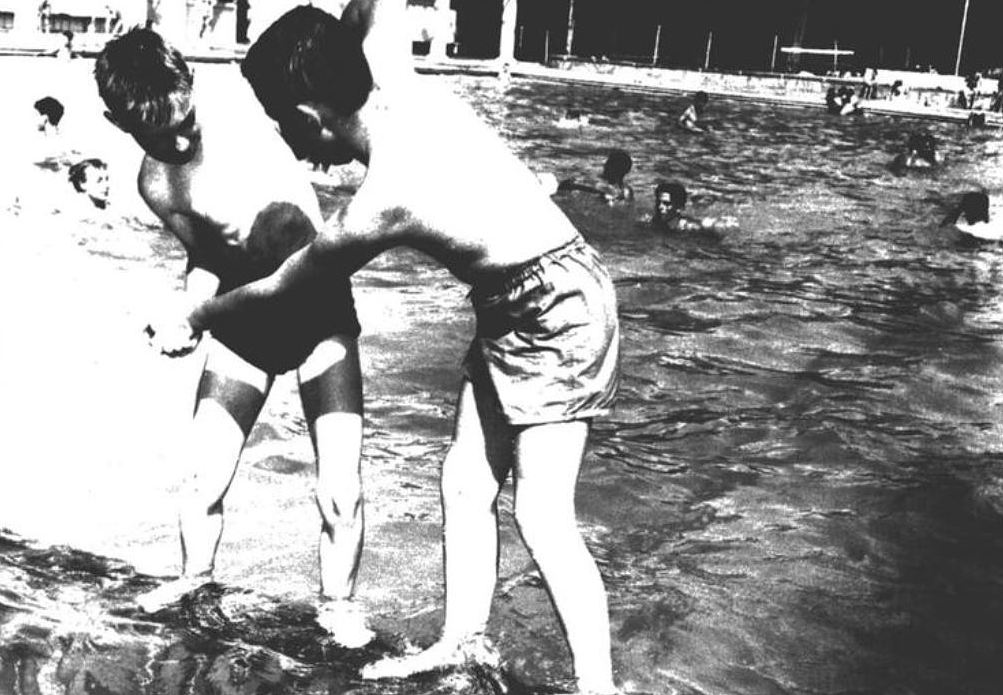
The third photo, showing two boys, was found in the Fall 2002 issue of Legacies.

There are memories-galore of Vickery here.

A couple of interesting tidbits:

  • The Vickery pool was used as an officers’ recreation club during World War II by the Fifth Ferrying Group; an aquatic meet was held there in June, 1945 which featured a variety of exhibitions, including a water ballet performed by “half a dozen mermaids from University Park.”
  • In the early 1970s, Vickery Park (…not to be confused with Vickery Place…) was owned by the Seventh Day Adventist Church. They reopened the park as a “family recreation center” — unlike the earlier days, alcohol was no longer sold. They sold the land to developers around 1974 or 1975; in the summer of 1975, the recreation center was bulldozed and the pool was paved over (and became a parking lot).

Articles on the disappearing community of Vickery can be found in the archives of The Dallas Morning News:

  • “Progress Overtakes Old Vickery” by Rena Pederson, with photos by Eli Grothe (DMN, August 3, 1975)
  • “Store Provides Feed For Thought On Town’s Past” (Vickery Feed Store) by Steve Kenny (DMN, Nov. 18, 1979)

*

Copyright © 2018 Paula Bosse. All Rights Reserved.

Dallas House Moving Company — 1940

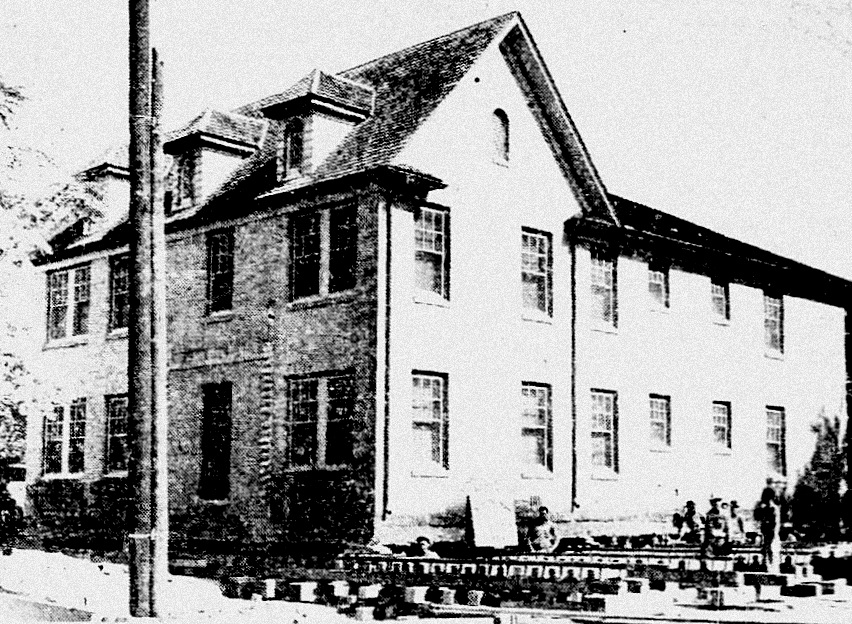
ad_dallas-house-moving-co_aug-1940Moving from W. 12th to … W. 12th…. (click for larger image)

by Paula Bosse

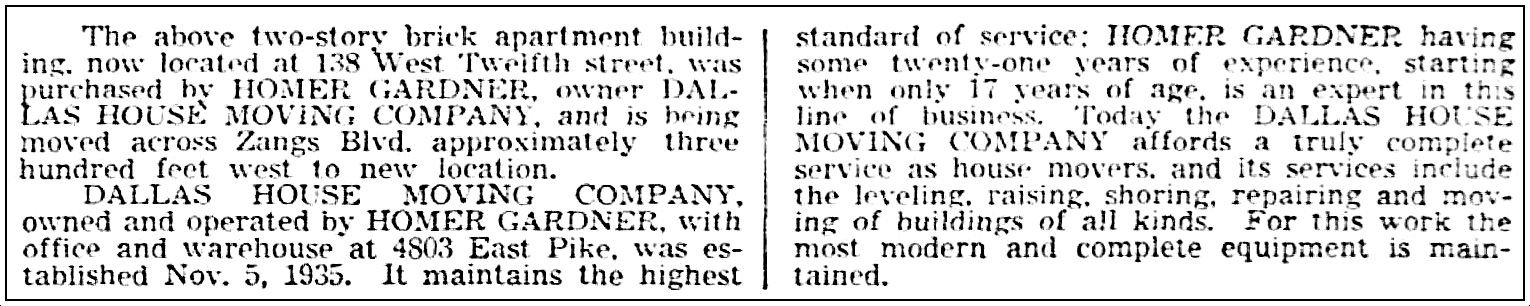
My brother and I are helping our mother move. At least we aren’t having to move a two-story brick apartment building, as seen in the photo above, which is from a 1940 ad for the Dallas House Moving Company (est. 1935), owned and operated by Homer Gardner. The caption for the photo is below (click to see a larger image):

ad_dallas-house-moving-co-aug-1940-captionDallas House Moving Co. advertisement, Aug. 1940

The apartment house (which contained six units) was one of several houses and apartment buildings which were moved in 1940 to accommodate the widening of Zang Boulevard in Oak Cliff. The building was moved from 138 W. 12th Street to 214 W. 12th. The 900,000-pound structure was loaded onto a steel track and was moved the short distance on steel rollers.

So when I sigh heavily on having to move things my down-sizing mother really does not need to be keeping (like … schnapps glasses?!), I have to take a moment and keep this relatively simple move in perspective. No steel tracks necessary

*

Copyright © 2018 Paula Bosse. All Rights Reserved.

Ghost Rails of the Belmont Streetcar Line

matilda-richmond_dan-parr-photo_FB-dallas-history-guild_april-2018Matilda & Richmond, April, 2018… (photo: Dan Parr)

by Paula Bosse

I grew up on Ellsworth, between Greenville Avenue and Matilda — just south of Mockingbird, just north of the M Streets. When I was a child, Matilda was only partially paved — in my neighborhood, maybe only from Mockingbird down to Kenwood? Otherwise, it was a dirt street (!) — and this was in the ’70s! Right around Kenwood was a weird mound which might not have looked like much to an adult, but to a child it was pretty strange. I can’t remember if the rails were visible — I’m pretty sure they were.

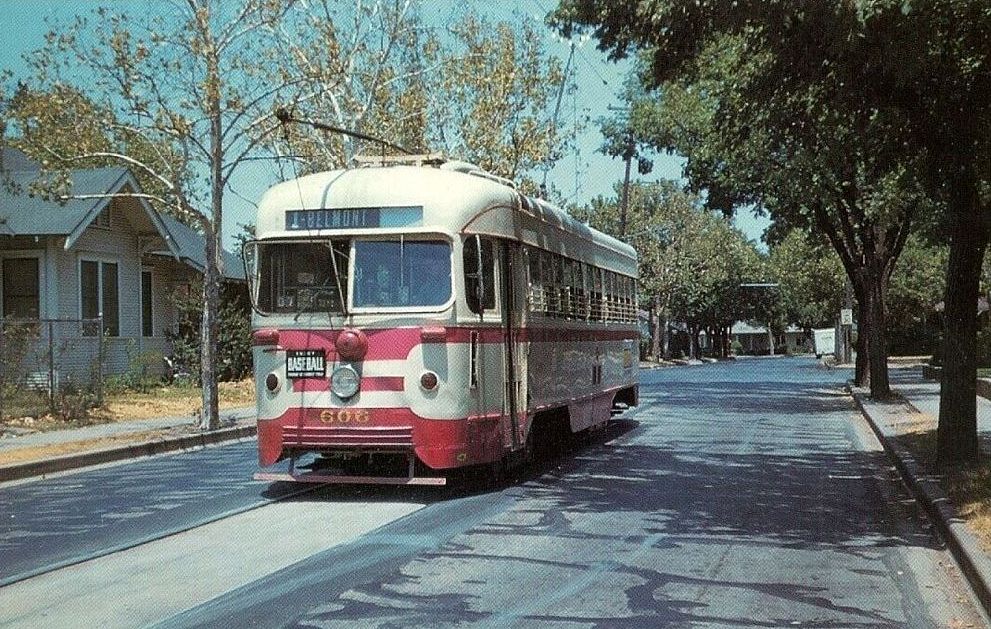
That line was the Belmont Line, which ended (began?) at Mockingbird (I think there was a later extension of sorts, but I think Mockingbird was the end of the line for streetcar passengers). As a kid, I knew that Matilda had been a long-gone streetcar line, but never having seen a streetcar outside of a movie, I couldn’t really imagine what it must have been like to have streetcars (and an interurban! — more on that below) moving up and down a street which was less than a block from my house.

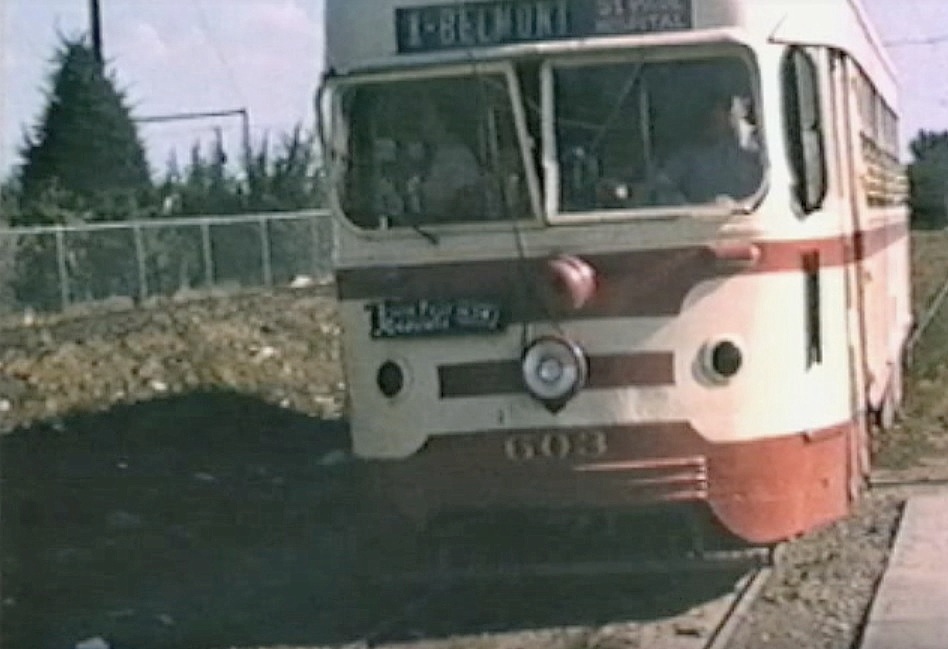
A few years ago I stumbled across the YouTube video below and was surprised to see actual footage of that streetcar rolling up Matilda. The first five minutes of the video contains 16mm footage (both black-and-white and color) shot around Dallas in 1953 and 1954 by Gene Schmidt. It’s GREAT! You’ll see streetcars-galore moving past all sorts of familiar and vaguely familiar sights around the city, from Oak Cliff to downtown to way out to Mockingbird and Matilda. It ends with the Belmont-Seventh car (car 603) pulling to the end of the line — the view is looking south down an unpaved Matilda Street from Mockingbird, with a glimpse of the Stonewall Jackson playing field at the left, on the other side of the fence. (The Matilda footage begins at 4:17.)

*

belmont-line_matilda-from-mockingbird_youtube-cap_ca1954Matilda, south from Mockingbird, ca. 1954 (Gene Schmidt)

Above, a screen capture from the video showing Matilda looking south from just south of Mockingbird. Stonewall Jackson Elementary School is at the left. Today the view looks like this.

*

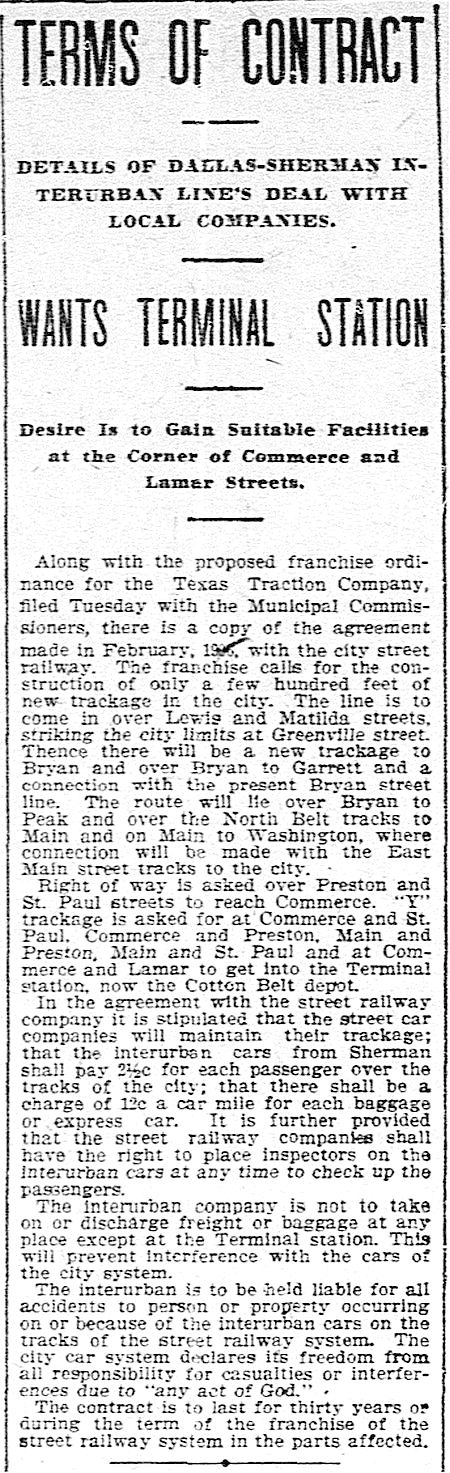
Before the streetcar arrived, Matilda was the artery that led the Texas Traction Company’s Sherman/Denison interurban into Dallas. This electric interurban service from the north, which closely followed the H&TC railroad line, arrived in Dallas in 1908, back when the official entry-point into the Dallas city limits was just off Matilda, near Greenville Avenue and Bryan Street.

1908_interurban_sherman-dallas_dmn_011608
DMN, Jan. 16, 1908 (click to read)

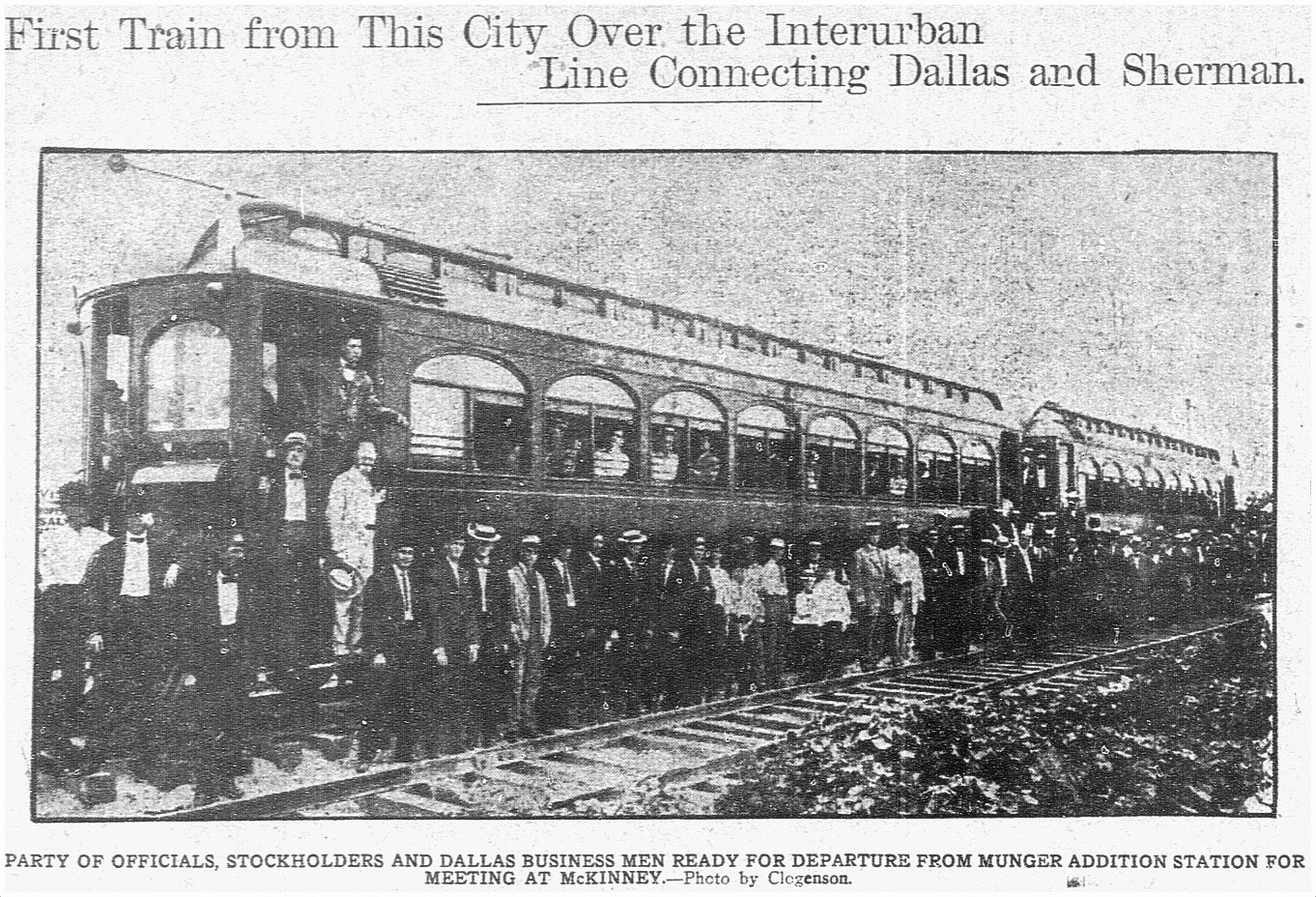
The interurban route connecting Sherman/Denison with Dallas opened on July 1, 1908 and lasted for 40 years, until its final run on December 31, 1948. (Read the Dallas Morning News article on the 1908 inaugural trip for big-wigs, “Many Make Trip Over Interurban,” July 1, 1908, here. Below is the accompanying photo. Image that running up and down Matilda — and, later, along other streets in Dallas — several times a day!)

interurban_sherman-dallas_dmn_070108
DMN, July 1, 1908

Dallas’ ever-increasing population began to move northward and eastward, necessitating public transportation which would connect these developing areas with the rest of the city. One of the early “suburban” lines was the Belmont Line, which branched off the Bryan Street line and served the Belmont Addition and beyond; it opened in 1913, but these early days appear to have been more of a private “dinky” service (see SMU’s dinky car on the beyond-the-city-limits tracks at Hillcrest and McFarlin, here). The Belmont line — as well as the Vickery Place and Mount Auburn lines — became part of the city’s official streetcar system in 1922.

Before the dinky service, riders were able to get on and off the large interurban cars at stops between Mockingbird and the area around Bryan and Greenville Ave. Even though interurbans and streetcars were able to travel on the same rails, it took years for dedicated streetcar tracks to be laid along Matilda.

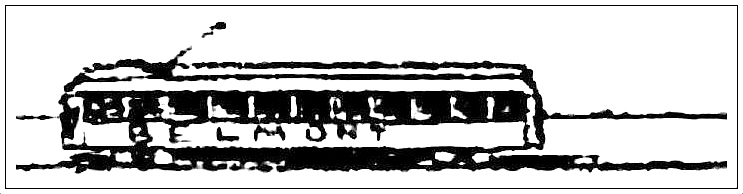
This detail of a real estate ad shows that the Belmont line had reached at least as far as Richmond by 1914 (I felt I had to include this because the finger is pointing at the exact location of the exposed rails in the photo at the top!):

1914_matilda-richmond_lakewood-heights-ad_det_050314
May, 1914 (detail from Lakewood Heights real estate ad — see full ad here)

By 1922 the Belmont line had extended north to Velasco; by 1925 it had gotten to McCommas; by 1936 it had made it up to Penrose; and by 1939 it had finally reached Mockingbird (in time for the opening that year of Stonewall Jackson Elementary School, located at Mockingbird and Matilda).
Dallas streetcars began to be phased out in 1955, and the Belmont line was one of the first to go — its last run was March 6, 1955: “The Belmont-Seventh streetcar line will go out of existence Sunday to be replaced by service with new Diesel buses” (Dallas Morning News, March 6, 1955). The new bus route in the Lower Greenville area would, for the most part, be along Greenville Avenue, one block west of unpaved Matilda Street.

In March, 1955, it was reported that the abandoned Belmont-Seventh streetcar tracks were deeded to the city by the Dallas Railway and Terminal Co., with the understanding that they would eventually be paved over. The tracks were on Matilda, Bryan, Cantegral, Live Oak, St. Paul, King’s Highway, Edgefield, Seventh, Bishop, and Colorado. In April, 1956, it was reported that the City Council had approved the sale of the streetcar viaduct over the Trinity River and the Matilda street right-of-way.

But what about that paving of Matilda? Mrs. K. E. Slaughter had thoughts on the matter in a letter-to-the editor in April, 1955:

Since removal of the Belmont streetcar line in part — Matilda and Bryan streets — would it not be advantageous to develop this section into an important use to the heavy automobile traffic? Matilda now is no more than useless tracks built up between a cow path. (DMN, April 7, 1955)

“Cow path” — ha!

Another annoyed News reader wrote in 1963 — eight years after the tracks had been abandoned — about the useless unpaved thoroughfare:

The abandoned almost-private right of ways, such as Matilda, nearly two miles south from Mockingbird, received by the city in a deal to permit an all-bus operation, have not yet been paved or otherwise improved. (DMN, Oct. 21, 1963)

I’m not sure when that paving finally happened — early ’70s? — I think it must have been done in stages. I don’t remember a time when the stretch between Mockingbird and Kenwood wasn’t paved, but I do remember Matilda being a dirt road south of Kenwood. I don’t have a good recollection of the year, but kids remember all sorts of weird things, and those mysterious mounds were pretty memorable. (UPDATE: See photos of Matilda being paved at Goodwin in 1971 here.) I wish I’d known what an interurban was when I was a child. That would have made my neighborhood seem a whole lot more interesting! Heck, it used to the Gateway to Sherman!

I’ve long despaired of having missed the streetcar age. But it’s nice to know that one ran so close to the house I grew up in.

belmont-line_matilda-mockingbird_youtube-cap_ca1954End of the line, ca. 1954… (Gene Schmidt)

belmont-car_lakewood-heights-ad-det_050314

***

Sources & Notes

Top photo taken by Dan Parr on April 15, 2018; it was originally posted to the Facebook group Dallas History Guild and is used here with permission. (Thanks, Dan!) The photo was taken at Matilda and Richmond, looking south on Matilda. See it on Google Street View, here. (Roadwork along Matilda is awful at the moment, but much-needed. Apparently it is being reduced to three lanes for automobiles with two bike lanes being added — read about it in the Lakewood Advocate, here.)

YouTube video shot by Gene Schmidt in 1953 and 1954; the direct link is here.

Another interesting video on YouTube was made by the City of Allen and contains period footage of the interurban that served North Texas. It’s a breezy 6-and-a-half  minutes, and it includes some cool shots of Dallas.

If you want to see a whole bunch of North Texas interurban photos, check out this great 83-page PDF compiled by DART, “History of the Interurban Railway System and Monroe Shops,” here.

Speaking of DART, they posted a cool 1925 map of streetcar and interurban lines, here — click the map to see a larger image. (In 1925, the Belmont line ended on Matilda at McCommas).

ALSO extremely cool is a Google map showing Dallas’ Historical Streetcar (and Interurban) Lines laid over a present-day Google map, here. Zoom in and out. Very useful!

streetcar_belmont_color_ebayeBay

belmont-streetcar_new-moon_1940_palace_ebay1940, eBay

belmont-streetcar_1954_ebay1954, eBay

*

Copyright © 2018 Paula Bosse. All Rights Reserved.

“The Cedars” Maternity Sanitarium, Oak Cliff — ca. 1923-1944

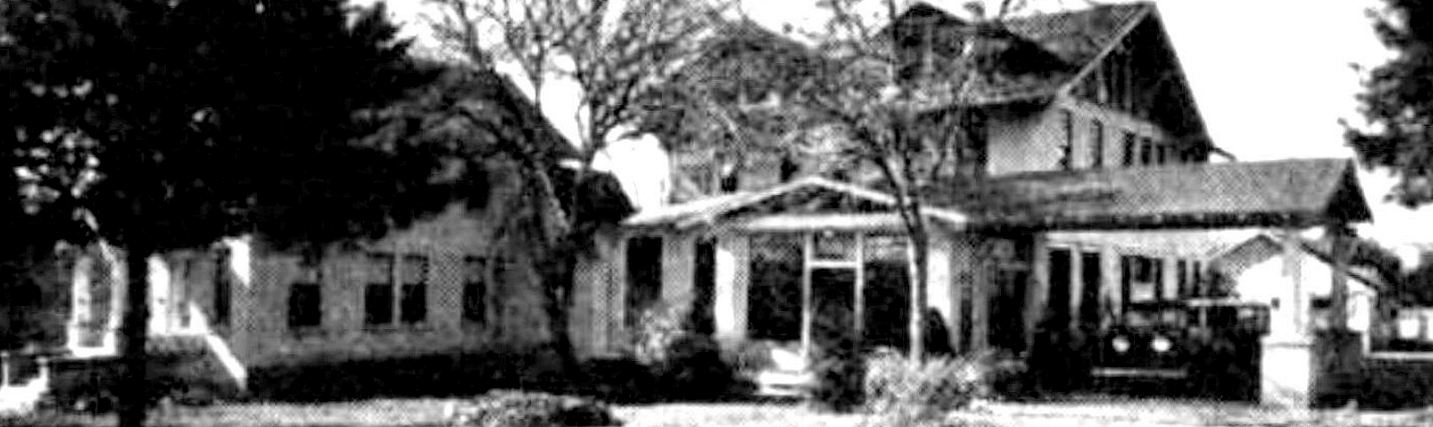
cedars-maternity-sanitarium_texas-state-journal-of-medicine_oct-1933_portalA “seclusion home for unwed mothers”…

by Paula Bosse

The rather blurry photo above shows a “maternity sanitarium” for unwed mothers, where “unfortunate women” could spend their days in seclusion until their babies were born there on the premises. The home/sanitarium was called “The Cedars” and was located on N. Ravinia Drive in the Beverly Hills area of Oak Cliff; when it opened, it was just outside the Dallas city limits. (It has nothing to do with The Cedars area south of downtown; its name may have had something to do with the name of a nearby street which intersected Ravinia. …Or it might have been located near a cedar grove. …Or it might have been used to subliminally suggest famed Cedars-Sinai Hospital.)

The sanitarium was opened around 1923 by Mrs. Lillie Perry (1876-1929), a woman who might have had some personal experience with the “fallen women” she cared for, as it appears she might have had a child out of wedlock herself. When she died in 1929, her daughter Lillian Hanna took over the running of the sanitarium. Lillian died in 1938, and that seems to have been around the time that the home became part of the Volunteers of America organization, which, among its many social services, provided maternity care for women and also assisted in adoption placement. The last mention I saw of “The Cedars” was in 1944.

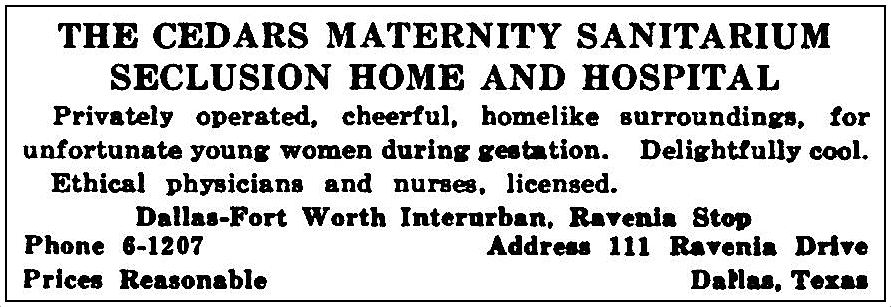
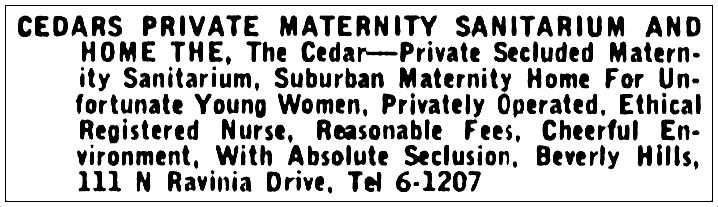
The photo above appeared in an ad placed in the Oct., 1933 issue of the Texas State Journal of Medicine with the accompanying text (for larger images, click pictures and clippings):

cedars-maternity-sanitarium_tx-state-journal-of-medicine_oct-1933_portal_text
1933

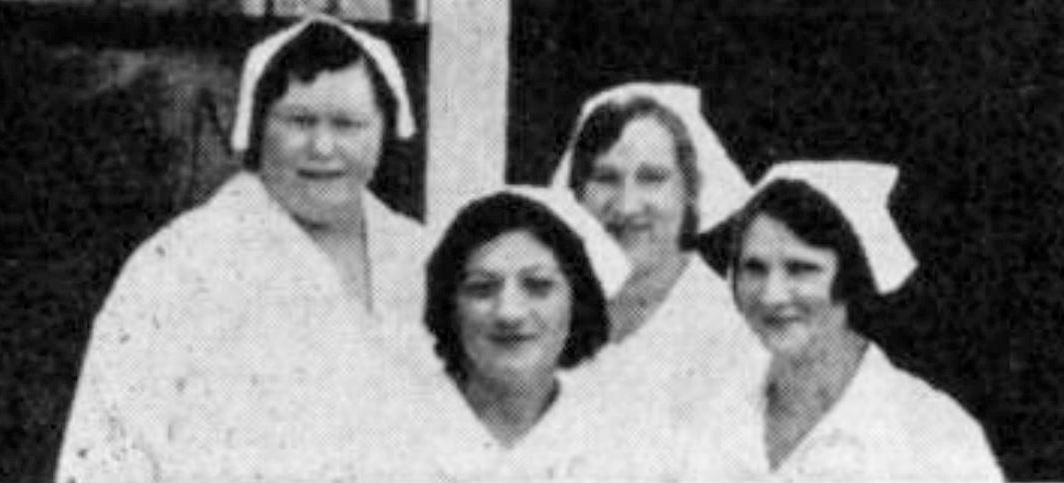
Another ad, featuring friendly-looking nurses, appeared in the same issue, a few pages earlier:

cedars-maternity-sanitarium_tx-state-journal-of-medicine_oct-1933_portal_nurses

cedars-maternity-sanitarium_tx-state-journal-of-medicine_oct-1933_portal_nurses_text1933

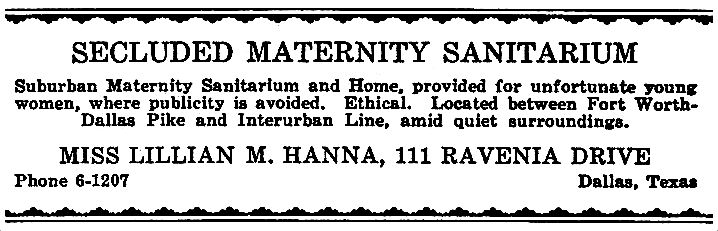
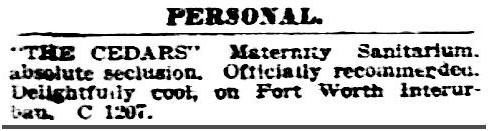
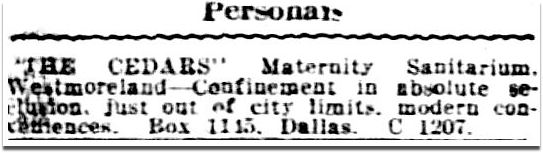
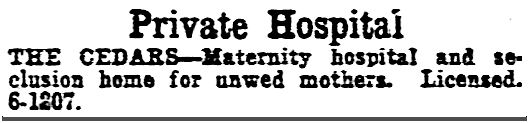
Below are a few discreet newspaper ads for The Cedars which appeared over the years in the “personals” section of the classifieds.

cedars-maternity-home_dmn_070623
1923

cedars-maternity-home_dmn_042724_westmoreland
1924

cedars-maternity-home_dmn_1006291929

cedars-maternity-home_dmn_0105311931

cedars-maternity-home_dmn_0418341934

1937_cedars-maternity-sanitarium
Listing from the 1937 Dallas city directory

***

Sources & Notes

Ads from the Texas State Journal of Medicine appeared in the October, 1933 issue, which can be found scanned in its entirety on the Portal to Texas History site, here.

Homes for “unwed mothers”/”unfortunate girls”/”fallen women” were generally places families sent their daughters in order to avoid the social stigma that unmarried girls and women faced when pregnant. They just kind of “disappeared” for several months and had their babies in secret, often feeling pressured to put their children up for adoption. An interesting Salon article on the topic is “The Children They Gave Away” by Sarah Karnasiewicz.

More on the Beverly Hills neighborhood of Oak Cliff can be found in articles from Heritage Oak Cliff and Preservation Dallas.

Thanks to Patricia M. who wrote to ask me a question about this place. I’ve learned a lot of interesting things about Dallas I would never have thought to look into were it not for obscure questions from readers. Like this one! Thanks, Patricia!

*

Copyright © 2018 Paula Bosse. All Rights Reserved.

The Eccentric Medford Compound On the Old Eagle Ford Road: 1945-1950

medford_trinity-cafe_west-dallas_FB_dallas-historyYou need it, he’s got it…

by Paula Bosse

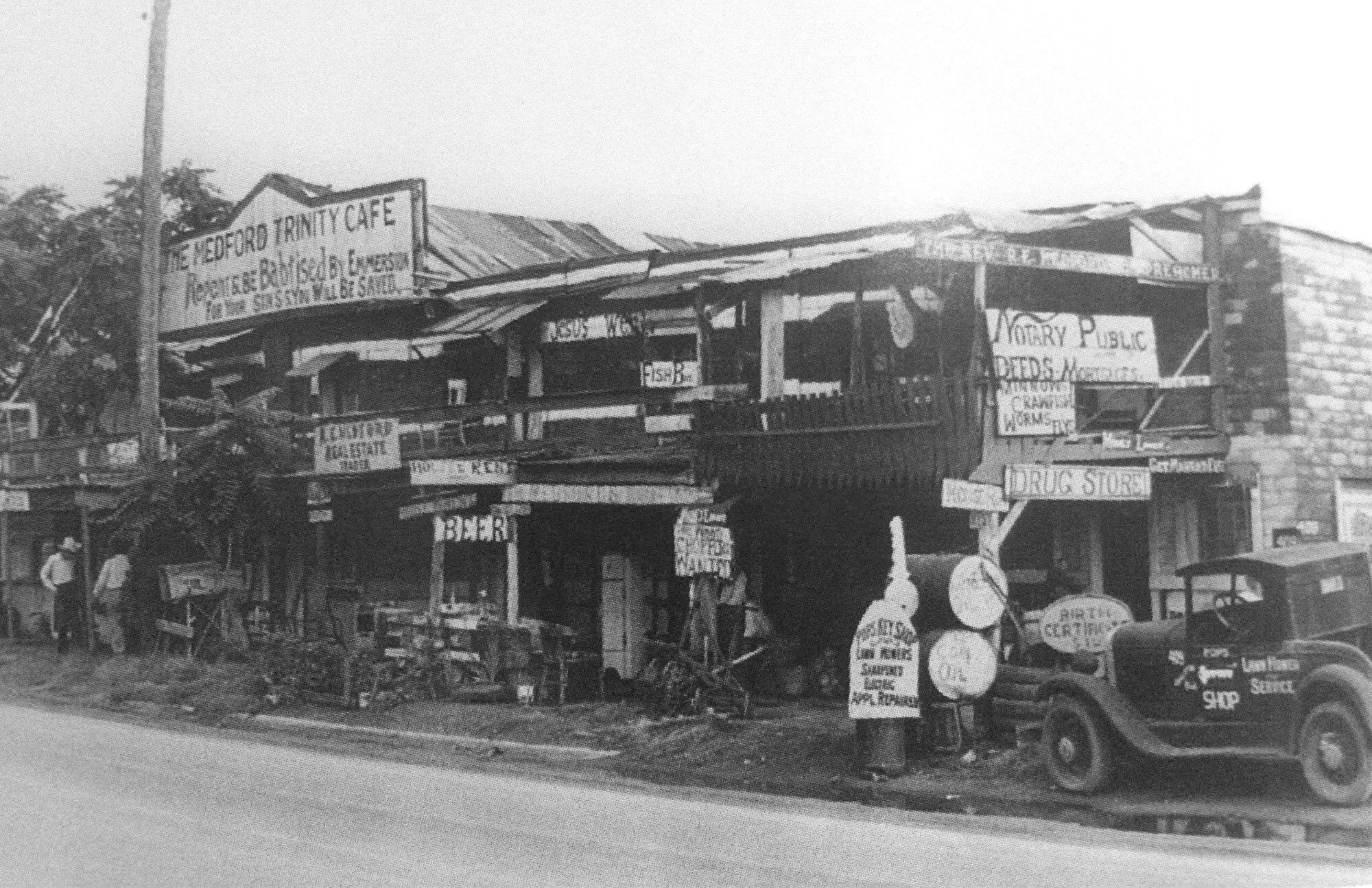
Above, 409-413 Singleton Blvd. in West Dallas, not long after the name of the street had been changed from Eagle Ford Road. The name-change happened in 1942 because of “unfavorable incidents in the past which had been associated with Eagle Ford Road” (The Dallas Morning News, April 26, 1942) — “Singleton” was Vernon Singleton, a former Oak Cliff County Commissioner. Today, this area is part of the super-hipstery Trinity Groves neighborhood; the block seen in the photo is now mostly occupied by a parking lot and looks like this.

Back then, “Eagle Ford Road” would have conjured up all sorts of unsavory images of bad behavior and illegal activities, and, even now, one tends to think immediately of the area’s most notorious exports: Bonnie and Clyde. Immediately after World War II, the population of West Dallas (an area which would not become part of the City of Dallas until its annexation in December 1952) was about 12,000, and its residents were generally poor and living in substandard housing with inadequate water and drainage and little in the way of sanitary facilities.

The “complex” above — which consisted of, basically, the Trinity Cafe, a grocery/drug/dry-goods store, and a residence — was perhaps a bit more colorful than most of the businesses that lined Eagle Road/Singleton Blvd. in post-war West Dallas. The property was owned by Richard Elbert Medford (1864-1950), who, as one of the signs says, was also known as “The Rev. R. E. Medford, Preacher” (I’m not sure if he was an actual ordained minister or just a self-styled preacher). In 1944 or 1945 — after several years of selling mattresses — Medford took over the collection of rickety buildings seen in the photo above and began to sell a wide-ranging collection of unrelated stuff and painted a lot of signs. He remained in business there until his death in 1950 at the age of 86 (the cause of death was “senile exhaustion” which I gather means “died of old age”).

The signage in the photo is … well … it’s fantastic. It’s verging on Outsider Art. Medford offered everything, including (but not limited to):

  • Real estate
  • Beer
  • Notary Public services (deeds, mortgages, birth certificates…)
  • Keys
  • Appliance repair
  • Lawn mowers
  • Oil
  • Fish bait (minnows, crawfish, worms, and “flys”)

He also offered religious advice (“Repent & Be Babtised By Emmersion For Your Sins You Will Be Saved”).

Mr. Medford’s personal life was not a happy one, and perhaps the unrelenting family dramas caused him to become more and more eccentric as the years went by. Many of his children found themselves caught up in the crime and violence West Dallas had become known for.

  • One teenage son was shot and wounded during an attempted robbery in 1930, two months before one of his daughters married at the age of 13.
  • Another son, who was 11 years old, was killed when he attempted to intervene in a fight between his sister and her husband and was fatally kicked in the abdomen by his brother-in-law.
  • Another son was a habitual criminal who committed an eye-popping range of crimes and was in and out of city, county, state, and federal correctional facilities throughout his life. (This son, Homer, was also married for a short time to the ex-wife of Clyde Barrow’s brother L. C. Barrow, but that marriage hit the skids when she shot Homer, sending him to the hospital with critical — but not fatal — wounds.)
  • And in 1951, after Rev. Medford’s death, the son who had been shot in 1930 while attempting to break into a store in Irving, shot and killed his wife and young son before killing himself.

So, yeah, Rev. Medford’s life was a rough one, and there were definitely some dark days in hardscrabble West Dallas. I’d like to think his store, plastered with its kooky signs, offered him some respite from the incessant melodramas percolating all around him.

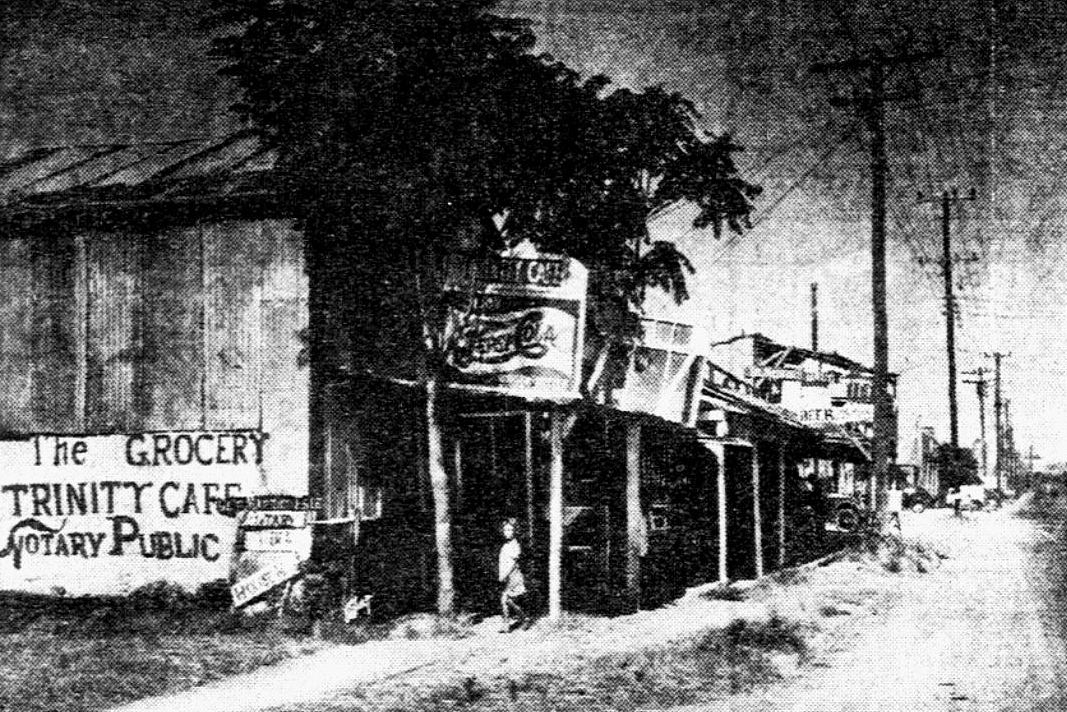
medford_trinity-cafe_west-dallas_1940sSingleton Blvd., late 1940s, not yet part of Dallas

*

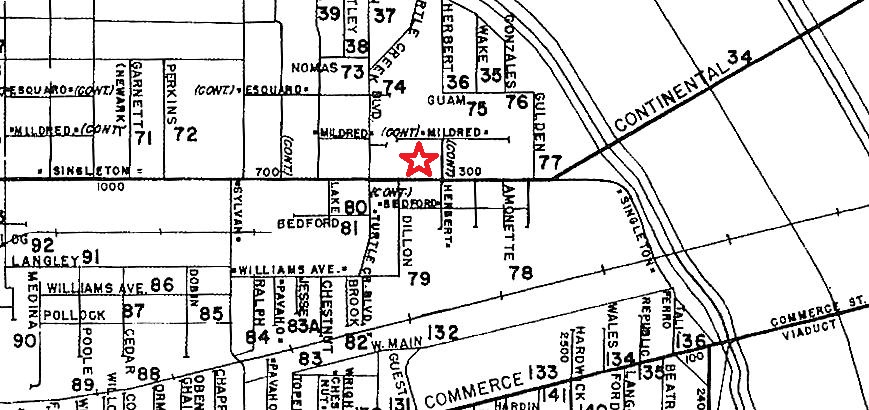
The location of the Medford house/cafe/store, seen on a 1952 Mapsco (click for larger image).

medford_1952-mapsco1952 Mapsco

***

Sources & Notes

I came across the photo years ago on the Dallas History Facebook group. There was no source, but there appears to be a copy of this photograph in the Jim Doster Collection at the Dallas Public Library titled “Meford [sic] Trinity Cafe on Singleton Blvd.,” incorrectly dated as 1930 (call number PA97-7/147). I’m sure a higher resolution image of this would offer up quite a few amusing details and discoveries.

*

Copyright © 2018 Paula Bosse. All Rights Reserved.

The Ray Hubbard Estate, Lakewood

ad-evervess_mrs-ray-hubbard_1948_detA country estate in the heart of Lakewood, 1948… (click for larger image)

by Paula Bosse

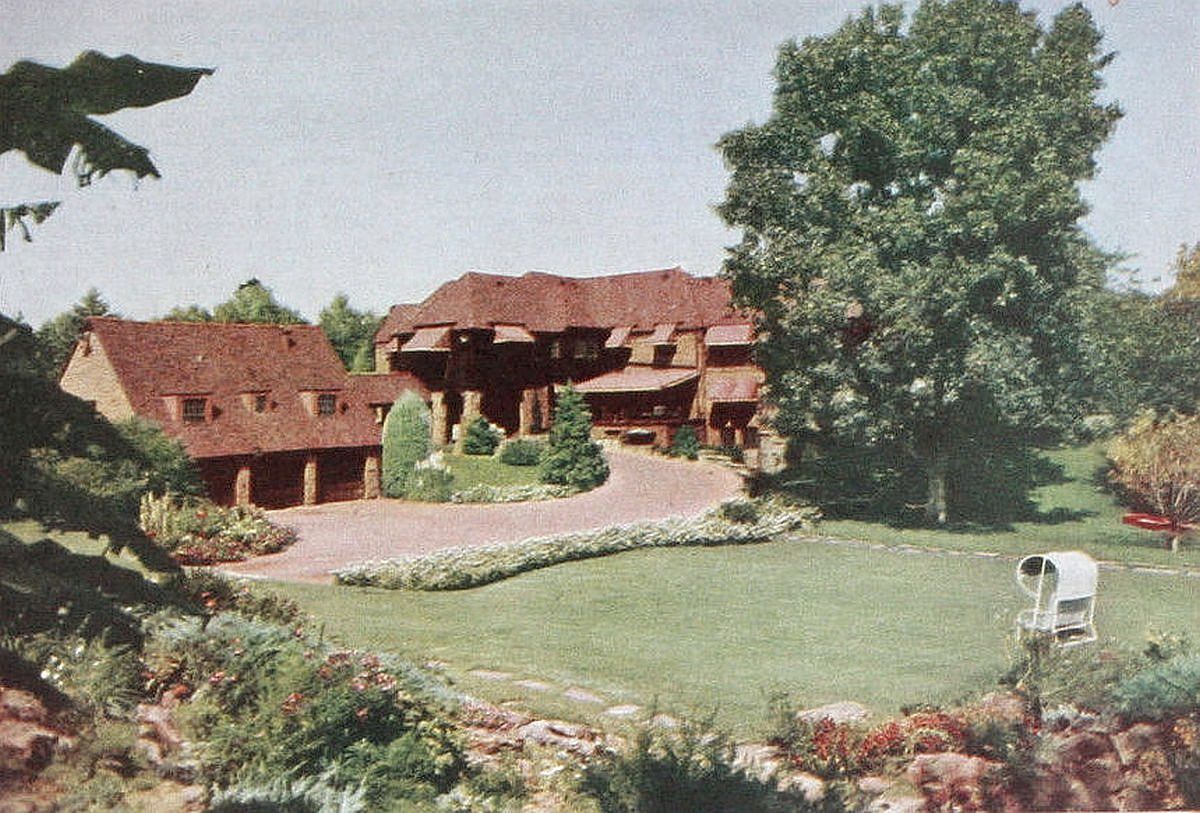
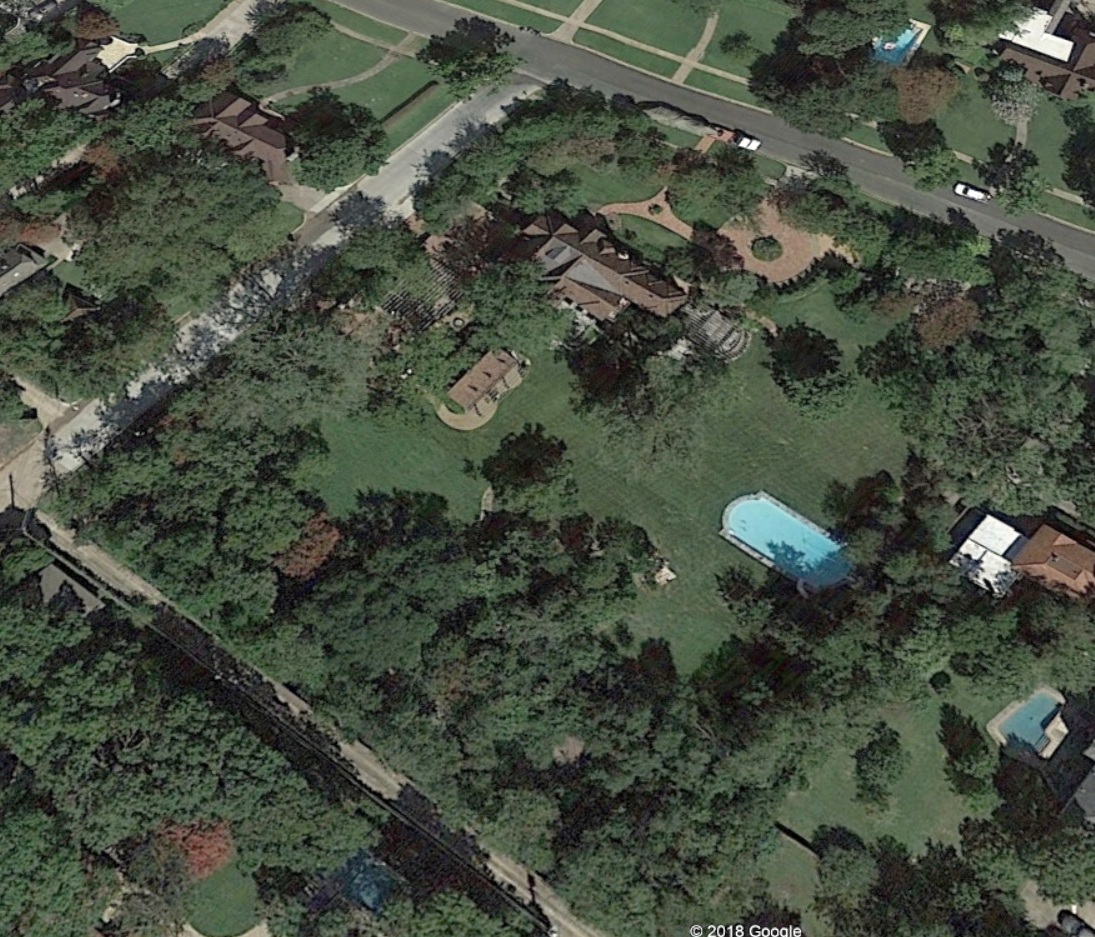
Lakewood has a lot of beautiful homes — large and small — but the (very large) Raymond E. Hubbard estate at the corner of Lakewood Boulevard and Brendenwood Drive is quite the show-stopper. Built in 1934, the two-and-a-half-acre property is about a mile from White Rock Lake and was known for years for its spectacular landscaping and gardens, much of which was the personal handiwork of owner Ray Hubbard (1893-1970). Hubbard amassed his wealth as an independent oilman during the boom years, but he was known in his later life for his lengthy tenure as president of the Dallas Park Board.

From a 1938 Dallas Morning News article:

Mr. Hubbard is that phenomenon known as a natural tiller of the soil. In the short space of two years he has taken a barren hill and transformed it into a blaze of beauty in the form of a rock garden he designed himself. In the symphony of color, he has even had the subtlety to plant a few onions because there is a blue-green cast to the leaves of the onion that is found in no other plant. Carnations, pansies and pinks mingle in profusion as well as a thousand other oddities you have never seen the likes of  before. (“Edens in Preview,” DMN, April 10, 1938)

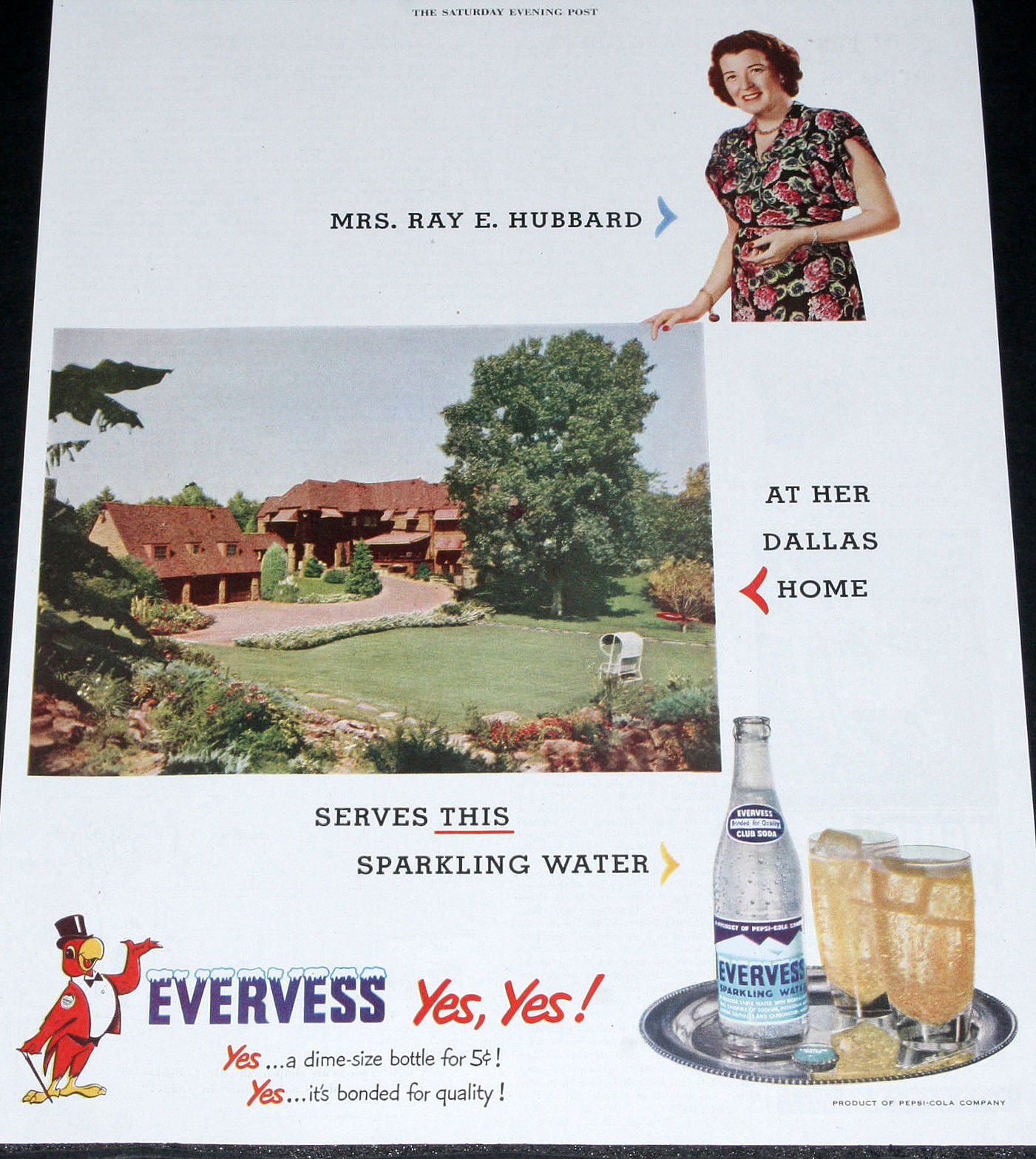
In 1948, his wife, Janet Hubbard, was seen in an ad for Evervess Sparkling Water, with photos of both Mrs. Hubbard and a view of the impressive “backyard” of their Lakewood home. (Click ad to see larger image.)

ad-evervess_mrs-ray-hubbard_1948Saturday Evening Post, 1948

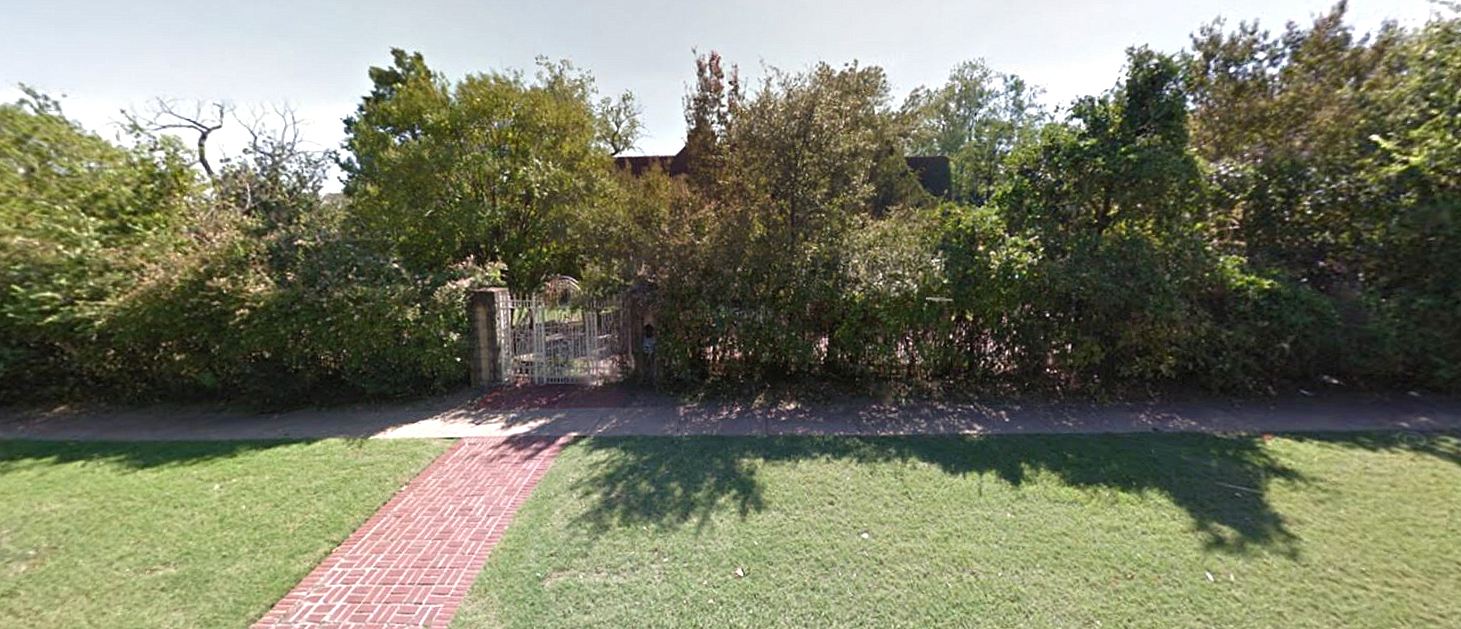
I came across this ad a few years ago but had no idea where the house was located or who Ray Hubbard was, other than the probable namesake of the lake which bears his name (the Rockwall-Forney reservoir was named Lake Ray Hubbard in January, 1967, in honor of Hubbard’s devotion to civic affairs and his decades-long service to Dallas parks). I was surprised to learn that this was the somewhat mysterious and foreboding-looking house I’d passed years ago, looking run-down and deserted, surrounded by overgrown shrubs and bushes. The 2012 Google Street View looked like this:

hubbard-house_google-street-view_oct-2012Google Street View, Oct. 2017

Back then the overgrown approach to the house looked like this, and was probably something of a thorn in the side of the Lakewood Boulevard residents.

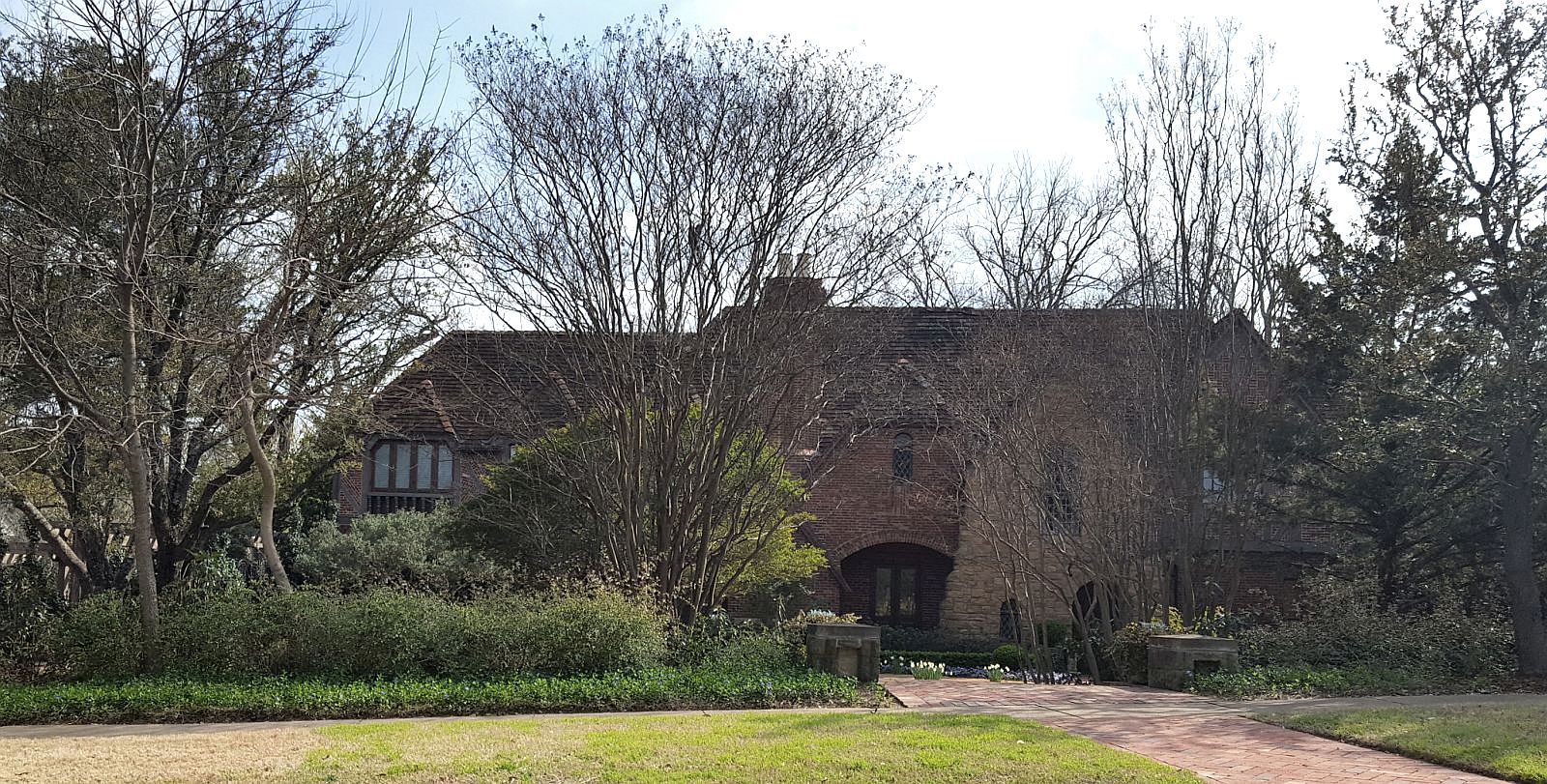
Since Google Street View was so out-of-date, I decided to drive by the house today to see what it looked like in 2018. It’s beautiful!

hubbard-house_lakewood-blvd_031519_PBphoto: Paula Bosse

The reason for the transformation? The property was bought and restored by Hunter Hunt (grandson of one-time richest man in the world — and White Rock Lake resident — H. L. Hunt) and his wife, Stephanie Hunt. And they did a wonderful job! If I had some, I’d raise a toast to the couple with an ice-cold glass of Evervess Sparkling Water!

ray-hubbard-estate_google-earth_2017
Google Earth, 2017

*

hubbard_ray-e-hubbard_find-a-grave

Even though I now know who Ray Hubbard was, I’ll probably still find myself unintentionally (and, okay, sometimes intentionally) calling the lake named after him “Lake Ray Wylie Hubbard” (another former Dallas resident of note, but we’ll leave that for another time…).

***

Sources & Notes

Ad found on eBay. This image is from an item offered several years ago, but as luck would have it, another seller has it for sale right now, here. Perhaps if you’re friends with Hunter and Stephanie Hunt, this would make a nice stocking stuffer. (This Evervess advertisement seems to have been part of a 1948 ad campaign featuring society women, their homes, and their favorite sparkling water: another ad, featuring Mrs. Homer Lange and her Chicago home, can be seen here.)

Photo of Ray E. Hubbard is from Find-a-Grave; read a biographical sketch about Mr. Hubbard’s life on the site, here. Not included in this information was that during Hubbard’s 27 years heading the Park Board (1943-1970), the Dallas park system expanded from 4,400 acres to more than 15,000 acres, and the number of parks increased from 54 to 150.

Read about Stephanie and Hunter Hunt and their Hunt Institute at SMU, here.

If anyone knows the original architect of the Hubbard house, please let me know!

For more on Lakewood Boulevard, I really enjoyed the 1992 Lakewood Advocate article “Lakewood Boulevard’s First Resident Looks Back On the Area’s Development; Mrs. Barnett’s Late Husband, Marshall, Built the First House on Lakewood Boulevard in the 1920s,” here.

See a 1932 view of the 7100 block of Lakewood Blvd. (with White Rock Lake at the end of the street), here; this photo was taken two years before the construction of the Hubbards’ house, which would  be built three blocks to the west (Dines and Kraft photo from the Flashback Dallas post “‘Reminiscences: A Glimpse of Old East Dallas,'” here).

*

Copyright © 2018 Paula Bosse. All Rights Reserved.

The Magnolia Cafe, N. Lamar & Munger — 1947

magolia-cafe_1947_ebayStep in for a cool glass of Metzger’s Milk…

by Paula Bosse

I love stumbling across photos of random small businesses. This photo from 1947 shows an interesting modification of a rooming house in the area immediately north of downtown at 1914 N. Lamar, at the corner of what is now N. Lamar and Munger (the curb shows “Caruth St.,” the street’s original name). Unsurprisingly, this former residential area — which became an industrial warehouse district — looks pretty different today (see the current Google Street View here). A succession of cafes operated here over the years (while people lived in rented rooms upstairs) since at least 1927.

I love the entrance to the rooming house with the concrete steps to the right of the cafe, the street light, the streetcar tracks, The Metzger’s Milk sign, the Stier’s Laundry truck, the parked cars, and the street names (probably in tile?) on the curbs.

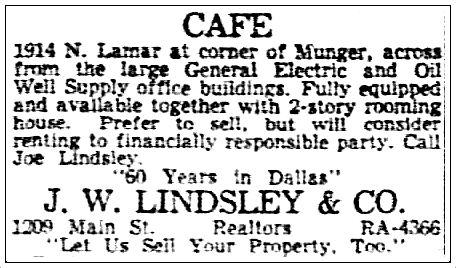
Three years after this photo was taken, the building was up for sale:

magnolia-cafe_nov-1950_bldg-for-sale1950

Its future? A parking lot.

A longtime owner of this combo building was Mrs. Ella Mae Stuart, who was living there with her husband as early as 1913 (possibly 1909). After her husband’s death in 1915, she ran a boarding house upstairs and rented out the cafe below. She seems to have been a much-married woman who was very creative with her age as given to census takers: every 10 years she continued to grow younger and younger, ending up in 1930 with her age listed as 50. She died three years later at the actual age of 68, leaving behind a husband 26 years her junior. Her great stamina might be the result of her regular consumption of a wonder tonic called Konjola (a patent medicine popular during Prohibition, made from roots, herbs, and a lot of alcohol). (Click to read Mrs. Stuart’s testimonial.)

e-m-stuart_konjola-ad_1930
1930

***

Sources & Notes

Photo from eBay; taken by Rogers Studio (the business owned by noted Dallas photographer Frank Rogers and his son Norman Rogers), with the date “May 8, 1947” stamped on the back. Also on the back of the photo: “Magnolia Cafe, Lamar and Munger; seating capacity: 32.”

See the building on the 1921 Sanborn map here, which shows 1914 N. Lamar at the corner of Caruth Street. It appears the house might have become renovated to include a cafe on the ground floor in 1926 or 1927 when one of Mrs. Stuart’s boarding-house roomers opened up Frank’s Lunch Room.

*

Copyright © 2018 Paula Bosse. All Rights Reserved.

“There’s No Place Like Home … In Dallas” — 1940s

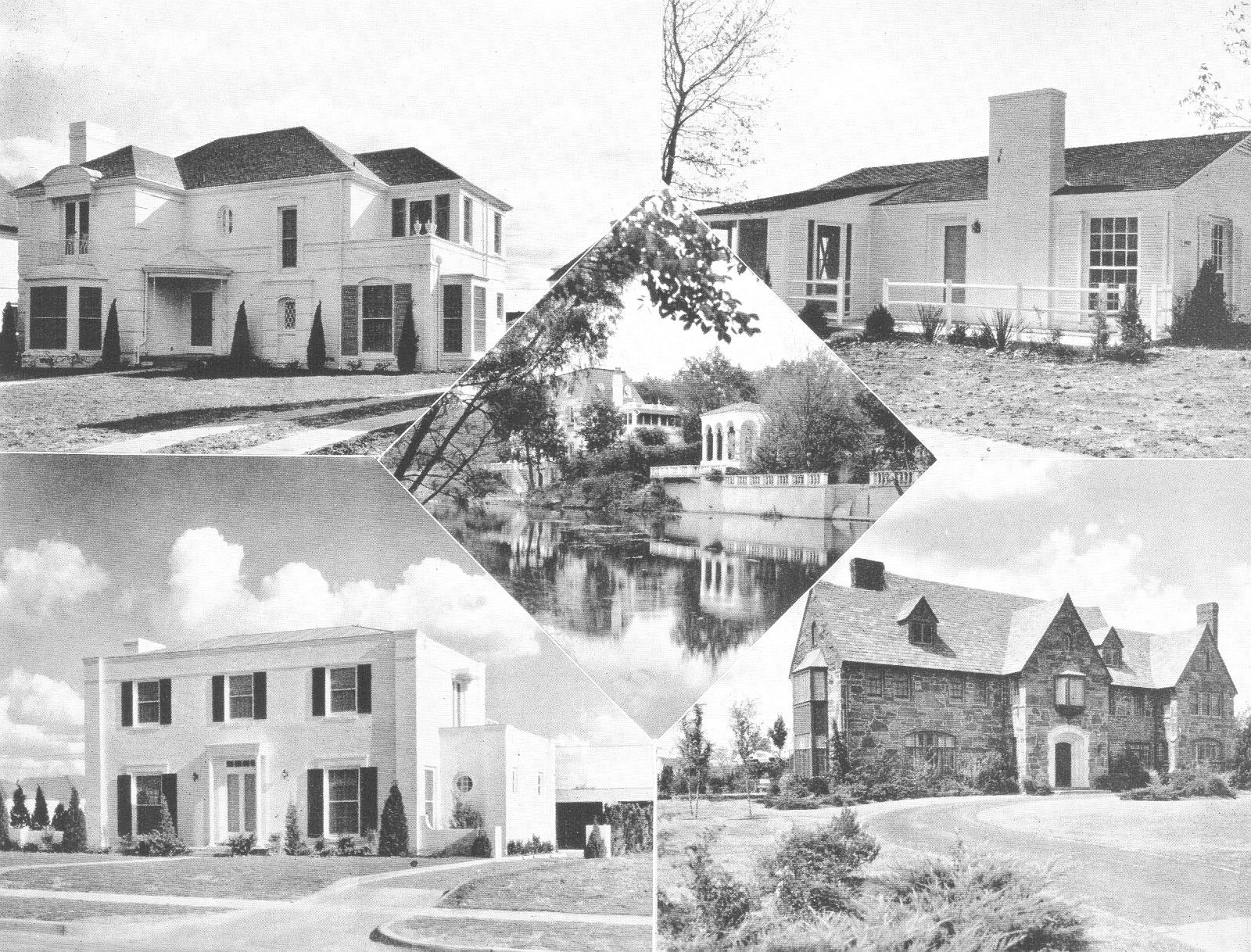
dallas-homes_so-this-is-dallas_ca-1943Dallas homes, ca. 1943 — from modest to palatial… (click for larger image)

by Paula Bosse

These photos are from a Chamber of Commerce-like booklet intended to lure new residents to the city. The photo montage above is from about 1943, and the one below is from about 1946. There are some beautiful houses here. In the photo above, I recognize Highland Park in the center and possibly lower right (the lower right has a lot of empty space behind it — maybe Bluff View or Preston Hollow?). The top right might be Oak Cliff? The house that makes me swoon is the white house at the lower left. It and the house above it look as if they might have been in Lakewood. If anyone knows the location of any of these houses — and if they’re still standing — please let me know!

The text that accompanied the above photo montage (circa 1943):

THERE’S NO PLACE LIKE HOME … IN DALLAS

Visitors to Dallas invariably comment on its beautiful homes, both large and small, and the care with which they are kept modern and clean.

The women of Dallas have their garden clubs, which are organizations of flower lovers. They vie with each other in striving to make their homes attractive to the passerby and homelike to those who live within.

One reason for this is the high percentage of home ownership. A recent study indicates that 60 per cent of families living in one-family residences own their own home. This is far above the national average.

For several years Dallas has been on a truly remarkable building boom in its residential sections. New homes are springing up at the rate of 14 a day and new subdivisions are being opened as rapidly as others are sold out. The outer fringe of Dallas is, in effect, a brand-new city. Lots that were cotton fields a few years ago now contain beautiful new homes and landscaped gardens.

Any type of home plot is available to the prospective home builder here. If he desires a home in a close-in busy section, that can be found in many places. If he prefers a modest cottage on the outskirts, there are a dozen subdivisions where it can be found. If he is seeking a palatial residence or a rustic cottage on a country estate, he can find that too, and on short notice.

Dallas takes much pride in its wide recognition as a city of homes.

*

dallas-home_so-this-is-dallas_ca-1946

The text that accompanied this photo (circa 1946):

HOMES MAKE A CITY

Dallas… Has Planned Beauty

The beauty of Dallas may be attributed to the wide awake and broadminded citizens of some 25 years ago, who at that time, engaged nationally known landscape artists to design and plan the future Dallas. So well was this done and so cooperative were the people of Dallas that in this short time Dallas is known as one of the most beautiful cities in the nation.

Dallas has attractive parks, driveways, public buildings and in fact hardly a house, no matter how humble, that is not improved with planting. As a city of homes the saying, “It is not a home until it is planted well” applies to Dallas. No tenant house is built today that is not surrounded by a setting of nature’s beauty. To the Garden Clubs and various women’s organizations much credit must be given for their untiring efforts to eliminate slum districts, unsightly streets and the planting of our highways.

Much credit is due the nurserymen and landscape architects, who are ever ready to give advice, planting instructions, and who have furnished shrubs, flowers and assistance to many charitable institutions and public places, as well as make talks to the clubs and organizations on when, how and what to plant in order to constantly improve Dallas. The Garden and women’s clubs annually stage flower shows and have garden contests.

All this has made Dallas today, a city beautiful – a place where you want to live.

***

Sources & Notes

Photos are from the booklet So This Is Dallas, published by The Welcome Wagon. The top photo is from the circa-1943 edition, used with permission, courtesy of the Lone Star Library Annex Facebook page. The second photo is from the circa-1946 edition, from the author’s collection.

Photos are larger when clicked.

*

Copyright © 2018 Paula Bosse. All Rights Reserved.