Flashback : Dallas

A Miscellany: History, Ads, Pop Culture

Category: 1950s

Lucy, Desi, Dallas — 1956

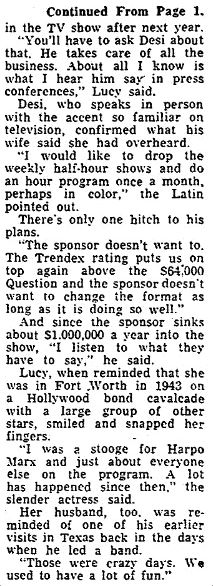
lucy-desi_fw_bellaircraftLucille Ball and Desi Arnaz and their loaner ‘copter from Bell Aircraft

by Paula Bosse

Lucille Ball and Desi Arnaz came to Dallas and Fort Worth in 1956 to promote their new movie, “Forever Darling.” Their arrival times were heavily publicized, and throngs of fans showed up to welcome them — in Dallas at Love Field, and in Fort Worth at the Western Hills Hotel. For those who might have missed their arrivals, they still had a chance to see the couple at one of the personal appearances scheduled at the theaters showing their movie (in Dallas at the Majestic on February 10th, and in Fort Worth at the Hollywood on the 11th). Crowds were large and enthusiastic, and everyone appears to have had a genuinely fun time, possibly even Lucy and Desi, whose relationship in those days was frequently a bit shaky.

Best of all was the tidbit about how the famous couple traveled from Dallas to Fort Worth: by helicopter.

Two television stars will be sailing around above Dallas skyscrapers Saturday. …Lucille Ball and Desi Arnaz will catch a helicopter ride from atop the Statler Hilton for a trip to Fort Worth. City Council officially sanctioned the ride at its Monday meeting. (Dallas Morning News, Feb. 7, 1956)

They left from the helipad atop the Statler Hilton and touched down at the helipad at the Western Hills Hotel in Fort Worth (hotels are nothing without helipads). There was some sort of cordial relationship between the Arnazes and the people at Bell Aircraft, because they availed themselves of this brand new deluxe chopper in New York as well as in DFW. When their promotional duties were finished, Lucy and Desi left Cowtown for California as guests of the president of the Santa Fe Railway — in his private car. Because that’s how you travel if you’re Hollywood royalty.

*

lucy-desi_dmn_020856-detFeb 8, 1956
*

lucy-desi_dmn_021156-photolucy-desi_dmn_021156-captionDMN, Feb. 11, 1956

(Leon Craker, I bet you had a great story about this for years after this momentous meeting.) 

*

In Fort Worth, Elston Brooks (whose amusing articles I’ve really enjoyed discovering these past few months), seemed underwhelmed and a little annoyed at the prospect of  “lovable Lucy and spouse” invading the city (click articles to see larger images):
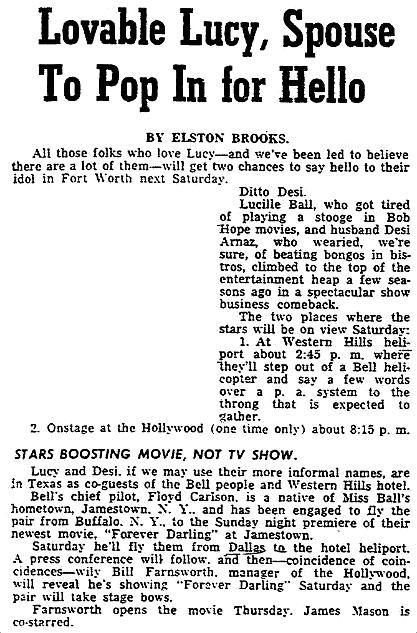
lucy-desi_FWST_020556Fort Worth Star-Telegram, Feb. 5, 1956
*

Elson Brooks may not have been very excited, but when Lucy and Desi stepped out of that helicopter, the Fort Worth crowd went wild (click text for larger image):

lucy-desi_FWST_021256-photo

lucy-desi_FWST_021256a

lucy-desi_FWST_021256bFWST, Feb. 12, 1956

*

And here they are back in Los Angeles, with Desi Jr., at the end of a busy promotional tour. Desi is proudly wearing the cowboy hat he’d been given in Fort Worth. And he looks damn good in it.

lucy-desi_dfw

***

Sources & Notes

Top photo of Lucy and Desi standing next to the 1956 Bell 47H-1 (“one of the world’s first executive helicopters”) is from the August 2012 issue of Vintage Aircraft Magazine; photo from Bell Aircraft. The article concerning this helicopter model is contained in a PDF here.

The bottom photo is from a Pinterest page, here.

UPDATE: I had originally identified the photo of Lucy and Desi with the train as having probably been taken in Fort Worth as they were about to depart for Hollywood, mainly because they’re wearing similar clothing from the FW appearance, but a rail historian noted that this photo was actually taken in California at the Los Angeles Union Passenger Terminal — he could tell because he recognized the part of the platform structure over their heads! (“I can name that song in TWO notes!”) The photo he directed me which shows the LAUPT platform (and, in fact, the same engine, two years earlier!), is here. They probably took the final photo for the Santa Fe company as thanks for providing them with transportation back home in the president’s private car. (Thanks, Skip!)

*

And because today is Lucille Ball’s birthday (which I know only because she shares a birthday with my aunt — happy birthday, Bettye Jo!), it seems like a good time to wheel out this strikingly beautiful portrait of Lucy, along with a wonderful photograph of her from about the same time (probably between 1928 and 1930).
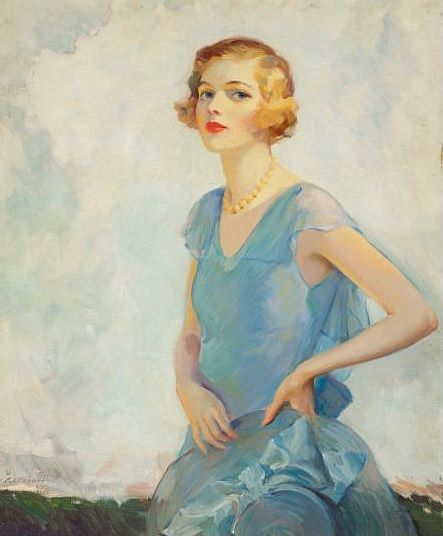
lucilleballportrait

lucilleball-ca1930

*

Copyright © 2014 Paula Bosse. All Rights Reserved.
 

Margo Jones & Jim Beck: Both Legends in Their Fields, Both Victims of Carbon Tetrachloride

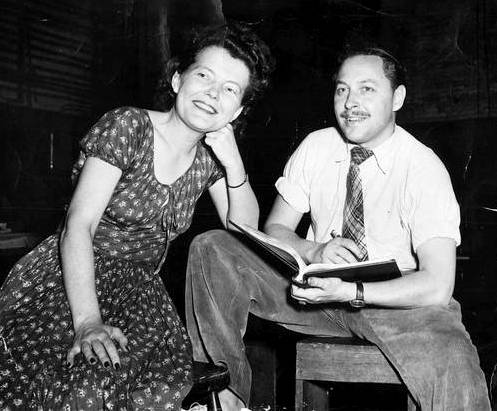
margo_tennessee
Margo Jones with Tennessee Williams

by Paula Bosse

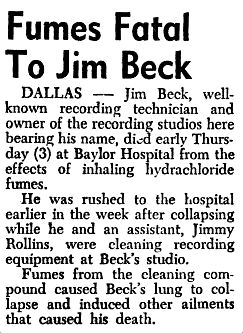
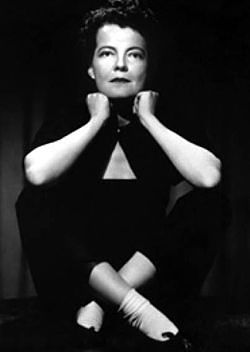
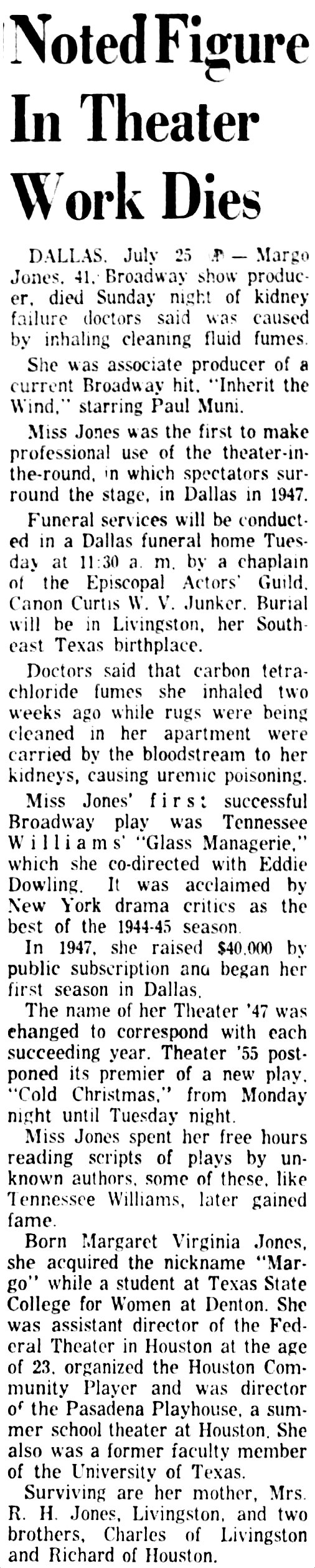
In reading about Dallas theater legend Margo Jones, I saw that she died from inhaling the lingering fumes of a cleaning agent that had been used to clean a rug in her apartment at the Stoneleigh Hotel: carbon tetrachloride. The only thing I knew about carbon tetrachloride was that it had also caused the early death of legendary recording engineer and producer Jim Beck (the man who discovered and produced the first records of Lefty Frizzell, Ray Price, et al.); Beck had been cleaning his recording equipment and had been overcome by the fumes. Both were rushed to the hospital when they were discovered unconscious, and both died about ten days later.

Margo Jones died on July 24, 1955, and Beck died less than a year later, on May 3, 1956. Jones was in her early 40s — Beck was only 39. Margo Jones was a creative powerhouse who was already revolutionizing regional theater, and Jim Beck’s enormous talent was the sole reason that Columbia Records was on the brink of moving their operations from Nashville to Dallas (a move that might very well have set the wheels in motion for Dallas to overtake Nashville as the nation’s recording center for country music). It is such a loss that both died so young,victims of something as mundane as cleaning fluid. With so much remarkable potential ahead of them, it’s sobering to imagine how different Dallas theater and the Dallas recording industry would be today had their careers lasted another two or three or four decades.

margo-jones-photo

margo-jones_austin-american_072655_obitAustin American, July  26, 1955 (click to see larger image)

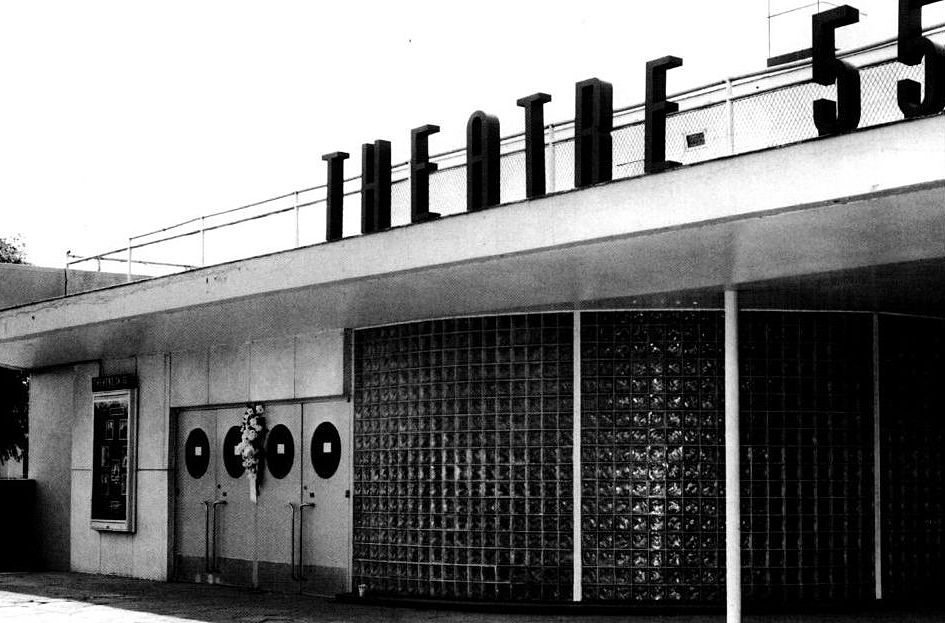
margo-jones_wreath_legacies_fall-2004Margo Jones’ Theatre ’55 with wreath on door (click for larger image)

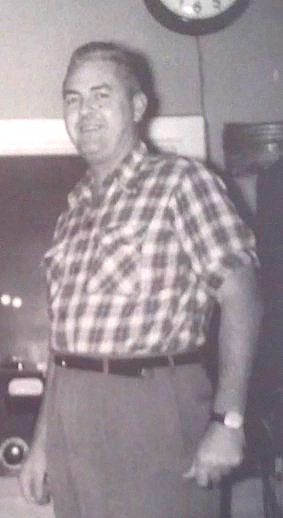
jim-beck_detJim Beck in his studio

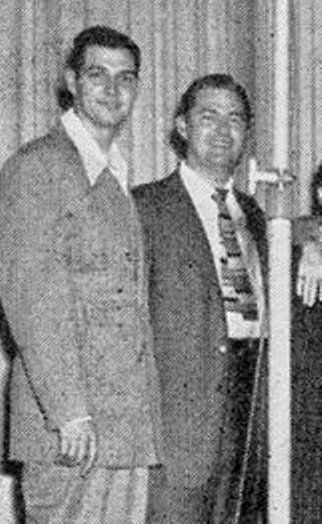
jim-beck_hank-thompson_liberty-jamboree_c1951-detJim Beck (right) with Hank Thompson

jim-beck_billboard_051256bBillboard, May 12, 1956

jim-beck-studio-logo

***

Sources & Notes

Photo of Theatre ’55 (formerly the Magnolia Lounge in Fair Park) with wreath is from the story “‘I’m Doing It, Darling!’ — Dallas, Margo Jones, and Inherit the Wind” by Kay Cattarulla (Legacies, Fall, 2004 issue), which can be read here.

First photo of Jim Beck (which has been cropped) is from the Bear Family CD box set “Lefty Frizzell: Life’s Like Poetry.”

Photo of Jim Beck and country recording star Hank Thompson is a (cropped) Liberty Jamboree promotional photo, circa 1951.

Jim Beck Studio logo from the Handbook of Texas entry for the recording industry in Texas, here.

Margo Jones is very important. Read why here.

Jim Beck is very important. Read why here.

A bit morbid, perhaps, but Margo Jones’ death certificate can be viewed here; Jim Beck’s death certificate, here.

And, finally … kids, stay away from that carbon tetrachloride. It’s bad stuff.

For my previous post “Lefty Frizzell: It All Began on Ross Avenue,” click here.

*

Copyright © 2014 Paula Bosse. All Rights Reserved.
Ernie Banks: From Booker T. Washington High School to the Baseball Hall of Fame to the Presidential Medal of Freedom

banks-ernie_jet_110355
Ernie Banks and George Allen, Oct. 1955 (Jet magazine)

by Paula Bosse

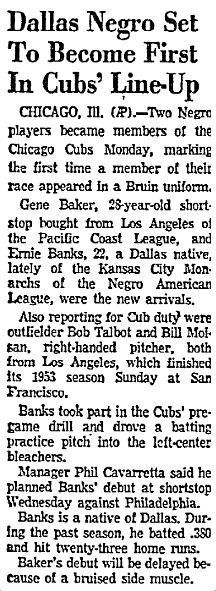
Ernie Banks, the baseball player so indelibly linked with Chicago that he is known as “Mr. Cub,” is a Dallas native whose professional career began when he was spotted by a Negro League scout while playing softball in a park near his high school, Booker T. Washington. He was recruited right away and made his mark almost immediately, and, in 1953, he and Gene Baker became the first African American players signed to the Chicago Cubs.

One of the sport’s most popular players, Banks, who began his career playing shortstop, routinely shattered home run records and was a perennial MVP and All-Star player. Even though his Cubs never made it to the World Series, Banks was a stand-out player, and his election to the Baseball Hall of Fame in 1977 came as no surprise. I have to admit, my knowledge of baseball is scant, but I love this man, and it’s a testament to “Mr. Cub” that he is as famous for his genuine nice-ness as he is for his undisputed skill as a player.

banks_dmn_091553AP, Sept. 15, 1953

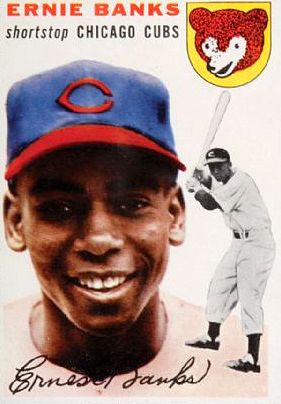
ernie-banks_rookieErnie Banks’ rookie card – Topps, 1954

ernie_banks

*

Oct. 11, 1955 was declared “Ernie Banks Day” in Dallas. Ernie was in town to play an exhibition game between the Major League Negro All Stars and the Negro American League All Stars (Ernie’s major leaguers won, 6-2) — while he was here, he enjoyed the hometown adulation and was lauded with gifts. The photo at the top of this post was from that day, as is the one below, in which he poses with his wife, Mollye Banks.

banks-ernie_wife-mollye-ector-banks_101155_patton-collection_DHSHometown hero, Oct. 11, 1955 (Dallas Historical Society)

***

Sources & Notes

Top photo from Jet magazine, Nov. 3, 1955; a version ran in The Dallas Morning News on Oct. 12, 1955 above the following caption: “Honors came thick and fast for Ernie Banks at Burnett Field Tuesday night. Appearing with a group of barnstorming Major League All Stars, Banks was presented a new Oldsmobile (background), a Texas style hat and scrolls and trophies. With Banks is George Allen, chairman of the citizens’ appreciation committee which presented the automobile. The mayor [R.L. Thornton] proclaimed Oct. 11 Ernie Banks Day in Dallas.”

The photo of Banks and his wife, Mollye Ector Banks, in Dallas is from the John Leslie Patton Jr. Papers, Dallas Historical Society (Object ID V.86.50.902).

Check out these articles from The Dallas Morning News archives:

  • “Banks to Tackle First — Reluctantly” by Bud Shrake (DMN, March 16, 1962) — with a few paragraphs on growing up in Dallas
  • “From Dallas to Cooperstown” by Randy Galloway (DMN, Jan. 20, 1977)

A nice overview of Ernie Banks’ career titled “Nice Guys Don’t Always Finish Last” by Steven Schmich (from his larger article titled “Five Dallas Athletes Who Made a Difference”) can be read in the Spring, 1994 issue of Legacies magazine here. (In fact, the entire issue of this Dallas history journal is devoted to sports and is available to read in its entirety, beginning here.)

Stats? I got yer stats, right here.

In November 2013, Ernie Banks was awarded the Presidential Medal of Freedom. A few short words from him after the ceremony say all that really needs to be said from this wonderful man — watch the short video here.

UPDATE: Sadly, Ernie Banks has died. He died Friday, January 23, 2015. He was 83. The New York Times obituary is here; the Chicago Tribune’s wonderful collection of tributes and photos is here.

*

Copyright © 2014 Paula Bosse. All Rights Reserved.
“The Riviera of the South” — On Harry Hines!

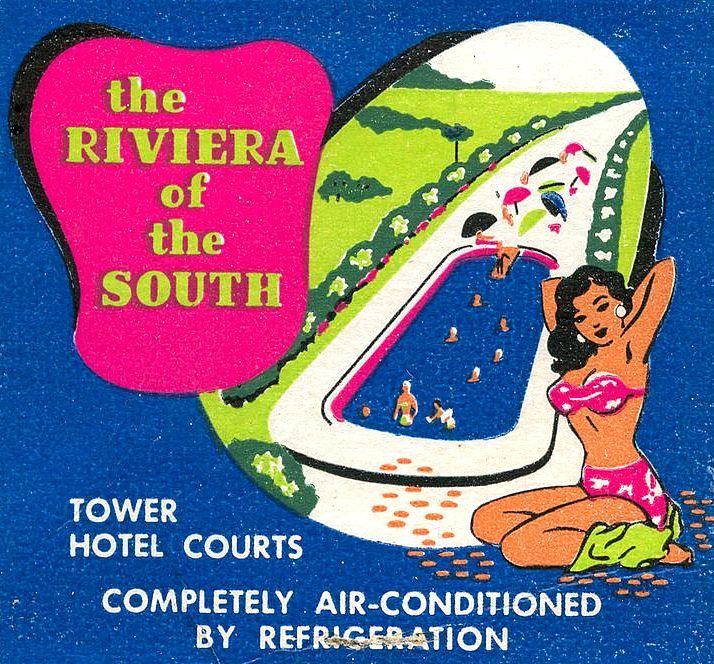
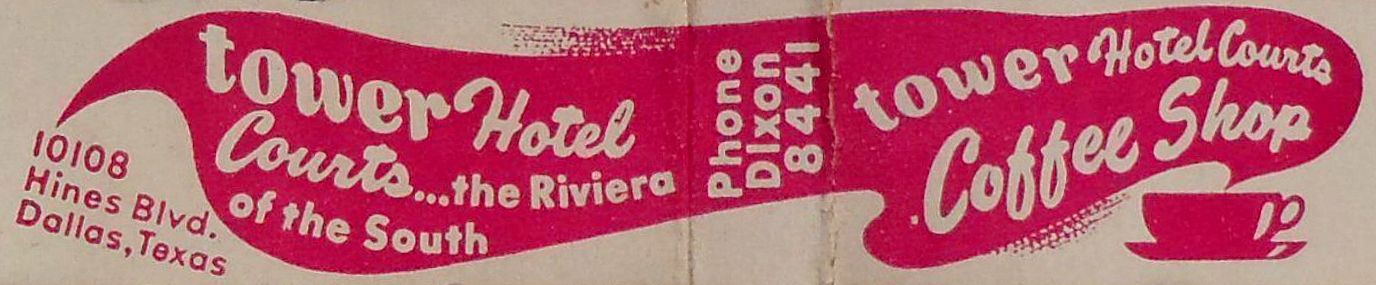
tower-hotel-courts_pool-match_flickr-smThe paradise of Harry Hines awaits…

by Paula Bosse

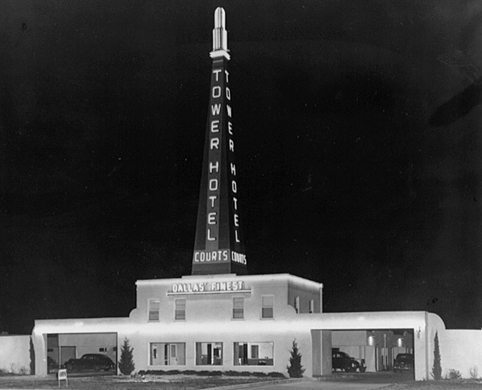
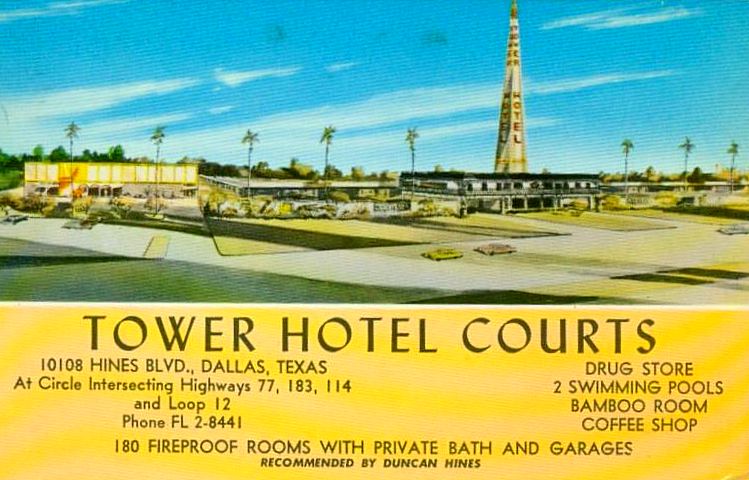
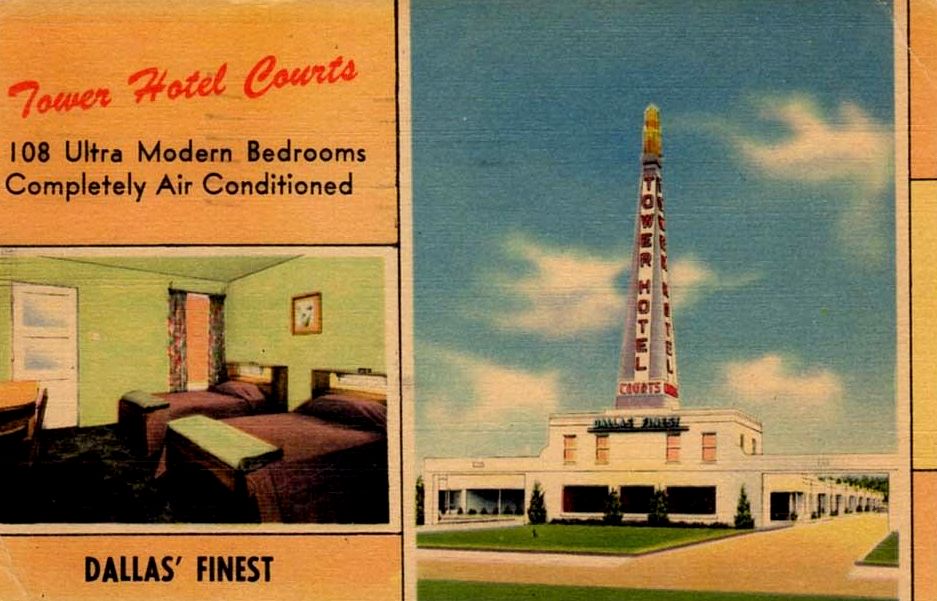
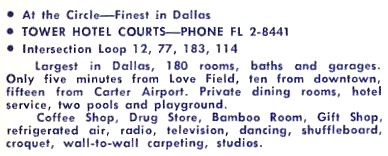
The Tower Hotel Courts opened in the fall of 1946. Their address makes my had spin: at “The Circle” where highways 77, 183, 114, and Loop 12 intersect. “10108 Harry Hines” would have been easier to fit on the stationery, but mention of all those highways just made everything more exciting. (It also gave some indication to prospective guests of what would be awaiting them, such as constant traffic noise and the ever-present whiff of exhaust in the air. “You can’t say we didn’t warn you, madam.”)

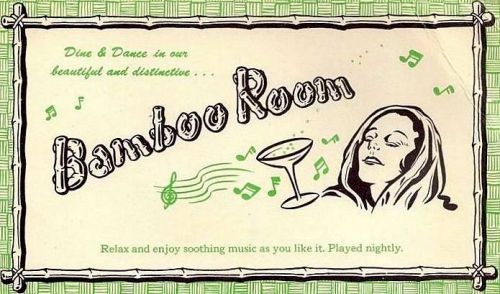
The fancy motel was five speedy minutes away from Love Field, which seems handy, because if you had an hour or seven to kill before your flight, wouldn’t you want to spend it there in the fabulous-looking Bamboo Room? I would! (Even though I’m pretty sure that matchbook cover is a little more glamorous than the actual Bamboo Room.)

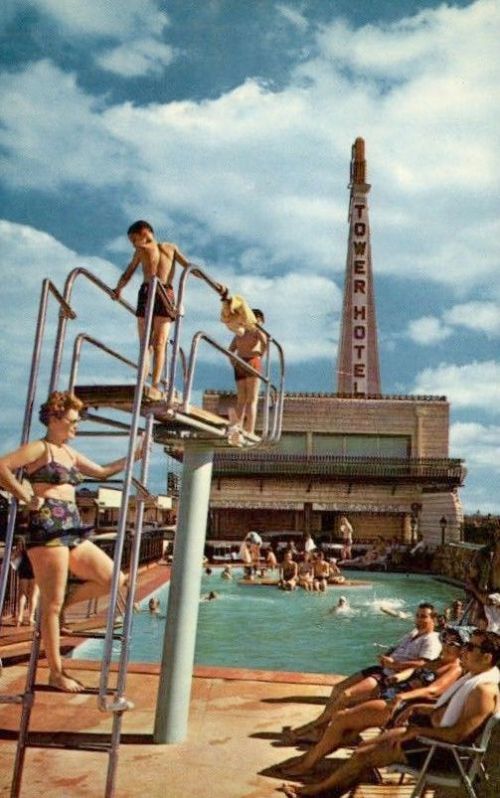
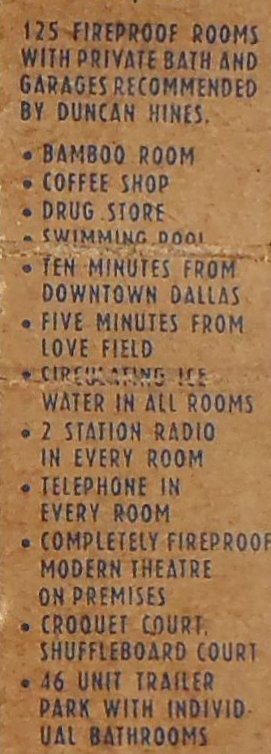
If you were going to stay for a day or two and not just a few drinks, there were all sorts of things waiting for you: two pools (one a very large children’s wading pool), a theater, a croquet court AND a shuffleboard court, “circulating ice water,” and … stand back … a 2-station radio in every room. Somewhere in amongst all of this was a 46-unit trailer park (“with individual bathrooms”).

It’s not hard to see why they called the Tower Hotel Courts The Riviera of the South.”

tower-hotel_bw

tower-hotel-courts_postcard2

tower-hotel-courts_postcardUltra Modern!

tower-hotel-courts_pool-smOwner’s wife and kids?

tower-hotel-courts_pool_back

tower-hotel-courts_riviera

tower-hotel-courts_riviera_inside

tower-court-hotel_bamboo-room_flickr

tower-hotel-courts_pool-match_flickr-sm

***

First and last images from Flickr; Bamboo Room image also from Flickr.

Several of these pictures are larger when clicked.

*

Copyright © 2014 Paula Bosse. All Rights Reserved.
Neiman-Marcus Brings France to Big D — 1957

neiman-marcus_french-fortnight-poster_1957

by Paula Bosse

In 1957, Neiman-Marcus presented their very first Fortnight celebration — a tribute to France, which included filling the department store with French products and couture, hosting celebrated fashion icon Coco Chanel on her first visit to Texas, promoting French culture and tourism, and even elaborately decorating the outside of their downtown building to resemble the Rue du Faubourg Saint-Honoré. It was a huge success, and it became a much-anticipated annual event in Dallas.

n-m_french-fortnight_stanley-marcus-papers_degolyer-lib_SMU_color_1957A little bit of Paris on Ervay Street (via DeGolyer Library)

The Fortnights became very popular and were celebrated city-wide. There were all sorts of non-N-M events around town that tied in with whatever country was being honored that year (plays, art exhibits, lectures, etc.), and businesses soon realized that it was easy to share in the Fortnight spotlight and momentum by either blatantly or subtly customizing their advertisements to have a bit more international flavor for two weeks every year.

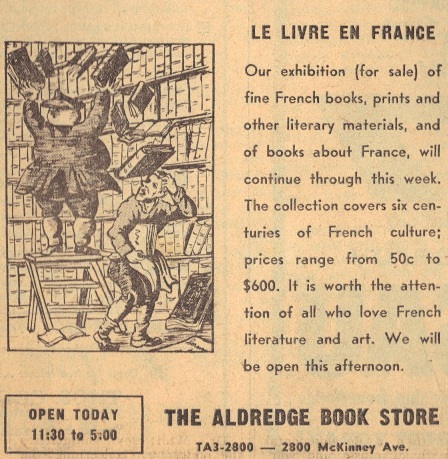
As I have a personal connection to The Aldredge Book Store, I’ll use them as an example. The ad below is one of the earliest examples of a Fortnight tie-in ad. Sawnie Aldredge, the original owner of the store, was an enthusiastic Francophile, and Stanley Marcus had been a regular customer from the day the doors opened in 1947. It seems likely that the two would have discussed the event at some point, and this type of piggy-backing seems like a mutually beneficial sales opportunity made in heaven. Even though N-M was not specifically mentioned, readers of the ad would certainly have known of the connection to the well-publicized promotion. As the Fortnights became more and more popular, everyone in town began jumping on the bandwagon, and between 1957 and 1986, the whole city went crazy for one specific country for two weeks every year. It was great. And I still miss them.

ABS_lelivreenfrance_1957“From 50¢ to $600” (1957)

***

Sources & Notes

Neiman-Marcus “France Comes to Texas” poster by Raymond Savignac.

Photograph of the Frenchified facade of the N-M building from the Stanley Marcus Papers collection, DeGolyer Library, SMU Libraries, Southern Methodist University; more information on this photo is here.

Aldredge Book Store ad from October, 1957.

One of my favorite pieces of ephemera from this first French Fortnight is a lavish advertisement insert that appeared in the October 1957 issues of American and French editions of Vogue. The 30-plus page insert has been scanned by SMU (it is in the collection of Stanley Marcus’ papers at the DeGolyer Library). It is great. If you are interested in fashion advertising of the 1950s, you’ll enjoy the sophisticated-but-fun-and-frothy art direction, seen in a PDF, here.

For an entertaining look back at the various Fortnights (including the year when Mr. Stanley & Co. had to invent a country one year when Australia pulled out at the last minute!), read “Fabulous Fortnight” by Si Dunn in D Magazine (Oct. 1984), here.

And for my previous post on Coco Chanel’s visit to Dallas (during which she attended a barbecue!), “When Coco Chanel Came to Dallas — 1957” can be found here. This wasn’t an official part of the first Fortnight, but it was a sort of prelude, preceding the 1957 French Fortnight by a month.

*

Copyright © 2014 Paula Bosse. All Rights Reserved.
Building Collapse on Elm Street — 1955

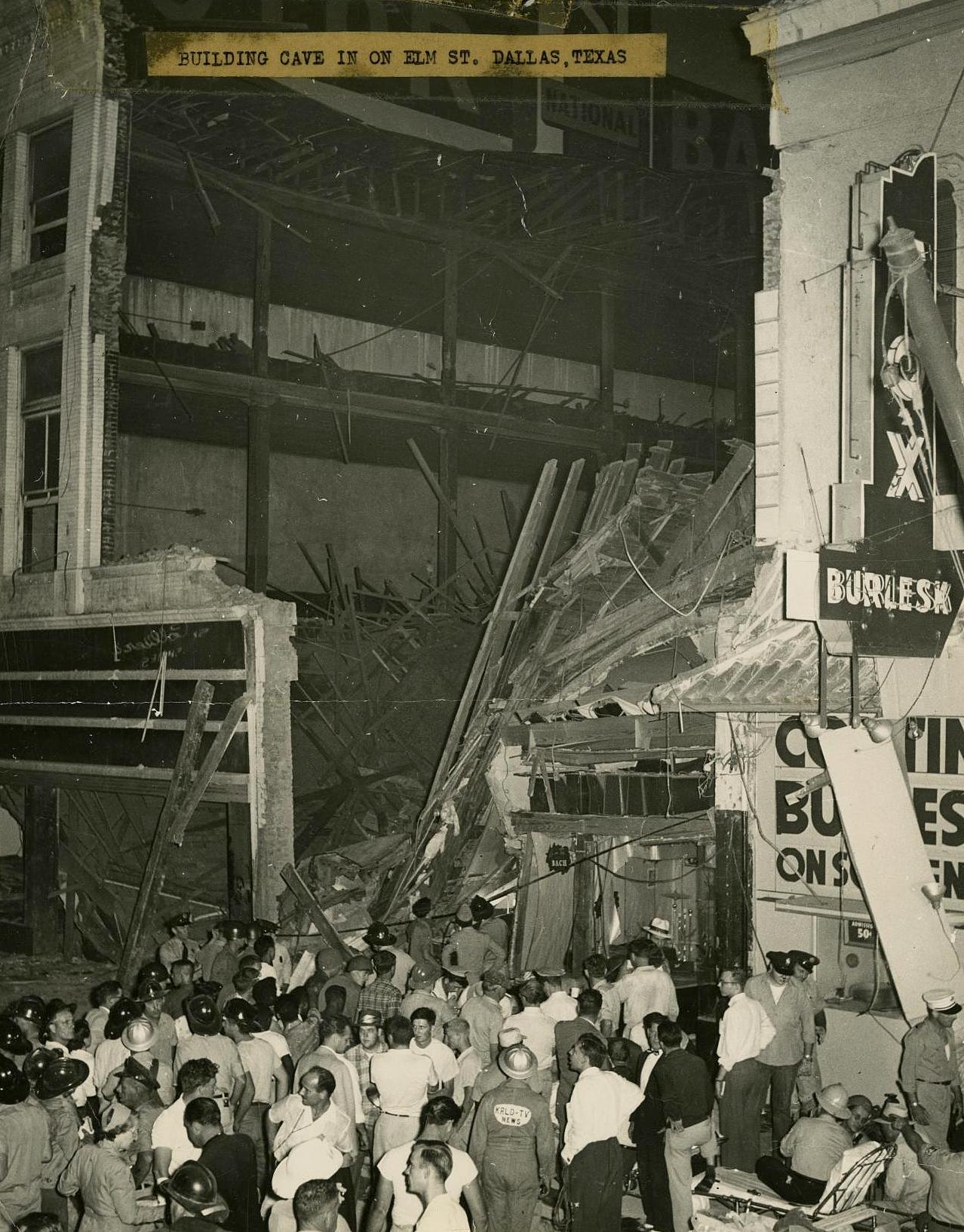
elm-st-collapse_1955
Aftermath… June 1, 1955 (photo by Gene Gauss)

by Paula Bosse

At 6:40 p.m. on June 1, 1955, a 3-story building in the process of being razed collapsed onto the smaller building next door at 1409 Elm St. The “story-and-a-half” building contained the Cline Music Company and Harry’s Fine Food, a bar and cafe. Four people were killed, and several people sustained major injuries; many were trapped for hours in the rubble.

The rousing report in The Dallas Morning News the next day described the scene as pandemonium. As emergency personnel arrived and rescue operations began, the street was roped off — there were fears a partially standing wall would topple at any moment. The Fox Burlesk house next door was quickly emptied of its 50-or-so patrons for safety concerns.

Witnesses said the building fell with a gigantic whoosh and spewed rubble about four feet deep across the sidewalk and into the street. Trolley wires were snapped and lay crackling sparks in the street for a while before the power was cut. A late-model station wagon parked at the curb was flattened under the rubble to a height of only about three feet. It belonged to [the owner of the music store]. (DMN, June 2, 1955)

Nine companies of firemen and several doctors — one of whom just happened to be passing by the scene — worked to rescue and treat the victims. A passing clergyman administered conditional last rites for those still trapped. A troop of Boy Scouts who had been nearby practicing civil defense drills, ran to help in the real-life emergency. And most cinematic of all, a Houston truck driver named Larry Ford — who just happened to be visiting Dallas and was standing in the crowd of spectators — was called in to help when someone noticed that he was wearing a truck drivers’ union insignia — authorities had obtained a winch truck to clear the heavy rubble but had been unable to find anyone to operate it. Ford sprang to action and worked through the night for 16 grueling hours. He was later hailed as a hero. Just like in the movies.

So what caused the collapse? The city manager was quick to say that the city was not to blame and, basically, had no responsibility to determine who WAS to blame.

City Mgr. Elgin Crull told The News an investigation by Chief Building Engineer Cecil A. Farrell has not been completed. “There won’t be anything on it for a long, long time — if ever at all,” Crull declared. “It’s not our responsibility to say why it fell or who was at fault. We’ll just seek to determine whether or not all the proper safety precautions were followed.” (DMN, June 3, 1955)

Well, all right, then.

As several people noted, had the collapse happened an hour earlier — in the midst of rush hour — many, many more people would have been killed and injured. I’m not sure if the cause was ever determined. The block (between Field and Akard) now contains the old First National Bank Building, built a decade later.

elm-st-collapse_060155

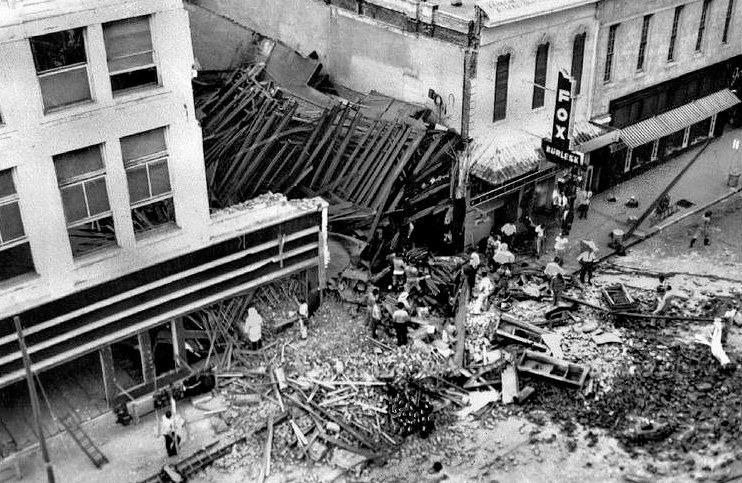
UPDATE: Just stumbled across this UPI photo, posted a few years ago by Robert Wilonsky on the Dallas Observer’s Unfair Park blog:

building-collapse_observer-090511

And below, a photo showing the 1400 block of Elm in the 1920s (looking west from Akard), with the “cafeteria” sign in front of the doomed building, to the left of the Fox Theater. The wall with what looks like the beginning of the word “Steinway” is the one that crushed its neighbor. (From Troy Sherrod’s Historic Dallas Theatres; photo from the Dallas Public Library.)

fox-theater_sherrod_dpl

***

Sources & Notes

The first two photos are from the collection of the Dallas Firefighters Museum, via the Portal to Texas History; they can be seen here and here.

The reports of the collapse that appeared in The Dallas Morning News are pretty exciting to read. You can find them in the newspaper’s archives.

  • “Three Killed, 10 Injured As Elm St. Building Falls” (DMN, June 2, 1955)
  • “Building Ruins Termed Clear Of All Victims” (DMN, June 3, 1955)
  • “Debris Yields Another Body” (DMN, June 4, 1955)

Click pictures for larger images (especially the first two, which are HUGE).

*

Copyright © 2014 Paula Bosse. All Rights Reserved.

Michael G. Owen, Jr. — Dallas Sculptor of Lead Belly

leadbelly_three-views_paul-l_yelp

by Paula Bosse

Above, three views of “Leadbelly,” the sculpted head of the blues legend, by Michael G. Owen, Jr., 1943.

Michael Owen (profiled here previously as the 15-year-old soap-sculptor who made headlines at the 1930 State Fair of Texas), was the youngest member of the group of artists loosely affiliated with the Dallas Nine group who were making a name for themselves in the 1930s and ’40s. He studied life drawing as a student of Olin Travis and painting as a student of Jerry Bywaters, but he was most proficient as a sculptor. He is best known for his award-winning 1943 bust of bluesman Lead Belly, a piece in the permanent collection of the Dallas Museum of Art (which can be seen in a 1951 DMFA catalog here).

In a 1950 letter to the (then-) Dallas Museum of Fine Arts, Owen recounted how Lead Belly sat for him in New York and sang “Goodnight Irene” as Owen worked on a clay model. Owen was living in Greenbelt, Maryland at the time, and Louisiana-born Lead Belly was living in New York City, but I’d like to think that the two men reminisced about their formative days in Dallas where Owen was a much-talked-about young artist and Lead Belly performed on the streets of Deep Ellum with Blind Lemon Jefferson.

I noticed in the newspaper article that the stone was called black Belgian marble. Actually it isn’t so exotic. It was quarried not far from Charlottesville, Virginia, and is called Black Serpentine. It was the first time I have ever heard of the stuff being black. If you’ll notice it seems quite a bit more crystalline than marble.

The way I happened to do the head went like this. A young fellow I had known in Dallas by the name of Ralph Knight had gone to New York a year or so after I went to Washington. He was interested in folk music and became acquainted with Leadbelly. It was at Ralph’s instigation that I did the head — he got me the stone, sent pictures (I first roughed out the head in clay at home in Greenbelt) and then arranged the sitting at his apartment in New York. Leadbelly sat for me one afternoon and I finished the clay model at that time. From that I worked out the stone cutting, only being able to work on it in my spare time. All in all it was about a full month’s work, I guess. During the time he was “sitting” for me (playing his guitar and singing) he played “Goodnight Irene,” but at that time the folk music devotees did not consider the tune “true folk music.” Still it pleased me when it became a popular song. It’s too bad Leadbelly couldn’t have lived to see himself gain such popularity. (Mike Owen in 1950, from a letter excerpted in the book Lone Star Regionalism, The Dallas Nine and Their Circle)

Sadly, Mike Owen’s career stalled soon after this 1940s artistic high point. He eventually settled in Oregon, where he was sidelined by multiple sclerosis. He died in 1976 at the age of 60.

owen-michael_1930s
Mike Owen in his early 20s

I’m not sure how often the piece is displayed at the Dallas Museum of Art, but it’s a wonderful work of art. When I saw it a couple of years ago, I just stood and stared at it for ages. It’s really fantastic. And it’s fitting that it resides here in Dallas where Michael Owen was once a part of a group of Texas artists whose influence continues to be felt today.

It also seems fitting to throw in this classic from Mr. Ledbetter, who, like Mike Owen, spent time honing his craft in Dallas:

lead-belly-wikipedia

***

Sources & Notes

“Leadbelly” sculpture by Michael G. Owen, Jr. is in the collection of the Dallas Museum of Art.

Photo of the artwork is by Paul L. as posted on Yelp.

Photo of Lead Belly from Wikipedia.

Quote from Mike Owen’s letter to the DMFA (April 11, 1950) can be found in the superb book Lone Star Regionalism, The Dallas Nine and Their Circle, 1928-1945 by Rick Stewart (Austin: Texas Monthly Press, Dallas Museum of Art, 1985) — the best book on Dallas art of this period.

Read the Handbook of Texas entry about Huddie Ledbetter (aka Lead Belly/Leadbelly) here.

Other Flashback Dallas posts on Owen:

  • Young Mr. Owen’s star-turn as the teenager who carved the WFAA transmitter plant from 8,400 pounds of Ivory Soap is here.
  • Owen’s monument to SMU Mustangs’ mascot Peruna, commissioned in 1937, is here.

UPDATE: Read about a recently discovered large painting by Owen up for auction in Dallas in 2019 here.

*

Copyright © 2014 Paula Bosse. All Rights Reserved.


Cokesbury Book Store — 1959

cokesbury_dallas_1959

“For a summer of pleasure, grab a good book.”

*

Copyright © 2014 Paula Bosse. All Rights Reserved.

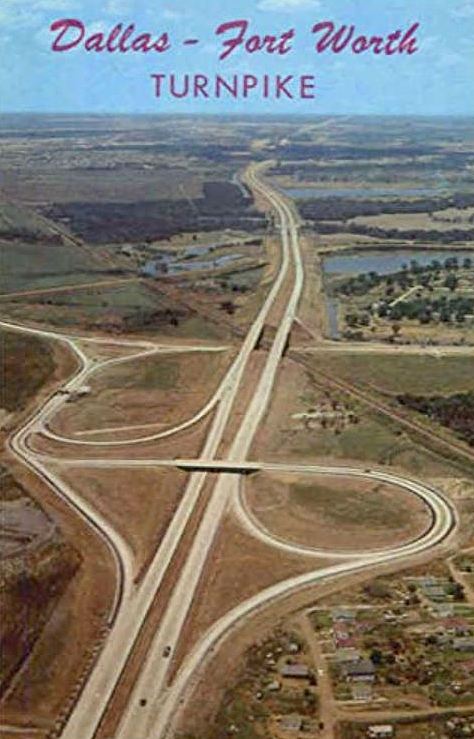
The DFW Turnpike, Unsullied by Traffic, Billboards, or Urban Sprawl — 1957

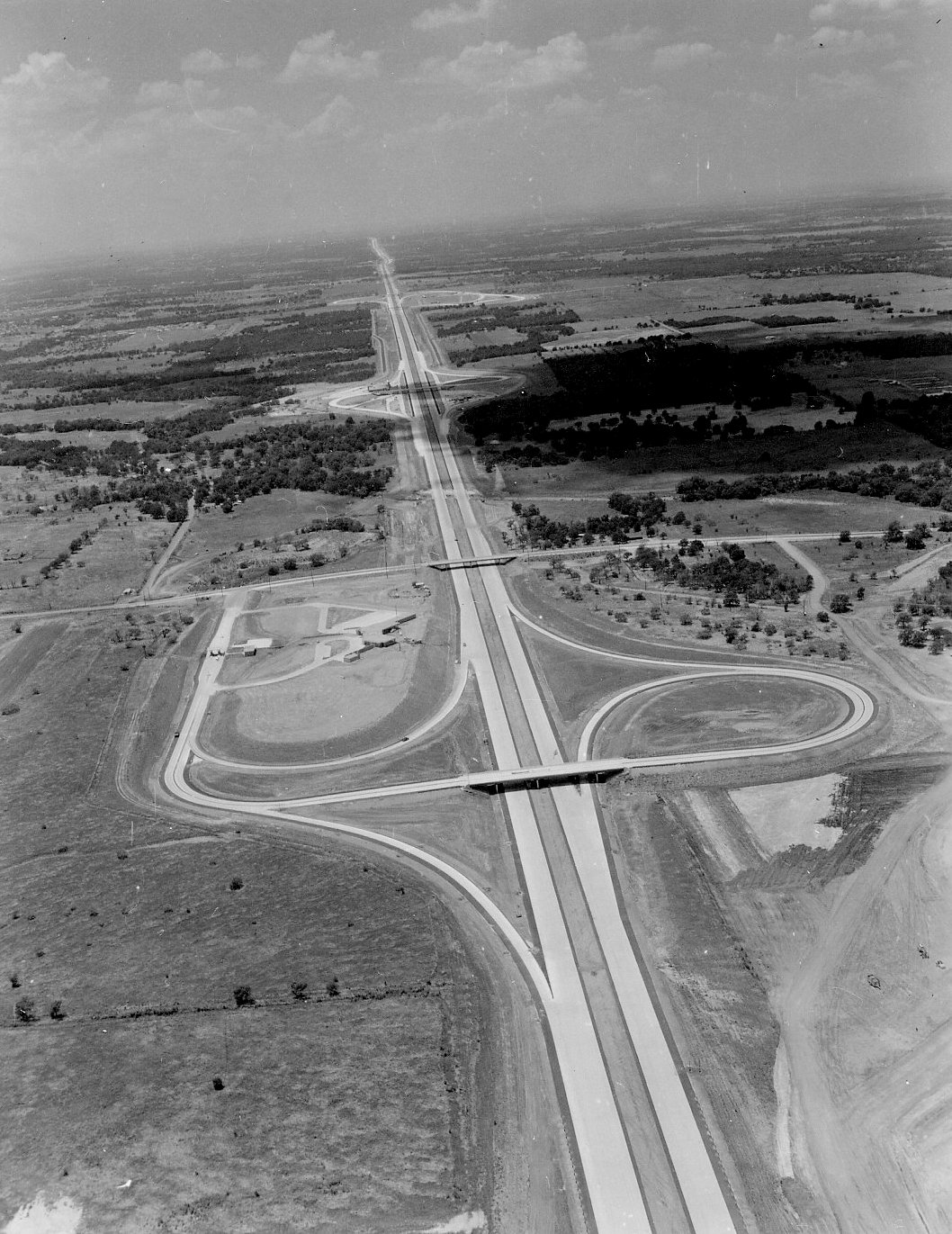
turnpike_west-from-360_1957The DFW Turnpike, 1957… (click for very large image!)

by Paula Bosse

Above, the Dallas-Fort Worth turnpike in 1957, before it opened for business. When this toll road was paid off in 1977, the toll booths were removed and it became I-30, a “free” highway. (This “toll-road-becoming-a-free-road” thing has happened only once in the history of Texas; I can’t imagine it will ever happen again.) This photo shows the turnpike heading west through Arlington, with Hwy. 360 crossing over it in the middle. Six Flags over Texas would be built in this wide open expanse four years later. And then … an explosion of development.

A Texas Highways article described the 30-mile stretch (“30 miles — 30 minutes!”) as being a blissful drive through “a landscape devoid of advertising signboards and commercial establishments” (!). In fact, the only businesses along the turnpike were two restaurants and two service stations. All the way from Dallas to Fort Worth … that was IT! You know, I’d gladly pay an obscenely exorbitant toll today if it meant I could drive that stretch of highway the way it was in this photo. A world without urban sprawl would be heaven.

I love this photo. The road ahead just disappears into the ether. And, Arlington, you’ve never looked better.

dfw_turnpike

dfw-turnpike_postcard

dfw-turnpike_flickr_coltera

dfw-turnpike_postcard_skyline

dallas-fw-turnpike_postcard

***

Sources & Notes

Top photo from Oscar Slotboom’s book Dallas-Fort Worth Freeways, credited to TxDOT Travel Information Division, 1957. His caption: “The view looks west along the turnpike just before it opened in  1957 with the  SH 360 intersection in the foreground…. Land on the left side of the turnpike just past SH 360 would soon be developed into Six Flags Over Texas…. The building alongside the turnpike was a Texas Turnpike Authority administrative office which was demolished in 2011.”

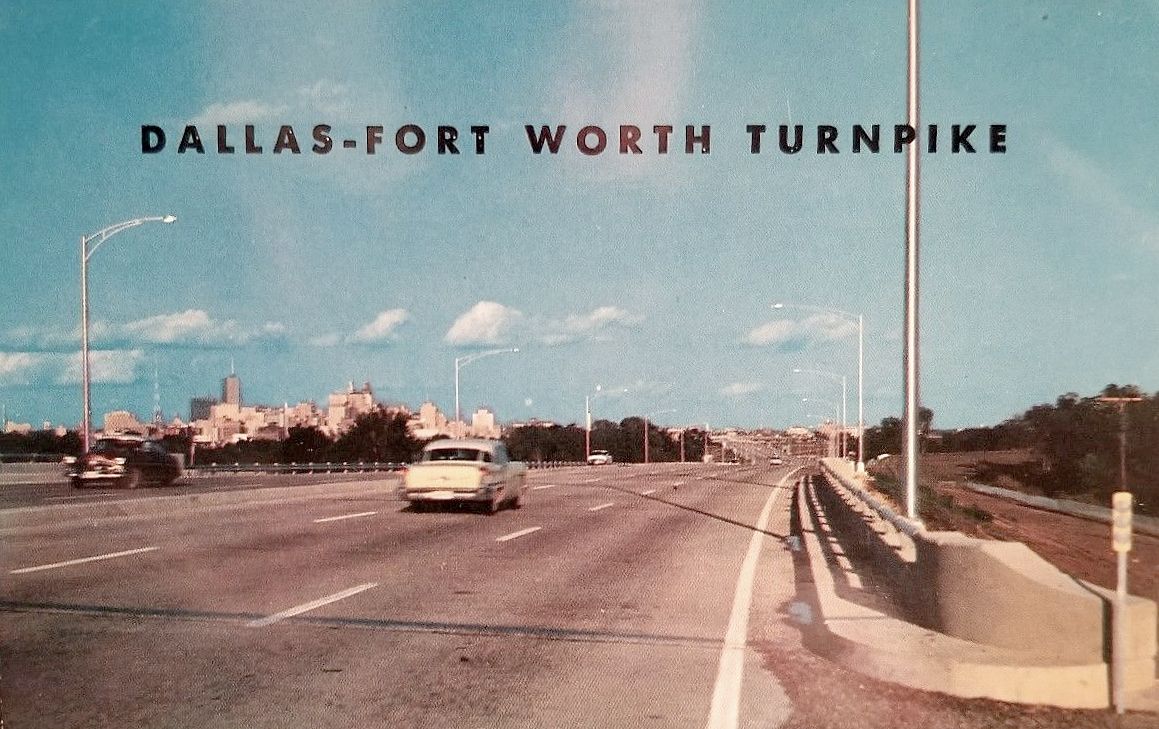
Postcards from around the internet.

For an informative read and LOTS of photos, I highly recommend Oscar Slotboom’s chapter on the DFW Turnpike, which you can access here (there are tons of historical photos). This chapter is from Slotboom’s exhaustive work Dallas-Fort Worth Freeways: Texas-Sized Ambition. The entire book has been made available online — for free (the home-page is here). You can read about Mr. Slotboom’s work in a Dallas Morning News interview by Robert Wilonsky here.

A fun read about the turnpike (yes, fun!) is an article from Texas Highways (Dec. 1957), here. (The article is spread over three web pages — don’t miss the links for all of the pages at the top of each page.)

By the way, when the turnpike opened, the toll was 50 cents. According to the Inflation Calculator, that would be equivalent in today’s money to just over $4.00. To drive from Dallas to Fort Worth quickly, through not-yet-developed green spaces and along a new highway uncluttered with billboards. A BARGAIN!

Click photo for larger image.

*

Copyright © 2014 Paula Bosse. All Rights Reserved.


A Lost Photo of Director Larry Buchanan, Celebrated “Schlockmeister” — 1955

buchanan-katy-camera_1955_bwLarry Buchanan (in bowtie) in his ad-man days, 1955

by Paula Bosse

I got all excited when I saw the above photo posted in the Lone Star Library Annex Facebook group. It accompanied an article and another photo from the Katy Employes’ Magazine (August, 1955) (seen below) — the poster was interested in the railroad-angle of the article and photos, but the name “Larry Buchanan” was what grabbed my attention.

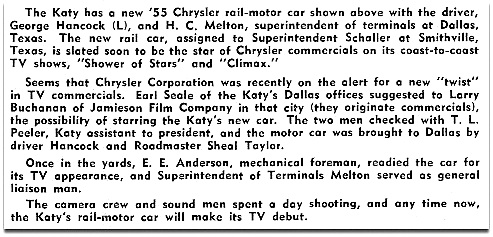
buchanan_katy-chrysler

buchanan_katy-text

The photo was posted because it was a wonderful piece of M-K-T Railroad-related ephemera. Before reading the accompanying text, I thought that the idea of a 1955 Chrysler tricked-out to ride along Katy railroad tracks (so that M-K-T officials could, presumably, ride the rails in comfortable air-conditioned splendor as they moved from one inspection site to the next) was the cool thing about the article. Then I got to the name “Larry Buchanan.” And it became much, MUCH more interesting.

So who is Larry Buchanan? Briefly, Larry Buchanan is one of the greatest exponents of grade-Z, low-low-low-LOW-budget filmmaking, a director with a cult following amongst those who enjoy movies in the “so-bad-they’re-good” genre. He shot most of his movies in the 1960s in Dallas, taking advantage of lots of locations around the city, even if the movies he was shooting weren’t actually set in Dallas (one movie had Highland Park Village standing in for Italy, and “Mars Needs Women” was set in Houston, even though the movie is crammed full of easily recognizable Dallas locations such as the downtown skyline and the Cotton Bowl). The movies that have earned him his place in the pantheon of cult figures are primarily his sci-fi movies, like “Mars Needs Women,” “Attack of the Eye People,” “Curse of the Swamp Creature,” and “Zontar: The Thing from Venus.” Many were re-makes of earlier low-budget sci-fi movies commissioned by American International Pictures, and Buchanan was usually the producer, director, writer, and editor — “auteur” seems like the wrong word to use here, but that’s what he was, a filmmaker intensely involved with every phase of the production.

Buchanan was born in 1923 and grew up in Buckner Orphans Home. After a fleeting thought of becoming a minister, Buchanan — long-fascinated by movies — left for Hollywood and New York where he worked as an actor in small roles or on the crew (during this time there were professional brushes with, of all people, George Cukor and Stanley Kubrick). By the early 1950s, Buchanan was back in Dallas, employed by the Jamieson Film Company (3825 Bryan St.), working on industrial films, training films, television programs, and commercials. It was at Jamieson that he learned all aspects of film production, including how to get things done quickly and how to bring projects in under budget. It’s also where he met co-workers Brownie Brownrigg, Robert B. Alcott, Bob Jessup, and Bill Stokes, all of whom went on to have film careers of their own and most of whom Buchanan used as crew members when shooting in and around the city.

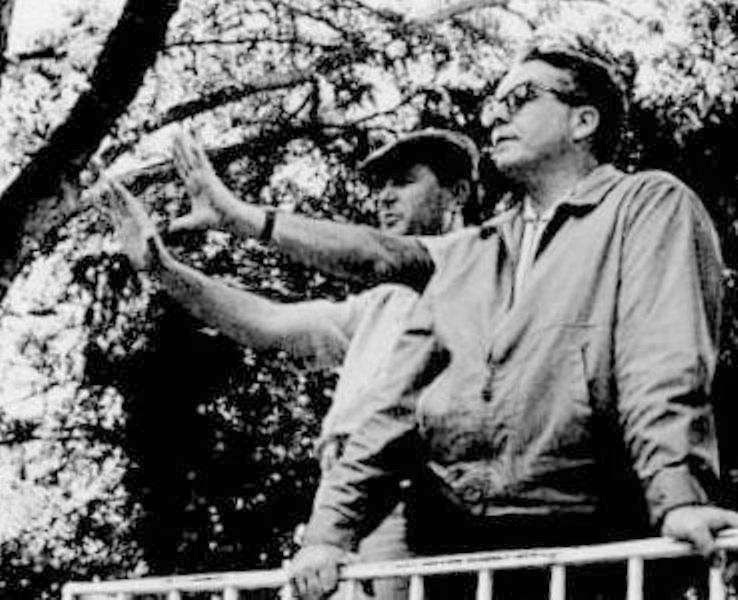
It was during this period that the photo above was taken. There are countless websites out there devoted to Larry Buchanan’s film oeuvre, but there are very, very few photos of him online. I found exactly three:

larry-buchanan_bob-jessup_texas-monthly_lgLarry (left) with cinematographer Bob Jessup

larry-buchanan_tx-monthly_may-1986-photo_detIn 1986 (Tim Boole/Texas Monthly)

larry-buchananDate unknown

The photo at the top of this post is from 1955, before Buchanan had really begun cranking out his own movies. I can’t say for sure that this IS a photograph of Larry Buchanan, but it seems likely that it is. In that striped shirt, he looks like the kind of hip, energetic, ever-enthusiastic director I imagine him being. I can only hope that it IS him, straddling railroad ties, behind a camera pointed at a retrofitted Chrysler, in Dallas’ Katy railyard. One wonders if that Chrysler spot had a higher budget than some of the movies he was making ten years later. UPDATE: In the comments, below, Larry’s son Barry identifies his father in the top photo, but not as the man behind the camera, but as the man behind the car, wearing the bowtie. Thanks for the correction, Barry1)

From all reports, Larry was a tireless, driven, upbeat guy who loved making movies, and I think it would have been a lot of fun hanging out with him. If I ever have enough disposable income, I’ll fork it over and buy a copy of his entertaining-but-pricey autobiography, the well-received It Came From Hunger: Tales of a Cinema Schlockmeister (McFarland & Co., 1996).

It’s been fun researching Larry Buchanan. There’s a lot more to tackle later. I mean, I haven’t even touched on the legendary “Naughty Dallas” yet!

***

Tons of links here….

First two photos and text from the Katy Employes’ Magazine (Aug. 1955).

buchanan-cover_sm

Katy magazine scans made with permission of the Facebook page Lone Star Library Annex.

Other examples of automobiles equipped with “railroad wheels” can be found here.

Black and white photo of Buchanan with Bob Jessup (photographer and date unknown) and the great color photo (a detail of which is shown above) by Tim Boole, both from the article, “How Bad Were They?” by Douglass St. Clair Smith (Texas Monthly, May 1986), which you can read here.

That last photo of Buchanan is all over the internet — the only one you ever really see. I don’t know who took it, when it was taken, or where it originally appeared. But it’s a great photo!

Larry Buchanan died in December, 2004, at the age of 81. His obituary from The New York Times is here.

A fond look back at Buchanan’s career by Eric Celeste appeared in the April 2005 issue of D Magazine and can be read here.

The best piece on Buchanan is “A Tribute to Larry Buchanan” by his good friend Greg Goodsell, here.

My recent post on “Mars Needs Women” — with screen caps of movie scenes shot at recognizable Dallas locations — is here.

I never did find that Chrysler spot that had been slated to appear on network TV. I have a feeling it may be in a lengthy collection of Chrysler commercials and films from 1955 which you can watch here. I couldn’t slog all the way through it, but there are a couple of “Shower of Stars” episodes, which are mentioned in the Katy article (they’re odd “entertainment” shows which seem to be nothing more than infomercials for Chrysler starring famous people in bad sketches). If anyone actually finds footage that was filmed that day in Dallas, please let me know!

And, lastly, Larry Buchanan’s movies are fun, but some are more fun than others, “if you know what I mean, and I think you do” (as Joe Bob Briggs — surely one of Larry’s biggest admirers — might say). Many of them are available to watch in their entirety online. Check YouTube and Google.

Click photos for larger images!

*

Copyright © 2014 Paula Bosse. All Rights Reserved.