Flashback : Dallas

A Miscellany: History, Ads, Pop Culture

Category: 1960s

The Over-the-Top University Park Christmas Display Featuring Big Tex and a Six Flags Spee-lunker
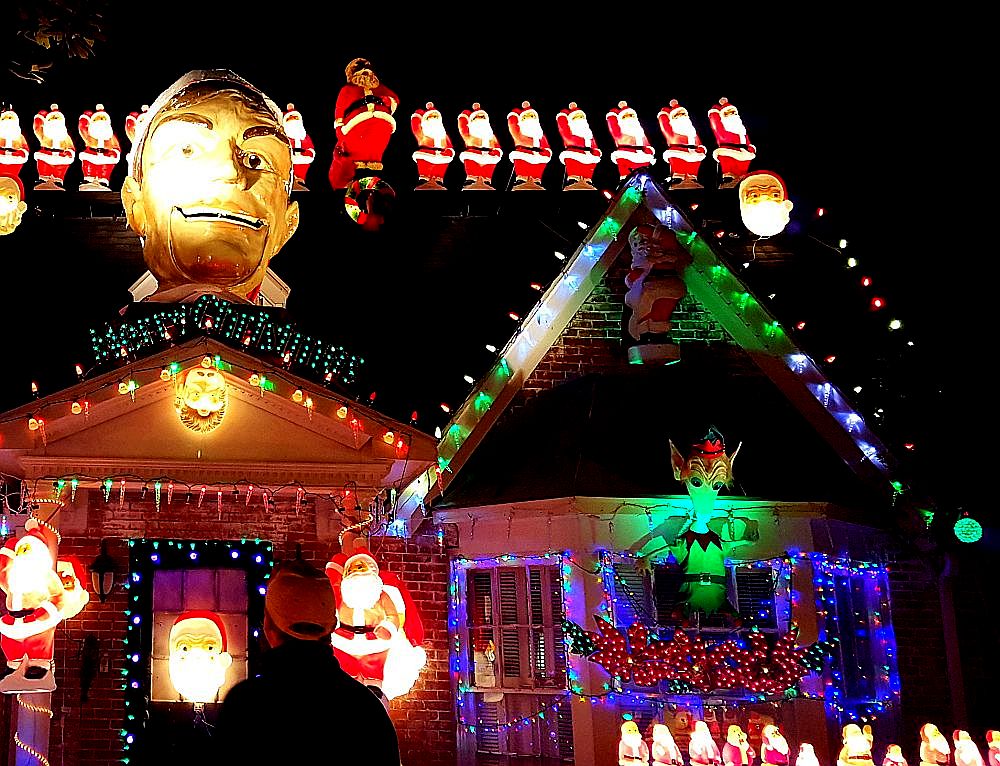
xmas-wayne-smith_university-park_2015_big-tex_speelunkerBig Tex on the roof, a “Spee” to the right (click for larger image)

by Paula Bosse

You may have heard about Wayne Smith’s annual spectacular Christmas display in the 3600 block of Southwestern in University Park — the one with a cast of thousands, including a previous head of Big Tex, what seems like hundreds of illuminated Santas, Dracula, Moe Howard, and a former denizen of Six Flags Over Texas’ “Cave”/Spee-lunker ride. Before I get back to the “Spees” (the name the creatures have been given by their surprisingly enthusiastic fan-following), here’s a wider shot of a photo I took during last year’s holiday season. (Click it!)
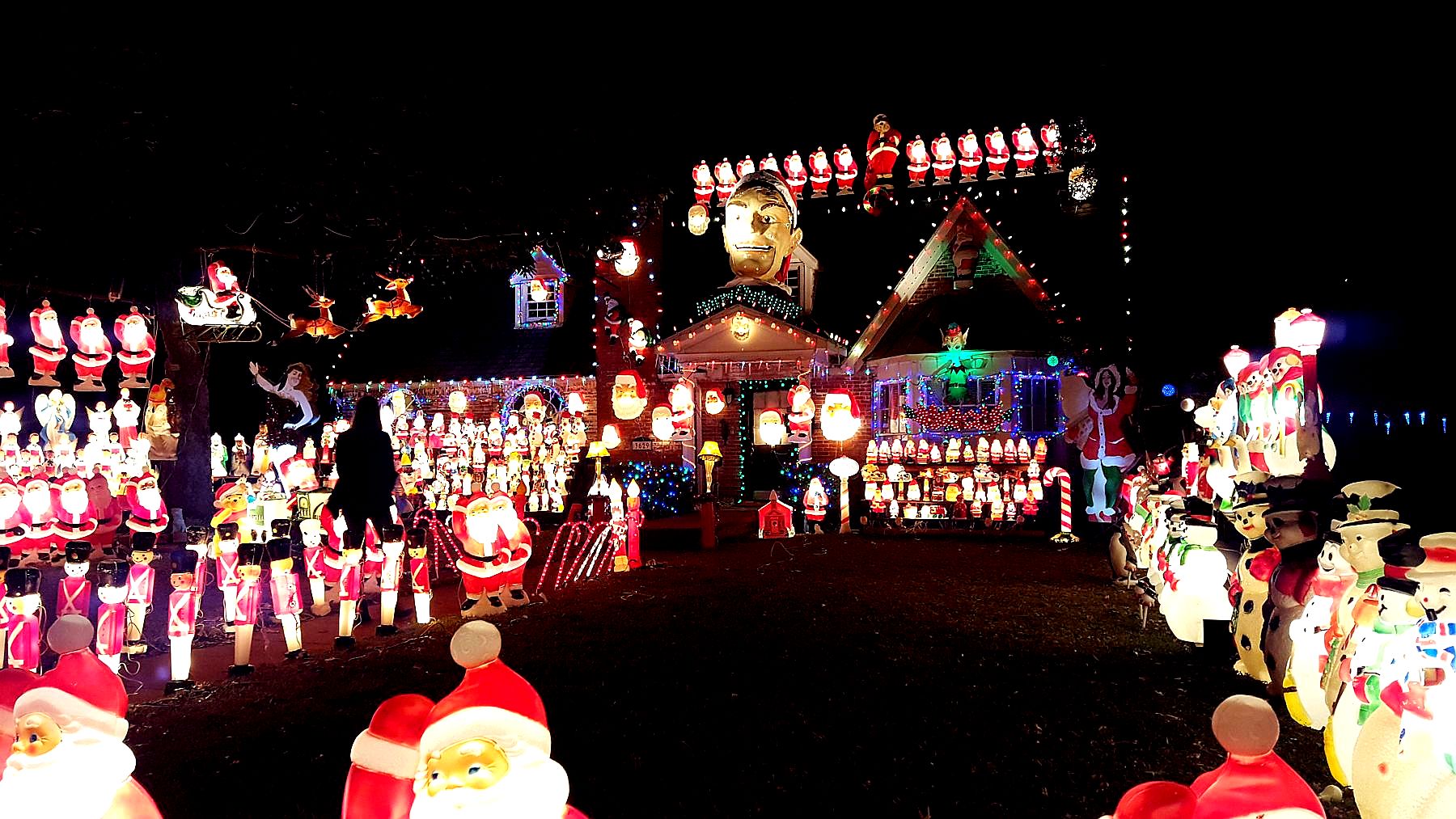
xmas_wayne-smith_university-park_2015_full

(And this gives you only an inkling of what’s actually there. I LOVED it! I waited until after Christmas — in fact, after New Year’s — to wander around — I can only imagine how backed up with looky-loos the street gets closer to Christmas.)

*

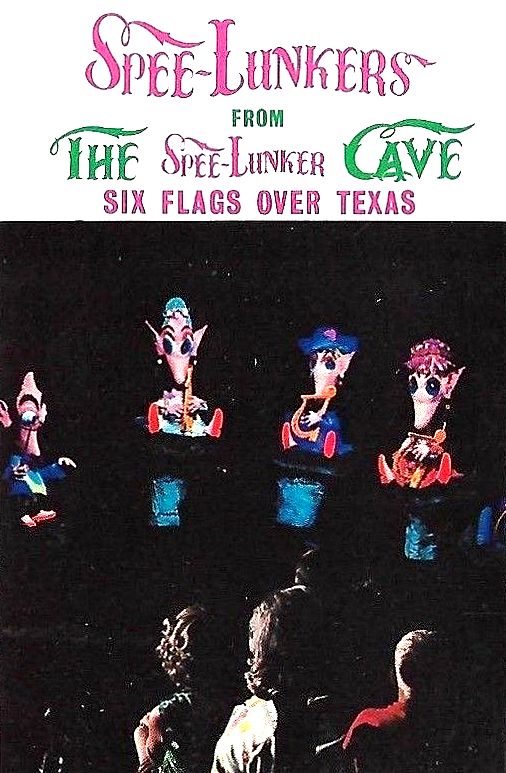
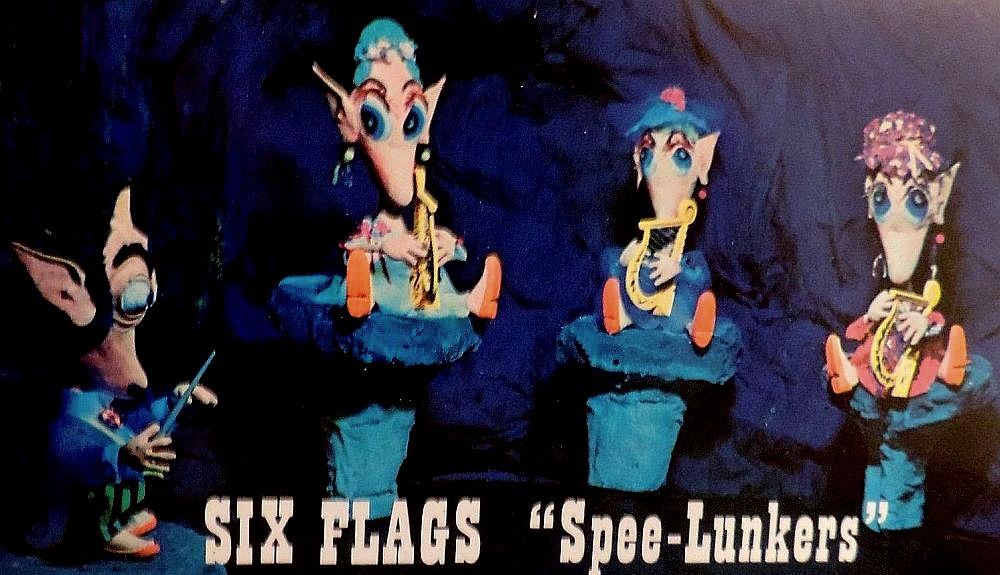
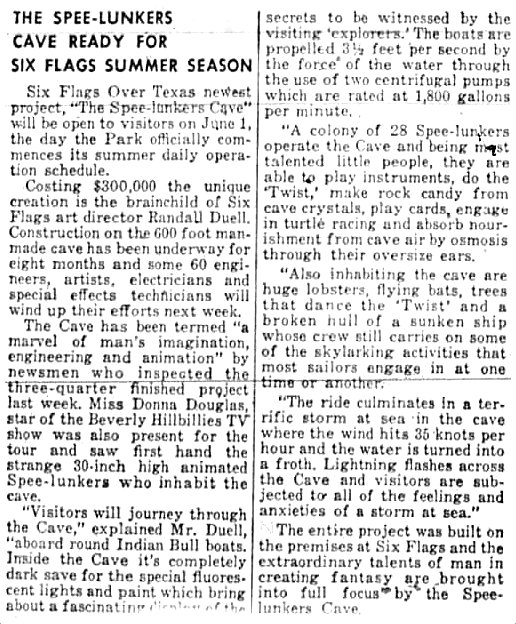
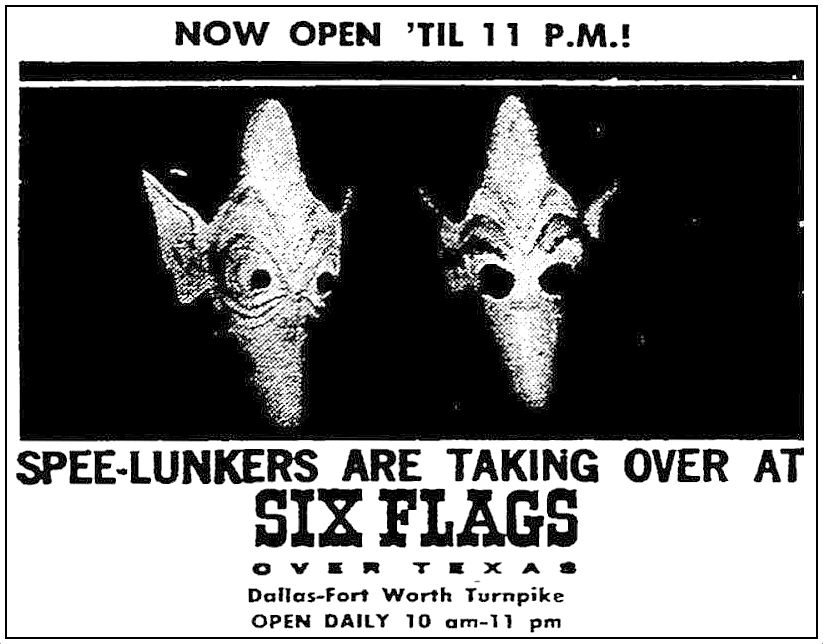
Back to the Spees. The Cave water ride debuted in 1964 and was an immediate hit. When it opened, there were 28 of these creatures who, according to the original marketing, “came from innerspace.”

They are 30 inches high and they play harps, do the Twist, play cards, hammer cave crystals into rock candy and engage in a shell game — turtle racing.

This ride was always one of my favorites (probably because it provided a brief, cool respite from the glaring sun and the blasting heat that plagued my annual summer visits to Six Flags).

The Spee-lunkers left Six Flags a long time ago, so it’s nice to see that one of them is still entertaining local crowds, right next to another beloved DFW icon, Big Tex … along with a phalanx of festive Santas!
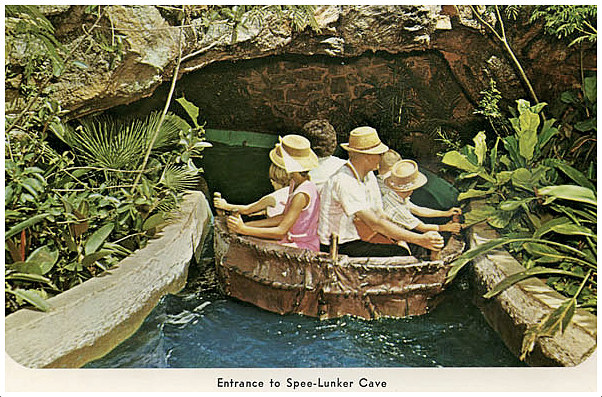
spee-lunker-cave_postcar

six-flags_speelunkers_ebay

six-flags_speelunkers_postcard_ebay

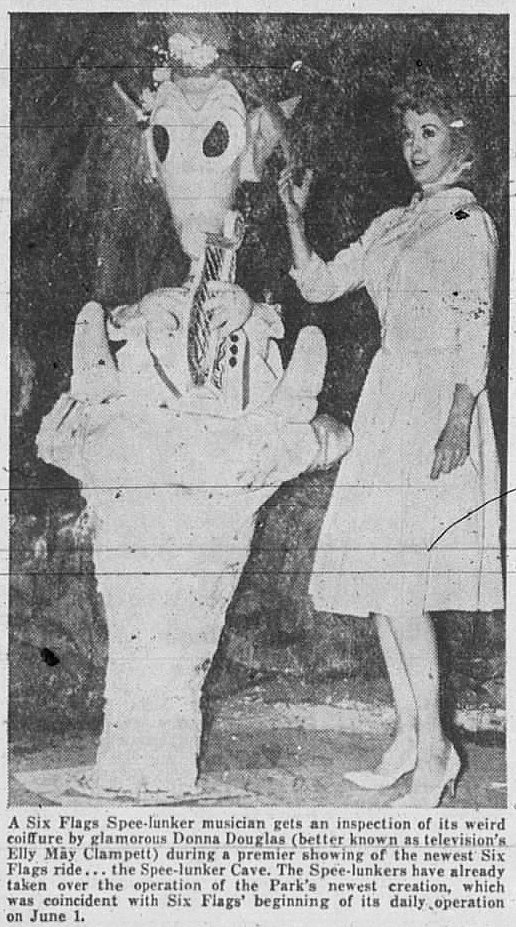
Lest you think the publicity mill wasn’t working all angles of this new attraction, we see below that one of the Spees got a visit from, of all people, TV-darling Donna Douglas who played Elly May Clampett on The Beverly Hillbillies.
cave_hood-county-news-tablet_060464

cave_hood-county-news-tablet_060464-text
photo and article, Hood County News Tablet, June 4, 1964
cave_fwst_082264
August, 1964

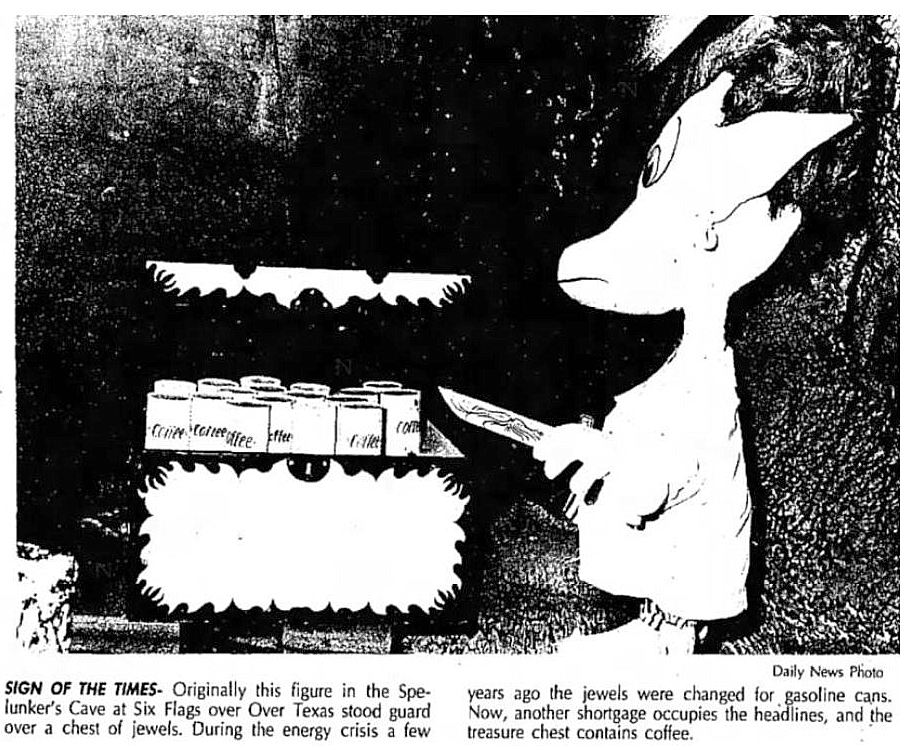
cave_grand-prairie-daily-news_052577
Grand Prairie Daily News, May 25, 1977

***

Sources & Notes

Photo of Wayne Smith’s Christmas display taken by me on January 2, 2016. The house is in the 3600 block of Southwestern, between Baltimore and Thackery. Since the display is probably visible from space, there’s no way you can miss it.

Postcards found on eBay and Google.

Every year TV crews descend on Smith’s house to do a story. Watch one from this year — from CW33 News — here.

For those who might like more info on the Spee-lunker attraction/ride (which, by the way, is classified as a “dark ride” in amusement park lingo) at Six Flags Over Texas, here’s a bunch of links:

  • Weird video and music (and history!) by a superfan, here
  • Article by the same guy who put the above video together, here
  • Spee-lunker vignettes described here
  • Google images aplenty, here

More on the new ride can be found in the Dallas Morning News archives in the article “$300,000 Hole: Six Flags To Open Cave Ride” (DMN, May 24, 1964) — accompanying the article is an amusing photo captioned “Gail Powers yelps in mock fear as lobster seizes her hand.”

A shout-out to Wendy Cook who, when I posted the top picture to the Flashback Dallas Instagram feed in January, pointed out to me that the Spee-lunker was even in there. She recognized him right away, but with so much visual overload, I hadn’t even noticed him! Thanks, Wendy!

See stuff bigger — when in doubt, click it!

*

Copyright © 2016 Paula Bosse. All Rights Reserved.
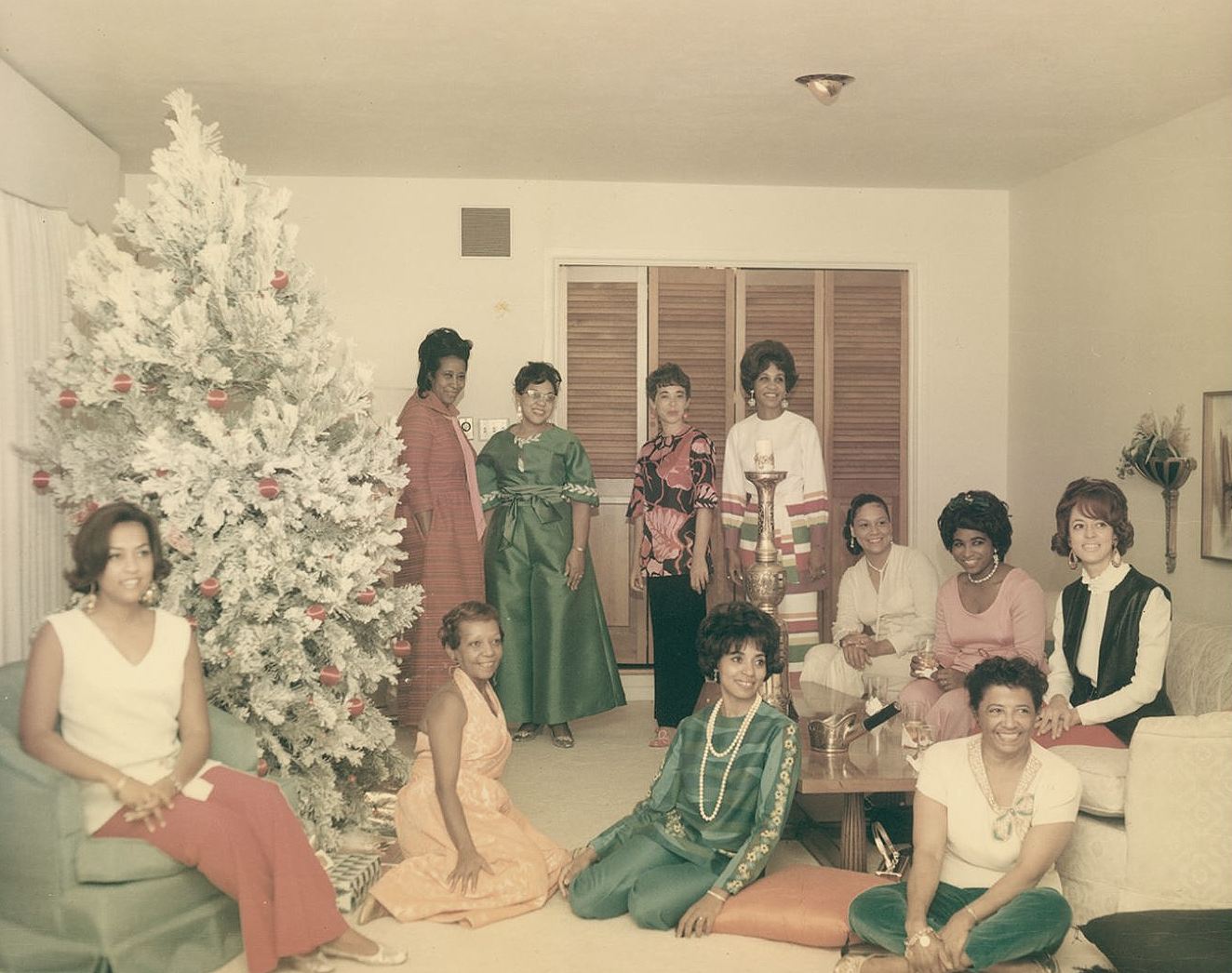
 

Merry Christmas from the Priscilla Art Club — 1968

xmas_priscilla-art-club_123168_uta“Say ‘fondue’!”

by Paula Bosse

These women look like they’ve stepped out of a catalog — perfectly dressed, perfectly coiffed, perfectly posed. They are members of the Priscilla Art Club, the oldest African-American women’s club in Dallas. The club was formed in 1911, and I think it may still be active — the most recent news I could find of the club was from 2012, when the “centennial legacy quilt,” made by members to celebrate the club’s 100th anniversary, was displayed at the African American Museum. Below, a little history of the club from the press release announcing the exhibit in February, 2012.

THE PRISCILLA ART CLUB CELEBRATES BLACK HISTORY MONTH

In honor of Black History Month, the Priscilla Art Club, the oldest African American women’s organization in Dallas County, will host a display of its centennial legacy quilt made by its members […] at the African American Museum of Life and Culture, Dallas Fair Park.

“The idea of a custom designed legacy quilt started out as a novel idea from our Systems Committee in recognition of our 100th anniversary. The twenty-two club members quickly became engaged in seeing it to fruition and we are happy to honor the beauty, the inspiration and the legacy of our Club” said Shirley Porter Ware, Club President.

The Priscilla Art Club, organized in 1911 as a club for young matrons, was organized under the encouragement and direction of Mrs. Mattie Mansfield Chalmers. The organization’s purposes were to establish and maintain the aesthetic, promote congenial companionship and foster all social and community interests that pertain to the general uplift. The Club was named for Priscilla, a New Testament woman of extraordinary culture and the wife of Aquila, a Jewish tentmaker.

Since its auspicious beginning, the Club has invited into its membership many of Dallas’ most distinguished homemakers. These members have exhibited an interest or are talented in arts and crafts.

Besides being homemakers and mothers, the members have been and some still are principals, school administrators, teachers, business owners, social workers, church leaders and servant volunteers in the local community.

Throughout the century of service and sisterhood, recorded in The Priscilla’s prolific history include mention of service rendered in support of the World War I efforts by rolling bandages that were sent overseas to the field hospitals in France. For several years, the Priscillas decorated the shotgun house, located in Old City Park, in observance of the holiday season. In more recent years, the members have decorated t-shirts and jackets made from sweat shirts to give to men and women in local assisted living facilities. Club members have made crocheted skull caps in a variety of vivid colors and patterns and donated to cancer patients actively engaged in treatment regimens.

Regardless of change, the Priscilla Art Club’s concern for its artistic endeavors and for civic and social uplift will continue with deepening interest and commitment as the tradition of the founders’ legacy is carried forward.

I hope the club is still around. This year marks its 105th anniversary.

***

Sources & Notes

Photo was taken on December 31, 1968; from the Culmer Family Papers, UTA Libraries, Special Collections, accessible here.

The 2012 press release was posted on the Facebook page of the Dallas Fort Worth Association of Black Journalists, here.

More on the history of the club can be found in the Dallas Morning News article “Reception to Honor Art Club’s 65th Year” by Julia Scott Reed (DMN, April 2, 1976).

The most in-depth history of the club that I could find online can be found in the guide to the Culmer Family Papers at UTA, here (scroll down to the paragraph that begins “The Priscilla Art Club was one of the most prestigious, if not elitist clubs for African American women in Dallas….

*

Copyright © 2016 Paula Bosse. All Rights Reserved.
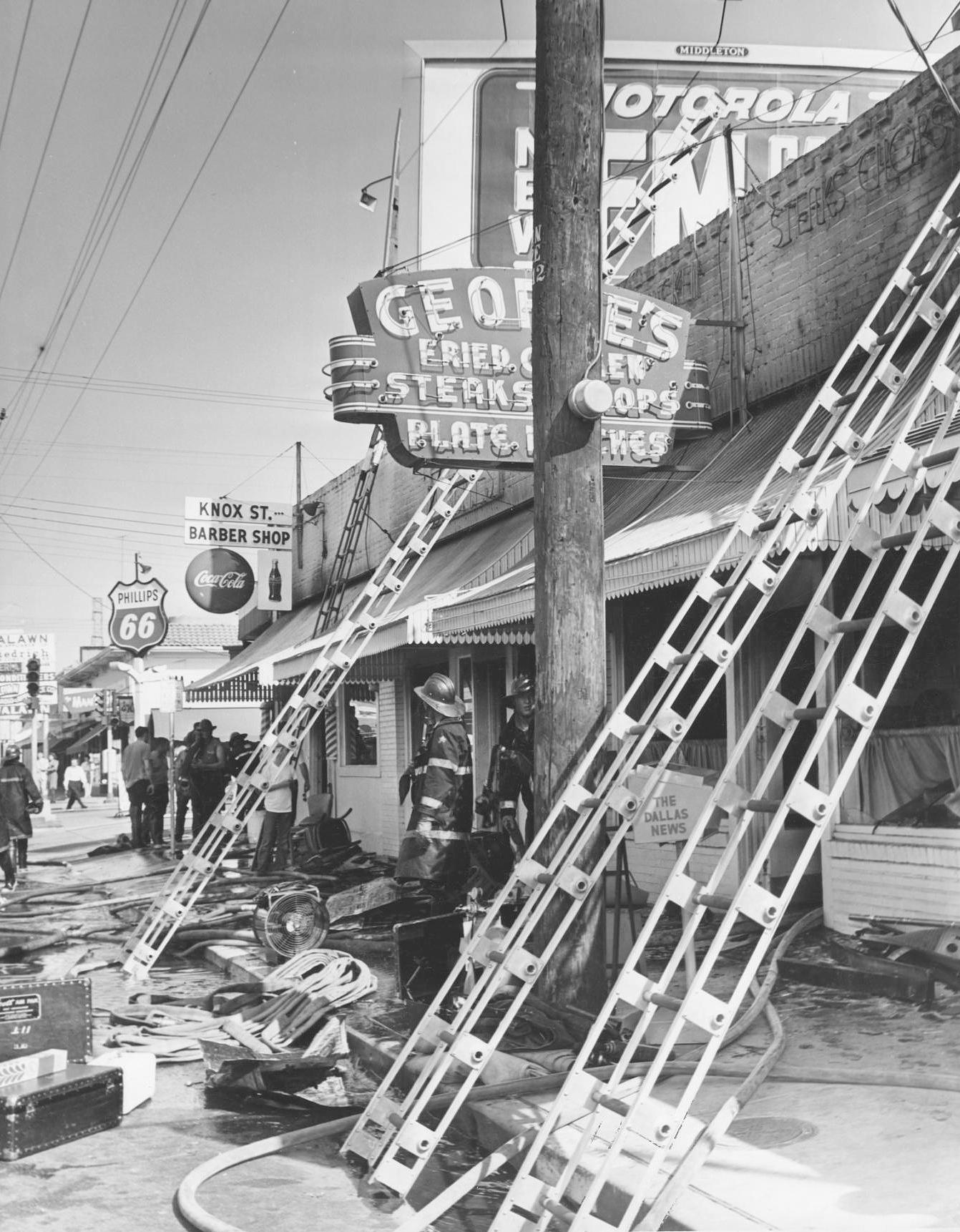
Knox Street Fire — 1961

knox-street-fire_3100-block_052161_unt_portal_dallas-firefighters-museum3100 block of Knox, after a 4-alarm fire…

by Paula Bosse

I often run across photos that aren’t particularly historical, but they’re interesting because they show a part of town with which I’m familiar, but which looks very different today. The photo above shows the 3100 block of Knox Street, between McKinney and Cole, looking toward Cole (seen at the stoplight). It shows the aftermath of a 4-alarm fire that broke out on May 21, 1951 and destroyed three businesses: George’s Cafe (at 3124 Knox), the Knox Street Barber Shop (3128 Knox), and Foster’s Food Store (3122 Knox) — the building housing these business survived, but it is long-gone; the land is now occupied by On The Border.

There were no fatalities at the scene, but, sadly, Charles William Layne, a 13-year-old neighborhood boy who suffered from a heart condition, collapsed while running to see what the commotion was and later died.

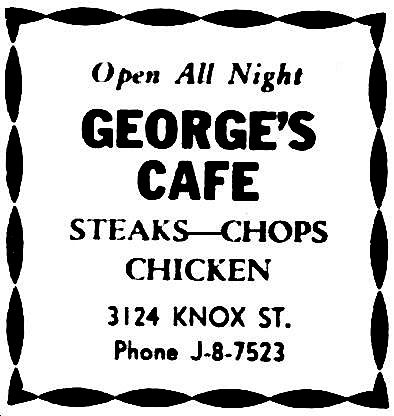
I looked up one of the businesses affected by the fire: George’s Cafe, owned by George Bartlett, who opened the business at 3124 Knox in 1937. Apparently those early days were difficult, and Bartlett barely kept the business afloat. The only thing that seemed to keep him going was the fear of losing the money his widowed mother had loaned him after she had mortgaged her home. A heartwarming rags-to-riches article about Bartlett appeared in the pages of The Dallas Morning News (“Shot at the Moon” by Kenneth Foree, DMN, Nov. 28, 1946).

Digging a bit, I saw that Bartlett had tried to sell the cafe several times but never seems to have found a buyer. The for-sale ads stopped after 1964. The last appearance of the cafe in the Dallas directory was in 1965. Bartlett died in 1966.

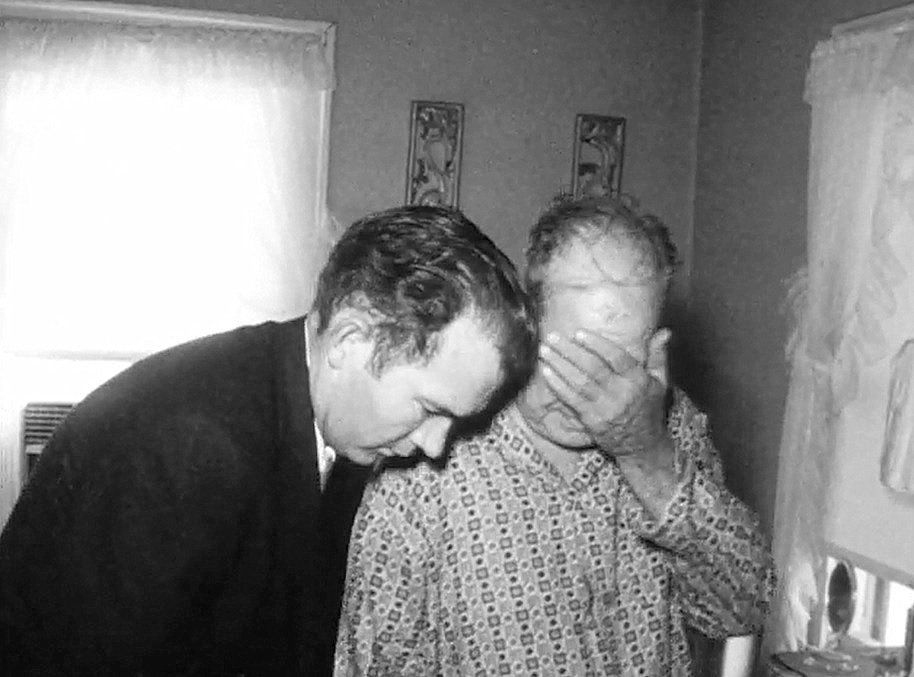
But Bartlett wasn’t kidding when he was interviewed by Kenneth Foree in that Dallas News article: it was very hard making money running the place. So hard, in fact, that in order to keep from going under, he had to take on a side job: he became a bookie, taking bets on basketball games, football games, and horse races. He was arrested twice (in 1959 and 1963) and spent 90 days in jail after being convicted on book-making charges. When arrested in 1963 after having been caught flushing receipts down the toilet as the vice squad broke down his door (a case which was later no-billed), the 57-year-old Bartlett told the arresting officer, “I just can’t make any money in the cafe business” (“Bookmaking Raid Nets Two Arrests” by Hugh Aynsworth, DMN, Nov. 17, 1963). He was shown in a news photo wearing handcuffs and pajamas. Oh, George. What would your mother have said?

UPDATE: I stumbled across news footage from 1963 of poor George on the worst day of his life, described above: in it, he is seen being arrested on camera — in his pajamas — after vice cops raided his East Dallas home. He has a black eye, which he sustained when cops caught him attempting to flush evidence. You can watch the short, silent video here — and you can read the news script which would have been read by the news anchor over the footage, here (it will explain those loaves of bread). Below is a screen shot.

bartlett-george_bookie-raid_nov-1963_WBAP_portalKXAS-NBC 5 News Collection, UNT

**

georges-cafe_dmn_062245
June 22, 1945

Below, the businesses in the 3100 block of Knox Street at the time of the fire. The businesses that burned were located in a building torn down many years ago and replaced by On The Border (the view today is here).

knox-street_3100-block_1962-directory
1962 Dallas directory

***

Sources & Notes

The photo at the top is from the Dallas Firefighters Museum collection, via the Portal to Texas History — more info is here.

Screen shot of George Bartlett is from footage shot on Nov. 16, 1963, from the KXAS-NBC 5 News Collection, UNT Libraries Special Collections, via the Portal to Texas History.

*

Copyright © 2016 Paula Bosse. All Rights Reserved.
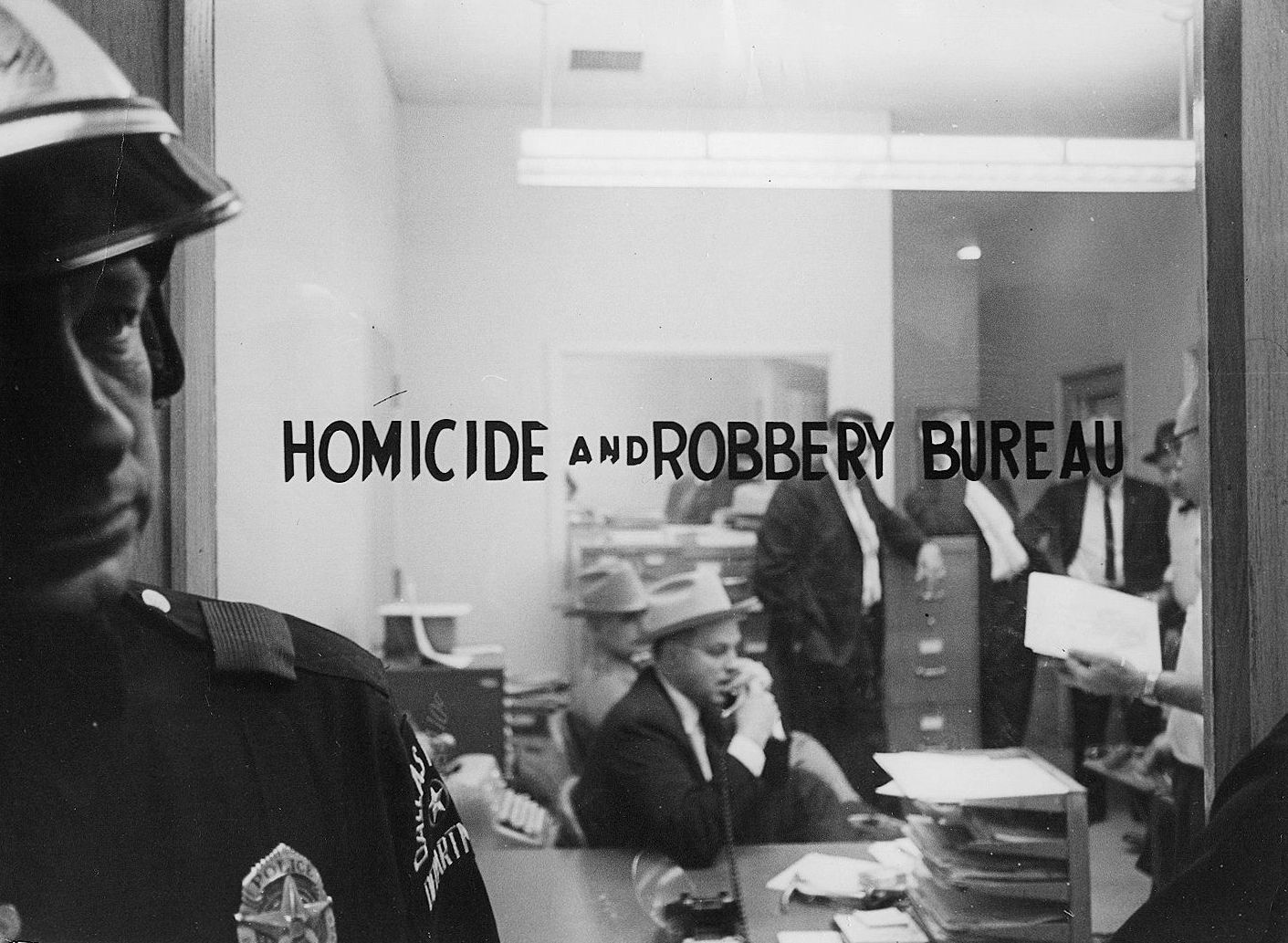
November 22, 1963: Will Fritz and the JFK Investigation

jfk_dpd_post-assassination_ebayThe men of the Homicide & Robbery Bureau at work (click for larger image)

by Paula Bosse

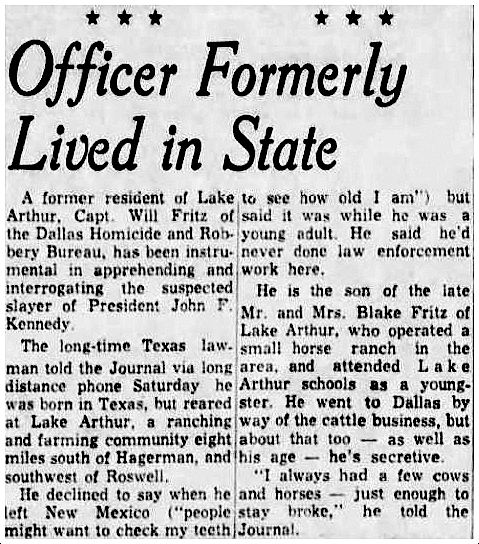
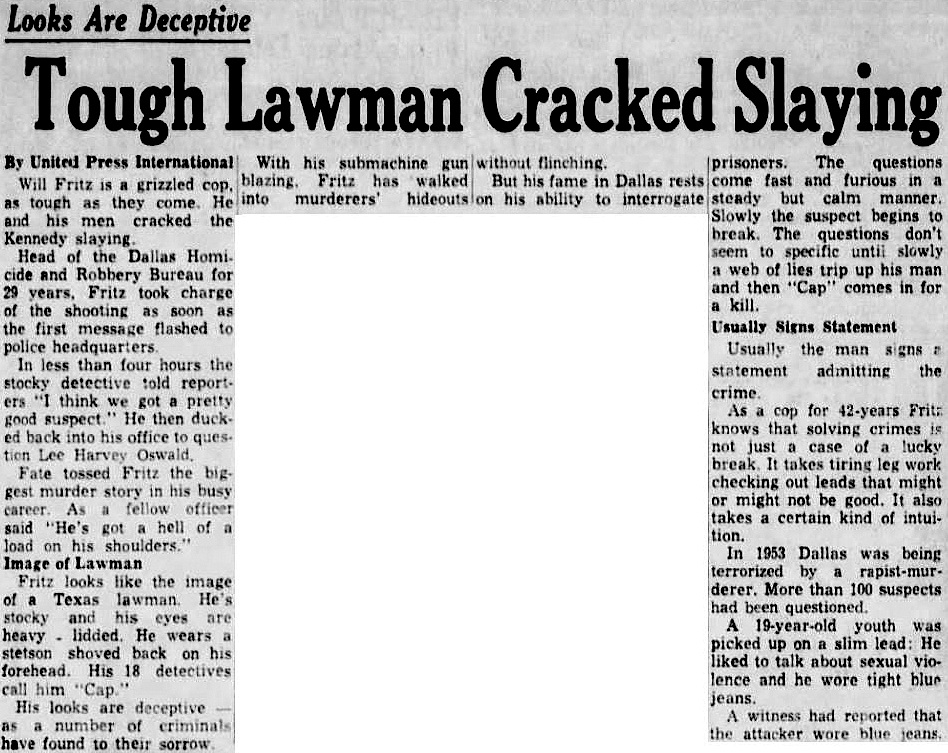
After the unthinkable had happened on the streets of Dallas — the assassination of a U.S. president — the Homicide and Robbery Bureau of the Dallas Police Department, led by Will Fritz, Captain of Detectives, sprang into action and quickly apprehended Lee Harvey Oswald as a suspect in the shooting of President John F. Kennedy. The FBI, the Secret Service, the Texas Rangers, and the whole of the Dallas Police Department worked together, but Fritz was the face of the investigation.

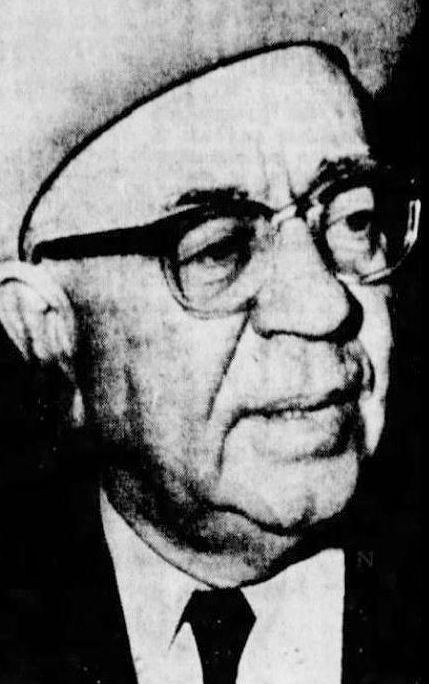
Will Fritz (1895-1984) was born in Dublin, Texas and grew up in New Mexico. He joined the Dallas Police Department in 1921 and remained on the force for 49 years, retiring in 1970 at the age of 74. He was considered one of the top police interrogators in the state and was a dedicated lawman — so dedicated he lived just steps away from police headquarters in the White Plaza Hotel (originally the Hilton Hotel, now the Indigo).

The success rate of Fritz’s detectives was impressive:

The record of Fritz and the Police Department’s Homicide and Robbery Bureau — which he has led since its formation — is a nationally enviable one. Over the past quarter century, he and his aides have solved roughly 98 per cent of the 54 to 98 homicides committed each year. (Dallas Morning News, March 1, 1959)

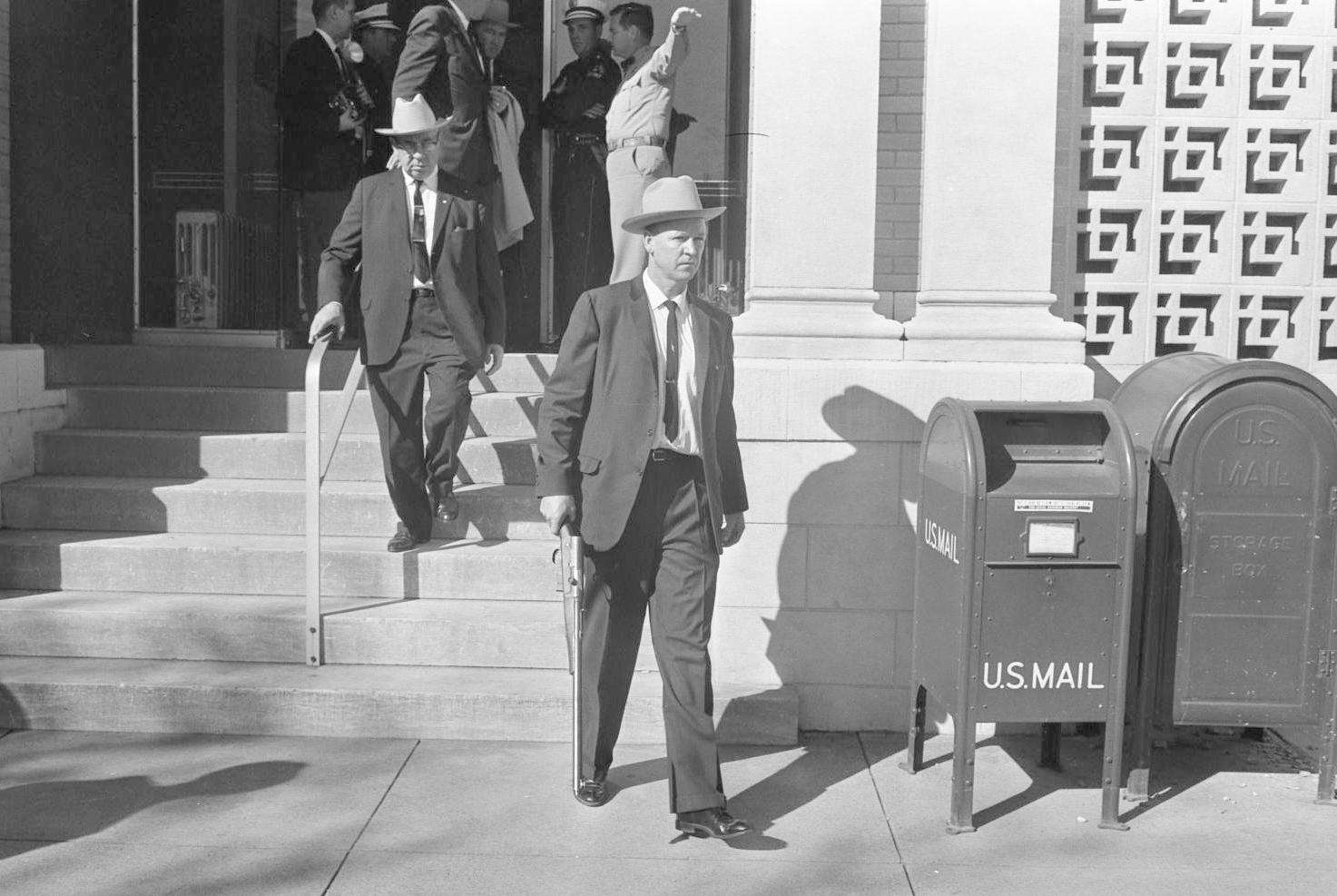
Fritz served for almost half a century with the DPD, involved in all sorts of colorful cases, but he’ll always be most remembered for the events surrounding the JFK assassination. The photo above shows his detectives at work in the Homicide office in the aftermath of the Kennedy assassination; the photo below shows him exiting the Texas School Book Depository with DPD detective Elmer Boyd (carrying rifle).

jfk_fritz_school-book-depository_112263_portal

*

*

jfk_fritz_albuquerque-journal_112463-photo

jfk_fritz_albuquerque-journal_112463a

jfk_fritz_albuquerque-journal_112463b

jfk_fritz_albuquerque-journal_112463_sidebar
Above photo and clippings from the Albuquerque Journal, Nov. 24, 1963

***

Sources & Notes

Top photo showing a Dallas police officer standing outside the Homicide and Robbery Bureau is from a 2015 eBay listing. The reverse of the photo is stamped “Paris Match/Marie Claire.”

Photo showing Fritz walking down the steps of the Texas School Book Depository, taken on November 22, 1963 by Dallas Times Herald staff photographer William Allen. It is from the Sixth Floor Museum’s Dallas Times Herald Collection, which is hosted online by the University of North Texas Libraries, via the Portal to Texas History, here (with additional information here).

More about Capt. Will Fritz from the Handbook of Texas History, here.

A really interesting profile of Fritz can be found in the 1959 Dallas Morning News article “Captain Fritz: Stays With the Case” by Don Freeman (DMN, March 1, 1959).

Other Flashback Dallas posts related to the assassination of President John F. Kennedy can be found here.

Click on photos and clippings to see larger images.

*

Copyright © 2016 Paula Bosse. All Rights Reserved.
 

Voting Day

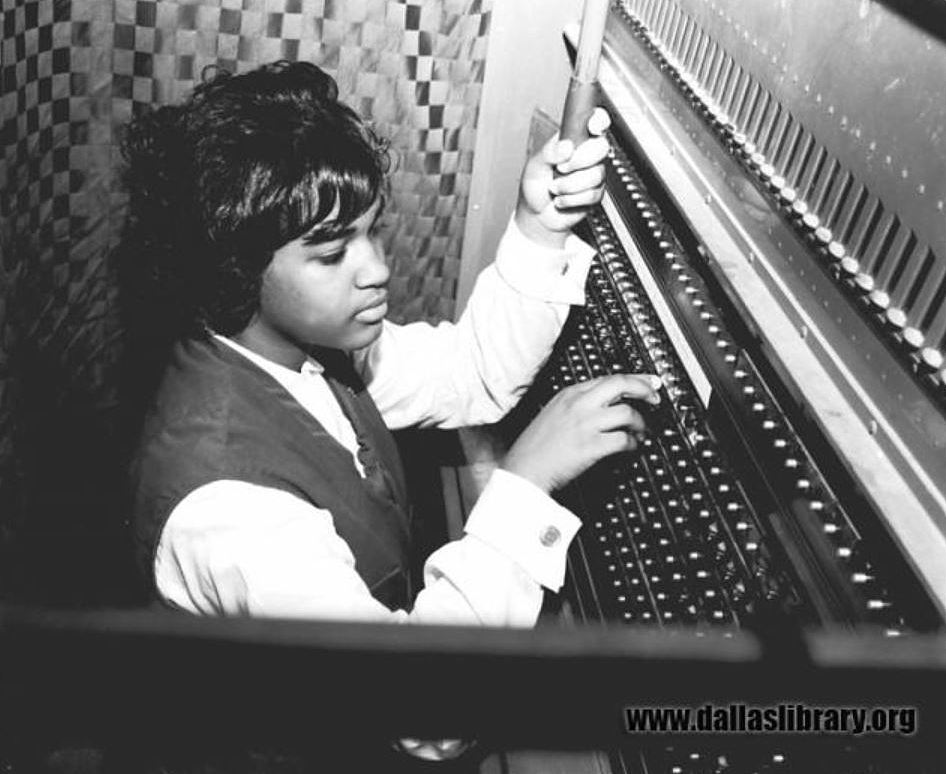
voting-instructions-for-youth_marion-butts_dpl_1965Lever-pulling behind the curtain, 1965 (click for larger image)

by Paula Bosse

It’s here, y’all. Get out and get it done.

voting_uta_no-date

voting_uta_1972

***

Sources & Notes

Top photo from 1965 by Marion Butts, from the Dallas Public Library’s Marion Butts Collection: “Young woman demonstrates the use of a voting machine” — more here (you may have to be logged into to your Dallas Public Library account to reach this page).

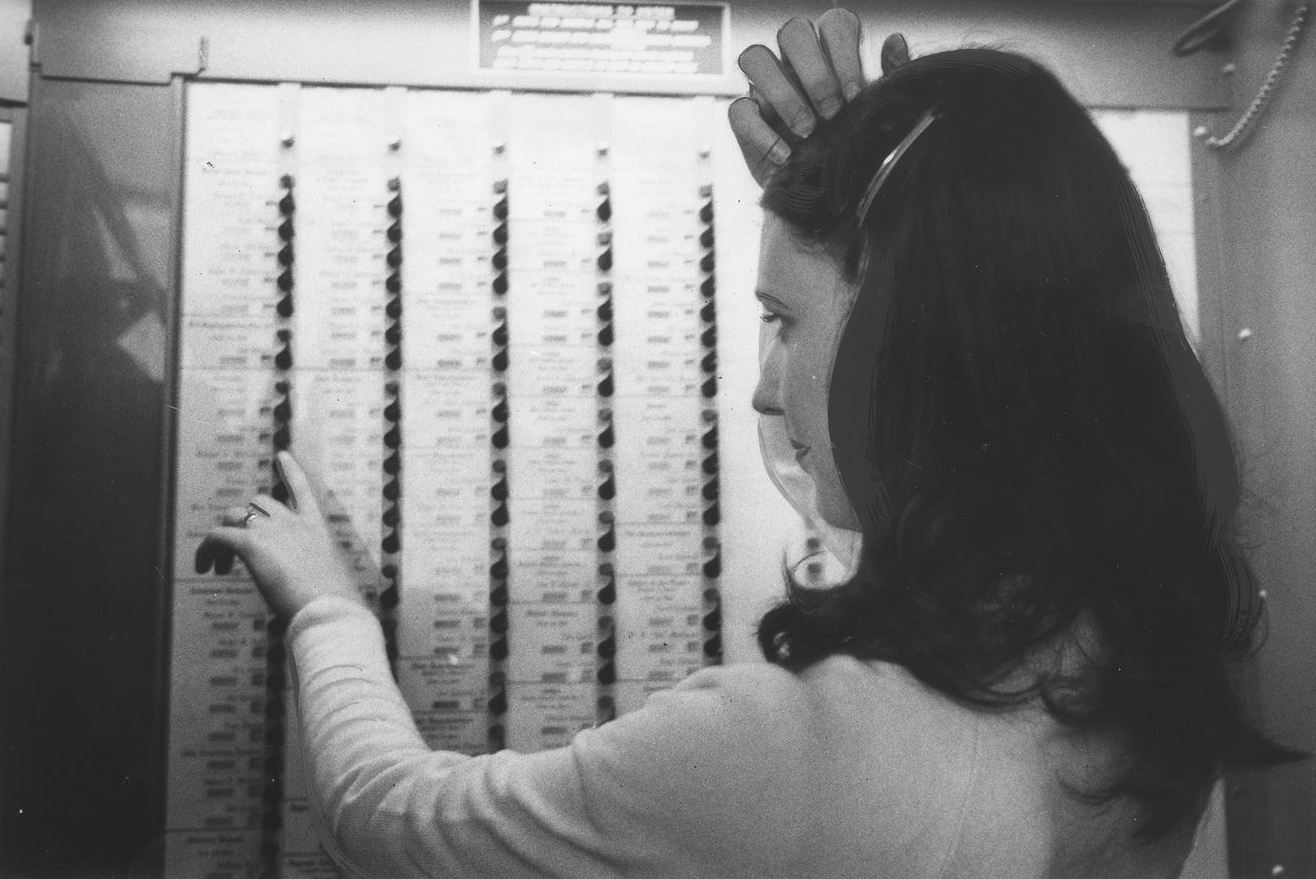
Second photo is undated and has no photographer info: “Early voter, Mrs. Gene Savage, looking at long Democratic party ballot,” from UTA Libraries, Special Collections — more info here.

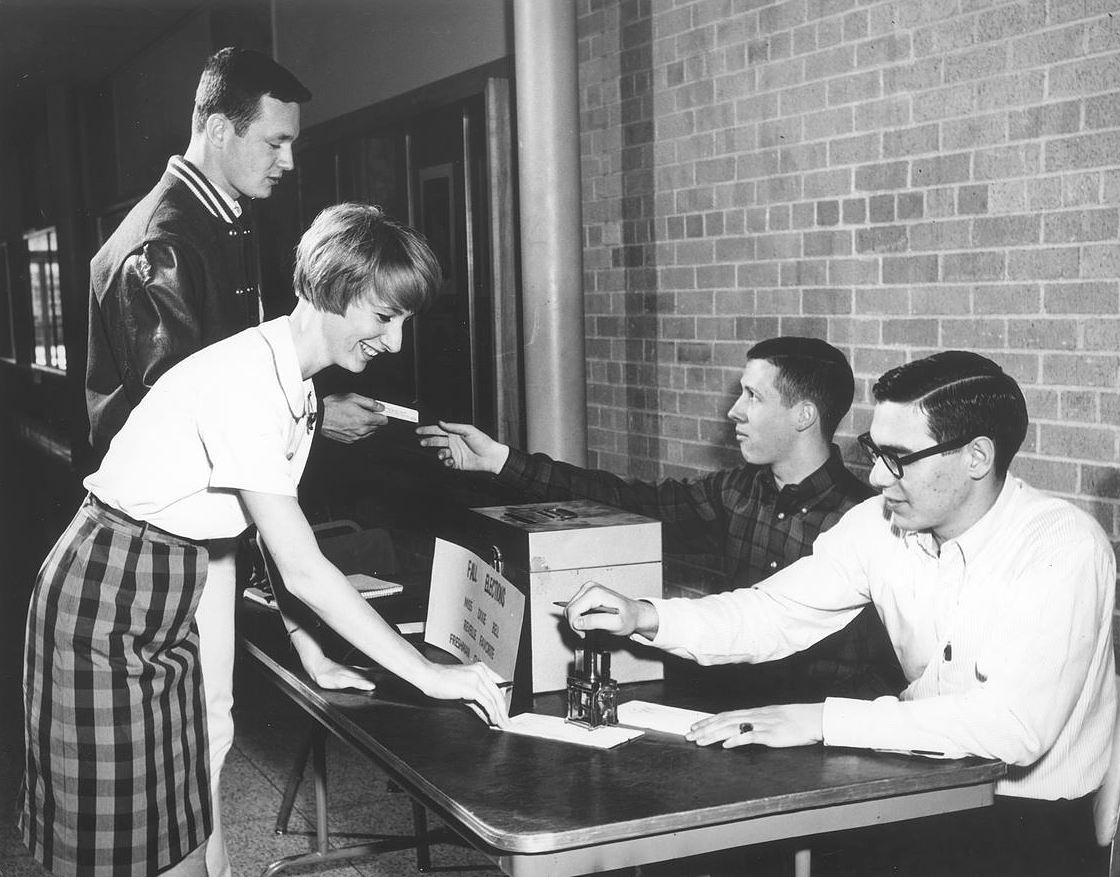
Third photo is from 1972: “Students voting in Fall Elections, University of Texas at Arlington (UTA), 1972,” from UTA Libraries, Special Collections — more info here.

More on Dallas elections can be found in the Flashback Dallas post “How Dallas Used to Get Election Returns,” here.

Click photos to see larger images.

*

Copyright © 2016 Paula Bosse. All Rights Reserved.


Looking South from the Hilltop — 1966

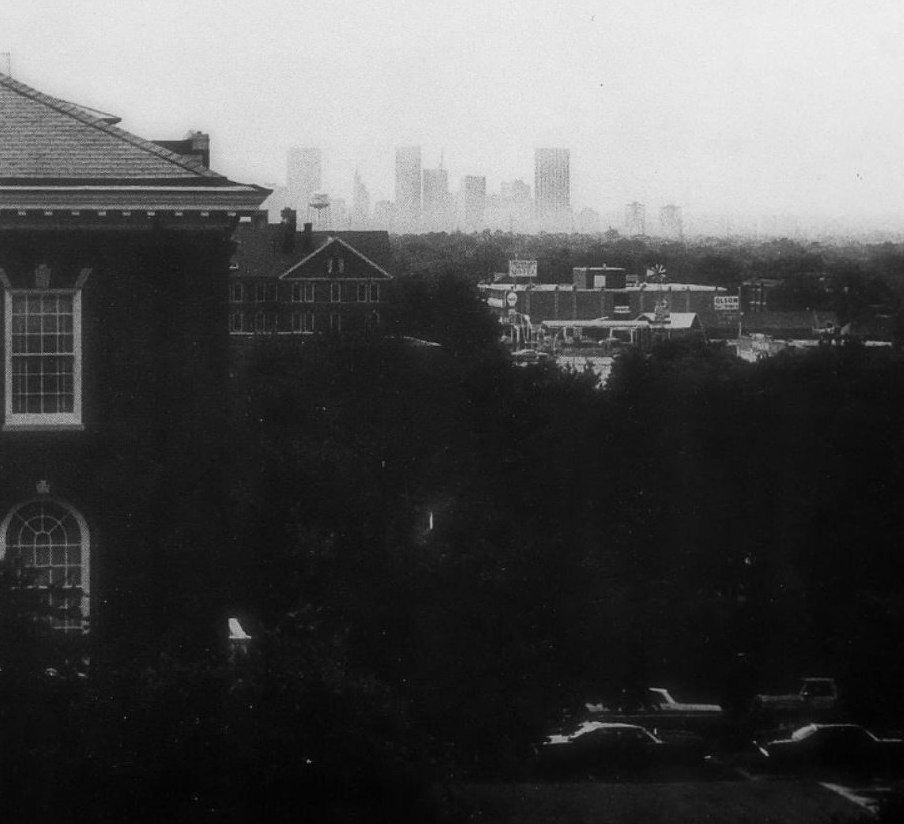
skyline_smu-law-school-yrbk_1966Downtown, as seen from the SMU campus… (click for larger image)

by Paula Bosse

Yeah, the photo is pretty dark, and the image quality leaves something to be desired, but I like this unusual view of a dreamlike downtown skyline, as seen from the SMU campus. Hillcrest Avenue — the SMU drag — can be seen in the upper center; the large building on the west side of Hillcrest is the University House Motel (still standing, but expanded and massively renovated as Hotel Lumen). Right next to the motel is the excessively quaint windmill of the Little Red Barn restaurant.

It all seems very calm.

***

Photo from the 1966 Southern Methodist University Law School yearbook.

*

Copyright © 2016 Paula Bosse. All Rights Reserved.
“How the News Got Made” — SMU’s WFAA Newsfilm Collection Spotlighted at the Dallas VideoFest

wfaa-newsfilm_thumbnails_hamon_cul_smu(G. William Jones Film and Video Collection, SMU)

by Paula Bosse

The Dallas VideoFest is in full swing this weekend, and one of the events on the schedule is How the News Got Made: A Rare Look at SMU’s WFAA Newsfilm and a Conversation with the People who Created It.” This screening and panel discussion will include WFAA news clips and B-roll footage on 16mm film from the 1960s and ’70s, selected from the large WFAA Newsfilm Collection (part of the moving image holdings of the G. William Jones Film and Video Collection, Hamon Arts Library, Southern Methodist University).

A few months ago I saw a screening at SMU of some of these clips — which had been selected by the collection’s curator, Jeremy Spracklen, who has also, I believe, compiled the clips for the VideoFest presentation — and I really enjoyed it. Being able to watch 45- or 50-year-old news clips — of subjects both newsworthy and not-so-newsworthy — is an interesting way to study moments in the history of Dallas. It’s certainly more immediate and “flavorful” than reading old black and white newspaper clippings. I mean … you can listen to people actually talking. (With actual ACCENTS!) And see them move! SMU is in the process of identifying people and places seen in these clips and may soon request crowdsourced assistance from the public. It’s a large undertaking, further complicated by the fact that much of the footage was received by SMU randomly spliced together, some of it raw footage without sound. The hope is to identify subjects and subject matter in order to assist researchers, historians, and documentarians.

At present, almost two decades’ worth of these film reels are slowly being digitized; when the transfers are complete, they are uploaded to SMU’s Central University Libraries site and are free to be viewed by the public. Check what’s up now, here, and watch a few yourself.

There is a great Dallas Observer article by Jamie Laughlin on this collection. You must make sure to scroll down and watch the clip of fresh-faced Channel 8 newsboy Bill O’Reilly (yes, that Bill O’Reilly) interview the only slightly younger-looking future superstar ventriloquist (…two words I’ve never typed one right after the other before…) Jeff Dunham, who, at 14, seems really excited to be talking about his craft on TV.

And, if only a sliver of what I saw of the hilariously bizarre and wonderfully entertaining footage from about 1969 of mini-skirt-and-sideburn-hating Texas Land Commissioner Jerry Sadler — who was reported to have grabbed and choked a political critic in a dispute over Spanish galleon treasure recovered off the Texas coast (…yes, that’s what I said…) —  is shown at the VideoFest, it will be WELL worth your time!

***

Sources & Notes

The top image is a collection of thumbnail images of WFAA digital files which have been uploaded to the Central University Libraries’ site, here.

Read about this WFAA Newsfilm Collection in the Hamon Arts Library digital collection here.

For more information on the collection, contact filmarchive@smu.edu.

The Dallas VideoFest program, “How the News Got Made: A Rare Look at SMU’s WFAA Newsfilm and a Conversation with the People who Created It,” takes place this weekend, Saturday, Oct. 22, 2016, 5:15-6:45 PM at the Angelika Film Center. More information on the event and the panel participants is here.

*

Copyright © 2016 Paula Bosse. All Rights Reserved.
 

“Teen-Age Downbeat”

teen-age-downbeat_broadcasting-mag_051859_detWBAP’s “Teen-Age Downbeat,” 1959 (click for larger image)

by Paula Bosse

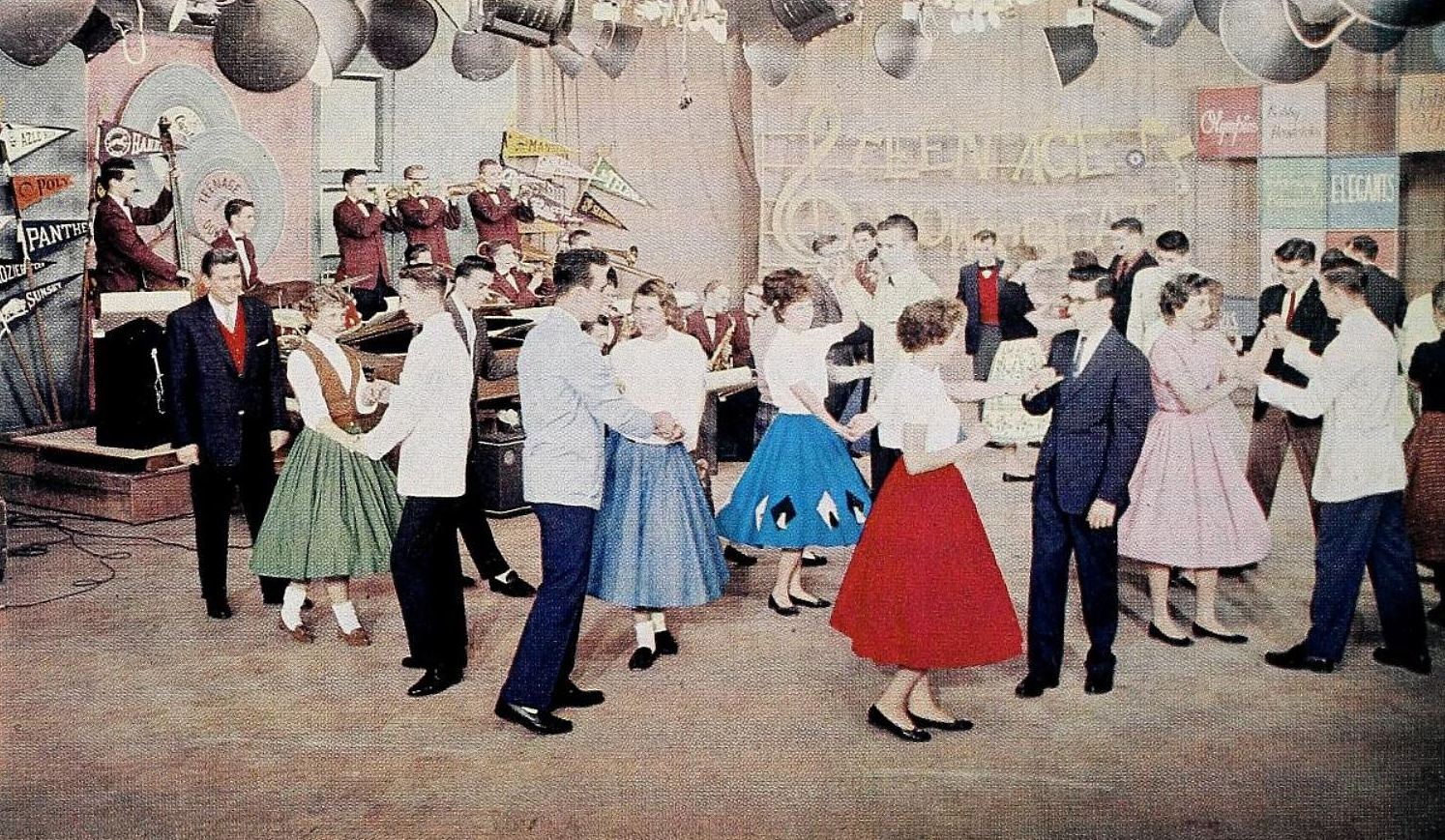
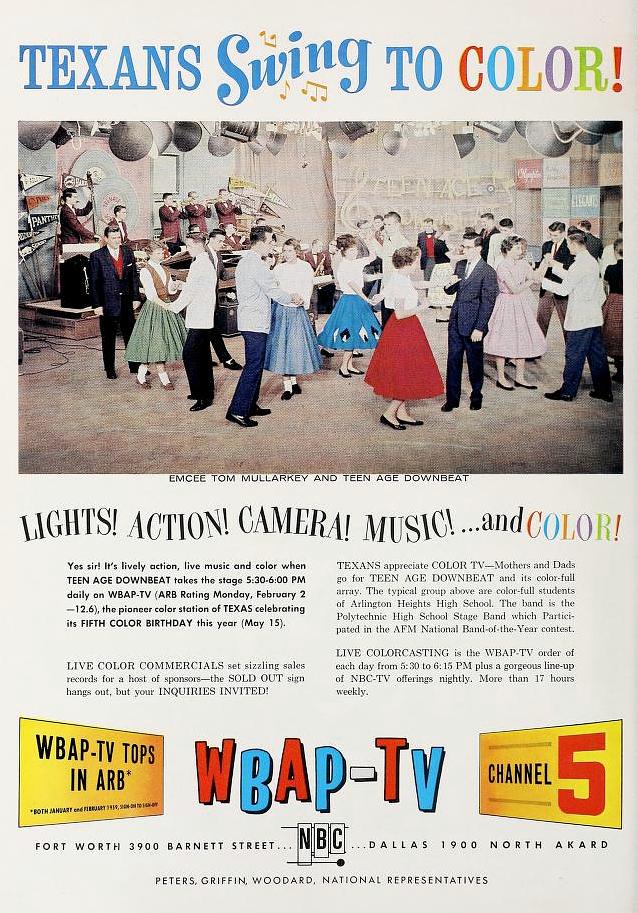
“Teen-Age Downbeat” — Fort Worth’s answer to “American Bandstand” — debuted on WBAP-TV in January, 1958 — in COLOR. It featured teens from the Dallas-Fort Worth area (…or maybe I should say from the Fort Worth-Dallas area…) who would play and dance to their favorite records. The host was WBAP broadcaster Tom Mullarkey (seen above at the left, wearing the red vest). The show was quite popular and lasted as best I can tell, from January, 1958 until July, 1961 (the last mention in The Fort Worth Star-Telegram was July 1, 1961). I’m guessing those kids danced to a lot of Fabian.

teenage-downbeat_fwst_010558FWST, Jan. 5, 1958

teen-age-downbeat_sponsor-mag_080860“Sponsor” trade magazine, Aug. 8, 1960

teen-age-downbeat_unt-lab-bandNorth Texas State College’s Lab Band with director Gene Hall

teenage-downbeat_fwst_022661
FWST, Feb. 26, 1961

teen-age-downbeat_broadcasting-mag_051859
“Broadcasting” trade magazine, May 18, 1959

teen-age-downbeat_xmas_1958_fortworthhistorical-IG“Toys For Tots” campaign, Christmas 1958

***

Sources & Notes

The color photo (which appeared in a full-page WBAP ad in the trade magazine Broadcasting) shows non-teen Tom Mullarkey watching over the dancers from Arlington Heights High School, as the Polytechnic High School Stage Band plays some happenin’ tunes. (I do see two Dallas high school pennants in the photo: Crozier Tech and Sunset.)

The photo showing director Gene Hall with the North Texas State College (now the University of North Texas) Laboratory Band was found at UNT’s Portal to Texas History site, here. The photo is not dated, but a blurb in The Fort Worth Star-Telegram mentioned that Hall and the band were to appear on “Teen-Age Downbeat” on Feb. 5, 1959.

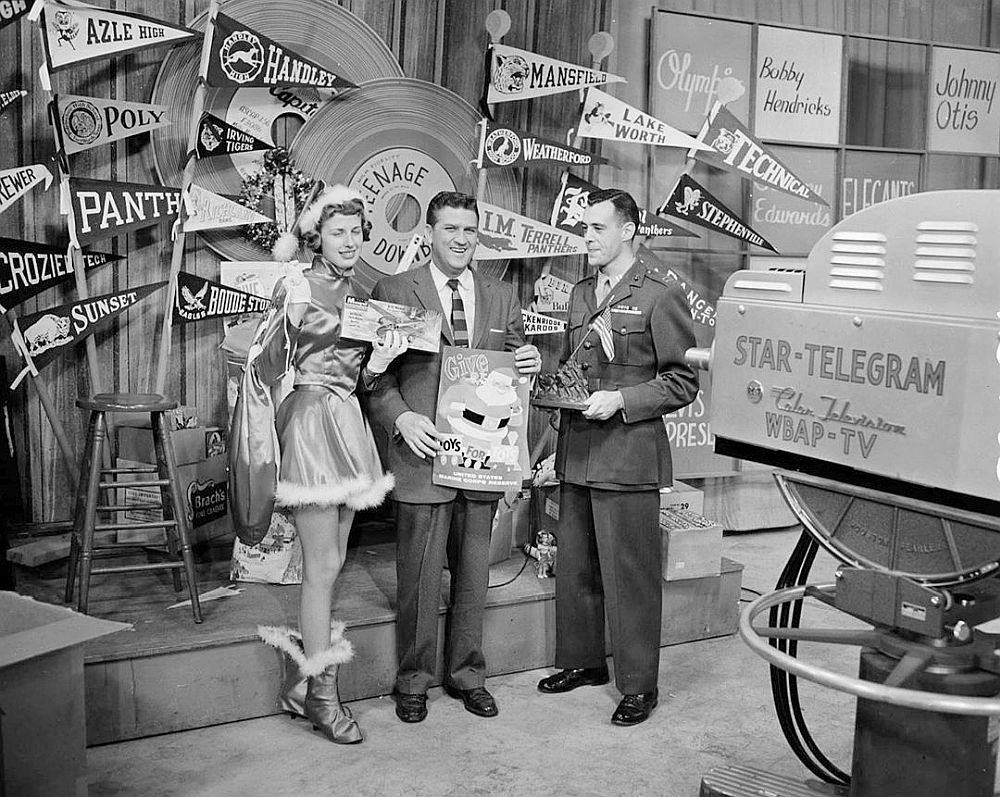
Photo of the “Toys For Tots” campaign, featuring a sexy Santa’s helper, Tom Mularkey, and a Marine Corps (Reserve?) officer was found on the Instagram feed of @fortworthhistorical.

*

Copyright © 2016 Paula Bosse. All Rights Reserved.
Adamson High School People and Places, Part 2 — 1960s

adamson_1966-yrbk_dance-plaidHave plaid, will dance — 1966… (click for larger images)

by Paula Bosse

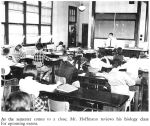
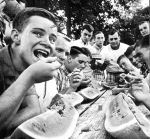
Check out these random photos of Adamson High School and its students, mostly from the 1966  yearbook. (Click for larger images.)

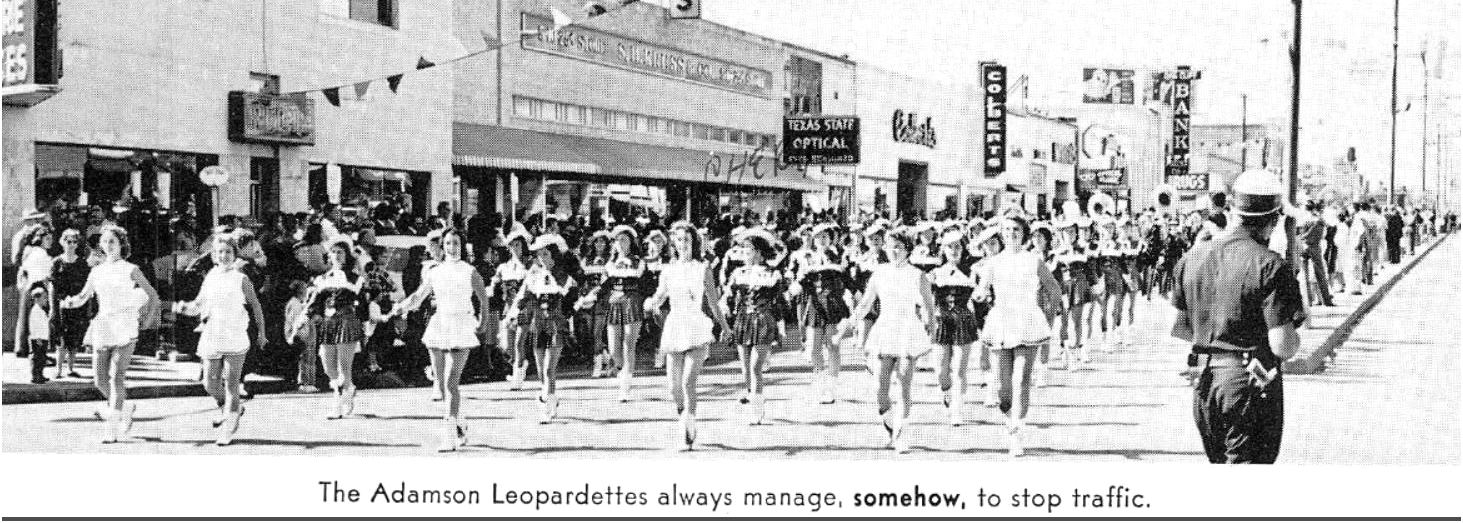
1961_adamson-yrbk_leopardettes1961

adamson_1966-yrbk_leopard
Go Leopards!

***

See the companion post (which shows advertisements from 1960s editions of the W. H. Adamson High School yearbook) here.

*

Copyright © 2016 Paula Bosse. All Rights Reserved.
Adamson High School People and Places, Part 1 — 1960s

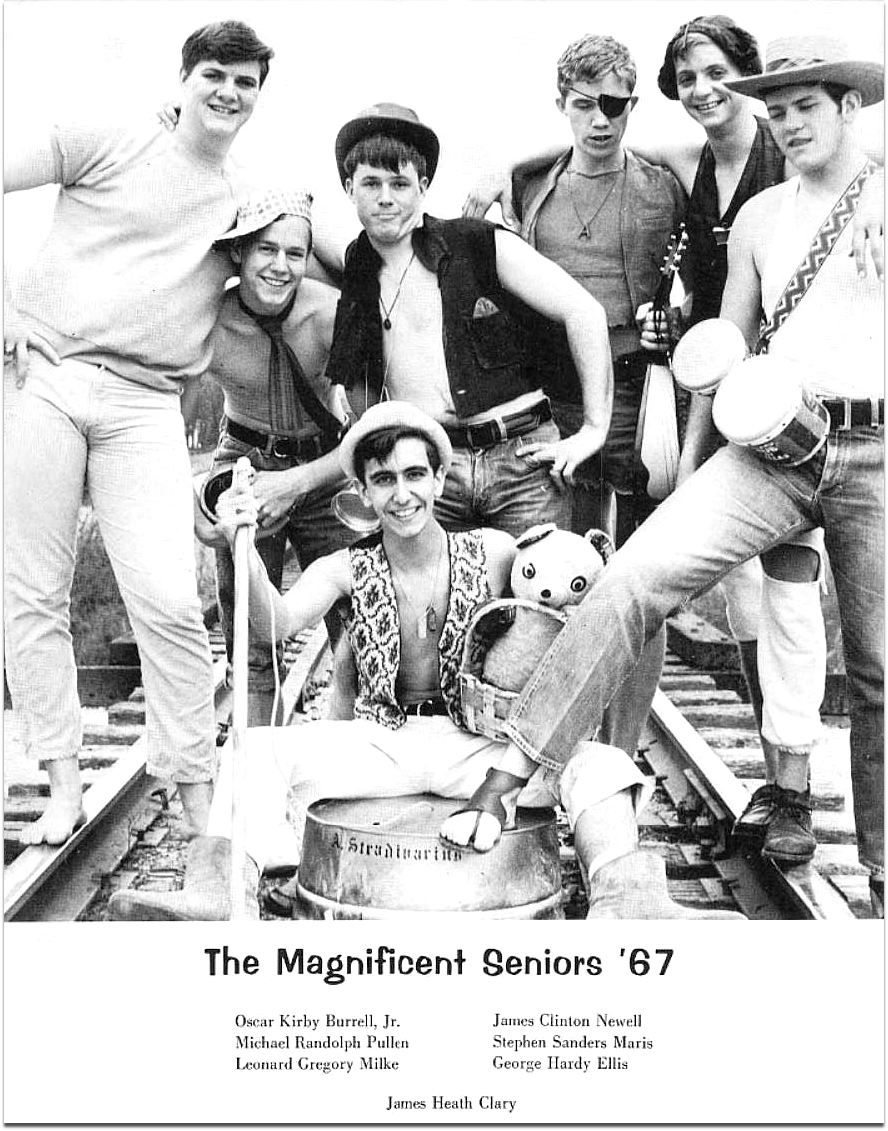
adamson-high-school_1967-yrbk_magnificent-seniors_adThe super-groovy Magnificent Seven of 1967

by Paula Bosse

Here are a whole bunch of 1960s ads from Adamson High School’s yearbooks. Go Leopards! (Click to see larger images.)

Above, a group of guys took out an ad for themselves in their 1967 senior yearbook:

  • Oscar Kirby Burrell, Jr.
  • James Clinton Newell
  • Michael Randolph Pullen
  • Stephen Sanders Maris
  • Leonard Gregory Milke
  • George Hardy Ellis
  • James Heath Clary

Thumbs up for creativity, guys!

Below, churches, lotsa churches, including:

  • Cliff Temple Baptist Church (from the 1961 yearbook)
  • First Church of the Nazarene (1961)
  • Galilean Baptist Church (1961)
  • Grace Temple Baptist Church (1961)
  • Polk Street Baptist Church (1964)
  • Oak Cliff Presbyterian Church (1966)
  • Western Heights Church of Christ (1966)
  • Grace Temple Baptist Church (1967)

And then you’ve got your garages and gas stations, including:

  • O. B. Goodman’s Gulf Service Center (1967)
  • Herbie Dodd Wynnewood Texaco (1965)
  • Navarro Custom Automotive (for all your hot rod needs) (1966)

And Safety Brake Service over the years: 1961, 1964, 1965.

One must eat:

  • The Old South (1961)
  • Speedy Chick No. 4 (1965)
  • Inky’s Charcoal Burger (1966)
  • Woody’s Pancake House (1965)
  • Big Daddy’s Grill (1966)
  • Goff’s Hamburgers (don’t forget Mrs. Goff’s Ice Cream) (1966, 1967)

And then everything else:

  • U.S. Congressman Joe Pool (1967)
  • Colbert’s (women’s clothing) (1967)
  • Raven’s Pharmacy (1966)
  • John Hiegel’s One Hour Martinizing (1966)
  • King’s Book Store (1966)
  • Ketchum & Killum Sporting Goods (you read that right) (1965)
  • Crosswinds Apartments (1965)
  • Dougherty’s Pharmacy (1964)
  • Doris Wood Bridal & Party Service (1966)
  • Bronco Bowl (…RIP…) (1966)

adamson_1966-yrbk_doris-wood-bridal

adamson_1966-yrbk_bronco-bowl

***

Sources & Notes

Ads from the 1961, 1964, 1965, 1966, and 1967 W. H. Adamson High School yearbooks.

See the companion post (which shows the school and students — mostly from 1966), here.

*

Copyright © 2016 Paula Bosse. All Rights Reserved.