Flashback : Dallas

A Miscellany: History, Ads, Pop Culture

Category: Historic Ads

Selling Kidd Springs Heights, 1909-1910
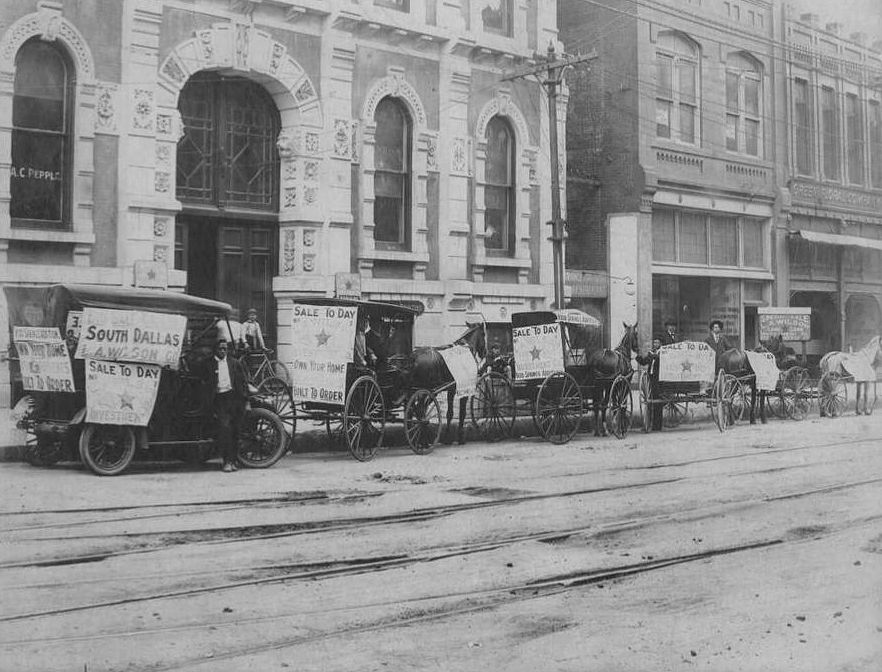
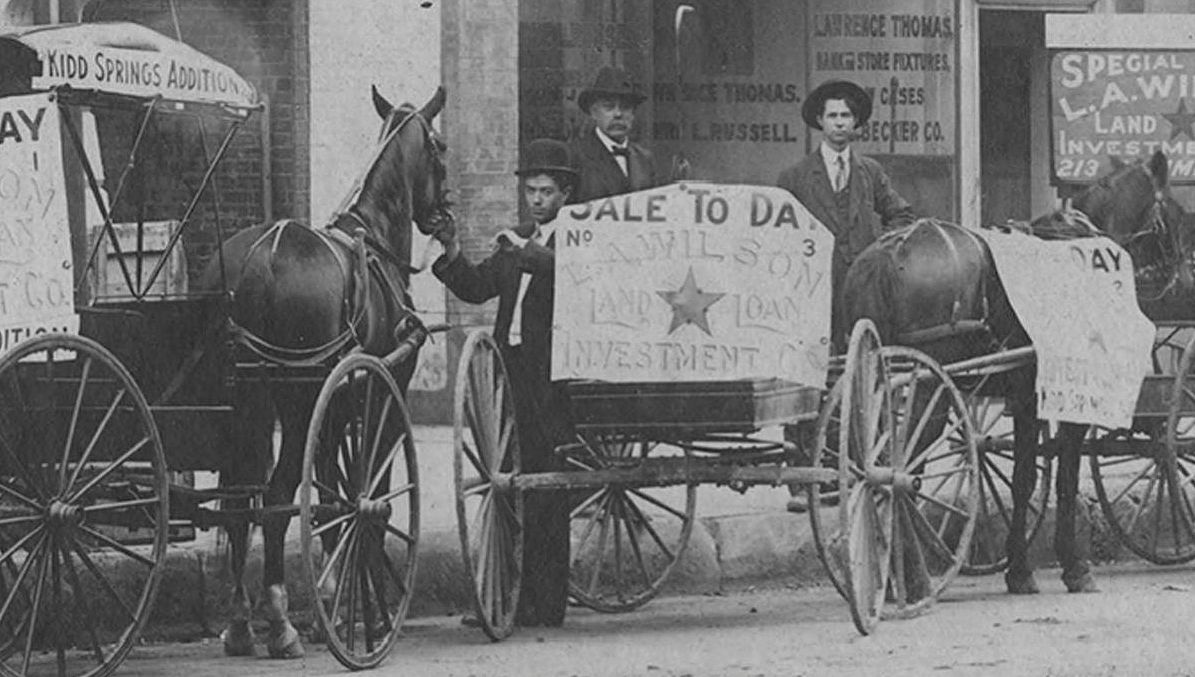
gaston-bldg_1910_cook-degolyerThe L. A. Wilson Co. is having a sale! (photo: SMU)

by Paula Bosse

The above photo shows a car-and-buggy convoy belonging to the L. A. Wilson Land, Loan & Investment Company, stretched out in front of the Gaston Building at Commerce and S. Lamar. There’s a “Sale To Day” and they’re really pushing property in the Kidd Springs Addition in Oak Cliff. The date “April 20, 1910” is written on the back of the photo, and if that’s true, the big show here might be rooted more in desperation than in enthusiasm. The Wilson company began selling the 30-or-so lots in the new Kidd Springs Heights neighborhood in July of the previous year. An ad that appeared seven months before this photo was taken announced that there were only ten lots left. It looks like this was an impassioned display to make Kidd Springs seem more exciting and move that remaining property. People love parades.

(This is another great photo to zoom in on to see the details. All images are larger when clicked.)
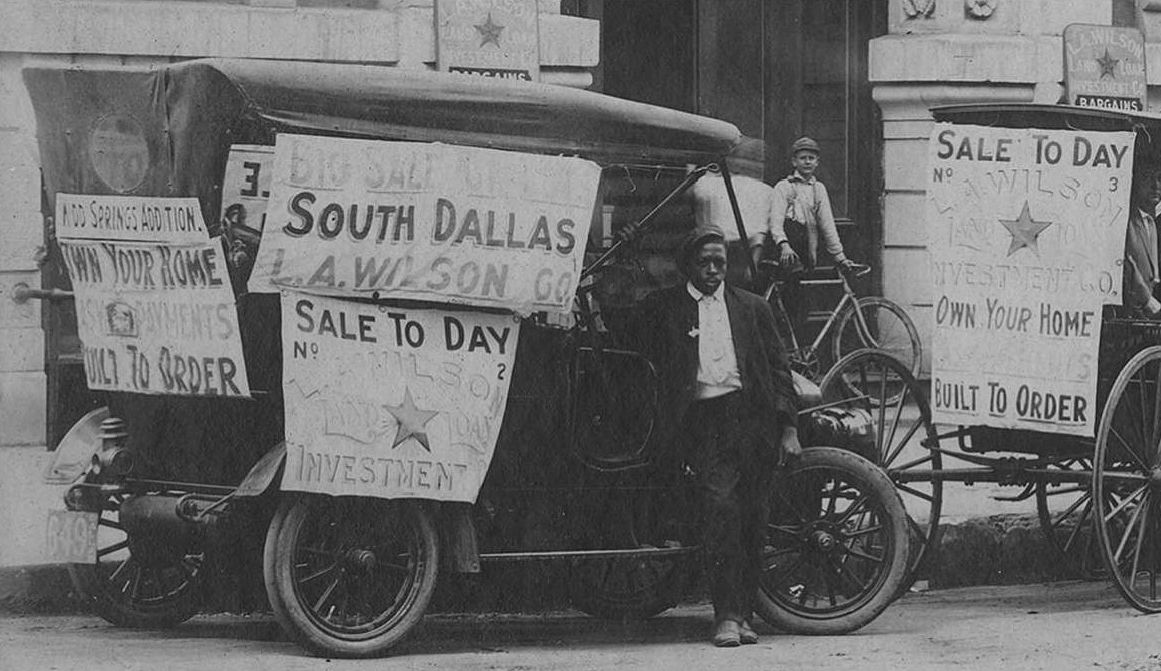
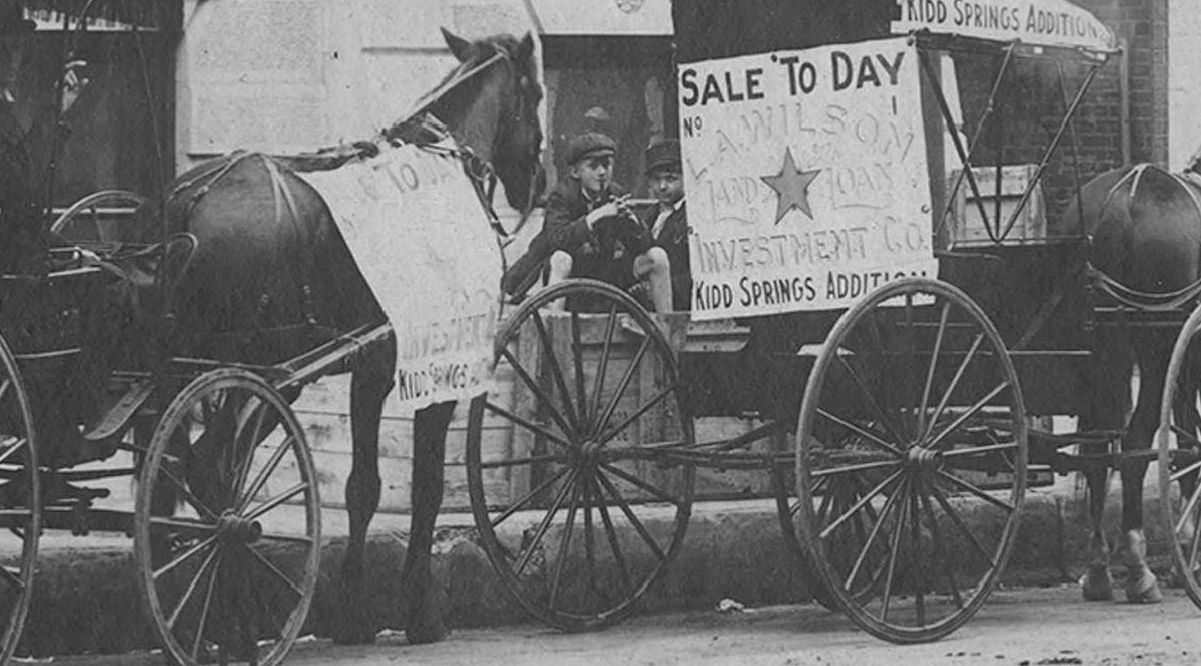
gaston-bldg_1910_cook-degolyer-det1

gaston-bldg_1910_cook-degolyer-det4

gaston-bldg_1910_cook-degolyer-det5

The L. A. Wilson Co. was a fairly large real estate company founded by Missouri-born Lewis A. Wilson (1851-1926); at the time of this photo, the company’s offices were in the Gaston Building at 213 Commerce. (In the photo immediately above, I think the man with the moustache is Mr. Wilson.)
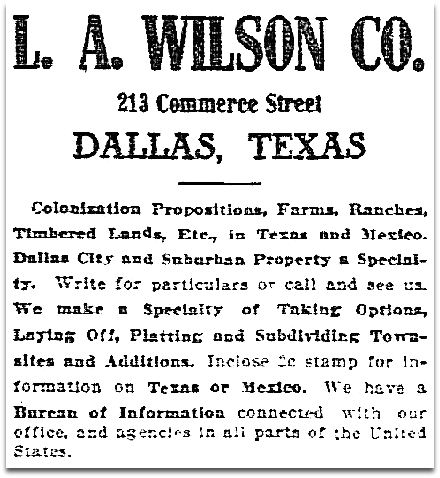
wilson_dmn_070409-detDallas Morning News, July 4, 1909 (ad detail)

The first ad announcing the sale of lots in the Kidd Springs Heights area of Oak Cliff appeared on July 4, 1909. It included the two blocks north of what is now W. Canty, bounded by Turner Ave. on the west and N. Tyler (and Kidd Springs Park) on the east.
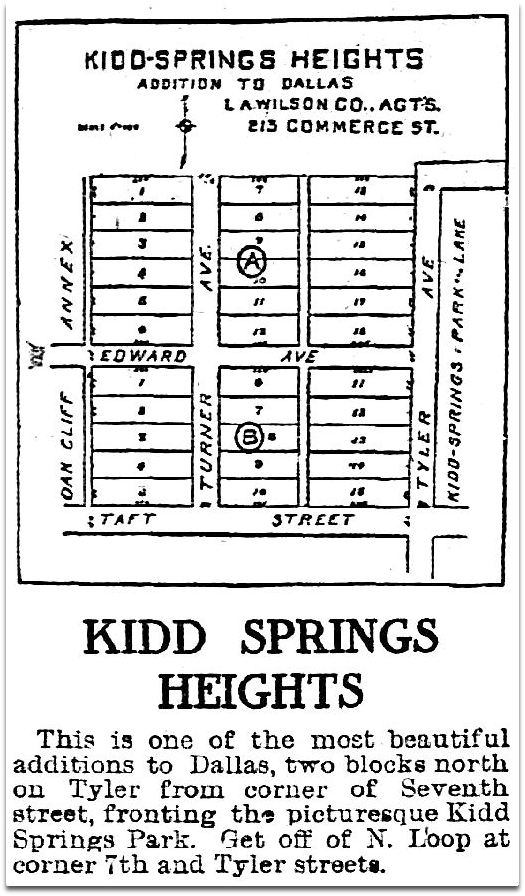
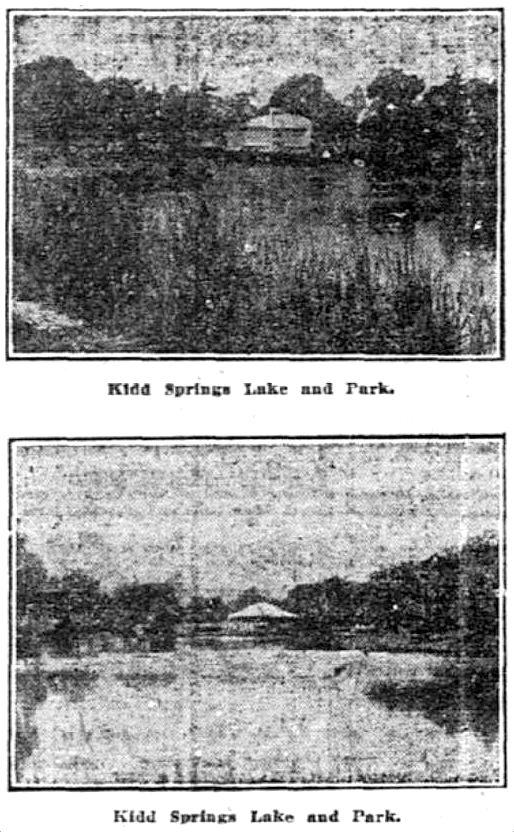
ad-wilson_dmn_070409-text

ad-wilson_dmn_070409-photosDMN, July 4, 1909

Four weeks later, a huge half-page ad ran in The Dallas Morning News, full of wonderful reasons why life would be better in Kidd Springs Heights:

The newest theory of scientists is that one should sleep at least eighty or ninety feet above the level of the city – and thus escape the germs which are particularly active during the hours of darkness. Here then is the place for your home. Here then is the place for investment. Kidd Springs Heights is higher than the top of the court house. Up where the cooling breezes are found on the hottest of hot days; where the air is ozone-laden; where the nights are cool and refreshing and where insomnia soon becomes naught but a dim memory.

The effusive sales copy is definitely worth a read (click ad below to read the full sales pitch).
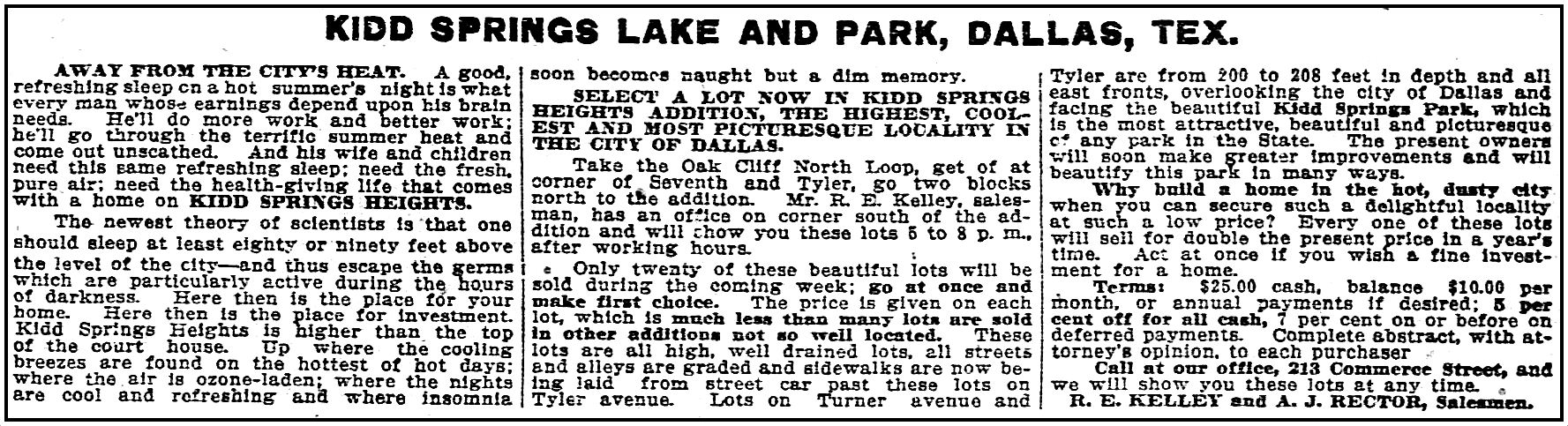
wilson_kidd-springs-heights_dmnn_090109DMN, Aug. 1, 1909

Six weeks later the following self-congratulatory ad appeared. (It’s interesting to note that of the twenty lots sold, two of them had been sold to Mrs. L. A. Wilson, and one each had been sold to the two salesmen. The next year’s telephone directory showed that the Wilsons lived on Live Oak, and the two salesmen lived in boarding houses.)
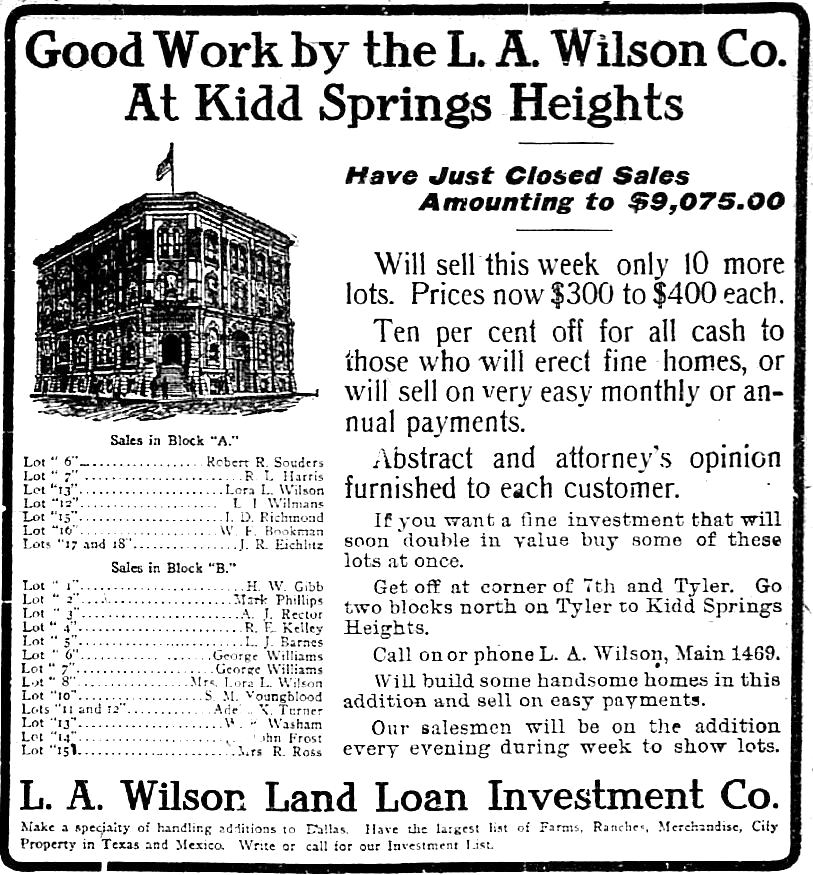
wilson-kidd-springs_dmn_091209DMN, Sept. 12, 1909

It wasn’t until 1921 that the tiny little Kidd Springs Heights was annexed to the city of Dallas.
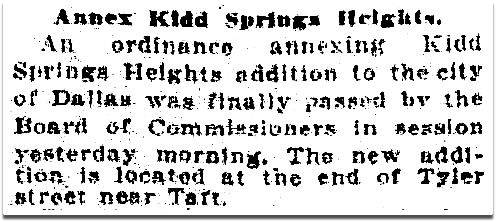
annexed_dmn_051421DMN, May 14, 1921

Things may be different today, but in 1909, these were the boundaries of Kidd Springs Heights.
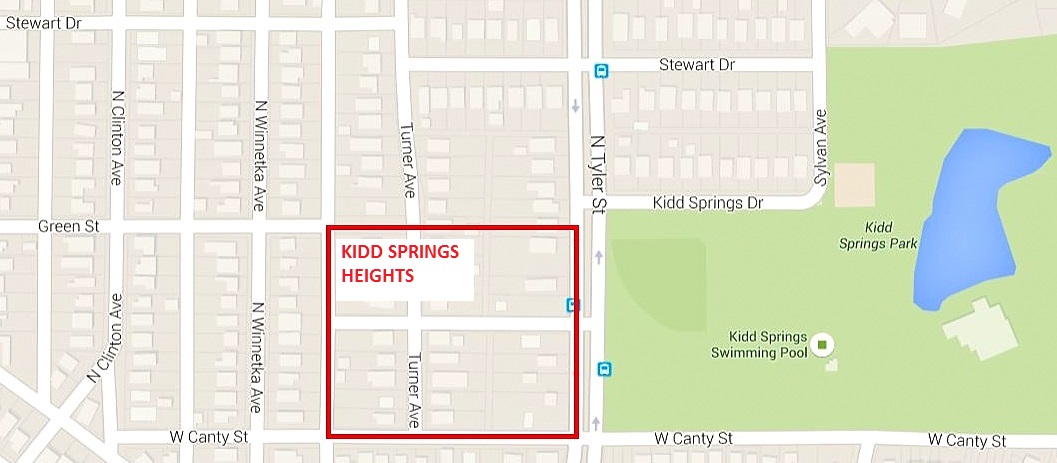
kidd-springs-heights_google_2015

The most interesting odd thing about Kidd Springs Heights? There appear to be two brick archways placed (very awkwardly) across Turner Avenue from one another — each spanning the sidewalk. I can’t find any information about these, but it looks as if they were set right at the northern boundary of the Kidd Springs Heights Addition. Old maps (such as this one from 1919) show no development to the north of this boundary up into at least the ’20s (it doesn’t look as if this addition is even in Oak Cliff proper), so I guess they were there before those sidewalks and served as a welcoming gateway to a new development where germs did not dwell after nightfall.
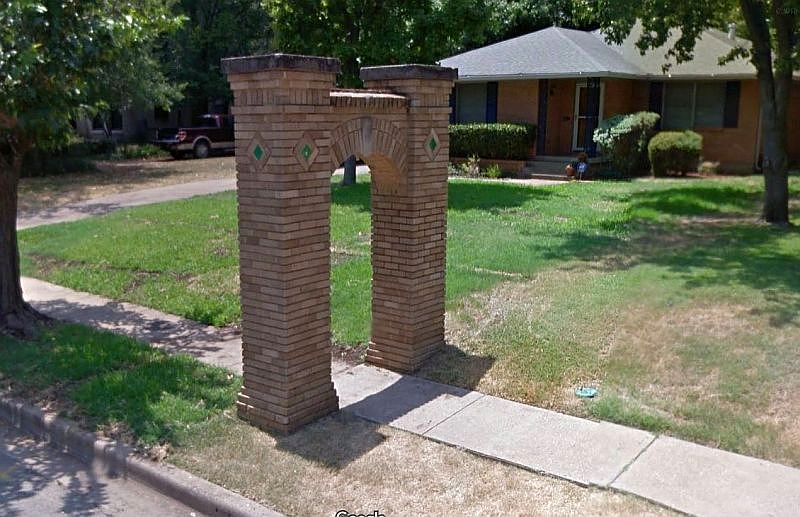
arch_google
900 block of Turner Avenue (Google Street View)

(Check out both of these markers on Google Street View, here. It’s pretty strange-looking.)

If anyone has information on these markers, please pass it along!

***

Sources & Notes

Top photo is titled “L. A. Wilson Land Loan Investment Company, Gaston Building, Commerce Street” — the photographer’s name and the date are written on the back: W. R. Lindsay, April 20, 1910. It is from the George W. Cook Dallas/Texas Image Collection, DeGolyer Library, Central University Libraries, Southern Methodist University, and it can be viewed here. I have adjusted the color.

Lewis A. Wilson’s biography can be read in A History of Greater Dallas and Vicinity (1909), here. His photo:
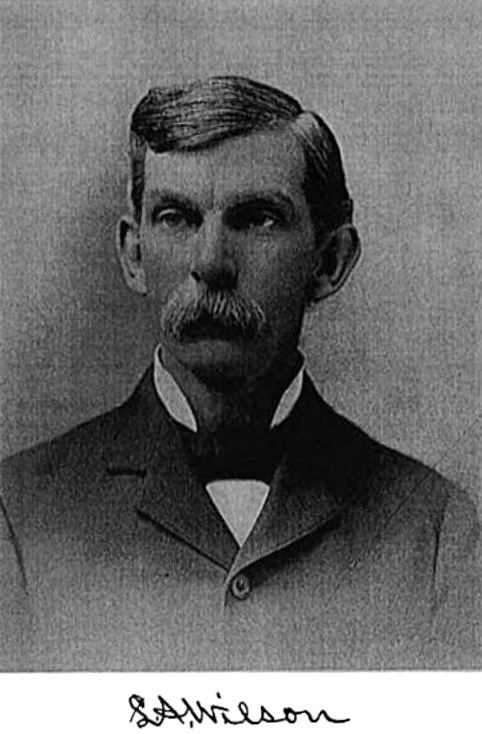
wilson_hist-greater-dallas

The Kidd Springs Wikipedia entry is here.

The Sanborn map from 1922 showing this tiny neighborhood at about the middle of the page on the right can be found here. Note how few lots actually have houses built on them. (Taft is now W. Canty; Edwards is now Everts.)

The Murphy & Bolanz map can be seen here. (If the link doesn’t work, you may need to download the plug-in — information on how to do that is here.)

*

Copyright © 2015 Paula Bosse. All Rights Reserved.

Snag Boat Dallas — 1893

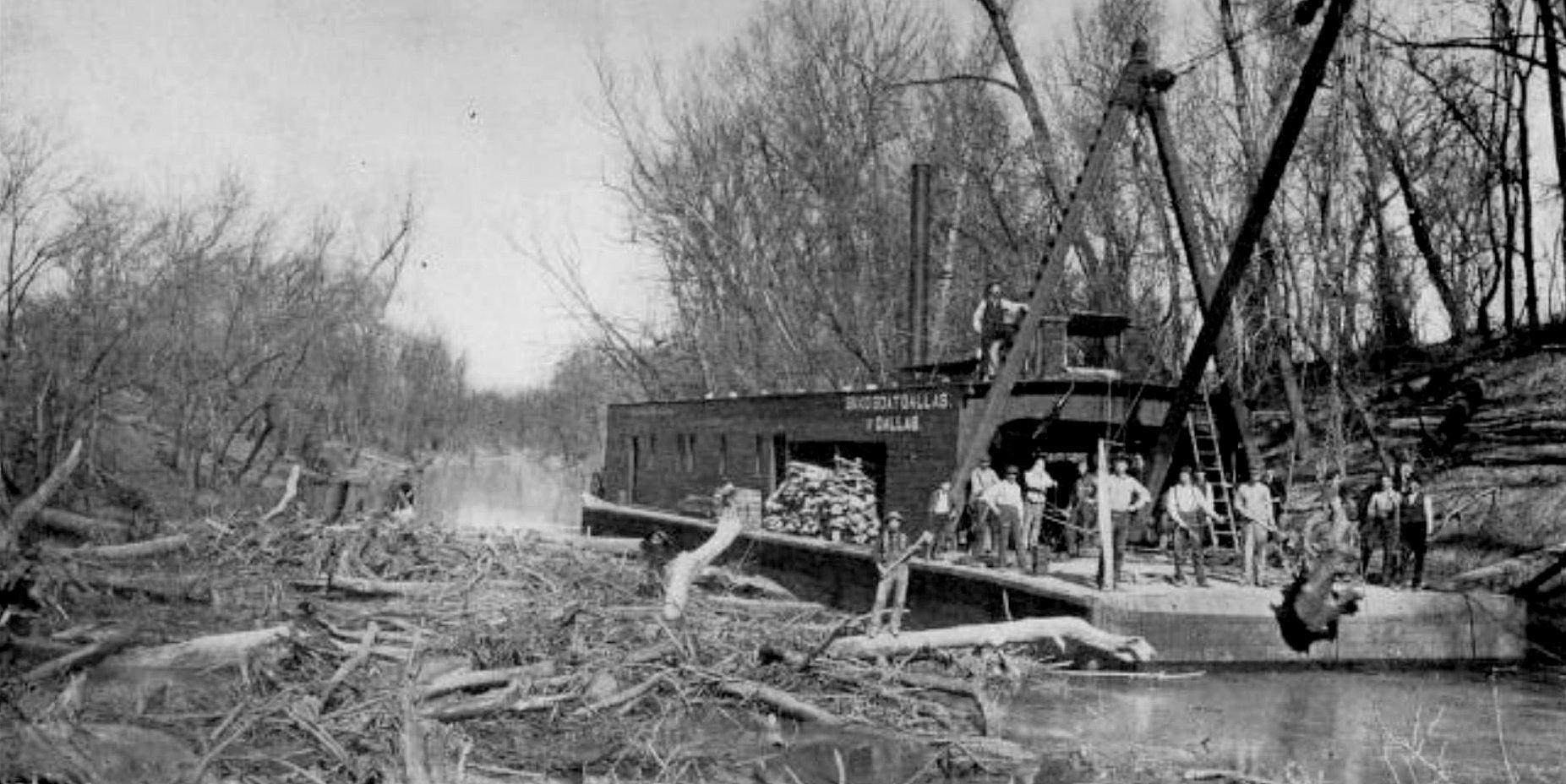
snagboat_dplSnag Boat Dallas of Dallas, Trinity River

by Paula Bosse

“Snagboat.” It’s a great word. And if you’ve taken even a glancing look into the history of the Trinity River, you’ve probably come across it. What is it? According to the Wikipedia entry, it is “a river boat, resembling a barge with superstructure for crew accommodations, and deck-mounted cranes and hoists for removing snags and other obstructions from rivers and other shallow waterways.” If you’re from Dallas, “shallow waterway” will immediately bring to mind our very own Trinity River, which, unless it’s flooding, you probably rarely even think of as being an actual river. But Dallas money-men have tried their damnedest for what seems like EVER to make the Trinity do what they wanted it to do.

In the late 19th century, a group of Dallas businessmen organized the Trinity River Navigation and Improvement Company and began to sink large sums of money into it. The goal was to make the Trinity navigable for large boats between the Gulf of Mexico and Dallas. They knew that if they could open this waterway to vessels carrying all manner of freight that they could make a lot of money. A lot.

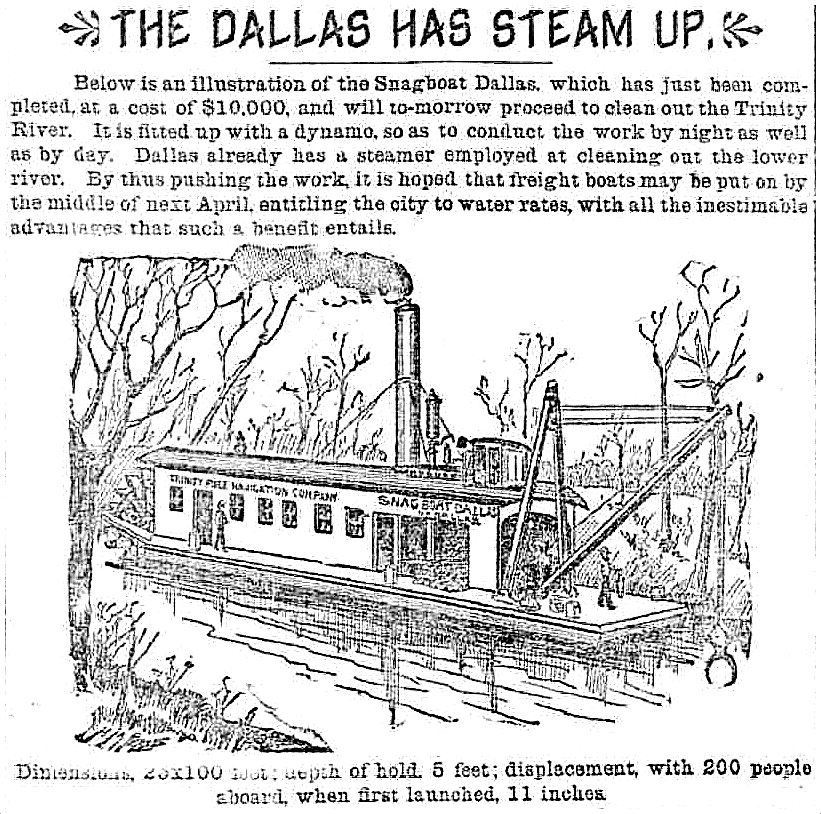
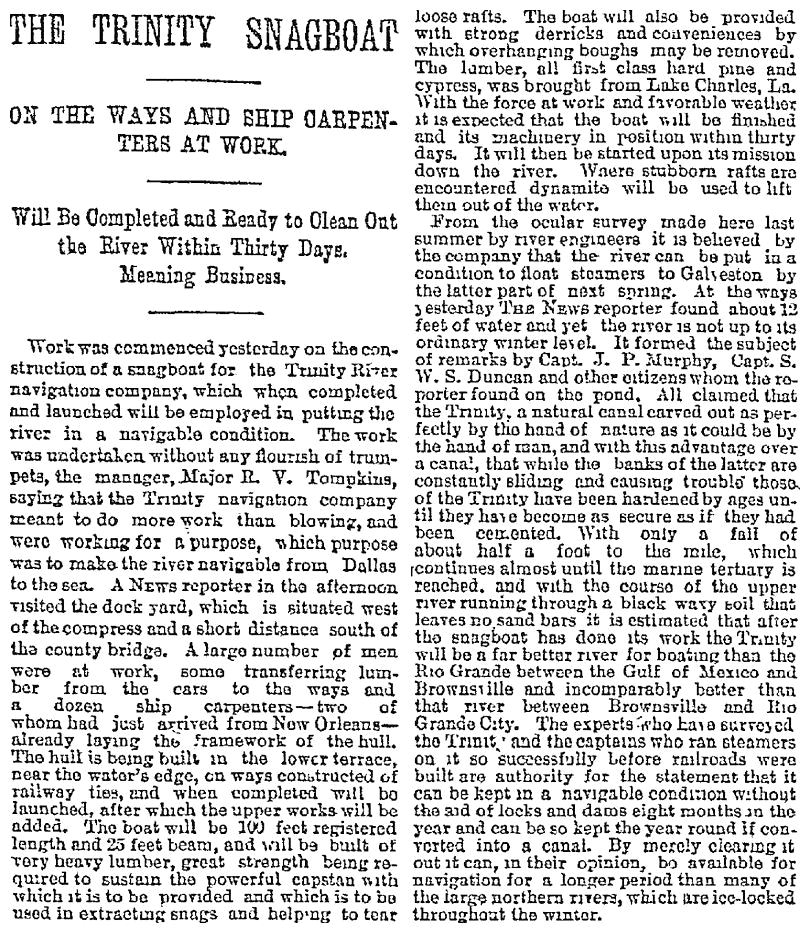
In order to make the Trinity navigable, it first had to be cleared of all sorts of impassable debris in it, on it, over it, and along it. The stretch of the river around the soon-to-be inland port of Dallas was particularly snarled with all sorts of things making passage of large boats through its waters impossible. A snagboat was needed, and construction on the Snag Boat Dallas of Dallas began in November of 1892.

snagboat_dmn_112692Dallas Morning News, Nov. 26, 1892

The construction of the boat was followed closely in the Texas papers, and giddy ads/editorials like this one were filling the pages of Dallas newspapers.

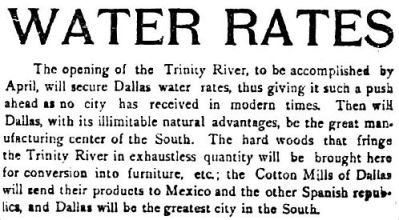
ad-water-rates_dmn_011593DMN, Jan. 15, 1893

“Water rates” — charges for freight shipped via boat — were lower than the rates charged by railroads. Were the Trinity able to support freight traffic, this new competition would mean that railroads would lower their rates, and the savings for manufacturers and builders would  be substantial. As a result, manufacturing and building in the city would boom, and before you knew it, Dallas would become “the greatest city on Earth in the South”!

A few days before the official launch of the boat, reporters, businessmen, and the public were invited to a preview. An interesting account in The Galveston Daily News described the boat’s machinery (which included a “liquid battering ram”) and took the reader on a tour of the crew’s quarters (which had separate sleeping and dining areas for black and white crew members, per the “Separate Coach Law” of 1891).

snagboat_galveston-daily-news-021993Galveston Daily News, Feb. 19, 1893

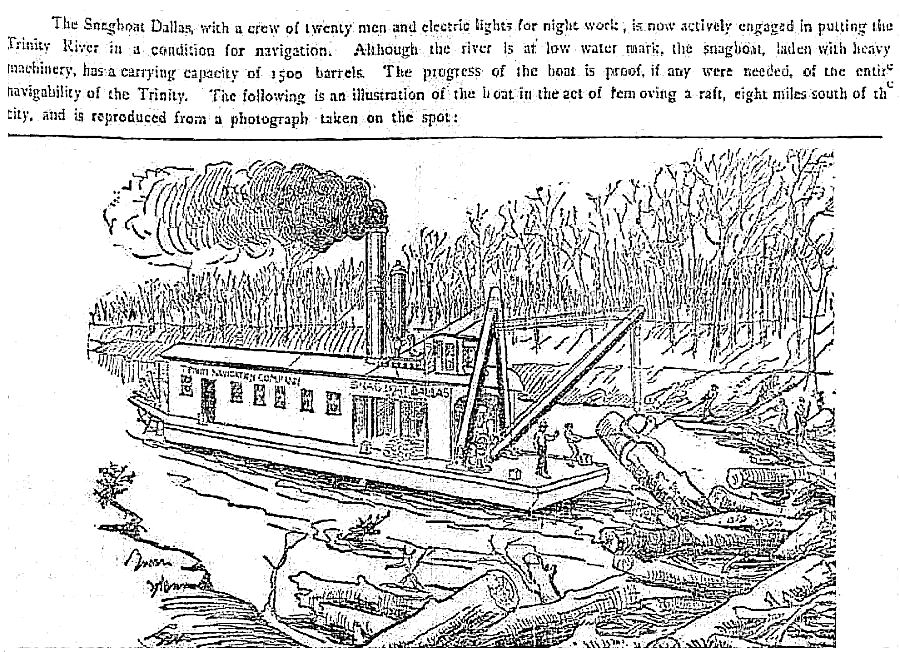
The boat began its snagging work in February, 1893, and, in order to keep readers abreast of all Snag Boat Dallas developments, there were almost daily updates on its progress in the newspapers, and (in lieu of photographs) Dallas Morning News illustrators provided scenes of the boat’s important work.

snagboat_dmn_021293DMN, Feb. 12, 1893

snagboat_dmn_022693DMN, Feb. 26, 1893

The celebrity snagboat succeeded in clearing the debris, and in May, 1893, the steamer H. A. Harvey, Jr. arrived in Dallas, having, yes, navigated the Trinity River from the Gulf, even though it had faced two months’ worth of difficulties along the way (problematic water levels, low bridges which had to be dismantled in order for it to pass under, underwater impediments which had to be dynamited into oblivion, etc.). When it finally pulled into Dallas — accompanied by the hard-working snagboat that had paved its way — the city shut down and had a massive celebration. The Dallas Morning News went so far as to print several of its pages in red ink (!). This proof that the Trinity River was, in fact, navigable, meant that the city was on the cusp on becoming “the greatest city in the South.” The DMN (which was not shy in its almost rabid boosterism of this project) published an editorial for those Dallasites who might “not fully comprehend” the significance of why they were celebrating.

harvey-impact_dmn_052293DMN, May 22, 1893

Dallas would become an important inland port. “It can be done.”

Except that we know that it couldn’t be done. Too many other natural forces were working against the Trinity River entrepreneurs. The Harvey and the snagboat didn’t actually do much after that tumultuous reception in 1893. Sure, they moved some small loads back and forth along the Dallas stretch of the river, but that grand vision of taming the Trinity never came to pass. Even now, more than 120 years later, it still has yet to happen. Dallas has done pretty well without the Trinity River being truly navigable, but people can’t seem to stop trying to somehow monetize it. It’s probably time we just appreciated our little section of the Trinity River for what it is: a little trickle of a river that has (so far) survived everything we’ve tried to do to it in the name of “progress.”

*

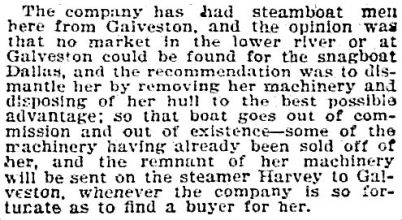
For closure, snagboat fans: the hard-working little Dallas had an ignominious end. It was tied to an old pier and left to rot on the water before it was eventually cannibalized and slowly picked apart. Its end came in January of 1898 when it was finally “broken up.”

rip_dmn_052897DMN, May 28, 1897

RIP, Snag Boat Dallas of Dallas — we hardly knew ye.

*

The Harvey (which quietly left town when it was sold to a Louisiana company in 1898) has gotten the lion’s share of the historical attention, but the snagboat is the one that did all the work. Here are two more photos of the Dallas and its crew taking a break from snagging to pose for posterity.

snagboat_dfwurbanwildlife

The photo below shows just what the crew of the snagboat was up against. The caption was written by C. A. Keating, president of the Trinity River Navigation Company.

snagboat_keating_1890s

snagboat-caption_keating

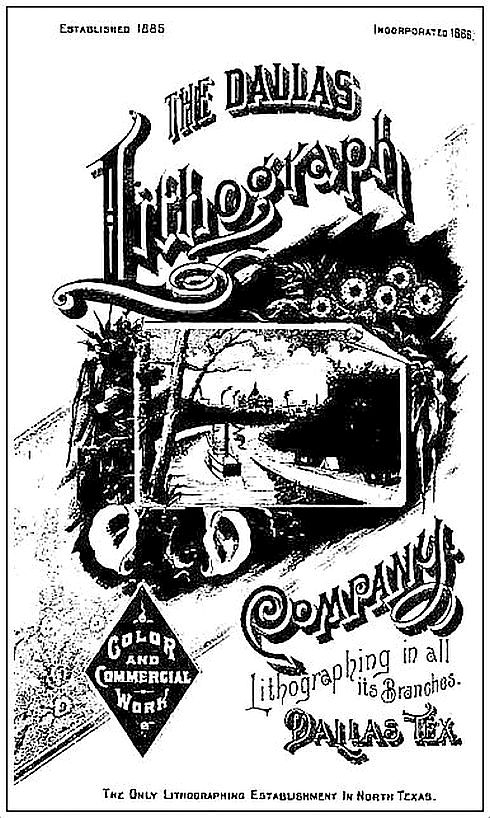
And, finally, what prompted me to find out more about the snagboat in the first place: this ad for the Dallas Lithograph Company from the 1893 city directory. It featured an illustration of a little boat chugging along on the idyllic (and blissfully snag-free) Trinity River, with the Old Red Courthouse in the background and a little tent pitched on the bank. I wasn’t all that familiar with snagboats, but that’s what I thought it looked like. I’m sure it’s supposed to be something grander, but I’ll think of it as a snagboat anyway.

ad-dallas-lithography-co_1893-directory-det

ad-dallas-lithograph-co_1893-dir1893 Dallas directory

***

Sources & Notes

I came across the top photo (which is from the archives of the Dallas Public Library) on the web page for the 99% Invisible podcast, here. I was so enthralled with the pictures on this page that I didn’t even realize until just now that there was a podcast to listen to, called “The Port of Dallas” — about this very topic! Listen to it at the top of the page — it’s very entertaining. I think Julia Barton and I were separated at birth!

There are lots of other photos on that page, including a photo of the H. A. Harvey, Jr. and a photo showing what the Dallas Morning News looked like printed in red.

Second photo of the Snag Boat Dallas is from the DFW Urban Wildlife blog, here. More great photos there!

The final photo of the Dallas and the photo’s caption are from C. A. Keating’s autobiography, Keating and Forbes Families and Reminiscences of C. A. Keating (Dallas: self-published, 1920).

All other clippings, as noted.

To read about how people have tried and tried and tried over the years to make the Trinity River do what they wanted it to do — and failed — read the article “Navigating the Trinity, A Dream That Endured for 130 Years” by Jackie McElhaney (Legacies, Spring 1991), here.

UPDATE: I swear I was completely unaware of Julia Barton’s podcast about the “Port of Dallas” when I wrote this post, but I’m happy to report there is ALSO a video, from a presentation she did at the TEDxSMU talks in October. Watch it here. (Thanks, for alerting me to that this, Julia — my “internet twin”!)

*

Copyright © 2015 Paula Bosse. All Rights Reserved.
The Dallas News Special: Fast Train to Denison — 1887

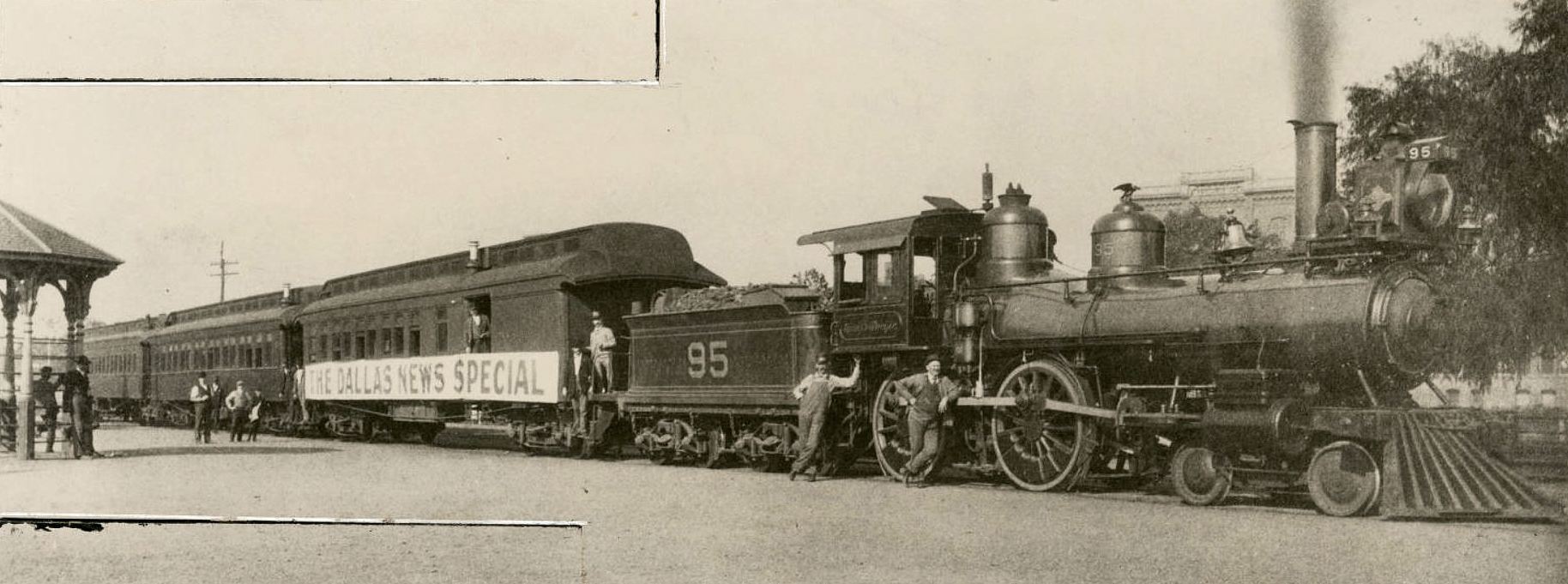
dallas-news-special_belo-collection_smuThe Dallas Morning News, full speed ahead! (Belo Collection, SMU)

by Paula Bosse

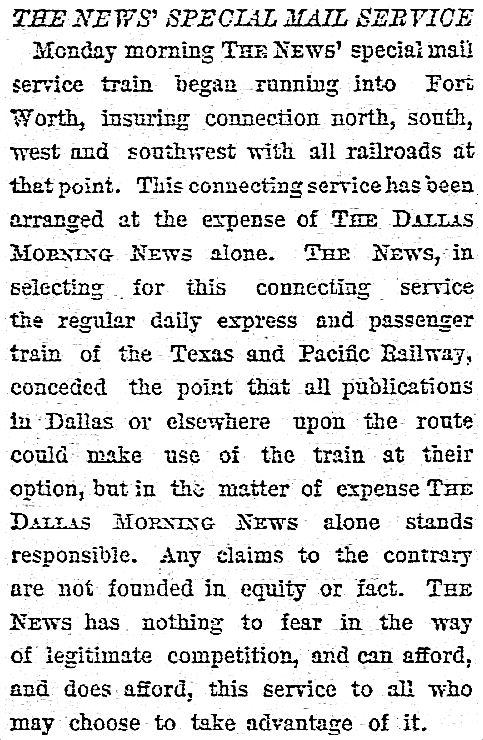
In October 1885, The Galveston News decided to launch a sister publication in Dallas, The Dallas Morning News. They sent 26-year-old George Bannerman Dealey to run it. Before that first month was up, go-getter Dealey had made a special arrangement with the Texas & Pacific railroad — “at considerable expense to The News” — to extend its route and pop into Dallas to pick up papers destined for its subscribers west of the city. (The photo at the top may or may not show that very first “Special Mail train.”)

news-train-fort-worth_dmn_102885DMN, Oct. 27, 1885 (click for larger image)

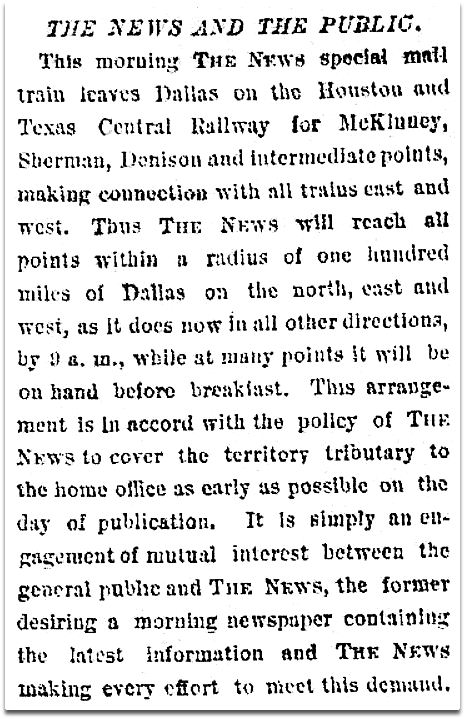
A year and a half later, The News one-upped itself and made the announcement that it would operate a special train to Denison — again, “at a vast expense.” This train would transport editions of the paper in the wee small hours in order to assure that The Dallas Morning News would actually BE a morning newspaper for as many of its subscribers as possible, whether they lived “within a block of the press” or a hundred miles away (DMN, Sept. 30, 1888). News-hungry Denisonians could read their papers over breakfast at the same time their Dallas counterparts did.

news-train_dmn_052287DMN, May 22, 1887

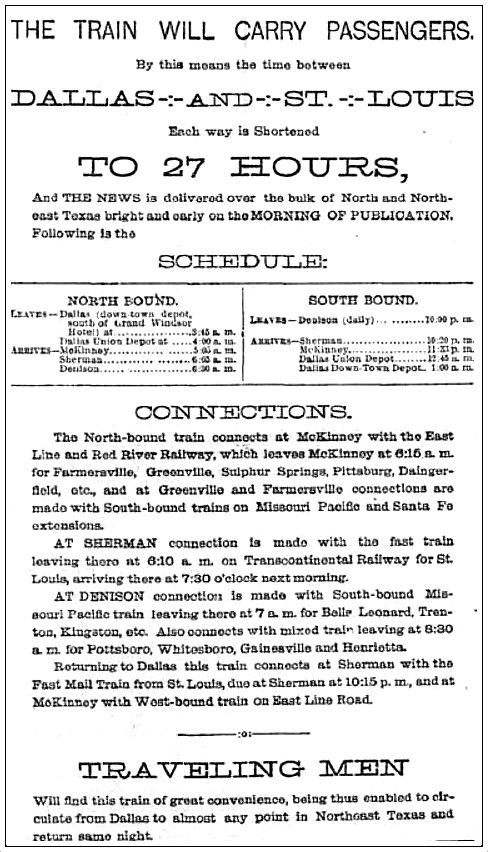
The train was dubbed by some “The Comet” (not to be confused with the MKT’s later Katy Komet). It was a “fast train” that carried passengers as well as newspapers along the Houston and Texas Central rails.

ad-special-news-train_dmn_052287-det

ad-special-news-train_dmn_052287-det2DMN, May 22, 1887

Not only was this a clever way to extend its reach and expand its circulation, but, as the Handbook of Texas notes, it also “enabled the paper to meet the threat of the St. Louis newspapers, which in 1885 had a larger circulation in North Texas than did any state paper.”

A rousing account of the first Dallas-to-Denison run appeared in the pages of both The Dallas News and The Galveston News (which often shared content). A link to that full story is below, but here are a few passages from an article written the next year, touting the wondrous success of the News Special, written as only a nineteenth-century newspaperman could write it (and the writer might well have been G. B. Dealey himself).

First, one encounters a mention of Plano in a more grandiose combination of words than one might expect, as the writer describes his pleasant pre-dawn train trip along the route.

Plano was reached before the drowsy god of day had wiped his eyes at the first yawn. He rolled over in his couch by the time it reached McKinney, and he was sitting on the side of it when the train was at Melissa. And here the mocking birds, with no ruddier iris upon their breast, but moved with the spirit that makes the burnished dove mourn out his love, made the air resonant with their chatter and their songs. Into Sherman and Denison the train plunged and the trip was done.

Um, yes. Then he breaks it down in a little more specifically. Actually, a LOT more specifically.

It starts. Two minutes are consumed at the Missouri Pacific crossing five miles out, two minutes at Caruth’s, five minutes for water, two minutes at Richardson, two minutes at the Cotton Belt crossing, three minutes at Plano, two minutes at Allen, three minutes at McKinney, two minutes at Melissa, fifteen minutes at Anna for a meeting point, three minutes at Van Alstyne, two minutes at Howe, five minutes at Sherman. Total forty-eight minutes. The distance between Sherman and Dallas is sixty-four miles. The time card calls for two hours and five minutes from Dallas to that point. Forty-eight minutes is consumed in stoppages. Anyone can make the calculations, sixty-four miles in seventy-seven minutes, and see the terrific speed that this train makes, has made for over a year, and made it without a single accident, and it is a good road — an awful good road — to make it over.

And then he congratulates his employer on giving even its most distant readers “an even whack.”

Is there anything like this in the history of newspapers? True, some of them in the north run special trains on special occasions, but THE NEWS stands without a rival in this sustained work of giving its remote patrons an even whack with its people of the city. (–The Dallas Morning News, Sept. 30, 1888)

Below, a train identified as this H&TC News Special to Denison, even though it looks remarkably similar to the T&P train (in the photo above) which may or may not have been that earlier 1885 mail train to Fort Worth. Dealey is identified as the man in the light-colored suit, standing on the steps (he also resembles the man in the top photo, but now with a full beard).

dallas-news-special_train-to-denison_1887_mcafee_degolyer_SMU

The train would slow down as it neared a small-town depot, and, without stopping, a man would toss bundles of papers from the train into the waiting arms of another man on the platform, who would then divide them up and hand them off to men and boys on horseback who would race to deliver them to stores and homes before breakfast.

The Dallas Morning News ran its hot-off-the-presses newspapers up to Denison for several decades on this train until, presumably, cheaper trucks were pulled into action. But did the rather less romantic trucks, rattling up to Grayson County, inspire the mockingbirds to “[make] the air resonant with their chatter and their songs” as had the noble locomotive speeding the news through the night? I think not.

*

dallas-news-train_degolyer-lib_SMU_ca-1885Dallas News offices, via DeGolyer Library, SMU

***

Sources & Notes

Top photo, titled “The Dallas Morning News special train,” is from the Belo Records, DeGolyer Library, Central University Libraries, Southern Methodist University; it can be viewed here. It’s a bit confusing, but this may show the inaugural run of the DMN’s special train to Fort Worth on May 22 ,1885, along the Texas & Pacific Railway. If anyone has suggestions on where this photo may have been taken, please let me know.

I came across a cropped version of the second photo in the March 1976 issue of Texas Historian, with the caption: “The Comet, Dallas News special train operated between Dallas and Denison in 1887. G. B. Dealey, then Dallas News business manager, stands on first car platform.” The version seen above is from the George A. McAfee photographs collection, DeGolyer Library, Southern Methodist University here; it is titled ”The Dallas News Special (H&T.C.).”

If you’re into trains (and even if you’re not), you might enjoy reading the following three stories from The Dallas Morning News:

  • “Special Mail Service, Observations of a Staff Correspondent Along the Route” (DMN, Oct. 27, 1885), describing the new Fort Worth route and how The News convinced (i.e. paid) the Texas & Pacific Railway to include a stop in Dallas to load up on newspapers and haul them westward, can be read here.
  • “The News in North Texas, The Special Mail Train Service” (DMN, May 23, 1887), a rousingly written ride-along narrative, is here. (I would advise more fragile readers to skip to the next paragraph when they come across mention of a cute little calf — nineteenth-century journalism is not for the overly sensitive.)
  • “News Special Train, Between Dallas and Denison Before Day, Remarkable Record, But the Following Cheerful Narrative Tells the Whole Story, Extending Over Sixteen Months, Over Fifty Miles An Hour” (DMN, Sept. 30, 1888), another genuinely exciting and poetic account of the special train and its crew, again, probably written by Dealey, can be read here. The few sentences that are illegible at the bottom of the first column: “He rang it with jerks in town, he rang it clangingly at crossings, but away out in the solitudes of the country, softly and gently he would peal it slowly, as if he had quit; softly as if his head had dropped upon his bosom. Lyerly is promoted now. Lasher is on the regular passenger train, and R. R. Roe has beautifully and [evenly?] taken his place. But Gentry still sits upon his old seat on the right hand side and watches growing into beefhood the….” 

*

Copyright © 2015 Paula Bosse. All Rights Reserved.
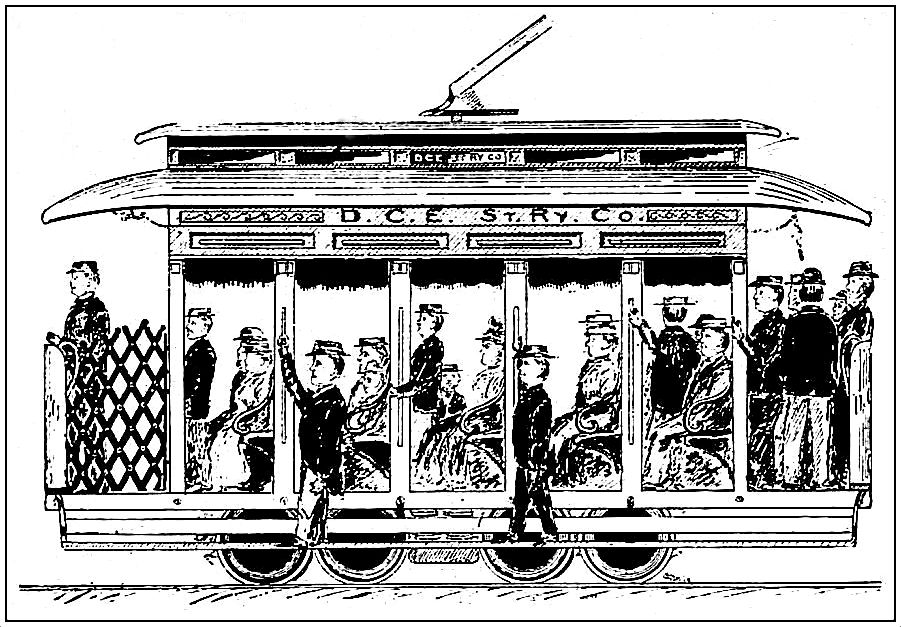
Dallas Consolidated Electric Street Railway Co. Ad — 1902

streetcar_dce_worleys_1902-det

by Paula Bosse

Why bother with a horse and buggy when you can take the streetcar?

streetcar_dce_worleys_1902-det1

streetcar_dce_worleys_1902(click me!)

streetcar_dce_worleys_1902-det2

***

D.C.E. St. Ry. Co. ad from the 1902 city directory.

Click for larger images.

*

Copyright © 2015 Paula Bosse. All Rights Reserved.

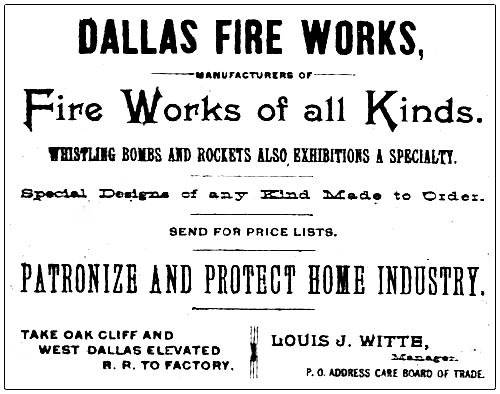
Dallas Fire Works Ad — 1891

ad-dallas-fireworks_1891-directory

by Paula Bosse

Even in the 1890s, Oak Cliff was encouraging people to buy local.

DALLAS FIRE WORKS
Manufacturer of
Fire Works of All Kinds.
Whistling Bombs and Rockets Also Exhibitions A Specialty.
Special Designs of any Kind Made to Order.
Send For Price Lists.
PATRONIZE AND PROTECT HOME INDUSTRY.
Take Oak Cliff and West Dallas Elevated R.R. to Factory.

Louis J. Witte, Manager.
P.O. Address Care Board of Trade.

Do NOT go to Fort Worth for your fireworks!

***

Ad from the 1891 city directory.

*

Copyright © 2015 Paula Bosse. All Rights Reserved.

“Clean, Delightful, Refined” — The 1908 State Fair of Texas

ad-1908_sfot_dmn_101508_katzenjammer-castleDon’t miss the Katzenjammer Castle!

by Paula Bosse

As it’s State Fair of Texas time again and I’ve recently reposted the wonderful 1908 panoramic photo of a crowd-filled entrance to Fair Park (seen here), I thought I’d look to see what kinds of attractions that particular fair had to offer.

The 23rd State Fair of Texas was held from October 17 to November 1, 1908. Below are two ads that ran before the opening of the fair, the first one in The Dallas Morning News, the second in The Fort Worth Star-Telegram. The very wordy ad copy is similar in both, but they’re different enough to warrant taking a look at each one (click for larger images).

ad-1908_sfot_dmn_101508-textDMN, Oct. 15, 1908

An excerpt:

The very best features of every species of entertainment, from the Olympian games of old down to the creations and inventions of this year. Our permanent amusements represent an investment of $100,000. In addition to the Scenic Railway, Katzenjammer Castle [pictured at top], Hall of Mirth, Electric Theater, Figure Eight, Laughing Gallery, we have constructed this year the latest in the field of amusement and novelty – the ‘Tickler’ – the most laughable and fun-producing creation yet devised by man. Our Amusement Park an ensemble brilliantly spectacular and educational – a miniature Oriental City as it were. Here will be gathered a grand ethnological congress – Turks, Arabs, Cinghalese, Igorrotes, Bedouins, Turcomen, Japanese and Zulus – the strange peoples of the world, living as they do in their native lands.

Wow. The Hall of Mirth, the Tickler, and a “grand ethnological congress” — it had everything! But, wait — there’s more!

Here’s the ad for Fort Worth:

ad-1908-sfot_FWST_ 101608FWST, Oct. 16, 1908

And an excerpt:

Clean, Delightful, Refined

More than 100 new and superb shows constitute our amusement department. Permanent attractions alone represent an investment of $100,000. A grand aggregation of the latest and most ingenious attractions and revived sensations from all parts of the world. A cosmopolitan gathering of Oriental dancing girls, wrestlers, whirling dervishes, magicians, torture dancers, rough riders of the world, in a strange display of barbaric splendor. Marvelous free attractions, including the great Velaire, in his act “Beyond the Limit.”

Wonderful Exhibitions

Six acres of implement and vehicle displays. Three thousand birds in the poultry department. Over two thousand head of exhibition stock. Magnificent arena program. Agricultural and industrial growth of the state exemplified. Notable display of the handiwork of the women of the South in all departments of home life. Superb art display. Great dog show.

Martial Pyrotechnic Display Thrilling to Thousands.

Barbaric splendor, whirling dervishes, and a “great dog show.” And that mysterious “torture dance” (which I’m sure was “clean, delightful, and refined”).

Here’s one more ad promoting “Fort Worth Day,” which was held as “The Greatest Fair on Earth” was winding down:

ad-1908_sfot_FWST_102808FWST, Oct. 28, 1908

So, lots of interesting stuff was going on. But apparently the thing that people were most excited about was the horse racing (…and the wagering). Back then, people looked forward to the races with the same manic enthusiasm that people today look forward to the fried food. Racing aficionados were such a huge source of SFOT revenue that it seemed only fair they got a brand new grandstand that year.

state-fair_grandstand_dmn_082308DMN, Aug. 23, 1908

state-fair_grandstand_dmn_082308_textDMN, Aug. 23, 1908

There was also a new Grand Gateway at the main entrance to Fair Park, designed by one of Dallas’ most notable early architects, James Edward Flanders (read about him here).

fair-park-entrance_gate_flanders_dmn_052208DMN, May 22, 1908

fair-park-entrance_gate_flanders_dmn_090608DMN, Sept. 6, 1908

You can see it in this detail from the panoramic photo by Henry Clogenson mentioned earlier:

fair-park-entrance_gate_clogenson-photo_1908_loc-det

There was an exhibit of thousands of live bees in a mesh-enclosed apiary.

state-fair_bees_dmn_092908DMN, Sept. 29, 1908

And fireworks. Gotta have fireworks. Somehow they managed to recreate a pyrotechnic display which simulated a Crash at Crush scenario of two locomotives colliding with each other head-on. I’m not quite sure how that worked, but it seems to have been effective. (I’m not a fireworks connoisseur, but this “set-list” is really great.)

fireworks_trains-colliding_dmn_103108DMN, Oct. 31, 1908

fireworks_trains-colliding_dmn_110108DMN, Nov. 1, 1908

I have to say, I’m a big fan of the exhibit that was set up in the new Agricultural Building: three figures of women, each about seven feet tall, one made of rice (from Beaumont), one made of salt (from Grand Saline), and one made of coal (I’m going to guess from somewhere like Thurber),

state-fair_salt_lots-wife_dmn_092408DMN, Sept. 24, 1908

That last sentence:

She will stand in the attitude of looking over her shoulder, and in the direction in which she is represented as looking will be placed paintings of the Cities of the Plain in flames, and the terrified inhabitants making desperate though vain attempts to escape the wrath which they have called down on their stiff necks.

How fun! (When I visited Grand Saline a few years ago, I saw a little cabin in the center of town purported to be made of salt. I was curious, and when no one was looking, I licked it. Yep. Salt. I’m sure I wasn’t the first to have done that, disgusting as it was. But I digress….)

Lastly, my favorite little throwaway factoid mentioned in one of the many endless articles that appeared in the weeks leading up to the opening of the fair was that the walkways were paved with “finely crushed pink granite.”

state-fair_pink-granite_dmn_092708DMN, Sept. 27, 1908

I’d like to have seen that.

***

The photo at the top shows the Katzenjammer Castle, a popular attraction that had appeared the previous year and which sounds like the old German Funhouse (the thing *I* used to look forward to every year). The photo accompanied the ad that appeared in The Dallas Morning News on Oct. 15, 1908 (the first ad posted above). It looks as if it shows part of the Shoot the Chute water ride. (You can see several pictures of this ride, which was right next to that brand new grandstand, in a previous post “The Chute,” here.

*

Copyright © 2015 Paula Bosse. All Rights Reserved.

Thirsty For Something Stronger Than a Sarsaparilla? — 1890

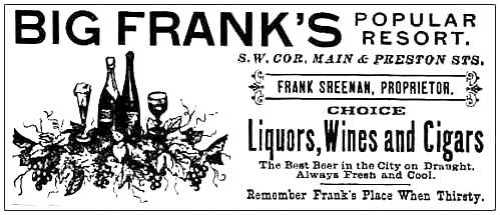
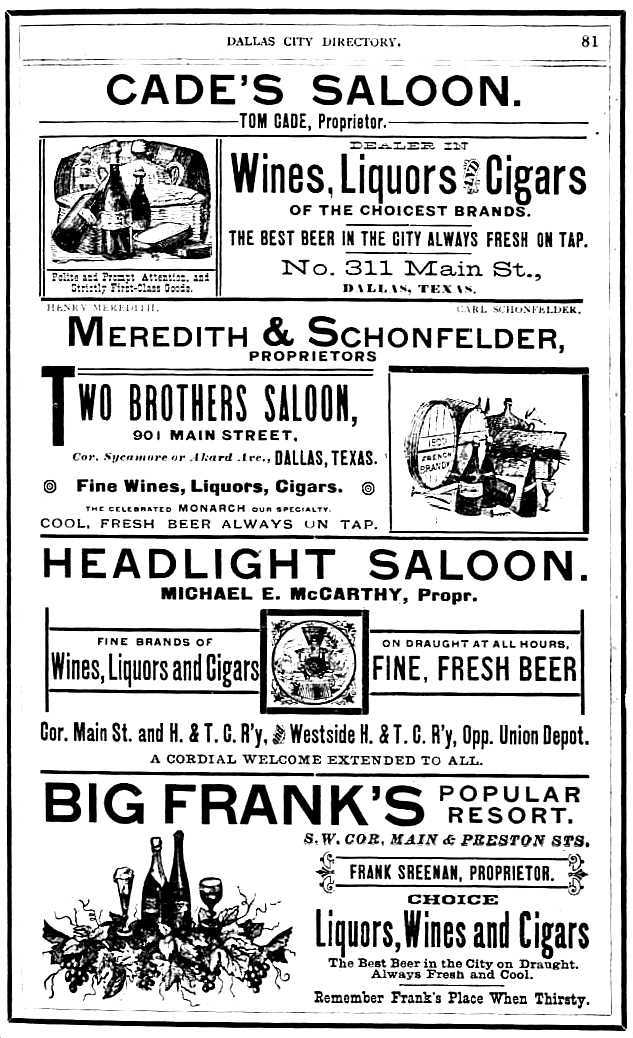
ad-saloons_city-directory_1890-det“Remember Frank’s Place When Thirsty”

by Paula Bosse

According to the 1890 city directory, Dallas had roughly 145 saloons. That seems like a lot when the city’s population was only 38,000. That would be one bar for every 262 people — and this is before you take out all the residents who wouldn’t have been allowed in saloons, like African Americans, Hispanics, women, children, etc. (and I’m sure there MUST have been a few adult white men who didn’t drink…). And there were probably a lot more than 145 bars — this doesn’t include private clubs or “unlicensed” holes in the wall (I’m not sure how heavily enforced “licensing” was back then). So it could have been more like one bar for every 50 imbibing Dallasites. Call me crazy, but this seems like a disproportionate ratio of bars to customers. But depending where you fall on the how-many-bars-is-too-many spectrum, it might have been just the perfect number. It fact it might have been a veritable paradise.

ad-saloons_city-directory_1890(click me!)

Here are a few of the “popular resorts” of the day into which a white man could mosey and slake his big Texas thirst.

  • Meisterhans’ Garden
  • Mayer’s Garden
  • Glen Lea
  • Planters House
  • Pat’s Place
  • Frank’s Place
  • Ord’s Place
  • Two Johns
  • Two Brothers
  • Louis
  • Bohny’s Hall
  • New Idea
  • U Bet
  • Walhalla
  • Coney Island
  • Butchers’ and Drovers’
  • Q. T.
  • Eureka
  • Gem
  • The Wonder
  • Sample Room
  • Monarch
  • Casino
  • Little Casino
  • Red Front
  • Blue Front
  • Blue Corner
  • Buck Horn Corner
  • Sharp Corner
  • Mikado
  • Apollo Hall
  • Mammoth Cave
  • Headlight
  • Green Tree
  • Live Oak
  • Moss Rose
  • Sunny South
  • White House
  • Cabinet
  • Senate
  • Postoffice
  • Board of Trade
  • First and Last Chance
  • Turf
  • Black Elephant
  • Jockey
  • Union Depot
  • 9-45
  • Dallas Club
  • Wichita Exchange
  • City Hall Exchange
  • Ross’ Exchange
  • Mechanics’ Exchange

That’s a whole lot of places to get drunk in.

***

Sources & Notes

Saloon ad from the 1899/1890 edition of Morrison & Fourmy’s Dallas City Directory.

See the complete list of saloons, with addresses and proprietors’ names, here.

Street names and addresses have changed over the years. Plot the location of your favorite bar by referring to an 1890s map, here.

In the nineteenth century, the word “resort” often denoted places a bit more unsavory than, say, Puerto Vallarta. A list of similar establishments might include “tippling houses, gaming houses, bawdy houses, billiard saloons, lager beer saloons, and other places of public resort” (source here).

I’m wondering if “respectable” women were allowed as customers in the larger beer gardens in Dallas at this time? If anyone has info on this, I’d love to know.

Was drunkenness a goldmine-like source of city revenue? Oh yeah. See my previous post “Police Blotter — 1880s,” here. Building a greater Dallas, five bucks at a time.

*

Copyright © 2015 Paula Bosse. All Rights Reserved.

University Park: The Addition — 1916

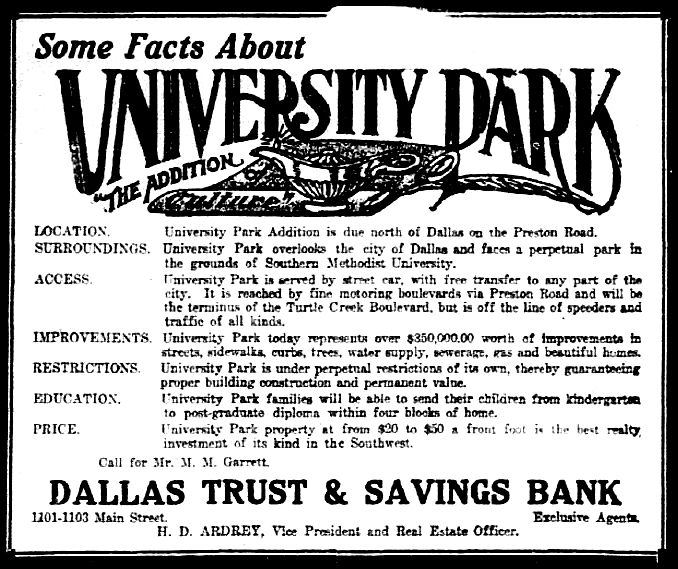
university-park_dmn_0625161916 ad (click for larger, slightly more legible image)

by Paula Bosse

Mr. M. M. Garrett of the Dallas Trust & Savings Bank wants you to know some facts about the University Park Addition:

  • LOCATION. University Park Addition is due north of Dallas on the Preston Road.
  • SURROUNDINGS. University Park overlooks the city of Dallas and faces a perpetual park in the grounds of Southern Methodist University.
  • IMPROVEMENTS. University Park today represents over $350,000.00 worth of improvements in streets, sidewalks, curbs, trees, water supply, sewerage, gas and beautiful homes.
  • RESTRICTIONS. University Park is under perpetual restrictions of its own, thereby guaranteeing proper building construction and permanent value.
  • EDUCATION. University Park families will be able to send their children from kindergarten to post-graduate diploma within four blocks of home.
  • PRICE. University Park property at from $20 to $50 a front foot is the best realty investment of its kind in the Southwest.

Hurry!

*

Copyright © 2015 Paula Bosse. All Rights Reserved.


A. A. Johnston House Moving Co. — 1908

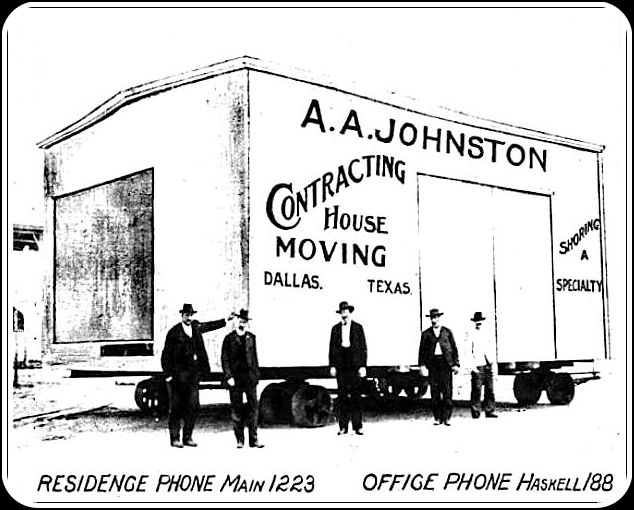
ad-johnston-house-moving_city-directory_1908_sm“Shoring a Specialty”

by Paula Bosse

Imagine what moving entailed before the advent of large motorized moving trucks.

I, myself, will be moving soon, and this will be my last new post for a while. I will probably link to old posts on Twitter and Facebook (see the tab at the top of the page to follow me and “like” me). I’ll be back sometime next week. Maybe by then the rain will have finally stopped!

***

Ad from the 1908 city directory.

*

Copyright © 2015 Paula Bosse. All Rights Reserved.

The Interurban Parlor Car: Perusing the News in Comfy Chairs

interurban-interior_tx-historian_jan81(Click for larger image)

by Paula Bosse

The height of comfort!

You know this photo was taken for promotional purposes, because none of the men has a reeking cigar clenched between his teeth.

***

Texas Electric Railway Interurban ad reprinted in Texas Historian, Jan. 1981.

Interurbans were great. I wish we still had them. Read about what they were, here.

*

Copyright © 2015 Paula Bosse. All Rights Reserved.