Flashback : Dallas

A Miscellany: History, Ads, Pop Culture

Category: Modern Ads

Bull Pen Barbecue/Austin’s Barbecue — 1949-2000
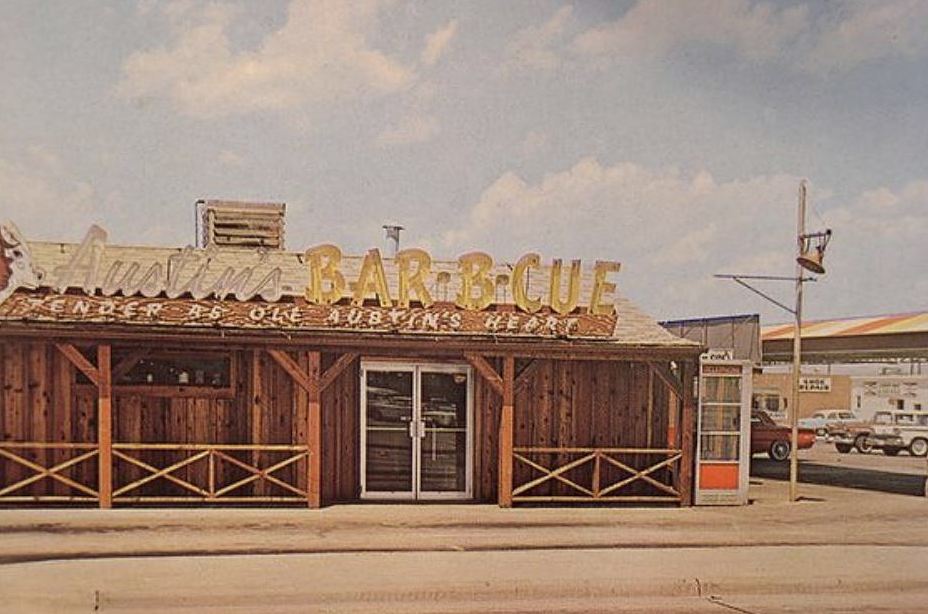
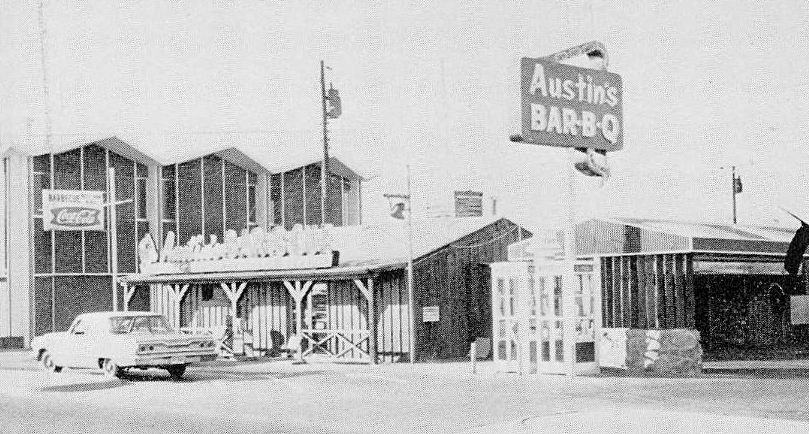
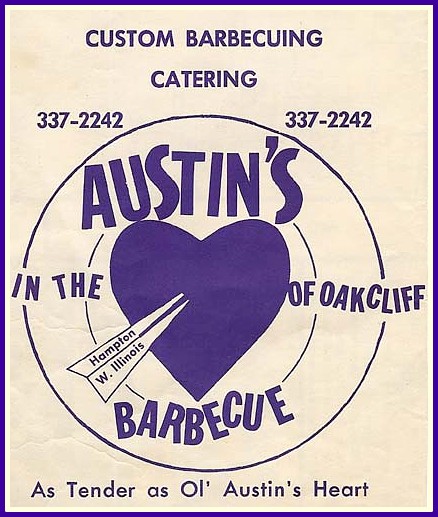
austins-barbecue_postcard_pinterest“As Tender as Ole Austin’s Heart…”

by Paula Bosse

One of my major failings as a Dallasite is that I don’t know Oak Cliff. Like at all. Every time I go over there, I get lost. I can’t remember my family ever going to Oak Cliff when I was a kid, except to visit the zoo. This explains why I had no idea how important a cultural landmark Austin’s Barbecue was when I posted a bunch of Oak Cliff ads the other day. That post has been shared hundreds and hundreds of times now and, inevitably, the only thing people mention — and rhapsodize about — is Austin’s Barbecue. …I had no idea!

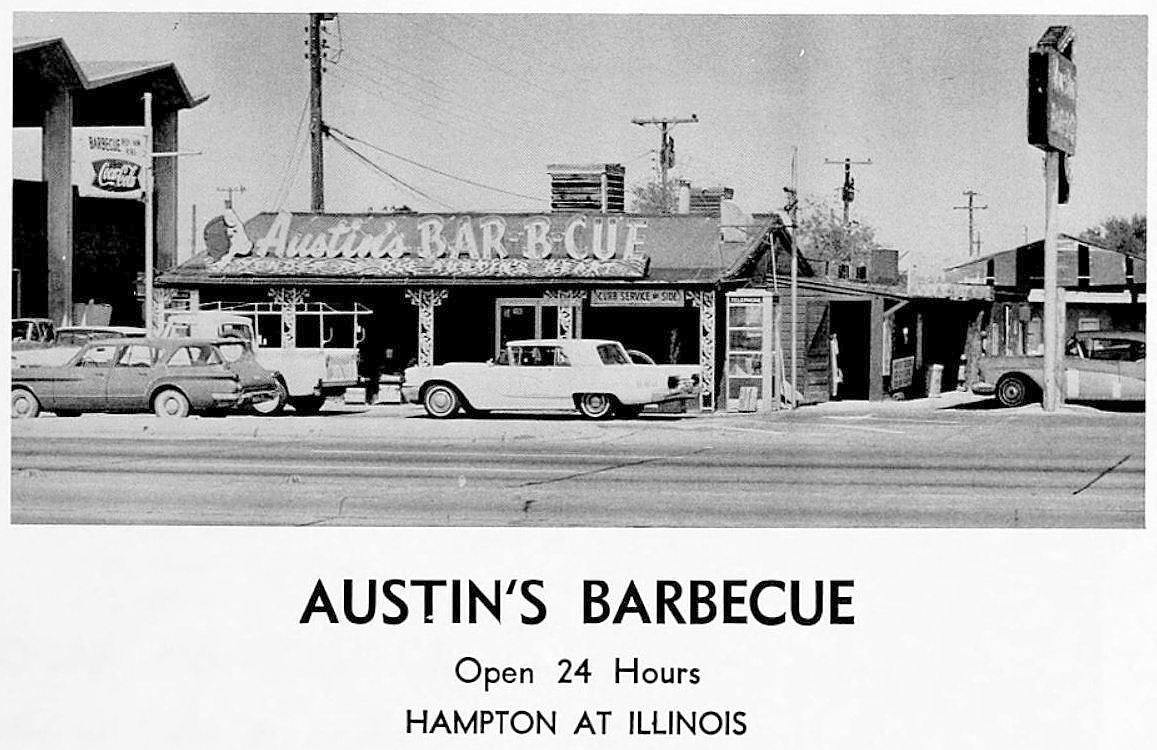
The famed BBQ joint at the northeast corner of Illinois Avenue and Hampton Road opened in 1949 as B & G Barbecue but soon became known as Bull Pen Barbecue, run jointly by owners Bert Bowman and Austin Cook. In 1956 or 1957, another Bull Pen opened in Arlington. After Oak Cliff went dry (a dark day for many Oak Cliffites), Bowman — who firmly believed that BBQ and beer were a match made in heaven — left for Arlington and Cook stayed in Oak Cliff and changed the restaurant’s name to Austin’s Barbecue. (“Bull Pen Barbecue” was still appearing in ads as late as Oct. 1957 — the official name changeover seems to have  happened in 1958.)
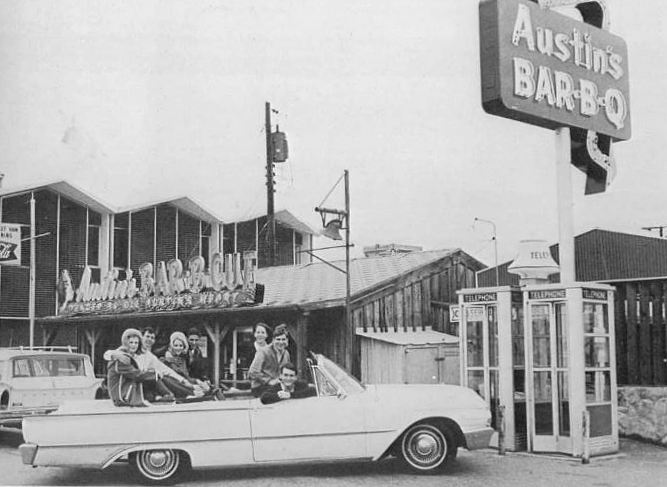
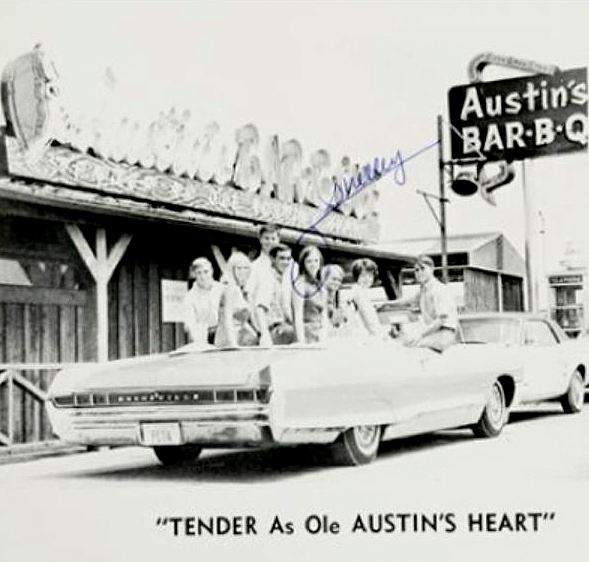
austins-bar-b-q_sunset-high-school_1967-yrbk1967 Sunset High School yearbook

*

The following memory of starting the business was apparently written by Austin Cook in 1990:

Dear Family & Friends,

I will try to tell you a little more about my being in the restaurant business. We borrowed $10,000 and bought out some one and it was B and G Barbecue. You see I always spell out Barbecue because when I went in business they hadn’t started abbreviating it like it is today.

After we had been there awhile we changed the name to The Bull Pen. Our slogan was “Come in and Shoot the Bull with Austin and Bert.” We used that name until they voted beer out of Oak Cliff. That really set us back, but maybe it was the best thing for us. We put another place in Arlington and that place was going pretty good. My partner wanted to get rid of the place in Oak Cliff. I traded him my part of the one in Arlington for his part in the one in Oak Cliff. Everyone said I was crazy.

When we bought that first place it was way out in the country, but they were building a bunch of houses not too far away. There was an airport across the street from the place. They kept talking about building a shopping center where the airport was. I remember the first day we ran a hundred dollars, and I thought we would never make it.

We started making money and we paid that ten thousand dollars back and we drew fifty dollars a week just like I was making in the grocery store. We started out with a barbecue sandwich and a hamburger. Then we started adding different things until we had a menu. We started getting those workers in the houses, and the business took off. We had beer also to go with the barbecue. My mother wasn’t too happy about that, but Dad said if that was the way I wanted to make my living it would be all right. In about a year or two we had a customer make us up a menu and we put in Barbecue plates for one dollar and twenty five cents. When I left they we were getting $4.99 for them. After I left I think they went to over seven dollars.

They always told me that you weren’t a success until you were in debt a hundred thousand dollars, and I went to the bank and borrowed all they would let me have. Then I went to my landlord and sold him the idea that I wanted to improve his property, and he loaned me the balance I needed to remodel, and I built a restaurant that held a hundred and twenty-five. Many times I was almost broke and didn’t know what I was going to do, but something always happened and I came out of it.

*

Both the Bull Pen in Arlington and Austin’s in Oak Cliff were successful and long-lived. Austin Cook retired at the end of 1993, and the business was taken over by his stepson, John Zito who had already been working at the restaurant for several years. Austin’s Barbecue closed in July, 2000, and the building was demolished soon after, replaced with an Eckerd drug store (now a CVS). Bert Bowman (born Glynbert Lee Bowman) died in 1989 at the age of 66; Austin O. Cook died at in 2006 at 86. And now I kind of feel like I know them, and I’m really sorry I never sampled their sandwiches.

*

Below, a Bowman and Cook timeline (most pictures and clippings are larger when clicked).
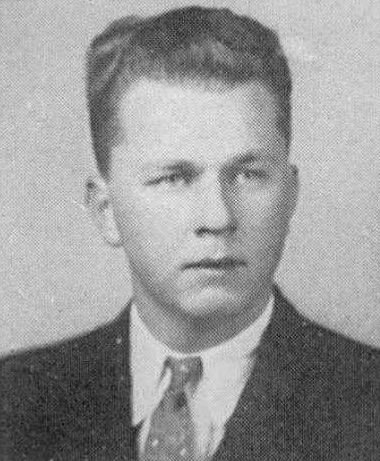
austin-cook_sunset-high-school_1937Austin Cook, Sunset High School, 1937

Before Cook and Bowmen met — probably around 1947 — each had been dabbling in different businesses. In early 1947, Cook leased a Clover Farm Store building at 203 N. Ewing and opened the Libby & Cook grocery with partner Lendal C. Libby.
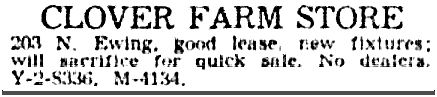
LIBBY-COOK_dmn_021047February, 1947

LIBBY-COOK_1947-directory1947 Dallas directory

Bert Bowman worked there as a meat-cutter.

bowman_1947-directory_GROCERY-w-AUSTIN1947 Dallas directory

The grocery store was in business at least into 1949, the year that Bowman and Cook decided to ditch the groceries and start their own business at 2321 W. Illinois, in a part of Oak Cliff which was just starting to be developed. Their BBQ place was originally called B & G Barbecue, which — according to Cook’s letter above — was the name of the restaurant he and Bowman bought out. I guess they felt it was easier to keep the name for awhile.

b-and-g-1951-directory1951 Dallas directory

The name “Bull Pen Barbecue” didn’t come until later. In fact, the first appearance of the Bull Pen name associated with this address doesn’t show up in local newspaper archives until a want-ad placed in the summer of 1952.
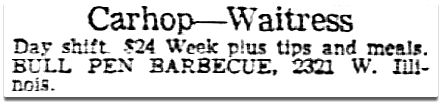
bull-pen_dmn_082652_FIRSTAugust, 1952

A probably related “Bull Pen No. 2” opened in South Dallas in 1953. It appears to have been very short-lived.

bull-pen-no-2_dmn_100853
October, 1953

By the fall of 1957, Cook and Bowman had opened another Bull Pen — this one in Arlington, and this one a success.
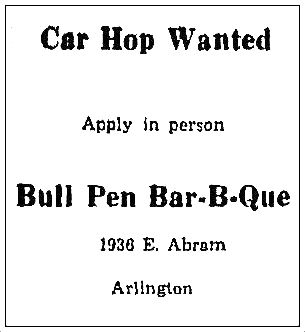
bull-pen_arlington_grand-prairie-daily-news_091557
September, 1957

And then Oak Cliff went dry, the worst thing that could happen to a restaurant that sold a lot of beer. Similar businesses which relied heavily on beer sales began to desert Oak Cliff. Bowman did not think their original drive-in could survive, but Cook disagreed. Bowman sold his half-interest in the Oak Cliff location to Cook, and Cook sold his half-interest in the Arlington location to Bowman. Cook changed the name of his now solely-owned restaurant to Austin’s Barbecue, and his success continued, despite the fact that he could no longer sell beer. He was doing well enough that, in 1961, he opened a second location, on Harry Hines across from Parkland Hospital (a location which lasted through 1964).
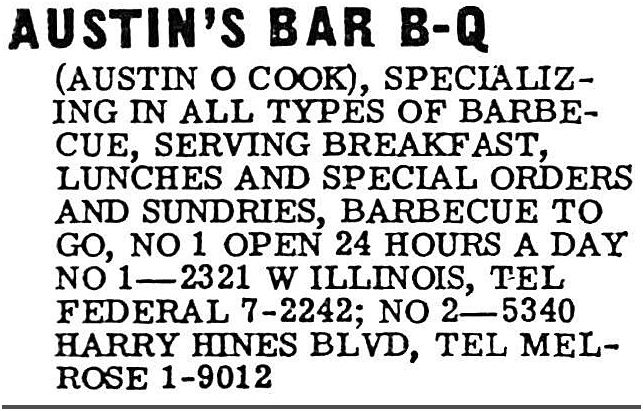
austins-barbecue_1962-directory_two-locations
1962 Dallas directory

austins-barbecue_1963-directory_two-locations_ad
1963 Dallas directory

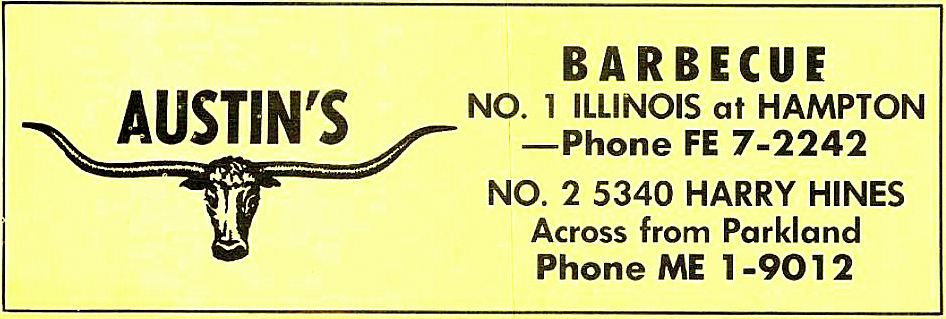
By 1963, Austin’s was a well-established teen hang-out and wisely placed ads in Oak Cliff high school annuals. Apparently everyone went there!
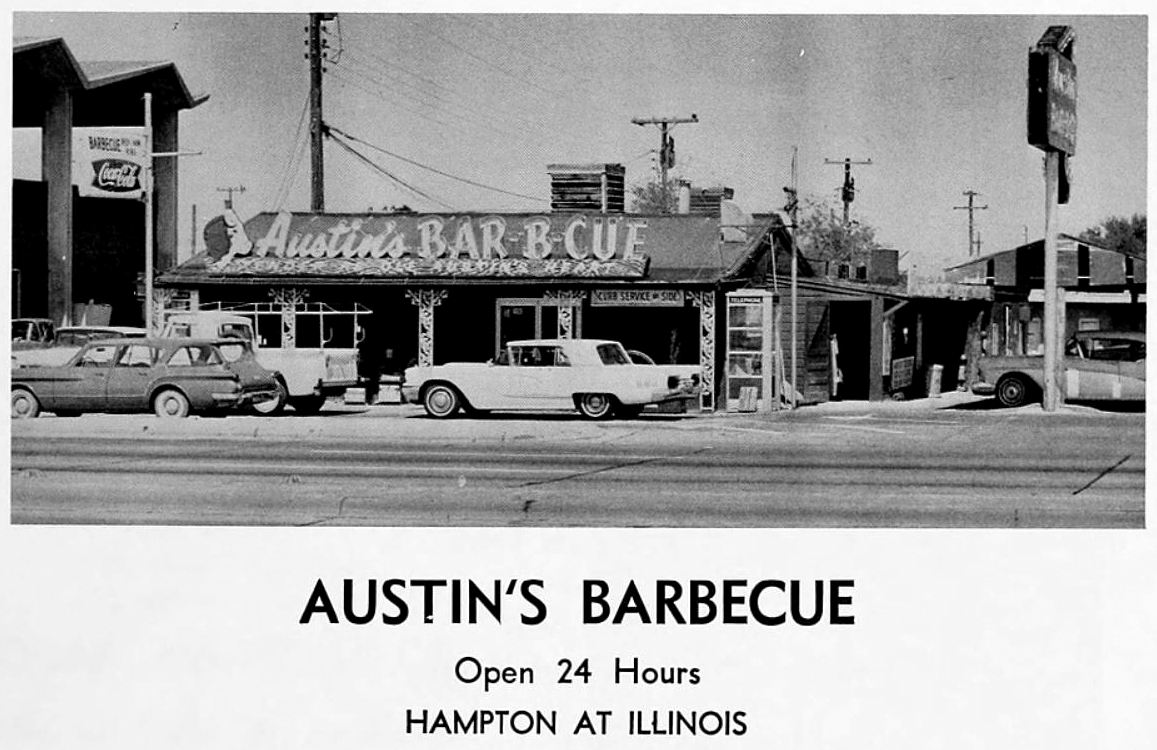
oak-cliff_austins_bar-b-cue_kimball-yrbk_19631963 Kimball High School yearbook

austins-bar-b-q_sunset-high-school_1964-yrbk.det1964 Sunset High School yearbook

austins_car-teens_flickr-coltera
Date and source unknown, via Flickr

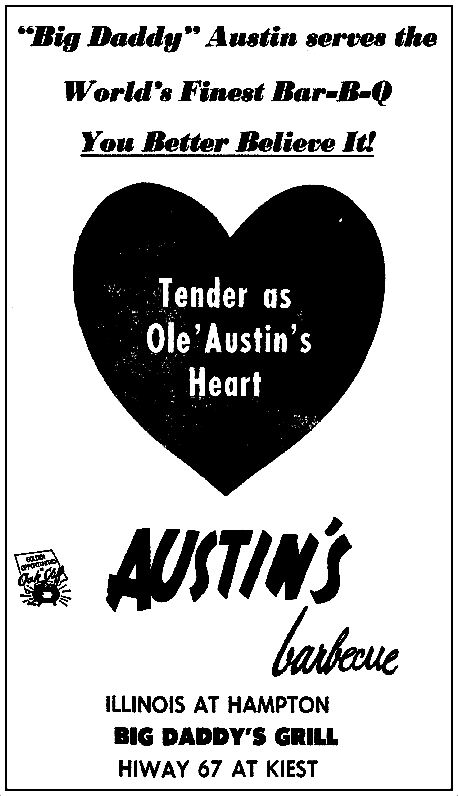
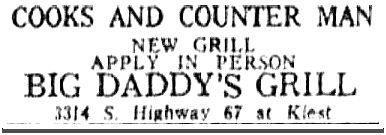
In 1964, Cook — known as “Big Daddy” — opened another restaurant, this one called Big Daddy’s Grill.
big-daddys_dmn_063064June, 1964

austins-barbecue_dmn_081466-adAugust, 1966

The restaurant was a bona fide Oak Cliff landmark, and Cook was an active participant in community business affairs. Below, a detail of a photo showing Cook as a member of the Oak Cliff Chamber of Commerce.
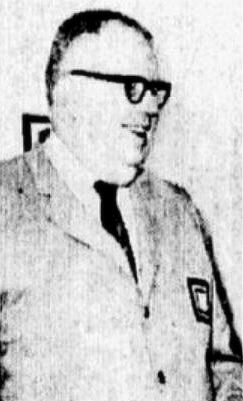
austin-cook_dmn_082568-photo-det
late 1960s

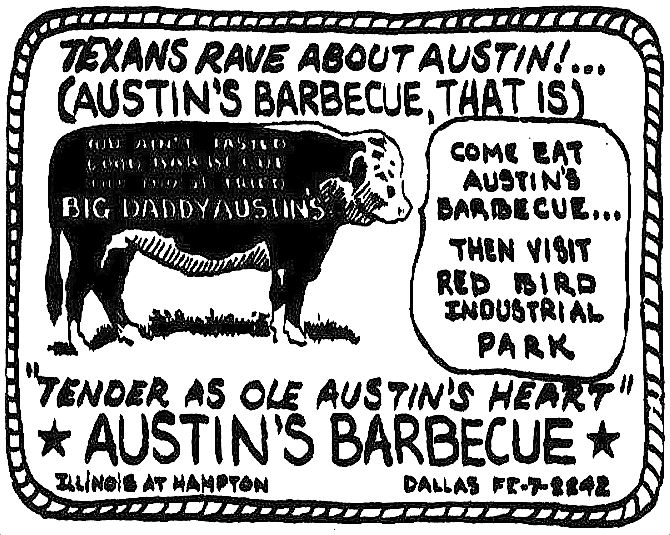
Cook participated in a series of Oak Cliff Chamber of Commerce campaigns and even included oddities like “Come eat Austin’s barbecue… and then visit Red Bird Industrial Park” in his ads. Make a day of it!
austins-barbecue_092968
September, 1968

ad_austins-barbecue
via OakCliff.org

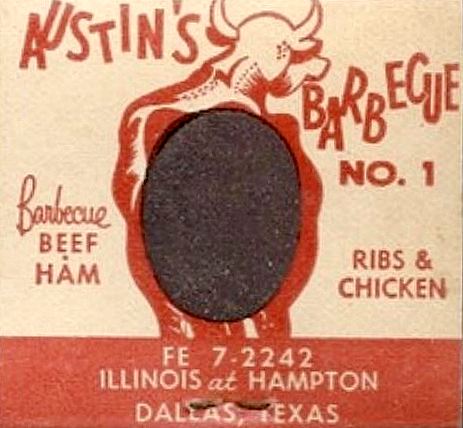
austins_matchbk_flickr_coltera
via Flickr

***

Sources & Notes

Color postcard at the top found on Pinterest, here.

The letter from Austin Cook was quoted on the DHS Phorum, here. More from the Phorum on The Bull Pen/Austin’s is here.

More can be found in the Dallas Morning News archives in the following stories:

  • “Austin’s Bar-B-Q Grows With Oak Cliff” (DMN, Aug. 14, 1966)
  • “Barbecue To Go — Staff, Customers Mourn Closing of Oak Cliff Institution” (DMN, July 13, 2000)
  • “Closed But Not Forgotten — Oak Cliff Eatery Marks Half-Century of Barbecue With Memorable Auction” (DMN, Aug. 27, 2000)
  • “John P. Zito — Operated Oak Cliff Landmark Austin’s Barbecue For 19 Years” by Joe Simnacher (DMN, Oct. 14, 2003)

Read the obituaries of Bert Bowman (1989) and Austin O. Cook (2006) here.

The Oak Cliff Advocate article “A Look Back at Austin’s Barbecue” by Gayla Brooks is here (with tons of memories from readers in the comments).

Not mentioned in this post is the connection of Officer J. D. Tippit (who moonlighted as a keeper of the peace at Austin’s) and other tangential/coincidental associations to the Kennedy assassination. It’s well documented elsewhere. Google is your friend.

*

Copyright © 2016 Paula Bosse. All Rights Reserved.
A Few Ads From the Pages of the 1963 and 1967 Kimball High School Yearbooks

oak-cliff_austins_bar-b-cue_kimball-yrbk_1963_a
BBQ in the OC, 1963

by Paula Bosse

A few random, nostalgic ads from the 1963 and 1967 Kimball High School yearbooks.

**

Above, Austin’s Barbecue.

*

Below, the Wynnewood Pharmacy:

oak-cliff_wynnewood-pharmacy_kimball-yrbk_1963_a1963

*

Gilley’s Cockrell Hill Pharmacy:

oak-clliff_gilleys-cockrell-hill-pharmacy_kimball-yrbk_1963_a1963

*

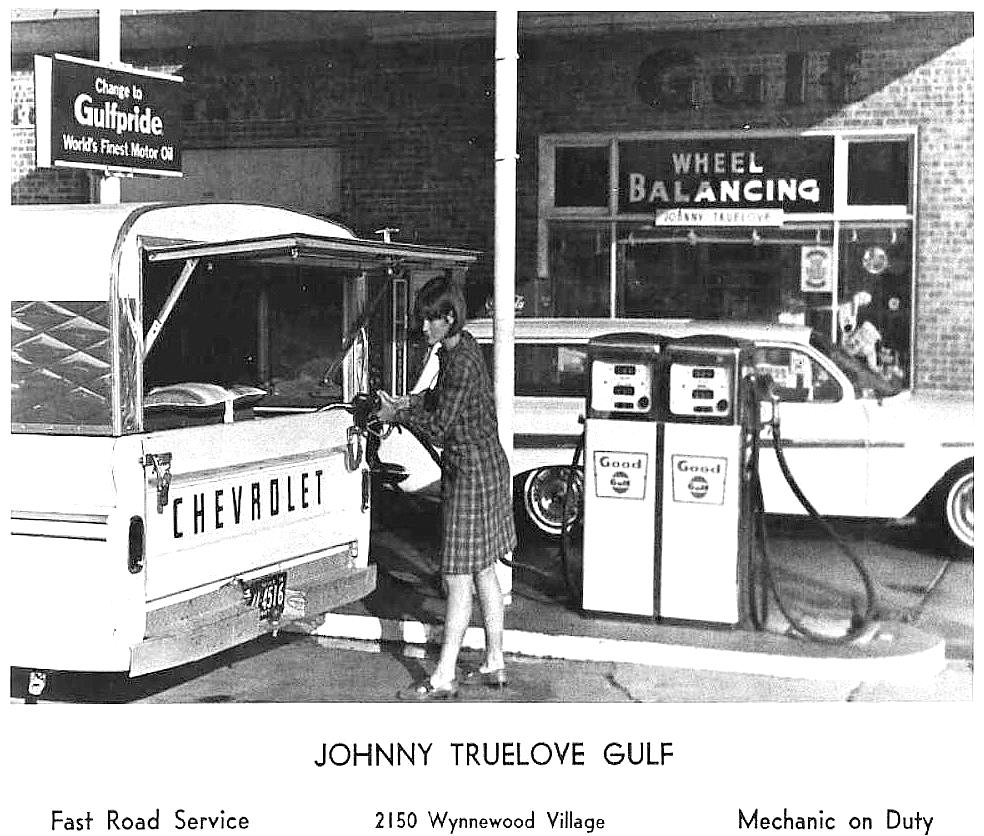
Johnny Truelove Gulf station:

truelove-gulf-station_kimball-yrbk_1963_a1963

truelove-gulf-station_kimball-yrbk_1967_a1967

*

Sammy’s Westcliff (a favorite of Marsha and her Aqua-Netted pals):

sammys_oak-cliff_1967-kimball-yrbk_a1967

*

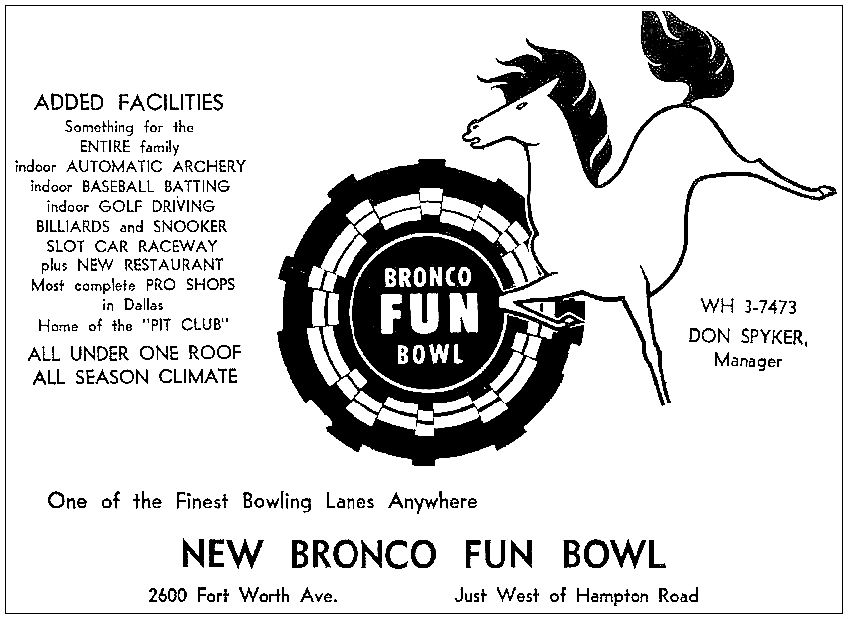
And the late, lamented Bronco Bowl:

ad-bronco-bowl_kimball-yrbk_1967_a1967

*

And for those who want to browse the retail offerings of Wynnewood Village in 1963, here is a handy list (click to see a larger image):

oak-cliff_wynnewood-village_kimball-yrbk_1963_a1963

***

Sources & Notes

All ads from the 1963 and 1967 Kimball High School yearbooks.

More than you’d ever want to know about The Bull Pen/Austin’s Barbecue in my follow-up post, here.

*

Copyright © 2016 Paula Bosse. All Rights Reserved.

Commerce & Record Streets — 1946

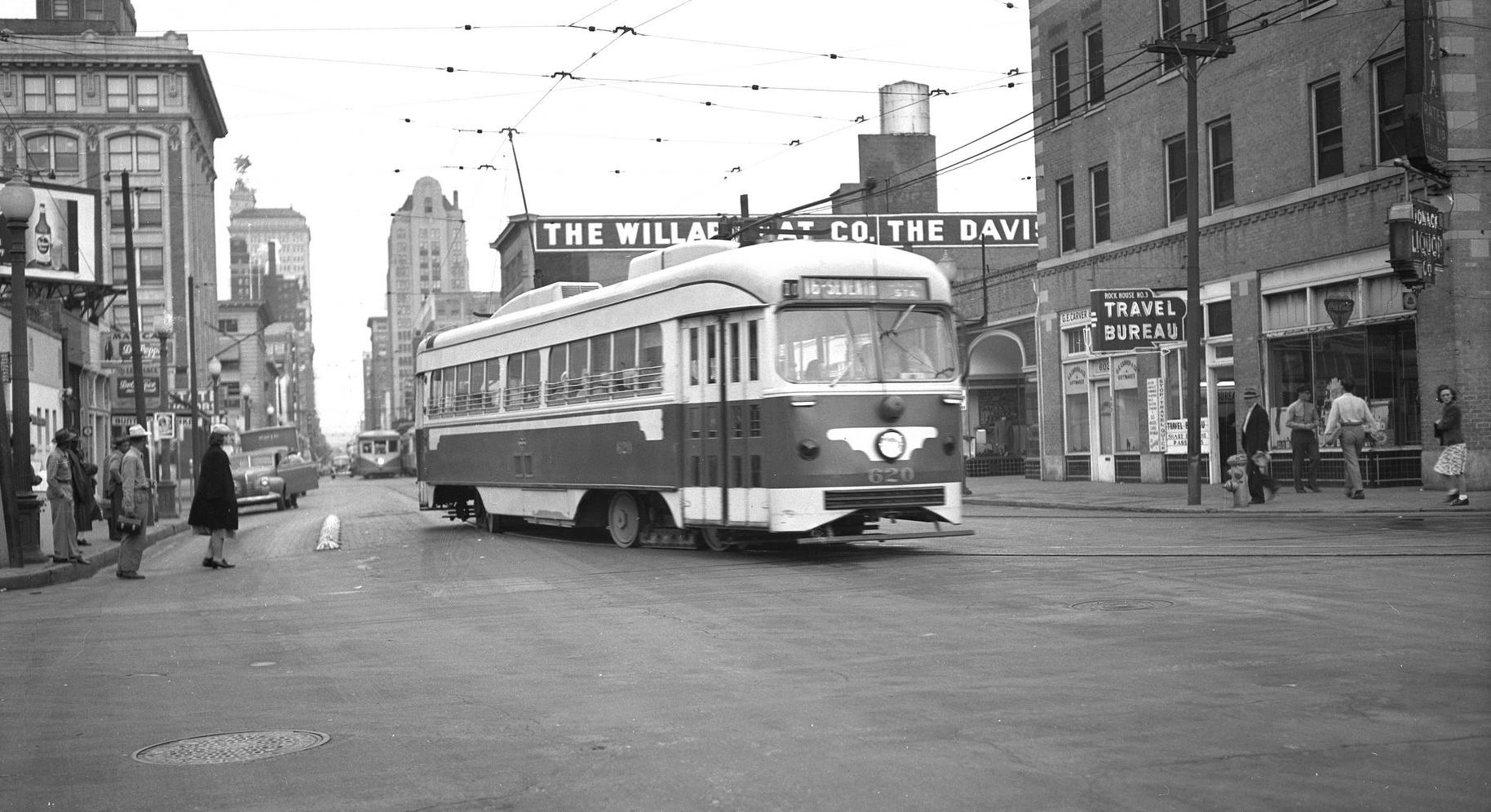
streetcar_commerce-record_051046_ceraCommerce St. looking east from Record (click for huge image)

by Paula Bosse

If it’s a photo of downtown in the ’40s, with people on the streets, retail storefronts, and streetcars, I’m going to love looking at it. Like this one. A lot of people might be hard-pressed to identify the location of this photograph, even if they were standing in the exact spot the photographer stood in. If you look at today’s view from the same vantage point (here), just about everything in the immediate foreground (west of the Pegasus-topped Magnolia Building) is gone — except for, most notably, the beautiful MKT Building at Commerce and Market, one of my favorite downtown buildings.

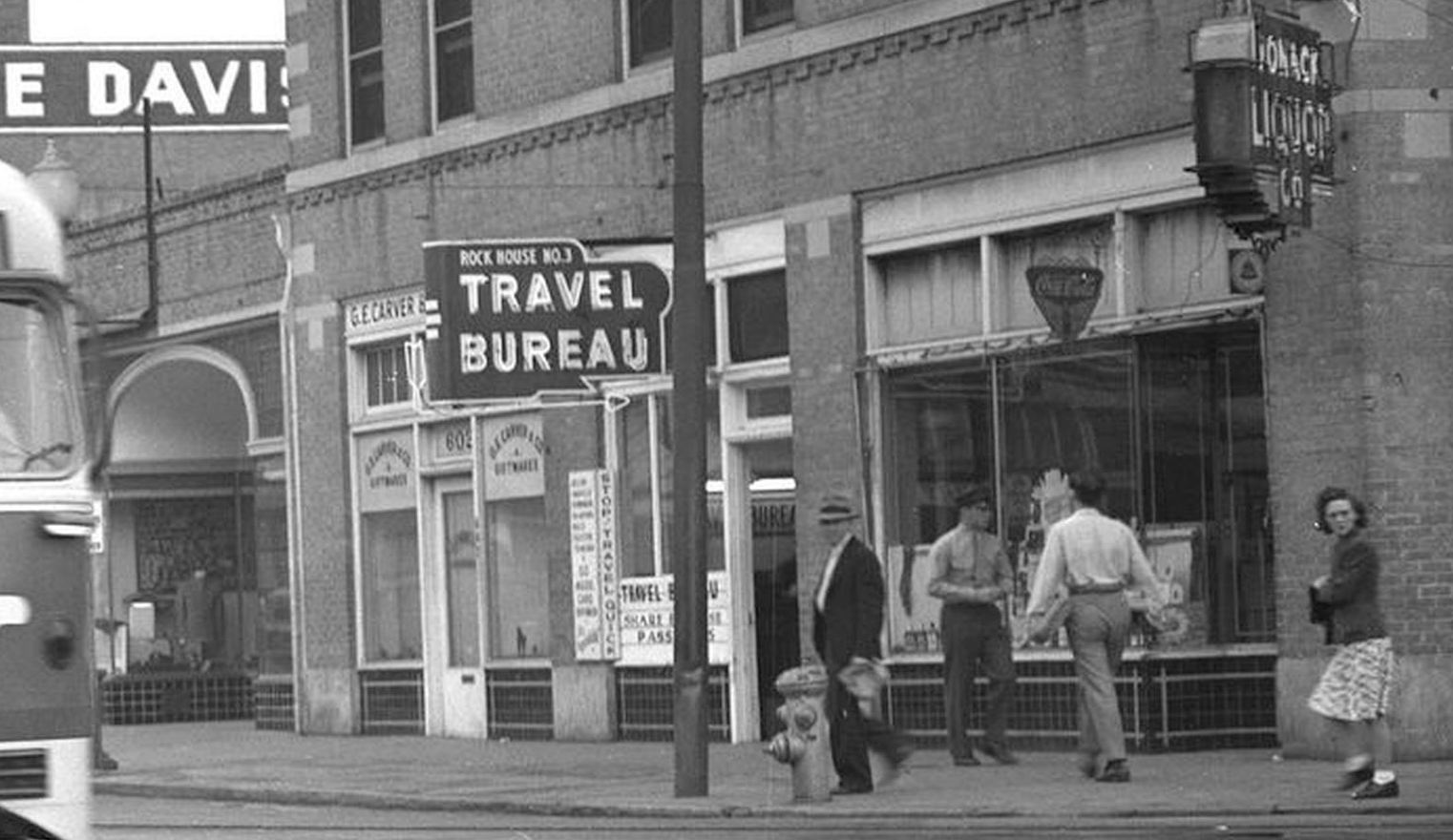
This is the intersection of Commerce and Record streets, when Record still extended from Elm to Jackson; the Old Red Courthouse was behind the photographer, to the left. Today, the Kennedy Memorial is at the left where the people are waiting for a streetcar; the George Allen Courts Building is across the street — at the right, in the block with the travel bureau; and the block containing the Willard and Davis Hat building — across Commerce from the Katy Building — is now a parking lot.

As with every photograph like this I see, I wish I could step into it and walk around the downtown Dallas of 1946. Maybe pop into Ma’s Cafe for a Dr Pepper before I hop on a streetcar and just ride around on it all day until someone kicks me off.

*

Below are a couple of magnified details (both are much larger when clicked).

streetcar_commerce-record_051046_cera-det1

streetcar_commerce-record_051046_cera-det2

Below is a listing of the businesses in this 600 block of Commerce, between Record Street and the MKT Building.

600-block-commerce_1945-directory1945 Dallas directory

(The tall building on the right with the travel bureau on the ground floor is the Plaza Hotel at 202-204 Record Street. The Yonack Liquor Store on the corner is at 200 Record, with entrances on both Commerce and Record.) 

Here’s a detail of a photo taken about the same time, showing an aerial view of Commerce Street.

aerial_commerce-st_1940s_foscue-lib_smuFoscue Map Library/SMU

***

Top photograph was taken on May 10, 1946 by Richard H. Young; it can be viewed on the CERA (Central Electric Railfans’ Association) website, here. (If you’re interested in Dallas streetcars, this page has some GREAT photographs!)

The caption of the photo from the above website: “May 10, 1946 — New Dallas Railway & Terminal Co. double-end PCC car 620, at speed, southbound, turning into Record St. from Commerce St. (Ervay-7th Line).”

The aerial photo was taken by Lloyd M. Long in the 1940s and is titled “Downtown Dallas looking east (unlabeled); it is from the Edwin J. Foscue Map Library, Central University Libraries, Southern Methodist University. This is only a small portion of the full photograph — the full photo is here.

Since there is an exact date for this photo, here is a large Skillern’s ad from that day’s newspaper. Coincidentally, there was a  Skillern drugstore on the northeast corner of Commerce and Record — it is in this photo, behind the lamppost at the bottom left. Let’s see what was on sale May 10, 1946. (I would kill for a set of those Pyrex bowls!)

skillerns-ad_dmn_051046

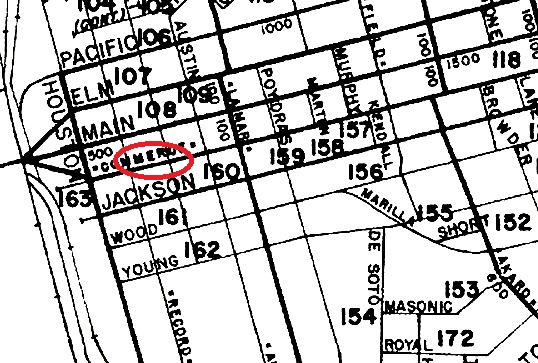
And, lastly, who doesn’t love a map?

map_commerce-and-record_1952-mapsco 1952 Mapsco

Everything is bigger when clicked!

*

Copyright © 2016 Paula Bosse. All Rights Reserved.
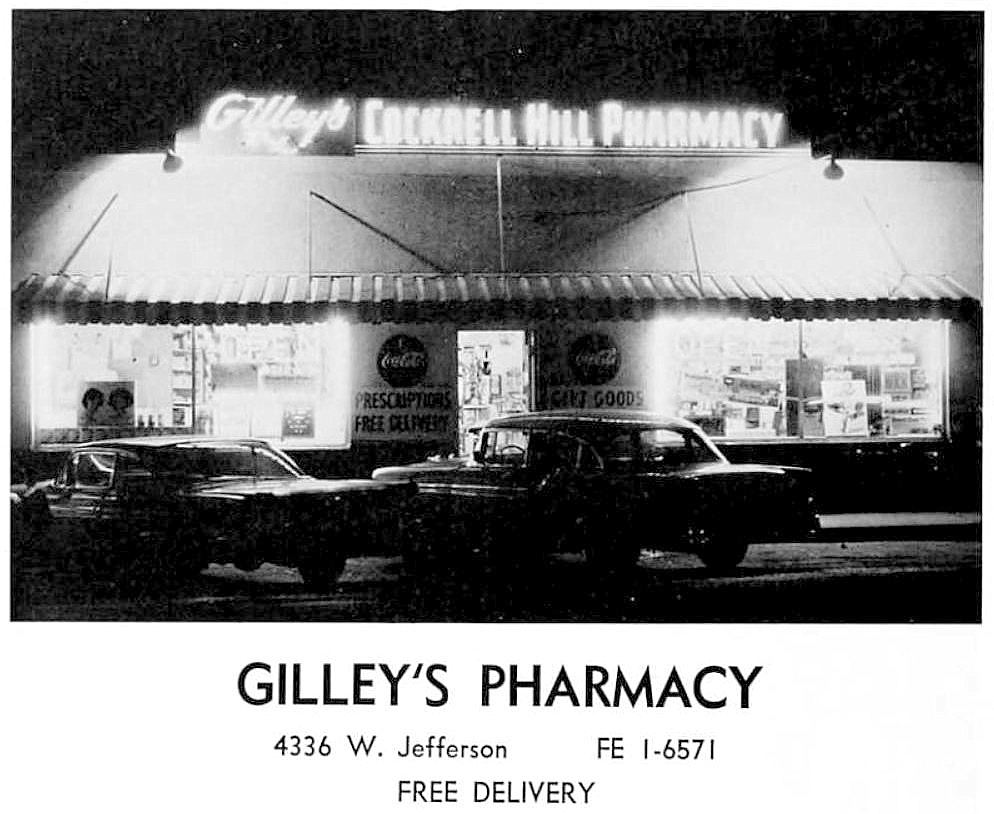
 

Photo-Pac: The First Disposable Camera — 1948

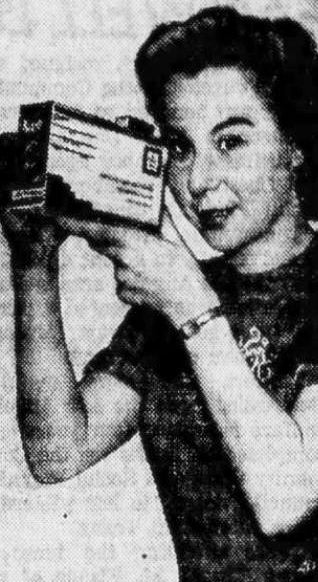
weir_mechanix-illus_1949_smA. D. Weir and his invention, 1949

by Paula Bosse

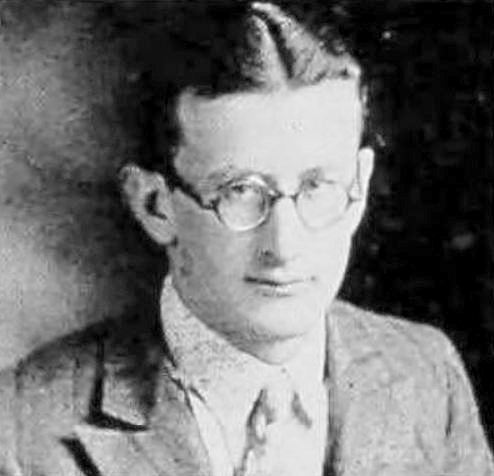
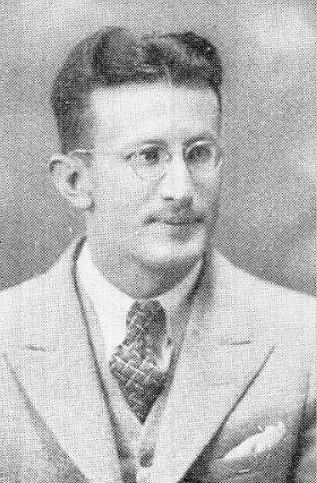
Alfred D. Weir (1909-1996) was the son of A. F. Weir, the successful retail furniture merchant who founded Weir Furniture in 1922. The younger Weir graduated from SMU in 1933 with a degree in mechanical engineering and started his career, fresh out of college, at Dallas’ Ford assembly plant. During World War II, he was the chief industrial engineer at North American Aviation and was later employed by Fairchild Engine and Aircraft, Ford’s aircraft division in Kansas City, Texas Instruments, and Bell Helicopter.

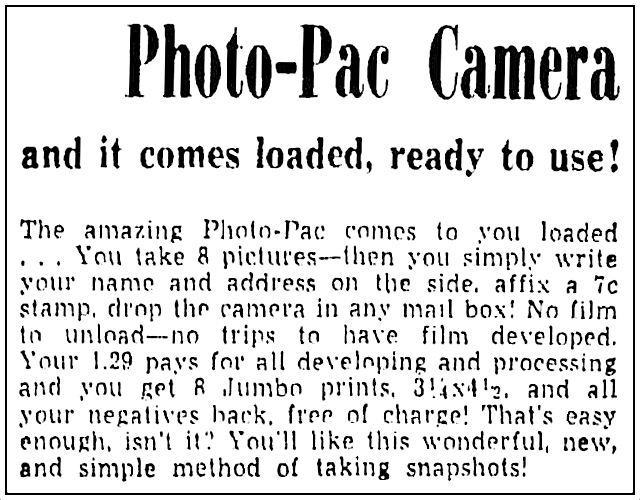
After the war and before his time in Kansas City, Weir took time out from his engineering career to try his hand as an entrepreneur: he invented, patented, and manufactured the Photo-Pac, a single-use camera made of inexpensive fiber board and pre-loaded with 35mm film (loaded by blind employees in total darkness). The user would buy one of these cameras at a drug store, department store, or gas station for $1.29, take eight photographs, and then write his or her name on the side of the camera and drop the whole thing — with the film still inside the camera — in a mail box. Photos would be processed in Dallas, and prints and negatives would be returned to the customer in a couple of days. The camera would not be returned.

photo-pac_san-bernardino-county-sun_040250-photoSan Bernardino County Sun, April 2, 1950

photo-pac_arlington-heights-illinois-herald_122349-photoArlington Heights (Illinois) Herald, Dec. 23, 1949

It appears to have made its debut at the 1948 State Fair of Texas at an introductory price of only 98¢ (click for larger image).

photo-pac_billboard_100948Billboard, Oct. 9, 1948

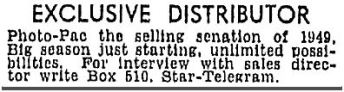
Manufacture and distribution of the camera began in earnest in May, 1949. And then … ads for the camera were everywhere! (The home-grown invention appeared in a hometown newspaper advertorial on May 1, here.) Weir and his small team managed to get the camera in retail locations all over the country. He was also worked hard to line up distributors. Ads such as this one were placed in several U.S. newspapers:

photo-pac_FWST_061649Fort Worth Star-Telegram, June 16, 1949

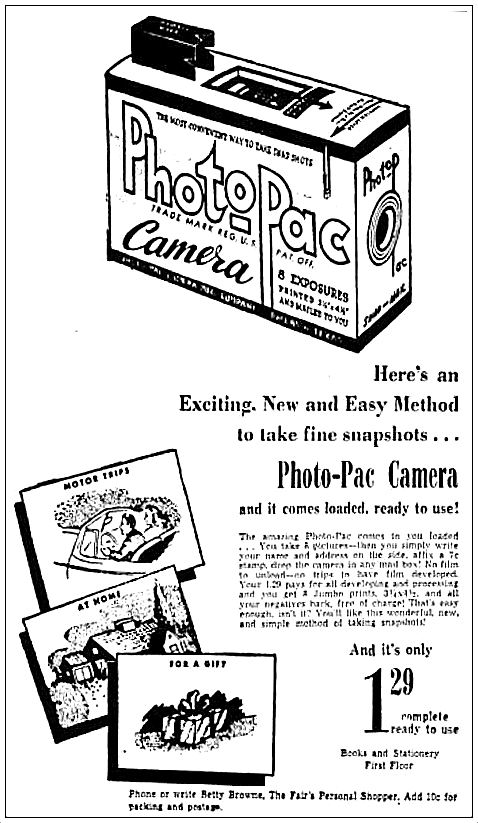
It seems to have been very popular — both as a novelty impulse buy and as a useful product for people who either did not own cameras or who did not want to take their family cameras on trips. Here’s a typical ad (see text below):

photo-pac_FWST_111649_fair-dept-store-ad

photo-pac_FWST_111649_fair-dept-store-ad_detFWST, Nov. 16, 1949 — from ad for Fort Worth’s Fair Department Store

The camera won a “prize gadget” award from Mechanix Illustrated (click to see very large image).

photo-pac_mechanix-illus_sept-1949Mechanix Illustrated, Sept. 1949

By the summer of 1950, the number of exposures went from eight to twelve, and the price increased to $1.49. It seemed that the business was growing, but by the fall of 1950, Photo-Pac seems to have reached the end of the road. Court dockets showed a couple of lawsuits filed against the company. Newspaper ads showed stock of the cameras being deep-discounted to as low as 50¢ apiece. The next year, 1951, saw Weir returning to his engineering career — he accepted a position with Ford in Kansas City and apparently left his business dreams behind. It was a great idea, but, for whatever reason, it never fully caught on.

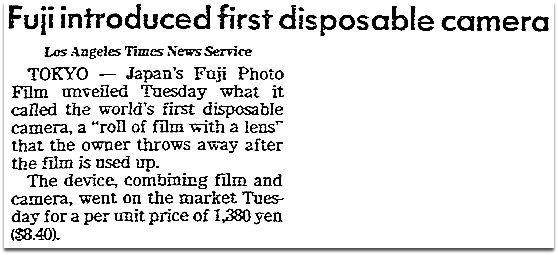
36 long years after A. D. Weir’s Dallas company folded, Fuji introduced their very popular disposable camera; Kodak followed with theirs in 1987. Those things were everywhere — everyone’s had one of them at one time or another. I bet A. D. Weir was miffed.

fuji_FWST_070286FWST, July 2, 1986

*

weir_smu_rotunda_1930A. D. Weir, SMU Rotunda, 1930

weir_smu_rotunda_1933Weir, SMU Rotunda, 1933

weir_dmn_032253-photo1953

***

Sources & Notes

Top photo is an inset from the Mechanix Illustrated “prize gadget” page, from the blog Modern Mechanix, here.

Weir’s patent can be found on Google here. To view Google Patent Image separately (and really big), click image below.

weir_patent

There seems to be some debate about whether Weir’s Photo-Pac was actually the first single-use disposable camera — if it isn’t strictly the first, it seems to have been the one that made the most headway into the American marketplace. A great article on the topic can be found on the Disposable America website here.

Wikipedia’s “disposable camera” page is here.

A. D. Weir’s father, Alfred Folsom (A. F.) Weir opened Weir Furniture at 2550 Elm Street in 1922; in 1934 the company was incorporated to include his wife and son. A. F. Weir sold the Dallas company to his brother Earl (who had owned furniture stores in Fort Worth and Arlington) in the 1940s — that business closed sometime between 1945 and 1948. In 1948, Earl’s son John Ray Weir opened Weir’s Furniture Village on Knox Street, a business still going strong today.

Most images are magically larger when clicked!

*

Copyright © 2016 Paula Bosse. All Rights Reserved.

Sonny James: The “Shindig Heartbreaker”

shindig-cast_sonny-james-websiteSonny James, center, with fiddle (photo: SonnyJames.com)

by Paula Bosse

Sonny James — the much-loved Country Music Hall of Fame singer — died yesterday (Feb. 22, 2016). When I was a child, his version of “Runnin’ Bear” was my favorite song, and it was played endlessly throughout the ’70s on Dallas’ classic country stations like KBOX and WBAP. I was surprised to learn a few years ago, that the Alabama-born Sonny James lived in Dallas for several years, and that Dallas was where he was performing regularly when he exploded into the national consciousness with his first #1 hit, “Young Love.”

sonny-james_dmn_0609561952

Before he made his way to Dallas, Sonny James had been making a name for himself as a performer on Shreveport’s Louisiana Hayride. One of his first appearances in Dallas was during his Hayride Days: he was a guest on the Big D Jamboree in the summer of 1952.

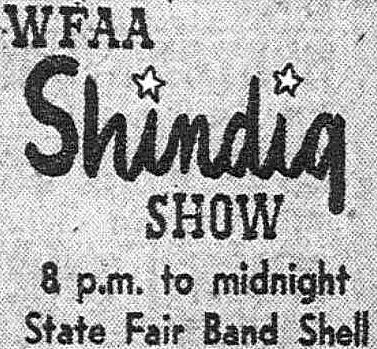
He must have made quite a splash, because only a month later, he had left the Hayride, moved to Dallas, and was signed to appear on the show “Saturday Nite Shindig,” the WFAA-sponsored answer to the Big D Jamboree, which debuted on October 11, 1952. (As “Saturday Night Shindig,” the radio show had been a WFAA staple since it began in 1944; Sonny James was hired to be part of a new “Shindig,” which was revamped from a folksy half-hour show to a 4-hour live music show and was broadcast from Fair Park.)

“Yeoow! More Zip than a Singed Cat!” (Click for larger image.)

sonny-james_dmn_100852Oct. 8, 1952

sonny-james_dmn_101052Oct. 10, 1952

It was an immediate hit, and Sonny became the main draw and something of a teen heart-throb. Less than a month after the announcement of his permanent gig as a “Shindigger,” he also got his own radio show on WFAA, Tuesday and Thursday mornings from 11:00 to 11:15.

Pretty soon, the Shindig revue was being simulcast on TV and radio, live from Fair Park (from the bandshell when it was warm, and from various other buildings during cold and inclement weather).

sonny-james_dmn_041153April 11, 1953

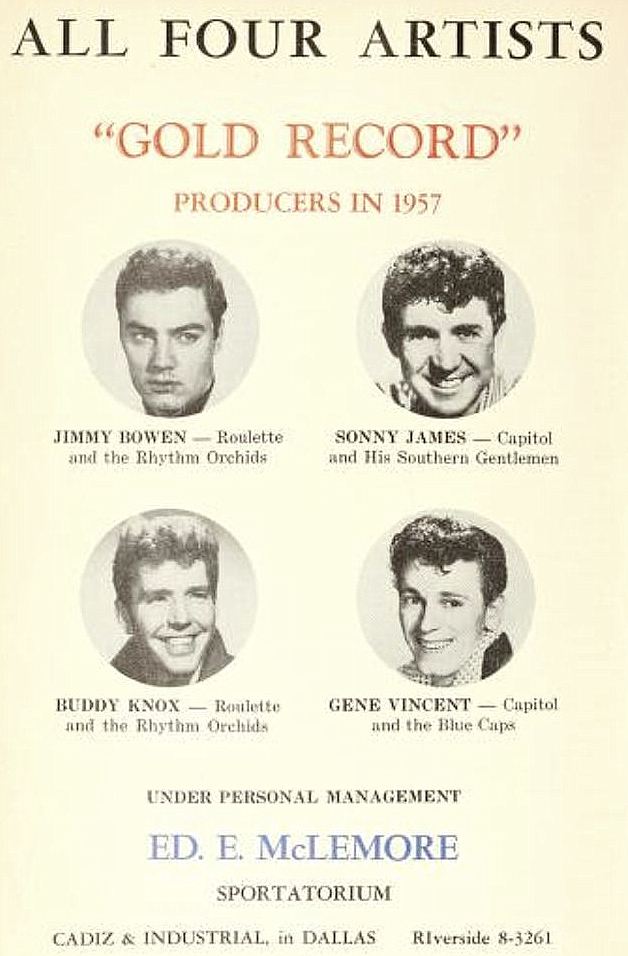
The Shindig show seems to have died away in 1954 or 1955. Sonny James headed back to the Sportatorium and the Big D Jamboree (which was run by his manager, Ed McLemore). One show of note was this one in 1955, with his old Louisiana Hayride pal Elvis Presley. (McLemore made sure that even though Elvis was the headliner, Sonny’s name was actually bigger!)

big-d-jamboree_FWST_041555-elvis_sonny-jamesApril 15, 1955

Sonny James had been recording for Capitol for several years, with some success, but it wasn’t until the end of 1956 that he had his mammoth #1 crossover hit, “Young Love,” which made him a national star. Apparently, he kept a residence in Dallas for a while (the last address I see for him in Dallas was in 1955 at 4718 Capitol, between N. Carroll and Fitzhugh). While living in Dallas, he was a steadfast member of the Church of Christ at East Side and Peak, and he frequently participated in area fishing contests (in fact, there might have been more mentions of his extracurricular fishing exploits in the local papers than there were mentions of his show-biz exploits — his fishing activities were often covered using his real name, Jimmie Loden). One person who lived in the same neighborhood Sonny did recalled on a Dallas-history message board that Sonny worked on Saturday mornings bagging groceries at a store on the corner of Capitol and Fitzhugh.

Sonny James went on to be a much-loved country performer who racked up a number of hits and was, apparently, one of the nicest guys around. He was most definitely a Southern Gentleman. Thanks, Sonny.

sonny-james_shindig_ebay

*

sonny-james_dmn_110852-shindig-ad
Nov. 8, 1952

sonny-james_promo-photo_1953
1953

shindig_dmn_091253
Sept. 12, 1953

shindig_billboard_100353
Billboard, Oct. 3, 1953

sonny-james_dmn_082154
Aug. 21, 1954

james-sonny_1957_promo-photoRadio Annual and Television Yearbook, 1957

james-sonny_mclemore_1958Radio Annual and Television Yearbook, 1958

***

Sources & Notes

Sonny James’ obituary form the Hollywood Reporter is here. His Wikipedia page is here.

The official Sonny James website is here.

To get an idea of the absolutely HOT hillbilly and rockabilly music that was being performed in Dallas in the years that Sonny James was here, check out this fantastic sampling of recordings from the Big D Jamboree:

*

See a few photos of Sonny James in Dallas at SonnyJames.com here (click thumbnails for larger images — the photo of Sonny sitting in the wings watching Elvis on stage at the Big D Jamboree is pretty great!).

A couple of good articles about Sonny James’ time in Dallas (written while he still considered himself a resident of the city) can be found in the Dallas Morning News archives:

  • “Success Won’t Spoil Mr. James” by Tony Zoppi in his “Dallas After Dark” column (DMN, Feb. 10, 1957)
  • “Sonny Snubs That Las Vegas ‘Loot'” by, of all people, Frank X. Tolbert in his “Tolbert’s Texas” column (May 13, 1957), in which Sonny — fresh off his 2.5-million-selling “Young Love” hit — talked about having a clause in contracts saying he would not perform in places with drinking, “clinch dancing,” and gambling, mostly because he did not want to exclude his teenage fans from being able to see him perform.

A good interview with Sonny James — packed with photos — appeared in the January, 1958 issue of TV Radio Mirror, a full scan of which you can find here. Even after he had hit the mega-big-time, Sonny said he continued to keep an apartment in Dallas. In the story there is a photo of his Dallas girlfriend, Doris Farmer (née Shrode) — she and Sonny took out a marriage license in July, 1957 (seen here) — I’m not sure when they married, but Sonny and Doris were happily married until Sonny’s death, almost 60 years.

Another performer who lived in the DFW area at the same time as Sonny James and who was also on the cusp of national stardom was Pat Boone, who had his own show on WBAP while attending college in Denton. Sonny and Pat were friends and even appeared on a few bills together. They were both also members of the Church of Christ, which both no doubt felt was an important bond. I wrote about Pat Boone’s time in DFW in the Flashback Dallas post “Pat Boone, Host of Channel 5’s ‘Teen Times’ — 1954,” here.

*

Copyright © 2016 Paula Bosse. All Rights Reserved.
When a Ten-Spot Could Get a Family of Four Into Six Flags — 1962

ad-six-flags_dmn_042362

by Paula Bosse

Six Flags Over Texas is about to open up again. In 1962 — the theme park’s second year — the admission price for one adult was $2.75 (approximately $22.00 in today’s money), and the price for children under 12 was $2.25 (approximately $18.00 in today’s money). A family of two adults and two children would pay $10.00 for admission — that would be a little under $80.00 in 2016 money, which was still a lot back then, until you compare it to today’s Six Flags ticket prices: $250 for a family of four (as long as both of those children are under 48″ tall). (Pink Things not included.) And you probably won’t even see a dad wearing a suit and tie and a porkpie hat. And you certainly won’t get to see ANY of this! I think you got a lot more bang for your buck 50 years ago.

***

Never leave home without the Inflation Calculator.

*

Copyright © 2016 Paula Bosse. All Rights Reserved.


Lakewood Post Office — 1946-1976

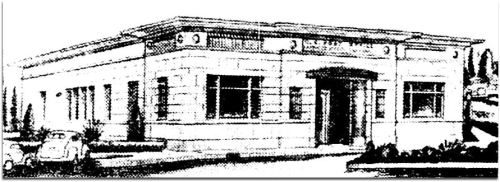
lakewood_post-office_dmn-123045Lakewood Post Office, 6324 Prospect

by Paula Bosse

I’m often surprised to discover things about the part of Dallas I grew up in which I somehow never knew — in this case: Lakewood’s first post office, which was apparently in operation when I was a living, breathing, sentient human being but which I’d never known about until today. (I actually grew up in the nearby Lower Greenville neighborhood, but even though I went to Long and Woodrow, I don’t remember being all that aware of Lakewood proper until I was able to drive myself around it as a teenager.) Somehow I had never known that there was a post office in Lakewood before the one at Swiss and La Vista. Or, rather, I’d never even thought about it. Until I saw this ad earlier today:

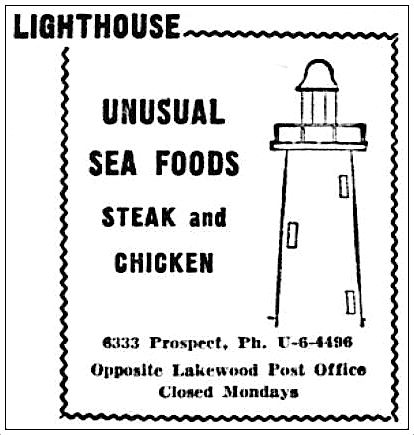
lakewood_lighthouse_dmn_0425471947

“The Lighthouse — Unusual Sea Foods, Steak and Chicken — Opposite Lakewood Post Office.”

Post office? New to me. I looked it up. It was just west of Abrams, on Prospect at Kidwell, positioned diagonally across the lot. It was the 13th post office substation in Dallas, and it opened on December 2, 1946, over two years after its approval had been announced, during the war, in August, 1944.

A 1945 Dallas Morning News article had this interesting bit of information:

The contractor is Bascomb E. McClesky [sic]. The building will have 4,000 square feet of floor space. Parking space will be provided on the lot. [McCleskey] will retain title to the property and will lease it to the government, Payne said. (“Lakewood To Get Branch Post Office,” DMN, Nov. 18, 1945)

(I’m not sure I was aware developers leased property to the federal government. B. E.  McCleskey lived in the Pasadena area of Lakewood and seems to have spent his 30-year career as a general contractor who also bought, sold, and developed both commercial and residential properties in and around this part of East Dallas. When he began his career, he had an office on Gaston in the new Lakewood Shopping Center; at the time of his death in 1956, his office was right next door to the post office on land which, presumably, he still owned.)

This post office lasted for 30 years until the newer, hulkier, and far less aesthetically appealing station opened at Swiss and La Vista on May 10, 1976.

lakewood-post-office_dmn_112576_swiss.-photo
1976

Some factoids which will come in handy should you ever find yourself in a U.S. Post Office Trivial Pursuit (Lakewood Edition) competition:

  • When the first Lakewood post office opened in 1946, it employed 3 clerks, 1 supervisor, and 16 carriers.
  • When the second post office opened 30 years later, it employed 13 clerks, 2 supervisors, and 47 carriers.

*

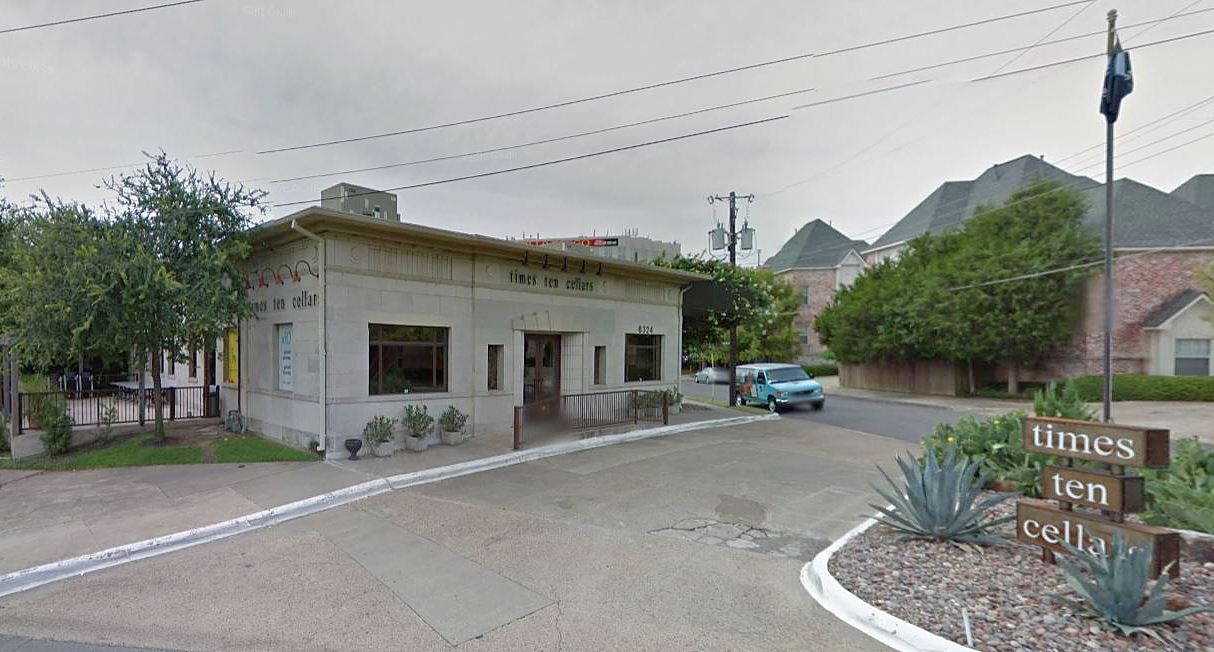
But back to the first post office — the building is still standing and houses the Times Ten Cellars wine bar! I’ve passed that building a lot over the years, but I guess I never paid much attention to it. I don’t know why, because it’s a great little  building. It would never occur to me that it might ever have been a post office. I wish more businesses in Dallas would consider repurposing older buildings rather than building characterless boxes that look like every other characterless box. Thank you, Times Ten Cellars!

times-ten-cellar_google_2015Google Street View (2015)

*

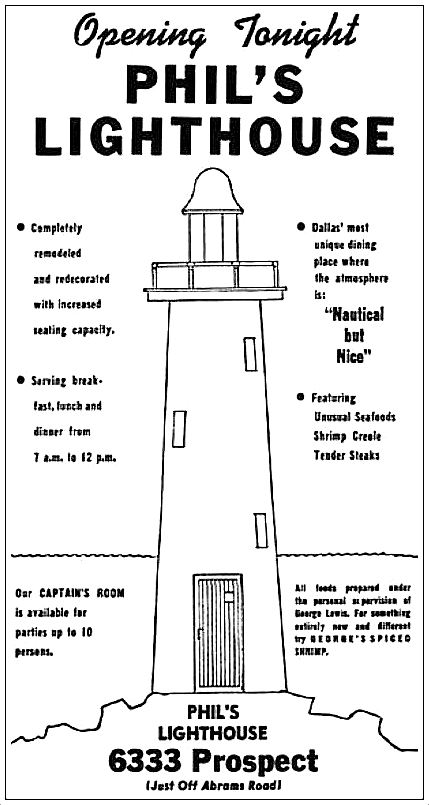
That Lighthouse “unusual sea foods” restaurant? It doesn’t seem to have lasted very long. It changed hands a few times before closing as the Lighthouse Cafe at the end of 1950. At one point it was known as Phil’s Lighthouse — “Dallas’ most unique dining place where the atmosphere is: ‘Nautical But Nice.'”

phils-lighthouse_dmn_121649DMN, Dec. 16, 1949

That’s right … “NAUTICAL BUT NICE”!

***

Sources & Notes

If anyone remembers the Lighthouse restaurant: was it actually shaped like a lighthouse?

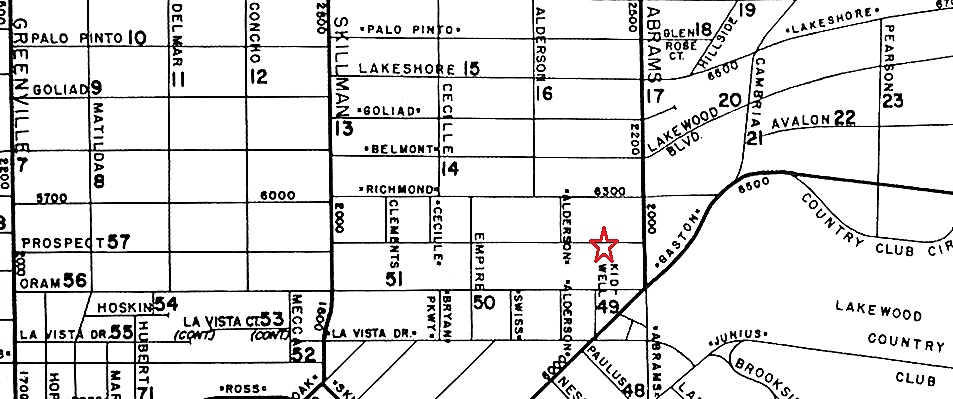
Detail of a page from the 1952 Mapsco showing the location of the old post office (click for larger image):

lakewood-post office_1952-mapsco

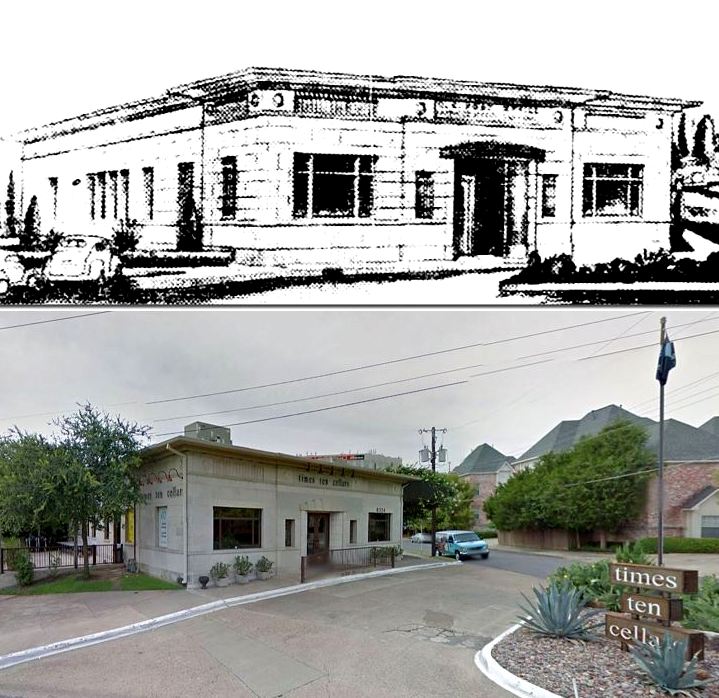
lakewood-post-office_then-now

Click pictures for larger images.

*

Copyright © 2016 Paula Bosse. All Rights Reserved.
 

Life in The Grove: Pleasant Grove — 1954-1956

pghs_1956-dairy-queenDairy Queen, 1238 S. Buckner — 1956 (click for larger image)

by Paula Bosse

The community of Pleasant Grove was first settled in the 1840s but didn’t officially become part of Dallas until it was annexed in 1954 after a huge postwar surge in population. Upon annexation, the schools that made up the Pleasant Grove Independent School District became part of the DISD, including Pleasant Grove High School, which was located on Lake June Road, between Conner and Pleasant Drive. PGHS closed when the brand new W. W. Samuell High School opened on January 28, 1957, halfway through the 1956-1957 school year. The photos here are from the yearbooks of the last three years that Pleasant Grove High School was open — most of the ads feature students inside or in front of the business establishments. And they’re great! (Click photos for larger images.)

*

Photos of overcrowded Pleasant Grove High School and its numerous out-buildings, 1955.

pghs_1955a

pghs_1955b

Pleasant Grove Pharmacy, Grady’s Clover Farm Grocery, and Grove Shoe Store:

pghs_1954-yrbk_a1954

Worthington Service Station:

pghs_1954-yrbk-worthington1954

Schepps Dairy:

pghs_1954-yrbk-schepps1954

The Eatmore Hamburger System (greatest name EVER!!):

pghs_1954-yrbk-eatmore1954

Dasch Cleaners:

pghs_1955-yrbk-dasch1955

Harvey Hayes, “The Insurance Man”:

pghs_1955-yrbk_a1955

Cassidy’s Conoco Station, Tee-Pee Drive-In Grocery, and Gay and Jones Motor Co.:

pghs_1956-yrbk_b1956

Worthington’s Magnolia Service Station (again) and Barrett’s Used Cars:

pghs_1956-yrbk_a1956

W. W. Hughes Magnolia Service Station, E & L Service Shop (bicycle and lawnmower service), and, again, Pleasant Grove Pharmacy:

pghs_1956-yrbk_d1956

Billie Price Real Estate and Maridell’s:

pghs_1956-yrbk_c1956

Martin’s Sinclair Service Station (with a DQ photobomb):

pghs_1956-martins1956

The Kaufman Pike Drive-In, “The Theater With a Heart”:

pghs_1956-yrbk-kaufman-pike-drive-in1956

And lastly, a very dark photo of Pleasant Grove High School from the 1948 yearbook:

pleasant-grove-high-school_1948-yrbk1948

***

Sources & Notes

All photos and ads are from the 1954, 1955, and 1956 editions of The Bobcat, the Pleasant Grove High School yearbook.

More on the history of Pleasant Grove in southeast Dallas, here. More on the history of Pleasant Grove High School here and here. The confusing school changes revolving around the the PGISD/DISD switchover were a bit like musical chairs and affected attendance of numerous high schools (including Forest High School, Crozier Tech, and Woodrow Wilson), junior high schools, and elementary schools. Read about the details in the Dallas Morning News article “Mid-Term Switch Set for Students” (DMN, Jan. 6, 1957).

Google map showing Pleasant Grove and approximate location of PGHS, here.

As always, click pictures for larger images.

*

Copyright © 2016 Paula Bosse. All Rights Reserved.

The Lakewood Theater — 1944

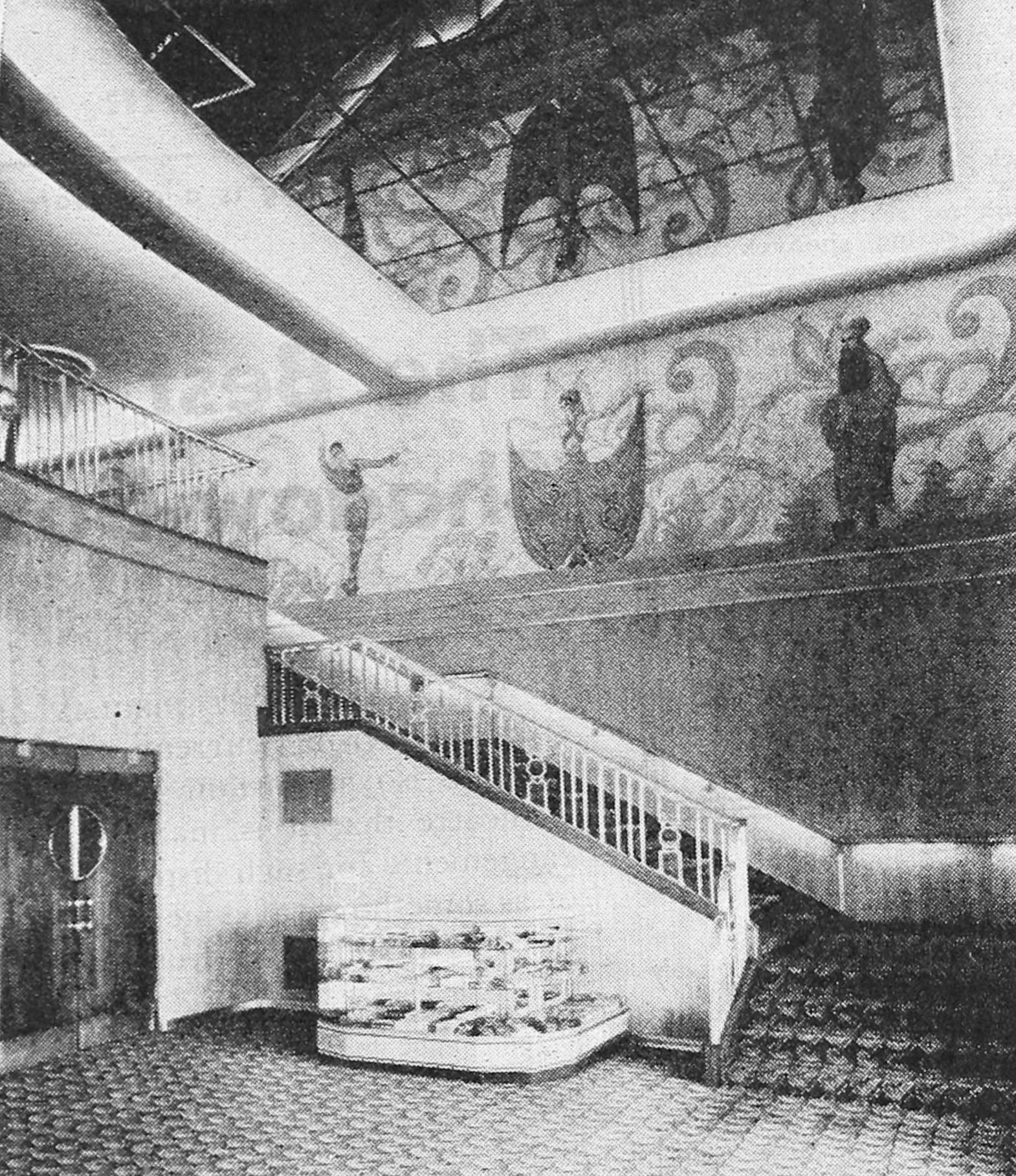
lakewood-theater_ad_inset_1944A well-lit staircase to the balcony (click for giant image)

by Paula Bosse

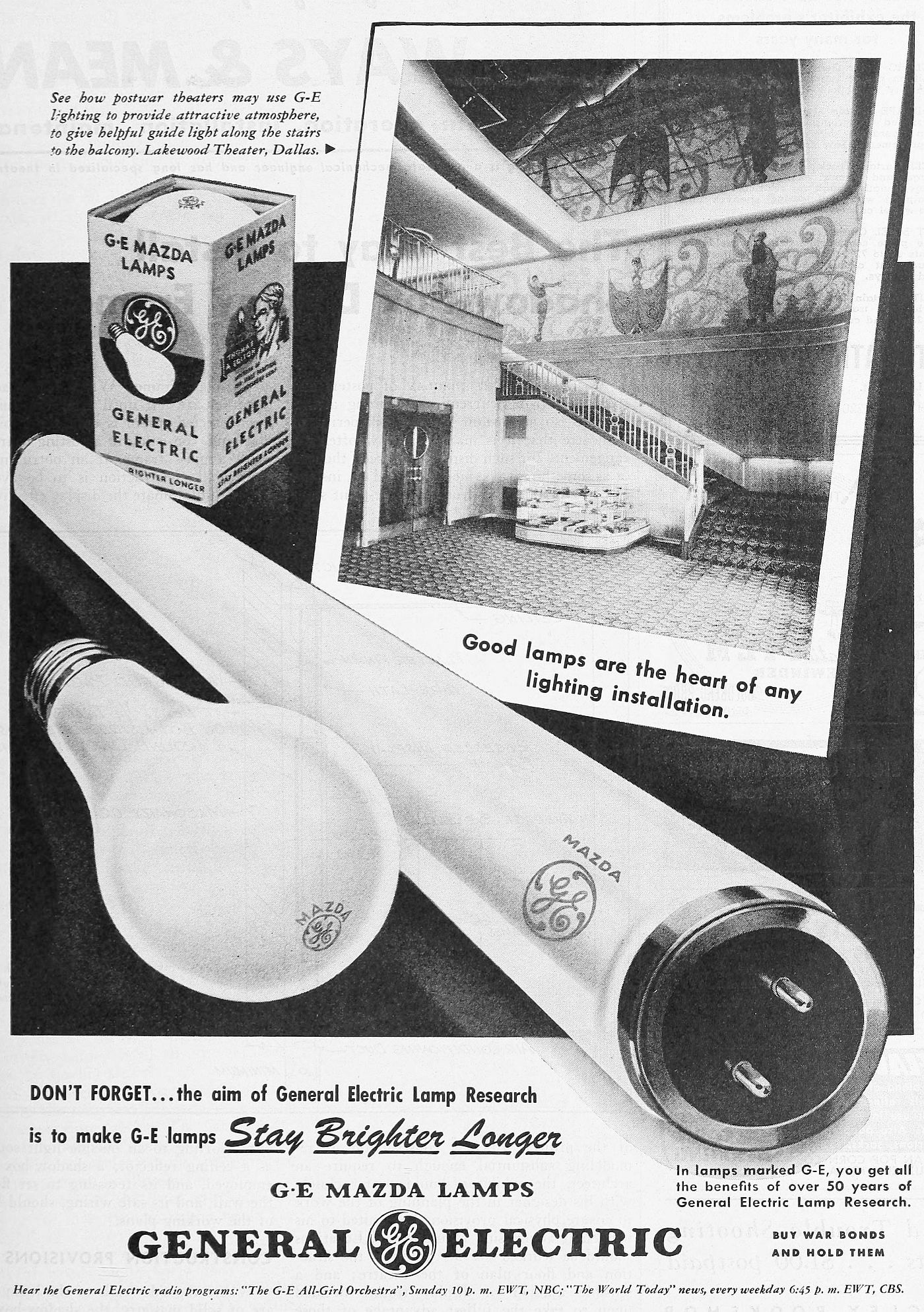
Occasionally one stumbles across a national advertisement featuring someone or something familiar to local audiences which elicits an involuntary exclamation like, “Hey! I know that guy!” I had a response kind of like that when I saw this General Electric light bulb ad featuring a photograph of the interior of the Lakewood Theater (showing a few figures from the mural by Woodrow boy Perry Nichols).

“See how postwar theaters may use G-E lighting to provide attractive atmosphere, to give helpful guide light along the stairs to the balcony.”

lakewood-theater_ad_MPH_072244_med

Yes, the Lakewood certainly did have an “attractive atmosphere.”

***

Sources & Notes

Ad for G-E Mazda lamps appeared in the July 22, 1944 issue of Motion Picture Herald. Click the above ad to see it much larger. To see it REALLY big, click here. (Apologies for the bleed-through of the ad on the other side of the page. If you’re a Photoshop wizard who can remove the offending ghost letters plastered across Nichols’ whimsical mural, I’d love a cleaned-up version.)

I have no idea what’s going on with the beleaguered Lakewood Theater these days, but if you’d like to see those murals in color, see the photos in the Lakewood Advocate, here.

*

Copyright © 2016 Paula Bosse. All Rights Reserved.
The Volunteer Fire Department’s Early Days

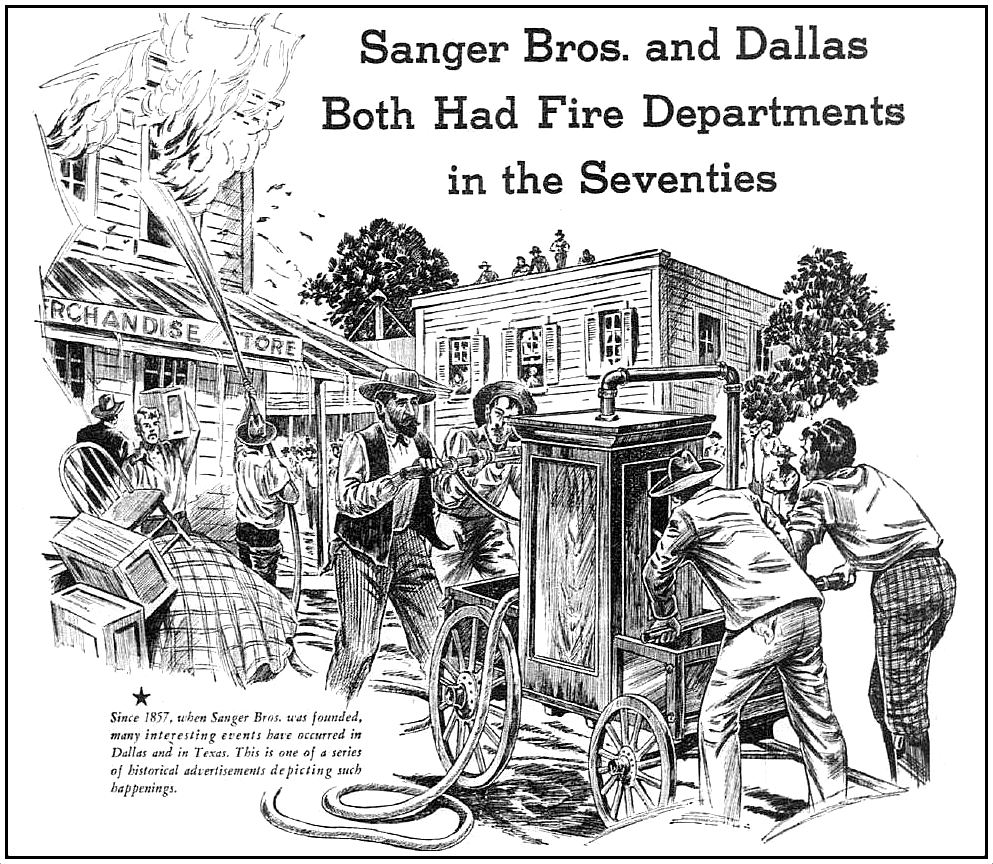
sanger-bros_fire-department_dmn_030836aPumping water from an underground cistern (click for larger image)

by Paula Bosse

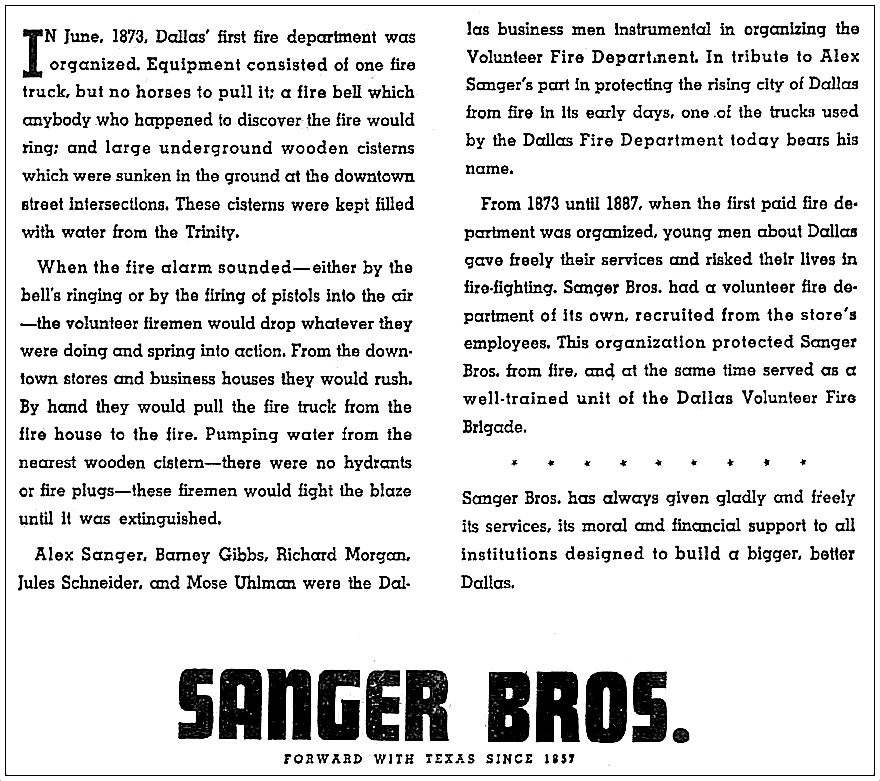
Dallas was constantly catching on fire in its early days. According to this very informative advertisement, Alex Sanger was one of the Dallas businessmen responsible for organizing the city’s first volunteer fire department. Interestingly, the Sanger Bros. department store also had a volunteer fire department which not only protected the store, but also served as a special unit of the Dallas Volunteer Fire Brigade.

The drawing above and the text below are from a 1936 Sanger Bros. advertisement. (Click to see larger images.)

sanger-bros_fire-department_dmn_030836b1936

*

Copyright © 2016 Paula Bosse. All Rights Reserved.