Flashback : Dallas

A Miscellany: History, Ads, Pop Culture

Category: Advertisements

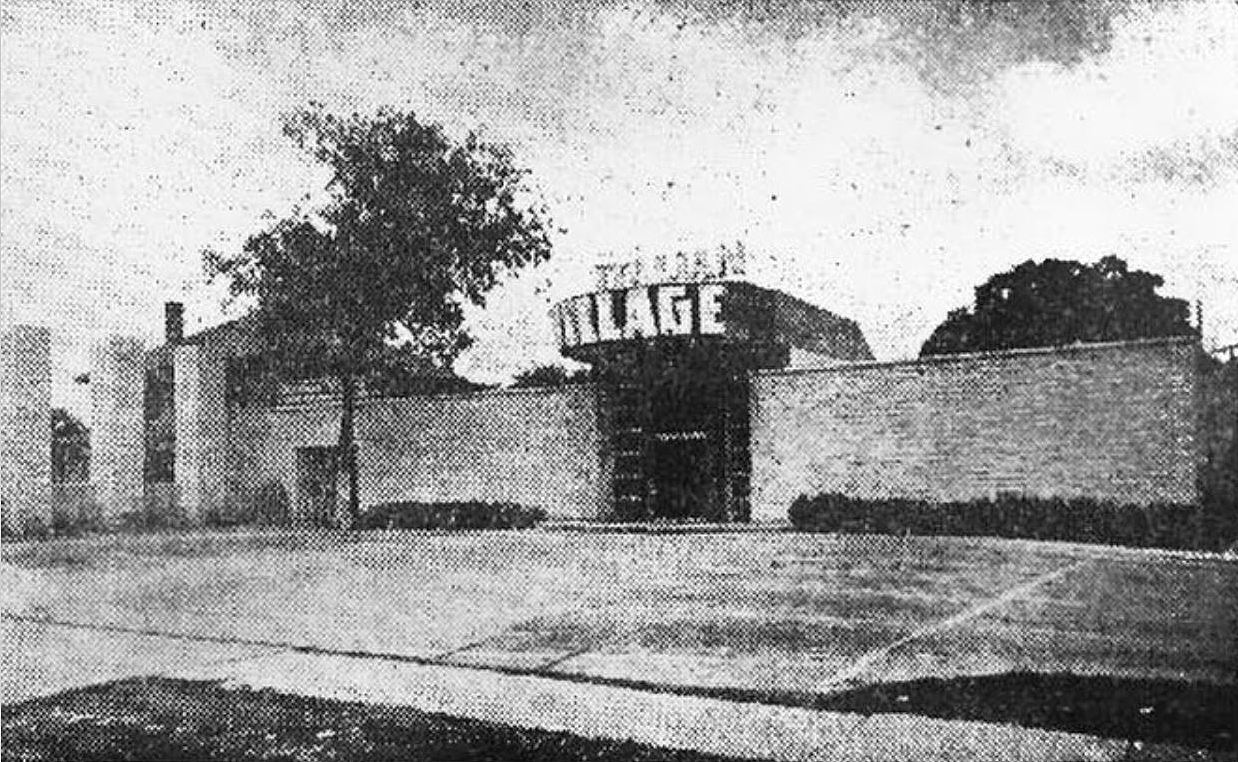
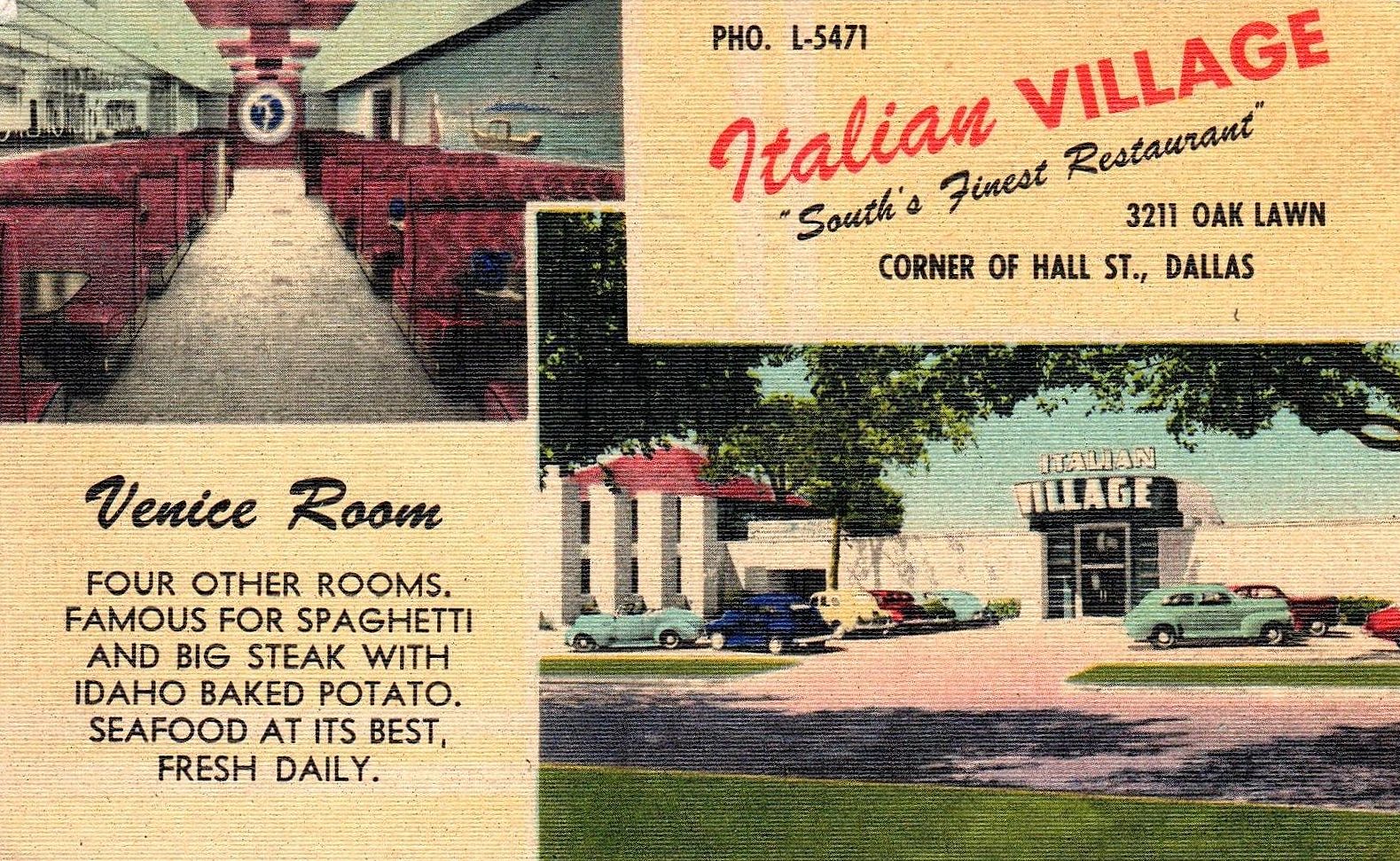
Sam Ventura’s Italian Village, Oak Lawn

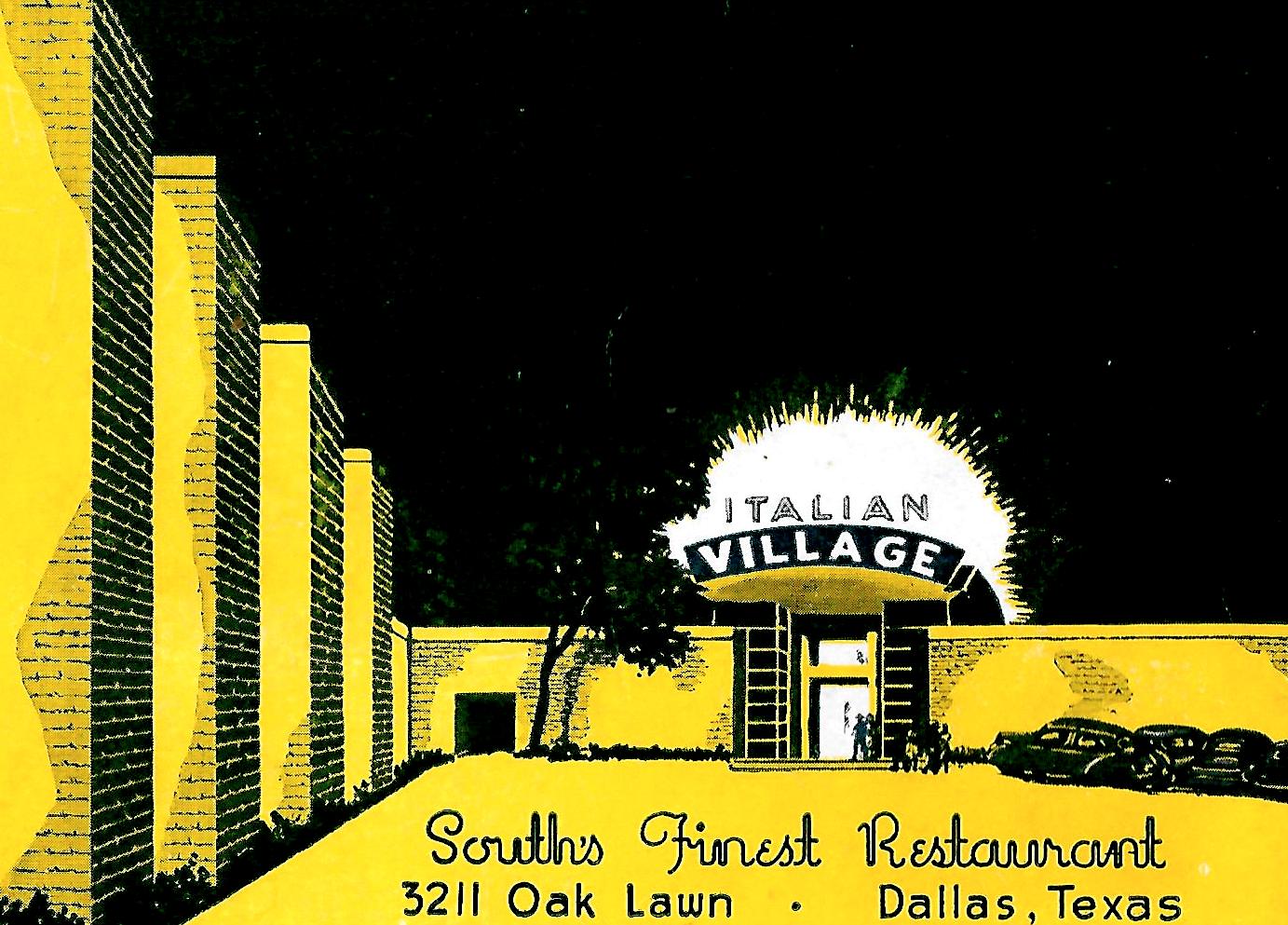
italian-village_photo-holder_PEB

by Paula Bosse

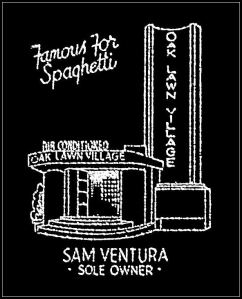
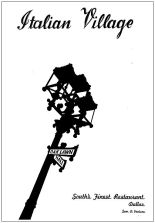
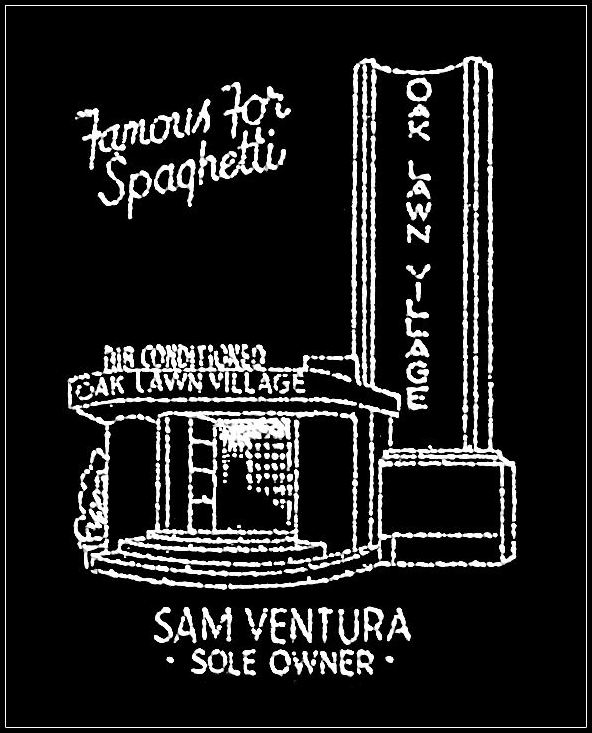
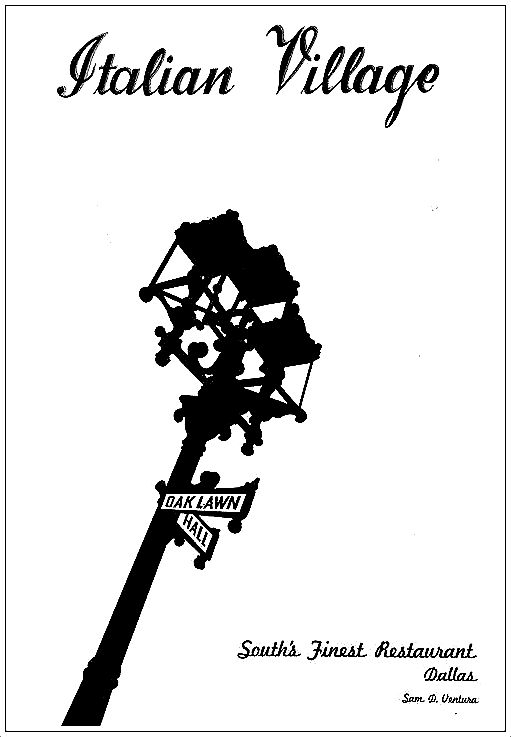
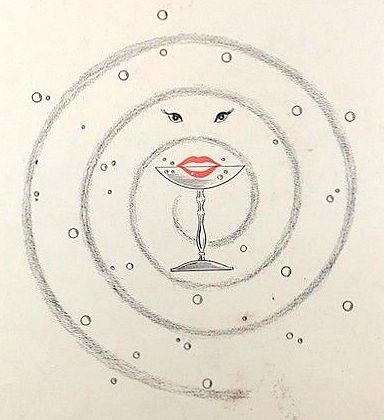
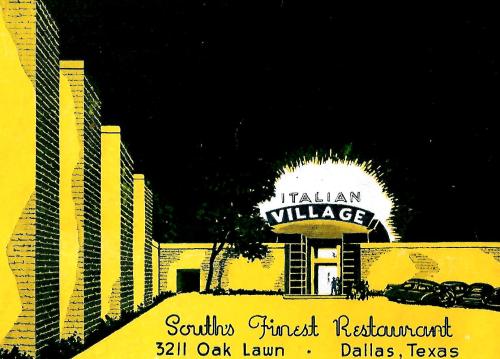
In amongst photos and belongings of my mother’s aunt, I recently came across this wonderful graphic of Oak Lawn’s Italian Village (3211 Oak Lawn, at Hall). It was on the cover of one of those cardboard photo holders which contained photos of diners and club-goers captured by photographers wanting to memorialize celebrants’ special occasions — they would take your photo and you would later purchase prints, which would be tucked inside the souvenir folder. (I don’t recognize any of the people in the photo which was  inside — the photo is here.)

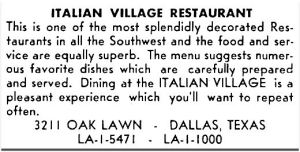
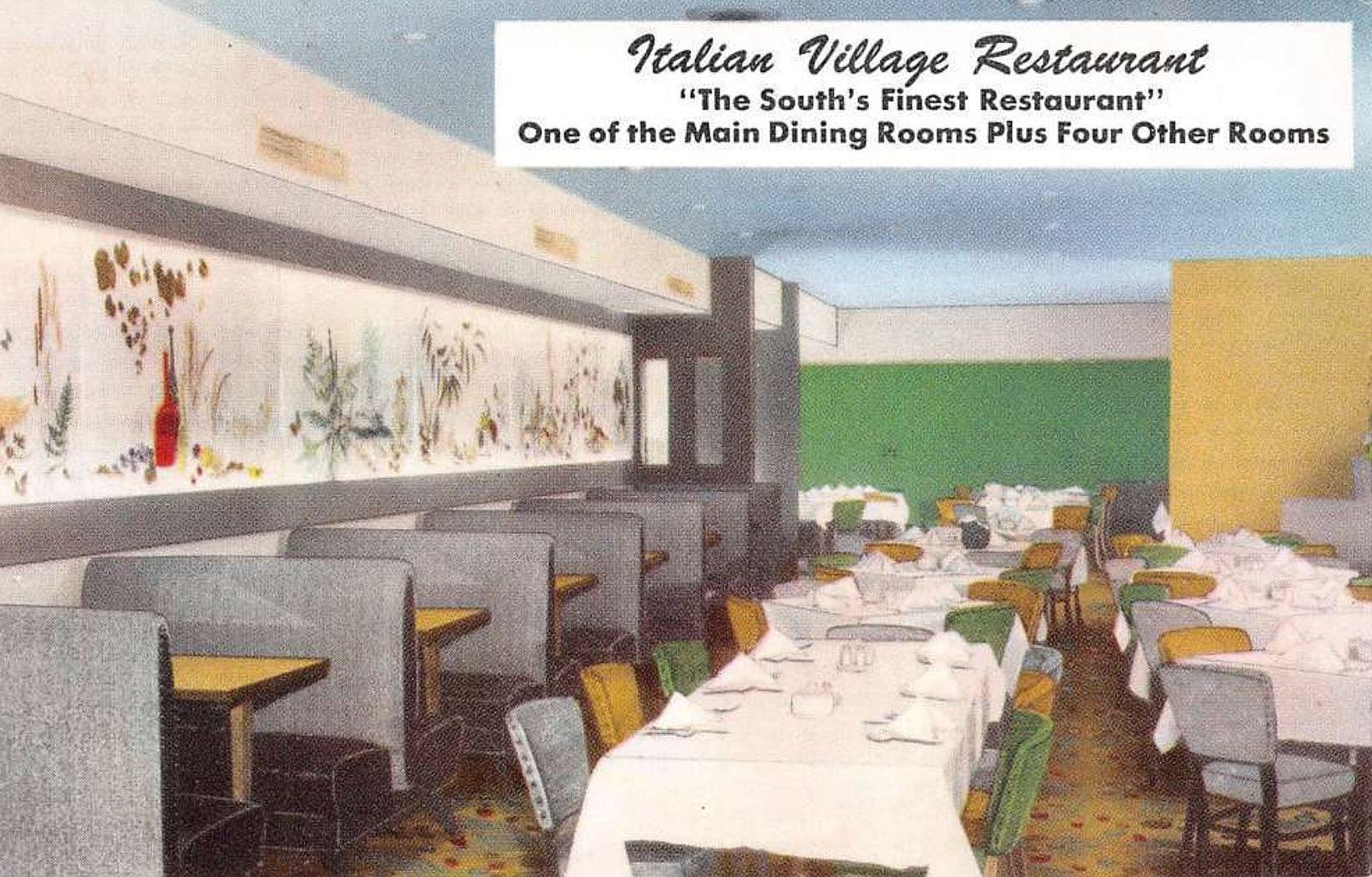
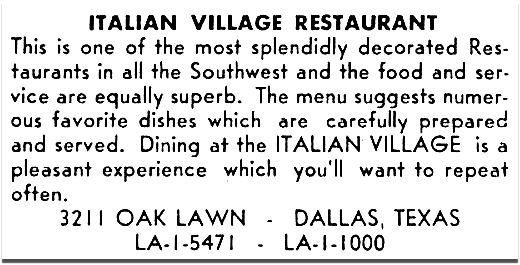
The Italian Village complex (which contained all its various tangential enterprises over he years) was an Oak Lawn fixture for over 45 years — it was apparently still around during my lifetime, but I have no memory of ever seeing it. But by the time I would have been aware of it, things had begun to get a little weird and its profile had definitely dipped. (More on that later.)

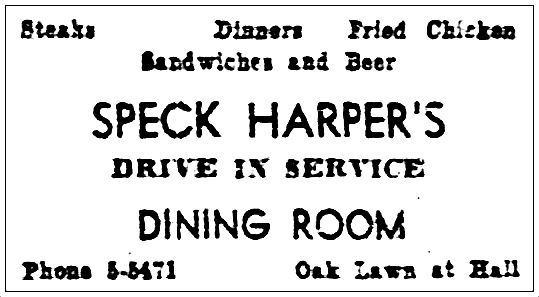
Italian Village began its life in 1934 when Sam Ventura (1907-1997) bought a popular drive-in restaurant in Oak Lawn from a man named Levi F. “Speck” Harper. In Ventura’s obituary in The Dallas Morning News, his wife said: “He bought it from a man named Speck Harper who told him, ‘Give me $250 and my hat, and you’ll never see me again.’ Sam had to go and borrow the money.” (DMN, June 1, 1997) ($250 in today’s money would be about $4,700.)
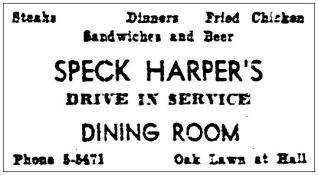
speck-harper_july-1934July, 1934

Not only did $250 start Ventura on a very successful career as a restaurateur, it also assured him ownership of what would quickly become a primo piece of real estate. (Ventura dabbled in real estate and, in 1937, along with fellow restaurant man Sam Lobello, he purchased land at Preston Road and Northwest Highway which would one day become Preston Center.) (It might be worth noting here that Sam Ventura was not affiliated with the very popular Sammy’s restaurants, run by Dallas’ Messina family.)
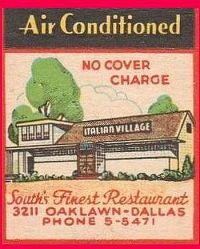
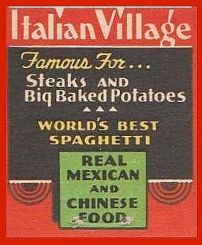
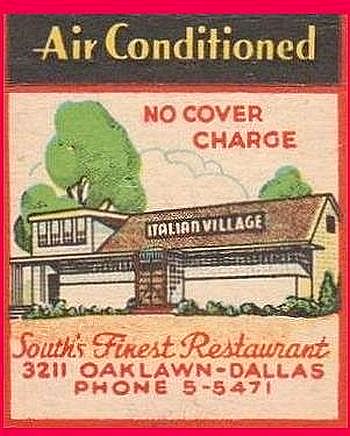
italian-village_matchbook_front_ebay        italian-village_matchbook_back_ebay
Matchbook, via eBay

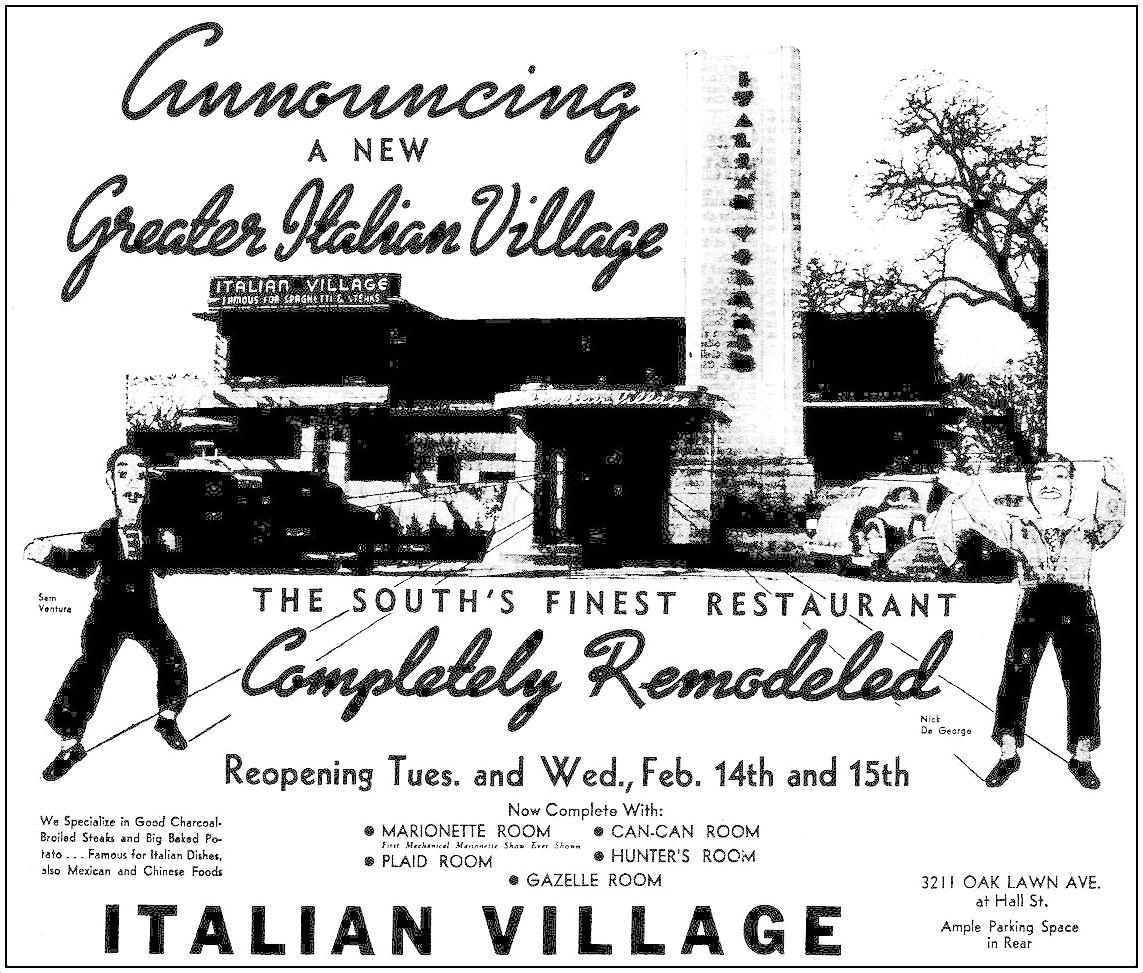
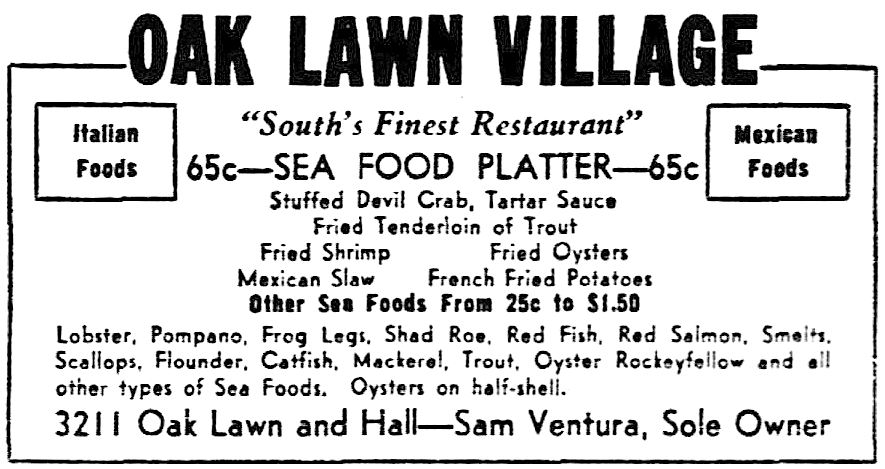
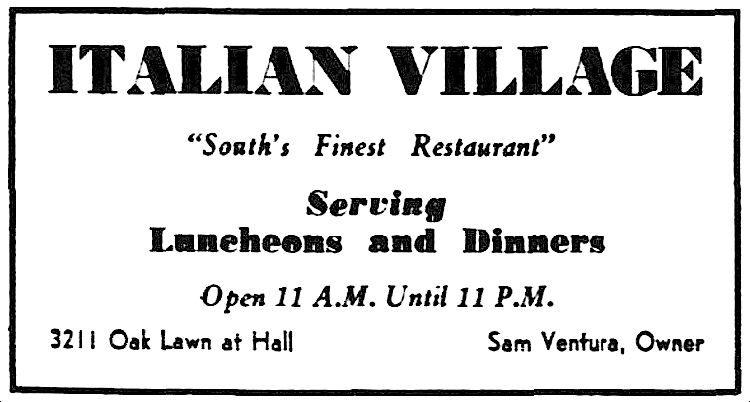
Italian Village — a restaurant which operated for many years as a private club in order to sell liquor — was originally co-owned by brothers-in-law Sam Ventura and Nick DeGeorge (DeGeorge was later married to Ventura’s sister Lucille). By the time the ad below appeared in 1939, the place had been newly remodeled and was on its ninth (!) expansion. There were lots of new “rooms”: the Can-Can Room, the Plaid Room, the Hunter’s Room, the Gazelle Room, and the Marionette Room, the latter of which featured entertainment in the form of a marionette show with puppets made in likenesses of the owners. (All images are larger when clicked.)
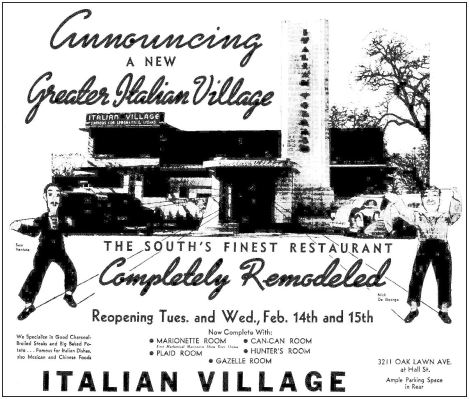
1939_italian-village_feb-1939Feb., 1939

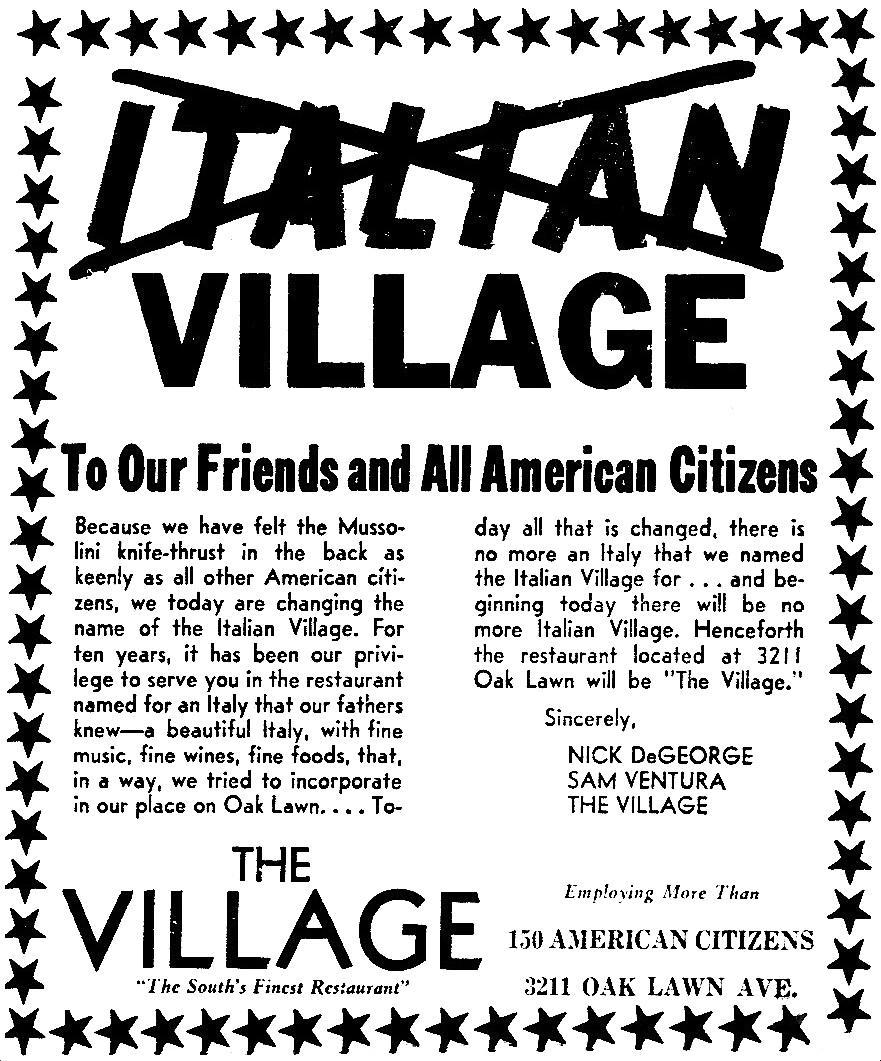
In June, 1940, Italy entered the War in Europe as a member of the Axis forces. As a result, Ventura and DeGeorge immediately asserted their patriotism and their American-ness (both were born in the United States to Italian immigrants) by changing the name of their restaurant: arrivederci, Italian Village, hello, Oak Lawn Village. The owners placed an ad in Dallas newspapers explaining their decision (see ad below) — this made news across the country, garnering both positive national publicity as well as fervent local support.
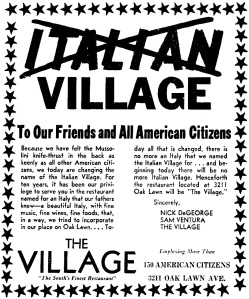
italian-village_ad_june-1940
June, 1940

Not only did the restaurant’s name change in 1940, so did its ownership. Nick DeGeorge and his wife (the sister of Sam Ventura) embarked on a very lengthy, very bitter divorce (newspapers reported that Nick and Lucille were each on their fourth marriages). The result of this marital split spilled over and also caused a business split: Ventura became the sole owner of Italian Oak Lawn Village, and DeGeorge left to start his own (very successful) restaurant career (DeGeorge’s, Town & Country, etc.). Sam announced that he was “sole owner” in a September, 1940 ad. (I hope Nick at least got custody of his mini-me marionette….)
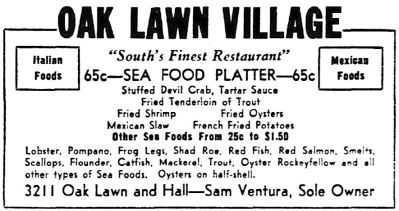
1940_oak-lawn-village-ad_sept-1950Sept., 1940

oak-lawn-village_matchbook_flickr-coltera
Oak Lawn Village matchbook cover, via Flickr

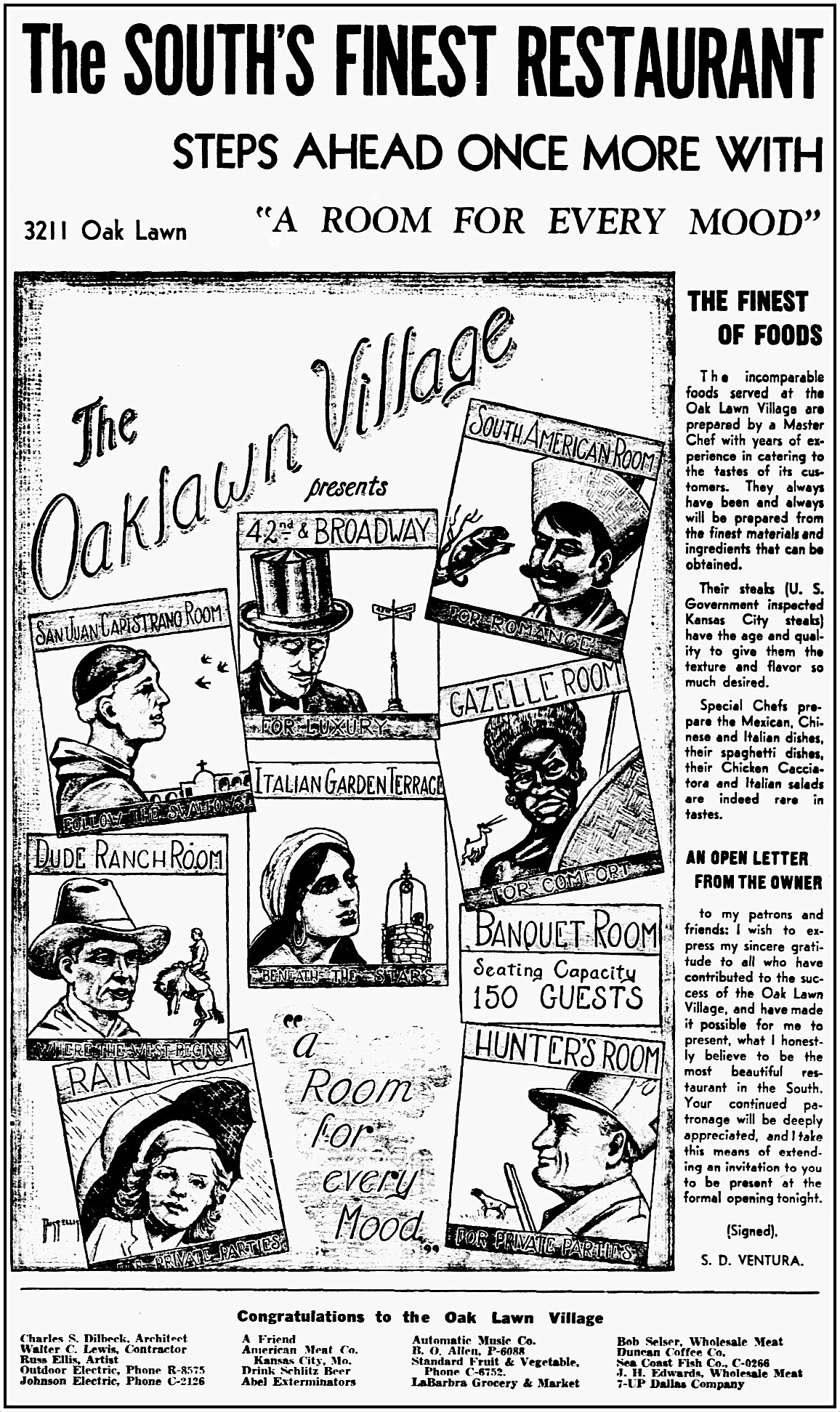
In June, 1941 yet another remodeling/expansion was announced, with architectural design by longtime friend of Ventura and DeGeorge, Charles Dilbeck, and murals by Russ Ellis. In addition to the Gazelle Room (“for comfort”) and the Hunter’s Room (“for private parties”), there was now the San Juan Capistrano Room (“follow the swallows”), the 42nd & Broadway Room (“for luxury”), the South American Room (“for romance”), the Dude Ranch Room (“where the west begins”), the Rain Room (“for private parties”), the Banquet Room (“seating capacity 150 guests”), and an outdoor Italian Garden Terrace (“beneath the stars”).
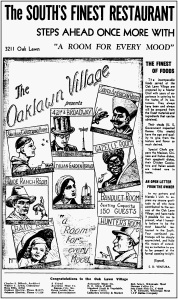
1941_oak-lawn-village_dmn_june-41June, 1941

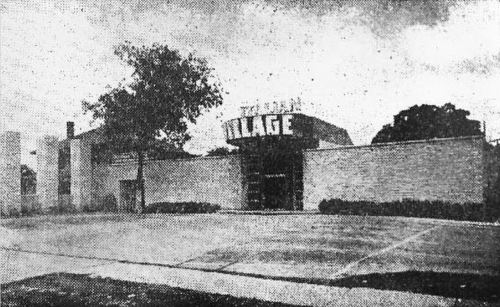
That $20,000 remodel (which would have been equivalent to about $350,000 in today’s money) went up in smoke — literally — in April, 1944, when the restaurant was “virtually destroyed” by fire. Ventura said he would rebuild when war-time government regulations would permit him to do so. At the end of the year he announced that he would build a new restaurant, of shell stone and marble construction, lit in front by decorative tower lights. The new place was built and in full swing — and back with its original name — in the summer of 1945.
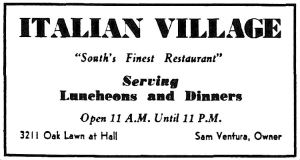
1945_italian-village_aug-1945Aug., 1945

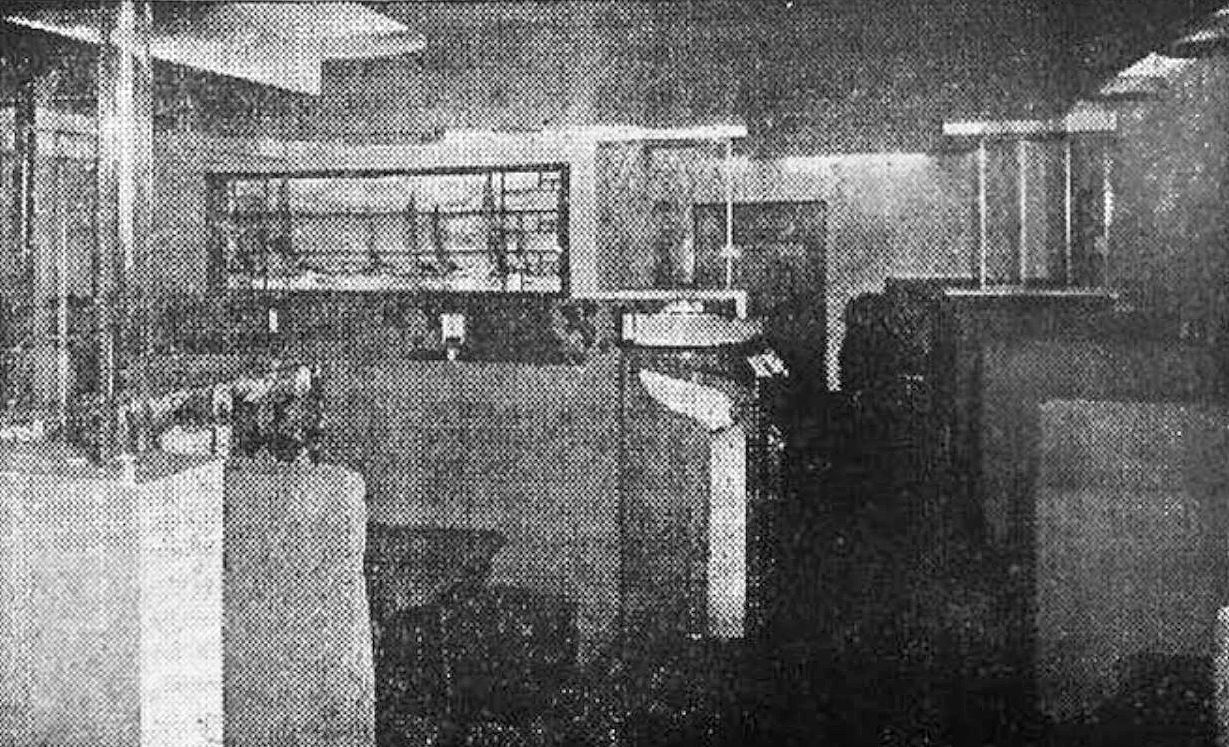
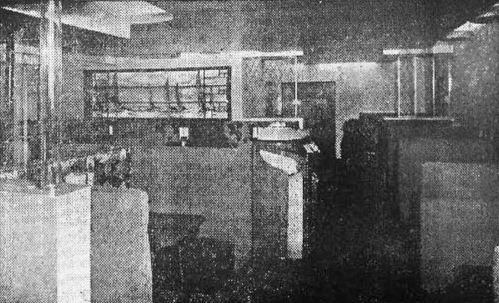
An ad for Dallas’ S. H. Lynch & Co.’s Seeburg Scientific Sound Distribution system appeared in the Aug. 10, 1946 issue of Billboard magazine, showing photos of Sam Ventura, the exterior of the new building, and an interior shot showing a Seeburg jukebox. (See full ad here.)
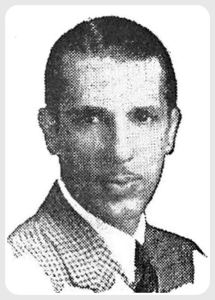
1946_italian-village_billboard_081046_ad-det-1Sam D. Ventura, 1946 (ad detail, Billboard magazine)
1946_italian-village_billboard_081046_ad-det-2

1946_italian-village_billboard_081046_ad-det-3Italian Village exterior and interior, 1946 (ad detail, Billboard magazine)
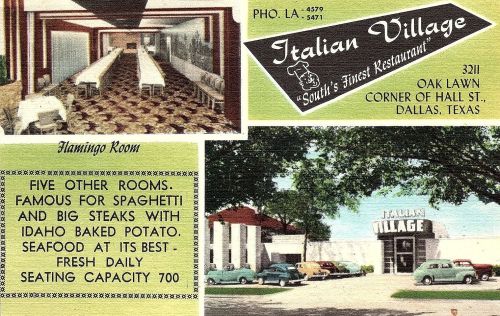
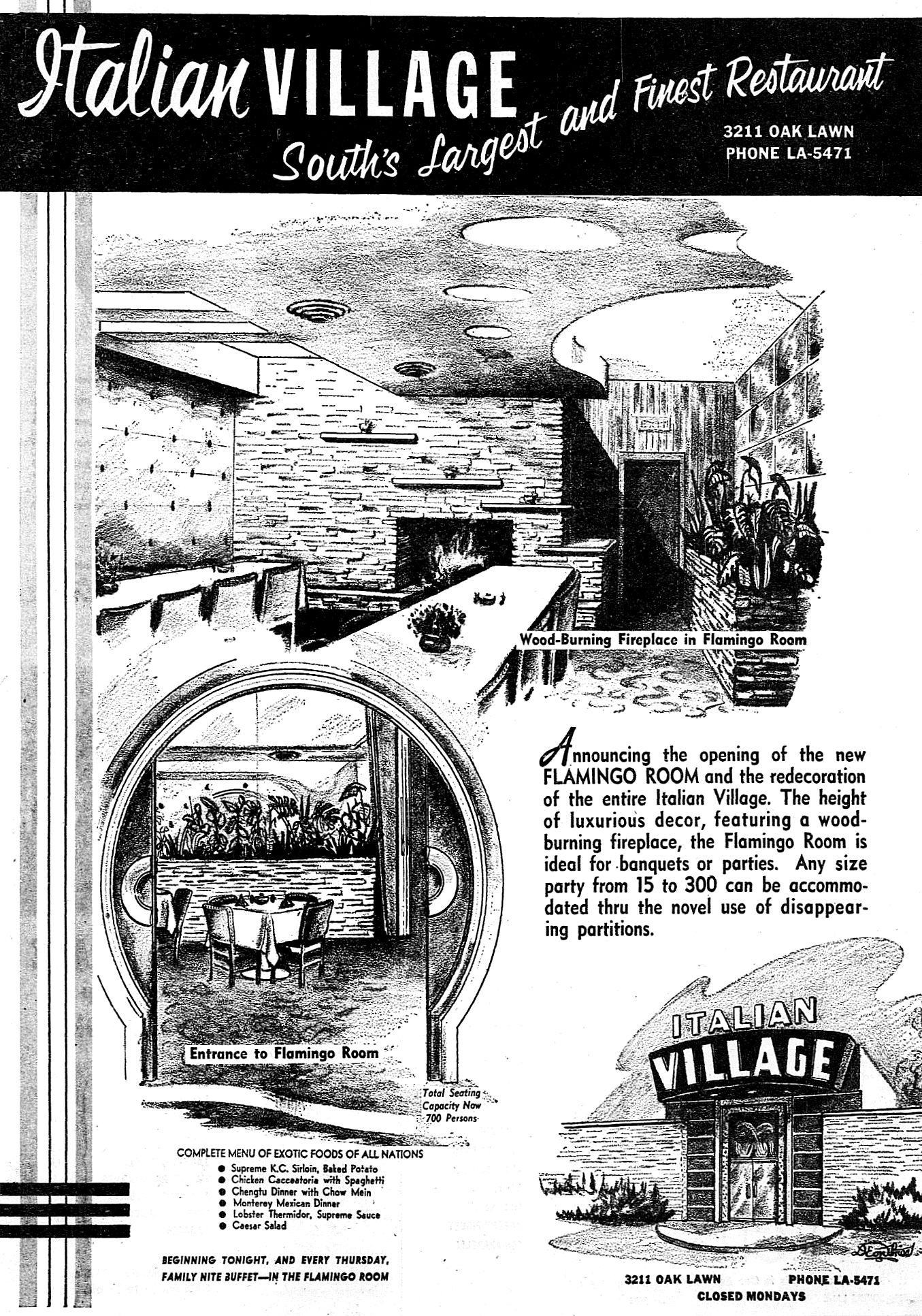
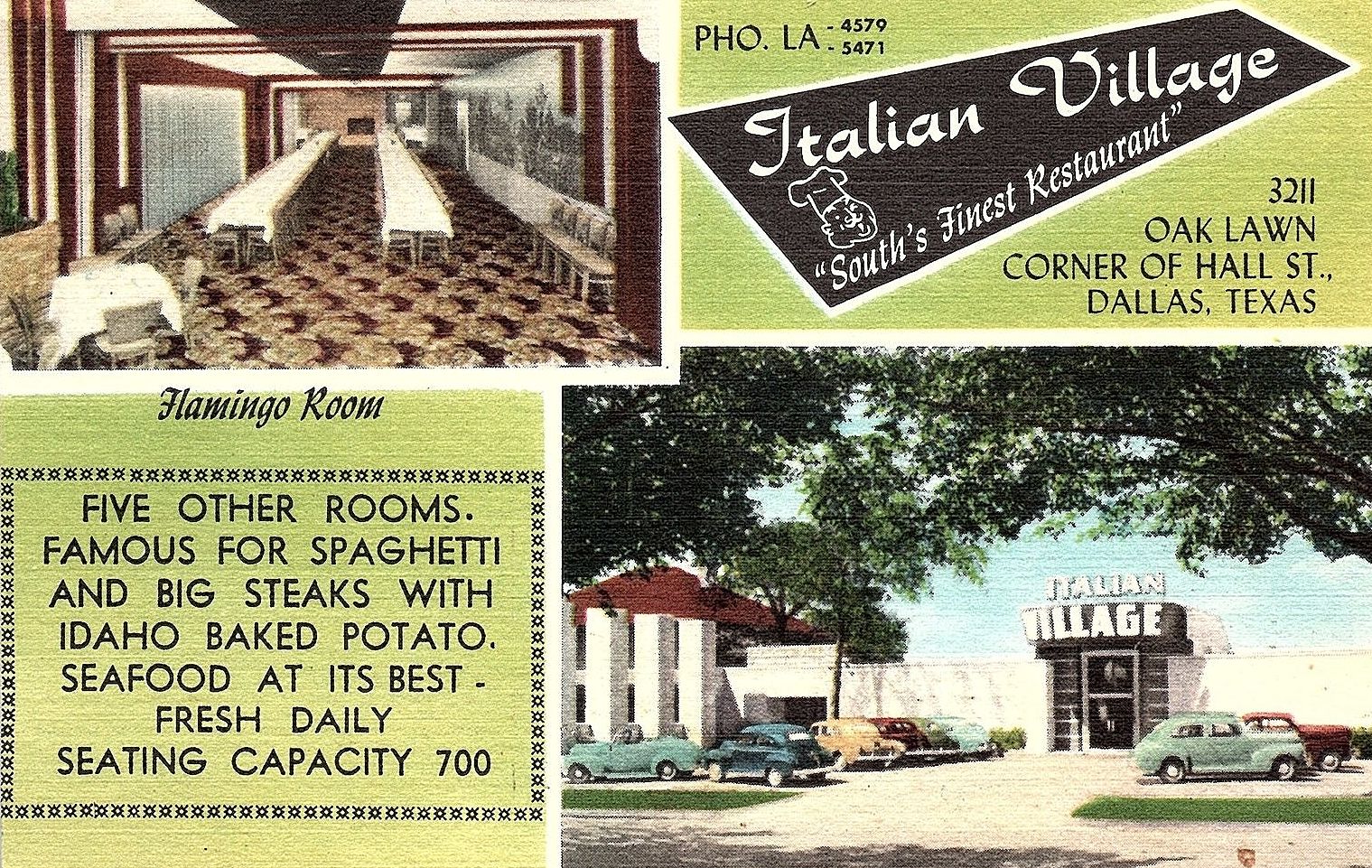
In January, 1951 another remodeling (to the tune of $75,000!) introduced the 300-seat Flamingo Room, which meant the entire Italian Village now had a seating capacity of more than 700 (Ventura had said that the original post-Speck’s restaurant seated only 40 or 50 people). The “modernistic styling” was the work of architect J. N. McCammon.
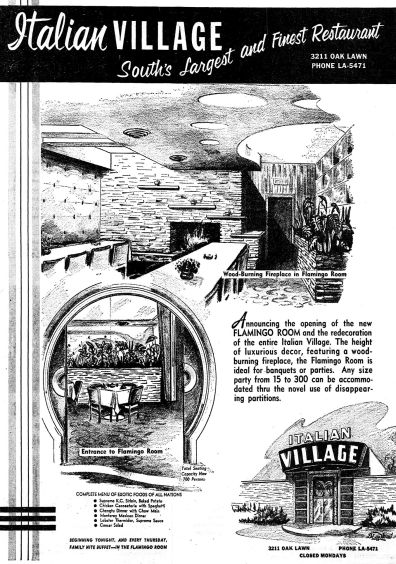
1951_italian-village_flamingo-room_jan-1951Jan., 1951

italian-village_postcard_flamingo-room_ebay

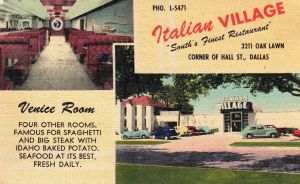
italian-village_postcard_yellow_ebay

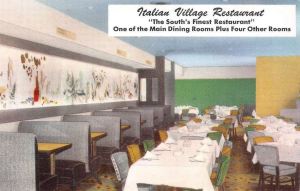
italian-village_postcard_interior_ebay

italian-village_postcard_interior_caption_ebay

italian-village_menu_ebay_1     italian-village_menu_ebay_4
Front and back of 1955 menu, via eBay

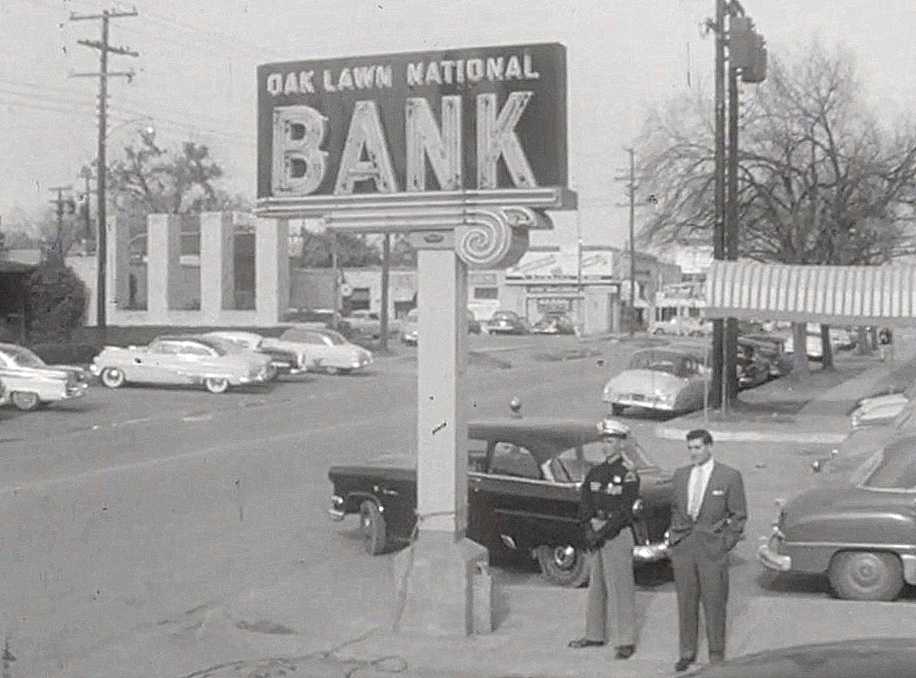
Below, a shot of the Italian Villa’s four odd brick structures seen from across the street (in a screen capture from unrelated January 1955 news footage).
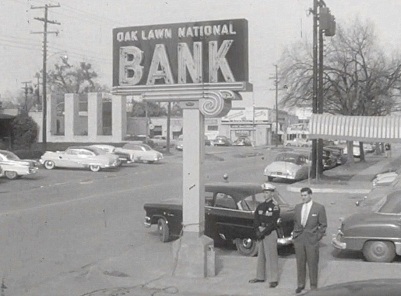
italian-village_oak-lawn-natl-bank_wbap-news_012355-portalKXAS-NBC 5 News Collection, UNT

Further changes came to 3211 Oak Lawn in the fall of 1954 with the arrival of the Village Club, which featured live entertainment (including a rotating piano) and shared a kitchen with Italian Village. It was also a “private locker club” with personal liquor lockers available to members to keep their bottles in at a time when it was not legal for restaurants in Dallas to sell liquor-by-the-drink — “set-ups” were sold and the demon alcohol was poured from the member’s stash (or, more likely, from the communal stash).

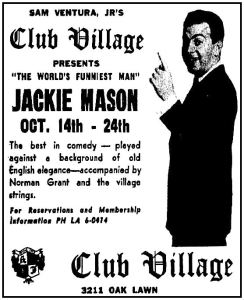
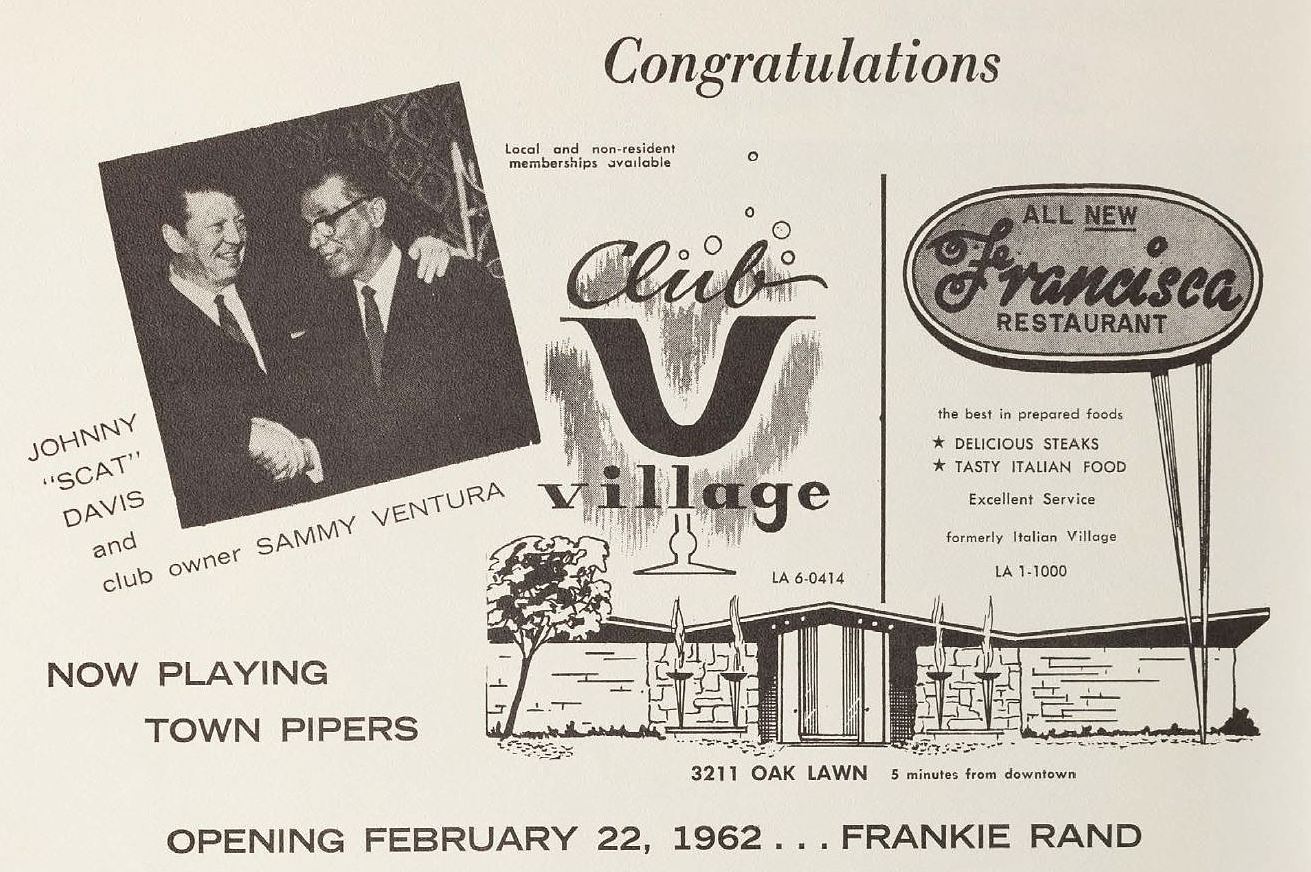
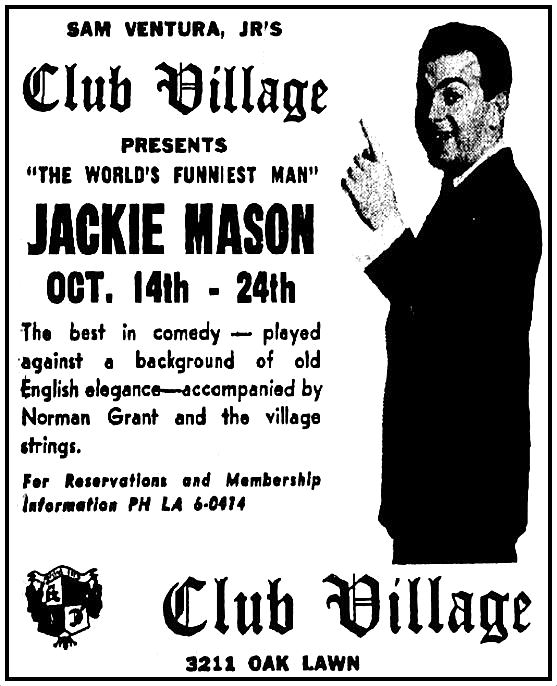
In 1961 there was yet another remodel, which enlarged the club — now called Club Village — and shrank the restaurant. The swanky new club was designed by Charles Dilbeck and had a sort of Olde English theme (and, for some reason, featured a waterfall, a glass cage behind the bar containing live monkeys, and two live flamingos named Lancelot and Guenevere).
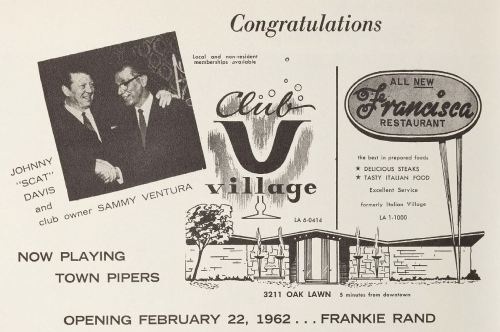
italian-village_dallas-entertainment-awards_1961_SMUvia DeGolyer Library, SMU

1965_club-village_oct-1965Oct., 1965

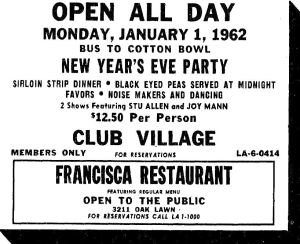
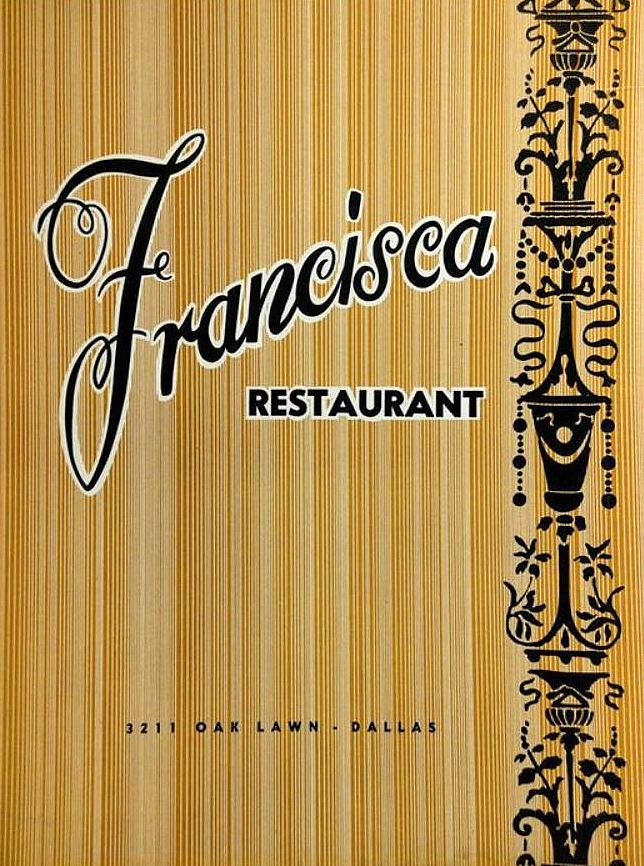
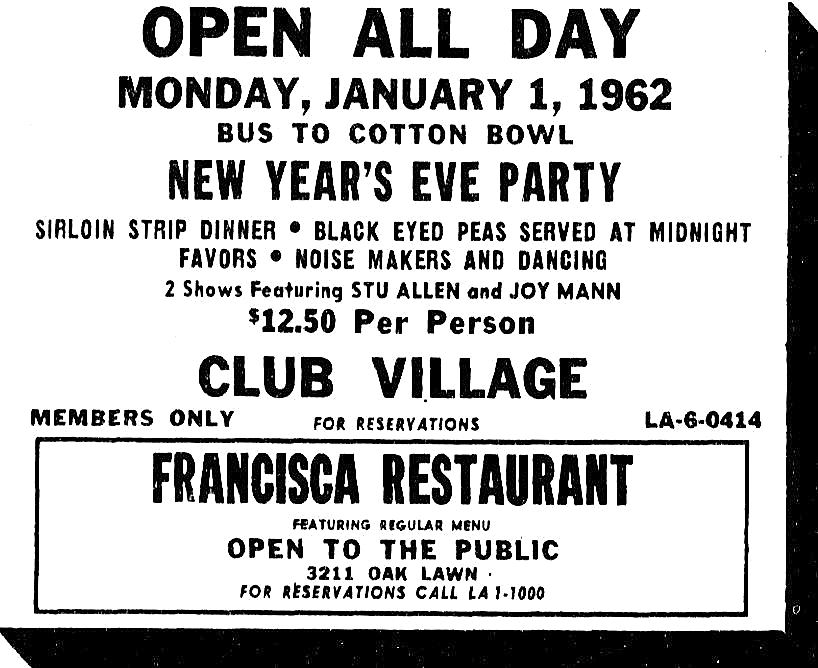
Around this time the (apparently short-lived) Francisca Restaurant appeared.
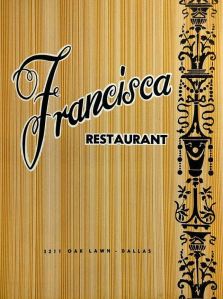
francisca-restaurant_menu_1961_ebayvia eBay

club-village_francisca_new-years-eve_dec-1961New Year’s Eve, Dec., 1961

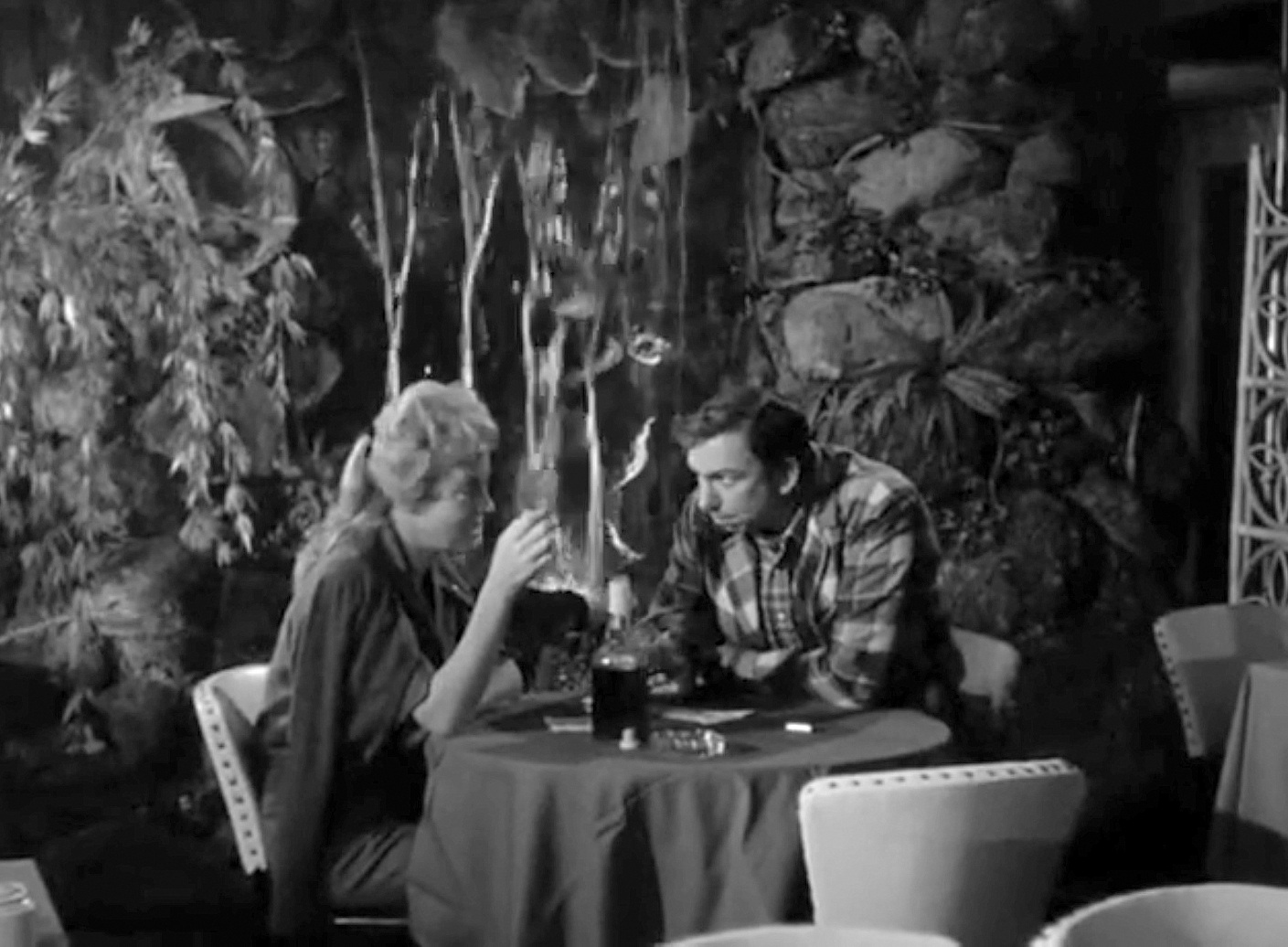
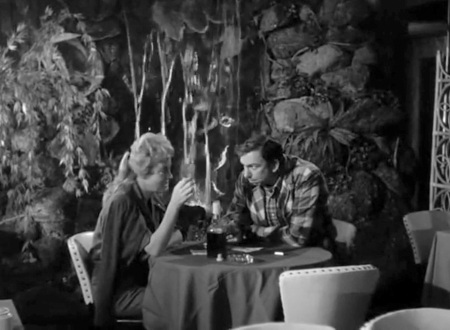
1961 also marked the club’s debut on national television, appearing in scenes of the hit show Route 66, which were filmed in November. Below is a screen-capture from the episode “A Long Piece of Mischief,” with the waterfall in the background. (The entire episode, shot around the Mesquite Rodeo, can be watched on YouTube here — the two Club Village scenes begin at the 26:42 and 38:15 marks.)
1961_club-village_route-66Route 66 (screen capture) — Nov., 1961

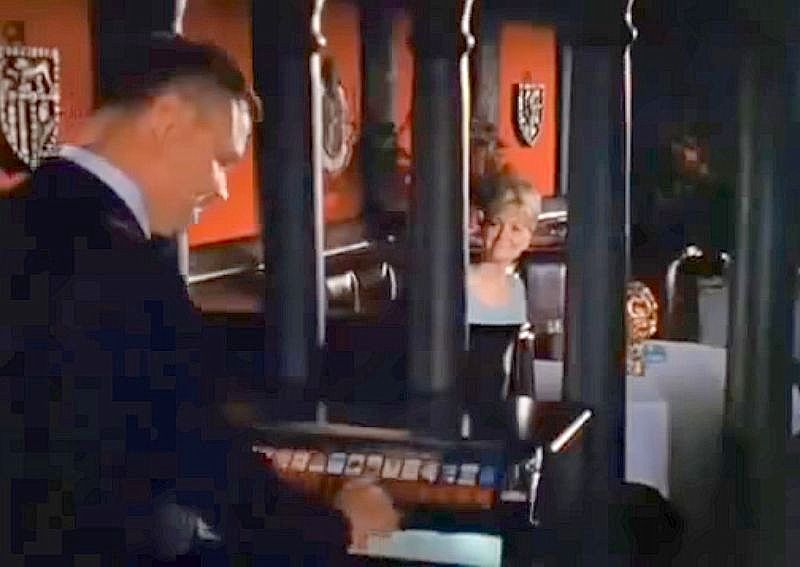
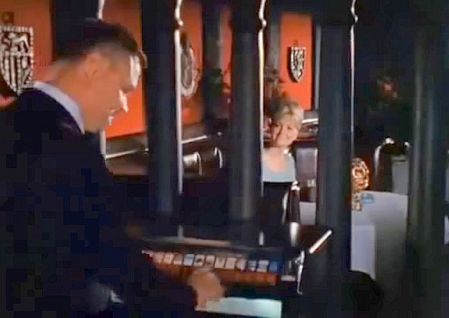
In late 1966, Dallas filmmaker Larry Buchanan shot his cult classic Mars Needs Women in various locations all over town. I’m pretty sure one of the very first scenes was shot inside the club, after yet another remodel. (Incidentally, see what the lively neon-ified corner of Oak Lawn and Lemmon, a couple of blocks away, looked like in Buchanan’s film, here.)
1966_club-village_mars-needs-women
Mars Needs Women (screen capture) — 1966

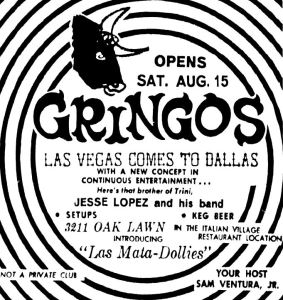
In August, 1964 a new club opened: Gringos (sometimes spelled Gringo’s). This public club, featuring mostly rock bands, was the brainchild of Sam Ventura, Jr. (who said in an interview that he had rather brazenly sprung the whole thing as a big surprise on his father, who had been out of town on a lengthy vacation — luckily, the club was a hit and Sam, Sr. was pleased). Club Village continued as a private club, but from newspaper accounts it seems that the new discotheque displaced the Italian Village and/or Francisca restaurant completely. So now on one side you had the long-running “sophisticated” private club, and on the other side, the “new concept in continuous entertainment,” with its Mexican-themed decor and Watusi-dancing waitresses (“Las Mata-Dollies…”), which catered to a younger set. The Fort Worth Star-Telegram described Gringos thusly:

Newest “port of call” for Dallas revelers on the bistro beat is the just-opened and lavishly-done Gringos Club on Oak Lawn Ave. near the Melrose Hotel and in the location formerly occupied by the Italian Village Restaurant and Village Club. Open to the public, this night time Camelot with Mexican decor features, among other flings, Jesse (brother of Trini) Lopez and his handful of musical consorts on the bandstand and a covey of revealing young handmaidens called “Las Matta-Dollies” [sic], sort of Spanish-type Playboy Bunnies who are worthy of your scrutiny. (Chris Hobson, FWST, Aug. 27, 1964)
1964_gringos_aug-1964Aug., 1964

In May, 1967, Sam Ventura, Jr. (“Sammy,” who had taken over the family business when Sam, Sr. retired in 1966) declared that Gringos was dead: “There will be absolutely no rock-and-roll in this room anymore. It’s dead. Our whole concept [now] is for sophistication, for adult entertainment” (DMN, May 24, 1967). So adios, Gringos, hello an even bigger Club Village. (In 1968 a club described as a “new” Gringos  opened a block away, at 3118 Oak Lawn — it’s unclear whether this was affiliated in any way with the Ventura family.)

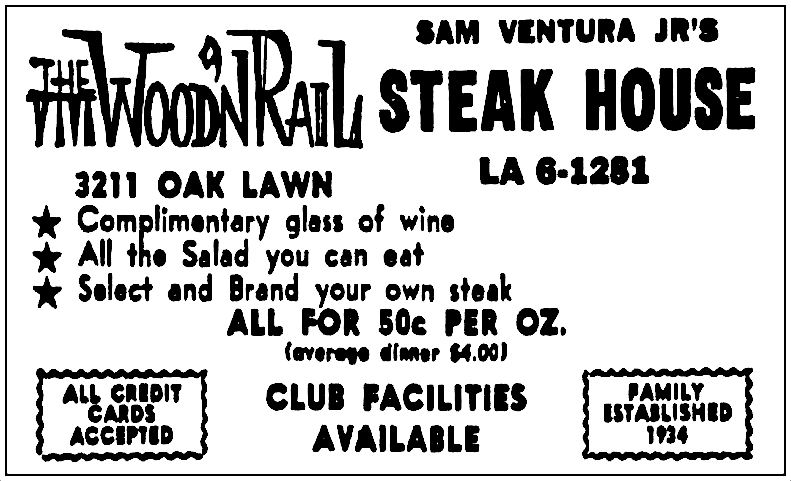
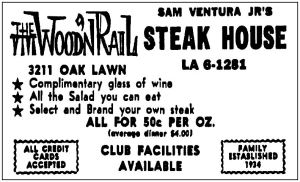
In June, 1968, the never-ending improvements, remodelings, and reconfigurings of 3211 Oak Lawn continued with Sammy’s announcement of a new (public) restaurant, the Wood ‘N Rail. This steakhouse featured a revolving “ice bar” (the old revolving piano bar, repurposed), which contained a display of raw meat — from this, customers would choose whichever cut of beef called to them, and before the meat was escorted into the kitchen, the patron would sear his or her initials into it with a “red-hot branding iron.” The restaurant’s slogan was “Personalized Beef.” The unstoppable Club Village continued as a private club and restaurant in the adjoining complex.
1968_wood-n-rail_oct-1968Oct., 1968

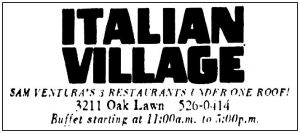
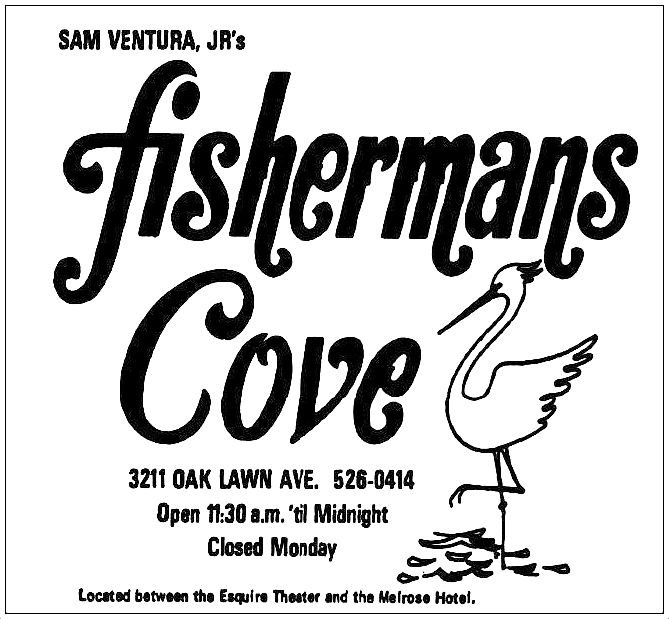
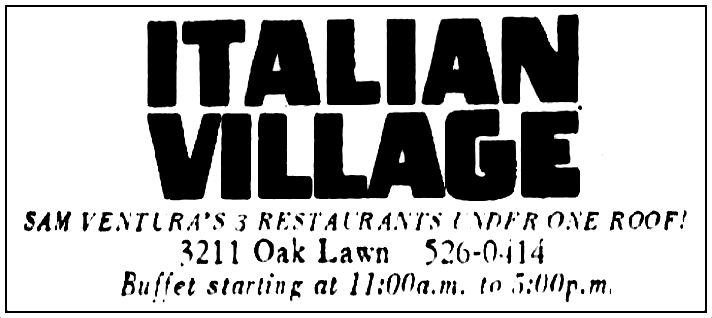
1971 began with a fire. The (once) unstoppable Club Village was destroyed. The adjacent Wood ‘N Rail emerged unscathed. So, yes, more remodeling! By 1972, 3211 Oak Lawn boasted three (three!) restaurants at one address: the continuing Wood ‘N Rail (steakhouse), Fisherman’s Cove (seafood), and — hey! — the return of Italian Village. As the ads said: “3 RESTAURANTS UNDER ONE ROOF!”
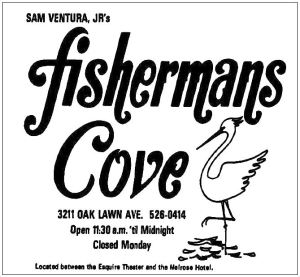
1972_fishermans-cove_march-1972March, 1972

1972_three-restaurants_may-1972May, 1972

Also big news in 1971: it finally became legal to order liquor and mixed drinks in bars and restaurants — the whole “private club-membership” thing in order to get around liquor laws was mostly a thing of the past (unless you lived in a dry area of the city…).

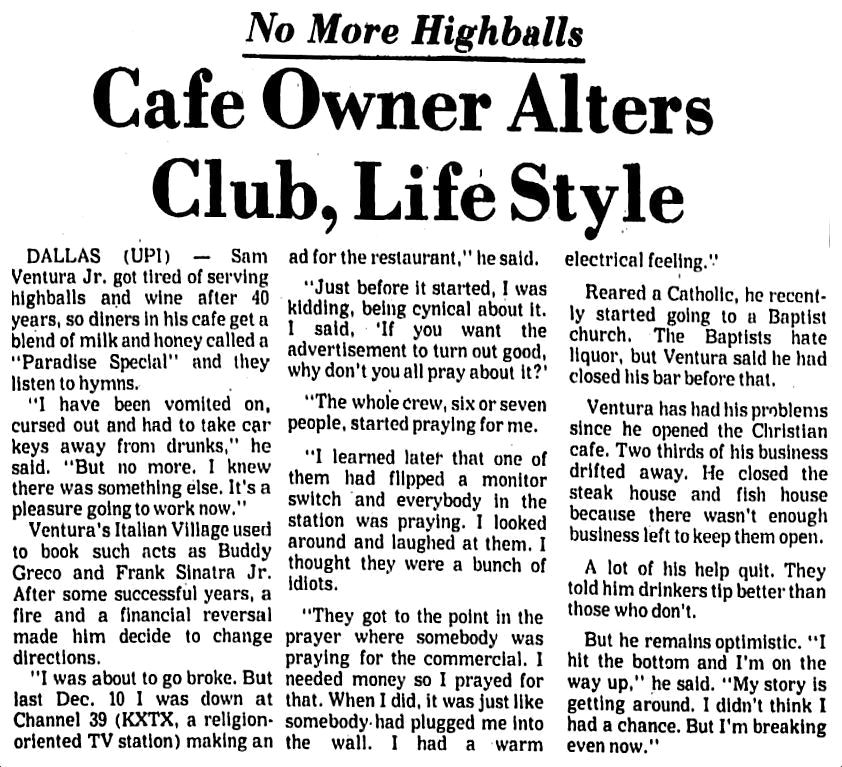
Then, in 1974, things really changed. After a “profound religious conversion,” Sammy Ventura stopped all sales of alcohol and told the TABC he didn’t need or want that ol’ liquor license. This made news around the country.
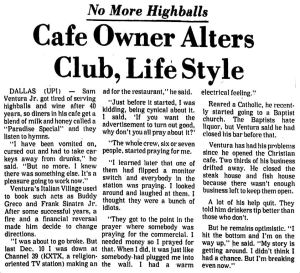
1974_kings-village_panama-city-FL-news-herald_081274UPI wire story, Panama City [FL] News Herald, Aug, 1974

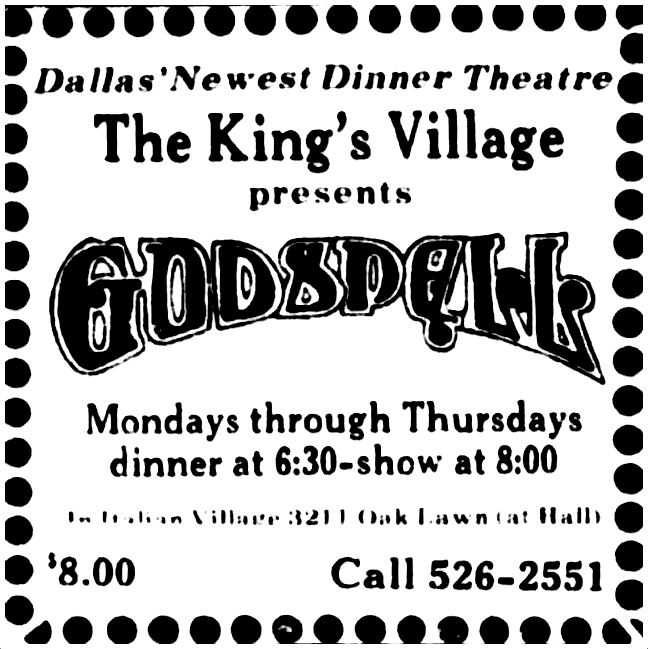
Unsurprisingly, business plummeted. Two of the three restaurants closed. Italian Village continued to limp along, even weathering the introduction of the King’s Village, “Dallas’ first Christian dinner theater.”
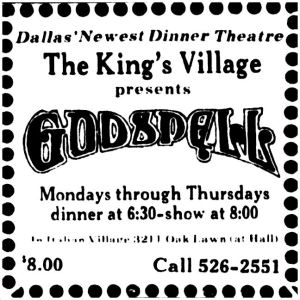
1976_kings-village_june-1976June, 1976

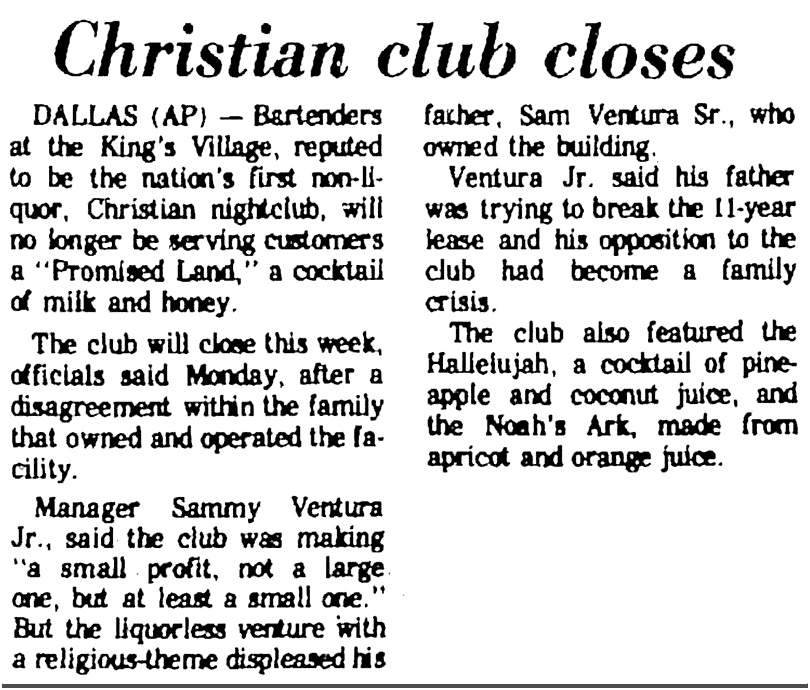
This change in direction of the the 40-plus-year-old family business caused a huge rift between Sammy and his father. Sam, Sr. put his foot down, and The King’s Village (“the nation’s first non-liquor, Christian nightclub”) closed in June, 1977.
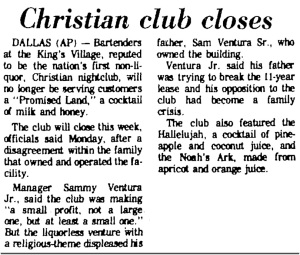
1977_kings-village_pampa-daily-news_062177
AP wire story, Pampa Daily News, June 21, 1977

Oak Lawn’s decades-old Italian Village was no more (although Sammy appears to have opened his own Italian Village restaurant in Richardson’s Spanish Village for a while). The last mention I found of Italian Village was in Feb., 1979:

After 45 years, the Italian Village restaurant has changed to another venture, the Crazy Crab. Sam Ventura opened the Italian Village in 1934 and the last event before the changeover was a surprise birthday party honoring Sam. (DMN, Feb. 23, 1979)

It’s a shame Italian Village’s last incarnation was a mere shadow of its former go-go glory, but it’s almost unbelievable that a restaurant in Dallas was in business for 45 years. Sam Ventura’s $250 gamble in 1934 paid off very, very well.

***

Sources & Notes

Top image is the front cover of a cardstock photo-holder (with linked photo by the Gilbert Studios, 4121 Gaston); collection of Paula Bosse.

All clippings and images are larger when clicked.

*

Copyright © 2018 Paula Bosse. All Rights Reserved.

The Last Traces of Vickery Park Are Now Definitely Gone

vickery-park_demo_062118_d_PEBThe last vestige of a one-time summer destination…

by Paula Bosse

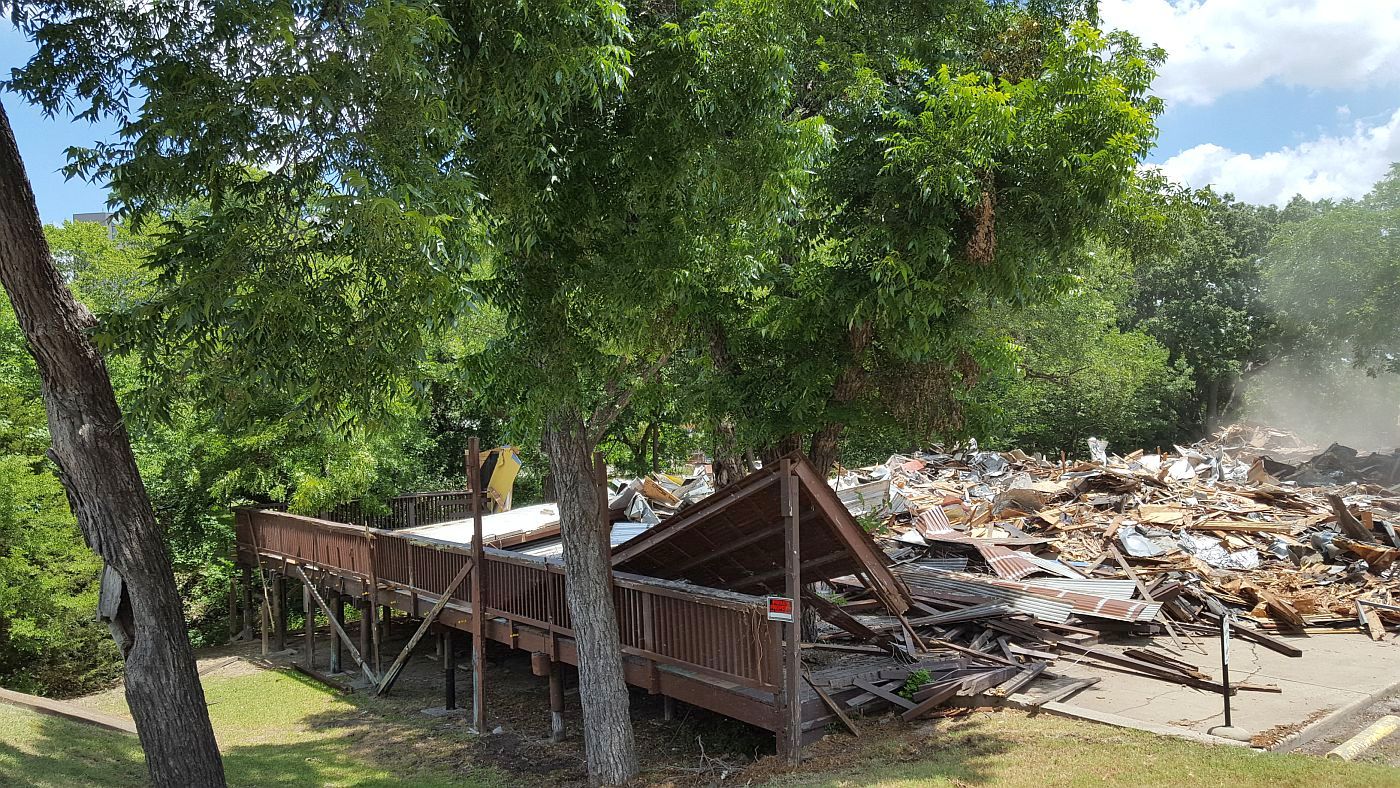
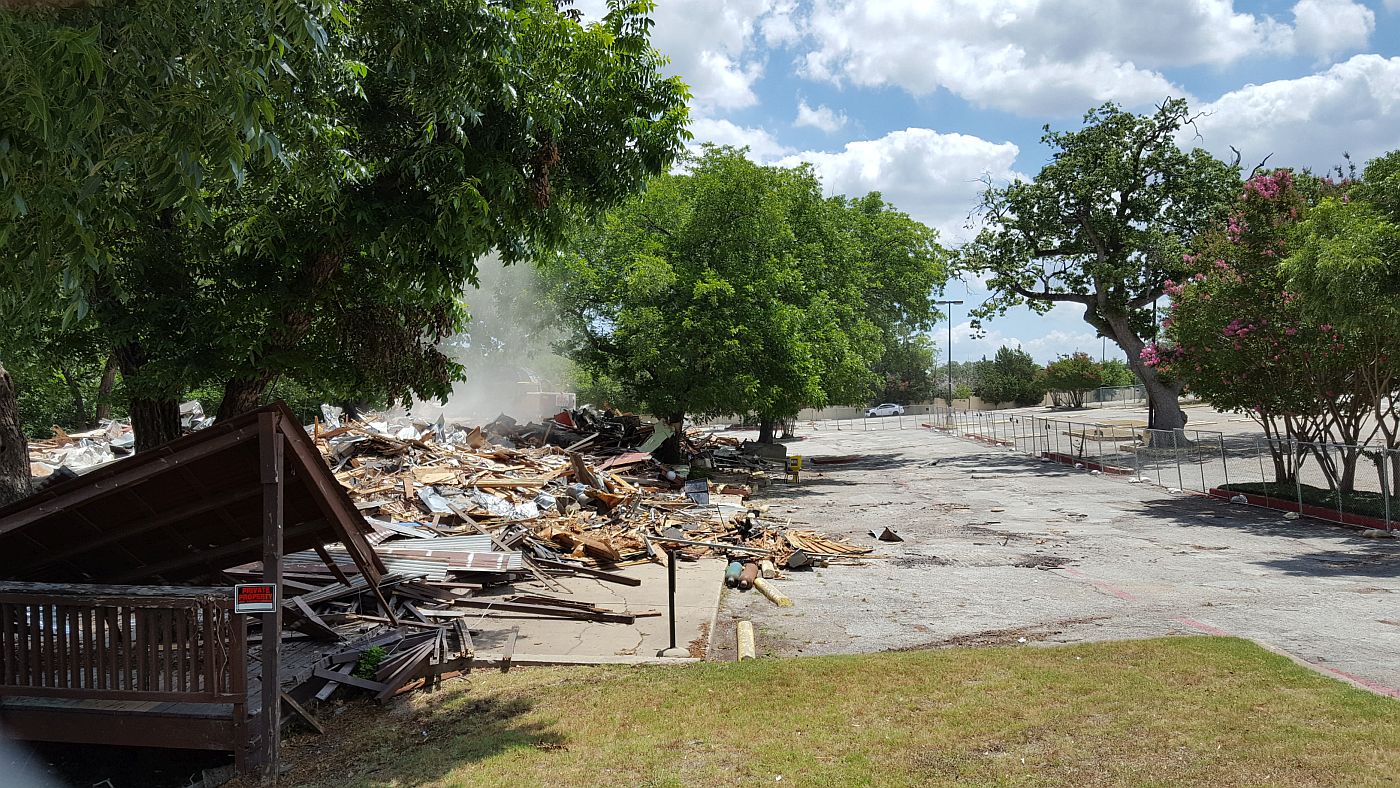
Driving along Greenville Avenue this morning, I noticed a pile of rubble where Vickery Park once stood (just south of Walnut Hill, across from Presbyterian Hospital). It seemed sadly ironic that the land which was once occupied by a fondly-remembered swimming pool and picnic area was heaped with demolished buildings on the first day of summer.

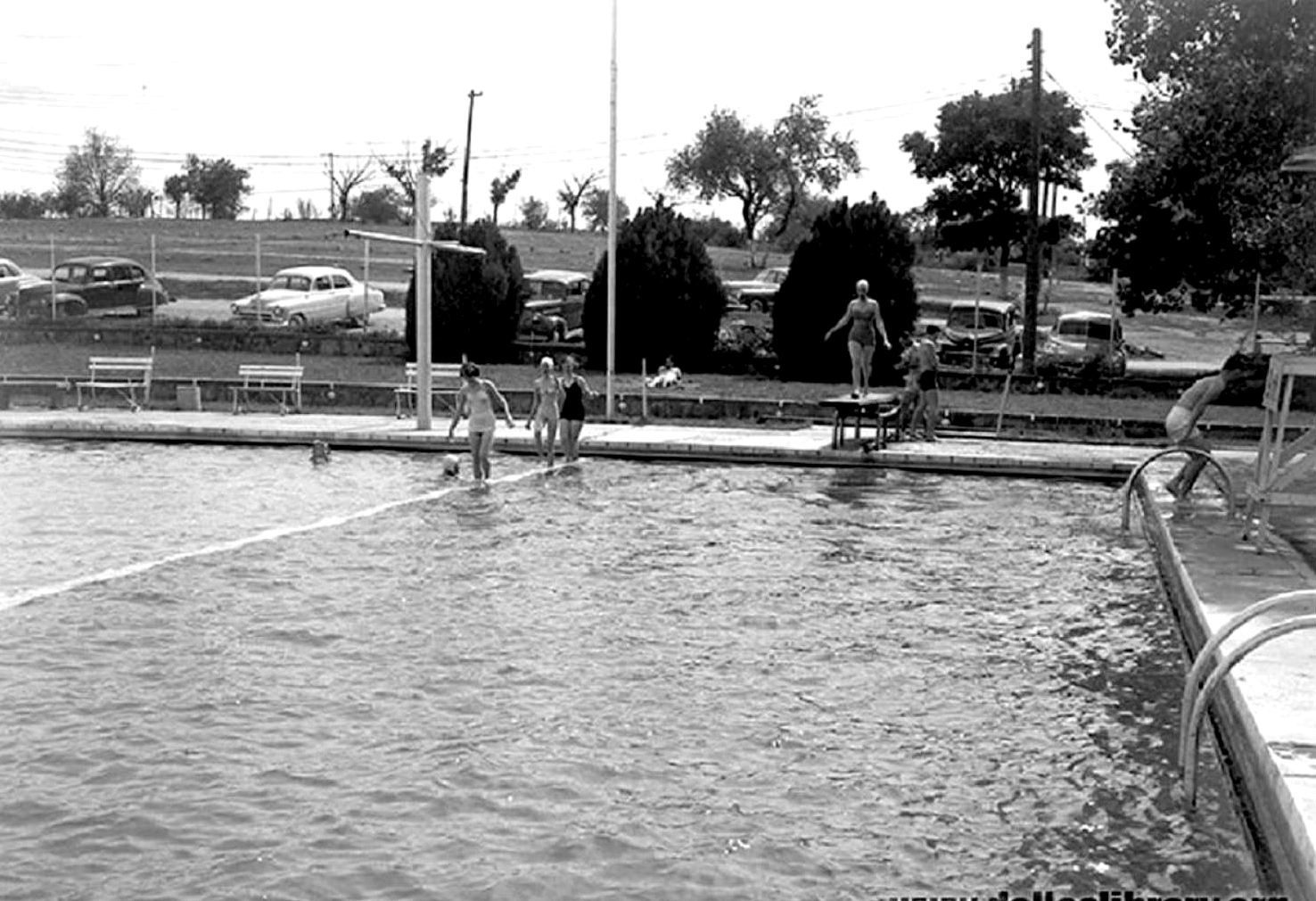
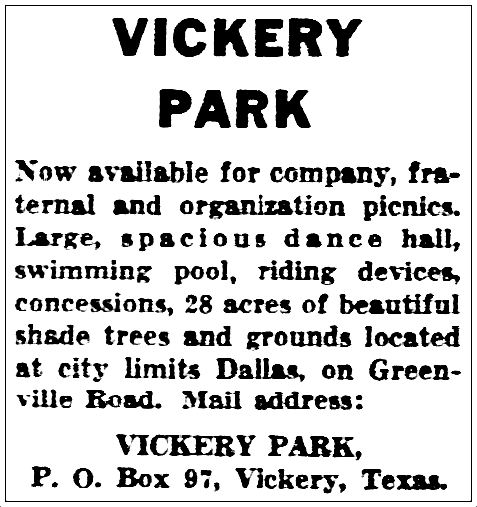
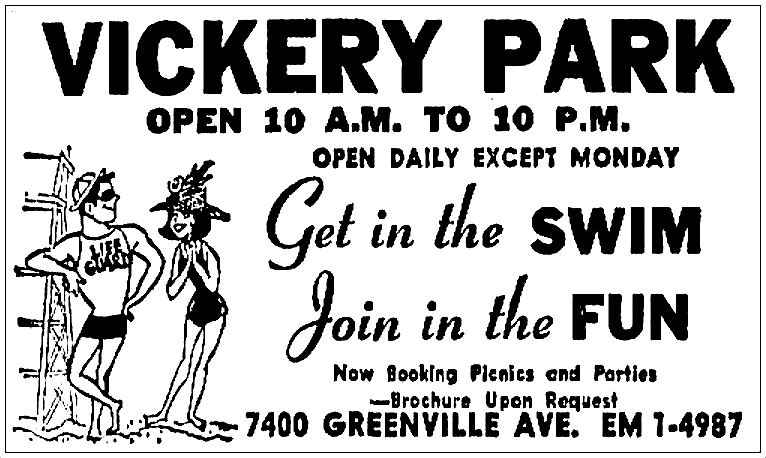
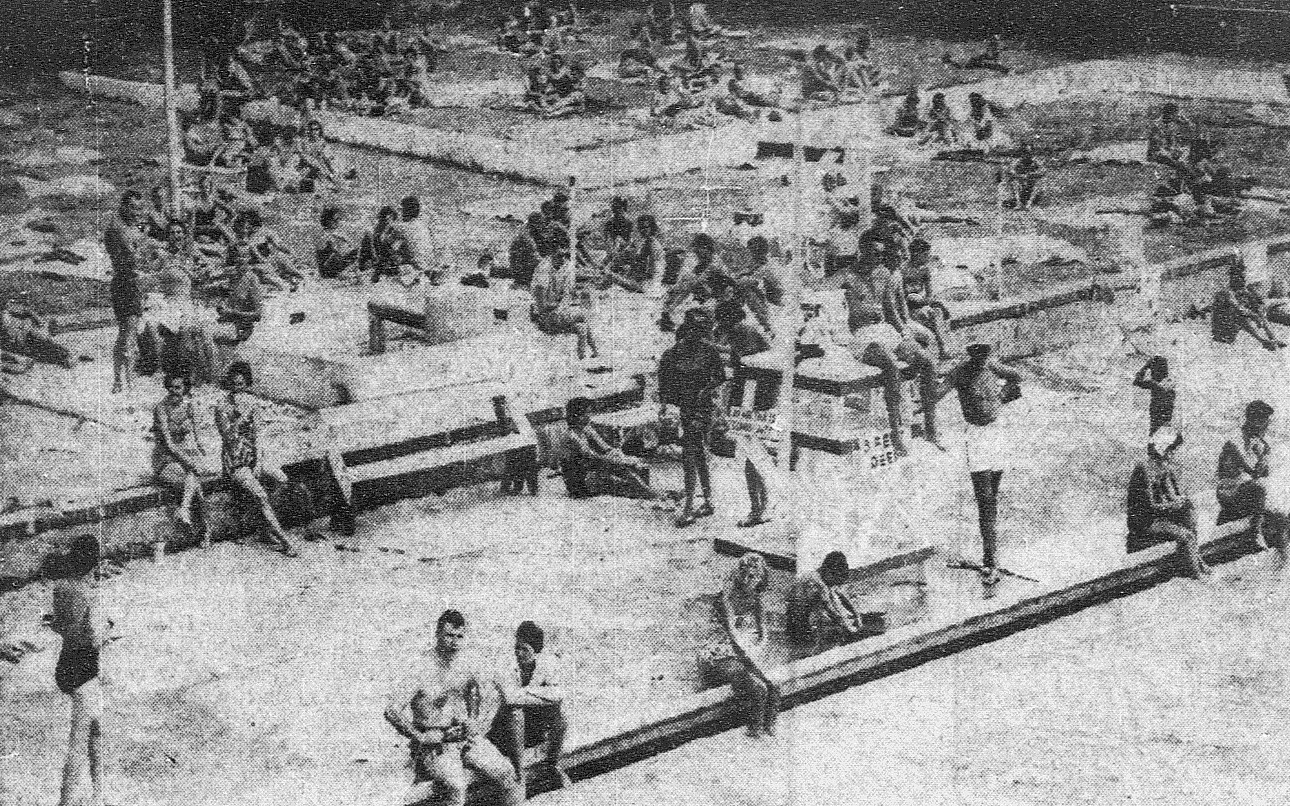
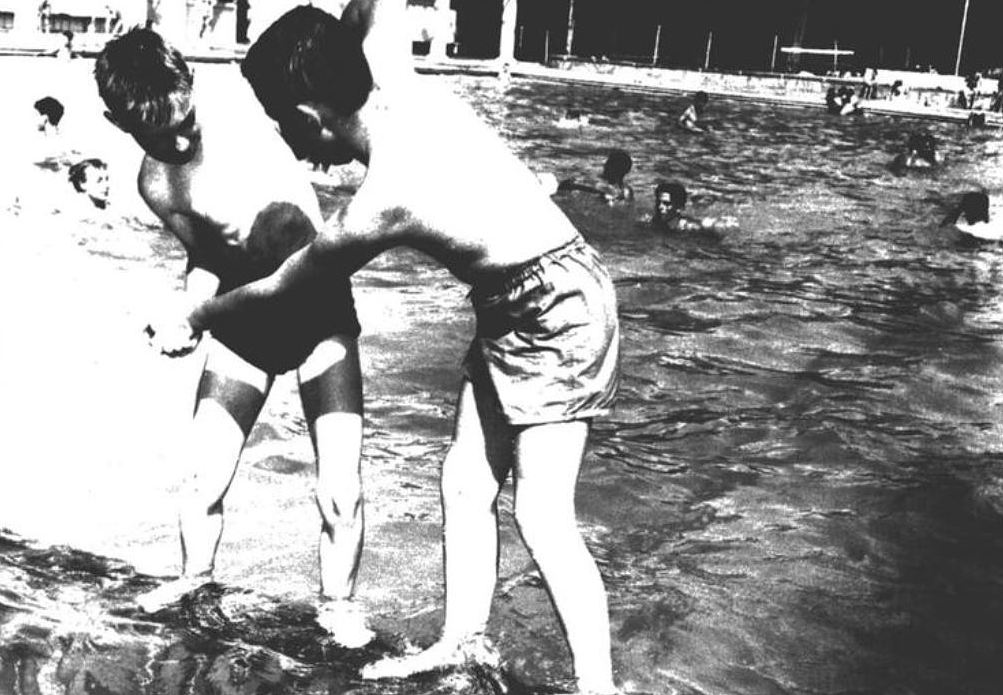
I never saw the huge swimming pool myself, but from everything I’ve read about it over the years, it seems to have been very, very popular with generations of Dallasites. It was built in the then-rural community of Vickery as far back as the 1930s (well before Vickery was annexed by the city of Dallas), and it was still open at least through the ’60s.

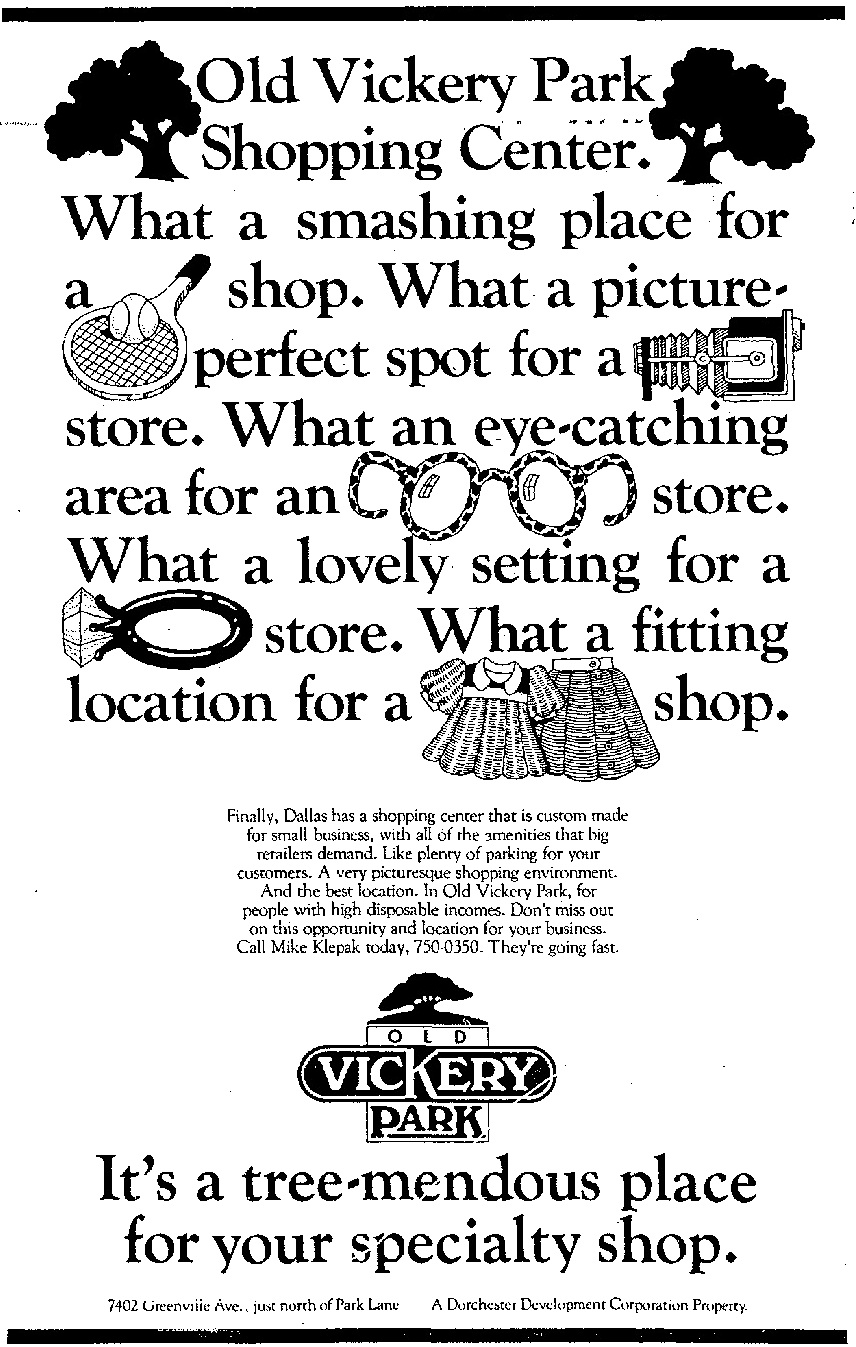
The pool and amusement park were long gone when the (now-demolished) small shopping and restaurant area was built in the mid-1970s on a very pretty wooded site alongside White Rock Creek. Initially, the developer envisioned lots of quaint little boutiques and cafes (similar to those found in the Quadrangle) dotting the banks of White Rock Creek, creating Dallas’ version of San Antonio’s River Walk. …No one has ever accused real estate developers of dreaming small.

It’s sad to see this anachronistic, funky little area go away. My vague memories of childhood games of miniature golf in the ’70s are about to get vaguer.

vickery-park_demo_062118_a_PEB

*

vickery-park_demo_062118_b_PEB

I’ve never known exactly where the pool was, but I think it might have been at the back right of the photo above, just off Pineland.

vickery-park-pool_dpl_pinterest

vickery-park-swimming-pool_1950s

vickery-park-swimming-pool_legacies_fall-2002

vickery-park-pool_19461946

swim_vickery-park_19651965

1978_vickery-park_sept-1978Sept., 1978

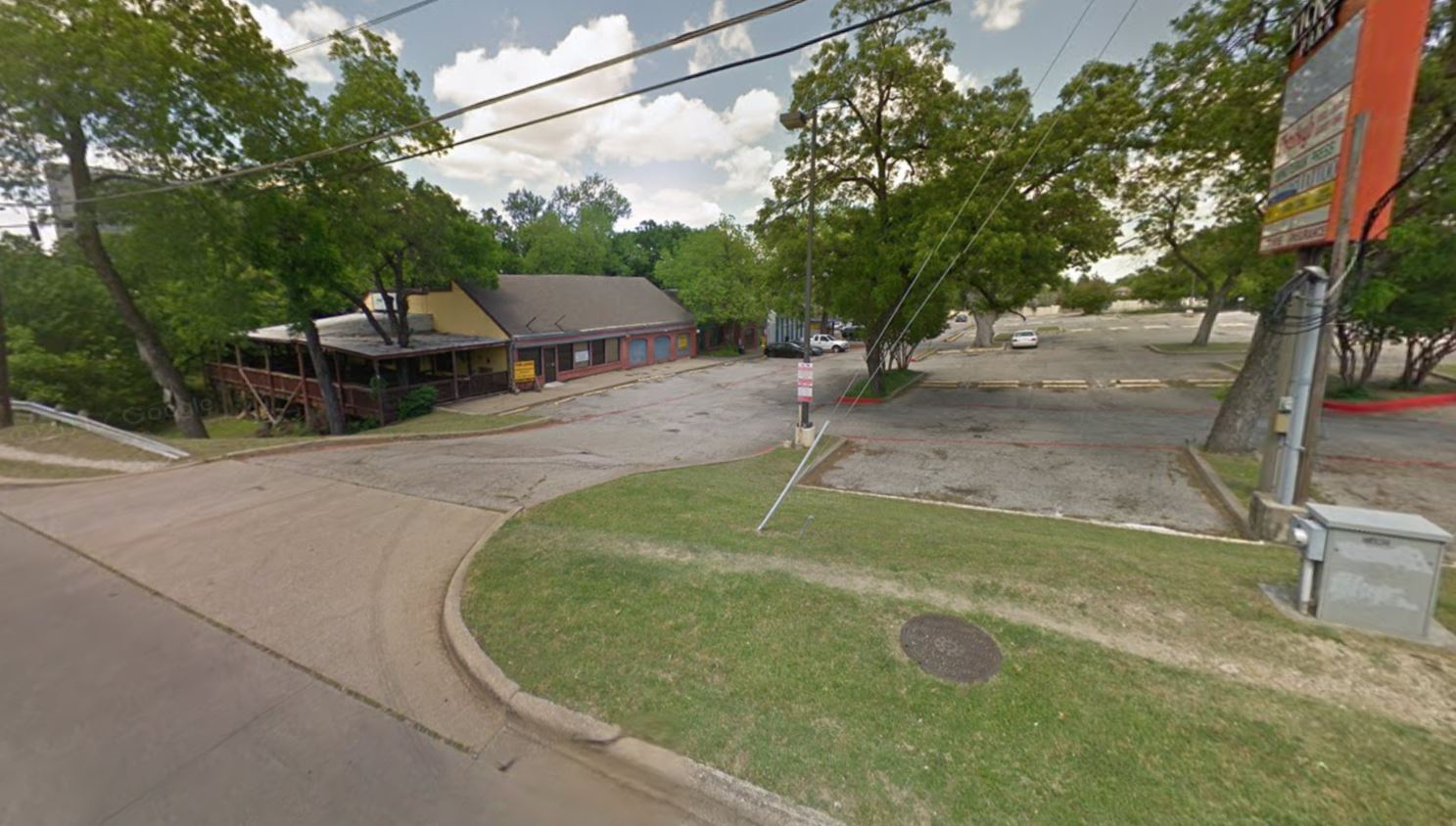
vickery_google_may-2017Google Street View

Above is a Google Street View from May, 2017. If you’d like to take a little virtual “drive” through the parking lot, hie yourself over to Google, here.

*

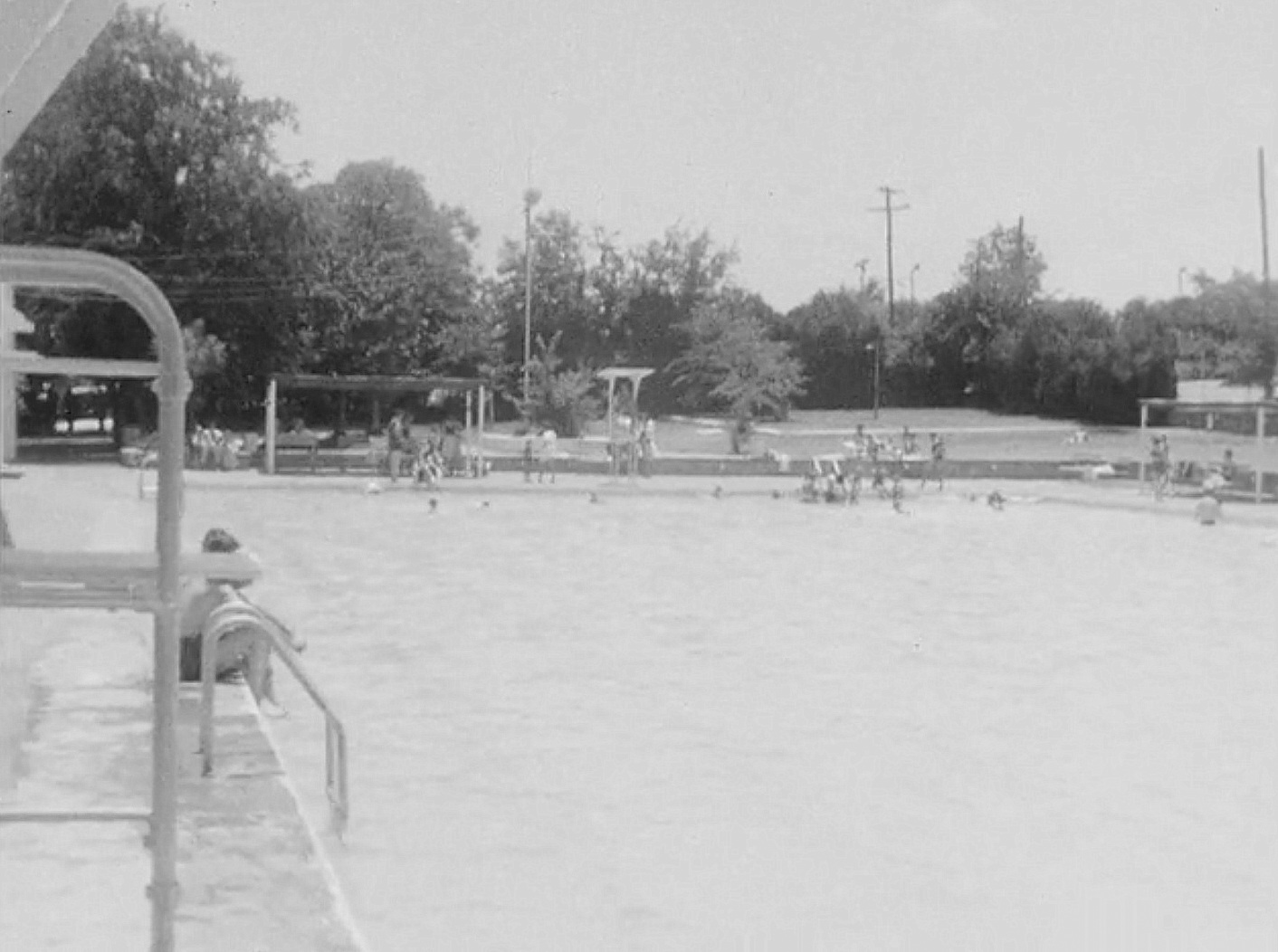
Here are two pieces of film footage showing the pool. The first one is from June, 1964 and is (silent) news footage shown on WBAP Channel 5. It’s a little unsettling, as it shows a boy being rushed off by ambulance after an accident, but it does have some interesting shots of the pool and the park, which I’ve certainly never seen before. I am unable to embed the video, but you can watch it here. (The script for the story is here.) (Footage is from the WBAP-TV News collection, UNT Libraries Special Collections.) Here is a screen capture:

vickery-pool_WBAP_portal_062364

The second is undated, but the clips are from home movies.

***

Sources & Notes

Rubble photos taken by me on June 21, 2018 — construction was underway. And it was extremely HOT.

The first historic photo appears to be a Dallas Public Library photo, with most of the watermark cropped off. I found it on Pinterest, here.

The third photo, showing two boys, was found in the Fall 2002 issue of Legacies.

There are memories-galore of Vickery here.

A couple of interesting tidbits:

  • The Vickery pool was used as an officers’ recreation club during World War II by the Fifth Ferrying Group; an aquatic meet was held there in June, 1945 which featured a variety of exhibitions, including a water ballet performed by “half a dozen mermaids from University Park.”
  • In the early 1970s, Vickery Park (…not to be confused with Vickery Place…) was owned by the Seventh Day Adventist Church. They reopened the park as a “family recreation center” — unlike the earlier days, alcohol was no longer sold. They sold the land to developers around 1974 or 1975; in the summer of 1975, the recreation center was bulldozed and the pool was paved over (and became a parking lot).

Articles on the disappearing community of Vickery can be found in the archives of The Dallas Morning News:

  • “Progress Overtakes Old Vickery” by Rena Pederson, with photos by Eli Grothe (DMN, August 3, 1975)
  • “Store Provides Feed For Thought On Town’s Past” (Vickery Feed Store) by Steve Kenny (DMN, Nov. 18, 1979)

*

Copyright © 2018 Paula Bosse. All Rights Reserved.
Dallas House Moving Company — 1940

ad_dallas-house-moving-co_aug-1940Moving from W. 12th to … W. 12th…. (click for larger image)

by Paula Bosse

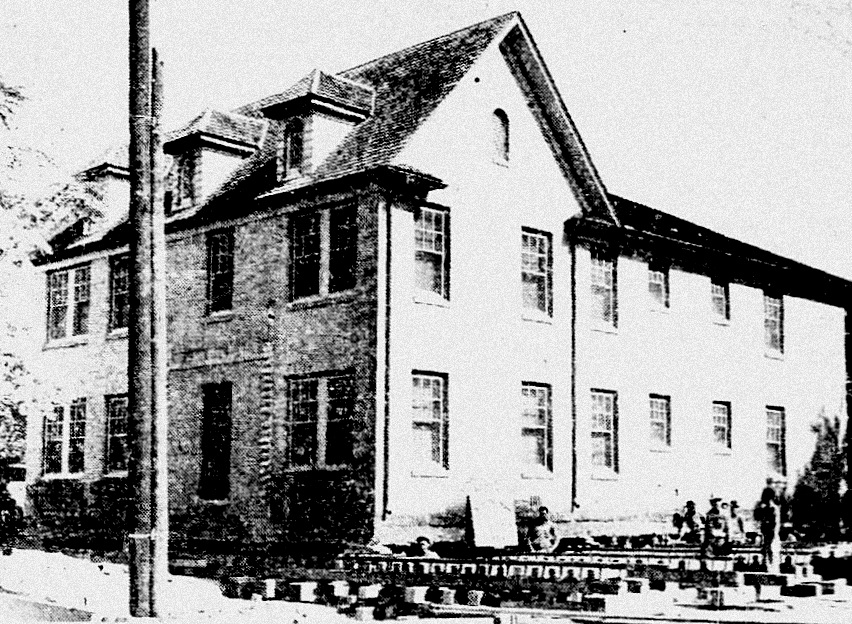
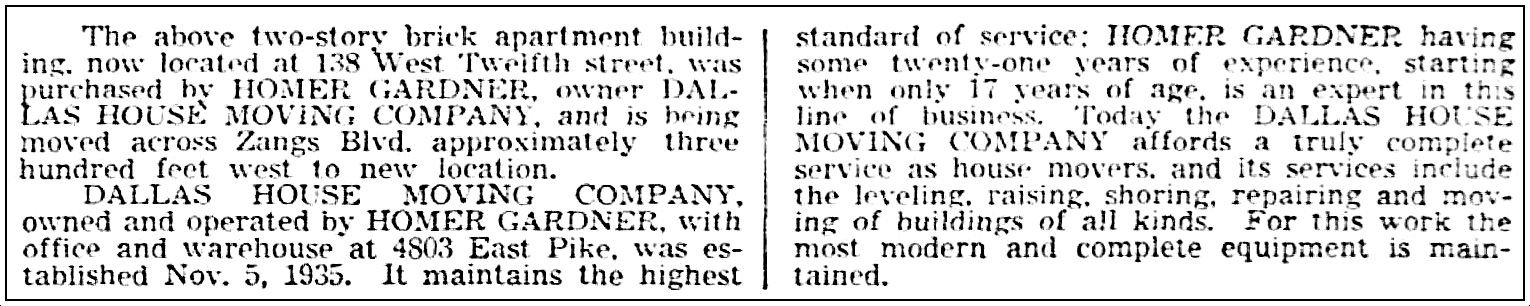
My brother and I are helping our mother move. At least we aren’t having to move a two-story brick apartment building, as seen in the photo above, which is from a 1940 ad for the Dallas House Moving Company (est. 1935), owned and operated by Homer Gardner. The caption for the photo is below (click to see a larger image):
ad_dallas-house-moving-co-aug-1940-captionDallas House Moving Co. advertisement, Aug. 1940

The apartment house (which contained six units) was one of several houses and apartment buildings which were moved in 1940 to accommodate the widening of Zang Boulevard in Oak Cliff. The building was moved from 138 W. 12th Street to 214 W. 12th. The 900,000-pound structure was loaded onto a steel track and was moved the short distance on steel rollers.

So when I sigh heavily on having to move things my down-sizing mother really does not need to be keeping (like … schnapps glasses?!), I have to take a moment and keep this relatively simple move in perspective. No steel tracks necessary
*

Copyright © 2018 Paula Bosse. All Rights Reserved.
“Dr. Dante” Dodges Bullets in Dallas — 1970

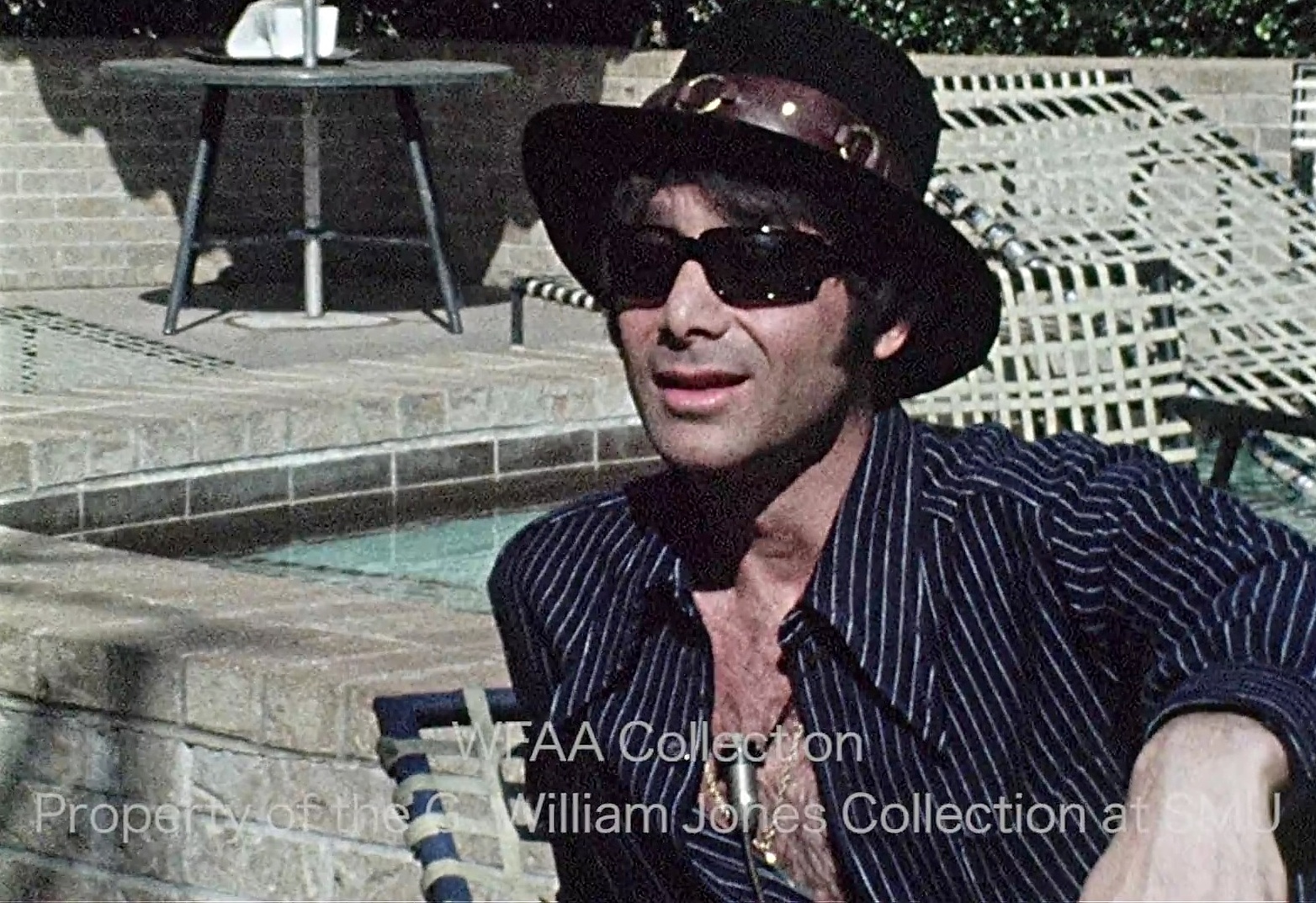
dante_wfaa_SMU_1The Dr. is in…

by Paula Bosse

I’ve written about the interesting old WFAA Channel 8 news footage which was either never aired or was aired decades ago and hasn’t been seen since (such as newly discovered Jack Ruby footage and a fantastic short interview with Jimi Hendrix at Love Field), which is part of an ongoing digitization project by SMU’s Hamon Arts Library as part of the G. William Jones Film and Video Collection. There are so many (SO MANY!) quirky clips that are being uploaded to the web almost daily that it’s easy to miss the super-quirky.

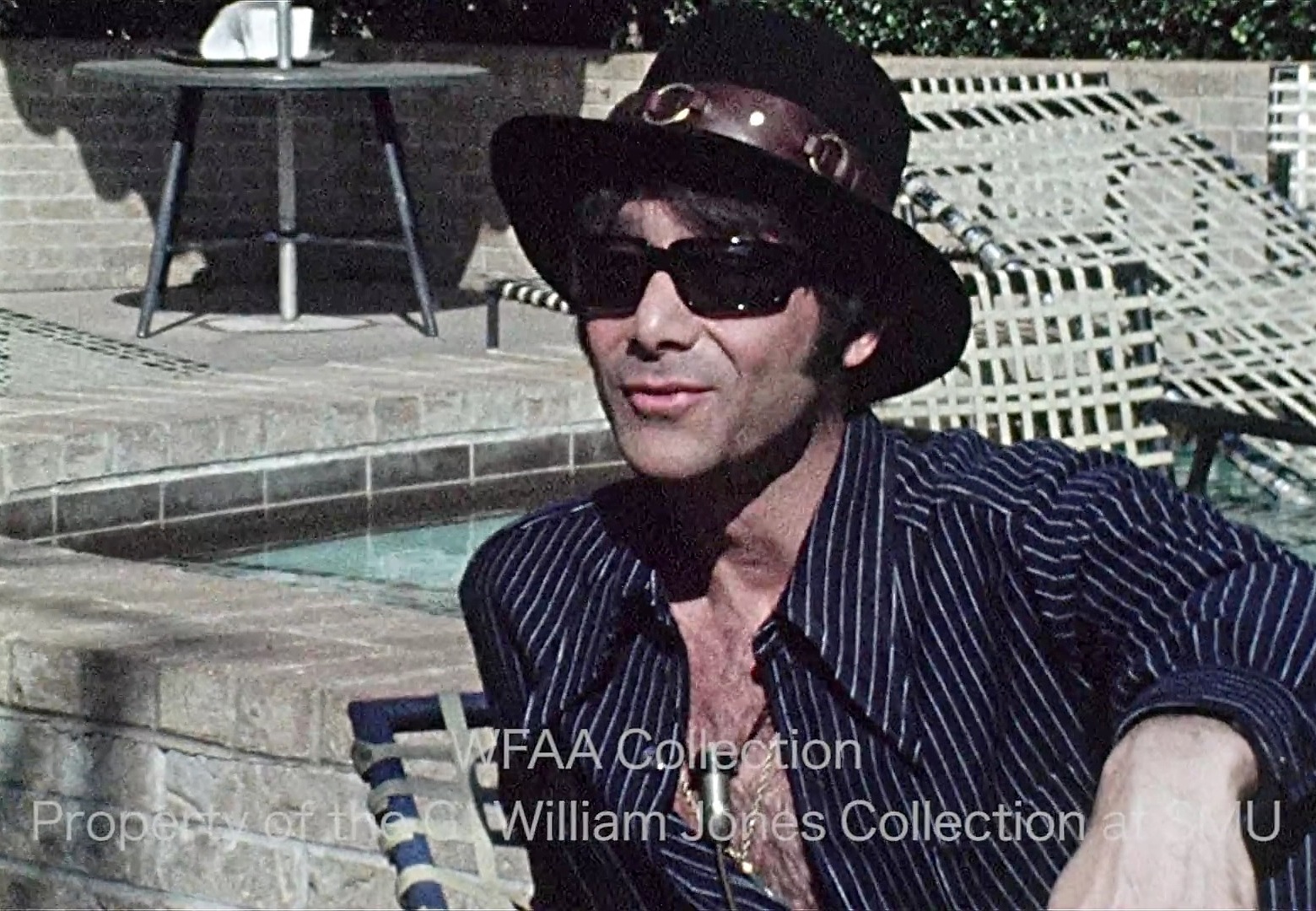
A week and a half ago the clip below was posted online, featuring an unidentified man who was much groovier-looking than one would normally have seen on the nightly Channel 8 newscast — he said that someone had shot at him from a car, just before dawn, near the Hilton Inn at Mockingbird and Central. He seemed pretty sure they were associates of Frank Sinatra, who was not at all happy that our mystery man had been fraternizing with his daughter, the singer Nancy Sinatra. Take a look at this short (1:43) footage from May, 1970.

*

Okay, that was weird. “I’ve been shot at *many* times — for one reason or another….” Add in an unexpected mention of Mrs. Baird’s bakery and, yeah, weird.

Who was that guy? The only information the SMU digitizers had on the out-of-context snippet was that it was filmed on May 21, 1970. It was obvious the guy was not local and, with that voice (and apparent ready access to Nancy Sinatra), he was most likely in the entertainment business. I could find no mention of this incident in The Dallas Morning News archives — I tried using every conceivable keyword I could think of. Nothing. So I checked Newspapers.com and found an AP story about this which had run all over the country — just not in the city where the incident had occurred.

The guy is Ronald Dante, who has gone by a variety of aliases but is generally known as “Dr. Dante,” the stage name he used for decades as a successful nightclub hypnotist. (According to a 1985 Dallas Morning News profile, he had legally changed his name from Ronald Hugh Pellar to “Dr. Dante” — with “Doctor” being his legal first name.) (This may not be true.) (Most of what Dr. Dante has said is not true.) At the time of the shooting described in the video above, he was performing at The Losers Club at 5438 E. Mockingbird, about 2 blocks from his hotel, the Hilton Inn.

To describe Ron Dante (who was born in Chicago on Feb. 5, 1930) (and is not to be confused with the Ron Dante who was the lead singer of The Archies) as “colorful” is an understatement. His extraordinarily … um … extreme life as a performer, con-man, fraudster, schemer, opportunist, convicted felon, etc., is too much to cover here, but there is a fantastic 2006 profile of him from the San Diego Union-Tribune here (seriously, READ THIS! — the part about him being orphaned in Kuala Lumpur when his family was attacked by Malaysian insurgents is great — in actuality, U.S. Census records from 1930 and 1940 show that he grew up in a nice Chicago neighborhood with his very-much-alive parents and brother).

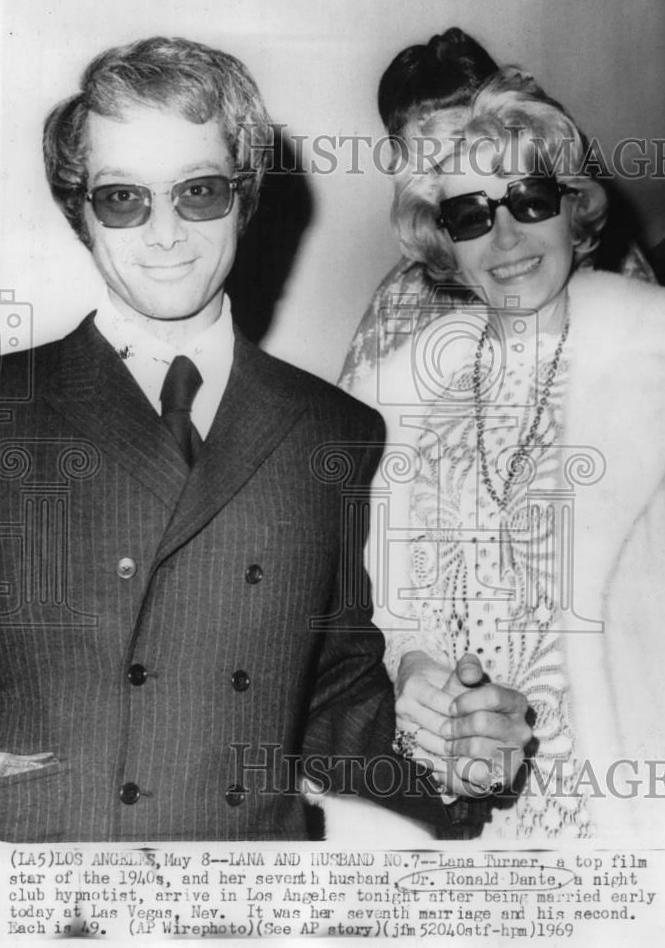
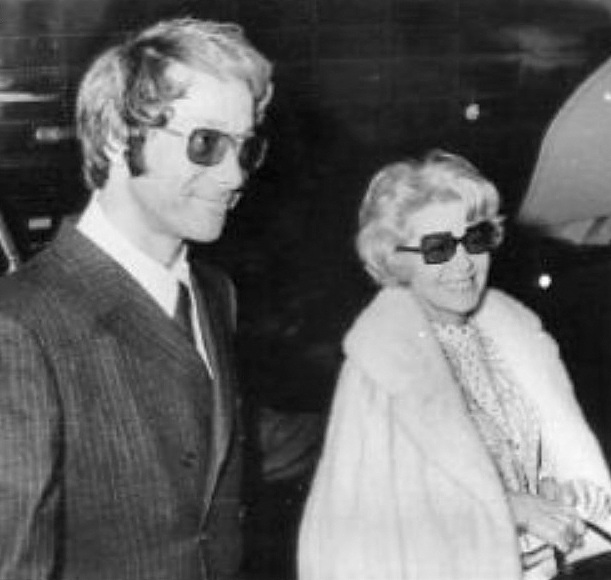
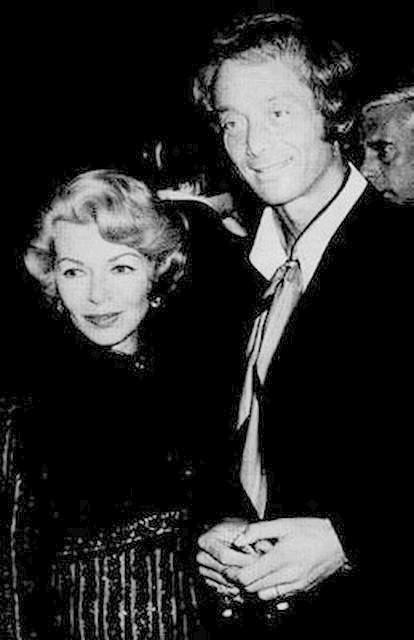
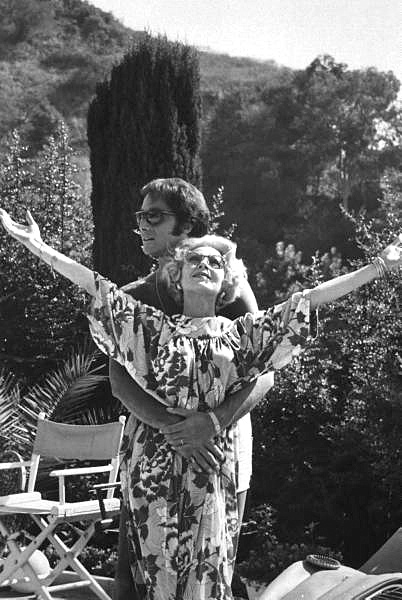
But back to Dallas in May, 1970. Dante was, at the time, the estranged husband of Hollywood icon Lana Turner. They had married in May, 1969; it was Lana’s seventh (and final) marriage. In news reports of the nuptials, Dante was reported to be the same age as his new bride, but he was actually almost 10 years younger. (In the Channel 8 video above he is 40.) Below are some photos of the happy couple before Lana began to realize what she’d gotten herself into.

dante-lana_just-married_1969_ebay    dante_lana_pinterest

lana_dante_pinterest    dante_turner_california_ua

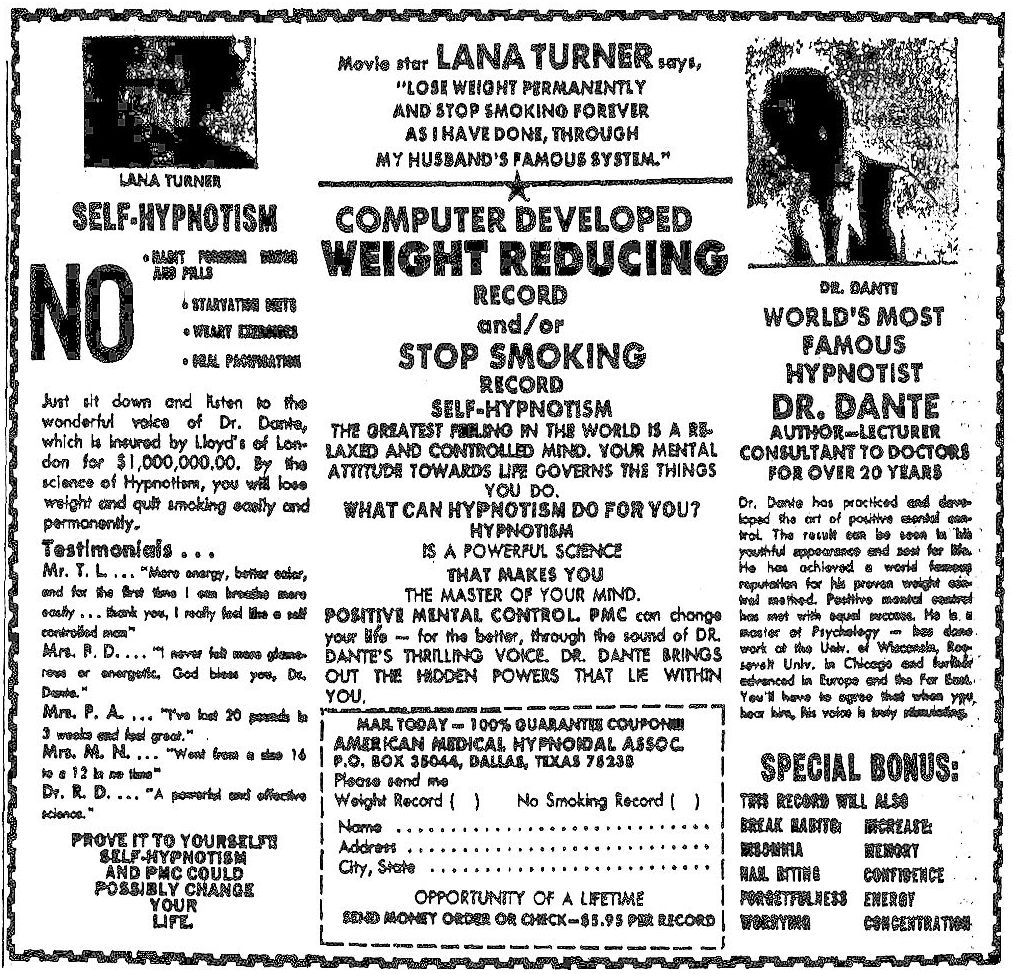
Their marriage hit the skids within 6 months, with Turner accusing Dante of misappropriating $35,000 of her money and, later, disappearing with many of her jewels, worth $100,000; on Nov. 14, 1969, Dante (not Lana!) filed for divorce on grounds of “extreme mental cruelty.” Two days later, the ad below touting a “computer-developed” self-hypnosis recording by Dante appeared in a Dallas paper, complete with a suspect thumbs-up testimonial attributed to estranged and recently-bilked Lana Turner (also worth a raised eyebrow was the inclusion of the even more suspect “American Medical Hypnoidal Assoc.” office which resided in a Dallas post office box) (click to see larger image):

dante_ad_nov-1969
Nov. 16, 1969

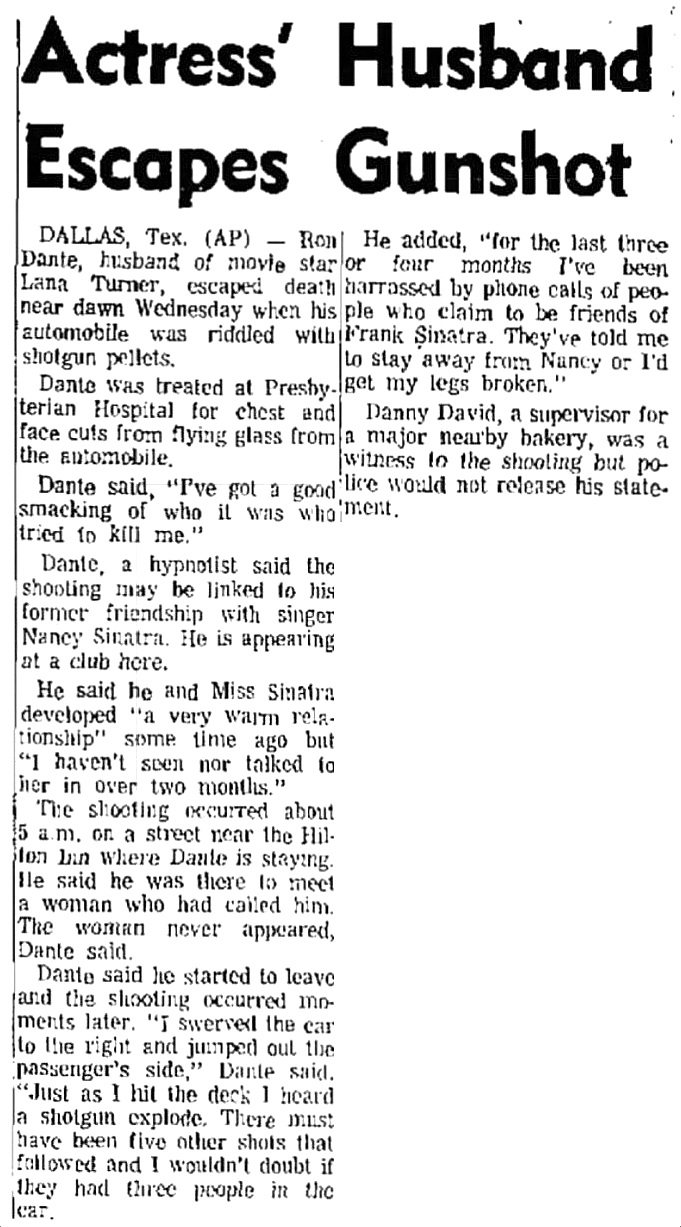
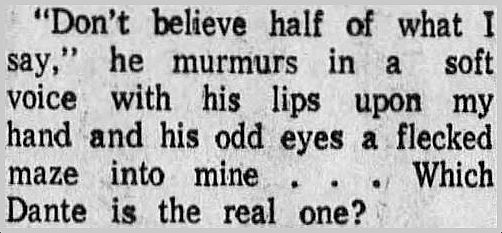
Six months later, Dante was in Dallas, claiming to have been shot at by men sent by Frank Sinatra to warn him to stop seeing his daughter Nancy. (A similar “being shot at” scenario was reported by Dante in Los Angeles in June, 1969 — photo here — Sinatra was not implicated by Dante in that shooting, but Lana Turner wondered about it in her 1982 autobiography: “Shortly after our wedding he was shot at, or so he said, in an underground garage, by a gunman wearing an Australian bush hat. It got a lot of attention in the papers — maybe that was what he wanted.”) One might reasonably wonder whether Dante was lying about the shooting in Dallas, but there seems to have been a witness: a Mrs. Baird’s employee, David Davis (whose name was misspelled in wire reports). Here’s the Associated Press report of the incident:

dante-ron_ap-wire_abilene-TX-reporter-news_052170AP wire story, May 21, 1970 (click to read)

Other reports noted that “a spokesman for Miss Sinatra said she did not know [Dante]” or had even ever heard of him; a spokesman for Miss Turner said they had been separated for several months and “she doesn’t even know where he is.” (It should be noted that Frank Sinatra had had a very steamy affair with Lana Turner in the 1940s — a tidbit which just adds all sorts of weird tangents to this story.)

I never saw a follow-up, but whether the story was true or not, it was pretty ballsy to accuse Frank Sinatra (a man of known “connections”) of being behind something like this. Someone should crack open this cold case!

dante_reno-gazette-journal_080770_groovy-hypnotist
“Groovy hypnotist,” Reno Gazette-Journal, Aug. 7, 1970

*

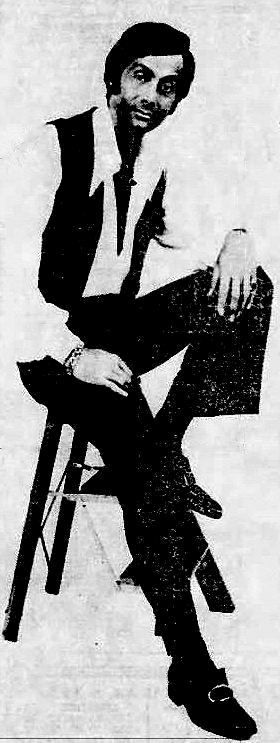
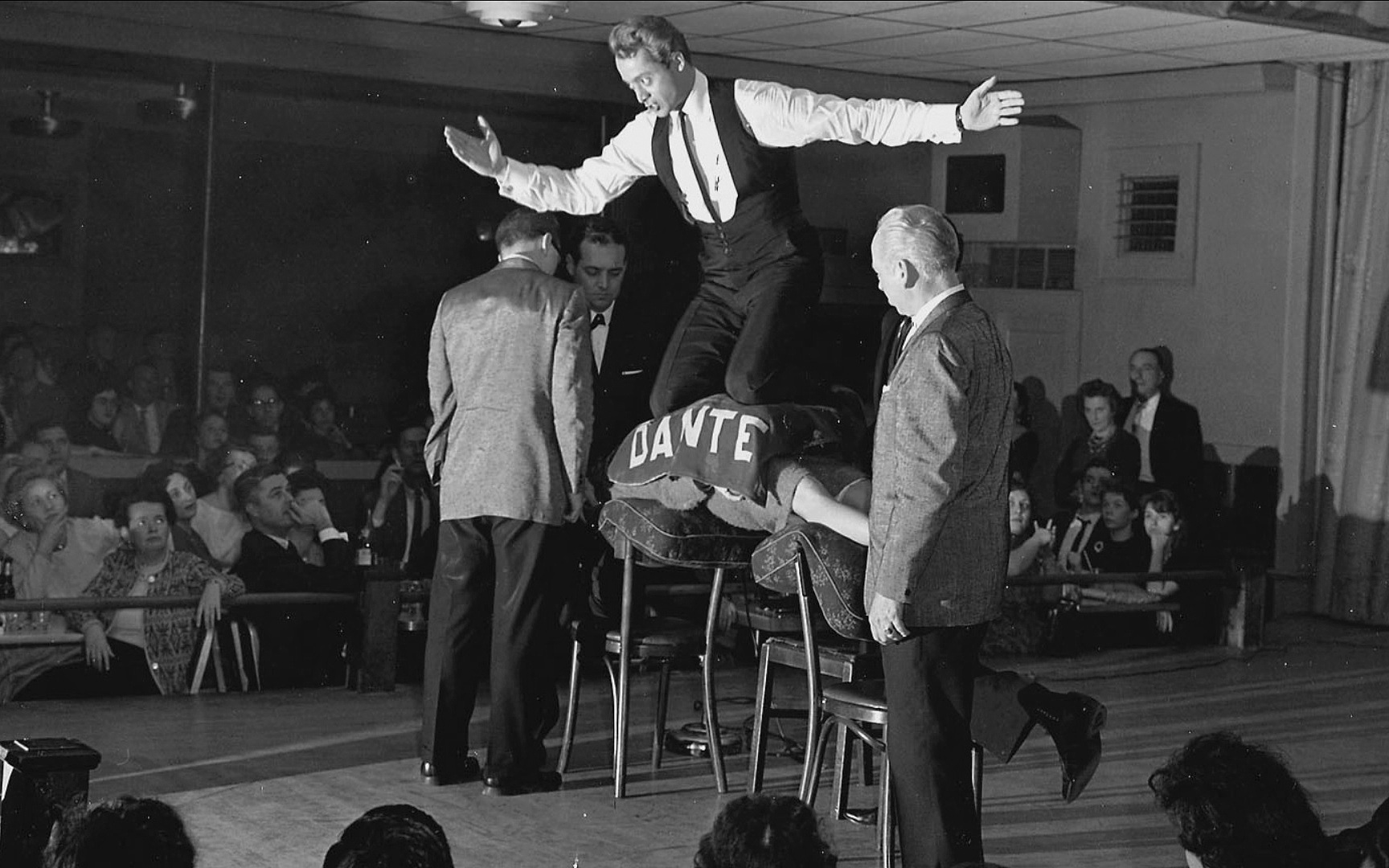
Ronald Dante’s first appearance in Dallas was at the Adolphus Hotel’s tony Century Room in January, 1963, back when he was known simply as “Dante.” Tony Zoppi, who covered the city’s nightclub scene for The News, wrote, “The handsome showman entertained his Century Room crowd with one of the most amazing hypnotic acts in the business” (DMN, Jan. 3, 1963). Back then his act looked something like this:

dante_on-stage_ua

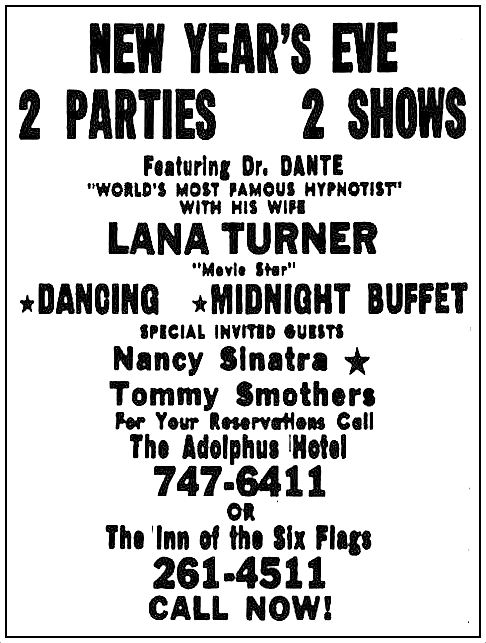
An interesting New Year’s Eve engagement at the Adolphus’ Rose Room was announced in The News in December, 1970 (same year as the shooting…): 

The Adolphus Hotel has lined up a star-studded evening for its New Year’s Eve celebration, including hypnotist Dr. Ronald Dante, reportedly to be accompanied by his wife, actress Lana Turner. (DMN, Dec. 17, 1970)

An appearance by Lana Turner seems … unlikely. Others rumored to be appearing on the star-studded bill? Actor Ralph Bellamy, comedian Tommy Smothers, and … singer Nancy Sinatra. Unsurprisingly, none of the special guests showed up.

dante_dallas-new-years-eve_dec-1970
Dec. 20, 1970

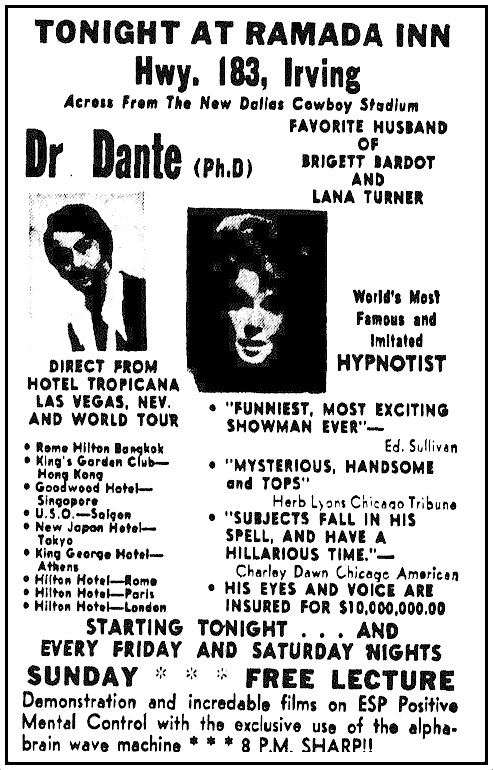
A couple of weeks after the New Year’s Eve engagement, an ad appeared in the paper filled with SO MUCH odd stuff in it: after a “world tour” which had him playing at swanky venues in Rome, Paris, London, Athens, Japan, and Bangkok, the next stop by Dr. Dante (“Ph.D.”) was none other than the somewhat less exotic Ramada Inn in the somewhat less exotic Irving, Texas; he billed himself as the “favorite husband” of both Lana Turner and “Brigett” [sic] Bardot (to whom he had never been married); and his eyes and voice were said to have been insured for 10 million dollars. Etc. In general, statements made by Dr. Dante were more likely than not to be absolutely untrue … untrue but usually pretty entertaining.

dante_ramada-inn_jan-1971
Jan. 15, 1971

A year later, Lana Turner and Ron Dante were divorced — the judge ruled that Dante had defrauded Turner, dissolved the marriage, and “postponed indefinitely a ruling on community property.” That was soon followed by a string of weirdness including the bizarre case of Dante’s being charged with soliciting an undercover cop to kill a rival stage hypnotist (!), creating a “school” to teach aspiring cosmeticians to administer permanent makeup (via tattoos), suing Johnny Carson for one billion dollars (“billion” with a “b”), and running an extremely lucrative diploma mill. (And that’s just the tip of the iceberg.) There were convictions and there was prison time.

Ron Dante appears to have died in 2013. (I believe nothing at this point.) A short documentary about him, “Mr. Hypnotism,” was shown at SXSW in 2009 (watch it here). It’s entertaining, but he really deserves a much longer documentary — and I really hope someone is working on a book. (PLEASE let someone be working on a book!)

In a lengthy Dallas Morning News profile/exposé of Dante (“Dr. Dante’s Traveling Hypnotherapy Show,” Feb. 24, 1985), reporter Glenna Whitley wrote:

Whatever else Dante is, he is likable. Even the most outrageous statements seem strangely plausible when coming from his lips. That may be the secret to his success, says [District Attorney] Gary Kniep, who was alternately amused and exasperated during Dante’s attempted-murder trial.

“Yeah, I kind of like him,” Kniep says. “He’s got some sort of magnetism that gets people into his confidence.” (DMN, Feb. 24, 1985)

I can see that.

dante_wfaa_SMU_3

*

This was Dante’s closing statement to Muncie, Indiana reporter Betty Harris after a 1970 interview absolutely LOADED with whoppers. Can’t say she wasn’t warned!

dante_muncie-IN-evening-press_102370_reporter-betty-harris
Muncie Evening Press, Oct. 23, 1970

***

Sources & Notes

Screen captures at top and bottom are from the digitized WFAA Channel 8 News film footage from May 21, 1970; the video is from the WFAA Newsfilm Collection, held at the Hamon Arts Library, Southern Methodist University. The direct link to the Ron Dante clip on YouTube is here. Follow the WFAA clips as they are added by SMU digitizers to YouTube here, and on Facebook here. (Thanks for your tireless dedication, Jeremy and Scott!)

Photos of Lana Turner and Ron Dante are from Pinterest and eBay.

The photo of Dante performing in a nightclub was found on a page about Lana Turner on the University of Alabama site, here.

See Wikipedia for more on Dr. Dante and Lana Turner.

I HIGHLY recommend listening to Jennifer Sharpe’s 6-minute 2007 NPR story on Dr. Dante (“Lana Turner’s Ex Maintains Dreams of Grandeur”), here (click the “play” button in the blue circle at the top of the page). The short film “Mr. Hypnotism” was made by her and Austin-based director Bradley Beesley — the full film is here, the trailer is here.

UPDATE, 2023: Well, there is now an 8-episode podcast about the exploits of Dante: “Chameleon: Gallery of Lies, Dr. Dante.” He was weirder than I thought!

*

Copyright © 2018 Paula Bosse. All Rights Reserved.

Oak Lawn Ice & Fuel Co.

oak-lawn-ice-and-fuel-co_krystal-morrisThe fleet… (click to see larger image) / Photo: Krystal Morris

by Paula Bosse

Above, another great Dallas photo shared by a reader — this one shows the Oak Lawn Ice & Fuel Co., which sold ice to independent dealers and to retail customers. Krystal Morris sent in the family photo — her great-great-grandfather J. F. Finney is standing next to the horse-drawn wagon.

The first mention I found of the Oak Lawn Ice & Fuel Co. was in a notice of “New Texas Charters” in Dec., 1912 (there was a classified ad from Dec., 1909, but that appears to be either another company with the same name or an earlier incarnation of the business seen above). Below, an ad from 1913:

1913_oak-lawn-ice_19131913

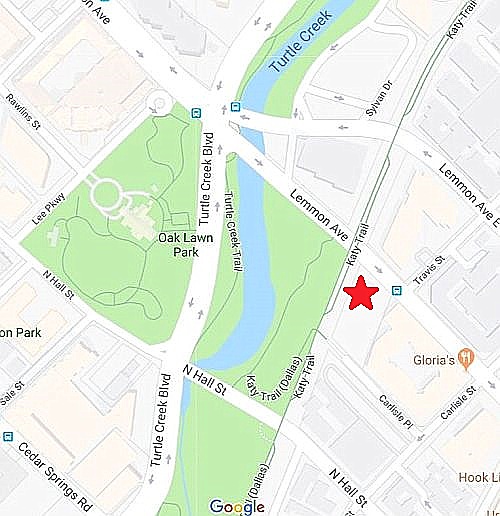
The company was located at 3307 Lemmon Avenue, at the MKT railroad track (now the Katy Trail) — on Lemmon between the railroad tracks and Travis Street (see the location on a map composed of two badly-cobbled-together Sanborn maps from 1921 here). The location is marked on a present-day Google map below (click to see a larger image):

lemmon-and-katy-trail_google-map

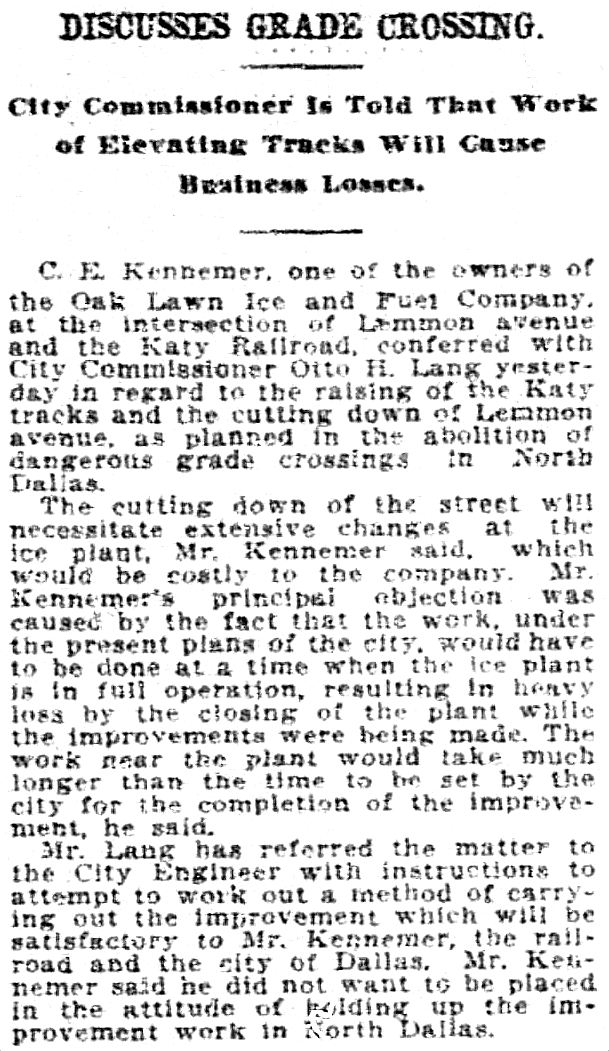
In 1917, the City of Dallas, in partnership with the Missouri, Kansas & Texas Railroad began to eliminate grade crossings in the Oak Lawn area — one of those crossings was at Lemmon Avenue: Lemmon was to be lowered and the MKT tracks were to be raised. Oak Lawn Ice & Fuel Co. General Manager Clarence E. Kennemer (who, along with his brothers, operated something of an ice empire in Texas) was concerned about the negative impact of this construction on his business. (All images are larger when clicked.)

1917_oak-lawn-ice_dmn_013117_katy-crossing     Dallas Morning News, Jan. 31, 1917

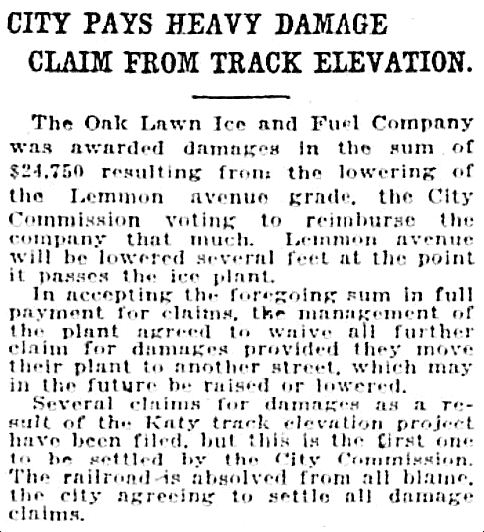
To the surprise of many, the ice company was awarded damages by the city.

1917_oak-lawn-ice_dmn_120617_katy-crossingDMN, Dec. 6, 1917

Things apparently continued fairly well until 1920 when the company began to experience tensions with its residential neighbors. Early in the year, city building inspectors responded to nuisance complaints and ordered the company to move its horse stables as they were too close to adjoining residences (ice delivery even into the 1940s and possibly 1950s was often done via horse-drawn wagons). Later the same year, still-unhappy neighbors filed suit to “force the company to remove its plant from the thickly settled residence district” (DMN, Dec. 1, 1920). The ice company appears to have won the lawsuit, since the company (under various names) was at 3307 Lemmon until at least 1939 or ’40, but these problems might have led them to build a new plant at Cole and what is now Monticello in 1922 (as with the Lemmon location, this new plant was also built alongside the MKT tracks). The mere prospect of this new icehouse was met with loud protests by the new neighborhood — before construction even began — but a judge ruled in favor of the ice people. Construction went ahead, and the plant was a neighborhood fixture for many years. (See the location on a 1921 Sanborn map here; “Gertrude” — near the top edge — was the original name of Monticello Avenue.)

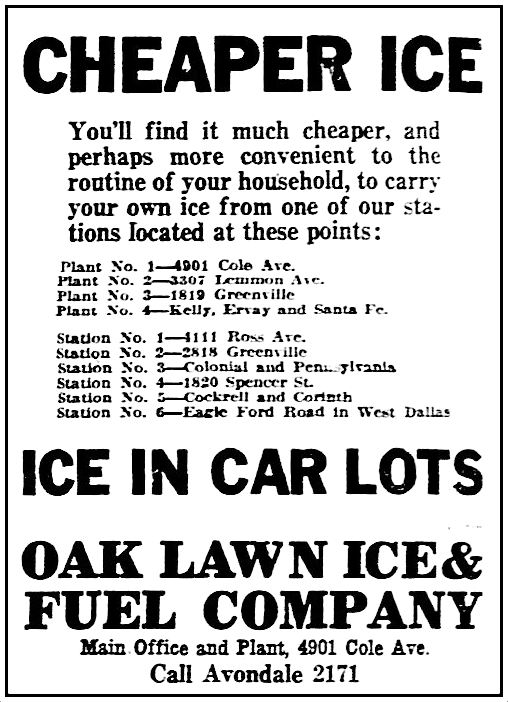
In 1923, ads for the Oak Lawn Ice & Fuel Co. began displaying both addresses: the original location, 3307 Lemmon, was now being referred to as “Plant No. 2,” and the new location, 4901 Cole, was being referred to as the “Main Office/Plant No. 1.”

1923_oak-lawn-ice_1923-directory
1923 Dallas city directory

By 1924 the company expanded as it absorbed other ice companies.

1924_oak-lawn-ice_sept-19241924

By 1925, “Oak Lawn Ice & Fuel Company” had become “American Ice Co.” (another C. E. Kennemer enterprise).

1925_american-ice-co_aug-19251925

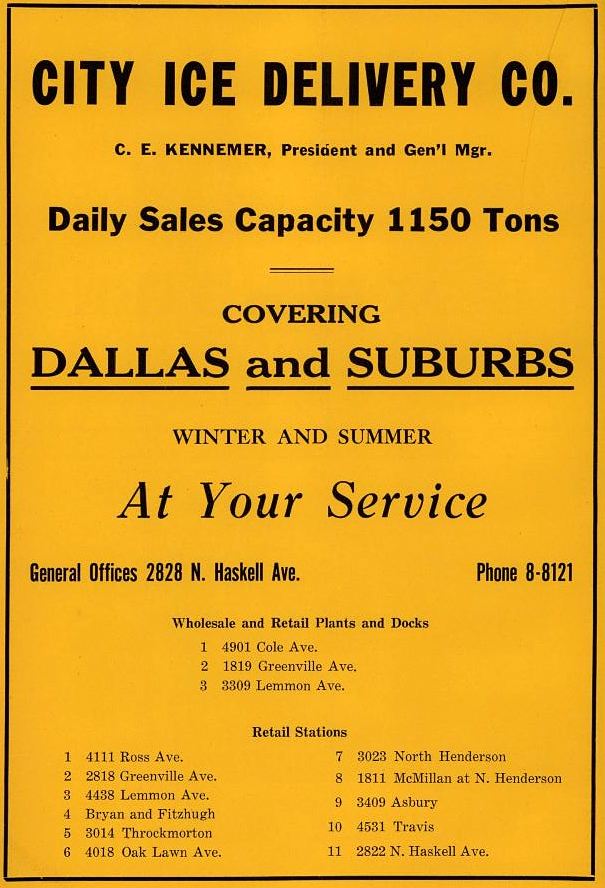
By 1933, American Ice Co. was swallowed up by City Ice Delivery Co.

city-ice-delivery_1934-directory1934 Dallas city directory

In the late 1930s or early 1940s City Ice Delivery Co. was acquired by Southland Ice (the forerunner of the Southland Corp., owners of 7-Eleven convenience stores). The Lemmon Avenue location became a meat-packing plant sometime in the mid-’40s (if neighbors were bent out of shape by an ice company, imagine how they felt about a meat-packing plant!); the Cole location became a 7-Eleven store and later a Southland Corp. division office.

*

But back to Jonathan F. Finney, the man standing next to the ice wagon in the top photo. He came to Dallas from Alabama around 1916 and bought a house at 3001 Carlisle Street, where he lived for most of his life in Dallas. His occupation was “ice dealer,” and he seems to have worked in both the wholesale and retail areas, as a driver, a salesman, and even for a while the owner of his own company. His great-great-granddaughter Krystal Morris (supplier of these wonderful family photos) says she believes he was the manager of the Oak Lawn Ice & Fuel Co. The 1932 directory lists him as foreman of the City Ice Delivery Co., and as he lived at 3001 Carlisle, it seems to make more sense he was working at the Lemmon Ave. location (which was less than half a mile away from his home) rather the Cole Ave. location. The actual address of the photo at the top is unknown, but it may show the Lemmon Ave. location when Finney was working as an independent ice dealer, standing beside his own wagon.

Below, the Finney family around 1920 (J. F., daughters Thelma and Viva Sue, and wife Wenona), and below that, their house at 3001 Carlisle (which was at the corner of Carlisle and Sneed — seen in a 1921 Sanborn map here).

finney-family_krystal-morris-photoFinney family, circa 1920 / Photo: Krystal Morris

finney-home_3001-carlisle_krystal-morris-photo3001 Carlisle, Finney family home / Photo: Krystal Morris

J. F. Finney, born in 1885, died in Dallas in 1962, long after the era of necessary daily ice deliveries to residences and businesses. The occupation listed on his death certificate was “painter” but I have a feeling “once an iceman, always an iceman.”

***

Sources & Notes

All photographs are from the family photos of Krystal Morris and are used with her permission. Thank you, Krystal!

The history of ice delivery is very interesting, especially to those of us who have never lived in a house without an electric refrigerator. Here are links-a-plenty on the subject:

  • “Icehouses — Vintage Spaces with a Cool History” by Randy Mallory (Texas Highways, Aug., 2000) here (additional photos can be found in the scanned issue on the Portal to Texas History site, here)
  • “Keeping Your (Food) Cool: From Ice Harvesting to Electric Refrigeration” by Emma Grahn on the Smithsonian National Museum of American History blog, here
  • “Delivering the Ice: Ice Wagons” — from an online exhibit based on an exhibit that was on display at the Woods Hole Historical Museum in Woods Hole, Massachusetts during the summer of 2015, here
  • “Portals to the Past: Golden Days of Home Delivery (ice, as well as bread, milk, groceries, etc.) by Waco historian Claire Masters, here
  • “The Iceman Cometh” by Dick Sheaff from the Ephemera Society of America blog, here

Here’s a fantastic little clip of a woman ice deliverer manning the tongs (and wearing heels):


*

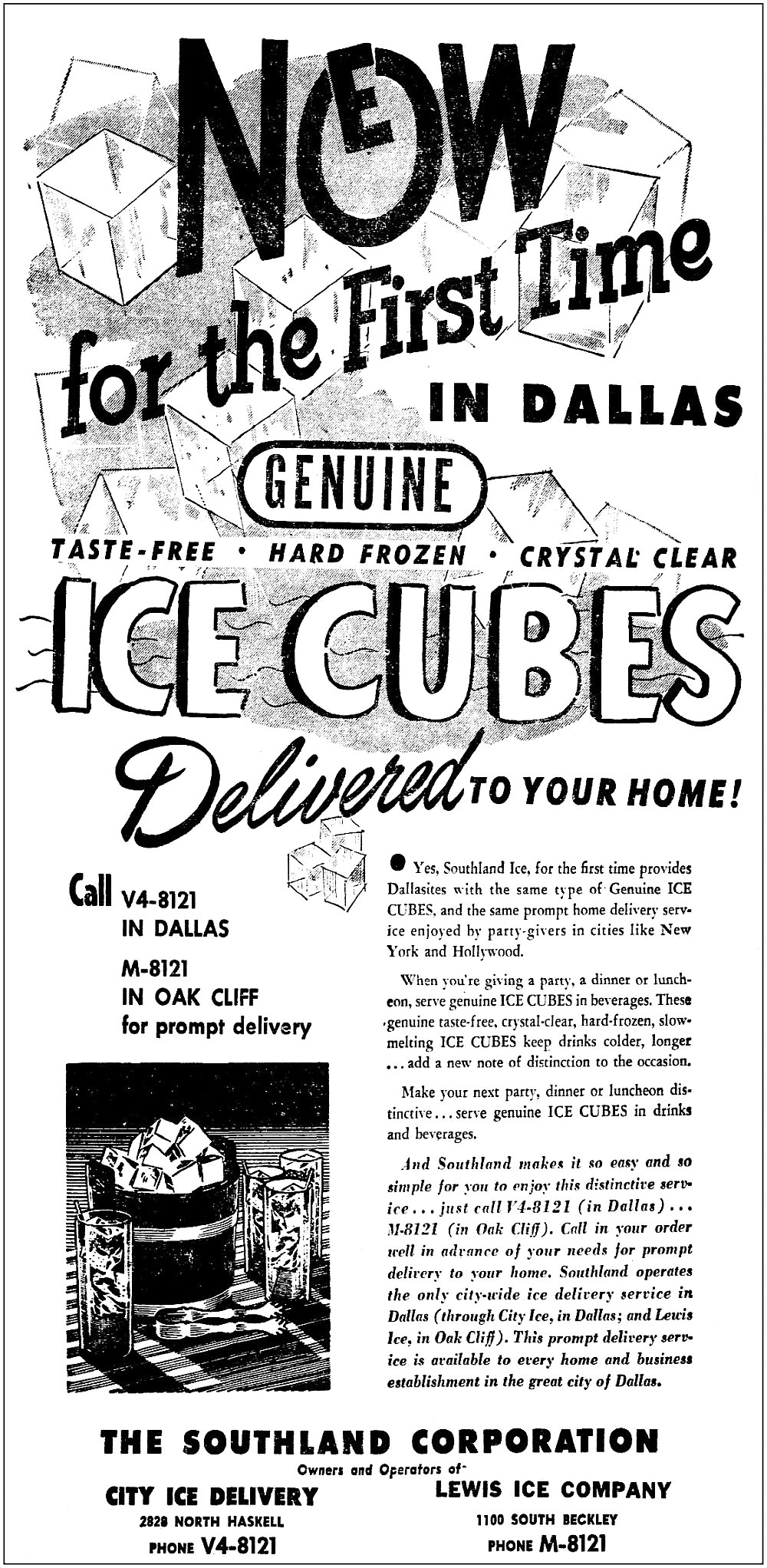
And, lastly, the Southland Corp. to the rescue with an ad from Dec., 1948 with news of the arrival in Dallas of “genuine” ice cubes! “Now for the first time in Dallas: Genuine Taste-Free, Hard Frozen, Crystal Clear Ice Cubes delivered to your home!”

city-ice-delivery_southland-ice_dec-1948
1948

All images are larger when clicked.

*

Copyright © 2018 Paula Bosse. All Rights Reserved.

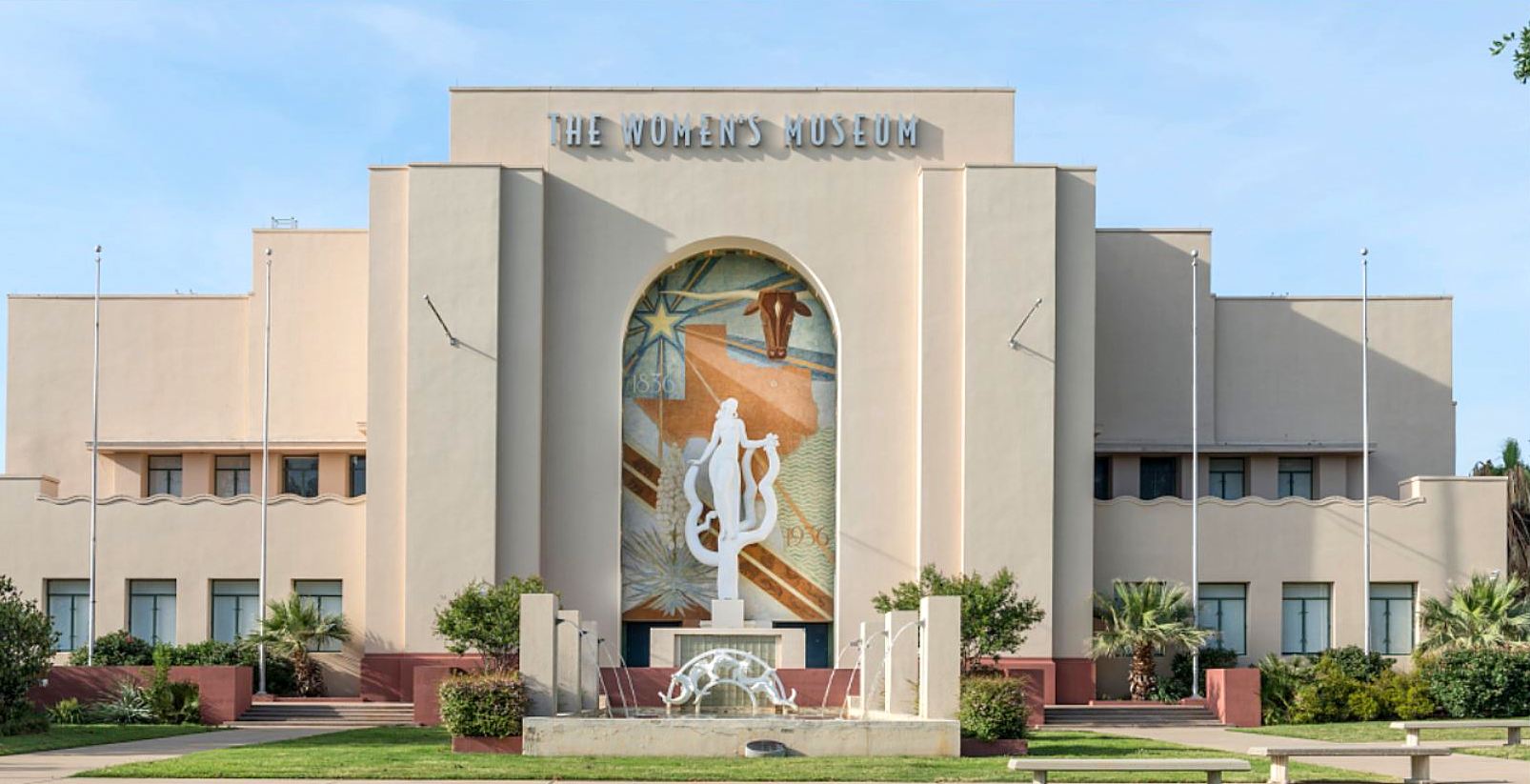
State Fair Coliseum / Centennial Administration Building / Women’s Museum / Women’s Building

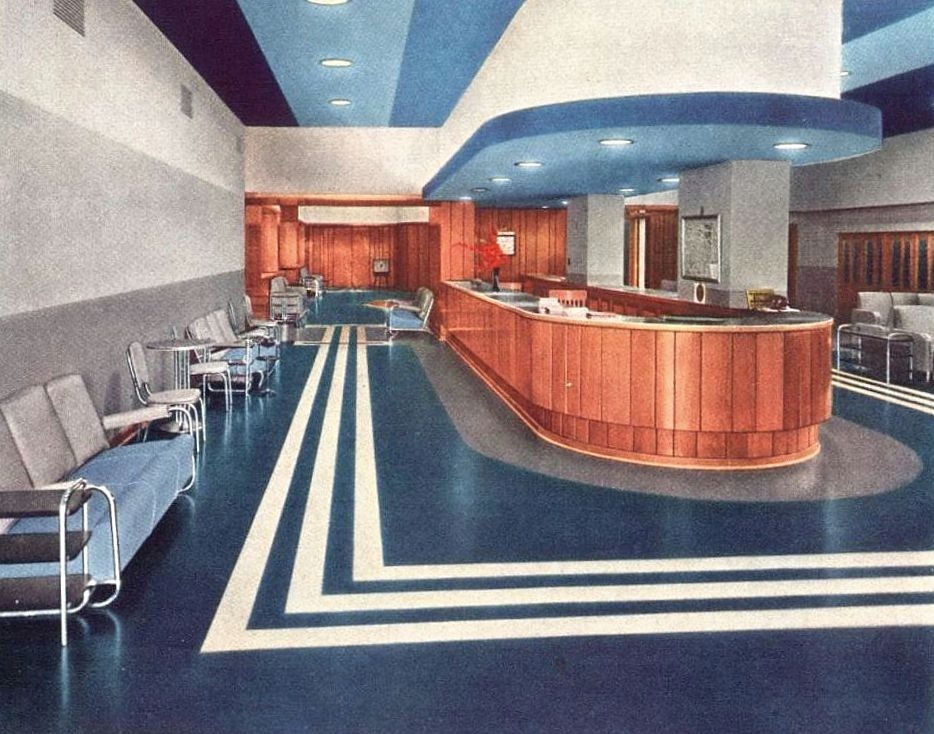
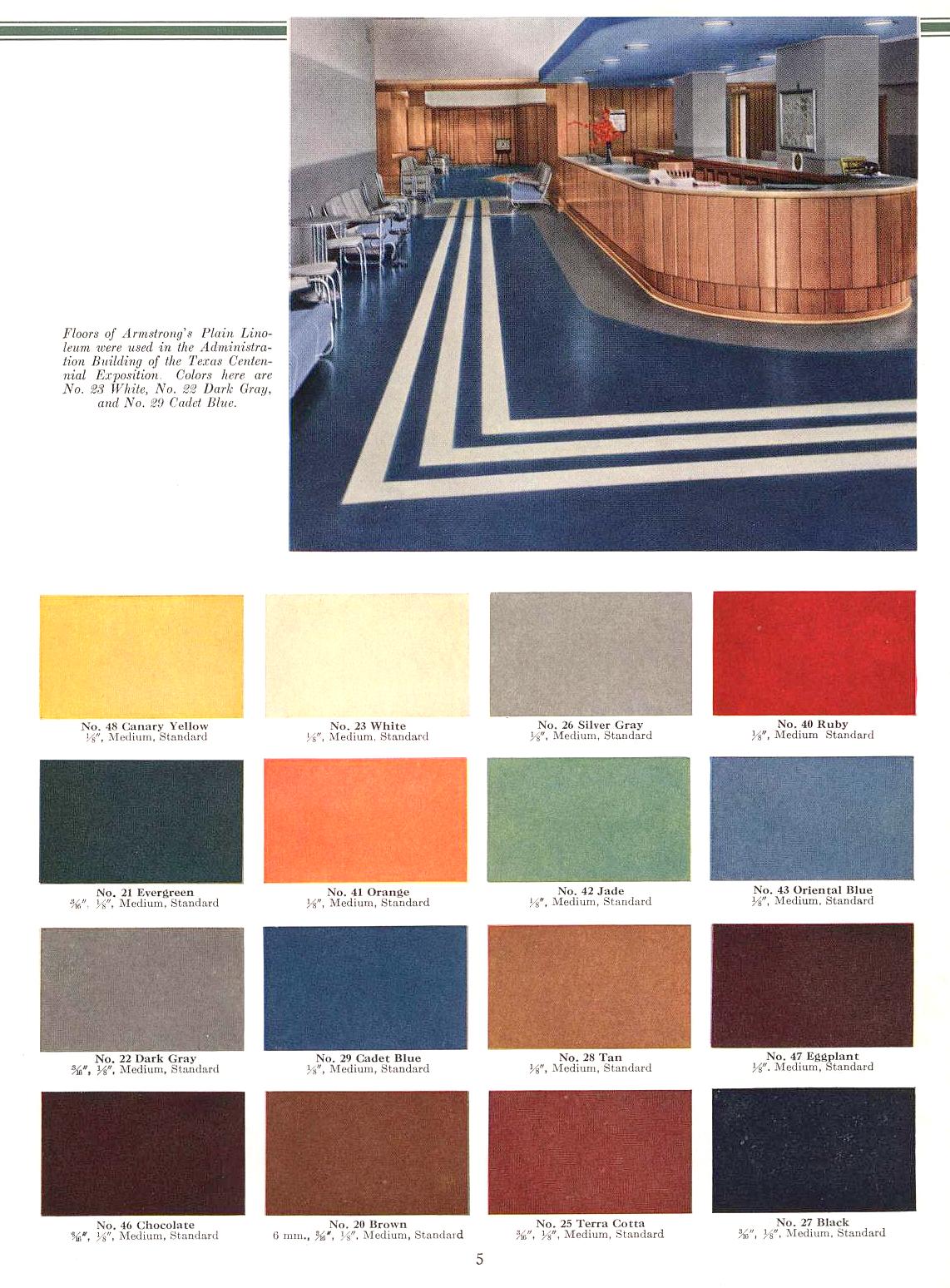
tx-centennial_armstrong-linoleum-ad_1936_detAdministration Building interior, 1936…

by Paula Bosse

Thursday night I attended a very entertaining Dallas Historical Society presentation at the Hall of State in Fair Park: “An Evening With Jim Parsons: Lost Fair Park,” in which the author of Fair Park Deco and DFW Deco talked about many of the buildings constructed for the Texas Centennial Exposition in 1936 which are no longer with us.

One of Jim’s asides was that there are very, very few color photos of the Centennial buildings and murals taken in 1936. If you’ve seen a Centennial view in color, it’s probably a colorized postcard. Kodachrome film was introduced in 1935 and was, sadly, not in wide use by visitors to Fair Park in 1936 (or by the Centennial organization).

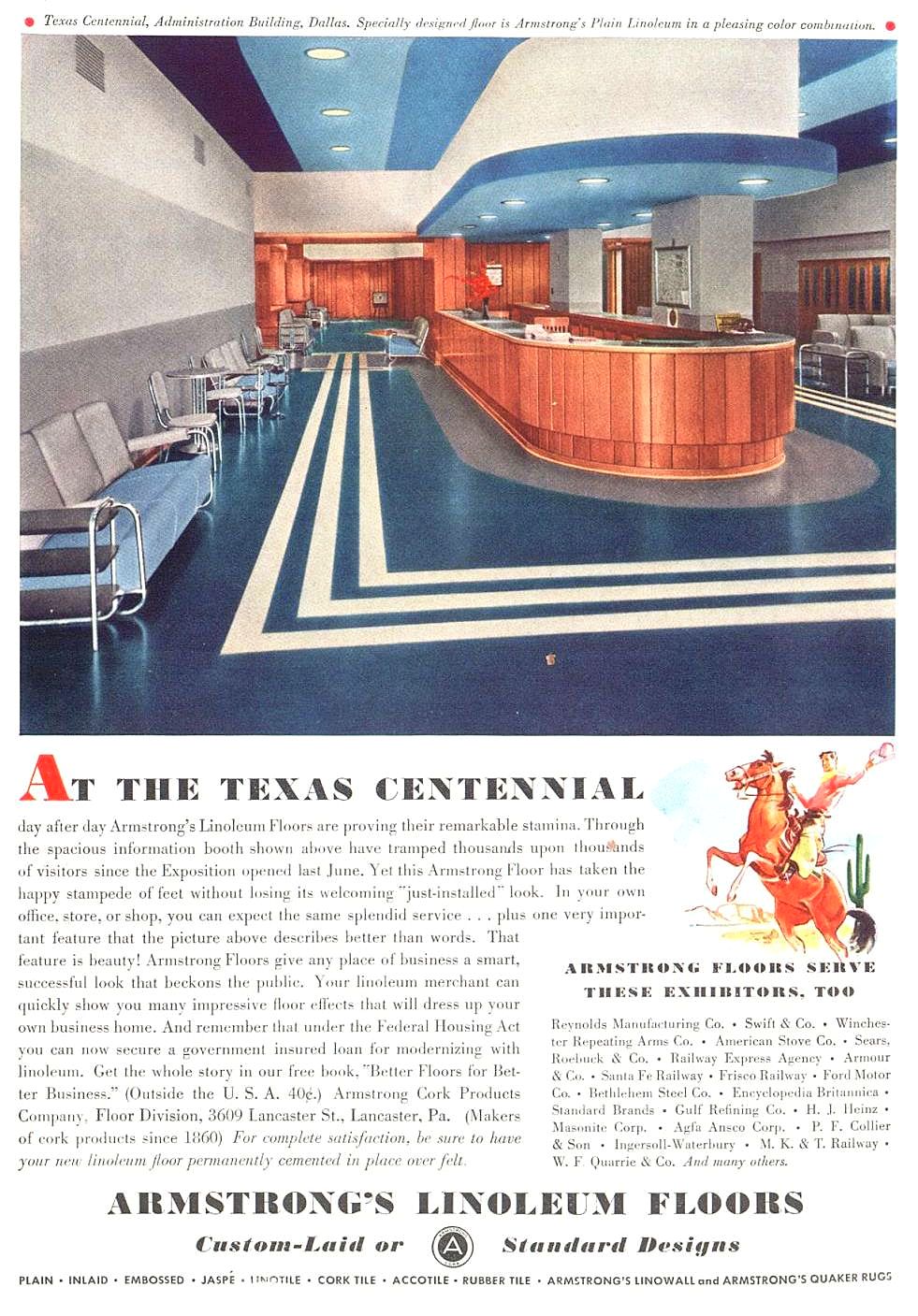
When he said that, though, I remembered an ad I had come across that I thought was pretty cool, simply because it shows the interior of one of the Centennial buildings when it was brand new (…well, it was sort of new — more on that below). The ad is for Armstrong Linoleum and it features a color photo showing one of their custom linoleum floors installed in the Centennial Administration Building, an interior I’d never seen. And it’s in color! (Check out the furniture and the recessed lighting!) Here’s the full ad, which appeared in national magazines in 1936 (click for larger image).

ad- tx-centennial_armstrong-linoleum_19361936 ad

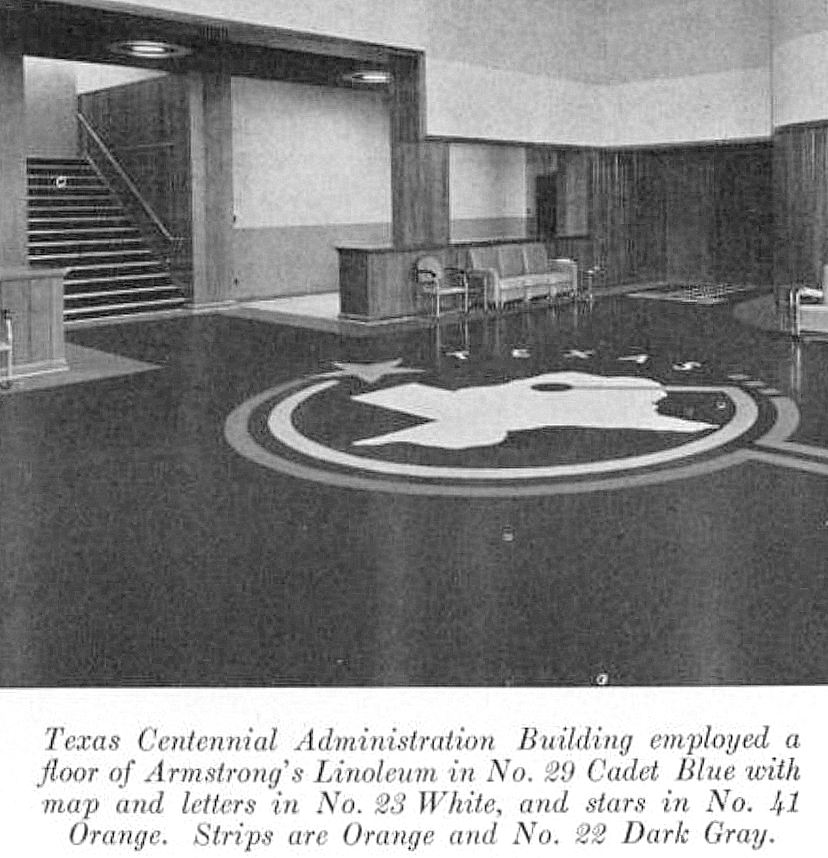
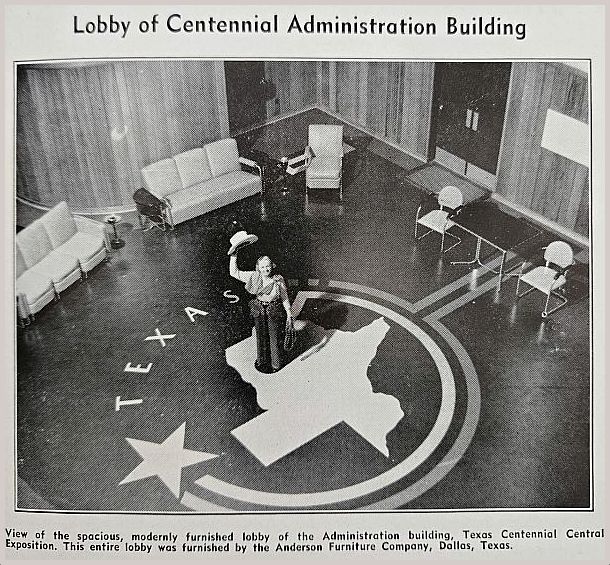
And — hallelujah — I found another photo of the interior — also from the helpful Armstrong people (I don’t know if they had the concession to outfit all the Centennial buildings, but, if so, I’d love to see all of their designs). Unfortunately this one is not in color, but it shows a fantastic Texas-centric custom design, laid down in fabulous linoleum.

tx-centennial_armstrong-linoleum_admin-bldg_texas-floor

And another one:

tx-centennial_administration-bldg-floor_southwest-business-mag_june-1936
Southwest Business, June 1936

Imagine that floor in Cadet Blue, White, Orange, and Dark Gray. This is from a trade publication called Armstrong’s Floors and Walls for Homes and Public Buildings, published around 1950 (and fully scanned here). A cropped version of the photo of the top is also included here (that floor, by the way, is in White, Dark Gray, and Cadet Blue), with handy swatches (which, reproduced below, lose some accuracy in color).

tx-centennial_armstrong-linoleum_admin-bldg_colors

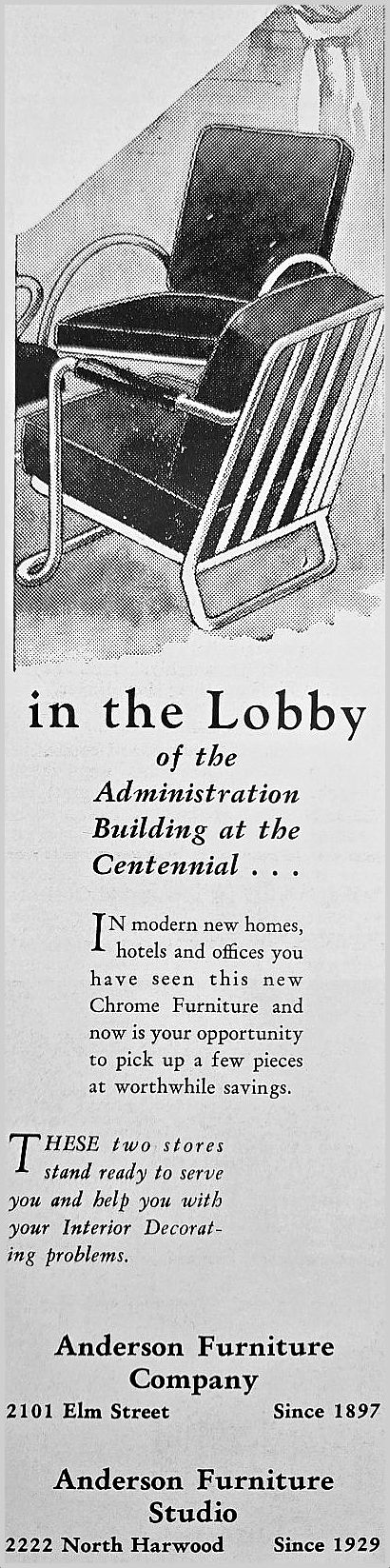
And just because I found an ad for those cool chairs:

tx-centennial_furniture_southwest-business-mag_oct-1936Southwest Business, Oct. 1936

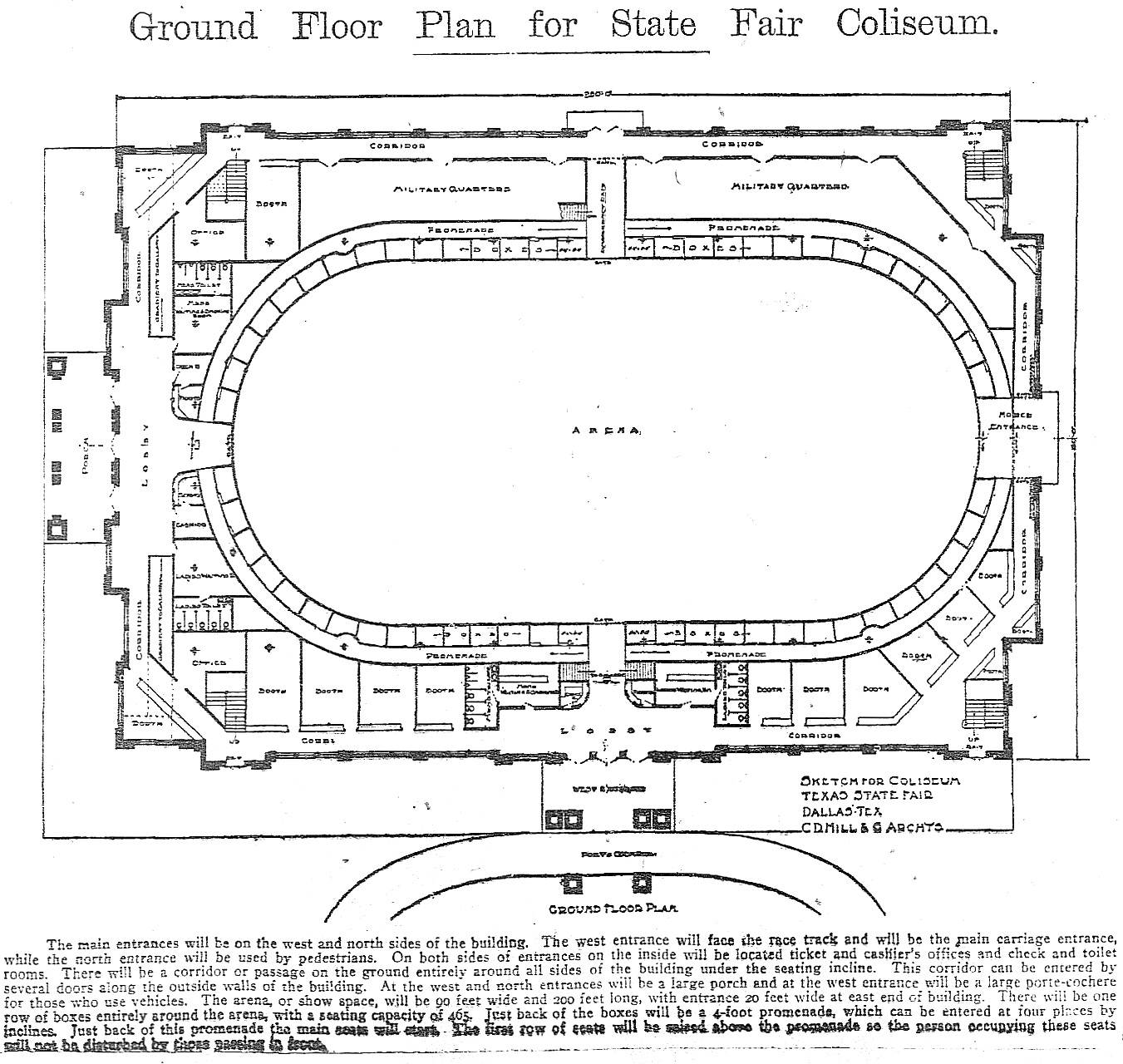
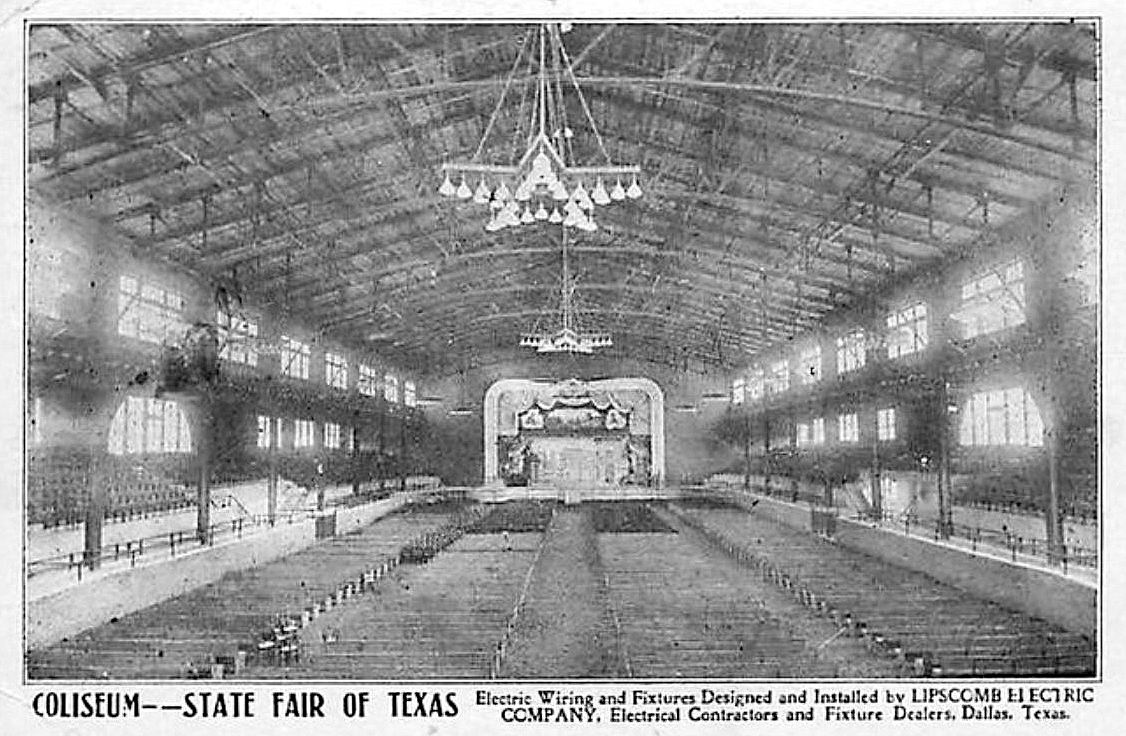
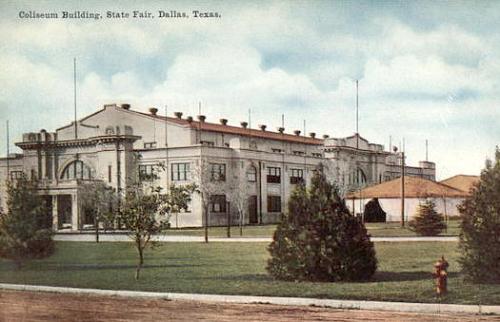
The Centennial Administration Building — which housed the hundreds of office workers and executives behind the running of the Texas Centennial Exposition — was actually the very first Centennial building completed (at the end of December 1935). Most of the Centennial buildings were newly built in 1936, but the Administration Building was actually an old building given a new stucco façade and completely remodeled — it even acquired a second floor inside the huge structure. This building was originally known as the State Fair Coliseum, built in 1910, designed by architect C. D. Hill (who designed many buildings in Dallas, including the still-standing Municipal Building downtown (built in 1914) and the Melrose Hotel (1924).

state-fair-coliseum_dmn_062009_drawingDallas Morning News, June 20, 1909

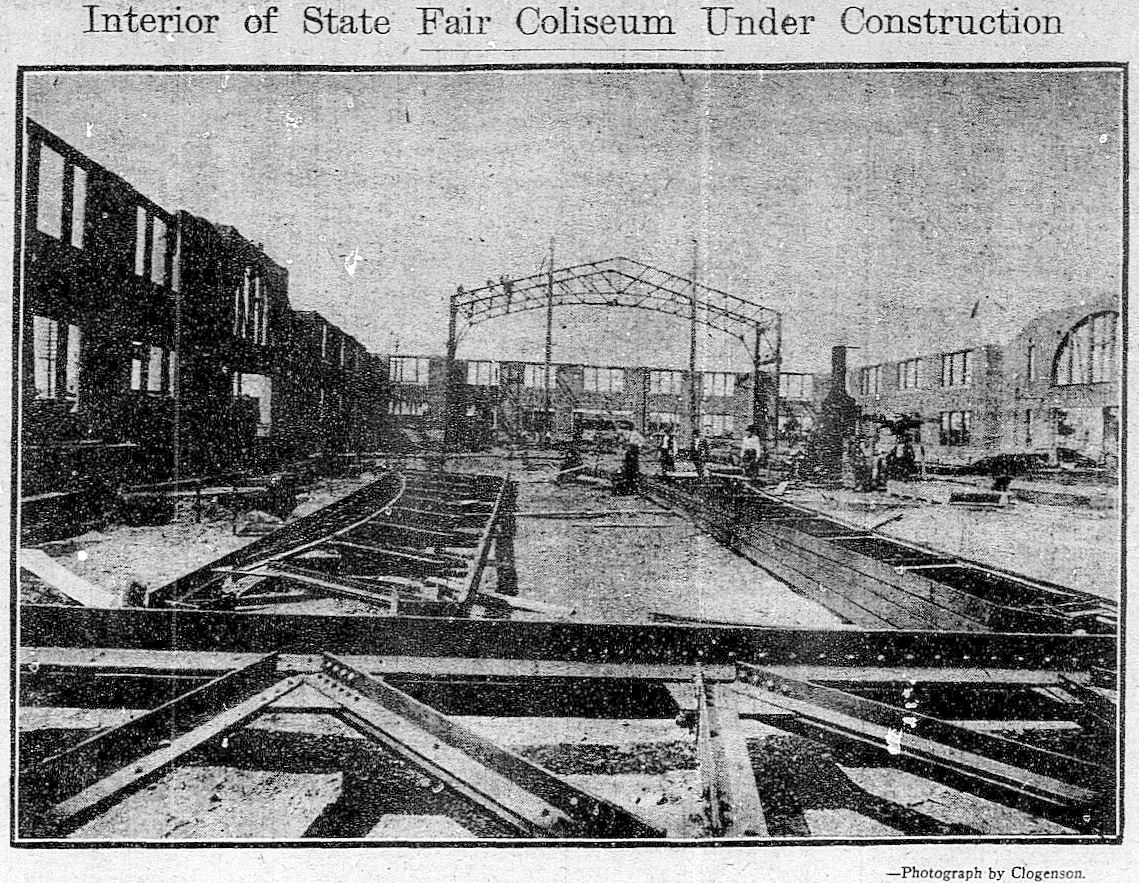
state-fair-coliseum_dmn_050710_constructionDMN, May 7, 1910

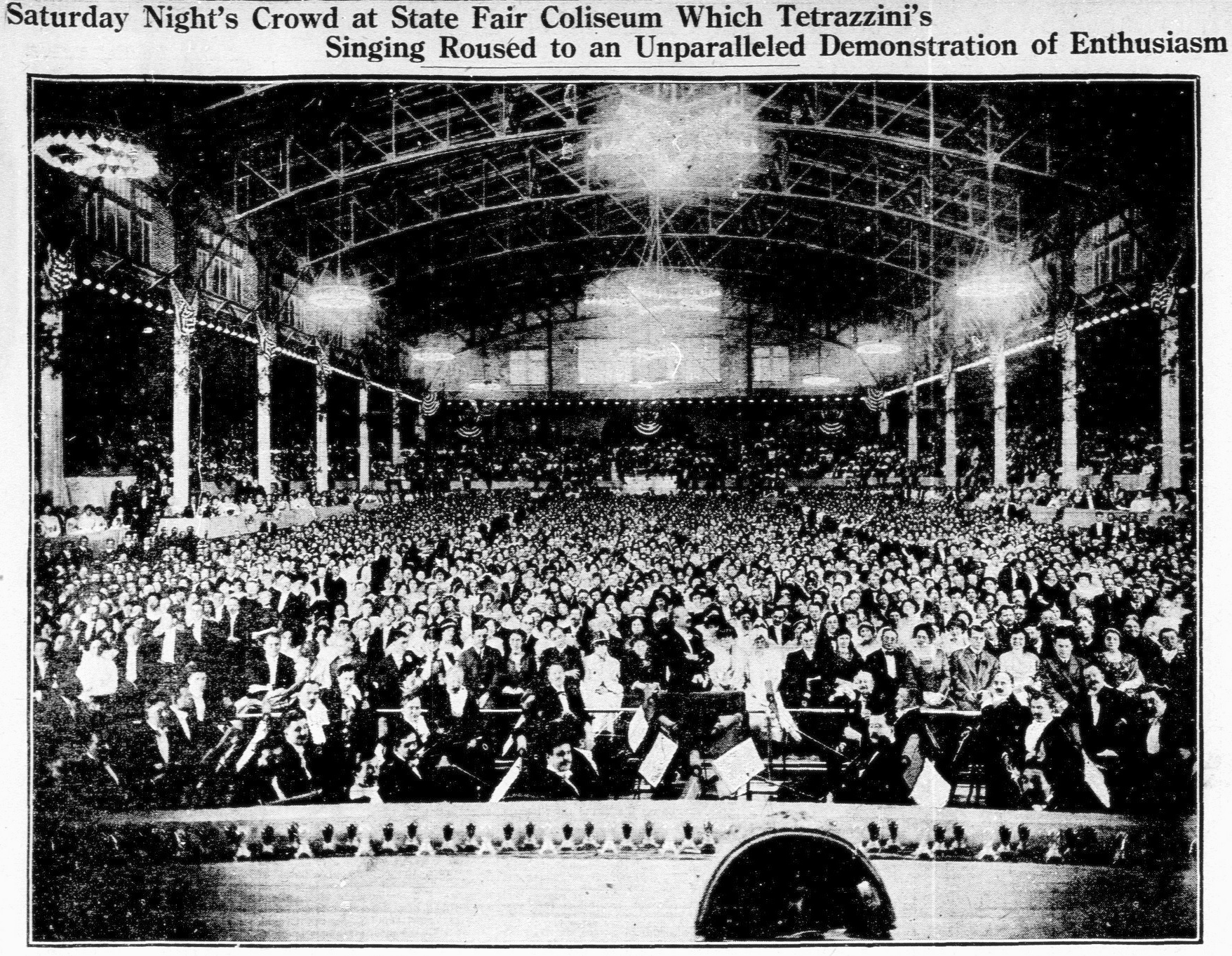
It was BIG. It had a seating capacity of 7,500.

state-fair-coliseum_flickr_coltera

state-fair-coliseum_dmn_030413DMN, March 4, 1913

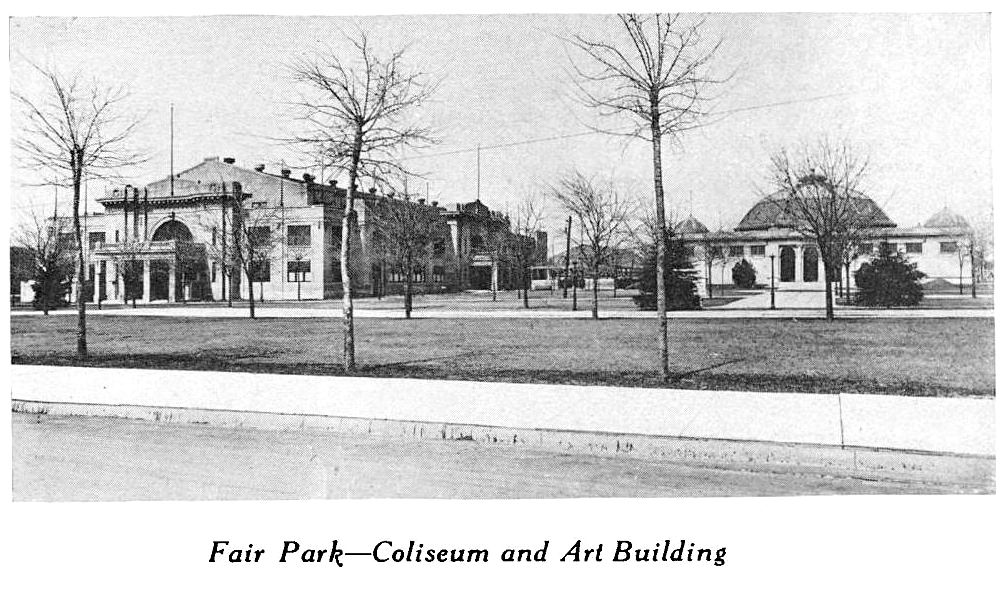
This was the first building you’d see as you entered Fair Park, as it was right inside the front entrance on Parry Avenue (after you entered, the building would be on your left).

Coliseum Building, State Fair Dallas, TX

park-board-bk_fair-park-coliseum_1914

It was the city’s first official municipal auditorium, and it hosted everything from livestock shows, conventions, large civic gatherings, and the occasional opera.

Fast-forward a few decades: in 2000 the building became the home of the Women’s Museum. The museum closed in 2011 and is now called the Women’s Building and is used for special events.

A photo of the building from 2014:

womens-museum_fair-park_2014_carol-highsmith_library-of-congressphoto: Carol Highsmith, Library of Congress

See a Wikimedia photo of this building in 2016 here — click it again (and again) to see it really big, and linger on the mural by Carlo Ciampaglia and the sculpture by Raoul Josset. See interior photos of the space in 2009 during its time as the Women’s Museum here and here. I’m not sure if the exposed brick and steel are from the original 1910 building, but I certainly hope so! And, lastly, exterior photos from 2009 showing the side of the building here, and here

***

Sources & Notes

This building can be seen on this aerial Google view, here. It is currently the Women’s Building, and it is available for special events — more about this building from the Friends of Fair Park, here.

Black-and-white postcard showing the interior of the Coliseum is from Flickr.

Black-and-white photo “Coliseum and Art Building” is from Report for the Year 1914-1915 of the Park Board of the City of Dallas, With a Sketch of the Park System (Dallas: Park Board, 1915), which can be accessed as part of the Dallas Municipal Archives via the Portal to Texas History, here.

And since this whole post was spurred by Jim Parsons’ talk the other night, here’s a link to the book he and David Bush wrote: Fair Park Deco: Art & Architecture of the Texas Centennial Exposition.

*

Copyright © 2018 Paula Bosse. All Rights Reserved.

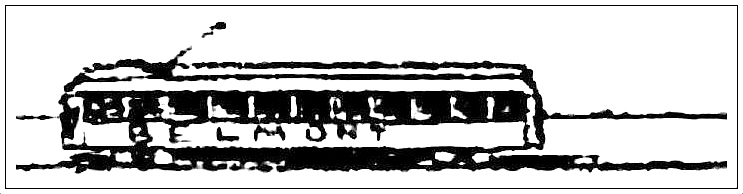
Ghost Rails of the Belmont Streetcar Line

matilda-richmond_dan-parr-photo_FB-dallas-history-guild_april-2018Matilda & Richmond, April, 2018… (photo: Dan Parr)

by Paula Bosse

I grew up on Ellsworth, between Greenville Avenue and Matilda — just south of Mockingbird, just north of the M Streets. When I was a child, Matilda was only partially paved — in my neighborhood, maybe only from Mockingbird down to Kenwood? Otherwise, it was a dirt street (!) — and this was in the ’70s! Right around Kenwood was a weird mound which might not have looked like much to an adult, but to a child it was pretty strange. I can’t remember if the rails were visible — I’m pretty sure they were.

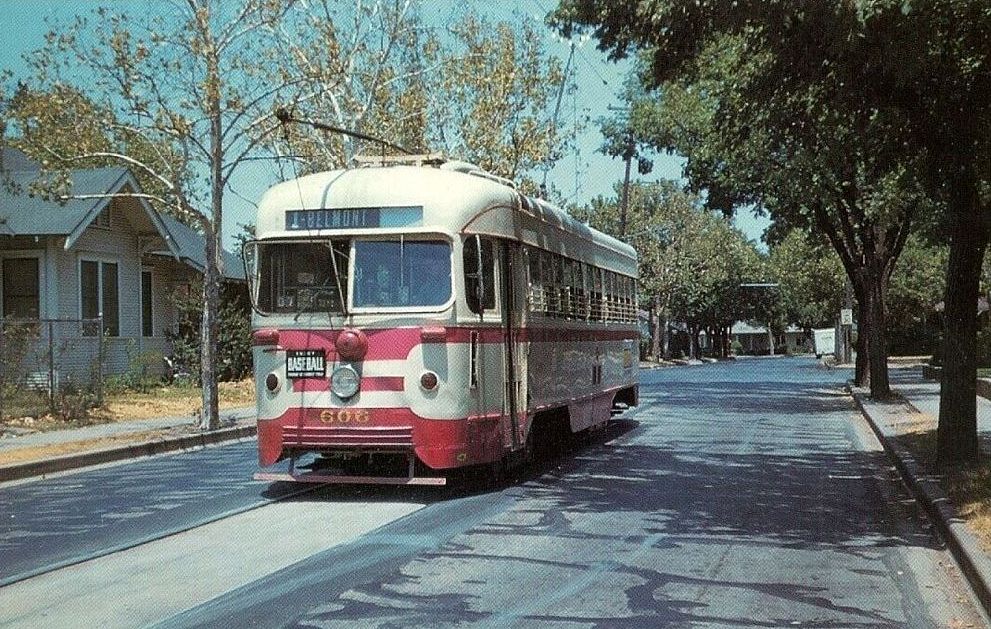
That line was the Belmont Line, which ended (began?) at Mockingbird (I think there was a later extension of sorts, but I think Mockingbird was the end of the line for streetcar passengers). As a kid, I knew that Matilda had been a long-gone streetcar line, but never having seen a streetcar outside of a movie, I couldn’t really imagine what it must have been like to have streetcars (and an interurban! — more on that below) moving up and down a street which was less than a block from my house.

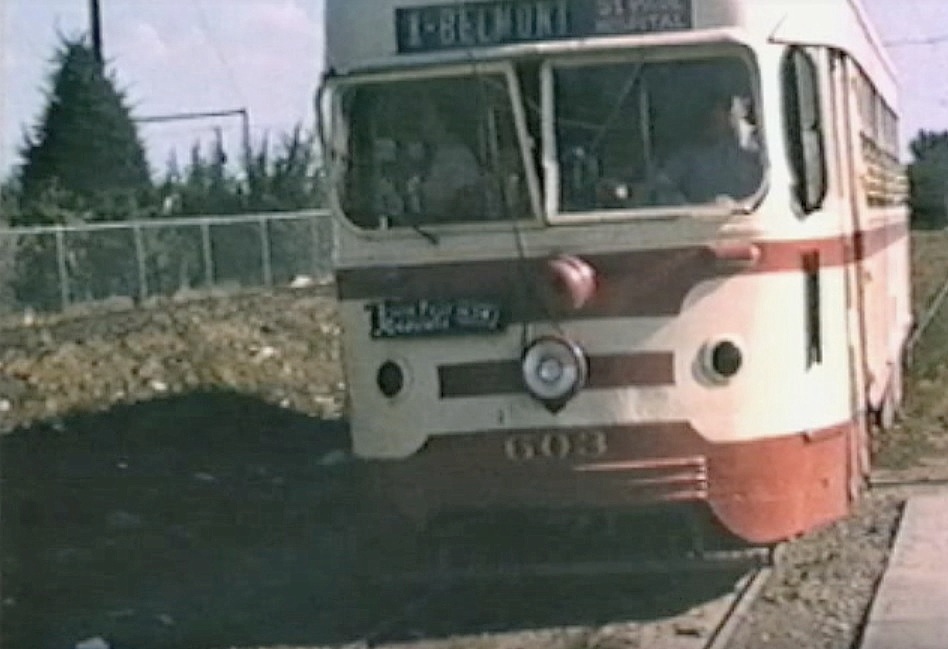
A few years ago I stumbled across the YouTube video below and was surprised to see actual footage of that streetcar rolling up Matilda. The first five minutes of the video contains 16mm footage (both black-and-white and color) shot around Dallas in 1953 and 1954 by Gene Schmidt. It’s GREAT! You’ll see streetcars-galore moving past all sorts of familiar and vaguely familiar sights around the city, from Oak Cliff to downtown to way out to Mockingbird and Matilda. It ends with the Belmont-Seventh car (car 603) pulling to the end of the line — the view is looking south down an unpaved Matilda Street from Mockingbird, with a glimpse of the Stonewall Jackson playing field at the left, on the other side of the fence. (The Matilda footage begins at 4:17.)

*

belmont-line_matilda-from-mockingbird_youtube-cap_ca1954Matilda, south from Mockingbird, ca. 1954 (Gene Schmidt)

Above, a screen capture from the video showing Matilda looking south from just south of Mockingbird. Stonewall Jackson Elementary School is at the left. Today the view looks like this.

*

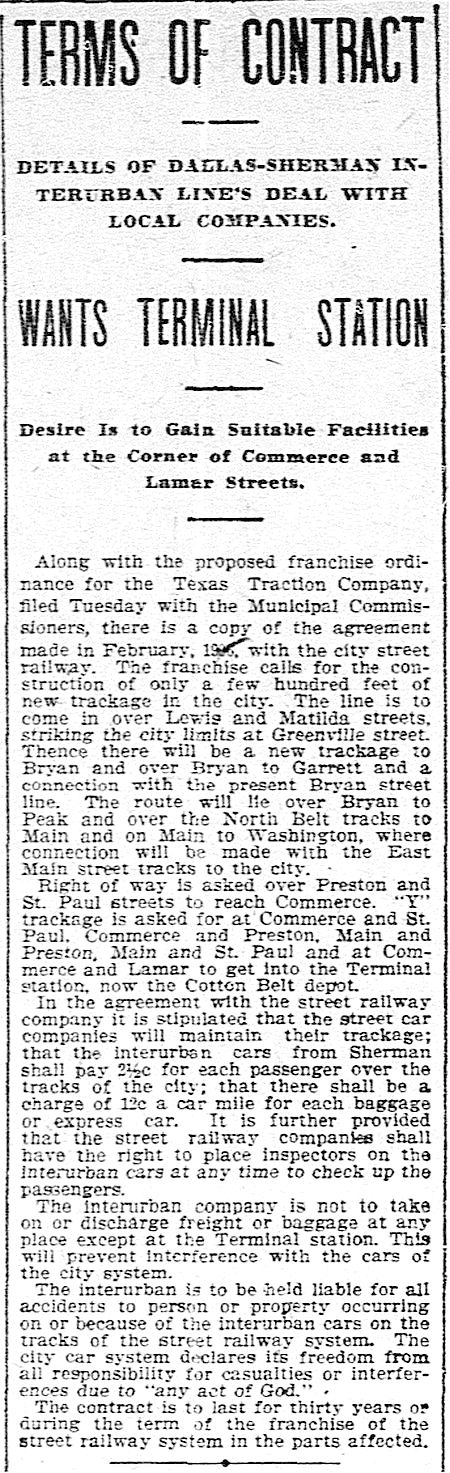
Before the streetcar arrived, Matilda was the artery that led the Texas Traction Company’s Sherman/Denison interurban into Dallas. This electric interurban service from the north, which closely followed the H&TC railroad line, arrived in Dallas in 1908, back when the official entry-point into the Dallas city limits was just off Matilda, near Greenville Avenue and Bryan Street.

1908_interurban_sherman-dallas_dmn_011608
DMN, Jan. 16, 1908 (click to read)

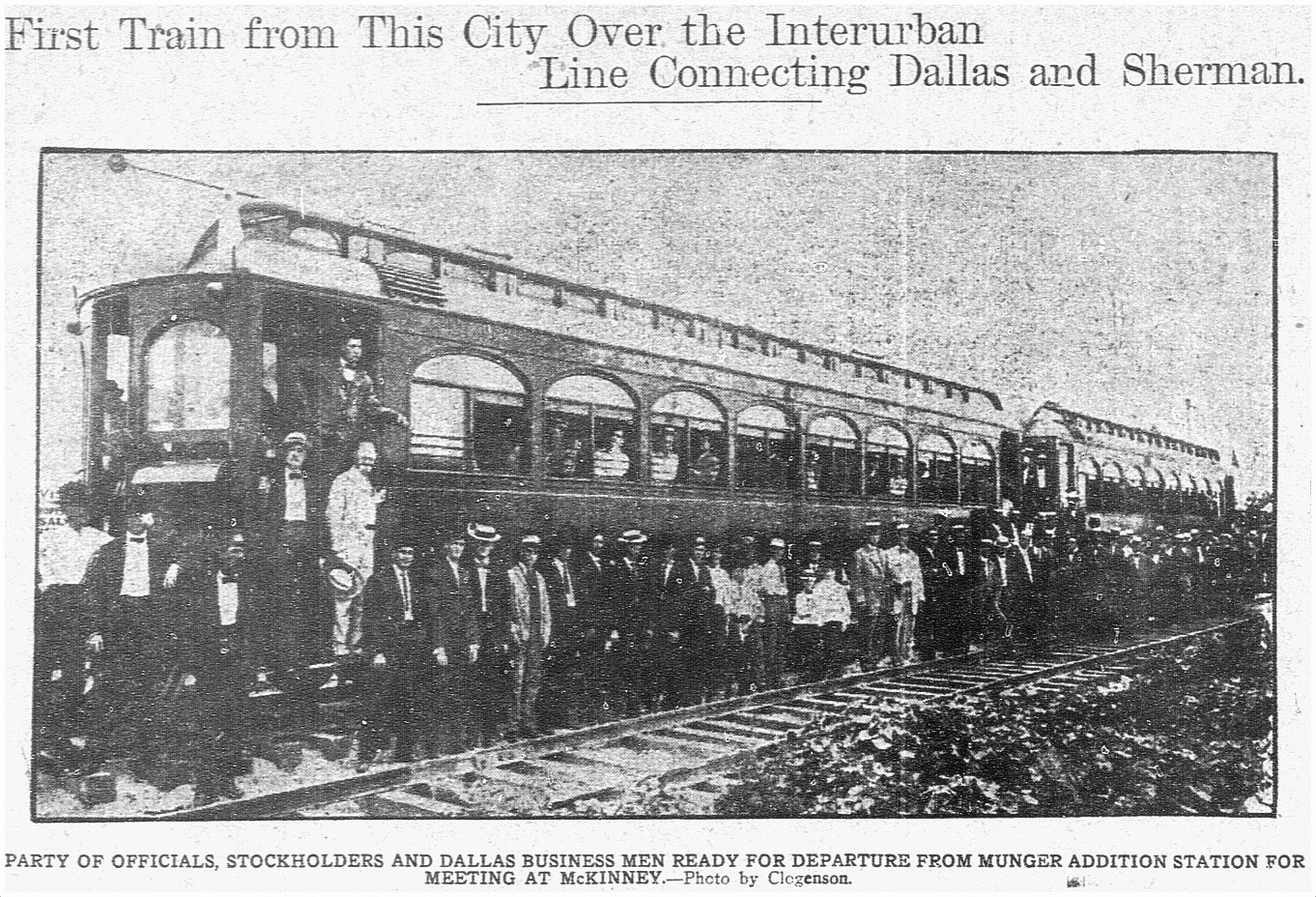
The interurban route connecting Sherman/Denison with Dallas opened on July 1, 1908 and lasted for 40 years, until its final run on December 31, 1948. (Read the Dallas Morning News article on the 1908 inaugural trip for big-wigs, “Many Make Trip Over Interurban,” July 1, 1908, here. Below is the accompanying photo. Image that running up and down Matilda — and, later, along other streets in Dallas — several times a day!)

interurban_sherman-dallas_dmn_070108
DMN, July 1, 1908

Dallas’ ever-increasing population began to move northward and eastward, necessitating public transportation which would connect these developing areas with the rest of the city. One of the early “suburban” lines was the Belmont Line, which branched off the Bryan Street line and served the Belmont Addition and beyond; it opened in 1913, but these early days appear to have been more of a private “dinky” service (see SMU’s dinky car on the beyond-the-city-limits tracks at Hillcrest and McFarlin, here). The Belmont line — as well as the Vickery Place and Mount Auburn lines — became part of the city’s official streetcar system in 1922.

Before the dinky service, riders were able to get on and off the large interurban cars at stops between Mockingbird and the area around Bryan and Greenville Ave. Even though interurbans and streetcars were able to travel on the same rails, it took years for dedicated streetcar tracks to be laid along Matilda.

This detail of a real estate ad shows that the Belmont line had reached at least as far as Richmond by 1914 (I felt I had to include this because the finger is pointing at the exact location of the exposed rails in the photo at the top!):

1914_matilda-richmond_lakewood-heights-ad_det_050314
May, 1914 (detail from Lakewood Heights real estate ad — see full ad here)

By 1922 the Belmont line had extended north to Velasco; by 1925 it had gotten to McCommas; by 1936 it had made it up to Penrose; and by 1939 it had finally reached Mockingbird (in time for the opening that year of Stonewall Jackson Elementary School, located at Mockingbird and Matilda).

Dallas streetcars began to be phased out in 1955, and the Belmont line was one of the first to go — its last run was March 6, 1955: “The Belmont-Seventh streetcar line will go out of existence Sunday to be replaced by service with new Diesel buses” (Dallas Morning News, March 6, 1955). The new bus route in the Lower Greenville area would, for the most part, be along Greenville Avenue, one block west of unpaved Matilda Street.

In March, 1955, it was reported that the abandoned Belmont-Seventh streetcar tracks were deeded to the city by the Dallas Railway and Terminal Co., with the understanding that they would eventually be paved over. The tracks were on Matilda, Bryan, Cantegral, Live Oak, St. Paul, King’s Highway, Edgefield, Seventh, Bishop, and Colorado. In April, 1956, it was reported that the City Council had approved the sale of the streetcar viaduct over the Trinity River and the Matilda street right-of-way.

But what about that paving of Matilda? Mrs. K. E. Slaughter had thoughts on the matter in a letter-to-the editor in April, 1955:

Since removal of the Belmont streetcar line in part — Matilda and Bryan streets — would it not be advantageous to develop this section into an important use to the heavy automobile traffic? Matilda now is no more than useless tracks built up between a cow path. (DMN, April 7, 1955)

“Cow path” — ha!

Another annoyed News reader wrote in 1963 — eight years after the tracks had been abandoned — about the useless unpaved thoroughfare:

The abandoned almost-private right of ways, such as Matilda, nearly two miles south from Mockingbird, received by the city in a deal to permit an all-bus operation, have not yet been paved or otherwise improved. (DMN, Oct. 21, 1963)

I’m not sure when that paving finally happened — early ’70s? — I think it must have been done in stages. I don’t remember a time when the stretch between Mockingbird and Kenwood wasn’t paved, but I do remember Matilda being a dirt road south of Kenwood. I don’t have a good recollection of the year, but kids remember all sorts of weird things, and those mysterious mounds were pretty memorable. (UPDATE: See photos of Matilda being paved at Goodwin in 1971 here.) I wish I’d known what an interurban was when I was a child. That would have made my neighborhood seem a whole lot more interesting! Heck, it used to the Gateway to Sherman!

I’ve long despaired of having missed the streetcar age. But it’s nice to know that one ran so close to the house I grew up in.

belmont-line_matilda-mockingbird_youtube-cap_ca1954End of the line, ca. 1954… (Gene Schmidt)

belmont-car_lakewood-heights-ad-det_050314

***

Sources & Notes

Top photo taken by Dan Parr on April 15, 2018; it was originally posted to the Facebook group Dallas History Guild and is used here with permission. (Thanks, Dan!) The photo was taken at Matilda and Richmond, looking south on Matilda. See it on Google Street View, here. (Roadwork along Matilda is awful at the moment, but much-needed. Apparently it is being reduced to three lanes for automobiles with two bike lanes being added — read about it in the Lakewood Advocate, here.)

YouTube video shot by Gene Schmidt in 1953 and 1954; the direct link is here.

Another interesting video on YouTube was made by the City of Allen and contains period footage of the interurban that served North Texas. It’s a breezy 6-and-a-half  minutes, and it includes some cool shots of Dallas.

If you want to see a whole bunch of North Texas interurban photos, check out this great 83-page PDF compiled by DART, “History of the Interurban Railway System and Monroe Shops,” here.

Speaking of DART, they posted a cool 1925 map of streetcar and interurban lines, here — click the map to see a larger image. (In 1925, the Belmont line ended on Matilda at McCommas).

ALSO extremely cool is a Google map showing Dallas’ Historical Streetcar (and Interurban) Lines laid over a present-day Google map, here. Zoom in and out. Very useful!

streetcar_belmont_color_ebayeBay

belmont-streetcar_new-moon_1940_palace_ebay1940, eBay

belmont-streetcar_1954_ebay1954, eBay

*

Copyright © 2018 Paula Bosse. All Rights Reserved.

Oakland Cemetery

oakland-cemetery_postcard

by Paula Bosse

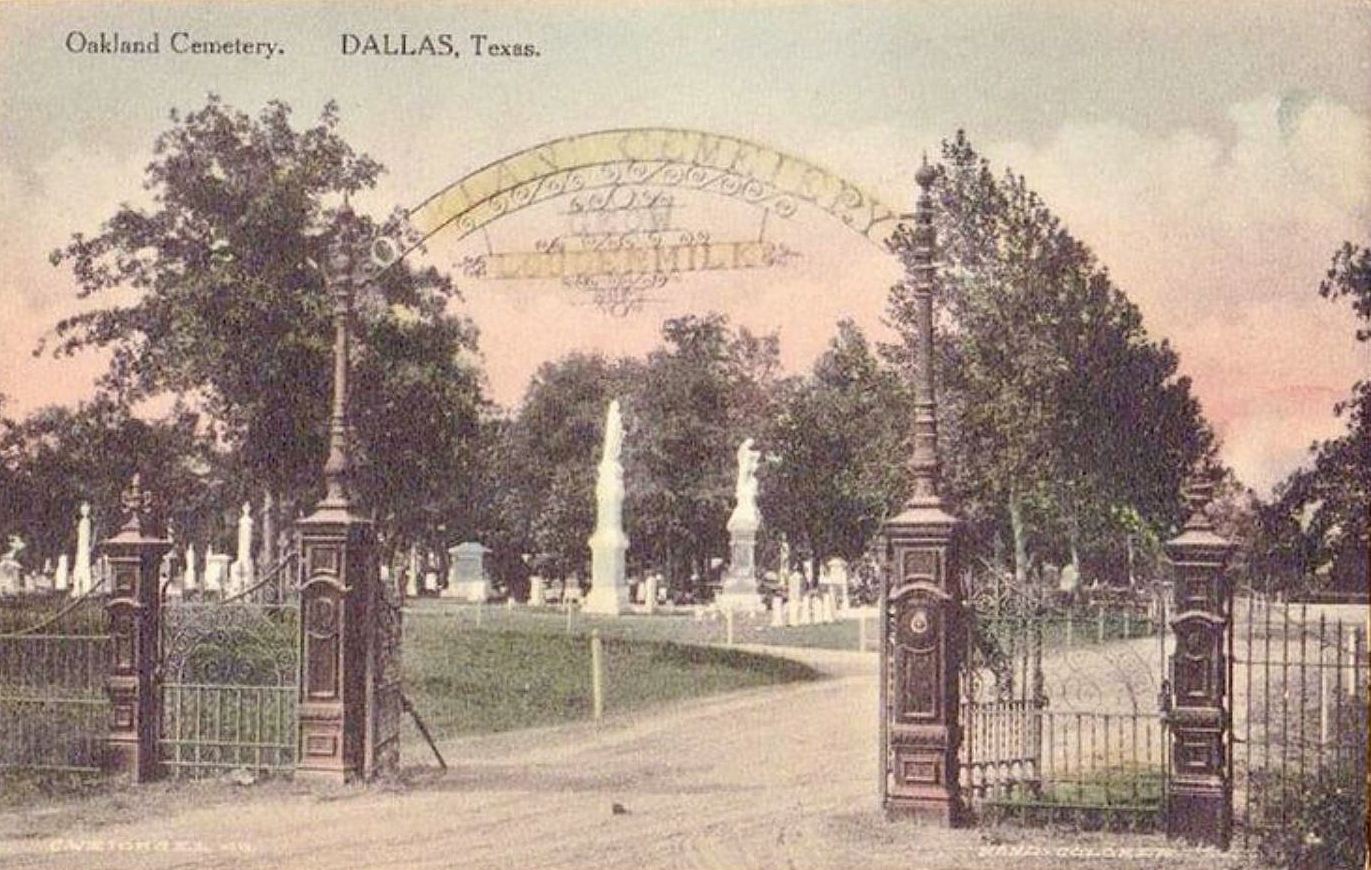
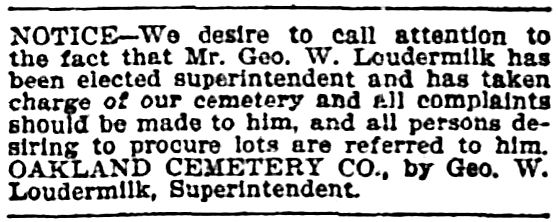
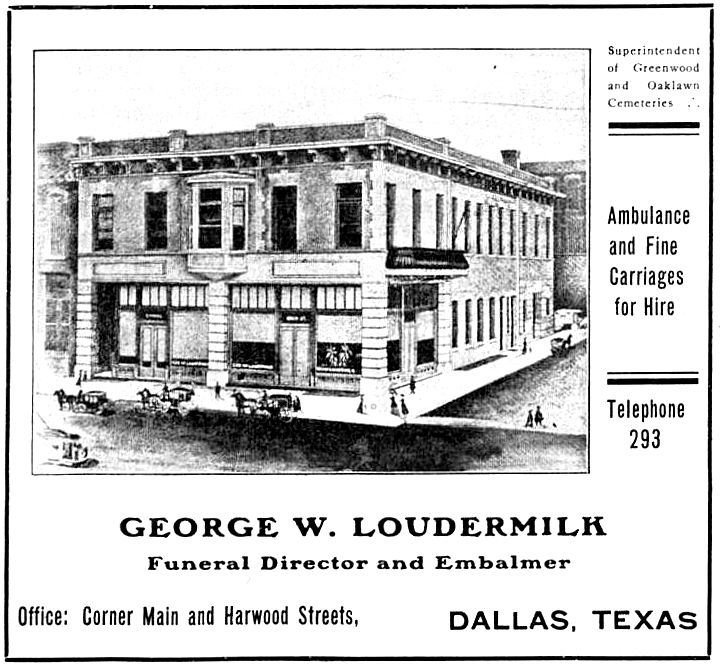
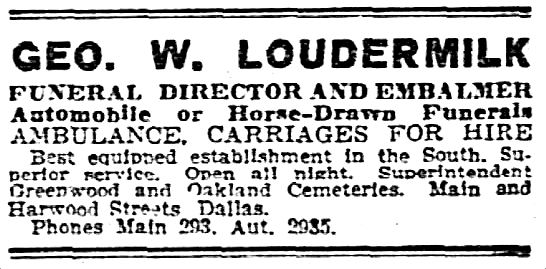
A beautiful postcard showing the gates of Oakland Cemetery emblazoned with the name of one of Dallas’ most prominent funeral directors, George W. Loudermilk.

oakland_loudermilk_dmn_060102Dallas Morning News, June 1, 1902

ad-loudermilk-funeral-home_19061906 ad

loudermilk_dmn_071912DMN, July 19, 1912

***

Sources & Notes

More on historic Oakland Cemetery, in South Dallas:

  • Wikipedia, here
  • Dallas Genealogical Society, here
  • Oakland Cemetery website, here
  • A lovely YouTube video filled with photographs of the cemetery and its markers, here

You can explore parts of the cemetery by touring via Google Street View, here.

*

Copyright © 2018 Paula Bosse. All Rights Reserved.

R. S. Munger’s Cotton Gin Manufactory

munger-improved-cotton-gin_1889-dallas-directory_detElm & Trunk, the early years (detail of an ad from 1889)…

by Paula Bosse

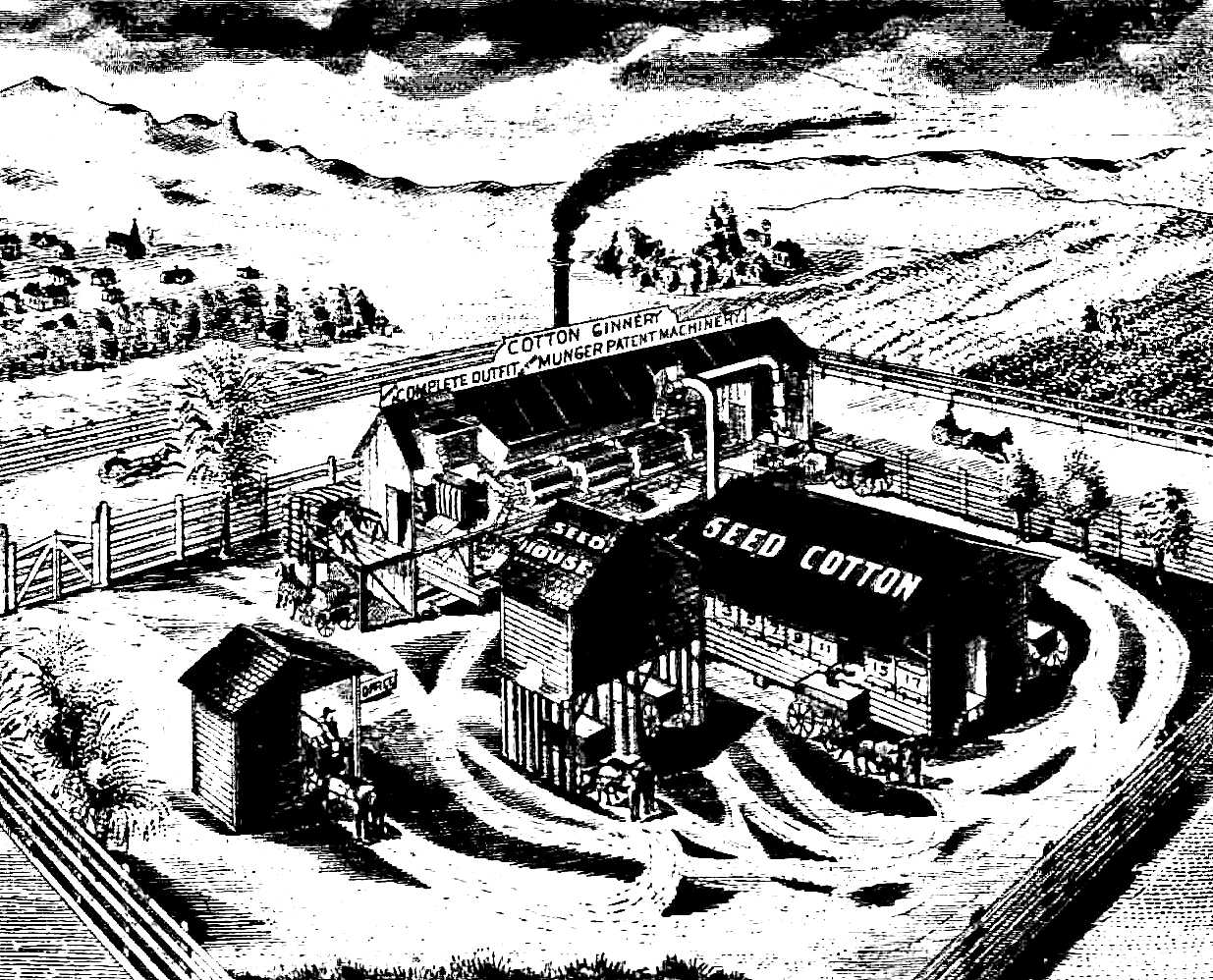
When R. S. Munger moved to Dallas from Mexia around 1885, even he probably had no idea how revolutionary his patented inventions would become to the world of agriculture — he had several patents, but his “improved” cotton gin was hailed as the most significant advance in cotton ginning since Eli Whitney’s original invention. Munger had been producing his equipment for a while in Mexia, but he knew that in order for his company to grow, he would have to move to a larger city, one served by the all-important railroad. He arrived in 1885 and moved into an existing “East Dallas” building owned by the wealthy banker (and former cotton farmer…) William H. Gaston (who later became an officer of the company).

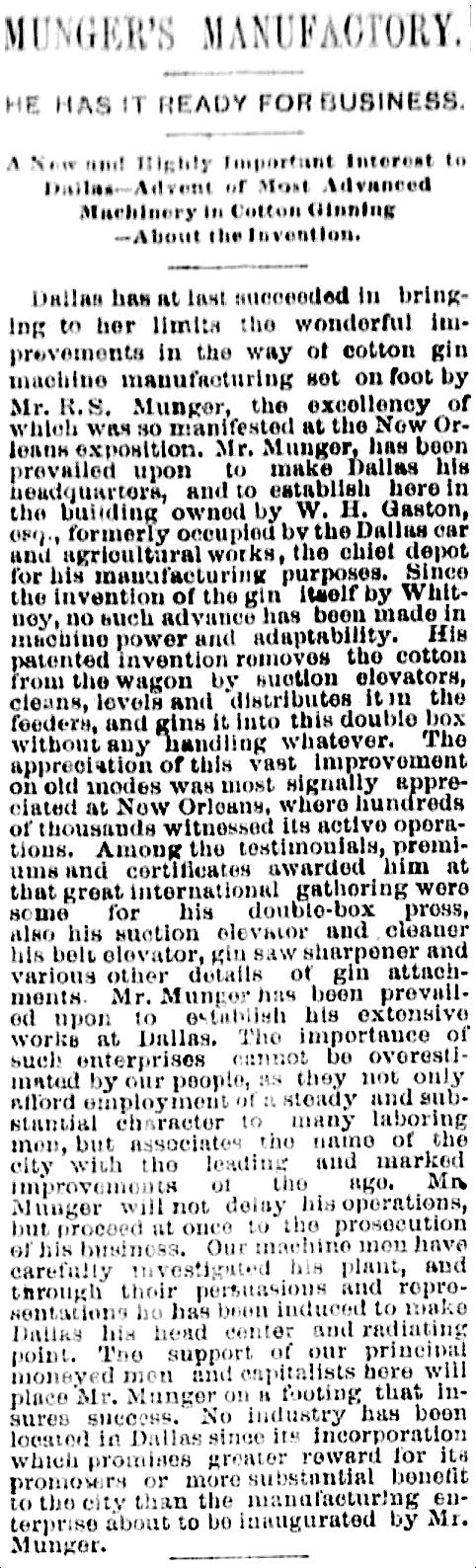
The following article appeared in an 1885 edition of the Dallas Herald. It is bulging with superlatives and grand statements which actually weren’t exaggerations: because of Munger’s relocation to Dallas and his products’ massive success, the city became a national hub of agricultural machinery manufacturing. This had a huge impact on Dallas’ economic development, and the unnamed writer of this article deserves credit for his prescient words. (Click to see larger image.)

munger_to-dallas_dallas-weekly-herald_052885Dallas Weekly Herald, May 28, 1885

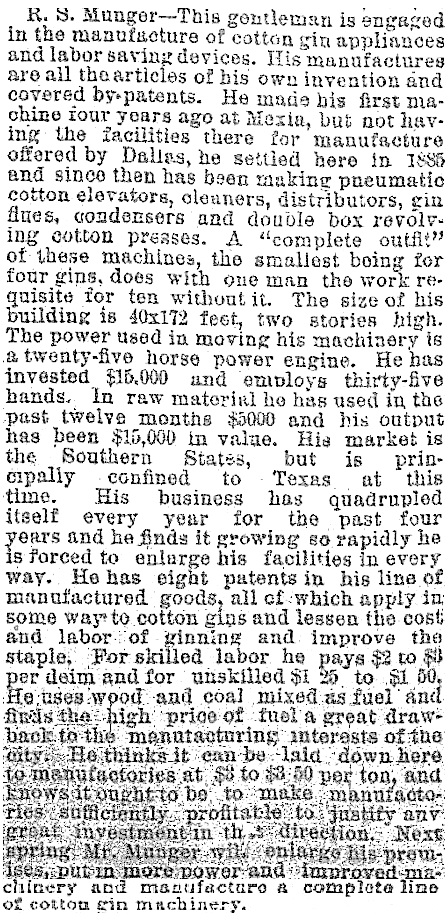
Another article describes just what Munger’s “improvements” were and also has a description of his factory — the heart of which was a 25 horsepower engine (a quick Google search tells me that 25hp is the size of a standard outboard motor engine).

munger_dmn_092886
Dallas Morning News, Sept. 28, 1886

A very early want-ad:

munger_dmn_072886_very-early-ad
DMN, July 28, 1886

(You can read about Mr. Munger’s career accomplishments in A History of Greater Dallas, published in 1909, here, and in the Handbook of Texas entry here.)

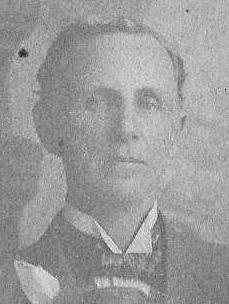
munger-r-s_find-a-graveR. S. Munger (1854-1923)

Fast-forward to today: the factory which Munger began in Dallas in the 1880s is somehow still standing and is known by most as the Continental Gin Building.

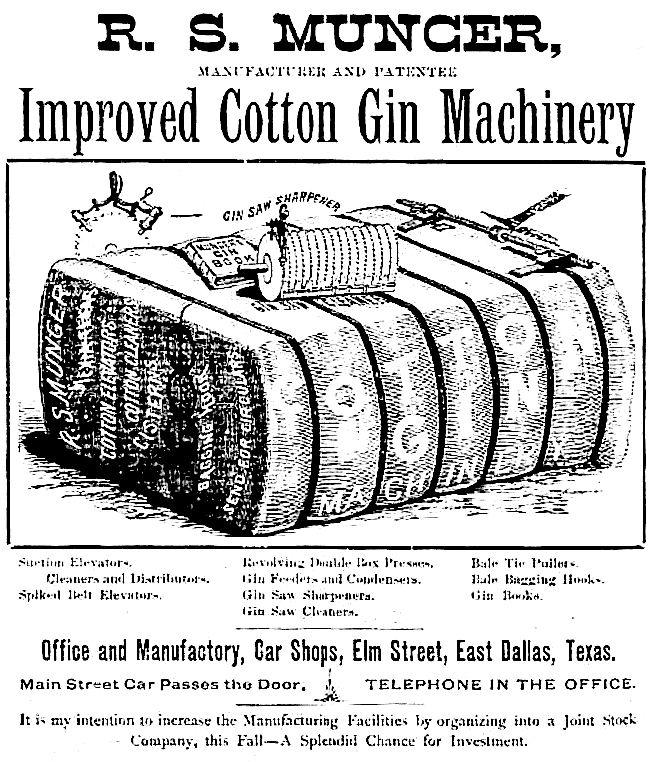
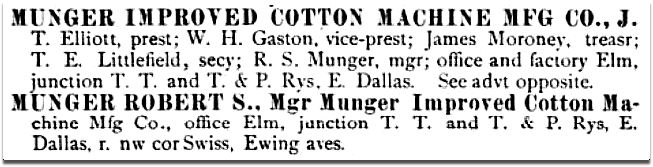
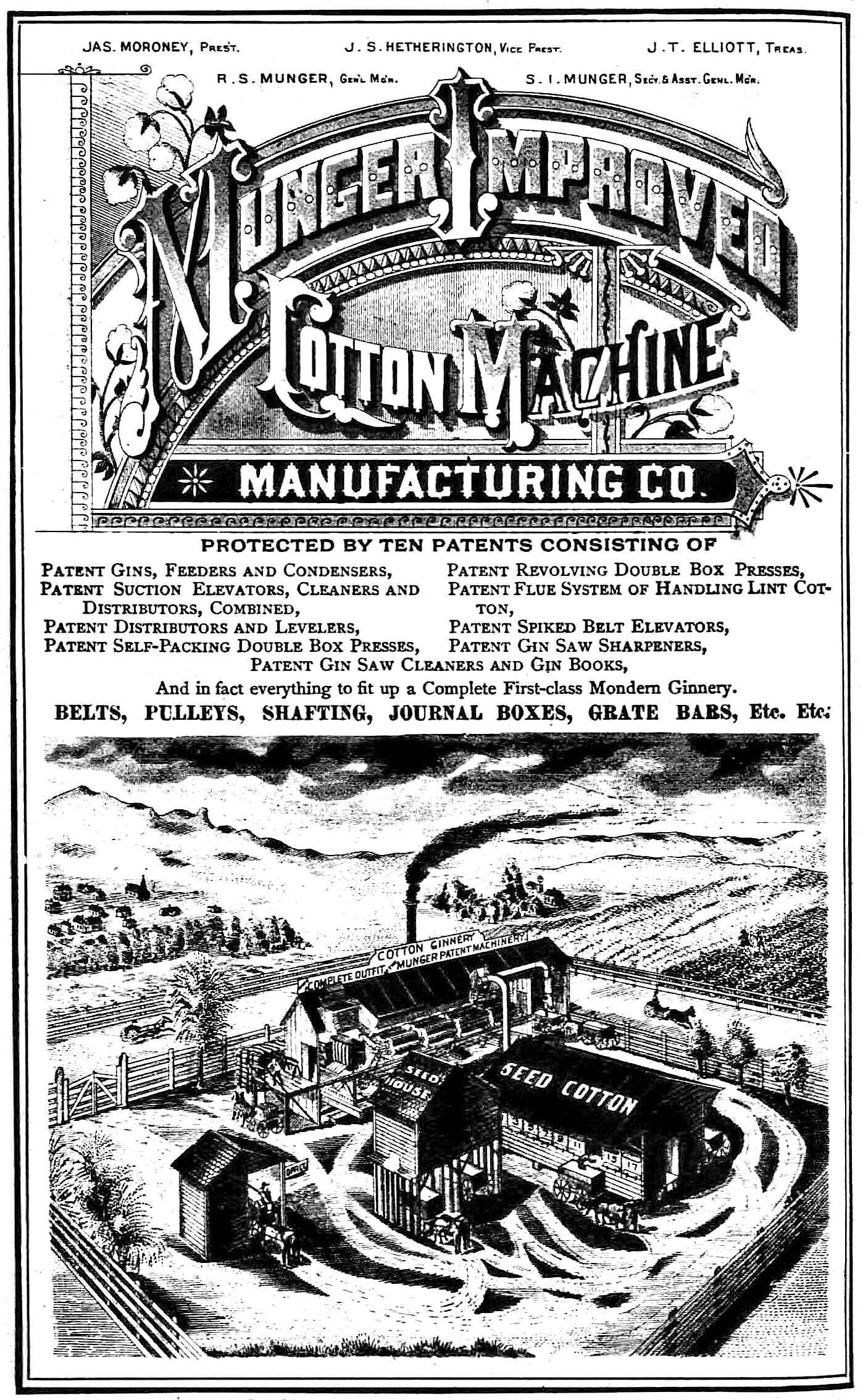
Here are a few very early ads of Munger’s cotton-gin-manufacturing empire, from city directories (the illustrated ads are full-page, which even in 1886 cost a pretty penny).

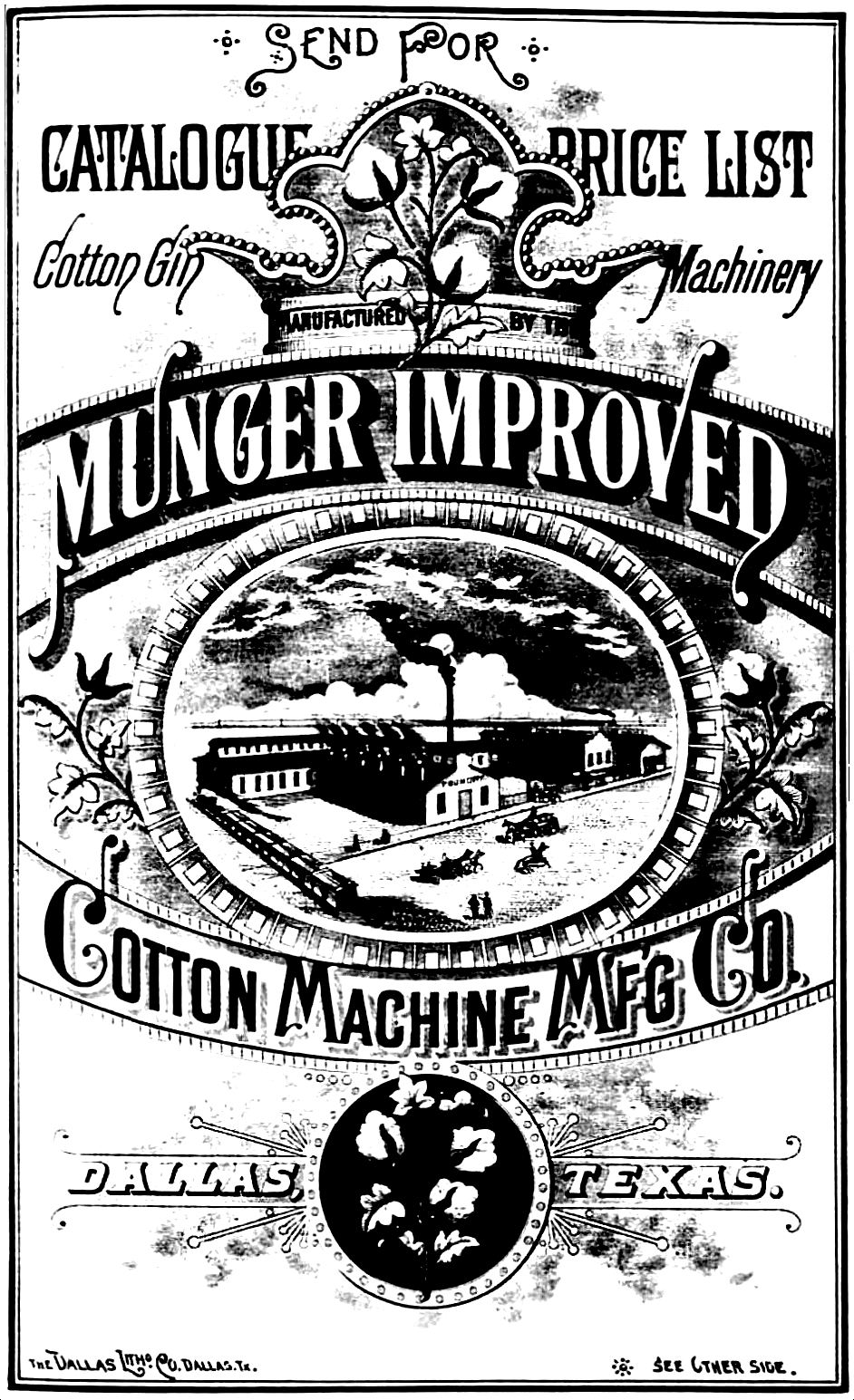
munger-improved-cotton-gin_1886-dallas-directory_listingDallas city directory, 1886

munger-improved-cotton-gin_1886-dallas-directory_aDallas city directory, 1886

munger-improved-cotton-gin_1886-dallas-directory_bDallas city directory, 1886

munger-improved-cotton-gin_1888-dallas-directory_listingDallas city directory, 1888

munger-improved-cotton-gin_1889-dallas-directoryDallas city directory, 1889

***

Sources & Notes

Photo of Robert Sylvester Munger from Find-a-Grave.

All other sources noted.

An aerial view of the complex of former Continental Gin Co. buildings can be seen via Google here.

More on the Continental Gin Company can be found in these Flashback Dallas posts:

*

Copyright © 2018 Paula Bosse. All Rights Reserved.


“The Cedars” Maternity Sanitarium, Oak Cliff — ca. 1923-1944

cedars-maternity-sanitarium_texas-state-journal-of-medicine_oct-1933_portalA “seclusion home for unwed mothers”…

by Paula Bosse

The rather blurry photo above shows a “maternity sanitarium” for unwed mothers, where “unfortunate women” could spend their days in seclusion until their babies were born there on the premises. The home/sanitarium was called “The Cedars” and was located on N. Ravinia Drive in the Beverly Hills area of Oak Cliff; when it opened, it was just outside the Dallas city limits. (It has nothing to do with The Cedars area south of downtown; its name may have had something to do with the name of a nearby street which intersected Ravinia. …Or it might have been located near a cedar grove. …Or it might have been used to subliminally suggest famed Cedars-Sinai Hospital.)

The sanitarium was opened around 1923 by Mrs. Lillie Perry (1876-1929), a woman who might have had some personal experience with the “fallen women” she cared for, as it appears she might have had a child out of wedlock herself. When she died in 1929, her daughter Lillian Hanna took over the running of the sanitarium. Lillian died in 1938, and that seems to have been around the time that the home became part of the Volunteers of America organization, which, among its many social services, provided maternity care for women and also assisted in adoption placement. The last mention I saw of “The Cedars” was in 1944.

The photo above appeared in an ad placed in the Oct., 1933 issue of the Texas State Journal of Medicine with the accompanying text (for larger images, click pictures and clippings):

cedars-maternity-sanitarium_tx-state-journal-of-medicine_oct-1933_portal_text
1933

Another ad, featuring friendly-looking nurses, appeared in the same issue, a few pages earlier:

cedars-maternity-sanitarium_tx-state-journal-of-medicine_oct-1933_portal_nurses

cedars-maternity-sanitarium_tx-state-journal-of-medicine_oct-1933_portal_nurses_text1933

Below are a few discreet newspaper ads for The Cedars which appeared over the years in the “personals” section of the classifieds.

cedars-maternity-home_dmn_070623
1923

cedars-maternity-home_dmn_042724_westmoreland
1924

cedars-maternity-home_dmn_1006291929

cedars-maternity-home_dmn_0105311931

cedars-maternity-home_dmn_0418341934

1937_cedars-maternity-sanitarium
Listing from the 1937 Dallas city directory

***

Sources & Notes

Ads from the Texas State Journal of Medicine appeared in the October, 1933 issue, which can be found scanned in its entirety on the Portal to Texas History site, here.

Homes for “unwed mothers”/”unfortunate girls”/”fallen women” were generally places families sent their daughters in order to avoid the social stigma that unmarried girls and women faced when pregnant. They just kind of “disappeared” for several months and had their babies in secret, often feeling pressured to put their children up for adoption. An interesting Salon article on the topic is “The Children They Gave Away” by Sarah Karnasiewicz.

More on the Beverly Hills neighborhood of Oak Cliff can be found in articles from Heritage Oak Cliff and Preservation Dallas.

Thanks to Patricia M. who wrote to ask me a question about this place. I’ve learned a lot of interesting things about Dallas I would never have thought to look into were it not for obscure questions from readers. Like this one! Thanks, Patricia!

*

Copyright © 2018 Paula Bosse. All Rights Reserved.