Flashback : Dallas

A Miscellany: History, Ads, Pop Culture

Category: Advertisements

Neiman-Marcus Celebrates the Texas Centennial with “Cactus Colors” and Cattlebrands Burned Into Rawhide Belts — 1936
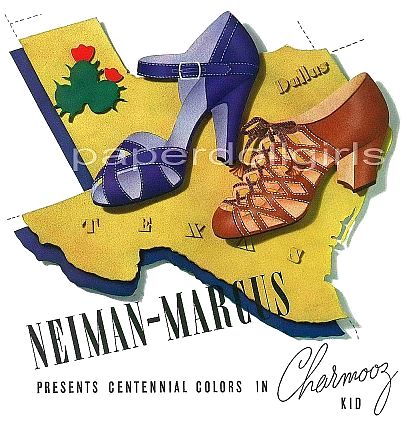
neiman-marcus_shoes_vogue-1936-det

by Paula Bosse

Texans celebrate history with — what else? — fashion! Below, text from a Neiman-Marcus ad which appeared on the eve of the huge Texas Centennial celebrations in 1936.

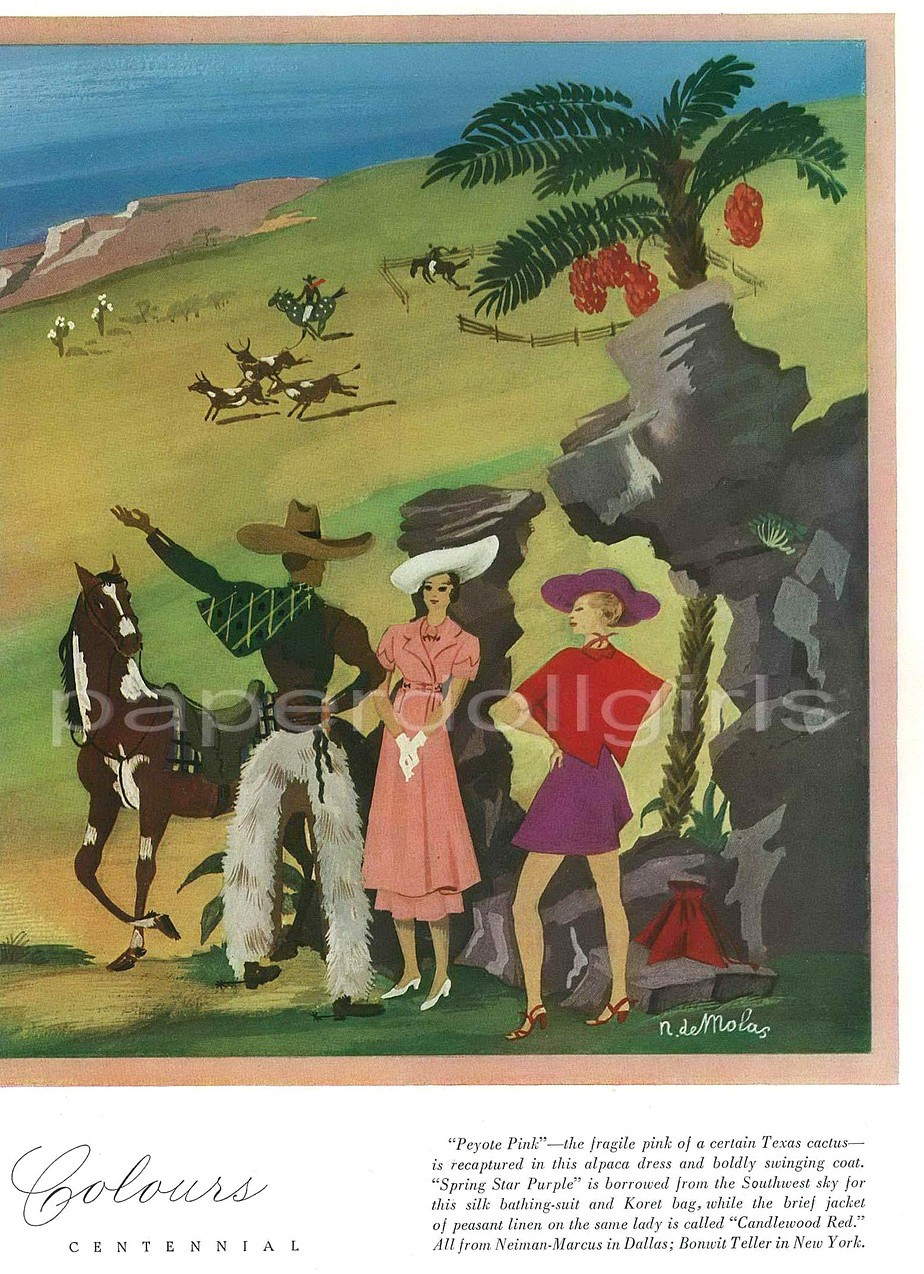
Five days before the Centennial finds Neiman-Marcus keyed for last-minute demands … both in selections and service … Spectator clothes and accessories in cactus colors (see current Vogue), and Artcraft stockings, thin as a web, in Texas range colors … Cool snowy crepe dresses for the afternoon and printed chiffon jacket dresses for Centennial sightseeing … Cottons gifted with importance … Crownless roof hats and trailing garden party dresses … Cattlebrands burned on a rawhide belt that girdles a crisp white watching dress. All in the best of taste and at a happy range of prices.

And then I looked for the Vogue ads mentioned and … wow! I’ve had a vintage advertising blog for several years, and I’ve seen a lot of ads … but these may be my favorites! All as a tie-in to the Texas Centennial, celebrated in Dallas in 1936, spear-headed by Stanley Marcus himself. Thanks, Mr. Stanley!

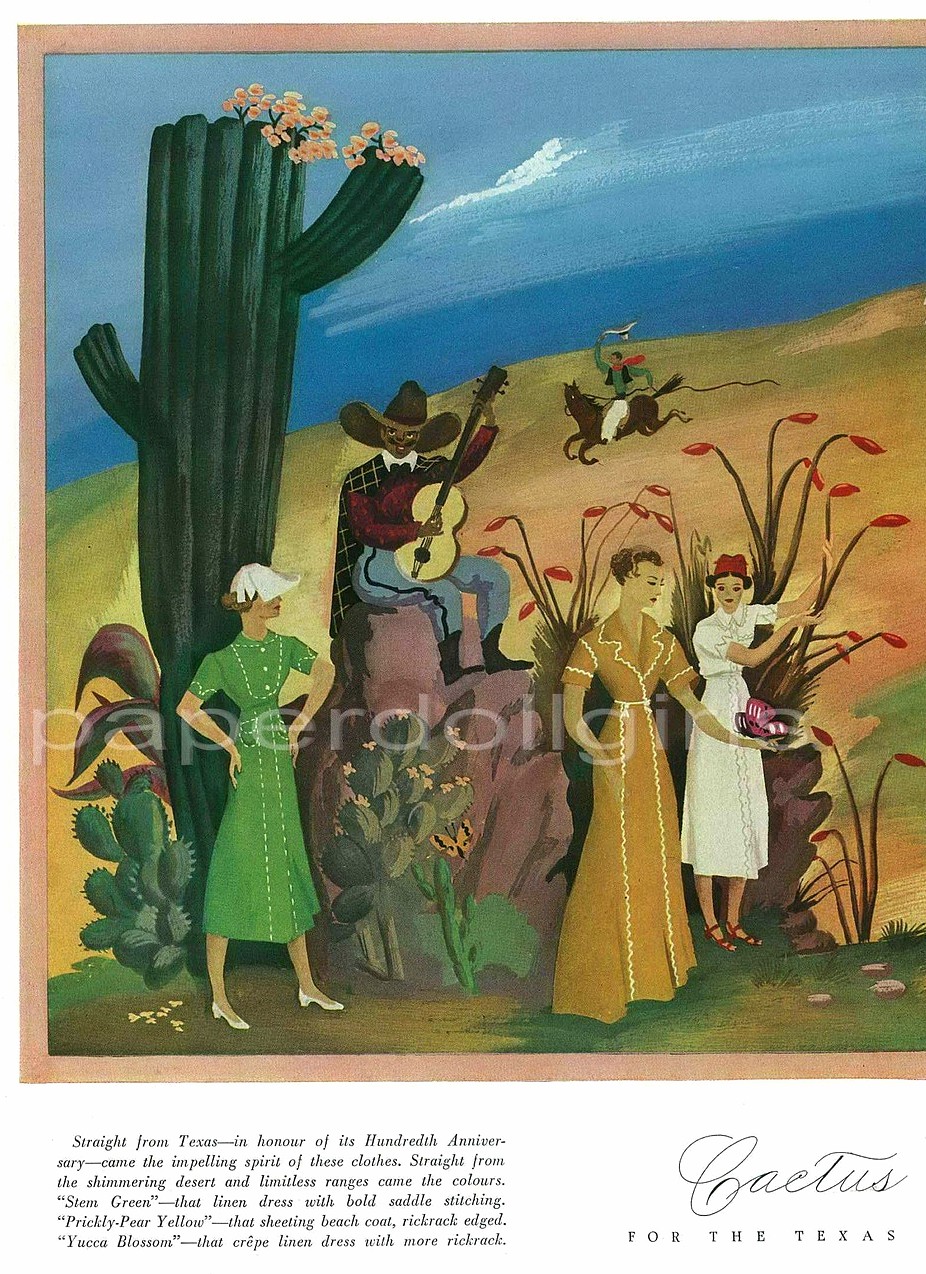
neiman-marcus_shoes_vogue-1936

neiman-marcus_cactus-colours_vogue-1936a

neiman-marcus_cactus-colours_vogue_1936b

***

Color ads from Vogue, June 1936. I found them on Etsy from this seller (the ads have, apparently, been sold). I would LOVE to see these with the watermarks removed, and I’d also love to know what became of the original artwork and who “N. de Molas” was. I love Texas kitsch and I love fashion illustration from this period, and this is fantastic! Click color pictures for much larger images! And read that copy, man.

If you want to wander around a whole bunch of vintage advertising, my Retro Adverto blog is here, but it has been sadly neglected since my immersion into this blog!

*

Copyright © 2014 Paula Bosse. All Rights Reserved.
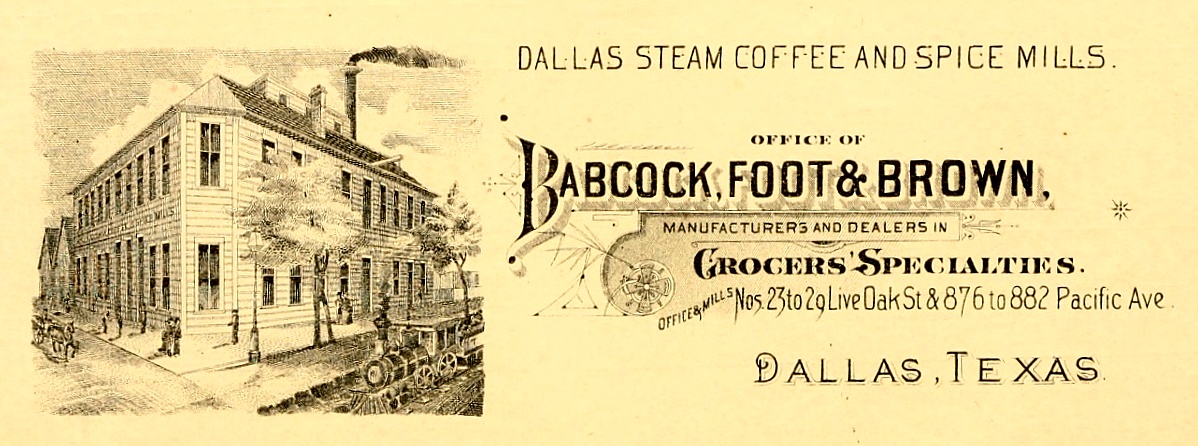
 

Dallas Steam Coffee & Spice Mills — 1880s

babcock-foot-brown_imm-gd_1889

by Paula Bosse

It’s 1880-something. You’re in Dallas. You need a pound of coffee. Some ground mustard seed. Maybe some “Texas Bleaching Blue.” Where, oh where, do you turn?

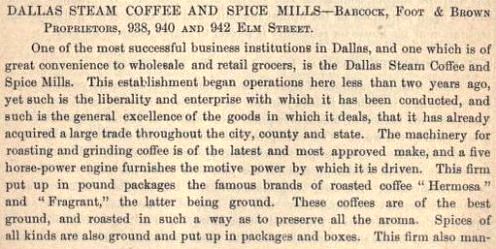
babcock-foot_1884ababcock-foot_1884b

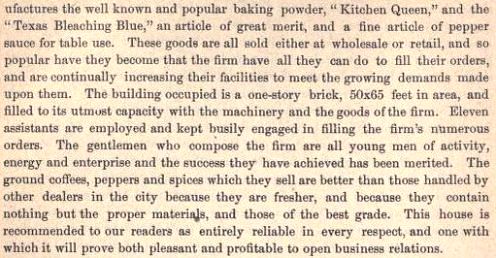
Messrs. Babcock, Foot & Brown will be happy to supply you with everything you need. And that five-horsepower engine? Top-of-the-line!

***

Sources & Notes

Ad from The Immigrant’s Guide to Texas, 1889. Click for larger image.

Description of the business from The Historical and Descriptive Review of the Industries of Dallas, 1884-85.

*

Copyright © 2014 Paula Bosse. All Rights Reserved.
The Britling Cafeteria Serves Those Who Serve Themselves

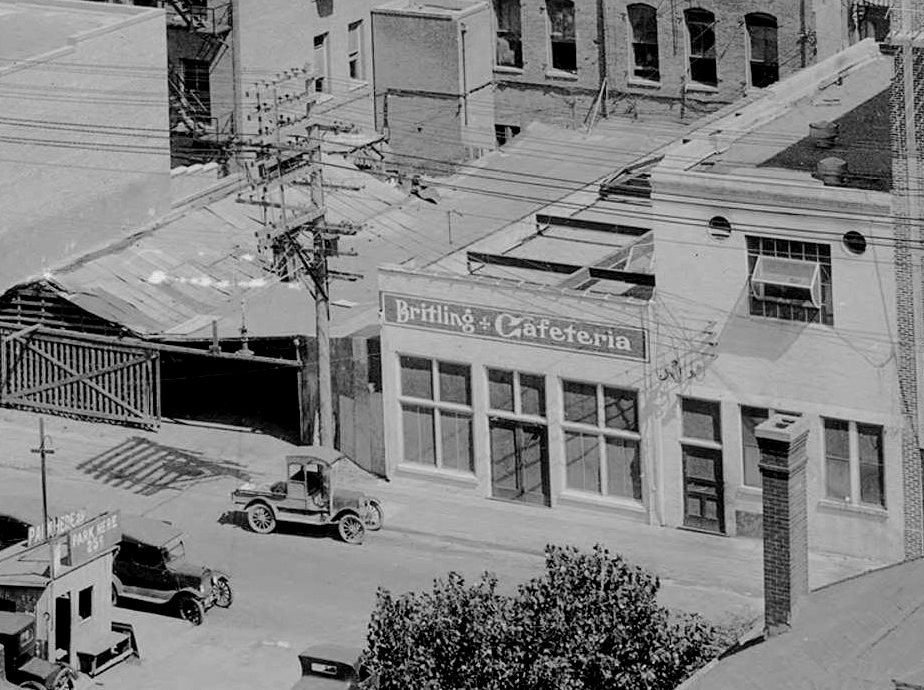
britling-cafeteria_rear-entrance_degolyerBritling Cafeteria’s rear entrance on Jackson St., 1920s

by Paula Bosse

A few weeks ago, I was zooming in on a view of the Dallas skyline when I saw an interesting restaurant sign: the Britling Cafeteria. After a little research, I learned that Britling Cafeterias are something of a cultural institution in Birmingham and Memphis (Elvis’ mother worked the coffee urn station in Memphis, and if that isn’t the sign of a Southern institution, I don’t know what is). Here in Texas, though … I’d never heard of it. It claimed to be the first cafeteria chain in the South, having begun in Birmingham in 1917 (and named for a character in, of all things, an H. G. Wells story). When the Dallas location opened at the end of 1922, it was only the sixth restaurant in the chain, joining others in Birmingham, Atlanta, and Memphis.

The Britling Cafeteria was at 1316 Commerce (“Right in the Heart of Things”), between Field and Akard. There were two entrances, one on Commerce and one on Jackson (seen in the photo above). It sounds pretty nice for a cafeteria — it was lavishly decorated in black and gold, lined with mirrors, filled with flowers, and it had a mezzanine and a raised platform for a live orchestra to provide background music. It had a seating capacity of 450, with an expected daily capacity of 3,000. We’re not talkin’ Luby’s here. Quick “Southern home-cooking” had arrived in Dallas, and it seems to have remained an active advertiser until the ads suddenly stopped in 1926. I hope Dallas enjoyed it while it had it.

Below is the interior of the Atlanta location, from about the same time as the Dallas location. Cafeterias were a whole lot nicer back then.

britling_atlanta

The first non-institutional cafeteria I can find mentioned in The Dallas Morning News was the one in the basement of the Praetorian Building (“Cleanliness, courteous, tipless”) in 1912, but the cafeteria “concept” must have still been fairly new to Dallas as the Britling advertisements that appeared in the week before the grand opening felt it necessary to explain how the system worked. “You’ll wait on yourself — and do it gladly.”

britling_dmn_112722abritling_dmn_112722b1922 (click to read)

But first, stop by for a “Day of Courtesy” preview — flowers for the ladies!

britling_open_dmn_1127221922

britling-cafeteria_forest-ave-high-school-yrbk_19231923

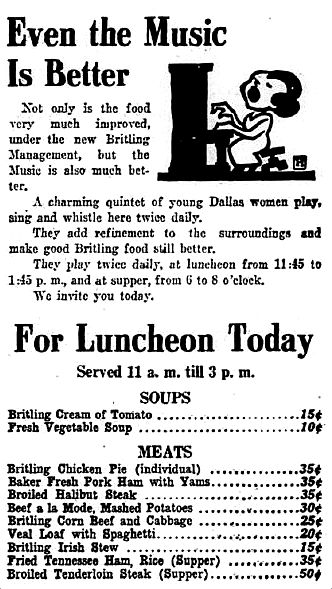
Below, a sample of some of the Southern home-cooking on the menu as well as the warning that there WILL be live music as “a charming quintet of young Dallas women play, sing and whistle (!) here twice daily.”

britling_dmn_030926abritling_dmn_030926b1926

britling_logo_dmn-112722

***

Sources & Notes

Photo is a detail from a larger view of the city from the DeGolyer Library, Southern Methodist University, seen in an earlier post here. The block in which the cafeteria was located is now 2 AT&T Plaza.

Postcard of the interior of the Atlanta Britling Cafeteria from somewhere on the internet.

More can be found in the DMN article “Britling Cafeteria Will Open” (Nov. 26, 1922), with details on the chain and specifics on the Dallas location, here.

Great short history on the cafeteria that every self-respecting citizen of Alabama and Tennessee is apparently familiar with can be found here.

An amusing first-hand account of a Texan (J. J. Taylor) visiting a newfangled cafeteria in San Francisco appeared in The Dallas Morning News on Aug. 25, 1912 and can be read here.

*

Copyright © 2014 Paula Bosse. All Rights Reserved.
“Electricity in Every Form” — 1909

ad-sanitarium_moran_1909(Click for larger image)

by Paula Bosse

There was a lot going on in 1909 on the 7th floor of the Wilson Building in the “extensive apartments” occupied by a local “institution” affiliated with the Battle Creek Sanitarium. Individuals could (and apparently did) avail themselves of the following treatments:

Some of the therapeutic measures employed are: Baths of various kinds scientifically administered by trained attendants. Electricity in every form. Every kind of general and special Massage. Mechanical Vibration by the most recent and efficient apparatus. Hydrotherapy (the scientific use of water) in its great variety of application. Electric Light Baths. Physical Culture.

Just let that soak in. Or surge through you. Administering your voltage? Say hello to Dr. F. B. Moran, below.

moran_sanitarium_dmn_102730

Yes, indeed.

***

Sources & Notes

Ad from the 1909 Worley’s city directory.

Photo of Dr. Moran from a 1930 ad so long-winded and dull I couldn’t finish reading it or fit it in here.

See the Battle Creek Sanitarium contraptions in action here.

Click ad for larger image.

*

Copyright © 2014 Paula Bosse. All Rights Reserved.
 

“It’s 10 Degrees Cooler in Highland Park” — 1916

highland-park-ad_smu-rotunda-1916

And don’t you forget it!

***

Flippen and Prather developed Highland Park, and this great ad may well have swayed more than a few people to consider HP as their future home. From the 1915-16 edition of SMU’s “Rotunda” yearbook.

*

Copyright © 2014 Paula Bosse. All Rights Reserved.

Chas. Ott: One-Stop Shopping for Bicycles and Dynamite

ad-charles-ott-dynamite_smu-19161916 ad

by Paula Bosse

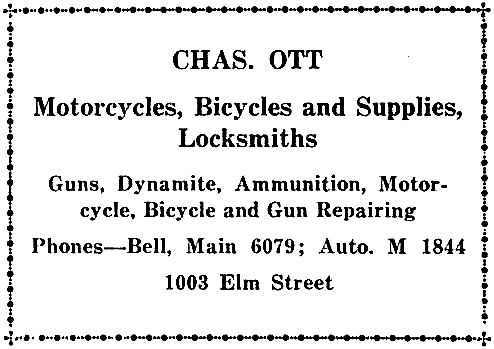
Aside from maybe an ad for a popular off-campus soda shop or one of those bland, dutiful business card ads for an insurance company, I’m not sure that there’s necessarily a specific type of advertisement I expect to see in the pages of a college yearbook. But if I were quizzed on types of ads I wouldn’t expect to see in the pages of a college yearbook, it would probably include an ad for dynamite and ammo. But in 1916, SMU’s inaugural yearbook committee was proudly testing the limits of advertising propriety!

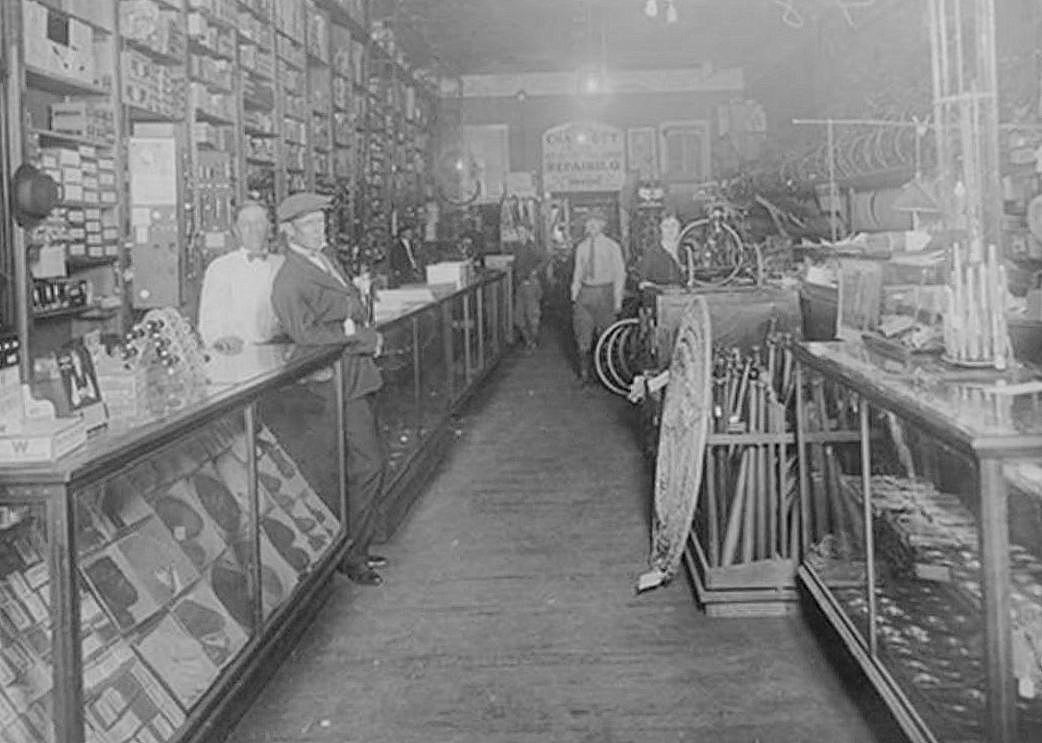
Charles Ott was kind of a big deal in the world of, first, gunsmithing, and second, locksmithing. Born in Germany, he came to Dallas in 1873 and opened a gun shop on Elm Street in 1876. According to The Encyclopedia of Texas, at the time of his death (c. 1921?), he was “the oldest gunsmith in the State of Texas.” That’s an impressive accomplishment. As seen from the ad above, a successful businessman not only knows his craft, but he knows how to diversify. (A nice bio of Mr. Ott can be found here.) Below, a photo of the interior of his shop, sometime in the early 20th century:

chas-ott_interior_cook-coll_degolyer_smu

*

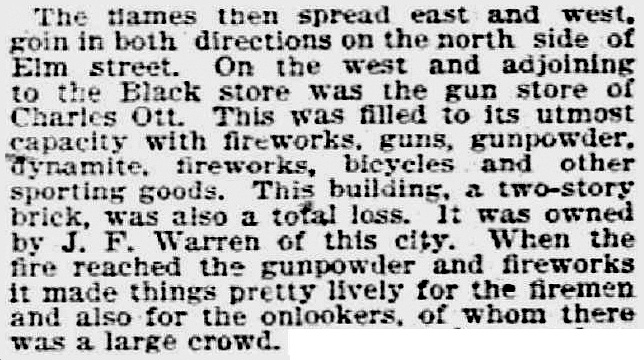
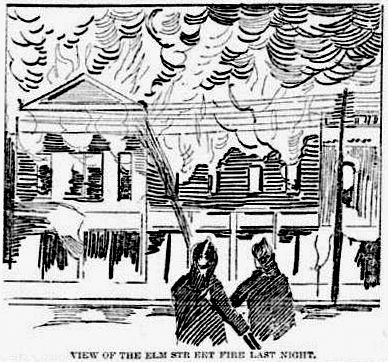
If you’re in business selling ammunition and gunpowder and fireworks and dynamite, you probably need to secure them in a place safe from the reach of the fires that seemed to hit Dallas constantly in the 19th century. ‘Cause if you don’t, you run the risk of something like this happening (north side of Elm, between Griffin and Akard):

ott-fire_dmn_052696Dallas Morning News, May 26, 1896

My favorite part of the story, though, was this on-the-spot artist’s depiction of the “conflagration.” You can practically feel the smoke burning your eyes.

ott-fire_pic_dmn_052696

***

Sources & Notes

Top ad from, yes, the 1915-16 SMU Rotunda.

Bio of Charles Ott linked above from Davis & Grobe’s Encyclopedia of Texas (Dallas: Texas Development Bureau, 1922). If you sped-read past it above, you can find it here.

Excerpt and drawing of the explosive Elm St. fire from The Dallas Morning News, May 26, 1896.

Photo of the interior of the Ott store from the George W. Cook Dallas/Texas Image Collection, DeGolyer Libraries, SMU Libraries, Southern Methodist University; more info on this photo is here.

*

Copyright © 2014 Paula Bosse. All Rights Reserved.


Swell Hats for Swell People — 1911

sangers-hats_dmn_030711asangers-hats_dmn_030711b

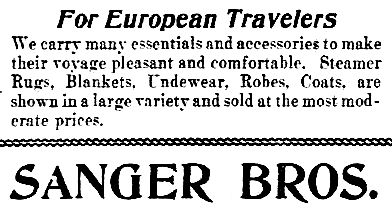
For the ladies: “For every lady desirous of owning a Swell Hat for the Horse Show or any of the other Spring functions…. There are daring creations in the large and small shapes; there are conservative styles for the demure maiden.”

e-m-kahn_hats_dmn_030711

And for the gentlemen, The Ryton:“The most popular style of the season; a wide-brimmed telescope, in all proportions, with the very correct pencil curl edge. Ask for this Hat; you’ll like it.”

(You don’t see a lot of semi-colons in ads anymore, do you?)

***

Sanger Bros. ad and E.M. Kahn ad from The Dallas Morning News, March 7, 1911.

*

Copyright © 2014 Paula Bosse. All Rights Reserved.

Liquor Doctors Prescribe “Beer by the Case — All You Want”

liquor-doctors_neon-sign_dmn-video_1939

by Paula Bosse

If you have an interest in the Dallas of yesterday, you’ve probably seen the great color film footage shot in downtown in 1939, presented to us by Robert Wilonsky of The Dallas Morning News (link below). One of my favorite things from that wonderful footage is a neon sign for a business called Liquor Doctors, with “Good & Bad Liquors” below it. That would be good enough on its own, but it’s even better as seen in the film, because the “Good” and the “Bad” flash back and forth. Great.

Liquor Doctors (what a great name) seems to have started in late 1937 and eventually had at least three locations: 509 Jackson St., Commerce & Houston, and Cedar Springs & Harwood. Info is limited on these stores — I found a classified ad looking for “salesladies” for the Jackson St. store (“must be over 21”) and a report of a hold-up at the Commerce St. location (the manager was forced, at gun point, to turn over $41.86 from the cash register). Not that interesting. Until I found this tidbit from the great-granddaughter of the owner, describing the utterly ridiculous (and thoroughly entertaining) operating procedure of the Cedar Springs location in the June 2010 issue of Texas Monthly (see link at bottom of post):

Later he opened another Liquor Doctors on Cedar Springs that offered curbside service. The employees, dressed as doctors and nurses, would stroll out to the cars and dispense “medicine” six days a week.

Depending on your threshold for silliness, this is either clever or hokey. (I vote “clever.”)

For some reason the owner changed the name of the business (but why?!), and the next incarnation was simply his name, “Bob Ablin” (where, thankfully, you could still get “good and bad liquors”). I think he might have sold the liquor businesses and opened a soda fountain on Cedar Springs, a venture that lasted until January of 1948.

Below is an ad placed during a WWII whiskey shortage. There was a strict limit of one bottle per person. But beer? Until the cows came home. Bob sounds like a fun guy.

liquor-doctors_dmn_011244

***

Sources & Notes

Screen capture of the Liquor Doctors flashing neon sign from the really wonderful 1939 film footage purchased from Ebay by Robert Wilonsky (of The Dallas Morning News) and several others who joined together to share a cool slice of the city’s history with us. Watch the video and read Wilonsky’s Dallas Morning News article from April 23, 2014, here.

Quote about the Cedar Springs costumed curb service from the essay “Old Testament” — about growing up Jewish in Dallas — by Megan Giller-Dupe, Bob’s great-granddaughter. You can find the essay in Texas Monthly (June 2010), here. It includes a nice photo of Bob.

*

Copyright © 2014 Paula Bosse. All Rights Reserved.

Need a Studebaker? We Got You Covered

ad_studebaker_1912

by Paula Bosse

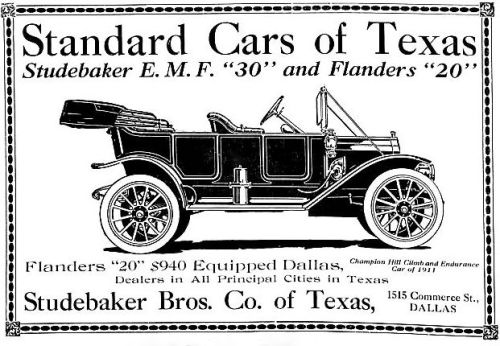
Studebaker Bros. have got you covered!

ad_studebaker_souv-gd_1894

Whatever you need, Studebaker has it: horseless carriage or … just … well … carriage.  “A complete line of vehicles.”

***

Top ad from 1912; lower ad from 1894.

Studebaker info here.

*

Copyright © 2014 Paula Bosse. All Rights Reserved.

Linz Bros. and “The Vogue of Bracelets” — 1923

ad-linz-bros_dmn_031123

by Paula Bosse

What a beautiful art nouveau-inspired ad, echoing Beardsley’s pen and ink drawings and Whistler’s Peacock Room. This is wonderful. And it’s unsigned! Ah, the lot of the commercial artist.

***

Ad from The Dallas Morning News, March 11, 1923.

More on Linz Brothers, premier Dallas jewelers, here.

*

Copyright © 2014 Paula Bosse. All Rights Reserved.