Flashback : Dallas

A Miscellany: History, Ads, Pop Culture

Category: African American Dallas

The Dallas Express — A Look Inside the Offices of the City’s Most Important Black Newspaper — 1924
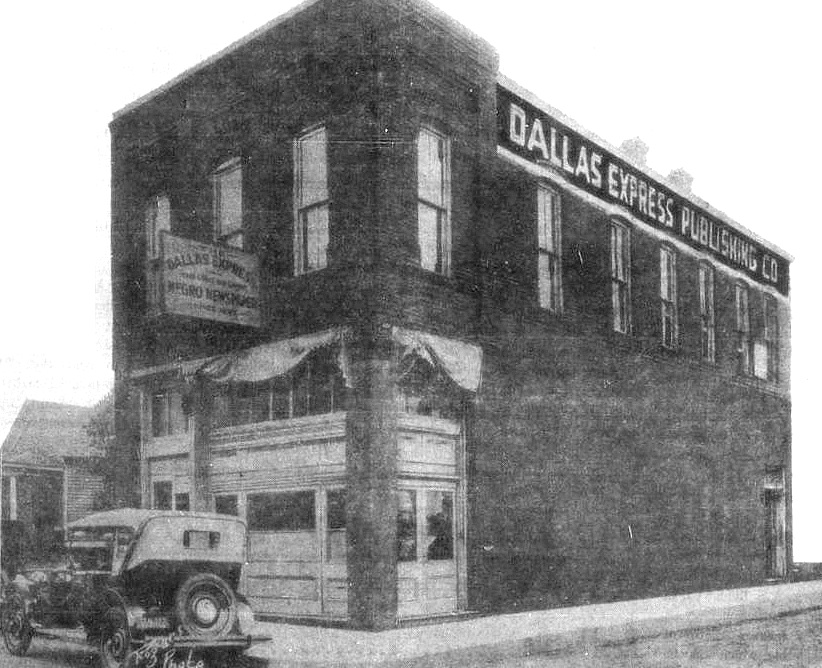
dallas-express-bldg_dallas-express_0607242600 Swiss, home of The Dallas Express (click for larger image)

by Paula Bosse

Without question, The Dallas Express (1892/3-1970) was the most important and most widely-read black-owned newspaper published for Dallas’ African-American community. In addition to stories of particular interest to its Dallas and Texas readership, it also covered national and international news, and in the Jim Crow era, when black Dallasites were rarely mentioned in white-owned newspapers except in crime reports, The Express reported on the people, the businesses, the churches, and the achievements of their large community. They also wrote about politics and issues of race and discrimination. One of the paper’s slogans was “A Champion of Justice, A Messenger of Hope.”

I’ve been interested in newspapers, journalism, and the actual physical process of printing newspapers for as long as I can remember, but until a couple of years ago, I was not aware of The Dallas Express, founded in 1892 by publisher/editor W. E. King. Discovering this paper and its stories about my hometown has been eye-opening. The Dallas Express is an important — and often overlooked — source of Dallas history. I love reading through issues of The Express because unlike white-owned papers of this period, it presents a realistic and human chronicle of the everyday lives of Dallas’ black men and women, something which was almost completely ignored by The Dallas Morning News and The Dallas Times Herald.

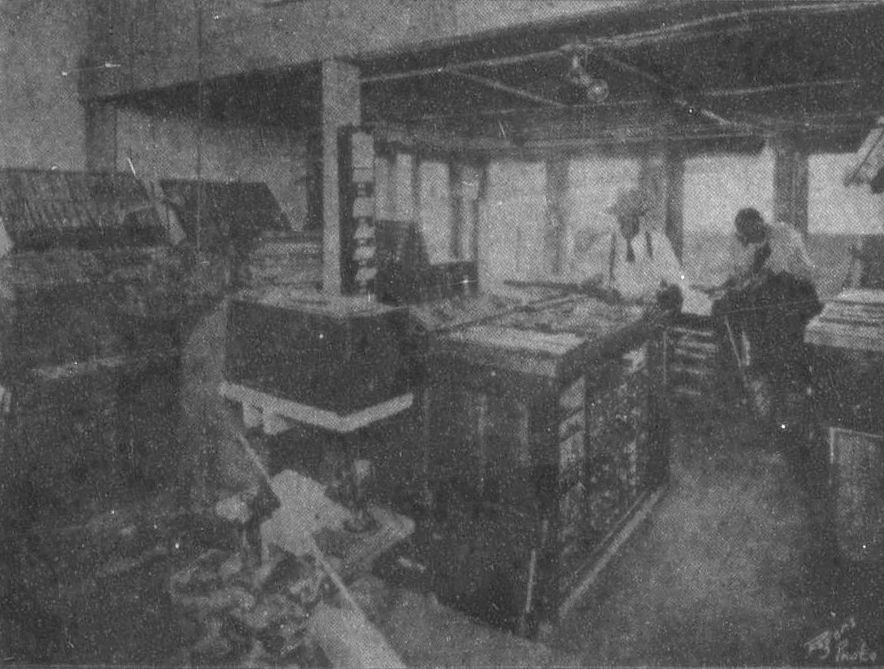
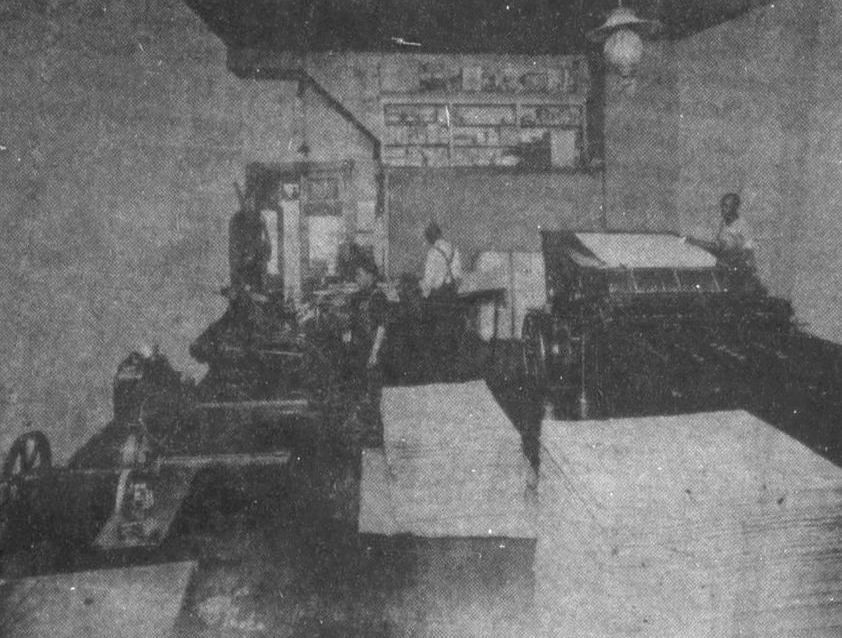
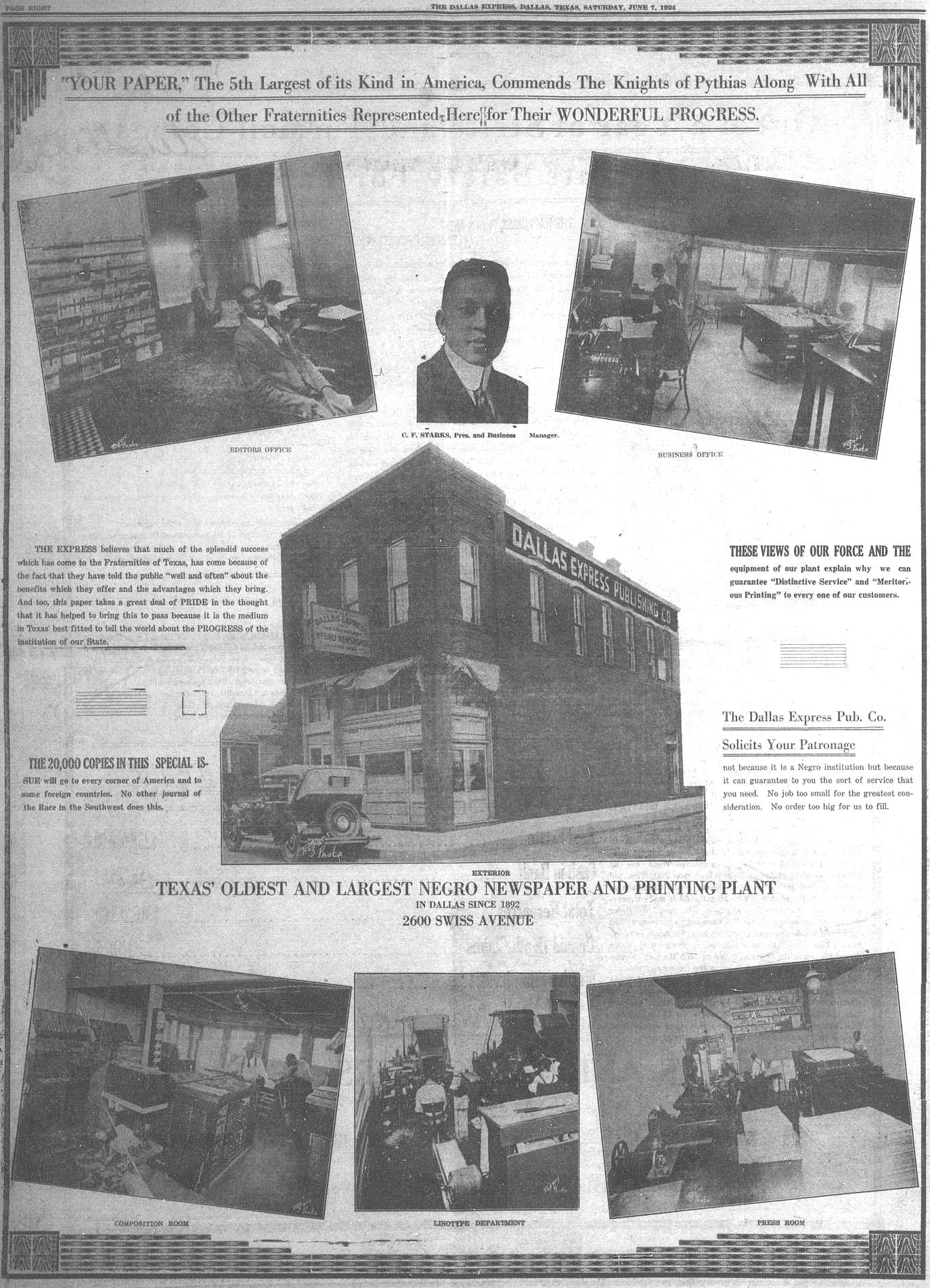
For many years, the offices of the Express were just north of Deep Ellum, at 2600 Swiss — at the corner of Good Street, about where Brad Oldham’s Traveling Man sculpture stands today. (I have a feeling the actual location was in the middle of what is now Good-Latimer. See the location on a 1921 Sanborn map here.) Happily, the Express printed a full-page ad for itself in the June 7, 1924 edition, so we can see what the Swiss Avenue building, its offices, and its production rooms looked like. These photos were taken by noted Dallas photographer Frank Rogers. (Apologies for the muddy quality of these photos — I’d love to see the crisp originals!)

*

These photos show the Dallas Express offices as they looked in 1924, when the newspaper had already been in business for 32 years. The exterior of the two-story building can be seen in the photo at the top — standing next to a private residence. (Click photos to see larger images.)

Below, president and business manger (and, later, owner), C. F. Starks:
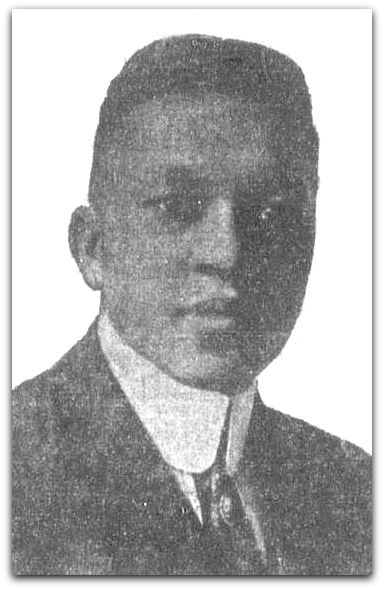
dallas-express_c-f-starks_pres-business-mgr_060724

The editor’s office (John W. Rice was the editor at this time and is, presumably, the man in the foreground):

dallas-express_editors-office_060724

The business office:

dallas-express_business-office_060724

The composition room:

dallas-express_composition-room_060724

The linotype department (I have written about my fascination with linotype machines here):
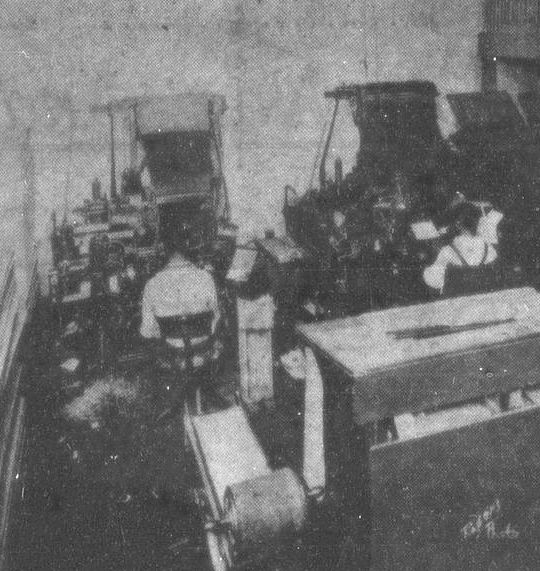
dallas-express_linotype_060724

And the press room:

dallas-express_press-room_060724

The text from the ad (this special “Pythian Edition”of the paper was printed to coincide with the 40th annual meeting of the Knights of Pythias):

“YOUR Paper,” The 5th Largest of its Kind in America, Commends The Knights of Pythias Along With All of the Other Fraternities Represented Here for Their WONDERFUL PROGRESS.

THE EXPRESS believes that much of the splendid success which has come to the Fraternities of Texas, has come because of the fact that they have told the public “well and often” about the benefits which they offer and the advantages which they bring. And too, this paper takes a great deal of PRIDE in the thought that it has helped to bring this to pass because it is the medium in Texas best fitted to tell the world about the PROGRESS of the institution of our State.

These views of our force and the equipment at our plant explain why we can guarantee “Distinctive Service” and “Meritorious Printing” to every one of our customers.

The 20,000 copies in this special issue will go to every corner of America and to some foreign countries. No other journal of the Race in the Southwest does this.

The Dallas Express Pub. Co. Solicits Your Patronage not because it is a Negro institution but because it can guarantee to you the sort of service that you need. No job too small for the greatest consideration. No order too big for us to fill.

TEXAS’ OLDEST AND LARGEST NEGRO NEWSPAPER AND PRINTING PLANT
In Dallas Since 1892
2600 Swiss Avenue

*

The full-page ad:
dallas-express_060724_p8_full-page
Dallas Express, June 7, 1924

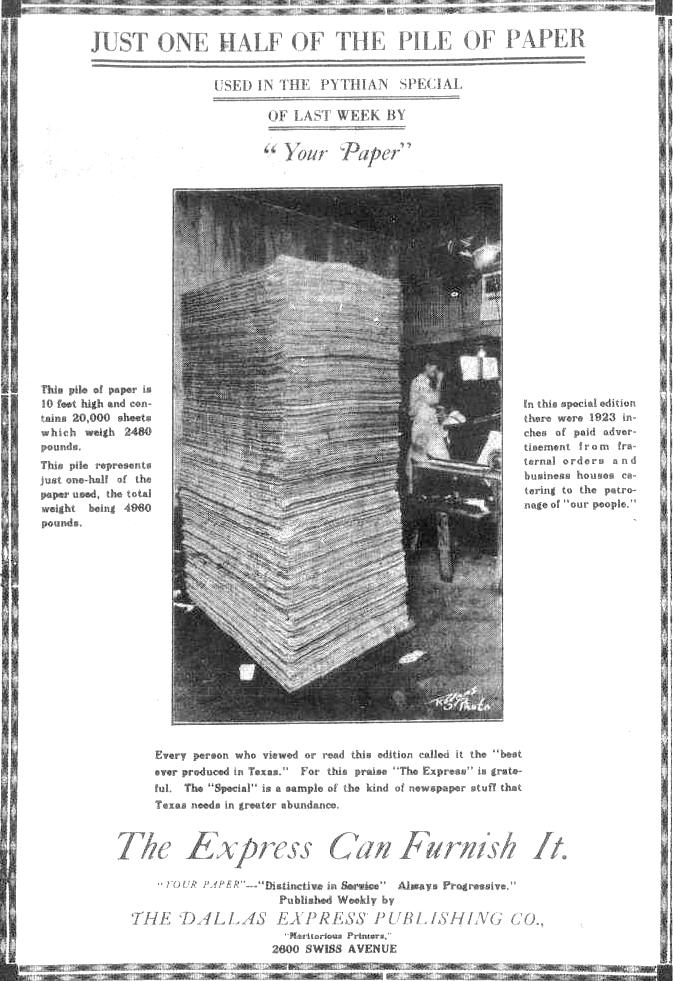
Another photo of the printing room appeared in an Express ad which ran in the paper the following week:
dallas-express_061424_ad
Dallas Express, June 14, 1924

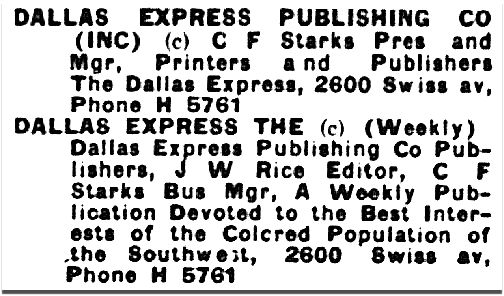
dallas-express_1923-directory
1923 Dallas directory

***

Sources & Notes

Photos by Frank Rogers. Original prints might be in the Frank Rogers Collection at the Dallas Public Library, but nothing showed up when I searched the DPL database. Original crisp prints would be wonderful to see!

Photos appeared in the June 7, 1924 edition of The Dallas Express. The full newspaper can be found here. Only a few years’ worth of scanned issues of The Express are available on UNT’s Portal to Texas History site — mostly 1919-1924 — they can be accessed here.

Read about The Dallas Express at the Portal to Texas History, here; the Wikipedia entry is here.

*

Copyright © 2016 Paula Bosse. All Rights Reserved.
 

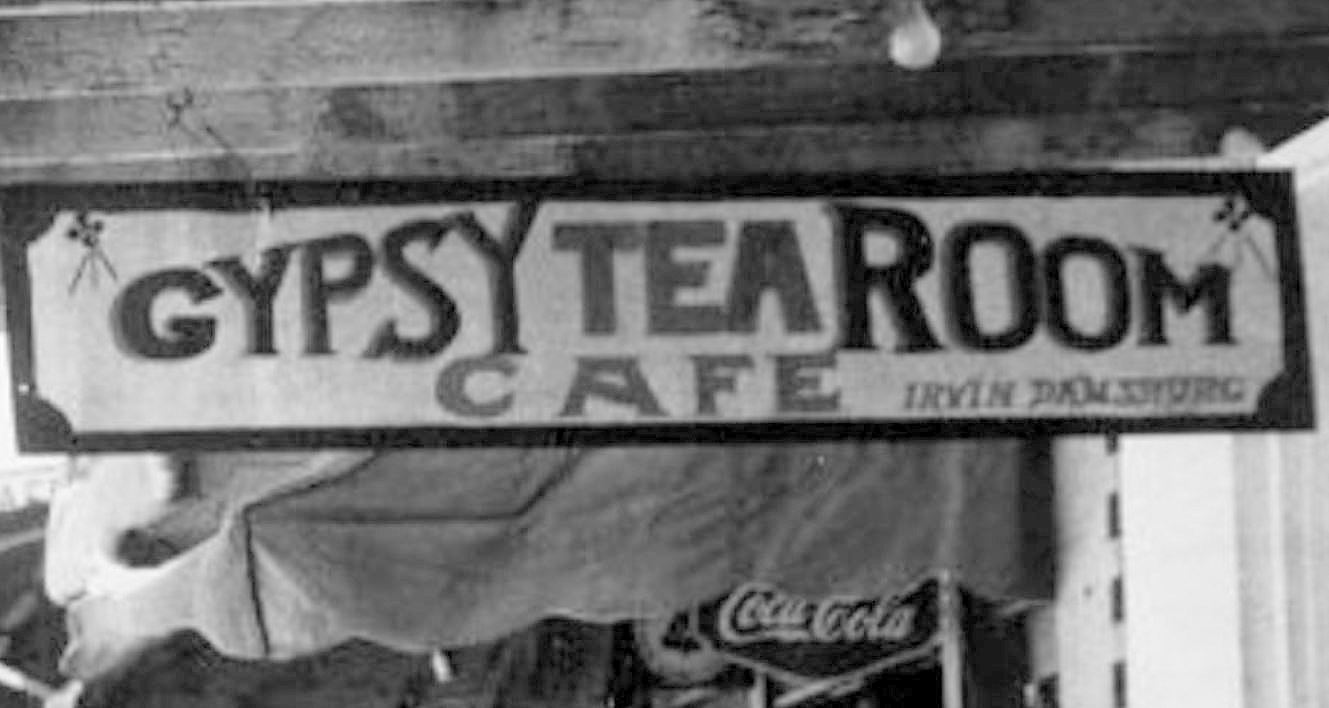
The Gypsy Tea Room, Central Avenue, and The Darensbourg Brothers

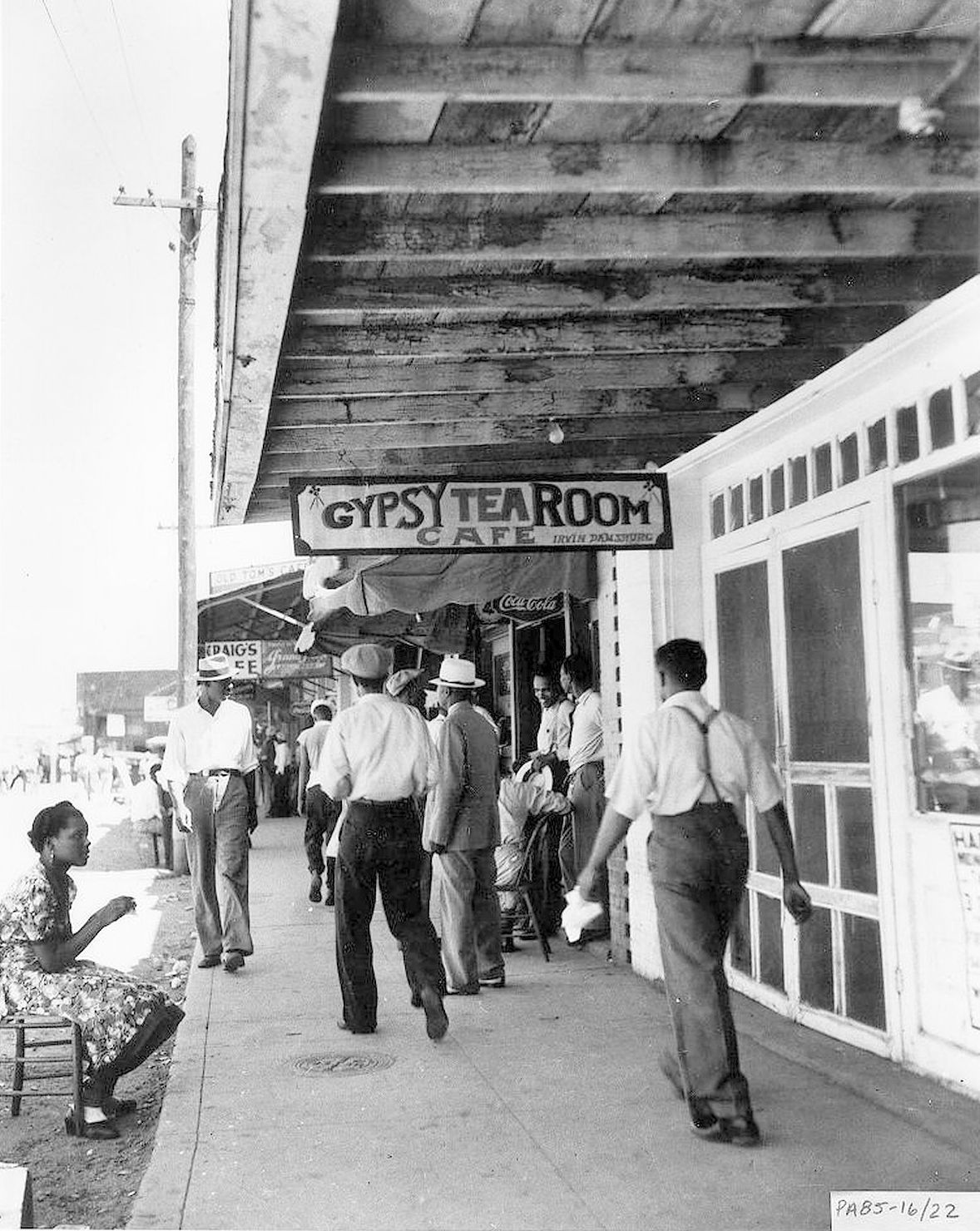
gypsy-tea-room_dallas-public-libraryThe 200 block of Central Ave., about 1937…  (Dallas Public Library photo)

by Paula Bosse

I’ve seen this photograph of Deep Ellum for years, and I’ve always loved it. But for some reason, I always thought this showed Elm Street — across from the Knights of Pythias Temple, just west of Good-Latimer (probably because that’s where a recent club with the same name was located). In fact, this scene was captured a couple of blocks west, just north of Elm, on Central Avenue, sometimes referred to as Central Track, along the Houston & Texas Central railroad tracks — a part of Deep Ellum that’s been gone for more than 60 years.

gypsy-tea-room-location_1952-map.jpgAfter Central Expwy. replaced Central Ave. (1952 Mapsco)

This area — which many have described as being the very heart of Deep Ellum in the 1920s through the 1940s (and which was somewhat ironically referred to as “the gay white way of the Negro in Dallas” by an uncredited WPA writer) — was demolished to make way for the construction of North Central Expressway (which closely followed the H&TC Railway tracks). This photo was taken in the 200 block of North Central Avenue, looking south toward Elm (the building farthest in the background, jutting out to the left, is across Elm, on the south side of the street). To the immediate left of this photo (out of frame) was the old union depot (read about it here).

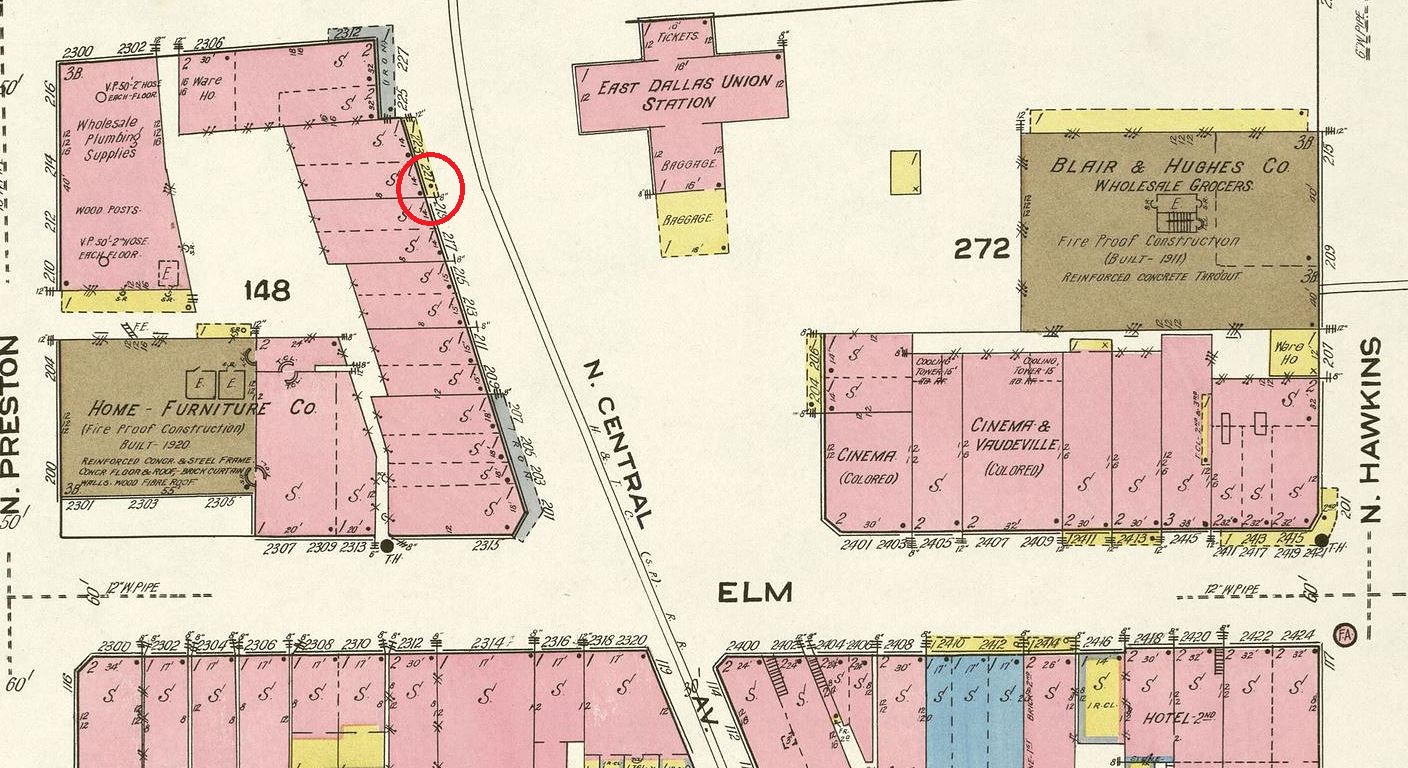
You can see that the Sanborn map from 1921 shows that same building jutting out. (See the full Sanborn map here; it might be more helpful to see this detail rotated to show the same view as the photo, here.)

sanborn-map_1921_sheet-17-det1921 Sanborn map, detail (click for larger image)

Information about The Gypsy Tea Room is scant. The proprietor was a man named Irvin Darensbourg, whose family was from the black community of Killona, Louisiana in St. Charles Parish; they appear to have been of French Creole extraction, and the family’s last name was probably correctly spelled as D’Arensbourg.

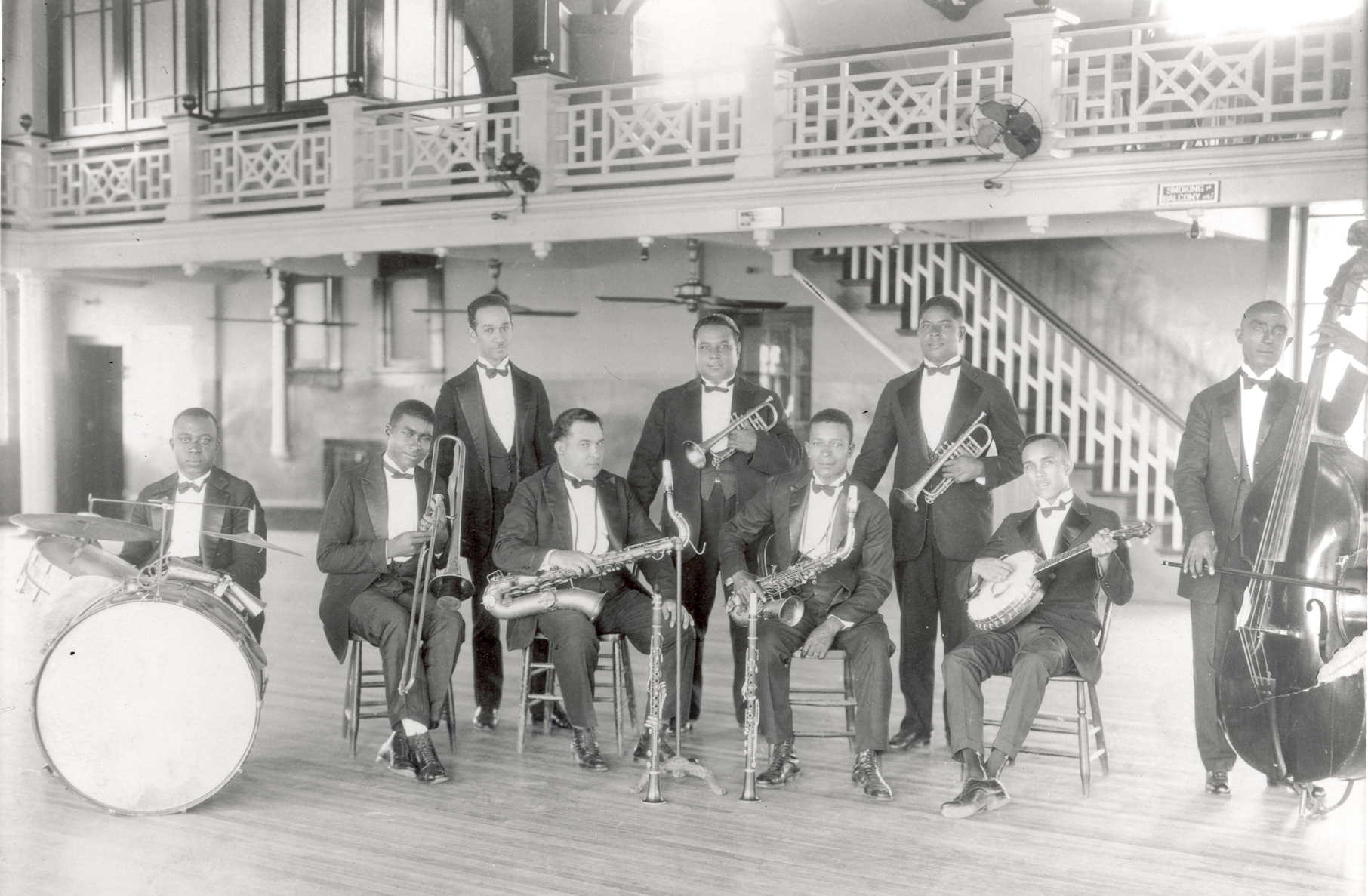
The Darensbourgs were an interesting family (and not just because their mother’s maiden name was Louise Jupiter!). There were several children, and at least two of them were professional musicians: Percy Darensbourg (1899-1950) and Caffery (often spelled “Caffrey”) Darensbourg (1901-1940). Both played with several jazz bands, and Percy even made a few recordings, playing banjo. Below are a couple of promotional photos showing them at work in the 1920s, when they were still based in New Orleans, before they settled in Dallas. (These are cropped details — click pictures to see the full photos.)

Percy Darensbourg, with Lee Collins‘ band, 1925 or 1926:

percy-darensbourg_duke_det

Listen to Percy on banjo, here:


And, below, Caffery Darensbourg, with Manuel Perez’s Garden of Joy Orchestra (click photo to see full band — the other band members are identified here):

caffery-darensbourg_tulane-library

The first of the brothers to arrive in Dallas from New Orleans was Percy, in about 1929, and for the next few years he continued to make his living as a professional musician. Caffery followed in 1932 and opened the short-lived Frenchie’s Creole Inn on Boll Street. Their non-musician brother Irvin was here by 1935 and promptly opened the Green Tavern at 217 Central Avenue, just a few doors down from Percy’s drinking establishment, the Central Tavern Inn, at 223 Central. At about this same time, Percy was also running a club at 3120 Thomas called The Gay Paree — which The Dallas Morning News described as a “swanky negro night club” (April 12, 1938) in a short mention of Percy’s being fined for selling alcohol to an already-inebriated customer.

But back to that 200 block of Central Avenue — the one pictured in the photo at the top. Between 1937 and 1939, Irvin also owned/ran a small restaurant or cafe — and later a pool hall — out of 219½ Central. The Darensbourgs had that block locked up.

*

In 1935, a song called “In a Little Gypsy Tea Room” by Bob Crosby swept the country. It was a huge hit. Suddenly there were scads of places popping up all over calling themselves The Gypsy Tea Room or The Little Gypsy Tea Room. Some might have been actual tearooms, but there were also a lot of clubs and bars with the “tea room” name — the most famous of these was The Gypsy Tea Room in the Tremé district of New Orleans, at Villere & St. Ann, which opened the same year the song was being played incessantly by every dance band in the nation. This famous New Orleans nightclub booked the biggest jazz bands around and was a legendary musician’s hangout.

gypsy-tea-room_new-orleans_1942_tulane-libNew Orleans’ Gypsy Tea Room, 1942 (via Tulane University)

gypsy-tea-room_NOLA_myneworleansNew Orleans’ Gypsy Tea Room, 1930s (via MyNewOrleans.com)

The Darensbourgs most likely knew the club, its owner, its patrons, and the musicians who played there. Perhaps Irvin Darensbourg decided to name his own little Gypsy Tea Room in Dallas in honor of the New Orleans landmark. Whatever the case, Deep Ellum’s Gypsy Tea Room appears to have come and gone fairly quickly (and one assumes there was more than tea being sipped inside).

*

The life of a tavern and club operator could be a hard one, especially in those days, especially in the black neighborhoods of Deep Ellum and North Dallas. Irvin seemed to be forever sleeping on a relative’s couch and had a different address every few months. By 1940 he had moved to Fort Worth to open another bar, and after that … I’m not sure what became of him — but one hopes that he met a less violent end than his brothers did here in Dallas. According to Caffery’s death certificate, he died in 1940 after having been shot in the abdomen while “in a public place.” His death was ruled a homicide. Percy, who by all indications was the most stable and successful of the brothers, was also killed — in 1950 he was stabbed in the neck (!) while out on the street at 4:20 AM.

**

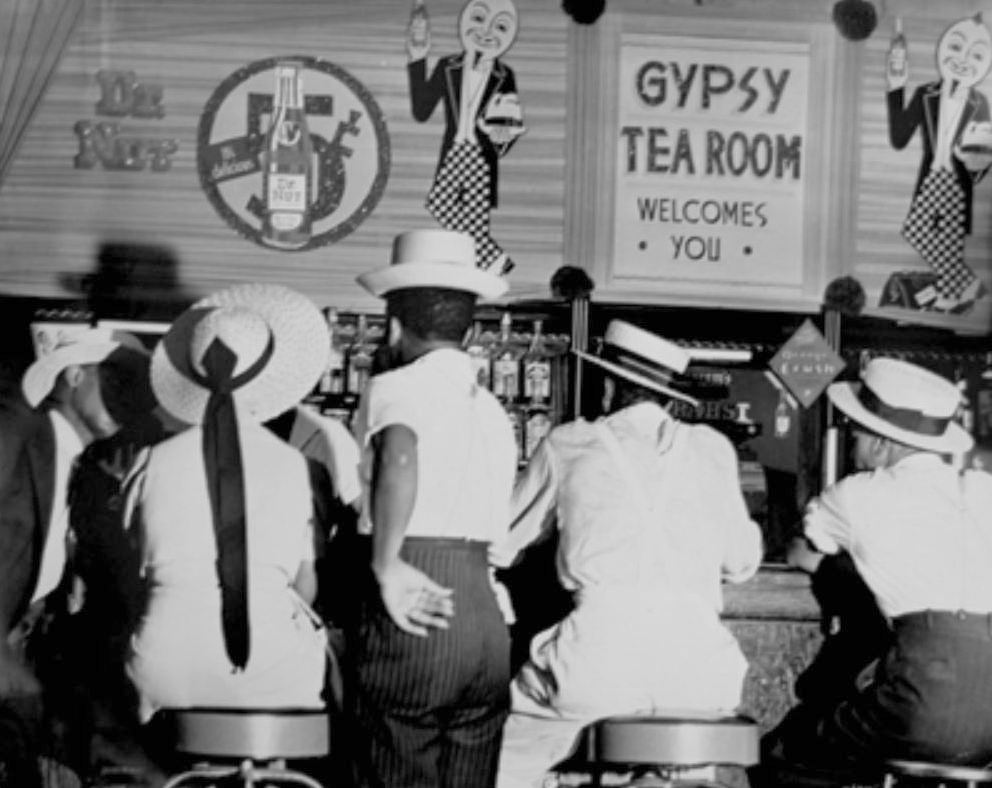
As for the original photograph, I’ve pored over it and looked through directories, but I can’t pinpoint the exact year this photo was taken or determine what the actual address of the Gypsy Tea Room was. Since it was mentioned in the WPA Dallas Guide and History, which was written and compiled between 1936 and 1940 and contains the only contemporary mention of the Tea Room, my guess is that this photograph was taken about 1937, as this was the last year that Old Tom’s Tavern (209 ½ Central) seems to have been in business (although the bar that replaced it was owned by the same person, and the sign seen in this photograph could well have remained up for a while).

Craig’s Cafe, at 213 Central, was in business between 1929 and at least 1946 when property began to be demolished in order to begin construction on the expressway. The Gypsy Tea Room looks to be either two or three doors down from Craig’s place. My guess is that it’s 219 Central. The 1937 street directory has Irvin Darensbourg (whose name is constantly mangled and misspelled everywhere) listed as being the proprietor of both the Green Tavern (at 217 Central) as well as an unnamed restaurant at 219-A (sometimes written as 219 ½) Central. The 1938 and 1939 directories specify Darensbourg’s business at this address in those years is a pool hall, not a restaurant. So I’m going to venture that Irvin Darensbourg ran the Gypsy Tea Room at 219 Central Avenue in 1937. 

1937_gypsy-tea-room_central_1937-directory
1937 Dallas directory

That was exhausting!

***

Sources & Notes

Photo of the Gypsy Tea Room at the top of this post is from the Texas/Dallas History & Archives Division of the Dallas Public Library: “Gypsy Tea Room Cafe located in Deep Ellum” is from the WPA Dallas Guide & History Collection of the Dallas Public Library — its call number is PA85-16/22.

Thanks to Bob Dunn of the Lone Star Library Annex for deciphering “Darensbourg” from this badly garbled printed name on the Gypsy Tea Room sign.

gypsy-tea-room-sign

Here are a few of the numerous ways this Darensbourg’s family’s name is misspelled across the internet:

D’Arensbourg
Darensbourg
Darensburg
Darenbourg
Darenburg
Darnburg
Darnsberg
Dansberg

Darensborough

And I’m still not actually sure whether it’s “Irvin” or “Irving,” or “Caffery” or “Caffrey.”

When clicked, the photo of Percy Darensbourg above opens up to show the full band — the personnel is identified in a caption from the book Oh, Didn’t He Ramble: The Life Story of Lee Collins: “Lee’s band in Dallas, 1925 or 1926. From the left: Coke Eye Bob (Arthur Joseph?), Mary Brown, Freddie ‘Boo-Boo’ Miller, Octave Crosby, Henry Julien, ‘Professor’ Sherman Cook, Lee, and Percy Darensburg [sic].”

A couple of other versions of “In a Little Gypsy Tea Room,” if you must:

  • The version by The Light Crust Doughboys (no strangers to Deep Ellum), recorded in 1935 in Dallas at 508 Park, is here.
  • The at-least-peppier version by Louis Prima and His New Orleans Gang, also recorded in 1935, is here.

See what the area once occupied by the vibrant street life of Central Track looks like now, here. The expressway overpass is now planted about where the photo was taken. It’s a shame this important part of town — in a way it was Dallas’ second downtown — was bulldozed into oblivion.

*

Copyright © 2015 Paula Bosse. All Rights Reserved.

The Idle Wild Social Club: Life Magazine Presents Black Debutantes — 1937

debs_life_120637-detThree of 1937’s debs (click for larger image and caption)

by Paula Bosse

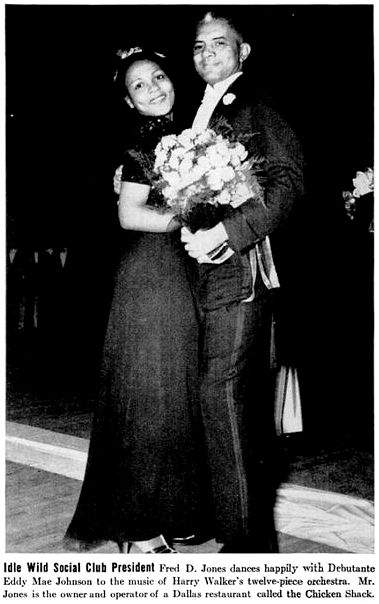
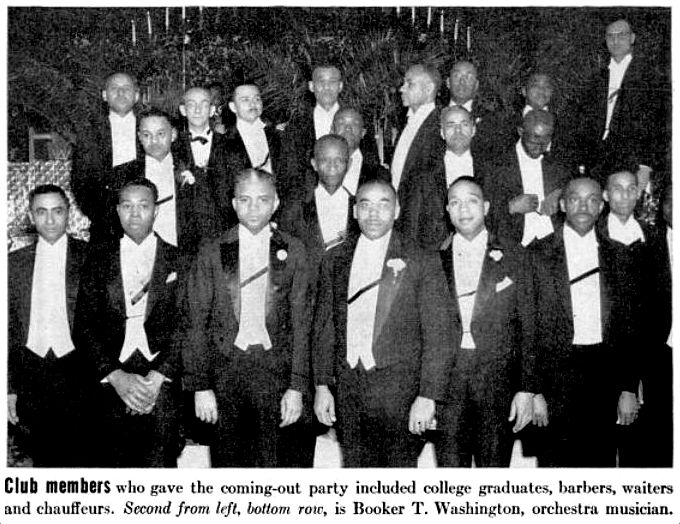
In December of 1937, something appeared in a national mainstream magazine that had probably never appeared before: photographs of a society ball celebrating African-American debutantes. In the December 6, 1937 issue of Life magazine — in the recurring “Life Goes To a Party” pictorial feature — four pages were devoted to coverage of the annual Idle Wild Social Club ball (later Idlewild Social Club, and later Cotillion Idlewild Club — none of which is to be confused with Dallas’ 130-plus-year-old super-exclusive, white Idlewild Club). The letters this unusual pictorial elicited were either congratulatory or, dismayingly, shocked and irate. Although today these photos are nothing unusual, in 1937, to see African-Americans depicted in a magazine such as Life as just normal, everyday Americans, was exceedingly uncommon. To see photos of black high-society must have made people’s heads explode. So kudos to Life for running the only slightly patronizing story and for publishing some wonderful photographs.

life_debs_120637_aLife magazine, Dec. 6, 1937

*

The Idle Wild Social Club was started in Dallas around 1918 by a group of socially well-placed black men — perhaps as a response to the white Idlewild Club. By the early 1920s they, like the white club, were presenting the cream of the crop of their young women to society in debutante balls. The ball covered by Life took place on November 18, 1937. The women making their debuts were:

  • Eddy Mae Johnson
  • Glodine Marion Smith
  • Lorene Marjorie Brown
  • Gladys Lee Carr
  • Gladys Lewis Powell
  • Hattie Ruth Green

life_debs_120637The debs and their escorts (Life, Dec. 6, 1927)

life_debs_120637-club-membersClub members (Life, Dec. 6, 1927)

life_debs_120637-crowd“Social chitchatterers” (Life, Dec. 6, 1927)

life_debs_120637-couple(Life, Dec. 6, 1927)

Read the article and see additional photos featured in this pictorial here.

There was an outcry in response to the article, and some of it was shockingly ugly — read the letters to the editor about the “Negro Ball” that Life published in the next issue, here (use the magnification tool at the top of the page to increase the size of the text).

Here is the more progressive response, from the Jan. 1938 issue of the NAACP’s magazine, The Crisis:

the-crisis-mag_jan-1938

Progress moves at a snail’s pace, but if coverage of a debutante ball can help to move things forward even a step or two … great!

***

All photos from Life magazine, Dec. 6, 1937; the scanned article (and, in fact, the entire scanned issue) is here.

The January, 1938 issue of The Crisis is available online; the page featuring the editorial is here. (This issue also has an interesting article, “Free Negroes In Old Texas” by J. H. Harmon, Jr., here.) The Crisis Wikipedia page is here.

To read coverage of earlier Idle Wild Social Club balls — published in the black-owned Dallas Express — see this from 1922, and this from 1923.

The African-American debutante ball has been called Cotillion Idlewild for many years now; information on their 2014 ball is here. (Again, this is not to be confused with the (white) Idlewild Club, which has been throwing heart-stoppingly elaborate balls in Dallas since the 1880s.)

Apparently there is a history of the club out there — Idle Wild Social Club History (1940) — and, according to WorldCat, appears to be available at nearby libraries.

Personally, I don’t really “get” debutante balls, but growing up in Dallas, I know that they’ve always been big, big, BIG deals. A. C. Greene’s snarky article “Social Climber’s Handbook” (D Magazine, October, 1976), is both amusing and informative; read it here.

*

Copyright © 2015 Paula Bosse. All Rights Reserved.
 

The Dallas Day Nursery: “Bring On Your Babies” — 1919

dallas-day-nursery_dallas-express_112219“Inmates and their nurse-mother” (click for larger image)

by Paula Bosse

This photo appeared in the pages of The Dallas Express, the main source of news for the city’s black residents. The caption, below (click for larger image).

dallas-day-nursery_dallas-express_112219_captionDallas Express, Nov. 22, 1919

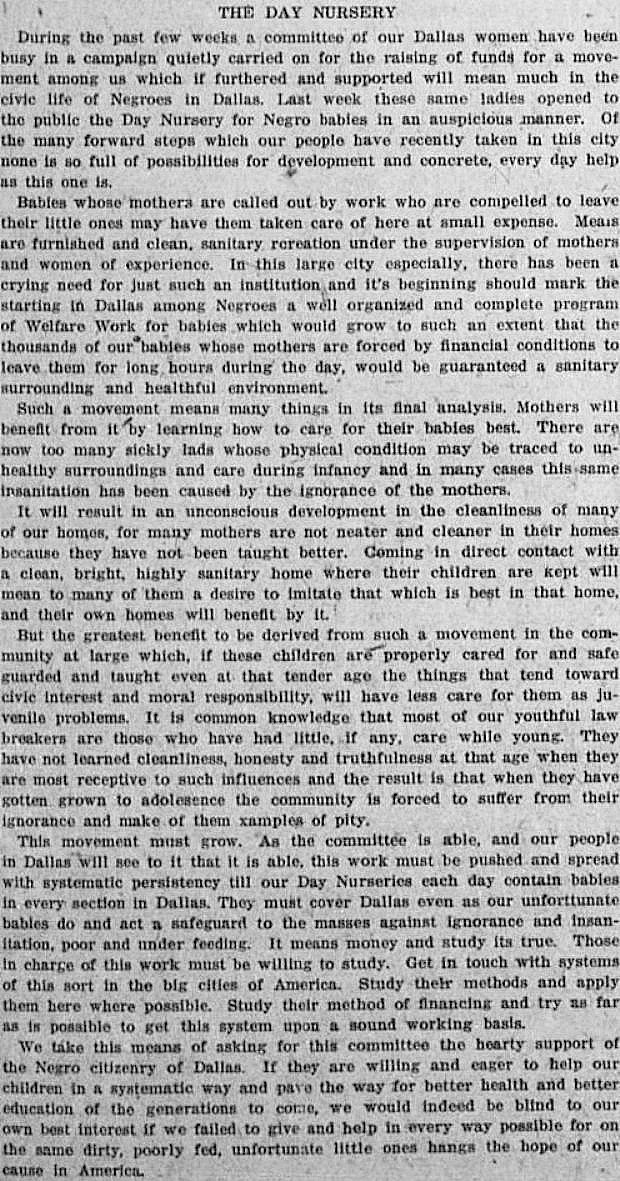
This “day nursery” organized by the Federation of Colored Women’s Clubs, must have been a relief to working women who had young children that needed supervision. At the nominal fee of 10¢ a day (equivalent to about $1.35 today), the community service was affordable to many working families. A few weeks after the above photo appeared in its pages, an editorial appeared in the Express, urging support for the Dallas Day Nursery and explaining why it was important not only to families, but to the greater community.

dallas-day-nursery_dallas-express_121619Dallas Express, Dec. 16, 1919

***

The nursery appears to have been run out of a residence at 2417 Caddo Street, which would now be located in the CityPlace Market parking lot, behind the Office Max.

dallas-day-nursery_googleGoogle Maps

*

Copyright © 2015 Paula Bosse. All Rights Reserved.

Movie Houses Serving Black Dallas — 1919-1922

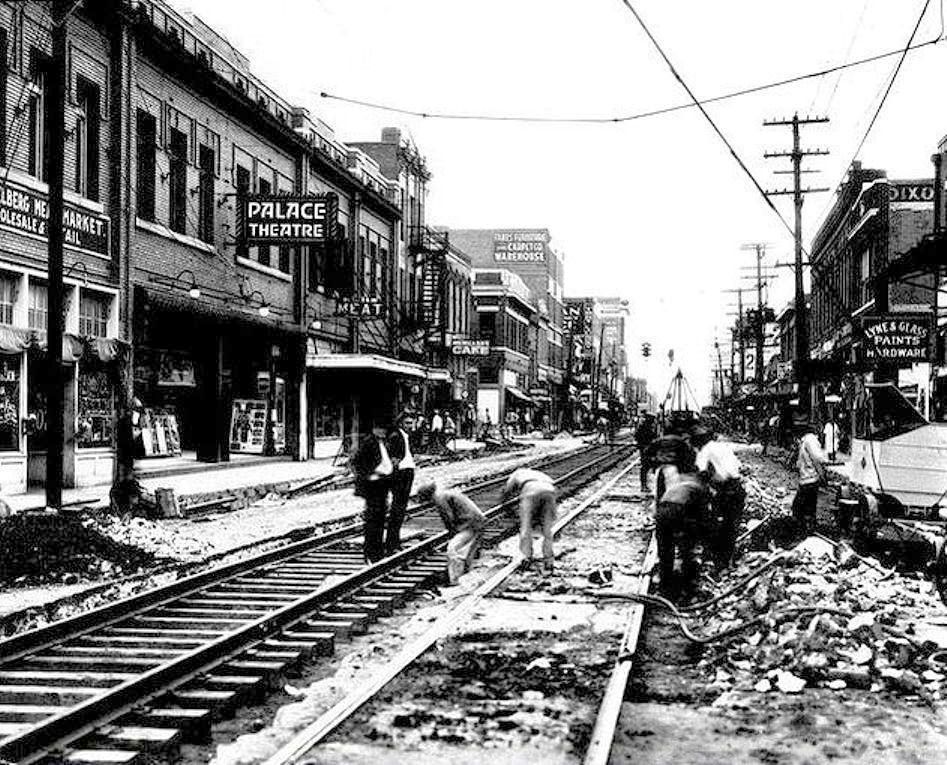
palace-theatre_elm-st_1922-dplThe Palace Theatre, Elm St., Deep Ellum, 1922 (click for larger image)

by Paula Bosse

In 1920, movie theaters — like most places in Dallas at the time — were segregated. If black customers were allowed at all in the downtown white vaudeville and movie houses, they had separate entrances and restricted seating areas (generally in the balcony). But Dallas’ African-American community had their own popular theaters, run by enterprising and energetic men who endlessly promoted their jam-packed and constantly-changing bills.

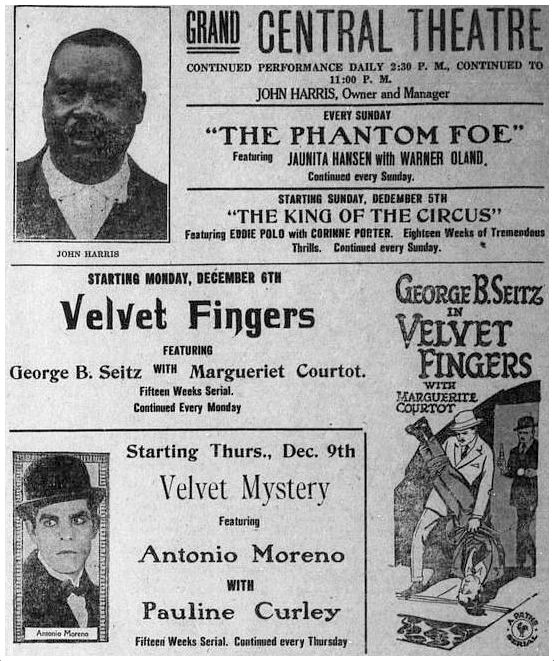
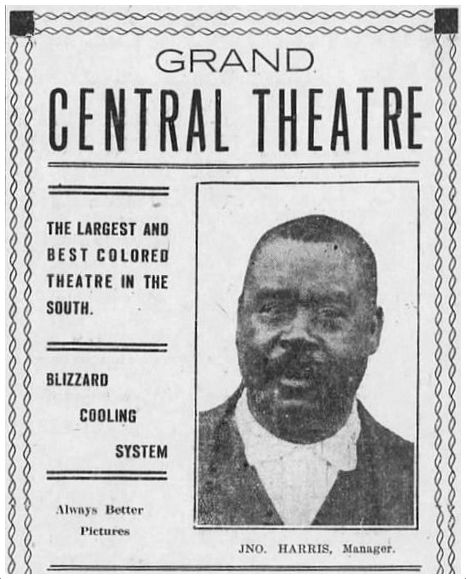
Judging by the amount of ad space purchased in the black-owned and operated Dallas Express, there were four main movie theaters catering to black Dallasites around 1920: the Grand Central Theatre, run by John Harris, the Mammoth Theatre, run by Joe Trammell, the Palace Theatre, run initially by Felix Moore, and the High School Theatre, run by Herbert Batts; the first three of these houses were in Deep Ellum, the last one was in what was then called “North Dallas.’ The theaters played both “white” films and films with “all-Colored casts.” The advertising for these theaters is great — far more ad space was available in the tiny Express to publicize the movies, the popular but now-forgotten Silent Film stars of the era, and the proprietors themselves than was available to the theaters on the other end of Elm Street in the much larger, white-owned News, Journal, or Times Herald. Sometimes it’s good being the big fish in the little pond — absolutely everybody knows who you are.

*

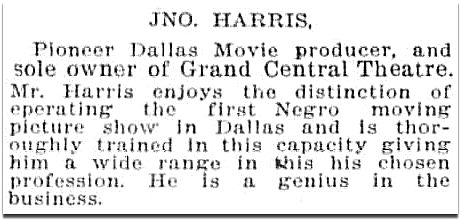
The Grand Central Theatre was at 405-407 N. Central Ave. (which later became Central Expressway), between Swiss and Live Oak on the outer northern edge of Deep Ellum. John Harris, the owner, put himself in practically all of his ads. He included this autobiographical sketch in one of them:

micheaux-grand_dallas-express_052821-detDallas Express, May 28, 1921

I’m not sure if he operated “the first Negro moving picture show in Dallas,” but I wouldn’t doubt it — the man was a dynamo who possessed not only a bold self-confidence, but he also seems to have had an unlimited promotional budget. UPDATE: The first appearance of a theatrical enterprise by John Harris shows up in the 1913 city directory (directories generally collected their information the previous year, so he was probably in business in 1912). Harris is listed under the “Amusements” section at the same address as the Grand Central Theatre, a name which came later. The same 1913 directory also lists the Star Theatre, which later became the Palace (see below). These are the only two theatres designated as “colored.” It’s unclear whether the theaters hosted live performances or showed movies. Or both.

The Grand Central advertised relentlessly. (Click ads to see larger images.)

grand-central-theatre_dal-express_120420Dec. 4, 1920

grand-central-theatre_dal-express_051421May 14, 1921

grand-central-theatre_dallas-express_080621Aug. 6, 1921

Below, an ad showing one of the offerings to be a Ben Roy Motion Picture Corp. movie called “My Baby” which was “made in Dallas, featuring William Lee and All Colored Cast.”

grand-central-theater_dal-express_052722May 27, 1922

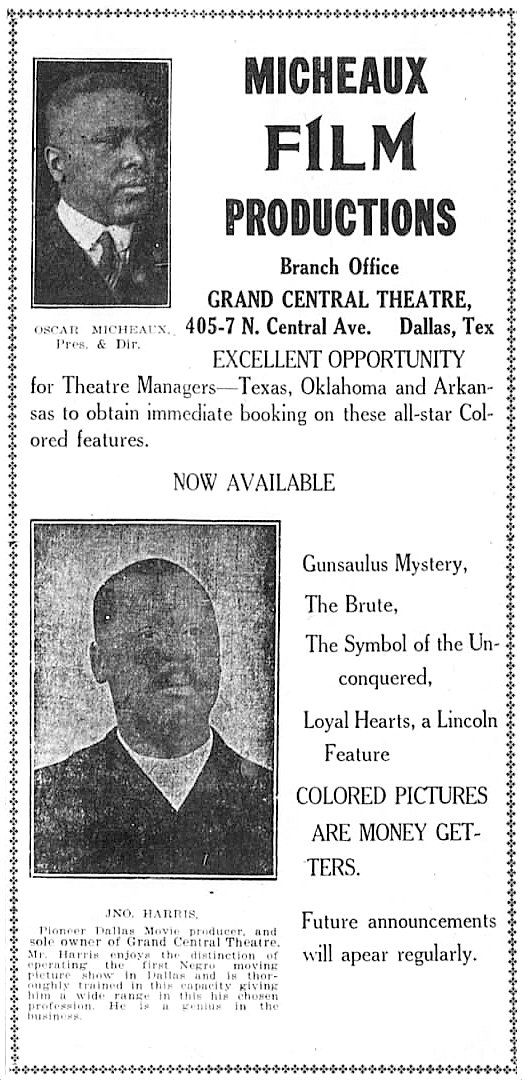
Harris was connected with the legendary black filmmaker Oscar Micheaux. Not only did he regularly run his films, but he also seems to have been working as a booker, promoter, and distributor of Micheaux’s films and ran the Micheaux Film Productions branch office out of the Grand Central. “Colored Pictures are Money-Getters.”

micheaux_dallas-express_051421May 14, 1921

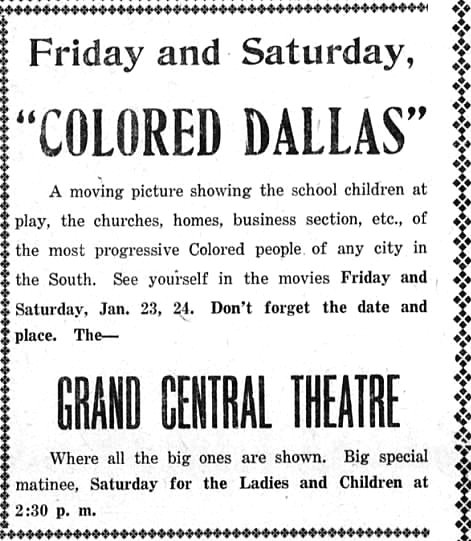
One ad that caught my attention was this one, for a locally-shot film called “Colored Dallas.” I really, REALLY want to see this, but the possibility of an extremely minor, 95-year-old silent film having survived into the 21st century is slim.

colored-dallas_dallas-express_012420Jan. 24, 1920

*

The Mammoth Theatre was located at 2401 Elm Street, between Central and Hawkins. It opened in late 1919 — the run-up to the opening was publicized in this Dallas Express item.

mammoth_dallas-express_112219Nov. 22, 1919

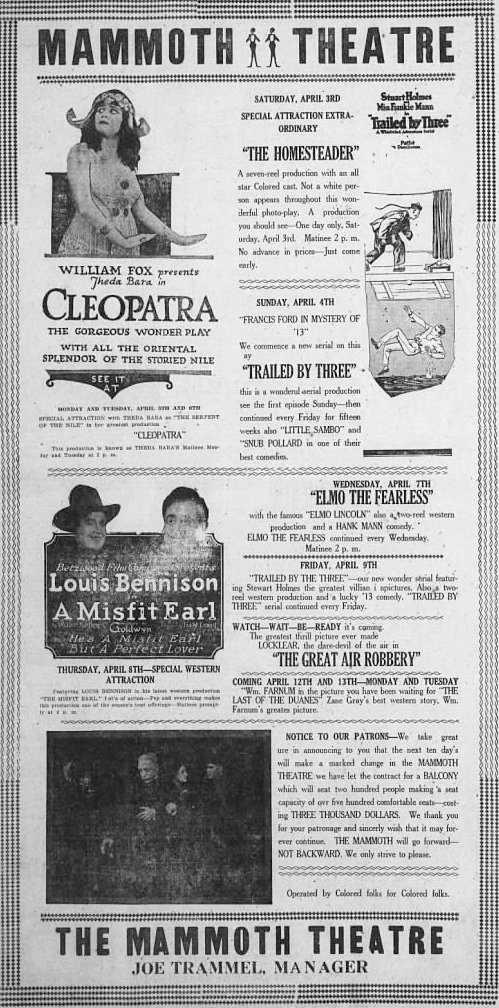
The Mammoth might not have advertised quite as much as the Grand Central did, but it frequently took out splashy full-page ads. Full-page! I bet that royally irked John Harris. Below, a Mammoth ad from 1920.

mammoth_dallas-express_040320April 3, 1920

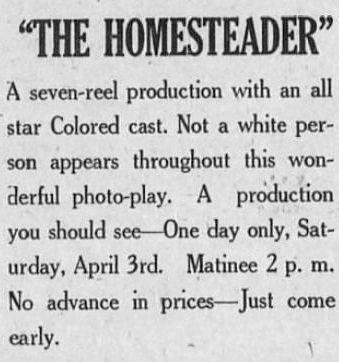
Two details from the above ad:

mammoth_dallas-express_040320-det-2

mammoth_dallas-express_040320-det
“Operated by Colored folks for Colored Folks.”

The owner, Joe Trammell, seems to have had an inexhaustible source of money for advertising — those frequent full-pagers (unusual for the time) must have cost a pretty penny. I couldn’t find much information about any of these men, but I stumbled across this photo of Trammell, tacked on to one of his … um … mammoth ads.

mammoth_joe-trammell_dallas-express_021221Feb. 12, 1921

*

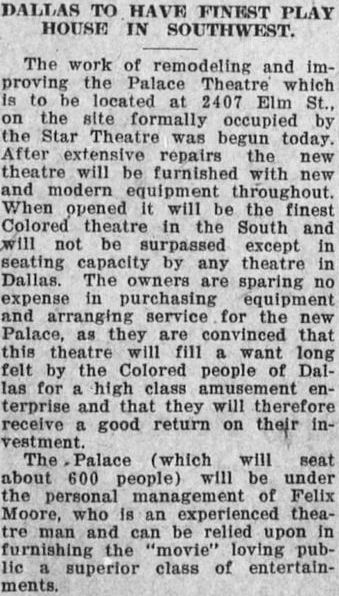
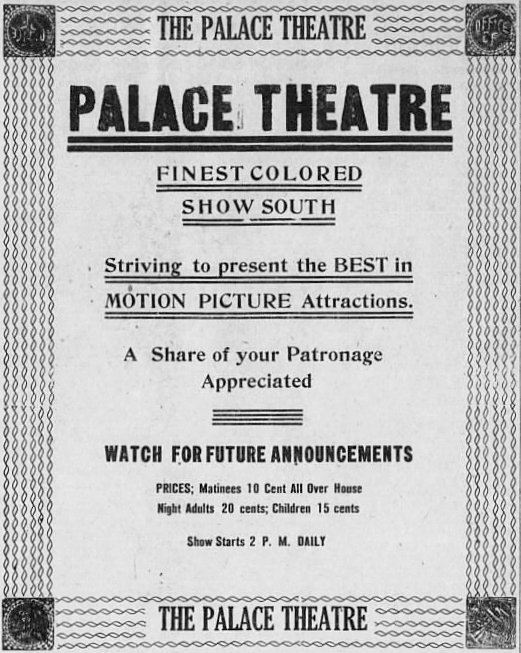
The Palace Theatre, seen in the photo at the top, was at 2407 Elm Street, just a couple of doors down from the Mammoth. (This Palace is not to be confused with the “white” Palace Theatre, the stalwart of Theater Row at the other end of Elm.) It opened in 1920 in the remodeled space formerly occupied by the Star Theatre,

palace_dallas-express_030620March 6, 1920

palace_dallas-express_050820May 8, 1920

*

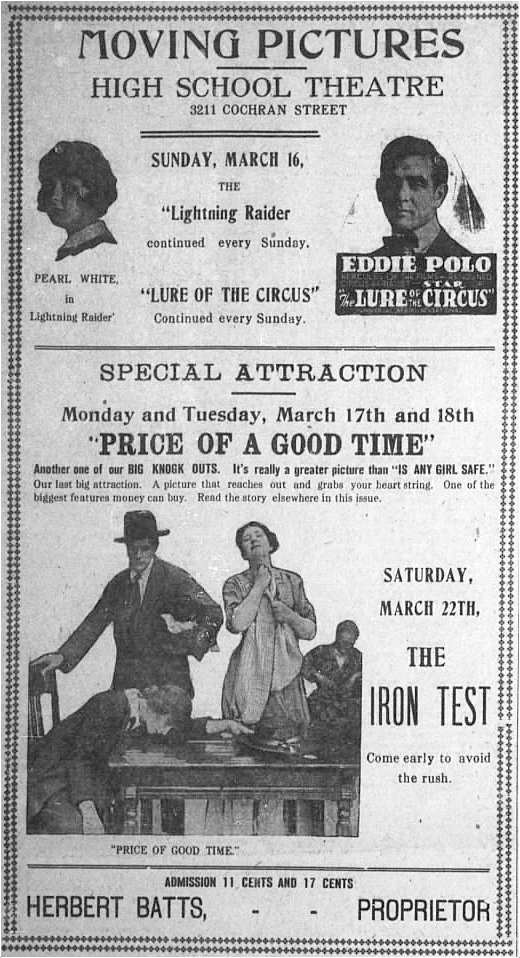
Lastly, moving up to North Dallas, we find the High School Theatre, located at 3211 Cochran, between Central and N. Hall Street. The reason for its name was its close proximity to the Colored High School (the only high school for African-American students at the time — it would soon merge with and relocate to the new Booker T. Washington High School a short distance away). The following businesses were in this same block: the High School Cold Drink Stand, the High School Cafe, the High School Shine Parlor, and the High School Tailor Shop. Location, location, location.

high-school-theater_dallas-express_031519March 15, 1919

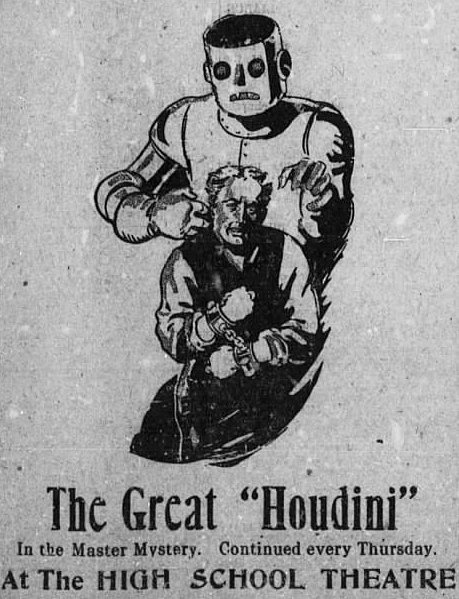
My favorite High School Theatre ad is this one, touting a serial called “The Master Mystery” starring Houdini … one of the screen’s first appearances of a robot! (Check out a scene featuring both Houdini and the robot/automaton, here.)

houdini_dallas-express_031519March 15, 1919

*

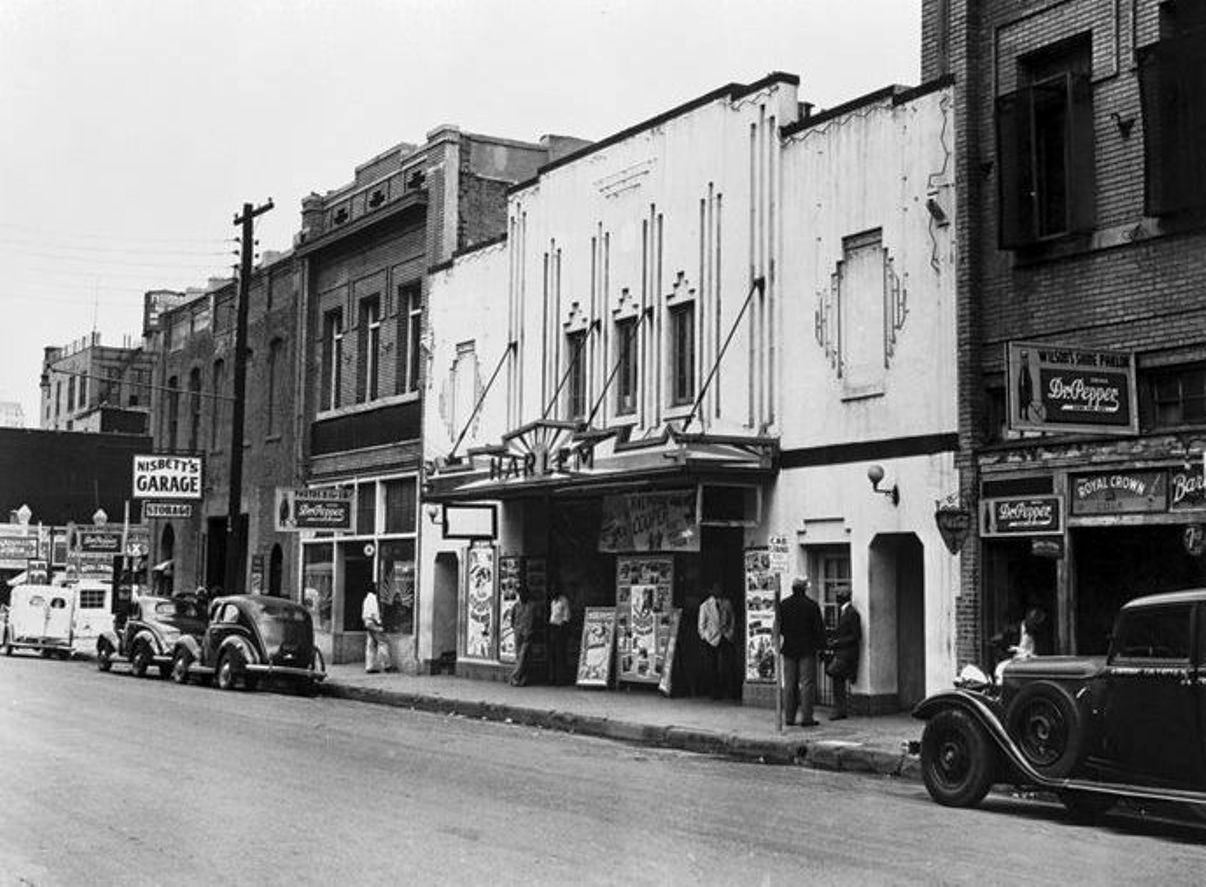
The only one of these theaters still in business in 1930 was the Palace. by 1937, the Palace had become the Harlem Theatre.

harlem-theatre_deep-ellum

harlem-theatre_dpl

***

Sources & Notes

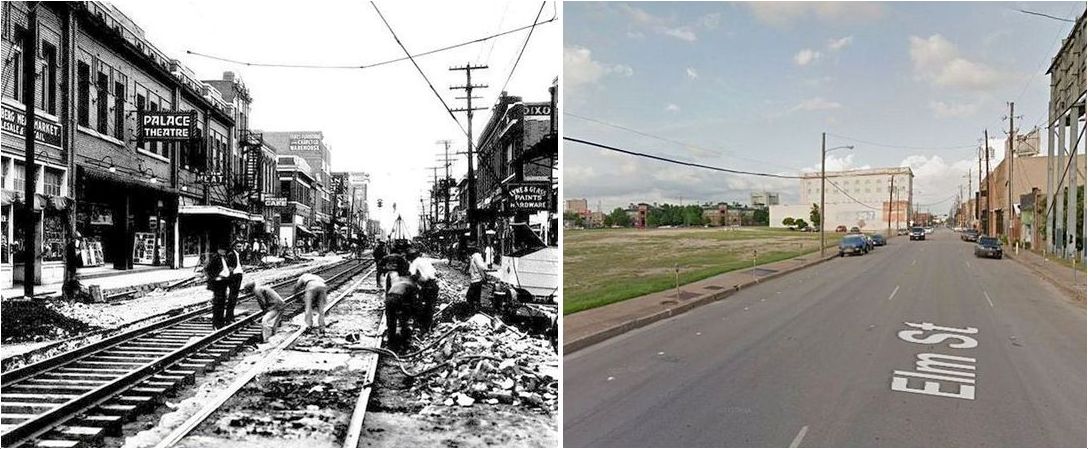
Top photo showing Elm Street and the Palace Theatre and the bottom two photos showing the Harlem Theatre are from the Texas/Dallas History & Archives Division, Dallas Public Library. The upsetting view of what that stretch of Elm looks like now can be seen on Google Street View, here. Below, side-by-side, 1922 and 2015 — Elm St. looking east to Deep Ellum, the Knights of Pythias temple in both images down the street on the left. Look what we’ve lost.

elm-looking-east_1922-2015

All ads and clippings from The Dallas Express, as noted. A few years’ worth of this important newspaper, which served Dallas’ African-American community, can be accessed here.

More on Oscar Micheaux, here.

Another Flashback Dallas post on a theater serving the black community is “Oak Cliff’s Star Theatre — 1945-1959.”

A 1919 map from UNT’s Portal to Texas History shows the location of the Grand Central Theatre (red square), the Mammoth (blue), and the Palace (yellow).

black-cinemas_ca1920_deep-ellum

The High School Theatre — up in “North Dallas” (adjacent to present-day Uptown) — is seen on a different portion of the same map, below.

black-cinemas_ca1920_north-dallas

Most images are larger when clicked.

*

Copyright © 2015 Paula Bosse. All Rights Reserved.
The Vision In “The Miracle Window” — 1931

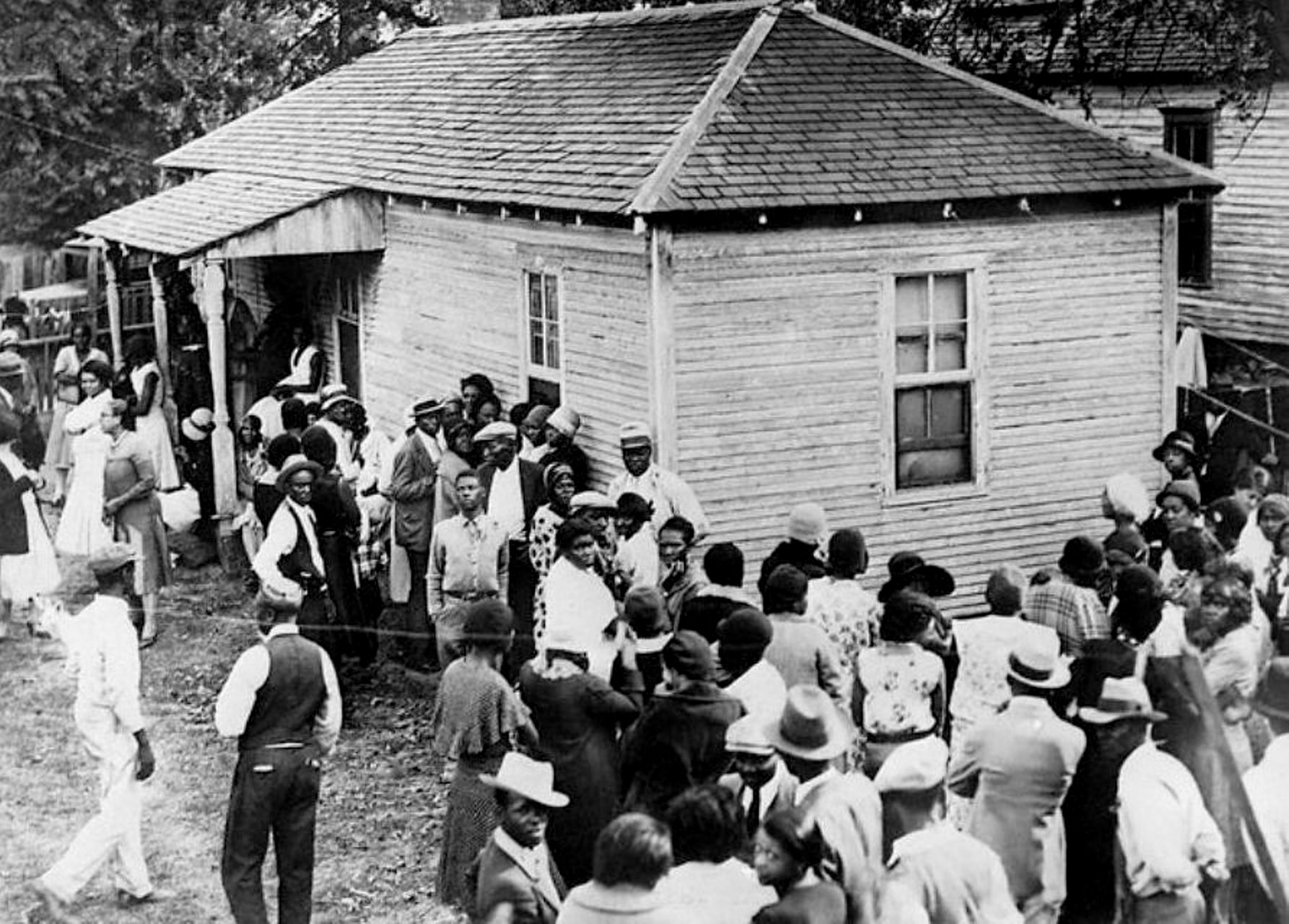
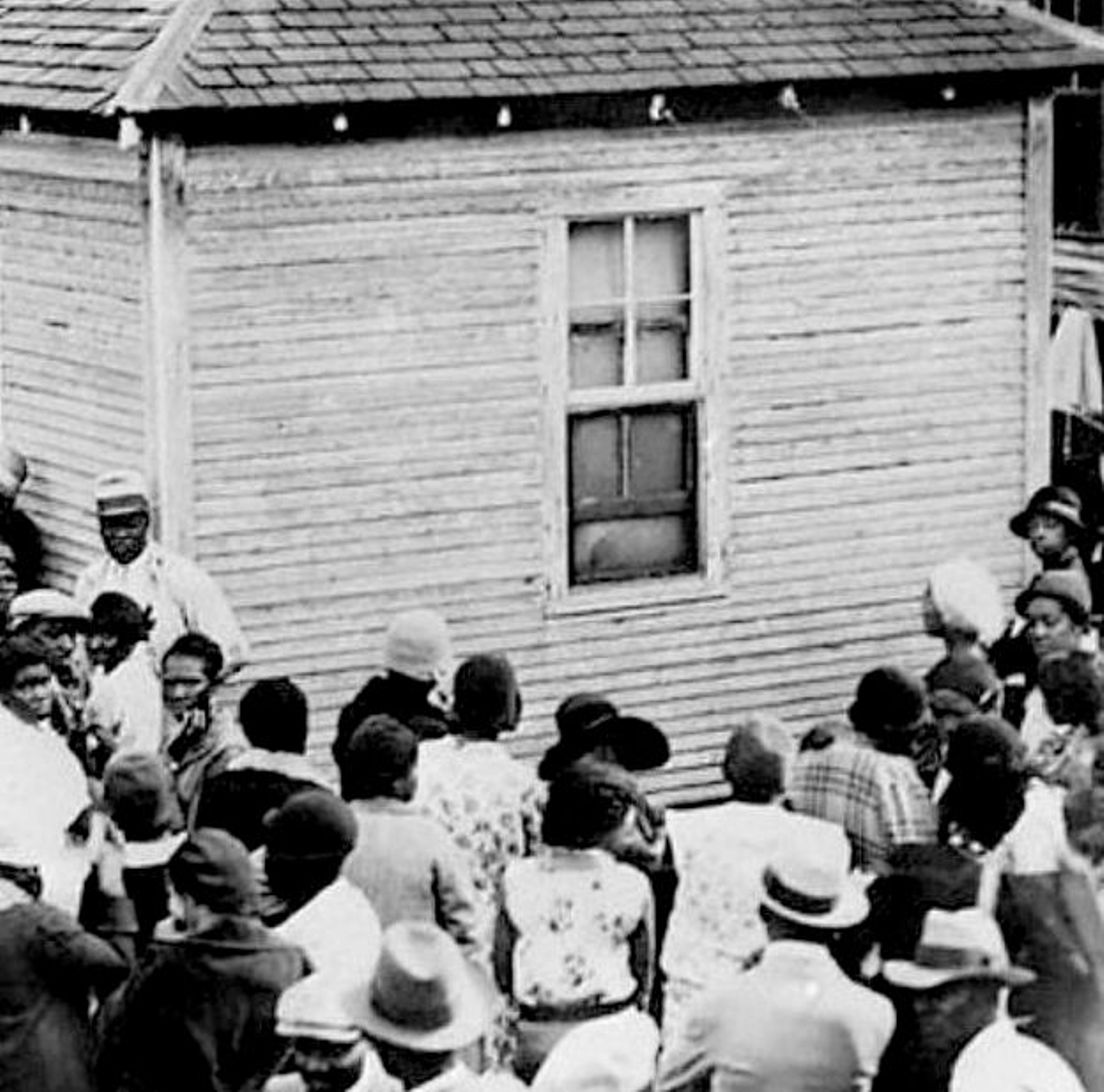
vision_corbis_1931Waiting for a message from God

by Paula Bosse

In the winter of 1931, a woman named Hattie Henderson made news when a “vision” appeared on her window shade twice a day. She interpreted the image — which was formed by shadows cast by the sun streaming through her window onto the shade — as a warning from God that “war, pestilence and other calamity” were on their way to wreak havoc. Word of the “miracle window” spread throughout the community, and soon thousands of people were flocking to the little house on Campbell Street to see the vision for themselves.

The Dallas Morning News covered the story:

More than a thousand curious and devout negroes, and a sprinkling of whites, congregated Tuesday afternoon at 3504 Campbell street, near the Greenwood Cemetery, in North Dallas, to witness the miraculous appearance of images on a drawn window shade. […] Sister Hattie Henderson, whose husband is a preacher in the Holiness Church, reports the images have been appearing twice daily, at 8 a.m. and 2:45 p.m. each day since Oct. 19. She firmly believes they are divine warnings. (DMN, Nov. 11, 1931)

vision_corbis_detWaiting patiently….

*

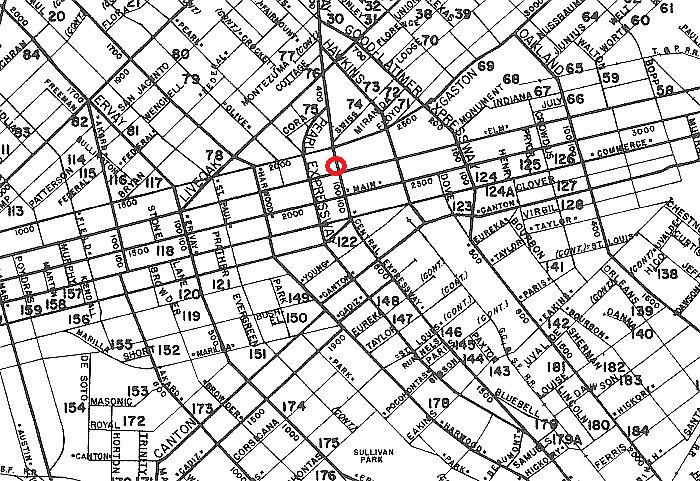
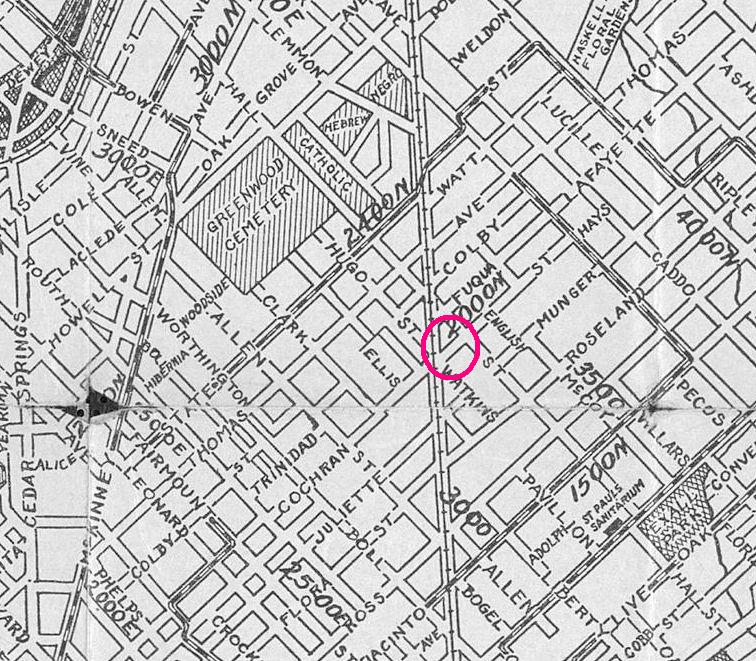
Campbell St. is a short street that runs between the Jewish section of Greenwood Cemetery and the Freedman’s Memorial Cemetery. In 1931 it was in the large African American community of “North Dallas.” The scene in the photograph took place in what is now a Walmart parking lot in the heart of “Uptown.”

vision_google

***

Sources & Notes

Photo by an uncredited photographer, ©Underwood & Underwood/Corbis; found on the Corbis website.

Read more about this in the Dallas Morning News archives in the story “Thousand Negroes Gather to View in Awe Warning Miracle in House Near Cemetery” (DMN, Nov. 11, 1931).

Map — with location of sacred window shade circled in red — from Google Maps.

*

Copyright © 2015 Paula Bosse. All Rights Reserved.

Orson Welles In Dallas — 1934-1940

orson-welles_cornell-tour_1934
Orson at 18 — publicity photo used for the Cornell tour, 1934

by Paula Bosse

Today is the 100th anniversary of the birth of Orson Welles. Welles was one of the truly great, innovative theater and film directors, an actor with a commanding presence, and a delightfully entertaining raconteur. His frenetically creative work on the New York stage, on radio, and in film (he wrote, produced, directed, and acted in his first film, Citizen Kane, when he was only 25) earned him/saddled him with the hard-to-deny sobriquet “Boy Genius.” His rise up the show-biz ladder was a quick one.

Orson’s first professional acting gig was as an unknown 18-year old repertory player in the touring company of famed actress Katharine Cornell who, along with British actor Basil Rathbone, starred in the three plays performed on the tour, which stopped in Dallas for a two-night engagement at the Melba theater, in February, 1934. The three plays performed in Dallas on February 19 and 20 (one a matinee) were “Romeo and Juliet” (Orson played Mercutio), “The Barretts of Wimpole Street” (he played Octavius Moulton-Barrett), and “Candida” (he played Marchbanks). Cornell was a huge draw, and there was a rush for tickets. The Melba begged her to extend her stay and add performances, but she declined.

The young Welles had gotten reviews on the tour which ranged from a dismissive mention in Variety that he was unable to speak Shakespeare’s lines properly and audibly (!), to raves from Charles Collins of The Chicago Tribune:

The cast is brilliant, and many of the secondary characters are acted with consummate skill. This is particularly true of Orson Welles’ Mercutio, which is an astonishing achievement for a youth still new on the stage. In his duel with Tybalt and his death scene, this Mercutio is a complete realization of Shakespeare’s bravest blade.

The star of the show was the then-very-famous Katharine Cornell, around whom most of the articles and reviews centered (she was, for instance, breathlessly reported to be staying at the Melrose during her Dallas stay) (I wonder if the lowly company players — i.e. Orson Welles — stayed there as well?). The Dallas Morning News theater critic, John Rosenfield — who mentioned this 1934 Dallas appearance in almost every succeeding article he ever wrote about Orson Welles over the next several decades — wrote the following before he saw Orson’s performances in any of the three plays:

Orson Welles, 18-year-old actor, who is apparently bulky enough to hold his own with adults, will be Mercutio. (DMN, Feb. 19, 1934)

After he saw his Mercutio:

Orson Welles’ Mercutio was up to the best standards known for this role. (DMN, Feb. 20, 1934)

When the tour finished, Welles quickly became a presence in the New York theater world. One of his early successes as a producer and director was his production of the so-called “Black Macbeth”/”Negro Macbeth”/”Voodoo Macbeth” — a hugely popular staging of Shakespeare’s “Macbeth” with an all-black cast, done under the auspices of the Federal Theatre Project in 1936. In August of that year — just two and a half years after his appearance as an unknown at the Melba — he took the production to Dallas where it made a splash at the Texas Centennial in the brand new bandshell.

macbeth_texas-centennial_dmn_081336Aug., 1936

macbeth_playbill_dallas_LOC(click for larger image)

Rosenfield was impressed by the lush design and the electric and inventive spectacle, but he was not a fan of the performances. A few years later, on the eve of the release of Citizen Kane, he wrote the following (which was much harsher than his original 1936 review):

We saw this production in Dallas during the Texas Centennial and could marvel at the artistic futility of such ingenuity. The Negro Macbeth, however, was something to be seen if only to be despised. (DMN, Oct. 29, 1941)

Oh dear.

In 1940, Welles was working on his first film, the legendary Citizen Kane. As filming began to wind down, he decided to go out on a short lecture tour because he was in desperate need of money (an all-too-common circumstance he found himself in throughout the entirety of his career). His topic was a vague “anecdotes of the stage and theories on the drama” — and it sounds like his “performances” were largely unscripted and unrehearsed. 

On October 29, 1940 — only a week or two after wrapping production on Citizen Kane — 25-year old Orson Welles spoke at McFarlin Auditorium on the SMU campus as part of the Community Course series of lectures. His topic: The Actor’s Place in the Theater. It was another packed house of adoring and/or curious Dallasites. Rosenfield was both entertained and annoyed by the rambling “lecture,” but Orson was undoubtedly delighted to talk for two hours before an adoring crowd, answer their questions about his craft, and collect a $1,200 check.

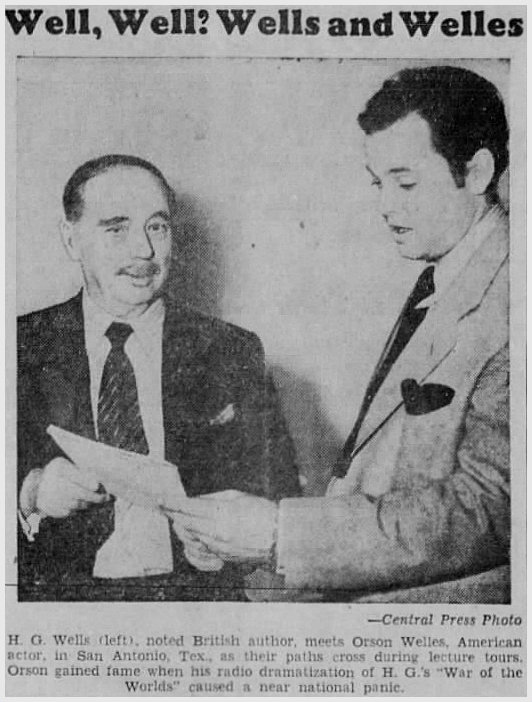
Orson’s appearance in Dallas was particularly noteworthy for the fact that the speaker scheduled to appear on the McFarlin stage just three days later was … H. G. Wells! At the time of this lecture tour, Orson was best known for his infamous 1938 radio adaption of H. G. Wells’ The War of the Worlds, the frighteningly realistic production that panicked the nation and led thousands to believe that the earth was being attacked by Martians. Rather surprisingly, Welles and Wells had never met.

According to a blurb in a Phoenix newspaper, Orson had cancelled a previously-scheduled meeting in Tucson in order to fly into Dallas earlier than planned. My guess is that he saw that H. G. Wells was also lecturing in Texas and realized that H. G.’s lecture in San Antonio the night before Orson’s own appearance in Dallas on the 29th was the only chance he had to meet the man who had provided the source-material for his (to-date) greatest career triumph.

A quick timeline:

  • Sun. Oct. 27, 1940: Orson arrives in Dallas, staying at the Baker Hotel.
  • Mon. Oct. 28: In the morning, Orson flies down to San Antonio to meet H. G. Wells and attend his lecture. The two meet, get along famously, have their photos taken, and give a short joint interview to San Antonio radio station KTSA (see below for link to recording). That evening, both fly to Dallas. Later that night, Orson (well known as an amateur magician) pops into The Mural Room in the Baker Hotel to catch the floor show featuring popular magician Russell Swann.
  • Tues. Oct. 29: H. G. Wells leaves Dallas for Denver, continuing his lecture tour. That morning Orson drives to Fort Worth to present a lecture and attend a luncheon at the River Crest Country Club. That night, he presents his lecture at McFarlin Auditorium at Southern Methodist University. After his lecture, he catches Russell Swann’s magic show for a second time. At 3:00 a.m. he flies to San Antonio for his lecture there.
  • Wed. Oct. 30: Orson lectures in San Antonio. It is the second anniversary of the broadcast of “The War of the Worlds.” Conveniently, newspapers around the country begin to run the photos of Welles and Wells taken on the 28th.
  • Thurs. Oct. 31: A Martian-free Halloween.
  • Fri. Nov. 1: H. G. Wells is back in Dallas for his lecture that night at McFarlin Auditorium.

welles-wells_san-antonio_102840

welles-wells_pottstown-pa-mercury_103140Pottsdown (PA) Mercury, Oct. 31, 1940

h-g-wells_dmn_102940DMN, Oct. 29, 1940

Whew.

Happy 100th, Orson! And thanks for everything.

***

Sources & Notes

Dates and sources of newspaper clippings as noted.

“Macbeth” playbill from the Library of Congress, here.

The timeline for the Welles-Wells meeting and their Dallas-related activities were gleaned from a report in the Oct. 30, 1940 edition of The Dallas Morning News.

And now, links galore.

  • Watch an entertaining short clip in which Orson talks about mind-reading and fortune-telling — which he says he indulged in on the Cornell tour — here.
  • Read the profile of the 18-year-old phenom which appeared in newspapers during the run of the Katharine Cornell tour, here.
  • Read about the “Voodoo Macbeth” here (scroll to the bottom to see fantastic photos).
  • Listen to the interview with Orson Welles and H. G. Wells that aired on San Antonio station KTSA, the day they met for the first time, on Oct. 28, 1940 — here.
  • Read about that still-chilling Mercury Theatre radio broadcast of The War of the Worlds, here.

Finally, my favorite Orson Welles-related quote from the erudite and not-without-humor arts critic of The Dallas Morning News, John Rosenfield. He wrote the following in his review of the set-in-Haiti “Macbeth” — about the aesthetic viability of future Shakespeare productions tailored for specific audiences:

…Mr. Welles hasn’t started a movement. His Negro “Macbeth” does not inspire us to corroborate a fabled Texas lawyer and make Antonio “The Merchant of Ennis.” (DMN, Aug. 16, 1936)

“THE MERCHANT OF ENNIS”! Someone! Make this happen!

*

Copyright © 2015 Paula Bosse. All Rights Reserved.

The Allen Street Taxi Company

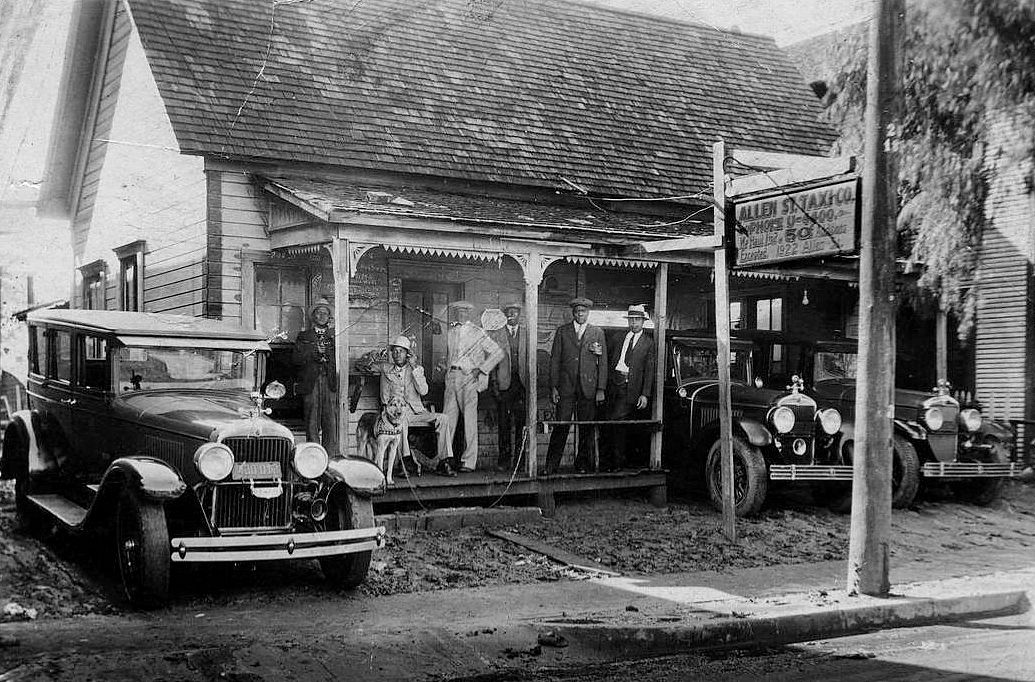
allen-st-taxi-co_cook-degolyerAllen St. Taxi Co. / George W. Cook Collection, SMU

by Paula Bosse

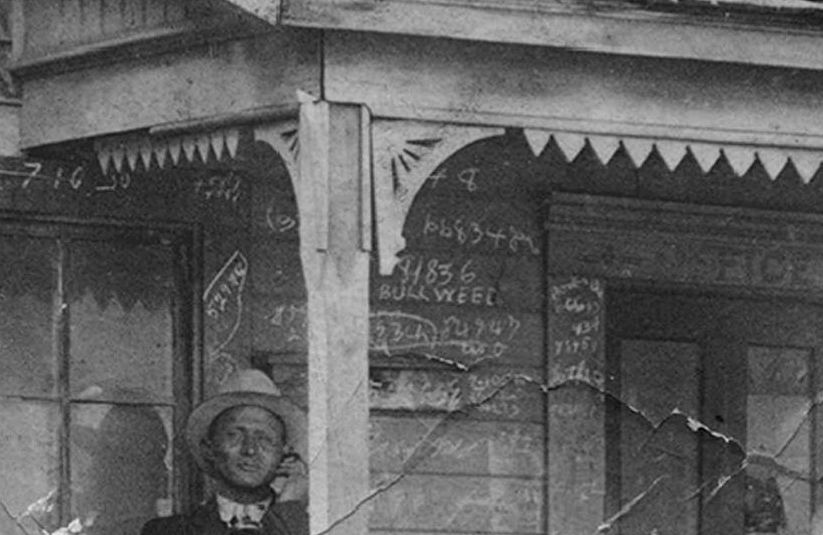
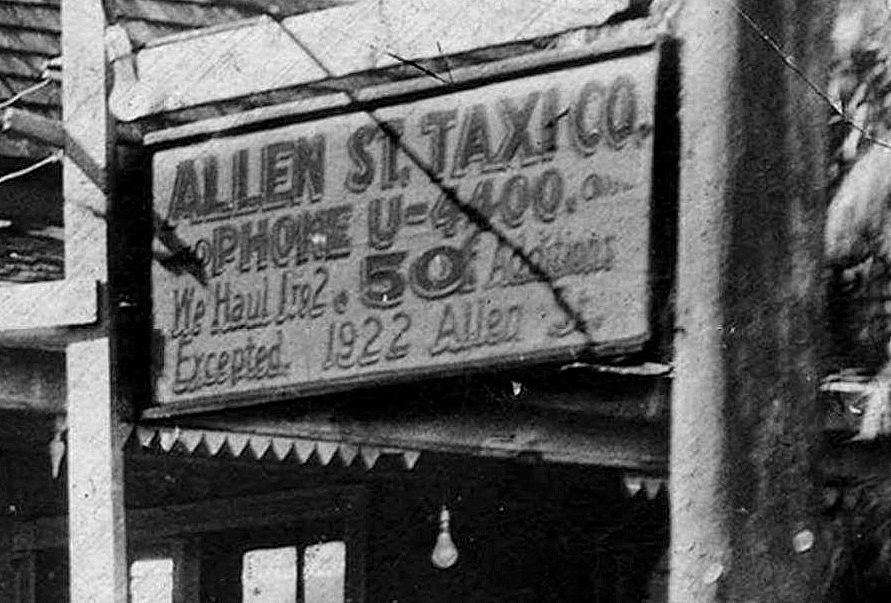
This has to be one of my favorite “unknown Dallas” photographs that I’ve come across. It shows the Allen St. Taxi Co. — in the State-Thomas area — at 1922 Allen Street (now pretty much vacant land under the Woodall Rodgers freeway). My ability to date cars is not good, but from city directory information, it seems that this photo might date from somewhere between the mid-1920s to around 1930. The owners/proprietors of the company were listed as John Leonard and Andrew Short in the 1929 telephone book. I wonder if they are in this fantastic photo? Let’s look a little more closely at some of the details. (All pictures larger when clicked.)

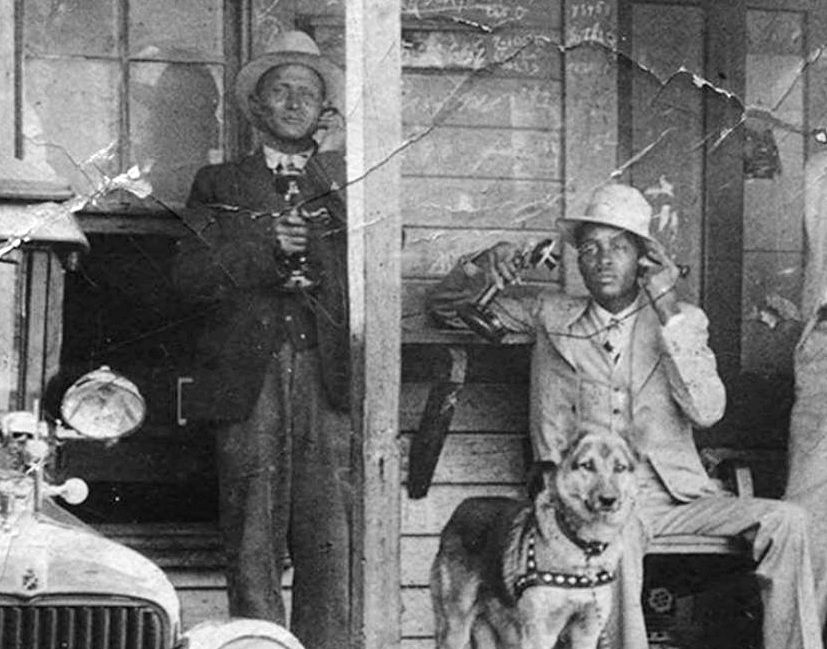
allen-st-taxi-co_cook-degolyer_det2Those phones!

allen-st-taxi-co_cook-degolyer-det4I love these guys. All business.

allen-st-taxi-co_cook-degolyer_det5“Bullweed.” What is all this writing? I love the guy’s face looking out of the window.

allen-st-taxi-co_cook-degolyer_det1“Dallas.” Car-people know exactly what make and model this vehicle is. …I am not one of these people.

allen-st-taxi-co_cook-degolyer_det3

***

Sources & Notes

Top photo, titled “Allen Street Taxi Co.,” is from the George W. Cook Dallas/Texas Image Collection, DeGolyer Library, Central University Libraries, Southern Methodist University; it can be viewed here.

The first “official” listing of the Allen St. Taxi Co. was in the 1929 city directory. The address at that time (which usually reflected information supplied the previous year) was 1907 Allen St. It didn’t appear again in the directory until 1932 when it was listed at 2816 Juliette St. In 1933 and 1934 it was listed at 2114 Hall St. In 1936 and 1937 it had moved to 2217 Hugo. And in 1938, the taxi part of the business seems to have fallen by the wayside, and it became Allen St. Transfer.

In 1925 there were only three official cab companies listed in the city directory. But the rough-and-tumble world of taxi cab service in the unregulated ’20s and ’30s was pretty intense. There were a lot of unlicensed jitneys rolling around town, especially, one would assume, in the segregated black neighborhoods of the city unlikely to be served by white-owned companies. My guess is that this might have been how the Allen St. Taxi Co. began.

For more on the go-go-go competitive world of taxi service at this time, see my previous post, “Washington Taxi Company: ‘Call George!'” here.

*

Copyright © 2015 Paula Bosse. All Rights Reserved.

The Dunbar Branch: Dallas’ First Library for the African-American Community, 1931-1959

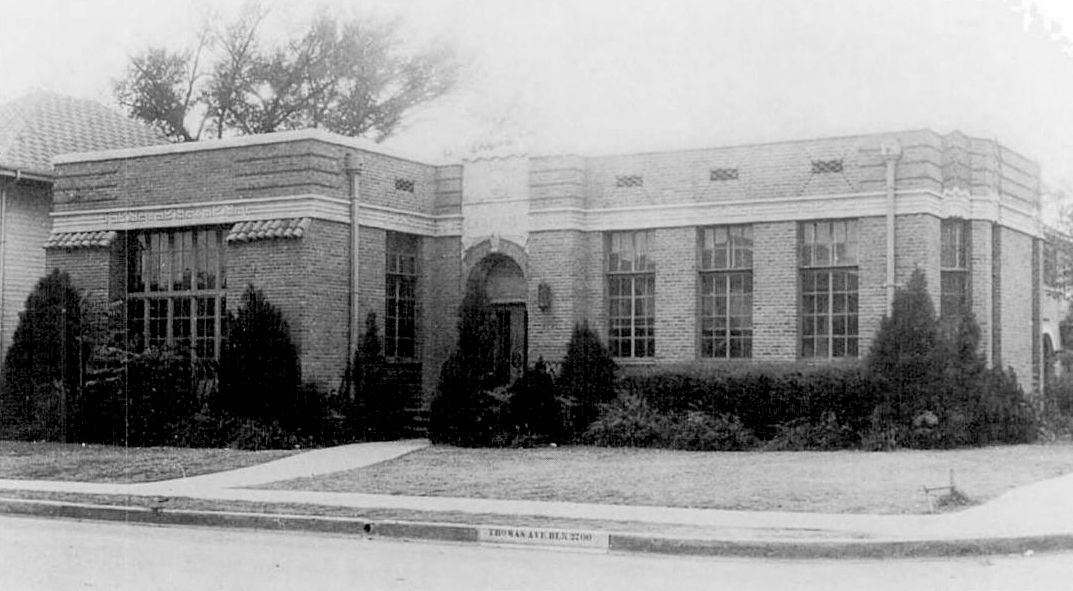
dunbar_hazel_dpl-bkThe Paul Laurence Dunbar Branch of the Dallas Public Library

by Paula Bosse

The Paul Laurence Dunbar Branch of the Dallas Public Library was the first library in Dallas to welcome and serve the African-American community. It opened in June, 1931 at the northwest corner of Thomas and Worthington in what was then the predominantly black neighborhood of “North Dallas” (the area is now known as “Uptown”), a thriving business and residential neighborhood which was home to everyone from the city’s black professionals who lived in large, lovely gingerbread-style houses, to middle- and lower-class black families who lived in more modest homes.

This was a time when almost every aspect of life was racially segregated — the grand downtown Carnegie Library was expressly off-limits to non-whites, and few of the black schools had any sort of functioning library. It was a long, hard bureaucratic battle of petitioning the city, the state, the Carnegie corporation … anyone … for a library which the city’s woefully underserved black citizens could call their own. It took years until the powers-that-be gave the go-ahead to finally build one. The building was designed by Dallas architects Ralph Bryan and Walter Sharp.

The charming one-story, brick-and-reinforced-concrete building was very, very popular and was a source of pride in the community. And it was beautiful!

dunbar_ref-and-reading-rm_hazelThe reference and reading room

dunbar-lib_hazel_062931-photoOpening-day crowds, June 1931

dunbar-children_hazel_1949Children in costumes to celebrate National Book Week, Nov. 1949

Even though the photo featured in the ad below is very grainy, it’s still kind of cool (from 1958, one year before the branch closed).

dunbar-branch-library_lincoln-high-school-yrbk-ad_19581958 Lincoln High School yearbook

dunbar-branch-library_lincoln-high-school-yrbk-ad_1958-det

In the late 1940s, construction began on Central Expressway. Unfortunately, this much-needed highway cut right through the heart of the North Dallas/State-Thomas/Freedman’s Town area. The destruction of many of the area’s buildings and displacement of many of its residents was a devastating blow to the African-American community who lived, worked, and shopped there. That and other economic forces led to the eventual dispersal of the area’s black population to other parts of the city. By the 1950s, the library had lost many of its core patrons, and in 1959 the Dunbar Branch closed. At some point that beautiful building, located just a few blocks south of McKinney Avenue, was demolished. The historic State-Thomas area has now been almost completely obliterated as “Uptown” has taken over. And another part of the city’s history has been lost.

***

Sources & Notes

All photos are from the book Dallas Public Library, Celebrating a Century of Service 1901-2001 by Michael V. Hazel (Denton: University of North Texas Press/Friends of the Dallas Public Library, 2001); photos are presumably from The Texas/Dallas History & Archives Division of the Dallas Public Library.

Hazel’s chapter on the Dunbar Branch is well worth reading. Not only is it interesting (and kind of shocking) to learn the lengths to which the black community had to go simply in order to have access to a library system which their tax dollars were helping to support, but there are also more wonderful photos like the ones above. The Dunbar chapter is accessible here.

Two articles of interest from the archives of The Dallas Morning News:

  • Description of the planned new “Negro branch” library (DMN, Aug. 15, 1930)
  • “City Plans To Sell Building” (DMN, May 15, 1959) — on the decision to close the branch and sell the building

The library’s (white) architects, Ralph Bryan and Walter Sharp also designed the nearby Moorland YMCA — it was built at almost the same time as the library, and, hallelujah, that building still stands, currently housing the Dallas Black Dance Theatre. A few years later Sharp designed Lincoln High School in South Dallas. All in all, these architects were responsible for three extremely important buildings that served Dallas’ black citizens.

Paul Laurence Dunbar (1872-1906) was one of the first nationally prominent African-American writers; more about him, here.

There is another Dunbar branch library in the Dallas Public Library system — the website for the Paul Laurence Dunbar Lancaster-Kiest Branch Library is here.

*

Copyright © 2015 Paula Bosse. All Rights Reserved.
MLK in DFW — 1959

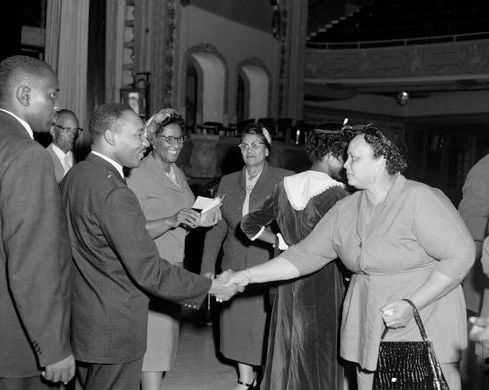
mlk-DFW-102259_calvin-littlejohn_briscoeDr. Martin Luther King, Jr. in DFW (photo © Calvin Littlejohn Estate)

by Paula Bosse

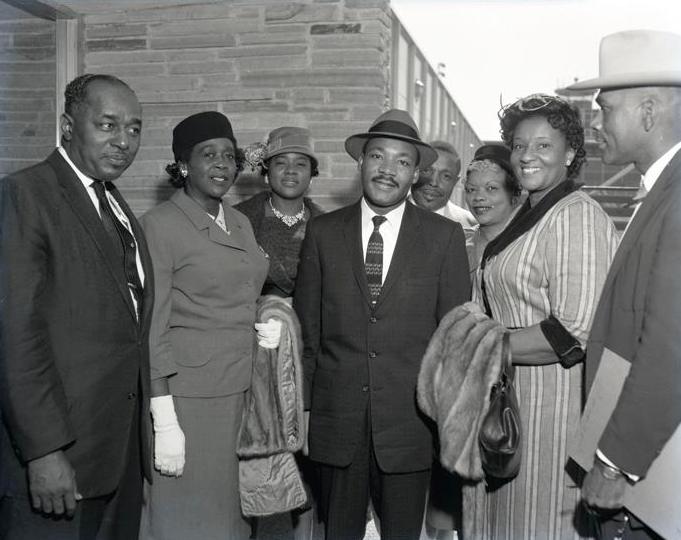
A couple of photos of Dr. Martin Luther King, Jr. on a quick trip to Dallas and Fort Worth in late October, 1959, taken by the wonderful Fort Worth photographer Calvin Littlejohn. The above photo is from Oct. 22, 1959 and was, I believe, taken after his speech at the Majestic Theatre in Fort Worth. Below, a photo of Dr. King taken at Love Field.

mlk_love-field_calvin-littlejohn_1959

***

Sources & Notes

Top photo by Calvin Littlejohn, from the Littlejohn Photographic Archive, Dolph Briscoe Center for American History. Mr. Littlejohn took several photos of Dr. King that visit, the locations of which are listed here — giving a good indication of the itinerary of the visit. I saw no mention or coverage of this visit in either The Dallas Morning News or The Fort Worth Star-Telegram.

Second photo from the TCU Press Facebook page.

A nice overview of Calvin Littlejohn’s career and a few of his photographs can be found here.

*

Copyright © 2015 Paula Bosse. All Rights Reserved.