Flashback : Dallas

A Miscellany: History, Ads, Pop Culture

Category: Architecture/Significant Bldgs.

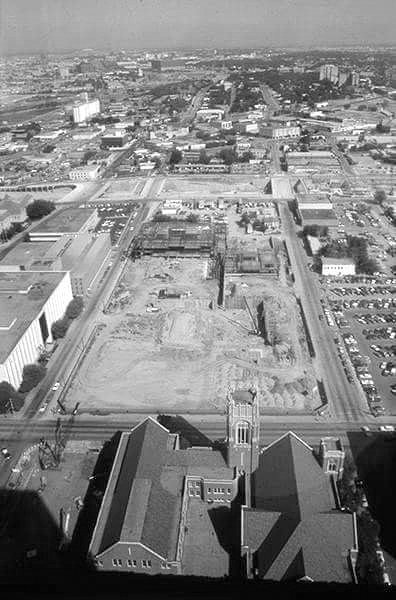
Dealey Plaza and The Triple Underpass Under Construction — 1935

dealey-plaza_triple-underpass-construction_1935_fitzgeraldCleared for construction…

by Paula Bosse

Dealey Plaza and the triple underpass were envisioned as an impressive “Gateway to Dallas” — for visitors arriving from the west, this attractive and welcoming sight would be their first impression of the city. Construction was completed in 1936 as the city was preparing for its mammoth Texas Centennial celebration. Little did anyone know back when these photos were taken in 1935 that “Dealey Plaza” and “Triple Underpass” would one day be place names known around the world and that the not-at-all remarkable Southern Rock Island Plow Co. building seen in both of these photos would become a must-see site for almost every out-of-town visitor to the city.

triple-underpass-under-construction_1935_m-c-toyerTriple Underpass and pedestrian tunnel under construction

***

Sources & Notes

The top photo, showing the cleared land that will become Dealey Plaza is from The Hayes Collection, Dallas Public Library Texas/Dallas History and Archive Division; I found it in the book Dallas Then and Now by Ken Fitzgerald (San Diego: Thunder Bay Press, 2001).

Bottom photo showing the “triple underpass and south pedestrian tunnel under construction” was posted by M. C. Toyer in a very interesting Phorum discussion on this area (with a lot of great photos), here.

Below are related Flashback Dallas posts:

  • More on Dealey Plaza can be found here.
  • More on the Triple Underpass can be found here.
  • More on the John F. Kennedy assassination can be found here.

*

Copyright © 2015 Paula Bosse. All Rights Reserved.

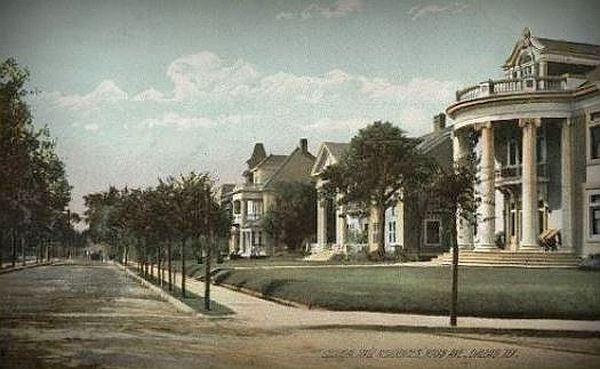
The Beginning of the End for Ross Avenue’s Downtown Mansions — 1925

construction_jan-1925Mansions across from First United Methodist Church, Jan. 1925

by Paula Bosse

The First Methodist Episcopal Church, South (now First United Methodist Church of Dallas) was built in 1924 and 1925 at Ross and North Harwood. It was a large undertaking, and its construction meant that three of the four very large houses in the 1900 block of Ross Avenue, between North St. Paul and North Harwood, had to be demolished, including the house built by Mrs. Miranda Morrill in 1886 at the southwest corner of Ross and Harwood.

morrill-house_lost-dallas_doty_dmn

For many years, large houses like this — owned by the city’s wealthiest bankers, industrialists, and real estate men — lined Ross Avenue, just to the north of the central business district. But by the 1920s, more and more non-residential development began to encroach into this part of town.

The photograph at the top is pretty amazing, because it shows some of those grand houses in their last days. The north side of the 1900 block of Ross (the block now occupied by the Dallas Museum of Art) contained four lots. In the 1925 construction photo above, there are three houses and a business.

ross-houses_1925

In the detail above, at the far left we see the home of land baron William Caruth (in the book Dallas Rediscovered, William L. McDonald called this little pied-à-terre his “townhouse”) — for decades it sat at the northeast corner of Ross and St. Paul (which had previously been named Masten). Next to it is something that looks like scaffolding or a tower (what is that? — is it a photographer’s perch to document the construction?). Next to it is another grand house, home of several wealthy occupants over the years. And then … a car dealership and garage. How this happened is a mystery, but this 1921 building — which replaced a beautiful house and which sticks out like a sore thumb — belonged to the Flippen Auto Co., complete with showroom on the ground floor and garage and repair facilities on the second floor — it may have had one of the first car elevators in town.

Next to the Flippen Auto Co. was the grandiose Conway House, with its columns and portico; it was built around 1900 at the northwest corner of Ross and Harwood and was the childhood home of pioneer female fashion illustrator Gordon Conway. In 1921 — after a few years as a music conservatory — it became the home of the Knights of Columbus.

conway-house_ross-harwood_ca1902_mcdonaldConway House, about 1902

And here’s a photo showing both the Flippen Auto Co. and part of the former Conway House.

flippen-auto_park-cities-photohistory_galloway

On the northeast corner of Ross and Harwood, we can see a large house facing Harwood. Forget the house — on that corner was a tiny little gas station. And glory be, I stumbled across a great photo of the Acme Oil & Supply Co. complete with Texaco pump — probably from around 1919 or 1920.

ross-harwood_gas-station_greene

But back to the construction of what is now the First United Methodist Church of Dallas — a lovely building which still stands and faces the Dallas Museum of Art. Here’s a photograph of the construction from May, 1925.

construction_may-1925

And here is the postcard filled with an artist’s conception of people to-ing and fro-ing.

methodist-episcopal-church_ebay

methodist_postcard

And, finally, an aerial view taken above the church in the early 1980s, looking north, showing the same block once bookended by the Caruth and Conway mansions, now leveled to make way for the Dallas Museum of Art.

dma-under-construction_1984

I think I prefer the view from 75 years earlier.

ross-avenue_ca1910

***

Sources & Notes

The two photos taken in 1925 during the construction of the church are from the book Church at the Crossroads, A History of First United Methodist Church, Dallas (Dallas: UMR Communications, 1997); the entire book has been scanned and may be viewed at Archive.org, here (all the photos are at the end).

The photo of the Morrill house is from Mark Doty’s book Lost Dallas (Charleston: Arcadia Publishing, 2012).

Photo of the Conway House is from Dallas Rediscovered by William L. McDonald (Dallas: Dallas Historical Society, 1978).

Photo showing the Flippen Auto Co. and the Conway house from Diane Galloway’s book The Park Cities, A Photohistory.

Photo of the Acme gas station is from Dallas: The Deciding Years by A. C. Greene (Austin: Encino Press, 1973).

The construction of the First Methodist Episcopal Church, South was announced in a Dallas Morning News article on Oct. 5, 1924.

methodist_dmn_100524

All that’s left of those grand homes is the Belo Mansion. It’s something!

Click pictures to see larger images.

*

Copyright © 2015 Paula Bosse. All Rights Reserved.


The Republic Bank Building’s Death-Ray Beacon

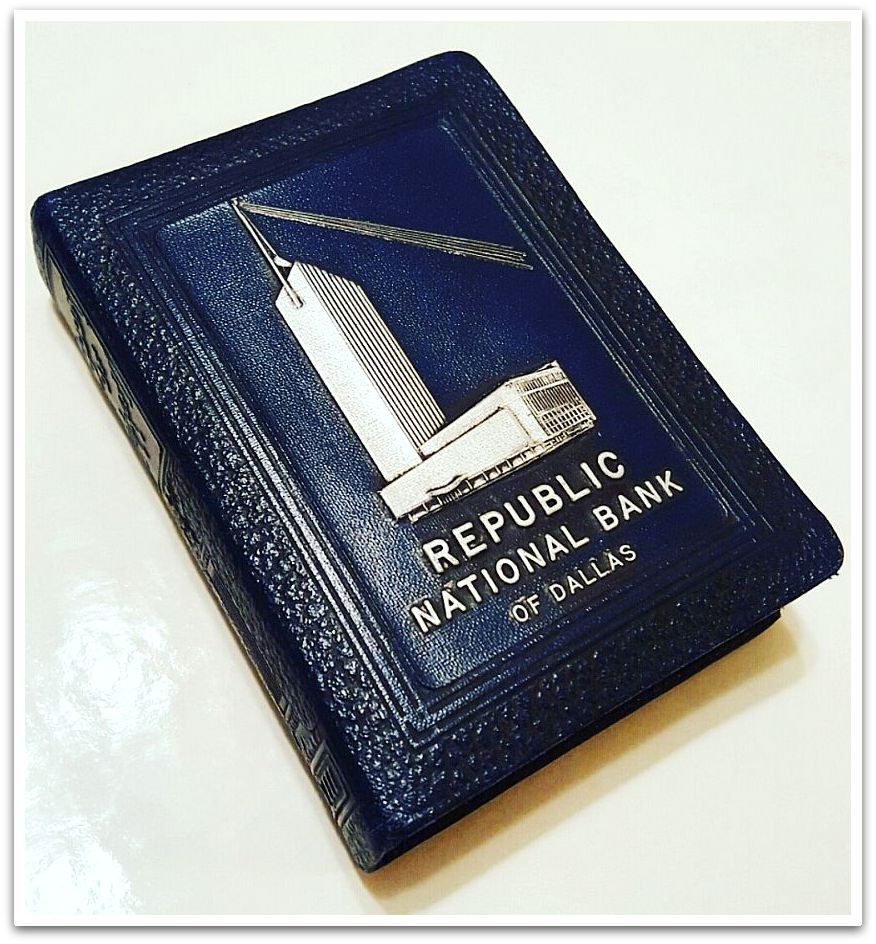
repub-natl-bank_book-bankThis novelty bank is WAY cooler than a toaster! (photo: Paula Bosse)

by Paula Bosse

I’m not a big collector of things, but when I saw this little book-shaped bank, probably a promotional item given away by the Republic National Bank in, I would guess, the 1950s, I really wanted it. I love that building, and I especially love images showing that powerful sci-fi-looking beacon on top of it.

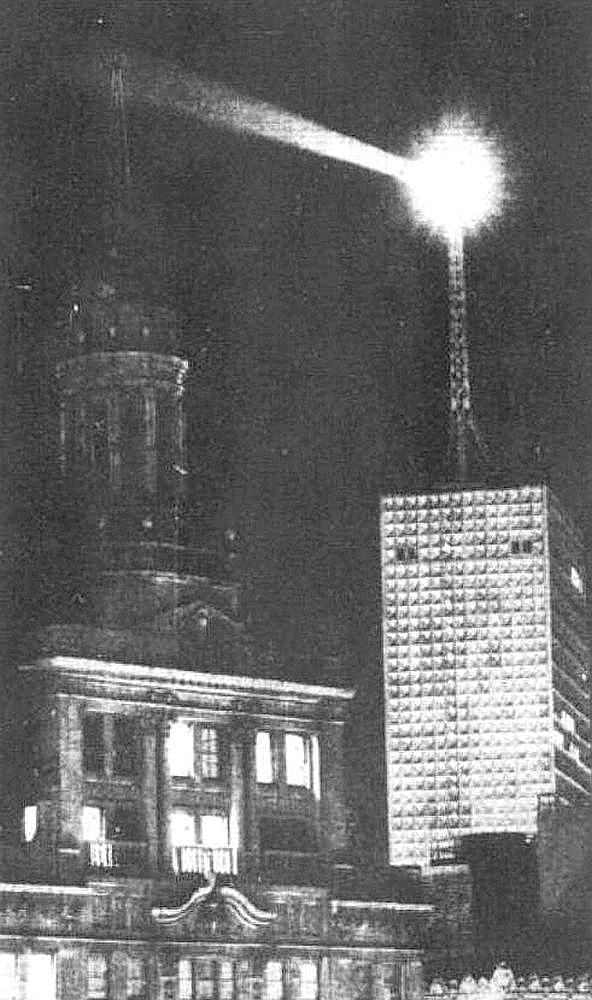
About that beacon. I’ve never actually seen a photograph of that thing in action … until today. Here is a great photo (I’d love to see the original…) during a test-run of the blinding searchlight. (The Davis Building — previous home of Republic National Bank — is seen at the left.) (Click to see larger image.)

beacon_mid-50s

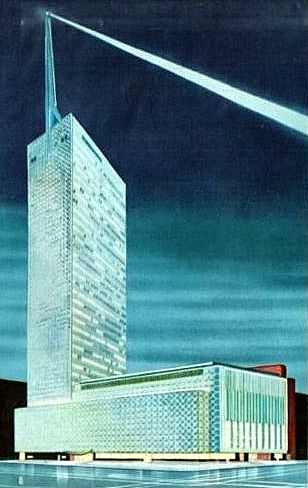
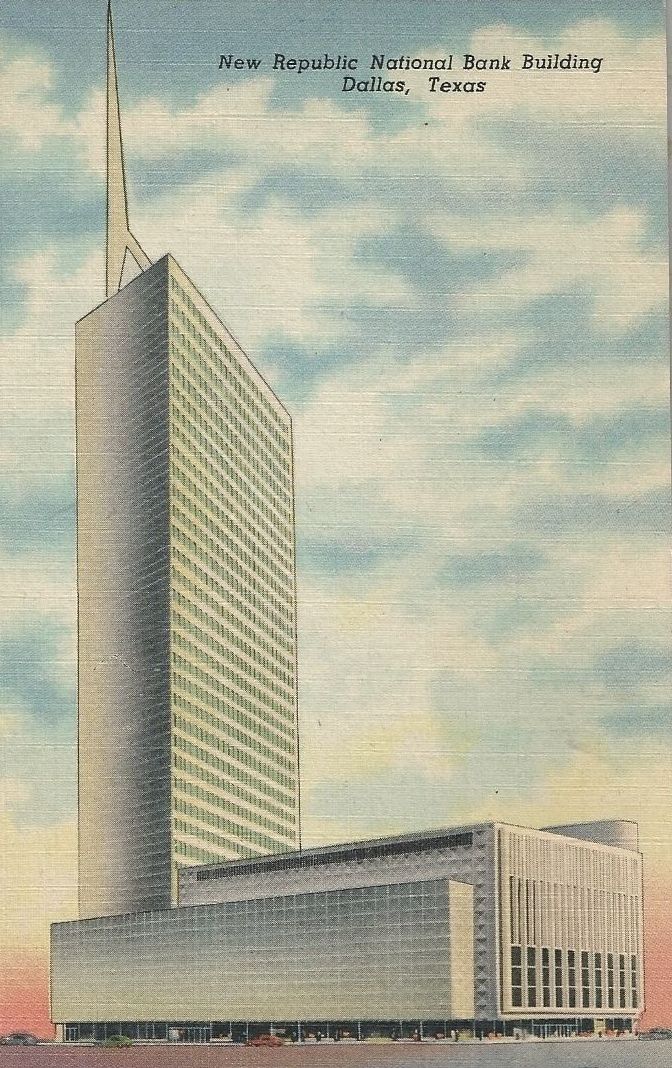
When the Republic Bank Building opened in December, 1954, it was Dallas’ tallest building — helped out by the added oomph of that rocket on top. In an article detailing the specifics of the building, was this:

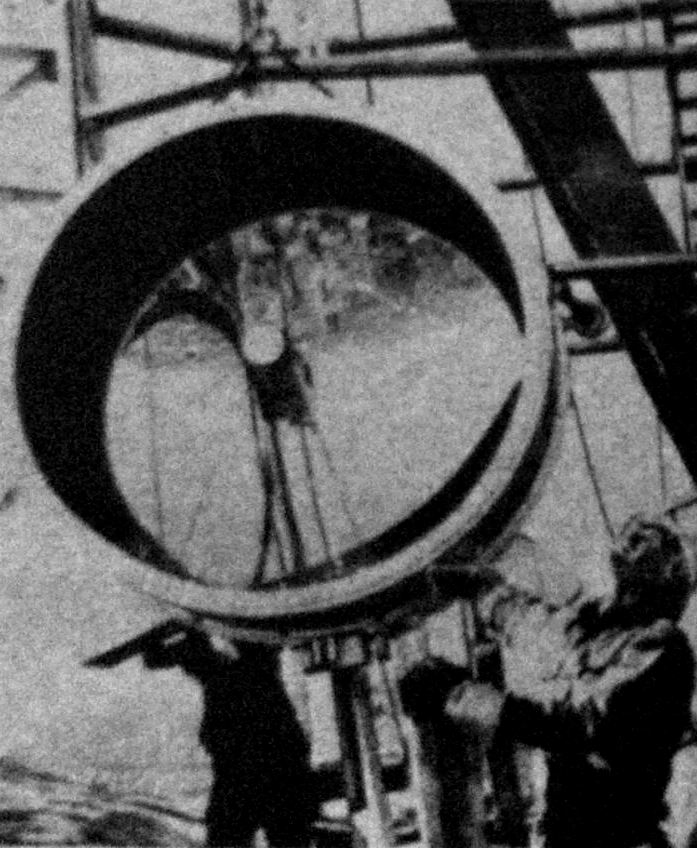
The 150-foot ornamental tower […] supports a beacon light with a lens five feet in diameter. The rotating light of almost a half-billion candlepower was designed for visibility of 120 miles. (DMN, Nov. 28, 1954)

Wow. I don’t even know what “half-billion candlepower” IS, but I bet it cut through the night sky like a hot knife through butter. And visible for 120 miles? …ONE HUNDRED AND TWENTY MILES?! I can’t even imagine what that death-ray must have looked like, rotating and pulsing and stabbing through the night sky probably hundreds of times every night. (I  just checked on this. The light rotated twelve times a minute, or once every five seconds. 720 times an hour! If this pace actually kept up over the years, that’s thousands of times every night!) At some point, the beacon was turned off, most likely from complaints from pilots trying to fly in and out of Love Field (possibly from Atoka, Oklahoma, which is … 120 miles from Dallas).

beacon_repub-natl-bankFive feet in diameter…

I have searched and searched to find out when the beacon/searchlight was finally turned off for good. My assumption was that it was fairly early on, because I’m sure it was a major problem for aircraft and was probably shut down at the emphatic insistence of the FAA, but when I asked around on a history group, people told me they remembered seeing it in the ’60s (a couple of people even said they thought they remembered it in the ’70s). If anyone can tell me when this beam finally stopped beaming, I would love to know.

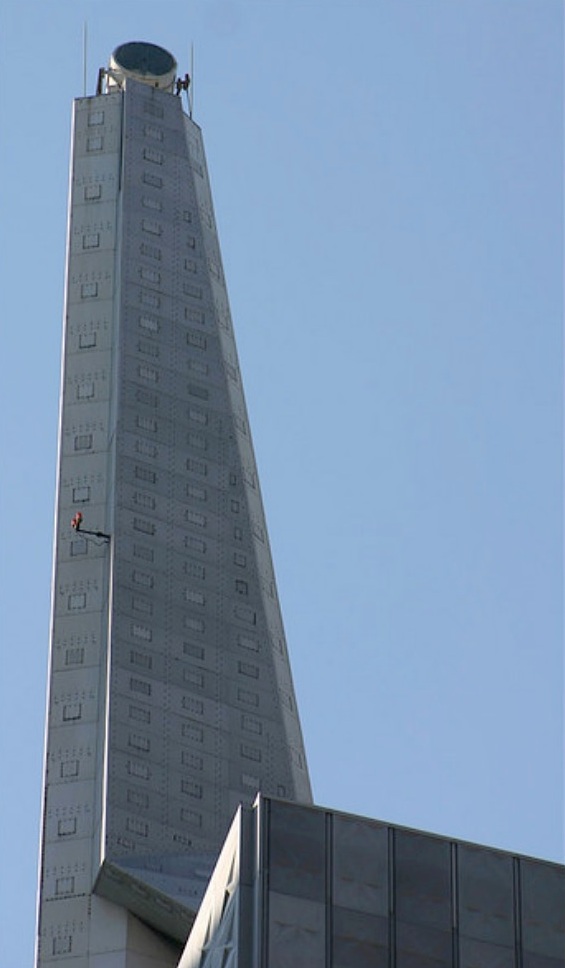
The rocket’s original red, white, and blue lights — made not of neon but of “Lumenarc” tubing (“a newly-developed, super-brilliant luminous tube” — DMN, Dec. 1, 1954) — were turned off in the 1980s, but lighting returned in the early 2000s when the building was being remodeled for residential living, and it continues to stand out as an important part of the Dallas skyline.

rocket_repub-center-websiteToday (via RepublicCenter.com)

That giant lens is still up there, and it might even still function, but the building is no longer the city’s tallest, and were it to be turned on today, that light would pierce right through neighboring buildings — not over them, but into them. If it hit you, it would be like an old cartoon where you would be able to momentarily see an x-ray image of your skeleton. Here’s a photo from 2006 in which you can see the light at the top of the rocket. (Click it!)

republic-bank-bldg_rocket_beacon_scott-dorn_2006_flickrPhoto by Scott Dorn/Flickr

There’s also a great photo of this which I included in one of my favorite Flashback Dallas posts, showing the rocket and searchlight from above, taken in 1968 from Republic Tower 2, here.

republic-national-bank_beacon_front

***

Sources & Notes

That “book bank” is mine! It’s very small — about 3.5″ x 4.5″, covered in blue cloth to mimic a book (it even has a title — “Book of Thrift” — embossed on the spine); it was manufactured by Bankers Utilities Co., which made similar novelty banks for companies all over the country. It has no key — I found one comment online that suggested that they were never issued with keys because the banking institution wanted the young owners of the banks to have to go into the bank in order to retrieve their savings — just like Mom and Dad had to. It’s a cool little bank — much better than a toaster!

Scott Dorn’s photograph can be viewed on Flickr, here.

Not sure what “candlepower” is? I read the Wikipedia article, here, but I’m still not exactly sure. Imagine the light from half a billion candles, I guess. In other words, BRIGHT. Super-cool bright. Retina-damaging bright.

The building is now Gables Republic Tower (website here), a ritzy apartment building.

And, again, if you have information about when the plug was pulled on the painfully powerful revolving spotlight, let me know!

*

Copyright © 2015 Paula Bosse. All Rights Reserved.


The Republic Bank Building and Spain’s “Casa de Los Picos”

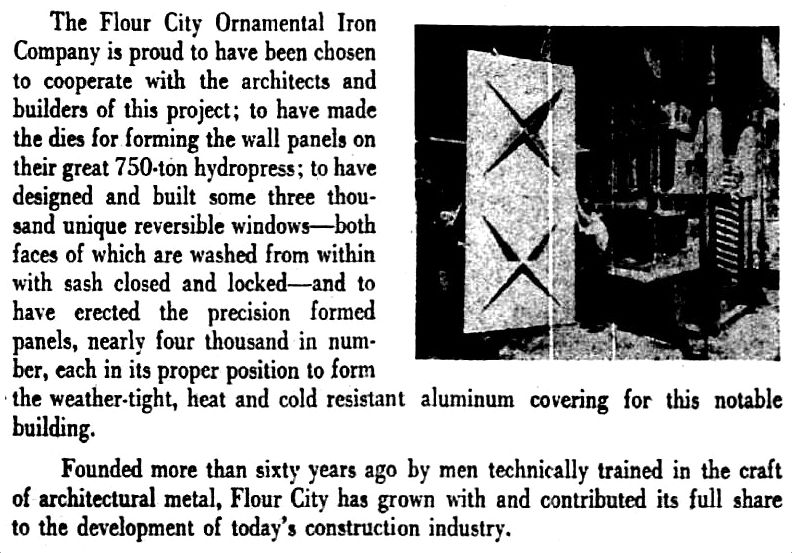
flour-city-ad_dmn_120154-panelFlour City Ornamental Iron Co. employees hard at work (click for larger image)

by Paula Bosse

Did a 15th-century building in Spain inspire one of Dallas’ most distinctive and recognizable skyscrapers?

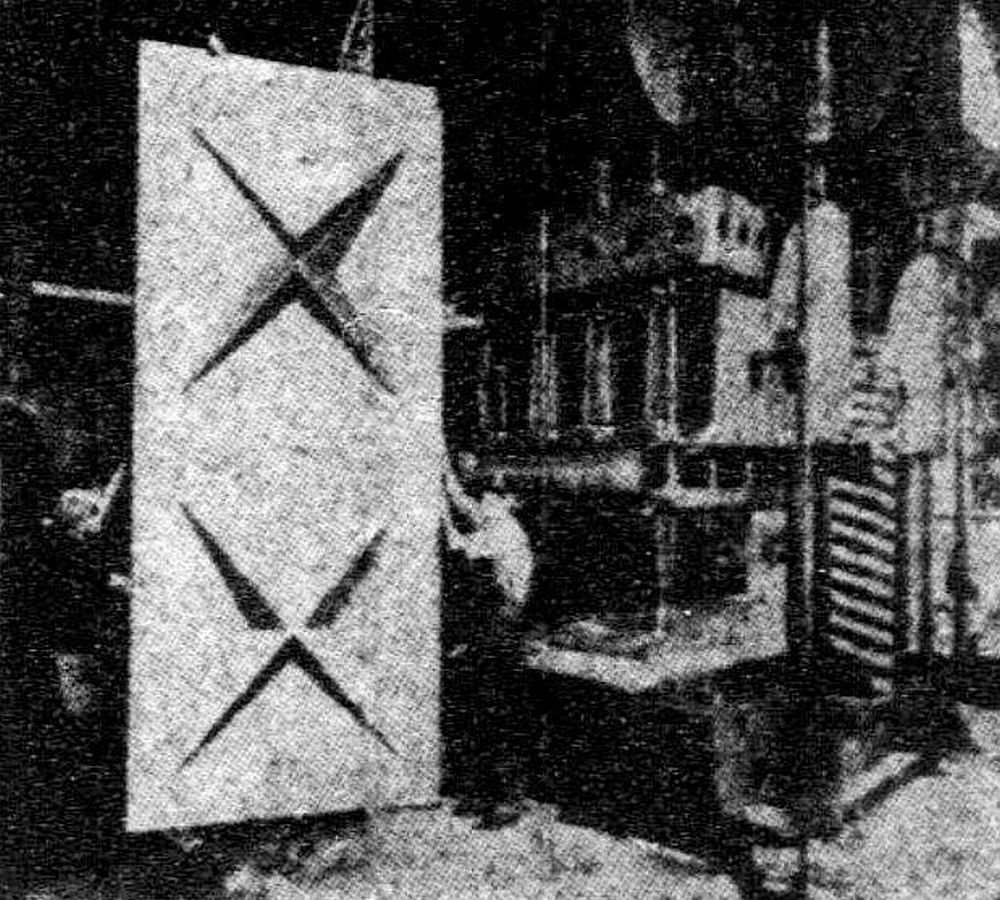
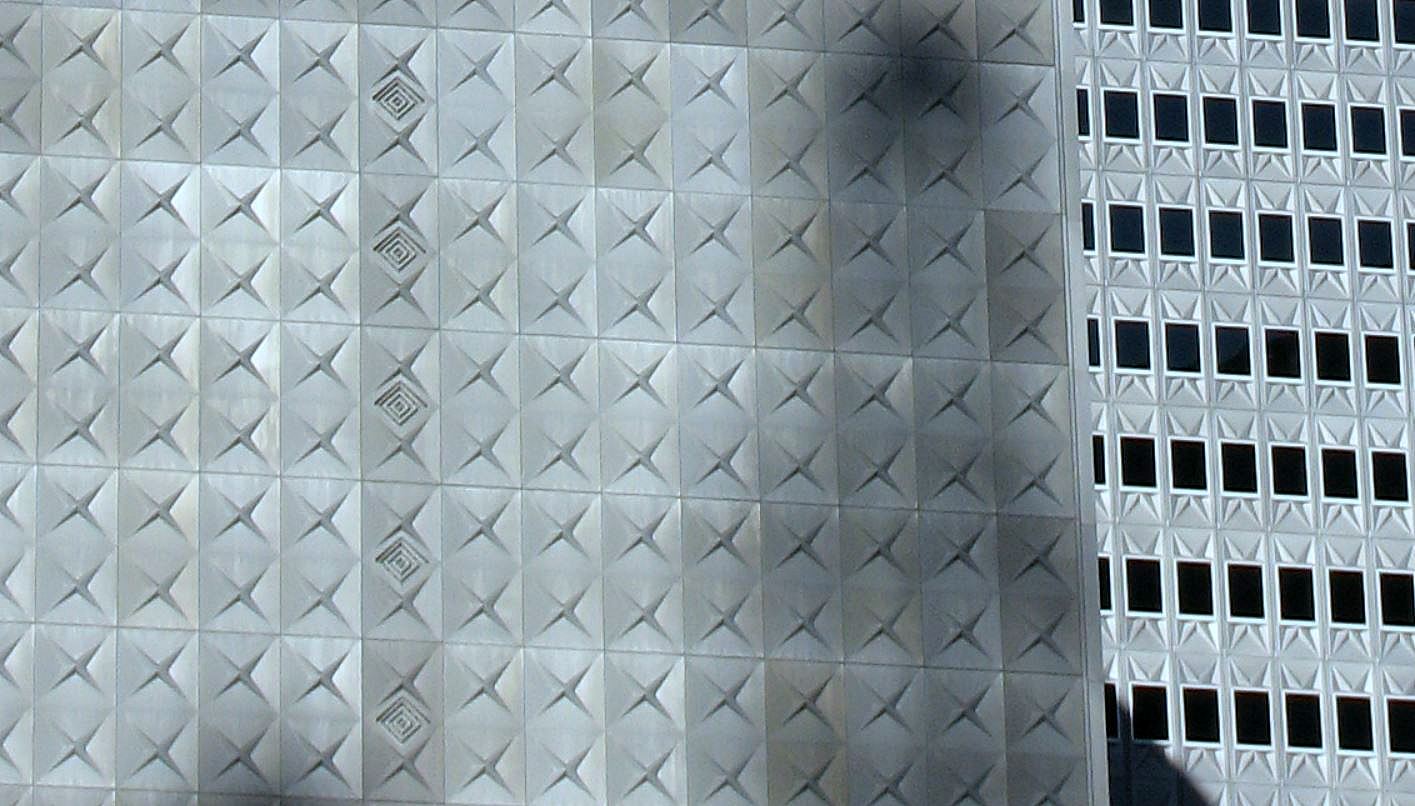
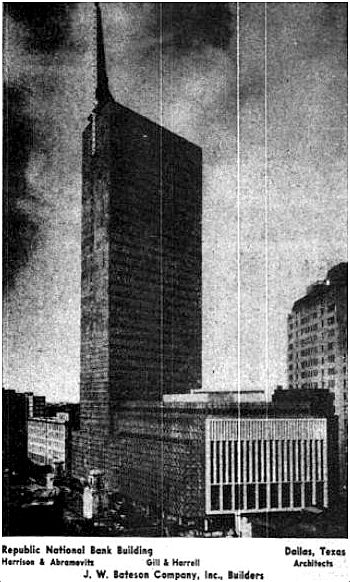
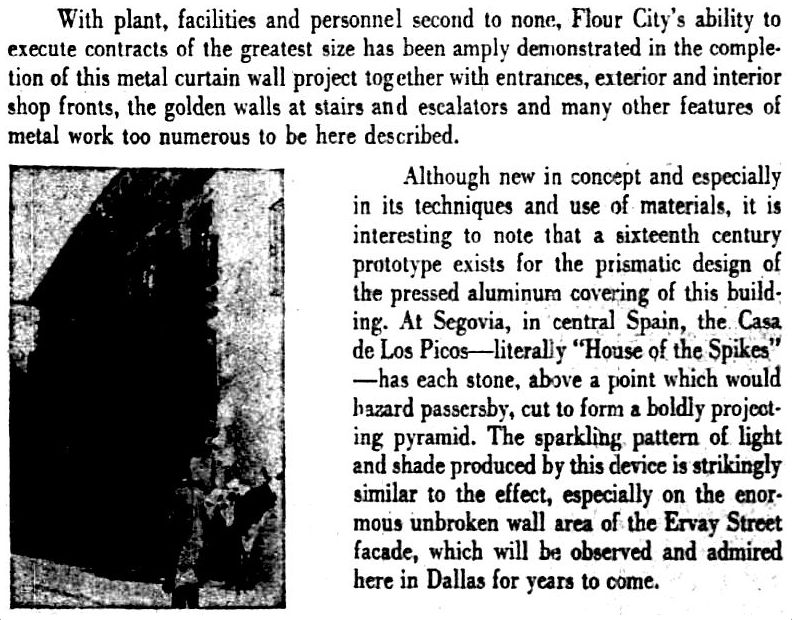
While reading about the construction of the Republic Bank Building, I came across the great, GREAT photo above which was part of an ad which ran about the time of the grand opening of the just-completed big, splashy Republic Bank Building in December, 1954. The ad this photo appeared in was for the Flour City Ornamental Iron Co. in Minnesota — the company that manufactured the thousands of pressed and embossed aluminum panels that covered the building’s exterior. These star-embossed panels — along with the distinctive and forever-cool “rocket” on the top of the building — gave the Dallas skyline a new super-modern look and an instantly recognizable landmark.

But back to that photo. It’s pretty cool. I had never really thought about those panels, but now I know that these iconic architectural adornments were manufactured in Minneapolis (…”New York CITY?!”) at the Flour City Ornamental Iron Co. Almost four thousand of these aluminum panels, a mere 1/8th of an inch thick (!), along with three thousand windows (which were reversible, so that the exterior sides could be washed from inside the building) were made in Flour City’s Minneapolis factory and transported to Dallas. From the ad:

The Flour City Ornamental Iron Company is proud to have been chosen to cooperate with the architects and builders of this project; to have made the dies for forming the wall panels on their great 750-ton hydropress; to have designed and built some three thousand unique reversible windows — both faces of which are washed from within with sash closed and locked — and to have erected the precision-formed panels, nearly four thousand in number, each in its proper position to form the weather-tight, heat and cold resistant aluminum covering for this notable building.

So, discovering that was interesting. But maybe even more interesting was this paragraph:

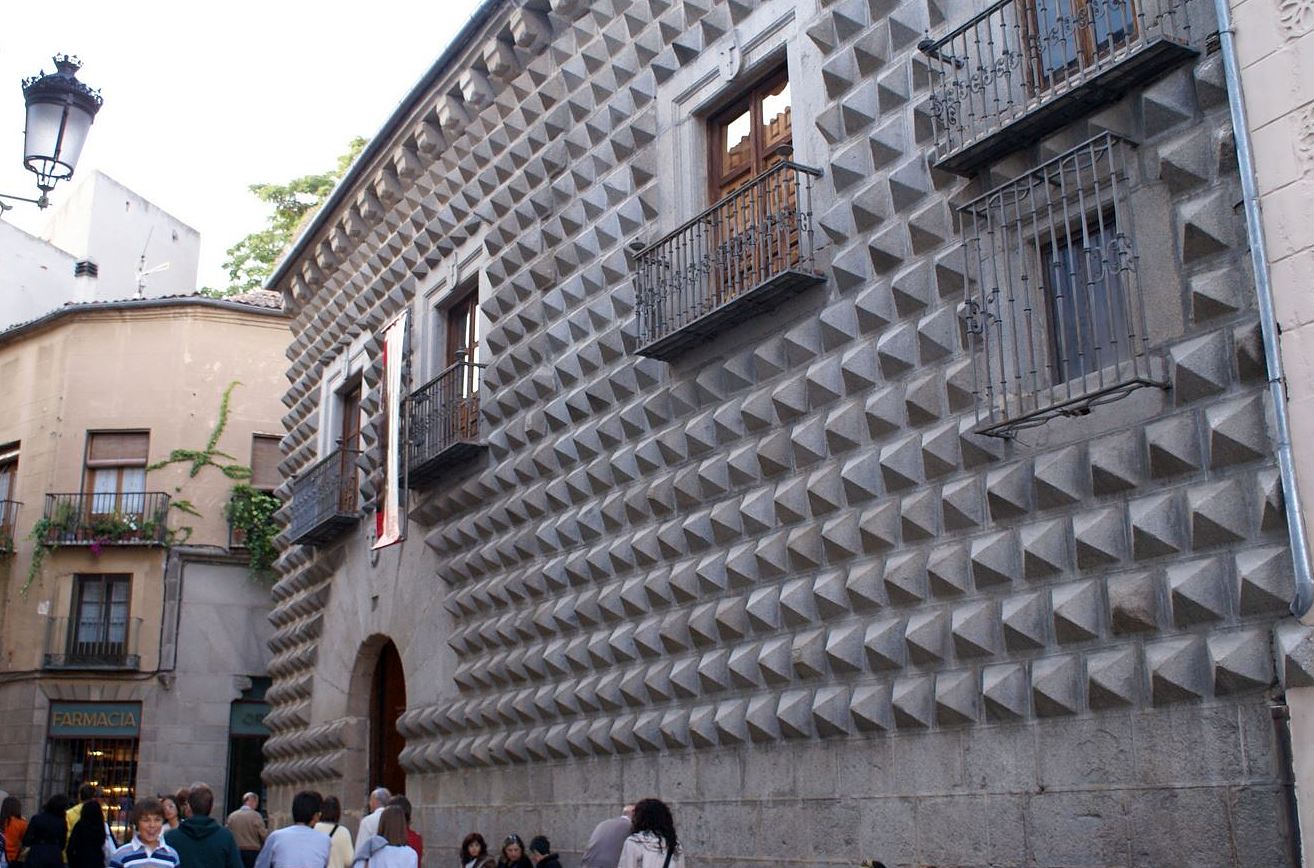
Although new in concept and especially in its techniques and use of materials, it is interesting to note that a sixteenth century [sic — it’s actually fifteenth century] prototype exists for this prismatic design of the pressed aluminum covering of this building. At Segovia, in central Spain, the Casa de Los Picos — literally ‘House of the Spikes’ — has each stone, above a point which would hazard passersby, cut to form a boldly projecting pyramid. The sparkling pattern of light and shade produced by this device is strikingly similar to the effect, especially on the enormous unbroken wall area of the Ervay Street side, which will be observed and admired here in Dallas for years to come.

I looked up Casa de Los Picos. It’s fantastic.

casa-de-los-picos_trover-websiteCasa de Los Picos, Segovia, Spain / via Trover.com

Was this design an homage of sorts to the Spanish building, conceived by the building’s main architects, Wallace K. Harrison and Max Abramovitz of the New York firm Harrison & Abramovitz? Or was it just Flour City exaggerating their work’s architectural significance? Whichever — I’m excited to have discovered Casa de Los Picos … because of an advertisement! I love this building — here it is again.

casa-de-los-picos_wikimediaWikimedia (click for gigantic image here)

And here’s an extreme close-up of the hometown favorite.

panels_wikimedia-detWikimedia (see a fuller image image here)

You learn something new every day.

Here’s the original 1954 Flour City advertisement, broken into readable sections (click for larger images).

ad-flour-city_dmn_120154a

ad-flour-city_dmn_120154b

ad-flour-city_dmn_120154c

ad-flour-city_dmn_120154d

ad-flour-city_dmn_120154e

republic-national-bank

***

Sources & Notes

Wikipedia round-up:

  • Flour City Ornamental Iron Works Company, here
  • Casa de Los Picos (en Español), aqui
  • Harrison & Abramovitz, architects, here
  • Republic Bank Building, here

See a whole passel of photos of the exterior of Case de Los Picos, here.

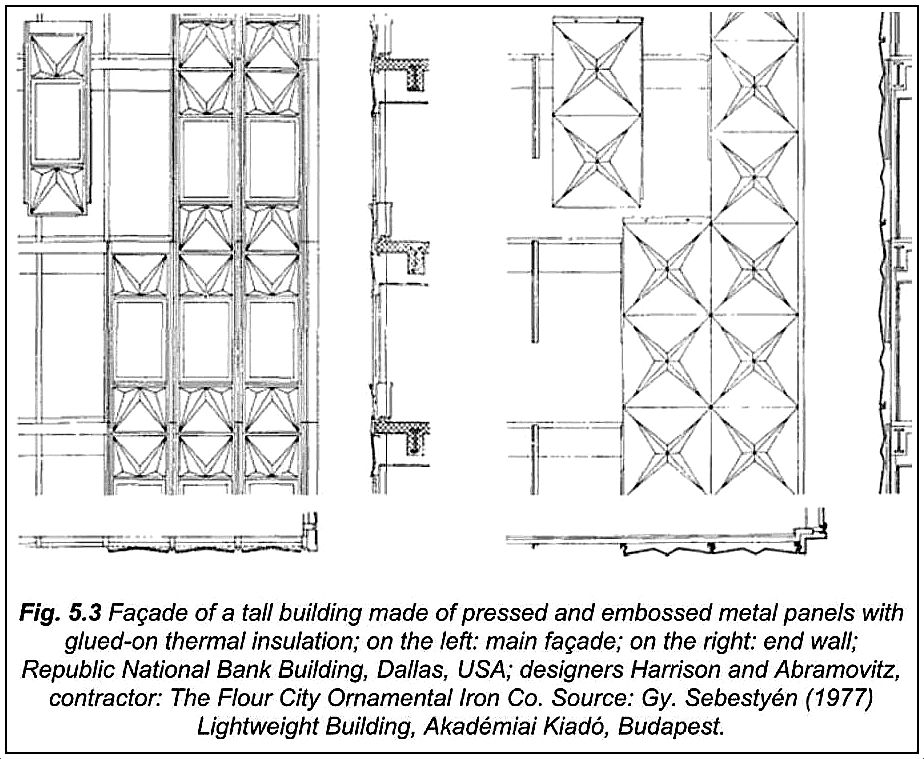
Here’s something I stumbled across in the middle of stumbling across other things — a schematic of the aluminum panels — I don’t know if they are original architectural drawings or not. They are contained in the book Construction, Craft to Industry by Gyula Sebestyen (London: E & FN Spon, 1998); you can find it here.

panel-details_construction-craft-to-industry_

I found surprisingly little information on Flour City’s contribution to the Republic Bank Building on the internet. Anyway, thanks, Minnesota, for playing such an important role in the construction of — and look of — one of my favorite Dallas buildings!

My previous post on this great building — “The Republic National Bank Building: Miles of Aluminum, Gold Leaf, and a Rocket” — is here.

When in doubt, click pictures for larger images.

*

Copyright © 2015 Paula Bosse. All Rights Reserved.


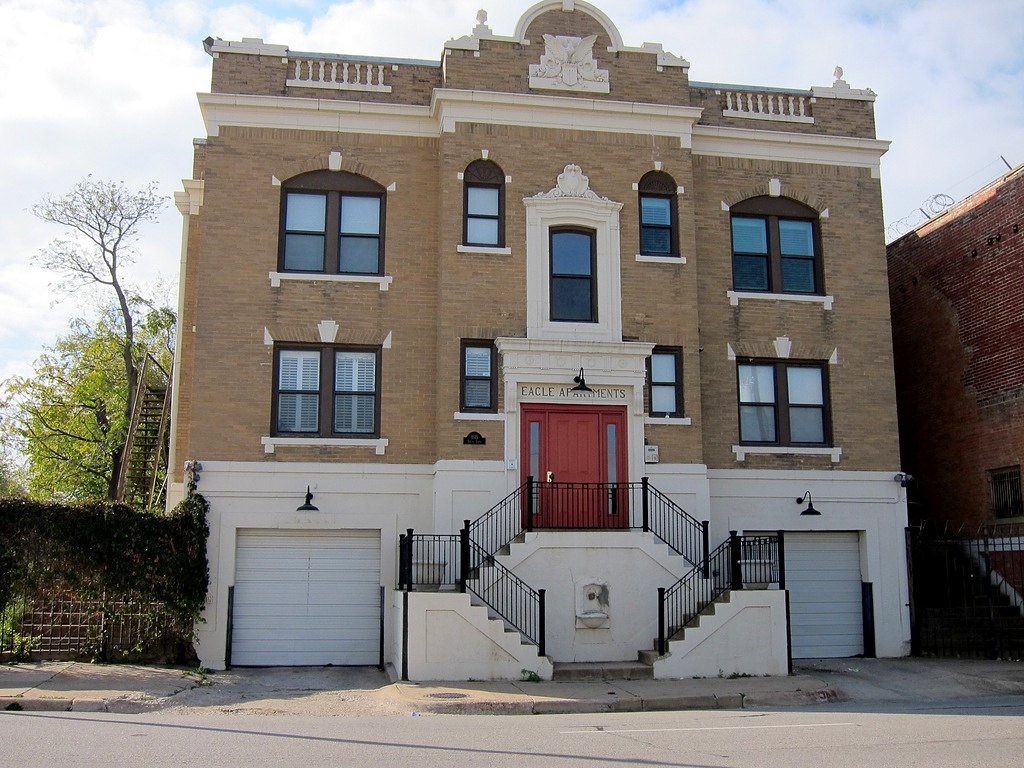
1615 South Ervay: The Eagle Apartment Building

1615-s-ervay_zillowThe Eagle, today (click for larger image) / Photo: Zillow

by Paula Bosse

Whenever I drive along South Ervay, I always slow down — or pull over — to take a look at this building. It doesn’t look like anything else around it, and I’ve wondered about it from the first time I saw it.

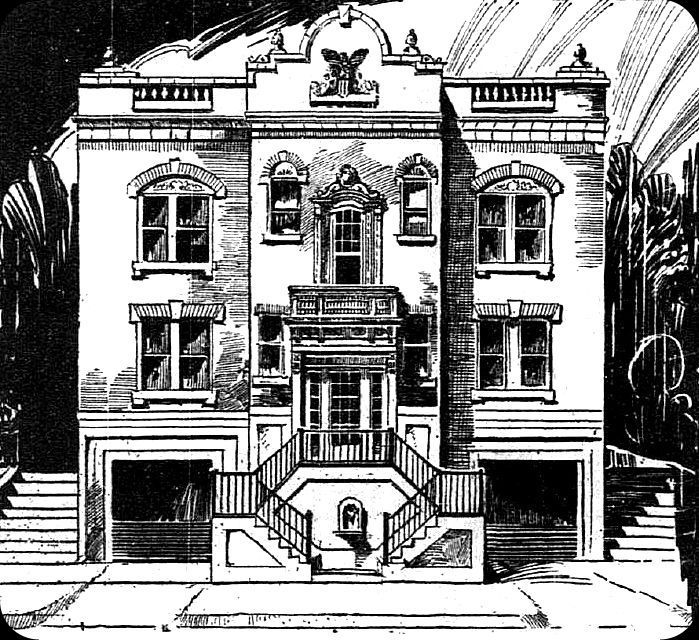
It was built in 1924 and was announced in a newspaper advertorial beneath the headline “New Apartment Building on South Ervay Street to Have Garage Space in Basement.” It was accompanied by a drawing of a fairly grand-looking building.

1615-s-ervay_dmn_0622241924

This new apartment building at 1615 South Ervay street, now being completed by George Kean, embodies many new and novel features in the construction of buildings of this character, one of these being provision of garage space for tenants in the basement. The building will contain eight four-room apartments and sixteen two-room efficiency apartments. J. W. Lindsley & Co. are leasing agents, and contract has been given to Sanger Bros. for furnishings of the building.

A basement garage for a small apartment building like this was pretty unusual for the time. And when they said Sanger’s was supplying the furnishings, they meant everything from furniture down to bed linens and kitchen utensils!

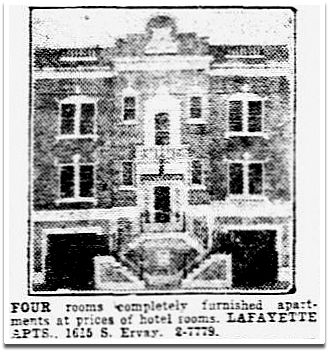
The first “for rent” ads began appearing a week after this announcement. Below, the photo and text of an ad from June 29, 1924.

eagle-apts_dmn_062924-deteagle-apts_dmn_062924-textJune, 1924

Hey, I’d take a look!

But renting’s for chumps — how about owning the entire building? (“Can care for 50 cars”!)

eagle-apts_dmn_080324Aug., 1924

Below, an ad with rates and a bit more info (it sounds like all units had a Murphy bed — even the apartments with a bedroom):

eagle-apts_dmn_071225July, 1925

They were kind of pricey. According to the Inflation Calculator, prices in today’s money would be about $825-$900 for a 2-room efficiency, and about $1,225-$1,375 for a 4-room apartment.

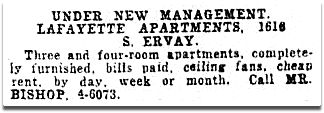
By the fall of 1931, the building had changed hands, was under new management, and had been re-named. It was now the Lafayette Apartments, and units were now being rented “by day, week or month.”

lafayette_dmn_100131Oct., 1931

lafayette-apartments_dmn_101532Oct., 1932

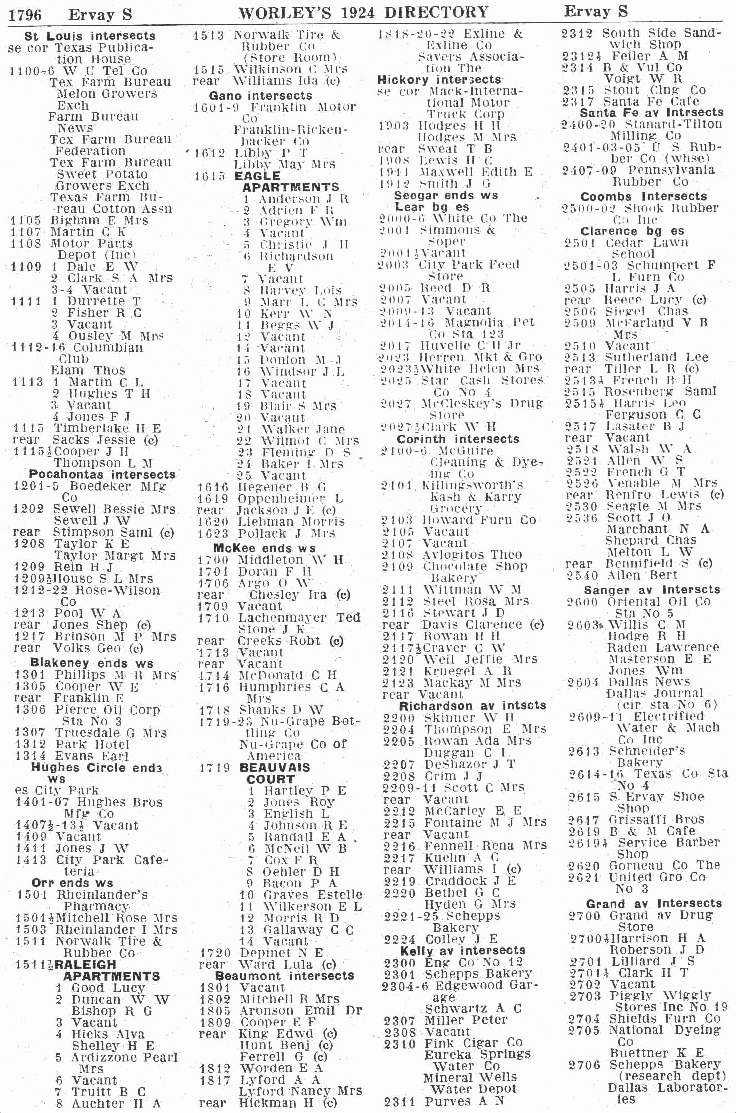
Today this stretch of South Ervay is not the crowded and busy thoroughfare it once was. Though there were several businesses and small industrial buildings, it was also a residential area, lined with houses, apartment buildings, and the large Park Residence Hotel (better known in recent years as the Ambassador Hotel). The Eagle apartment building is in the 1600 block of South Ervay — when it opened in 1924, there were also apartment buildings in the 1500 and 1700 blocks. It’s interesting to take a look at a page from the 1924 city directory to see who and what occupied this South Ervay neighborhood in 1924 (click for larger image):

south-ervay_1924-directory1924 Dallas directory

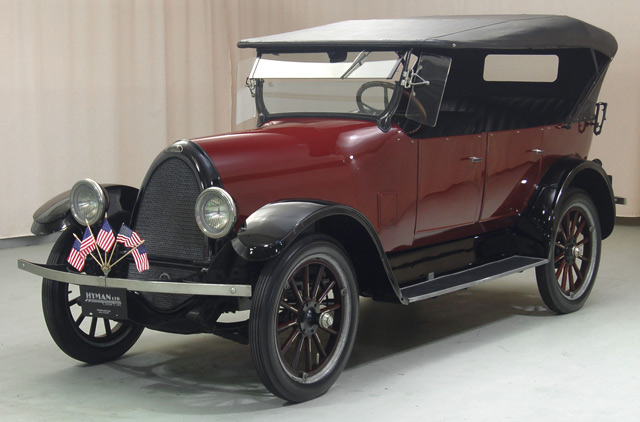
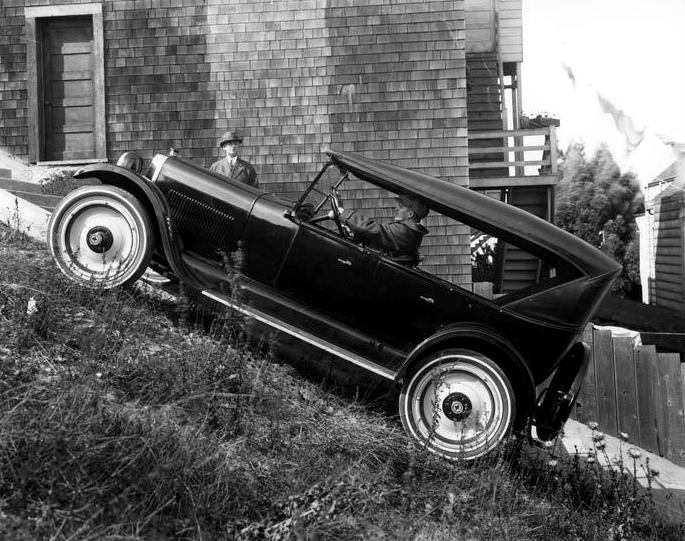
The building right next door to the Eagle Apartments was the Franklin-Rickenbacker Motor Co., a car dealership (part of the word “Franklin” can be seen painted on the brick wall in the 1924 photograph). For context, here are the automobiles that would have been for sale next door to the Eagle when it opened.

1924-franklin_secondchancegarage1924 Franklin

1924-rickenbacker1924 Rickenbacker

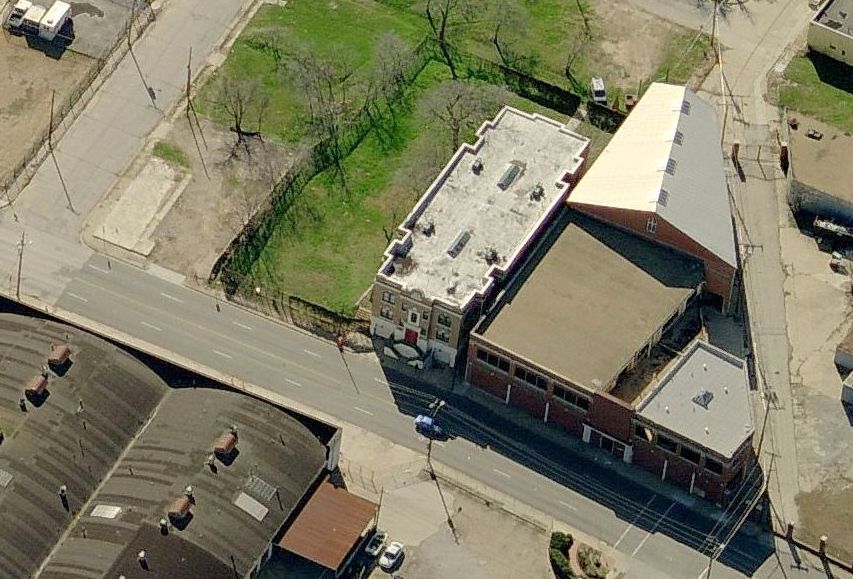
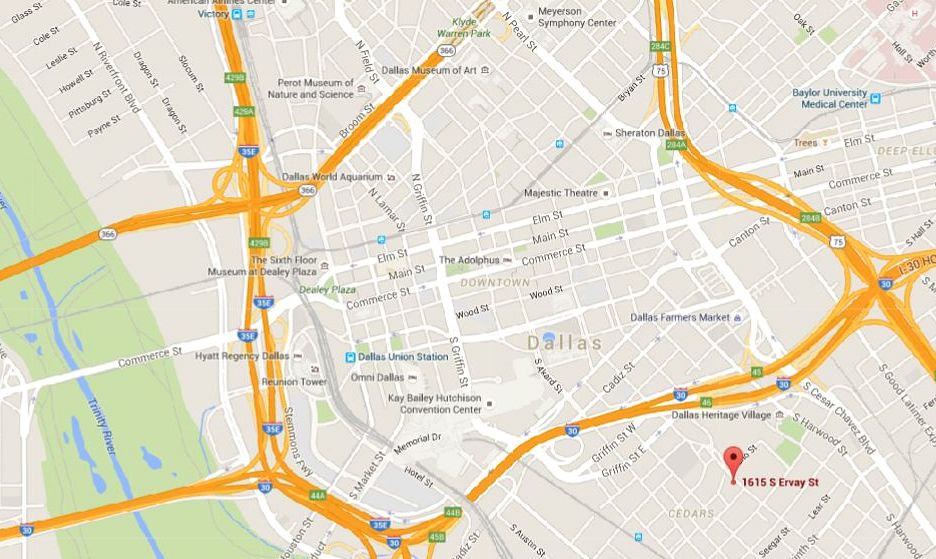
Today, people are still living in 1615 South Ervay. I’m not sure how many condominiums are in the building, but if you search around on the internet, you can find several real estate listings that show what various of the units look like inside. They’re very nice! It’s a much larger building than I realized, as can be seen in this aerial view.

south-ervay_bingBing

I love that red door. Here’s to the continued revitalization of South Dallas and The Cedars!

***

Sources & Notes

Top photo from Zillow.

Photo of the Franklin automobile from SecondChanceGarage.com, here. I found the Rickenbacker photo on a Rickenbacker guitar site which froze my computer and which shall remain unlinked; more photos of Rickenbacker cars (as well as a history of the company) can be found here (the car was named after WWI flying ace Eddie Rickenbacker, a cousin of the guitar maker).

1615 S. Ervay is located catty-corner to Old City Park/Dallas Heritage Village, near the intersection of S. Ervay and Gano streets.

1615-s-ervay_googleGoogle

Street view of the building, looking north on Ervay toward downtown, here.

*

Copyright © 2015 Paula Bosse. All Rights Reserved.

“The Only Motel Located In the Park Cities” — 1964

university-house-hotel_smu-rotunda_1965-detA palm tree, a palm tree, my kingdom for a palm tree… (click for large image)

by Paula Bosse

Behold, an architect’s rendering of University Park’s first motel (… motel?!). With palm trees! (The architects — Barron, Heinberg and Brocato  — were from Alexandria, Louisiana, where they might actually have palm trees. Perhaps they assumed they grew in Dallas. Or could be imported. Or just looked nice as a whimsical garnish.) Palm trees or not, look at that great mid-century design!

Plans for the University House Motel were announced in December, 1963 — it was to be built on Hillcrest at Binkley, right across the street from SMU by Edward T. Dicker, the man who built 3525 Turtle Creek. (Interestingly, according to a press release printed in The Dallas Morning News on Dec. 8, 1963, real estate transactions for the property involved a land lease from Shell Oil Co.) With 60 suites, it was the perfect location for hotel lodgings for parents visiting their children in college.

This was to be both a major commercial addition to University Park as well as something of an architectural departure. The closest hotel/motel alternative (according to the ad below, anyway) was farther away than might have been convenient for visiting families — the (also super-cool-looking) Holiday Inn was all the way down Central, just past Fitzhugh.

ad-holiday-inn_central-expwy_smu-rotunda_1965
If I were a visiting parent, I’d probably choose the University House option because of its unbelievably close proximity to the campus. And if I saw the ad below, I’d definitely book a room — pronto!

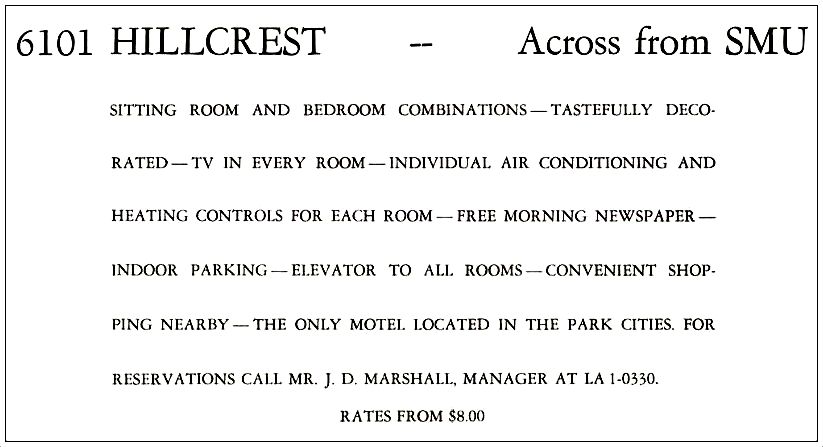
university-house-hotel_smu-rotunda_1965(click to read text)

When construction was complete and the motel opened for business, the sans-palm-tree reality of the building had to have been a bit of a disappointment to anyone who had salivated over that sleek Mid-Century Modern drawing (even though I’m sure the interior decor was much nicer than most motels). Maybe it’s just me. It sort of looks like the drawing. …Sort of….

university-house_smu-rotunda_1965

The University House hung on for several years, then changed ownership and names several times. It is now the site of the much-expanded and certainly much-swankified Hotel Lumen. Interestingly, the skeleton of the original building is still in there somewhere. As Alan Peppard wrote in the Dallas Morning News on Oct. 16, 2006 soon after Hotel Lumen opened, “The old hotel was gutted back to nothing but the concrete frame and rebuilt as a hip University Park hotel.” (To see what things look like now, click here — the renovated original building is on the left, the expansion is on the right.)

In the 21st century, Hotel Lumen is exactly the kind of hotel that comfortably-well-off-but-still-tastefully-hip SMU parents want to stay in when they arrive in town to visit the progeny. All that’s missing are a few palm trees….

***

The University House Motel ad appeared in the 1965 Southern Methodist University Rotunda yearbook. That same yearbook also contained the Holiday Inn ad and the photograph of the University House Motel. (The photo appeared over the yearbook’s cheeky “Why be discreet?” caption and was featured in the previous Flashback Dallas post, “The SMU ‘Drag’ — 1965,” here.)

The 1965 ad has the nightly rate at the University House Motel at $8 — about $60 in today’s money, adjusted for inflation. Not bad for parents who could afford to send their children to SMU and who weren’t staying downtown at the Adolphus, the Baker, or the Hilton.

Photos of Hotel Lumen — inside and out — can be found on their website, here.

Click pictures for larger images.

*

Copyright © 2015 Paula Bosse. All Rights Reserved.


Brown Cracker Co. Cracker Wrappers

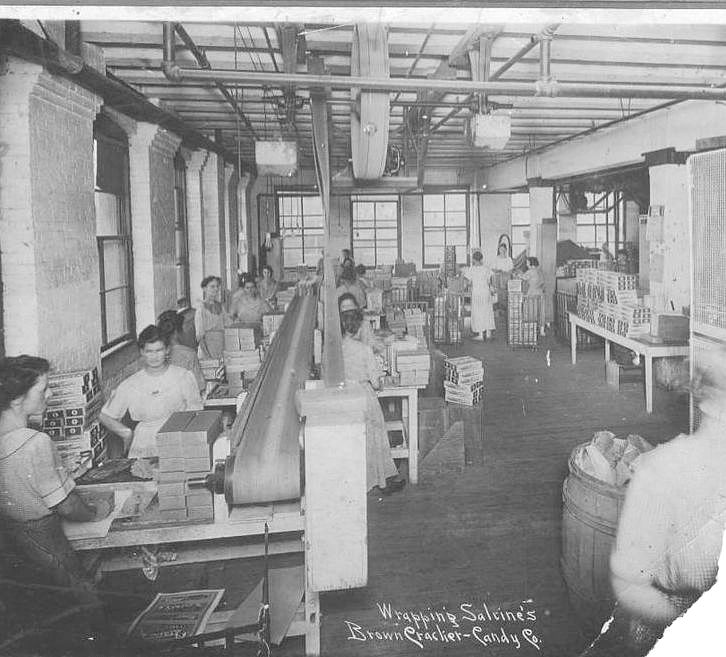
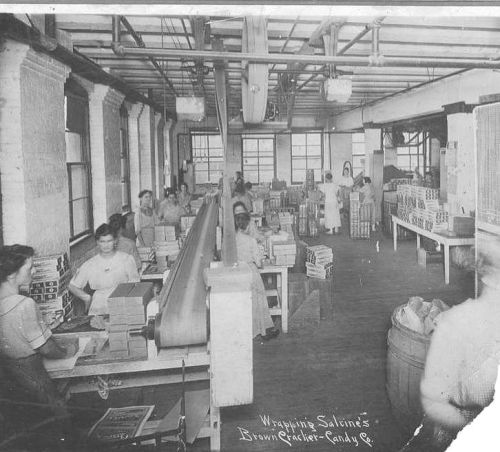
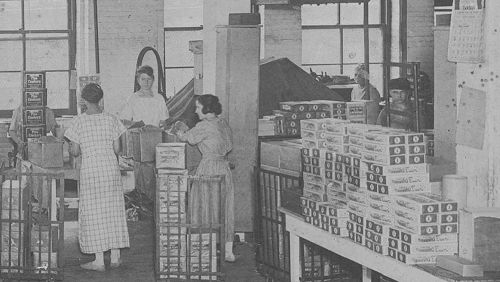
brown-cracker_ca1918_cook_degolyerThe saltine-wrapping room

by Paula Bosse

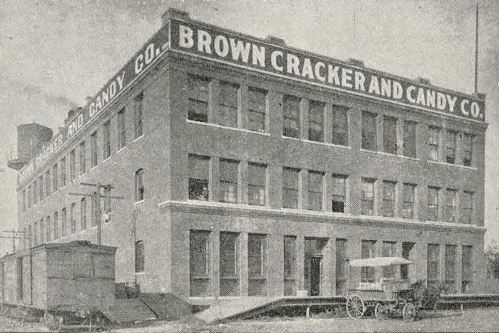
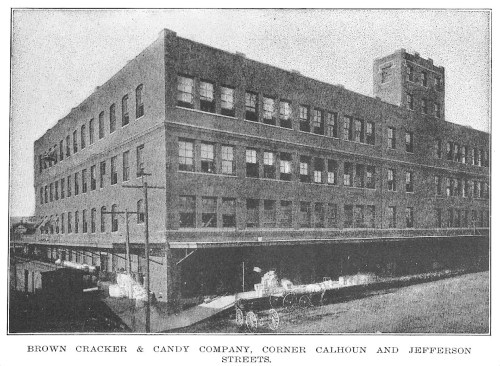
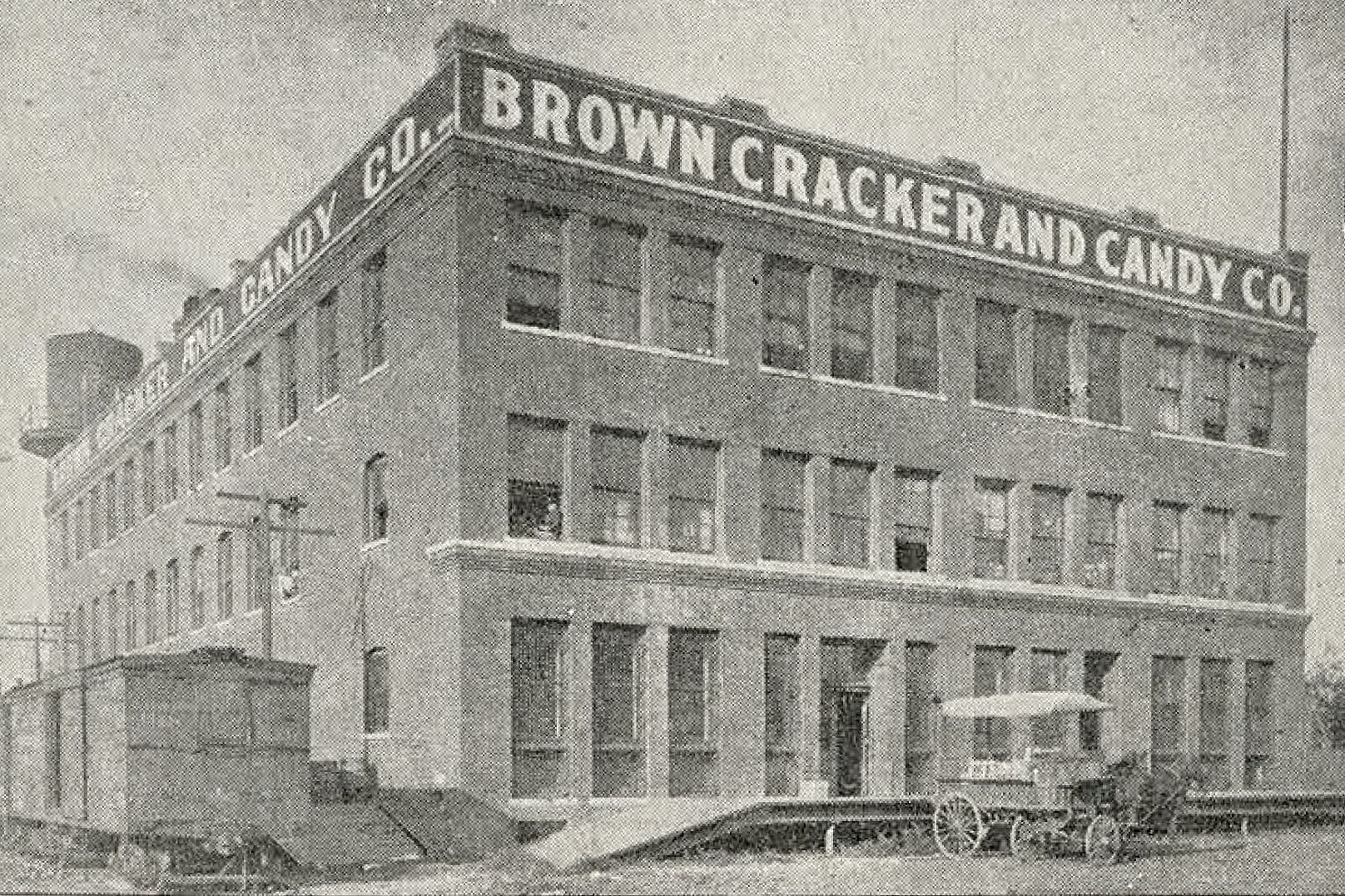
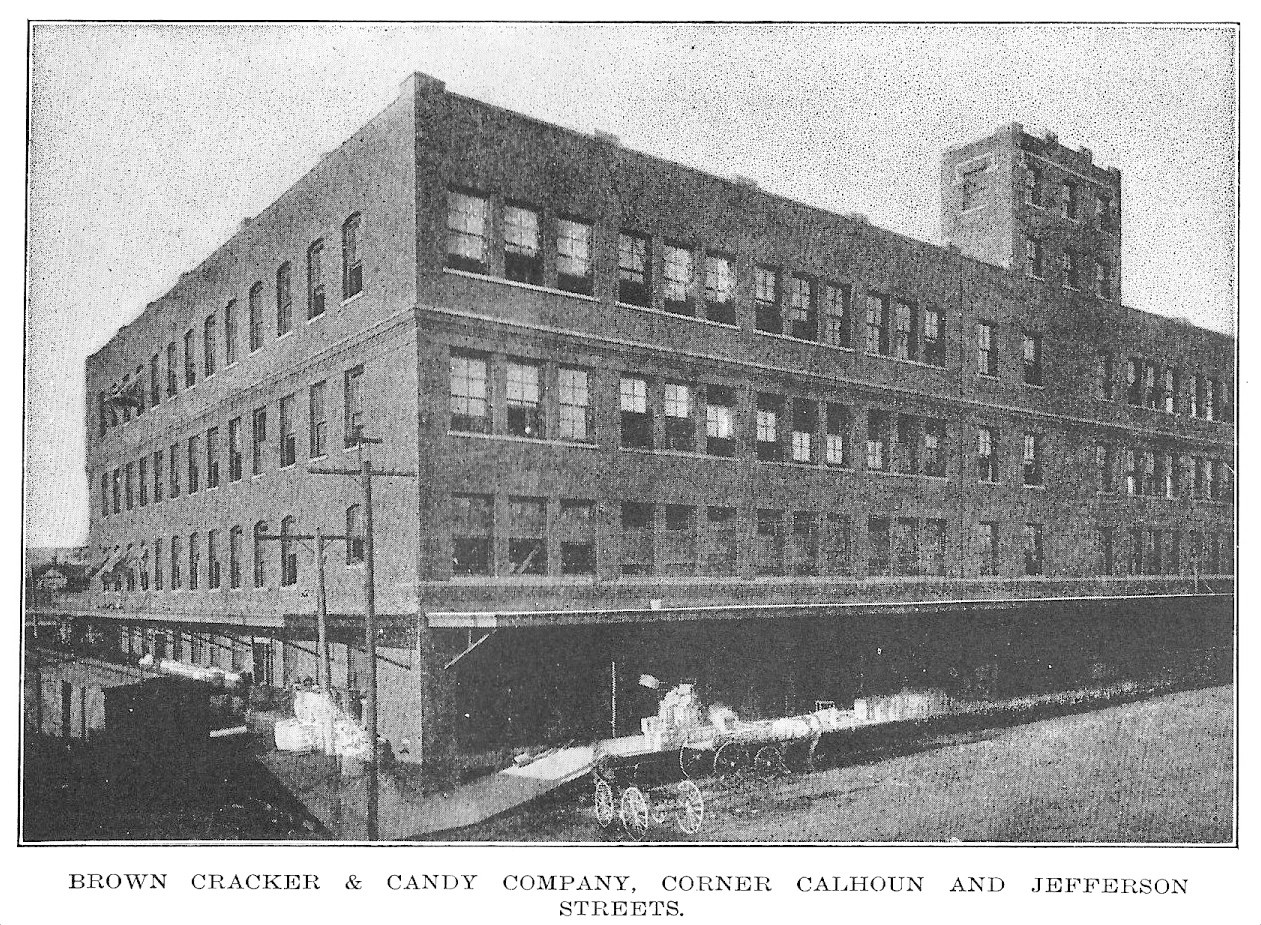
I will stop and look at great length at any photograph containing a conveyor belt. The conveyor belt in this photo belonged to the Brown Cracker and Candy Company, a large and important Dallas manufacturer and employer. The cracker, cake, and candy factory opened in 1903 in a brand new building in the industrial area just south of McKinney Avenue (the part of town that borders downtown, now known as the West End). Best known these days as the West End Marketplace building, the structure still stands and, in fact, has just been purchased and is about to undergo renovation.
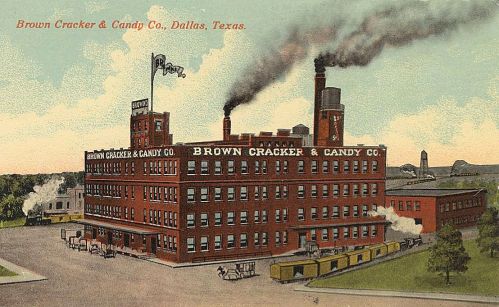
brown-cracker_postcard_cook-degolyerDeGolyer Library, SMU

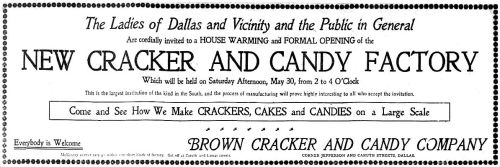
As the new building was nearing completion, the company charter was filed in April 1903, and just a few short weeks later, the factory opened itself up for inspection by the community.
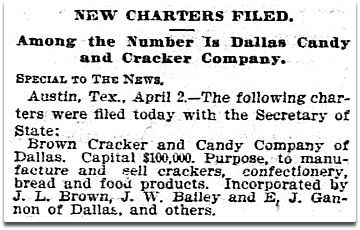
brown-charter_dmn_040303Dallas Morning News, April 3, 1903

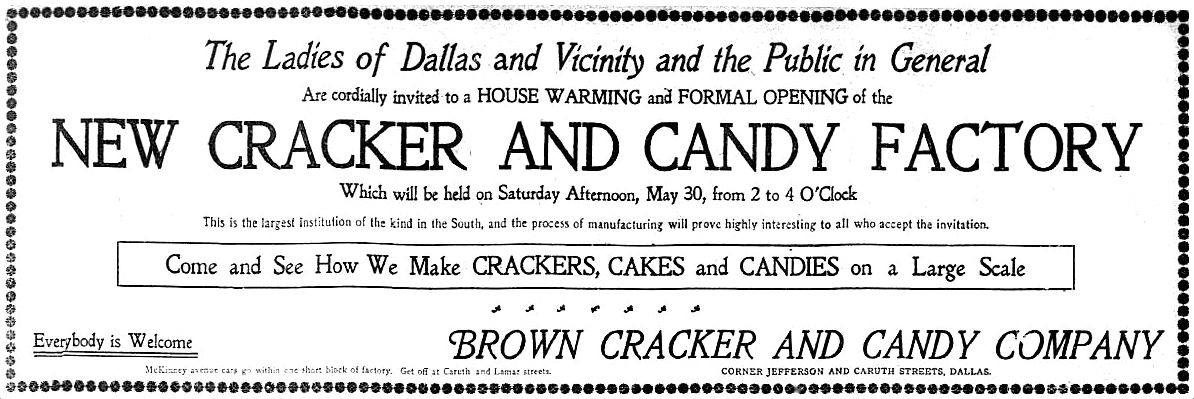
brown_opening_dmn_052903
DMN, May 29, 1903 (click for larger image)

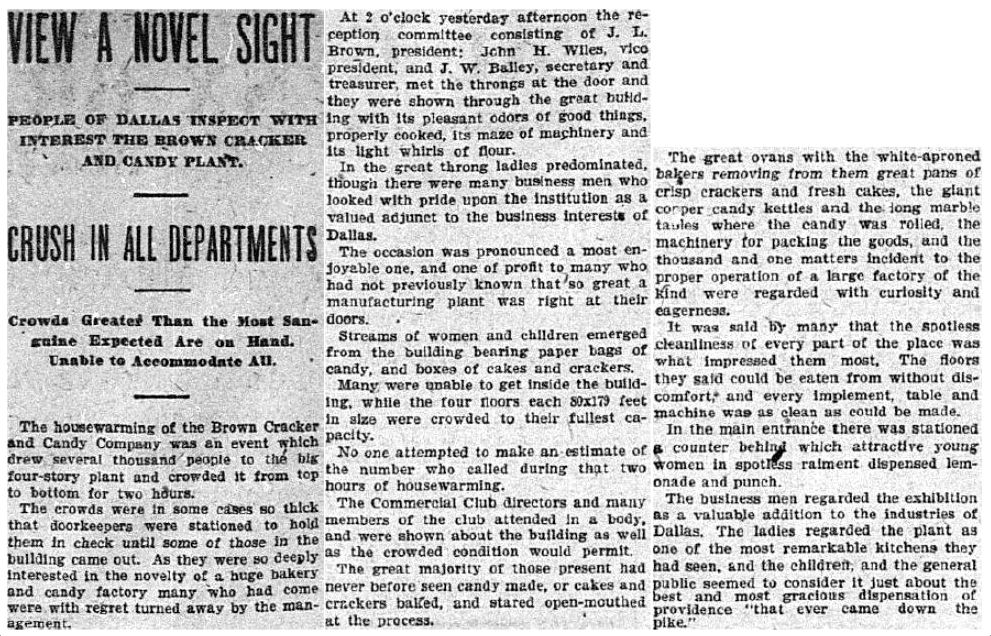
The open house was packed — several thousand people (mostly women) showed up to tour the plant, fascinated by the inner workings of the city’s newest business, a manufacturer of crackers and sweet treats. Of particular interest must have been the two giant brick ovens on the the second floor, which used more than one ton of coal daily, and the huge copper kettles used in candy making on the top floor. There were also things like chocolate dipping machines, starch machines (?), and marshmallow heaters (I don’t know what that is, but I want to see one in action — could it have been a “marshmallow beater,” like the one seen here?).
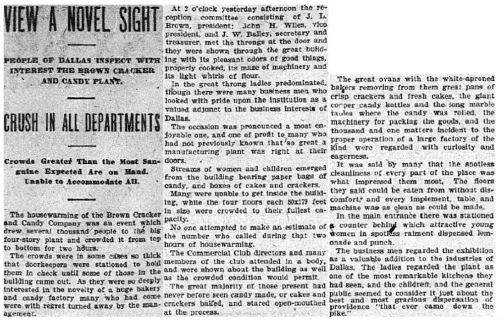
brown-cracker_dmn-053103DMN, May 31, 1903

The main reason to open the factory to the public for inspection — other than as a PR-managed meet-and-greet — was to let the people see for themselves just how CLEAN the place was. This was at a time when unsanitary food handling and manufacturing practices were much in the news (see here) — concerns which ultimately led to the enactment of the Pure Food and Drug Act of 1906 — and the above article stresses that visitors were impressed by the factory’s “spotless cleanliness” (“The floors they said could be eaten from without discomfort…”). In regard to the “cracker wrappers” pictured at the top, the company wanted to make sure everyone knew that their products were wrapped and boxed — gone were the days of shoppers dipping their (probably unclean) hands into the old “cracker barrel” full of loose, stale crackers.

crackers_dmn_040603DMN, April 6, 1903

Let’s take a closer look at the top photo, probably taken around 1920 (click pictures for larger images).
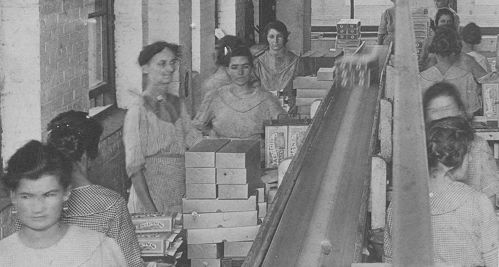
brown-cracker_ca1918_cook_degolyer_det2

brown-cracker_ca1918_cook_degolyer_det1

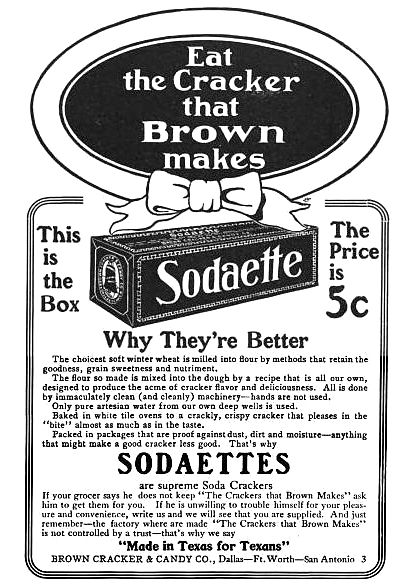
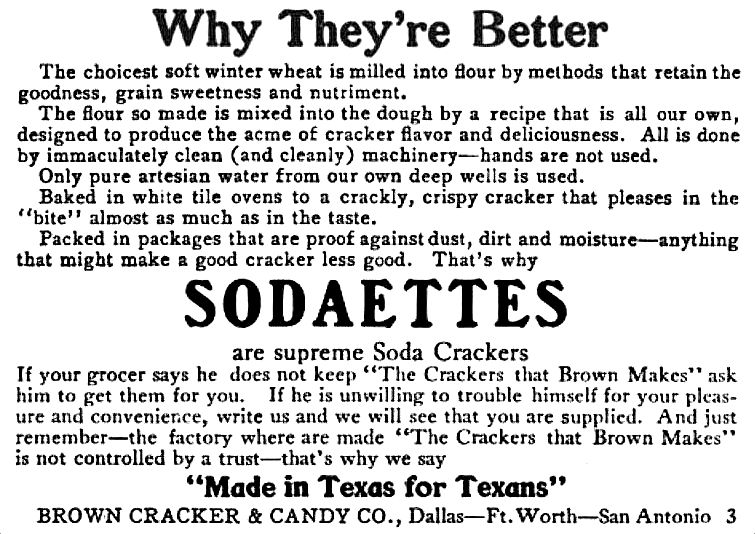
ad-brown_dmn_122003DMN, Dec. 20, 1903

sodaette-crackers(click to read text)

brown-cracker_1922-directory1922 city directory

brown-cracker_come-to-dallas_degolyer_SMU_ca1905ca. 1905

brown-cracker-greater-dallas-illustrated_ca1908ca. 1908

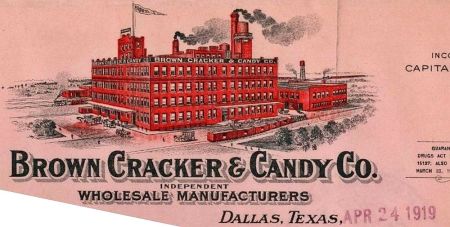
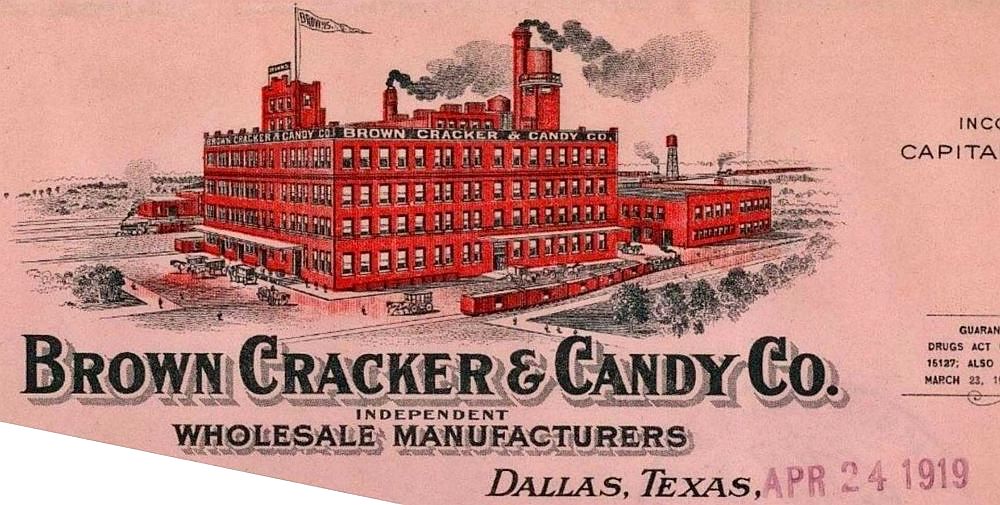
brown-cracker-co-lettrhead_1919_ebay1919 (eBay)

***

Sources & Notes

Top photo, titled “Wrapping Saltines at Brown Cracker and Candy Co.,” is from the George W. Cook Dallas/Texas image collection, DeGolyer Library, Central University Libraries, Southern Methodist University; it can be accessed here.

Written on the back of the photo: “Miss Bessie Manning, 2724 Roadwood [sic] avenue, Dallas, Texas.” Bessie Manning (born Bena Manina in 1899 to Italian immigrants), began working at the Brown Cracker Co. (with a brother and a sister) around 1917 but wasn’t living on Rosewood (later North Harwood) until 1919; she left Brown in 1921 or 1922. She isn’t identified in the photo, but she is, presumably, one of the women on the left; she would have been about 20.

bessie-manning_1920-censusBessie Manning’s occupation, 1920 census

The color postcard showing the Brown Cracker Co. is also from the Cook collection at SMU; it is here.

The Sodaette ad is from Library of Advertising by A. P. Johnson (Chicago: Cree Publishing Co., 1911).

The photo from about 1905 is from the promotional brochure titled “Come To Dallas” (Dallas: Dorsey Printing Co., about 1905), in the collection of the DeGolyer Library, Southern Methodist University; more info is here.

The photo at the bottom is from Greater Dallas Illustrated, The Most Progressive Metropolis in the Southwest (Dallas: The American Illustrating Company, 1908; reprinted by Friends of the Dallas Public Library, 1992). The informative company profile that accompanied the photo can be read in a PDF, here.

All other ads and clippings as noted.

Another very informative article which details the specifics of the building and its machinery — “New Dallas Industry, Brown Cracker and Candy Company About to Begin Operations” (DMN, Apr. 6, 1903) — can be read in a PDF, here.

To see the Brown Cracker Company’s specs on a Sanborn map from 1905, see here; to see where it is on a modern map, see here.

For current info on what’s about to happen to the building (much expanded over the years), see Steve Brown’s Dallas Morning News article, here.

And, yes, a teenaged Clyde Barrow apparently worked there briefly, for a dollar a day.

*

Copyright © 2015 Paula Bosse. All Rights Reserved.

The Stoneleigh Court Apartment Hotel — 1923/1924

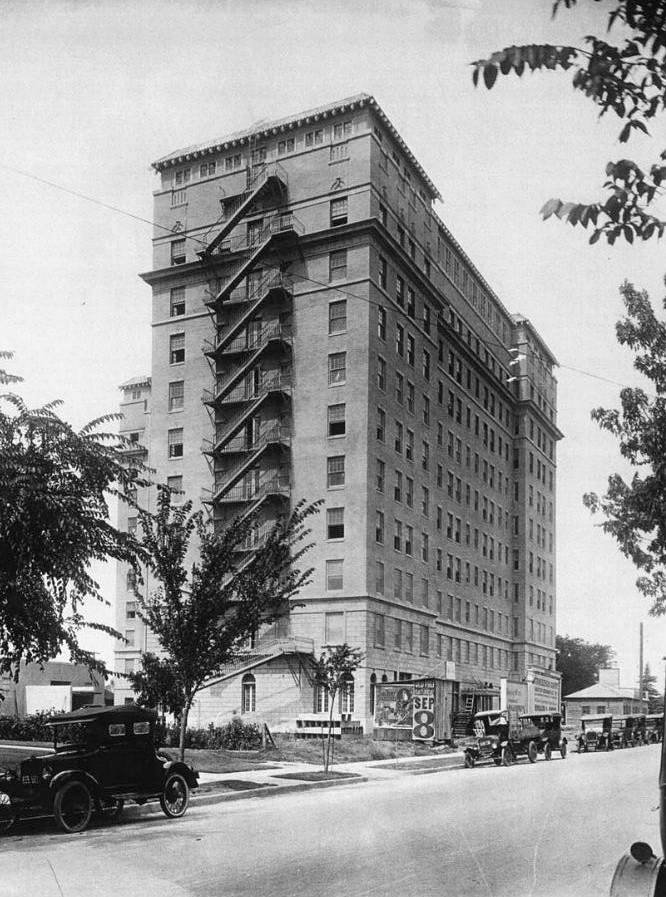
stoneleigh_1923_natl-reg-application
Still standing, still beautiful…

by Paula Bosse

Above, the Stoneleigh Hotel (originally known as the Stoneleigh Court Apartment Hotel) in 1923, in its final weeks of construction. When the Stoneleigh opened in October, 1923 at the corner of Maple Avenue and Wolf Street, it was a swanky apartment house, with hotel amenities (a few rooms were set aside for “transient” travelers). Thankfully, the Frank J. Woerner-designed building still stands and remains a lovely hotel.

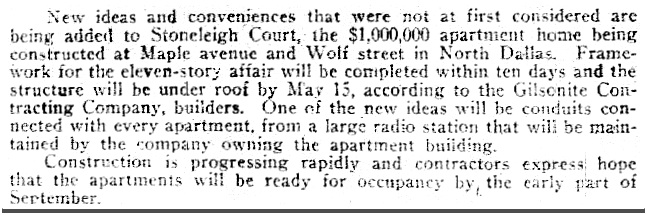
Originally there were 125 apartments (which ranged from 1-5 rooms each), all of which were fully furnished (linens, silver, kitchen utensils, dishes, telephones, etc.), and maid service was provided. There were also radios in every room (a pretty new-fangled thing at the time). Each apartment had a kitchenette and a private bath, and ice water was piped to all apartments. Another innovative feature was the Servidor delivery service which allowed residents and hotel staff to conduct transactions without ever having to look one another in the eye or exchange stilted chit-chat. There was a grocery store, a pharmacy, a beauty shop, and a barber shop on the premises. There were smoking rooms, billiards rooms, and lounges on the ground floor and a grand ballroom on the top floor. And apartments were “handsomely furnished, [with] a color scheme of taupe, blue and mulberry being observed alternately on the various floors.” Sign me up!

*

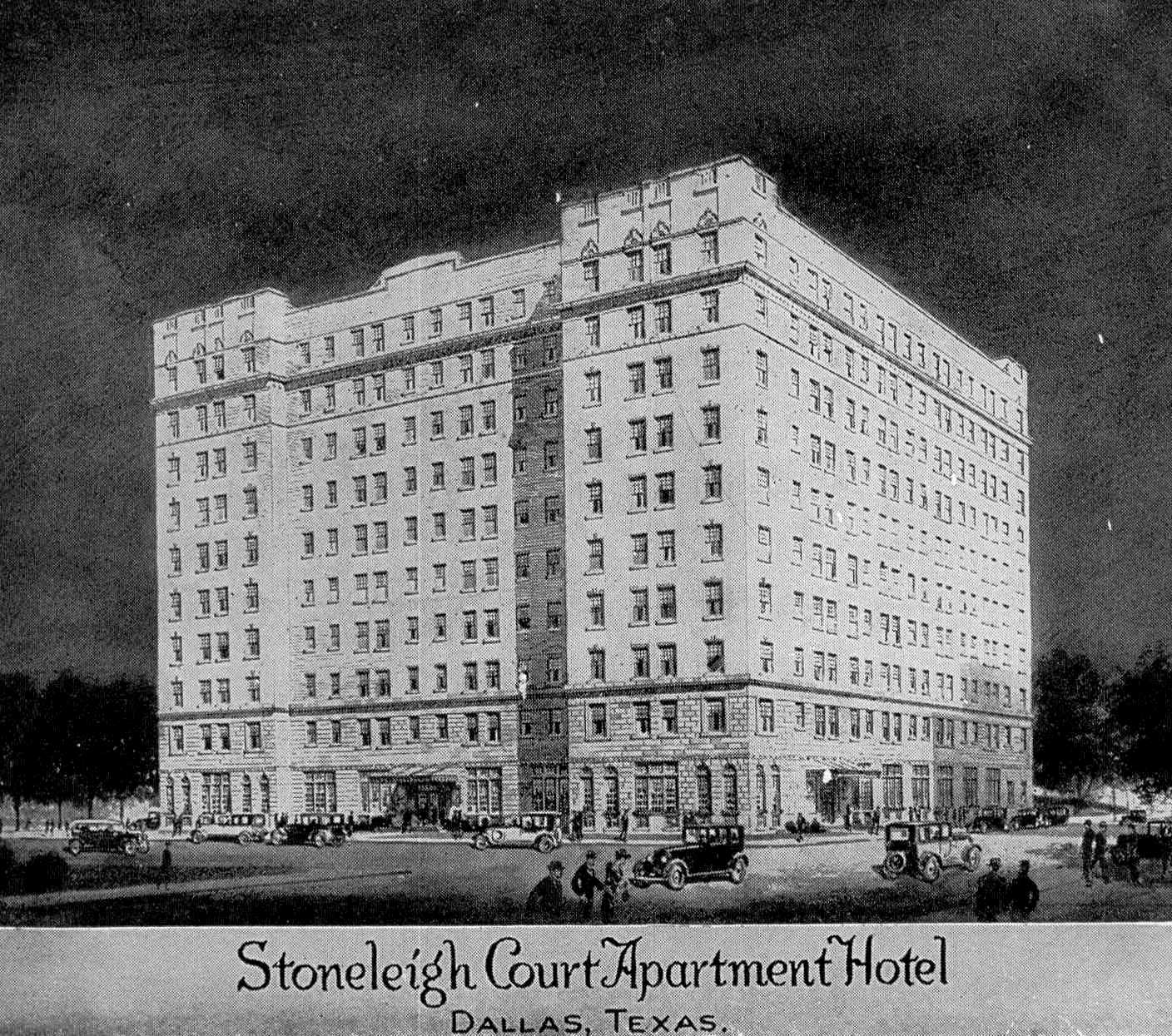
Below, an early ad (click to see a much larger image of the illustration on its own).

ad-stoneleigh_terrill-yrbk_1924

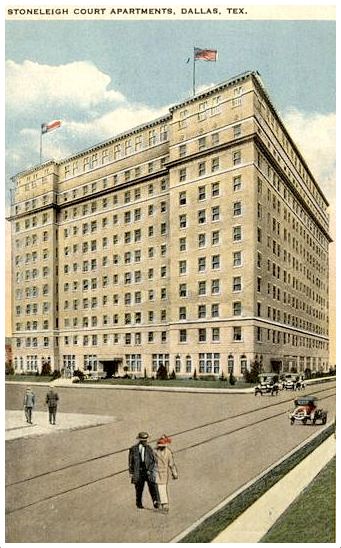
And, of course, the obligatory postcard in which the building looks familiar, but which its surroundings seem somewhat … romanticized.

stoneleigh_court_apartments

*

A grainy photo from the construction and its caption:

stoneleigh-hotel_dmn_042223_under-construction_photo

stoneleigh-hotel_dmn_042223_under-construction_captionDallas Morning News, April 22, 1923

***

Sources & Notes

Photo of the building nearing the end of its construction is from the application to the National Register of Historic Places, which can be found in a PDF, here. (Dallas Historical Society photo.)

Ad is from the 1924 Terrill School yearbook.

To read a lengthy article published a few days before the Stoneleigh officially opened — “Stoneleigh Court Most Pretentious Apartment Hotel in the Southwest” (Dallas Morning News, Oct. 14, 1923) (with “pretentious” used here in a good way!) — click here.

Not sure what an “apartment hotel” is? See Wikipedia, here.

The Stoneleigh is currently called “Le Méridien Dallas, The Stoneleigh,” and the official website is here.

*

Copyright © 2015 Paula Bosse. All Rights Reserved.
Akard Street Looking South, 1887-2015

akard_from-pacific_cook_degolyer_smu_ca1898-detAkard Street from Pacific, ca. 1898, via Cook Collection, SMU

by Paula Bosse

I realized the other day that I have an inordinate number of photographs and postcards showing Akard Street looking south — usually taken from Pacific or Elm, so I thought I’d collect them all together. Some of these aren’t dated, so they’re not in strict chronological order, but I’ve made a half-hearted attempt to make sure horse-and-buggy photos are before the men-in-straw-hat-boaters, which are before the women-in-Miss-Crabtree-dresses, which are before the cars-with-rounded-bodies. It might be easiest to just assume they are not in chronological order. (All photos are larger when clicked — a couple are really  big.)

*

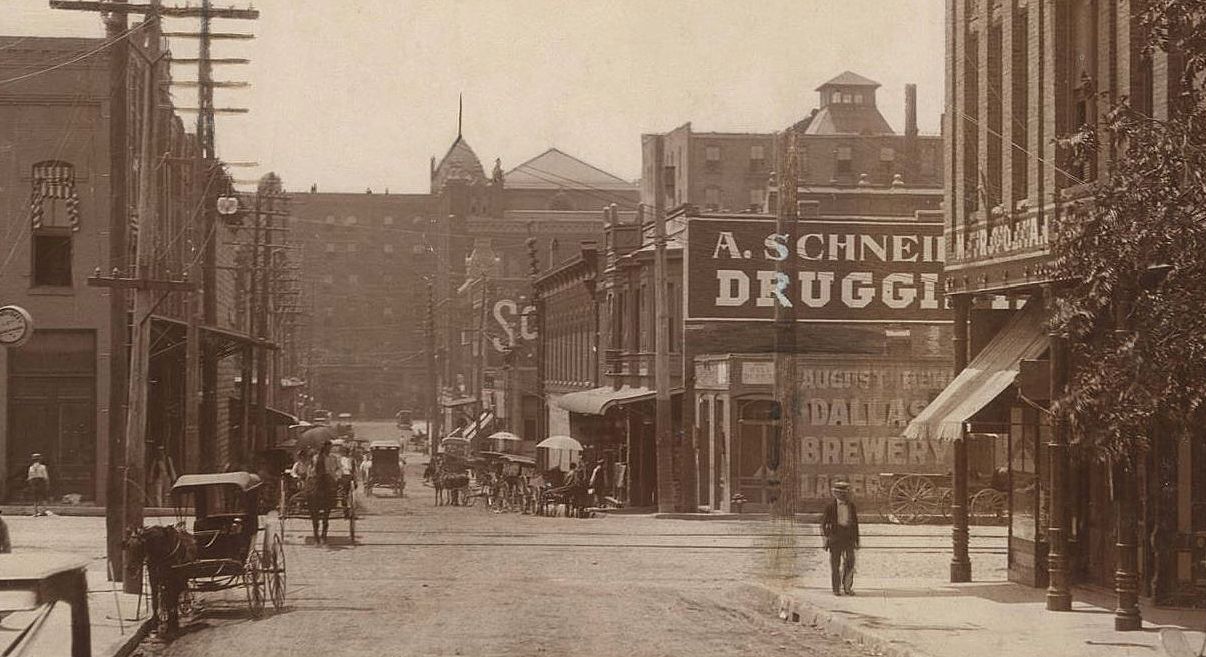
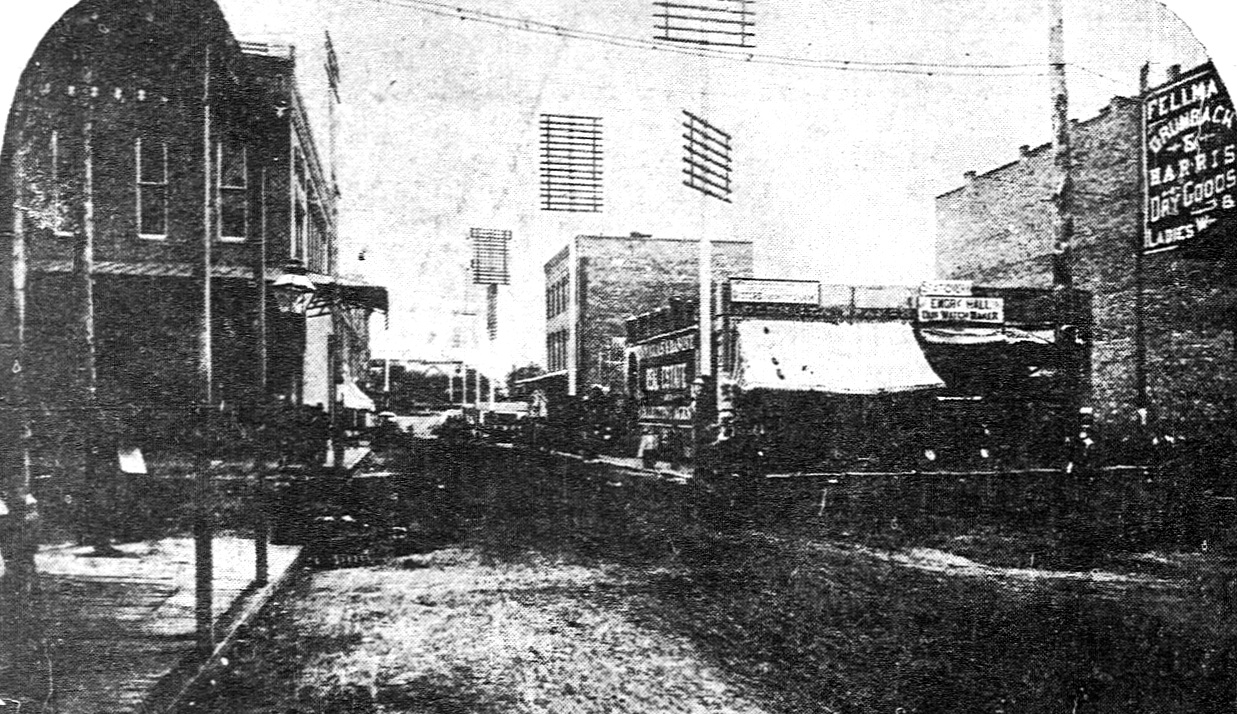
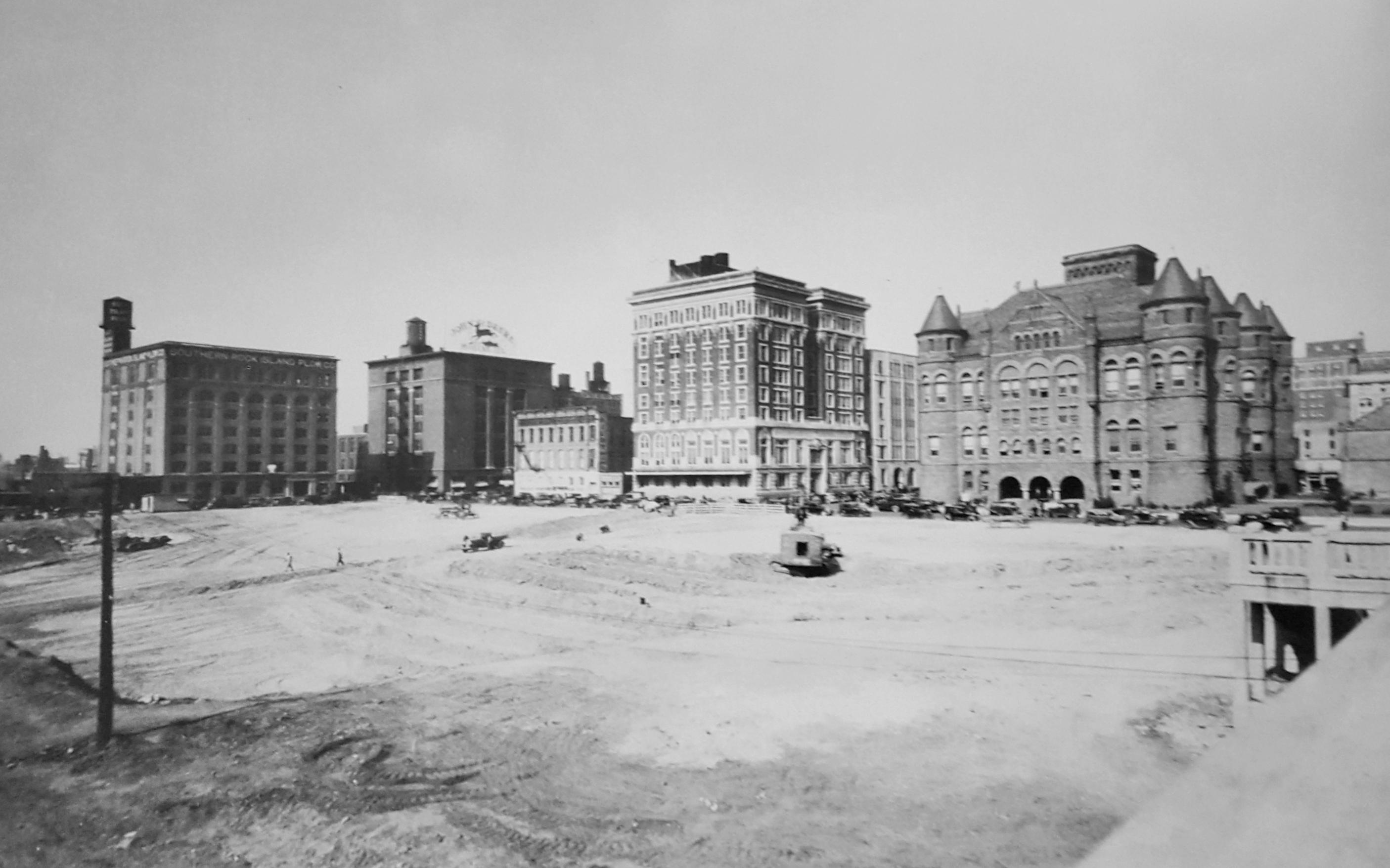
The oldest is from 1887, when North Akard was still called Sycamore Street, and before the Oriental Hotel was built at Commerce and Akard in 1895.

akard_south-from-elm_1887

*

Next up, an incredible photo, taken around 1898, a detail of which appears at the top of this post. The Oriental Hotel can now be seen at the end of Akard, at Commerce, where Akard used to make a dog-leg turn before continuing south, giving the appearance of a dead-end street.

akard_from-pacific_cook_de-golyer_smu-ca1898via George W. Cook Collection, DeGolyer Library, SMU

*

Another, with the Adolphus Hotel (built in 1912) now on the right, across Commerce from the Oriental. The tall building across Akard from the Adolphus is the Southwestern Life Building. The Gentry photography studio was at the southeast corner of Elm and Akard from 1912, which is probably the date of this postcard image. Construction of the Busch Building (now known as the Kirby Building) began in December, 1912.

akard-elm_postcard_ebay_ca-1912via eBay

*

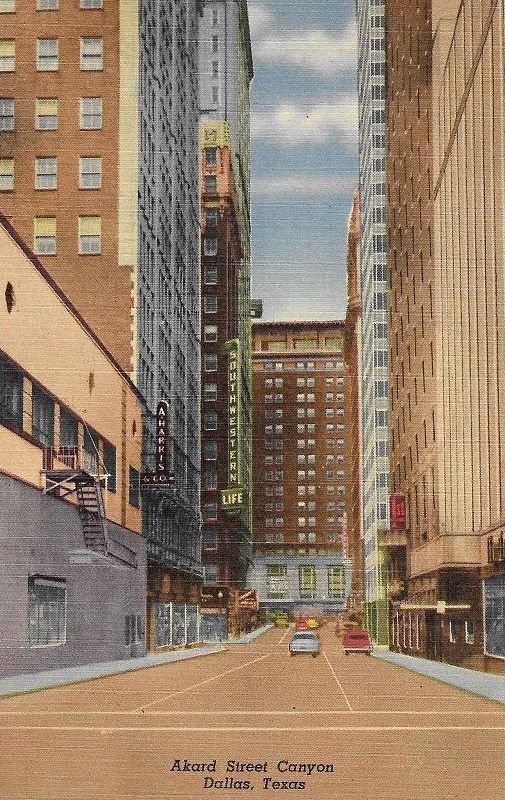
From 1925, with the new Baker Hotel having replaced the Oriental Hotel. This area was now being called “the canyon district” or “the canyon.”

akard_south-from-elm_1925

*

In this great Frank Rogers photo, the canyon walls are getting higher, with the Adolphus Hotel firmly anchoring the Commerce corner across from the Baker.

akard_baker-adolphus_postcard_rogers_ebayvia eBay

*

By the time this photo was taken in about 1936, Pegasus had become a part of the skyline, perched atop the Magnolia Petroleum Building. (Note the Queen Theater at the northeast corner of Elm and Akard.)

akard_pacific_1936_legacies-spring-1989via Legacies History Journal

*

This photo is from the early- or mid-1930s — LOOK AT ALL THOSE PEOPLE.

akard-canyon_municipal-archives_dma-uncratedvia the DMA’s Uncrated blog

*

As opposed to this one, which has NO people in it.

akard-canyon_ebayvia eBay

*

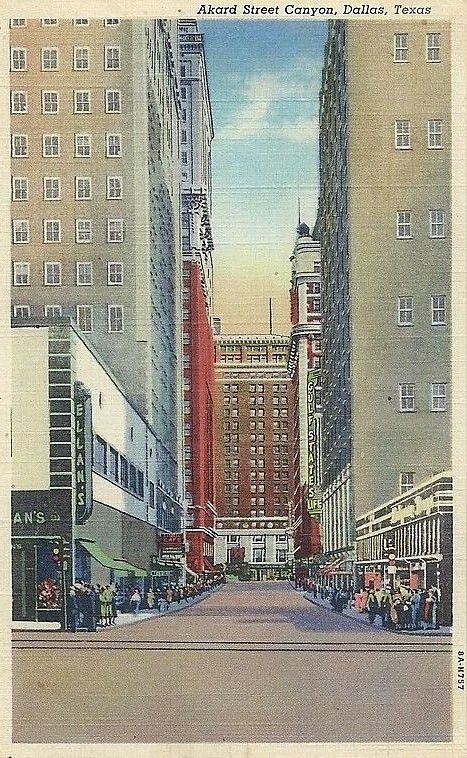
More canyon, this view showing the super-cool art-deco-y building at Elm and Akard with Ellan’s hat shop on the ground floor, late-1930s.

akard-st-canyon_ellans

*

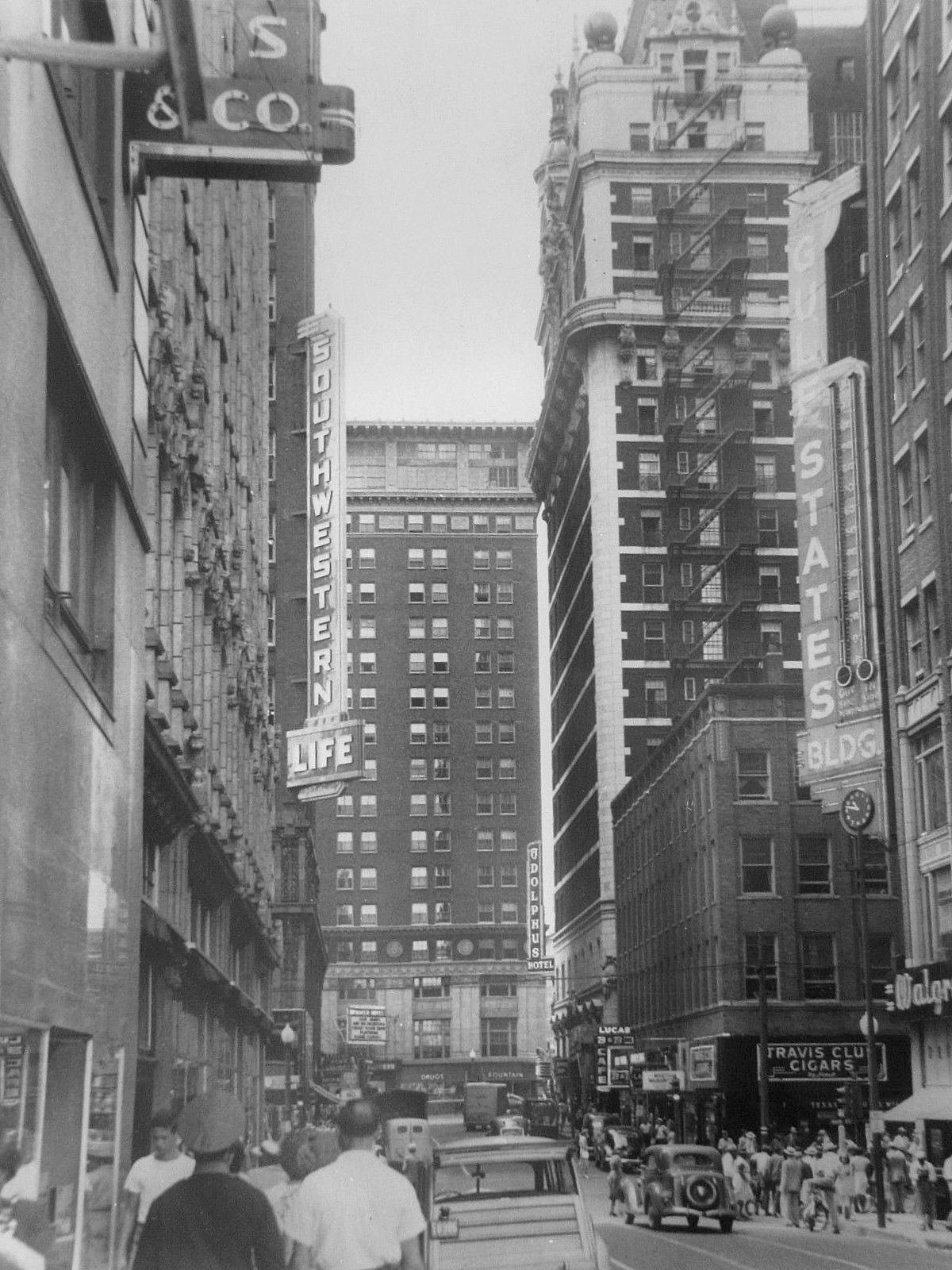
This candid photograph, a little deeper into the canyon, is one of my favorites. (Click to see a gigantic image.)

akard-looking-south_ebayvia eBay

*

From 1951 — a bit grainy, but a slightly closer view of the side of the Queen Theater at the left and the Mayfair department store, built in 1946, at the right:

akard_dpl_1951via Dallas Public Library

*

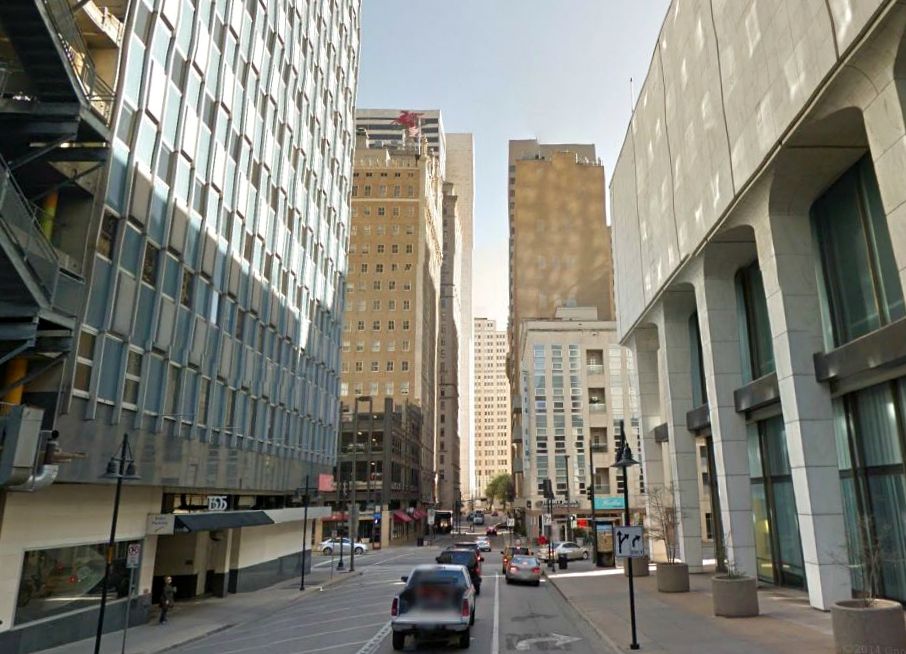
And, finally, today. Pegasus and the Adolphus are still there, but the Baker Hotel was demolished in 1980, replaced by the One AT&T Plaza/Whitacre Tower.

akard-looking-south_google_2015via Google Street View, 2014

***

Sources & Notes

The photo dated by SMU as “circa 1898” is titled “Akard Street from Akard and Pacific Avenue Intersection”; it is from the George W. Cook Dallas/Texas Image Collection, DeGolyer Library, Central University Libraries, Southern Methodist University, and it can be viewed here.

The circa 1936 photo showing Pegasus is from the Spring, 1989 issue of Legacieshere; it is from the Hayes Collection, Texas/Dallas Archives Division, Dallas Public Library, and is attributed to Denny Hayes.

The photo showing “ALL THOSE PEOPLE” is from the Dallas Museum of Art’s Uncrated blog — here — is from the Dallas Municipal Archives. They have the date as “1940,” but Liggett’s Drug Store was gone from Elm and Akard by 1936.

Other sources as noted.

Click pictures for larger images — sometimes MUCH larger images.

*

Copyright © 2015 Paula Bosse. All Rights Reserved.


St. Paul’s Sanitarium — 1910

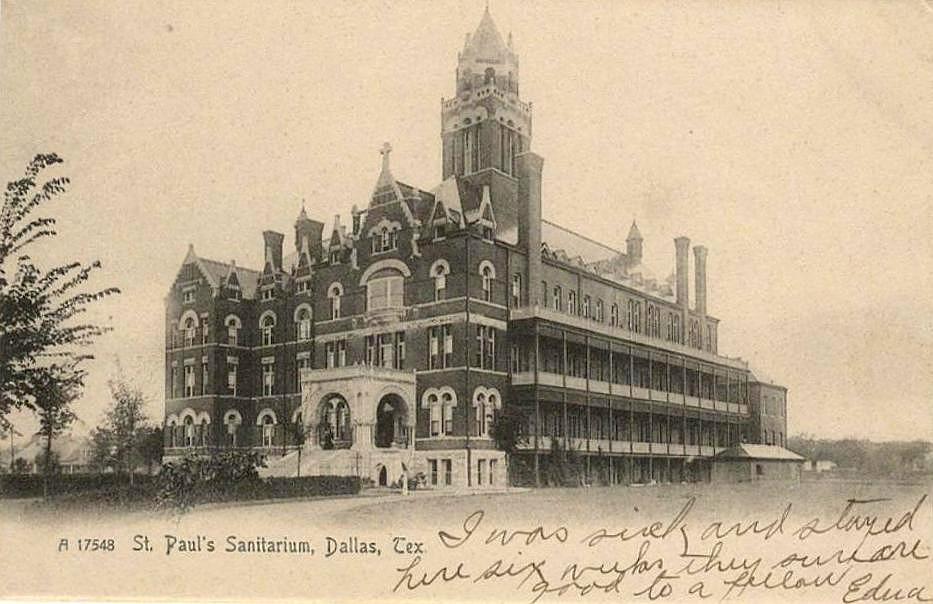
st-pauls_postcard_de-paul-univSt. Paul’s Sanitarium, located at Bryan & Hall (click for larger image)

by Paula Bosse

My posting has been infrequent as of late, due, in part, to obligations concerning a family member’s hospital stay. So, since I have a short time before I have to rush off to run errands and make visits, why not focus on a historic Dallas hospital?

St. Paul’s Sanitarium was opened in a small cottage on Hall Street in 1896 by the Daughters of Charity of St. Vincent de Paul, but it soon moved to the new large H. A. Overbeck-designed building on Bryan Street in 1898. In 1927 the name changed to St. Paul’s Hospital, and in 1958, the name changed again, this time to St. Paul Hospital. The imposing building and annex (and whatever other structures were contained in the complex) were demolished in 1968.

Below are several wonderful photographs taken inside the sanitarium around 1910 by one of Dallas’ best photographers, C. E. Arnold. They are from the St. Paul Hospital Collection in the UT Southwestern Library (click links below photos to see info about each picture).

*

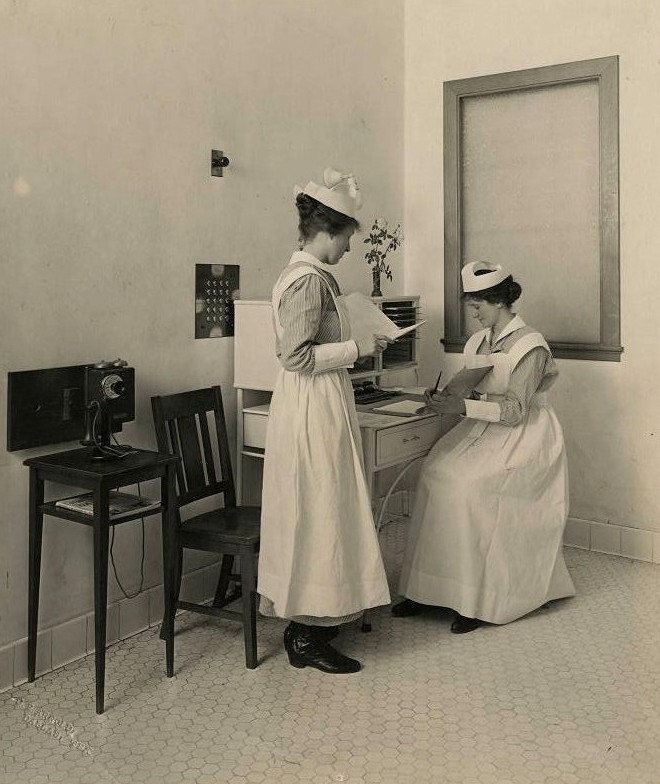
st-pauls_nursing-stn_1910_utsw_smThe nursing station.

*

st-pauls_mexican-ward_1910_utswThe “Mexican Ward” (as noted on the back of the photograph).

*

st-pauls_sleeping-porch_1910_utswA patient ward on a screened-in sleeping porch.

*

st-pauls_waiting-room_1910_utswA waiting room.

*

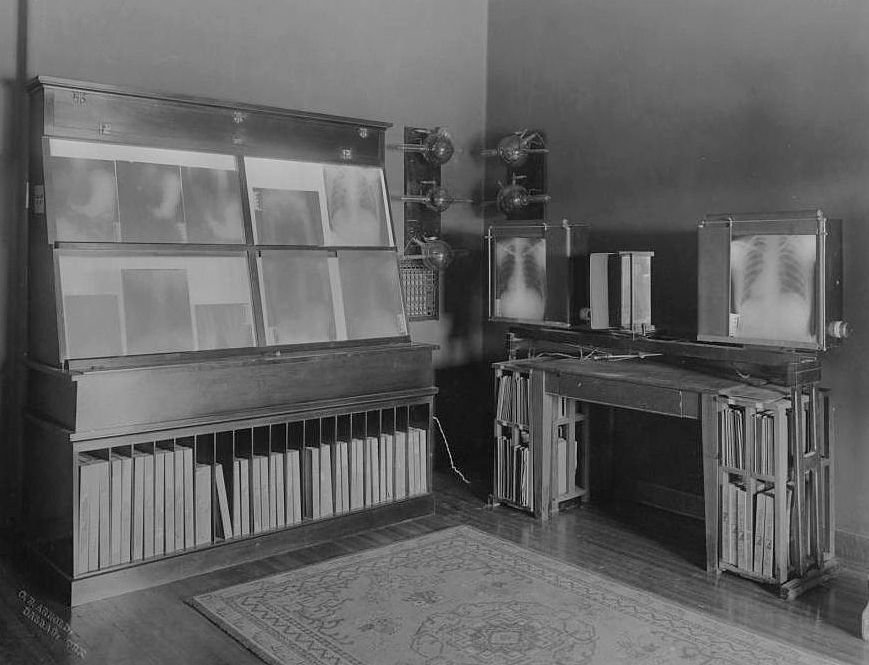
st-pauls_xray-room_1910_utswThe x-ray room.

*

st-pauls_nurses-library_1910_utswThe nurses’ library. (I LOVE this photo! Check out the crazy typewriter stand attached to the desk — I’ve never seen anything like that before.)

*

st-pauls_student-nurses-dorm_1910_utswThe nurses’ dormitory on the top floor.

*

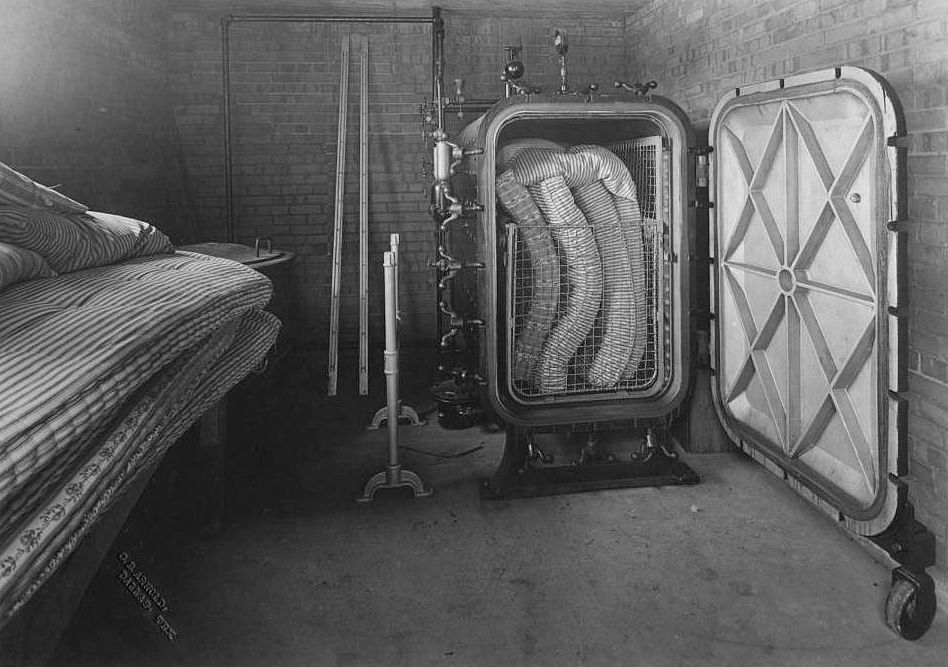
st-pauls_mattress-sterilization-room_1910_utswAnd, my favorite, the ominous-looking mattress sterilization room in what appears to be a dungeon.

*

st-pauls_flickr_coltera

**

UPDATE: Check out some fantastic historic photos of the hospital and its nurses contained in this UT Southwestern Medical Center publication, “St. Paul University Hospital, A Legacy of Caring,” here.

***

Top postcard is from the Vincentiana Postcard Collection, Special Collections and Archives, DePaul University Library, Chicago; it can be found here.

Bottom postcard, with the cheerful message from Edna, was found on Flickr, here.

All photographs are from the St. Paul Hospital Collection in the UT Southwestern Library. Other photos from this 1910 collection can be found here. (For fuller descriptions, click the linked text beneath the photos in this post.)

An interesting article on the photographer, Charles Erwin (C. E.) Arnold, and the technique used in capturing his interiors, can be found here.

A historical timeline of St. Paul’s can be found in a PDF here.

Wondering where St. Paul’s Sanitarium was located? It was at Bryan and Hall streets, across from Exall Park. Here is the location, from a 1919 map:

st-pauls_1919-map

All images larger when clicked.

*

Copyright © 2015 Paula Bosse. All Rights Reserved.