Flashback : Dallas

A Miscellany: History, Ads, Pop Culture

Category: Art

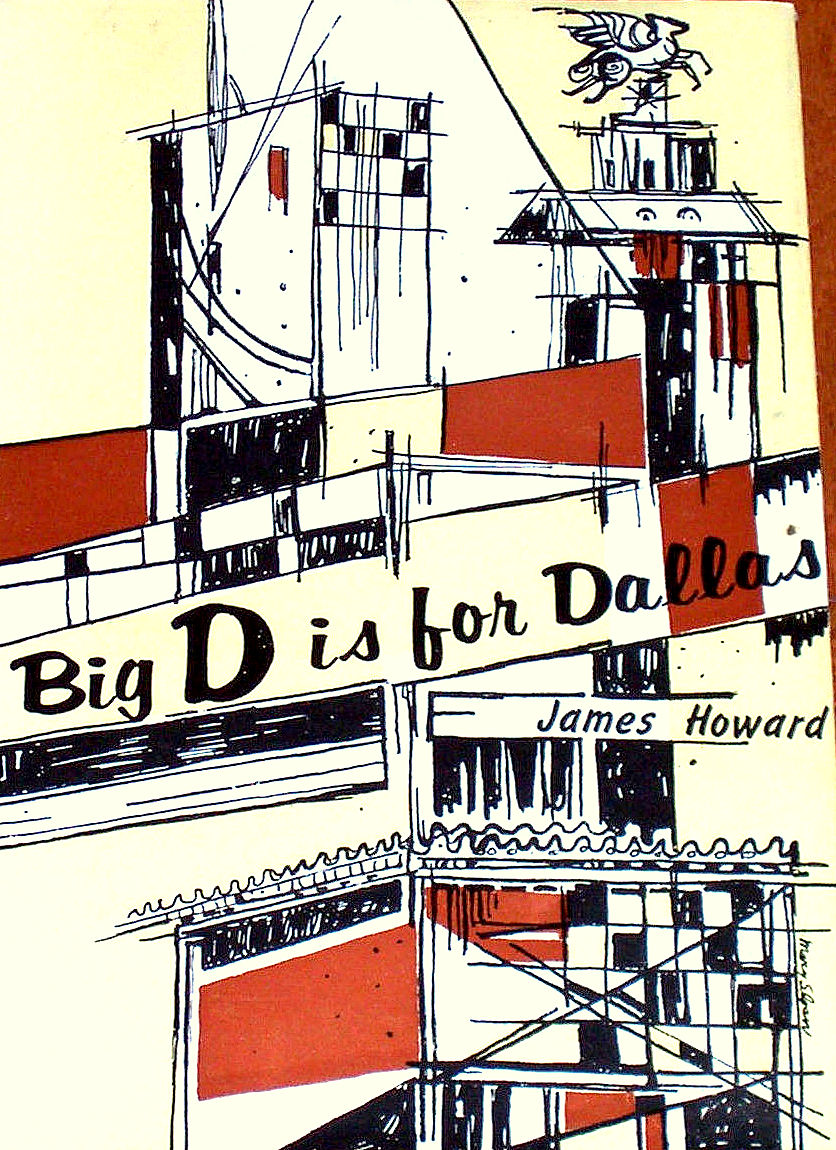
Mary Sloan’s Stylized Dallas Skyline

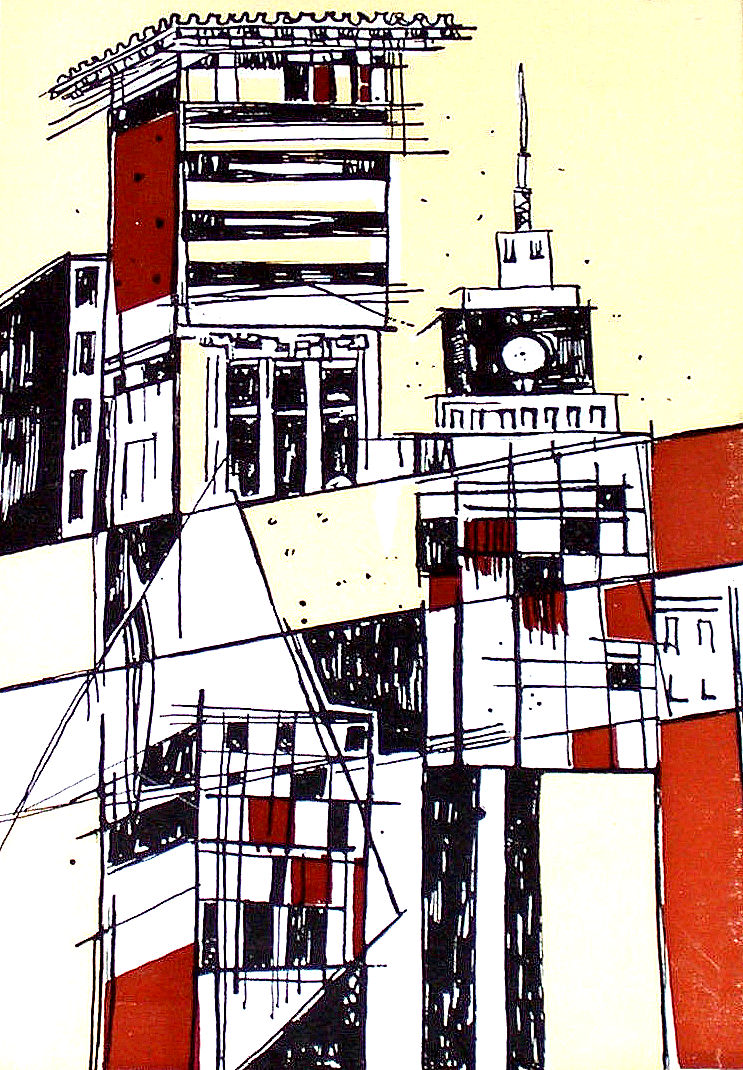
mary-sloan_jacket-art_front_1957-smArt by Mary Sloan, 1957

by Paula Bosse

Dust jacket artwork and design are often taken for granted, which makes no sense because the cover of a book does actually tend to drive book sales. Things have improved in recent years, but in the past, these artists were frequently not credited at all. Here’s an example, though, of jacket art that actually gives full credit to the artist, Mary Sloan. This fantastic, stylized depiction of the Dallas skyline positively reeks (in a good way) of mid-century illustration. I don’t think I’ve seen this before, which is a bit of a surprise, because I was a bookseller for many years, specializing in Texana titles. I’m not sure how this one escaped me, but I’m pretty sure I’d remember this cover art.

Mary Sloan was born Mary Key in about 1925 and grew up in Denton. She studied art in Denton and Austin, working under noted Texas artists such as William Lester, Everett Spruce, and Charles Umlauf. She won numerous art competitions and is represented in several Texas museums. She settled with her husband and family in Corpus Christi where she taught art for many years at Del Mar College. In addition to painting and drawing, she was also a proficient mosaic artist and designed glass and stone mosaic murals. I don’t know if she did any other book jacket art — it would be a shame if this is all she did, because I think it’s really great.

mary-sloan_jacket-art_back_1957_smRear panel of dust jacket

mary-sloan_ad_swhq_1957-det

mary-sloan_swhq_1957_ad-text

***

Sources & Notes

Dust jacket for Big D is for Dallas by James Howard (Austin: self-published, 1957), a collection of biographical profiles of Dallas business luminaries.

Black-and-white image of the cover art and accompanying text are from an ad that appeared in the Southwestern Historical Quarterly in 1957.

*

Copyright © 2014 Paula Bosse. All Rights Reserved.

Big Tex, Old Tex, Big Ol’ Tex — Whatever You Call Him, Otis Dozier Wins (1954)

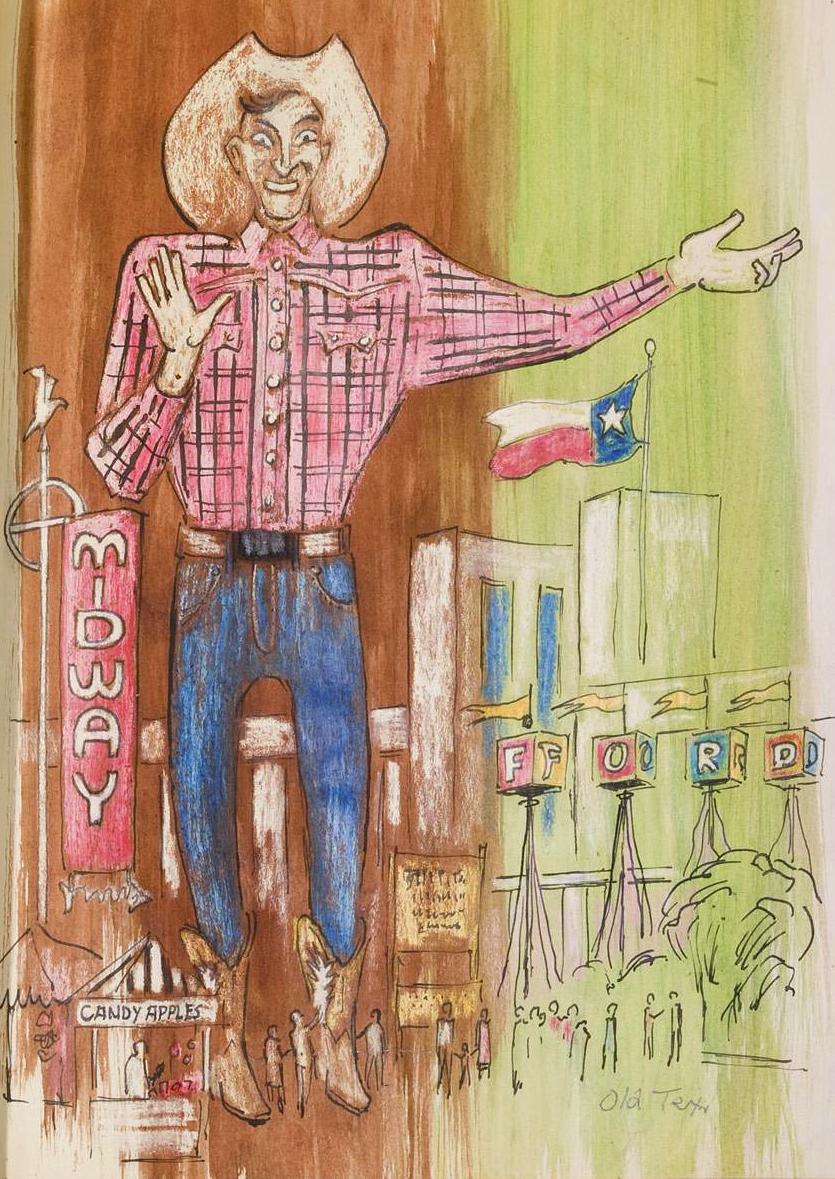
dozier_big-tex_sketchbook_1954_dma“Old Tex” sketch by Otis Dozier, 1954 — Dallas Museum of Art

© Marie Scott Miegel and Denni Davis Washburn

by Paula Bosse

Hey, y’all, guess what’s just around the corner. Whenever you start seeing pictures of Big Tex, you know that the State Fair of Texas can’t be too far away.

There have been a lot of artistic depictions of Big Tex over the years, but I think this sketch by Dallas artist Otis Dozier (1904-1987) may be my all-time favorite. And I’ve only just discovered it! (Thank you, DMA!)

***

This wonderful ink, watercolor, and crayon sketch of “Old Tex” is contained in one of Otis Dozier’s sketchbooks, now in the collection of the Dallas Museum of Art, a gift of the Dozier Foundation (© Marie Scott Miegel and Denni Davis Washburn). To see details on this work, see the page on the DMA’s website, here.

The Otis Dozier sketchbooks have been digitized in a joint project between the Dallas Museum of Art, SMU’s Bywaters Special Collections at the Hamon Arts Library, and SMU’s Norwick Center for Digital Services. To read about this fantastic collection, see the SMU Central University Libraries page, here.

*

This week, the Dallas Museum of Art launched a new digital database in which its entire collection is now accessible online! This is great news for many reasons, not least being that it allows the public to see works that are rarely — if ever — displayed in the museum. Such as this one. To read more about assembling this incredible database, read the DMA’s announcement, here.

To look up your favorite artist, check to see what the DMA has, here.

For the biography of the Forney-born Dozier (who was one of the members of the famed Dallas Nine group), see the Handbook of Texas entry here.

Click picture for larger image.

*

Copyright © 2014 Paula Bosse. All Rights Reserved.


“Twilight…Rest” by Frank Reaugh

reaugh_twilight-rest_ut-ransom

by Paula Bosse

Cattle at rest, by Dallas artist Frank Reaugh.

*

“Twilight…Rest” by Frank Reaugh (1860-1945). Pastel on cardboard; undated.

From the Frank Reaugh Art Collection, Harry Ransom Center, University of Texas; painting and info can be viewed here.

Handbook of Texas entry on Frank Reaugh (a Dallas resident for most of his life) is here.

Click picture for larger image.

*

Copyright © 2014 Paula Bosse. All Rights Reserved.

Gusher at Old Red! — 1890

artesian_bywaters-hogue_color-smu“Artesian Well Gushes on the Courthouse Grounds”
Partial view of the mural by Jerry Bywaters & Alexandre Hogue (1934)

by Paula Bosse

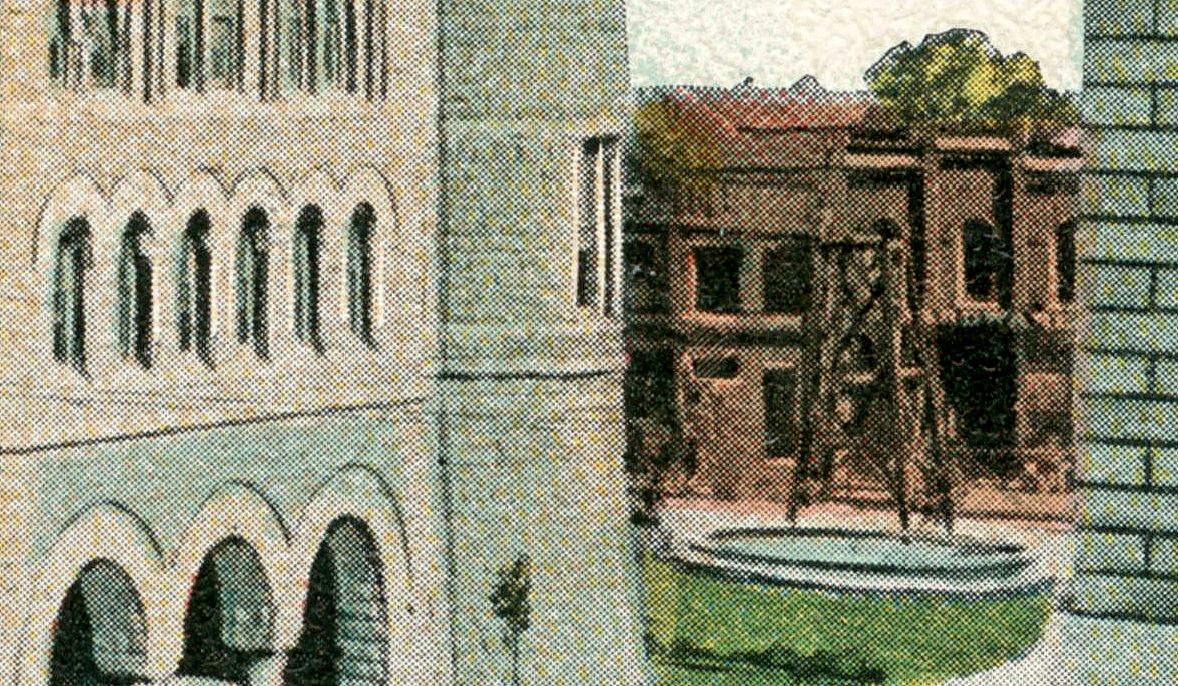
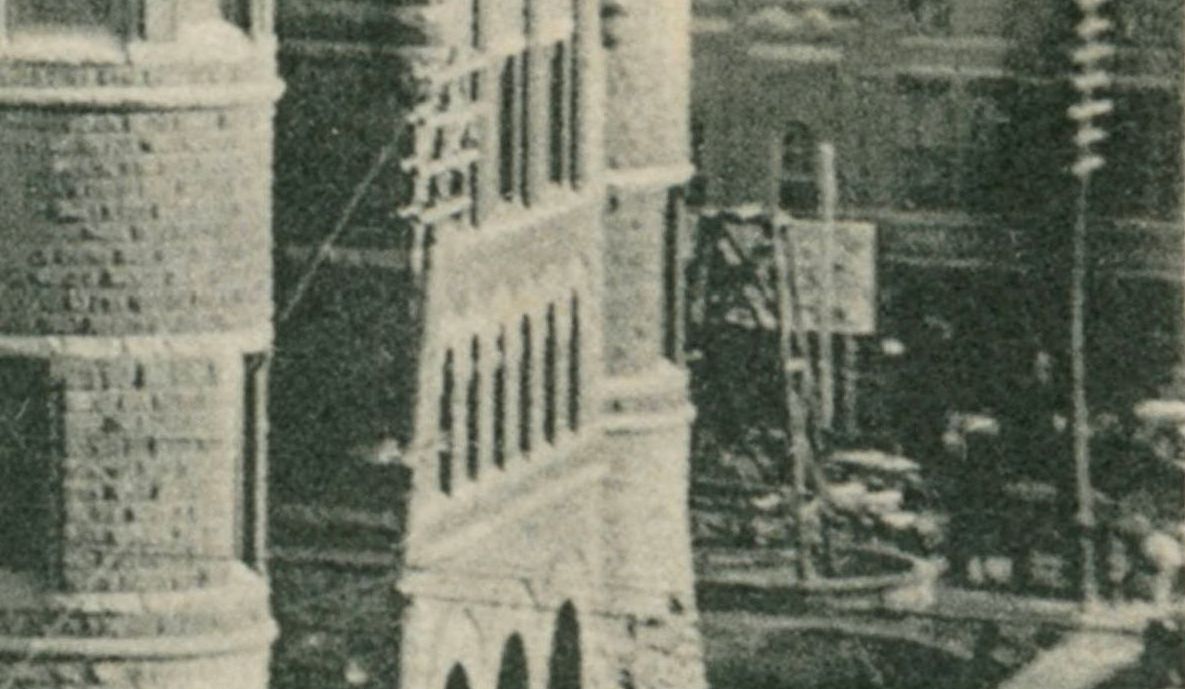
Several months ago, I was looking at the postcard of the Old Red Courthouse shown below. I thought it was interesting because I hadn’t seen that view before. And then I noticed what looked like a derrick just to the right of the courthouse. What was that? It  looked like it was standing over a tank of water, kind of like a windmill. And then I got distracted and didn’t come back to it until I read of an (unrelated) old well having been uncovered in present-day Dealey Plaza a year or two ago, and I remembered this postcard. Was that a well? On the courthouse property? And now I know: it was, in fact, an artesian well that had been sunk on the courthouse lawn in the fall of 1890, and its success was an INCREDIBLY important factor in Dallas’ growth as a city.

artesian_old-red_postcard-color_degolyer

artesian_old-red_postcard-color_degolyer-det

artesian_old-red_postcard-bw_degolyer

artesian_old-red_postcard-bw_degolyer-det

In 1890, Dallas was growing at a remarkable rate, and like any large city, it needed a reliable source of water. In Dallas, that was a problem. Wells were dotted around town — many on private property — but a large supply of water for the ever-increasing community was needed, and needed fast. I gather things were reaching a critical point when The Dallas Morning News printed a letter from a reader named S. T. Stratton in January of 1890. Stratton, a long-time resident of Dallas, suggested digging an artesian well on courthouse property. (And while they were down there, they could check for the possibility of oil and gas.)

artesian-old-red_STRATTON-dmn_010890DMN, Jan. 8, 1890

It seems that this might not have been an idea many people would have taken seriously at the time, because several pages away in the same issue of the paper was this little tidbit encouraging readers to seriously consider this as a viable option. (This was unsigned, but it seems likely it was written by DMN publisher G. B. Dealey.)
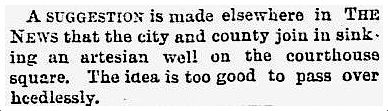
artesian-old-red_dmn_010890DMN, Jan. 8, 1890

The idea gained popularity, and a “special committee on artesian water” convened in February, deciding to go forward with the plan; the city and the county would divide the cost.

artesian-old-red_dmn_020690DMN, Feb. 6, 1890

Later in the year, drilling began, and on Oct. 9, 1890, water was hit. The flow at first was slow, but then, just like in the movies … a gusher! A Dallas News reporter had been writing a story on the initial success when, before he was able to file his report, the well suddenly became the biggest story in the city, in the state, and even around the country. When the drill hit 1,000 feet, the water began to shoot up with such force that it was estimated the well would produce in excess of one million gallons a day. There must have been incredible excitement in the wee hours of that morning, and the reporter’s story of the gusher is pretty thrilling to read — that last sentence is wonderful: “The water at 1 o’clock this morning was clear and it sparkled beautifully in the rays of electric lights.”

gusher_dmn_101090_updateDMN, Oct. 10, 1990

Below is the headline of the in-depth coverage of the successful well (full story linked at bottom of this page). Throngs of people crowded around the well, jubilant politicians patted themselves on the back, and men from the surrounding area wanted one for their towns (Marsalis declared he would get one for Oak Cliff, post haste!). What a scene it must have been. Finally, with that massive reservoir of water underneath the city, Dallas was assured of its continued growth.

gusher_dmn_101190-headlineDMN, Oct. 11, 1890

A story that ran in the national business journal Manufacturer’s Record underlines the importance of the well’s discovery to business investors around the country:

This successful experiment effectively settles the water supply problem of Dallas, and it removes the last obstacle possible to be urged against the rapid building up of Dallas. It insures an unlimited supply of the finest water not only for domestic use, but for manufacturing purposes, which, taken in connection with cheap fuel and ample distributing facilities in a land where various lines of raw material abound, leaves no question as to the success of manufactures. (Quoted in the DMN, Oct. 21, 1890)

Not only was the well’s success being discussed in the national press, but it was also popping up in local ads, like this one from a real estate company which appeared in the pages of the DMN on Oct. 12, 1890:

THE ARTESIAN WELL
Is ‘a Thing of Beauty and a Joy Forever.’
And the hour the drill pierced the water-bearing strata and the precious fluid gushed forth at the rate of 1,000,000 gallons a day forms a new era in the history of the metropolis of the southwest. Every foot of ground in Dallas has increased in value by no inconsiderable amount, but the few lots left on the market in Hall’s second addition will still be sold at $100 each, easy terms.

So I’ve learned something new. I probably should have known about this, at least in connection with the series of PWAP murals produced in 1934 by Jerry Bywaters and Alexandre Hogue, two of my favorite Dallas artists. They painted ten murals throughout the old City Hall (later known as the Municipal Building), each illustrating a high point in the city’s history. The decade 1890-1900 was commemorated by a depiction of the artesian well and all that water discovered flowing beneath the grounds of the then-under-construction Dallas County Courthouse. Unbelievably, the murals were destroyed (!) when the building underwent renovation in 1956. Had they still  been around, I probably would have seen them, and I would have learned about this whole artesian well thing many, many years ago!

artesian_bywaters-hogue_bw-smuWho is the sinister-looking man in the dark coat?

*

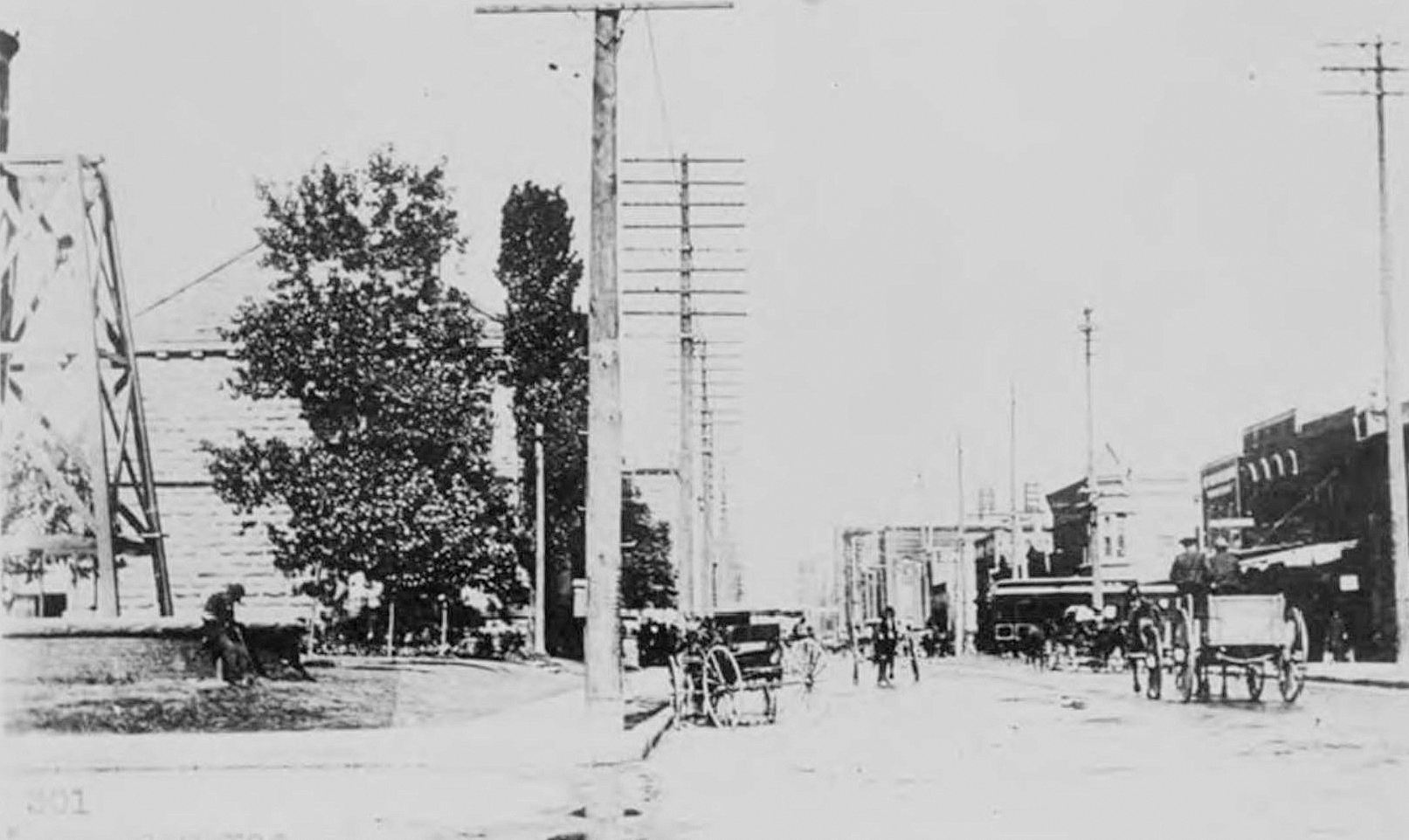
A street-level view from about 1900, showing Commerce Street east from Houston Street showing the artesian well at the left — I believe this served as a public watering trough for horses.

gusher_east-on-commerce-from-houston_degolyer-lib_SMU_1900via DeGolyer Library, SMU

*

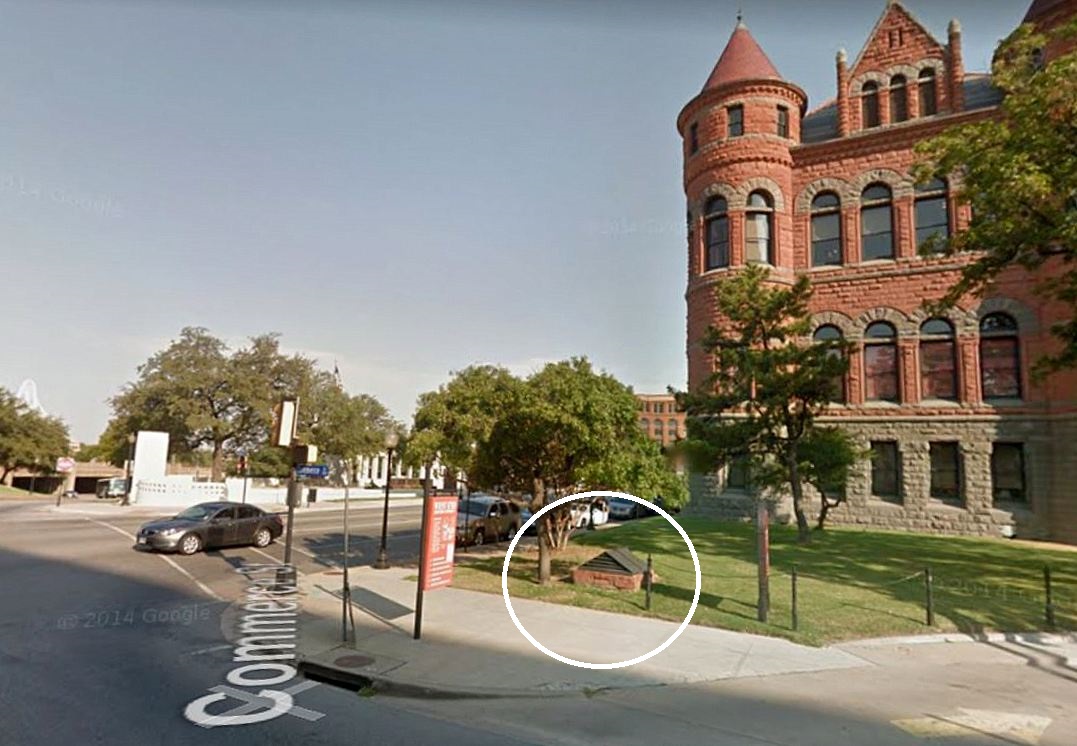
UPDATE: I went to see the capped well today (July 20, 2014). It’s under a shady tree at the southwest corner of the Old Red Courthouse, at Commerce & Houston streets. It isn’t marked at all and is fairly inconspicuous. Even though I’ve known about the existence of this well for only a couple of days, I was so happy to see it — still there, where it’s been for almost 125 years. It was like seeing an old friend.

Photo by Paula Bosse

The view below (looking across Houston Street toward Dealey Plaza from Commerce) shows where this capped well is.

gusher_commerce-and-houston_google-street-view_2011Google Street View (2011)

*

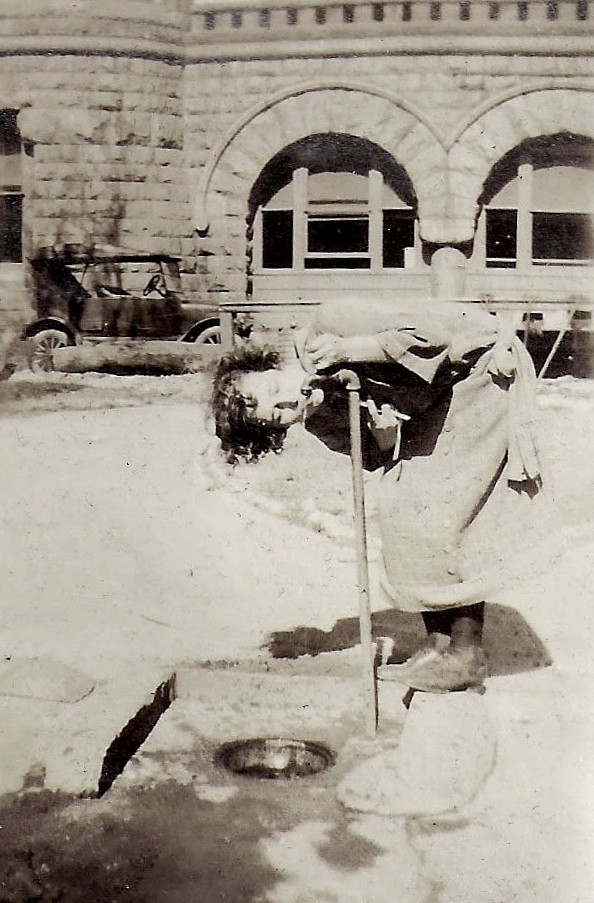
The wonderful photo below is from the 1920s and shows a young woman stopping for a drink on the courthouse lawn.

gusher_old red_ann-hoffman-collection_1920sFrom the collection of Ann Hoffman

***

Sources & Notes

The color image of the Bywaters and Hogue mural is a photograph taken by Jerry Bywaters in 1956 before the murals were destroyed; the black and white photo is by Harry Bennett. Both are from The Bywaters Special Collections, Hamon Arts Library, Central University Libraries, Southern Methodist University. See more information on the color image here, and the black and white image here.

Both postcards are from the DeGolyer Library at SMU: the color postcard can be accessed here; the black and white one here. The black and white image has been cropped — missing is the amusing note on the front of the card, dated 1-4-07: “Dear Faye, can you imagine me a long-haired Texan, brandishing a bowie knife? Ross.”

The circa-1900 photograph showing the well at the left side of the photo is titled “East on Commerce, Commerce and Houston streets, 1900” and is from the Collection of Dallas Morning News negatives and copy photographs, DeGolyer Library, SMU —  more info is here.

The photo of the young woman on the courthouse lawn is from the collection of Ann Hoffman and is used with permission; taken in the 1920s, it shows a friend of her Great Aunt Nora stopping for a drink of water. Thank you for sharing, Ann!

All news clippings from The Dallas Morning News.

To read the report of the initial, somewhat tentative early-in-the-day well success, the DMN article from Oct. 10, 1890 is in a PDF here. For the crazy, jubilant, people-beside-themselves-with-joy report of the gusher, the entire article from Oct. 11, 1890 is here.

Not exactly sure what an artesian well is? Wikipedia to the rescue, here.

*

Copyright © 2014 Paula Bosse. All Rights Reserved.

Summers and Lagoons — 1940s

dmfa_color

by Paula Bosse

The old Dallas Museum of Fine Arts at Fair Park. Just across the lagoon.

And a streamlined rendering which could be found on DMFA letterhead and publications for many years:

dmfa_logo_1944

*

Copyright © 2014 Paula Bosse. All Rights Reserved.
Michael G. Owen, Jr. — Dallas Sculptor of Lead Belly

leadbelly_three-views_paul-l_yelp

by Paula Bosse

Above, three views of “Leadbelly,” the sculpted head of the blues legend, by Michael G. Owen, Jr., 1943.

Michael Owen (profiled here previously as the 15-year-old soap-sculptor who made headlines at the 1930 State Fair of Texas), was the youngest member of the group of artists loosely affiliated with the Dallas Nine group who were making a name for themselves in the 1930s and ’40s. He studied life drawing as a student of Olin Travis and painting as a student of Jerry Bywaters, but he was most proficient as a sculptor. He is best known for his award-winning 1943 bust of bluesman Lead Belly, a piece in the permanent collection of the Dallas Museum of Art (which can be seen in a 1951 DMFA catalog here).

In a 1950 letter to the (then-) Dallas Museum of Fine Arts, Owen recounted how Lead Belly sat for him in New York and sang “Goodnight Irene” as Owen worked on a clay model. Owen was living in Greenbelt, Maryland at the time, and Louisiana-born Lead Belly was living in New York City, but I’d like to think that the two men reminisced about their formative days in Dallas where Owen was a much-talked-about young artist and Lead Belly performed on the streets of Deep Ellum with Blind Lemon Jefferson.

I noticed in the newspaper article that the stone was called black Belgian marble. Actually it isn’t so exotic. It was quarried not far from Charlottesville, Virginia, and is called Black Serpentine. It was the first time I have ever heard of the stuff being black. If you’ll notice it seems quite a bit more crystalline than marble.

The way I happened to do the head went like this. A young fellow I had known in Dallas by the name of Ralph Knight had gone to New York a year or so after I went to Washington. He was interested in folk music and became acquainted with Leadbelly. It was at Ralph’s instigation that I did the head — he got me the stone, sent pictures (I first roughed out the head in clay at home in Greenbelt) and then arranged the sitting at his apartment in New York. Leadbelly sat for me one afternoon and I finished the clay model at that time. From that I worked out the stone cutting, only being able to work on it in my spare time. All in all it was about a full month’s work, I guess. During the time he was “sitting” for me (playing his guitar and singing) he played “Goodnight Irene,” but at that time the folk music devotees did not consider the tune “true folk music.” Still it pleased me when it became a popular song. It’s too bad Leadbelly couldn’t have lived to see himself gain such popularity. (Mike Owen in 1950, from a letter excerpted in the book Lone Star Regionalism, The Dallas Nine and Their Circle)

Sadly, Mike Owen’s career stalled soon after this 1940s artistic high point. He eventually settled in Oregon, where he was sidelined by multiple sclerosis. He died in 1976 at the age of 60.

owen-michael_1930s
Mike Owen in his early 20s

I’m not sure how often the piece is displayed at the Dallas Museum of Art, but it’s a wonderful work of art. When I saw it a couple of years ago, I just stood and stared at it for ages. It’s really fantastic. And it’s fitting that it resides here in Dallas where Michael Owen was once a part of a group of Texas artists whose influence continues to be felt today.

It also seems fitting to throw in this classic from Mr. Ledbetter, who, like Mike Owen, spent time honing his craft in Dallas:

lead-belly-wikipedia

***

Sources & Notes

“Leadbelly” sculpture by Michael G. Owen, Jr. is in the collection of the Dallas Museum of Art.

Photo of the artwork is by Paul L. as posted on Yelp.

Photo of Lead Belly from Wikipedia.

Quote from Mike Owen’s letter to the DMFA (April 11, 1950) can be found in the superb book Lone Star Regionalism, The Dallas Nine and Their Circle, 1928-1945 by Rick Stewart (Austin: Texas Monthly Press, Dallas Museum of Art, 1985) — the best book on Dallas art of this period.

Read the Handbook of Texas entry about Huddie Ledbetter (aka Lead Belly/Leadbelly) here.

Other Flashback Dallas posts on Owen:

  • Young Mr. Owen’s star-turn as the teenager who carved the WFAA transmitter plant from 8,400 pounds of Ivory Soap is here.
  • Owen’s monument to SMU Mustangs’ mascot Peruna, commissioned in 1937, is here.

UPDATE: Read about a recently discovered large painting by Owen up for auction in Dallas in 2019 here.

*

Copyright © 2014 Paula Bosse. All Rights Reserved.


Juneteenth at the Texas Centennial — 1936

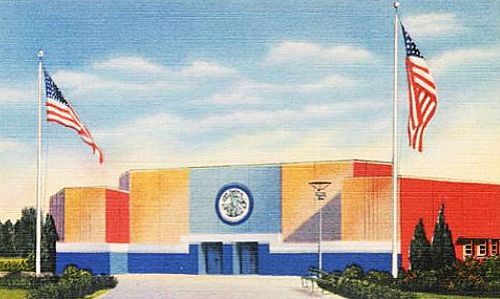
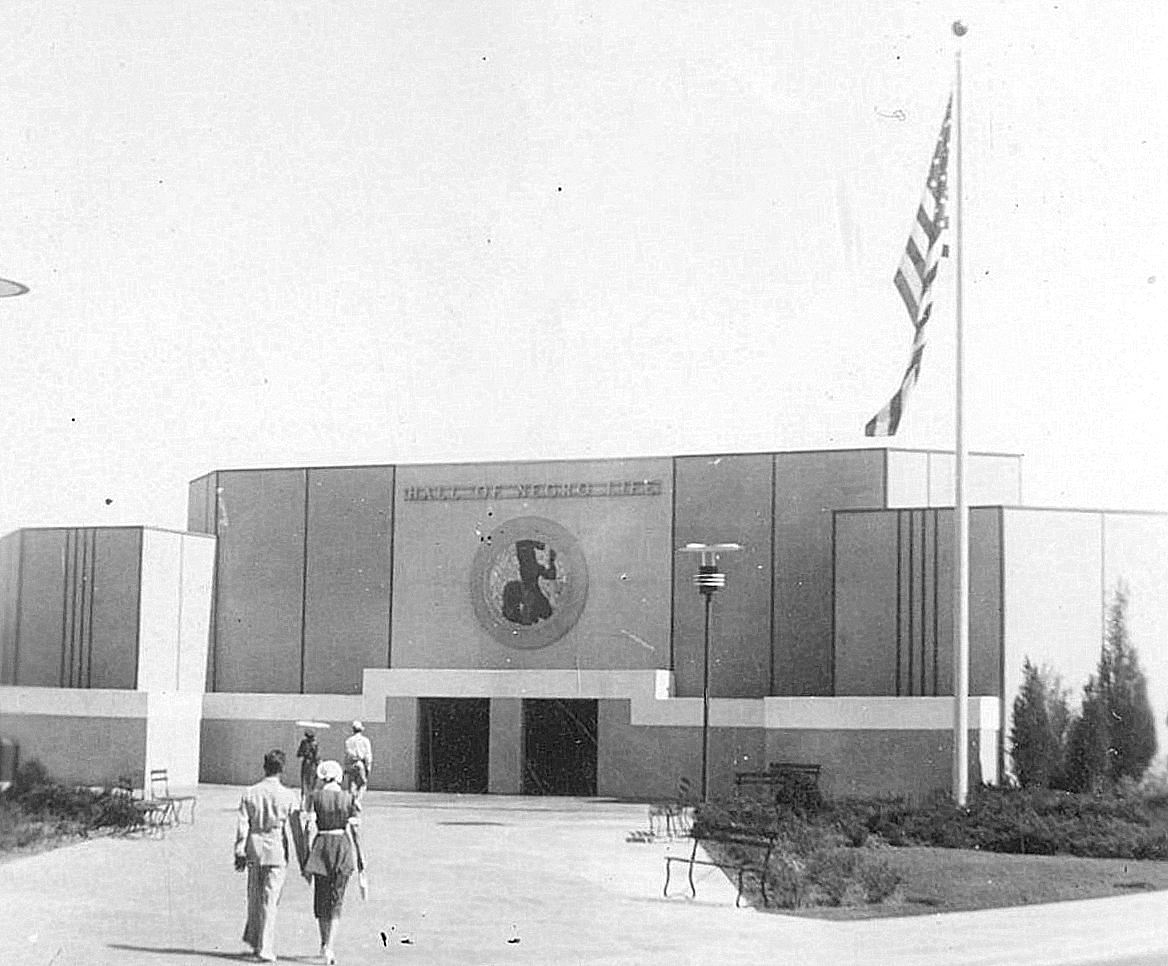
hall-of-negro-life_centennialThe Hall of Negro Life at the Texas Centennial Exposition, Fair Park
by Paula Bosse

Juneteenth, the anniversary of the date that African American Texans learned they were freed from slavery, was celebrated at the Texas Centennial Exposition with a day of entertainment and exhibits. It was also the day that the Hall of Negro Life — a federally funded exhibition hall acknowledging and honoring the history and accomplishments of African Americans in the United States — was officially dedicated.

tx-centennial_hall-of-negro-life_portal

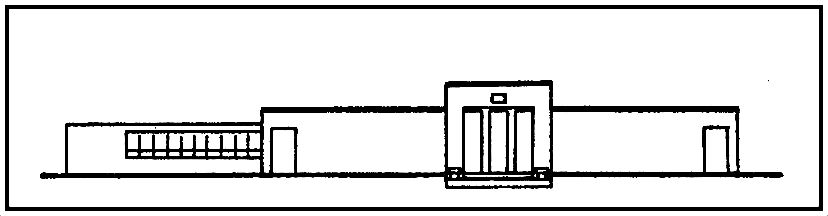
One of the more interesting things I’ve stumbled across is a drawing of the proposed building (published in J. Mason Brewer’s The Negro In Texas History in 1935). I don’t believe I’ve seen this before. It’s interesting to note the changes from original proposal to finished product.

hall-of-negro-life_proposed_the-negro-in-texas-history_1935

Among the large collection of art by black artists displayed in the Hall of Negro Life were four murals by the artist Aaron Douglas, depicting black history in Texas. Below are the two murals that survive, “Into Bondage” and “Aspiration.” These are incredible murals, and it must have been an emotional experience for those Juneteenth visitors in 1936 to be surrounded by all four powerful pieces in the lobby of a government-backed project that formally recognized the contributions of fellow African Americans.

aaron-douglas_into-bondage_1936_corcoran“Into Bondage” by Aaron Douglas, 1936 (Corcoran Gallery of Art)
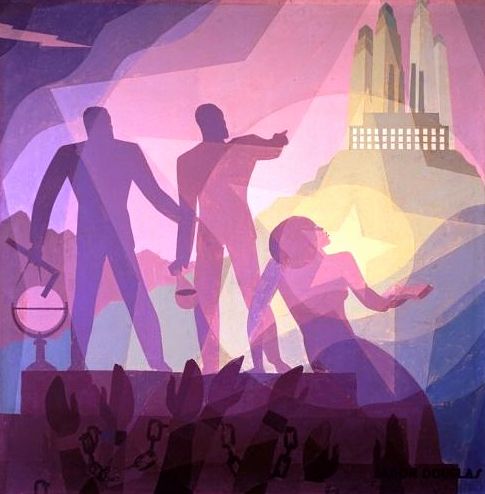
aaron-douglas_aspiration_1936“Aspiration” by Aaron Douglas, 1936 (Fine Arts Museum of San Francisco)
***

Sources & Notes

Black-and-white photograph of the Hall of Negro Life from the Private Collection of Mary Newton Maxwell, Portal to Texas History, here.

Photo of proposed Hall of Negro Life from An Historical and Pictorial Souvenir of the Negro In Texas History, written by J. Mason Brewer (Dallas: Mathis Publishing Co., 1935).

“Into Bondage” by Aaron Douglas (1936) is from the collection of The Corcoran Gallery of Art.

“Aspiration” by Aaron Douglas (1936) is from the collection of The Fine Arts Museum of San Francisco. (There is an amazing interactive look at this painting here.)

More on the Hall of Negro Life, from the Handbook of Texas, here.

More on the Hall of Negro Life from The Crisis, the magazine of the NAACP, in the July, 1936 article “Negroes and the Texas Centennial” by Jesse O. Thomas, here.

How was this important Juneteenth celebration at the Texas Centennial covered by The Dallas Morning News? Well, the paper actually devoted a lot of space to the day’s events in a fairly lengthy article which appeared on June 20, 1936. I think the DMN editorial board probably thought they were being magnanimous in the amount of coverage given, but, really, the article — though brimming with a certain amount of probably well-intentioned jubilation — is so unremittingly racist that it’s actually shocking to see this sort of thing in print in a major newspaper. I encourage you to check out the article published on June 20, 1936 which carries the laboriously headlined and sub-headlined “Negroes Stage Big Juneteenth at Centennial; Dallas Eats Cold Supper and Cotton Patches Emptied as Thousands Inspect Magic City; Hall Is Dedicated; Dusky Beauties Prance; Cab Calloway Does His Stuff For Truckers.”

*

Copyright © 2014 Paula Bosse. All Rights Reserved.

Give a 15-Year-Old 8,400 Pounds of Soap and He’ll Carve You a Radio Transmitter — 1930

owen-michael_soap_1930a
Michael Owen, Jr., boy soap-carver 1930

by Paula Bosse

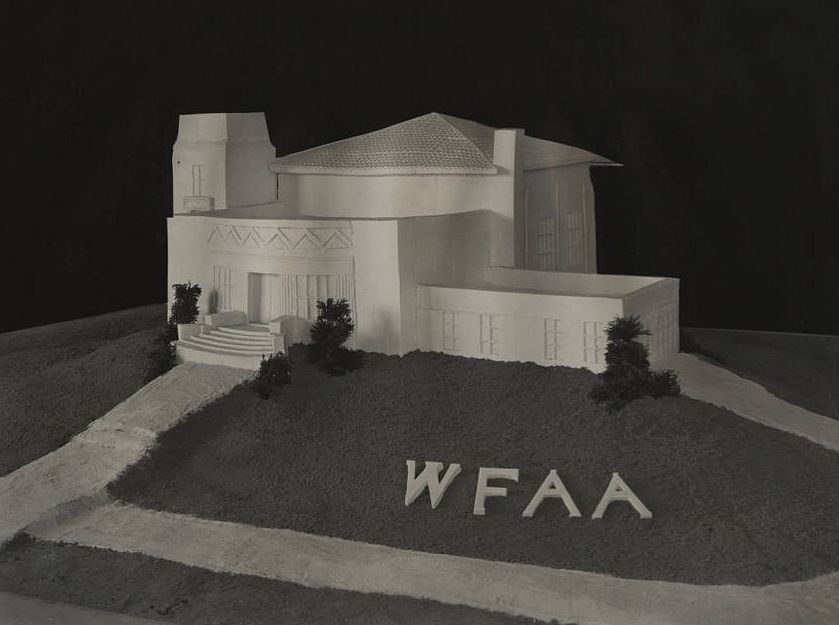
In 1930, 15-year-old sculptor Michael G. Owen, Jr. carved a replica of the WFAA transmitter building out of 8,400 pounds of Ivory soap. And why not? It was a big draw at that year’s State Fair of Texas.

Mike Owen, a student at well-to-do Highland Park High School (although Dallas artist Olin Travis, who had him as a pupil at about this time, described him as being “very poor”), had been sculpting all sorts of things, from the age of 3. He had begun winning awards when he was 13 or 14, one in an earlier “soap modeling” contest sponsored by Procter & Gamble. Not only did that soap-carving award result in young Mr. Owen being commissioned by Sanger Bros. to carve a model of the downtown skyline (I’m not sure this commission was ever actually completed), he was also asked to create an attraction for the State Fair: a replica-in-soap of the WFAA transmitter plant located on Northwest Highway near Grapevine (see a photo of the transmitter building and tower here). Owen worked from blueprints of the building and a bronze model supplied by the Belo Corporation (owner of WFAA), and Proctor & Gamble supplied the huge bars of Ivory soap (12 bars, each weighing 700 pounds). The finished piece was an “exact replica” of the 50,000-watt transmitter plant and was touted by Procter & Gamble as being the largest soap sculpture ever executed. It was a big hit at the 1930 State Fair of Texas.

Michael Owen went on to become a professional artist, with early enthusiastic support from Jerry Bywaters. He was associated with the Dallas Nine (and was, by far, the youngest member affiliated with that somewhat amorphous group), and I will address his more serious non-soap forays into the art world in a later post. But, first, back to soap!

The photo below shows Mike Owen’s finished product, which took him 12 days to complete.

owen_wfaa-soap_degolyerBelo Collection, DeGolyer Library, SMU

It’s difficult to tell what the size of the finished work was from this photo, but it was described as being five feet high and seven feet wide. So… big. When it was displayed at the fair it was, for some reason, bathed in blue light. After the 12 days it took Owen to complete this sculpture, I bet that kid was squeaky-clean and positively reeked of Ivory soap.

owen-michael_soap_1930b

owen-michael_soap_1930

***

Sources & Notes

Photo of Owen’s soap carving of the WFAA transmitter plant is from the Belo Records collection, DeGolyer Library. Central University Libraries, Southern Methodist University; more information on this photo can be found on the SMU website here.

Other Flashback Dallas posts on artist and sculptor Michael G. Owen, Jr.:

  • For a look at Owen’s professional career as a sculptor, see my post “Michael G. Owen, Jr., Dallas Sculptor of Lead Belly” here.
  • To read about the Peruna monument SMU commissioned him to produce in 1937 (when he had just turned 22), see my post here.

UPDATE: Read about a recently discovered large painting by Owen up for auction in Dallas in 2019 here.

*

Copyright © 2014 Paula Bosse. All Rights Reserved.


Deep Ellum / Deep Elm / Deep Elem Blues

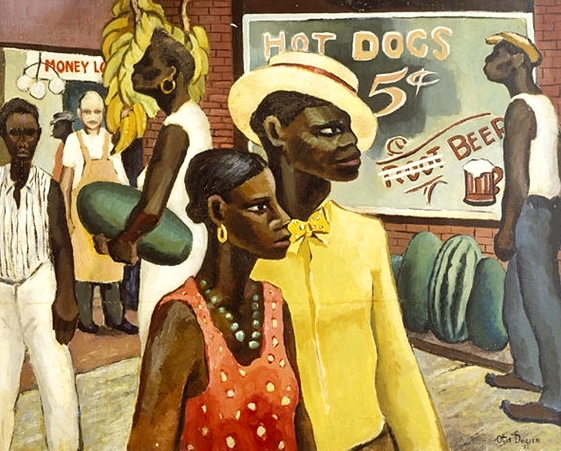
deep-elm-otis-dozier_1932“Deep Elm” – Otis Dozier, 1932

by Paula Bosse

“Deep Ellum Blues” has become a standard blues song, warning of/extolling the vices found in the once-thriving, predominantly black area of town, where a lot of people — black and white — enjoyed themselves (after dark) in clubs and bars, immersed in the sometimes shady goings-on that one tends to find on the other side of the tracks. The song (sometimes irritatingly called “Deep Elem Blues”) was first recorded in 1935 by the Lone Star Cowboys (popular performers in the Dallas area, better known as the Shelton Brothers). And now it’s become a blues standard, sung around the world by people who have no idea what a “Deep Ellum” is.

Below are four versions of the song that I like. (I searched for early performances by black musicians, but, according to Deep Ellum experts Alan Govenar and Jay Brakefield, there is only one that anyone seems to know about — by Booker Pittman, grandson of Booker T. Washington, and I couldn’t find it.)

But first, if you haven’t seen this wonderful short documentary by Alan Govenar about Deep Ellum in its original prime, it’s a must-see. (Bill Neely sings “Deep Ellum Blues” in this — it’s great. Listen for the extra verses.)

Below, the original version by the Lone Star Cowboys, who later changed their name to The Shelton Brothers and were well-known to Dallas audiences through their regular appearances at the Big D Jamboree and on local radio. (Listen to their follow-up, “What’s the Matter with Deep Elem?”)

My personal favorite, this hopping western-swing-big-band-rock-n-roll version by the always fabulous one-time Dallas resident Hank Thompson.

I can’t leave off this turbo-charged rockabilly version by Dallas’ own “Groovey” Joe Poovey!

And, finally, for good measure, one weird version, by the always reliable Charlie Feathers.

Remember y’all: KEEP YOUR MONEY IN YOUR SHOE!

***

Sources & Notes

“Deep Elm” painting by Otis Dozier (1932) — one of the Dallas Nine group — from the collection of the Dallas Museum of Art.

“Deep Ellum” film by Alan Govenar, one of Dallas’ leading blues and cultural historians and archivists. For more on the 1985 short film, see the FolkStreams site here. For Alan Govenar’s Documentary Arts website, see here.

For more on the history of Deep Ellum, I highly recommend Deep Ellum and Central Track, Where the Black and White Worlds of Dallas Converged by Alan B. Govenar and Jay F. Brakefield (Denton: UNT Press, 1998), as well as their recent revised/expanded book Deep Ellum, The Other Side of Dallas (College Station: Texas A & M University Press, 2013). Govenar and Brakefield have written the definitive history of Deep Ellum in these two volumes. You can read a bit about the song from the latter book here.

I wrote about another interesting song, “Dallas Blues” — considered by many to be the first blues song ever published — in the post “I’ve Got the Dallas Blues and Main Street Heart Disease,” here.

*

Copyright © 2014 Paula Bosse. All Rights Reserved.

“Rainy Day” and “Rainy Day” on a Rainy Day

bowling_rainy-day_smu

spruce-everett_rainy-day_1944

by Paula Bosse

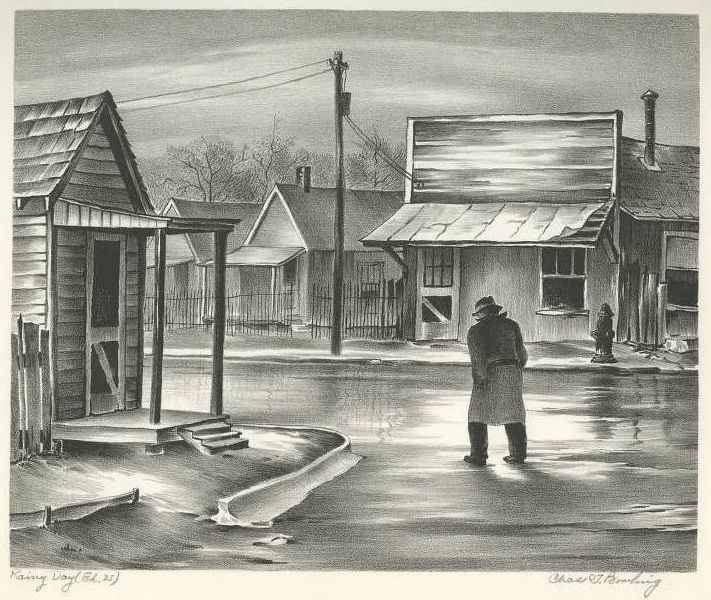
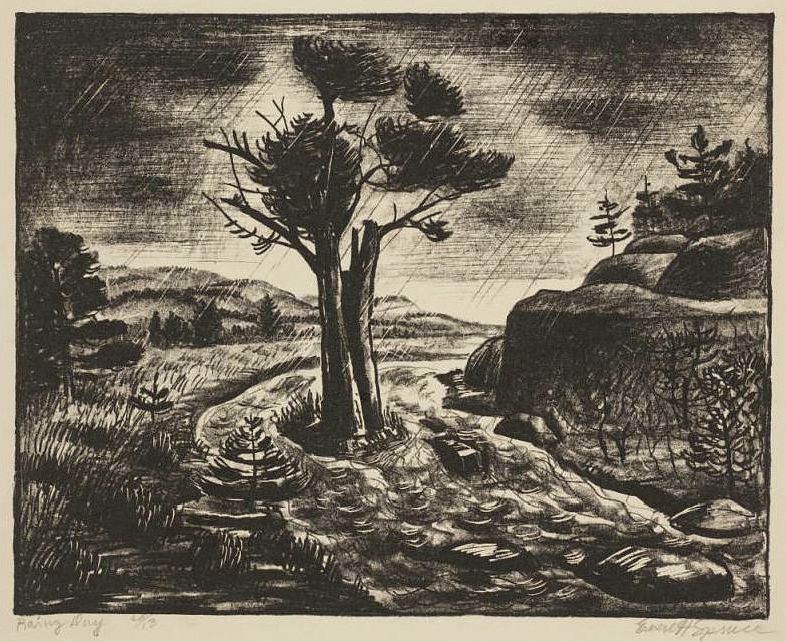
Two works by local artists closely connected with (if not actually IN) the influential Dallas Nine group of painters and printmakers. Both works are titled “Rainy Day.”

The top print is a lithograph by Charles T. Bowling (1891-1985) and is undated. (From the Bywaters Special Collections, Hamon Arts Library, Southern Methodist University.)

The second print, also a lithograph, is by Everett F. Spruce (1908-2002), dated 1944. (From the collection of the Dallas Museum of Art, a gift of A. H. Belo Corporation and The Dallas Morning News, via the Central University Libraries of SMU.)

Stay dry!

Click pictures for larger images.

*

Copyright © 2014 Paula Bosse. All Rights Reserved.