Flashback : Dallas

A Miscellany: History, Ads, Pop Culture

Category: Churches

Mosaic Restoration at Downtown’s St. Jude Chapel
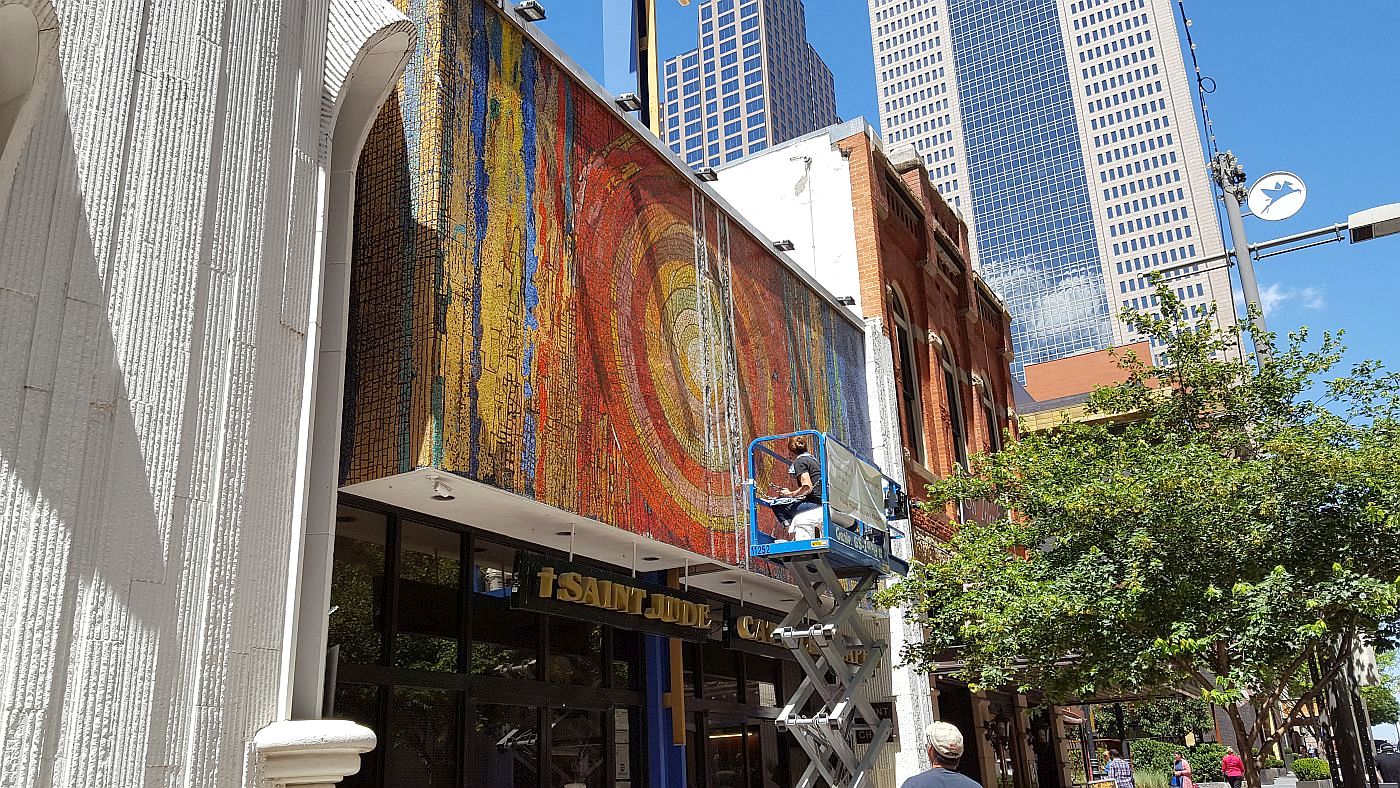
st-jude-chapel_scaffold_052417_bosse_bosseTile by tile by tile… (click for larger image)

by Paula Bosse

A couple of weeks ago I went downtown to check out the restoration of the large mosaic above the entrance to the St Jude Chapel on Main Street. The 1968 Gyorgy Kepes mosaic (which I wrote about here) is undergoing needed repair work, restoration, and cleaning, in preparation for next year’s 50th anniversary of the downtown chapel. The work on mosaics inside the chapel as well as the large one outside is being done by artist and preservationist Julie Richey of Julie Richey Mosaics in association with Art Restorations, Inc.

As you can imagine, the outdoor mosaic overlooking Main Street has, for 50 years, weathered everything from intense summer heat, freezing temperatures, automobile exhaust, slight shifting of the building’s structure, damage to individual tiles, mildew, grout decomposition, and a host of other factors, all of which led to the much-needed restoration work.

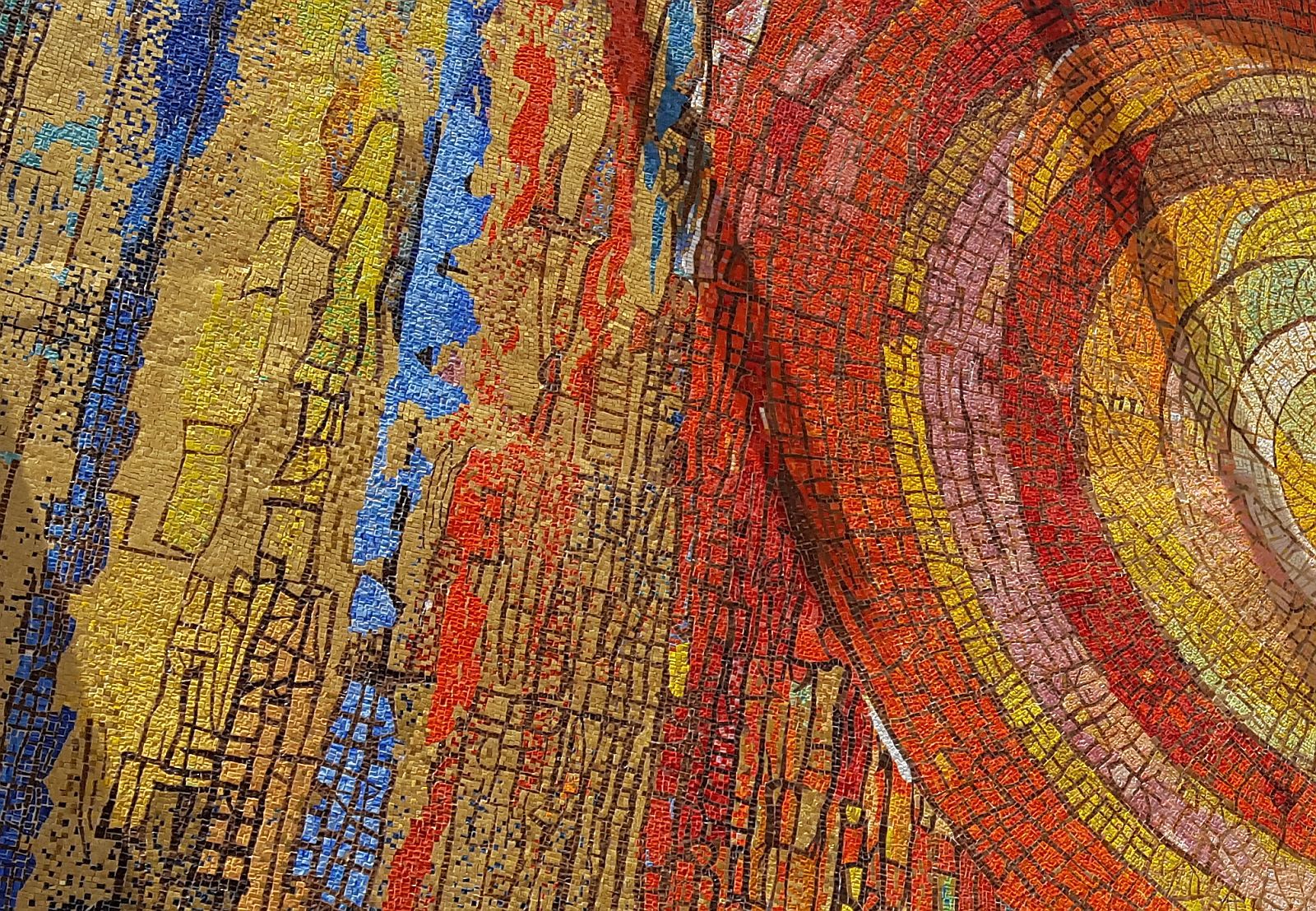
A couple of things that I found interesting, in talking with Julie Richey and Cher Goodson (of Art Restorations, Inc.) was that there are over 800,000 glass smalti tiles (or tesserae) forming the sunburst mosaic. 800,000! I had no idea it was so large until I was standing right below it. After missing or damaged tiles have been replaced, all 800,000-plus will be cleaned — by hand, I think — with, as Cher told me, Dawn dishwashing liquid (good for cleaning greasy dishes, oil-soaked waterfowl, and Venetian glass tiles). Speaking of those tiles, one of the most serendipitous moments in this project was when Julie was able to track down slabs of smalti in New York which were the very same smalti used in the original 1968 mosaic — they had been kept in storage for 50 years, and they look brand new. That means that the tesserae being used to replace the damaged or missing tiles are from the exact same batch as the originals, which means the vivid colors, the composition, the opacity, and the surface texture are the same. That is an incredible stroke of luck!

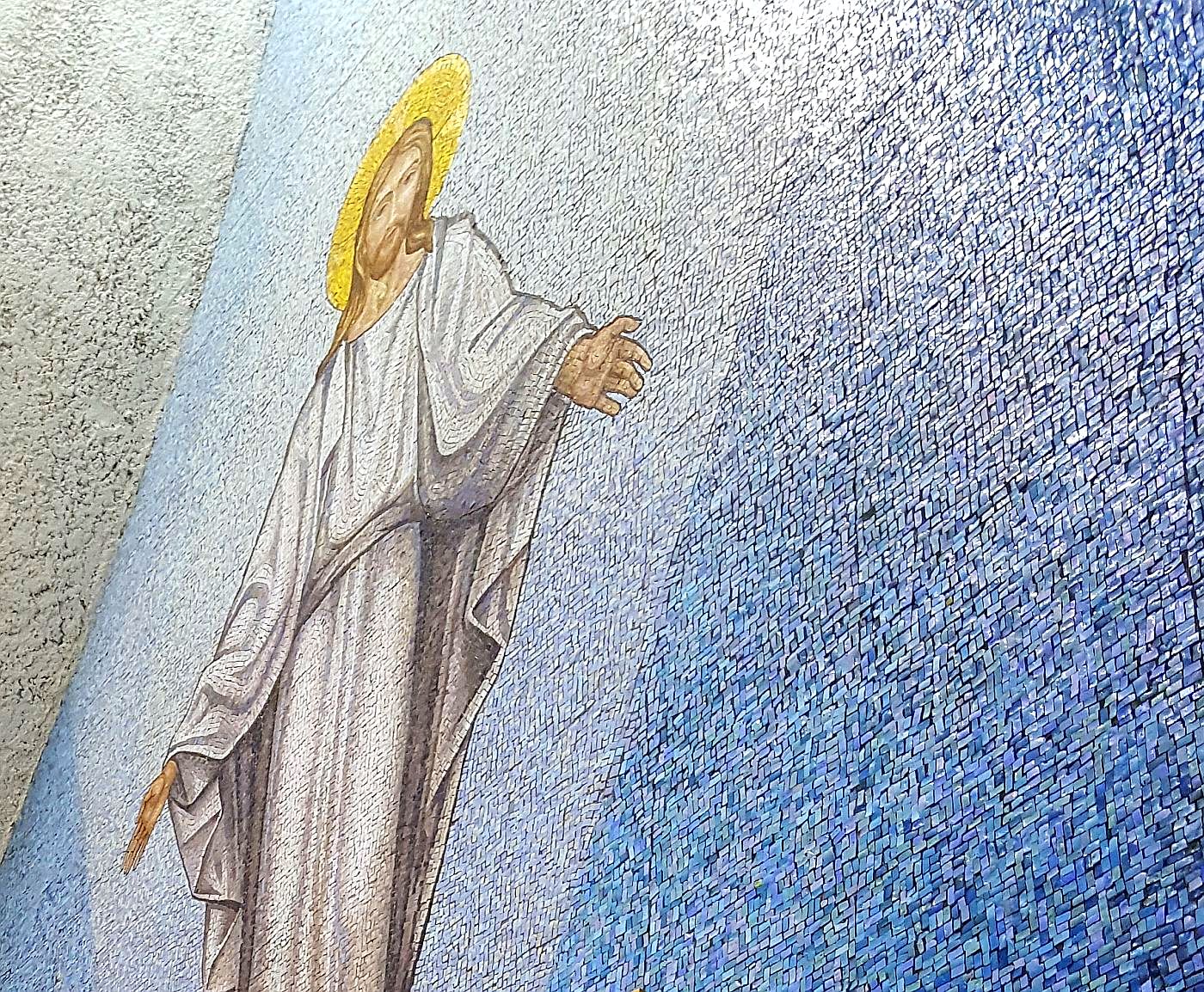
The work should be wrapping up soon — if you’d like to catch the last few days of this project, hop downtown and say hello to the women doing such great work! (UPDATE: The project actually ended Friday. But you should still go down and take a look at it!) While you’re there, you should step inside to see the little chapel, a calm and peaceful oasis in the heart of downtown. There are several other mosaics inside — Julie and company did work on some of those as well, most notably the very large, striking “Risen Christ” above the altar.

Below are some photos I took inside and outside the chapel on May 24, 2017 — most are larger when clicked.

**

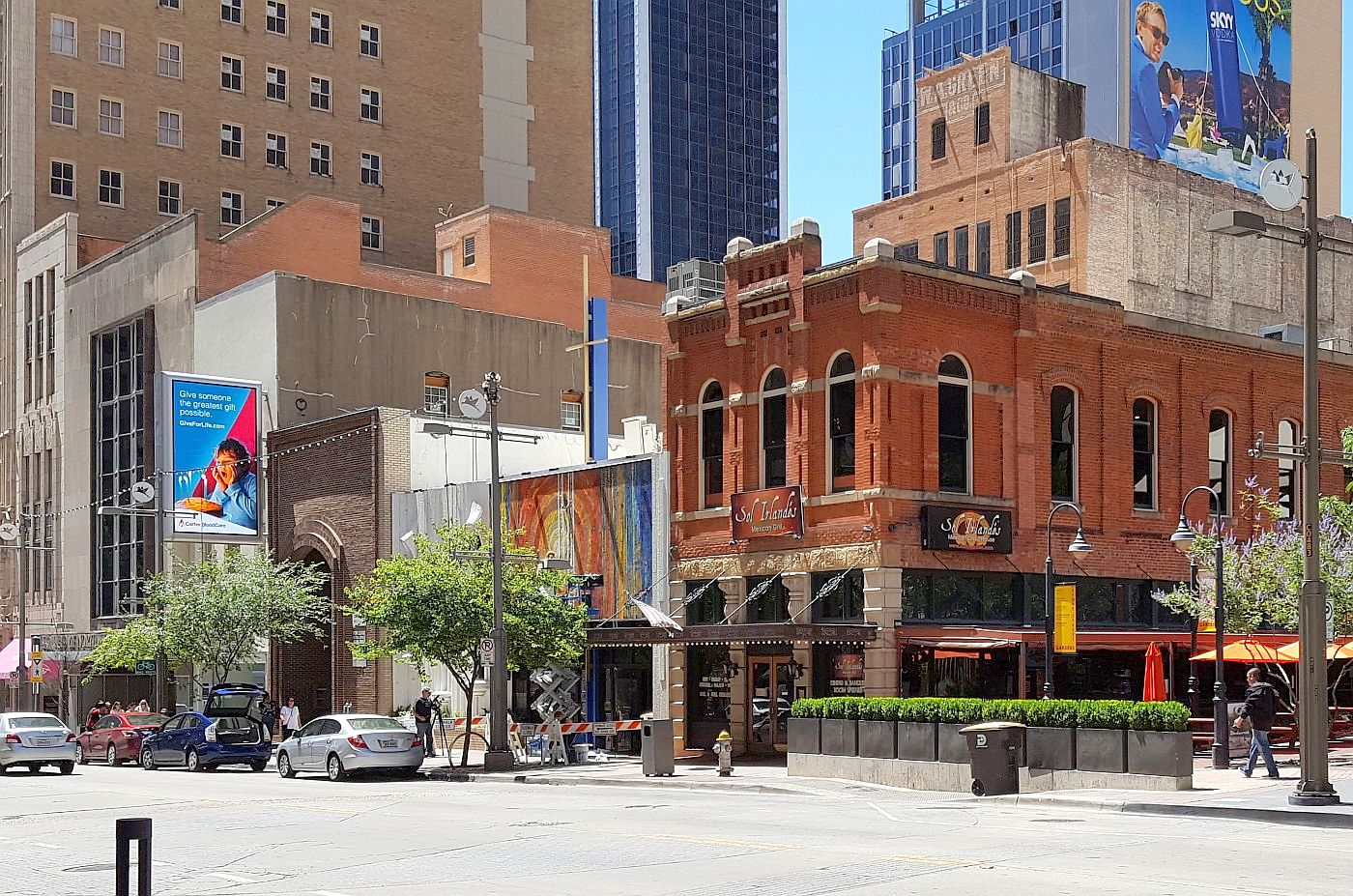
St. Jude Chapel is in the 1500 block of Main, between Ervay and Akard.

Here it is, seen from Neiman’s, across the street.
st-judes-chapel_sol-irlandes_052417_bosse

Below is part of the mosaic by Gyorgy Kepes — seeing it up close, you begin to realize that, yeah, there probably are more than 800,000 glass tiles up there. (Definitely click the photo to see a very large image.)
st-jude-chapel_mosaic_052417_det_bosse

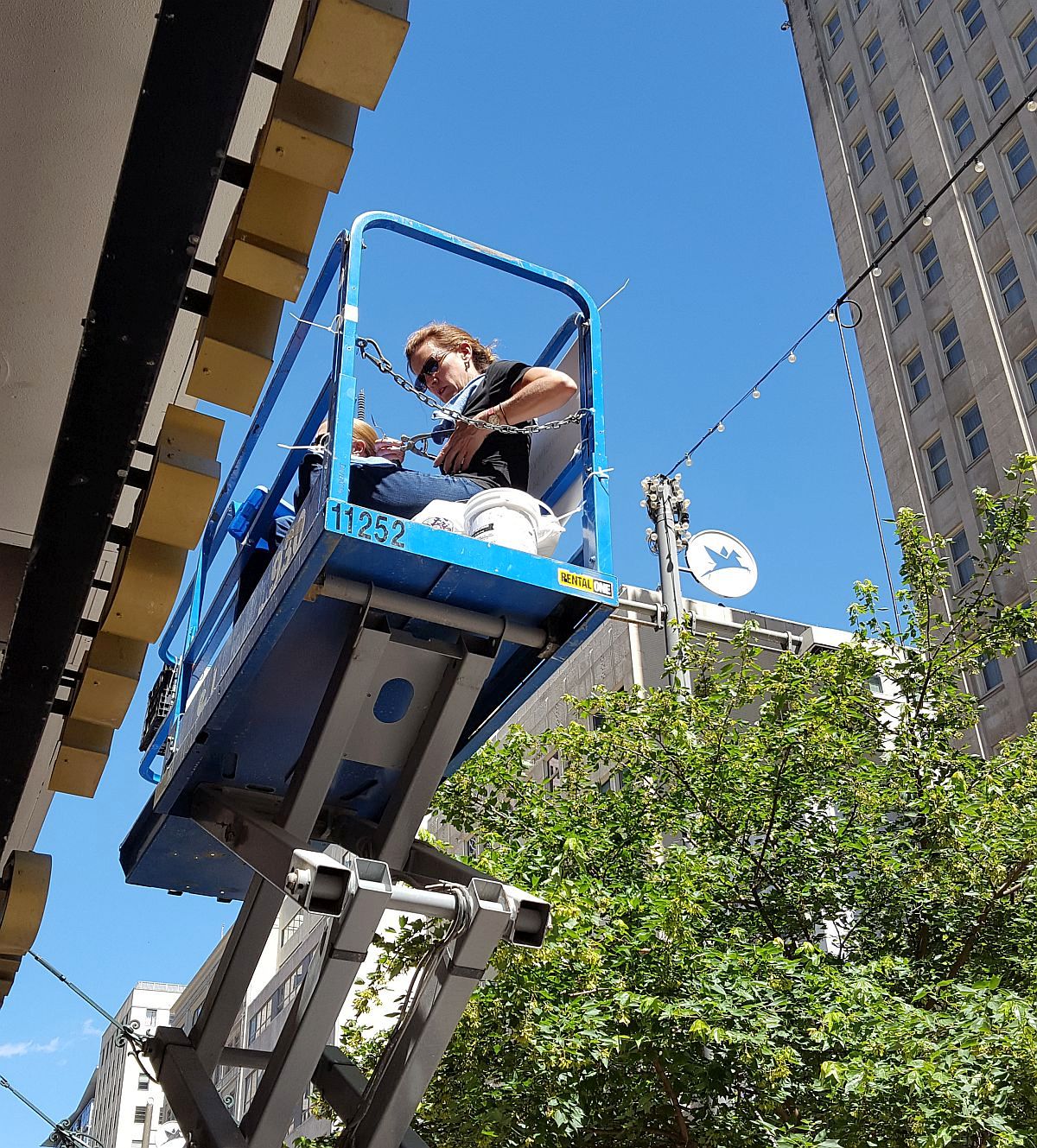
The photo at the top of the post shows the lift used to tackle the job; looking on is Dallas filmmaker Mark Birnbaum who is documenting the project. Below, Julie Richey and Lynne Chinn are raised up on the lift to do their torturously tedious and very, very detailed work (imagine working on this huge thing using tweezers!). Julie can be seen snipping “new” smalti to replace the damaged or missing tiles, working from photos, diagrams, grids, graphs, and guides to make sure the restoration is as close as possible to the original mosaic: the colors must match, the shapes must match, the placement must match.
st-jude-chapel_julie-richey_snipping_052417_bosse

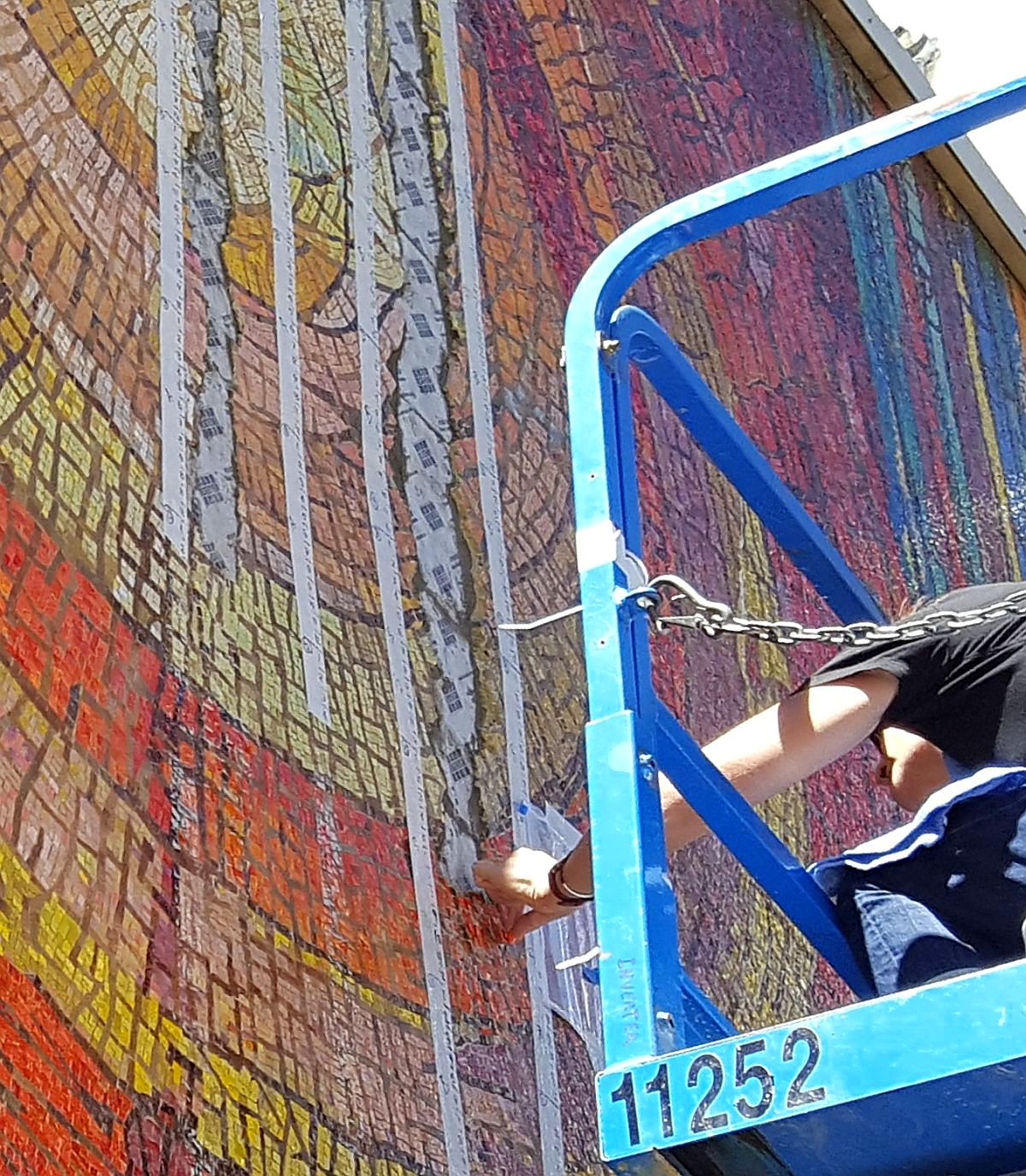
You really have to be focused to do work like this. Here, Julie is setting a tiny piece into that giant mosaic (the marked vertical strips of tape help map the mosaic and insure that everything goes back in exactly as it was originally placed in 1968.
st-jude-chapel_julie-richey-at-work_052417_det_bosse

Speaking of snipping the smalti (which sounds like a naughty euphemism used amongst naughty mosaicists), here’s what’s left over, below. I talked to conservator Callie Heimburger, who gave me a lot of interesting information on how the whole intricate process worked — she was set up at a table on the sidewalk and had containers full of these beautiful discarded glass shards in front of her. I really wanted to scoop up a handful and sneak them into a pocket, but I managed to control myself.
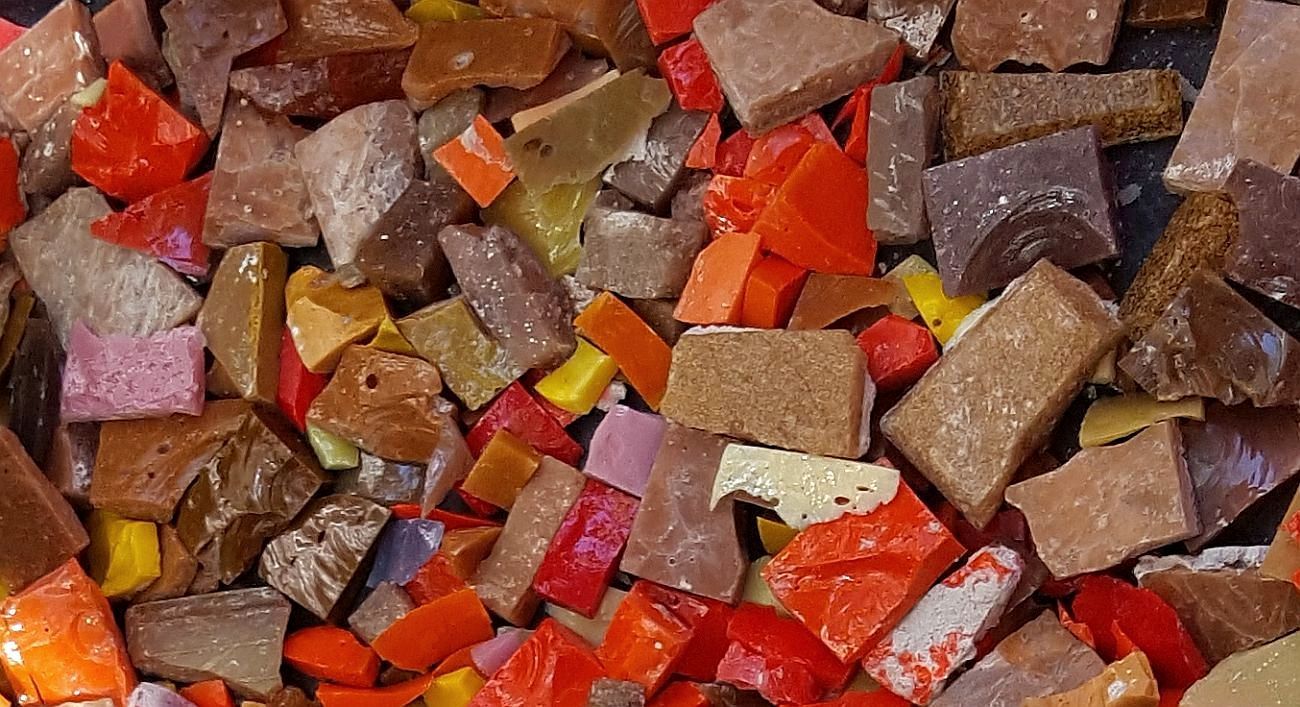
st-jude-chapel_smalti-snippings_052417_bosse

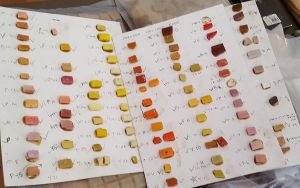
Everything is meticulously color-coded.
st-jude-chapel_greens-blues_052417_bossse

st-jude-chapel_oranges-yellows_052417_bosse

And smalti? Here are bags of “new” bagged tiles — not shown are the slabs or the larger pieces which look a little like brightly colored peanut brittle.
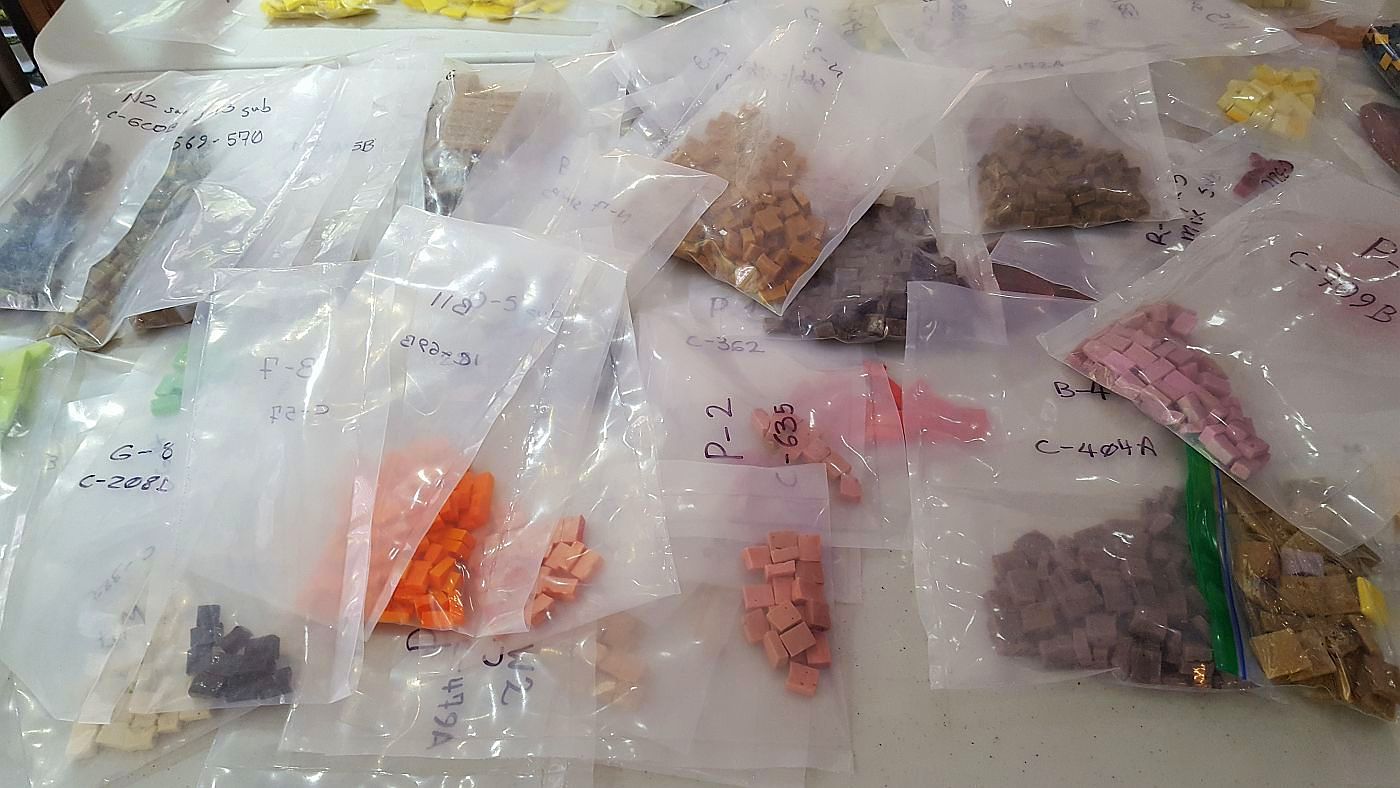
st-jude-chapel_bagged-tiles_052417_bosse

Julie asked if I wanted to go up on the lift and take a closer look. It was even more impressive (and a little overwhelming) to be right next to it. I also got to take a look over the top of the building. There Julie pointed out all that remains of one of downtown’s biggest and busiest retail stores, W. A. Green. I didn’t have the presence of mind to get a good photo up there, but here’s the “ghost sign,” seen from across the street.
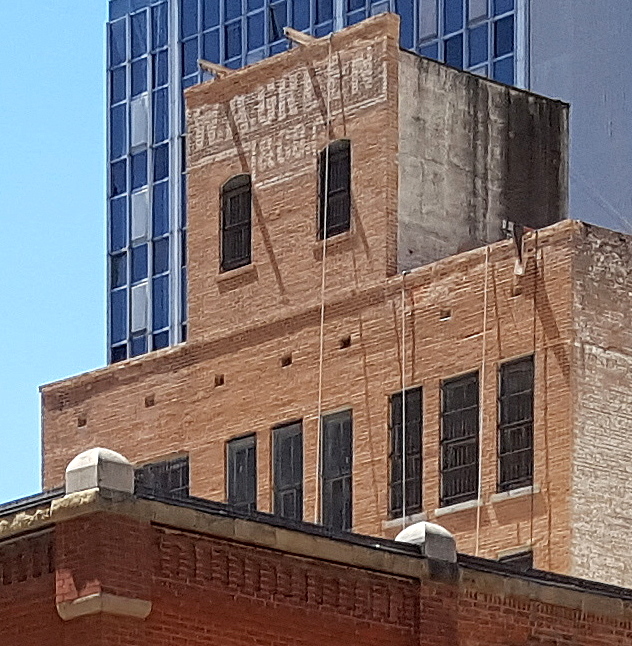
w-a-green_ghost-sign_052417_bosse

**

Since I was there, I had to step inside to see what the little chapel looked like. It’s very charming. And the mosaics inside are also impressive.

Here’s what you see as you step in.
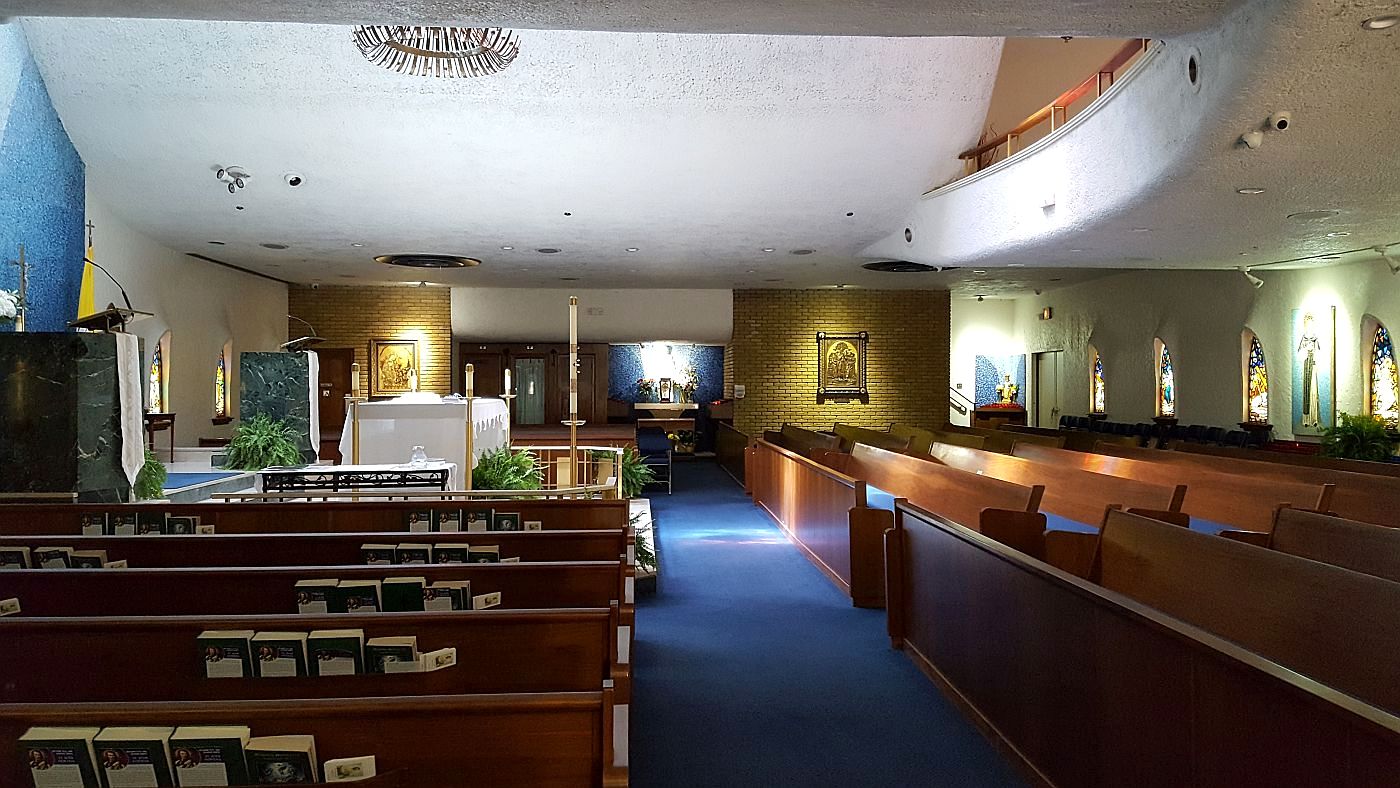
st-jude-chapel_toward-back-of-chapel_052417_bosse

To your left is the altar. This lovely mosaic was also restored and cleaned. Also: curved walls, a stained glass skylight, and a light fixture that is one of my very favorite decorative elements of this chapel.
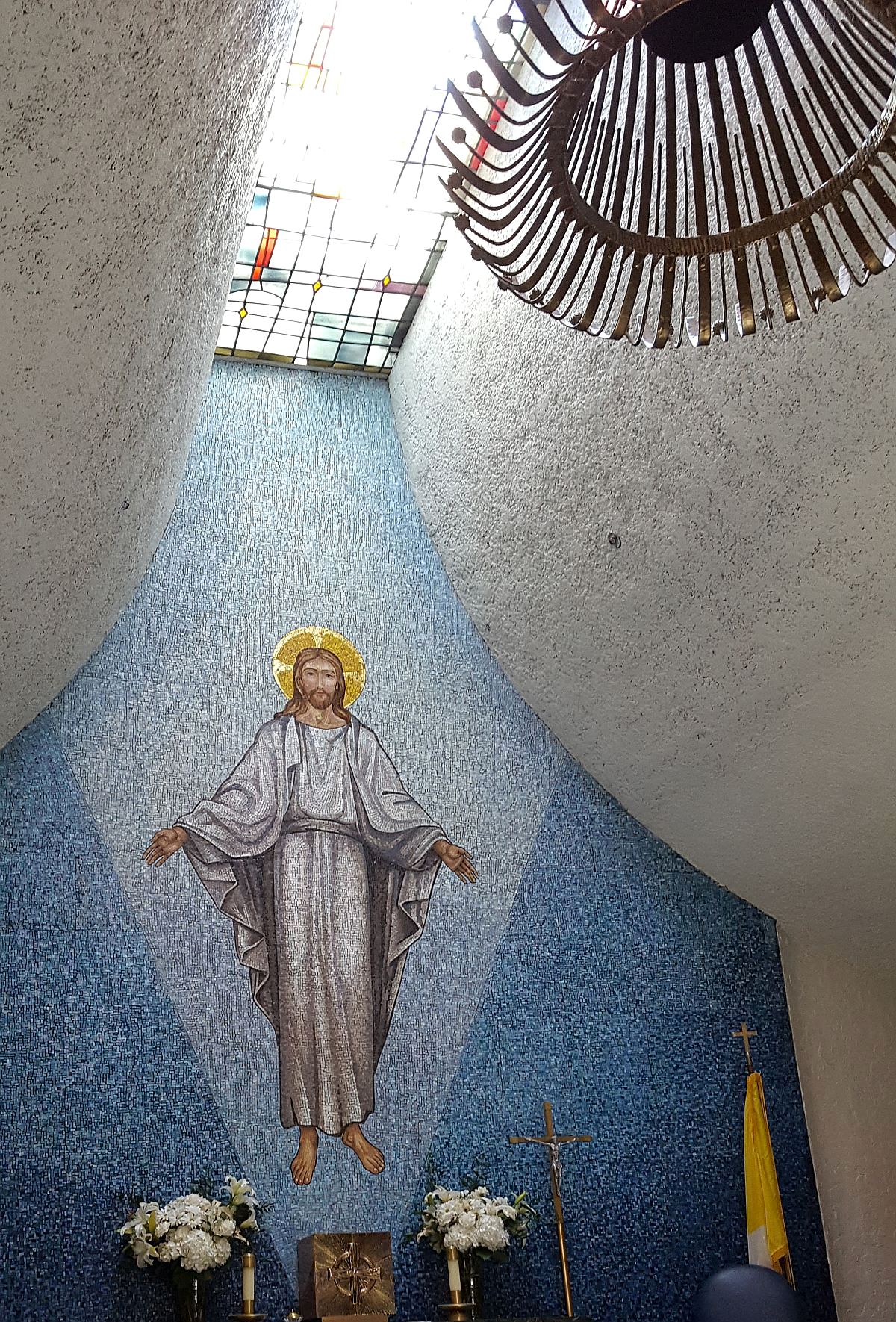
st-jude-chapel_altar_stained-glass-skylight_052417_bosse

A closer look at “Risen Christ.”

st-jude-chapel_altar_det_052417_bosse

Turn around, and from the pulpit you can see the choir loft.
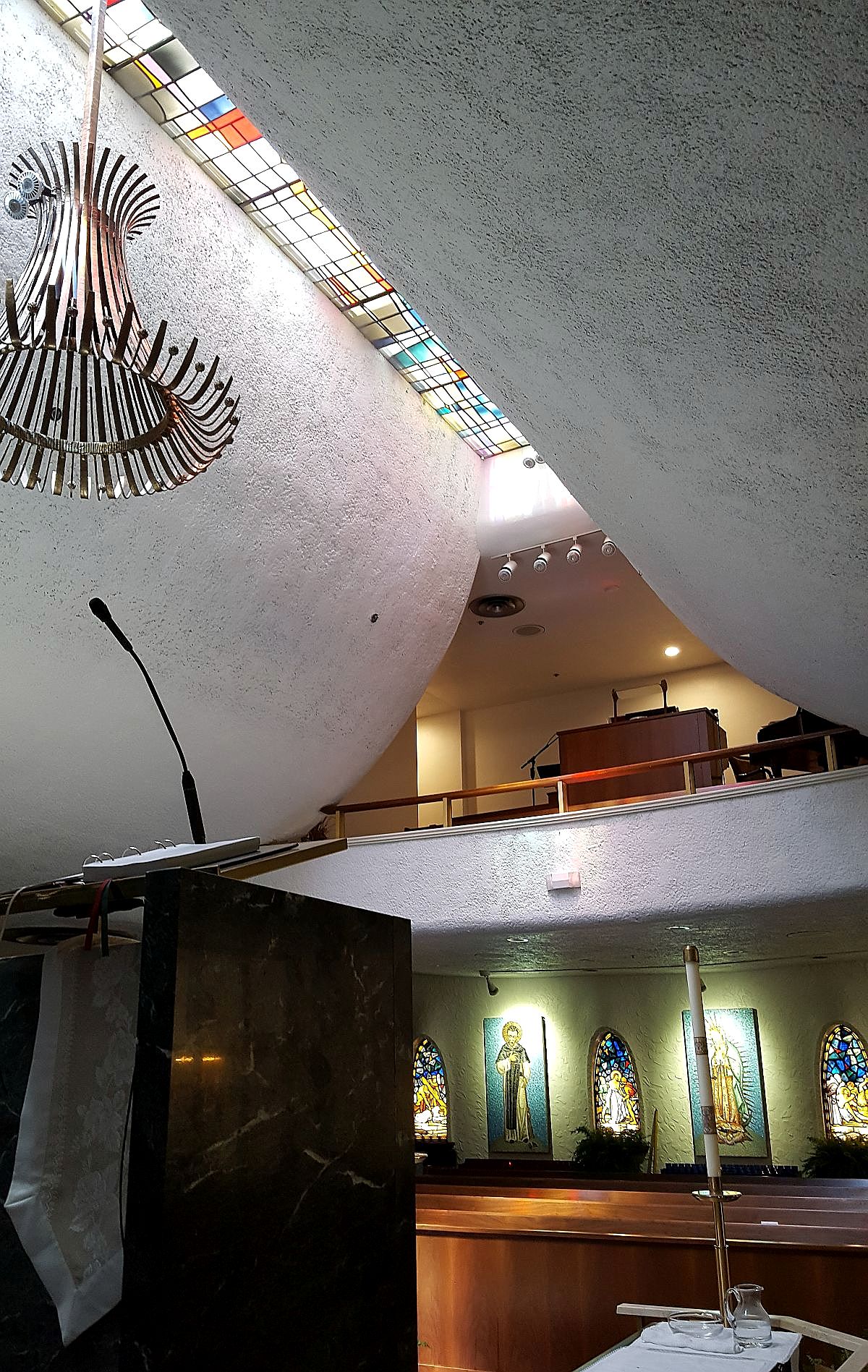
st-jude-chapel_choir-loft_052417_bosse

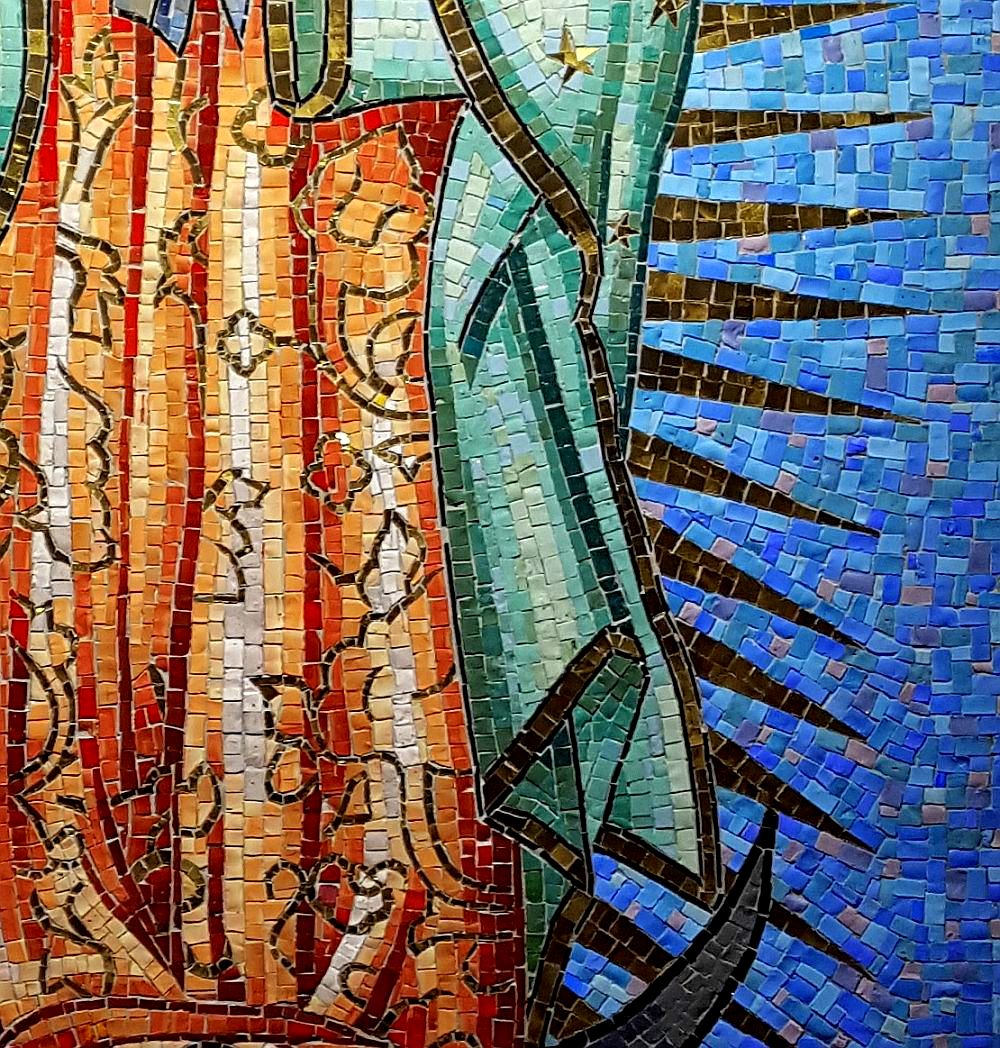
A wonderful depiction of Our Lady of Guadalupe.
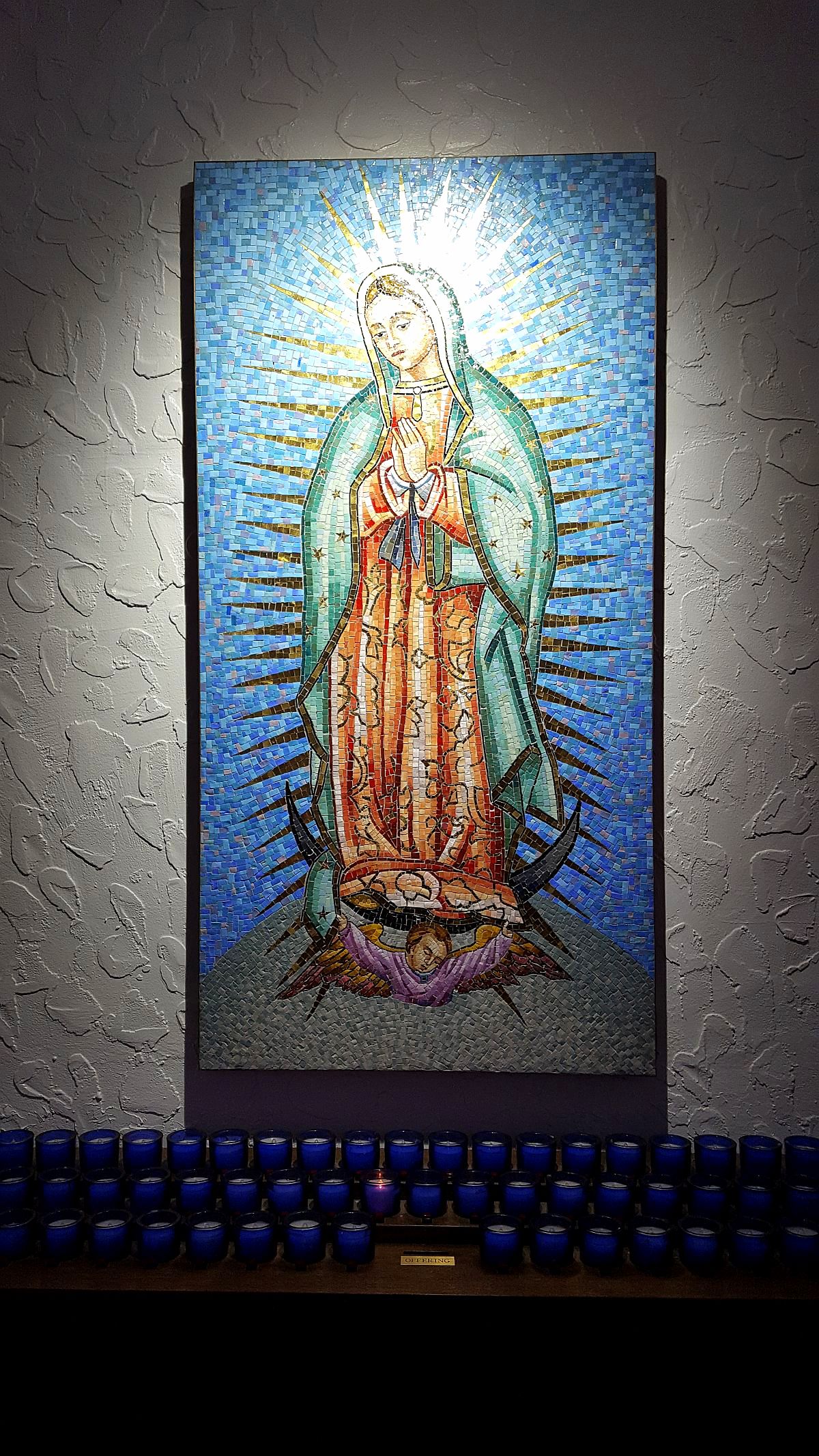
st-jude-chapel_la-virgin_052417_bosse

A detail.

st-jude-chapel_la-virgin_det_052417_bosse

I’m afraid I’m not very well-versed on my saint iconography, but this might be St. Martin de Porres, with a broom, and mice at his feet.
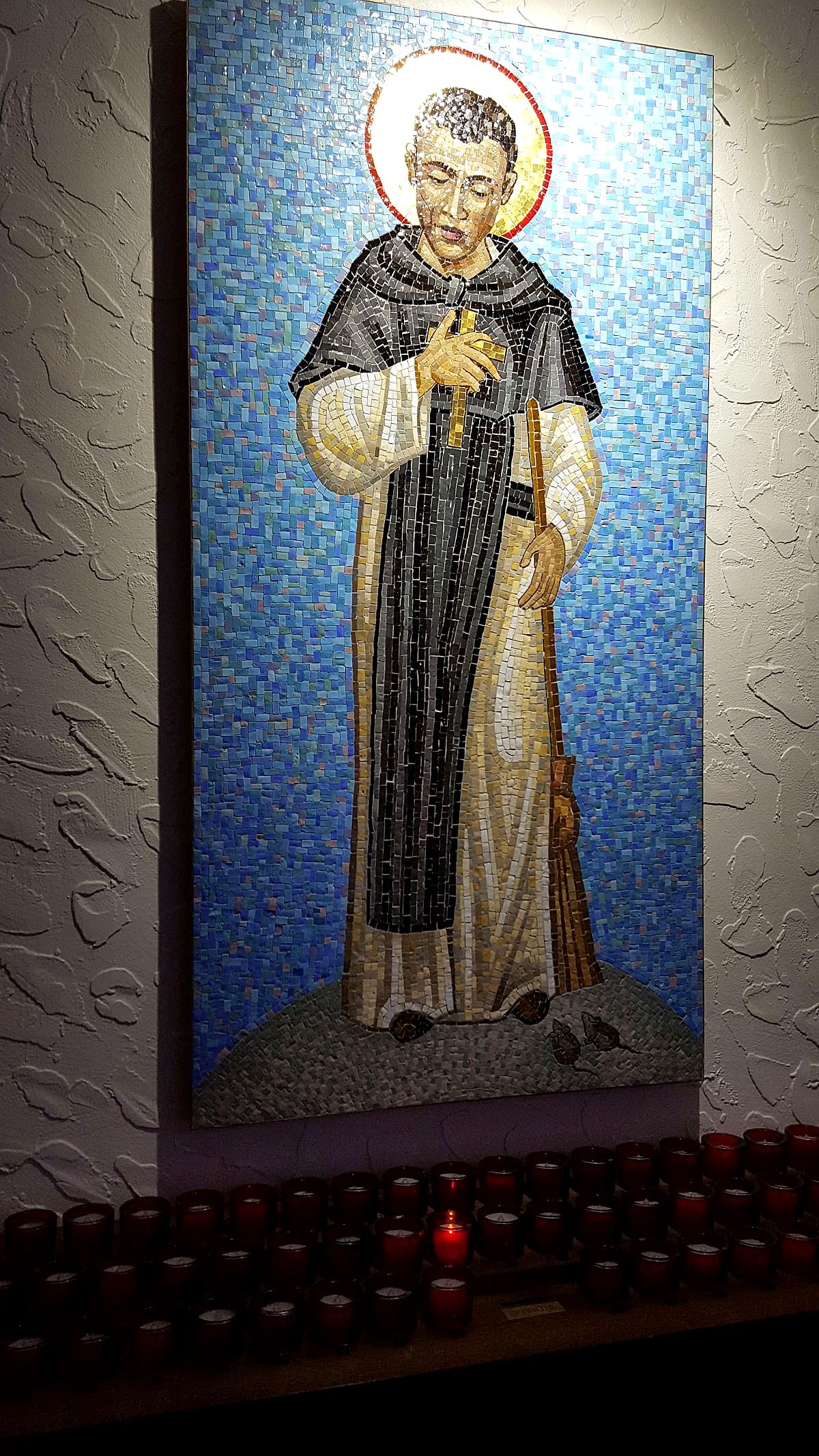
st-jude-chapel_st-martin-de-porres_052417_bosse

Leave it to me to find these little mosaic mice, my favorite tiny discovery of the day.
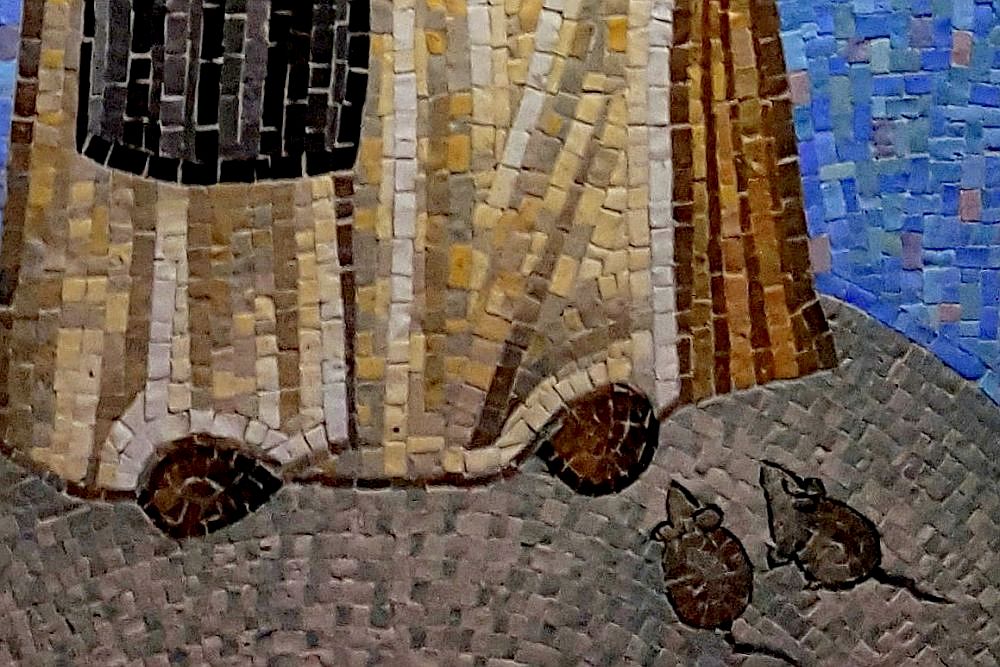
st-jude-chapel_st-martin-de-porres_mice-det_052417_bosse

And here’s the view from the chapel toward Main Street.
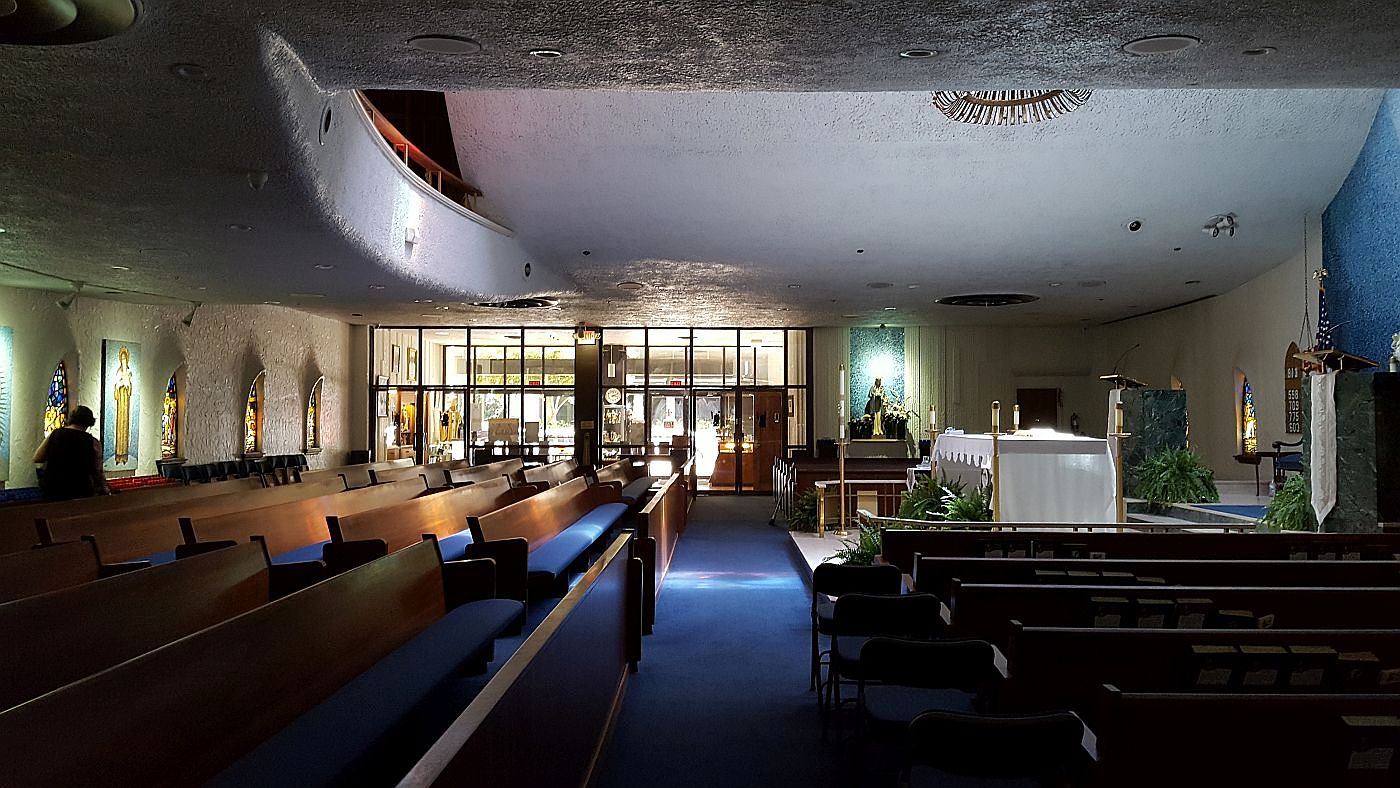
st-jude-chapel_interior-with-view-to-street_053417_bosse

The St. Jude Chapel offers a nice, tranquil respite from a loud and busy downtown Dallas. You should visit sometime. All are welcome.
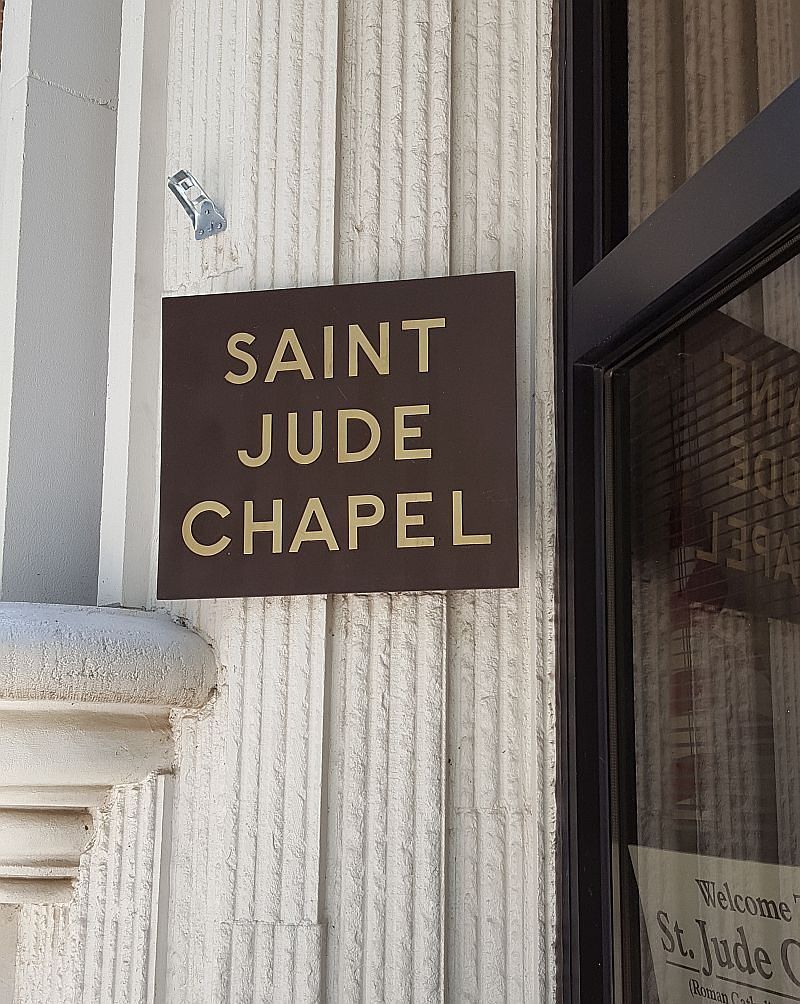
st-jude-chapel_sign_052417_bosse

**

UPDATE: Dallas filmmaker Mark Birnbaum was working on a short documentary of the project when I stopped by the site (you can see the back of his head in the top photo). His 10-minute film, “Genesis Mosaic,” can be viewed here.

***

Sources & Notes

Thanks so much to Julie Richey, Callie Heimburger, Cher Goodson, and Lynne Chinn for taking the time to chat with me. Julie Richey Mosaics website is here; Art Restorations, Inc. website is here.

You can see more on this project (including photos and video) on Julie’s Facebook page, here, and Art Restorations’ Facebook page, here; see photos from the Risen Christ restoration on Julie’s blog, here.

The St. Jude Chapel (Roman Catholic Diocese of Dallas) website is here; videos on the history of the downtown chapel are here.

All photos by Paula Bosse.

Images larger when clicked.

*

Copyright © 2017 Paula Bosse. All Rights Reserved.
 

Twelve Prominent Black Baptist Churches — 1967

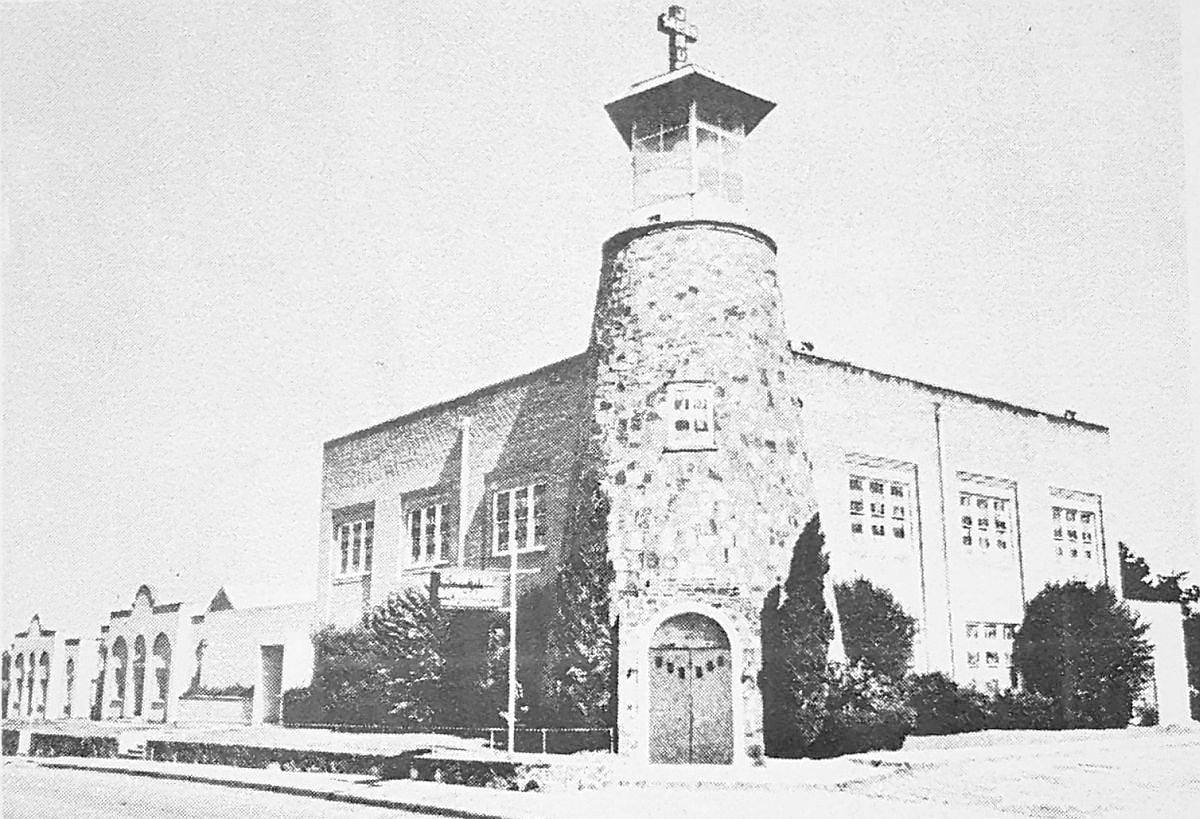
church_zion-hill-missionary-baptist_1967Zion Hill Missionary Baptist Church… (click for larger image)

by Paula Bosse

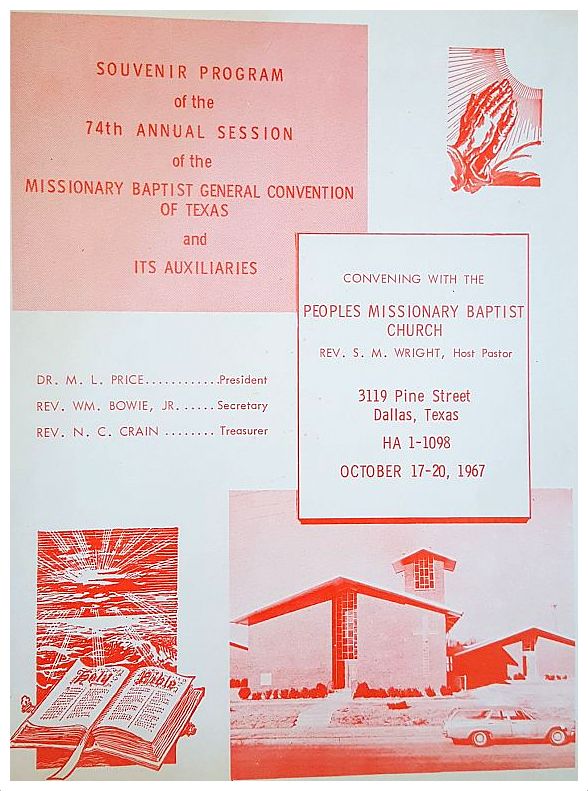
Flipping through the pages of the 1967 Souvenir Program of the 74th Annual Session of the Missionary Baptist General Convention of Texas and Its Auxiliaries (…as one does), I kept coming across ads featuring photos of Dallas churches and wondered how many were still standing. Out of the twelve I’m posting here, all but three are still standing. That’s a healthy survival rate!

All photos are from the above-mentioned program for the Missionary Baptist General Convention of Texas, which convened in Dallas, October 17-20, 1967. All photos (which are larger when clicked) appeared in this 1967 booklet, but a few were older photos taken in previous years or decades.

missionary-baptist-convention_1967

*

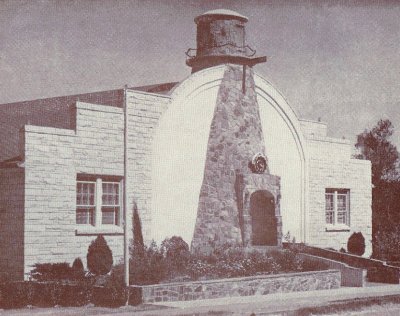
At the top, Zion Hill Missionary Baptist Church, 909 Morrell Avenue, East Oak Cliff (Rev. A. F. Thomas, Sr., Minister). The church is still standing and is still cool-looking — see it on Google Street View here. (According to a history of the church, the building was designed by J. C. Hibbard, the Assembly of God preacher who designed his own Oak Cliff church, the Gospel Lighthouse Church, which I wrote about here — the two eye-catching buildings are only a mile apart.)

*

church_peoples-missionary-baptist_1967

People’s Missionary Baptist Church, 3119 Pine Street, South Dallas (Rev. S. M. Wright, Pastor). Still standing, here

*

church_allen-chapel-baptist_1967

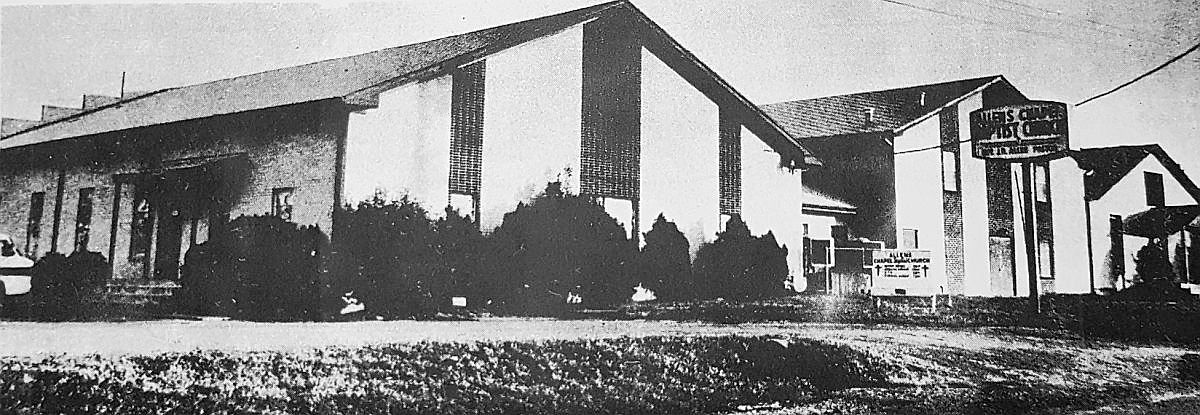
Allen Chapel Baptist Church, 2146 Overton Road, Oak Cliff (Rev. J. R. Allen, Pastor). Still standing, here.

*

church_morning-star-baptist_1967

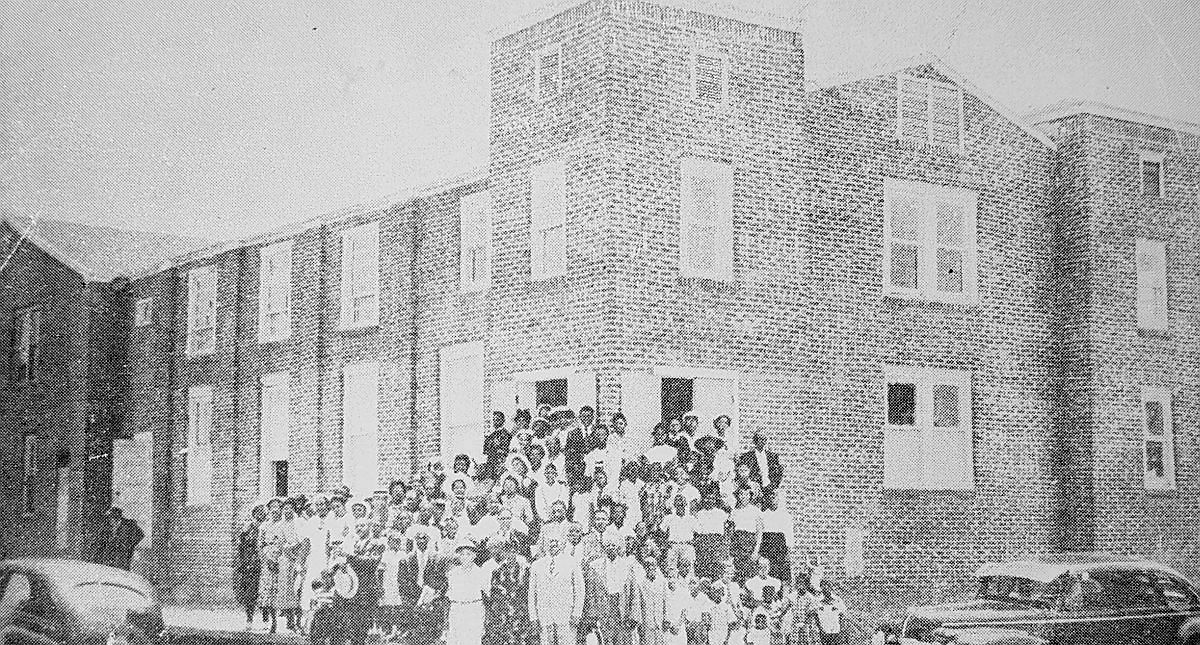
Morning Star Baptist Church (photo circa 1947, the year the brick church was built), 2662 Anderson Street, South Dallas (Rev. Howard Gill, Pastor). Still standing, here.

*

church_good-street-baptist_1967

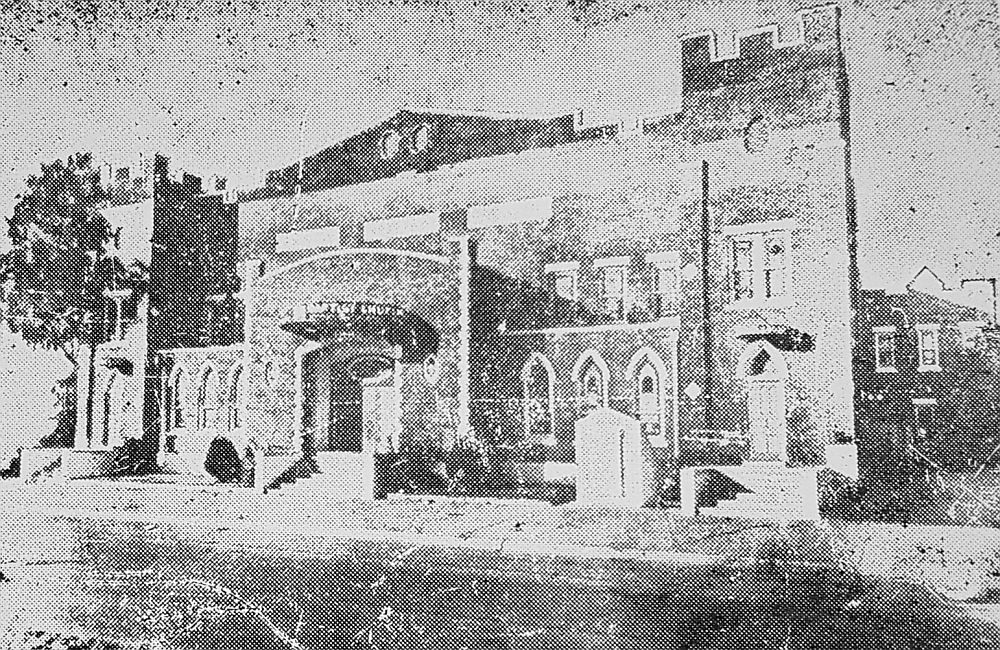
Good Street Baptist Church, 902 N. Good-Latimer (between Live Oak and Bryan) (Dr. Cesar Clark, Pastor). No longer standing.

*

church_oak-hill-missionary-baptist_1967

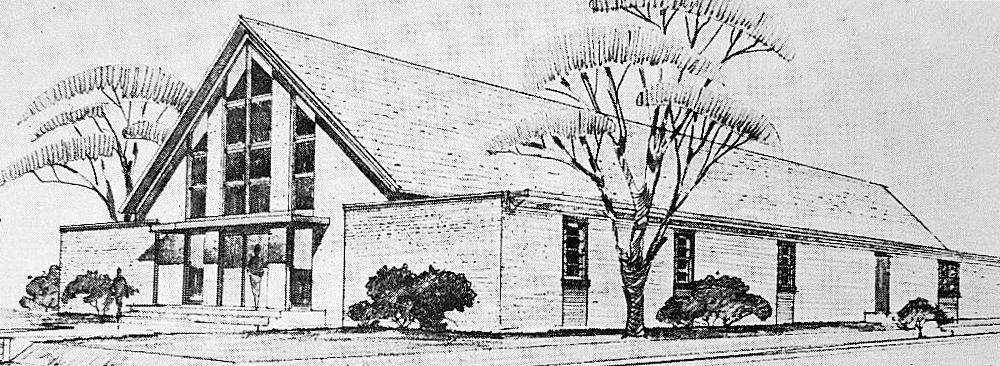
Oak Hill Missionary Baptist Church, 4440 S. Oakland Avenue (now Malcolm X Blvd.), South Dallas (Rev. M. G. Solomon, Pastor). Drawing of their “future church building.” Still standing, here.

*

church_bethany-baptist_1967

Bethany Baptist Church, 6710 Webster Street, Love Field area (A. L. Schley, Pastor). Still standing, here.

*

church_munger-avenue-baptist_1967

Munger Avenue Baptist Church, 3919 Munger Avenue (not to be confused with N. Munger Blvd.), near Haskell and Washington, in what used to be the thriving African-American neighborhood of North Dallas (Rev. B. E. Joshua, Pastor). Still standing, here.

*

church_pilgrim-rest-baptist_1967

Pilgrim Rest Missionary Baptist Church, 2525 Caddo Street, just a few blocks from Munger Avenue Baptist Church (Rev. G. B. Prince, Pastor). No longer standing. The property was sold to the Southland Corporation in 1983 — its location is now occupied by a Cityplace parking lot. According to the history of the church, Pilgrim Rest moved to 1819 N. Washington in 1985.

*

church_mount-moriah-missionary-baptist_1967

Mount Moriah Missionary Baptist Church, 3611 Latimer Street, South Dallas (Rev. B. F. Briggs, Pastor). Still standing, here.

*

church_st-john-baptist_1967

St. John Baptist Church, 2019 Allen Street, State-Thomas area (Robert H. Wilson, Minister). No longer standing.

*

church_new-zion-baptist_1967

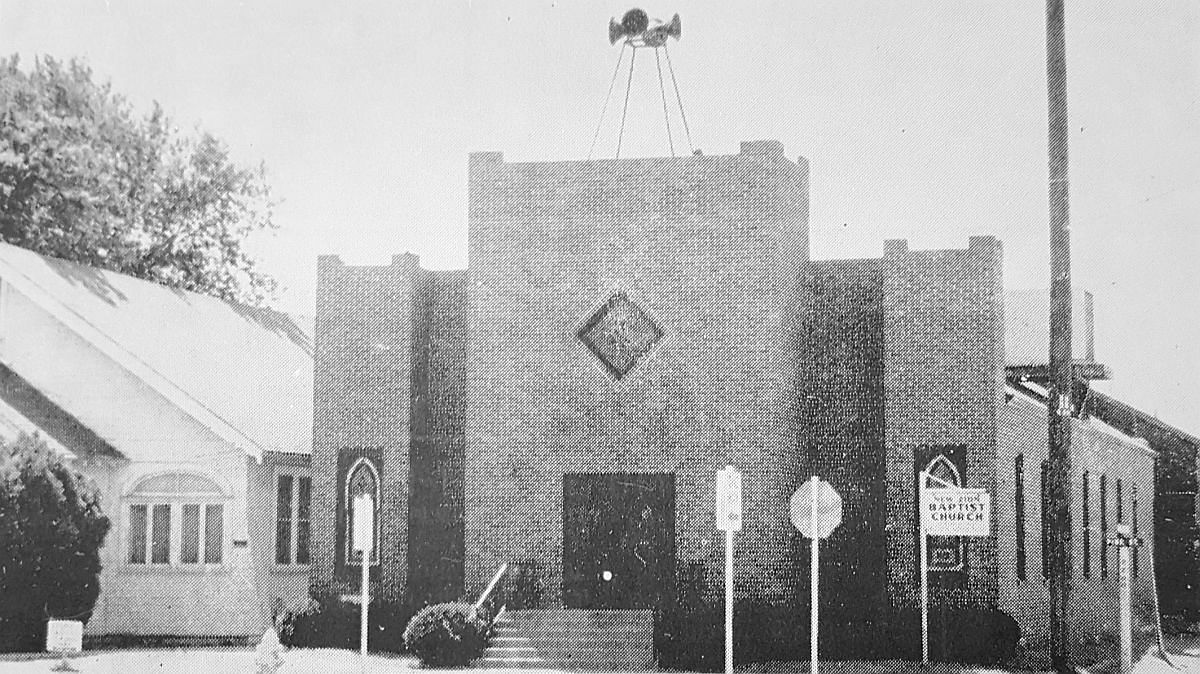
New Zion Baptist Church, 2214 Pine Street, South Dallas (Rev. A. V. Voice, Pastor). Now Greater New Zion Church, this is my favorite of these twelve buildings, and it still looks good, here.

***

Sources & Notes

All photos from the Souvenir Program of the 74th Annual Session of the Missionary Baptist General Convention of Texas and Its Auxiliaries, which was held in Dallas in October, 1967.

Many thanks to George Gimarc for passing this wonderful little booklet on to me. I hope to share more from its pages in the future.

All photos larger when clicked.

*

Copyright © 2017 Paula Bosse. All Rights Reserved.
 

Beautiful South Ervay Street — ca. 1910

ervay_coltera_flickrStreet life in South Dallas

by Paula Bosse

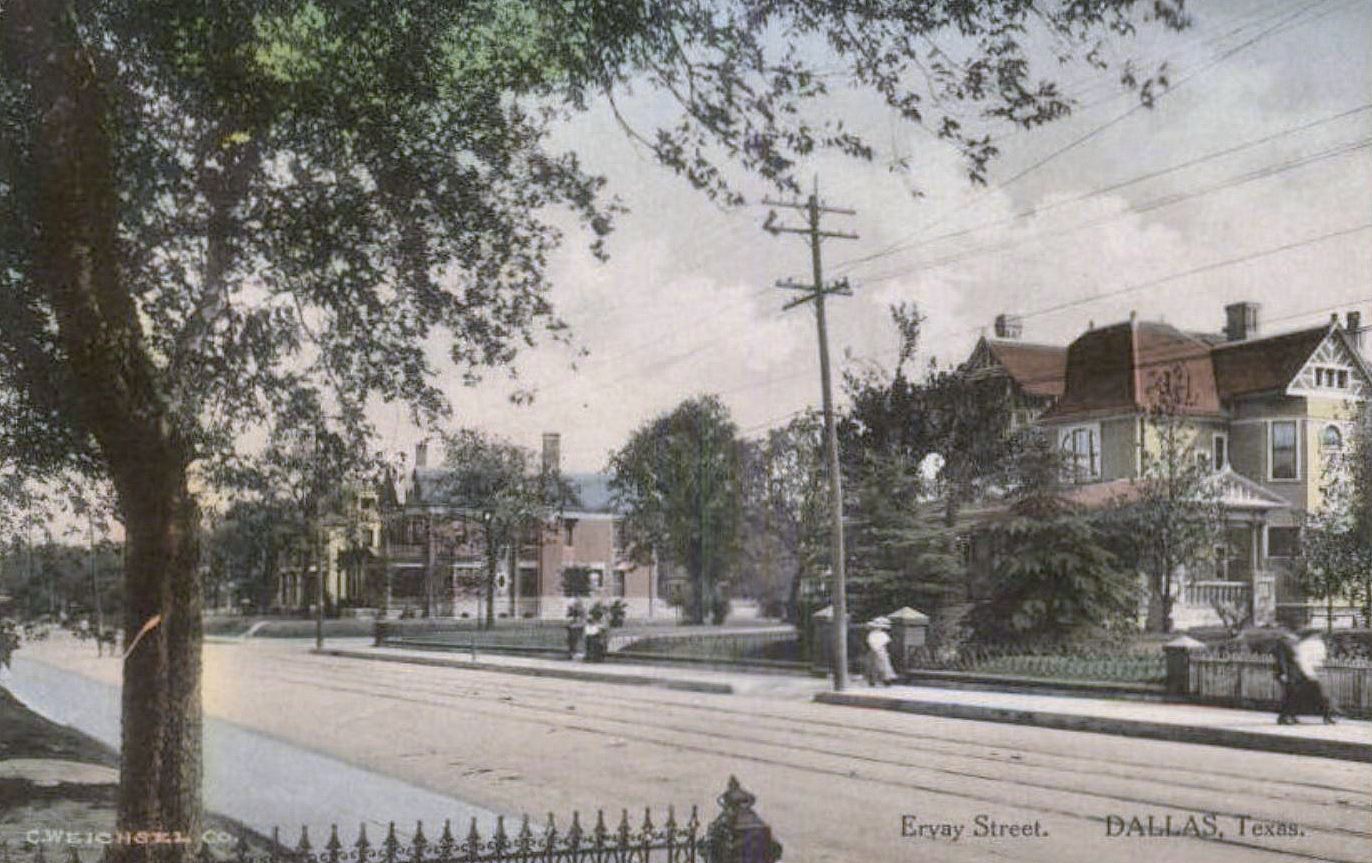
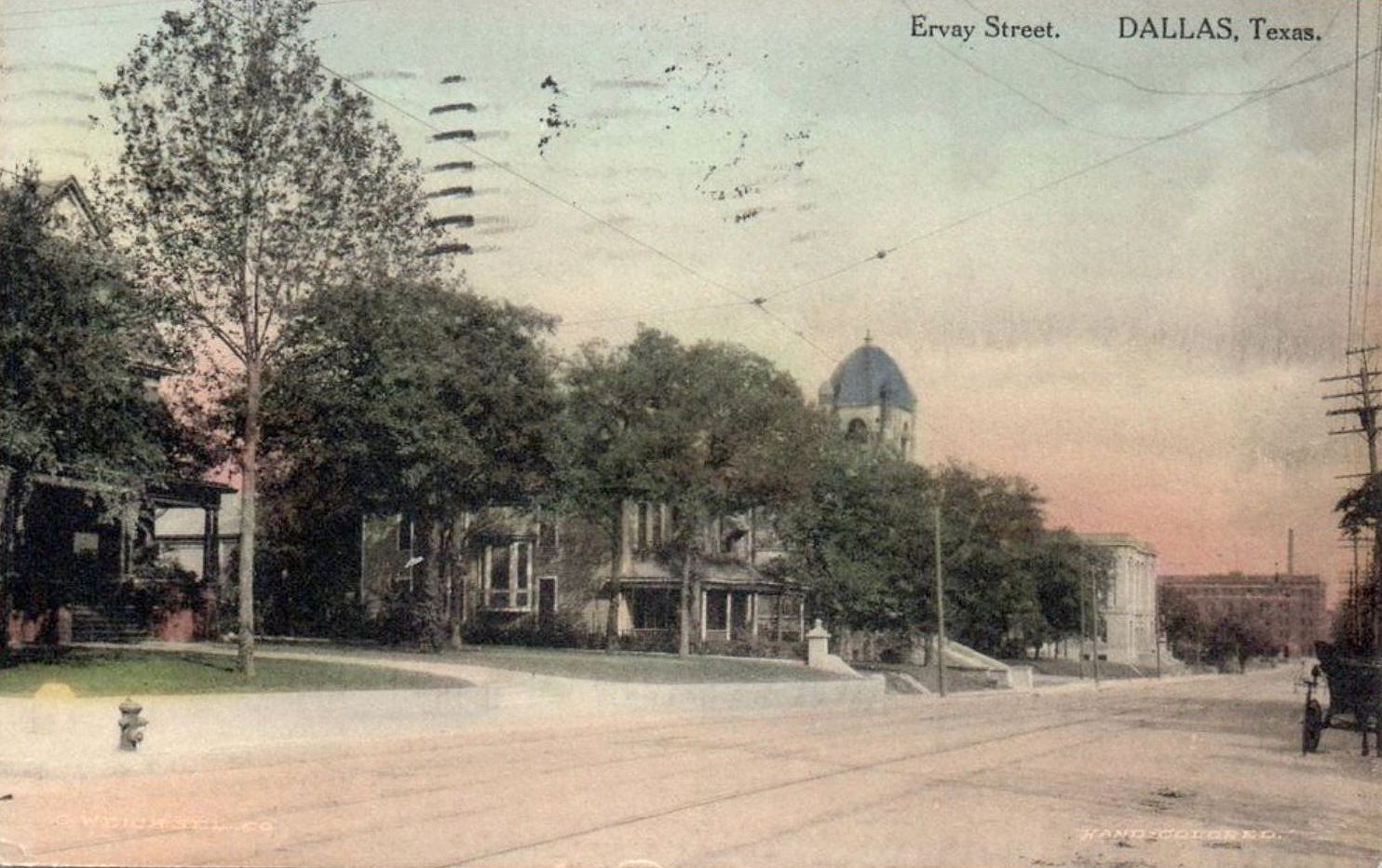
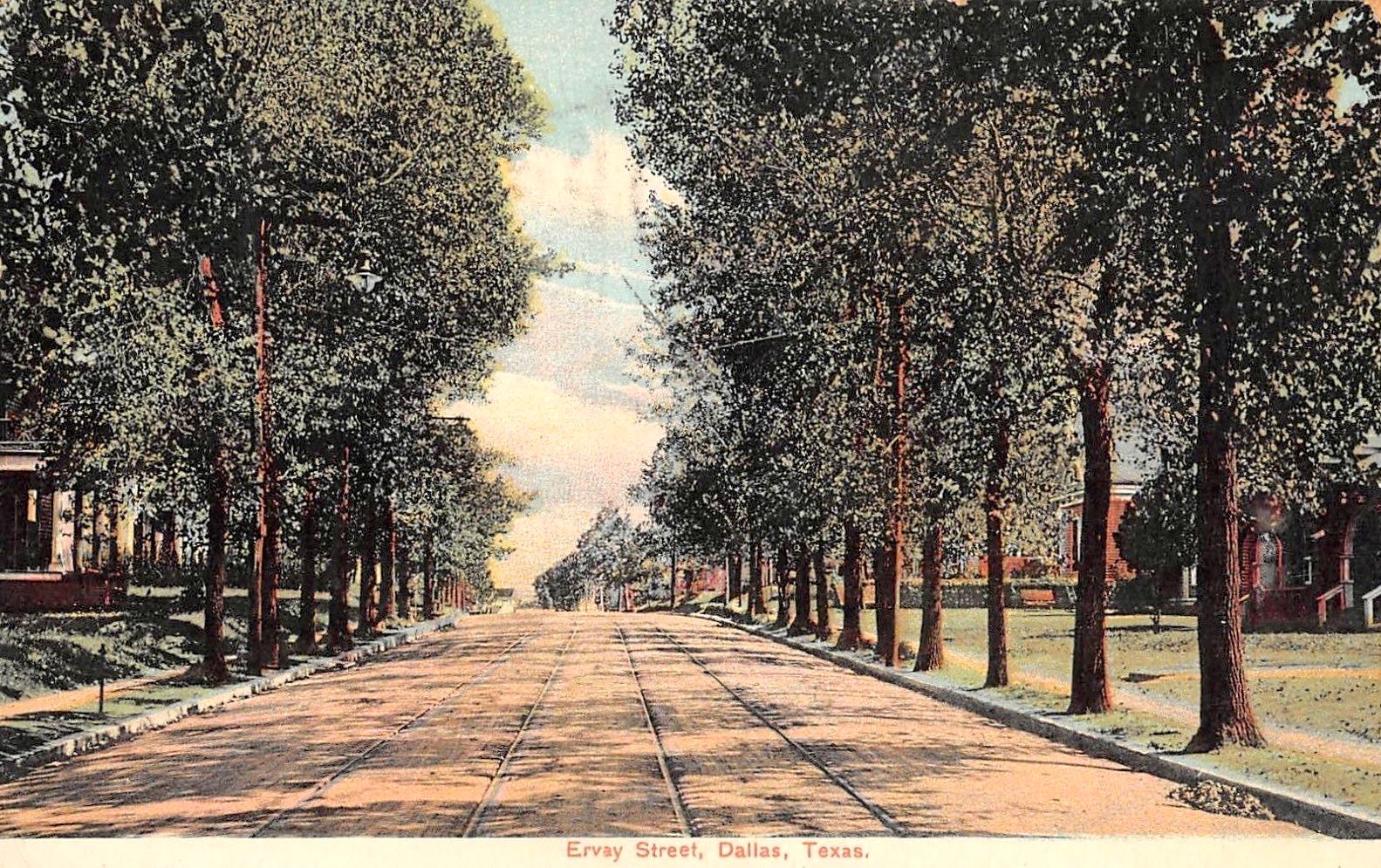
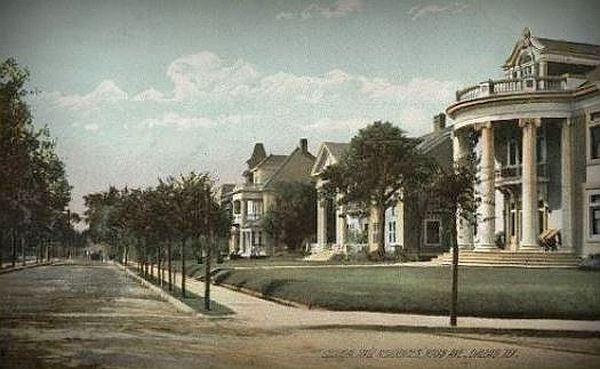
Today, a few hand-colored postcards from around 1910 showing the lovely houses that used to line Ervay Street in South Dallas. Hard as it is to believe today, the stretch of South Ervay from just outside the central business district down to its end at Forest Avenue (now Martin Luther King, Jr. Blvd.), was once a very nice area where many of the city’s most fashionable and well-to-do Jewish families (and, later, African American families) lived. The intervening century has not been kind to South Dallas. I’m not sure of the location in the postcard above, but it certainly looks like a very pleasant neighborhood — one that no longer exists in this mostly blighted area.

*

Below, S. Ervay looking south. The rounded top of Temple Emanu-El can be seen at the left. The light-colored building in the next block was the Columbian Club. The hotel most recently known as the Ambassador (which burned down three years after I originally wrote this post) is set back on a curve of the street and is hidden by the Columbian Club. The red building is the Hughes candy plant (still standing). A Google Street View of this area today can be seen here.

ervay-street_ebay

*

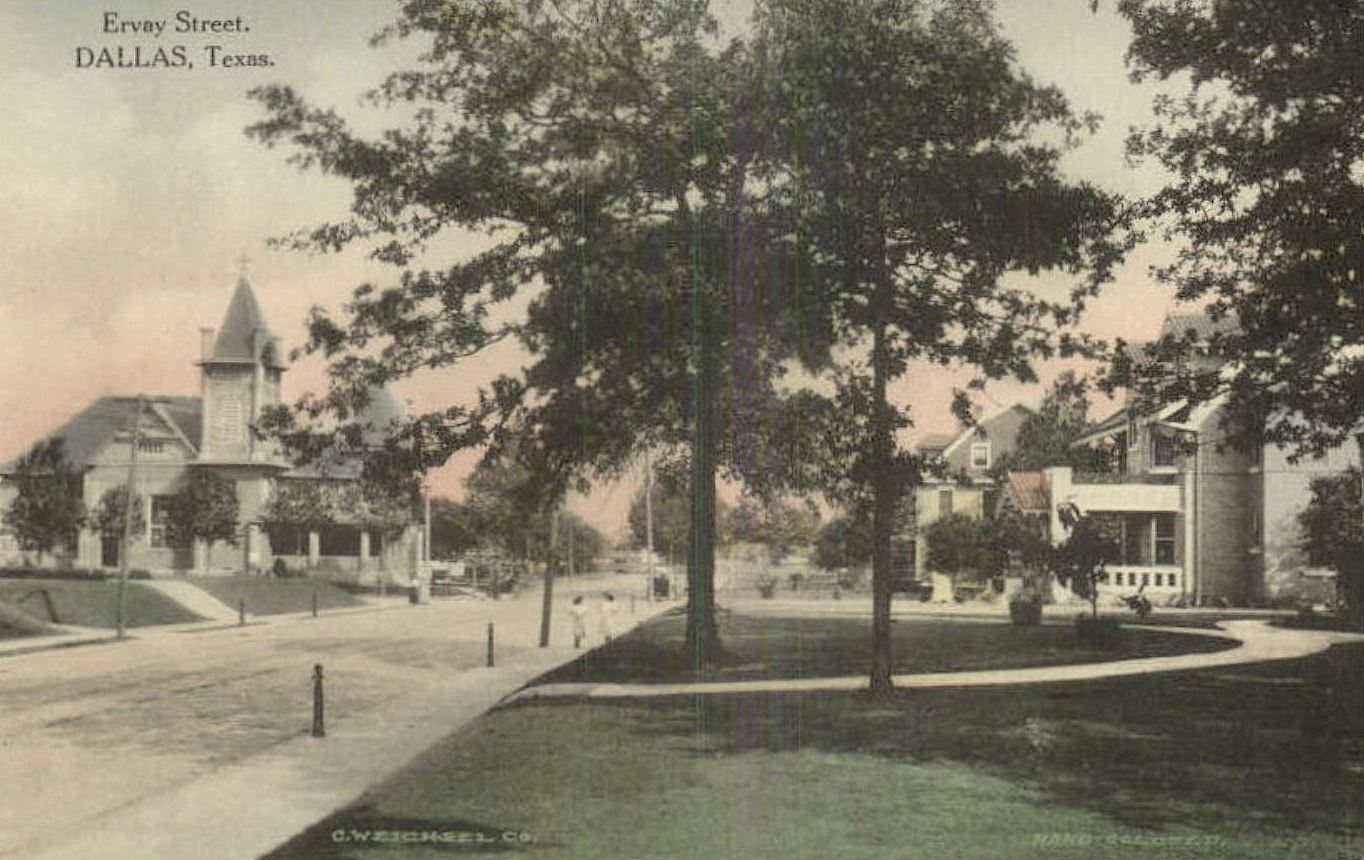
Below, we see a view still looking south, but now much farther down Ervay, almost to Forest Avenue (now MLK). The church on the left is the James Flanders-designed Ervay Street Methodist Episcopal Church (South), built in 1908 at the corner of corner of Ervay and South Boulevard — it’s interesting that a Methodist church was located in the center of Dallas’ largest Jewish residential neighborhood. (More on the church from a Dallas Morning News article from July 1, 1908, here. See this area on a 1922 Sanborn map here.)

ervay-residence_coltera

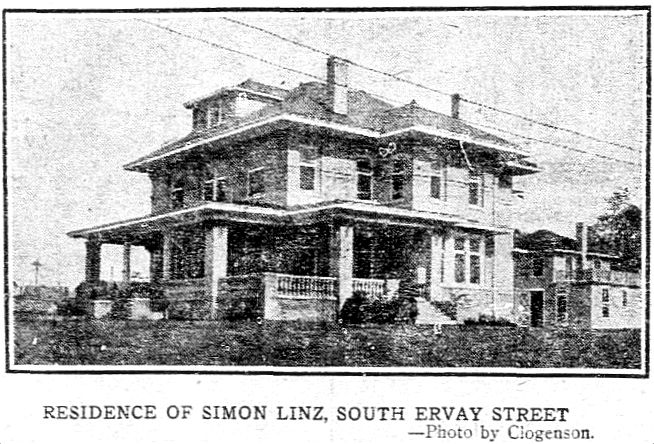
Not seen in the view above is one house worth mentioning. The house — just out of frame at the left, with the steps leading up to it, was the home of Simon Linz, of Linz Jewelers fame. Here is what the Linz house looked like in 1908:

linz-house_dmn_010108Dallas Morning News, Jan. 1, 1908

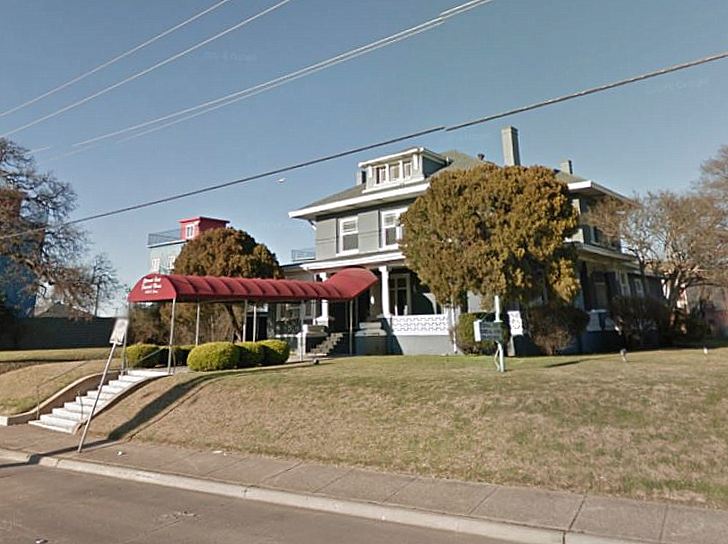
Remarkably, this house is still standing. It is currently a funeral home at 2830 S. Ervay. The present-day image below, showing the pretty house and the neatly landscaped yard, is a little deceptive; see what the Google Street View looks like just south — where the Flanders church once stood — here. (If you’re up to it, reverse the Google view and move back toward town.)

linz-house_2830-828-s-ervay_google
Google Street View

Hold on, little house!

This was once such a beautiful part of Dallas….

ervay_postcard_clogenson_postmark-1908

**

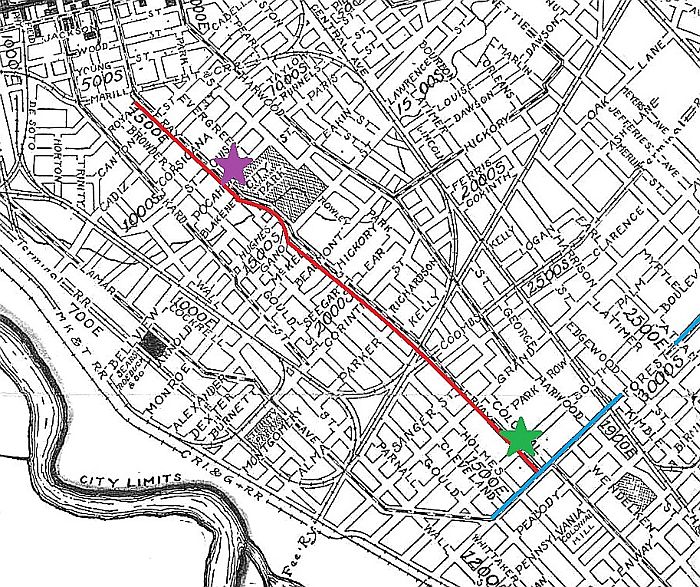
Below, a detail of a 1919 map showing S. Ervay down to Forest. The purple star shows the location of Temple Emanu-El and the Columbian Club. The green star shows the location of the Linz house and the Ervay St. Methodist Episcopal church. (Click for larger image.)

e-ervay_map_1918_portal
1919 map via Portal to Texas History

 ***

Sources & Notes

First and third postcards are from Flickr: here and here. Others found on eBay.

*

Copyright © 2016 Paula Bosse. All Rights Reserved.
The St. Joseph Orphanage — 1891

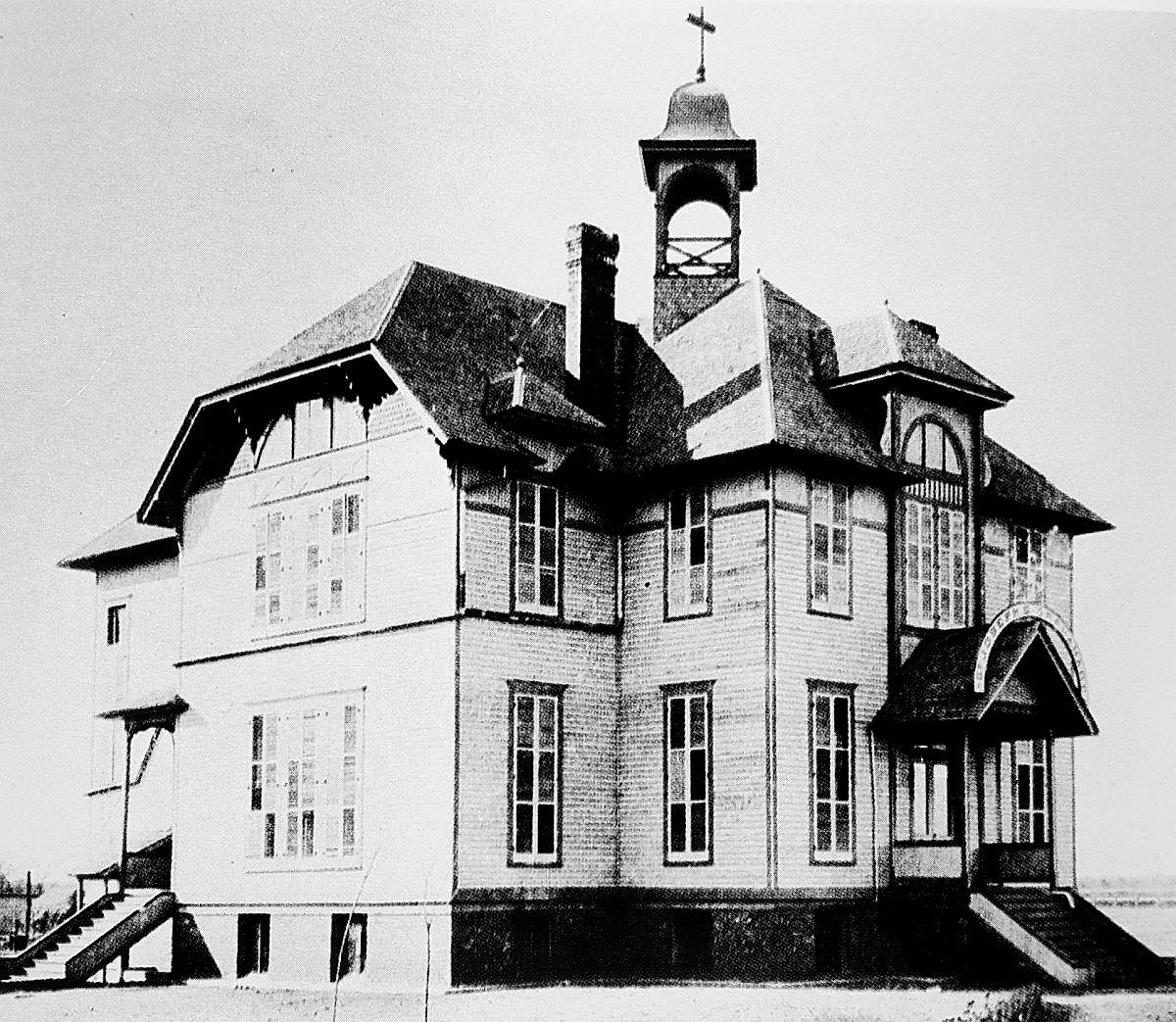
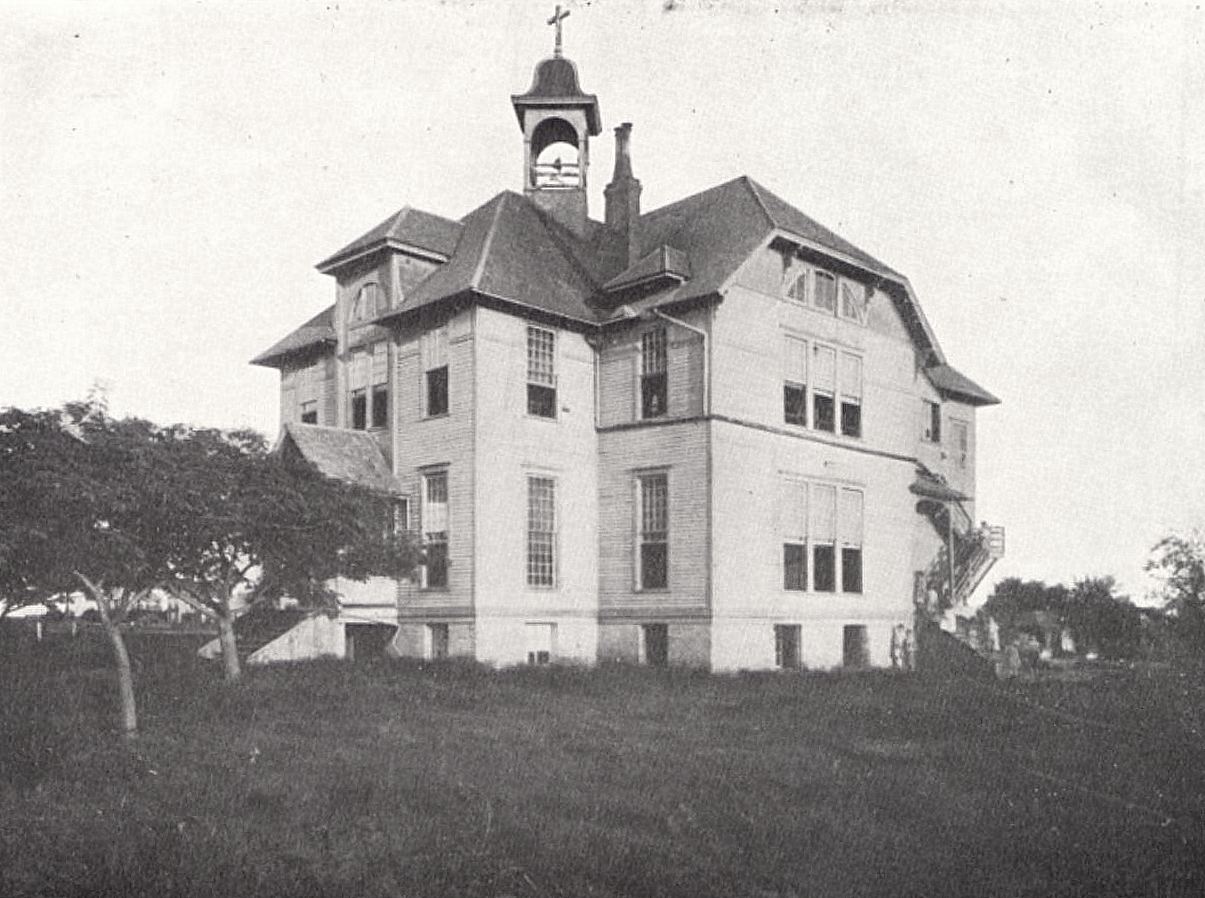
st-josephs-orphanage_dallas-rediscoveredThe new Oak Cliff orphanage, ca. 1891 (click for larger image)

by Paula Bosse

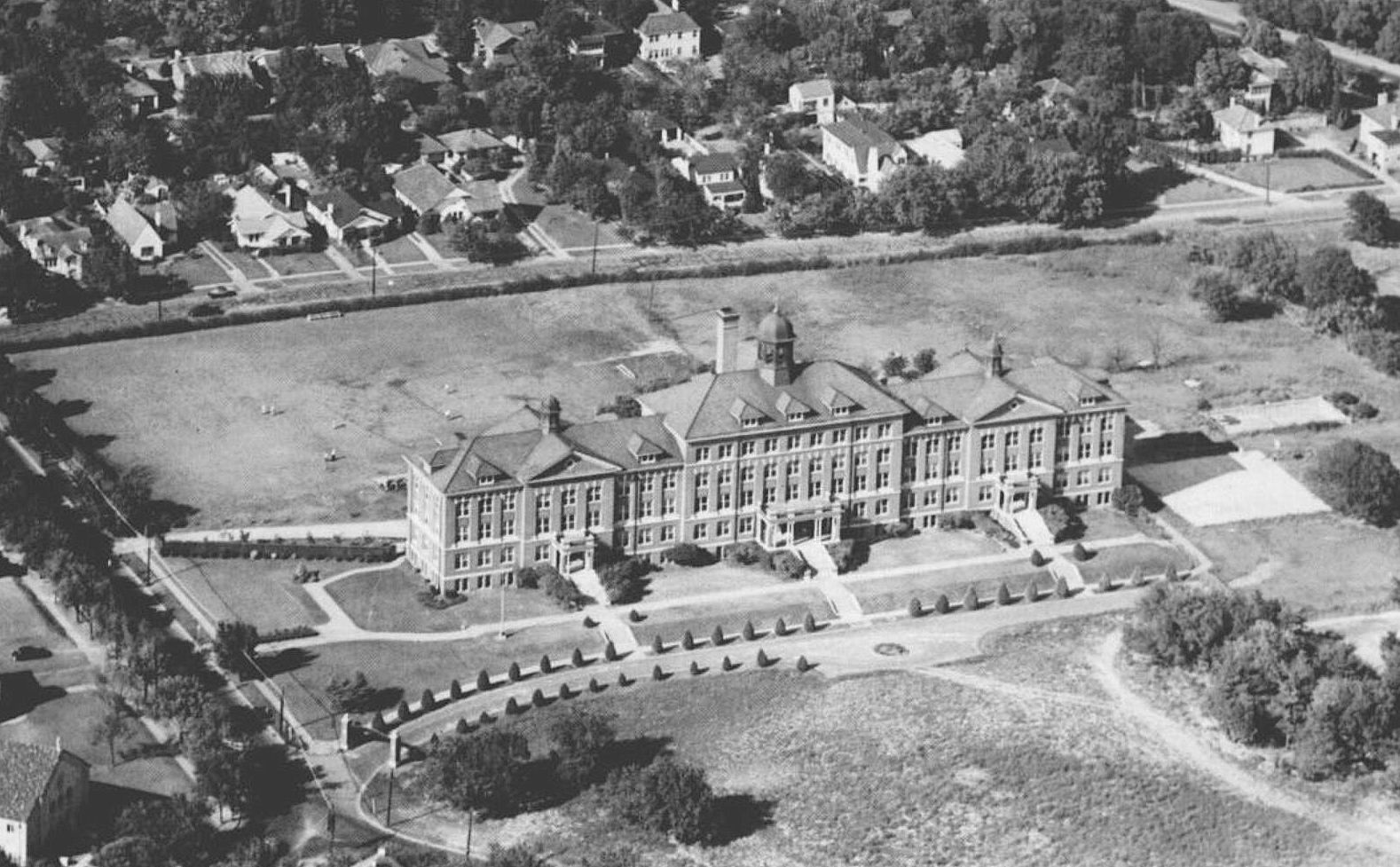
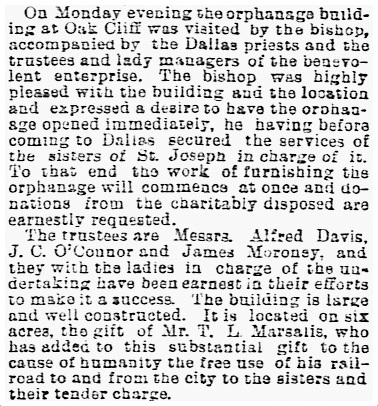
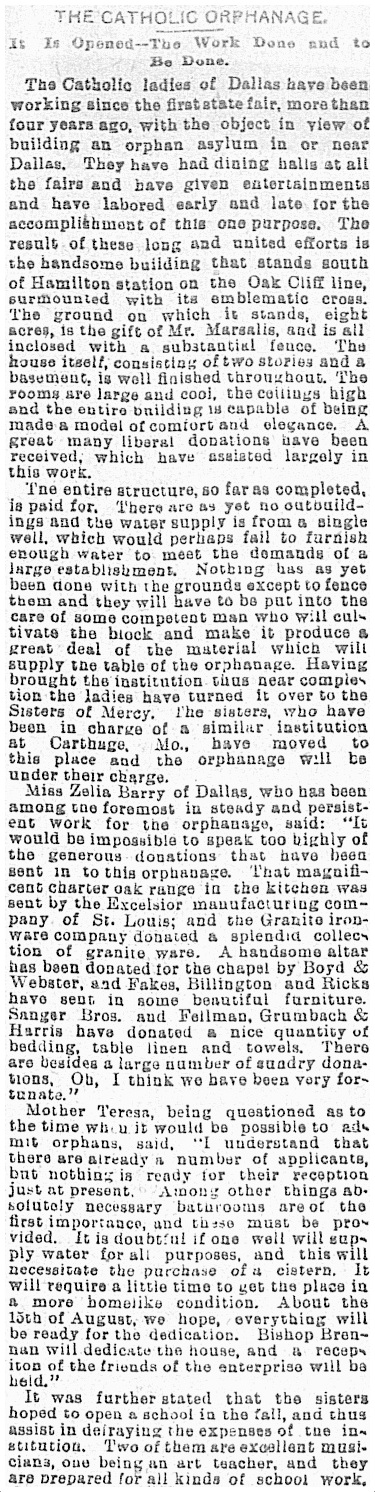
The St. Joseph orphanage was built in Oak Cliff in 1891 on 6-8 acres donated to the Catholic Diocese by Thomas Marsalis. The building was a large house, built and furnished with funds raised from local donations.

The house itself, consisting of two stories and a basement, is well finished throughout. Rooms are large and cool, the ceilings high and the entire building is capable of being made a model of comfort and elegance. A great many liberal donations have been received which have assisted largely in this work. (Dallas Morning News, July 16, 1891)

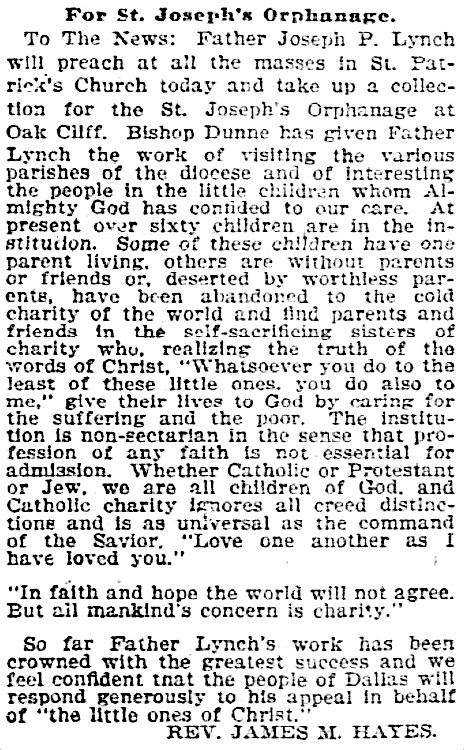
The orphanage was a Catholic institution — run at various times by the Sisters of St. Joseph, the Sisters of Mercy, the Sisters of Charity of St. Vincent de Paul, and the Sisters of Charity of the Incarnate Word — but it was “non-sectarian” in that the children or families in need were not required to be of the Catholic faith.

Some of these children have one parent living, others are without parents or friends or, deserted by worthless parents, have been abandoned to the cold charity of the world and find parents and friends in the self-sacrificing sisters of charity…. (DMN, Feb. 9, 1902)

st-josephs-orphanage_smu_ca1913-1919DeGolyer Library, SMU

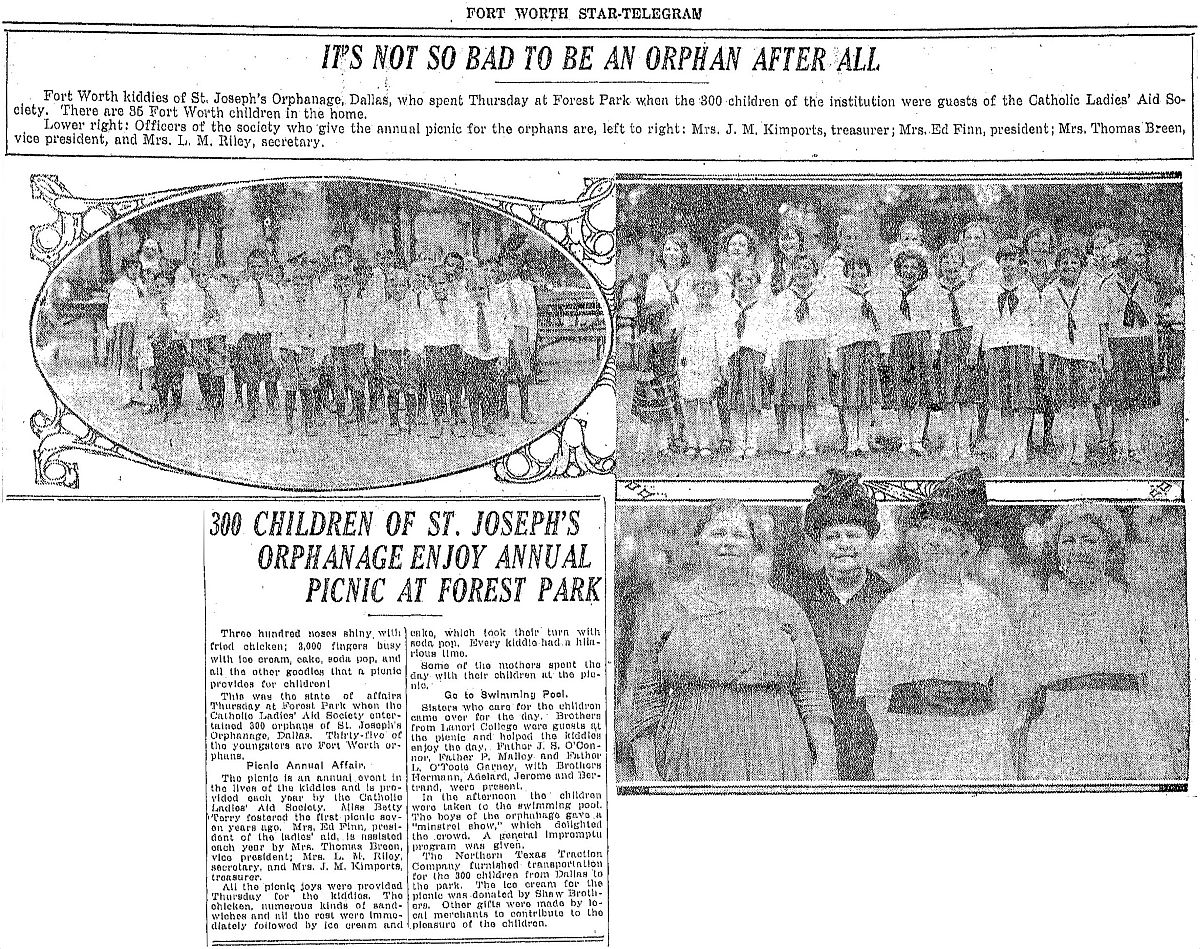
In the late ‘teens or early ’20s, the Catholic Ladies’ Aid Society of Fort Worth began an annual tradition of hosting a party for the children at Forest Park in Fort Worth. The 1923 picnic entertained 300 children. The Fort Worth Star-Telegram ran a story about the event under the unfortunate headline “It’s Not So Bad To Be An Orphan After All.” (Click article for a much larger image.)

st-josephs-orphanage_FWST_060123FWST, June 1, 1923

According to William L. McDonald in his book Dallas Rediscovered, “the orphanage was converted into a Carmelite convent and school in 1929 and demolished in 1945.” In December, 1930, the girls moved into their new (huge!) home in Oak Lawn (at Blackburn), in the old Dallas University building (later the Jesuit campus). The boys, I believe, moved to the Dunne Memorial Home. Here is a photo of the girls’ new home, which was taken over by Jesuit High School in 1941. (The impressive building originally built in 1906 was demolished in 1963.)

jesuit_legacies_fall-2005

**

st-josephs-orphanage_dmn_042991Dallas Morning News, April 29, 1891

st-josephs-orphanage_dmn_071691
DMN, July 16, 1891

orphanage_dmn_020902
DMN, Feb. 9, 1902

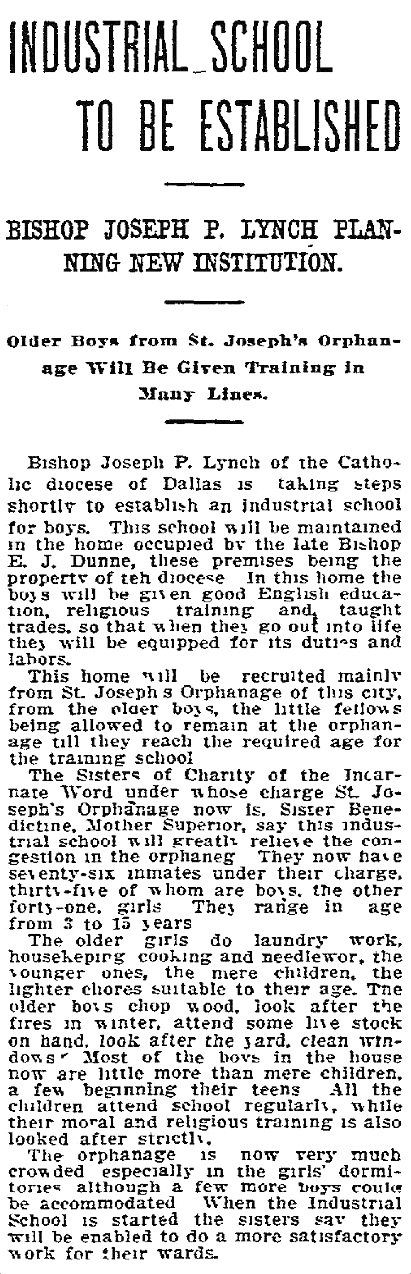
orphanage_dmn_113013-inudstrial-school-to-open
DMN, Nov. 30, 1913

st-josephs-orphanage_catholic-charities-of-dallas

***

Sources & Notes

Top photo from Dallas Rediscovered by William L. McDonald, is from the collection of the Dallas Public Library.

Photo titled “Children and Nuns, St. Joseph’s Orphanage, Dallas, Texas” was taken by Frank Rogers and is from the George W. Cook Dallas/Texas Image Collection, DeGolyer Library, Southern Methodist University; more information can be found here.

Photo of the old Dallas University/University of Dallas/Trinity University is from the article “Jesuit High School” by Liz Conrad Goedecke, which appeared in the Fall, 2005 issue of Legacies.

Bottom photo of St. Joseph’s Orphanage is from a PDF titled “A Brief Visual History of the Catholic Diocese of Dallas,” here (p. 19).

More on the original St. Joseph orphanage can be found here (scroll down to the 1902 article, “Charities of Dallas”).

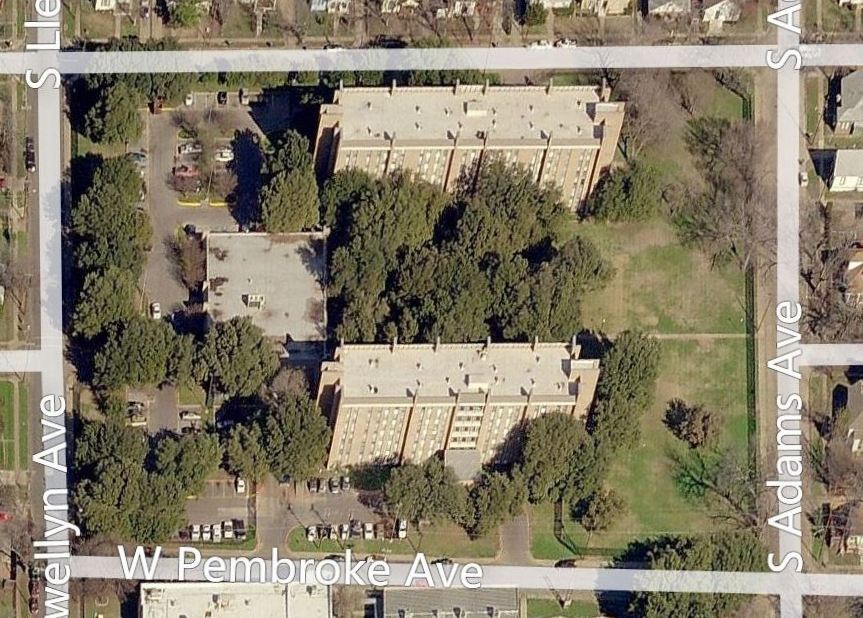
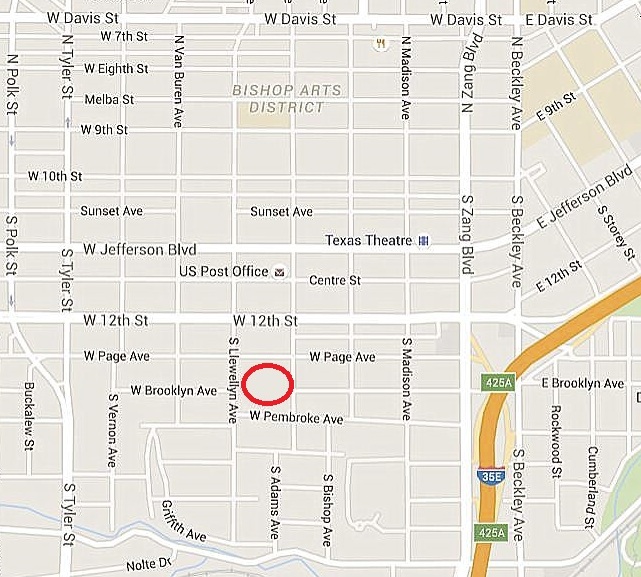
The original St. Joseph orphanage was at the southwest corner of West Page and South Adams, in Oak Cliff. See the 1922 Sanborn map, here. According to the Dallas Central Appraisal District website, the land is currently owned by the Dallas Housing Authority, which, as recently as 2014, had sought permission to build a new “home for the aged” on this property. The Bing Maps aerial view shows the Brooks Manor low-income housing project which had occupied this block for several decades before its recent demolition.

brooks-manor_bing

The Google Street view from Jan. 2016 shows an empty block.

orphanage_googleGoogle Maps

The original building at the top is not to be confused with the later St. Joseph home for girls (or the earlier Virginia K. Johnson home for unwed mothers), which was also on West Page, but a couple of blocks to the east. More on that can be found here. (It was at the Page and Madison, seen on the 1922 Sanborn map, here.) (Perhaps this was the campus the St. Joseph school moved to when Jesuit took over the campus in Oak Lawn in 1941?)

All photos and articles are larger when clicked.

*

Copyright © 2016 Paula Bosse. All Rights Reserved.
 

Winnetka Congregational Church, Org. 1914

winnetka-congregational-church_tulane-universityThe Oak Cliff church’s first pastor? (click for larger image)

by Paula Bosse

I stumbled across this photograph tonight and was really taken with it. It shows a man standing in front of the Winnetka Congregational Church in Oak Cliff, located at W. Twelfth and S. Windomere streets — on land now part of the property of the W. E. Greiner school. The church was organized in 1914, but by 1925 they were making plans to expand. A new church was built in 1929, just across W. Twelfth, facing Windomere.

winnetka-congregational-church

The new building still stands, but Winnetka Congregational Church doesn’t seem to have made it past the 1950s.

Nice though that newer church is, I think I prefer the smaller one from 1914 with the uncomfortable-looking man standing in front of it.

***

Sources & Notes

Top photo from the Tulane University Digital Library (with the name of the church misspelled as “Winnietka”), here.

I love Sanborn maps. Here’s one from 1922 which shows what the neighborhood looked like then. The original small wood frame church can be seen just north of a neighborhood completely undeveloped, except for the Winnetka School. Check out the very large map, here.

Background on the church can be found on the Oak Cliff Yesterday blog, here.

If you REALLY want to learn about this church’s history, there is a book, History of Winnetka Congregational Church, Dallas, Texas by Sarah E. Johnson (1935). Looks like the Dallas Public Library has a copy, here.

And, lastly, here’s what the church built in 1929/1930 looks like today. (The original church was built in the area seen in the background, now part of the Greiner campus.)

*

Copyright © 2015 Paula Bosse. All Rights Reserved.
 

The Beginning of the End for Ross Avenue’s Downtown Mansions — 1925

construction_jan-1925Mansions across from First United Methodist Church, Jan. 1925

by Paula Bosse

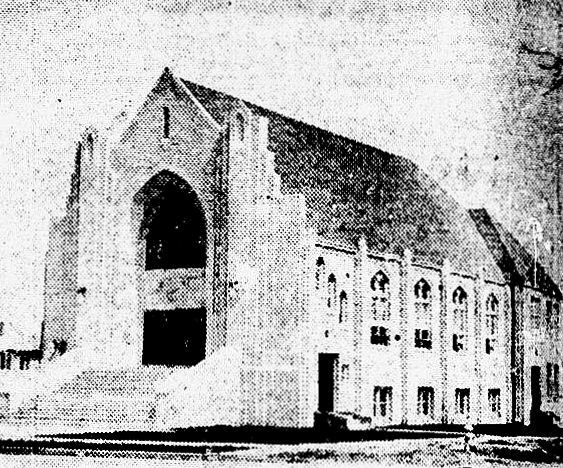
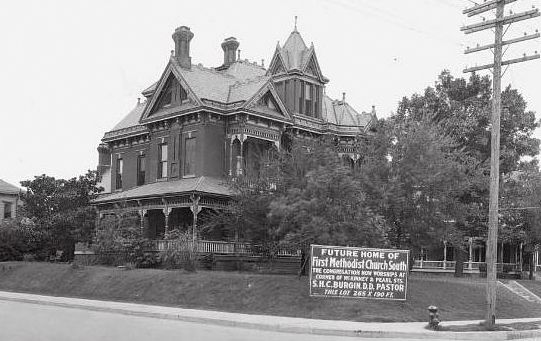
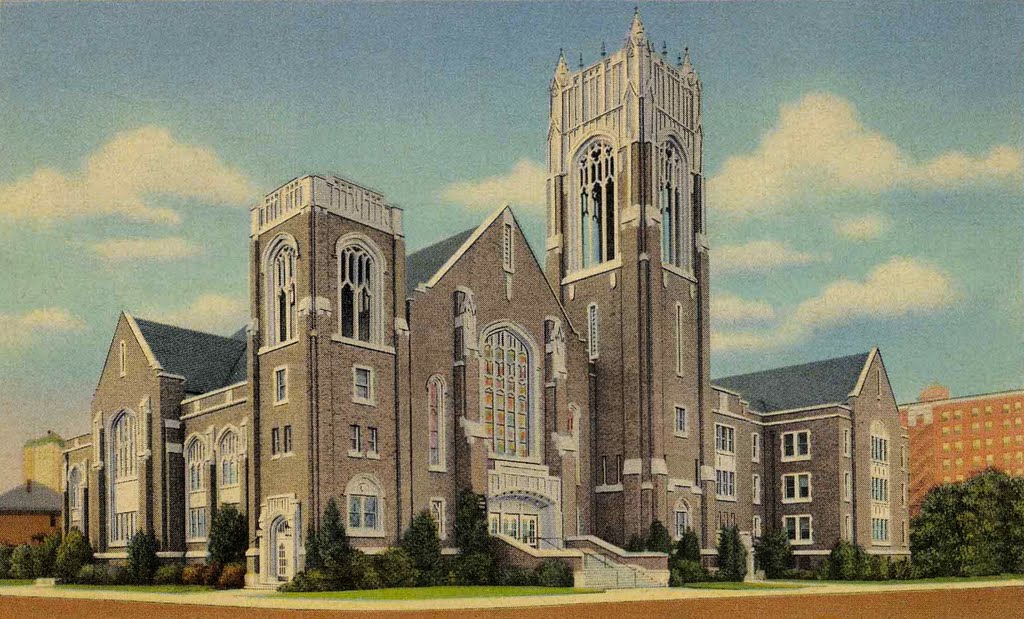
The First Methodist Episcopal Church, South (now First United Methodist Church of Dallas) was built in 1924 and 1925 at Ross and North Harwood. It was a large undertaking, and its construction meant that three of the four very large houses in the 1900 block of Ross Avenue, between North St. Paul and North Harwood, had to be demolished, including the house built by Mrs. Miranda Morrill in 1886 at the southwest corner of Ross and Harwood.

morrill-house_lost-dallas_doty_dmn

For many years, large houses like this — owned by the city’s wealthiest bankers, industrialists, and real estate men — lined Ross Avenue, just to the north of the central business district. But by the 1920s, more and more non-residential development began to encroach into this part of town.

The photograph at the top is pretty amazing, because it shows some of those grand houses in their last days. The north side of the 1900 block of Ross (the block now occupied by the Dallas Museum of Art) contained four lots. In the 1925 construction photo above, there are three houses and a business.

ross-houses_1925

In the detail above, at the far left we see the home of land baron William Caruth (in the book Dallas Rediscovered, William L. McDonald called this little pied-à-terre his “townhouse”) — for decades it sat at the northeast corner of Ross and St. Paul (which had previously been named Masten). Next to it is something that looks like scaffolding or a tower (what is that? — is it a photographer’s perch to document the construction?). Next to it is another grand house, home of several wealthy occupants over the years. And then … a car dealership and garage. How this happened is a mystery, but this 1921 building — which replaced a beautiful house and which sticks out like a sore thumb — belonged to the Flippen Auto Co., complete with showroom on the ground floor and garage and repair facilities on the second floor — it may have had one of the first car elevators in town.

Next to the Flippen Auto Co. was the grandiose Conway House, with its columns and portico; it was built around 1900 at the northwest corner of Ross and Harwood and was the childhood home of pioneer female fashion illustrator Gordon Conway. In 1921 — after a few years as a music conservatory — it became the home of the Knights of Columbus.

conway-house_ross-harwood_ca1902_mcdonaldConway House, about 1902

And here’s a photo showing both the Flippen Auto Co. and part of the former Conway House.

flippen-auto_park-cities-photohistory_galloway

On the northeast corner of Ross and Harwood, we can see a large house facing Harwood. Forget the house — on that corner was a tiny little gas station. And glory be, I stumbled across a great photo of the Acme Oil & Supply Co. complete with Texaco pump — probably from around 1919 or 1920.

ross-harwood_gas-station_greene

But back to the construction of what is now the First United Methodist Church of Dallas — a lovely building which still stands and faces the Dallas Museum of Art. Here’s a photograph of the construction from May, 1925.

construction_may-1925

And here is the postcard filled with an artist’s conception of people to-ing and fro-ing.

methodist-episcopal-church_ebay

methodist_postcard

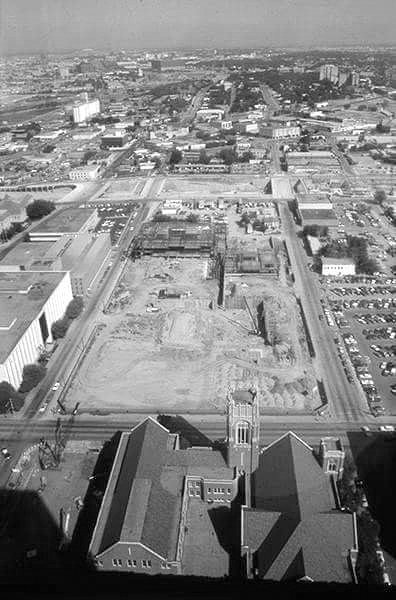
And, finally, an aerial view taken above the church in the early 1980s, looking north, showing the same block once bookended by the Caruth and Conway mansions, now leveled to make way for the Dallas Museum of Art.

dma-under-construction_1984

I think I prefer the view from 75 years earlier.

ross-avenue_ca1910

***

Sources & Notes

The two photos taken in 1925 during the construction of the church are from the book Church at the Crossroads, A History of First United Methodist Church, Dallas (Dallas: UMR Communications, 1997); the entire book has been scanned and may be viewed at Archive.org, here (all the photos are at the end).

The photo of the Morrill house is from Mark Doty’s book Lost Dallas (Charleston: Arcadia Publishing, 2012).

Photo of the Conway House is from Dallas Rediscovered by William L. McDonald (Dallas: Dallas Historical Society, 1978).

Photo showing the Flippen Auto Co. and the Conway house from Diane Galloway’s book The Park Cities, A Photohistory.

Photo of the Acme gas station is from Dallas: The Deciding Years by A. C. Greene (Austin: Encino Press, 1973).

The construction of the First Methodist Episcopal Church, South was announced in a Dallas Morning News article on Oct. 5, 1924.

methodist_dmn_100524

All that’s left of those grand homes is the Belo Mansion. It’s something!

Click pictures to see larger images.

*

Copyright © 2015 Paula Bosse. All Rights Reserved.
 

Winter Scene: The Belo Mansion & The Cathedral of the Sacred Heart — ca. 1902

cathedral_snow_flickr-colteraSnow on Ross Avenue…

by Paula Bosse

A beautiful dusting of snow in one of the tonier areas of the city, captured by a postcard photographer in the early years of the 20th century — back when the snowy slush along Ross Avenue would have been caused by horses and the buggies they pulled behind them.

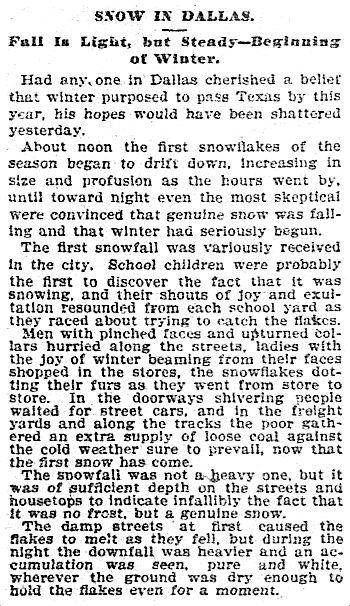
The date of this postcard is unknown, but at the end of 1902 (the same year the construction of the cathedral was completed) it snowed in Dallas — a “weather event” then (as now) so out of the ordinary that it resulted in these rapturous few paragraphs from the December 4, 1902 edition of The Dallas Morning News:

snow_dmn_120402DMN, Dec. 4, 1902

***

Sources & Notes

Postcard from Flickr, here.

The Belo Mansion was built in about 1890; more info here.

Construction of the Cathedral of the Sacred Heart (now the Cathedral Santuario de Guadalupe) was completed in 1902. Except for the bell tower, which, though part of the architect Nicholas J. Clayton’s original design, was not completed until 2005. More on this “sympathetic addition” from Architexas, here.

While most of the buildings and houses that once stood along ritzy Ross Avenue are long gone, both the Cathedral and the Belo Mansion still stand as Ross Avenue landmarks.

Below, the same view today (sans snow), via Google Street View (click for larger image). I really wish that iron fence was still there.

belo-cathedral_google

*

Copyright © 2015 Paula Bosse. All Rights Reserved.
Highland Park Methodist Church — 1927

hp-methodist-church_1927-degolyerHighland Park Methodist Church, 1927 (click for larger image)

by Paula Bosse

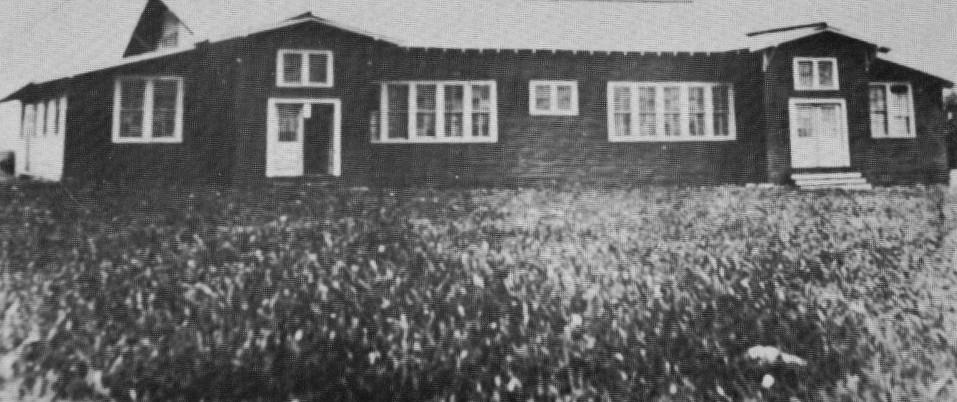
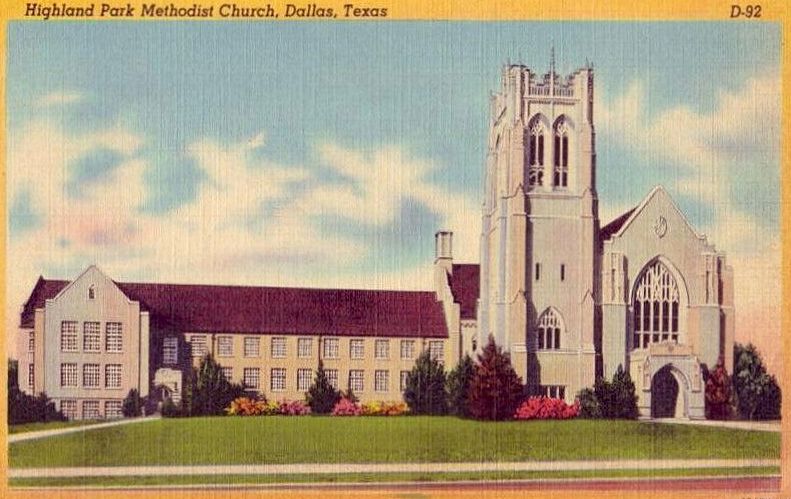
The beautiful Highland Park Methodist Church (now Highland Park United Methodist Church) was designed by architects Mark Lemmon and Roscoe DeWitt (who also designed several of the buildings on the adjacent SMU campus, as well as Woodrow Wilson and Sunset high schools, to name only a few of their projects). According to the HPUMC website, the first church — a temporary building which was referred to as “The Little Brown Church” — was built at Mockingbird and Hillcrest in 1917. It wasn’t until 1927 that the beautiful French Gothic-inspired building we know today was built on that same site. (At one time, Highland Park Methodist Church was the largest Methodist church in the world.)

(Incidentally, Mark Lemmon built his lovely cottage-like home on Mockingbird, across the street from both the church and the SMU campus, where at any time of the day or night, he could look out his front window and gaze with satisfaction upon his beautiful church and the ever-growing university campus dotted with buildings he had designed.)

hp_methodist-church_post-card-series“The Little Brown Church” — built 1917

hpmc_postcard_color

hpmc_golden-prologue-backChurch and SMU campus, Hillcrest and Mockingbird, 1960s

Highland Park Methodist Church Dallas, TX

***

Top photo by Joseph Neland Hester, taken in 1927. From the DeGolyer Library, Central University Libraries, Southern Methodist University; photo can be seen here. (UPDATE: I erroneously labeled the direction of this photo previously. It actually shows the back of the church, looking toward Mockingbird. It would have been taken from about where the Meadows Museum is now. If this is incorrect, please let me know!)

Photo of “The Little Brown Church” from the Park Cities Bank Heritage Series, used courtesy Lone Star Library Annex Facebook Group.

Aerial view from the back cover of Golden Prologue to the Future: A History of Highland Park Methodist Church by Doris Miller Johnson (Parthenon Press, 1966).

Other images from postcards.

For more on the history of Highland Park United Methodist Church check out the Wikipedia page here; check out the church’s history page here.

All photos larger when clicked.

*

Copyright © 2014 Paula Bosse. All Rights Reserved.
Oak Cliff Presbyterian Church, Organized 1890

oak-cliff-presbyterian_smOak Cliff Presbyterian Church, ca. 1897 (click for larger image)

by Paula Bosse

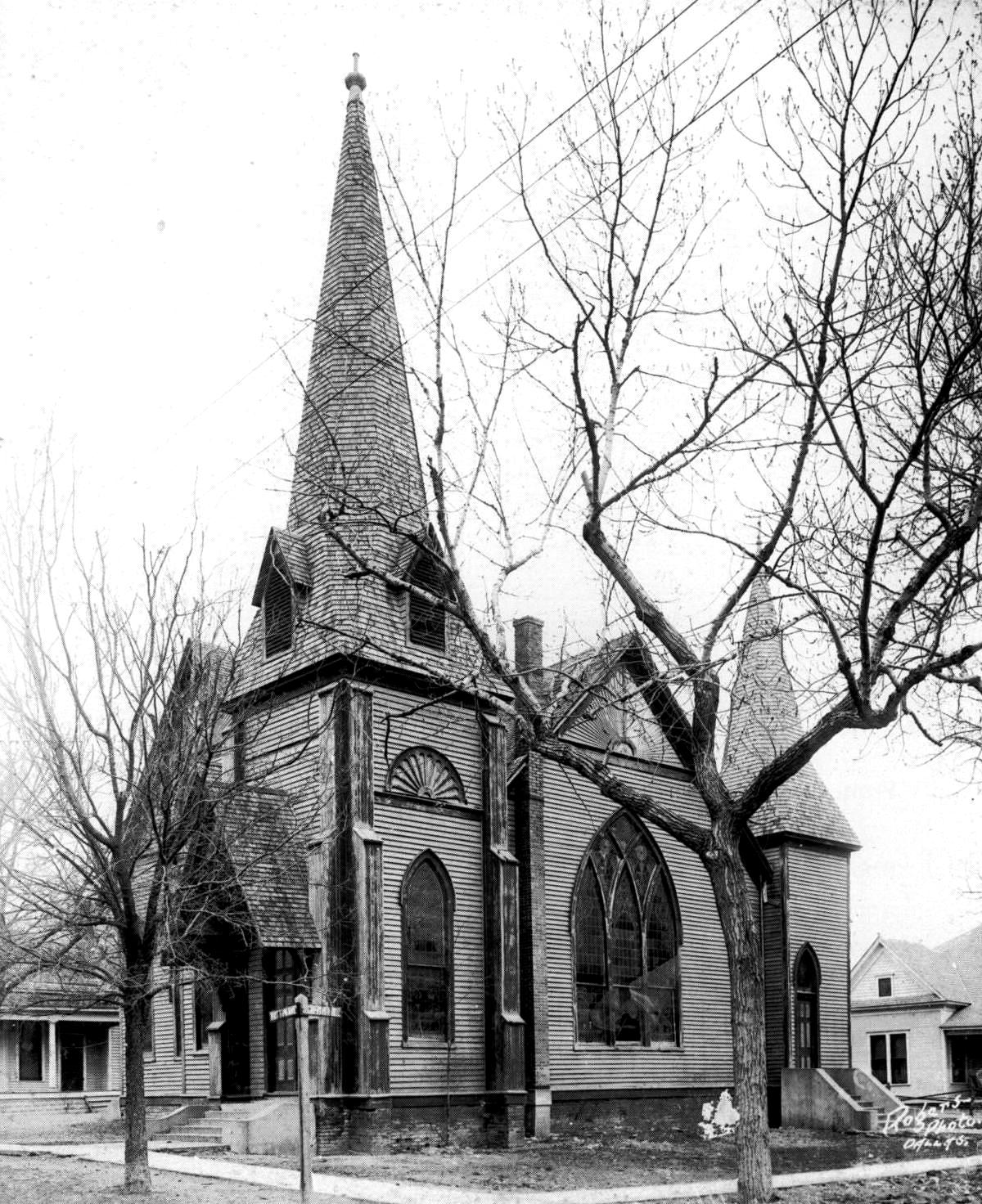
I came across this photograph of a church a couple of days ago and was mesmerized by its charming woodiness. According to its caption, it was the Oak Cliff Presbyterian Church, at the corner of Ninth Street and St. George (now Patton). Its first pastor was the Rev. W. L. Lowrance who had organized the church in 1890 with fewer than twenty members. Church membership grew steadily, and in 1923, having finally outgrown the small wood frame building, the congregation moved to their next location at Tenth and Madison (contributing to Tenth Street’s appearance in Ripley’s Believe It Or Not as the street having more churches per mile than any other street in the world). At some point this lovely church was razed.

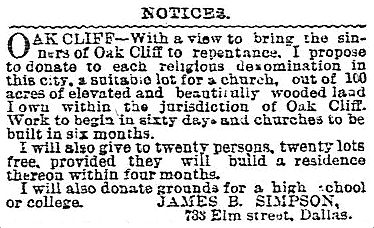
I’ve found little else on its earliest history. but I came across this advertisement placed in The Dallas Morning News in 1891:

simpson_oak-cliff-land-donation_dmn_031491(DMN, March 14, 1891)

Col. James B. Simpson was something of a learned Renaissance-man around Dallas. He had been the editor of The Dallas Herald for many years and was a civic leader with real estate interests. I’m not sure if this ad has anything to do with the establishment of the Oak Cliff Presbyterian Church, but it’s interesting to note that construction of the new church was mentioned as being under construction one month after this ad’s appearance. Time was running out for those Oak Cliff sinners (even though one newspaper report stated that the building wasn’t occupied until 1893).

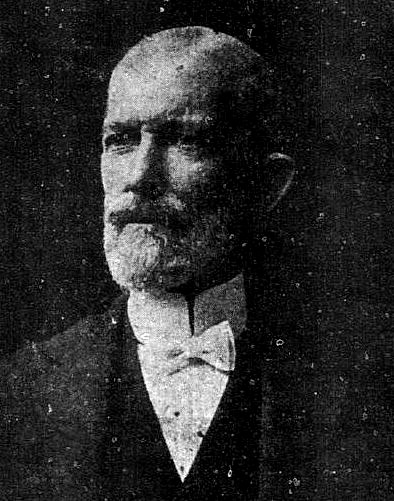
Rev. Lowrance, an apparently well-liked and respected pastor, retired at the end of 1903.

lowrance_dmn_122903-photo“Dr. W. L. Lowrance of Oak Cliff”

lowrance_dmn_dmn_122903(DMN, Dec. 29, 1903 — click for larger image)

The Oak Cliff Presbyterian Church lives on, now on S. Hampton. One can only assume that the building it occupies today is not quite as charming as the little woody one that was built 120 years ago.

***

Top photo (by the Rogers Photo Studio, circa 1897) appeared in the Fall 2009 issue of Legacies magazine, here.

Though the first Oak Cliff Presbyterian Church was on Ninth St., the second one was on Tenth St., and that seems reason enough to direct attention to the article “Road to Glory: Tenth Street Becomes Church Street” by René Schmidt — it appeared in the same issue of Legacies as the church photo, and you can read it here.

Read more about this “Street of Churches” and its staggering fourteen churches (!) in the May 1, 1950 edition of The Dallas Morning News.

*

Copyright © 2014 Paula Bosse. All Rights Reserved.


The Lighthouse Church That Warned of Sin’s Penalty with a Beam of Blue Mercury Vapor Shot Into the Skies Above Oak Cliff — 1941

gospel-lighthouse-churchStill standing in Oak Cliff… (click for larger image)

by Paula Bosse

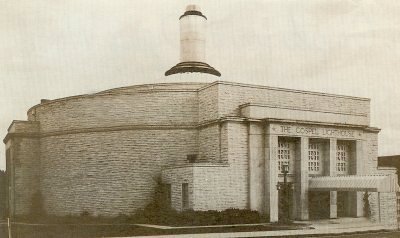
Sometimes an image just grips you. That’s what happened when I saw this postcard featuring The Gospel Lighthouse Church. The building was so odd-looking and cool. Who designed it? Where had it been? And what was that thing on top of it? I did a bit of research on the church and found out that it was organized in Dallas in 1940 by Pentecostal preacher J.C. Hibbard and his wife Nell, who was also a preacher. The two had been preaching at the Oak Cliff Assembly of God Church until J.C.’s divorce from his first wife (and subsequent second marriage to Nell) became such a point of controversy that the two felt compelled to leave (or were asked to leave) the Assemblies of God, and they formed their own church.

And that was the Gospel Lighthouse Church, located in the 1900 block of S. Ewing (at Georgia) in Oak Cliff. While their first church was being built, they held services in a large circus tent in the parking lot. The congregation helped with the physical labor of the construction, and progress on the building continued non-stop, 24 hours a day. In January of 1941, the church was completed, and an article appeared in The Dallas Morning News soon after with the grabber of a headline, “Lighthouse Church Warns Oak Cliff of Sin’s Penalty.” Sadly, the article has no byline, which is a shame, because I’d love to know who wrote the piece, because he or she pulled out all the purple-prose stops. The introduction is fantastically over-the-top:

A towering forty-foot lighthouse 300 miles from the sea was blinking out its warning signals across the dry land of South Ewing Sunday. At the front of a neat new white stone church house at 1914 South Ewing, near Louisiana, the white stone lighthouse reared far above the other buildings. Eventually, its big circular light tower will shoot a bluish mercury-vapor beam through the night to guide shaken mariners adrift on the sea of sin. Its semi-fog horns will broadcast a soft carillon of sacred music. This is the Gospel Lighthouse, built by a preacher with a new idea of church architecture and a dream of a denomination all his own. (DMN, Feb. 10, 1949)

gospel-lighthouse_first

Wow. A “bluish mercury-vapor beam” shooting through the Oak Cliff skies! (The full article is linked below.)

By 1948, J.C. Hibbard had become so popular (largely as a result of his daily radio sermons) that ground was broken on a larger church, designed by J.C. himself. It was right next to the first church. And it was pretty elaborate.

gospel_lighthouse_bw

Yeah, the lighthouse part of it looks a little cheesy, but with a name like “Gospel Lighthouse Church” you kind of have to have it.

*

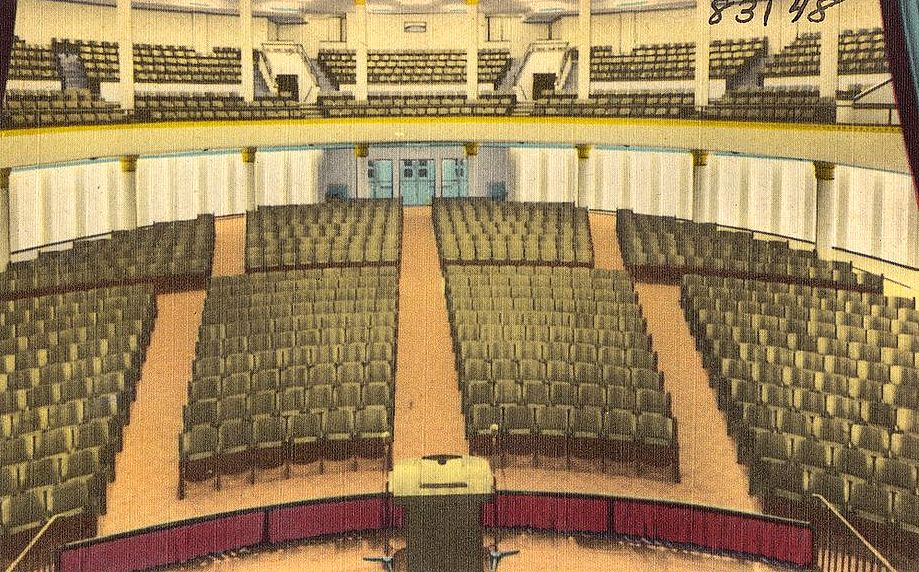
gospel-lighthouse-church_interior

The auditorium and its mezzanine.

*

gospel-lighthouse-nursery

The nursery, with elaborate murals.

*

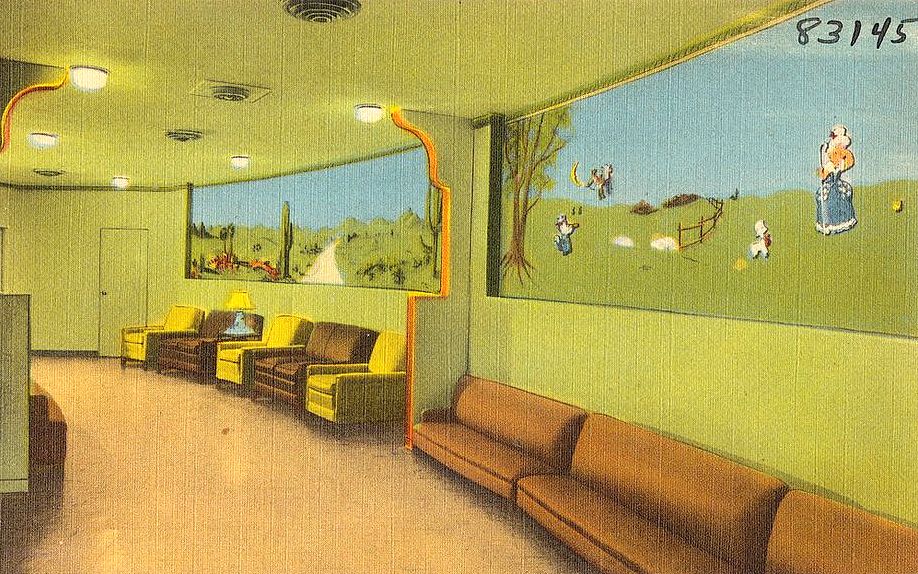
gospel-lighthouse-lounge

The lounge. Like the first church, this one had a nursery with a lounge — a “crying room” for mothers to tend to crying children without having to miss a single moment of the service. The crying was contained behind sound-proof glass while the sermon was piped in through speakers. The church had a lot of other amenities, but these were the only ones I’ve found deemed worthy enough to put on postcards.

*

I wondered if the church still stood, so I drove over to Oak Cliff yesterday and, amazingly, both churches are still there, and they are beautiful! (The original caretaker’s house is still there, too.) I’m not sure what religious group has possession of the buildings at the moment, but they are to be commended for maintaining the structures and the grounds — the 1900 block of S. Ewing really stands out from its fairly ragged surrounding neighborhood. Below are photos I took on April 19, 2014. (Click pictures for larger images.)

gospel-lighthouse_first-church_041914

Above, the first church — “a modern concrete and steel building, overlaid with white Austin stone” — which was built with help from the congregation in 1941. The beam of “bluish mercury-vapor” emanated (somehow) from the squat lighthouse above the foyer.

And, below, the later church, next door. I think the “mercury-vapor” was replaced by neon. But I could be wrong. Does either beacon light up anymore?

gospel-lighthouse_041914_sm

Aside from the “lighthouse,” the most distinctive feature of this building is those rounded walls. So beautiful!

gospel-lighthouse_side_041914-sm

The  building is actually pretty impressive to see up close. Next time you’re in the neighborhood, check it out!

***

Sources & Notes

Postcards from the Boston Public Library Tichnor Brothers Postcard Collection on Flickr, here.

Period black-and-white photos are from a page detailing the history of the Gospel Lighthouse Church, here. A biography of Rev. Hibbard from the same site can be found here.

Wander around the block on Google Street View, here.

Stumbled across this ad in the 1957 Dallas directory:

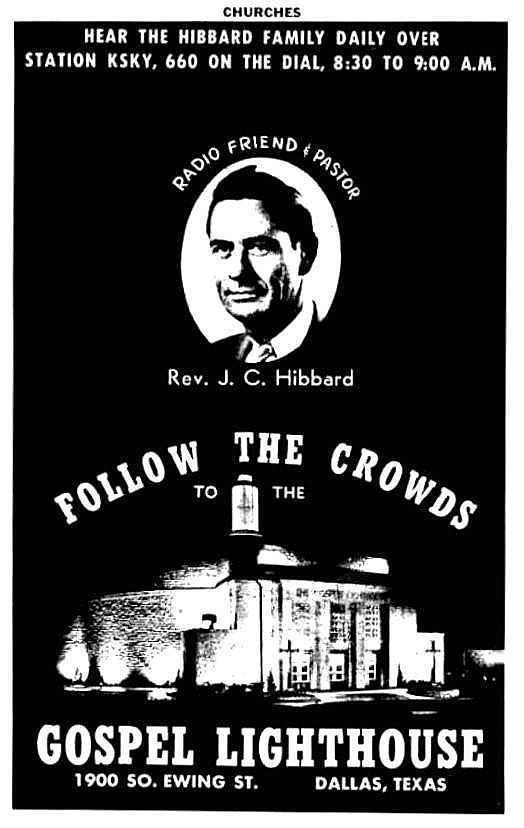
gospel-lighthouse_1957-directory

And I found this ad in, of all places, the 1967 Carter High School yearbook:

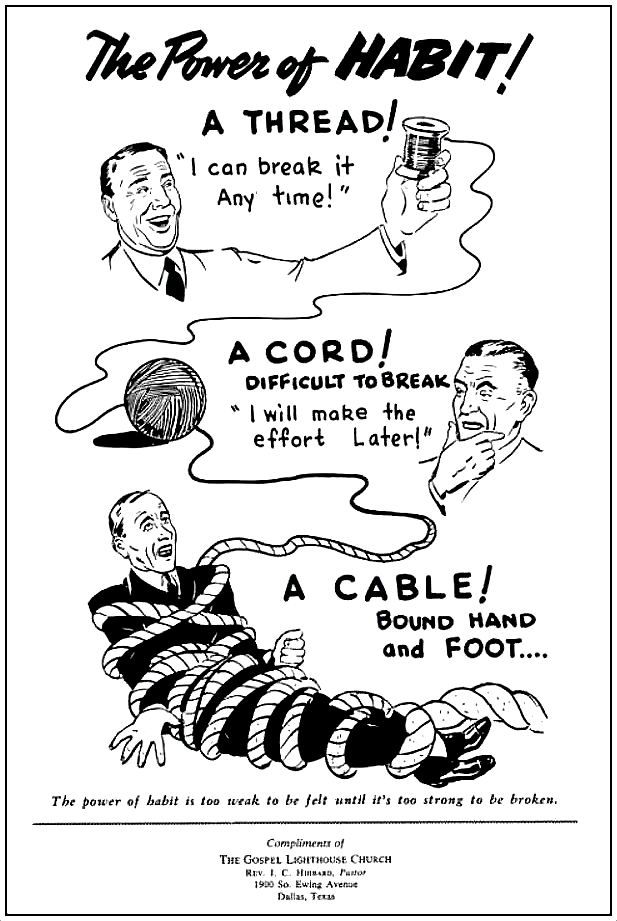
gospel-lighthouse_carter-high-school_1967-yrbk

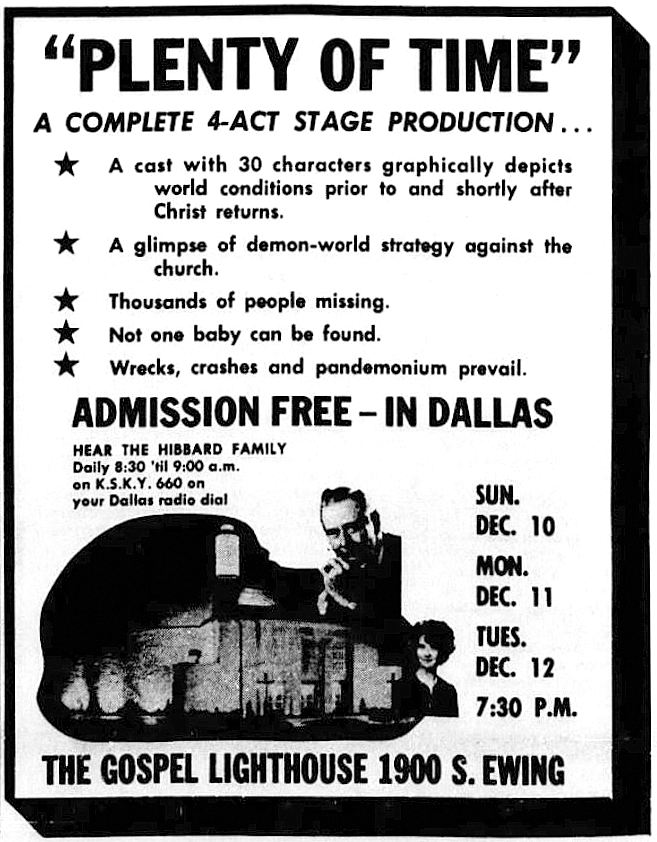
I also found this rather hair-raising ad for a 1967 Christmas-season production — an ad which somehow contains no exclamation marks:

gospel-lighthouse_mckinney-courier-gazette_120867Dec. 8, 1967

*

Copyright © 2014 Paula Bosse. All Rights Reserved.