Flashback : Dallas

A Miscellany: History, Ads, Pop Culture

Category: Dallas Skyline

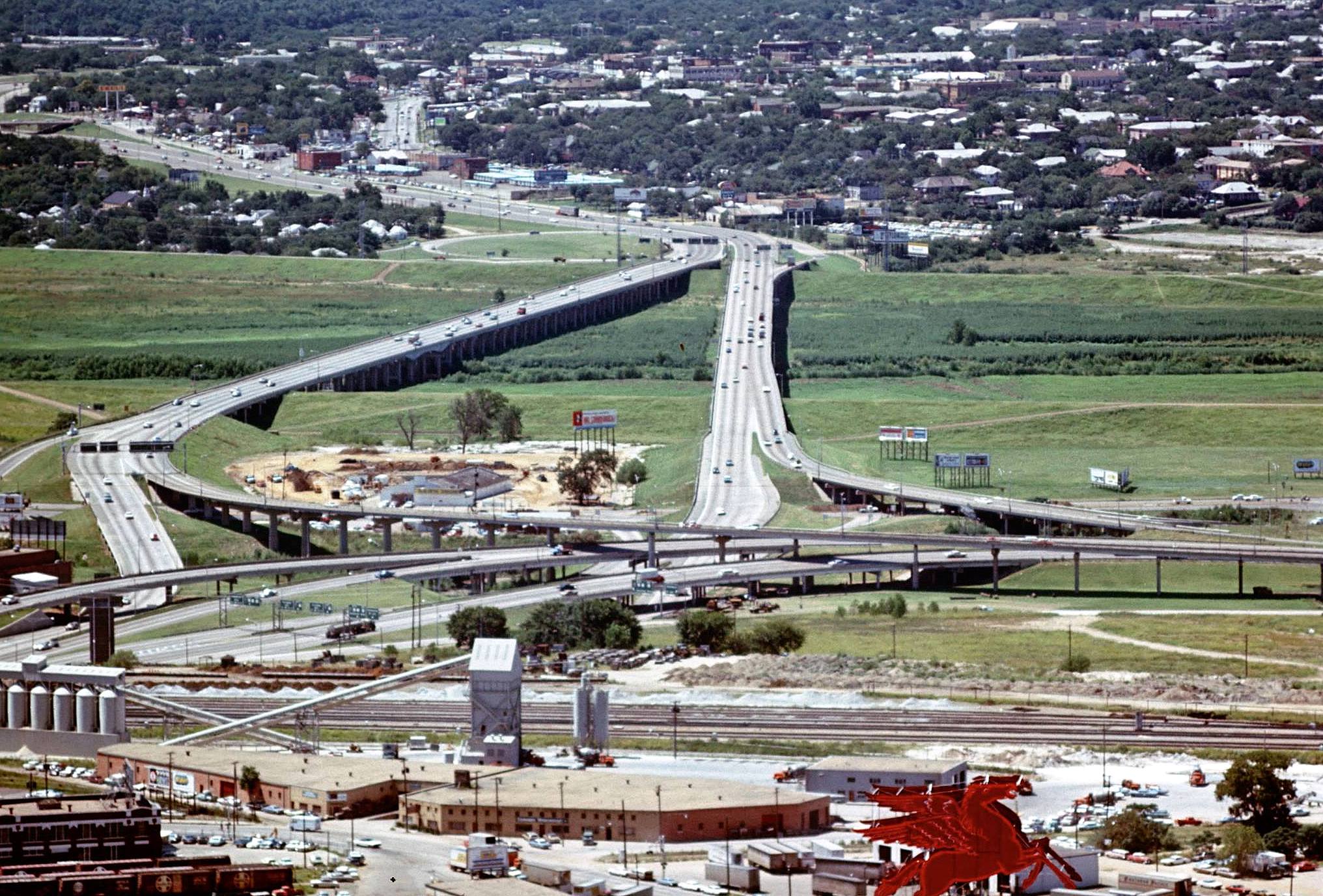
An Incredible View From Republic Tower 2 — 1968
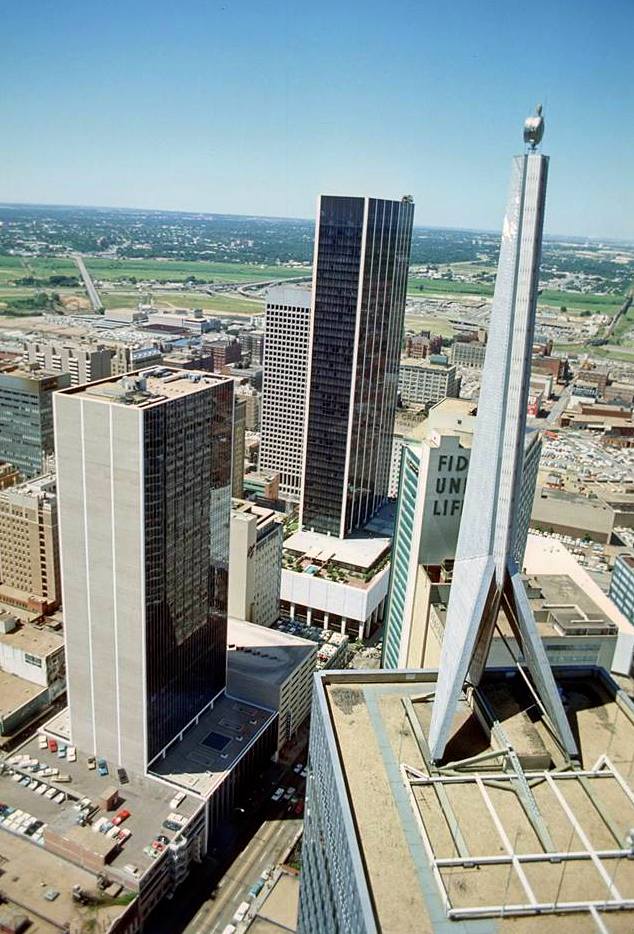
republic2_parrish_1_1968
Photo by Bill Parrish, 1968, used with permission (click for larger image)

by Paula Bosse

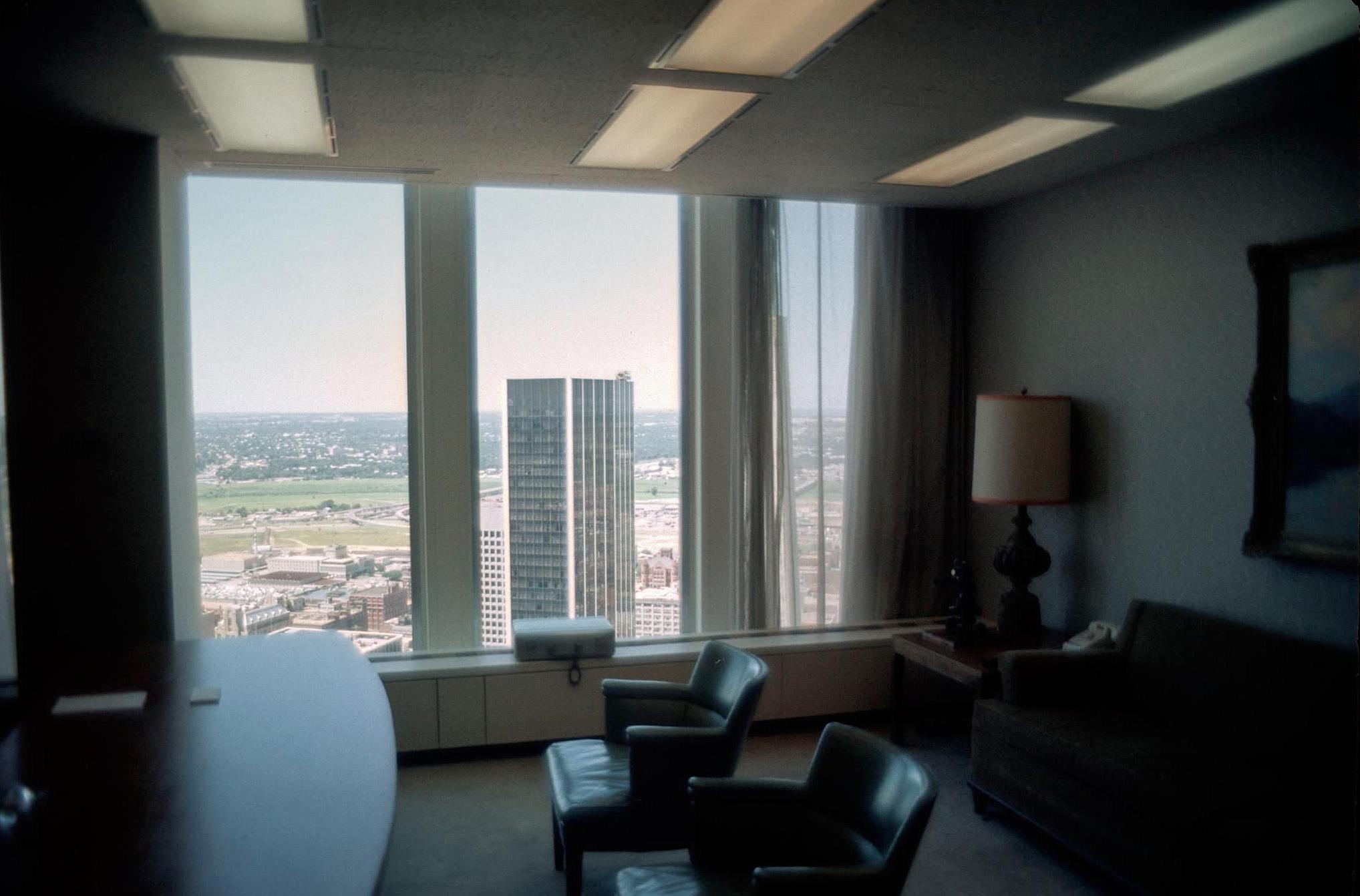
On August 15, 1968, teenager Bill Parrish — a former Dallasite who was back in town on a visit — was surprised to see that a new building has sprung up since he’d left: the 50-story Republic Tower 2 (built in 1964), the much-taller sister-building to one of Dallas’ most famous skyscrapers, the 36-story rocket-topped Republic National Bank Building. He wondered if he could get to the top of the building to take some photos. Bill remembers the day clearly:

“I lived in Dallas until I was 9 years old, at which time we moved to Palo Alto, Califorinia. I spent the summer of 1968 at Texas A&M in an engineering program for high-ability science students. My parents picked me up in College Station and we came back via Dallas. I was a ‘tourist who used to live there’ and wanted some shots to remember the city by — even as a teenager. I had a fairly good camera, and I knew how to take pictures, having done photojournalism in high school. Also, I remembered how much fun I had living in Dallas, so maybe I was looking at the city a little differently.

“We stopped in Dallas for a few days on the way back, and we spent one day downtown visiting old haunts. My dad and I were in our suits, and we went to the new (to us) Republic Tower 2 and rode the elevator to the top and asked around if we could take some shots out of some windows. Some very nice folks allowed us to use an office that was currently not being used. A number of shots were made from the same office. I think we were in and out in about 5 minutes — I remember the folks up there were very nice to us … considering we just ‘dropped in.’

“I just wish I had shot like 3 rolls of film — like inside the Mercantile lobby, inside Titche’s, and inside Neiman’s. I would have shot stuff at Walnut Hill Village, Marsh Hill Village, in the terminal at Love Field, at my old school, peoples’ houses I remembered, restaurants, etc. if I had known they would be of value in 50 or so years.

“I guess the takeaway is that today if something catches your eye, shoot it (with your phone even), and archive it so it can be found later… and don’t throw away old pictures! You may not be able to keep everything, but be careful about what might be of value to someone.”

*

Below are some of Bill’s really, really wonderful photos taken on that summer day in 1968 from a top floor of the tallest building in Dallas. (Many of these are HUGE. Click to enlarge.)

republic2_parrish_2_1968

republic2_parrish_5_1968

republic2_parrish_4_1968

republic2_parrish_3_1968

republic2_parrish_6_1968The office Bill shot from; his aluminum camera case is on the windowsill.

republic2_parrish_7_1968The original be-rocketed Republic National Bank Building on the left, the taller Republic Tower 2 in the middle.

***

Sources & Notes

All photos in this post by Bill Parrish, used with his permission. They first appeared in the Retro Dallas Facebook group.

During this short trip to Dallas, Bill’s family also shot some home movie footage, which can be seen here.

Below, a Google map showing the Bill’s general view of the photos looking over Pegasus to Oak Cliff:

map-view-from-republic2

Some photos by a different photographer, taken from the top of the Republic Center Tower II (its official name) in 2007, can be seen here. A couple of the photos show the exact same shots Bill took. A lot can happen in 40 years!

The Wikipedia page for Republic Center is here; the official Republic Center site is here (worth checking out if only to see the BEAUTIFUL shot of the two buildings, including the re-lit “rocket” tower).

My previous post, “The Republic National Bank Building: Miles of Aluminum, Gold Leaf, and a Rocket,” is here.

All of Bill Parrish’s photos are very large. Click to see some of them much, much larger!

Thank you so much, Bill, for sharing these fantastic pictures. The photo at the top is now one of my favorite-EVER shots of the Dallas skyline!

*

Copyright © 2015 Paula Bosse. All Rights Reserved.


The Dallas Skyline from the Maple Terrace Penthouse — 1952

feldman_terrace_huntington-detView from the penthouse (Huntington Library)

by Paula Bosse

The best view of the Dallas skyline that no longer exists may very well have been the view from atop the Maple Terrace Apartments, located on Maple Avenue, right across Wolf Street from the Stoneleigh Hotel. The photo above was taken in 1952, when there was a straight-shot view of downtown, with no hulking buildings to spoil the vista. This view — completely unobstructed except for the Stoneleigh (out of frame, at left) — must have been spectacular at night. (Although, as can be seen at the far right, the industrial area that surrounded the iconic DP&L smokestacks was also part of the view. Also not included in realtor brochures would have been the fact that the luxury apartment building overlooked the adjacent Little Mexico neighborhood, often described as a “slum area” — the huge economic disparity between the neighboring haves and have-nots would have been starkly apparent to any gimlet-sipping rooftop visitor. And then there was the not-so-distant meat-packing plant…. But I digress.)

The beautiful Maple Terrace Apartments — designed by architect Alfred Bossom (who also designed the Magnolia Building) — was built in 1924-25 and opened with great fanfare as the city’s first luxury apartments.

maple-terrace_postcard

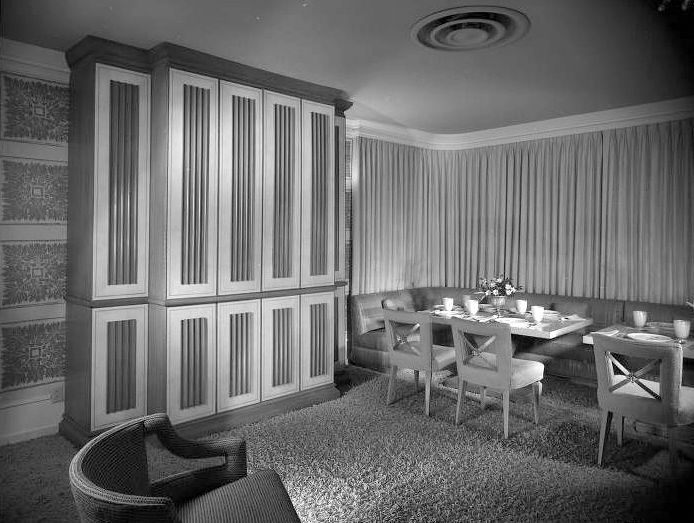
An early tenant was Morris Feldman, a Polish immigrant whose family owned the successful Parisian Fur Co. (later Parisian-Peyton). Morris’ son, the incredibly wealthy oilman and art collector, D. D. Feldman, must have been quite taken with his parents’ home there, because in the late ’40s or early ’50s, he transformed the entire seventh floor — which had previously contained 20 “hotel-type” units — into his personal penthouse. The patio terrace with the to-die-for view was the cherry on the sundae.

feldman_terrace_huntington

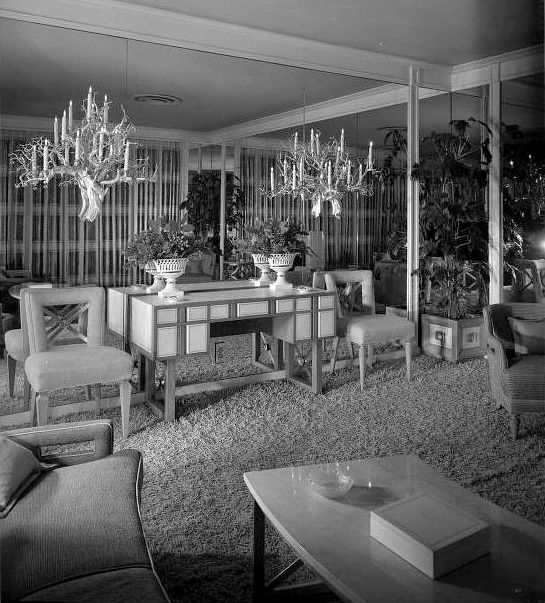
Countless cocktail parties, dinner parties, and fashionable teas were held in the Feldmans’ penthouse. The interior design — the work of Tom Douglas, of Los Angeles — was, apparently, much admired. The decor consisted of a mixture of typically cool Mid-Century Modern pieces as well as a few touches that, from a 21st-century vantage point, look a little … tacky. Somewhere in all of the acreage of furnishings was a fireplace, a white leather-covered piano (!), “a cocoa-striped sofa with pale blue frame,” murals, white brick wallpaper, and several pieces of furniture and cabinetry with a “driftwood finish.” And lots of lacquer. And mirrors, mirrors, mirrors. These “timeless furnishings in beige, marigold, white leather and ash” (DMN, Nov. 19, 1960) are dated relics of another era, but, at the time, they were splashed across the pages of magazines such as Architectural Digest.

feldman_entryway_huntington-lib

feldman_living-rm_huntington-lib

feldman_dining-rm_huntington-lib

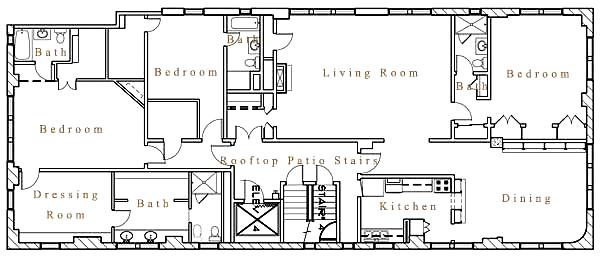
As far as I know, the seventh floor of the Maple Terrace is still a single space. A 1978 real estate ad touted its “recently redecorated” 3,000 sq. ft. amenities:

maple-terrace-penthouse_dmn_032278

Below, the present-day penthouse floor plan from the Maple Terrace’s website:

maple-terrace_penthouse-floorplan-today

And, look, here’s a photo of what that entryway looks like now, (without the mural):

maple-terrace_hallway-today

I’m sure the rooftop terrace is still as beautiful as ever, but, sadly, it will never again boast of that once-incredible view:

maple-terrace-view-today

***

Sources & Notes

Top photo (and all black and white photos from this series) by Maynard L. Parker, for Architectural Digest; from the Maynard L. Parker Collection at the Huntington Library, accessible here. The top photo is a detail, which has been cropped and reversed; the original photo is shown in reverse on the Huntington site (along with some early image “editing” on the outline of the Stoneleigh), which is a bit freaky when you know that what you’re looking at is backwards!

Color photos and floor plan from the website of the Maple Terrace Apartments, here. Biographical info on the architect, Sir Alfred Bossom, is here. Fabulous photos of the building from AIA Dallas, is here; and a wonderful piece on the mystique of living in the famed Maple Terrace from D Magazine, is here.

An intense and thorough description of the Feldmans’ penthouse decor is in the article “Feldman Apartment: Timeless Decorating” by Jeanne Barnes (Dallas Morning News, Nov. 19, 1960).

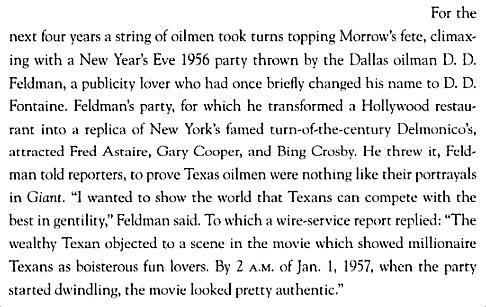
In addition to his oil holdings, D. D. Feldman was an important collector and patron of Texas art. In reading about Mr. Feldman, my favorite tidbit is this, from the book The Big Rich: The Rise and Fall of the Greatest Texas Oil Fortunes by Bryan Burrough (Penguin, 2009):

feldman_big-rich_quote

*

Copyright © 2015 Paula Bosse. All Rights Reserved.

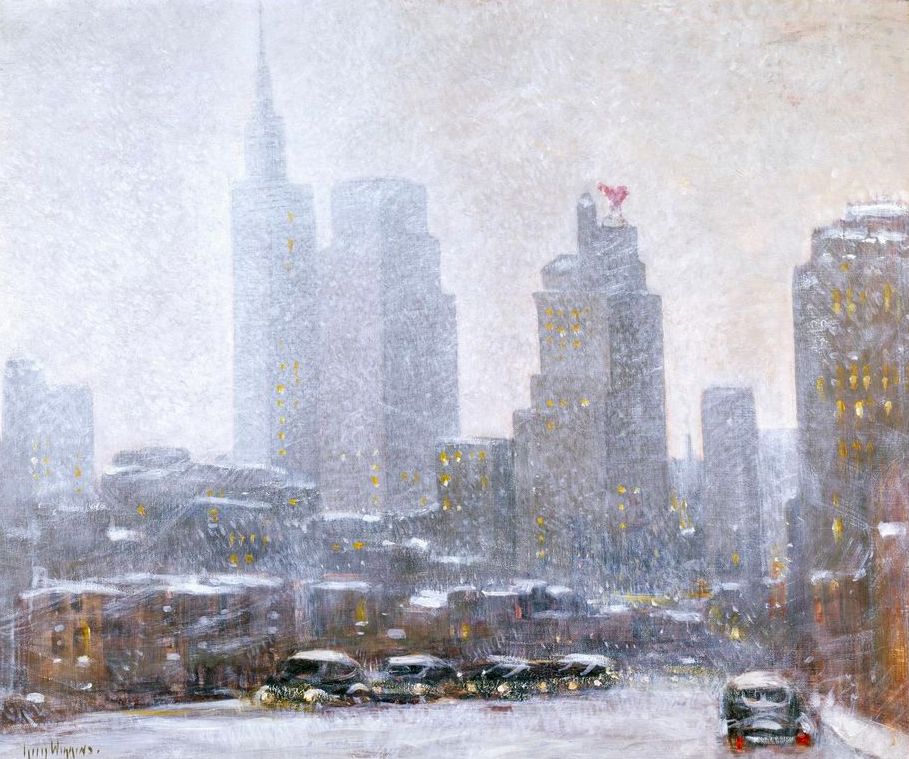
“Dallas in Winter” by Guy Wiggins — ca. 1942

wiggins_dallas-in-winter_c1942_dma“Dallas in Winter” by Guy Carleton Wiggins (Dallas Museum of Art)

by Paula Bosse

A nostalgic look back at a snowy Dallas scene from the 1940s by Guy Wiggins (1893-1962), an artist most remembered for his snow scenes of New York City. Wiggins was apparently quite fond of Dallas and was a frequent visitor, beginning in the 1920s. He had countless gallery shows here over the years, and while in town he’d often present lectures and “master classes” to arts groups and women’s groups. According to articles in local newspapers, Wiggins painted views of the Dallas skyline several times, paintings which no doubt found their way into private collections and are probably still hanging on the walls of local art patrons. In 1952, his daughter and her family moved here, giving Wiggins yet another reason to visit.

The wonderful snow scene above is in the collection of the Dallas Museum of Art; this is the DMA’s description of the painting:

A rare snowstorm in Dallas captured the eye of Guy Carleton Wiggins, who recorded this scene from the downtown vantage point of Live Oak and Pearl streets, showing the skyline’s distinctive historic landmark of the red statue of Pegasus on the Magnolia building.

Although born and raised in the East, where he was affiliated with the artists’ colony in Old Lyme, Connecticut, Wiggins traveled widely throughout the United States during his career. He became known for urban winter scenes such as this one.

***

Sources & Notes

The painting “Dallas in Winter” by Guy Carleton Wiggins is from the Patsy Lacy Griffith Collection, Dallas Museum of Art; it was a bequest of Patsy Lacy Griffith. More information on the painting can be found on the DMA’s website, here.

(Patsy Lacy Griffith was the daughter of oil millionaire Rogers Lacy, who was this close to building the incredible Frank Lloyd Wright-designed hotel downtown. I wrote about it in a previous post, here.)

More on the career of Guy Wiggins, from Wikipedia, here, and from a 2011 New York Times profile of the Wiggins family of painters, here.

Because he visited so often and had many friends here (and because he apparently painted very quickly), Wiggins’ paintings were well represented in private collections in Dallas. (One of his earliest patrons was Miss Ela Hockaday, of the Hockaday School for Girls, who loaned one of her paintings for an exhibit at the Dallas Public Library in 1930.) Among works depicting views of the city were oil studies with the titles “Morning Over Dallas,” “The Akard Canyon,” “Dallas: Morning From Cliff Towers,” and “Dallas Nocturne,” all of which were probably still damp when first shown, as The Dallas Morning News reported that they had been painted “little more than a week ago” before they went on display at the Ed Spillars gallery on Fairmount at the end of December, 1948 (DMN, Dec. 22, 1948). I’d love to see these paintings.

Want “Dallas in Winter” hanging on your walls? Buy the poster from the DMA Shop here. Look at it longingly when it’s 157 degrees in August.

*

Copyright © 2015 Paula Bosse. All Rights Reserved.

A Downtown Gas Station! — 1949

tyler-service-stn_degolyer_1949-det1Gas station at Elm & Houston! (click for larger image) (SMU Libraries)

by Paula Bosse

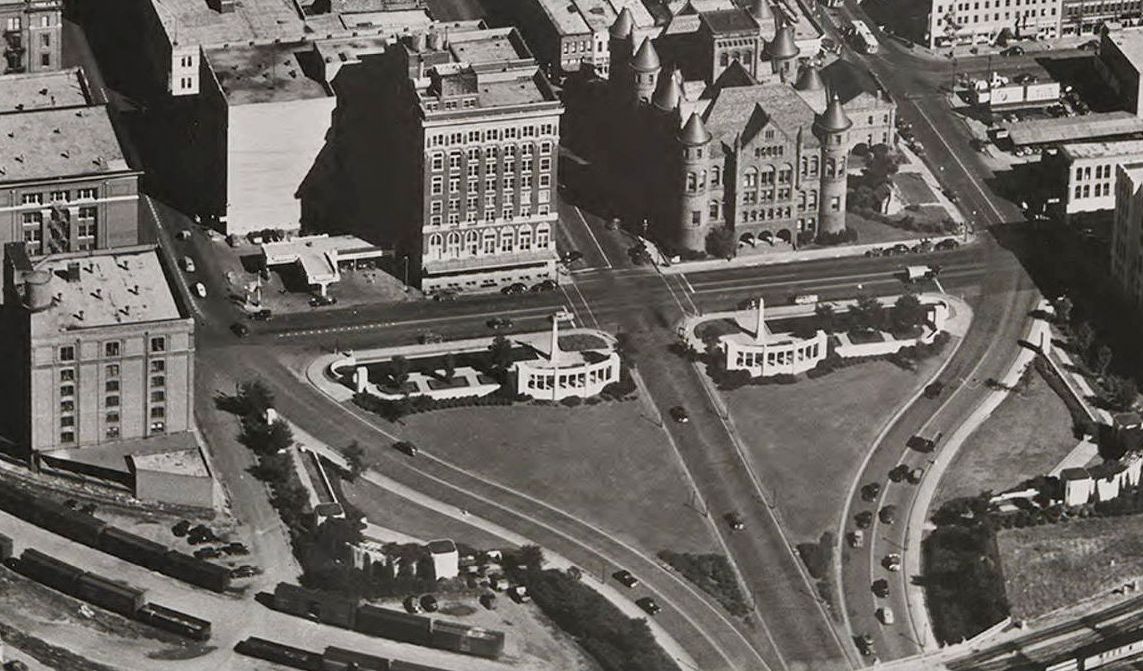
There was a time when gas stations populated the central business district in downtown Dallas. But now? I’m not sure I’ve ever seen a gas station in the heart of downtown. Which is probably why the station seen above (from a detail of a larger aerial view of downtown) stood out so much when I was looking at the photo. And it wasn’t located just anywhere downtown, but it was in the primo location opposite Dealey Plaza at the “gateway” to the city. It doesn’t fit in that space very well — it’s a corner crying out for a more substantial structure — but … wouldn’t it be nice to have an actual full-service gas station downtown again?

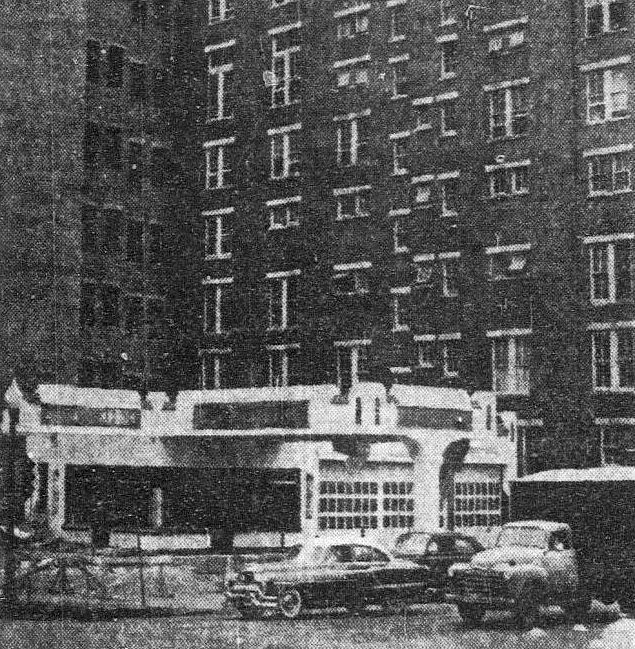
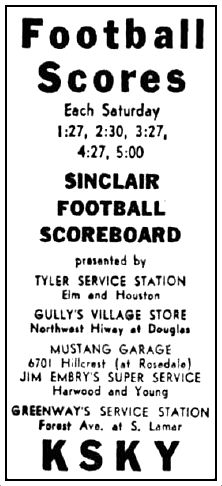
The Tyler Service Station (and before that the Longhorn Service Station) held down the corner at Elm and Houston streets in the 1940s but was demolished in 1953 to make way for the construction of the Records Building/Criminal Courts Building annex. And, hallelujah, I found a photo of the service station from ground-level — and it was pretty cool-looking!

gas-station_elm-and-houston_1950s

tyler-service-stn_dmn_100948Oct. 9, 1948

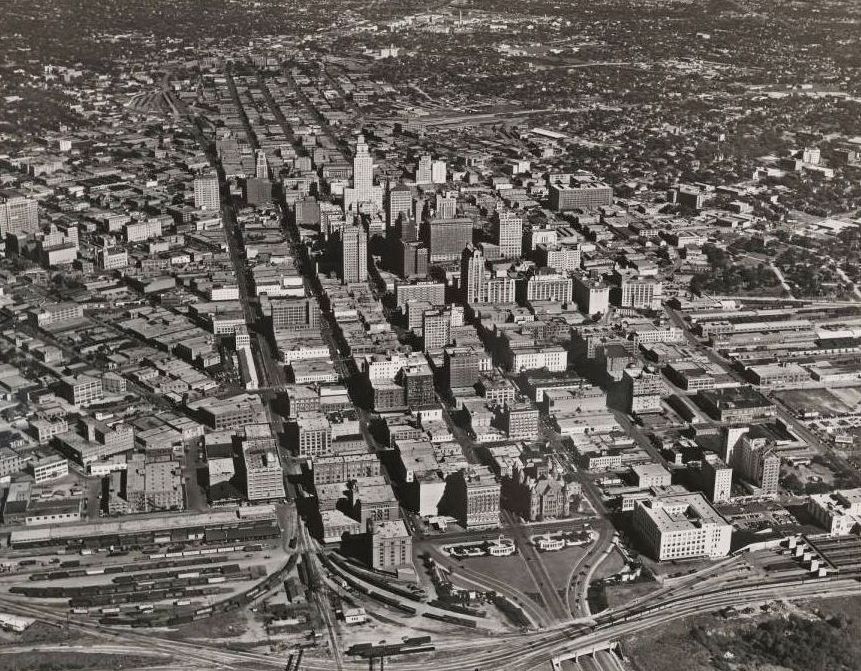
And, finally, here’s the original photo I saw in which that long-gone gas station jumped out at me, another wonderful photo by Lloyd M. Long, taken in May, 1949. You never know what odd things you’ll discover if you just take the time to explore.

downtown_degolyer_1949Aerial photo by Lloyd M. Long, 1949 (Foscue Map Library, SMU)

***

Sources & Notes

Lloyd M. Long photo (“Downtown Dallas, looking east”), from the Edwin J. Foscue Map Library, Central University Libraries, Southern Methodist University; it can be viewed here.

Click pictures for larger images.

*

Copyright © 2014 Paula Bosse. All Rights Reserved.
 

Crossing the Trinity River Viaduct — 1946

streetcar-crossing-trinity_1946-denverpublibStreetcar on the Trinity River Viaduct (click for larger image)

by Paula Bosse

A few days ago I posted a photograph of a streetcar pulling into Oak Cliff, having just crossed the Trinity River Viaduct (link below). In this photo, we see what streetcars of the period looked like actually crossing the viaduct.

***

Photo by Robert F. Richardson, taken on June 5, 1946. From the Western History/Genealogy Dept., Denver Public Library, viewable here.

Photos of these double-ended streetcars taken from a distance present a bit of a Pushmi-Pullyu problem in determining which direction they’re heading, but if you enlarge the photo at the Denver Public Library link just above, you can see the silhouette of the operator at the eastbound end of the car, driving the car toward Dallas. UPDATE: I’m wrong! The car is moving toward O.C., not Dallas! That motorman silhouette is a figment of my imagination! See the comments below for tips on how an amateur like myself who’s never actually seen a streetcar can tell which direction one is moving. (Thanks, Bob and Bob for the correction!)

Streetcars ran back and forth across the Trinity River on a special trestle just south of the Oak Cliff Viaduct/Houston Street Viaduct. It had been in use since 1887 (through various renovations) and was demolished in the early 1970s to build the present-day Jefferson Street Viaduct. The streetcar shown is from the Dallas Railway & Terminal Co. fleet.

My previous post mentioned above, “Waiting for a Streetcar on a Sunny Winter Day in Oak Cliff — 1946,” contains a fantastic photo taken by the same photographer, four months earlier, showing people waiting for the approaching streetcar just after it’s crossed the river; that photo can be seen here.

*

Copyright © 2014 Paula Bosse. All Rights Reserved.

Waiting For a Streetcar on a Sunny Winter Day in Oak Cliff — 1946

jefferson-addison_denver-pub-lib_1946Addison St. & Jefferson Blvd. in Oak Cliff — Feb., 1946 (click for larger image)

by Paula Bosse

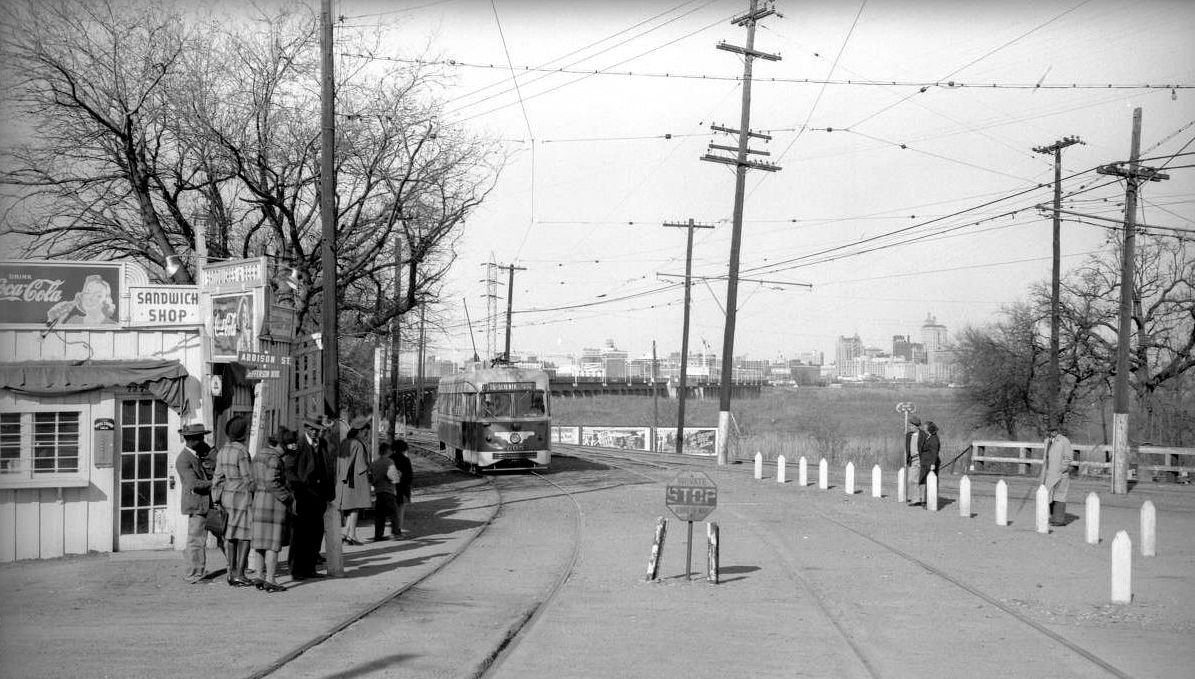
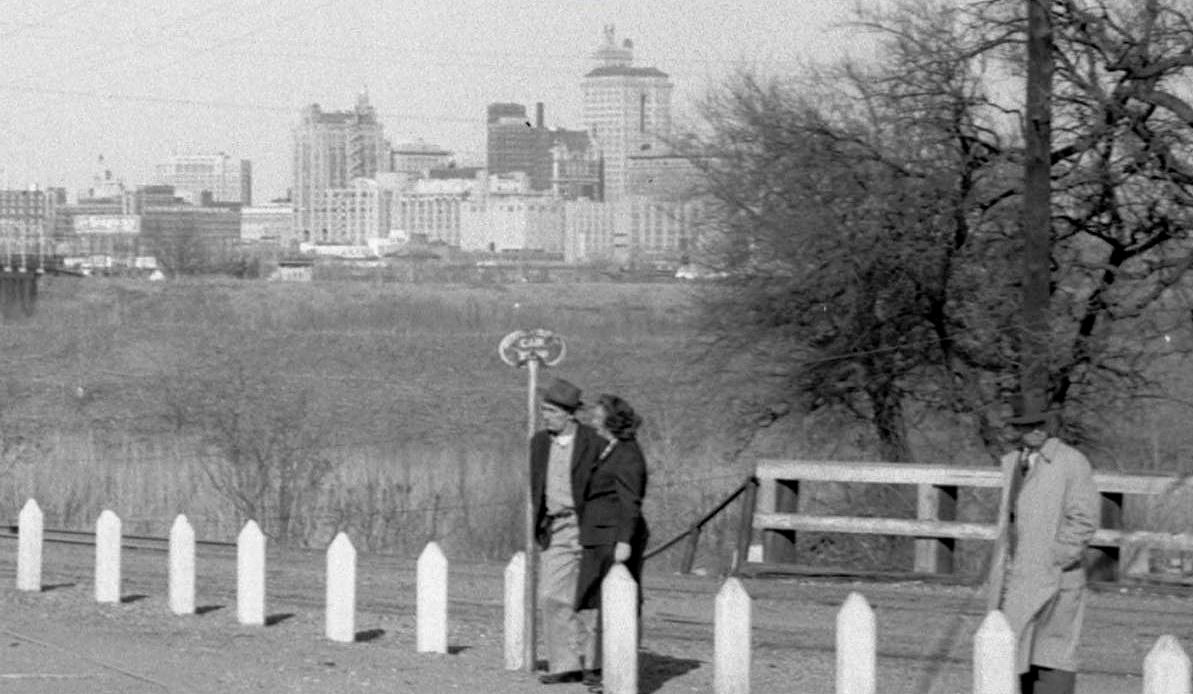
I love streetcars, photos from the 1940s, fashions of the ’40s, and views of the Dallas skyline. And here are all of these things, in one great, GREAT photograph. We see people waiting for the streetcar on a sunny Saturday in February, 1946 — in Oak Cliff, at E. Jefferson Blvd. and Addison St. The people at the left (outside Helen’s Sandwich Shop) are about to catch the car that has just crossed the Trinity River and head into Oak Cliff; the people on the right are waiting to go to Dallas. The Oak Farms Dairy is just out of frame at the top left, and Burnett Field is just out of frame at the bottom right. The Dallas skyline looms across the Trinity.

Below, I’ve zoomed-in a bit and cropped this fantastic photograph into two images to show, a bit more intimately, details of an ordinary moment in an ordinary day of ordinary people. What once was such a commonplace scene — people waiting for a streetcar or interurban — now seems completely out of the ordinary and quaintly nostalgic. (Nostalgic on its surface, anyway — not shown is the interior of the car which had specific black-only and white-only seating areas for passengers.) (As always, click for larger images.)

jefferson-addison-det1

jefferson-addison-det2

***

Photo by Robert W. Richardson, taken on February 2, 1946. From the Western History/Genealogy Dept., Denver Public Library, viewable here. More on rail enthusiast, writer, photographer, and preservationist Bob Richardson, here.

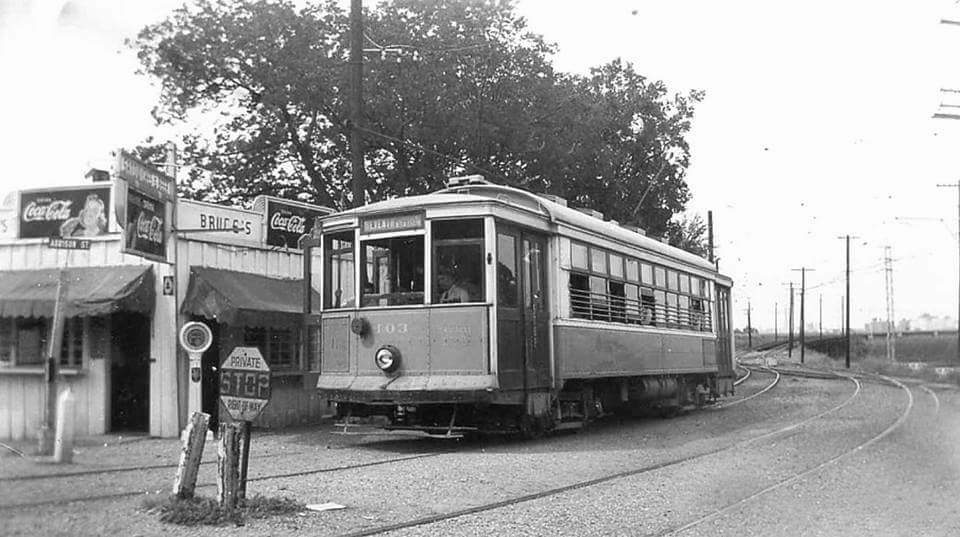
The same stop can be seen in this undated photo (source and photographer unknown):

oak-cliff-streetcar-stop_addison-jefferson

Streetcars ran back and forth across the Trinity River on a special trestle just south of the Oak Cliff Viaduct/Houston Street Viaduct. It had been in use since 1887 (through various renovations) and was demolished in the early 1970s to build the present-day Jefferson Street Viaduct.

To see a photo by the same photographer showing a streetcar actually on the trestle over the Trinity, see the post “Crossing the Trinity River Viaduct — 1946,” here.

Streetcar enthusiasts are incredibly, well, enthusiastic, and they keep precise track of where cars operated over their life spans. The car from the photo — Dallas Railway & Terminal Co. car #605 — was a PCC streetcar, built by the Pullman-Standard company in 1945; it was sold to the MTA in 1958 and was in operation in Boston for many years. See cool photos of the very same streetcar in operation over the years in both Dallas and Boston, here (scroll down to “605”). To see what the retired car looked like in 2002 — a bit worse for wear — click here.

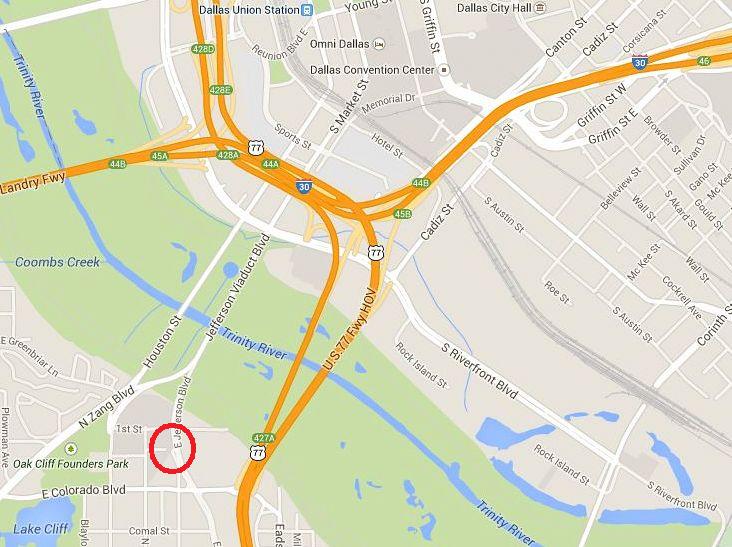
A distinctly less-wonderful view from roughly the same location, seen today, is here.

map_jefferson-addison_googleGoogle

Click pictures for larger images.

*

 Copyright © 2014 Paula Bosse. All Rights Reserved.
“Wonderful K-BOX” at 1480 On Your AM Dial

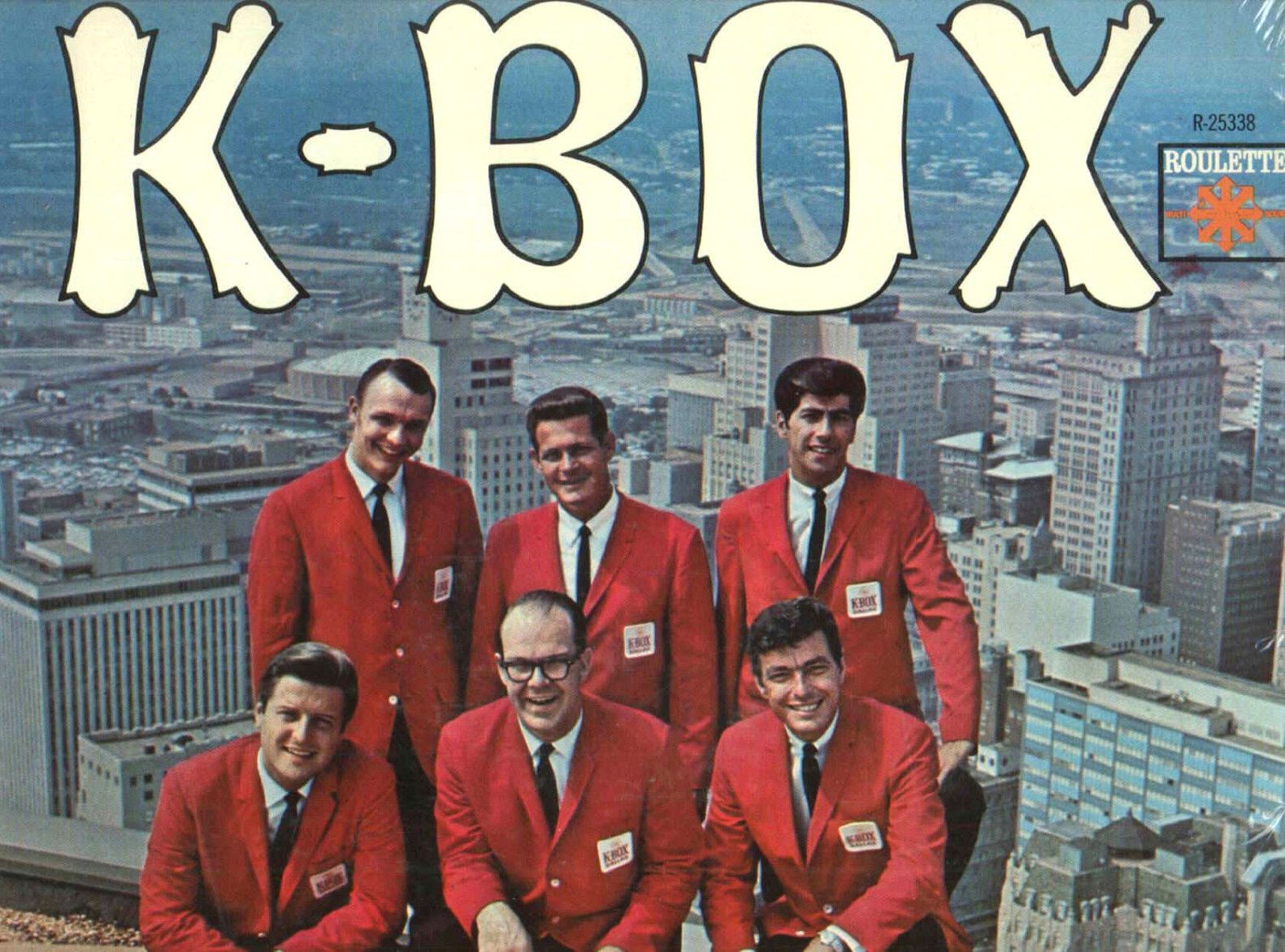
kbox-djs“Wonderful K-BOX” jocks atop the Southland Life Bldg.

by Paula Bosse

When I was a kid, it seems like KBOX was always on in the background. Always. My father was a huge country music fan, and it was one of the (if not THE) top country stations in town. This was in the ’70s. So it’s a bit of a shock to learn that KBOX had been a Top 40 station in the ’50s and ’60s — in fact, it was the major competitor of top-dog KLIF.

The photo above was shot atop the Southland Life Building in 1966 and appeared on an LP called “Dusty Discs.” On-air personalities shown are (top row) Terry Byrd, Ron Rice, Frank Jolle/Jolley, (bottom row) Dan Patrick, Bill Ward, and Bill Holley.

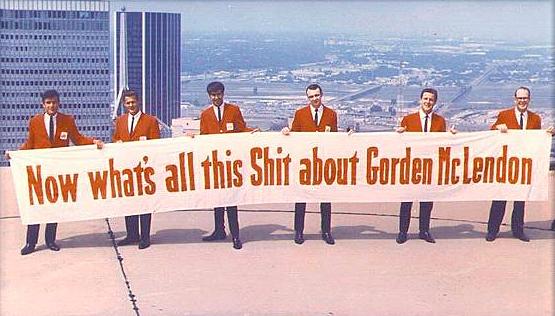
The competition between KBOX (owned by John Box — the “Box” in KBOX) and KLIF (owned by the legendary Gordon McLendon) was fierce. This explains the photo below in which John Box had his DJs hold a special banner during the same photo shoot. Box had this photo printed up and gleefully sent to McLendon as a Christmas card that year (during which KBOX had trounced KLIF in one of the crucial ratings periods). (I’m sure McLendon enjoyed seeing his name misspelled.) AM radio ain’t for the meek.

kbox-mclendon-banner

***

Sources & Notes

Top photo/album cover from eBay.

Second photo from a Frank Jolley site, here. (Jolley’s name is spelled “Jolley” and “Jolle” almost interchangeably all over the internet, so I’m not sure which is correct.)

Absolutely everything you’d ever want to know about KBOX can be found here (and this is just part two of the history!).

BEST OF ALL is this aircheck from 1959, featuring Dan Ingram. It’s crazy. The energy level is exhausting to listen to. They were really pulling out all the stops. (And, hey, you could go see Johnny Cash at the Sportatorium for ONE DOLLAR!) This is great:

 *

Copyright © 2014 Paula Bosse. All Rights Reserved.

Dallas Gets Vertical: 1887-1925

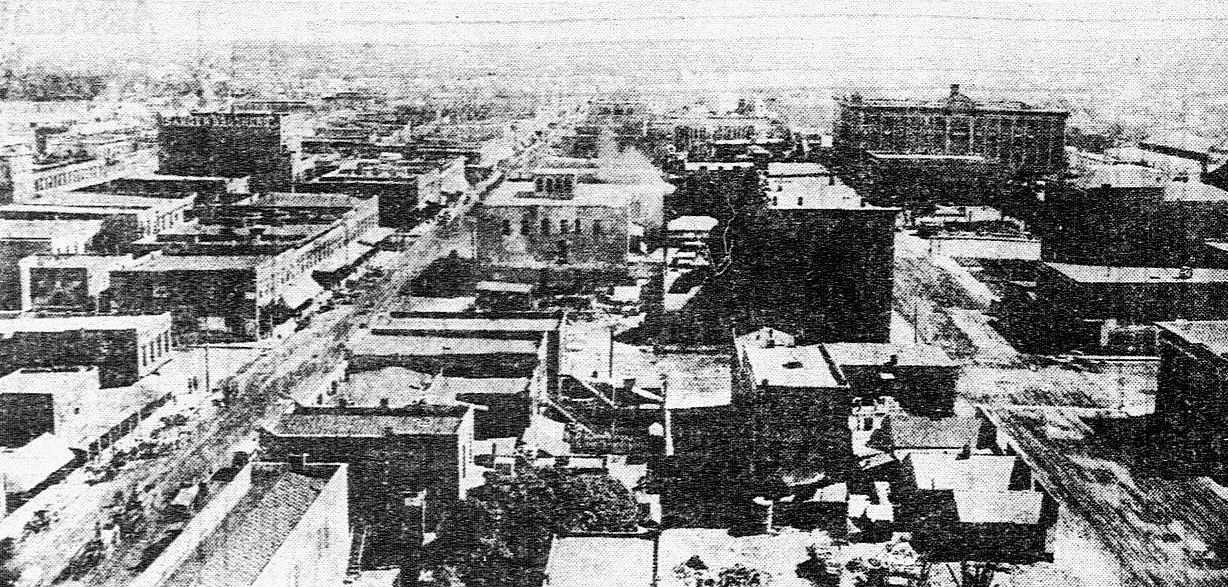
east-from-courthouse_1887Looking east from the courthouse, ca. 1887 (click for larger image)

by Paula Bosse

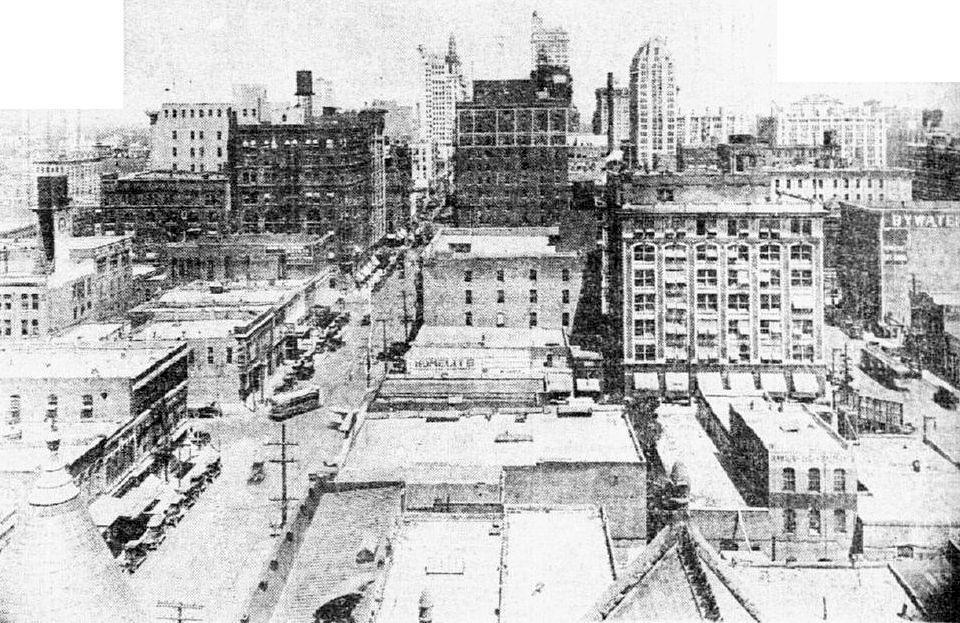
Above and below, the view of downtown Dallas looking east from the courthouse, with Main Street on the left and Commerce on the right. The top photo was taken about 1887 (the Grand Windsor hotel is the mammoth building in the top right corner), and the bottom one was taken about 1925. What a difference 38 years makes — the horizon has disappeared!

east-from-courthouse_1920s

***

Sources & Notes

Both photos appeared in The Dallas Morning News on Oct. 1, 1925. The caption reads: “[First photo]: View of Dallas looking east between Main and Commerce streets from the courthouse. It was taken about 1887. So far as known it is the only picture in existence which shows the Dallas Opera House at the southwest corner of Commerce and Austin streets. It also shows the old Grand Windsor Hotel. Note the vacant lots, and the unpaved condition of the streets and the horsedrawn vehicles on Main. [Second photo] This picture was made by H. B. Hillyer & Son.”

*

Copyright © 2014 Paula Bosse. All Rights Reserved.

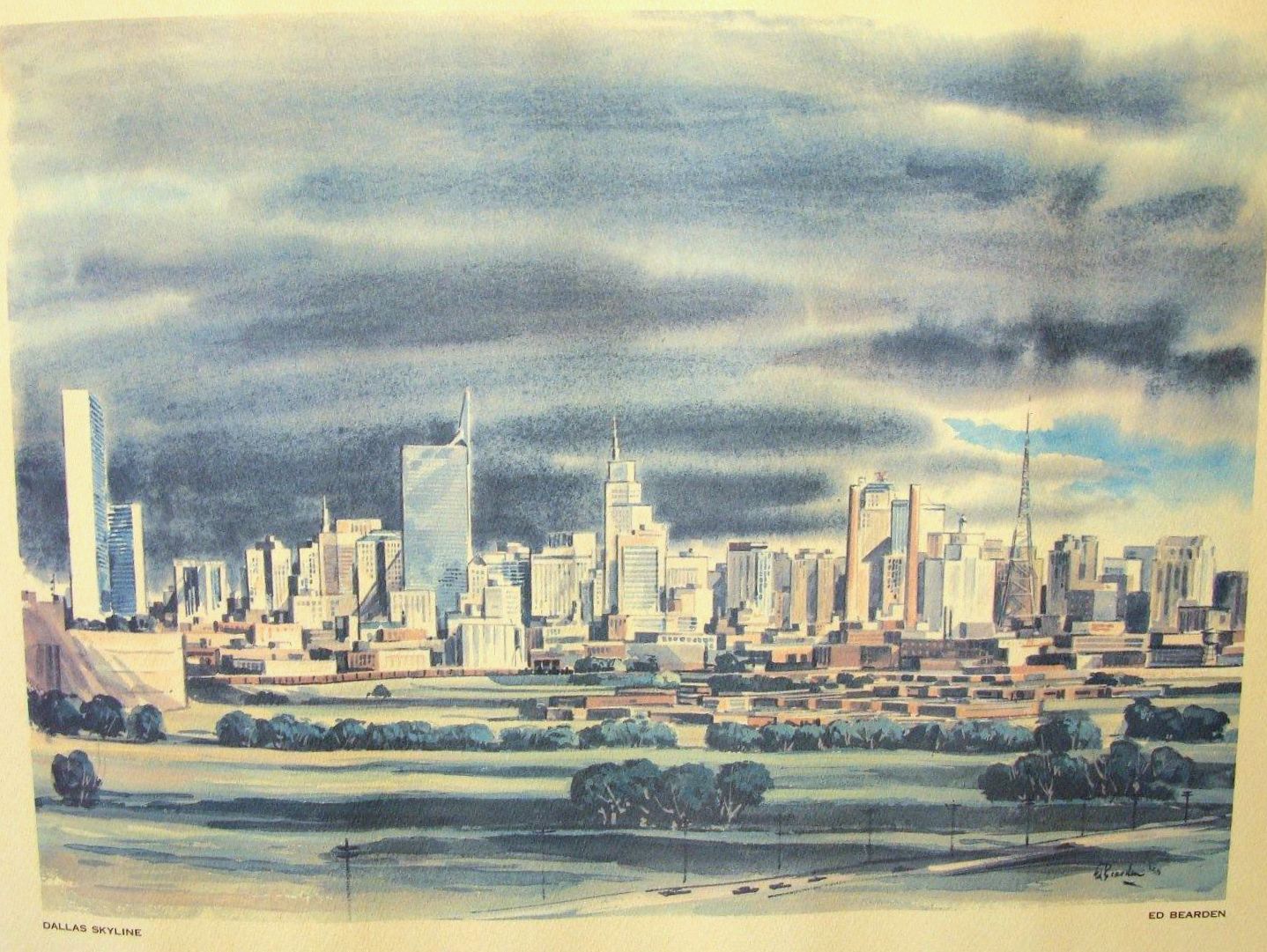
“Dallas Skyline” by Ed Bearden — 1958

dallas-skyline_ed-bearden“Dallas Skyline” by Ed Bearden (click for much larger image)

by Paula Bosse

Ed Bearden (1919-1980) was a Dallas painter who studied under Jerry Bywaters and Otis Dozier and was loosely affiliated with the Dallas Nine group of artists. He worked with Bywaters at the Dallas Museum of Fine Art as Assistant Director, and he helped found the Dallas Museum for Contemporary Arts. He also spent several years at SMU — both as a student and as a member of the faculty — until he decided to leave to focus on his own art career. In addition to working as a fine artist, he also owned a commercial art business.

The constantly changing Dallas skyline was a particular favorite subject of his, and he returned to it again and again. The one above is a personal favorite. I’m not sure why I feel so nostalgic when I look at it, except that I swear that I saw this print as a child at my father’s bookstore. It’s a Dallas I’ve never known, but one I wish I had.

***

Apologies for the wonky image, but I can’t find a better scan of it. I’m assuming this was first a watercolor, then issued as a lithograph, then maybe printed as a broadside or a loose plate in a book? The date in the lower right corner is very difficult to make out — it looks like either 1958 or 1959. I’m going with 1958. ‘Cause I’m like that.

A brief biography of Ed Bearden can be found here.

An unlikely gig came Bearden’s way when director George Stevens asked him to draw the storyboards for the film Giant, hoping that having a Texas artist do them would lend an air of authenticity to the look and feel of the movie (and, in fact, Bearden’s sketches were used as reference by makeup and wardrobe personnel). Read more about this interesting assignment on SMU’s Hamon Arts Library site, and see some of Bearden’s sketches from the set in Marfa, here.

*

Copyright © 2014 Paula Bosse. All Rights Reserved.
“A Cavalcade of Texas” — Dallas, Filmed in Technicolor, 1938

“A Cavalcade of Texas”

by Paula Bosse

(SCROLL DOWN TO WATCH THE FILM CLIPS.)

Brought to my attention last night in a Dallas history group was the heretofore unknown-to-me full-length, Hollywood-slick travelogue called “A Cavalcade of Texas,” shot around the state in 1938 under the auspices of Karl Hoblitzelle in his capacity as chairman of the Texas World’s Fair Commission. (Hoblitzelle also built the Majestic Theater and founded the Interstate Theatre chain.)

“A Cavalcade of Texas” — a 49-minute full-color travelogue touting the beauty, history, natural resources, and industries of the state — was made to be shown at the New York World’s Fair, but because of a variety of production and logistical problems, the film was, instead released theatrically. John Rosenfield, the legendary “amusements” critic for The Dallas Morning News, was suitably impressed. After an early preview of the film, he wrote:

The picture should be a revelation to the outlanders who still think of Texas as the backwoods with a hillbilly civilization. (DMN, June 27, 1939)

Ha.

The film opened in Dallas in October of 1939 at, unsurprisingly, The Majestic, second on a bill with a Ginger Rogers film (which was fitting, as Ginger had begun her professional career at The Majestic as a teenager). The pertinent paragraph from Rosenfield’s official review is amusingly snippy:

“Cavalcade” shoots the Houston skyline as a bristling metropolitan acreage but hides the Dallas buildings behind the towering Magnolia Building. Maybe we are sensitive about it but we don’t feel that architectural justice has been done. The Fort Worth aspect is glorified more than it deserves. (DMN, Oct. 15, 1939)

(Sorry, Fort Worth!)

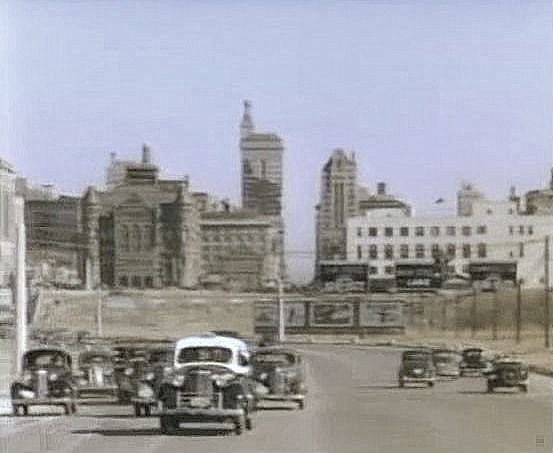
The Dallas scenes are only about 4 minutes’ worth of the whole film, but to see Dallas at this time in color — and moving — is kind of thrilling. The entire film is on YouTube, but I’ve bookmarked the two Dallas bits. First, after an interminable sequence on how fantastic things will be when we finally make that darn Trinity navigable, is a Dealey Plaza-less Triple Underpass, shots of Main Street (including the now partially obliterated 1600 block at the 17:52 mark, on the right), Fair Park (including a description of the Hall of State as “the Westminster Abbey of the New World” (!)), and a neon-lit Elm Street at night. (If you let it keep going, you’ll see “the Fort Worth aspect.”)

(I am having problems embedding this clip to begin at the 17:30 mark. If the above does not begin at the Dallas sequence, see it at YouTube, here.)

*

Twenty minutes later, the viewer is, for some reason, shown the Dallas Country Club with what I’m guessing are Neiman-Marcus models pretending to play golf.

(If the above does not begin at the Dallas Country Club sequence at 40:09, see it at YouTube, here.)

*

Those are just the Dallas bits — the whole film is an impressive undertaking, and it’s great to see documentary footage of this period in rich color, presented with incredibly high production values, in full Hollywood style.

cavalcade_101439_ad
Ad, Oct. 14, 1939 (click to see larger image)

***

Sources & Notes

“A Cavalcade of Texas” was directed, edited, and narrated by James A. Fitzpatrick and can be seen in full on YouTube, here.

Background on Karl Hoblitzelle can be read in information provided by the Handbook of Texas, here, and by the Dallas Public Library, here.

The wonderful and vibrant 1939 footage of downtown Dallas that was discovered on eBay a few months ago and “saved” by a group of preservation-minded Dallasites, which included Robert Wilonsky and Mark Doty, is one of my favorite Dallas-history-related stories of 2014. Watch that footage here.

*

Copyright © 2014 Paula Bosse. All Rights Reserved.