Flashback : Dallas

A Miscellany: History, Ads, Pop Culture

Category: Disasters and Emergencies

Interview about the 1952 Dallas Texans, The Last NFL Team to Die

by Paula Bosse

Happy Thanksgiving! What better way to celebrate the day than to post something about Dallas and something about football? So here we go.

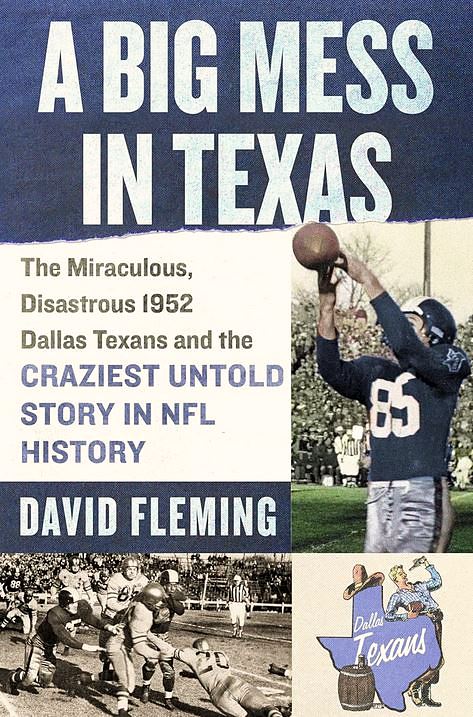
A new book is out called A Big Mess in Texas, The Miraculous, Disastrous 1952 Dallas Texans and the Craziest Untold Story in NFL History by David Fleming (St. Martn’s Press, 2025). I’ve been aware of this book for a few months because the author was in regular contact with a co-worker of mine at the Dallas History & Archives, doing research for the book and licensing photos.

Now that the book is out, Fleming has participated in a Dallas Public Library video interview, conducted by the person who helped him through his pre-publication research process, Caitlyn Jones. I’m not really a sports person, but I have to say, I really enjoyed this interview. It’s always entertaining to listen to someone who is really, really enthusiastic about a topic. Caitlyn did a great job for her first interview, and Fleming tells her how much one particular piece of information — which she stumbled across weeks after their initial email communication — helped shape part of the story he was wanting to tell about what is, quite frankly, a pretty weird story about what must be Dallas’ least successful professional sports team ever (as Wikipedia has it: “…the Texans are officially recognized as the last NFL team to permanently cease operations and not be included in the lineage of any current franchise”).

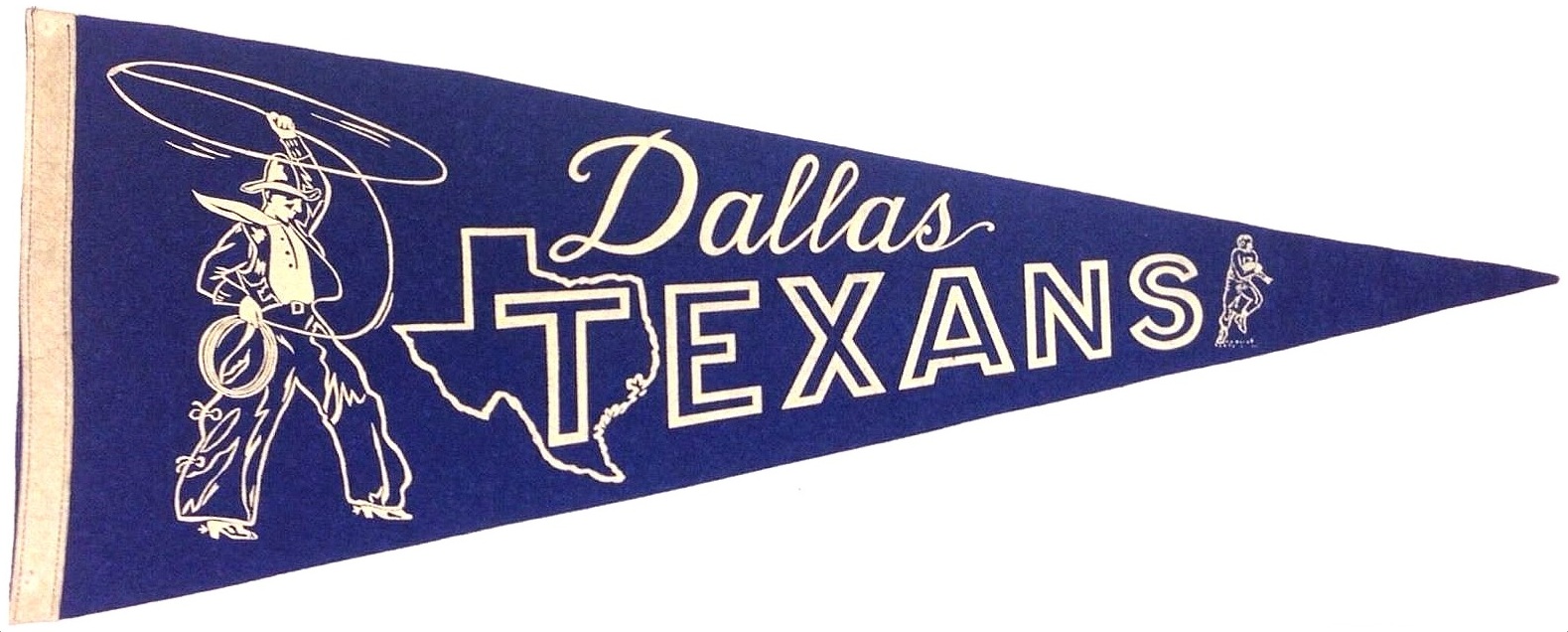
So as you’re waiting for the turkey to finish or waiting for the Cowboy game to start, check out this 55-minute interview on YouTube. And if you missed my 2016 post on the Texans, mosey on over to “The 1952 Dallas Texans: Definitely NOT America’s Team.”

*

**

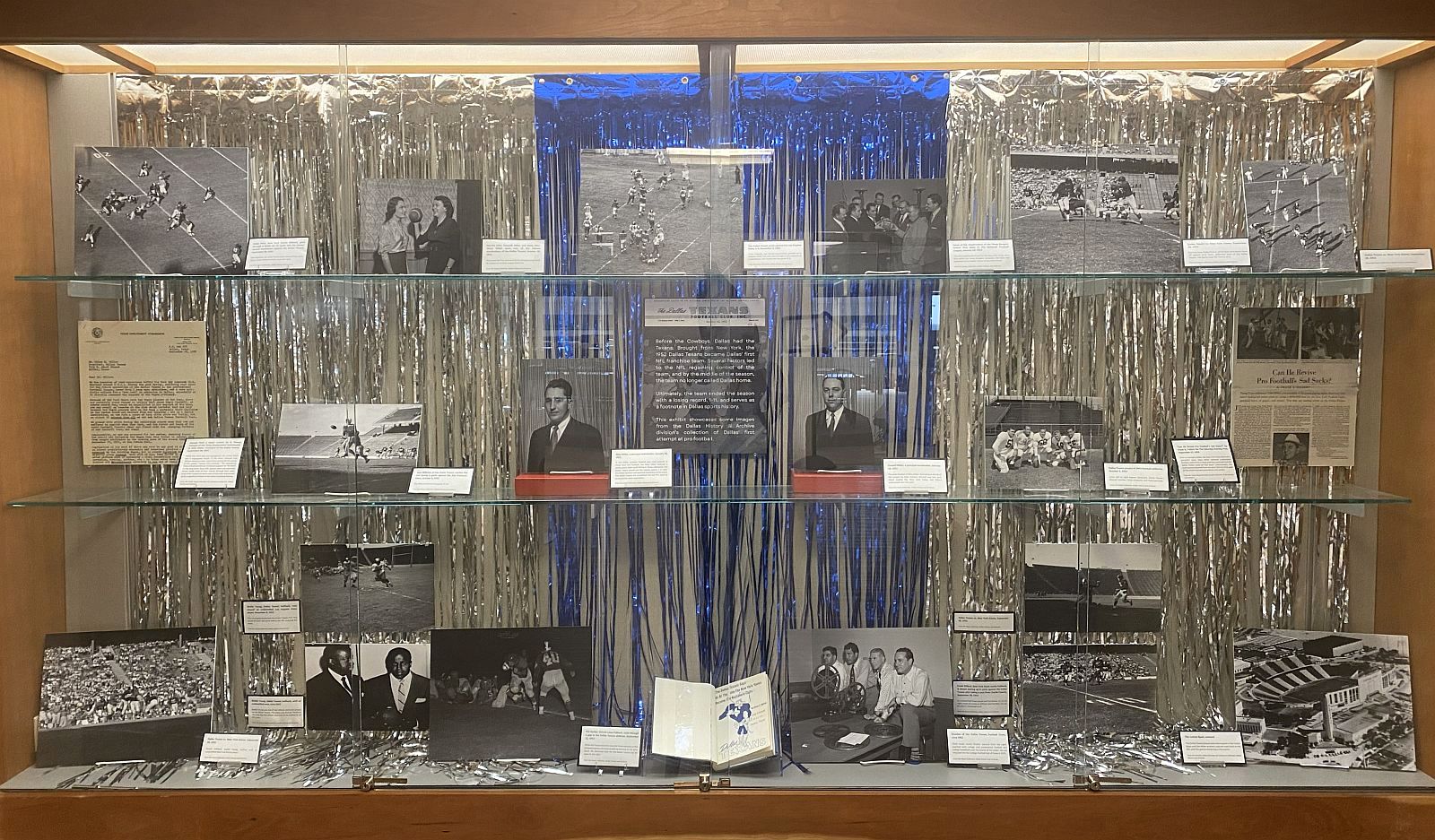
Because of all the research Caitlyn did looking for photos of and information about the Dallas Texans, she became our “staff expert” on the team and even put together this great display, which was exhibited for several weeks on the 7th floor of the downtown Central Library. Thank you, Caitlyn!

*

I’m posting this on Thanksgiving. It turns out the only game the Texans ever won was an upset victory over the Chicago Bears in 1952 on Thanksgiving Day. A miracle! I hope you have as good a Thanksgiving today as the Texans players, coaches, and owners had in 1952!

***

Sources & Notes

Interview of author David Fleming by Dallas History & Archives staffer Caitlyn Jones can be found on the Dallas Public Library YouTube channel: “Into the Archives with David Fleming: Forgotten NFL Football Team The Dallas Texans.”

David Fleming’s website is here.

Dallas Texans display and photo by Caitlyn Jones of the Dallas History & Archives.

If you’ve read all the way down to the bottom of the page, here are a couple of pertinent Flashback Dallas posts you might enjoy:

*

Copyright © 2025 Paula Bosse. All Rights Reserved.

Dallas Fire Department Training Tower, Fair Park — 1936

by Paula Bosse

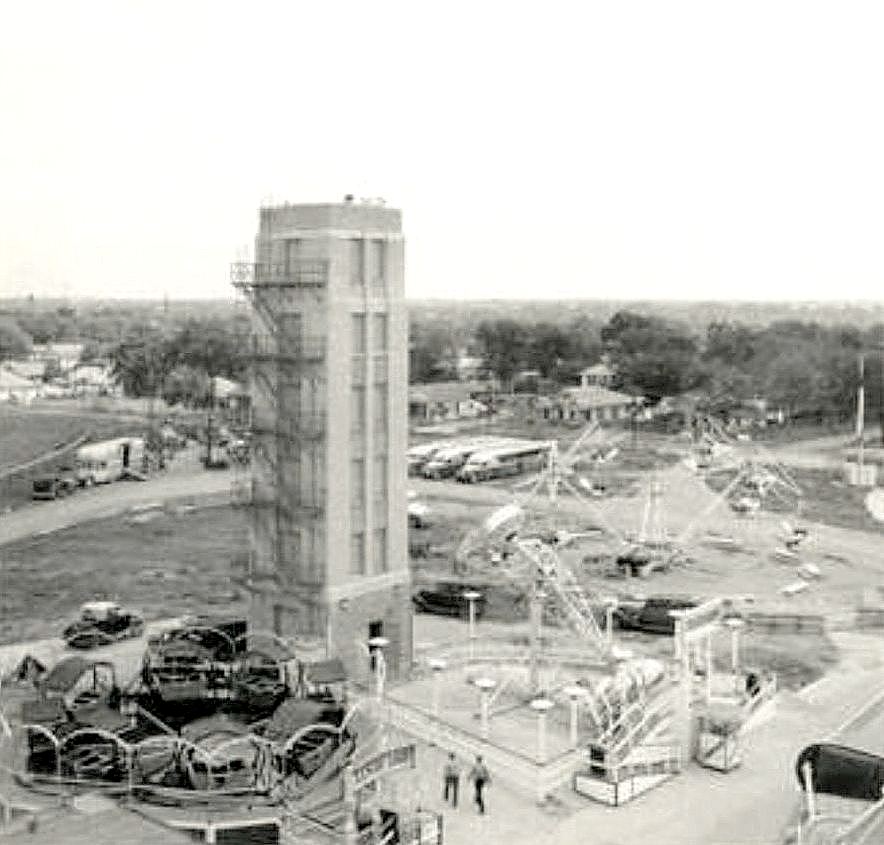
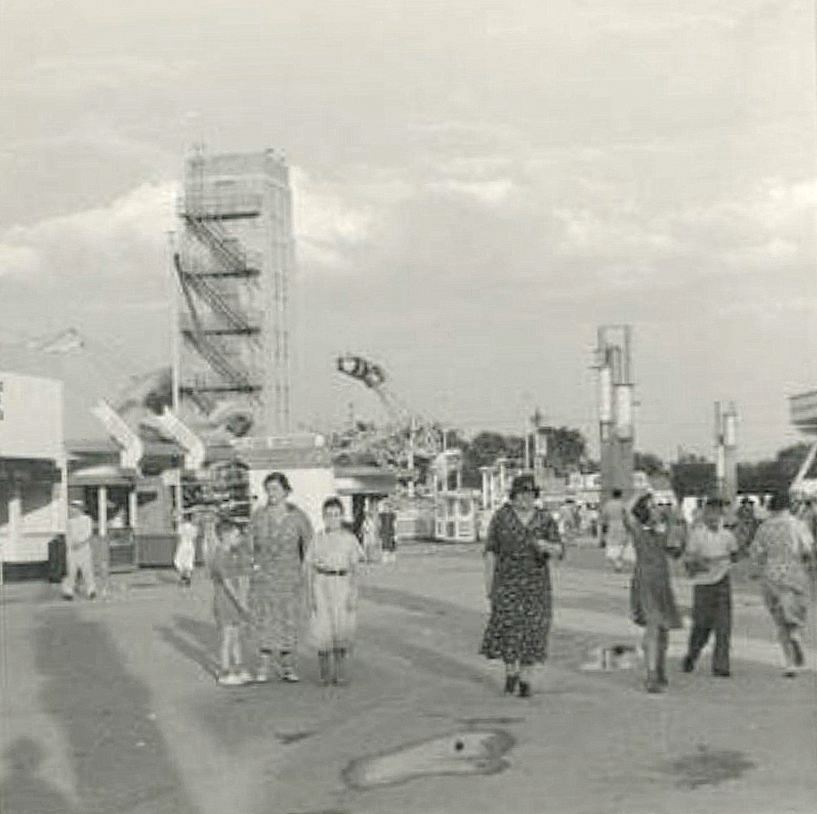
A few months ago, I came across the photos directly above and directly below on the SMU Digital Libraries site. They were both stereographs, and they were both identified as having been taken at Fair Park in 1936 during the Texas Centennial. These two photos didn’t look like Fair Park (except for the long tour buses parked at the upper right of the top photo). If they had not been accompanied by other photos that were unquestionably taken at Fair Park, I might not have been so sure.

Because… what was that odd tower? No sleek, modern art deco architecture there! More like a looming hunk of something ugly and industrial. And it looked like it was relegated to the outer edge of the midway. What was it?

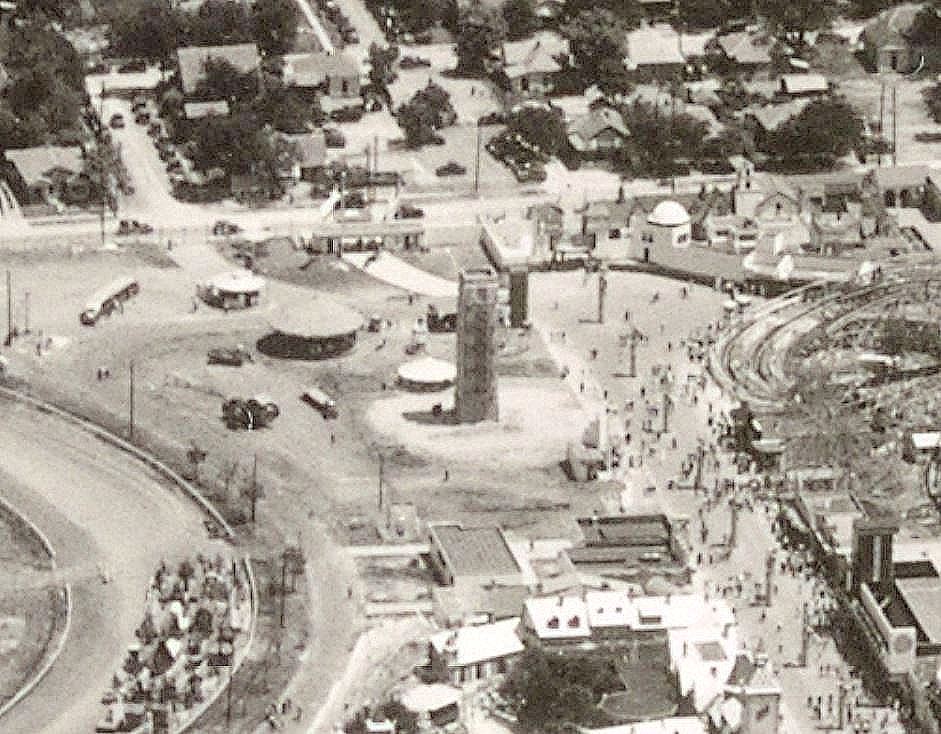
I posted the top photo to the Flashback Dallas Facebook page and asked about this tower thing, and I was informed that it was a drill tower, used by the fire department for training purposes. It was also used to demonstrate rescue practices during the fair. I was directed to this truly spectacular photo, which shows the tower on the far edge of Fair Park (slightly right of center, near the top of the photo — which, by the way, is HUGE). A detail is below.

When — and why — was it built?

In 1930, Dallas was apparently running afoul of the law, because it did not have one of these towers. The State notified that City that that needed to be rectified pronto, or there would be a price to pay:

Unless Dallas provides its fire department with a drill tower, in accordance with the State law, the local key rate of 13 cents will be increased by a 5-cent penalty — the State Fire Insurance commission has served notice. (Dallas Morning News, July 19, 1930)

The city dragged its feet. It was announced almost a year and a half later that things were finally moving toward compliance:

Contract for the new six-story fire drill tower for the Dallas fire department, to be located in Fair Park, has been let to S. J. Buckalew, contractor, by the city department of public works. It will cost $6,328 and will rise 60 feet in height, being built of steel frame with concrete foundation and concrete floors. (DMN, Nov. 18, 1931)

The tower was completed in January 1932 (at a cost closer to $8,000). A few months later, the inaugural exhibition for the public was held at the tower. Firemen demonstrated firefighting techniques and performed drills on how to rescue victims from a tall building. This was the first time that many in the crowd had ever seen such a display. There was, however, a hiccup in one of these performances (or maybe it was planned, as a bit of shocking showmanship):

The demonstration of fire fighting methods included one unexpected thrill when, during the rope-sliding exhibition, a dummy was released from the six-story drill tower, falling to the ground. The crowd, hardly prepared for this feature of the show, was horrified to see what seemed to be a fireman fall out of the tower. Several women were particularly affected, having to be revived by first-aid methods. (DMN, July 1, 1932)

These public demonstrations were very popular and were held for decades. (The tower was, of course, also used regularly by the Dallas Fire Department as its official training tower.) I’m not sure when it was eventually demolished (EDIT: thanks to the comment below, it was demolished on Feb.1, 1947), but the “shows” continued, with towers erected especially for the fair every year, as can be seen in this silent footage from the 1961 State Fair of Texas (the steam pumper “Old Tige” makes an appearance at the 1:13 mark):

***

Sources & Notes

First two stereograph photos were taken in 1936 at the Texas Centennial Exposition and are from the DeGolyer Library, Southern Methodist University: “[Amusement Rides at Fair Park]” is here, and “[View of the Fairgrounds at Fair Park]” is here.

Third photo is a detail from a U.S. National Archives and Records Administration aerial, on Wikipedia.

Video — “Firefighter Demonstration At The State Fair Of Texas – October 1961 (Silent)” — is from the WFAA Collection, G. William Jones Collection, Hamon Arts Library, SMU, on YouTube.

Thanks to the person commenting below, the tower was demolished on Feb. 1, 1947, “to make way for new structures” (DMN, “Landmark Bites Dust,” Feb. 2, 1947).

People may be more familiar with the DFD training tower at Record Crossing — see a photo of that at the Portal to Texas History, here.

Thanks, as always, for the crowdsourcing help!

*

Copyright © 2025 Paula Bosse. All Rights Reserved.

Tornado Snapshots — 1957

tornado_1957_ebay_3April 2, 1957, Oak Cliffwards…

by Paula Bosse

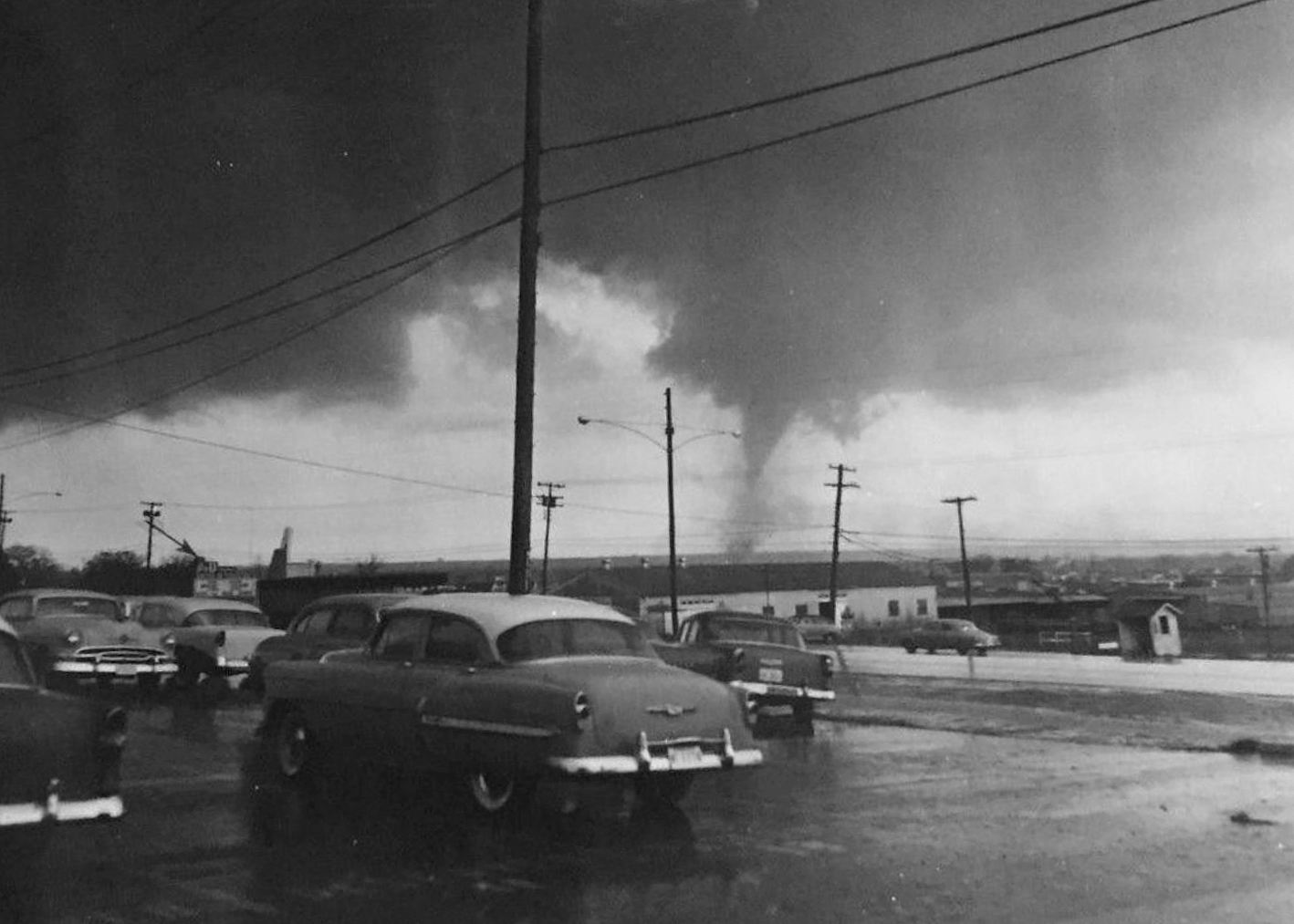
A few photos of the infamous April 2, 1957 tornado which hit Dallas and was, at the time, the most photographed tornado in history. See more photos (and film footage) in the 2014 Flashback Dallas post “Tornado as Learning Tool — 1957.”

tornado_1957_ebay_1

tornado_1957_ebay_2

tornado_1957_ebay_4

***

Sources & Notes

All four photos were sold as one lot on eBay several years ago.

In addition to the post linked above, here are a few other tornado-related posts:

tornado_1957_ebay_3_sm

*

Copyright © 2023 Paula Bosse. All Rights Reserved.

Influenza Pandemic Arrives in Dallas — 1918

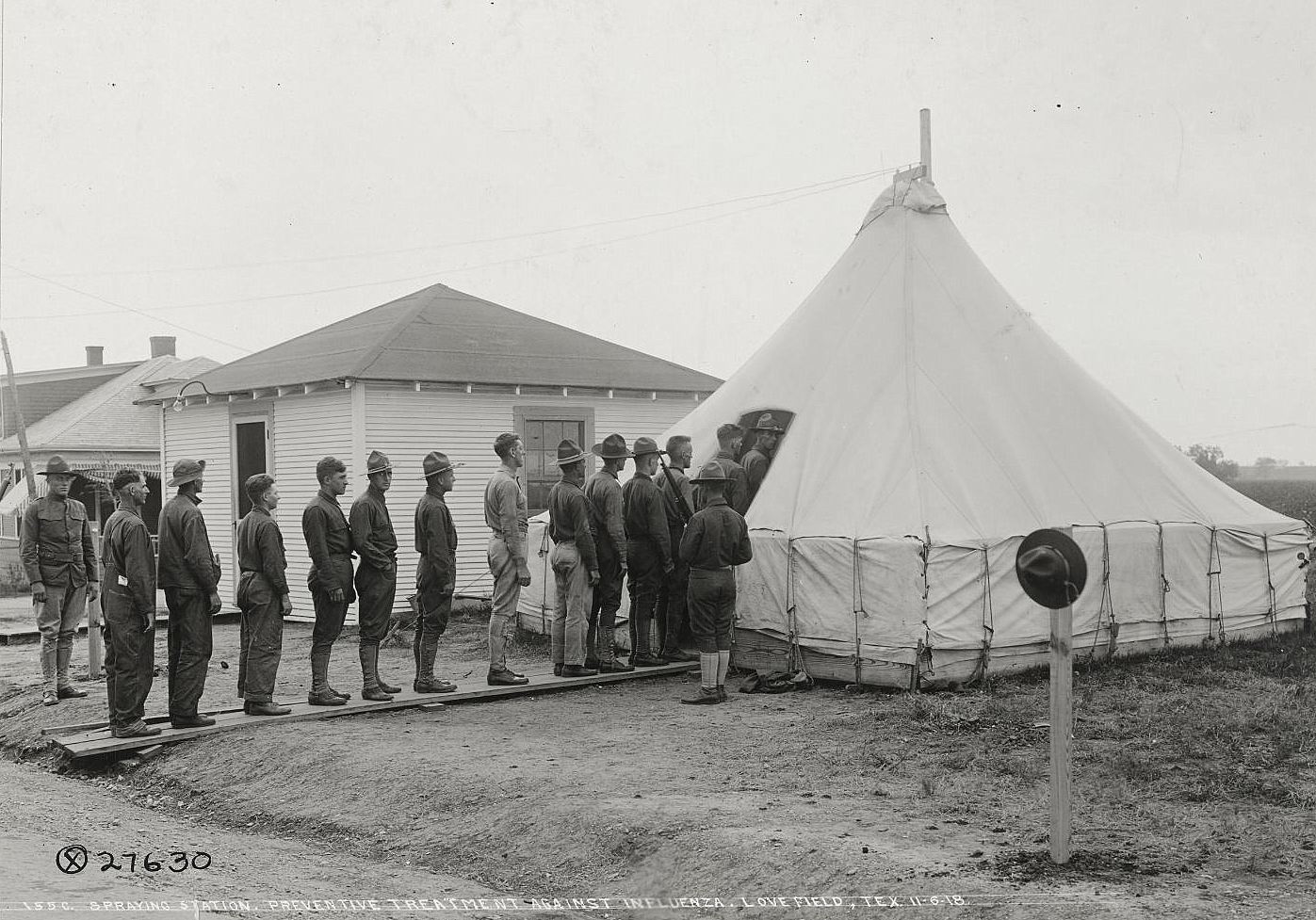
influenza-epidemic_love-field_1918_natl-archivesIn line at the Love Field “spraying station” (click for larger image)

by Paula Bosse

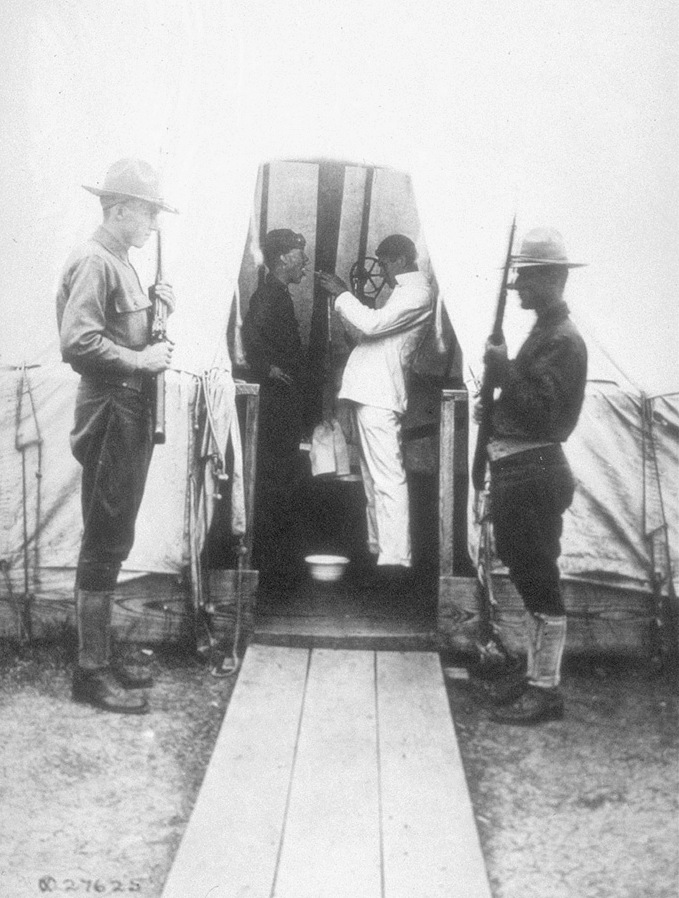
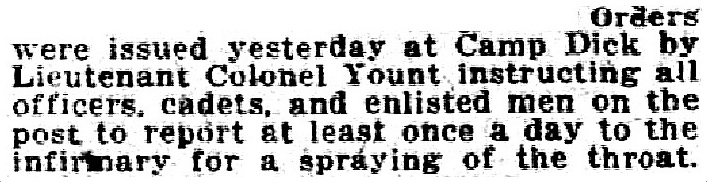
I write this as the U.S. is bracing for the spread of COVID-19, the novel coronavirus which has just been declared a world-wide pandemic by the World Health Organization — this inescapable news item reminds me of a previous post I wrote about the local response to another major epidemic. In 2014, Dallas (of all unlikely places) was ground-zero in the U.S. for a feared Ebola outbreak — back then I wondered how Dallas had handled health crises in the past, specifically the spectre of the Spanish Influenza, which, like the coronavirus, swept around the globe. So I wrote “When the Spanish Influenza Hit Dallas — 1918,” and I have to say, it was pretty interesting. The flu first hit the regional military bases during World War One: Love Field, Camp Dick at Fair Park, and Camp Bowie in Fort Worth. It wasn’t long before people beyond the WWI camps were contracting the Spanish Flu, and then it just spread and spread and spread.

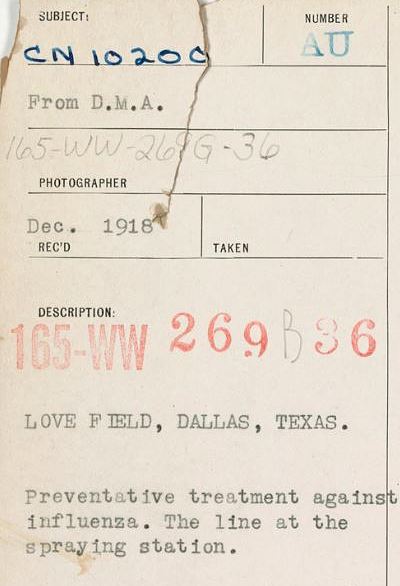
The photo above, from December, 1918, shows Love Field military personnel waiting in line to be “sprayed” — the caption reads:

Love Field, Dallas, Texas: Preventative Treatment against influenza.
The line at the spraying station.

influenza-epidemic_love-field_1918_natl-archives_INFO

Here’s the throat-sprayer waiting inside the tent:

spanish-influenza_love-field_otis-historical-archives_nmhm_110618Love Field, Nov. 6, 1918

spanish-influenza_dmn_100118_sprayingDallas Morning News, Oct. 1, 1918

I’m not sure how effective this spraying was, but the advice given to Dallasites in 1918 is still good today: wash your hands, keep your surroundings clean, and do not spit in streetcars!

***

Sources & Notes

Top photo is from the National Archives at College Park; more info is here.

Second photo, showing the inside of the “spraying station,” is from the Otis Historical Archives, National Museum of Health and Medicine; more info is here

For a more detailed post about how Dallas dealt with the Spanish Influenza, read the 2014 Flashback Dallas post “When the Spanish Influenza Hit Dallas — 1918.”

influenza-epidemic_love-field_1918_natl-archives_sm

*

Copyright © 2020 Paula Bosse. All Rights Reserved.


Rubber Stockpile: Forty-One Mountainous Piles of Tires — 1943

rubber-stock-pile_dallas-1943_ebay-det
Guarding wartime scrap rubber, near Love Field…

by Paula Bosse

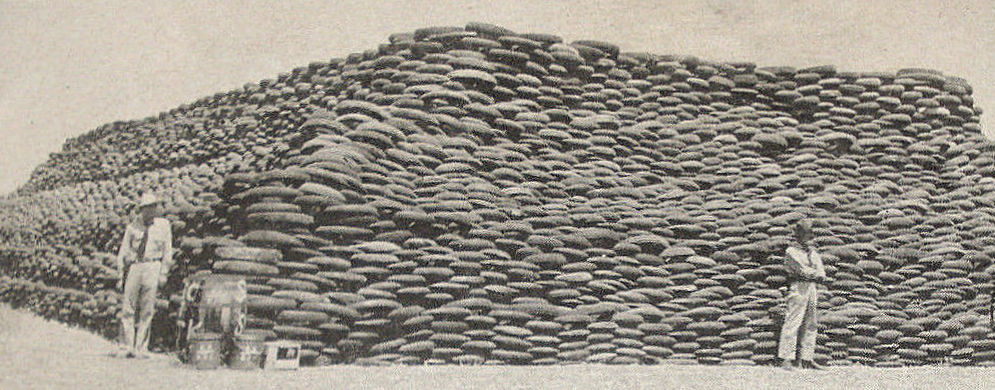
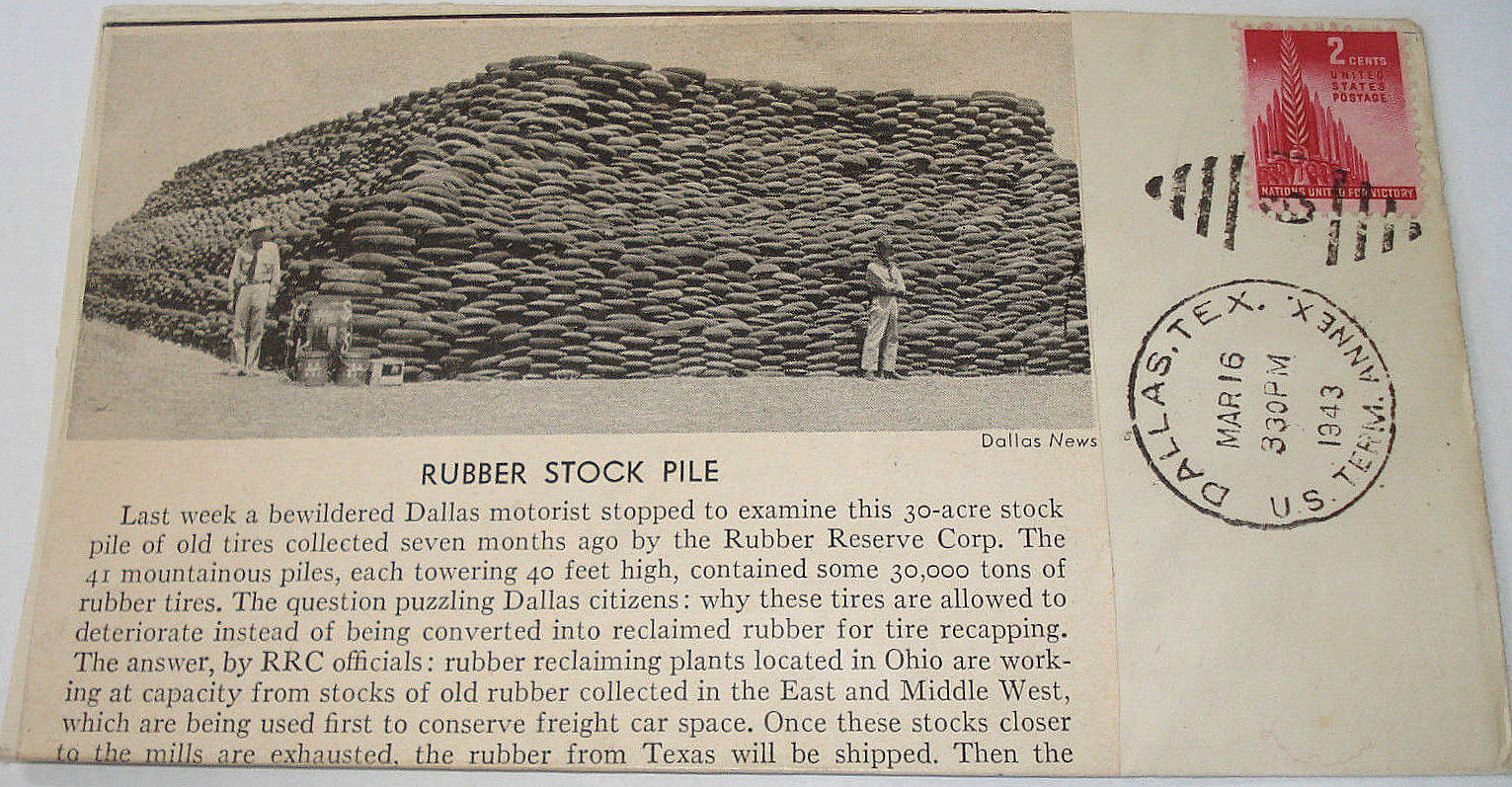
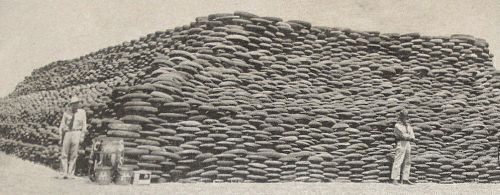
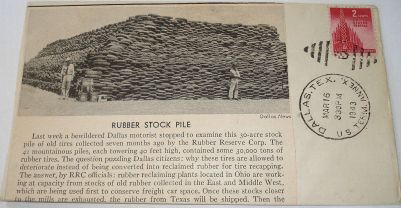
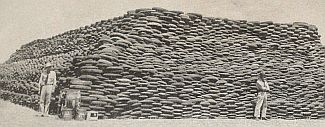
You don’t see this everyday: a photo of a pile of tires so large it dwarfs the armed guards who stand in front of it. (For that matter, you don’t often see armed men guarding tires.) What’s going on here? All is explained in the accompanying Time magazine article from March, 1943, which appears to have been cut from the magazine and pasted onto an envelope.
rubber-stock-pile_dallas-1943

The article reads:

RUBBER STOCK PILE
Last week a bewildered Dallas motorist stopped to examine this 30-acre stock pile of old tires collected seven months ago by the Rubber Reserve Corp. The 41 mountainous piles, each towering 40 feet high, contained some 30,000 tons of rubber tires. The question puzzling Dallas citizens: why these tires are allowed to deteriorate instead of being converted into reclaimed rubber for tire recapping. The answer, by RRC officials: rubber reclaiming plants located in Ohio are working at capacity from stocks of old rubber collected in the East and Middle West, which are being used first to conserve freight car space. Once these stocks closer to the mills are exhausted, the rubber from Texas will be shipped. Then the 25 armed guards, who watch Dallas’s [illegible] day and night, can go home.

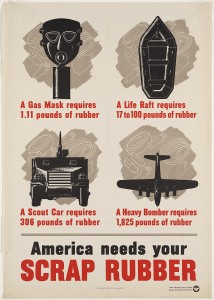
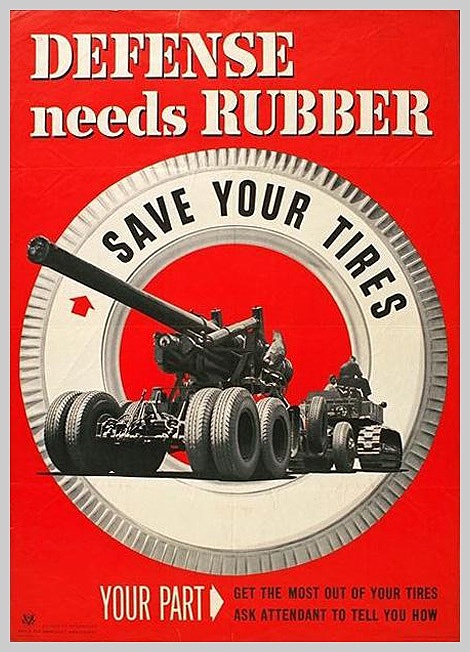
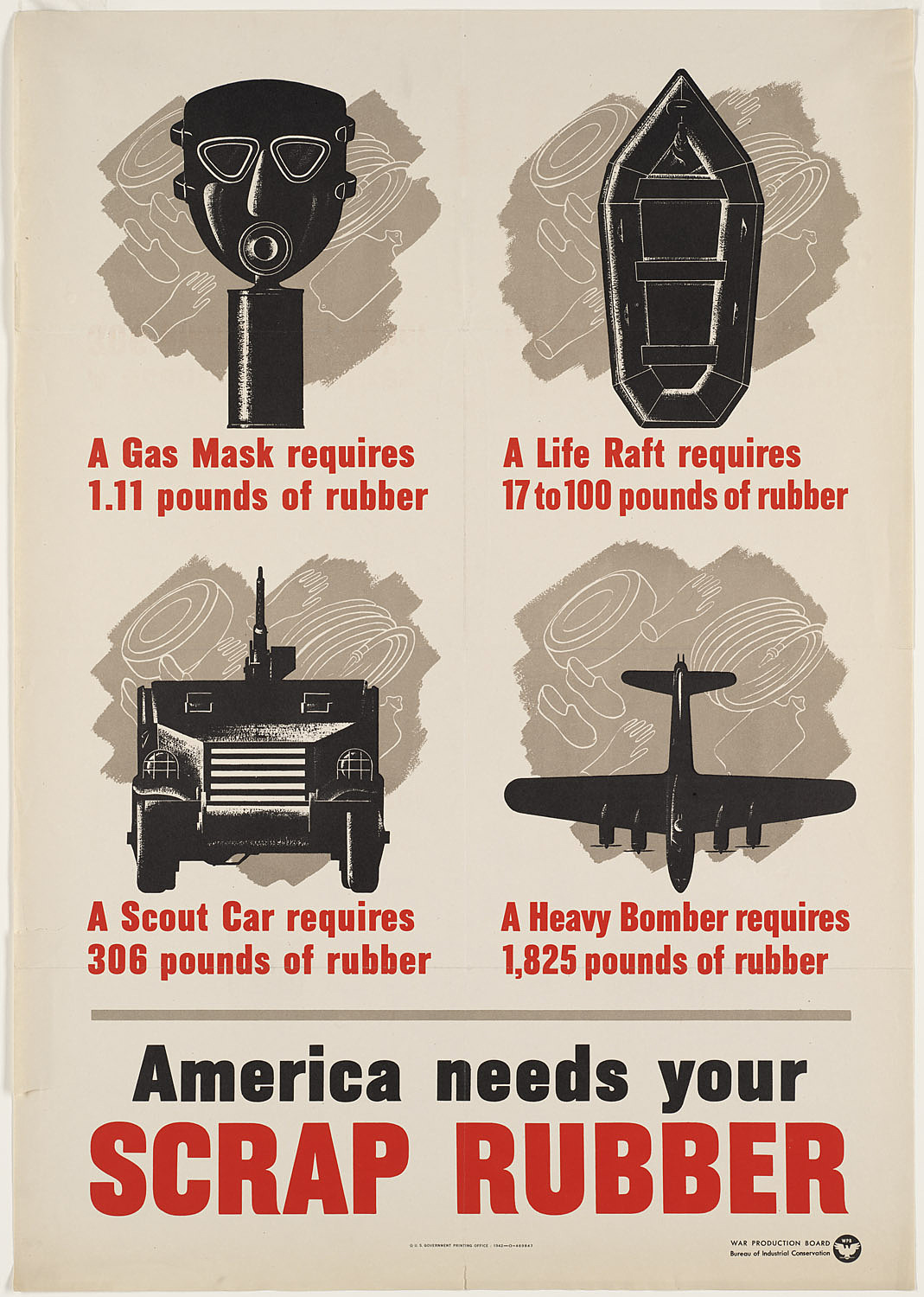
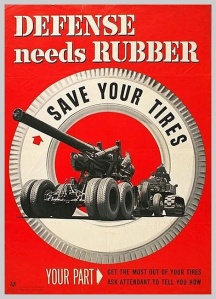
Ah, that mound of tires was the result of one of World War II’s many scrap drives. The national rubber drive ran from June 15, 1942 until July 10, 1942. The government requested that all Americans collect any old or unused rubber items in order to help with the supply of rubber in the U.S. (Japan controlled the bulk of rubber imports, and those imports had stopped when the United States entered the war). Rubber was needed for military purposes, but it was also necessary for essential domestic needs, mainly as tires needed to transport goods and people. Americans were told they needed to treat their automobile’s tires like gold: drive safely, drive slowly, and drive only when necessary — don’t wear your tires out, because you don’t know how long it’ll be until they’re manufactured again and/or how long it will be until large-scale production of synthetic rubber would become a reality. 
defense-needs-rubber_sarah-sundin

scrap-rubber-poster_sarah-sundinPosters via SarahSundin.com

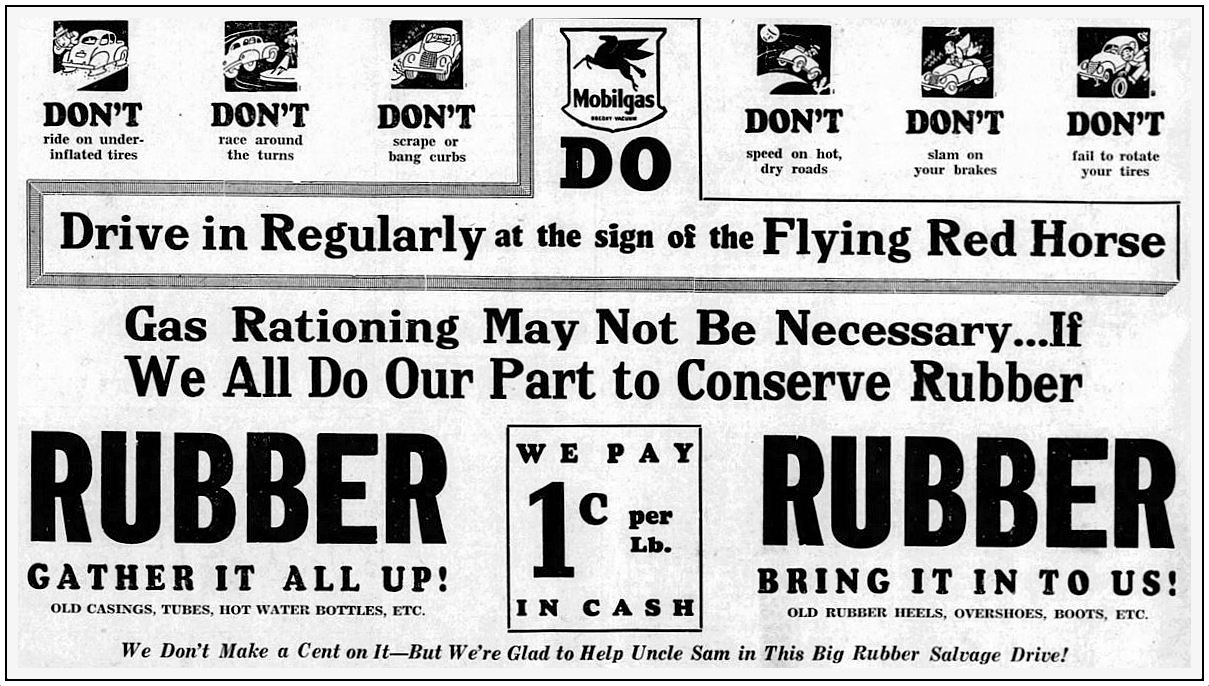
When the rubber drive began, people were basically told that if they collected enough scrap rubber, the dire prospect of nation-wide gas rationing might be unnecessary (at the time only a few states in the northeast had been suffering through the rationing of gasoline) — the thinking was that if the government withheld gasoline that citizens would conserve rubber simply because they were unable to drive as much. Texans really like their cars and trucks, and we have long distances to drive, so it’s no surprise that throughout the rubber drive, Texas out-performed almost every state in per capita tonnage collected. In the first day of the drive, a Dallas gas station at Harwood and Young reported that 4,500 pounds of collected scrap rubber had been left throughout the day by Dallasites performing their patriotic duty. And that was just one day and one gas station! The government was paying a penny a pound, but many people refused payment.

What sorts of things were people dropping off at their neighborhood gas station (the government-directed drop-off points)? Other than used tires, everything you could imagine:

  • Automobile floor mats
  • Galoshes and raincoats
  • Bathing caps
  • Hot water bottles
  • Garden hoses
  • Girdles
  • Doorstops
  • Tennis and golf balls
  • Rings from jelly jars
  • Baby pants
  • Dolls
  • Toy mice
  • Slingshots
  • Soles of athletic shoes
  • Roadside debris
  • Mats found under office furniture and cuspidors

That stuff adds up fast.

*

Below are several ads exhorting readers to do their bit for the war effort by collecting and donating scrap rubber during the national rubber drive. (All images are larger when clicked.)
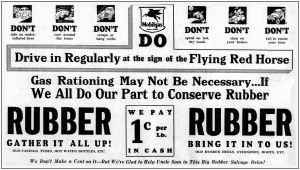
conserve-rubber_ad_nebraska_061642Mobil ad detail, June 16, 1942

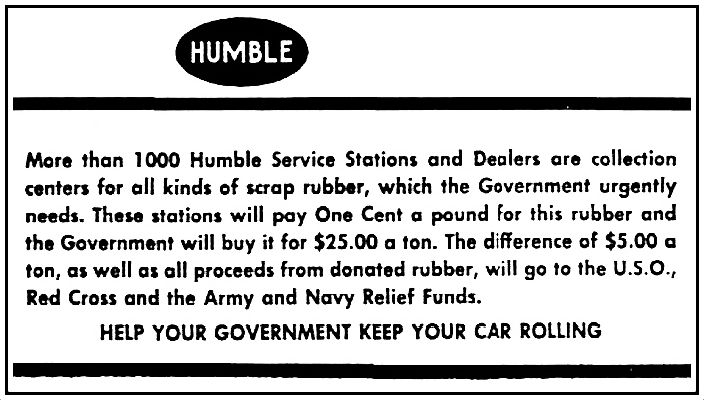
Scrap could be dropped off at any service station.
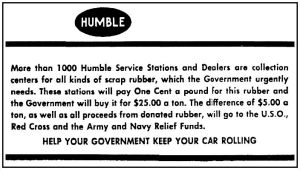
humble-ad_061742_detHumble Oil ad detail, June 17, 1942

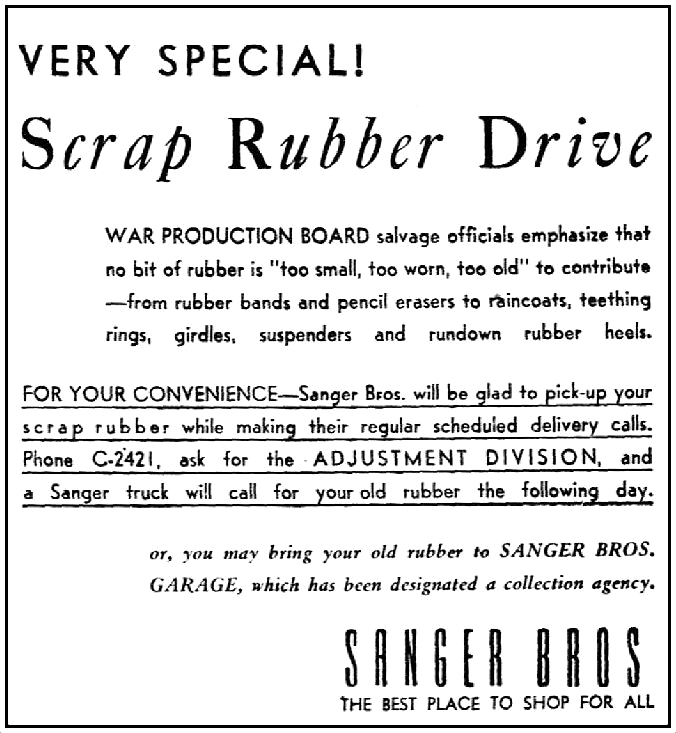
If you needed home pick-up service, Sanger Bros. would send a truck.
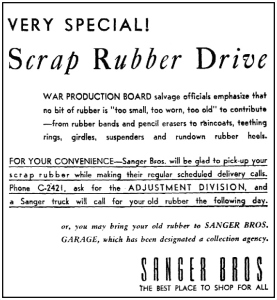
rubber-drive_sangers_061642Sanger Bros. ad, June 16, 1942

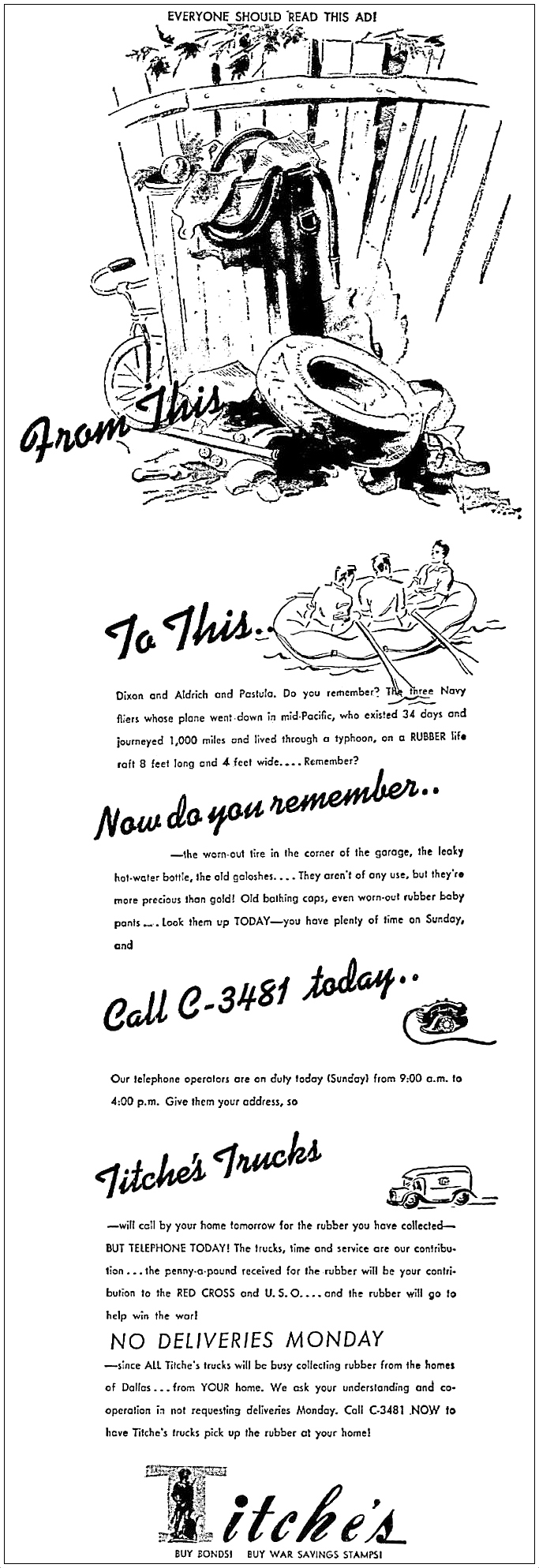
As would Titche’s.
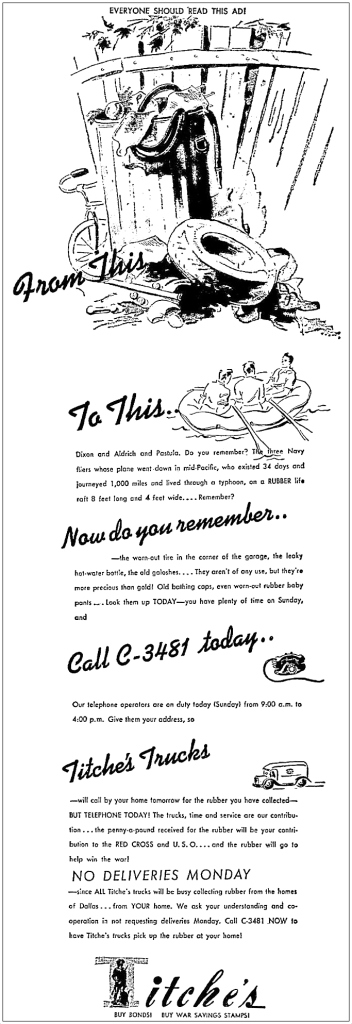
rubber-drive_titches-ad_062142Titche’s ad, June 21, 1942

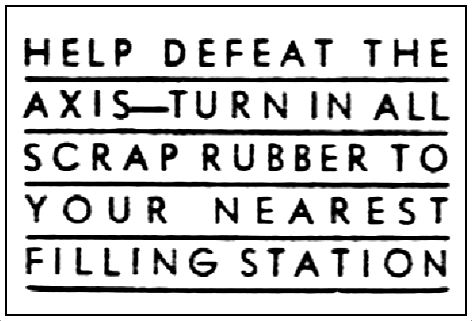
Reminders to ferret out that rubber were added to many advertisements, as seen in this detail from a larger grocery store ad. (The drive was originally intended to run through June 30, but ended up being extended through July 10.)
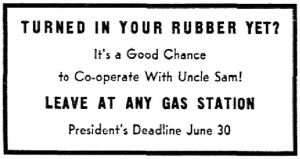
rubber-drive_safeway-ad_062642_detSafeway ad detail, June 26, 1942

This appeared in an ad from the men’s and boys’ clothing store Reynolds-Penland.
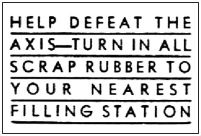
rubber-drive_reynolds-penland-ad_062642_detReynolds-Penland ad detail, June 26, 1942

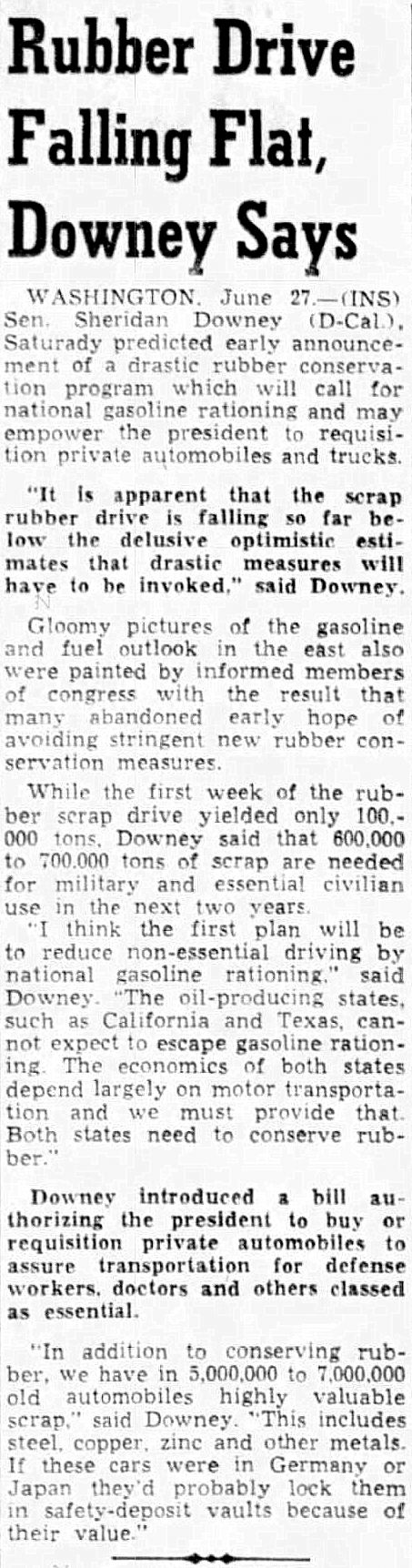
As well as things were going in Big D, according to the government, things weren’t going well nationally, and the powers-that-be were more loudly threatening gas rationing for the entire country, including the states which were actually collecting the most, Texas and California.
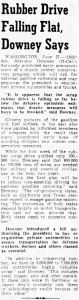
rubber-drive_austin-statesman_062742
Austin Statesman, June 27, 1942

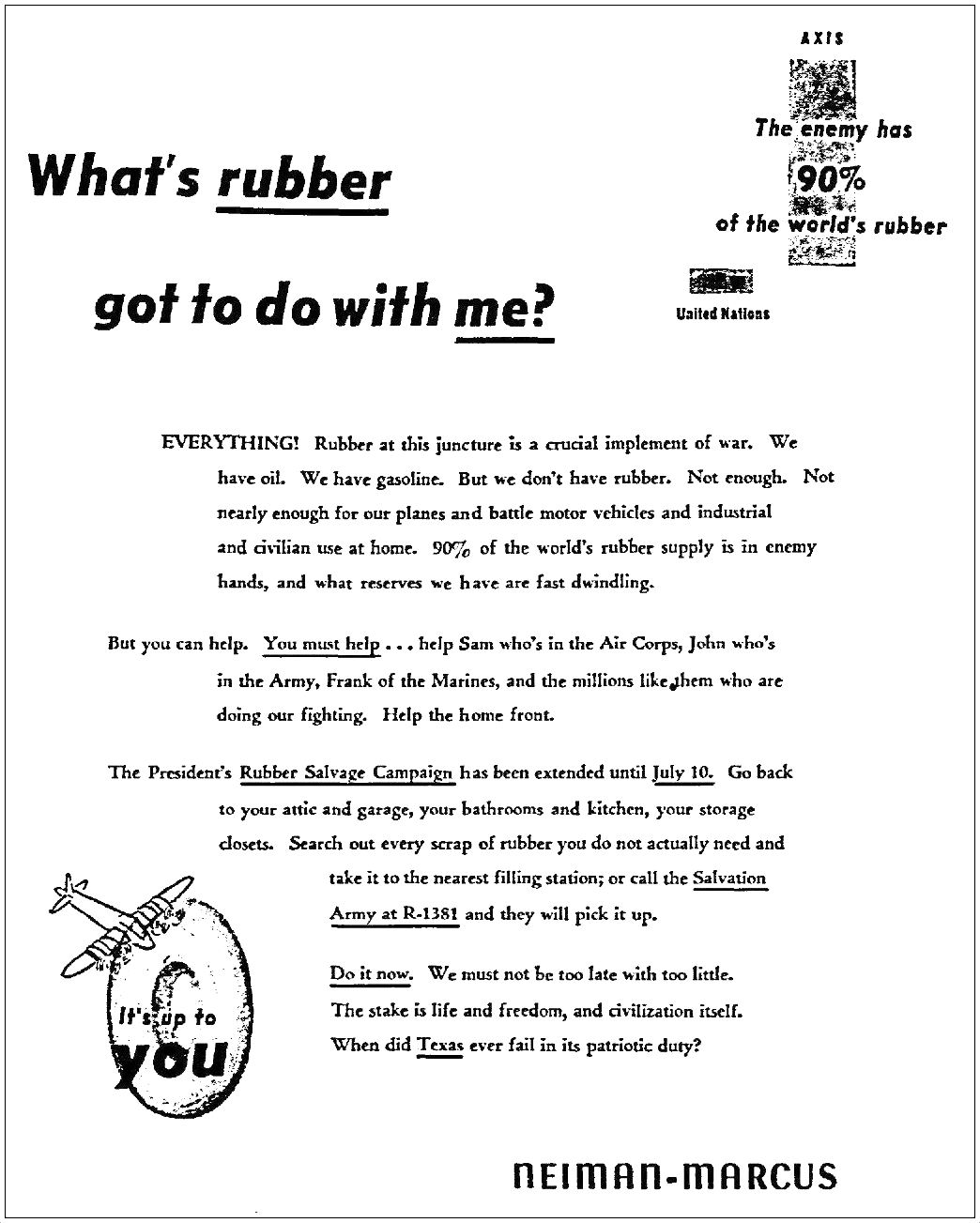
The deadline was extended until July 10, with hopes that people would knuckle down and collect much, much more. This Neiman’s ad asked the question “What’s rubber got to do with me?” and answered its own question with an emphatic “EVERTHING!” The ad ended with a barn-burner: “We must not be too late with too little. The stake is life and freedom, and civilization itself. When did Texas ever fail in its patriotic duty?”
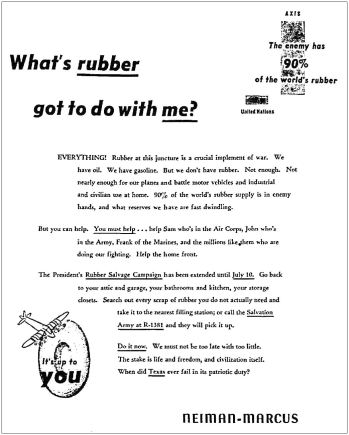
rubber-drive_neiman-marcus_070342Neiman-Marcus ad, July 3, 1942

The drive ended with Texas and the western states collecting the most scrap rubber. At the very bottom were New York, New Jersey, and Pennsylvania, all of which were already rationing gasoline. Ultimately, FDR considered the rubber drive to have been a failure, but, like the other scrap drives, it whipped up patriotism and resulted in a feeling of shared community as people worked together for the sake of the country — something which might have been more valuable than rubber.

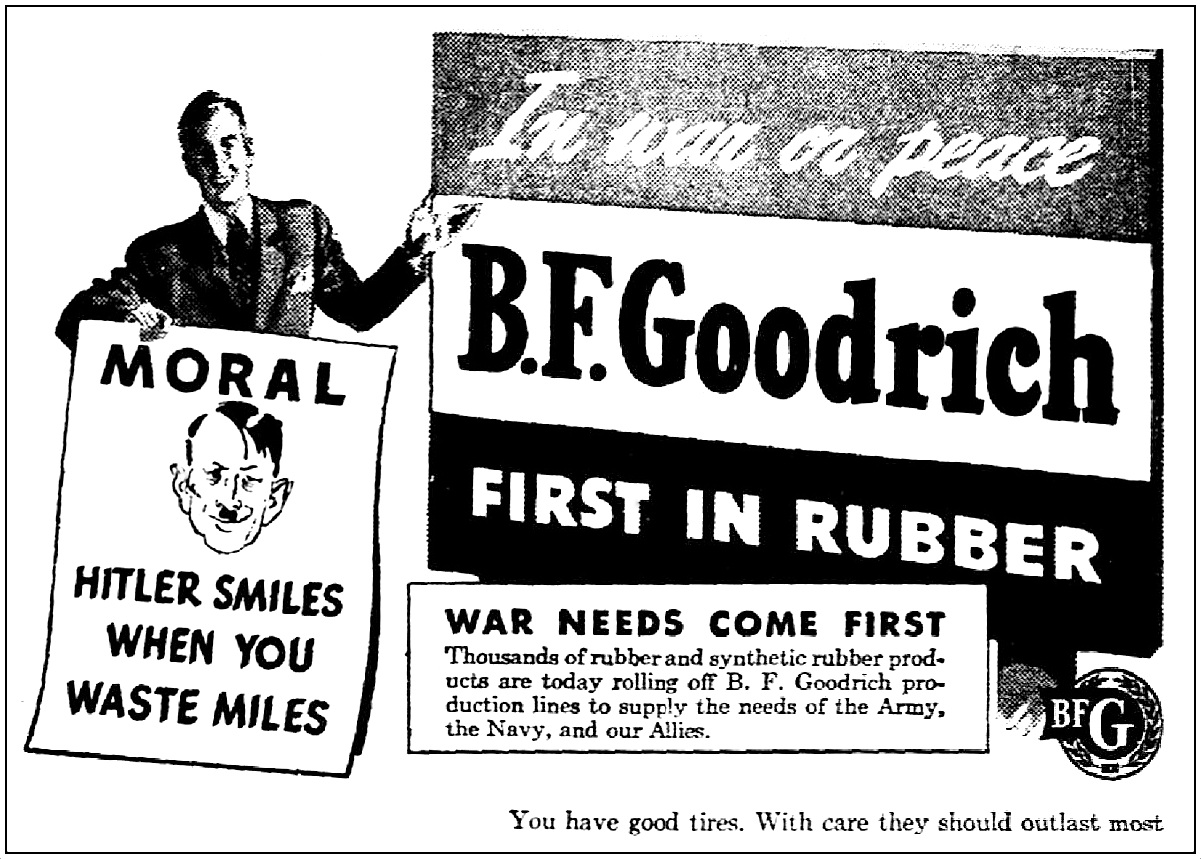
Synthetic-rubber production slowly increased, but, even so, tire manufacturer B. F. Goodrich wanted everyone to continue to make sure their tires lasted as long as possible, because, after all, ” Hitler smiles when you waste miles.”
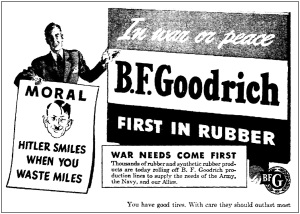
rubber-drive_b-f-goodrich-ad_071942_detB. F. Goodrich Tires ad detail, July 17, 1942

**

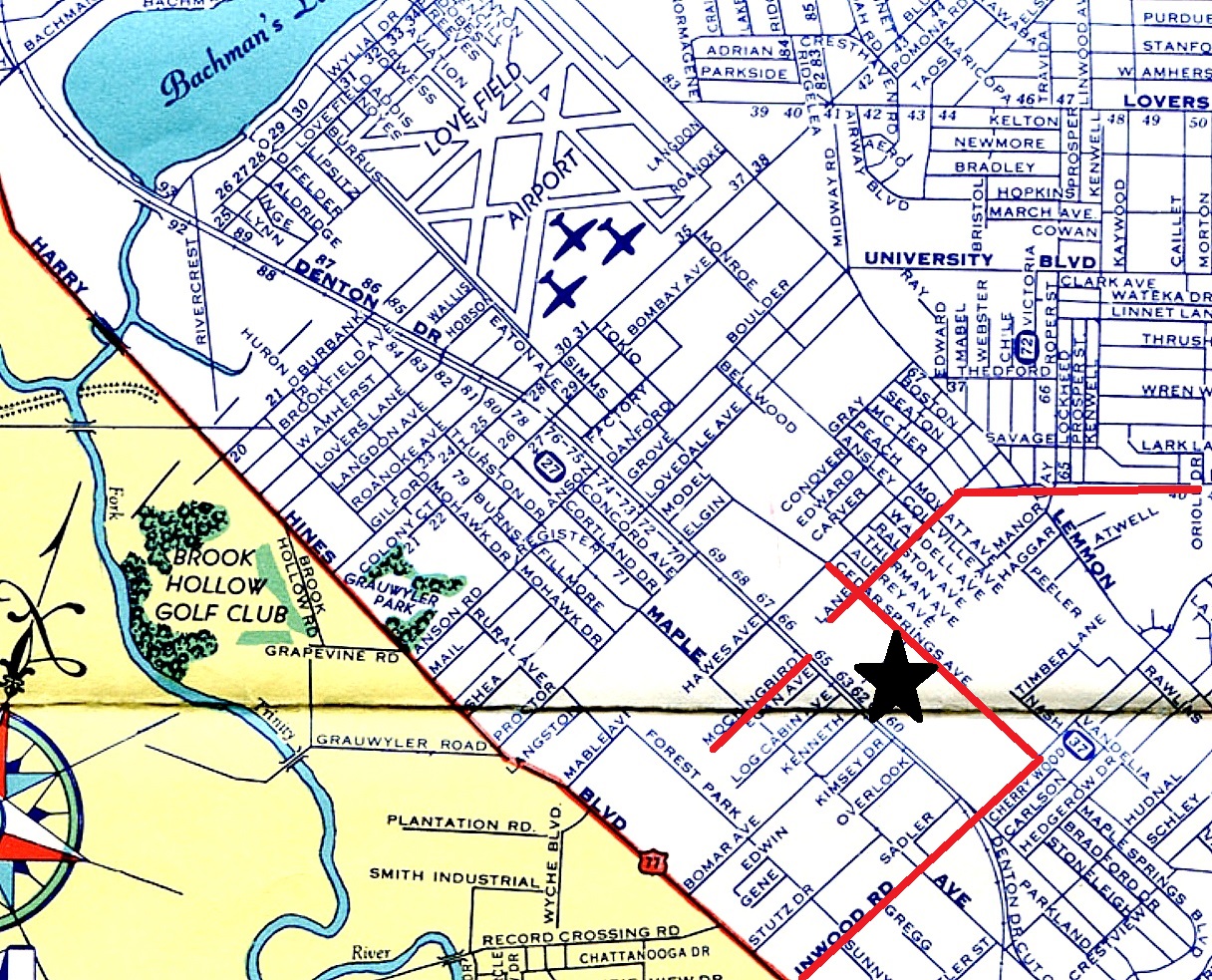
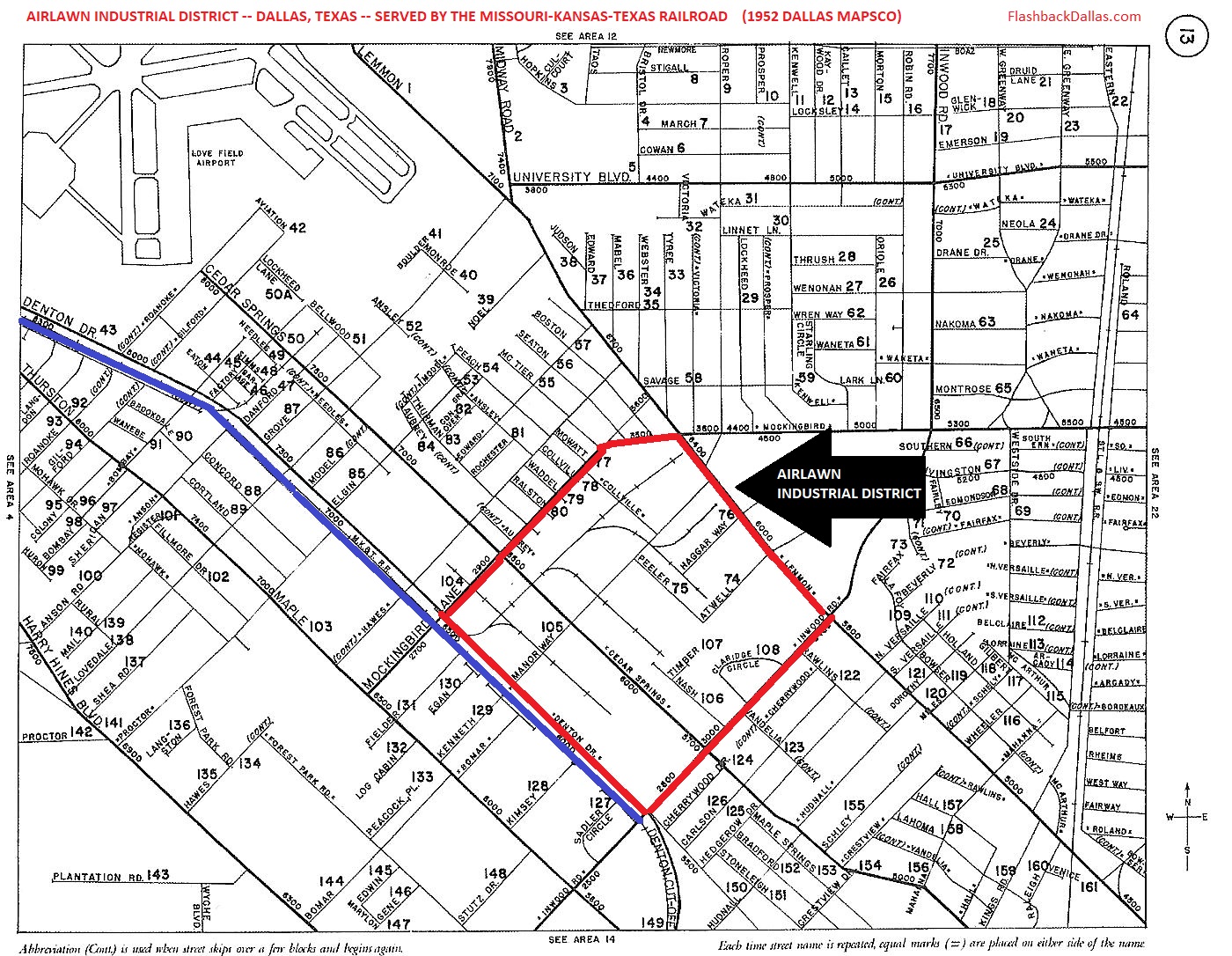
So where exactly was that massive used-tire mountain range? According to The Dallas Morning News, it was in a large open field “at the intersection of the MKT Railroad switch and Cedar Springs, just west of the Coca-Cola plant” (DMN, July 13, 1942), between Inwood and W. Mockingbird, not far from Love Field. The map below (from 1949) shows the general location of the yard, marked with a black star.
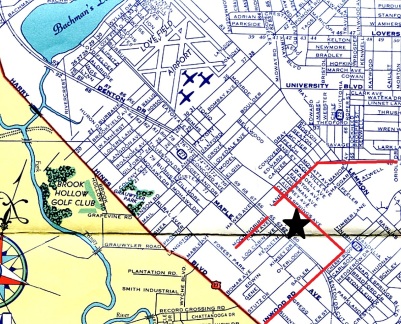
tire-mountain_1949-ashburn-map_dallas-freeways-site_det1949 Ashburns’ map detail, via DFW Freeways site

Initially, the salvage yard was to be contained on a 13-acre plot of land, surrounded by an 8-foot board fence. There were to be several tall guardhouses, and the “precious pile of vital war material” would  be patrolled 24 hours a day by armed guards “to protect it from fire hazards, thieves, or saboteurs” (DMN, Aug. 6, 1942). The fear of a potentially huge and uncontrollable fire was the main concern — a special fire plug was installed on the property and a direct phone/alarm line to the central fire station was set up. By August, the size of the yard increased by 50% to accommodate the 30 or more freight carloads which were arriving daily with scrap rubber from all over Texas (except the Panhandle). This huge salvage yard was meant to hold the rubber-drive scrap until reclamation plants in Ohio could accommodate it.

Several months later, the Time article put the expanded size of the yard at 30 acres, containing 30,000 tons of rubber material. By January, 1944, it was estimated the mammoth tire graveyard contained a whopping one million tires. Rather anti-climactically, a local tire dealer was contracted by the Rubber Reserve Corporation to “pick out the repairable and recappable carcasses” (DMN, Jan. 23, 1944) which were estimated to number about 150,000 tires; they would then be dispersed to Texas dealers who would either sell  them to consumers or vulcanize them. Despite the frenzied rubber drive of 1942 and almost a year and a half of sitting forlornly in an open field guarded by men with guns, it looks like those tires never made their trip to Ohio.

*

The land that these “tire mountains” occupied appears to have been leased from Carl C. Weichsel, member of a noted Dallas pioneer family. 23 acres of the land was sold to the Coca-Cola Company in 1937 — a $1,000,000 syrup plant and warehouses were built on ten of the acres, at Lemmon and W. Mockingbird. (Coca-Cola bought ten more acres in 1947 in order to expand.) A few weeks after the Coca-Cola land-purchase was announced, Dallas County granted the Missouri-Kansas-Texas Railway right of way across Cedar Springs, just south of Mockingbird, for a switch track to the Coca-Cola plant. 

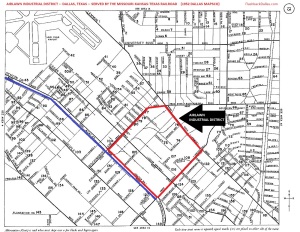
In the mid 1940s, the Airlawn Industrial District sprang up in this area. The planning and development of Airlawn was spearheaded by none other than the Katy Railroad, beginning when Coca-Cola decided to move to the area. 

The […] plans were drawn up by the Katy’s industrial research and development department with the aid of experts versed in the problems of present day industry. […] The Katy maintains a Diesel switch engine on duty twenty-four hours a day to handle the switching operations in the Airlawn area. One section gang is assigned to this area to maintain the miles of track that interweave the industrial buildings. (DMN, Oct. 9, 1949)

The MKT was working to attract businesses along their lines: they needed the businesses, and the businesses needed them. Win-win! (It’s interesting to note that another major manufacturer that the Katy worked with on securing a location was another soft drink company: the Dr Pepper plant on Mockingbird, near Central.)

Below is a map from 1952 which shows the railroad spurs which were used by the Airlawn businesses. I’m not sure why I find this so interesting, but I do! (Are these tracks still in use?)
airlawn-industrial-district_mapsco-19521952 Dallas Mapsco

***

Sources & Notes

First and second image are from an old eBay listing; it appears that someone pasted a Time magazine article (March 15, 1943) to an envelope; the postmark and cancellation shows that it was mailed from Dallas on March 16, 1943, even though there does not appear to be an address on the front or back of the envelope.

A really interesting article on the various WWII scrap drives — “Getting In the Scrap: The Salvage Drives of World War II” by Hugh Rockoff, of the Economics Dept. of Rutgers University — is well worth a read, here. From his abstract: “While the impact of the drives on the economy was limited, the impact of the drives on civilian morale, may well have been substantial.”

Another very informative article on the national rubber drive of 1942 can be found in the post “Make It Do — Tire Rationing in World War II” by Sarah Sundin, here.

See a variety of patriotic posters encouraging Americans to participate in WW2 scrap drives here.

Pertinent Dallas Morning News articles about this rubber salvage yard:

  • “Work Begun on Rubber Storage Plant” (DMN, July 13, 1942)
  • “Close Guard Is Kept On Rubber” (DMN, Aug. 6, 1942 — includes a photo of the yard, similar to the one that appeared in Time magazine)
  • “150,000 Usable Tires Believed Salvageable From Waste Pile” (DMN, Jan. 23, 1944)
rubber-stock-pile_dallas-1943_ebay-det_sm

*

Copyright © 2019 Paula Bosse. All Rights Reserved


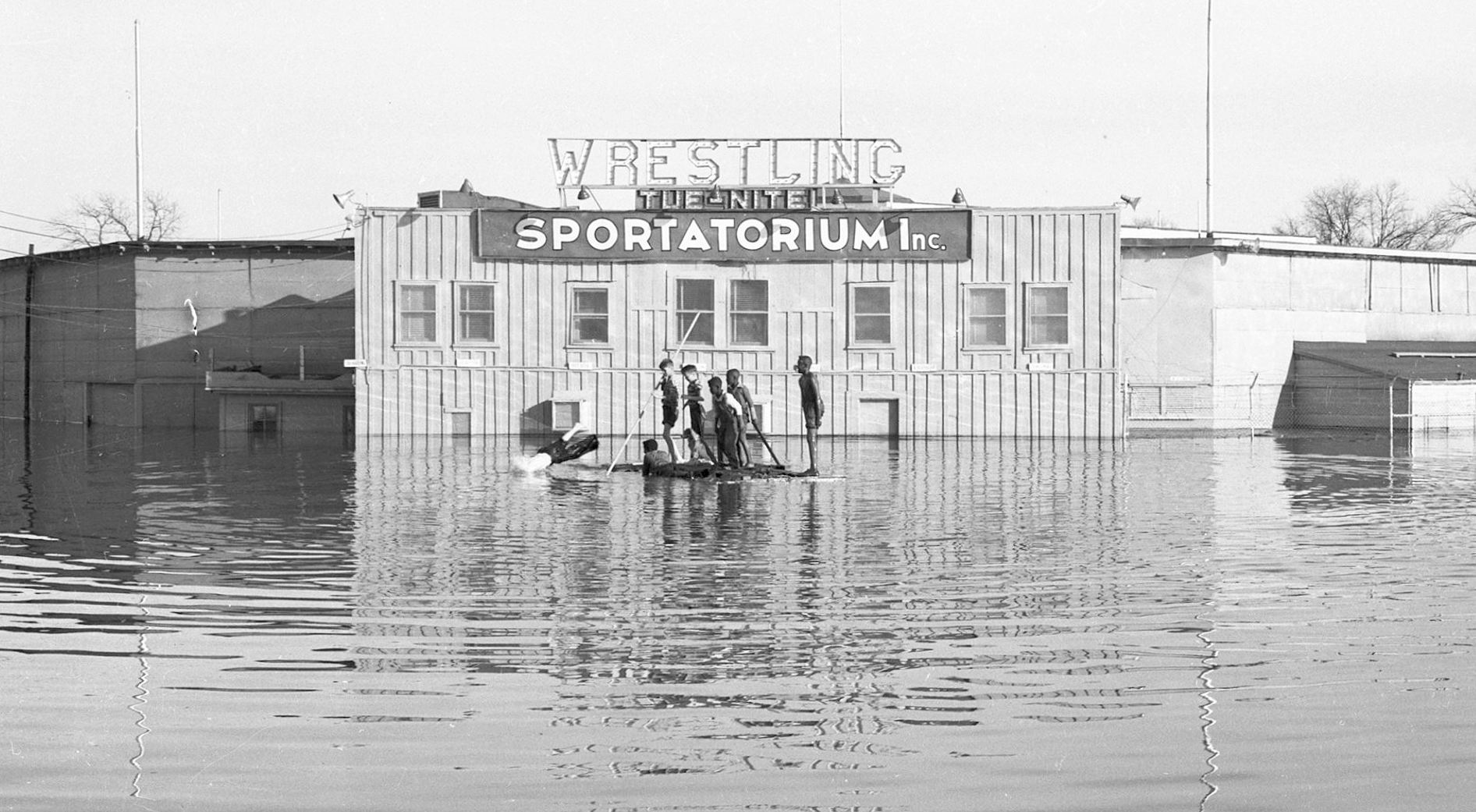
A Flooded Sportatorium — 1945

sportatorium_flood_squire-haskins_UTA_boys-1_det
Boys gotta do what boys gotta do… (photo: Squire Haskins/UTA Libraries)

by Paula Bosse

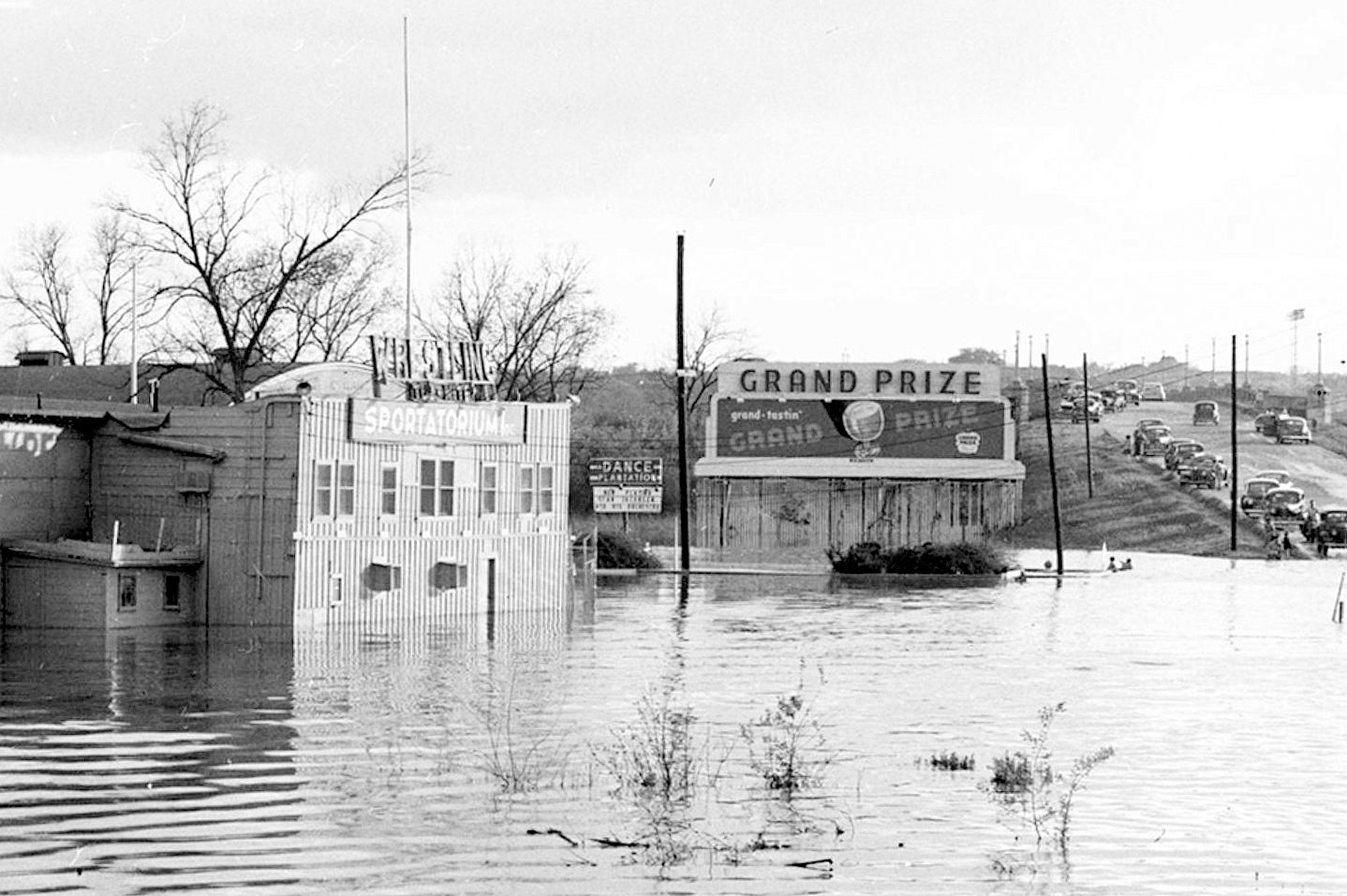
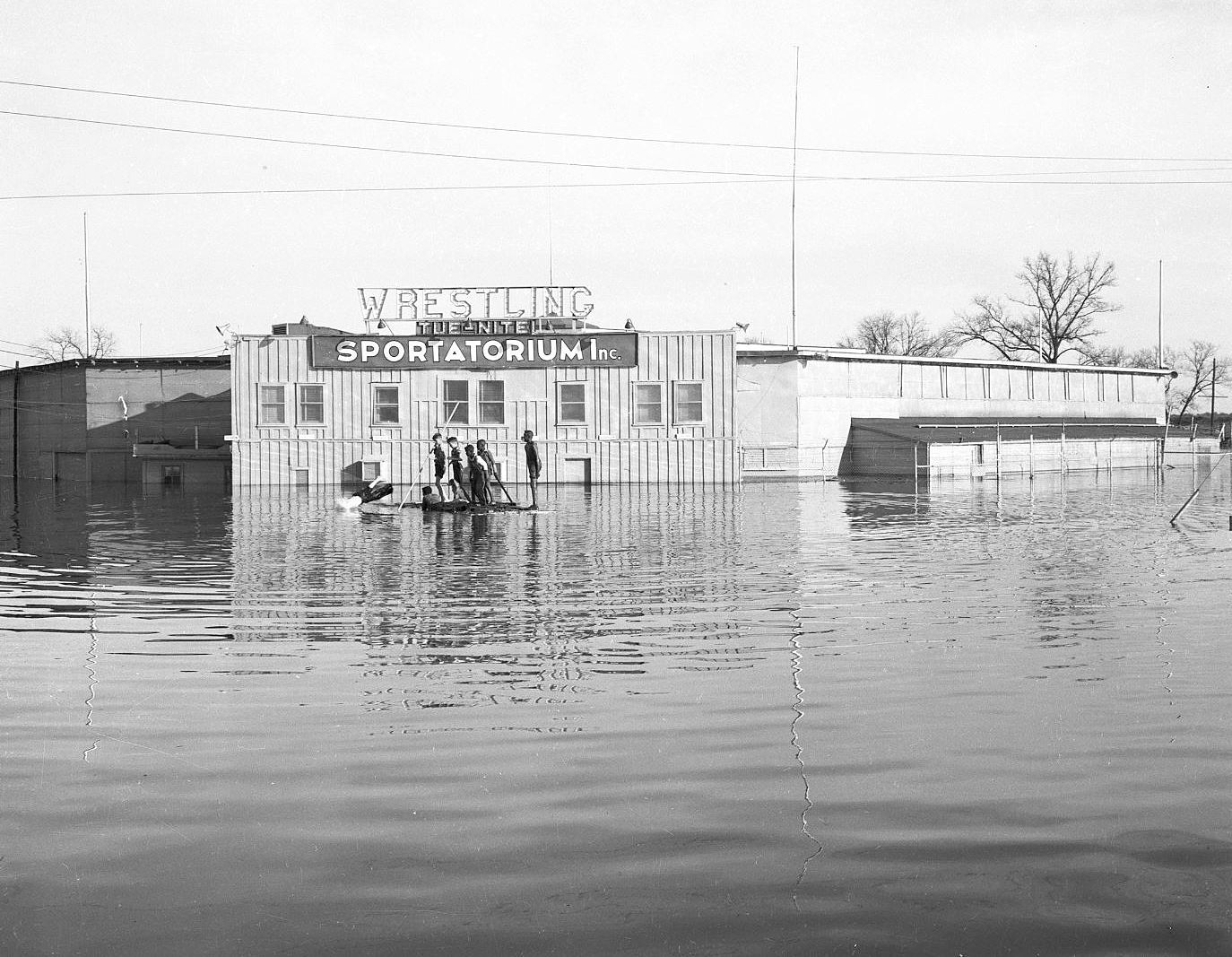
Imagine it has flooded around the Sportatorium: what would you expect seven boys and their dog to do? Well, here they are doing about what you’d expect. (The image above is a detail from the photo below, by Squire Haskins.)

sportatorium_flood_squire-haskins_UTA_boys-1

Another photo, this one with a Huck-Finn-meets-Iwo-Jima-Memorial vibe:

sportatorium_flood_squire-haskins_UTA_boys-2

My closer-up detail (click to see larger image):

sportatorium_flood_squire-haskins_UTA_boys-2_det

Another view:

sportatorium_flood_squire-haskins_UTA_no-boys

Closer up, with a Grand Prize Beer billboard, cars (on Industrial?), and a sign for the next-door Plantation nightspot:

sportatorium_flood_squire-haskins_UTA_no-boys_det

No wrasslin’ tonight, y’all.

***

Sources & Notes

All photos by Squire Haskins, from the University of Texas at Arlington Libraries, Special Collections.

The photos in the UTA collection are undated, but a photograph of these same boys and dog on their raft appeared in The Dallas Morning News on April 5, 1945, along with a whimsical article titled “Pint-Size Warriors Fight Battle of Trinity, Prove Stormiest Rain Cloud Has Silver Lining.” A few pages away there were several aerial photos showing the major flooding which had submerged large portions of the area around the Sportatorium and Corinth Street viaduct.

The Sportatorium was located at 1000 S. Industrial (now Riverfront), at Cadiz (see map here). Maybe a little too close to the Trinity….

*

Copyright © 2019 Paula Bosse. All Rights Reserved
Dallas Fire Fighter Magazine — 1960s

dallas-fire-fighter-magazine_jan-1965_ebay

by Paula Bosse

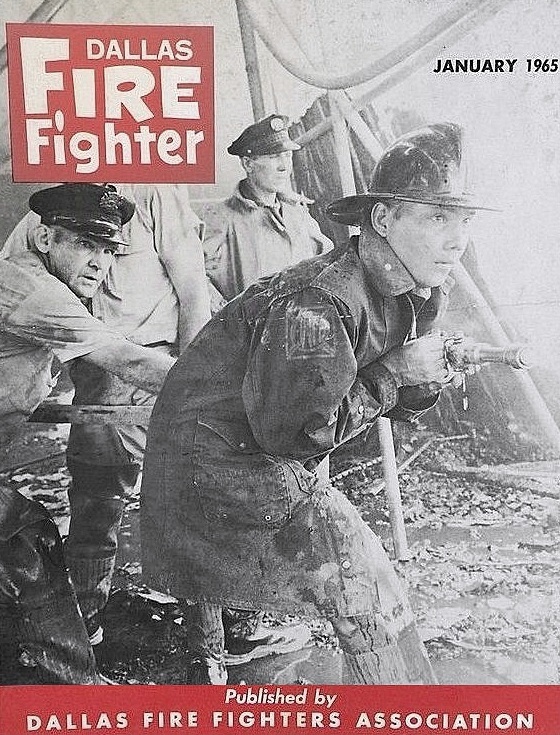
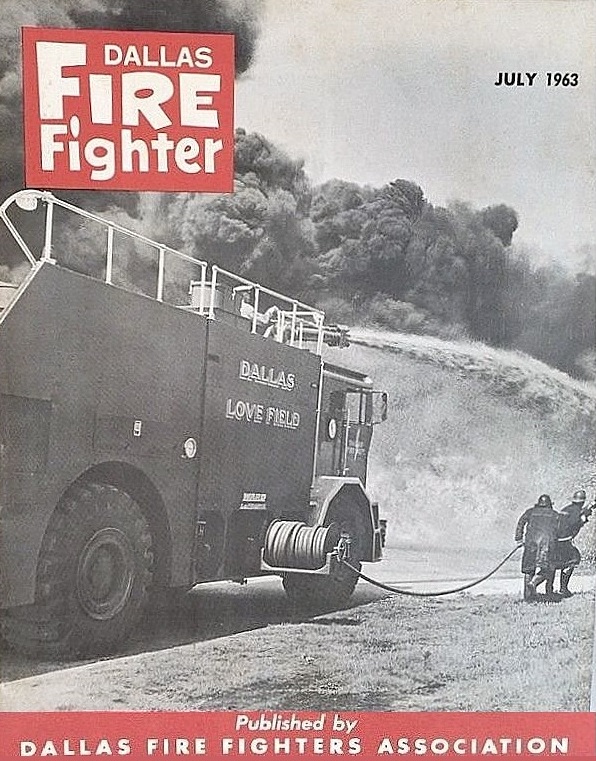
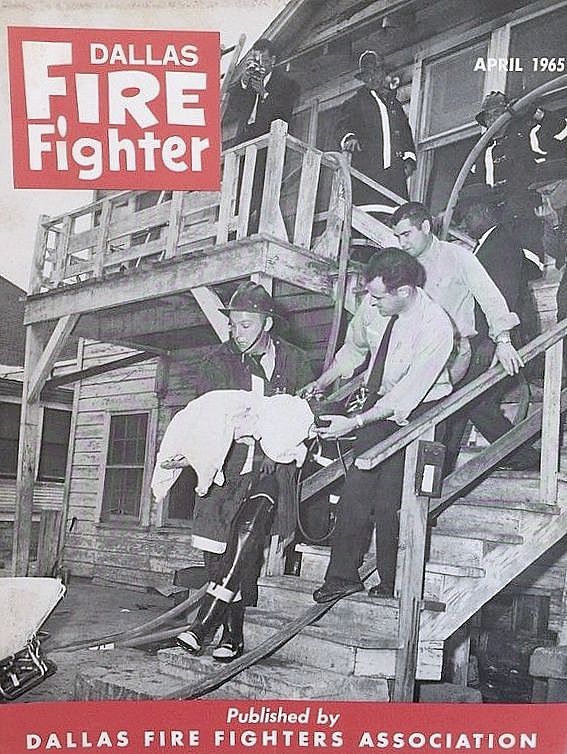
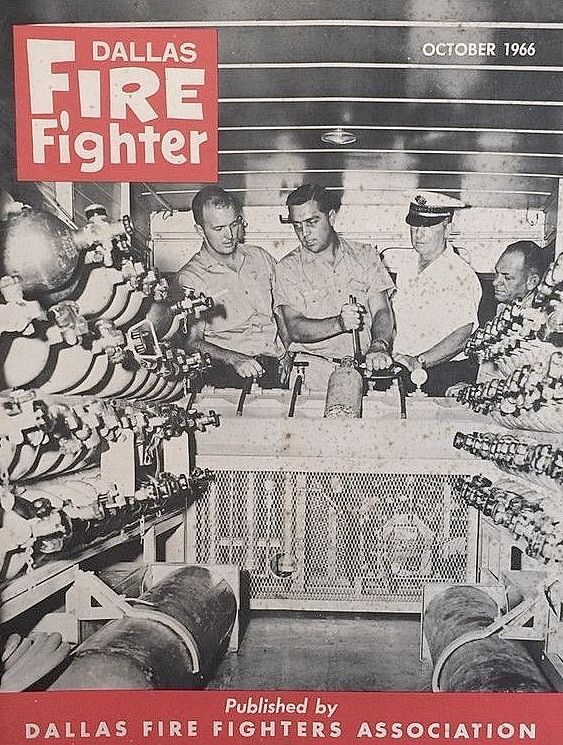
I saw these covers of Dallas Fire Fighter magazine on eBay and thought they looked really interesting. I can’t find anything about this publication other than a one-sentence glancing mention in a Dallas Morning News article on fire prevention in January, 1962 — so it had been around at least since the early ’60s. Here are four covers — one from 1963, two from 1965, and one from 1966.

dallas-fire-fighter_magazine_july-1963_ebay_love-fieldLove Field engine, July 1963

dallas-fire-fighter_magazine_1965-ebay
Rescue of a toddler, April, 1965

dallas-fire-fighter_magazine_oct-1966_ebay
Aero-Unit inspection, No. 1 Station, October, 1966

The person listing these magazines on eBay included a few (very low-resolution!) photos of some of the pages inside. Below are a few interesting tidbits from the October, 1966 issue.

dallas-fire-fighter-magazine_oct-1966_ebay_fire-house-rhythm-kings_photo

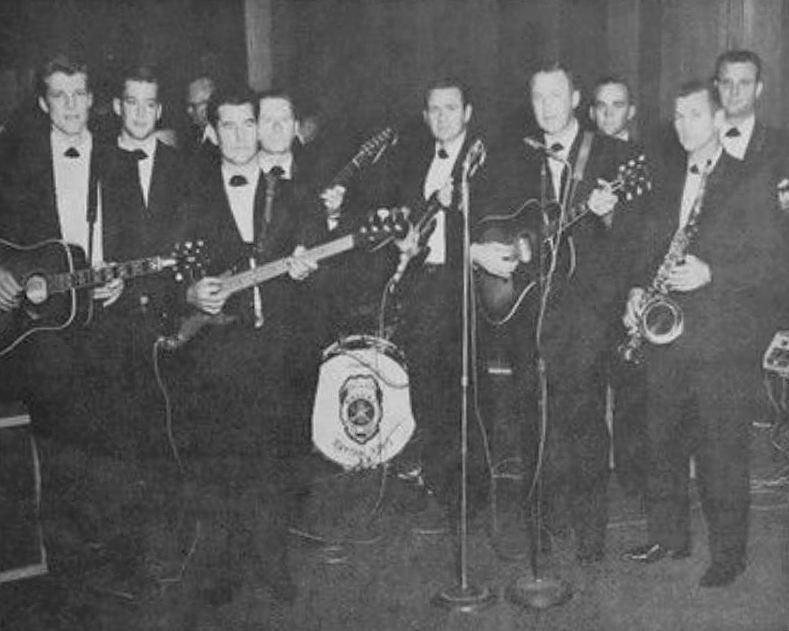
The Fire House Rhythm Kings was a country band made up of Dallas firefighters, formed in 1956. They played well over 300 gigs a year (one article noted they sometimes performed at four venues in one DAY!), combining entertainment with education on fire prevention. The caption: “Fire House Rhythm Kings – left to right, Jack Mewbourne, Doug May, Les Wilson, Spurgeon Harris, Don Smith, ‘Big Ed’ Hunt, J. W. Hadaway, Don Spruell, and Leland Loggins. Members not present in the photo include Harvey Lanier, Troy England, W. T. Babb and Wendel Jenkins. Newest additions to the band include Larry Gotchel and Earl Rowe who have also joined since the photo was made.”

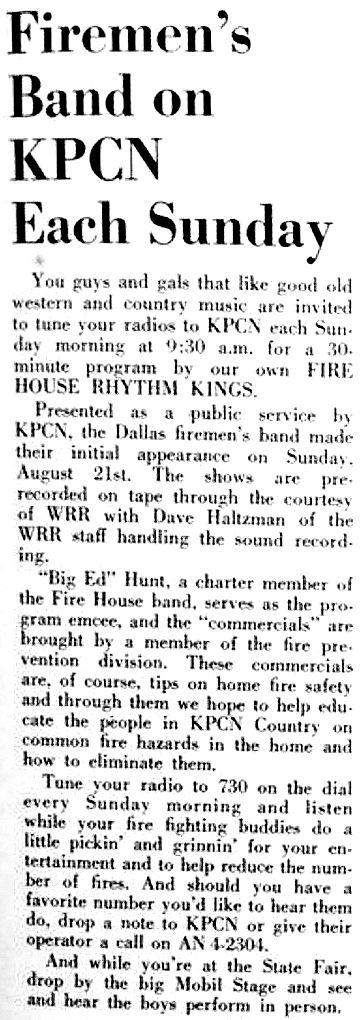
They also had a regular show on radio station KPCN (click to see larger image):

dallas-fire-fighter-magazine_oct-1966_ebay_fire-house-rhythm-kings
Dallas Fire Fighter, October, 1966

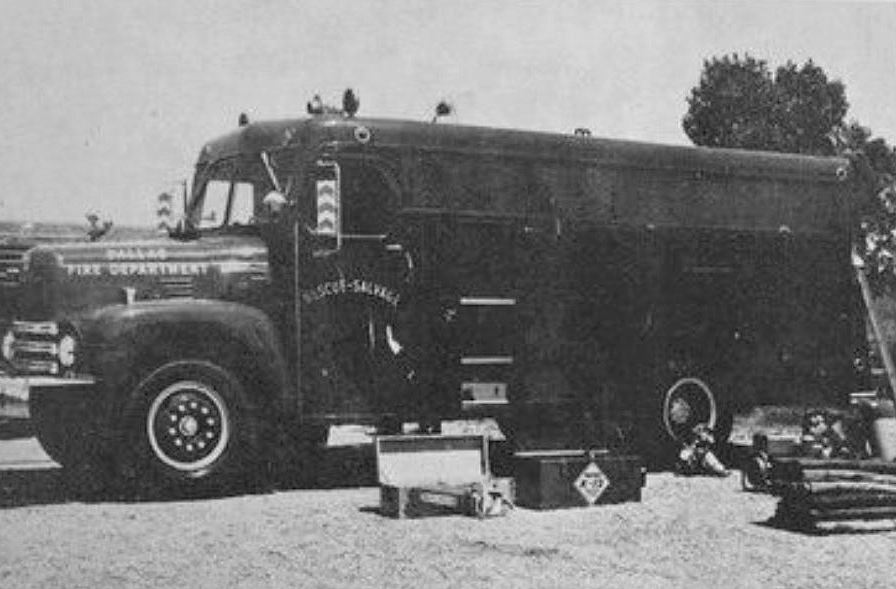
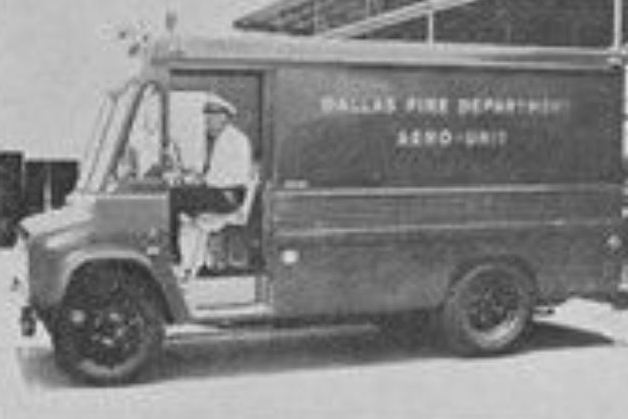
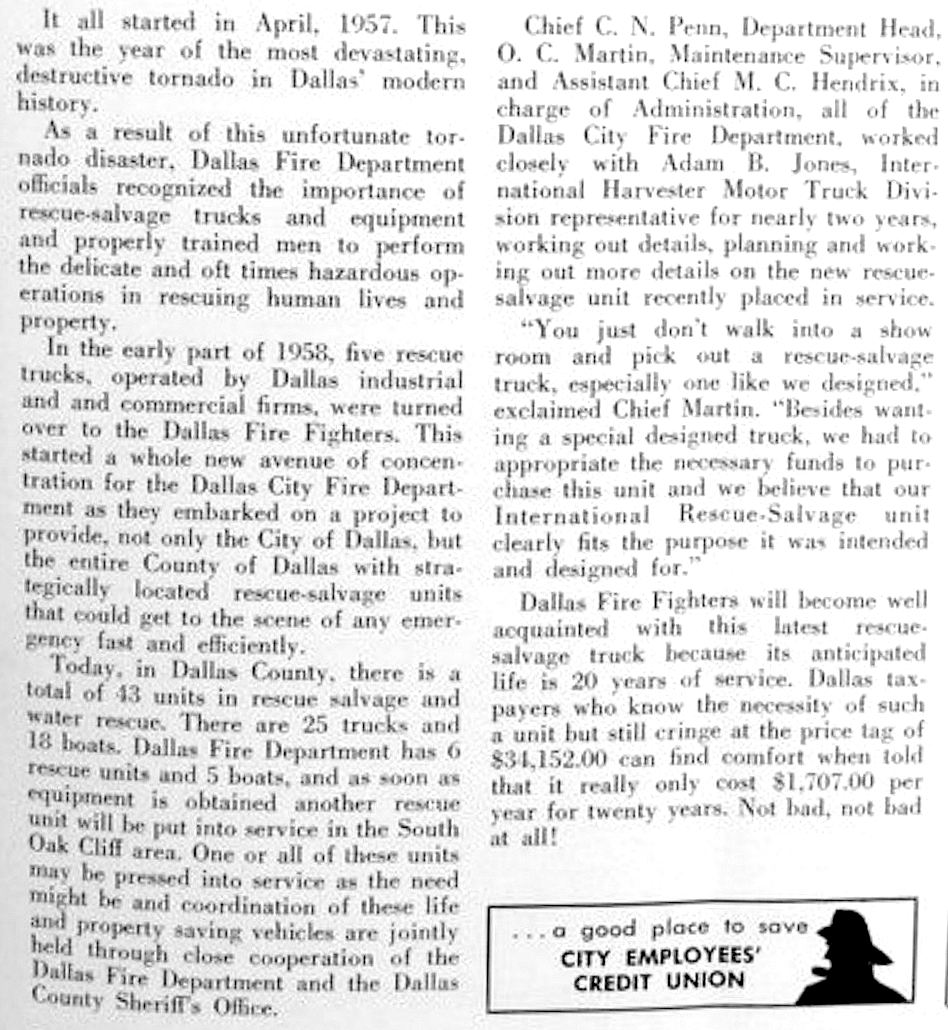
The department had recently acquired new equipment, including a heavy-duty rescue-salvage unit and an aero-unit (apologies for image quality!):

dallas-fire-fighter-magazine_oct-1966_ebay_heavy-duty-rescue-salvage-unit“New heavy duty rescue-salvage unit now in service at No. 3 Station”

dallas-fire-fighter_magazine_oct-1966_ebay_aero-unit
Aero-Unit

dallas-fire-fighter_magazine_oct-1966_ebay_new-equipment

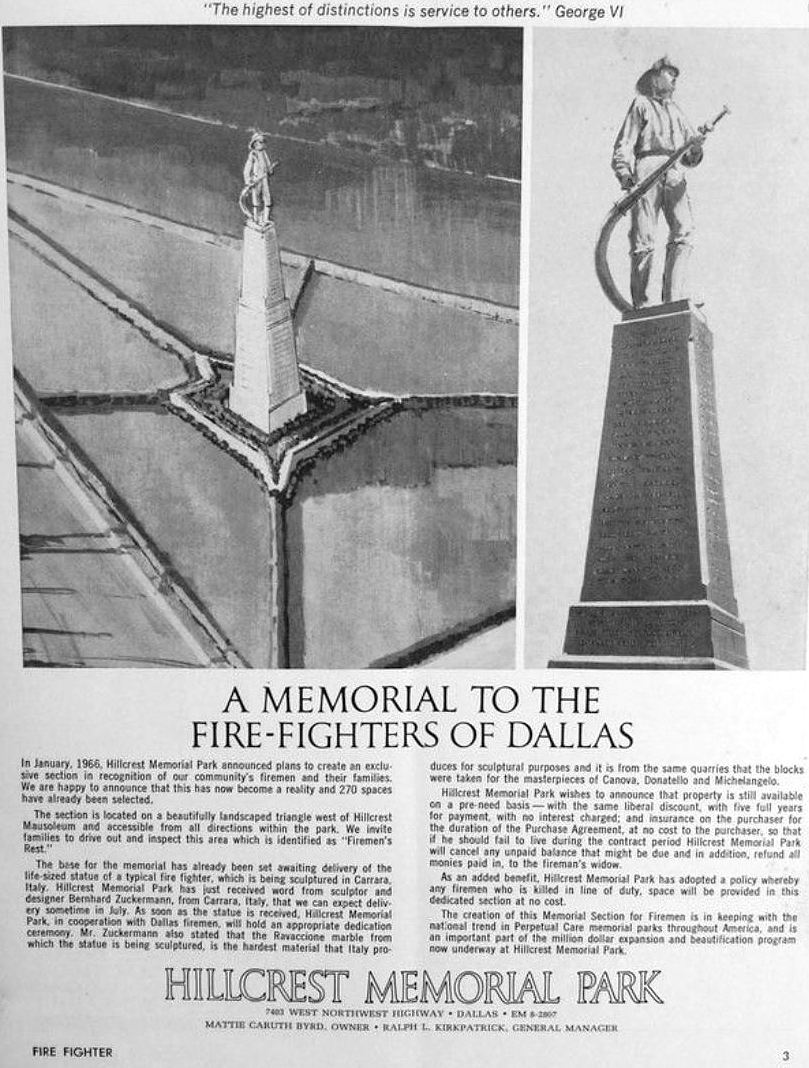
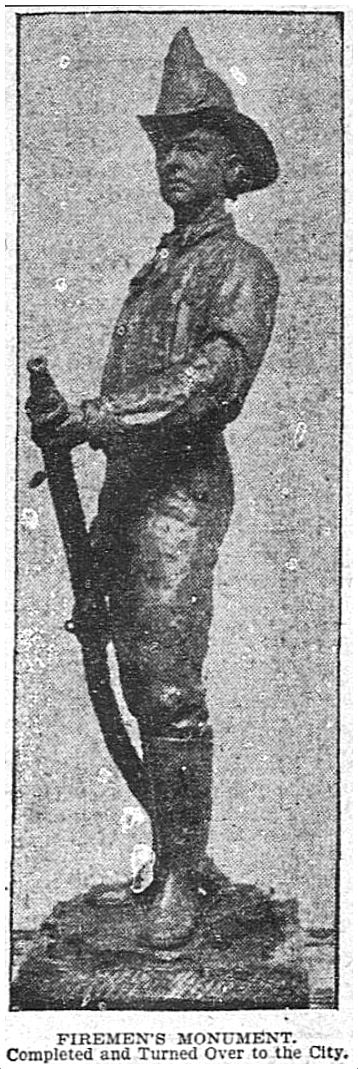
And, lastly, an ad announcing a new section of Hillcrest Memorial Park created exclusively for fire-fighters and their families: “Firemen’s Rest.” This section of the cemetery featured a large marble statue by memorial sculptor Bernhard Zuckermann, which appears to be a copy of the bronze Firemen’s Monument dedicated in City Park in 1903 (the original bronze statue has been relocated to the Dallas Fire-Rescue Training Center on Dolphin Rd.). (See a transcription of the ad’s hard-to-read text here.)

dallas-fire-fighter_magazine_oct-1966_ebay_hillcrest-memorial-park_ad

Below, the original monument topped with the bronze likeness of Dallas fireman John Clark (who died fighting a huge East Dallas fire in 1902) honors Dallas firefighters who have died in the line of duty; it was dedicated on Nov. 26, 1903.

firemans-monument_dmn_112703_photoDallas Morning News, Nov. 27, 1903

***

Sources & Notes

Dallas Fire Fighter magazine (published by the Dallas Fire Fighters Association) found on eBay.

An interesting article on the Fire House Rhythm Kings band can be found in the Dallas Morning News archives in the article “Firehouse Band Goes Like Blazes” by the always entertaining Kent Biffle (DMN, Dec. 13, 1965)

*

Copyright © 2019 Paula Bosse. All Rights Reserved.

The JFK Assassination and Television Firsts — 1963

JFK_ruby-oswald_broadcasting-mag_120263_nbc-screenshot
Ruby shooting Oswald on live TV

by Paula Bosse

The assassination of President John F. Kennedy was not only one of the most sobering moments in American history, it was also a turning point for broadcast journalism, particularly in the way television covers breaking news.

The Kennedy assassination and the later captured-live-on-television shooting of Lee Harvey Oswald by Jack Ruby put broadcast journalists to the test as never before. News coverage was a solid days-long block — with NBC devoting almost 72 straight hours to the assassination and its aftermath. The immediacy of live television and the ability to learn of breaking-at-this-minute news was something that had never been experienced by Americans before — and something which pushed radio and television news reporting to new heights. It was reported that CBS alone used 80 newsmen to cover the story. The Nielsen ratings estimated that an unbelievable 93% of American households with televisions were tuned in to watch live coverage of the President’s funeral procession.

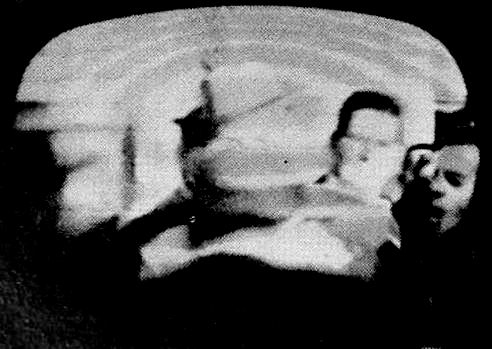
Perhaps the grisliest “first” of this new era of TV news was that millions of Americans watched a murder happen live as they watched from their living rooms: when Jack Ruby lunged from the phalanx of reporters gathered in the parking lot beneath the Municipal Building to shoot Lee Harvey Oswald as he was walking to an armored vehicle to be transported to the county jail, millions witnessed the shooting as it happened, stunned. NBC was the lone network to have broadcast live coverage of this unforgettable moment of 20th-century American history. The other networks followed soon after with recorded footage, but NBC got the scoop.

ad-jfk-assassination-NBC_broadcasting-mag_120263NBC ad in Broadcasting magazine, Dec. 2, 1963

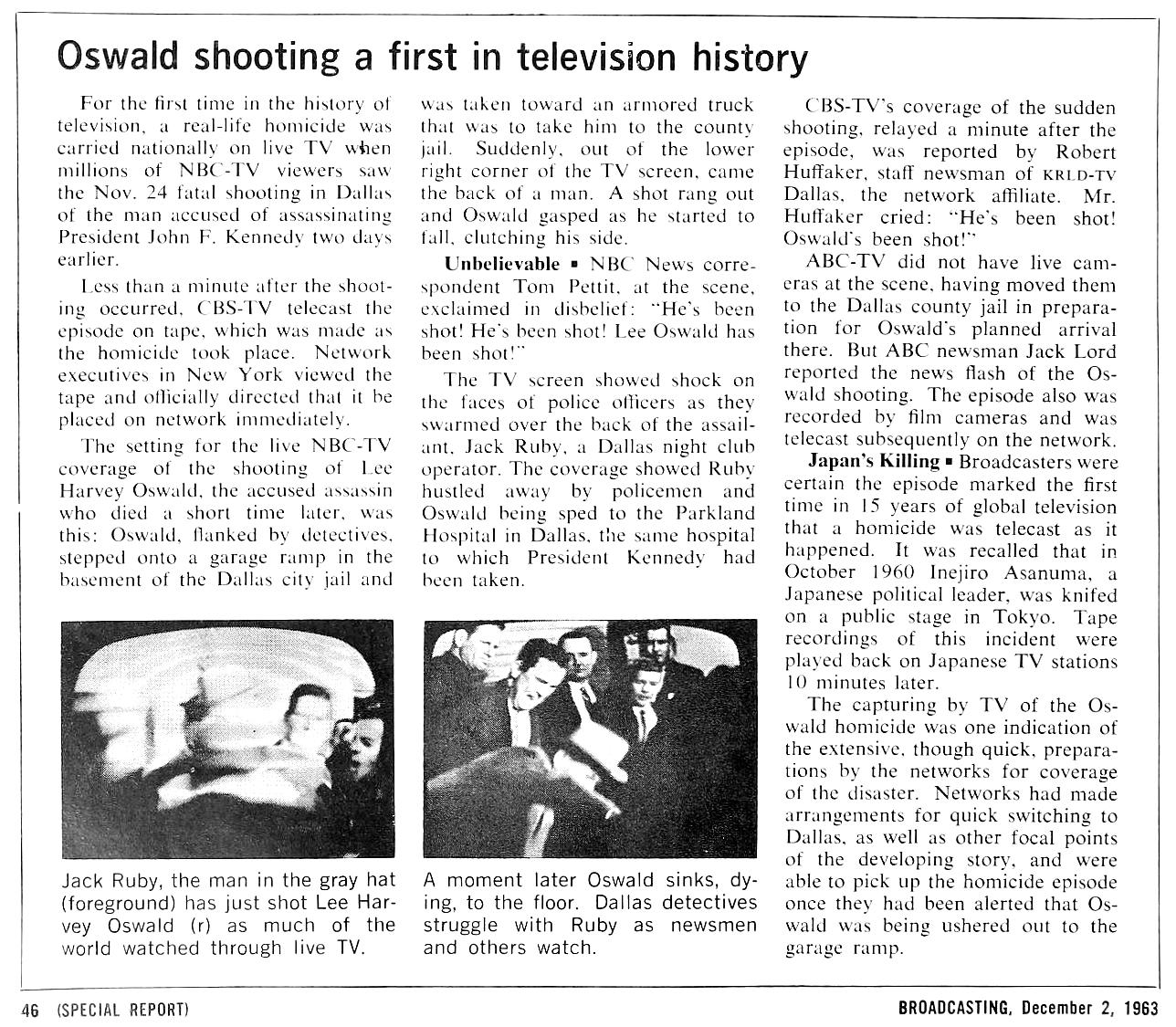
Broadcasting — an industry trade magazine — devoted an entire 25-page “Special Report” on how television had covered — and shaped — JFK’s presidency and his assassination. Below is the article which specifically focused on the wall-to-wall broadcast news coverage, post-Nov. 22.

OSWALD SHOOTING A FIRST IN TELEVISION HISTORY

For the first time in the history of television, a real-life homicide was carried nationally on live TV when millions of NBC-TV viewers saw the Nov. 24 fatal shooting in Dallas of the man accused of assassinating President John F. Kennedy two days earlier.

Less than a minute after the shooting occurred, CBS-TV telecast the episode on tape, which was made as the homicide took place. Network executives in New York viewed the tape and officially directed that it be placed on network immediately.

The setting for the live NBC-TV coverage of the shooting of Lee Harvey Oswald, the accused assassin who died a short time later, was this: Oswald, flanked by detectives, stepped onto a garage ramp in the basement of the Dallas city jail and was taken toward an armored truck that was to take him to the county jail. Suddenly, out of the lower right corner of the TV screen, came the back of a man. A shot rang out and Oswald gasped as he started to fall, clutching his side.

UNBELIEVABLE

NBC News correspondent Tom Pettit, at the scene, exclaimed in disbelief: “He’s been shot! He’s been shot! Lee Oswald has been shot!”

The TV screen showed shock on the faces of police officers as they swarmed over the back of the assailant, Jack Ruby, a Dallas night club operator. The coverage showed Ruby hustled away by policemen and Oswald being sped to the Parkland Hospital in Dallas, the same hospital to which President Kennedy had been taken.

CBS-TV’s coverage of the sudden shooting, relayed a minute after the episode, was reported by Robert Huffaker, staff newsman of KRLD-TV Dallas, the network affiliate. Mr. Huffaker cried: “He’s been shot! Oswald’s been shot!”

ABC-TV did not have live cameras at the scene, having moved them to the Dallas county jail in preparation for Oswald’s planned arrival there. But ABC newsman Jack Lord reported the news flash of the Oswald shooting. The episode also was recorded by film cameras and was telecast subsequently on the network.
JAPAN’S KILLING

Broadcasters were certain the episode marked the first time in 15 years of global television that a homicide was telecast as it happened. It was recalled that in October 1960 Inejiro Asanuma, a Japanese political leader, was knifed on a public stage in Tokyo. Tape recordings of this incident were played back on Japanese TV stations 10 minutes later.

The capturing by TV of the Oswald homicide was one indication of the extensive, though quick, preparations by the networks for coverage of the disaster. Networks had made arrangements for quick switching to Dallas, as well as other focal points of the developing story, and were able to pick up the homicide episode once they had been alerted that Oswald was being ushered out to the garage ramp. (Broadcasting magazine, Dec 2, 1963)


JFK_ruby-oswald_broadcasting-mag_120263
Broadcasting, Dec. 2, 1963 (click to see larger image)

*

NBC was the only network to carry Ruby’s shooting of Oswald on live TV. The footage — as it was aired — can be watched in the video below (the Dallas footage begins at about the 5:00 mark).


*

KRLD, the local CBS affiliate, captured the shooting live, but it was not broadcast live. Here is the KRLD footage, helmed by Bob Huffaker (the shooting takes place near the 13:00 mark).


*

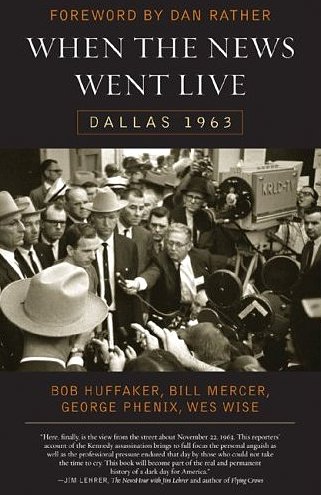
In 2007, Bob Huffaker, Bill Mercer, Wes Wise, and George Phenix — reporters for CBS-affiliate KRLD-TV news — recalled the blur of days on the beat following the assassination in their book When the News Went Live: Dallas 1963. Watch a panel discussion on those days, below, recorded at the Sixth Floor Museum in 2008. (I found Wise’s recollections, beginning at the 39:00 mark to be most interesting.) (RIP, Bob Huffaker, who died June 25, 2018.)

when-the-news-went-live_cover

*

ABC came in late, with reports from affiliate WFAA-Ch. 8 (about the 7:20 mark), but their coverage was certainly no less exciting — in fact, this might be my favorite reporting by local broadcast journalists that day.


*

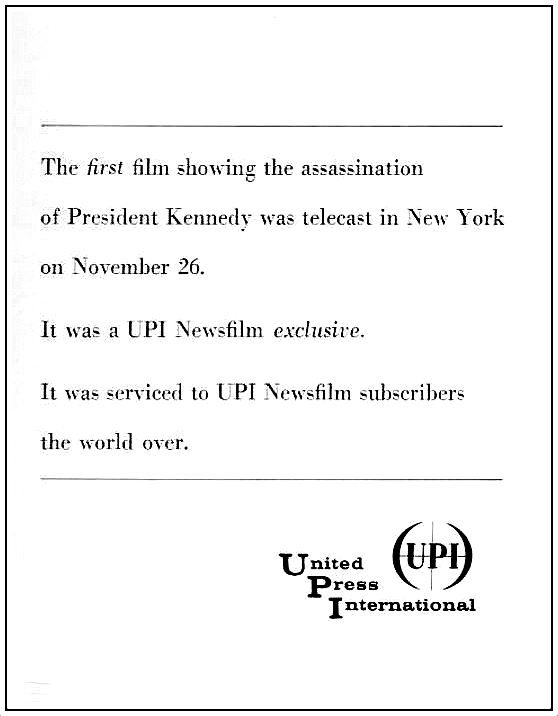
Another “first” in these days immediately following that awful day in Dallas was the very first showing of 8mm home-movie footage showing the assassination of the president. The film was shot by Dallasite Marie Muchmore, who reportedly sold the footage — sight unseen (it hadn’t even been developed) — to UPI for $1,000 (roughly about $8,000 in today’s money); the film was then shown on WNEW-TV in New York on Nov. 26. (The short footage, restored in recent years, can be watched on the Associated Press Archive site, here.)

ad-jfk-assassination-film_UPI_broadcasting-mag_120263
Broadcasting, Dec. 2, 1963

***

Sources & Notes

A “Special Report” on the broadcast coverage of the Kennedy assassination and the shooting of Oswald by Ruby appeared in the Dec. 2, 1963 trade magazine Broadcasting; the issue may be read in its entirety here (pp. 36-61); the photo at the top of this post (showing Jack Ruby shooting Lee Harvey Oswald) is from that issue.

More Flashback Dallas posts on the Kennedy assassination can be found here.

*

Copyright © 2018 Paula Bosse. All Rights Reserved.


“Dallas Is a Major Target Area!” — Know Where Your Nearest Fallout Shelter Is

passport-to-survival_nov-1958_art

by Paula Bosse

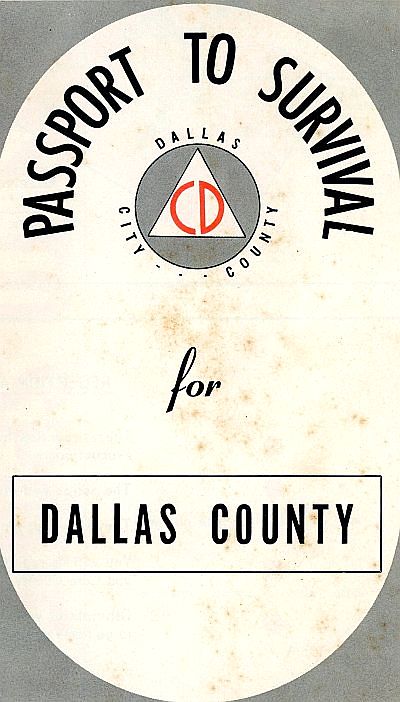
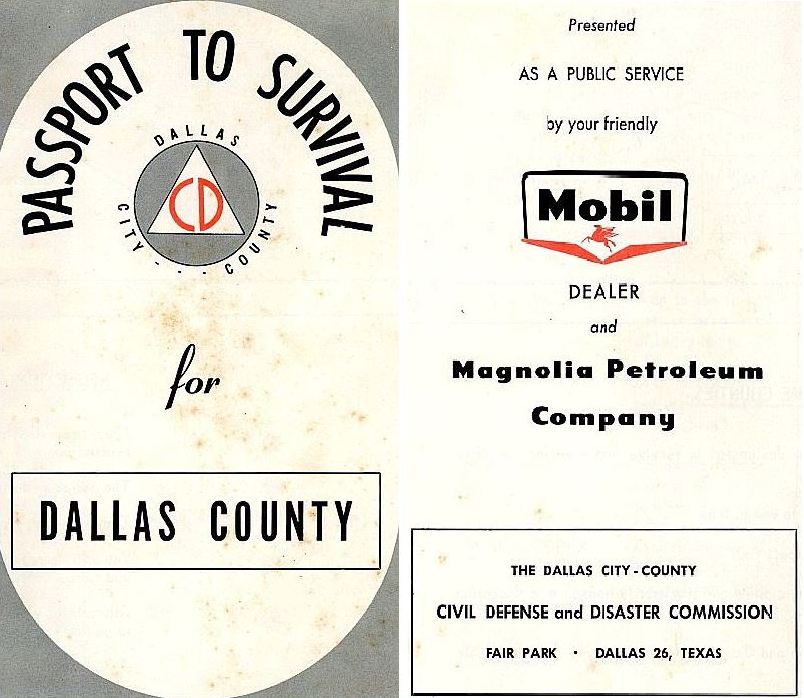
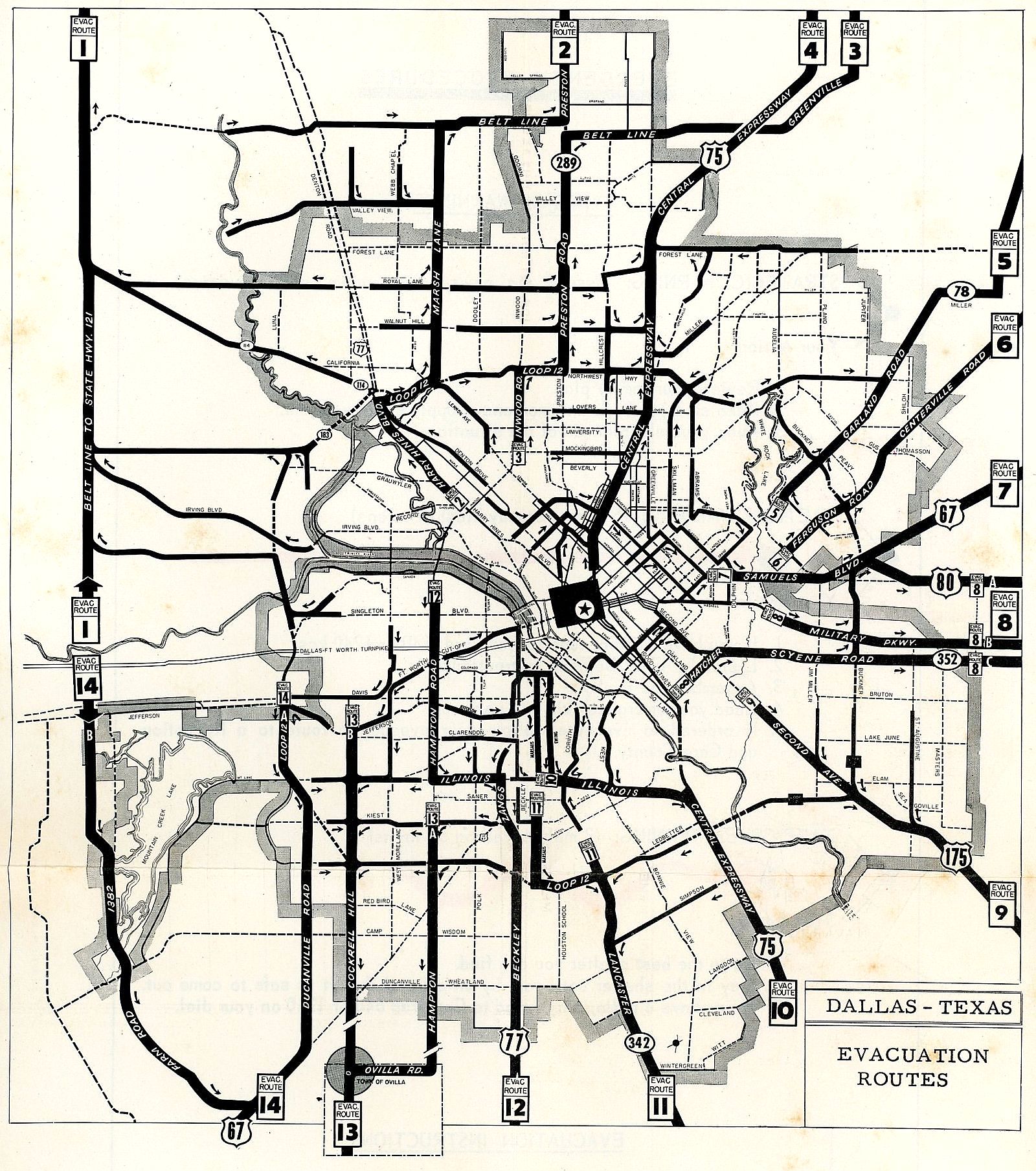
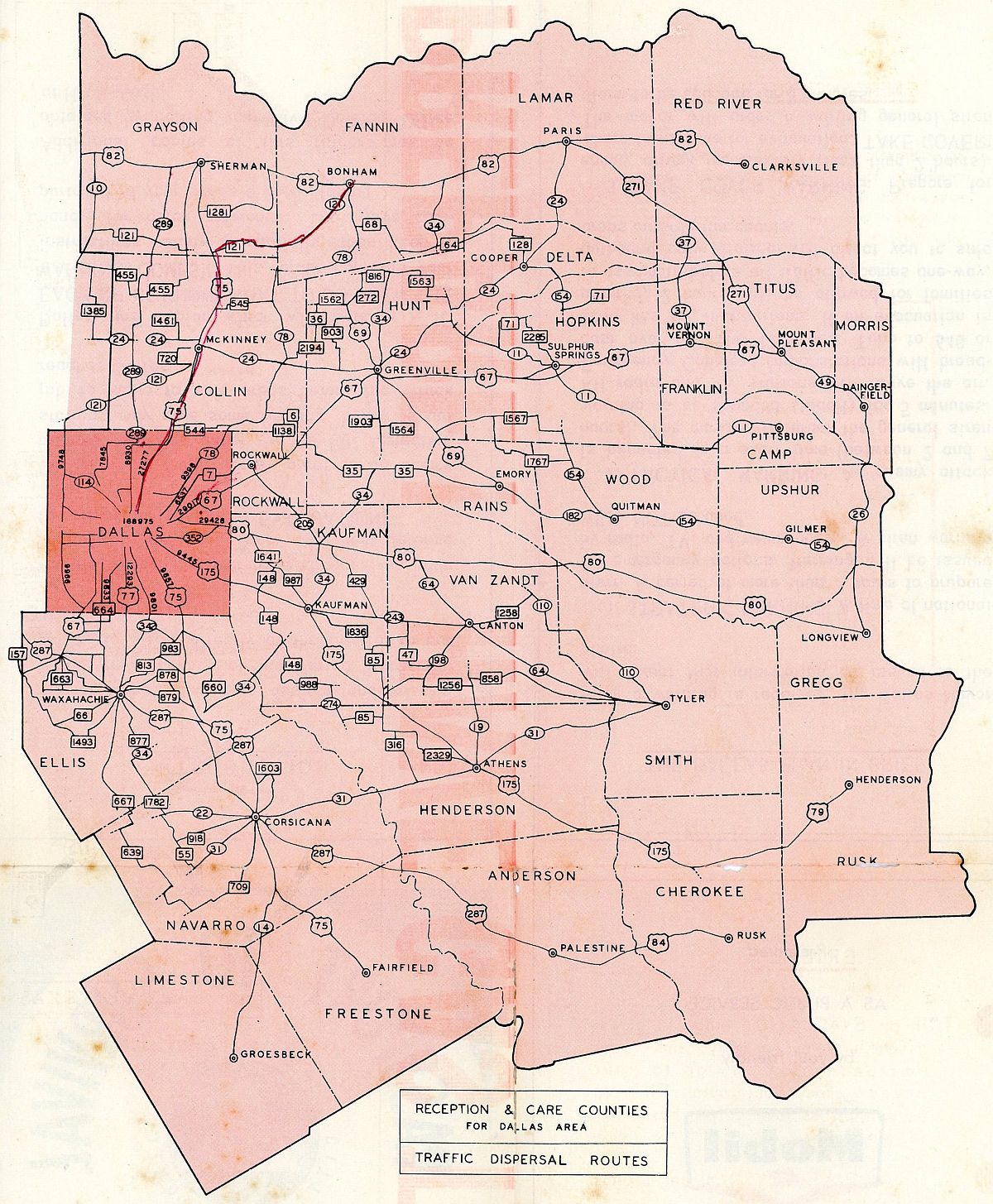
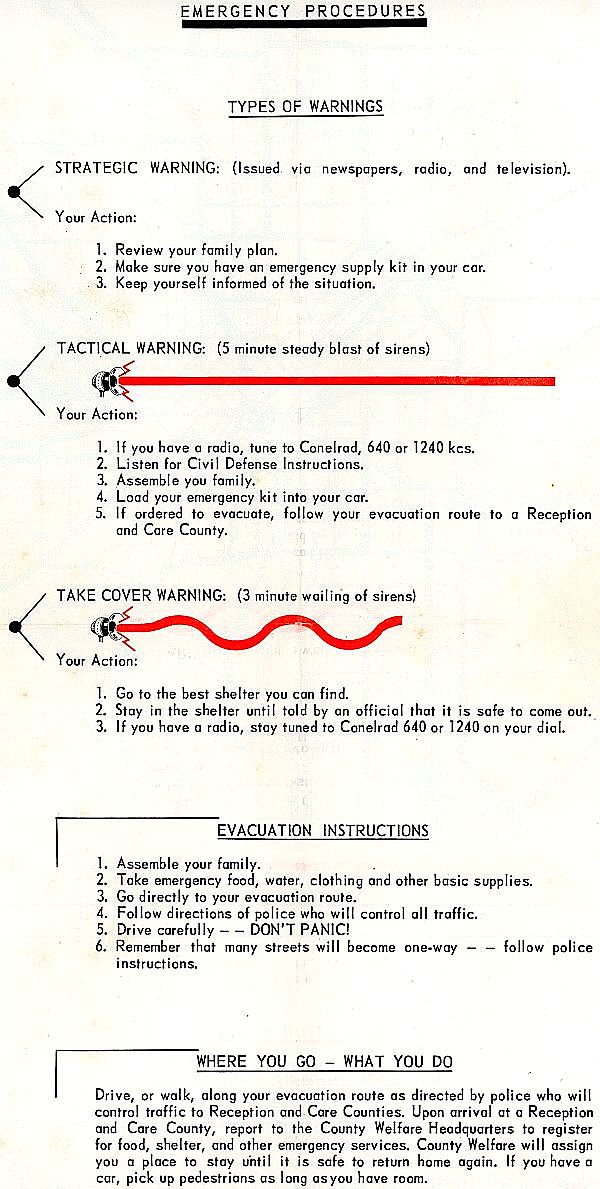
During the Cold War, the fear of nuclear attack was very real in the United States, reaching its peak of anxiety in the late 1950s and early 1960s. In 1958, the Dallas City-County Civil Defense Commission published a free informational pamphlet titled Passport to Survival, which contained evacuation maps for Dallas County, preparation tips, an emergency supply checklist, etc. Though the information contained in this publication could be applied to any disaster or emergency (nuclear-based or otherwise), it was printed a time when visions of Soviet atomic bombs were dancing in the heads of many concerned Americans. And this mild-mannered-looking pamphlet made sure you, Mr. and Mrs. Dallas County, knew that it was talking about a potential direct strike by nuclear missiles: “DALLAS IS A MAJOR TARGET AREA!” (See images from this pamphlet at the end of this post.)

civil-defense_passport-to-survival_front-cover

The arrival of Passport to Survival (“presented as a public service by your friendly Mobil dealer and Magnolia Petroleum Company”) was heralded by a newspaper ad in November, 1958 (its eye-catching “DISASTER CAN HIT DALLAS!” artwork is seen above). (The full ad — with an exhortative letter by Commission chairman John W. Mayo, addressed to the people of Dallas — can be seen here.) I’m not sure how much “survival” there would be in case of a nuclear attack, but, like a good Boy Scout, one should at least be prepared.

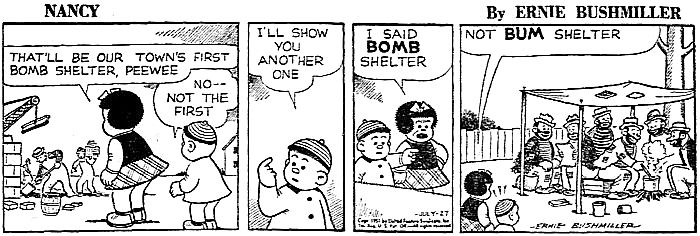
Backyard bomb shelters were necessary in Britain during World War II and saved countless lives during the almost nightly German air raids (I wrote about these shelters on another blog, here), but it was a new concept to post-war America. It wasn’t long, though, before bomb shelters became all the rage in the early ’50s as the Cold War heated up. If it’s becoming a common reference-point on the country’s funny-pages, it’s hit mainstream acceptance.

bomb-shelter_nancy-comic_072751“Nancy” by Ernie Bushmiller, July 27, 1951

I’m not sure how many people were building these shelters, but they were certainly talking about them. When Highland Park Village announced their new underground parking garage in 1953, owners Flippen-Prather made sure to note that the two subterranean parking levels (the lowest of which was 20 feet below street level) would not only accommodate 300 vehicles, but, if needed, it could serve as a bomb shelter for 3,500 very well-dressed Park Cities residents seeking refuge.

But what really caused the mania for nuclear fallout shelters to reach its zenith was the Bay of Pigs Invasion in April of 1961. In May, 1961, ground was broken for construction of the $180,000 Civil Defense Emergency Operating Center at Fair Park (the first such center in Texas), adjacent to the Health and Science Museum. The underground bunker was to serve as a government operating and communications center for Dallas County in the event of a nuclear attack or natural disaster. It would house about 30 people (which would include the mayor and other city officials) and would be stocked with provisions for 14 days. It had its own water supply, electric generators, radios, and telephones. It was built to withstand a 20-megaton nuclear blast three miles away (i.e. downtown, where, presumably, the mayor and other city officials would be working when the 20-megaton bomb lit up Big D). When not in use as a shelter, it was to be maintained by the Health and Science Museum staff, and operated as a center for survival training. For many years it was open to the public, seven days a week. (It’s worth noting that the Civil Defense headquarters in Dallas was also located in Fair Park, at the building housing radio station WRR.)

The man behind the everything-you-need-to-know-about-Civil-Defense website CivilDefenseMuseum.com did a really interesting video walk-through of the surprisingly large decommissioned (if that’s the correct word to use here) Fair Park shelter in 2013:

*

1961 was THE year if you wanted to get into the bomb-shelter business. There was even a three-day “Fallout Survival Show” at Market Hall. You couldn’t open the pages of a magazine or newspaper without seeing ads for personal bomb shelters.

Some of the ads were kind of cozy:

fallout-shelter-ad_sept-1961Sept., 1961

Some were not:

scot_fallout-shelter-ad_sept-1961Sept., 1961

Again, not all that many people were actually building them, but everyone was certainly talking about them. But in just a few short months … no one cared anymore. The ads disappeared. A lot of people who had been trying to sell them went broke. Those who survived (as it were) repurposed their products as “storm shelters” — turns out tornadoes were more of a pressing threat to Dallasites than Russian A-bombs.

Public shelters, however, didn’t disappear. In September, 1962, the very first public fallout shelter in Dallas was officially designated: the Southland Life Insurance Building could accommodate a staggering 30,000 people in the event of disaster. (The plan for this shelter was actually announced in 1954, and the Southland Center opened in 1959, but the official designation was not made until 1962.)

In 1966, Dallas had more than 300 official shelters, able to house 971,000 people:

…323 buildings in the city have been approved as shelters. The owners and managers of 204 of them have entered into agreements with the federal government and with the city to permit their use in emergencies as public shelters…. Shelters in Dallas can house 971,000 persons. Many of the buildings are permanently stocked with water, food supplies and medical supplies sufficient to sustain about 300,000 people for approximately two weeks. (“Maps at Fire Stations To Pinpoint Shelters,” Dallas Morning News, March 9, 1966)

Some of the permanent provisions kept in these places were water, food, “fortified crackers,” hard candy, bandages, iodine, and Geiger counters.

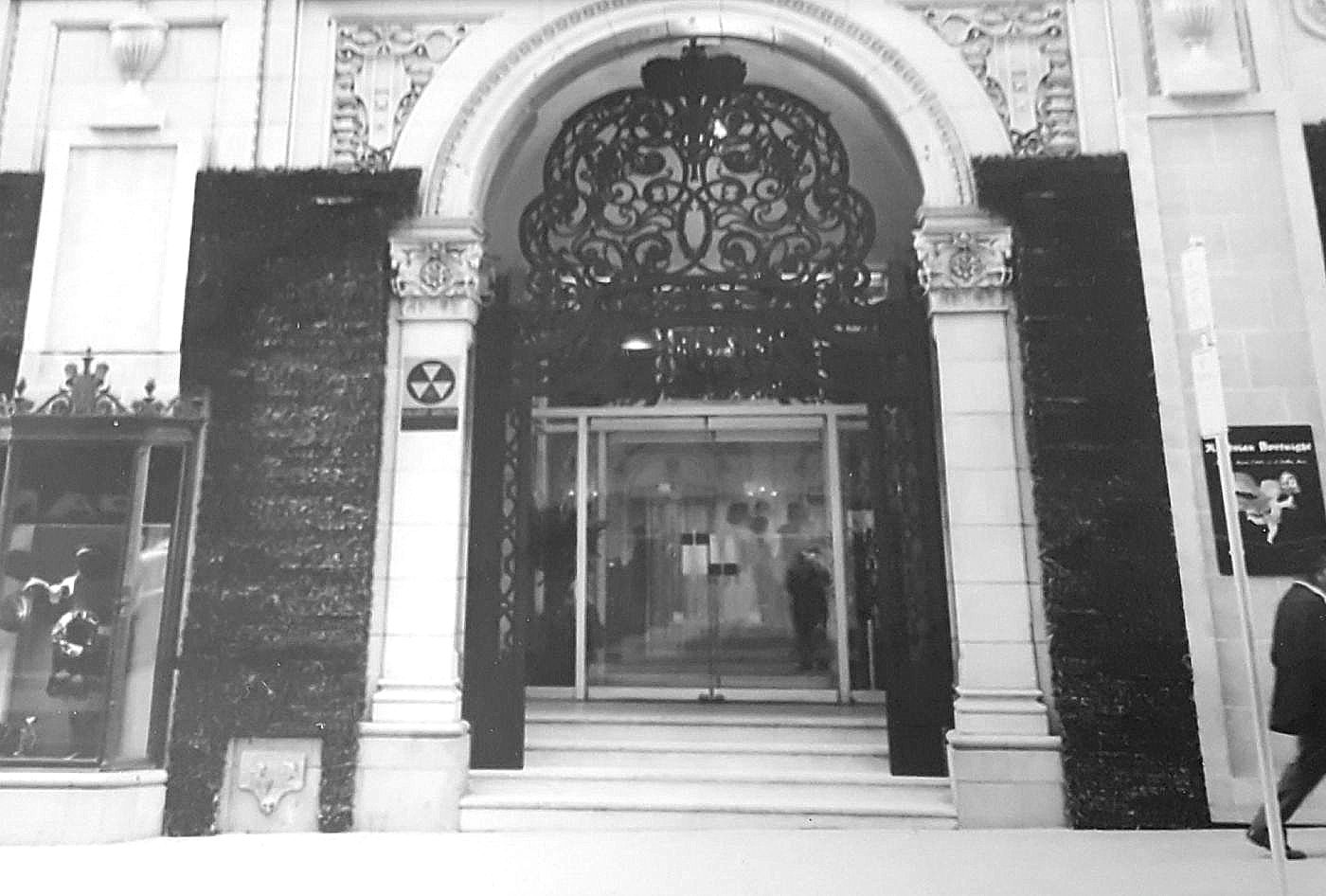
As one might expect, many of the city’s fallout shelters were in downtown buildings, their exteriors adorned with official Civil Defense signage. My favorite? Neiman-Marcus, of course, seen below in 1965, decorated for the Austrian Fortnight.

civil-defense_NM-austrian-fortnight_1965_degolyer_SMU_cropNeiman-Marcus, the most elegant bomb shelter in town…

If I were able to choose where to huddle during a nuclear attack, I think I’d choose Neiman’s. I’m sure Mr. Stanley made sure his basement was comfortable, tasteful, and well-appointed. …And one would have to expect he wouldn’t have had his guests living off hard candy and fortified crackers.

**

Below are images from the 1958 publication Passport to Survival (thanks to Jeff Hanning for his original scans, which precipitated this post) — all images are larger when clicked.

passport-to-survival_1958_covers

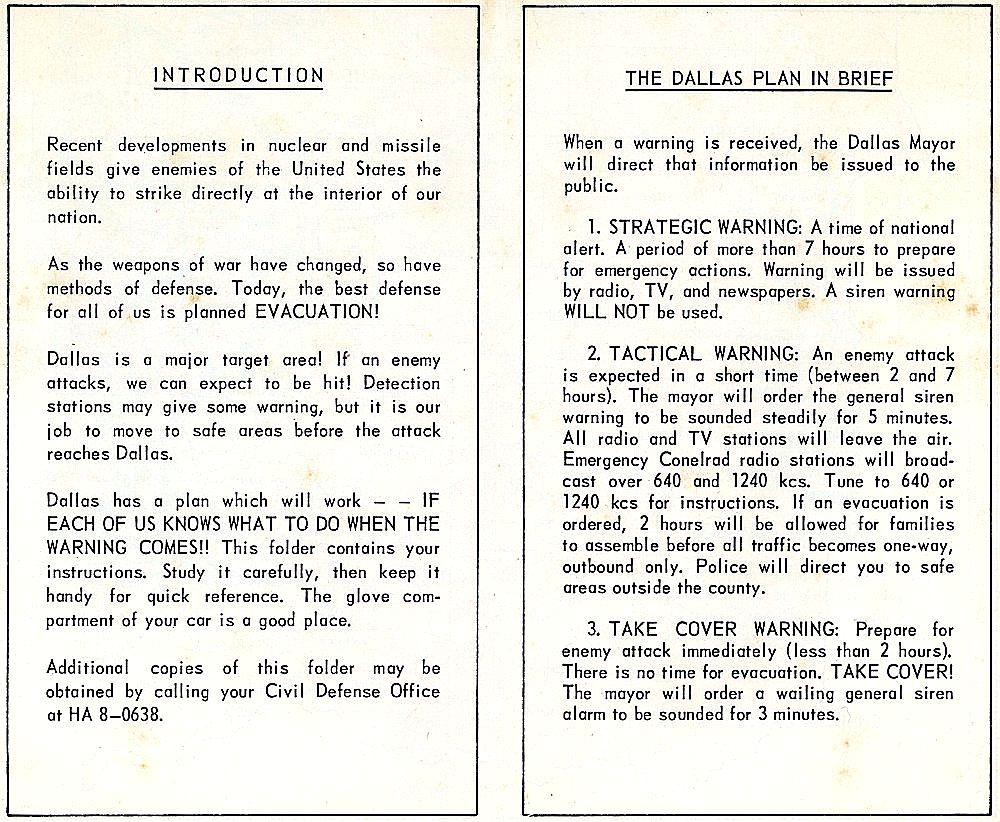
“Introduction” / “The Dallas Plan in Brief” (more information of CONELRAD is in this YouTube video):

civil-defense_passport-to-survival_intro

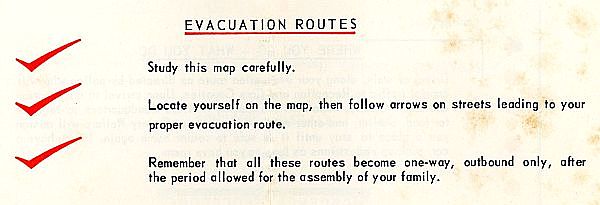
“Evacuation Routes.” (This plan did not sit well with the citizens of Grand Prairie as they were not included in the evacuation plans of either Dallas County or Tarrant County — this seems to have been a particularly odd oversight, seeing as Grand Prairie was a military aviation hub — home to Hensley Field and Chance Vought — and a likely target if DFW were attacked. As an editorial in the Grand Prairie Daily News-Texan stated somewhat bitterly: “Dallas seems to have it all sewed up.”) (Also interesting in these evacuation plans was that the county was divided into four divisions, the boundaries of which corresponded to school districts: District I covered the Dallas Independent School District, Division III covered the Highland Park Independent School District, District IV covered the “Negro Unit,” and District II covered every other school district in Dallas County not covered in the other divisions.)


civil-defense_passport-to-survival_evacuation-routes-map


civil-defense_passport-to-survival_evacuation-routes

“Reception & Care Counties For Dallas Area Traffic Dispersal Routes” (the person who owned this pamphlet was planning to hightail it to Bonham):


civil-defense_passport-to-survival_traffic-dispersal_map


civil-defense_passport-to-survival_reception-and-care-counties

“Emergency Procedures”:

civil-defense_passport-to-survival_warnings

“Emergency Supply Kit” (do NOT forget the can opener!) / “Taking Cover”:


civil-defense_passport-to-survival_preparation

***

Sources & Notes

Thanks again to Jeff Hanning for sending me scans of his Passport to Survival, Dallas County pamphlet.

The photo of Neiman-Marcus is from the DeGolyer Library at SMU. The above image is a really bad photo I took as a reference photo for a project I was working on at SMU last year. The actual photograph in the DeGolyer collection is, of course, much better! Apologies to the DeGolyer Library! I would link to the photo in SMU’s online database, but a scan of that particular photo is not available.

As mentioned above, if you’re interested in Civil Defense in Dallas, the CivilDefenseMuseum.com site is where you need to be. There’s TONS of stuff there. In addition to the great video walk-though of the old Fair Park shelter, there are also several pages of photos here (click through all the pages by following the links at the bottom of each page).

More on the history of United States Civil Defense, here.

And two stories from the Lakewood Advocate on Dallas’ Civil Defense shelters and preparedness can be found here and here.

A related Flashback Dallas post: “A-Bomb in Akard Street! — 1950,” with an eerie illustration of a smoldering downtown Dallas.

*

Copyright © 2018 Paula Bosse. All Rights Reserved.

The Prelude to the Great Flood of 1908

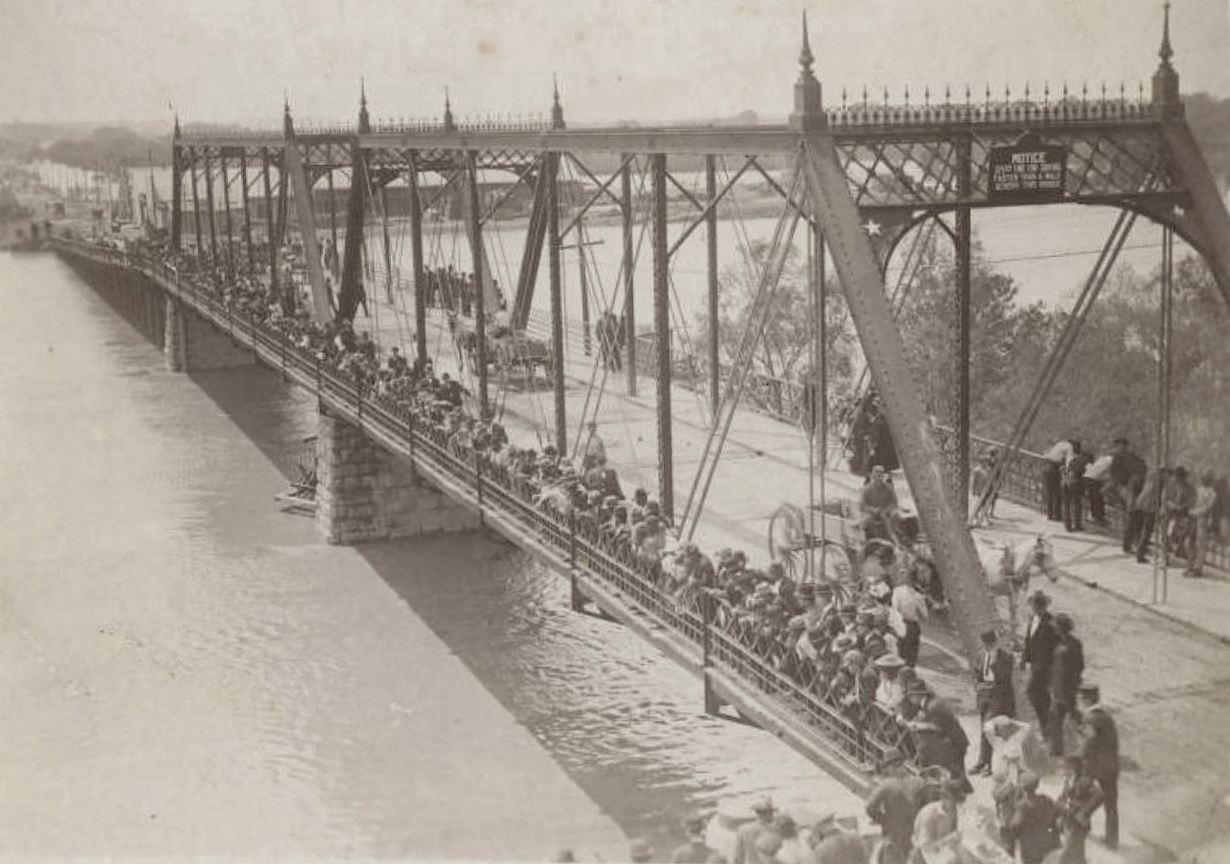
commerce-st-bridge_1908_cook-degolyerApril 20, 1908… (click for larger image) / SMU

by Paula Bosse

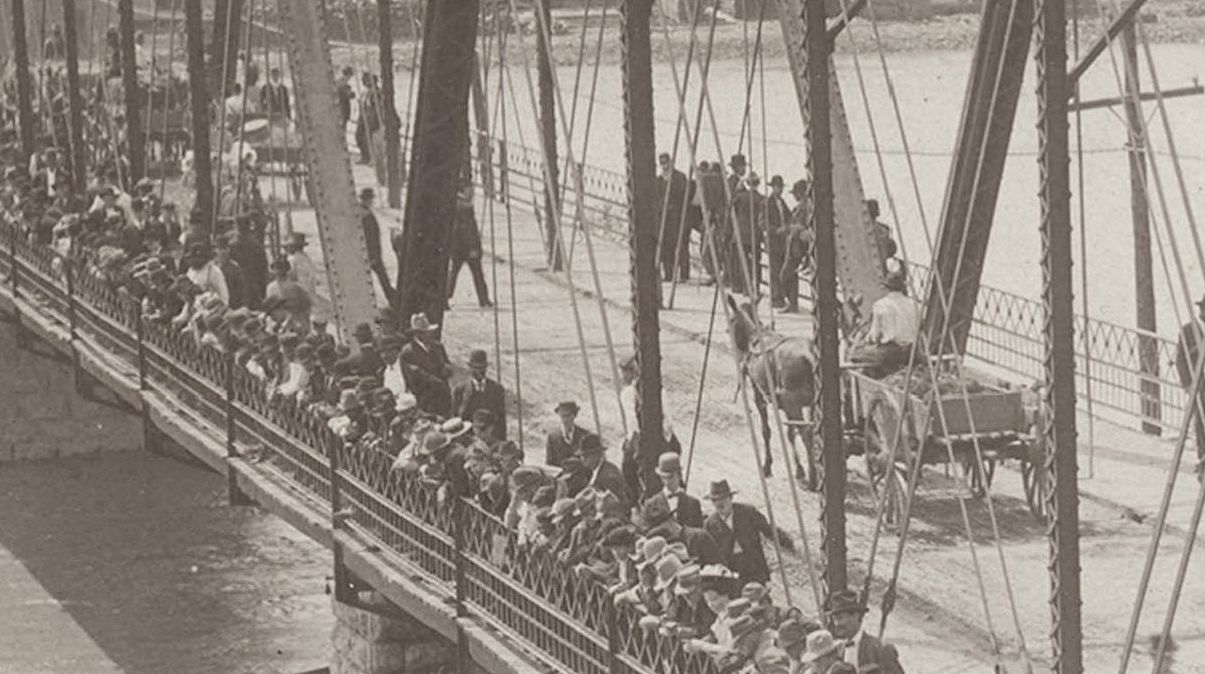
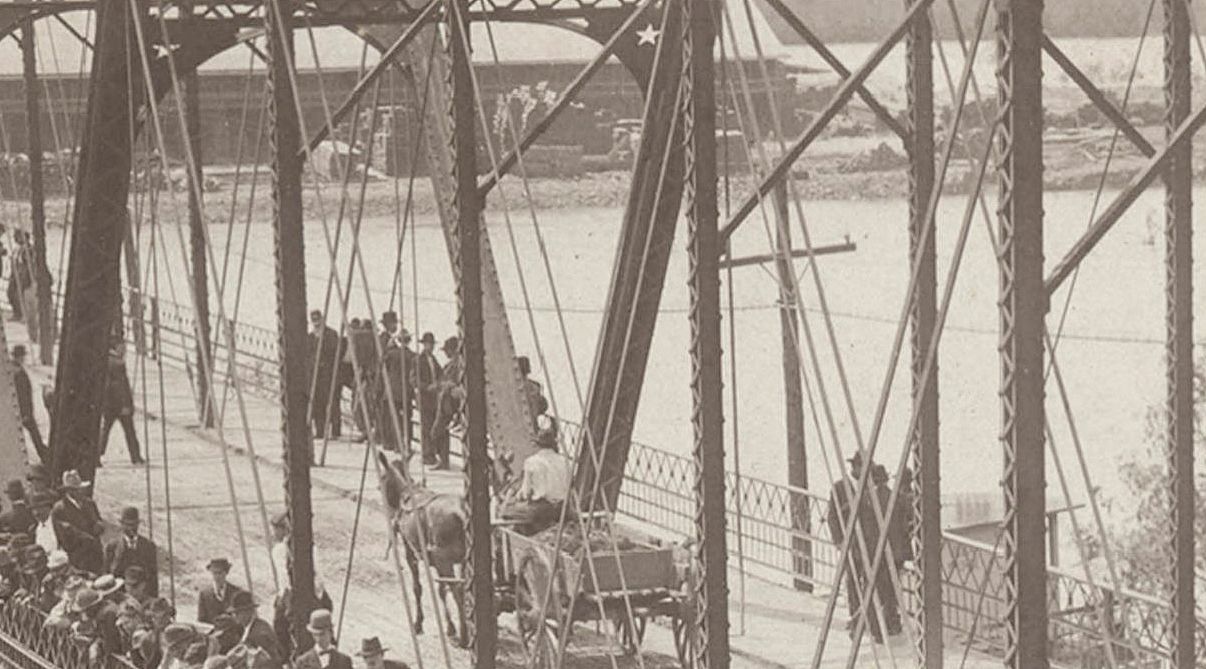
The greatest flood Dallas has ever known — the disastrous flood of 1908 (read about it here) — happened in the spring of 1908. The Trinity River reached its highest crest of more than 52 feet on May 26. The photo above was taken on April 20 — five weeks before that.

On April 20, 1908 — the day this photo was taken — The Dallas Morning News reported that after three weeks of rain the Trinity had finally crested at “nearly 39 feet.” This flooding was the worst in 20 years and the third worst on record.

In a mere five weeks, though, every record regarding the Trinity River and flooding in Dallas would be broken. Those people who had ventured out to survey the river from the Commerce Street Bridge that April day had no idea what was in store for them in just 35 days.

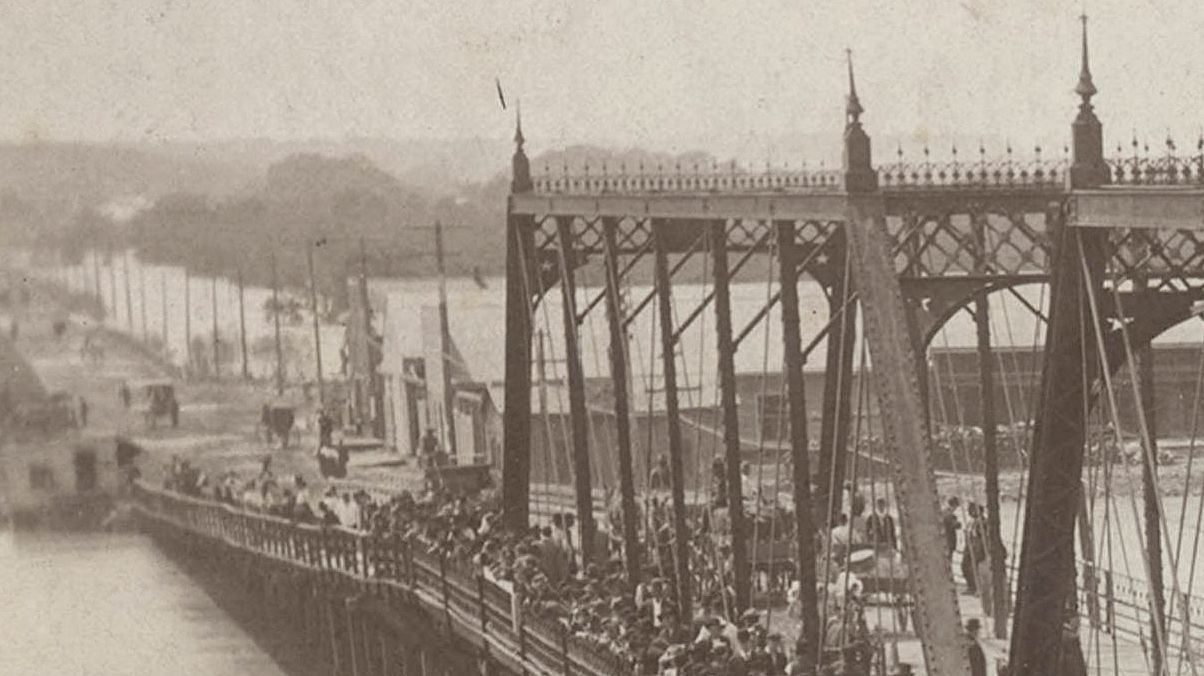
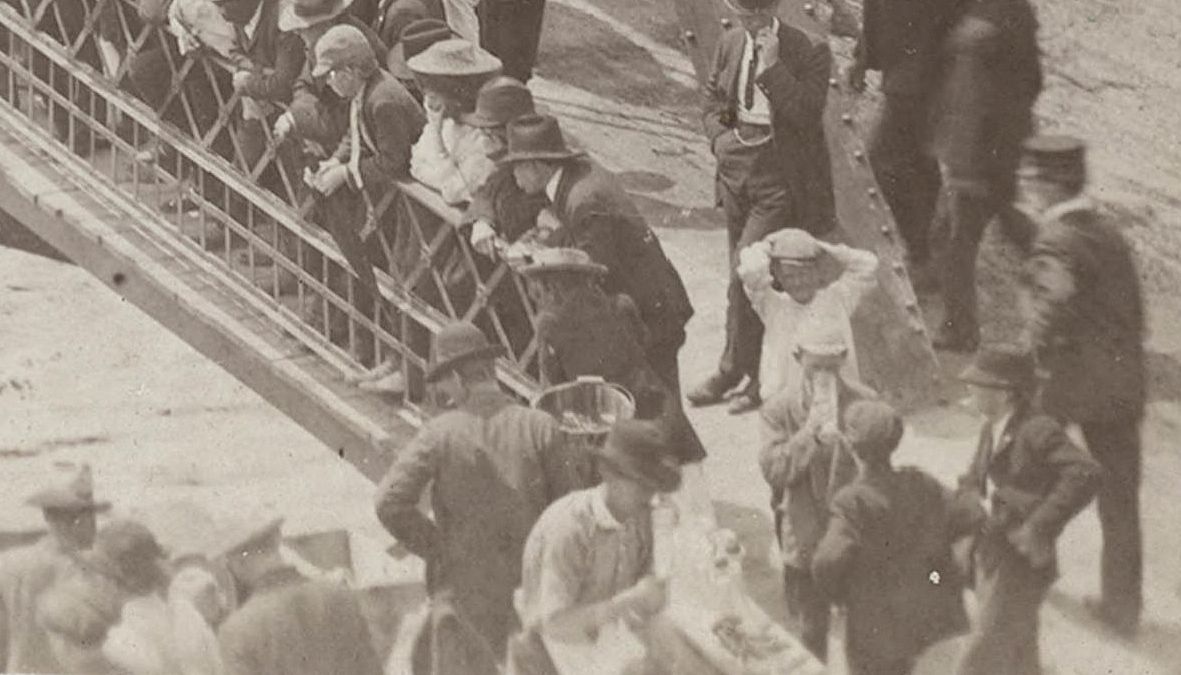
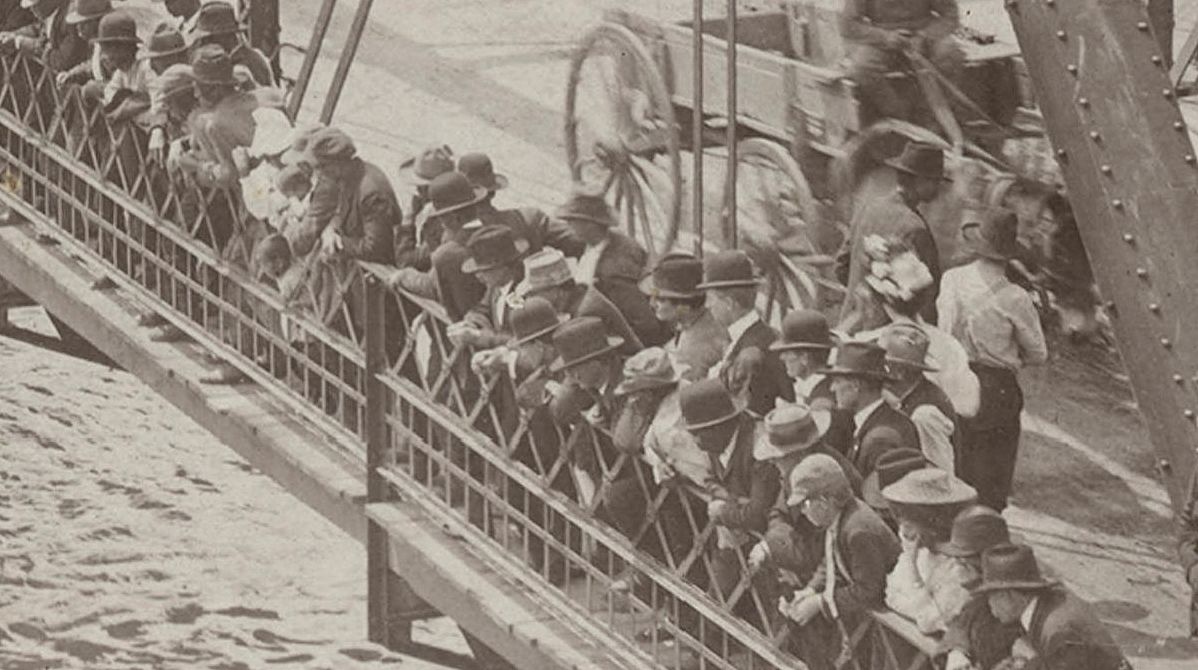
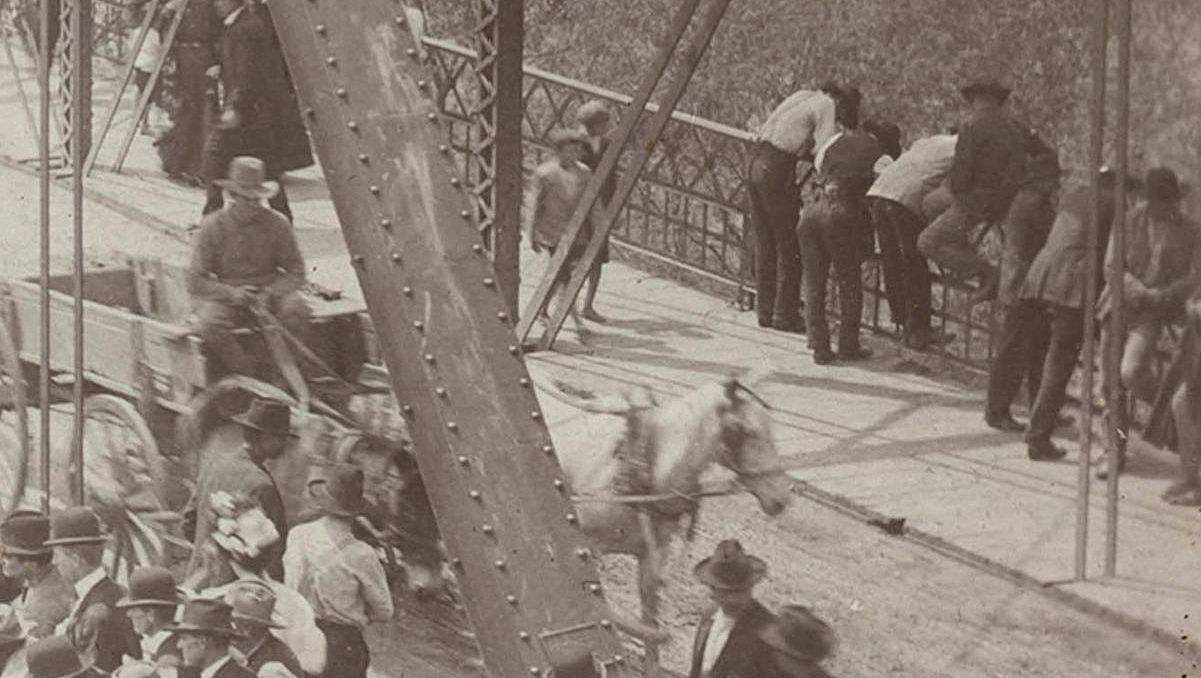
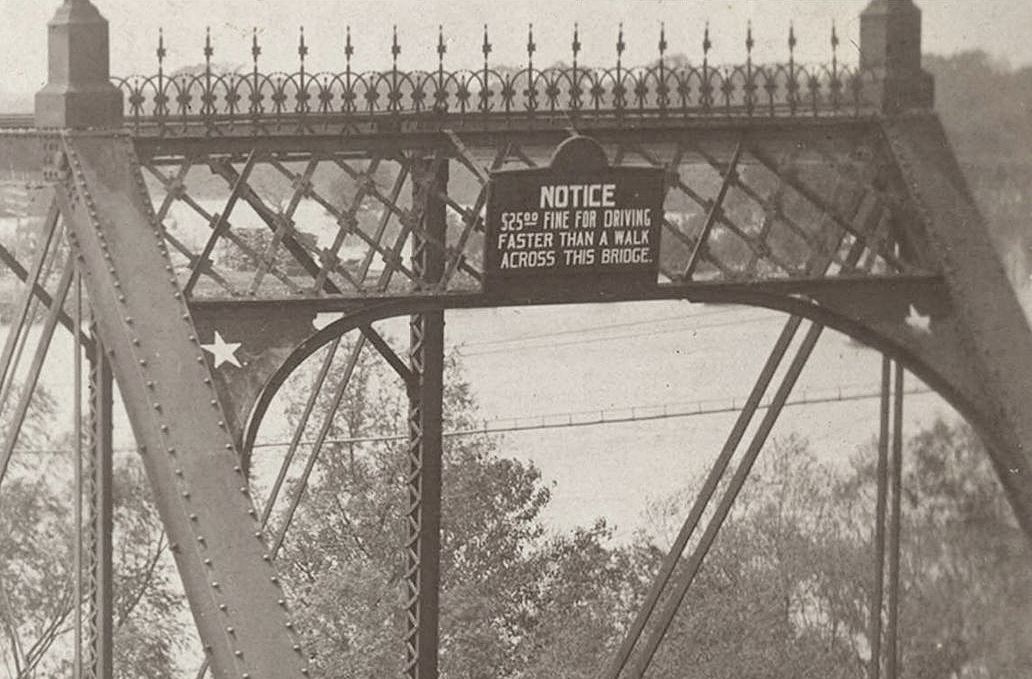
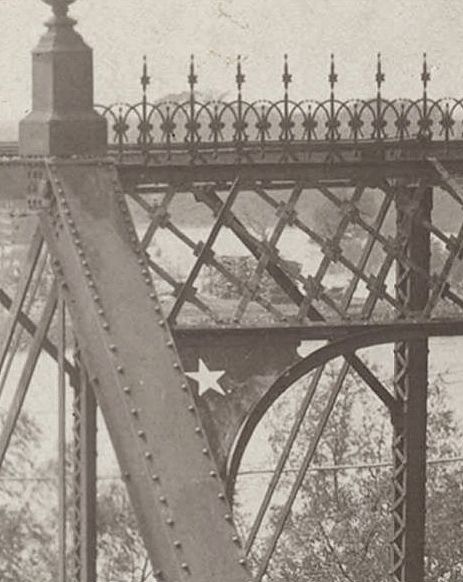
Let’s zoom in on this photo and look at some of the details of the crowd and the bridge (all images are larger when clicked).

commerce-st-bridge_1908_cook-degolyer-det1

commerce-st-bridge_1908_cook-degolyer-det2

commerce-st-bridge_1908_cook-degolyer-det3

Above: are refreshments being sold?

commerce-st-bridge_1908_cook-degolyer-det4

commerce-st-bridge_1908_cook-degolyer-det5

commerce-st-bridge_1908_cook-degolyer-det6

commerce-st-bridge_1908_cook-degolyer-det7

“NOTICE: $25.00 FINE FOR DRIVING FASTER THAN A WALK ACROSS THIS BRIDGE.”

commerce-st-bridge_1908_cook-degolyer-det8

**

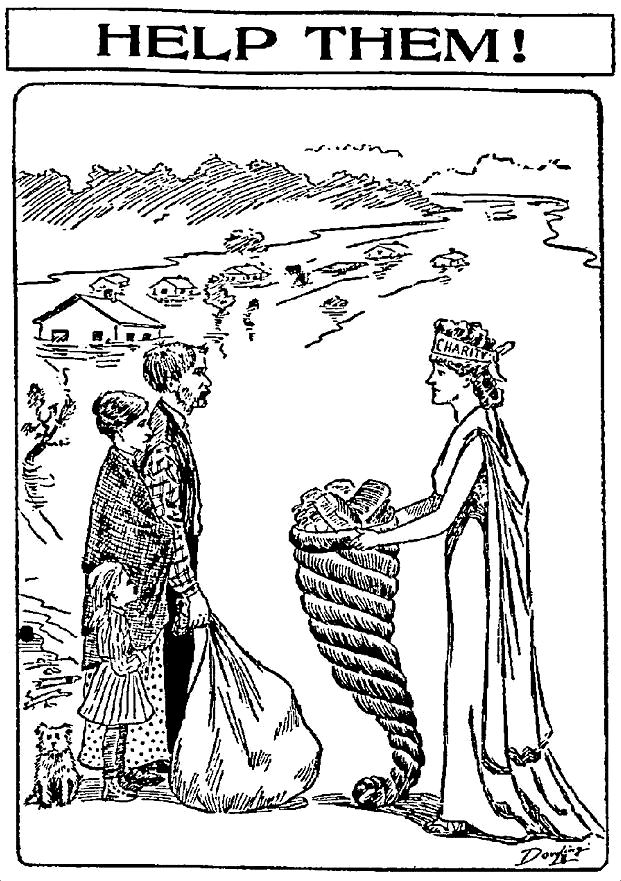
The editorial cartoon below appeared on the front page of The Fort Worth Telegram next to a story with the headline “Dallasites Flee Flooded Homes; River is Rising.”

flood_FWST_042008_help-them
FWT, April 20, 1908

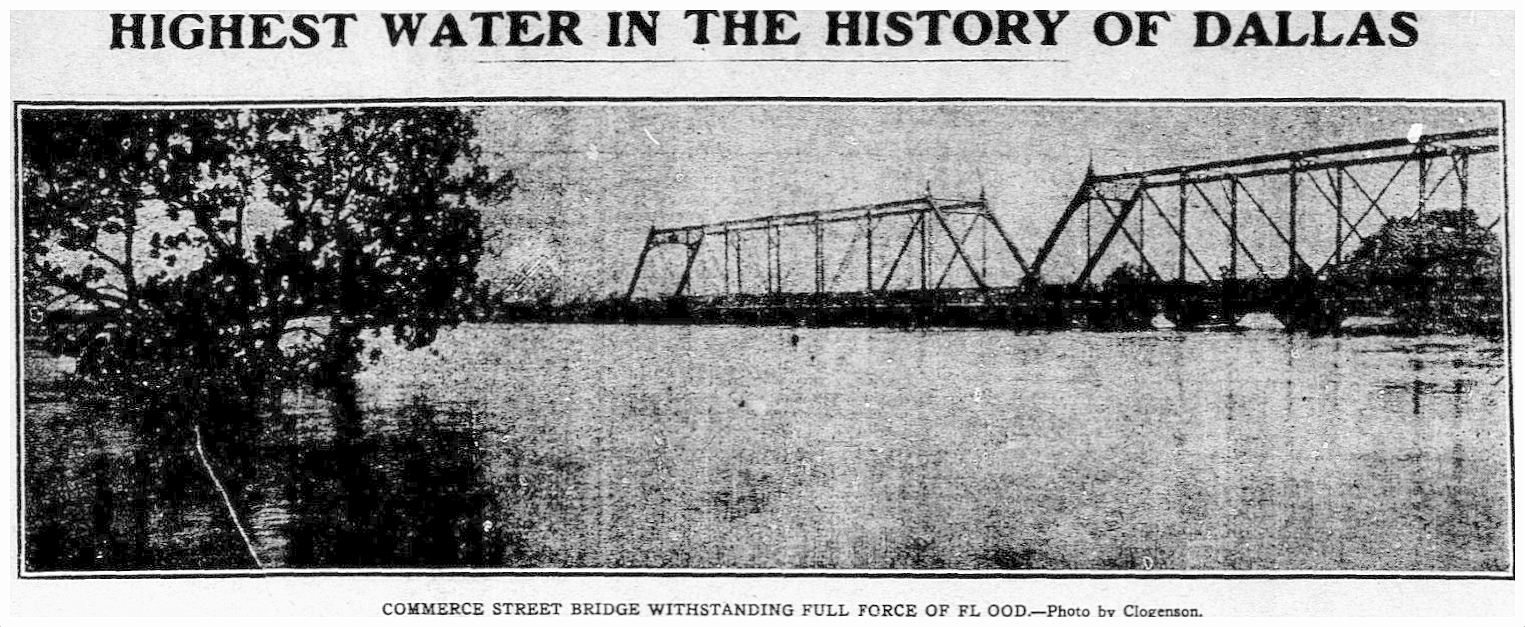
In May, this photo (by Henry Clogenson) showing “Highest Water in the History of Dallas” appeared in The Dallas Morning News:

flood_dmn_052608_clogenson_commerce-st-bridge
DMN, May 26, 1908

Another photo by Clogenson:

trinity-river_flood_1908_LOC-lg

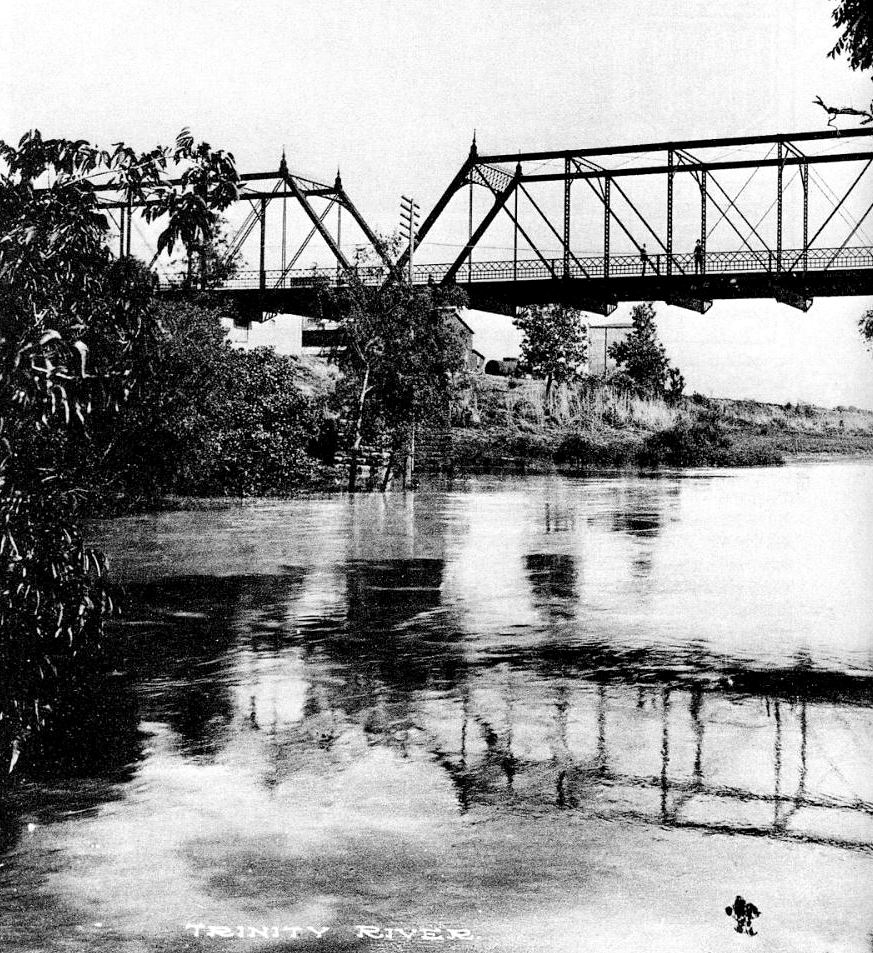
For comparison, here’s the bridge at a calmer time:

commerce-street-bridge_legacies_fall-1995

Flood memorabilia? Check out the book and stationery department at Sanger Bros.

flood_postcard-sales_dmn_060408_sangers-ad-detJune, 1908

***

Sources & Notes

Top photo titled “Commerce St. Bridge, Trinity River, Dallas, Tex., April 20, 1908” from the George W. Cook Dallas/Texas Image Collection, DeGolyer Library, Central University Libraries, Southern Methodist University; the photo and more information can be accessed here.

The wide-angle photo of the Commerce Street Bridge, taken by Henry Clogenson, is from the Library of Congress, here.

“Calmer” photo of the Commerce Street Bridge is from the Fall, 1995 issue of Legacies, from the article “Bridges Over the Trinity” by Mary Ellen Holt.

Read the Dallas Morning News article “Trinity Flood Crest Has Reached Dallas … Great Damage is Reported” (DMN, April 20, 1908) here.

*

Copyright © 2018 Paula Bosse. All Rights Reserved.