Flashback : Dallas

A Miscellany: History, Ads, Pop Culture

Category: Education/Schools

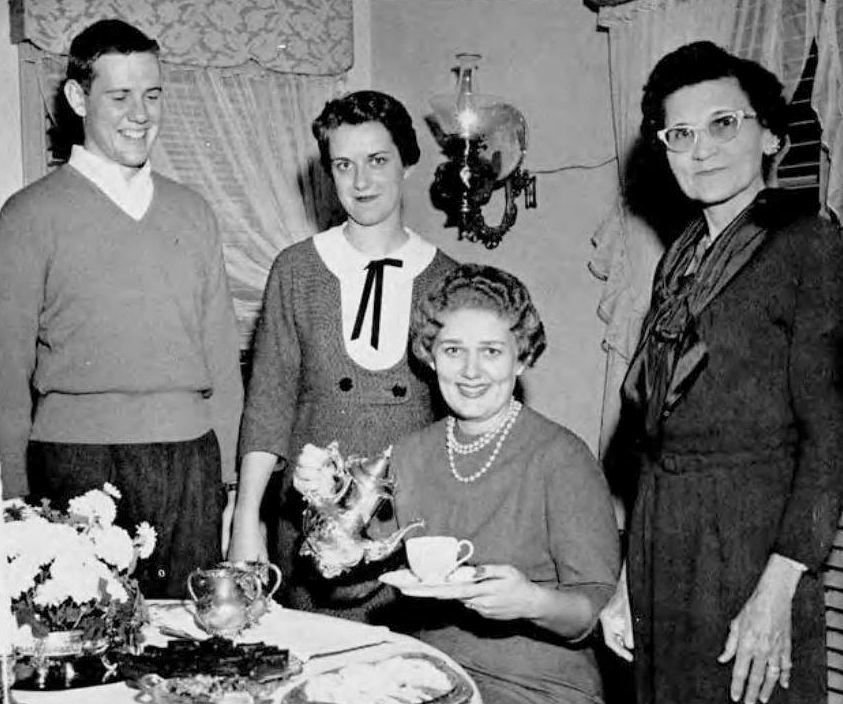
Happy Flag Day from the Girls of Miss Hockaday’s School — 1957

flag_hockaday-yrbk_1957On flag detail in lovely Vickery Place (click for larger image)

by Paula Bosse

Today is Flag Day. This seems an appropriate day to post this photo of Hockaday girls on flag duty in 1957, a few short years before the prestigious school moved from this Lower Greenville campus which once occupied the entire block at the northwest corner of Belmont and Greenville to its present location in North Dallas.

***

Photograph from the 1957 Hockaday yearbook.

Click picture for larger image.

*

Copyright © 2016 Paula Bosse. All Rights Reserved.

The St. Joseph Orphanage — 1891

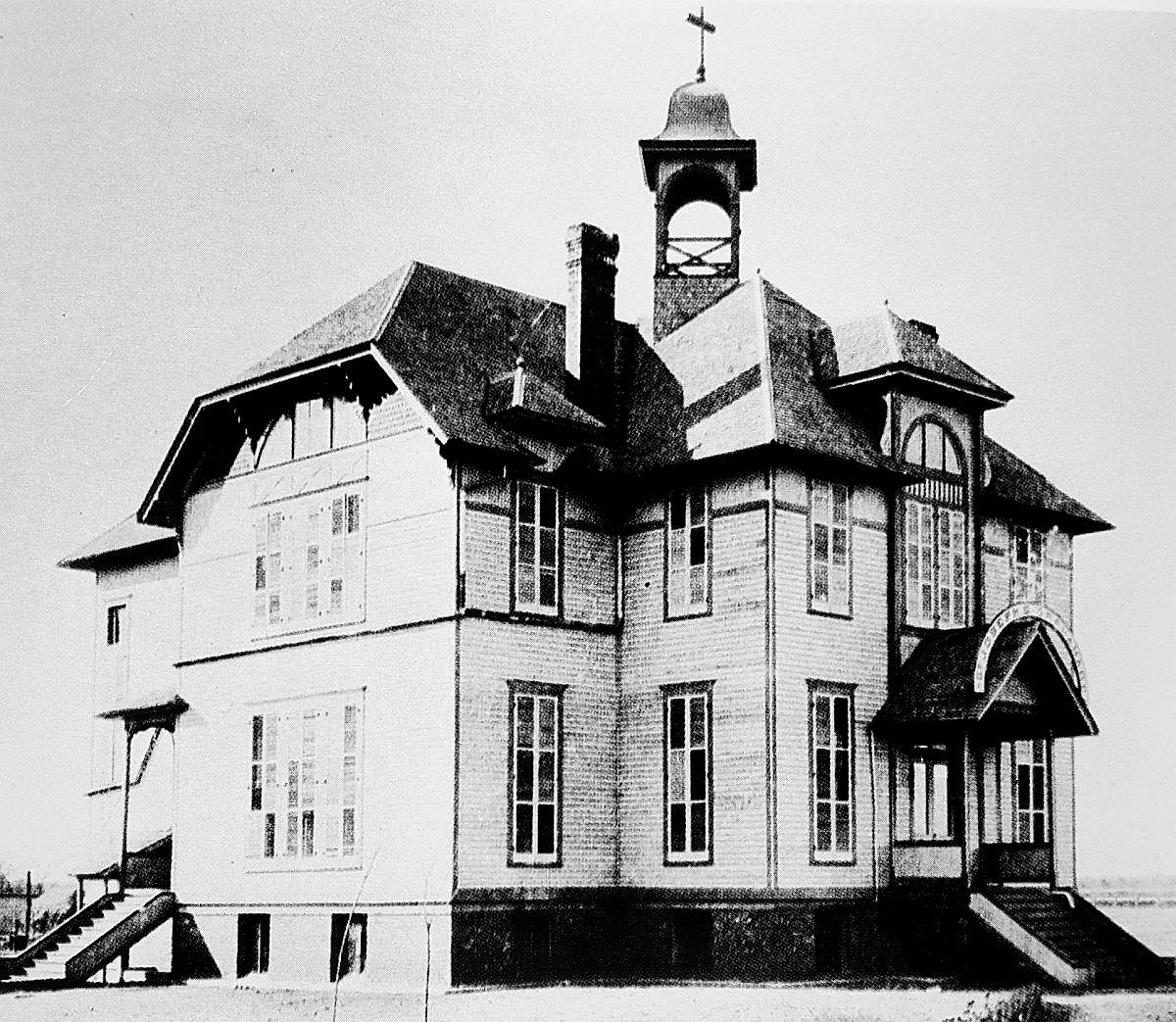
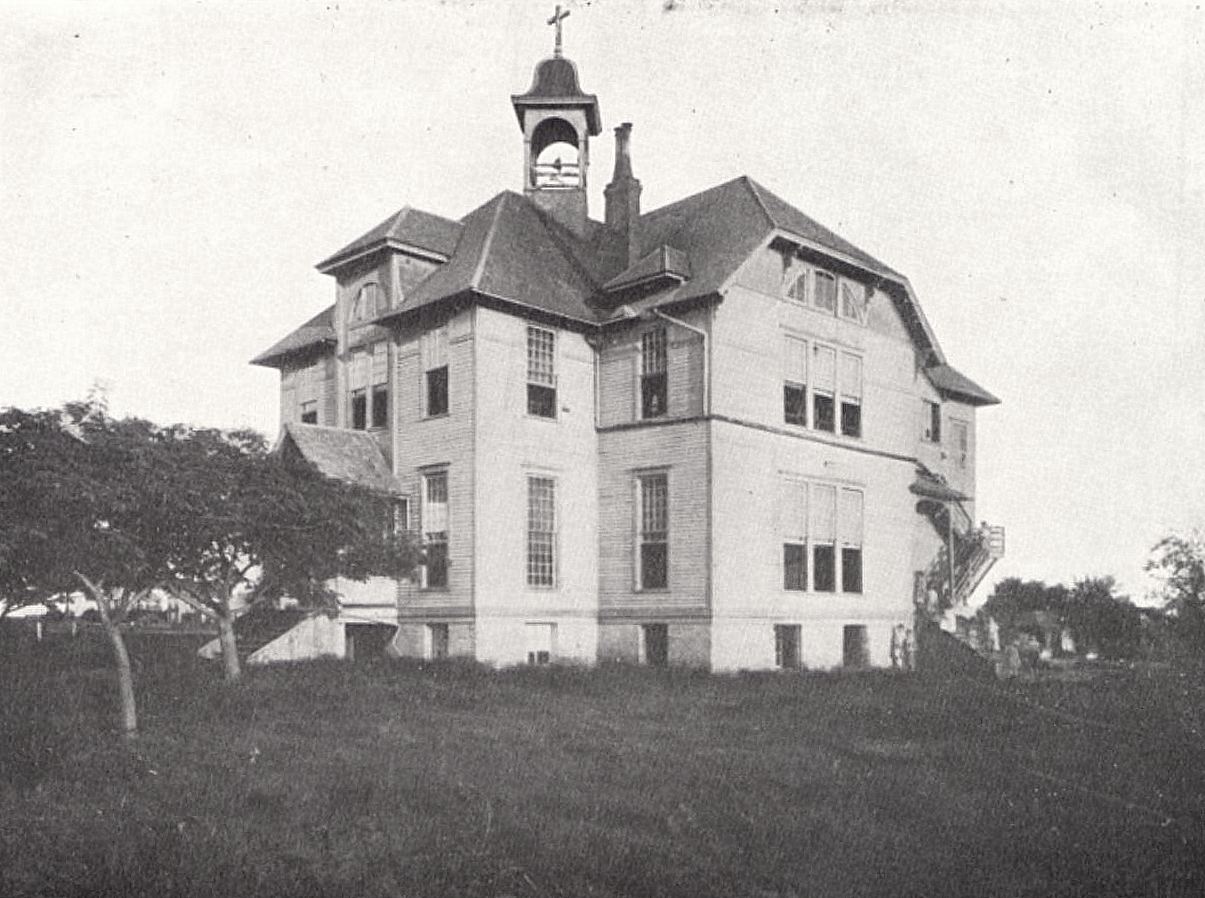
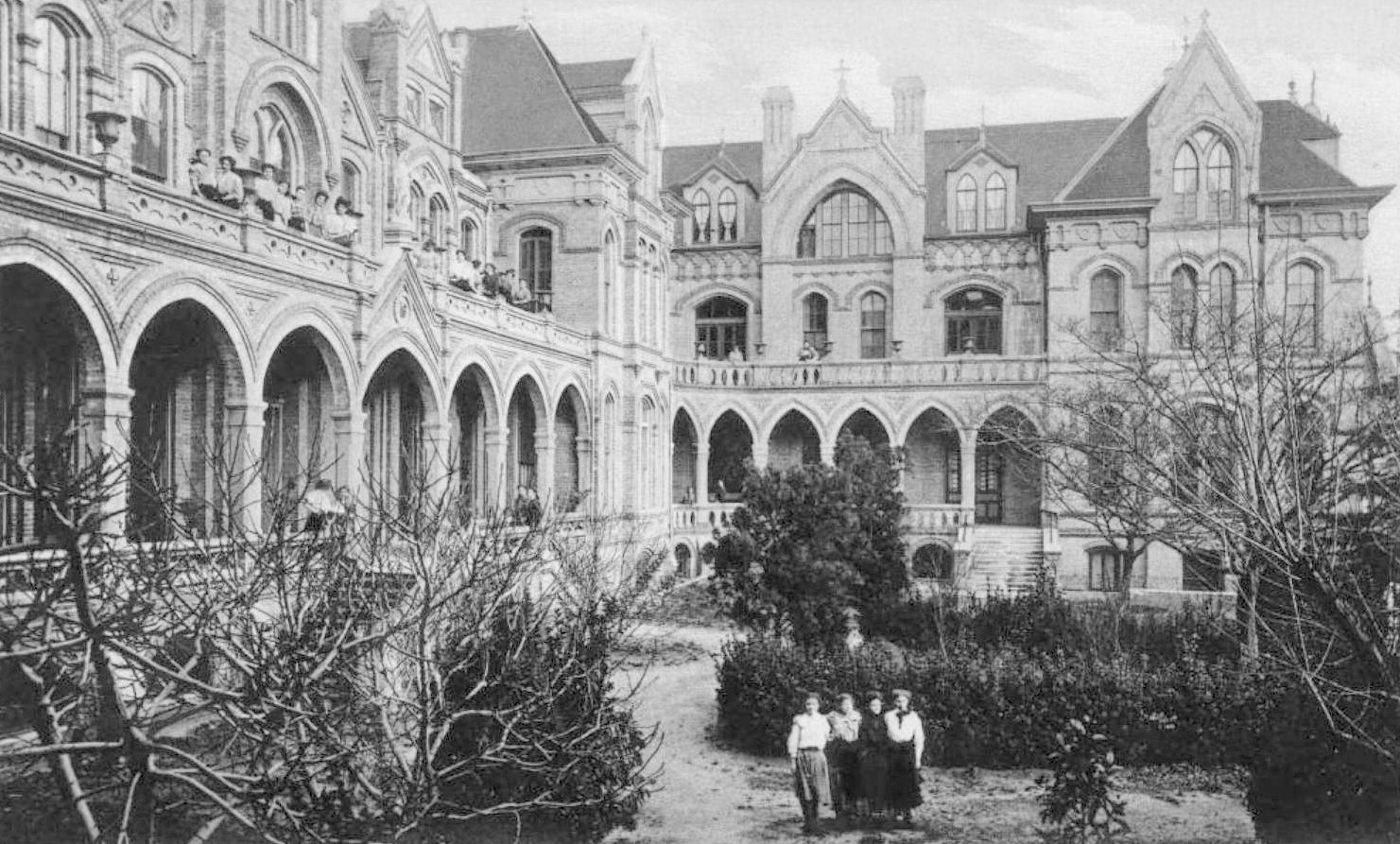
st-josephs-orphanage_dallas-rediscoveredThe new Oak Cliff orphanage, ca. 1891 (click for larger image)

by Paula Bosse

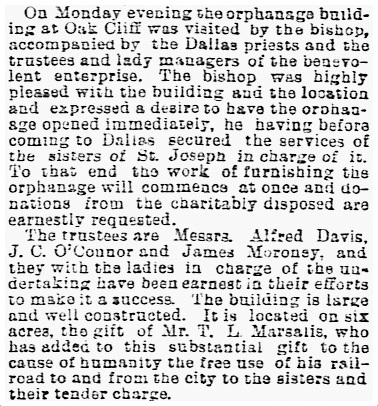
The St. Joseph orphanage was built in Oak Cliff in 1891 on 6-8 acres donated to the Catholic Diocese by Thomas Marsalis. The building was a large house, built and furnished with funds raised from local donations.

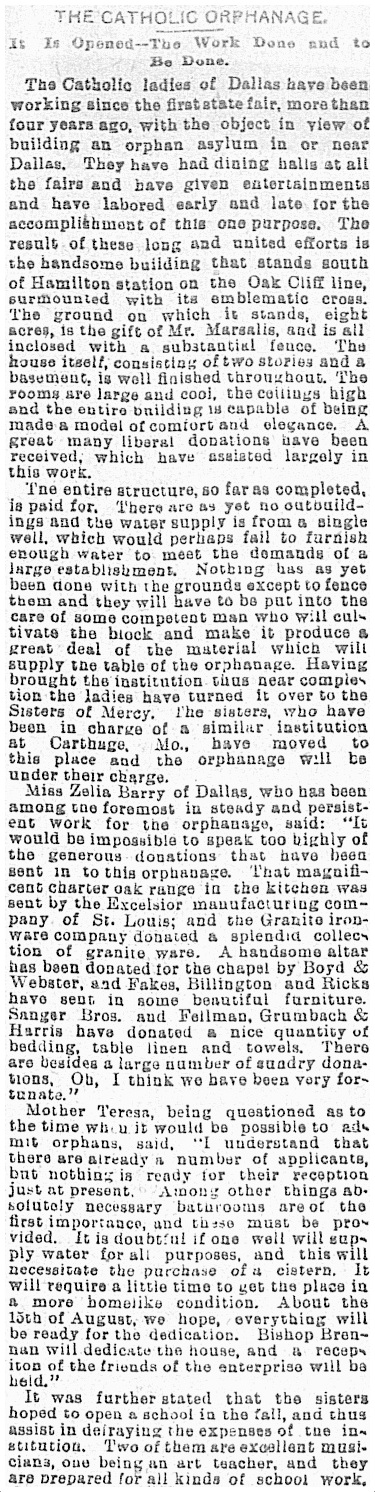
The house itself, consisting of two stories and a basement, is well finished throughout. Rooms are large and cool, the ceilings high and the entire building is capable of being made a model of comfort and elegance. A great many liberal donations have been received which have assisted largely in this work. (Dallas Morning News, July 16, 1891)

The orphanage was a Catholic institution — run at various times by the Sisters of St. Joseph, the Sisters of Mercy, the Sisters of Charity of St. Vincent de Paul, and the Sisters of Charity of the Incarnate Word — but it was “non-sectarian” in that the children or families in need were not required to be of the Catholic faith.

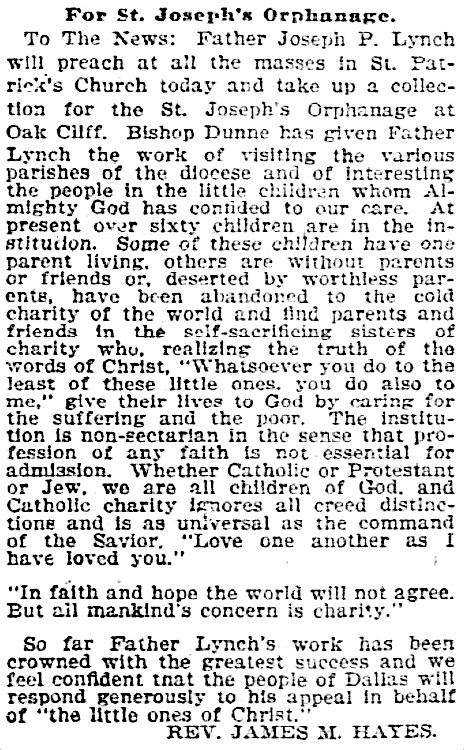
Some of these children have one parent living, others are without parents or friends or, deserted by worthless parents, have been abandoned to the cold charity of the world and find parents and friends in the self-sacrificing sisters of charity…. (DMN, Feb. 9, 1902)

st-josephs-orphanage_smu_ca1913-1919DeGolyer Library, SMU

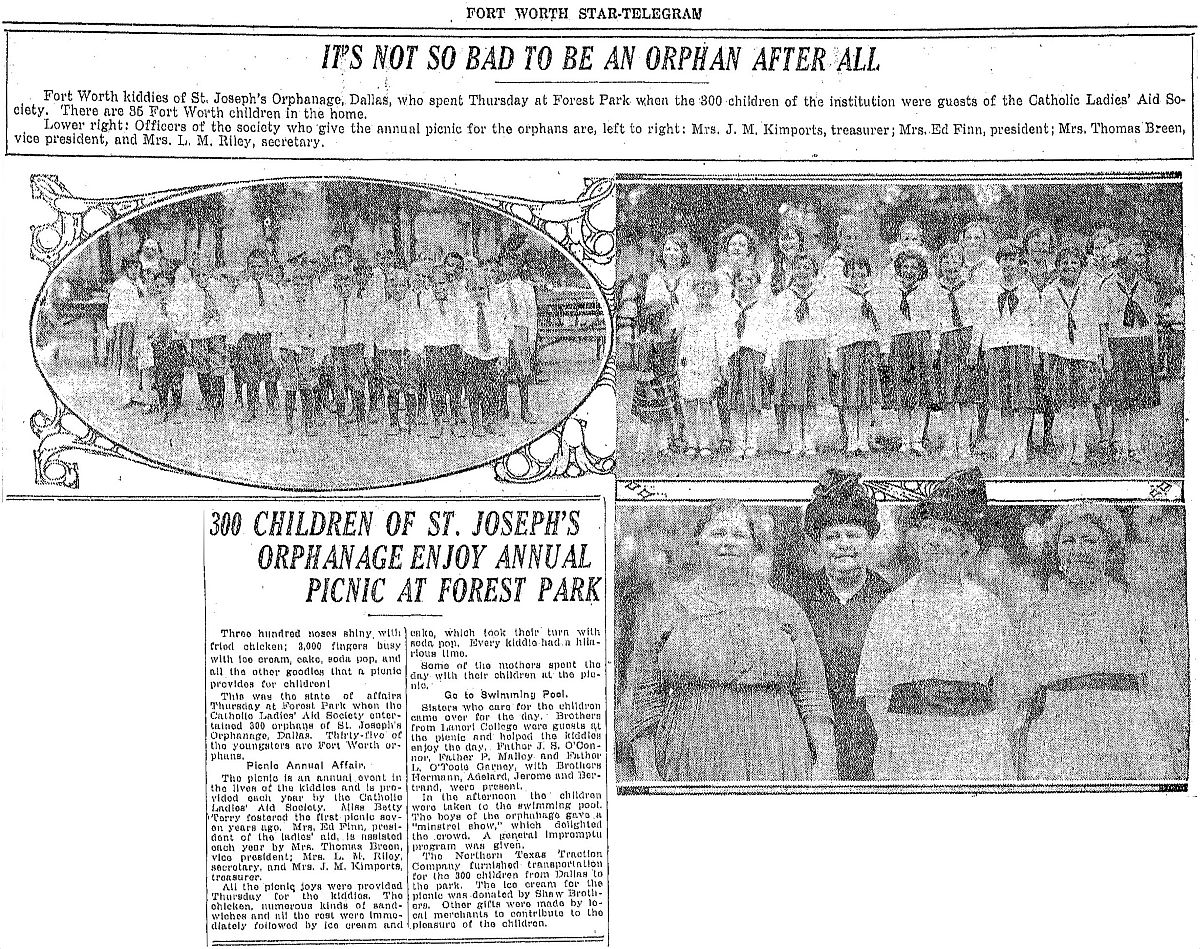
In the late ‘teens or early ’20s, the Catholic Ladies’ Aid Society of Fort Worth began an annual tradition of hosting a party for the children at Forest Park in Fort Worth. The 1923 picnic entertained 300 children. The Fort Worth Star-Telegram ran a story about the event under the unfortunate headline “It’s Not So Bad To Be An Orphan After All.” (Click article for a much larger image.)

st-josephs-orphanage_FWST_060123FWST, June 1, 1923

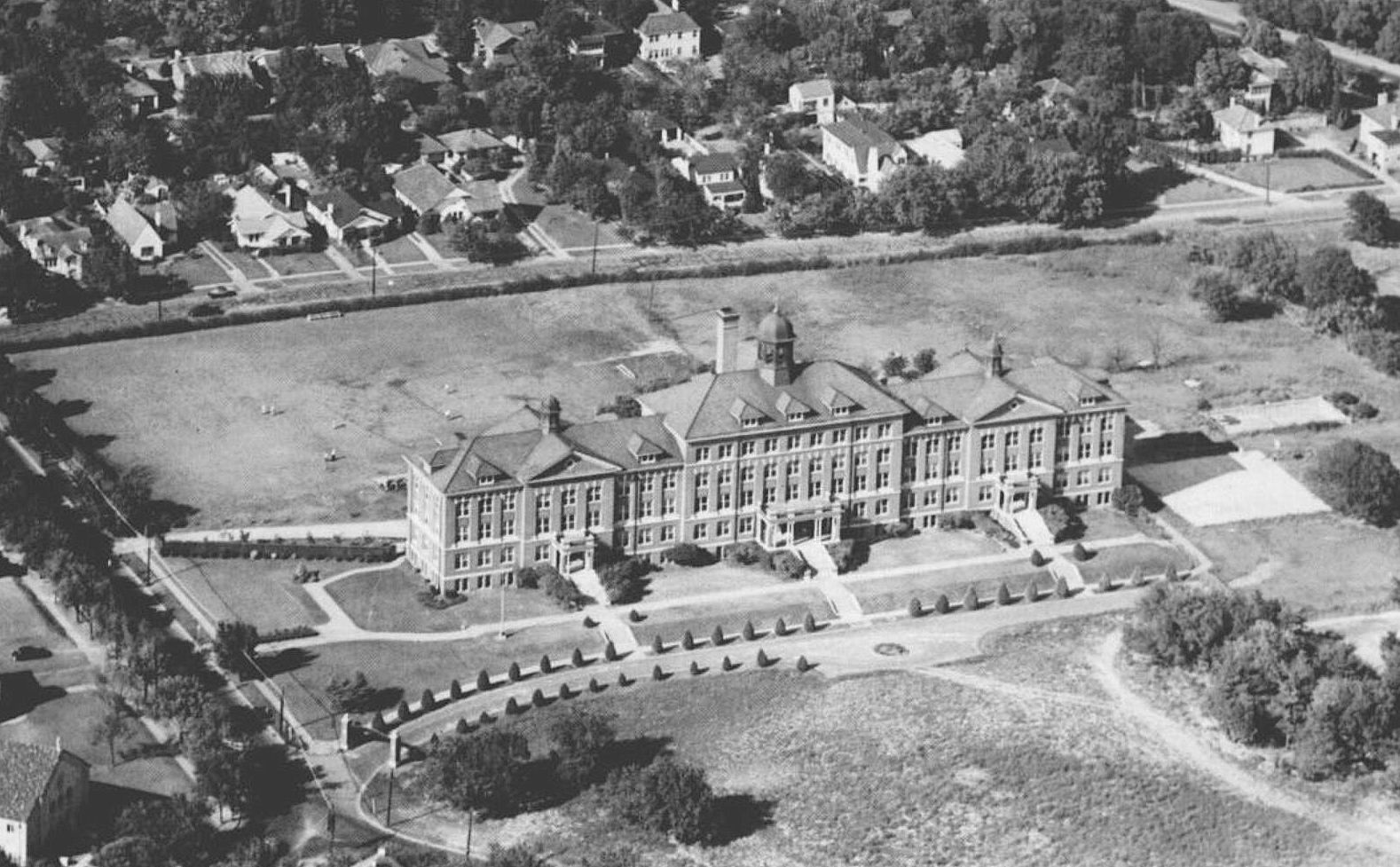
According to William L. McDonald in his book Dallas Rediscovered, “the orphanage was converted into a Carmelite convent and school in 1929 and demolished in 1945.” In December, 1930, the girls moved into their new (huge!) home in Oak Lawn (at Blackburn), in the old Dallas University building (later the Jesuit campus). The boys, I believe, moved to the Dunne Memorial Home. Here is a photo of the girls’ new home, which was taken over by Jesuit High School in 1941. (The impressive building originally built in 1906 was demolished in 1963.)

jesuit_legacies_fall-2005

**

st-josephs-orphanage_dmn_042991Dallas Morning News, April 29, 1891

st-josephs-orphanage_dmn_071691
DMN, July 16, 1891

orphanage_dmn_020902
DMN, Feb. 9, 1902

orphanage_dmn_113013-inudstrial-school-to-open
DMN, Nov. 30, 1913

st-josephs-orphanage_catholic-charities-of-dallas

***

Sources & Notes

Top photo from Dallas Rediscovered by William L. McDonald, is from the collection of the Dallas Public Library.

Photo titled “Children and Nuns, St. Joseph’s Orphanage, Dallas, Texas” was taken by Frank Rogers and is from the George W. Cook Dallas/Texas Image Collection, DeGolyer Library, Southern Methodist University; more information can be found here.

Photo of the old Dallas University/University of Dallas/Trinity University is from the article “Jesuit High School” by Liz Conrad Goedecke, which appeared in the Fall, 2005 issue of Legacies.

Bottom photo of St. Joseph’s Orphanage is from a PDF titled “A Brief Visual History of the Catholic Diocese of Dallas,” here (p. 19).

More on the original St. Joseph orphanage can be found here (scroll down to the 1902 article, “Charities of Dallas”).

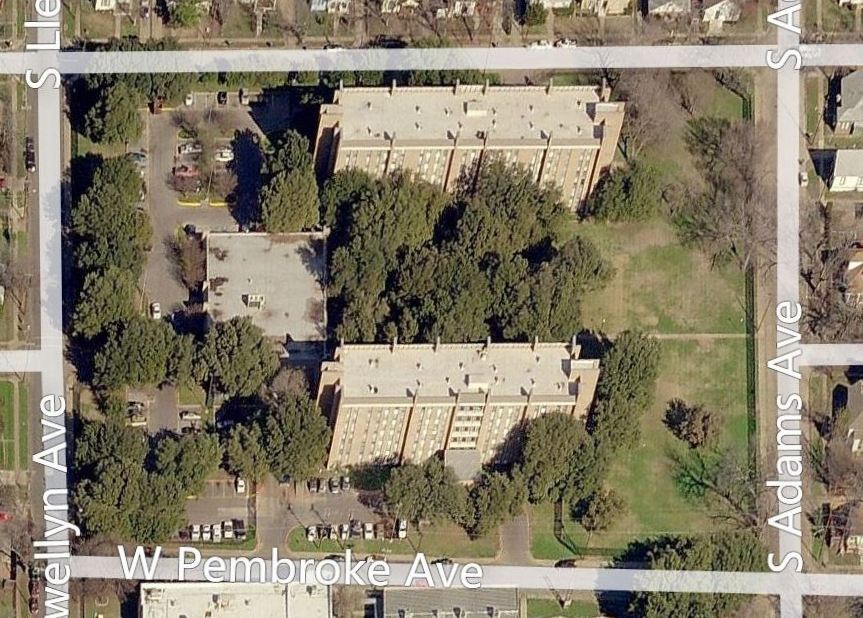
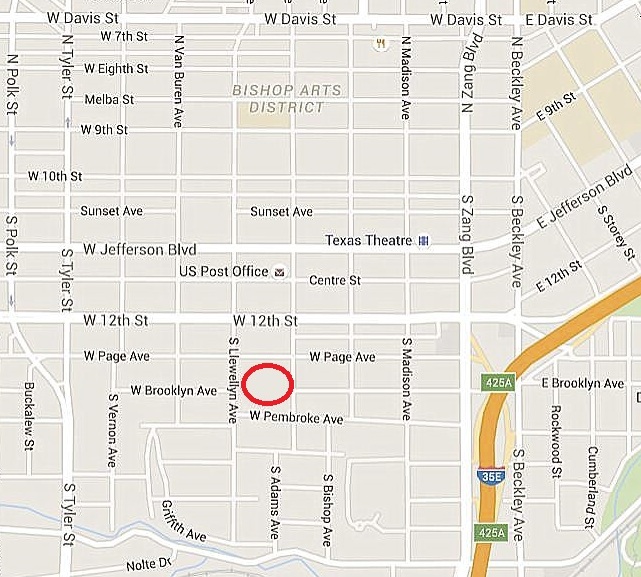
The original St. Joseph orphanage was at the southwest corner of West Page and South Adams, in Oak Cliff. See the 1922 Sanborn map, here. According to the Dallas Central Appraisal District website, the land is currently owned by the Dallas Housing Authority, which, as recently as 2014, had sought permission to build a new “home for the aged” on this property. The Bing Maps aerial view shows the Brooks Manor low-income housing project which had occupied this block for several decades before its recent demolition.

brooks-manor_bing

The Google Street view from Jan. 2016 shows an empty block.

orphanage_googleGoogle Maps

The original building at the top is not to be confused with the later St. Joseph home for girls (or the earlier Virginia K. Johnson home for unwed mothers), which was also on West Page, but a couple of blocks to the east. More on that can be found here. (It was at the Page and Madison, seen on the 1922 Sanborn map, here.) (Perhaps this was the campus the St. Joseph school moved to when Jesuit took over the campus in Oak Lawn in 1941?)

All photos and articles are larger when clicked.

*

Copyright © 2016 Paula Bosse. All Rights Reserved.


On the Grounds of the Ursuline Academy and Convent

ursuline-convent_cook-colln_degolyer_smuBetween classes… (click for much larger image)

by Paula Bosse

I love this photo of Ursuline girls at the fantastically ornate school and convent in Old East Dallas. See more photos of the school, convent, and grounds in my post “Nicholas J. Clayton’s Neo-Gothic Ursuline Academy,” here.

***

Sources & Notes

Photo by Clogenson, from a postcard in the George W. Cook Dallas/Texas Image Collection, DeGolyer Library, Central University Libraries, Southern Methodist University; it is accessible here. I have un-colorized it.

See the scale of the Ursuline property on a 1922 Sanborn map, here. It is now mostly a parking lot, across from the Dallas Theological Seminary; a sad 21st-century view of what the former campus property looks like is here.

*

Copyright © 2016 Paula Bosse. All Rights Reserved.


North Dallas High School, The Pre-Beatles Era

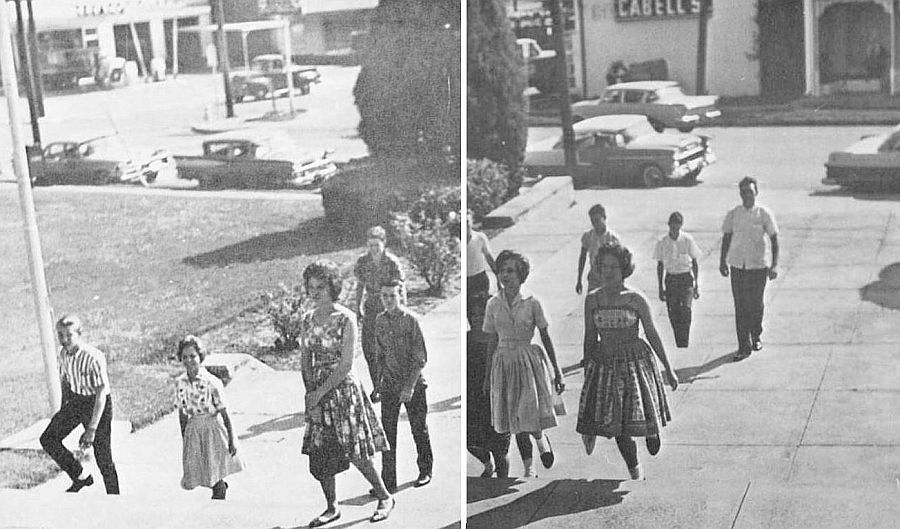
1962_before-school_ndhs_1962-yrbkBefore school, 1962 (click for larger image)

by Paula Bosse

Today, a few random photos from the 1960, 1962, and 1963 yearbooks of North Dallas High School.

The top photo (from 1962) is my favorite, because, had I not known what part of town this photo was taken in, I would never have guessed. I’m still not 100% sure, but I think this shows Cole Avenue running alongside NDHS. The Cole and Haskell Drug Store (Coke sign) was on the corner of … Cole and Haskell, but things have been so Uptown-ified that this area is now almost completely unrecognizable from even 20 years ago. At least the school and Cole Park remain (mostly) unchanged.

So, a few moments in the life of NDHS students in the days just before The Beatles and Vietnam. (All photos are larger when clicked.)

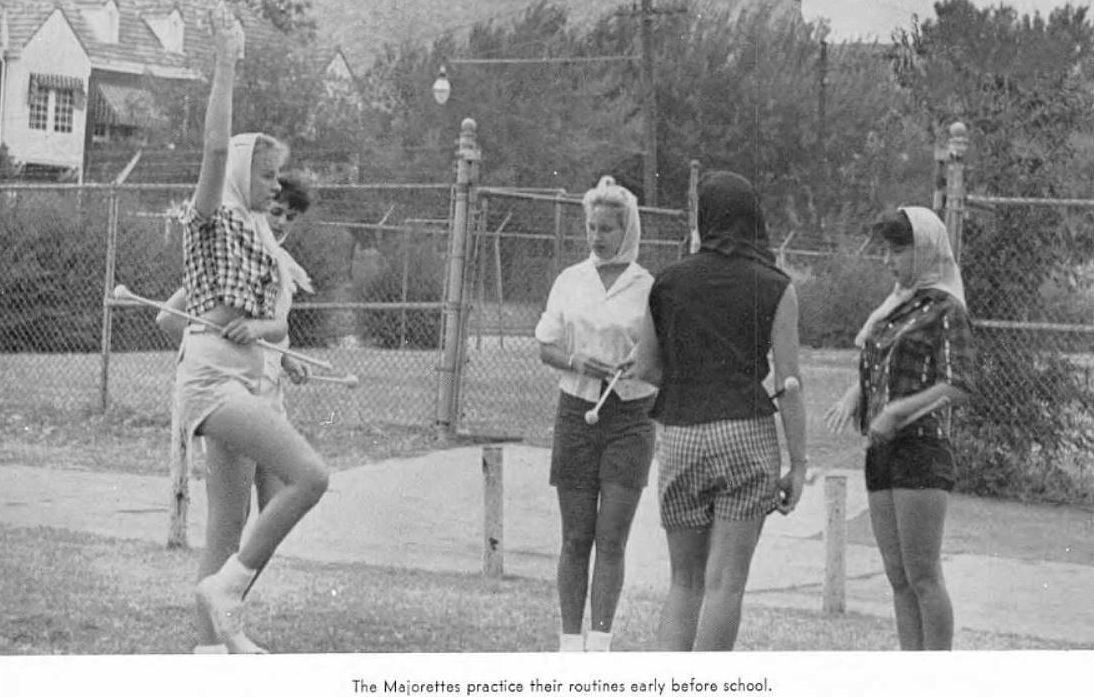
From 1960, majorettes practicing, with batons and headscarves — two things one doesn’t encounter often these days.

1960_majorettes_ndhs_1960-yrbk

*

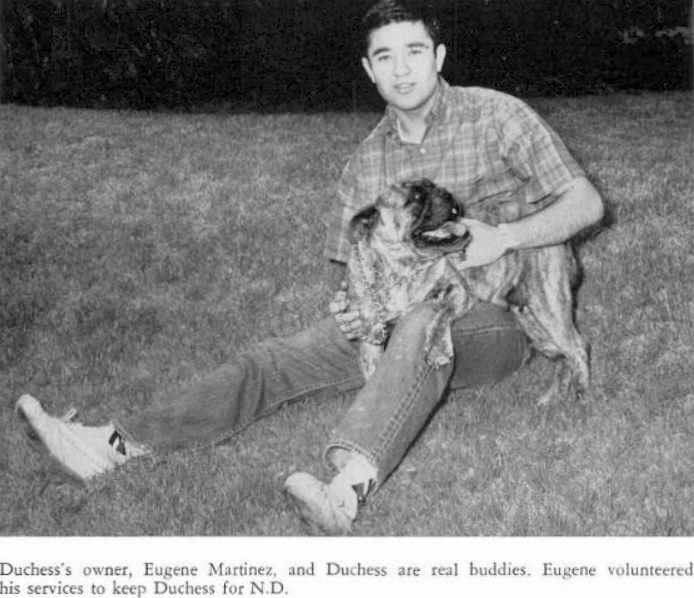
From 1962, cheerleader Gene Martinez with the school’s bulldog mascot, Duchess.

1962_duchess-the-mascot_ndhs_1962-yrbk-photo

*

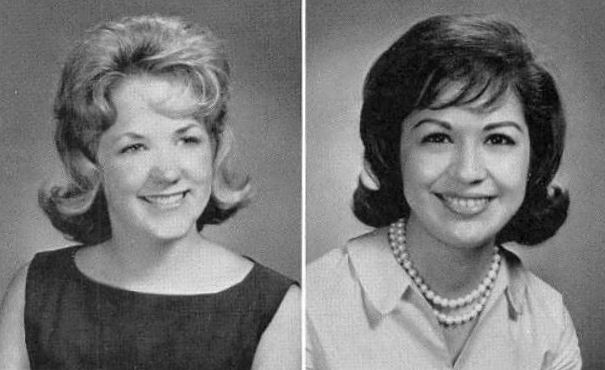
The rest of the photos are from 1963, when most of the girls had the Laura Petrie flip hairstyle. (Seen here are Suzy DeGaw and Olga Delgado.)

girls-hairdos_ndhs_1963-yrbk

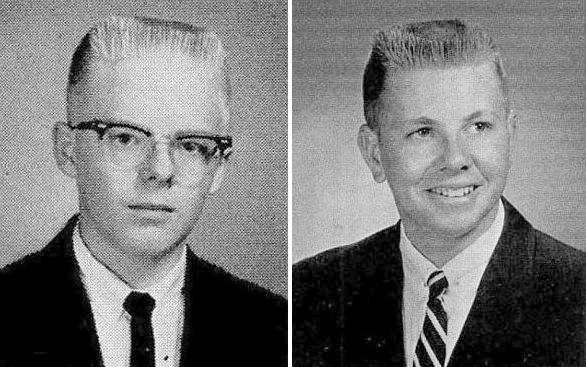
As far as the boys, an alarming number of them sported haircuts like the ones below (although these two seem to be a bit on the extreme side — most were shorter) — it’s a sort of early-’60s version of the ’80s’ Flock of Seagulls hair-do where you look back on it and shake your head in wonderment. I’m not exactly sure what “butch wax” is for, but I’m thinking it’s for this. (Pictured here are Jody Chenoweth and Robert Paul Reid.)

boys-hair_ndhs_1963-yrbk

Girls “gabbed.”

gab-session_ndhs_1963-yrbk

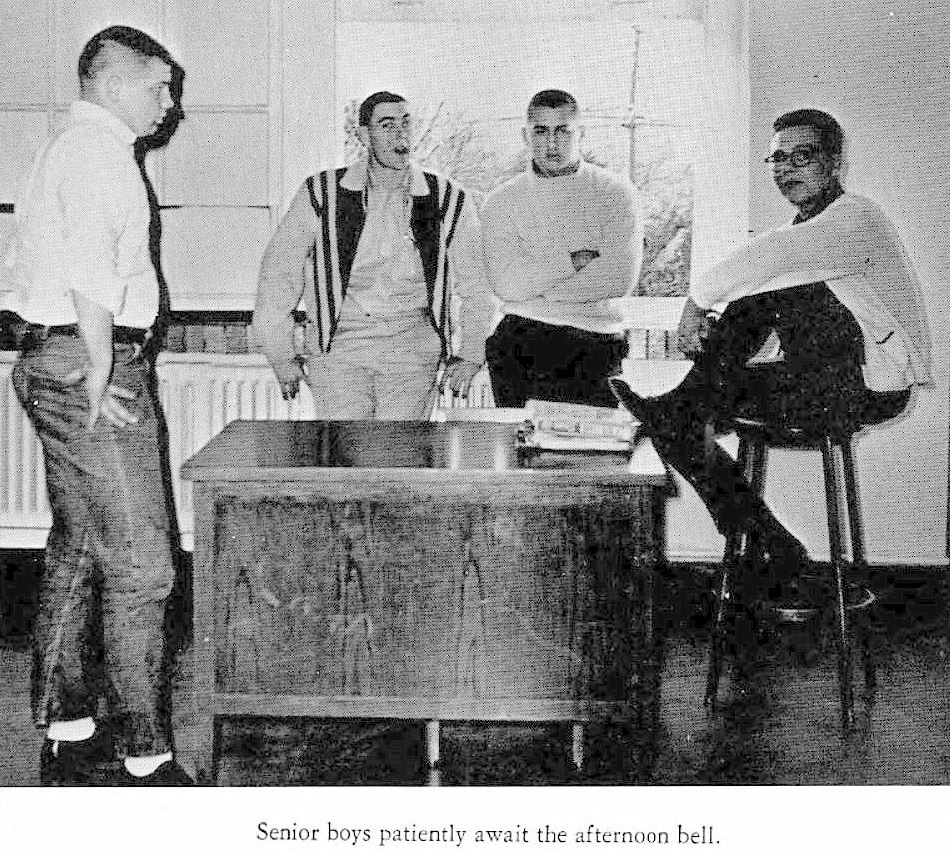
Boys loitered.

senior-boys_ndhs_1963-yrbk

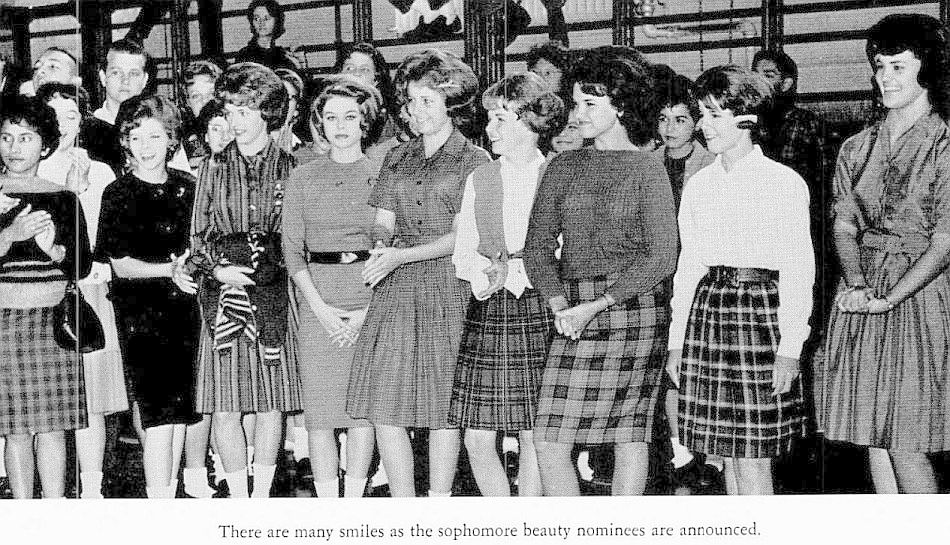
Girls had beauty pageants (and wore a lot of plaid).

sophomore-girls_ndhs_1963-yrbk

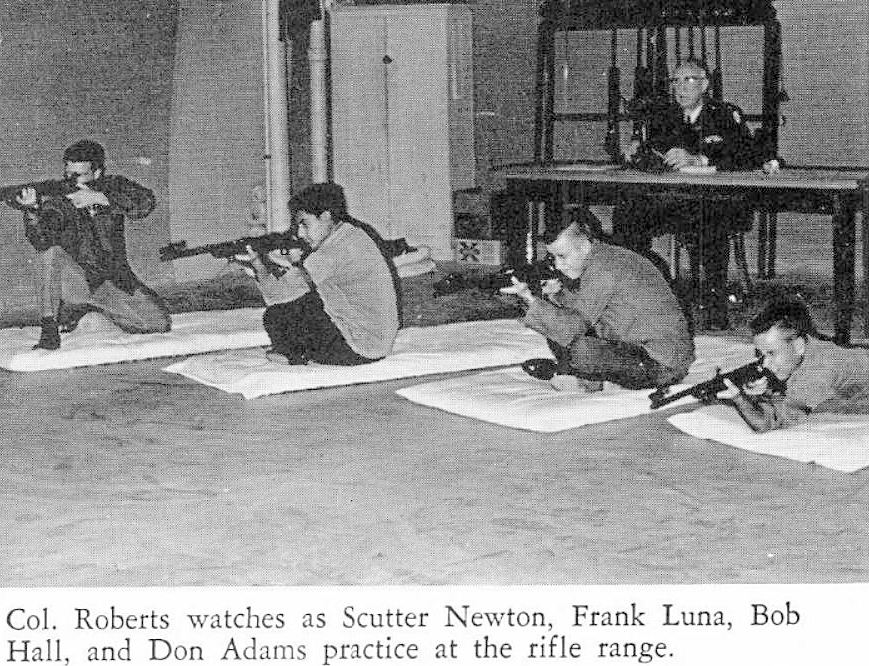
And boys practiced shooting.

rifle-range_ndhs_1963=yrbk

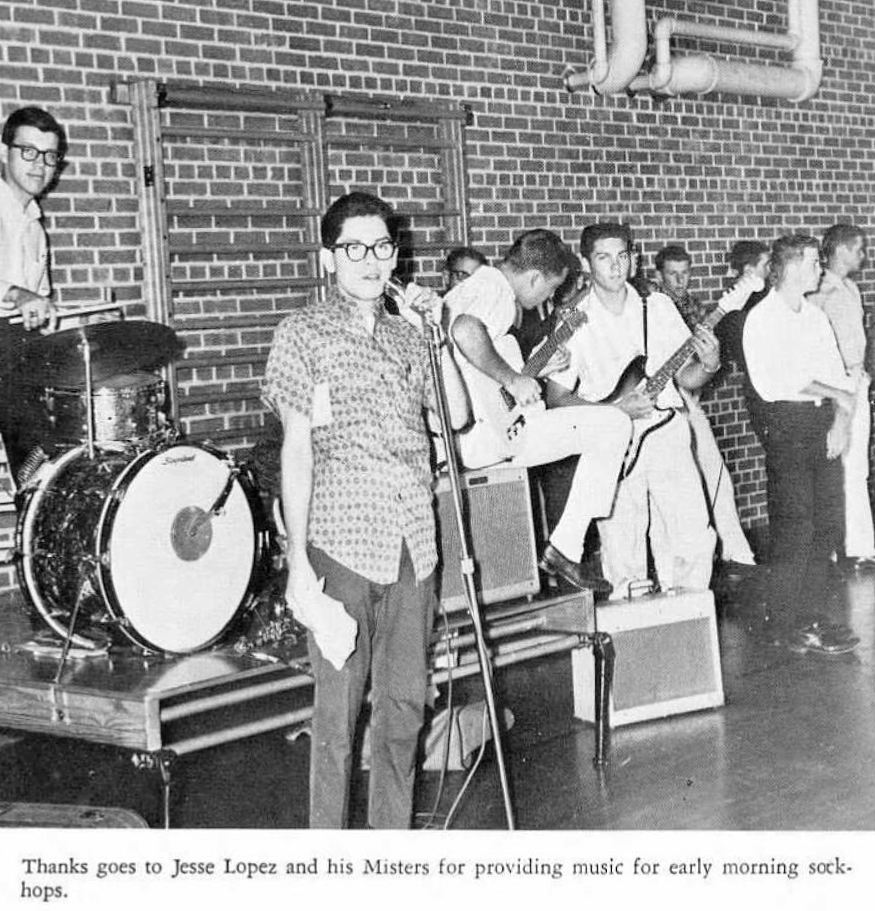
North Dallas had their very own rock and roll band — “The Misters,” headed by the enormously popular Jesse Lopez (younger brother of Trini Lopez, who went to Crozier Tech). (Morning sock hops?!)

jesse-lopez_ndhs_1963-yrbk

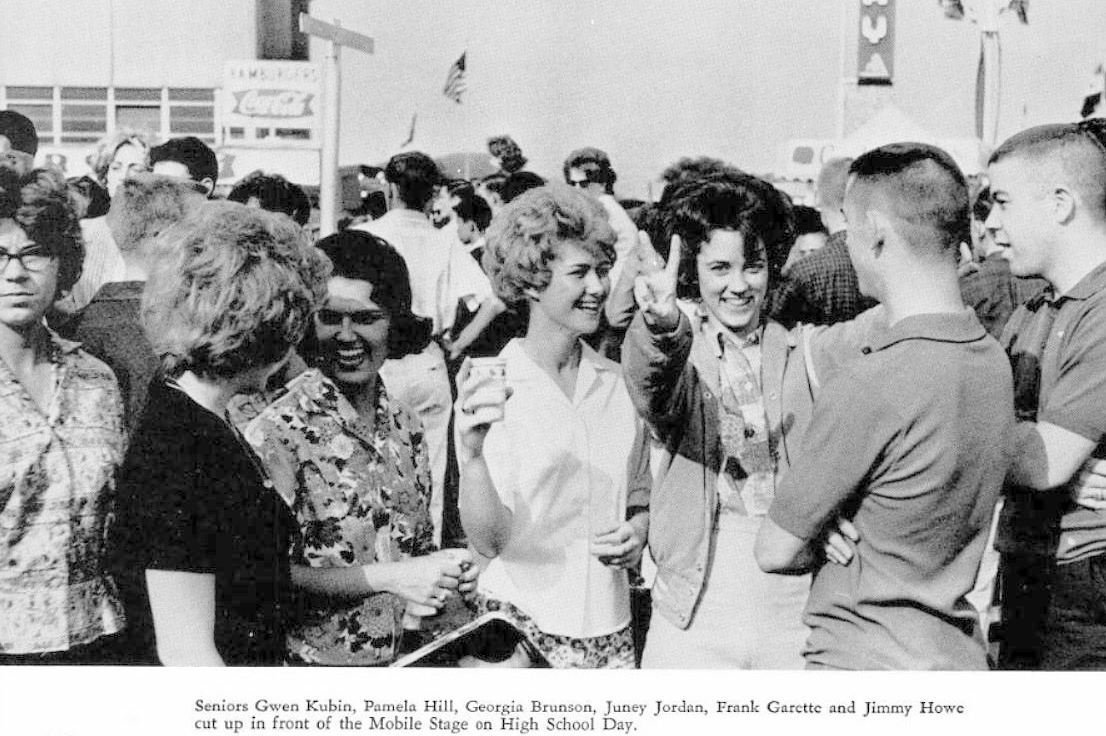
In fact, The Misters won the high school combo contest at the State Fair several times. And speaking of High School Day at the fair….

high-school-day_fair_ndhs_1963-yrbk

And back on campus, I don’t know who you are, Rufus Jara, but I nominate you as Coolest-Looking NDHS Student of 1963. (Caption from the yearbook: “Rufus Jara appears to be bothered by the light in the lunch room.”)

jara-rufus_ndhs_1963-yrbk

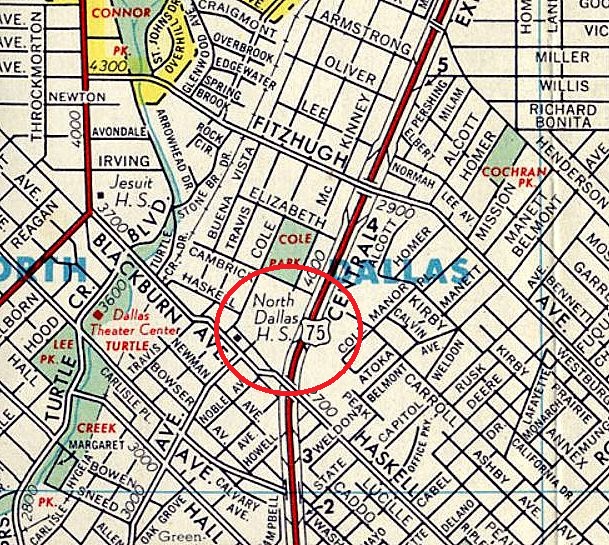
These last two photos leave a lot to be desired in quality (I did my best with yellowed paper and a broken book spine), but I think it’s interesting to see what the street looked like in front of the school, and on McKinney Avenue, to the left. Again, not recognizable today.

ndhs_steps_1963-yrbk

*

ndhs_map_1962Detail from a 1962 city map

***

All photos from The Viking, the North Dallas High School yearbooks from 1960, 1962, and 1963.

More from these yearbooks: see a LOT of ads in the post “Ads For Businesses Serving the  North Dallas High School Area — Early 1960s,” here. Several feature NDHS students.

All pictures larger when clicked!

*

Copyright © 2016 Paula Bosse. All Rights Reserved.

The Digital Collections of SMU’s Central University Libraries: The Gold Standard

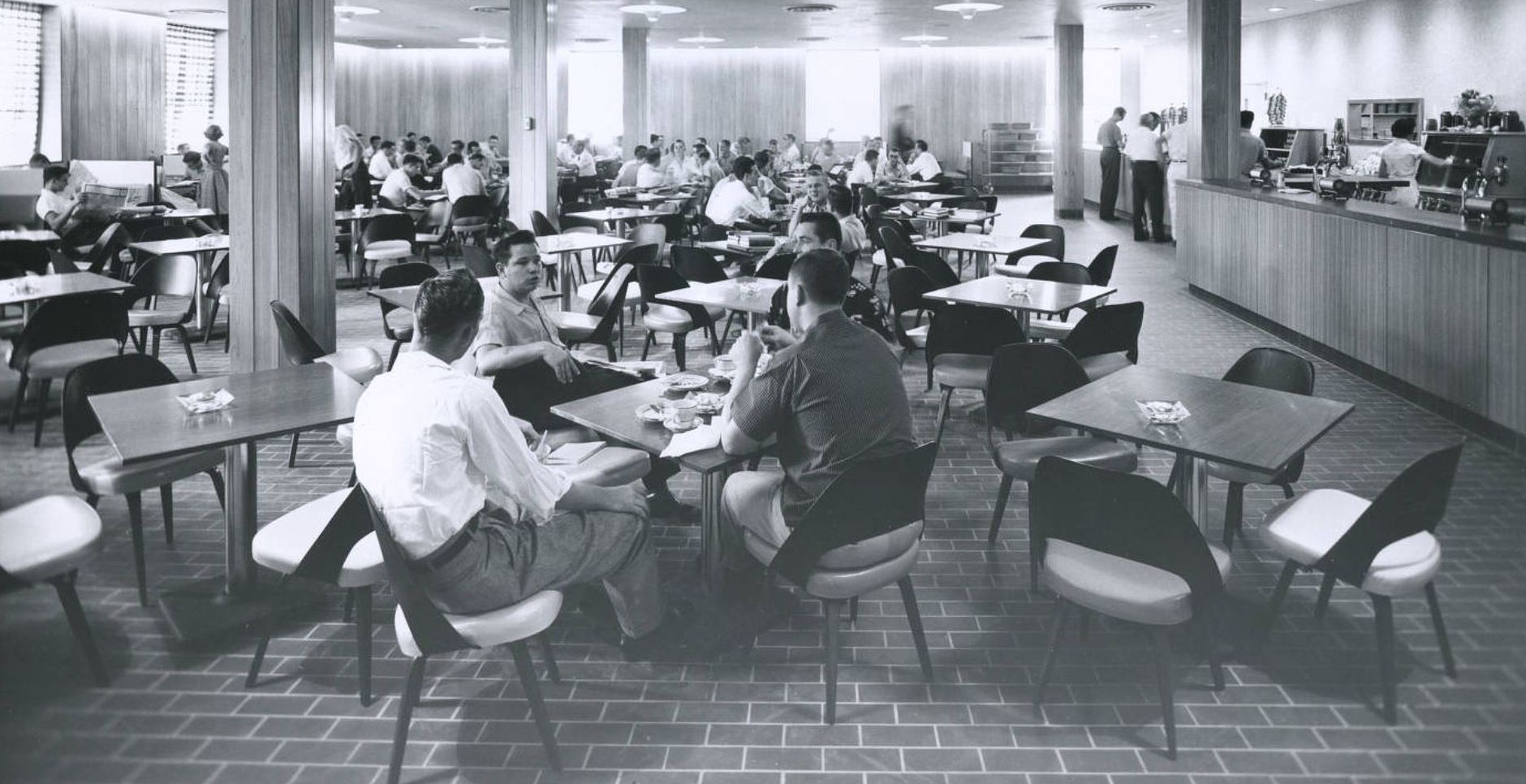
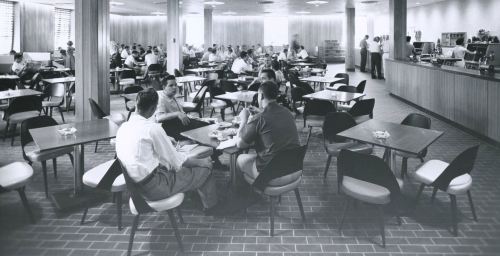
umphrey-lee-snack-bar_rotunda_1956My father in the Umphrey Lee snack bar?

by Paula Bosse

This past week I was invited by the Norwick Center for Digital Solutions at Southern Methodist University to tour several of SMU’s special collections libraries, which include the DeGolyer Library, the Hamon Arts Library (which includes the Bywaters Special Collections and the G. William Jones Film and Video Collection), the Edwin J. Foscue Map Library, and the SMU Archives. I had a behind-the-scenes look at the journey an item takes on its way to being digitized, beginning with the acquisition of the collection itself, the cataloging of the collection, and the research, annotation, and imaging of each item. Another important part of the process is the often mundane but necessary grant-writing which must be done to obtain funding to do much of the above. These collections at SMU are huge, but a remarkably efficient group of SMU library staff and students tackle the herculean task of getting everything cataloged and up online, accessible to everyone. At the end of February 2016, over 51,000 items have been published online. And there is a vast, exciting amount still to come!

For me, the online digitized database of SMU’s Central University Libraries is the absolute best for researching historical Dallas images. (I should note that Dallas history is only part of the wide-ranging collection of photographs, manuscripts, films, etc., concerning everything from Western Americana to the Mexican Revolution to trains and railroad history to artists’ sketchbooks, etc.) I’m most interested in Dallas photographs, and SMU really has no equal in what they provide online: large, high-resolution images without watermarks, accessible to anyone with a computer, tablet, or phone. It is an unbelievable treasure trove of historical images, and I’ve been lost in it for hours at a time.

I know this might come dangerously close to appearing to be some sort of paid promotion, but it’s not. We are very lucky here in Dallas to have these SMU collections available to us. I wish ALL institutions with historical holdings would also throw open the doors to their archives and share their collections online freely. (I would be remiss if I didn’t mention UNT’s wonderful Portal to Texas History site here, which, along with SMU, does just that.) We are living in a digital age, and to be unable to access some of Dallas’ other deep and varied collections of our own city’s history is incredibly frustrating, as I think it must also be for the institutions themselves — digitization of large collections takes time and money, both of which are often in short supply. SMU’s online presence is what all other libraries and institutions should model themselves after. Thank you, Norwick Center for Digital Services, for truly bringing SMU into the Digital Age.

**

On a more personal note, even though I use the online digital catalog of SMU’s collections all the time for this blog, it can also be a great source to use to explore your family’s history, if family members have attended SMU. My mother and my father both attended SMU, and thanks to the digitization of EVERY SINGLE ROTUNDA YEARBOOK (!), I was able to find photos of my parents I’d never seen before.

The photo at the top of this post shows the then-new Umphrey Lee Student Center snack bar and appeared in the 1956 Rotunda yearbook. I was browsing through the “Campus Memories” photos from the SMU Archives, and when I saw this photo, I immediately recognized the back of my father’s head! A KA fraternity brother of his doesn’t think it’s my father in this picture, but my mother, my brother, and I all think that that the student in the white shirt in the foreground with his back to the camera is almost certainly my father, who was a grad student in 1956. If it weren’t for the Campus Memories collection (which is FANTASTIC, by the way), I’d never have seen this photograph. And because the Rotunda database is searchable by names (see below for link), I was able to find a photo of my still-teenaged father in some sort of large, uniformed squadron (“Squadron A”) in 1953 — a zoomed-in detail of the photo is below:
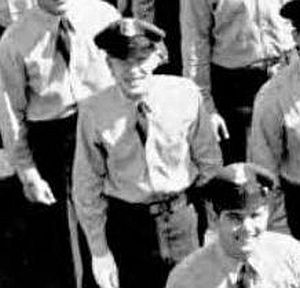
PRB_squadron-A_rotunda-19531953

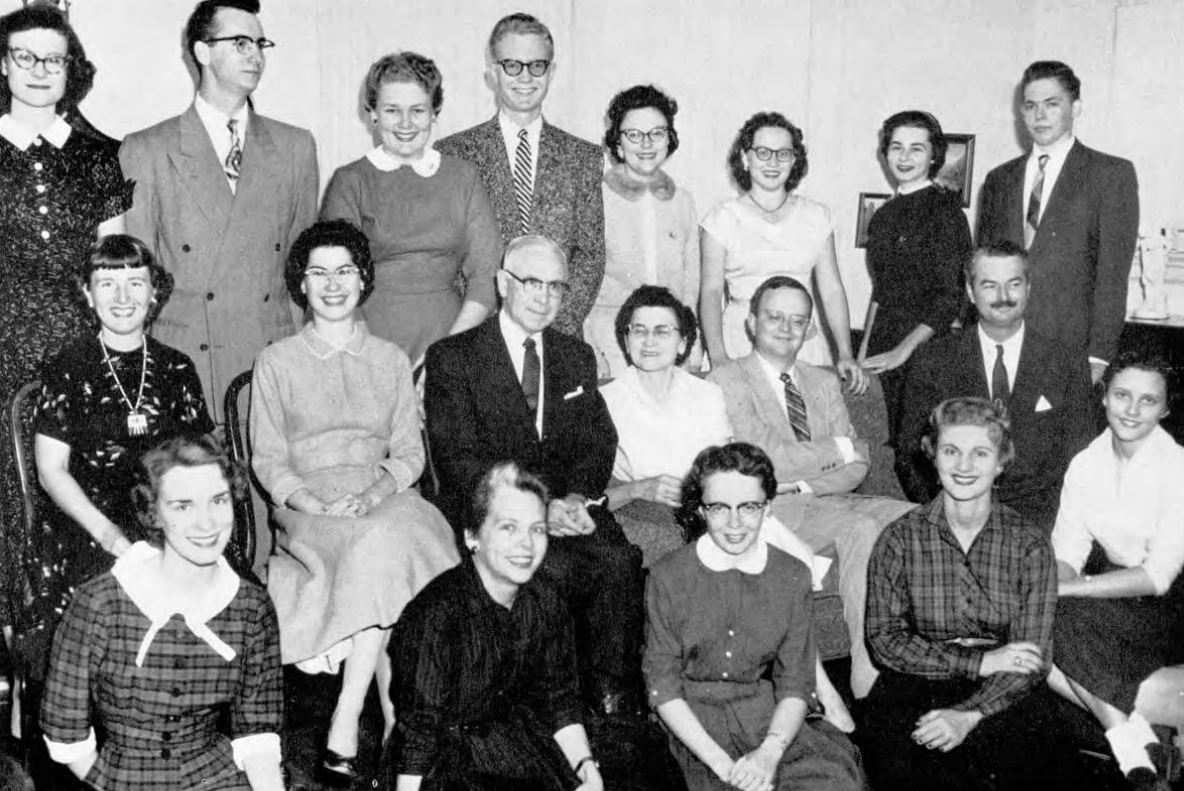
And I’m not sure I would have seen this photo of my mother taken a few years later, looking incredibly cute and perky as an officer of the honorary Comparative Literature fraternity, Beta Kappa Gamma. (My mother is on the back row, between the two tall men.)
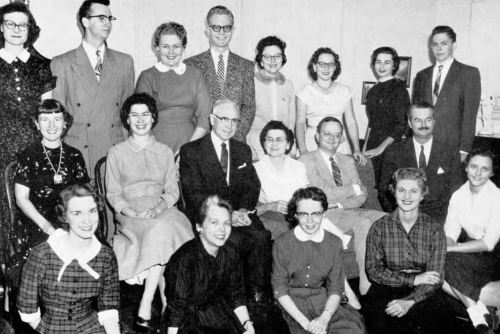
beta-kappa-gamma_rotunda_19561956 (mustachioed professor Lon Tinkle is in middle row, far right)

Or this photo a few years after that when she was the president of the group. She always laughs when she recalls how one of the rituals that came with the office was pouring tea from the group’s silver tea service.
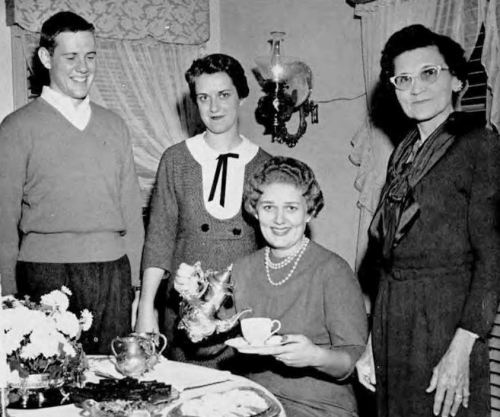
mew_rotunda_19591959 (with sponsor Dr. Gusta Nance at right)

Again, thank you, SMU!
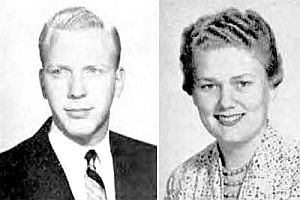
prb-mew-rotundaDick Bosse, Margaret Werry

***

Sources & Notes

Main search page for SMU Libraries’ digital collections is here. Pack a lunch. You might be here a while.

Norwick Center for Digital Solutions info is here.

Top photo is titled “Students in Umphrey Lee Student Center Snack Bar” — it was taken in 1955 and appeared in the 1956 Rotunda, SMU’s yearbook; it is from the SMU Archives, DeGolyer Library, Central University Libraries, Southern Methodist University, and it is accessible here. (I’ve cropped it a bit at the top and bottom.)

All other photos are from various editions of the Rotunda yearbook, all of which are online.

Every single edition of the Rotunda — from the very first yearbook for the inaugural 1915-1916 class — has been scanned in its entirety and is available online. This incredible resource is here. It takes a little while to figure how to navigate through the yearbooks, and it can be slow to load — but it’s worth the wait.

More from the SMU Archives (including the archived campus newspaper) is here.

Lastly, I would like to thank the Norwick Center for inviting me to visit. I’d also like to thank Anne Peterson of the DeGolyer Library; Jolene de Verges, Sam Ratcliffe, and Ellen Buie Niewyk of the Hamon Arts Library; SMU archivist Joan Gosnell; and all of the other students and Norwick staff members I met on my visit to the SMU campus. Keep up the great work!

*

Copyright © 2016 Paula Bosse. All Rights Reserved.

Life in The Grove: Pleasant Grove — 1954-1956

pghs_1956-dairy-queenDairy Queen, 1238 S. Buckner — 1956 (click for larger image)

by Paula Bosse

The community of Pleasant Grove was first settled in the 1840s but didn’t officially become part of Dallas until it was annexed in 1954 after a huge postwar surge in population. Upon annexation, the schools that made up the Pleasant Grove Independent School District became part of the DISD, including Pleasant Grove High School, which was located on Lake June Road, between Conner and Pleasant Drive. PGHS closed when the brand new W. W. Samuell High School opened on January 28, 1957, halfway through the 1956-1957 school year. The photos here are from the yearbooks of the last three years that Pleasant Grove High School was open — most of the ads feature students inside or in front of the business establishments. And they’re great! (Click photos for larger images.)

*

Photos of overcrowded Pleasant Grove High School and its numerous out-buildings, 1955.

pghs_1955a

pghs_1955b

Pleasant Grove Pharmacy, Grady’s Clover Farm Grocery, and Grove Shoe Store:

pghs_1954-yrbk_a1954

Worthington Service Station:

pghs_1954-yrbk-worthington1954

Schepps Dairy:

pghs_1954-yrbk-schepps1954

The Eatmore Hamburger System (greatest name EVER!!):

pghs_1954-yrbk-eatmore1954

Dasch Cleaners:

pghs_1955-yrbk-dasch1955

Harvey Hayes, “The Insurance Man”:

pghs_1955-yrbk_a1955

Cassidy’s Conoco Station, Tee-Pee Drive-In Grocery, and Gay and Jones Motor Co.:

pghs_1956-yrbk_b1956

Worthington’s Magnolia Service Station (again) and Barrett’s Used Cars:

pghs_1956-yrbk_a1956

W. W. Hughes Magnolia Service Station, E & L Service Shop (bicycle and lawnmower service), and, again, Pleasant Grove Pharmacy:

pghs_1956-yrbk_d1956

Billie Price Real Estate and Maridell’s:

pghs_1956-yrbk_c1956

Martin’s Sinclair Service Station (with a DQ photobomb):

pghs_1956-martins1956

The Kaufman Pike Drive-In, “The Theater With a Heart”:

pghs_1956-yrbk-kaufman-pike-drive-in1956

And lastly, a very dark photo of Pleasant Grove High School from the 1948 yearbook:

pleasant-grove-high-school_1948-yrbk1948

***

Sources & Notes

All photos and ads are from the 1954, 1955, and 1956 editions of The Bobcat, the Pleasant Grove High School yearbook.

More on the history of Pleasant Grove in southeast Dallas, here. More on the history of Pleasant Grove High School here and here. The confusing school changes revolving around the the PGISD/DISD switchover were a bit like musical chairs and affected attendance of numerous high schools (including Forest High School, Crozier Tech, and Woodrow Wilson), junior high schools, and elementary schools. Read about the details in the Dallas Morning News article “Mid-Term Switch Set for Students” (DMN, Jan. 6, 1957).

Google map showing Pleasant Grove and approximate location of PGHS, here.

As always, click pictures for larger images.

*

Copyright © 2016 Paula Bosse. All Rights Reserved.

Early Aerial View of the SMU Campus

smu_early-aerial_ca1920s_degolyerWide open… (click for much larger view)

by Paula Bosse

Does anyone else fear the SMU campus is getting a little crowded these days? Here’s what it looked like back when there was still plenty of room to stretch out.

This photo is in the SMU archives, accompanied by this description:

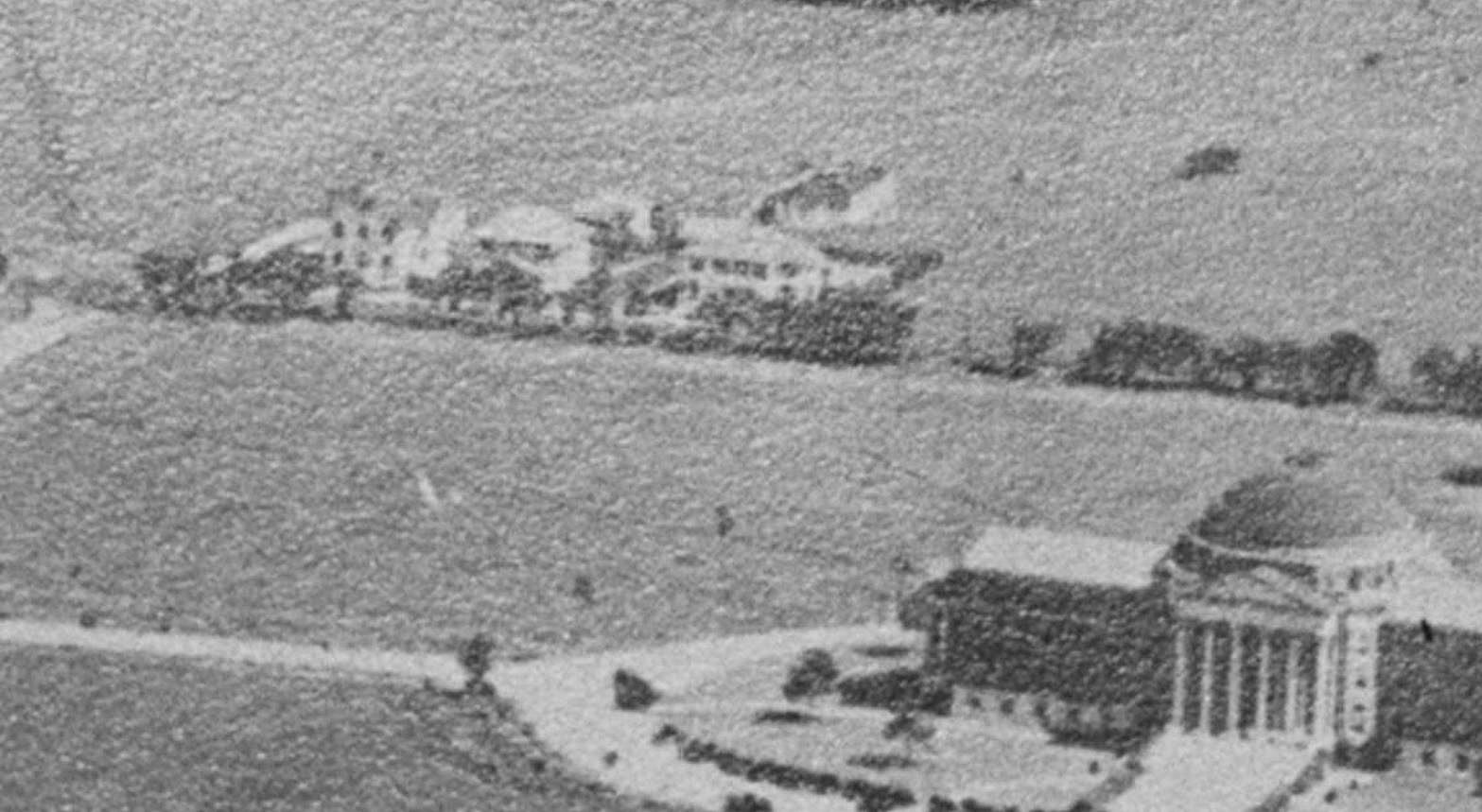
Pictured is an aerial view of campus from the southeast. At the bottom is Mockingbird Lane; on the right is Airline Road; at the top is Daniel Avenue; and on the left is Hillcrest Avenue. Situated in the middle of fields is a water tower, Dallas Hall, Atkins Hall, Rankin Hall, North Hall, South Hall, the Women’s Gymnasium, Armstrong Field, and the Morrison-Bell Track.

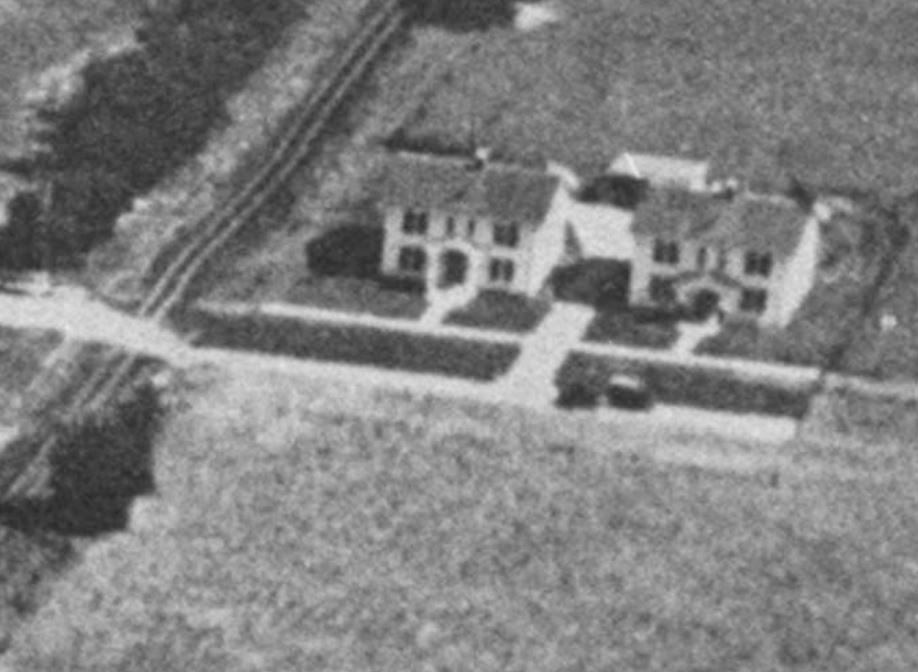
What is the huge hacienda at Hillcrest and Daniel (below)? Is that the Daniel family home?

smu_early-aerial_ca1920s_degolyer_a

And what are the little houses next to the under-construction stadium? Faculty housing? Fraternity houses? Houses not even connected with the university?

smu_early-aerial_ca1920s_degolyer_b

I kinda wish the campus still looked like this.

***

Photo titled “Early aerial view of campus,” ca. 1920s, from the DeGolyer Library, Central University Libraries, Southern Methodist University; it is accessible here.

Zoom in on this photo as much as you can and wander around it — it’s pretty cool. Go here, then slide the magnification bar at the top all the way to the right.

Click pictures for larger images.

*

Copyright © 2016 Paula Bosse. All Rights Reserved.

School Lunches of Yesteryear

lunch-ladies_frontier-top-tier_dplMorning prep work: the calm before the storm

by Paula Bosse

Above, Dallas lunch ladies shelling what looks like black-eyed peas for an unidentified school’s midday meal. I can’t say I’ve ever imagined lunchroom employees ever doing something like this. In the 1920s and ’30s, schools used fresh foods when they could, but they were definitely using a lot of canned fruits and vegetables, too. All this effort — and all these women — for peas.

In a quick search for what school lunch menus were like in the late ’20s and early ’30s, here were a few delicacies that would never be found in a school cafeteria these days:

  • Roast veal
  • Sardine sandwiches
  • Creamed onions
  • “Italian hash”
  • Banana and peanut salad
  • Salmon loaf
  • Tongue salad
  • Stuffed dates
  • Prune whip/prune salad/prune pudding

Yummy!

***

Sources & Notes

Photo from the Texas/Dallas History & Archives Division, Dallas Public Library.

*

Copyright © 2015 Paula Bosse. All Rights Reserved.

The Terrill School — 1914

terrill-school_tx-almanac_1914-detThe Terrill School, 4217 Swiss Avenue

by Paula Bosse

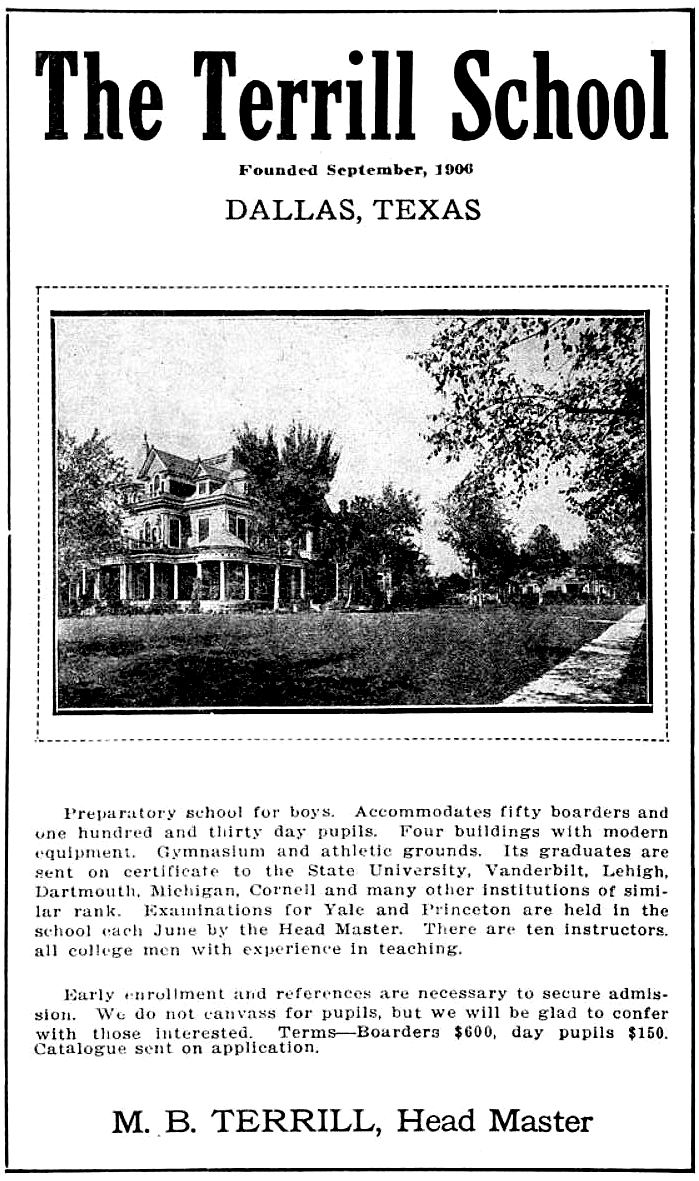
The Terrill School was for many years THE top prep school for boys in Dallas. Founded in 1906, it was located at the corner of Swiss and Peak in Old East Dallas until a move to Ross Avenue in the early ’30s. After a series of mergers over a span of years, it eventually became St. Mark’s School of Texas. Below, an ad that appeared in the 1914 edition of The Texas Almanac. (Click for larger image.)

terrill-school_tx-almanac_1914

I’m never sure how accurate The Inflation Calculator is, but when those numbers are run through it, in today’s money, parents would be forking over $14,000 a year if their sons lived on the campus, or $3,500 a year if they were students who lived at home.

Hundreds, if not thousands, of successful businessmen and civic leaders spent time at the Terrill School. According to an eyebrow-raising account of life at Terrill — written by Dallas Morning News publisher Ted Dealey — those early days sounded more like a reform school than a prestigious prep school. One can only hope the practices he describes below did not last very long.

terrill_dealey_p28from “Diaper Days of Dallas” by Ted Dealey (1966)
Seems to have turned Ted Dealey around!

***

Sources & Notes

Ad from the 1914 edition of The Texas Almanac.

The passage by Ted Dealey is from his (highly recommended!) book, Diaper Days of Dallas (Nashville: Abingdon Press, 1966), p. 28.

More photos and background on The Terrill School can be found in the post “George Cacas, The Terrill School’s Ice Cream Man — 1916,” here.

*

Copyright © 2015 Paula Bosse. All Rights Reserved.

SMU Turns 100: A Look Back at Its Very First Days — 1915

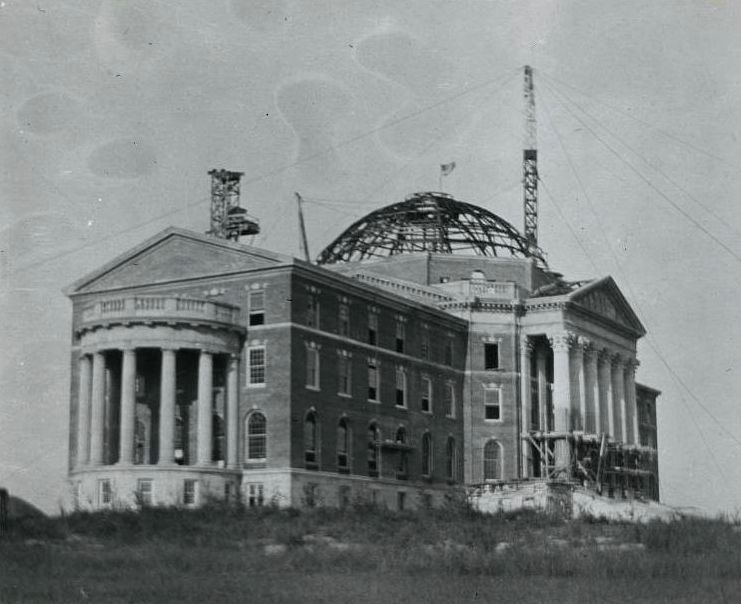
smu_dallas-hall-dome-under-construction_1914Dallas Hall’s dome under construction, 1914 (SMU Archives)

by Paula Bosse

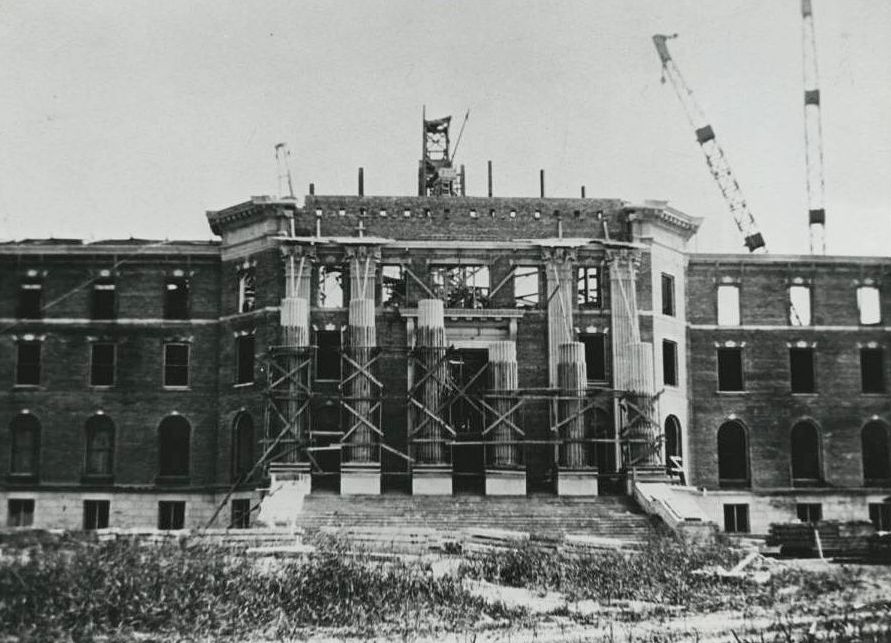
Classes began for the very first time at brand new Southern Methodist University on September 28, 1915 — 100 years ago today! Where HAS the time gone? Below, a few photos from those early days (click pictures for larger images).

smu_dallas-hall-columns-under-construction_1914_degolyerDallas Hall’s columns going up, 1914, out in the middle of a mostly empty prairie, well beyond the Dallas city limits.

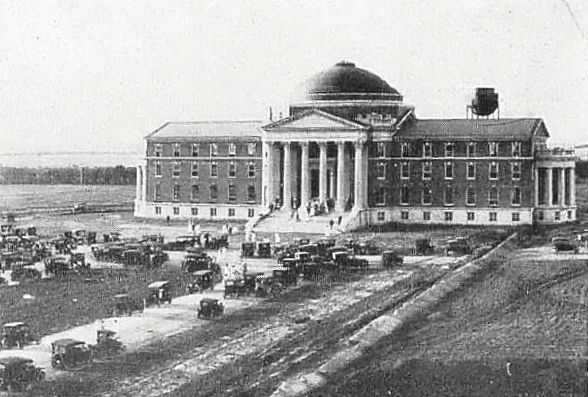
smu_week-before-opening_1935-rotundaVisitors checking out the new campus, a week before its opening.

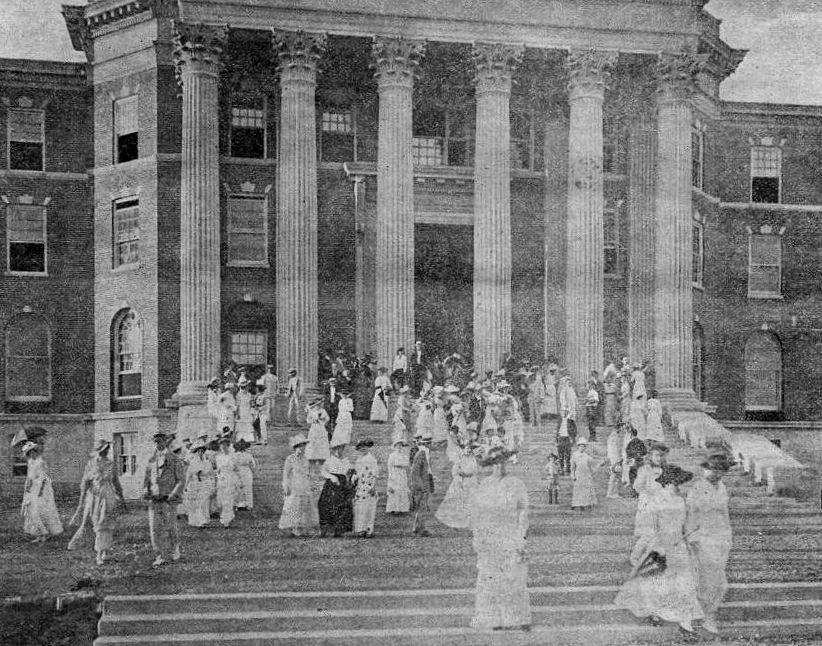
smu_visitors-before-opening_091115Genteel visitors on the steps of Dallas Hall, the only building on campus in which classes were actually held.

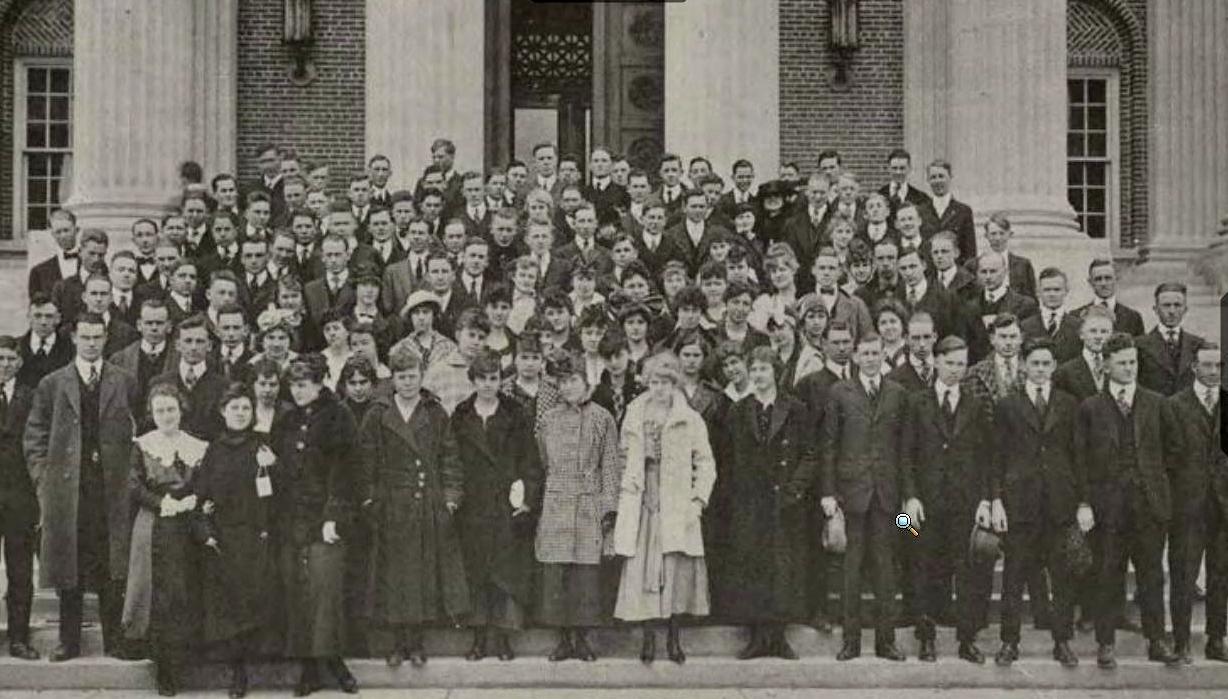
12smu-rotunda-1916_freshman-classSMU’s first freshman class.

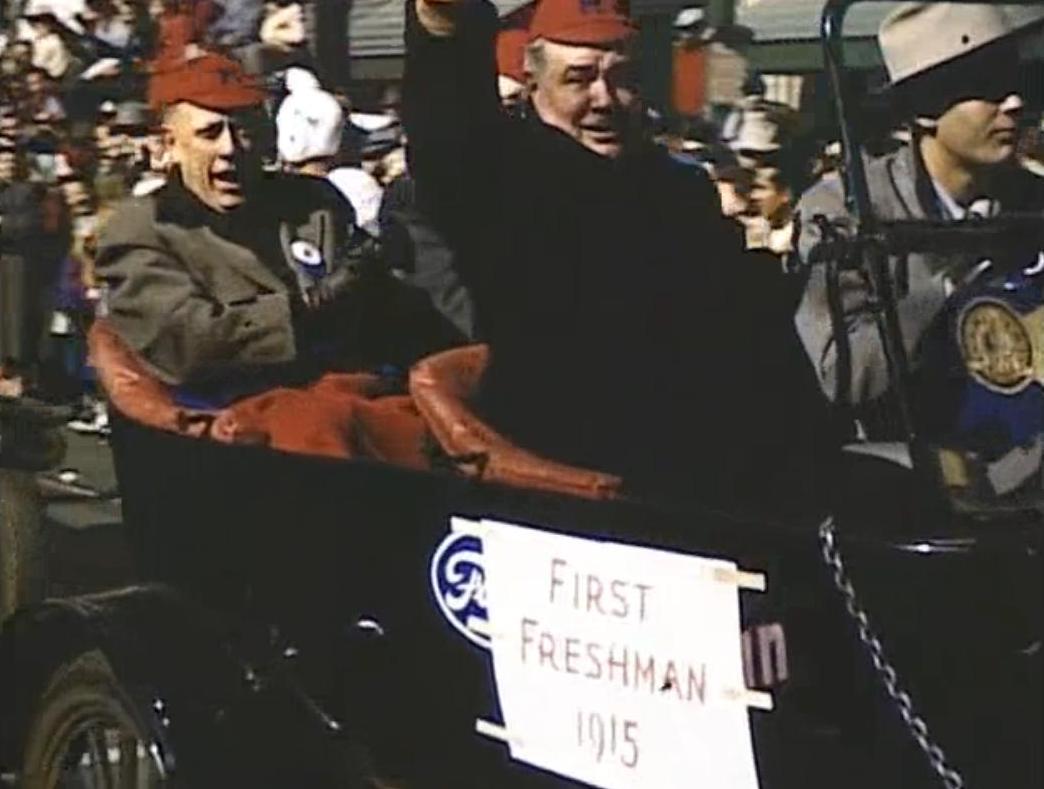
smu_first-freshmen_1950-homecoming-paradeAnd a couple of those freshmen, 35 years later, riding in a car in the 1950 Homecoming Parade downtown.

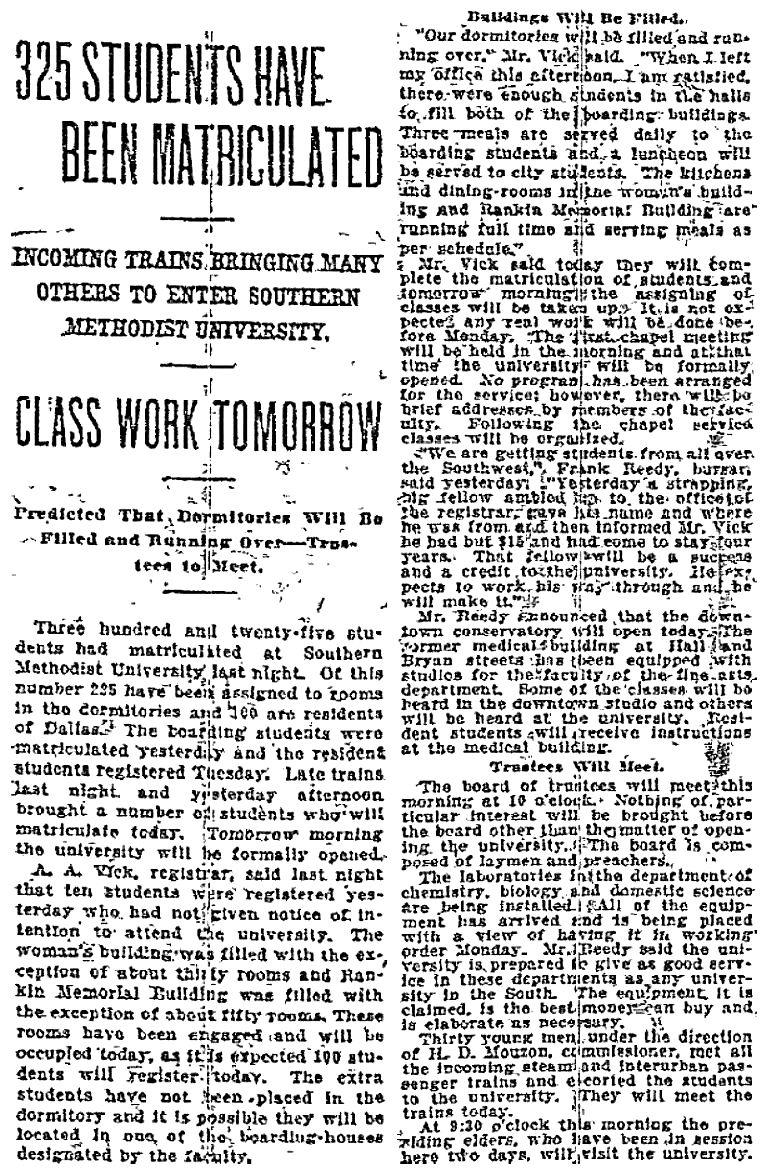
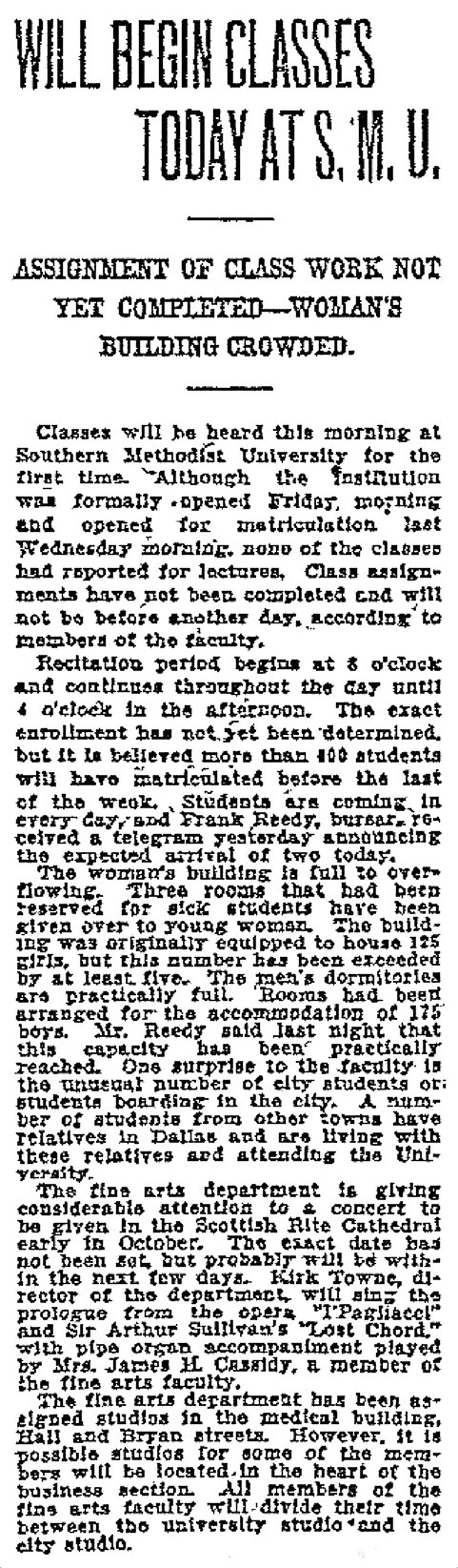
Below are a couple of logistical and progress-report articles from the week when students began arriving for that first year’s classes. Most interesting is that several classes were held off-campus, because of lack of space in an already crowded Dallas Hall. The fine arts department was housed at the “downtown conservatory” which was located in a former medical building at Hall and Bryan streets. The fine arts faculty had studios there and would move between downtown and the SMU campus. (Click articles for larger images.)

smu_first-day_dmn_092315Dallas Morning News, Sept. 23, 1915

smu_first-day-classes_dmn_092815DMN, Sept. 28, 1915

Happy Centennial, SMU!

***

Sources & Notes

The photos of Dallas Hall under construction are from the DeGolyer Library, Central University Libraries, Southern Methodist University. The photo of the dome under construction is here; the photo of the columns going up is here.

The photo of campus visitors and their cars lined up in front of Dallas Hall is from the 1935 edition of the SMU Rotunda yearbook; the caption: “Dallas Hall, a week before opening of SMU.”

The photo of visitors on the steps of Dallas Hall is from Bridwell Library, Special Collections, Perkins School of Theology, Southern Methodist University, and it can be accessed here. The photo was taken on Sept. 11, 1915 and was printed in the Sept. 23, 1915 edition of The Texas Christian Advocate above the caption “[Snapshot] of visitors at entrance to Dallas Hall on occasion of the reception given Saturday the 11th by the citizens of Dallas to the faculty.” (The article and another photo can be seen at the link above.)

The photo of SMU’s first freshman class is from the 1915-16 SMU Rotunda yearbook.

The image of the former SMU freshmen is a screen capture from a home movie of SMU’s 1950 Homecoming Parade which is part of the DeGolyer Library’s collection; the entire 17-minute silent color film can be watched on the SMU Central Libraries site, here. The very entertaining film contains the parade, a tour around campus, an elaborately decorated Fraternity Row, and the football game against Texas A & M at the Cotton Bowl.

These other Flashback Dallas posts related to SMU’s first year may also be of interest:

  • “SMU, ‘The School of the Future’ — 1915-16,” here
  • “SMU’s First Year: The Dinkey, Campus Hijinx, and The Basket Ball — 1915-16,” here
  • “University Park, Academic Metropolis — ca. 1915,” here
  • “Send Your Kids to Prep School ‘Under the Shadow of SMU’ — 1915,” here (Incidentally, the Powell University Training School opened on the same day as SMU as a sort of “sister school” — the building it occupied is still standing, on Binkley, just off Hillcrest — this building celebrates its Centenary, too!)

Click photos and clippings to see larger images.

*

Copyright © 2015 Paula Bosse. All Rights Reserved.