Flashback : Dallas

A Miscellany: History, Ads, Pop Culture

Category: HOF

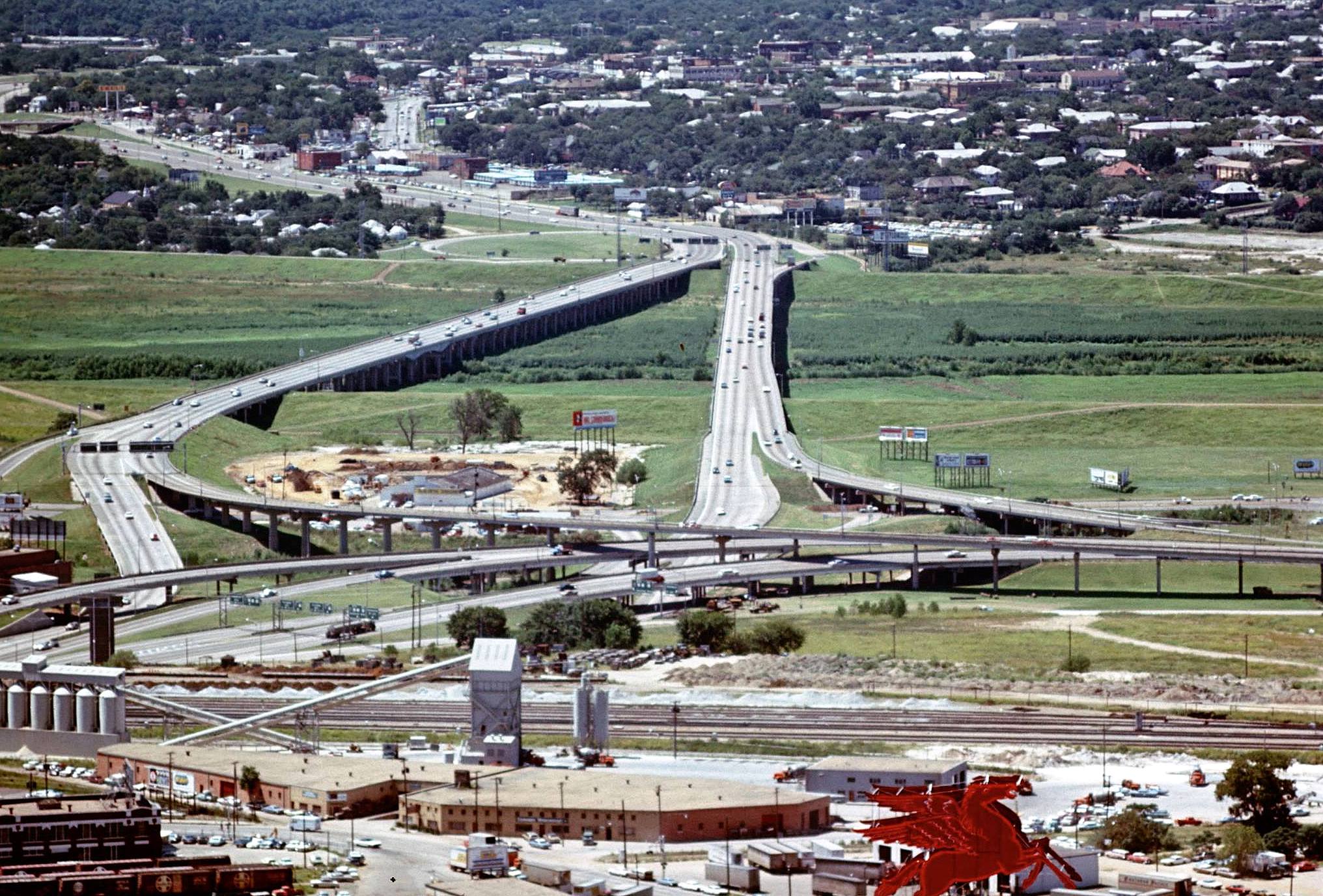
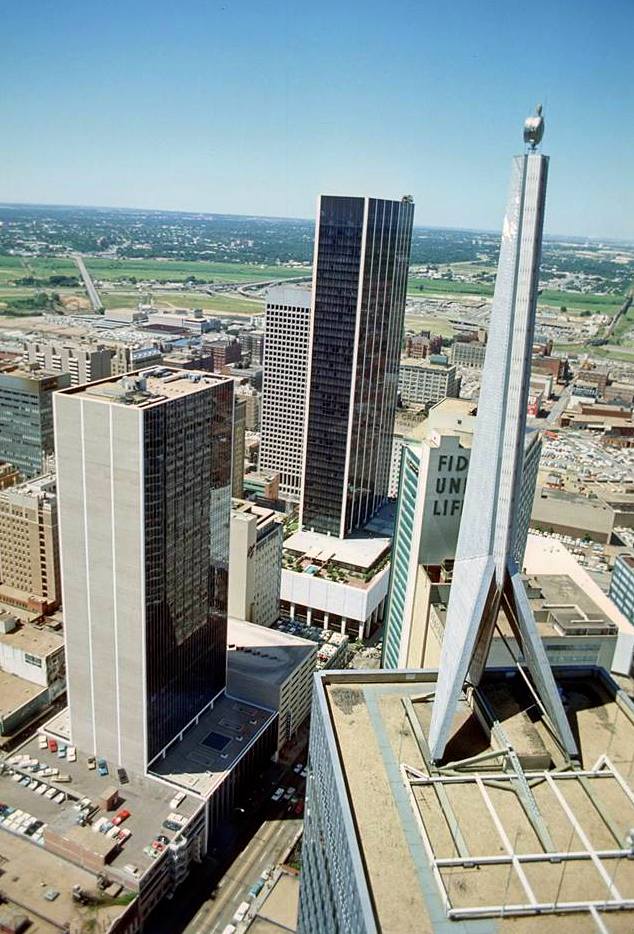
An Incredible View From Republic Tower 2 — 1968
republic2_parrish_1_1968
Photo by Bill Parrish, 1968, used with permission (click for larger image)

by Paula Bosse

On August 15, 1968, teenager Bill Parrish — a former Dallasite who was back in town on a visit — was surprised to see that a new building has sprung up since he’d left: the 50-story Republic Tower 2 (built in 1964), the much-taller sister-building to one of Dallas’ most famous skyscrapers, the 36-story rocket-topped Republic National Bank Building. He wondered if he could get to the top of the building to take some photos. Bill remembers the day clearly:

“I lived in Dallas until I was 9 years old, at which time we moved to Palo Alto, Califorinia. I spent the summer of 1968 at Texas A&M in an engineering program for high-ability science students. My parents picked me up in College Station and we came back via Dallas. I was a ‘tourist who used to live there’ and wanted some shots to remember the city by — even as a teenager. I had a fairly good camera, and I knew how to take pictures, having done photojournalism in high school. Also, I remembered how much fun I had living in Dallas, so maybe I was looking at the city a little differently.

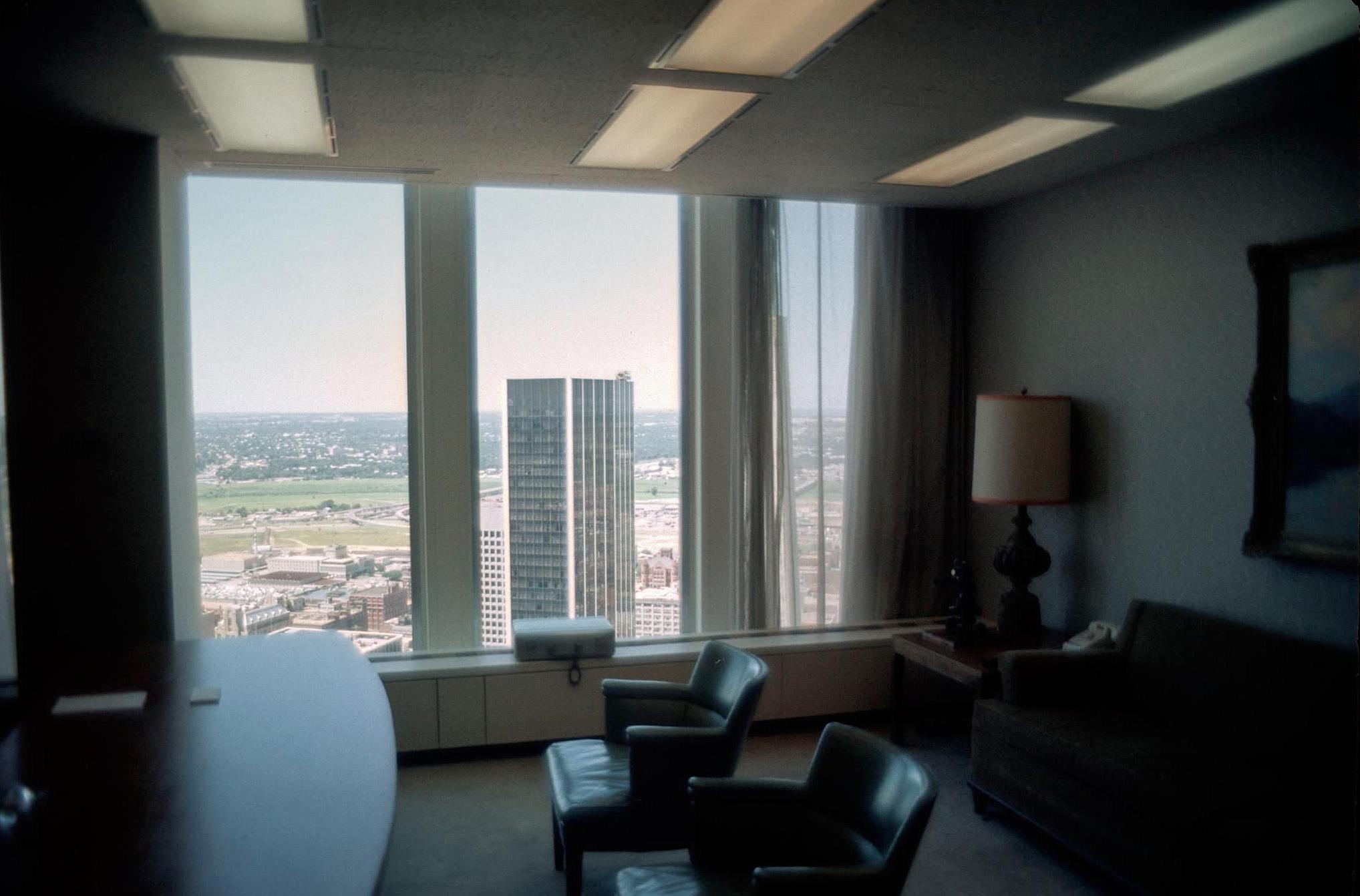
“We stopped in Dallas for a few days on the way back, and we spent one day downtown visiting old haunts. My dad and I were in our suits, and we went to the new (to us) Republic Tower 2 and rode the elevator to the top and asked around if we could take some shots out of some windows. Some very nice folks allowed us to use an office that was currently not being used. A number of shots were made from the same office. I think we were in and out in about 5 minutes — I remember the folks up there were very nice to us … considering we just ‘dropped in.’

“I just wish I had shot like 3 rolls of film — like inside the Mercantile lobby, inside Titche’s, and inside Neiman’s. I would have shot stuff at Walnut Hill Village, Marsh Hill Village, in the terminal at Love Field, at my old school, peoples’ houses I remembered, restaurants, etc. if I had known they would be of value in 50 or so years.

“I guess the takeaway is that today if something catches your eye, shoot it (with your phone even), and archive it so it can be found later… and don’t throw away old pictures! You may not be able to keep everything, but be careful about what might be of value to someone.”

*

Below are some of Bill’s really, really wonderful photos taken on that summer day in 1968 from a top floor of the tallest building in Dallas. (Many of these are HUGE. Click to enlarge.)

republic2_parrish_2_1968

republic2_parrish_5_1968

republic2_parrish_4_1968

republic2_parrish_3_1968

republic2_parrish_6_1968The office Bill shot from; his aluminum camera case is on the windowsill.

republic2_parrish_7_1968The original be-rocketed Republic National Bank Building on the left, the taller Republic Tower 2 in the middle.

***

Sources & Notes

All photos in this post by Bill Parrish, used with his permission. They first appeared in the Retro Dallas Facebook group.

During this short trip to Dallas, Bill’s family also shot some home movie footage, which can be seen here.

Below, a Google map showing the Bill’s general view of the photos looking over Pegasus to Oak Cliff:

map-view-from-republic2

Some photos by a different photographer, taken from the top of the Republic Center Tower II (its official name) in 2007, can be seen here. A couple of the photos show the exact same shots Bill took. A lot can happen in 40 years!

The Wikipedia page for Republic Center is here; the official Republic Center site is here (worth checking out if only to see the BEAUTIFUL shot of the two buildings, including the re-lit “rocket” tower).

My previous post, “The Republic National Bank Building: Miles of Aluminum, Gold Leaf, and a Rocket,” is here.

All of Bill Parrish’s photos are very large. Click to see some of them much, much larger!

Thank you so much, Bill, for sharing these fantastic pictures. The photo at the top is now one of my favorite-EVER shots of the Dallas skyline!

*

Copyright © 2015 Paula Bosse. All Rights Reserved.
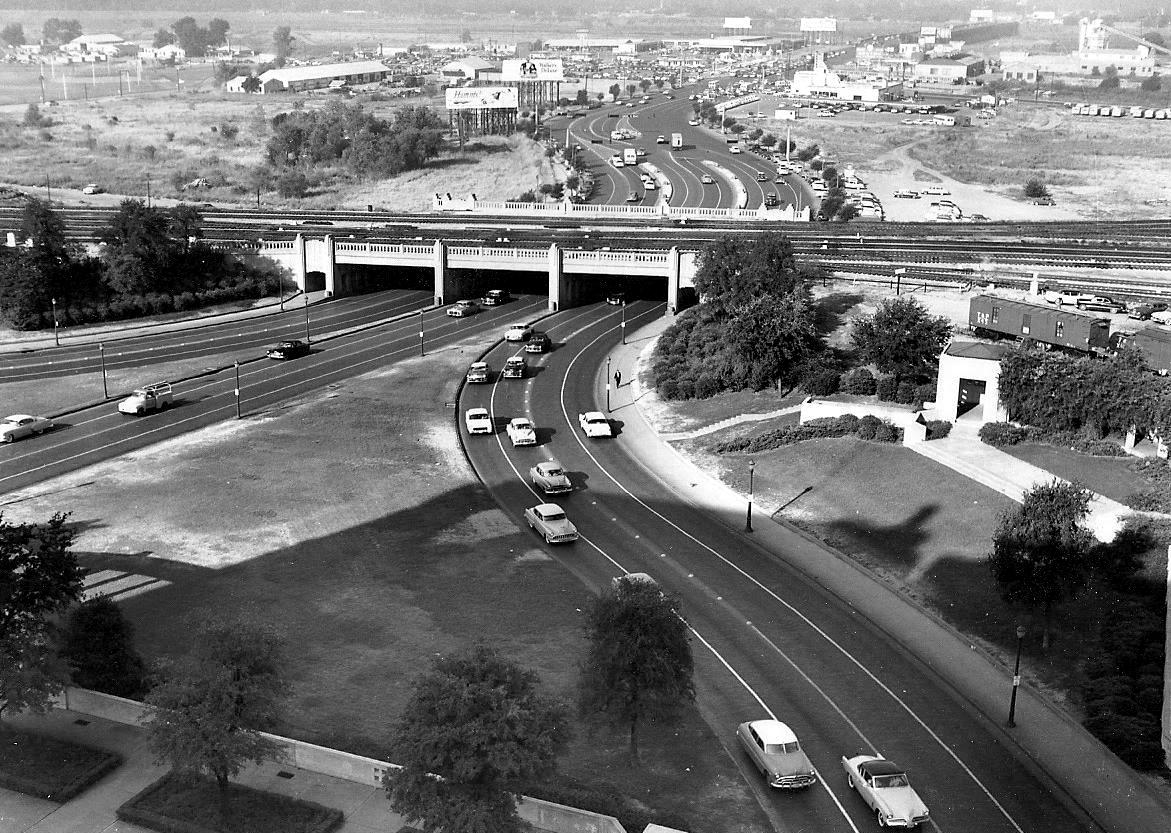
 

Triple Underpass — 1950s

triple-underpass_1950sComing and going…

by Paula Bosse

A view toward Oak Cliff, back before the words “triple underpass” began to be capitalized.

I LOVE this photo.

Check out this same view from about 1936 here.

***

Sources & Notes

Photo found here (along with other JFK-related photos of Dealey Plaza).

*

Copyright © 2015 Paula Bosse. All Rights Reserved.
The Allen Street Taxi Company

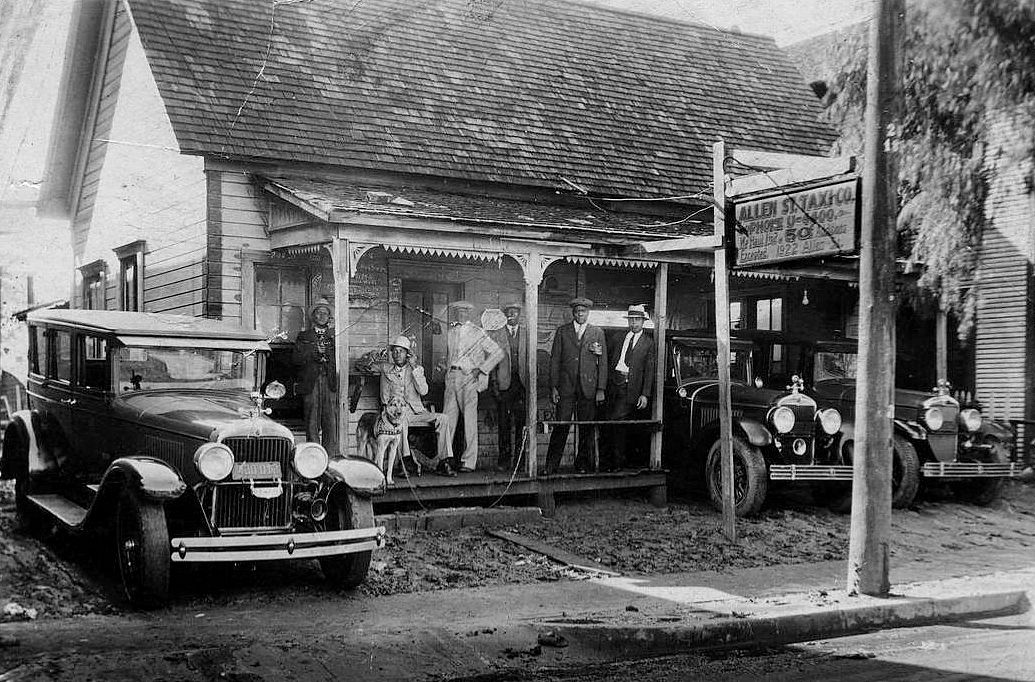
allen-st-taxi-co_cook-degolyerAllen St. Taxi Co. / George W. Cook Collection, SMU

by Paula Bosse

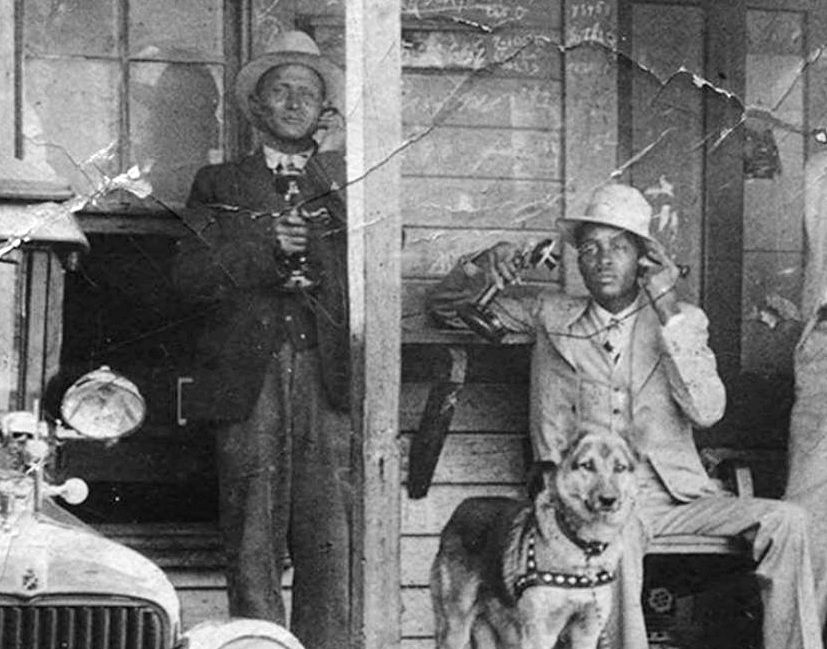
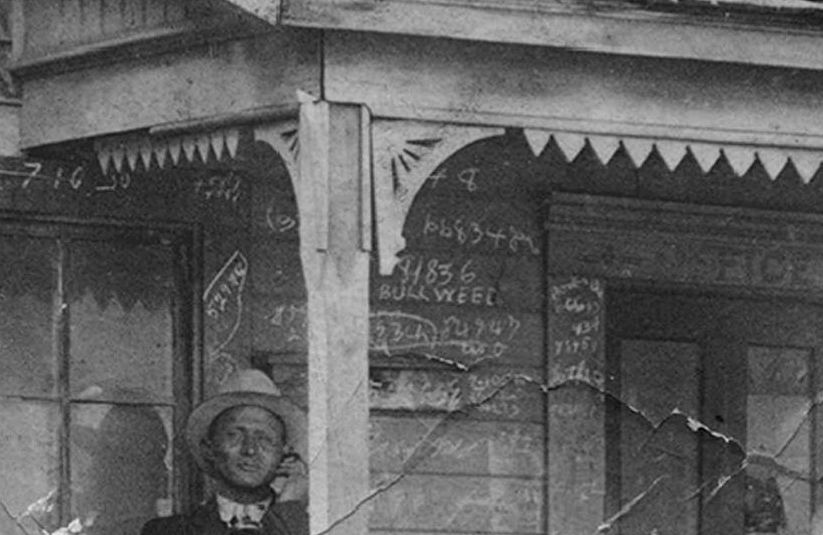
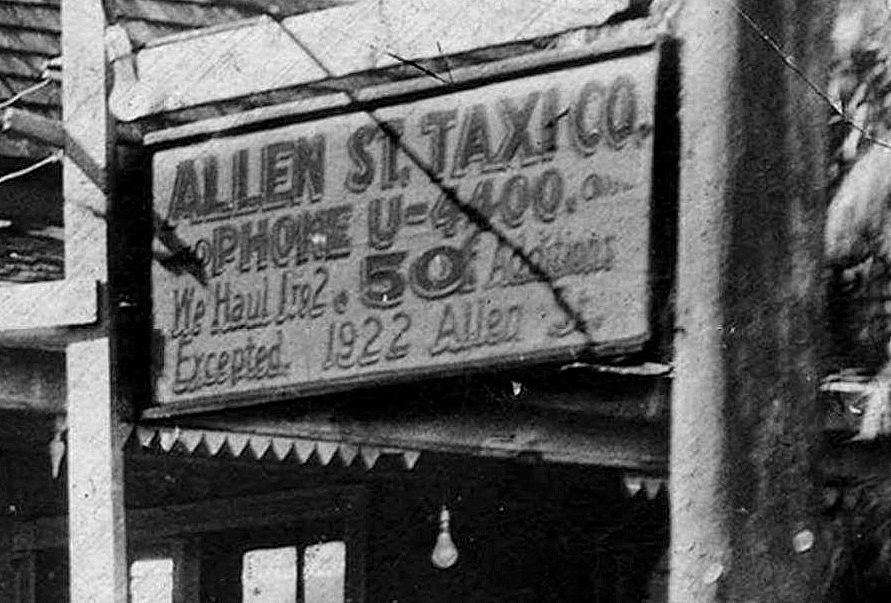
This has to be one of my favorite “unknown Dallas” photographs that I’ve come across. It shows the Allen St. Taxi Co. — in the State-Thomas area — at 1922 Allen Street (now pretty much vacant land under the Woodall Rodgers freeway). My ability to date cars is not good, but from city directory information, it seems that this photo might date from somewhere between the mid-1920s to around 1930. The owners/proprietors of the company were listed as John Leonard and Andrew Short in the 1929 telephone book. I wonder if they are in this fantastic photo? Let’s look a little more closely at some of the details. (All pictures larger when clicked.)

allen-st-taxi-co_cook-degolyer_det2Those phones!

allen-st-taxi-co_cook-degolyer-det4I love these guys. All business.

allen-st-taxi-co_cook-degolyer_det5“Bullweed.” What is all this writing? I love the guy’s face looking out of the window.

allen-st-taxi-co_cook-degolyer_det1“Dallas.” Car-people know exactly what make and model this vehicle is. …I am not one of these people.

allen-st-taxi-co_cook-degolyer_det3

***

Sources & Notes

Top photo, titled “Allen Street Taxi Co.,” is from the George W. Cook Dallas/Texas Image Collection, DeGolyer Library, Central University Libraries, Southern Methodist University; it can be viewed here.

The first “official” listing of the Allen St. Taxi Co. was in the 1929 city directory. The address at that time (which usually reflected information supplied the previous year) was 1907 Allen St. It didn’t appear again in the directory until 1932 when it was listed at 2816 Juliette St. In 1933 and 1934 it was listed at 2114 Hall St. In 1936 and 1937 it had moved to 2217 Hugo. And in 1938, the taxi part of the business seems to have fallen by the wayside, and it became Allen St. Transfer.

In 1925 there were only three official cab companies listed in the city directory. But the rough-and-tumble world of taxi cab service in the unregulated ’20s and ’30s was pretty intense. There were a lot of unlicensed jitneys rolling around town, especially, one would assume, in the segregated black neighborhoods of the city unlikely to be served by white-owned companies. My guess is that this might have been how the Allen St. Taxi Co. began.

For more on the go-go-go competitive world of taxi service at this time, see my previous post, “Washington Taxi Company: ‘Call George!'” here.

*

Copyright © 2015 Paula Bosse. All Rights Reserved.
The Dallas Skyline from the Maple Terrace Penthouse — 1952

feldman_terrace_huntington-detView from the penthouse (Huntington Library)

by Paula Bosse

The best view of the Dallas skyline that no longer exists may very well have been the view from atop the Maple Terrace Apartments, located on Maple Avenue, right across Wolf Street from the Stoneleigh Hotel. The photo above was taken in 1952, when there was a straight-shot view of downtown, with no hulking buildings to spoil the vista. This view — completely unobstructed except for the Stoneleigh (out of frame, at left) — must have been spectacular at night. (Although, as can be seen at the far right, the industrial area that surrounded the iconic DP&L smokestacks was also part of the view. Also not included in realtor brochures would have been the fact that the luxury apartment building overlooked the adjacent Little Mexico neighborhood, often described as a “slum area” — the huge economic disparity between the neighboring haves and have-nots would have been starkly apparent to any gimlet-sipping rooftop visitor. And then there was the not-so-distant meat-packing plant…. But I digress.)

The beautiful Maple Terrace Apartments — designed by architect Alfred Bossom (who also designed the Magnolia Building) — was built in 1924-25 and opened with great fanfare as the city’s first luxury apartments.

maple-terrace_postcard

An early tenant was Morris Feldman, a Polish immigrant whose family owned the successful Parisian Fur Co. (later Parisian-Peyton). Morris’ son, the incredibly wealthy oilman and art collector, D. D. Feldman, must have been quite taken with his parents’ home there, because in the late ’40s or early ’50s, he transformed the entire seventh floor — which had previously contained 20 “hotel-type” units — into his personal penthouse. The patio terrace with the to-die-for view was the cherry on the sundae.

feldman_terrace_huntington

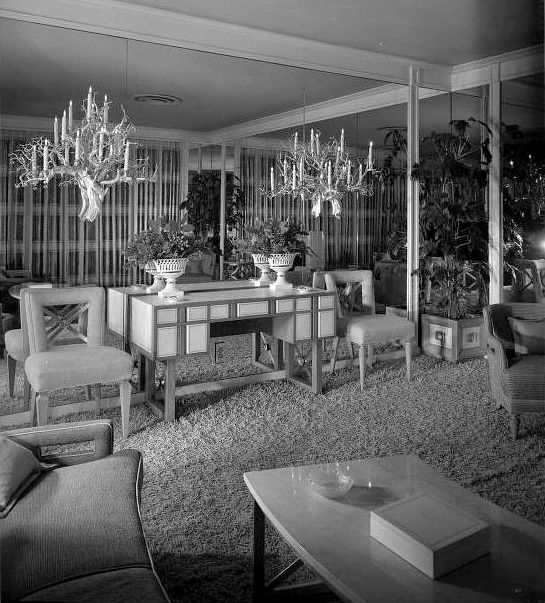
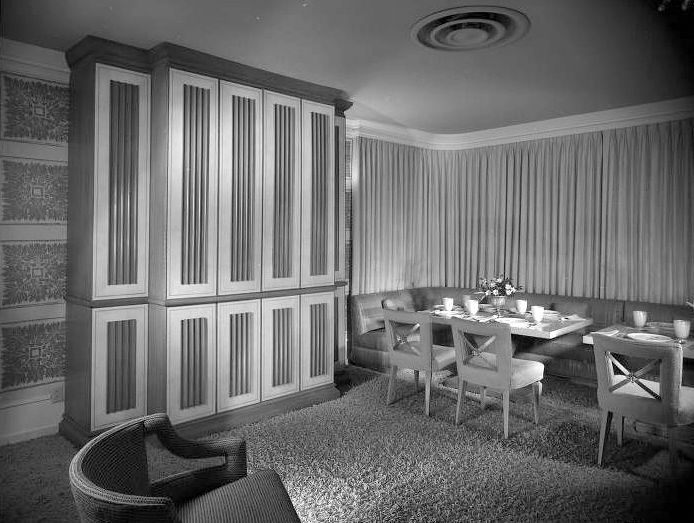
Countless cocktail parties, dinner parties, and fashionable teas were held in the Feldmans’ penthouse. The interior design — the work of Tom Douglas, of Los Angeles — was, apparently, much admired. The decor consisted of a mixture of typically cool Mid-Century Modern pieces as well as a few touches that, from a 21st-century vantage point, look a little … tacky. Somewhere in all of the acreage of furnishings was a fireplace, a white leather-covered piano (!), “a cocoa-striped sofa with pale blue frame,” murals, white brick wallpaper, and several pieces of furniture and cabinetry with a “driftwood finish.” And lots of lacquer. And mirrors, mirrors, mirrors. These “timeless furnishings in beige, marigold, white leather and ash” (DMN, Nov. 19, 1960) are dated relics of another era, but, at the time, they were splashed across the pages of magazines such as Architectural Digest.

feldman_entryway_huntington-lib

feldman_living-rm_huntington-lib

feldman_dining-rm_huntington-lib

As far as I know, the seventh floor of the Maple Terrace is still a single space. A 1978 real estate ad touted its “recently redecorated” 3,000 sq. ft. amenities:

maple-terrace-penthouse_dmn_032278

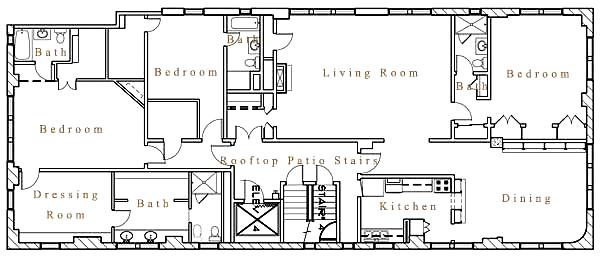
Below, the present-day penthouse floor plan from the Maple Terrace’s website:

maple-terrace_penthouse-floorplan-today

And, look, here’s a photo of what that entryway looks like now, (without the mural):

maple-terrace_hallway-today

I’m sure the rooftop terrace is still as beautiful as ever, but, sadly, it will never again boast of that once-incredible view:

maple-terrace-view-today

***

Sources & Notes

Top photo (and all black and white photos from this series) by Maynard L. Parker, for Architectural Digest; from the Maynard L. Parker Collection at the Huntington Library, accessible here. The top photo is a detail, which has been cropped and reversed; the original photo is shown in reverse on the Huntington site (along with some early image “editing” on the outline of the Stoneleigh), which is a bit freaky when you know that what you’re looking at is backwards!

Color photos and floor plan from the website of the Maple Terrace Apartments, here. Biographical info on the architect, Sir Alfred Bossom, is here. Fabulous photos of the building from AIA Dallas, is here; and a wonderful piece on the mystique of living in the famed Maple Terrace from D Magazine, is here.

An intense and thorough description of the Feldmans’ penthouse decor is in the article “Feldman Apartment: Timeless Decorating” by Jeanne Barnes (Dallas Morning News, Nov. 19, 1960).

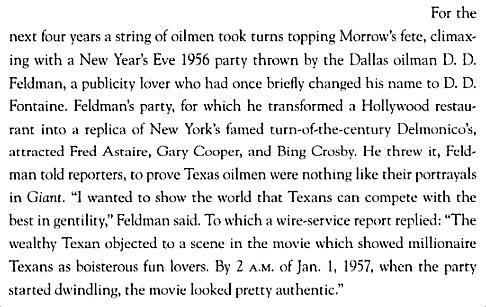
In addition to his oil holdings, D. D. Feldman was an important collector and patron of Texas art. In reading about Mr. Feldman, my favorite tidbit is this, from the book The Big Rich: The Rise and Fall of the Greatest Texas Oil Fortunes by Bryan Burrough (Penguin, 2009):

feldman_big-rich_quote

*

Copyright © 2015 Paula Bosse. All Rights Reserved.

The Continental Gin Complex — 1914

continental-gin-bldg_1914_cook-degolyer-smu-bwPhoto by Chas. Erwin Arnold (DeGolyer Lib., SMU) (click for larger image)

by Paula Bosse

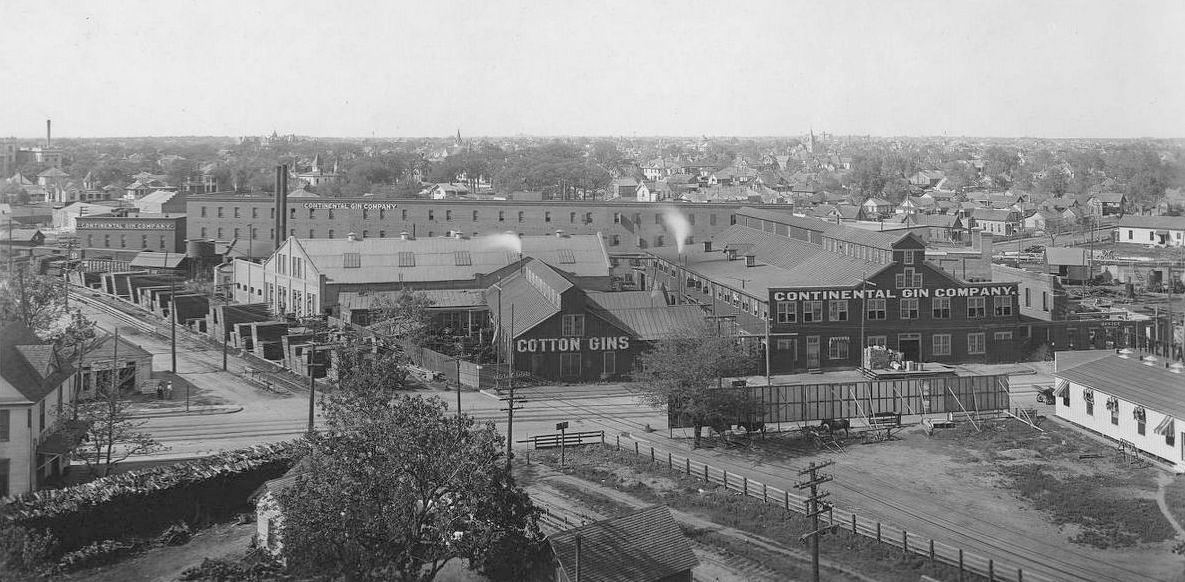
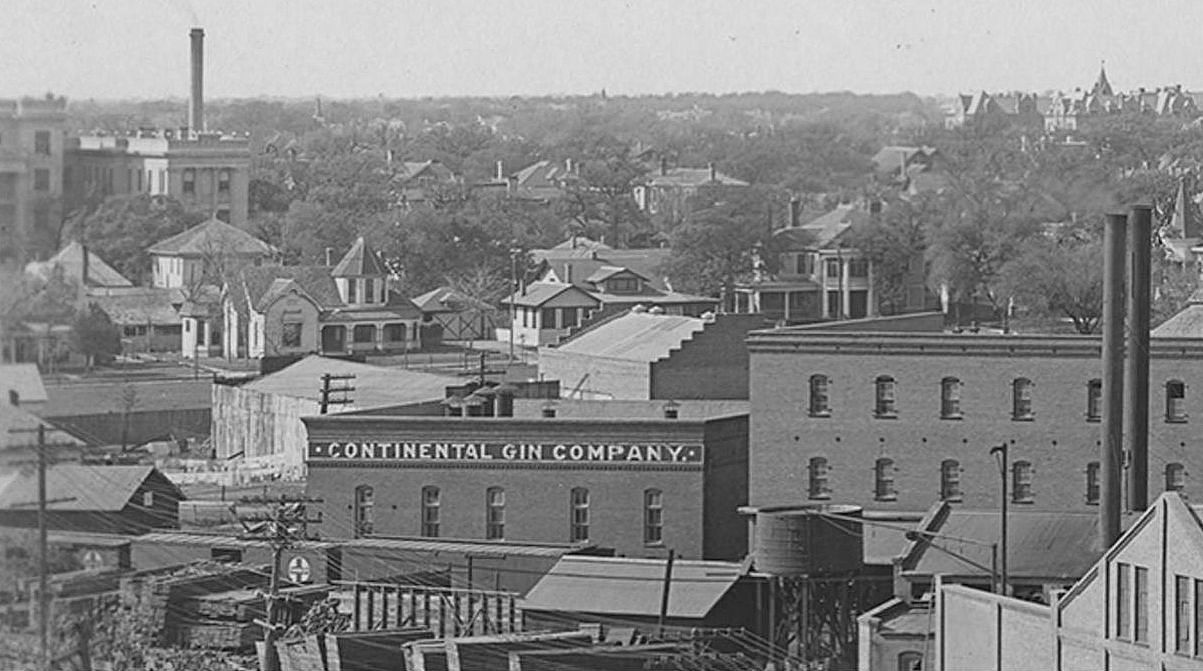
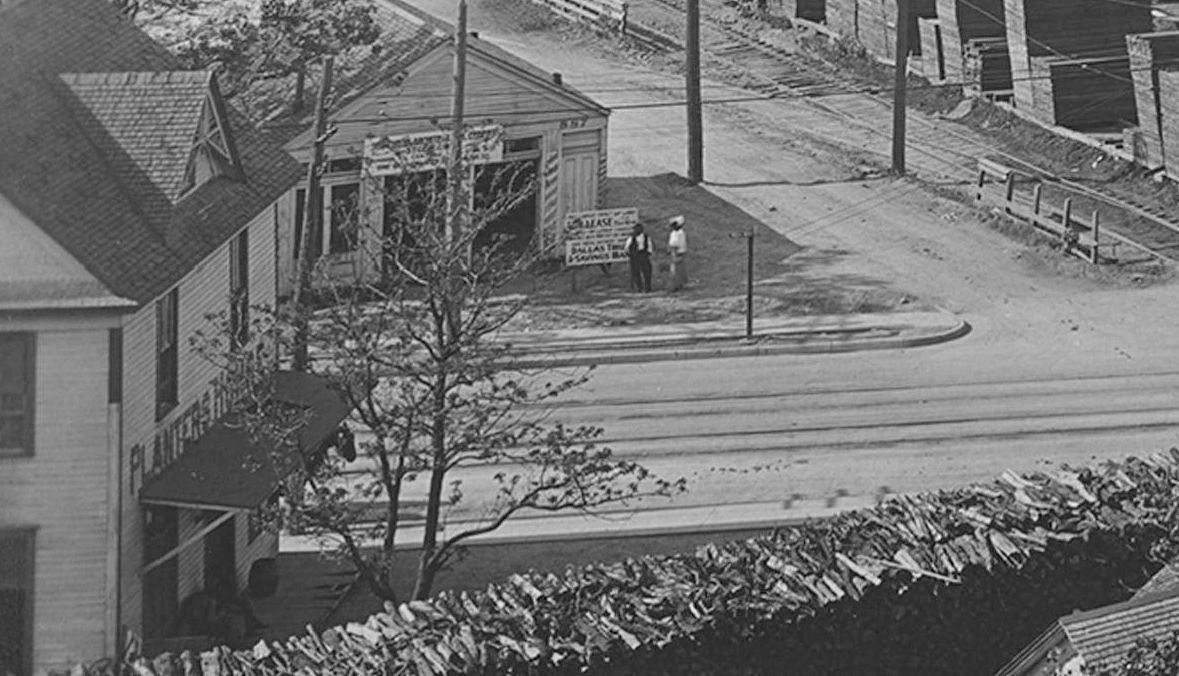
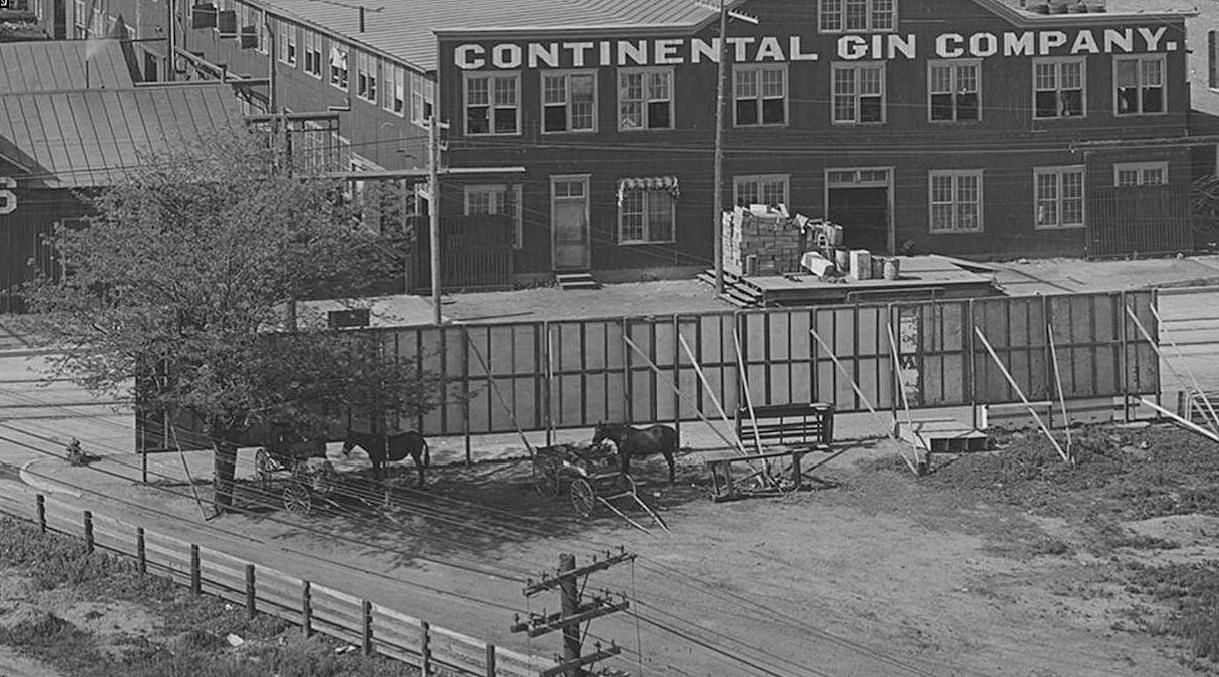
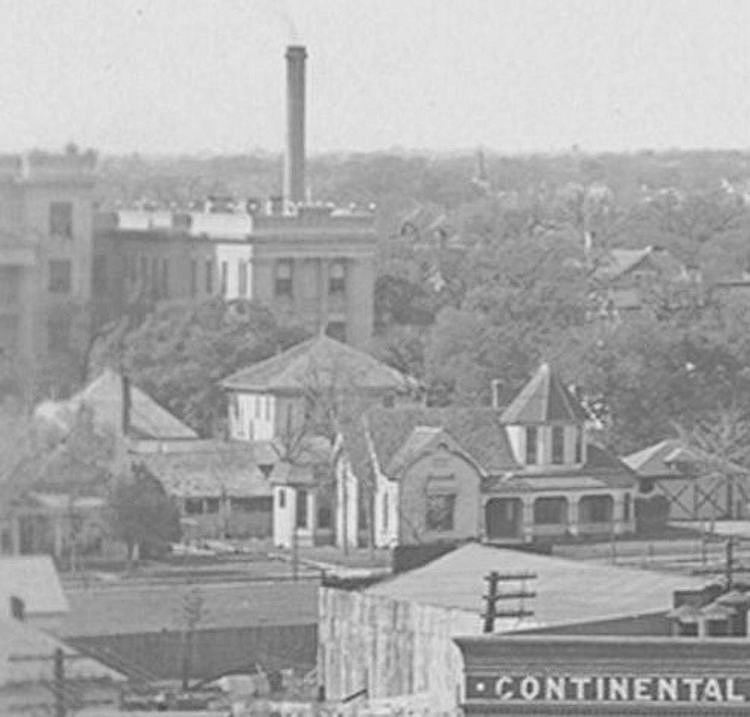
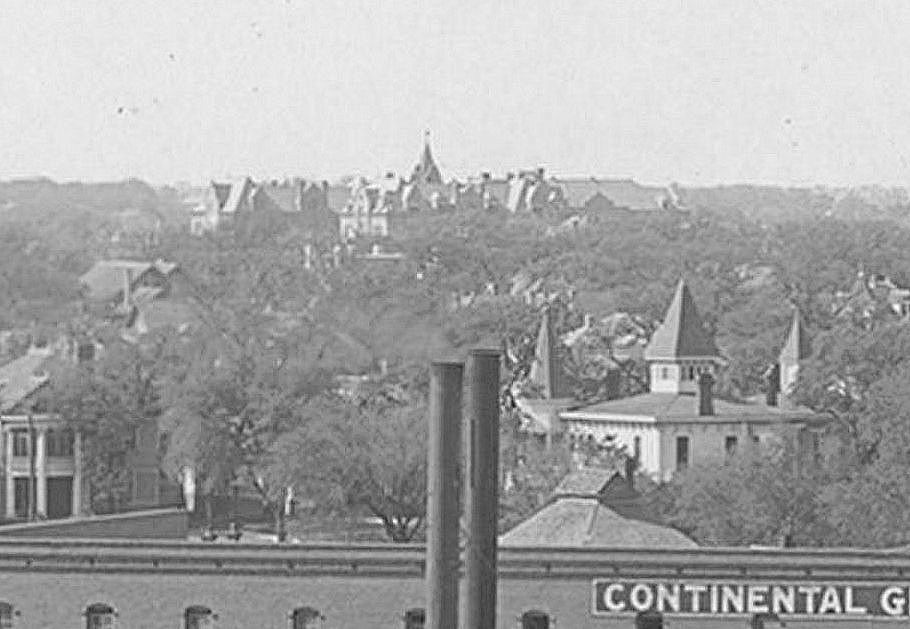
This is a really wonderful view of the Continental Gin Company complex, a Dallas landmark, much of which is, remarkably, still standing in Deep Ellum. Granted, my experience is limited, but I’ve never seen a photograph from this period showing the manufacturing end of Deep Ellum and the residential neighborhood just beyond it to the north. This is another incredible image from the George W. Cook Collection at the DeGolyer Library at SMU. A few magnified details, below. (Click for much larger images.)

continental-gin-bldg_1914_cook-degolyer-det1_bw

continental-gin-bldg_1914_cook-degolyer-det2_bw

continental-gin-bldg_1914_cook-degolyer-det3_bw

And zooming into the distance….

continental-gin_baylor_1914_bwThe back side of Baylor, at the top left. See it from the front here.

continental-gin_ursuline_1914_bwIn the middle at the top, Ursuline. (See more views of it here.)

continental-gin_smu_1914_bwAnd, my favorite, SMU’s Dallas Hall, waaaaaaaaaaaaaay in the distance. SMU hadn’t even officially opened when this photo was taken!

map_1919_continental-gin-bldg1919 map

***

Photograph titled “Continental Gin Company on Elm Street, Facing North” by Charles Erwin Arnold; from the George W. Cook Dallas/Texas Image Collection housed at the DeGolyer Library, Central University Libraries, Southern Methodist University. The photo and its details can be viewed here (I have altered the color in the images seen in this post).

Map detail from a large 1919 Dallas street map (which can be seen via the Portal to Texas History, here).

A view of this area from the 1921 Sanborn maps can be found here (click to make larger). (What’s a Sanborn map? Wikipedia tells you here.)

I wrote at length about the history of the Continental Gin complex of buildings in the post “Munger’s Improved Continental Gin Company,” here.

All images larger when clicked.

*

Copyright © 2015 Paula Bosse. All Rights Reserved.
 

Carhops as Sex Symbols — 1940

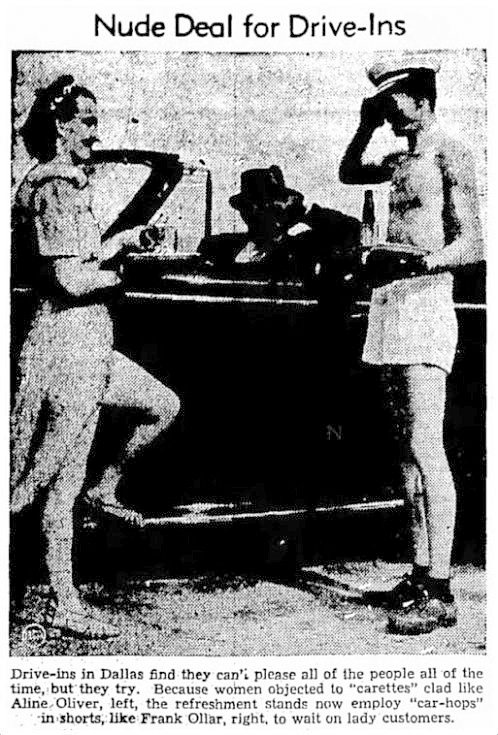
male-car-hops_AP_1940“At your service, ma’am…” / AP Photo

by Paula Bosse

In 1940, Dallas was in a tizzy about the sudden fad of scantily-clad “girl carhops.” This scourge had made its way to Dallas from Houston (brought to Oak Cliff by the enterprising husband and wife team behind Sivils Drive-In), and in April of 1940, it was a newspaper story with, as it were … legs. For a good month or two, stories of sexy carhops were everywhere.

The girls started wearing uniforms with very short skirts — or midriff-baring costumes with cellophane hula skirts. Some of the women reported an increase in tips of $25 or more a week — a ton of money for the time.

The public’s reaction ranged from amusement to outrage. There were reports of community matrons who reported the “indecent” attire to the police department and demanded action. Other women were annoyed by the objectification of young womanhood. Lawmakers in Austin discussed whether the practice of waitresses exposing so much extra skin posed a health risk to consumers.

But it wasn’t until a woman from Oak Cliff piped up that something actually happened. She complained that she didn’t want to look at girls’ legs when she stopped in at her local drive-in — she wanted to look at men’s legs. Drive-in owners thought that was a GREAT idea, and the idea of the scantily-clad male carhop was born.

carhops_FWST_042840Fort Worth Star-Telegram, Apr. 28, 1940 

One might think that the woman behind this “equal ogling” campaign was sort of proto-feminist, until you get to the part where she said that the whole girl carhop thing was “wrong socially and economically and should not be tolerated” (DMN, Apr. 27, 1940) — not because of the skin flashed, but because men needed jobs, not girls. And that also raised hackles. Two married women who had been carhops wrote to the Dallas News to speak up for these girls and women who were “at least coming nearer to making a living wage than at any other time of their existence. […] The girl carhops are either supporting their family or sharing the expenses. […] Why all the storm about a leg? It is nothing more than you see at a movie and a vaudeville” (DMN, May 5, 1940).

The photo at the top ran in newspapers around the country with the headline: “Adonis and Apollo of Roadside Bring Trade to Daring Stand.”

First large roadside stand Friday to bow to the demand of Dallas women and feature husky young male carhops in shorts was the Log Lodge Tavern at Lemmon and Midway where four six-footers found jobs. Above, in blue shorts, white sweatshirt and cowboy boots, Joe Wilcox serves Pauline Taylor who smiles her approval of the idea. Bound for another car is James Smith, at right.

April, 1940 must have been a slow news month, because this story really got around (click to see a larger image).

sexy-carhops_corsicana-daily-sun_042740Corsicana Daily Sun, April 27, 1940

One intrepid reporter even tracked down a Texas Ranger (!) to ask his opinion, to which the Ranger replied, “…letting those roadside glamor boys wear boots is nothing more than a slam at the state. People think of booted Texans as men, not as fancy-panted carhops.” The whole article, below, is pretty amusing.

sexy-carhops_anniston-AL-star_042840Anniston (AL) Star, April 28, 1940

There were other male carhops around town, some not quite so hunky. This guy — game as he was — really needed to reconsider his outfit.

carhops_xenia-ohio-daily-gazette_050340Xenia (Ohio) Daily Gazette, May 3, 1940

But back to the female carhops and their siren-like hold over their male customers. This was, by far, the best story to hit the wires:

sexy-carhops_waxahachie-daily-light_071640
Waxahachie Daily Light,  July 16, 1940

***

Sources & Notes

Top image from the Associated Press, 1940. 

The Log Lodge Tavern was located at 7334 Lemmon Avenue, which was across from Love Field and adjacent to the Log Lodge Tourist Court. It was located approximately where the red circle is below, on a page from the 1952 Mapsco (click for larger image).

lemmon-ave_mapsco-1952

Check out these related articles from The Dallas Morning News:

  • “Skimpiest Costumes Bring Biggest Wages” (DMN, April 24, 1940)
  • “Women To Fight Girl Carhops; Slogan: Let Us See Men’s Legs” (DMN, April 26, 1940)
  • “Adonis and Apollo of Roadside Bring Trade to Daring Stand” (DMN, April 27, 1940)
  • “Word For Carhops Grass Skirts And All” (letter to the editor) (DMN, May 5, 1940)
  • “Went Crazy Over Car Hops, Wife Says of Fugitive” (DMN, July 16, 1940)

UPDATE: This has been a weirdly popular post — it’s gotten thousands and thousands of hits and even resulted in a short radio interview on Dallas’ public radio station, KERA. I don’t really add anything new to this story, but if you’d like to listen to the interview conducted by Justin Martin, it is here.

If you like what you’ve seen on Flashback Dallas, please consider supporting me on Patreon, where for as little as $5 a month, you can receive all-new updates several times a week (if not daily!). More information can be found at Patreon, here.

*

Copyright © 2015 Paula Bosse. All Rights Reserved.

Mardi Gras: “Our First Attempt at a Carnival Fete” — 1876

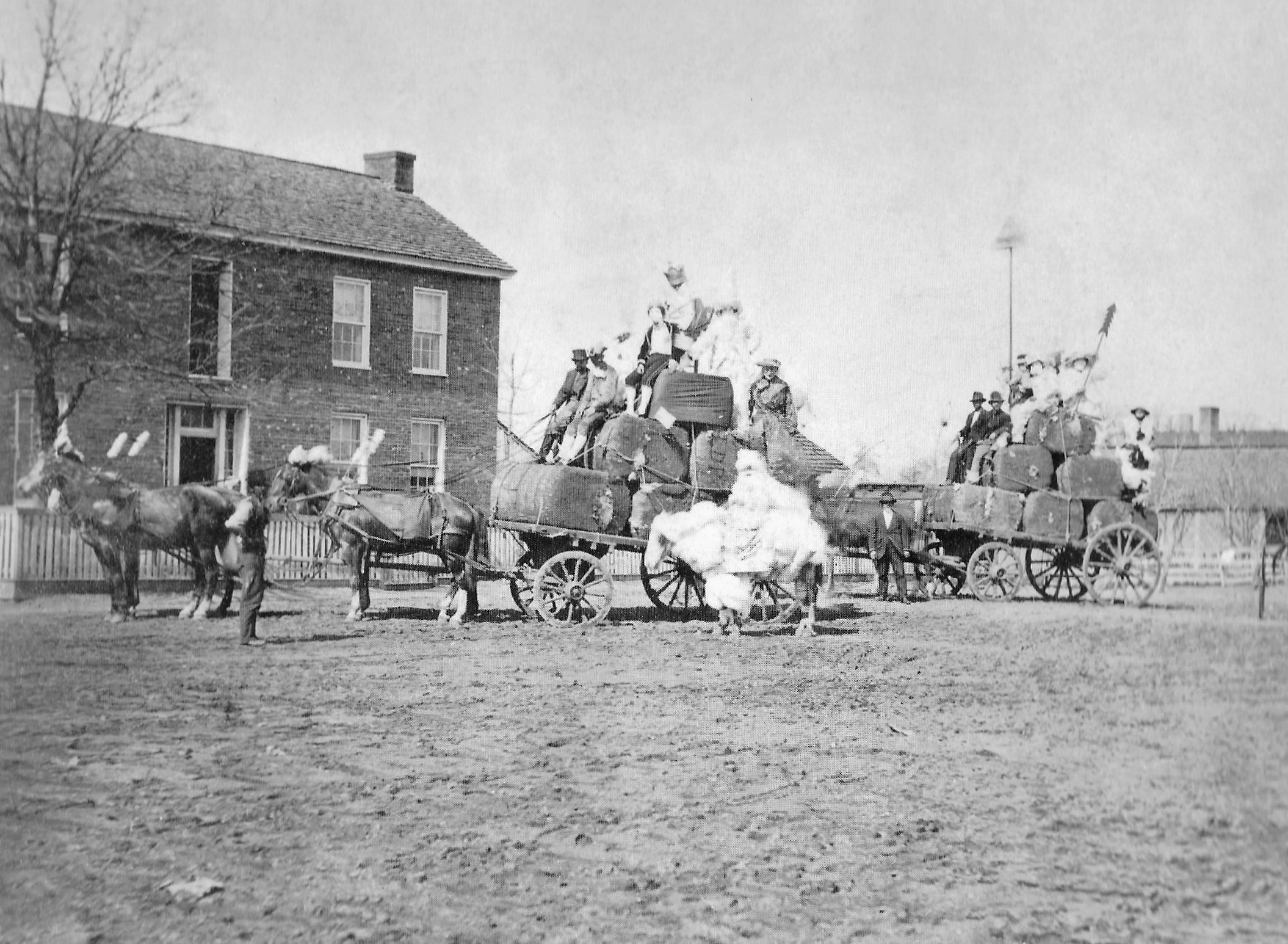
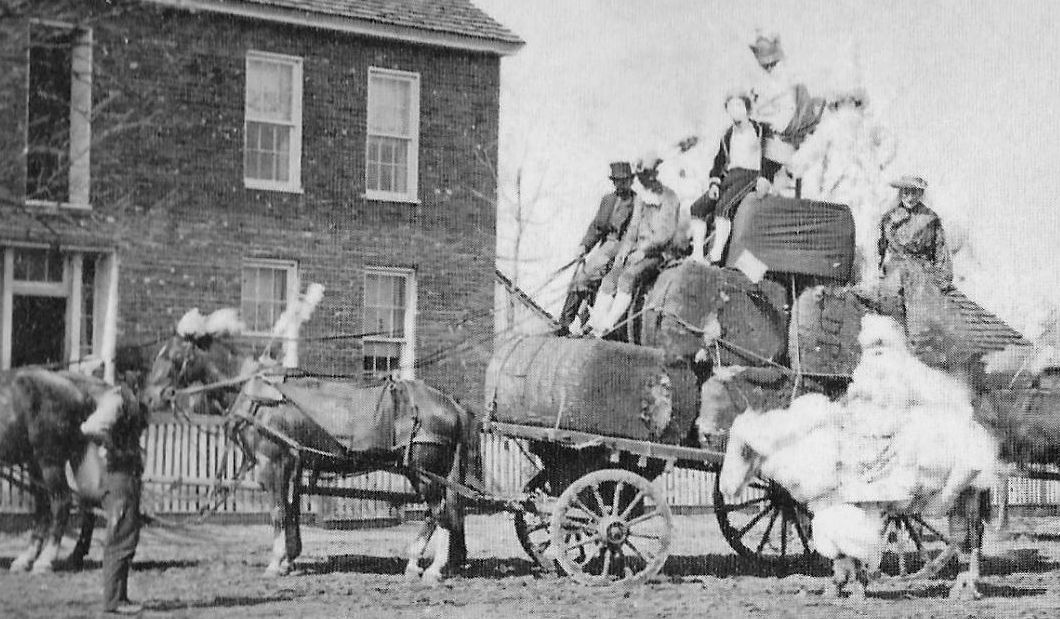
mardi-gras_dhs_1876When cotton was Rex (click for much larger image)

by Paula Bosse

In the 1870s, if a Dallas resident wanted to celebrate the glitzy revelry of Mardi Gras with a parade and balls and didn’t want to travel all the way to New Orleans, the place to go was Galveston. Galveston had a lock on Texas Mardi Gras galas. But Dallas being Dallas, there were soon plans to stage a massive Carnival right here. The day-long celebration debuted on February 24, 1876, which, oddly, was on a Thursday. (Mardi Gras that year was actually on Tuesday, Feb. 29, and it was probably celebrated early in Dallas so as not to interfere with the hey-we-got-here-first celebrations in New Orleans and Galveston.)

It was estimated that the festivities cost the city more than $20,000 (which, if the Inflation Calculator is to be believed, would be the equivalent of almost $450,000 in today’s money). The city was cleaned up in preparation for the anticipated onslaught of visitors and was decorated with flags and bunting along the lengthy parade route of Main, Elm, and Commerce streets. Revelers had elaborate costumes made for the processions and the grand masked balls, some with fabric imported for the occasion from France

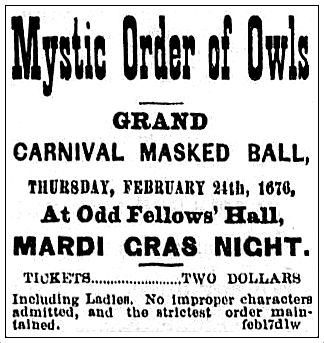
mardi-gras_dal-herald_021876Dallas Herald, Feb. 18, 1876 (not 1676!)

The Dallas Herald and The Dallas Commercial were incessant in their whipping up of excitement for the big day. And it worked. People streamed into town from all over Texas. Hotels were packed, and it was estimated that over 20,000 spectators watched one or both of the day’s parades.

The following day, The Dallas Herald apparently devoted their entire front page to coverage of the event, under this wordy headline:

A Day in Dallas, Our First Attempt at a Carnival Fete. The City Aglow with Enthusiasm and Wild with Rollicking Revelry. Visit of King Momus — His Cordial Reception by the People — The Procession in His Honor. The Season of Merry-Making Brought to a Happy Close with Balls and Bouts — Well Done, Dallas!

(Sadly, this issue is not available online, perhaps because there were none found to scan as it sold out more than five editions and was probably the paper’s best-selling edition to-date.)

Dallas’ first Mardi Gras had been an unqualified triumph, and newspaper editors and city leaders were beside themselves with joy. The parade — and the city — had been covered enthusiastically and favorably by newspapers around the country, and the success of the huge celebration was seen as having been better advertising for the exuberant and growing city than could ever have been hoped.

Galveston? Pffft!

**

A few tidbits from that first Mardi Gras.

There were very few “incidents” reported surrounding the festivities. That’s not to say there weren’t a lot of incidents that occurred that day, just that not a lot of them found their way into the newspapers (apparently whiskey was free-flowing all day long, and one suspects there were “incidents” aplenty connected with that). Among the very few non-“jolly” things that happened on Carnival Day and the day following included the following:

  • A small boy had been run over by a carriage (“but not dangerously hurt”)
  • A child and a horse had been burned severely when a can of gasoline was thrown into a bonfire “to increase the flame”
  • A member of the Stonewall Greys who had participated in the noontime parade had fallen whilst “foolishly scuffling” and had “received a slight but painful wound from a bayonet”

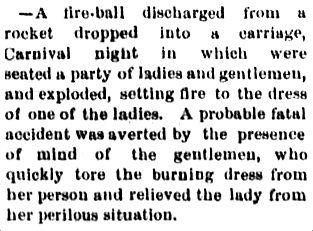
Also, there was some sort of “fireball discharged from a rocket” which caused some consternation:

fireball_dal-herald_022676Dallas Herald, Feb. 26, 1876

*

All residences and businesses along the parade route during the evening procession were “commanded” to be illuminated. Even if gasoline-fueled bonfires were raging along the parade route, the elaborate procession was probably poorly lit.

*

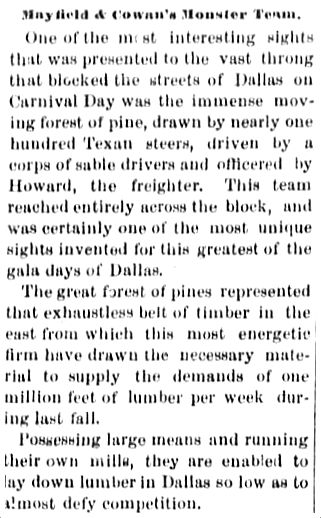
My favorite “float” was the huge wagon of lumber meant to draw attention to East Texas timber and the thriving lumber industry in Dallas. One report said “the immense moving forest of pine” was drawn by “32 yoke of oxen” — another said “nearly 100 Texan steers.” Whatever it was, that must have been spectacular to see.

oxen-team_dal-herald_022676Dallas Herald, Feb. 26, 1876

*

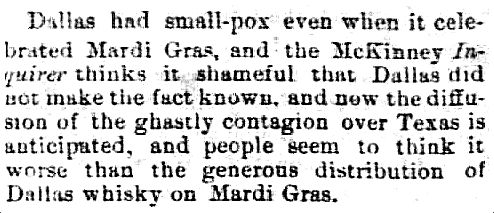
The massive amount of publicity and praise that Dallas received quite clearly irked other cities. Austin seemed especially perturbed. There had been a small outbreak of smallpox in McKinney preceding the big day, and several digs at Dallas (like the one below) appeared in newspapers around Texas, accusing the city’s leaders of knowingly endangering the welfare of the entire state just so they could put on their little parade. The exaggerated furor passed fairly quickly, and the het-up schadenfreude expressed by rival cities was amusing.

small-pox_austin-weekly-standard_031676Austin Weekly Standard, Mar. 16, 1876

*

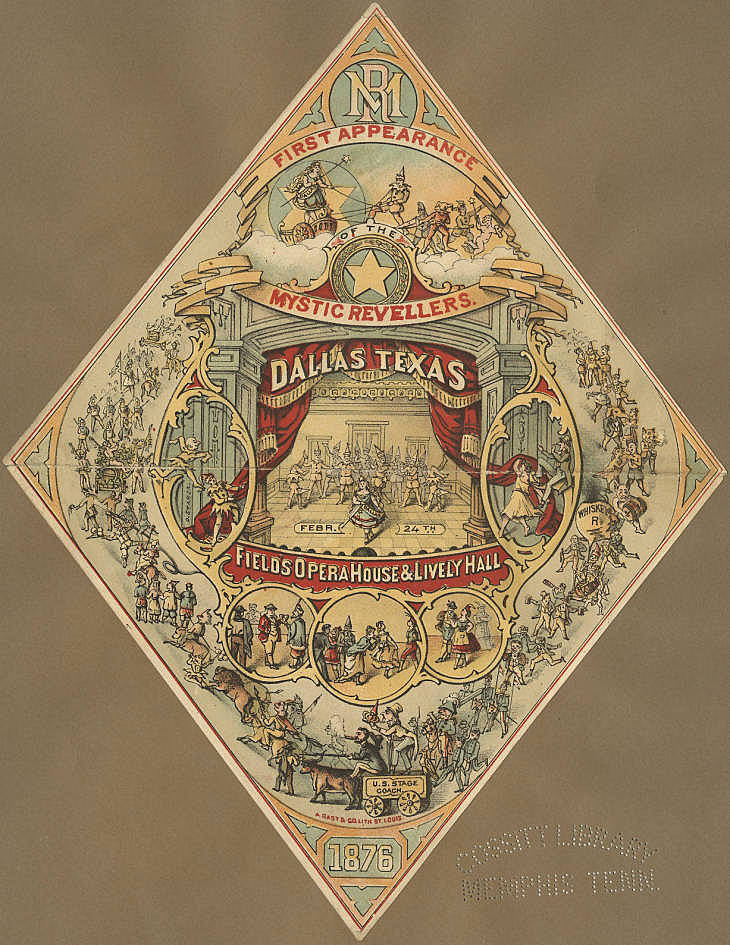
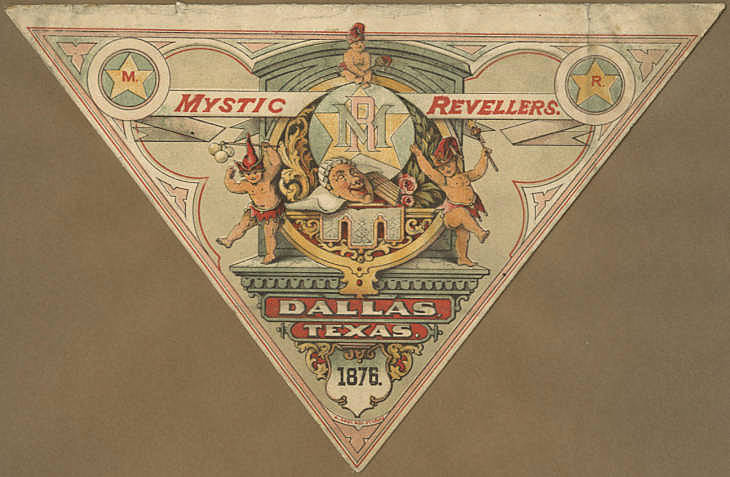
An invitation issued by the Mystic Revellers:

mardi-gras_mystic-revellers_invitation_1876_memphis-public-library

mardi-gras_mystic-revellers_1876_envelope_memphis-public-libraryColton Greene Collection, Memphis Public Libraries

*

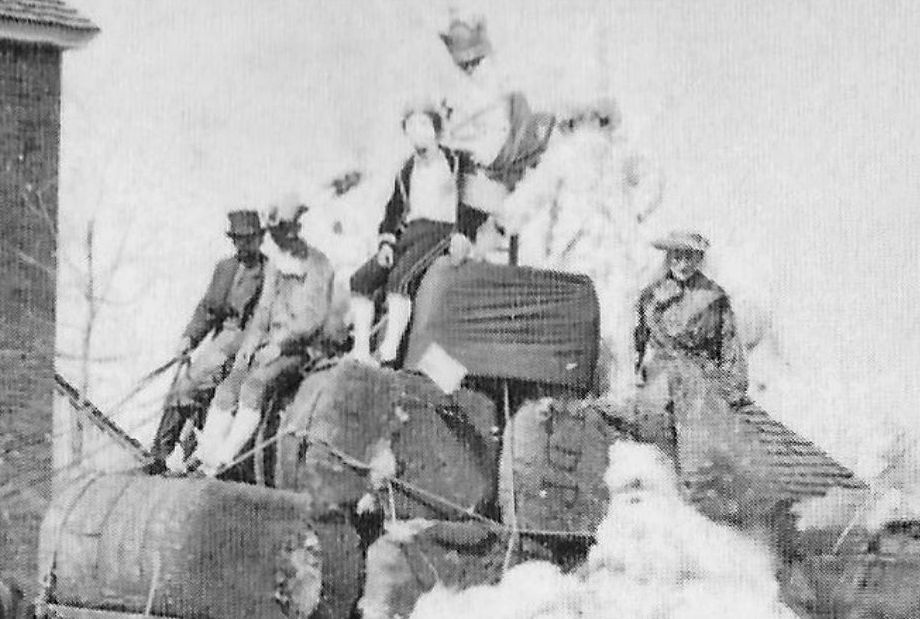
The photo at the top shows the parade wagons representing the brand new Dallas Cotton Exchange (which seems to have been organized the previous month). As described in The Galveston Daily News, the Cotton Exchange’s offering “represent[ed] King Cotton enthroned on six bales of cotton, with numerous subjects appropriately costumed, and occupying two cars” (Feb. 25, 1876). Below are a couple of magnified details of the photo. I’m not sure, but it looks as if the horse and rider in the foreground are covered with cotton. Like tarring and feathering … but fun … and with cotton. The King of Cotton is surrounded by what look like henchmen. The masked man on the right in the elaborate costume is both cool and kind of creepy. (Click both photos for larger images.)

mardi-gras_1876-det1

mardi-gras_1876-det2

***

Sources & Notes

Top photo appeared in the book Historic Photos of Dallas by Michael V. Hazel (Nashville: Turner Publishing Co., 2006); photo from the Dallas Historical Society.

Newspaper clippings as noted.

To read the coverage of Dallas’ Mardi Gras parades and balls —  “a grand pageant and general jollification” — see the front page of The Galveston Daily News (Feb. 25, 1876), here (third column, top of page — zoom controls are on the left side of page).

I wrote a previous post called “Mardi  Gras Parade in Dallas — ca. 1876” which features a photograph which might be from this first Mardi Gras. That post and photo can be seen here.

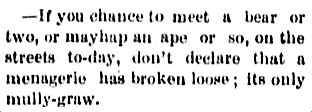
Happy Mardi Gras!

mully-graw_dal-herald_022476Dallas Herald, Feb. 24, 1876

Photos larger when clicked.

*

Copyright © 2015 Paula Bosse. All Rights Reserved.
University Park’s Monarch Butterfly Wrangler

monarch_life_colorCarl Anderson & friends (John Dominis, Time-Life Pictures/Getty Image)

by Paula Bosse

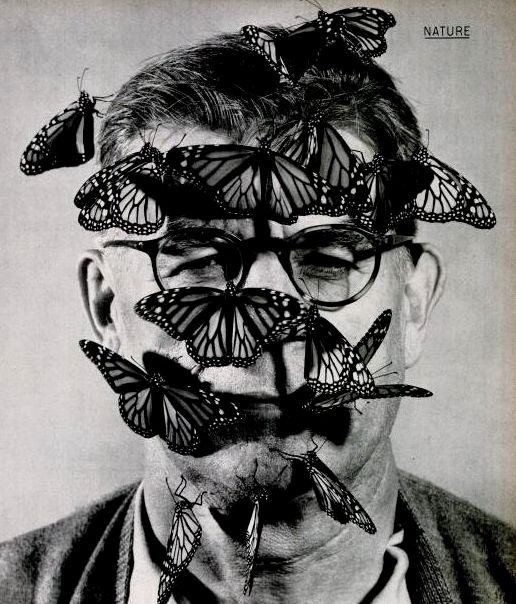
Carl Axel Anderson (1892-1983) was a mild-mannered internal revenue executive by day and a mild-mannered Monarch butterfly expert by night (and weekend … and probably every waking second). Anderson had been interested in insects and butterflies from an early age, and he studied entomology at the University of Minnesota and Columbia. When he was away from the office, he was raising, tagging, tracking, and, perhaps, training Monarch butterflies at his University Park home on Centenary Avenue, which writer Frank X. Tolbert dubbed “the Butterfly Ranch.” Even the neighborhood children — who called themselves The Centenary Monarchs — joined in and learned all about Monarchs from Anderson, their butterfly mentor.

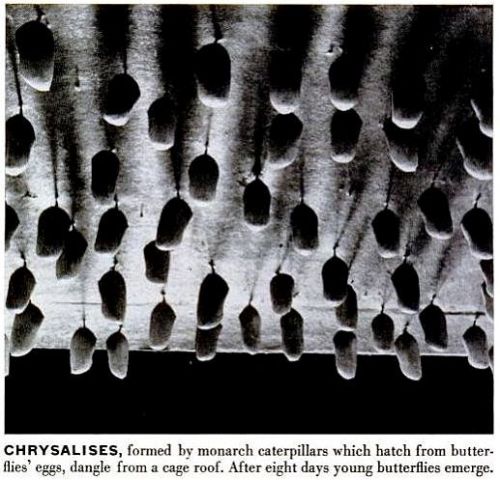
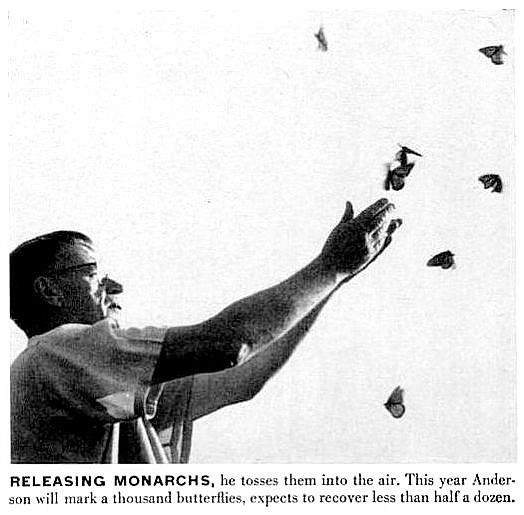
Anderson’s primary interest was studying the migration patterns of the Monarch butterfly, and, conveniently, Dallas was on their pathway, twice a year, so he had a front-row seat. Not only did he observe them passing overhead, he also raised them from eggs laid on the underside of his milkweed plants, enjoyed them as caterpillars, and when they became butterflies, he “branded” their wings painlessly (see below) and released them into the wild, hoping to be able to track their migration from fellow butterfly spotters around the country. He wrote letters to newspapers around the country and mailed hundreds of postcards to groups and individuals, hoping to get his message out. His message, in part:

Monarch butterflies raised from the egg are being released. A number is placed on their wings before they are released. Members of the public are invited to join the observers on the magic carpet of these wings to see where it will take us. Invite your friends and associates to come along, too…. Examine the wings of the Monarch…for numbers or other marks. Allow the butterfly to go on its way after your observation. Please report any observation where marked wings are found….”

In 1950, big news was made when one of his butterflies — one with the number “9” on its wing — was reported to have been seen in California by a 10-year old boy named Ben Harris in Santa Monica, California. That must have been one of the happiest moments of Anderson’s life.

Every year during Monarch migration over Texas, Mr. Anderson was a reliable go-to story for the local media. Particularly fascinated by Anderson and his “butterfly ranch” was Dallas Morning News writer Frank X Tolbert, who wrote about him numerous times. A very early profile by Tolbert rhapsodized about Anderson’s “pet” butterfly Pete which set the tone for all his very sweet subsequent articles about Anderson that appeared over the years. (Next time you’re wandering around in the Dallas News archives, check out Tolbert’s story “An Affectionate Fellow Was Pete the Butterfly” published on May 16, 1948 — but if you like happy endings, beware of the last two paragraphs of the story: personally, I’d advise readers to stop reading when Pete sets off on his journey.)

Anderson was the subject of newspaper and magazine articles all over the country, but the high point was, undoubtedly, his appearance in the pages of Life magazine in 1954, accompanied by the striking photo of him with several of his butterfly pals resting on his face.

monarch_life_052454-a

The caption for this photo reads: “Mottled with Monarchs, butterfly breeder Carl Anderson stares serenely ahead as the domesticated insects swarm all over his face.” (That is NOT a “swarm,” Life!)

The two-page photo spread was titled “Monarch Man: Texan Breeds Bushels of Them To Help Map Butterfly Migration.”

Each spring Mr. Anderson raises hundreds of Monarchs in cages. If released, they flutter about him, looking for a sip of sugar water. When the Monarchs mature, he brands them and turns them out, alerting friends across the U.S. to watch for them. One of Anderson’s butterflies turned up 1,200 miles away. But instead of clarifying the northward migration it added another enigma by flying cross-country and winding up almost directly west of Dallas. (Life, May 24, 1954)

monarch_life_052454-b

monarch_life_052454-c

monarch_life_052454_d

Anderson died at the age of 91, having spent the bulk of his long life engrossed in the study of his beloved Monarch butterflies. This excerpt from a 1955 interview shows a glimpse of the wonder and enthusiasm that kept him fascinated by the butterflies his entire life:

“Just at dusk on Oct. 26, the wind shifted to the north with a velocity of 15 MPH. It brought in a huge cloud of Monarchs riding ahead of the cool front. The cloud changed into the shape of a tremendous, brown, moving carpet of unusual surging design. A signal from some leader or leaders in the great flight designated a grove of our hackberry trees as the resting place for the night. Down came the flying carpet of thousands of butterflies. And in a few minutes every twig was bent by the weight of Monarchs. They took off in small groups the next morning, leaving our Dallas hackberries bare of leaves.” (DMN, May 3, 1955)

Thanks, Carl. I wish I’d known you.

**

Below, a short clip from Oct. 1973 featuring an interview with Carl Anderson by Arch Campbell of Channel 8 News (Campbell mistakenly refers to the park as being Tenison Park — it is Lake Cliff Park).

***

Sources & Notes

Color photo of Carl Anderson by John Dominis (Time & Life Pictures/Getty Image). It is from the same session that produced the slightly different black and white image featured in Life magazine.

The profile of Anderson (which includes the text and photos reproduced above) appeared in the May 24, 1954 issue of Life; it can be accessed here.

The Channel 8 film clip is from the WFAA Collection, G. William Jones Film & Video Collection, Hamon Arts Library, SMU; the direct YouTube link is here.

Read another profile of Anderson from the Bakersfield Californian, “Lepidopterist Traces Branded Butterflies” (July 11, 1949), here.

A bunch of Monarch butterfly sources:

  • “The Monarch Butterfly’s Annual Cycle” from the Monarch Butterfly Fund, is here.
  • “The Monarch Butterfly Journey North News,” a regularly updated blog on the current (overwintering/leading-up-to-Spring 2105) migration, is here.
  • A regularly updated map of Monarch sightings (currently at Winter 2015, showing Monarchs warming up in the bullpen along the Texas coast) is here.
  • An animated map of 2014’s Spring migration is here. UPDATE: An animated map of the Fall/Winter 2015 migration is here.
  • “Monarch Butterflies Could Gain Endangered Species Protection,” from the Scientific American blog, is here. (“Populations of the iconic and beloved Monarch butterfly (Danaus plexippus plexippus) have dropped an astonishing 96.5 percent over the past few decades, from an estimated 1 billion in the mid-1990s to just 35 million in early 2014.”)
  • Information on the Monarch butterfly conservation program — and some beautiful photographs — can be found on the World Wildlife Fund site, here.

Keep your eyes peeled — they’ll be on their way soon

*

Copyright © 2015 Paula Bosse. All Rights Reserved.

Back at the Ranch with Yves Saint Laurent — 1958

YSL_longhorn_josey-ranch_1958_eric-sweckerYSL & friend… (photo: Eric Swecker)

by Paula Bosse

Even if you had no idea who the man with the glasses was, this would be an attention-grabber of a photo. But if you do happen to recognize the man as international fashion icon Yves Saint Laurent, then it’s even more of an attention-grabber. Yes, that is 22-year-old Yves Saint Laurent, head of the legendary House of Dior.

…In a pasture with a longhorn steer.

…Wearing a Stetson (or something Stetson-like).

..In Carrollton, Texas! What could be more unexpectedly perfect?

The UPI/Telephoto caption:

9/5/58-DALLAS: Yves-Mathieu Saint Laurent, 22-year-old master of the House of Dior, got a taste of Texas tradition on his first trip to the US. Saint Laurent, in Dallas to receive an award from Neiman-Marcus, stopped off at a cattle ranch near here before departing for France and was presented a Texas-style hat and introduced to a real “Texas Longhorn” steer.

YSL (who had not yet jettisoned the “Mathieu”) was the wunderkind fashion designer who — at the unbelievable age of 21 — had succeeded Christian Dior as Dior’s head designer. His first collection was a hit, and he was 1958’s fashion superstar.

That was the year that YSL was invited to Dallas by Stanley Marcus to receive the 21st Annual Neiman-Marcus Fashion Exposition Award — known throughout the industry as the “Fashion Oscar.”

He has had many offers to come to America to accept awards but the Dallas honor was the only one he accepted. He had a sentimental reason. His late master, Christian Dior, came to Dallas to accept the Neiman-Marcus award in 1947 after he had created the New Look in his second collection. (Dallas Morning News, Sept. 4, 1958)

While in Dallas, the young Saint Laurent — whom the fashion editor of The Dallas Morning News described as looking “like a serious young man who might be coming to enroll at SMU” — soaked up a little local color: he was taken to the Orleans Room downtown to see the Dixieland jazz band The Chain Gang, and — apparently at his request — he was taken to a Texas ranch.

Saint Laurent had been quite keen to see a real Texas ranch, so Stanley Marcus’ son Richard took him out to the nearby Josey Rancho — the large ranch owned by Dallas oilmen brothers Clint and Don Josey in then-rural Carrollton. The fashionably dressed, Cartier-watch-wearing dudes took a bumpy ride in a pickup truck across the large ranch, and there was much gawking of longhorn cattle and herds of buffalo. YSL seems to have enjoyed himself and must have found the whole thing very “Texan”: he got closer to a longhorn than I’d ever get (and he squatted like a real cowboy!), he watched some calf roping, and he ate some barbecue. And he was probably the most stylishly-dressed visitor the ranch ever had (there aren’t a lot of tailored suits and French cuffs out on the lone prairie).

He headed back to Paris later that afternoon with, I’m sure, plenty of exotic stories to share with those back at the atelier. He also had a new hat. And maybe some indigestion.

*

ysl_090458_stanley-marcus-papers_SMUvia Stanley Marcus Papers, SMU

josey-rancho-longhorns_lufkin-line-mag_1956Josey Rancho

josey-rancho-buffalo_1950sJosey Rancho

josey-rancho_aerial_pointer-bkJosey Rancho

***

Sources & Notes

Top photo by UPI/Telephoto. This wire photo is from the collection of my old friend Eric Swecker. Thank you for use of this fantastic photo, Eric!

Photo of longhorns at the Josey Rancho from a trade magazine called The Lufkin Line (Jan./Feb., 1956). Photo of Josey Rancho buffalo and the aerial photo are from the book Carrollton by Toyia Pointer, with photo credit given to Linda Sollinger; more on the book here. More information on the ranch from the book is here.

More on YSL’s visit can be found in the Dallas Morning News article “N-M Awardees Get Glimpse of Texas” by Gay Simpson (DMN, Sept. 6, 1958).

YSL wiki, here.

“When Coco Chanel Came To Dallas — 1957” — my post about Mlle. Chanel’s visit to Dallas to accept the previous year’s Neiman-Marcus award — is here. (Let’s hope Saint Laurent liked the BBQ more than Coco did.)

*

Copyright © 2015 Paula Bosse. All Rights Reserved.

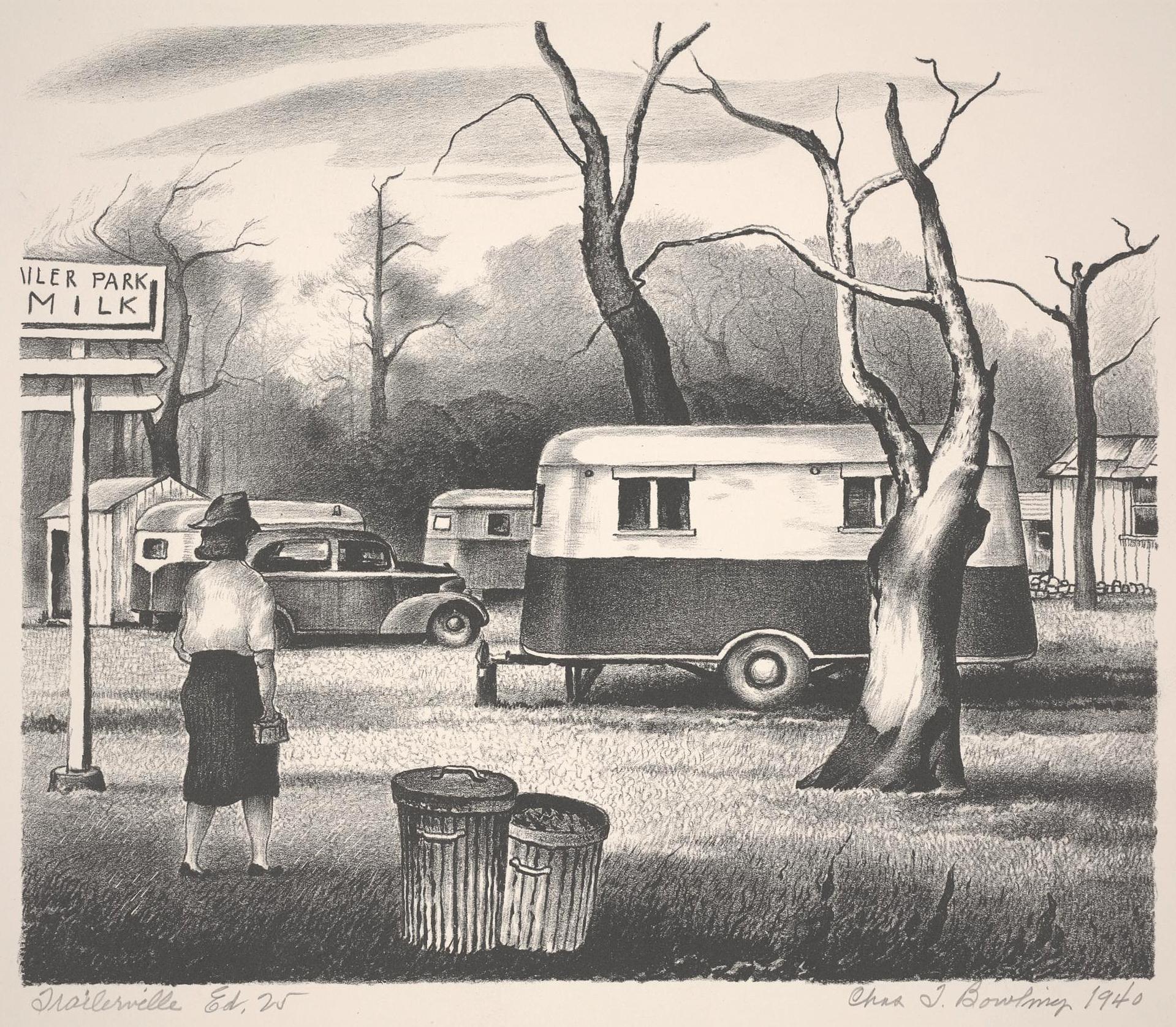
“Trailerville” by Charles T. Bowling — 1940

bowling_trailerville_1940_dma(Dallas Museum of Art)

by Paula Bosse

A 1940 lithograph by one of my favorite Dallas artists, Charles Bowling (1891-1985). I don’t know if this trailer park was in Dallas, but I certainly hope so.

***

This lithograph is in the collection of the Dallas Museum of Art, a gift of A. H. Belo Corporation and The Dallas Morning News. More info can be found at the DMA website, here.

Biographical information on Bowling can be found here.

Image is much larger when clicked.

*

Copyright © 2015 Paula Bosse. All Rights Reserved.