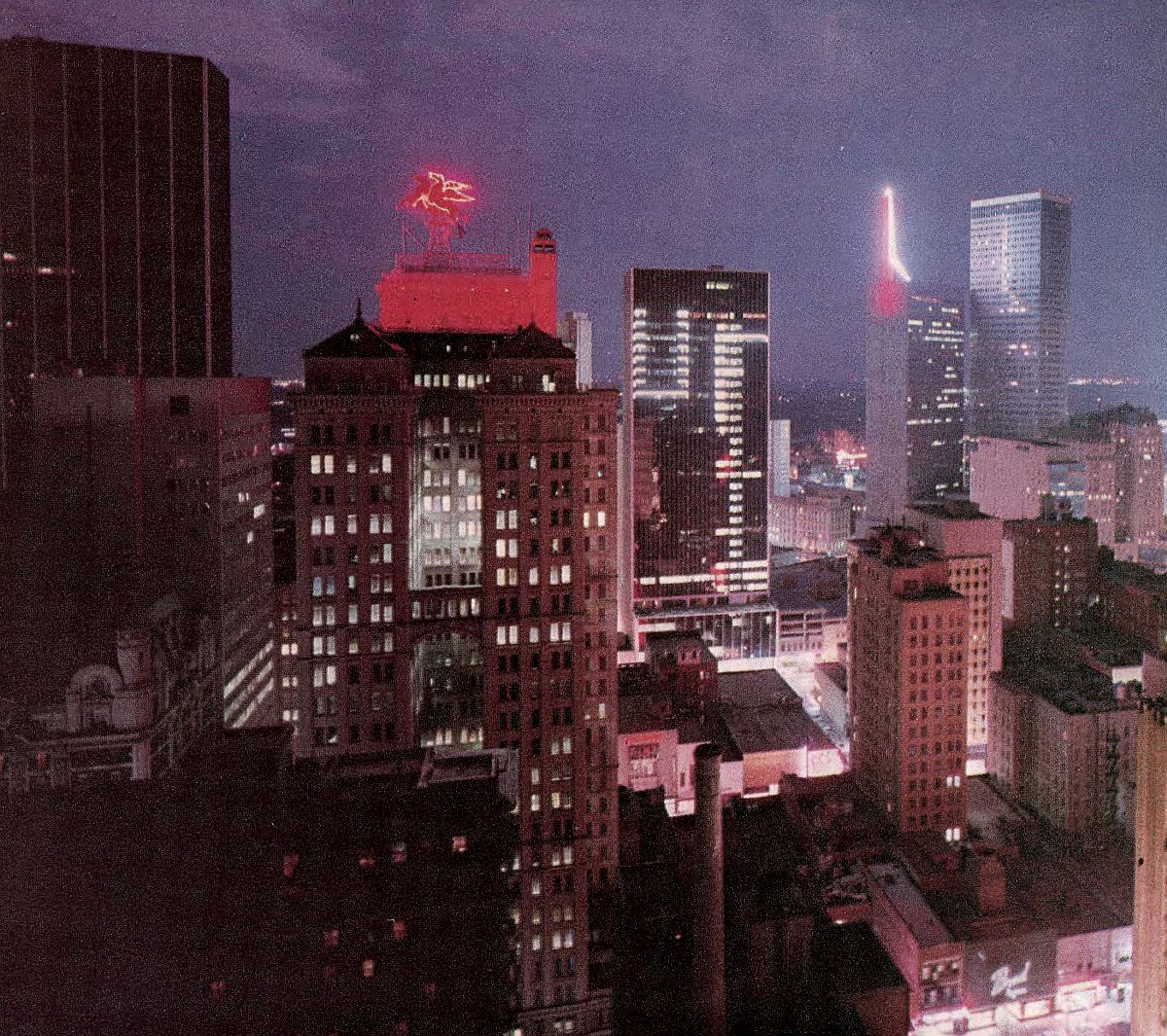
Flashback : Dallas

A Miscellany: History, Ads, Pop Culture

Category: HOF

“Enemy Aliens” and the WWII Internment Camp at Seagoville
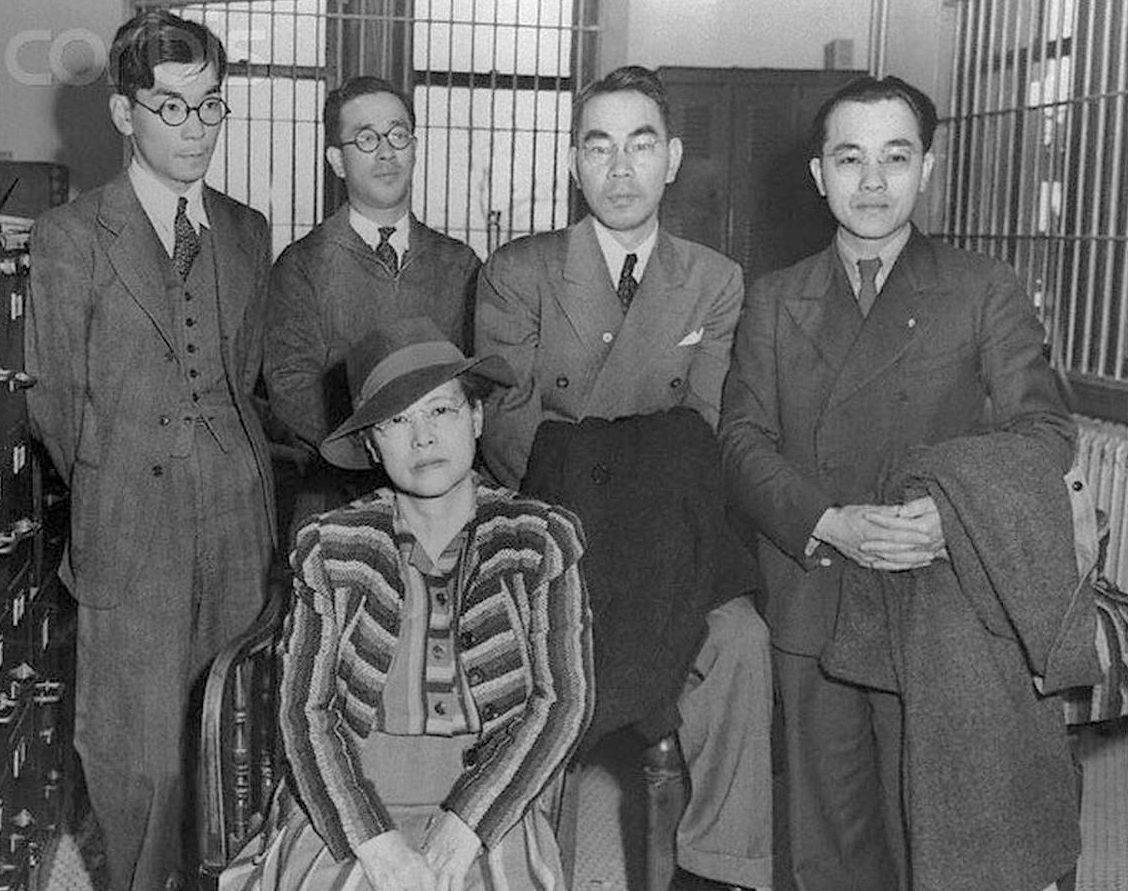
japanese_dallas_wwii_corbisDallasites rounded up the day after Pearl Harbor… (click for larger image)

by Paula Bosse

I think most of us know about the sad period in American history of Japanese internment camps when, following Japan’s bombing of Pearl Harbor, the United States “interned” men, women, and children of Japanese descent (often including whole families, some of whom were born in America or were naturalized American citizens). I’ve always thought of these camps as being in the western part of the country. I had no idea until just a couple of days ago that there were three “enemy alien” internment camps in Texas — and one of them was in Dallas County.

For a full history of the camp in Seagoville — which is a mere 20 miles southeast of Dallas — there are several links at the bottom of this post. But, briefly, the “camp” was originally built as a federal women’s prison in 1938 on 800 acres of farmland. The United States entered World War II as a result of Japan’s bombing of Pearl Harbor on Dec. 7, 1941, and, suddenly, authorities began scrambling to round up enemy aliens living in the U.S.: people born in countries we were now at war with — primarily those of Japanese, German, and Italian descent — were rounded up and questioned. Many were arrested, and some were interned in camps where they were basically kept prisoner for the duration of the war. Even though the bulk of the initial internees were, oddly enough, from Latin America (most of them Japanese, most sent from Peru), there were also several who, before the war, had been living in the United States for decades without any problems. (See a dizzying number of links at the bottom of this post for more on the Texas internment camps at Seagoville, Kenedy, and Crystal City.)

Below, the Seagoville camp.

seagoville_aerial_thc

seagoville-internment-camp_ut-inst-texan-cultures

In December, 1941, authorities in every city in the country were swooping down on foreign nationals (or sometimes just people who looked foreign or spoke with an accent), hauling them in for questioning, often arresting them for nothing more than the fact that they had been born in another country. Dallas was certainly no exception. Unsurprisingly, immediately following the bombing of Pearl Harbor, Dallas’ few Japanese residents were rounded up. All ten of them. The photo at the top shows five of the first detainees, at the Dallas jail.

Most of Dallas’ Japanese residents worked for the Japan Cotton Company, an important cotton broker which had occupied space in the Dallas Cotton Exchange building since the late 1920s. (For a bit of weird trivia, the father of famed gossip columnist Liz Smith was working as a cotton buyer for the company during the war, commuting to work from Fort Worth.) If they weren’t working for the Japan Cotton Company, they were probably members of two Japanese families with long ties to Dallas: the Muta and Sekiya families, owners of the respected Oriental Art Company since 1900.

oriental-art-company_1921-ad1921 ad

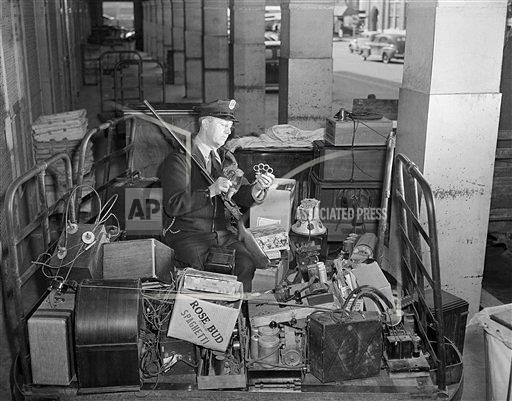
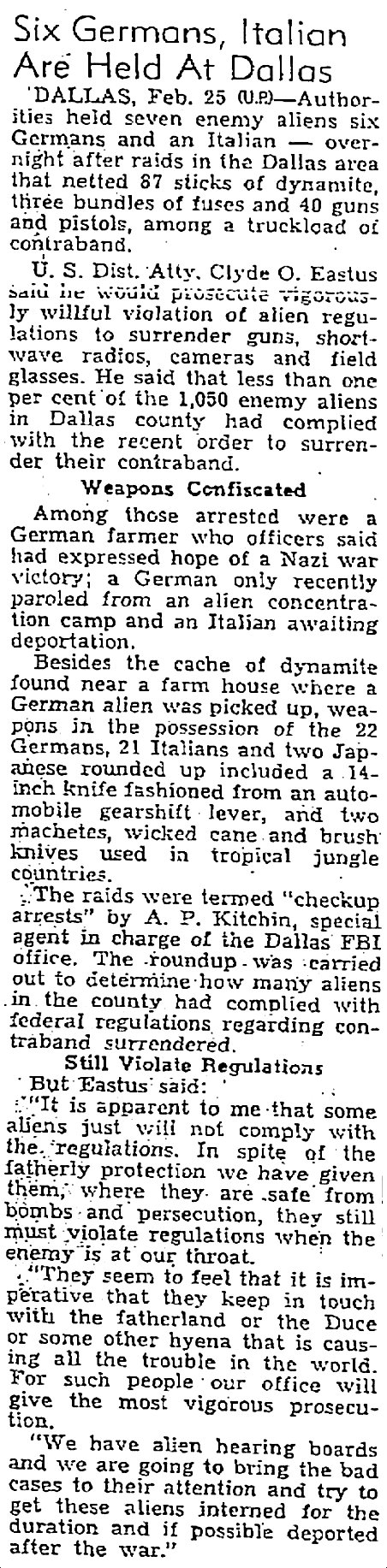
In February 1942, the Associated Press photo below appeared in several newspapers, along with the following caption: “This is a portion of the contraband radios, cameras, guns, that were seized during all-night raids on residences of enemy aliens in Dallas County, Texas, by federal and local officers. Scores of aliens also were taken into custody.”
wwii_aliens_AP_1942

Lubbock Avalanche, Feb. 26, 1942 (click to read)

The first internees arrived in the Dallas area in April 1942. The group was comprised of 250 women and children (“citizens of the Axis nations”) who had been arrested in Panama. They were interned in Seagoville, displacing the federal women prisoners who had previously been held there — they were transferred to a prison in West Virginia.

Jewish refugees sometimes found themselves tossed into enemy alien internment camps — simply because they had fled homelands which happened to be “Axis-controlled” countries with which the U.S. was at war (even though it seems highly unlikely that a German Jew would be an ardent Nazi sympathizer, gathering classified information to send the Führer’s way). Yes, Seagoville had detainees from all over the place. It was quite the melting pot. There was even a Bavarian princess in there. I wonder if a single person in that camp, held against his or her will for months and years, posed any actual threat to Allied forces.
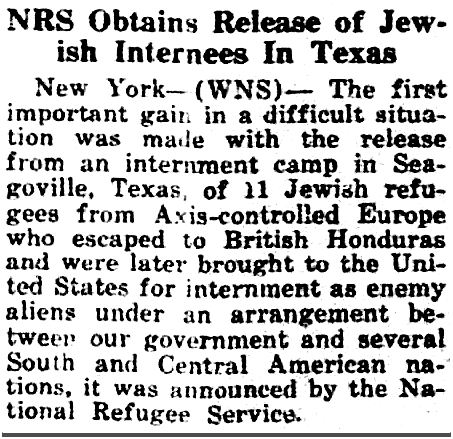
seagoville_wwii_wisconsin-jewish-chron_milwaukee_052843
Wisconsin Jewish Chronicle, May 28, 1943

Germans and Italians were able to “blend in” to American society, but Asian men and women had a harder time and were more often harassed. The person who seems to have most disliked and distrusted Japanese people was top Dallas police detective Will Fritz — in fact, The Dallas Morning News called Fritz “one of Dallas’ most enthusiastic Jap-haters” (DMN, Feb. 17, 1943). Let’s just say that Capt. Fritz wasn’t going to be sending the wartime Welcome Wagon to any prospective Dallas residents of Japanese descent.

One Dallasite who was pretty angry and unhappy with the situation was Masao Yamamoto, an executive with the Japan Cotton Company who had lived in Dallas since 1928. He and his wife and two young sons (one of whom was born in Dallas) were living what appears to have been a nice life in the M-Streets when they were “detained.” Ultimately, the Yamamoto family was deported and sent to Tokyo, six months after the photo at the top of this post was taken (Mr. Yamamoto is the third from the left in the top photo) — they were part of a sort of prisoner swap.

After his deportation, Mr. Yamamoto complained to the Japanese press about his treatment in Dallas, where he said he was arrested, relieved of his possession, and thrown in jail with “burglars, murderers, deserters and other criminals.” (Click to see larger image.)
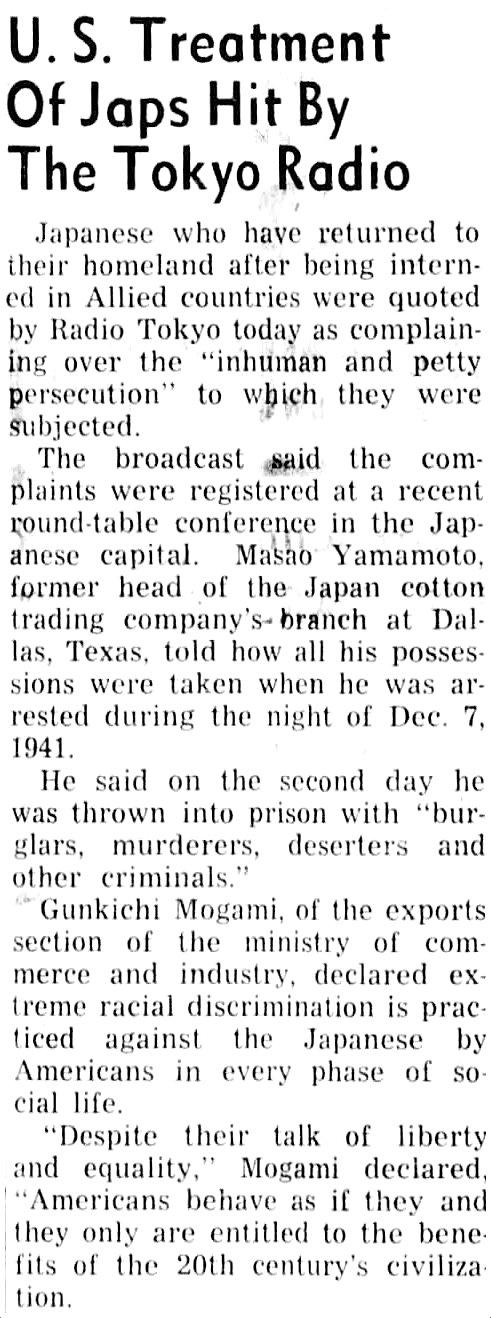
yamamoto_santa-cruz-sentinel_021843UPI wire story, Feb. 16, 1943

Will Fritz just about had a seizure when he heard of Yamamoto’s complaints, insisting that he was not mistreated and that he was a dangerous enemy agent: “Any apology that may be due should go to the murderers and burglars instead of Yamamoto. […] He was deported for we have absolute proof he was an agent of the Imperial Japanese Government and that his cotton-buying story was just another Jap blind. I consider him one of the most dangerous of enemy agents” (DMN, Feb. 17, 1943). (This is from the article which described Fritz as “one of Dallas’ most enthusiastic Jap-haters.”)

But even in the midst of all this paranoid nastiness, there were occasional heartwarming moments. After the attack on Pearl Harbor, the Oriental Art Company — the 40-year-old business owned by Hideo Muta (who came to Dallas in 1900) — was ordered closed. In a show of support, 200 of his friends, neighbors, and customers signed a petition vouching for his staunch American patriotism (which is plainly evident in his 1951 obituary in which he is described as a “patriot”). In the ad below, the 73-year-old Muta acknowledged the support of his Dallas friends and announced the reopening of his business in an ad taken out on Dec. 15, 1941: “Thank You — Dallas friends have been wonderful to us … their expressions of friendship and confidence have made us very happy. The United States Government has licensed us to continue business. Oriental Art Co., 1312 Elm.”
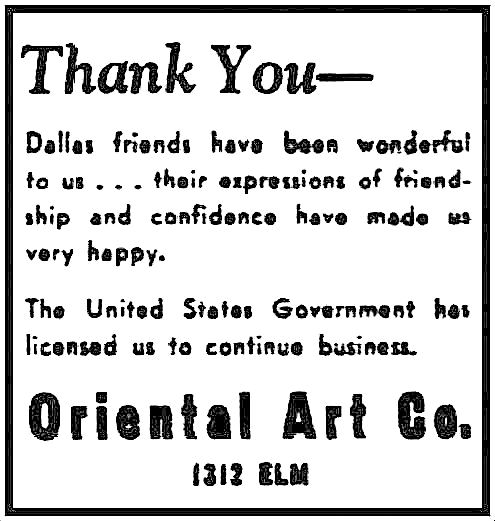
oriental-art-co_dmn_121541
Dec. 15, 1941

Mr. Muta was spared the “enemy alien” internment camp, but, along with other Asian men and women residing in the United States, he was barred from becoming a naturalized U.S. citizen because of the “Oriental Exclusion Act.” The inability of Mr. Muta to become a U.S. citizen did not dampen his enthusiasm for American democracy: he paid his poll tax every year, even though he was not allowed to vote, and he was a proud member of the Dallas Chamber of Commerce for over 25 years.

The Seagoville Enemy Alien Detention Station was closed in May, 1945, and the site was returned to the Bureau of Prisons.

***

Sources & Notes

Photos of the Seagoville camp are from the Institute of Texan Cultures (UTSA).

Articles of interest from The Dallas Morning News:

  • “Six Japanese Taken in Custody By Local Police” (DMN, Dec. 8, 1941)
  • “Dallas Japs Questioned” (DMN, Dec. 9, 1941)
  • “Six Suspected Germans Held in Dallas Roundup of Aliens; Total of Jap Prisoners Rises to 10” (DMN, Dec. 9, 1941)
  • “Enemy Aliens In Dallas, 776; Arrested, 30: But All Suspects Are Closely Watched By G-Men and Police” (DMN, Dec. 19, 1941)
  • “FBI Rounds Up 50 Enemy Aliens, Seizes Arms, Cameras, Radios” (with photos of Dallas residents of Japanese, German, and Italian descent as well as seized “contraband”) (DMN, Feb. 25, 1942)
  • “Women Aliens Are Interned At Seagoville; 250, Including Their Children, Arrive Here From Panama” (DMN, April 11, 1942)
  • “Chilly Welcome Given 15 Japs From Coast; O.K. to Come to Dallas, Were Told; Still More On Way, Inform Police (DMN, April 23, 1942)
  • “Japs Leave Dallas” and “Tokyo-Bound Jap Lad Takes Candy Six-Gun as Souvenir” (about the deportation of the Yamamoto family, with photo) (DMN, June 6, 1942)
  • “Fritz Sheds No Tears For Mr. Yamamoto” (DMN, Feb. 17, 1943)
  • “Japanese Woman Revisits Seagoville” by Roy Hamric (profile of Masayo Ogawa) (DMN, Sept. 8, 1970)
  • “American Gulag: When Seagoville Housed the Aliens” by Kent Biffle (DMN, July 23, 1978)

More articles on the Seagoville internment camp:

  • One of the best articles I’ve read on the camp was an interview with two men (Erich Schneider and Alfred Plaschke) who, as American-born children of German parents, were interned at Seagoville and were later deported to Nazi Germany (in a prisoner exchange) where they experienced the terrifying bombing of Dresden. Both families returned to the United States after the war. The article by Mark Smith — “German-Americans Recall Horror of Deportation — Hundreds of Detainees Sent to Nazi Germany in POW Trade” — appeared in the Houston Chronicle on Nov. 11, 1990, and can be read here.
  • “Seagoville Enemy Alien Detention Station” (Texas Historical Commission), here
  • “World War II Internment Camps” (Handbook of Texas), here
  • “Seagoville, South America, and War — A Historic Intersection” by Kathy Lovas (Legacies, Fall, 2000), here
  • “Seagoville Detention Facility” (Densho Encyclopedia), here (and for more on the Japanese-American experience overall, see the main page, here)
  • “The Japanese Texans” by John L. Davis (Institute of Texan Cultures), here (opens a PDF)

Thanks to friend Julia Barton for posting about (and suddenly making me aware of) the Seagoville camp.

All photos and clippings are larger when clicked.

*

Copyright © 2017 Paula Bosse. All Rights Reserved.
How Dallas Used to Get Election Returns

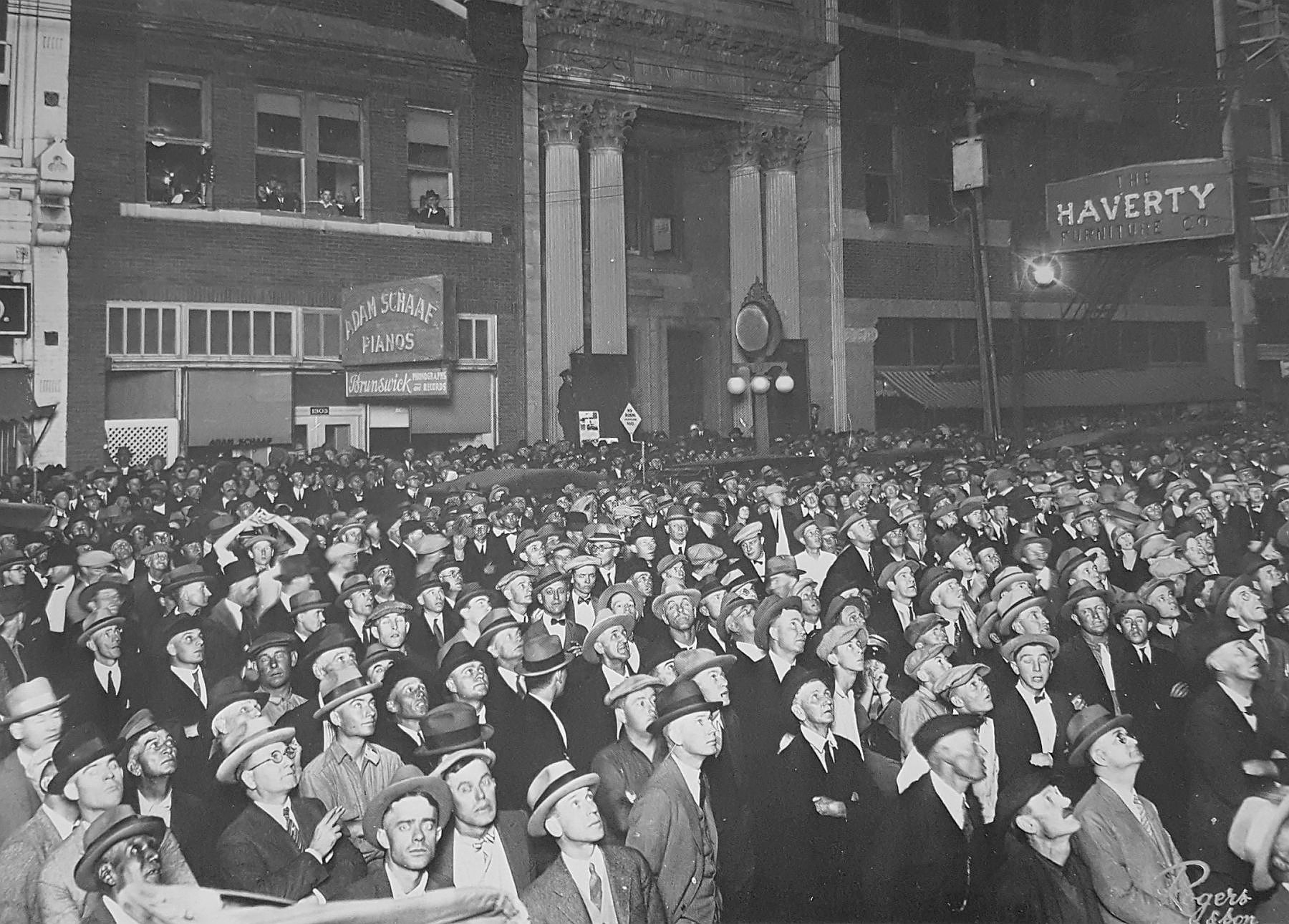
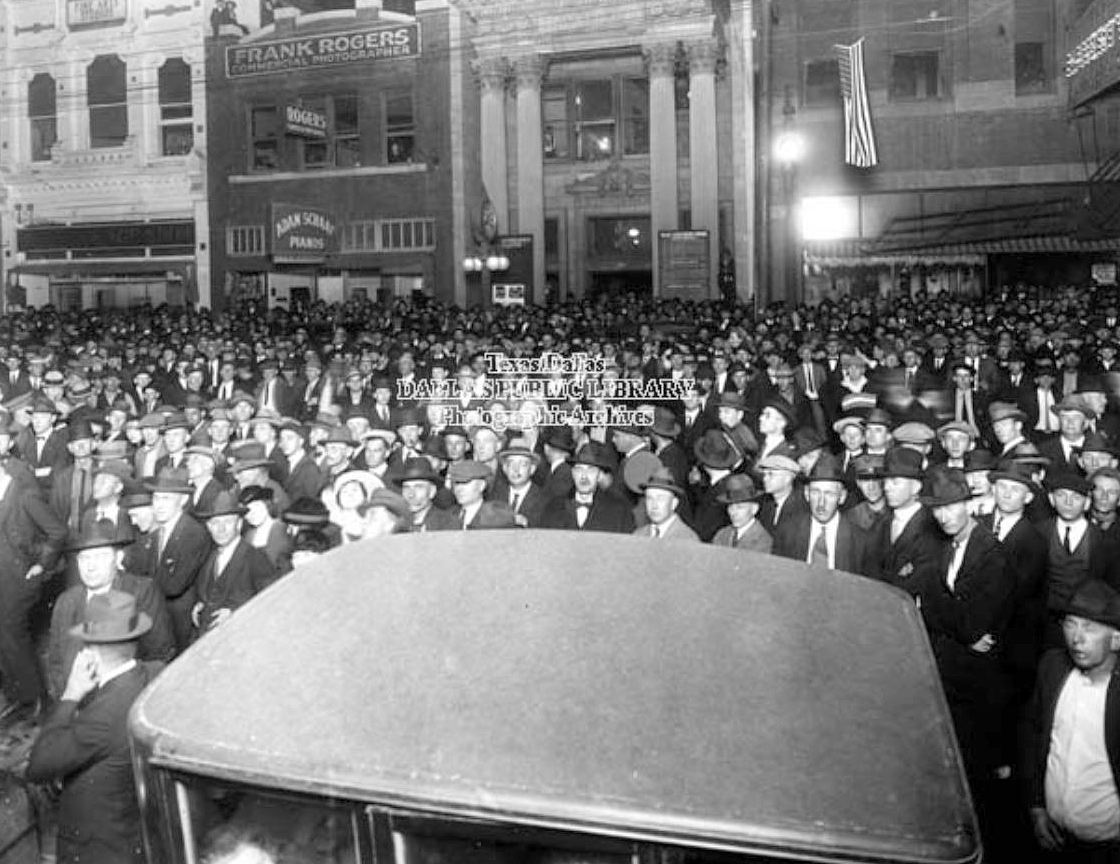
election-returns_1928_frank-rogers_dplA Dallas crowd waits for returns, in the middle of Elm Street…

by Paula Bosse

I think there’s some sort of political thing going on? Like most every other human being in the United States (…and beyond), I’m pretty sick of hearing about politics and politicians. Like nauseous sick. So why not write about elections! Below are some fun facts about how Dallasites used to get their election returns — share them with your fellow voters while standing in line at the polling station. They will think you are either very interesting or very annoying.

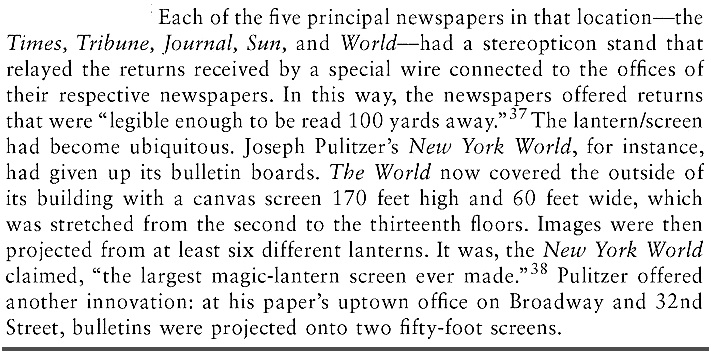
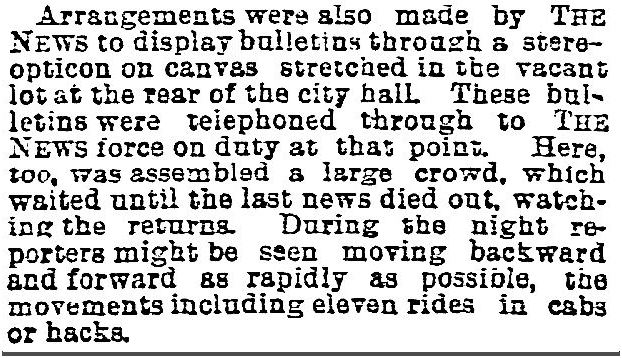
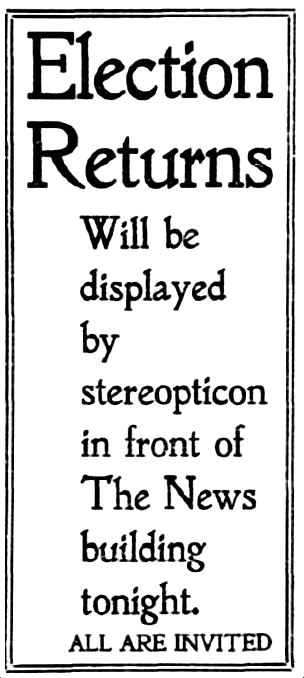
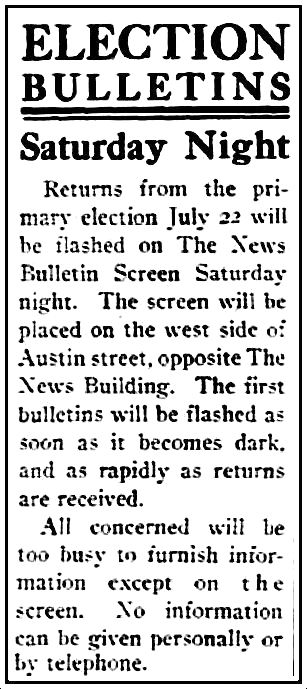
Forget the issues and the personalities, let’s look at election results: how were they passed along to the public in the days before radio and television? Other than newspapers (the primary source of all things informational), there was a time when results were “bulletined” by throwing images onto stretched canvases or even onto the sides of  buildings by a powerful stereopticon or “magic lantern.” These results were continuously updated as manual counts in local races were tabulated; farther-flung races were updated via tallies received by telegraph or telephone. Crowds gathered in front of buildings — usually newspaper offices — to watch the returns. Some accounts have this form of information dissemination beginning in the 1860s (see an illustration from 1872 here), with the practice becoming more widespread by the 1880s and more technologically advanced by the 1890s.

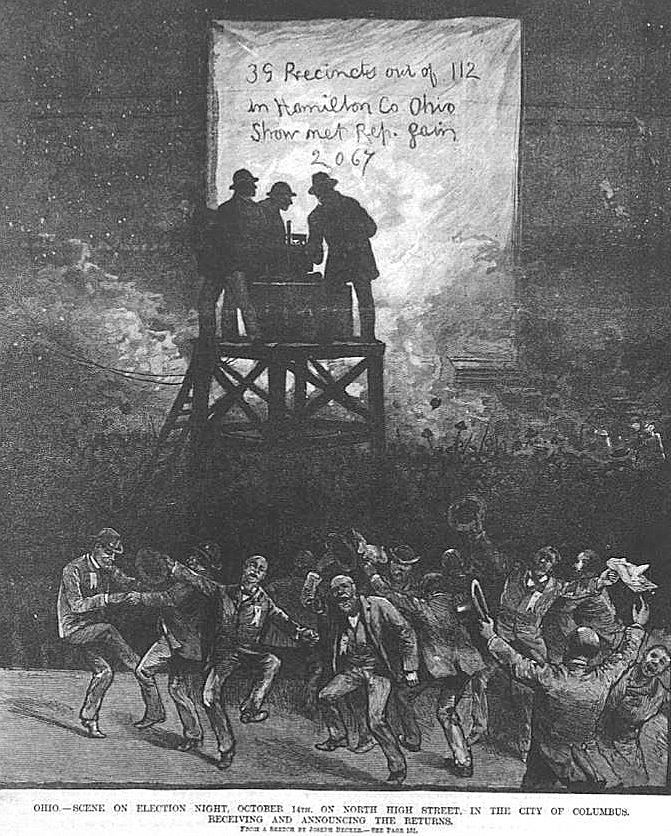
Below, an illustration showing jubilant crowds watching congressional returns in Columbus, Ohio in 1884.

ohio_election-results_1884
Columbus, Ohio, 1884

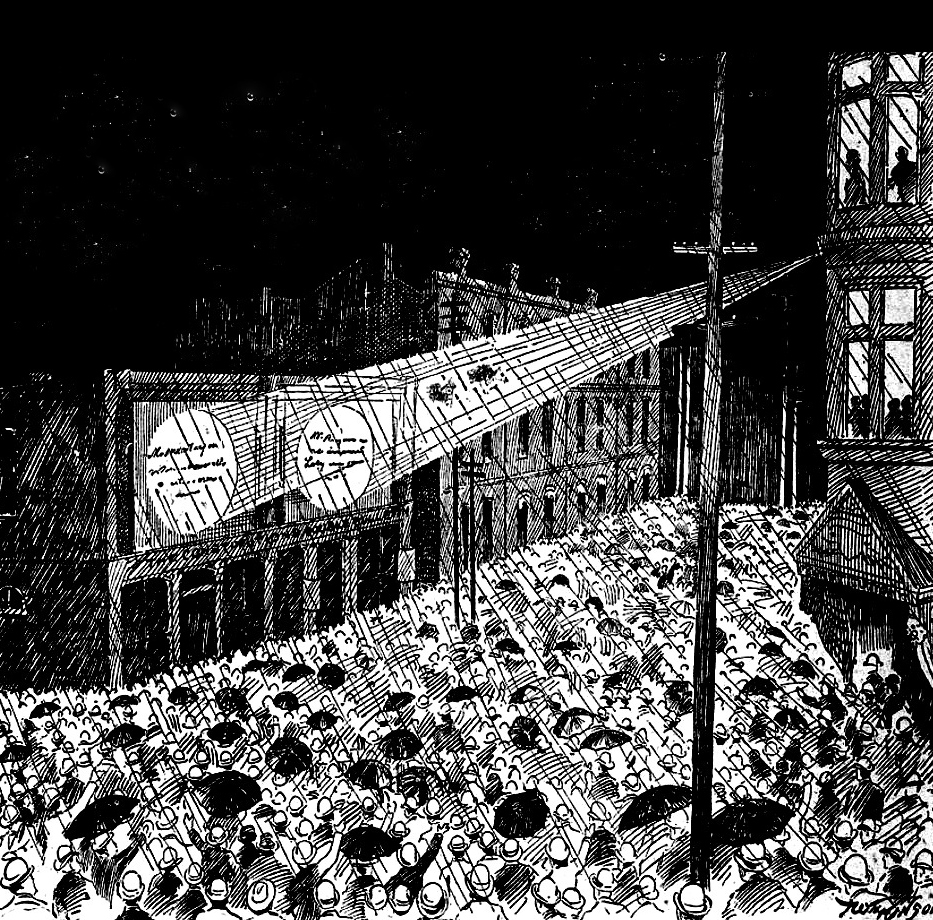
Things had been refined by 1896, as this illustration from the Atlanta Constitution shows. The caption: “Flashing out the returns in front of the Constitution office. Thousands of people gathered in front of the Constitution Building last night and watched the returns come in.” In the rain! That’s dedication.

atlanta-1896_twitter
Atlanta, Georgia, 1896

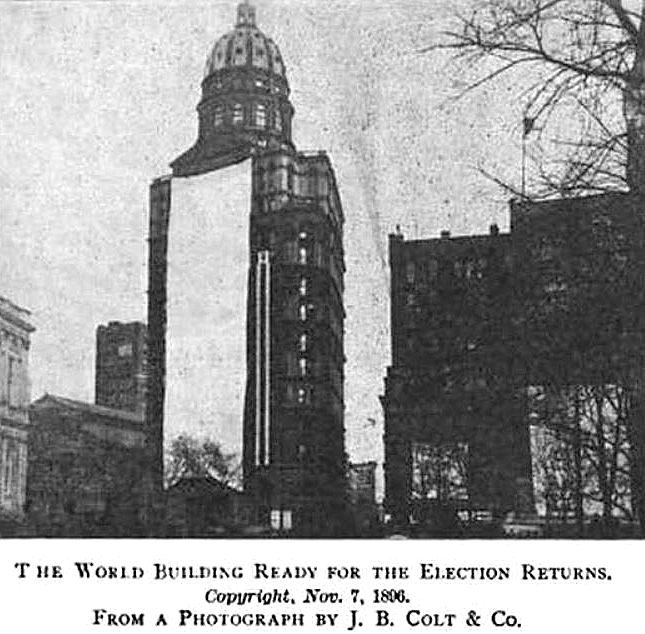
Also in 1896 — things got crazy in New York, with a ridiculously large “screen” hung from a very tall building.

projections_electrical-engineer_mag_111196_photo
NYC, 1896

magic-lantern_nyc_films-and-american-presidency
from “Film and the American Presidency”

The first mention I found in The Dallas Morning News about projecting election results before a large crowd was in 1891. Not only did the newspaper have a large bulletin board (maybe like a large chalk board?), they also used the stereopticon. (The full article about the results of the 1891 election can be read here.) (All pictures and clippings are larger when clicked.)

1891_election-returns_dmn_040891
Dallas Morning News, April 8, 1891

The magic lantern was called back into service the next year (read an entertaining DMN article about an 1892 election here in which the crowd huddled in front of the screen watching the returns despite rain and open saloons) — in fact, this “electric bulletin board” was so popular it was used for at least 40 more years.

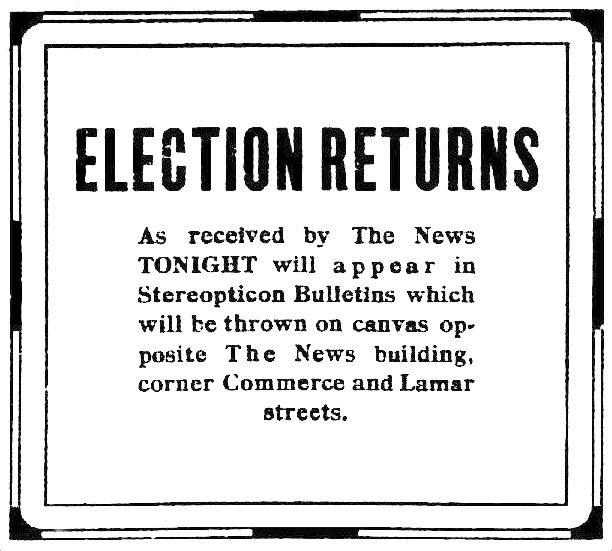
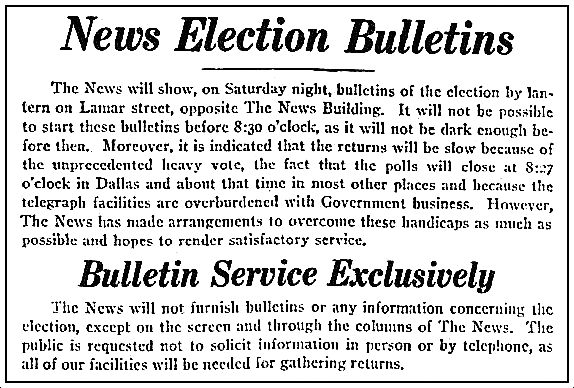
In 1896, interest was really intense — an unbelievable 94% of Dallas’ registered voters had turned out to cast ballots. (It took four days to tally the votes!) A huge crowd gathered around the News building at Commerce and Lamar to watch the bulletins which were “flashed by means of a powerful stereopticon on a large canvas screen stretched across the street” (“Republicans Doubled Votes in ’96” by Sam Acheson, DMN, Jan. 1, 1968).

By 1900 this stereopticon thing was getting to be standard operating procedure.

1900_election-result_dmn_110600
DMN, Nov. 6, 1900

1908_election-result_dmn_050208
DMN, May 2, 1908

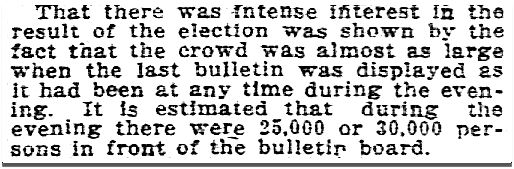
By 1911, “25,000 or 30,000 persons” were showing up to watch the returns.

1911_25-or30000-people_dmn_072311
DMN, July 23, 1911

I guess people used to just phone the papers after elections to ask about the results. The News would rather you didn’t, thanks.

1916_election-result_dmn_072116
DMN, July 21, 1916

1918 was an interesting year for a few reasons: (1) WWI was underway, (2) the polls opened — for some reason — at 9:27 AM and closed at 8:27 PM (?), and … (3) it was the first election in Dallas in which women were allowed to vote. There was suddenly a huge number of registered voters to have to deal with. Newspaper reports showed registration of women outnumbering men in several precincts. The large number of new voters meant that votes began to be counted “one hour after the polls are opened and will continue until the work is concluded” (DMN, July 19, 1918). Which seems odd. Also, women were encouraged to vote early in the day so as to avoid long lines and men were instructed to watch their behavior if there were women present.

1918_election-result_dmn_072618
DMN, July 26, 1918

It’s surprising that the use of projectors to display election returns was used as late as 1930, well after the advent of radio. Apparently the Texas Election Bureau and Press Association had rules forbidding radio stations from announcing election results over the air until they had been printed in the newspaper — they were, however, allowed to give “relative standings” to their audiences at fifteen-minute intervals (DMN, July 27, 1930).

Seems like the newspapers held all the power (probably not a huge problem for radio stations since most of them were owned by the newspapers, and, of course, no problem at all for the papers who printed oodles of “extra” editions). By 1930, though, crowds had gotten so large downtown that they were diverting people to Fair Park where they could sit and enjoy the cool breezes as they listened to see if their candidates had won or lost. (“Sitting” seems to be the operative word here.) But soon radio would wrest the “instant news bulletin” power away from the newspapers, and these quaint magic lantern watching-parties would be unnecessary. Eventually people wouldn’t know they’d ever even existed.

Fast-forward to today. I can’t even imagine trekking downtown to watch election results come in at a snail’s pace, magic lantern or not. It’s the 21st century, man, and I’ll be plopped in front of my TV, channel-hopping, stress-eating and stress-drinking, and wondering what friendly country I might consider “visiting” for a while.

***

Sources & Notes

Top photo shows crowds of Dallasites watching election returns. This Frank Rogers photo — a Dallas Public Library photo reproduced in A. C. Greene’s book Dallas, The Deciding Years — shows a crowd (which seems to be devoid of women) watching election returns in the 1300 block of Elm Street. Below is another Rogers photo from the DPL, undated, but probably taken in 1922:

election-returns_elm-street_dpl_frank-rogers

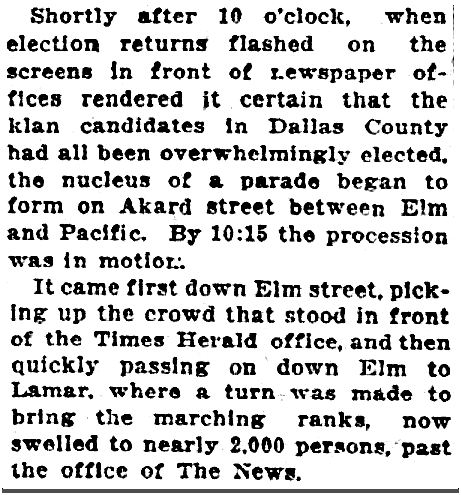
It’s convenient that Rogers was able to include his studio in the background! The photograph is undated, but Frank Rogers and the Adam Schaaf Piano Store shared a building at 1303 Elm only between 1922 and 1923 (the top photo is dated 1928 by the DPL, but neither Rogers nor the piano store were in that location after about 1925). The building to the right is the Dallas Times Herald Building (with the pillars, at 1305 Elm), and it would make sense that the crowd was looking toward the other side of the street as results were being updated and projected from the Times Herald. In fact, this may have been the night that the KKK famously marched through downtown, past the large crowds gathered in front of both the Dallas Times Herald and Dallas Morning News offices, to celebrate that their candidates had won … and had won big.

klan-march_dmn_082722
DMN, Aug. 27, 1922

The illustration showing Ohio returns in Columbus being projected on the night of Oct. 14, 1884 is from Frank Leslie’s Weekly (this illustration was featured in the book Politicking and Emergent Media: U.S. Presidential Elections of the 1890s by Charles Musser).

The 1896 illustration is from the Atlanta Constitution, found on Twitter.

The 1896 photograph of the World Building in New York is from the trade journal The Electrical Engineer, Nov. 11, 1896. The paragraph below it is from the book Film and the American Presidency by Jeff Menne and Christian B. Long.

Further reading from the archives of The Dallas Morning News (regarding the July 26, 1930 election):

  • “News and Journal To Give Two Election Count Parties” (DMN, July 25, 1930) — an announcement to voters where they could get the “flashed” returns of the next day’s voting (in front of the News building “as usual,” and at Fair Park “where results will also be thrown on a screen at the moving picture booth near the grand stand”
  • “Fates of Favorites Watched on News and Journal Screens” (DMN, July 27, 1930) — two photos showing crowds at Commerce and Lamar and at Fair Park watching the returns

Click pictures and clippings to see larger images.

*

Copyright © 2016 Paula Bosse. All Rights Reserved.
Under the Paw of the Tiger: Taking the Cocaine, Morphine, and Opium “Cure” — 1890s

ad-dallas-ensor-institute_souv-gd_1894
“No cure, no pay…”

by Paula Bosse

In the 1890s, Dallas had a big cocaine problem. And a big morphine problem. And a big opium problem. In fact, the whole country did. Before the over-the-counter dispensing of these drugs was made illegal, they were easily obtained in any drugstore. Cocaine was especially cheap: a nickel or a dime (the equivalent of about two bucks in today’s money) could get you plenty. Things seem to have hit the breaking point in Dallas in 1892, with scads of lurid cautionary tales about crazed and doomed hopheads filling the papers, but the problem had been building for a while.

With this sudden surge in readily available opiates came a surge in institutions attempting to help the addicted kick their habit. Between 1893 and 1895 or 1896, there were three such places one could go to “take the cure” in Dallas: the Dallas Ensor Institute (which was located at what is now 1213 Elm Street, between Griffin and Field, where Renaissance Tower now stands), the Hagey Infirmary (in what is now the 2100 block of Main, just east of Pearl), and, most famously, the Keeley Institute (which for many years was on Hughes Circle in The Cedars, just south of Belleview, between S. Akard and S. Ervay). The first two  were gone after only a couple of years, but the Dallas branch of the then-famous Keeley Institute lasted in Dallas at a few different locations until at least 1936.

*

The text of the 1894 Dallas Ensor Institute ad above:

No Gold – No Mineral
The Dallas Ensor Institute
For the Cure of
Liquor, Morphine, Cocaine
and Tobacco Habits
No. 287 Elm Street,
Opened in the City of Dallas on the 1st day of July, 1893, and has successfully cured Two Hundred and Sixty-Three people all told, who are to-day sober men with the exception of three.
We Guarantee a Cure in every case, to the entire satisfaction of the patient, or it COSTS HIM NOTHING
REMEMBER, NO CURE, NO PAY.
Consultation Free and Correspondence Solicited.
Address Lock Box 367.
C. B. BEARD, Manager
Call and see us

*

The more widely known Keeley Institute opened in Dallas around 1895 (click ad for larger image).

keeley-institute_dmn_103195
Dallas Morning News, Oct. 31, 1895

The text is worth a read of its own:

keeley-institute_dmn_103195-det

It’s interesting that the Keeley ad and the Ensor ad both admit to being less than perfect in their success rate — to the tune of “three.” I wonder if they were the same three people?

keeley-institute_1899
1899

*

Even though the addiction rate was getting to be something of an epidemic — especially, it seems, among women — pharmacists were split on whether the city council should ban sales of these drugs except when ordered by a doctor. While all of them saw first-hand the hopeless addicts who came in every day proffering scrounged dimes, many were loath to lose the steady business — they were making a pretty good living. It wasn’t until about 1901 that the city council outlawed the sale of narcotics unless accompanied by a prescription; the State of Texas enacted a similar law four years later. Not that that stopped people from continuing to “hit the pipe” (a phrase I was surprised to see had been around in 1910), but it probably did save many lives in the days when addiction was not very well understood and was not very effectively treated.

***

Sources & Notes

Dallas Ensor Institute ad from the Souvenir Guide of Dallas (Dallas: D. M. Anderson Directory Co., 1894).

Interested in more on a druggy Dallas?

  • See an ad for the Hagey Infirmary in my post “Hagey Infirmary, No Patient Too Frail — 1894,” here.
  • See my post “‘Delusions of Affability’ — Marijuana in 1930s Dallas,” here.
  • And, heck, see my other cocaine-related post, “New Year, New Teeth — 1877” — about a dentist who might have been dipping into his own medicine chest a little too frequently — here.
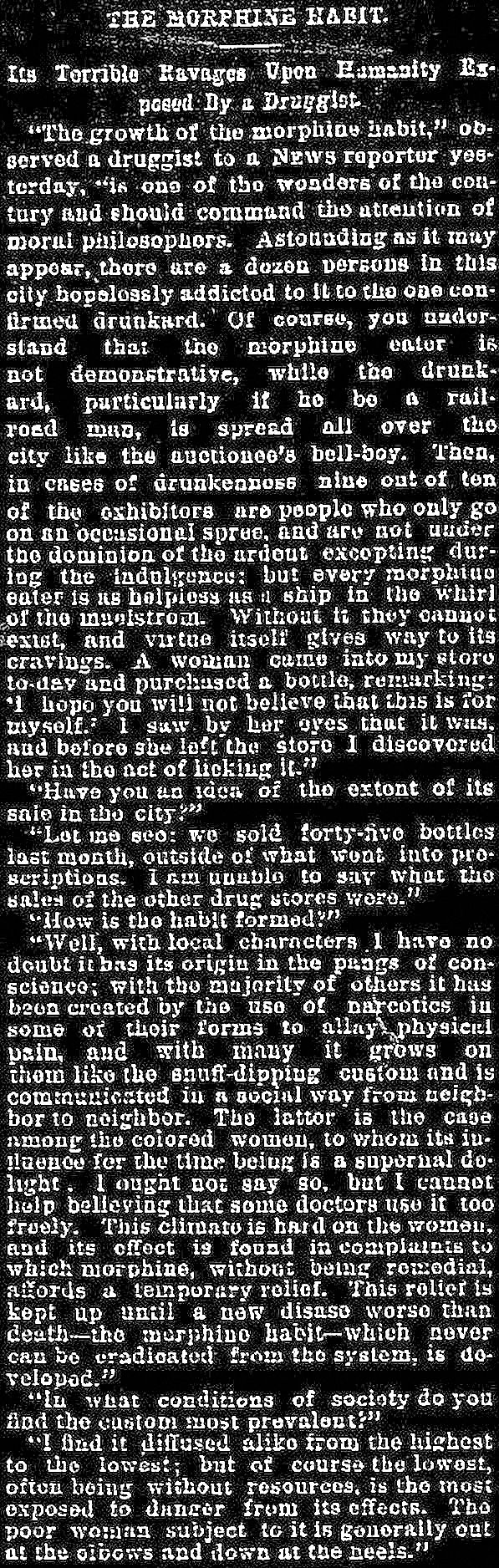
  • See the Dallas Morning News article “When Dope Sold Like Aspirin,” by Kenneth Foree (DMN, Sept. 5, 1951) for a really interesting look at Dallas during its first wave of drug problems. Imagine, if you will, the sight of a woman so in need of a fix that, despite having vehemently assured the druggist only moments earlier that the “medicine” she was purchasing was not for her, she began to lick the bottle before she even left the store. Cocaine is a hell of a drug….

A Dallas Morning News article which was cited by Kenneth Foree in the above article was this one, from 1887 (click to see a larger image):

morphine-habit_dmn_090587
DMN, Sept. 5, 1887

The song referenced in the Foree article mentioned above is “Take a Whiff on Me,” which Lead Belly — who played around Deep Ellum in the ‘teens and ’20s — recorded in the 1930s. One of the verses of the song sometimes called “Cocaine Habit Blues” has a Dallas shout-out: “Walked up Ellum and I come down Main / Tryin’ to bum a nickle just to buy cocaine / It’s oh, oh, baby take a whiff on me.” Hear his version of the song (and read the lyrics) here (the “Ellum” line is at the 1:29 mark).

Most images are larger when clicked.

*

Copyright © 2016 Paula Bosse. All Rights Reserved.
 

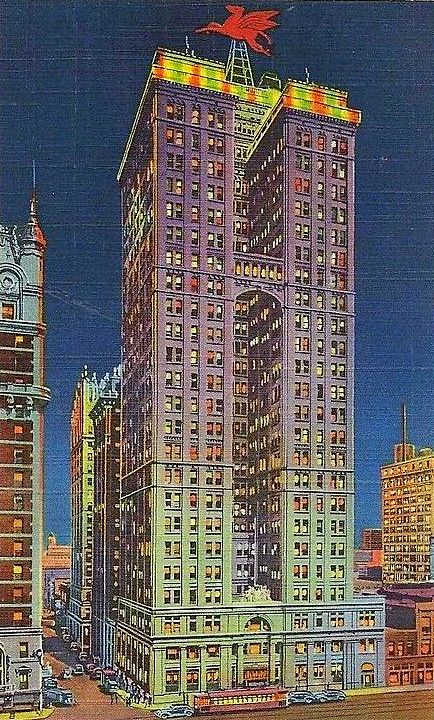
“Magnolia Building by Night”

magnolia-bldg-night

by Paula Bosse

Still standing. Still beautiful.

See a similar postcard, with a wider view — and a blobbier Pegasus — here.

*

Copyright © 2016 Paula Bosse. All Rights Reserved.
Thomas Marsalis’ Spectacular Oak Cliff Hotel: 1890-1945

oak-cliff_cook-coll_degolyer_smu_front“Visit the Oak Cliff…” (click for much larger image) Photo: SMU

by Paula Bosse

I saw this image yesterday while browsing through the George W. Cook Collection (DeGolyer Library, SMU). It’s from about 1890. It’s great. BUT, the other side of this card is even better:

oak-cliff_cook-coll_degolyer_smu_back

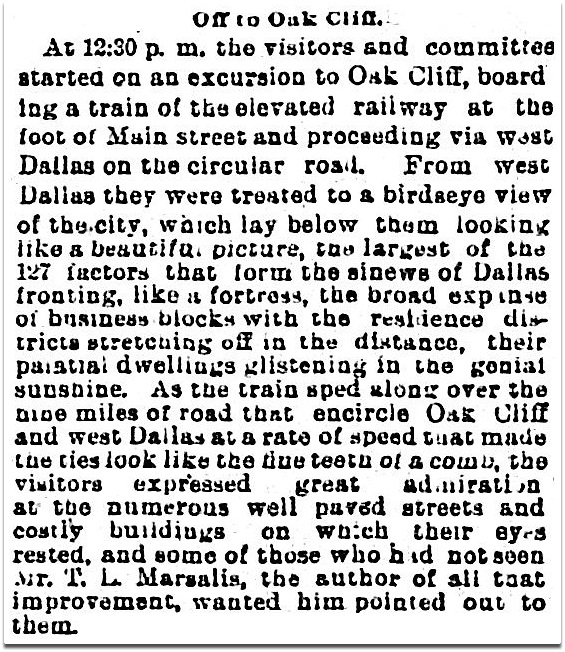
I’m not sure how realistic this drawing is, but it’s great! Oak Cliff never looked so … quaint. The best part is the depiction of the little commuter railway that Oak Cliff developer Thomas L. Marsalis built in the 1880s to handle commuter traffic between Oak Cliff and Dallas — a necessity if his development west of the Trinity was to grow. There were two little steam trains which made a complete circle and offered spectacular views of  Dallas as they headed toward the river. Here’s an account of visitors from Kansas City who enjoyed their scenic ride (click to see a larger image):

oak-cliff-train_dmn_112490
Dallas Morning News, Nov. 24, 1890

Marsalis had made his fortune in the grocery business, and much of that fortune was funneled into making his vision a reality: Oak Cliff would become a large, beautiful, prosperous community. He spent huge amounts of money developing the then-separate town of Oak Cliff. A wheeler-dealer and an obsessive whirlwind, money was no object to Marsalis as he charged at full speed to make Oak Cliff a booming North Texas garden spot.

marsalis_legacies_fall-2007
Thomas L. Marsalis — the “Father of Oak Cliff”

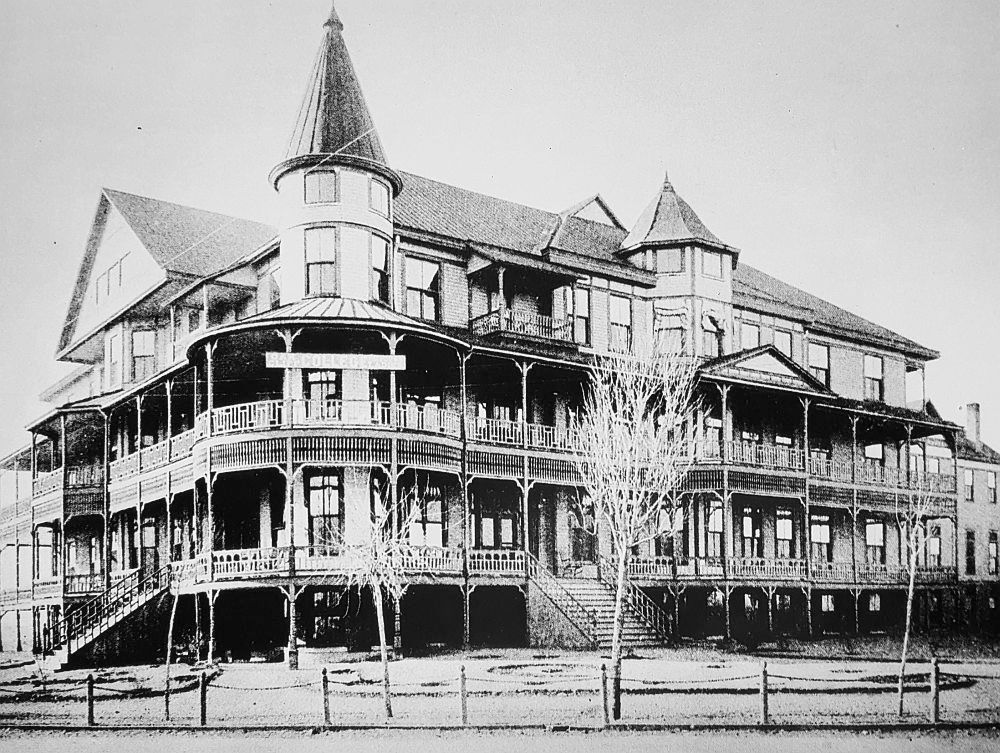
The jewel in T. L.’s O.C. crown was the 100-room resort, the Oak Cliff Hotel (which in its early planning had been called the Park Hotel). Ground was broken on Dec. 21, 1889. Projected to cost $75,000, it is said to have cost over $100,000 when construction was completed, or, over $2.6 million in today’s money.

oak-cliff-hotel_dmn_122289_groundbreaking
DMN, Dec. 22,1889

A thorough description of the spectacular $100,000 showplace can be read in a Dallas Morning News article from May 25, 1890, here. When it opened on July 10, 1890, the News’ coverage of the opening included the following lyrical passage:

When darkness had settled down over the cliff the large hotel showed off to its best advantage, as at a short distance away it looked like some living monster with hundreds of fiery eyes. The lights showing from every window made a startling sight to those who coming upon it had previously seen a dark pile looming up in the night.

oak-cliff-hotel_minutaglio

It was, by all accounts, a popular hotel and social gathering place. But, in November of 1891 — having been open only a little over a year — a notice appeared in the papers that the hotel would be closing for the winter for “renovations.” It never reopened. Marsalis had over-extended himself. His dreams for Oak Cliff began to dim as the stacks of unpaid bills mounted, and he found himself mired in lawsuits for the next several years. He eventually had to admit defeat, and he and his family moved to New York.

Six months after that notice of “renovations” appeared, the huge building was leased to Prof. Thomas Edgerton, who planned to open a “female seminary.”

oak-cliff-college_flickr

The Oak Cliff College For Young Ladies opened  in the fall of 1892. And it was a spectacular-looking schoolhouse.

oak-cliff-college_dallas-rediscoverd_dpl

The college lasted until the beginning of 1899 when it changed hands and became Eminence College for a brief year and a half.

eminence-college_southern-mercury_062299
Southern Mercury, June 22, 1899

After Eminence College appears to have gone bust, the building was vacant by 1901. There was talk that Oak Cliff should purchase the property and reinstall a school, but, eventually, the building went up for auction in September, 1903.

oak-cliff-hotel_dmn_082603_for-sale
DMN, Aug. 26, 1903

The building sold to T. S. Miller, Jr. and L. A. Stemmons for $6,850, a fraction of what Marsalis had spent building it. That’s a pretty steep depreciation.

oak-cliff-hotel_dmn_090203_sold
DMN, Sept. 2, 1903

But, no fear, Hotel Cliff opened on April 18, 1904. Still looking good.

hotel-cliff_degolyer

hotel-cliff_dmn_071104
DMN, July 11, 1904

Hotel Cliff was in business through about 1915. There were some “lost” years in there when it seemed to be in limbo (during some of this time it was undergoing extensive renovation), but in 1921 it re-opened as the Forest Inn.

forest-inn_dmn_042421
DMN, April 24, 1921

forest-inn_bartlett-tribune-and-news_070424
Bartlett News, July 4, 1924

The Forest Inn had a long run — 24 years. In 1945 the property was sold, and T. L. Marsalis’ spectacular resort hotel was demolished. It was estimated that it would take ten weeks to finish the demo job — Marsalis had spared no expense building his hotel, and it had been built to last.

The destruction is a tough job, Jack Haake, wrecking contractor, said. Despite its age, the building is so well built that much time is being required to take it apart. The lumber is of the best grade and much of it still is in good condition, Haake said. Scores of huge 2×6 planks, thirty-two feet long, were used in the building, and that timber is in excellent condition. (“Historic Oak Cliff Hotel Being Razed For New Structure,” DMN, Sept. 10, 1945)

The land apparently remained vacant until Southwestern Bell Telephone announced plans to build a three-story office building on the property in 1954; the building opened the following year. In 1986, the building was renovated and became the Oak Cliff Municipal Center, which still occupies the site.

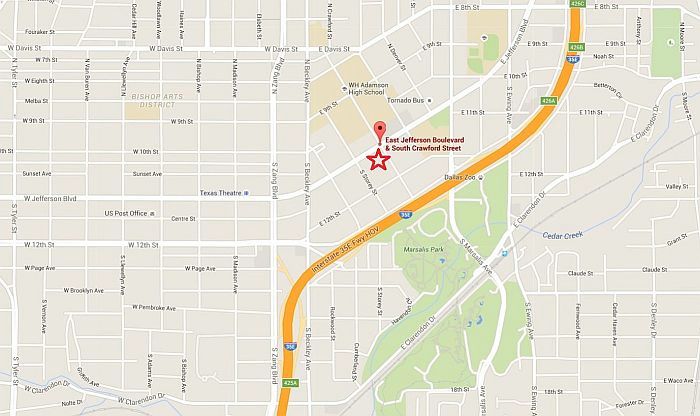
Where exactly was that huge, wonderful hotel that Thomas Marsalis built? It was located at what is now the southwest corner of East Jefferson Blvd. and South Crawford Street. A view of that corner today can be seen here. To get an idea  of how much land the hotel/college once occupied, check out the 1905 Sanborn map, here (and this is after 15 years of explosive growth of Oak Cliff, so it obviously originally had much more open land around it); by 1922, encroachment was well underway, and the property was already being chopped into smaller parcels.

oak-cliff-hotel_map_google
Google Maps

I wonder what Thomas Marsalis would think of Oak Cliff today? And I wonder what Oak Cliff would have become had Marsalis never put his money and energy into its early development?

**

There is a lot of misinformation on various online sources about the timeline of this building. As best I can determine, here is the correct chronology:

  • 1889: groundbreaking for hotel, in December
  • 1890-1891: Oak Cliff Hotel
  • 1892-1899: Oak Cliff College For Young Ladies
  • 1899-1901: Eminence College (also for young women)
  • 1902-1903: vacant
  • 1903: building sold at public auction, in September
  • 1904-1914: Hotel Cliff
  • 1914-1915: Oak Cliff College (reorganized, back for one last gasp)
  • 1915-1920: basically empty, with a couple of token tenants
  • 1921-1945: Forest Inn
  • 1945: demolished

***

Sources & Notes

First two images show both of sides of an advertising card; “Visit Oak Cliff” is from the George W. Cook Dallas/Texas Image Collection, DeGolyer Library, Central University Libraries, Southern Methodist University — more information is here.

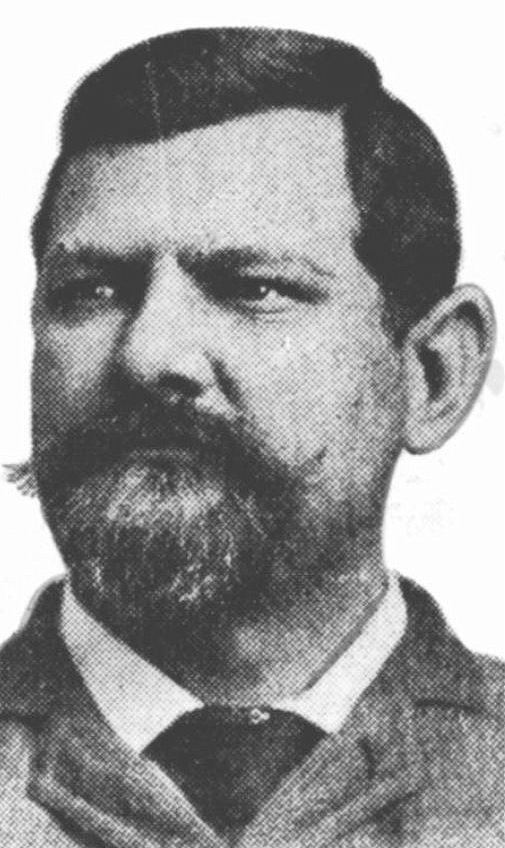
Photo of Thomas Marsalis from Legacies, Fall, 2007.

Colorized image of hotel from the front cover of The Hidden City: Oak Cliff, Texas by Bill Minutaglio and Holly Williams. The sign is hard to read, but this may show the building during the Hotel Cliff days.

The detail of an Oak Cliff College envelope comes from the Flickr page for the Texas Collection, Baylor University, here. (Sure hope Mr. Edgerton was able to get a refund on that printing job — having “Oak Cliff” misspelled on official college correspondence probably caused a grimace or two!)

Large black and white photograph of Oak Cliff College appeared in William L. McDonald’s Dallas Rediscovered; photo from the collection of the Dallas Public Library.

Hotel Cliff postcard from the Cook Collection, SMU; information is here.

See the beautiful house Marsalis built for himself (but which he might never actually have lived in) in my post “The Marsalis House: One of Oak Cliff’s ‘Most Conspicuous Architectural Landmarks,'” here.

Thomas L. Marsalis is a fascinating character and an important figure in the development of Oak Cliff, but his post-Dallas life has always been something of a mystery. I never really thought of myself as a “research nerd” until I started this blog, but reading how a few people in an online history group pieced together what did happen to him was surprisingly thrilling. This round-robin investigation began in the online Dallas History Phorum message board, here, and finished as the Legacies article “Where Did Thomas L. Marsalis Go?” by James Barnes and Sharon Marsalis (Fall 2007 issue). If you have some time, I highly recommend reading through the Phorum comments and then reading the article. It’s very satisfying!

All images and clippings larger when clicked. 

*

Copyright © 2016 Paula Bosse. All Rights Reserved.
Dallas Fire Stations — 1901

fire-dept_engine-co-3_gaston-and-college_1901Fire horse in Old East Dallas relaxing between calls (click for larger image)

by Paula Bosse

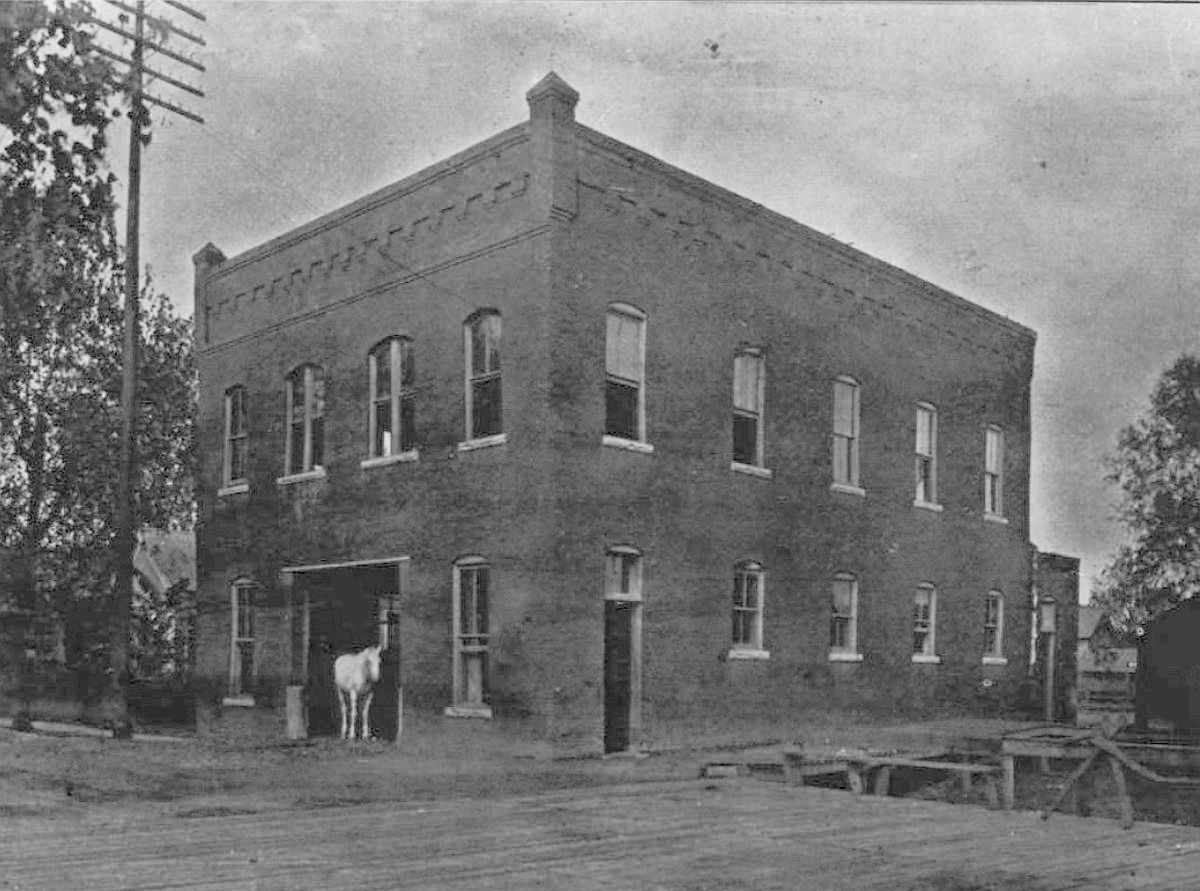
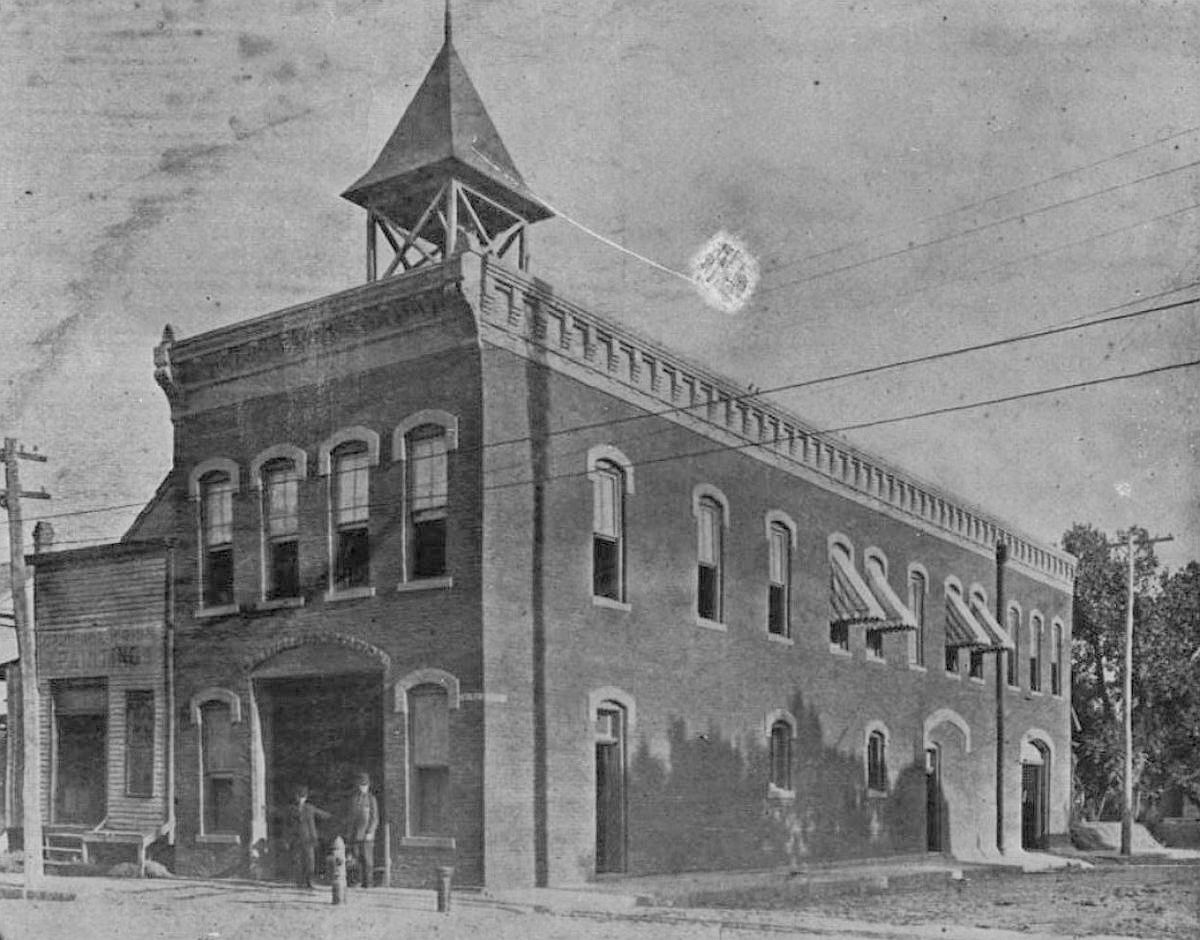
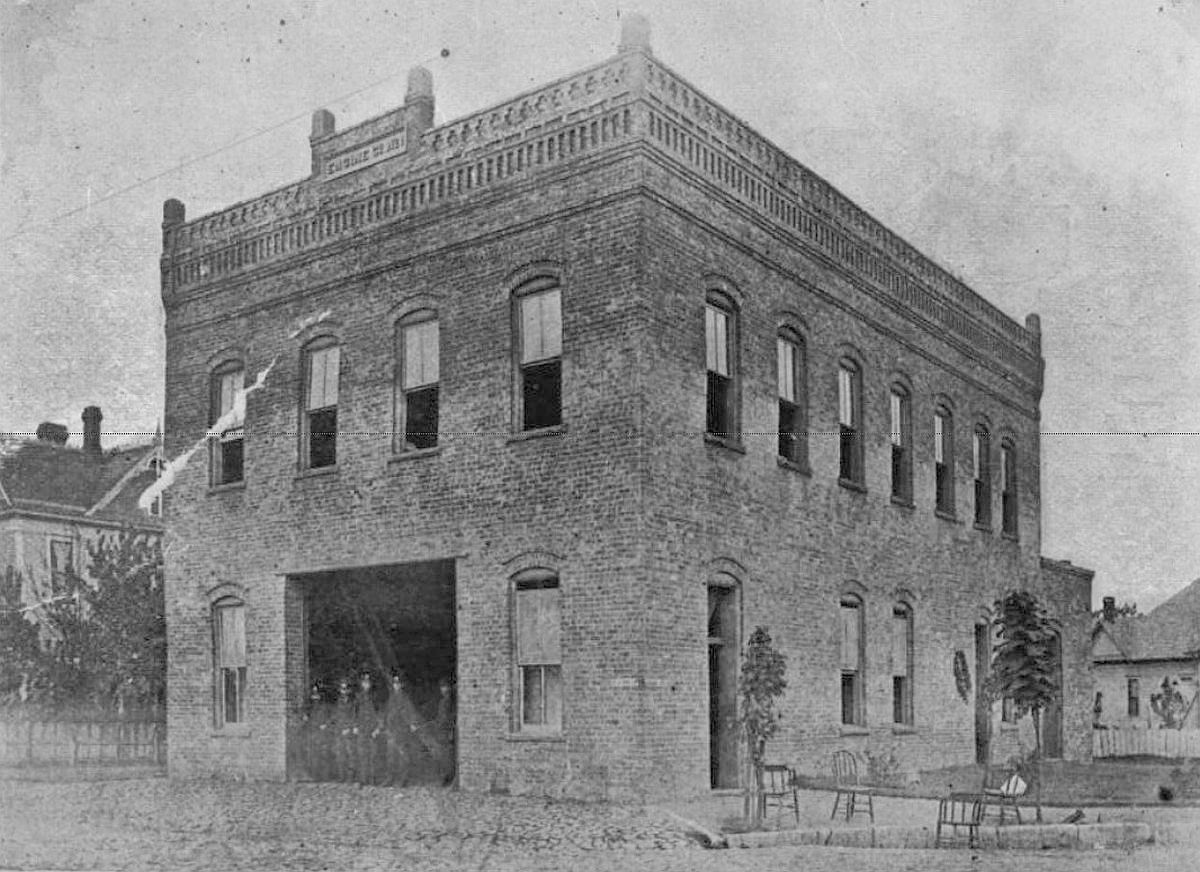
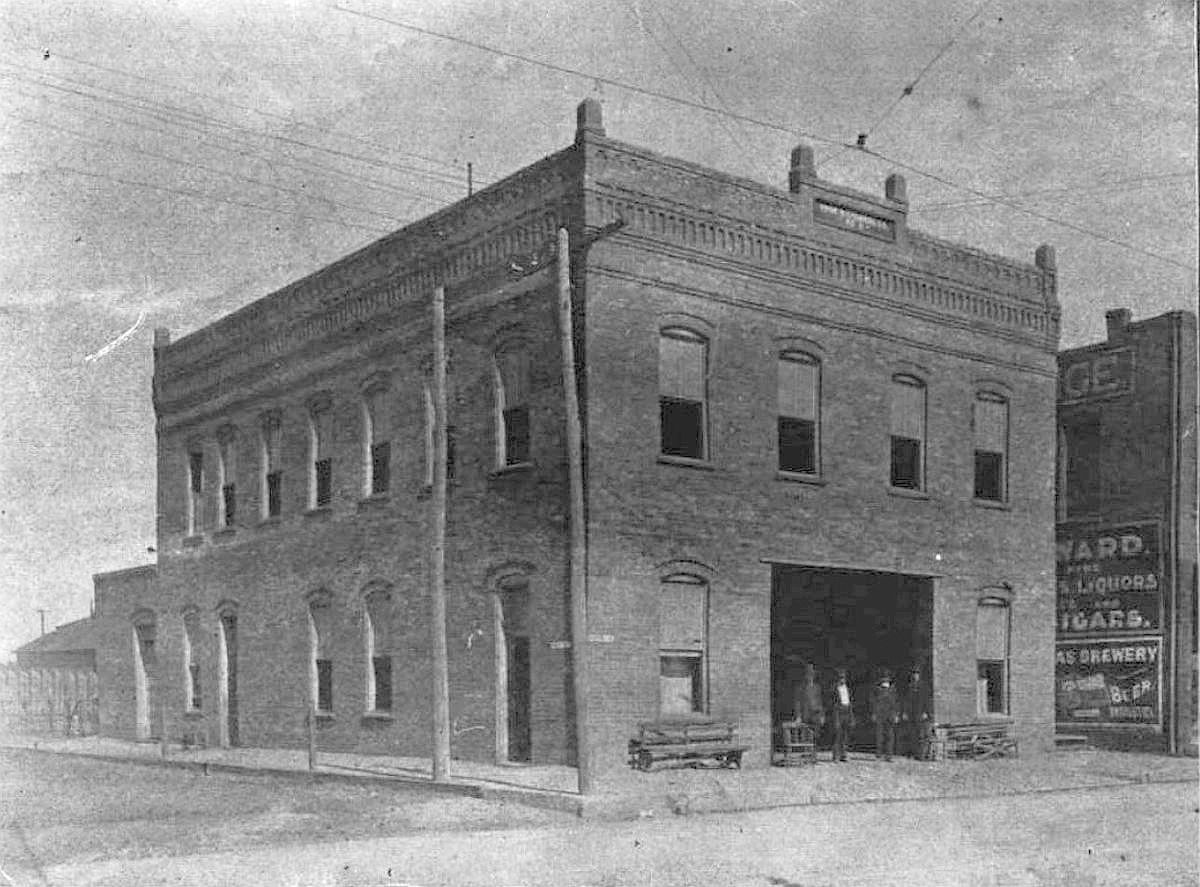
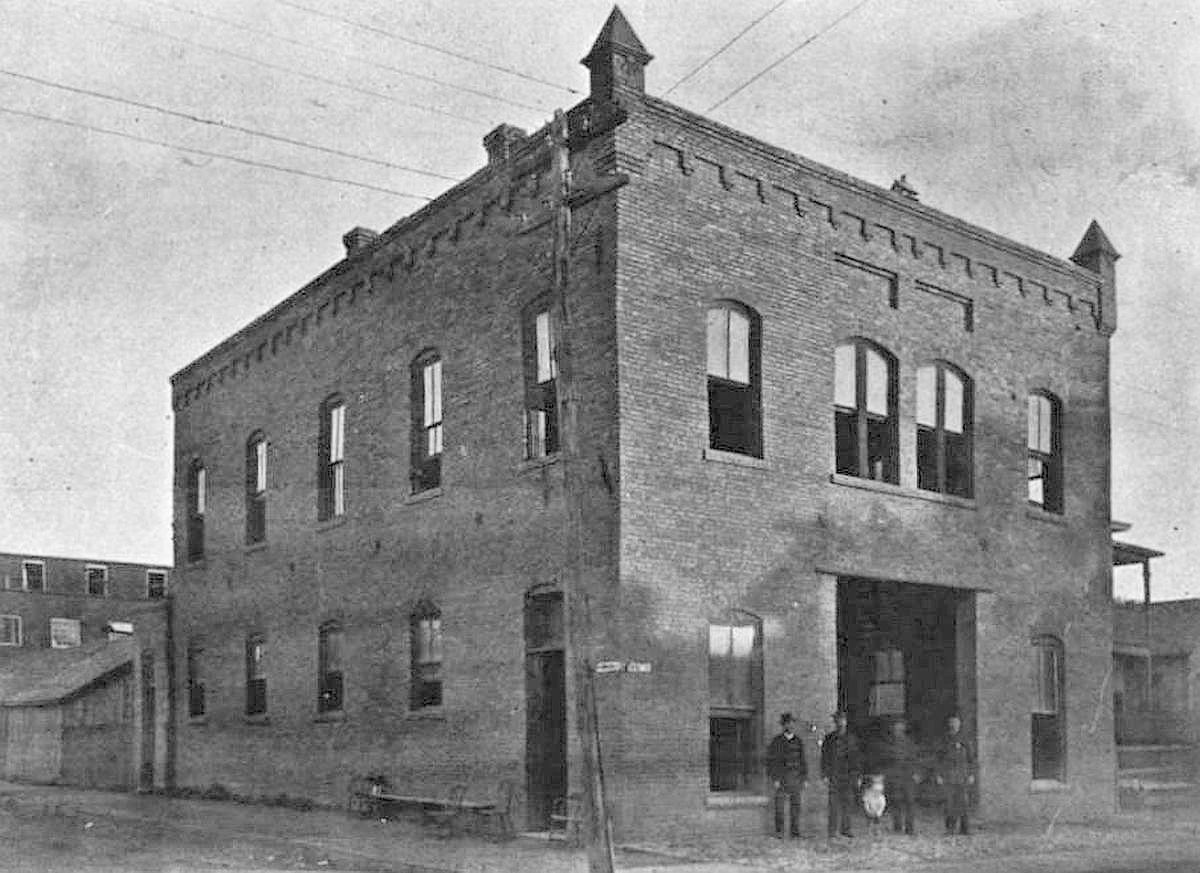
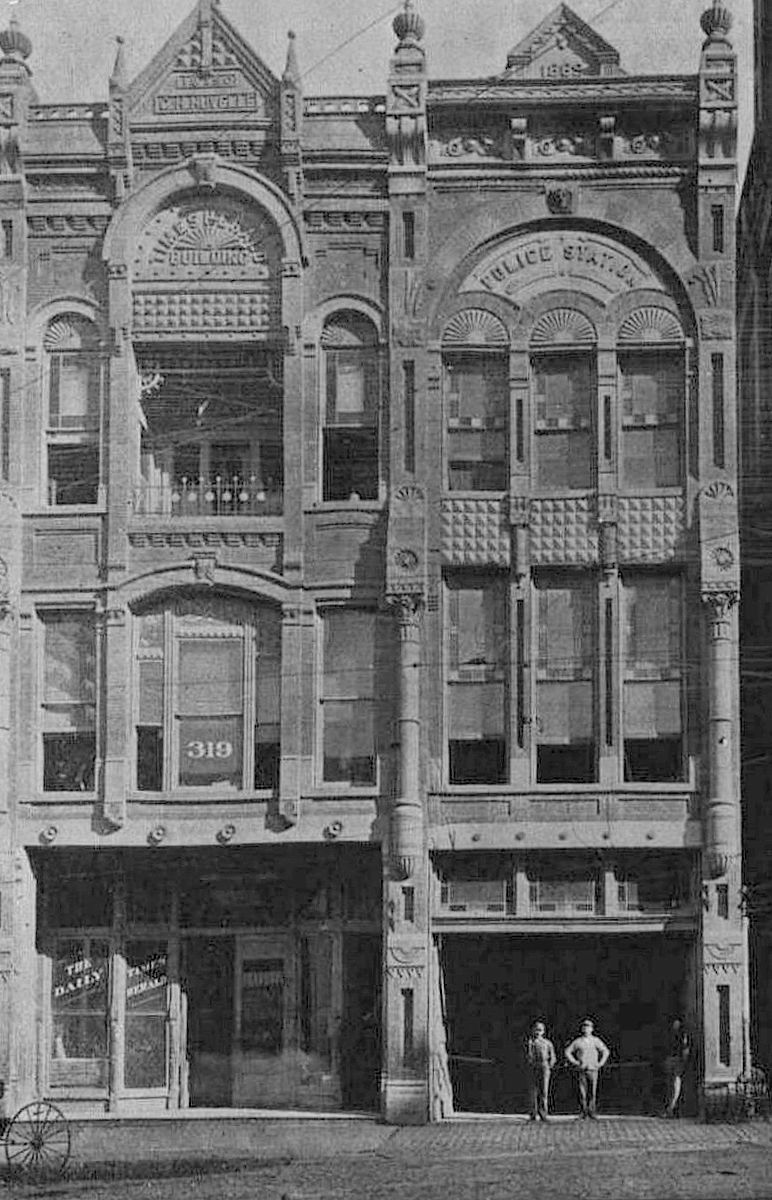
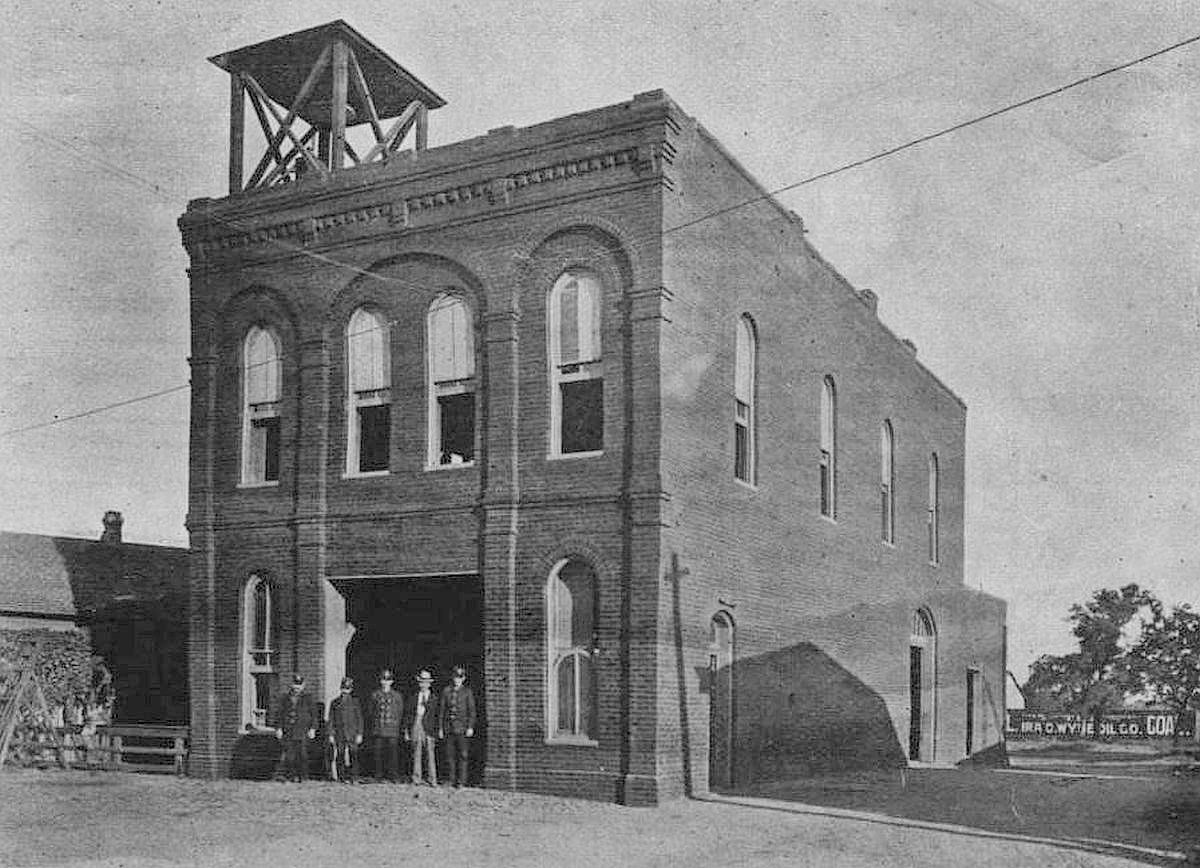
A few turn-of-the-century photos of Dallas’ fire stations, from a 1901 photographic annual. These seven firehouses were built between 1882 and 1894. One of these buildings is, miraculously, still standing on McKinney Avenue, in the heart of Uptown.

*

At the top, Engine Co. No. 3, at Gaston and College Avenues. In service: January, 1892. Equipment: an Ahrens Steamer, capacity 750 gallons per minute, and a Cooney Hose Carriage. See it on a 1905 Sanborn map here; see the present location (Gaston and Hall) here. (And since I just used it a few days ago, here’s a 1921 Sanborn map, showing Mill Creek running right through the property.)

*

fire-dept_central-station_main-harwood_1901

Above, Central Fire Station, Main and Harwood Streets. In service: October, 1887. Equipment: a double-sixty-gallon Champion Chemical Engine and a City Hook and Ladder Truck. See it on a 1905 Sanborn map here; see the present location here (the site of the old City Hall/Municipal Building).

*

fire-dept_mckinney-leonard_engine-co-1_1901

Engine Co. No. 1, McKinney Avenue and Leonard. Equipment: an Ahrens Steamer, 750 gallons per minute, and a Cooney Hose Carriage. In service: August, 1894. See it on a 1905 Sanborn map here; see the present location here. NOTE: This is the only one of these firehouses still standing. I wrote about it here.

UPDATE: Well, sort of. Thanks to a comment on Facebook, I researched this station a bit more and found that it was rebuilt and modernized at the end of 1909 — using materials from the original building seen above, built on the same plot of land. So instead of being 122 years old, the building on McKinney today is a mere 106 years old.

*

fire-dept_commerce-hawkins_engine-co-2_1901

Engine Co. No. 2, Commerce and Hawkins Streets. In service: January, 1882. Equipment: an Ahrens Steamer, capacity 750 gallons per minute, and a Cooney Hose Carriage. See it on a 1905 Sanborn map here; see a shot-in-the-dark guess at a present location here.

*

fire-dept_ervay-kelly_hose-co-2_1901

Hose Co. No. 2 and Chemical Co. No. 2, Ervay Street and Kelly Avenue. In service: September, 1894. Equipment: a Cooney Hose Carriage and double-sixty-gallon Champion Chemical Engine. See it on a 1905 Sanborn map here; see the present location here (right behind where the word “Cedars” is).

fire-dept_bryan-hawkins_hook-and-ladder-1_1901

Hose Co. No. 1 and Hook and Ladder Co. No. 1, Bryan and Hawkins Streets. In service: January, 1893. Equipment: Preston Aerial Truck with 75-foot extension ladder, and a Cooney Hose Carriage. See it on a 1905 Sanborn map here; see the approximate present location here.

*

fire-dept_commerce-akard_engine-co-4_1901

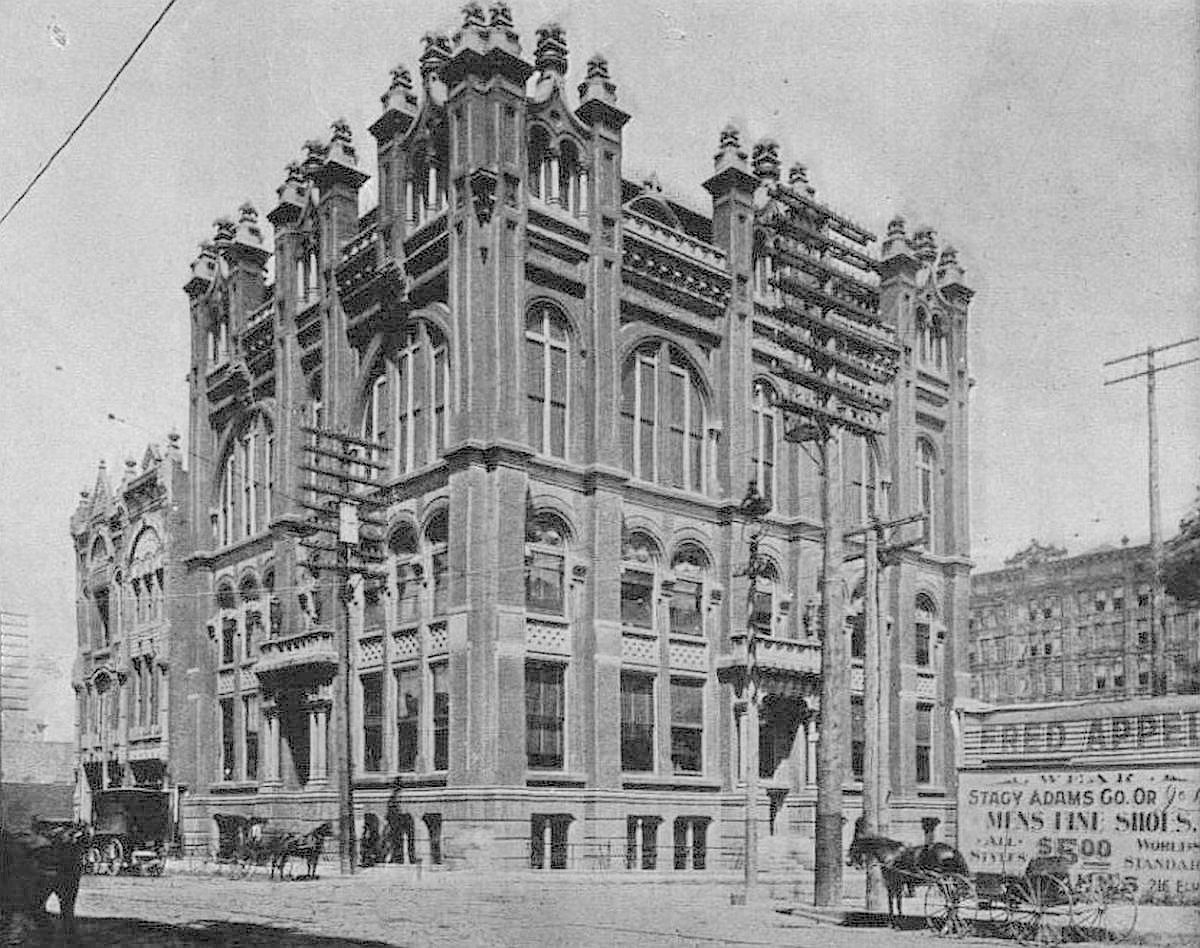
Engine Co. No. 4, Commerce and Akard Streets, next door to the City Hall. In service: August, 1894. Equipment: an Ahrens Steamer, capacity 1,100 gallons per minute, and a Cooney Hose Carriage. See it on a 1905 Sanborn map here; see the present location here (just out of frame at the right was the City Hall; the block is now the site of the Adolphus Hotel).

*

city-hall_1901_fire-dept-annual_portal

City Hall, Commerce and Akard Streets, now the location of the Adolphus Hotel. Half of the shorter building to the left housed the police department and Engine Co. No. 4.

*

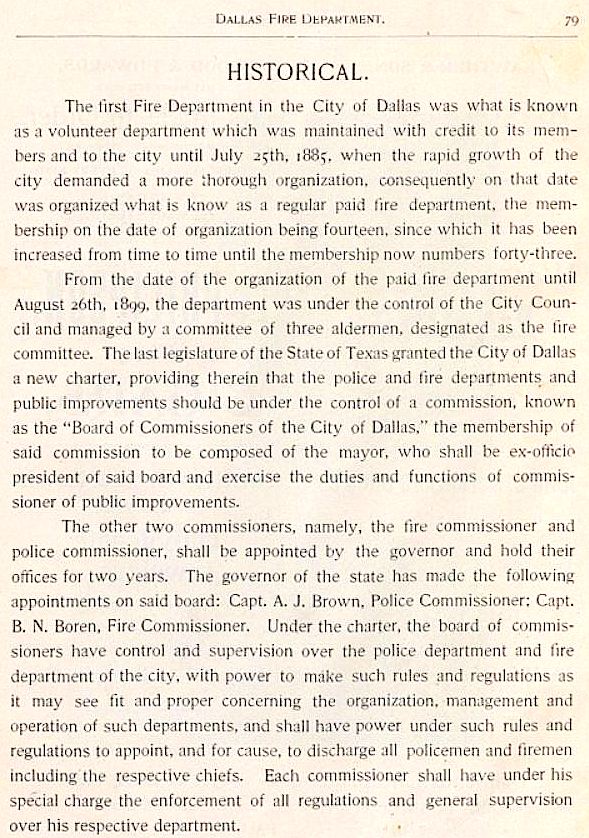
The “Historical” page from the book (click to read).

fire-dept-hist_dallas-fire-dept-annual_1901_portal

**

Since there is no sign of the actual equipment in these photos, here’s what horse-drawn steam engines (Ahrens steamers) looked like at this time. (Photo from the Wisconsin Historical Society).

fire-steam-engine_wisconsin-hist-soc

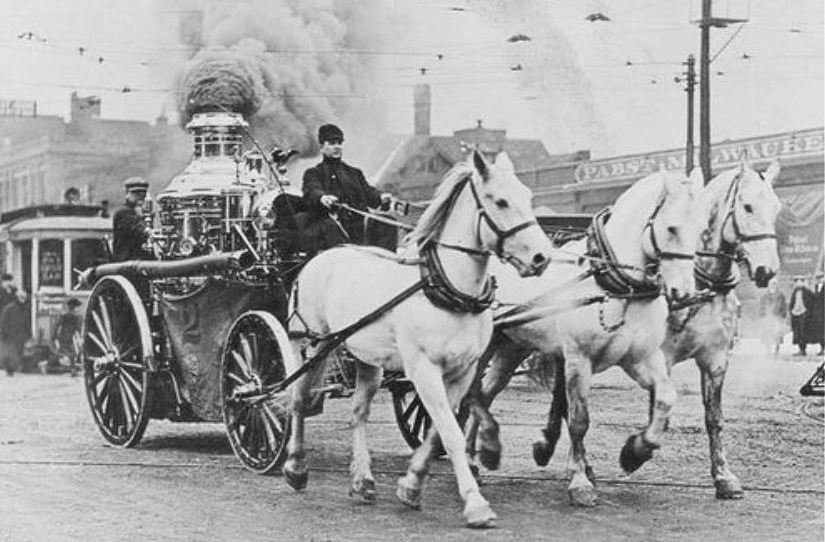
UPDATE: I found this photo on Flickr, showing equipment from those early days being driven through the streets of Dallas during a fire prevention parade.

fire-department_pumper_flickr_coltera

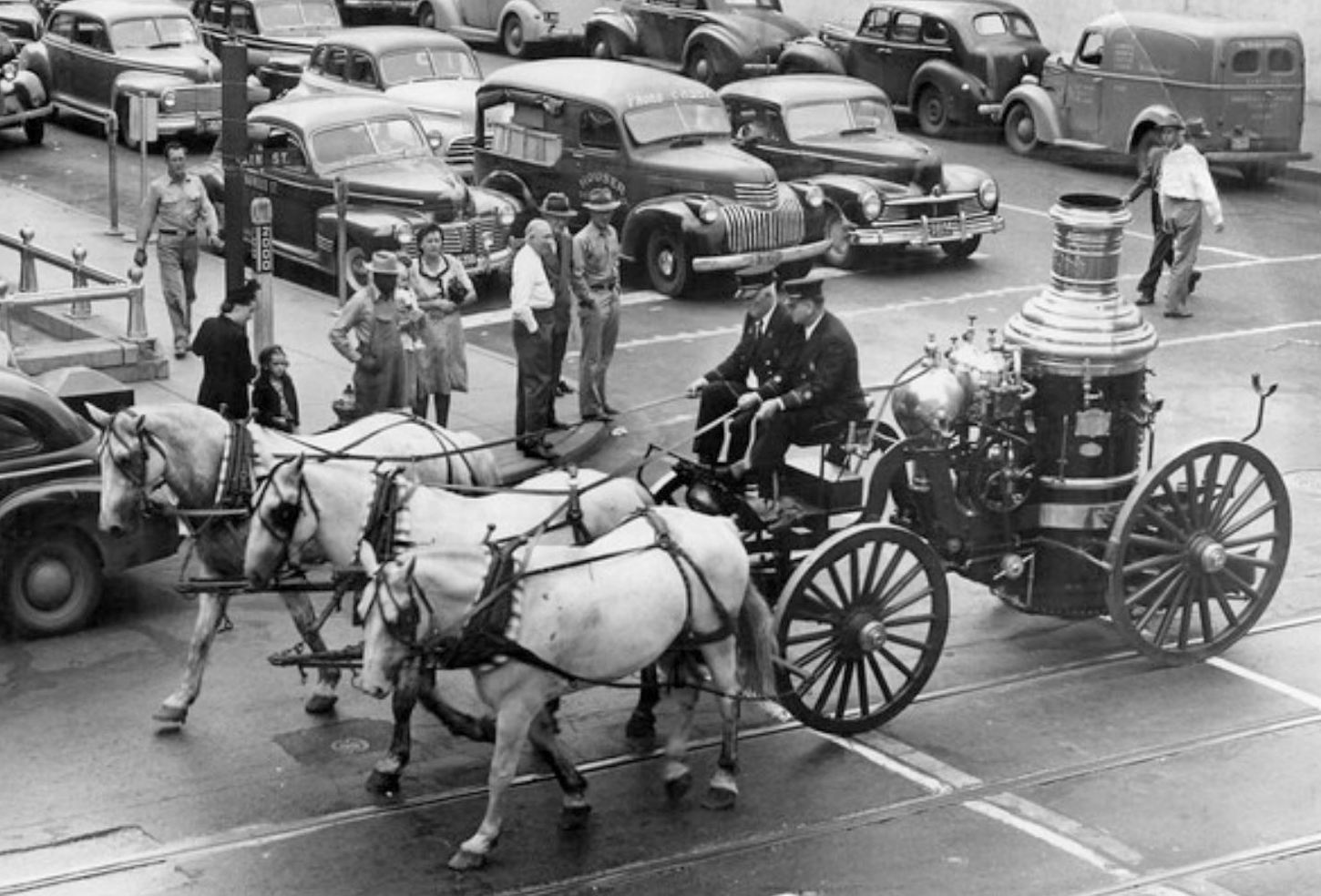
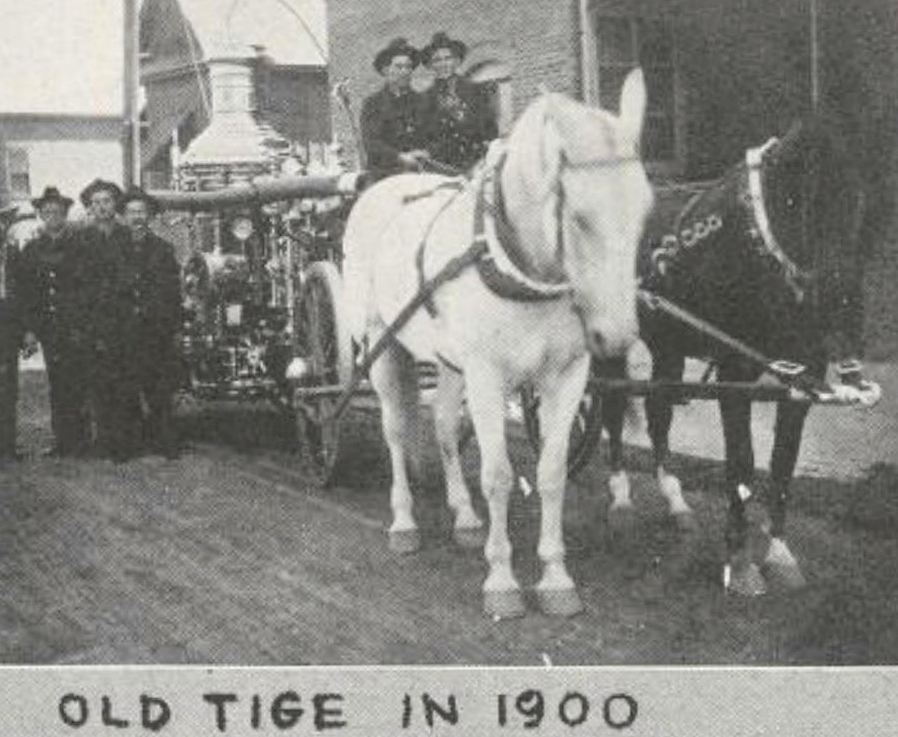
UPDATE: Lo and behold, a photo from 1900 of Old Tige, the 600 gallons-per-minute steam pumper, built in 1884, which was in service with the Dallas Fire Department until 1921. (Old Tige can be seen in the Firefighters Museum across from Fair Park.) Found at the Portal to Texas History.

old-tige_1900_fire-dept-bk_1931_portal

***

Sources & Notes

Photos by Clifton Church, from the Dallas Fire Department Annual, 1901, which can be viewed in its entirety on the Portal to Texas History, here.

A contemporary map of Dallas (ca. 1898) can be viewed on the Portal to Texas History site, here.

More Flashback Dallas posts on historic Dallas firehouses can be found here.

All photos larger when clicked.

*

Copyright © 2016 Paula Bosse. All Rights Reserved.
The Inwood Theatre

theater_inwood_oct_1954_d-mag_dplSeven years after opening, in 1954… (click for larger image)

by Paula Bosse

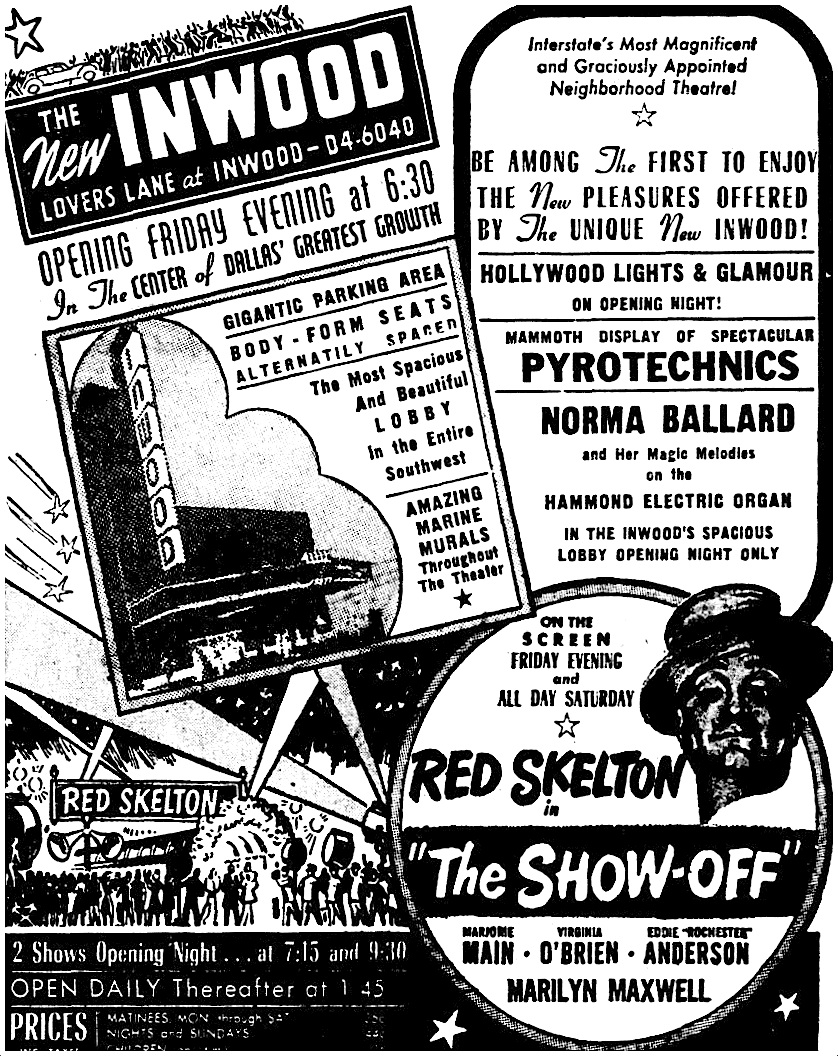
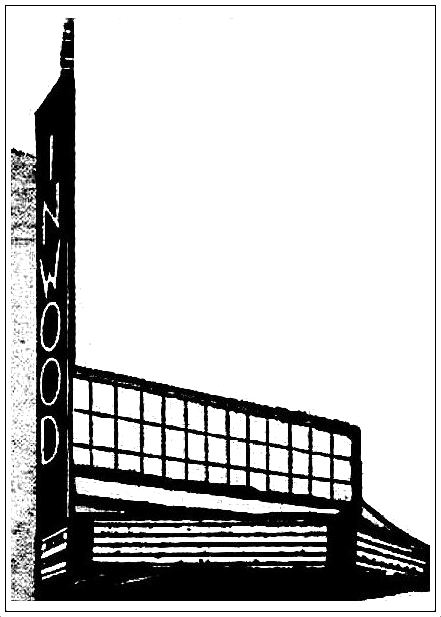
The Inwood Theatre opened at Lovers Lane and Inwood Road on May 16, 1947. Even though the surrounding neighborhood has changed pretty dramatically over the years, the exterior of the H. F. Pettigrew-designed building looks pretty much the same today. Happily, the 69-year old movie theater is still in business.

inwood_dmn_051647_grand-opening
The Grand OpeningMay 16, 1947 (click to see larger image)

theater_inwood_cinema-treasures via Cinema Treasures

inwood_1947_d-mag_dplvia D Magazine

theater_inwood_instagram_architexasvia Architexas on Instagram

inwood_el-chico_dmn-website

inwood_dmn_051947_ad-det
Ad detail, May, 1947

inwood_dmn_051147_ad-det
Ad detail, May, 1947

***

Sources & Notes

Top photo from D Magazine, here; from the Texas/Dallas History and Archives Division, Dallas Public Library. If you zoom in, there seems to be some drama going on inside one of those parked cars:

inwood_1954-zoom

Images are larger when clicked.

*

Copyright © 2016 Paula Bosse. All Rights Reserved.
 

“Melons on Ice” — 1890s

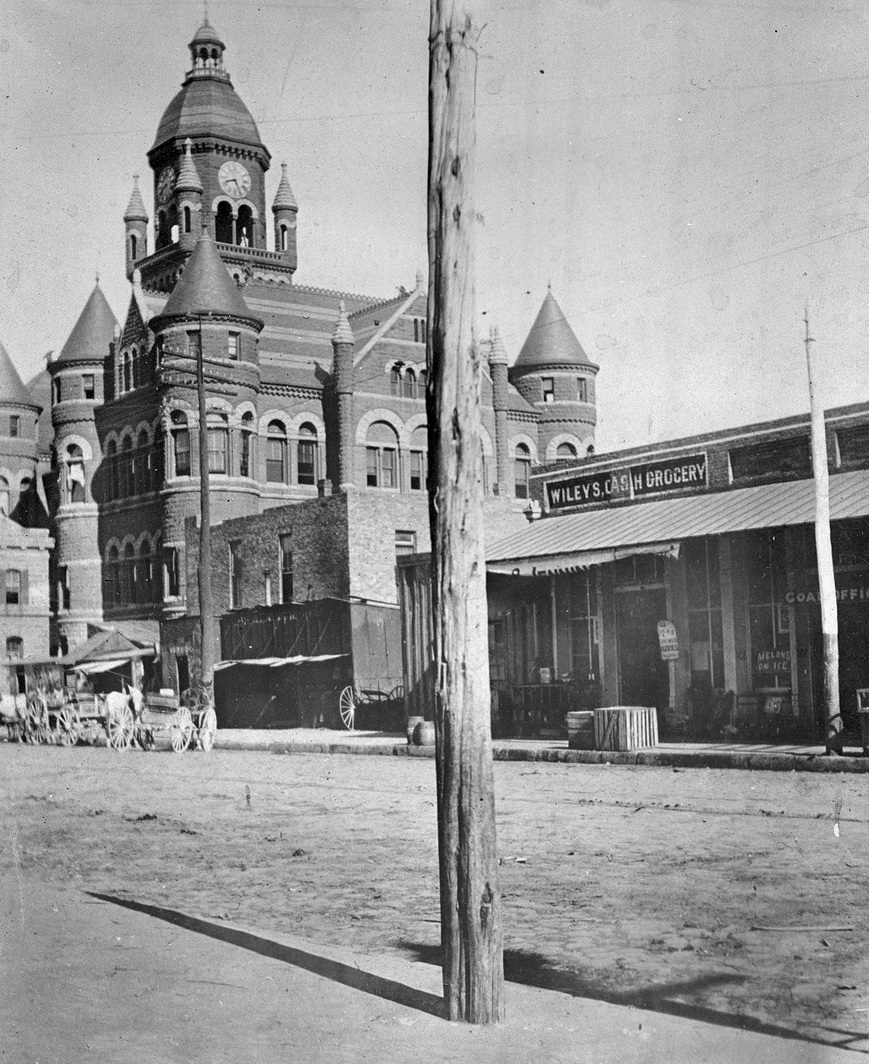
wiley-grocery_1890s_haskins-coll_utaA sleepy little town…

by Paula Bosse

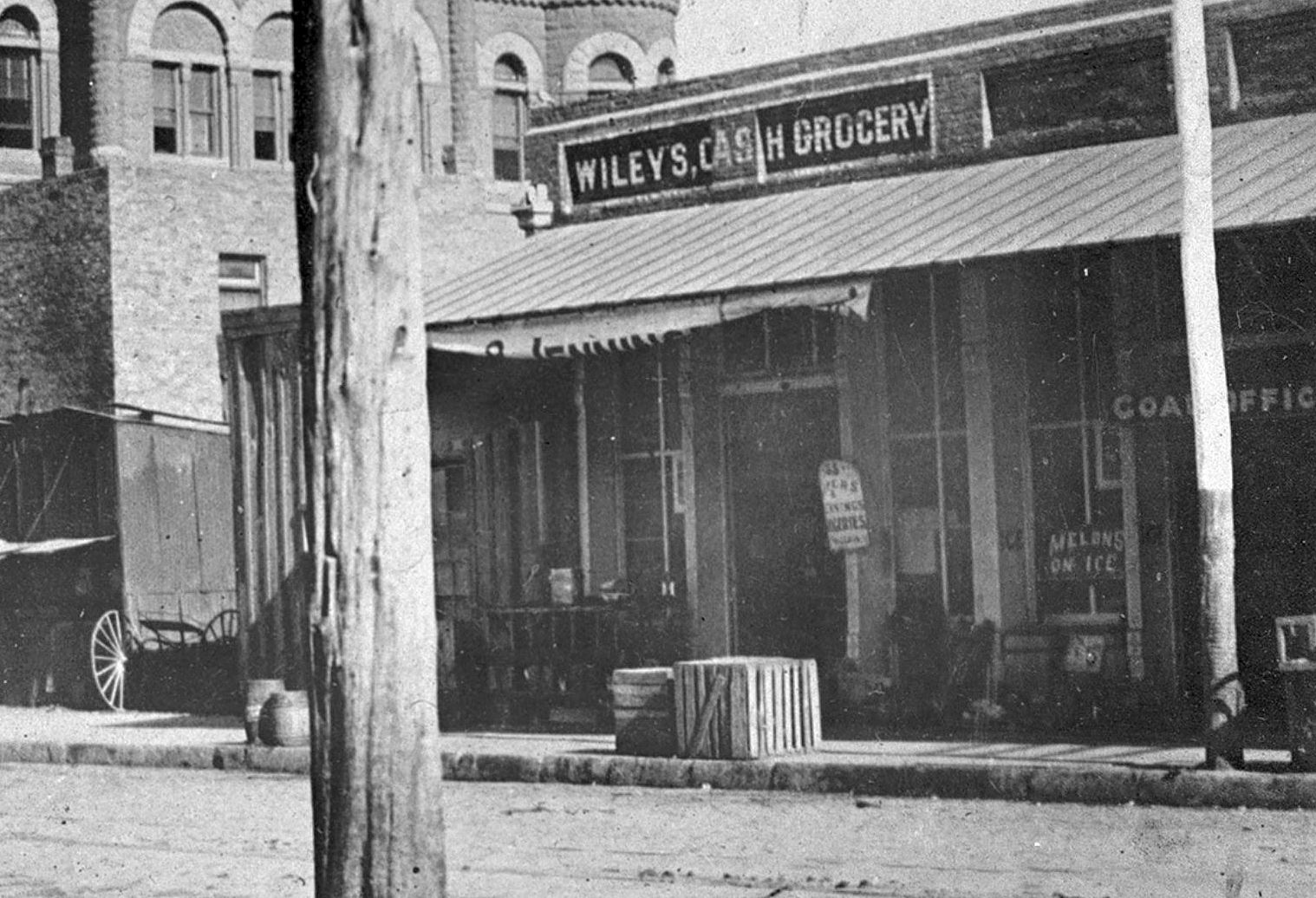
It looks hot in this photo from the 1890s. I bet those “Melons On Ice” in front of Wiley’s grocery store really hit the spot.

wiley-grocery_melons_det-1

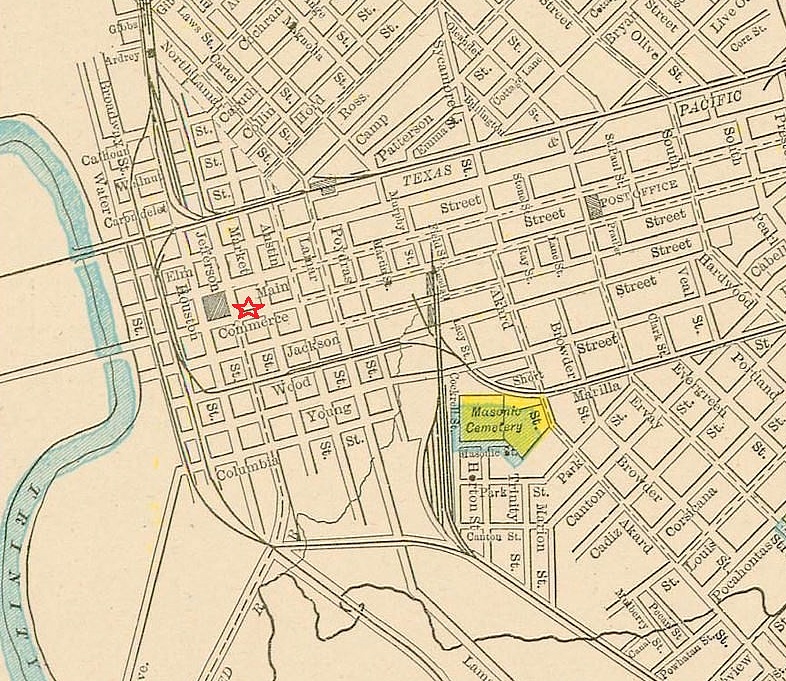
I love this photo. The Wiley Cash Grocery was in business for only a few years — from about 1892 to 1896. It was located at 153 Commerce, one block east of the brand-new county courthouse.

wiley-grocery_1893-directory1893 Dallas directory

wiley-grocery-1893-map
1893 map of Dallas, det.

The business was owned by Anna E. Wiley (~1862-1930) and her husband Jesse P. Wiley (~1863-1942). When they arrived in Dallas around 1887 their address in the city directory was simply “¾ mile w of river.”

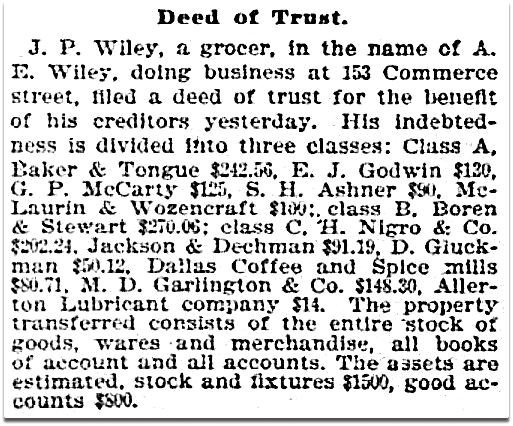
Even though the store seems to have been in Anna’s name, Jesse was forced to file a deed of trust in 1896 when the store was faced with crippling debt. The Wileys owed approximately $1,545 to creditors (about $45,000 in today’s money), but their assets were only about $1,500, plus $800 of “good accounts.” Unsurprisingly, the store was gone by 1897. (Click article below to see a larger image.)

1896-wiley-grocery_dmn_021596
Dallas Morning News, Feb. 15, 1896

This photo captures such an odd view of downtown Dallas — it’s hard to believe that the site once occupied by the Wiley store is now the site of the John F. Kennedy Memorial. A present-day view can be seen here.

***

Sources & Notes

This photo is from the Squire Haskins Photography, Inc. Collection, University of Texas at Arlington Libraries; additional info is here. See this great photo REALLY big here.

The map is a detail from an 1893 map of Dallas from the collection of the Texas State Library and Archives Commission.

*

Copyright © 2016 Paula Bosse. All Rights Reserved.
Belmont & Greenville: From Caruth Farmland to Hub of Lower Greenville

hockaday_aerial_squire-haskins_022750_UTA
Hockaday campus, 1950 (UTA Libraries)

by Paula Bosse

If you’ve driven down lower Greenville Avenue lately, you’re probably aware that the buildings that most recently housed a retirement home at the northwest corner of Belmont and Greenville were scheduled to be been torn down. When I drove past that intersection a few weeks ago and saw the entire block leveled, I was shocked. It’s weird suddenly not seeing buildings you’ve seen your entire life. It got me to wondering what had been on that block before. I’d heard that Hockaday had occupied that block for several years, but even though I’d grown up not too far away, I’d only learned of that within the past few years. When I looked into this block’s history, the most surprising thing about it is that it has passed through so few owners’ hands over the past 140 or so years.

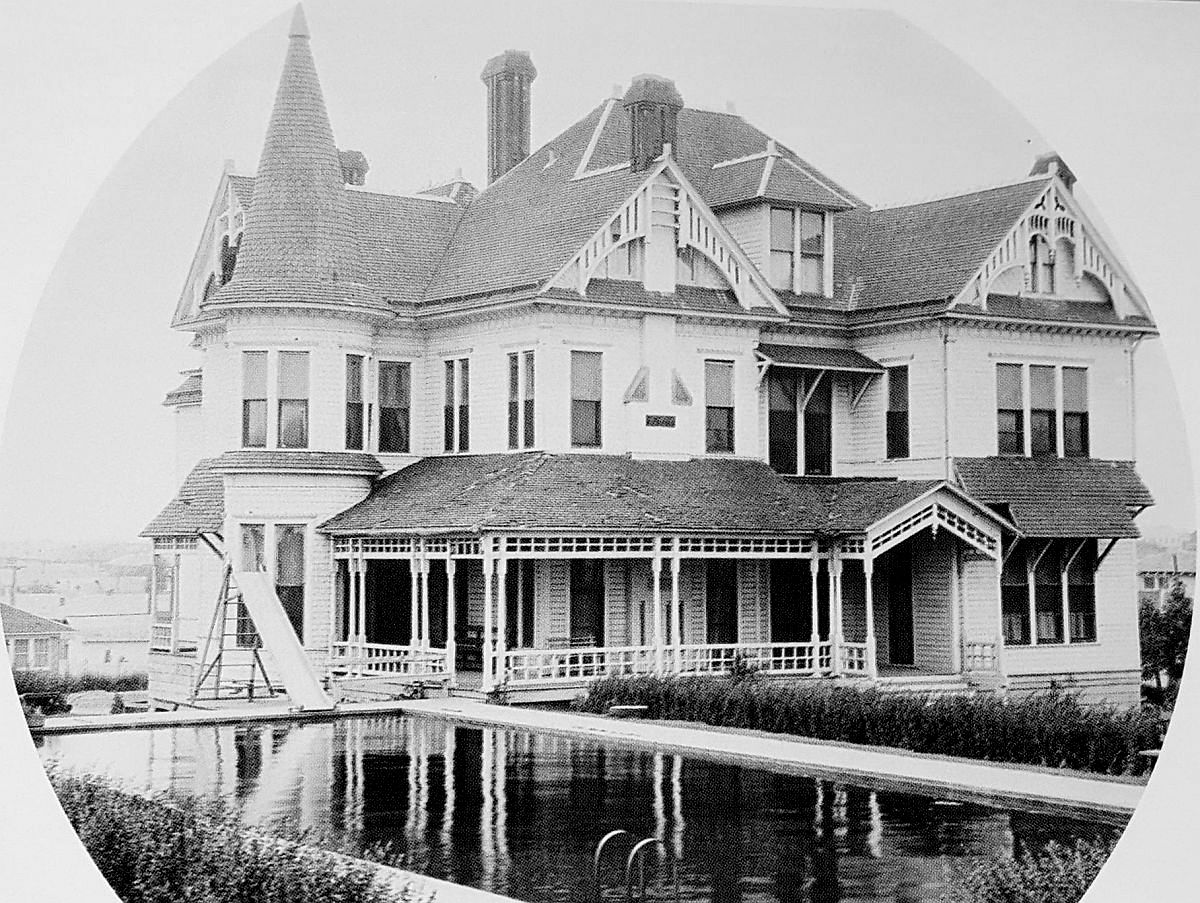
As far as I can tell, the first owner or this land was Walter Caruth (1826-1897), a pioneer merchant and farmer who arrived in this area in the 1840s (some sources say the 1850s), along with his brother, William. Over the years the brothers amassed an absolutely staggering amount of land — thousands and thousands of acres which stretched from about Inwood Road to White Rock Lake, and Ross Avenue up to Forest Lane. One of Walter Caruth’s tracts of land consisted of about 900 acres along the eastern edge of the city — this parcel of land included the 8 or 9 acres which is now the block bounded by Greenville, Belmont, Summit, and Richard, and it was where he built his country home (he also had a residence downtown). The magnificent Caruth house was called Bosque Bonita. Here is a picture of it, several years after the Caruths had moved out (the swimming pool was added later).

caruth_bosque-bonita_dallas-rediscovered

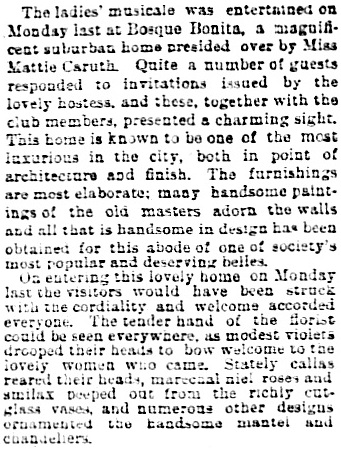
Most sources estimate that the house was built around 1885 (although a 1939 newspaper article stated that one of Walter’s children was born in this house in 1876…), but it wasn’t until 1890 that it began to be mentioned in the society pages, most often as the site of lavish parties. (Click pictures and  articles to see larger images.)

bosque-bonita_dmn_020390Dallas  Morning News, Feb. 3, 1890

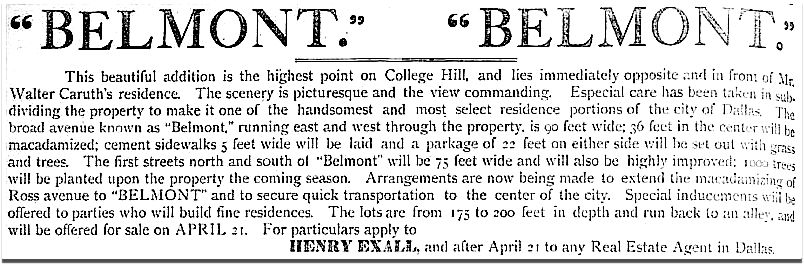
At the time, the Caruth house was one of the few buildings in this area — and it was surrounded by endless acres of corn and cotton crops. It wasn’t long, though, before Dallas development was on the march eastward and northward. This ad, for the new Belmont Addition, appeared in April of 1890, and it mentioned the Caruth place as a distinguished neighboring landmark.

belmont-addition_dmn_041690
DMN, April 16, 1890

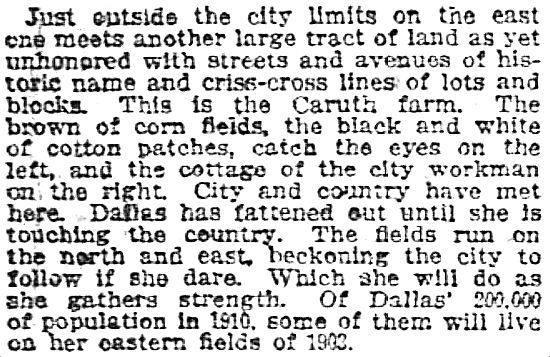
By the turn of the century — after Caruth’s death in 1897 — it was inevitable that this part of town (which was not yet fully incorporated into the City of Dallas) would soon be dotted with homes and businesses.

caruth-farm_dmn_092703
DMN, Sept. 27, 1903

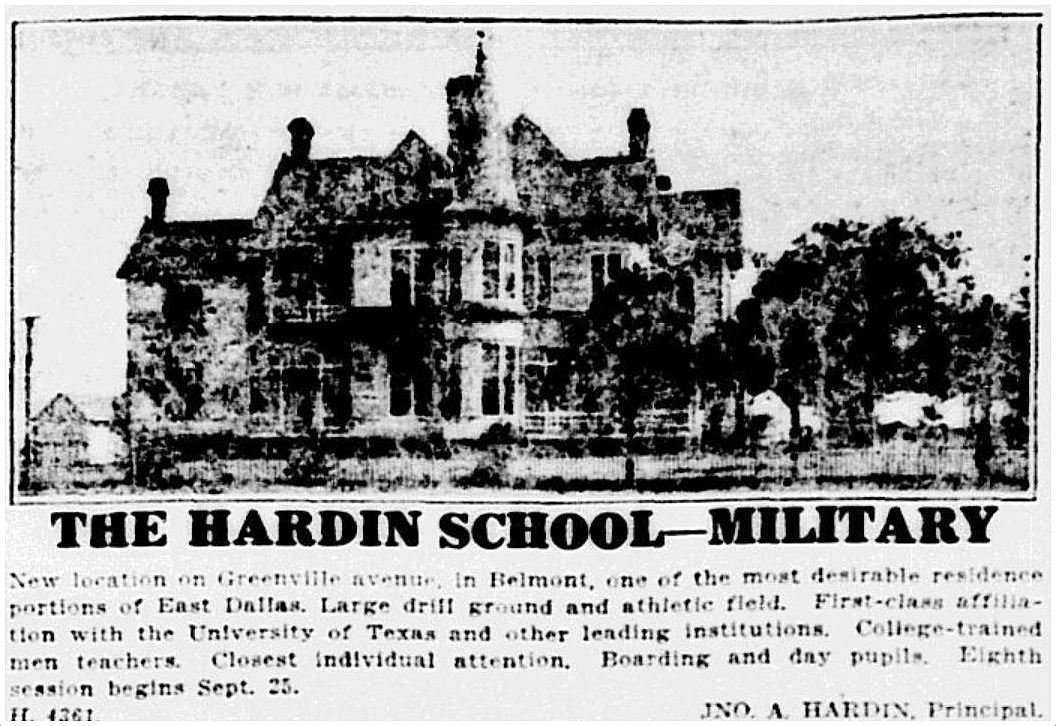
At one time the Caruth family owned land in and around Dallas which would be worth the equivalent of billions of dollars in today’s money. After Walter Caruth’s death, the Caruth family became embroiled in years of litigation, arguing over what land belonged to which part of the family. I‘m not sure when Walter Caruth’s land around his “farmhouse” began to be sold off, but by 1917, the Hardin School for Boys (established in 1910) moved into Bosque Bonita and set up shop. It operated at this location for two years. The Caruth house even appears in an ad.

hardin-school_dmn_071517_bosque-bonita_ad
DMN, July 15, 1917

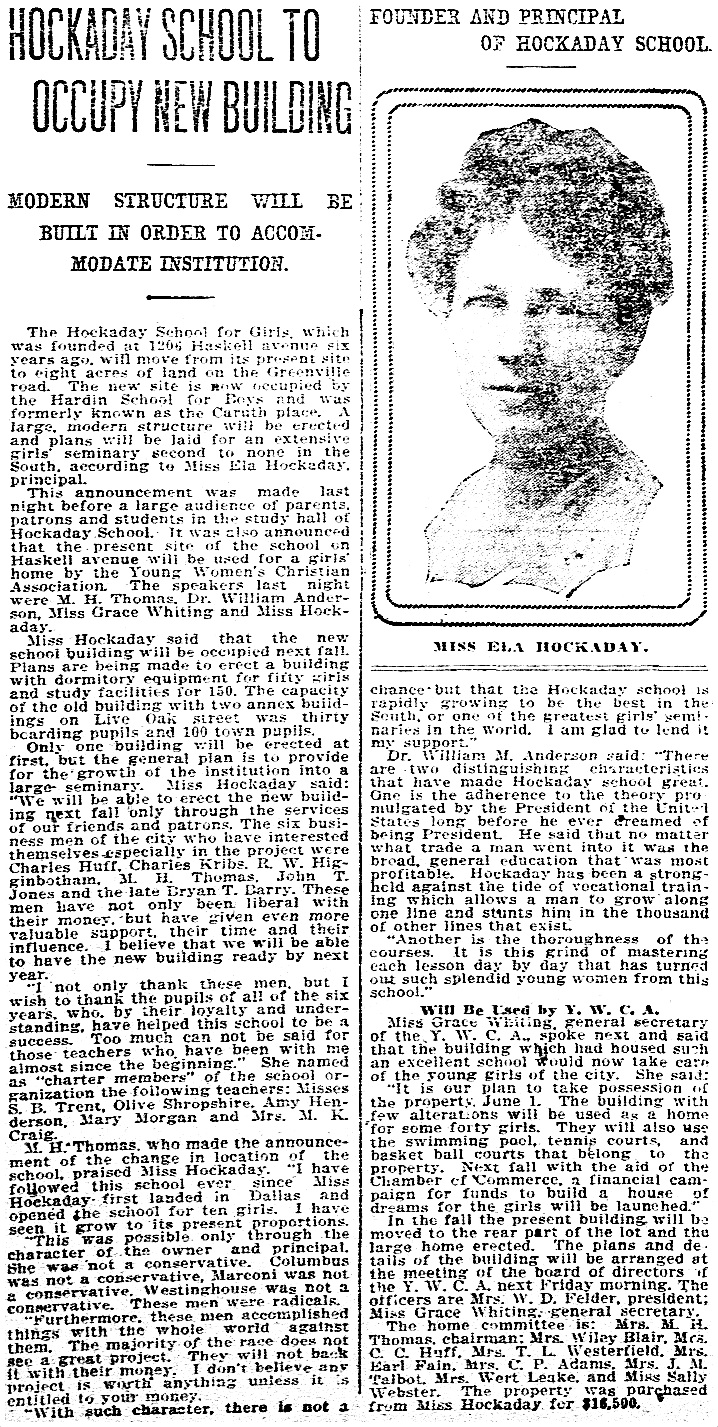
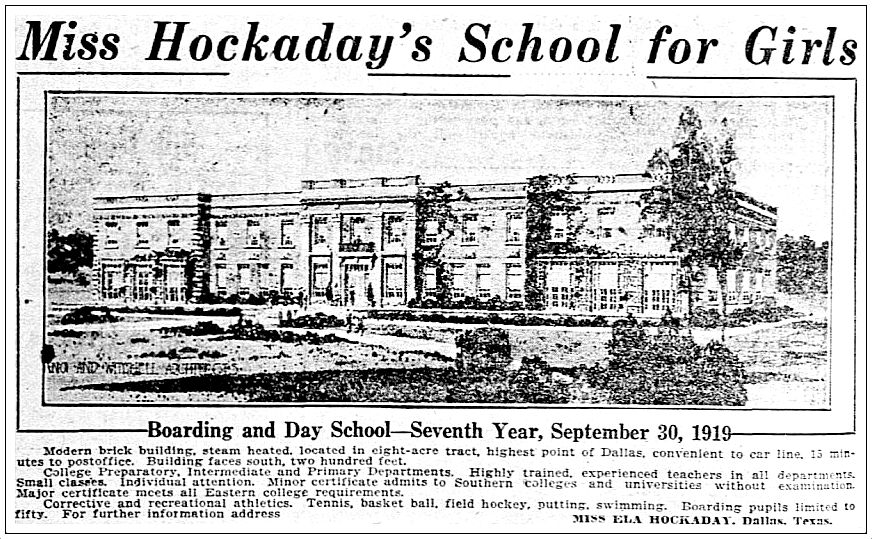
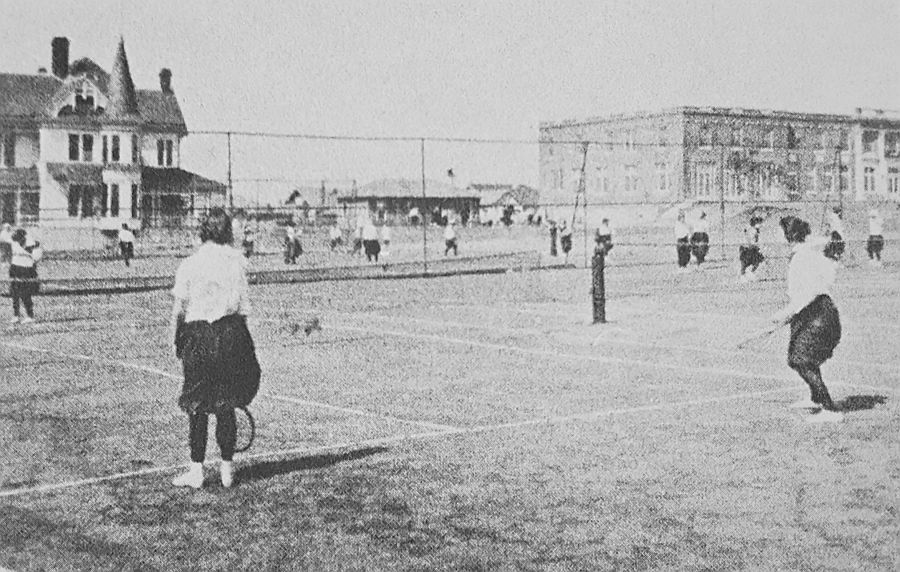
I’m not sure if the Hardin School owned the land or was merely leasing it and the house, but in 1919, Ela Hockaday announced that she had purchased the land and planned to move her school — Miss Hockaday’s School for Girls (est. 1913) — to this block and build on it a two-story brick school building, a swimming pool (seen in the photo above), tennis courts, basketball courts, hockey fields, and quarters for staff and girls from out of town who boarded.

hockaday_dmn_051119DMN, May 11, 1919

hockaday_dmn_070619
DMN, July 6, 1919

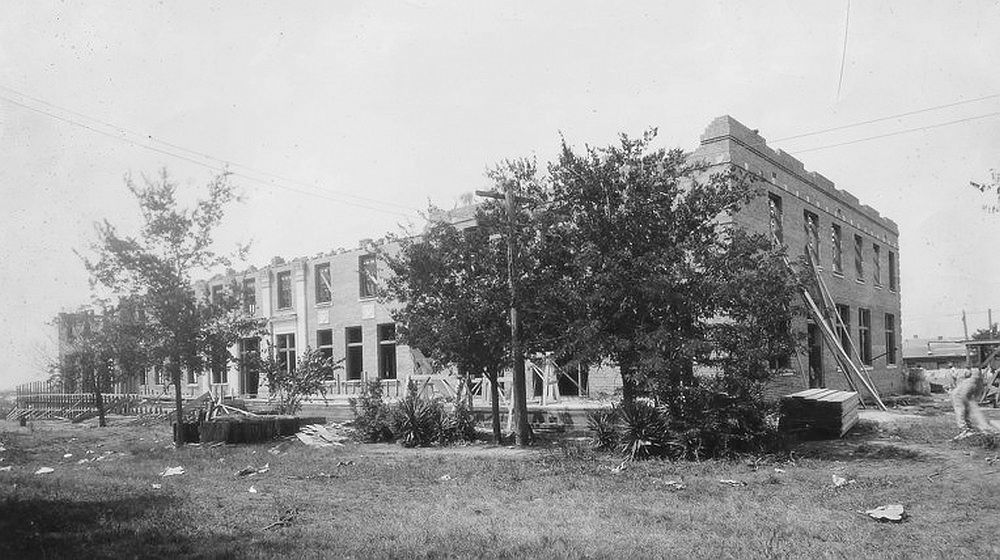
Ground was broken in July of 1919, and the first session at the new campus began on schedule in September. Below, the building under construction. Greenville Avenue is just out of frame to the right.

hockaday_greenville_construction_hockaday100Photo: Hockaday 100

hockaday_greenville-ave_1919_reminiscences

hockaday_greenville-belmont_1920s_horses

The most interesting thing I read about the Hockaday school occupying this block is that very soon after opening, the beautiful Caruth house was moved from its original location at the northwest corner of Belmont and Greenville. It was rolled on logs to the middle and back of the property. “Bosque Bonita” became “Trent House.” Former student (and later teacher) Genevieve Hudson remembered the moving of the house in an oral history contained in the book Reminiscences: A Glimpse of Old East Dallas:

caruth-house_hockaday_reminiscences-bk

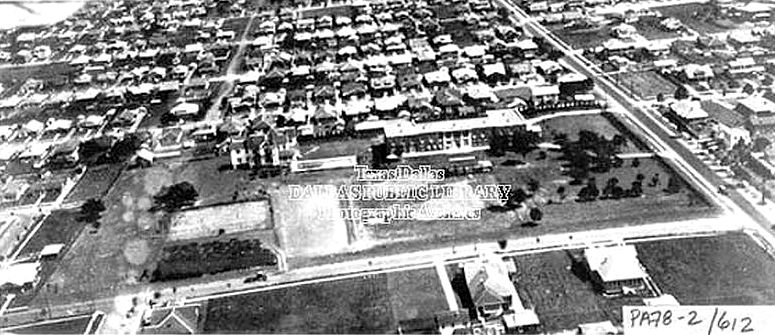
You can see the new location of the house in the top aerial photo, and in this one:

hockaday_aerial_dpl
Dallas Public Library

Another interesting little tidbit was mentioned in a 1947 Dallas Morning News article: Caruth’s old hitching post was still on the property — “on Greenville Avenue 100 feet north of the Belmont corner” (DMN, May 2, 1947). I’d love to have seen that.

After 42 years of sustained growth at the Greenville Avenue location (and five years after the passing of Miss Hockaday), the prestigious Hockaday School moved to its current location in North Dallas just after Thanksgiving, 1961. Suddenly, a large and very desirable tract of land between Vickery Place and the M Streets was available to be developed. Neighbors feared the worst: high-rise apartments.

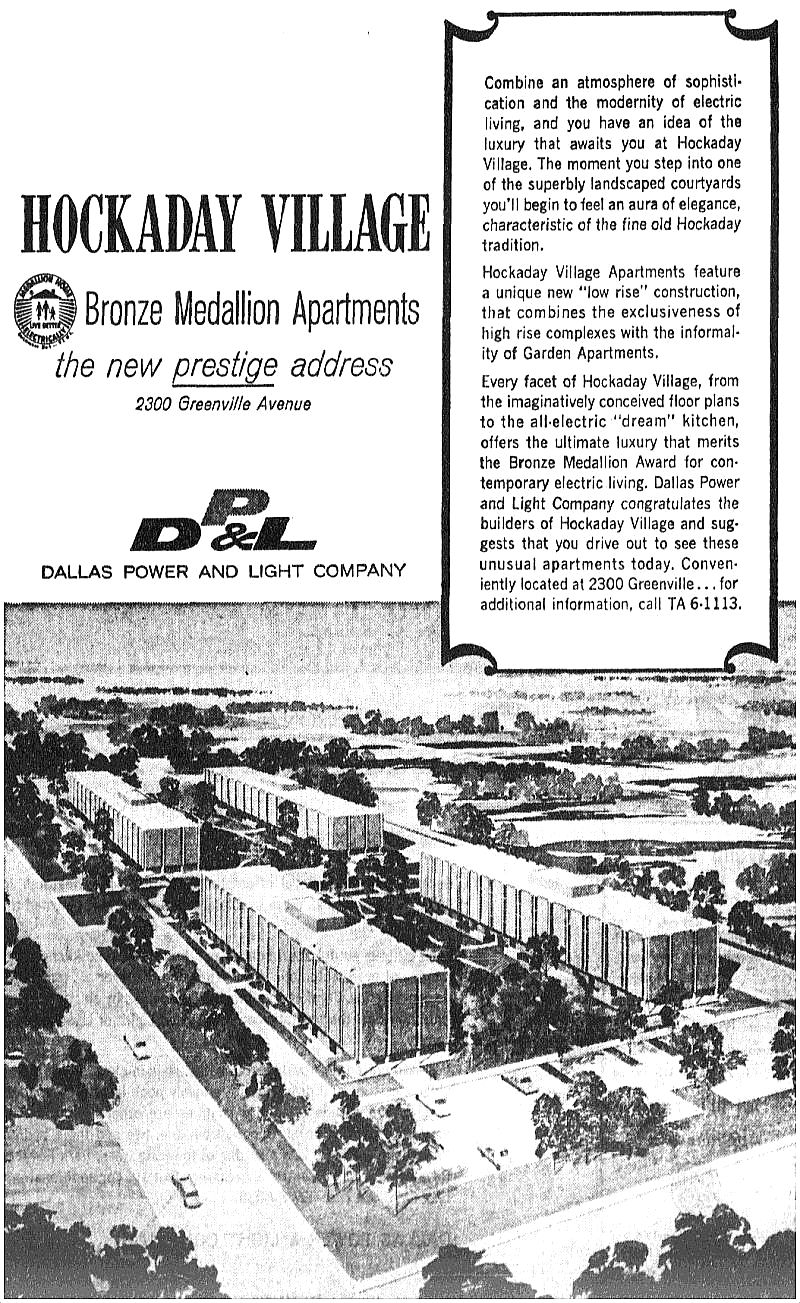
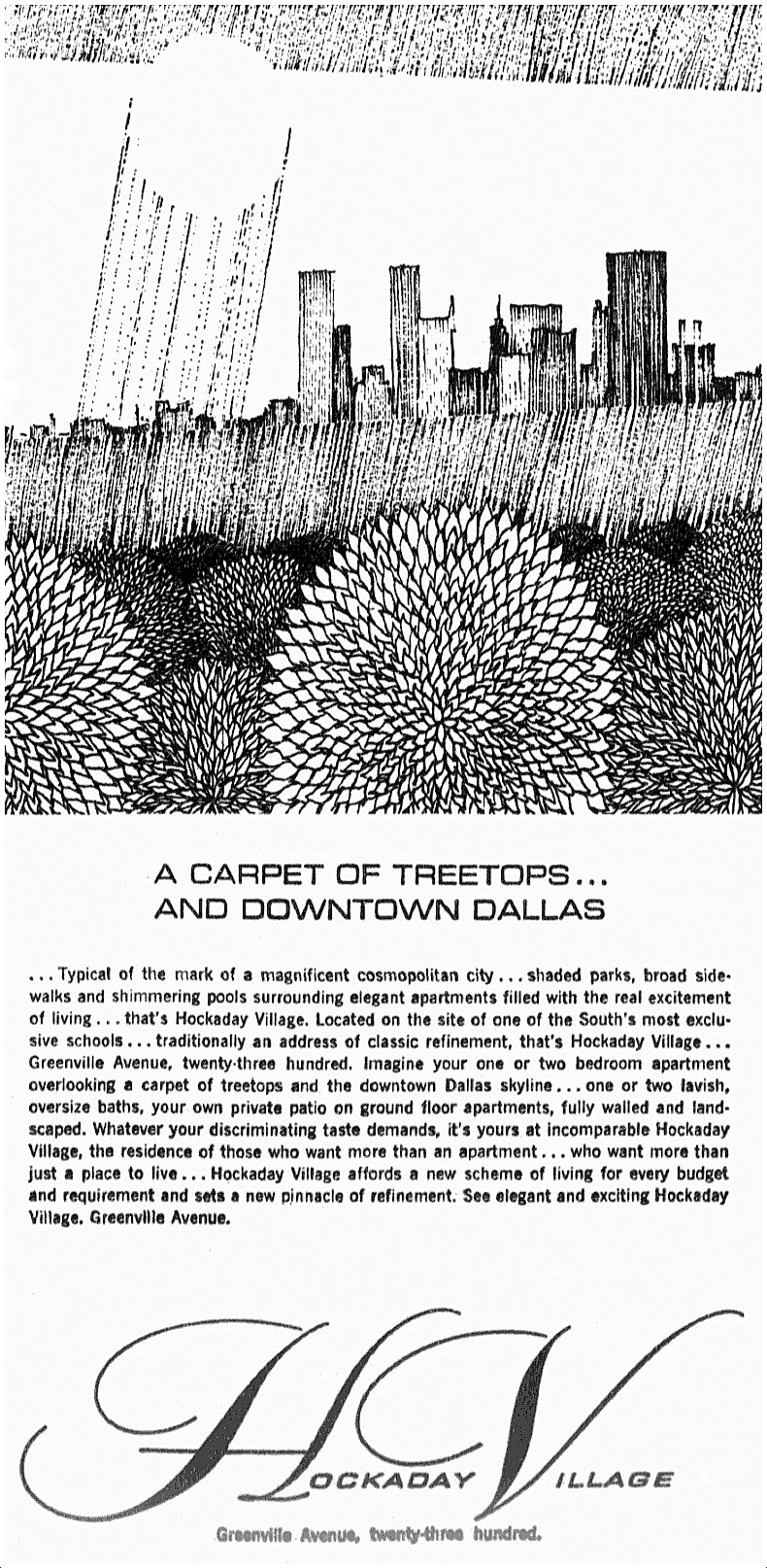
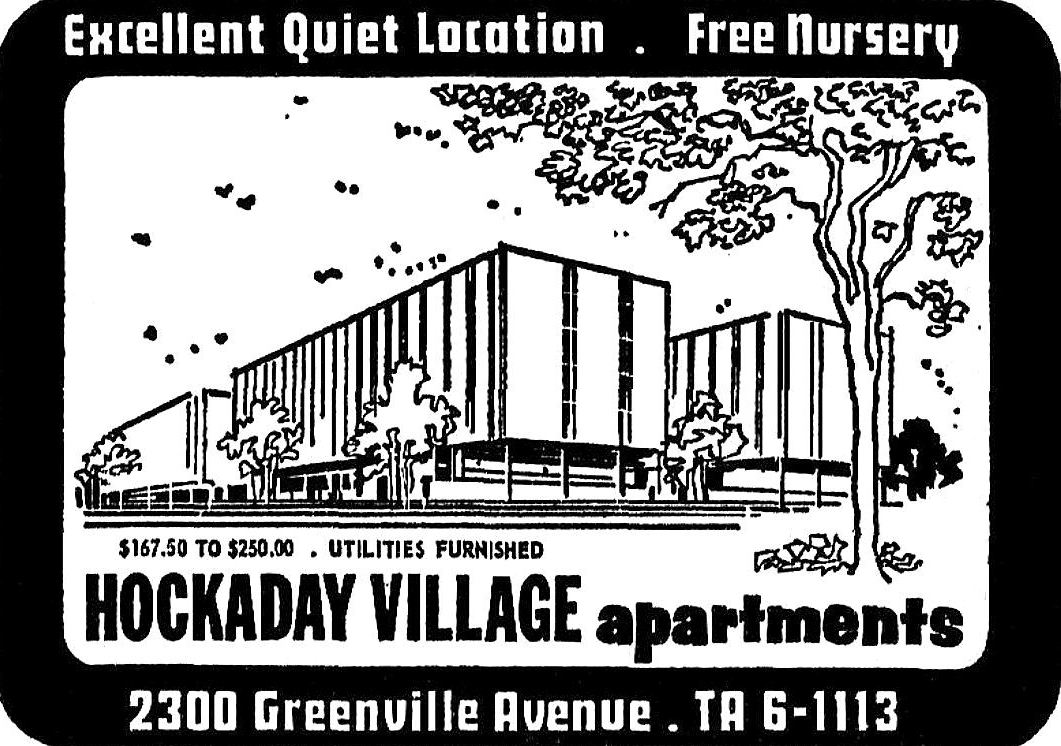
The developer proposed a “low-rise,” “semi-luxury” (?) group of four 5-story apartment buildings, each designed to accommodate specific tenants: one for swinging singles (“where the Patricia Stevens models live”), one for single or married adults, one for families with children, and one for “sedate and reserved adults.” It was to be called … “Hockaday Village.” The architect was A. Warren Morey, the man who went on to design the cool Holiday Inn on Central and, surprisingly, Texas Stadium.

Bosque Bonita — and all of the other school buildings — bit the dust in preparation for the apartment’s construction. Hockaday Village (…what would Miss Hockaday have thought of that name?) opened at the end of 1964.

hockaday-village_dmn_101864
Oct. 1964

hockaday-village_dmn_101864_carpet-of-treetops
Oct. 1964

hockaday-village_dmn_031365
March 1965

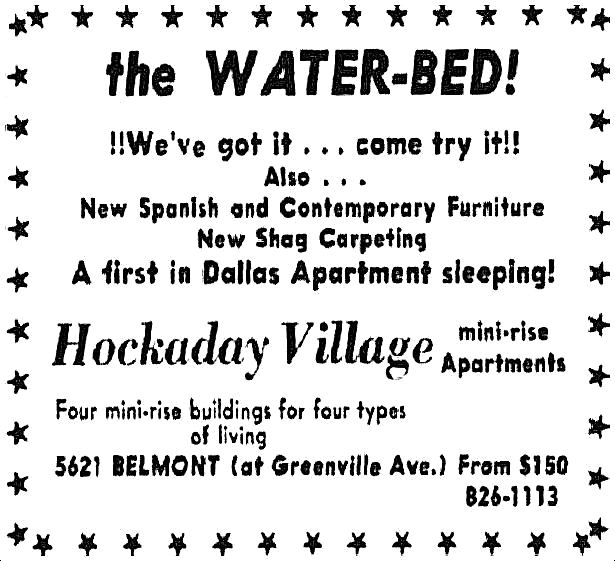
And then before you knew it, it was the ’70s, the era of waterbeds and shag carpeting. (Miss Hockaday would not have tolerated such tackiness, and I seriously doubt that Mr. Caruth would have ever understood why shag carpeting was something anyone would actually want.)

hockaday-village_dmn_052271_waterbeds
1971

Then, in 1973, the insistently hip ads stopped. In April, 1974 this appeared:

hockaday-village_FWST_042874
Fort Worth Star-Telegram, April 28, 1974

The apartments were being offered for public auction by the “Office of Property Disposition” of the Federal Housing Authority and HUD. Doesn’t sound good. So who bit and took the plunge? The First Baptist Church of Dallas, that’s who. The plan was to redevelop the existing apartments into a retirement community called The Criswell Towers, to be named after Dr. W. A. Criswell. But a mere three months later, the Baptists realized they had bitten off more than they could chew — the price to convert the property into a “home for the aged” would be “astronomical.” They let the building go and took a loss of $135,000. It went back on the auction block.

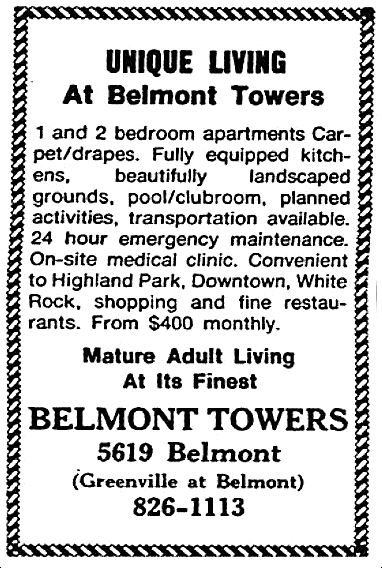
Two years later, in the summer of 1976 … the old Hockaday Village became Belmont Towers — and the new owners must have thought the Baptists’ idea was a good one, because Belmont Towers advertised itself as “mature adult living at its finest” — “perfect for retired or semi-retired individuals.”

hockaday-village_dmn_043083_belmont-towers
April 1983

It was Belmont Towers for 20-or-so years. In 1998, the buildings were renovated and updated, and it re-opened as Vickery Towers, still a retirement home and assisted living facility. A couple of years ago it was announced that the buildings would be demolished and a new development would be constructed in its place. It took forever for the 52-year-old complex to finally be put out of its misery since that announcement. Those buildings had been there my entire life and, like I said, it was a shock to see nothing at all in that block a few weeks ago.

vickery-towers_050516_danny-linn-photoPhoto: Danny Linn

In the 140-or-so years since Walter Caruth acquired this land in the 1870s or 1880s, it has been occupied by Caruth’s grand house, a boys school, the Hockaday School, and four buildings which have been apartments and a retirement community. And that’s it. That’s pretty unusual for development-crazy Dallas. I’ll miss those familiar old buildings. I hope that whatever is coming to replace them won’t be too bad.

greenville-belmont_bing_aerial
Bing Maps

***

Sources & Notes

The top aerial photograph is by Squire Haskins, taken on Feb. 27, 1950 — from the Squire Haskins Photography Inc. Collection, University of Texas at Arlington Libraries, Special Collections, accessible in a massive photo here (click the thumbnail). Greenville Avenue is the street running horizontally at the bottom. The Hockaday Junior College can be seen at the northwest corner of Belmont and Greenville — the original location of Bosque Bonita before it was rolled across the campus.

That fabulous photo of Bosque Bonita is from the book Dallas Rediscovered by William L. McDonald.

Photo of Hockaday girls playing tennis is from the book Reminiscences: A Glimpse of Old East Dallas.

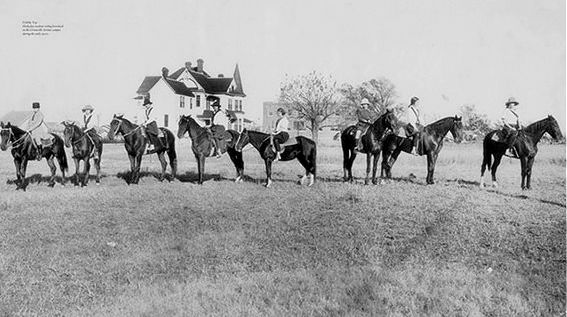
Photo of girls on horseback … I’m not sure what the source of this photo is.

Photo of the block, post-razing is by Danny Linn who grew up in Vickery Place; used with permission. (Thanks, Danny!)

All other sources as noted.

In case you were confused, the Caruth Homeplace that most of us might know (which is just south of Northwest Highway and west of Central Expressway) was the home of Walter Caruth’s brother William — more on that Caruth house can be found here.

The Hockaday School can be seen on the 1922 Sanborn map here (that block is a trapezoid!).

More on the history of the Hockaday School can be found at the Hockaday 100 site; a page with many more photos is here. Read about the history of the school in the article “Miss Ela Builds a Home” by Patricia Conner Coggan in the Spring, 2002 issue of Legacies, here.

Additional information can be found in these Dallas Morning News articles:

  • “Proposal to Change Hockaday Site to Apartment Zoning Opposed” (DMN, Oct. 29, 1961)
  • “Retirement Home Plans Going Ahead” (regarding the purchase by the First Baptist Church of Dallas) (DMN, June 15, 1974)
  • “Church Takes $135,000 Loss on Property” (DMN, Sept. 10, 1974)

*

If you made it all the way through this, thank you! I owe you a W. C. Fields “hearty handclasp.”

*

Copyright © 2016 Paula Bosse. All Rights Reserved.
Dallas Skyline at Night — ca. 1965
downtown_chamber-of-commerce_ca1965Goodnight, Pegasus…

by Paula Bosse

It might just be because this photo is so grainy, but it’s very dreamy-looking — a sort of soft-focus view of Dallas’ sophisticated nighttime skyline.

***

Sources & Notes

The photo is credited to the Dallas Chamber of Commerce. I’m pretty sure this came from a high school yearbook, but I’m afraid I neglected to note which one.

See another great photo from the same period in the Flashback Dallas post “Nighttime Skyline — 1965.”

*

Copyright © 2016 Paula Bosse. All Rights Reserved.