Flashback : Dallas

A Miscellany: History, Ads, Pop Culture

Category: Holidays/Celebrations

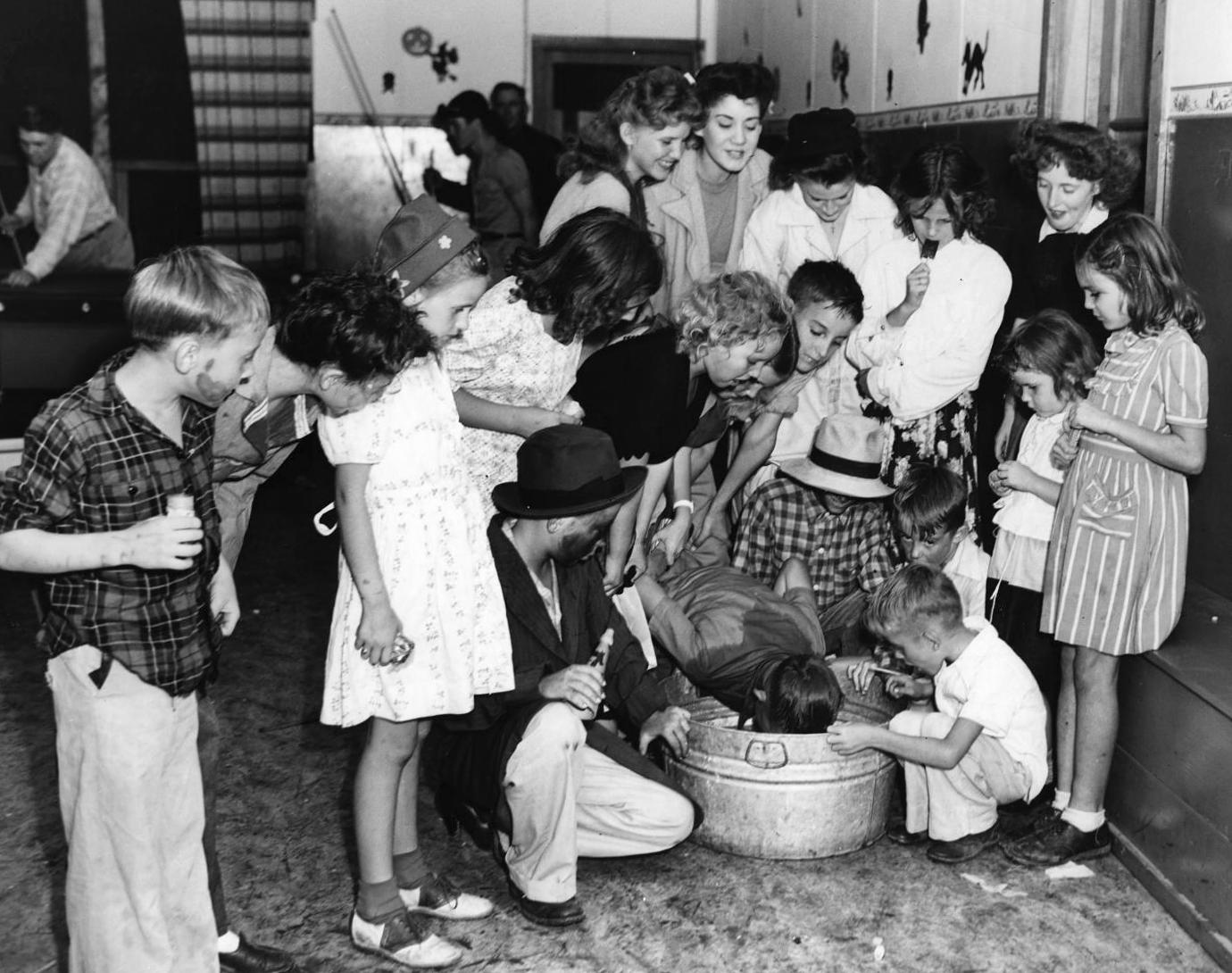
Dunking For Apples at a Halloween Night “Spooks’ Party”

halloween-party_dallas-parks_portalKids used to really have to WORK for those treats!

by Paula Bosse

In an effort to steer young revelers to safe Halloween festivities, the Dallas Park and Recreation Department organized parties in community centers around Dallas in the 1930s and ’40s. One of those parties (in an unidentified location) can be seen above, in a photograph titled “Dunking for Apples — Hallowe’en Night — October 31 at Spooks Party.”

The party’s apple-bobbing is in full swing. All eyes are on the dunker, who has obviously been hard at work, dunking down well past his shoulders. A couple of young hobos appear to be in attendance, both with prominent five o’clock shadows. Even though the party is for children, the adults seem to be having more fun than the kids, but perhaps this is early in the evening. And the party’s not just for the small-fry — there’s a pool game going on in the background, providing dunk-free entertainment for dads (and other men who might have wandered in).

Happy Halloween! Dunk responsibly!

***

Sources & Notes

This photograph comes from the Dallas Municipal Archives, accessed through the Portal to Texas History, here. The photographer is Harry Bennett. The photo is undated, but it looks like it is from the early 1940s. These city-sponsored parties appear to have started in the late-1930s as a way to keep children out of mischief and away from the riotous celebrations downtown (which I wrote about previously, here).

More Halloween photos from the Dallas Park and Recreation Department collection, taken by Harry Bennett — perhaps taken the same year, perhaps at the same location — can be seen here.

Click picture for larger image.

*

Copyright © 2015 Paula Bosse. All Rights Reserved.

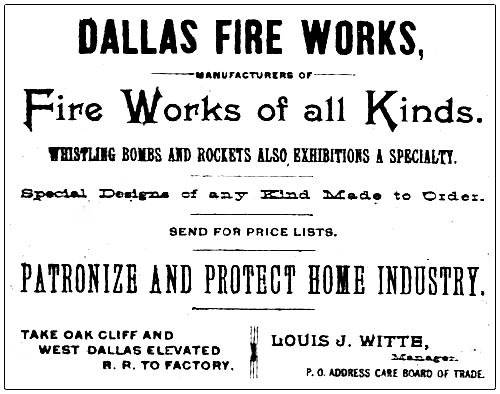
Dallas Fire Works Ad — 1891

ad-dallas-fireworks_1891-directory

by Paula Bosse

Even in the 1890s, Oak Cliff was encouraging people to buy local.

DALLAS FIRE WORKS
Manufacturer of
Fire Works of All Kinds.
Whistling Bombs and Rockets Also Exhibitions A Specialty.
Special Designs of any Kind Made to Order.
Send For Price Lists.
PATRONIZE AND PROTECT HOME INDUSTRY.
Take Oak Cliff and West Dallas Elevated R.R. to Factory.

Louis J. Witte, Manager.
P.O. Address Care Board of Trade.

Do NOT go to Fort Worth for your fireworks!

***

Ad from the 1891 city directory.

*

Copyright © 2015 Paula Bosse. All Rights Reserved.

SMU Turns 100: A Look Back at Its Very First Days — 1915

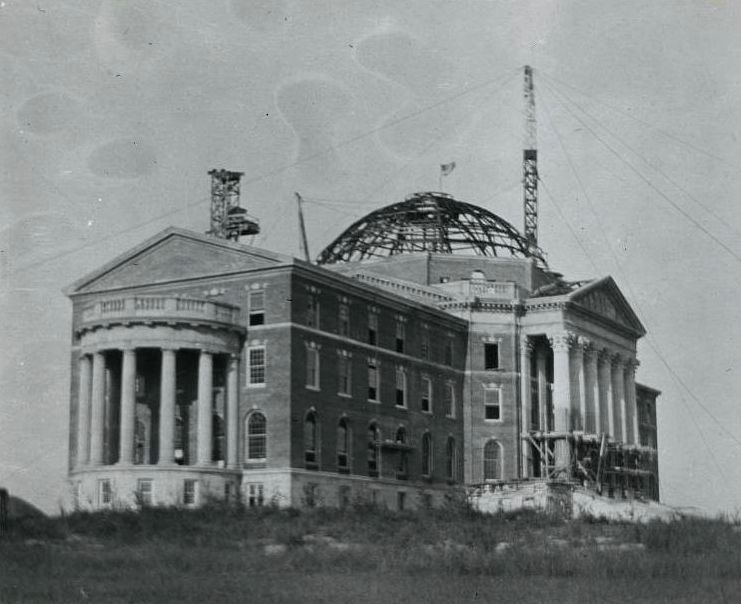
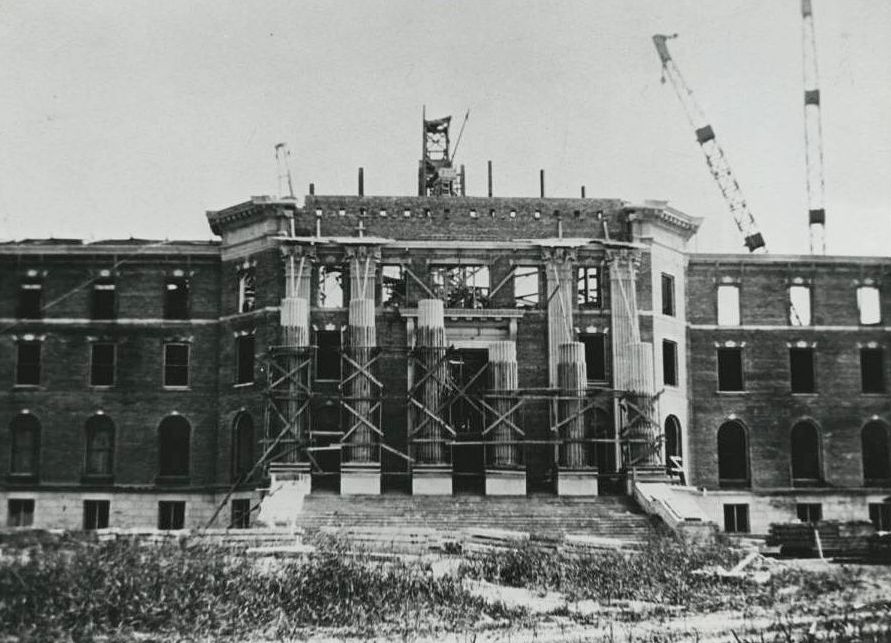
smu_dallas-hall-dome-under-construction_1914Dallas Hall’s dome under construction, 1914 (SMU Archives)

by Paula Bosse

Classes began for the very first time at brand new Southern Methodist University on September 28, 1915 — 100 years ago today! Where HAS the time gone? Below, a few photos from those early days (click pictures for larger images).

smu_dallas-hall-columns-under-construction_1914_degolyerDallas Hall’s columns going up, 1914, out in the middle of a mostly empty prairie, well beyond the Dallas city limits.

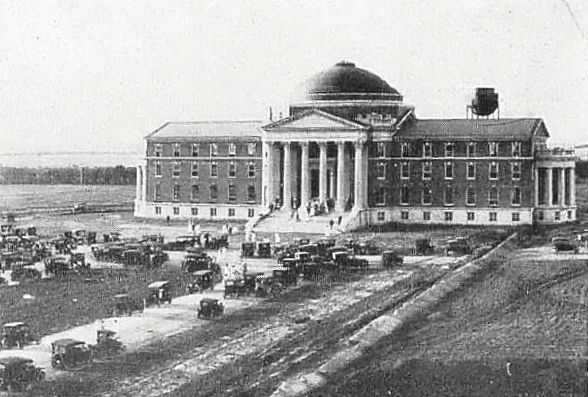
smu_week-before-opening_1935-rotundaVisitors checking out the new campus, a week before its opening.

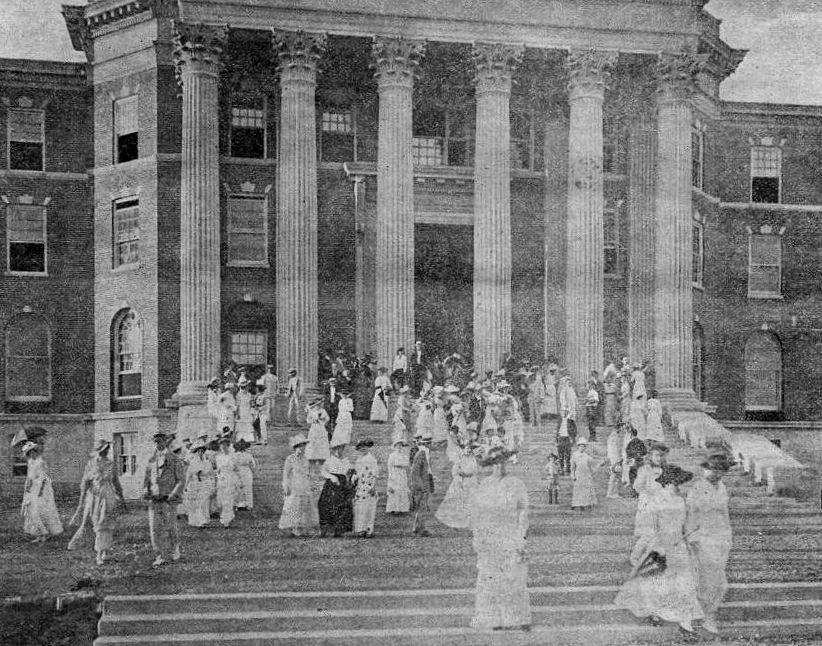
smu_visitors-before-opening_091115Genteel visitors on the steps of Dallas Hall, the only building on campus in which classes were actually held.

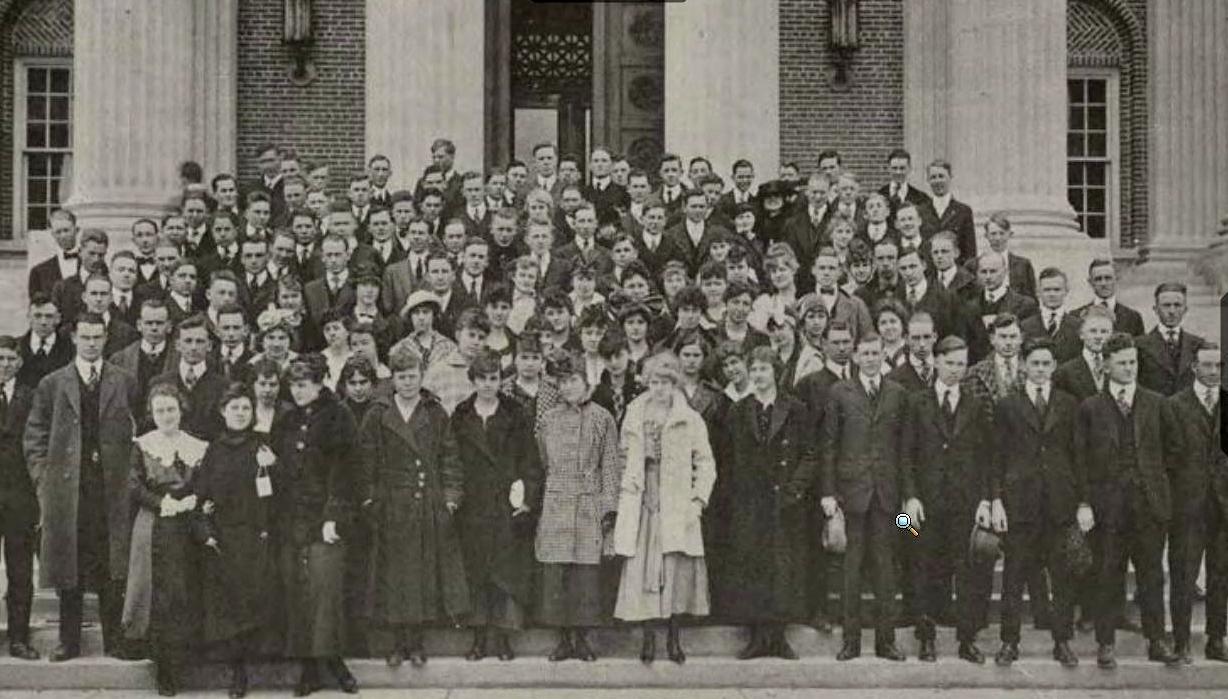
12smu-rotunda-1916_freshman-classSMU’s first freshman class.

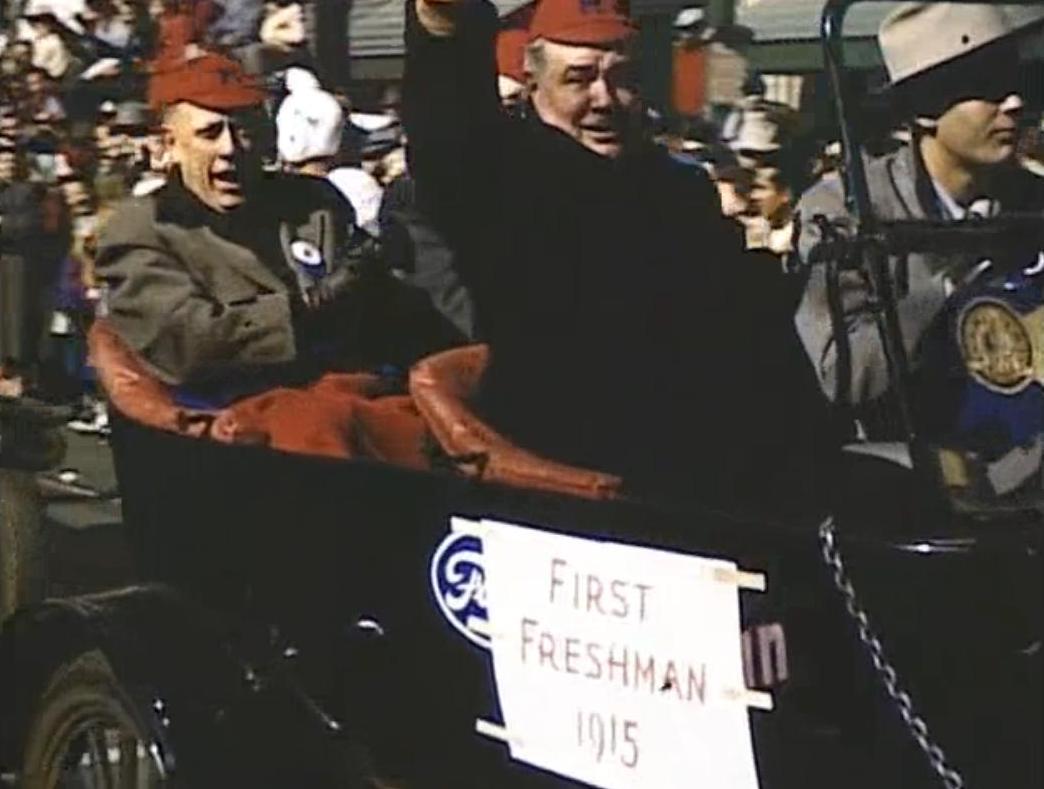
smu_first-freshmen_1950-homecoming-paradeAnd a couple of those freshmen, 35 years later, riding in a car in the 1950 Homecoming Parade downtown.

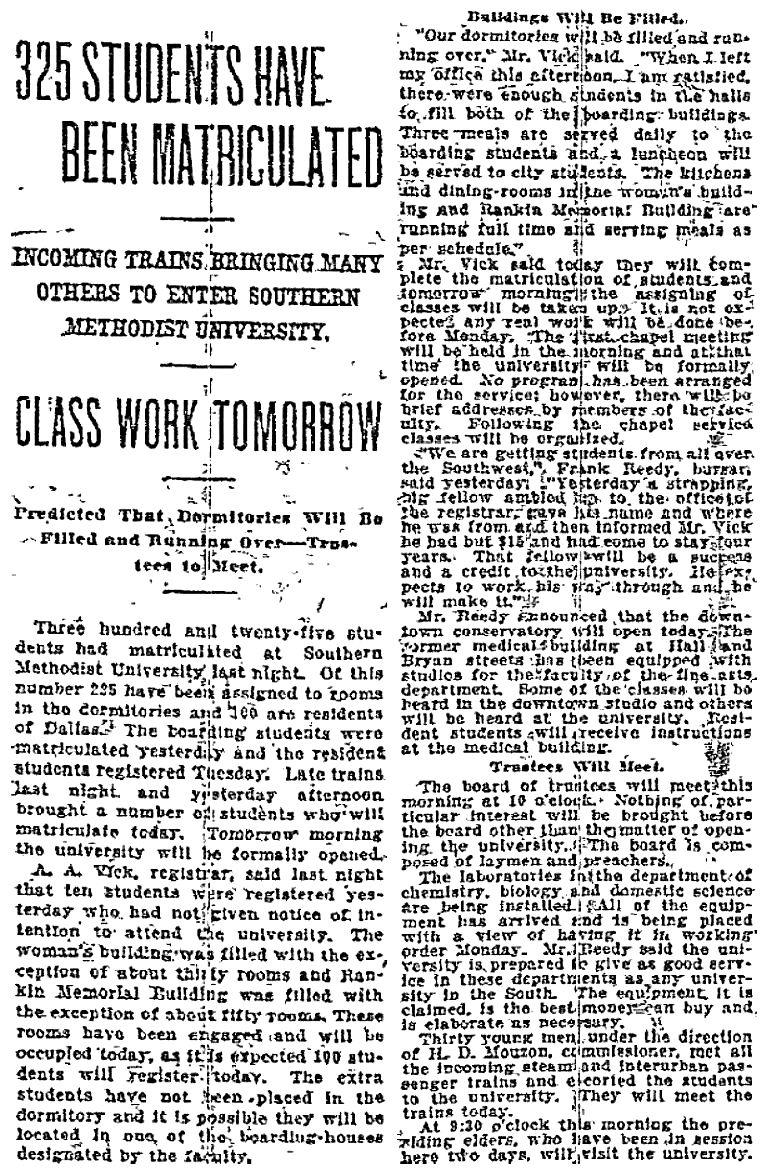
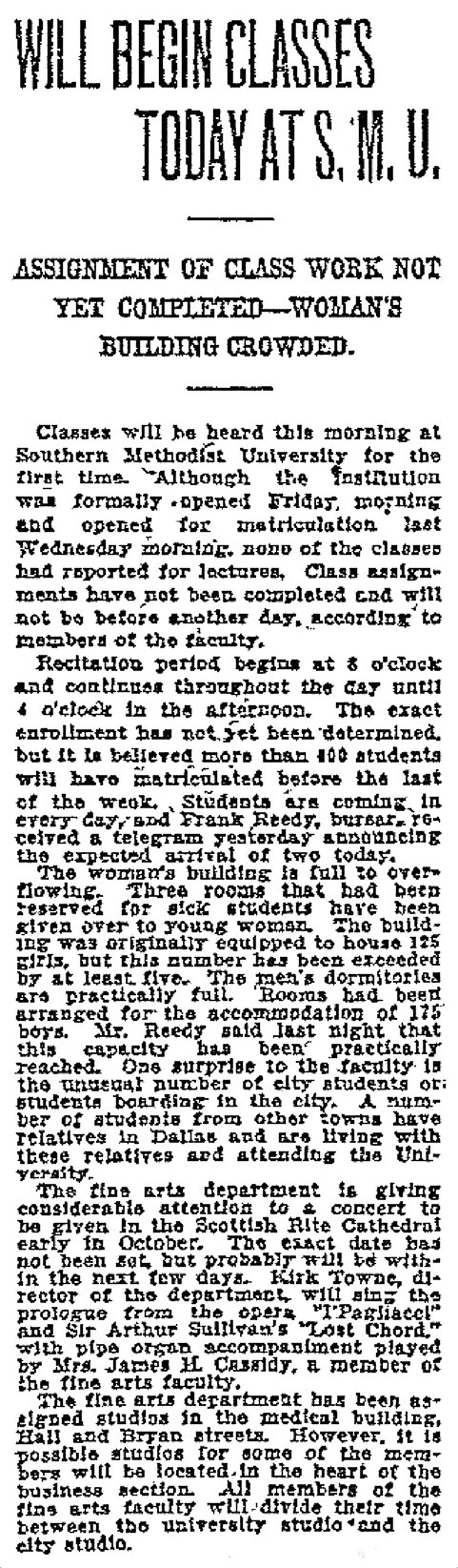
Below are a couple of logistical and progress-report articles from the week when students began arriving for that first year’s classes. Most interesting is that several classes were held off-campus, because of lack of space in an already crowded Dallas Hall. The fine arts department was housed at the “downtown conservatory” which was located in a former medical building at Hall and Bryan streets. The fine arts faculty had studios there and would move between downtown and the SMU campus. (Click articles for larger images.)

smu_first-day_dmn_092315Dallas Morning News, Sept. 23, 1915

smu_first-day-classes_dmn_092815DMN, Sept. 28, 1915

Happy Centennial, SMU!

***

Sources & Notes

The photos of Dallas Hall under construction are from the DeGolyer Library, Central University Libraries, Southern Methodist University. The photo of the dome under construction is here; the photo of the columns going up is here.

The photo of campus visitors and their cars lined up in front of Dallas Hall is from the 1935 edition of the SMU Rotunda yearbook; the caption: “Dallas Hall, a week before opening of SMU.”

The photo of visitors on the steps of Dallas Hall is from Bridwell Library, Special Collections, Perkins School of Theology, Southern Methodist University, and it can be accessed here. The photo was taken on Sept. 11, 1915 and was printed in the Sept. 23, 1915 edition of The Texas Christian Advocate above the caption “[Snapshot] of visitors at entrance to Dallas Hall on occasion of the reception given Saturday the 11th by the citizens of Dallas to the faculty.” (The article and another photo can be seen at the link above.)

The photo of SMU’s first freshman class is from the 1915-16 SMU Rotunda yearbook.

The image of the former SMU freshmen is a screen capture from a home movie of SMU’s 1950 Homecoming Parade which is part of the DeGolyer Library’s collection; the entire 17-minute silent color film can be watched on the SMU Central Libraries site, here. The very entertaining film contains the parade, a tour around campus, an elaborately decorated Fraternity Row, and the football game against Texas A & M at the Cotton Bowl.

These other Flashback Dallas posts related to SMU’s first year may also be of interest:

  • “SMU, ‘The School of the Future’ — 1915-16,” here
  • “SMU’s First Year: The Dinkey, Campus Hijinx, and The Basket Ball — 1915-16,” here
  • “University Park, Academic Metropolis — ca. 1915,” here
  • “Send Your Kids to Prep School ‘Under the Shadow of SMU’ — 1915,” here (Incidentally, the Powell University Training School opened on the same day as SMU as a sort of “sister school” — the building it occupied is still standing, on Binkley, just off Hillcrest — this building celebrates its Centenary, too!)

Click photos and clippings to see larger images.

*

Copyright © 2015 Paula Bosse. All Rights Reserved.


Main Street and Flags, Flags, Flags — ca. 1917

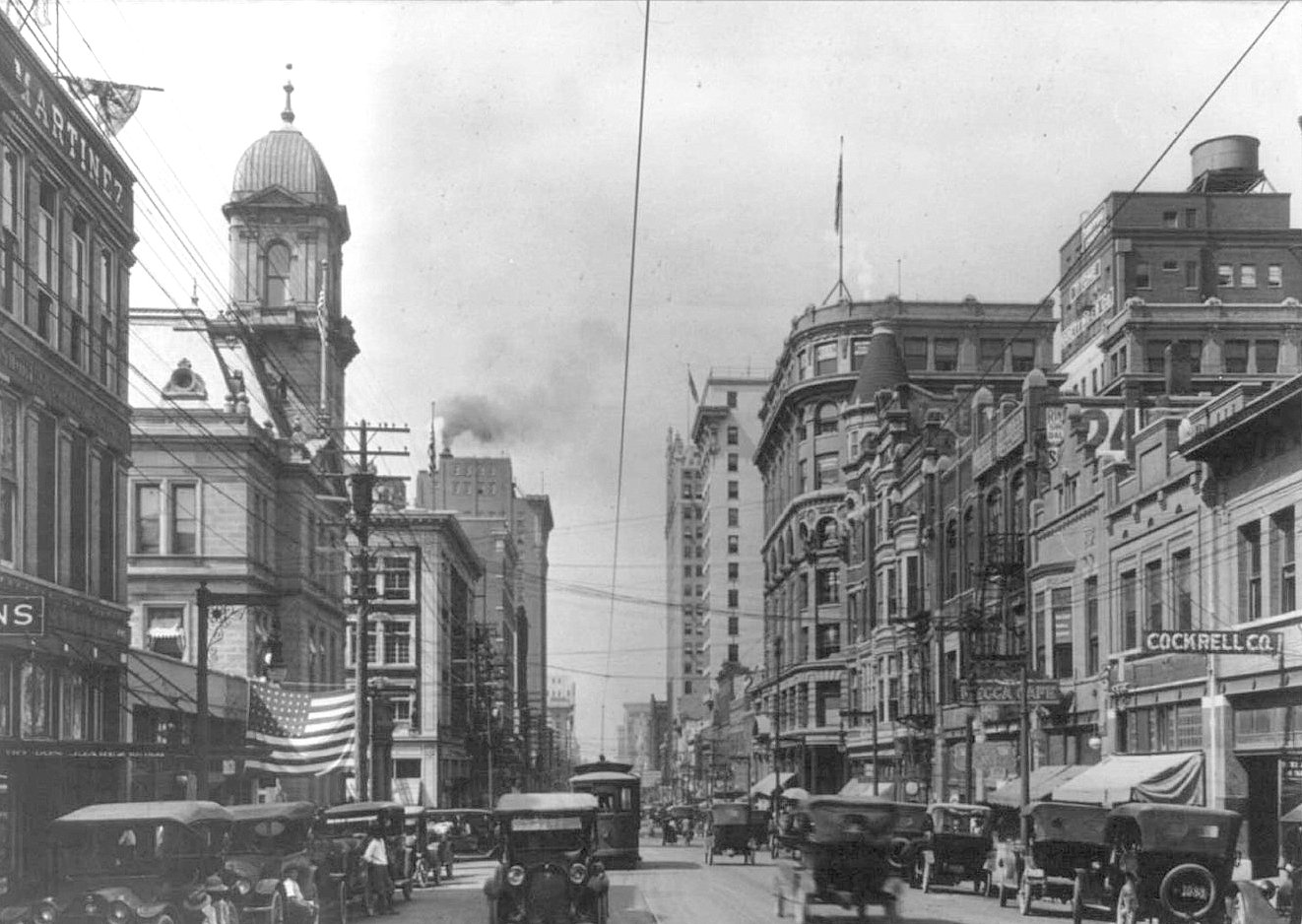
downtown_ca1917_LOCFind the flags! (click for larger image)

by Paula Bosse

This is a cool photo. I have no idea if it was taken anywhere around July 4th, but I post it today because today is July 4th, AND I see 5 — possibly 6 — American flags in this photograph of Main Street. The patriotism displayed here may have more to do with World War I than Independence Day, but why not post it on the 4th of July?

Enjoy the holiday!

***

Photo identified as “Texas, Dallas, 1917, Business section” by the Library of Congress; photo info here.

For the previous Flashback Dallas post “4th of July — Sweating in Formation,” which shows a parade from the 1870s or 1880s, click here.

*

Copyright © 2015 Paula Bosse. All Rights Reserved.

“The Last Time I Saw Texas” — 1953/58

neiman-marcus_texas-mapThat “X” is in the wrong spot, y’all…. (click for larger image)

by Paula Bosse

Before I begin, I offer apologies in advance to Oscar Hammerstein II (original lyricist of “The Last Time I Saw Paris”), NeimanMarcus (with or without the hyphen), haters of Texas stereotypes, and, especially, Fort Worth.

In a Dallas item connected with “Independence Day” in only the most tangential way possible, I thought I’d share a little cabaret song I stumbled across today whilst rummaging through the internet. It’s a humorously re-written version of the Academy Award-winning hit song “The Last Time I Saw Paris,” (…um, the one in FRANCE….), written in 1940 by Oscar Hammerstein II (lyrics) and Jerome Kern (music).

Partial lyrics were reported by Earl Wilson in his syndicated gossip/entertainment column, “Broadway Last Night,” twice — first in 1953, after he’d seen Juliana Larson sing it at the Sherry Netherland Hotel, then later, in 1958, after he’d heard Connie Moore sing it at the St. Regis Maisonette. Both women had Texas ties (Constance Moore actually grew up in Dallas), so I’m sure both enjoyed singing the ditty (in what one hopes was in an ever-so-amusing sophisticated style, à la Noël Coward).

At the Neiman-Marcus store
They sell the usual furs
And the cutest children’s Cadillacs
And yachts marked “His” and “Hers.”

The last time I saw Texas
And the oil was in her hills,
The kiddies bought their lunch at school
With hundred-dollar bills.

The last time I saw Texas,
All Dallas was so gay,
We’d burned Fort Worth to the ground
On Independence Day.

Happy Independence Day, Fort Worth!

***

Listen to Noël Coward sing “The Last Time I Saw Paris” (before FW was being burned to the ground), here.

Juliana Larson (aka Juliana Bernhardt) was a former John Powers model who married wealthy Houston oilman Walter Bedford Sharp, Jr. (whose father was a business partner with Howard Hughes’ father). She started in light opera in Texas and moved on to New York nightclubs. She seems to be known mostly as the wife of a Texas oilman and a permanent fixture on Best Dressed lists. She horrified everyone when she showed up to a Metropolitan Opera opening night wearing trousers — see her delighting in the publicity she received from that, in Life magazine (Nov. 24, 1952), here.

Constance Moore was born in Iowa but grew up and began her career in Dallas. More about her here and here; glamour photos here.

The “Texas” lyrics were reported by Earl Wilson to have been written by David Roger (for Juliana Larson, in 1953) and by Earl Brent (for Connie Moore, in 1958). The partial lyrics Wilson quoted in 1953 and 1958 were the same. …So there you go. (I changed the order of one line, because it seems that Wilson got the lines of the first verse in the wrong order.)

I’m not sure where I found that Neiman’s map, but it’s cool. (Why IS the “X “is the hinterlands, anyway?)

Enjoy your 4th of July weekend! And don’t burn anything down!

*

Copyright © 2015 Paula Bosse. All Rights Reserved.

When In Doubt, Get Mom a Hat — 1951

mothers-day_dmn_050351

by Paula Bosse

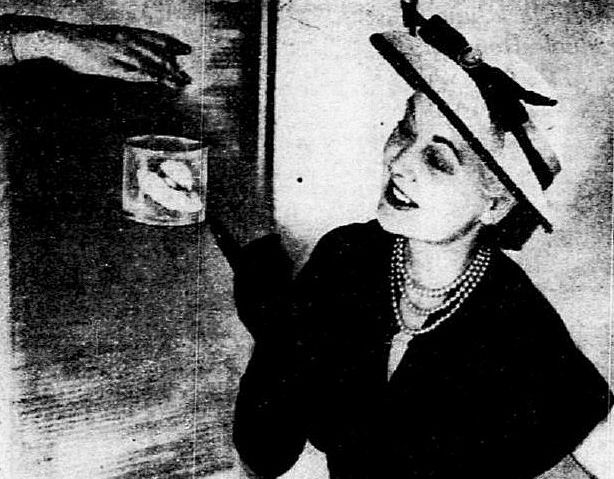
Give Mom a teeny-tiny hat!

Mother’s Day Sure to please everybody’s mother is this attractively packaged Mother’s Day hat certificate that she can use to purchase the hat that is most becoming. The certificate is enclosed with a miniature straw hat in a crystal-clear plastic hat box. W. A. Green Company.

Happy Mother’s Day!

***

Sources & Notes

From an advertorial appearing in The Dallas Morning News on May 3, 1951.

*

Copyright © 2015 Paula Bosse. All Rights Reserved.

Easter Egg Hunt at City Park — 1924

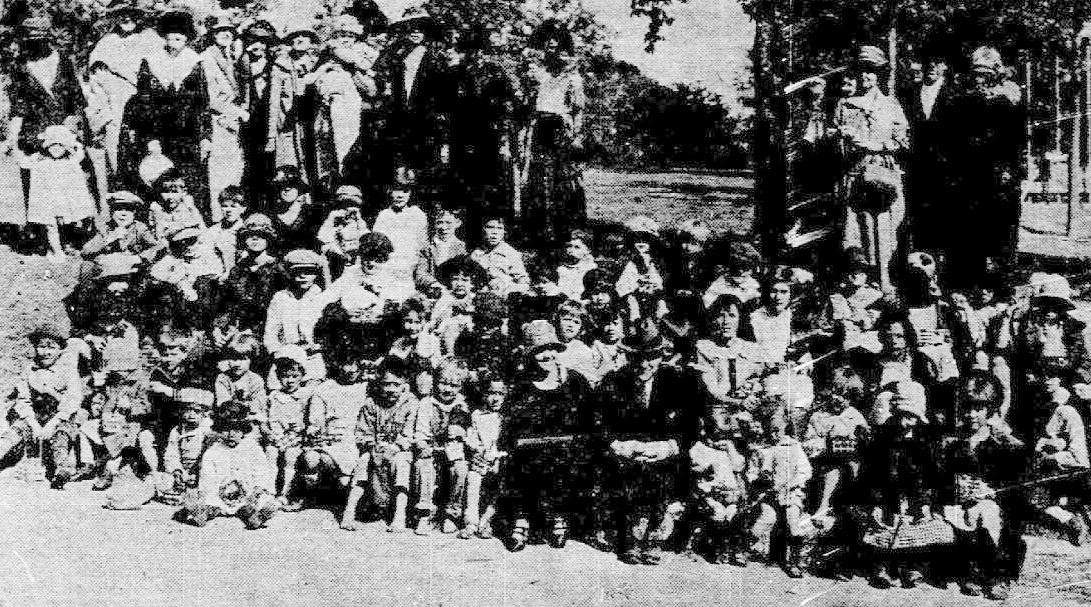
Hunters and their patrons, 1924…

by Paula Bosse

Happy Easter! Here’s what was going on at about this time, 91 years ago.

*

Osteopathic Clinic Fetes Children With Easter Egg Hunt

The church committee of the free osteopathic clinic at the First Unitarian Church, Ervay and St. Louis streets, entertained seventy-five children of the clinic at an Easter egg hunt in City Park Friday afternoon. Real Easter eggs were hidden by the ladies of the committee about the park, and where the close-cropped grass did not provide good hiding places about the tree trunks, nests were made in the sand.

After the youngsters had been released to hunt, they pursued the quest vigorously, to the accompaniment of shrill cries of delight, until all the eggs were found, the members of the committee distributed Easter baskets filled with candy eggs for the children to eat. Later they were taken to the church, where refreshments were served.

***

Sources & Notes

Photo and caption from The Dallas Morning News, April 19, 1924.

*

Copyright © 2015 Paula Bosse. All Rights Reserved.

Happy 1st Day of April!

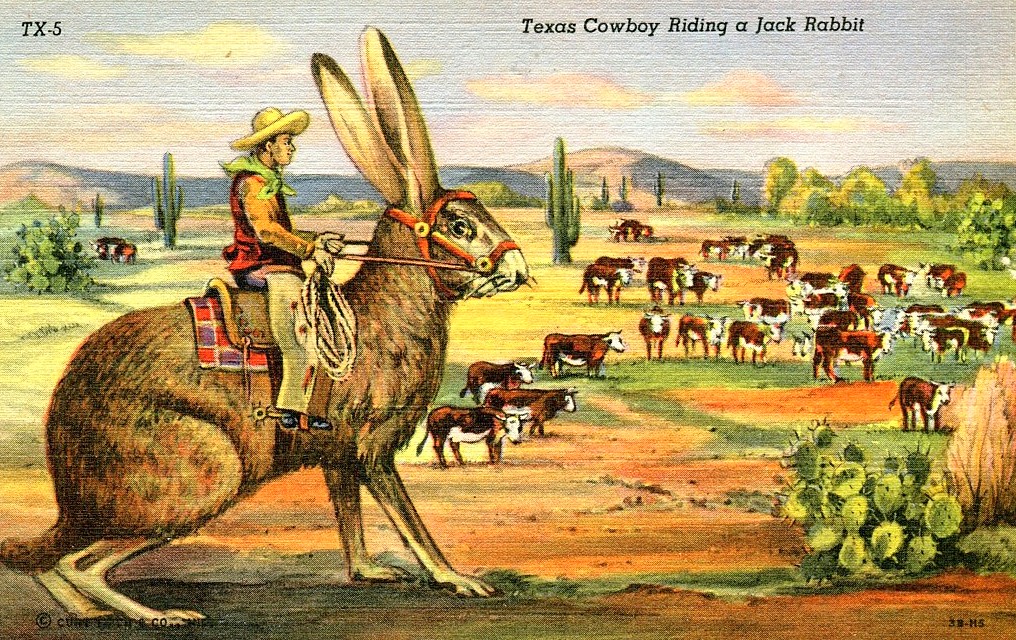
tx-jackrabbitPerspective’s a bit off — those cattle would have been MUCH larger

by Paula Bosse

Everything’s bigger in Texas — including our jackrabbits, which are justifiably legendary. Below, a photo of a (concerned-looking) child posed atop one of the more docile breeds. We’re just not growing them that big anymore. Shame.

jackrabbitApparently somewhere in Dallas…

***

Sources & Notes

Top image found here (where other historical images of cowboys riding giant jackrabbits can be seen).

Bottom photo (possibly a postcard) was on eBay a while back. Location was identified as Dallas.

For a previous Flashback Dallas post celebrating the 1st Day of April, see “U.S. Revenue Cutter ‘Carrie Nation’ Successfully Navigates the Trinity In Valiant Effort to Keep Dallas Dry! — 1931” here.

*

Copyright © 2015 Paula Bosse. All Rights Reserved.

Texas Independence Day: The Most Patriotic Bank Ad EVER — 1921

tx-flag

by Paula Bosse

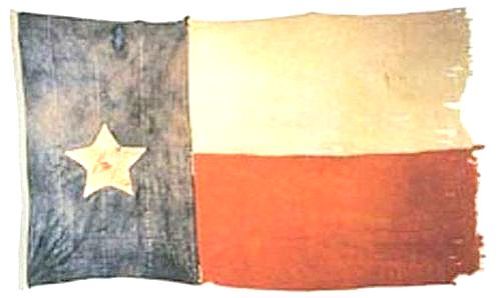
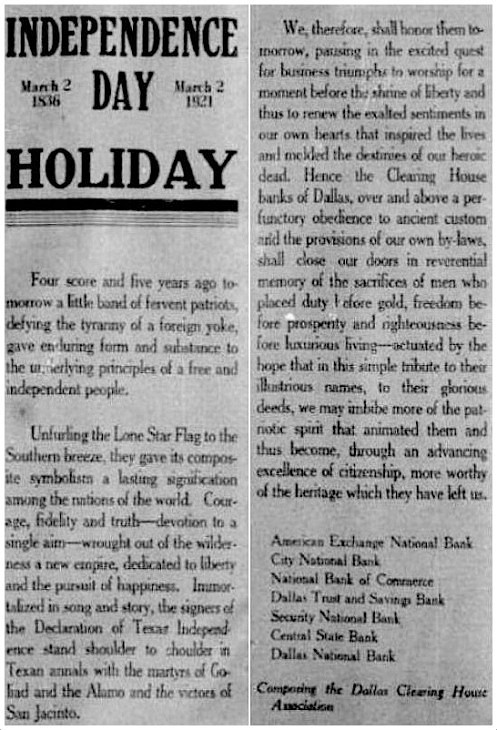
Today is the anniversary of Texas Independence. Below, you will find the most heart-swellingly patriotic bank ad ever penned. Before you plunge in, you might want to get a hanky. (Transcription below.)

tx-independence_ad_dmn_030121Dallas Morning News, March 1, 1921

Four score and five years ago tomorrow a little band of fervent patriots, defying the tyranny of a foreign yoke, gave enduring form and substance to the underlying principles of a free and independent people.

Unfurling the Lone Star Flag to the Southern breeze, they gave its composite symbolism a lasting signification among the nations of the world. Courage, fidelity and truth — devotion to a single aim — wrought out of the wilderness a new empire, dedicated to liberty and the pursuit of happiness. Immortalized in song and story, the signers of the Declaration of Texas Independence stand shoulder to shoulder in Texan annals with the martyrs of Goliad and the Alamo and the victors of San Jacinto.

We, therefore, shall honor them tomorrow, pausing in the excited quest for business triumphs to worship for a moment before the shrine of liberty and thus to renew the exalted sentiments in our own hearts that inspired the lives and melded the destinies of our heroic dead. Hence the Clearing House banks of Dallas, over and above a perfunctory obedience to ancient custom and the provisions of our own by-laws, shall close our doors in reverential memory of the sacrifices of men who placed duty before gold, freedom before prosperity and righteousness before luxurious living — actuated by the hope that in this simple tribute to their illustrious names, to their glorious deeds, we may imbibe more of the patriotic spirit that animated them and thus become, through an advancing excellence of citizenship, more worthy of the heritage which they have left us.

American Exchange National Bank
City National Bank
National Bank of Commerce
Dallas Trust and Savings Bank
Security National Bank
Central State Bank
Dallas National Bank

Composing the Dallas Clearing House Association

*

Remember the Alamo! And remember the men who placed “righteousness before luxurious living”! (Even though that last part’s not exactly a sentiment that Dallas is typically known for….)

*

Copyright © 2015 Paula Bosse. All Rights Reserved.

Mardi Gras: “Our First Attempt at a Carnival Fete” — 1876

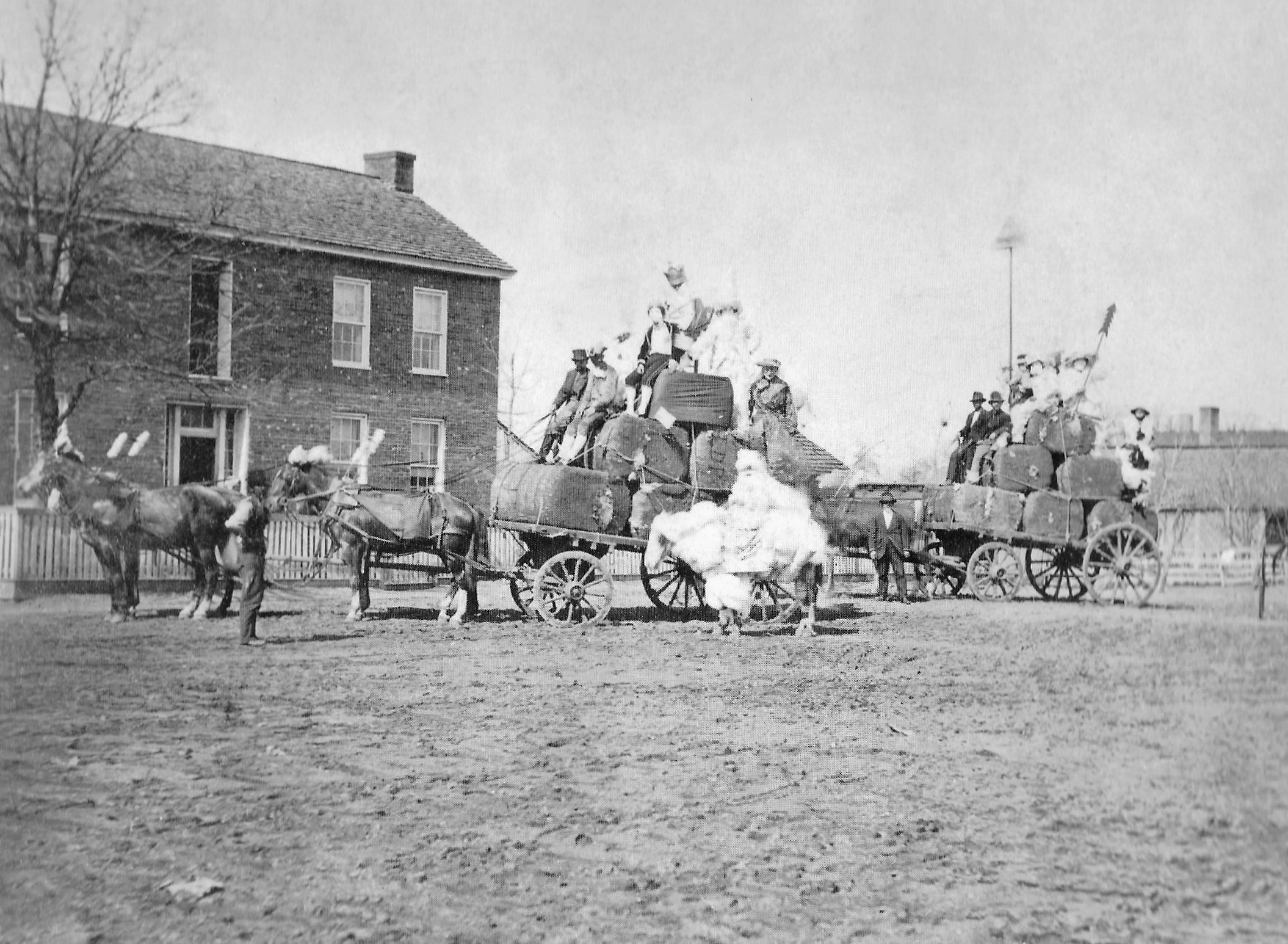
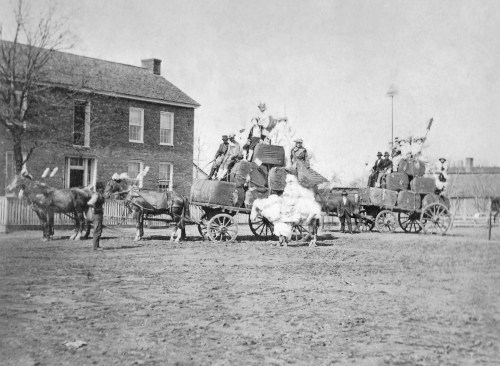
mardi-gras_dhs_1876When cotton was Rex (click for much larger image)

by Paula Bosse

In the 1870s, if a Dallas resident wanted to celebrate the glitzy revelry of Mardi Gras with a parade and balls and didn’t want to travel all the way to New Orleans, the place to go was Galveston. Galveston had a lock on Texas Mardi Gras galas. But Dallas being Dallas, there were soon plans to stage a massive Carnival right here. The day-long celebration debuted on February 24, 1876, which, oddly, was on a Thursday. (Mardi Gras that year was actually on Tuesday, Feb. 29, and it was probably celebrated early in Dallas so as not to interfere with the hey-we-got-here-first celebrations in New Orleans and Galveston.)

It was estimated that the festivities cost the city more than $20,000 (which, if the Inflation Calculator is to be believed, would be the equivalent of almost $450,000 in today’s money). The city was cleaned up in preparation for the anticipated onslaught of visitors and was decorated with flags and bunting along the lengthy parade route of Main, Elm, and Commerce streets. Revelers had elaborate costumes made for the processions and the grand masked balls, some with fabric imported for the occasion from France
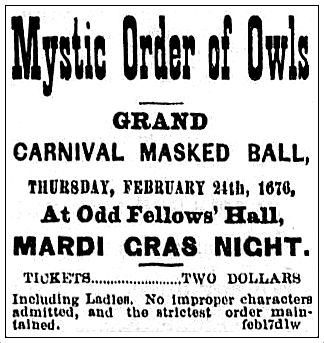
mardi-gras_dal-herald_021876Dallas Herald, Feb. 18, 1876 (not 1676!)

The Dallas Herald and The Dallas Commercial were incessant in their whipping up of excitement for the big day. And it worked. People streamed into town from all over Texas. Hotels were packed, and it was estimated that over 20,000 spectators watched one or both of the day’s parades.

The following day, The Dallas Herald apparently devoted their entire front page to coverage of the event, under this wordy headline:

A Day in Dallas, Our First Attempt at a Carnival Fete. The City Aglow with Enthusiasm and Wild with Rollicking Revelry. Visit of King Momus — His Cordial Reception by the People — The Procession in His Honor. The Season of Merry-Making Brought to a Happy Close with Balls and Bouts — Well Done, Dallas!

(Sadly, this issue is not available online, perhaps because there were none found to scan as it sold out more than five editions and was probably the paper’s best-selling edition to-date.)

Dallas’ first Mardi Gras had been an unqualified triumph, and newspaper editors and city leaders were beside themselves with joy. The parade — and the city — had been covered enthusiastically and favorably by newspapers around the country, and the success of the huge celebration was seen as having been better advertising for the exuberant and growing city than could ever have been hoped.

Galveston? Pffft!

**

A few tidbits from that first Mardi Gras.

There were very few “incidents” reported surrounding the festivities. That’s not to say there weren’t a lot of incidents that occurred that day, just that not a lot of them found their way into the newspapers (apparently whiskey was free-flowing all day long, and one suspects there were “incidents” aplenty connected with that). Among the very few non-“jolly” things that happened on Carnival Day and the day following included the following:

  • A small boy had been run over by a carriage (“but not dangerously hurt”)
  • A child and a horse had been burned severely when a can of gasoline was thrown into a bonfire “to increase the flame”
  • A member of the Stonewall Greys who had participated in the noontime parade had fallen whilst “foolishly scuffling” and had “received a slight but painful wound from a bayonet”

Also, there was some sort of “fireball discharged from a rocket” which caused some consternation:
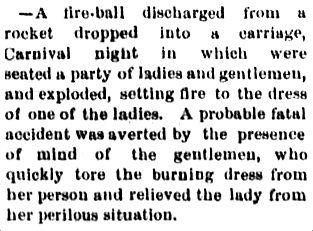
fireball_dal-herald_022676Dallas Herald, Feb. 26, 1876

*

All residences and businesses along the parade route during the evening procession were “commanded” to be illuminated. Even if gasoline-fueled bonfires were raging along the parade route, the elaborate procession was probably poorly lit.

*

My favorite “float” was the huge wagon of lumber meant to draw attention to East Texas timber and the thriving lumber industry in Dallas. One report said “the immense moving forest of pine” was drawn by “32 yoke of oxen” — another said “nearly 100 Texan steers.” Whatever it was, that must have been spectacular to see.
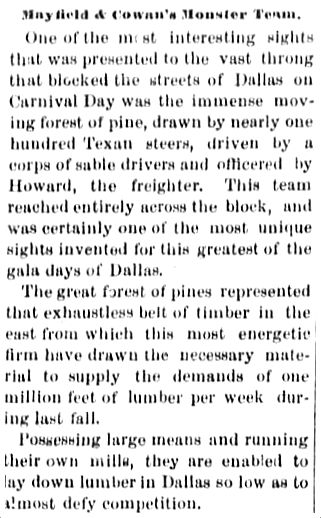
oxen-team_dal-herald_022676Dallas Herald, Feb. 26, 1876

*

The massive amount of publicity and praise that Dallas received quite clearly irked other cities. Austin seemed especially perturbed. There had been a small outbreak of smallpox in McKinney preceding the big day, and several digs at Dallas (like the one below) appeared in newspapers around Texas, accusing the city’s leaders of knowingly endangering the welfare of the entire state just so they could put on their little parade. The exaggerated furor passed fairly quickly, and the het-up schadenfreude expressed by rival cities was amusing.
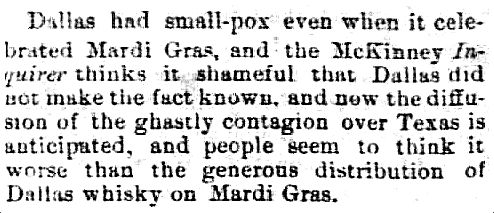
small-pox_austin-weekly-standard_031676Austin Weekly Standard, Mar. 16, 1876

*

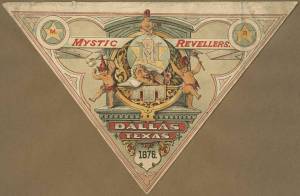
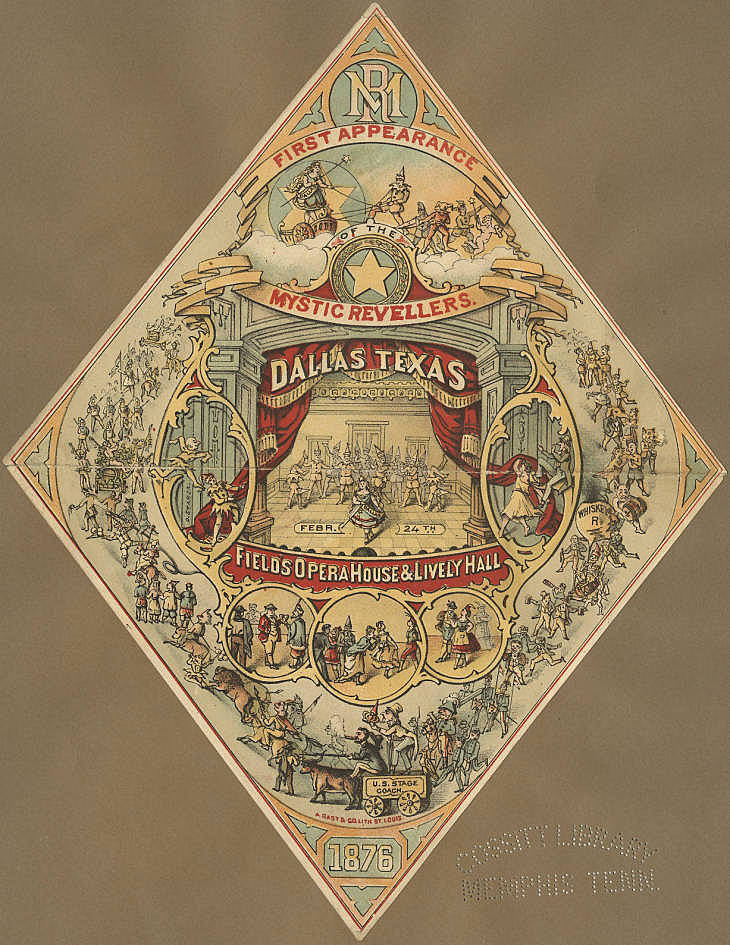
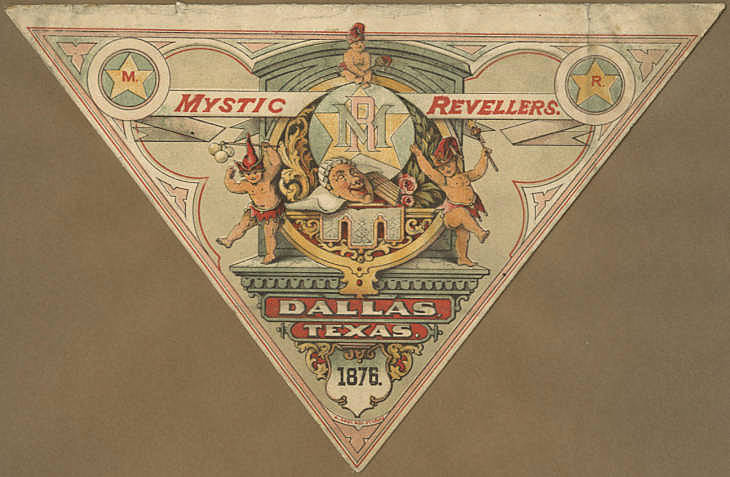
An invitation issued by the Mystic Revellers:
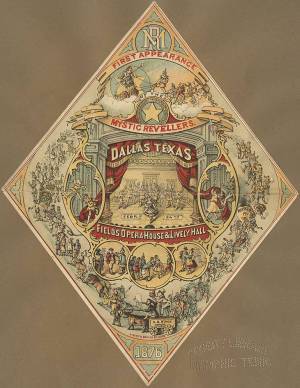
mardi-gras_mystic-revellers_invitation_1876_memphis-public-library

mardi-gras_mystic-revellers_1876_envelope_memphis-public-libraryColton Greene Collection, Memphis Public Libraries

*

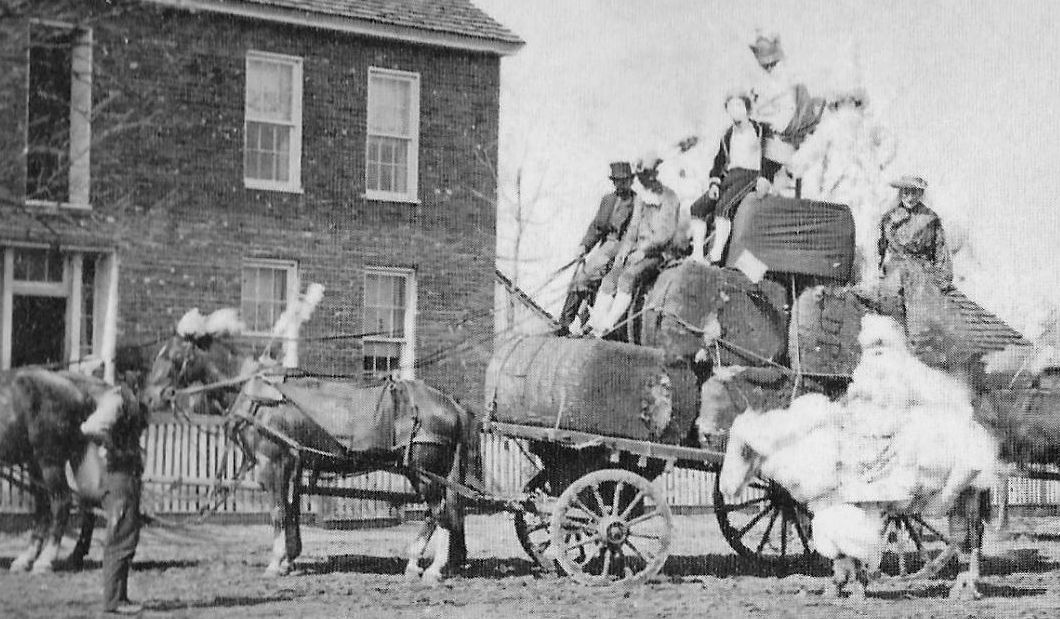
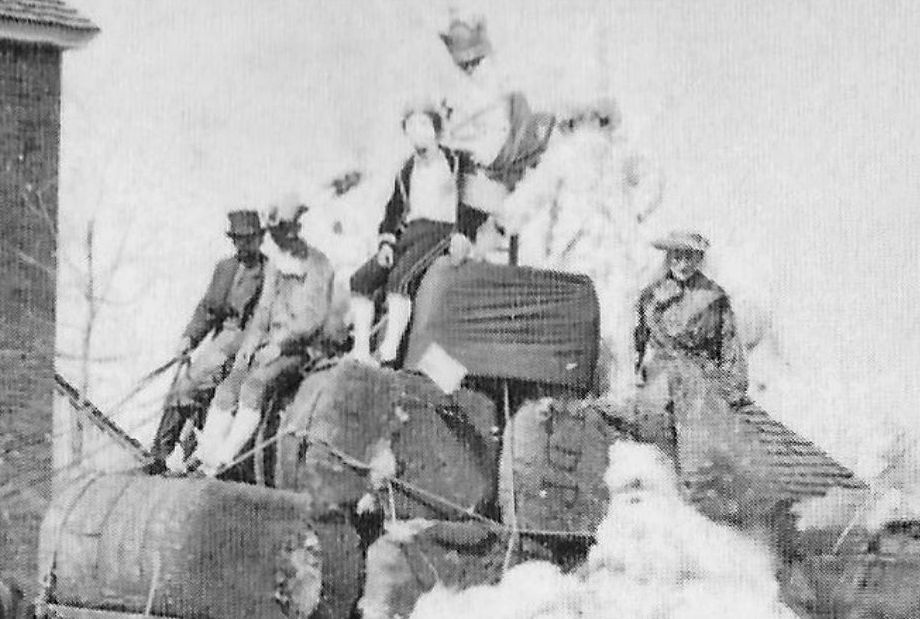
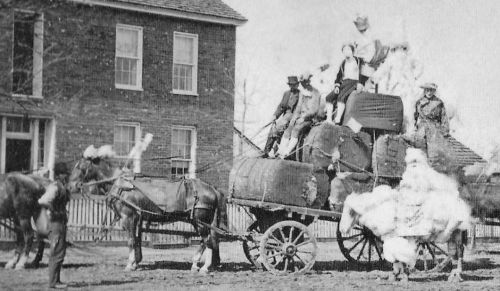
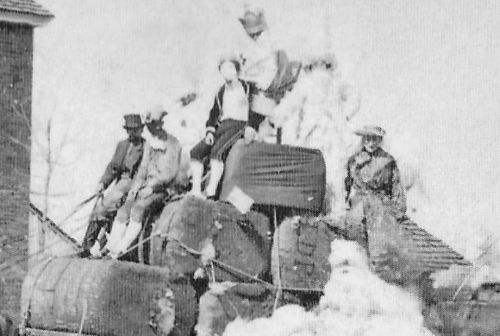
The photo at the top shows the parade wagons representing the brand new Dallas Cotton Exchange (which seems to have been organized the previous month). As described in The Galveston Daily News, the Cotton Exchange’s offering “represent[ed] King Cotton enthroned on six bales of cotton, with numerous subjects appropriately costumed, and occupying two cars” (Feb. 25, 1876). Below are a couple of magnified details of the photo. I’m not sure, but it looks as if the horse and rider in the foreground are covered with cotton. Like tarring and feathering … but fun … and with cotton. The King of Cotton is surrounded by what look like henchmen. The masked man on the right in the elaborate costume is both cool and kind of creepy. (Click both photos for larger images.)
mardi-gras_1876-det1

mardi-gras_1876-det2

***

Sources & Notes

Top photo appeared in the book Historic Photos of Dallas by Michael V. Hazel (Nashville: Turner Publishing Co., 2006); photo from the Dallas Historical Society.

Newspaper clippings as noted.

To read the coverage of Dallas’ Mardi Gras parades and balls —  “a grand pageant and general jollification” — see the front page of The Galveston Daily News (Feb. 25, 1876), here (third column, top of page — zoom controls are on the left side of page).

I wrote a previous post called “Mardi  Gras Parade in Dallas — ca. 1876” which features a photograph which might be from this first Mardi Gras. That post and photo can be seen here.

Happy Mardi Gras!
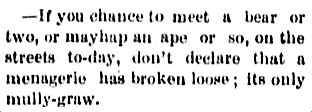
mully-graw_dal-herald_022476Dallas Herald, Feb. 24, 1876

Photos larger when clicked.

*

Copyright © 2015 Paula Bosse. All Rights Reserved.