Flashback : Dallas

A Miscellany: History, Ads, Pop Culture

Category: JFK

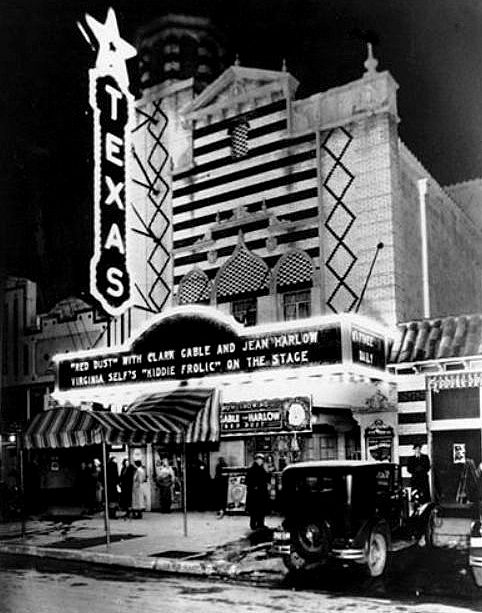
The Texas Theatre — 1932

texas-theater_1932The “Texas”

by Paula Bosse

West Jefferson Blvd, 1932. All that’s missing from this photo is Edward G. Robinson and an arsenal of tommy-guns. This is the only theater in the world whose marquee showing the 1963 double feature of “Cry of Battle”/”War Is Hell” has become a part of history (the Texas Theatre, is of course, where Lee Harvey Oswald was captured on the afternoon of November 22,  1963). When the movie theater opened in 1931 — in the time of Prohibition and running boards —  it was a much more elegant-looking picture palace. Had he not been in the Big House at the time, John Dillinger might have seen this very same Gable and Harlow movie at the Biograph (or what I call “Chicago’s Texas Theatre”). He probably wouldn’t have been sitting through something called “Kiddie Frolics,” featuring Oak Cliff’s own Virginia Self, a teenage dancer … frolicking.

***

After several changes in ownership and a few awkward renovations, the Texas Theatre seems to be back on track these days. The history page of their website is here (with interesting factoids such as: it opened on San Jacinto Day, it was the first theater in Dallas with air-conditioning, and it was briefly owned by Howard Hughes).

For photos of the theater’s interior, published in 1932 in the trade journal Motion Picture Herald, see my post “The Texas Theatre and Its Venetian-Inspired Decor,” here.

*

Copyright © 2014 Paula Bosse. All Rights Reserved.


The Sexton Foods Building and the Former Life of the School Book Depository

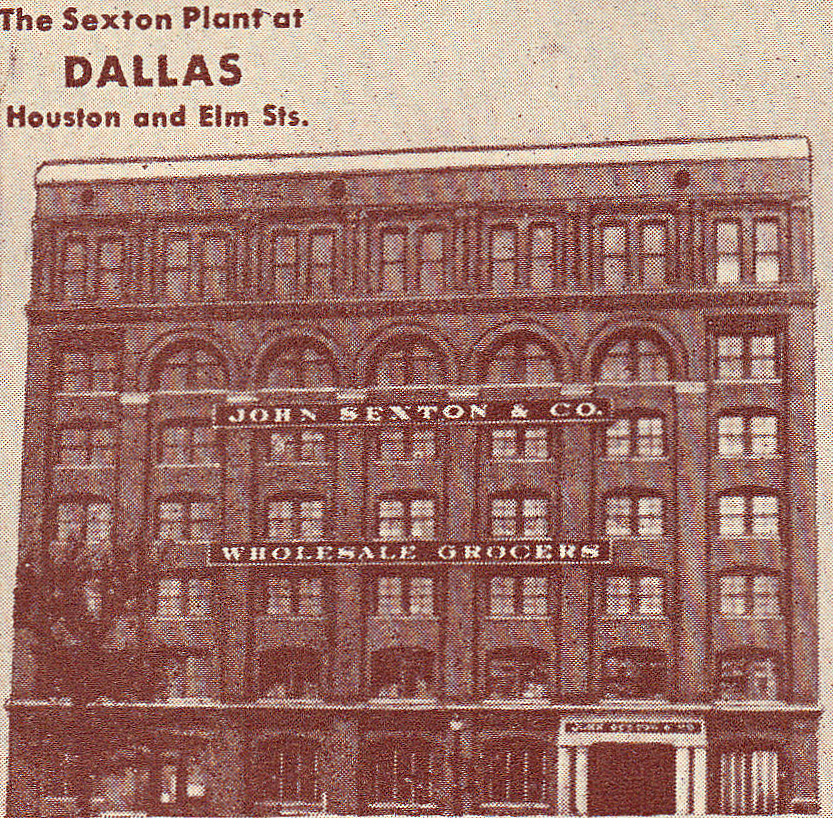
sexton_croppedLook familiar? (click for larger images)

by Paula Bosse

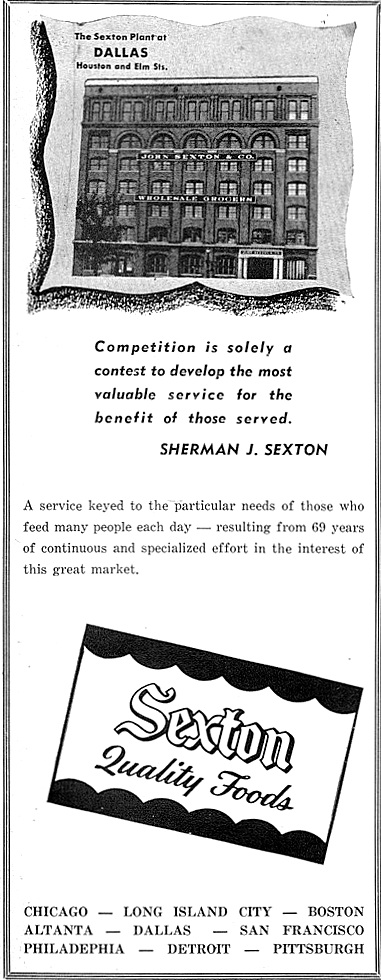
Look familiar? The building above would later become the Texas School Book Depository. But prior to that, the building housed Sexton Foods, a Chicago-based wholesale grocer which occupied the building for twenty years (1941-1961). The building was known commonly in town as “the Sexton building,” even after it was leased to the Texas School Book Depository in 1963, which explains why some people — citizens and police officers alike — were still referring to it by that name on the day of the Kennedy assassination (and this has apparently caused confusion amongst those wading deep into the “assassination literature”). The photo above is cropped from an ad I came across in The Dude Wrangler, a dude ranch quarterly (!), published in Bandera. The ad (which is reproduced in full down the page a bit) is from 1953, but the photo of the building appears to have been taken earlier.

The leasing of the building by D. Harold Byrd to the John Sexton Wholesale Grocery Company of Chicago (initially for only five years) was announced in The Dallas Morning News on Nov. 28, 1940 (“Wholesale Grocery Leases Building at Houston and Elm”). The Sexton Co. was scheduled to move in on Dec. 8 “following a general remodeling which will include installation of elevators, rearranging of partitions and painting.” They remained in the building until 1961.

sexton_19511951

sexton_foods_dallas_19531953

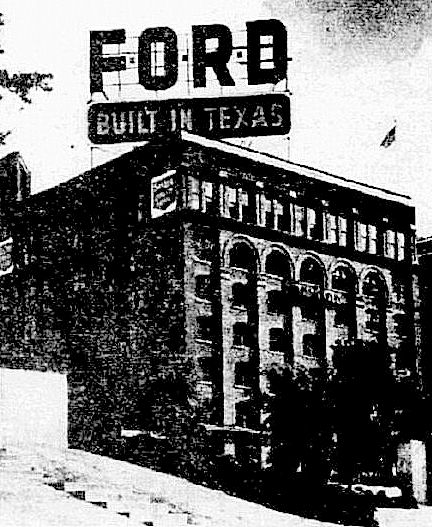
In 1953 (before anyone from Hertz was planning on putting a billboard up there), the Ford people erected a giant neon sign on top of the building to commemorate the 50th anniversary of the founding of the Ford Motor Company. In fact, it was so big that it had half a mile of neon tubing in it and was touted as being the largest animated neon sign in the Southwest. Now there’s a sign that probably caused a few car accidents!

sexton-bldg_ford-sign_1953
1953

*

Before the Sexton company moved in, the building housed the Perfection-Aire air-conditioning  company. Newspaper articles announced the renovation of the building for the A/C people — the company went into receivership a couple of years later.

perfection-aire_dmn_0314371937

*

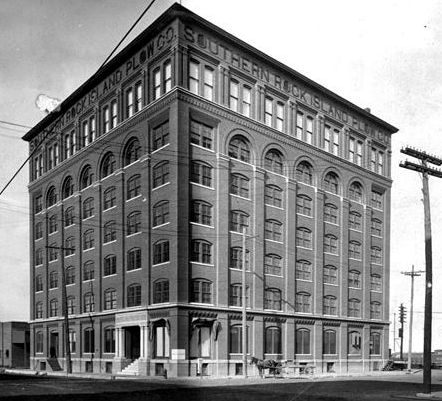
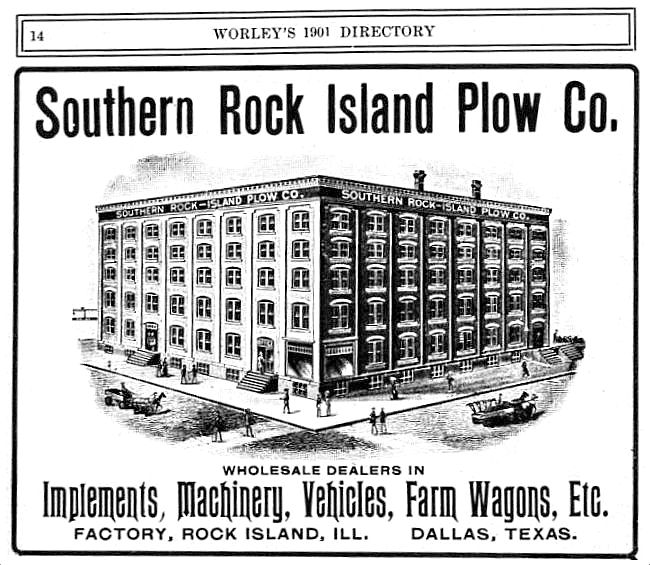
Before that, it was the site of the Southern Rock Island Plow Co., which was the original owner of the property (1894) and which built the building in 1903 after the first building was destroyed in a fire after it was hit by lightning on May 4, 1901.

rock-island-plow_DMN-c1910circa 1910

Above, the Southern Rock Island Plow Co. Building which still stands, famous as the “Texas School Book Depository”; below, the building originally built by the plow company which was destroyed by fire  in May, 1901.

southern-rock-island-plow_1901_pre-current-bldg_1901-directory1901, Dallas city directory

***

Sources & Notes

Sexton Co. ad from a 1953 issue of The Dude Wrangler ; the top image is a detail from that ad.

More on the history of the building as it pertains to the Rock Island Plow Co. is here.

More on the Sexton Foods Co. is here.

More info, specifically on the Texas School Book Depository, is here.

Official site of the current occupant, the Sixth Floor Museum, is here.

*

Copyright © 2014 Paula Bosse. All Rights Reserved.


Nardis of Dallas: The Fashion Connection Between “The Dick Van Dyke Show” and the Kennedy Assassination

by Paula Bosse

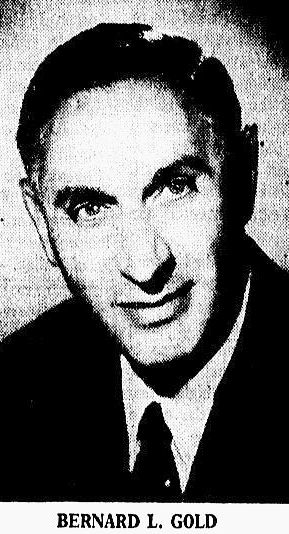
I started watching reruns of The Dick Van Dyke Show on Channel 11 when I was a kid. I still love the show, and I’ve seen every episode countless times. Which is kind of an odd jumping-off point for a post on a Dallas clothing manufacturer, but there you are. The company was Nardis of Dallas, a successful manufacturer of women’s apparel, owned by the Russian-born Bernard “Ben” Gold who arrived here in 1938 from New York City where he had operated a taxi company for many years.

Gold moved to Dallas at the request of his brother who, along with a man named Joe Sidran (“Sidran” spelled backwards is “Nardis”) was an owner in a near-bankrupt dress company. Ben Gold became a part-owner (and later the sole owner) and quickly turned the business around. When he brought in the International Ladies’ Garment Workers’ Union, other Dallas garment manufacturers were shocked (Time magazine used the word “horrified”). He also shook things up by employing African-American workers, the first such company in town to do so. The company eventually grew to become the largest clothing manufacturer in Dallas, with clients around the country and around the world. Nardis was one of the first Dallas clothing companies to have an apparel collection made in a foreign country: his upscale “House of Gold” boutique line specialized in silk, beaded, and sequined dresses and gowns, hand-made in Hong Kong.

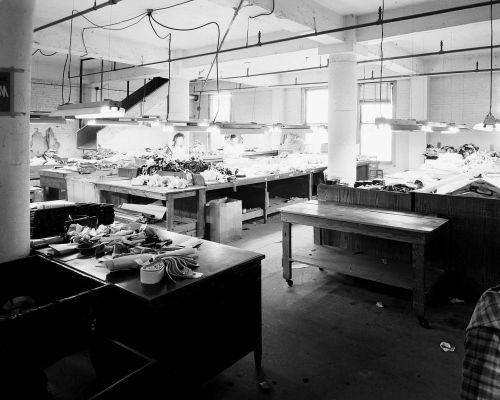
Nardis of Dallas was originally located at 409 Browder, with factories at 211 North Austin, the 400 block of S. Poydras (at Wood Street), and, finally, at 1300 Corinth (at Gould St.), where they built their 75,000-square-foot “million-dollar plant” in 1964 (a quick check of Google Maps shows the building still there, but it appears to be vacant). Below are two photos of their S. Poydras location.
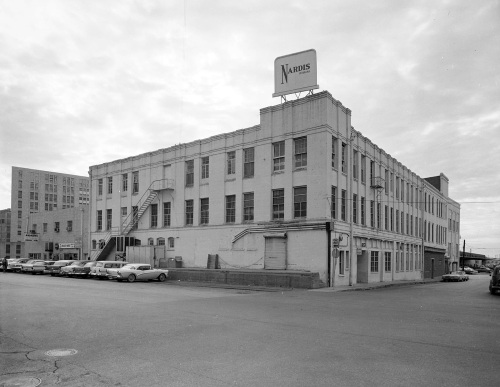
nardis_squire-haskins_UTA_wood-and-poydras

Above, Wood Street at the left (Andrew’s Cafe is listed at 1008 Wood St. in the 1960 Dallas directory); below, Nardis garment workers.
AR447-R812

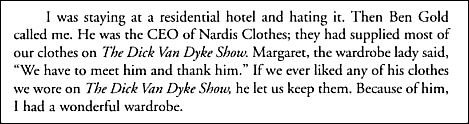
So how does this all connect to The Dick Van Dyke Show? If you’re a fan of the show and a faithful reader of closing credits like I am, you’ve probably seen the “Fashions by Nardis of Dallas” credit at the end of some episodes, right under the Botany 500 credit. And, like me, you might have wondered, “How did THAT happen?” How does an apparel-maker from Dallas network itself into a primo gig supplying fashions to a top Hollywood television show? I have no idea how the initial contact was made, but I DO know that Dick Van Dyke Show star Rose Marie and Nardis owner Ben Gold became very good friends while she was appearing in a production of Bye, Bye Birdie at the Dallas Summer Musicals in 1965. She mentions Gold several times in her autobiography.
Excerpt from “Hold the Roses” by Rose Marie

She spent much of her off-stage time in Dallas with Gold and his wife, and, in fact, when Gold was fatally injured in a traffic accident that summer, Rose Marie (then recently widowed herself) stayed with his wife Tina for several days at Tina’s request.

So, no big Dick Van Dyke Show story, but, as is no doubt known to the hyper-vigilant members of the JFK-assassination community, Nardis of Dallas DOES have an interesting connection to that. In 1941, Abraham Zapruder, who had worked in the garment industry in New York, moved to Dallas and began working for Ben Gold as a Nardis pattern-cutter. His name even appears in a couple of classified ads in The Dallas Morning News.

June 1945

Jan. 1948

While at Nardis — before he left to start his own clothing company — Zapruder worked with a woman named Jeanne LeGon (later Jeanne De Mohrenschildt) who, with her husband George (suspected by some of being a CIA operative), was friends with Lee Harvey Oswald in the early ’60s. Yep. That’s an interesting, head-spinning coincidence.

And I owe all this trivial Nardis-related knowledge to wondering for years about a single card seen in the closing credits of the unquestionably stylish and fashion-forward Dick Van Dyke Show.

nardis-label_ebay

***

Sources & Notes

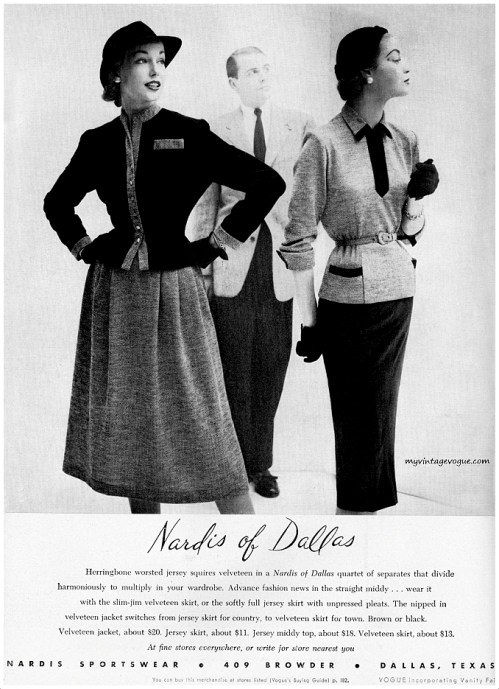
Fashion photographs from MyVintageVogue.com (1952, 1955, and 1956, respectively). Other Nardis fashion photos from My Vintage Vogue can be found here. (If you’re interested in vintage fashion, fashion photography, and vintage advertising, this is a great website.)

Photos of the Nardis plant at S. Poydras and Wood are by Squire Haskins, from the Squire Haskins Photography Inc. Collection, University of Texas at Arlington Libraries, Special Collections — more info on the exterior shot is here; more on the interior shot here.

Passage about Gold from Rose Marie’s autobiography, Hold the Roses (Lexington: University Press of Kentucky, 2002), p. 192.

Dick Van Dyke Show closing credits card from a 1965 episode.

Nardis of Dallas logo from a clothing tag, found on eBay.

Additional background information on Gold from Time magazine, June 12, 1950.

See another Flashback Dallas post on Nardis — “Nardis Sign-Painters: ‘Everything in Sportswear’ — 1948” — here.
nardis_texas-jewish-post_122354
1954 ad, detail

*

Copyright © 2014 Paula Bosse. All Rights Reserved

Dear JFK: Welcome to Big “D” — Love, DP

Nov. 22, 1963

by Paula Bosse

Sorry, Dr Pepper, but this might be the most unfortunate, unintended instance of product placement ever.

***

Sources & Notes

AP photo, November 22, 1963.

*

Copyright © 2014 Paula Bosse. All Rights Reserved.

Where to Put That JFK Memorial? — 1964

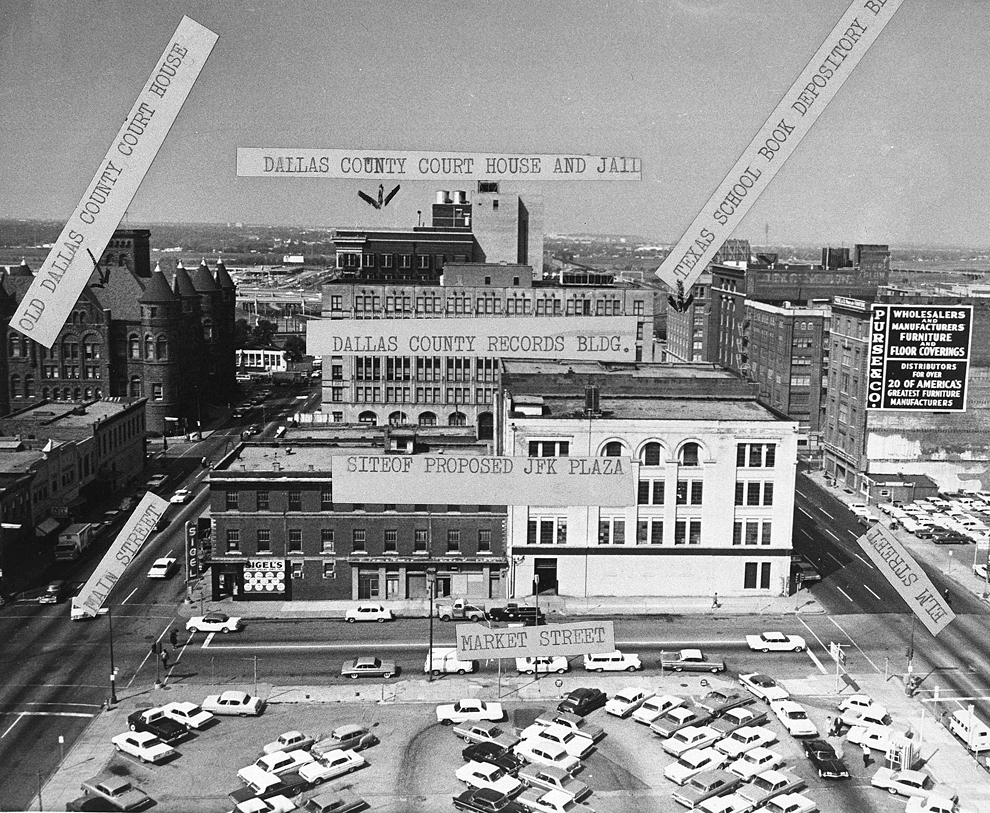
Looking west, 1964 (AP photo)

by Paula Bosse

I’m not really into the whole assassination thing, which may explain why I’ve never seen this 1964 Associated Press photo (with or without the labels). Despite the connections to “that dark day,” I think this is a really interesting view of the city, from an unusual vantage point.

Here’s another similar photo, from April 1964 — this one from United Press International. UPI’s caption:

DALLAS: Site of Memorial Park. The area outlined in white is the block where the John F. Kennedy Plaza will be created as a memorial to the late president. The outline traces buildings now on the site which will be removed on completion of the new county courthouse.

jfk-memorial_proposed_apr-1964_UPI_ebayApril 1964 (UPI Telephoto)

The original location for the memorial was in the block immediately to the east of the Records Building, not the Old Red Courthouse, where it eventually was placed. I’m not sure why the location changed, but by the time architect Philip Johnson, designer of the memorial, was on board, the site had moved one block south.

*

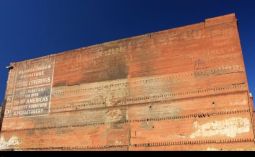
The Purse & Co. sign seen at the right side of the top photo is still visible today — it’s probably the largest and most familiar ghost sign downtown. Here’s a picture that was linked to Google maps. (I think I prefer it as a ghost sign.)

***

Sources & Notes

Top photo by Ferd Kaufman for the Associated Press, 1964.

Bottom UPI Telephoto found on eBay.

*

Copyright © 2014 Paula Bosse. All Rights Reserved.