Flashback : Dallas

A Miscellany: History, Ads, Pop Culture

Category: Leisure

Bruce Channel, Delbert McClinton, and The Beatles — 1962

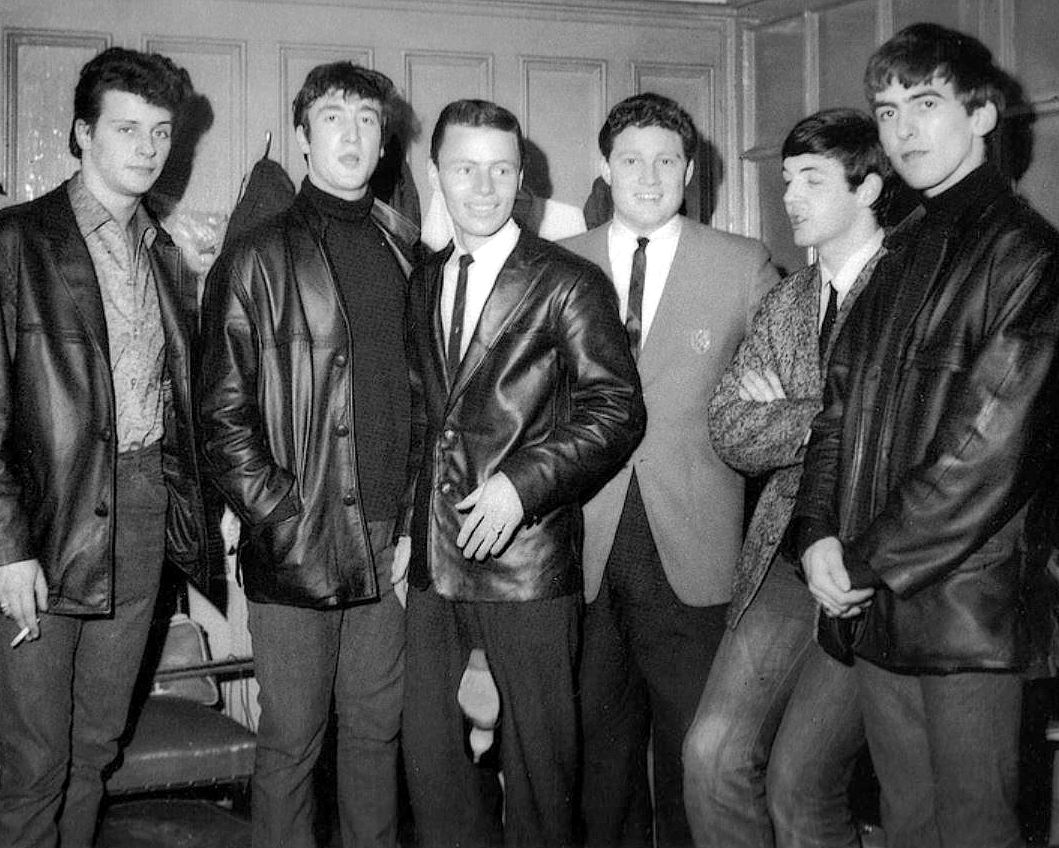
beatles_delbert_bruce_062162_mike-mccartneyThe Ringo-less Beatles with Delbert and Bruce, June 21, 1962

*

(CLICK HERE TO WATCH THE FILM DISCUSSED IN THIS POST)

*

by Paula Bosse

You know how you’re all excited about one thing only to discover something even more exciting sitting all alone over off to the side? That’s what happened when I took a look at the “Light Crust Doughboys collection” which has recently been uploaded to the Portal to Texas History site as part of the Spotlight on North Texas project via the UNT Media Library. I’m a huge fan of Western Swing and classic country music, and I spent an enjoyable hour or two watching home movies of the Light Crust Doughboys as they toured around Texas. When I looked to see what else comprised this collection, I saw the words “England Tour,” “Bruce Channel,” and “Delbert McClinton,” and a jolt went through me: oh my god, could there be film footage of the legendary meeting between the Beatles and North Texas musicians Bruce Channel and Delbert McClinton? Every Beatles fan worth his/her salt knows about the June 21, 1962 meeting when John Lennon eagerly chatted with Delbert McClinton about his harmonica prowess.

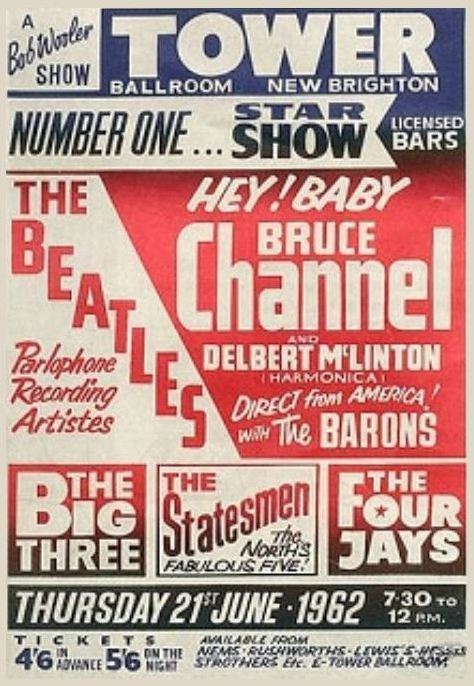
channel-beatles_poster_new-brightonvia Beatlesource.com

I watched the 27-minute home movie (shot by Marvin “Smokey” Montgomery, member of the Light Crust Doughboys and, from what I gather, Bruce Channel’s musical collaborator and, possibly, acting manager), and it does, in fact, capture glimpses of the famed tour in which Grapevine’s Channel, riding high on his #1 hit Hey! Baby, toured England with Fort Worth musician Delbert McClinton, who played harmonica on the record. One of their dates was the English town of Wallasey, just across the Mersey from Liverpool. On June 21, 1962 Bruce and Delbert played the New Brighton Tower Ballroom — their opening act was a popular local band on the brink of superstardom, The Beatles. Backstage, John Lennon asked for a few harmonica tips from Delbert whose Hey! Baby sound John really liked, and Delbert was happy to share. The photo above was taken at that meeting by Paul’s brother, Mike McCartney: from left to right, Pete Best (who would soon be replaced by Ringo Starr), John Lennon, Delbert McClinton (is he wearing Paul’s jacket?), Bruce Channel, Paul McCartney, and George Harrison. Another one, with Bruce and Paul, is below (I’m not sure who the girl is).

channel_mccartney_062162_mike-mccartney-photoBoth photos via Beatlesource.com

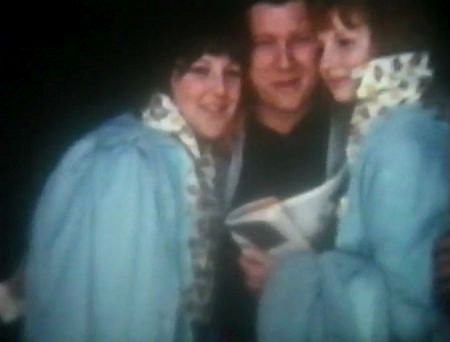
The home movie shot by Smokey Montgomery shows Bruce and Delbert (both only 21 years old at the time), their Fort Worth record producer “Major Bill” Smith, as well as several members of the package show of British performers that toured with Bruce, including Frank Ifield, Jay and Tommy Scott, and Beryl Bryden. …But, argh, no Beatles! So close! Still, this is great film footage of a famous tour — footage which may never have been seen by the public — and it is now available online for all to see, courtesy of the University of North Texas!

The 27-minute (silent) film can be viewed here (the good stuff is really only in the first 11 minutes or so — the rest is mostly tourist footage of the changing of the guards at Buckingham Palace). 

This may be thrilling to only a handful of people, but I am definitely one of those people!

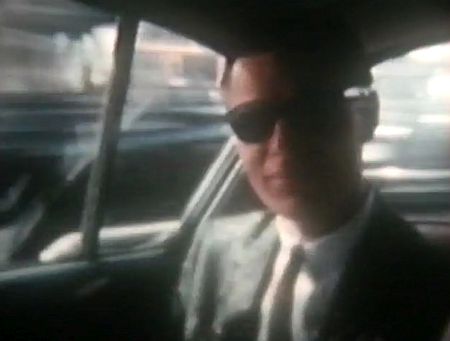
A few screen captures from Smokey Montgomery’s 1962 “England Tour” film (all images are larger when clicked):

channel-film_UK_1962_bruce_busBruce on the bus

channel-film_UK_1962_delbertDelbert in a taxi

channel-film_UK_1962_bruce_with-fansBruce with fans

channel-film_UK_1962_bruce_fansPerks of the trade

channel-film_UK_1962_bruce_kiss
More perks

channel-film_UK_1962_delbert_hands-up
Delbert

channel-film_UK_1962_bruce_delbert_bbc
Bruce and Delbert, London

You just never know what you’re going to stumble across…. Below is Bruce Channel’s monster 1962 hit, recorded in 1961 at the Clifford Herring Studios in Fort Worth, Hey! Baby, kicked off by Delbert McClinton’s distinctive harmonica.

**

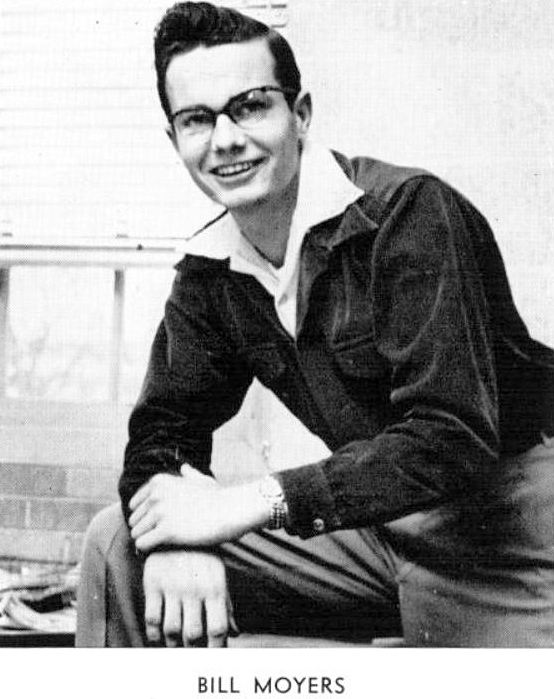
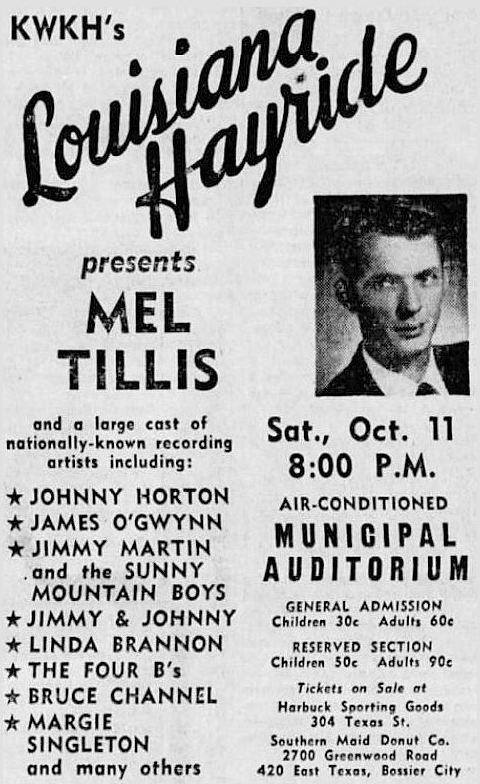
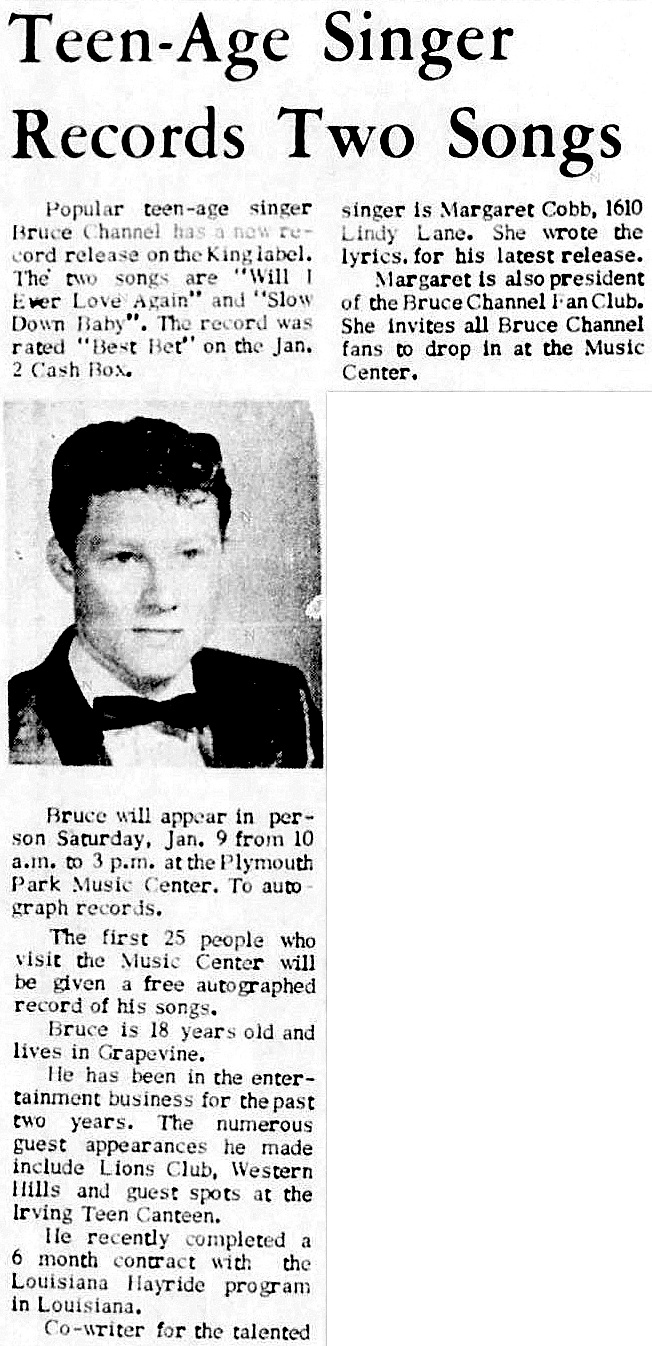
Bruce Channel (born Bruce McMeans — the “Channel” was his mother’s maiden name), was born at the end of 1940 and attended Grapevine High School. During his high school days he gained popularity as a performer, complete with lengthy commutes between Dallas and Shreveport, where he was a regular performer on the star-making Louisiana Hayride. Around this time he began writing songs with Margaret Cobb, an Irving woman who was 10-15 years older and the sister of a musician acquaintance. Dallas-Fort Worth-area musician Smokey Montgomery (known for decades as the banjo player in the Light Crust Doughboys) not only helped arrange those songs, but he also produced and played on some of Channel’s early singles, such as the cool (and fast!) rockabilly number, Slow Down, Baby (hear it here) and a song I like even more, Come On, Baby (hear it here).

The Cobb-Channel-penned Hey! Baby was recorded in 1961 and soon became a local radio hit, most notably on KLIF in Dallas, then worked its way up charts around Texas. The song finally reached #1 in the country in March, 1962. Channel had a few other lesser hits, but none ever reached the heights of Hey! Baby. He moved to Nashville in the ’70s and embarked on a successful songwriting career.

Delbert McClinton was born in Lubbock, also at the end of 1940, but grew up in Fort Worth where he, too, was a teenage musician, first gaining attention with his band The Straitjackets/Straightjackets and later the Rondels. He’s a bona fide Texas blues legend and continues to perform.

channel-bruce_grapevine-high-school_sr-photo_1960Bruce McMeans, Grapevine High School, 1960

channel-bruce_louisiana-hayride_shreveport-times_101058
Shreveport Times, Oct. 10, 1958

channel-bruce_irving-news-record_010760
Irving (TX) News-Texan, Jan. 7, 1960 (click for larger image)

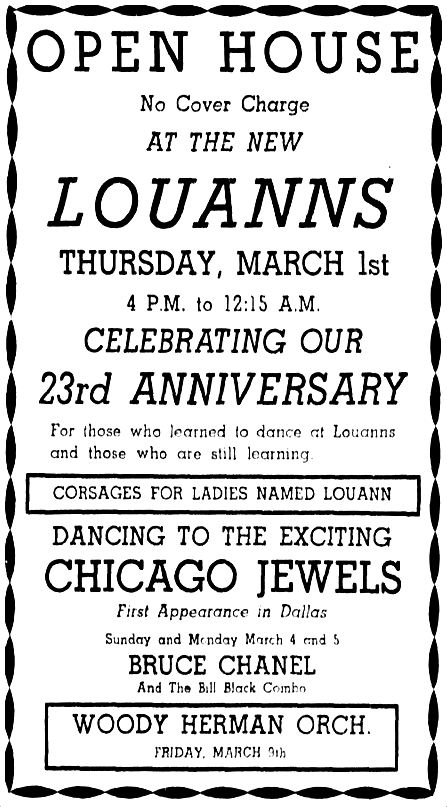
channel-bruce_louanns_march-1962
Louann’s, Dallas, March, 1962

bruce-channel_photo
British tour program photo, June, 1962, via Flickr

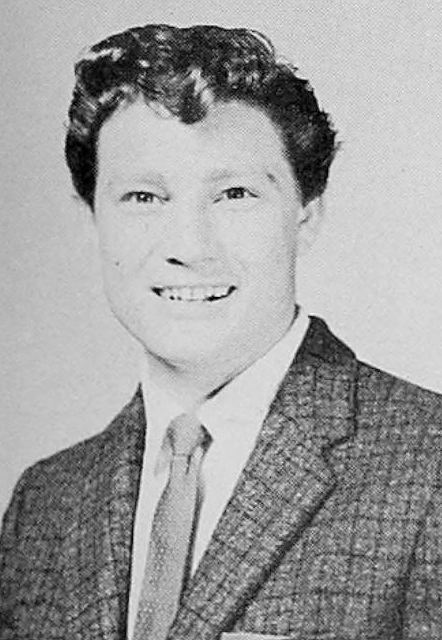
mcclinton-delnert_arlington-hts-high-school_1959_junior
Delbert McClinton, Arlington Heights High School, 1959

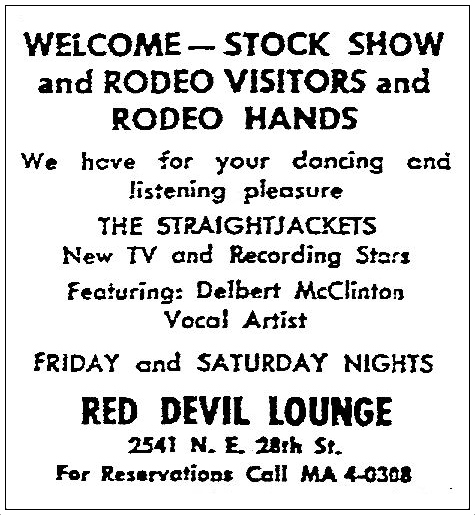
delbert-mcclinton_FWST_012558
Red Devil Lounge, Fort Worth, Jan., 1958

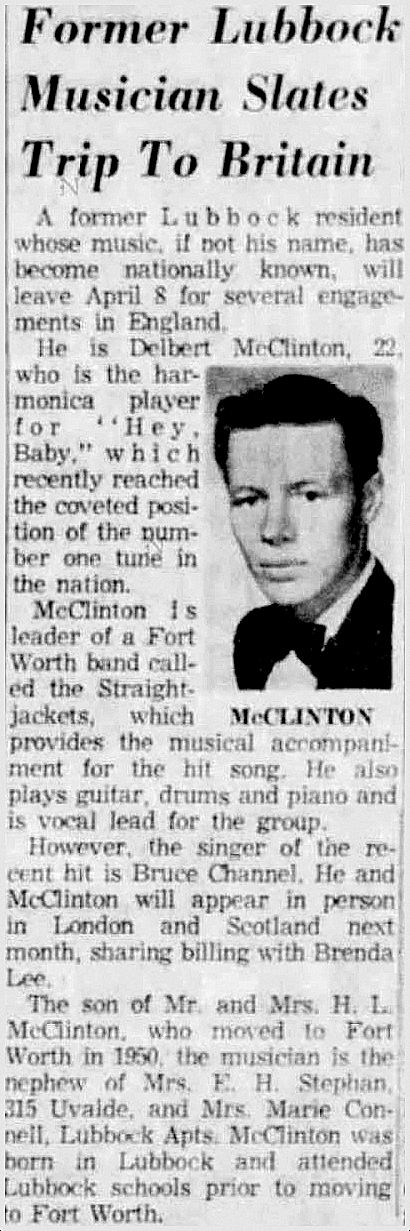
mcclinton-delbert_lubbock-avalanche-journal_032162
Lubbock Avalanche-Journal, March 21, 1962 (click to read)

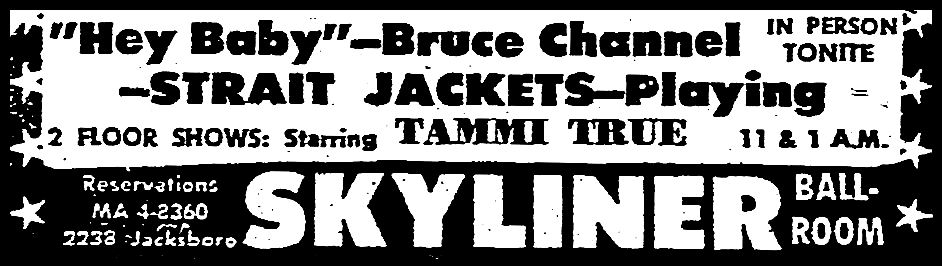
channel-bruce_delbert-mcclinton-strait-jacketsFWST_010662
Bruce with Delbert (and stripper Tammi True), FW, Jan. 1962

***

Sources & Notes

The film featuring Bruce Channel and Delbert McClinton is titled “[The Light Crust Doughboys, No. 16 — England Tour]” and is part of the Spotlight on North Texas collection; it was provided by UNT Media Library to The Portal to Texas History and may be viewed here. It was filmed by Marvin “Smokey” Montgomery (who can be seen near the very end, sitting almost in silhouette in front of an airplane window). The film is part of a collection of Light Crust Doughboys and LCD-related materials donated by Art Greenhaw. (Special thanks to Laura Treat!)

Speaking of UNT, there may also be a film clip somewhere in the Denton vaults in which Bruce Channel, the “Grapevine farmboy,” was the subject of a WBAP-Ch. 5 news story (the April 18, 1962 script is here).

See the full printed program for Bruce Channel’s June, 1962 British package tour here.

Bruce Channel’s website is here. Read an interesting interview with him here. More Bruce on Wikipedia, here.

Delbert McClinton’s website is here. He’s constantly touring. Go see him!

The producer of (among other recordings) Hey! Baby and Hey, Paula (the song which has followed me around my whole life) was “Major Bill” Smith who was quite a polarizing character and was often described as a “hustler” (Delbert was not a fan). Read about him here. (Also, rockabilly god Ronnie Dawson might be one of the musicians on Hey! Baby — I’ve always heard he played drums on Hey, Paula.)

Marvin “Smokey” Montgomery is listed, along with Major Bill Smith, as a co-producer of Hey! Baby, which sold well over a million copies, but it rankled him that he did not get a songwriting credit (and, perhaps more importantly, did not earn royalties), which he contended he deserved: in a 1973 Dallas Morning News profile he said somewhat bitterly, “[*Now*] if I have anything to do with making the music or writing the words… you can bet your sweet life my name will be on that record.” (“The Man Who’ll ‘Listen To Your Song'” by David Hawkins, DMN, Oct. 18, 1973). More on Smokey’s long career can be found at the Handbook of Texas, here.

Read about the Beatles’ use of a perhaps Delbert-inspired harmonica sound on several of their early recordings, most notably Love Me Do, here.

Side note: Hey! Baby broke first locally on Dallas radio station KLIF and then on Houston’s KILT — both stations were owned by Gordon McLendon, which might explain why Bruce Channel was appearing at an April, 1964 political rally at Reverchon Park in support of McLendon’s race for U.S. Senate (?!) — see the ad here. (McLendon lost his Democratic primary challenge against Sen. Ralph Yarborough, who ultimately went on to defeat Republican contender, the elder George Bush.)

Bruce and Delbert weren’t the only DFW musicians with whom pre-Beatlemania Beatles hobnobbed: they also shared a bill in Paris with Dallas son Trini Lopez in 1963 — the Flashback Dallas post “Trini Lopez: Little Mexico’s Greatest Export” is here.

*

Copyright © 2018 Paula Bosse. All Rights Reserved.
 

Life on Hall Street — 1947

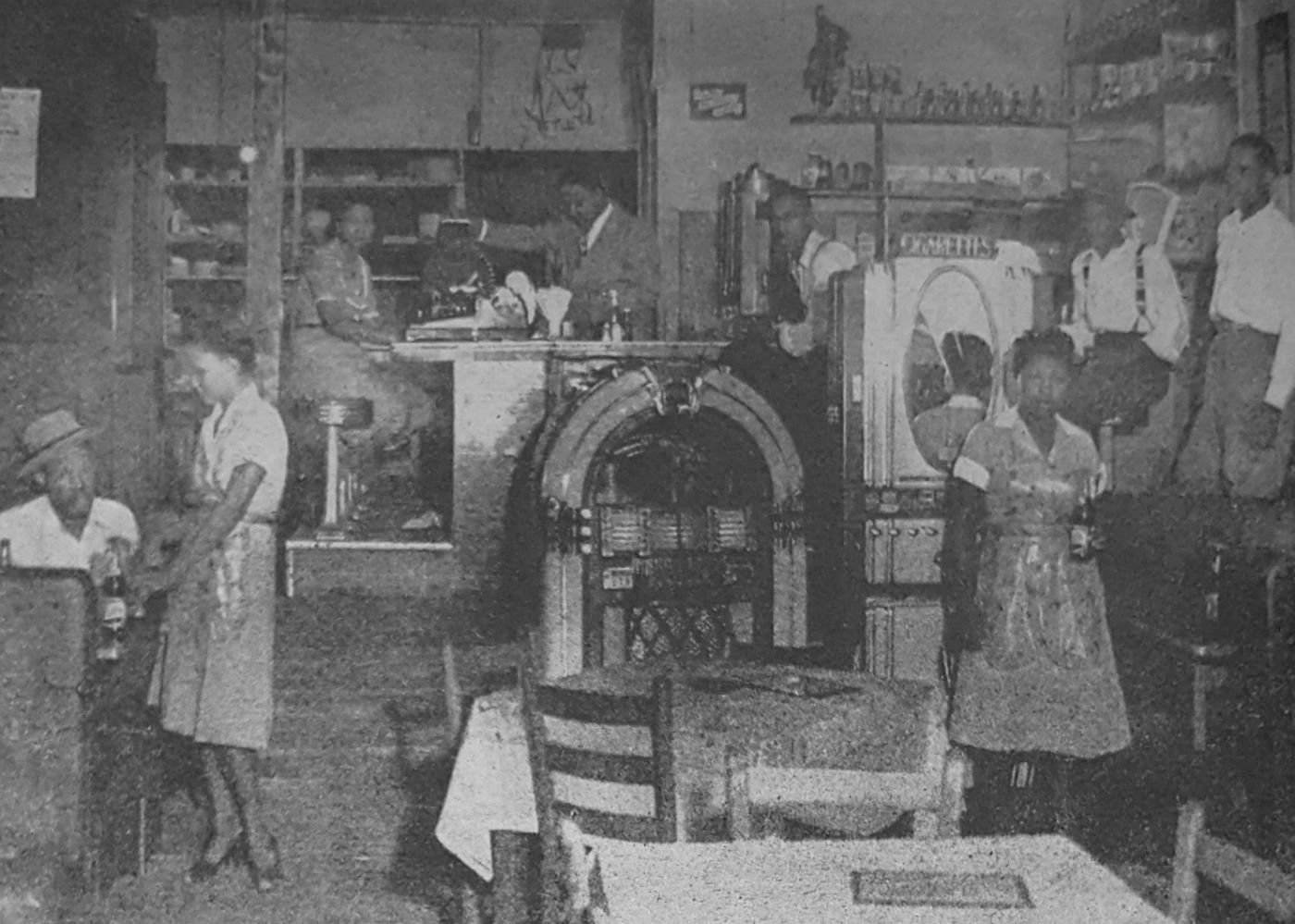
adolphus-bar-b-q_dallas-negro-directory_1947-48_dining-roomInterior of Adolphus Isaac’s Bar-B-Q Palace…

by Paula Bosse

Here are a few post-war ads for businesses in the 2200 and 2300 blocks of N. Hall, between Thomas and State, in the heart of “North Dallas,” a once-thriving business and entertainment district which catered to Dallas’ black community, until construction of Central Expressway sliced it in half a year or two after these ads appeared. These two blocks are completely unrecognizable today (a Google Street View looking north on Hall from Thomas can be seen here), and evidence that this area was once a lively African American neighborhood teeming with small businesses, cafes, and clubs exists almost entirely in old photos and ads like these.

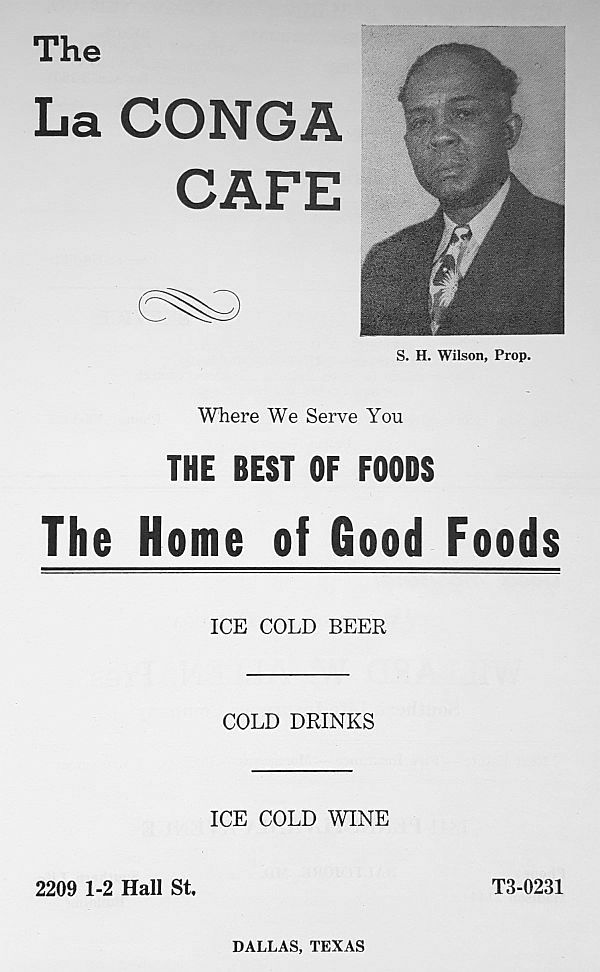
Below, the LA CONGA CAFE, 2209½ Hall, S. H. Wilson, proprietor. “Where we serve you the best of foods. The home of Good Foods. Ice cold beer.” (All pictures are larger when clicked.)


la-conga_dallas-negro-directory_1947-48

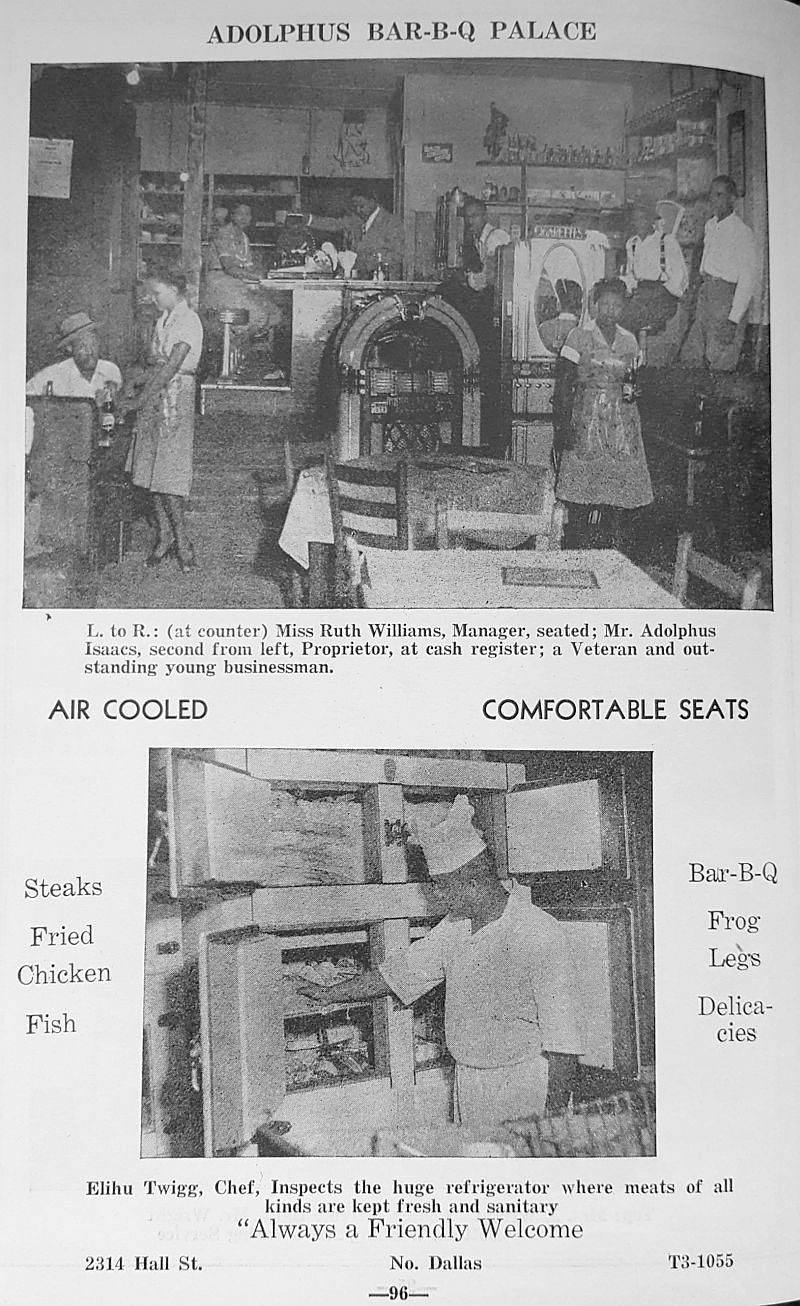
THE ADOLPHUS BAR-B-Q PALACE, 2314 Hall, Adolphus Isaac (whose name in the ad appears to be misspelled), proprietor. “Always a friendly welcome. Steaks, fried chicken, fish, bar-b-q, frog legs [!], delicacies.”

adolphus-bar-b-q_dallas-negro-directory_1947-48

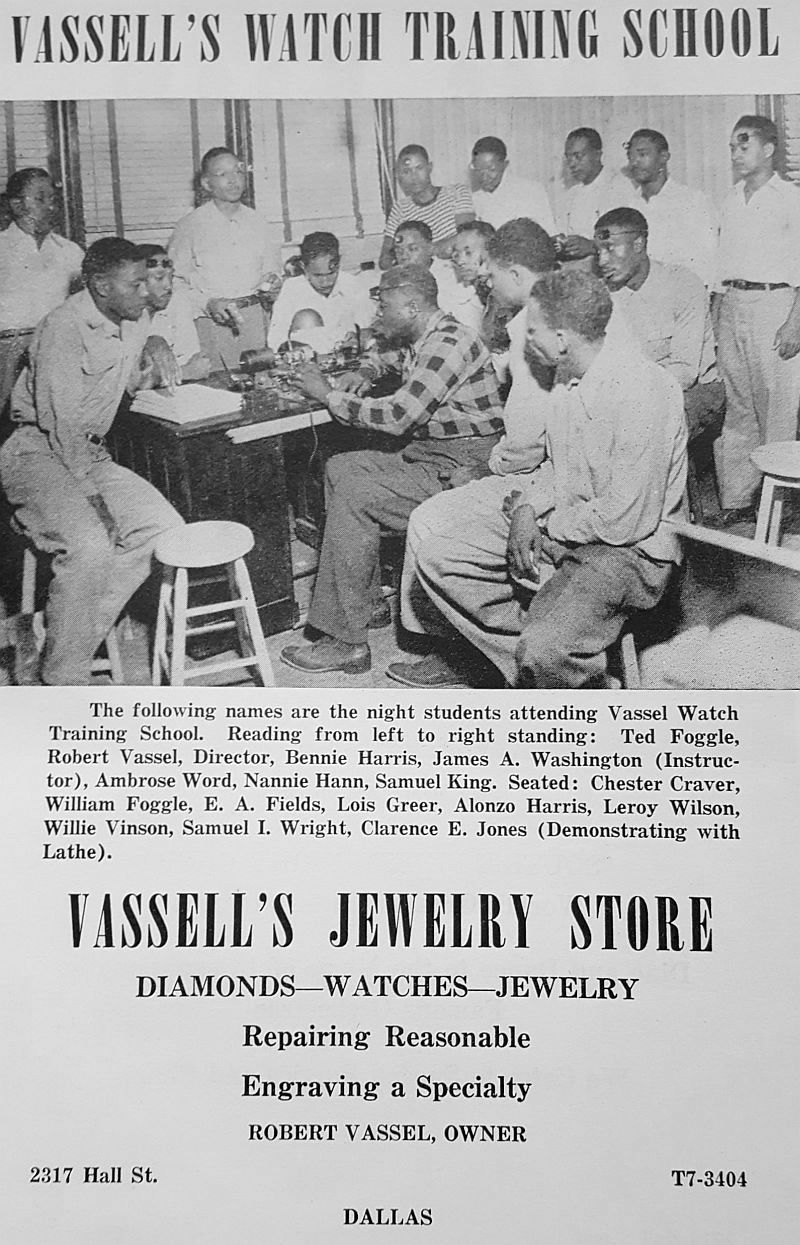
VASSELL’S JEWELRY STORE, 2317 Hall, Robert Vassell, proprietor. “Diamonds — watches — jewelry. Repairing reasonable, engraving a specialty.” This ad shows the “watch training school” Vassell operated in which WWII GI’s learned watch-repair.

vassells-watch-training-school_negro-directory_1947

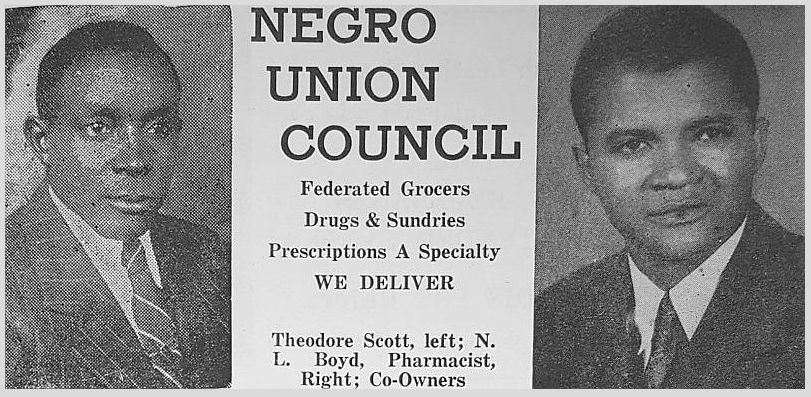
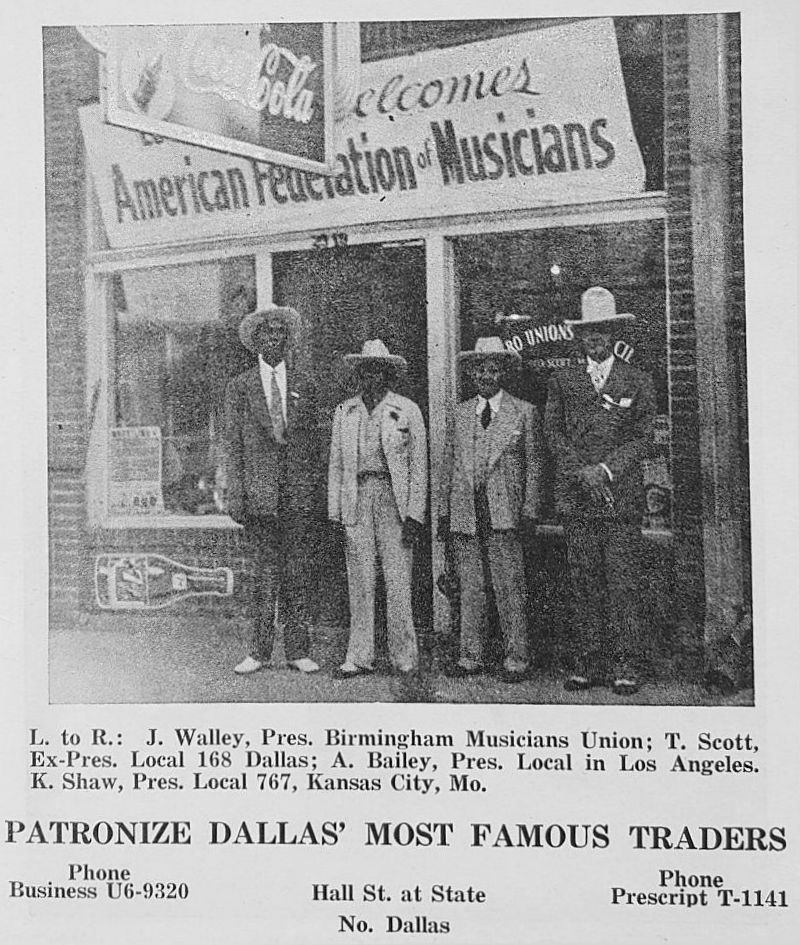
NEGRO UNION COUNCIL, 2319 Hall. A group of black unionists shared space at 2319 Hall: the Negro Unions Council, the Musicians Protective Union Local 168 (whose former president was Theodore Scott seen in both photos below), Federated Labor (AF of L), Hotel & Restaurant Employees Intl. Local No. 825. (Ned L. Boyd, pictured below, was a pharmacist who owned Boyd’s Pharmacy a couple of doors down at 2311 Hall.)

negro-union-council_negro-directory_1947

American Federation of Musicians officials (and their hats) standing in front of 2319 Hall.

negro-union-council_musicians_negro-directory_1947

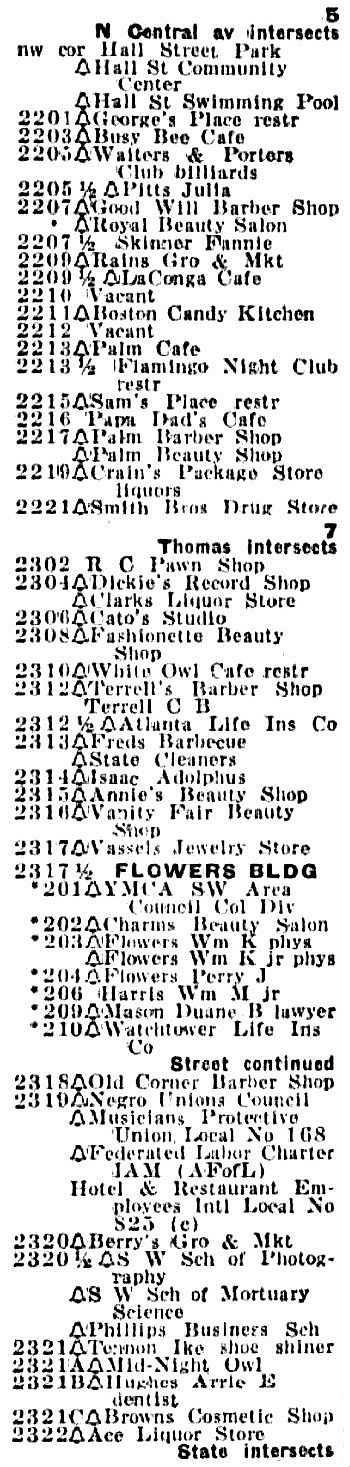
Below, the 1947 Dallas street directory, showing the businesses in the 2200 and 2300 blocks of N. Hall.

vassell_hall-st_1947-directory1947 Dallas directory (click to see larger image)

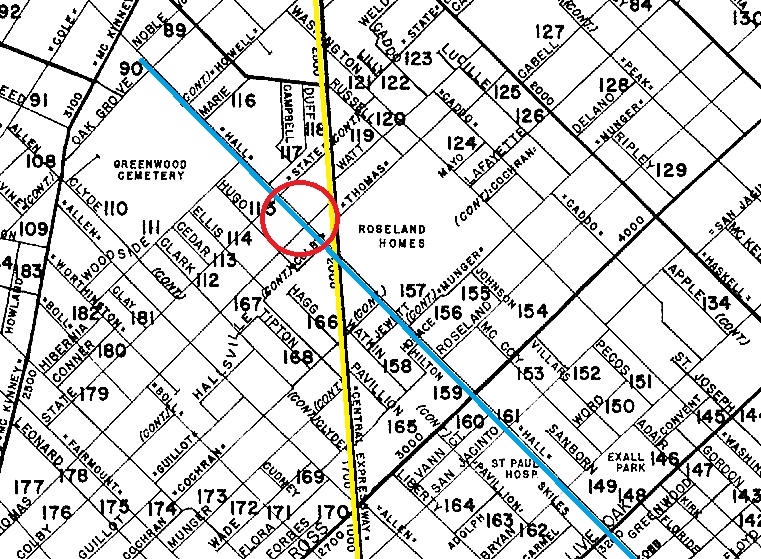
Below, a detail of a 1952 Mapsco page, with Hall Street in blue, Central Expressway (which hadn’t yet been built when the ads above appeared in 1947) in yellow, and the 2200 and 2300 blocks of Hall circled in red.

state-thomas_mapsco_1952
1952 Mapsco

As an aside, Roseland Homes seen in the map detail above, was a low-income public housing project for black residents, which opened in June 1942. It covered a 35-acre tract, with 650 units and was the first of many such housing projects for low-income black, white, and Hispanic families which opened that year, and it continues to this day.

***

Sources & Notes

Ads from the Dallas, Texas Negro City Directory, 1947-1948, with thanks to Pat Lawrence.

Read more about Hall Street — just a few blocks south, near Ross — in the Flashback Dallas post “1710 Hall: The Rose Room/The Empire Room/The Ascot Room — 1942-1975,” here.

*

Copyright © 2018 Paula Bosse. All Rights Reserved.
The State Fair of Texas Over the Decades

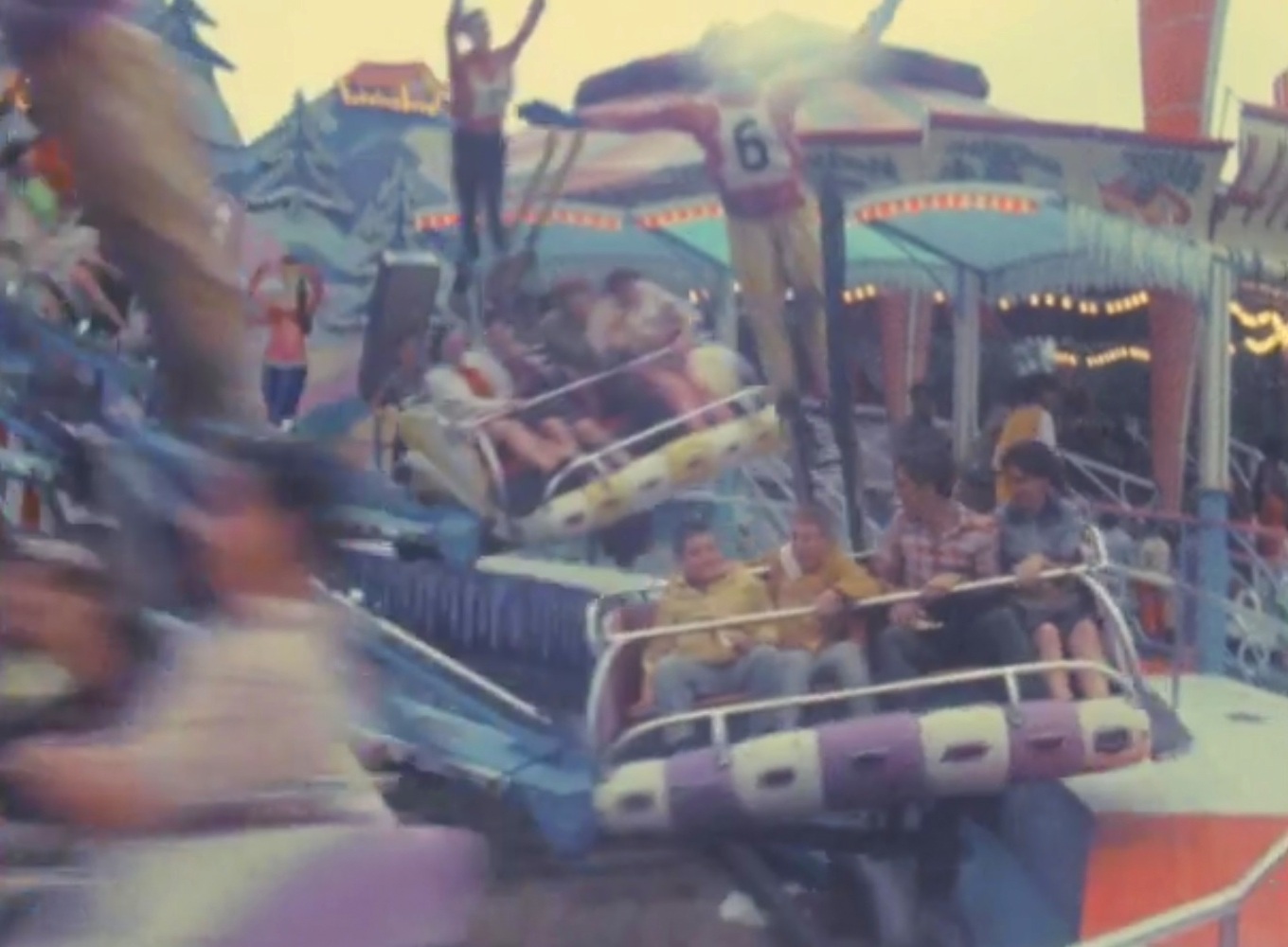
state-fair-of-tx_midway_kodachrome_1961_ebaySFOT midway, 1961… (click for larger image)

by Paula Bosse

The history of the State Fair of Texas is also the history of Dallas — if you live in Dallas, you know a lot about the fair, if only by osmosis. Here are a few images from the decades since the fair began in 1886.

Below, from 1889, a sedate advertisement for the Texas State Fair and Dallas Exposition (from The Immigrant’s Guide to Texas, 1889). (All images are larger when clicked.)

state-fair_imm-gd_1889

*

A great-looking poster from 1890, colorful and exciting:

sfot_poster_1890

*

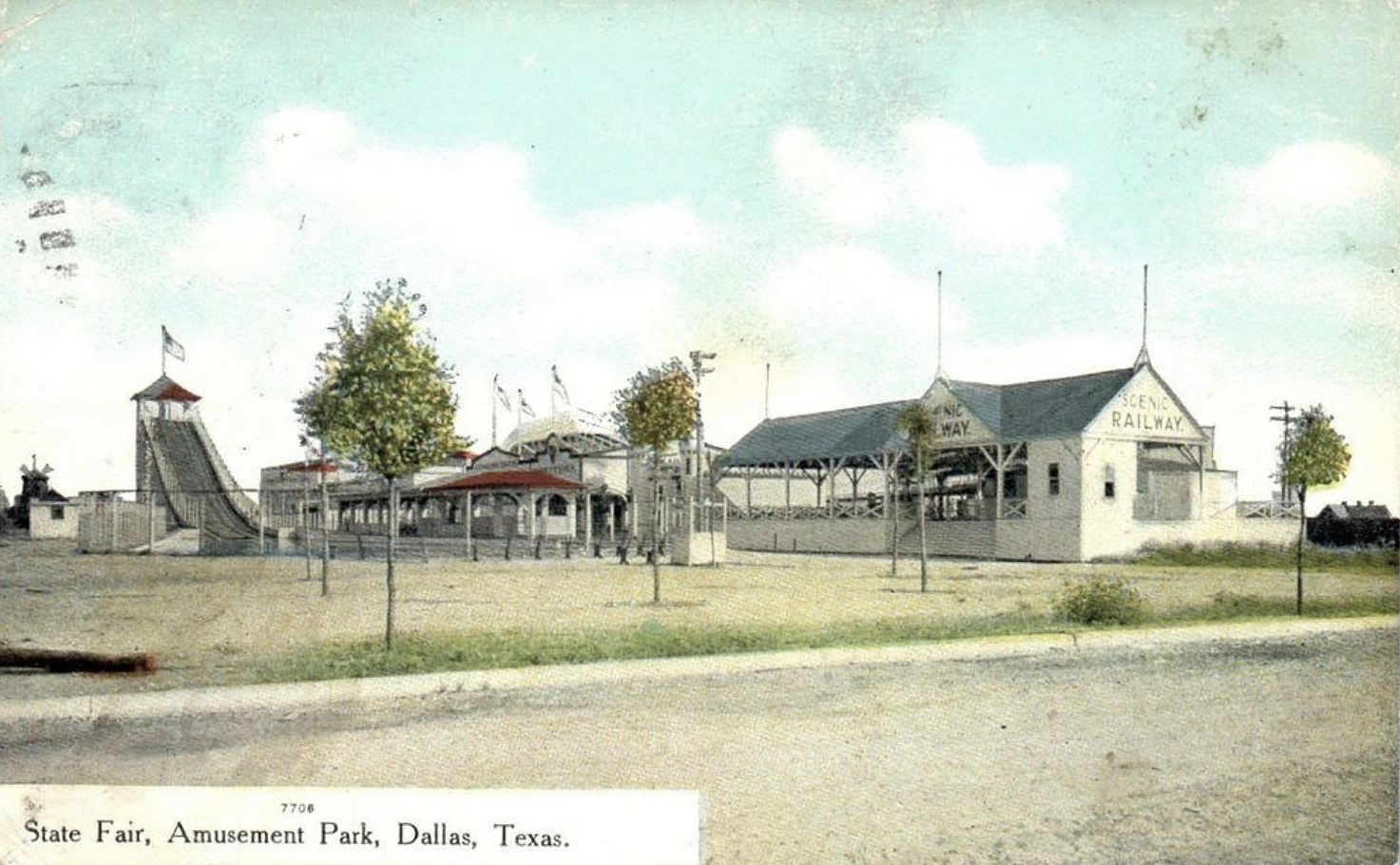
A midway in its infancy, in the aughts. (I wrote about the “The Chute” water ride, here.)

shoot-the-chute_postcard_ca-1906

*

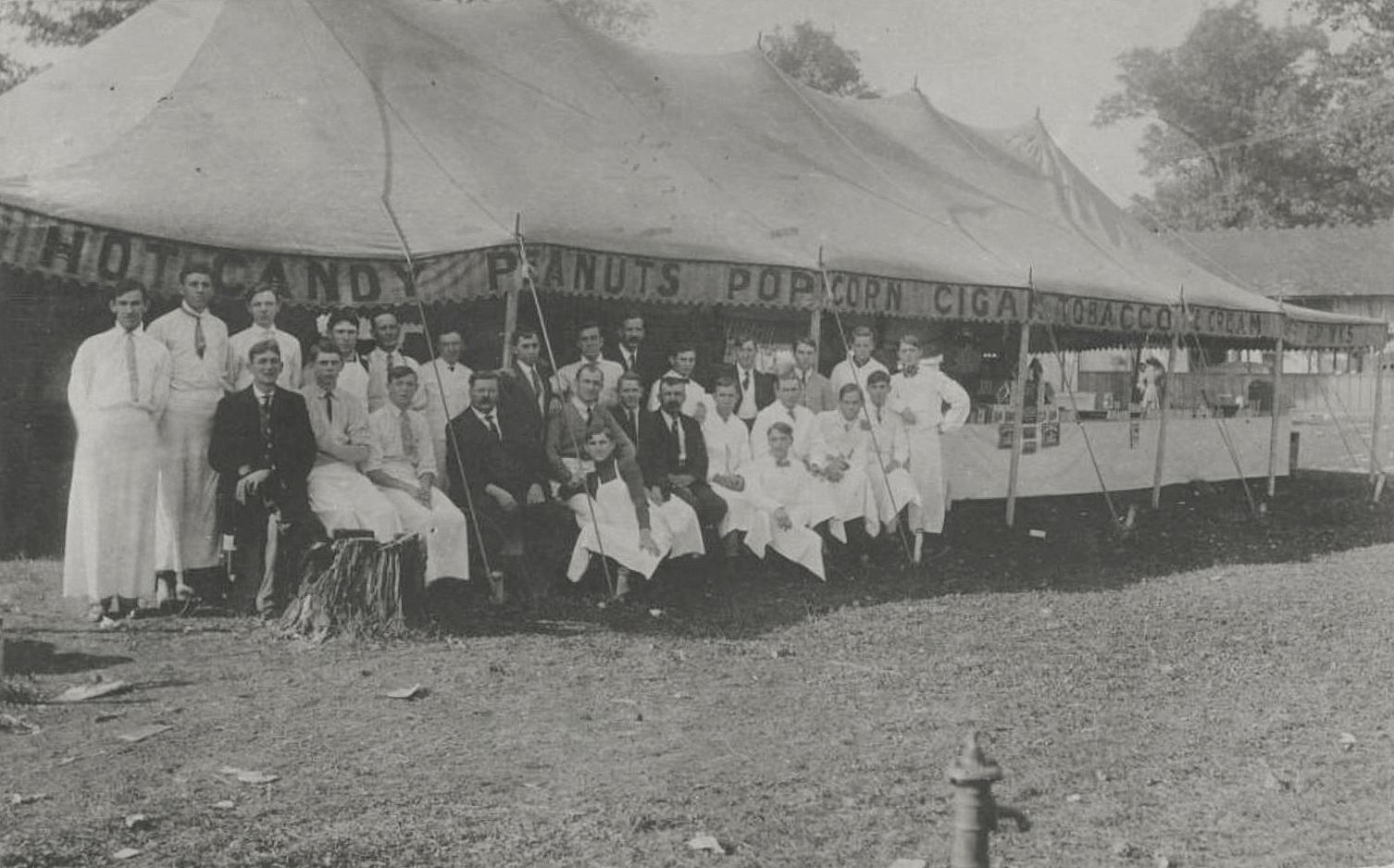
Here’s a group photo showing the food vendors at the 1910 fair. No corny dogs in 1910, but plenty of candy, peanuts, popcorn, ice cream, and, sure, why not, cigars and tobacco.

state-fair-concessionaires_1910_cook-colln_degolyervia George W. Cook Collection, DeGolyer Library, SMU

*

In the 1920s, Fair Park looked a lot smaller:

fair-park_mcafee_degolyer_SMU_ca-1920s
via George A. McAfee Collection, DeGolyer Library, SMU

Here’s a handy 1922 map of the grounds, from the fine folks at Caterpillar (don’t miss those tractors!) — you can see where the people in the photo above are walking.

state-fair-map_caterpillar_ad_1922

*

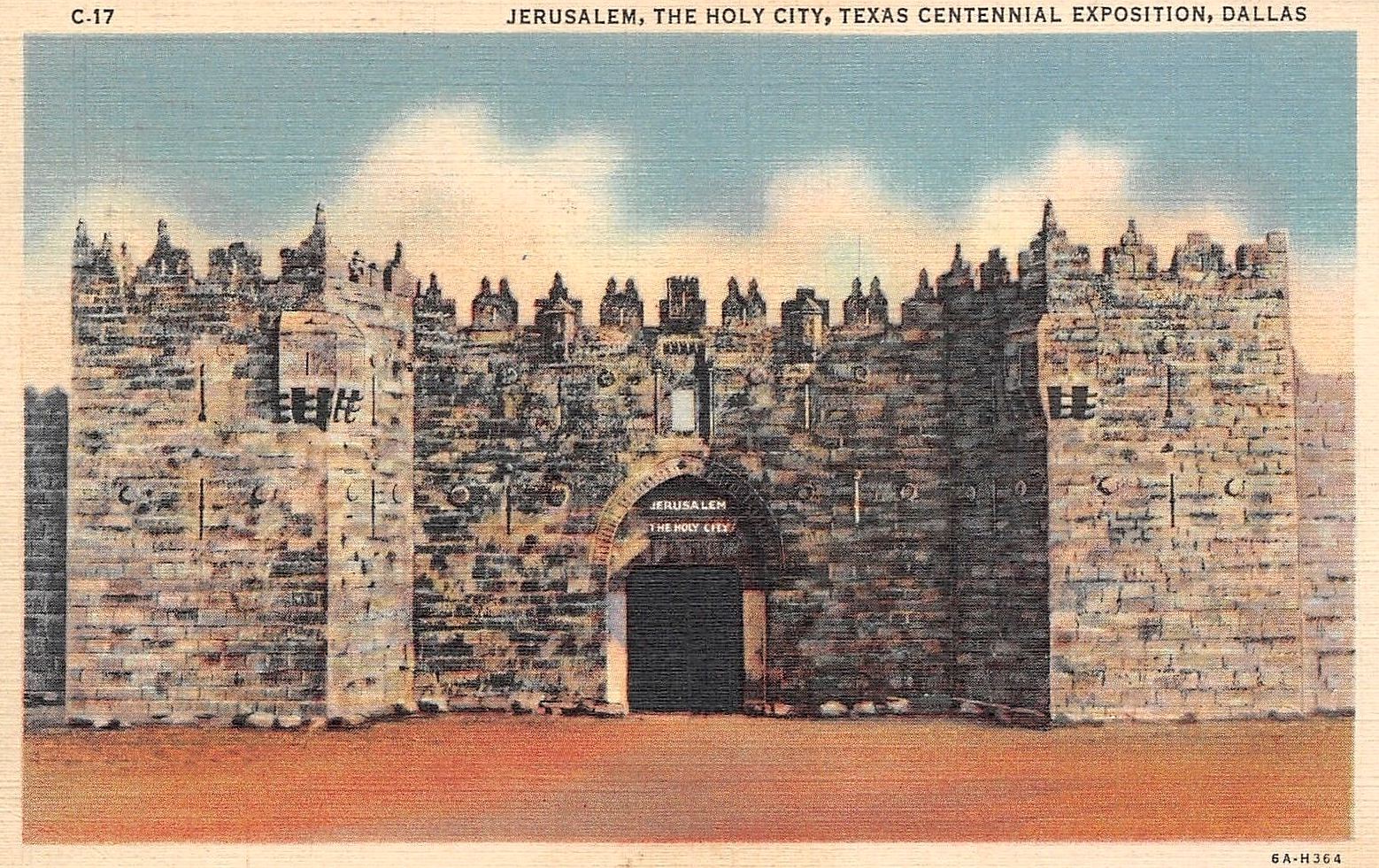
If it’s 1936, it’s gotta be the Texas Centennial — and here’s an exhibit I’d never heard of: Jerusalem, The Holy City. This was one of many exhibits at the Texas Centennial previously seen at the 1933 Chicago World’s Fair, where it apparently had attracted more than one million visitors. In the weeks leading up to the Centennial’s opening, it was described thusly: “The Holy City will contain a collection of religious artworks and other material. The entrance will represent the Damascus gate of Jerusalem. No admission will be charged but donations will be asked visitors” (Dallas Morning News, May 17, 1936).

tx-centennial_jerusalem-the-holy-city_postcard

*

The State Fair of Texas was not held during much of World War II, but it was back in 1946, with Tommy Dorsey, Gypsy Rose Lee, and Jackie Gleason.

state-fair_sept-1946_ad-cow
Sept., 1946

*

Neiman-Marcus was at-the-ready in 1950 with suggestions on stylish footwear for ladies wanting to trudge around the Fair Park midway in heels.

For the Million-Dollar Midway — For taking in this famous “main drag” of the State Fair — get into our famous-maker midway heel shoes. Most everybody — after walking a block or two in them — says they’re worth a million! Have all the comfort of low heels, plus the high-heel’s way of making your ankles look prettier.

sfot-neiman-marcus_ad_101650October, 1950

*

The 1960s were certainly colorful, and this is a great color photo from 1961 (currently available on eBay as a 35mm Kodachrome slide) — it’s the photo at the top of this post, but in order to cut down on unnecessary scrolling, I’ll slide it in again right here:

state-fair-of-tx_midway_kodachrome_1961_ebay

*

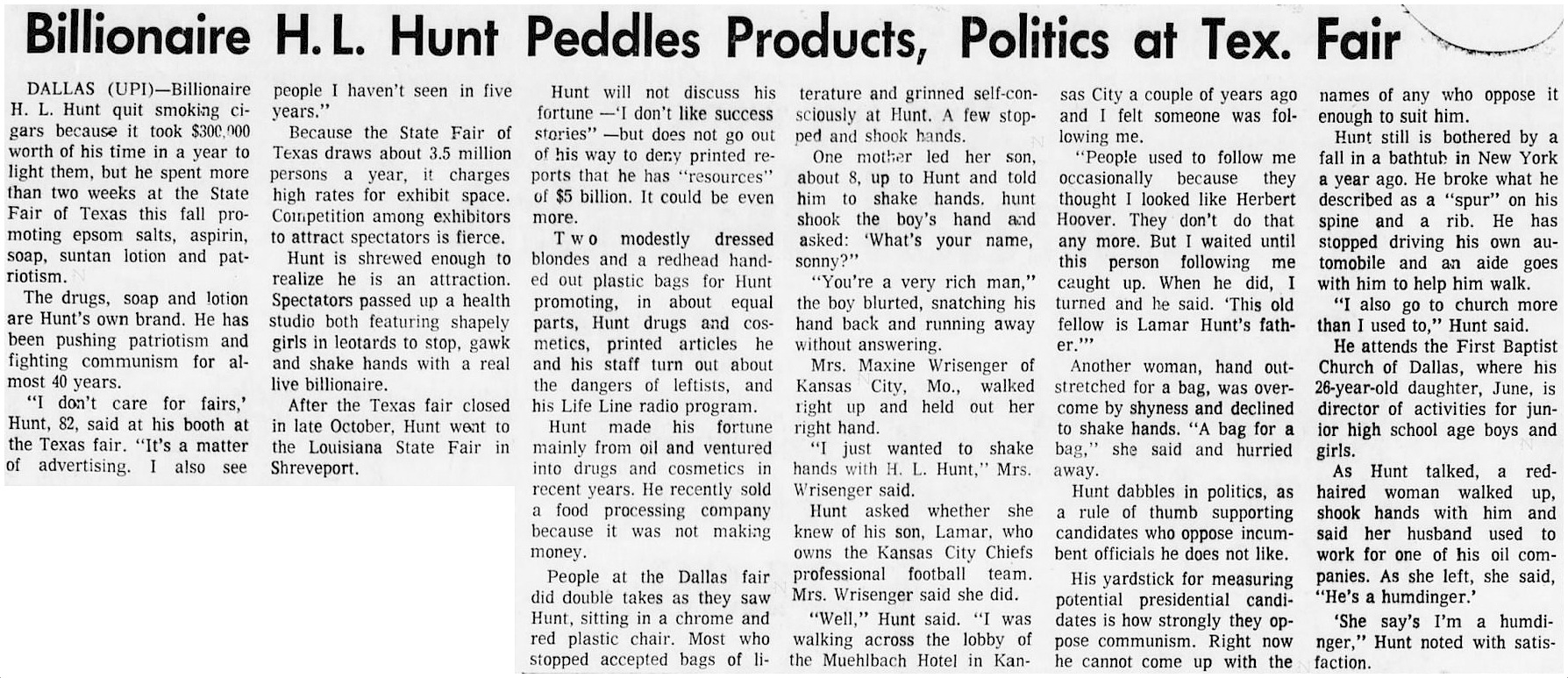
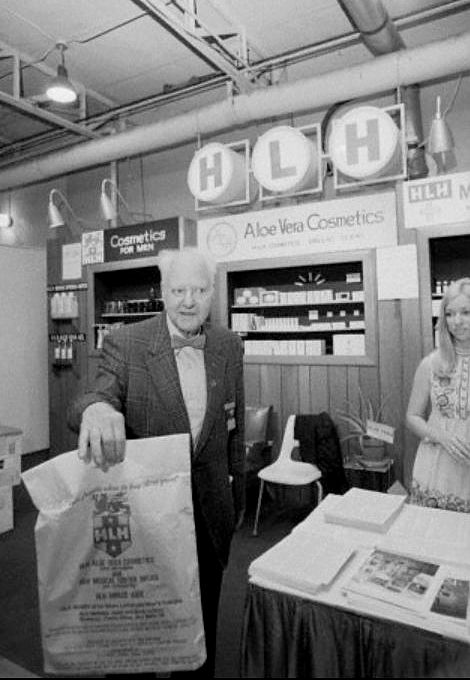
The 1970s was a weird decade, and what better way to start off a weird decade than with 80-something-year-old oil tycoon (and eccentric Dallas resident) H. L. Hunt handing out cosmetics at a booth at the State Fair? Hunt — whom Frank X. Tolbert described as “probably the world’s only billionaire health freak” — manufactured a line of cosmetics and other products containing aloe vera, the wonder elixir. Imagine seeing the world’s richest man handing out plastic goodie-bags to awe-struck passersby. Like I said, weird.

h-l-hunt_state-fair_1971

hunt_state-fair_pomona-progress-bulletin_CA_111471Pomona (CA) Progress-Bulletin, Nov. 14, 1971 (click to read)

*

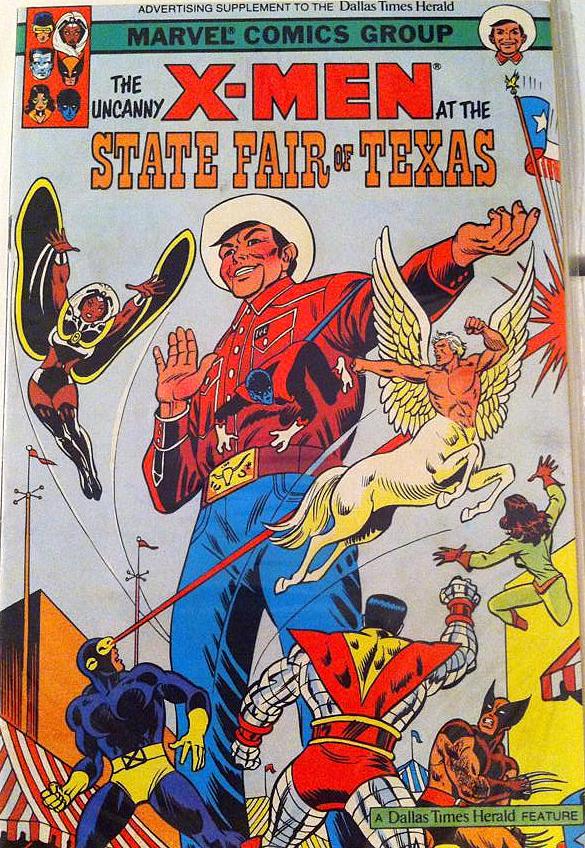
And, finally, the 1980s. A century after the State Fair of Texas began, the X-Men came to Big D to do whatever it is they do — and The Dallas Times Herald got a cool little advertising supplement out of it. (If this appeals to you, check out when Captain Marvel came to Dallas in 1944, here, and when Spider-Man came to Dallas in 1983, here.)

sfot_xmen_comic-book_1983

***

Sources & Notes

Sources (if known) are noted.

All images are larger when clicked.

I wrote a similar State-Fair-of-Texas-through-the-ages post a few years ago: “So Sorry, Bill, But Albert Is Taking Me to the State Fair of Texas,” here.

*

Copyright © 2018 Paula Bosse. All Rights Reserved.

A Rainy Opening Day of the State Fair of Texas — 1967

sfot_rain_1967_wbap_unt_fair-park_texas-carthageA damp day at the fair… (click for larger image)

by Paula Bosse

It’s  been raining pretty heavily today. And the State Fair of Texas is underway. I always feel bad for the people visiting and working at the fair when it rains like this. What a disappointment!

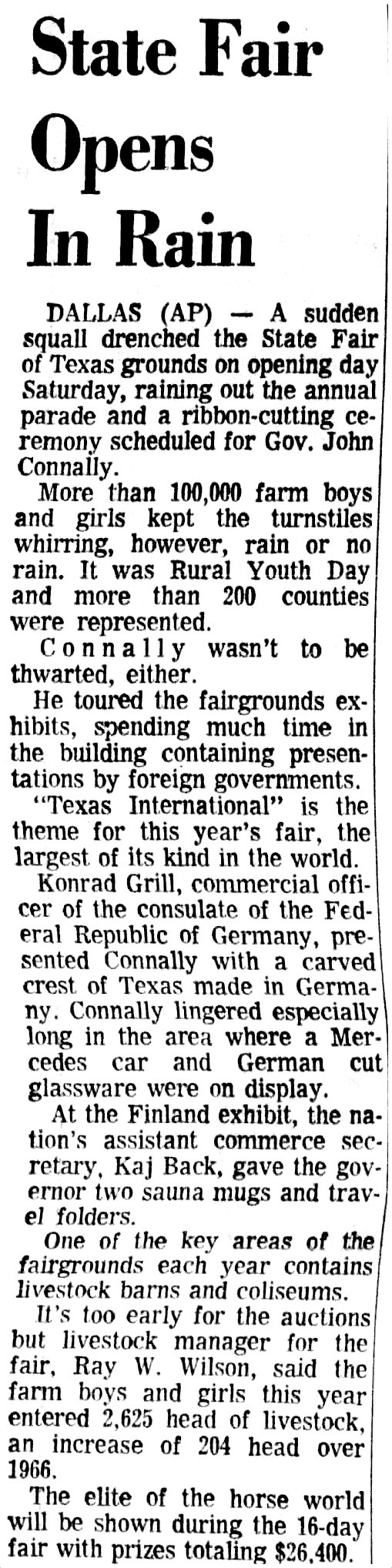
It rained so much on Opening Day of the State Fair in 1967 that the downtown parade ended up being canceled, as did the ceremonial ribbon-cutting which was to have been performed by Governor John Connally. That day — Oct. 7, 1967 — was also Rural Youth Day, and newspaper reports estimated that more than 100,000 “farm boys and girls” from more than 200 Texas counties had traveled to Dallas for what turned out to be a soggy day at the fair. (But kids never seem to mind being out in the rain as much as adults do.)

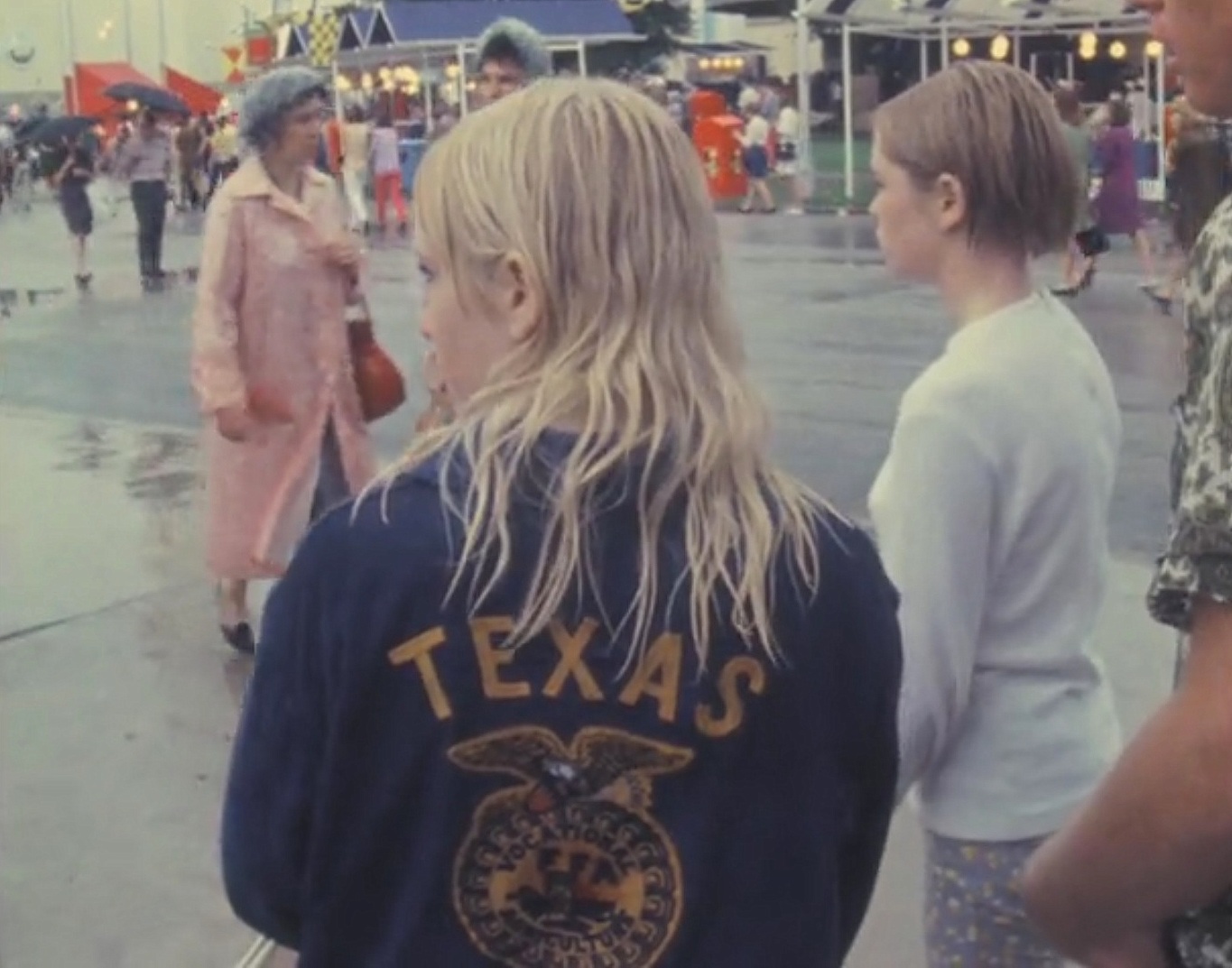
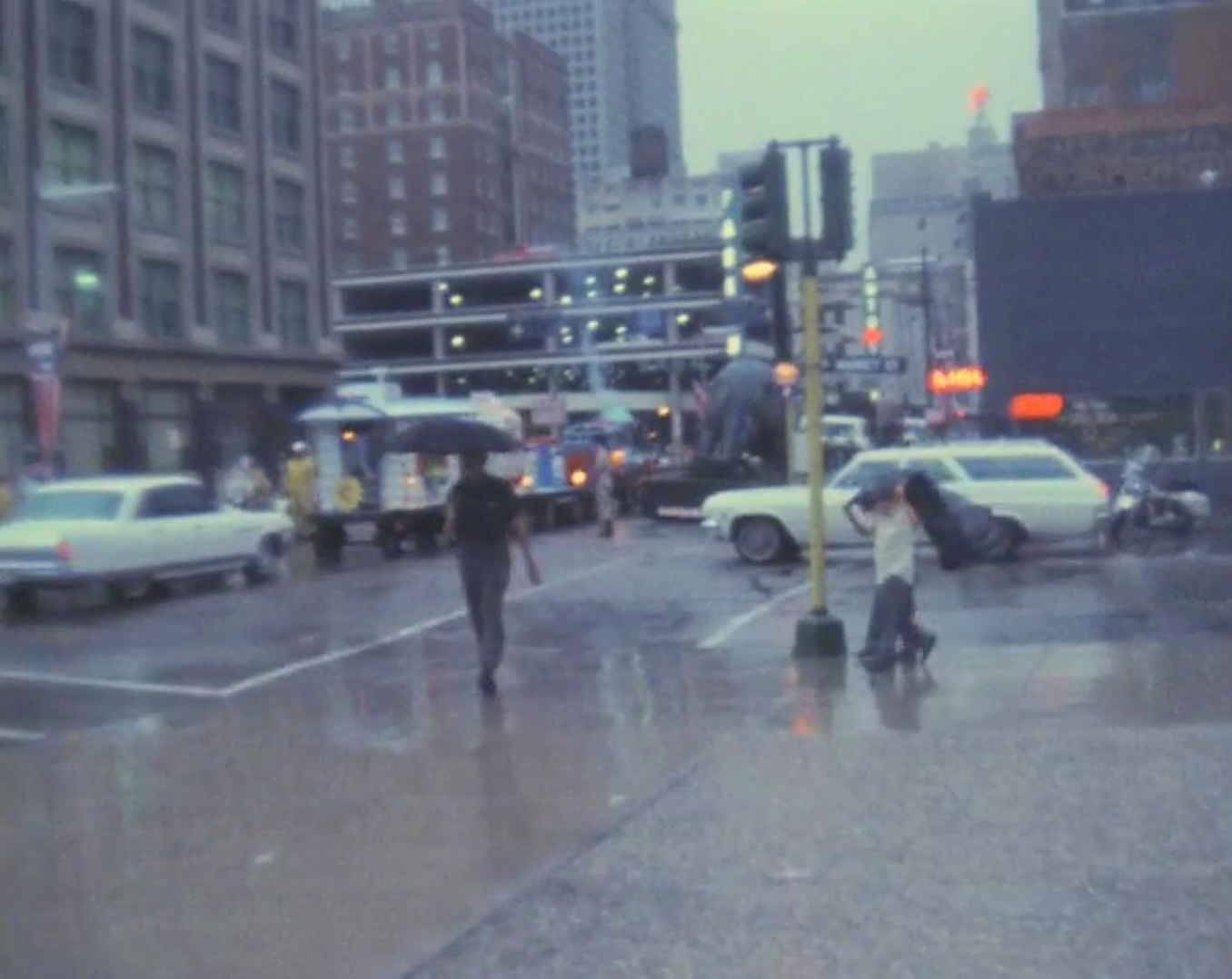
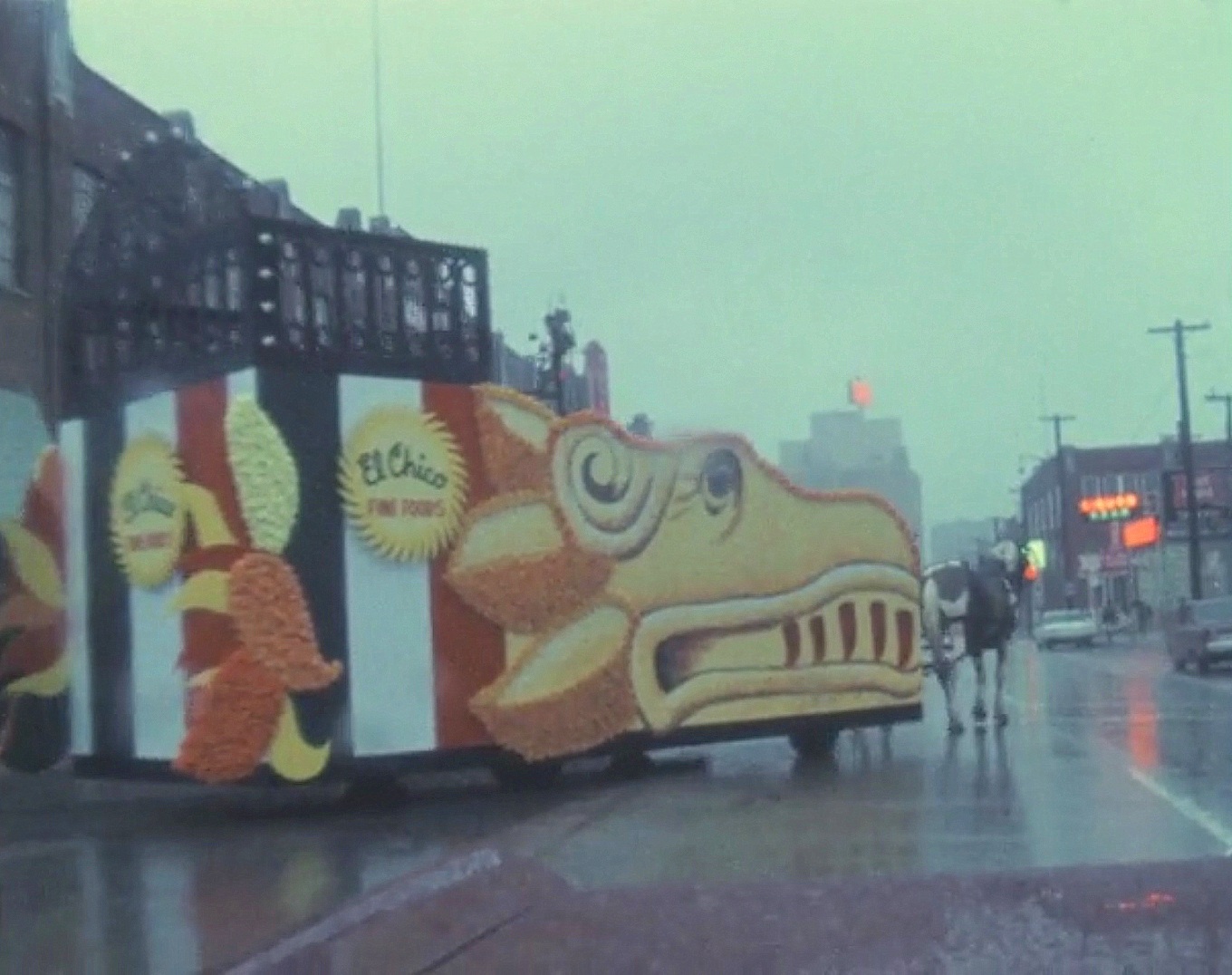
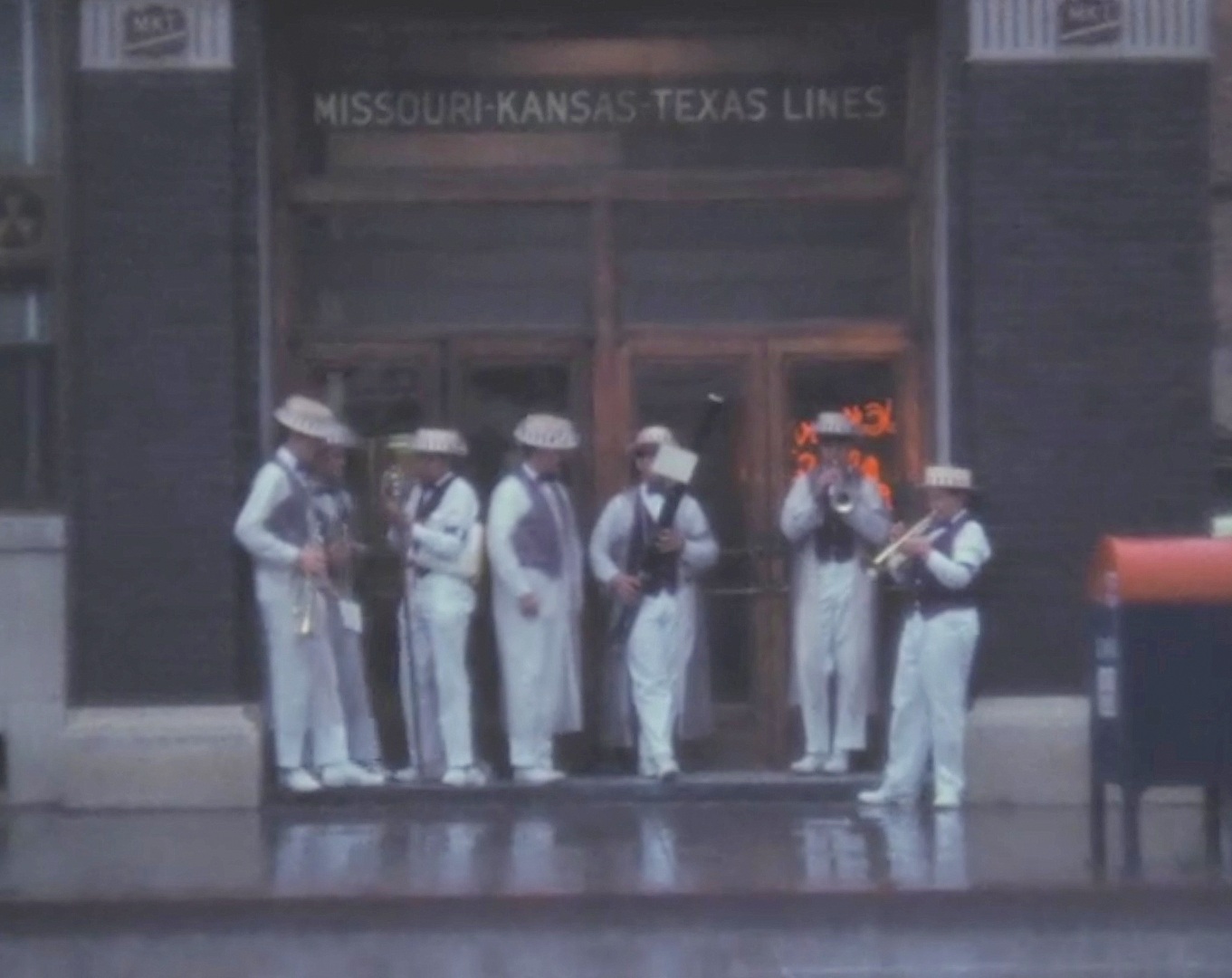
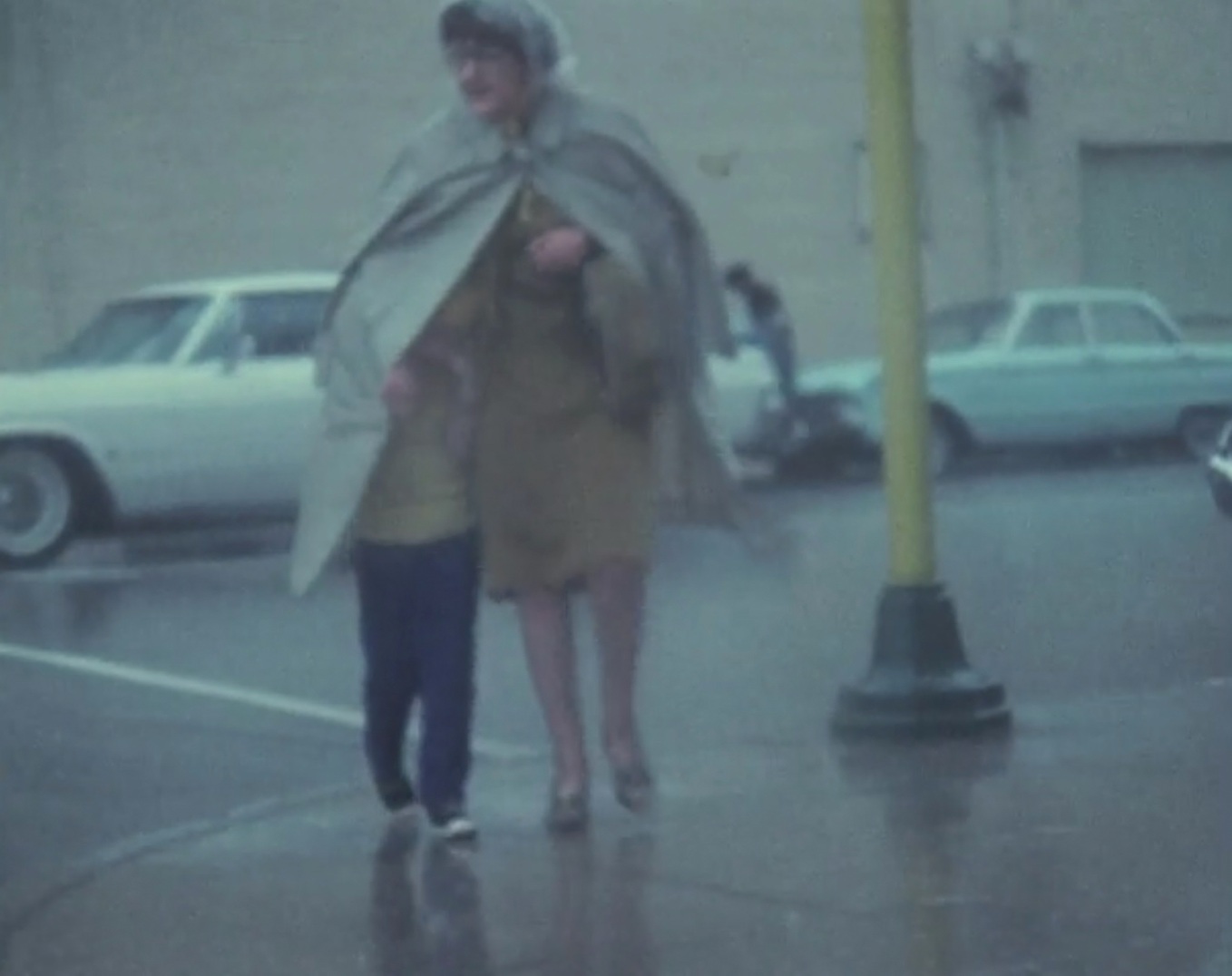
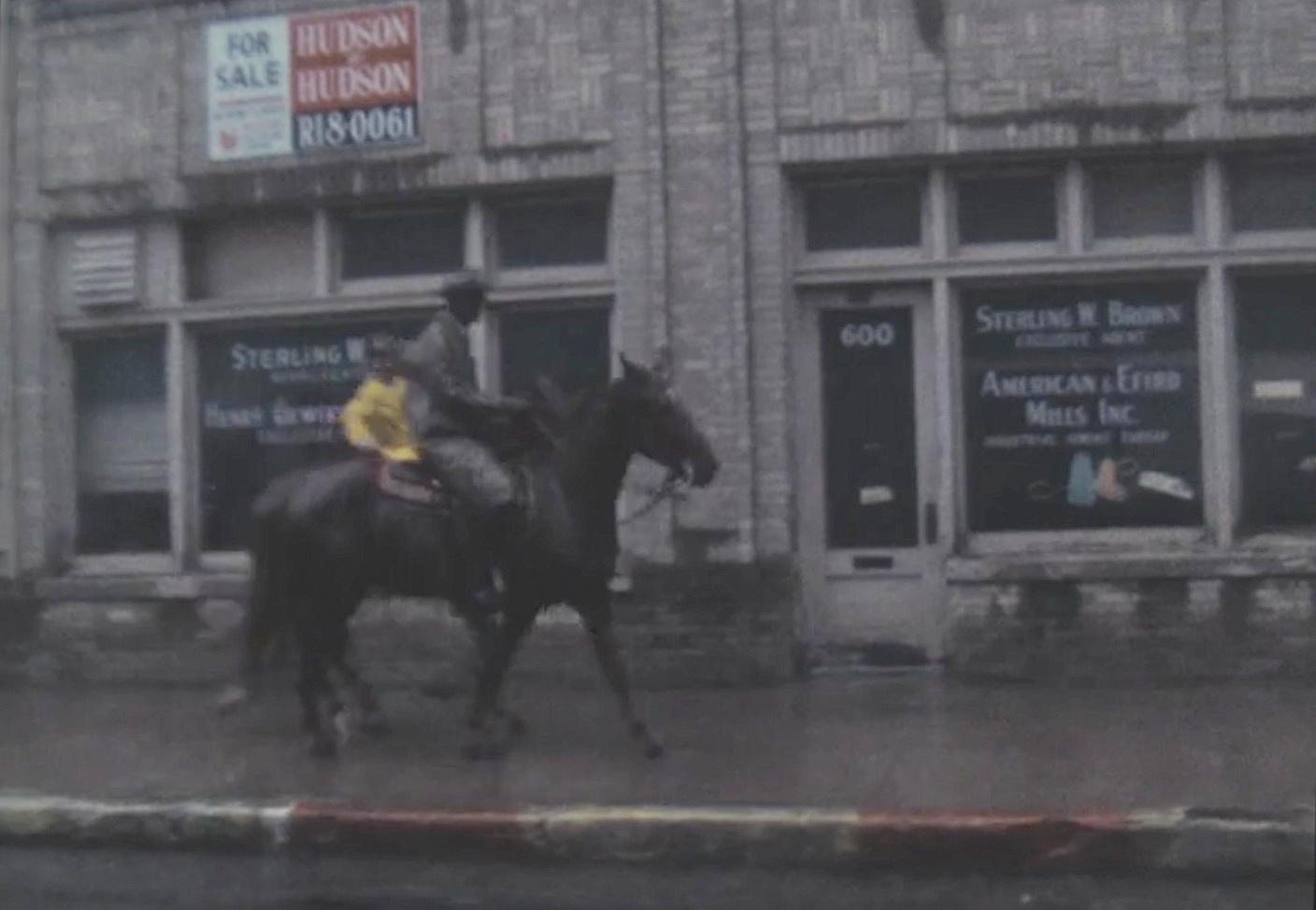
Watch rainy footage of the parade preparations downtown and wet-haired teenagers at the fair in an atmospheric clip shot by WBAP Channel 5 News cameramen, collected and digitized by UNT (see bottom of this post for more info). The 1:47 film footage can be viewed here (be sure to watch it in full-screen mode).

Below are a few screenshots.

sfot_rain_1967_wbap_unt

At the top, a girl from Carthage, wearing a Future Farmers of America jacket (it was Rural Youth Day, and the FFA was well represented) as well as a couple of ladies in coif-preserving plastic rain bonnets.

Below, a rain-drenched downtown.

sfot_rain_1967_wbap_unt_street

El Chico float getting soaked.

sfot_rain_1967_wbap_unt_el-chico-float

Marching band guys taking shelter.

sfot_rain_1967_wbap_unt_band_mkt

Grandma as human umbrella.

sfot_rain_1967_wbap_unt_boy_grandmother

Quadrupedestrians. (Pretty sure horses shouldn’t be trotting along sidewalks….)

sfot_rain_1967_wbap_unt_horses_sidewalk

A break in the precip — rides are revved up.

sfot_rain_1967_wbap_unt_fair-park_ride

Menacing clouds as seen from the top of the Comet.

sfot_rain_1967_wbap_unt_fair-park_top-of-roller-coaster


sfot_rain_san-antonio-express-news_100867
San Antonio Express-News, Oct. 8, 1967

***

Sources & Notes

Screenshots are from the video titled “News Clip: 1967 Texas State Fair Begins, Parade Rained Out.” It is part of the KXAS-NBC 5 News Collection and was provided by UNT Libraries Special Collections to The Portal to Texas History, a digital repository hosted by the UNT Libraries. More info — including the video itself — can be accessed here.

More rainy-day SFOT weather can be seen in this clip from 1970, courtesy of SMU.

*

Copyright © 2018 Paula Bosse. All Rights Reserved.

“Hola, Folks!” — Big Tex at the State Fair’s “Exposition of the Americas” — 1965

sfot_big-tex_serape_1965_dallas-heritage-village_portal

by Paula Bosse

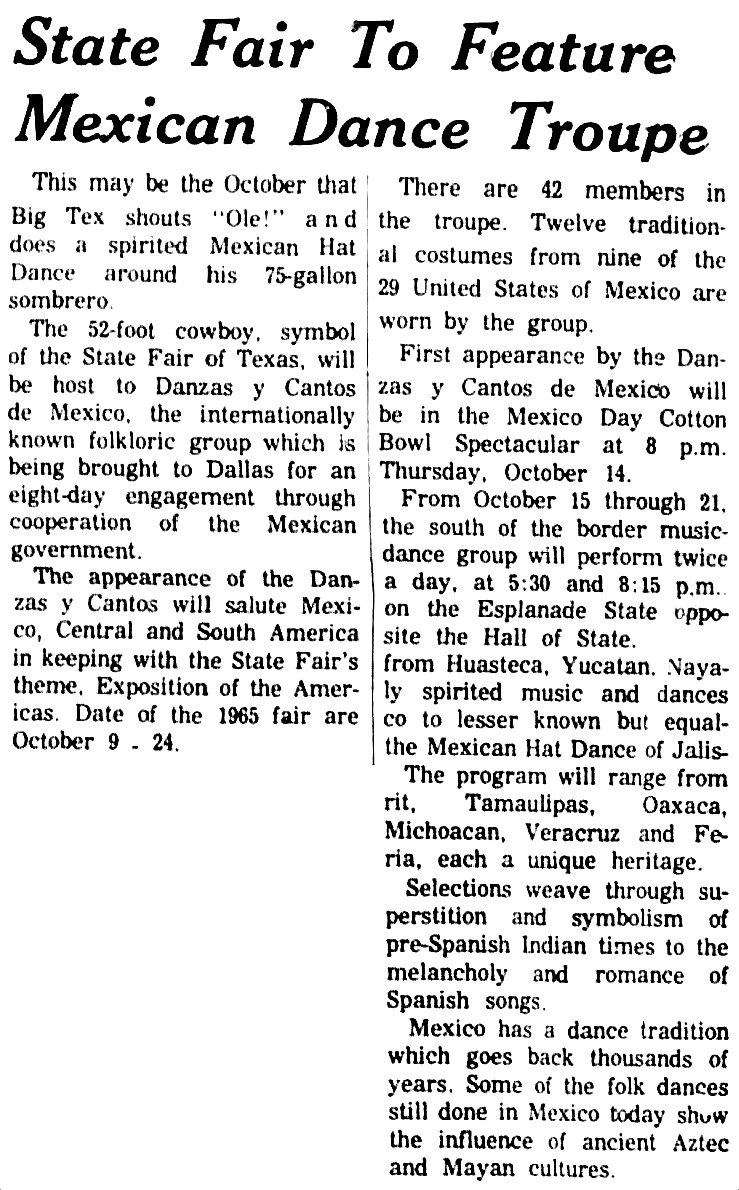
This “Howdy from Big D” postcard features Big Tex wearing a colorful Mexican serape at the 1965 State Fair of Texas. The theme that year was a salute to the Americas, with events celebrating Canadian and Latin American culture held during the fair’s run. In honor of Mexico Day (and the arrival of the Danzas y Cantos de Mexico troupe of performers), Big Tex donned a snazzy 60-foot-long serape which was provided by the Dallas Beer Distributors Association as a “goodwill gesture.”

Looking good, Big Tex. El Guapo Grande!

big-tex_serape_sfot-1965_plano-star-courier_090165Plano Star-Courier, Sept. 1, 1965 (click to read)

***

Sources & Notes

Postcard is from the collection of Dallas Heritage Village, via UNT’s Portal to Texas History; more info is here.

*

Copyright © 2018 Paula Bosse. All Rights Reserved.
The Palace — 1969

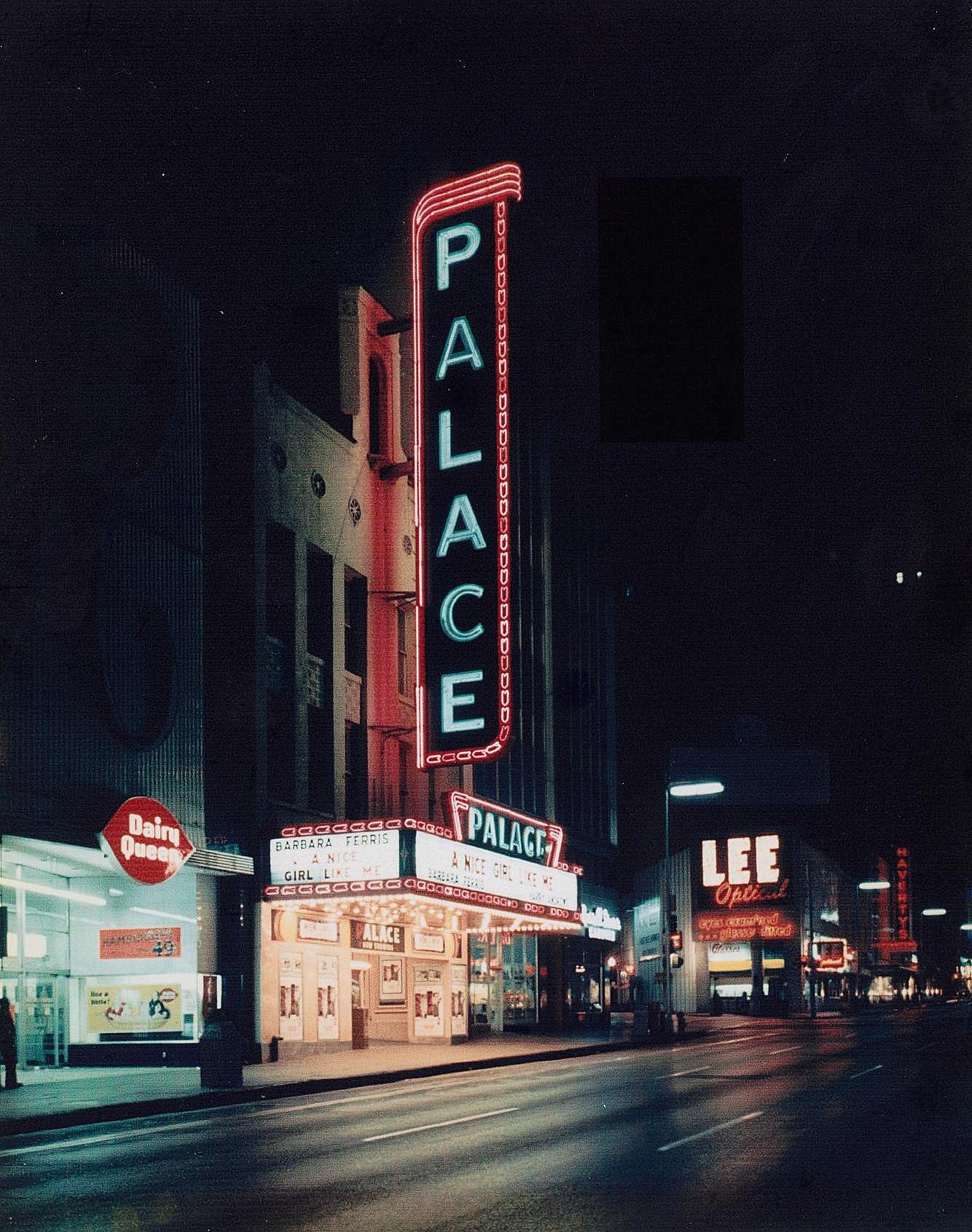
palace-theatre_1969_color_portalMovies and Dilly Bars, Elm Street, 1969…

by Paula Bosse

The only thing more exciting than seeing a cool nighttime photo of Dallas’ Theater Row with neon blazing, is discovering that there was once a Dairy Queen downtown!

**

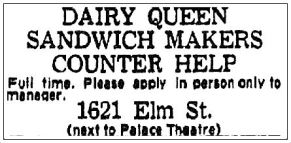
UPDATE: That DQ was there for a VERY short time. It shows up in none of the directories. In fact, its address — 1621 Elm — shows as “vacant” in the 1969, 1970, and 1971 city directories (it was occupied in 1968 by a newsstand — the Elm Street News — until it was raided that year for selling nudie mags). The address disappears altogether after the 1971 directory (it and the Palace Theatre were demolished in 1971). The only evidence I can find of the downtown Dairy Queen’s brief existence on Elm was in a handful of want-ads placed in October, 1969 (about the same time this photo was taken). My guess is that DQ bugged out when they learned the building was going to be torn down. It may have been there only a couple of months. Downtown DQ, we hardly knew ye.

dairy-queen_elm-street_100269Oct. 2, 1969

***

Sources & Notes

“Exterior of Palace Theatre at Night” is from the Lovita Irby Collection via the Spotlight on North Texas project, UNT Media Library, and may be viewed on UNT’s Portal to Texas History site here.

The movie on the marquee is “A Nice Girl Like Me,” starring Barbara Ferris, which opened at the Palace on Sept. 19, 1969.

The Palace Theatre was located on the north side of Elm Street, just west of Ervay, at 1625 Elm — by 1969, “Theater Row” consisted of only a handful of theaters. The Palace (and the building housing the Dairy Queen) was demolished in 1971; most of the north side of that block is now occupied by Thanksgiving Tower.

*

Copyright © 2018 Paula Bosse. All Rights Reserved.
Prepping for the 1932 State Fair of Texas Midway

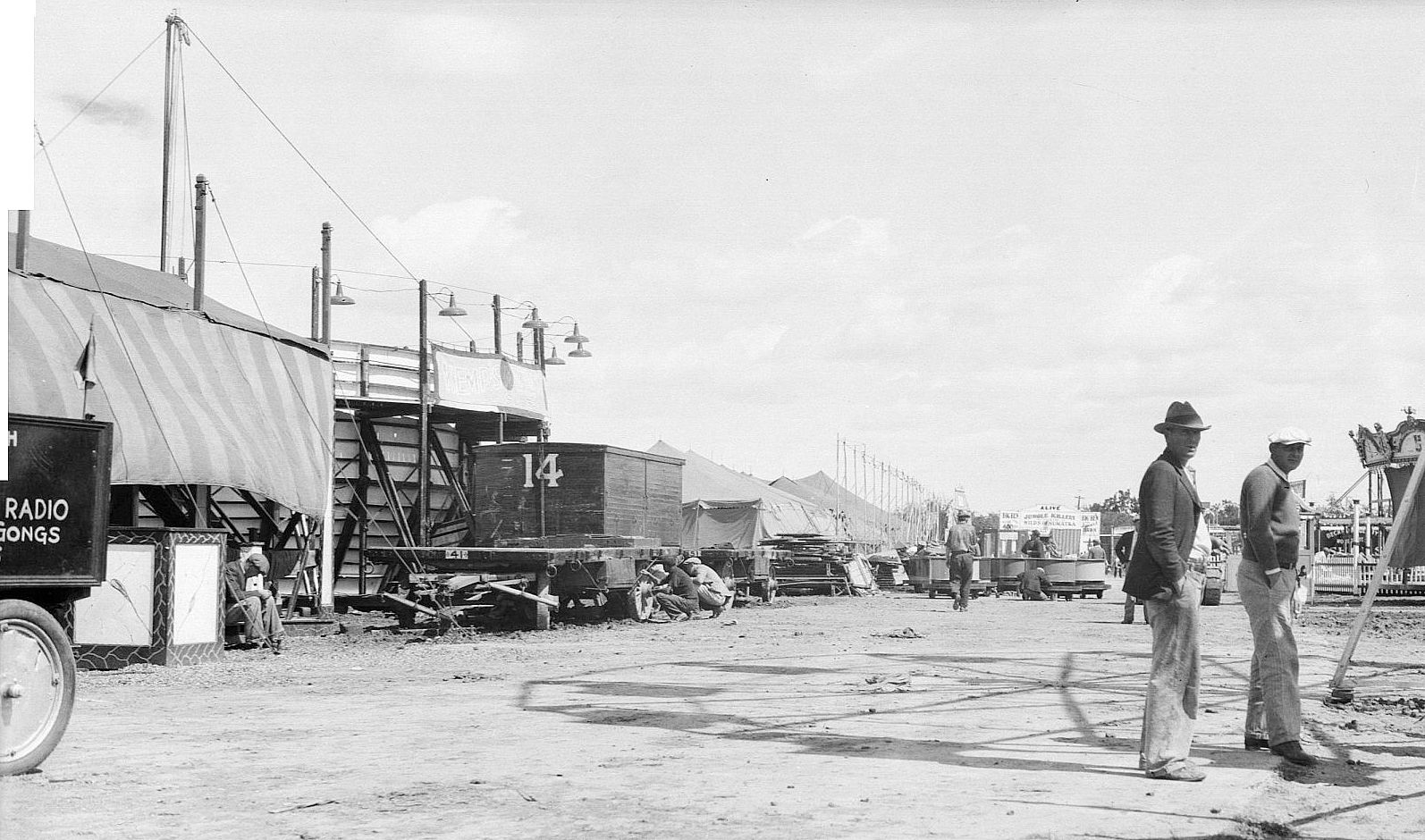
state-fair-of-texas_1932_gimarcBackstage” at the SFOT… (click for larger image)

by Paula Bosse

We usually see photos of the State Fair of Texas as the fair is underway, with everything already built, assembled, painted, and manned. But what happens before the gates open each year? Here’s a great photo (from pack rat George Gimarc, of Dallas dj fame) showing what things looked like in 1932 as workers prepped midway attractions for the fair’s opening. Let’s zoom in and look at a few details (all images are larger when clicked).

sfot_1932_gimarc_det-3Axle problem?

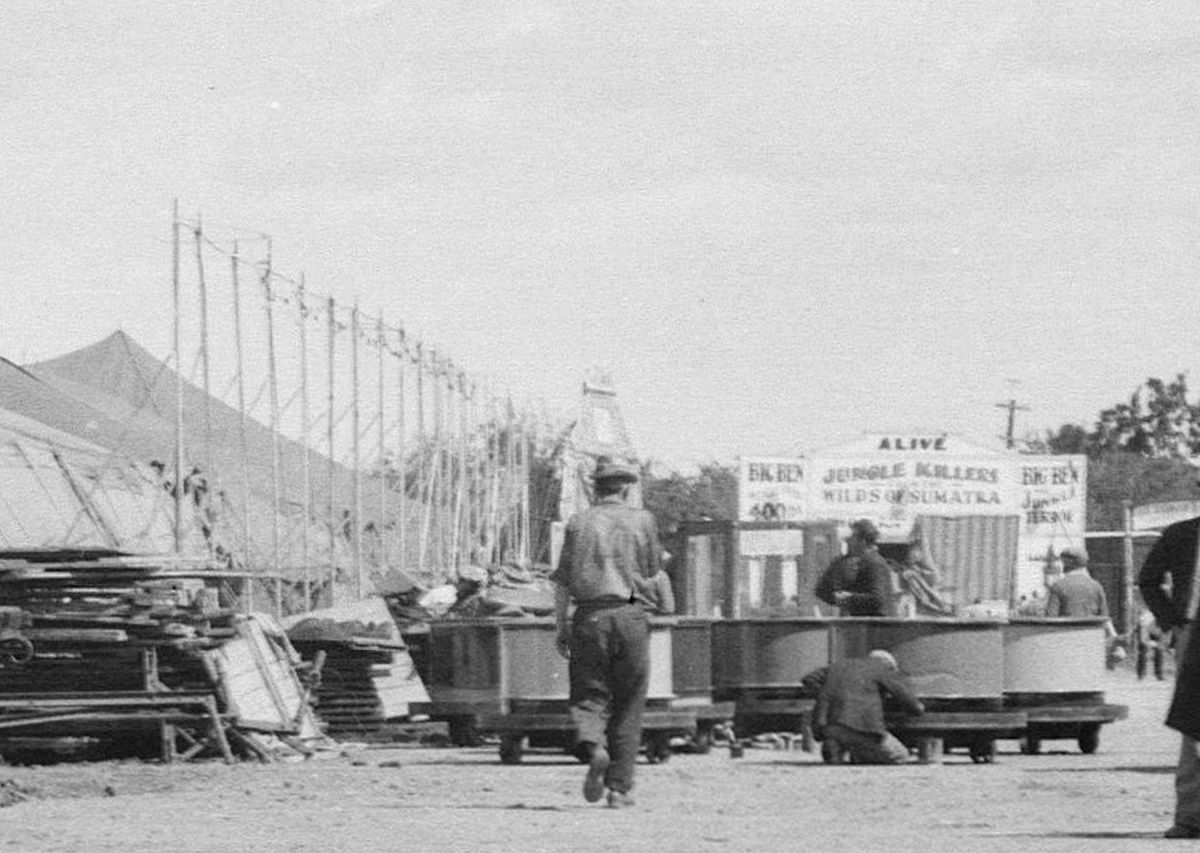
sfot_1932_jungle-killers-det_gimarc“ALIVE. Jungle Killers from the Wilds of Sumatra.” And someone — or some creature — named “Big Ben.”

sfot_1932_beckman-gerety-det_gimarcAbove, in the background at the right you can see a partial sign for Beckman & Gerety, providers of midway entertainment for fairs and carnivals around the country. (I don’t  know who these two men are, but they do not appear to be Fred Beckman and Barney Gerety, who can be seen here.)

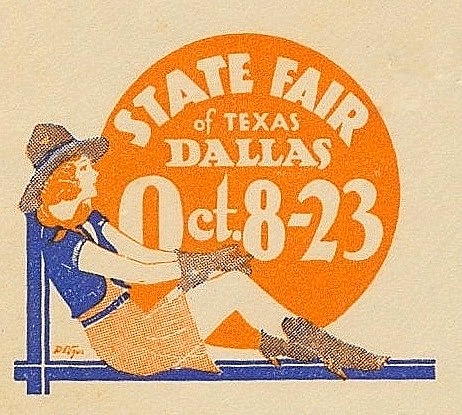
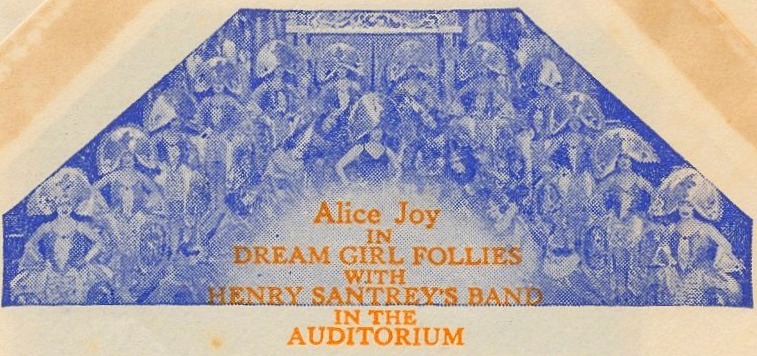
When George Gimarc sent me this photo, he also sent me images of the State Fair of Texas envelope he found it in (see the envelope here). Below are details from the front and back.

sfot_1932_envelope_logo_gimarc

sfot_1932_envelope_back_det_gimarc

“Alice Joy in ‘Dream Girl Follies’ with Henry Santrey’s Band in the Auditorium.” Alice Joy was fresh from two years as NBC’s “radio dream girl” and was the namesake-headliner of this spectacular three-and-a-half-hour revue at the Music Hall which featured a bevy of chorus girls, acts-a-plenty, and “hot jazz novelties.” 4,000 people witnessed the show’s opening night. Probably gave those jungle killers from the wilds of the Sumatra a run for their money.

There was a lot going on at the 1932 State Fair of Texas. Check out this (comprehensive) ad from the opening weekend (click it!). Cars! Football! Alligator wrestling! Hoot Gibson’s Rodeo (“famous outlaw broncs”)! An aviation show! Everything!

sfot-1932_oct-9-1932_adOct. 9, 1932 (click to see large image)

***

Sources  & Notes

Photo and color images from the collection of George Gimarc, used with permission (thank you, George!).

*

Copyright © 2018 Paula Bosse. All Rights Reserved.


David Bates — “Corny Dog” (1986)

bates-david_corny-dog_litho_tyler-museum-of-art_1986“Corny Dog” by David Bates, 1986

by Paula Bosse

First day, y’all. Here’s how David Bates, one of my favorite contemporary Texas artists, sees it. Click it to see that corny dog real big.

***

Sources & Notes

“Corny Dog” by David Bates (lithograph, 1986), shown at the Tyler Museum of Art this summer in the show “David Bates: Selected Works From Texas Collections.” More on that exhibition is here.

*

Copyright © 2018 Paula Bosse. All Rights Reserved.

Dallas in “The Western Architect,” 1914: Places of Leisure, Etc.

hippodrome-theater_western-architect_july-1914

by Paula Bosse

Continuing with the series of photos from the all-Dallas issue of The Western Architect, which featured photos of new buildings which had popped up all over the city between the years of about 1910 to 1914. Today, in an attempt to categorize the seven buildings in this post, I’ve decided on “places of leisure” — although one of the places is a high school, and a high school is hardly a place of leisure. Two of these buildings are still standing: one which you’ve no doubt heard of as being at death’s door for a few decades now, and the other… well,  you’ve probably never seen it or been aware of it (but it’s my favorite one in this group!). 

*

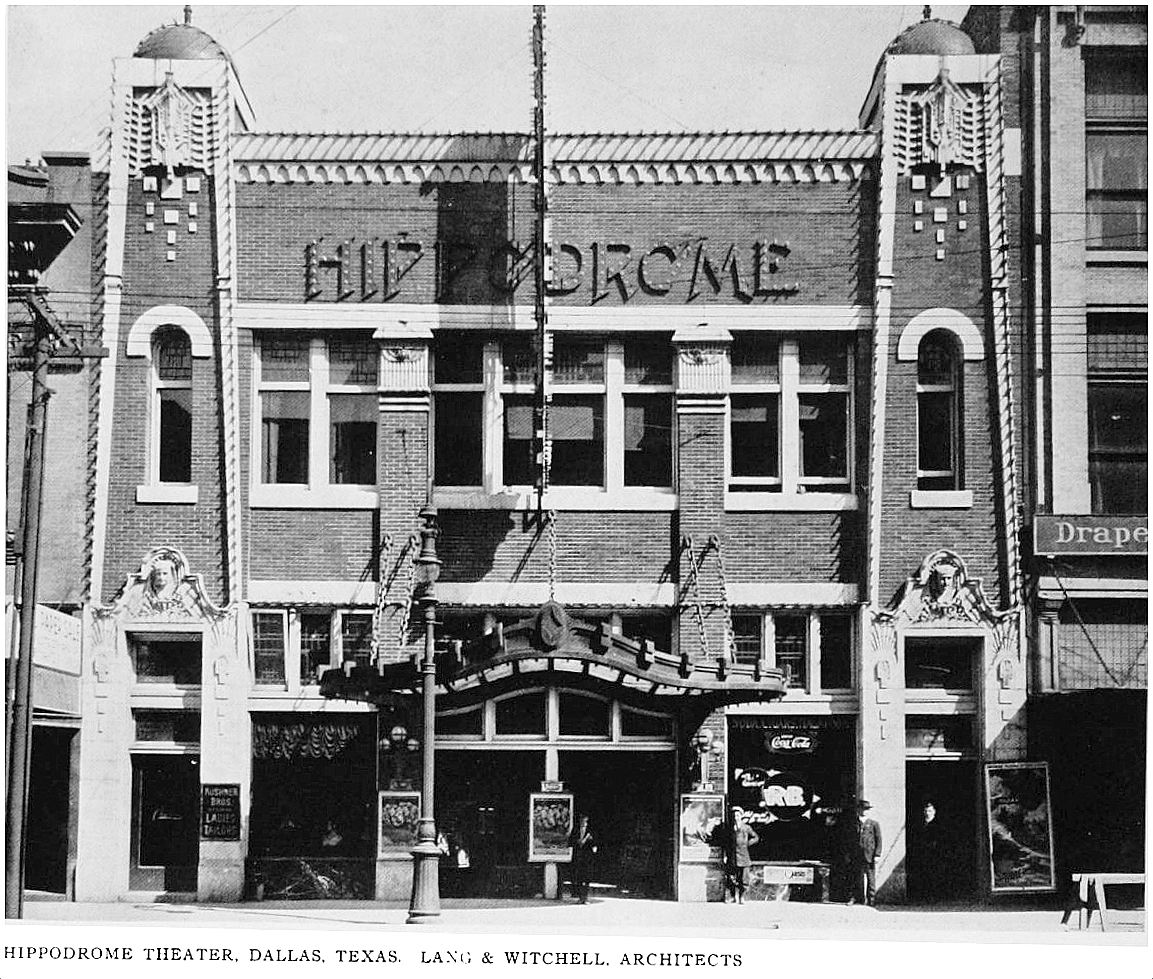
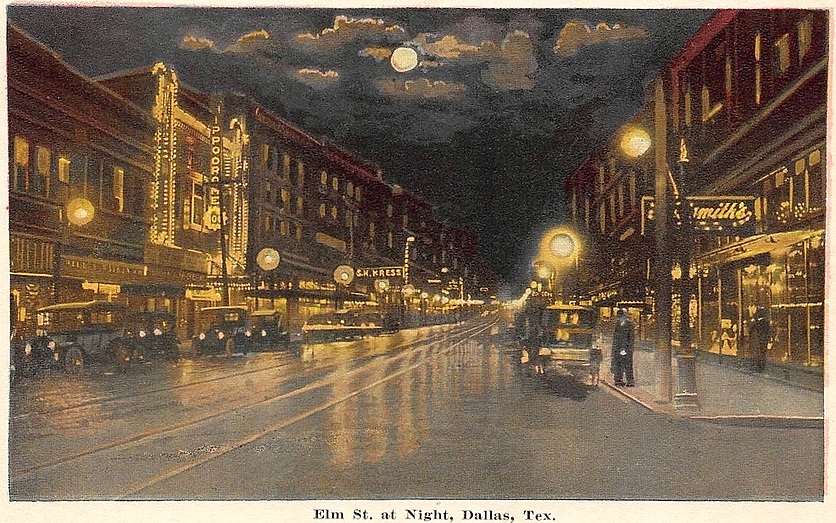
1.  THE HIPPODROME THEATER (above), 1209 Elm Street, designed by architects Otto Lang & Frank Witchell. Built along Dallas’ burgeoning “theater row” in 1912-1913, the Hippodrome was one of the city’s grandest “moving picture playhouses.” Among its lavish appointments was this odd little tidbit: “Over the proscenium arch there is an allegorical painting representing Dallas as the commercial center of the Southwest,” painted by the theater’s decorator, R. A. Bennett. Below was a fire curtain emblazoned with a depiction of Ben Hur (a “hippodrome” was a stadium for horse and chariot races in ancient Greece). So that was a nice little weird culture clash. Though originally a theater which showed movies exclusively, it eventually became a theater featuring movies as well as live vaudeville acts. As the Hippodrome became less and less glamorous, it resorted to somewhat seedier burlesque acts (it was raided more than once,for employing female performers who were too scantily clad) and the occasional boxing or wrestling match. The building was sold several times and was known as the Joy Theater, the Wade, the Dallas, and, lastly, the Strand. I was shocked to learn this old-looking-when-it-was-new building stood for almost 50 years and wasn’t demolished until 1960 (that façade must have looked very different by then). (See it on a 1921 Sanborn map, here.) (All images are larger when clicked.)

hippodrome_theater-row_night_postcard_flickr_coltera
via Flickr

*

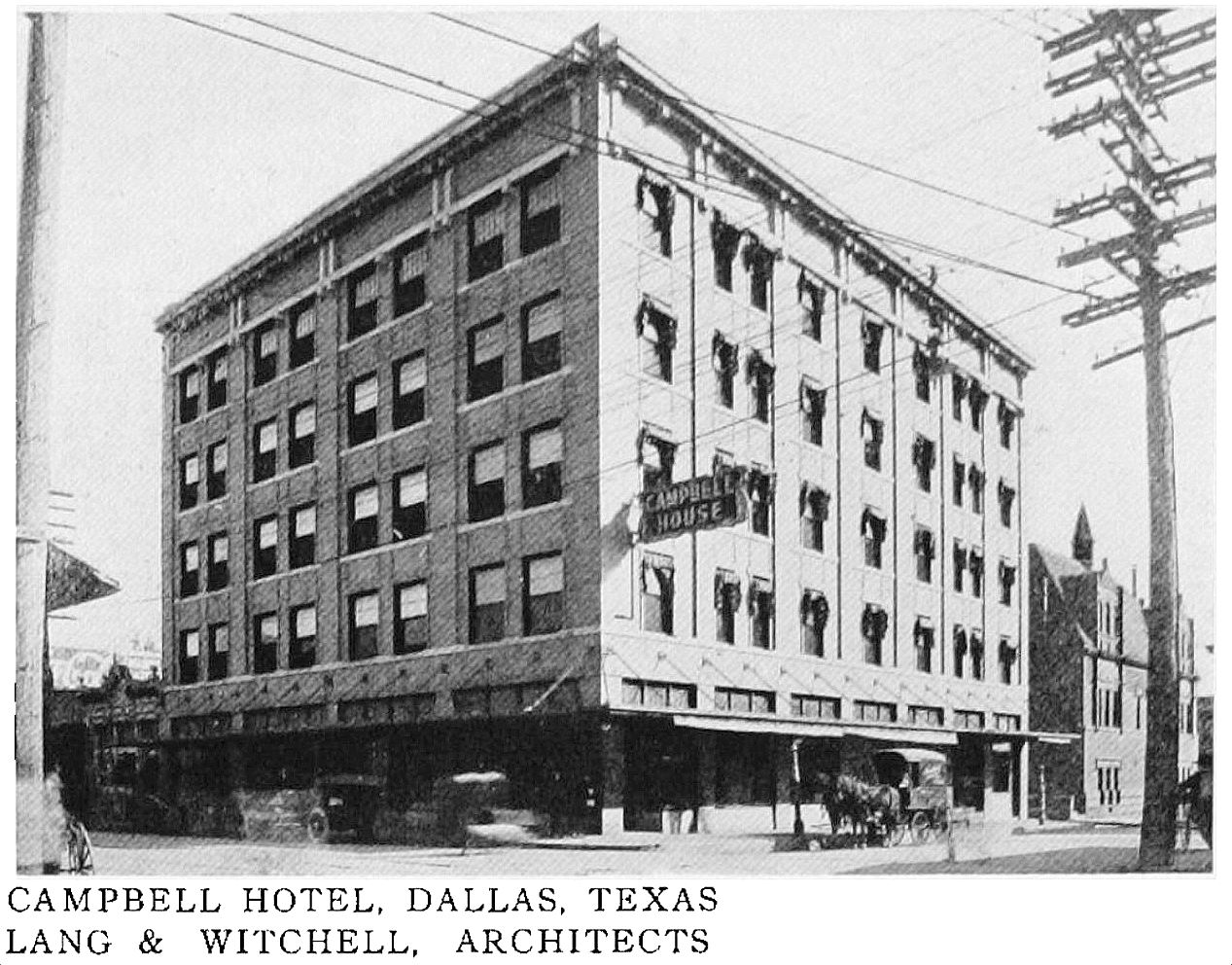
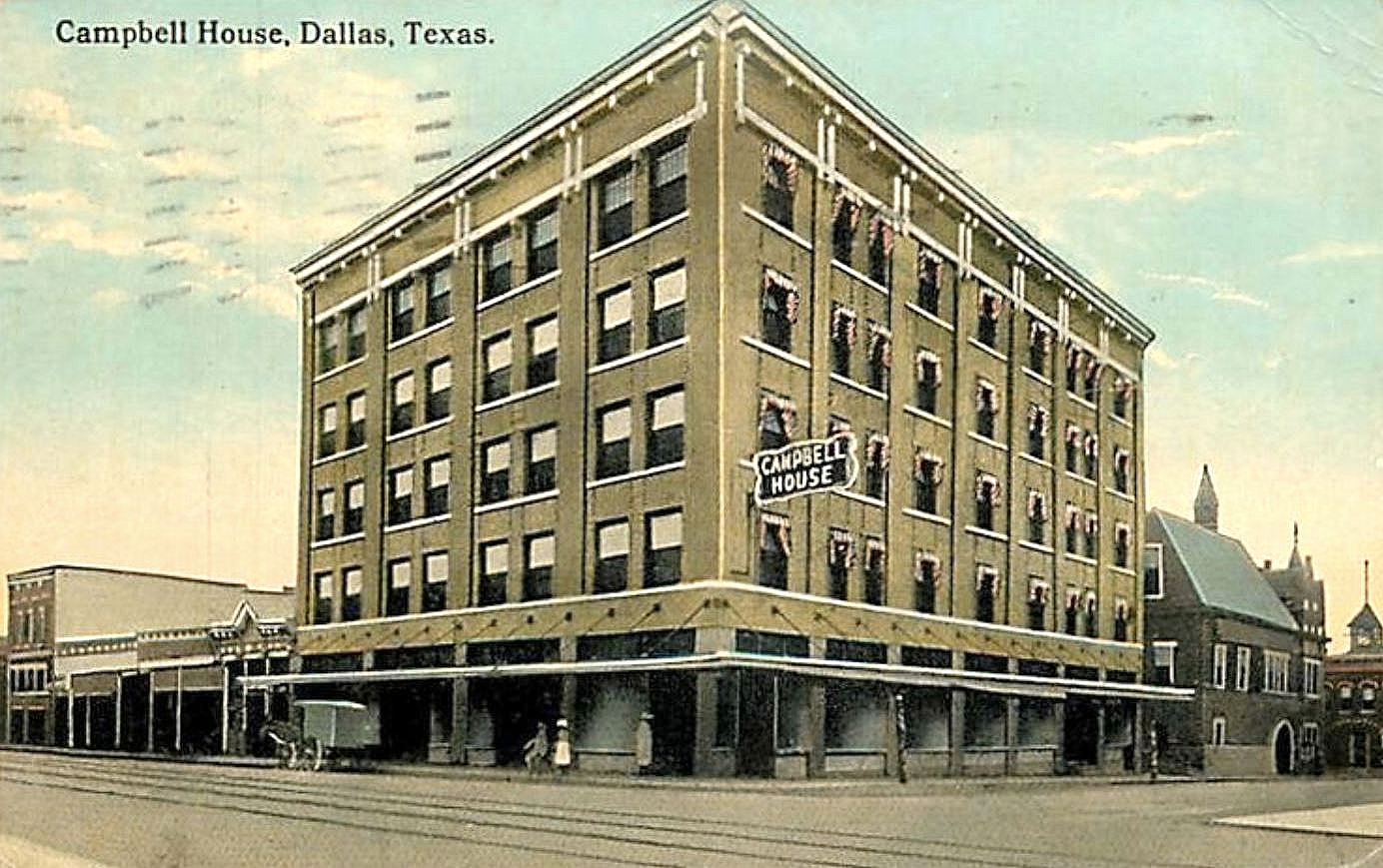
2.  THE CAMPBELL HOUSE HOTEL, 2004 Elm Street (southeast corner of Elm & Harwood), designed by Lang & Witchell. A few blocks east on Elm from the Hippodrome was the Campbell Hotel, built in 1910-1911 by Archibald W. Campbell, a man who knew how to invest in Dallas real estate and left an estate worth more than a million dollars when he died in 1917 (a fortune equivalent to almost $20 million today). The Campbell Hotel lasted until 1951, when it  was sold and became the New Oxford Hotel. It was demolished sometime before 1970; the site is currently occupied by a parking garage. (See it on a 1921 Sanborn map, here.)

campbell-house_western-architect_july-1914

campbell-house_flickr_coltera_ca-1918

*

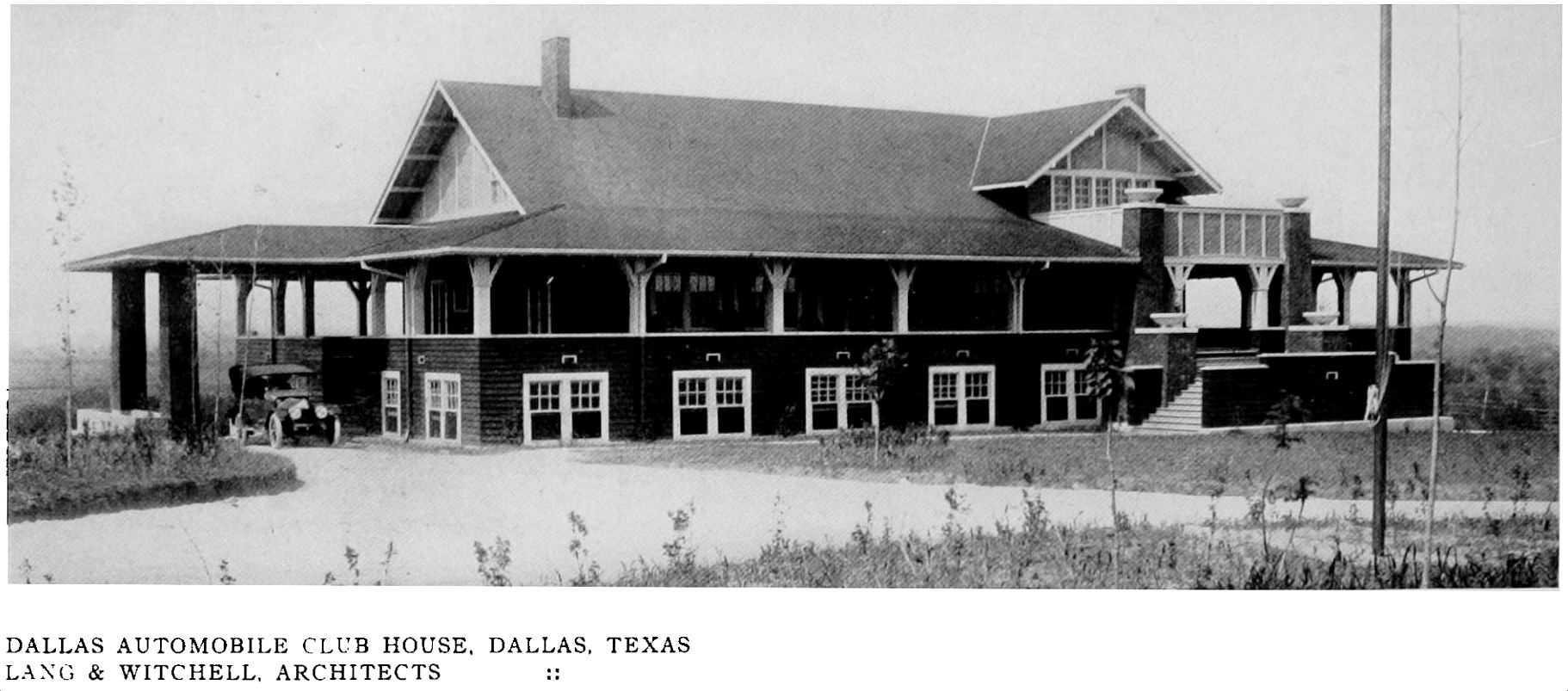
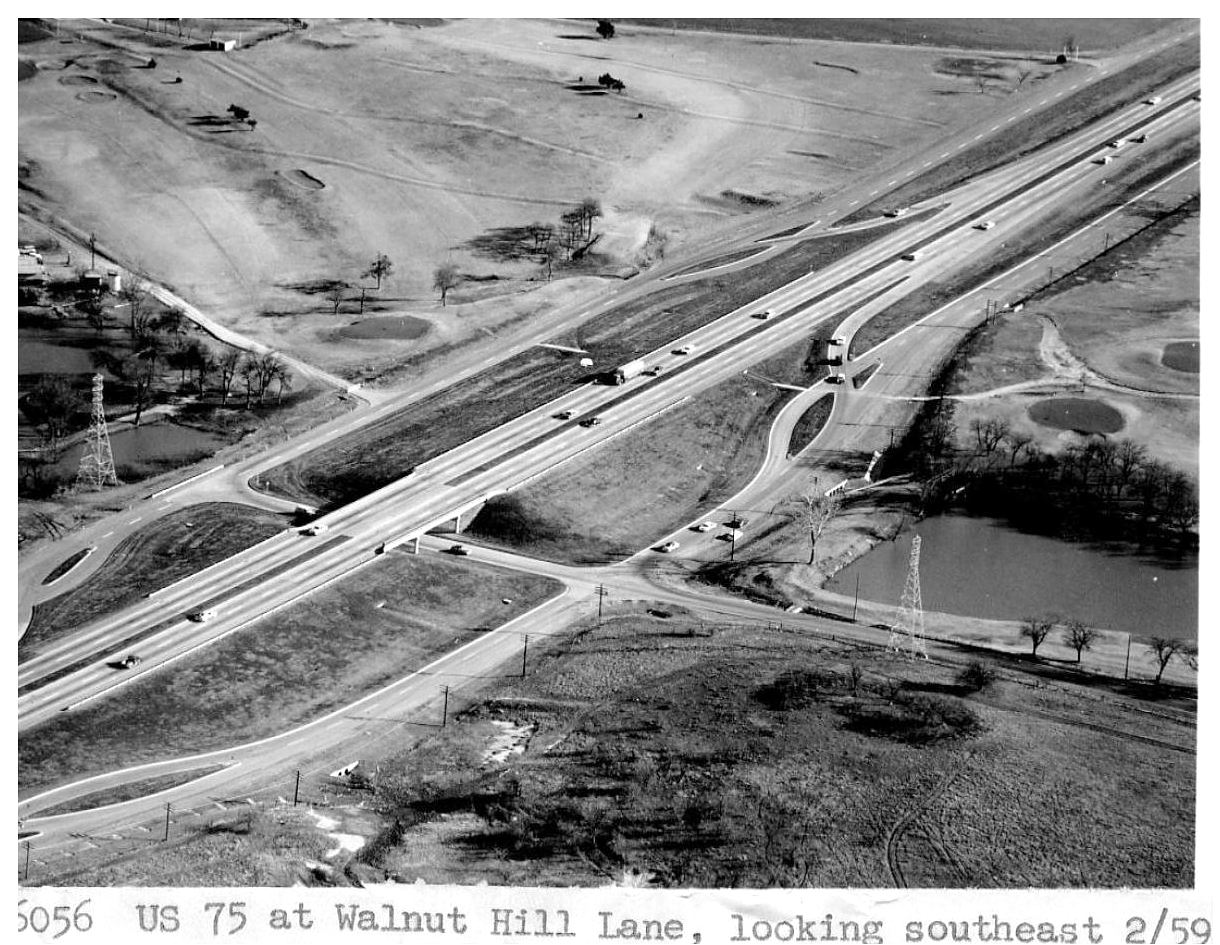
3.  DALLAS AUTOMOBILE COUNTRY CLUB, at the time 6 miles north of Dallas (roughly at what is now Walnut Hill and Central Expressway), clubhouse designed by Lang & Witchell. Built in 1913/1914, this club for wealthy “automobilists” was located on what was originally 26 acres donated by W. W. Caruth — in order to get there, you had to drive, which was part of the relaxing experience this golf course-free country club counted as one of its benefits. The club grounds included a 6-acre lake and was a popular site for boating, fishing, and swimming (a top-notch golf course was eventually added). The name of the country club changed a couple of times over the years: it became the Glen Haven Country Club in 1922 and then the Glen Lakes Country Club in 1933. Glen Lakes had a long run, but northward-development of Dallas was inexorable, and the club and golf course were closed in 1977 when the land the country club had occupied for over 60 years was sold for development. (See it on a 1962 map here — straddling Central Expressway — and just try to imagine the value of that land today.)

dallas-automobile-club-house_glenlakes_western-architect_july-1914

glen-lakes-country-club_aerial-photo_1959

*

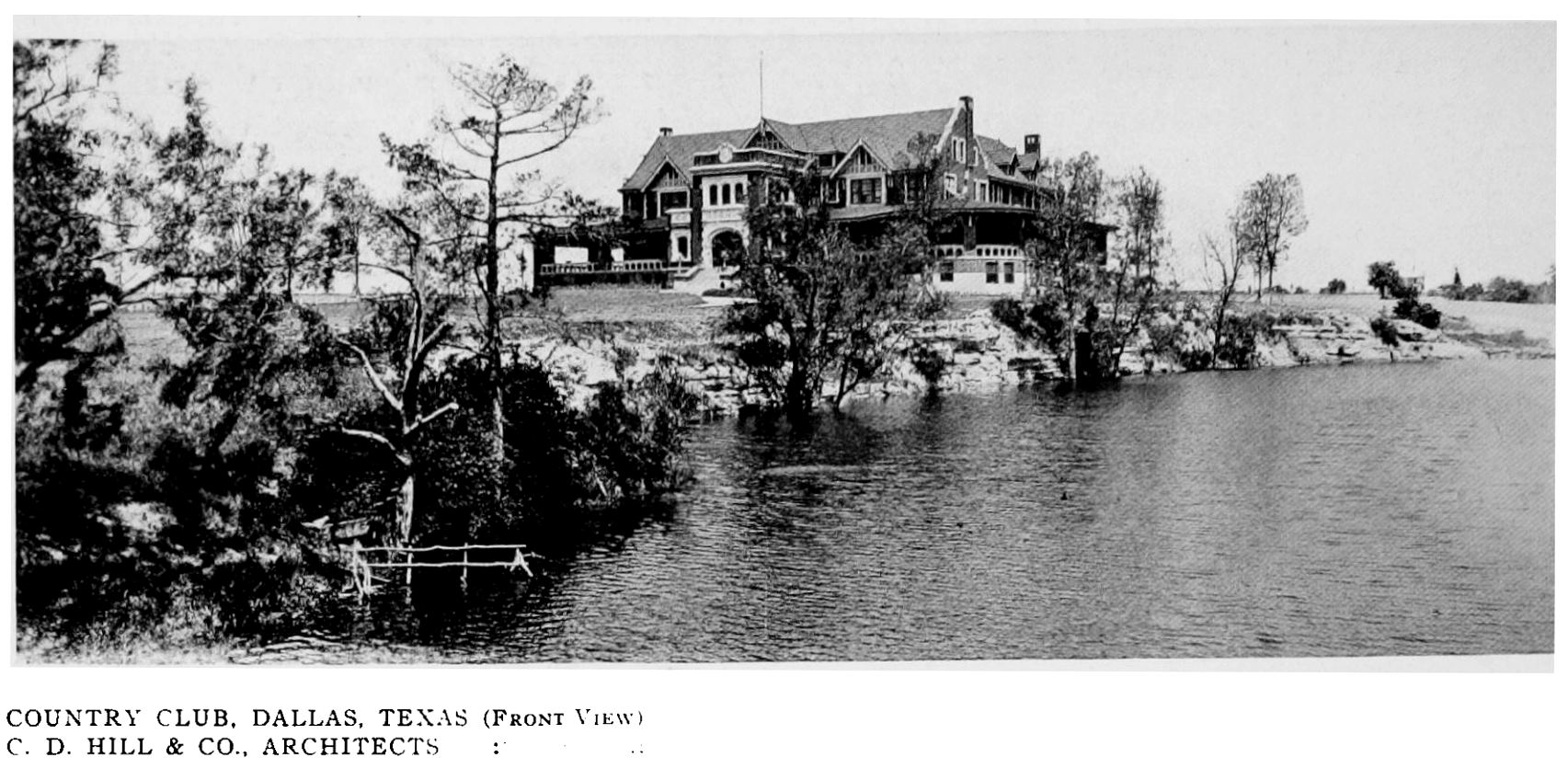
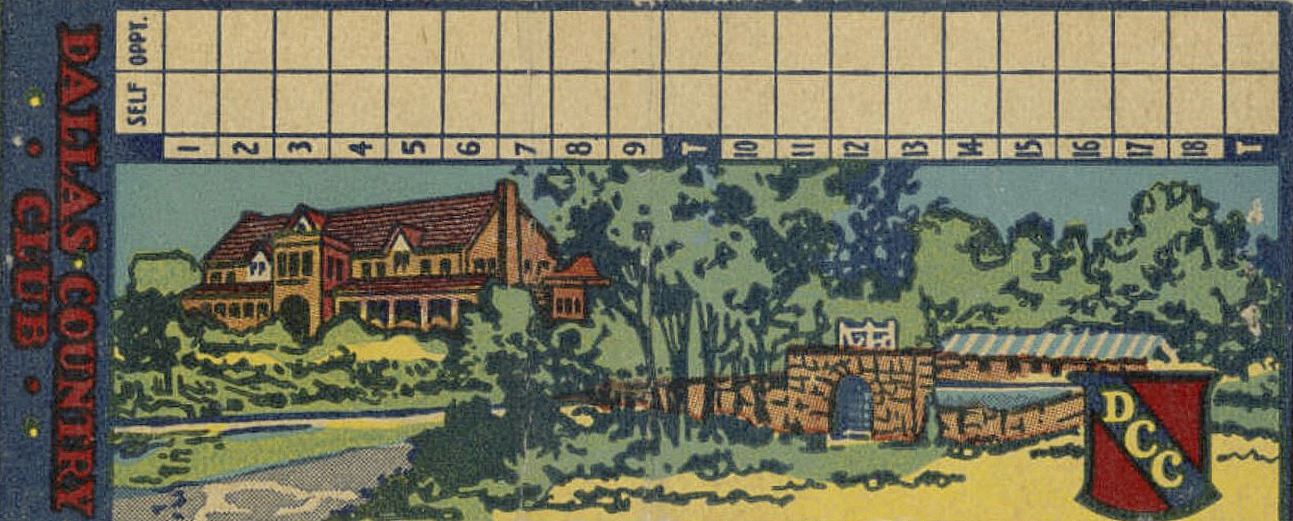
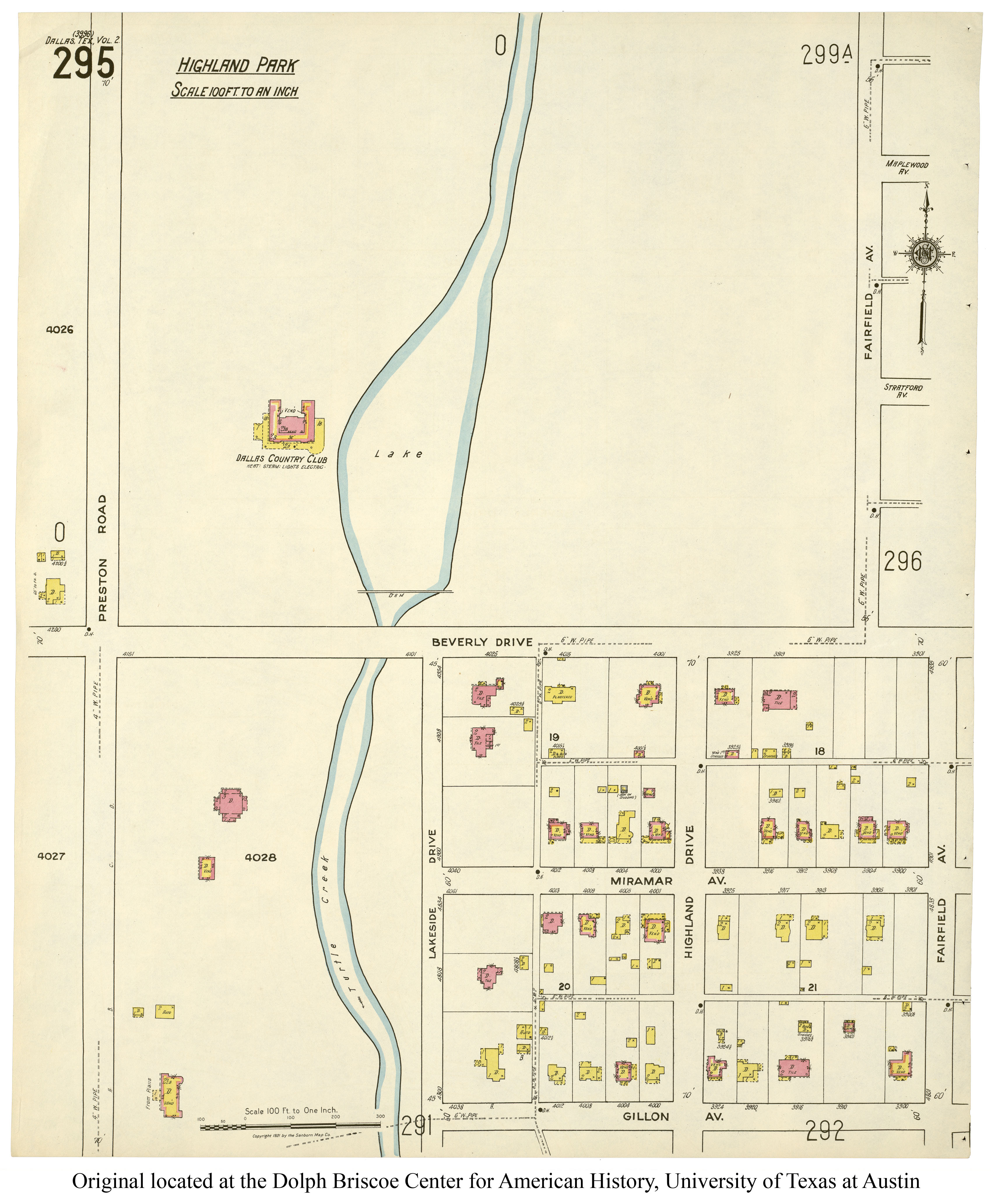
4.  DALLAS COUNTRY CLUB, Preston Road & Beverly Drive, clubhouse designed by C. D. Hill. One of the reasons the Dallas Automobile Country Club had to change its name was because people kept confusing it with the granddaddy of Dallas’ country clubs, the Dallas Country Club, in Highland Park, built in 1911 and still the most exclusive of exclusive local clubs and golf courses. (See part of the club’s acreage on a 1921 Sanborn map, here.) (I don’t think any of the original clubhouse still stands, but I could be wrong on this.)

dallas-country-club_western-architect_july-1914

dallas-country-club_matchbook_cook-collection_degolyer_smuvia DeGolyer Library, SMU

*

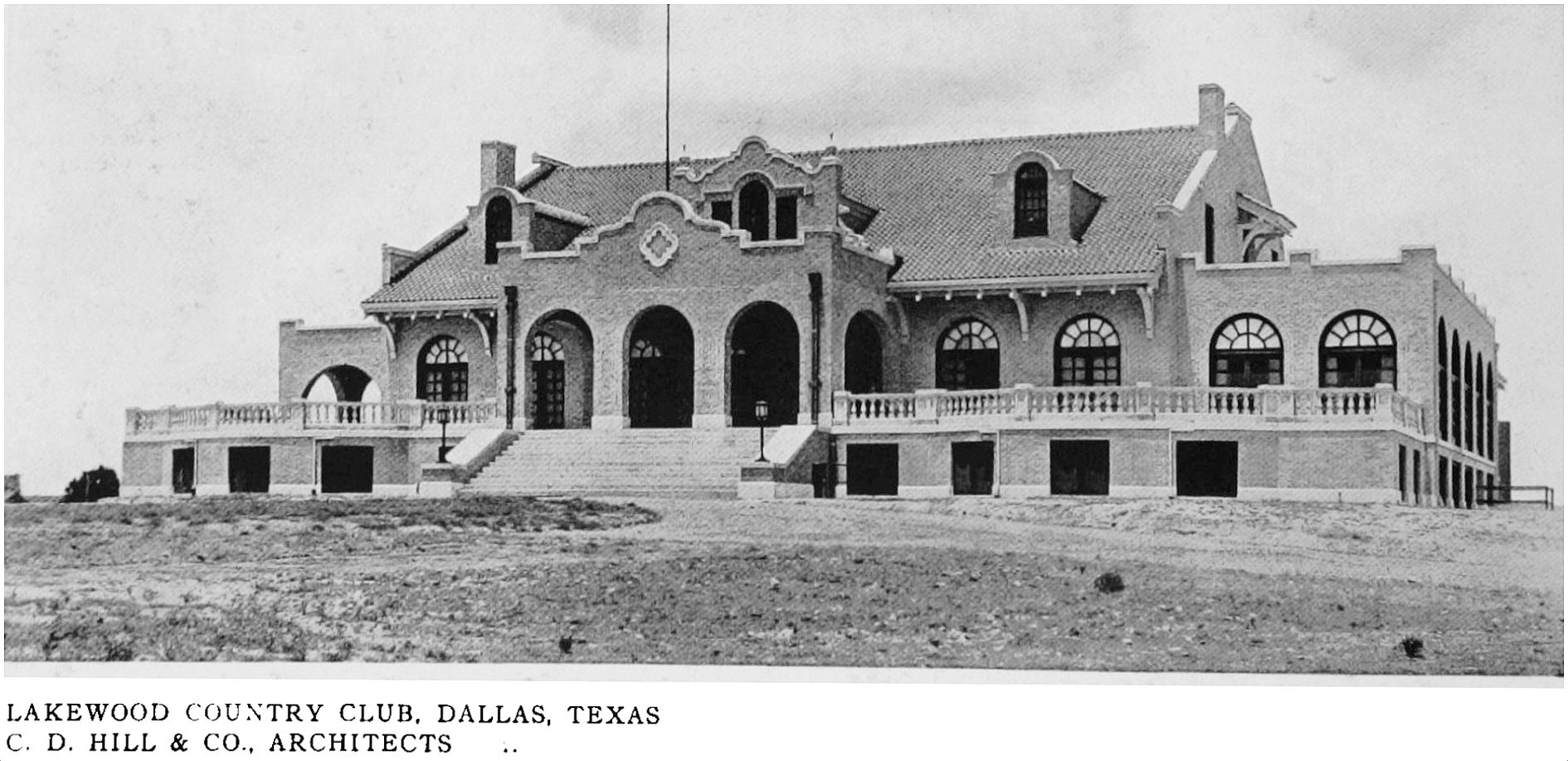
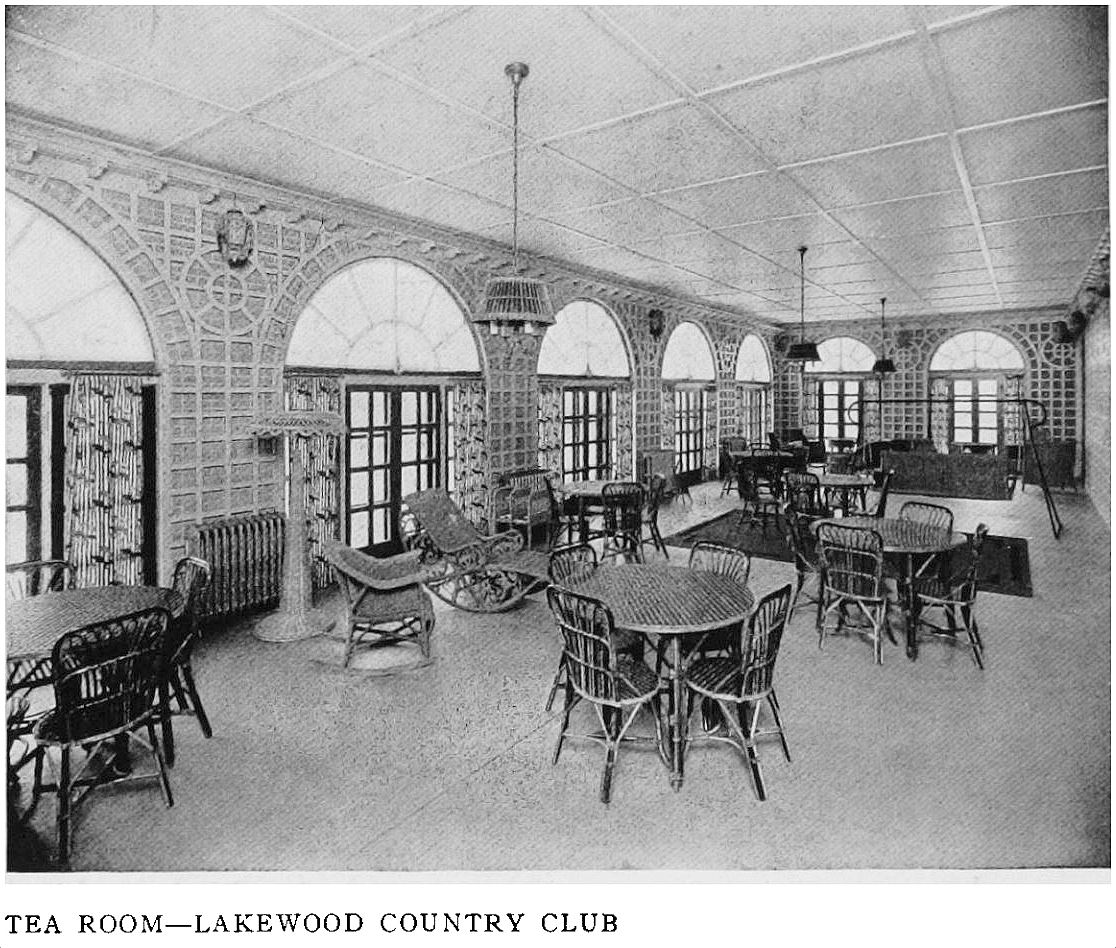
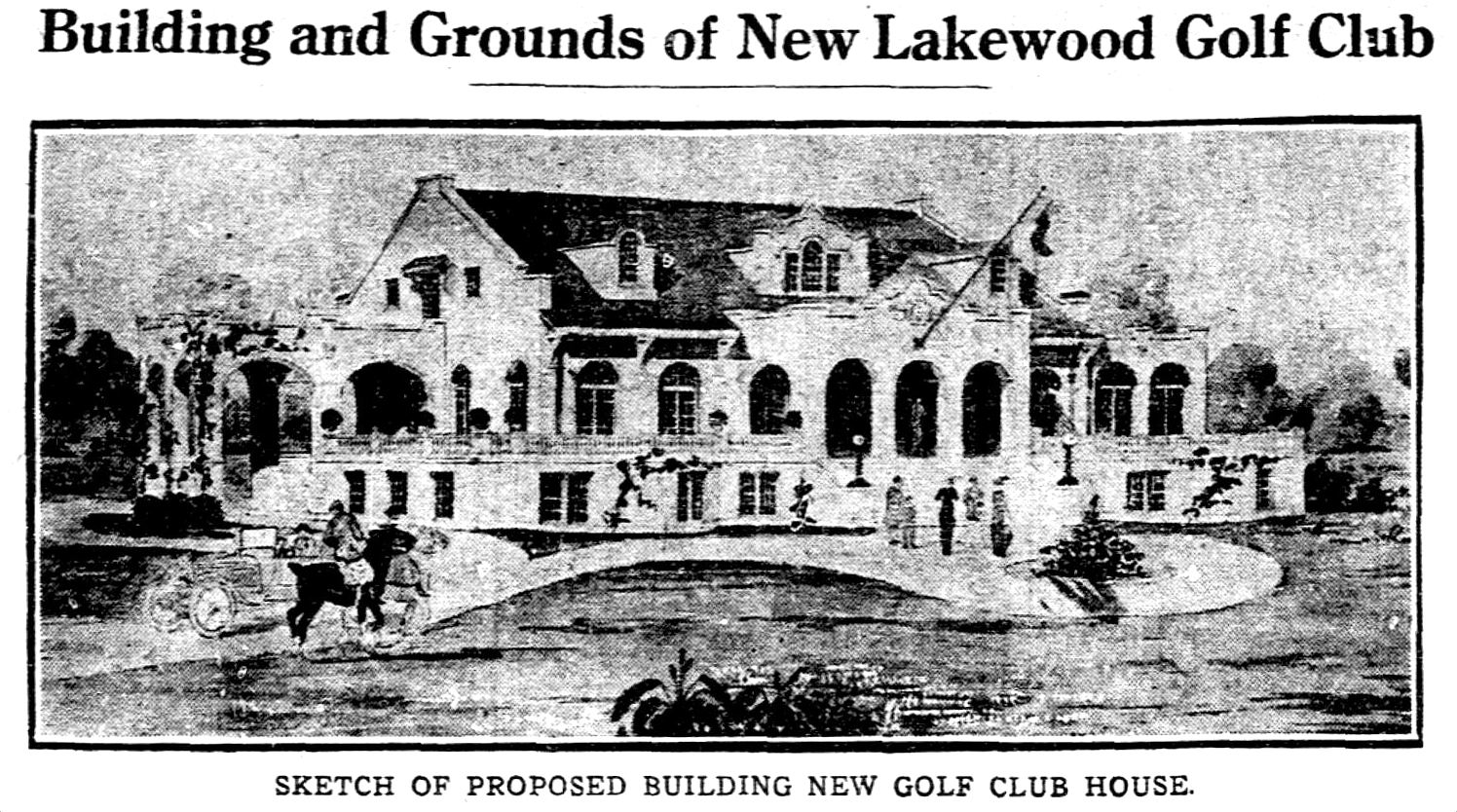
5.  LAKEWOOD COUNTRY CLUB, 6430 Gaston Avenue, clubhouse designed by C. D. Hill. This East Dallas country club and golf course was built in 1913-1914 on 110 acres of “rolling prairie and wooded glades, broken with ravines and set with stately trees that offer puzzling hazards” (it was estimated that there were over 1,000 pecan trees on the land). I don’t know anything about golf, but trying to play a round on this original ravine-ravaged course sounds … exhausting. This large structure (which seems too big to be called a “clubhouse”!) stood in Lakewood until it was demolished at the end of 1959 or beginning of 1960 when a new clubhouse was built. (See it on a 1922 Sanborn map — out in the middle of NOTHING — here. Note that many of the street names have changed over the years, including Abrams, which was once called Greenville Rd.)

lakewood-country-club_western-architect_july-1914

lakewood-country-club_tea-room_western-architect_july-1914

lakewood-country-club_dmn_051813_drawingDallas Morning News, May 18, 1913

*

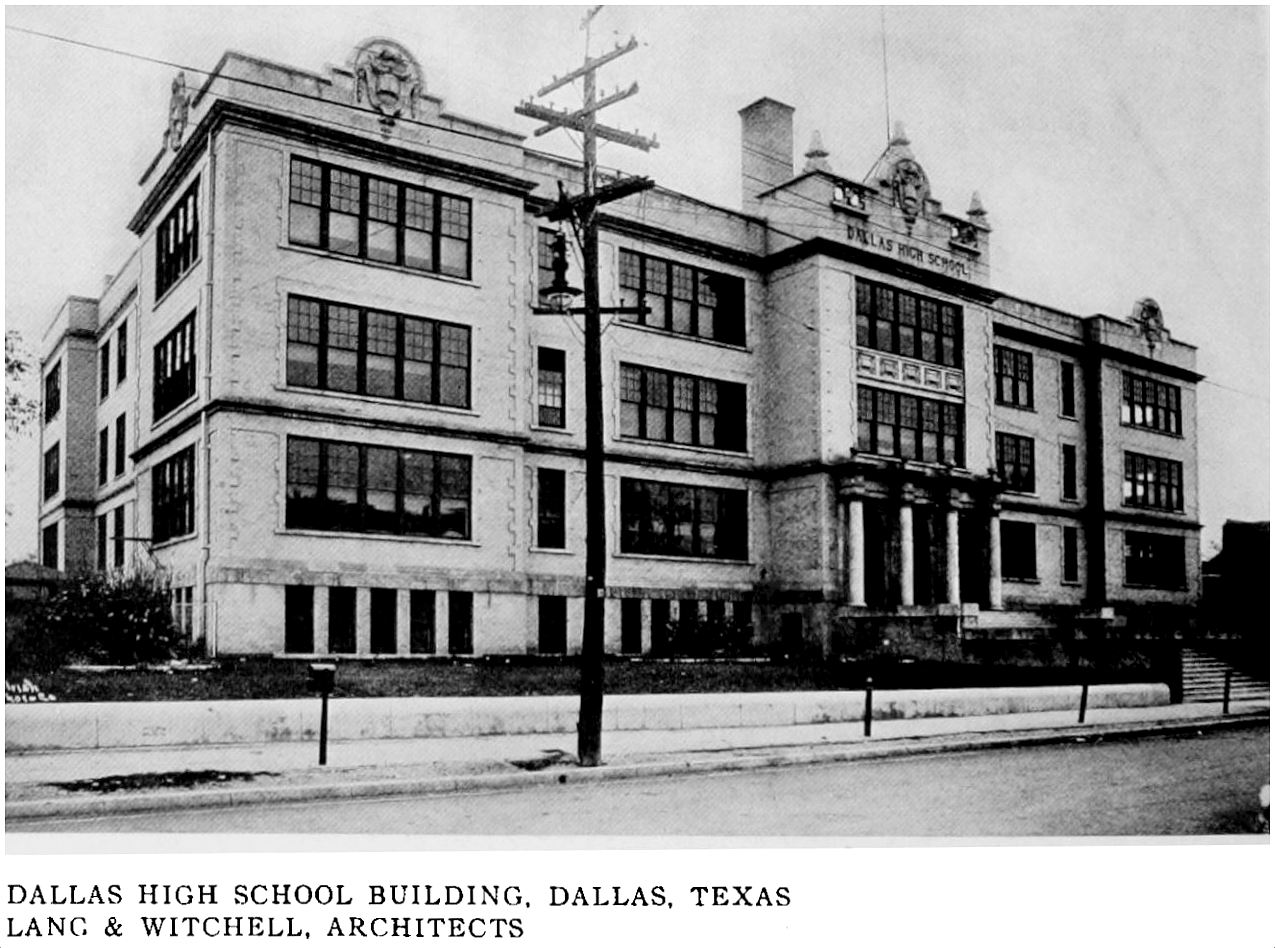
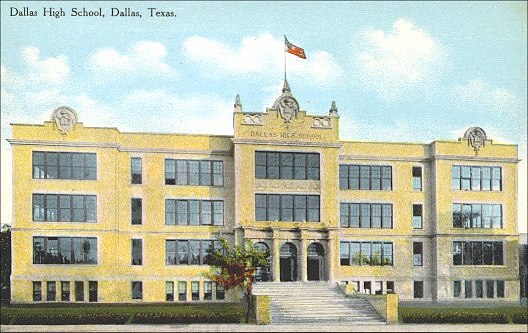
6.  DALLAS HIGH SCHOOL, Bryan & Pearl streets, designed by Lang & Witchell. Located on the site of the previous Dallas High School, this new building was built in 1908. For years Dallas’ only (white) high school, the building expanded over the years and has been known by a variety of names (Dallas High School, Bryan Street High School, Crozier Tech, etc.). I like this description of the original “somewhat novel” color scheme of the classrooms: the ceilings were in cream, the “under wall” in warm green, then the blackboards, and beneath them, the walls, in RED. This building has valiantly managed to survive for 110 years — seemingly forever under threat of demolition — but it still stands and, recently renovated into office space, it appears to have a rosy future. (See the main school building on a 1921 Sanborn map here; the gymnasium is here.)

dallas-high-school_western-architect_july-1914

dallas-high-school_flickr_colteravia Flickr

*

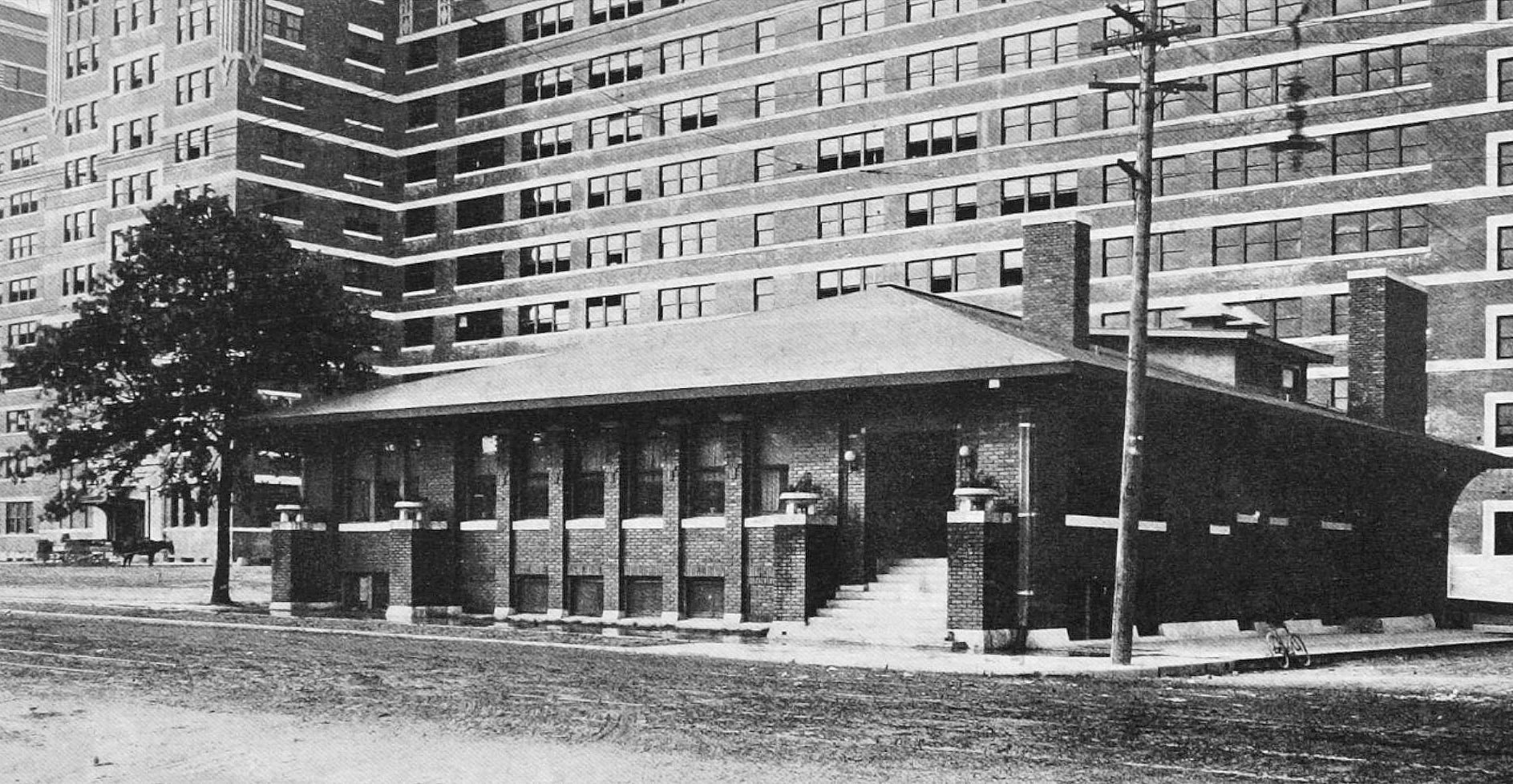
7.  SEARS, ROEBUCK & COMPANY OF TEXAS, EMPLOYEES’ CLUB HOUSE, S. Lamar & Belleview, designed by Lang & Witchell. I love this little building! When plans for the 1913 expansion of the massive Sears warehouse were drawn up, this modest building was to be a (three-story) clubhouse for employees. A description of the not-yet-built expansion included this:

This clubhouse will contain ample cafeteria, dining room and lunch room [space] to accommodate 600 employees at one time. The main cafeteria will be so arranged that it can be turned into an assembly room for the benefit of the employees, having a stage built at one end, and means will be afforded for all variety of social, musical and athletic activities as may be developed by the employees themselves. (Dallas Morning News, Feb. 5, 1913)

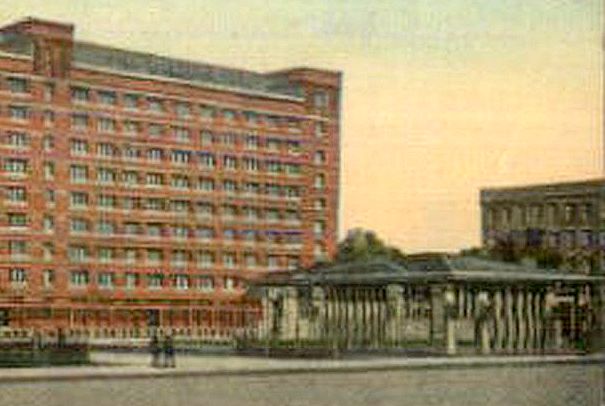
What a perk! But by 1918, Sears had basically outgrown the building (which had ultimately been built as only one story, with a half-basement), and the company offered the use of it to the Dallas YWCA who used it as an “industrial branch” lunchroom/cafeteria (and lounge) in which meals were served to both YWCA members as well as to the general public (including many who worked at Sears). Prices of these wholesome meals served by wholesome girls varied over the years from a nickel to 25 cents — 200-400 patrons were served daily. The building’s half-basement was used as the men’s dining room and as a gymnasium for the YWCA girls (I believe it was also made available to Sears-Roebuck employees). (Read an article about this little “industrial branch” of the YWCA in a Dallas Morning News article from Aug. 15, 1920, here). The YWCA used this Sears building from at least 1918 to 1922. I’m not sure what its use was after the YWCA closed their “Sears-Roebuck Branch,” but I’m delighted to see that it still stands as part of the South Side on Lamar complex. (See the employee club house on a 1921 Sanborn map, here — it appears to be connected to one of the main buildings by a tunnel).

sears-warehouse_western-architect_july-1914_clubhouse-det

sears-roebuck_postcard_ebay_det
Detail of this postcard

**

Next: churches, firehouses, an art gallery, and a hospital (the last installment!).

***

Sources & Notes

The Western Architect, A National Journal of Architecture and Allied Arts, Published Monthly, July, 1914. This issue, with text and critical analysis in addition to the large number of photographs, has been scanned in it entirety by the University of Illinois at Urbana-Champaign as part of its Brittle Books Program — it can be accessed in a PDF, here (the Dallas issue begins on page 195 of the PDF). Thank you, UIUC!

In this 7- part series:

*

Copyright © 2018 Paula Bosse. All Rights Reserved.

Titche-Goettinger, Fashions for the Chic Dallas Woman — 1940s

titches_newton-elkin-shoes_1944_my-vintage-vogue

by Paula Bosse

Just a few 1940s ads for fashions available at Titche-Goettinger, one of many of Dallas’ nicer department stores which made the city a fashion meccas for the chic Texas woman.

Above, a 1944 ad featuring the latest in shoes from Newton Elkin (“two new shoe shades: Tanbark — Cedar Green”): “the sling-back pump with perforated Cleopatra vamp” and “Vicki in brown lizard” (which I sincerely hope someone uses as a song title).

Below, a newspaper ad from 1945 featuring other Newton Elkin shoes, these dressier, with fancy paillettes (sparkly decorations). Perfect to wear with the matching black silk turban. (Click to see a larger image.)

titche-goettinger_nov-19451945

A “Nardis of Dallas” wool suit from 1945, “tomorrow and terrifically smart… in cocoa, rust, black, moss green, and grey.”

titches_nardis-of-dallas_suit_1945_my-vintage-vogue1945

Another “Nardis of Dallas” suit from 1945, this one in “superlative” gabardine: “a suit you’ll wear from swivel chair to swizzle stick… platinum, aqua, lime, red, brown.” Sold separately: a matching hat and slacks (!). “Men prefer it.”

titches_nardis-of-dallas_1945_my-vintage-vogue1945

Speaking of hats: “Sally Victor creates the ‘Big and Little Filly’ for Titche-Goettinger.” …There’s a lot going on up there. (1947)

titche-goettinger_1947_ebay_hats1947

The still-standing Titche’s building at Main and St. Paul was designed by George Dahl in 1929 and was expanded in the 1950s. The women buying these clothes in the 1940s would have shopped at the smaller — though still elegant — store, which looked like this:

titches_unvisited-dallas_jeppsonNoah Jeppson/Unvisited Dallas

When shopping was more sophisticated.

titches-logo_1945

***

Sources & Notes

All color ads from the FABULOUS website My Vintage Vogue, here, here, and here.

Sally Victor ad found on eBay, here.

This doesn’t really fit into the 1940s, but I’ve had this 1955 ad for the Titche’s Shoe Clinic kicking around for a few years — this seems like a good place to slip it in. Platforms removed! Open toes closed! Closed toes opened! Pop down to the basement for all your shoe repair and restyling needs.

ad-titches_shoe-clinic_19551955

Check out other Flashback Dallas posts on Titche’s, here.

Flashback Dallas posts on Nardis of Dallas can be found here and here.

All images are larger when clicked.
*

Copyright © 2018 Paula Bosse. All Rights Reserved.