Flashback : Dallas

A Miscellany: History, Ads, Pop Culture

Category: Leisure

The Dallas Clippers: Early Dallas Baseball

baseball_dallas-clippers_cook-coll_degolyer_smu

by Paula Bosse

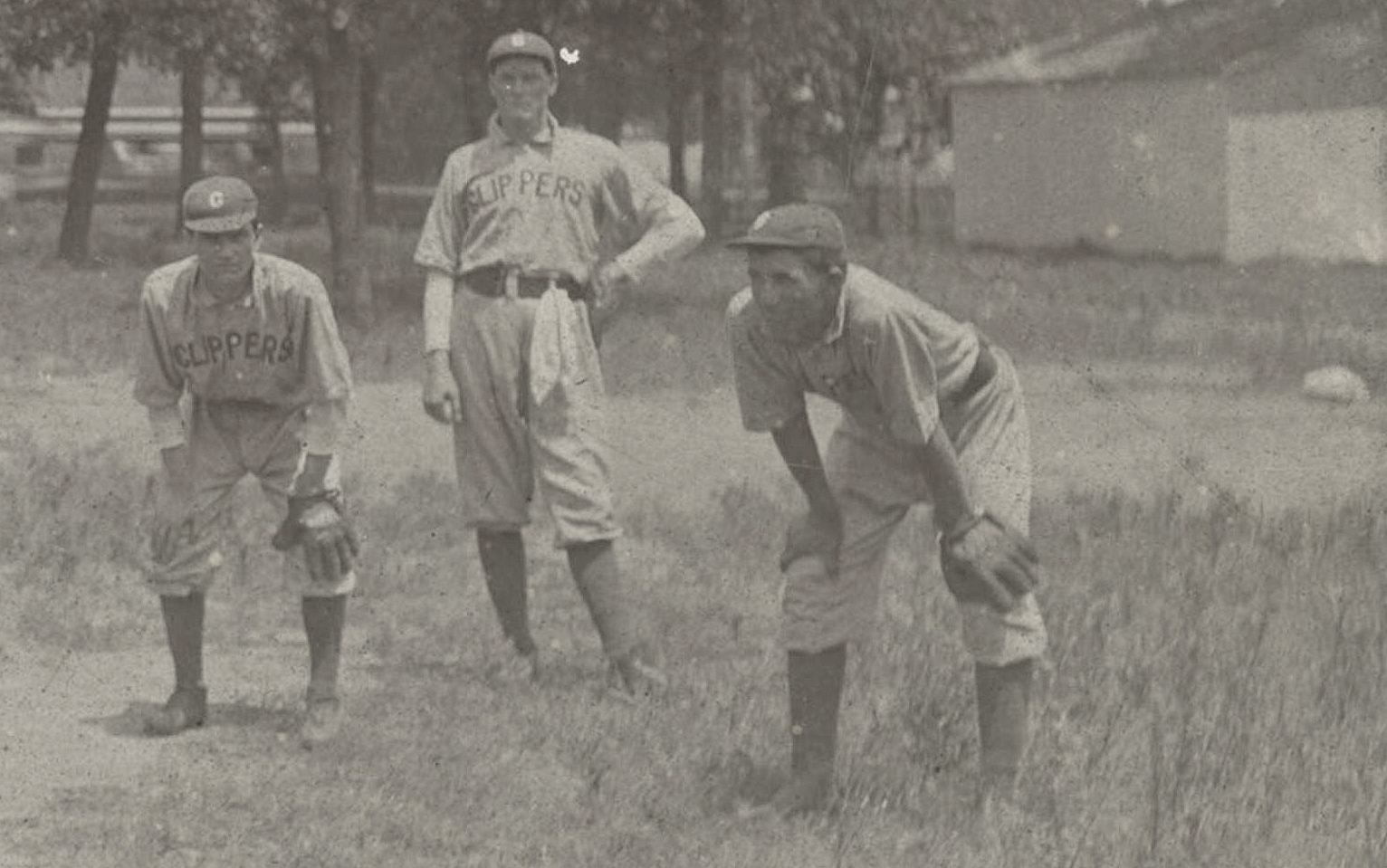
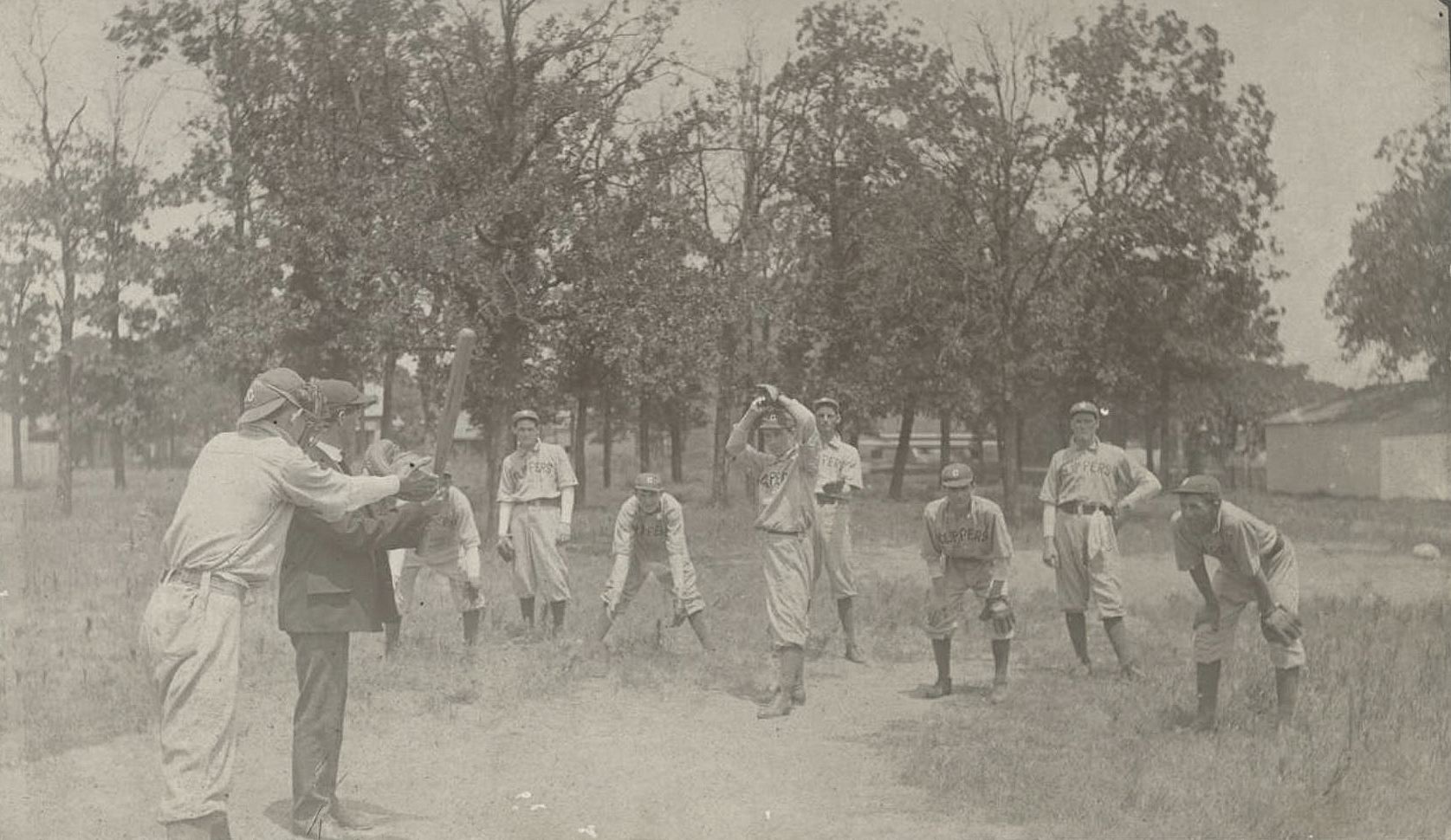
The Dallas Clippers were one of the city’s earliest baseball teams — their games were covered in local papers as early as 1888, and they appear to have played through at least 1905.

I’m not sure what’s going on in this photo. Tryouts? Practice? The stances are interesting — the way they’re holding their gloves (especially the catcher) — the gloves themselves. Cool photo. Here are a few details, a little closer up.

clippers_1

clippers_2

clippers_3

Those gloves are interesting — similar styles can be seen in the Wikipedia entry, here.

clippers_3a

*

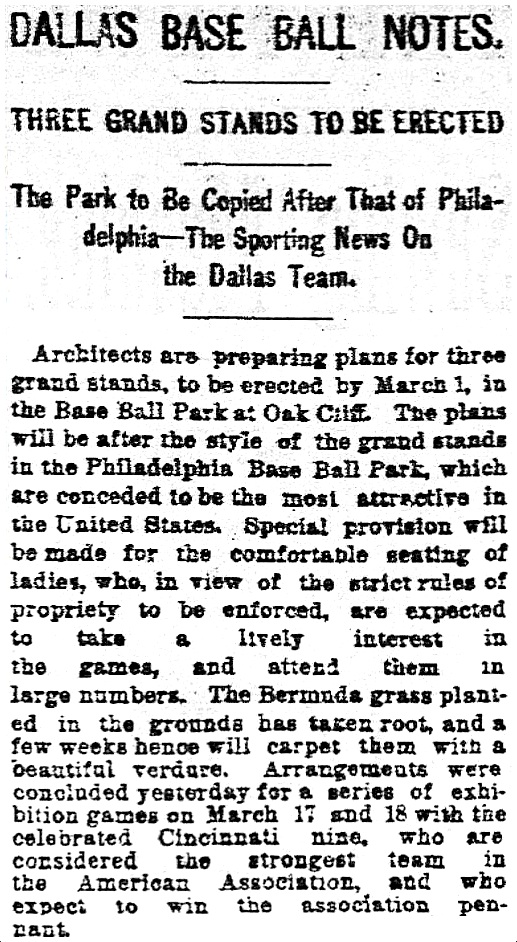
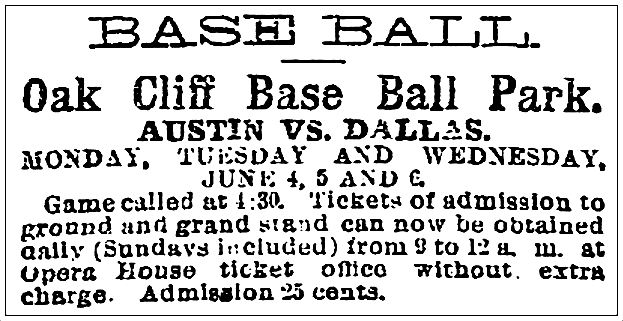
Many early baseball games in Dallas were played at the “base ball park” located in Oak Cliff Park (the park now known as Marsalis Park). A fantastic article on early sports in Dallas (“Gradual Development of the Scope and Popularity of Sports in Texas” — no byline — Dallas Morning News, Oct. 1, 1910) can be read here.)

baseball_oak-cliff-ball-park_dmn_012888
Dallas Morning News, Jan. 28, 1888

baseball_oak-cliff-ball-park_dmn_020388
DMN, Feb. 3, 1888

baseball_oak-cliff-ball-park_dmn_060688
June, 1888

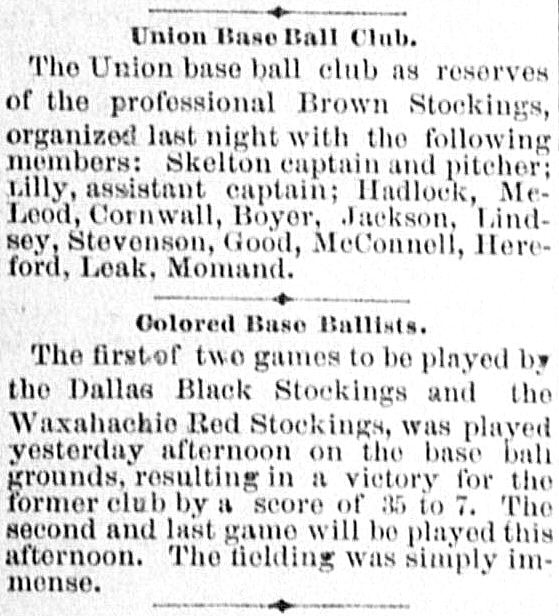
And this interesting little bit of early sports reportage appeared in the pages of the Dallas Herald in 1884, covering both black and white teams:

baseball_dallas-herald_082684
Dallas Herald, Aug. 26, 1884

***

Sources & Notes

Photo “Dallas Clippers Baseball Team” from the George W. Cook Dallas/Texas Image Collection, DeGolyer Library, Central University Libraries, Southern Methodist University; more information on this photo is here.

*

Copyright © 2017 Paula Bosse. All Rights Reserved

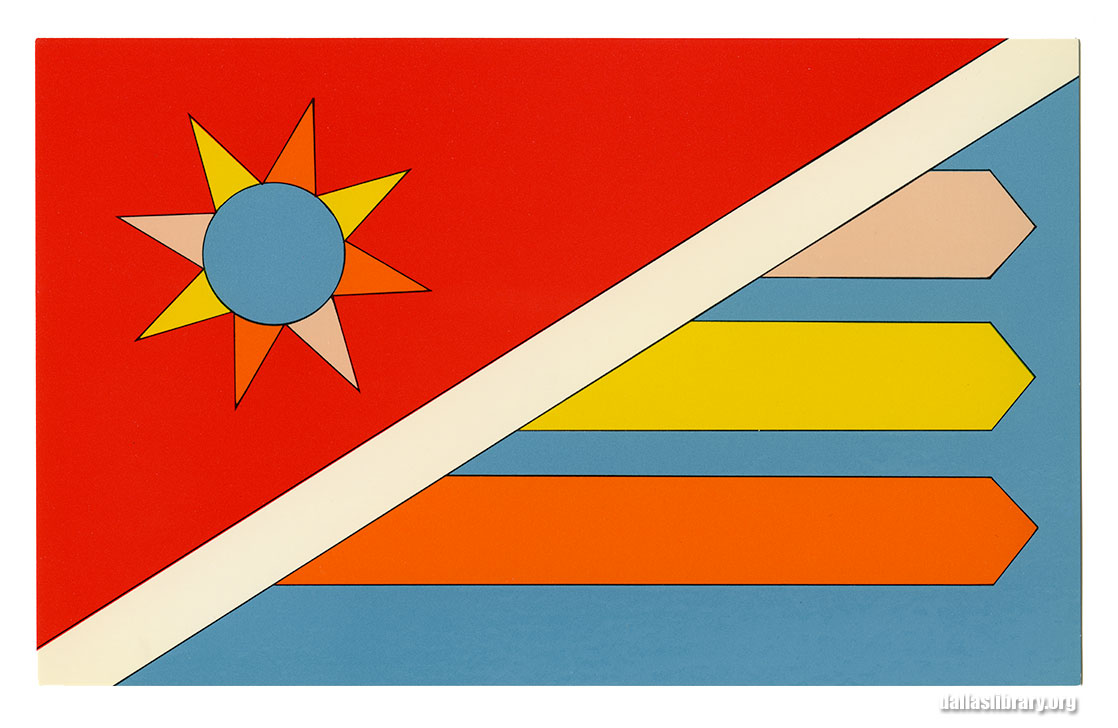
The Neiman-Marcus Corporate Flag, Designed by Emilio Pucci — 1966

neiman-marcus-corporate-flag_emilio-pucci_1966_dallas-public-library“Emilio Pucci was our Betsy Ross…”

by Paula Bosse

While looking through the Neiman Marcus Collection at the downtown Dallas Public Library, I stumbled across this perhaps long-forgotten part of Neiman-Marcus history: the “corporate flag” designed by Italian fashion legend Emilio Pucci. The image was featured on a Neiman’s postcard; the text on the back of the card reads:

Flying high over the fashion land of Neiman-Marcus: our new corporate flag, the Lone-Star-and-Stripes. Emilio Pucci was our Betsy Ross.

Betsy Ross and Emilio Pucci mentioned in the same breath! An 18th-century American seamstress who became a patriotic icon, and an Italian fashion designer whose vividly colorful, boldly patterned designs came to symbolize the youth and energy of the 1960s… talk about your strange bedfellows!

The only thing I could find about this unusually colorful flag was a brief mention in a Dallas Morning News fashion article about Neiman’s 28th Neiman-Marcus Exposition Award in early February of 1966. Gay Simpson wrote in The News that the luncheon centerpieces “carried the colors of the new Neiman-Marcus house flag. The flag, designed by Emilio Pucci, Italian couturier, has the colors of a Texas sunset dramatized with the Lone Star and stripes” (DMN, Feb. 9, 1966).

Stanley Marcus wrote in his 1974 memoir Minding the Store that his business relationship with Pucci (“the most copied designer of our time, aside from Chanel”) began in Italy in 1948 when Marcus met with the struggling young designer and placed an order for several of his scarves. Though Neiman-Marcus had not yet expanded beyond their single department store in Dallas, the store’s reputation and influence were certainly known in fashionable circles around the world, and this N-M “stamp of approval” must have been immensely important to Pucci, whose name was not yet known. This friendship and business relationship blossomed into a mutually beneficial and very profitable partnership, and it seems perfectly reasonable that Pucci would design a flag for his friend and early supporter, Stanley Marcus. (Read more of Marcus’ thoughts on Pucci here.)

There you have it. Who knew?

**

As a postscript, any Dallas blog worth its salt cannot let a mention of Emilio Pucci go by without noting his main connection to the city: Pucci will forever be remembered as the man who brought outrageously colorful and super groovy mod designs to the stewardess uniforms of Dallas-based Braniff International Airways (designs so retinally exciting that they make that little Neiman’s flag look a little dowdy in comparison!).

***

Sources & Notes

The image of the corporate flag is from a Neiman’s postcard, which can be found in the extensive (!) Neiman Marcus Collection of the Dallas Public Library (the back of the card can be seen here); it is used with permission. Thanks to the incredibly helpful staff of the Dallas History & Archives division of the downtown Dallas Public Library. (Much thanks, particularly, to Digital Archivist Misty Maberry!)

*

Copyright © 2017 Paula Bosse. All Rights Reserved.


Roth’s, Fort Worth Avenue

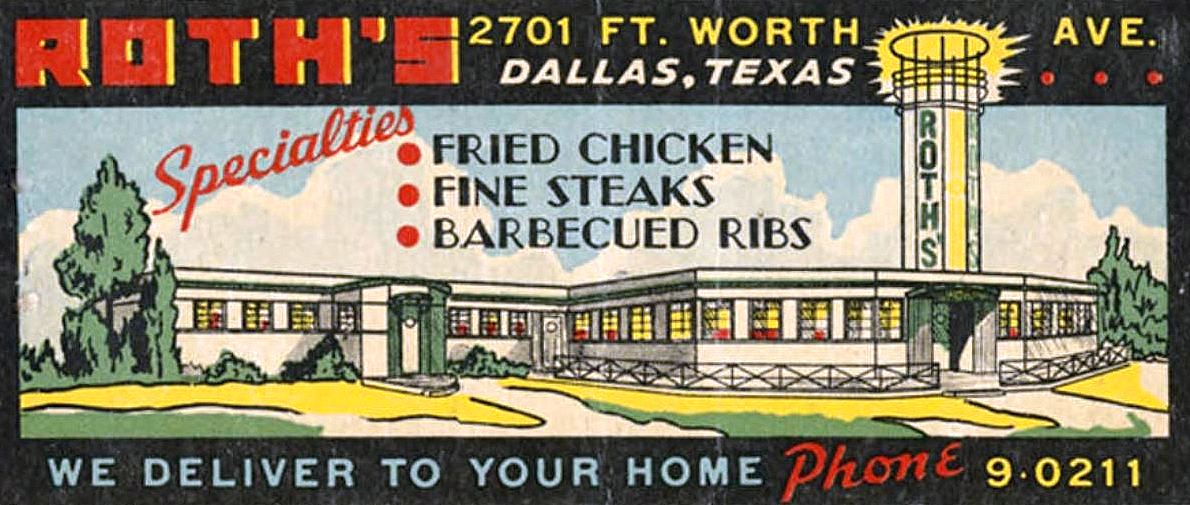
roths_cook-collection_smuSign me up, Mr. Roth…

by Paula Bosse

When I see a building like this, I always hope I can find a photo of it somewhere, but all I’ve been able to come up with is this energetic rendering from a 1940s matchbook cover. Roth’s (which was advertised variously as Roth’s Cafe, Roth’s Restaurant, and Roth’s Drive-In) was in Oak Cliff, on Fort Worth Avenue. It opened in about 1940 or ’41 and operated a surprisingly long time — until about 1967. When Roth’s opened, its address was 2701 Fort Worth Avenue, but around 1952 or ’53 the address became 2601. (I think the numbering might have changed rather than the business moving to a new location a block down the street.)

During World War II, Mustang Village — a large housing development originally built for wartime workers (and, later, for returning veterans and their families) — sprang up across Fort Worth Avenue from the restaurant. It was intended to be temporary housing only, but because Dallas suffered such a severe post-war housing shortage, Mustang Village (as well as its sister Oak Cliff “villages” La Reunion and Texan Courts) ended up being occupied into the ’50s. Suddenly there were a lot more people in that part of town, living, working, and, presumably, visiting restaurants.

As the 1960s dawned, Mustang Village was just a memory, and Roth’s new across-the-street neighbor was the enormous, brand new, headline-grabbing Bronco Bowl, which opened to much fanfare in September 1961. I don’t know whether such close proximity to that huge self-contained entertainment complex hurt or helped Roth’s business, but it certainly must have increased traffic along Fort Worth Avenue.

Roth’s continued operations until it closed in 1967, perhaps not so coincidentally, the same year that Oak Cliff’s beloved Sivils closed. Ernest Roth, like J. D. Sivils, most likely threw in the towel when a series of “wet” vs. “dry” votes in Oak Cliff continued to go against frustrated restaurant owners who insisted that their inability to sell beer and wine not only damaged their own businesses but also adversely affected the Oak Cliff economy. The last straw for Sivils and Roth may have been the unsuccessful petition drive in 1966/1967 to force a “beer election” (read about it here in a Morning News article from Aug. 17, 1966).

As far as that super-cool building seen at the top — I don’t know how long it remained standing, but when Roth’s closed, a mobile home dealer set up shop at 2601 Fort Worth Avenue, and mobile homes need a lot of parking space….

The building on the matchbook cover above is, unfortunately, long gone (as is the much-missed Bronco Bowl); the area today is occupied by asphalt, bland strip malls, and soulless corporate “architecture” (see what 2701 Fort Worth Avenue looks like today, here).

*

The man behind Roth’s was Ernest W. Roth, a Hungarian immigrant who had worked for many years as maître-d’ at the Adolphus Hotel’s tony Century Room. He decided to go out on his own, and around 1940, he and his business partner Joseph Weintraub (who was also his brother-in-law) opened the Oak Cliff restaurant which boasted two dining rooms (with a seating capacity of 350, suitable for parties and banquets), fine steaks, and, on the weekends, a live band and dancing. Ernest’s wife, Martha, and their son Milton were also part of the family business. When the restaurant opened, there wasn’t much more out there on the “Fort Worth cut-off,” but the place must have been doing something right, because Roth’s lasted for at least 27 years — an eternity in the restaurant business. It seems to have remained a popular Oak Cliff dining destination until it closed around 1967.

*

The real story, though, is the Roth family, especially Ernest’s mother, Johanna Roth, and even more especially, his older sister, Bertha Weintraub.

Johanna Rose Roth was born in 1863 in Budapest, where her father served as a member of the King’s Guard for Emperor Franz Josef. She and her husband and young children came to the United States about 1906 and, by 1913, eventually made their way to San Antonio. In the ’40s and ’50s she traveled by airplane back and forth between San Antonio and Dallas, visiting her five children and their families — she was known to the airlines as one of their most frequent customers (and one of their oldest). She died in Dallas in 1956 at the age of 92.

Johanna’s daughter Bertha Roth Weintraub had a very interesting life. She too was born in Hungary — in 1890. After her husband Joe’s death in the mid ’40s, a regular at her brother’s restaurant, Abe Weinstein — big-time entertainment promoter and burlesque club empresario — offered Bertha a job as cashier at the Colony Club, his “classy” burlesque nightclub located across from the Adolphus. She accepted and, amazingly, worked there for 28 years, retiring only when the club closed in 1972 — when she was 82 years old! It sounds like she led a full life, which took her from Budapest to New York to San Francisco to San Antonio to Austin and to Dallas; she bluffed her way into a job as a dress designer, ran a boarding house in a house once owned by former Texas governor James Hogg, hobnobbed with Zsa Zsa Gabor and Liberace, was a friend of Candy Barr, and, as a child, was consoled by the queen of Hungary. She died in Dallas in 1997, a week and a half before her 107th birthday. (The story Larry Powell wrote about her in The Dallas Morning News — “Aunt Bertha’s Book Filled With 97 Years of Memories” (DMN, Nov. 17, 1987) — is very entertaining and well worth tracking down in the News archives.)

weintraub-bertha-roth_texas-jewish-post_021590
Bertha Roth Weintraub

I feel certain that the extended Roth family found themselves entertained by quite a few unexpected stories around holiday dinner tables!

***

Sources & Notes

Matchbook cover (top image) is from the George W. Cook Dallas/Texas Image Collection, DeGolyer Library, Central University Libraries, Southern Methodist University; more info is here.

Photo of Bertha Weintraub is from The Texas Jewish Post (Feb. 15, 1990), via the Portal to Texas History, here.

*

Copyright © 2017 Paula Bosse. All Rights Reserved.

1710 Hall: The Rose Room/The Empire Room/The Ascot Room — 1942-1975

rose-ballroom_aug-1942_cook-collection_degolyer_smuThe Rose Ballroom, 1942

by Paula Bosse

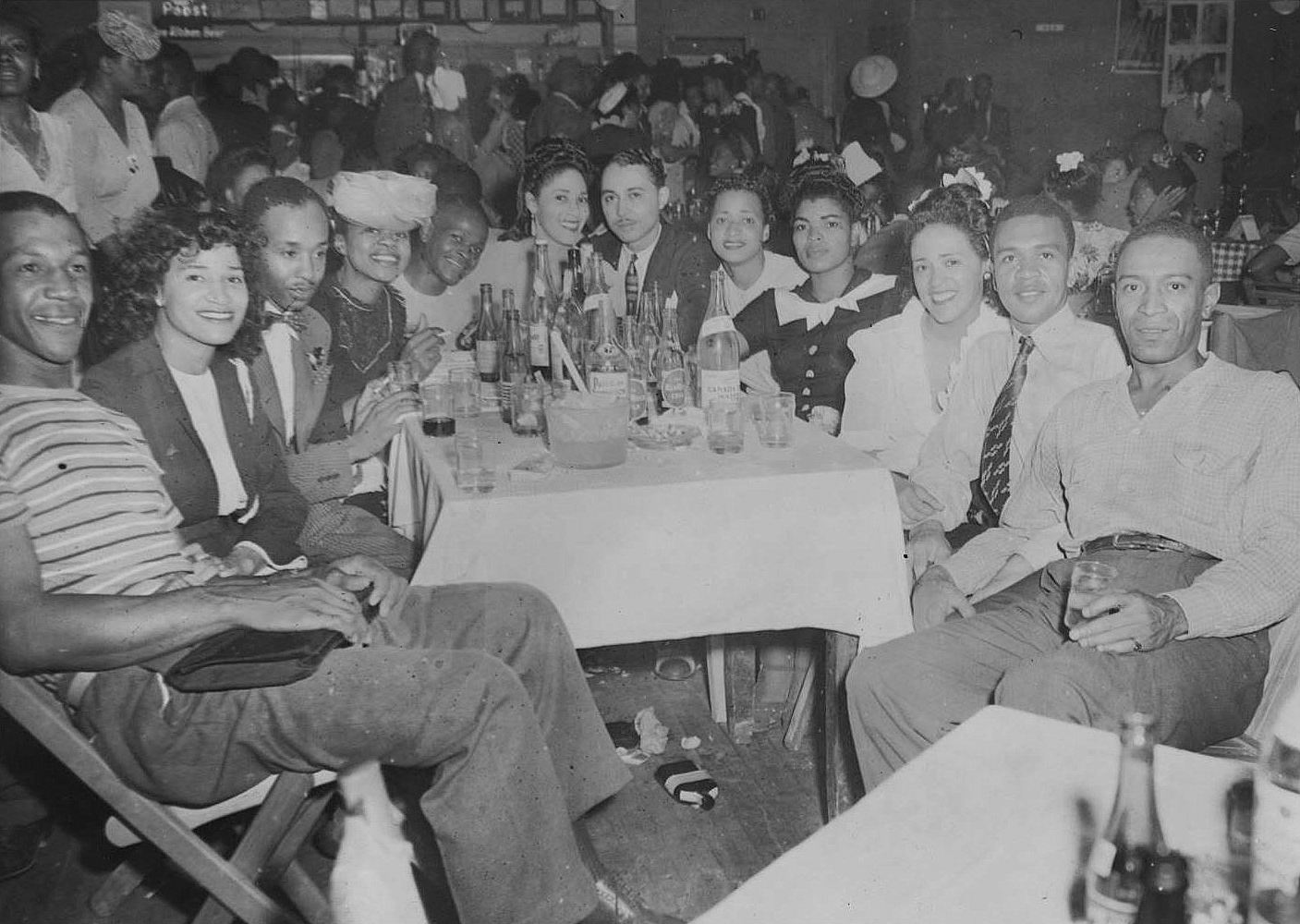
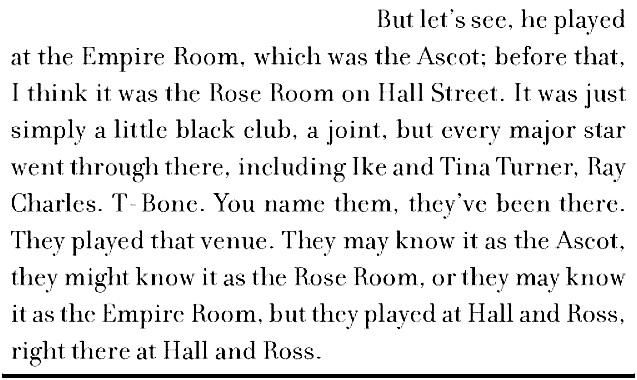
The photo above was taken at the Rose Ballroom at 1710 Hall Street (a few steps off Ross Avenue) in August, 1942. 1710 Hall was the home to a string of very popular black nightclubs: the Rose Ballroom (1942-1943), the Rose Room (1943-1951), the Empire Room (1951-1969) (not to be confused with the nightclub of the same name in the Statler Hilton), and the Ascot Room (1969-1975). There seems to have been some overlap of owners and/or managers and/or booking agents, but they all appear to have been very popular “joints” (as described by Freddie King’s daughter), where both big-name touring musicians as well as popular local acts played. Icons T-Bone Walker and Ray Charles were regulars (there are stories of Ray Charles sleeping on the Empire Room’s stage during the time he was living in Dallas in the ’50s). Everybody seems to have played there. Below, a quote from Wanda King, talking about her father, blues legend Freddie King — from the book Texas Blues: The Rise of a Contemporary Sound by Alan Govenar (all clippings and photos are larger when clicked):

rose-room_freddie-king_wanda-king_texas-blues_govenar

Some of the acts scheduled to appear in early 1946 at the Rose Room were Erskine Hawkins, Louis Armstrong, Lionel Hampton, Buddy Johnson, and Andy Kirk. …Wow.

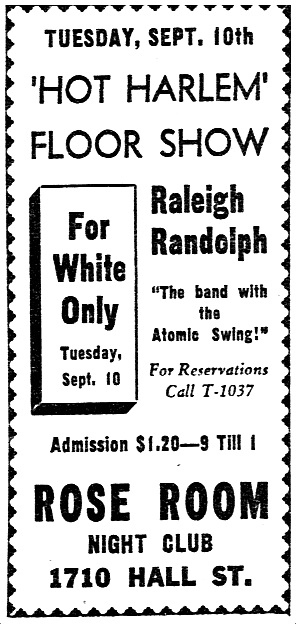
In the days of segregation, when Dallas police threatened to shut the club down if the owner allowed white patrons to mix with black patrons, the club scheduled “white only” nights where Caucasian audiences could see their favorite non-Caucasian performers. (Before these special club nights, which seem to have started in 1945, a revue would be taken “on the road” — over to the Majestic Theatre on Elm Street — to perform live onstage.)

rose-room_dmn_092945-ad
1945

rose-room_dmn_090846_ad
1946

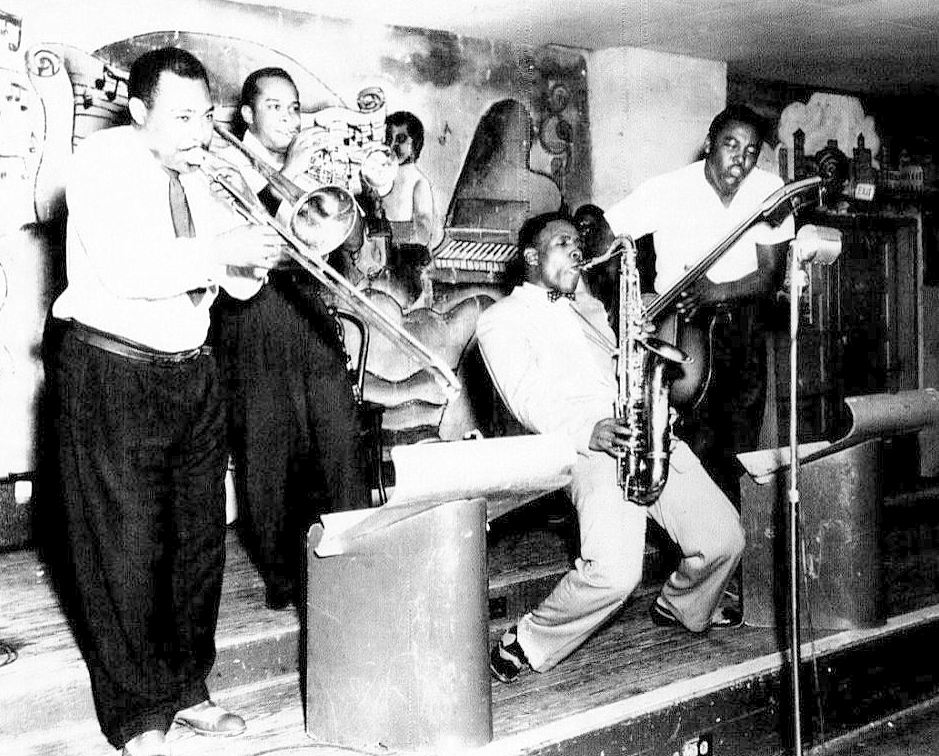
The photo up there at the top showed the audience — here’s the stage (1946 photo of the E F Band by Marion Butts, from the Marion Butts Collection, Dallas Public Library):

rose-room_the-e-f-band_marion-butts_dpl_1946

And here’s what the stage looked like when the club became the Empire Room (onstage is Joe Johnson in a 1954 photo by R. C. Hickman, taken from a great article about Hickman in Texas Highways, here):

empire-room_joe-johnson_1954_r-c-hickman_tx-highways_020299

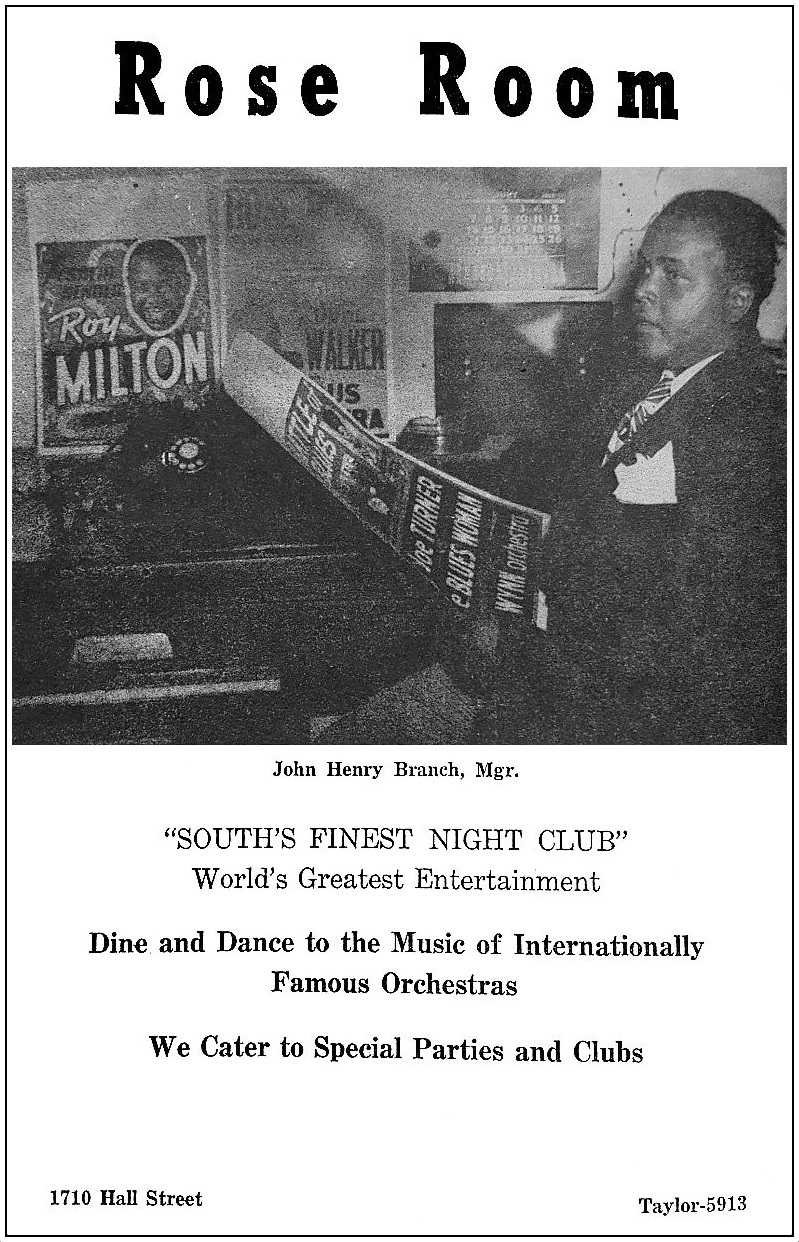
One thing that probably helped set the Rose Room/Empire Room apart from a lot of the other clubs in town at this time was the man who booked the shows — and who booked acts all over the area: John Henry Branch. The guy knew everyone. Here he is in an ad from 1947:

rose-room_1947-1948-negro-directory_dallas

Aside from booking acts and musicians for black clubs, he also booked acts for white clubs — including Jack Ruby’s Carousel and Vegas clubs. In fact, Branch chatted with Ruby at the Empire Room the night before Ruby shot Oswald — Ruby had come in to check on a piano player Branch was booking for a gig at the Vegas Club in Oak Lawn. Branch supplied testimony to the Warren Report, and while it’s not all that riveting (because there wasn’t that much to tell), it’s still interesting to hear how Branch describes his own club and Ruby’s personality (“You can’t never tell about him — he’s a weird person.”) — you can read his testimony here.

I have to admit, I’d never heard of the Rose Room or the Empire Room before I saw the photo at the top of this post. I really missed out. So much fantastic music! And I missed it. It’s just another reminder that Dallas has an incredible music history.

rose-room_texas-blues_govenar-brakefieldfrom the Texas African American Photography Archive

rose-room_1944-45-directory_hall-street
1700 block of Hall Street, 1944-45 city directory

What’s at 1710 Hall these days? A vacant lot — soon to be developed, no doubt. Ross Avenue ain’t what it used to be….

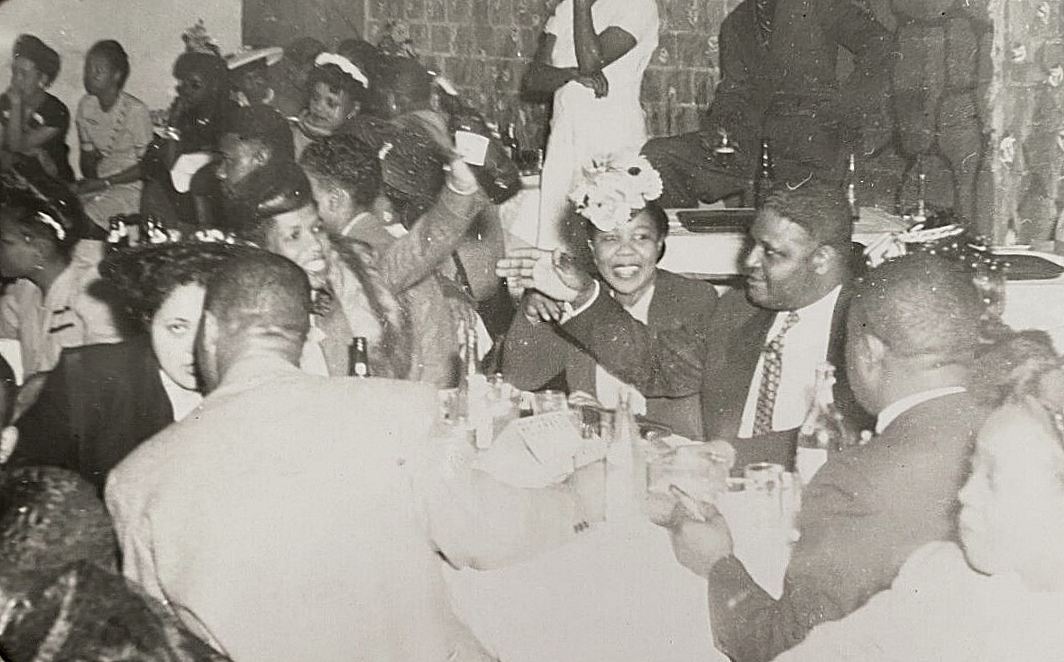
rose-room_photo_green-cover_ebayeBay

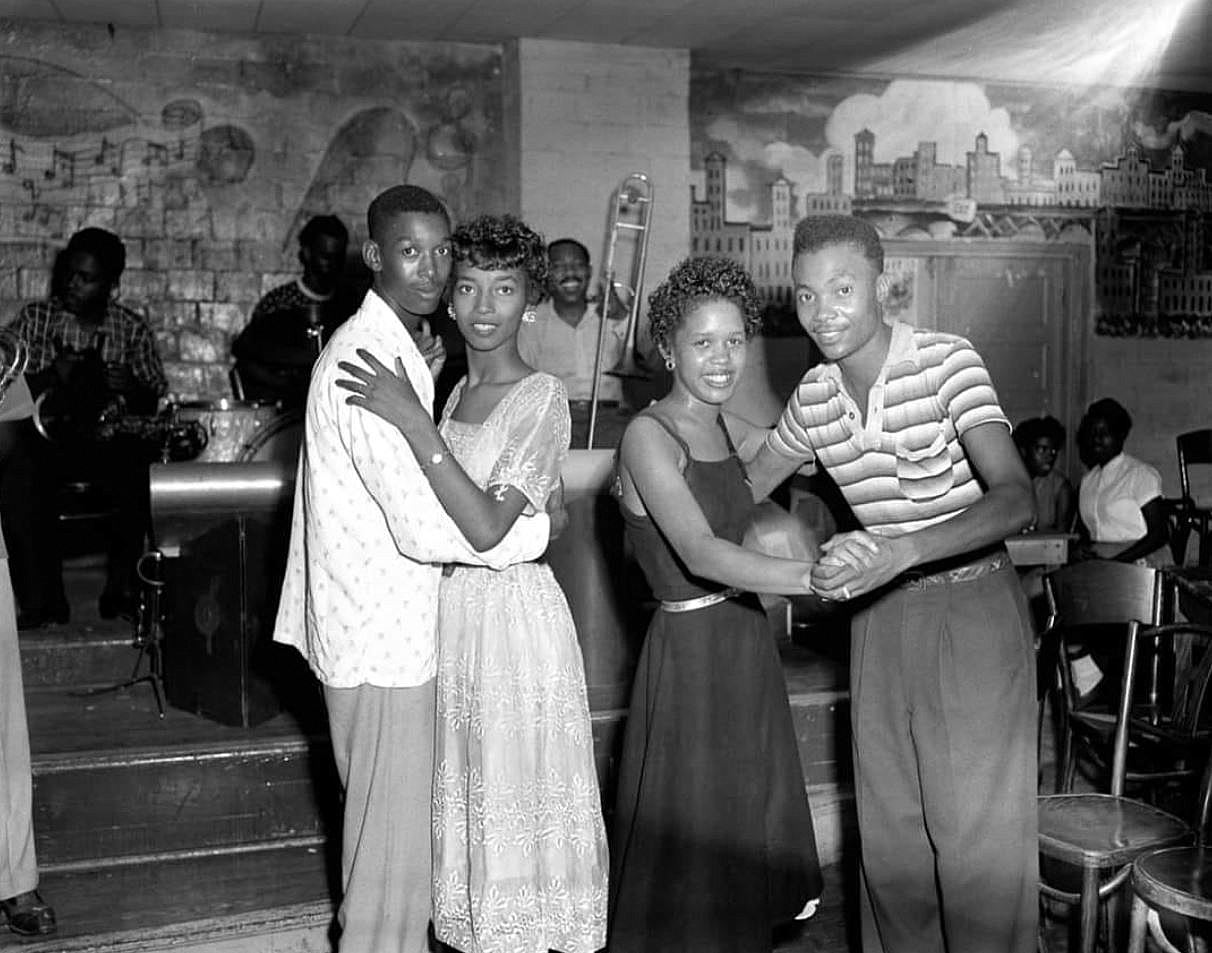
empire-room_teenage-dance_hickman_080656Teen dance, Aug. 6, 1956 (photo by R. C. Hickman)

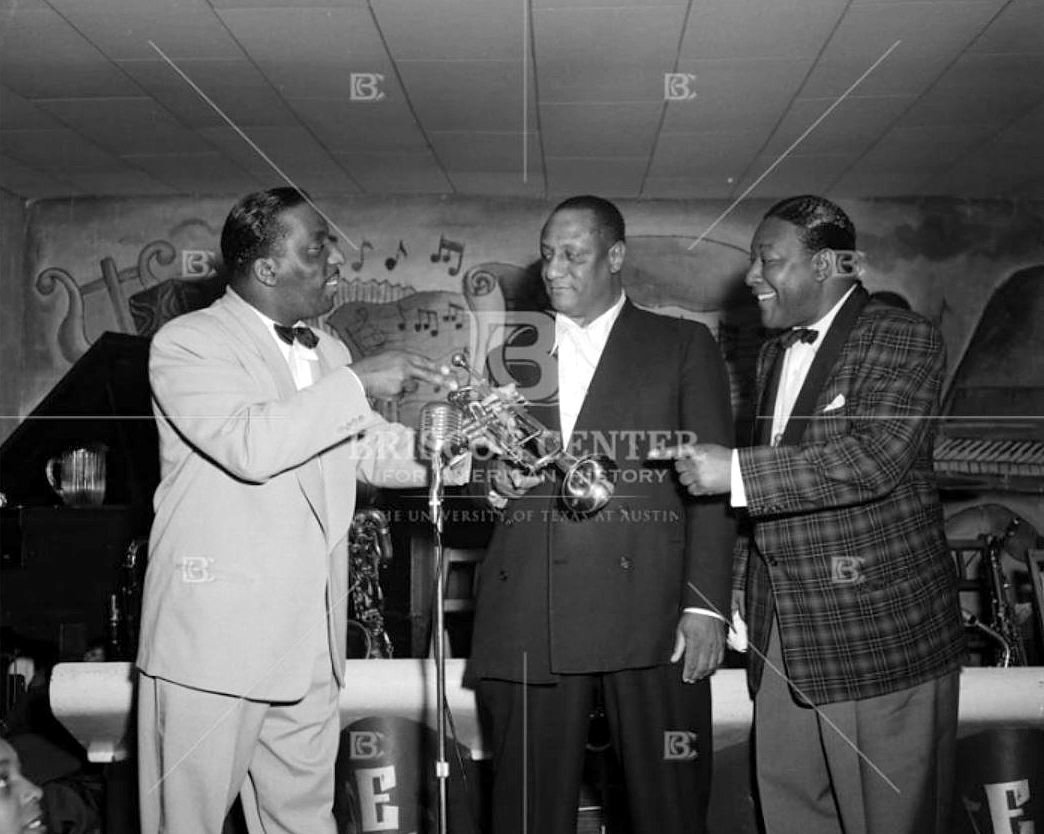
empire-room_l-g-mccutcheon_hickman_042351_briscoe-center_watermarkApr. 23, 1951 (photo by R. C. Hickman, Briscoe Center, Univ. of TX)

**

UPDATE: After many fruitless attempts to find a photo of the exterior of this building, I stumbled across it in a 1973 filmed report from KERA, recently uploaded by the G. William Jones Film and Video Collection at SMU. Below is a screenshot showing the Ascot Room a couple of years before it finally closed, looking a little worse for wear. The 8-minute film (which you can watch here) shows tons of locations in the Black neighborhoods of South Dallas (along Forest Avenue/MLK Blvd.) and “North Dallas” (along Hall Street) — the Ascot Room can be seen briefly at the 1:46 mark. (More on this film can be found in the Flashback Dallas post “Black Dallas — 1973.”)

ascot-room_june-1973_kera-collection_jones-collection_SMUAscot Room, 1973 (screenshot, Jones Collection, SMU)

***

Sources & Notes

Top photo from the George W. Cook Dallas/Texas Image Collection, DeGolyer Library, Central University Libraries, Southern Methodist University; more info on this photo is here. Someone has written this on the photo: “Aug. 42, Dallas, Rose Room” — in August, 1942 the club was known as the Rose Ballroom; it changed its name to the Rose Room in early 1943.

1973 screenshot is from a 1973 film (my guess is that it was broadcast on Channel 13’s “Newsroom”) from the KERA Collection, G. William Jones Film and Video Collection, Hamon Arts Library, Southern Methodist University.

Wanda King quote is from the book Texas Blues: The Rise of a Contemporary Sound by Alan Govenar (College Station: Texas A & M University Press, 2008).

Rose Room ad featuring John Henry Branch is from the 1947-48 Dallas Negro City Directory (with thanks to Pat Lawrence!).

More about the hopping Hall Street area can be found in the Flashback Dallas post “Life on Hall Street — 1947,” here.

*

Copyright © 2017 Paula Bosse. All Rights Reserved.

Neiman-Marcus Toy Department — 1965

n-m_toys-northpark_1965_marcus-papers_degolyerThat kangaroo is fab… (click to see it bigger!)

by Paula Bosse

This photo shows the world’s least-cluttered toy department at the then-new Neiman’s store at the then-new NorthPark mall. What were the well-heeled tots of 1965 playing with? Model castles, stuffed tigers, dolls, robots, and kangaroo-shaped slides.

***

This photo — “Toy Department, Neiman Marcus, NorthPark”– is from the Stanley Marcus Papers, DeGolyer Library, Central University Libraries, Southern Methodist University; more info on the photo can be found here.

*

Copyright © 2017 Paula Bosse. All Rights Reserved.

The Praetorian Building and Its 19th-Century Neighbors

praetorian_empire_main-street_postcard_ebay_detIn the shadow of the Praetorian —  Main Street, 1907

by Paula Bosse

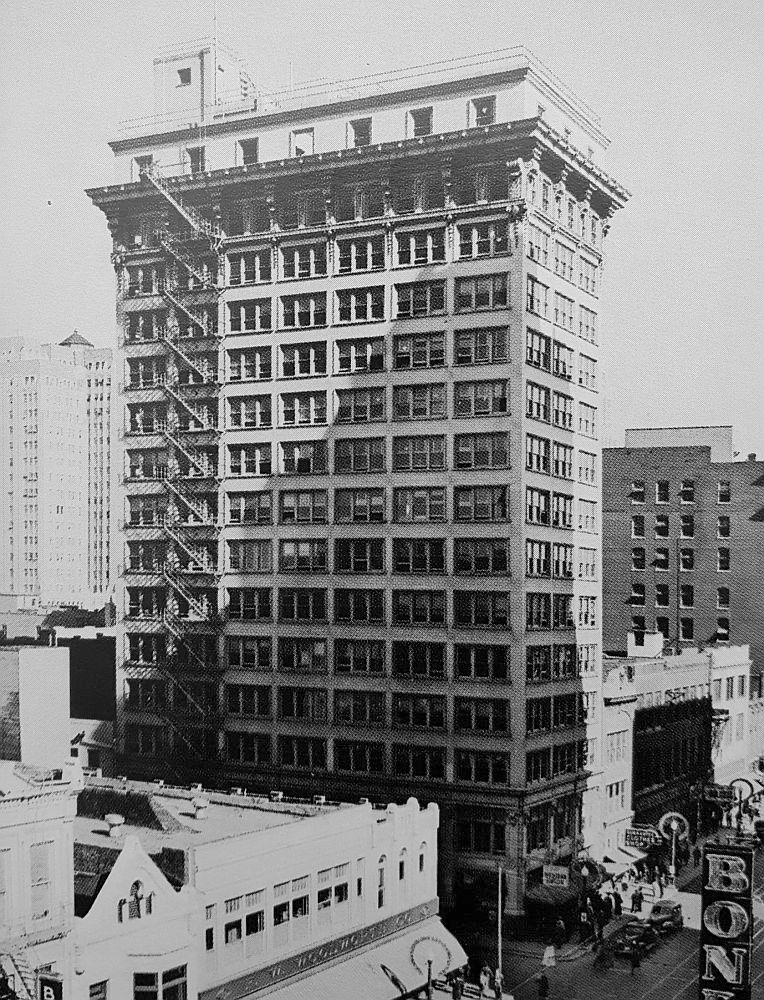
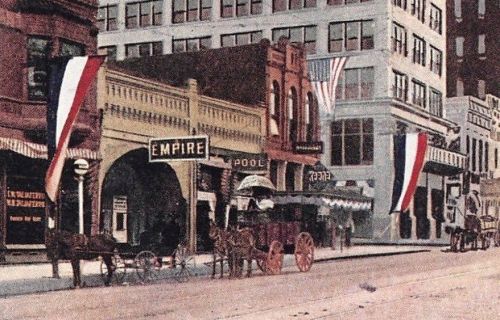
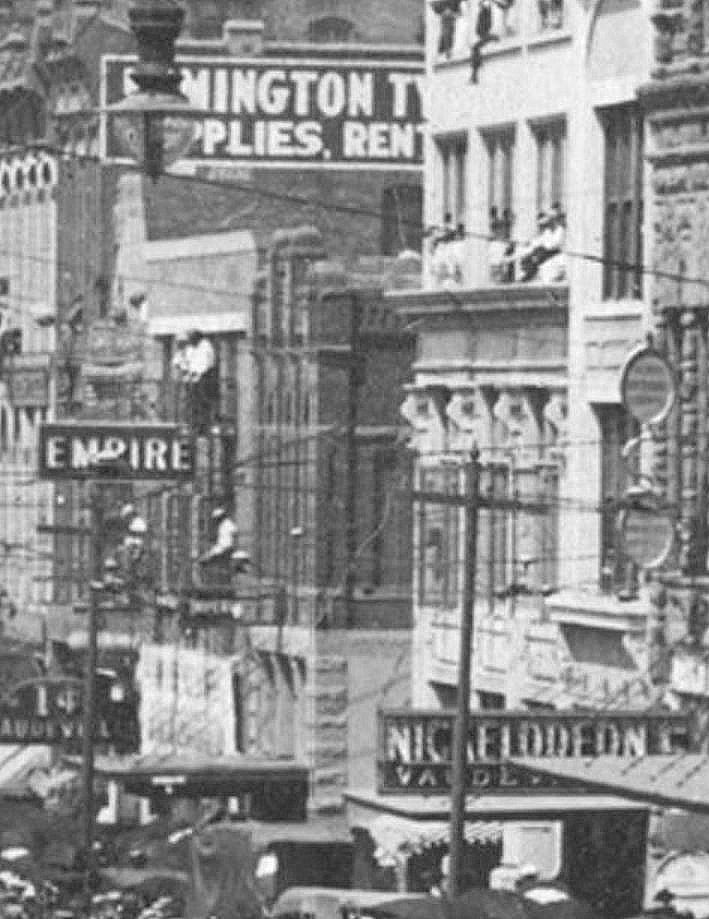
The photo below is a detail of a larger photo from the George W. Cook Collection treasure trove at SMU’s DeGolyer Library, which shows the Praetorian Building under construction. It appeared on a real-photo postcard which shows a postmark of July 25, 1907. What I found most interesting about this photo are the two buildings standing in its shadow, just west of Stone Street (now Stone Place). Here’s a close-up (click to see a larger image):

empire-imperial-praetorian_1907_cook-collection_SMU_det

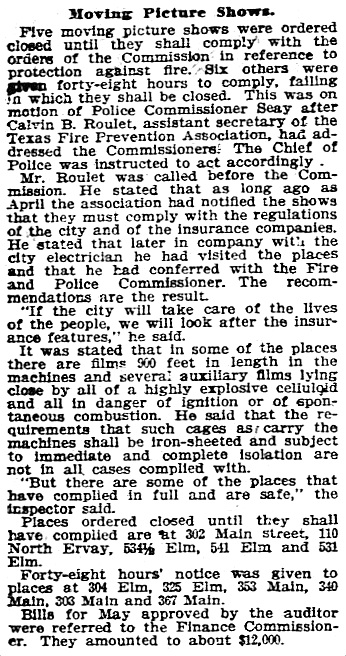
I knew that the building with “Imperial Bar” on the side is still standing (the Sol Irlandes restaurant at 1525 Main has been its occupant for several years), but I wondered about the one with the “Empire” sign. It took a bit of digging, but I’m happy to report that it was a very early movie theater. I had determined that the address of the building with the Empire sign was 353 Main Street (in what is today the 1500 block of Main) and found this article from 1907 about officials closing down “moving picture shows” which had not complied with fire precautions in the storing and projection of highly flammable celluloid film — one of these movie houses was at 353 Main (clippings and photos are larger when clicked):

fire-code-violations_moving-pictures_dmn_062507
Dallas Morning News, June 25, 1907

Below is a clipping from the Dallas city directory issued in 1907 — the first year a special “Moving Pictures” category was included in the directory.

1907-directory_harris-empire
1907 Dallas directory

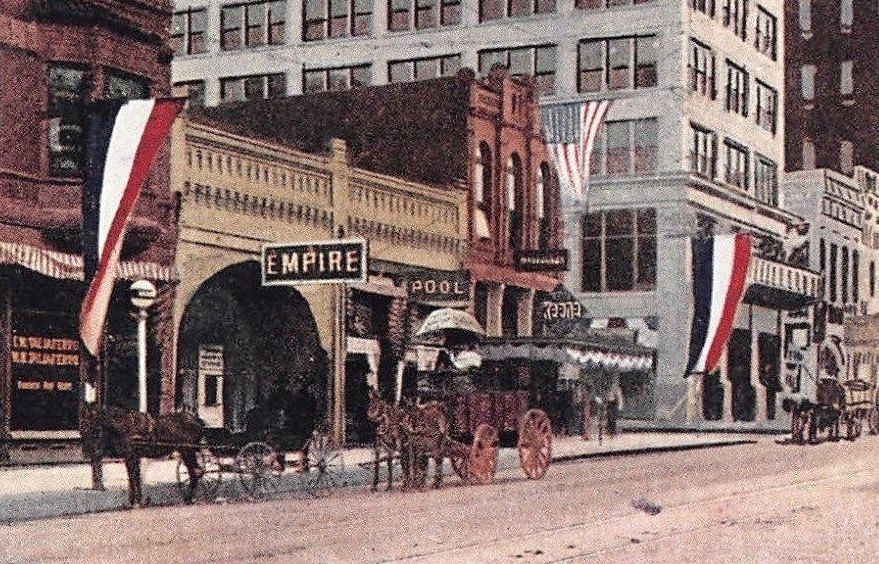
These “picture shows” were listed not by theater name (if they had one), but by owner or manager. (This was the era of nickelodeons, which were not so much “theaters” as “viewing rooms” — a great article from 1908 about the sudden surge in popularity of the nickelodeon — what they were and what they were like — can be read here.) The theater at 353 Main was owned by Charles B. Harris (usually referred to as C. B. Harris, who had previously worked as a wholesaler for the Edison Phonograph Co. a couple of doors down the block). When the picture above was taken, the Empire was showing movies at 353 Main, men were playing pool for 45¢ an hour at the New Brunswick Billiard Hall next door at 355 Main, and Bartholomew Lynch was running the Imperial Bar on the corner, at 357 Main.

pool-hall_355_dmn_041307
DMN, April 13, 1907

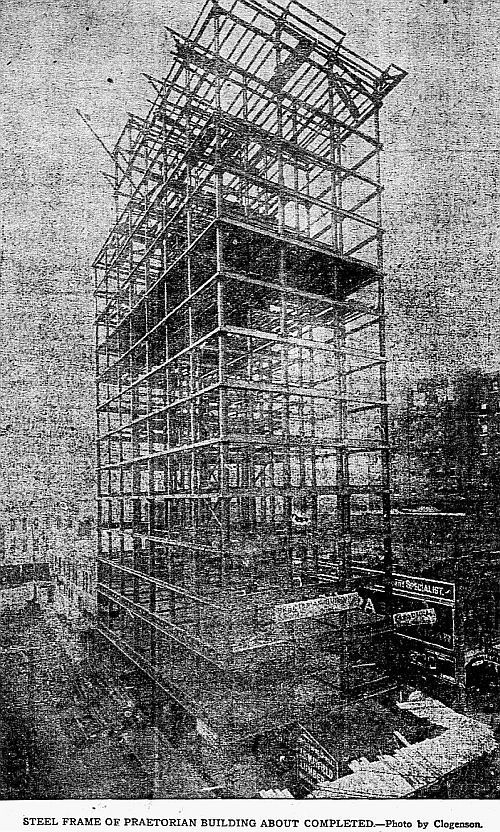
Construction of the C. W. Bulger-designed Praetorian Building — Dallas’ first skyscraper (14 stories!) — had begun in September, 1906. Here’s what it looked like in March, 1907:

praetorian_construction_dmn_031707
DMN, March 17, 1907

And here it is shortly after completion:
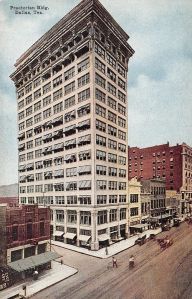
praetorian-building_main-street_postcard_ebay

In January, 1909, C. B. Harris decided to expand up and into the space next door. The Empire Theater stopped showing movies, and in March, 1909, it became a venue for live stage productions.
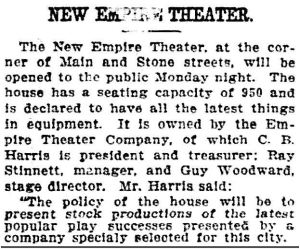
empire_dmn_032109_opening
DMN, March 21, 1909

Here are a few photos showing the Empire and the finished Praetorian Building, around 1909. The first one may be one of the few to show the short-lived Colonial Theater (352 Main), a vaudeville house, across the street.
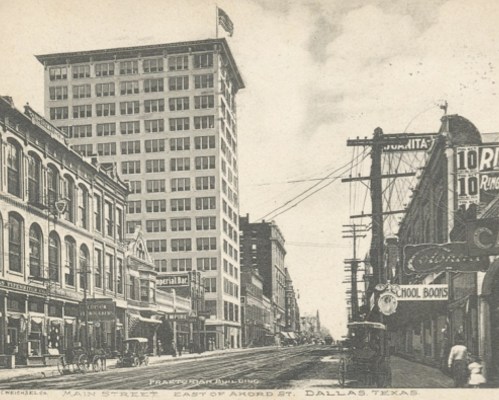
empire-imperial-praetorian_flickr_colteravia Flickr

Here is another postcard view, showing the Empire (the detail of this image is at the top of this post).
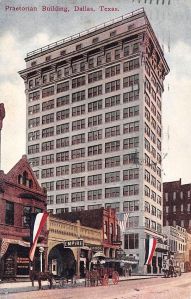
praetorian_empire__main-street_postcard_ebay

Below, a detail of a larger photo, also from around 1909.
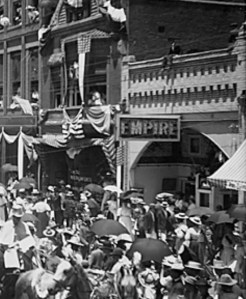
empire_ca-1908_parade_flickr

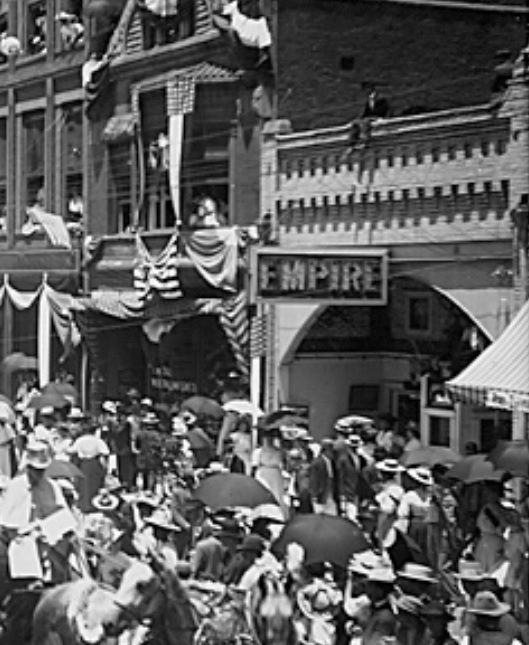
And below, a detail from a larger photo, with spectators watching a parade in August, 1909, showing the Empire with its new construction.
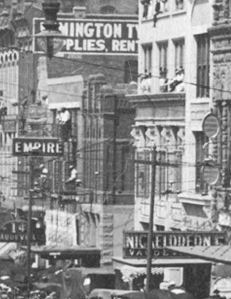
empire_parade-day_1909_degolyer_SMU_close-up

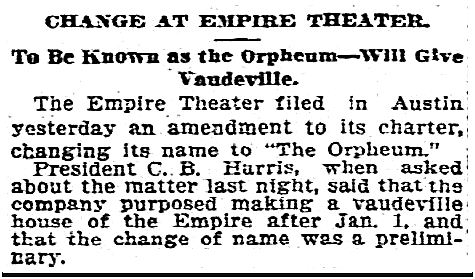
In December, 1909, Harris changed the name of the theater to the Orpheum — it became a vaudeville house.
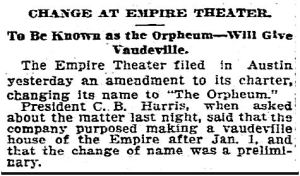
empire-orpheum_dmn_121409
DMN, Dec. 14, 1909

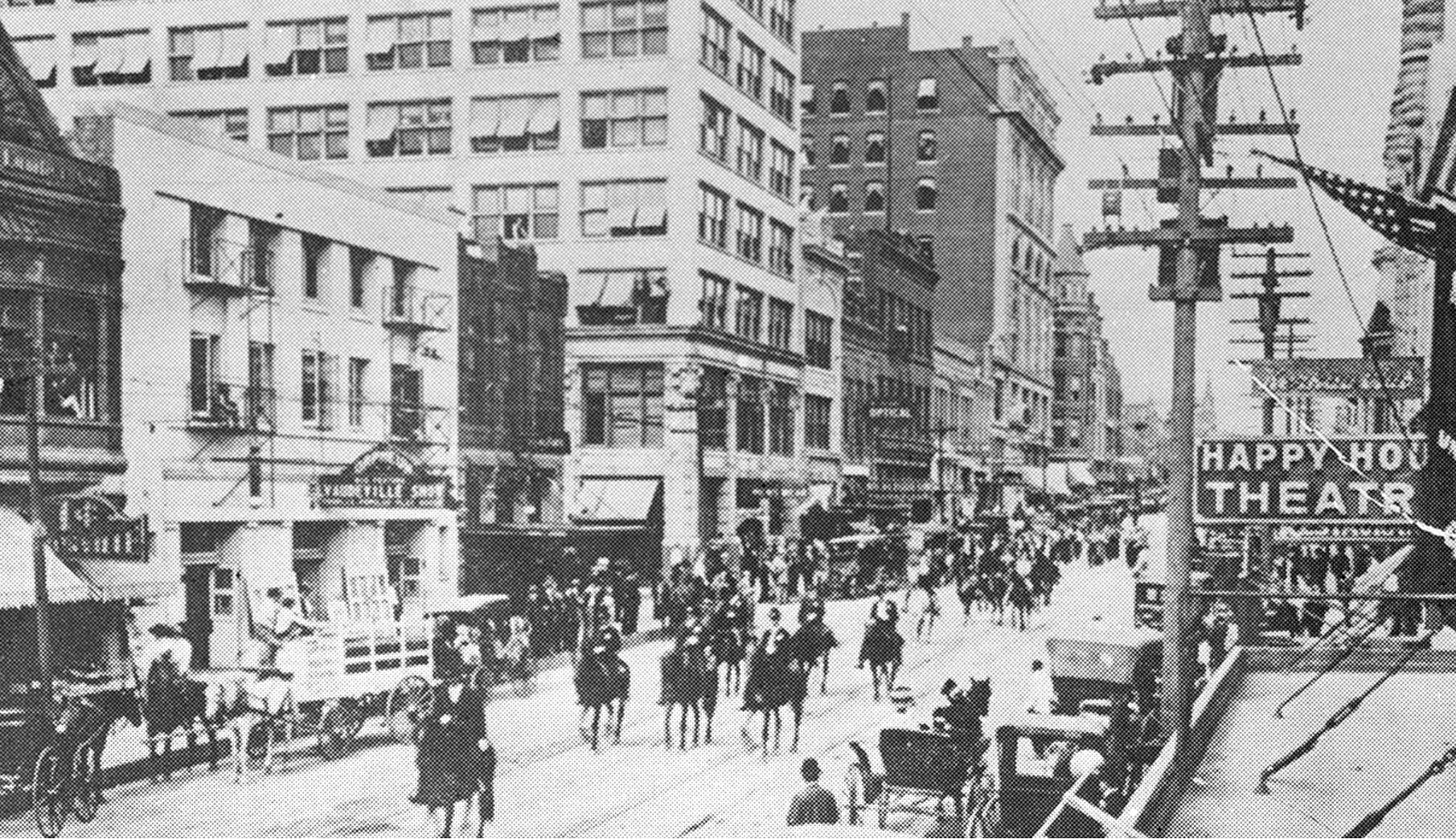
You can see the Orpheum Theater sign in this detail of a larger photo (click thumbnail on page to see full image). (Note that the Happy Hour Theater has taken over the Colonial’s space.)
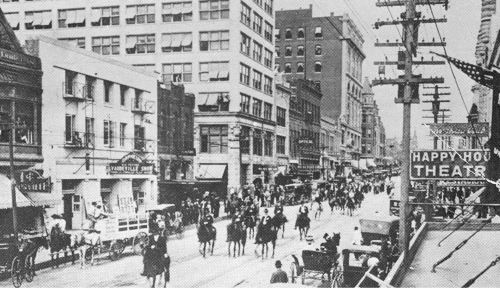
orpheum_happy-hour_praetorian_uta_det

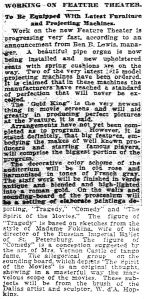
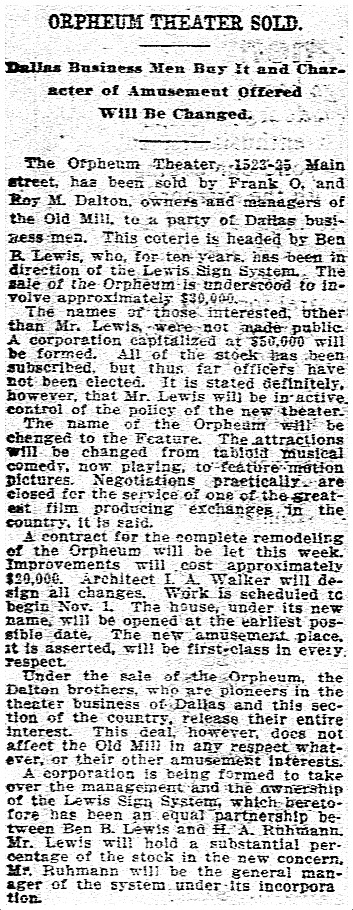
By 1914, the building’s address was 1521 Main (or, more specifically, 1521-23 Main), and ownership of the theater (which was now featuring “tabloid musical comedy”) had changed hands (to the Dalton brothers, who owned the Old Mill Theater). In October, 1914, the Daltons sold the theater. It was extensively remodeled and became the Feature Theater, a motion picture house (once again!).

orpheum_dmn_101814_sold
DMN, Oct. 18, 1914

feature-theater_dmn_111514
DMN, Nov. 15, 1914

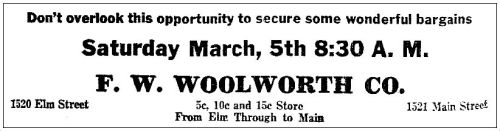
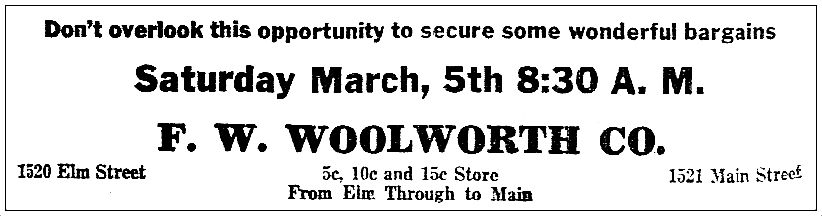
The Feature hung on through the Great War, but finally sputtered out in 1919. In 1920, Woolworth’s expanded into the space (they were already located on Elm Street, and the expansion afforded them entrances on both Elm and Main — and, I think, Stone. Woolworth’s had already been occupying the old Imperial Bar building on the corner when they took over the old Empire space (1525 Main). That was a big Woolworth’s store.

feature-theater_dmn_122420_woolworths
DMN, Dec. 24, 1920

woolworth_dmn_030421_grand-openingDMN, March 4, 1921

Here’s what our old pal, The Praetorian, and NKOTB, Woolworth’s, looked like around 1930.

praetorian_ca-1930_dallas-rediscovered-cushman-and-wakefield-inc

Here’s Woolworth’s closer up — you can see how the two buildings (the old Empire and the old Imperial Bar) have been joined together a little oddly.

praetorian_ca-1930_dallas-rediscovered_cushman-and-wakefield-inc

Here’s a street-level view from the 1940s.
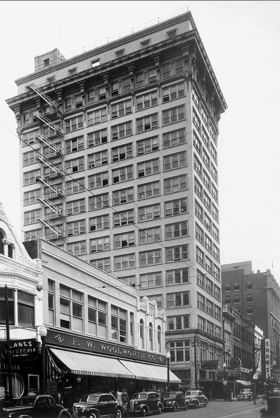
praetorian_william-langley_DPL_ca-1940
via Dallas Public Library

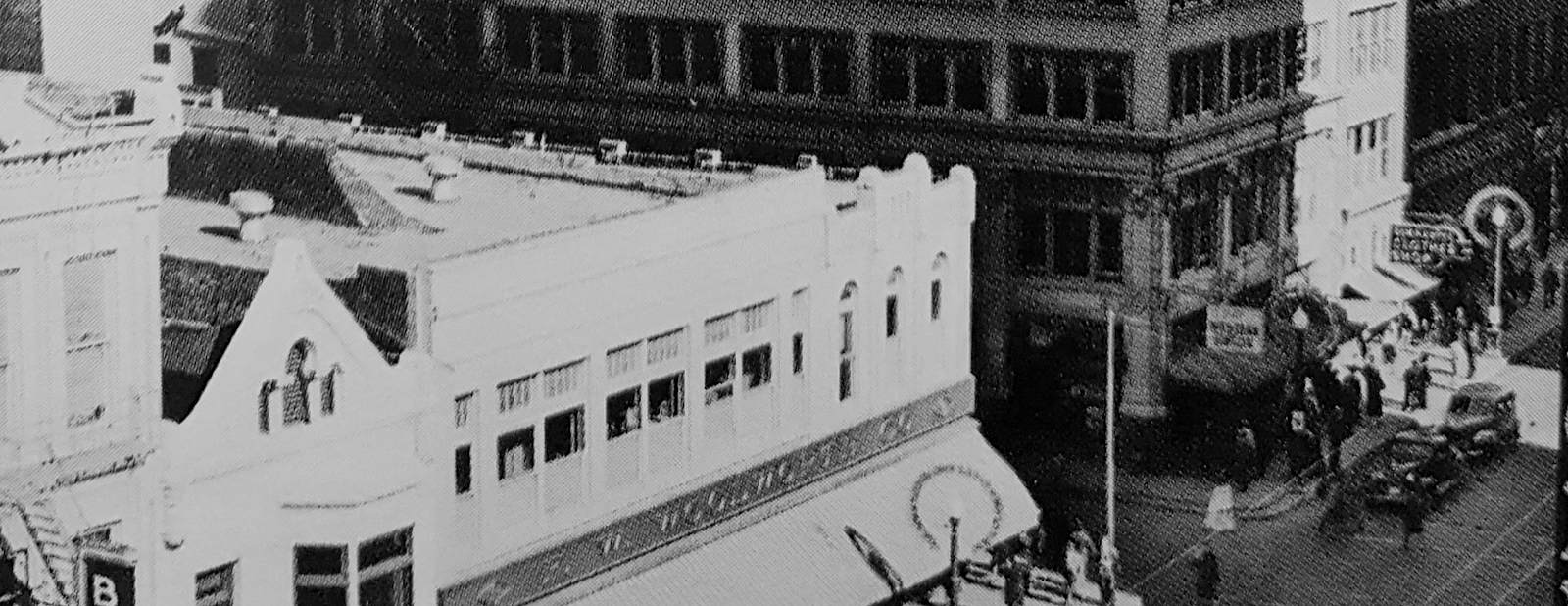
Fast-forward to 1953: the Shaw Jewelry Company moved into the old Empire Theater space at 1521 Main.

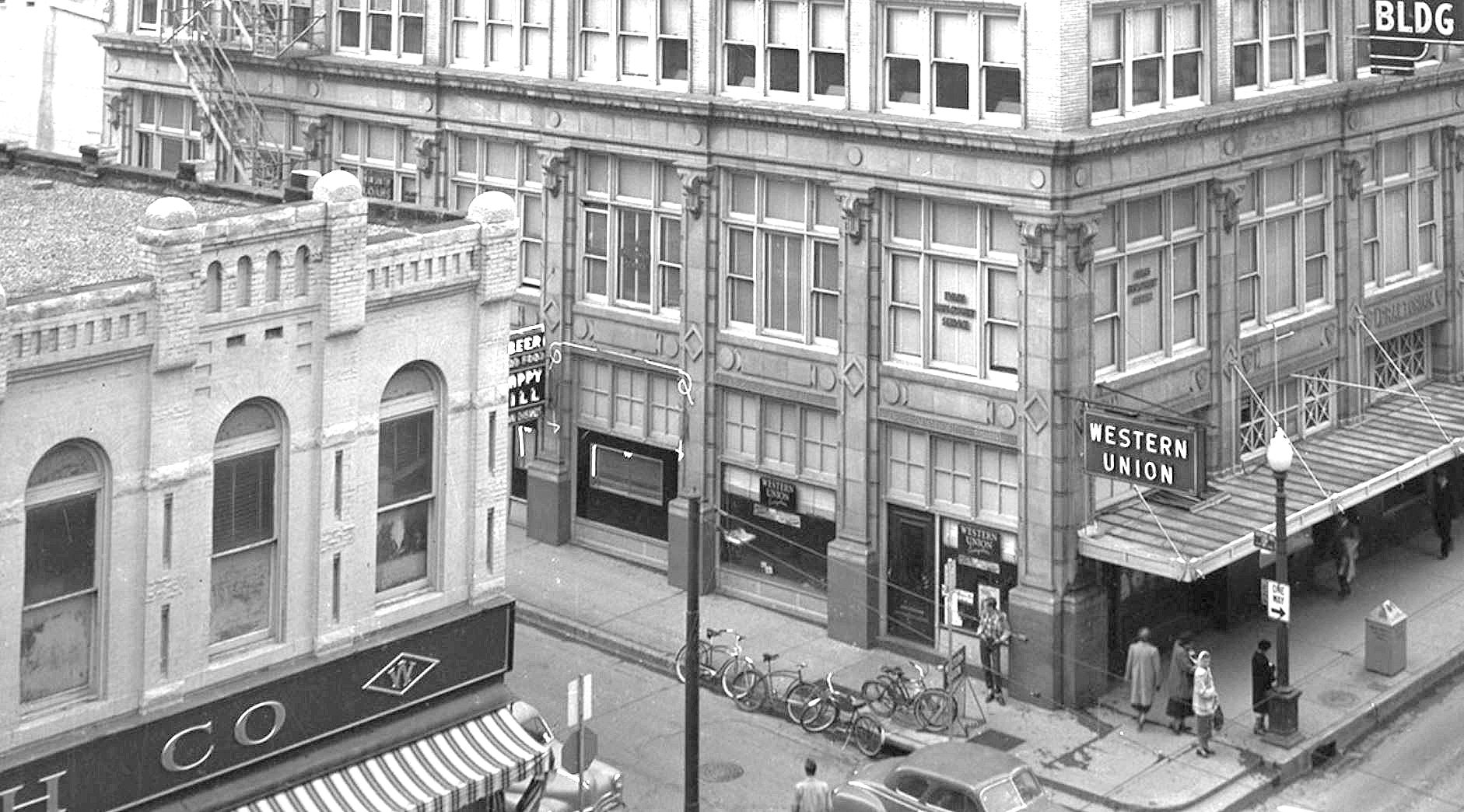
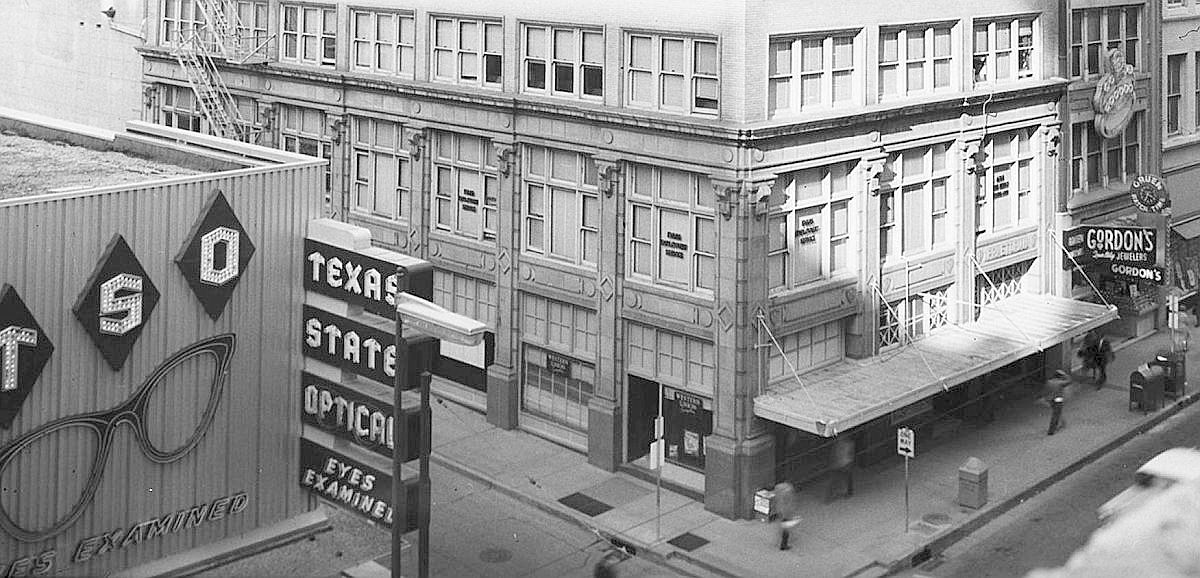
Meanwhile, next door, the old Imperial Bar space had become Texas State Optical. Sadly, someone thought it would be a good idea to wrap the original brick building (which has been estimated as having been built around 1895) in, I don’t know … aluminum siding? Here are before-and-after photos of that corner (Imperial Bar) building. It looked pretty good before TSO took over. (The detail below is from a Squire Haskins photo, via UTA — full photo is here — click thumbnail on UTA page to see a larger image). (I love the delivery boys’ bicycles parked at the curb outside the Western Union office.)

main-and-stone_praetorian_haskins_UTA_det

And here’s the same corner after “improvements” (this is another detail from another of Squire Haskins’ fab photos from the UTA collection — see the full photo here — click on thumbnail), circa 1950s.

tso_praetorian_squire-haskins_UTA_1950s

Oh dear. There should be a law….

tso_1525-main_dmn_102055_texas-state-optical
1955 (ad detail)

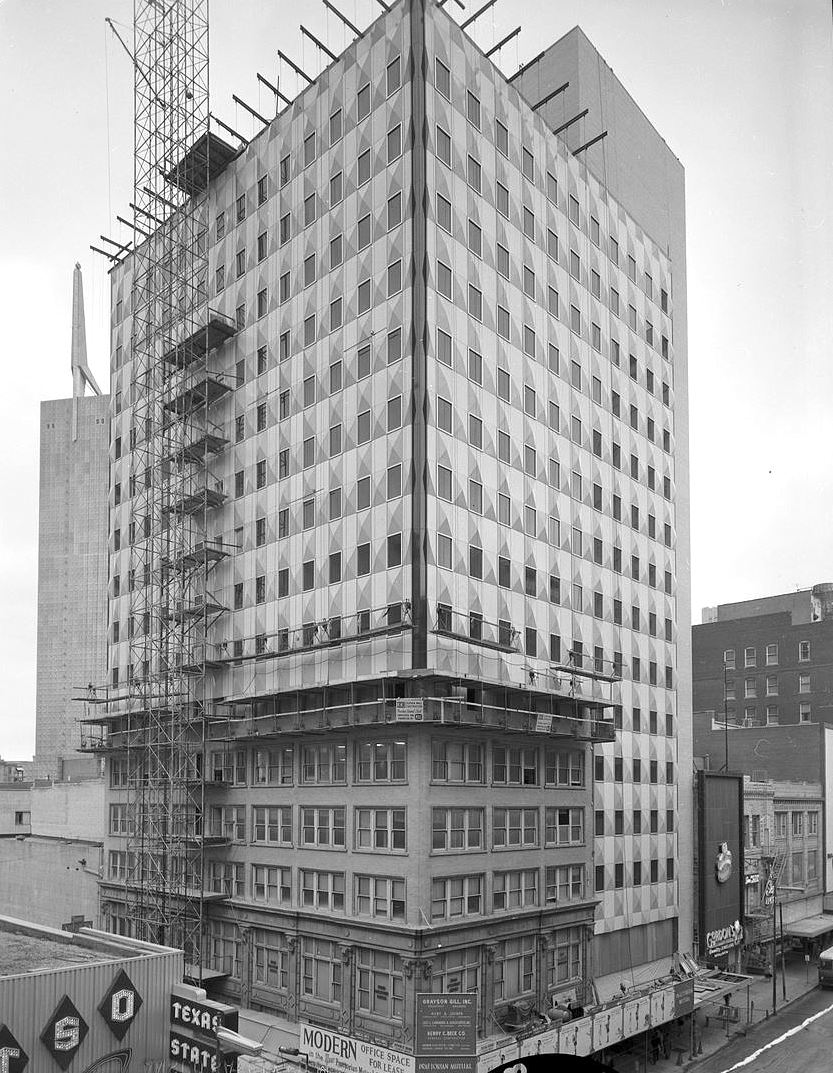
Speaking of “oh dear,” a few short years after this, the Praetorian Building expanded and was … argh … “re-clad.” Here’s a shot of it, mid-cladding, about 1961 (Squire Haskins photo info from UTA here).

praetorian_recladding_ca-1961

I believe it was … yellow.

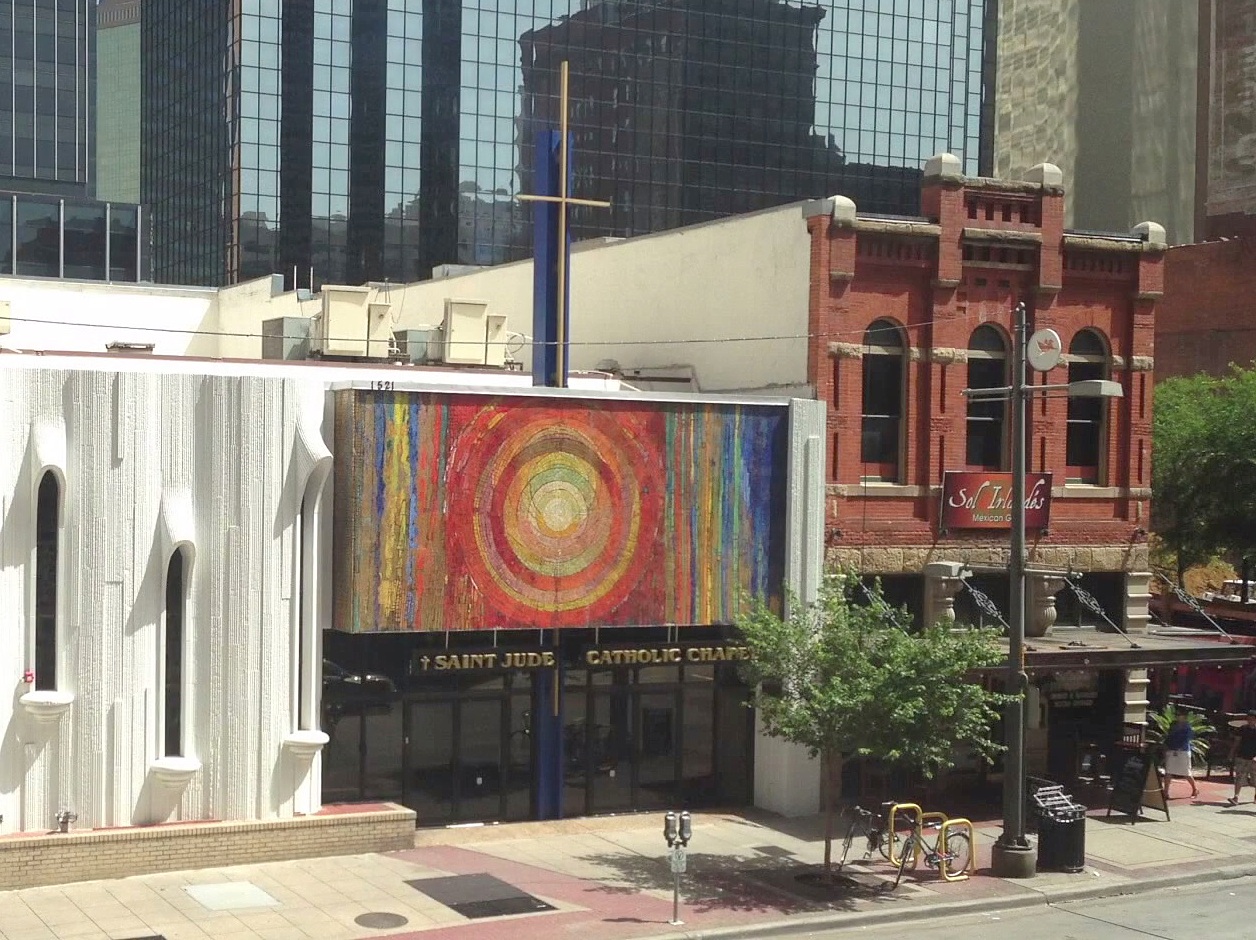
In 1968, the Saint Jude Catholic Chapel moved into 1521 Main — the old Empire Theater space. The front was adorned with a vivid mosaic by Gyorgy Kepes (I wrote about the mosaic here).
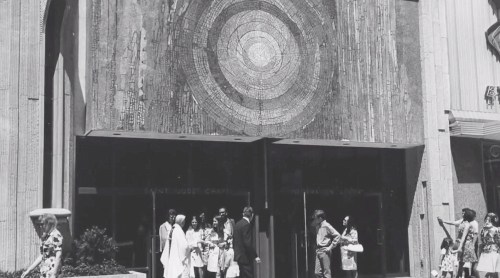
gyorgy-kepes_mosaic_st-jude-chapel_website_videovia St. Jude Chapel website

The chapel is still there.

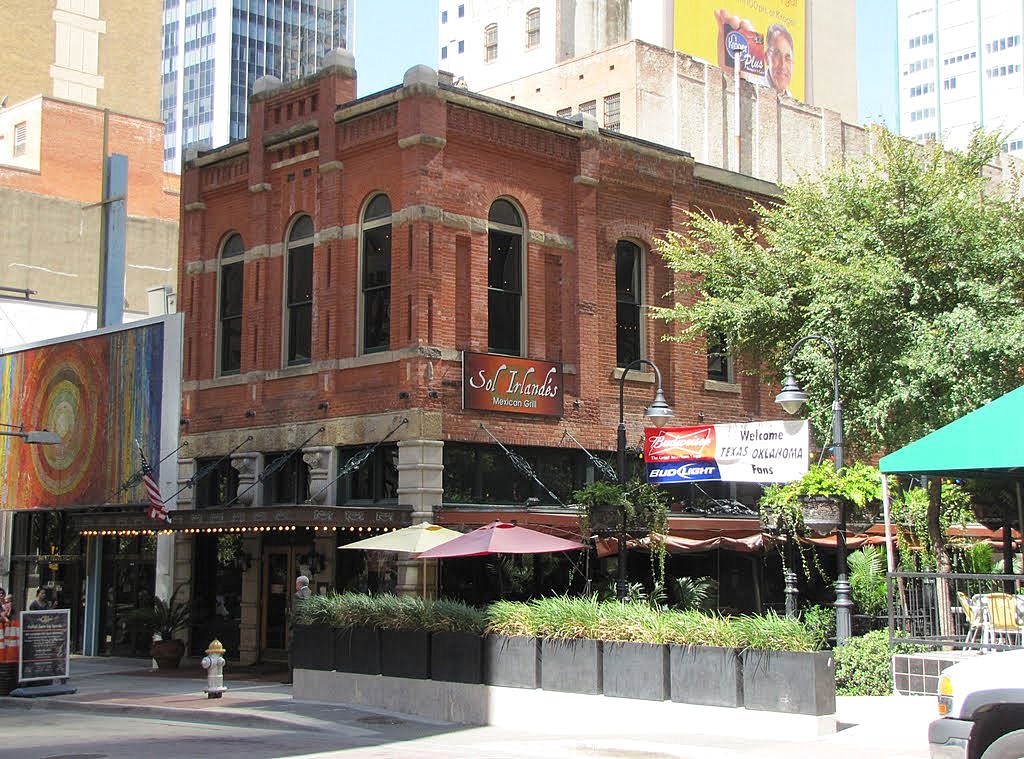
TSO — and later Pearle Vision — lasted at 1525 Main for years. In 2001, renovation and restoration efforts to develop Stone Place began. 1525 Main was restored as closely as possible to its original design and became home to a succession of restaurants (it has been occupied by Sol Irlandes for several years). ArchiTexas did a GREAT job with the building’s restoration!! (Read a 2001 Dallas Morning News article about this project — and about the historic 1525 building: “Historic Downtown Buildings To Be Restored — Shops, Restaurants Will Breathe New Life Into Stone Place,” DMN, Feb. 21, 2001.)
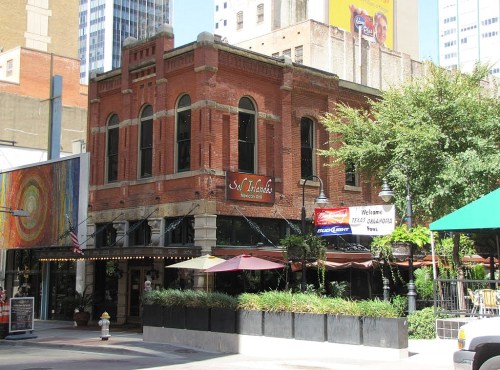
sol-irlandes_panoramio

So. Back to the top photo. There’s good news and bad news. Empire Theater building: still there. Imperial Bar building: still there. But the Praetorian Building — the most historically important of the three? The fabulous “skyscraper” was demolished in 2013 and replaced by a giant eyeball. Here’s a 2012 Dallas Morning News photo of it in mid death spiral, being slowly dismantled.
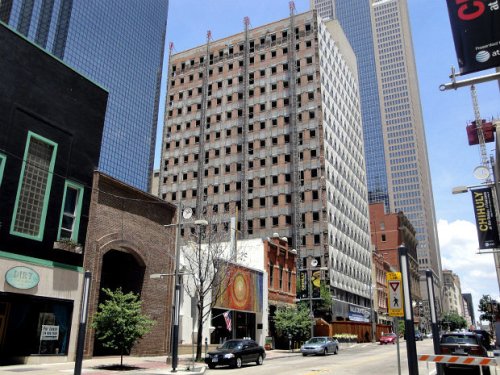
praetorian-pre-demo_dmn-photo_2012

See what this view looks like in the most recently updated Google Street View, here.

**

Interested in seeing the development of this block, as chronicled in Sanborn maps? Of particular interest is the northwest corner of Main and Stone — before 1911 the addresses of these two building were 353-355 Main and 357 Main; after 1911 the addresses changed to 1521-23 Main and 1525 Main. It appears that both buildings were built between 1892 and 1899.

  • 1885 — not a lot in this block yet — but there is a well
  • 1888 — a building has appeared one lot off Stone
  • 1892 — that building from 1888 is now nothing but “ruins” — likely the result of a fire
  • 1899 — the buildings we’ve been looking at in this post have appeared
  • 1905 — C. B. Harris’ Empire would occupy 353 Main by 1907 — possibly by 1906 (in 1905, Harris was working three doors down, at 347 Main, as an agent for the Edison Phonograph Co.)
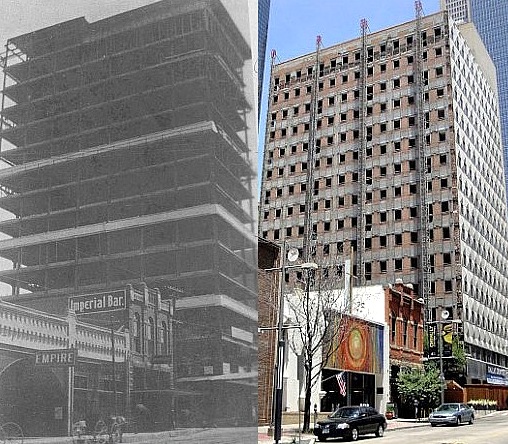
  • 1921 — This map indicates that the 1521-23 building is two stories. Pictures going back to 1909 (see a couple above) seem to show three stories, but pictures of the building as part of Woolworth’s appear to show two floors (for comparison, the building on the corner at 1525 was two stories). So … what looks like a third floor on 1521-23 Main might be … architectural trompe l’oeil? Either that, or there was demolition and construction and demolition of the two-story building currently occupied by the St. Jude Chapel. This is confusing. Whatever the case, the renovation/restoration of these two buildings in 2001 shows them to look pretty much as they did in the top 1907 photo — once again, that original roofline is present. Below, the 1907 photo is on the left, a 2012 photo is on the right.
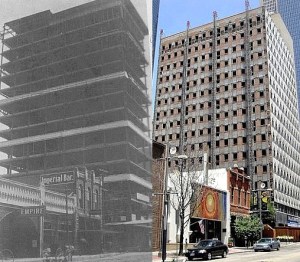
praetorian_main-stone_1906-1912

And here the buildings are today, minus the dearly departed Praetorian (RIP).
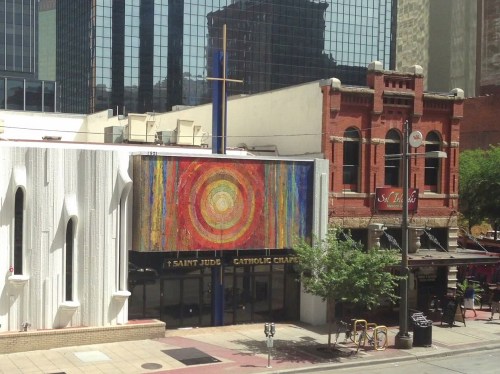
st-jude-chapel_website_present-day

Pretty cool.

***

Sources & Notes

Top photo from the George W. Cook Dallas/Texas Image Collection, DeGolyer Library, Central University Libraries, Southern Methodist University; more info is here. (I have edited the image slightly — and rather poorly — please see link for original image.)

The photo and detail showing Woolworth’s, circa 1930, is from William L. McDonald’s book Dallas Rediscovered; photo credit cites Cushman & Wakefield, Inc.

Sources of all other images noted, if known.

For an entertaining history of the construction of the Praetorian Building (which had MANY detractors and doubters), read check the archives of The Dallas Morning News for the article by Kenneth Foree, “First Skyscraper Had Its Skeptics” (Oct. 27, 1948).

More on the Praetorian Building on Wikipedia, here.

*

Copyright © 2017 Paula Bosse. All Rights Reserved.

Union Station — ca. 1916

union-station_ca-1916A century ago… (click to see larger image)

by Paula Bosse

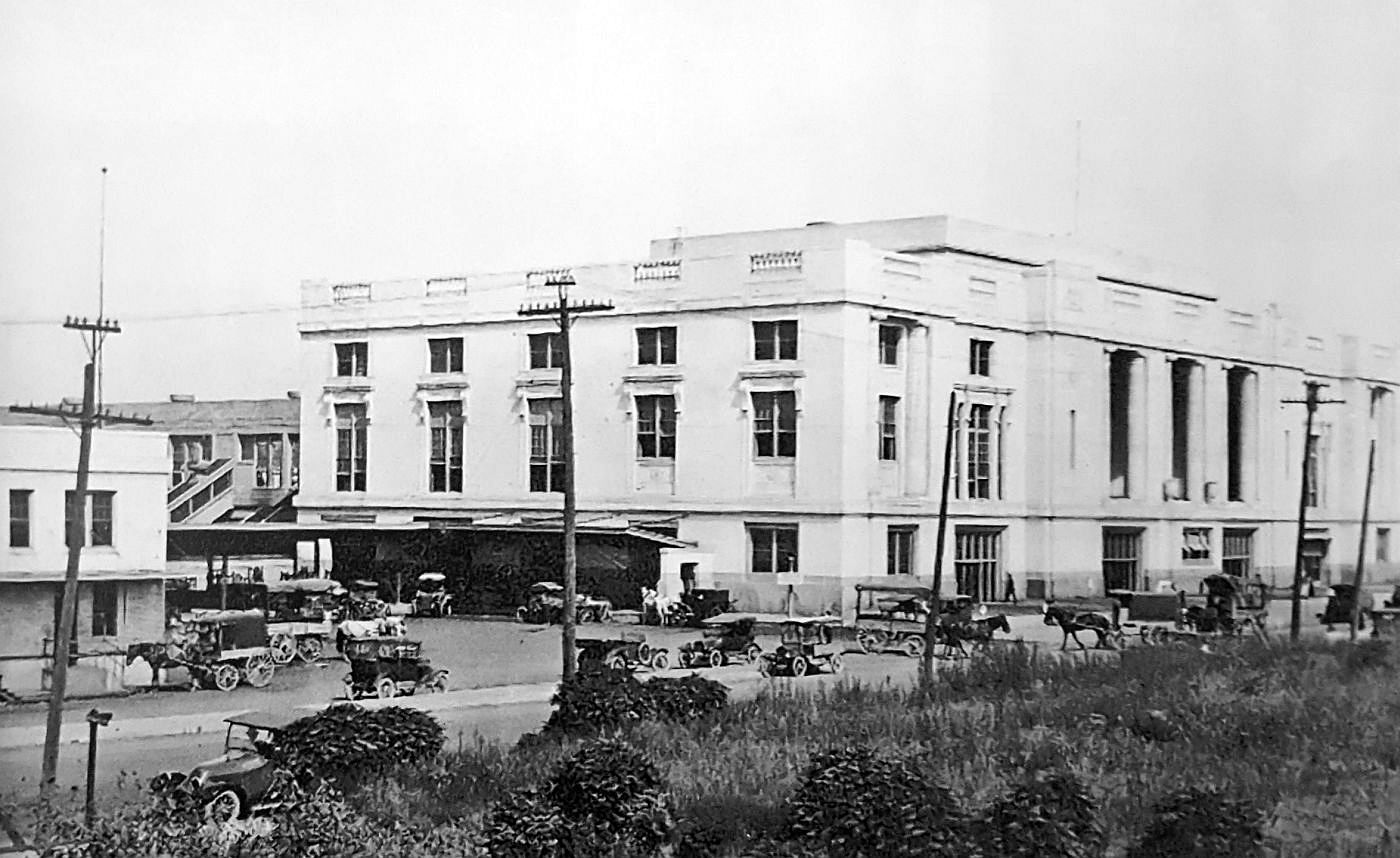
A new Union Station, bustling with activity, as seen across a scrubby vacant lot which, today, is the home of the Dallas Morning News building at S. Houston and Young. See the view today, here.

The photo shows the baggage shed which used to be on the south side of the building as well as the passenger bridge heading to and from the trains, with steps leading down to the platforms. See the details on the Sanborn map from 1921 here.

Union Station has weathered some difficult times and suffered from neglect after the golden age of train travel ended, but after recent extensive renovation/restoration, the historic landmark looks as good as new!

*

Copyright © 2017 Paula Bosse. All Rights Reserved.
 

Dobbs House: Love Field’s Airport Restaurant

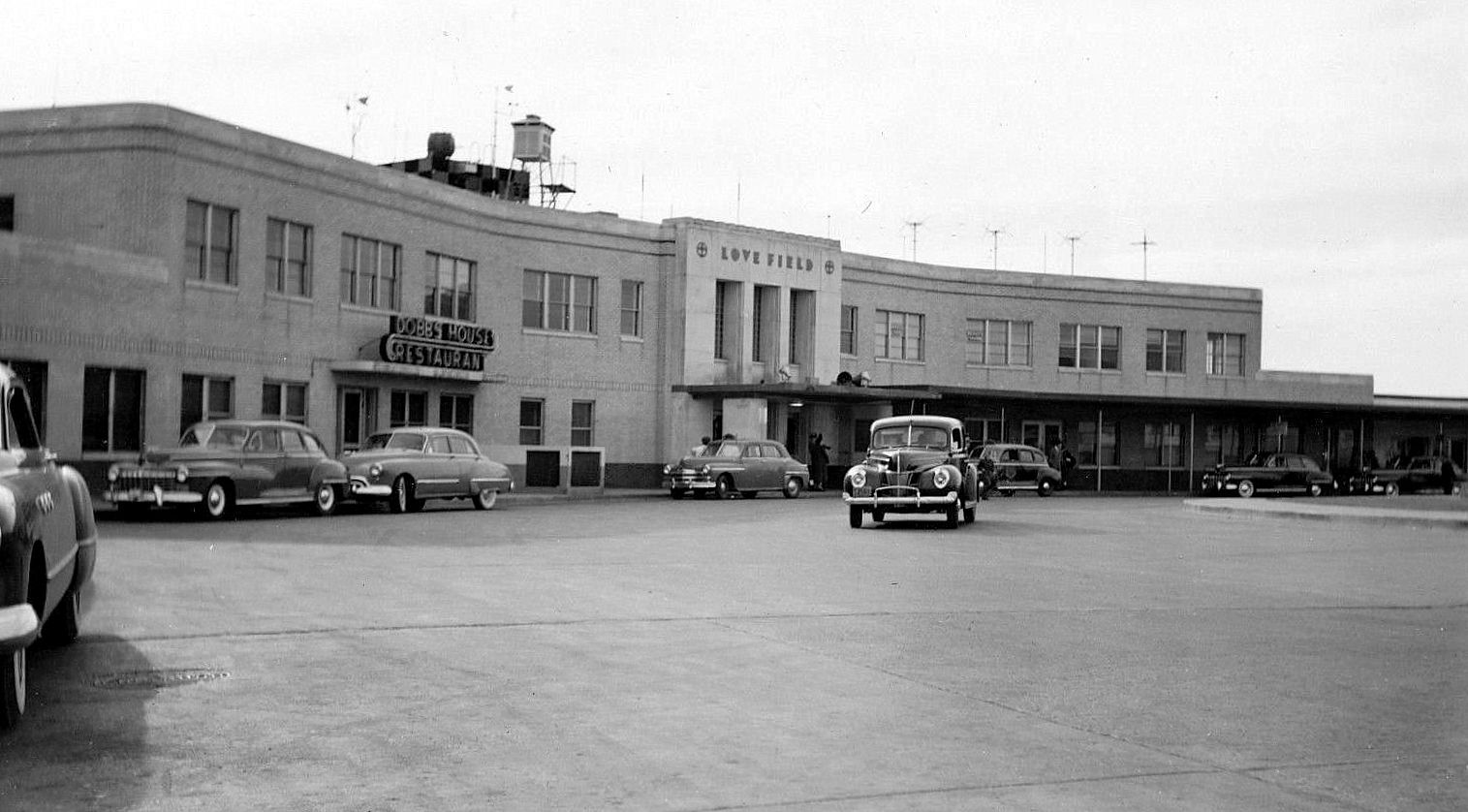
love-field_dobbs-house-restaurant_ebayDallasites’ favorite airport restaurant… (click for larger image)

by Paula Bosse

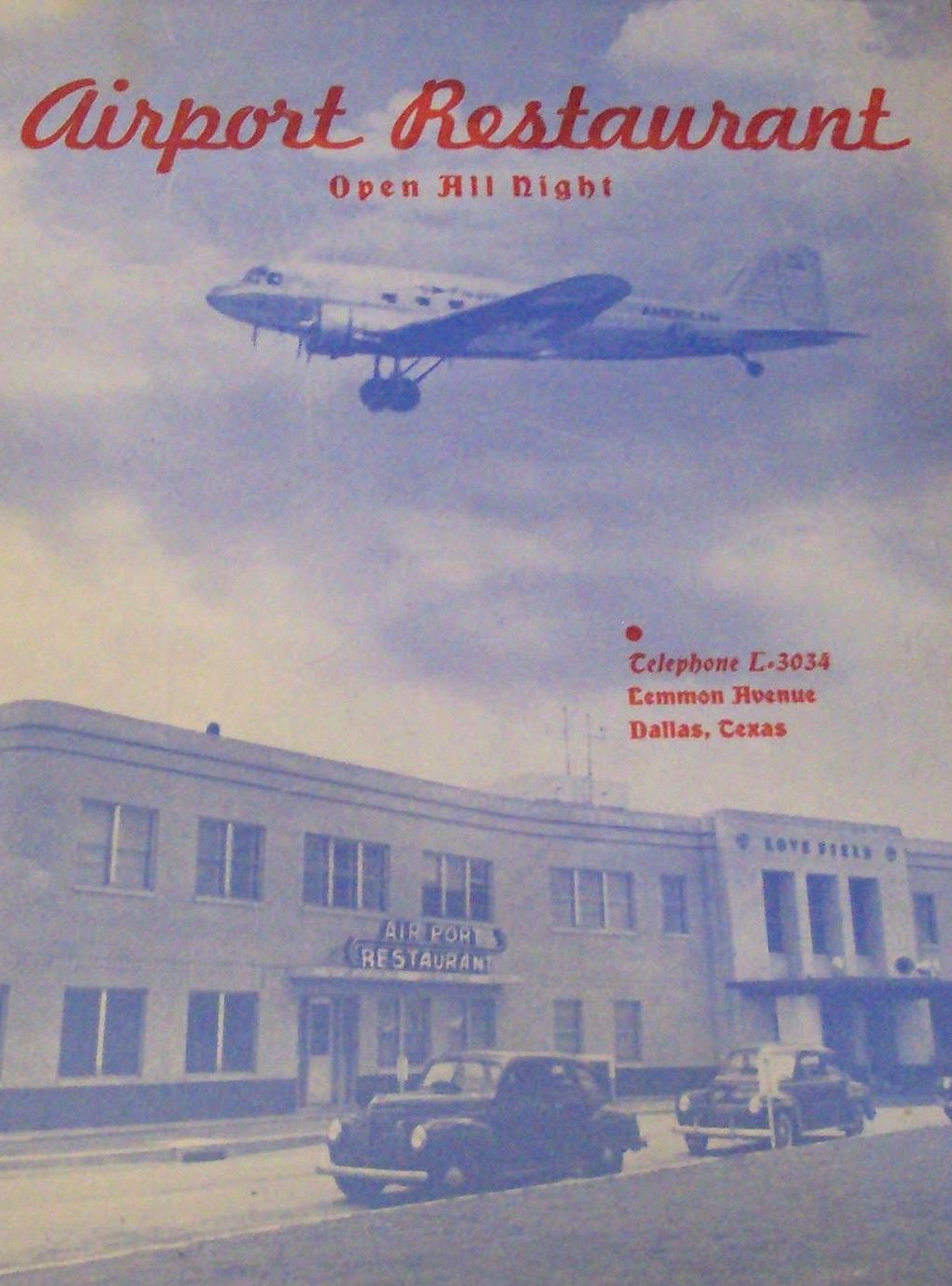
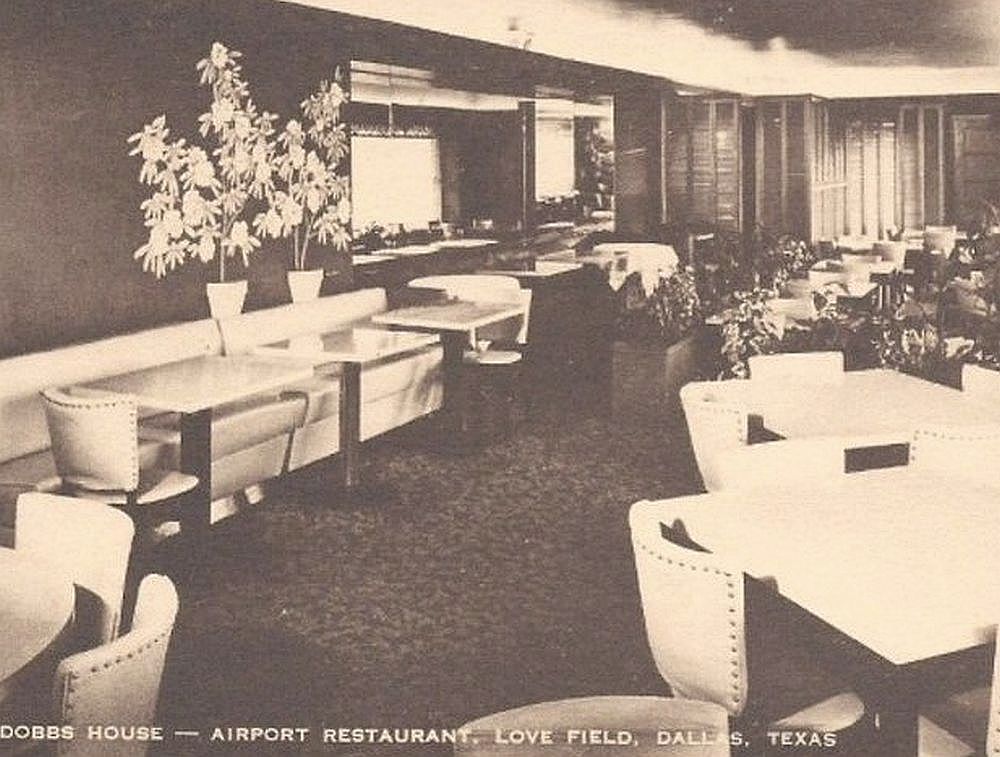
Dobbs House was a national restaurant and catering company, found chiefly in airports (although they did have non-airport restaurants, and at one point they had bought out the Toddle House chain). When the “new” Love Field terminal opened in 1940 (see the heart-stoppingly beautiful Art Deco front entrance at night, here), it had what was probably a very nice, perfectly serviceable, 24-hour restaurant. It was rather unimaginatively called “Airport Restaurant,” and it seated about 75 in the coffee shop and 100 in the dining room. And its “modern  blue and yellow leatherette furniture” was probably delightful.

love-field_airport-restaurant_menu_ebay_cropped

A lot of people probably enjoyed a hot cup of coffee while seated on that modern leatherette. But in 1944, the Hull-Dobbs company waltzed in and took over the restaurant and catering business and agreed to pay the city what seems like a miniscule $500 a month (about $7,000 in today’s money). The administration building, which housed the restaurant, was undergoing remodeling at the time, and I guess the city was giving the company something of a break. In 1945, though, Hull-Dobbs began to pay 5% of their gross revenue to the city, rather than a flat monthly fee. (I’m guessing that 5% was quite a bit more than $500.)

Business was good. REAL good. It was almost too good, because almost every newspaper article which mentioned the restaurant (called Dobbs House, part of a national chain) noted how busy it was and how it was almost impossible for a person to find an empty seat. It was known for its good food (see a 1955 menu here), and one of the main reasons it was always crowded was because local people dined at the restaurant, taking up precious seats intended for hungry travelers. Dallasites loved to drive out to the airport for a nice meal, followed by a leisurely couple of hours watching airplanes take off and land.

But, basically, Love Field had become a major metropolitan airport, and its success — and the resulting increase in traffic and the overall crush of humanity — meant that everyone was running out of space.

The airport had outgrown its beautiful 1940 Art Deco terminal, and a new, equally heart-stoppingly beautiful terminal opened in 1958. Dobbs House moved into its more spacious quarters with a freshly signed ten-year contract. …And by now they were paying a whole lot more than $500 a month. According to a January, 1957 Dallas Morning News article, the restaurant offered a high bid of just over $15,000 a month to retain the restaurant concession at the airport.

The restaurant and catering business were not all that the Dobbs company was running. Not only did they have a “swanky” restaurant at the new terminal, they also had a non-swanky restaurant and a basement cafeteria. They also had, at various times, control of the following concessions: cigar, shoeshine, gift shop (including apparel, candy, and camera shops), and … parking (!). This was on top of their land-office business catering and restauranting. James Dobbs knew a thing or two about business — he didn’t get fantastically wealthy just selling 15-cent cups of coffee and black-bottom pie….

dobbs-house_love-field_love-field-FB-page
via Dallas Love Field Facebook page

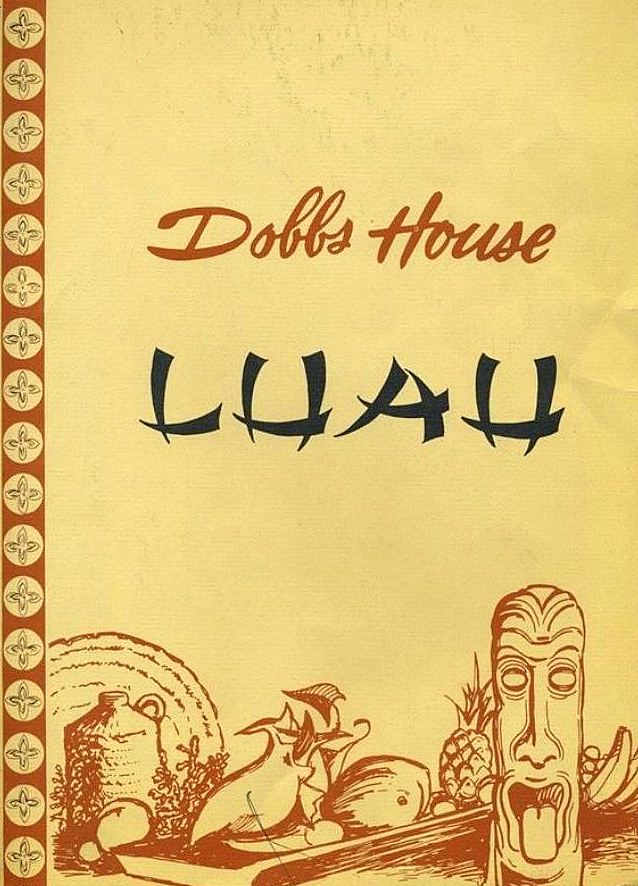
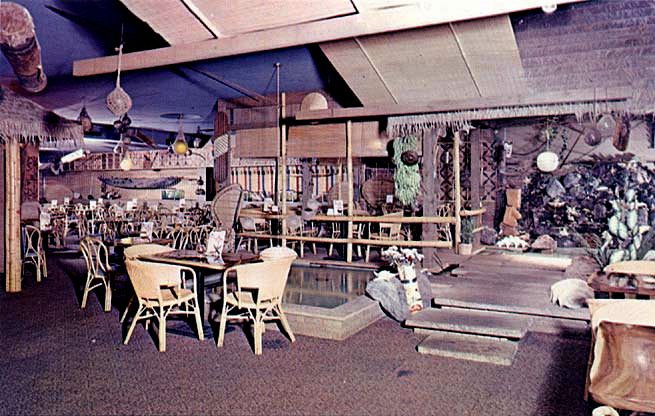
In 1958, Dobbs House opened the exotic Luau Room, which served Polynesia cuisine. This was another Dobbs eatery that was very popular with Dallasites, and it lasted many, many years.

dobbs-house_luau_menu_ebay
via eBay

The Luau Room was a sort of early “theme” chain from the Dobbs people, and it was a feature at several Dobbs House-served airports. The photo below might be the Dallas location. Might be Charlotte, or Orlando, or Houston.

dobbs-house_luau
via Tiki Central — check out the comments

Dobbs House  was a fixture of the Dallas airport/restaurant scene for a surprisingly long time. Dobbs House was still at Love Field in the 1980s — possibly into the ’90s. And when Dallas-Fort Worth International Airport opened, the Dobbs people slid right in. DFW was huge — and they had control of everything. (Alcohol sales alone must have been enormous!)

For D/FW’s first two decades, a single company operated all of the bars and restaurants that generate about $40 million in sales each year. Dobbs House had the food and beverage contract from 1974 until 1993, when Host Marriott Services took over the operations. (DMN, May 22, 1996)

Dobbs House was in business here for almost 50 years. That’s a pretty good run for a restaurant in Dallas. (And I hear their cornbread sticks were to die for.)

***

Sources & Notes

Top photo showing Dobbs House Restaurant at Love Field found on eBay several months ago.

Airport Restaurant menu (ca. 1940-1944) found on eBay, here.

The Dobbs House cornsticks recipe is contained in the 1960 book How America Eats by Clementine Paddleford — used copies are out there, but they are surprisingly expensive. But from what I hear, if you want that recipe, it’s probably worth it!

An interesting side note about James K. Dobbs, head of the company that bore his name: even though he was a resident of Memphis, he actually died in a Dallas hospital in September, 1960, having been sent here for asthma treatment, and having recently suffered his second heart attack. He was 66. His company had grown to include about 125 restaurants at the time of his death. He had also made huge sums of money in automobile dealerships.

Photos and clippings are larger when clicked.

*

Copyright © 2017 Paula Bosse. All Rights Reserved.


Remember the Alamo! — In Plano, Behind the Target

alamo-plano_dmn_051284-photoNever forget… (click for larger image)

by Paula Bosse

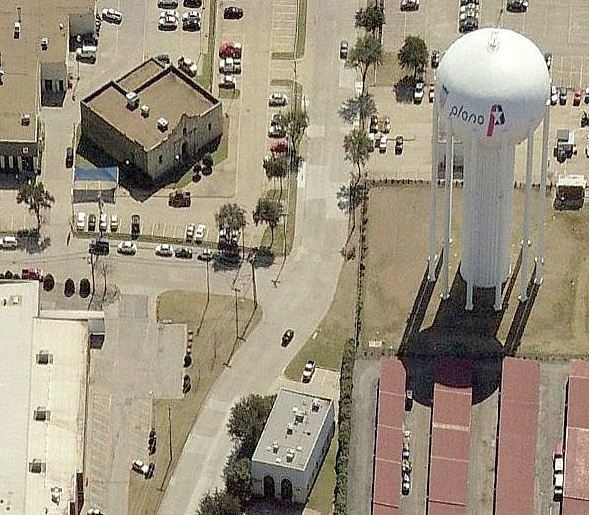
Today is Texas Independence Day. This time last year after posting a photo of the Alamo somewhere, I was informed that there was, in fact, an Alamo replica right here in DFW. I knew about the one(s) in Fair Park, but Plano? Yep, near 75 and Parker Road, at the corner of Lexington and Premier, just west of the highway. See a southward-looking aerial view on Google here; below is the same view, from Bing.

alamo-plano_birdseye-bingBing Maps

Here it is at street level:

alamo-plano_bingBing Streetside

So, um, why is that there?

Not being up on my Plano history, and never having been aware of this, it took me a long time to find anything about it. Which is pretty surprising, because you’d think there would be all SORTS of articles about a very large replica of one of the most famous structures in the world (yes, I’m going to say “in the world”), standing right here in the Metroplex. And it’s been standing here for at least 35 years! I managed to find a couple of ads and an article about the building — it had started out as an arcade called the Alamo Fun Center and later became part of a car dealership — but I could  never find out who built it or why. I thought I’d come back to it in a year — so I could post it on Texas Independence Day — and see if I could find more, looking with fresh eyes. So I tackled it again today, and, glory be, I’ve just discovered that Rick Saigling wrote a piece for Plano Magazine last November titled “Remember the Alamo Fun Center” which answered all of my questions (and had photos of the building when it was new).

The Plano Alamo was built in 1982 by brothers-in-law Nathan White and Gene Cason and other investors as a “fun center” to house a Texas-themed arcade featuring video games, miniature golf, etc. While popular with Plano kids, the Alamo Fun Center was not a successful venture, and it shut its ornately carved doors after only a relatively short time in business. There you have it. Thank you, Rick. I now have closure.

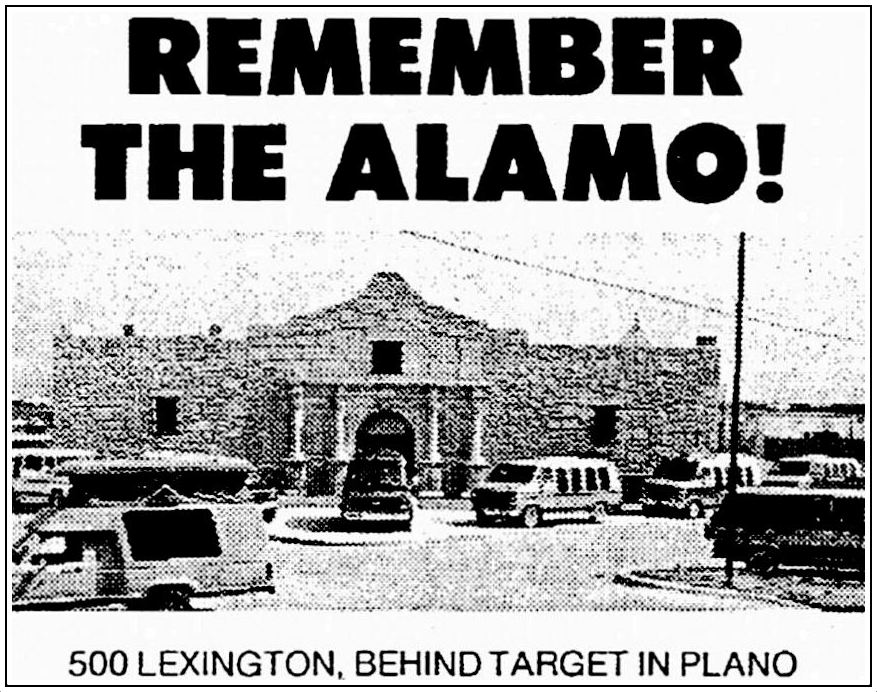
The earliest (only?) mention I found of the “Fun Center” was the ad below, which appeared in The Wylie News a short time before its grand opening in the summer of 1982. The ad seems to indicate that the name of this “western theme park” is Lone Star Recreation Park and Alamo Fun Center (click to see a larger image).

alamo-fun-center_wylie-news_072982
The Wylie News, July 29, 1982

A few months after the Alamo Fun Center opened, Larry Lange Cadillac moved to its new location on the adjacent property. I’m not sure exactly when it closed, but the Plano Alamo was taken by the advancing forces of Larry Lange Cadillac in 1983 or 1984. For whatever reason, the building remained (what Texan is going to demolish the Alamo?) and was incorporated into the Larry Lange business plan.

alamo-plano_dmn_062683-larry-lange-ad-det
June, 1983

In May, 1984, the ad below announced the grand opening of the Larry Lange Adventure Center — the Alamo had been emptied of its batting cages and pizza ovens and had been transformed into an “Indoor Van Showroom Which is ‘As Large as Texas’!” (That doesn’t seem to have lasted very long.)

alamo-plano_dmn_051284-ad
May, 1984

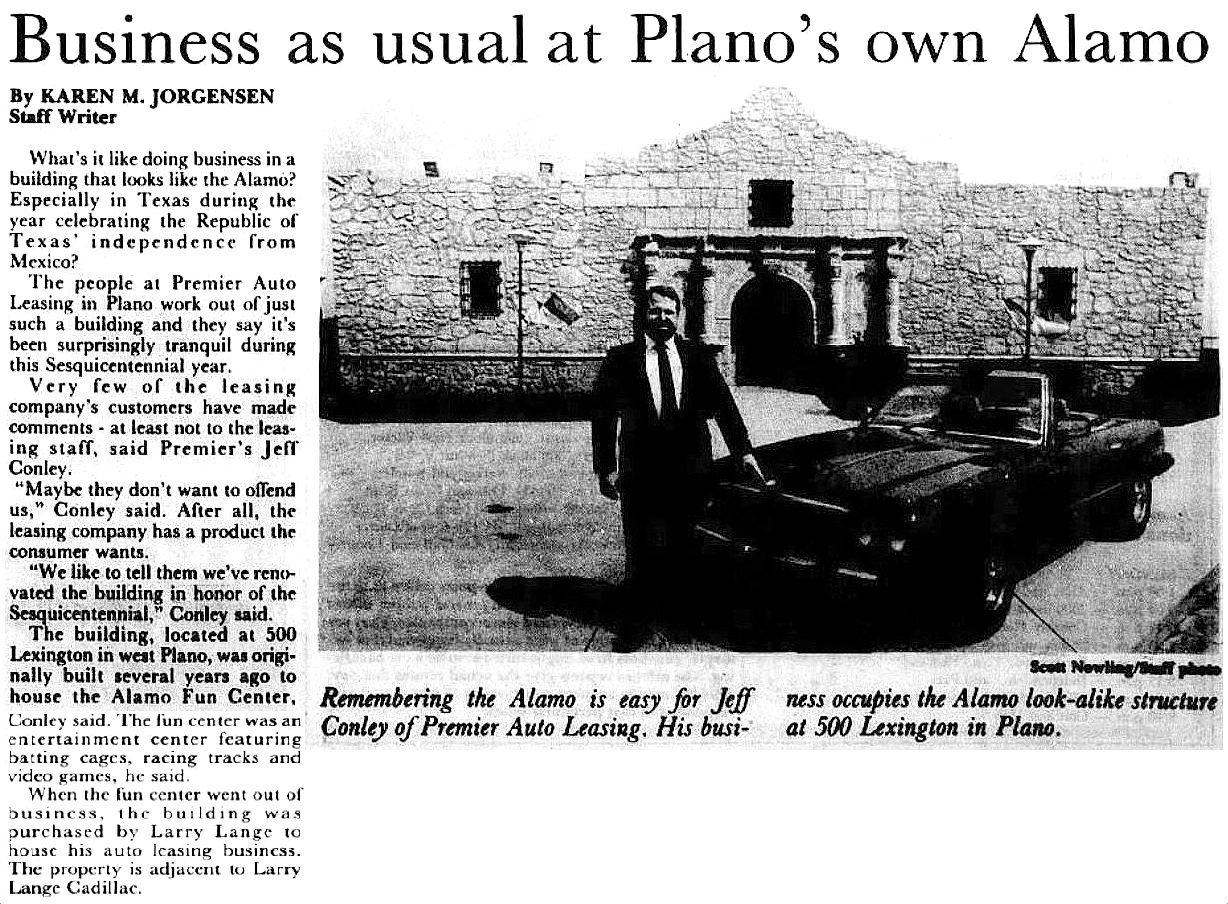
Two years later, in 1986 — the year of the Texas Sesquicentennial — The Plano Star Courier checked in with the then-current occupants of the hometown Alamo, Premier Auto Leasing, to see what it was like working in the Alamo. In Plano. An employee made the impossible-to-believe statement that very few people ever actually commented on the fact that they were leasing their vehicle from a company that occupied a building shaped like the Alamo.

alamo-plano_plano-star-courier_072286
Plano Star Courier, July 22, 1986

In 1999, Diane Jennings of The Dallas Morning News wrote a story on “mock Alamos” around the state. She checked in on the Plano location, then owned by Crest Cadillac, and found it was being used as a warehouse. The general manager, Michael Coston, was not a fan of the building for several reasons, not least of which was the replica’s design.

As a native Texan and history buff, he worries that the inaccurate construction may “deface the fame of the how-many-ever we say gave their lives there.” He is particularly irritated by the parapet, the rounded hump over the door, which most people associate with the Alamo facade, but which was actually added by the U.S. Army decades after the battle. (DMN, Feb. 28, 1999)

Today Crest Cadillac appears to have forsaken Plano for Frisco, but the property is still in the Crest auto family — it’s now occupied by Crest Volvo. But what of The Alamo? It’s now the home of Crest Collision, a body shop.

So there you  have it, the story of Plano’s Alamo.

Instead of rushing out to get a Mirabeau B. Lamar tattoo to show my Texan-ness in these waning hours of Texas Independence Day, I’ve decided instead to post a few photos of the real Alamo, which, strangely enough, was also a neighbor to a car dealership, the Clifton George Ford Motor Co. Remember the Model-T!

alamo_clifton-george-ford_san-antoniovia Texas Transportation Museum

alamo_clilfton-george-ford_e-o-goldbeck_ransom-center_ca-1918via Harry Ransom Center, University of Texas

alamo_herpel-gillespie-ford
via Texas Transportation Museum

***

Sources & Notes

Top ad from May, 1984.

Second-from-last photo by an unidentified photographer, circa 1918, from the  E. O. (Eugene Omar) Goldbeck Photography Collection, Harry Ransom Center, The University of Texas at Austin; more information and a larger image may be found here.

Rick Saigling’s Plano Magazine article “Remember the Alamo Fun Center” (November 21, 2016) is here. It includes several photos of the Alamo Fun Center in 1982/83 and interviews with a former owner and employee. See a (large!) close-up of the unexpectedly ornate stone façade of the Plano Alamo here. (If you’re interested in Plano history, Rick’s also written a nice nostalgic piece, “I Remember When Plano Was a Sleepy Town,” here.)

*

Copyright © 2017 Paula Bosse. All Rights Reserved.

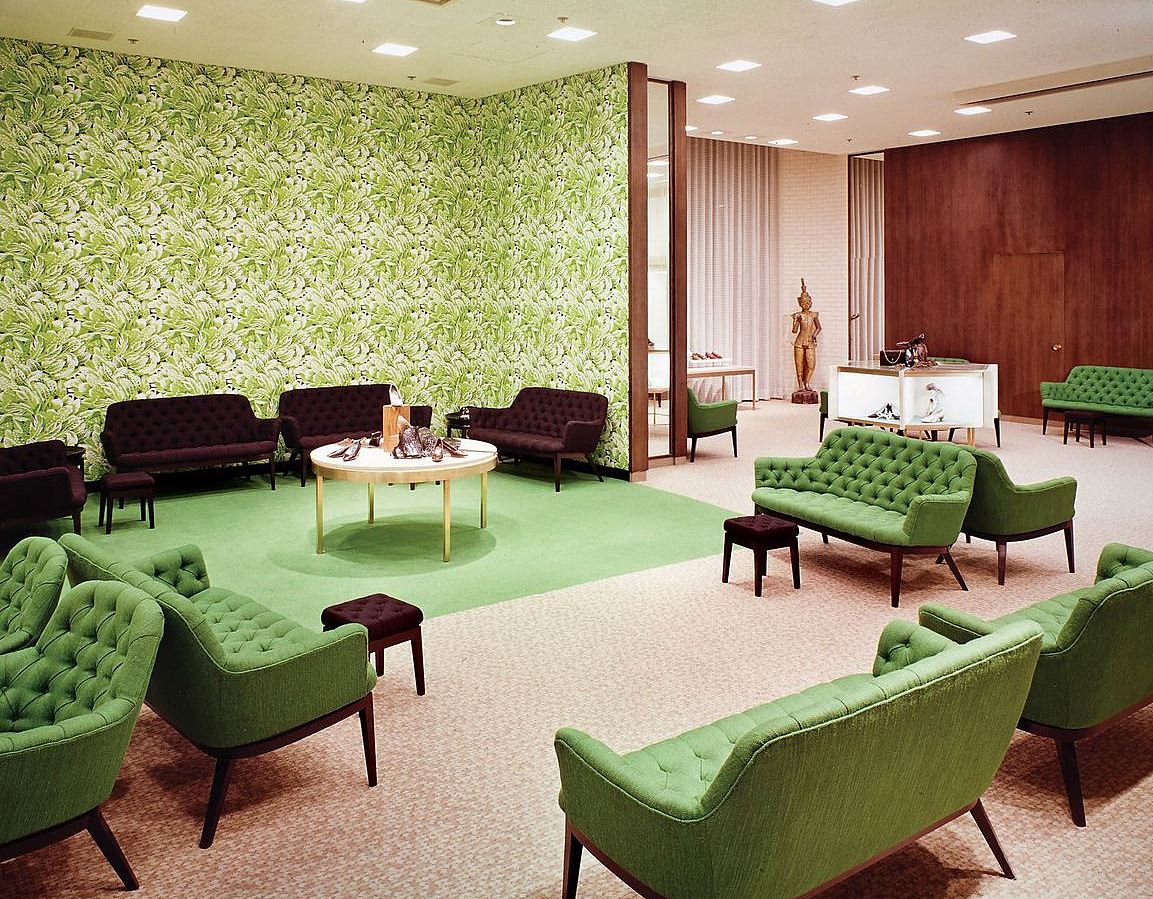
The Neiman-Marcus Shoe Salon — 1965

n-m_shoe-salon_1965_nyt-magazine_dec-2016Behold, the shoe salon…

by Paula Bosse

Look at this.
LOOK. AT. THIS.

***

Sources & Notes

1965 photo by Ezra Stoller. It appeared in the December 1, 2016 New York Times magazine as part of a slideshow, here; it was a companion to a short article about Stanley Marcus by James McAuley, here.

I never thought of myself as a fan of lime green upholstery until I saw that salon furniture. The wallpaper is a bit … busy (in a tasteful, sophisticated way…), but that furniture is, as they say, to die for. (And the door that disappears into the wall is a nice touch.)

*

Copyright © 2017 Paula Bosse. All Rights Reserved.