Flashback : Dallas

A Miscellany: History, Ads, Pop Culture

Category: Leisure

Highland Park: The Ideal Residence Subdivision — 1907

ad-highland-park_072107Ideal!

by Paula Bosse

HIGHLAND PARK
For natural charms it is in a class by itself.
Beautiful lakes, high altitudes, cool breezes.

And the fishing is great!

***

Sources & Notes

Ad from The Dallas Morning News, July 21, 1907.

*

Copyright © 2016 Paula Bosse. All Rights Reserved.

The Union Depot Hotel Building, Deep Ellum — 1898-1968

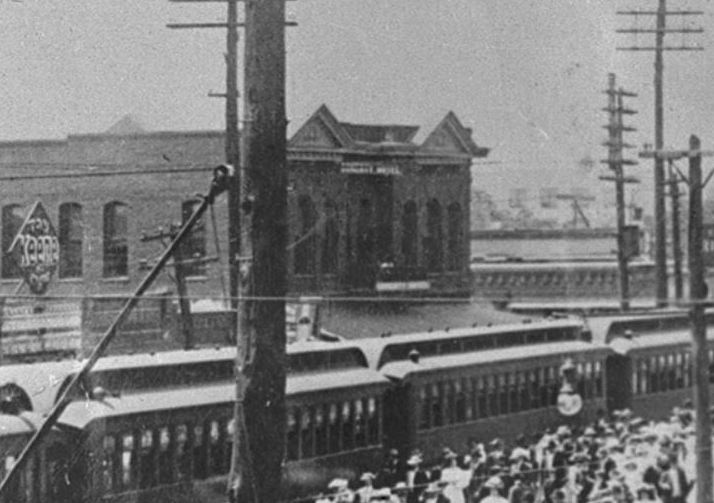
union-depot-hotel_1909_uta-detThe old Union Depot Hotel, about 1909 (click for larger image)

by Paula Bosse

Above, we see the hotel known originally as the Union Depot Hotel, built in 1898 across from the very busy old Union Depot, at the intersection of two major rail lines: the Houston & Texas Central (the H&TC, which ran north-south) and the Texas & Pacific (the T&P, which ran east-west). The tracks crossed at the intersection of Central and Pacific — streets named after the two railroads — in the area east of downtown we now call Deep Ellum. The hotel was on the southwest corner of that intersection.

The large, two-story hotel (which also housed a popular cafe and bar) was built by William S. Skelton — more commonly known as Wiley Skelton — to cash in on the large number of travelers coming to Dallas via the bustling passenger depot right across the street. When it opened, it was charging a hefty two bucks a day (the equivalent of about $60.00 in today’s money) — a large-ish sum in 1899, but … location, location, location. This two-dollar-a-day rate to stay at Skelton’s hotel was the same as the base rate of Dallas’ ritziest, priciest hotels, The Windsor and The Oriental. How could Skelton’s “wrong side of the tracks” hotel charge similar rates as the city’s most elegant hotels? Convenience, convenience, convenience. The Union Depot Hotel could not have been more convenient to weary travelers unless it had been located inside the depot.

union-depot-hotel_houston-post_012599Houston Post, Jan. 25, 1899

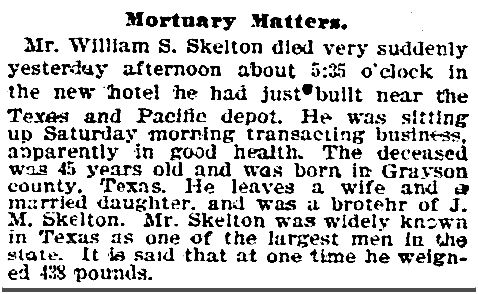
Skelton was a popular and successful businessman (and noted saloon pugilist) who was known far and wide for his substantial physical bulk. He was a founding member of the city’s “fat men’s club” and was reported to be the heaviest man in the city. When he died suddenly at the age of 45 (probably not a huge surprise, as his obituary mentioned that his weight had, at one time, reached 438 pounds), his new hotel had been open only weeks (perhaps only days).

skelton_dmn_011699Dallas Morning News, Jan. 16, 1899

His unexpected death threw the running of the hotel into confusion. His brother (another famed “fighting fat man”) took over the business side of its operations and occasionally placed ads in the paper seeking a hard-to-find buyer.

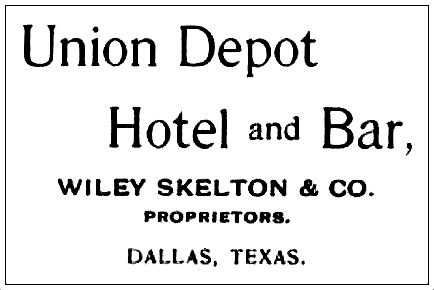
union-depot-hotel_1901_portal1901 ad

union-depot-hotel_dmn_111602DMN, Nov. 16, 1902

Eventually the hotel was sold, and it went through several owners and name changes over the years. Then, in 1916, a major catastrophe struck: brand new Union Station, which was waaaay on the other side of town, opened, consolidating passenger rail service to one depot, resulting in the shuttering of most of the city’s smaller depots. Location, location, location wasn’t such a great thing for the old Skelton hotel after this.

The hotel went through many changes over the years, but after the closing (and later razing) of the old Union Depot, it was on a general, inevitable, slide downward. By the time it was demolished in 1968 — when large swaths along Central Avenue were leveled to facilitate highway construction — the building was in disrepair and, apparently, long-vacant. It stood for 70 years.

*

Below is a photo taken from Elm Street in 1908 or 1909, when the hotel (seen at the top left) was owned by Charles S. Conerty and named the Conerty Hotel (you can see the name on two signs, but you have to really zoom in to make them out). Conerty, an Irishman who had previously run bars, owned the hotel very briefly. By May of 1909, plagued with legal troubles stemming from his being charged with selling liquor on a Sunday, Conerty sold the hotel (which he seems to have been running as a boarding house), stating in his classified ad that he was “leaving city.” (He did not leave the city.) In 1910, with a new owner, the hotel was once again known as the Union Depot Hotel.

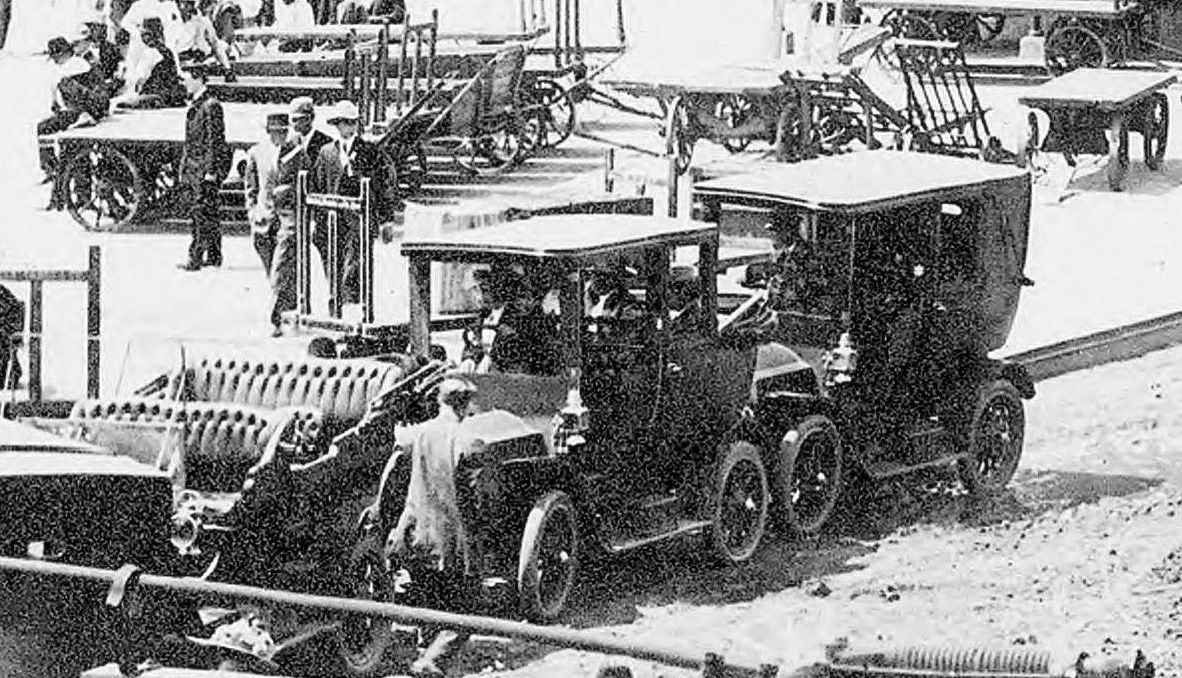
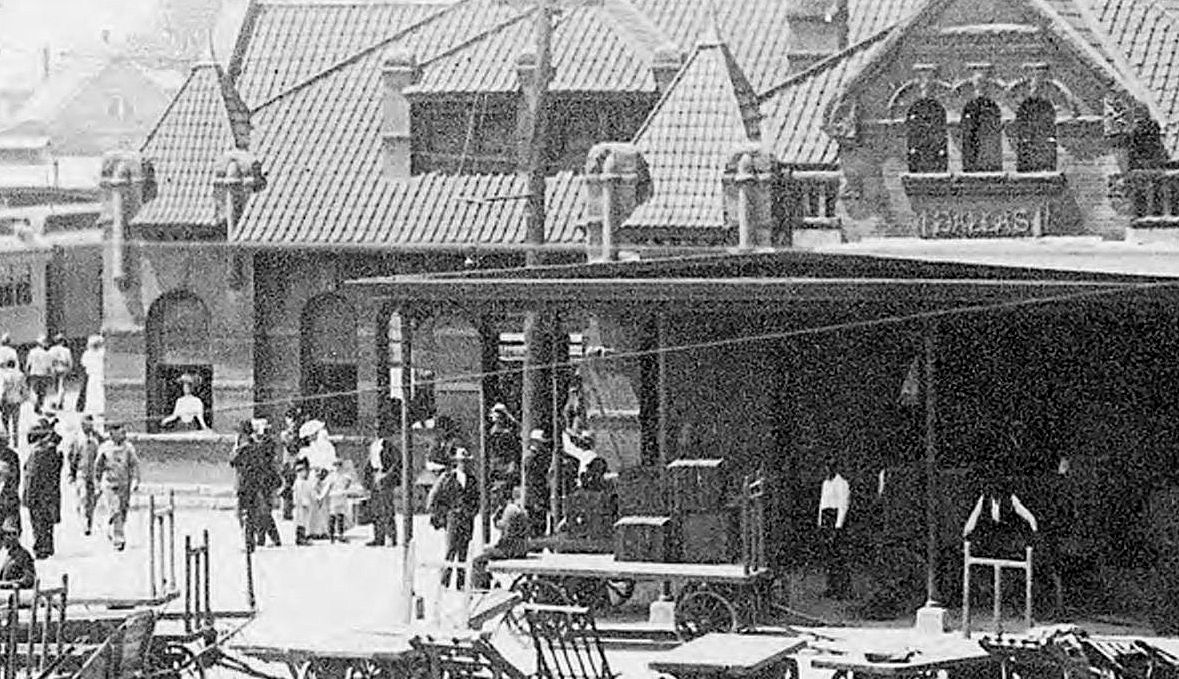
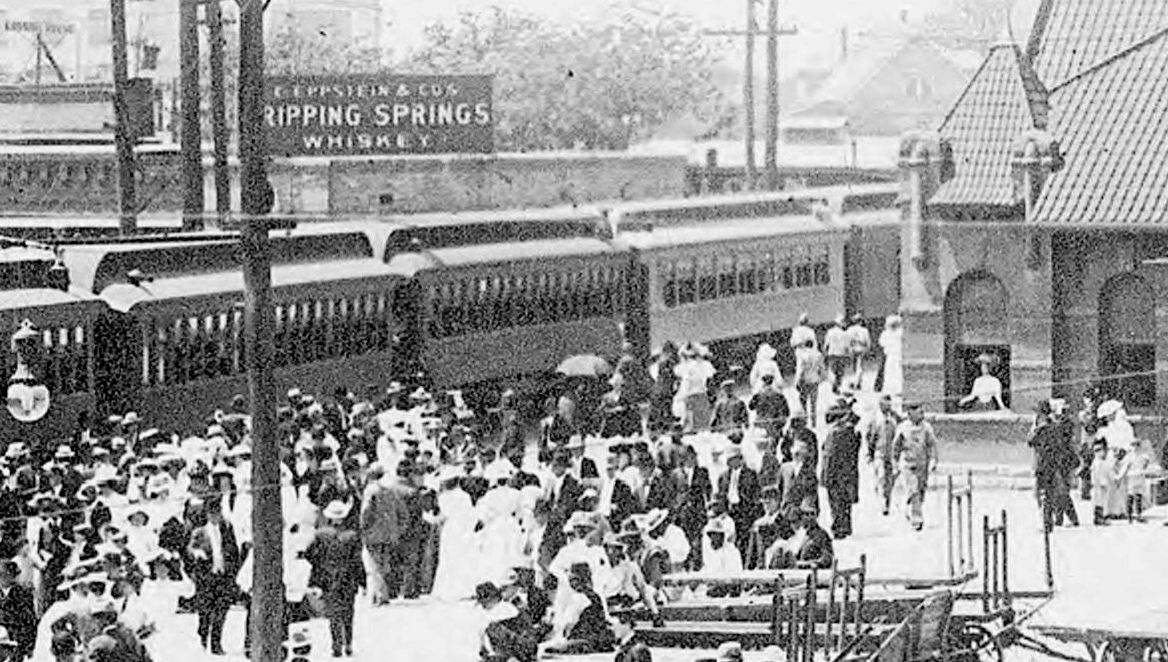
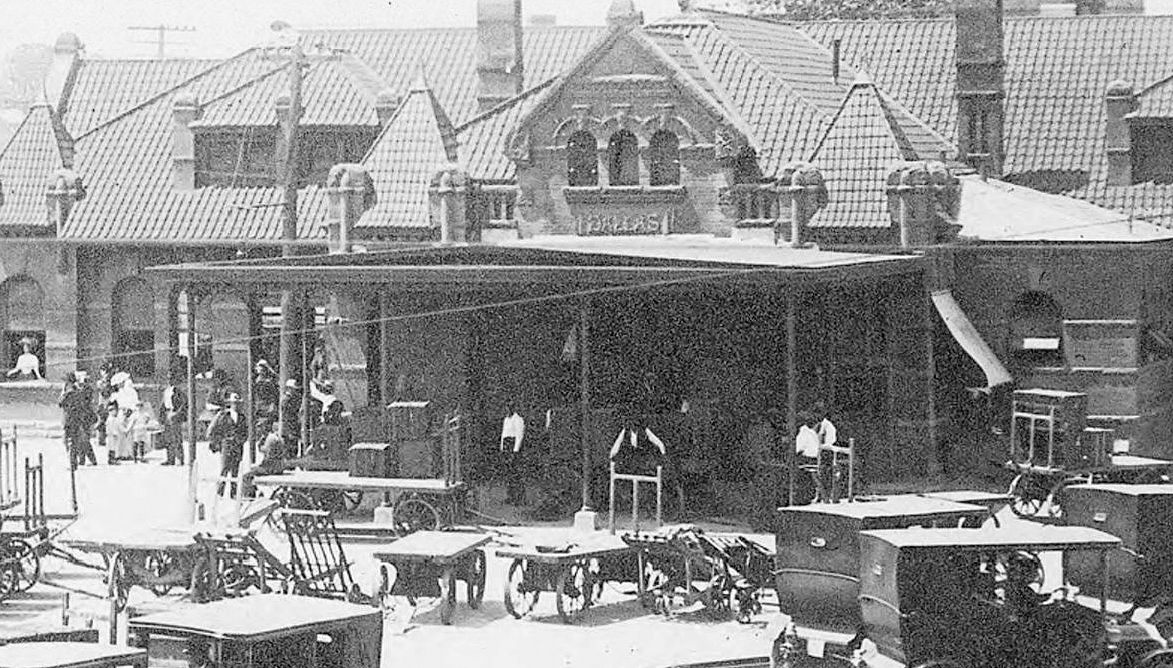
Back to the photo. Across Central Avenue from the hotel is the old Union Depot, where there was always a lot going on. Let’s look at the photo a little more closely. (Click photos to see larger images.)

old-union-depot_degolyer_ca1910

old-union-depot_degolyer_det1

old-union-depot_degolyer_det2

old-union-depot_degolyer-det3

old-union-depot_degolyer_det4

old-union-depot_degolyer_det5

old-union-depot_degolyer_det6

Just seven or eight years after this photo was taken, all that human traffic was gone.

In the fall of 1968, having been vacant for years and counting down its final hours, Dallas Morning News writer Doug Domeier wrote about the old run-down hotel which had long outlived the passenger depot it had been built to serve (see the article “Demolition Leveling Once-Noisy Deep Elm,” DMN, Oct. 19, 1968). Domeier’s entertaining article about those early days includes memories of Lizzie Mae Bass, who once worked in the hotel’s cafe as a waitress and remembers when “horses back[ed] away in fright when a locomotive pulled in at the lively intersection linking the Houston and Texas Central with the Texas & Pacific.”

And today? You’d never EVER suspect that that patch of empty land at the edge of Deep Ellum was ever occupied by one of the city’s busiest train depots.

*

So where was it? Get a good visual idea of how things were laid out in the Sanborn map from 1905, here. Below is a street map that shows where the hotel was (red star) and where the train depot was (blue star). These days? Depressing. See it here (the view is looking north from Elm — the hotel would have been under the overpass, the train station straight ahead).

union-depot-hotel_1952-mapsco1952 Mapsco

It’s interesting to note that during the heyday of the Union Depot, the west side of the block of Central Ave. which ran between Elm and Pacific was the only block in this area not filled with black-owned businesses or residences. When the depot shut down and white-owned businesses moved out, the block began to fill with popular African-American establishments. It’s also interesting (to me, anyway!) to realize that the Gypsy Tea Room of the 1930s was just a few steps to the left of the hotel in the top photo. It took me forever to try to figure out where the Gypsy Tea Room had been — I wrote about it here.

***

Sources & Notes

Top photo is a detail of a larger photo, from the Squire Haskins Photography, Inc. Collection, University of Texas at Arlington Libraries; it is accessible here. The same photograph is shown in full farther down the post — this copy is from the DeGolyer Library, Central University Libraries, Southern Methodist University, and it is accessible here. The quality of both photos makes it difficult to zoom in on them with much clarity, but both sites offer very large images to view.

As mentioned above, an entertaining Dallas Morning News article full of historical info about the area around the depot is highly recommended: “Demolition Leveling Once-Noisy Deep Elm” by Doug Domeier (DMN, Oct. 19, 1968). (I’m not sure why the hotel is referred to as the “Grand Central Station Hotel” throughout — just substitute “Union Depot Hotel” whenever you come across that incorrect name.) The article also has a few paragraphs about the Harlem Theater which was also about to be torn down as part of what Domeier described as the “brutal change” then affecting Deep Ellum.

See a great early-’20s photo of the hotel building (the Tip-Top Tailors moved in around 1922) in the book Deep Ellum: The Other Side of Dallas by Alan Govenar and Jay Brakefield, here (the view is from Pacific to the southwest).

A related Flashback Dallas post — “The Old Union Depot in East Dallas: 1897-1935” — can be read here.

All images larger when clicked.

*

Copyright © 2016 Paula Bosse. All Rights Reserved.


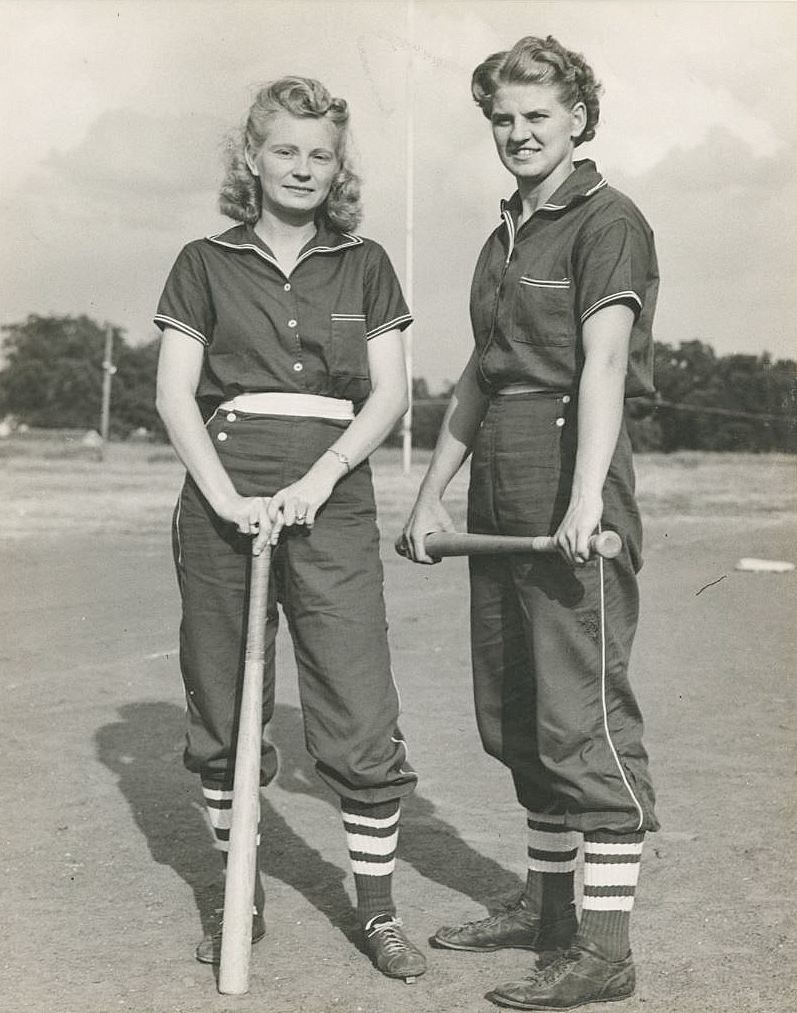
Girls’ Softball in Dallas, Hugely Popular

girls-softball_WPA-GD_dallas-park-rec-deptSoftball in the park… 

by Paula Bosse

Around 1938, softball suddenly became very, very popular in Dallas. Absolutely everyone seemed to be playing it: boys, girls, moms, dads, kids, businessmen, college students, and senior citizens. By 1939, The Dallas Morning News was calling the sport “the newest Dallas crazy custom.” There were more than 18,000 players playing on more than 300 organized teams, which meant that most of the roughly 100 softball diamonds in the city were constantly in use. It was estimated that more than 700,000 spectators had filled softball bleachers in 1938. These were all, of course, non-professional teams and players,  but there was some concern that this new-found softball enthusiasm might be cutting into attendance for the professional baseball games.

…[B]ut the fact remains that softball is cutting into the gate receipts of professional baseball. When more than 100 softball teams play almost every night in Dallas and hundreds of fans watch the games there certainly must be vacant seats at the stadium where professionals are doing their stuff for the Texas League. (Dallas Morning News, June 16, 1939)

Most interesting about this “fad” is that girls’ softball league games became extremely popular. These teams were often affiliated with local companies (Metzger’s Milk, Dunlap-Swain, etc.), and their sponsored games drew very large crowds, usually more than the men’s games did. The Dallas Morning News reported that attendance at the regular Friday night games in 1939 was something like five or six thousand. Some of the girls even became minor local celebrities.

baseball_teammates-of-fort-worth-cats_william-langley_nd_portal
Fort Wort at bat (via Portal to Texas History)

Coverage of the women’s games by the local press was solid, but coverage of the women themselves seemed more like a good excuse to run photos of the “girls” in skimpy uniforms rather than focus on their athletic ability. But I’m sure the girls shrugged it off and were just happy to be playing a sport they loved.

girls-softball_1940

**

Below, the 1943 Dallas Girls’ Softball League champions, the Metzer Dairy Maids. I love their names so much I want to type them out:

Tinker Tarker
Mutt McFanning
Aubrey Ray
Thelma Lowe
Pat Bell
Faustine Riley
Beatrice Draper
Flo Dyer
Opal Ritter
Annie Jo Floyd
Alma Floyd
Genevieve Dobbins
Pud Adams

girls-softball_dmn_071843
DMN, July 18, 1943

***

Sources & Notes

Top photo from the WPA Dallas Guide and History.

Second photo by Dallas photographer William Langley, from the collection of the Birdville Historical Society, via the Portal to Texas History.

Even though these company-sponsored teams were often in city- and state-wide leagues, they were all comprised of amateur players. That’s not to say money wasn’t being made. A lot of tickets were being sold, and companies got a lot of publicity for their winning teams. In fact, companies often scouted for players and hired them solely based on their athletic prowess — this is exactly how Babe Didrikson, generally considered one of the greatest all-round athletes in history, ended up working for an insurance company in the Interurban Building in downtown Dallas. (Read all about that in my previous post, “Babe Didrikson, Oak Cliff Typist.”)

*

Copyright © 2016 Paula Bosse. All Rights Reserved.

Blackie Sherrod: “The Most Plagiarized Man in Texas” — 1919-2016

blackie-sherrod_dmn-video

by Paula Bosse

Legendary sportswriter Blackie Sherrod died yesterday at the age of 96. My father was not a follower of sports, but I remember he read Blackie Sherrod’s columns because, along with other great, larger-than-life, and exceptionally talented DFW sportswriters such as Bud Shrake, Dan Jenkins, and Gary Cartwright, Blackie was — for want of a better word — a “literary” journalist whose style transcended his subject matter. His writing appealed to everyone who enjoyed and appreciated well-written and caustically funny forays into, around, over, and under the world of sports. Sports fans — and other sportswriters — loved the guy. And so did everyone else.

In the December 1975 issue of Texas Monthly, Larry L. King (forever known as the man who made more money from the best little whorehouse in Texas than any of the girls who plied their trade there) wrote a fantastic profile of Blackie (“The Best Sportswriter in Texas”), in which he described Blackie Sherrod as being “the most plagiarized man in Texas.” Sportswriters around the state routinely stole all of Blackie’s best lines and inserted them, unattributed, into their own columns. King himself admits he was one of the worst offenders. The lengthy profile is great. Great. Read it here.

*

UPDATE: Also, this is a great 9-minute film produced by KERA in the 1970s in which Blackie talks about his career, past and present.

***

Sources & Notes

Video is from the KERA Collection, G. William Jones Film & Video Collection, Hamon Arts Library, Southern Methodist University; the permanent link on YouTube is here.

Watch a Dallas Morning News-produced video tribute to Blackie Sherrod from 2013.

The Dallas Morning News obituary — “Legendary News Sportswriter Blackie Sherrod Dies at 96” — written by Kevin Sherrington, is here.

Several of Blackie’s Sherrod’s books can be purchased online, here.

Moments after I posted yesterday’s photo of the Dallas Times Herald lobby, I read that Blackie had died. He must have walked through that lobby thousands of times. That was an odd bit of synchronicity.

See an early photo of Blackie with his famed co-workers in the post “Legendary Sports Writers of the Fort Worth Press — ca, 1948.”

Thanks, Blackie.

*

Copyright © 2016 Paula Bosse. All Rights Reserved.

Six Flags: The Mexican Section — 1961

six-flags_mexican-section-lights_1962_ebayBienvenidos!

by Paula Bosse

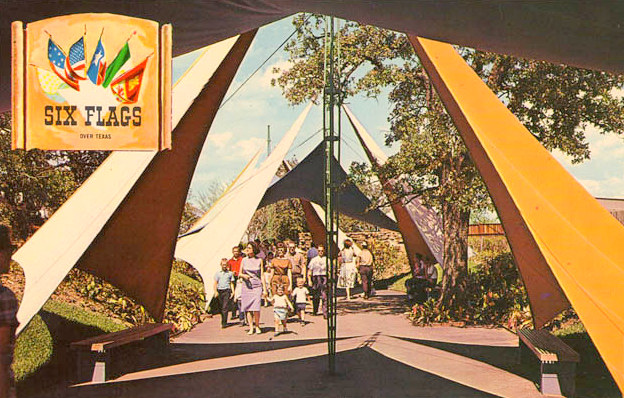
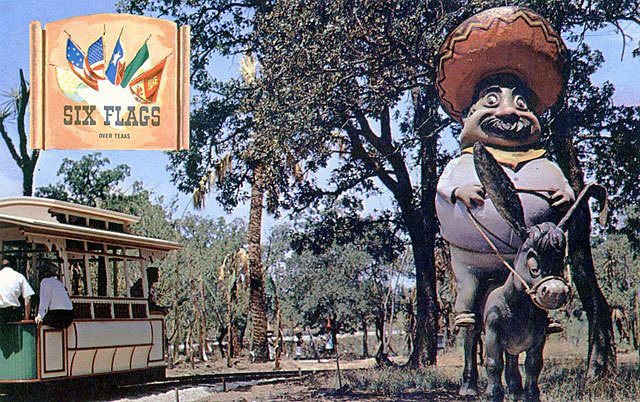
The image above is from a Six Flags Over Texas postcard. The description on the back reads:

Geometric Patterns — Mexican Section
Multi-colored lighting effects reveal a fascinating and beautiful picture of the Canopied Garden Walkway leading into the Mexican Section at this new 105-acre $10,000,000 family entertainment center.

Here it is in the daytime, still kind of attention-grabbing, but nowhere near as cool-looking:

six-flags_canopied-entrance_colliervia Ken Collier

I just wanted to post this Six Flags picture I’d never seen and move along, but why not add a few more postcards showing attractions in this part of the theme park: the “Mexican Section.”

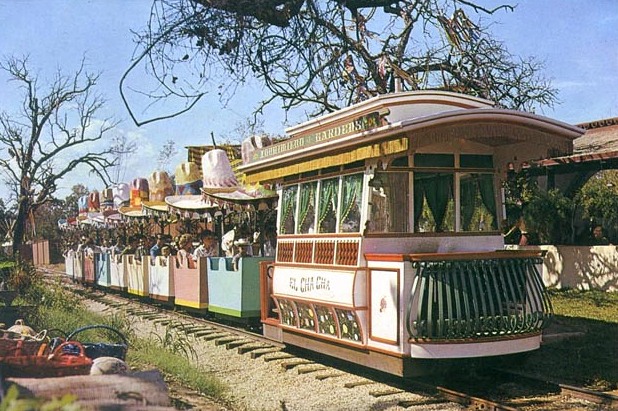
There was the Fiesta Train (which I was surprised to see was originally called Ferrocarril Fiesta), which was topped with colorful sombreros and chugged by all sorts of “festive” scenes which might seem a little culturally eyebrow-raising today.

six-flags_mexican-section-fiesta-train_colliervia Ken Collier

six-flags_mexican-section_burro-ridervia Ken Collier

There were animatronic bull fights. “Olé!”

six-flags_mexican-section_bull-fightvia Gorillas Don’t Blog

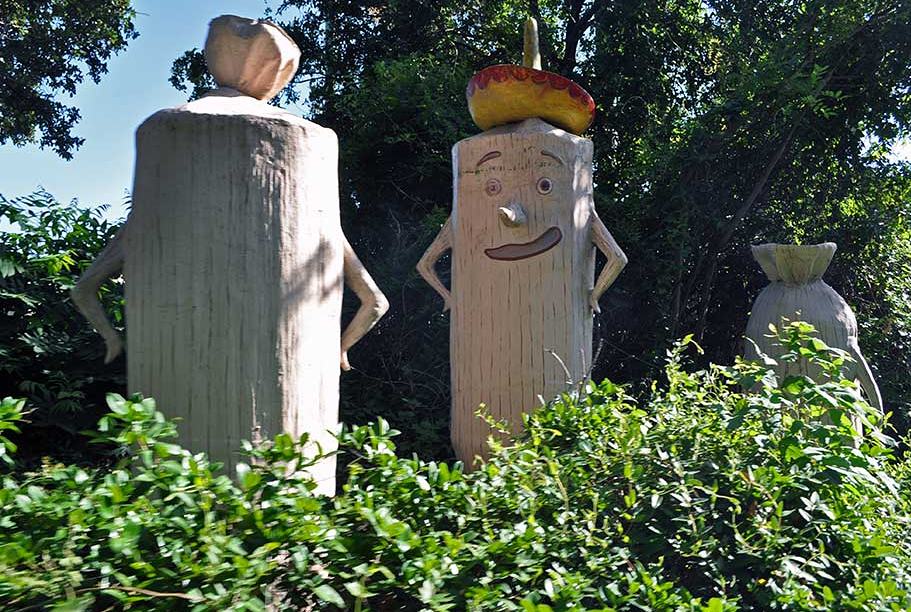
There were … dancing tamales. DANCING TAMALES! (Designed by Peter Wolf.)

Dancing Tamales — Mexican Section
One of the most popular of the many colorful and comical animations on the Fiesta Train ride, this group of Dancing Tamales perform to the gay strains of Mexican music that fills the air.

six-flags_dancing-tamales_flickrvia Flickr

And speaking of Mexican music, there were strolling mariachis.

six-flags_mexican-section_mariachis-flickrvia Flickr

And there was an even an El Chico restaurant.

el-chico_six-flags-gazette_091061Six Flags Gazette, Sept. 10, 1961

Here is an interesting article about what visitors to the brand new amusement park could expect to encounter on their visit to the Mexican Section, written by the Six Flags promotion department (click for larger image).

six-flags_mexican-section_six-flags-gazette_080661a   six-flags_mexican-section_six-flags-gazette_080661b
Six Flags Gazette, Aug. 6, 1961

And, no, I couldn’t find a 1961 photo of the sombrero ride!

UPDATE: Found one (from 1965)!

six-flags_el-sombrero_FWST-collection_1965_UTA

***

Sources & Notes

Sombrero ride photo is from the Fort Worth Star-Telegram Collection, University of Texas at Arlington Libraries, Special Collections — more on this photo is here.

Info about the Six Flags Railroad is here; more about the Ferrocarril Fiesta Train is here.

Apparently those tamales (with a face lift) are still around? I LOVE THESE GUYS!

six-flags_dancing-tamalesvia GuideToSFOT.com

Ken Collier is The Man for all things Six Flags. See his great site, here.

Other Flashback Dallas posts on Six Flags Over Texas can be found here.

*

Copyright © 2016 Paula Bosse. All Rights Reserved.

Bob-O-Links Golf Course — 1924-1973

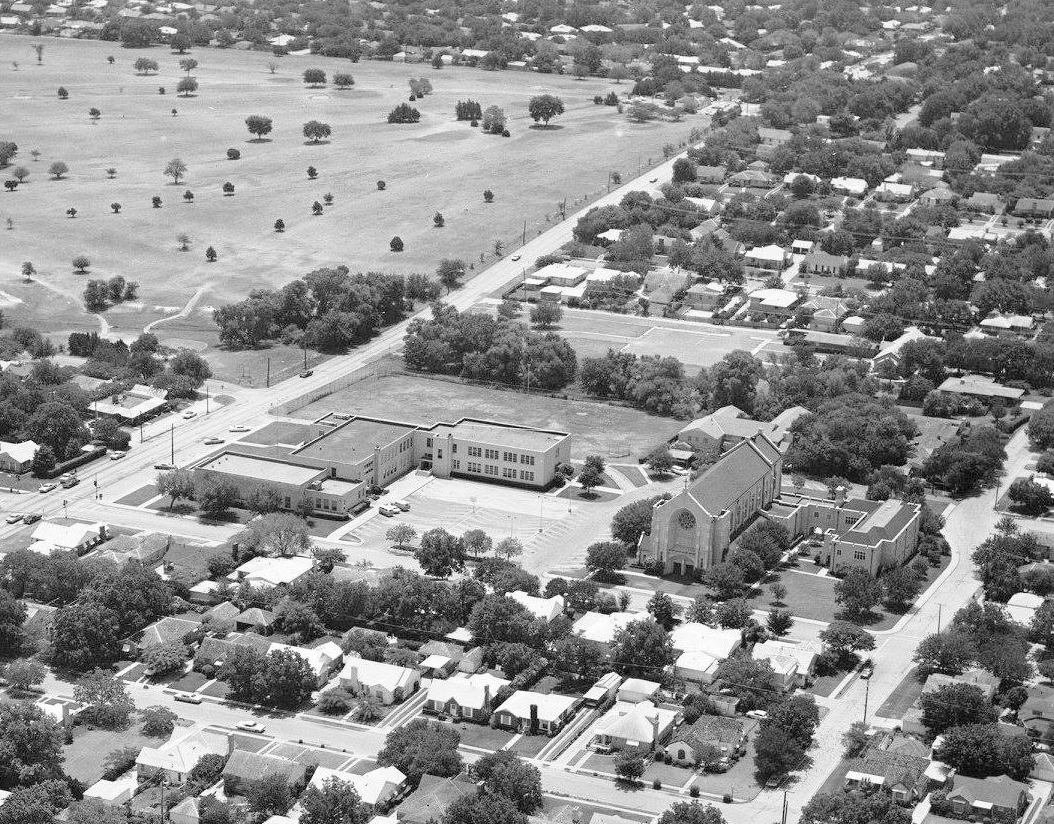
bob-o-links_abrams-rdBob-O-Links golf and St. Thomas Aquinas… (click for larger image)

 by Paula Bosse

The photograph above (with a view to the southeast) shows Abrams Road (at the left), a few blocks south of Mockingbird. On the right is St. Thomas Aquinas Catholic Church and school, and on the left, part of the Bob-O-Links Golf Course, Lakewood’s only public golf course. If you’re familiar with that part of town, it’s pretty incredible to see all that open land right in the middle of it.

Bob-O-Links, a 9-hole course, was opened by Harry McCommas in 1924 on 60 acres of the land originally owned by the pioneer McCommas family (the family’s full 640 acres covered land that stretched from what is now Abrams Road to White Rock Lake). Despite a creek meandering through seven of the course’s nine holes, the course was an immediate hit, mainly because it was one of the few public courses in town. This is where East Dallas residents with golf-fever would go to play if they couldn’t afford to join the Lakewood County Club.

From an article by John Anders in The Dallas Morning News:

When [Harry] McCommas, 75, decided to build a golf course on his grandfather’s sheep pasture in 1928 [sic], there were only three other golf courses in Dallas. And two of those three are now gone. “We were really out in the country then. There was no water, gas or electricity so we hauled in our water by truck. We didn’t need much since it was originally a sand course.” (DMN, July 6, 1973)

When the course opened in 1924, it was pretty much out in the sticks. By the late 1950s, though, Lakewood was booming, and developers were eager to build things — much to the dismay of nearby residents. Development was staved off for over a decade, but during that whole time, developers never stopped trying to get the area re-zoned, either for commercial use or for apartments and townhouses. Eventually — inevitably — the land was sold, and the days of the little golf course came to an end. The only “victory” the neighborhood could claim is that only single-family homes would be built on the land.

Bob-O-Links Golf Course closed on July 4, 1973. And as one drives down Abrams Road these days, it’s almost impossible to believe that it was ever there.

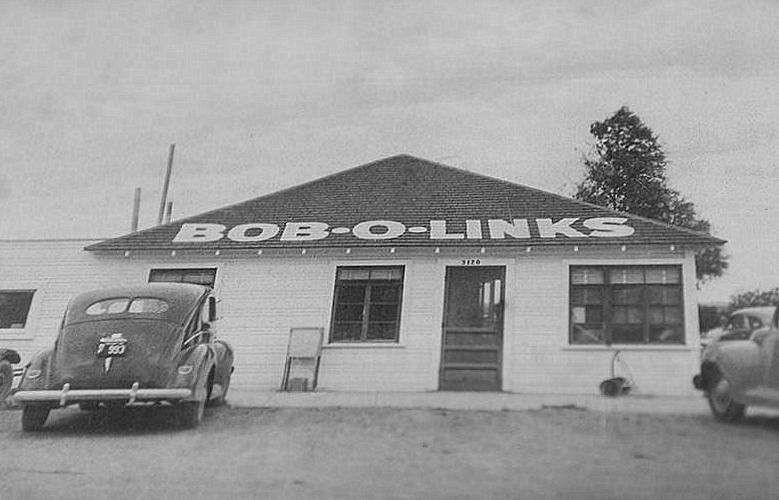
bob-o-links

bob-o-links_matchbook_flickr
via Flickr

bob-o-links_matchbook_2b
via Flickr

patreon_bob-o-links_harry-mccommas_matchbk_ebay_a

patreon_bob-o-links_harry-mccommas_matchbk_ebay_b

bob-o-links_dallas-park-board-minutes_070858Dallas Park Board minutes, July 4, 1958

bob-o-links_1962-map
1962 map detail (click for larger image)

***

Sources & Notes

I have no information about the top photo. It was posted on the Lakewood neighborhood group on Facebook by local bon vivant Michael Vouras. Comments on his post suggest that it may be a photo in the possession of St. Thomas Aquinas, taken around the mid 1960s. I welcome more info! (UPDATE: Below in the comments, other dates are suggested.)

A present-day aerial view of the same area can be seen here. The golf course (formerly on the left) has been gobbled up by houses.

A great article on Bob-O-Links — “The Bygone Days of Bob-O-Links Golf Course” — was written by Patti Vinson and appeared in a 2015 issue of The Lakewood Advocate; read it here.

Further reading from the archives of The Dallas Morning News:

  • “Re-zoning Denied for Bob-o-Links” (DMN, Sept. 17, 1960): this re-zoning request was to build a 35-acre shopping center; it was shot down by angry neighborhood residents
  • “Negotiations Finished To Buy Bob-o-Links” (DMN, Feb. 9, 1973): purchaser was long-time Dallas developer Hal McGraw who promised to build only single-family homes
  • “Farewell, Bob-O-Links” by John Anders (DMN, July 6, 1973): very entertaining article about Anders’ last round on the course, with memories of his earlier experiences on the course and quotes from owner Harry McCommas 

Wish I’d been there. “FORE!”

*

Copyright © 2016 Paula Bosse. All Rights Reserved.

The Moskovitz Cafe

moskovitz-cafe_winegarten-schechterA stool is waiting for you… (click for larger image)

by Paula Bosse

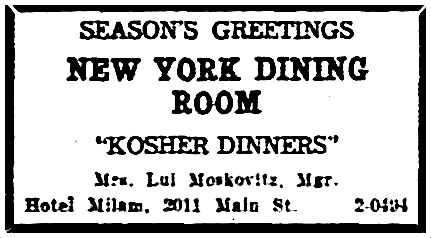
The Moskovitz Cafe was located at 2216 Elm Street, between S. Pearl and what is now Cesar Chavez Blvd., in an area of predominantly Jewish businesses. The restaurant served “Kosher and American cooking” and was owned and run by Lui Moskovitz, a Romanian immigrant, and his Polish-born wife, Eva. Eva, recently widowed, had arrived in Dallas in about 1928 with her three children and seems to have married Lui that same year. They had run another restaurant before the Moskovitz Cafe: the New York Kosher Dining Room on Commerce had been located across from the Adolphus Hotel for several years before it moved to 2011 Main, around the corner from City Hall. After that closed, they ran the Moskovitz Cafe between about 1937 and about 1944.

In 1945 there was no Lui or Eva Moskovitz in the Dallas directory. There was, however, an Eva Haberman — it appears that the Moskovitzes had split, Lui had left town, and Lui’s ex-wife had taken back the name of her late first husband. At this time she must have been about 60 years old, but she worked for the next few years as a department store seamstress and lived with one or more of her three sons from her marriage to Nathan Haberman. She died in April, 1961. Not only is there no trace of Lui after his time in Dallas, there is also no trace of 2216 Elm.

moskovitz_dmn_0101361936 ad

moskovitz-cafe_elm-st_1943-directory
Elm St. businesses, 1943 Dallas directory (click for larger image)

moskovitz_map
Location of Moskovitz Cafe (det. of a 1919 map)

***

Sources & Notes

Photo appeared in the book Deep in the Heart: The Lives & Legends of Texas Jews, A Photographic History by Ruthe Winegarten and Cathy Schechter (Austin: Eakin Press, 1990); from the collection of the Dallas Jewish Historical Society.

I’m not sure who the people in the photo are. When the Moskovitz Cafe opened, Lui would have been in his mid-40s and Eva would have been in her early 50s. UPDATE: Per the comment below (from Eva’s grandson), the woman in the white apron is the proprietress, Eva Moskovitz, and the man at the cash register is her son, Jack Haberman.

More information about Mrs. Eva Haberman can be found in her obituary, published in The News on April 19, 1961.

All images larger when clicked.

*

Copyright © 2016 Paula Bosse. All Rights Reserved.


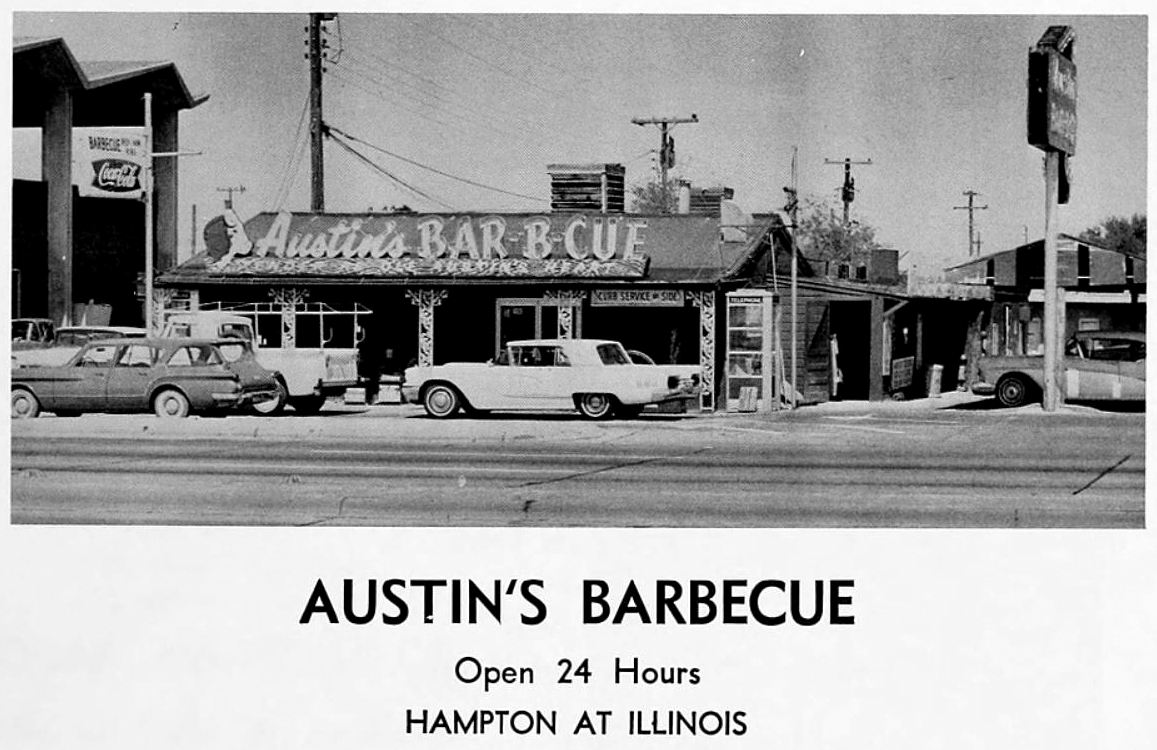
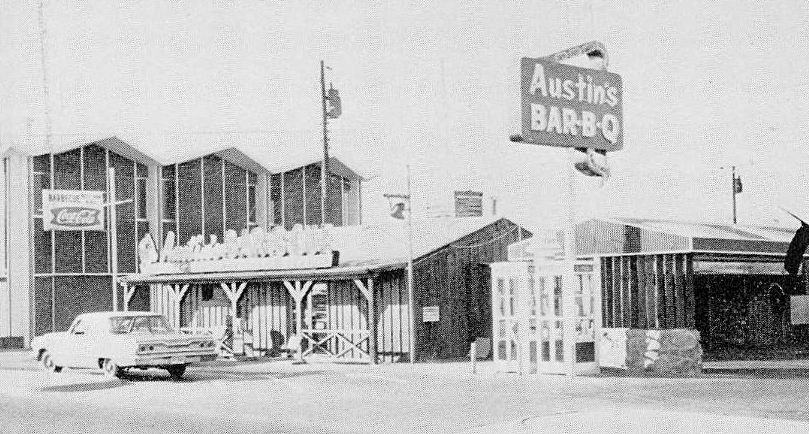
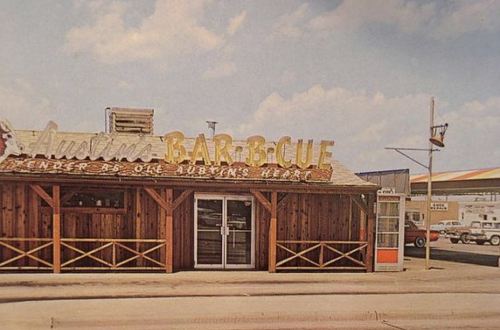
Bull Pen Barbecue/Austin’s Barbecue — 1949-2000

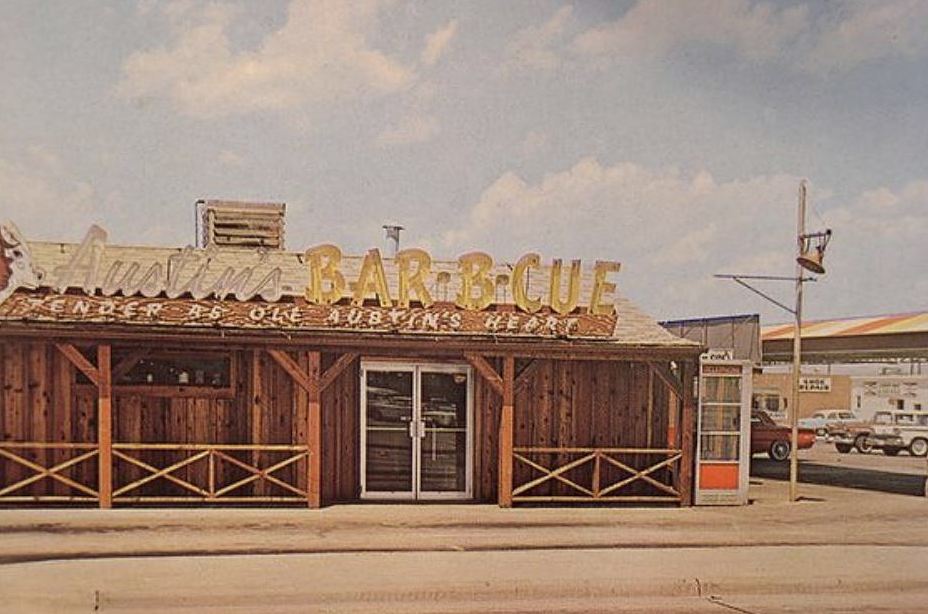
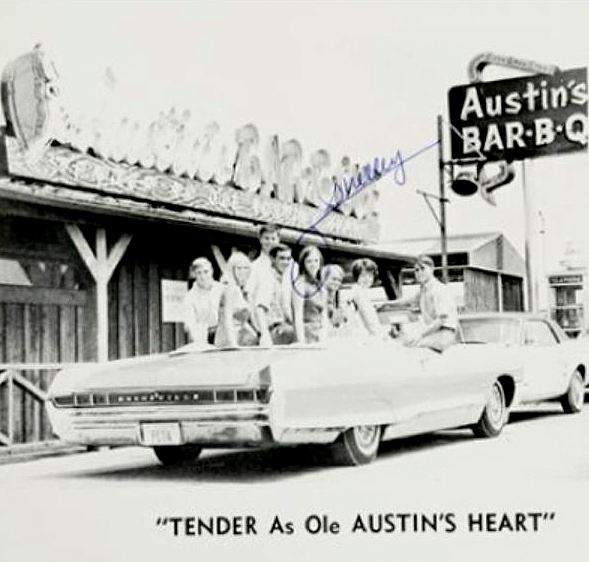
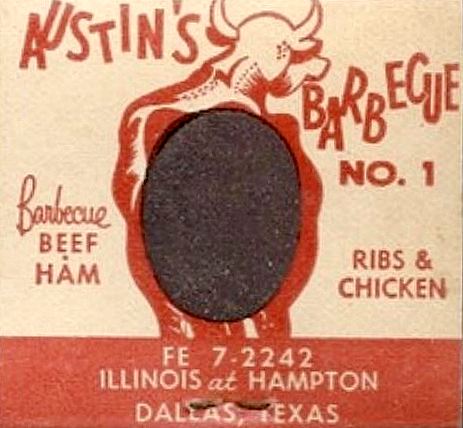
austins-barbecue_postcard_pinterest“As Tender as Ole Austin’s Heart…”

by Paula Bosse

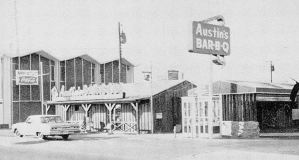
One of my major failings as a Dallasite is that I don’t know Oak Cliff. Like at all. Every time I go over there, I get lost. I can’t remember my family ever going to Oak Cliff when I was a kid, except to visit the zoo. This explains why I had no idea how important a cultural landmark Austin’s Barbecue was when I posted a bunch of Oak Cliff ads the other day. That post has been shared hundreds and hundreds of times now and, inevitably, the only thing people mention — and rhapsodize about — is Austin’s Barbecue. …I had no idea!

The famed BBQ joint at the northeast corner of Illinois Avenue and Hampton Road opened in 1949 as B & G Barbecue but soon became known as Bull Pen Barbecue, run jointly by owners Bert Bowman and Austin Cook. In 1956 or 1957, another Bull Pen opened in Arlington. After Oak Cliff went dry (a dark day for many Oak Cliffites), Bowman — who firmly believed that BBQ and beer were a match made in heaven — left for Arlington and Cook stayed in Oak Cliff and changed the restaurant’s name to Austin’s Barbecue. (“Bull Pen Barbecue” was still appearing in ads as late as Oct. 1957 — the official name changeover seems to have  happened in 1958.)
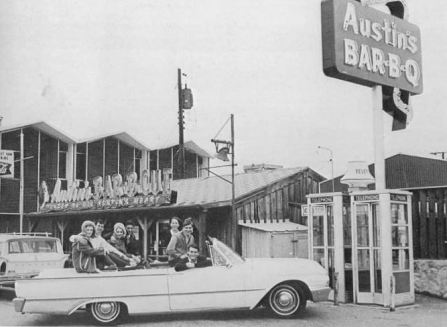
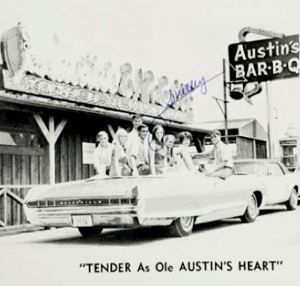
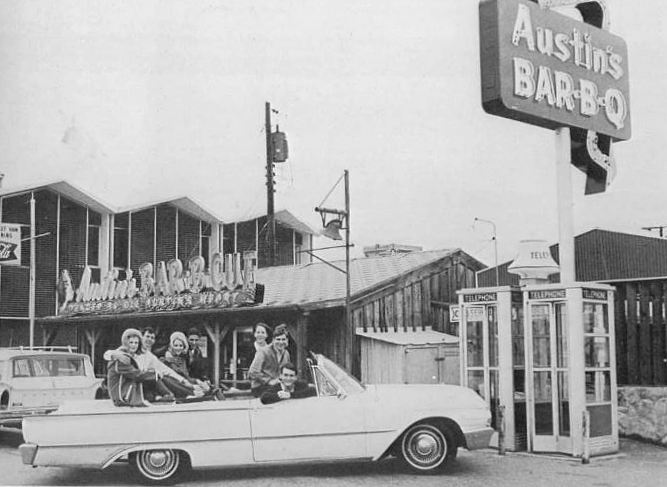
austins-bar-b-q_sunset-high-school_1967-yrbk1967 Sunset High School yearbook

*

The following memory of starting the business was apparently written by Austin Cook in 1990:

Dear Family & Friends,

I will try to tell you a little more about my being in the restaurant business. We borrowed $10,000 and bought out some one and it was B and G Barbecue. You see I always spell out Barbecue because when I went in business they hadn’t started abbreviating it like it is today.

After we had been there awhile we changed the name to The Bull Pen. Our slogan was “Come in and Shoot the Bull with Austin and Bert.” We used that name until they voted beer out of Oak Cliff. That really set us back, but maybe it was the best thing for us. We put another place in Arlington and that place was going pretty good. My partner wanted to get rid of the place in Oak Cliff. I traded him my part of the one in Arlington for his part in the one in Oak Cliff. Everyone said I was crazy.

When we bought that first place it was way out in the country, but they were building a bunch of houses not too far away. There was an airport across the street from the place. They kept talking about building a shopping center where the airport was. I remember the first day we ran a hundred dollars, and I thought we would never make it.

We started making money and we paid that ten thousand dollars back and we drew fifty dollars a week just like I was making in the grocery store. We started out with a barbecue sandwich and a hamburger. Then we started adding different things until we had a menu. We started getting those workers in the houses, and the business took off. We had beer also to go with the barbecue. My mother wasn’t too happy about that, but Dad said if that was the way I wanted to make my living it would be all right. In about a year or two we had a customer make us up a menu and we put in Barbecue plates for one dollar and twenty five cents. When I left they we were getting $4.99 for them. After I left I think they went to over seven dollars.

They always told me that you weren’t a success until you were in debt a hundred thousand dollars, and I went to the bank and borrowed all they would let me have. Then I went to my landlord and sold him the idea that I wanted to improve his property, and he loaned me the balance I needed to remodel, and I built a restaurant that held a hundred and twenty-five. Many times I was almost broke and didn’t know what I was going to do, but something always happened and I came out of it.

*

Both the Bull Pen in Arlington and Austin’s in Oak Cliff were successful and long-lived. Austin Cook retired at the end of 1993, and the business was taken over by his stepson, John Zito who had already been working at the restaurant for several years. Austin’s Barbecue closed in July, 2000, and the building was demolished soon after, replaced with an Eckerd drug store (now a CVS). Bert Bowman (born Glynbert Lee Bowman) died in 1989 at the age of 66; Austin O. Cook died at in 2006 at 86. And now I kind of feel like I know them, and I’m really sorry I never sampled their sandwiches.

*

Below, a Bowman and Cook timeline (most pictures and clippings are larger when clicked).
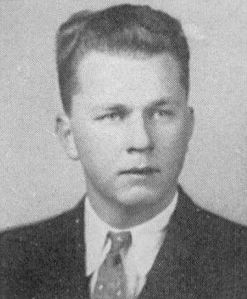
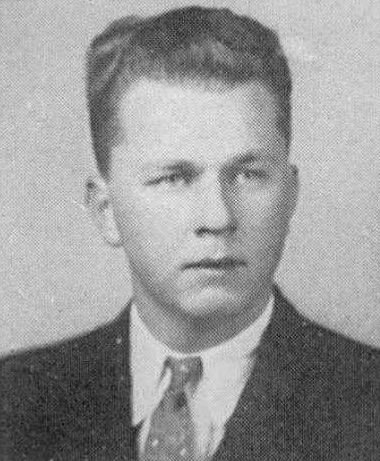
austin-cook_sunset-high-school_1937Austin Cook, Sunset High School, 1937

Before Cook and Bowmen met — probably around 1947 — each had been dabbling in different businesses. In early 1947, Cook leased a Clover Farm Store building at 203 N. Ewing and opened the Libby & Cook grocery with partner Lendal C. Libby.
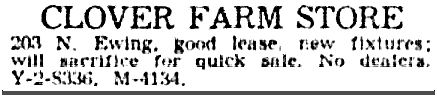
LIBBY-COOK_dmn_021047February, 1947

LIBBY-COOK_1947-directory1947 Dallas directory

Bert Bowman worked there as a meat-cutter.

bowman_1947-directory_GROCERY-w-AUSTIN1947 Dallas directory

The grocery store was in business at least into 1949, the year that Bowman and Cook decided to ditch the groceries and start their own business at 2321 W. Illinois, in a part of Oak Cliff which was just starting to be developed. Their BBQ place was originally called B & G Barbecue, which — according to Cook’s letter above — was the name of the restaurant he and Bowman bought out. I guess they felt it was easier to keep the name for awhile.

b-and-g-1951-directory1951 Dallas directory

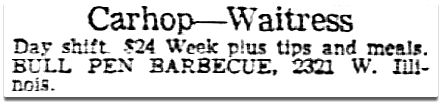
The name “Bull Pen Barbecue” didn’t come until later. In fact, the first appearance of the Bull Pen name associated with this address doesn’t show up in local newspaper archives until a want-ad placed in the summer of 1952.
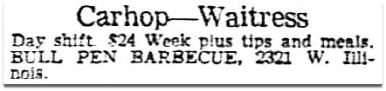
bull-pen_dmn_082652_FIRSTAugust, 1952

A probably related “Bull Pen No. 2” opened in South Dallas in 1953. It appears to have been very short-lived.
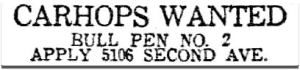
bull-pen-no-2_dmn_100853
October, 1953

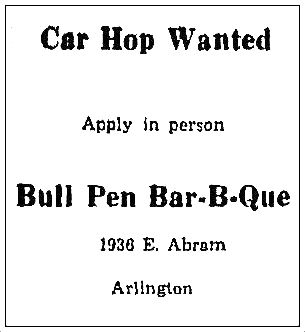
By the fall of 1957, Cook and Bowman had opened another Bull Pen — this one in Arlington, and this one a success.
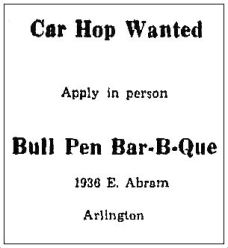
bull-pen_arlington_grand-prairie-daily-news_091557
September, 1957

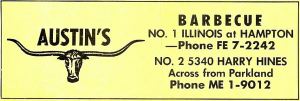
And then Oak Cliff went dry, the worst thing that could happen to a restaurant that sold a lot of beer. Similar businesses which relied heavily on beer sales began to desert Oak Cliff. Bowman did not think their original drive-in could survive, but Cook disagreed. Bowman sold his half-interest in the Oak Cliff location to Cook, and Cook sold his half-interest in the Arlington location to Bowman. Cook changed the name of his now solely-owned restaurant to Austin’s Barbecue, and his success continued, despite the fact that he could no longer sell beer. He was doing well enough that, in 1961, he opened a second location, on Harry Hines across from Parkland Hospital (a location which lasted through 1964).
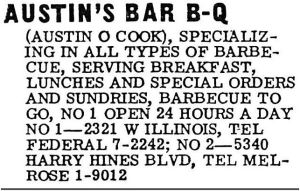
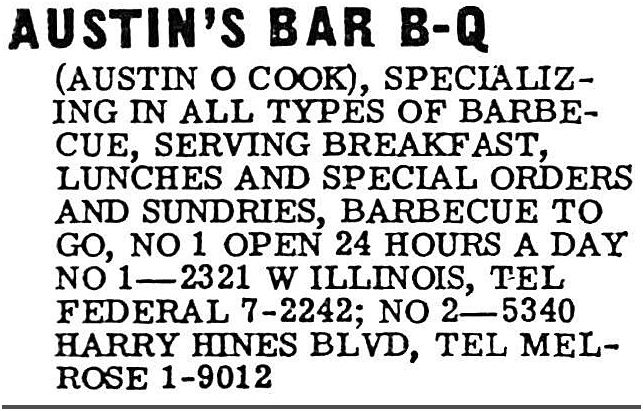
austins-barbecue_1962-directory_two-locations
1962 Dallas directory

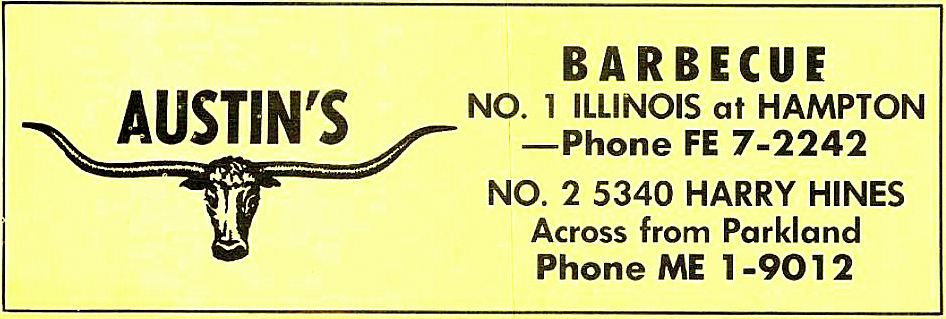
austins-barbecue_1963-directory_two-locations_ad
1963 Dallas directory

By 1963, Austin’s was a well-established teen hang-out and wisely placed ads in Oak Cliff high school annuals. Apparently everyone went there!
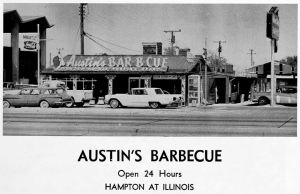
oak-cliff_austins_bar-b-cue_kimball-yrbk_19631963 Kimball High School yearbook

austins-bar-b-q_sunset-high-school_1964-yrbk.det1964 Sunset High School yearbook

austins_car-teens_flickr-coltera
Date and source unknown, via Flickr

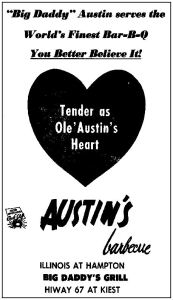
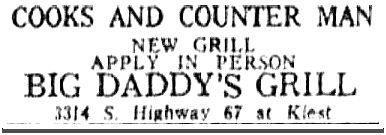
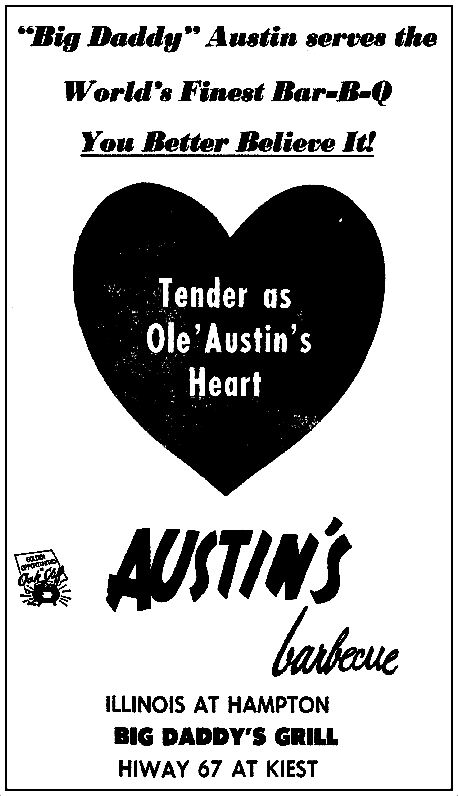
In 1964, Cook — known as “Big Daddy” — opened another restaurant, this one called Big Daddy’s Grill.
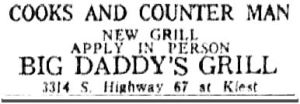
big-daddys_dmn_063064June, 1964

austins-barbecue_dmn_081466-adAugust, 1966

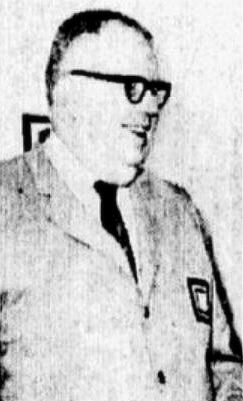
The restaurant was a bona fide Oak Cliff landmark, and Cook was an active participant in community business affairs. Below, a detail of a photo showing Cook as a member of the Oak Cliff Chamber of Commerce.
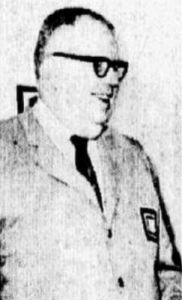
austin-cook_dmn_082568-photo-det
late 1960s

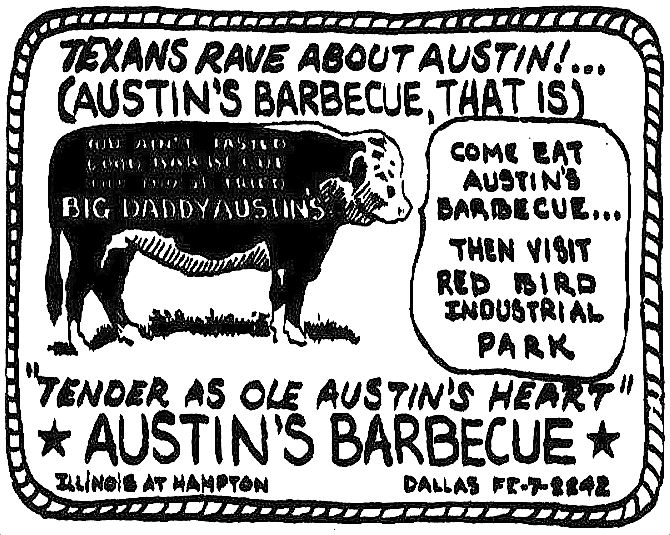
Cook participated in a series of Oak Cliff Chamber of Commerce campaigns and even included oddities like “Come eat Austin’s barbecue… and then visit Red Bird Industrial Park” in his ads. Make a day of it!

austins-barbecue_092968
September, 1968

ad_austins-barbecue
via OakCliff.org

austins_matchbk_flickr_coltera
via Flickr

***

Sources & Notes

Color postcard at the top found on Pinterest, here.

The letter from Austin Cook was quoted on the DHS Phorum, here. More from the Phorum on The Bull Pen/Austin’s is here.

More can be found in the Dallas Morning News archives in the following stories:

  • “Austin’s Bar-B-Q Grows With Oak Cliff” (DMN, Aug. 14, 1966)
  • “Barbecue To Go — Staff, Customers Mourn Closing of Oak Cliff Institution” (DMN, July 13, 2000)
  • “Closed But Not Forgotten — Oak Cliff Eatery Marks Half-Century of Barbecue With Memorable Auction” (DMN, Aug. 27, 2000)
  • “John P. Zito — Operated Oak Cliff Landmark Austin’s Barbecue For 19 Years” by Joe Simnacher (DMN, Oct. 14, 2003)

Read the obituaries of Bert Bowman (1989) and Austin O. Cook (2006) here.

The Oak Cliff Advocate article “A Look Back at Austin’s Barbecue” by Gayla Brooks is here (with tons of memories from readers in the comments).

Not mentioned in this post is the connection of Officer J. D. Tippit (who moonlighted as a keeper of the peace at Austin’s) and other tangential/coincidental associations to the Kennedy assassination. It’s well documented elsewhere. Google is your friend.

*

Copyright © 2016 Paula Bosse. All Rights Reserved.

Goodbye, Merle

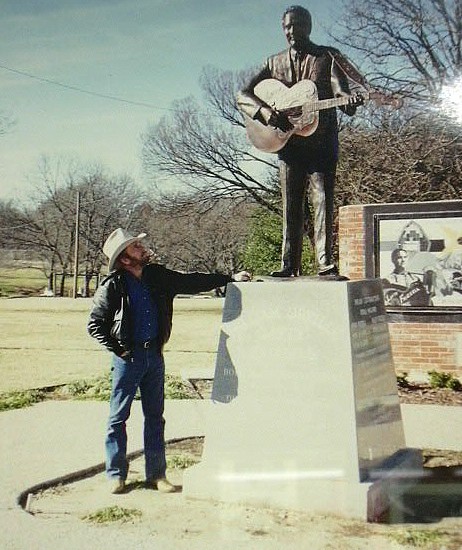
merle_lefty_corsicanaMerle and Lefty, in Corsicana

by Paula Bosse

The great Merle Haggard died today, on his 79th birthday. My earliest music memories are hearing his songs on the radio. Even people who don’t listen to country  music know who Merle Haggard is (and are probably fans).

One of his idols was Lefty Frizzell, the Corsicana-born legend whose first hits were recorded in Dallas. Merle helped raise the funds in the late ’80s and early ’90s for the wonderful statue of Lefty which now stands in Jester Park in Corsicana. The picture above shows Merle visiting the statue. (Whenever I’m in Corsicana, I always drop by Jester Park to spend some time with Lefty.)

As far as Merle and Dallas, the earliest mention I could find was from January, 1965. Country music was covered only sporadically in the pages of The Dallas Morning News back then, but his early-’65 stop at the Sportatorium may have been Merle’s first appearance in Dallas — appropriately enough, it was at the Big D Jamboree. “California country music team” Merle and Bonnie Owens were guest performers, along with Billy Grammer and James O’Gwynn of the Grand Ole Opry, and the regular Jamboree cast of thirty, for the Jan. 30, 1965 Saturday-night Big D Jamboree show.

RIP, Merle. Thanks for everything.

***

The top picture is a photo I took of an original photograph which is hanging in the Lefty Frizzell Museum, which is also in Corsicana’s Jester Park (as part of the Pioneer Village).

Merle’s obituary in Variety — which includes entertaining salty quotes from the man himself — is here.

*

Copyright © 2016 Paula Bosse. All Rights Reserved.


Tennessee Williams in Dallas

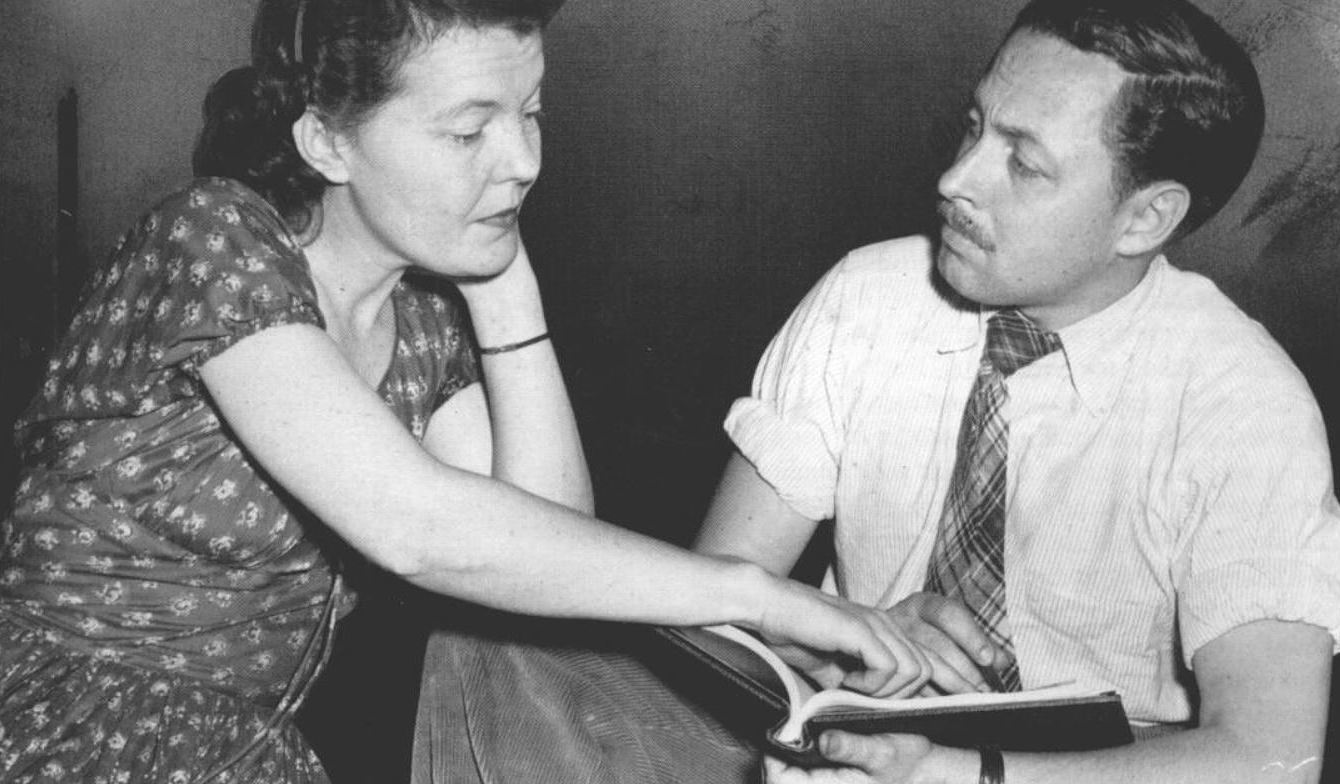
tennessee-williams_margo-jones_legacies_spring-2007Tennessee Williams with Margo Jones, 1948

by Paula Bosse

Today is Tennessee Williams’ birthday — he was born March 26, 1911. Thanks to his personal friendship and professional relationship with energetic Dallas theater pioneer Margo Jones (to whom he gave the nickname “The Texas Tornado”), playwright Tennessee Williams was a fairly frequent visitor to Dallas in the 1940s in the early years of his celebrity. Margo was a very early supporter of Williams, and their friendship led to her co-directing The Glass Menagerie on Broadway and her directing and producing the world premiere of his play Summer and Smoke at her Theater ’47 in Fair Park (a production which she took to Broadway the following year).

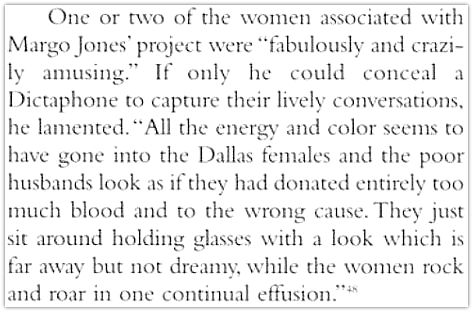
Dallas historian Darwin Payne wrote an interesting profile of Williams’ time in Dallas in the Spring 2007 issue of Legacies (read it here — it  begins at the bottom of the page). My favorite quote in the article is about Dallas women, from a letter Tennessee wrote to New York theater director and producer Guthrie McClintic on June 1, 1945:

tennessee-williams_legacies_spring-2007_darwin-payne_1945-quote

***

Sources & Notes

A comprehensive chronology of the friendship and professional partnership of Tennessee Williams and Margo Jones can be found in the article “An Alignment of Stars: Tennessee Williams, William Inge, and Margo Jones’s ‘Theatre ’47′” by Ralph F. Voss, here.

My previous post concerning Margo Jones’ early demise — “Margo Jones & Jim Beck: Both Legends in Their Fields, Both Victims of Carbon Tetrachloride” — is here.

*

Copyright © 2016 Paula Bosse. All Rights Reserved.