Flashback : Dallas

A Miscellany: History, Ads, Pop Culture

Category: Leisure

A Dip in the HP Pool — 1924

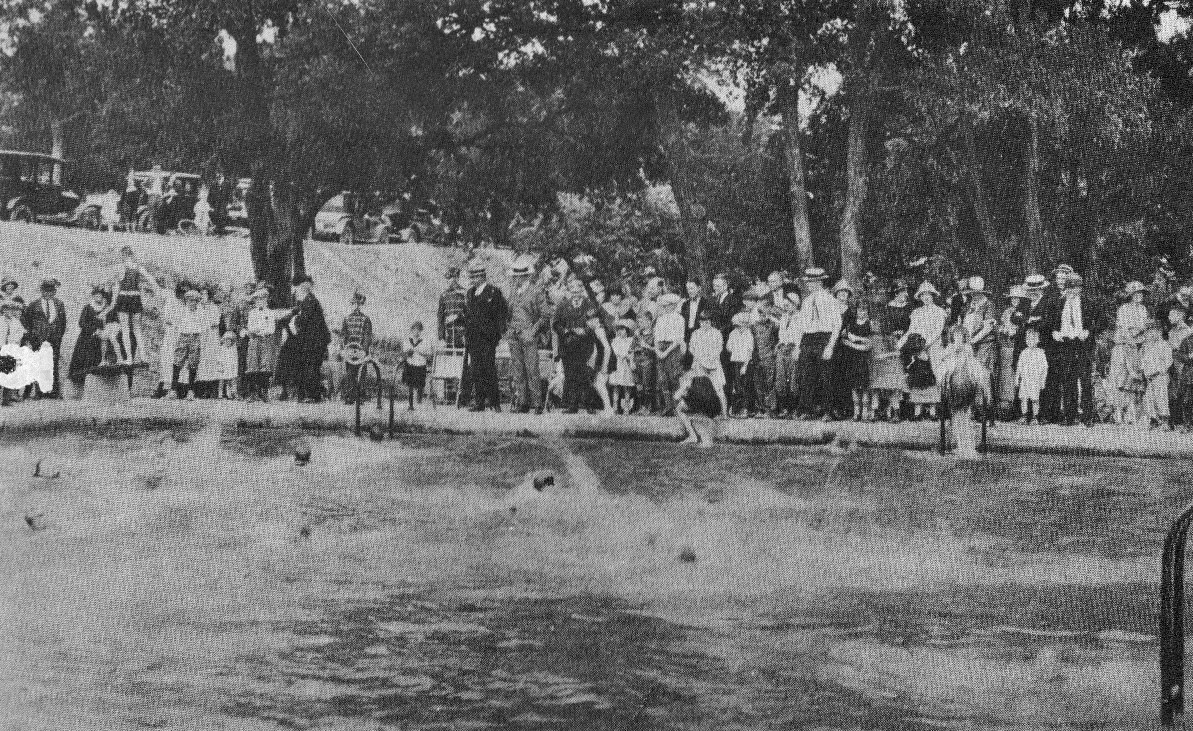
hp-pool_aDedication & formal opening of the HP pool, 1924

by Paula Bosse

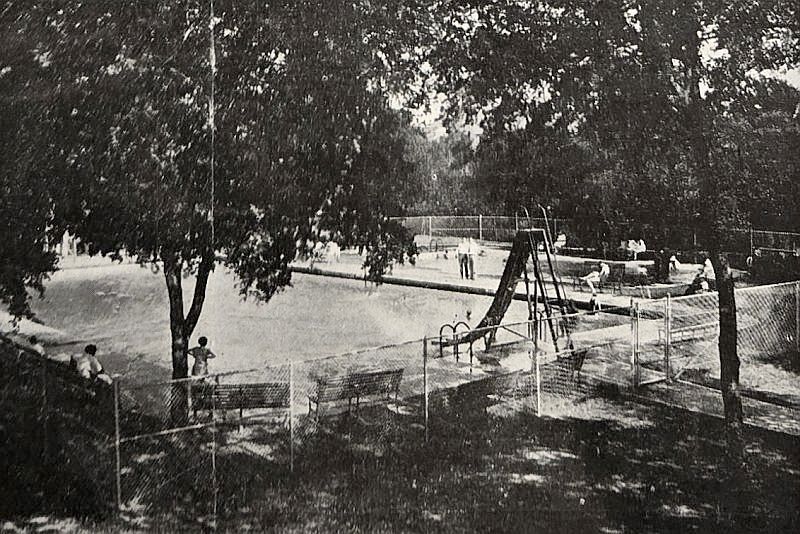
Even though “municipal pool” and “Park Cities” don’t really seem to belong in a sentence together, the still-going-strong pool in Highland Park is over 90 years old. The photo above shows crowds gathered at the formal opening of the brand new Highland Park swimming pool, dedicated on May 17, 1924. The caption of this photo which ran in The Dallas Morning News on May 18, 1924 reads: “The above shows the group of Highland Park citizens gathered at the new municipal swimming pool Saturday afternoon for the formal opening exercises. Mayor Frank M. Smith is seen standing in the middle of the group. Seated by his side is former mayor Henry L. Davis in whose administration the movement for the installation of the pool was started.”

Oh, to have witnessed the fabulously wealthy (or near-fabulously wealthy) sashaying down the street toward the pool, dressed in their mandated bathrobes and swimsuits. Or their raincoats and swimsuits. (“[Regulations governing use of the pool require that] swimmers must dress at home in their bathing suits, but may come through the streets to the pool so clad if they wear a raincoat or a bathrobe over their swimming garb.” — Dallas Morning News, May 18, 1924)

The municipal pool is in Davis Park on the south side of Lexington Avenue, in the “natural amphitheater” between St. Johns and Drexel. The 50 x 100-foot pool (reduced somewhere along the way from the original plan of a 60 x 140-foot pool) cost about $10,000 when it was built with municipal funds in 1924. The pool was very popular amongst Highland Park residents, and, as can be seen in the photos, it was located in one of the prettiest settings in Dallas.

hp-pool_highland-park-paper_june-1927_DPL

***

Sources & Notes

Top photo is from a postcard issued as part of the Park Cities Bank “Heritage Series” in the 1970s; the credit line on the postcard reads “Donated by Mr. Burton Gilliland.” Thanks to the Lone Star Library Annex Facebook group for use of the image. (The printed description of the postcard has an incorrect date of 1923.)

Bottom photo is from Highland Park (an interesting newspaper published by developers Flippen-Prather), June 1927, Periodicals Collection, Dallas History and Archives, Dallas Public Library.

More on the pool’s opening can be found in the Dallas Morning News article “Highland Park Pool Dedicated Saturday” (May 18, 1924).

Official site of the HP pool? Here it is.

*

Copyright © 2015 Paula Bosse. All Rights Reserved.

“The Last Time I Saw Texas” — 1953/58

neiman-marcus_texas-mapThat “X” is in the wrong spot, y’all…. (click for larger image)

by Paula Bosse

Before I begin, I offer apologies in advance to Oscar Hammerstein II (original lyricist of “The Last Time I Saw Paris”), NeimanMarcus (with or without the hyphen), haters of Texas stereotypes, and, especially, Fort Worth.

In a Dallas item connected with “Independence Day” in only the most tangential way possible, I thought I’d share a little cabaret song I stumbled across today whilst rummaging through the internet. It’s a humorously re-written version of the Academy Award-winning hit song “The Last Time I Saw Paris,” (…um, the one in FRANCE….), written in 1940 by Oscar Hammerstein II (lyrics) and Jerome Kern (music).

Partial lyrics were reported by Earl Wilson in his syndicated gossip/entertainment column, “Broadway Last Night,” twice — first in 1953, after he’d seen Juliana Larson sing it at the Sherry Netherland Hotel, then later, in 1958, after he’d heard Connie Moore sing it at the St. Regis Maisonette. Both women had Texas ties (Constance Moore actually grew up in Dallas), so I’m sure both enjoyed singing the ditty (in what one hopes was in an ever-so-amusing sophisticated style, à la Noël Coward).

At the Neiman-Marcus store
They sell the usual furs
And the cutest children’s Cadillacs
And yachts marked “His” and “Hers.”

The last time I saw Texas
And the oil was in her hills,
The kiddies bought their lunch at school
With hundred-dollar bills.

The last time I saw Texas,
All Dallas was so gay,
We’d burned Fort Worth to the ground
On Independence Day.

Happy Independence Day, Fort Worth!

***

Listen to Noël Coward sing “The Last Time I Saw Paris” (before FW was being burned to the ground), here.

Juliana Larson (aka Juliana Bernhardt) was a former John Powers model who married wealthy Houston oilman Walter Bedford Sharp, Jr. (whose father was a business partner with Howard Hughes’ father). She started in light opera in Texas and moved on to New York nightclubs. She seems to be known mostly as the wife of a Texas oilman and a permanent fixture on Best Dressed lists. She horrified everyone when she showed up to a Metropolitan Opera opening night wearing trousers — see her delighting in the publicity she received from that, in Life magazine (Nov. 24, 1952), here.

Constance Moore was born in Iowa but grew up and began her career in Dallas. More about her here and here; glamour photos here.

The “Texas” lyrics were reported by Earl Wilson to have been written by David Roger (for Juliana Larson, in 1953) and by Earl Brent (for Connie Moore, in 1958). The partial lyrics Wilson quoted in 1953 and 1958 were the same. …So there you go. (I changed the order of one line, because it seems that Wilson got the lines of the first verse in the wrong order.)

I’m not sure where I found that Neiman’s map, but it’s cool. (Why IS the “X “is the hinterlands, anyway?)

Enjoy your 4th of July weekend! And don’t burn anything down!

*

Copyright © 2015 Paula Bosse. All Rights Reserved.

(Obscure) Country Music Radio Stations — 1969

KYAL-1600“Home of the Tall Texans” (click for larger image)

by Paula Bosse

Okay, maybe they’re not obscure to people who listened to country stations in Dallas in the 1960s, but to someone who grew up in the ’70s in a household in which country stalwarts KBOX and WBAP were always on, these three stations are unknown to me.

Of these, my favorite call letters are KYAL, as seen in the ad above — that’s right, “K-y’all.” Disc jockey “Johnny Dallas” was none other than local rockabilly fave, Groovey Joe Poovey.

KYAL_johnny-dallas_groovey-joe-poovey_ca1969

KBUY was out of Fort Worth and had quite the daytime signal.

KBUY-1540

There was also KCWM (for “Country & Western Music”). This one was an FM station. Legendary DJ Bill Mack was hired by the station to get its country format going, and he even suggested the call letters.

KCWM-99.5

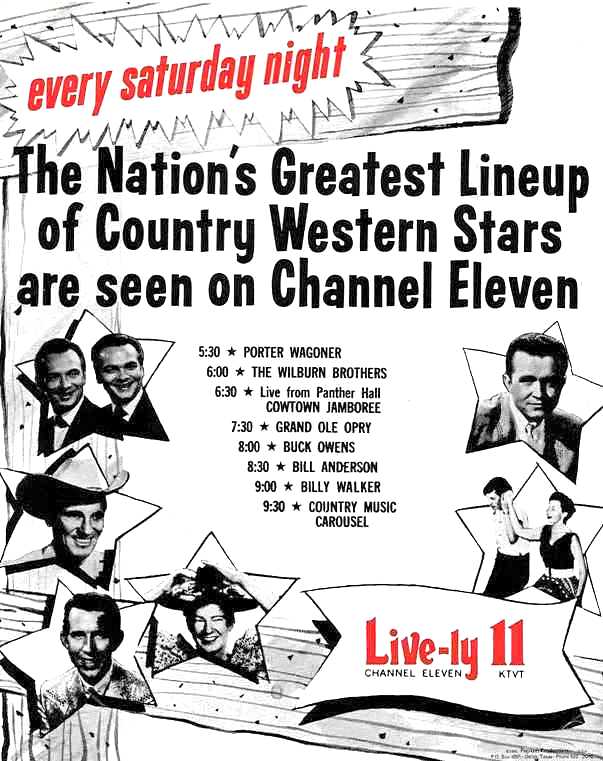
I came across these ads in some sort of local country music publication called “Country and Western — The Sound That Goes Around the World” (1969). Sprinkled amongst bios and photos of country stars are lots of local ads. One of the (non-radio) ads that caught my attention was one for the Saturday night lineup of country music television shows on KTVT Channel 11. Some of these shows were still on in the ’70s when I used to watch them with my father. (I’m not sure I knew there was ever a live television broadcast from Panther Hall in Fort Worth — “Cowtown Jamboree” — that would have been cool to see.)

country-music-saturday-night_ch-11-1969(click for larger image)

***

The best source for the history of Dallas-Fort Worth radio is, without question, Mike Shannon’s DFWRetroplex.com site.

KBOX was the station that really started it all for country music radio in Dallas; read about its history here.

Info on KYAL 1600 AM is on this page.

Info on KBUY 1540 AM and KCWM 99.5 FM is on this page.

Read about Groovey Joe Poovey here and here and here. See a slideshow of photos of him while listening to his GREAT version of “Deep Ellum Blues,” here.

Click pictures for larger images.

*

Copyright © 2015 Paula Bosse. All Rights Reserved.


“Experimental” Bus Trip to White Rock Lake — 1925

white-rock-bus_dmn_071625Next stop: White Rock Lake

by Paula Bosse

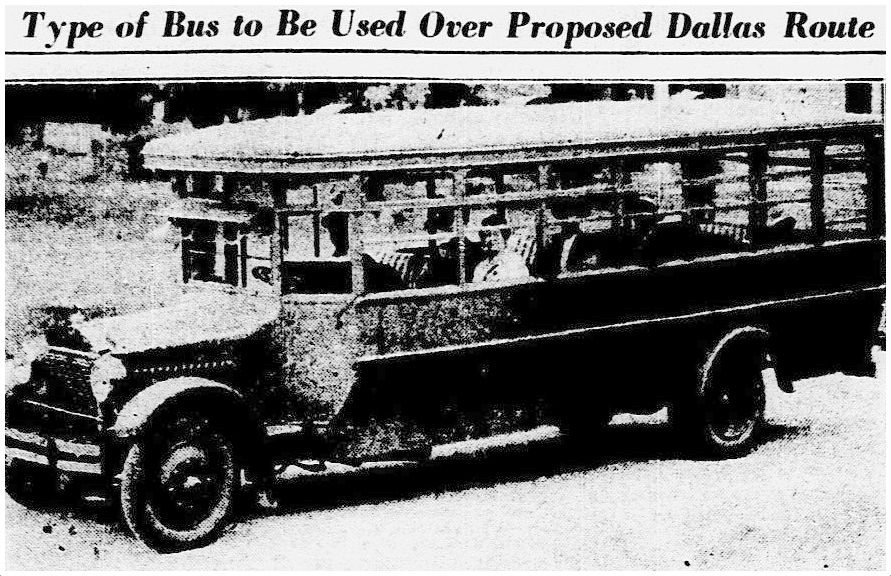
In the 1920s, White Rock Lake was becoming a popular nearby recreation area and beauty spot. It was a bit of a drive to get out there, though. Bus operators were wangling to get the contract to transport tired and pale Dallasites to a nice day out at the lake. The caption accompanying the above photo:

“This city type bus will make an experimental trip to White Rock with city officials, applicants for bus franchise and newspaper men to test adaptability of various routes to bus line operation. Busses [sic] of this type, said C. D. Cain, who has been voted the White Rock franchise informally by the City Commission, will be run on the line when the franchise is formally granted.”

***

Sources & Notes

Photo and caption from The Dallas Morning News, July 16, 1925.

*

Copyright © 2015 Paula Bosse. All Rights Reserved.

Orson Welles In Dallas — 1934-1940

orson-welles_cornell-tour_1934
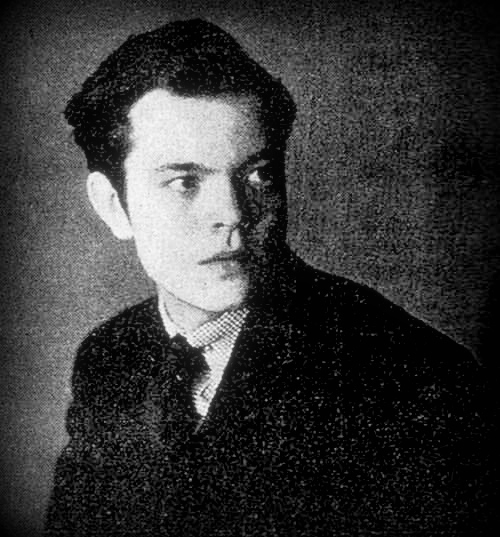
Orson at 18 — publicity photo used for the Cornell tour, 1934

by Paula Bosse

Today is the 100th anniversary of the birth of Orson Welles. Welles was one of the truly great, innovative theater and film directors, an actor with a commanding presence, and a delightfully entertaining raconteur. His frenetically creative work on the New York stage, on radio, and in film (he wrote, produced, directed, and acted in his first film, Citizen Kane, when he was only 25) earned him/saddled him with the hard-to-deny sobriquet “Boy Genius.” His rise up the show-biz ladder was a quick one.

Orson’s first professional acting gig was as an unknown 18-year old repertory player in the touring company of famed actress Katharine Cornell who, along with British actor Basil Rathbone, starred in the three plays performed on the tour, which stopped in Dallas for a two-night engagement at the Melba theater, in February, 1934. The three plays performed in Dallas on February 19 and 20 (one a matinee) were “Romeo and Juliet” (Orson played Mercutio), “The Barretts of Wimpole Street” (he played Octavius Moulton-Barrett), and “Candida” (he played Marchbanks). Cornell was a huge draw, and there was a rush for tickets. The Melba begged her to extend her stay and add performances, but she declined.

The young Welles had gotten reviews on the tour which ranged from a dismissive mention in Variety that he was unable to speak Shakespeare’s lines properly and audibly (!), to raves from Charles Collins of The Chicago Tribune:

The cast is brilliant, and many of the secondary characters are acted with consummate skill. This is particularly true of Orson Welles’ Mercutio, which is an astonishing achievement for a youth still new on the stage. In his duel with Tybalt and his death scene, this Mercutio is a complete realization of Shakespeare’s bravest blade.

The star of the show was the then-very-famous Katharine Cornell, around whom most of the articles and reviews centered (she was, for instance, breathlessly reported to be staying at the Melrose during her Dallas stay) (I wonder if the lowly company players — i.e. Orson Welles — stayed there as well?). The Dallas Morning News theater critic, John Rosenfield — who mentioned this 1934 Dallas appearance in almost every succeeding article he ever wrote about Orson Welles over the next several decades — wrote the following before he saw Orson’s performances in any of the three plays:

Orson Welles, 18-year-old actor, who is apparently bulky enough to hold his own with adults, will be Mercutio. (DMN, Feb. 19, 1934)

After he saw his Mercutio:

Orson Welles’ Mercutio was up to the best standards known for this role. (DMN, Feb. 20, 1934)

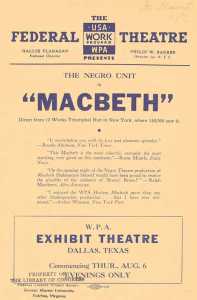
When the tour finished, Welles quickly became a presence in the New York theater world. One of his early successes as a producer and director was his production of the so-called “Black Macbeth”/”Negro Macbeth”/”Voodoo Macbeth” — a hugely popular staging of Shakespeare’s “Macbeth” with an all-black cast, done under the auspices of the Federal Theatre Project in 1936. In August of that year — just two and a half years after his appearance as an unknown at the Melba — he took the production to Dallas where it made a splash at the Texas Centennial in the brand new bandshell.
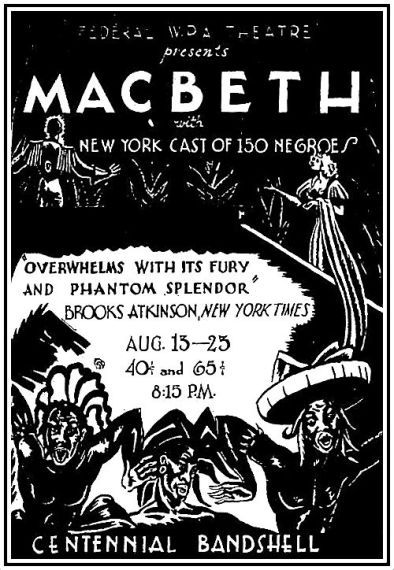
macbeth_texas-centennial_dmn_081336Aug., 1936

macbeth_playbill_dallas_LOC(click for larger image)

Rosenfield was impressed by the lush design and the electric and inventive spectacle, but he was not a fan of the performances. A few years later, on the eve of the release of Citizen Kane, he wrote the following (which was much harsher than his original 1936 review):

We saw this production in Dallas during the Texas Centennial and could marvel at the artistic futility of such ingenuity. The Negro Macbeth, however, was something to be seen if only to be despised. (DMN, Oct. 29, 1941)

Oh dear.

In 1940, Welles was working on his first film, the legendary Citizen Kane. As filming began to wind down, he decided to go out on a short lecture tour because he was in desperate need of money (an all-too-common circumstance he found himself in throughout the entirety of his career). His topic was a vague “anecdotes of the stage and theories on the drama” — and it sounds like his “performances” were largely unscripted and unrehearsed. 

On October 29, 1940 — only a week or two after wrapping production on Citizen Kane — 25-year old Orson Welles spoke at McFarlin Auditorium on the SMU campus as part of the Community Course series of lectures. His topic: The Actor’s Place in the Theater. It was another packed house of adoring and/or curious Dallasites. Rosenfield was both entertained and annoyed by the rambling “lecture,” but Orson was undoubtedly delighted to talk for two hours before an adoring crowd, answer their questions about his craft, and collect a $1,200 check.

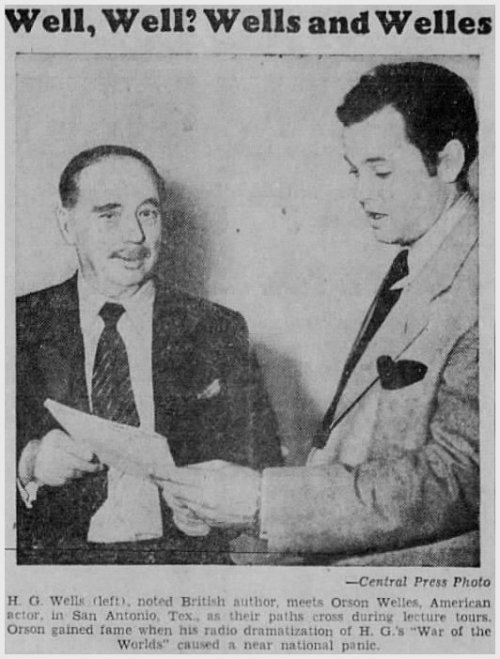
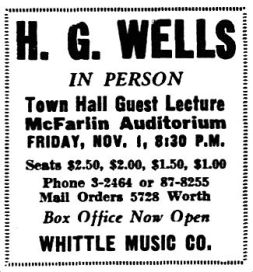
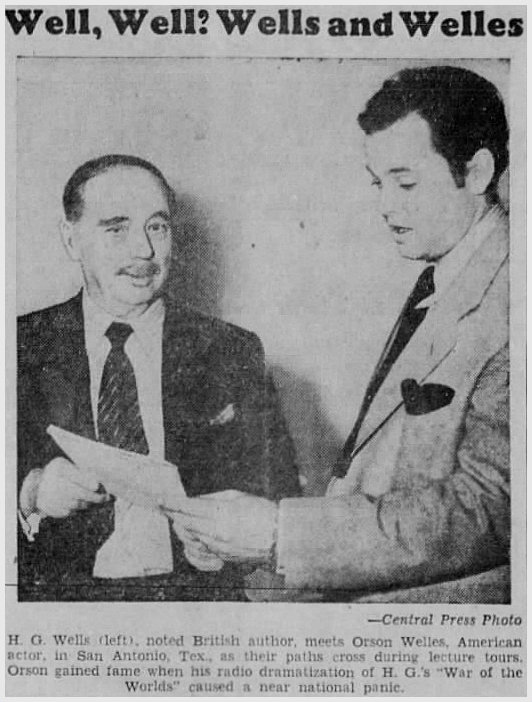
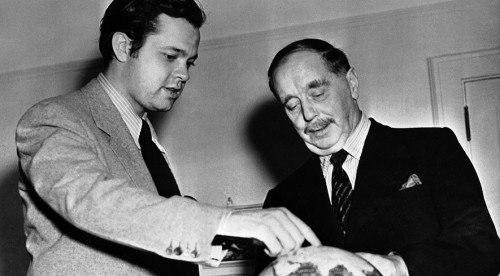
Orson’s appearance in Dallas was particularly noteworthy for the fact that the speaker scheduled to appear on the McFarlin stage just three days later was … H. G. Wells! At the time of this lecture tour, Orson was best known for his infamous 1938 radio adaption of H. G. Wells’ The War of the Worlds, the frighteningly realistic production that panicked the nation and led thousands to believe that the earth was being attacked by Martians. Rather surprisingly, Welles and Wells had never met.

According to a blurb in a Phoenix newspaper, Orson had cancelled a previously-scheduled meeting in Tucson in order to fly into Dallas earlier than planned. My guess is that he saw that H. G. Wells was also lecturing in Texas and realized that H. G.’s lecture in San Antonio the night before Orson’s own appearance in Dallas on the 29th was the only chance he had to meet the man who had provided the source-material for his (to-date) greatest career triumph.

A quick timeline:

  • Sun. Oct. 27, 1940: Orson arrives in Dallas, staying at the Baker Hotel.
  • Mon. Oct. 28: In the morning, Orson flies down to San Antonio to meet H. G. Wells and attend his lecture. The two meet, get along famously, have their photos taken, and give a short joint interview to San Antonio radio station KTSA (see below for link to recording). That evening, both fly to Dallas. Later that night, Orson (well known as an amateur magician) pops into The Mural Room in the Baker Hotel to catch the floor show featuring popular magician Russell Swann.
  • Tues. Oct. 29: H. G. Wells leaves Dallas for Denver, continuing his lecture tour. That morning Orson drives to Fort Worth to present a lecture and attend a luncheon at the River Crest Country Club. That night, he presents his lecture at McFarlin Auditorium at Southern Methodist University. After his lecture, he catches Russell Swann’s magic show for a second time. At 3:00 a.m. he flies to San Antonio for his lecture there.
  • Wed. Oct. 30: Orson lectures in San Antonio. It is the second anniversary of the broadcast of “The War of the Worlds.” Conveniently, newspapers around the country begin to run the photos of Welles and Wells taken on the 28th.
  • Thurs. Oct. 31: A Martian-free Halloween.
  • Fri. Nov. 1: H. G. Wells is back in Dallas for his lecture that night at McFarlin Auditorium.
welles-wells_san-antonio_102840

welles-wells_pottstown-pa-mercury_103140Pottsdown (PA) Mercury, Oct. 31, 1940

h-g-wells_dmn_102940DMN, Oct. 29, 1940

Whew.

Happy 100th, Orson! And thanks for everything.

***

Sources & Notes

Dates and sources of newspaper clippings as noted.

“Macbeth” playbill from the Library of Congress, here.

The timeline for the Welles-Wells meeting and their Dallas-related activities were gleaned from a report in the Oct. 30, 1940 edition of The Dallas Morning News.

And now, links galore.

  • Watch an entertaining short clip in which Orson talks about mind-reading and fortune-telling — which he says he indulged in on the Cornell tour — here.
  • Read the profile of the 18-year-old phenom which appeared in newspapers during the run of the Katharine Cornell tour, here.
  • Read about the “Voodoo Macbeth” here (scroll to the bottom to see fantastic photos).
  • Listen to the interview with Orson Welles and H. G. Wells that aired on San Antonio station KTSA, the day they met for the first time, on Oct. 28, 1940 — here.
  • Read about that still-chilling Mercury Theatre radio broadcast of The War of the Worlds, here.

Finally, my favorite Orson Welles-related quote from the erudite and not-without-humor arts critic of The Dallas Morning News, John Rosenfield. He wrote the following in his review of the set-in-Haiti “Macbeth” — about the aesthetic viability of future Shakespeare productions tailored for specific audiences:

…Mr. Welles hasn’t started a movement. His Negro “Macbeth” does not inspire us to corroborate a fabled Texas lawyer and make Antonio “The Merchant of Ennis.” (DMN, Aug. 16, 1936)

“THE MERCHANT OF ENNIS”! Someone! Make this happen!

*

Copyright © 2015 Paula Bosse. All Rights Reserved.

Aerial View of the Centennial Fairgrounds — 1936

fair-park_1936_red-oak-kidThe Texas Centennial: a “World’s Fair” for Dallas

by Paula Bosse

This fantastic photo (by one of Dallas’ top aerial photographers, Lloyd M. Long) shows the impressive expanse of Fair Park’s new Art Deco splendor — most of the buildings seen here were built especially for the 1936 Texas Centennial Exposition, and most of those are, thankfully, still standing.

***

Sources & Notes

Lloyd M. Long photo, found on Red Oak Kid’s Flickr stream, here.

To see this photo REALLY big, click here.

*

Copyright © 2015 Paula Bosse. All Rights Reserved.
Nolan Ryan’s Celebratory Pancake Breakfast — 1972

nolan-ryan© Bettmann/CORBIS

by Paula Bosse

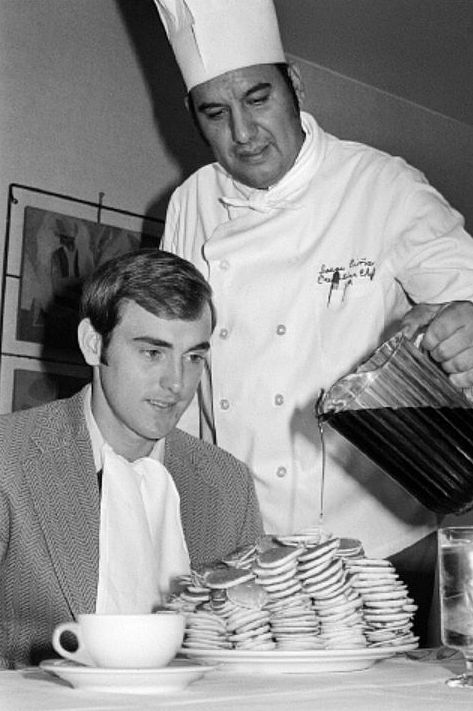
In 1972, future baseball hall-of-famer and Texas Rangers legend Nolan Ryan (then a California Angel) was photographed in Dallas as he sat mesmerized by a platter of 302 silver-dollar pancakes and an iced-tea-sized pitcher of syrup. The celebratory breakfast was served to him at the Sheraton Dallas the morning after he became only the sixth pitcher in major league history to strike out more than 300 batters in a season. (His opponents the previous night — September 25, 1972 — had been the Rangers, the team he would one day play for and preside over as president and CEO.)

The UPI Telephoto wire photo ran on Sept. 27, 1972 above the following caption:

302 PANCAKES — Ever wonder what 302 strikeouts in a season will get you? If you’re a batter, you may lose your job, but if you’re a pitcher like Nolan Ryan, left, of the California Angels, [you] will at least get 302 silver dollar pancakes. This was the breakfast that awaited Ryan Tuesday after his 3-hit, 12-strikeout win over the Texas Rangers Monday. The executive chef at the Sheraton Dallas [Isaac Pina] produced the breakfast for the Alvin native, a former New York Met, who is the sixth pitcher in major league history to strike out more than 300 batters in one season.

Twelve strike-outs!

ryan_FWST_092672Fort Worth Star-Telegram, Sept. 26, 1972
Judging by the expression on his face at the next day’s breakfast table, it’s pretty obvious the 25-year old Nolan Ryan enjoyed his triumph.

***

Sources & Notes

Photo ©Bettmann/CORBIS. The photo is also seen on this page, from The Guardian, which shows a collection of really great historic baseball photos — a bit of a surprise, coming from a British newspaper!

The photo was published in newspapers around the country; the quoted wire copy appeared in the Sept. 27, 1972 edition of The Waxahachie Daily Light.

To read a passage from the book Nolan Ryan’s Pitcher’s Bible in which he writes about the importance of his high-carb breakfasts (Day One: Pancakes…), see here.

The Wikipedia entry on Nolan Ryan is here; his stats are here.

*

Copyright © 2015 Paula Bosse. All Rights Reserved.


Dr Pepper Ad: “I’ll Have Another Myself” — 1929

dr-pepper_dmn_052729

by Paula Bosse

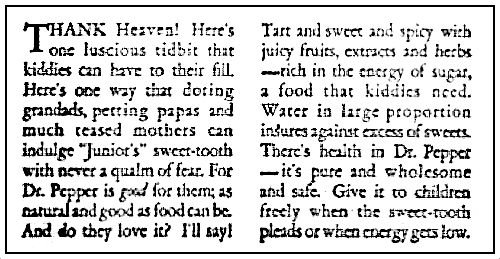
Drink up, kids — Gramps is buying! “It’s pure and wholesome and safe.”

ad-dr-pepper_dmn_052729-text

And the tag line: “It’s A Good Habit To Get — It’s One That Won’t Get You.”

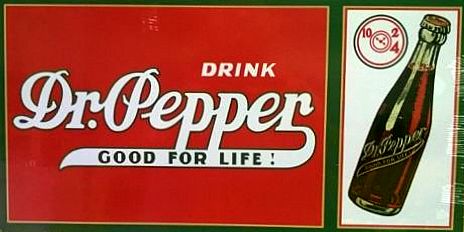
dp-sign

***

Ad from 1929.

Reproduction of period sign found on eBay.

*

Copyright © 2015 Paula Bosse. All Rights Reserved.


The Periphery of the Texas State Fair Never Looked Better

state-fair_postcard_carrie-ednaApproaching the Fair Grounds…

by Paula Bosse

A couple of pretty, but unusual views of the fairgrounds, turn-of-the-century-ish. The message on the postcard at the top: “Carrie the fair was real good this year better than it has been for years. Edna”

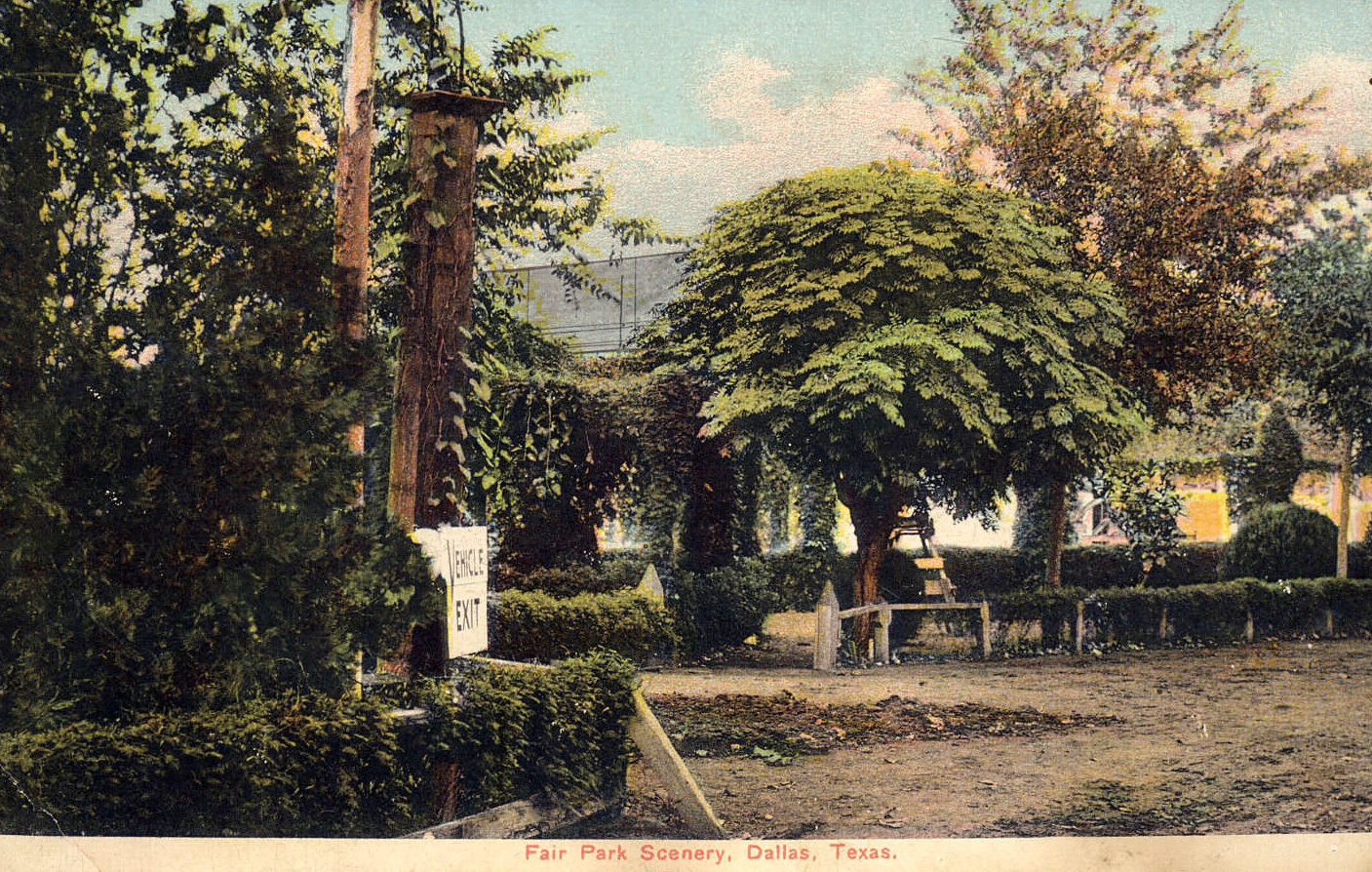
And then there’s this view, “Fair Park Scenery.” Same period as the top one? Later? It shows the “Vehicle Exit.” “Vehicles” meaning buggies and wagons?

state-fair-grounds_postcard_vehicle-exitLeaving the Fair Grounds… 

I think the top postcard shows the entrance — I have another view of the entrance that looks like this, from around 1900 (see it here). And the bottom card? “Scenery” near the Vehicle Exit. So … a parking lot? Or a road leading to the exit? Whatever it is, it’s not really all that “scenic.” Both postcards are fairly odd choices for picture postcards of the Texas State Fair, as neither one shows anything of the actual fair! But if people had fond memories of driving into or out of the State Fair, these were the postcards to buy!

***

Sources & Notes

Postcards from eBay. The second one is a photo by Clogenson.

Top postcard’s 2-cent stamp was issued in Nov. 1903, per Wikipedia.

*

Copyright © 2015 Paula Bosse. All Rights Reserved.

Lakewood’s “Modernistic” Skillern’s Drug Store — 1934

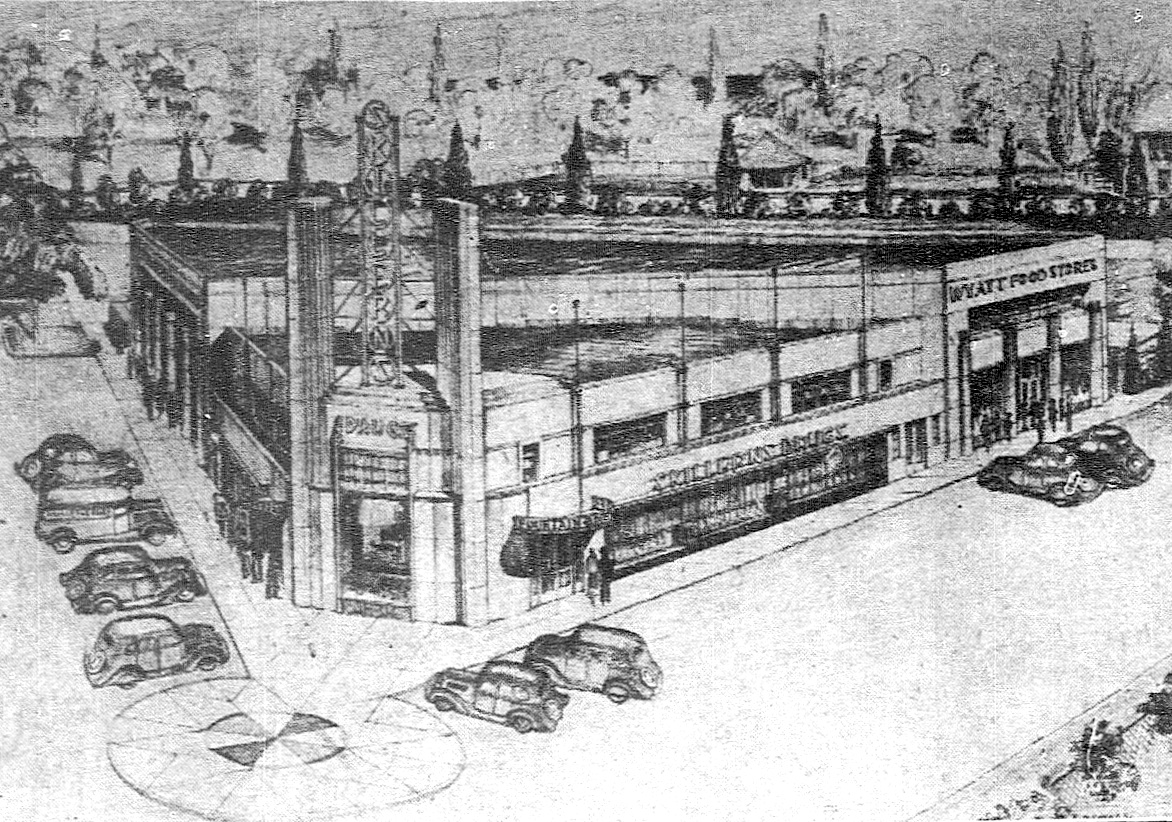
skillerns-lakewood_architects-rendering_1934
Architect’s drawing, 1934 — Abrams & Gaston…

by Paula Bosse

The drawing above was architect J. N. McCammon’s design for a new 14,000-square-foot concrete-and-stucco building of a new Lakewood development, at Abrams and Gaston (a stone’s throw from land now occupied by the parking lot of the Lakewood Whole Foods). It was to be built by Rae Skillern, whose Skillern’s drug store would anchor the development, with a Wyatt Food Store also occupying a large chunk of the property. The “retail village” was to be modeled (…somewhat) after the much-lauded Highland Park Village shopping center, and its design was described in articles as being “modernistic.”

Construction was to begin in early 1934 and be completed in 90 days, but things hit a bit of a roadblock when Lakewood residents objected to a shopping area in their “high-class” residential neighborhood (charming though Skillern’s design might have been…). A zoning classification change from “local retail” to “residential” was sought by concerned Lakewood inhabitants, but the City Plan Commission nixed this and gave the builders the go-ahead.

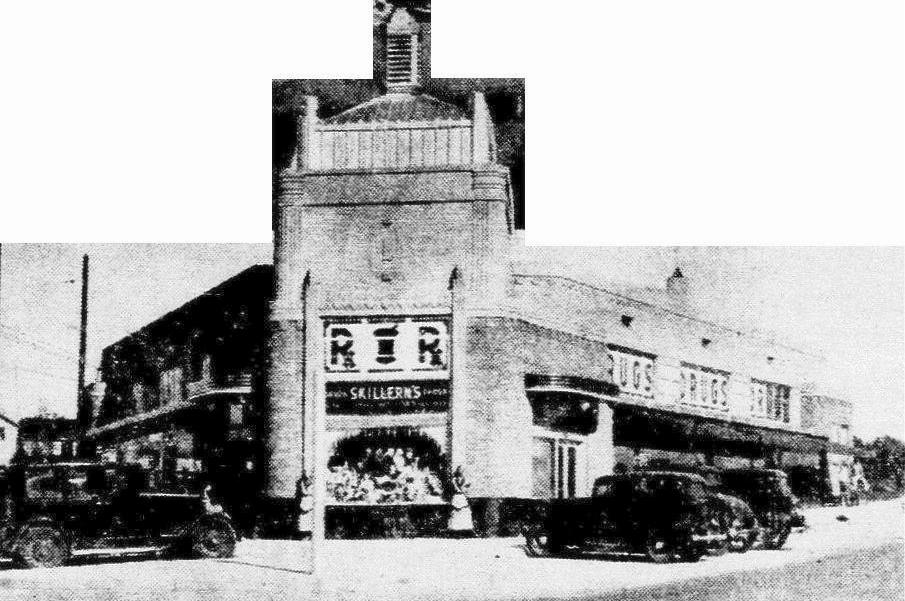
Skillern’s No. 4 opened in December of 1934 at 6401 Gaston and humbly hailed its newest emporium as “America’s most beautiful drug store.” It was, by far, the largest in the local company’s quickly expanding chain, and it featured a large, varied inventory, beautiful fixtures and innovative merchandising, a large soda fountain (with curb service), a “perfume bar,” and an open view into the “prescription department” where customers could watch the pharmacists doling out their medications.

The small shopping area quickly became a popular shopping destination (along with the larger Lakewood Shopping Center across Gaston), and the big, new Skillern’s — which sat at the point of the triangular-shaped “village” — was its focal point.

lakewood-skillerns_1930s
Dec., 1934

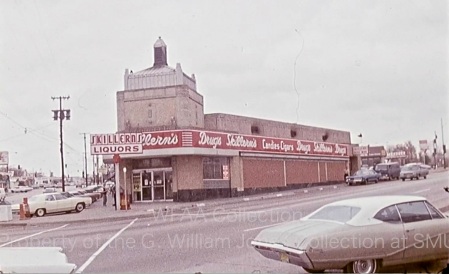
Skillern’s left its cool building sometime around 1971, after a fire caused heavy damages in November, 1970. It moved across the street, into the equally cool old Gaston Avenue Pharmacy (known familiarly as Doc Harrell’s drug store, the place with the iconic conical roof), not long after Harrell’s death in 1969. The Lakewood outpost of the Mickey Finn’s chain of pool halls opened in the old Skillern’s space in February, 1972. In 1978 the property was condemned by the city to make way for the weird Abrams Bypass, which cut through that northeast corner of the Gaston-Abrams intersection; several buildings in the immediate vicinity deemed to be in the way of progress were demolished, including Rae Skillern’s “modernistic” drug store, a Lakewood landmark for over 40 years. Pity.

Below, a screenshot of footage from WFAA-Channel 8 News, in late November 1970. A last hurrah.

skillerns_lakewood_nov-29-1970

 ***

Sources & Notes

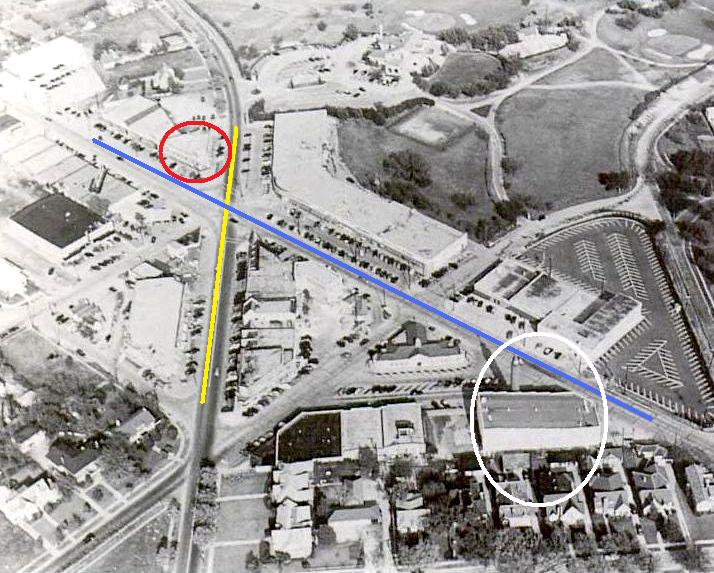
Skillern’s was located on the northeast corner of Gaston and Abrams at the tip of a triangular-shaped piece of land. The drawing at the top shows Abrams running vertically (to its west), and Gaston running horizontally (to its south). It would have faced the old Dixie House space. The Abrams Bypass skewed everything, but it was about where the little triangular “park” is now — between Abrams Parkway and Abrams Road, just west of the Whole Foods parking lot. (UPDATE: I now know that that greenspace has a name: Harrell Park!) Below is an aerial photo of what this part of Lakewood used to look like. Gaston is in yellow, Abrams is in blue, the Skillern’s building is circled in red, and the Lakewood Theater (for reference, because this all looks pretty freaky to us today and it’s hard to get one’s bearings) is circled in white. Looking northeasterly.

lakewood_aerial_marked

To see a larger image of this aerial photo — without the markings — click here. (Photo from the book The Dallas Public Library, A Century of Service by Michael V. Hazel, presumably from the collection of the Dallas Public Library.)

An interesting account of the how the bizarro Abrams Bypass happened can be found in the D Magazine article “Why Lakewood Doesn’t Trust Itself” by Charles Matthews (Oct., 1978), here. A Dallas Morning News article on the same topic — “Lakewood Plan May Benefit Bank” by Henry Tatum (March 12, 1978) — can be found in the Dallas Morning News archives.

*

Copyright © 2015 Paula Bosse. All Rights Reserved.