Flashback : Dallas

A Miscellany: History, Ads, Pop Culture

Category: Leisure

“A Man’s Shop With a Texas Man’s Viewpoint” — 1945

irby-thompson_western-wear_tx-country-day-school-yrbk-1945

by Paula Bosse

Back when men wore Western pearl-snap shirts embroidered with cardinals, leaves, and acorns — and, if this ad is anything to go by, they wore them proudly and unironically.

Frankly, I’d like to see a return to this style.

*

“Wherever Texas men gather to relax and play
you’ll see fine sports clothes by Irby-Thompson.”

Western Suit: $115 (equivalent in today’s money to about $1,660)
Sport Coat: $45 (today, $650)
Slacks: $20 (today, $290)
Tie & Handkerchief: $5 (today, $73)

***

Sources & Notes

Ad found in the pages of the 1945 Texas Country Day School yearbook. 

Irby-Thompson (housed in the Mercantile Building), was opened in 1944 by Collis P. Irby and J. S. Thompson; in 1948 Irby and his former store manager, Count Mayes, bought out Thompson and became Irby-Mayes.

Related: see the Flashback Dallas post “Irby-Mayes Ad With a Cameo by the Merc — 1948.”

irby-thompson_western-wear_tx-country-day-school-yrbk-1945_sm

*

Copyright © 2020 Paula Bosse. All Rights Reserved.

Awaiting the “Victory Fair” of 1946…

sfot_victory-fair_ebay_1946

by Paula Bosse

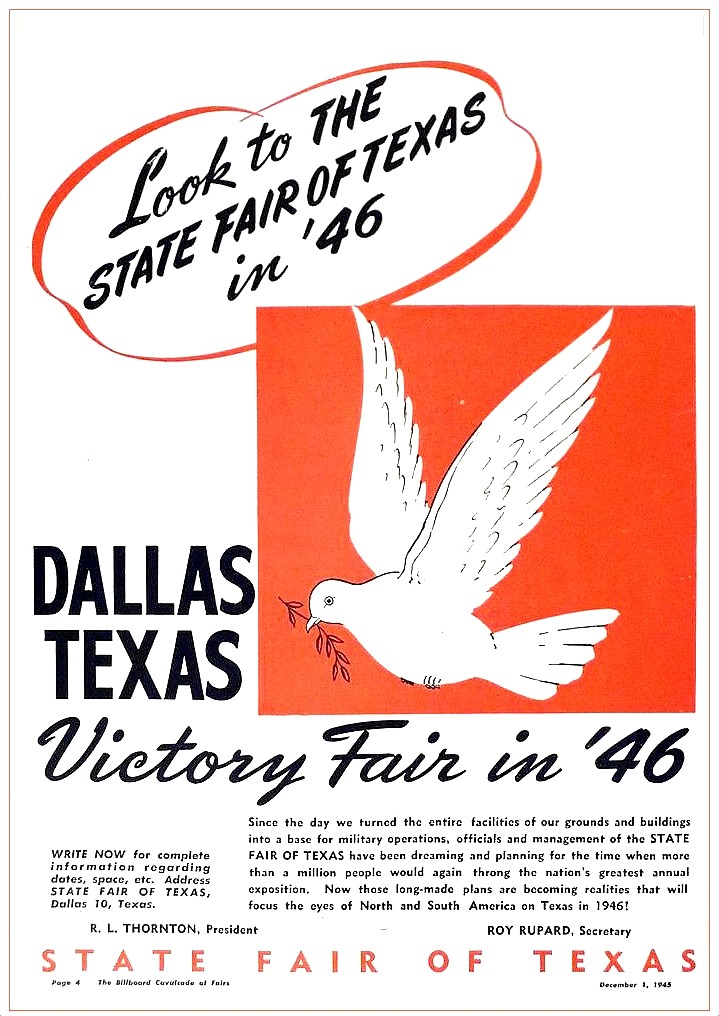
Many of us are missing the State Fair of Texas, canceled this year due to the COVID-19 pandemic. The last time the fair was canceled was during World War II. Here is an ad from 1945, assuring everyone that the State Fair would be back in 1946.

*

Dallas Texas Victory Fair in ’46

Since the day we turned the entire facilities of our grounds and buildings into a base for military operations, officials and management of the STATE FAIR OF TEXAS have been dreaming and planning for the time when more than a million people would again throng the nation’s greatest annual exposition. Now those long-made plans are becoming realities that will focus the eyes of North and South America on Texas in 1946!

***

Sources & Notes

Ad found on eBay (originally published in the “Billboard Cavalcade of Fairs,” Dec. 1, 1945).

More Flashback Dallas posts on the State Fair of Texas can be found here.

*

Copyright © 2020 Paula Bosse. All Rights Reserved.

Legendary Sports Writers of the Fort Worth Press — ca. 1948

sportswriters_blackie-sherrod_dan-jenkins_bud-shrake_etc_fort-worth-press_SMUBlackie and crew…

by Paula Bosse

The legendary sport writers of The Fort Worth Press, circa 1948: (standing, l to r) Jerre Todd, Blackie Sherrod, Dan Jenkins; (sitting) Andy Anderson and Edwin “Bud” Shrake. Missing: Gary Cartwright. 

This is what sports writers should look like!

***

Sources & Notes

Photo — titled “[Staff of Fort Worth Press]” — is from the Blackie Sherrod papers, DeGolyer Library, Southern Methodist University; more info can be found here.

More on Blackie Sherrod, who became the dean of Dallas sportswriters, can be found in the Flashback Dallas post “Blackie Sherrod: The Most Plagiarized Man in Texas: 1919-2016.”

Read a great, lengthy piece about these guys and their time as the greatest sportswriting staff in Texas in the article “Mourning Dark: The Fort Worth Press’ Legendary Sportswriters Are a Dying Breed” by Kathy Cruz (Fort Worth Weekly, Jan. 3, 2018).

*

Copyright © 2020 Paula Bosse. All Rights Reserved.

Luby’s, In Dallas Since 1929

lubys_main-st_1954_detLuby’s No. 2, Main Street, 1954 (photo detail)

by Paula Bosse

The liquidation of Luby’s restaurants was announced this week. There are a lot of people (Texans in particular) who are going to take this news hard.

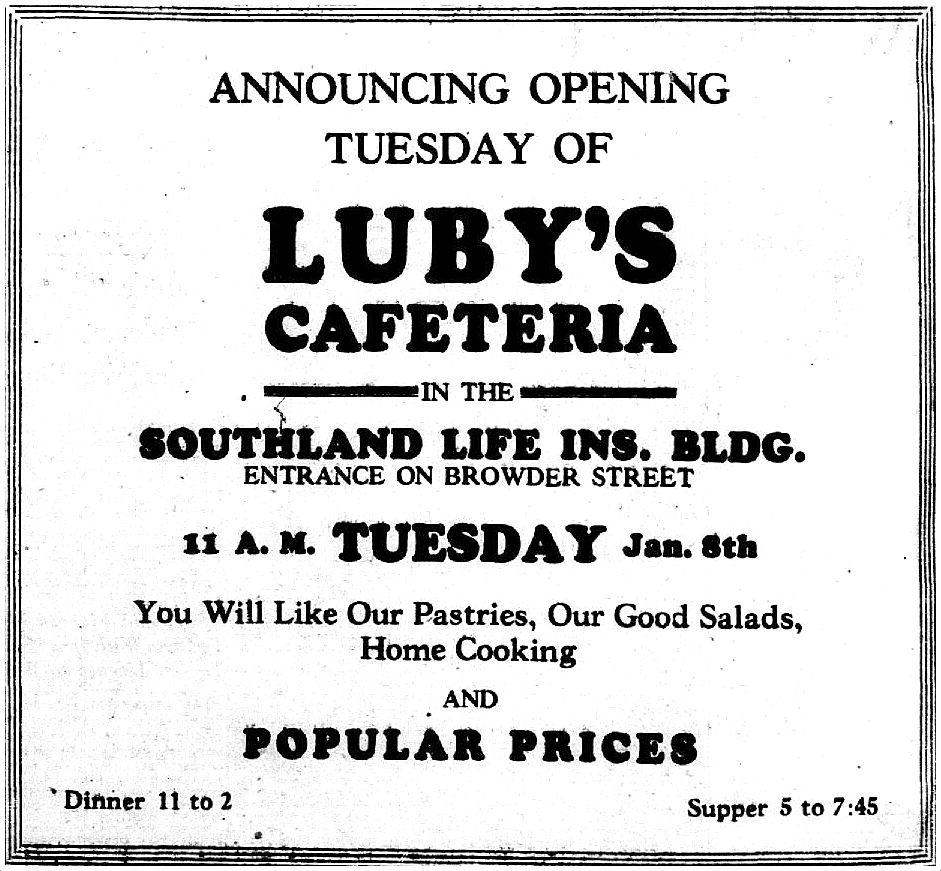
I spotted the Luby’s seen in the picture above in a photo I found on eBay a few years ago (see the full photo here). I was surprised to learn that the first Luby’s in Dallas opened in 1929. (I think it was the first Luby’s in Texas — there might have been a tangentially related “Luby’s”-branded restaurant in Muskogee, Oklahoma, but let’s just say that the Luby’s at 205 Browder Street in downtown Dallas was the first one in Texas. It was opened by Earl E. Luby on January 8, 1929.

lubys_010829_adJan. 8, 1929

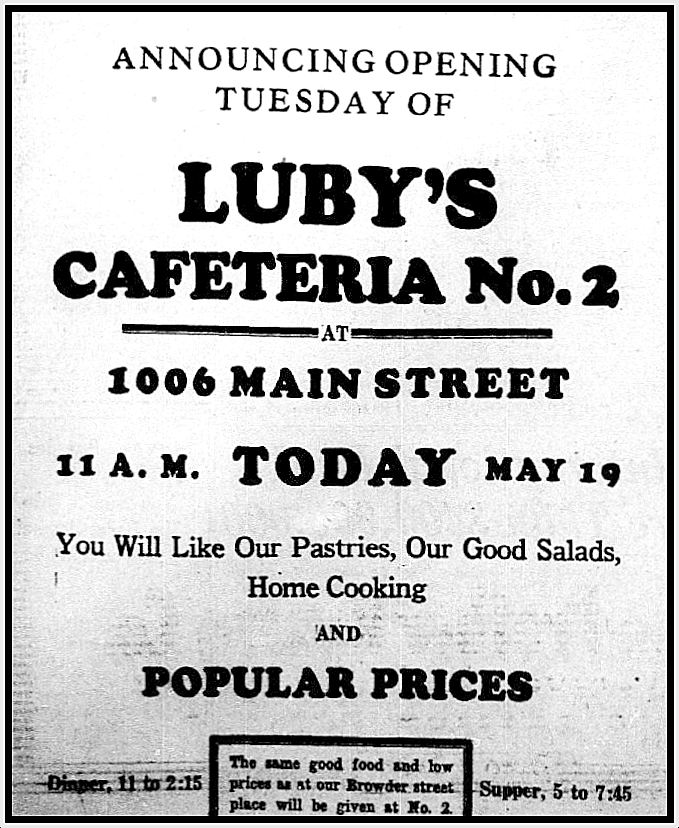
The second location (the one seen in the photo above) opened at 1006 Main Street (at Poydras) two years later, on May 19, 1931.

lubys_051931_no-2May 19, 1931

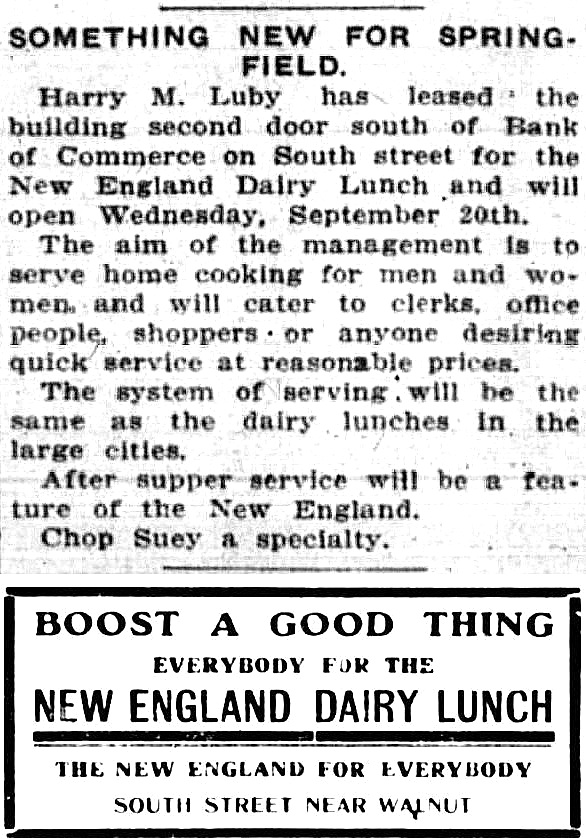
Earl Luby was the first cousin of Harry M. Luby, the man who is generally considered to have opened the forerunner of what we now know as Luby’s. In September, 1911, Harry opened a cafeteria in Springfield, Missouri called New England Dairy Lunch — there were several other restaurants around the U.S. with the same name, so I’m not sure if he bought it as a franchise, but whatever the case, that cafeteria was the start of a tray-toting empire.

luby_springfield-MO-news-leader_sept-1911Springfield News-Leader, Sept. 20 & 21, 1911

He opened other New England cafeterias in Missouri and, with cousin Earl, in Oklahoma. (There was one in Dallas in 1919, located at 1409 Elm, which appears to be connected to the Luby family.)

new-england-cafeteria_041619Apr. 16, 1919

In 1929 Earl branched off, moved to Texas, opened his own cafeterias (mostly in Dallas), and made a fortune. (There were Luby’s cafeterias run by other members of the Luby family, most notably Harry’s son, Robert Luby, who was active in South Texas a few decades later. I don’t know whether these were two completely different business entities, but Earl was king of the very lucrative Dallas market.)

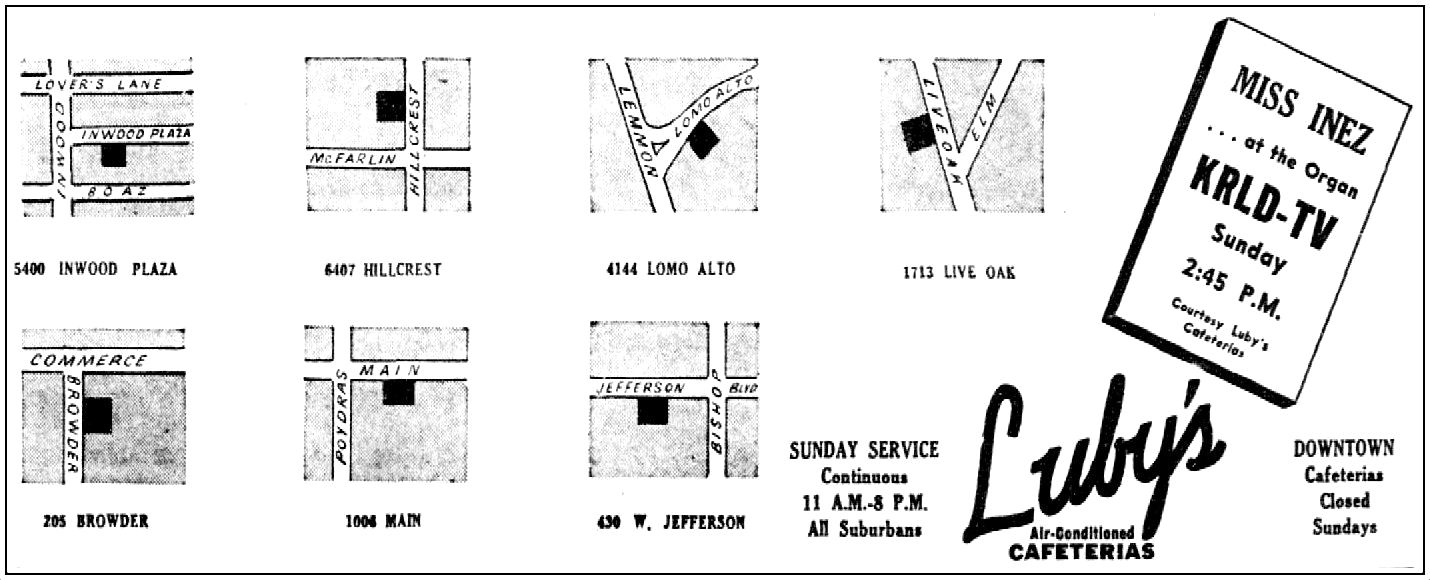
Here’s an ad from 1953 with Luby’s locations at that time (along with a Miss Inez shout-out). (Click to see a larger image.)

lubys_062153_ad-det_maps

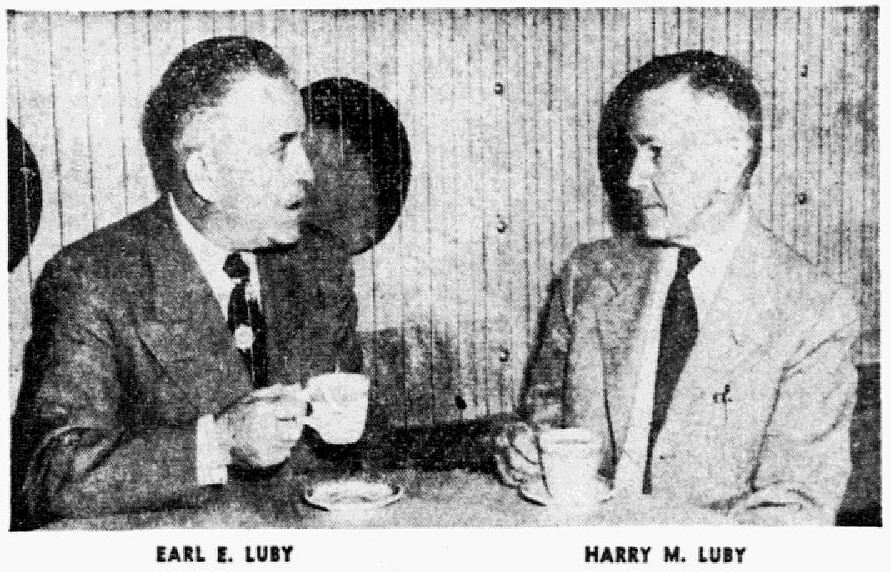
And from the same ad, a photo of cousins Earl and Harry enjoying a convivial cup of coffee.

lubys_062153_ad-det_photoJune 1953 ad (details)

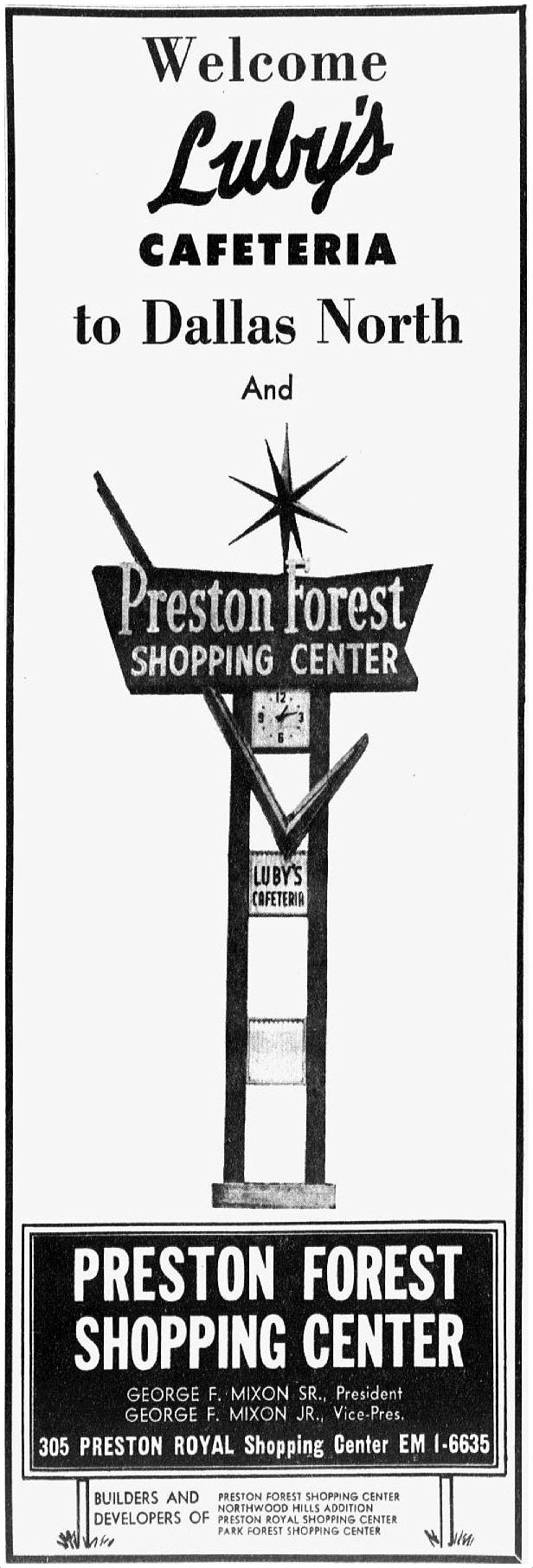
And, below, a 1960 ad for the new Luby’s at the Preston Forest Shopping Center (that sign is fantastic!).

preston-forest_lubys_090760_signSept. 1960

It’s a shame to say goodbye to such a long-lived Dallas institution. RIP, Luby’s. And thanks, Earl (1897-1990).

lubys_matchbk

***

Sources & Notes

1954 photo of Main Street is a detail of a larger photo found in the Flashback Dallas post “Streetcar #728, Main Street — 1954.”

Luby’s website is here (hurry!).

More on the history of Luby’s (with some incorrect information and nary a mention of Earl!) can be found on Wikipedia and The Handbook of Texas.

lubys_main-st_1954_det_sm

*

Copyright © 2020 Paula Bosse. All Rights Reserved.

Labor Day Weekend, Union Bus Depot — 1952

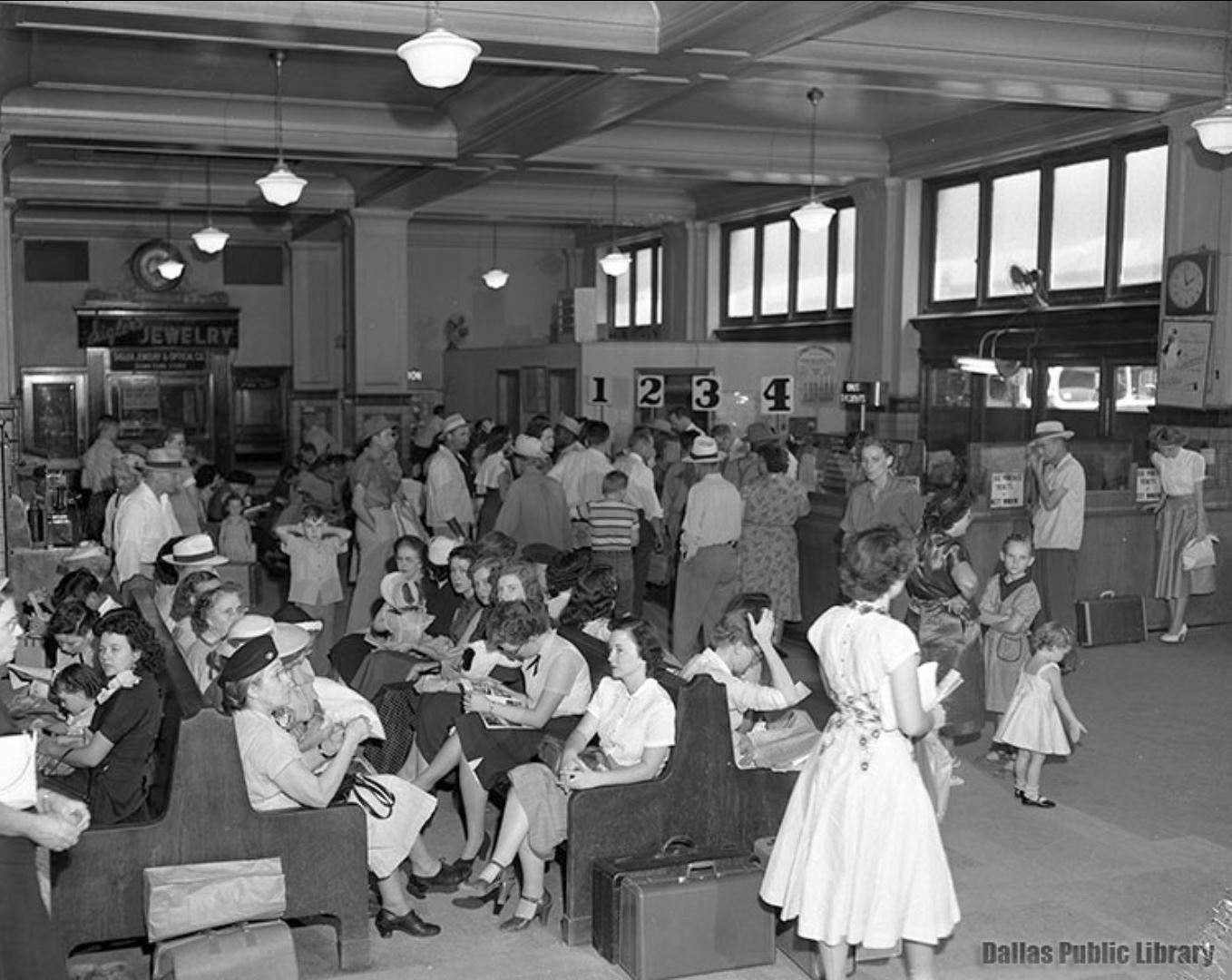
labor-day_union-bus-depot_hayes-coll_1952_DPLWaiting for buses… (photo: Dallas Public Library)

by Paula Bosse

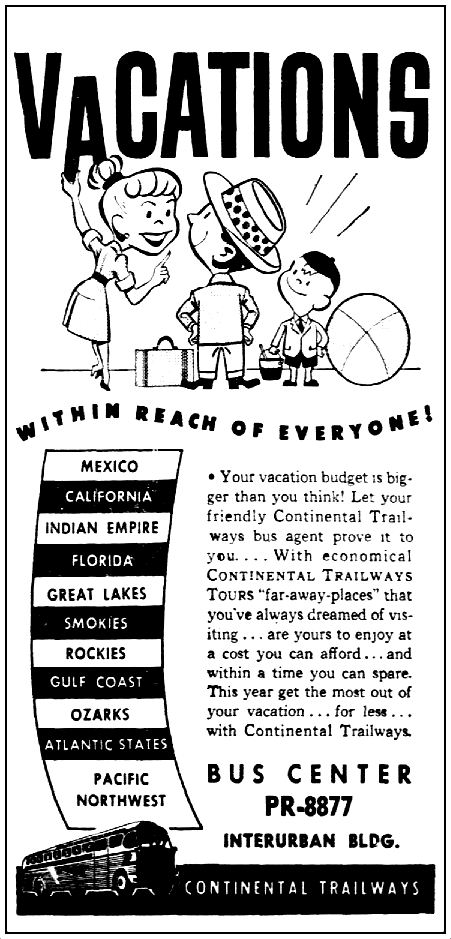
Labor Day in 1952 was on Sept. 1. The people in the photo above were waiting for buses to whisk them away for a nice end-of-summer Labor Day holiday. They were in the Union Bus Depot in the Interurban Building (downtown, at Jackson and Browder). They were probably waiting for a Continental Trailways bus. (While waiting, they might have availed themselves of merchandise at the Sigler’s Jewelry & Optical Co., seen in the background. This was their downtown location — I wrote about their main store at Peak and Elm here.)

So what was going on in Dallas on Labor Day in 1952? Well, it was hot. Real hot. (It’s always hot.) (ALWAYS!) It was 102°, and it was very dry and very windy. Grassfires were popping up everywhere — there were 30 fires that day! 

There were, of course, Labor Day picnics. The largest was for members of the UAW-CIO — the crowd of union members and their families was estimated at 5,200 and was held on ranchland (the D & L Ranch) west of Grapevine. There were also hundreds of AFL plumbers and carpenters at a picnic at Vickery Park on Greenville Avenue. 6,000 Dallasites took advantage of the city’s swimming pools on the last they were open. And then there were 500 people who waved off the whole “outdoor” thing and spent the day skating at the chilly Fair Park ice rink. 

The movie “Jumping Jacks,” starring Dean Martin and Jerry Lewis, was playing at the Majestic, and “Merry Widow,” starring Lana Turner, was at the Palace. Kay Thompson, the singer (and creator of the Eloise children’s books) was opening at the Adolphus Hotel’s Century Room. And there was a square-dancing contest on the Fair Park midway.

It was a bad day, however, for a motorist who indulged in one too many Labor Day adult beverages. The guy zig-zagged in and out of traffic on the Houston Street viaduct, hit a curb, and then swerved back into traffic. He was stopped by one of the cars he had whipped around. Unfortunately for the tipsy driver, the man who stopped him was Sheriff Bill Decker. Bet he’d wished he gotten out of town, along with all those sweaty travelers seen above waiting at the Union Bus Depot.

continental-trailways_ad_march-1952March, 1952 (click for larger image)

continental-trailways_ad_may-1952May, 1952

*

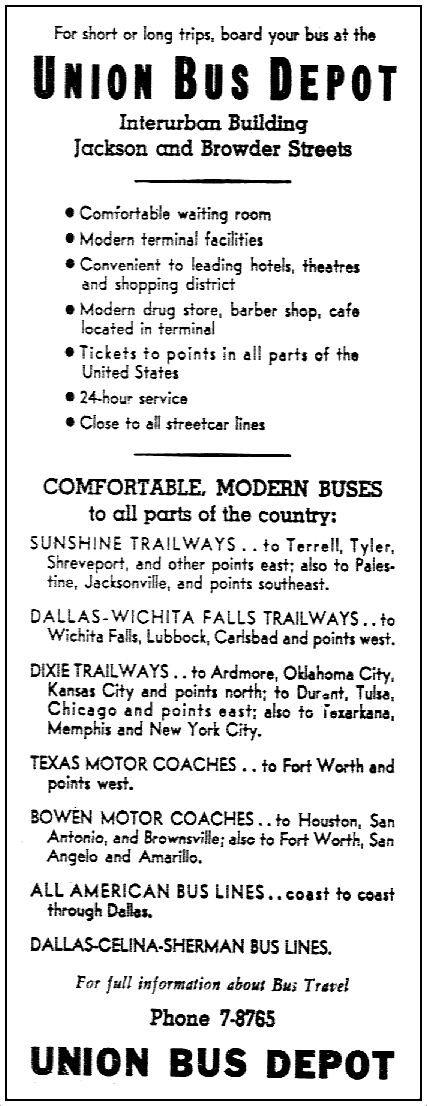
I was unaware of the Union Bus Depot until researching this post. It was established around the time when the Dallas-Fort Worth Interurban ceased operation on Christmas Eve, 1934 (the line from Dallas to Waco and Denison kept going a while longer). Suddenly the Interurban terminal at Jackson and Browder streets was going to be sorely underused, so it was decided to make it a great big bus depot. Most of the major bus companies serving Dallas (except for Greyhound, which had it own terminal) used the Interurban Building terminal as a shared depot. 

union-bus-depot_interurban-bldg_072537July, 1937

***

Sources & Notes

Photo, titled “Labor Day Weekend crowd at the Union Bus Depot” (Aug. 31, 1952), is from the Hayes Collection, Dallas Public Library Dallas History & Archives Division, Dallas Public Library; Call Number PA76-1/11420.

From the Dallas Morning News archives:

  • “Outings on Labor Day Lack Only In Oratory” by Frank X. Tolbert (DMN, Sept. 2, 1952)
  • “Last 24 Hours in Dallas” by Lorrie Brooks (DMN, Sept. 2, 1953)
  • “Grassland Areas Hit By Flames” (DMN, Sept. 2, 1952)
  • “Negotiations For Union Bus and Interurban Terminal Are Under Way By Electric Lines” (DMN, Oct. 25, 1934)
  • “Electric Line Station To Be Bus Terminal” (DMN, Dec. 1, 1934)

More on Labor Day in Dallas can be found in the Flashback Dallas Post “Labor Day Parade — 1911.”

labor-day_union-bus-depot_hayes-coll_1952_DPL_sm

*

Copyright © 2020 Paula Bosse. All Rights Reserved.

Oak Cliff’s Star Theatre — 1945-1959

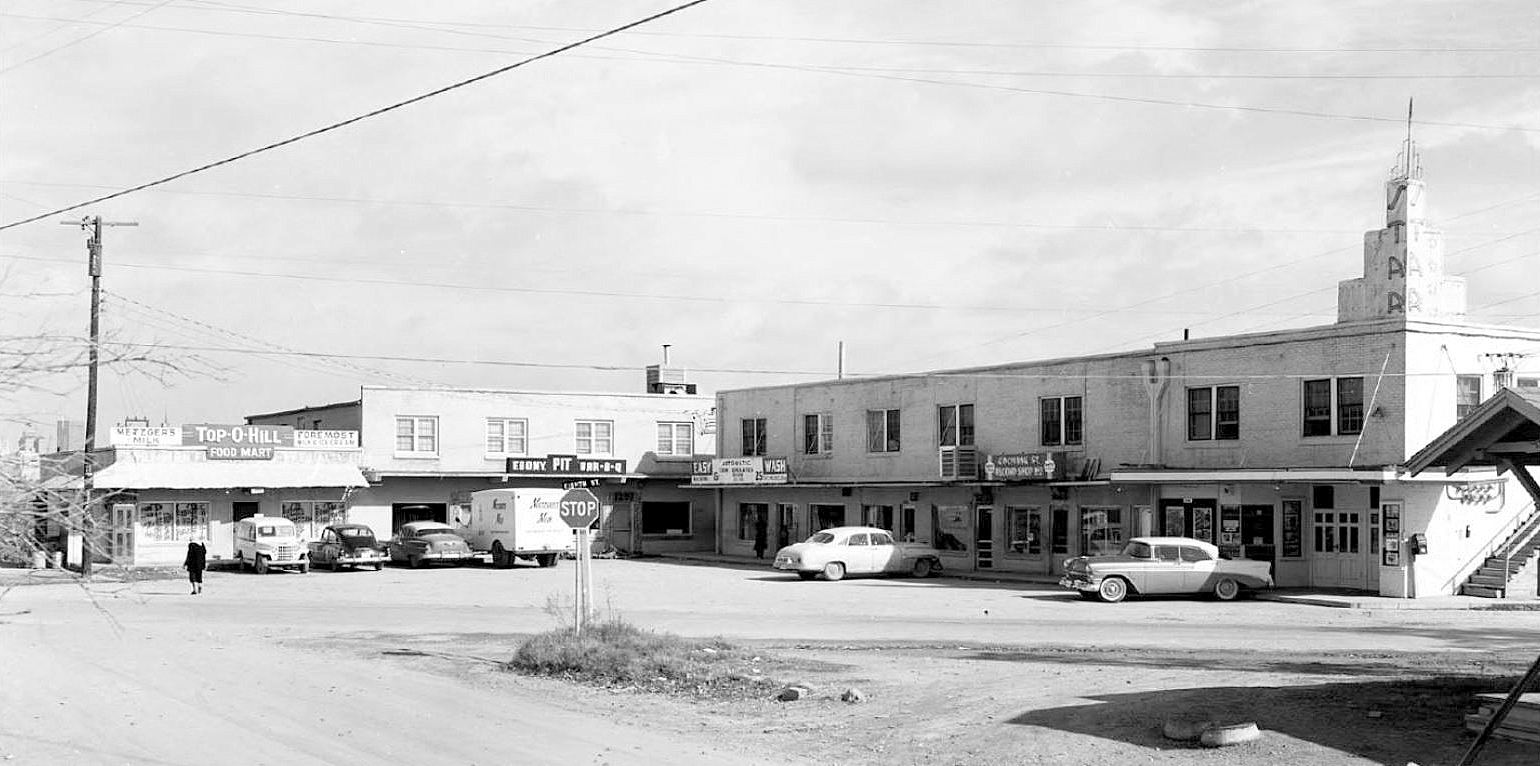
star-theatre_troy-sherrod-hist-dallas-theatres_DPLShow Hill, with the Star Theatre at right

by Paula Bosse

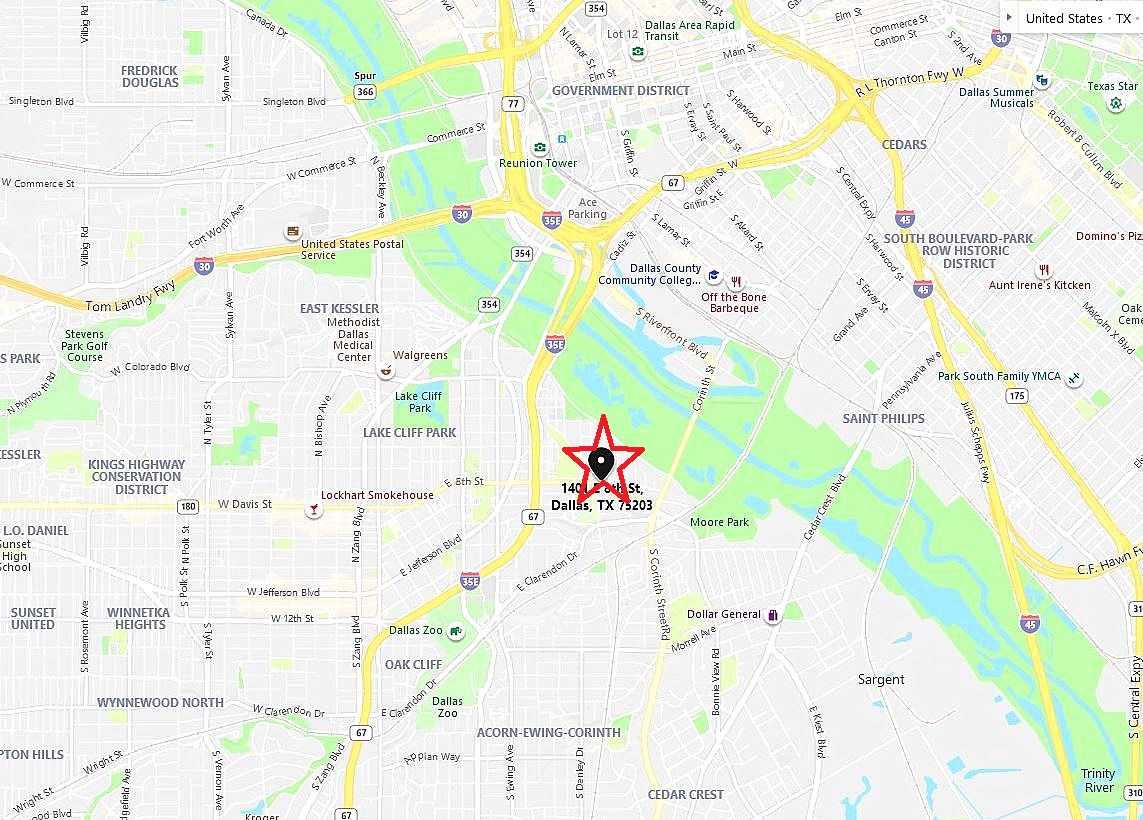
This is one of those photographs I could stare at all day long. It shows a shopping area in East Oak Cliff at the intersection of E. Eighth Street and N. Moore Street — this part of Oak Cliff was originally settled as a freedman’s town, and this photo shows an area between the Tenth Street Historic District and The Bottoms (or The Bottom) neighborhood (see a great map, here).

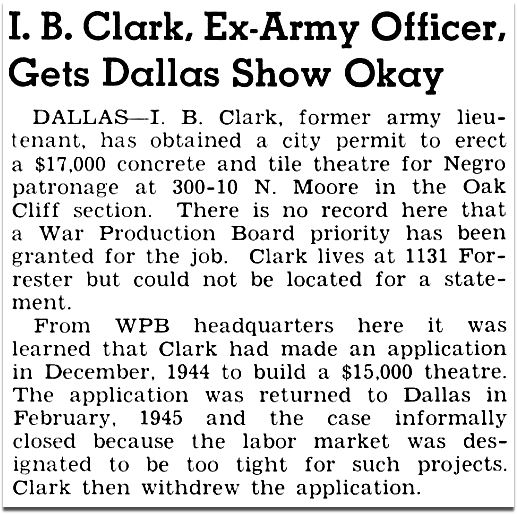
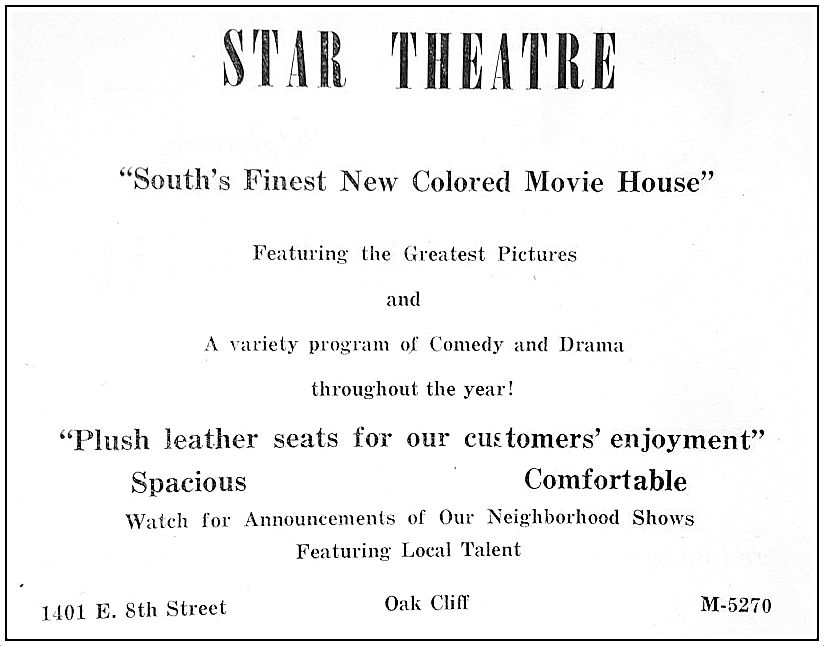
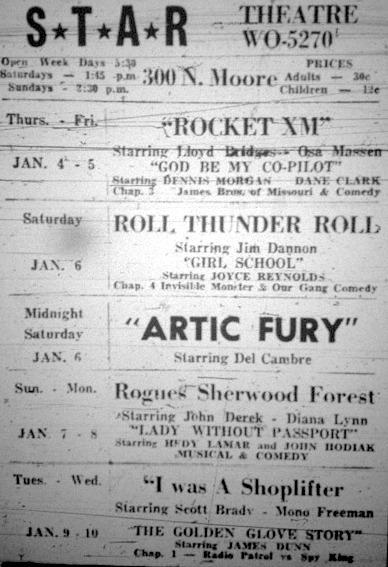
When these buildings were built in 1945 by I. B. Clark, it was an exclusively African-American part of Dallas. The anchor of this strip (which occupied what was described as both the 300 block of N. Moore and the 1400 block of E. Eighth) was the Star Theatre, which was, according to Mr. Clark, the only movie house for black customers in Oak Cliff.

star-theatre_boxoffice_042845
Boxoffice, April 28, 1945

star-theatre_oak-cliff_negro-directory-1947-48_adDallas Negro Directory, 1947-48

I. B. Clark was a white businessman who lived on a ranch in Cedar Hill; he had owned the Southern Fireworks Company before the war and had frequently battled with Dallas lawmakers about the constitutionality of banning the selling and shooting of fireworks within the city limits.

In the undated photo above, businesses in the retail strip are the Top-O-Hill Food Mart, the Ebony Cafe (Pit Bar-B-Q), the Easy-Wash laundromat, the second location of the Cochran Street Record Shop, the Star Theatre, and hotel apartments.

This hub of businesses was popular with neighborhood residents, who referred to this area as “Show Hill” (for the picture show). I stumbled across a really wonderful 2018 oral history of Margaret Benson, who, in 1944, moved with her family to Dallas and attended N. W. Harllee Elementary School and both Lincoln High School and Madison High School. She describes these shops and says that whenever black entertainers such as Dinah Washington or Sister Rosetta Tharpe came to town, they frequently stayed in the apartments above these businesses, as hotel accommodations for African Americans were few and far between. (I loved the entire recording of Mrs. Benson reminiscing about living for most of her life in this area of Oak Cliff — the part where she specifically talks about “Show Hill” is at the 8:25 mark in the recording at the link above.)

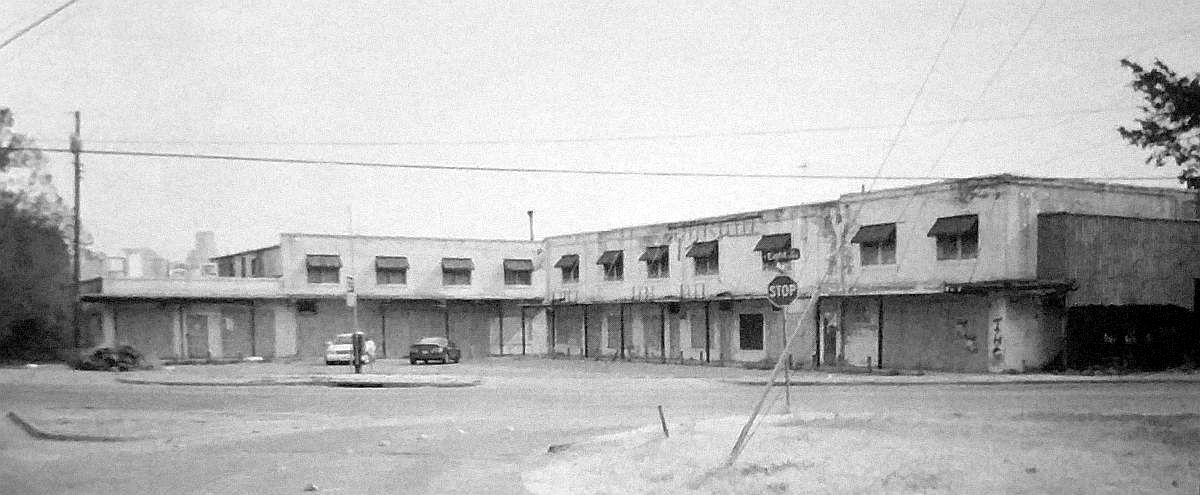
According to Dallas movie theater historian Troy Sherrod, the Star closed in 1959. Over time the area eventually declined and the remaining businesses closed. The strip, which was looking pretty down-at-its-heels in the 1990s, was demolished around 2000. The photo below shows the once-vibrant strip in its later days. (Three more photos, from 1999, can be found here — the addition of more apartments (the “Ebony Hotel Annex”) can be seen in the third one.)

star-theatre_mark-doty_lost-dallas
via Lost Dallas by Mark Doty

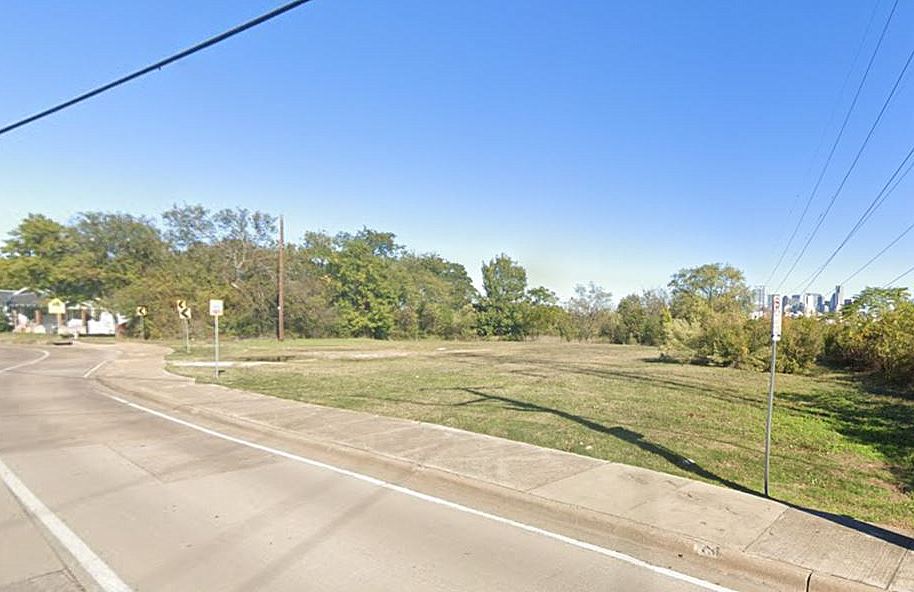
Here is what “Show Hill” vacant lot looks like today on Google Street View:

star-theatre_google-street-view-nov-2019Google Street View, 2019

star-theatre_bing-mapsBing Maps

star-theatre_cinematreasures_advia Cinema Treasures

***

Sources & Notes

Top photo showing the Star Theatre is from the excellent book by D. Troy Sherrod, Historic Dallas Theatres (Arcadia Publishing, 2014); the photo is from the collection of the Dallas Public Library.

Second photo showing the dilapidated buildings is from another excellent book, Lost Dallas by Mark Doty (Arcadia Publishing, 2012).

The ad for the Star Theatre appeared in the Dallas, Texas Negro City Directory, 1947-1948 (many thanks to Pat Lawrence). The address for the theater was listed in various places as both 300 N. Moore and as 1401 E. Eighth.

If you have access to the archives of the Dallas Morning News, I encourage you to read “Inner-City Secret — The Bottoms Residents Say They Are Forgotten” by Bill Minutaglio (DMN, Aug. 28, 1994).

Also worth a read is Texas Tribune article “Dallas Neighborhood Established by Freed Slaves Fights to Keep Its History Alive” by Miguel Perez of KERA News.

More on the Tenth Street Historic District can be found on the City of Dallas website here.

Check out photos of a pop-up market on Show Hill in 2014 here.

Also, of related interest is the Flashback Dallas post “Movie Houses Serving Black Dallas — 1919-1922.”

Thank you to reader Jerry Richburg for contacting me with a question about this old strip shopping area — he remembered attending church services in one of the buildings and asked if I knew more about what had been there and if I might have a photo. Thanks, Jerry! You led me down the path to discovering a little pocket of Dallas history I was completely unaware of!

star-theatre_troy-sherrod-hist-dallas-theatres_DPL_sm

*

Copyright © 2020 Paula Bosse. All Rights Reserved.

Neiman’s First Suburban Store: Preston Road — 1951-1965

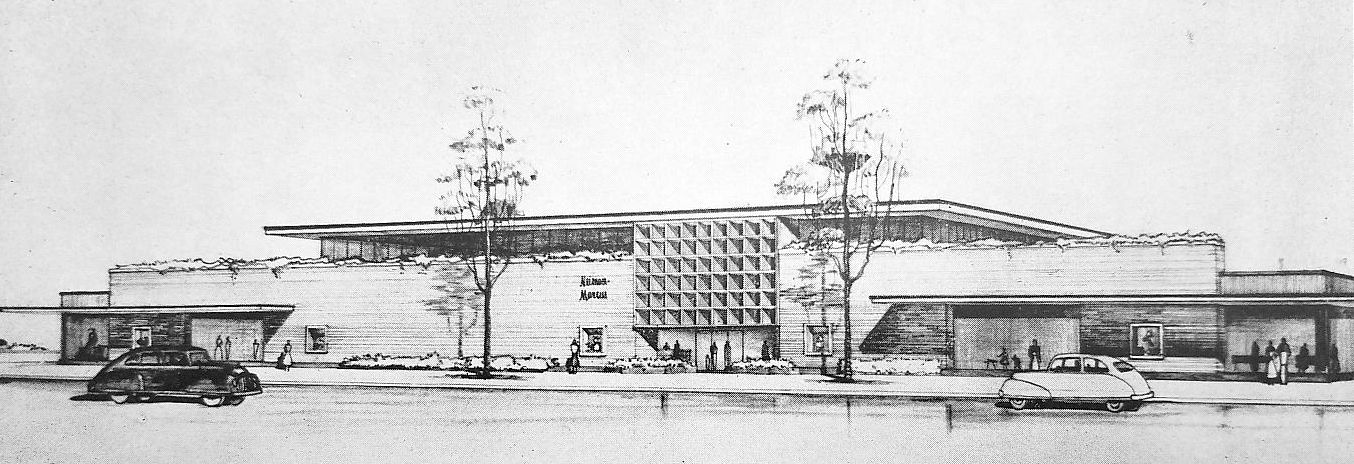
neiman-marcus_preston-road_dallas-mag_feb-1949Original design by DeWitt & Swank, 1949 (click for larger image)

by Paula Bosse

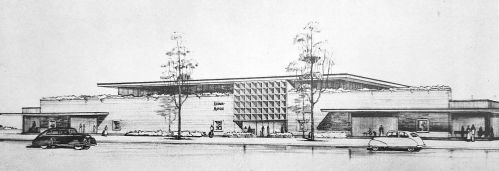
In January, 1949, Neiman-Marcus announced they would soon begin construction of their very first “branch” store. It was to be built in the new “Varsity Village” shopping area on Preston Road, just south of Northwest Highway (on the east side of Preston, facing Preston Center). This store was referred to in early articles as their “town and country store.” The downtown store was running out of room (in fact the expansion and renovation of their downtown store was announced at the same time as this new “suburban” store) — and the new store was to provide 30,000 square feet of primo retail space.

The original idea for the store’s design is seen in the drawing above, which was accompanied by this caption in a Chamber of Commerce publication:

New suburban shop of Neiman-Marcus Company (pictured above in drawing by Roscoe DeWitt and Arch Swank, architects for the building) is scheduled for construction this year in Varsity Village on a plot 30,000 square feet facing Preston Road and extending from Wentwood to Villanova Drives. The store will conform to the general architectural plan of Varsity Village and will represent a total investment of about $1,500,000. (“Dallas” magazine, Feb. 1949)

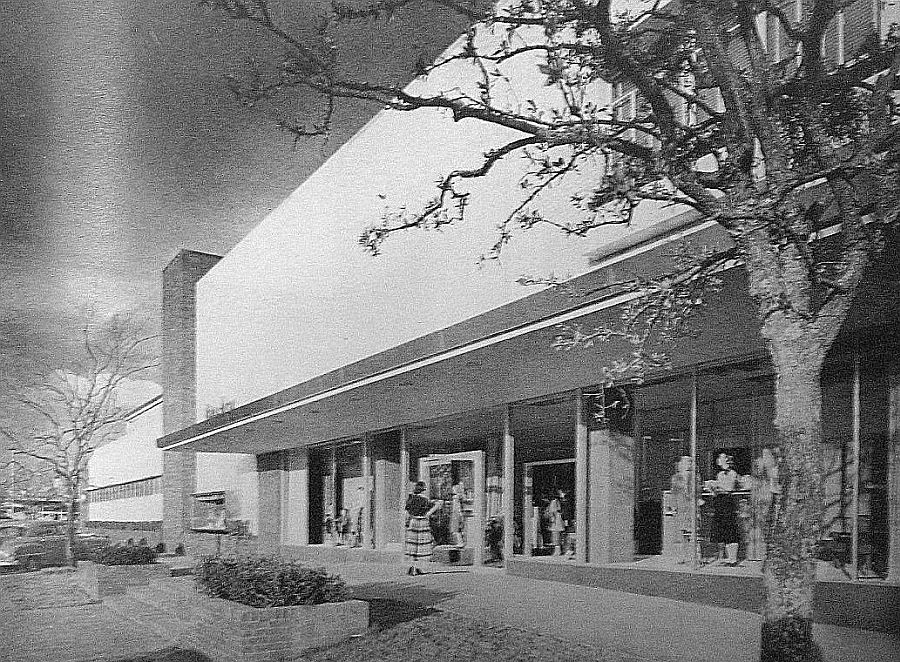
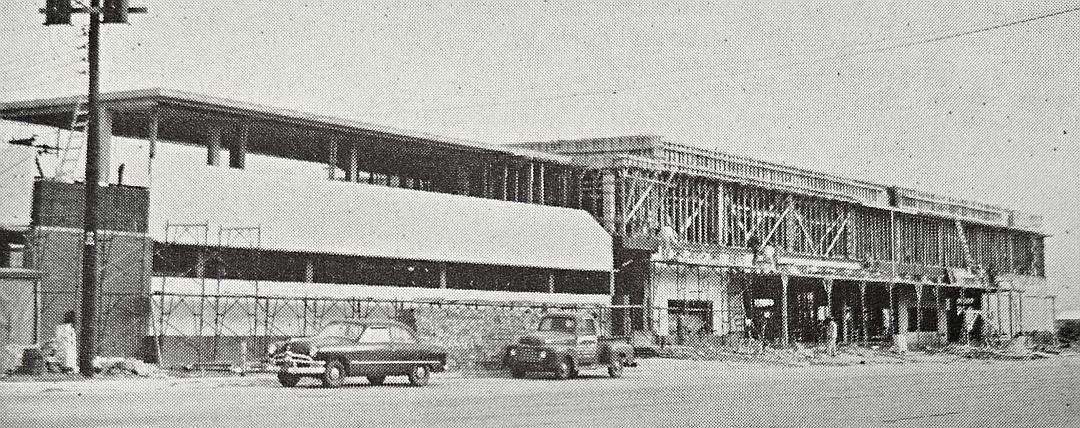
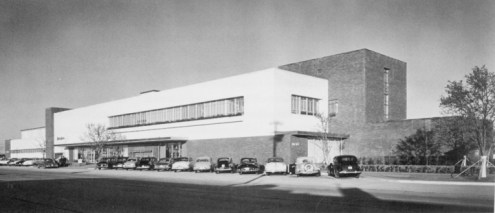
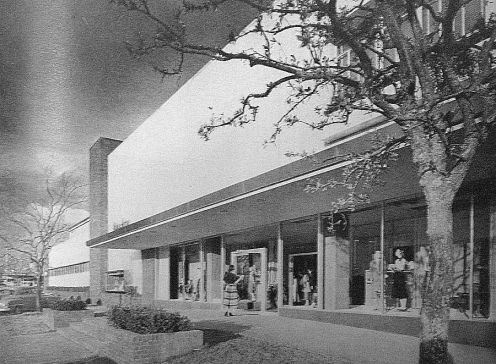
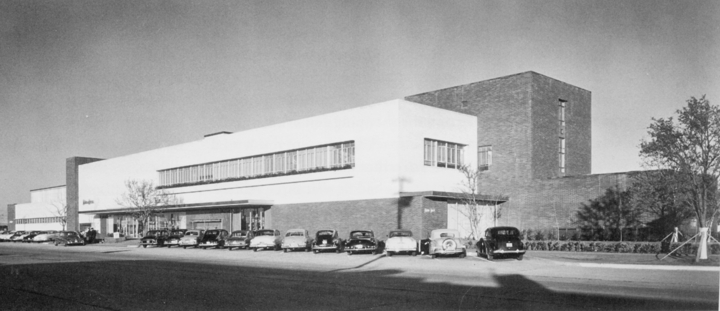
I LOVE that drawing! Unfortunately, things changed between the time that DeWitt and Swank offered that initial drawing and the almost three years that passed before the store was actually completed. The store was expanded to two floors (with mezzanine and basement), and… I don’t know — it just lost all of its supercool sleekness. It went from mid-century-modern fabulousness to big boring blocks. I’m sure the interior was still fantastic (designed by Eleanor Le Maire), but that exterior is uncharacteristically (for Neiman’s) blah.

Under construction:
n-m_preston-center_construction_dallas-mag_feb-1951_DPLDallas magazine, Feb. 1951

Constructed:
n-m_preston-center_1951_departmentstoremuseum
1951, via thedepartmentstoremuseum.org

*

But back to the decor. This store was aimed at suburban families — the shoppers were primarily stylish mothers with kids, so there was a lot of thought put into making the store appealing to children. The basement — which was home to the toy and nursery department — sounds pretty great, complete with a Willy Wonka-esque attraction: at the entrance was an enchanted forest mural and a giant cage filled with toy animals, and “in the toy shop there is a magic tree — one with a built-in dispenser that pours out an endless supply of orangeade” (Dallas Morning News, Oct. 14, 1951).

The store was designed in a Southwestern color palette, featured a glass mosaic, lots of Kachina dolls, a glass-walled landscaped patio, a specially commissioned Alexander Calder mobile, and it was an immediate hit. The denizens of the Park Cities and Preston Hollow would still have to make the trek downtown if they wanted a gown for that do at the country club, but for casual clothing for mom and a large selection of clothing for children and teens, the “town and country store” was perfect. And nearby.

It lasted until NorthPark opened in 1965. Realizing the Preston Road store would be unable to expand, Neiman’s decided to close the 14-year-old store and move into Raymond Nasher’s striking new NorthPark Center.

*
n-m_preston_dallas-history-guild
via Dallas History Guild Facebook page

*

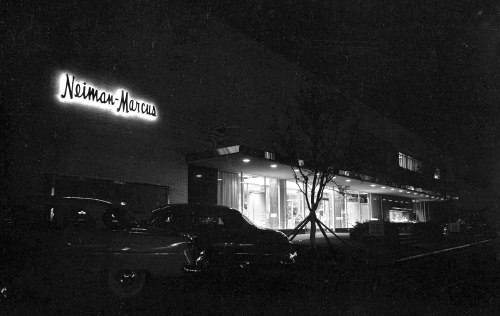
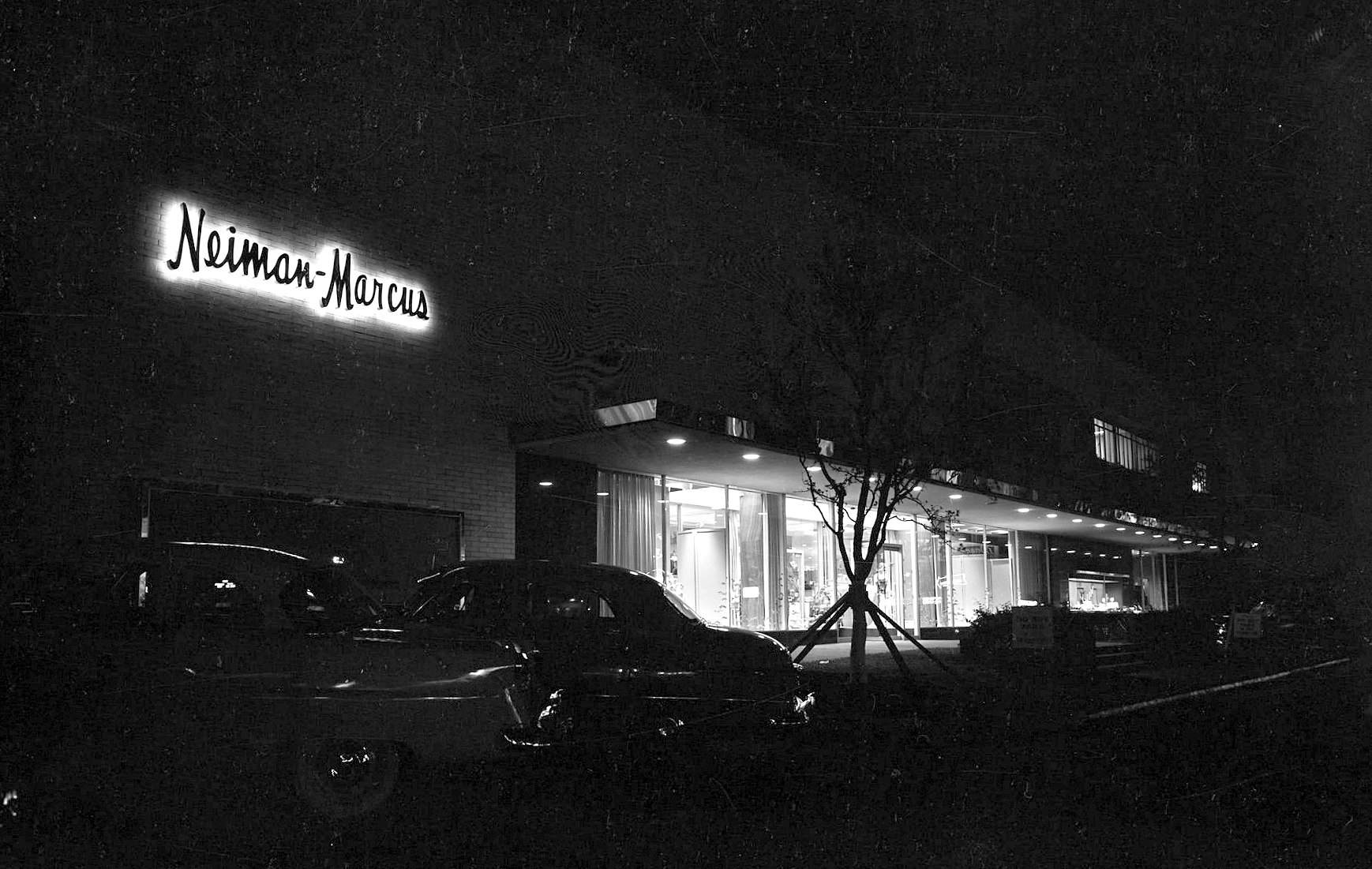
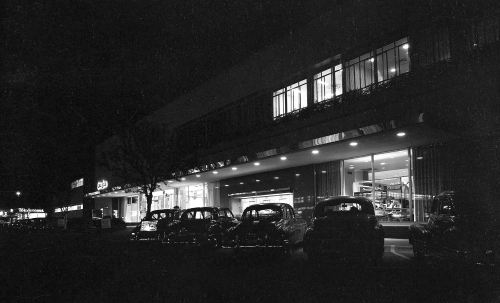
Below, two night-time photos by Squire Haskins, taken on May 23, 1952:
n-m_preston_night_squire-haskins_UTA_1952_bvia UTA Libraries

n-m_preston_night_squire-haskins_UTA_1952_avia UTA Libraries

*

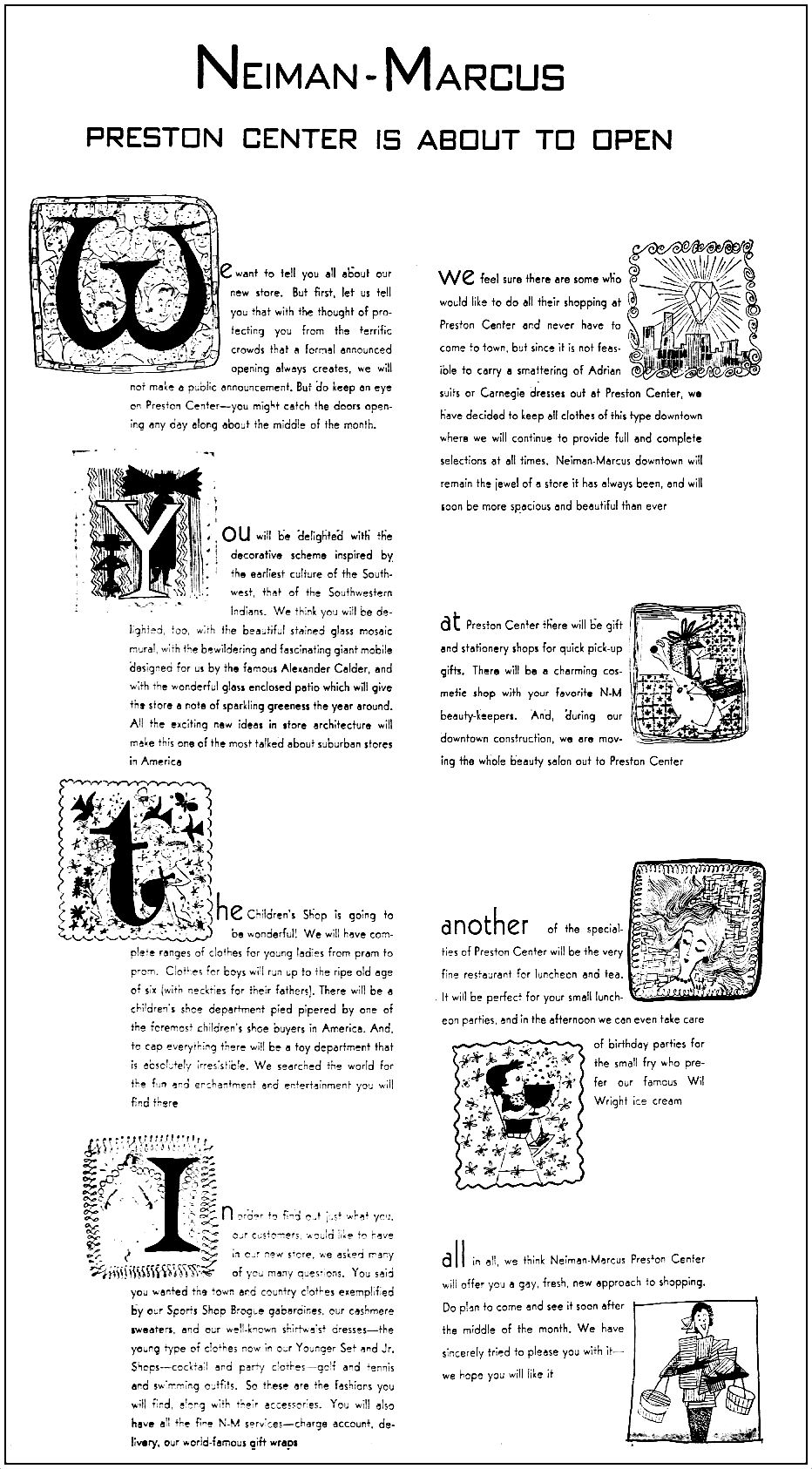
Instead of placing a “Grand Opening” announcement, Neiman’s teased the public with a “we’ll be opening soon-ish” announcement (in fact, the store opened exactly one week after the appearance of this ad). This ad describes that the new location will be more geared to families — to children (“from pram to prom”), adult casualwear, and gift items. With a restaurant and salon. The more typical Neiman’s couture lines and more expensive items would be available only “in town.” (Click ad to see a larger image.)

n-m_preston_100851_adOct. 8, 1951 ad

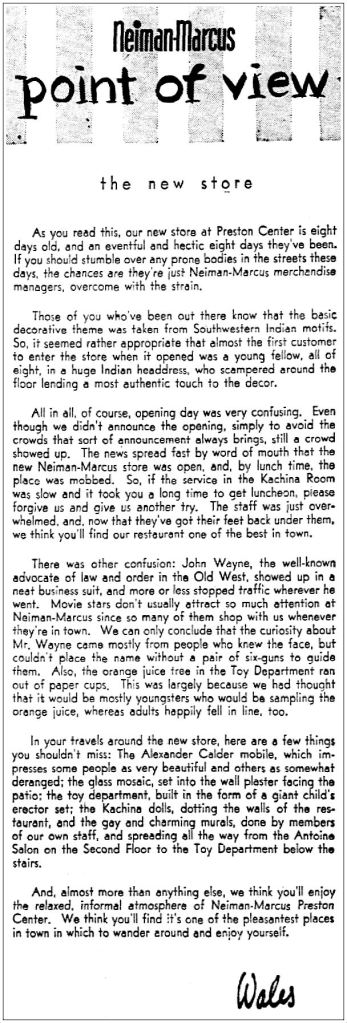
In the “Wales” column — a regular feature of N-M ads, with chatty text written by Warren Leslie (“Wa” from “Warren” and “les” from Leslie), a Neiman-Marcus executive and spokesperson and, later, author of the controversial book Dallas Public and Private) — the store’s opening is discussed, including the unexpected appearance of John Wayne (in town for the “Movietime in Texas, USA,” a promotional Hollywood caravan tour through Texas, packed with movie stars (watch cool footage here). Too bad about that orangeade, kids.
n-m_preston_102351_ad-detAd detail, Oct. 23, 1951

*

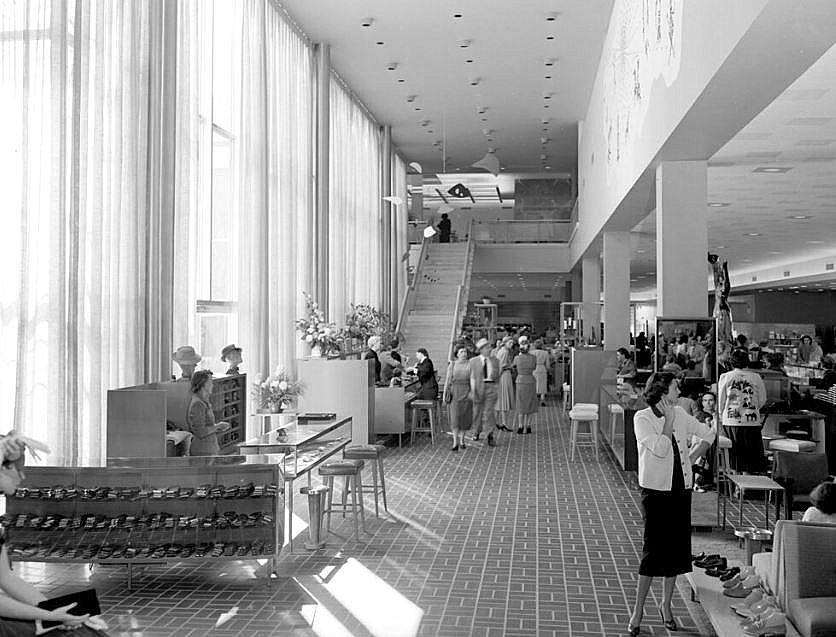
One of the features of the new store was a specially commissioned mobile by artist Alexander Calder which hung above the stairway (a bit difficult to see in the photo below, but it’s there!). This was the first permanent installation of one of Calder’s kinetic sculptures in Dallas. (The three photos below are by Denny Hayes.) The staircase was used for fashion shows (watch Channel 5 news footage from a swimsuit fashion show from April 25, 1958 here, via the UNT’s Portal to Texas History site — according to the news script, the last suit was priced at a whopping $500, which in today’s money, would be about $4,500). (UPDATE: Perhaps because of its current financial situation, Neiman’s decided to sell the Alexander Calder mobile, titled “Mariposa” — it was auctioned by Sotheby’s on Dec. 8, 2020 and sold for $18.2 million, far surpassing its high estimate of $8 million — more info and several photos of the sculpture can be found on the Sotheby’s site here.)

n-m_preston_PA76-1-5388.1_hayes-collection-1954_DPL
Dallas Public Library (PA76-1/5388.1)  

Those floor-to-ceiling windows and sheer draperies are wonderful.
n-m_preston_PA76-1-5388.5_hayes-collection-1951_DPL
Dallas Public Library (PA76-1/5388.5)

n-m_preston_PA76-1-5388.2_hayes-collection_DPLDallas Public Library (PA76-1/5388.2)

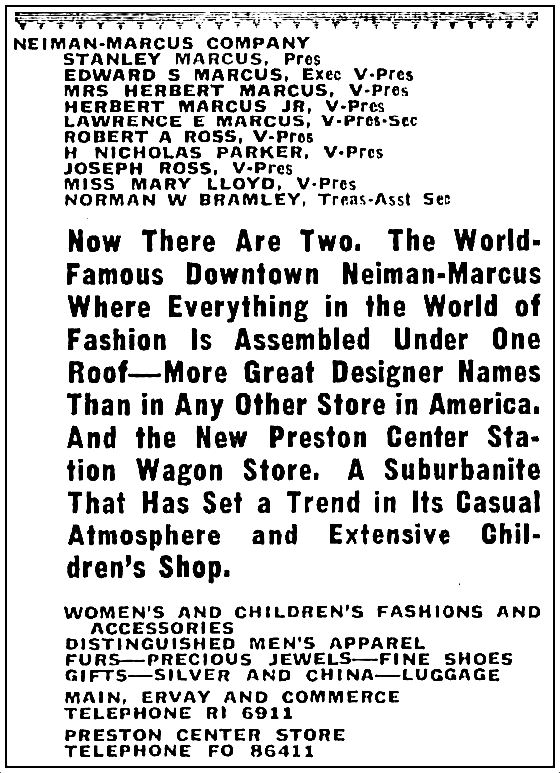
The listing in the 1953 directory described the Preston store as “the New Preston Center Station Wagon Store.” That’s right, the “station-wagon store.”
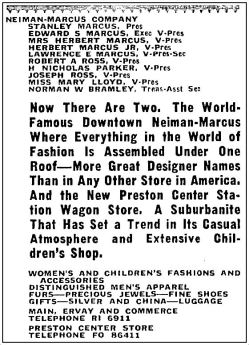
n-m_preston_1953-dallas-directory1953 Dallas directory

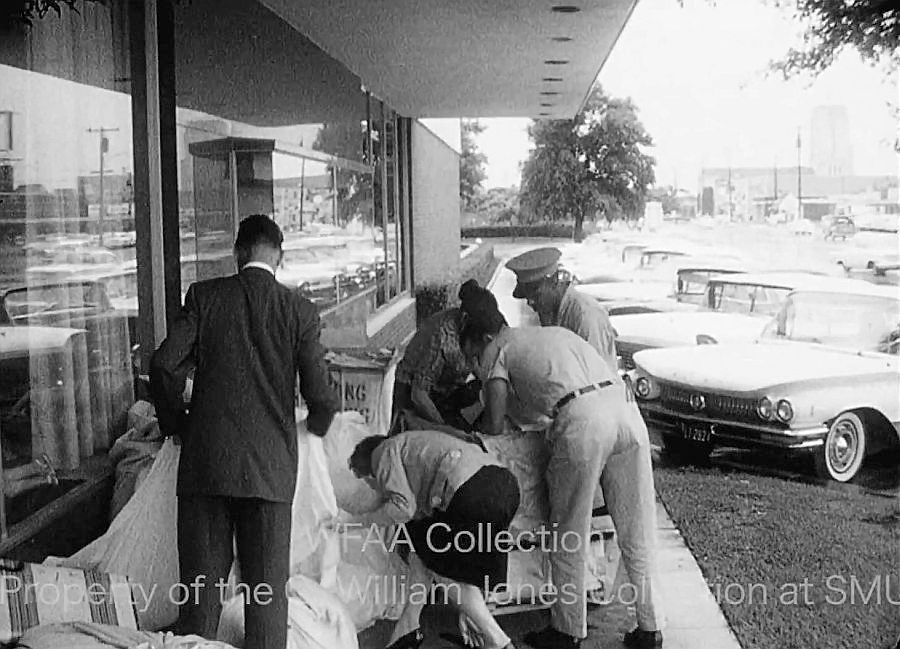
In May, 1960 there was a relief drive throughout Dallas to send much-needed supplies to Chile, which had recently experienced almost simultaneous devastating earthquakes, volcanic eruptions, tidal waves, and avalanches. Neiman’s coordinated with several agencies and the State Department to rush food and clothing to Chile. The view in the screenshot below shows Preston Road looking south (watch the 1-minute Channel 8 news footage, via SMU, here).
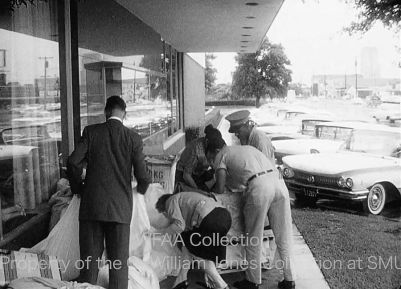
n-m_preston_SMU_053060_preston-road

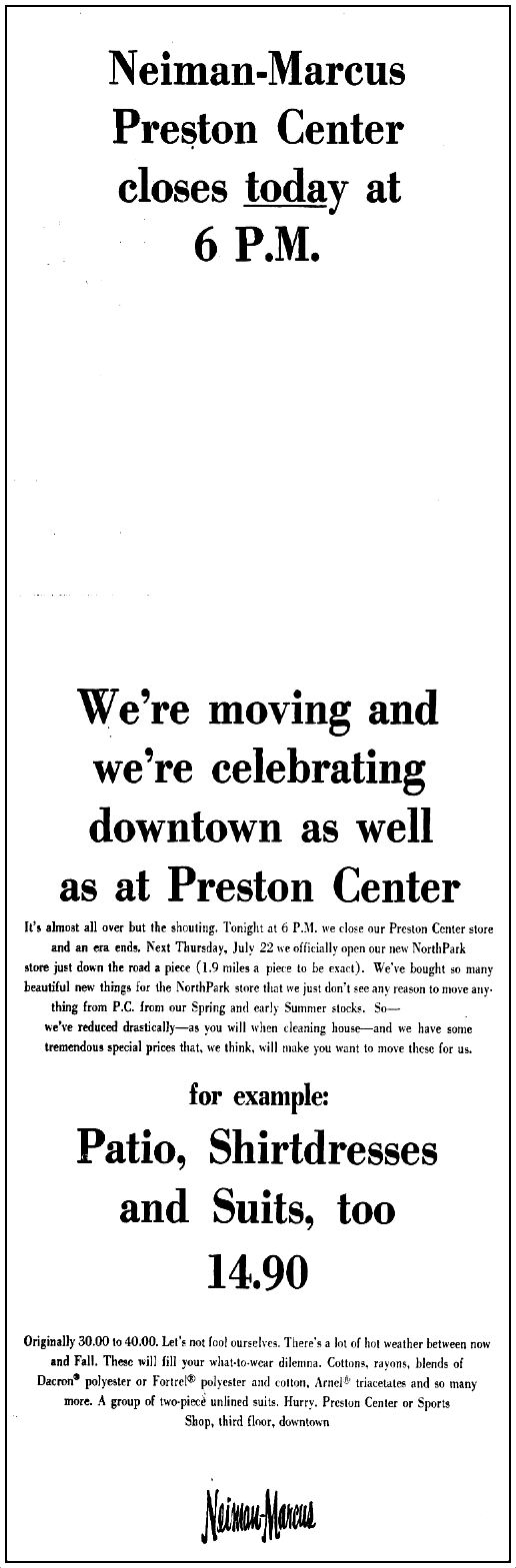
After 14 years, the Preston location closed up shop in July 1965. This coincided with the opening of the much larger Neiman’s store in NorthPark. Bye-bye, “suburbia”!
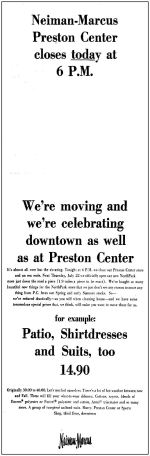
n-m_071565_preston-closingJuly 15, 1965 ad

The Preston Road building still stands, but it’s not very interesting looking these days. I think I’d prefer the “blah” look from 1951.

n-m_preston_bldg_google-street-view_2017Google Street View, 2017

***

Sources & Notes

Top image appeared in the Feb. 1949 issue of “Dallas,” a monthly magazine published by the Dallas Chamber of Commerce.

Photos by Squire Haskins are from the Squire Haskins Photography, Inc. Collection, University of Texas at Arlington Libraries, Special Collections.

Interior photos by Denny Hayes are from the Hayes Collection, Dallas History and Archives, Dallas Public Library.

Image of the 1960 Chilean American Red Cross relief drive is a screenshot from the WFAA Newsfilm Collection, G. William Jones Archive, Hamon Arts Library, Southern Methodist University.
neiman-marcus_preston-road_dallas-mag_feb-1949_sm

*

Copyright © 2020 Paula Bosse. All Rights Reserved.

Dallas Baseball Team — ca. 1910

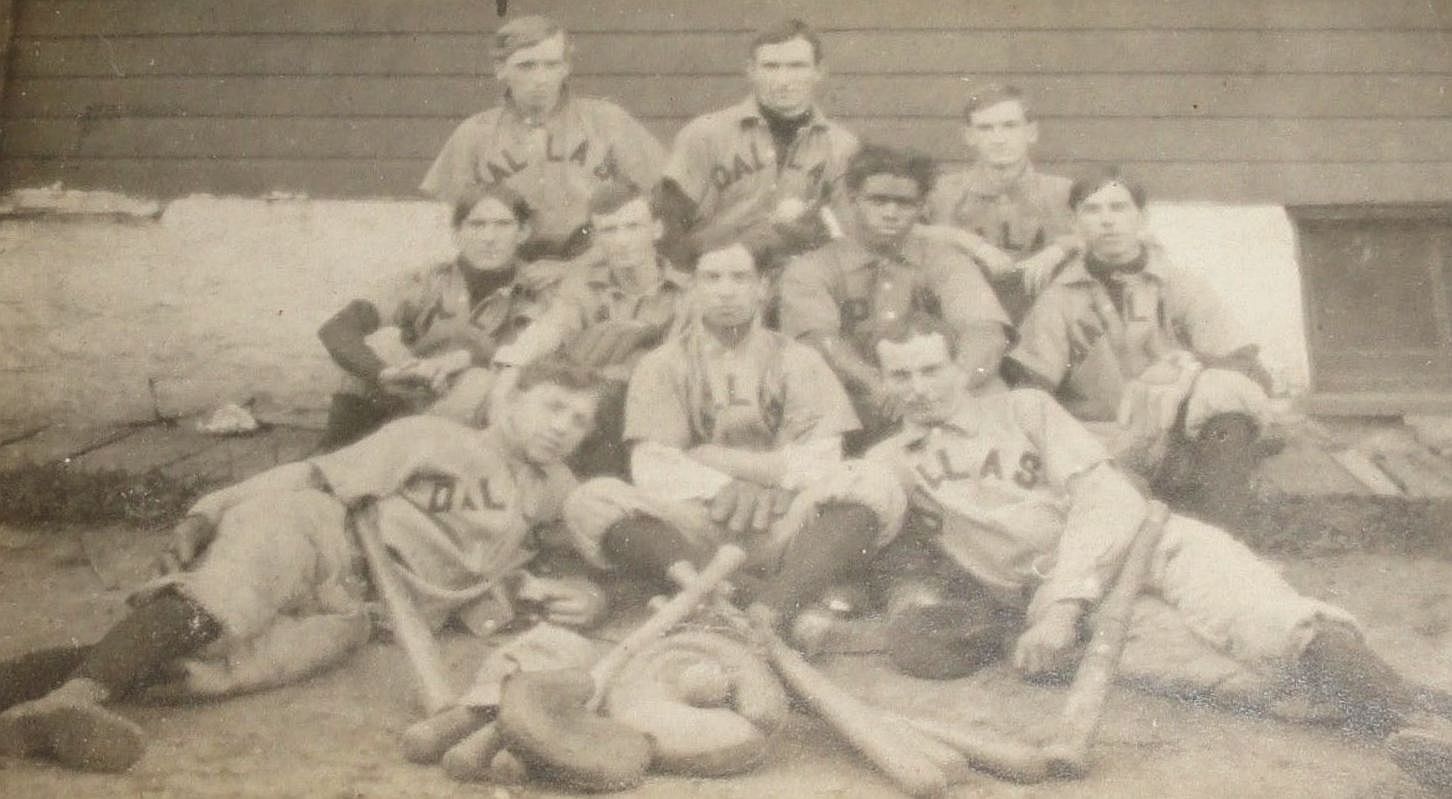
dallas-baseball_1910_ebay_black-teammateTeam photo, circa 1910… (click for larger image)

by Paula Bosse

I came across this circa-1910 photo on eBay about a year and a half ago. I thought it was unusual because of the presence of an African American man posing with the team. Sports teams weren’t integrated at this time — was he part of the team but not a player? I don’t know what’s written on his shirt, but it doesn’t have “Dallas” on it like the ones the others are wearing. What do you think?

Happy Opening Day!

***

Sources & Notes

Photo found on eBay. (I assume it’s Dallas, Texas….)

More Flashback Dallas posts on baseball can be found here.

*

Copyright © 2020 Paula Bosse. All Rights Reserved.
Dallas — From “Texas, The Big State” (1952)

texas-big-state_santa-fe-film_jones-film_triple-underpassBehold…

by Paula Bosse

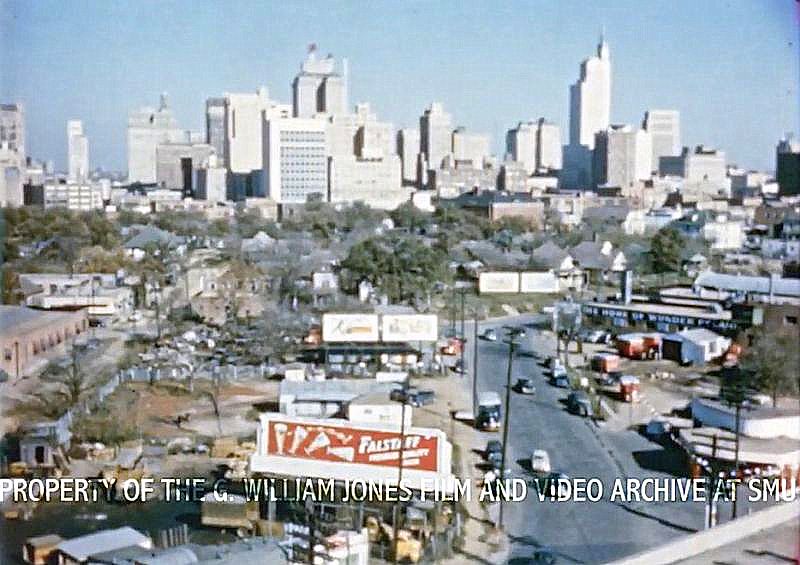
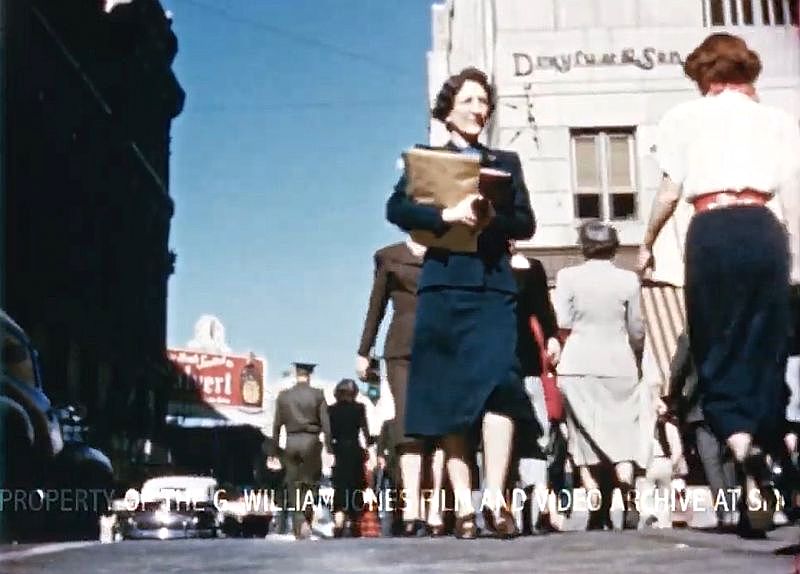
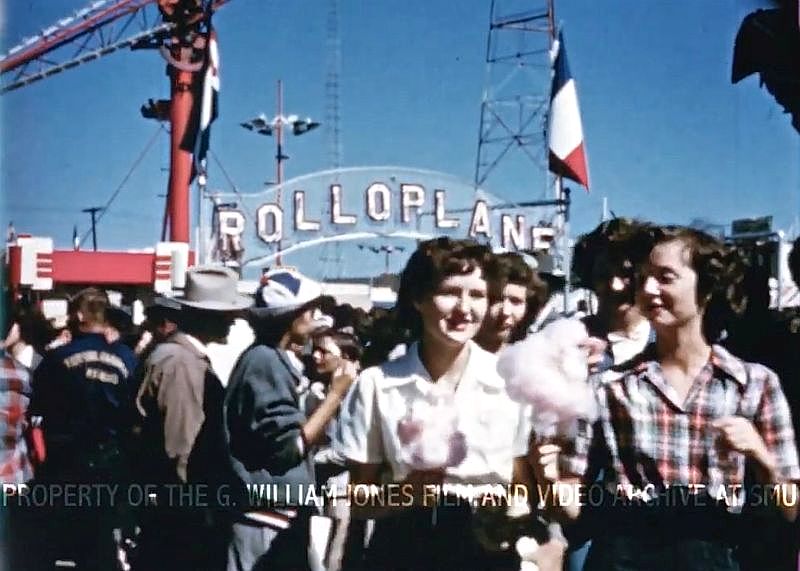
It’s always fun to see Dallas on film — and it’s even better when it’s a Technicolor film. Below are a few screenshots from “Texas — The Big State,” a 1952 travelogue produced by Santa Fe Railroad as a promotional film. It’s very enthusiastic. …Very. Dallas’ Norma-Desmond moment lasts only about three and a half minutes, but visits to downtown, Chance Vought, SMU, Fair Park, a Cotton Bowl game, and the State Fair of Texas manage to get crammed in, surrounded by a warm bath of dynamic adjectives.

Above, a scenic view of the triple underpass and the approach to downtown Dallas from the west. Nice foliage.

Below, a birds-eye view from the south (the same shot as the one by Eisenstaedt in the ’40s seen here, only a decade later — even the Falstaff Beer billboard is still there).

texas-big-state_santa-fe-film_jones-film_SMU_skyline

The well-dressed mean streets of Big D:

texas-big-state_santa-fe-film_jones-film_SMU_crosswalk

A woman walking on water at the Esplanade in Fair Park:

texas-big-state_santa-fe-film_jones-film_fair-park_esplanade

Rolloplane, cotton candy, etc., at the State Fair of Texas:

texas-big-state_santa-fe-film_jones-film_fair-park_midway

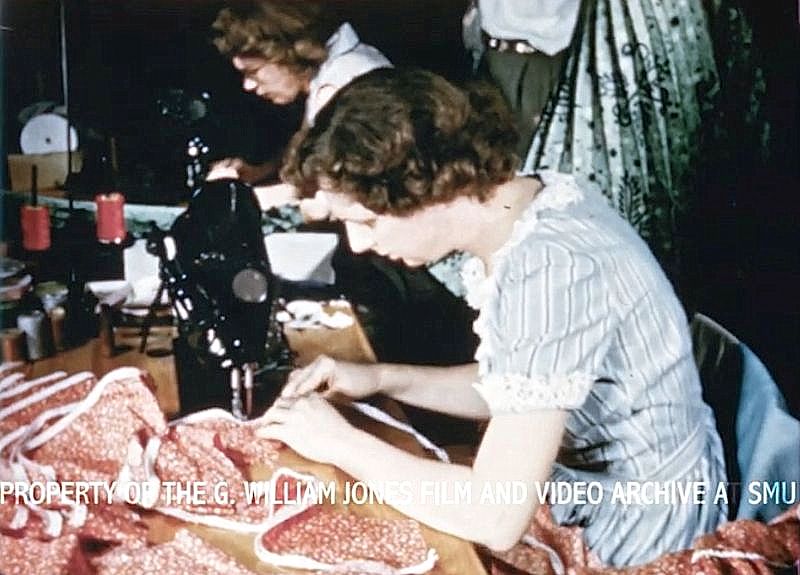
And, lastly, a fun fact I bet no one alive on this planet knows (or remembers): in 1952 Dallas was the second largest manufacturer of WASH DRESSES in the country. Probably the world. What a random piece of information for the Chamber of Commerce to have given to the Santa Fe people to include in a fluffy little film like this. Forget Neiman’s — we were number two in wash dresses! Number TWO!! (“Wash dresses”? Apparently they were house dresses made from washable fabrics. Like what Lucy Ricardo used to wear around the house when she didn’t have to don a hat and gloves to go pick up Ricky’s tux at the dry cleaners. Like the one seen in this “wash frocks” ad from 1950.) And here you go, two of the women who pushed us to runner-up wash-dress greatness:
texas-big-state_santa-fe-film_jones-film_wash-dresses

*

The 24-minute film — which premiered in Austin on May 28, 1952 and was included for months afterward as a “featurette” on double bills across the country — can be seen in its entirety on the SMU Jones Film YouTube channel. The Dallas bit starts at 9:43, followed by the Fort Worth bit at 13:19. I understand there are other cities, too.
***

Sources & Notes

All images are screenshots from the 16mm film posted on YouTube by the G. William Jones Film Archive, Hamon Library, Southern Methodist University.

Special thanks to Erik Swanson for bringing this to my attention.

*

Copyright © 2020 Paula Bosse. All Rights Reserved.

Mother Hansen’s Home Cooking — 1913

mother-hansens-home-cooking_ebay_postmarked-1913Mother Hansen’s, 1814 Main Street… (click for larger image)

by Paula Bosse

A popular restaurateur in early-20th-century Dallas was Ruth Hansen (1870-1947), known to most people as “Mother Hansen.” She maintained a restaurant in downtown Dallas from about 1910 until the early 1930s, moving between locations on S. Ervay and a couple of different addresses on Main Street. The cafe interior seen above was at 1814 Main Street, just west of St. Paul — the photo was taken in 1912 or 1913.

In a 1968 Dallas Morning News interview with Mr. and Mrs. D. L. Whittle, Mother Hansen’s eatery was still remembered. When the Whittles arrived in Dallas in 1912, their Western Automatic Music Co. was two doors from the restaurant — they were regular customers of Mrs. Hansen, and Mrs. (Elsie) Whittle “vividly” remembered the place:

“It was pretty expensive,” Mrs. Whittle said with a smile. “I remember that a T-bone steak dinner cost all of 25 cents.” (“Music Brought Whittle to the City” by Sam Acheson, DMN, Nov. 25, 1968)

(That 25 cents would be about $7.00 in today’s money.)

I love this era of cafes and restaurants — three others in downtown Dallas from this same era are:

***

Notes & Sources

Postcard (with a 1913 postmark) found on eBay.

In addition to buying the Western Automatic Music Co. soon after his arrival in Dallas, D. L. Whittle was also a partner in the Crystal Theatre and, most famously, the founder of the Whittle Music Co.

*

Copyright © 2020 Paula Bosse. All Rights Reserved.