Flashback : Dallas

A Miscellany: History, Ads, Pop Culture

Category: Non-Celebs

Roth’s, Fort Worth Avenue
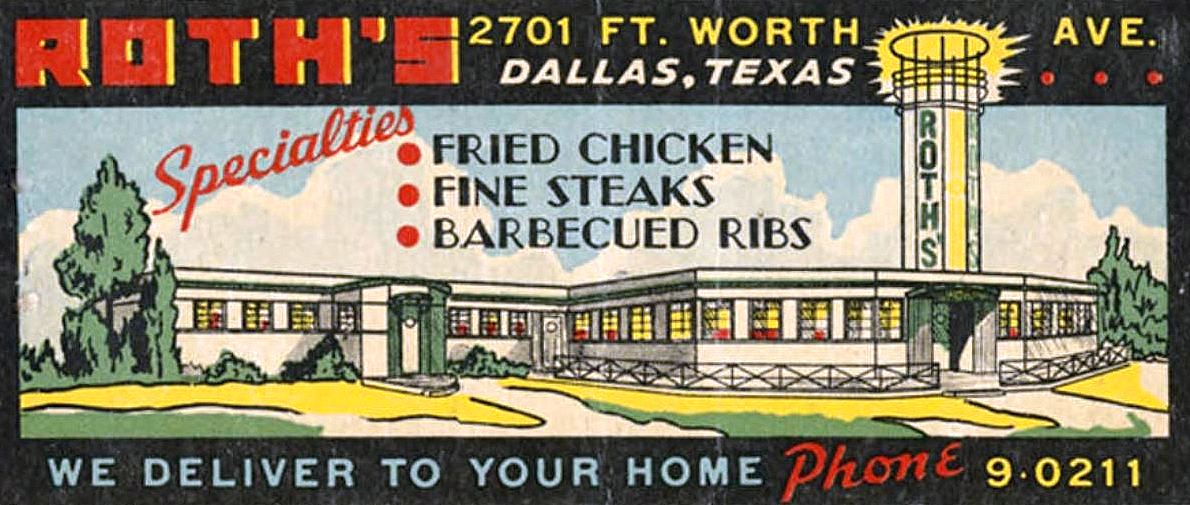
roths_cook-collection_smuSign me up, Mr. Roth…

by Paula Bosse

When I see a building like this, I always hope I can find a photo of it somewhere, but all I’ve been able to come up with is this energetic rendering from a 1940s matchbook cover. Roth’s (which was advertised variously as Roth’s Cafe, Roth’s Restaurant, and Roth’s Drive-In) was in Oak Cliff, on Fort Worth Avenue. It opened in about 1940 or ’41 and operated a surprisingly long time — until about 1967. When Roth’s opened, its address was 2701 Fort Worth Avenue, but around 1952 or ’53 the address became 2601. (I think the numbering might have changed rather than the business moving to a new location a block down the street.)

During World War II, Mustang Village — a large housing development originally built for wartime workers (and, later, for returning veterans and their families) — sprang up across Fort Worth Avenue from the restaurant. It was intended to be temporary housing only, but because Dallas suffered such a severe post-war housing shortage, Mustang Village (as well as its sister Oak Cliff “villages” La Reunion and Texan Courts) ended up being occupied into the ’50s. Suddenly there were a lot more people in that part of town, living, working, and, presumably, visiting restaurants.

As the 1960s dawned, Mustang Village was just a memory, and Roth’s new across-the-street neighbor was the enormous, brand new, headline-grabbing Bronco Bowl, which opened to much fanfare in September 1961. I don’t know whether such close proximity to that huge self-contained entertainment complex hurt or helped Roth’s business, but it certainly must have increased traffic along Fort Worth Avenue.

Roth’s continued operations until it closed in 1967, perhaps not so coincidentally, the same year that Oak Cliff’s beloved Sivils closed. Ernest Roth, like J. D. Sivils, most likely threw in the towel when a series of “wet” vs. “dry” votes in Oak Cliff continued to go against frustrated restaurant owners who insisted that their inability to sell beer and wine not only damaged their own businesses but also adversely affected the Oak Cliff economy. The last straw for Sivils and Roth may have been the unsuccessful petition drive in 1966/1967 to force a “beer election” (read about it here in a Morning News article from Aug. 17, 1966).

As far as that super-cool building seen at the top — I don’t know how long it remained standing, but when Roth’s closed, a mobile home dealer set up shop at 2601 Fort Worth Avenue, and mobile homes need a lot of parking space….

The building on the matchbook cover above is, unfortunately, long gone (as is the much-missed Bronco Bowl); the area today is occupied by asphalt, bland strip malls, and soulless corporate “architecture” (see what 2701 Fort Worth Avenue looks like today, here).

*

The man behind Roth’s was Ernest W. Roth, a Hungarian immigrant who had worked for many years as maître-d’ at the Adolphus Hotel’s tony Century Room. He decided to go out on his own, and around 1940, he and his business partner Joseph Weintraub (who was also his brother-in-law) opened the Oak Cliff restaurant which boasted two dining rooms (with a seating capacity of 350, suitable for parties and banquets), fine steaks, and, on the weekends, a live band and dancing. Ernest’s wife, Martha, and their son Milton were also part of the family business. When the restaurant opened, there wasn’t much more out there on the “Fort Worth cut-off,” but the place must have been doing something right, because Roth’s lasted for at least 27 years — an eternity in the restaurant business. It seems to have remained a popular Oak Cliff dining destination until it closed around 1967.

*

The real story, though, is the Roth family, especially Ernest’s mother, Johanna Roth, and even more especially, his older sister, Bertha Weintraub.

Johanna Rose Roth was born in 1863 in Budapest, where her father served as a member of the King’s Guard for Emperor Franz Josef. She and her husband and young children came to the United States about 1906 and, by 1913, eventually made their way to San Antonio. In the ’40s and ’50s she traveled by airplane back and forth between San Antonio and Dallas, visiting her five children and their families — she was known to the airlines as one of their most frequent customers (and one of their oldest). She died in Dallas in 1956 at the age of 92.

Johanna’s daughter Bertha Roth Weintraub had a very interesting life. She too was born in Hungary — in 1890. After her husband Joe’s death in the mid ’40s, a regular at her brother’s restaurant, Abe Weinstein — big-time entertainment promoter and burlesque club empresario — offered Bertha a job as cashier at the Colony Club, his “classy” burlesque nightclub located across from the Adolphus. She accepted and, amazingly, worked there for 28 years, retiring only when the club closed in 1972 — when she was 82 years old! It sounds like she led a full life, which took her from Budapest to New York to San Francisco to San Antonio to Austin and to Dallas; she bluffed her way into a job as a dress designer, ran a boarding house in a house once owned by former Texas governor James Hogg, hobnobbed with Zsa Zsa Gabor and Liberace, was a friend of Candy Barr, and, as a child, was consoled by the queen of Hungary. She died in Dallas in 1997, a week and a half before her 107th birthday. (The story Larry Powell wrote about her in The Dallas Morning News — “Aunt Bertha’s Book Filled With 97 Years of Memories” (DMN, Nov. 17, 1987) — is very entertaining and well worth tracking down in the News archives.)

weintraub-bertha-roth_texas-jewish-post_021590
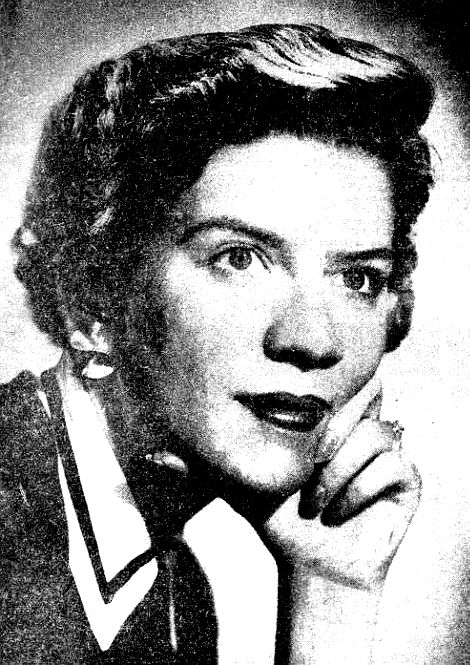
Bertha Roth Weintraub

I feel certain that the extended Roth family found themselves entertained by quite a few unexpected stories around holiday dinner tables!

***

Sources & Notes

Matchbook cover (top image) is from the George W. Cook Dallas/Texas Image Collection, DeGolyer Library, Central University Libraries, Southern Methodist University; more info is here.

Photo of Bertha Weintraub is from The Texas Jewish Post (Feb. 15, 1990), via the Portal to Texas History, here.

*

Copyright © 2017 Paula Bosse. All Rights Reserved.
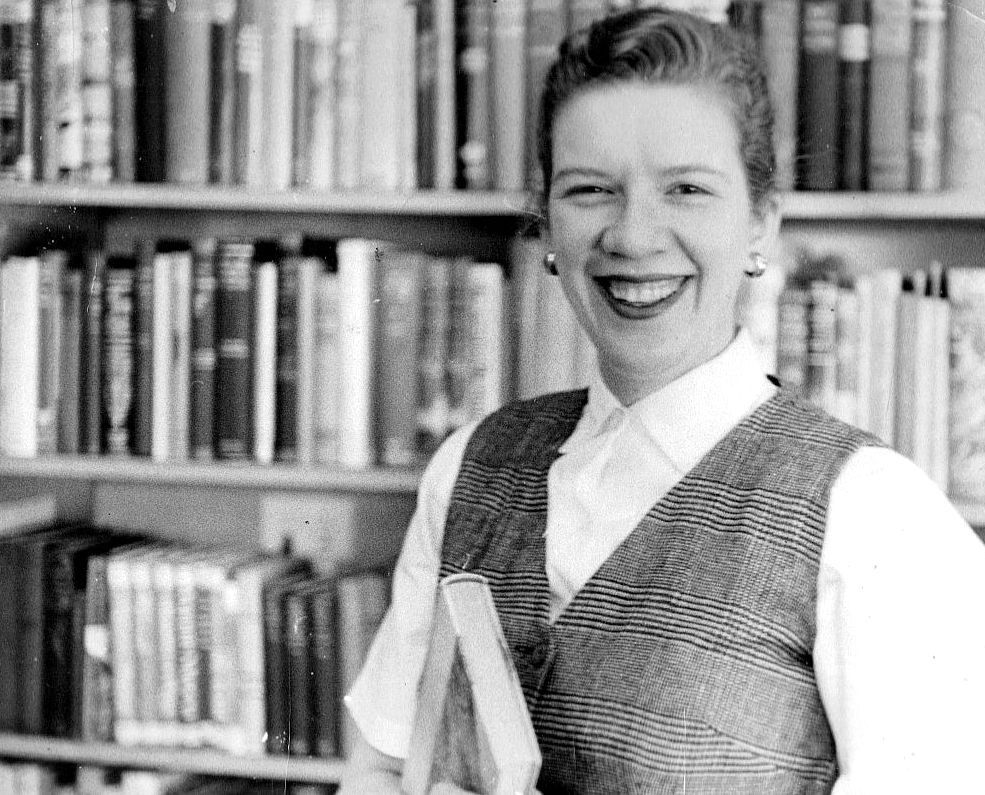
Mimi Payne Aldredge McKnight

ABS_mimi_bookcaseMimi, with books… (click for larger image)

by Paula Bosse

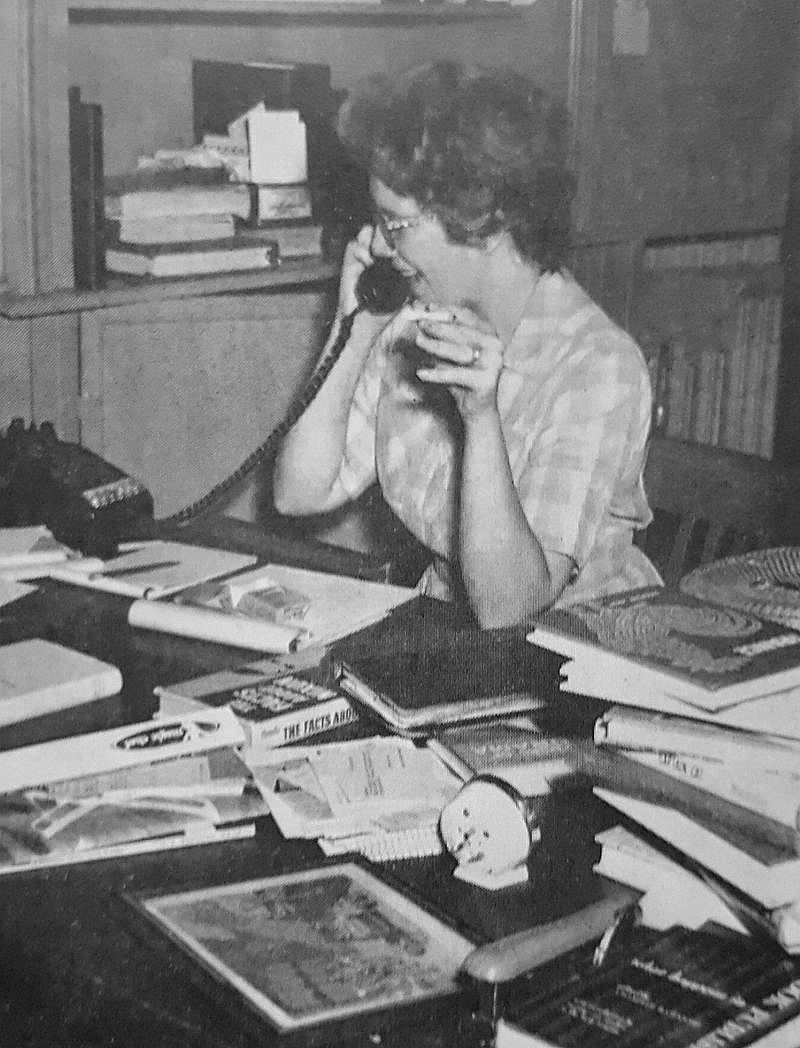
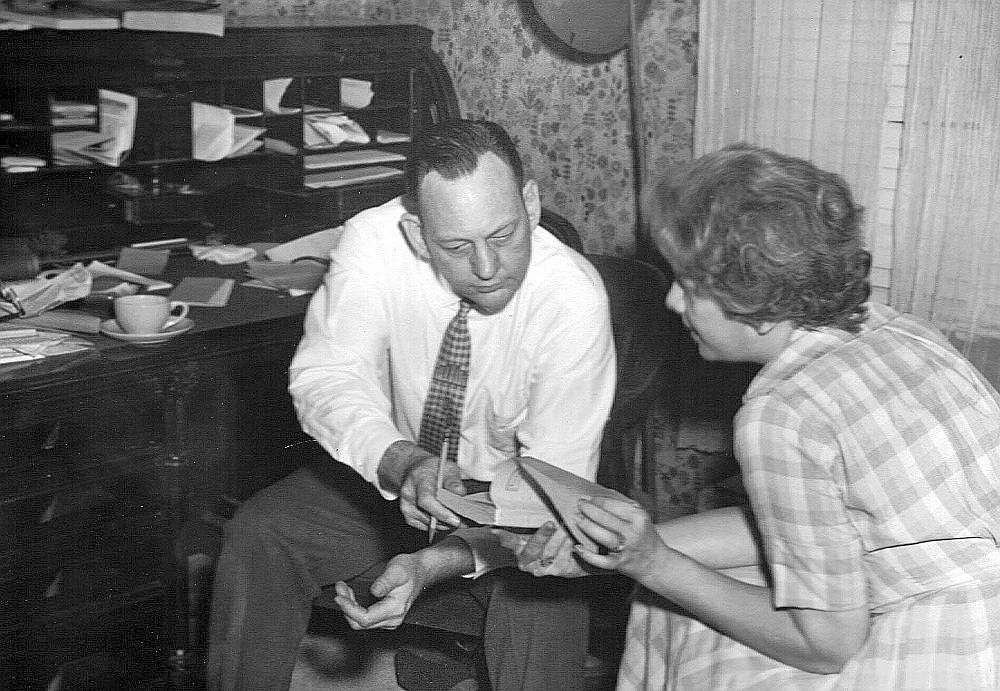
Mimi Aldredge McKnight (née Mildred Payne) died this week. She was an important person in the story of my family — she and her then-husband, Sawnie Aldredge, Jr. owned The Aldredge Book Store on McKinney Avenue, where my parents met and worked for many years and which, for my brother and me, became pretty much a second home. When Sawnie died, Mimi continued to run the store and kept my father, Dick Bosse, on as manager. My father ended up owning the store, and when he died, he had worked at The Aldredge Book Store for almost 45 years. Even when Mimi’s involvement with the store was minimal, she still kept in touch, and she and my father were always on very friendly terms.

I knew Mimi mostly when I was a child, and my memories of her are happy ones. I remember her laugh and her voice most of all. She always seemed like a lovely, friendly woman, and my parents were both very fond of her.

The photo below is how I remember her — talking animatedly on the phone (she and my mother, Margaret, were champion telephone talkers, and I remember them both working at that desk, and talking and talking and talking on that phone).

mimi_phone_texas-parade_feb-1961

I ran into Mimi a few times as an adult. We’d usually just exchange quick pleasantries and ask how various family members were — but I always hoped I’d have the chance to sit down and have a long conversation with her someday. Sadly, that didn’t happen, but I’m so happy that my brother, Erik, and I have reconnected with her children, Amy and Trip Aldredge, and that we’re all friends. The four of us share nostalgic childhood memories of each other’s parents and of that old creaking house on McKinney — a house so crammed with books that the medical section had to be shelved in the bathroom. I can’t imagine a better childhood that one spent growing up in a bookstore.

Goodbye, Mimi — I’m so glad you were a part of my family’s life.

**

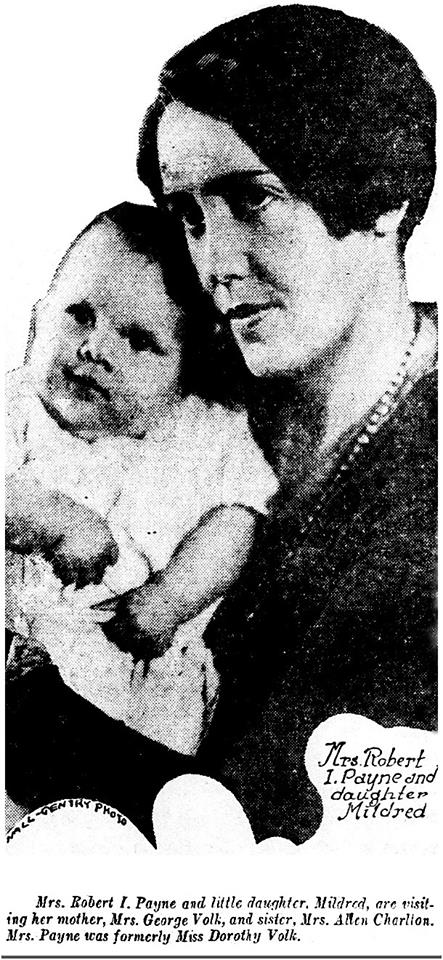
In one of those wonderful unexpected discoveries I’ve made while looking for something completely unrelated, I stumbled across this photo of little Mildred Payne as a baby and was happier about it than I might have expected. (Click photo to see a larger image.)

1929_mimi_dmn_061429
1929

It wasn’t until I was an adult that I realized Mimi had been a real-life, honest-to-god debutante (probably the only debutante I’ve ever met) and that her mother was a member of Dallas’ famed Volk retail family. She grew up in a very nice house, built by her father, Robert I. Payne, in the Perry Heights area of Oak Lawn. If you’re famiiar with Oak Lawn, you’ve probably seen the plantation-like house at 4524 Rawlins (at Hawthorne), designed by architect Ralph Bryan in 1936. (See the house today on Google Street View, here.)

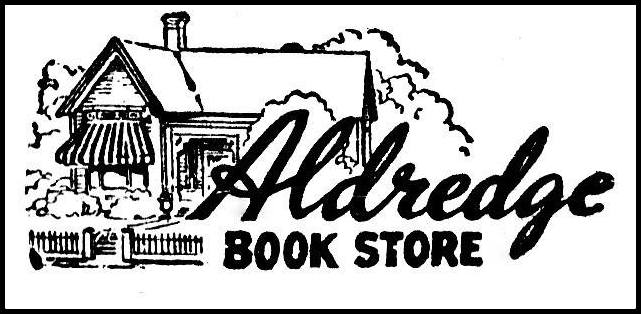
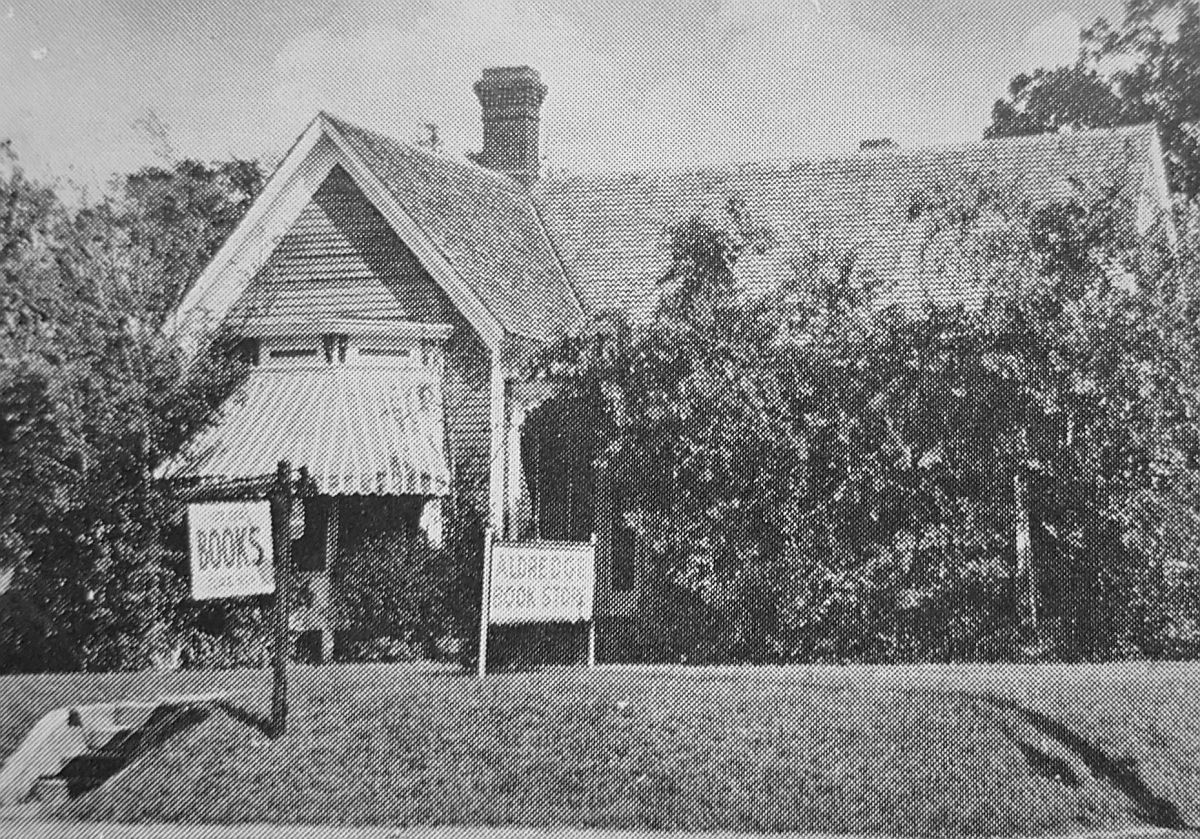
Sawnie Aldredge, Jr. (son of a Dallas mayor) opened The Aldredge Book Store in 1947 at 2800 McKinney Avenue (at Worthington) in an old house built in the 1880s or 1890s (this was several years before Sawnie and Mimi married). The picture below is from around 1960. This was before my time, but I seem to remember it looking less overgrown and less … shabby! It was much larger than it appears in this photo. Below the photo, the store’s early logo. (I’m not sure when the house was torn down — maybe in the ’80s? The lot was vacant for quite some time, as I reall. The block is painfully unrecognizable today. Today it looks like this.)

aldredge-book-store_texas-parade_feb-19611960-ish

ABS_logo_1947

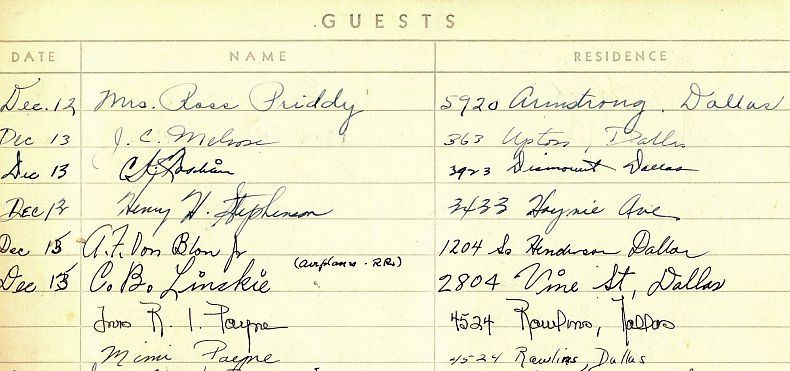
A few years ago, when my brother and I were closing the store, I came across a guestbook from the first year of business and was happy to see that on Dec. 15, 1947, a 19-year-old Mimi Payne visited the store with her mother, Mrs. R. I. Payne. Little did she know that seven years later she’d be married to the proprietor of the store and — for a while — living in that house, battling for personal space amongst all those damn books!

aldredge-book-store-guestbook_1215471947

sawnie_mimi_desk_1961Sawnie and Mimi, 1961

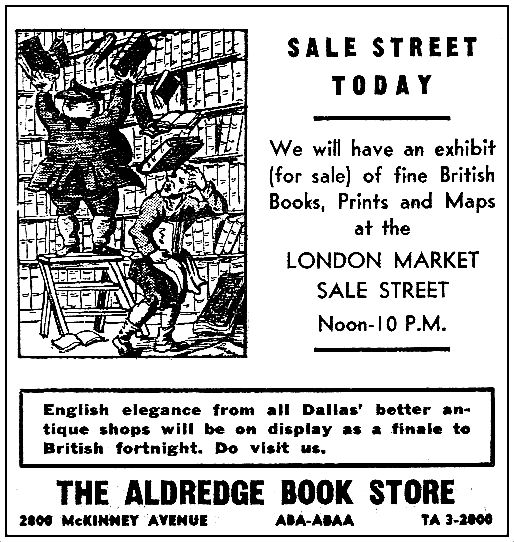
The photo below is one I really love — it was taken in 1958 at the Sale Street Fair, an annual antique street market which ran at the same time as the Neiman-Marcus Fortnight (in 1958 Neiman’s was celebrating Britain). This shows Mimi manning the bookstore booth. My mother told me that she and Mimi (and probably everyone else there) passed the time sitting on the curb, sipping cocktails supplied by friendly neighborhood antique dealers. Sounds great!

ABS_mimi_sale-street-fair_1958Sale Street Fair, Mimi and a browsing London bobby, 1958

ABS_sale-street-fair_1958
Oct., 1958

In 1975, another chapter of Mimi’s life opened when she married esteemed SMU law professor Joe McKnight, to whom she had been married for 40 years at the time of his death in 2015. One interesting highlight was that Joe and Mimi — through their friendship with international bestselling author Alexander McCall Smith (The No. 1 Ladies Detective Agency, etc.) — were featured as characters in his Sunday Philosophy Club/Isabel Dalhousie series. He talked about putting them in one of his novels in a 2006 interview:

Isabel’s mother was American, and she has a cousin of her mother in Dallas, [who is based on] a real person… I was a visiting professor at Southern Methodist University and I’ve got very good friends there, a wonderful couple called Joe and Mimi McKnight, who I’ve made the cousin of Isabel in this book. I have Joe and Mimi coming to Edinburgh, and Mimi plays a large part in the story. So, I’m writing a real person into the story, which is great fun.

A woman who spent a number of years in the early part of her life selling books certainly deserved to be transformed into an entertaining character in a bestselling book in the later part of her life!

***

Sources & Notes

Photos and clippings from the Aldredge Book Store archives and the Aldredge family, unless otherwise noted.

A couple of the photos above come from a profile of The Aldredge Book Store in a magazine called Texas Parade (Feb. 1961): “100,000 Books … Old and New” by Joe Swan. See the full article and photos in a PDF, here

aldredge-book-store_texas-parade_feb-1961_spread_sm

Mimi McKnight died April 3, 2017; her obituary is here.

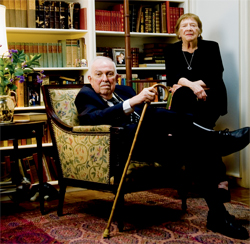
D Magazine wrote about Joe and Mimi McKnight and their connection to Scottish author Alexander McCall Smith in the June 2007 article “Muse, Thy Name is McKnight,” here. The photo below (by Elizabeth Lavin) is from that article.

mcknights_joe-and-mimi_d-mag_june-2007
2007 (D Magazine)

Other Flashback Dallas posts concerning The Aldredge Book Store can be found here.

*

mimi_wedding_announcement_101054_det
1954

Most photos larger when clicked.

*

Copyright © 2017 Paula Bosse. All Rights Reserved.
“Dallas/The Big D” by William E. Bond — ca. 1962

dallas-big-d_william-e-bond_business-week-collection_ca1962Yonder lies Big D…

by Paula Bosse

This print — titled “Dallas/The Big D” by native Texan William E. Bond (1923-2016) — is fantastic. I love everything about it. It was commissioned by Business Week magazine to be used as part of its “Business America” series, an advertising campaign showcasing fifteen American cities captured in woodcuts. Every element of this scene is great, but let’s look at a detail showing just the Dallas skyline, with a hard-to-miss Pegasus. I also see what looks to be the Mercantile Building and the Republic Bank Building in there. And … that sky!

bond_william-e_dallas-big-d_print_business-week_ca-1962_det

william-e-bond_sig

Bond’s homage to Dallas was reproduced in the 1963 book Woodcuts of Fifteen American Cities from the Business Week Collection. Below, text from the book (my assumption is that the first paragraph is the copy that appeared in a print advertisement for Business Week — it appears that the ad campaign used the artists’ works collected in this book to illustrate the ads, with each ad mentioning local companies with large BW subscribership).

Dallas … leapfrogging ahead commercially and culturally. Cotton, cattle, and oil put the Big D on the map. But aircraft, electronics and machinery keep it moving. Companies like Texas Instruments (682 Business Week subscribers), Ling-Temco-Vought (106), Collins Radio (135), Dresser Industries (123). In Dallas, and everywhere in business America, men who manage companies read Business Week. You advertise in Business Week when you want to inform management.

And this was Bond’s bio with a quote from him on “the Big D”:

“Dallas is a great many things. It is a giant of a city in the midst of a giant country – full of life and energy and the will to grow and keep growing. Anyone who knows Dallas feels this spirit. And it is this feeling that I have tried to capture.”

Born in 1923 in Crandall, Texas, Mr. Bond attended the Art Center School in Los Angeles. He has won many gold and silver awards in art director and illustrator shows, including a gold medal in the New York Illustrators Show in 1962. Mr. Bond uses a variety of media, including paper prints, sculpture, and painting. He has been an agency art director most of his career, and is now a free-lance designer.

**

Bill Bond was born in Crandall, Texas in 1923, studied art at the Art Center School in Los Angeles, and spent several years as an award-winning commercial artist in Dallas. He worked as an advertising art director for The Dallas Times Herald, the Sam Bloom Agency, and Tracey-Locke; during this time he frequently participated in group art shows around the city. When he retired, he focused his creative talents on sculpture, becoming known for his wildlife pieces and Western bronzes. He died in Kerrville in 2016 at the age of 92.

william-bond_obit-photo

***

Sources & Notes

The book that features a reproduction of this print is Woodcuts of Fifteen American Cities from the Business Week Collection (New York: McGraw-Hill Publishing Company, Inc., 1963). From the introduction:

One of the principal methods of communication in the 20th century, and one of the biggest businesses, is advertising. Here, too, industry has regularly and effectively used fine art – in the creation of some memorable advertising campaigns.

From 1960 to 1962 Business Week commissioned fourteen prominent woodcut artists to illustrate its “Business America” series. Reproductions of the fifteen woodcut illustrations which were produced appear on the following pages.

Bill Bonds’ obituary is here.

Thanks to Bob Dunn for posting an image of Bond’s print in the Retro Dallas Facebook group. I liked it so much I went out and bought a copy of the (large) book! A few copies are available online here.

*

Copyright © 2017 Paula Bosse. All Rights Reserved.
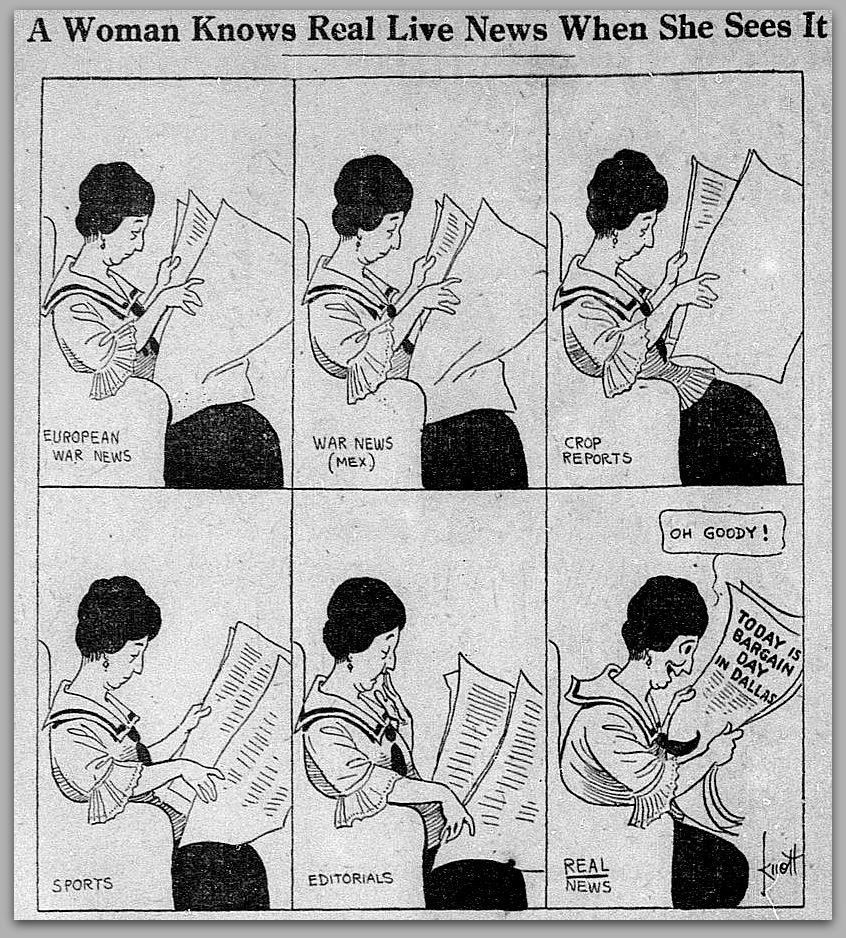
“A Woman Knows Real Live News When She Sees It” — 1915

womens-news_dmn_070815_knott-cartoon“Oh goody!” (click for larger image)

by Paula Bosse

This editorial cartoonist’s take on what was really important to Dallas women is one that probably caused some Dallasites to chuckle and some to fume. The date of this Dallas Morning News cartoon was July 8, 1915. In 1915 women had no constitutional right to vote in the United States and were barred from voting in local, state, and national elections. The Nineteenth Amendment to the U. S. Constitution (which gave women the right to vote) was ratified in Texas in June, 1919.

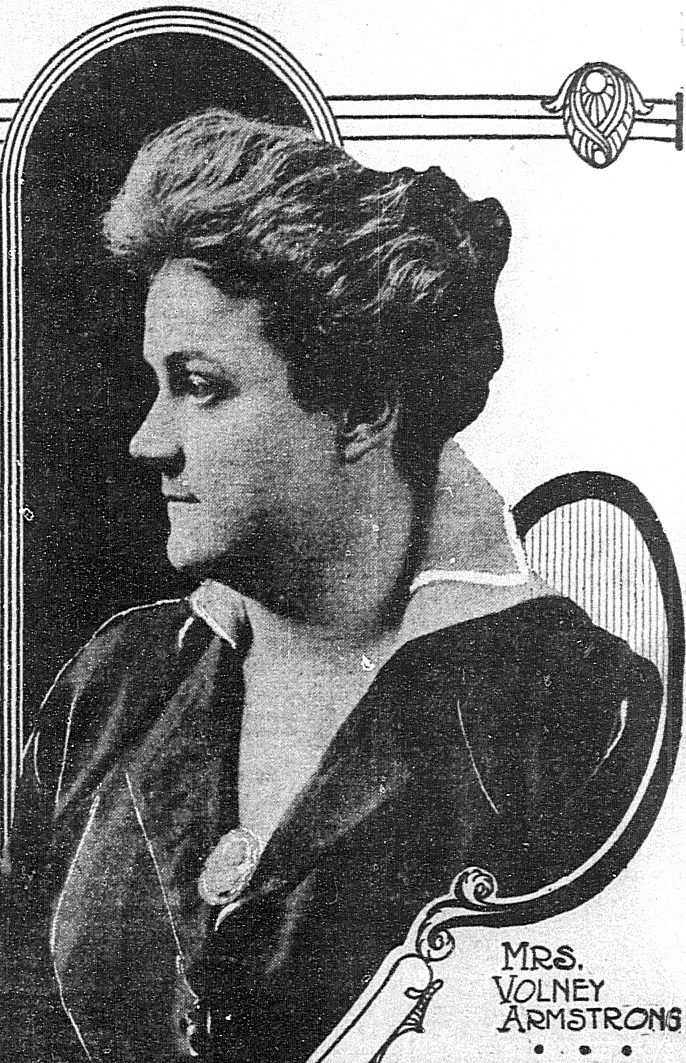
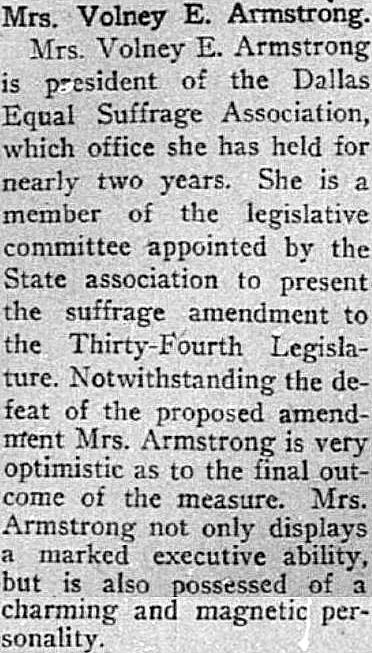
The woman’s suffrage movement in Dallas had been active since at least the 1890s, but it really began to catch fire in the early ‘teens when the Dallas Equal Suffrage Association (DESA) was formed in 1913. The second president of this organization (who was one of the state’s leading suffragists when this cartoon appeared) was Texas Erwin Armstrong (Mrs. Volney E. Armstrong). (Yes, her first name was “Texas” — her friends called her “Tex.”)

I have to admit, I was not aware of Mrs. Armstrong until today, but she was one of many laudable women who helped forge the way for those of us who followed. I like this quote of hers from 1918, commenting on the support (or lack thereof) of politicians during the slow but sure path to ratification:

“Any Democrat who failed to vote for this measure is a man without a party and soon will be a man without a country.” (DMN, Jan. 12, 1918)

tex-armstrong_dmn_031515_suffrage_photo

tex-armstrong_dmn_031515_suffrage
Dallas Morning News, March 15, 1915 (photo and profile)

**

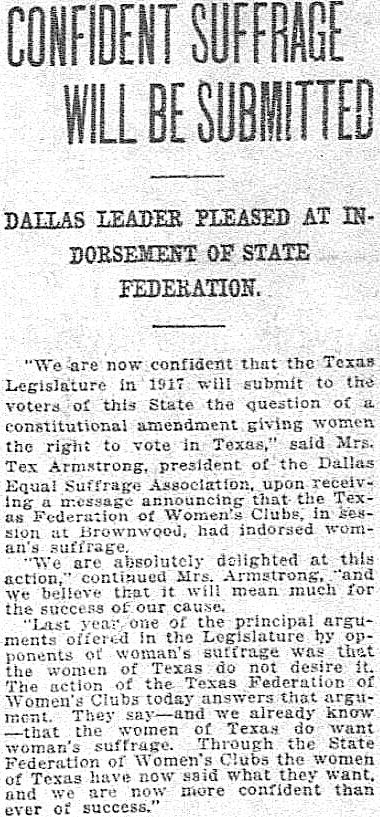
More suffrage news from Dallas (click articles to see larger images).

suffrage_dmn_111115
DMN, Nov. 11, 1915

suffrage_dmn_030818
DMN, March 8, 1918

***

Sources & Notes

Dallas Morning News editorial cartoon “A Woman Knows Real Live News When She Sees It” (by staff cartoonist John Knott) appeared in the July 8, 1915 edition of the paper.

For more on the history of Dallas women and women’s causes, check out the book Women and the Creation of Urban Life: Dallas, Texas, 1843-1920 by Elizabeth York Enstam (College Station: Texas A & M University Press, 1998); a large portion of the chapter “Suffragists and the City” can be read here.

The history of the women’s suffrage movement in Texas can be found at the Handbook of Texas site, here.

The obituary of Mrs. Texas Erwin Armstrong (1878-1960) can be found in the archives of The Dallas Morning News: “Campaigner For Women’s Suffrage Dies” (DMN, March 7, 1960).

Click clippings and pictures to see larger images.

*

Copyright © 2017 Paula Bosse. All Rights Reserved.
 

The Historic Masonic, Odd Fellows, and City Cemeteries

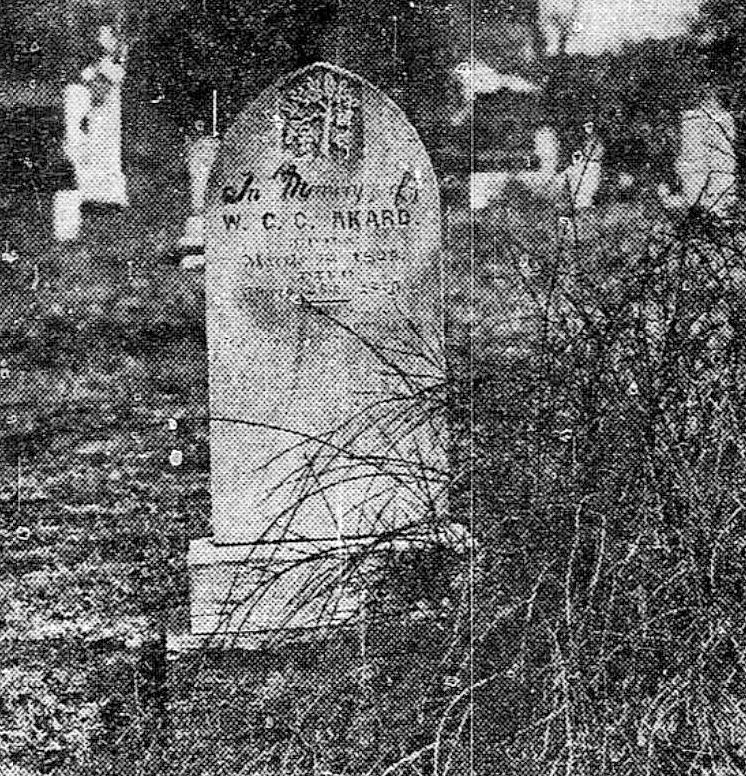
cemeteries_1920s_photo-e
Tombstone of W. C. C. Akard, 1826-1870… (click for larger image)

by Paula Bosse

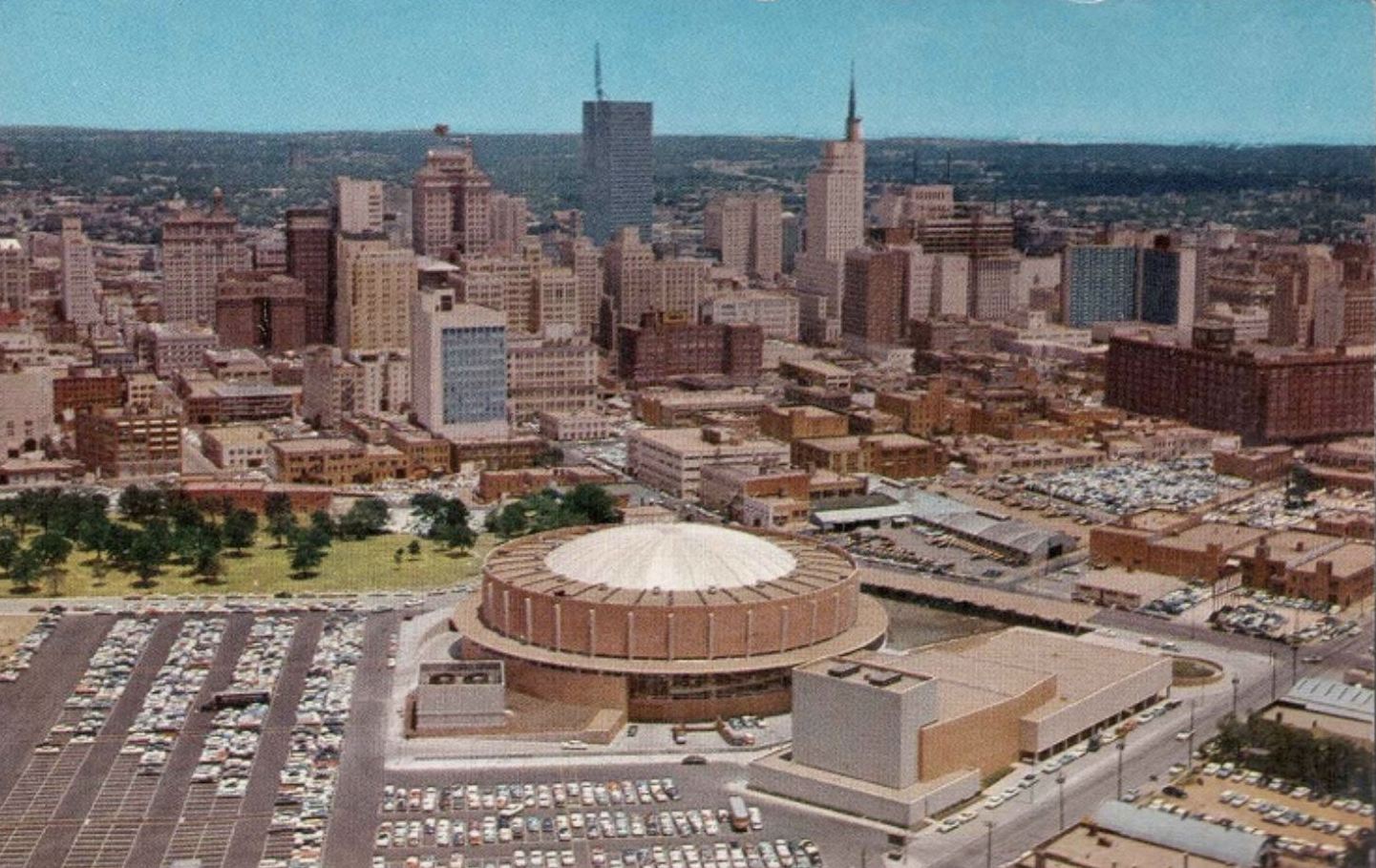
The other day I posted a photo of the Dallas skyline and pointed out that the land occupied by Memorial Auditorium/Dallas Convention Center was once the site of a cemetery (or, rather, several cemeteries: the old City Cemetery, the Masonic and Odd Fellows Cemeteries, and the Jewish Cemetery.

By the 1920s, the grounds were overgrown and grave markers were in various states of disrepair; there were about 500 graves, but many of the remains of those buried there had been moved (resulting in more than a few somewhat alarming gaping holes!). As the 1920s were winding down, fewer and fewer burials were taking place in these cemeteries, but people were still being interred throughout the 1920s — some of these appear to have been indigents without funds to be buried elsewhere.

The oldest grave markers dated to the 1850s. Many of those buried there were important Dallasites: mayors, politicians, pioneer businessmen, doctors, and judges — many of the markers bore names which are now part of everyday life in Dallas (names such as Harwood, Ervay, Akard, Crowdus, Browder, Marsalis, etc.). Over the years, cemetery land had been encroached upon bit by bit (by the Santa Fe railroad, for one) causing many graves to be unceremoniously destroyed. As the city grew and this land (which was once beyond the city limits) became more and more valuable for developers, many of the graves were moved and the remains relocated to other cemeteries. But many remained, and there was concern that the land was being neglected. For decades, the city of Dallas was petitioned by civic leaders to officially protect, beautify, and maintain this land. It wasn’t really until the construction of the convention center in the 1950s that these plans began to take shape. Remaining graves and markers are now part of the Pioneer Park Cemetery at Pioneer Plaza.

Below is a detail from an 1882 map, showing the original locations of the four cemeteries, just beyond the southern edge of the city limits. The Masonic Cemetery occupied the northern section, and the Odd Fellows Cemetery occupied the southern section. The City Cemetery adjoined both, immediately to the east (just west of Akard). The tiny Jewish Cemetery is seen on the southeastern edge of the City Cemetery (in later years Masonic Street cut through the City Cemetery land, and the Jewish Cemetery was just south of the street and right next to the old Columbian School). (See the changed boundaries of the cemeteries on a 1905 Sanborn map here.)

map_1882_cemeteries
Jones & Murphy’s Map of the City of Dallas, Texas, 1882 (det.)

*

The photo at the top of this post shows the grave of W. C. C. Akard (1826-1870). (Incidentally, according to a 1939 Dallas Morning News article, he apparently pronounced his name “Ay-kard” rather than “ACK-erd” as we do today.) The photos below show the run-down Masonic-Odd Fellows cemetery in the 1920s.

*

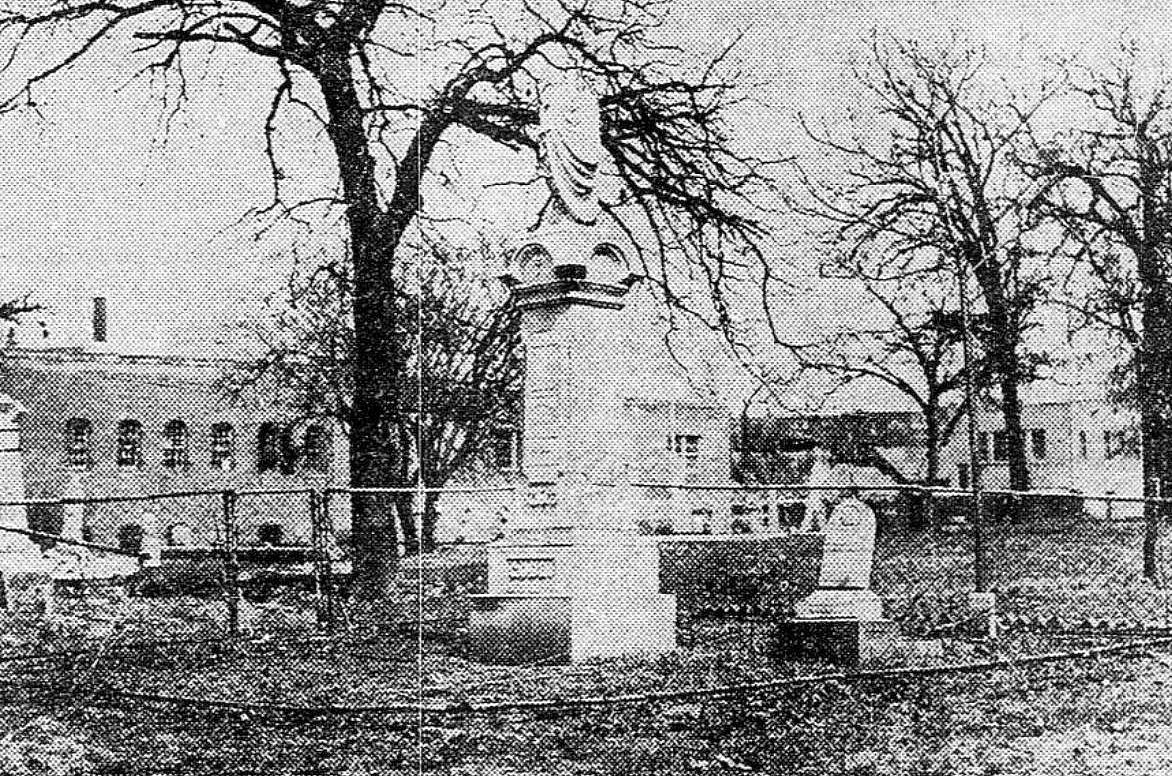
cemeteries_1920s_photo-a

The Masonic and Odd Fellows Cemetery, with the Magnolia Building in the background.

*

cemeteries_1920s_photo-b

Cheek-by-jowl with a growing urban Dallas.

*

cemeteries_1920s_photo-c

I love this photo, with train cars on the Marilla Street tracks and the Butler Brothers building in the distance, just east of where City Hall now stands.

*

cemeteries_1920s_photo-d

Another interesting image, looking to the northwest, with the Santa Fe freight depot (still standing on Young Street near Griffin) at the top right. (The cemetery land was apparently fifteen feet above the surrounding street level.)

**

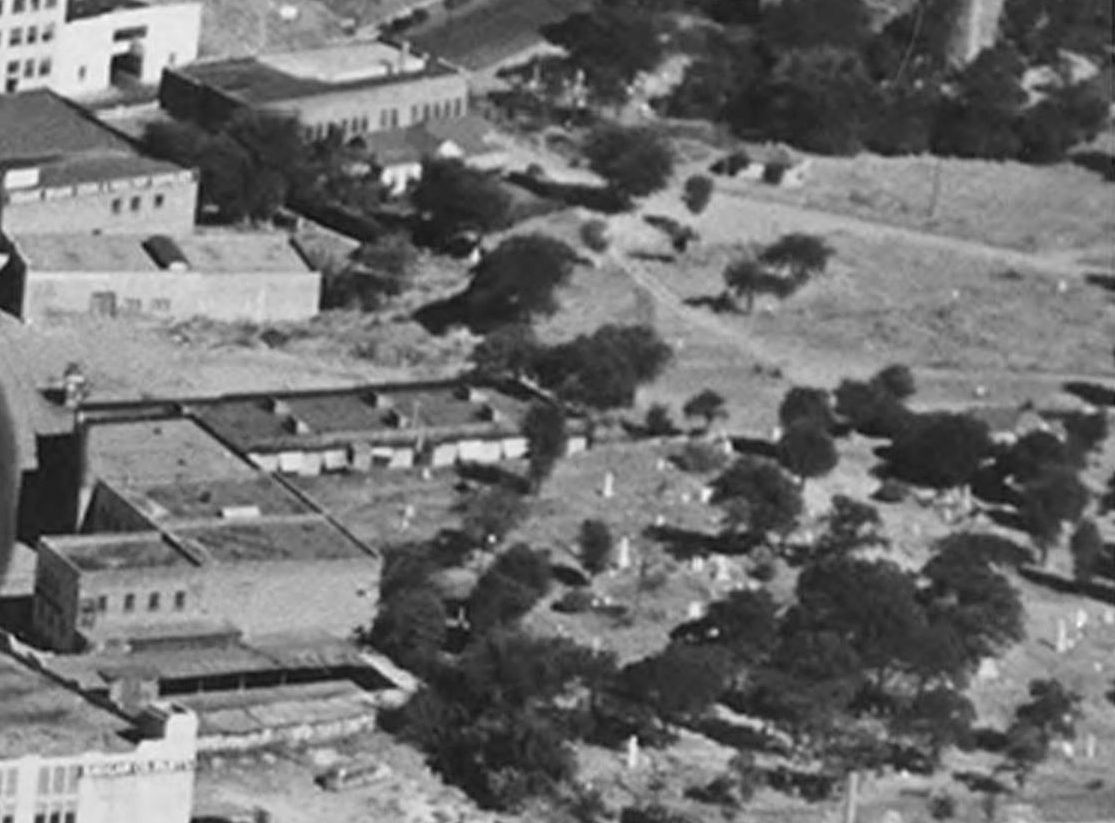
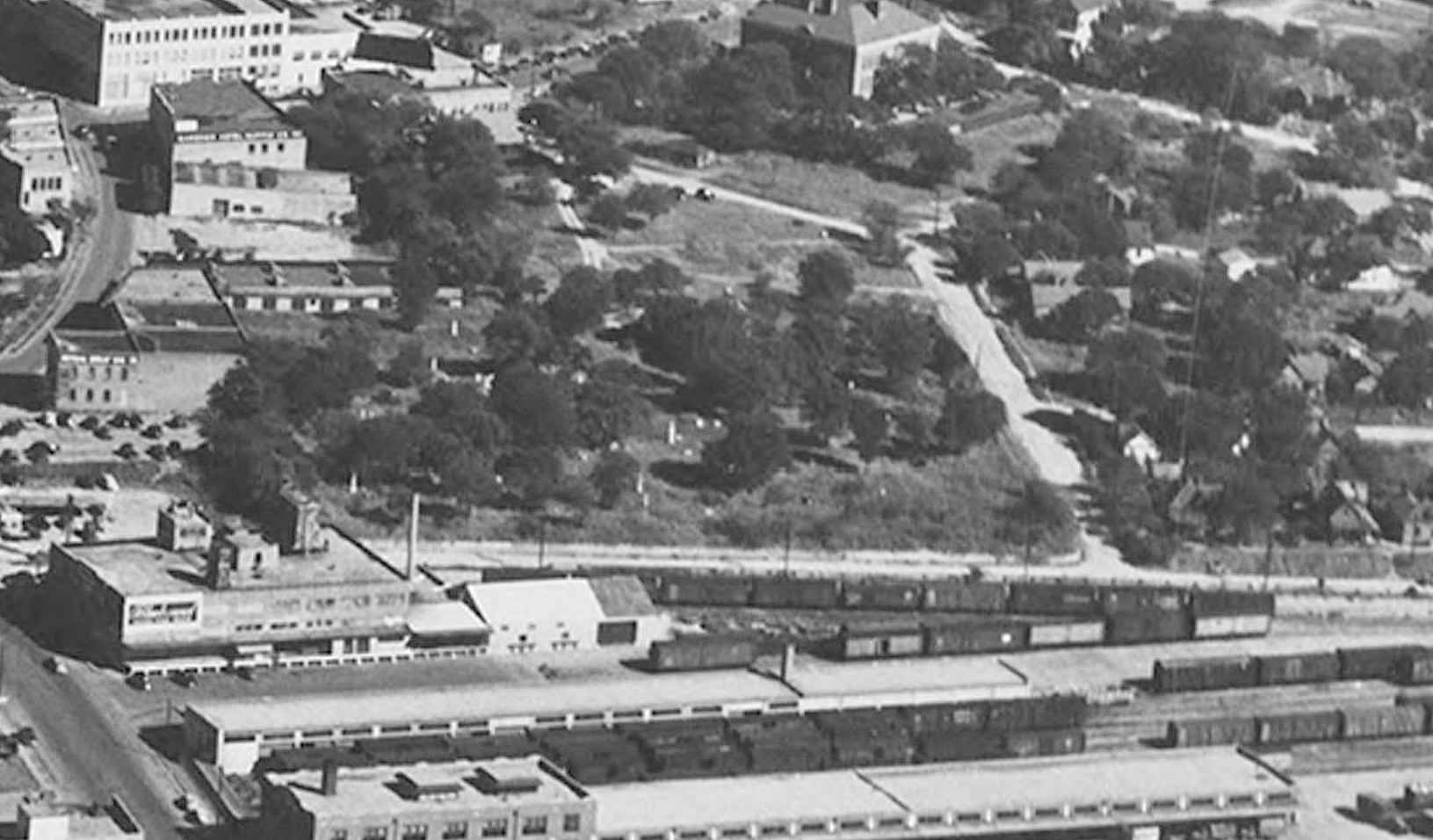
Below are a few extreme close-ups from aerial photographs by Lloyd M. Long (from the Edwin J. Foscue Map Library, Southern Methodist University — links to the original full photos can be found beneath each image). Cemetery markers are visible in these photos taken from the west.

cemeteries_1938_foscue_smu_longAbove, a detail from a 1938 photo.

*

cemeteries_1939_foscue_smu_longDetail from a 1939 photo.

*

cemeteries_1949_foscue_smu_long
And a detail from a 1949 photo.

*

dallas-convention-center_flickr_coltera

And the “after” photo, with much of the old cemetery land used as the site of Memorial Auditorium.

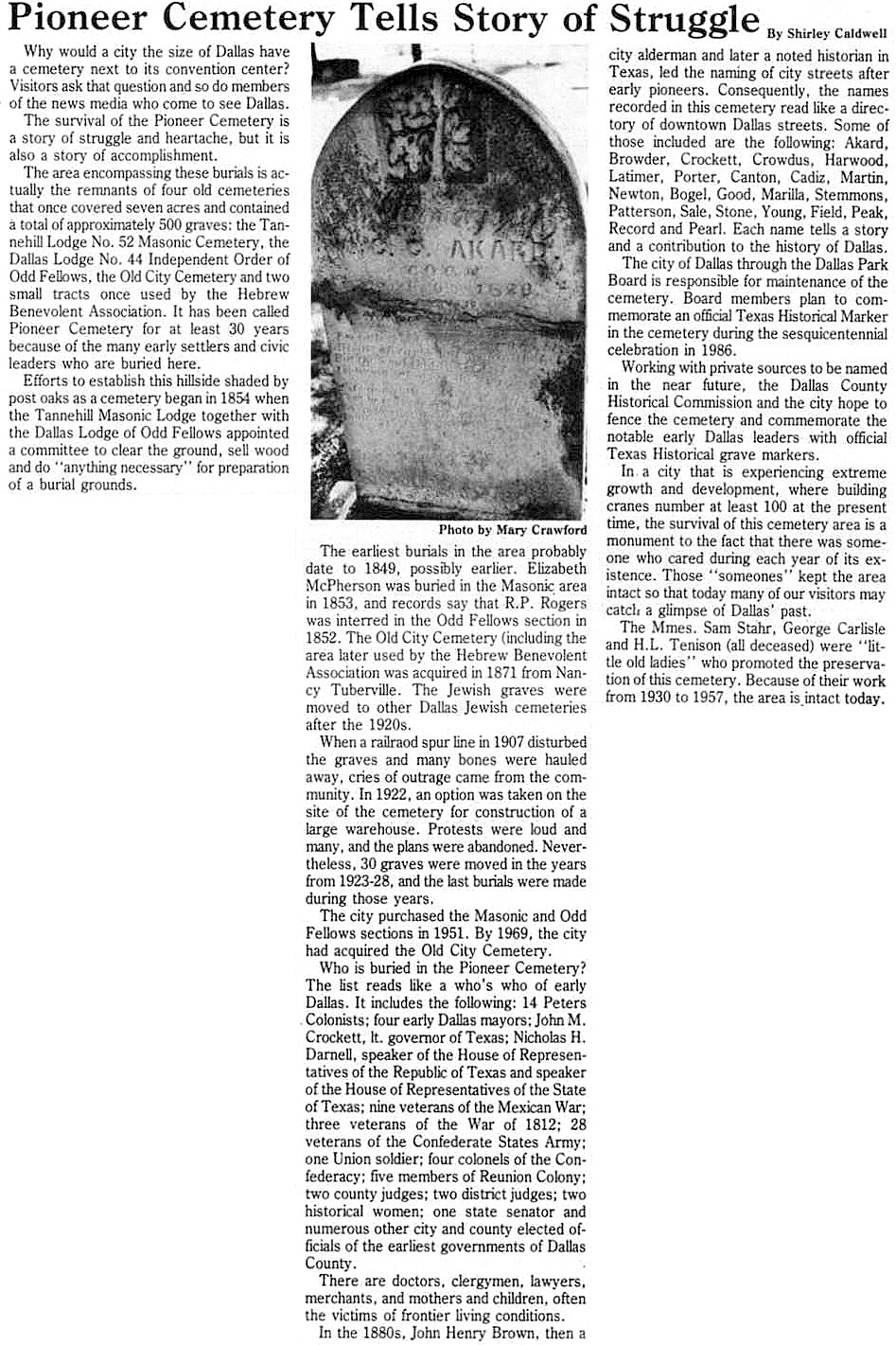
Below, a short history of the cemeteries, which appeared in the July, 1985 issue of Historic Dallas magazine: “Pioneer Cemetery Tells Story of Struggle” by Shirley Caldwell. (Click to read.)


pioneer-cemeteries_historic-dallas_july-1985_portal
via UNT’s Portal to Texas History

***

More on this cemetery can be found on Julia D. Quinteros de Hernandez’s timeline, here.

A collection of newspaper stories about the adjacent “Old City Cemetery” (some of which describe shocking disturbances of the land and of graves) can be found on Jim Wheat’s site, here.

More on Dallas’ older cemeteries can be found in Frances James’ article “Cemeteries in Dallas County: Known and Unknown” (Legacies, Fall, 1996), here.

Information about how the city dealt with the plight of the cemeteries amidst the looming possibility of development can be found in the Dallas Morning News article “Park Board Protests Motel at Auditorium” by Francis Raffetto (DMN Dec. 18, 1958).

A bird’s-eye view of Pioneer Plaza can be seen on Bing, here (zoom in to see the historic markers in the lower right corner).

All images and clippings are larger when clicked.

*

Copyright © 2016 Paula Bosse. All Rights Reserved.
 

Bull Pen Barbecue/Austin’s Barbecue — 1949-2000

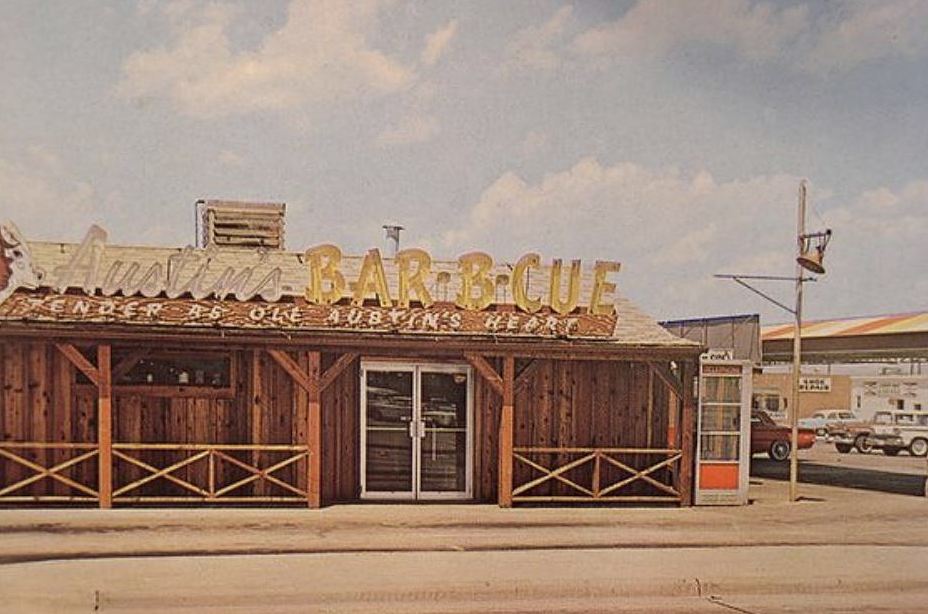
austins-barbecue_postcard_pinterest“As Tender as Ole Austin’s Heart…”

by Paula Bosse

One of my major failings as a Dallasite is that I don’t know Oak Cliff. Like at all. Every time I go over there, I get lost. I can’t remember my family ever going to Oak Cliff when I was a kid, except to visit the zoo. This explains why I had no idea how important a cultural landmark Austin’s Barbecue was when I posted a bunch of Oak Cliff ads the other day. That post has been shared hundreds and hundreds of times now and, inevitably, the only thing people mention — and rhapsodize about — is Austin’s Barbecue. …I had no idea!

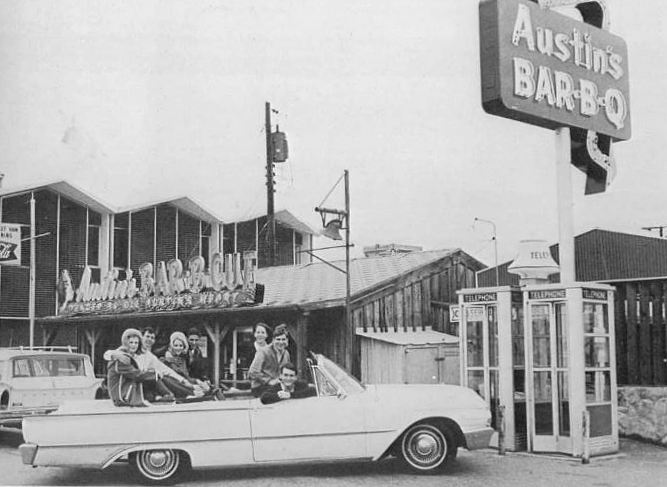
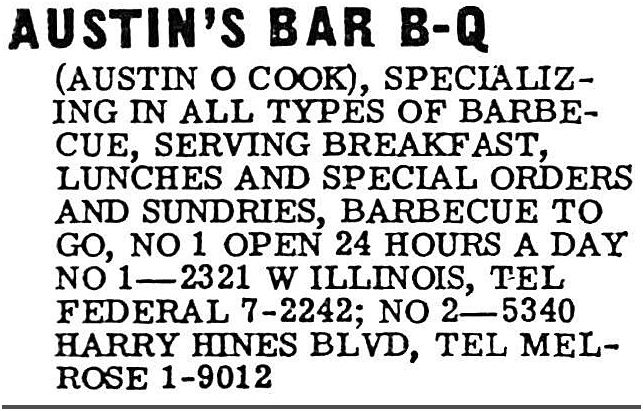
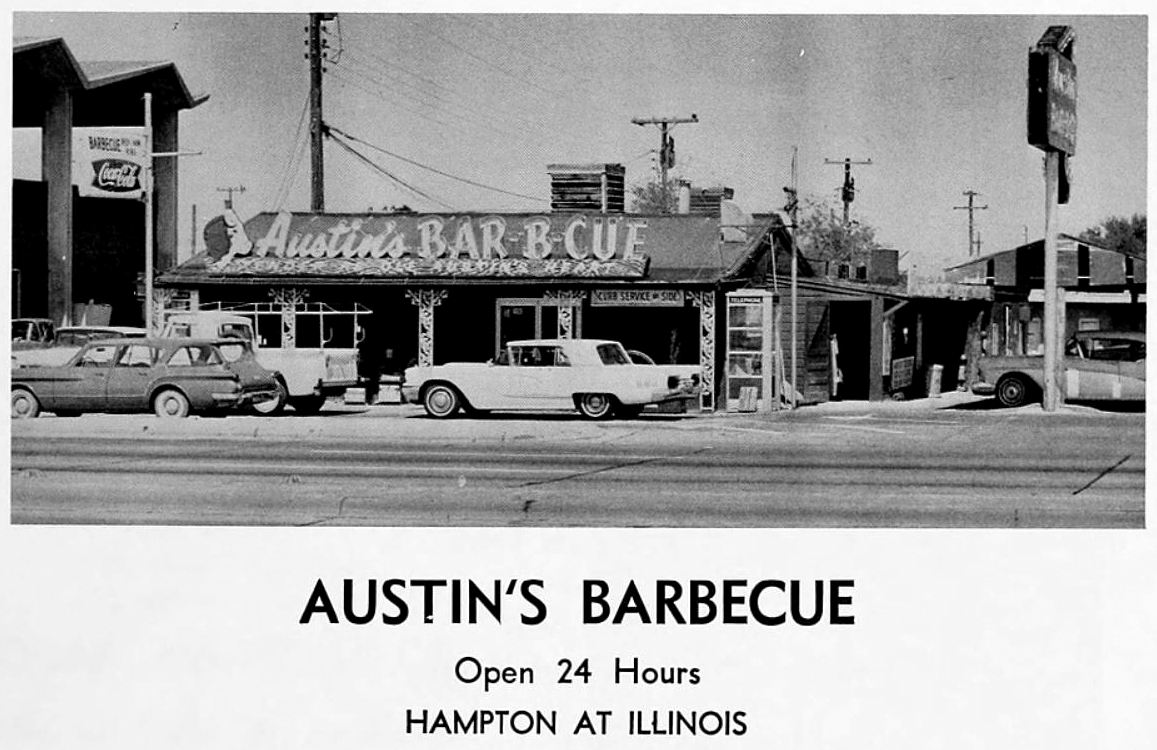
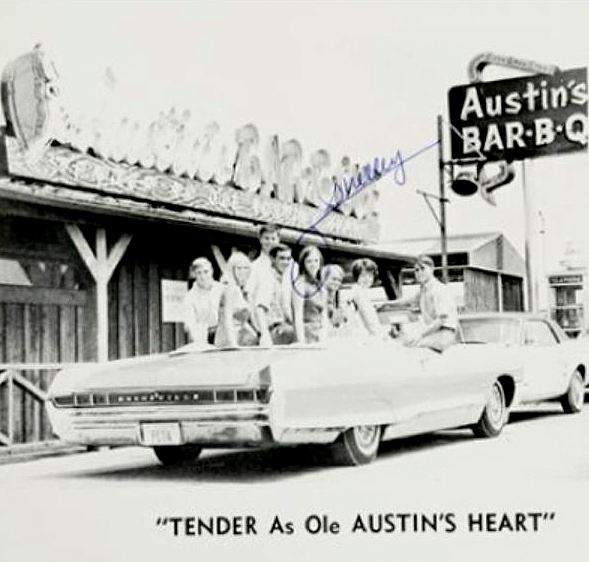
The famed BBQ joint at the northeast corner of Illinois Avenue and Hampton Road opened in 1949 as B & G Barbecue but soon became known as Bull Pen Barbecue, run jointly by owners Bert Bowman and Austin Cook. In 1956 or 1957, another Bull Pen opened in Arlington. After Oak Cliff went dry (a dark day for many Oak Cliffites), Bowman — who firmly believed that BBQ and beer were a match made in heaven — left for Arlington and Cook stayed in Oak Cliff and changed the restaurant’s name to Austin’s Barbecue. (“Bull Pen Barbecue” was still appearing in ads as late as Oct. 1957 — the official name changeover seems to have  happened in 1958.)

austins-bar-b-q_sunset-high-school_1967-yrbk1967 Sunset High School yearbook

*

The following memory of starting the business was apparently written by Austin Cook in 1990:

Dear Family & Friends,

I will try to tell you a little more about my being in the restaurant business. We borrowed $10,000 and bought out some one and it was B and G Barbecue. You see I always spell out Barbecue because when I went in business they hadn’t started abbreviating it like it is today.

After we had been there awhile we changed the name to The Bull Pen. Our slogan was “Come in and Shoot the Bull with Austin and Bert.” We used that name until they voted beer out of Oak Cliff. That really set us back, but maybe it was the best thing for us. We put another place in Arlington and that place was going pretty good. My partner wanted to get rid of the place in Oak Cliff. I traded him my part of the one in Arlington for his part in the one in Oak Cliff. Everyone said I was crazy.

When we bought that first place it was way out in the country, but they were building a bunch of houses not too far away. There was an airport across the street from the place. They kept talking about building a shopping center where the airport was. I remember the first day we ran a hundred dollars, and I thought we would never make it.

We started making money and we paid that ten thousand dollars back and we drew fifty dollars a week just like I was making in the grocery store. We started out with a barbecue sandwich and a hamburger. Then we started adding different things until we had a menu. We started getting those workers in the houses, and the business took off. We had beer also to go with the barbecue. My mother wasn’t too happy about that, but Dad said if that was the way I wanted to make my living it would be all right. In about a year or two we had a customer make us up a menu and we put in Barbecue plates for one dollar and twenty five cents. When I left they we were getting $4.99 for them. After I left I think they went to over seven dollars.

They always told me that you weren’t a success until you were in debt a hundred thousand dollars, and I went to the bank and borrowed all they would let me have. Then I went to my landlord and sold him the idea that I wanted to improve his property, and he loaned me the balance I needed to remodel, and I built a restaurant that held a hundred and twenty-five. Many times I was almost broke and didn’t know what I was going to do, but something always happened and I came out of it.

*

Both the Bull Pen in Arlington and Austin’s in Oak Cliff were successful and long-lived. Austin Cook retired at the end of 1993, and the business was taken over by his stepson, John Zito who had already been working at the restaurant for several years. Austin’s Barbecue closed in July, 2000, and the building was demolished soon after, replaced with an Eckerd drug store (now a CVS). Bert Bowman (born Glynbert Lee Bowman) died in 1989 at the age of 66; Austin O. Cook died at in 2006 at 86. And now I kind of feel like I know them, and I’m really sorry I never sampled their sandwiches.

*

Below, a Bowman and Cook timeline (most pictures and clippings are larger when clicked).

austin-cook_sunset-high-school_1937Austin Cook, Sunset High School, 1937

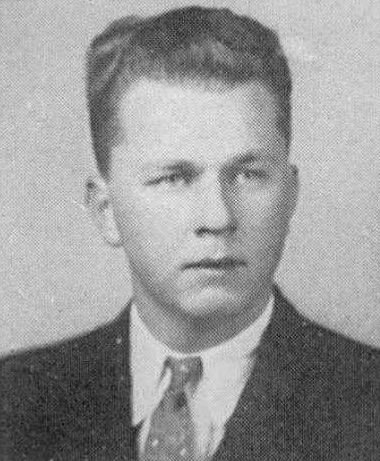
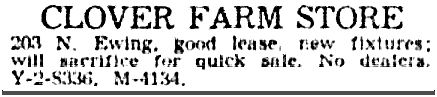
Before Cook and Bowmen met — probably around 1947 — each had been dabbling in different businesses. In early 1947, Cook leased a Clover Farm Store building at 203 N. Ewing and opened the Libby & Cook grocery with partner Lendal C. Libby.

LIBBY-COOK_dmn_021047February, 1947

LIBBY-COOK_1947-directory1947 Dallas directory

Bert Bowman worked there as a meat-cutter.

bowman_1947-directory_GROCERY-w-AUSTIN1947 Dallas directory

The grocery store was in business at least into 1949, the year that Bowman and Cook decided to ditch the groceries and start their own business at 2321 W. Illinois, in a part of Oak Cliff which was just starting to be developed. Their BBQ place was originally called B & G Barbecue, which — according to Cook’s letter above — was the name of the restaurant he and Bowman bought out. I guess they felt it was easier to keep the name for awhile.

b-and-g-1951-directory1951 Dallas directory

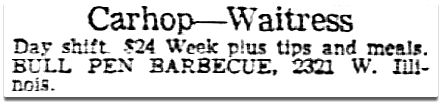
The name “Bull Pen Barbecue” didn’t come until later. In fact, the first appearance of the Bull Pen name associated with this address doesn’t show up in local newspaper archives until a want-ad placed in the summer of 1952.

bull-pen_dmn_082652_FIRSTAugust, 1952

A probably related “Bull Pen No. 2” opened in South Dallas in 1953. It appears to have been very short-lived.

bull-pen-no-2_dmn_100853
October, 1953

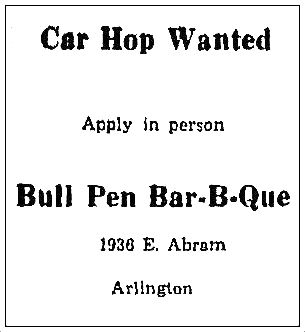
By the fall of 1957, Cook and Bowman had opened another Bull Pen — this one in Arlington, and this one a success.

bull-pen_arlington_grand-prairie-daily-news_091557
September, 1957

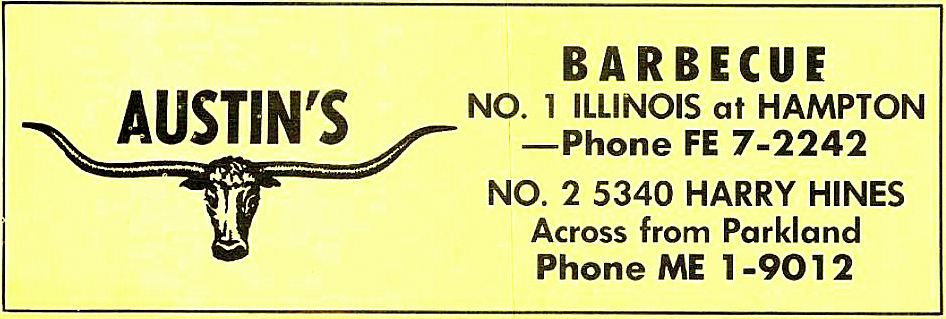
And then Oak Cliff went dry, the worst thing that could happen to a restaurant that sold a lot of beer. Similar businesses which relied heavily on beer sales began to desert Oak Cliff. Bowman did not think their original drive-in could survive, but Cook disagreed. Bowman sold his half-interest in the Oak Cliff location to Cook, and Cook sold his half-interest in the Arlington location to Bowman. Cook changed the name of his now solely-owned restaurant to Austin’s Barbecue, and his success continued, despite the fact that he could no longer sell beer. He was doing well enough that, in 1961, he opened a second location, on Harry Hines across from Parkland Hospital (a location which lasted through 1964).

austins-barbecue_1962-directory_two-locations
1962 Dallas directory

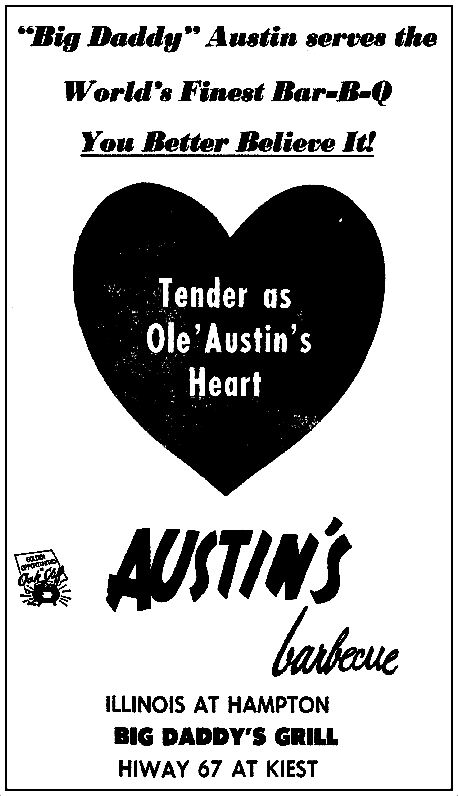
austins-barbecue_1963-directory_two-locations_ad
1963 Dallas directory

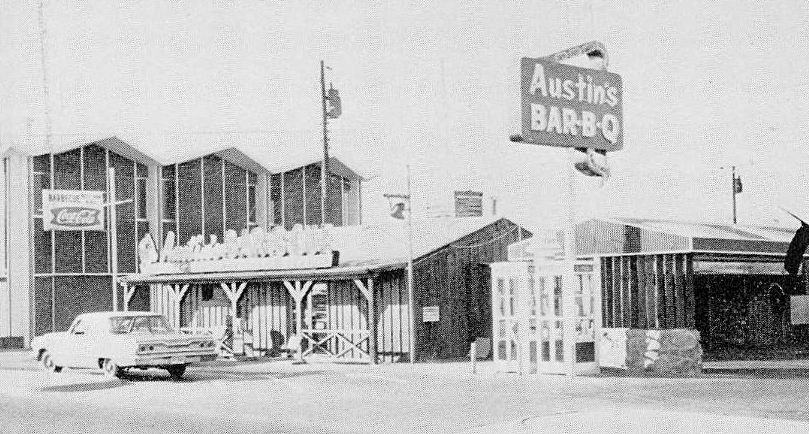
By 1963, Austin’s was a well-established teen hang-out and wisely placed ads in Oak Cliff high school annuals. Apparently everyone went there!

oak-cliff_austins_bar-b-cue_kimball-yrbk_19631963 Kimball High School yearbook

austins-bar-b-q_sunset-high-school_1964-yrbk.det1964 Sunset High School yearbook

austins_car-teens_flickr-coltera
Date and source unknown, via Flickr

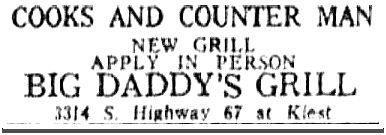
In 1964, Cook — known as “Big Daddy” — opened another restaurant, this one called Big Daddy’s Grill.

big-daddys_dmn_063064June, 1964

austins-barbecue_dmn_081466-adAugust, 1966

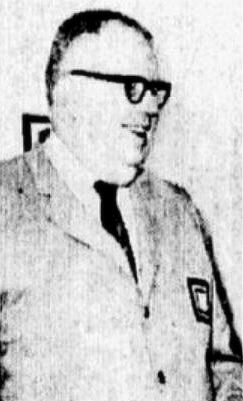
The restaurant was a bona fide Oak Cliff landmark, and Cook was an active participant in community business affairs. Below, a detail of a photo showing Cook as a member of the Oak Cliff Chamber of Commerce.

austin-cook_dmn_082568-photo-det
late 1960s

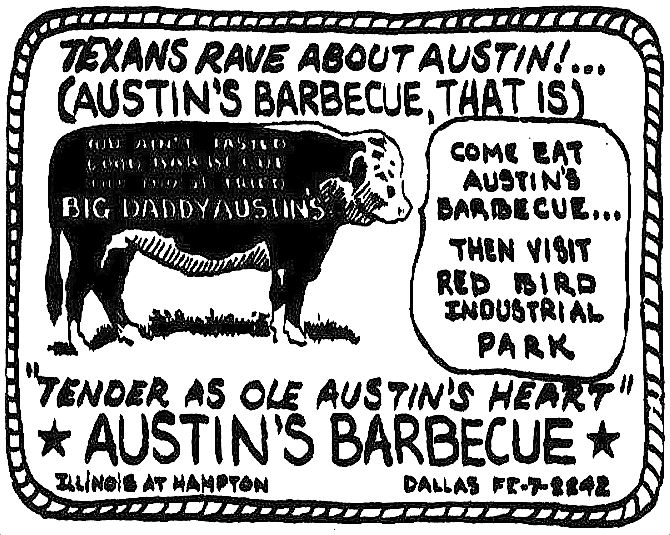
Cook participated in a series of Oak Cliff Chamber of Commerce campaigns and even included oddities like “Come eat Austin’s barbecue… and then visit Red Bird Industrial Park” in his ads. Make a day of it!

austins-barbecue_092968
September, 1968

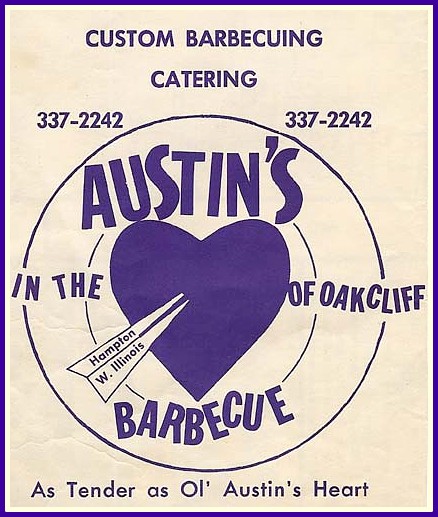
ad_austins-barbecue
via OakCliff.org

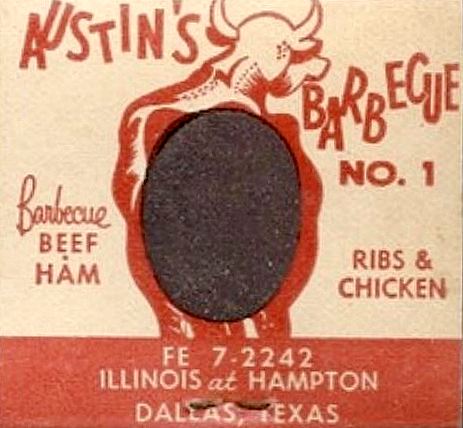
austins_matchbk_flickr_coltera
via Flickr

***

Sources & Notes

Color postcard at the top found on Pinterest, here.

The letter from Austin Cook was quoted on the DHS Phorum, here. More from the Phorum on The Bull Pen/Austin’s is here.

More can be found in the Dallas Morning News archives in the following stories:

  • “Austin’s Bar-B-Q Grows With Oak Cliff” (DMN, Aug. 14, 1966)
  • “Barbecue To Go — Staff, Customers Mourn Closing of Oak Cliff Institution” (DMN, July 13, 2000)
  • “Closed But Not Forgotten — Oak Cliff Eatery Marks Half-Century of Barbecue With Memorable Auction” (DMN, Aug. 27, 2000)
  • “John P. Zito — Operated Oak Cliff Landmark Austin’s Barbecue For 19 Years” by Joe Simnacher (DMN, Oct. 14, 2003)

Read the obituaries of Bert Bowman (1989) and Austin O. Cook (2006) here.

The Oak Cliff Advocate article “A Look Back at Austin’s Barbecue” by Gayla Brooks is here (with tons of memories from readers in the comments).

Not mentioned in this post is the connection of Officer J. D. Tippit (who moonlighted as a keeper of the peace at Austin’s) and other tangential/coincidental associations to the Kennedy assassination. It’s well documented elsewhere. Google is your friend.

*

Copyright © 2016 Paula Bosse. All Rights Reserved.
The 101 Bar: Patrick Hannon, Prop. — ca. 1917

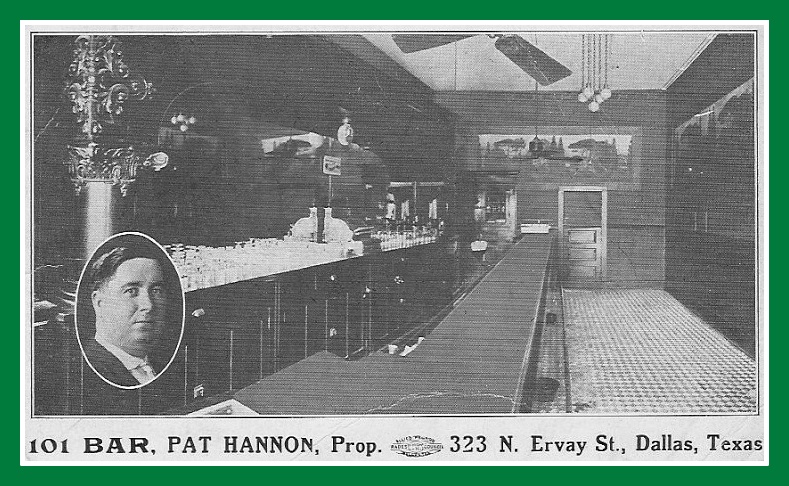
101-bar_ca-1917
Pat Hannon’s dreams are about to be dashed…

by Paula Bosse

The 101 Bar was located at 323 North Ervay, on the southwest corner of Ervay and Bryan — it is now the site of Thanksgiving Square. The owner was Patrick Hannon who had worked in saloons in Dallas from at least 1908. The bar pictured above opened around 1917 but lasted only a few months — by the time the 1918 directories were printed, 323 N. Ervay was listed as “vacant.” Pat had worked his way up the competitive saloon trade in Dallas, from bartender to owner, only to be cut down by Prohibition. Had Prohibition not gone into effect in 1918 (with Dallas County voting to start even earlier, in October, 1917), this fine-looking  bar might have had a long, boozy life. Pat disappeared from the directory completely in 1918, but he was back in 1919, with a new occupation: butcher. Meat-cutting is all well and good and certainly pays the bills, but I bet in his idle moments, Pat’s thoughts turned to daydreams of his old Ervay St. bar.

The 1917 Dallas directory showed 183 bars operating in Dallas; the next year, zero.

Bad timing, Pat.

***

Sources & Notes

I’m not sure where the photo came from — some random web page, I think.

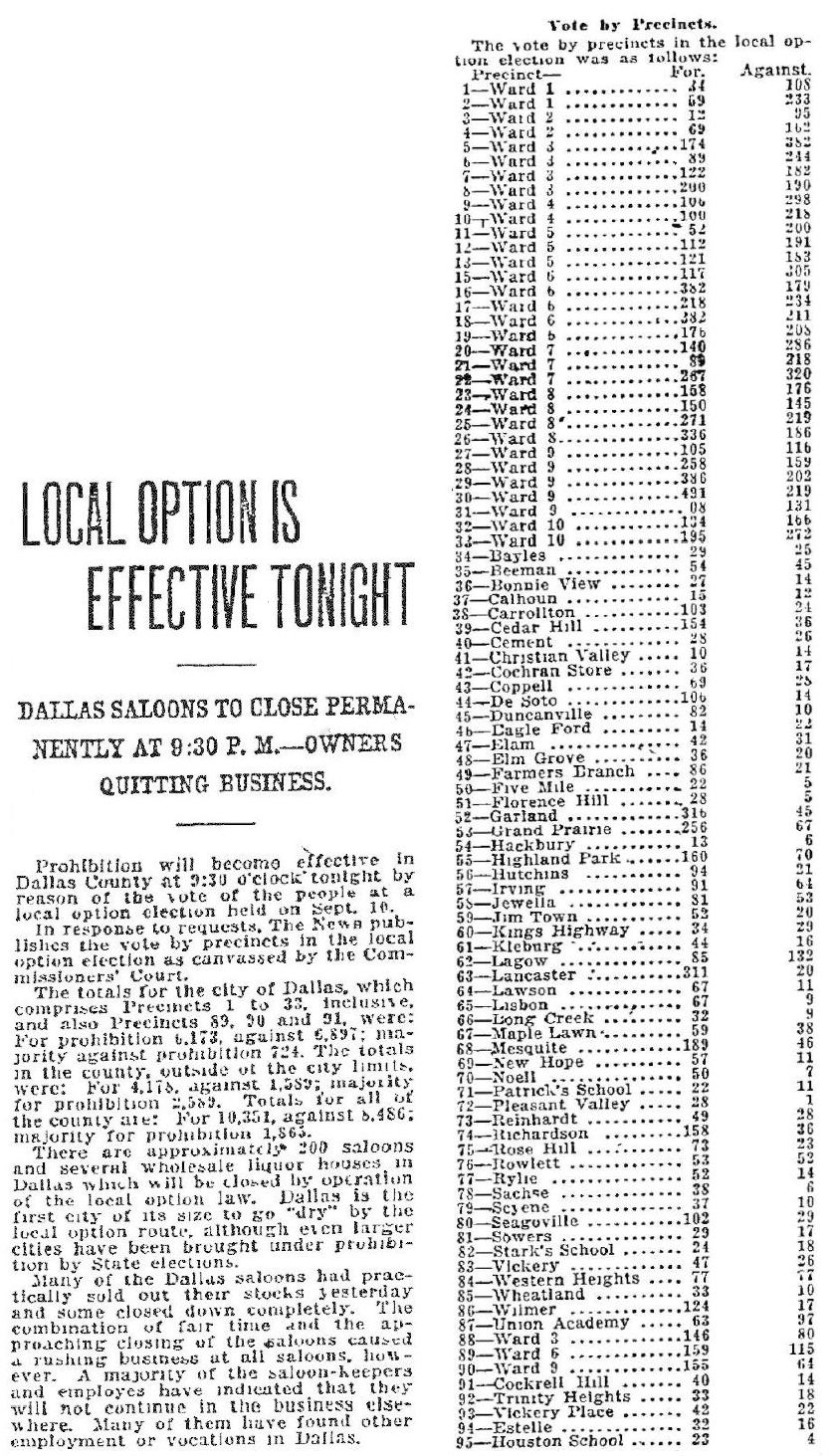
Why did Dallas County go dry so early? Because of a “local option” vote in September 1917. The city of Dallas voted against it, but the surrounding communities voted overwhelmingly FOR it. (You could still drive over to Fort Worth for legal beer and hooch, though.) Election results below (click for larger image). 

prohibition_local-option_dmn_102017Dallas Morning News, Oct. 20, 1917

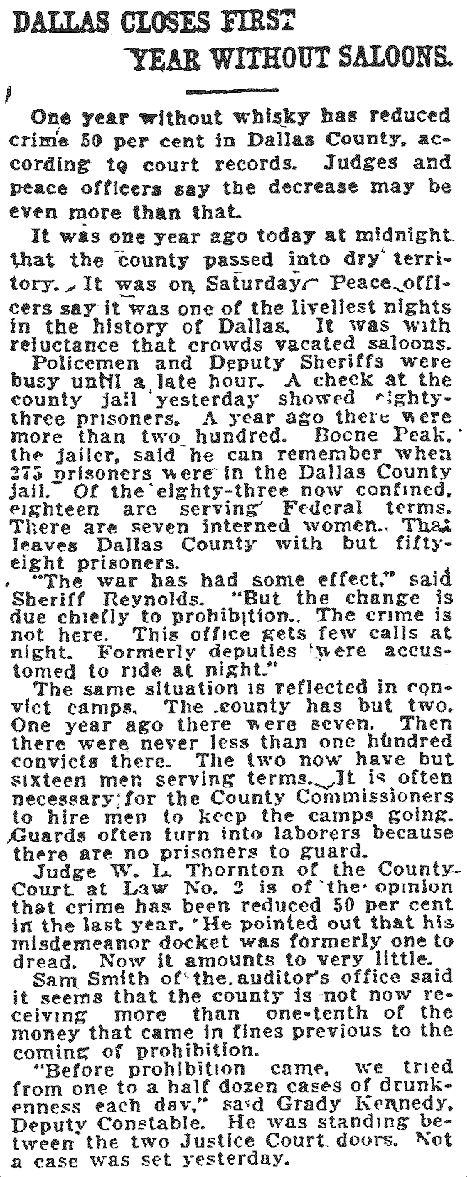
How were things faring a year later?

probibition_dallas-co_dmn_102018DMN, Oct. 20, 1918

This has been a rather tenuously-associated St. Patrick’s Day post (Irish name, bar, green border), but … Happy St. Patrick’s Day!

*

Copyright © 2016 Paula Bosse. All Rights Reserved.
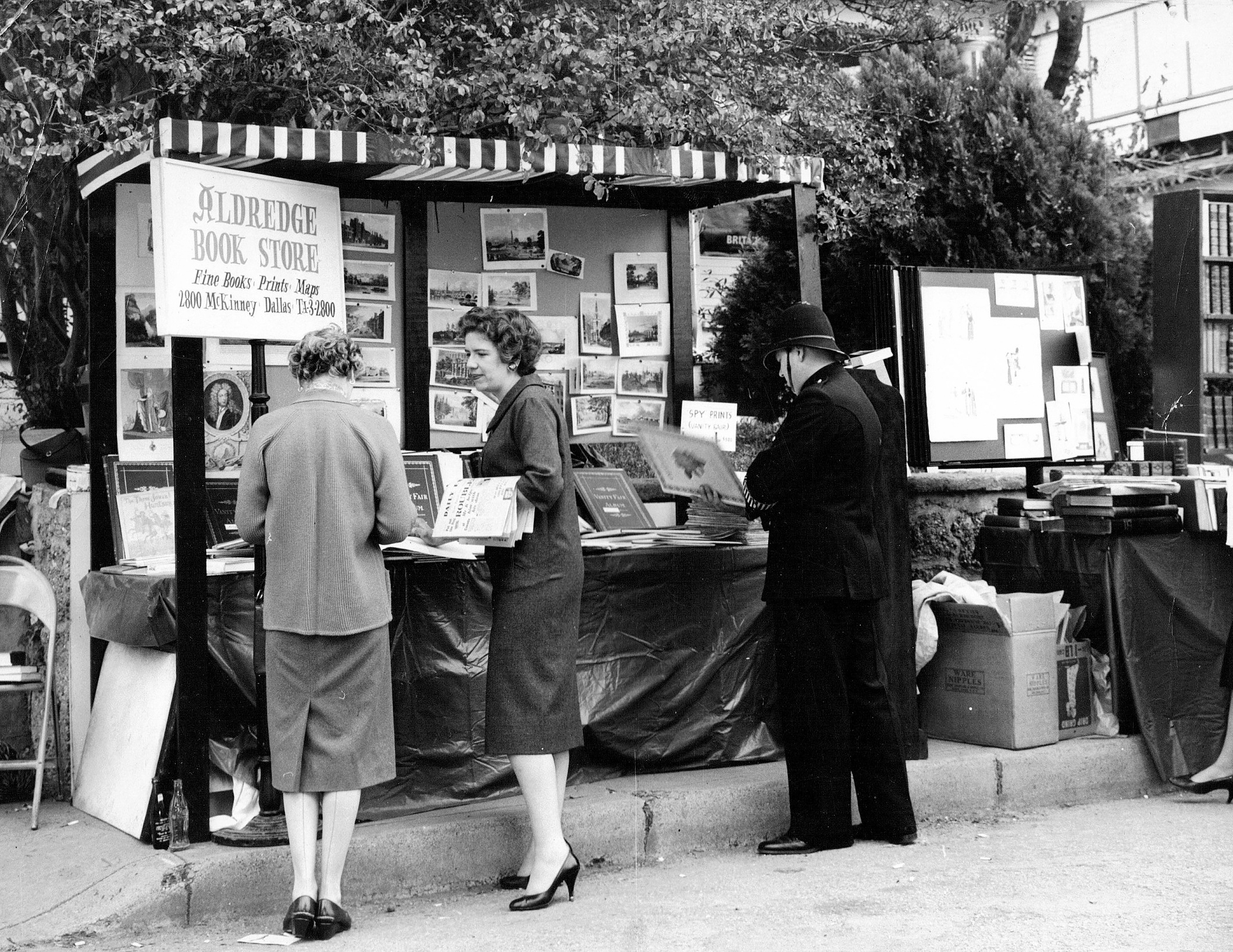
Photo-Pac: The First Disposable Camera — 1948

weir_mechanix-illus_1949_smA. D. Weir and his invention, 1949

by Paula Bosse

Alfred D. Weir (1909-1996) was the son of A. F. Weir, the successful retail furniture merchant who founded Weir Furniture in 1922. The younger Weir graduated from SMU in 1933 with a degree in mechanical engineering and started his career, fresh out of college, at Dallas’ Ford assembly plant. During World War II, he was the chief industrial engineer at North American Aviation and was later employed by Fairchild Engine and Aircraft, Ford’s aircraft division in Kansas City, Texas Instruments, and Bell Helicopter.

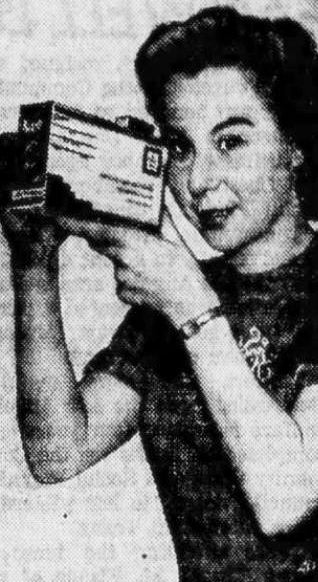
After the war and before his time in Kansas City, Weir took time out from his engineering career to try his hand as an entrepreneur: he invented, patented, and manufactured the Photo-Pac, a single-use camera made of inexpensive fiber board and pre-loaded with 35mm film (loaded by blind employees in total darkness). The user would buy one of these cameras at a drug store, department store, or gas station for $1.29, take eight photographs, and then write his or her name on the side of the camera and drop the whole thing — with the film still inside the camera — in a mail box. Photos would be processed in Dallas, and prints and negatives would be returned to the customer in a couple of days. The camera would not be returned.

photo-pac_san-bernardino-county-sun_040250-photoSan Bernardino County Sun, April 2, 1950

photo-pac_arlington-heights-illinois-herald_122349-photoArlington Heights (Illinois) Herald, Dec. 23, 1949

It appears to have made its debut at the 1948 State Fair of Texas at an introductory price of only 98¢ (click for larger image).

photo-pac_billboard_100948Billboard, Oct. 9, 1948

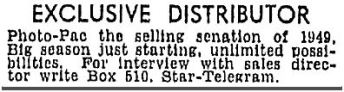
Manufacture and distribution of the camera began in earnest in May, 1949. And then … ads for the camera were everywhere! (The home-grown invention appeared in a hometown newspaper advertorial on May 1, here.) Weir and his small team managed to get the camera in retail locations all over the country. He was also worked hard to line up distributors. Ads such as this one were placed in several U.S. newspapers:

photo-pac_FWST_061649Fort Worth Star-Telegram, June 16, 1949

It seems to have been very popular — both as a novelty impulse buy and as a useful product for people who either did not own cameras or who did not want to take their family cameras on trips. Here’s a typical ad (see text below):

photo-pac_FWST_111649_fair-dept-store-ad

photo-pac_FWST_111649_fair-dept-store-ad_detFWST, Nov. 16, 1949 — from ad for Fort Worth’s Fair Department Store

The camera won a “prize gadget” award from Mechanix Illustrated (click to see very large image).

photo-pac_mechanix-illus_sept-1949Mechanix Illustrated, Sept. 1949

By the summer of 1950, the number of exposures went from eight to twelve, and the price increased to $1.49. It seemed that the business was growing, but by the fall of 1950, Photo-Pac seems to have reached the end of the road. Court dockets showed a couple of lawsuits filed against the company. Newspaper ads showed stock of the cameras being deep-discounted to as low as 50¢ apiece. The next year, 1951, saw Weir returning to his engineering career — he accepted a position with Ford in Kansas City and apparently left his business dreams behind. It was a great idea, but, for whatever reason, it never fully caught on.

36 long years after A. D. Weir’s Dallas company folded, Fuji introduced their very popular disposable camera; Kodak followed with theirs in 1987. Those things were everywhere — everyone’s had one of them at one time or another. I bet A. D. Weir was miffed.

fuji_FWST_070286FWST, July 2, 1986

*

weir_smu_rotunda_1930A. D. Weir, SMU Rotunda, 1930

weir_smu_rotunda_1933Weir, SMU Rotunda, 1933

weir_dmn_032253-photo1953

***

Sources & Notes

Top photo is an inset from the Mechanix Illustrated “prize gadget” page, from the blog Modern Mechanix, here.

Weir’s patent can be found on Google here. To view Google Patent Image separately (and really big), click image below.

weir_patent

There seems to be some debate about whether Weir’s Photo-Pac was actually the first single-use disposable camera — if it isn’t strictly the first, it seems to have been the one that made the most headway into the American marketplace. A great article on the topic can be found on the Disposable America website here.

Wikipedia’s “disposable camera” page is here.

A. D. Weir’s father, Alfred Folsom (A. F.) Weir opened Weir Furniture at 2550 Elm Street in 1922; in 1934 the company was incorporated to include his wife and son. A. F. Weir sold the Dallas company to his brother Earl (who had owned furniture stores in Fort Worth and Arlington) in the 1940s — that business closed sometime between 1945 and 1948. In 1948, Earl’s son John Ray Weir opened Weir’s Furniture Village on Knox Street, a business still going strong today.

Most images are magically larger when clicked!

*

Copyright © 2016 Paula Bosse. All Rights Reserved.
Lt. Mary L. Roberts, The “Angel of Anzio” — The First Woman Awarded the Silver Star

silver-star_feb-22-1945Roberts (left) and two fellow Army Nurse Corps nurses receiving the Silver Star

by Paula Bosse

The opening paragraph from a chapter in Tom Brokaw’s book The Greatest Generation:

There are so many impressive numbers connected to World War II that it’s difficult for one or two to catch your eye. Here are a few that caught me by surprise: more than sixty thousand women served in the Army Nurse Corps. Sixteen died as a result of enemy action. Sixty-seven nurses were taken prisoner of war. More than sixteen hundred were decorated for bravery under fire or for meritorious service.

The chapter is titled “Mary Louise Roberts Wilson,” a profile of Mary L. Roberts, a Methodist Hospital nurse who enlisted in the Army Nurse Corps in 1942. She served with the 56th Evacuation Hospital Unit alongside many other medical professionals from Dallas (the unit — sometimes called the “Baylor Unit” — was organized by the Baylor University College of Medicine in Dallas). She knew she would be serving overseas in field hospitals in combat zones.

As far as seeing action, the worst of the worst for the 56th was on February 10, 1944 when their hospital tents on the Anzio beachhead in Italy were attacked by German long-range artillery shells for a full thirty minutes. Several operations were underway during the attack, and Roberts, the chief nurse of the operating tent, managed to keep a calm head and help to maintain as much order as possible.

“I wanted to jump under the operating table, but first we had to lower litter cases to the floor. Pieces of steel already were ripping through tents. There were four litters. I saw a patient on the operating table had his helmet near him so I put it over his head to give him that much protection.” (Mary L. Roberts, Dallas Morning News, Feb 23, 1944)

When the shelling ended, two enlisted men in the operating tent had been wounded, and elsewhere in the field hospital, two nurses had been killed and several other personnel wounded. As a result of their exceptional bravery, outstanding leadership, and “gallantry in action,” Roberts and two other nurses, 2nd Lt. Rita Virginia Rourke and 2nd Lt. Elaine Arletta Roe were awarded the Silver Star. No women had ever received the medal. As 1st Lt. Roberts had seniority, she was the first woman in history to be decorated for heroism in action.

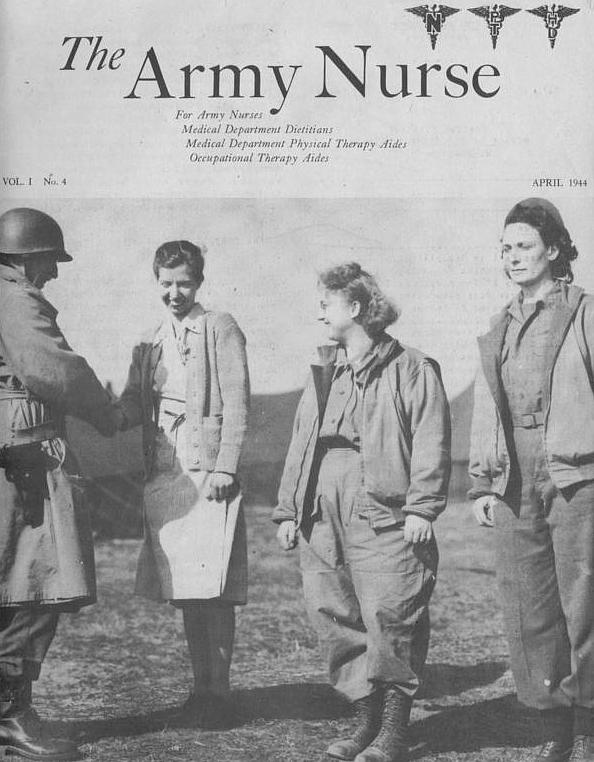
Maj. General John P. Lucas surprised her and the other two nurses on Feb. 22, 1944 with an informal presentation of the medals at the same Anzio hospital that had been shelled only twelve days earlier. After the brief pinning ceremony, the nurses immediately returned to their duties, all feeling they were accepting acknowledgement for their team, not for themselves alone. Roberts spent 29 months overseas, and tended to more than 73,000 patients.

After the war, when Lufkin-native Mary Roberts returned home, she worked for almost 30 years as a nurse at a VA hospital in Dallas, and, rather late in life, she married fellow veteran Willie Ray Wilson. Mrs. Wilson died in 2001 at the age of 87. She was buried with full military honors.

roberts_texas-women-first_mcleroy_UTA1944 (Fort Worth Star-Telegram Archives, UTA)

roberts_dmn_022344-photo1944

roberts-cover_army-nurse_april-1944Presentation of the Silver Star at Anzio

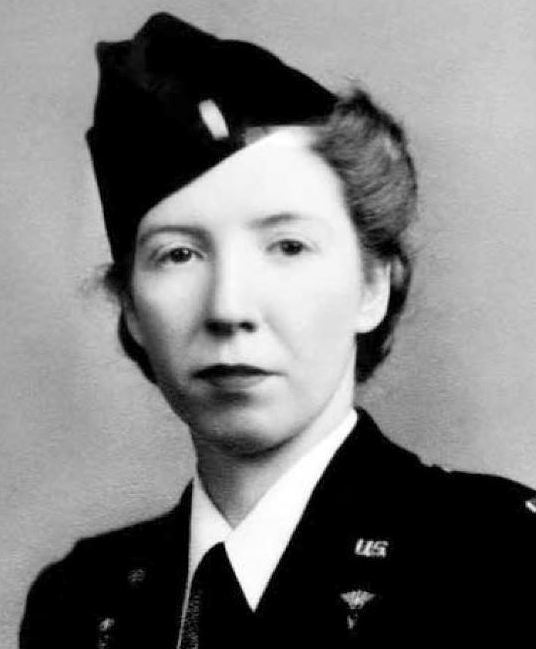
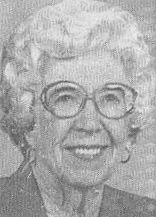
roberts_obit-photoMary Roberts Wilson (1914-2001)

***

Sources & Notes

Top photo and first quote from The Greatest Generation by Tom Brokaw (New York: Random House, 1998).

For an exceedingly detailed history of the 56th Evacuation Hospital Unit, with several photographs, see here.

Articles on Mary Roberts from The Dallas Morning News archives:

  • “Baylor Unit In Action” (DMN, Aug. 26, 1942): photo of unit, including Roberts, working around an operating table
  • “Dallas Nurse, Two Others Win Medals” (DMN, Feb. 23, 1944): “The award, denoting exceptional bravery went to Lt. Mary L. (Pinky) Roberts, 1205 North Bishop, Dallas, Texas, chief nurse in an operating room hit by shell fragments.”
  • “Nurses of Dallas Unit Serving at Anzio Doing Jobs Cheerfully Despite Many Hardships” by Wick Fowler (DMN, March 31, 1944)
  • “Ends Military Career: WWII Recalled By Heroic Nurse” (DMN, July 26, 1964): photo and interview with Mary Roberts Wilson on her retirement from the U. S. Army Reserve
  • “Happiness Is Being Part of a Team” by Jane Ulrich Smith (DMN, May 16, 1972), photo and interview, on her retirement from the Veterans Administration Hospital
  • “Compassion Revisited: Nurse Reunites With GI She Treated For Serious Injuries In WWII” (DMN, Nov. 4, 1999): a reunion with former patient Dewey Ellard of Mobile, Alabama, brought together by Tom Brokaw
  • “Distinguished Career In Medicine Followed — WWII Gallantry — VA Hospital Honors Longtime Nurse — Who Won Silver Star in ’44” (DMN, Nov. 6, 2001): interview with the then-87-year-old Mrs. Wilson, published two-and-a-half weeks before her death
  • “Mary Wilson, ‘Angel of Anzio,’ Dies at 87 — WWII Nurse Known For Kindness Was Decorated For Bravery Under Fire” (DMN, Nov. 24, 2001)

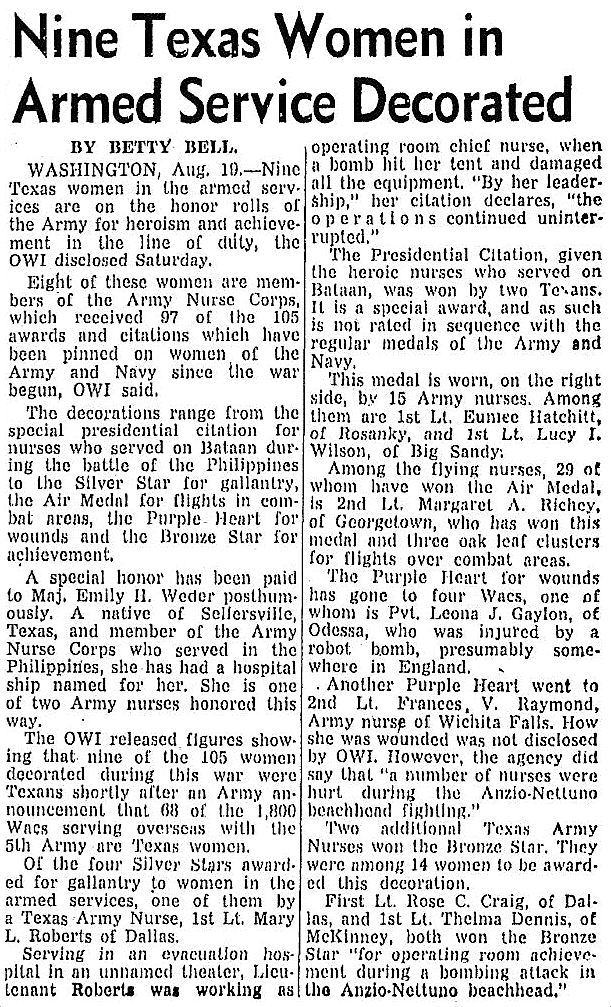
Other women who were honored in 1944 for heroism and achievement in the line of duty:

women_ww2_medals_FWST_082044Fort Worth Star-Telegram, Aug. 20, 1944

Click pictures and articles for larger images.

*

Copyright © 2016 Paula Bosse. All Rights Reserved.
 

Muriel Windham — An Oak Cliff Teenager’s 1940s Diary

muriel_colorMuriel, via Muriel Windham’s Diary

by Paula Bosse

About this time last year, Robert Wilonsky of The Dallas Morning News wrote an interesting article about a black-out imposed by the city of Dallas in January, 1942, just a few weeks after the attack on Pearl Harbor. In the middle of it, he linked to a diary entry written by a 14-year-old describing the event. For me, the most interesting thing about Wilonsky’s piece was the fact that someone had transcribed diary entries of a teenage girl growing up in Dallas in the 1940s. So I read the whole thing. And I loved it.

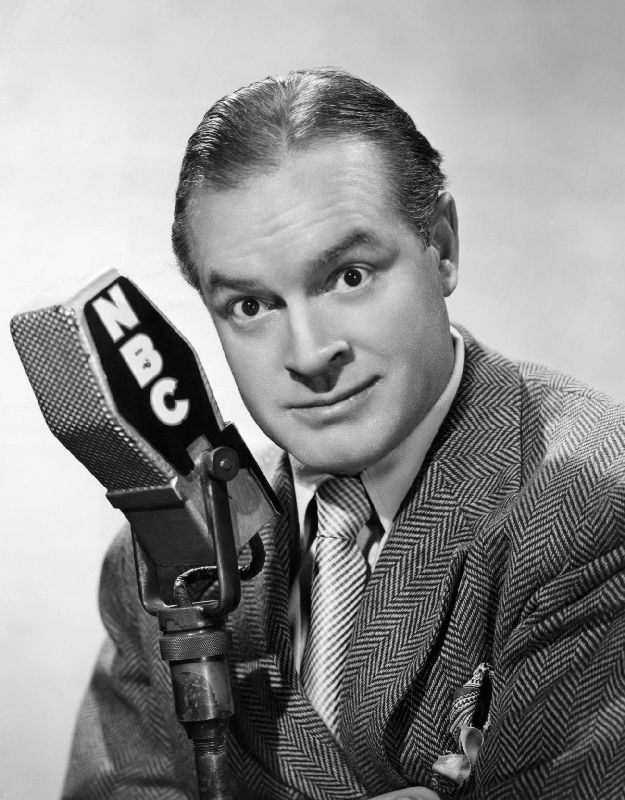
The teenager in question is Muriel Windham (1926-2005) who grew up in Oak Cliff and attended Peeler Elementary, Greiner Jr. High, and Sunset High School. She was a top student who was involved in lots of extracurricular activities, but her greatest joy was going to the movies and listening to comedians on the radio. She was absolutely obsessed — OBSESSED! — with Bob Hope. She attended SMU where she ultimately received a Master in English Literature degree and Master in Library Science degrees; she was head of the children’s department of the Dallas Public Library (as Muriel Brown) for many years and was a specialist in children’s literature. Somewhere in there she married G. W. Brown II and had three children.

But back to the diary. After her death in 2005, Muriel’s son David began transcribing his mother’s teenage diary — exactly as written, complete with misspellings and grammatical errors. It begins on January 1, 1940 (six weeks after she had turned 13) and ends in the summer of 1942. David Brown says he has years and years worth of her diaries — I hope he gets  back to transcribing them one day, because what’s on his blog now is utterly charming.

The diary is exactly like every other teenage girl’s diary. If you’re not of the female persuasion, you might not be able to handle the deep, deep plunge into teenybopperdom. It reads just like MY diary from when I was 13, except that my obsession wasn’t Bob Hope but a TV star from a 1970s TV show that might prove highly embarrassing were it to be revealed. If you have a low threshold for incessant mentions of Bob Hope by a moony adolescent or are not at all interested in entertainment of the early 1940s, this may not be for you. As I said, I loved it. I wish there were more Dallas-specific entries, because when those pop up, it’s pretty cool.

An introduction to the diary is here. The blog is written in reverse order — and it really should be read chronologically, so I suggest starting here at the very bottom and reading up the page; when it’s time for the next page, scroll down to the bottom and click  “Next Entries.” (You’ll get used to it.) There are 8 pages, and each entry is very short. It’s the perfect sort of thing to read when you stay in on a cold weekend. …But I’m not going to sugar-coat it: there is a LOT of Bob Hope to slog through! You’ve been warned!

**

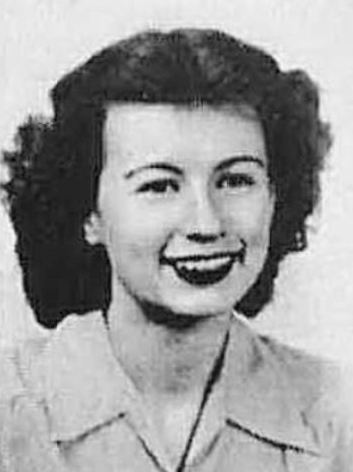
muriel-windham_sunset-high-school_1943Muriel, 1943

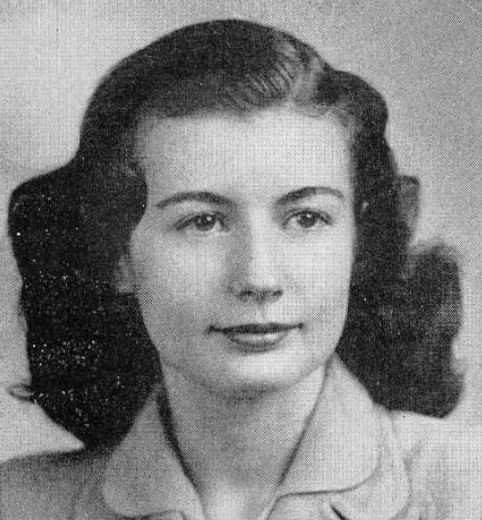
muriel-windham_sunset-high-school_1944Muriel, 1944 — editor of the Sunset yearbook

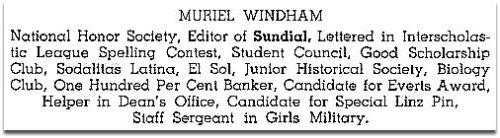
muriel-windham_sunset-high-school_1944-clubsSenior, over-achiever — 1944 yearbook

***

Sources & Notes

Black and white photos are from the Sunset High School yearbook, the Sundial.

Muriel Windham Brown’s obituary can be read here.

Muriel does actually get to meet Bob Hope once or twice, but the diary entries stopped before a pretty incredible meeting on April 22, 1943 at a benefit to sell war bonds at the Dallas Country Club. There was even a short article in The Dallas Morning News which chronicled what must have been the biggest moment in her 16 years: “Hope Thrills Girl As He Sells Bonds” (DMN, April 23, 1943). A couple of sentences from the article:

In the hustle and bustle of his bond sale at Dallas Country Club Wednesday afternoon a pretty, young girl shyly stepped up to Hope and caused him to sink to his knees in a swoon as she whispered she would pay $10,000 for his autograph. […] Hope treated her beautifully. He sat her down on the platform, left the mike occasionally to dash over, feel her pulse, stroke her brow and leave a light kiss on her forehead. (DMN, April 23, 1943)

I can’t even imagine how stunned Muriel must have been! (Her father worked as an executive, mostly in insurance and banking, and I have a feeling that the $10,000 check came from his employer, not his own bank account.)

Muriel’s family lived at 817 Brooks. No movie theater was all that far away by streetcar.

muriel_817-brooksGoogle Maps

A few more photos as she made her way through Sunset and SMU are here.

And, well, I kind of feel I have to….

bob-hope

*

Copyright © 2016 Paula Bosse. All Rights Reserved.