Flashback : Dallas

A Miscellany: History, Ads, Pop Culture

Category: Local Personalities

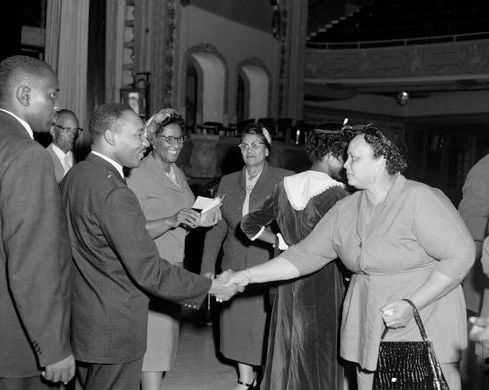
MLK in DFW — 1959

mlk-DFW-102259_calvin-littlejohn_briscoeDr. Martin Luther King, Jr. in DFW (photo © Calvin Littlejohn Estate)

by Paula Bosse

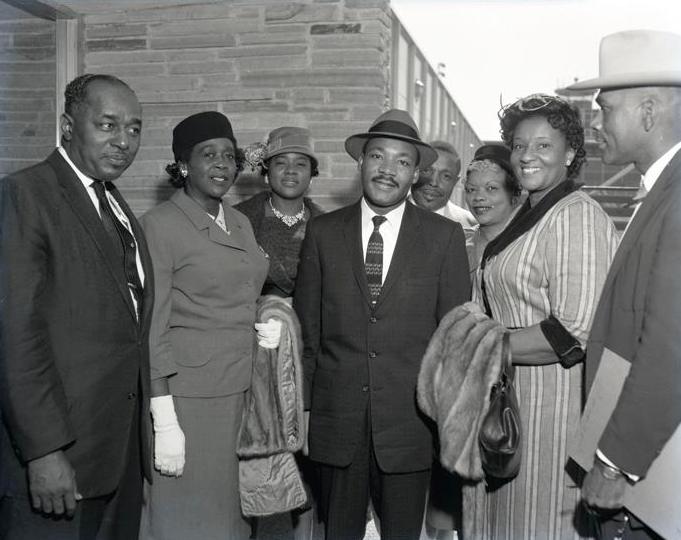
A couple of photos of Dr. Martin Luther King, Jr. on a quick trip to Dallas and Fort Worth in late October, 1959, taken by the wonderful Fort Worth photographer Calvin Littlejohn. The above photo is from Oct. 22, 1959 and was, I believe, taken after his speech at the Majestic Theatre in Fort Worth. Below, a photo of Dr. King taken at Love Field.

mlk_love-field_calvin-littlejohn_1959

***

Sources & Notes

Top photo by Calvin Littlejohn, from the Littlejohn Photographic Archive, Dolph Briscoe Center for American History. Mr. Littlejohn took several photos of Dr. King that visit, the locations of which are listed here — giving a good indication of the itinerary of the visit. I saw no mention or coverage of this visit in either The Dallas Morning News or The Fort Worth Star-Telegram.

Second photo from the TCU Press Facebook page.

A nice overview of Calvin Littlejohn’s career and a few of his photographs can be found here.

*

Copyright © 2015 Paula Bosse. All Rights Reserved.


Elvis at the Big D Jamboree — 1955

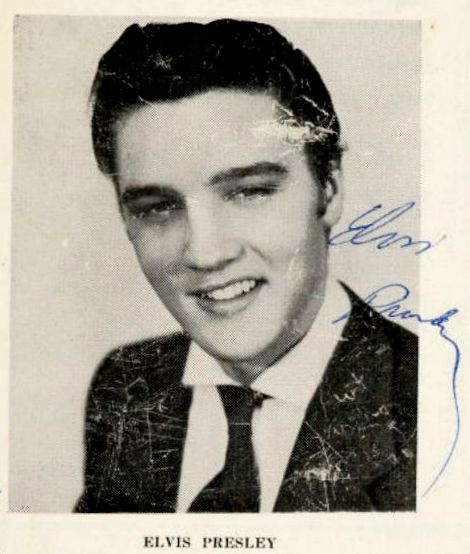
elvis_big-d-jamboree_program_090355-photo

by Paula Bosse

Today is Elvis Presley’s birthday — a perfect time to present a nostalgic look back at the early days of his fame, before he broke nationally and when it was still pretty easy to get a ticket to see him. Here are a few tidbits from his appearance on Sept. 3, 1955 at the legendary Big D Jamboree (held at the equally legendary Sportatorium). Happy Birthday, E!

*

elvis_big-d-jamboree-program-090355Big D Jamboree program, Sept. 3, 1955

*

elvis_big-d-jamboree_090355That night’s schedule — E’s all over it

*

elvis_big-d-jamboree-ad_dmn_090355Typos like this wouldn’t be a problem soon

***

Sources & Notes

Photo of Elvis and the two clippings from the Big D Jamboree program to that night’s show, Sept. 3, 1955 (which the ad is promoting).

*

Copyright © 2015 Paula Bosse. All Rights Reserved.

Old Red Goes Hollywood (sort of…) — 1964

buchanan_trial-oswald_1964Old Red’s star turn in The Trial of Lee Harvey Oswald (click for larger image)

by Paula Bosse

An interesting (if a bit fuzzy) screenshot of the Old Red Courthouse from one of Larry Buchanan’s Dallas-made films, “The Trial of Lee Harvey Oswald” (1964), about what might have happened had LHO lived to face trial. As with most of Buchanan’s extremely low-budget films, it drags and has clunky acting (…I have to admit that I didn’t watch the whole thing), but it’s interesting to fast-forward through to see the bits shot out on the streets of downtown. I really like this view of the courthouse. It seems familiar and unfamiliar at the same time.

***

Yes, you can watch the whole film on YouTube — free! Mosey on over here. The movie’s tagline: “Not a Newsreel … A Full-Length Motion Picture Filmed Secretly in Dallas.” Uh-huh. And as far as the movie having been “suppressed” (as is mentioned at the  beginning of the film) … well, let’s just say Larry worked in advertising for many years and knew a thing or two about marketing.

For other posts I’ve written about Larry Buchanan (I kind of feel I know him now — he would have been a lot of fun to shoot a movie with!), click here.

*

Copyright © 2014 Paula Bosse. All Rights Reserved.

Getting Married on the Radio — 1922

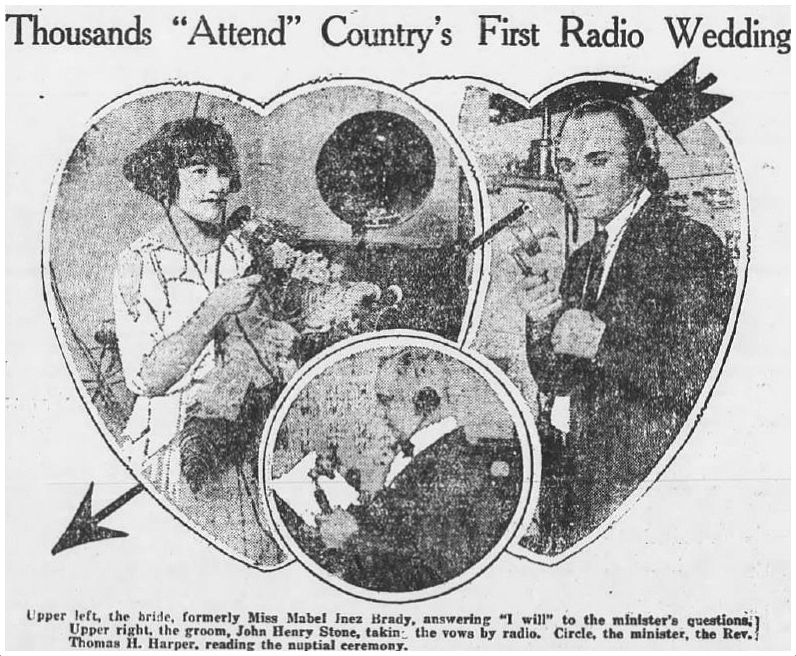
radio-wedding_corbis_062922Inez & John, exchanging vows on Dallas radio, 1922

by Paula Bosse

An early radio stunt happened in Dallas on the night of June 29, 1922 when a couple exchanged wedding vows over the air, with the bride, the groom, and the minister each broadcasting from the studios of different Dallas radio stations: WDAO, WRR, and WFAA. These were the very early days of radio, and when the wedding was broadcast, WDAO had been on the air for a little over a month, and WFAA for less than a week! (WRR, Dallas’ first radio station had been on the air for about a year, but most of that time it had been operating as a one-way radio dispatcher for the city’s fire and police departments). In June of 1922, these were the only three Dallas-based radio stations, and they all worked together in this “historic” broadcast. (This early media stunt was a full 47 years before Tiny Tim and Miss Vicki got hitched on the Tonight Show.)

DALLAS COUPLE TO WED BY RADIO THURSDAY NIGHT

DALLAS — The first wireless marriage ceremony ever performed in which neither the bride, the groom, nor the officiating minister will be at the same place is to be solemnized here Thursday night when Miss Inez Mabel Brady, Dallas society girl, becomes the bride of John H. Stone, operator at WRR, the municipal broadcasting station.

It is estimated that more than 25,000 radio fans will “witness” the tying of the radio nuptial knot.

Three Dallas broadcasting stations will be used in the ceremony. Rev. Thomas Harper, pastor of the Central Congregational Church, who has been asked to officiate, will repeat the marriage ritual into the transmitter of [WFAA,] the broadcasting station on the roof of [the Dallas Morning News] building. The bride and her attendants will be at the Automotive Electric Company’s radio station [WDAO, on South Ervay], while the groom will make his responses from WRR, the station of which he is in charge.

Operating staffs of the three stations are working out the details of the ceremony, which will include a broadcasted wedding march.

(– Fort Worth Star-Telegram, June 28, 1922)

Obviously new to the hustle of radio promotion, The Dallas Morning News (owner of WFAA) mentioned the event only a couple of times — fleetingly. They did note that “This probably will be audible to one of the largest audiences ever ‘hearing’ a wedding ceremony” (DMN, June 28, 1922). It’s not known just how many people tuned in to listen to the ceremony (probably a considerable number), but the story made news around the country, as can be seen in this article from The Durham Morning Herald in Durham, North Carolina:

radio-wedding_durham_071322a

radio-wedding_durham_071322-bDurham (NC) Morning Herald, July 13, 1922 (click for larger image)

The broadcast had only a tiny hiccup:

radio-wedding_winfield-daily-press_kansas_063022Winfield (Kansas) Daily Press, June 30, 1922

As successful as the radio wedding was, the marriage between Inez Brady and John H. Stone does not appear to have lasted very long. At the time of the wedding, Inez was just out of school and was only 16 or 17 years old (the descriptions of her as a “society girl” and “debutante” were, I think, a bit of an exaggeration). According to the news stories surrounding the wedding, she “fell in love” with Mr. Stone’s voice on the radio. None of that bodes well for a lasting marriage. The 1923 city directory had the newlyweds renting rooms on McMillan, off Lower Greenville, but the 1924 directory had John in Oak Cliff and Inez in Old East Dallas. She re-married in 1928 at the creaky old age of 22, and he seems to have left WRR to work in some capacity for RCA. The marriage might not have lasted, but they both had a “brush-with-celebrity” story to tell (and re-tell) for the rest of their lives.

***

Sources & Notes

Top photo from CorbisImages, ©Bettmann/CORBIS.

I’m not sure which ended first — Mr. and Mrs. Stone’s wedded bliss or the radio station WDAO, which ceased operation sometime in 1923. A good look at the history of early local radio can be found at DFW Radio Archives, here. (WRR and WFAA continue to march forward, just a few years shy of their 100th anniversaries!)

*

Copyright © 2014 Paula Bosse. All Rights Reserved.

The Peruna Monument — 1937

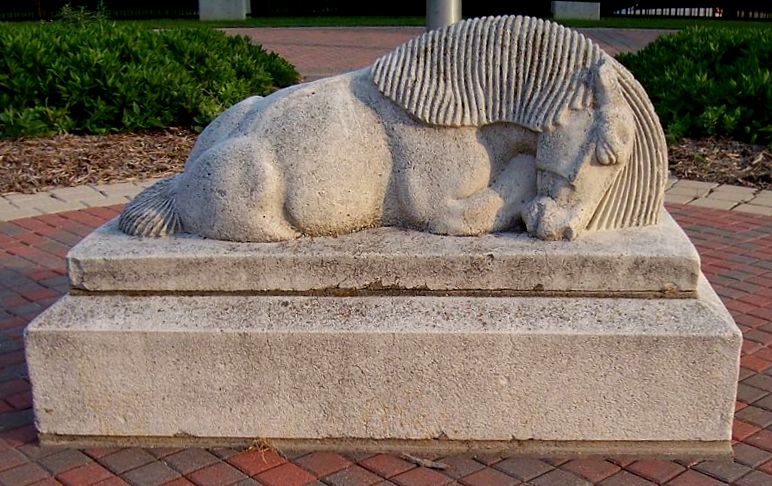
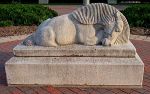
owen_peruna_monument_flickrMichael Owen’s Peruna monument today, SMU campus (photo by David Steele)

by Paula Bosse

When Peruna — SMU’s beloved Shetland pony that served as the Mustangs’ first live mascot — died in 1934, there was an immediate call to erect a memorial monument over the little horse’s grave, but it wasn’t until 1937 that a serious push for the erection began. Money was raised by the student council, which asked every student to contribute at least ten cents to the fund, and the search was on for the right sculptor.

The commission went to young Michael G. Owen, Jr., who, at only 21, was the same age as many of the students who were hiring him. (It has been erroneously reported that Owen attended SMU, but he did not.) Michael Owen was well-known within the Dallas art community and had made a mark for himself as something of an artistic prodigy — as a teenager, he had been on the periphery of the movement that spawned the Dallas Nine group of Regionalist artists, and he had  been mentored by many of the older artists, most notably Jerry Bywaters.

owen_peruna_smu-campus_050537
SMU Semi-Weekly Campus, May 5, 1937 (click for larger image)

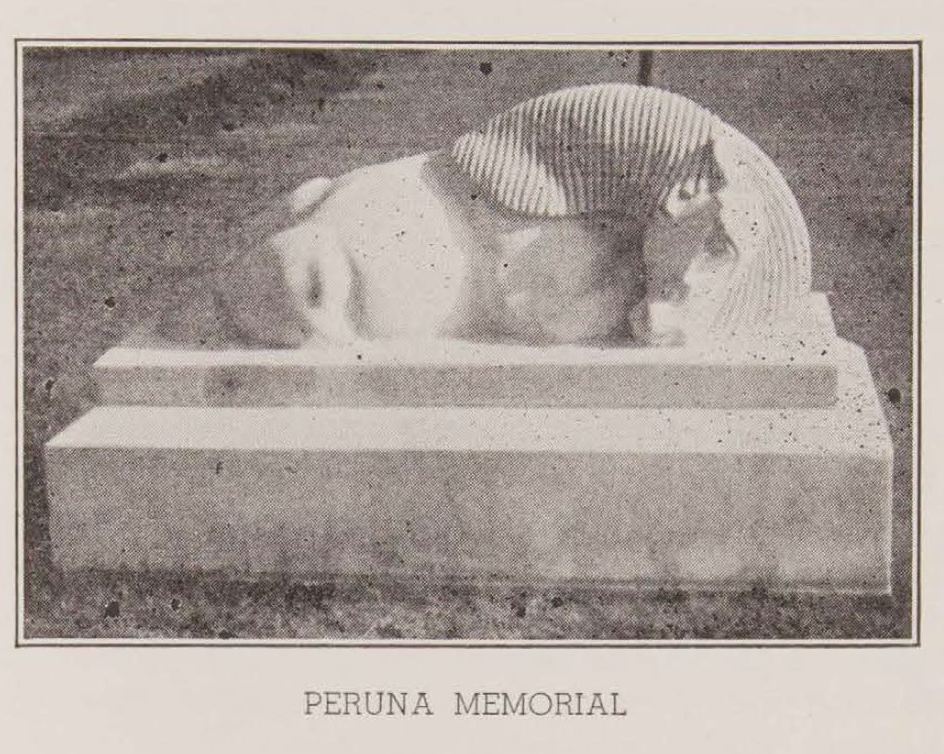
Owen worked quickly and completed the memorial — which was six feet long and four feet high and carved from 2,800 pounds of hard limestone — in time for the unveiling just outside Ownby Stadium on May 19, 1937.

The result was a quietly emotional — and even a very sweet — monument depicting the small slumbering horse atop a stone slab, with an inscription reading “Peruna I.” Jerry Bywaters wrote a glowing review of the piece, even though he seems a bit taken aback to find what he called “a memorial to a midget horse” on a college campus to be “one of the best pieces of memorial sculpture in the State.”

“Accustomed to seeing rather bad sculptured monuments erected to Confederate soldiers, Texas Rangers, political dignitaries or such abstract ideas as justice, plenty, or  beauty, it is slightly confusing to find a very good piece of sculpture set up as a memorial to a midget horse. […] Whatever the paradox of the situation, this monument is surely one of the best pieces of memorial sculpture in the State.” (Jerry Bywaters  in The Dallas Morning News, May 23, 1937)

peruna-memorial_mike-owen_m-book_1937_SMU-archives1937 (SMU Archives)

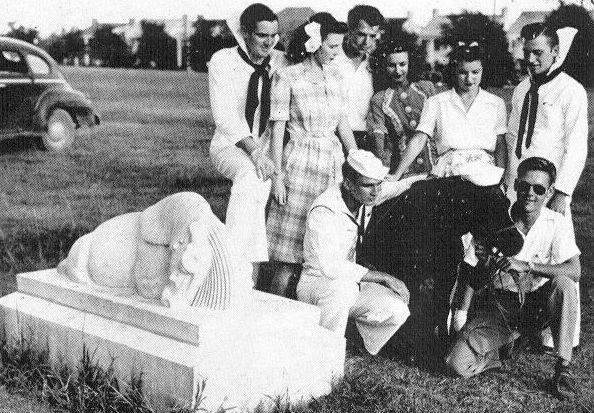
When Ownby Stadium was demolished and the new Ford Stadium built, the Peruna I monument was moved to the new stadium where it has become a memorial to all the Perunas.

owen_peruna-memorial_wiki_1944With Peruna III, during WWII (Wikipedia)

owen_peruna-statue_1950-degolyer-DET1950 (DeGolyer Library, SMU)

***

Sources & Notes

Top photo by David Steele, from Flickr, here.

Article from SMU’s The Semi-Weekly Campus (May 5, 1937, p. 3), here.

Photo of Peruna III with sailors from the Peruna page on Wikipedia, here.

Bottom photo (cropped) of the Peruna monument from the DeGolyer Library, Central University Libraries, Southern Methodist University, here.

Previous Flashback Dallas posts on Mike Owen:

  • “Give a 15-Year Old 8,400 Pounds of Soap and He’ll Carve You a Radio Transmitter — 1930” is here.
  • “Michael G. Owen, Jr. — Dallas Sculptor of Lead Belly” — is here.

UPDATE: Read about a recently discovered large painting by Owen up for auction in Dallas in 2019 here.

The previous post on the untimely demise of Peruna is here.

owen_peruna_monument_flickr_sm

*

Copyright © 2014 Paula Bosse. All Rights Reserved.

Little Peruna: He Died With His Mustang Bridle On — 1934

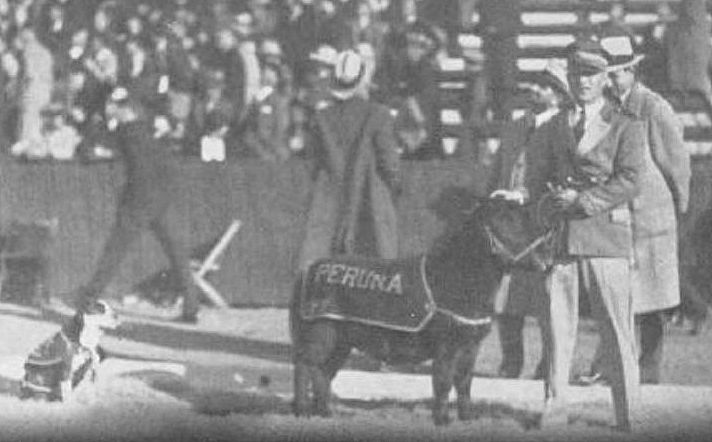
peruna-rotunda_1933Peruna, waiting for the Mustangs to score (photo: SMU)

by Paula Bosse

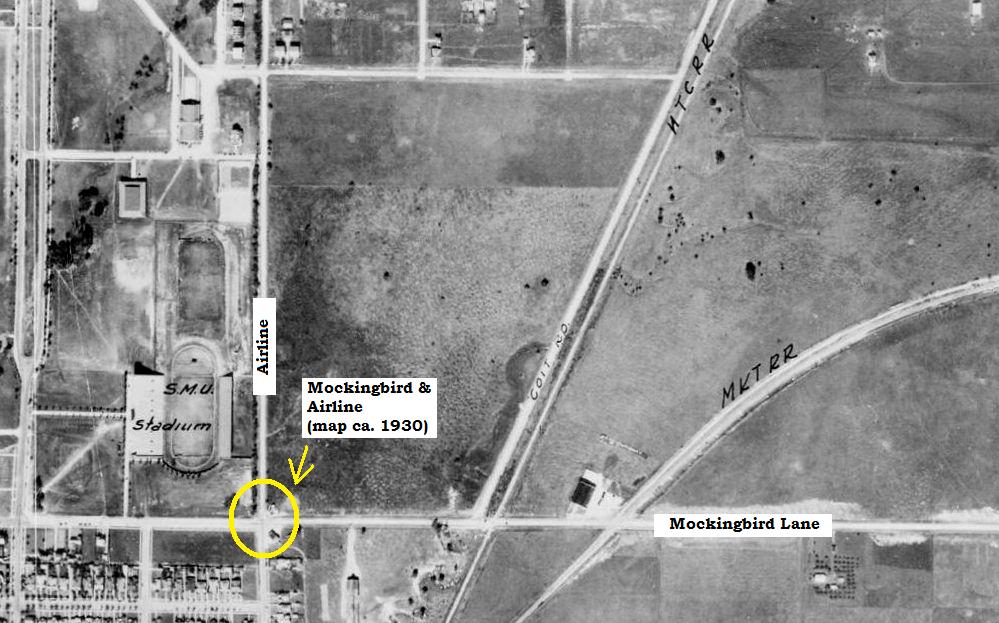
On October 30, 1934, shortly before midnight, Peruna, the 28-inch-tall little black Shetland pony mascot of the Southern Methodist University Mustangs, somehow liberated himself from his stable and wandered across campus and out into the intersection of Mockingbird and Airline where he was, sadly, struck by a hit-and-run driver and died soon after. As the newspaper account noted the next day, when the tragic accident occurred, “He was wearing a bridle of Red and Blue, the Mustang colors.”

Peruna had been the football team’s mascot for only two years, but he was an immensely popular attraction, and he was treated as something of a celebrity wherever he appeared, both at home and when traveling with the football team and the Mustang band. He did things most horses didn’t do, like ride in taxi cabs and sashay though hotel lobbies. Crowds at football games loved watching the little horse race across the field — even the ardent  supporters of the opposing teams were charmed by him. And he was, of course, much loved at SMU; his death was a hard blow to the student body.

When he was buried at Ownby Stadium, the band played the usually rousing fight song as a mournful dirge, and the flags on campus flew at half mast.

I’m an animal lover, and stories about the demise of animals are not things I normally find entertaining, especially when phrases like “the midget pony,” “the wee mascot,” “the stout-hearted little mascot,” and “the midget wonder horse” are constantly (and effectively) used by journalists to tug at the readers’ heart-strings. But the Peruna obituary/funeral coverage that was printed in The Dallas Morning News is so wonderfully and ridiculously over-the-top that that one yearns to know who wrote the uncredited story. I have created a little scenario in my head in which the writer had been (and I apologize…) “saddled” with writing a story about a horse’s funeral, but instead of handing it in the pedestrian short-and-vaguely-moving report that was expected, he decided — to hell with it — that he would just go full-throttle and produce the most outrageously grief-stricken story ever written about the untimely death of a college mascot. After what one assumes was the downing of much whiskey and much chuckling to himself (I suspect this was written by a sportswriter), a 500-word obit ran on Nov. 1, 1934:

CO-EDS AND GRID STARS SOB AS PERUNA IS BURIED
(The Dallas Morning News, Nov. 1, 1934)

In sight of the very gridiron on which he pranced to lasting fame, Peruna, stout-hearted little mascot of the Southern Methodist University Mustangs, was laid to rest Wednesday afternoon.

As co-eds sobbed openly and hardened football heroes found difficulty in brushing back the tears, the body of the diminutive pony was lowered into its grave in the shadow of Ownby Oval. His coffin was draped in red and blue, the school colors, and a huge M, the Mustang emblem, graced the top of the casket.

Across the way, on the campus of the big university itself, the flag fluttered at half mast. The school band, looking noticeably bare without Peruna prancing about, playing “Peruna,” the varsity song, in the tempo of a dirge. Hundreds of heads were bowed when the strains of the alma mater, “Varsity,” offered a final tribute to the wee mascot.

Peruna’s career was as colorful as that of the team he represented. Given to the school in November, 1932, by T. R. Jones, loyal Mustang supporter, the midget horse immediately became the constant companion of the team on its journeys from one side of the continent to the other.

Only last week Peruna was feted in New York, parading through the lobbies of the city’s swankiest hotels, whose clerks sniff haughtily at the thought of a dog or a cat entering the sacred portals of their hostelries….

In was in Shreveport where he slipped and cut his leg as he started to Centenary Stadium in a taxicab. His wound was stitched, and the faithful little animal pranced proudly with the band during the between-halves parade.

But Peruna prances no more. And if the music of Bob Goodrich and his Mustang band at Austin Saturday fails by a scant margin of being at its peppiest, it will be because the band has dedicated every tune on that day to the memory of its best friend.

That must have been fun to write.

The year following Peruna’s demise, the Rotunda — SMU’s yearbook — featured a two-page illustrated spread “Dedicated to the famous Mascot of the Mustangs … ‘Peruna.'”
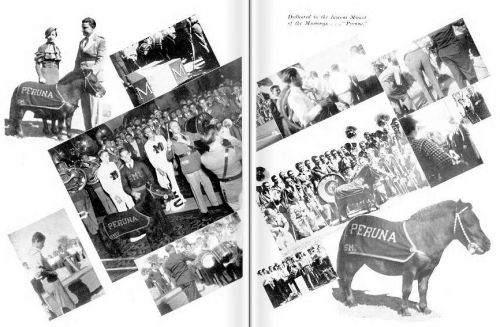
peruna_memorial_rotunda_1935

See Peruna’s very, very sweet memorial statue on the SMU campus here.

The loss of Peruna left the Mustangs without a mascot. Peruna’s son was proffered as a replacement, but even though “Little Peruna had been dressed in its father’s blanket and was prepared to give its all for SMU,” the school declined to bring Peruna fils on board. A successor — Peruna II — was eventually appointed, the first of many over the past eighty years. We’re now up to, I believe, Peruna IX, and the little stallion is still as popular as ever. May the “stout-hearted little mascot” continue to prance proudly for the SMU Mustangs.
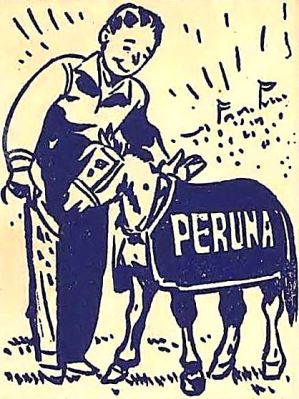
peruna_smu-rotunda_19391939 Peruna (SMU Rotunda)

peruna_varsity-shop_cully-culwell_culwell-ranch_1960-SMU-rotunda1960 Peruna (SMU Rotunda)

***

Sources & Notes

Top photo from the 1933 SMU yearbook, The Rotunda. The two-page spread is from the 1935 Rotunda.

For an idea of what the area looked like at the time of Peruna’s terrible midnight accident — large open fields to the north and east of the campus, and, to the south, a probably dimly-lit Mockingbird Lane — here is a detail from a 1930 aerial map from the Edwin J. Foscue Map Library at Southern Methodist University (the full map can be seen here):
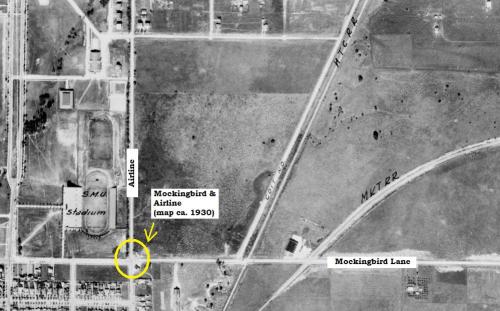
smu-aerial_1930(click for larger image)

Check out these articles in the Dallas Morning News archives:

  • “Car Kills Peruna Back From Victory Over New Yorkers; SMU Mascot Known To Over Half Nation, Dies With Bridle On” (DMN, Oct. 31, 1934)
  • “Co-Eds and Grid Stars Sob As Peruna Is Buried” (DMN, Nov. 1, 1934)
  • “Grieving Mustangs Won’t Take Son of Peruna for Mascot” (DMN, Nov. 11, 1934)

Peruna on Wikipedia, here.

If you really want to know about Peruna, though, you need to go to the horse’s mouth — his page on the SMU website, here.

Read about the Peruna monument by Dallas artist Michael G. Owen, Jr. which was dedicated on the SMU campus in 1937, here.

*

Copyright © 2014 Paula Bosse. All Rights Reserved.

Cowboys and Indians on Elm Street — 1915

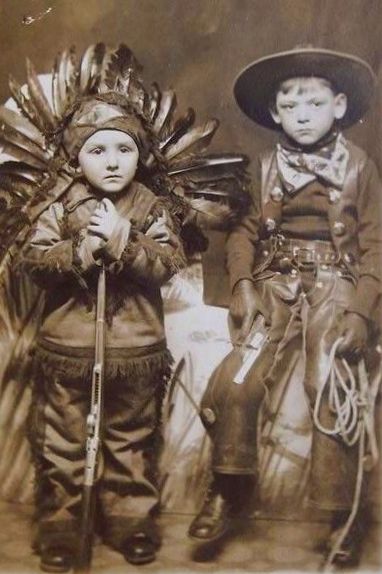
lawrence_kiddie-photoPhoto by Joe Lawrence, circa 1915

by Paula Bosse

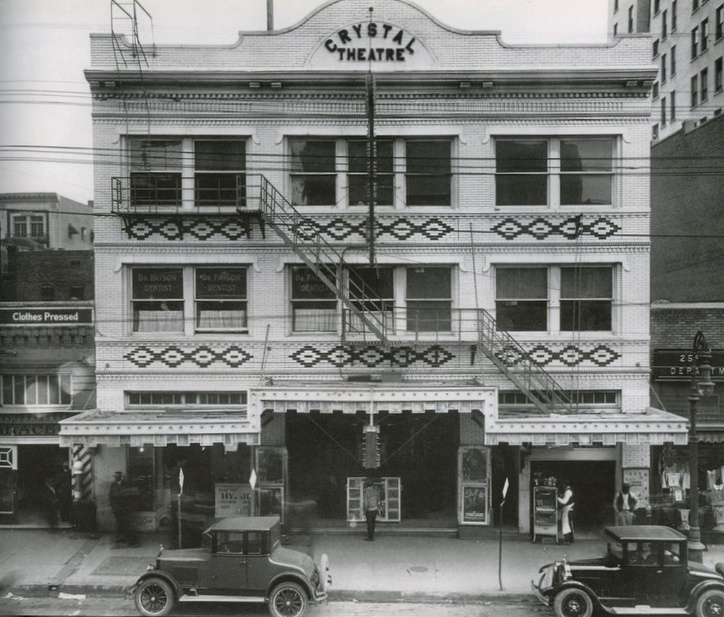
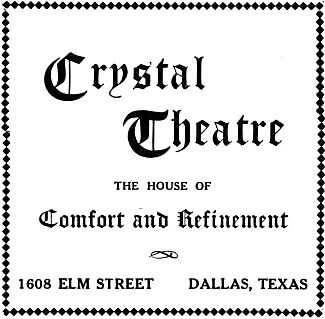
The photo above, showing two not-terribly-thrilled children dressed up in Old West costumes, was taken by Joe Lawrence in his “Crystal Electric Studio” at 1608 Elm Street, one of many small businesses located above the Crystal Theater.

crystal-theaterThe Crystal Theatre — with office space above (click for larger image)

Joseph Z. Lawrence (1884-1943) was born in Romania and settled in Dallas in 1909. In 1915 he was doing business as a photographer at 1608 Elm Street. Lawrence later owned the Lawrence Art Galleries on Pacific Avenue, and, along with his son Harry, was an early supporter of the Dallas Nine artists.

***

Sources & Notes

Top studio photo by Joe Lawrence, found on eBay.

Photo of the Crystal Theater found on Pinterest, here. A photo of the 101-year old building taken during the recent spate of downtown demolition — with the wrecking ball literally INCHES away from it — is here. The Dallas Morning News article it comes from is here.

At some point the address of the building (originally 1608-10) became 1610 Elm, perhaps when it was extensively remodeled in the late 1920s and became a retail store.

crystal-theater_building-code-bk_19141914 — “Comfort & Refinement”!

*

Copyright © 2014 Paula Bosse. All Rights Reserved.
David Wade: Overcoming Childhood Trauma

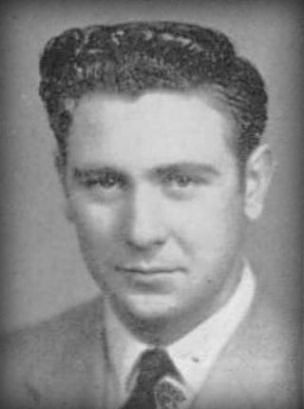
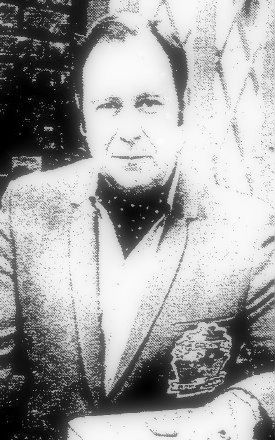
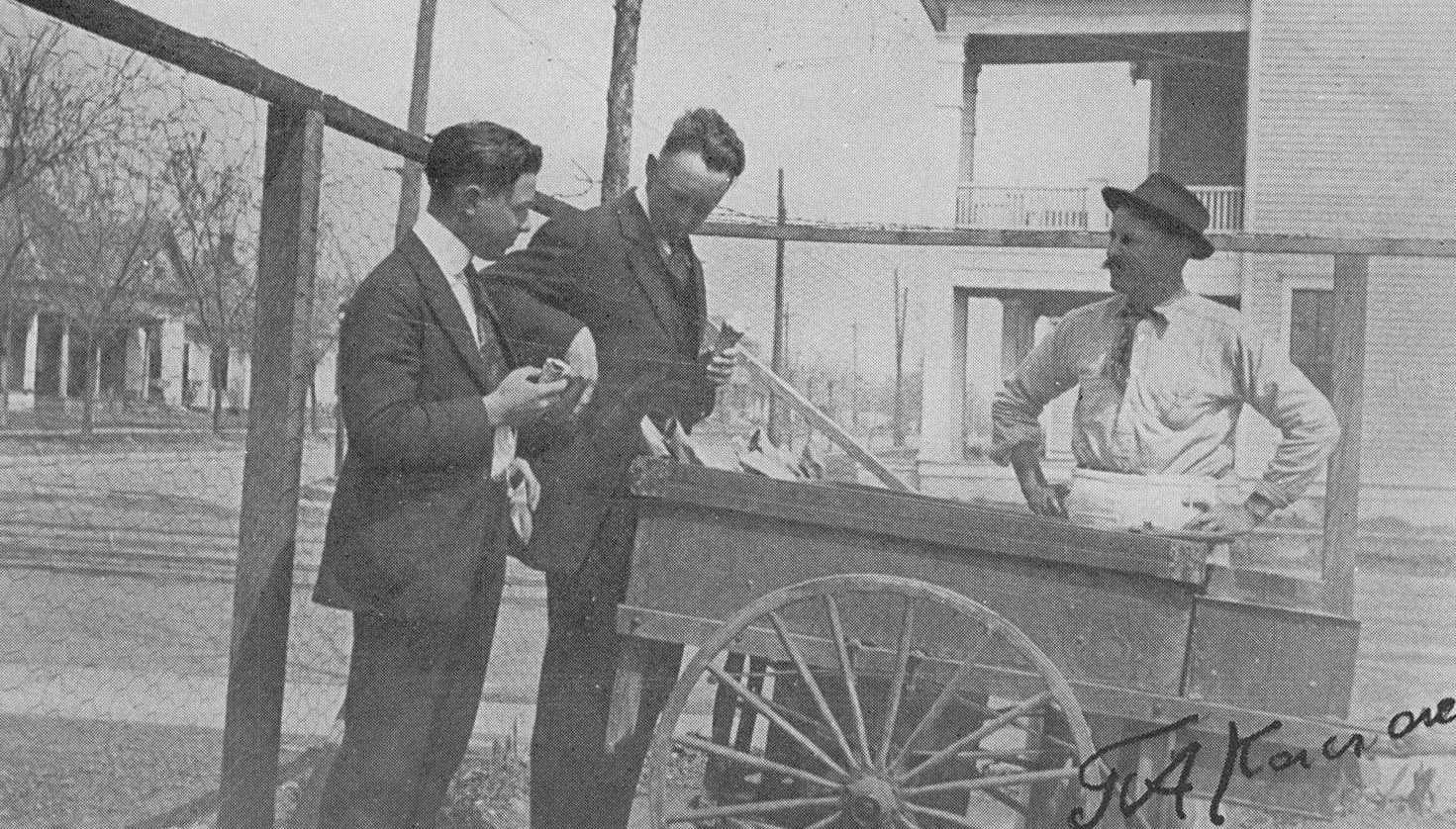
david-wade_waco-high-school-194117-year-old David Wade, Waco High School, 1941
by Paula Bosse

For many Texans, the name David Wade brings to mind a gentle and convivial, deep-voiced TV cooking show host who, for decades, shared his love of food with a legion of faithful fans. Dallas was Wade’s home base — it was where he lived, where he established his business empire, and, for the most part, where he recorded his television programs. He seemed like the kind of guy who had it all. But many of his fans would be shocked to learn that David Wade’s most searing childhood memory was the impossible-to-forget day his father killed his mother.

In 1929 Eugene and Ora Lee Wade lived in Cameron, Texas, about 50 miles south of Waco. They had four daughters, ranging in age from twelve to twenty-one, and one son, five-year old David. Eugene worked as an engineer at the local cotton gin, and Ora Lee raised the children and was a popular and active member of her church.

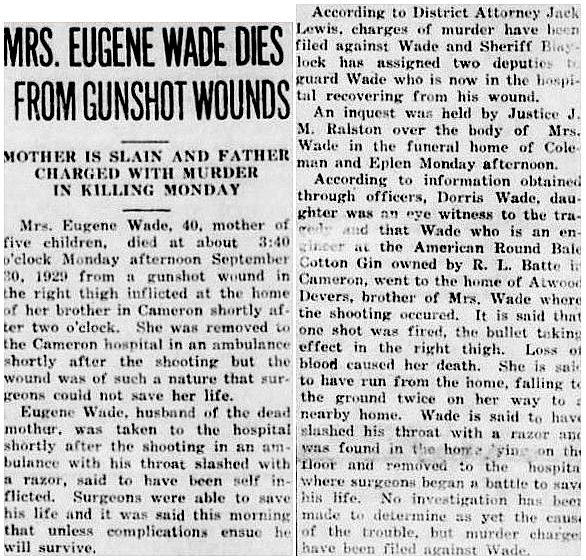
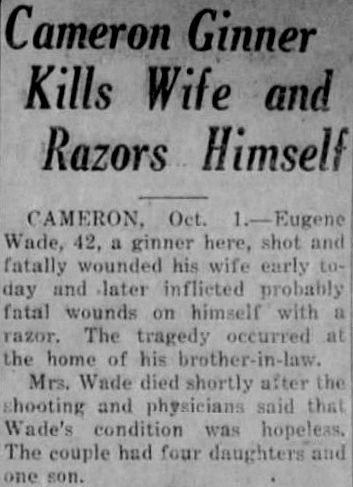
On the afternoon of Sept. 30, 1929, Eugene came home drunk. Very drunk. He began to argue with Ora Lee, and, as things escalated, she ran to the nearby house of her brother. An angry Eugene lurched after her. A gun was drawn, and Eugene drunkenly threatened his wife with it. In an ensuing physical altercation, the gun went off. Mrs. Wade had been shot in the thigh. She attempted to run away but collapsed after only a few steps. She died soon after being rushed to the hospital — her femoral artery had been severed, and she bled to death. Before the police arrived, Eugene Wade had slashed his throat with a razor, and though not initially expected to live, he survived and was charged with the murder of his wife. The horrible, violent, bloody scene had been witnessed by at least one daughter (and, in all likelihood, probably by five-year old David as well).

wade_bryan-eagle_100129The Bryan Eagle, Oct. 1, 1929

wade_cameron-herald-100329The Cameron Herald, Oct. 3, 1929 (click for slightly larger image)

A distraught Eugene Wade pleaded guilty, was sentenced to life in prison, and by the end of the year, he was on his way to Huntsville. Before he left Cameron, he gave a lengthy, sincere, and heartbreaking interview to The Cameron Herald. In it, he expressed his sorrow, his regret, and his love for his wife and children.

“Whiskey was the cause of it all. I am to blame for what has happened to my family and to myself. I can lay it all to drink. I loved my wife as well as any man ever loved his wife and I love my children. My home is destroyed and my wife is dead. My children will suffer the humiliation of this terrible thing. Time may heal their wounds but mine will bleed for all time. I can never escape the horror of it though I should live a thousand years. Nothing but sorrow is left for me, still I might come out of the trouble some day, maybe an old man and broken but maybe I can still do some good in the world.” (Cameron Herald, Dec. 19, 1929)

Five-year old David had been left, basically, an orphan. He spent some time at the Juliette Fowler home for orphans in Dallas and was later moved around between family members and foster families. He went to Waco High School where he was a popular student (the yearbook photo above was accompanied by the motto supplied by the Senior Band, of which he was a member: “And he is oft the wisest man”), and he received arts degrees from Baylor and the University of Texas (he studied music and had a short career as a singer). He seems to have done well in school, despite the terrible incident in his past.

But after college he spent time in California as a “test pilot,” a nerve-wracking job that apparently stressed him out so much that he sought medical treatment (an amateur psychologist might assume that his anxiety was triggered by post-traumatic stress). According to later newspaper profiles, instead of sedatives, the doctors suggested he focus on an enjoyable hobby to settle his nerves. A hobby like cooking. …And the rest is history.

As far as I’ve been able to determine, he rarely — if ever — talked about the tragedy he experienced in his youth. When one knows the details of his past, some of his quotes from interviews carry more weight:

“Any time you have a problem and you overcome it, you have a muscle. You never build a personality unless you have a lot of troubles.” (David Wade in the Fort Worth Star-Telegram, April 25, 1976)

When I was growing up and would frequently come across one of David Wade’s shows on TV, I usually clicked on past it unless there was absolutely nothing else to watch. He and the show felt a little corny and were a little too laid back for my taste. Now, though, having learned about his past — and having always felt that Mr. Wade seemed to be a genuinely nice person — I definitely have a more positive and respectful opinion of the man. Ascot, crest-emblazoned blazer, and all.

david-wade_FWST_042576-photoBon Appétit!

***

Sources & Notes

Top photo of a 17-year-old David Lloyd Wade from the 1941 Waco High School yearbook.

The coverage of Ora Lee Wade’s funeral in the Cameron Herald (Oct. 3, 1929) — which includes quite a bit of genealogical information — can be found here (click for larger image).

The full “jailhouse interview” with Eugene Wade in the Cameron Herald (Dec. 19, 1929) is available in a PDF, here.

Incidentally, Eugene Wade’s “life sentence” lasted four years. He was the recipient of one of Governor Ma Ferguson’s notorious “conditional pardons.” He appears to have lived around the Cameron area until his death in 1967. I don’t know whether he ever re-established relationships with his children.

A nice overview of David Wade’s very successful career can be found in an article from the April 25, 1976 issue of the Fort Worth Star-Telegram, in a PDF, here.

My previous post, “David Wade, Gourmet: Have Ascot, Will Travel” — about his happier days as a successful TV personality — can be read here.

*

Copyright © 2014 Paula Bosse. All Rights Reserved.

David Wade, Gourmet: Have Ascot, Will Travel

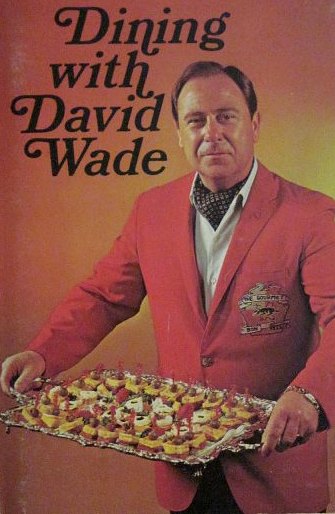
david-wade_dining-with_cover

by Paula Bosse

A few years ago, when I was a bookseller, I posted the following on a personal blog — it turned out to be the most commented-on and most clicked-on post I’d ever written. I wrote it a bit snarky, but I was amazed by the response it elicited: people (both in Texas and beyond) apparently have a strong affection for — and a seemingly deeply personal attachment to — local TV gourmand David Wade. Here’s what I wrote.

*

I just received an order for a David Wade cookbook I’ve had listed for four years:

DAVID WADE’S KITCHEN CLASSICS (Dallas: David Wade Industries, 1969). 300pp. Photographs, index. The ascot-clad TV gourmet presents recipes as well as photos of himself with celebrities such as Mickey Mantle (page 99, opposite the recipe for Crabmeat Tetrazzini). A couple of small splotches to fore-edge; one rubbed spot on cover. No dust jacket. Inscribed by Wade. $12.50

I don’t know if people outside of Texas (and maybe outside of Dallas) would be familiar with David Wade, described, tellingly, not as a “chef” but as a “food demonstrator.” He had a local TV show that must have started in the ’50s or ’60s, but I saw him in the ’70s and into the ’80s. And, yes, he DID wear an ascot, and a blazer, as seen above, from the front cover of another cookbook from the David Wade oeuvre.

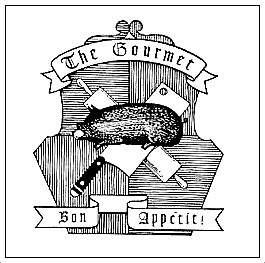
He had a catchy theme song (which compared him to Rembrandt and Edison) and he had his very own coat of arms, which I have vivid, rather frightening memories of from my childhood (I always imagined that poor pig being whacked over the head with the rolling pin and then hacked apart by the cleaver — Bon Appetit, little piggie!):

david-wade-show_logo

I was just a kid, but I remember cringing a bit at his deep-voiced cheesiness. I don’t actually remember much about the food or the actual program, but I can still hear that unnaturally calm, deep voice oozing around inside my head. But what did I know? He was an incredibly popular local TV personality. Yeah, he might have used an over-abundance of big words (…words like “over-abundance”), but, to be fair, he also had a folksy charm and was pleasantly inoffensive.

I’m not sure the same can be said for his food, however. Here are a few of the recipes which some lucky lady in South Carolina who bought the cookbook might be whipping up in a few days:

  • Squash Loaf
  • Citrus Surprise Steak
  • Liver Yucatan (featuring grated American cheese (can you actually grate American cheese?), macaroni, canned mushrooms, and sugar)
  • Baked Stuffed Fish with Pecan Grape Sauce
  • Deep Sea Loaf (made with canned tuna, gelatin, sweet pickle juice, avocado, and three tablespoons of sugar … among other equally distressing ingredients)
  • Salmon & Green Olive Casserole (with cream and “salmon liquid” straight from the can)
  • Apple & Banana Soup (these are the ingredients: chicken stock, apple, banana, potato, onion, cream, curry powder, chives)
  • Kidney Bean Tuna Salad
  • Meat Loaf Pizza
  • Pineapple Mint Cake
  • Quick Clove Jelly Cake
  • Sahib Eight Boy Chicken Curry (…I have no idea…)
  • Yam Peanut Puffs

Bon Appetit!

*

After I wrote that post, I was inundated by people looking for information on where to find all sorts of much-loved David Wade recipes (especially his famed “Turkey in a Sack”) and where they could find his apparently quite popular Worcestershire Powder. There were also many, many comments from people who just wanted to share personal memories of David Wade, invariably describing him as a warm and gracious, down-to-earth, gentle man. “Classy, but not pretentious.”

Wade began his TV career in Dallas at WFAA in 1949, hosting a 15-minute show about dogs (?!) called “Canine Comments” — it became so popular that it was syndicated around the country. He won awards for that show. It was VERY popular. In 1952, Wade was also appearing on WFAA radio as “The Hymn Singer,” singing religious songs and talking about each song’s history and composer. Along the line he made the switch to food.

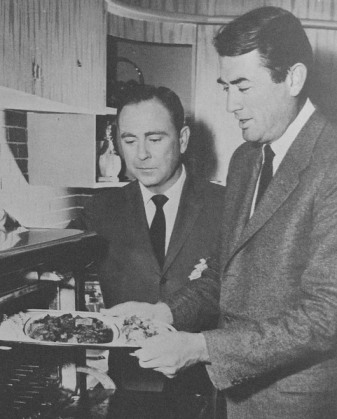
He was “demonstrating” food preparation at personal appearances and on local television by 1957, and in the early 1960s he became a nationally known figure when he commuted to New York from Dallas to tape regular spots for a show called “Flair” in which he frequently appeared with celebrities, guiding them through the preparation of a dish.

david-wade-gregory-peckWith Gregory Peck, 1960s

Eventually, his Dallas-based TV shows were syndicated all over the U.S., and he was so popular locally that he decided to run for mayor in 1971 (he lost to Wes Wise). He continued in his role as a cooking instructor and media figure until his retirement.

David Wade, a much-beloved man who lived and worked in Dallas for the bulk of his career — died in Tyler in March of 2001 at the age of 77. He had been a fixture on Texas television and had published numerous cookbooks. And in between rhapsodizing on good food and wine, he even taught untold thousands how to cook fish in the dishwasher and how to roast a turkey in a paper sack.

***

Sources & Notes

David Wade’s obituary is here.

A warm and fuzzy nostalgic look back at Wade can be read at CraveDFW, here; a super-snarky (and kind of amusing) LA Weekly post critiquing Wade’s recipes can be read here.

Regarding Wade’s run for Mayor of Dallas, check out the Dallas Morning News interview with him conducted by Carolyn Barta, in which he expounds on his vision for the future of Dallas, in the article “Wade Feels Need to Communicate” (March 21, 1971).

Next: The little-known devastating and traumatic childhood event that resulted in David Wade becoming an orphan at the age of 5. Read “David Wade: Overcoming Childhood Trauma” here.

*

Copyright © 2014 Paula Bosse. All Rights Reserved.

JFK’s “Last Hour In Dallas” — 1963

JFK_poster

by Paula Bosse

How is a city supposed to respond when it is suddenly plunged into the international spotlight? Does it grieve and try to forget, or does it grieve and capitalize? Dallas has had over 50 years to deal with/come to terms with the assassination of President Kennedy, but sometimes it seems as if the City of Dallas is still shell-shocked and isn’t quite sure how to acknowledge it on an official level. Let’s face it, Dallas is known to the rest of the world for one thing: the Kennedy assassination (and perhaps the TV show, and maybe the Cowboys). Yes, we have the justly-renowned Sixth Floor Museum, but it took 26 years to open it!

The cottage industry that sprang up in the wake of the Kennedy assassination has been big business for decades, some of it generated by people who live in Dallas, but most of it by people who have probably never even been to Texas. Since 1963, the “assassination literature” (…and, yes, it’s called that) has mushroomed, with local contributions coming from Dallasites whose brush with the President before, during, or after the events of November 22, 1963 have probably been pored over by numerous people either trying to understand why what happened happened or by people searching for hidden conspiracy clues to explain what really happened.

One local resident who added to the assassination literature was John E. Miller who took photos of the arrival of President and Mrs. Kennedy at Love Field and then apparently hot-footed it over to Parkland when the news of the shooting broke. These photos were issued as postcards in 1964 in a packet of 12. (Click pictures for larger images.)

JFK_envelope_frontAbove, the front of the envelope containing the cards; on the back: “A Real Picture Treat For Years To Come.”

JFK_card_01From the back of the card: “No. 1, Arrival of President’s Escort Plane at Love Field, Dallas, Texas.”

JFK_card_02“No. 2, Presidential and Escort Planes at Dallas’ Love Field landed shortly after this picture was taken.”

JFK_card_03“No. 3, President John F. Kennedy and party leaving airplane at Love Field. (Mrs. Kennedy — pink hat.)”

(UPDATE: The two little girls in the photos above and below are most likely Carolyn Jacquess, in blue, and Debby Massie, in red. Their little group arrived at the airport before the president’s plane arrived, walked through the terminal and out onto the tarmac, right to where the plane taxied up to the small crowd of about 100 people. Just like that. There was no special invitation, and, other than the chain-link fence, no real security.)

JFK_card_04“No. 4, President John F. Kennedy and Party in foreground at Dallas’ Love Field.”

JFK_card_05“No. 5, Vice-President Johnson, Governor Connally, Mrs. Kennedy (pink hat), other members of party at Dallas Love Field.”

JFK_card_06“No. 6, Vice-President Johnson, Governor Connally, Presidential Party and Newspaper Men, Love Field, Dallas.”

JFK_card_07“No. 7, Forming of Presidential Parade, Love Field, Dallas.”

JFK_card_08“No. 8, After Assassination, TV Unit arrives at Parkland Hospital in Dallas.”

JFK_card_09“No. 9, Blood Bank Unit at Parkland Hospital on fatal day. Dallas, Texas.”

JFK_card_10“No. 10, Hearse carrying President John F. Kennedy’s body and Mrs. Kennedy from Parkland Hospital back to airplane at Love Field, Dallas.”

JFK_card_11“No. 11, Presidential plane awaiting President Kennedy’s body, Vice-President Johnson and Mrs. Kennedy, for return to Washington, D.C. (Note Presidential seal.)”

JFK_card_12“No. 12, Texas School Book Depository building from which authorities believe fatal shots were fired. (Note second window down on right corner of building.)”

***

Photos and captions © John E. Miller 1964, 3500 W. Davis, Dallas, Texas 75211. (Mr. Miller was a Dallas businessman who sold motor homes and trailers in Oak Cliff between 1945 and 1976. A photo of Mr. Miller is here).

Many thanks to “amyfromdallas” for scanning and contributing the images in this post. Thanks, Amy!

For other Flashback Dallas JFK-related posts, see here.

Click pictures for larger images.

*

Copyright © 2014 Paula Bosse. All Rights Reserved.