Flashback : Dallas

A Miscellany: History, Ads, Pop Culture

Category: Local Personalities

Big Tex and His Dressers

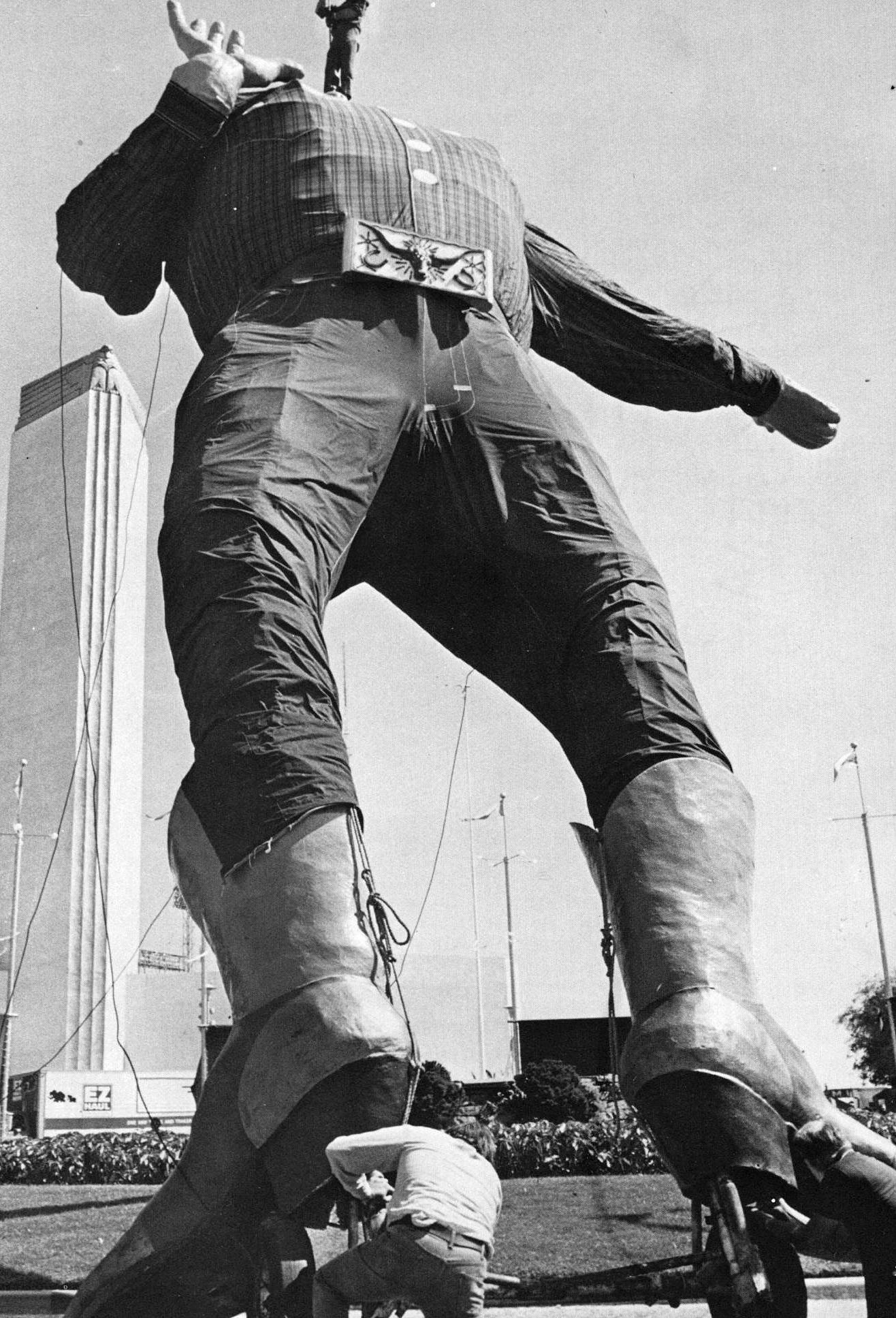
big-tex_headless_1970s
Headlessness and wardrobe malfunctions being attended to…

by Paula Bosse

It’ll probably all get straightened out in the end.

When I worked in a bookstore that had frequent visits by costumed characters for children’s events, we were told to make sure children never saw the characters without their costume heads because it might freak the kids out. If true, that photo above has the potential to scar some impressionable youngsters for life.

Above, Big Tex in dishabille.

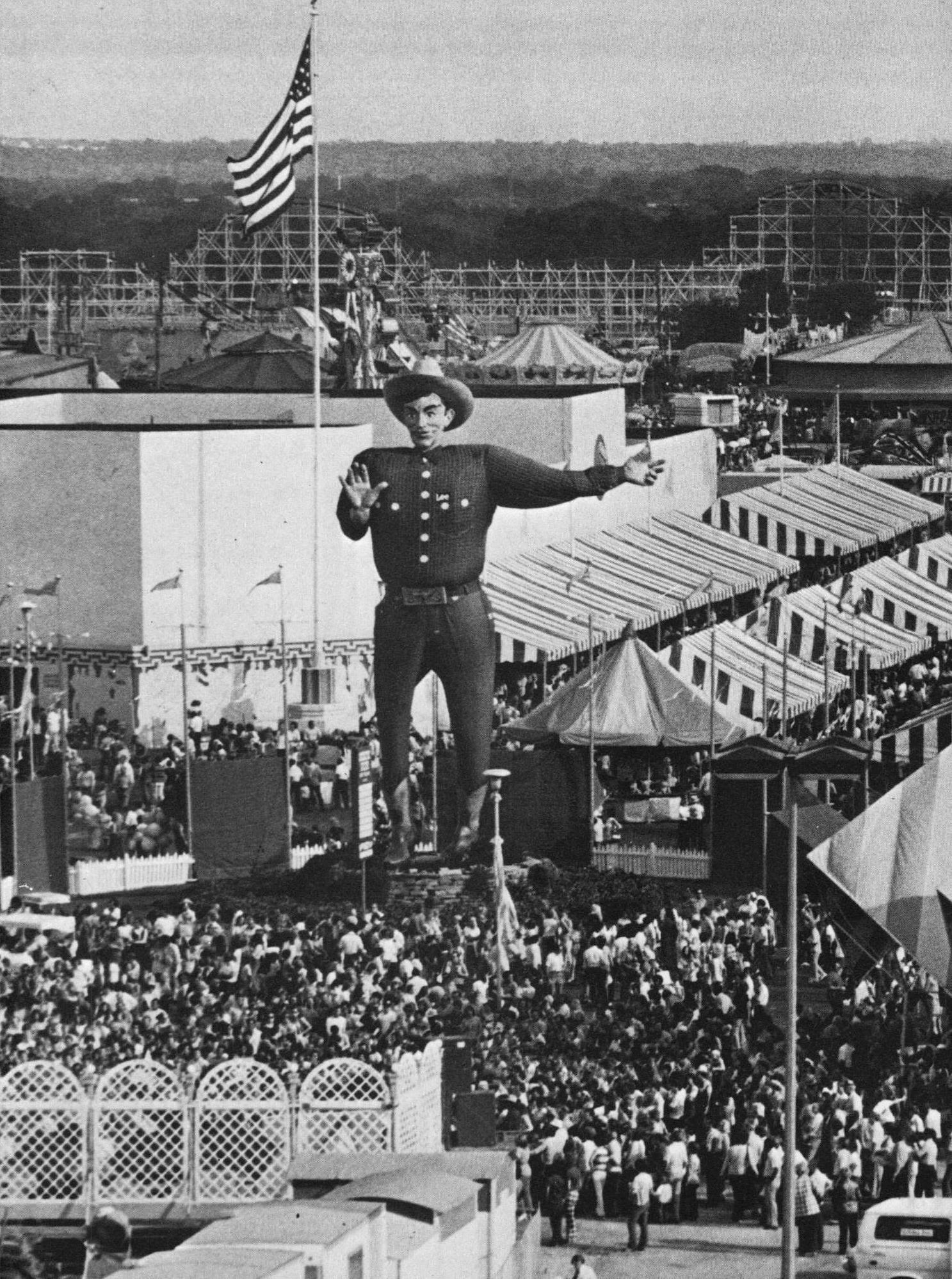
Below, all pulled together.

big-tex_tx-historian_sept1976-sm

***

Sources & Notes

Top photo of a headless Big Tex is from the Sept. 1976 issue of Texas Historian, a Texas State Historical Association publication of the Junior Historians of Texas.

Second photo, of a put-together Big Tex is a State Fair of Texas photo from the same issue of Texas Historian.

Click images to make Bit Tex REALLY big!

*

Copyright © 2014 Paula Bosse. All Rights Reserved.

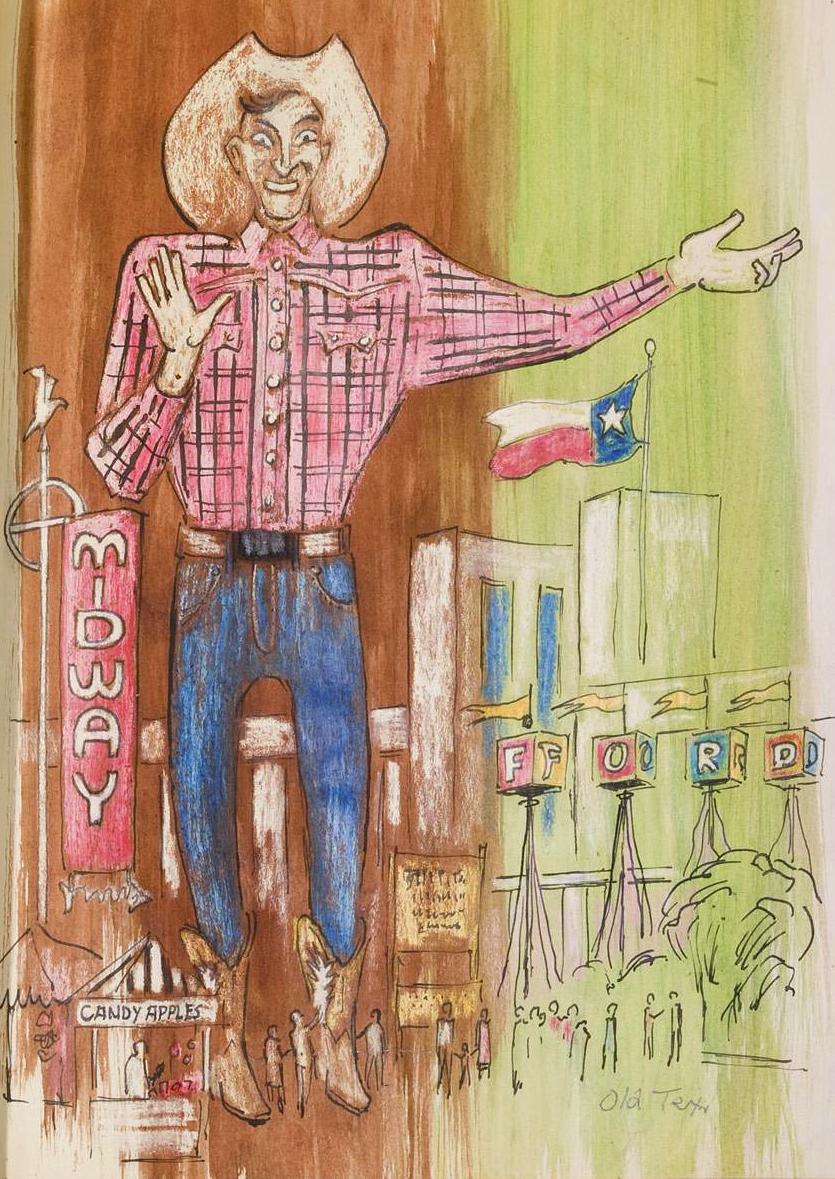
Big Tex, Old Tex, Big Ol’ Tex — Whatever You Call Him, Otis Dozier Wins (1954)

dozier_big-tex_sketchbook_1954_dma“Old Tex” sketch by Otis Dozier, 1954 — Dallas Museum of Art

© Marie Scott Miegel and Denni Davis Washburn

by Paula Bosse

Hey, y’all, guess what’s just around the corner. Whenever you start seeing pictures of Big Tex, you know that the State Fair of Texas can’t be too far away.

There have been a lot of artistic depictions of Big Tex over the years, but I think this sketch by Dallas artist Otis Dozier (1904-1987) may be my all-time favorite. And I’ve only just discovered it! (Thank you, DMA!)

***

This wonderful ink, watercolor, and crayon sketch of “Old Tex” is contained in one of Otis Dozier’s sketchbooks, now in the collection of the Dallas Museum of Art, a gift of the Dozier Foundation (© Marie Scott Miegel and Denni Davis Washburn). To see details on this work, see the page on the DMA’s website, here.

The Otis Dozier sketchbooks have been digitized in a joint project between the Dallas Museum of Art, SMU’s Bywaters Special Collections at the Hamon Arts Library, and SMU’s Norwick Center for Digital Services. To read about this fantastic collection, see the SMU Central University Libraries page, here.

*

This week, the Dallas Museum of Art launched a new digital database in which its entire collection is now accessible online! This is great news for many reasons, not least being that it allows the public to see works that are rarely — if ever — displayed in the museum. Such as this one. To read more about assembling this incredible database, read the DMA’s announcement, here.

To look up your favorite artist, check to see what the DMA has, here.

For the biography of the Forney-born Dozier (who was one of the members of the famed Dallas Nine group), see the Handbook of Texas entry here.

Click picture for larger image.

*

Copyright © 2014 Paula Bosse. All Rights Reserved.


Jim Conner, Not-So-Mild-Mannered RFD Mail Carrier

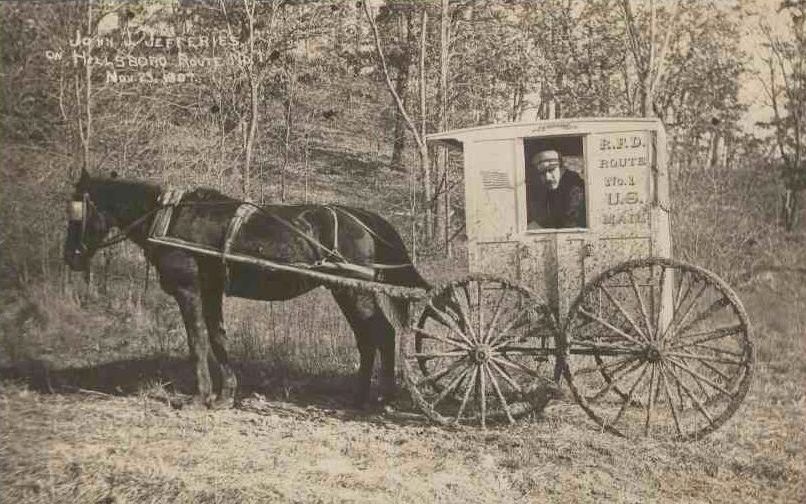
rfd_real-photo_1907-ebayAn RFD mail carrier… (click for larger image)

by Paula Bosse

The man in the photo below looks like every character actor working in Hollywood in the 1930s and ’40s.

conner-james-norton_mail-carrier_1940s

But he wasn’t an actor — he was a retired Dallas postal worker who began his career in 1901 as a rural mail carrier when the Rural Free Delivery (RFD) system was implemented in Dallas. (Before this, those who lived beyond the city limits — generally farmers — had to trek to a sometimes distant outpost — such as a general store — to pick up their mail.) RFD service began locally on October 1, 1901, and an 18-year old Jim Conner was one of six men hired to work the new mail routes beyond the city.

conner_FWregister_090101Fort Worth Register, Sept. 1, 1901

When Rural Free Delivery service began in Dallas, four rural post offices were closed: Lisbon, Wheatland, Five Mile, and Rawlins (the office at Bachman’s Branch, which Jim Conner’s route replaced).

In a 1940 interview with The Dallas Morning News, Conner talked about his early postal route (Route 5), which was 32 miles long; before the arrival of automobiles, he traveled on horseback, by horse cart, by buggy and cart, or by bicycle. The photo at the top shows what early RFD mail wagons looked like.

Jim’s route took him well beyond the city limits: out Cedar Springs to Cochran’s Chapel, to within a mile of Farmers Branch, and over to Webb’s Chapel by way of the “famous” Midway Church and School corner (which became Glad Acres Farm); he returned on Lemmon Avenue. It took him 8 hours if the weather was nice; if the weather was particularly bad, it could take 12 to 15 hours to complete his appointed rounds. He was paid $500 a year and was required to keep two horses, a cart, a buggy, and saddles. He retired in 1935.

**

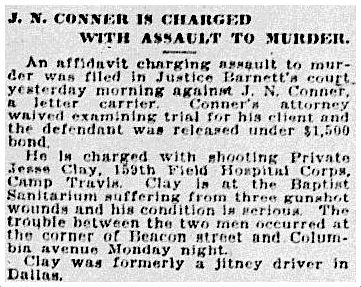
So. A delightfully nostalgic walk down memory lane with an avuncular-looking guy we all kind of feel we know. I thought I’d do a quick search to see if there was an obituary for Jim — there was: he died in 1956 at the age of 73, survived by his wife, 11 children (!), 22 grandchildren, and 3 great-grandchildren. But in addition to the obit, I found something else: a report of a shooting, an arrest, and a charge with “assault to murder.”

conner-charged_dmn_010218DMN, Jan. 2, 1918

What?!!

Though the account of the incident is described as being “somewhat vague,” on New Year’s Eve, 1918, Jim Conner shot a soldier named Jesse Clay after “words” were exchanged at the corner of Beacon and Columbia in Old East Dallas. There had been bad blood between the two in the past, and the New Year’s Eve situation apparently escalated quickly. Clay had been walking down the street with a lady-friend when Conner’s car came to a stop next to them. Clay (described as being drunk at the time) forced his way into the car, and Conner, fearful of being attacked, reached for a gun in the back seat. The two tussled and, after they were both out of the car, Conner saw that Clay also had a gun. This was when Conner shot him three times, intending, he said, to merely wound him. Clay shot back but missed. (The entire account, as it appeared in The Dallas Morning News on Jan. 1, 1918 can be read in a PDF here.)

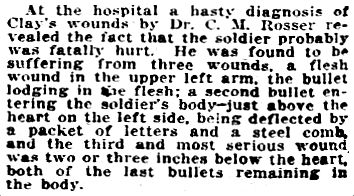
The soldier was badly injured, with two of the three shots hitting his chest. He was not expected to live. Conner had surrendered to police at the scene and was charged with “assault to murder.” The last report on this incident that I could find was on Jan. 3, in which Clay was described as being in “very critical condition.”

So what happened? As Conner spent a full career as a postal employee, it seems unlikely he was tried for murder. I used every possible combination of search words I could think of but found nothing more on this case. The story just disappeared. I did find a 1943 obituary for a Jesse P. Clay (killed while working on an Army Air Force Instructors School runway when he was struck by the wing of an airplane coming in for a landing), and it seems likely that it was the same guy — he was about the right age, he was a career military man, he lived in Dallas most of his life, and he was born in Kentucky. I assume the soldier in question (who would have been 37 at the time of the shooting) survived his gunshot wounds and that charges against Conner were either dismissed (with Conner pleading self-defense?) or settled (perhaps the military intervened to keep the story out of the press — this was during the height of WWI). Whatever actually happened, it seems that both men were able to move on from that really, really bad New Year’s Eve, a night I’m sure neither forgot.

My favorite little detail in the story of this sordid shooting was the line in the initial newspaper report in which it was revealed that one of the (potentially deadly) bullets was “deflected by a packet of letters and a steel comb.” How appropriate that the thing that probably saved mailman Jim Conner from a murder rap was “a packet of letters.” (…And a steel comb, but that doesn’t fit in with my narrative quite so well. Although Mr. Conner does look quite well-groomed.)

packet-of-letters_dmn_010118DMN, Jan. 1, 1918

***

Sources & Notes

Real-photo postcard of Hillsboro, Wisconsin RFD mail wagon is from eBay.

The full DMN account of the bizarre 1918 shooting can be read in a PDF, here.

An informative site on history of Rural Free Delivery — with lots of photos — can be found here.

“RFD”? Wiki’s on it, here.

*

Copyright © 2014 Paula Bosse. All Rights Reserved.


Lucy, Desi, Dallas — 1956

lucy-desi_fw_bellaircraftLucille Ball and Desi Arnaz and their loaner ‘copter from Bell Aircraft

by Paula Bosse

Lucille Ball and Desi Arnaz came to Dallas and Fort Worth in 1956 to promote their new movie, “Forever Darling.” Their arrival times were heavily publicized, and throngs of fans showed up to welcome them — in Dallas at Love Field, and in Fort Worth at the Western Hills Hotel. For those who might have missed their arrivals, they still had a chance to see the couple at one of the personal appearances scheduled at the theaters showing their movie (in Dallas at the Majestic on February 10th, and in Fort Worth at the Hollywood on the 11th). Crowds were large and enthusiastic, and everyone appears to have had a genuinely fun time, possibly even Lucy and Desi, whose relationship in those days was frequently a bit shaky.

Best of all was the tidbit about how the famous couple traveled from Dallas to Fort Worth: by helicopter.

Two television stars will be sailing around above Dallas skyscrapers Saturday. …Lucille Ball and Desi Arnaz will catch a helicopter ride from atop the Statler Hilton for a trip to Fort Worth. City Council officially sanctioned the ride at its Monday meeting. (Dallas Morning News, Feb. 7, 1956)

They left from the helipad atop the Statler Hilton and touched down at the helipad at the Western Hills Hotel in Fort Worth (hotels are nothing without helipads). There was some sort of cordial relationship between the Arnazes and the people at Bell Aircraft, because they availed themselves of this brand new deluxe chopper in New York as well as in DFW. When their promotional duties were finished, Lucy and Desi left Cowtown for California as guests of the president of the Santa Fe Railway — in his private car. Because that’s how you travel if you’re Hollywood royalty.

*

lucy-desi_dmn_020856-detFeb 8, 1956
*

lucy-desi_dmn_021156-photolucy-desi_dmn_021156-captionDMN, Feb. 11, 1956

(Leon Craker, I bet you had a great story about this for years after this momentous meeting.) 

*

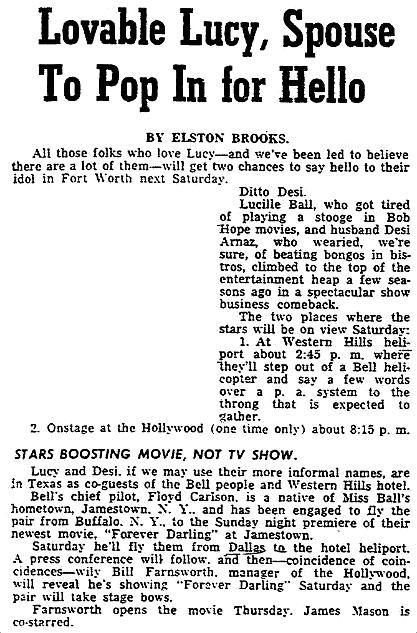
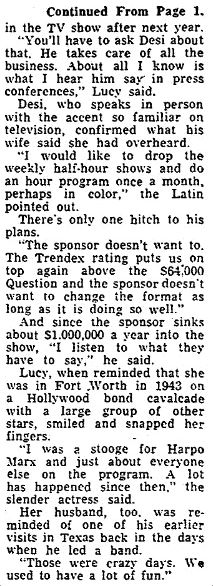
In Fort Worth, Elston Brooks (whose amusing articles I’ve really enjoyed discovering these past few months), seemed underwhelmed and a little annoyed at the prospect of  “lovable Lucy and spouse” invading the city (click articles to see larger images):

lucy-desi_FWST_020556Fort Worth Star-Telegram, Feb. 5, 1956
*

Elson Brooks may not have been very excited, but when Lucy and Desi stepped out of that helicopter, the Fort Worth crowd went wild (click text for larger image):

lucy-desi_FWST_021256-photo

lucy-desi_FWST_021256a

lucy-desi_FWST_021256bFWST, Feb. 12, 1956

*

And here they are back in Los Angeles, with Desi Jr., at the end of a busy promotional tour. Desi is proudly wearing the cowboy hat he’d been given in Fort Worth. And he looks damn good in it.

lucy-desi_dfw

***

Sources & Notes

Top photo of Lucy and Desi standing next to the 1956 Bell 47H-1 (“one of the world’s first executive helicopters”) is from the August 2012 issue of Vintage Aircraft Magazine; photo from Bell Aircraft. The article concerning this helicopter model is contained in a PDF here.

The bottom photo is from a Pinterest page, here.

UPDATE: I had originally identified the photo of Lucy and Desi with the train as having probably been taken in Fort Worth as they were about to depart for Hollywood, mainly because they’re wearing similar clothing from the FW appearance, but a rail historian noted that this photo was actually taken in California at the Los Angeles Union Passenger Terminal — he could tell because he recognized the part of the platform structure over their heads! (“I can name that song in TWO notes!”) The photo he directed me which shows the LAUPT platform (and, in fact, the same engine, two years earlier!), is here. They probably took the final photo for the Santa Fe company as thanks for providing them with transportation back home in the president’s private car. (Thanks, Skip!)

*

And because today is Lucille Ball’s birthday (which I know only because she shares a birthday with my aunt — happy birthday, Bettye Jo!), it seems like a good time to wheel out this strikingly beautiful portrait of Lucy, along with a wonderful photograph of her from about the same time (probably between 1928 and 1930).

lucilleballportrait

lucilleball-ca1930

*

Copyright © 2014 Paula Bosse. All Rights Reserved.


Margo Jones & Jim Beck: Both Legends in Their Fields, Both Victims of Carbon Tetrachloride

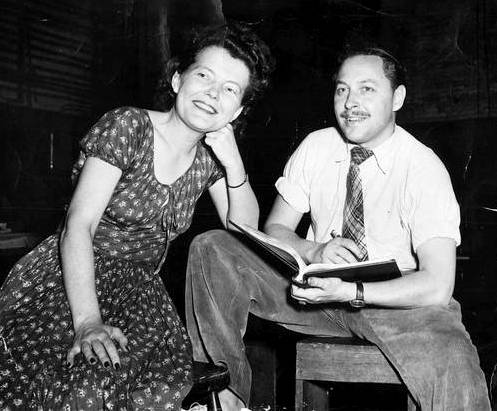
margo_tennessee
Margo Jones with Tennessee Williams

by Paula Bosse

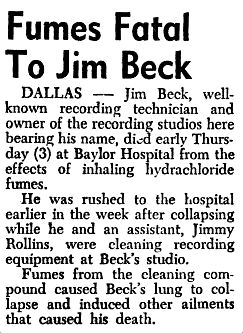
In reading about Dallas theater legend Margo Jones, I saw that she died from inhaling the lingering fumes of a cleaning agent that had been used to clean a rug in her apartment at the Stoneleigh Hotel: carbon tetrachloride. The only thing I knew about carbon tetrachloride was that it had also caused the early death of legendary recording engineer and producer Jim Beck (the man who discovered and produced the first records of Lefty Frizzell, Ray Price, et al.); Beck had been cleaning his recording equipment and had been overcome by the fumes. Both were rushed to the hospital when they were discovered unconscious, and both died about ten days later.

Margo Jones died on July 24, 1955, and Beck died less than a year later, on May 3, 1956. Jones was in her early 40s — Beck was only 39. Margo Jones was a creative powerhouse who was already revolutionizing regional theater, and Jim Beck’s enormous talent was the sole reason that Columbia Records was on the brink of moving their operations from Nashville to Dallas (a move that might very well have set the wheels in motion for Dallas to overtake Nashville as the nation’s recording center for country music). It is such a loss that both died so young,victims of something as mundane as cleaning fluid. With so much remarkable potential ahead of them, it’s sobering to imagine how different Dallas theater and the Dallas recording industry would be today had their careers lasted another two or three or four decades.

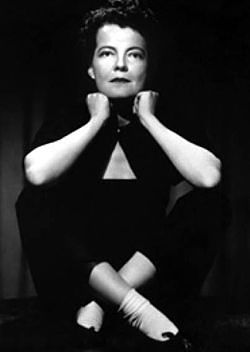
margo-jones-photo

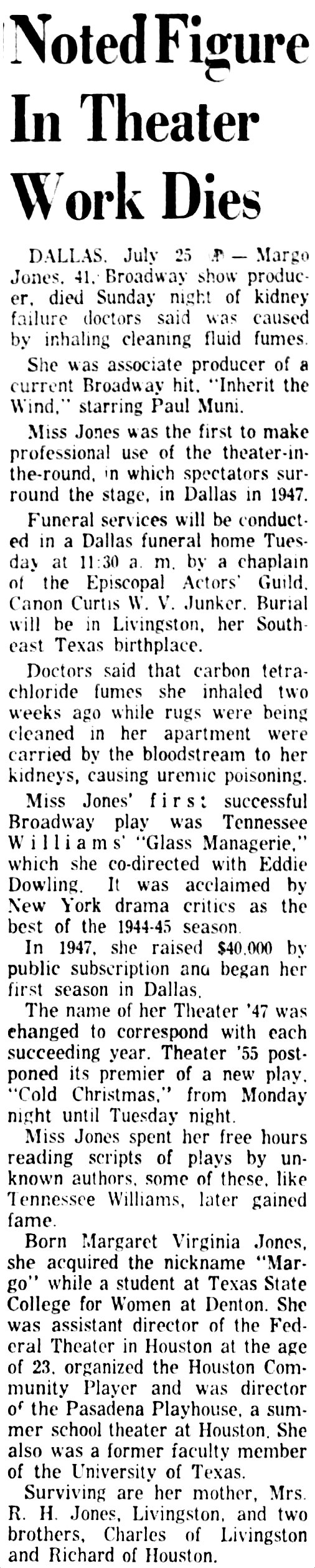
margo-jones_austin-american_072655_obitAustin American, July  26, 1955 (click to see larger image)

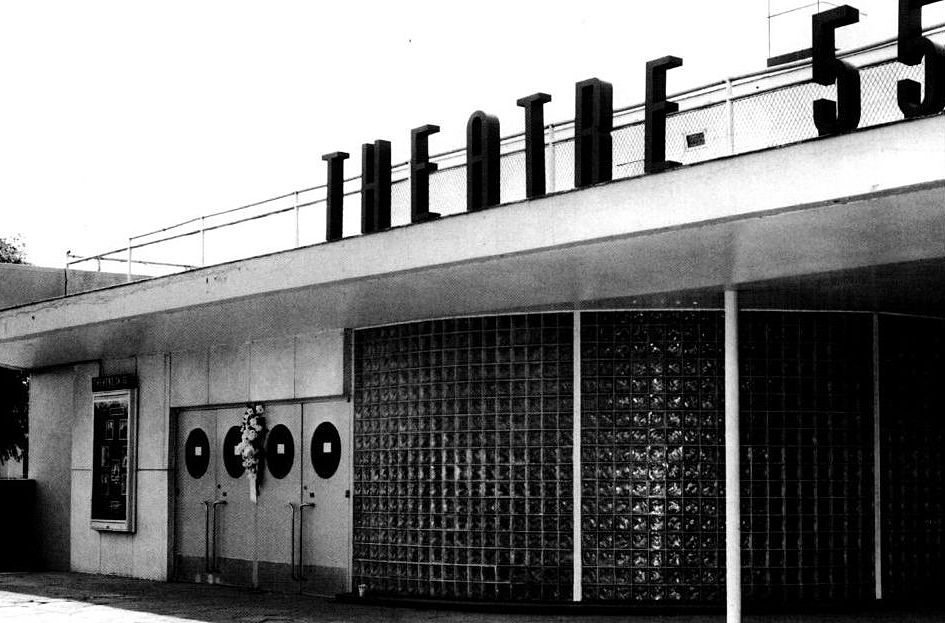
margo-jones_wreath_legacies_fall-2004Margo Jones’ Theatre ’55 with wreath on door (click for larger image)

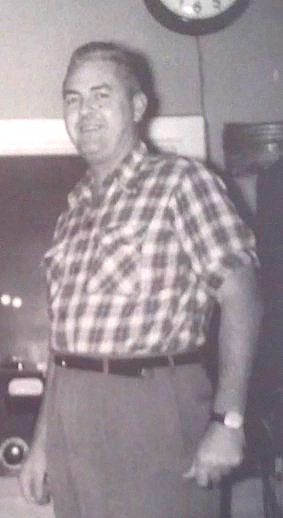
jim-beck_detJim Beck in his studio

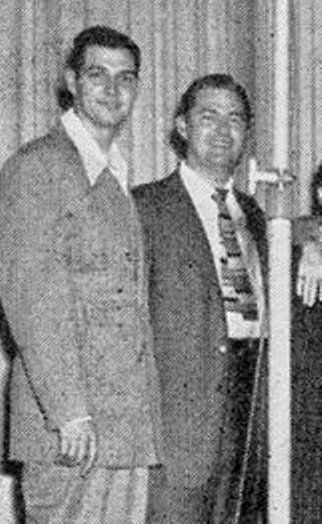
jim-beck_hank-thompson_liberty-jamboree_c1951-detJim Beck (right) with Hank Thompson

jim-beck_billboard_051256bBillboard, May 12, 1956

jim-beck-studio-logo

***

Sources & Notes

Photo of Theatre ’55 (formerly the Magnolia Lounge in Fair Park) with wreath is from the story “‘I’m Doing It, Darling!’ — Dallas, Margo Jones, and Inherit the Wind” by Kay Cattarulla (Legacies, Fall, 2004 issue), which can be read here.

First photo of Jim Beck (which has been cropped) is from the Bear Family CD box set “Lefty Frizzell: Life’s Like Poetry.”

Photo of Jim Beck and country recording star Hank Thompson is a (cropped) Liberty Jamboree promotional photo, circa 1951.

Jim Beck Studio logo from the Handbook of Texas entry for the recording industry in Texas, here.

Margo Jones is very important. Read why here.

Jim Beck is very important. Read why here.

A bit morbid, perhaps, but Margo Jones’ death certificate can be viewed here; Jim Beck’s death certificate, here.

And, finally … kids, stay away from that carbon tetrachloride. It’s bad stuff.

For my previous post “Lefty Frizzell: It All Began on Ross Avenue,” click here.

*

Copyright © 2014 Paula Bosse. All Rights Reserved.

Ernie Banks: From Booker T. Washington High School to the Baseball Hall of Fame to the Presidential Medal of Freedom

banks-ernie_jet_110355
Ernie Banks and George Allen, Oct. 1955 (Jet magazine)

by Paula Bosse

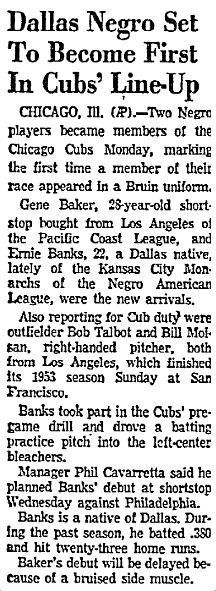
Ernie Banks, the baseball player so indelibly linked with Chicago that he is known as “Mr. Cub,” is a Dallas native whose professional career began when he was spotted by a Negro League scout while playing softball in a park near his high school, Booker T. Washington. He was recruited right away and made his mark almost immediately, and, in 1953, he and Gene Baker became the first African American players signed to the Chicago Cubs.

One of the sport’s most popular players, Banks, who began his career playing shortstop, routinely shattered home run records and was a perennial MVP and All-Star player. Even though his Cubs never made it to the World Series, Banks was a stand-out player, and his election to the Baseball Hall of Fame in 1977 came as no surprise. I have to admit, my knowledge of baseball is scant, but I love this man, and it’s a testament to “Mr. Cub” that he is as famous for his genuine nice-ness as he is for his undisputed skill as a player.

banks_dmn_091553AP, Sept. 15, 1953

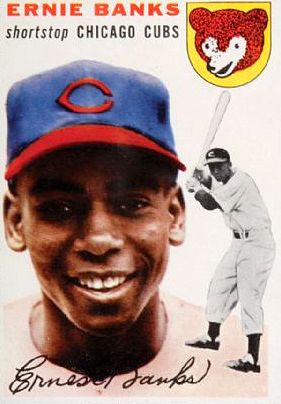
ernie-banks_rookieErnie Banks’ rookie card – Topps, 1954

ernie_banks

*

Oct. 11, 1955 was declared “Ernie Banks Day” in Dallas. Ernie was in town to play an exhibition game between the Major League Negro All Stars and the Negro American League All Stars (Ernie’s major leaguers won, 6-2) — while he was here, he enjoyed the hometown adulation and was lauded with gifts. The photo at the top of this post was from that day, as is the one below, in which he poses with his wife, Mollye Banks.

banks-ernie_wife-mollye-ector-banks_101155_patton-collection_DHSHometown hero, Oct. 11, 1955 (Dallas Historical Society)

***

Sources & Notes

Top photo from Jet magazine, Nov. 3, 1955; a version ran in The Dallas Morning News on Oct. 12, 1955 above the following caption: “Honors came thick and fast for Ernie Banks at Burnett Field Tuesday night. Appearing with a group of barnstorming Major League All Stars, Banks was presented a new Oldsmobile (background), a Texas style hat and scrolls and trophies. With Banks is George Allen, chairman of the citizens’ appreciation committee which presented the automobile. The mayor [R.L. Thornton] proclaimed Oct. 11 Ernie Banks Day in Dallas.”

The photo of Banks and his wife, Mollye Ector Banks, in Dallas is from the John Leslie Patton Jr. Papers, Dallas Historical Society (Object ID V.86.50.902).

Check out these articles from The Dallas Morning News archives:

  • “Banks to Tackle First — Reluctantly” by Bud Shrake (DMN, March 16, 1962) — with a few paragraphs on growing up in Dallas
  • “From Dallas to Cooperstown” by Randy Galloway (DMN, Jan. 20, 1977)

A nice overview of Ernie Banks’ career titled “Nice Guys Don’t Always Finish Last” by Steven Schmich (from his larger article titled “Five Dallas Athletes Who Made a Difference”) can be read in the Spring, 1994 issue of Legacies magazine here. (In fact, the entire issue of this Dallas history journal is devoted to sports and is available to read in its entirety, beginning here.)

Stats? I got yer stats, right here.

In November 2013, Ernie Banks was awarded the Presidential Medal of Freedom. A few short words from him after the ceremony say all that really needs to be said from this wonderful man — watch the short video here.

UPDATE: Sadly, Ernie Banks has died. He died Friday, January 23, 2015. He was 83. The New York Times obituary is here; the Chicago Tribune’s wonderful collection of tributes and photos is here.

*

Copyright © 2014 Paula Bosse. All Rights Reserved.

Wanted in Dallas: Refugee Children — 1940

refugee-children_rotarian_feb-1940

by Paula Bosse

In the summer of 1940, a group called The Children’s Evacuation Committee of Texas was organized to bring child refugees to Dallas, even if it meant sending a ship across the Atlantic Ocean to get them. Its chairman was local businessman George Edgley, a transplanted Briton who owned a music shop and performed around town as an actor and musician.

The group was formed in response to the heavily publicized plight of English children living under the constant threat of attack during World War II. The situation was of great international concern, and plans were drawn up to evacuate the children to safety. The United States had agencies working to bring some of the children to America, and communities around the country were organizing at a grassroots level.

George Edgley took up the cause in Dallas and was the driving force behind The Children’s Evacuation Committee of Texas. He worked day and night to sign up potential foster families, worked with American and British politicians and humanitarian relief agencies, and traveled to Washington, DC to petition for special immigration allowances. He even pleaded with Congress to authorize a special ship to carry children from the UK to the Texas Gulf.

Some Dallasites were adamant that only British children would be considered. One Briton living in Dallas made the following statement at an early meeting:

It’s the Anglo-Saxon race against the world, […] and we want Anglo-Saxon children brought over here  — not material for fifth columnists. We want English-speaking children. (Dallas Morning News, June 27, 1940)

Edgley disagreed vehemently, insisting that a humanitarian project such as the one under consideration should not be limited to British children.

Numerous Dallas families signed up to offer their homes to refugee children. Many were willing to take any child that needed a temporary home, and most were prepared to adopt the child should his or her parents be killed in the war. There was, though, this unsettling read-between-the-lines sentence in one of the reports in The Dallas Morning News:

A few stipulated that the children should be free of hereditary defects, should be from good families and of certain nationalities or have eyes or hair of certain color. (DMN, July 21, 1940)

A big supporter of this effort was Miss Ela Hockaday, who worked to get her school’s alumnae and patrons to offer their homes to the displaced children. She herself had adopted the children of British novelist Vera Brittain for the duration of the war.

After weeks of determined effort, though, the inability to find a way to safely transport children en masse from the UK became an insurmountable roadblock. The bureaucracy and logistics proved to be too big a hurdle. Edgley turned his attention to working one-on-one with Dallas families who agreed to be responsible for paying the transportation costs of a child and providing for all of his or her needs until the war’s end. It would cost a local family a substantial $188 to assure a child’s privately-arranged temporary adoption (equivalent in today’s money to just over $2,200).

I’m not sure how many children found shelter from the war in Dallas, but the tireless efforts of George Edgley on their behalf are to be admired.

***

Sources & Notes

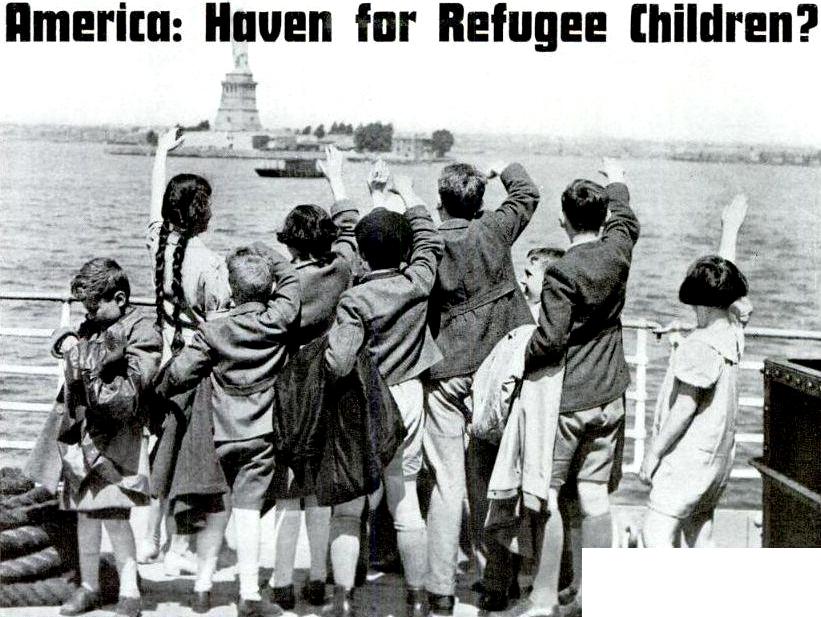
Top photo and headline “America: Haven for Refugee Children?” from the February, 1940 issue of The Rotarian. You can read the magazine’s take on the issue here.

If you would like more information on George Edgley’s campaign to relocate refugee children from war-torn England, please contact me.

The Life magazine story “U.S. Opens Its Homes and Heart to Refugee Children of England” (July 22, 1940), can be found here.

Some background on the evacuation of British children during World War II can be found here and here.

*

Copyright © 2014 Paula Bosse. All Rights Reserved.


Michael G. Owen, Jr. — Dallas Sculptor of Lead Belly

leadbelly_three-views_paul-l_yelp

by Paula Bosse

Above, three views of “Leadbelly,” the sculpted head of the blues legend, by Michael G. Owen, Jr., 1943.

Michael Owen (profiled here previously as the 15-year-old soap-sculptor who made headlines at the 1930 State Fair of Texas), was the youngest member of the group of artists loosely affiliated with the Dallas Nine group who were making a name for themselves in the 1930s and ’40s. He studied life drawing as a student of Olin Travis and painting as a student of Jerry Bywaters, but he was most proficient as a sculptor. He is best known for his award-winning 1943 bust of bluesman Lead Belly, a piece in the permanent collection of the Dallas Museum of Art (which can be seen in a 1951 DMFA catalog here).

In a 1950 letter to the (then-) Dallas Museum of Fine Arts, Owen recounted how Lead Belly sat for him in New York and sang “Goodnight Irene” as Owen worked on a clay model. Owen was living in Greenbelt, Maryland at the time, and Louisiana-born Lead Belly was living in New York City, but I’d like to think that the two men reminisced about their formative days in Dallas where Owen was a much-talked-about young artist and Lead Belly performed on the streets of Deep Ellum with Blind Lemon Jefferson.

I noticed in the newspaper article that the stone was called black Belgian marble. Actually it isn’t so exotic. It was quarried not far from Charlottesville, Virginia, and is called Black Serpentine. It was the first time I have ever heard of the stuff being black. If you’ll notice it seems quite a bit more crystalline than marble.

The way I happened to do the head went like this. A young fellow I had known in Dallas by the name of Ralph Knight had gone to New York a year or so after I went to Washington. He was interested in folk music and became acquainted with Leadbelly. It was at Ralph’s instigation that I did the head — he got me the stone, sent pictures (I first roughed out the head in clay at home in Greenbelt) and then arranged the sitting at his apartment in New York. Leadbelly sat for me one afternoon and I finished the clay model at that time. From that I worked out the stone cutting, only being able to work on it in my spare time. All in all it was about a full month’s work, I guess. During the time he was “sitting” for me (playing his guitar and singing) he played “Goodnight Irene,” but at that time the folk music devotees did not consider the tune “true folk music.” Still it pleased me when it became a popular song. It’s too bad Leadbelly couldn’t have lived to see himself gain such popularity. (Mike Owen in 1950, from a letter excerpted in the book Lone Star Regionalism, The Dallas Nine and Their Circle)

Sadly, Mike Owen’s career stalled soon after this 1940s artistic high point. He eventually settled in Oregon, where he was sidelined by multiple sclerosis. He died in 1976 at the age of 60.

owen-michael_1930s
Mike Owen in his early 20s

I’m not sure how often the piece is displayed at the Dallas Museum of Art, but it’s a wonderful work of art. When I saw it a couple of years ago, I just stood and stared at it for ages. It’s really fantastic. And it’s fitting that it resides here in Dallas where Michael Owen was once a part of a group of Texas artists whose influence continues to be felt today.

It also seems fitting to throw in this classic from Mr. Ledbetter, who, like Mike Owen, spent time honing his craft in Dallas:

lead-belly-wikipedia

***

Sources & Notes

“Leadbelly” sculpture by Michael G. Owen, Jr. is in the collection of the Dallas Museum of Art.

Photo of the artwork is by Paul L. as posted on Yelp.

Photo of Lead Belly from Wikipedia.

Quote from Mike Owen’s letter to the DMFA (April 11, 1950) can be found in the superb book Lone Star Regionalism, The Dallas Nine and Their Circle, 1928-1945 by Rick Stewart (Austin: Texas Monthly Press, Dallas Museum of Art, 1985) — the best book on Dallas art of this period.

Read the Handbook of Texas entry about Huddie Ledbetter (aka Lead Belly/Leadbelly) here.

Other Flashback Dallas posts on Owen:

  • Young Mr. Owen’s star-turn as the teenager who carved the WFAA transmitter plant from 8,400 pounds of Ivory Soap is here.
  • Owen’s monument to SMU Mustangs’ mascot Peruna, commissioned in 1937, is here.

UPDATE: Read about a recently discovered large painting by Owen up for auction in Dallas in 2019 here.

*

Copyright © 2014 Paula Bosse. All Rights Reserved.


Dallas in 1879 — Not a Good Time to Be Mayor

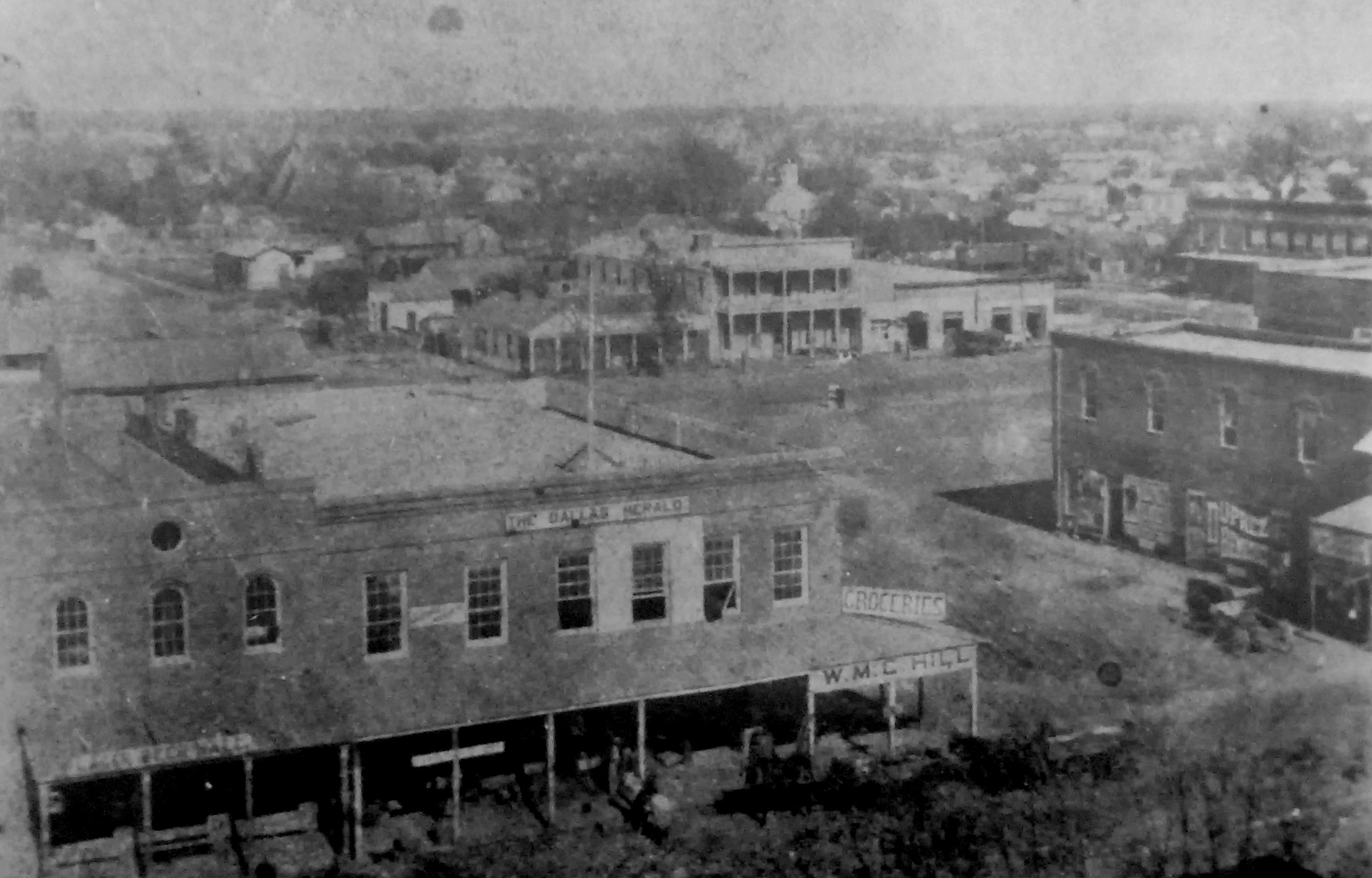
main-jefferson_1879_greeneA view from the courthouse, looking north (click for larger image)

by Paula Bosse

Above, a view of Dallas in 1879, looking north from the courthouse (one of many in the city’s past that eventually burned down); the intersection in the right foreground is Main and Jefferson (now Record Street).

This is such a cool photo that, on a whim, I checked to see what exciting things might have happened in Dallas in 1879. I found that the city’s voters had just elected a new mayor, James M. Thurmond, who had run on an “independent reform and morality ticket.” Yawn. On the surface, that hardly seemed very interesting — a  historical fact, yes, but not all that exciting. But, wait, there’s more to the story.

Thurmond’s post-election honeymoon was short-lived because, even though he had won a second (one-year) term, he had made some serious enemies in his first term. He was removed from office in 1880 by the city council in a lack-of-confidence vote, the result of a nasty trial and probably slanderous accusations by lawyer Robert E. Cowart.

The feud between Thurmond and Cowart grew more and more bitter as time passed, and on March 14, 1882 — moments after the two men had exchanged angry words in Judge Thurmond’s courtroom — Cowart shot and killed Thurmond. Witnesses described the shooting as an act of self-defense. They said that Cowart shot when the judge reached for his pistol. (For an incredibly gruesome account of this incident, the contemporary newspaper report is linked below.)

The photograph above was taken from the courthouse where this shooting took place. When the photograph was taken in 1879, the animosity between the new mayor and an unhappy lawyer had already begun to percolate. I suppose men with “Esq.” after their names in the 1880s were predisposed to shoot-outs indoors in well-appointed courtrooms rather than out in the dusty streets at high noon. It’s classier.

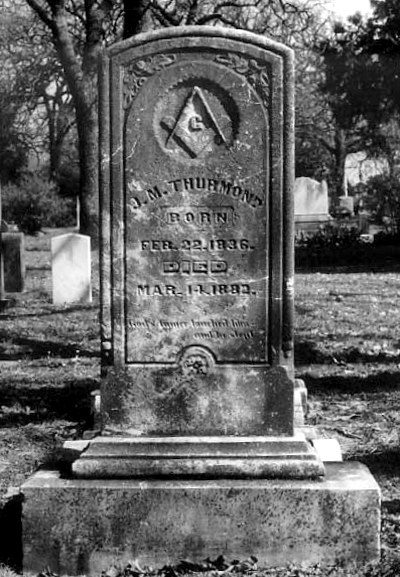
thurmond_headstone_greenwood-cemetery_findagraveGreenwood Cemetery, Dallas (photo: David N. Lotz)

***

Top photo is from Dallas, The Deciding Years — A Historical Portrait by A. C. Greene. (Austin: The Encino Press for Sanger-Harris, 1973); photo is from the collection of the Dallas Public Library.

Photo of J. M. Thurmond’s headstone in Greenwood Cemetery is from Find A Grave, here. Cowart — who died in 1924 — is buried in a nearby plot in the same cemetery. (Incidentally, Cowart’s claim to fame — other than shooting a judge in his own courtroom — appears to be that he was the person who inadvertently came up with Fort Worth’s nickname, “Panther City” when he wrote a tongue-in-cheek newspaper article about Fort Worth in 1875. Read a great history of this amusing kerfuffle in Hometown by Handlebar’s post, here — scroll to the second story.)

For an interesting contemporary report of the shooting — including gruesome eyewitness accounts — check out the article from the March 15, 1882 edition of The Dallas Herald (under the headline “The Deadly Pistol”), here, via the Portal to Texas History.

A short background on the Thurmond-Cowart feud, from the WPA Dallas Guide and History (which includes the verdicts of Cowart’s two trials for murder), can be read here.

Click top photograph for HUGE image.

*

Copyright © 2014 Paula Bosse. All Rights Reserved.

A Lost Photo of Director Larry Buchanan, Celebrated “Schlockmeister” — 1955

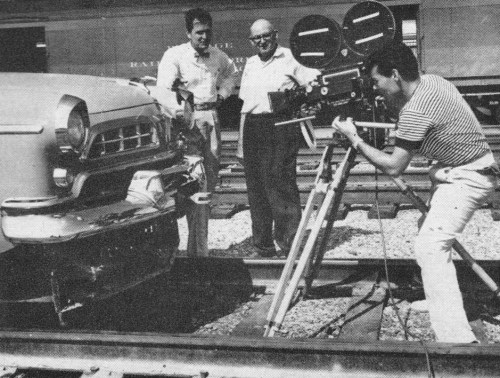
buchanan-katy-camera_1955_bwLarry Buchanan (in bowtie) in his ad-man days, 1955

by Paula Bosse

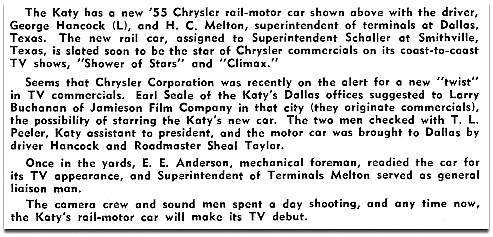
I got all excited when I saw the above photo posted in the Lone Star Library Annex Facebook group. It accompanied an article and another photo from the Katy Employes’ Magazine (August, 1955) (seen below) — the poster was interested in the railroad-angle of the article and photos, but the name “Larry Buchanan” was what grabbed my attention.
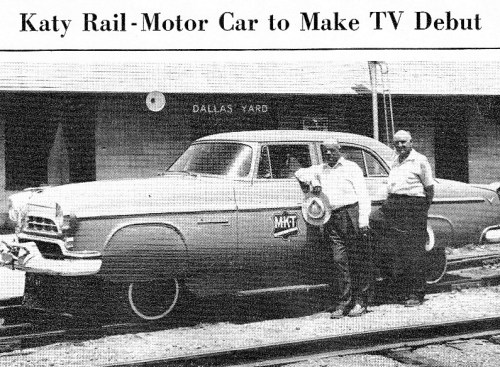
buchanan_katy-chrysler

buchanan_katy-text

The photo was posted because it was a wonderful piece of M-K-T Railroad-related ephemera. Before reading the accompanying text, I thought that the idea of a 1955 Chrysler tricked-out to ride along Katy railroad tracks (so that M-K-T officials could, presumably, ride the rails in comfortable air-conditioned splendor as they moved from one inspection site to the next) was the cool thing about the article. Then I got to the name “Larry Buchanan.” And it became much, MUCH more interesting.

So who is Larry Buchanan? Briefly, Larry Buchanan is one of the greatest exponents of grade-Z, low-low-low-LOW-budget filmmaking, a director with a cult following amongst those who enjoy movies in the “so-bad-they’re-good” genre. He shot most of his movies in the 1960s in Dallas, taking advantage of lots of locations around the city, even if the movies he was shooting weren’t actually set in Dallas (one movie had Highland Park Village standing in for Italy, and “Mars Needs Women” was set in Houston, even though the movie is crammed full of easily recognizable Dallas locations such as the downtown skyline and the Cotton Bowl). The movies that have earned him his place in the pantheon of cult figures are primarily his sci-fi movies, like “Mars Needs Women,” “Attack of the Eye People,” “Curse of the Swamp Creature,” and “Zontar: The Thing from Venus.” Many were re-makes of earlier low-budget sci-fi movies commissioned by American International Pictures, and Buchanan was usually the producer, director, writer, and editor — “auteur” seems like the wrong word to use here, but that’s what he was, a filmmaker intensely involved with every phase of the production.

Buchanan was born in 1923 and grew up in Buckner Orphans Home. After a fleeting thought of becoming a minister, Buchanan — long-fascinated by movies — left for Hollywood and New York where he worked as an actor in small roles or on the crew (during this time there were professional brushes with, of all people, George Cukor and Stanley Kubrick). By the early 1950s, Buchanan was back in Dallas, employed by the Jamieson Film Company (3825 Bryan St.), working on industrial films, training films, television programs, and commercials. It was at Jamieson that he learned all aspects of film production, including how to get things done quickly and how to bring projects in under budget. It’s also where he met co-workers Brownie Brownrigg, Robert B. Alcott, Bob Jessup, and Bill Stokes, all of whom went on to have film careers of their own and most of whom Buchanan used as crew members when shooting in and around the city.

It was during this period that the photo above was taken. There are countless websites out there devoted to Larry Buchanan’s film oeuvre, but there are very, very few photos of him online. I found exactly three:

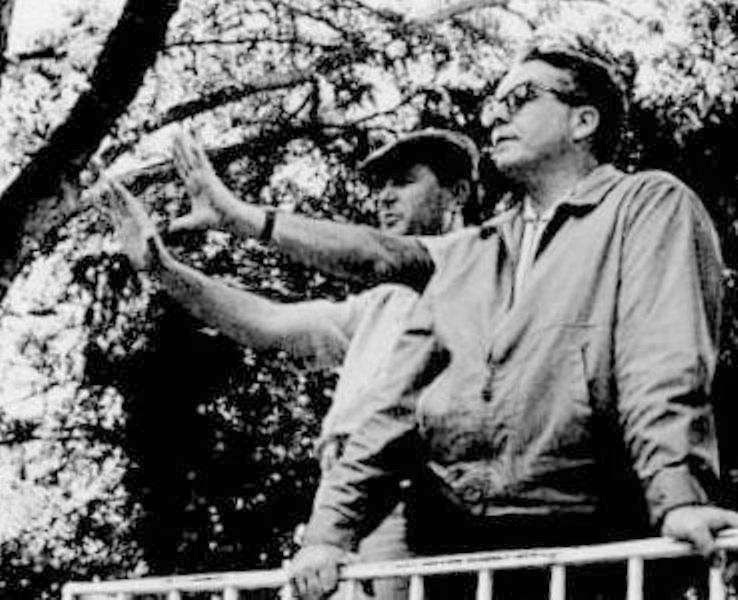
larry-buchanan_bob-jessup_texas-monthly_lgLarry (left) with cinematographer Bob Jessup

larry-buchanan_tx-monthly_may-1986-photo_detIn 1986 (Tim Boole/Texas Monthly)

larry-buchananDate unknown

The photo at the top of this post is from 1955, before Buchanan had really begun cranking out his own movies. I can’t say for sure that this IS a photograph of Larry Buchanan, but it seems likely that it is. In that striped shirt, he looks like the kind of hip, energetic, ever-enthusiastic director I imagine him being. I can only hope that it IS him, straddling railroad ties, behind a camera pointed at a retrofitted Chrysler, in Dallas’ Katy railyard. One wonders if that Chrysler spot had a higher budget than some of the movies he was making ten years later. UPDATE: In the comments, below, Larry’s son Barry identifies his father in the top photo, but not as the man behind the camera, but as the man behind the car, wearing the bowtie. Thanks for the correction, Barry1)

From all reports, Larry was a tireless, driven, upbeat guy who loved making movies, and I think it would have been a lot of fun hanging out with him. If I ever have enough disposable income, I’ll fork it over and buy a copy of his entertaining-but-pricey autobiography, the well-received It Came From Hunger: Tales of a Cinema Schlockmeister (McFarland & Co., 1996).

It’s been fun researching Larry Buchanan. There’s a lot more to tackle later. I mean, I haven’t even touched on the legendary “Naughty Dallas” yet!

***

Tons of links here….

First two photos and text from the Katy Employes’ Magazine (Aug. 1955).

buchanan-cover_sm

Katy magazine scans made with permission of the Facebook page Lone Star Library Annex.

Other examples of automobiles equipped with “railroad wheels” can be found here.

Black and white photo of Buchanan with Bob Jessup (photographer and date unknown) and the great color photo (a detail of which is shown above) by Tim Boole, both from the article, “How Bad Were They?” by Douglass St. Clair Smith (Texas Monthly, May 1986), which you can read here.

That last photo of Buchanan is all over the internet — the only one you ever really see. I don’t know who took it, when it was taken, or where it originally appeared. But it’s a great photo!

Larry Buchanan died in December, 2004, at the age of 81. His obituary from The New York Times is here.

A fond look back at Buchanan’s career by Eric Celeste appeared in the April 2005 issue of D Magazine and can be read here.

The best piece on Buchanan is “A Tribute to Larry Buchanan” by his good friend Greg Goodsell, here.

My recent post on “Mars Needs Women” — with screen caps of movie scenes shot at recognizable Dallas locations — is here.

I never did find that Chrysler spot that had been slated to appear on network TV. I have a feeling it may be in a lengthy collection of Chrysler commercials and films from 1955 which you can watch here. I couldn’t slog all the way through it, but there are a couple of “Shower of Stars” episodes, which are mentioned in the Katy article (they’re odd “entertainment” shows which seem to be nothing more than infomercials for Chrysler starring famous people in bad sketches). If anyone actually finds footage that was filmed that day in Dallas, please let me know!

And, lastly, Larry Buchanan’s movies are fun, but some are more fun than others, “if you know what I mean, and I think you do” (as Joe Bob Briggs — surely one of Larry’s biggest admirers — might say). Many of them are available to watch in their entirety online. Check YouTube and Google.

Click photos for larger images!

*

Copyright © 2014 Paula Bosse. All Rights Reserved.