Flashback : Dallas

A Miscellany: History, Ads, Pop Culture

Category: Local Personalities

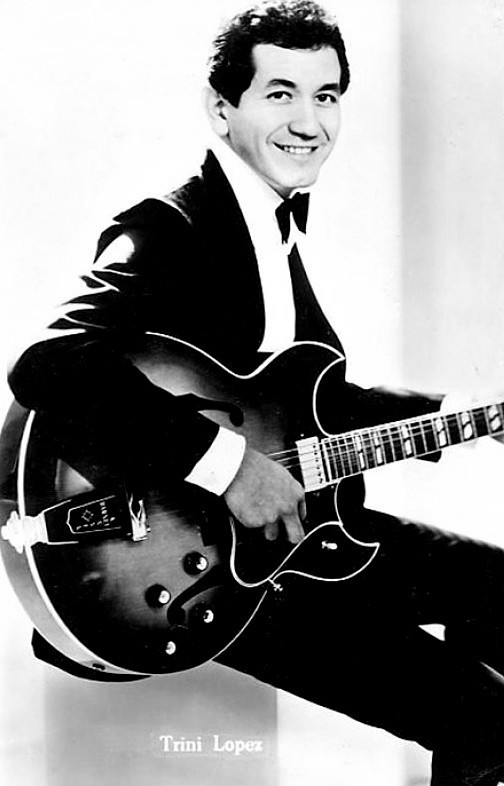
Trini Lopez: Little Mexico’s Greatest Export
trini-lopez-photo_bw

by Paula Bosse

Trini Lopez has sold millions of records. MILLIONS. He was born in Dallas in 1937 and grew up in the Little Mexico area of town. He started his career when he was a teenager at Crozier Tech High School, singing and playing guitar in a popular combo. He played at dozens of school dances and parties, and, with a steady and faithful following, he was much in demand at countless venues around town, including a regular 2:30-6:30 p.m. Sunday matinee spot at Club Vegas (Oak Lawn & Lemmon), one of the many clubs in the city run by Jack Ruby.

Jack Ruby — the personable Latin from Manhattan, reports surprising success with his Sunday night Fiestas at Club Vegas….

“There is a wide demand for Latin music in Dallas,” said the Oak Lawn impresario…. He is opening at 2:30 p.m. Sundays for matinee dances featuring Trini Lopez and his orchestra. The versatile Lopez combo offers an occasional Yanqui tune in addition to the likes of the “Jack Ruby Mambo.” (Tony Zoppi’s column in The Dallas Morning News, Dec. 19, 1956)

(I really want to hear that “Jack Ruby Mambo”!)

Speaking of the “Latin from Manhattan” (?!):
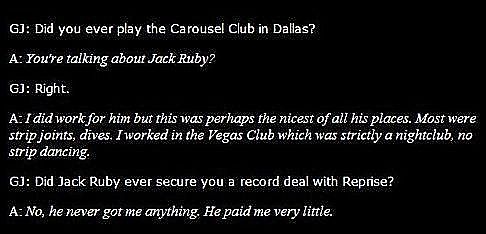
trini-rubyHa! (From Gary James’ really great interview w/ Trini — see link at end.)

He also appeared on local TV, including Channel 8 shows hosted by a pre-Peppermint Jerry Haynes: “Jukebox” and “Top Ten Dancing Party.”
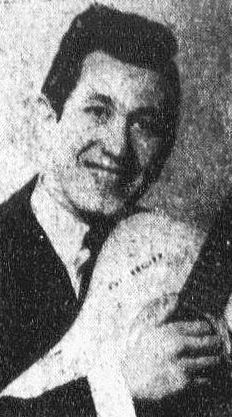
trini-lopez_19581958 publicity photo

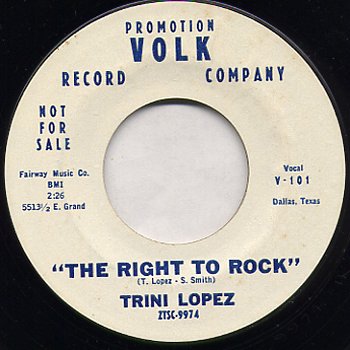
Trini’s first single was “The Right to Rock” — the first song he ever wrote — recorded in 1958 on a small Dallas label called Volk (did anyone else ever record for this label?).
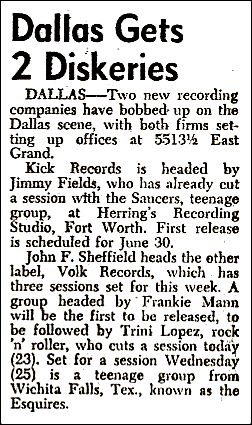
trini_volk_billboard_062358Billboard, June 23, 1958

It’s a great little rockabilly number, but it didn’t really make any waves outside of Dallas (although it’s since found new life in the cult-y world of vintage rockabilly reissues).

volk-label

Trini then recorded a few singles for King, but those went nowhere as well, and Trini and his combo continued to play small clubs in and around DFW, wondering when the big break was going to come.
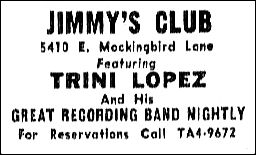
trini-lopez_jimmys-club_dmn_011159Jan., 1959

After a gig in Wichita Falls, Trini met fellow-Texan Buddy Holly who had been impressed by the young singer’s performance and encouraged him to contact his producer, Norman Petty, about recording some tracks at Petty’s studio in New Mexico. Trini jumped at the chance, but, unfortunately, the time in the studio at Clovis turned out to be a career low-point (see below for a link to the Gary James interview in which Trini gives a bitter and scathing account of that whole experience). Trini returned to Dallas and immediately fired his band and started a new one, determined that he would succeed, despite the prevailing (spoken and unspoken) racism he was continuing to run up against in the music business.

A few months after Buddy Holly’s death, the Crickets contacted Trini and asked him to travel to Los Angeles to discuss the possibility of becoming their new lead singer. Trini, seeing this as the big break he’d been waiting for, disbanded the combo and set out to the West Coast alone. The “audition” never really materialized, and Trini was stuck in California with no money and no prospects. He played a few small clubs and then settled into PJ’s for an extended and very successful engagement. It was there, in 1963, that the “big break” finally happened: he was discovered by producer Don Costa, who recommended that Frank Sinatra sign him to Reprise Records. Next thing you know, Trini had recorded his debut album, “Trini Lopez at PJ’s,” and the first single, “If I Had a Hammer,” was a huge smash hit, selling millions of copies and reaching #1 in 38 countries. Trini Lopez became an international star.
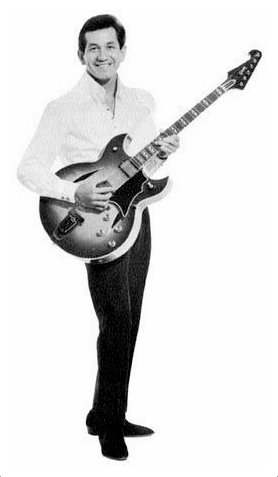
trini-lopez_photo_bw

At the beginning of 1964, he was booked for a series of shows in Paris where he shared the bill with The Beatles, just as they were about to hit big in the US (their Ed Sullivan appearance was less than a month away). Beatlemania was in full force in Europe, but Trini was also getting his share of attention. 
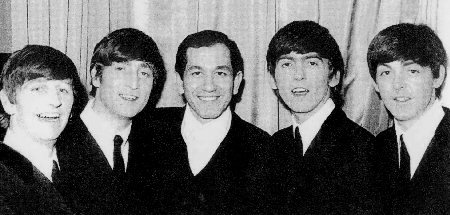
trini-lopez_beatles_1964

And, the rest, as they say, is history.

*

A couple of interesting things, Dallas-wise. My Trini Lopez knowledge is fairly scant, but having read a lot about him over the past couple of days, the one thing that keeps coming back when he talks about the Little Mexico section of town (invariably referred to by him as a “ghetto”) is how violent a place it was. He also recounts the deep and dehumanizing racial prejudice he and other Mexican-Americans experienced living in Dallas. When he left for Los Angeles in 1959/1960, he left for good. He came back regularly to visit his family (I remember having him pointed out to me by my parents in a restaurant once), but I’m not sure he would have ever wanted to live here again.
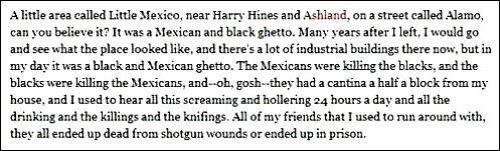
trini-lopez_wilonsky_052906From an interview by Robert Wilonsky (Dallas Observer, May 29, 2006)

*

Below are a few random interviews and tidbits.

Trini developed his own beat, a Tex-Mex style of rock and roll now popularly known as “the Trini beat” and which Trini describes as “American music with a Mexican feeing.” (DMN, July 12, 1964)

And from the same article:

“People in Dallas told me I had the talent but suggested I change my name. I said ‘No.’ I told them Italians had made it as Italians, Jews as Jews, and Negroes as Negroes. I wanted to make it as a Mexican. No one of Mexican-American heritage had made it before in the entertainment world. I wanted to be the first.” (DMN, July 12, 1964)

(According to Trini, the person who suggested he change he name was John F. Sheffield who owned Volk Records. Sheffield was okay with “Trini,” but he insisted the “Lopez” had to go. He suggested “Roper.” Trini refused and threatened to walk. Sheffield relented.)

trini-lopez_earl-wilson_july-1965a(Click for larger image – continues below.)

trini-lopez_earl-wilson_july_1965bEarl Wilson’s syndicated column (July 1965)

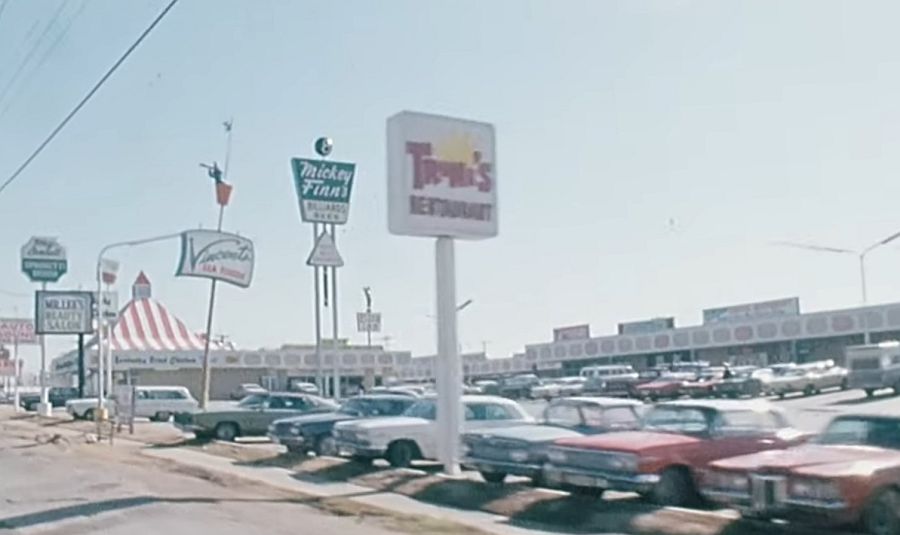
In 1969, Trini Lopez became a restaurateur and opened “Trini’s” at 5412 East Mockingbird, across from the old Dr Pepper plant (click for larger image):
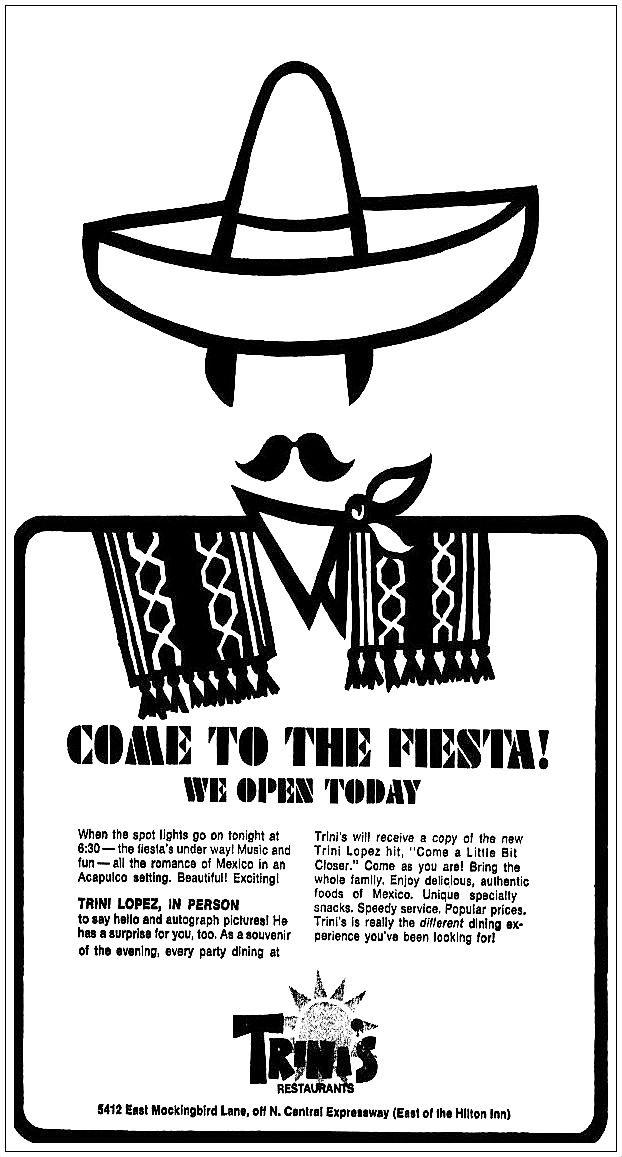
trinis_restaurant_031969
March, 1969

trinis_sightseeing-film_KERA_1970_jones-film_SMU - croppedScreenshot, KERA, 1970 (Jones Film Collection, SMU)

**

UPDATE: Sadly, Trini Lopez died on April 11, 2020 from complications of COVID-19. He was 83. Read his obituary in Variety here

***

Sources & Notes

Full Dallas Observer interview by Robert Wilonsky is here.

There are a lot of garbled accounts of Trini Lopez’s career scattered across the internet. One that seems mostly right is here.

The essential  interview with Trini by Gary James I’ve mentioned a couple of times above, is here. I think the interview is from 2002. His memories of growing up in Dallas are interesting, unvarnished, and well worth reading. He also talks about the racial prejudice he met with when attempting to record with Norman Petty and the resulting mutiny of his band in Clovis which led to their being fired by Trini immediately upon their return to Dallas.

Read Trini’s tribute to his parents — an essay he wrote in the early 1980s — here

Trini Lopez’s official website is here.

Discovering Trini and his music has been surprisingly fun! Thanks, Trini! Check out this great, infectiously joyful performance of “La Bamba” with Jose Feliciano at a music festival in San Antonio in 1974. (Trini was performing “La Bamba” when he was still in Dallas, before Ritchie Valens had a hit with it — when Valens’ version hit the airwaves, Trini was crushed that someone had beaten him to recording it. He may not have recorded it first, but he had the bigger hit with it a few years later.)

*

Copyright © 2014 Paula Bosse. All Rights Reserved.

Nardis of Dallas: The Fashion Connection Between “The Dick Van Dyke Show” and the Kennedy Assassination

by Paula Bosse

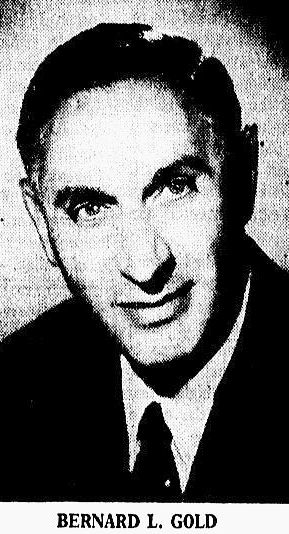
I started watching reruns of The Dick Van Dyke Show on Channel 11 when I was a kid. I still love the show, and I’ve seen every episode countless times. Which is kind of an odd jumping-off point for a post on a Dallas clothing manufacturer, but there you are. The company was Nardis of Dallas, a successful manufacturer of women’s apparel, owned by the Russian-born Bernard “Ben” Gold who arrived here in 1938 from New York City where he had operated a taxi company for many years.

Gold moved to Dallas at the request of his brother who, along with a man named Joe Sidran (“Sidran” spelled backwards is “Nardis”) was an owner in a near-bankrupt dress company. Ben Gold became a part-owner (and later the sole owner) and quickly turned the business around. When he brought in the International Ladies’ Garment Workers’ Union, other Dallas garment manufacturers were shocked (Time magazine used the word “horrified”). He also shook things up by employing African-American workers, the first such company in town to do so. The company eventually grew to become the largest clothing manufacturer in Dallas, with clients around the country and around the world. Nardis was one of the first Dallas clothing companies to have an apparel collection made in a foreign country: his upscale “House of Gold” boutique line specialized in silk, beaded, and sequined dresses and gowns, hand-made in Hong Kong.

Nardis of Dallas was originally located at 409 Browder, with factories at 211 North Austin, the 400 block of S. Poydras (at Wood Street), and, finally, at 1300 Corinth (at Gould St.), where they built their 75,000-square-foot “million-dollar plant” in 1964 (a quick check of Google Maps shows the building still there, but it appears to be vacant). Below are two photos of their S. Poydras location.

nardis_squire-haskins_UTA_wood-and-poydras

Above, Wood Street at the left (Andrew’s Cafe is listed at 1008 Wood St. in the 1960 Dallas directory); below, Nardis garment workers.

AR447-R812

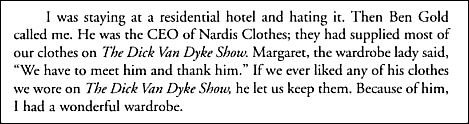
So how does this all connect to The Dick Van Dyke Show? If you’re a fan of the show and a faithful reader of closing credits like I am, you’ve probably seen the “Fashions by Nardis of Dallas” credit at the end of some episodes, right under the Botany 500 credit. And, like me, you might have wondered, “How did THAT happen?” How does an apparel-maker from Dallas network itself into a primo gig supplying fashions to a top Hollywood television show? I have no idea how the initial contact was made, but I DO know that Dick Van Dyke Show star Rose Marie and Nardis owner Ben Gold became very good friends while she was appearing in a production of Bye, Bye Birdie at the Dallas Summer Musicals in 1965. She mentions Gold several times in her autobiography.

Excerpt from “Hold the Roses” by Rose Marie

She spent much of her off-stage time in Dallas with Gold and his wife, and, in fact, when Gold was fatally injured in a traffic accident that summer, Rose Marie (then recently widowed herself) stayed with his wife Tina for several days at Tina’s request.

So, no big Dick Van Dyke Show story, but, as is no doubt known to the hyper-vigilant members of the JFK-assassination community, Nardis of Dallas DOES have an interesting connection to that. In 1941, Abraham Zapruder, who had worked in the garment industry in New York, moved to Dallas and began working for Ben Gold as a Nardis pattern-cutter. His name even appears in a couple of classified ads in The Dallas Morning News.

June 1945

Jan. 1948

While at Nardis — before he left to start his own clothing company — Zapruder worked with a woman named Jeanne LeGon (later Jeanne De Mohrenschildt) who, with her husband George (suspected by some of being a CIA operative), was friends with Lee Harvey Oswald in the early ’60s. Yep. That’s an interesting, head-spinning coincidence.

And I owe all this trivial Nardis-related knowledge to wondering for years about a single card seen in the closing credits of the unquestionably stylish and fashion-forward Dick Van Dyke Show.

nardis-label_ebay

***

Sources & Notes

Fashion photographs from MyVintageVogue.com (1952, 1955, and 1956, respectively). Other Nardis fashion photos from My Vintage Vogue can be found here. (If you’re interested in vintage fashion, fashion photography, and vintage advertising, this is a great website.)

Photos of the Nardis plant at S. Poydras and Wood are by Squire Haskins, from the Squire Haskins Photography Inc. Collection, University of Texas at Arlington Libraries, Special Collections — more info on the exterior shot is here; more on the interior shot here.

Passage about Gold from Rose Marie’s autobiography, Hold the Roses (Lexington: University Press of Kentucky, 2002), p. 192.

Dick Van Dyke Show closing credits card from a 1965 episode.

Nardis of Dallas logo from a clothing tag, found on eBay.

Additional background information on Gold from Time magazine, June 12, 1950.

See another Flashback Dallas post on Nardis — “Nardis Sign-Painters: ‘Everything in Sportswear’ — 1948” — here.

nardis_texas-jewish-post_122354
1954 ad, detail

*

Copyright © 2014 Paula Bosse. All Rights Reserved

Lefty Frizzell: It All Began on Ross Avenue

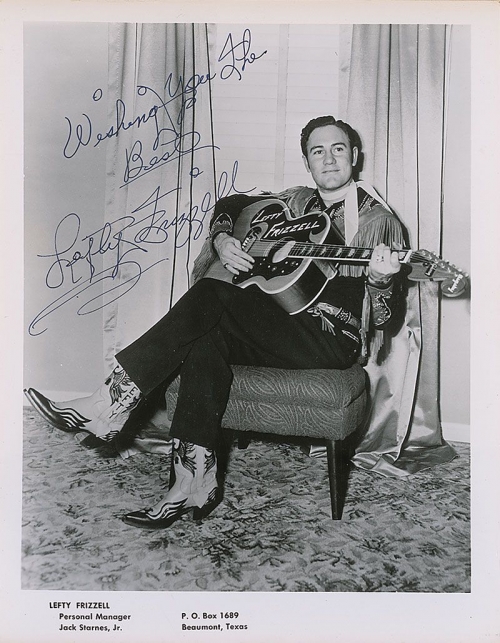
lefty_promoThe Man

by Paula Bosse

Lefty Frizzell was born on this day in 1928 in Coriscana. His Dallas connection? He was “discovered” by Dallas producer Jim Beck and recorded many of his early hits at Beck’s downtown studio. He played a lot of gigs around town, including several appearances over the years on the Big D Jamboree. But even if there weren’t any iron-clad Dallas connections, I’d have to mention him anyway. Not only is he one of country music’s most influential artists (up there in the Holy Trinity with Hank Williams and George Jones), he’s my favorite singer. Of any genre. EVER.

Take a listen to his first single, recorded on July 25, 1950 at the celebrated Jim Beck Studio at 1101 Ross Avenue: “If You’ve Got the Money, I’ve Got the Time” (which the Dallas Morning News — a bit dismissive of the “hillbilly” set — weirdly mangled into “I’ve Got the Money If You Can Spare the Time”). It was an incredible smash hit, and it kicked off a spectacular career, during which he was at almost Beatles-level popularity, with four singles in the top ten at the same time.

*

And another clip, this time a live performance from “The Porter Wagoner Show.”

*

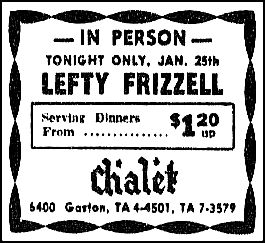
And, lastly, something I just found today, an ad for an appearance by Lefty in January 1963, when his career had dipped a bit (he would have a big come-back hit with “Saginaw, Michigan” at the end of the year). I’ve never heard of The Chalet (a supper club, I think), but its address of 6400 Gaston means that it was in the space where the Dixie House is now, in Lakewood. Maybe it’s only exciting to a superfan such as myself, but knowing that Lefty performed in my neighborhood, in a place in which I’ve actually spent a not insignificant amount of time, well … that’s just damn cool. Happy Birthday, Lefty!

lefty-chalet_dmn_012563January 1963

***

Sources & Notes

To read my post on the untimely death of Jim Beck (and see photos of him, which are few and far between), click here.

*

Copyright © 2014 Paula Bosse. All Rights Reserved.

Joe Yee Cafe: The Best Chop Suey in Town

joe-yee-cafe-extChop suey *and* famous chicken house…

by Paula Bosse

I came across the above image and was enthralled. I’ve never heard of the Joe Yee Cafe, but this (granted) idealized picture is wonderful. The postcards above and below were from the early 1950s, and if you are familiar with the generally run-down neighborhood around Columbia and Fitzhugh these days, you may well shed a tear that something this charming and picturesque has been gone for many, many years.

joe-yee-cafe-interior

I love the surprising color scheme of the restaurant’s interior — those fabulous purples and greens! (The colors are a bit unexpected because they so loudly clash with the bold tomato red of the exterior.)

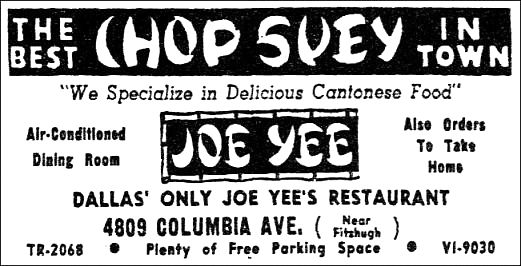
I did a little research to see what I could find out about Joe Yee’s Chinese restaurant. Seems that Mr. Yee’s cafe was in business by the 1930s, downtown, on Main Street near Field. It advertised steadily over the years, and its ads proudly proclaimed that the restaurant served “the best Chinese food you ever tasted” and was “completely air-conditioned.” Several newspaper accounts (particularly the society columns) mentioned it as a popular place for young people to grab a bite before and after dances at nearby downtown hotels. Business must have been pretty good for the place to have lasted so long at such a primo location. The cafe moved to the Columbia Street location in 1950 where it remained in business until at least late 1956 when a major fire struck.

joe-yee-cafe_matchbk

1938-joe-yee_dmn_1125381938

1943-joe-yee_dmn_0812431943

1953-joe-yee_dmn_0830531953

***

Sources & Notes

Top two early-’50s postcards are from the great Boston Public Library Tichnor Brothers Postcard Collection on Flickr, here.

In old photos of downtown Dallas one often sees “Chop Suey” signs along the streets. I’d love to know more about these restaurants in general, and about Chinese and Chinese-Americans in Dallas in the first half of the 20th century, if anyone can point me to a good source.

If background on Chop Suey is needed, might I point you to to the Wikipedia entry here, or the Snopes entry here.

*

Copyright © 2014 Paula Bosse. All Rights Reserved.


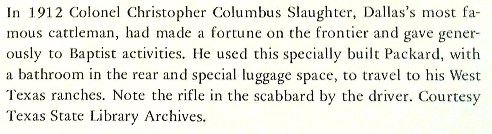
Cattle King C. C. Slaughter Really Knew How to Customize His Ride — 1912

ne

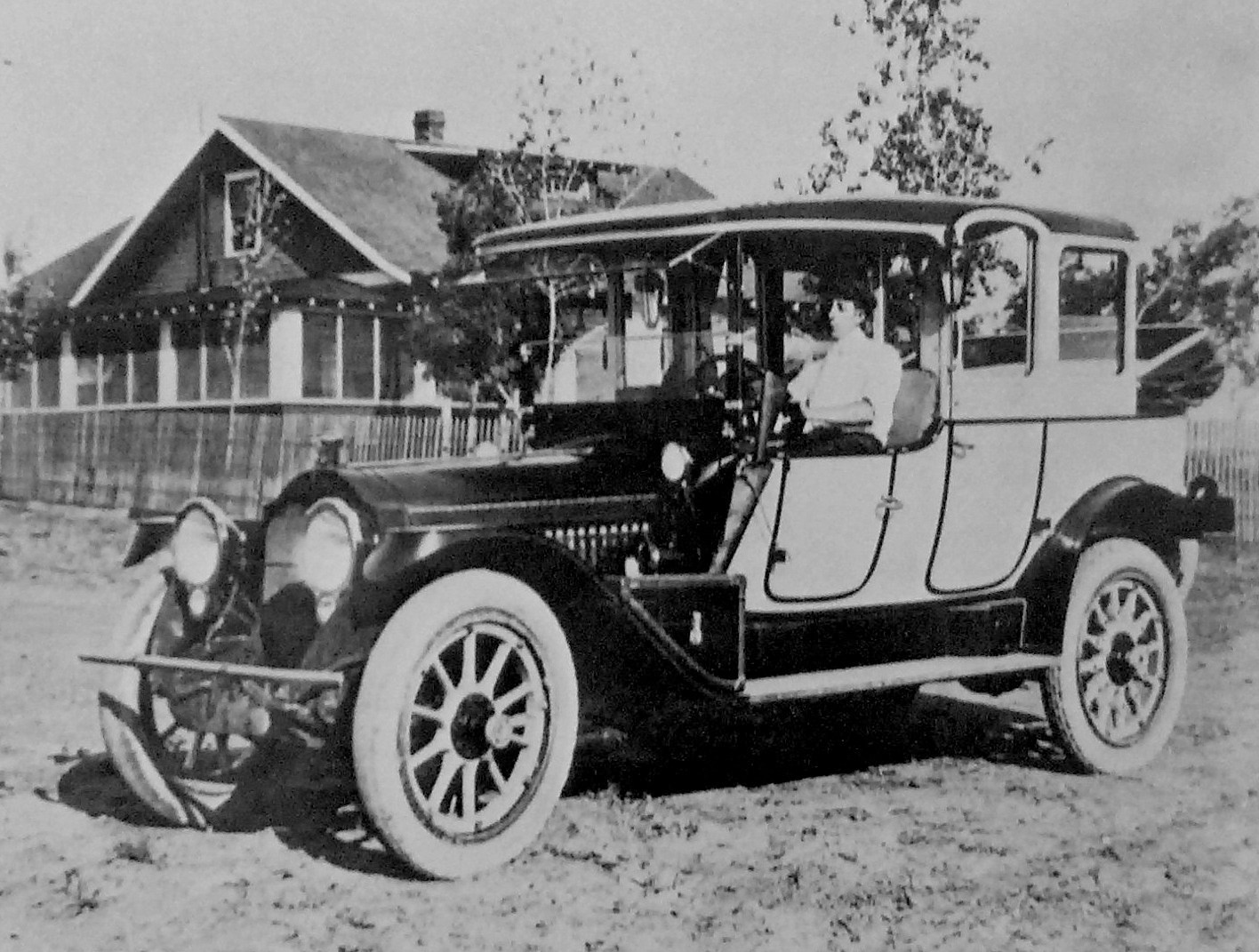
slaughter_car_1912_caption_greene

by Paula Bosse

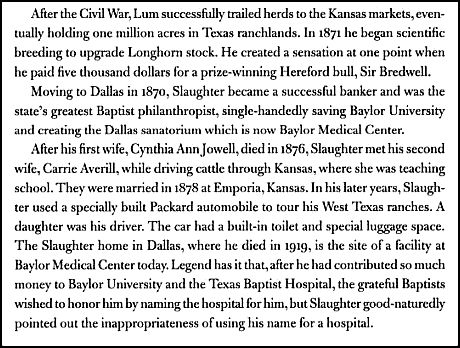
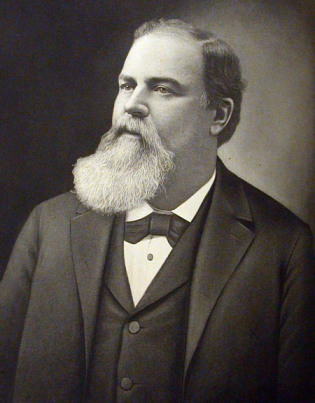
C. C. Slaughter (1837-1919) was known for being a rich cattleman, a rich Baptist, and one of Dallas’ richest pioneer businessmen. He was also pretty rich. He owned over a million acres of ranchland and more than 40,000 head of cattle. After health problems necessitated that he turn over management of his cattle interests to others, Slaughter moved his family to Dallas in 1873 and eased into the sweet life of a wealthy banker. Much of his money went to Baptist causes, including a contribution covering two-thirds of the cost of the construction of the First Baptist Church of Dallas. He was also a major investor in what became Baylor Hospital.

All of that accomplishment, and my favorite thing about Slaughter (“Lum” to his friends) is the tricked-out Packard with a built-in toilet. A. C. Greene — who wrote the caption to the photograph above — seems to have been fascinated by this as well, as he mentions it yet again, 25 years later in another book (with an added amusing tidbit about Slaughter’s response to the Baylor people on their wanting to name the hospital after him):

slaughter_portrait

***

Sources & Notes

Top photo and caption from Dallas, The Deciding Years by A. C. Greene (Austin: Encino Press, 1973).

Passage of text on Slaughter from Sketches from the Five States of Texas by A. C. Greene (College Stateion: Texas A&M University Press, 1998).

 The Handbook of Texas entry detailing the impressive life of Slaughter can be found here.

*

Copyright © 2014 Paula Bosse. All Rights Reserved.
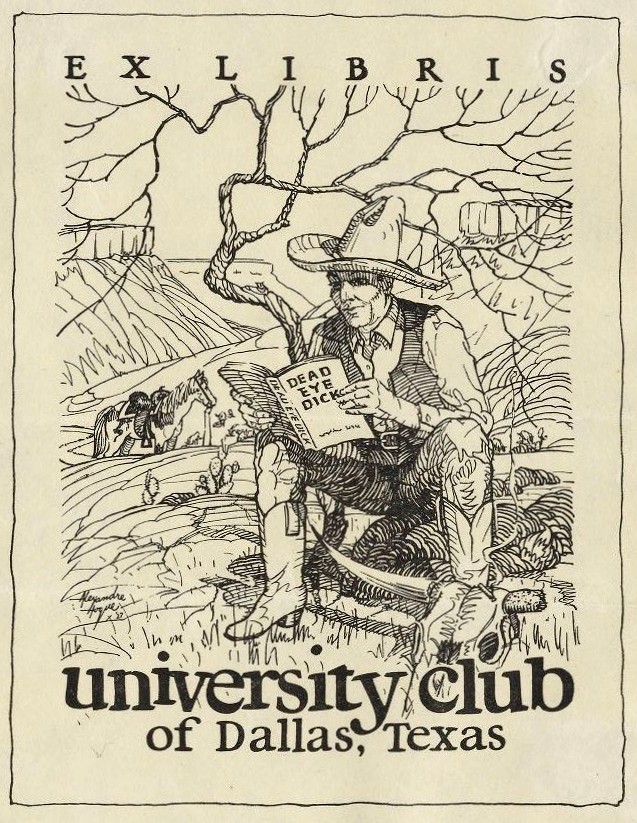
Alexandre Hogue and the Lost “Dead Eye Dick” Bookplate — 1927

hogue_bookplate_1927_full

by Paula Bosse

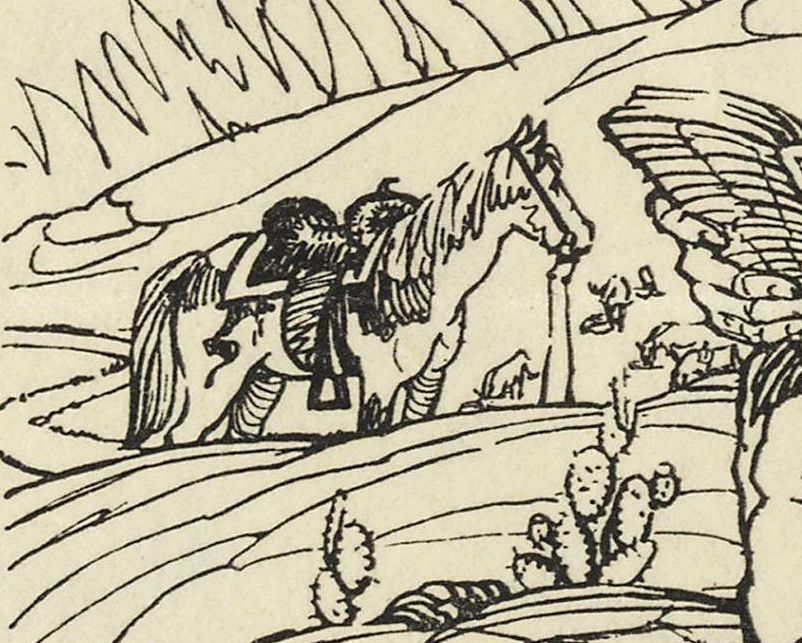
I am a huge fan of the paintings and prints by the Dallas Nine group, and Alexandre Hogue — one of the members of the group — has always been one of my favorite artists. I stumbled across this early, uncharacteristic work by him last night while looking for something else. I was browsing though a digital bookplate collection (…as one does…), and when I saw the thumbnail image of this western scene, I wondered who had drawn it. The citation had no artist attribution and noted merely that it was produced for the University Club of Dallas. As I have a background in rare books and Texas art, I thought I might know the artist, so I checked the signature. I never expected this drawing to have been done by Alexandre Hogue.

The bookplate was executed by Hogue for the University Club, a group whose well-heeled and literate members met in a tony downtown penthouse. It was done in 1927 when Hogue was working as an art instructor at the Dallas YWCA; his own work had begun to attract positive critical attention, but he had yet to make a big splash. I’ve checked various sources, but I don’t see mention anywhere of Hogue doing this sort of thing. Was he commissioned? Did he do it on spec, hoping to possibly network with influential members and perhaps improve his chances of showing his work there? Whatever his reason, things seem to have paid off, because he was showing his art at the club and participating in group shows there by 1928.

So here it is, art-lovers, a heretofore mostly (if not totally) unknown piece of Alexandre Hogue-iana from 1927 — a little piece of anonymous ephemera which has been stashed away for years in a bookplate collection in Illinois.

hogue_bookplate_1927_det

hogue_bookplate_sig_1927

***

Sources & Notes

This bookplate is from the John Starr Stewart Ex Libris Collection, Rare Book and Manuscript Library, University of Illinois at Urbana-Champaign. It can be seen here.

If you are unfamiliar with Alexandre Hogue’s work, see here for a few examples of his work as well as those of his fellow Dallas Nine artists.

Also, there is a show featuring Hogue’s works currently on at the Dallas Museum of Art. For details see here.

And a short, informative video, presented by Susan Kalil, author of Alexandre Hogue: An American Visionary, can be viewed here.

Another uncharacteristic example of Hogue’s work, is the incredible “Calligraphic Tornado” (1970), which I’ve posted here.

*

Copyright © 2014 Paula Bosse. All Rights Reserved.

When Coco Chanel Came to Dallas — 1957

neiman-marcus_coco-chanelStanley Marcus and Coco Chanel

by Paula Bosse

In September of 1957 — way back when that much-missed hyphen was still in “Neiman-Marcus” — Stanley Marcus invited Coco Chanel to Dallas to accept the Neiman Marcus Award for Distinguished Service in the Field of Fashion. Mlle. Chanel had never been to Texas, but her visit here was a meaningful one. Following a 15-year retirement, her re-emergence as a designer in the early 1950s was met with mostly derision by the French press. The American response, on the other hand, was very different. It was because of the enthusiastic reception that her work received from American retailers (such as the even-then legendary Neiman Marcus department store) that she had been able to bounce back and, once again, be considered a force in the fashion world. When she was invited to Dallas to receive the “Oscar” of the fashion industry, Mlle. Chanel was happy to accept.

In the photo above, Coco is seen trying on hats at the downtown Neiman’s store as Mr. Stanley stands by beaming. On her Dallas visit she was also treated to a ranch barbecue (!) where she was photographed watching both a square dance (!!) and a … oh god … Chanel-themed bovine fashion show (!!!). Mlle. Chanel seemed to love the cows-in-ropes-of-pearls runway show, but she was not a fan of the barbecue and beans — she (one hopes discreetly) dumped the contents of her plate onto the ground under the table … right onto the shoes of dining companion Elizabeth Arden (whose shoes may have been ruined, but who had a truly great story to tell for the rest of her life).

From all reports, everyone seemed to enjoy (and no doubt profit) from the successful visit. Karl Lagerfeld, the current creative director of Chanel, recently brought Chanel back to Dallas (both figuratively and literally) with the house’s important Métiers d’Art fashion show which was held at Fair Park in December, 2013. The following day, Lagerfeld was presented with the Neiman Marcus Award for Distinguished Service in the Field of Fashion — just as Coco Chanel had been, 56 years earlier. And the haute-couture circle-pin of life keeps on rolling.

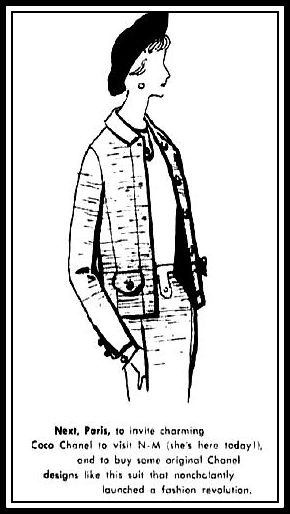
n-m_chanel_ad_dmn_090957

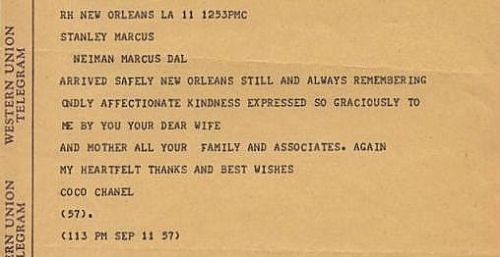
n-m_chanel_telegram

***

Sources & Notes

Top photo by Shel Hershorn for the AP. From the Briscoe Center for American History, University of Texas at Austin.

N-M ad from 1957 (portion of a larger ad).

Chanel’s thank-you telegram to Marcus, from the collection of Stanley Marcus’ Papers at the DeGolyer Library, Central University Libraries, Southern Methodist University.

Entertaining AP article about Chanel and Dallas, then and now (with photos of Stanley Marcus duded-up in an outfit you’d never see an actual cowboy in), can be found here. (Are those butterflies?!)

More photos of Mlle. Chanel in Dallas (along with text of a DMN article on the visit) can be found here.

Even more photos (bovine fashion show…) and a really great post from SMU’s “Off the Shelf” blog is here.

Video of the 2013 Chanel runway extravaganza (Métiers d’Art), held in Fair Park’s hay-stewn Centennial Hall, can be watched here. A shorter video with a few cursory shots of the Dallas skyline and Fair Park can be seen here.

For more on the first French Fortnight, see my post “Neiman-Marcus Brings France to Big D — 1957,” here.

*

Copyright © 2014 Paula Bosse. All Rights Reserved.

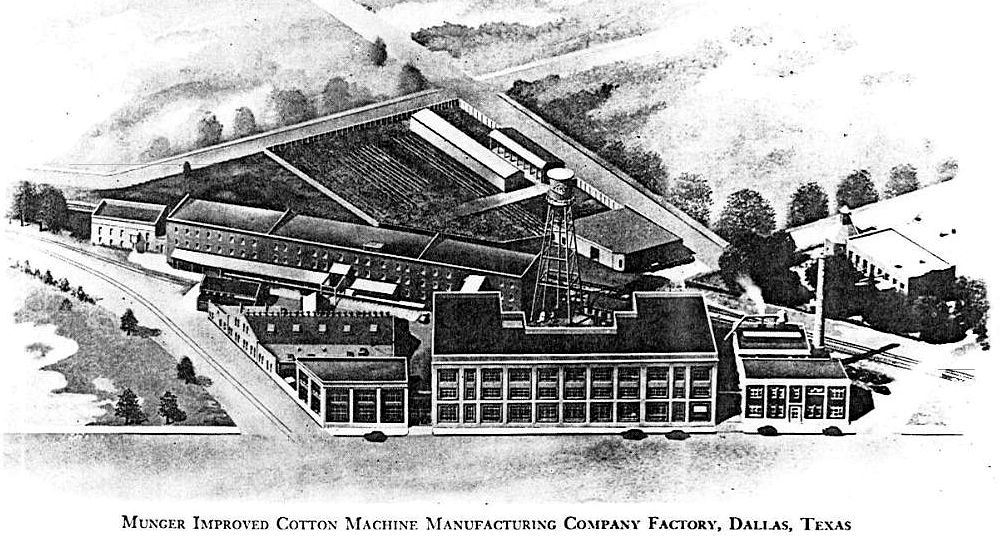
Munger’s Improved Continental Gin Company

continental-gin_munger-from-natl-reg-appA Dallas landmark… (click for larger image)

by Paula Bosse

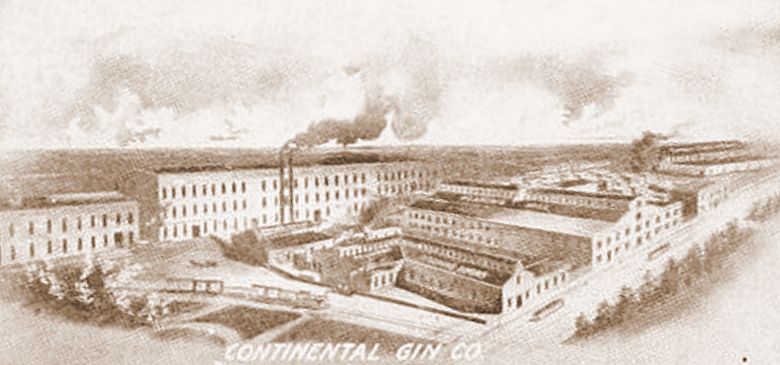
The Continental Gin Co. complex of buildings at Elm and Trunk is a Deep Ellum fixture which was successfully petitioned by the city in 1983 to be added to the National Register of Historic Places. No longer a manufacturing hub, it is now home to artists’ studios and residential lofts. The earliest of the buildings still standing were built in 1888 and the latest ones (the ones closer to Elm) were built in 1914. The company was incredibly successful, which was no surprise when one realizes that fully ONE-SIXTH of the world’s cotton grew within a 150-mile radius of Dallas at the time! It’s no wonder that Dallas was a hotbed of cotton gin manufacturing.

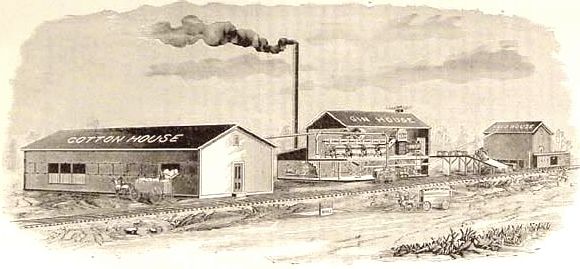
continental-gin_munger-drawing_Munger Catalogue and Price List, 1895

Robert S. Munger (yes, that Munger) patented several inventions that improved the cotton ginning process, and in 1888 he built a large manufacturing plant for his Munger Improved Cotton Machine Company. In 1900, after several extremely successful years, his company and several other companies that held important industry patents were absorbed by the Continental Gin Co. of Birmingham, Alabama, and, practically overnight, the Continental Gin Co. became the largest manufacturer of cotton gins in the United States. Munger retained a financial interest in the company, but he left the running of the business to his brother, S.I. Munger. R.S. Munger turned his creative talents to real estate and developed the exclusive Munger Place neighborhood. The Continental Gin Co. closed in 1962.

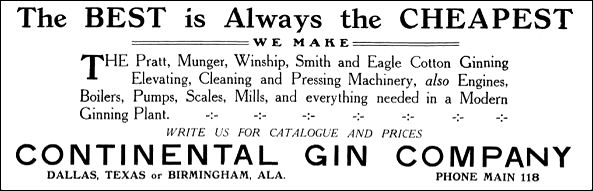
continental-gin-co_1912The Standard Blue Book of Texas, 1912-1914

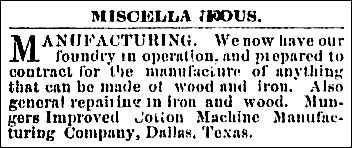
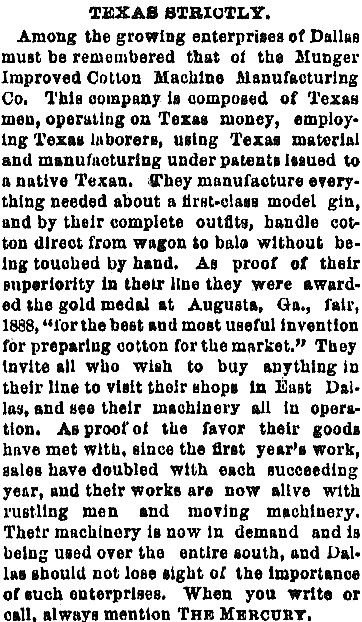
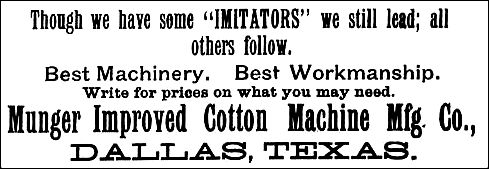
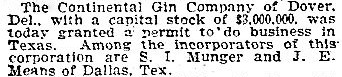
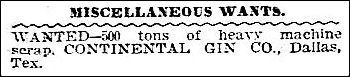
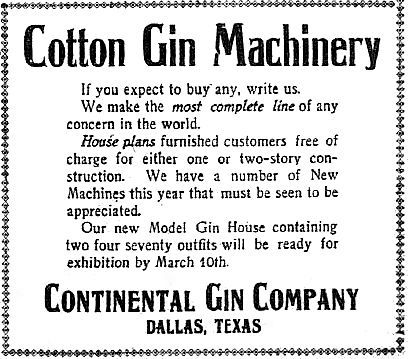
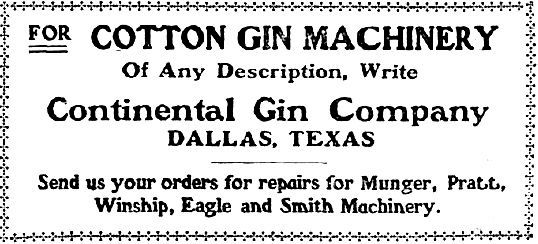
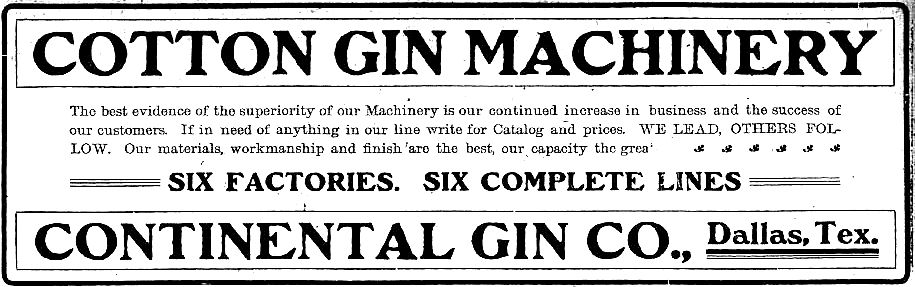
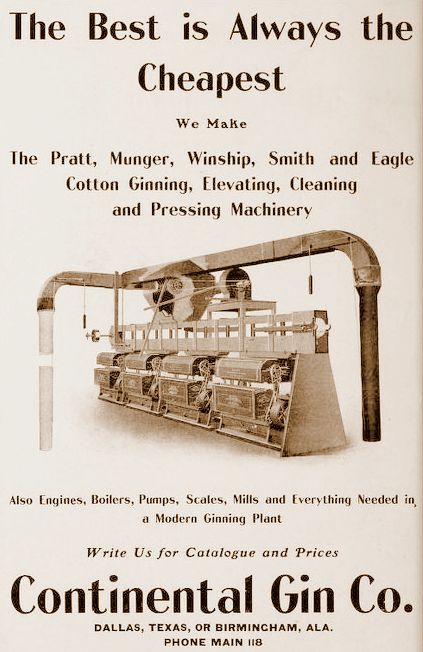
A few newspaper items regarding the Munger Improved Cotton Machine Company and the Continental Gin Company.

munger_dal-herald_101387The Dallas Herald, Oct. 13, 1887

munger_merc_053089The Southern Mercury, May 30, 1889

munger_merc_072892The Southern Mercury, July 28, 1892

munger_merc_041393The Southern Mercury, April 13, 1893

continental-gin_dmn_072600Change is imminent. (Dallas Morning News, July 26, 1900)

continental-gin_dmn_042001FIVE HUNDRED TONS! (DMN, Apri 20, 1901)

continental-gin_dmn_032203DMN, March 22, 1903

continental-gin_dmn_082005DMN, Aug. 20, 1905

continental-gin_dmn_060107DMN, June 1, 1907

continental-gin_worleys_1909Worley’s Dallas Directory, 1909

continental-gin_ad_dallas-police_1910Dallas Police, 1910

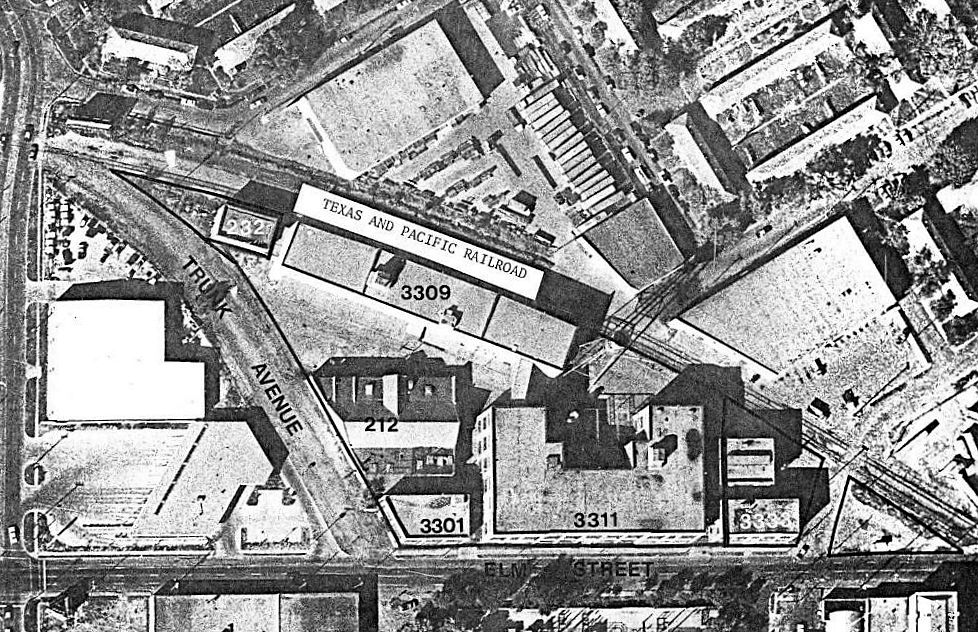
continental-gin-aerial-natl-reg-appPhotograph that accompanied the application to the National Register of Historic Places regarding the structures under consideration: 3301-3333 Elm St. and 212 & 232 Trunk Ave. (Landis Aerial Photography, 1980)

***

Sources & Notes

Handbook of Texas biography of Robert Sylvester Munger (1854-1923) is here.

The top image (which, by the way, took me FOREVER to find, is labeled as the Munger company, but the expansion would seem to indicate that this is the Continental Gin Company, after 1914. Whatever the case, it’s a great image!

That image and the aerial photograph of 1980 are included in the city’s application to have the complex included in the National Register of Historic Places, submitted in 1983. The detailed application — as a Texas Historical Commission PDF — can be accessed here.

The second image, of the early days of the Munger Improved Cotton Machine Company is from a bookseller’s online listing for Munger’s 13th Annual Catalogue and Price List (1895) — the item may still be available for a mere $435 and can be found here.

See an aerial view of what the area looks like today, via Google, here.

To see an incredible 1914 photograph of the buildings and the residential area to the north, see my post “The Continental Gin Complex — 1914,” here.

More on Robert S. Munger and more early company ads can be found in the post “R. S. Munger’s Cotton Gin Manufactory,” here.

*

Copyright © 2014 Paula Bosse. All Rights Reserved.
 

Mme. Koneman, High-Class Milliner

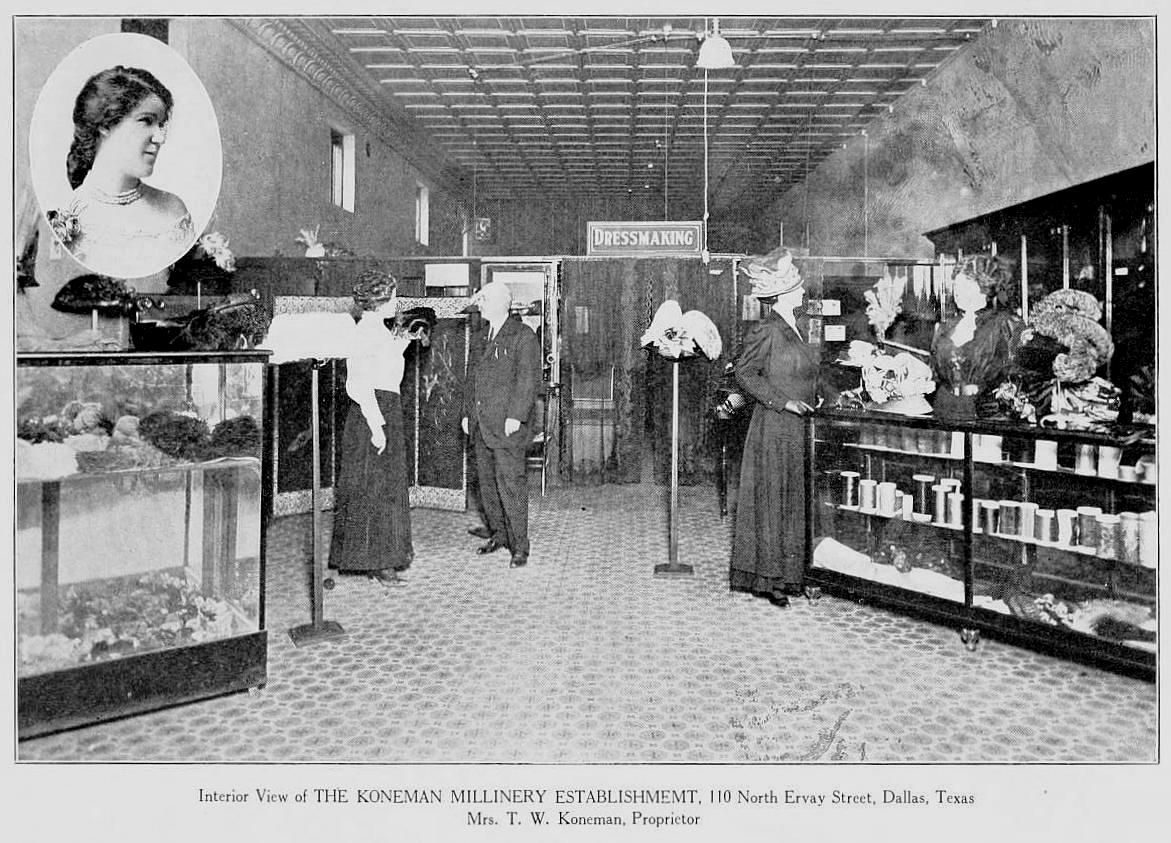
Madame Koneman’s fashion emporium, 1912 (click for larger image)

by Paula Bosse

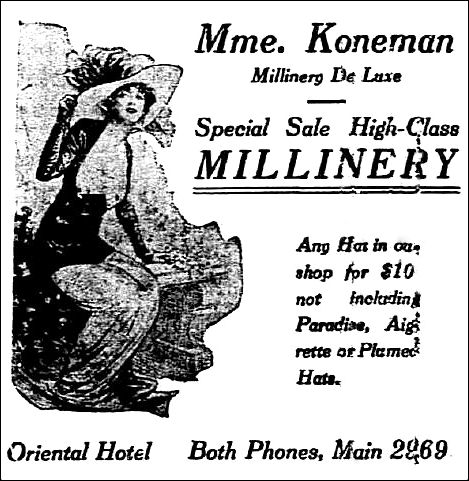
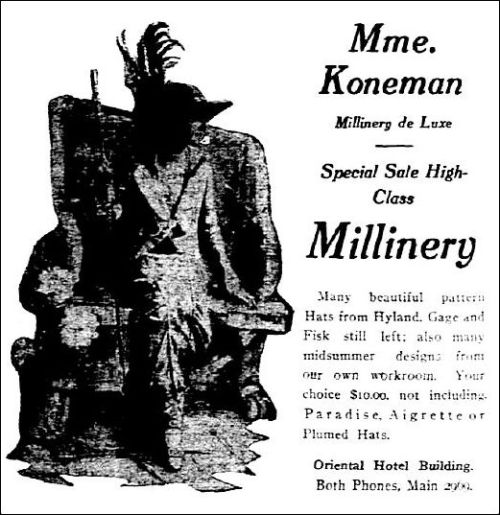
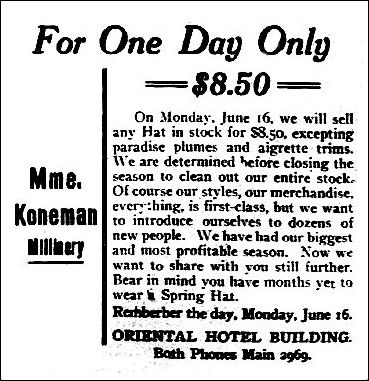
Behold, the Koneman Millinery Establishment, which actually looks a little plain for a millinery shop housed in the ornate Oriental Hotel building. When I see old ads or photos like this, I always wonder about the people pictured in them. I’m assuming that the woman in the oval inset at the left was the proprietess, “Mme. Koneman.” So who WAS she, this woman who had a “high-class” business that catered to a “high-class” clientele? I poked around a little and found these ads from 1913.

koneman-millinery_dmn_060113

koneman-millinery_dmn_060813

koneman-millinery_dmn_061413

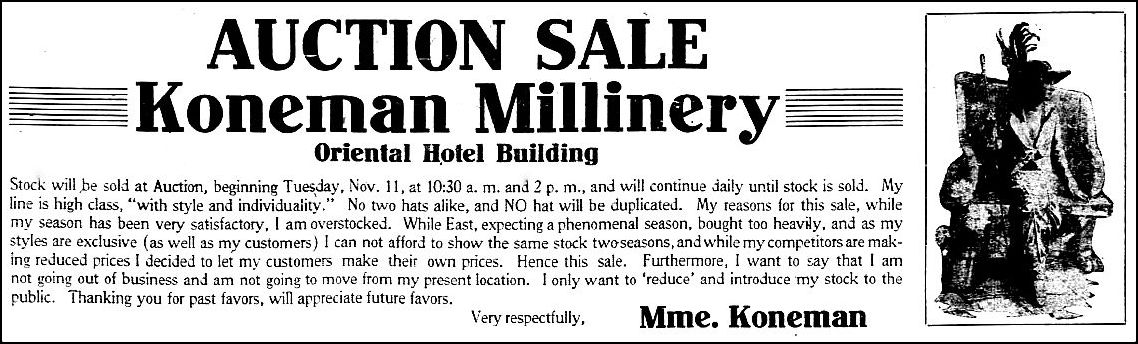
koneman-millinery_dmn_110913(click for larger image)

Ooh. Those last few sentences of the above ad seem a little defensive, as if she’s addressing nasty gossip. “Furthermore, I want to say that I am not going out of business.” When you see a sentence like that — in an advertisement — that sends up some furiously waving red flags. And … just one month after that ad, this miniscule tidbit in teeny-tiny letters appeared in the paper at the end of 1913:

Dallas Morning News, Dec. 21, 1913

Oh dear. D-I-V-O-R-C-E. And, guess what? There were no more ads for the millinery shop.

But, alarmingly, THIS appeared on the wire services on February 17, 1917:

Fort Worth Star-Telegram, Feb. 17, 1917

Oh DEAR! Shot by a widower with two children, who tried to kill both her and himself after he flew into a jealous rage in a New Orleans hotel lobby. Working with feathers and plumes and felt and velvet (probably) does not prepare one for being shot at!

Ten days after being shot, it was reported that the 36-year old Mrs. Koneman (whose first name was either “Matilda” or “Mathilda”) was released from the hospital in New Orleans. The jealous suitor, 40-year old Edgar J. Hargrave (or “Hargrove”), remained in the hospital, slowly recovering (but with a bullet still lodged in his head!). “Policemen expect to arrest Hargrave on a charge of shooting with intent to murder as soon as he is able to leave the institution.” He was an “oil salesman” from Houston.

One week later, Hargrave/Hargrove was released from the hospital and was transferred to Parish Prison where he awaited arraignment on attempted murder. Meanwhile, Matilda/Mathilda, a material witness in the case, had been arrested when the D.A. heard she was about to leave town. Out on a $650 bond, she was ordered to stay in the city until the arraignment.

On March 16, one month after being shot in the lobby of the Grunewald Hotel, Mrs. Koneman was in court recounting her near-death experience, and I’m sure the people back in Dallas were eating up every last morsel in the scandalous testimony about the spurned lover who tried to kill the divorcée who used to sell them great big hats with aigrette plumes in that bleakly unadorned hat shop over on Ervay!

koneman-testifies_dmn_031617-smDMN, March 16, 1917 (click for larger image)

(UPDATE: A reader kindly forwarded me a more detailed account of the shooting incident between the spurner and the spurnee, in a longer article from the New Orleans Times-Picayune (Feb. 17, 1917). Click here to read the article, with a blurry photo of Hargrave.)

And then — rather anticlimactically — the trail ran cold. What was the verdict? What happened to Edgar? Whither Mme. Koneman? Mrs. Koneman was reported to be living in Galveston at the time of the shooting, but by the summer of 1922 she was back in Dallas, checked into the Southland Hotel. The last shred of info I found about her was this classified ad from June, 1922, which raises even more questions.

DMN, June 15, 1922

I’m not really sure what this was all about, but it’s safe to say there would have been very few lags in the conversation between Dallas and California!

***

Top ad from The Standard Blue Book of Dallas, 1912-1914 (Dallas: A. J. Peeler & Co.).

“Dallas Woman Shot” article from the Fort Worth Star-Telegram, Feb. 17, 1917. This was a wire service story that was printed around the country, but, oddly enough, the news doesn’t seem to have made its way into the DMN until ten days after the shooting!

All other ads and articles from the Dallas Morning News. The Koneman Millinery ads were from 1913.

*

Copyright © 2014 Paula Bosse. All Rights Reserved.

Mr. Peppermint!

by Paula Bosse

I have no idea where I came across this photo a couple of years ago, but it is without question my favorite photograph of my childhood pal and idol, Mr. Peppermint!

*

Copyright © 2014 Paula Bosse. All Rights Reserved.