Flashback : Dallas

A Miscellany: History, Ads, Pop Culture

Category: Local Personalities

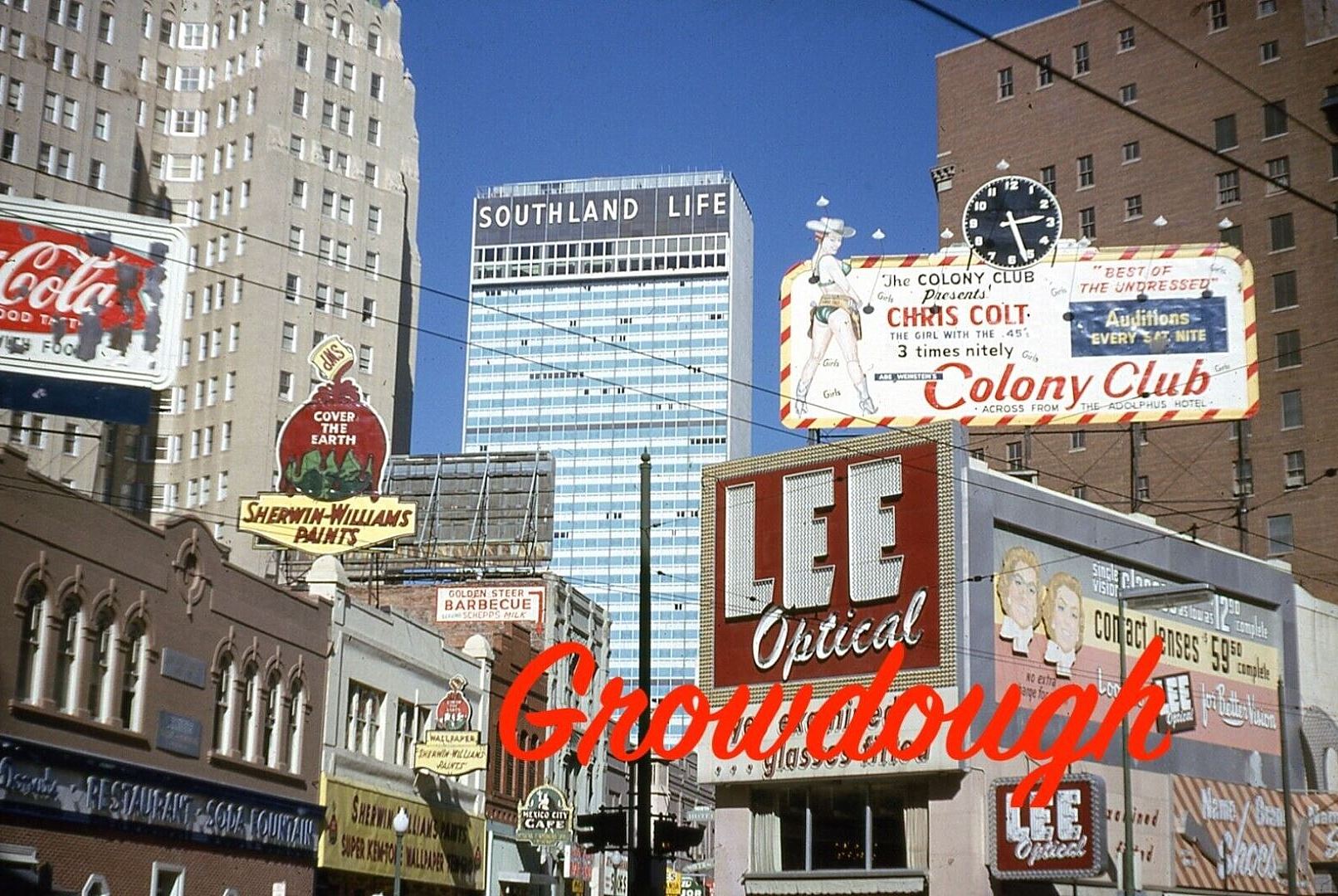
Colony Club Billboard in Beautiful Kodachrome — Early 1960s

kodachrome_elm-ervay-live-oak_chris-colt_colony-club-billboard_ebay_WATERMARKDowntown Dallas has it all…

by Paula Bosse

This. Is. A. Fantastic. Photo.

If only for the great, great, great Colony Club (“the best of the undressed”) billboard featuring Chris Colt (“the girl with the 45s”).

See this same view of the (one-time) intersection of Elm, Ervay, and Live Oak here and here. (The dazzling animated neon Coca-Cola sign was once where Chris Colt is showing off her 45s.)

I almost never post images with watermarks, but this photo is pretty spectacular. Look around the watermark!

I don’t know the seller of this color slide. I have no affiliation with the person. I get no cut in any sale. But I want someone reading this to BUY IT! Let’s keep this with someone who loves Dallas history! (And if you DO buy it and would like to send me a digital copy… well, I wouldn’t say no!) See this slide currently on eBay HERE. (HURRY!)

To see a naughty photo of Chris Colt, you can click on an antique collectors’ website here.

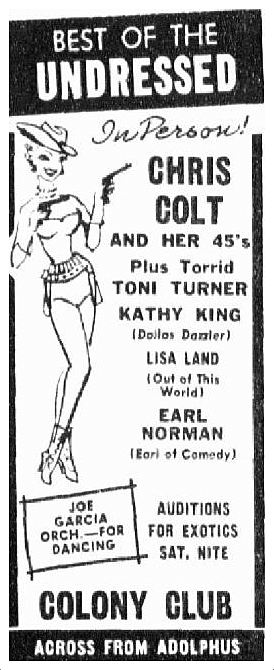
colony-club_ad_chris-colt_112262Colony Club ad, Nov. 22, 1962

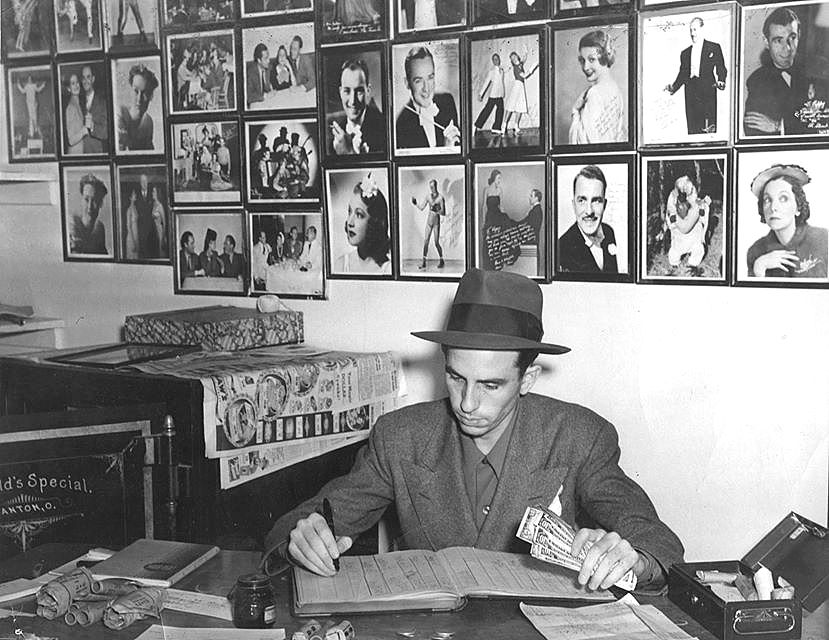
And below is a photo of Colony Club owner Abe Weinstein in his younger years counting his moolah.

abe-weinstein_abe-and-pappys_djhs-facebookphoto: Dallas Jewish Historical Society

***

Sources & Notes

Top image is from a color slide in a current eBay listing here. (Seller’s title: “Original Slide Dallas St Scene Colony Club Coca Cola Billboards Southland Life.”) There is no date, but Golden Steer Barbecue opened at 1713 Live Oak sometime in 1961.

Abe Weinstein photo — from his days as the co-owner of Abe’s and Pappy’s — is from the Facebook page of the Dallas Jewish Historical Society.

kodachrome_elm-ervay-live-oak_chris-colt_colony-club-billboard_ebay_WATERMARK_sm

*

Copyright © 2023 Paula Bosse. All Rights Reserved.

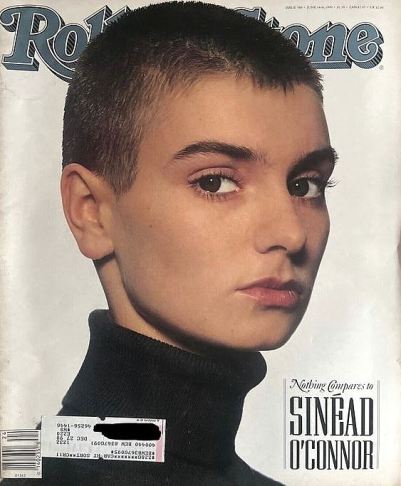
Sinead O’Connor — 1990

oconnor-sinead_rolling-stone_june-1990_ebay

by Paula Bosse

Sinead O’Connor died today. I loved her. When she came to Dallas to play the Bronco Bowl on May 25, 1990, I was there. She sang “Nothing Compares 2 U” a capella. The audience was so quiet while she sang you could hear a pin drop. It was one of the most memorable live music moments I’ve ever experienced.

In the early days of alternative radio station KDGE, I spent a lot of time at the Edge studios and provided a surprising amount of (uncredited, unheralded, and uncompensated) “comedy” writing for one of the on-air personalities. I even did a few on-air bits.

One night, out of the blue, I got a phone call at home, and was told to call the station’s answering machine and give ridiculous directions to a secret Sinead O’Connor party which was supposedly being given in her honor while she was in town for her show at the Bronco Bowl. So I did. The sound quality is atrocious, but I had to scramble to find a tape recorder before the bit aired a few minutes later. I’m still waiting for my Peabody.

So here’s one of the improvised stealth comedy bits I did on The Edge (and, yes, I really do give directions like this). It is followed by a commercial for Sinead’s appearance at the Bronco Bowl, produced by 462 (pure ’90s nostalgia). I’ve been told by a friend that he could access this link on his laptop but not his phone, but I’m going for it anyway.

Listen to it here.

I wish Sinead hadn’t had such a hard life. She made many of our lives better. She made my life better. RIP.

***

Sources & Notes

Rolling Stone cover, June 1990, from eBay.

Recording from collection of Paula Bosse.

oconnor-sinead_rolling-stone_june-1990_ebay_sm

*

Copyright © 2023 Paula Bosse. All Rights Reserved.

Muhammad Ali Visits Graham’s Barber Shop — ca. 1967
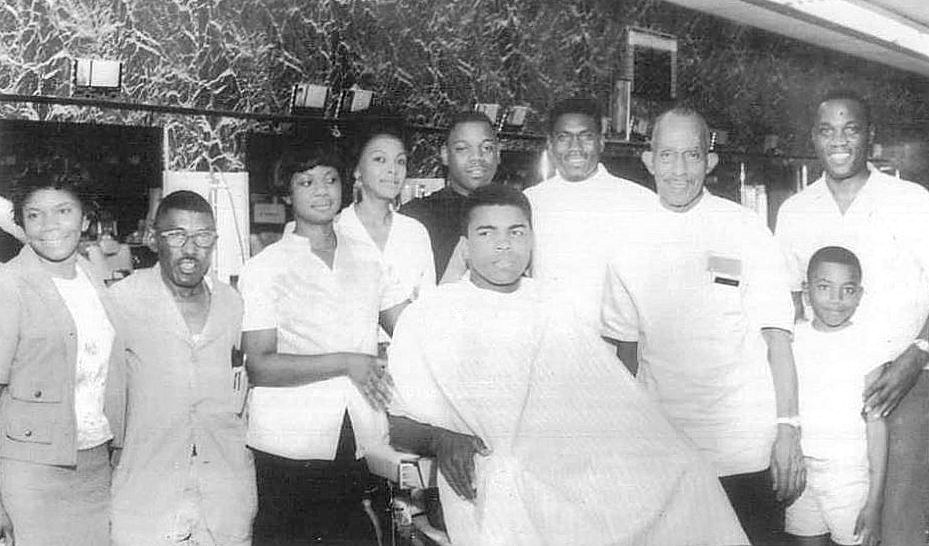
ali-muhammad_grahams-barber-shop_lincoln-high-school-yrbk_1967_photoMuhammad Ali in a Dallas barber chair

by Paula Bosse

I often just browse through the ads of old Dallas high school yearbooks on Ancestry.com. The other day, I saw the photo above and stopped and said to myself, “Is that Muhammad Ali?” I then looked at the text and, yes, that was, in fact, Muhammad Ali. Sitting in a barber chair in Dallas, Texas. What was the story behind that?

In my less-than-extensive research, I found three instances of Ali being in Dallas in or before 1967 (the year of this Lincoln High School yearbook ad). The first was in November 1960, just one month after the 18-year-old Olympic champion had won his first professional fight. He was tagging along with Archie Moore (who was acting as something of a mentor) when Moore came to Dallas to fight local boxer Willie Morris. (Morris had lost to the then Cassius Clay in the Olympic trials, and, in a somewhat bitter interview with The Dallas Morning News said this about the young upstart: “He’s not near as good as all this talk about him.”)

The photo of Ali in the barber chair isn’t from this 1960 visit, but he was specifically mentioned in a Dallas Times Herald article as being in the crowd of a Nov. 1960 event I wrote about a few years ago. There’s film footage of this, and I’ve scanned the crowds, hoping to find him, with no luck. But if you want to look to see if you can find him, that footage is linked in the Flashback Dallas post “Newly Discovered Footage of Jack Ruby — 1960.”

It’s more likely that the barbershop photo was taken in March 1967 when Ali, a Muslim, made two appearances in Dallas: the first was to “preach” at a local mosque, and the second (two days later) was to speak to students at Bishop College.

The mosque appearance was on Easter Sunday — March 26, 1967 — at Muhammad’s Mosque of Islam, described by Dallas Morning News sportswriter Bob St. John as being housed in “an old, pinkish building which used to belong to an insurance company and heretofore rested in reasonable obscurity on the corner across from Booker T. Washington High School.”

St. John continued: “On Sunday afternoon, it was no longer obscure. The old building rocked from its foundation as people filled it and lined the sidewalk outside and even poured into the streets, some coming to see Cassius Clay and others Muhammad Ali….”

The article mentions that Ali was living in Houston at the time, so it’s certainly possible he visited Dallas more often, but he was so famous at this time that it seems likely that the mere hint of his charismatic presence in town would have shown up in the papers. As it was, a visit by him to a Dallas barbershop was memorialized in this ad, which someone like me can now write about in a vaguely historical way (on a day which just happens to be Easter Sunday, the anniversary of Muhammad Ali’s 1967 Islamic sermon delivered across from Booker T. Washington High School).

**

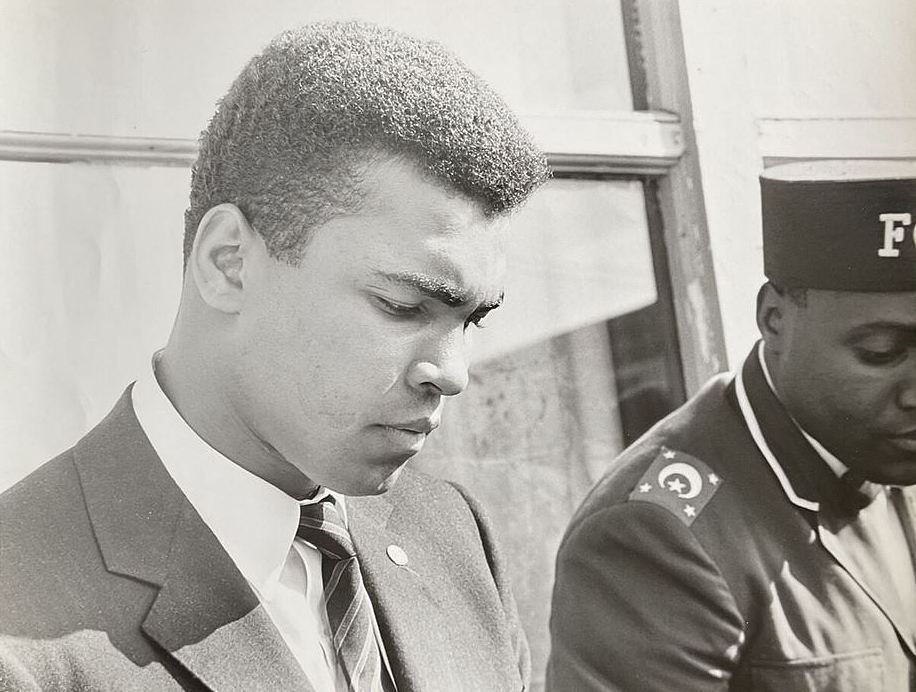
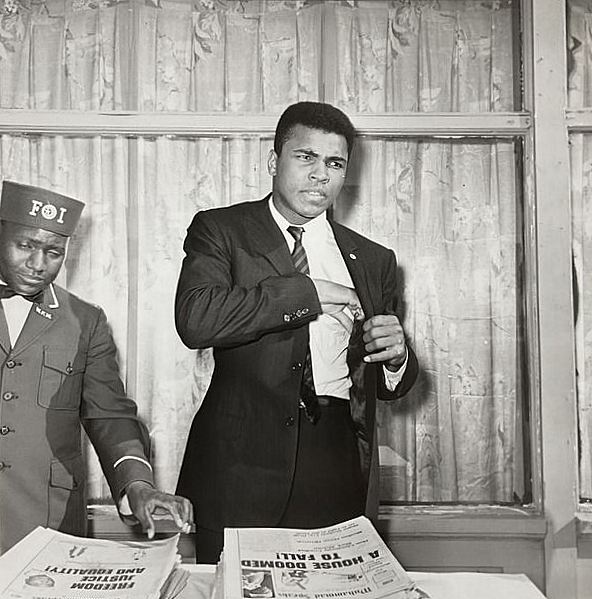
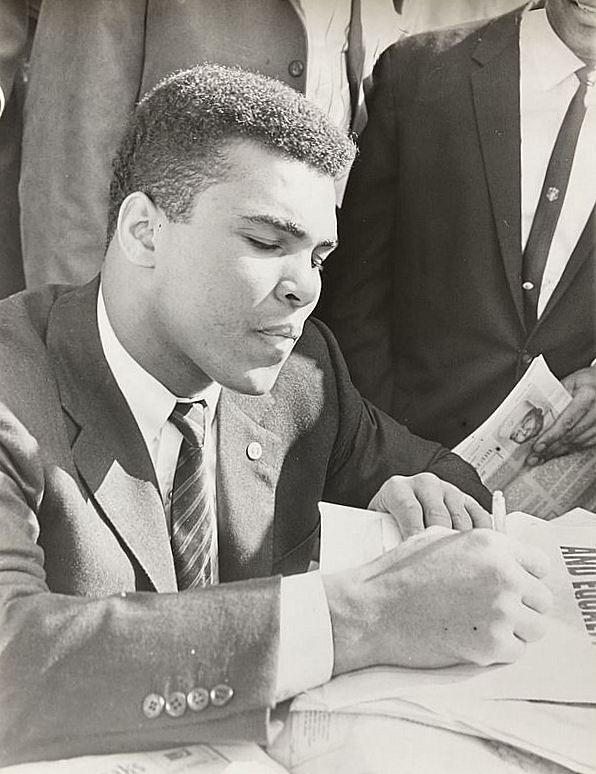
UPDATE: I was very excited to see the three photos below pop up recently on eBay — they show Ali at his mosque appearance (all three were taken on March 26, 1967 by Bob W. Smith, a Dallas news photographer). Ali is seen signing copies of a 20-cent Muslim paper called “Muhammad Speaks.” (A quote from Ali about why he was autographing these newspapers, from Bob St. John’s article: “A fish goes for bait. Then it’s hooked. I’m bait. Many would not buy if I didn’t autograph them. But once they’re bought… they’ll be sittin’ around some evening and pick up the paper. They’ll start reading. First thing you know, they’re hooked.”)

muhammad-ali_dallas_march-1967_a

muhammad-ali_dallas_march-1967_ebay_b

muhammad-ali_dallas_march-1967_ebay_c

**

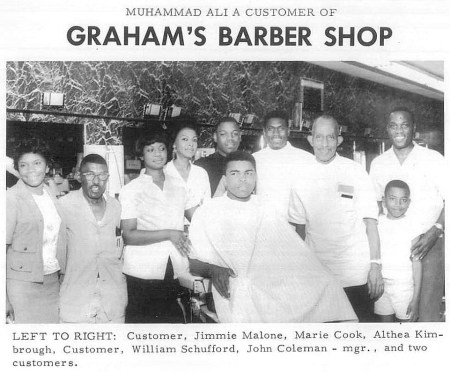
But back to the barbershop and Johnny Graham and a closer look at the two photos from the ad that originally caught my eye.

ali-muhammad_grahams-barber-shop_lincoln-high-school-yrbk_1967

“Muhammad Ali a Customer of Graham’s Barber Shop.” Ali is shown with an unidentified Graham’s customer, Jimmie Malone, Marie Cook, Althea Kimbrough, a customer, barber William Schufford, manager John Coleman, and two other customers.

*

ali-muhammad_grahams-barber-shop_lincoln-high-school-yrbk_1967_ford

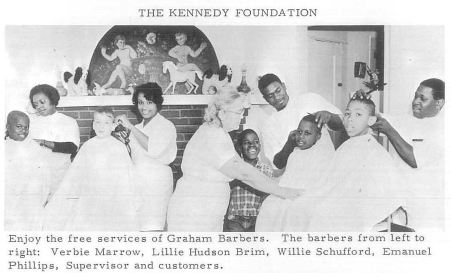
The photo above also appeared in the ad, showcasing Graham’s community service and his work with the Kennedy Foundation. “Enjoy the free services of Graham Barbers. The barbers from left to right: Verbie Marrow, Lillie Hudson Brim, Willie Schufford, Emanuel Phillips, Supervisor, and customers.”

*

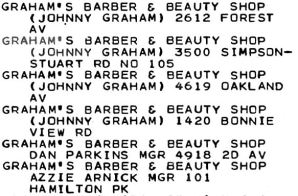
Johnny Graham was one of the most successful Black businessmen in Dallas at the time and was known for his philanthropic generosity. By the end of 1967, he owned eight barber shops and employed 135 barbers. Six of his shops are listed in the 1967 directory:

grahams-barber-shop_19671967 Dallas directory

***

Sources & Notes

Barbershop photos are from an ad in the 1967 Lincoln High School yearbook.

Photos of Muhammad Ali at Muhammad’s Mosque of Islam in Dallas were taken by news photographer Bob W. Smith on March 26, 1967, found on eBay.

The Dallas Morning News articles about Muhammad Ali in Dallas — and one about Johnny Graham:

  • “Morris Prefers Bout with Clay” (DMN, Nov. 26, 1960)
  • “Clay Makes Dallas Stop” by Bob St. John (DMN, Mar. 27, 1967)
  • “Clay Pleases Crowd With Speaking Form” by David Morgan (DMN, Mar. 29, 1967)
  • “Johnny Graham Offers Example” by Julia Scott Reed (DMN, Dec. 28, 1967)

Please consider supporting the work I do at Flashback Dallas by funding me on Patreon.

ali-muhammad_grahams-barber-shop_lincoln-high-school-yrbk_1967_photo_sm

*

Copyright © 2023 Paula Bosse. All Rights Reserved.

Uncle Scooter Reads the Funnies: 1940-41

radio_uncle-scooter_wfaa-wbap-kgko-combined-family-album_1941Little Man and Uncle Scooter…

by Paula Bosse

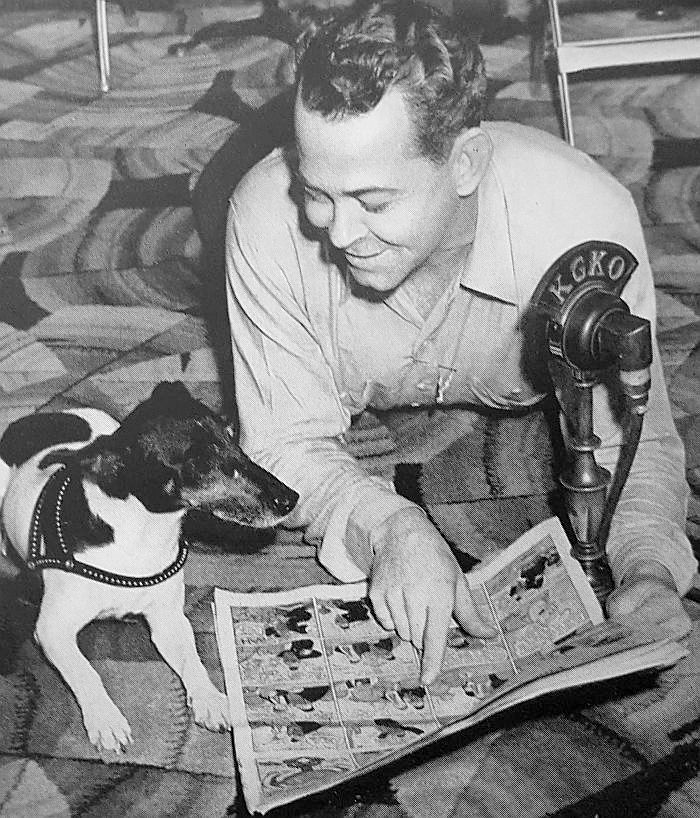
Several years ago, I was flipping through a promotional booklet for radio stations WFAA, WBAP, and KGKO, and I came across the photo above. I think about this photo a lot. It shows radio personality “Uncle Scooter” lying on the floor next to a KGKO microphone, reading the comics over the air to a vast audience of children and pointing out something pertinent to his trusty companion, a fox terrier named Little Man. I love this photograph. It makes me smile every time I see it. Wouldn’t it be great if this was how he actually conducted his broadcasts — on the floor with his doggie next to him? Here’s the caption:

uncle-scooter_dog_wfaa-wbap-kgko-combined-family-album_1941_caption

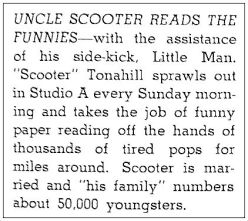
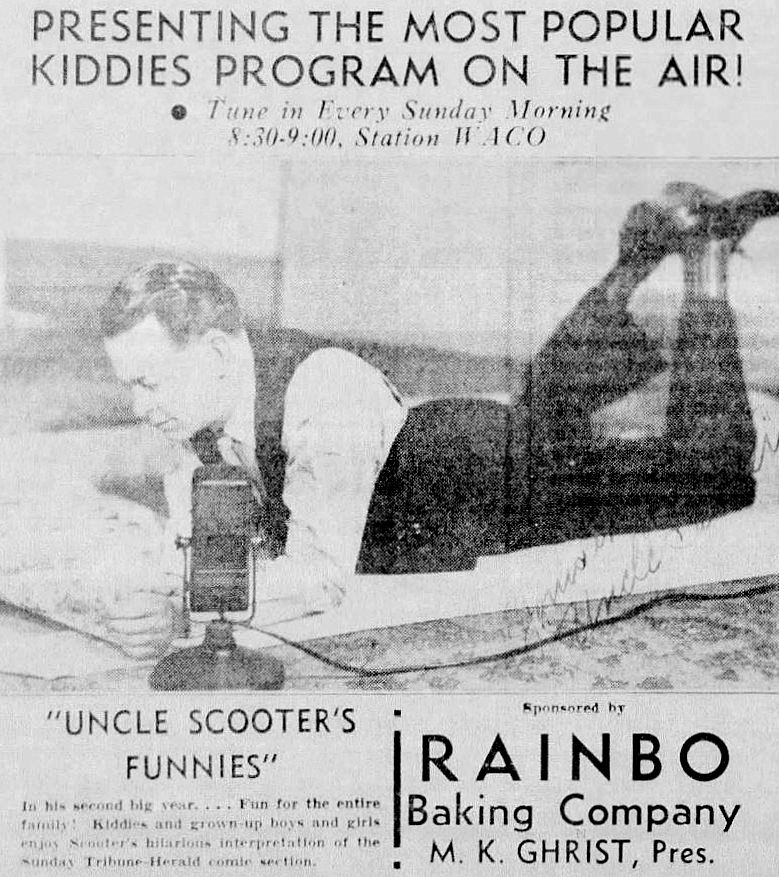
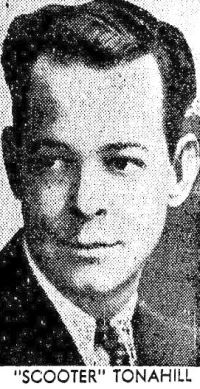
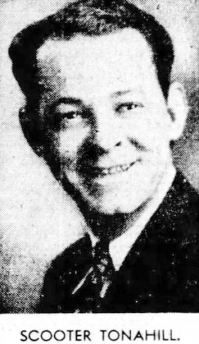
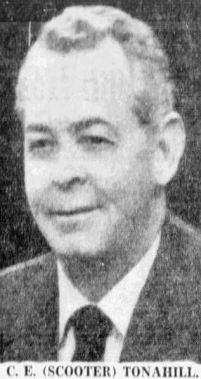
Clarence E. Tonahill (1904-1954) — known to everyone as “Scooter” — appears to have begun his radio career in Waco at the appropriately named station WACO. He then worked at KGKB in Tyler, then returned for a few years to WACO, and then to KTSA in San Antonio. Like most people in broadcasting in those days, he did a little bit of everything: he was an announcer, a newsreader, a sportscaster, and an entertainer. One of his most popular shows was just him reading the Sunday comics over the air for children. Below, a WACO ad from 1937 showing Uncle Scooter, again, lying on the studio floor (no dog, though).

uncle-scooter_waco-tribune-herald_010337Waco Tribune-Herald, Jan. 3, 1937

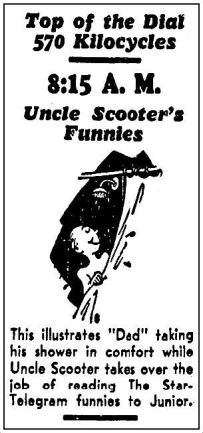
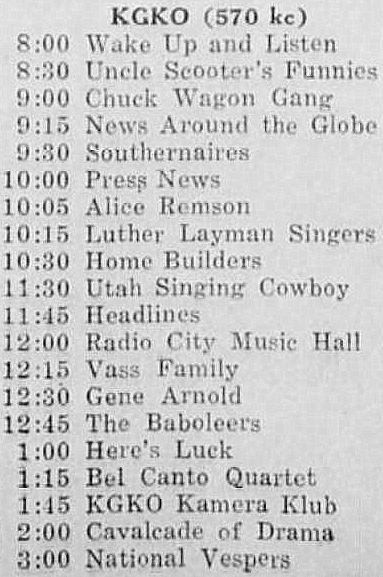
Around September 1939, he moved to Fort Worth to begin a busy stint at KGKO, a DFW station co-owned by The Dallas Morning News and The Fort Worth Star-Telegram (this was part of the very unusual WFAA-WBAP radio broadcasting partnership). He started as an “announcer” (which might well have included cleaning up the studio!), but he quickly graduated to doing a lot of sports-announcing and color commentary (football and boxing), man-on-the-street interviews, and personal appearances. He also hosted several shows, including a weekday morning show called “Sunrise Frolic.” But Sundays… Sunday mornings were set aside for his funnies-reading.

1940_radio_uncle-scooter_FWST_090840Fort Worth Star-Telegram, Sept. 1940

1940_radio_uncle-scooter_FWST_091540FWST, Sept. 1940

1941_radio_uncle-scooter_FWST_031641FWST, March 1941

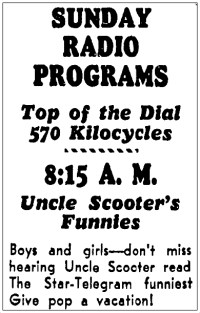
The Sunday lineup on KGKO, before and after the funnies:

1940_radio_uncle-scooter_bryan-tx-eagle_121440Bryan Eagle, Dec. 1940

I see listings for the show in 1940 and 1941 — and then, briefly, in 1947. His obituary says that Tonahill retired from his career as a broadcasting personality in 1946 and opened his own business in Fort Worth, Scooter’s Radio Supply (a supplier of broadcasting equipment to stations around the country).

He must have been a bright, friendly voice on the radio. I’d love to know the role Little Man played (Little Man was Scooter’s real-life pet and was described in a magazine profile as Scooter’s “favorite hobby”). I have fond (if somewhat vague) memories from my childhood of Bill Kelley reading the comics on The Children’s Hour on Channel 5 — but I can say without hesitation that things on The Children’s Hour would have been a whole lot more interesting if he’d just had a cute little dog with him!

1940_scooter-tonahill_FWST_042040_kgko-ad_det_photo1940_scooter-tonahill_FWST_100940_kgko-ad_det_photo1940

1954_tonahill-clarence-e_FWST_072654_obit_photo1954

kgko_19391939

***

Sources & Notes

Top photo from “WFAA, WBAP, KGKO Combined Family Album” (Dallas-Fort Worth, 1941).

radio_uncle-scooter_wfaa-wbap-kgko-combined-family-album_1941_sm

*

Copyright © 2023 Paula Bosse. All Rights Reserved.

The Bullen Store, Exposition Avenue — 1896-1936

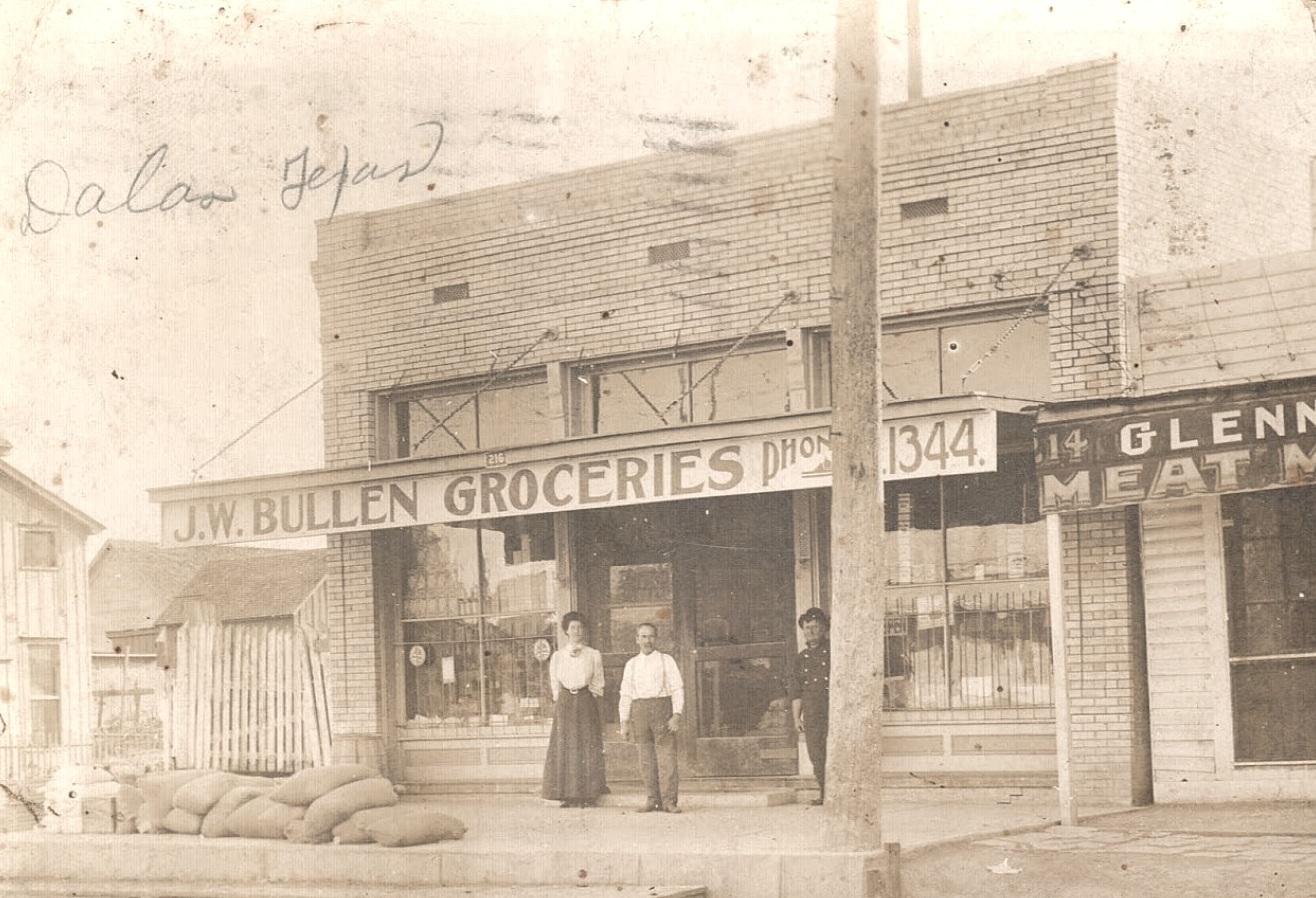
bullen-store_exposition-avenue_ca-1905Exposition Ave., ca. 1905 (photo: Bullen family, used with permission)

by Paula Bosse

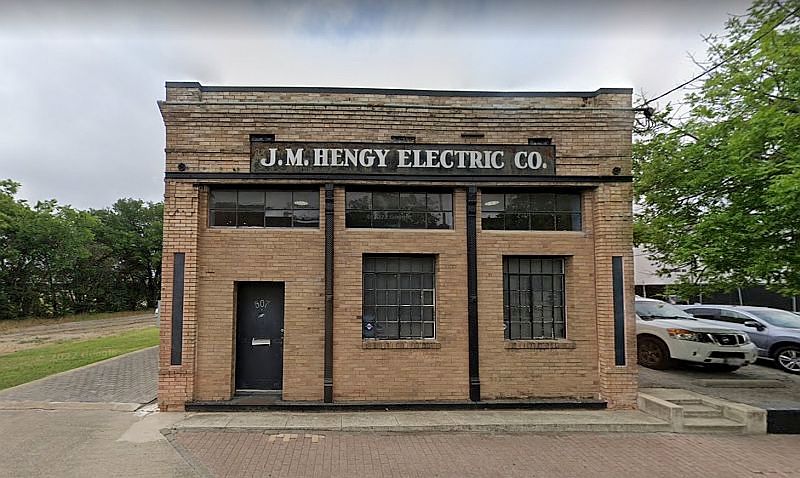
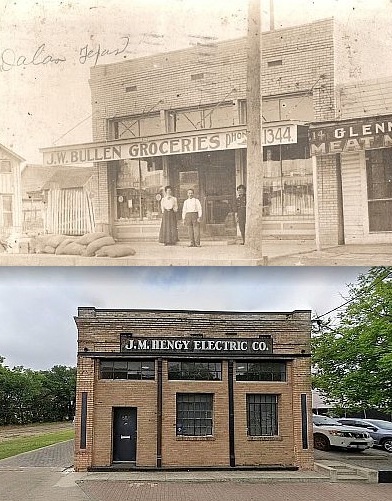
If you’re reading this, you probably have a fascination with old buildings. When was it built? What had it been? How has it not been torn down? One such building — which, though interesting, doesn’t really strike one as particularly old — is the small building at 507 Exposition Avenue, a few blocks from Fair Park. Actually, the thing that jumped out at me was the sign on the building reading “J. M. Hengy Electric Co.” — back in 2015 I wrote a long post about the exceedingly litigious Hengy family (“F. J. Hengy: Junk Merchant, Litigant”) (J. M. was the grandson of F. J.). The Hengy Electric Co. was in business at that location from at least the 1930s until at least the 1960s. I’m not sure why the current owners kept this sign, but I’m glad they did, because it’s why I noticed it.

This building was most likely built in the 1890s, and it was home to a grocery store owned by J. W. Bullen (John Wesley Bullen Sr.), a Tennesse native who came to Texas in the late 1870s and, after a few years of farming in the area, settled in Dallas. He worked for the Santa Fe railroad for a while before opening this grocery on Exposition Avenue in the 1890s — easy to give directions to because the Gulf, Colorado and Santa Fe (GC&SF) Railway tracks ran right alongside the store. Bullen’s grocery was a neighborhood mainstay for at least 40 years. He retired in 1936, and he and his wife, Mary, eventually moved to California to live with their daughter. J. W. Bullen died in California in 1948, at the age of 89 — his life spanned the Civil War to the advent of television.

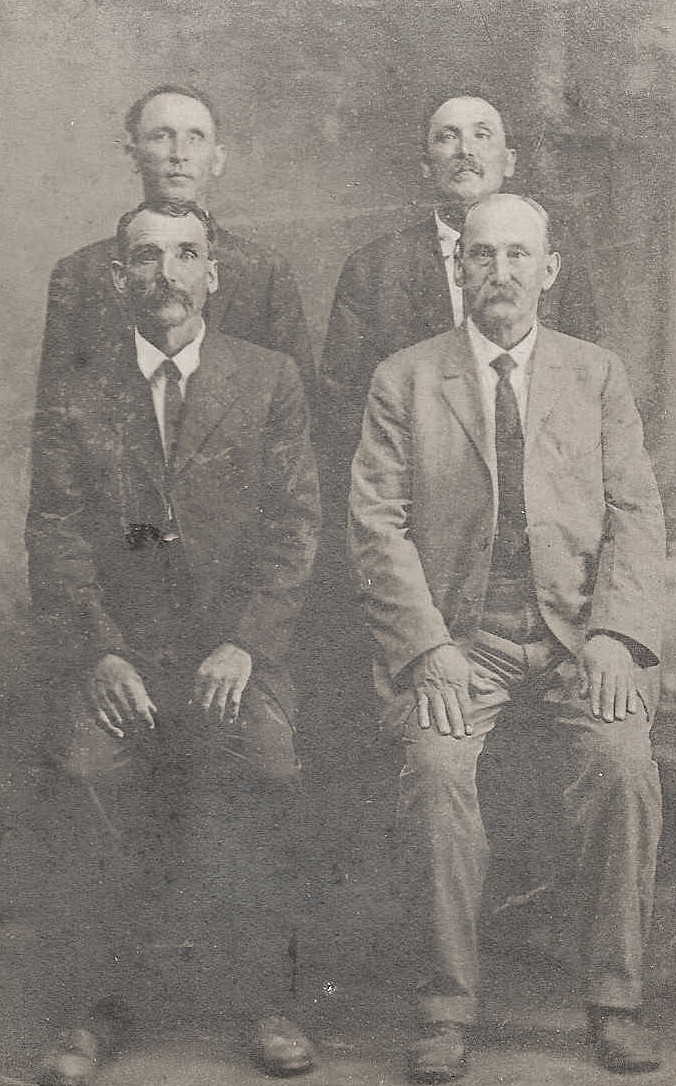
Below, J. W. Bullen is shown with his brothers, Thomas, James, and Joseph — he is at the bottom right.

bullen-j-w_sitting-right_ancestryvia Ancestry.com

I came across the photo at the top of this post on the Dallas Historical Society discussion forum (“The Phorum”) back in 2017 (it’s taken 5½ years for me to finally write this!) — the thread is here. A Bullen relative posted this photo, and I was ecstatic to see it! It’s such a great image — I have never seen a photo of Exposition Park from this period. (I asked Mr. Bullen — the man who posted this photo — if I could reproduce it, and he very nicely gave me permission.)

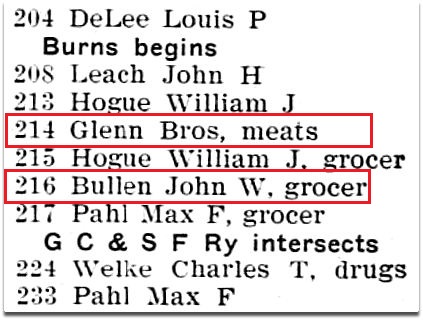
I would guess that the photo dates from sometime around 1904-1906, when the Glenn Brothers meat market occupied the space next door (originally 214 Exposition and later 505 Exposition).

1905-directory_bullen-glenn-bros1905 Dallas city directory
The Hengy business originally occupied the Glenn Bros. space for several years, from at least 1930. After Bullen’s retirement, Hengy moved into the larger space at 507 Exposition. Today it is occupied by Big Sky Construction.

507-exposition_google-street-view_may-2022
Google Street View, May 2022

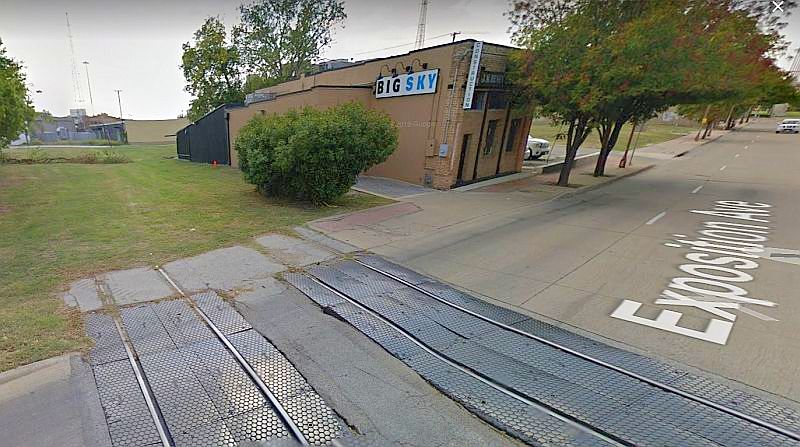
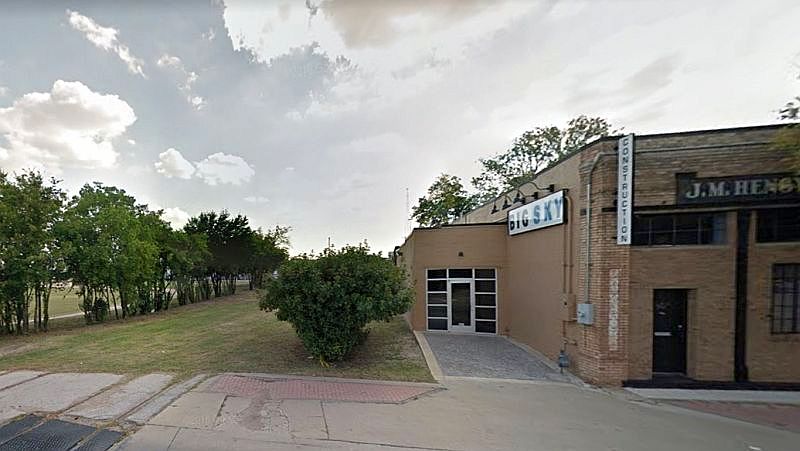
The railroad tracks have been pulled up, but below are two Google Street Views from 2012 showing where they once were — they couldn’t have been much closer to Bullen’s store! That’s got to have rattled the merchandise (and the store’s occupants) several times a day.

507-exposition_google-street-view_sept-2012Google Street View, Sept. 2012

507-exposition_google-street-view_sept-2012_bGoogle Street View, Sept. 2012

*

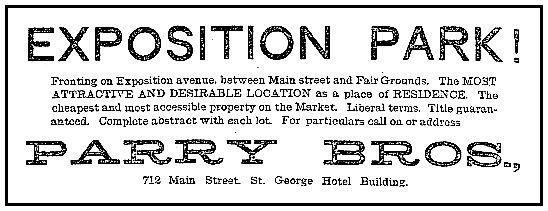
The address of Bullen’s store was originally 216 Exposition Avenue. After the citywide address change in 1911, it became 507 Exposition Avenue. The store was in business by at least 1896, but a newspaper article on the 62nd wedding anniversary of Mr. and Mrs. Bullen says that the business began in 1893. At this time, development of Exposition Park was exploding (see the 1889 ad I posted yesterday, here).

expo-park_ad_dmn_1012891889

If you look at Sanborn maps of this area (the 1899 map is here, the 1905 map is here, and the 1921 map is here) you see that almost all of the buildings in the area are houses (designated by the letter “D,” for “dwelling”). Having only ever known the area in recent times, it’s hard to imagine this ever having been an almost entirely residential neighborhood. And, back in the 1890s, it was also full of livestock.

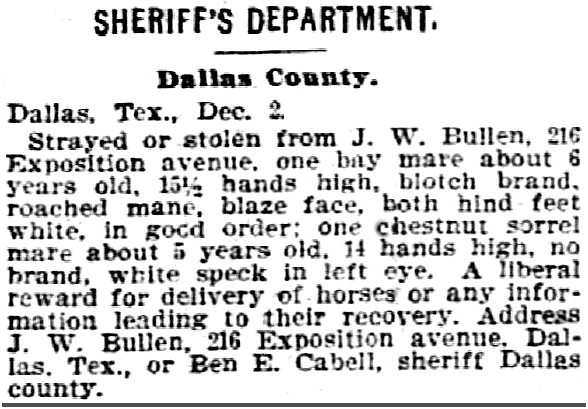
bullen_dmn_120397_stolen-horsesDallas Morning News, Dec. 3, 1897

*

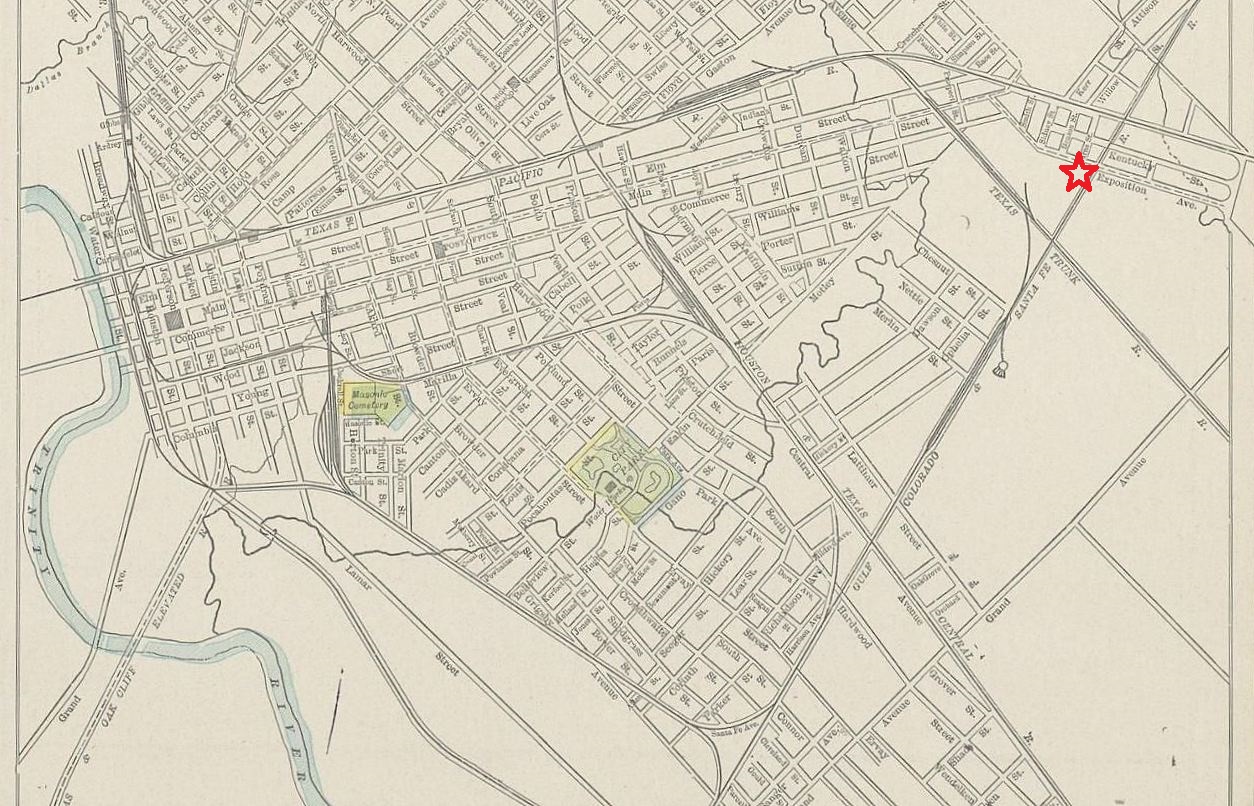
Here’s a map of Dallas from 1898, with Bullen’s store way on the edge of the world, under the star.

1898-map_bullen-store_expositionvia Portal to Texas History

*

507-exposition_then-now_ca-1905-2022

***

Sources & Notes

Photo is from the family collection of Joseph Bullen II, used with permission.

I would LOVE to see historical photos of the Expo Park area — from any time, really, but especially from the time it was primarily residential. If you have any photographs, please let me know!

See this building today on Google Street View, here.

Biographical information on J.W. Bullen from “J. W. Bullens Observe Their Anniversary” (Dallas Morning News, Nov. 22, 1942).

More Flashback Dallas posts on Exposition Park can be found here.

bullen-store_exposition-avenue_ca-1905_sm

*

Copyright © 2023 Paula Bosse. All Rights Reserved.

Wes Wise, 1929-2022

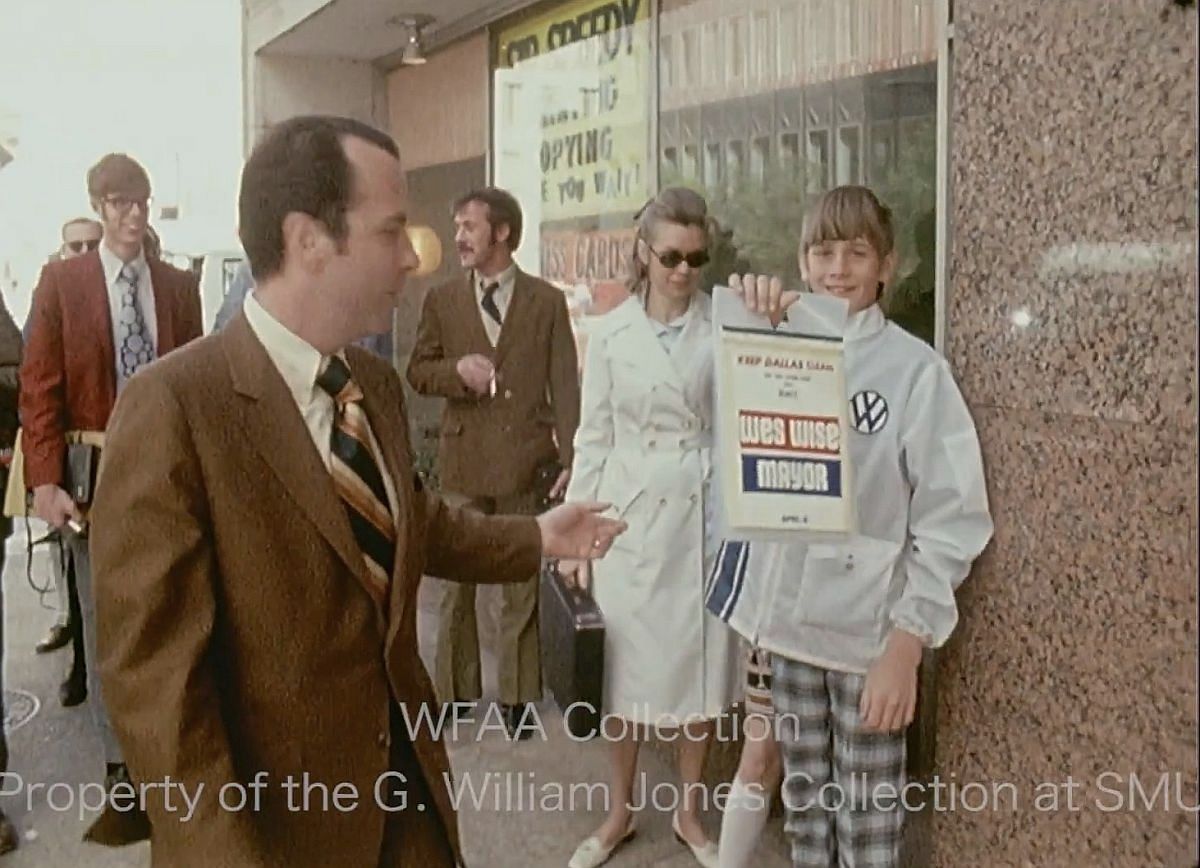
wise-wes_apr-1971_WFAA_SMUWes Wise and family campaigning for Mayor, April 1971

by Paula Bosse

Wes Wise, former 3-term Dallas mayor (1971-1976), has died. He was 94. Read his obituary in The Dallas Morning News, here. Also, a tribute to Wise from the Dallas Municipal Archives is here.

In the piece linked above, the Dallas Municipal Archives mentions this: “Wise is noted for being the first mayor since the 1930s not endorsed by the Citizens Charter Association.” The CCA was a powerful political organization I’ve only become aware of recently. It wasn’t really until I began working in the WFAA-Channel 8 News archives that I saw Dallas political history up close, and it was full of all these powerful groups I had never heard of which, for decades, could make or break candidates simply by deeming them endorsable. If you were running for mayor or City Council, you really wanted the support of the Citizens Charter Association. And you absolutely wouldn’t have dared poke at them with sharp sticks. …Wes Wise poked at them with sharp sticks.

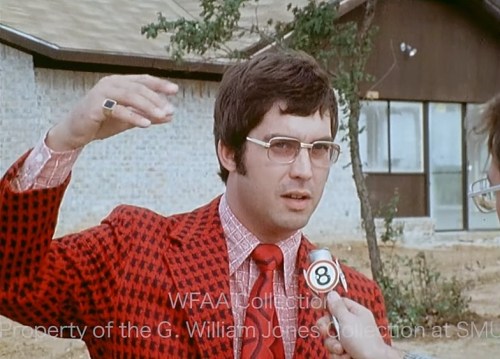
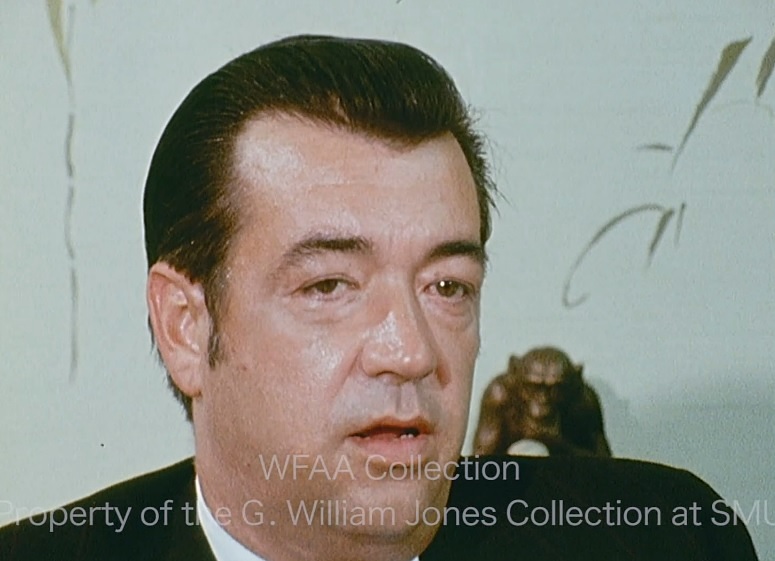
I’ve been going through old Channel 8 News footage, chronologically, for a while now. I am, at present, making my way through April 1971, when Wise and his opponent — the establishment-backed (i.e. CCA-backed) Avery Mays — were in the midst of a runoff for Dallas mayor. Mays, a businessman and civic leader, was the hand-picked candidate of the Citizens Charter Association and, as such, was expected to win. Wise, a City Councilman and former sportscaster, was the self-assured maverick who loudly proclaimed that he was an independent candidate who would not have accepted CCA backing had it been offered. He was young, good-looking, and — with a background in broadcasting — was comfortable and confident in the limelight.

mays_wise_apr-1971_WFAA_SMU

There was a “debate” of sorts between the two on Channel 8, with each man given a minute to make a statement. It’s not on the level of Nixon and JFK, but there is a stark, generational contrast in the two men. I don’t see perspiration on Mays’ upper lip, but I’m getting a rattled, sweaty vibe from him. Wise, on the other hand, is all casual bravado.

Two clips of the candidates during this runoff campaign show the difference in styles of the two men: it’s Old Dallas vs. New Dallas.

  • Watch Avery Mays accuse his opponent Wise of being all talk and no action and being nothing more than a professional “TV and radio talker” (even though Wise had just finished serving a 2-year term on the City Council) — the clip is here.
  • Watch Wes Wise deliver his stinging rebuttal here.

Old Guard vs. New Blood. New Blood won, and Wes Wise led Dallas through the 1970s, a decade of huge change for the city.

***

Sources & Notes

Top image is a screenshot showing Wes Wise campaigning for mayor during the runoff race against Avery Mays on April 8, 1971. Wise is seen with his wife, Sally, and his son, Wyn. The clip is from the WFAA Newsfilm Collection, G. William Jones Collection, Southern Methodist University — it can be viewed on YouTube here (Wise is seen in the segments at 14:20 and 17:21).

An informative mini-biography on Wes Wise can be found here. (It’s interesting to see that, while in the army, Wise was an instructor in psychological warfare, the perfect training for both a broadcaster and a politician!)

More on Wes Wise at Wikipedia, here.

See a shot of Wes Wise in his sports broadcasting days in the Flashback Dallas post “Wes Wise, Dallas Texans, WFAA — 1961.”

wise-wes_apr-1971_WFAA_SMU_sm

*

Copyright © 2022 Paula Bosse. All Rights Reserved.

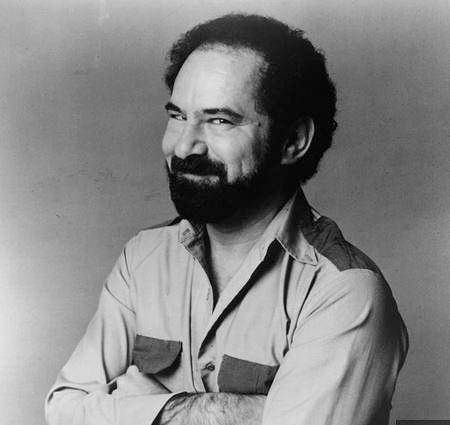
Stuart Margolin, 1940-2022

margolin-stuart_hillcrest-high-school_1955Hillcrest High School, 1955

by Paula Bosse

Everyone’s favorite character actor, Stuart Margolin, has died. He grew up in Dallas (Preston Hollow) and went to Hillcrest High School — until he was sent to what sounds like a reform school in another state. A brief look through the Dallas Morning News archives shows that he appeared in local theater productions as a child — he trod the boards in a production of A Midsummer Night’s Dream when he was 10. As a teenager, he was active in the Courtyard Theater in Oak Lawn, a school and theater led by Robert Glenn, who had also mentored other young Dallas actors such as Jayne Mansfield, Brenda Vaccaro, Ann Wedgeworth, and… Candy Barr). When he wasn’t acting — and apparently causing enough mayhem to get sent to reform school — he was a very good, avid junior golfer who competed in many tournaments (he is shown in one very grainy photo as a 13-year-old member of the DAC Country Club team, wearing a jaunty golf cap). There is no further mention of the young Margolin after 1955, when, one assumes, the teenager was shipped off to someplace not as cushy as Preston Hollow. He starts popping up again in newspaper stories in 1967, in the early days of his long and successful career in Hollywood when he was making regular appearances on TV shows such as Love American Style

His most-remembered role is Angel, sidekick to James Garner, in The Rockford Files. People loved this character. HE loved this character. He has said, with great affection, that he based Angel on streetwise guys he grew up with in Dallas. 

In 1979, though an established working actor and director in Hollywood, he moved back to Dallas for a couple of years, working on writing projects and establishing the production company River Entertainment.

margolin-stuart_dmn_022481_river-entertainmentFeb. 1981 (Dallas Morning News)

He tried for several years to establish a theater in the city, saying, “I don’t think there’s a professional theater here that is of a quality that this city deserves, a city that likes to view itself as Dallas does” (“Margolin’s Life Has Many Stages” by Joe Leydon, DMN, Apr. 20, 1980). (He was not a huge fan of the Dallas Theater Center and was especially unhappy that, in 1980, the DTC hadn’t had an Actors Equity contract in 20 years.)

At this time he also recorded a country/blues album, And the Angel Sings, of which he said:

I’m from [Dallas], and my musical influences are from this area. When I grew up in Dallas, I listened to a lot of blues — Muddy Waters, B.B. King, This record was made for the kind of people I grew up with. (The Daily Oklahoman, Apr. 22, 1980)

I just watched him in an old episode of The Mary Tyler Moore Show a couple of days ago and said to myself, “I love this guy.” I was always a fan of Stuart Margolin. RIP.

margolin-stuart

***

Sources & Notes

Top photo from the 1955 Hillcrest High School yearbook, The Panther.

margolin-stuart_hillcrest-high-school_1955_sm

*

Copyright © 2022 Paula Bosse. All Rights Reserved.

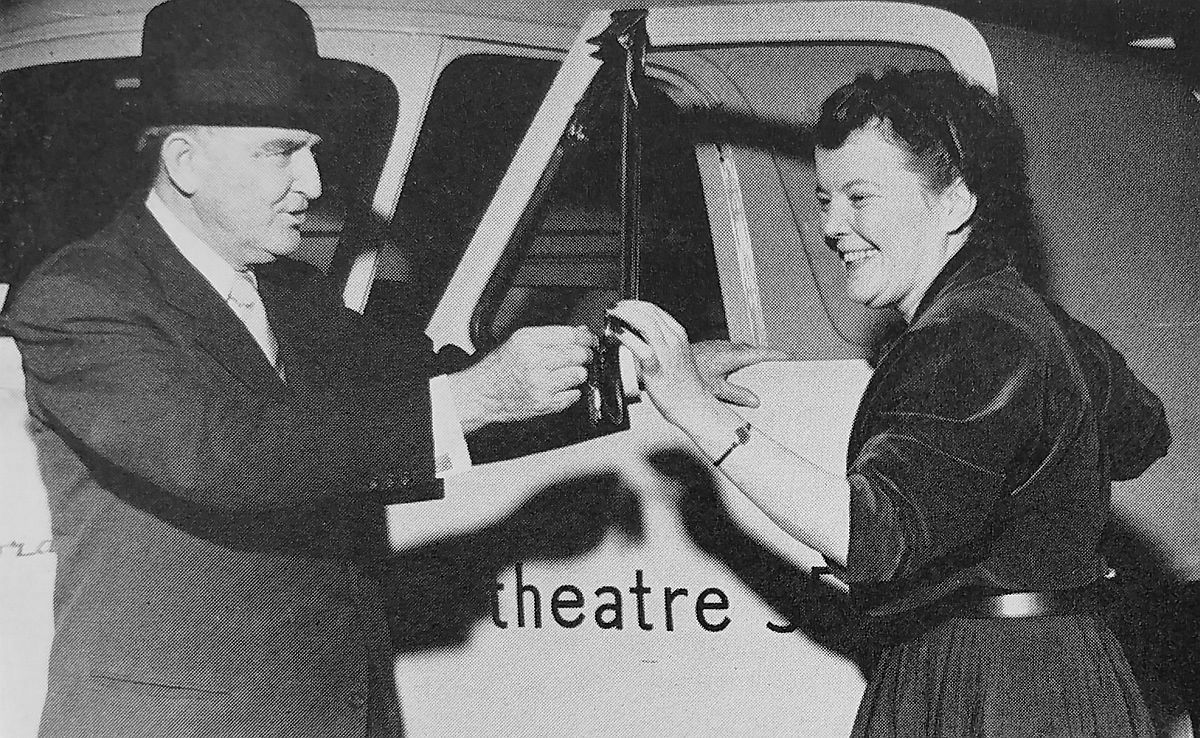
New Wheels for Margo Jones — 1955

jones-margo_theatre-55_dallas-magazine_apr-1955DeWitt Ray and Margo Jones

by Paula Bosse

The photo above shows Dallas theater legend Margo Jones accepting the keys to a new Ford truck in March 1955. Below, the caption that appeared in the April 1955 issue of Dallas magazine:

GIFT FOR THEATRE ’55: Margo Jones, director of Theatre ’55, is shown as she accepts the keys to a new 1955 panel truck from DeWitt T. Ray, Dallas banker and member of Dallas Theatre ’55 board of trustees. The truck, gift of a group of 18 Dallas businessmen and civic leaders, will be used for transporting set furniture, props and other necessities for the theatre’s productions.

She looks very, very happy!

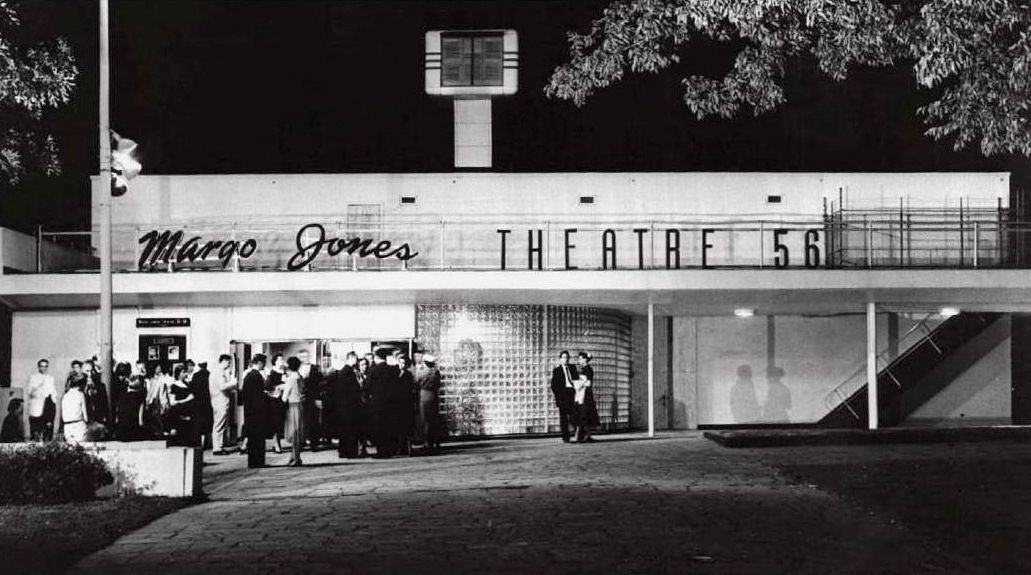
margo-jones_theatre-56_dpl

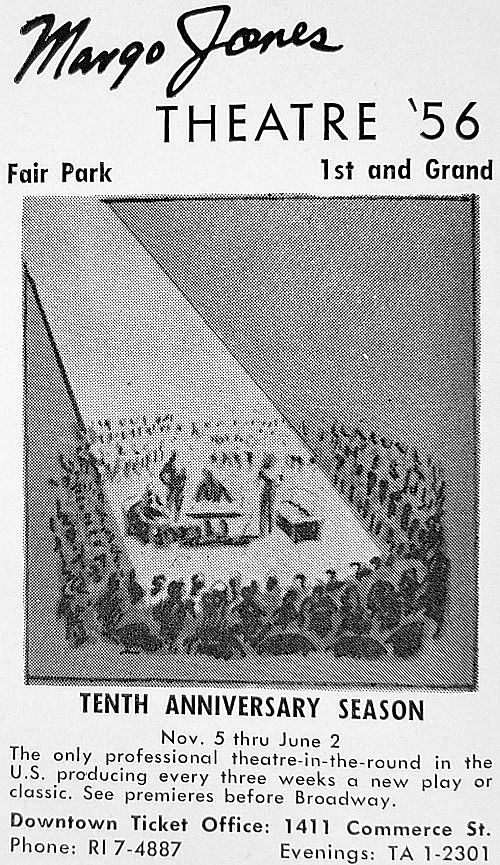
jones-margo_theatre-56_this-month-in-dallas_dec-1956_ad

***

Sources & Notes

Photo is from the April 1955 issue of Dallas, a periodical published by the Dallas Chamber of Commerce.

Photo of the exterior of the theater from the collection of the Dallas Public Library.

Ad from the Dec. 1956 issue of This Month in Dallas.

More on Margo Jones can be found in the following Flashback Dallas posts:

Watch “Sweet Tornado: Margo Jones and the American Theater,” the full documentary on Margo Jones produced by KERA-Channel 13, here.

jones-margo_theatre-55_dallas-magazine_apr-1955_sm

*

Copyright © 2022 Paula Bosse. All Rights Reserved.

The Fountain: “A Resort for Gentlemen” — ca. 1911

by Paula Bosse

This postcard (which has a 1911 postmark) shows The Fountain, a well-appointed drinking establishment (not lacking in ceiling fans). The caption reads:

Meet me at the Fountain, a Resort for Gentlemen, 1518 Main Street, Dallas, Texas.
John H. Senchal, Propr.
Don’t fail to see the Greatest Fair on Earth at Dallas, Texas.

This bar-with-food was located on the south side of Main, steps away from the present location of Neiman Marcus. It was in the block seen in the picture below (it is just out of frame at the bottom right, next door to the Colonial Theater):

Main Street looking east from Akard

Its address was originally 350 Main — after the city-wide address change in 1911, it became 1518 Main. It appears to have opened in 1907 and was in business until at least 1918 (after Dallas voted to go “dry,” the former saloon became The Fountain Cafe). Here are a few early ads for the “High-Class Stags’ Cafe” in its early go-go “gentlemen’s resort” days: 

Dallas Morning News, Oct. 1907

Dallas directory, 1909

Dallas Police annual, 1910

A few years later, the owner, John Henry Senchal, opened Senchal’s Buffet and Senchal’s Restaurant and Rathskeller at 1614-1618 Main.

Dallas directory, 1915

*

Johnnie Senchal — born in Galveston in 1875 to a French father and American mother — appears to have been a popular, civic-minded man’s-man. He frequently traveled with Dallas businessmen to other cities and states to act as a booster for the city. He also indulged in sporty activities such as being a regular wrestling referee and sponsoring horse races at the State Fair of Texas (in 1914 a $2,000 “Fountain Purse” was offered — in today’s money, more than $56,000!). One 1915 newspaper report said he was “probably the best known saloon man in the city.” He was very successful and was not hurting for money.

He also seems to have had a cozy relationship with members of the Dallas police department — a situation which is probably commonplace between saloon-owners and cops. One news story described how he had leapt to the defense of a policeman who was waylaid by a large group of men while he was walking prisoners to jail — a huge brawl broke out, and Senchal and the cop emerged victorious. Also — in a story which wasn’t fully explained — Senchal and another man ponied up $5,000 in bond money ($140,000 in today’s money!) for a Dallas policeman who was charged in the fatal shooting of a 17-year-old, Those are some strong ties between a saloonkeeper and the local constabulary, man.

In 1912 there was another confusing story concerning a man who had been arrested and convicted for being the owner/lessee/tenant of an establishment which was “knowingly permitted to be used as a place in which prostitutes resorted and resided for the purpose of plying their vocation. […] The house was a ‘disorderly house.’ Prostitutes resorted there and displayed themselves in almost a nude condition.” The man who was charged was seen there on a number of occasions “dancing with the prostitutes.” The man appealed his conviction because he had been charged with being the owner/lessee/tenant of this “bawdy house” — but the lessee/tenant was none other than Johnnie Senchal and another man. As far as I can tell, Senchal was not charged with anything regarding this case. 

But a couple of years later, in 1914, he was charged with running a “disorderly house” (a term often meaning a bordello or gambling den, but also meaning a place which is frequently the site of disturbances and is generally considered to be a public nuisance). It seems Johnnie and other were offering “cabaret” entertainment which might gotten out of hand. From The Dallas Morning News:

Alleging that the cabarets are conducted as “disorderly houses,” [charges were filed] on behalf of the State of Texas against owners of three restaurants in the downtown section. Affidavits accompanying the petitions alleged that women were allowed to drink at the places and to act in an unbecoming manner. (DMN, March 12, 1915)

I’m not sure exactly what constituted “an unbecoming manner,” but Johnnie Senchal was one of the men charged. At the very same time he was fighting this violation of the cabaret ordinance, it was reported that “an involuntary petition in bankruptcy has been filed in the United States court here against John Senchal and J. O. Walker, partners in the saloon business on Main Street. The petition was filed by local brewery agents and whisky houses” (DMN, June 20, 1915). Bankrupt! Even though he was apparently rolling in dough for years, he was rather ironically pushed to bankruptcy because he couldn’t pay his own bar tab.

And so Johnnie put the barkeeper’s life behind him. And I mean he REALLY put it behind him: he became a fervent speaker at Anti-Saloon League events, saying that having been forced out of the saloon game was actually a godsend — he was quoted as saying that his profits increased 75-80% when he stopped selling alcohol and became a full-time restaurateur. That seems unlikely, but that’s where he was in 1918, an improbable evangelist for Prohibition. 

Soon after, he and his family moved to Houston, where he opened a small cafe. On Oct. 9, 1929, after closing-time, Johnnie Senchal died in his cafe from a self-inflicted gunshot wound. He was 54 years old.

***

Sources & Notes

Postcard of The Fountain found on eBay.

Postcard of Main Street found on Flickr.

*

Copyright © 2022 Paula Bosse. All Rights Reserved.

Claes Oldenburg in Dallas — 1962

oldenburg-claes_dallas-museum-for-conteporary-arts_april-1962_WFAA_jones-film_SMU_postersClaes Oldenburg at the DMCA, April, 1962 (WFAA Collection, SMU)

by Paula Bosse

Claes Oldenburg, the Swedish-born American sculptor, died this week at the age of 93. Among his connections to Texas are two of my favorite Oldenburg pieces: the fabulous “Monument to the Last Horse,” a permanent fixture of Donald Judd’s Chinati Foundation in Marfa, which he created with his wife Coosje van Bruggen, and the much-missed “Stake Hitch,” a site-specific work commissioned by the Dallas Museum of Art (installed in the brand-new DMA in 1984, and, sadly, de-installed in 2002 after a nasty contretemps between Oldenburg and the museum).

Oldenburg’s first visit to Dallas was in April, 1962, at a time when he was known mainly to NYC art-world hipsters — well before he had achieved anything approaching his later international acclaim. He came to Dallas to present “The Store,” a pop art installation which was part of the group show “1961” at the Dallas Museum for Contemporary Arts (the DMCA was merged with/absorbed by what is now the Dallas Museum of Art in 1963). While Oldenburg was in Dallas exhibiting “The Store” (comprised of 45 individual works, the placement of which he re-created from the original December, 1961 show in Manhattan), he also presented “Injun,” the first-ever “happening” held outside New York or Los Angeles and the first such interactive event commissioned by a museum (Oldenburg’s Ray Gun Theater performance-art “happenings” were much talked about and had gained a cult following in New York, and having him in Dallas to present a “happening” was a definite “get” for the DMCA).

“The Store” and “Injun” — and Claes Oldenburg himself — were very un-Dallas. The reception Oldenburg received from Dallas’ followers of edgier contemporary art appears to have been positive, but his work was handily dismissed by Dallas Morning News art critic Rual Askew, who, invoking the “royal we,” wrote this rather laborious sentence:

Claes Oldenburg’s ‘The Store,’ a painted-plaster waste of time in our view, has interest as assembled pattern with carnival colors at a considerable distance perhaps, but displaces space out of all proportion to aesthetic experience. (DMN, April 15, 1962)

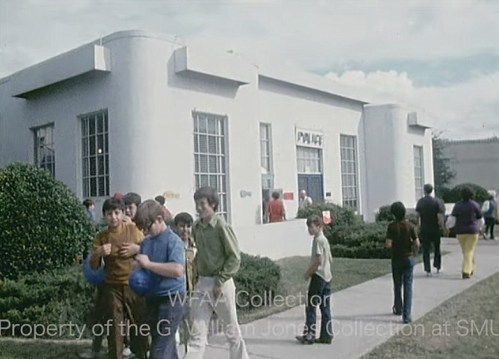
As I work with the WFAA Collection (held by the G. William Jones Collection at SMU’s Hamon Arts Library), I was pretty excited when film footage popped up showing Oldenburg and his first wife (and his collaborator), Patty Mucha, at the DMCA. I knew that the DMCA was somewhere in Oak Lawn (it was at 3415 Cedar Springs), but I had never seen an image of it until this footage. The Oldenburgs are seen walking into the DMCA, tinkering with the installation before the show opened, inspecting the store’s “foods” and other “merchandise,” and playfully “playing store” and exchanging imaginary cash at his “cash register.” Sadly, there is no sound for the one-minute-45-second film, but — being an art history major (that always sounds pretentious…) — I really, really love this. A young, happy Claes Oldenburg in a moth-eaten sweater, here in Dallas, in the early years of what would become an artistically important career is pretty cool to see.

I have been meaning to write this post since I first saw the WFAA footage two years ago. I’m sorry that it’s taken the death of the artist to finally get me to do it. RIP, Claes.

*

UPDATE: Morgan Gieringer, Head of UNT Special Collections, alerted me to a WBAP-Channel 5 news script they have in their collection which describes much the same sort of thing that is going on in the WFAA-Channel 8 film above. In the script, Oldenburg discusses some of the pieces — read the two pages here. (The Ch. 5 report was filmed on March 29, 1962, which could be the same date as the Ch. 8 footage.)

*

“The Store” at the Dallas Museum for Contemporary Arts, 1962 — in vivid color:

oldenburg-claes_the-store_DMCA_1962_DMAvia Dallas Museum of Art

via Dallas Museum of Art

1961_claes-oldenburg_catalog_DMCA_1962_injun“1961” catalogue, via DMA/Portal to Texas History

Screenshots from the WFAA footage, showing Oldenburg and his wife, Patty (who worked alongside her husband and was a frequent participant in the “happenings”) preparing “The Store” for its opening at the DMCA.

oldenburg-claes_dallas-museum-for-conteporary-arts_april-1962_WFAA_jones-film_SMU_ext

oldenburg-claes_dallas-museum-for-conteporary-arts_april-1962_WFAA_jones-film_SMU_1

oldenburg-claes_dallas-museum-for-conteporary-arts_april-1962_WFAA_jones-film_SMU_2

oldenburg-claes_dallas-museum-for-conteporary-arts_april-1962_WFAA_jones-film_SMU_3

oldenburg-claes_dallas-museum-for-conteporary-arts_april-1962_WFAA_jones-film_SMU_4

oldenburg-claes_dallas-museum-for-conteporary-arts_april-1962_WFAA_jones-film_SMU_5

oldenburg-claes_dallas-museum-for-conteporary-arts_april-1962_WFAA_jones-film_SMU_7

***

Sources & Notes

Top image (and all other black-and-white images) are screenshots from the WFAA Newsfilm Collection, G. William Jones Film and Video Collection, Hamon Arts Library, Southern Methodist University; the footage was filmed in early April 1962 (or possibly late March 1962); the clip may be viewed on YouTube, here.

The color photograph of “The Store” and the poster for “Injun” are both from a publication of the Dallas Museum of Art, here.

Other Oldenburg-related sources:

  • The “1961” exhibition catalogue — this group-show featured heavy-hitting up-and-comers such as Robert Rauschenberg, Roy Lichtenstein, Robert Motherwell, James Rosenquist, Joseph Albers, Morris Louis, Jasper Johns, Jim Dine, and Richard Diebenkorn — can be viewed in a fully scanned Dallas Museum for Contemporary Arts catalogue here, via the Dallas Museum of Art Exhibition Records, Portal to Texas History
  • Candid photos from the “Injun” performance can be seen here
  • See several great photos of Oldenburg taken during the installation of “Stake Hitch” in 1984, in a DMA Bulletin here, here, here, and here
  • Watch a short video about “The Store” when it was restaged at the Museum of Modern Art in 2013, with comments on the pieces by Oldenburg; see what the pieces shown in the 1962 black-and-white film made in Dallas looked like 51 years later, in color, in the MoMA video, here

On my blog High Shrink (non-Dallas stuff), you can read more about Oldenburg in a post I really enjoyed writing, “Claes Oldenburg’s ‘Slice of Bread; Tombstone for Ed Kienholz — 1974.”

oldenburg-claes_dallas-museum-for-conteporary-arts_april-1962_WFAA_jones-film_SMU_posters_sm

*

Copyright © 2022 Paula Bosse. All Rights Reserved.