Until last week, I don’t think I’d ever heard the 1969 song “The Back Side of Dallas,” sung by Jeannie C. Riley, who had had the blockbuster hit “Harper Valley PTA” the previous year. How have I never heard this? I was going to post it last week until I realized that it would be better to wait until today, because of this line from the song: “Meet me in Dallas on June the 23rd, his letter read.” And here we are, June 23rd.
The song, written by Jerry Foster and Bill Rice, was released in October, 1969. It wasn’t the huge, crossover, multi-award-winning monster hit that “Harper Valley PTA” was, but it did earn Jeannie another Grammy nomination (she lost to Tammy Wynette’s “Stand By Your Man” — if you’re going to lose, that’s a pretty great performance to lose to!).
Like “Harper Valley PTA,” it was one of several songs of the era which brought country music into the somewhat seedy realm of 1960s American culture. “The Back Side of Dallas” is about a small-town girl who finds herself a lonesome “working girl” in Dallas, chain-smoking king-size cigarettes, drinking in dingy bars, and popping pills. This ain’t no Kitty Wells song, y’all. (I’d love to hear Miranda Lambert — who also has an incredible country voice — cover this.)
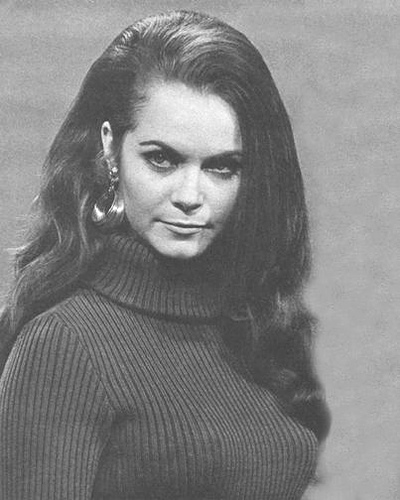
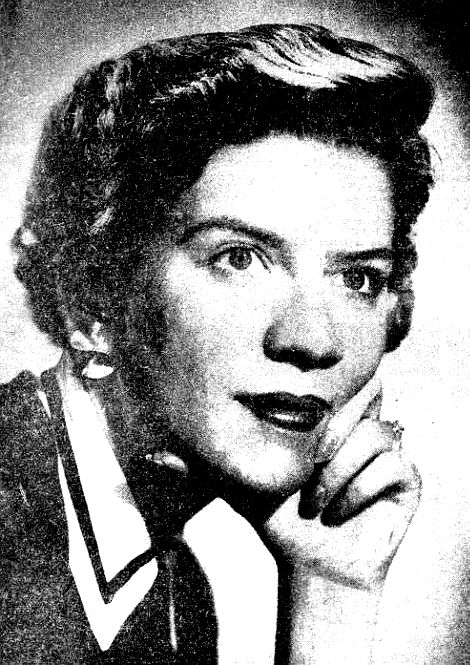
Jeannie C. Riley — born in Anson, Texas in 1945 — was one of the first certifiable sex symbols in country music, always gorgeous, outfitted in miniskirts and go-go boots, with sky-high hair teased to a fare-thee-well. AND she had an absolutely fantastic voice. Below is video of a 24-year-old Jeannie C. Riley singing “Back Side of Dallas” on Del Reeves’ Country Carnival in 1969 (Del Reeves had some greatsongs in the ’60s, but his TV persona was a little too Dean Martin-wannabe for my taste … and … oh dear … that set!):
*
I prefer the studio version, below. I’ve listened to this song dozens of times now, and I haven’t gotten tired of it yet!
*
And here’s Jeannie singing it in 2011, still sounding great! (Her thick Texas accent is the absolute best, and her laugh is fantastic.) She talks about the song a bit at the beginning with Jerry Foster, one of the writers of the song — the song itself starts at about the 3:10 mark.
*
And, to round out this “June the 23rd” post, a few photos of Jeannie C. — surely one of the most photogenic faces and bad-ass vocalists in the history of country music. As my father used to say, “hot damn.”
“Harper Valley PTA” — you know you want to hear it. This is a great live version she did on, I think, the Wilburn Brothers Show, with Harold Morrison on dobro.
*
Not that anyone’s going to confuse the two songs, but this song has nothing to do with the 1915 song of the same name by Adolphus Hotel orchestra leader Jack Gardner (which you can read about here).
I give you a 21-year-old Nolan Ryan soaking his pitching finger in pickle juice. As one does.
Years before the future Baseball Hall of Famer made it to DFW, young Nolan was the star pitcher of the New York Mets. He was prone to blisters on the middle finger of his pitching hand, so Mets trainer Gus Mauch put him on a strict pickle juice regimen of soaking the affected finger between innings to toughen the skin and prevent blisters from popping up at inopportune moments. And, of course, this weird pickle juice thing became really big news in May, 1968. Sportswriters jumped all over it, and a few began calling him “Pickle Brine Ryan,” because it sort of rhymes.
The delicatessen where Ryan’s pickle juice of choice was purchased tried to cash in on what they hoped would become a fad by placing jars of the brine in the window with a sign proudly proclaiming that they were the source of the famous “Mets’ Pitching Juice.” According to a UPI story, when another pickle company offered the Mets five gallons of their pickle juice, trainer Mauch responded, “Gosh, you could embalm a whole swimming team with five gallons!”
While teammates relax before a game, using anything handy for a pillow, New York Mets’ pitcher Nolan Ryan (left) soaks his pitching fingers in pickle juice. That’s right — pickle juice! Ryan says the juice toughens his fingers so that he doesn’t get blisters.
I wonder if he kept it up? By the time he got back home to Texas and signed with the Rangers, I’d love to know that he upped his brine game by using pickled jalapeño juice.
An earlier Nolan Ryan-related Flashback Dallas post — “Nolan Ryan’s Celebratory Pancake Breakfast — 1972” — is here.
I have a surprisingly deep knowledge of classic country music. And it can all be traced back to sitting with my father every Saturday night as he watched the jam-packed lineup of country music TV shows on KTVT-Channel 11.
Followed by wrestling.
Which I also have a surprisingly deep knowledge of. If only by osmosis.
Thank you, Channel 11, for providing this bonding time with my father, which I didn’t really appreciate as a child, but I do now.
(And, yes, I’m happy that my antiquarian bookseller father and Comparative Literature-degree-holding mother often took our family to the Sportatorium to see both country music package-shows and wrestling matches. You can’t say our family wasn’t well-rounded.)
***
Sources & Notes
1969 ad from an odd little local publication (which probably used to belong to my father) called Country and Western — The Sound That Goes Around the World, published in DFW by PegAnn Production.
Today, Fort Worth. I was looking for photos of the old Forest Park in Oak Cliff (which was renamed Marsalis Park in 1925) and came across photos of the Forest Park Zoo. A search on the internet showed me that there was also a Forest Park Zoo in Fort Worth. I’ve never actually been a big fan of zoos, but I saw the photo above and was won over by its sheer cuteness. So let’s just take a little trip westward and enjoy some photos of cute animals, most of which feature zookeeper Henry Hamilton (“Ham”) Hittson.
Ham Hittson (1912-1966) began working as a zookeeper at the Forest Park Zoo in the early 1930s — if his obituary is correct, he became the zoo’s director in 1933 — at the age of only 21! During World War II he served for two years in the Coast Guard, assigned to work with sentry and attack dogs and with patrol horses. After the war he returned to the zoo (he was the director of the zoo for 21 years) and eventually became the director of the Fort Worth Park Department. His 1966 obituary (he was only 54 when he died) noted that he was instrumental in forming the Fort Worth Zoological Association. And, well, these photos are very sweet.
(All photos are from the University of Texas at Arlington Libraries. Click pictures to see larger images; click the link below each photo for more information.)
*
The photo at the top is my favorite — it shows Hittson with a tiny fawn born the previous day. The photo above and the one below were taken on June 29, 1937.
Actor Jimmy Stewart stopped by the zoo on May 22, 1953 to check out the zoo’s new rhinoceros, Marilyn Monroe. F. Kirk Johnson, zoological board president, is at the left and Hittson, then park department director, is at the right.
Back to Ham’s zookeeper days: in the photo below (taken on August 2, 1940), he’s standing with one of the zoo’s top attractions, an elephant named Queen Tut. He’s bidding her farewell as he is about to leave for New York where he will pick up a baby elephant to be her companion. (Hittson and the zoo’s veterinarian brought the one-year-old elephant back with them in a trailer — they must have attracted a lot of stunned looks along the highway as they drove back from New York.)
The arrival of this new elephant was big news — there were almost daily updates in the pages of the Fort Worth Star-Telegram. In order to buy the elephant, the zoo had had to take out a loan from the bank, and in what was both a speedy way to pay off the debt and a clever way to garner publicity, there followed a successful drive to raise money to pay off the “mortgage”: countless school children happily did their parts by contributing pennies, nickels, and dimes in the fundraising effort and then flocked to the zoo to see the newest member of the zoo family and welcome her to Fort Worth.
And here’s Queen Tut with her new little pal, Penny, on September 10, 1940.
While looking through the Neiman Marcus Collection at the downtown Dallas Public Library, I stumbled across this perhaps long-forgotten part of Neiman-Marcus history: the “corporate flag” designed by Italian fashion legend Emilio Pucci. The image was featured on a Neiman’s postcard; the text on the back of the card reads:
Flying high over the fashion land of Neiman-Marcus: our new corporate flag, the Lone-Star-and-Stripes. Emilio Pucci was our Betsy Ross.
Betsy Ross and Emilio Pucci mentioned in the same breath! An 18th-century American seamstress who became a patriotic icon, and an Italian fashion designer whose vividly colorful, boldly patterned designs came to symbolize the youth and energy of the 1960s… talk about your strange bedfellows!
The only thing I could find about this unusually colorful flag was a brief mention in a Dallas Morning News fashion article about Neiman’s 28th Neiman-Marcus Exposition Award in early February of 1966. Gay Simpson wrote in The News that the luncheon centerpieces “carried the colors of the new Neiman-Marcus house flag. The flag, designed by Emilio Pucci, Italian couturier, has the colors of a Texas sunset dramatized with the Lone Star and stripes” (DMN, Feb. 9, 1966).
Stanley Marcus wrote in his 1974 memoir Minding the Store that his business relationship with Pucci (“the most copied designer of our time, aside from Chanel”) began in Italy in 1948 when Marcus met with the struggling young designer and placed an order for several of his scarves. Though Neiman-Marcus had not yet expanded beyond their single department store in Dallas, the store’s reputation and influence were certainly known in fashionable circles around the world, and this N-M “stamp of approval” must have been immensely important to Pucci, whose name was not yet known. This friendship and business relationship blossomed into a mutually beneficial and very profitable partnership, and it seems perfectly reasonable that Pucci would design a flag for his friend and early supporter, Stanley Marcus. (Read more of Marcus’ thoughts on Pucci here.)
There you have it. Who knew?
**
As a postscript, any Dallas blog worth its salt cannot let a mention of Emilio Pucci go by without noting his main connection to the city: Pucci will forever be remembered as the man who brought outrageously colorful and super groovy mod designs to the stewardess uniforms of Dallas-based Braniff International Airways (designs so retinally exciting that they make that little Neiman’s flag look a little dowdy in comparison!).
***
Sources & Notes
The image of the corporate flag is from a Neiman’s postcard, which can be found in the extensive (!) Neiman Marcus Collection of the Dallas Public Library (the back of the card can be seen here); it is used with permission. Thanks to the incredibly helpful staff of the Dallas History & Archives division of the downtown Dallas Public Library. (Much thanks, particularly, to Digital Archivist Misty Maberry!)
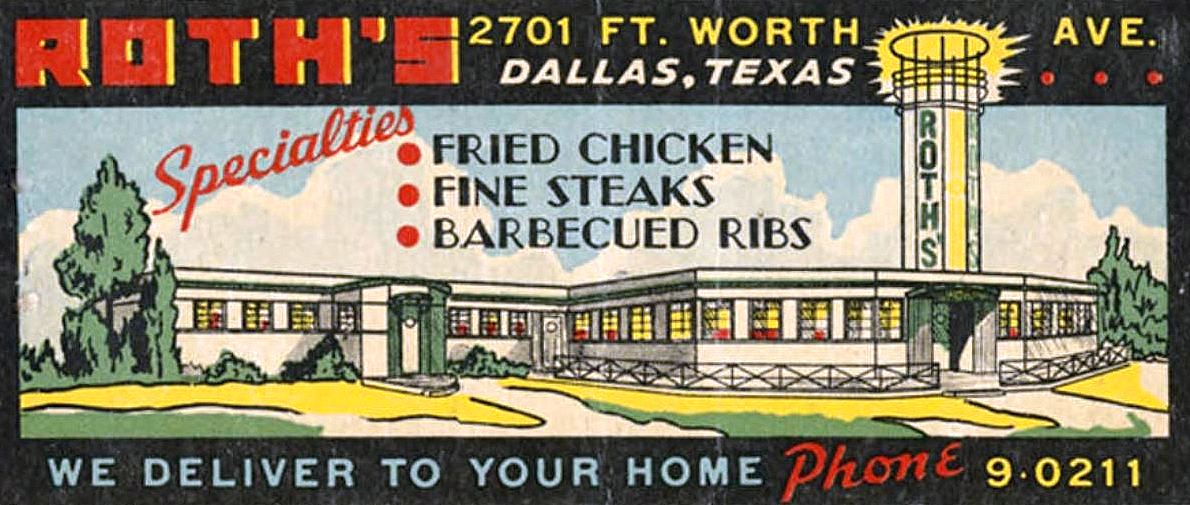
When I see a building like this, I always hope I can find a photo of it somewhere, but all I’ve been able to come up with is this energetic rendering from a 1940s matchbook cover. Roth’s (which was advertised variously as Roth’s Cafe, Roth’s Restaurant, and Roth’s Drive-In) was in Oak Cliff, on Fort Worth Avenue. It opened in about 1940 or ’41 and operated a surprisingly long time — until about 1967. When Roth’s opened, its address was 2701 Fort Worth Avenue, but around 1952 or ’53 the address became 2601. (I think the numbering might have changed rather than the business moving to a new location a block down the street.)
During World War II, Mustang Village — a large housing development originally built for wartime workers (and, later, for returning veterans and their families) — sprang up across Fort Worth Avenue from the restaurant. It was intended to be temporary housing only, but because Dallas suffered such a severe post-war housing shortage, Mustang Village (as well as its sister Oak Cliff “villages” La Reunion and Texan Courts) ended up being occupied into the ’50s. Suddenly there were a lot more people in that part of town, living, working, and, presumably, visiting restaurants.
As the 1960s dawned, Mustang Village was just a memory, and Roth’s new across-the-street neighbor was the enormous, brand new, headline-grabbing Bronco Bowl, which opened to much fanfare in September 1961. I don’t know whether such close proximity to that huge self-contained entertainment complex hurt or helped Roth’s business, but it certainly must have increased traffic along Fort Worth Avenue.
Roth’s continued operations until it closed in 1967, perhaps not so coincidentally, the same year that Oak Cliff’s beloved Sivils closed. Ernest Roth, like J. D. Sivils, most likely threw in the towel when a series of “wet” vs. “dry” votes in Oak Cliff continued to go against frustrated restaurant owners who insisted that their inability to sell beer and wine not only damaged their own businesses but also adversely affected the Oak Cliff economy. The last straw for Sivils and Roth may have been the unsuccessful petition drive in 1966/1967 to force a “beer election” (read about it here in a Morning News article from Aug. 17, 1966).
As far as that super-cool building seen at the top — I don’t know how long it remained standing, but when Roth’s closed, a mobile home dealer set up shop at 2601 Fort Worth Avenue, and mobile homes need a lot of parking space….
The building on the matchbook cover above is, unfortunately, long gone (as is the much-missed Bronco Bowl); the area today is occupied by asphalt, bland strip malls, and soulless corporate “architecture” (see what 2701 Fort Worth Avenue looks like today, here).
*
The man behind Roth’s was Ernest W. Roth, a Hungarian immigrant who had worked for many years as maître-d’ at the Adolphus Hotel’s tony Century Room. He decided to go out on his own, and around 1940, he and his business partner Joseph Weintraub (who was also his brother-in-law) opened the Oak Cliff restaurant which boasted two dining rooms (with a seating capacity of 350, suitable for parties and banquets), fine steaks, and, on the weekends, a live band and dancing. Ernest’s wife, Martha, and their son Milton were also part of the family business. When the restaurant opened, there wasn’t much more out there on the “Fort Worth cut-off,” but the place must have been doing something right, because Roth’s lasted for at least 27 years — an eternity in the restaurant business. It seems to have remained a popular Oak Cliff dining destination until it closed around 1967.
*
The real story, though, is the Roth family, especially Ernest’s mother, Johanna Roth, and even more especially, his older sister, Bertha Weintraub.
Johanna Rose Roth was born in 1863 in Budapest, where her father served as a member of the King’s Guard for Emperor Franz Josef. She and her husband and young children came to the United States about 1906 and, by 1913, eventually made their way to San Antonio. In the ’40s and ’50s she traveled by airplane back and forth between San Antonio and Dallas, visiting her five children and their families — she was known to the airlines as one of their most frequent customers (and one of their oldest). She died in Dallas in 1956 at the age of 92.
Johanna’s daughter Bertha Roth Weintraub had a very interesting life. She too was born in Hungary — in 1890. After her husband Joe’s death in the mid ’40s, a regular at her brother’s restaurant, Abe Weinstein — big-time entertainment promoter and burlesque club empresario — offered Bertha a job as cashier at the Colony Club, his “classy” burlesque nightclub located across from the Adolphus. She accepted and, amazingly, worked there for 28 years, retiring only when the club closed in 1972 — when she was 82 years old! It sounds like she led a full life, which took her from Budapest to New York to San Francisco to San Antonio to Austin and to Dallas; she bluffed her way into a job as a dress designer, ran a boarding house in a house once owned by former Texas governor James Hogg, hobnobbed with Zsa Zsa Gabor and Liberace, was a friend of Candy Barr, and, as a child, was consoled by the queen of Hungary. She died in Dallas in 1997, a week and a half before her 107th birthday. (The story Larry Powell wrote about her in The Dallas Morning News — “Aunt Bertha’s Book Filled With 97 Years of Memories” (DMN, Nov. 17, 1987) — is very entertaining and well worth tracking down in the News archives.)
Bertha Roth Weintraub
I feel certain that the extended Roth family found themselves entertained by quite a few unexpected stories around holiday dinner tables!
***
Sources & Notes
Matchbook cover (top image) is from the George W. Cook Dallas/Texas Image Collection, DeGolyer Library, Central University Libraries, Southern Methodist University; more info is here.
Photo of Bertha Weintraub is from The Texas Jewish Post (Feb. 15, 1990), via the Portal to Texas History, here.
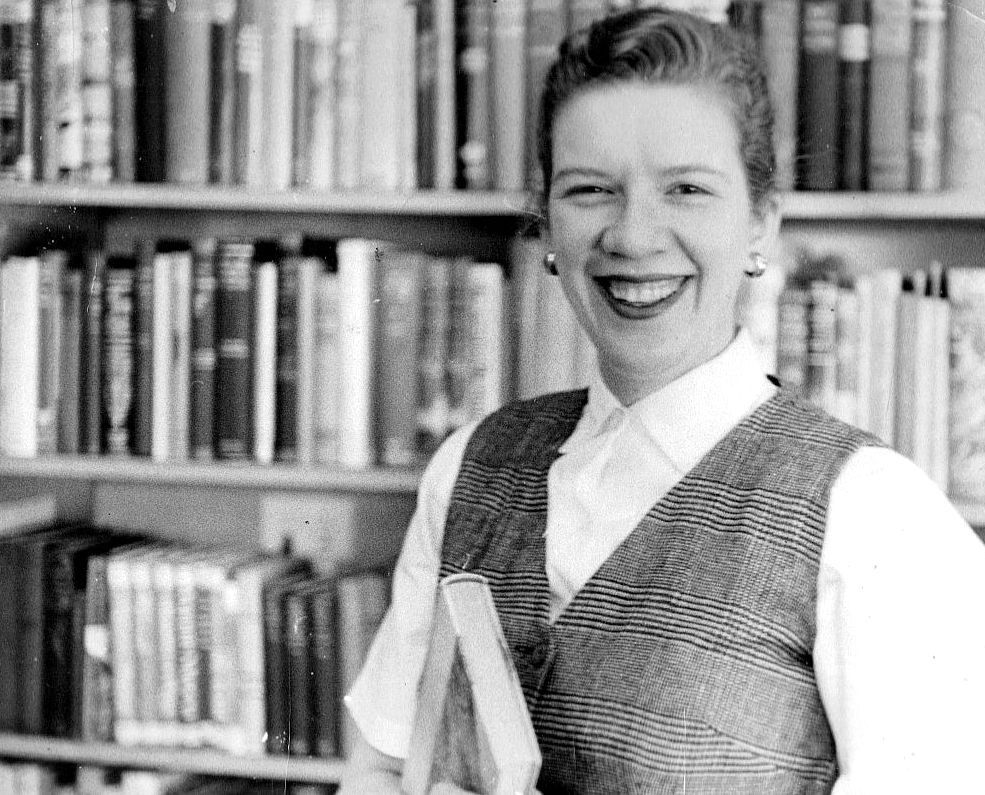
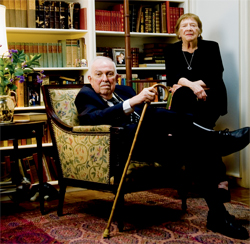
Mimi Aldredge McKnight (née Mildred Payne) died this week. She was an important person in the story of my family — she and her then-husband, Sawnie Aldredge, Jr. owned The Aldredge Book Store on McKinney Avenue, where my parents met and worked for many years and which, for my brother and me, became pretty much a second home. When Sawnie died, Mimi continued to run the store and kept my father, Dick Bosse, on as manager. My father ended up owning the store, and when he died, he had worked at The Aldredge Book Store for almost 45 years. Even when Mimi’s involvement with the store was minimal, she still kept in touch, and she and my father were always on very friendly terms.
I knew Mimi mostly when I was a child, and my memories of her are happy ones. I remember her laugh and her voice most of all. She always seemed like a lovely, friendly woman, and my parents were both very fond of her.
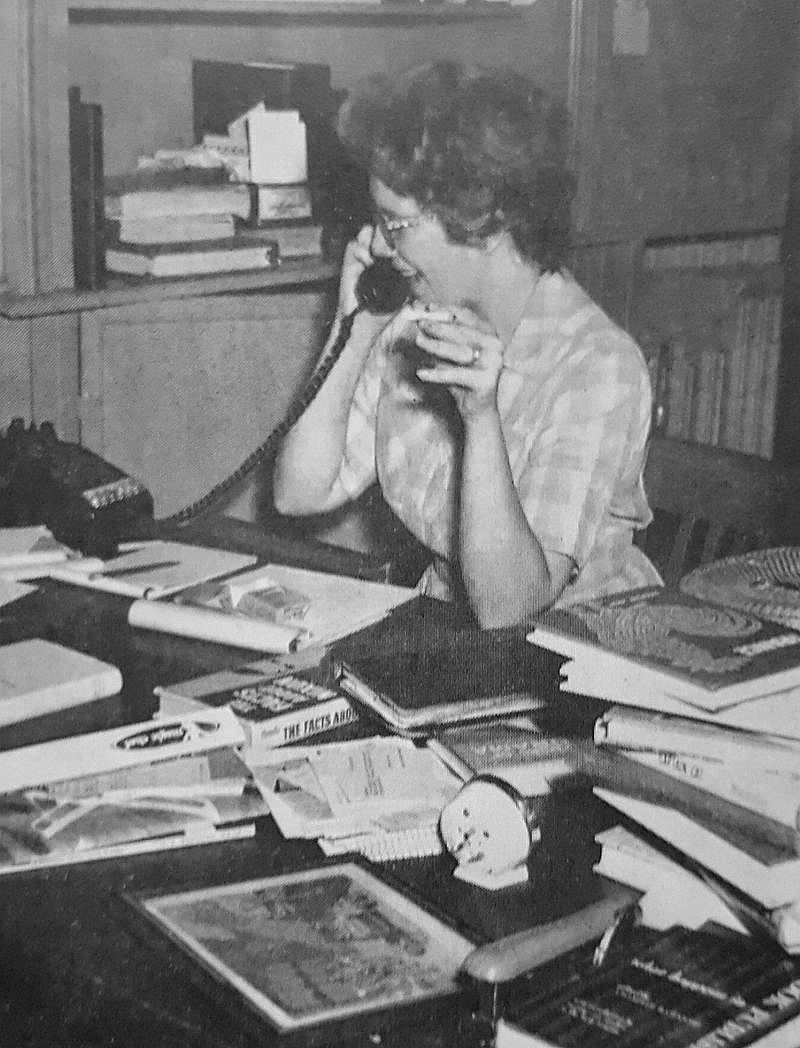
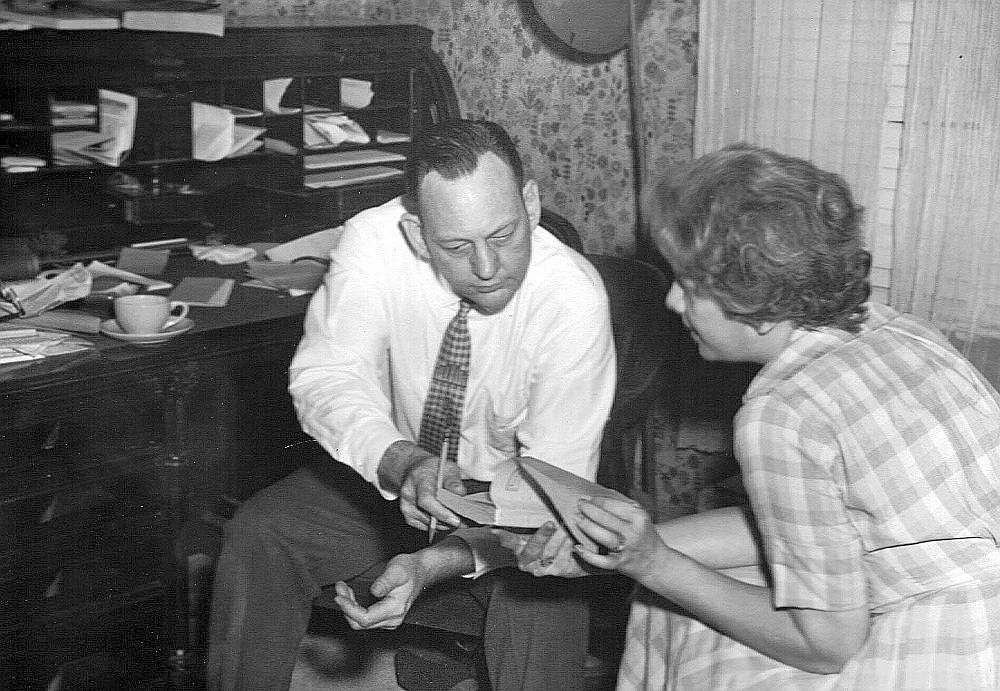
The photo below is how I remember her — talking animatedly on the phone (she and my mother, Margaret, were champion telephone talkers, and I remember them both working at that desk, and talking and talking and talking on that phone).
I ran into Mimi a few times as an adult. We’d usually just exchange quick pleasantries and ask how various family members were — but I always hoped I’d have the chance to sit down and have a long conversation with her someday. Sadly, that didn’t happen, but I’m so happy that my brother, Erik, and I have reconnected with her children, Amy and Trip Aldredge, and that we’re all friends. The four of us share nostalgic childhood memories of each other’s parents and of that old creaking house on McKinney — a house so crammed with books that the medical section had to be shelved in the bathroom. I can’t imagine a better childhood that one spent growing up in a bookstore.
Goodbye, Mimi — I’m so glad you were a part of my family’s life.
**
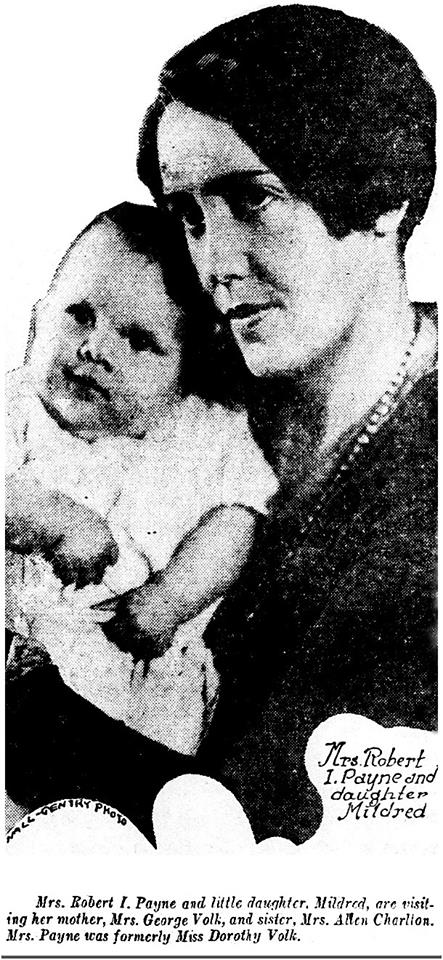
In one of those wonderful unexpected discoveries I’ve made while looking for something completely unrelated, I stumbled across this photo of little Mildred Payne as a baby and was happier about it than I might have expected. (Click photo to see a larger image.)
1929
It wasn’t until I was an adult that I realized Mimi had been a real-life, honest-to-god debutante (probably the only debutante I’ve ever met) and that her mother was a member of Dallas’ famed Volk retail family. She grew up in a very nice house, built by her father, Robert I. Payne, in the Perry Heights area of Oak Lawn. If you’re famiiar with Oak Lawn, you’ve probably seen the plantation-like house at 4524 Rawlins (at Hawthorne), designed by architect Ralph Bryan in 1936. (See the house today on Google Street View, here.)
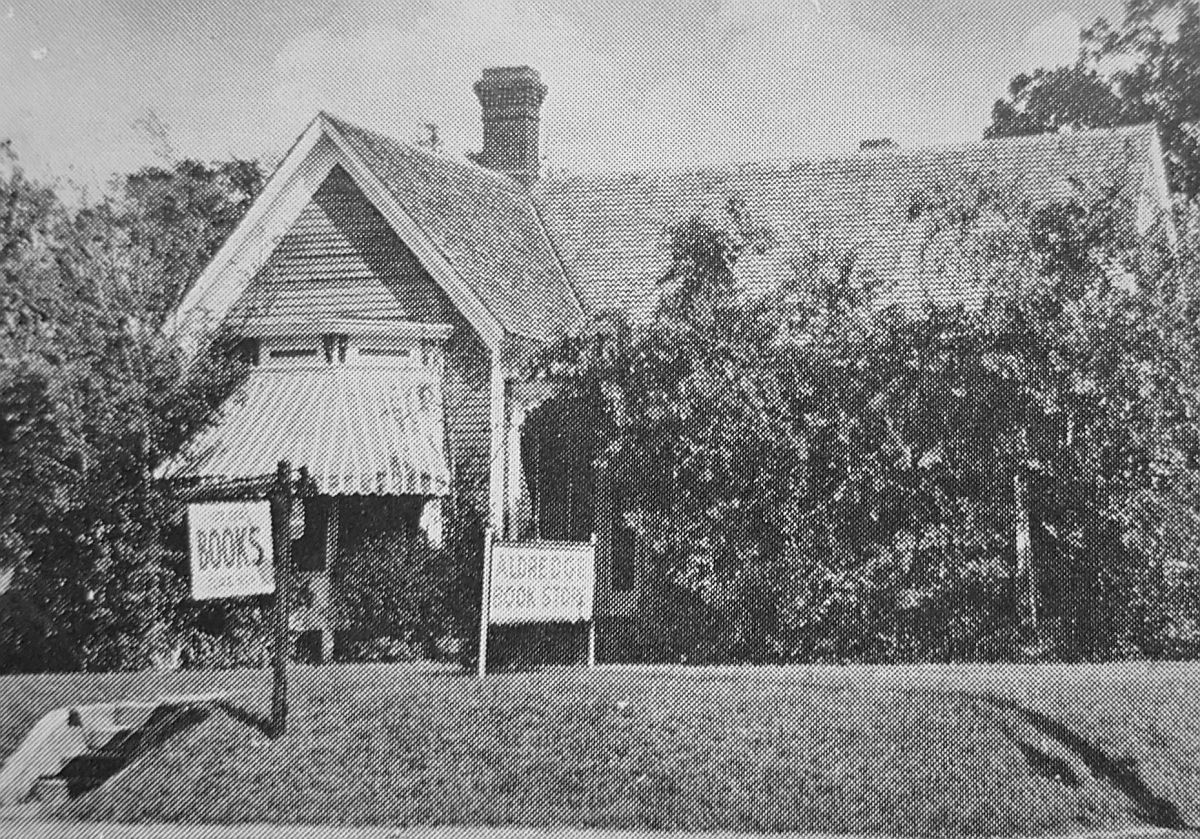
Sawnie Aldredge, Jr. (son of a Dallas mayor) opened The Aldredge Book Store in 1947 at 2800 McKinney Avenue (at Worthington) in an old house built in the 1880s or 1890s (this was several years before Sawnie and Mimi married). The picture below is from around 1960. This was before my time, but I seem to remember it looking less overgrown and less … shabby! It was much larger than it appears in this photo. Below the photo, the store’s early logo. (I’m not sure when the house was torn down — maybe in the ’80s? The lot was vacant for quite some time, as I reall. The block is painfully unrecognizable today. Today it looks like this.)
1960-ish
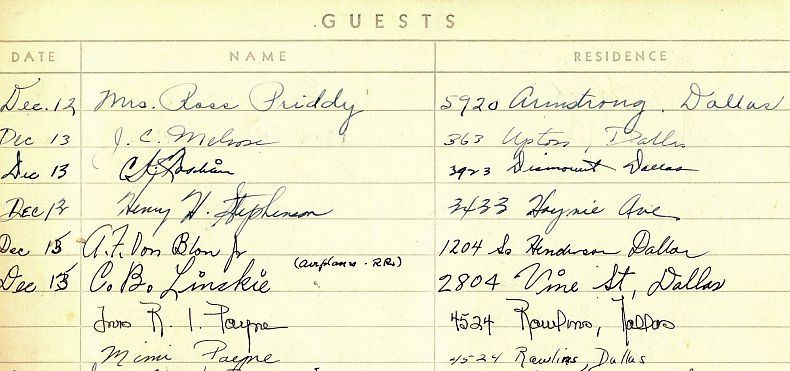
A few years ago, when my brother and I were closing the store, I came across a guestbook from the first year of business and was happy to see that on Dec. 15, 1947, a 19-year-old Mimi Payne visited the store with her mother, Mrs. R. I. Payne. Little did she know that seven years later she’d be married to the proprietor of the store and — for a while — living in that house, battling for personal space amongst all those damn books!
1947
Sawnie and Mimi, 1961
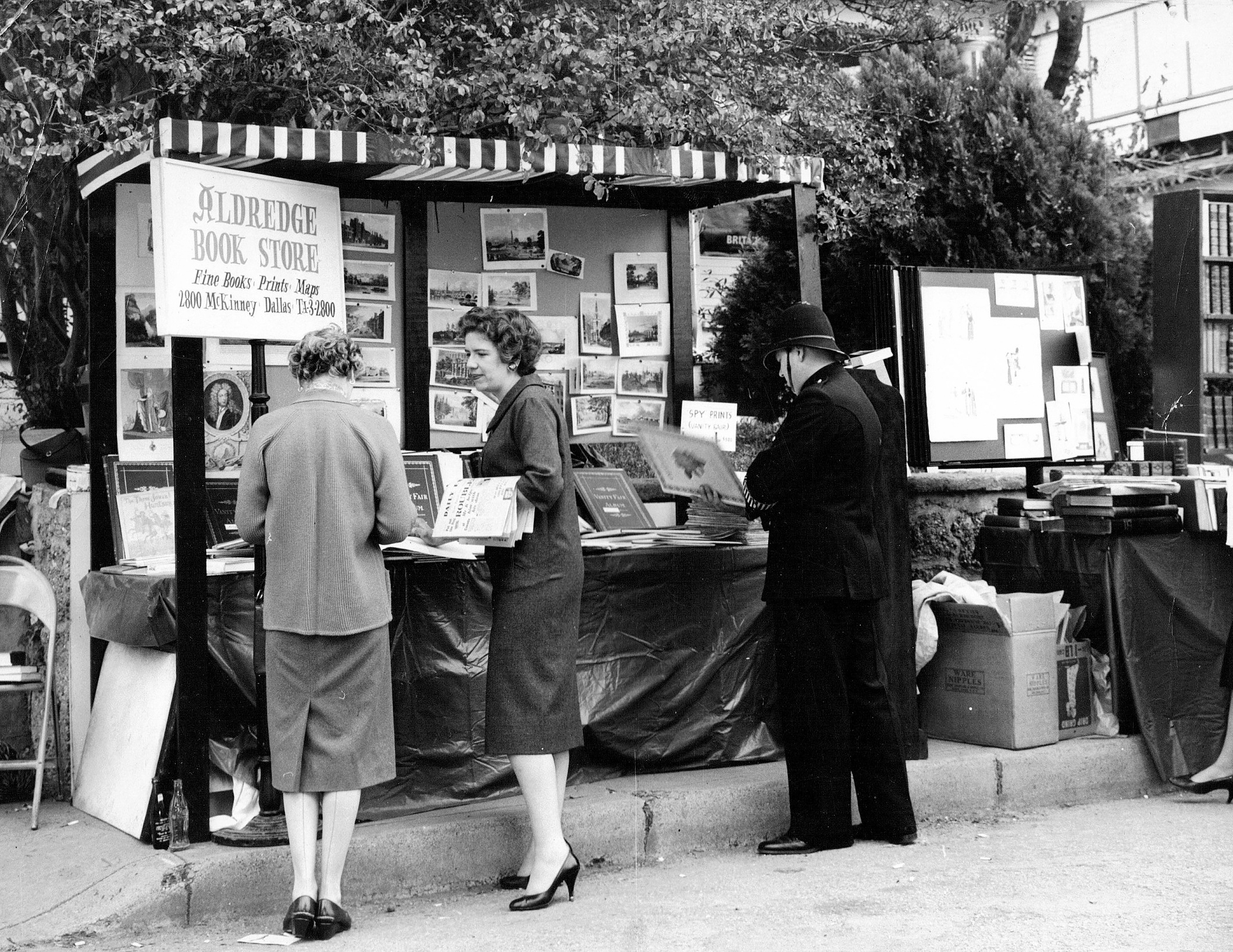
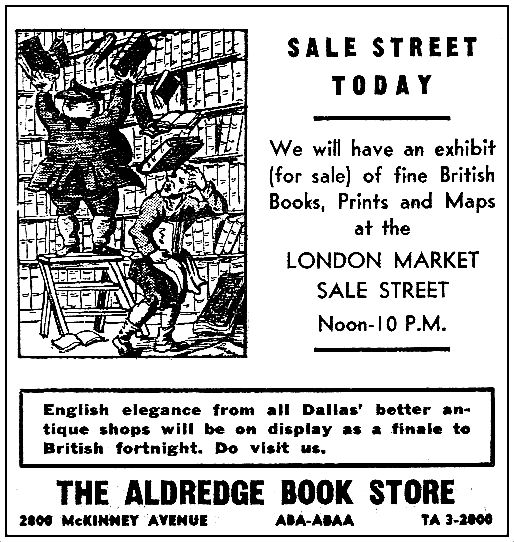
The photo below is one I really love — it was taken in 1958 at the Sale Street Fair, an annual antique street market which ran at the same time as the Neiman-Marcus Fortnight (in 1958 Neiman’s was celebrating Britain). This shows Mimi manning the bookstore booth. My mother told me that she and Mimi (and probably everyone else there) passed the time sitting on the curb, sipping cocktails supplied by friendly neighborhood antique dealers. Sounds great!
Sale Street Fair, Mimi and a browsing London bobby, 1958
Oct., 1958
In 1975, another chapter of Mimi’s life opened when she married esteemed SMU law professor Joe McKnight, to whom she had been married for 40 years at the time of his death in 2015. One interesting highlight was that Joe and Mimi — through their friendship with international bestselling author Alexander McCall Smith (The No. 1 Ladies Detective Agency, etc.) — were featured as characters in his Sunday Philosophy Club/Isabel Dalhousie series. He talked about putting them in one of his novels in a 2006 interview:
Isabel’s mother was American, and she has a cousin of her mother in Dallas, [who is based on] a real person… I was a visiting professor at Southern Methodist University and I’ve got very good friends there, a wonderful couple called Joe and Mimi McKnight, who I’ve made the cousin of Isabel in this book. I have Joe and Mimi coming to Edinburgh, and Mimi plays a large part in the story. So, I’m writing a real person into the story, which is great fun.
A woman who spent a number of years in the early part of her life selling books certainly deserved to be transformed into an entertaining character in a bestselling book in the later part of her life!
***
Sources & Notes
Photos and clippings from the Aldredge Book Store archives and the Aldredge family, unless otherwise noted.
A couple of the photos above come from a profile of The Aldredge Book Store in a magazine called Texas Parade (Feb. 1961): “100,000 Books … Old and New” by Joe Swan. See the full article and photos in a PDF, here.
Mimi McKnight died April 3, 2017; her obituary is here.
D Magazine wrote about Joe and Mimi McKnight and their connection to Scottish author Alexander McCall Smith in the June 2007 article “Muse, Thy Name is McKnight,” here. The photo below (by Elizabeth Lavin) is from that article.
2007 (D Magazine)
Other Flashback Dallas posts concerning The Aldredge Book Store can be foundhere.
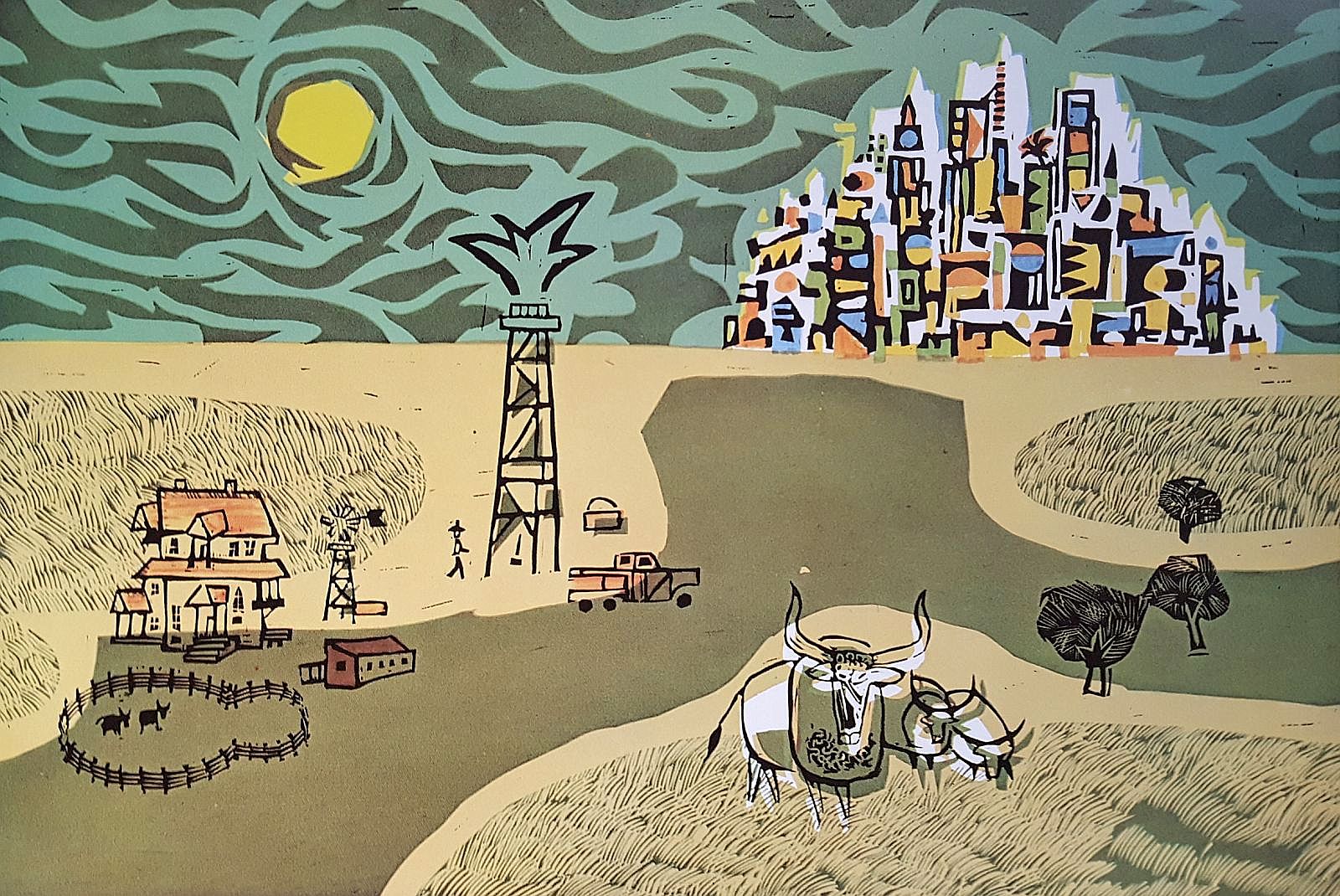
This print — titled “Dallas/The Big D” by native Texan William E. Bond (1923-2016) — is fantastic. I love everything about it. It was commissioned by Business Week magazine to be used as part of its “Business America” series, an advertising campaign showcasing fifteen American cities captured in woodcuts. Every element of this scene is great, but let’s look at a detail showing just the Dallas skyline, with a hard-to-miss Pegasus. I also see what looks to be the Mercantile Building and the Republic Bank Building in there. And … that sky!
Bond’s homage to Dallas was reproduced in the 1963 book Woodcuts of Fifteen American Cities from the Business Week Collection. Below, text from the book (my assumption is that the first paragraph is the copy that appeared in a print advertisement for Business Week — it appears that the ad campaign used the artists’ works collected in this book to illustrate the ads, with each ad mentioning local companies with large BW subscribership).
Dallas… leapfrogging ahead commercially and culturally. Cotton, cattle, and oil put the Big D on the map. But aircraft, electronics and machinery keep it moving. Companies like Texas Instruments (682 Business Week subscribers), Ling-Temco-Vought (106), Collins Radio (135), Dresser Industries (123). In Dallas, and everywhere in business America, men who manage companies read Business Week. You advertise in Business Week when you want to inform management.
And this was Bond’s bio with a quote from him on “the Big D”:
“Dallas is a great many things. It is a giant of a city in the midst of a giant country – full of life and energy and the will to grow and keep growing. Anyone who knows Dallas feels this spirit. And it is this feeling that I have tried to capture.”
Born in 1923 in Crandall, Texas, Mr. Bond attended the Art Center School in Los Angeles. He has won many gold and silver awards in art director and illustrator shows, including a gold medal in the New York Illustrators Show in 1962. Mr. Bond uses a variety of media, including paper prints, sculpture, and painting. He has been an agency art director most of his career, and is now a free-lance designer.
**
Bill Bond was born in Crandall, Texas in 1923, studied art at the Art Center School in Los Angeles, and spent several years as an award-winning commercial artist in Dallas. He worked as an advertising art director for The Dallas Times Herald, the Sam Bloom Agency, and Tracey-Locke; during this time he frequently participated in group art shows around the city. When he retired, he focused his creative talents on sculpture, becoming known for his wildlife pieces and Western bronzes. He died in Kerrville in 2016 at the age of 92.
***
Sources & Notes
The book that features a reproduction of this print is Woodcuts of Fifteen American Cities from the Business Week Collection (New York: McGraw-Hill Publishing Company, Inc., 1963). From the introduction:
One of the principal methods of communication in the 20th century, and one of the biggest businesses, is advertising. Here, too, industry has regularly and effectively used fine art – in the creation of some memorable advertising campaigns.
From 1960 to 1962 Business Week commissioned fourteen prominent woodcut artists to illustrate its “Business America” series. Reproductions of the fifteen woodcut illustrations which were produced appear on the following pages.
Thanks to Bob Dunn for posting an image of Bond’s print in the Retro Dallas Facebook group. I liked it so much I went out and bought a copy of the (large) book! A few copies are available onlinehere.
The Jimi Hendrix Experience, Love Field, 4/20/69 (Jones Film Collection, SMU)
by Paula Bosse
One of the advantages of living in a major American city is that all the biggest entertainers visit at one time or another. Let’s take three of the biggest entertainers of 1969: Jimi Hendrix, Glen Campbell, and Tiny Tim. All were huge, and all came to Dallas. And, luckily for us, they were captured on film in interviews by reporters from WFAA-Channel 8.
For me, without question, the most exciting interview was the one with Jimi Hendrix, who, standing on the tarmac of Love Field with bandmates Mitch Mitchell and Noel Redding on April 20, 1969 (yes, 4/20…), gives a great, relaxed interview to a very lucky Channel 8 reporter, Doug Terry. (I love the look on Terry’s face throughout the interview.) Watch it here:
A few screenshots (click to see slideshow):
April 20, 1969, WFAA-Ch. 8 News (Jones Film Collection, SMU)
4/20/24 UPDATE: After several years of trying to contact the reporter, Doug Terry, I finally heard from him! Here are a few paragraphs from his email to me (used with his permission), with some interesting tidbits about how some of these interviews were conducted:
I was still a college student most of the time I worked at WFAA. I handed in my resignation after covering the north Texas pop festival in that same year. [Watch one of Doug’s Texas International Pop Festival reports from Lewisville here.] Your comment about being in a large city and its advantages was something that I did not fully grasp until years later. The access was wonderful, I saw Hendrix at least three times, on one occasion being in the dressing room with a camera when he warmed up for a show (that footage is nowhere to be found).
There are two aspects to mention about that interview. First, I was a weekend reporter and late night news anchor at Ch. 8 and I assigned myself to go interview him. In those days, one could call up the airlines when a notable person was coming in and they would give the flight number and arrival time. Amazing. Most of the people at the station at that time probably had no idea who Jimi was and wouldn’t have cared if they did know.
The other interesting point is the work of the photographer. Ordinarily, we did over the shoulder interviews, the camera to the back and side of the reporter. The fact that this was shot from the side made all the difference. As a shooter, he was not otherwise outstanding but this interview would be much less interesting if it had been shot in the traditional line-up sort of way. The two bandmates goofing around was distracting but great.
Thank you, Doug! I love this interview — I’m so glad you assigned yourself to the duty!
*
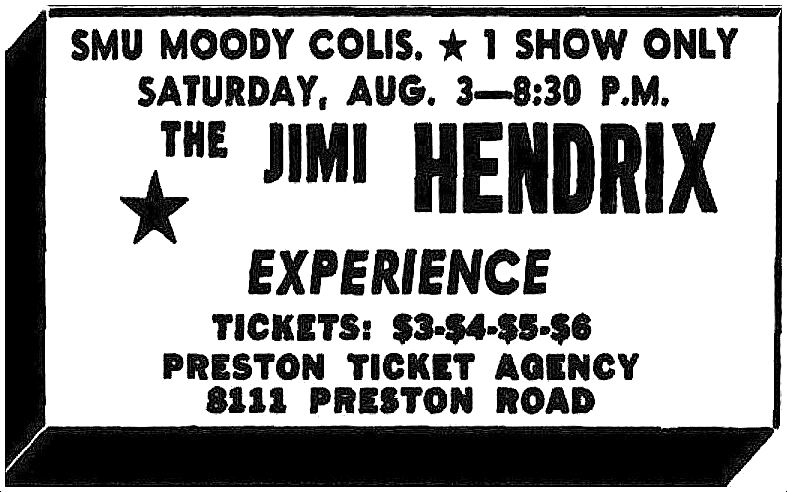
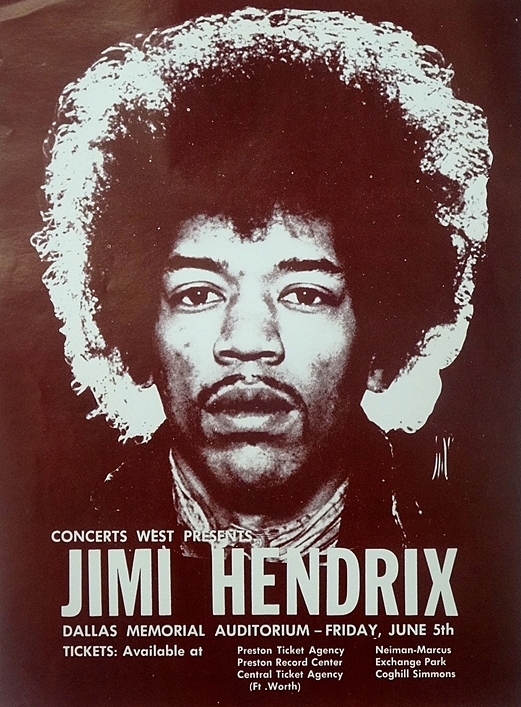
Jimi Hendrix appeared at least 4 times in Dallas:
Feb. 16, 1968: Fair Park Music Hall
Aug. 3, 1968: Moody Coliseum, SMU
April 20, 1969: Memorial Auditorium (where he was headed after the Ch. 8 interview)
June 5, 1970: Memorial Auditorium
July 28, 1968
Two surprising errors (grammatical and factual) appear in a Neiman-Marcus tie-in ad (of sorts) which states that Jimi would be at Memorial Auditorium, rather than Moody Coliseum. Despite the error, it’s cool that Neiman’s was expanding its cultural horizons to include someone like Jimi Hendrix in one of its ads (which was featuring teen fashions, but still). N-M has always had its finger on the pulse of current fashions — and Jimi Hendrix was certainly fashionable.
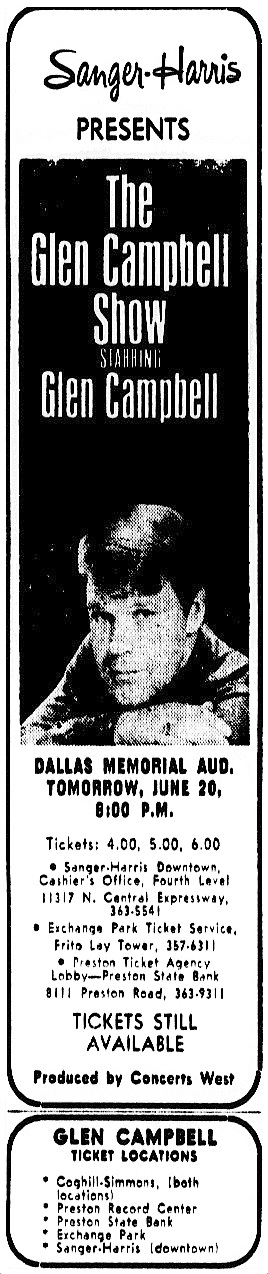
Glen Campbell was in town for several days in June, 1969. He arrived at Love Field on June 15 and was met by a “high-spirited throng” of teenage admirers. He was here to promote the release of the movie True Grit (in which he appeared with John Wayne), as well as to perform at Memorial Auditorium on June 19, 1969.
June 19, 1969
He was actually in Dallas the previous year, in March, 1968, to perform at the State Fair Music Hall with Bobbie Gentry. An interview with the pair begins at 3:57:
**
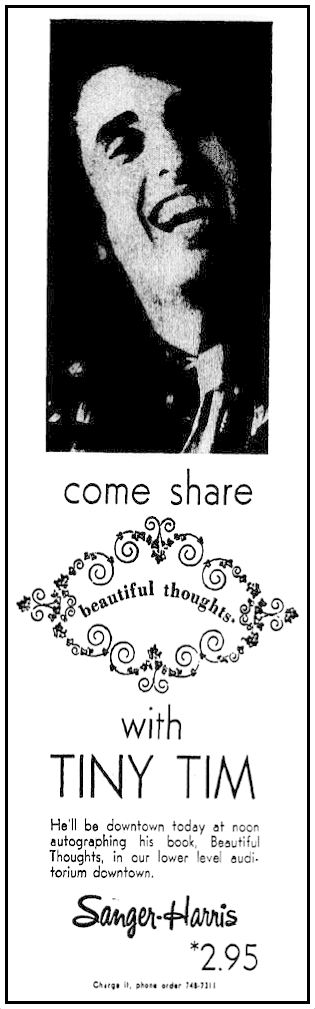
And Tiny Tim was in Dallas on June 17, 1969 to appear at a book-signing at the downtown Sanger-Harris department store. The signing was a bit more sedate than his previous visit to Dallas when he caused something of a riot on January 23, 1969 while making an appearance at the Melody Shop in NorthPark. I’m not sure what sort of crowd the Melody Shop thought they’d get for their little “autograph party,” but it’s safe to say they did not expect 5,000 over-excited teenagers. The news report the next day was peppered with words like “pandemonium,” “swarm,”“mob scene,” and “human wall.” (Read about that bizarre event here). His drawing power continued the next year when Tiny made his Dallas performing debut at … of all places … Abe Weinstein’s Colony Club, one of the city’s top “burlesque” houses. He was booked for an incredible 9-night run (!) in September, 1970. It was a major success. Dallas apparently loved Tiny Tim. And, of course, years later, Bucks Burnett’s Edstock and Burnett’s tiny Tiny Tim museum continued the Big D/Tiny Tim lovefest.
June 17, 1969
WFAA-Ch. 8 interview (screenshot)
***
Sources & Notes
Video is from the WFAA Newsfilm Collection, held at the Hamon Arts Library, Southern Methodist University; screenshots are from those clips. Any requests to license these clips (or any of the other thousands at SMU!) should be directed to curator Jeremy Spracklen.
4/20/24 UPDATE: Passages from former Channel 8 reporter Doug Terry are from an email to me on April 16, 2024, reprinted with his permission.
Hit the Dallas Morning News archives to find a little pre-Music Hall interview with Jimi Hendrix conducted by “YouthBeat Editor” Marge Pettyjohn: “A Real Experience” (DMN, Feb. 25, 1968). Her interview with Tiny Tim (“Magical Mystery Tour: On Meeting Tiny Tim,” DMN, Jan. 25, 1969) is also worth checking out, as is the Jean Kelly article “5,000 Kids Mob Tiny Tim” (DMN, Jan. 24, 1969).
While you’re in the archives, look for the interview with Glen Campbell at Love Field amidst the frenzied teenage girls: “High-Spirited Throng — Fans Mob Glen Campbell at Airport” by Maryln Schwartz (DMN, June 17, 1969).
Dallas teens loved Tiny Tim… (Sanger-Harris book-signing, June 1969)
by Paula Bosse
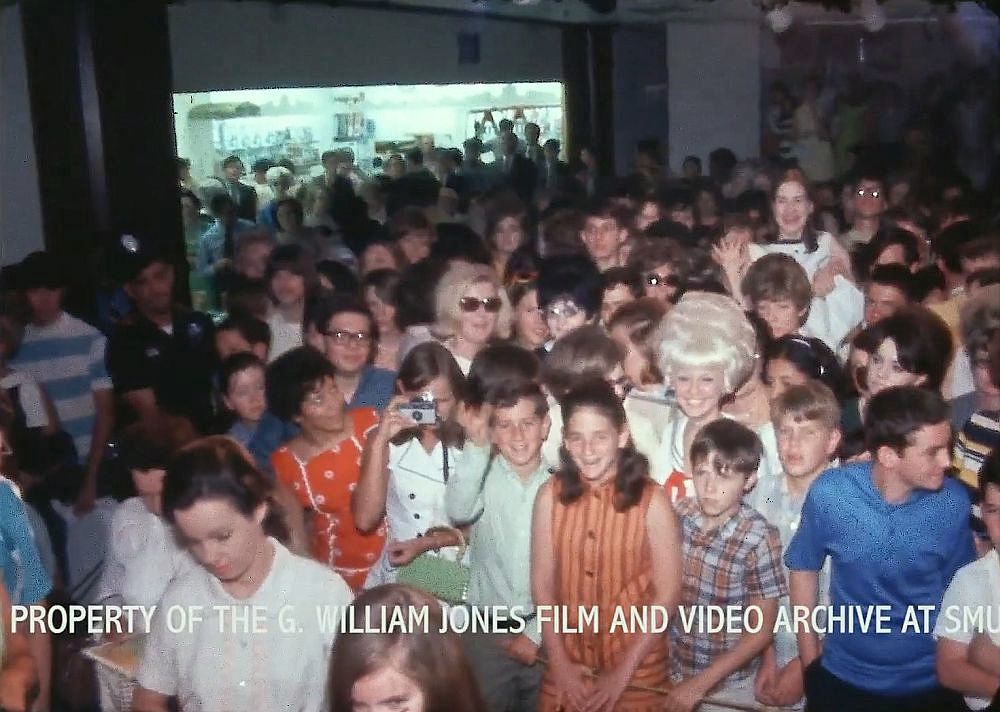
Tiny Tim — one of the most … unusual performers of the 1960s — was a hit with teenagers when he made his first appearance in Dallas at the Melody Shop in NorthPark mall on January 23, 1969. What had been expected to be a nice little autograph party which might attract a small number of fans and curiosity-seekers turned into something altogether unexpected.
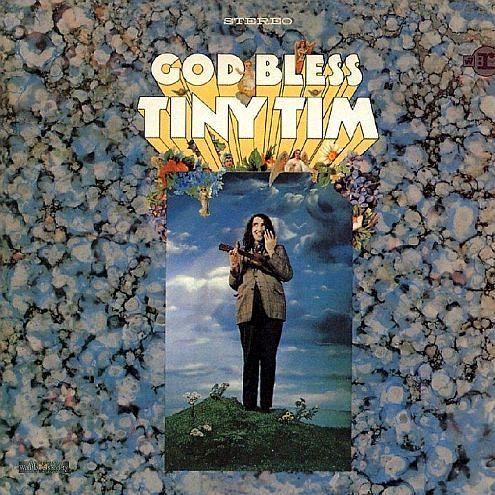
Tiny Tim (…”Tiny”? “Tim”? “Mr. Tim?”…) had the unlikeliest of hits during the hippie-era: “Tiptoe Through the Tulips,” a lilting little ukulele-accompanied song which had originally been a hit in 1929. Tiny Tim’s first few appearances on U.S. television must have caused a lot of heads to be scratched and/or jaws to be dropped. He was just kind of … weird. But gentle, and he seemed to be a genuinely nice fellow who just happened to have a penchant for songs from the megaphone-era of popular music. If you’ve never seen footage of a Tiny Tim performance, search for a clip of him on the Tonight show around 1968.
So anyway, Tiny was booked to do a little autograph party at the Melody Shop in NorthPark mall. I’m not sure what sort of crowd they thought they’d get, but it’s safe to say they did not expect 5,000 teenagers. The news report the next day was peppered with words like “pandemonium,”“swarm,” “mob scene,” and “human wall.” Who knew a 36-year-old man who strummed a ukulele and sang songs from the Victrola-age in a nasal falsetto would whip up that much enthusiasm amongst Texas teenagers?
My favorite description of the “riot” was this one:
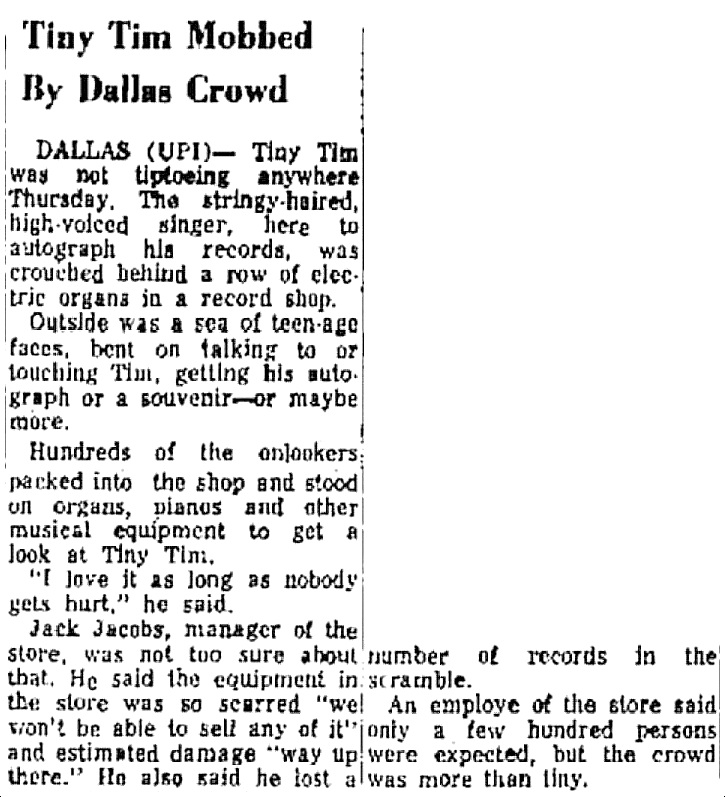
Inside, a disheveled Tiny Tim was crouched on the floor behind a row of electric organs….. “Pretend he’s not in the store,” directed a manager. Tiny Tim, his shirttail out and his orange, green and brown tie twisted to the side, huddled alone on the floor. (“5,000 Kids Mob Tiny Tim,” Dallas Morning News, Jan. 24, 1969)
The story was even picked up by wire services. (Click article below to see a larger image.)
Amarillo Globe Times, Jan. 24, 1969
Tiny was back in Dallas a few months later, this time to do a book-signing at the downtown Sanger-Harris. (Yes! He wrote a book!)
June 17, 1969
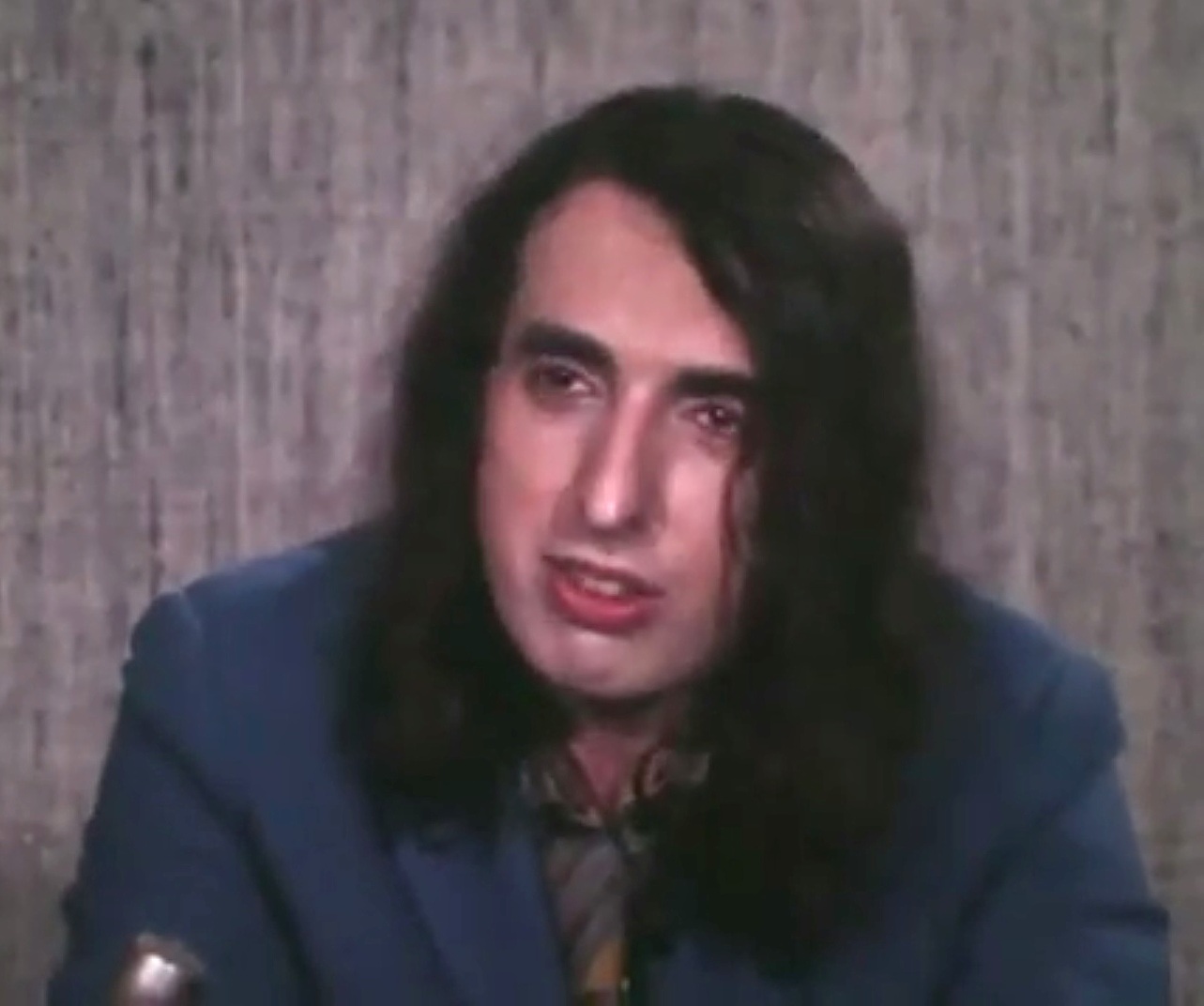
No riot was reported this visit, but Sanger’s still packed by fans who wanted a book signed by Mr. Tim (who signed with a pink quill pen). While in town, he give a little interview and an impromptu performance at a press conference (am I the only person who sees shades of Jeffrey Tambor here?):
*
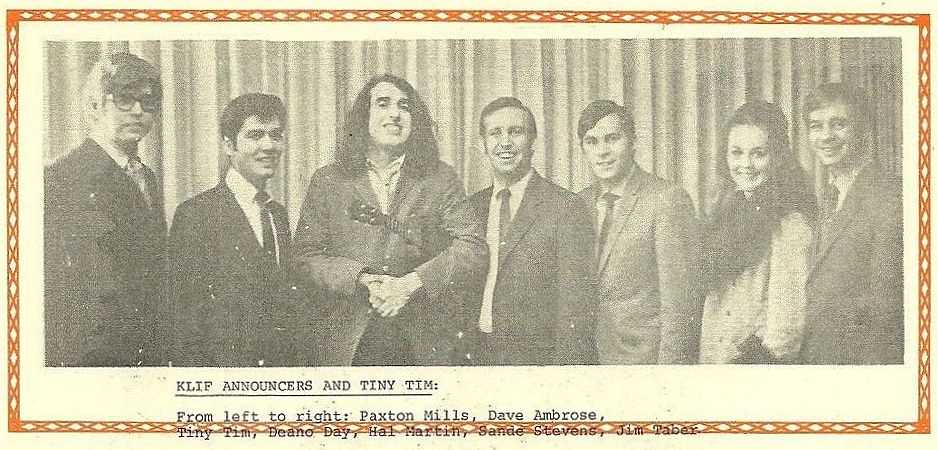
Also in 1969, he took time out to pose with KLIF on-air talent Paxton Mills, Dave Ambrose, Deano Day, Hal Martin, Sande Stevens (not sure if she worked for KLIF), and Jim Taber, seen below.
But wait, there’s more… he was back in Dallas in September, 1970 for a NINE-DAY engagement (two shows nightly) at Abe Weinstein’s famed downtown burlesque house. (I don’t know if the strippers took the time off while Tiny was in residence or if they might have entertained between his sets.) Here’s a clip from a press conference during that visit:
And, why not, here’s an early publicity photo of Herbert Khaury, the man who would one day become famous as the singer Bing Crosby once described as having (I paraphrase) a vibrato big enough to throw a Labrador through.
***
Sources & Notes
The 1969 Chanel 8 video is from the WFAA Newsfilm Collection held by the Hamon Arts Library, Southern Methodist University; it is posted on YouTube here (the first image and the three color photos of Tiny Tim are screenshots I captured from the video); the 1970 footage is from the same source and can be found on YouTube here.
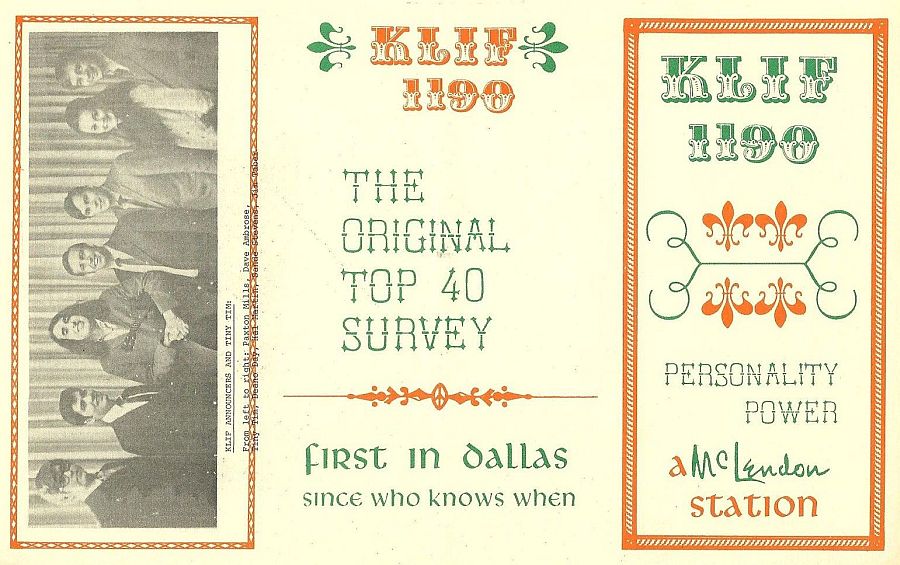
KLIF promotional material found on eBay several months ago. The back of the card lists the KLIF’s top 40 of the week, here.
Glamour shot of Mr. Khaury found somewhere on the internet.
One would be remiss in not mentioning Tiny Tim’s other ties to Dallas, namely his association with Bucks Burnett’s Edstock and Burnett’s tiny Tiny Tim museum from the 1990s. I’d link to articles in the Dallas Observer, but every time I go to the DO site my computer freezes. I encourage you to seek out these articles yourself.
More on Tiny’s January, 1969 visit to Dallas can be found in these Dallas Morning News articles:
“5,000 Kids Mob Tiny Tim” by Jean Kelly, with photo (DMN, Jan. 24, 1969)
“Magical Mystery Tour: On Meeting Tiny Tim” by Marge Pettyjohn, “YouthBeat” editor, with photo (DMN, Jan. 25, 1969)

 Jeannie C. Riley

















 Flashback : Dallas