Flashback : Dallas

A Miscellany: History, Ads, Pop Culture

Category: Beyond DFW

David Wade: Overcoming Childhood Trauma
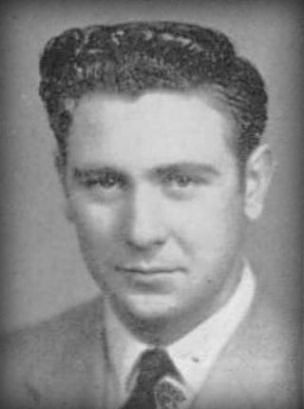
david-wade_waco-high-school-194117-year-old David Wade, Waco High School, 1941

by Paula Bosse

For many Texans, the name David Wade brings to mind a gentle and convivial, deep-voiced TV cooking show host who, for decades, shared his love of food with a legion of faithful fans. Dallas was Wade’s home base — it was where he lived, where he established his business empire, and, for the most part, where he recorded his television programs. He seemed like the kind of guy who had it all. But many of his fans would be shocked to learn that David Wade’s most searing childhood memory was the impossible-to-forget day his father killed his mother.

In 1929 Eugene and Ora Lee Wade lived in Cameron, Texas, about 50 miles south of Waco. They had four daughters, ranging in age from twelve to twenty-one, and one son, five-year old David. Eugene worked as an engineer at the local cotton gin, and Ora Lee raised the children and was a popular and active member of her church.

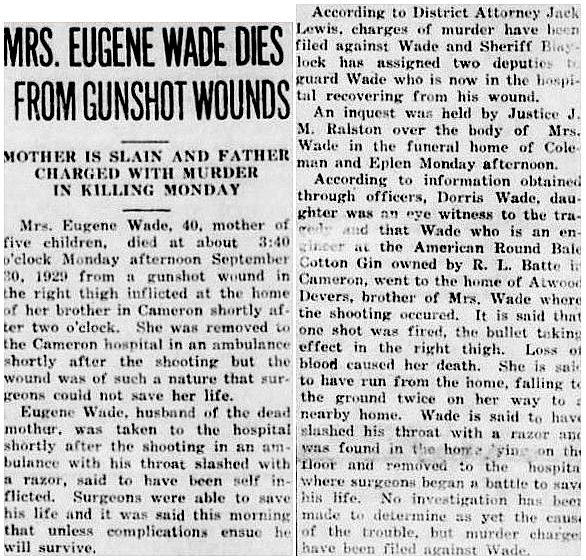
On the afternoon of Sept. 30, 1929, Eugene came home drunk. Very drunk. He began to argue with Ora Lee, and, as things escalated, she ran to the nearby house of her brother. An angry Eugene lurched after her. A gun was drawn, and Eugene drunkenly threatened his wife with it. In an ensuing physical altercation, the gun went off. Mrs. Wade had been shot in the thigh. She attempted to run away but collapsed after only a few steps. She died soon after being rushed to the hospital — her femoral artery had been severed, and she bled to death. Before the police arrived, Eugene Wade had slashed his throat with a razor, and though not initially expected to live, he survived and was charged with the murder of his wife. The horrible, violent, bloody scene had been witnessed by at least one daughter (and, in all likelihood, probably by five-year old David as well).
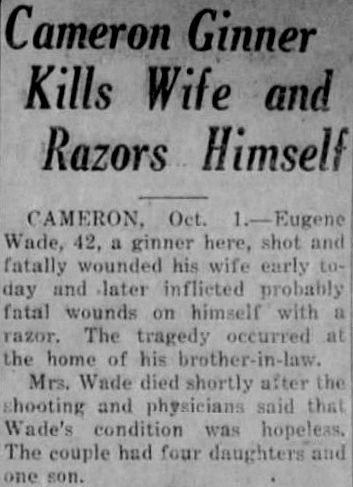
wade_bryan-eagle_100129The Bryan Eagle, Oct. 1, 1929

wade_cameron-herald-100329The Cameron Herald, Oct. 3, 1929 (click for slightly larger image)

A distraught Eugene Wade pleaded guilty, was sentenced to life in prison, and by the end of the year, he was on his way to Huntsville. Before he left Cameron, he gave a lengthy, sincere, and heartbreaking interview to The Cameron Herald. In it, he expressed his sorrow, his regret, and his love for his wife and children.

“Whiskey was the cause of it all. I am to blame for what has happened to my family and to myself. I can lay it all to drink. I loved my wife as well as any man ever loved his wife and I love my children. My home is destroyed and my wife is dead. My children will suffer the humiliation of this terrible thing. Time may heal their wounds but mine will bleed for all time. I can never escape the horror of it though I should live a thousand years. Nothing but sorrow is left for me, still I might come out of the trouble some day, maybe an old man and broken but maybe I can still do some good in the world.” (Cameron Herald, Dec. 19, 1929)

Five-year old David had been left, basically, an orphan. He spent some time at the Juliette Fowler home for orphans in Dallas and was later moved around between family members and foster families. He went to Waco High School where he was a popular student (the yearbook photo above was accompanied by the motto supplied by the Senior Band, of which he was a member: “And he is oft the wisest man”), and he received arts degrees from Baylor and the University of Texas (he studied music and had a short career as a singer). He seems to have done well in school, despite the terrible incident in his past.

But after college he spent time in California as a “test pilot,” a nerve-wracking job that apparently stressed him out so much that he sought medical treatment (an amateur psychologist might assume that his anxiety was triggered by post-traumatic stress). According to later newspaper profiles, instead of sedatives, the doctors suggested he focus on an enjoyable hobby to settle his nerves. A hobby like cooking. …And the rest is history.

As far as I’ve been able to determine, he rarely — if ever — talked about the tragedy he experienced in his youth. When one knows the details of his past, some of his quotes from interviews carry more weight:

“Any time you have a problem and you overcome it, you have a muscle. You never build a personality unless you have a lot of troubles.” (David Wade in the Fort Worth Star-Telegram, April 25, 1976)

When I was growing up and would frequently come across one of David Wade’s shows on TV, I usually clicked on past it unless there was absolutely nothing else to watch. He and the show felt a little corny and were a little too laid back for my taste. Now, though, having learned about his past — and having always felt that Mr. Wade seemed to be a genuinely nice person — I definitely have a more positive and respectful opinion of the man. Ascot, crest-emblazoned blazer, and all.

david-wade_FWST_042576-photoBon Appétit!

***

Sources & Notes

Top photo of a 17-year-old David Lloyd Wade from the 1941 Waco High School yearbook.

The coverage of Ora Lee Wade’s funeral in the Cameron Herald (Oct. 3, 1929) — which includes quite a bit of genealogical information — can be found here (click for larger image).

The full “jailhouse interview” with Eugene Wade in the Cameron Herald (Dec. 19, 1929) is available in a PDF, here.

Incidentally, Eugene Wade’s “life sentence” lasted four years. He was the recipient of one of Governor Ma Ferguson’s notorious “conditional pardons.” He appears to have lived around the Cameron area until his death in 1967. I don’t know whether he ever re-established relationships with his children.

A nice overview of David Wade’s very successful career can be found in an article from the April 25, 1976 issue of the Fort Worth Star-Telegram, in a PDF, here.

My previous post, “David Wade, Gourmet: Have Ascot, Will Travel” — about his happier days as a successful TV personality — can be read here.

*

Copyright © 2014 Paula Bosse. All Rights Reserved.
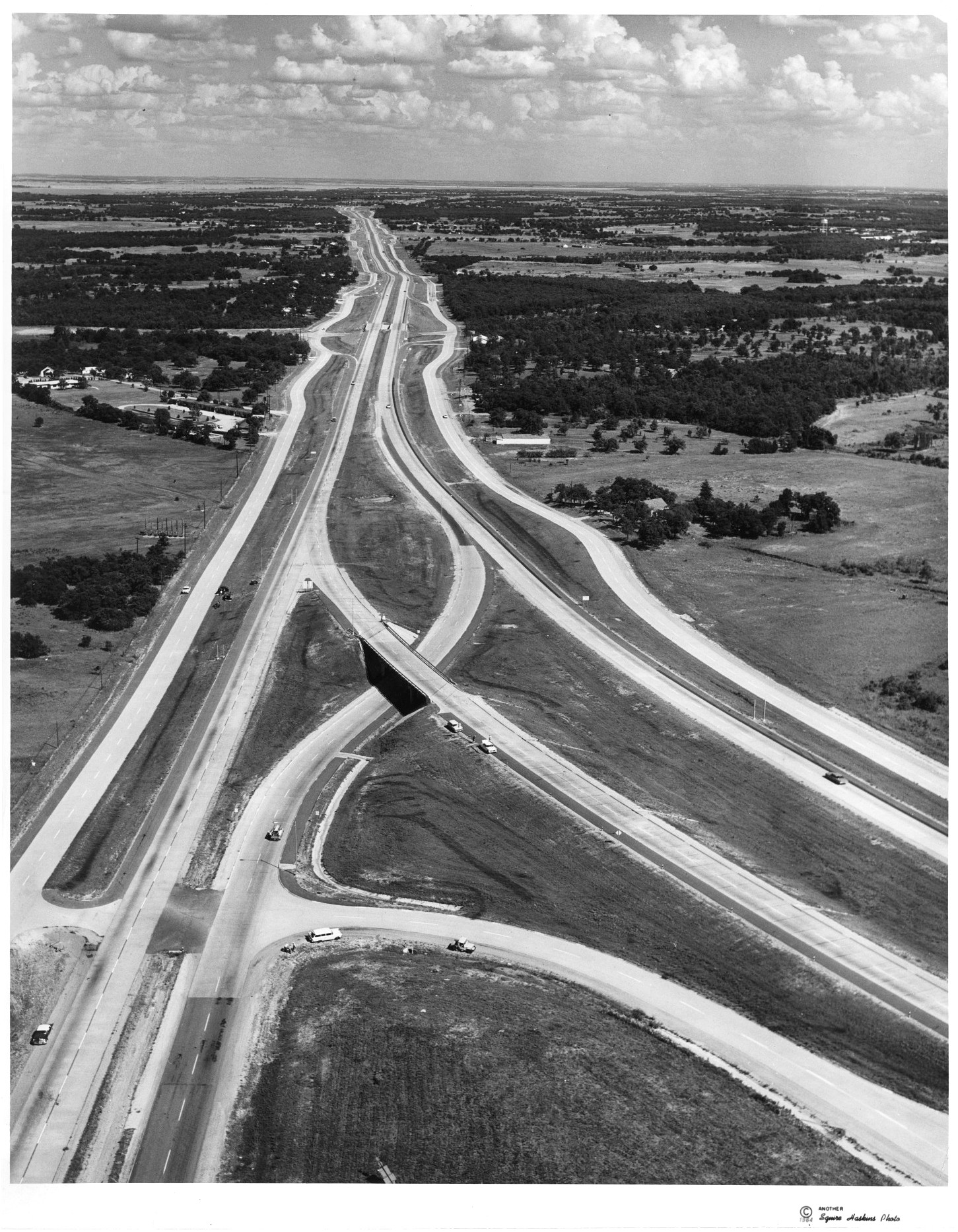
I-35E Looking South: A Landscape Blissfully Free of Cars and Strip Malls — 1964

I35E-south-from-denton_haskinsI-35, pre-sprawl — photo by Squire Haskins (GIGANTIC when clicked)

by Paula Bosse

This is I-35. …I-35! I’m not sure what stretch of the interstate this is exactly, but I think we’re looking north toward Denton south from Denton. I might cry. No sprawl!

*

UPDATE: I’ve had several comments about this photo from all over El Internet, and it appears that this is I-35E in Denton, looking south(east) toward Lake Lewisville (then Lake Dallas). More specifically, this shows the I-35 / US-77 (Dallas Dr.) interchange, with part of the old Hwy. 77 visible at the bottom of the photo. It’s been pointed out that the water tower at the top right is at the Denton State School. I hope this is correct! If anyone else has any suggestions, please let me know! (To see a 1965 road map of this area, see here.)

Here’s how it looks these days (thanks, Bill P.).

i35e_google-earth

***

Another amazing aerial photograph by Squire Haskins, from the collection of the Denton Public Library (with an incorrect description!). Accessible on the Portal to Texas History, here.

Click picture for larger image. In fact, it’ll get so big that it might break whatever device you’re viewing this on; proceed with caution.

*

Copyright © 2014 Paula Bosse. All Rights Reserved.

Up North in Denton: “Famous School and College County”

denton-co-courthouse-1928Denton County Courthouse, 1928 (click for larger image)

by Paula Bosse

Okay, so it’s not Dallas, but who in Big D doesn’t love Little D? Besides, this is just too great a photo to keep to myself.

And in case you need to bone up on your 1928 Denton County stats for “Jeopardy” or something, look no further (click for larger image):

denton-co-courthouse_1928b

“Kindergarten to College Degree —
Board at home and be educated free.”

Free!

*

Might as well see where the photo of the courthouse was taken from: the Wright Opera House (now Recycled Books). Here it is, about 1900:

denton-opera-house_1900_tx-historian_1982The Wright Opera House, built in 1899, shown here in 1900 (click for much larger image)

***

The photo of the courthouse and the ad are both from, where else, the program for the 52nd Annual Convention of the State Firemen’s Association of Texas, held in Denton in June of 1928. If you’re into firefighting ephemera or old Denton photos, you might want to peruse it yourself: click here. (From the collection of the Denton Public Library.)

Photo of the Opera House from the article “Faded Echoes: A History of the Wright Opera House in Denton” by Clare Adkins, featured in the September, 1982 issue of Texas Historian, accessible through the Portal to Texas History, here.

Click pictures for larger images.

*

Copyright © 2014 Paula Bosse. All Rights Reserved.

Reading, Writing, Beekeeping — 1905

by Paula Bosse

Beekeeping class at the College of Industrial Arts (later Texas Woman’s University) in Denton, around 1905. Pop quiz!

***

Sources & Notes

Photo from The Woman’s Collection of Texas Woman’s University.

Beekeeping was a popular “hobby” for women at the turn of the century, but for a look at larger-scale Texas honey production at this time, check out the article “The Bee Industry of Texas” from the 1904 edition of the Texas Almanac here.

For information on present-day North Texas beekeeping, the website of the Dallas-based Texas Honeybee Guild is here.

*

Copyright © 2014 Paula Bosse. All Rights Reserved.

Olsen-Stelzer Cowboy Boot Saleslady — 1939

Portrait with boots…

by Paula Bosse

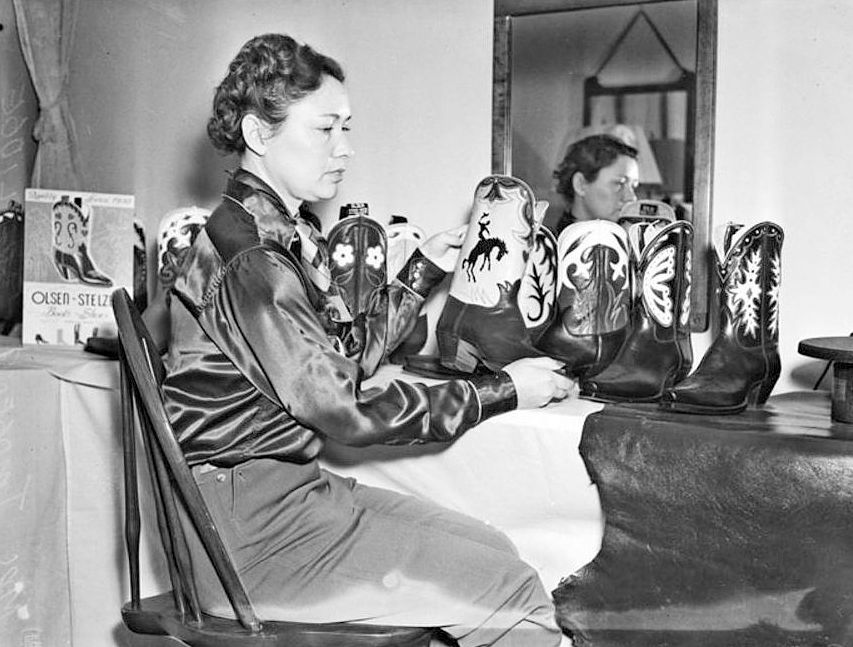
Above, Dallas resident Imogene Cartlidge is seen at a shoe retailers’ convention in San Antonio in 1939. Cartlidge was an employee of the Olsen-Stelzer boot company in Henrietta, Texas, and she was said to be “the only woman boot salesman on record.” I’m a big fan of cowboy boots of this period, and I have to say that I am ashamed that I was unaware of the famous Olsen-Stelzer company, which lasted from 1900 until the 1980s. The company is back in business again, led by Tom Cartlidge, whose parents began selling the boots in 1938 — Imogene is his mother. I wish them all the best of luck, because the world needs as many great-looking cowboy boots as it can get!

olsen-stelzer_dmn_120146

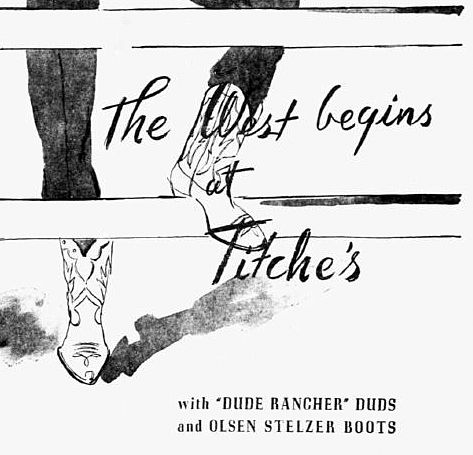
“The West begins at Titche’s”? First I’m hearing of this. Who knew? Nice ad, though.

olsen-stelzer_dmn_120146det

olsen-stelzer_dmn_103055

olsen-stelzer_1941

Best of all is this absolutely fantastic video from 1956 about the company:

olsen-stelzer-logo

olsen-stelzer-box

***

Sources & Notes

Photo of Imogene Cartlidge is from the San Antonio Light Photograph Collection, University of Texas San Antonio Libraries Special Collections, Institute of Texan Cultures.

Titche’s ad from 1946.

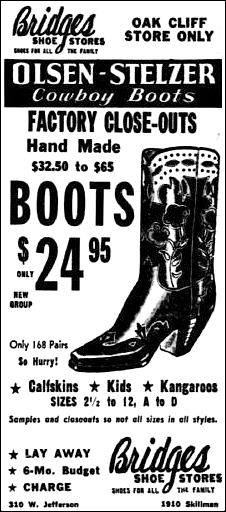
Bridges Shoe Store ad from 1955. (Bridges seems to have been the only place in Dallas where the boots were regularly sold — or at least regularly advertised. And you could get them ONLY IN OAK CLIFF!) (I hear the West begins at Oak Cliff….)

The video can be found on the home page of the Olsen-Stelzer website here.

The last image is the lid of an Olsen-Stelzer boot box, which belongs to my aunt — she keeps Christmas ornaments in it. (Sadly, no sign of the boots!)

The history of the company (and, again, that great video) can be found here.

*

Copyright © 2014 Paula Bosse. All Rights Reserved.

Mme. Koneman, High-Class Milliner

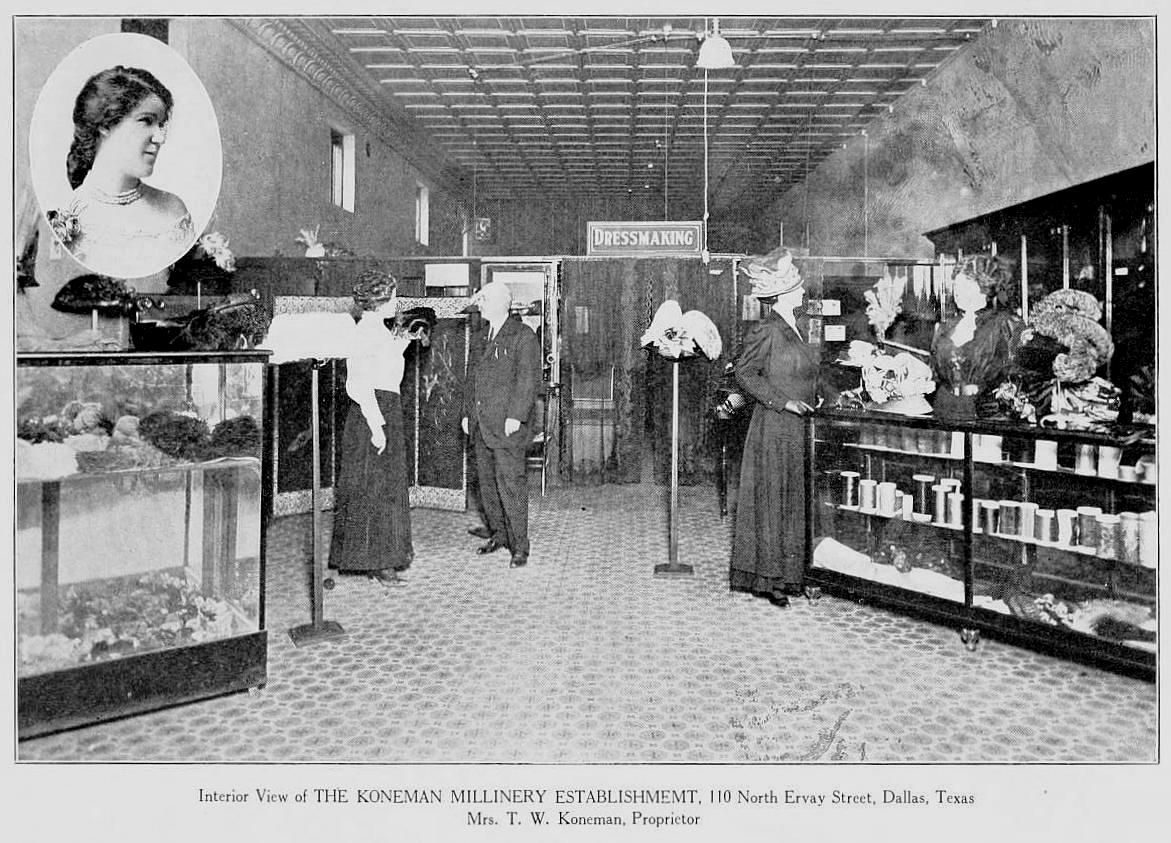
Madame Koneman’s fashion emporium, 1912 (click for larger image)

by Paula Bosse

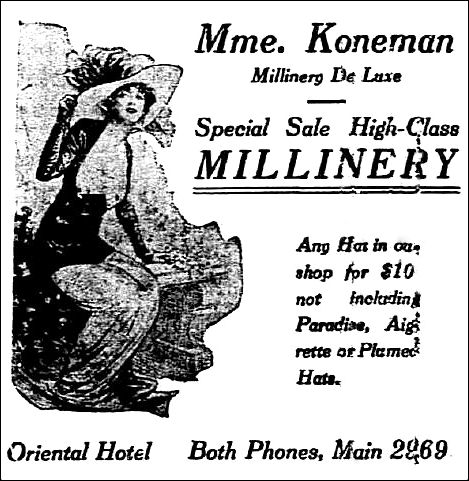
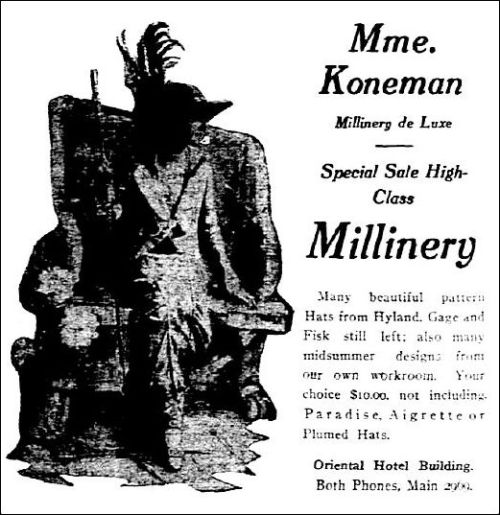
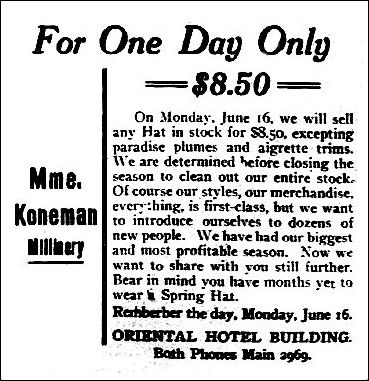
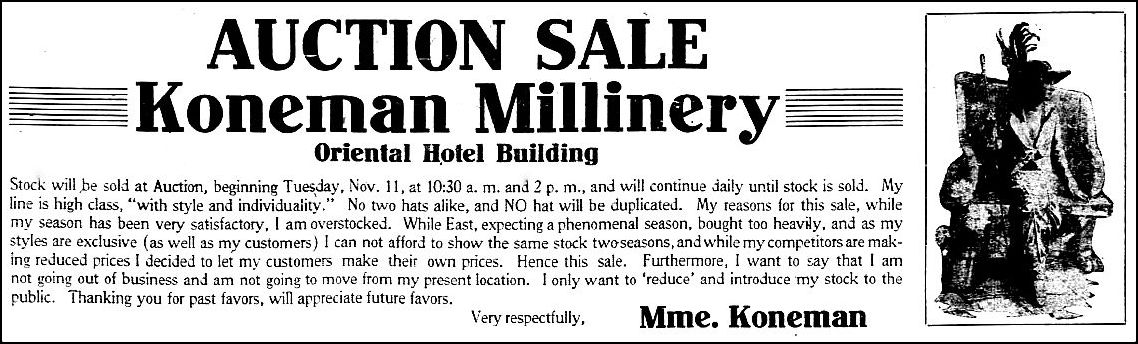
Behold, the Koneman Millinery Establishment, which actually looks a little plain for a millinery shop housed in the ornate Oriental Hotel building. When I see old ads or photos like this, I always wonder about the people pictured in them. I’m assuming that the woman in the oval inset at the left was the proprietess, “Mme. Koneman.” So who WAS she, this woman who had a “high-class” business that catered to a “high-class” clientele? I poked around a little and found these ads from 1913.

koneman-millinery_dmn_060113

koneman-millinery_dmn_060813

koneman-millinery_dmn_061413

koneman-millinery_dmn_110913(click for larger image)

Ooh. Those last few sentences of the above ad seem a little defensive, as if she’s addressing nasty gossip. “Furthermore, I want to say that I am not going out of business.” When you see a sentence like that — in an advertisement — that sends up some furiously waving red flags. And … just one month after that ad, this miniscule tidbit in teeny-tiny letters appeared in the paper at the end of 1913:

Dallas Morning News, Dec. 21, 1913

Oh dear. D-I-V-O-R-C-E. And, guess what? There were no more ads for the millinery shop.

But, alarmingly, THIS appeared on the wire services on February 17, 1917:

Fort Worth Star-Telegram, Feb. 17, 1917

Oh DEAR! Shot by a widower with two children, who tried to kill both her and himself after he flew into a jealous rage in a New Orleans hotel lobby. Working with feathers and plumes and felt and velvet (probably) does not prepare one for being shot at!

Ten days after being shot, it was reported that the 36-year old Mrs. Koneman (whose first name was either “Matilda” or “Mathilda”) was released from the hospital in New Orleans. The jealous suitor, 40-year old Edgar J. Hargrave (or “Hargrove”), remained in the hospital, slowly recovering (but with a bullet still lodged in his head!). “Policemen expect to arrest Hargrave on a charge of shooting with intent to murder as soon as he is able to leave the institution.” He was an “oil salesman” from Houston.

One week later, Hargrave/Hargrove was released from the hospital and was transferred to Parish Prison where he awaited arraignment on attempted murder. Meanwhile, Matilda/Mathilda, a material witness in the case, had been arrested when the D.A. heard she was about to leave town. Out on a $650 bond, she was ordered to stay in the city until the arraignment.

On March 16, one month after being shot in the lobby of the Grunewald Hotel, Mrs. Koneman was in court recounting her near-death experience, and I’m sure the people back in Dallas were eating up every last morsel in the scandalous testimony about the spurned lover who tried to kill the divorcée who used to sell them great big hats with aigrette plumes in that bleakly unadorned hat shop over on Ervay!

koneman-testifies_dmn_031617-smDMN, March 16, 1917 (click for larger image)

(UPDATE: A reader kindly forwarded me a more detailed account of the shooting incident between the spurner and the spurnee, in a longer article from the New Orleans Times-Picayune (Feb. 17, 1917). Click here to read the article, with a blurry photo of Hargrave.)

And then — rather anticlimactically — the trail ran cold. What was the verdict? What happened to Edgar? Whither Mme. Koneman? Mrs. Koneman was reported to be living in Galveston at the time of the shooting, but by the summer of 1922 she was back in Dallas, checked into the Southland Hotel. The last shred of info I found about her was this classified ad from June, 1922, which raises even more questions.

DMN, June 15, 1922

I’m not really sure what this was all about, but it’s safe to say there would have been very few lags in the conversation between Dallas and California!

***

Top ad from The Standard Blue Book of Dallas, 1912-1914 (Dallas: A. J. Peeler & Co.).

“Dallas Woman Shot” article from the Fort Worth Star-Telegram, Feb. 17, 1917. This was a wire service story that was printed around the country, but, oddly enough, the news doesn’t seem to have made its way into the DMN until ten days after the shooting!

All other ads and articles from the Dallas Morning News. The Koneman Millinery ads were from 1913.

*

Copyright © 2014 Paula Bosse. All Rights Reserved.
“Throw Me a Pink Thing, Mister!” — 1967

mardi-gras_1967_doubloon-a

mardi-gras_1967_doubloon-b1967 Mardi Gras doubloon (click for larger images)

by Paula Bosse

“THROW ME SOMETHING, MISTER.”

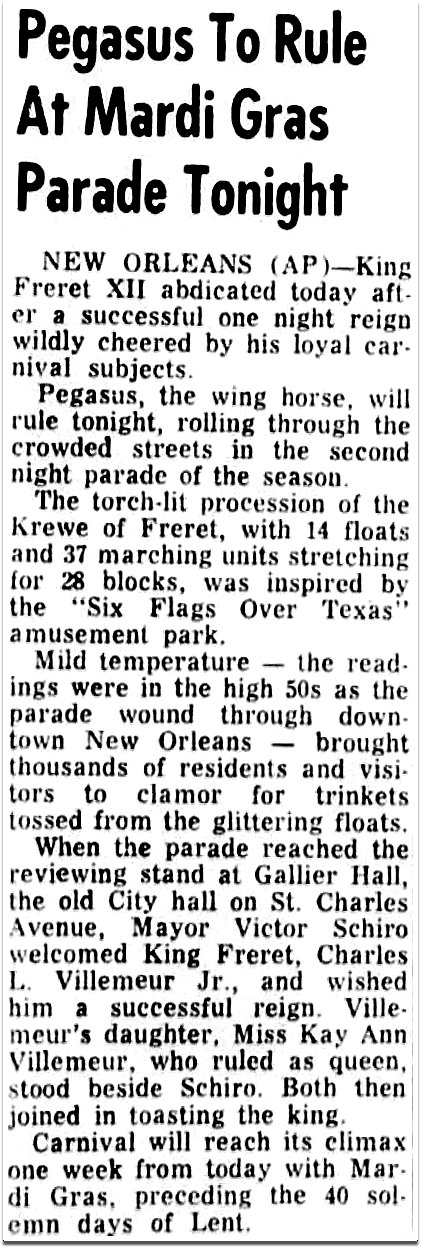
Pictures of these are all over the internet, but I found only ONE reference explaining why “Six Flags Over Texas” was on a Krewe of Freret Mardi Gras doubloon — and it was in this Jan. 31, 1967 AP article from the Monroe (Louisiana) News Star (transcription below):

mardi-gras_six-flags_monroe-louisiana-news-star_013167

NEW ORLEANS (AP)-King Freret XII abdicated today after a successful one night reign wildly cheered by his loyal carnival subjects. Pegasus, the winged horse, will rule tonight, rolling through the crowded streets in the second night parade of the season. The torch-lit procession of the Krewe of Freret, with 14 floats and 37 marching units stretching for 28 blocks, was inspired by the “Six Flags Over Texas” amusement park. Mild temperatures — the readings were in the high 50s as the parade wound through downtown New Orleans — brought thousands of residents and visitors to clamor for trinkets tossed from the glittering floats. When the parade reached the reviewing stand at Gallier Hall, the old city hall on St. Charles Avenue, Mayor Victor Schiro welcomed King Freret, Charles L. Villemeur Jr., and wished him a successful reign. Villemeur’s daughter, Miss Kay Ann Villemeur, who ruled as queen, stood beside Schiro. Both then joined in toasting the king. Carnival will reach its climax one week from today with Mardi Gras, preceding the 40 solemn days of Lent.

I wonder if there actually IS any connection to the amusement park? It might just be a friendly nod to neighboring Texas and not to the Arlington park we all know and love. But who am I to doubt the fine folks at the Biloxi Daily Herald?

Laissez les bons temps rouler!

***

Click the doubloons to get those suckers big. REAL big.

*

Copyright © 2014 Paula Bosse. All Rights Reserved.