The Business District at Night

by Paula Bosse
If you squint, the Mercantile Building looks a little Statue-of-Liberty here.
***
Postcard from Flickr.
Click for larger view.
*
Copyright © 2016 Paula Bosse. All Rights Reserved.

by Paula Bosse
If you squint, the Mercantile Building looks a little Statue-of-Liberty here.
***
Postcard from Flickr.
Click for larger view.
*
Copyright © 2016 Paula Bosse. All Rights Reserved.
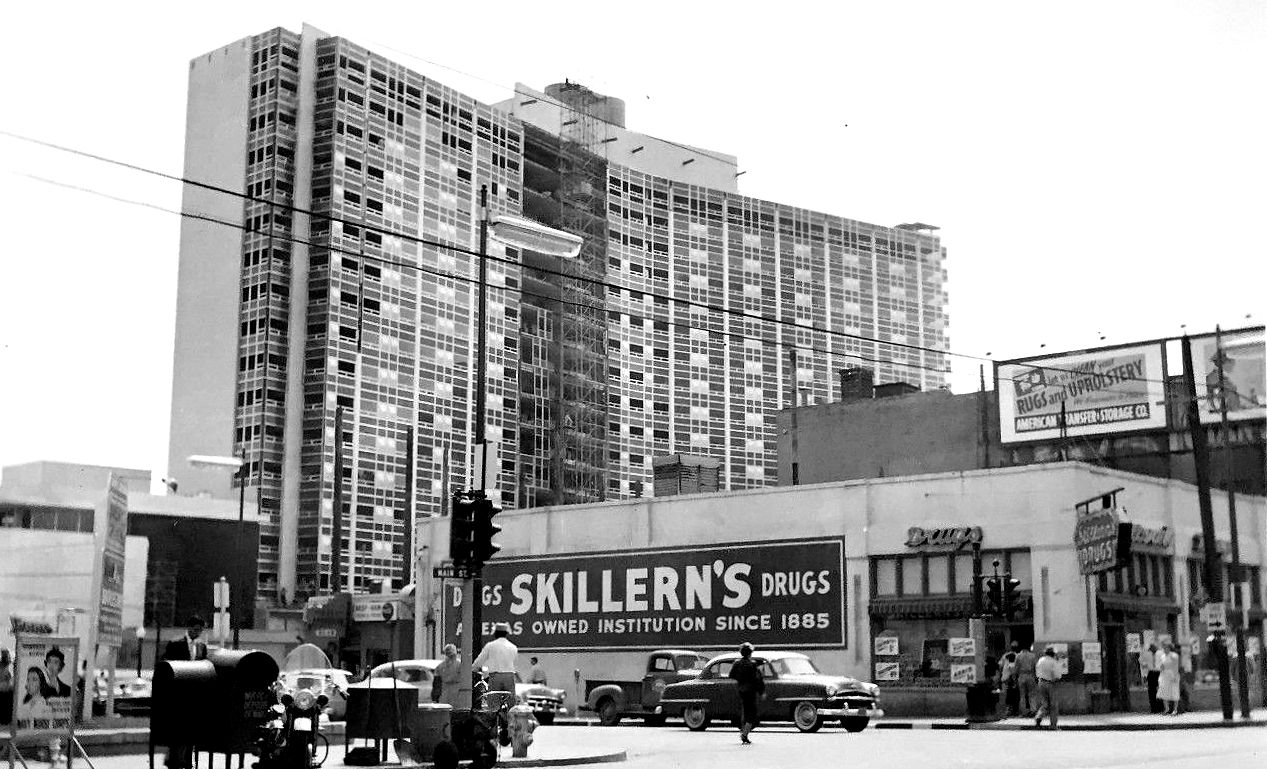 Hey, Skillern’s, you’re blocking the view!
by Paula Bosse
This view showing a Skillern’s drugstore at the southwest corner of Main and Harwood was taken as the Statler Hilton was nearing its opening in 1956. The block bounded by Main, Harwood, Commerce, and St. Paul was filled with businesses (…and later a parking garage) (…and way before that, homes) has been cleared and is now the lovely Main Street Garden Park. It’s always nice to have green space downtown, but, for me, the absolute best thing about this open space is that it FINALLY allows the beauty of the old (soon-to-be-new again) Statler Hilton, the old Titche-Goettinger building, and the old Municipal Building to be seen as they should have been seen all along: in full view, from a distance, without anything impeding the view. And now … the 360°-view — especially at night — is spectacular! Below, that same block these days, captured in a fantastic photo by my favorite Dallas photographer, Justin Terveen.
 Justin Terveen
As much as I love the mid-century skyline of this city, I have to say, the 21st-century version of this end of downtown — this square — wins.
***
The top photo appeared a couple of months ago on eBay.
The color photo is by Dallas photographer Justin Terveen, used with permission. See more of Justin’s incredible photos here — the one above and many others are available for purchase. I tend to get stuck in the past, but seeing Justin’s photographs of present-day Dallas make me realize how remarkably modern and vibrant the city is right now.
The same view from Main and Harwood, as seen today on Google, is here.
It always felt a little claustrophobic on Main, Harwood, and Commerce — those buildings needed room to breathe. For years, that block in the middle got in the way of fully appreciating Titche’s (this idealized postcard view shows Main Street at the right, St. Paul at the left), the Statler Hilton, and the Municipal Building (this 1920s photo shows people standing on the steps with a former drugstore occupant — Drake’s — across Harwood; Harwood was especially narrow when the building was originally built in 1914, and, as I recall, many were unhappy that such a majestic building was built in a location where it was impossible to fully appreciate its aesthetic qualities, even after the street was widened several years later).
More on Main Street Garden Park is here and here.
*
Copyright © 2016 Paula Bosse. All Rights Reserved.
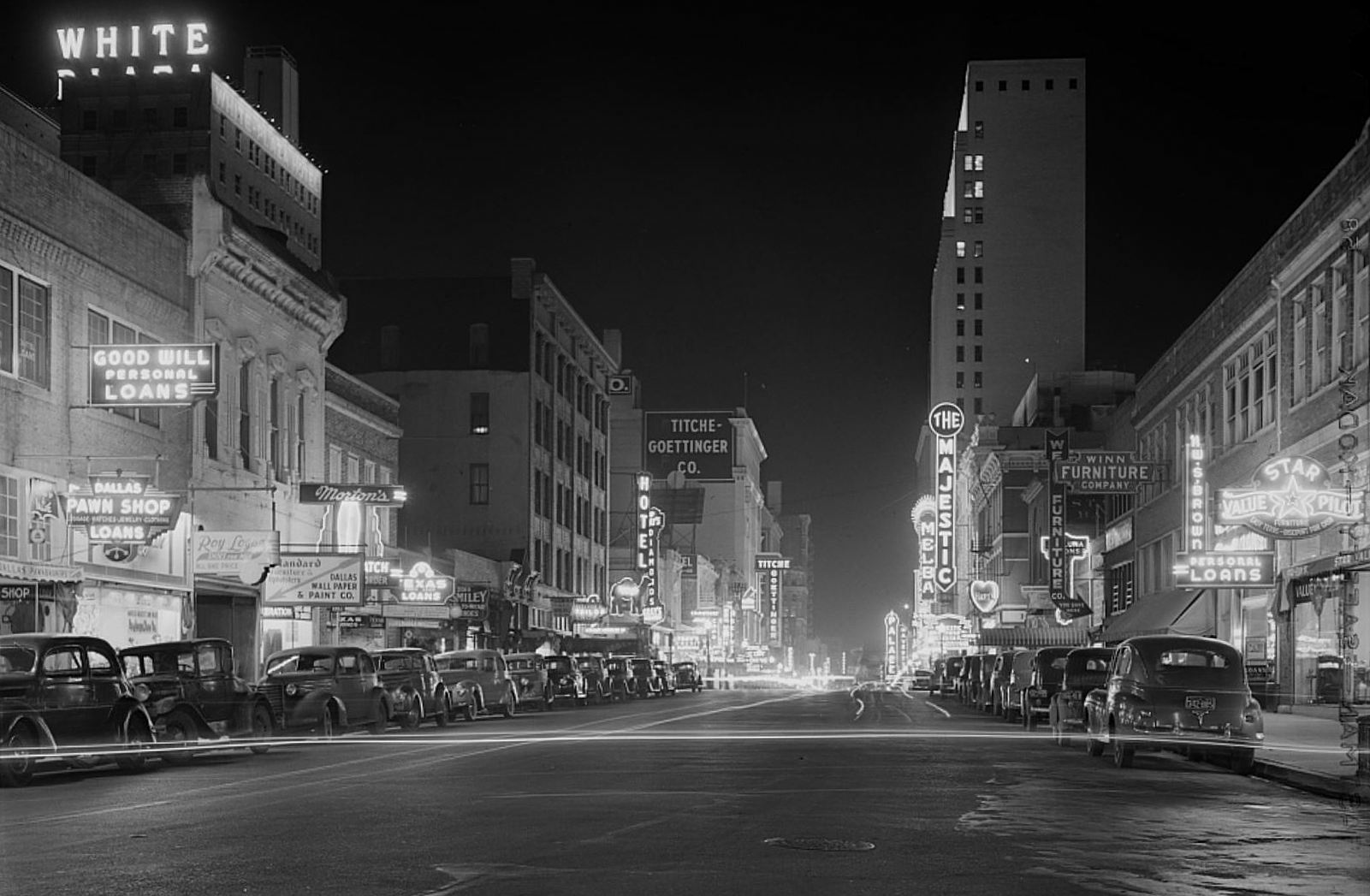 “Linger on the sidewalk where the neon signs are pretty…”
by Paula Bosse
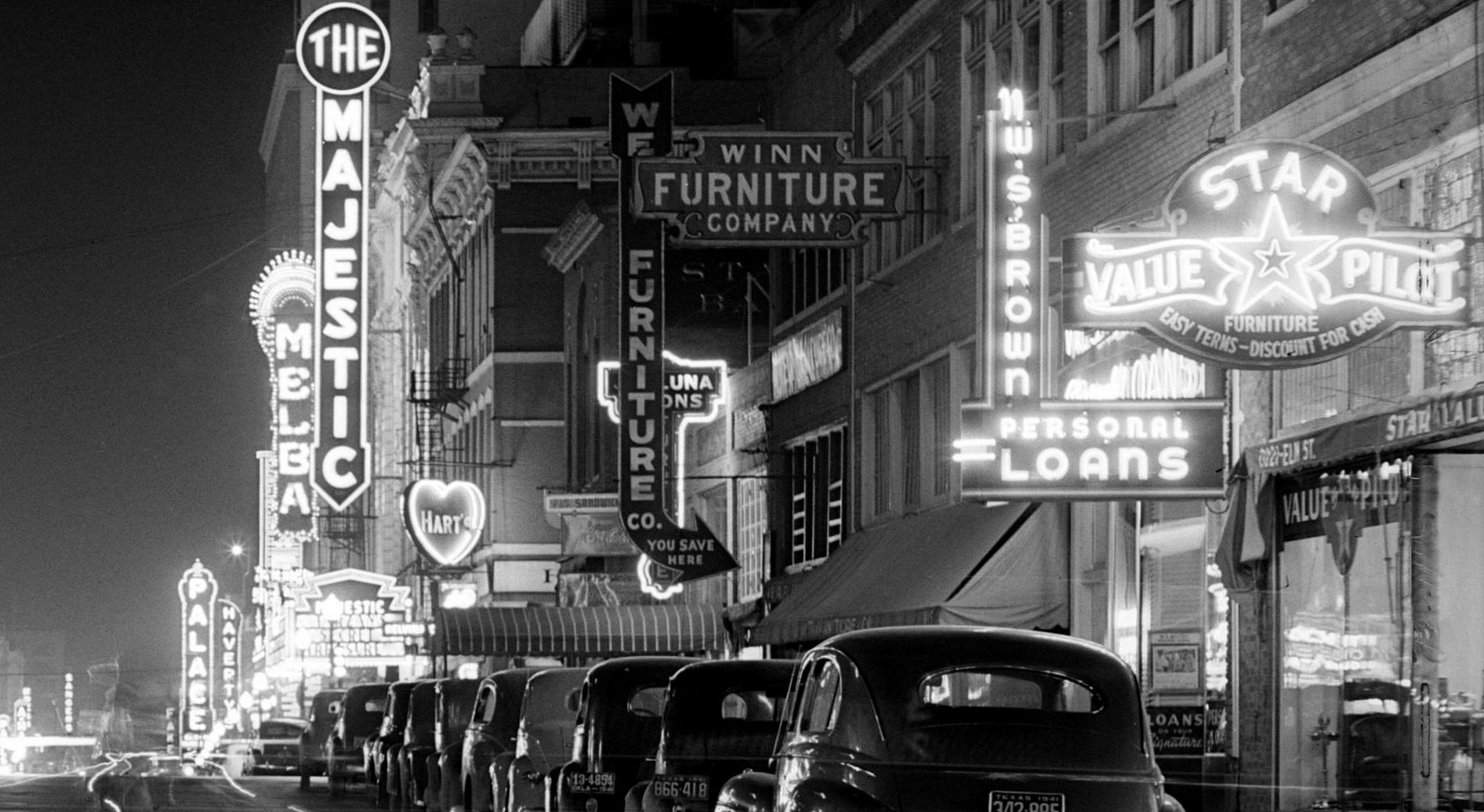
If you’re interested in Dallas history, chances are pretty good that you’ve seen this photograph by Arthur Rothstein, which was taken in 1942 — sometime between January 9th and 16th — taken for the Farm Security Administration (FSA). It shows Elm Street — “Theater Row” — looking west from the block east of Harwood. This photograph is from the Library of Congress (here) a larger image can be explored here.
Below are a few magnified details (click pictures to see much larger images).
*
Chattel loans and good will:
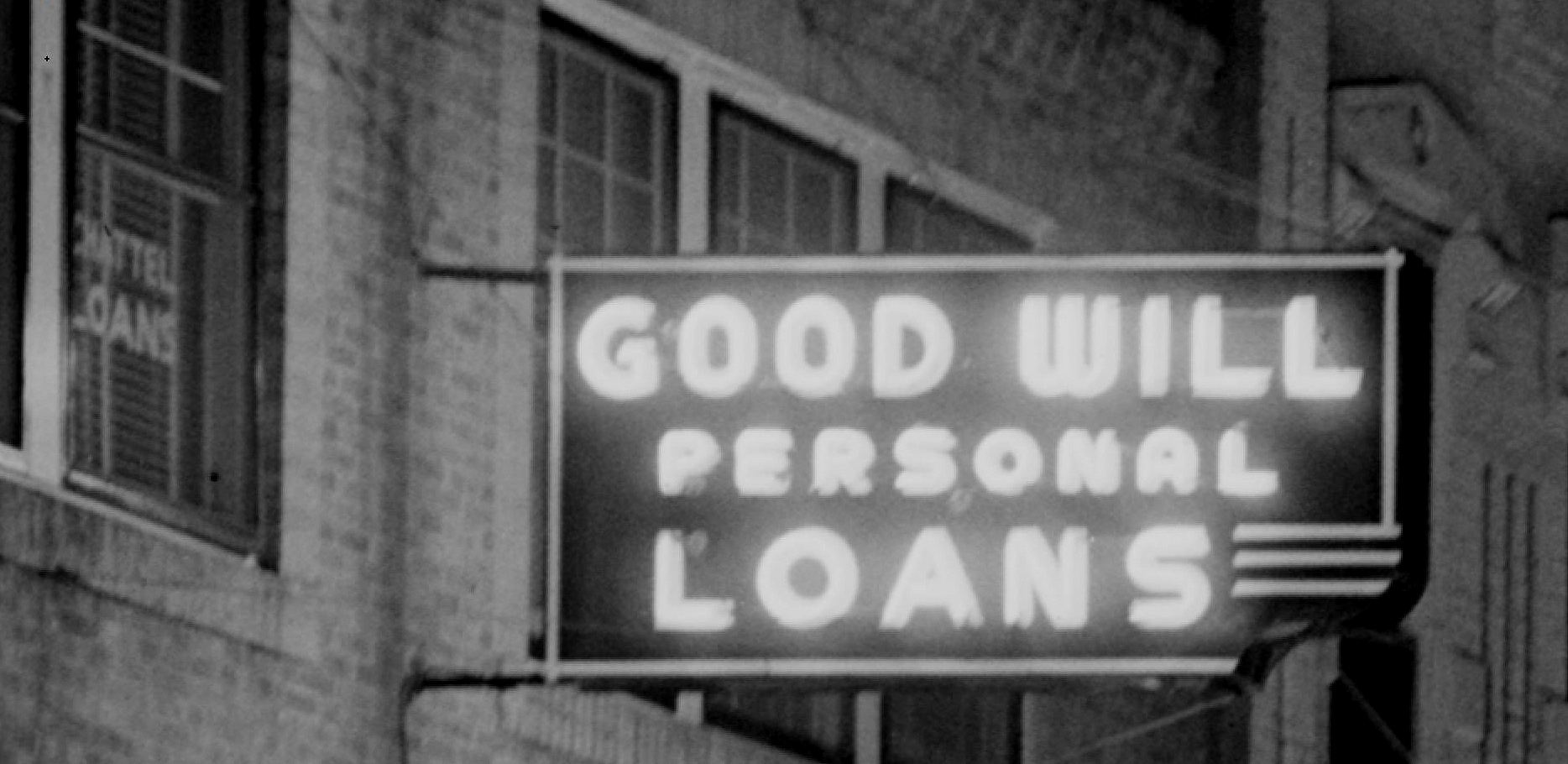
*
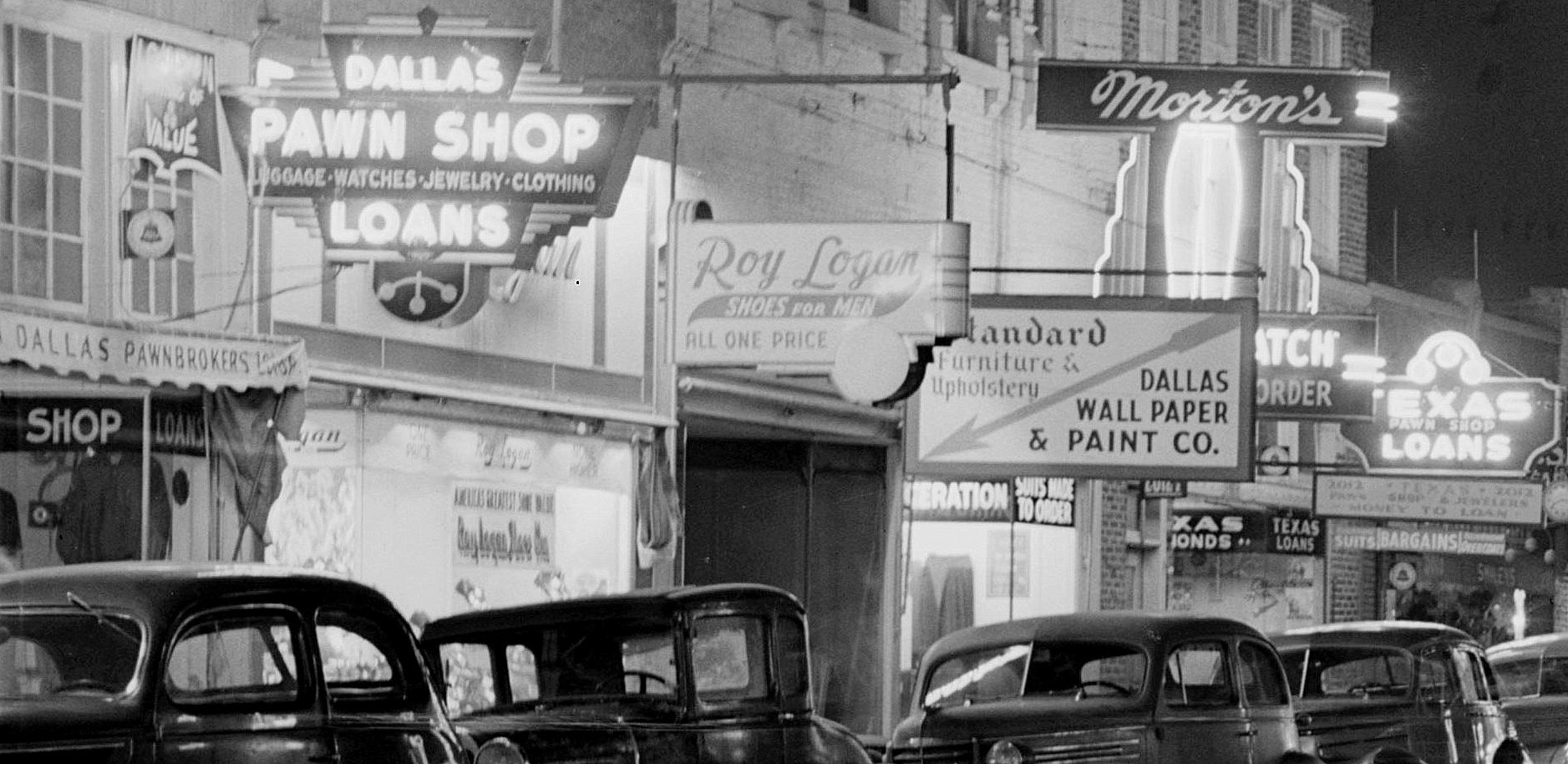
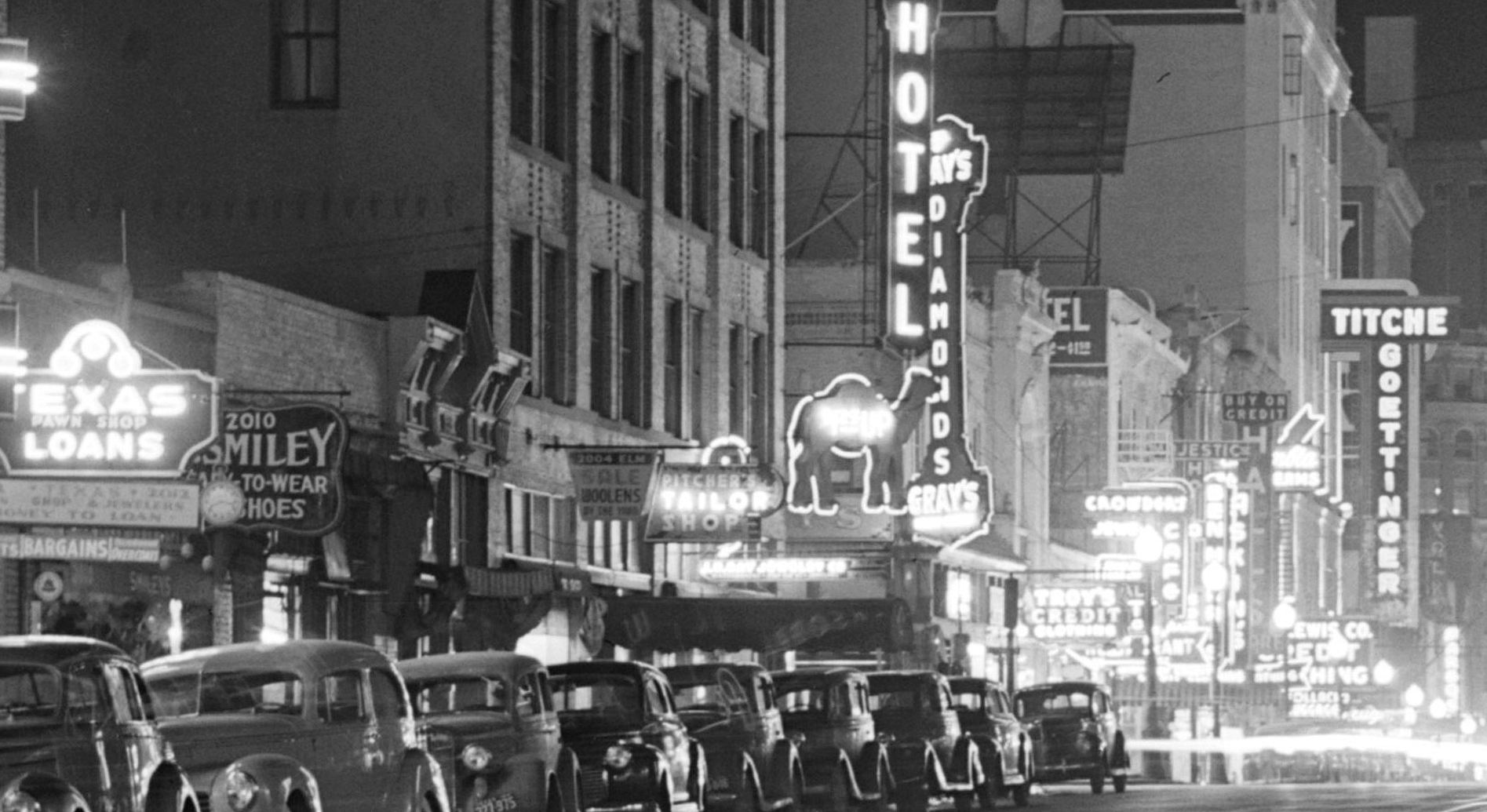
Morton’s Pants Shop (2014 Elm) has a neon sign in the shape of a pair of pants!
*
More interesting neon: the Texas Pawn Shop (2012 Elm) has the traditional three balls, and, better, the Campbell Hotel (Elm and Harwood) has a camel!
*
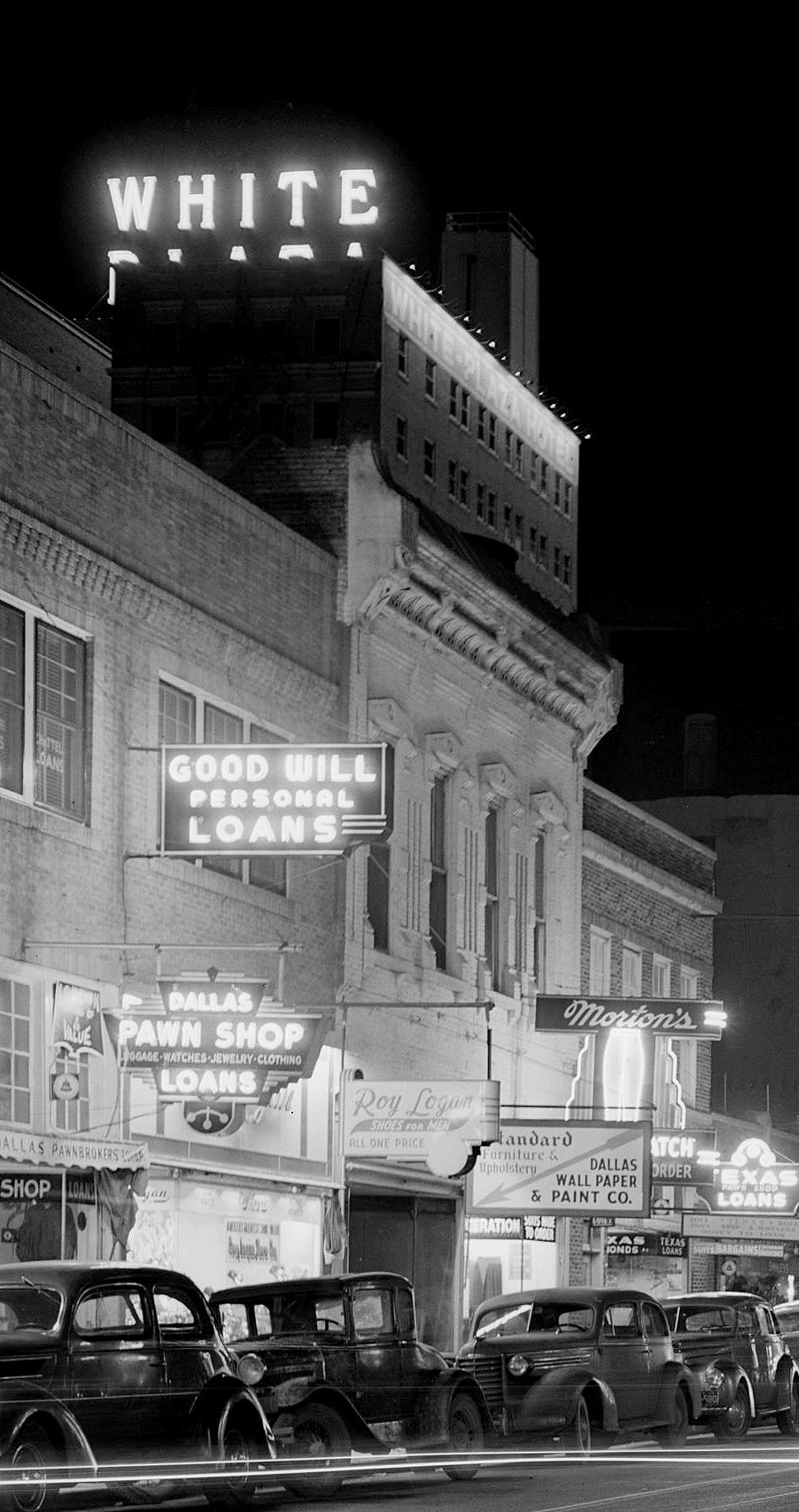
The White Plaza on Main St. (at Harwood) was originally the Hilton Hotel and is now Hotel Indigo. There were some great buildings in this block.
*
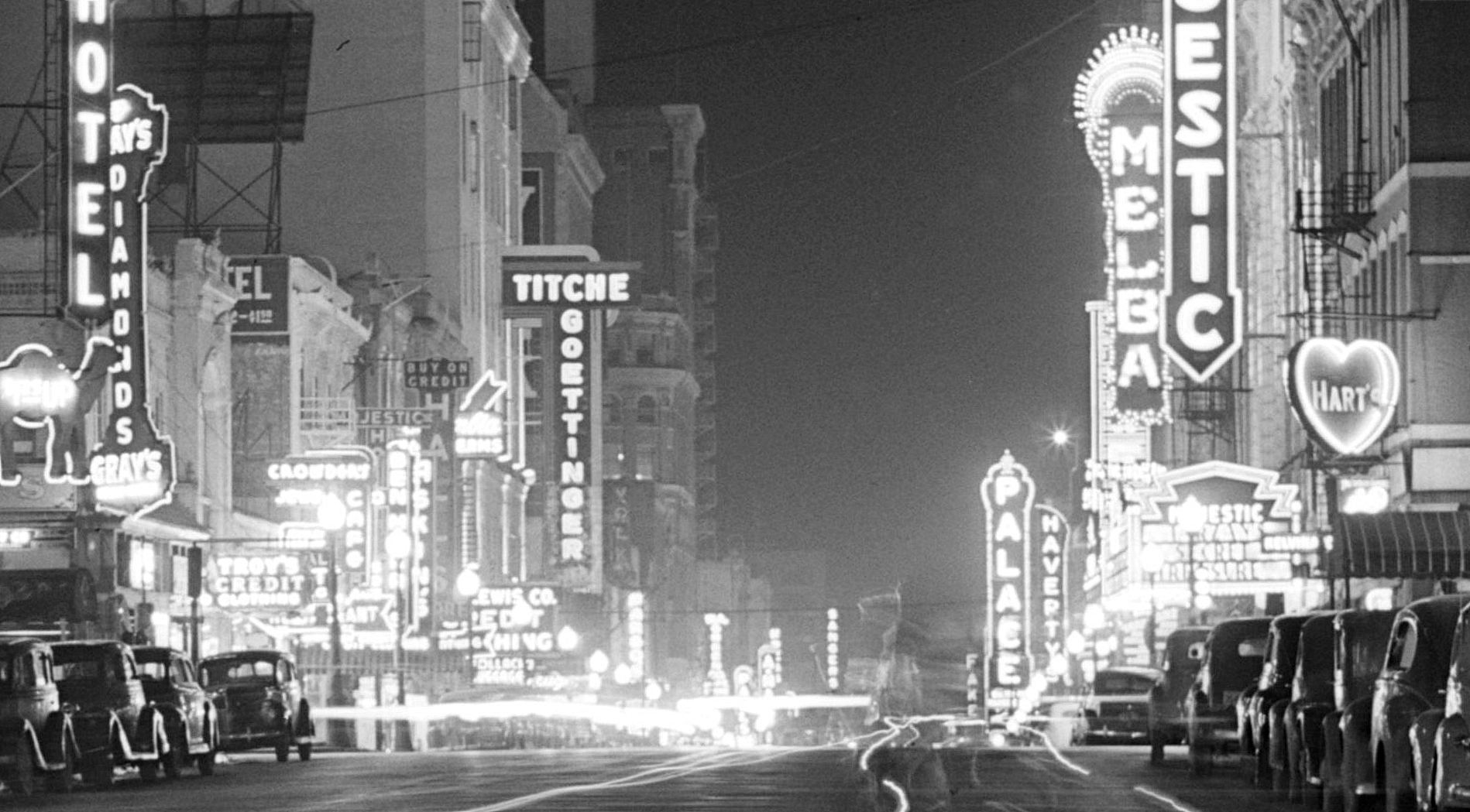
That light is blinding.
*
The towering Tower Petroleum Building (Elm and St. Paul) is pretty cool-looking here.
*
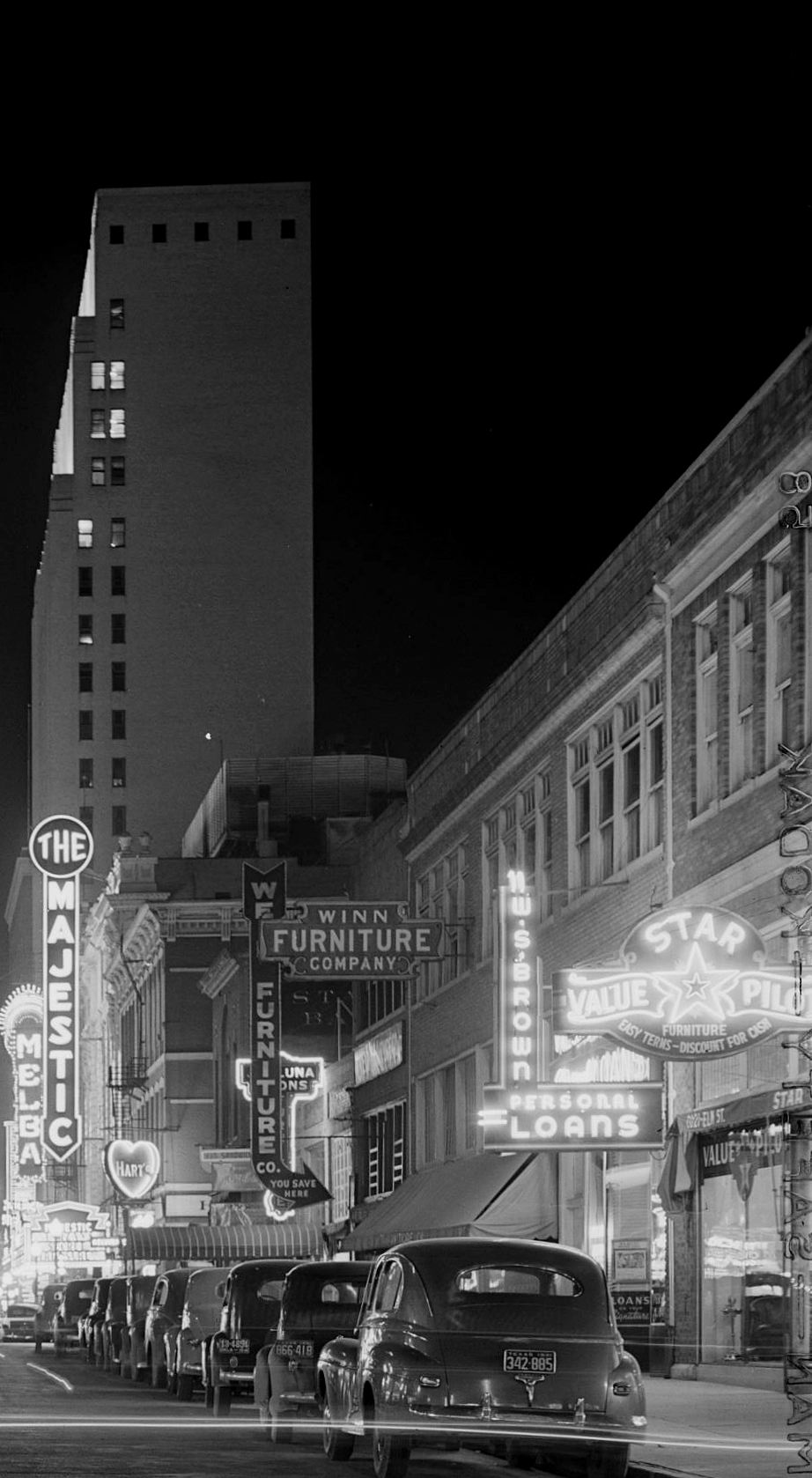
The 2000 block of Elm (seen in the foreground, just east of the Majestic block) was full of furniture stores, pawn shops, and tailors. This is my favorite detail from this photograph. Sadly, the entire block — which was once filled with businesses and activity — was completely demolished; the “camel” side of the street is now occupied by an ugly parking garage, and this side of the street is a wasteland of ugly asphalt parking lots. Yep.
*
1941 plates.

*
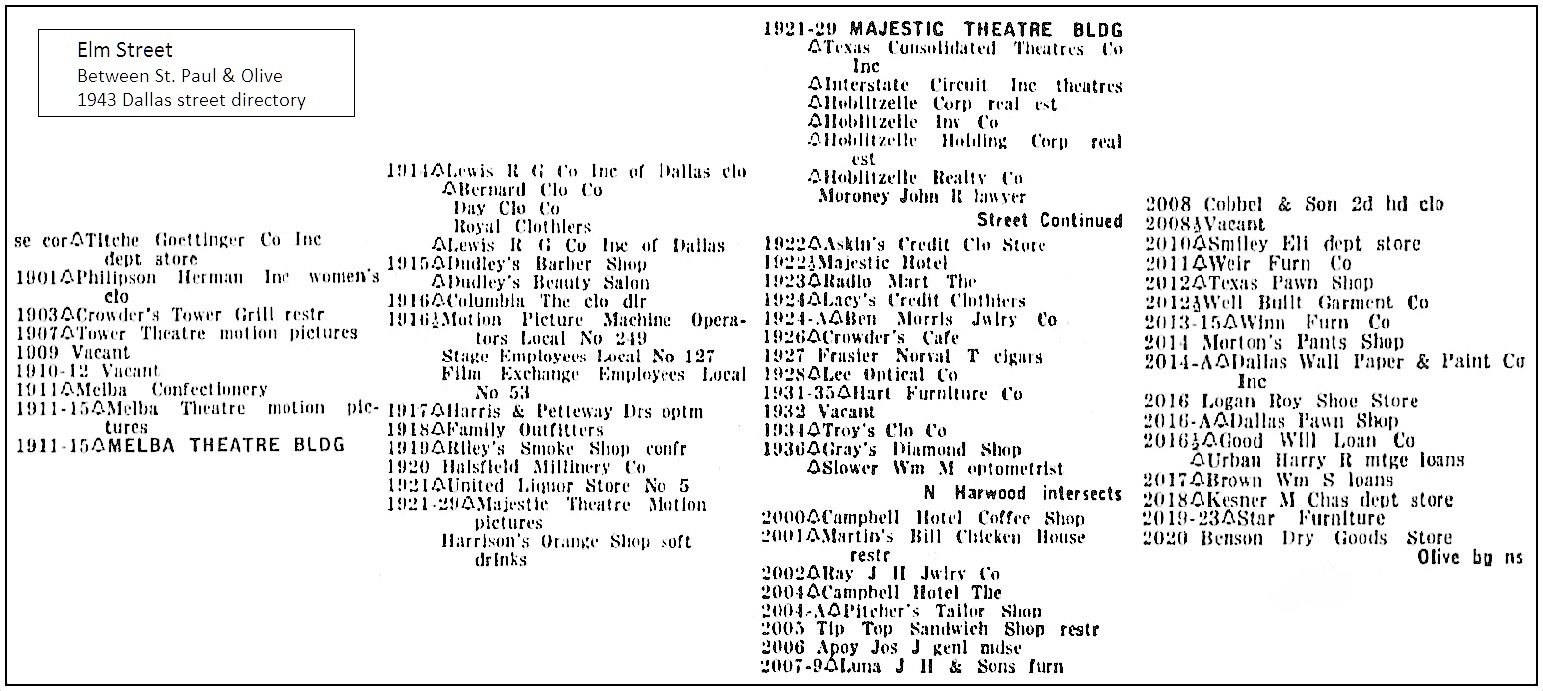
Below, Elm Street businesses from the 1943 city directory, beginning at N. St. Paul and ending at N. Olive. Next stop: Deep Elm.
*
The view today? Here. Hope you weren’t too attached. Kiss most of it bye-bye.
***
Photo from the Library of Commerce, here. This photo is all over the place, including the great Shorpy website, here (click the “supersize wallpaper” link under the photo to see it BIG). If you want a super-gigantic 26.3 MB file (5978 x 4619) (!), download the TIFF file in the dropdown beneath the photo.
The movie playing at the Majestic Theatre is “Tarzan’s Secret Treasure.” Newspaper ads show that the movie opened on January 9, 1942 and played just one week, closing on January 16.
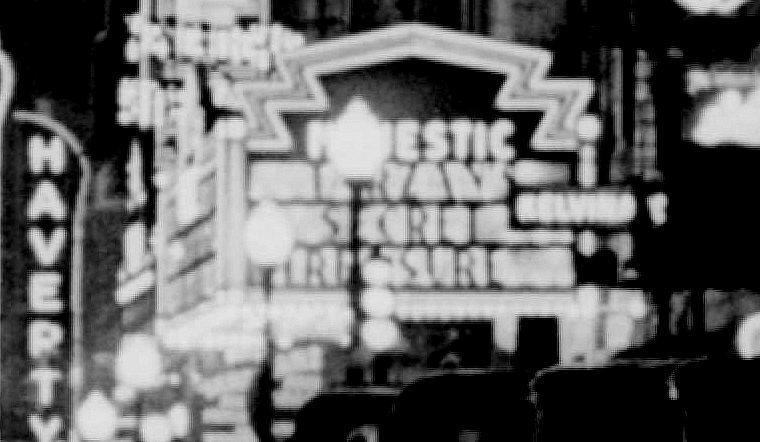
Thanks, Cody and Chris for asking about this photo!
Everything’s bigger in Texas, and everything’s bigger when it’s clicked.
*
Copyright © 2016 Paula Bosse. All Rights Reserved.
 Giant horses at the ready… (click for larger image)
by Paula Bosse
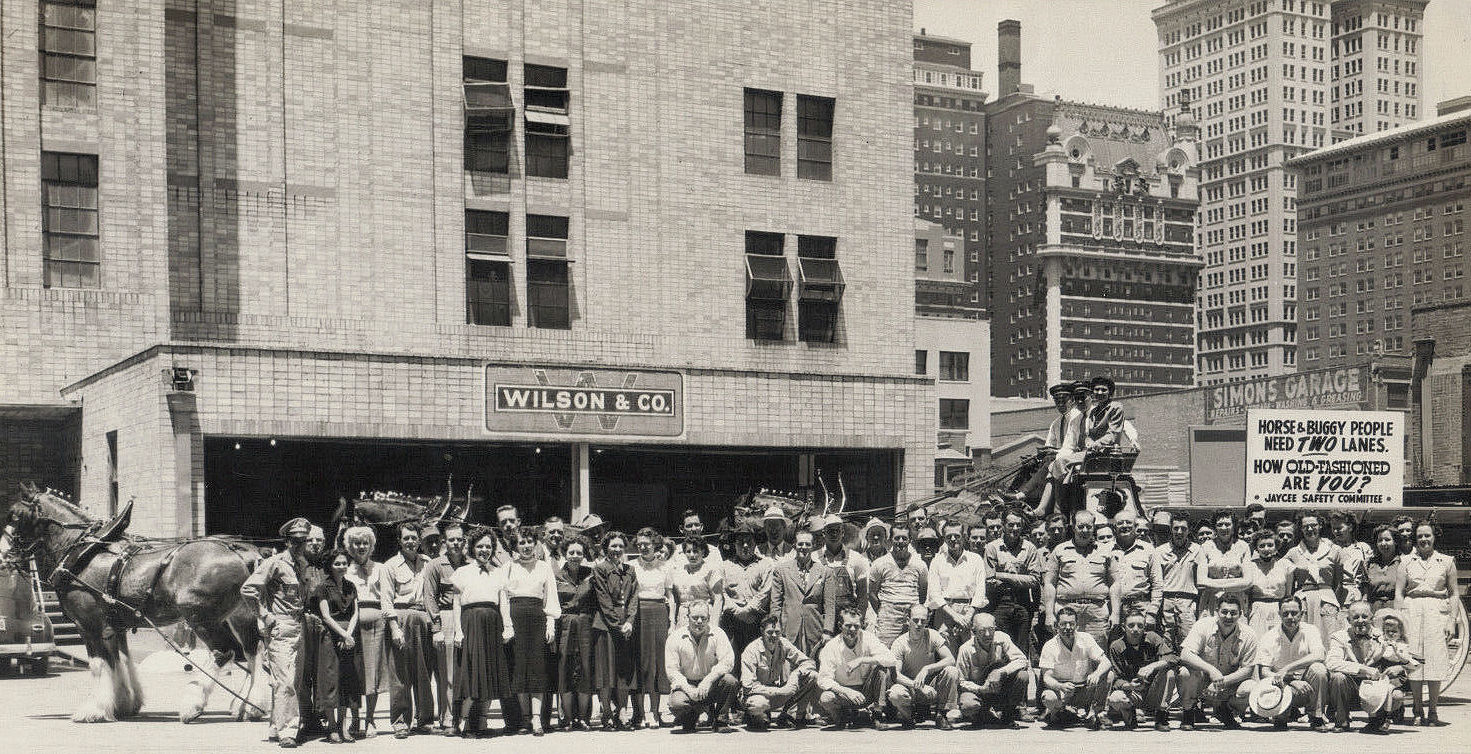
I came across this undated photo a couple of years ago on eBay, and it took a little bit of digging to come up with just what was going on here.
The Wilson & Co. meat packing and processing business began in Chicago in 1916 and quickly became one of the nation’s largest meatpackers, right up there with Armour and Swift. It expanded across the country, and one of its plants was in Dallas — in Unit 3 of the Santa Fe complex of buildings, located on Wood Street, between Field and what is now Griffin. (This building was later known as the Ingram Freezer Building and was demolished in 1988.) The Wilson company was acquired by Dallas-based LTV in 1967, and was later “spun off” from LTV in 1981
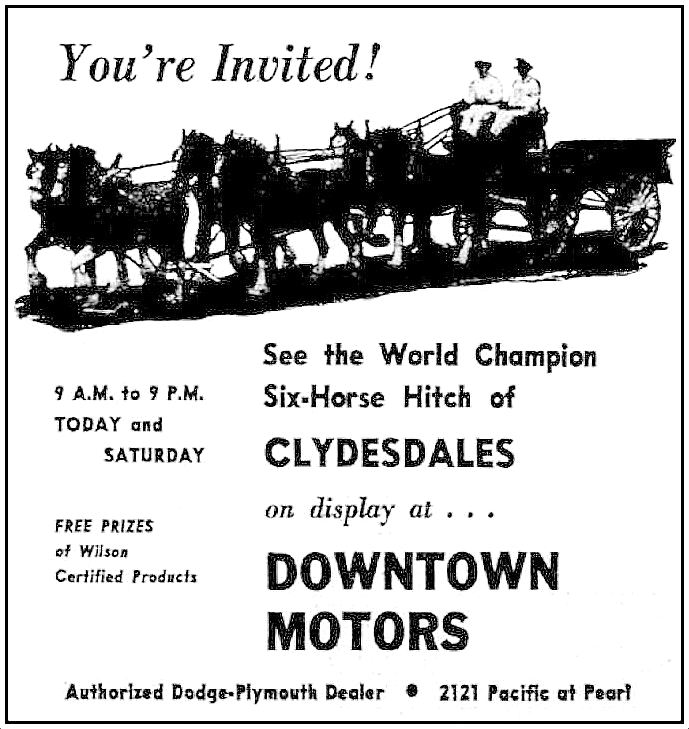
The Wilson company had owned a prize-winning “six-horse hitch” of Clydesdale horses since 1917, and they were sent around the country to promote the company and its line of processed meats. Not only were the horses prize-winners at livestock shows, they were also incredibly popular with the public. (They had made a huge splash at the Chicago World’s Fair in 1933, and it seems Budweiser took note of the promotional possibilities of the impressive animals, as the Anheuser-Busch Co. ended up buying the original team from Wilson that same year. So there were at least two competing Clydesdale teams clomping along the downtown streets of America, through at least the late ’60s.)
The photo above was taken when Wilson & Co.’s horse celebs visited Dallas in May, 1951. During their time in Big D they paraded through downtown at noontime and entertained workers on lunch breaks; at night they bunked in temporary stables in the service department of a Pacific Avenue car dealership. The photo at the top shows a public service event in which the Dallas Junior Chamber of Commerce promoted traffic safety in conjunction with the visiting horses. In the photo, the Wilson company employees (who have somehow managed to block the view of several thousand pounds of horseflesh and the huge 1890s wagon behind them) look happy during their little photo-op break from work. And in the background, we see the Adolphus Hotel (…built by the man behind Budweiser beer…), the Magnolia Building, and the Baker Hotel.
All this kind of makes me want a ham sandwich and a bottle of beer….

via Amazon
May, 1951
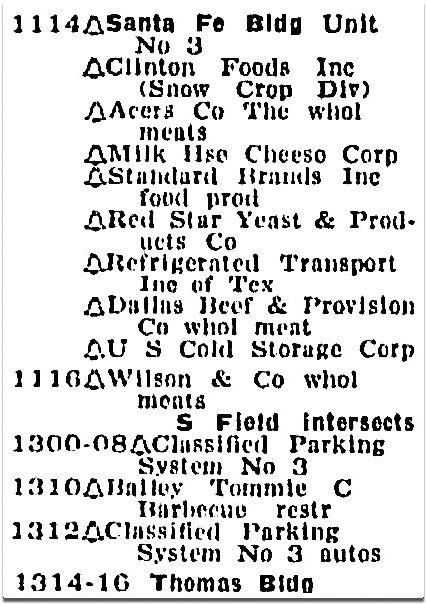
Wood Street, Dallas city directory, 1953
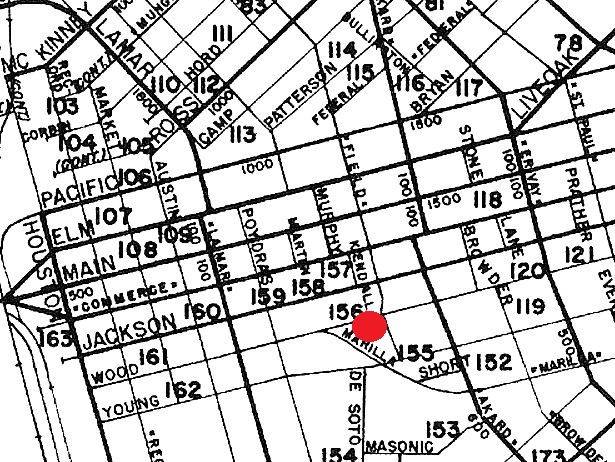
1952 Mapsco
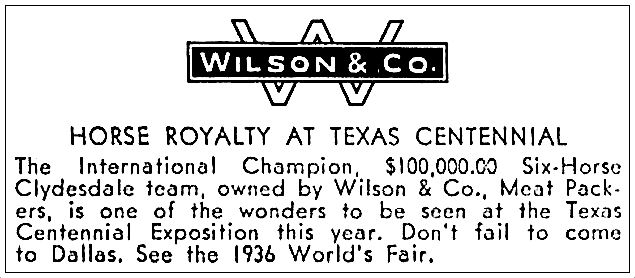
Below, a postcard advertising the appearance of the Wilson “Champion Six-Horse Team” at the 1936 Texas Centennial:
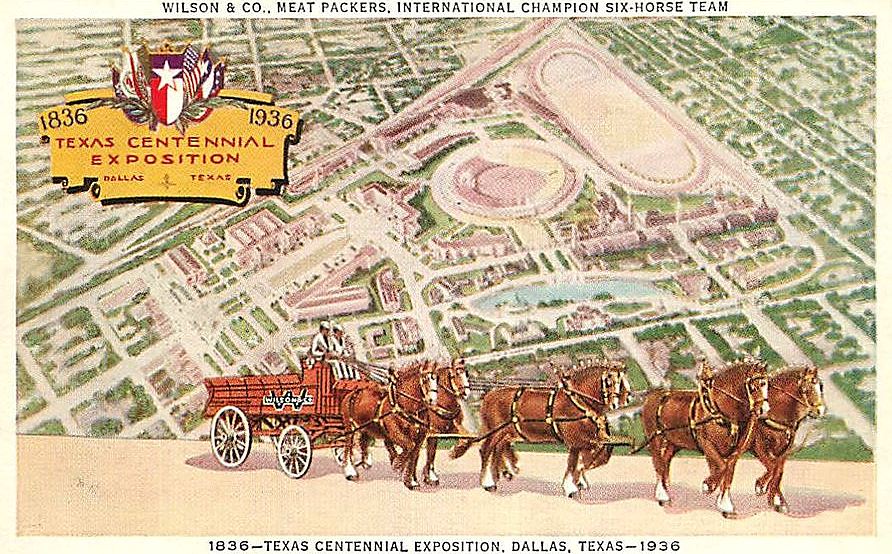
***
Photo found on eBay in 2014; on the back is the stamp of photographer Denny Hayes.
Texas Centennial postcard from eBay.
See an unimpeded view of the famous six-horse team of Clydesdales (each of which weighed, on average, two thousand pounds) in a 1954 Cedar Rapids Gazette photo, here.
A couple of interesting tidbits about the Wilson company and about the horses:
Pictures and clippings are larger when clicked.
*
Copyright © 2016 Paula Bosse. All Rights Reserved.
 Looking north up Akard from Main… (click for larger image)
by Paula Bosse
This postcard shows a bustling downtown at the intersection of Main and Akard (the view straight ahead is North Akard). Marvin’s Drug Store, on the northwest corner, was at 1415 Main, and the Palace Drug Store, on the southwest corner, was at 1414 Main. The Palace Drug Store moved to this location in December of 1909, and I’d guess the original photo used here was taken around 1910. See what this view looks like today here.
I love colorized postcards from this period, but sometimes draining them of their color gives a more realistic view of the scene (but doing this can also add a weird surreal flavor when you begin to notice evidence of the artist’s heavy hand — check out the two creepy Edvard Munch-like blank-faced pedestrians at the far right). (Click for larger image.)
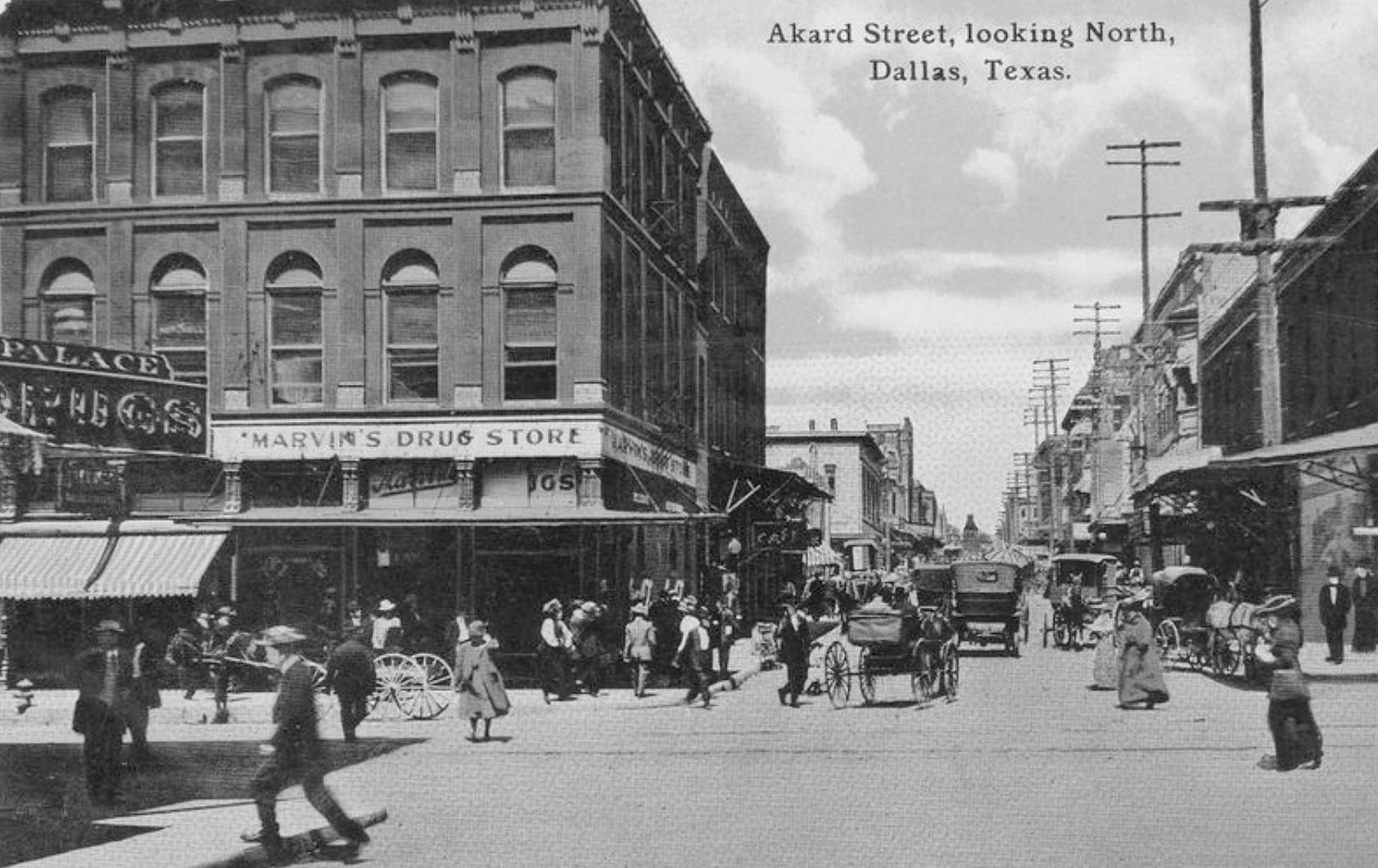
The building housing Marvin’s Drug Store was originally known as the Rowan Building, seen below in 1899 — its distinctive cupola was unceremoniously cropped from the postcard view.

In this photo you can see “Rowan” on the cupola:

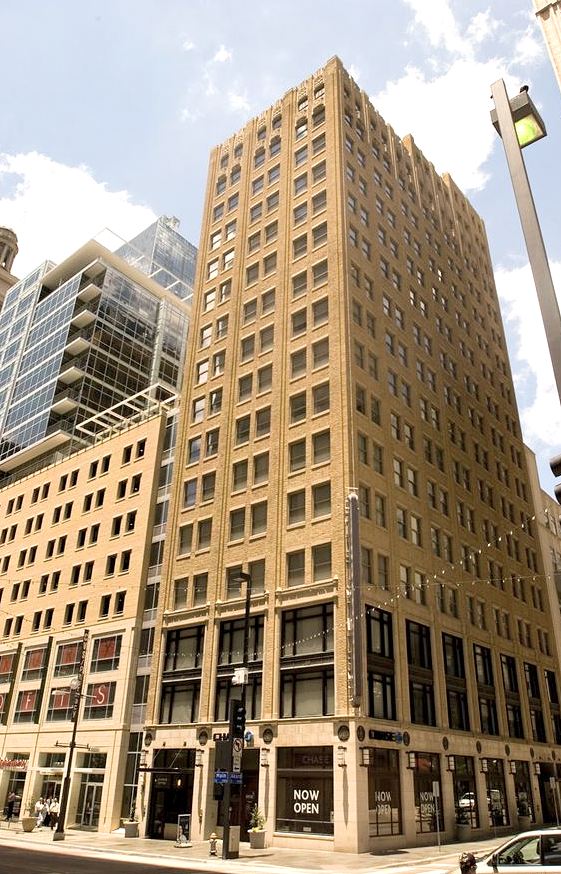
This attractive building was torn down in order to build the taller Marvin Building, which was originally intended to be 24 stories but was later downgraded to 16 stories, then to 10, then to 4 (but with plans to add more at a later date). When the new building opened in 1927, the namesake drugstore was retained as its ground-floor anchor tenant. This new structure was known as the Marvin Building until 1931 when the Gulf States Life Insurance Company purchased it and it became known as the Gulf States Building (coincidentally, ol’ Z. E. “Zeke” Marvin not only owned the Marvin Building and the Marvin Drug Company, but he was also the former president and CEO of the Gulf States Insurance Company). A Lang & Witchell-designed six-story addition was built in 1935. This 16-story building is still standing and has been converted into residential loft space.
***
The postcard at the top is from the incredible Flickr collection of Christian Spencer Anderson (aka “Coltera”), here.
The 1899 photo of the Rowan Building is a detail from a 1939 ad for the National City Bank of New York.
The sepia-toned photo is from eBay.
The color photo of the Gulf States Building is from the Chamberlin Roofing and Waterproofing site, here. (See that photo REALLY big here.)
Click pictures to see larger images.
*
Copyright © 2016 Paula Bosse. All Rights Reserved.
 Throwing the switch in 3-2-1… (click for larger image)
by Paula Bosse
While looking for something completely unrelated (which is always the best way to find unexpected things), I came across this full-page ad which appeared in the Sept. 9, 1921 edition of The Jewish Monitor (click to see a larger image):

Within the last few years a method of automatic exercise, known as the Bergonie treatment, has found favor among physicians abroad in the treatment of obesity and other chronic disorders.
One advantage is that with the Sinusoidal current, which is employed, very powerful muscular contractions may be induced without pain or sensation other than that due to the muscular contraction itself.
The Treatment chair is the last word in comfort. It is fitted to meet the physiologic needs of the body as well as being comfortable. The arm and leg electrodes are wide and comfortably curved to fit the arms and legs of the patient easily.
The Kellogg-Bergonie System of Battle Creek, Mich., will reduce you just where you wish to be reduced. No drugs, exercise or inconvenience. We will reduce you from one (1) to three (3) pounds per treatment and improve your physical condition. Trained nurses in attendance (under a registered physician’s supervision).
Hours for Men, 8 A.M. to 1 P.M.
Hours for Women, 1 P.M. to 6 P.M.
Phone X 5759
Ruth Rodgers, Mgr.
1614 1/2 Main Street, Dallas, Texas.
*
“The arm and leg electrodes are wide and comfortably curved” — there’s a line one doesn’t often encounter in an ad!
So what was this treatment of obesity that required “no drugs, exercise or inconvenience”? Well, basically, it was a low-voltage electric chair in which the naked, smock-draped “patient” reclined on wet towels and was covered with sandbags (which weighed up to 100 pounds). Electrodes were attached to the arms, legs, and abdomen. When the switch was flipped, electrically-provoked exercise began, and electric current caused muscular contractions (up to 100 a minute) without fatigue to the “exerciser.” All sorts of physiologic things were happening during these sessions, including a whole bunch of sweating. Patients would lose from 1 to 3 pounds during their time in the chair, hose themselves down and walk away refreshed.
Jean Albard Bergonié (1857-1925) was a French doctor/researcher/inventor who specialized in radiology in the treatment of cancer, and this odd electric chair was something of a departure from his oncology studies. It was used to treat a variety of ailments and conditions such as obesity, heart conditions, diabetes, “suppressed uric acid elimination,” and, later shell-shock. Professor Bergonié died in 1925 as the result of prolonged exposure to radium in his research to find a cure for cancer (in the years before his death, he had lost an arm and fingers to continual X-ray exposure). The Institut Bergonié continues in Bordeaux, France as a cancer research center.
So back to the chair. By the time of the 1921 ad above, Bergonié’s “ergotherapy” had become a weight-loss feature in beauty spas and salons. The ads I found mentioning the electric chair as something corpulent men and women of means might have seen in Dallas newspapers appeared between July and October of 1921, touting the miracle chair at Mrs. Ruth Rodgers’ beauty salon, The Old London Beauty Shoppe at 1614 ½ Main Street, a couple of doors from Neiman-Marcus.

July, 1921
I don’t know if it didn’t catch on or whether it just wasn’t mentioned in ads, but the chair made its final appearance in an Old London Beauty Shoppe ad in early October of the same year.
The splashiest news about Bergonié’s invention was a few months later, in early 1922, when it was revealed that the UK’s Queen Mary had availed herself of the chair in order to slim down in time for her daughter’s wedding, with Prof. Bergonié himself apparently operating the current flow. The best part of the lengthy and breathless article about the plump royal allowing herself to lie in this electric chair as she was rather unceremoniously weighted down with royal sandbags was this sentence:
[Mrs. David Lloyd George, the wife of the British prime minister] lost no time in telling Queen Mary all she knew about Professor Bergonie, the famous French ergotherapist, and his marvelous electric chair, which is said to jar fat from the human frame with the ease and almost the rapidity of a man peeling a tangerine.
Hey, I want that!
One would assume that sort of free publicity would be a boon to spas and salons offering State-side ergotherapy — I have a feeling Mrs. Rodgers had moved on by then and was probably kicking herself for concentrating on the more mundane treatment of wrinkles and sagging skin and the administering of marcel waves (her specialty).
Below, some views of The Chair over the years (all pictures larger when clicked).
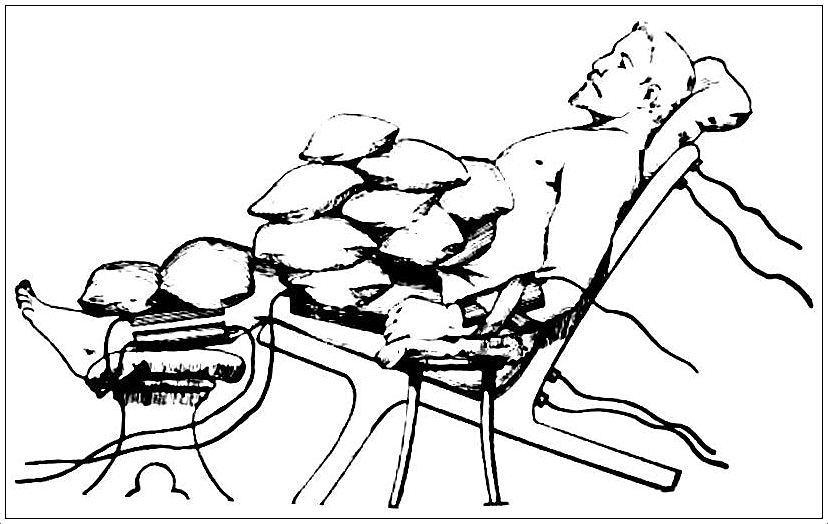
Above, a drawing from a 1913 medical book, found here.
*

From the journal Medical Record, May 1, 1915.
*

A World War I soldier being treated for shell-shock, from The Electrical Experimenter (Feb. 1919), here (continued here).
*

Jan., 1921
Ruth Rodgers was the proprietress of the Old London Beauty Shoppe (later the Old London School of Beauty Culture), which seems to have operated in Dallas from the ‘teens to at least the late-1930s. The location during the period of the ergotherapeutic chair was in the basement of 1614 Main Street.
*
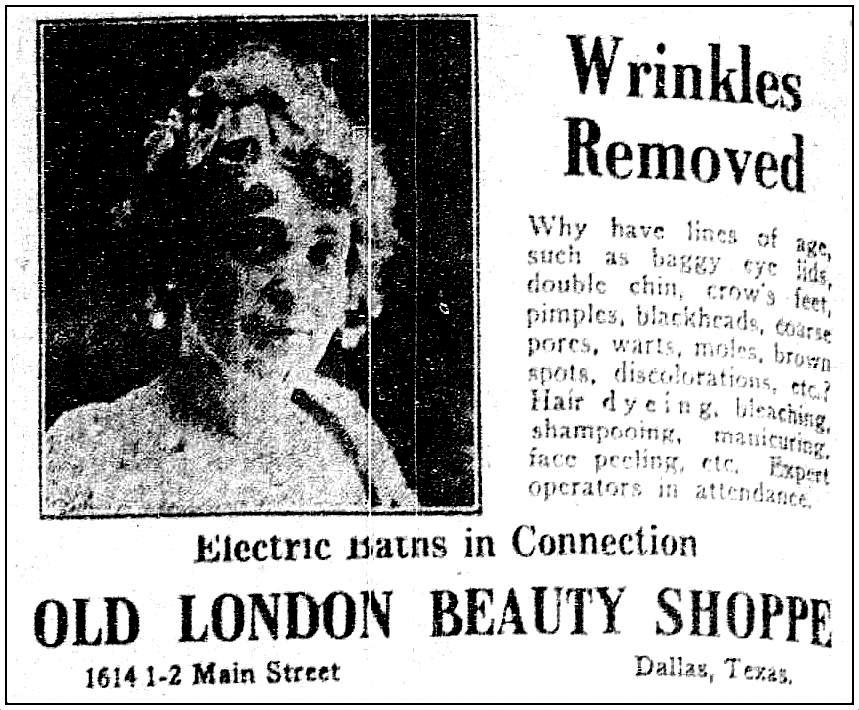
Aug., 1921
Mrs. Rodgers did it all. That might be her in the ad.
*

Aug., 1921
*

Aug., 1921
It’s a bit unusual seeing ads like this directed toward men.
*

San Francisco Chronicle, Sept. 25, 1925
*

Above, a very Aubrey Beardsley-esque depiction of the “distressingly stout” Queen Mary, ready to undergo her course of treatments. Read the full, widely-circulated article from February, 1922, “Queen Mary’s Jarring Anti-Fat Ordeal; Yearning for a Girlish Figure to Grace Her Daughter’s Wedding, the Queen-Mother Got One by Sitting in an Electric Chair and Losing 3½ Pounds a Week,” here. (They don’t write headlines like that anymore….) The photo below, showing the control panel, was also part of the article.

*

The caption for this photo (which appeared five years after the cutting-edge Ruth Rodgers was offering it to Dallas patrons): “The new French electric chair on which one reclines in comfort while form-fitting electroids [sic] direct the fat-melting current, as demonstrated by Alice Harris, a stage beauty who must keep thin.” (Ogden Standard-Examiner, April 18, 1926)
*
And, finally, to bring this back to Dallas, the location of Mrs. Rodgers’ Old London Beauty Shoppe in 1921 — 1614½ Main Street (basement) — is circled (this building was later the Everts Jewelry store before it moved across the street to the north side of Main). To the left is Neiman-Marcus, at the corner of Main and Ervay. (Full view of this postcard, from the collection of the DeGolyer Library, SMU, is here.)

***
Top photo is a detail from the ad below, which appeared in the Sept. 9, 1921 edition of The Jewish Monitor; it can be accessed via the Portal to Texas History, here.
Read a doctor’s account of just how Bergonie’s chair worked, in the article “Modern Treatment of Obesity” by Edward C. Titus (Medical Record, Jan. 24, 1920), here.
I’m not sure about the connection of this chair to J. H. Kellogg (the treatment in the ad was referred to as “The Kellogg-Bergonie System of Battle Creek, Mich.”). It appears that he and Bergonie might have developed similar chairs independently of one another and decided to form some sort of partnership — either by mutual agreement or court edict. Here is a photo of Kellogg’s “patented electrotherapy exercise bed” used in his Battle Creek sanitarium:

via Oobject (more Kellogg contraptions here)
And speaking of Mr. Kellogg, might I direct your attention to a previous Flashback Dallas post — “Electricity in Every Form — 1909” — here.
Click pictures for larger images
*
Copyright © 2016 Paula Bosse. All Rights Reserved.
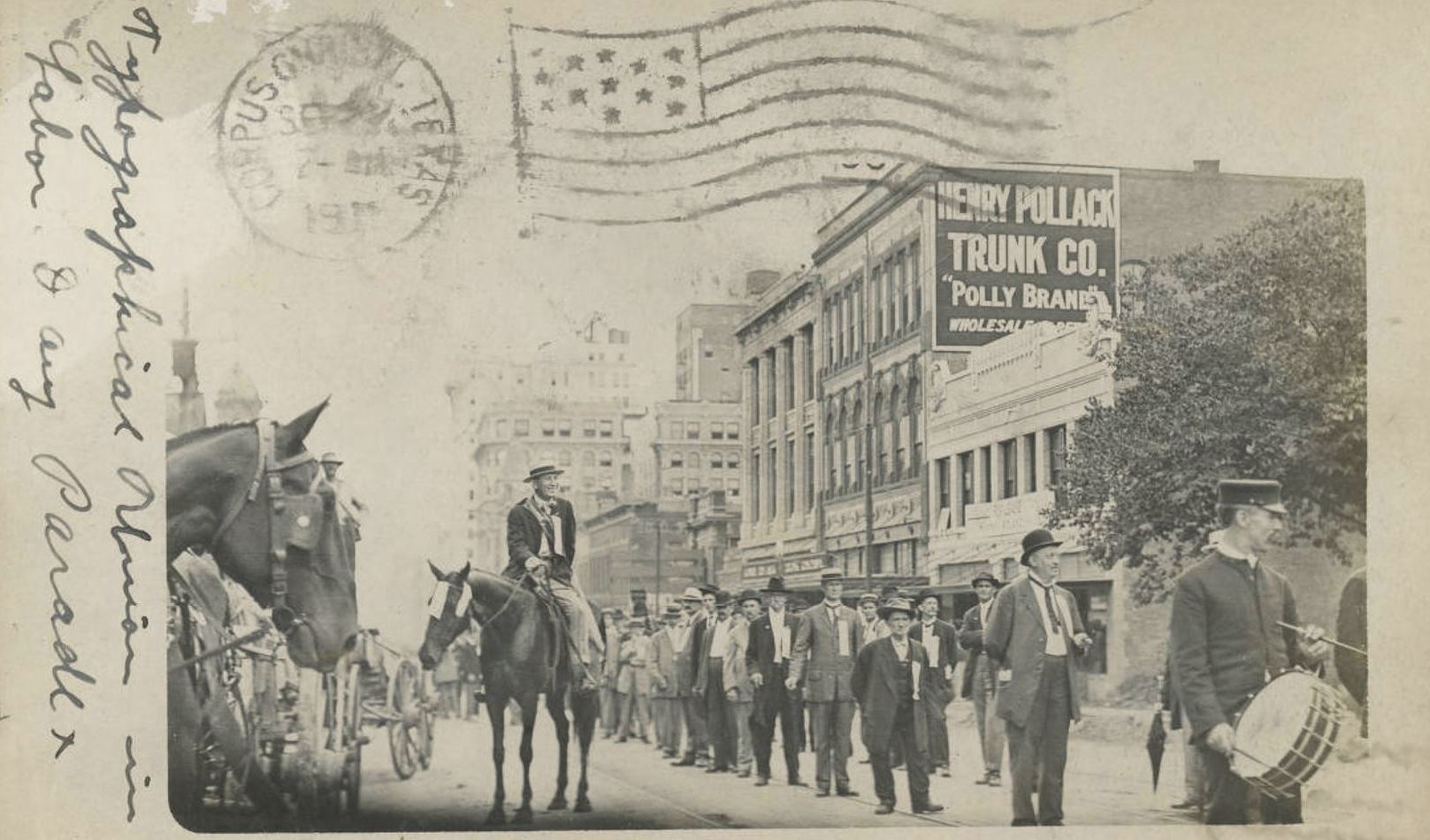 Union men on parade… (click for larger image)
by Paula Bosse
The photo above shows members of the Typographical Union marching in the Labor Day Parade held on Sept. 4, 1911. The photograph was taken looking west on Main Street toward St. Paul. (The Henry Pollack Trunk Co. was in the 1900 block, later occupied by the Titche’s building, now the Universities Center.)
The real photo postcard was sent three weeks later by John R. Minor, Jr. (a member of the union who worked as a linotype operator at The Dallas Morning News) to his mother, Mrs. Ada L. Minor, who was convalescing in Corpus Christi. (It’s possible the 27-year-old Minor was in this photo.)
Coverage of the day’s festivities can be read in the DMN article “Labor Day in Dallas Excels Past Record” (Sept. 5, 1911) here.
May your Labor Day not be spent walking behind a horse!
*
I feel I have to insert this bit of trivia here, if only because I spent so much time reading about the Minor family: in 1906, when John R. Minor, Jr. was 22 years old, the building in which he had a third-floor apartment was consumed by fire in the early hours of the morning. The three-story Knepfly Jewelry Building — built in 1888 on the southwest corner of Main and Poydras — was something of a landmark. The fire spread through the building so quickly that the only way to escape was to jump. Minor jumped and broke both legs and his pelvis. He was not expected to live, but he managed to pull through and spent several weeks in the hospital recovering. Two of the other top-floor residents died — one of whom had also jumped. Here’s the building. Minor had to jump past the telegraph wires on the Poydras (left) side of the building (the telegraph wires can be seen better in this photo from Dallas Rediscovered). He landed on his feet in the middle of the street. It’s amazing he didn’t break more bones. (Click for larger image.)
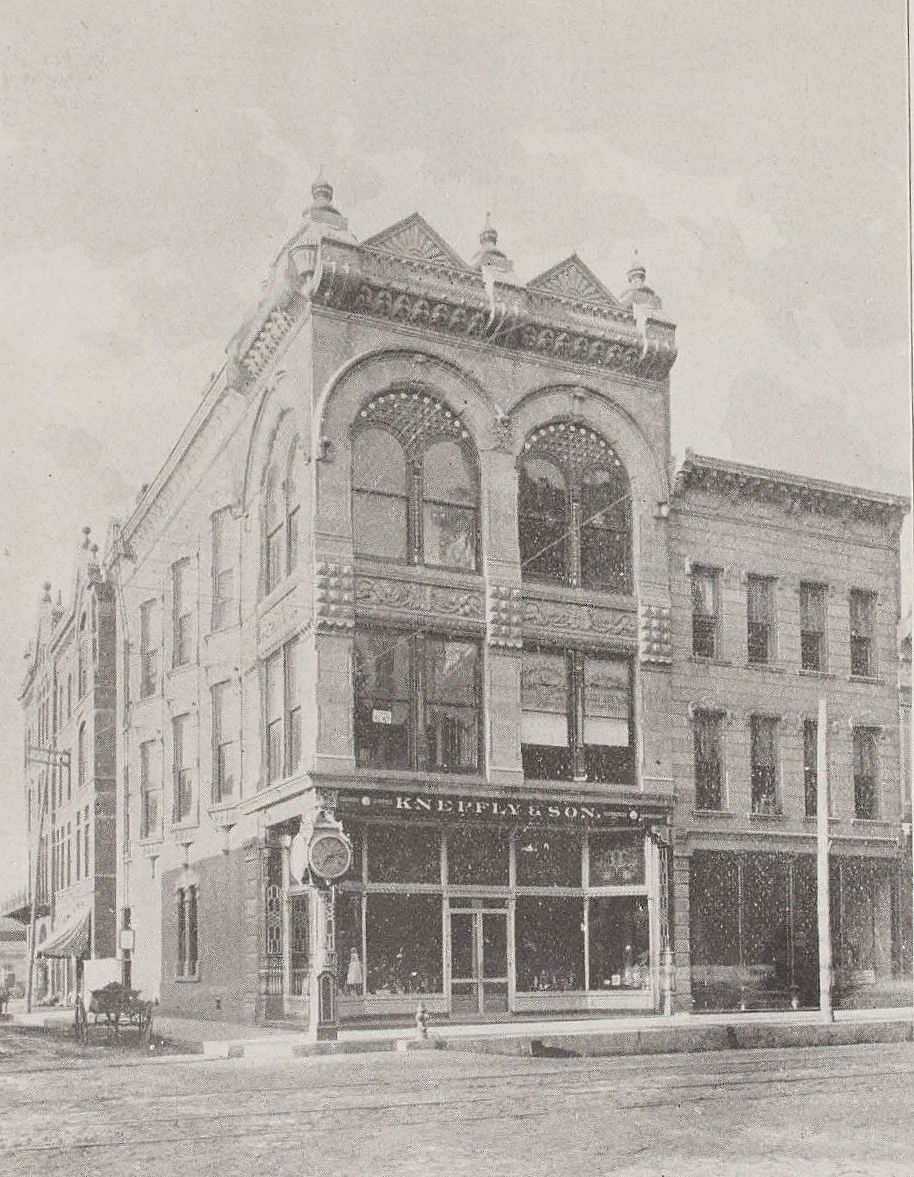
If he had marched in the 1911 Labor Day parade — which went west down Elm from about Pearl, then back east on Main from Lamar — he would have walked right past the building. On second thought, if he broke both legs and his pelvis, a mile-long march in a parade might have been a little taxing. (Maybe he’s the one on the horse!)
***
Postcard titled “Typographical Union in Labor Day Parade” is from the George W. Cook Dallas/Texas Image Collection, DeGolyer Library, Southern Methodist University; more info (and an image of the message side of the card) can be found here.
The photo of the Knepfly Building is by Clifton Church, from his book Dallas, Texas Through a Camera (1894), accessed from the DeGolyer Library, SMU Libraries, Southern Methodist University; more info is here.
Click pictures to see larger images.
*
Copyright © 2016 Paula Bosse. All Rights Reserved.
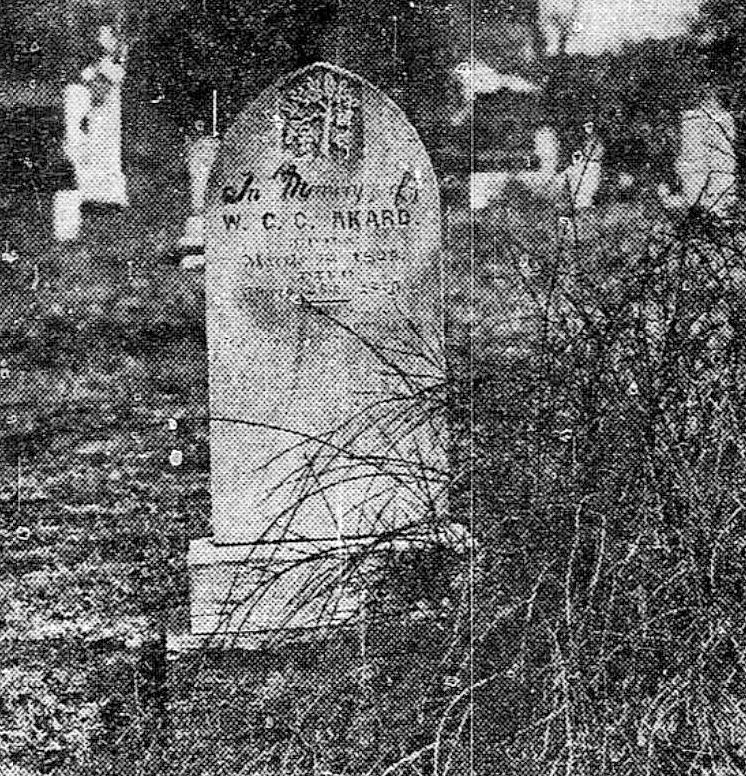
Tombstone of W. C. C. Akard, 1826-1870… (click for larger image)
by Paula Bosse
The other day I posted a photo of the Dallas skyline and pointed out that the land occupied by Memorial Auditorium/Dallas Convention Center was once the site of a cemetery (or, rather, several cemeteries: the old City Cemetery, the Masonic and Odd Fellows Cemeteries, and the Jewish Cemetery.
By the 1920s, the grounds were overgrown and grave markers were in various states of disrepair; there were about 500 graves, but many of the remains of those buried there had been moved (resulting in more than a few somewhat alarming gaping holes!). As the 1920s were winding down, fewer and fewer burials were taking place in these cemeteries, but people were still being interred throughout the 1920s — some of these appear to have been indigents without funds to be buried elsewhere.
The oldest grave markers dated to the 1850s. Many of those buried there were important Dallasites: mayors, politicians, pioneer businessmen, doctors, and judges — many of the markers bore names which are now part of everyday life in Dallas (names such as Harwood, Ervay, Akard, Crowdus, Browder, Marsalis, etc.). Over the years, cemetery land had been encroached upon bit by bit (by the Santa Fe railroad, for one) causing many graves to be unceremoniously destroyed. As the city grew and this land (which was once beyond the city limits) became more and more valuable for developers, many of the graves were moved and the remains relocated to other cemeteries. But many remained, and there was concern that the land was being neglected. For decades, the city of Dallas was petitioned by civic leaders to officially protect, beautify, and maintain this land. It wasn’t really until the construction of the convention center in the 1950s that these plans began to take shape. Remaining graves and markers are now part of the Pioneer Park Cemetery at Pioneer Plaza.
Below is a detail from an 1882 map, showing the original locations of the four cemeteries, just beyond the southern edge of the city limits. The Masonic Cemetery occupied the northern section, and the Odd Fellows Cemetery occupied the southern section. The City Cemetery adjoined both, immediately to the east (just west of Akard). The tiny Jewish Cemetery is seen on the southeastern edge of the City Cemetery (in later years Masonic Street cut through the City Cemetery land, and the Jewish Cemetery was just south of the street and right next to the old Columbian School). (See the changed boundaries of the cemeteries on a 1905 Sanborn map here.)

Jones & Murphy’s Map of the City of Dallas, Texas, 1882 (det.)
*
The photo at the top of this post shows the grave of W. C. C. Akard (1826-1870). (Incidentally, according to a 1939 Dallas Morning News article, he apparently pronounced his name “Ay-kard” rather than “ACK-erd” as we do today.) The photos below show the run-down Masonic-Odd Fellows cemetery in the 1920s.
*

The Masonic and Odd Fellows Cemetery, with the Magnolia Building in the background.
*
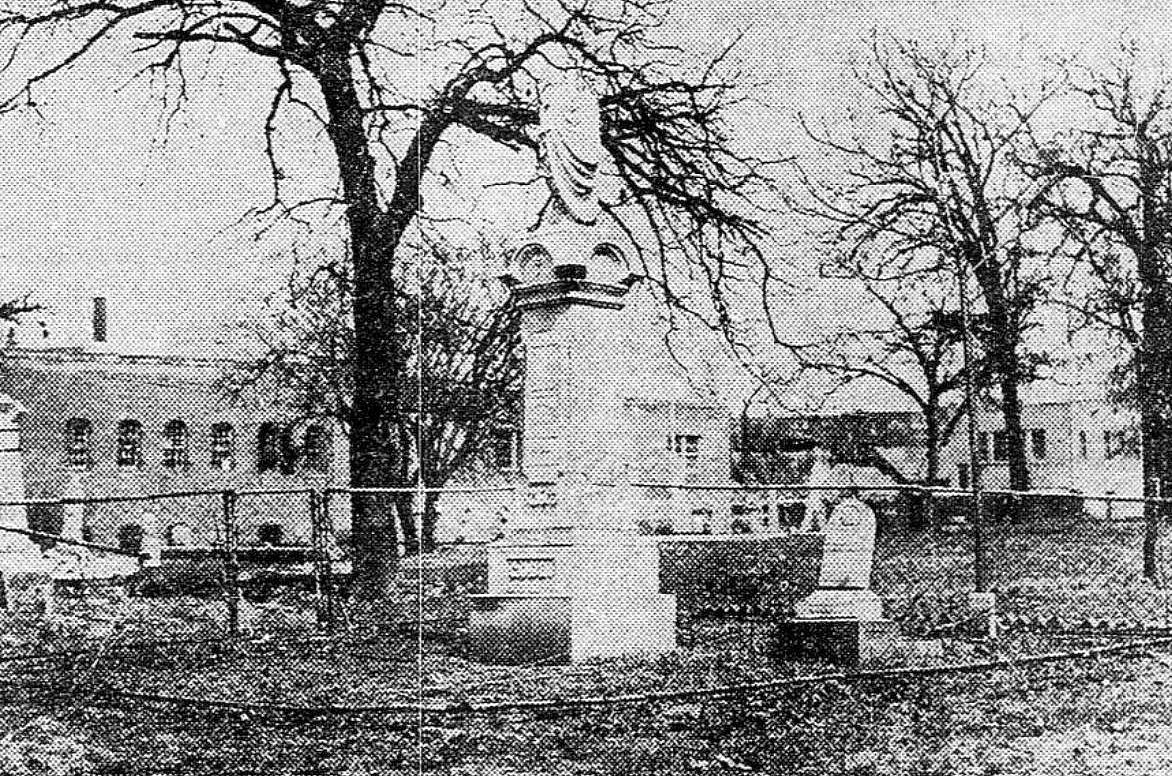
Cheek-by-jowl with a growing urban Dallas.
*

I love this photo, with train cars on the Marilla Street tracks and the Butler Brothers building in the distance, just east of where City Hall now stands.
*

Another interesting image, looking to the northwest, with the Santa Fe freight depot (still standing on Young Street near Griffin) at the top right. (The cemetery land was apparently fifteen feet above the surrounding street level.)
**
Below are a few extreme close-ups from aerial photographs by Lloyd M. Long (from the Edwin J. Foscue Map Library, Southern Methodist University — links to the original full photos can be found beneath each image). Cemetery markers are visible in these photos taken from the west.
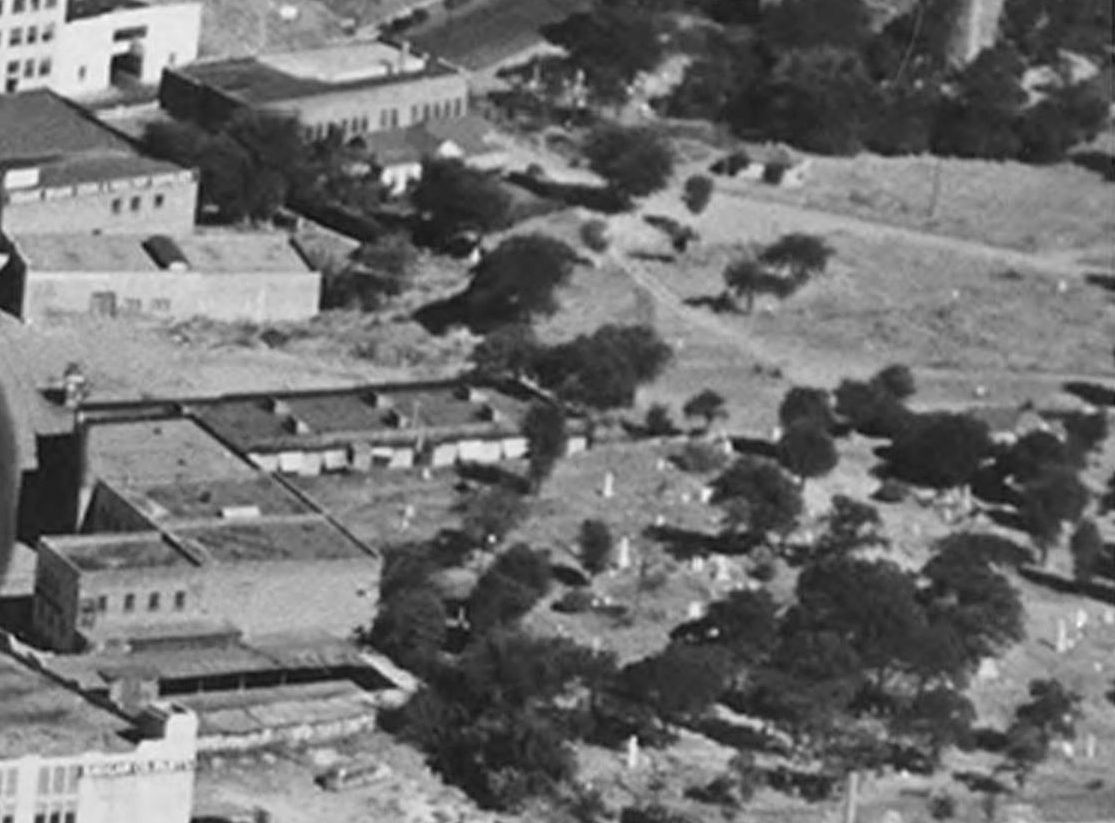 Above, a detail from a 1938 photo.
*
 Detail from a 1939 photo.
*
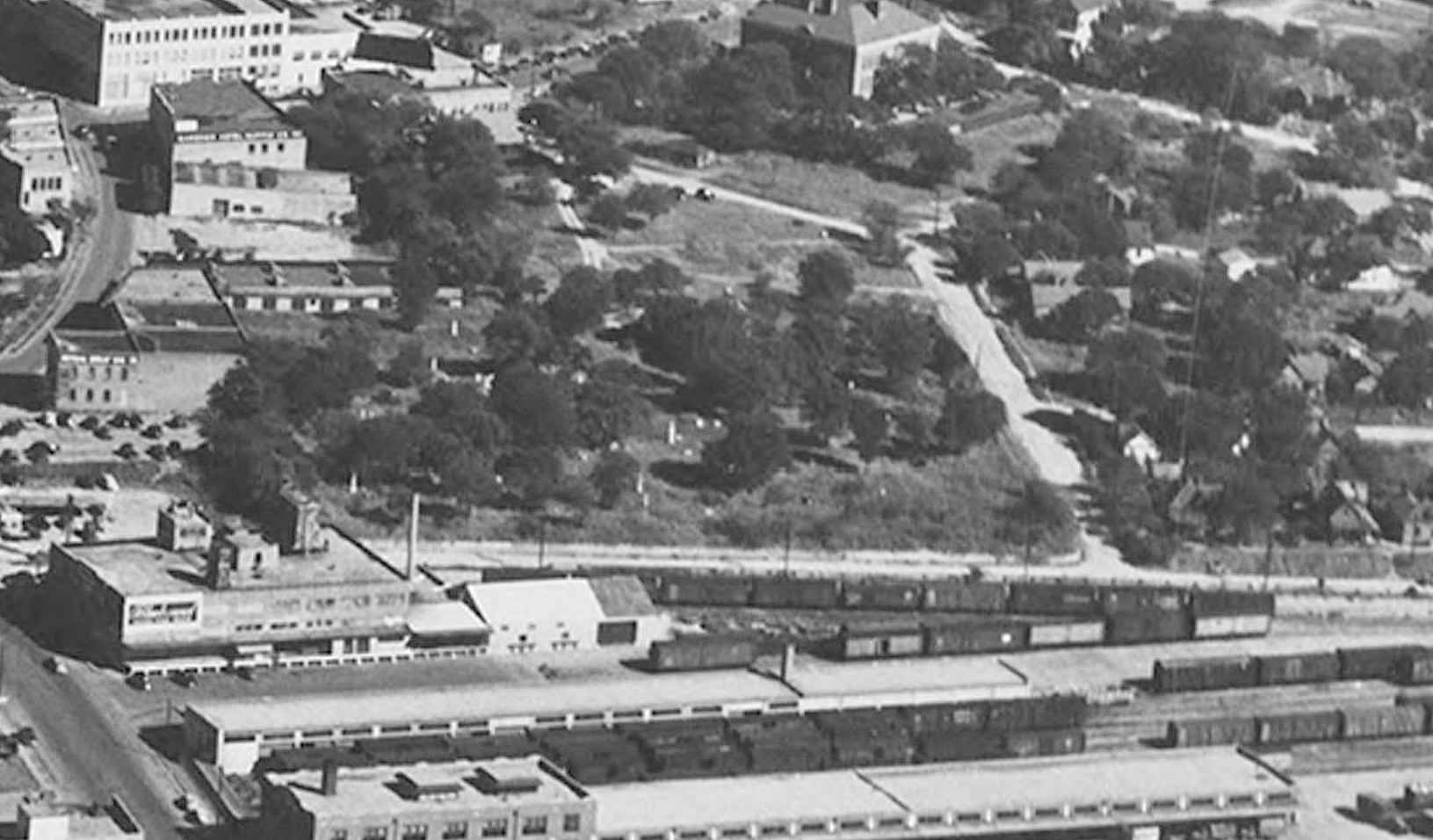
And a detail from a 1949 photo.
*
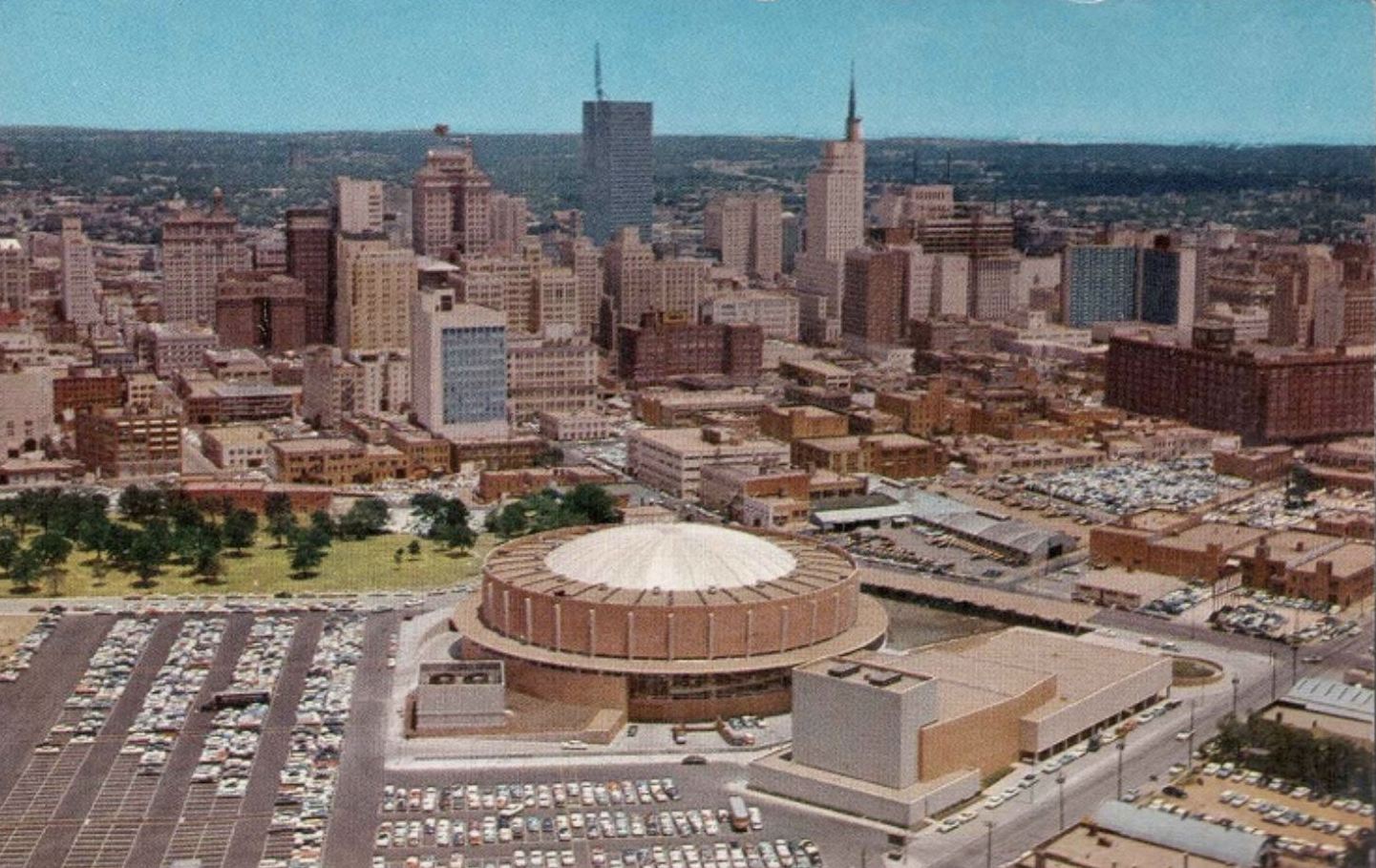
And the “after” photo, with much of the old cemetery land used as the site of Memorial Auditorium.
Below, a short history of the cemeteries, which appeared in the July, 1985 issue of Historic Dallas magazine: “Pioneer Cemetery Tells Story of Struggle” by Shirley Caldwell. (Click to read.)
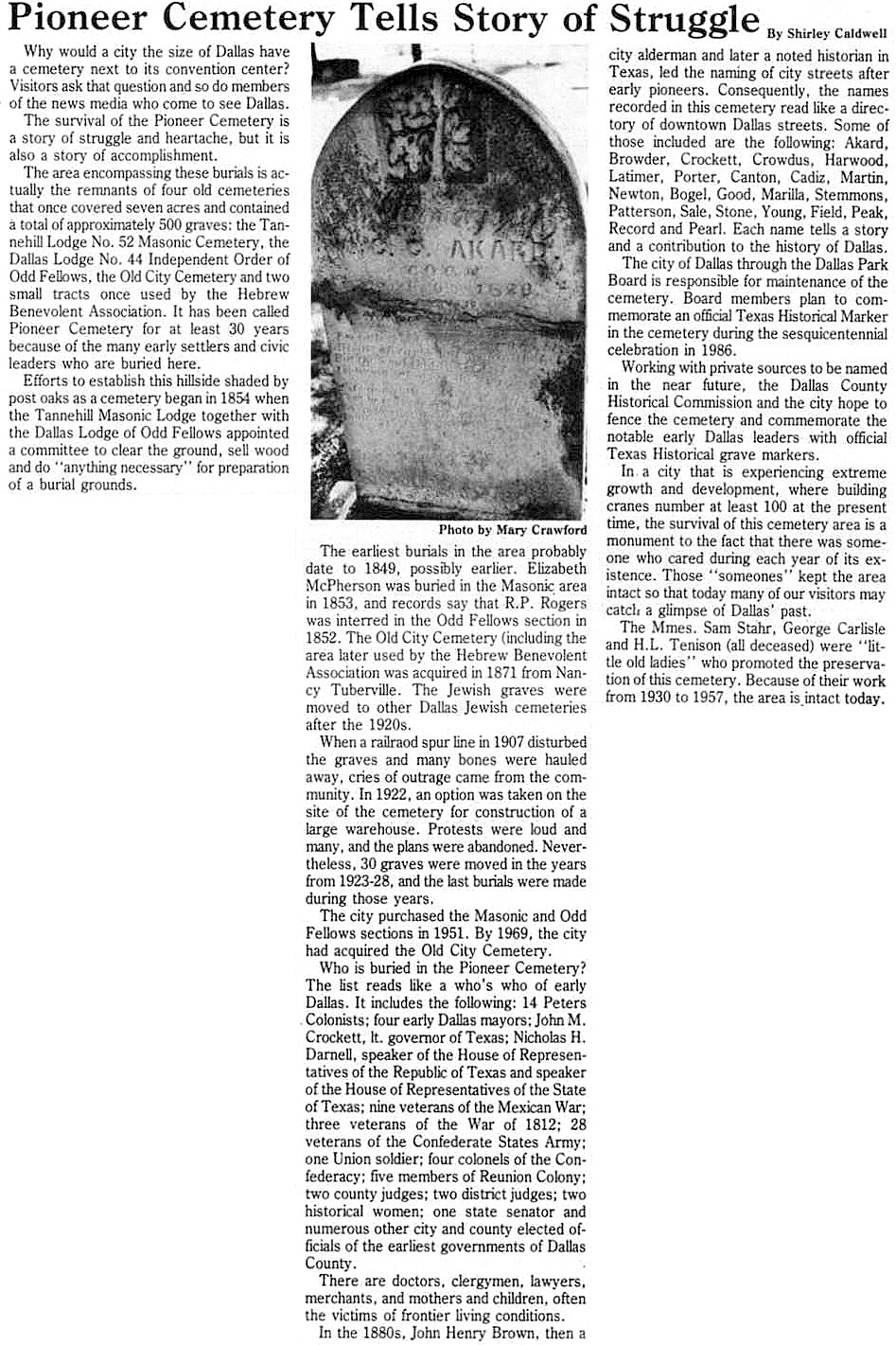 via UNT’s Portal to Texas History
***
More on this cemetery can be found on Julia D. Quinteros de Hernandez’s timeline, here.
A collection of newspaper stories about the adjacent “Old City Cemetery” (some of which describe shocking disturbances of the land and of graves) can be found on Jim Wheat’s site, here.
More on Dallas’ older cemeteries can be found in Frances James’ article “Cemeteries in Dallas County: Known and Unknown” (Legacies, Fall, 1996), here.
Information about how the city dealt with the plight of the cemeteries amidst the looming possibility of development can be found in the Dallas Morning News article “Park Board Protests Motel at Auditorium” by Francis Raffetto (DMN Dec. 18, 1958).
A bird’s-eye view of Pioneer Plaza can be seen on Bing, here (zoom in to see the historic markers in the lower right corner).
All images and clippings are larger when clicked.
*
Copyright © 2016 Paula Bosse. All Rights Reserved.
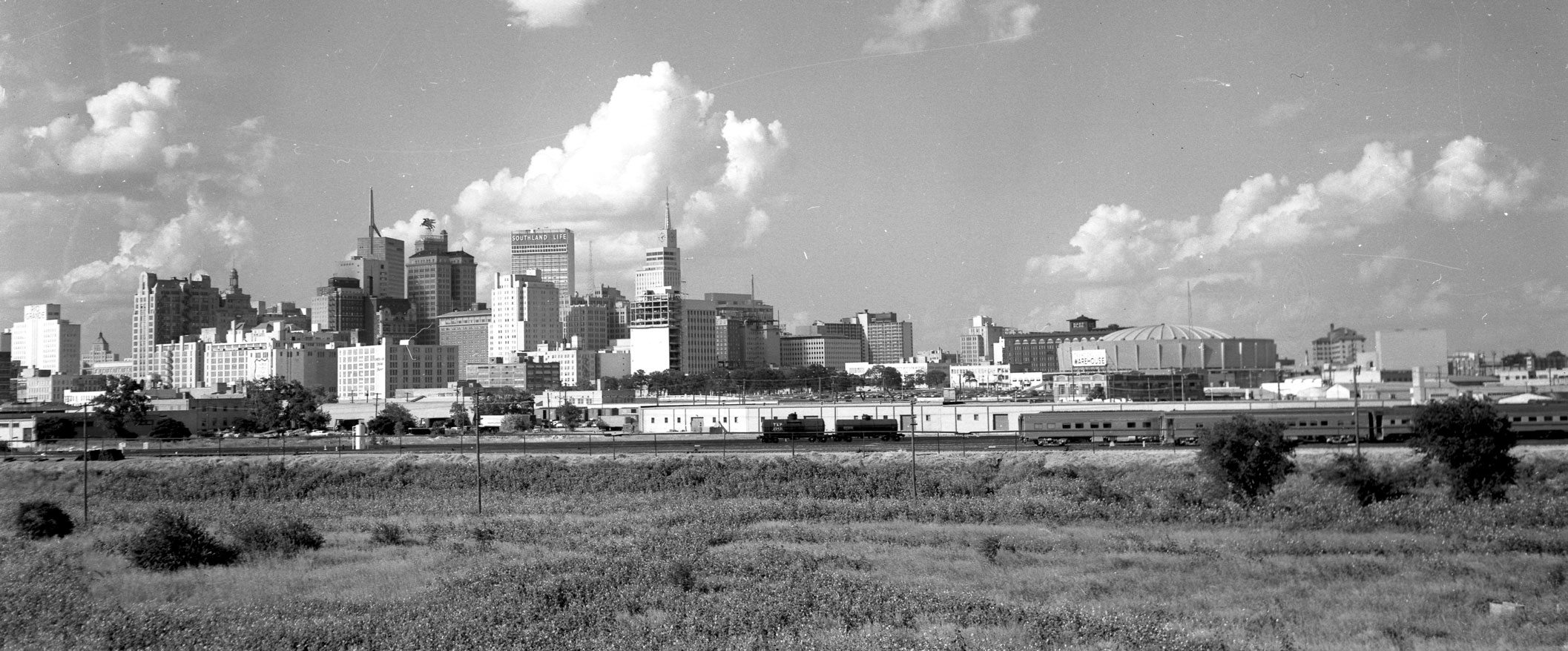 Mid-Century Big D…
by Paula Bosse
The Dallas skyline is always changing, and it’s always been impressive. The late-’50s/early-’60s version above looks quaint by today’s standards, but it’s one of my favorite skyline periods. I’ve never been a huge fan of the Convention Center, but the rest of it? Pretty great.
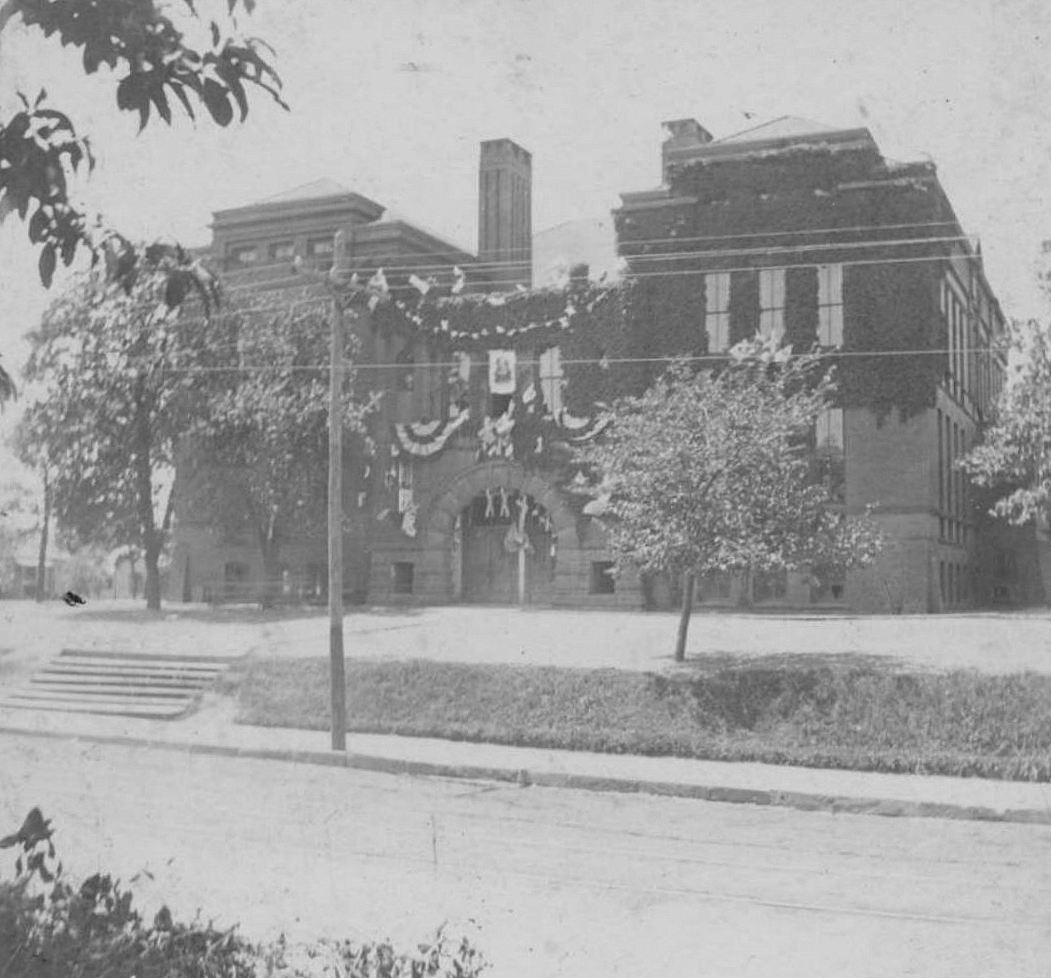
In order to make way for the George Dahl-designed Dallas Memorial Auditorium/Dallas Convention Center (which opened in 1957), the old Columbian School/Royal Street School (built in 1893) was demolished. At the time of its razing, it had most recently served as the city’s school administration building and as a book warehouse. Here are a couple of photos of the school, long before the bulldozers arrived.

via James Edwards Flanders site
Also interesting was that this land — which the city had been buying up for many years (some as a result of condemnation/eminent domain) also included four pioneer cemeteries. Read more about what happened to those cemeteries here.

***
Top photo is from a site containing several photos relating to early KRLD radio and TV, with the occasional shot of Dallas streets and buildings, here.
Other sources, if known, are noted.
*
Copyright © 2016 Paula Bosse. All Rights Reserved.

Akard looking north… (click me!!)
by Paula Bosse
This is just great. I’ve never seen this photo, which was taken sometime between 1922 and 1924. Dallas has never looked more … architectural. (Click that photo — it’s worth seeing it bigger.)
The view is looking north on Akard toward Commerce, from some building on or near Jackson Street. The Adolphus Hotel (built in 1912 and still standing) is straight ahead, the shorter Oriental Hotel (1893-1924) is in the middle, and the Pegasus-less Magnolia Petroleum Building (built in 1922 and still standing) towers above both of them.
I don’t think I’ve seen the Oriental from this angle. And I’ve never noticed all those windows in the Magnolia Building that look directly across into other windows. (That must be … strange.) And since I recently posted photos of this same block of S. Akard, I immediately recognized the short building with the odd-shaped cut-out/crest-like decoration in it opposite the Oriental.
Here’s the same view a few years earlier — about 1913, before the Magnolia was built:
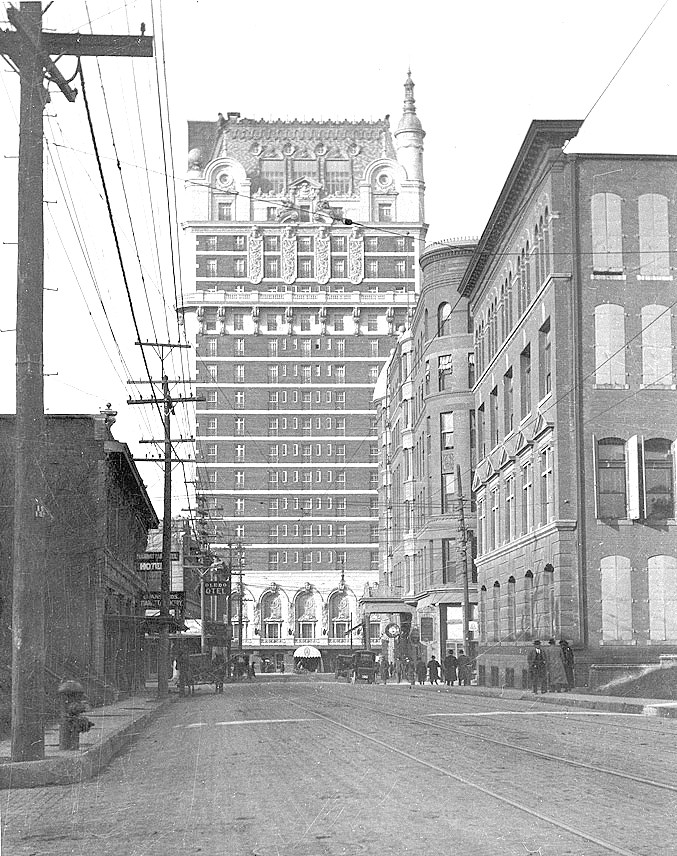
I love these photos. And how nice that two of these landmark buildings are still alive and kicking!
***
Top photo appeared in the program for the 1977 Texas State Historical Association Annual Meeting of 1977 (held, appropriately enough, in the Baker Hotel, which was built on the corner previously occupied by the Oriental); I found it on the Portal to Texas History site, here. (Dear printers of things like this: please never EVER use brown ink to print photographs. If anyone knows of a cleaner, sharper copy of this great photo, please let me know!)
Second photo is from the Texas/Dallas History Division, Dallas Public Library; I found it posted on the D Magazine site, accompanying the article “How Haunted Is the Adolphus Hotel?” here.
Photos larger when clicked.
*
Copyright © 2016 Paula Bosse. All Rights Reserved.
 Flashback : Dallas