Flashback : Dallas

A Miscellany: History, Ads, Pop Culture

Category: Neighborhoods

Lady Godiva and the “Flesh Shows” of the Texas Centennial — 1936

tx-centennial_streets-of-paris_ticket_cook-coll_smuGeorge W. Cook Collection/SMU

by Paula Bosse

When one thinks of the Texas Centennial Exposition, the splashy 6-month extravaganza held at Fair Park to celebrate the 100th anniversary of Texas independence, one might not immediately think of the three things associated with the big show that were making headlines around the country (and were undoubtedly responsible for healthy ticket sales): according to Variety, the Centennial had “all the gambling, wining and girling the visitor wants” (June 10, 1936).

The Dallas exposition (and the coattail-riding Frontier Exposition, which was held at the same time in Fort Worth) was “wide open” in 1936: there was gambling, liquor, and nudity everywhere. The Texas Rangers cracked down on some of the gaming in the early days, but alcohol and girlie shows continued throughout the expo’s run.

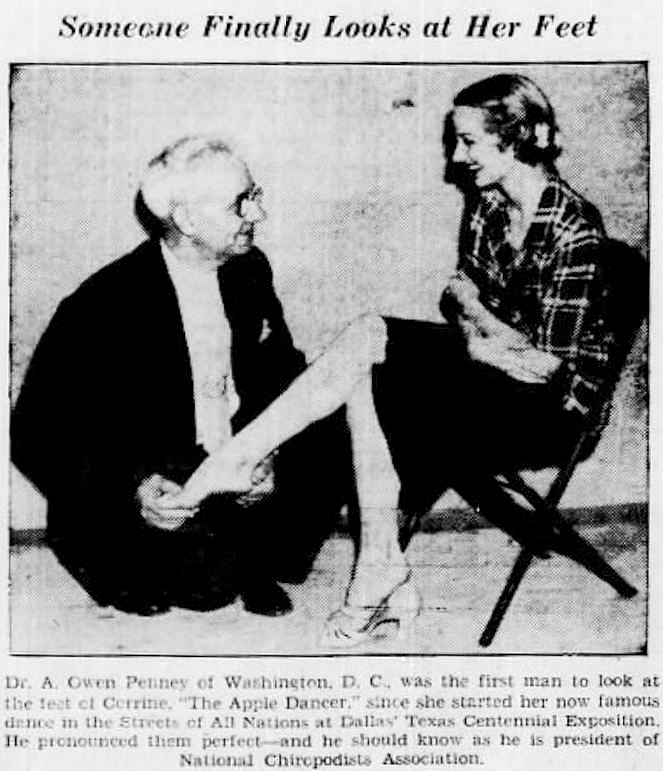
As far as the nudity, it really was everywhere. It’s a little shocking to think that this sort of thing was so widely accepted in very conservative Dallas — 80 years ago! — but it was (despite some local pastors disdainfully referring to the big party as the Texas Sintennial). Many of the acts — and much of the personnel — had appeared in a version of the same revue in Chicago in 1933 and 1934. Some of the offerings for the Centennial visitor: peep shows a-plenty, the clad-only-in-body-paint “Diving Venus” named Mona Lleslie (not a typo), a naked “apple dancer” named Mlle. Corinne who twirled with a “basketball-sized ‘apple'” held in front of her frontal nether regions, and the somewhat obligatory nude chorus girls. There was also an “exhibit” in which nude women were on display as “artists’ models,” posing for crowds of what one can only assume were life-drawing aficionados who were encouraged to render the scene before them artistically (…had they planned ahead and brought a pencil and sketchpad); those who lacked artistic skill and/or temperament were welcome to just stand there and gawk. (Click photos and ads to see larger images.)

corinne_apple-dancer_cook-collection_smu

tx-centennial_apple-dancer_dmn_070536

tx-centennial_apple-dancer_franklin-ind-evening-star_071136Franklin, Indiana Evening Star, July 11, 1936

Another attraction was Lady Godiva, who, naked, rode a horse through the Streets of Paris crowds. Her bare-breastedness even made it into ads appearing in the pages of staid Texas newspapers. (Click to see larger images.)

tx-centennial_lady-godiva_dmn_060436_sm
June, 1936

There were two areas along the Midway where crowds could find these saucy attraction: Streets of Paris (which Time magazine described as appealing to “lovers of the nude”) and Streets of All Nations (“for lovers of the semi-nude”). Lady Godiva was part of the Streets of Paris, and she rode, Godiva-esque, nightly. The gimmick (beyond the gimmick of a naked woman riding a horse in Fair Park) was that she was supposed to  be a Dallas debutante who rode masked in order to conceal her identity. The text below is from the ad above.

MASKED…but unclothed in all her Glory…Riding a milk-white steed. […] Miss Debutante was introduced to Dallas society in 1930. She was later starred in Ziegfeld’s Follies, in “False Dreams, Farewell,” “Furnished Rooms,” and other Broadway successes. She appeared in motion pictures, being starred in “Gold Diggers of 1935,” “Redheads on Parade” (yes, she is a redhead) and other picture successes.

SHE WILL STARTLE DALLAS SOCIETY! JUST AS THE STREETS OF PARIS WILL BE THE SENSATION OF THE CENTENNIAL SEASON .. WHO IS SHE?

And, of course, none of that was true (including the fact that this “Lady Godiva” rode a white horse — apparently one could not always be found), but I’m sure it got local pulses racing. My guess is that there were several Ladies Godiva (none of whom were members of Dallas society). One woman was actually named as the Centennial’s exhibitionist horsewoman. I haven’t been able to find mention of a “Paulette Renet” anywhere other than the caption of this photo, but here she is:

godiva_madera-tribune_082936

godiva_madera-tribune_082936-caption
Madera (California) Tribune, Aug. 29, 1936

Another photo featuring what appears to be the same woman, with this caption: “No white horse for Lady Godiva, at the Texas Centennial Exposition in Dallas. A feature of the ‘Streets of Paris,’ a midway show, Godiva rode a ‘paint pony,’ first week because no white one was available.”

godiva_altoona_penn-tribune_062336
Altoona (Pennsylvania) Tribune, June 23, 1936

I think this is still the same woman, but on a rare white steed:

lady-godiva_cook-collection_smu

The Godiva who appeared in the March of Times newsreel “Battle of a Centennial” appears to be a different woman. (Watch a 45-second snippet of the newsreel which features both a glimpse of Lady Godiva and a head-shaking son of Sam Houston wondering what the deal is with the younger generation — here.)

godiva_march-of-time_1936

Imagine seeing performers and attractions like this along the Fair Park midway today!

*

godiva_dmn_070536-detJuly, 1936 (ad detail)

tx-centennial_lady-godiva_dmn_060436-det
June, 1936 (ad detail)

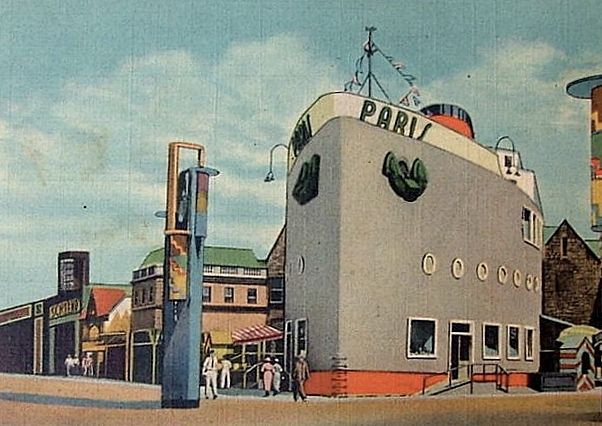
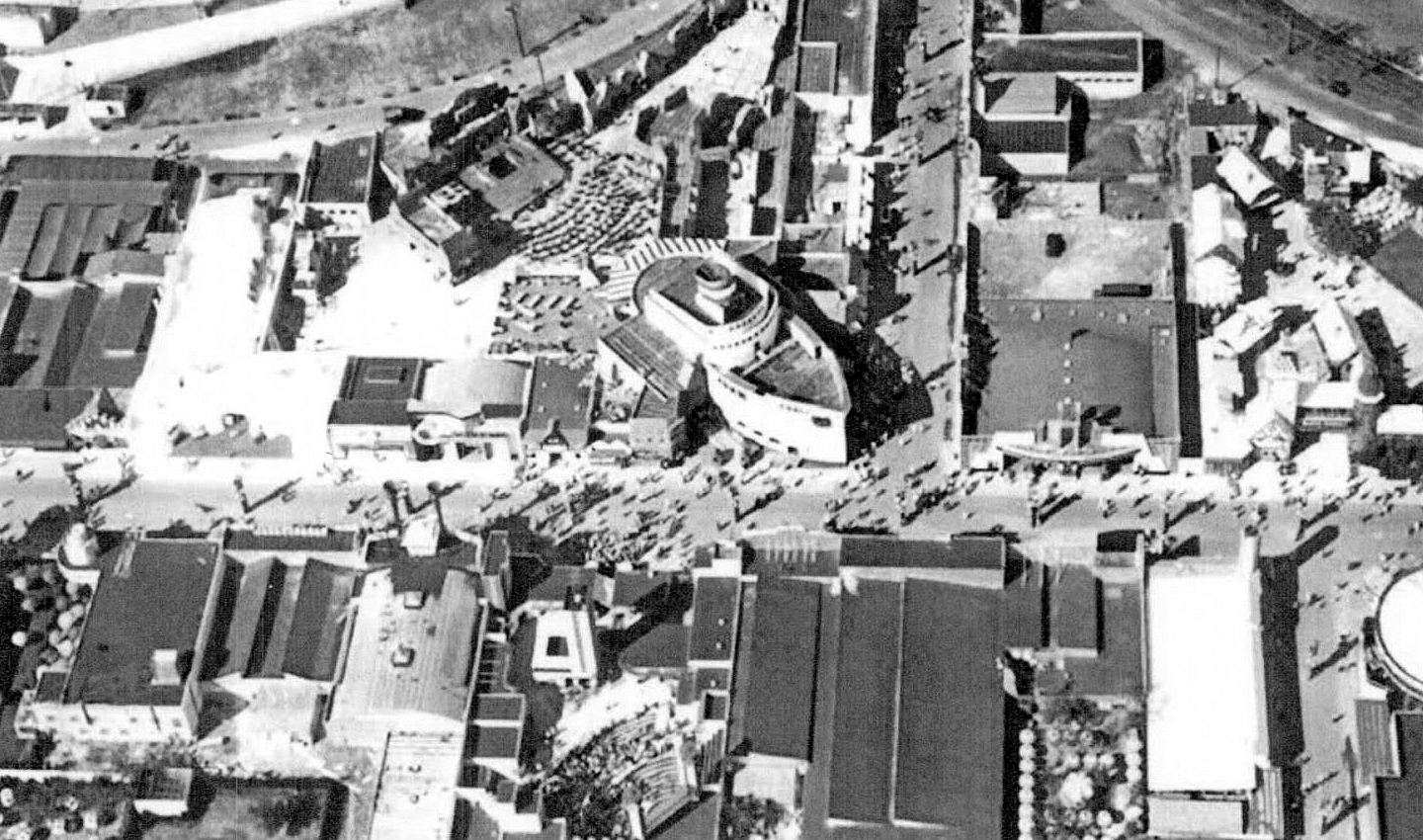
What was the Centennial Club? It was an exclusive, invitation-only private club located within the very large George Dahl-designed building which housed the Streets of Paris (and which was shaped like the famed S. S. Normandie ocean liner). It had three levels (“decks”) and housed a lounge, dining rooms, a main clubroom, and a “dance pavilion” — all air conditioned. From various decks, well-heeled patrons could look down at the action going on below: the milling throngs of the hoi polloi, the Streets of Paris shows, and the Midway.

centennial-club_dmn_061636
June, 1936

tx-centennial_streets-of-paris_art-institute-chicago

tx-centennial_streets-of-paris_ebay_rppc

tx-centennial_streets-of-paris

Can’t miss the ridiculously large land-locked ocean liner in the center of the photo below. Mais oui!
normandie_winters_dhs

**

The articles below on “gals, likker, and gambling” are GREAT. They are from the show biz trade publication Variety, which really latched onto the rampant nudity on view at the Texas Centennial. Remember: 80 years ago! (The abbreviation of “S. A.” in the headline of the second article stands for “sex appeal.”) (As always, click to see larger images.)

sex_variety_061036
Variety, June 10, 1936

sex_variety_062436
Variety, June 24, 1936

nudity_variety_070136
Variety, July 1, 1936

***

Sources & Notes

Top photo shows an admission ticket to the Streets of Paris, from the George W. Cook Dallas/Texas Image Collection, Central University Libraries, Southern Methodist University; more information is here. Another interesting item from this collection is a brochure (here) which describes Streets of Paris as “the smartest, most sophisticated night club in America. Here you will find the gay night life of Paris in a setting of exotic splendor.”

Photo of “Mlle. Corrine” also from the Cook Collection at SMU; more info on that photo here.

Photo of Lady Godiva on a white horse (with the words “Dallas Centennial” near the bottom … um, bottom of the image … is also from the Cook Collection at SMU, here.

The photo showing the night-time crowd outside the Streets of Paris Normandie is from the Ryerson & Burnham Archives, Art Institute of Chicago; more info here.

The aerial photograph showing the S. S. Normandie is from Willis Cecil Winters’ book Fair Park (Arcadia Publishing, 2010); photo from the collection of the Dallas Historical Society.

All other sources noted, if known.

See quick shots of the Streets of Paris and the Streets of All Nations in the locally-made short film “Texas Centennial Highlights,” here (Streets of Paris is at about the 7:00 mark and the more risqué bits showing the parasol chorus girls followed by Mlle. Corinne and her apple dance (I mean, it’s not really shocking, but … it still kind of is…) at the 8:45 mark. (Incidentally, there appears to be a new book on Corinne and her husband — Two Lives, Many Dances — written by their daughter.)

A very entertaining history of the State Fair of Texas and the Texas Centennial Exposition can be found in the article “State Fair!” by Tom Peeler (D Magazine, October, 1982), here.

A Flashback Dallas post on the feuding Dallas and Fort Worth Centennial celebrations can be found here.

More Flashback Dallas posts on the Texas Centennial can be found here.

Click pictures and clippings to see larger images.

*

Copyright © 2016 Paula Bosse. All Rights Reserved.
“Night View, Downtown Section” by Arthur Rothstein — 1942

rothstein_elm-street_jan-1942_loc_lg“Linger on the sidewalk where the neon signs are pretty…”

by Paula Bosse

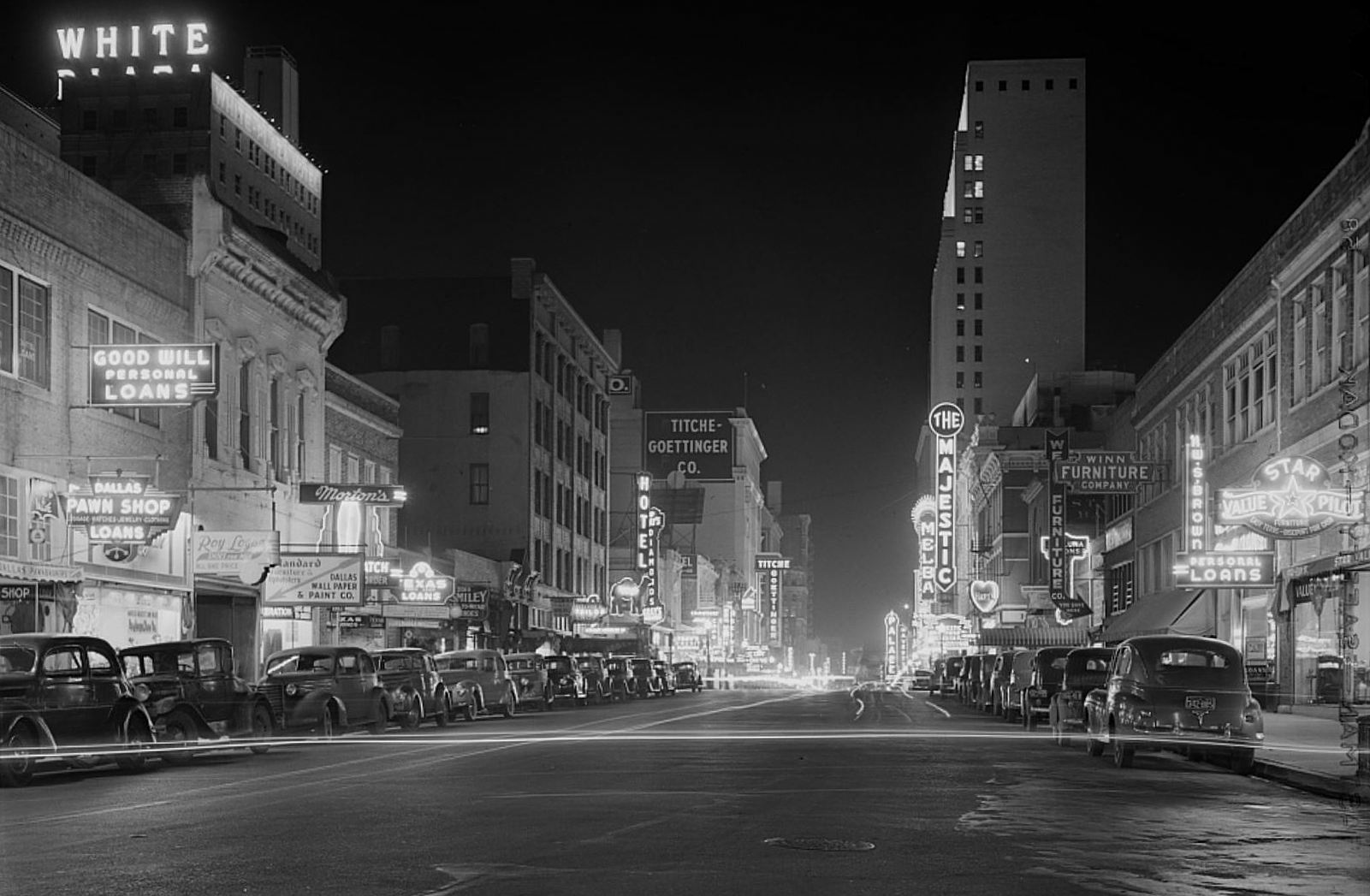
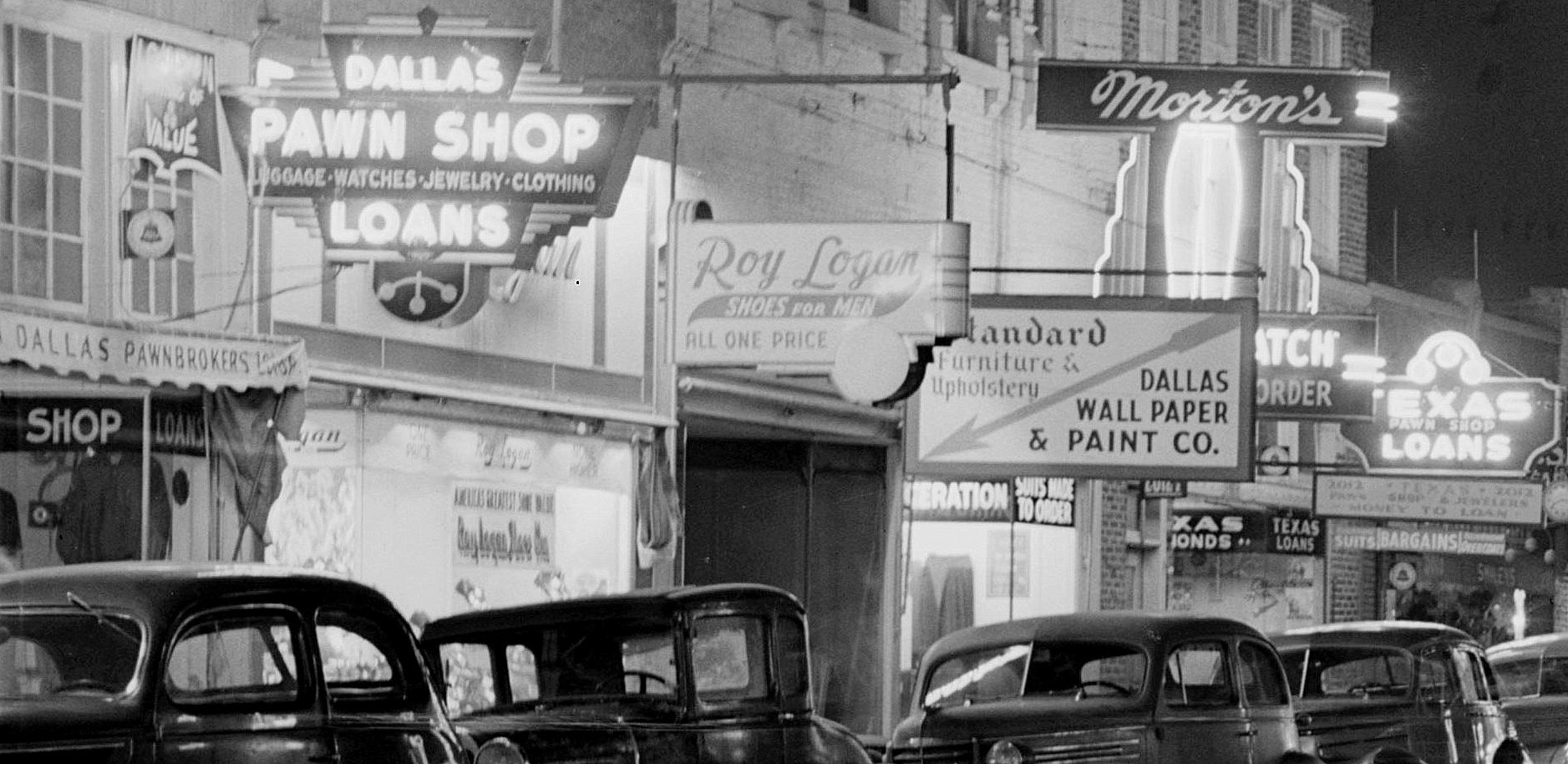
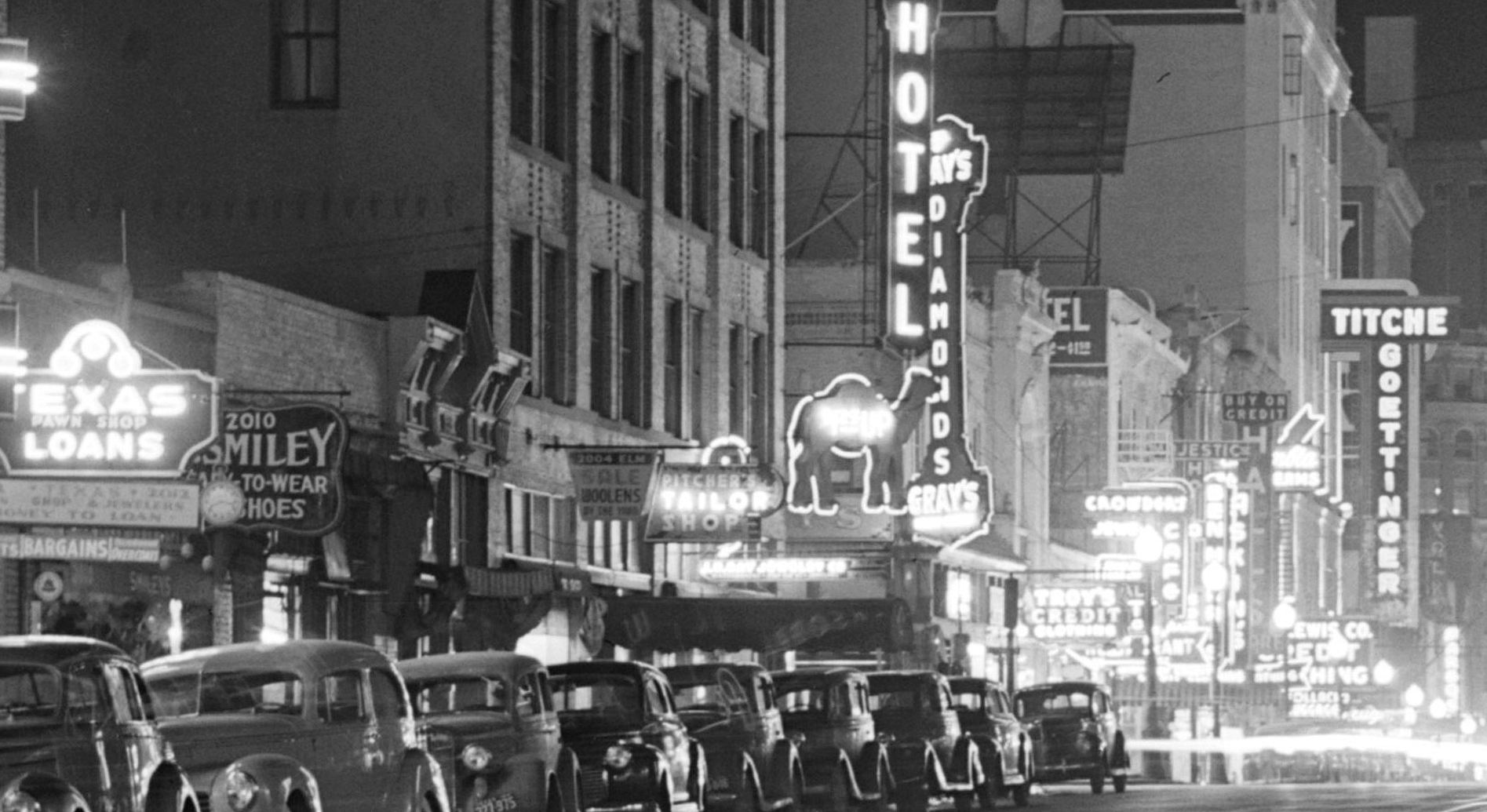
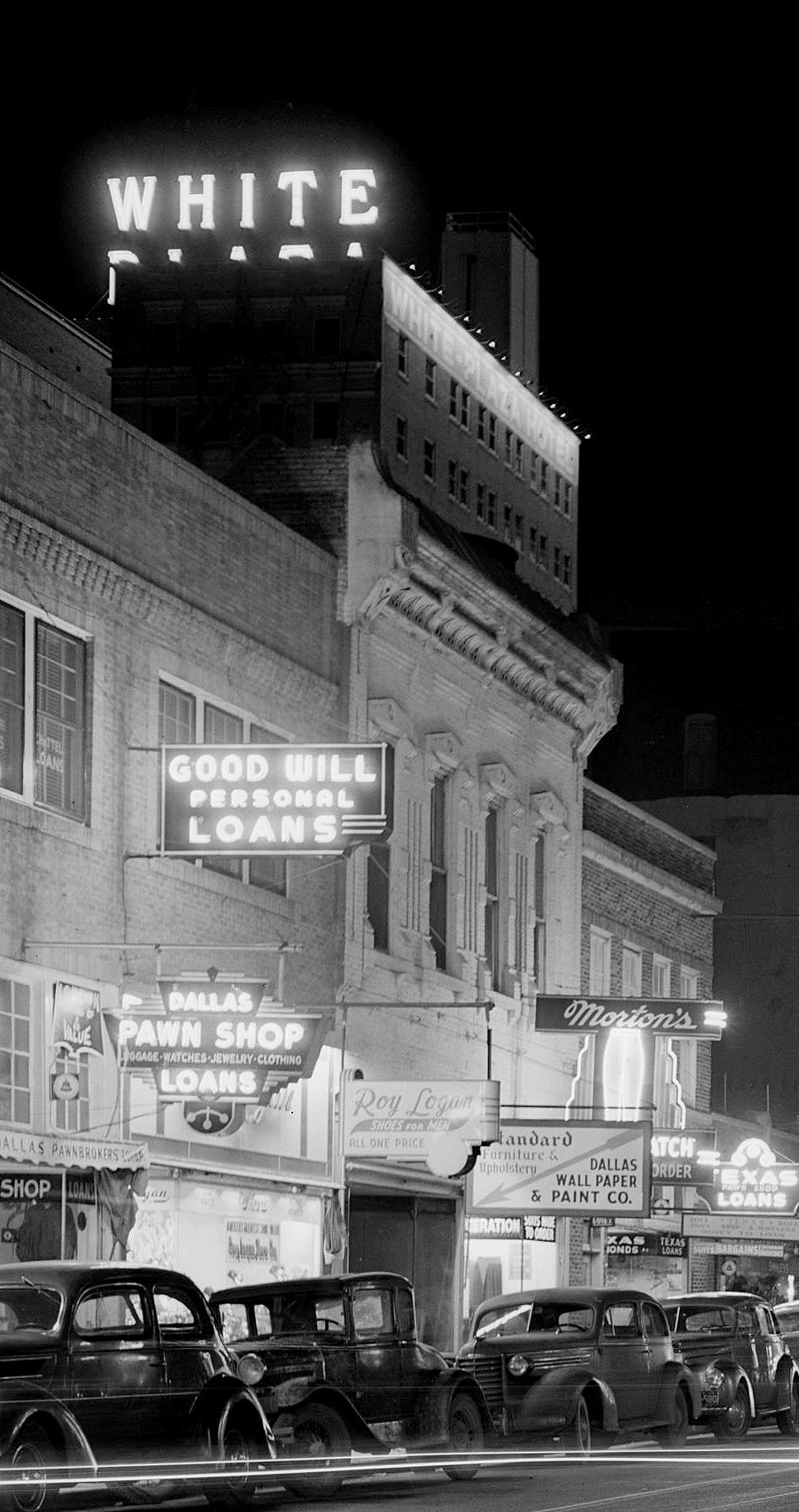
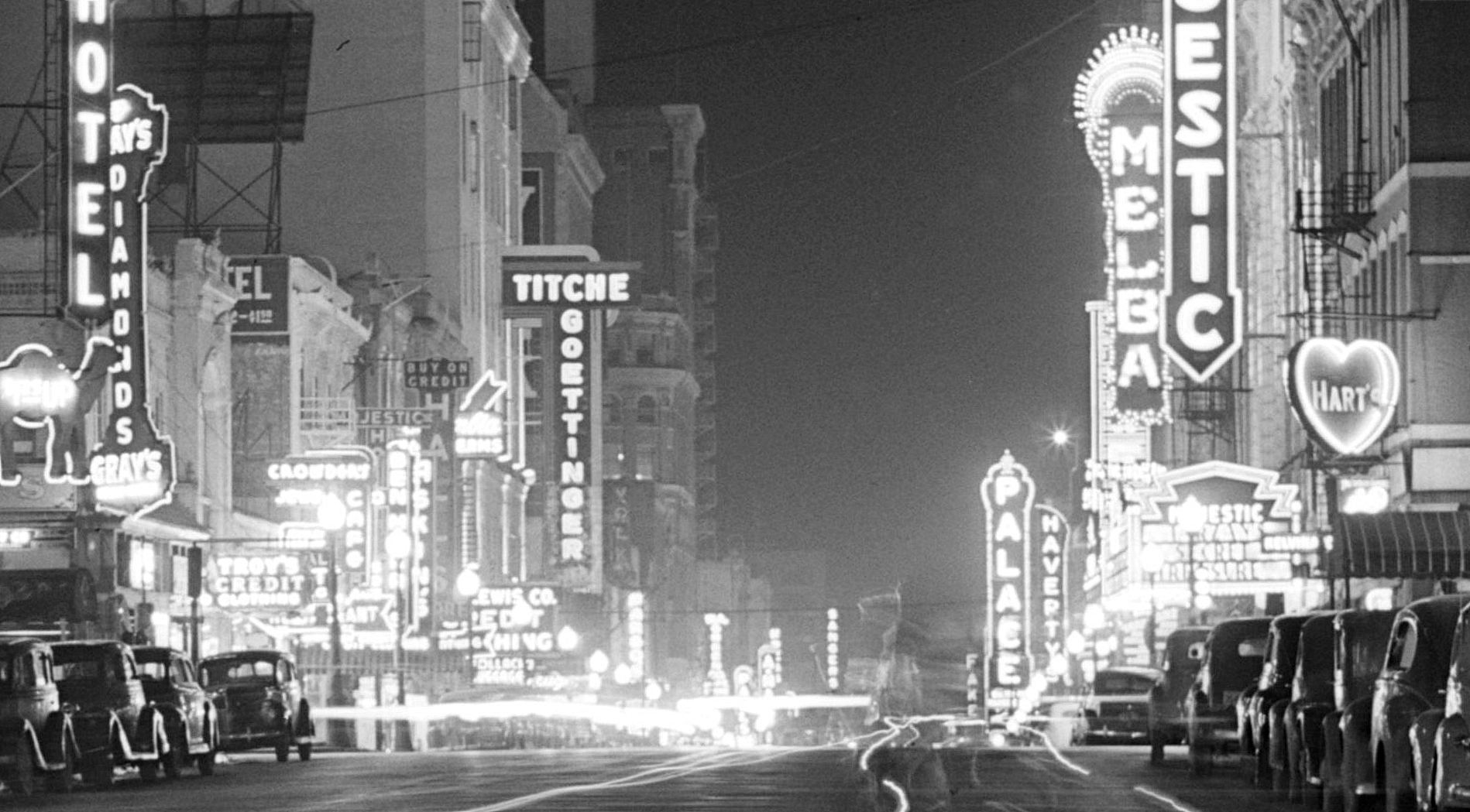
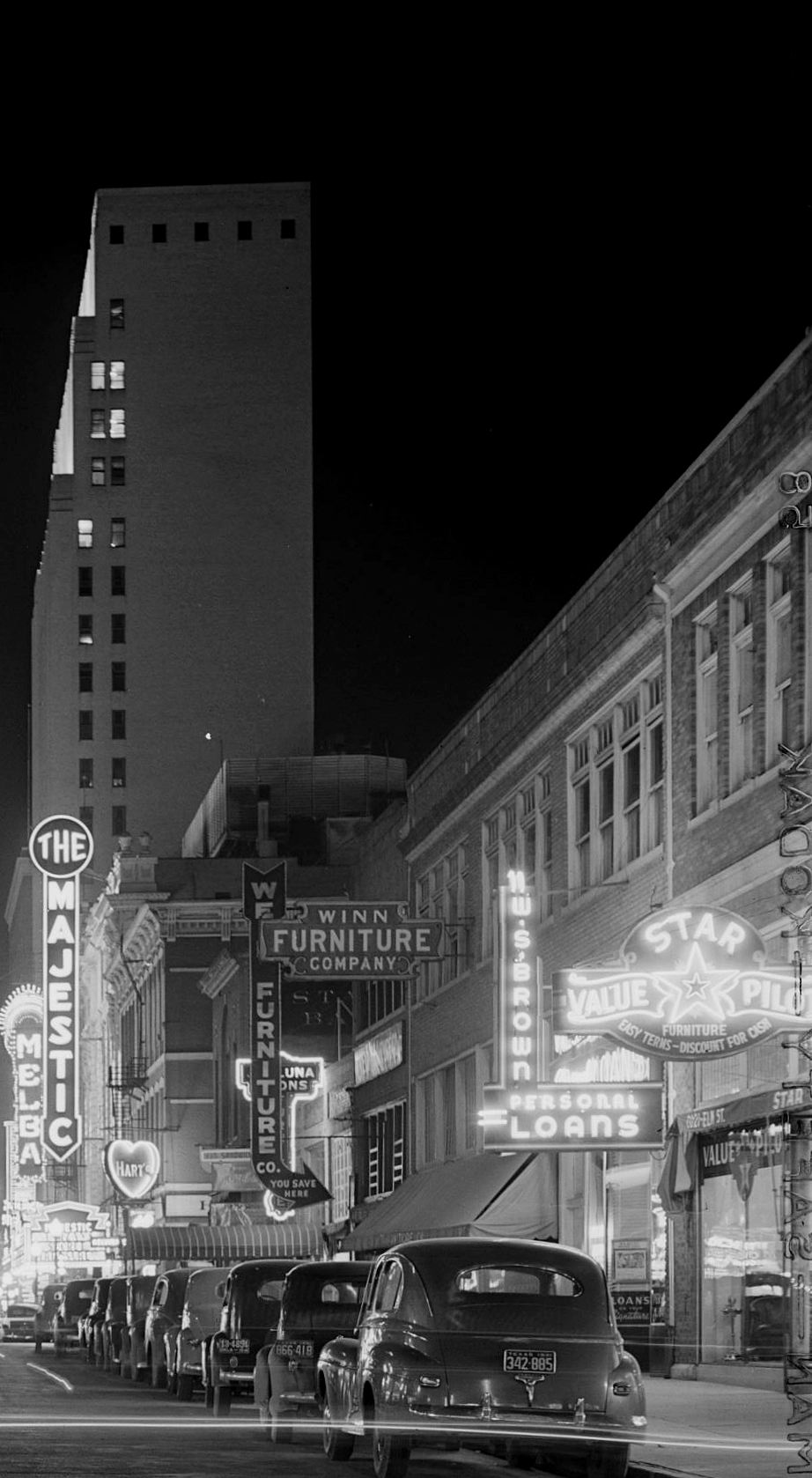
If you’re interested in Dallas history, chances are pretty good that you’ve seen this photograph by Arthur Rothstein, which was taken in 1942 — sometime between January 9th and 16th — taken for the Farm Security Administration (FSA). It shows Elm Street — “Theater Row” — looking west from the block east of Harwood. This photograph is from the Library of Congress (here) a larger image can be explored here.

Below are a few magnified details (click pictures to see much larger images).

*

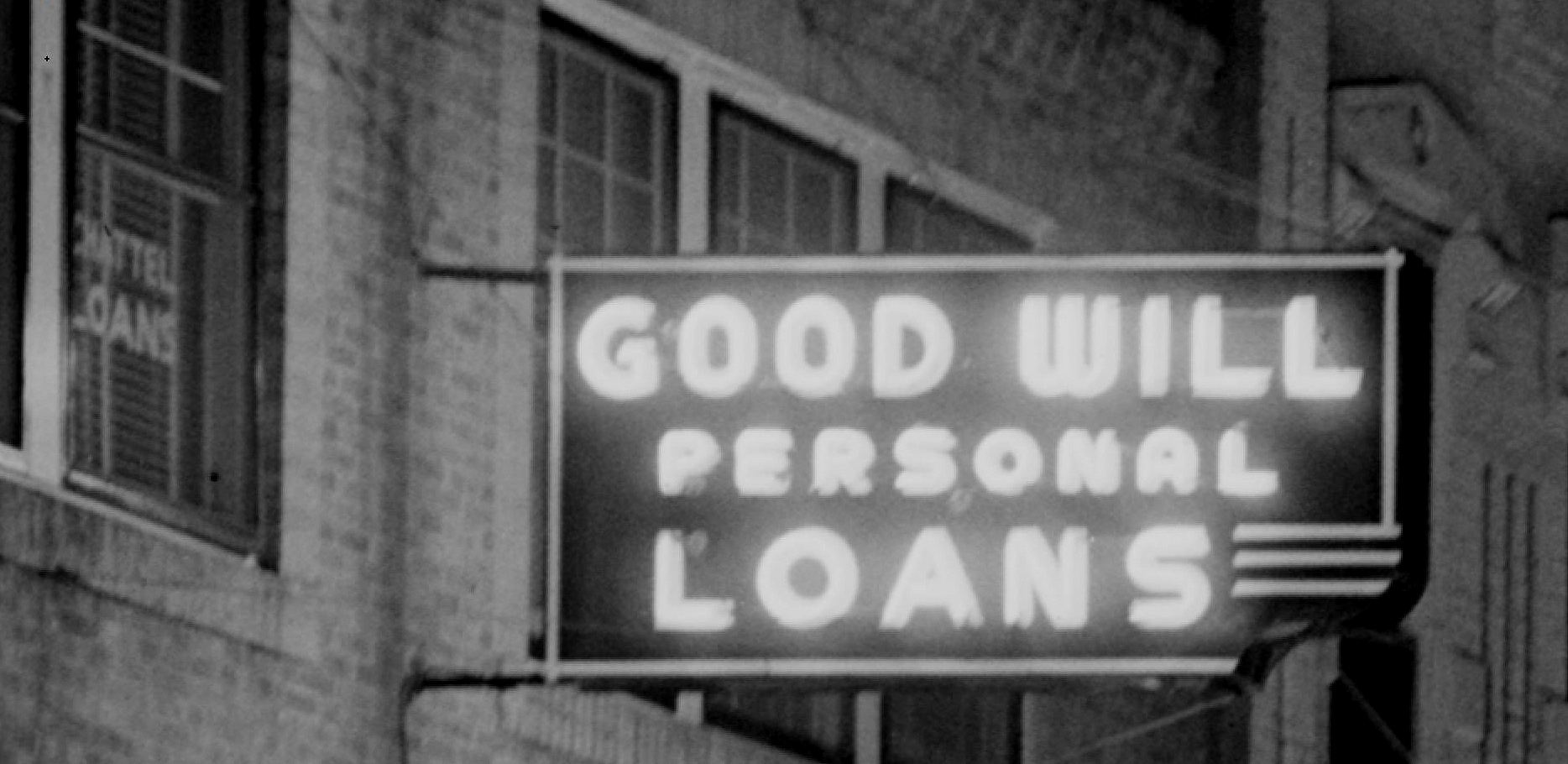
Chattel loans and good will:

rothstein_good-will-loans

*

Morton’s Pants Shop (2014 Elm) has a neon sign in the shape of a pair of pants!

rothstein_south-side_a

*

More interesting neon: the Texas Pawn Shop (2012 Elm) has the traditional three balls, and, better, the Campbell Hotel (Elm and Harwood) has a camel!

rothstein_south-side_b

*

The White Plaza on Main St. (at Harwood) was originally the Hilton Hotel and is now Hotel Indigo. There were some great buildings in this block.

rothstein_south-side_vert

*

That light is blinding.

rothstein_center

*

The towering Tower Petroleum Building (Elm and St. Paul) is pretty cool-looking here.

rothstein_north-side_vert

*

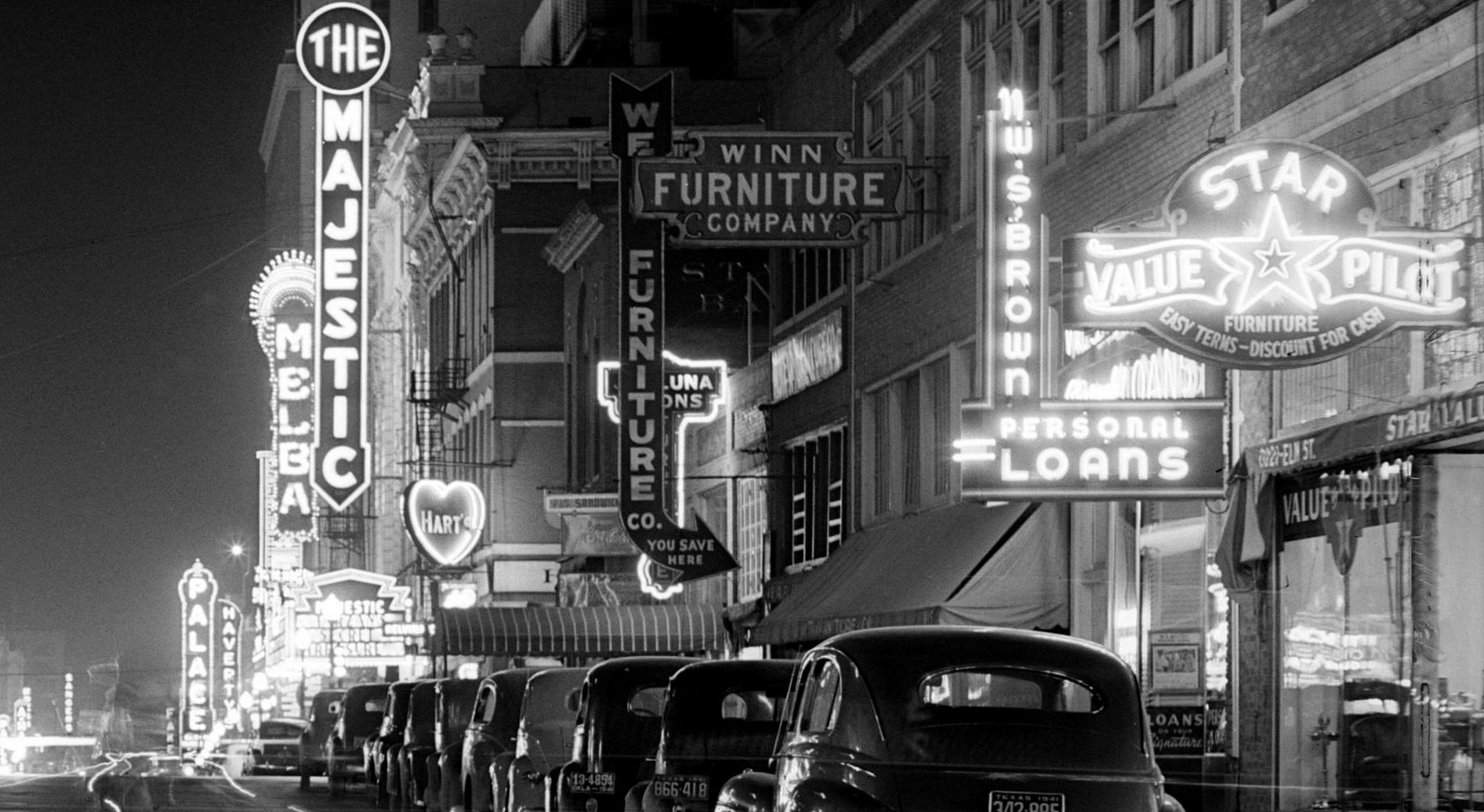
The 2000 block of Elm (seen in the foreground, just east of the Majestic block) was full of furniture stores, pawn shops, and tailors. This is my favorite detail from this photograph. Sadly, the entire block — which was once filled with businesses and activity — was completely demolished; the “camel” side of the street is now occupied by an ugly parking garage, and this side of the street is a wasteland of ugly asphalt parking lots. Yep.

rothstein_north-side

*

1941 plates.

rothstein_texas-1941-plate

*

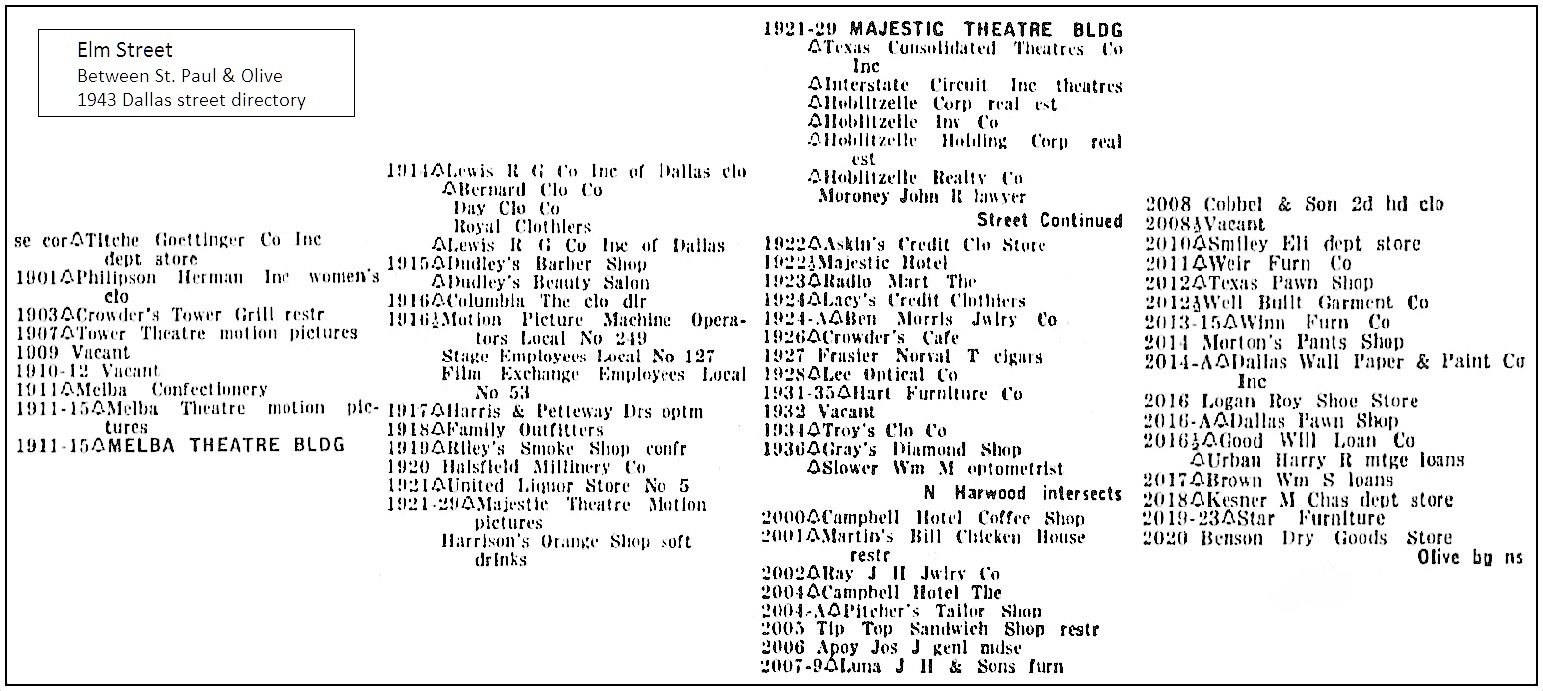
Below, Elm Street businesses from the 1943 city directory, beginning at N. St. Paul and ending at N. Olive. Next stop: Deep Elm.

elm-street_1943-directory

*

The view today? Here. Hope you weren’t too attached. Kiss most of it bye-bye.

***

Sources & Notes

Photo from the Library of Commerce, here. This photo is all over the place, including the great Shorpy website, here (click the “supersize wallpaper” link under the photo to see it BIG). If you want a super-gigantic 26.3 MB file (5978 x 4619) (!), download the TIFF file in the dropdown beneath the photo.

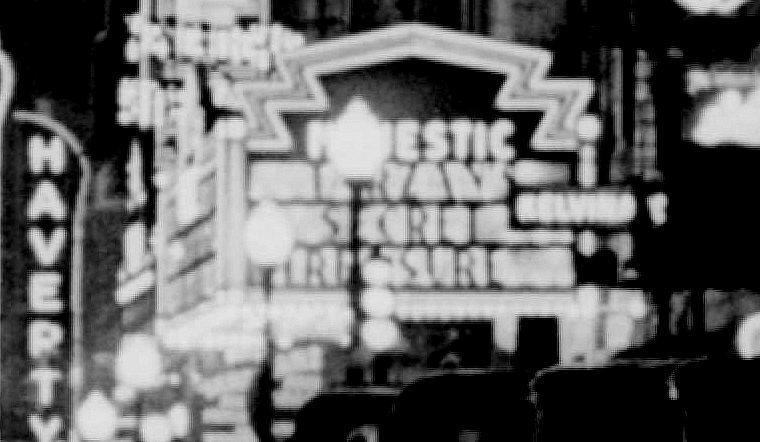
The movie playing at the Majestic Theatre is “Tarzan’s Secret Treasure.” Newspaper ads show that the movie opened on January 9, 1942 and played just one week, closing on January 16.

tarzans-secret-treasure

Thanks, Cody and Chris for asking about this photo!

Everything’s bigger in Texas, and everything’s bigger when it’s clicked.

*

Copyright © 2016 Paula Bosse. All Rights Reserved.
 

Wilson & Co., Their Clydesdales, and the Dallas Jaycees’ Safety Committee — 1951

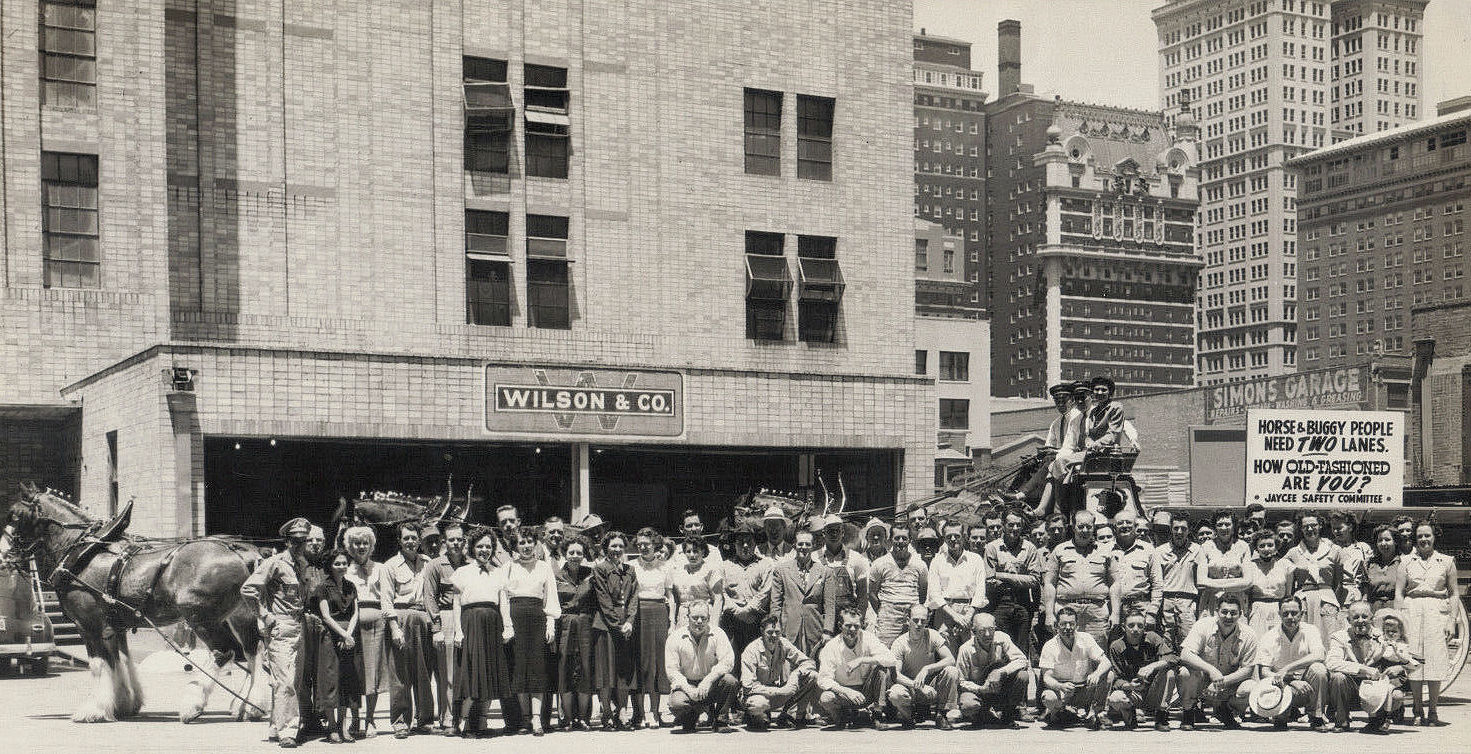
wilson-and-co_clydesdales_ebay_1951Giant horses at the ready… (click for larger image)

by Paula Bosse

I came across this undated photo a couple of years ago on eBay, and it took a little bit of digging to come up with just what was going on here.

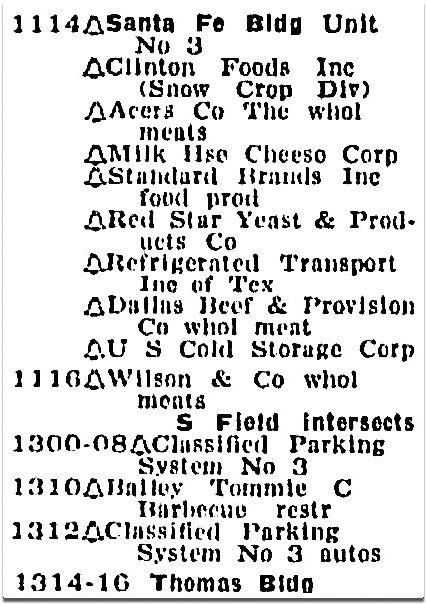
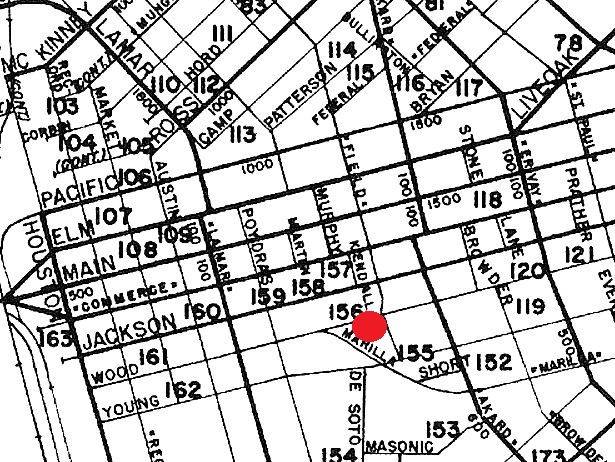
The Wilson & Co. meat packing and processing business began in Chicago in 1916 and quickly became one of the nation’s largest meatpackers, right up there with Armour and Swift. It expanded across the country, and one of its plants was in Dallas — in Unit 3 of the Santa Fe complex of buildings, located on Wood Street, between Field and what is now Griffin. (This building was later known as the Ingram Freezer Building and was demolished in 1988.) The Wilson company was acquired by Dallas-based LTV in 1967, and was later “spun off” from LTV in 1981

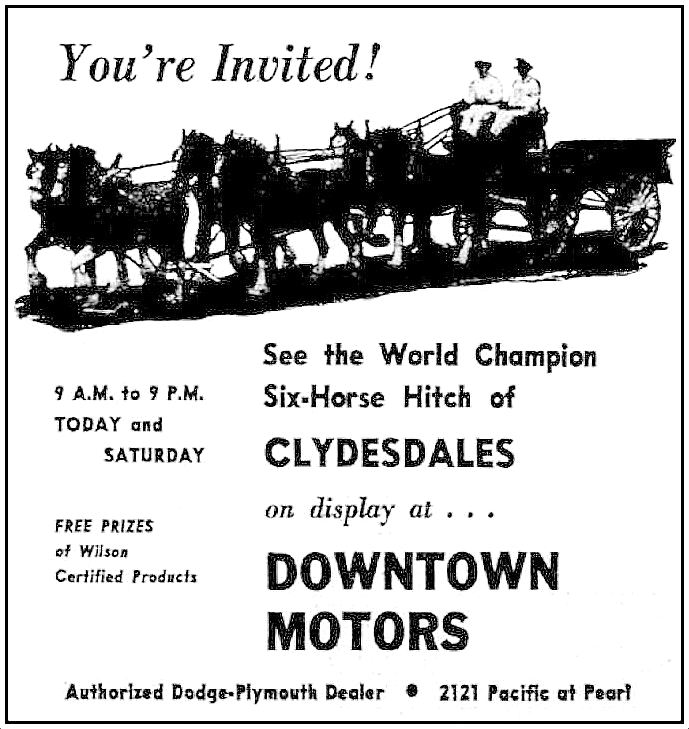
The Wilson company had owned a prize-winning “six-horse hitch” of Clydesdale horses since 1917, and they were sent around the country to promote the company and its line of processed meats. Not only were the horses prize-winners at livestock shows, they were also incredibly popular with the public. (They had made a huge splash at the Chicago World’s Fair in 1933, and it seems Budweiser took note of the promotional possibilities of the impressive animals, as the Anheuser-Busch Co. ended up buying the original team from Wilson that same year. So there were at least two competing Clydesdale teams clomping along the downtown streets of America, through at least the late ’60s.)

The photo above was taken when Wilson & Co.’s horse celebs visited Dallas in May, 1951. During their time in Big D they paraded through downtown at noontime and entertained workers on lunch breaks; at night they bunked in temporary stables in the service department of a Pacific Avenue car dealership. The photo at the top shows a public service event in which the Dallas Junior Chamber of Commerce promoted traffic safety in conjunction with the visiting horses. In the photo, the Wilson company employees (who have somehow managed to block the view of several thousand pounds of horseflesh and the huge 1890s wagon behind them) look happy during their little photo-op break from work. And in the background, we see the Adolphus Hotel (…built by the man behind Budweiser beer…), the Magnolia Building, and the Baker Hotel.

All this kind of makes me want a ham sandwich and a bottle of beer…. 

wilson_clydesdales_amazon
via Amazon

wilson-clydesdales_dmn_051151
May, 1951

wilson_1953-directory
Wood Street, Dallas city directory, 1953

wilson-and-co_1952-mapsco
1952 Mapsco

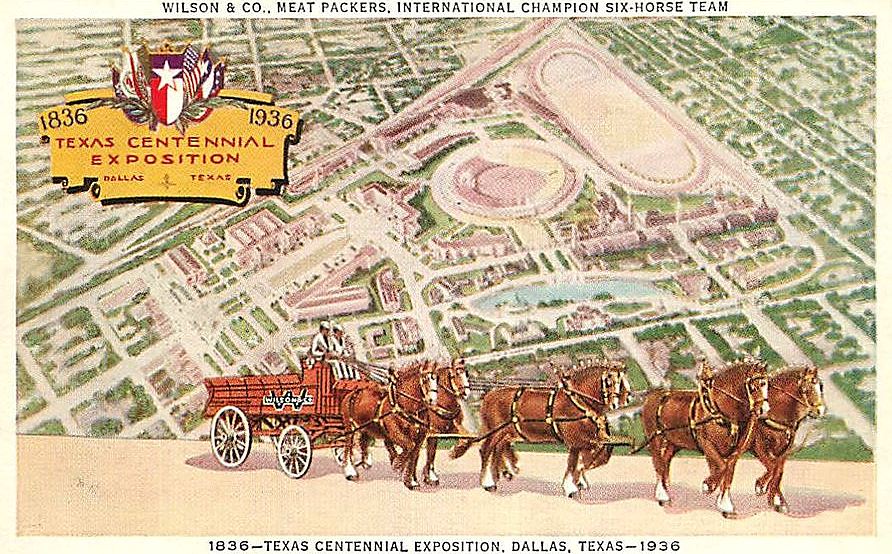
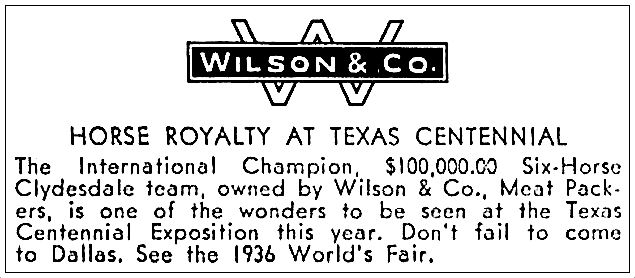
Below, a postcard advertising the appearance of the Wilson “Champion Six-Horse Team” at the 1936 Texas Centennial:

wilson-co_clydesdales_1936_ebay

wilson-co_clydesdales_1936_ebay_back

***

Sources & Notes

Photo found on eBay in 2014; on the back is the stamp of photographer Denny Hayes.

Texas Centennial postcard from eBay.

See an unimpeded view of the famous six-horse team of Clydesdales (each of which weighed, on average, two thousand pounds) in a 1954 Cedar Rapids Gazette photo, here.

A couple of interesting tidbits about the Wilson company and about the horses:

  1. Thomas E. Wilson, the founder of the meatpacking company also founded Wilson Sporting Goods
  2. As a celebratory nod to the end of Prohibition, the famed Budweiser Clydesdales were purchased from Wilson in 1933 — this was Wilson’s original team from 1917. (Clydesdale horses generally live for 20-25 years.)

Pictures and clippings are larger when clicked.

*

Copyright © 2016 Paula Bosse. All Rights Reserved.
Marvin’s Drug Store, Main and Akard

akard-looking-north_colteraLooking north up Akard from Main… (click for larger image)

by Paula Bosse

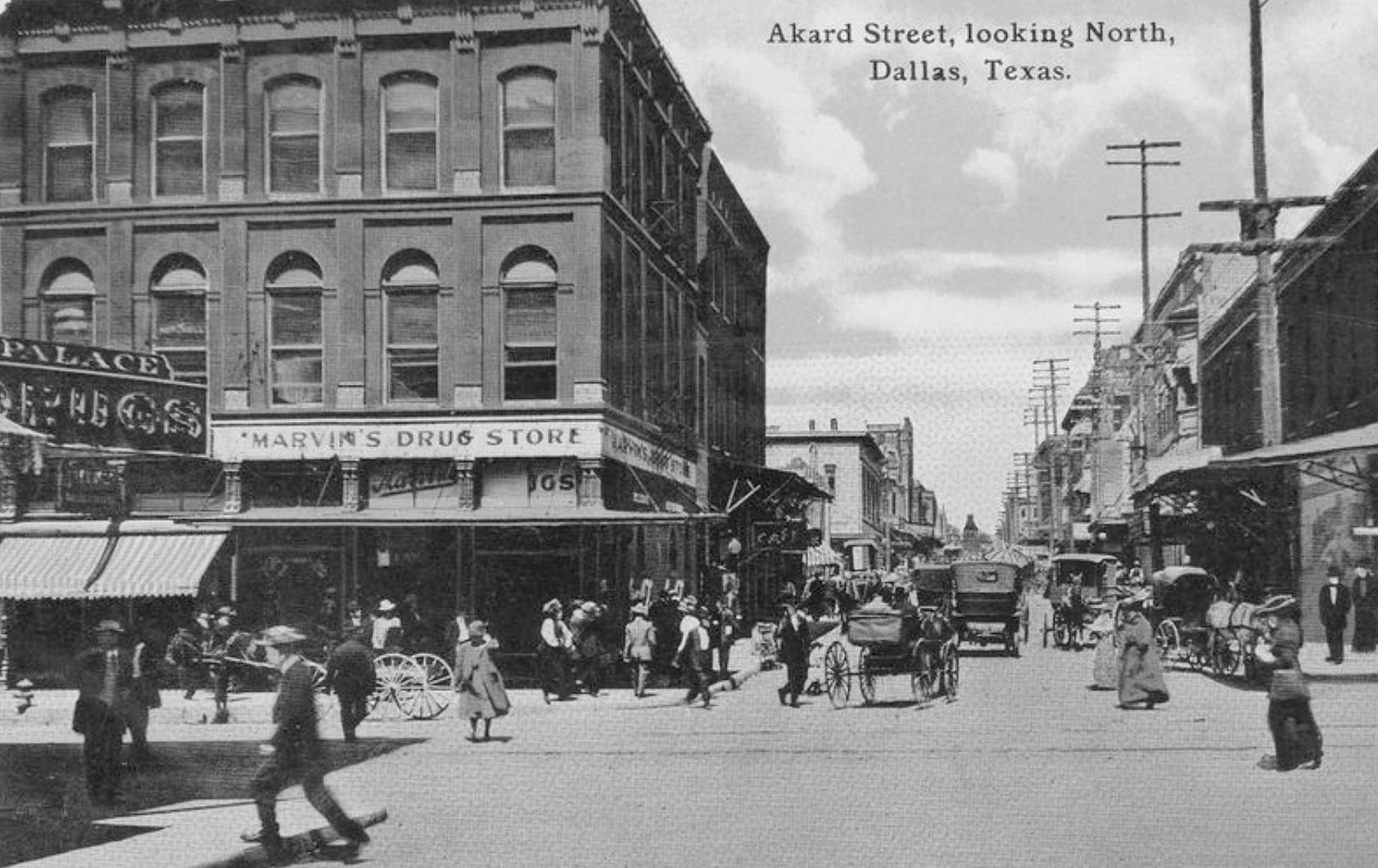
This postcard shows a bustling downtown at the intersection of Main and Akard (the view straight ahead is North Akard). Marvin’s Drug Store, on the northwest corner, was at 1415 Main, and the Palace Drug Store, on the southwest corner, was at 1414 Main. The Palace Drug Store moved to this location in December of 1909, and I’d guess the original photo used here was taken around 1910. See what this view looks like today here.

I love colorized postcards from this period, but sometimes draining them of their color gives a more realistic view of the scene (but doing this can also add a weird surreal flavor when you begin to notice evidence of the artist’s heavy hand — check out the two creepy Edvard Munch-like blank-faced pedestrians at the far right). (Click for larger image.)

akard-looking-north_coltera_bw

The building housing Marvin’s Drug Store was originally known as the Rowan Building, seen below in 1899 — its distinctive cupola was unceremoniously cropped from the postcard view.

rowan-bldg_1889-photo_detail_natl-city-bank-ny-ad_1939

In this photo you can see “Rowan” on the cupola:

rowan-bldg_marvins-drug-store_ebay

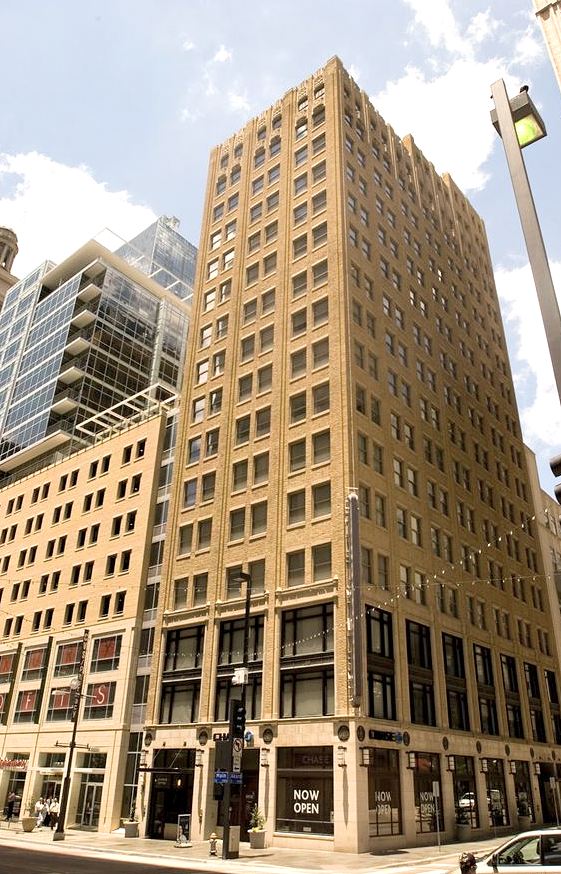
This attractive building was torn down in order to build the taller Marvin Building, which was originally intended to be 24 stories but was later downgraded to 16 stories, then to 10, then to 4 (but with plans to add more at a later date). When the new building opened in 1927, the namesake drugstore was retained as its ground-floor anchor tenant. This new structure was known as the Marvin Building until 1931 when the Gulf States Life Insurance Company purchased it and it became known as the Gulf States Building (coincidentally, ol’ Z. E. “Zeke” Marvin not only owned the Marvin Building and the Marvin Drug Company, but he was also the former president and CEO of the Gulf States Insurance Company). A Lang & Witchell-designed six-story addition was built in 1935. This 16-story building is still  standing and has been converted into residential loft space.

gulf-states-bldg_chamberlin-site

***

Sources & Notes

The postcard at the top is from the incredible Flickr collection of Christian Spencer Anderson (aka “Coltera”), here.

The 1899 photo of the Rowan Building is a detail from a 1939 ad for the National City Bank of New York.

The sepia-toned photo is from eBay.

The color photo of the Gulf States Building is from the Chamberlin Roofing and Waterproofing site, here. (See that photo REALLY big here.)

Click pictures to see larger images.

*

Copyright © 2016 Paula Bosse. All Rights Reserved.
“Teen-Age Downbeat”

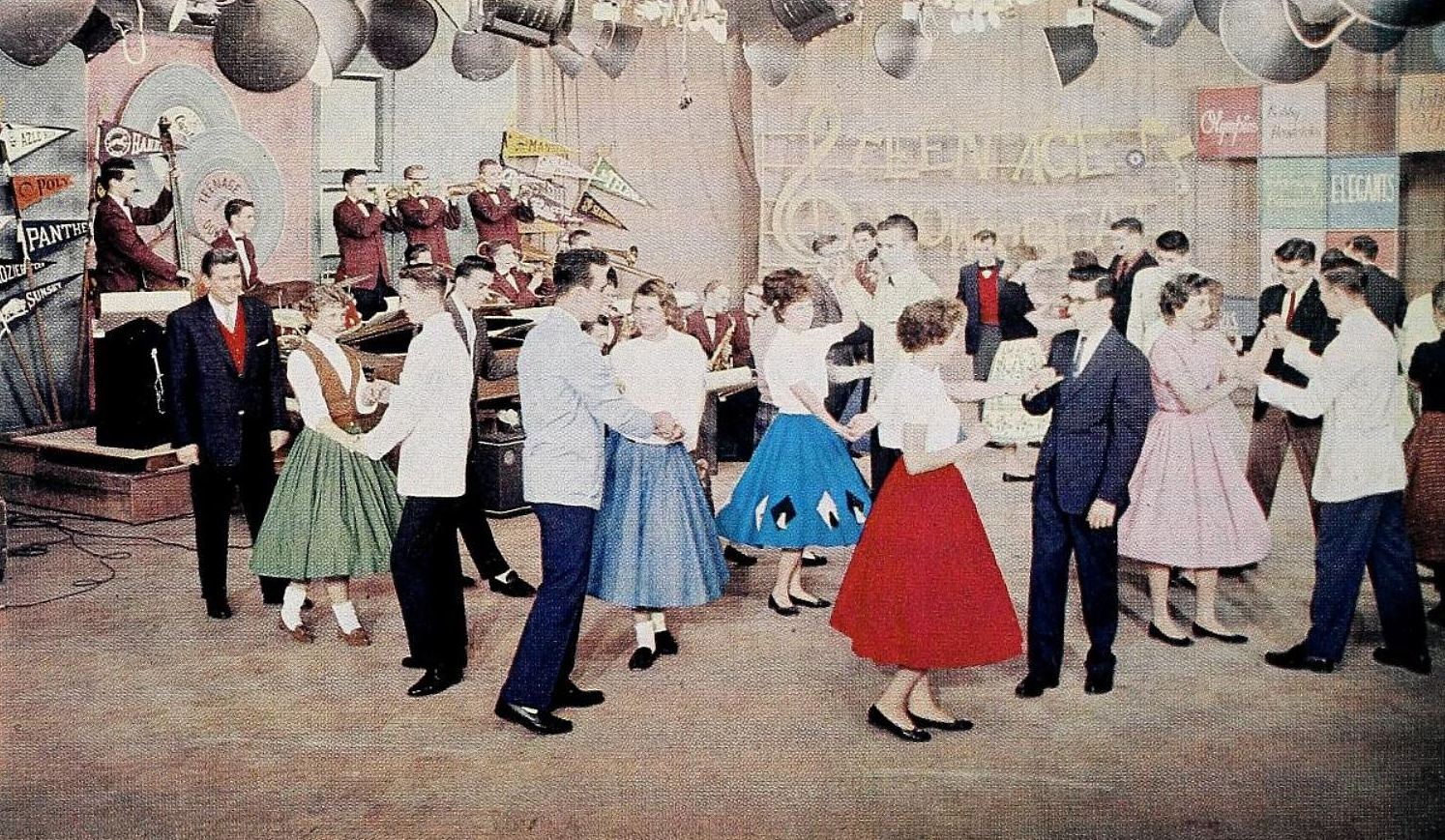
teen-age-downbeat_broadcasting-mag_051859_detWBAP’s “Teen-Age Downbeat,” 1959 (click for larger image)

by Paula Bosse

“Teen-Age Downbeat” — Fort Worth’s answer to “American Bandstand” — debuted on WBAP-TV in January, 1958 — in COLOR. It featured teens from the Dallas-Fort Worth area (…or maybe I should say from the Fort Worth-Dallas area…) who would play and dance to their favorite records. The host was WBAP broadcaster Tom Mullarkey (seen above at the left, wearing the red vest). The show was quite popular and lasted as best I can tell, from January, 1958 until July, 1961 (the last mention in The Fort Worth Star-Telegram was July 1, 1961). I’m guessing those kids danced to a lot of Fabian.

teenage-downbeat_fwst_010558FWST, Jan. 5, 1958

teen-age-downbeat_sponsor-mag_080860“Sponsor” trade magazine, Aug. 8, 1960

teen-age-downbeat_unt-lab-bandNorth Texas State College’s Lab Band with director Gene Hall

teenage-downbeat_fwst_022661
FWST, Feb. 26, 1961

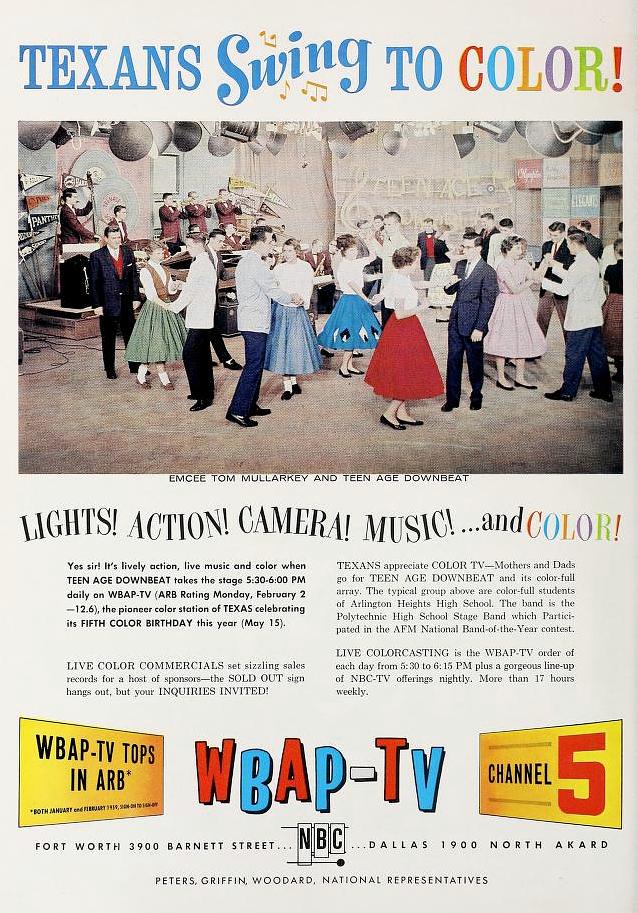
teen-age-downbeat_broadcasting-mag_051859
“Broadcasting” trade magazine, May 18, 1959

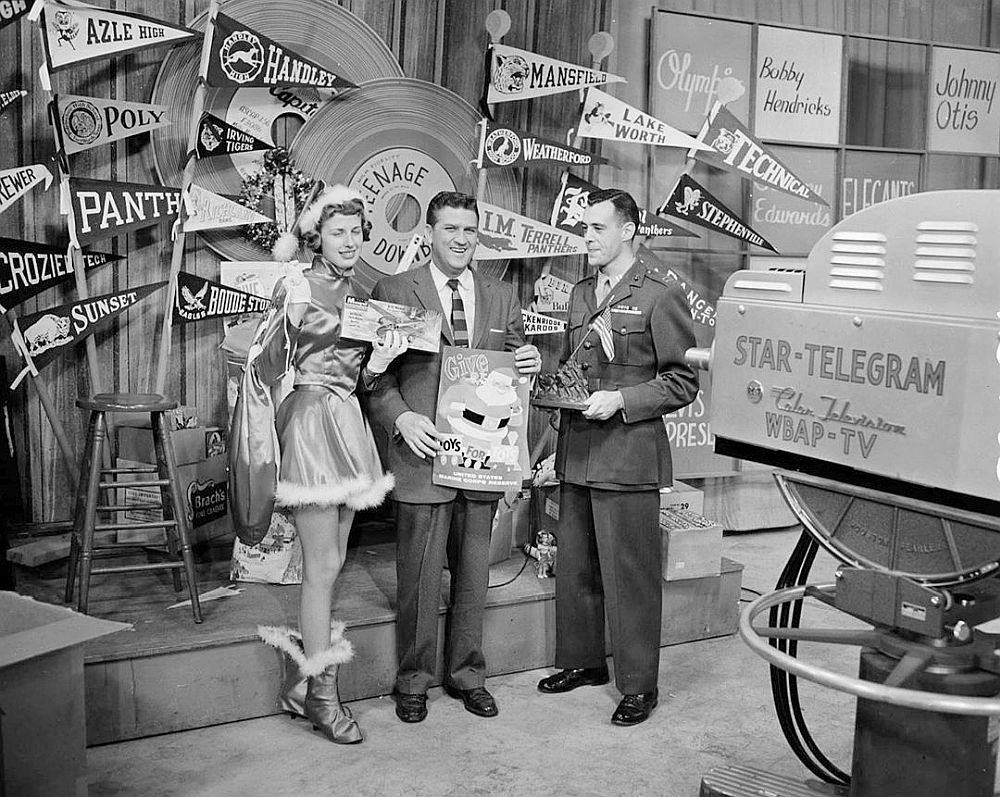
teen-age-downbeat_xmas_1958_fortworthhistorical-IG“Toys For Tots” campaign, Christmas 1958

***

Sources & Notes

The color photo (which appeared in a full-page WBAP ad in the trade magazine Broadcasting) shows non-teen Tom Mullarkey watching over the dancers from Arlington Heights High School, as the Polytechnic High School Stage Band plays some happenin’ tunes. (I do see two Dallas high school pennants in the photo: Crozier Tech and Sunset.)

The photo showing director Gene Hall with the North Texas State College (now the University of North Texas) Laboratory Band was found at UNT’s Portal to Texas History site, here. The photo is not dated, but a blurb in The Fort Worth Star-Telegram mentioned that Hall and the band were to appear on “Teen-Age Downbeat” on Feb. 5, 1959.

Photo of the “Toys For Tots” campaign, featuring a sexy Santa’s helper, Tom Mularkey, and a Marine Corps (Reserve?) officer was found on the Instagram feed of @fortworthhistorical.

*

Copyright © 2016 Paula Bosse. All Rights Reserved.
Zooming In on the State Fair: The Midway, the Cotton Bowl, and the Octopus — ca. 1950

state-fair_midway-cotton-bowl_squire-haskins_ca_1950_utaAnother visit to the fair… (click for larger image)

by Paula Bosse

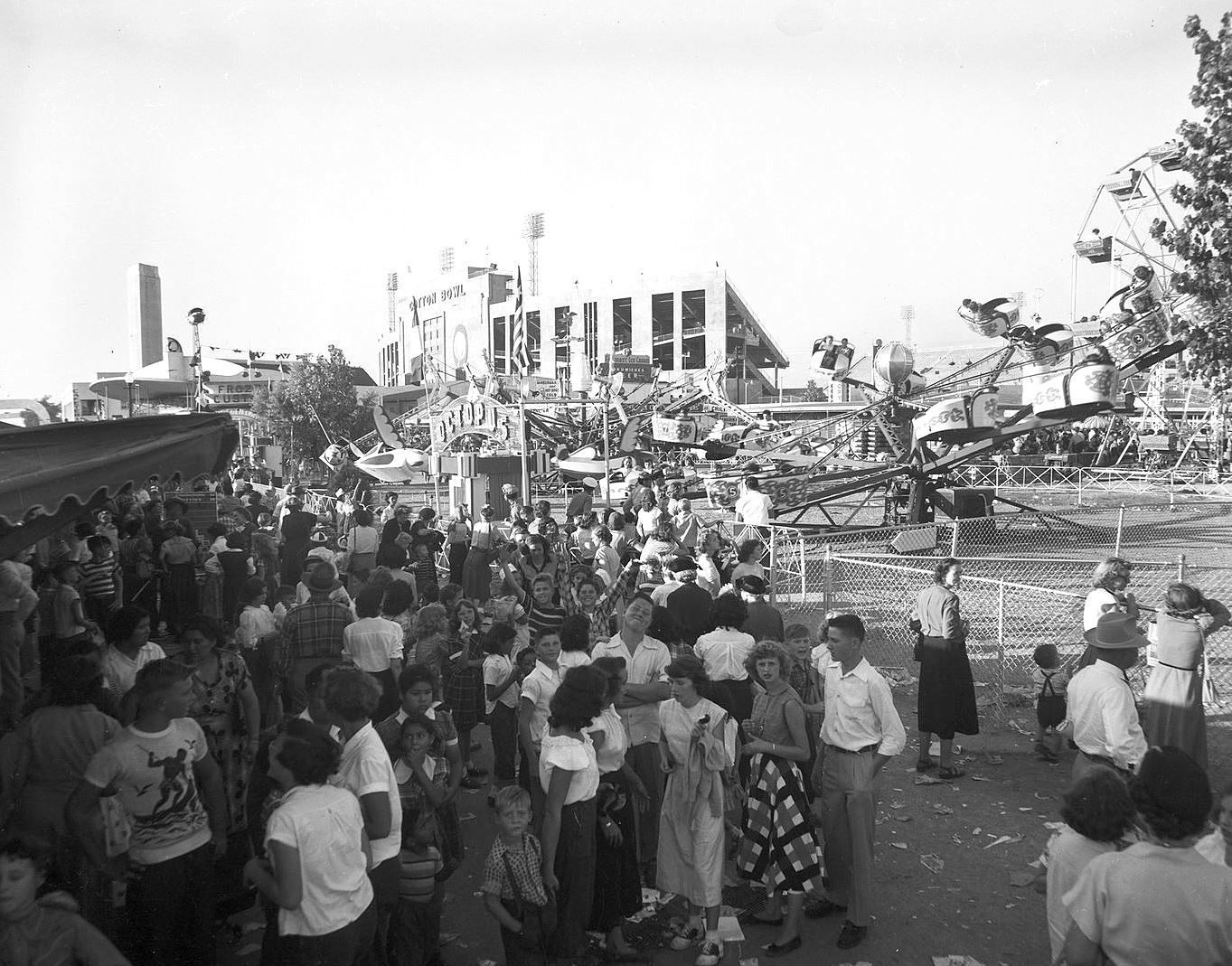
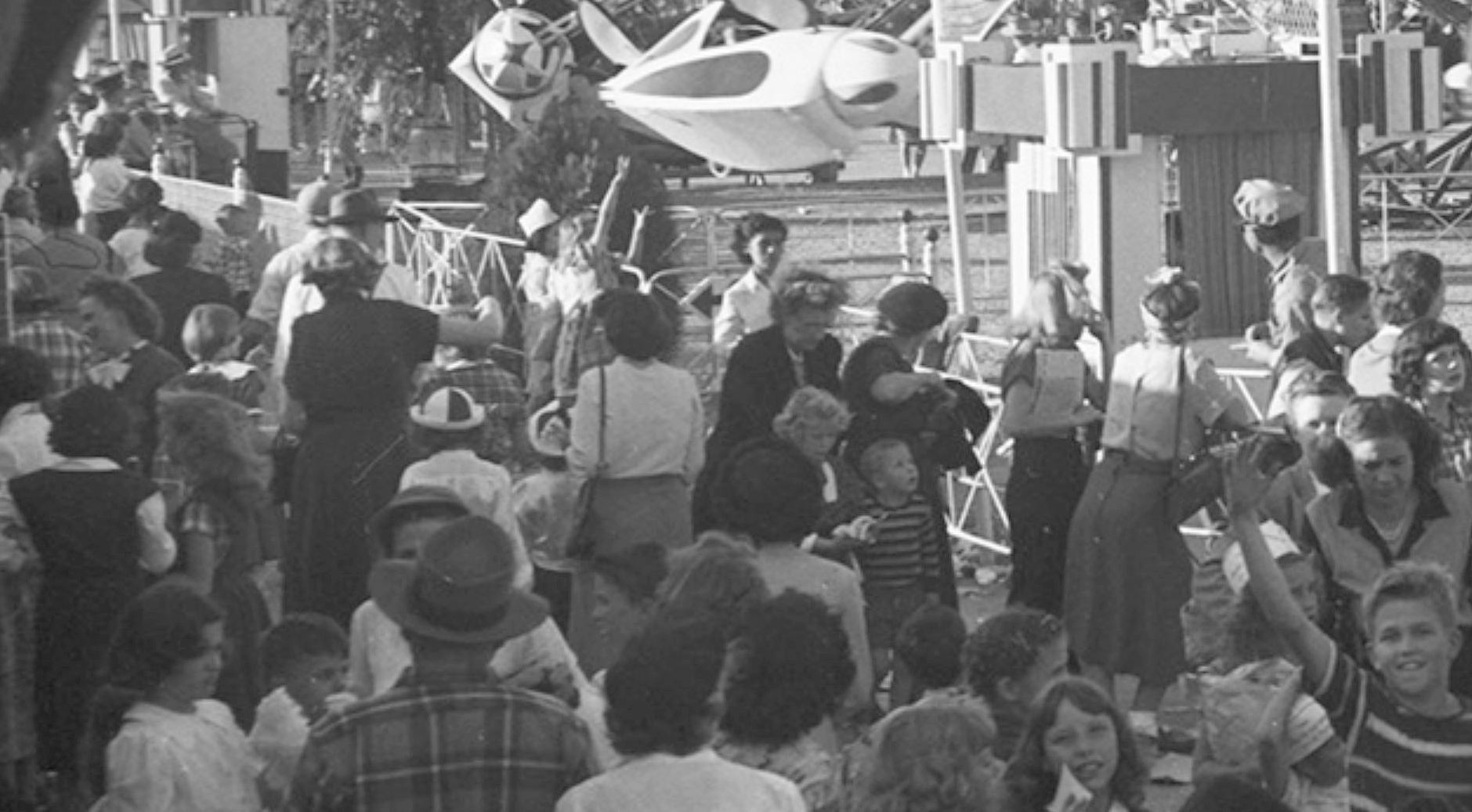
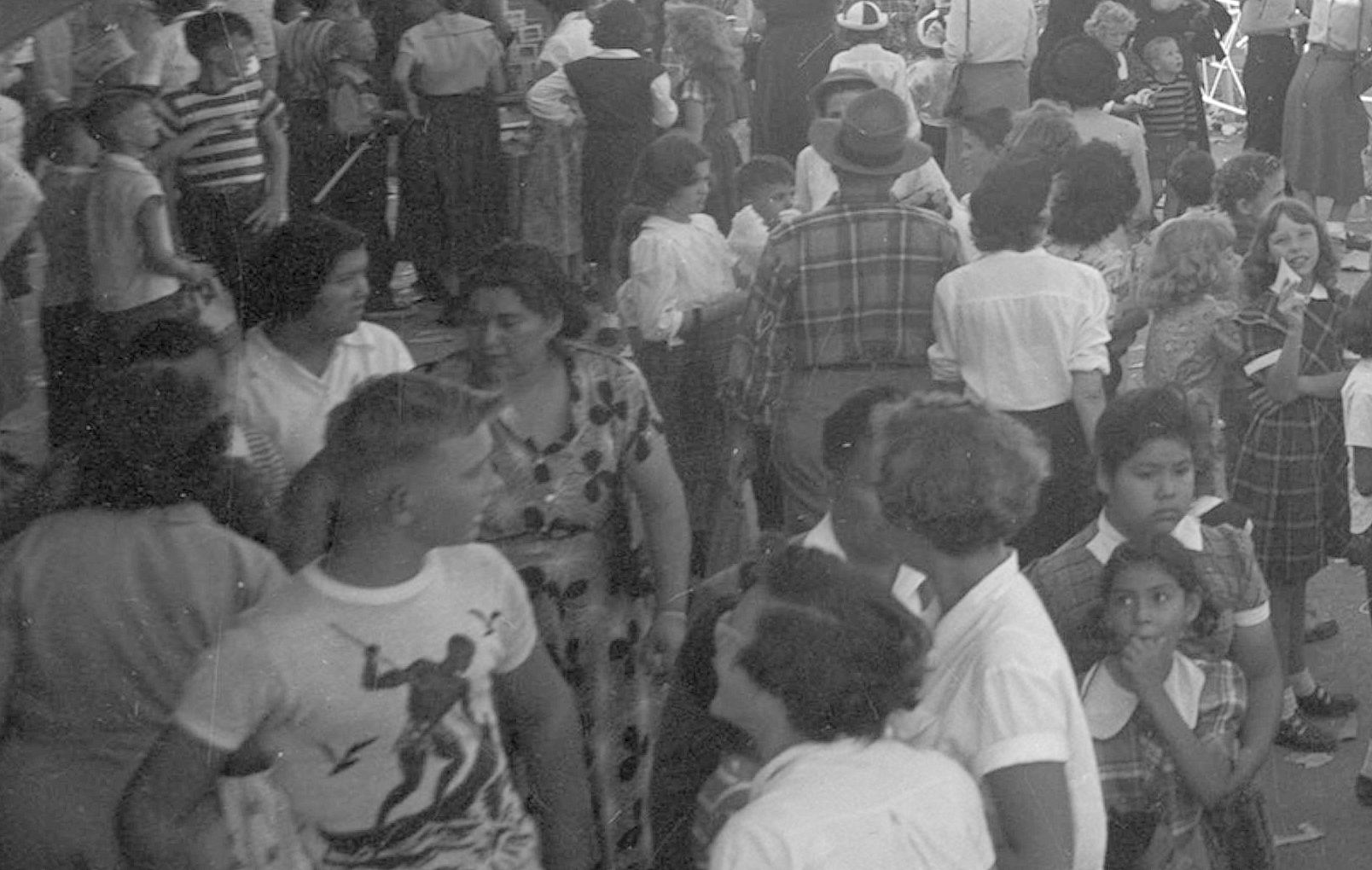
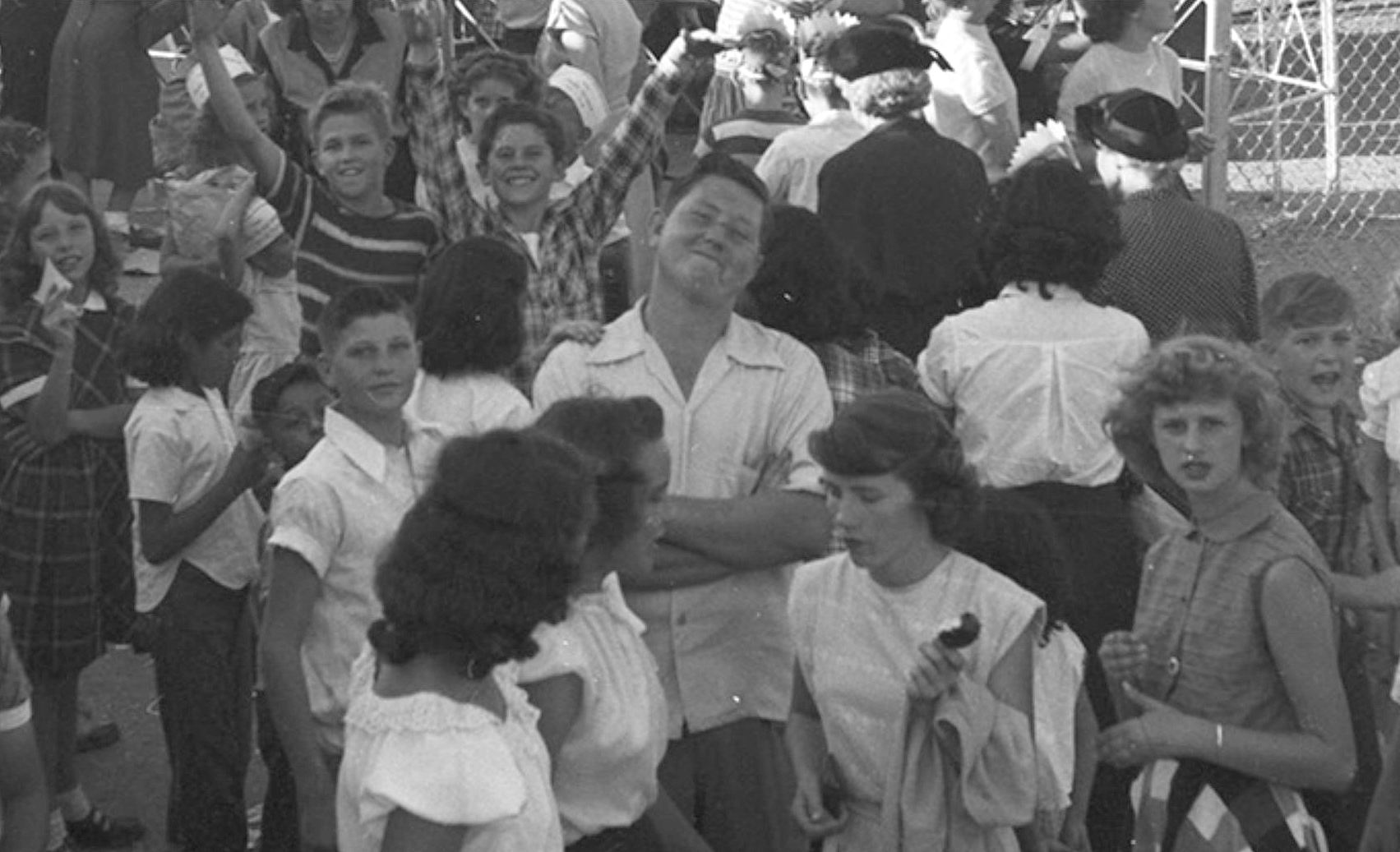
When I see old photos of the State Fair, I always look at the people. Let’s take a closer look at this great photo by Squire Haskins, taken around 1950. (See a BIG scan of this photo at the UTA website, here.)

Here are a few magnified details from Haskins’ photo (all are much larger when clicked):

midway-zoom_1

midway-zoom_2

midway-zoom_3

midway-zoom_5

midway-zoom-4

midway-zoom_6

***

Top photo by Squire Haskins, from the Squire Haskins Photography, Inc. Collection, Special Collections, University of Texas at Arlington Libraries; more information can be accessed here. (Other photos from this collection which were taken around the State Fair Midway at about this time were taken in October, 1950 — this one is not dated, but it seems likely it was taken at the same time.)

See other photos I’ve zoomed in on here.

Click pictures for larger images!

*

Copyright © 2016 Paula Bosse. All Rights Reserved.
NOW HEAR THIS: THE BELL TELEPHONE “LOUD SPEAKER” IS AT THE FAIR! — 1921

telephone_sw-bell_dmn_100821_photoYou might want to step back a few thousand feet… (click for larger image)

by Paula Bosse

When was the last time you wondered about the history of the public address system? If you’re like me, the answer to that is probably “never.”

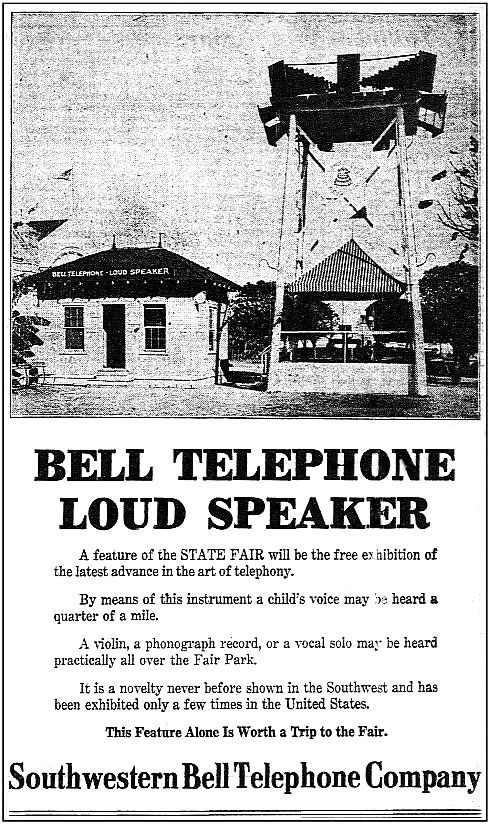
The photo above shows the new technical innovation from the army of Bell Systems engineers that was going to be demonstrated at the 1921 State Fair of Texas: the “Loud Speaker.” The ad (always click images and clippings for larger images):

telephone_sw-bell_dmn_100821
Dallas Morning News, Oct. 8, 1921

*

BELL TELEPHONE LOUD SPEAKER
A feature of the STATE FAIR will be the free exhibition of the latest advance in the art of telephony.
By means of this instrument a child’s voice may be heard a quarter of a mile.
A violin, a phonograph record, or a vocal solo may be heard practically all over the Fair Park.
It is a novelty never before shown in the Southwest and has been exhibited only a few times in the United States.
This Feature Alone Is Worth a Trip to the Fair.
Southwestern Bell Telephone Company

*

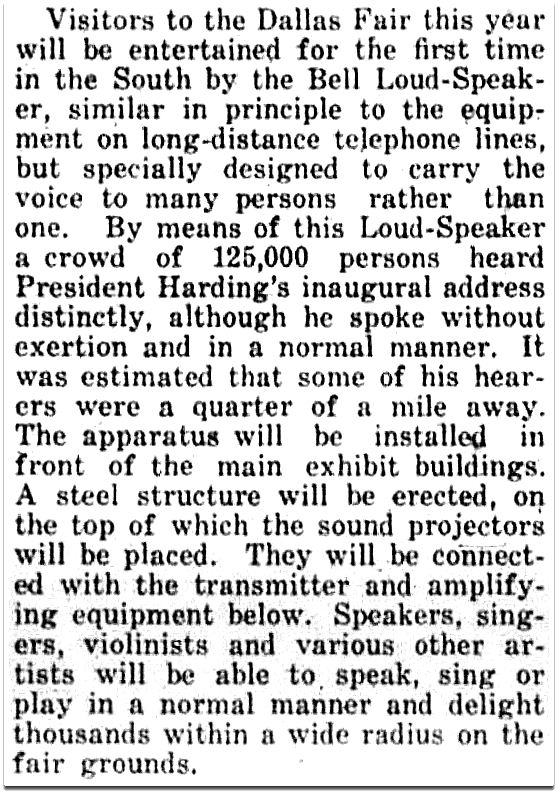
My technical expertise is pretty much non-existent, but, basically, this was the introduction of the public address system as developed by Bell Telephone, using their cutting-edge transmitters and amplifying equipment (the articles below contain more information).

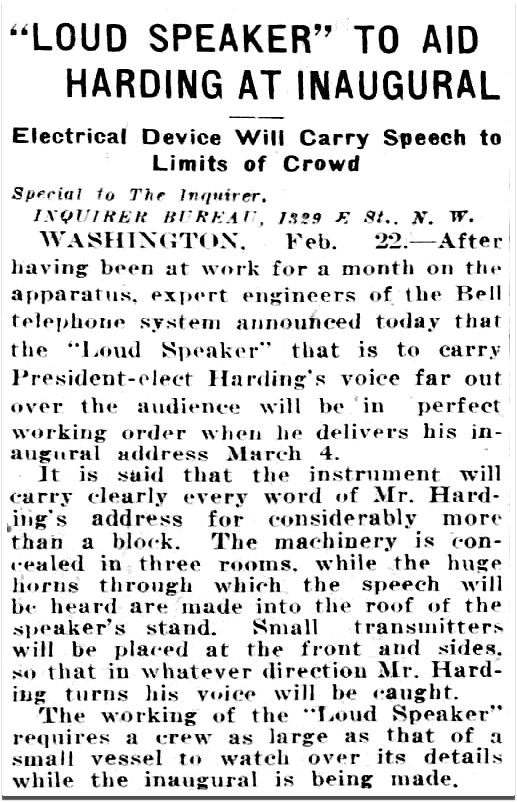
An earlier version of this particular set-up had debuted the previous year at the Republican National Convention in Chicago. (Imagine attending a large, noisy political convention with speakers whose voices weren’t amplified.) It had also been used for President Harding’s inauguration speech at the beginning of 1921, a first.

state-fair_loud-speaker_coleman-tx-democrat-voice_100721Coleman Democrat Voice, Oct. 7, 1921

This was before the days of mainstream radio — Dallas’ first commercial broadcasting station, WFAA, didn’t go on the air until June, 1922. The loudspeaker system used at the fair in 1921 allowed entertainment acts and World Series play-by-play to be played loudly overhead, for most of the fairgoers to hear (which sounds a little annoying to me, but it was newfangled novelty and people were quite taken with it).

state-fair_loud-speaker_dmn_101121
DMN, Oct. 11, 1921

state-fair_loud-speaker_dmn_101221
DMN, Oct. 12, 1921

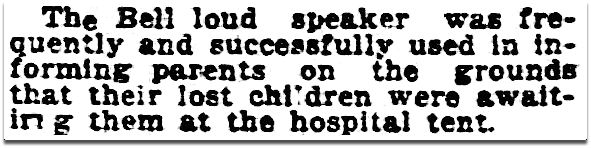
It also came in handy to make announcements and to page parents of lost children.

state-fair_loud-speaker_dmn_101521
DMN, Oct. 15, 1921

The amplification at public events was enthusiastically received and much appreciated, but the real end Bell was working toward was the ability to transmit and broadcast live events happening long distances away (and also to transmit recorded music without any substantial loss of sonic quality — radio, here we come!).

state-fair_loud-speaker_dmn_101621bDMN, Oct. 16, 1921

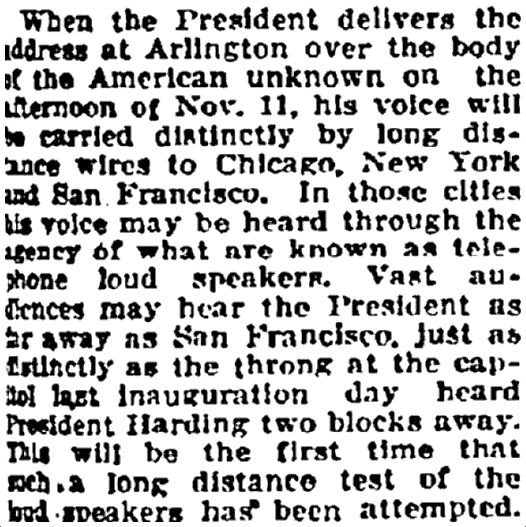
In fact, the equipment exhibited at the fair was the same equipment used less than a month later when President Harding presented his Armistice Day address to the nation. Not only was his voice amplified to the large crowd listening to him at Arlington National Cemetery, it was also transmitted and then broadcast through “loud speakers” to crowds in New York and San Francisco — another first.

state-fair_loud-speaker_harding_tulsa-daily-world_121121
Tulsa Daily World, Dec. 11, 1921

And Texas got to experience this new technology earlier than most others in the country. Little did those Bell engineers realize in 1921 that 30-some-odd years later the booming voice of a gigantic cowboy could be heard greeting visitors all over Fair Park.

**

A few clippings about the vaunted “loud speaker” before it made its way to the State Fair:

harding_loud-speaker_philadelphia-inquirer_022321
Philadelphia Inquirer, Feb. 23, 1921

harding_loud-speaker_winnipeg-tribune_030821
Winnipeg Tribune, March 8, 1921

harding_loud-speaker_dmn_100521_wire
DMN (from wire reports), Oct. 5, 1921

And an article on the exciting prospects of what lay ahead:

loud-speaker_tulsa-daily-world_121121
Tulsa Daily World, Dec. 11, 1921

***

Sources of clippings as noted.

Click for larger images!

*

Copyright © 2016 Paula Bosse. All Rights Reserved.
Adamson High School People and Places, Part 2 — 1960s

adamson_1966-yrbk_dance-plaidHave plaid, will dance — 1966… (click for larger images)

by Paula Bosse

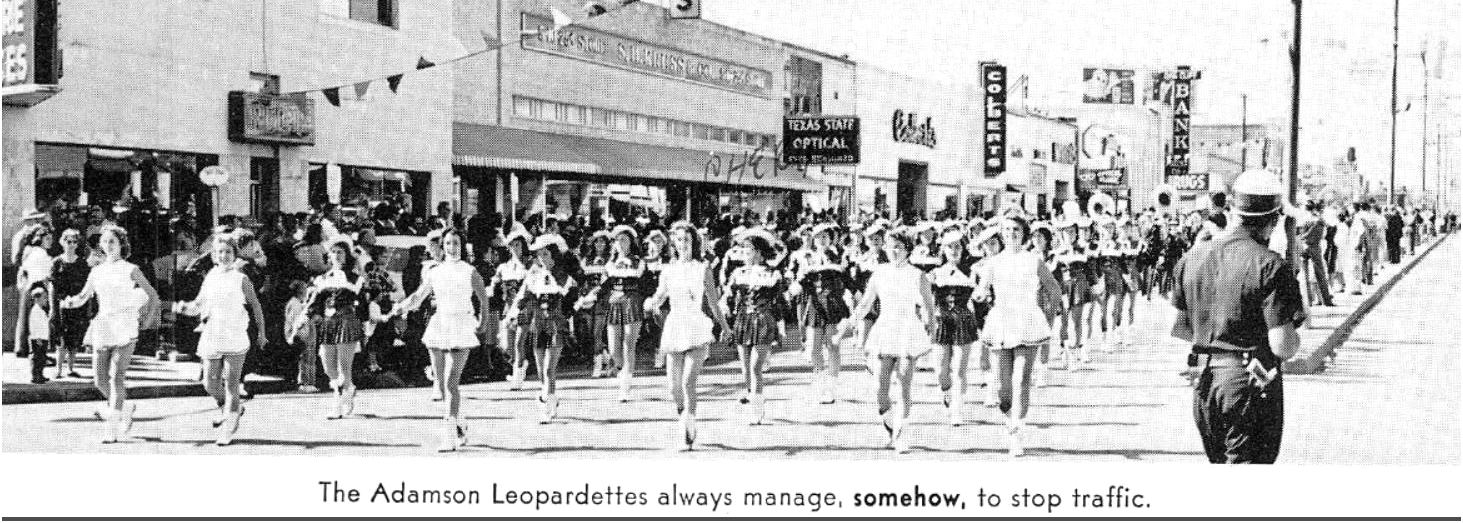
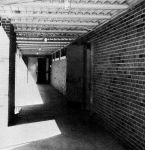
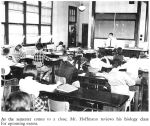
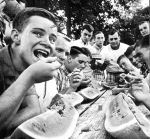
Check out these random photos of Adamson High School and its students, mostly from the 1966  yearbook. (Click for larger images.)

1961_adamson-yrbk_leopardettes1961

adamson_1966-yrbk_leopard
Go Leopards!

***

See the companion post (which shows advertisements from 1960s editions of the W. H. Adamson High School yearbook) here.

*

Copyright © 2016 Paula Bosse. All Rights Reserved.
Adamson High School People and Places, Part 1 — 1960s

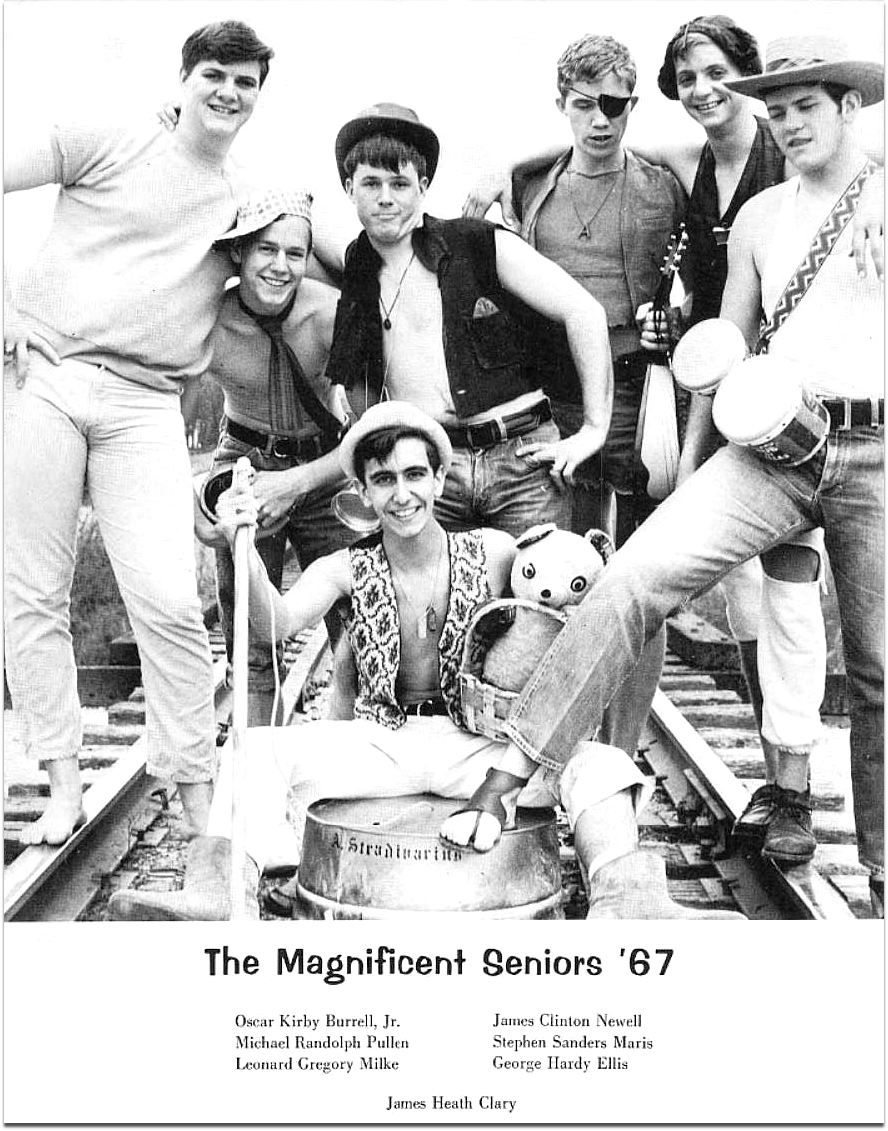
adamson-high-school_1967-yrbk_magnificent-seniors_adThe super-groovy Magnificent Seven of 1967

by Paula Bosse

Here are a whole bunch of 1960s ads from Adamson High School’s yearbooks. Go Leopards! (Click to see larger images.)

Above, a group of guys took out an ad for themselves in their 1967 senior yearbook:

  • Oscar Kirby Burrell, Jr.
  • James Clinton Newell
  • Michael Randolph Pullen
  • Stephen Sanders Maris
  • Leonard Gregory Milke
  • George Hardy Ellis
  • James Heath Clary

Thumbs up for creativity, guys!

Below, churches, lotsa churches, including:

  • Cliff Temple Baptist Church (from the 1961 yearbook)
  • First Church of the Nazarene (1961)
  • Galilean Baptist Church (1961)
  • Grace Temple Baptist Church (1961)
  • Polk Street Baptist Church (1964)
  • Oak Cliff Presbyterian Church (1966)
  • Western Heights Church of Christ (1966)
  • Grace Temple Baptist Church (1967)

And then you’ve got your garages and gas stations, including:

  • O. B. Goodman’s Gulf Service Center (1967)
  • Herbie Dodd Wynnewood Texaco (1965)
  • Navarro Custom Automotive (for all your hot rod needs) (1966)

And Safety Brake Service over the years: 1961, 1964, 1965.

One must eat:

  • The Old South (1961)
  • Speedy Chick No. 4 (1965)
  • Inky’s Charcoal Burger (1966)
  • Woody’s Pancake House (1965)
  • Big Daddy’s Grill (1966)
  • Goff’s Hamburgers (don’t forget Mrs. Goff’s Ice Cream) (1966, 1967)

And then everything else:

  • U.S. Congressman Joe Pool (1967)
  • Colbert’s (women’s clothing) (1967)
  • Raven’s Pharmacy (1966)
  • John Hiegel’s One Hour Martinizing (1966)
  • King’s Book Store (1966)
  • Ketchum & Killum Sporting Goods (you read that right) (1965)
  • Crosswinds Apartments (1965)
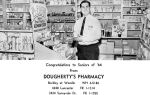
  • Dougherty’s Pharmacy (1964)
  • Doris Wood Bridal & Party Service (1966)
  • Bronco Bowl (…RIP…) (1966)

adamson_1966-yrbk_doris-wood-bridal

adamson_1966-yrbk_bronco-bowl

***

Sources & Notes

Ads from the 1961, 1964, 1965, 1966, and 1967 W. H. Adamson High School yearbooks.

See the companion post (which shows the school and students — mostly from 1966), here.

*

Copyright © 2016 Paula Bosse. All Rights Reserved.

The State Fair of Texas: “A Son-of-a-Gun in ’51” — 1951

state-fair-poster_1951_pinterest

by Paula Bosse

In honor of opening day of the 2016 State Fair of Texas, a poster from the 1951 fair. Proto-Big Tex imagery was being used well before the giant cowboy’s debut the following year (see, that hand thing is going on even back then…).
Welcome back, SFOT!

***

Poster found on Pinterest.

*

Copyright © 2016 Paula Bosse. All Rights Reserved.