Flashback : Dallas

A Miscellany: History, Ads, Pop Culture

Category: Neighborhoods

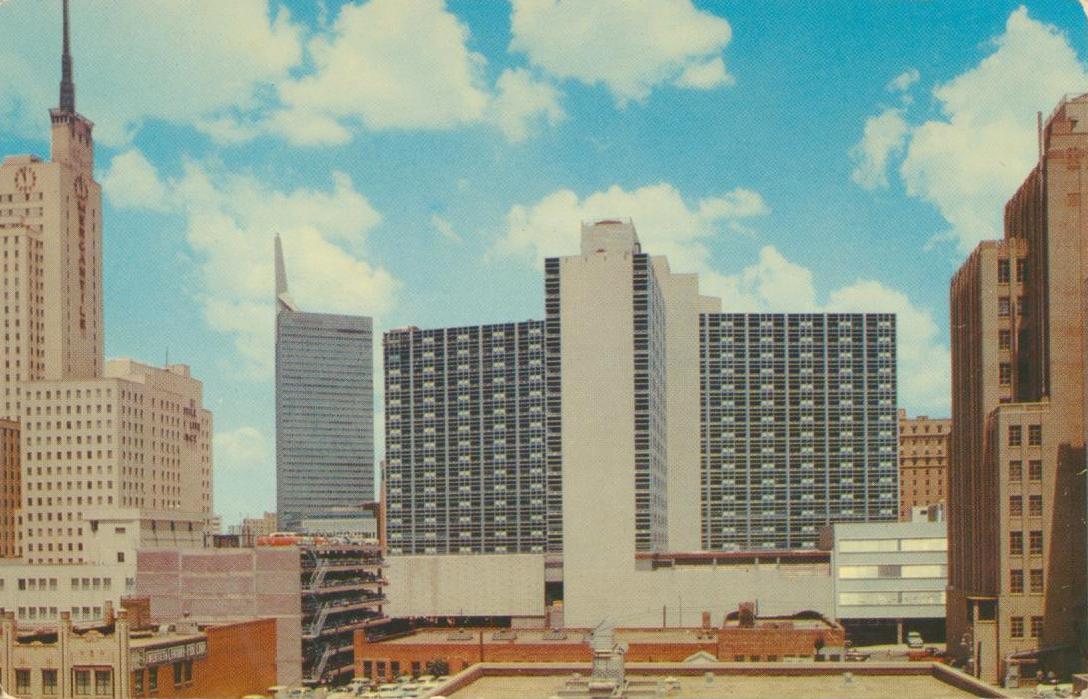
Dallas’ Mid-Century Skyline

skyline_statler_mercantile_republic_ebayBack then: more sky, fewer parking lots (click for larger image)

by Paula Bosse

Dallas architecture at mid-century: the Mercantile Bank Building, the Republic Bank Building, the Statler-Hilton (from behind!), and … a multi-level parking garage. Dallas is nothing if not a city full of banks, banks (and more banks), flashy hotels, and parking lots. Then and now.

***

Slightly fuzzy postcard from eBay. The Statler-Hilton (which this postcard identifies as the “Hilton-Statler”) isn’t often seen from behind like this in photos (not really its best side). Other than the three main buildings (and the old library, which is as architecturally cool as the other three), I think that just about everything else in this photo is gone. There are now parking lots (…yay…) where the buildings at the right and at the bottom left are seen — there’s even a parking lot where the parking garage once stood! (Dallas really loves its parking lots.) At least we managed not to tear down the most architecturally significant buildings seen here. (Even though the number of downtown parking spaces could be exponentially increased if we pulled those suckers down and replaced them with multi-multi-story garages!)

*

Copyright © 2016 Paula Bosse. All Rights Reserved.

Fletcher’s State Fair Drive-In — 1960-1963

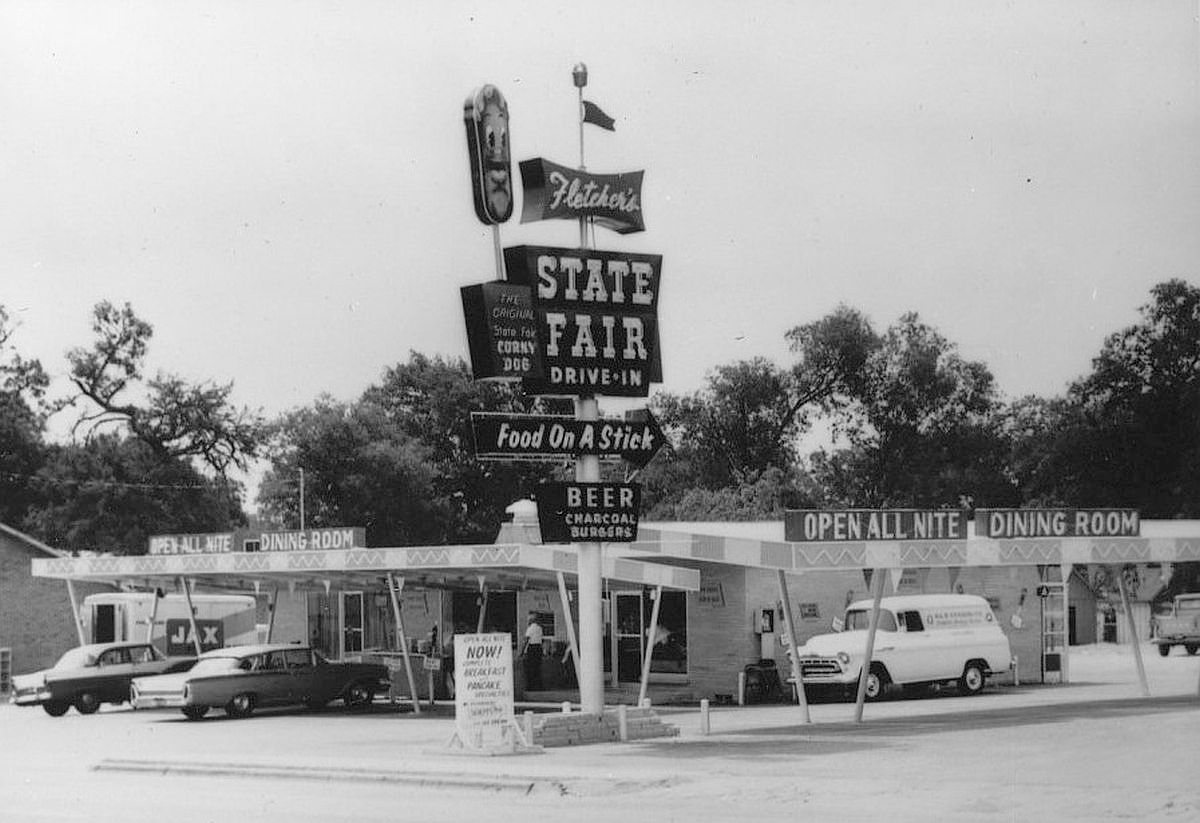
fletchers-state-fair-drive-in_DHSFood-on-a-stick, open all nite

by Paula Bosse

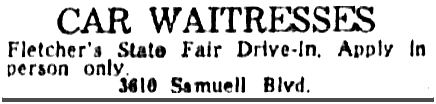
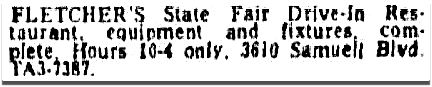
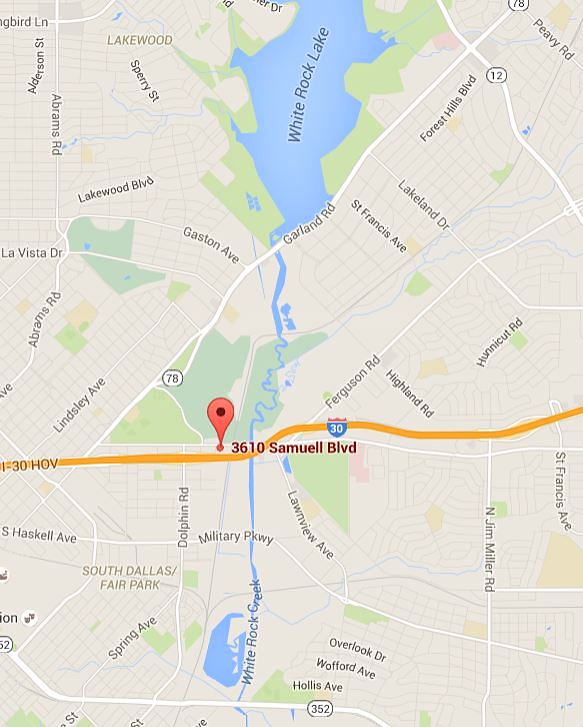
The legendary Fletcher’s Corny Dog once had its own drive-in! You didn’t have to wait until the State Fair of Texas rolled around to get your favorite “food on a stick” fix — you just needed to head to 3610 Samuell Boulevard, across from the Tenison Golf Course.

Sadly, there was a lot of drive-in and tavern competition along Samuell back then (Keller’s was practically next door!), and the State Fair Drive-In seems to have lasted only a little over three years, from the spring of 1960 to the fall of 1963.

I’d love to see this around NOW! Come on, Fletcher’s family: bring this back!

*

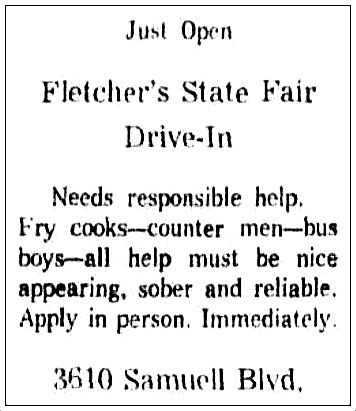
fletchers_dmn_051560May , 1960

fletchers_dmn_062960June, 1960

fletchers_dmn_102463_for-sale
Oct., 1963

***

Sources & Notes

Top photo from the Dallas Historical Society.

An article on Neil Fletcher’s new restaurant and a photo of the interior can be found in the archives of The Dallas Morning News: “State Fair Drive’In Fixtures Designed, Installed by Bab’s” (DMN, June 12, 1960).

After the Fletcher’s Drive-In closed, it was replaced by a Red Coleman liquor store, and was most recently a club, El Palmeras. Google Street View shows the shabby neighborhood these days, here.

3610-samuall_googleGoogle Maps

An entertaining interview with the late Neil Fletcher appeared in the Oct. 1982 issue of D Magazine, here.

A Travel Channel video focuses on the famed corny dog, here.

A previous Flashback Dallas post about that same stretch of Samuell Blvd. — “Red’s Turnpike Open-Air Dance: An East Pike/Samuell Blvd. Joint — 1946” — is here.

UPDATE: I’ve received many comments that Fletcher’s had several short-lived drive-thru restaurants which started popping up in the mid-’80s. More on the franchise plans can be read in the article “Fletcher and Firm Very Much Alive” by Donna Steph Hansard (DMN, Aug. 5, 1984).

*

Copyright © 2016 Paula Bosse. All Rights Reserved.

Main & Murphy — ca. 1907

city-national-bank_postcard_bwMain St. looking east

by Paula Bosse

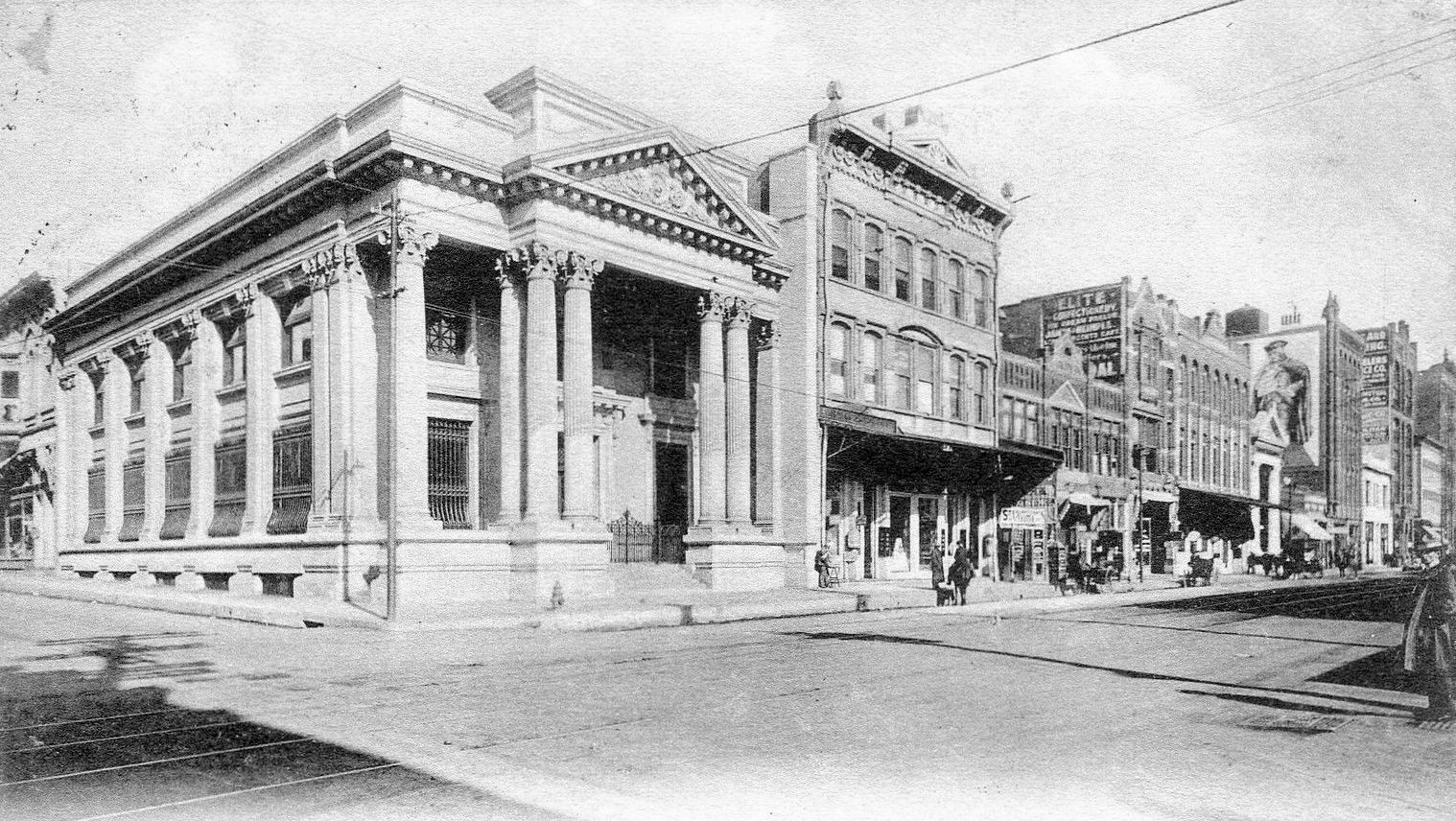
Above, Main Street looking east, taken from Murphy, anchored by the beautiful City National Bank, built in 1903. This block today? One Main Place.  Whatever old buildings were left in this block in 1965 (including the old City National Bank) were bulldozed into oblivion to make way for the skyscraper.

The same view today:

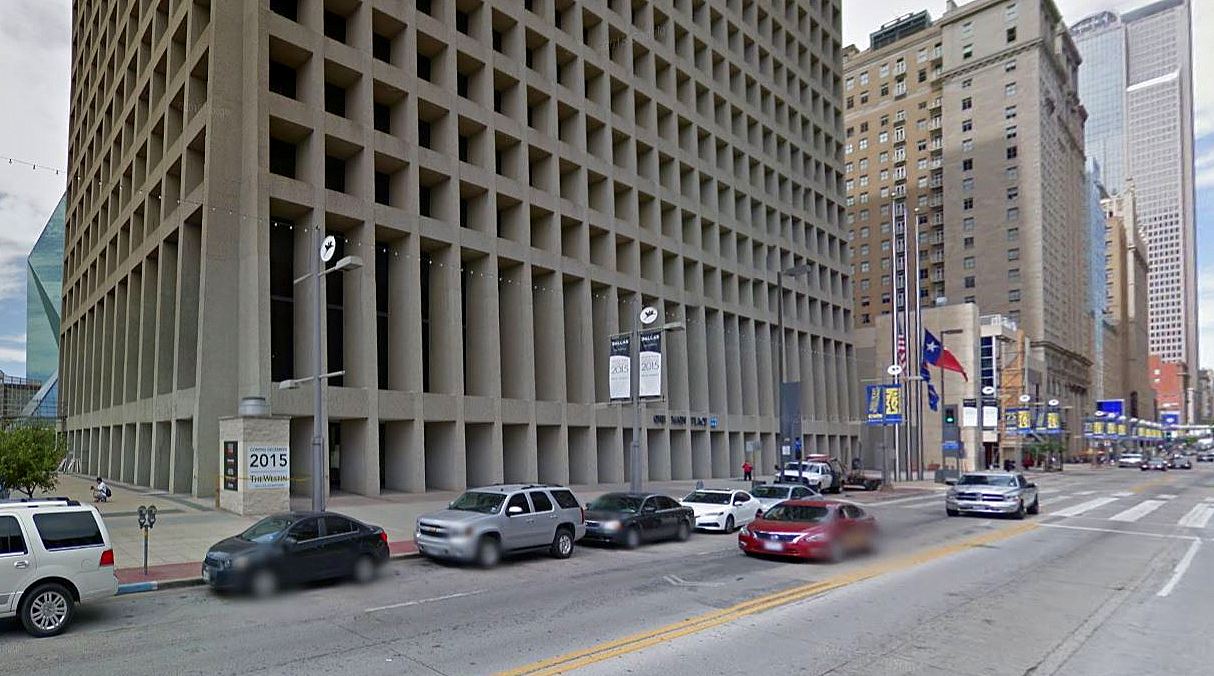
one-main-place_google_2015Google Street View, 2015

***

Sources & Notes

Top image from a postcard found on eBay.

Imagine looking up to the sky from the photographer’s vantage point in the top photo and seeing what things would look like a century later.

Murphy no longer exists — it was between what is now Griffin and Field. A map from 1898 showing the location:

main-murphy_1898-map

See another photo of the same view taken at about the same time, only with horse-and-buggy traffic, here.

*

Copyright © 2016 Paula Bosse. All Rights Reserved.

Early Aerial View of the SMU Campus

smu_early-aerial_ca1920s_degolyerWide open… (click for much larger view)

by Paula Bosse

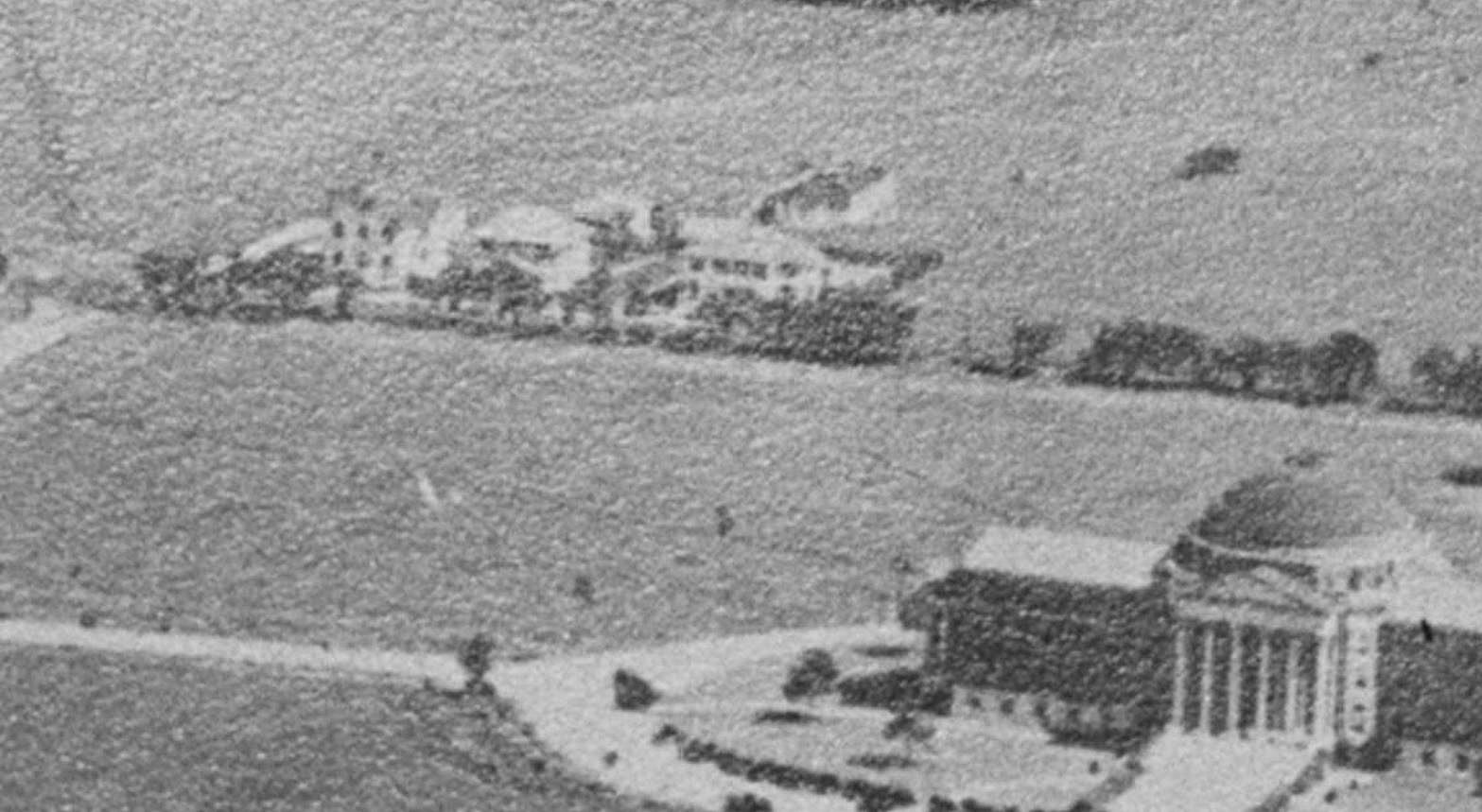
Does anyone else fear the SMU campus is getting a little crowded these days? Here’s what it looked like back when there was still plenty of room to stretch out.

This photo is in the SMU archives, accompanied by this description:

Pictured is an aerial view of campus from the southeast. At the bottom is Mockingbird Lane; on the right is Airline Road; at the top is Daniel Avenue; and on the left is Hillcrest Avenue. Situated in the middle of fields is a water tower, Dallas Hall, Atkins Hall, Rankin Hall, North Hall, South Hall, the Women’s Gymnasium, Armstrong Field, and the Morrison-Bell Track.

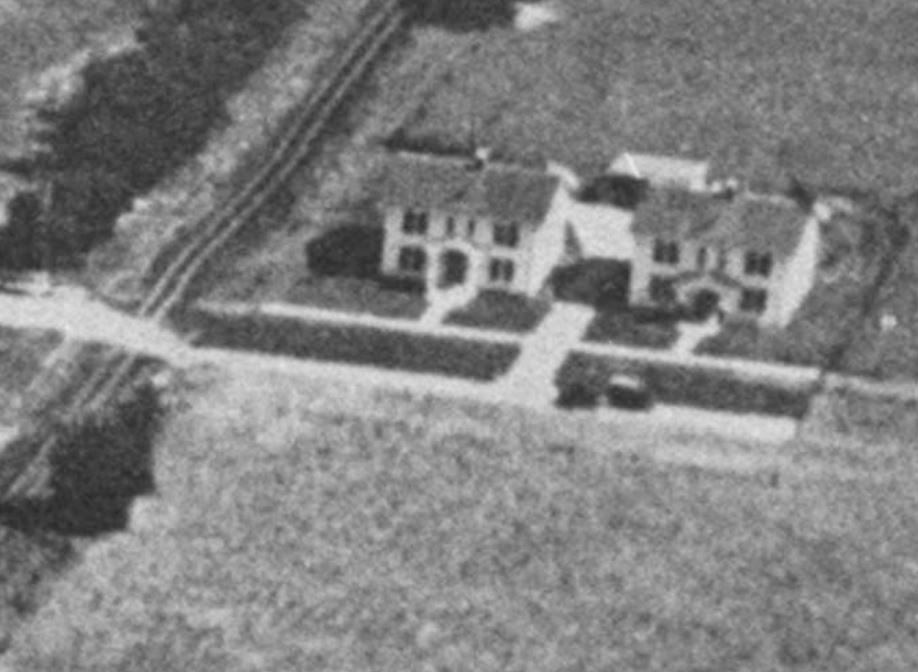
What is the huge hacienda at Hillcrest and Daniel (below)? Is that the Daniel family home?

smu_early-aerial_ca1920s_degolyer_a

And what are the little houses next to the under-construction stadium? Faculty housing? Fraternity houses? Houses not even connected with the university?

smu_early-aerial_ca1920s_degolyer_b

I kinda wish the campus still looked like this.

***

Photo titled “Early aerial view of campus,” ca. 1920s, from the DeGolyer Library, Central University Libraries, Southern Methodist University; it is accessible here.

Zoom in on this photo as much as you can and wander around it — it’s pretty cool. Go here, then slide the magnification bar at the top all the way to the right.

Click pictures for larger images.

*

Copyright © 2016 Paula Bosse. All Rights Reserved.

A-Bomb in Akard Street! — 1950

mcgrath-frank_atomic-aftermath-downtown-dallas_1950See Pegaus up there in the cloud of smoke and debris? (click for larger image)

by Paula Bosse

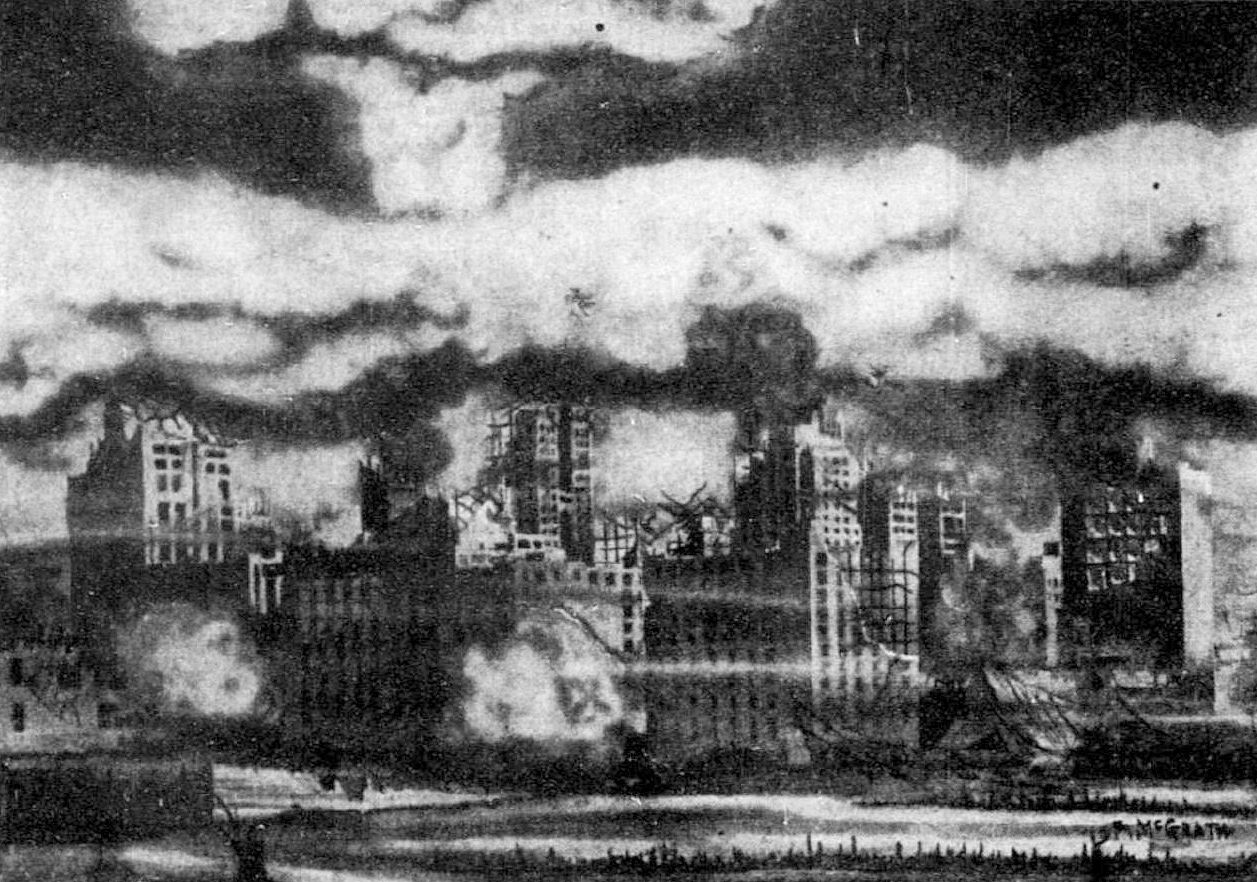
The image above, from 1950, is a depiction of what downtown Dallas might look like if an atomic bomb were dropped at the corner of Main and Akard (which is weirdly specific).

In 1950 Russia detonated a nuclear bomb during atomic tests and President Truman announced that the United States would increase and intensify research and production of thermonuclear weapons. It was a scary time for the world. The atomic bombings of Hiroshima and Nagasaki were still fresh in everyone’s minds, and news of the even more frightening hydrogen bomb was everywhere in 1950.

The drawing above is by Dallas artist Frank McGrath. It isn’t terribly realistic — Big D probably wouldn’t survive a nuclear blast —  but it’s nice that Frank spared Pegasus from annihilation.

***

Sources & Notes

There were bomb shelters all over the Dallas area. There was a (surprisingly) large shelter on the grounds of Fair Park. Watch a video tour here. And read the Flashback Dallas post “‘Dallas Is a Major Target Area!’ Know Where Your Nearest Fallout Shelter Is.”

Read about the tenor of the times in the article “Hydrogen Bomb — 1950,” here.

The title of this post is a direct reference to a great song by one of my favorite bands, The Jam. Listen to “A-Bomb in Wardour Street,” here. This time it’s nuclear apocalypse in London, but change the accent and, sure, it could be Dallas. (I knew I’d work The Jam in here one day!)

*

Copyright © 2016 Paula Bosse. All Rights Reserved.

Parasols on the SMU Campus — 1917

smu_parasols_1917_degolyerSMU, sparsely populated

by Paula Bosse

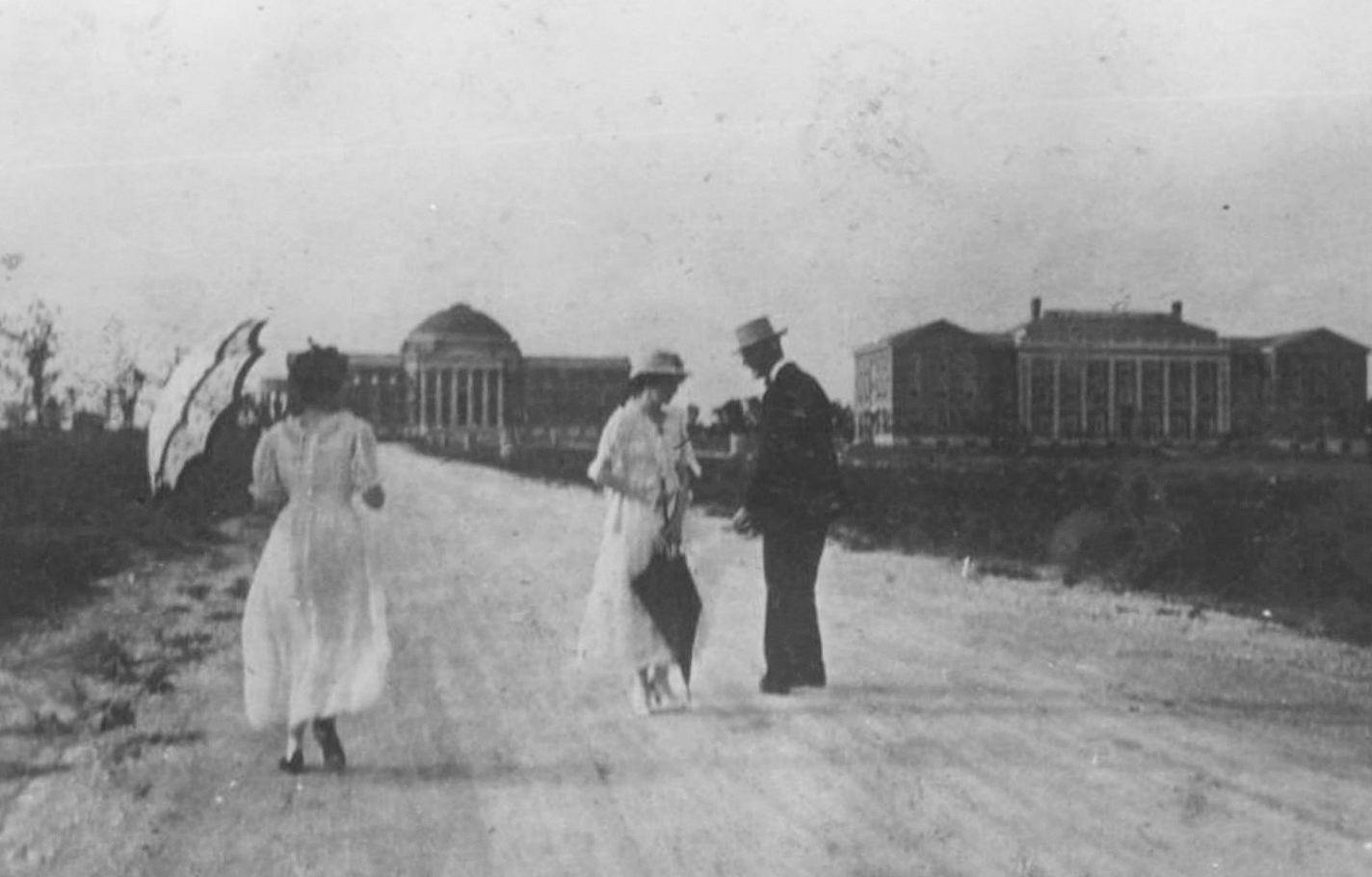
I love this photo showing a man and two women with parasols walking up an unpaved Bishop Blvd. toward Dallas Hall. The women’s dormitory, Atkins Hall, is on the right. …And that’s it.

***

Sources & Notes

Photo titled “Dallas Hall and women’s dormitory in 1917” is from the DeGolyer Library, Central University Libraries, Southern Methodist University; more information is here. (I have straightened the image, and corrected the color somewhat.)

*

Copyright © 2016 Paula Bosse. All Rights Reserved.

Tomorrow’s Weather at Live Oak & Elm — 1955-ish

weather-forecast_elm-live-oak_printed-feb-1956_ebayThe weather, brought to you by Coke…

by Paula Bosse

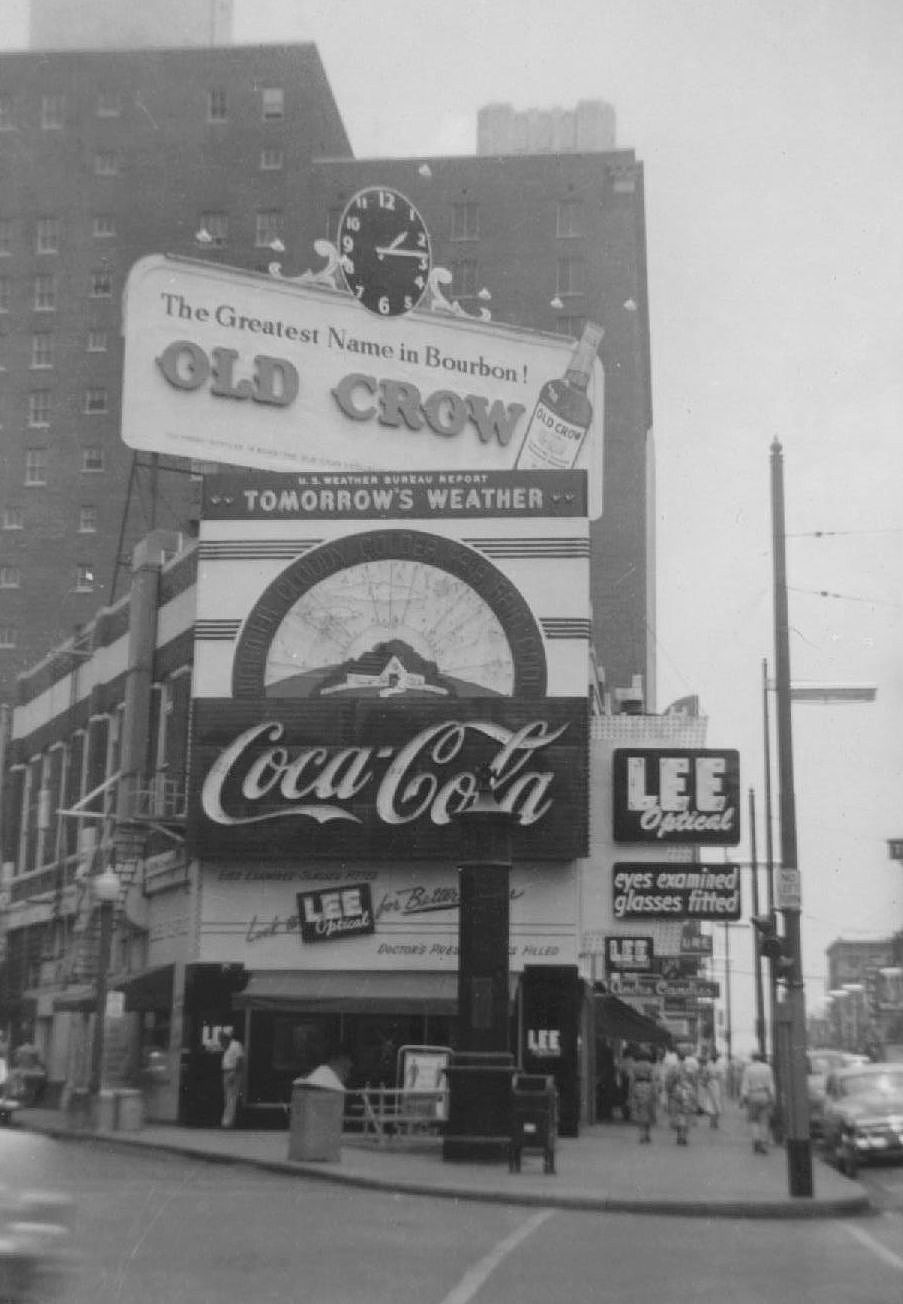
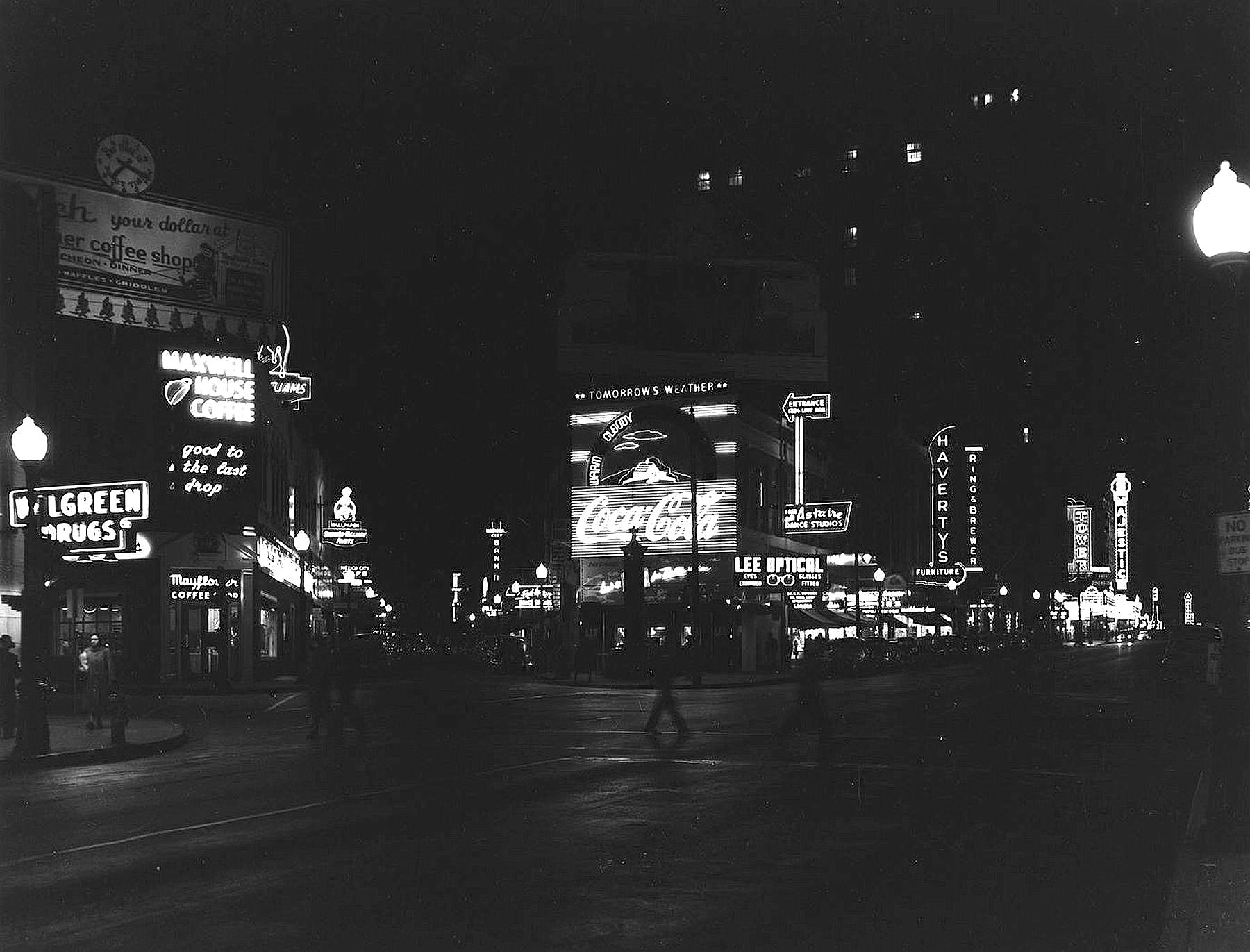
This photo (which is a little blurry, but the blurriness gives it a kind of dreamy softness) shows the one-time five-point intersection of Ervay, Live Oak (seen above at the left), and Elm (on the right, looking east). On the corner of this busy and confusing intersection, a large sign provided a public service by showing tomorrow’s weather forecast (…whilst subtly encouraging onlookers to hie themselves to the closest Coca-Cola-dispensary). During the day, the sign looked mildly interesting, but at NIGHT…! At night, this sign transformed downtown’s entertainment district into our very own mini Times Square. Here’s what it looked like at night (it’s a giant image — click it!).

ervay-live-oak-elm_haskins_uta_0107531953, Squire Haskins, UTA

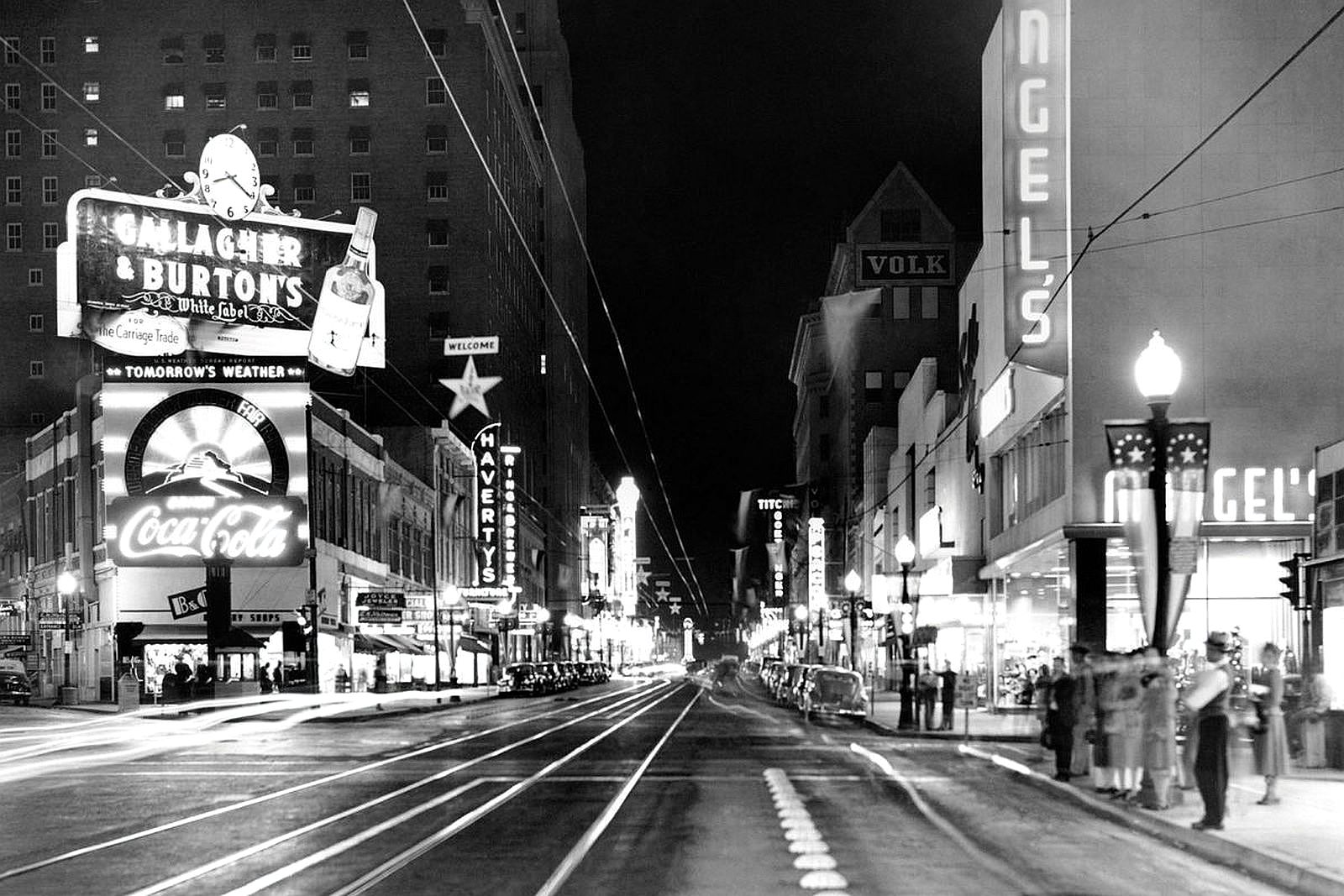
And here it is from another angle, about 1948:

elm-ervay-live-oak_weather-sign_ca-1948

And, hold on to yourself: from 1939, in color! (Screenshot of a 1939 film, shot in Dallas, in color. Watch the sign’s flashing, dancing neon in action on YouTube here.)

coca-cola-sign_downtown_1939-film_youtube_screenshot
1939

***

Sources & Notes

I found the top photo on eBay a few months ago. The amateur photo was stamped “Feb. 1956” when the photo was developed, but looking at the clothes people are wearing, one would assume it was taken earlier — probably the previous year.

The first nighttime photo is by Squire Haskins, taken in January, 1953. See my original post — “Ervay, Live Oak, and Elm: Just Another Wednesday Night — 1953” — here. This post includes a map showing Live Oak when it used to intersect with Elm and Ervay.

The second nighttime photo is ca. 1948, probably from the Dallas Public Library. See the notes in this post.

All pictures larger when clicked.

*

Copyright © 2016 Paula Bosse. All Rights Reserved.

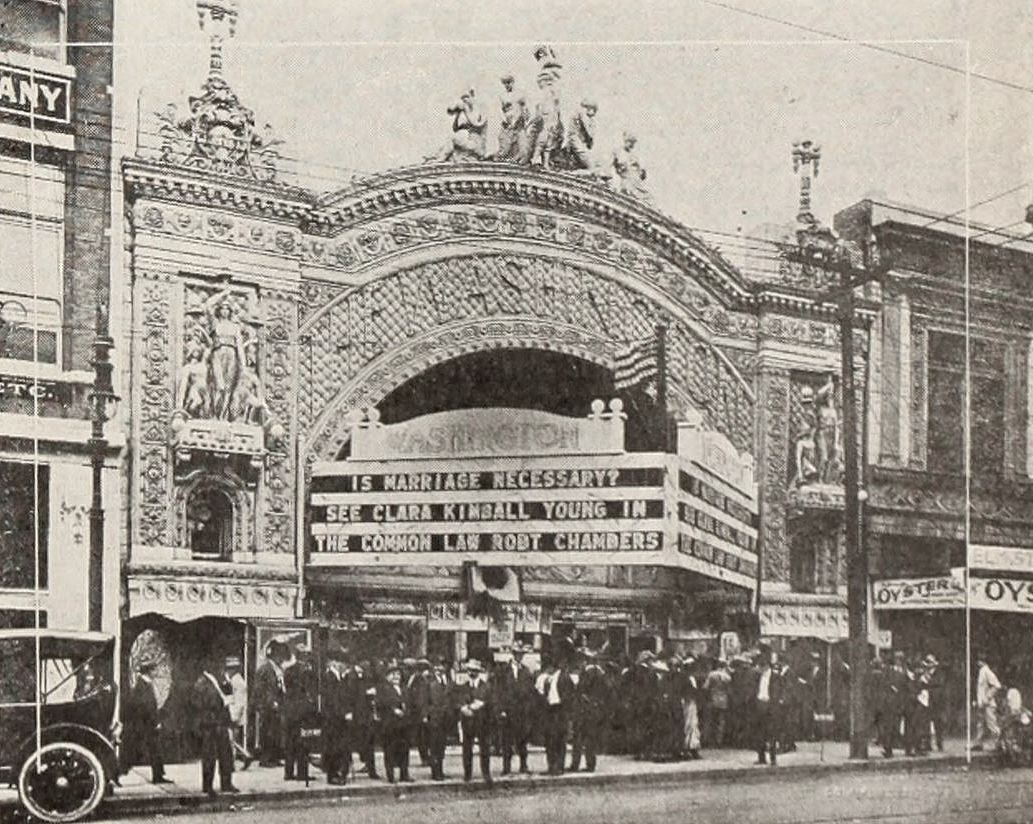
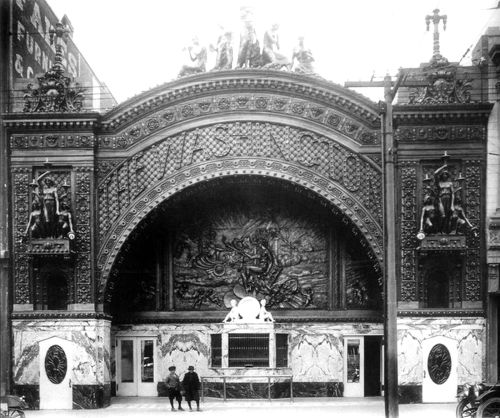
The Washington Theater — Dallas’ First Movie Palace

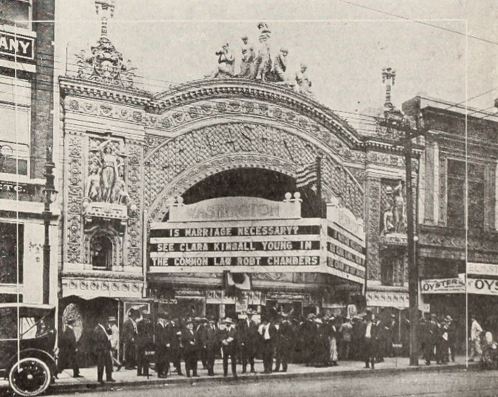
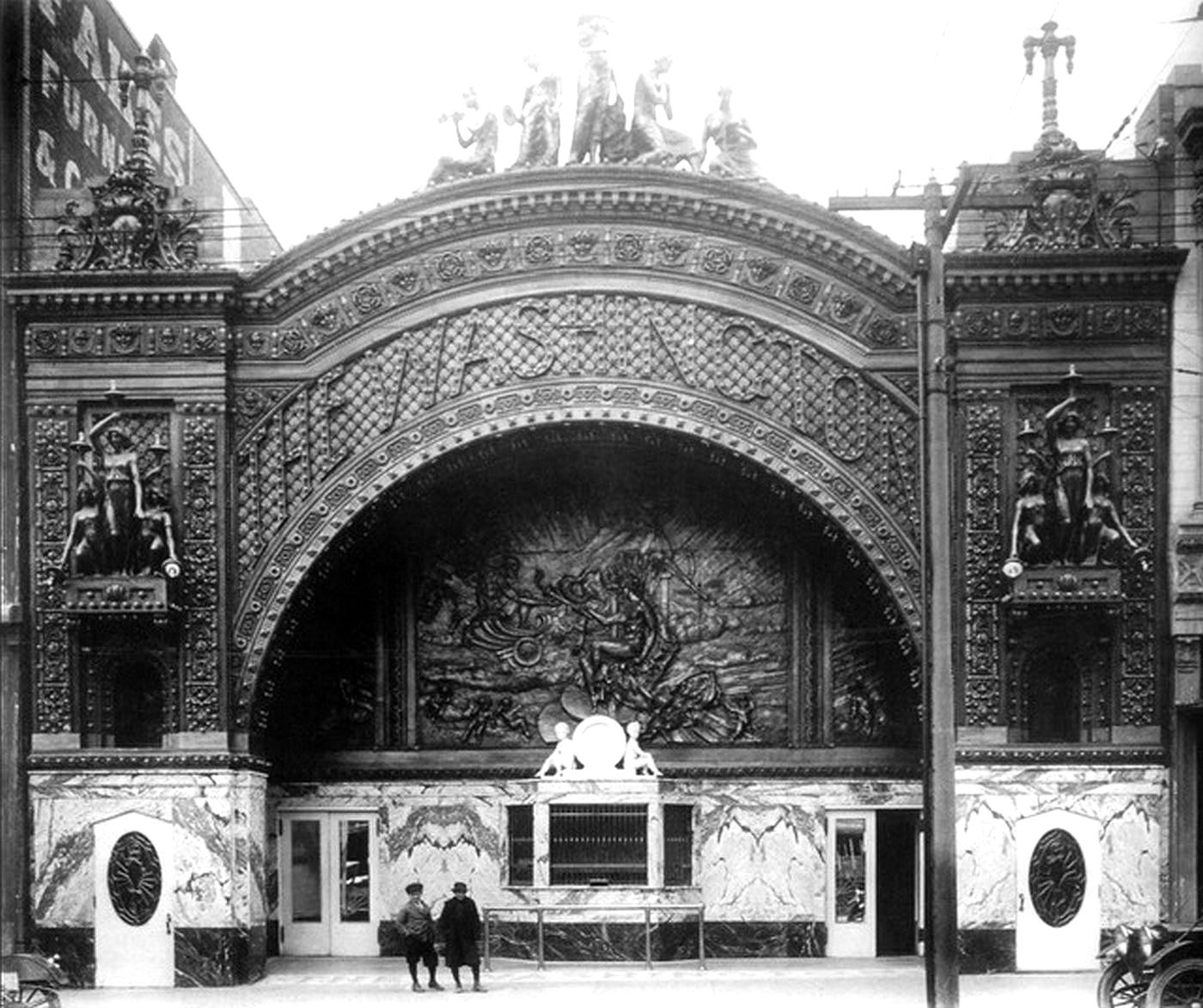
washington-theatre_cinema-treasures_lgThe Washington, 1615 Elm

by Paula Bosse

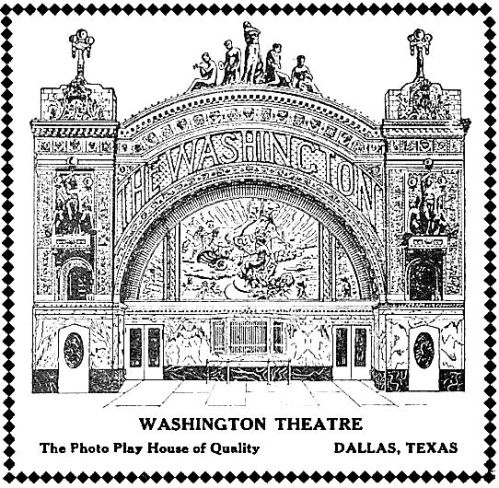
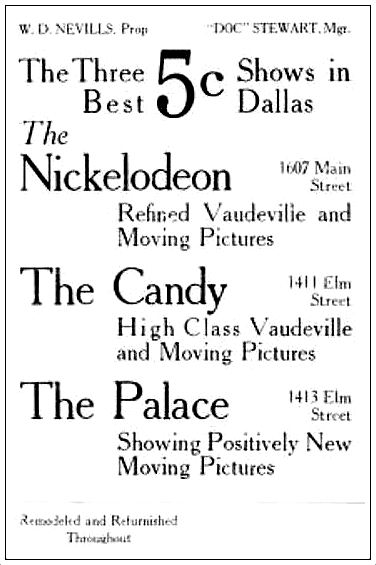
The outrageously ornate Washington Theater was built in 1912 by W. D. Nevills (1872-1945), a man who had been running cheap little store-front nickelodeons in Dallas for several years. Three of his most popular were The Nickelodeon, The Candy, and The Palace (not to be confused with any later theaters in Dallas called the “Palace”).
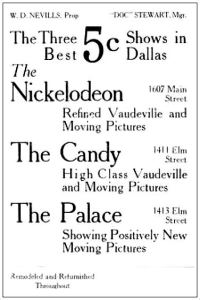
nevills_standard-blue-book-of-tx_1912-14Standard Blue Book of Texas, 1912-1914

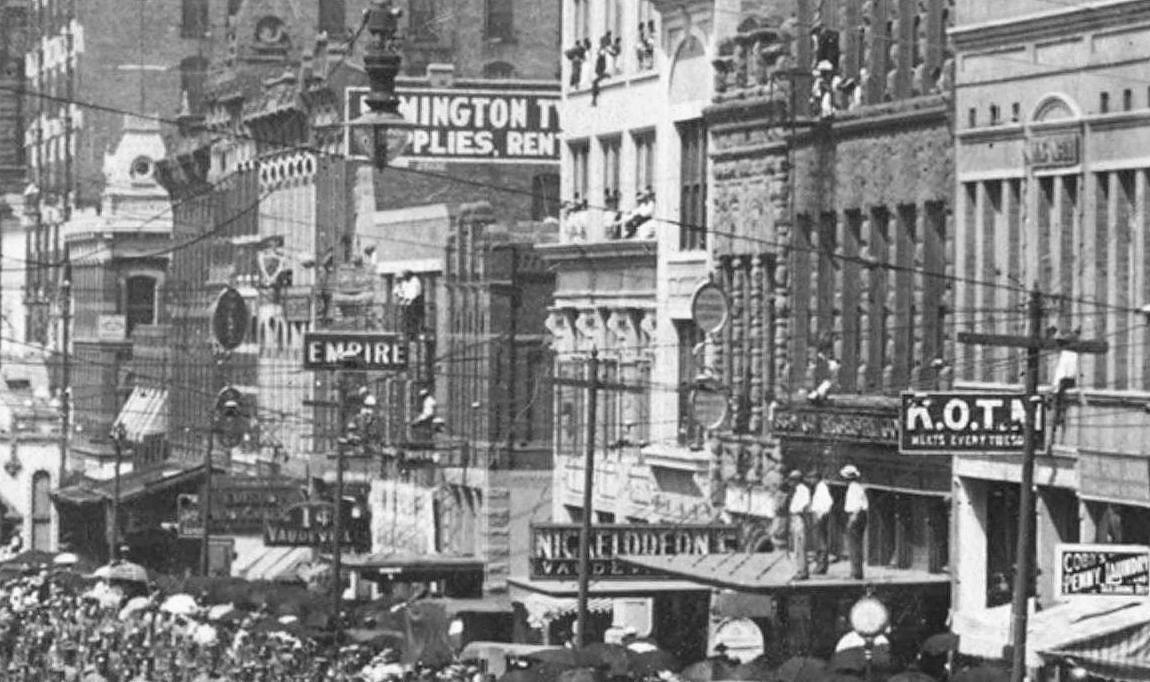
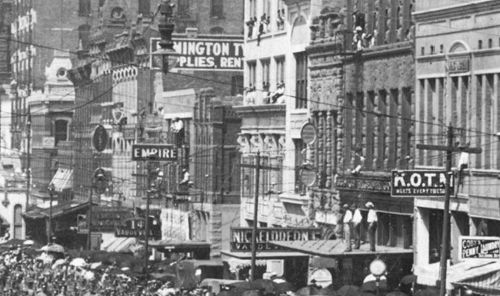
His Nickelodeon on Main Street can be seen in the lower center of this detail from a larger 1909 parade photo.
parade-day_1909_det41

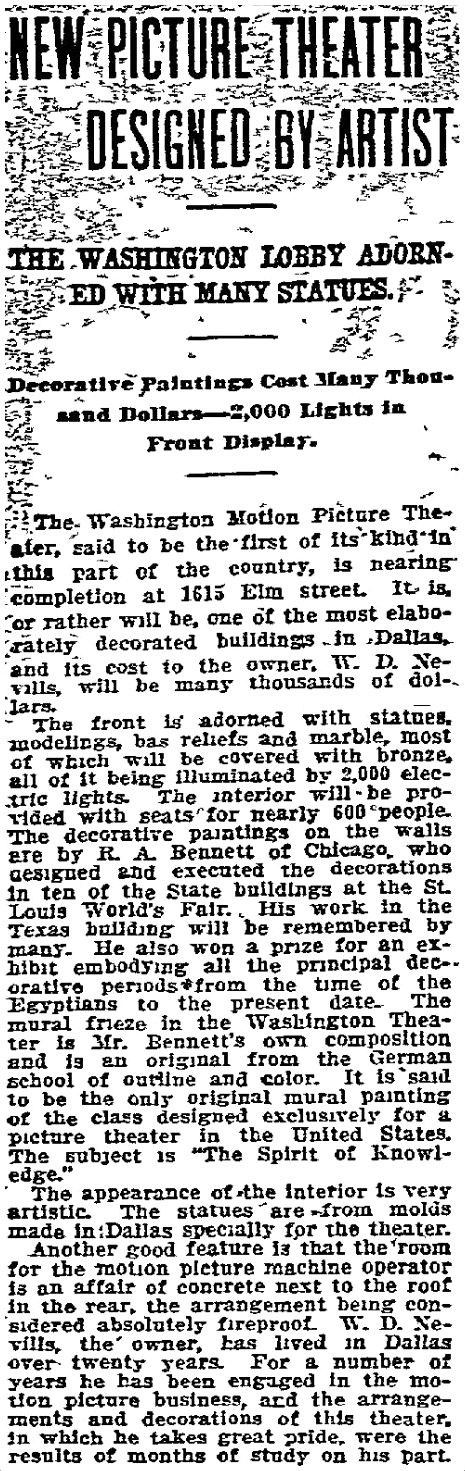
Nevills must have raked in a lot of nickels, because when his Washington Theater opened at 1615 Elm Street, it was the most spectacular motion picture “photoplay house” in Dallas. Nevills spared no expense for the theater’s furnishings and facade.
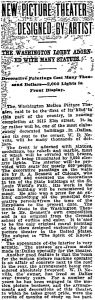
washington-theater_dmn_111712Dallas Morning News, Nov. 17, 1912 (click to read)

What might seem a little gaudy now, was probably still gaudy back then, but it was a fresh, NEW gaudy! And 600 Dallasites could all watch a movie at the same time. 600! Unheard of!

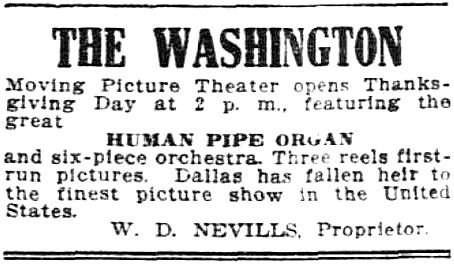
The Washington opened on Thanksgiving Day, 1912. Complete with “Human Pipe Organ.”
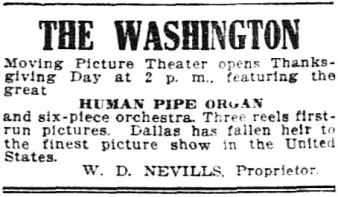
washington-theater_dmn_112712DMN, Nov. 27, 1912

The Washington was the king of the roost for only a short while, though — until young whippersnappers like the Queen began to steal its thunder. 600 seats? Pfft! It was a thousand or nothing now. The theater began to lose its luster and look more old and hulking than young and exciting, and after riding out its very long lease, the Washington Theater closed on July 1, 1927.

This little classified showed up a couple of weeks later, and it must have been a melancholy Nevills who had to write it up.
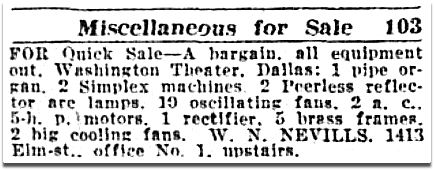
washington-theater_dmn_071327DMN, July 13, 1927

The theater continued to be used for a while — mostly for evangelical meetings or events. I’m not sure exactly when the building was demolished, but a report of the building’s being sold and plans for its razing appeared in The Dallas Morning News in October, 1927.

*

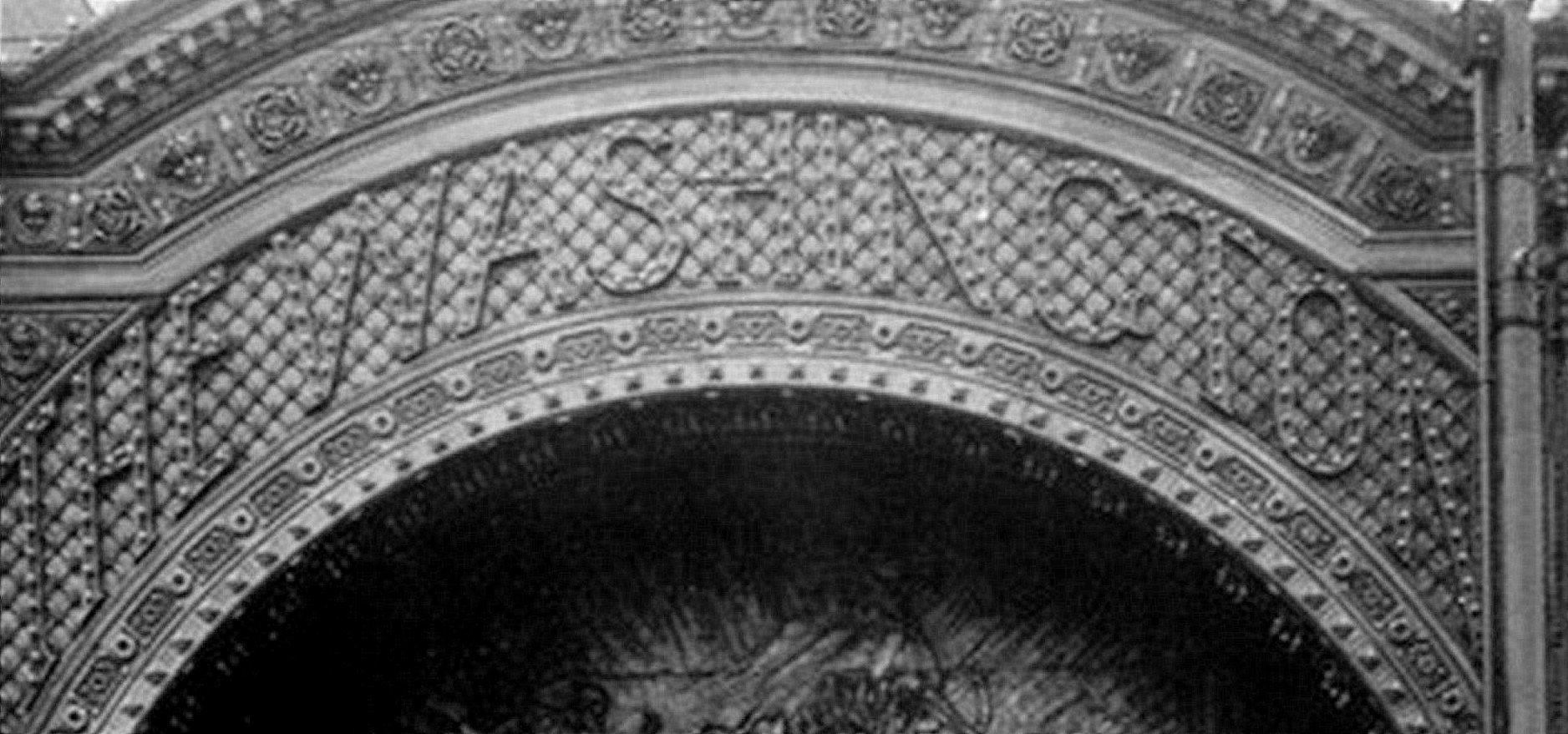
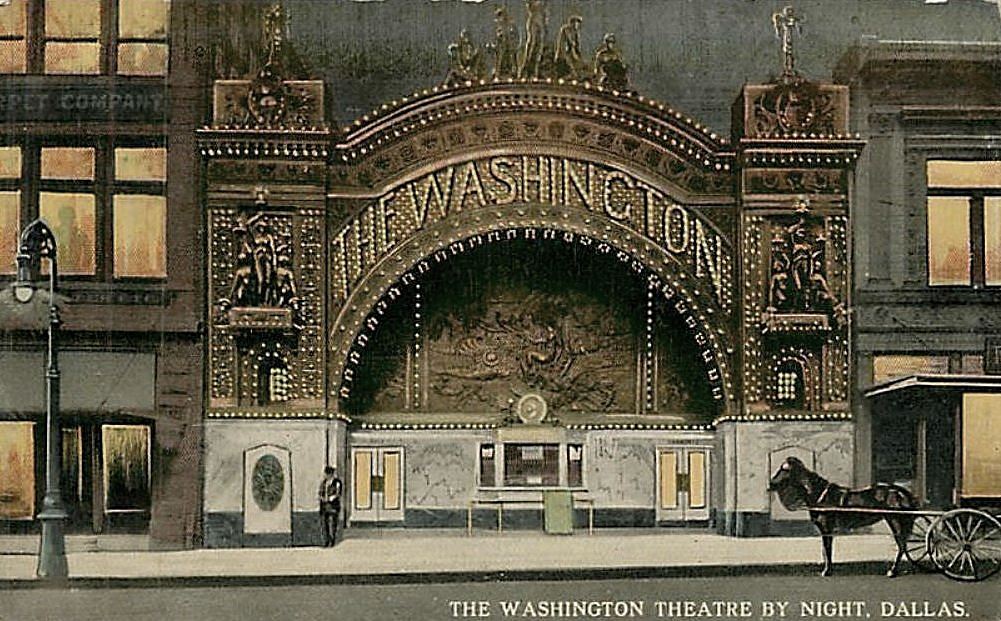
Let’s look at a couple of details from that top photo. The Washington was built without a marquee, but the outside of the building was studded with an eyeball-popping TWO THOUSAND LIGHTS! Imagine what that must have looked like — in 1912! Here’s an extreme close-up of the theater’s facade — look at all those bulbs!
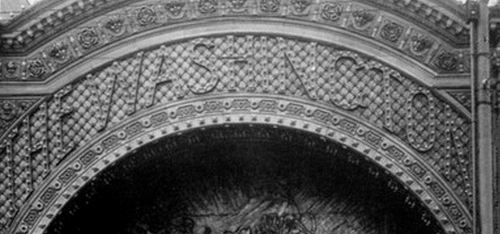
washington-theatre_cinema-treasures_det1

And, below (was one of these men W. D. Nevills?):
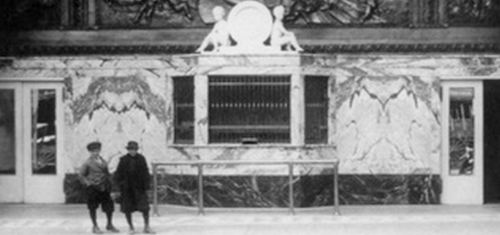
washington-theatre_cinema-treasures_det2

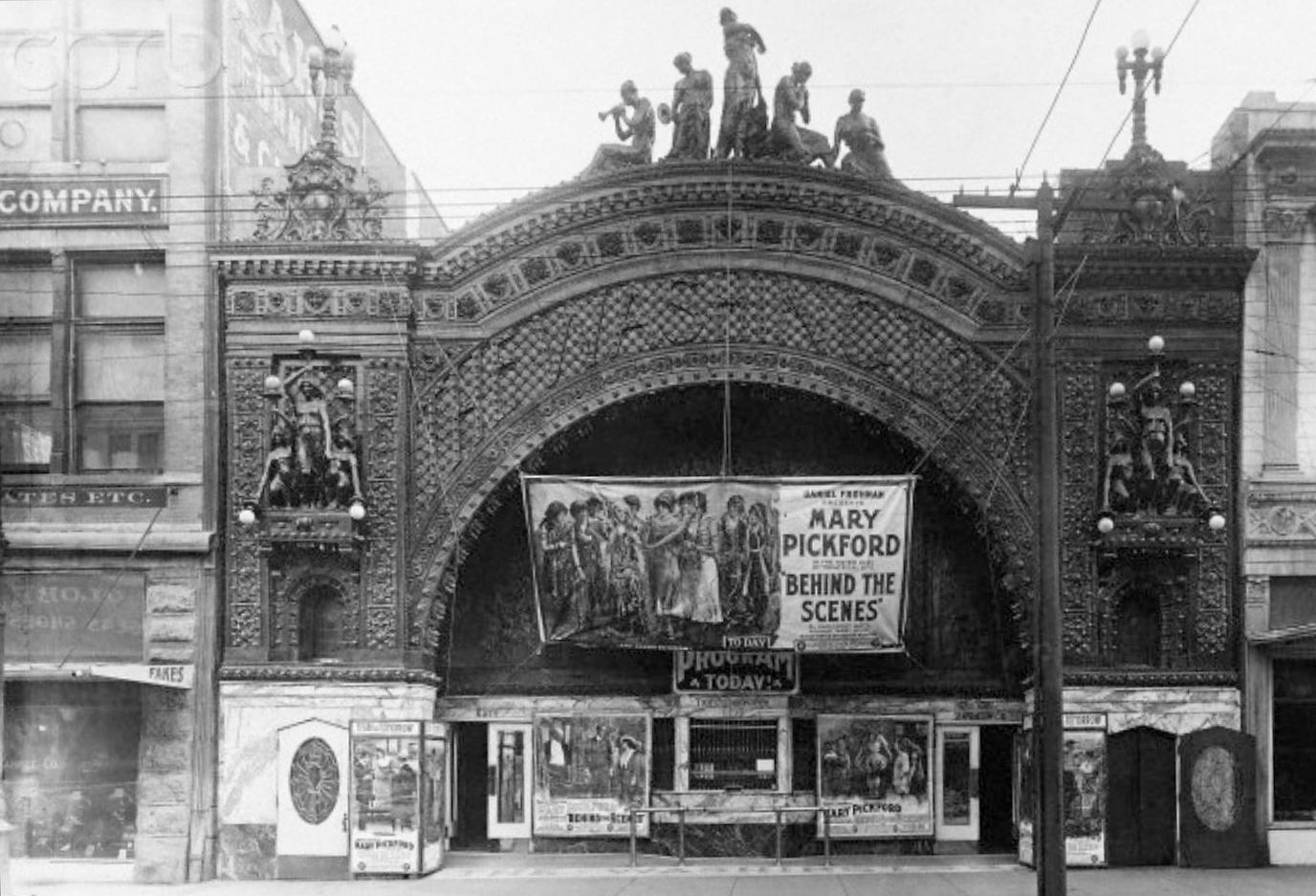
Another shot, this one showing how one worked without a typical illuminated marquee — you just string a banner up (the needle is hitting a solid “8.5” on the visual clutter scale here):
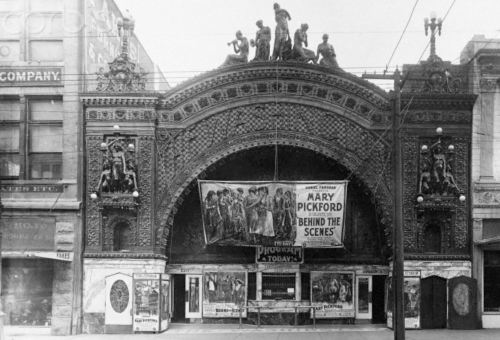
washington-theatre_corbis_19141914 via CorbisImages

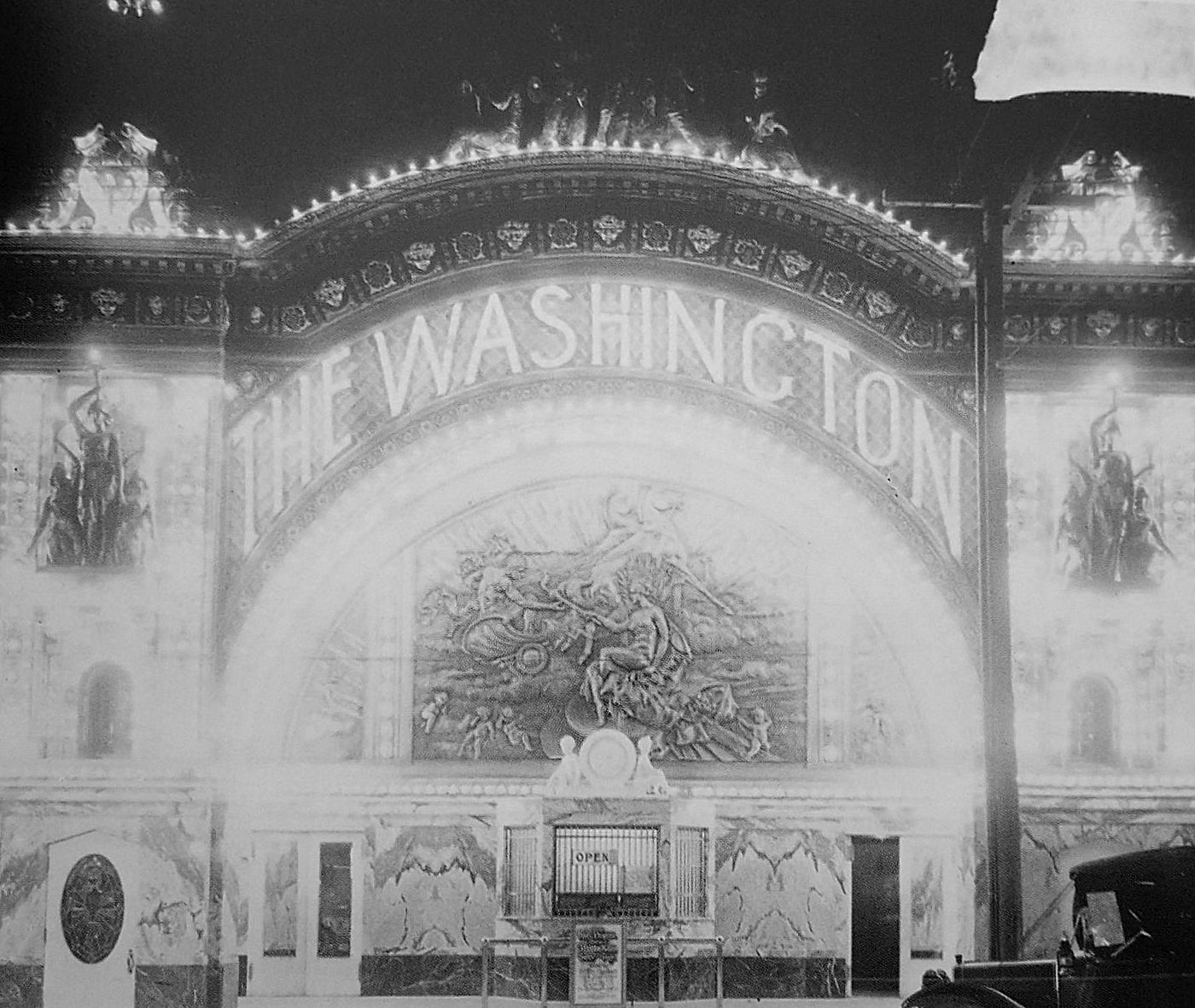
Here it is, ablaze at night:
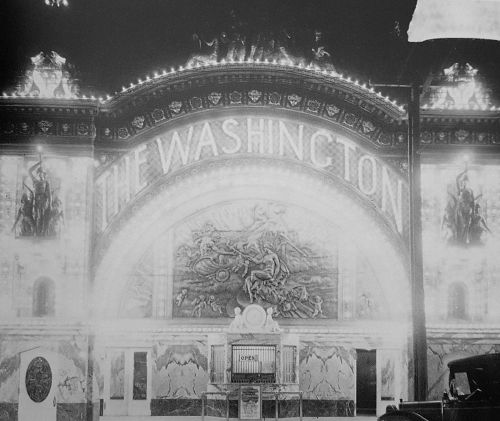
washington-theater_night_dallas-rediscovered_DHS

In an ad from 1914:

theater_washington_bldg-code_1914

Photo from October 1916:

theaters_washington-theatre_exhibitors-herald-and-motography_june-1919_photo-from-oct-1916

And in “color” from a picture postcard:
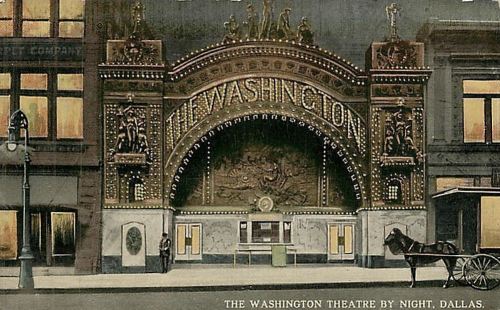
washington-theatre_ebay

***

Sources & Notes

Top photo from Cinema Treasures; to read a history of the Washington Theater from Cinema Treasures (and to see another photo), see here. (Photo’s original source appears to be the Dallas Historical Society.)

The photo of the theater with the Mary Pickford banner is ©Schenectady Museum; Hall of Electrical History Foundation/CORBIS; more info is here. (The movie “Behind the Scenes” was released in 1914.)

Photo of the theater at night is from Dallas Rediscovered by William L. McDonald — source: Dallas Historical Society archives.

The ad is from the 1914 Dallas Building Code.

Photo with the marquee showing “The Common Law” is from Oct. 1916, but the photo didn’t appear in the trade magazine Theatre Exhibitors Herald and Motography until June 1919.

The color postcard is from eBay.

Read about the closing of the Washington in an article available in the Dallas Morning News archives: “Washington Theater, Earliest Dallas ‘Movie Palace,’ Shows Last Close-Up After 15 Years” (DMN, July 4, 1927).

The Washington Theater must have been W. D. Nevills greatest achievement. It’s interesting to note that “Operator Washington Theater” appears on his death certificate. Nevills died in 1945, eighteen years after the theater closed.
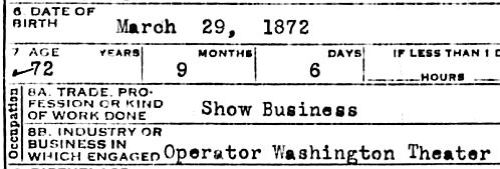
nevills_death-certificate_010545_det

For other Flashback Dallas posts on this era of movie theaters, see the following:

  • “Three of Dallas’ Earliest ‘Photoplay Houses’ — 1906-1913,” here
  • “Movie Houses Serving Black Dallas — 1919-1922,” here

*

Copyright © 2016 Paula Bosse. All Rights Reserved.

A Bird’s-Eye View Over the Washington Theater

washington-theater_aerial_dmn_lost-dallas_dotyAs the crow flies…

by Paula Bosse

This wonderful photo shows an aerial view looking northeasterly over the top of the Washington Theater, Dallas’ first ornate movie palace. It was located between N. Akard and N. Ervay, at 1615 Elm Street — now the site of Thanksgiving Tower. I think the street at the top right edge of the photo is Live Oak, which used to come all the way through to Elm. I love this photo.

***

Sources & Notes

Photo from Lost Dallas by Mark Doty (Charleston: Arcadia Publishing, 2012).

Bird’s-eye view today-ish (with 1615 Elm marked):

1615-elm-street_bingBing Maps

The Washington Theater was in business at 1615 Elm from 1912 to 1927. More on the Washington in the Flashback Dallas post “The Washington Theater — Dallas’ First Movie Palace,” here.

*

Copyright © 2016 Paula Bosse. All Rights Reserved.
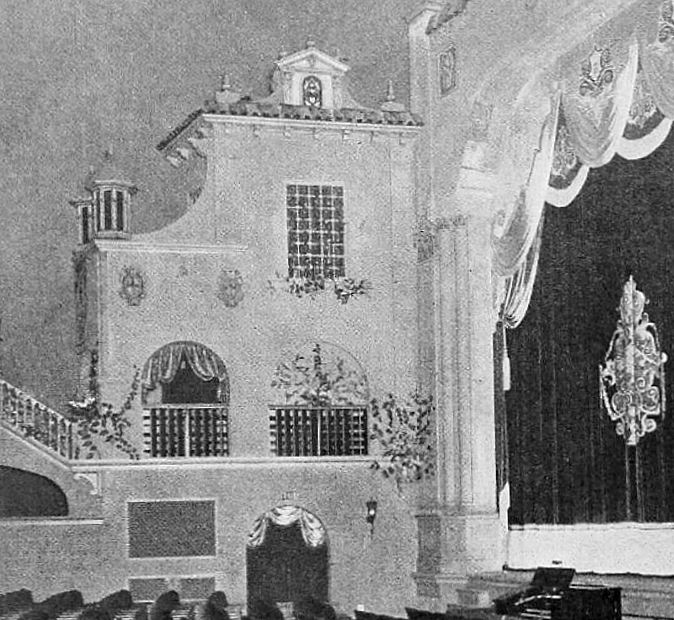
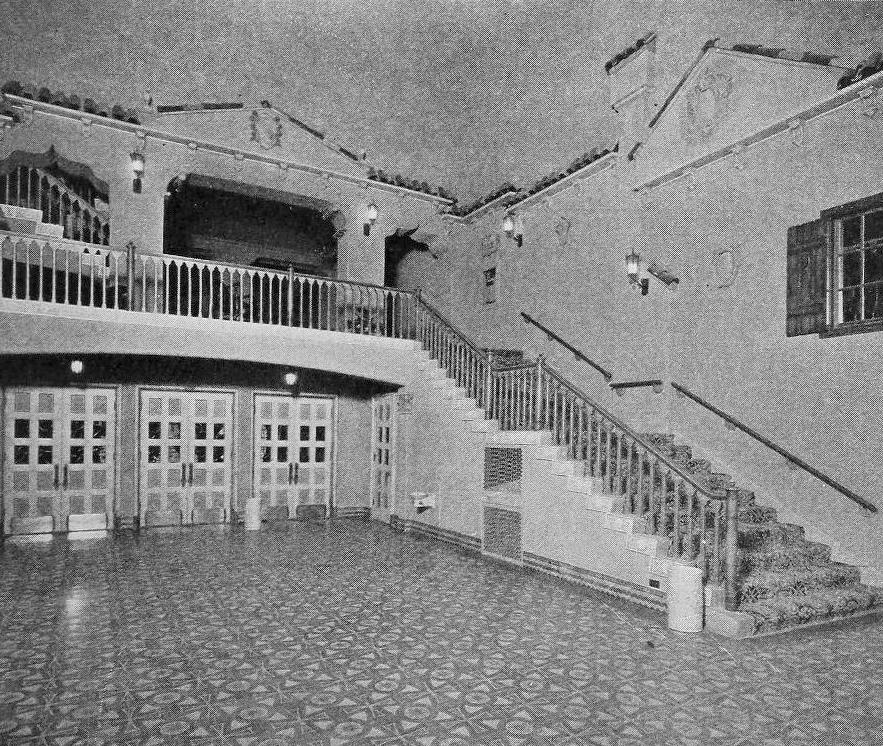
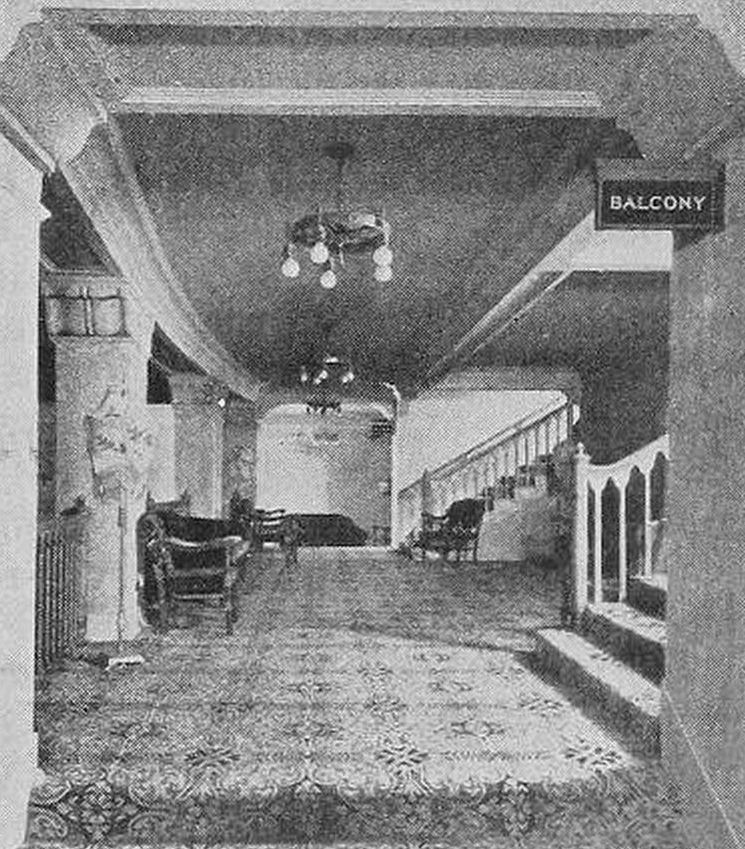
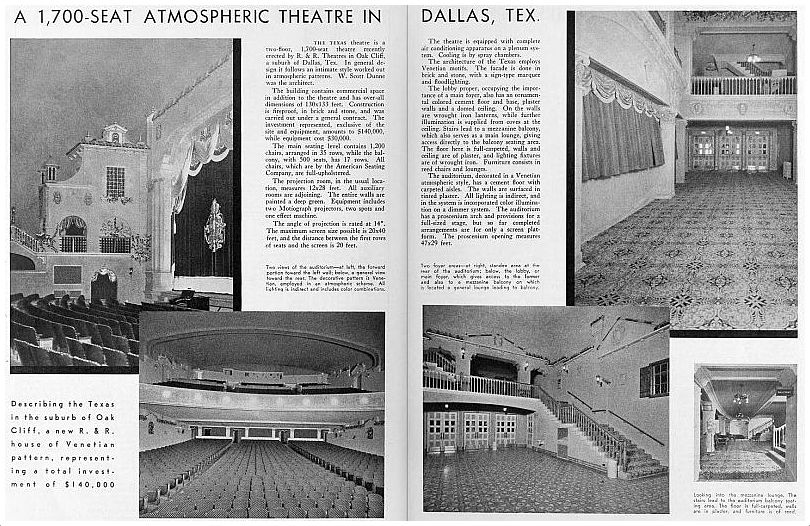
The Texas Theatre and Its Venetian-Inspired Decor

texas-theatre_motion-picture-herald_070232_det1A little bit of Venice in the O.C. (note organ at edge of stage)

by Paula Bosse

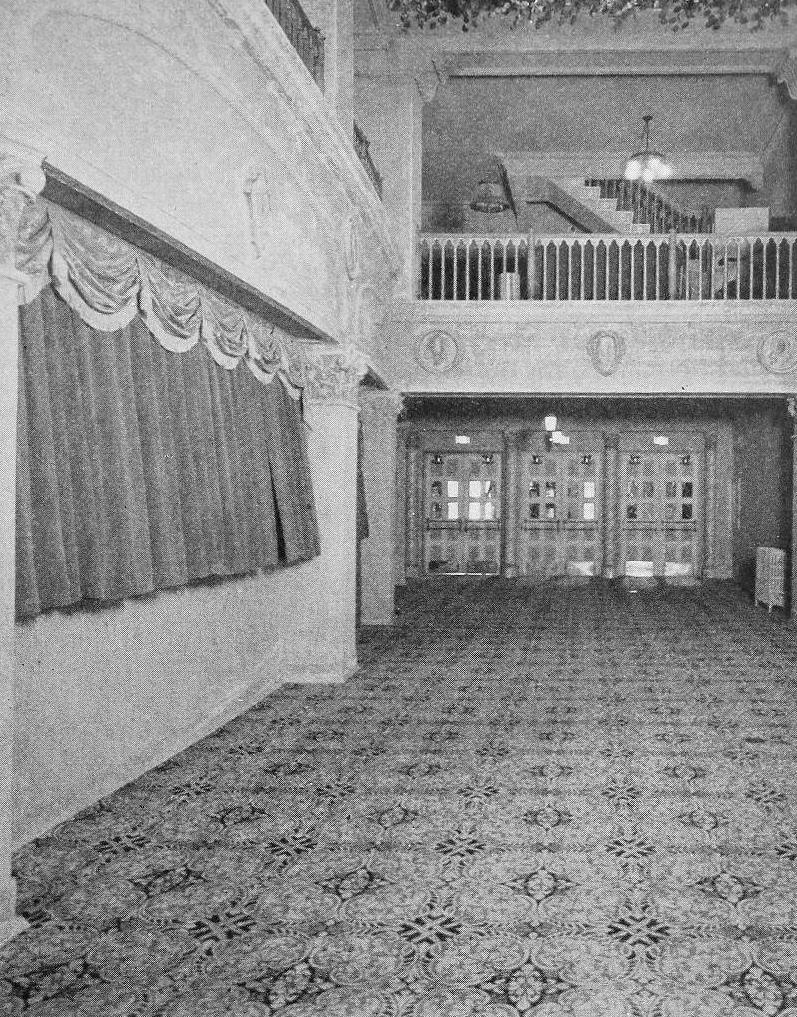
The Texas Theatre in Oak Cliff  — which opened in April, 1931 — was the first movie theater in Dallas built expressly to show movies with sound. It was also the largest “suburban” theater in the Dallas area — only downtown’s first-run Majestic and Palace theaters were larger. Below are photos of the theater’s “Venetian-style” interior, from the trade journal Motion Picture Herald.

texas-theatre_motion-picture-herald_070232_det2

texas-theatre_motion-picture-herald_070232_det3

texas-theatre_motion-picture-herald_070232_det4

texas-theatre_motion-picture-herald_070232_det5

***

Sources & Notes

Photos from Motion Picture Herald, July 2, 1932. For the full article, see the very large scan of page 1 here, and page 2 here.

texas-theatre_motion-picture-herald_070232

The Texas Theatre is still alive — its website’s history page is here.

My previous post, “The Texas Theatre — 1932” (which shows the theater’s exterior at the time this article was published), is here.

*

Copyright © 2016 Paula Bosse. All Rights Reserved.