Flashback : Dallas

A Miscellany: History, Ads, Pop Culture

Category: Neighborhoods

The San Jacinto School — Frittering Away the Gay Nineties, Stuck in a Classroom

san-jacinto-school_1893_shorpy1893 class photo, Ross Avenue

by Paula Bosse

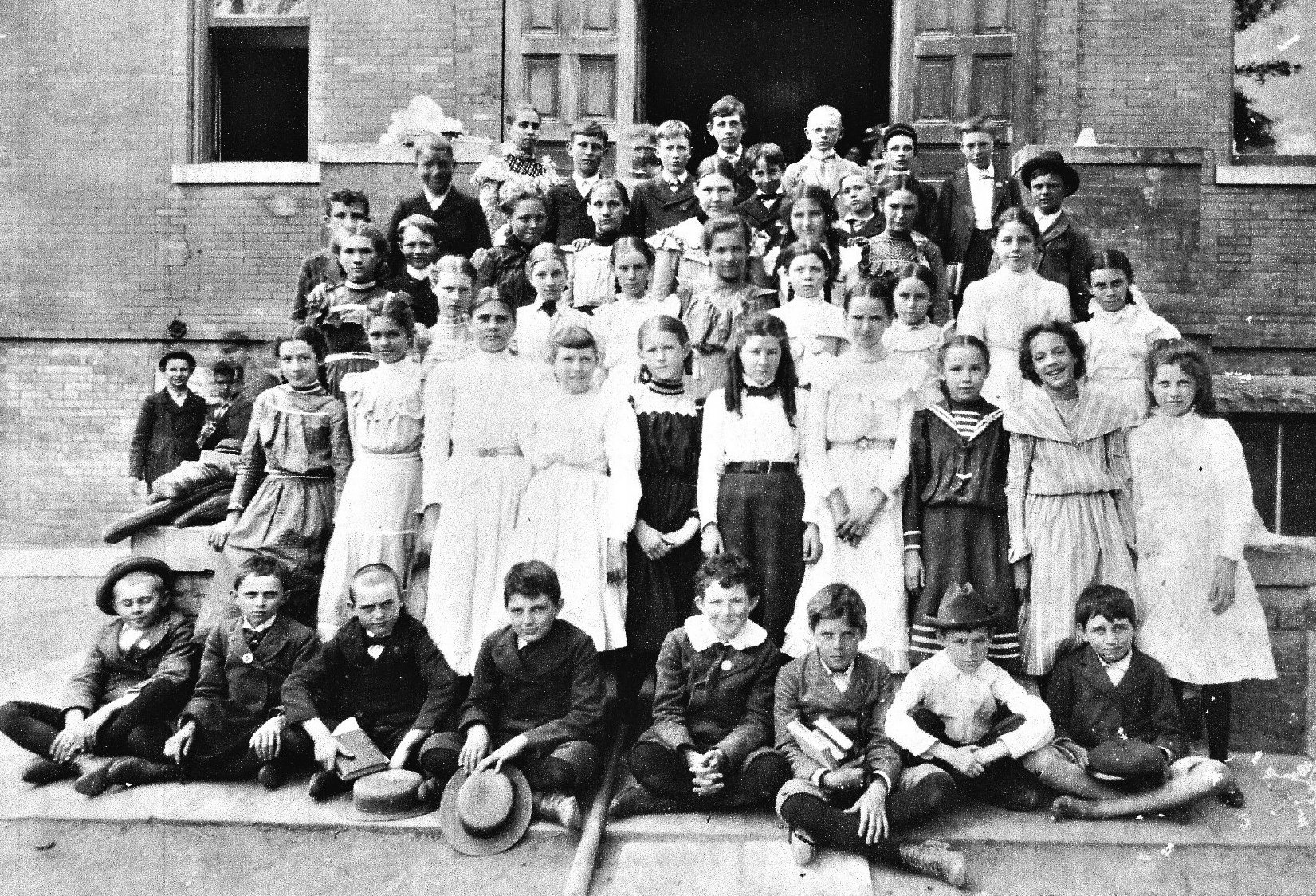
Above, fourth graders lined up in 1893 on the steps of the San Jacinto School, once located at Ross and Washington (now the site of the DISD Administration Building). All seem fairly glum. (At least they’re not toiling in factories like many other children of this period.)

Below, the sixth-grade class of 1899 seems slightly less bummed-out, perhaps because they’re on the brink of the much-anticipated 20th century. Those boys (and sadly probably only the boys) might well have been among the city’s business and political leaders during Dallas’ most explosive period of growth just a few short years later.

san-jacinto-school_6th-grade_1899-1900

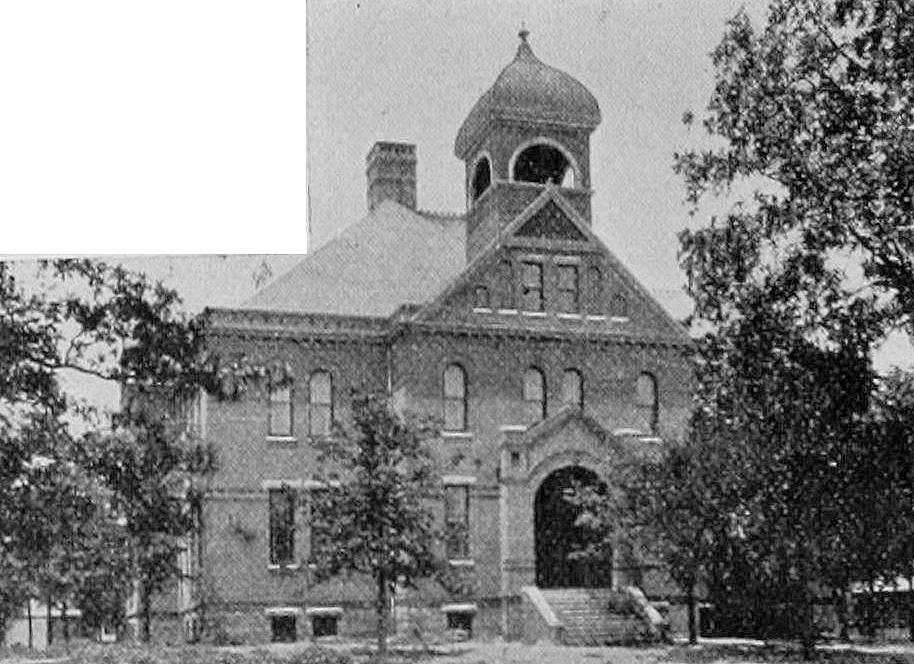
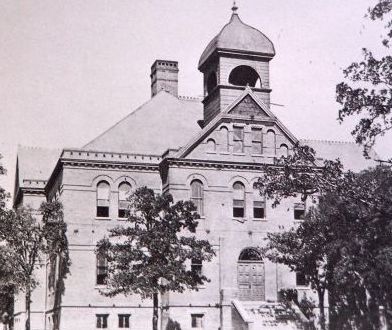
The San Jacinto School was designed by James E. Flanders and built in 1891 on two acres at the corner of Ross Avenue and Washington. It was demolished in 1948 to make way for the somewhat more severe (and perhaps a bit more interesting) DISD Administration Building.

san-jacinto-school_tx-and-pac-rr_1898

san-jacinto-school_dhs

***

Sources & Notes

Top photo is from the wonderful historical photo blog Shorpy, and can be found here.

First photo of the school building is from Texas: Along the Line of the Texas & Pacific Ry. (Dallas: Texas & Pacific Railway, n.d. [1898]).

Last photo is from a website devoted to “Dallas’ First Architect,” James Edward Flanders.

*

Copyright © 2014 Paula Bosse. All Rights Reserved.

The Republic National Bank Building: Miles of Aluminum, Gold Leaf, and a Rocket

republic-national-bank_beacon_front

by Paula Bosse

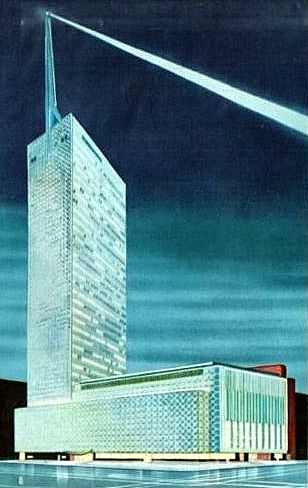
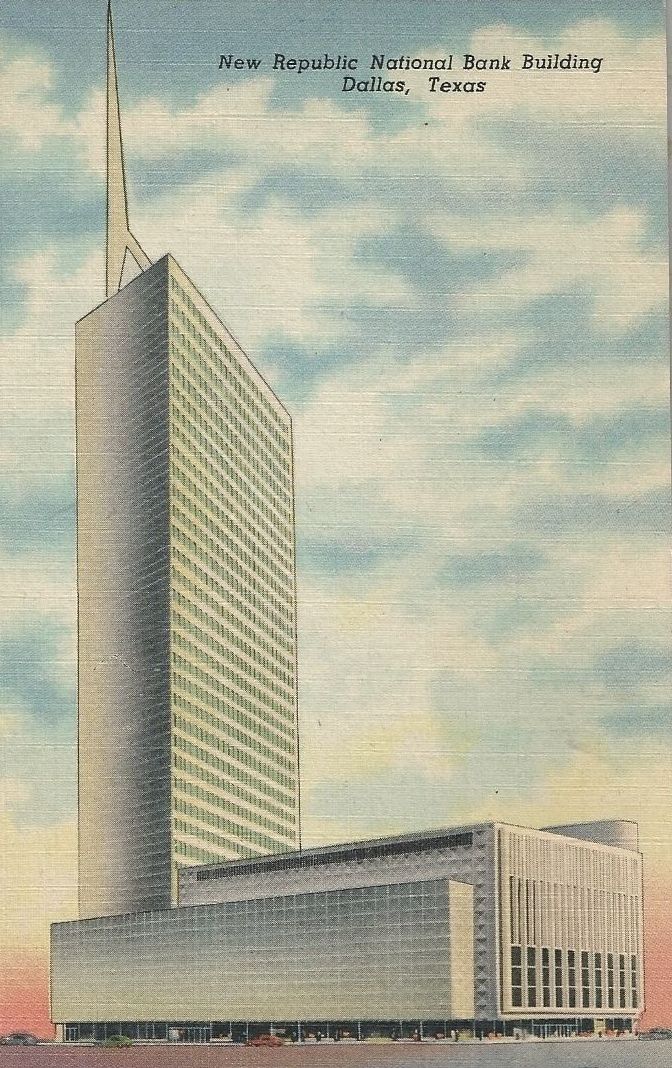
THIS is another great idealized image of a great building, The Republic National Bank Building, built in 1954. The blurb on the back of this postcard reads:

40 stories, cost 25 million dollars, the world’s tallest building faced in aluminum and glass.The mighty half-billion candle-power beacon atop the 150-foot spire is visible up to 120 miles.

This building was built to be the tallest building in Dallas — to dwarf the rival Mercantile (by a whole 53 feet!). Which it did for a while — it boasted of being the tallest building west of the Mississippi. Until … the Southland Life building came along a few short years later and knocked it off its pedestal (although, dammit, it was the “WORLD’S TALLEST BUILDING FACED IN ALUMINUM AND GLASS”!). For years, the powers-that-be seemed overly concerned with the “tallest” building thing and engaged in architectural pissing contests for years.

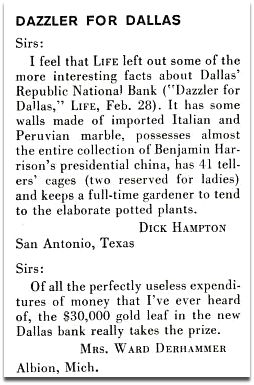
But forget the exterior. INSIDE. Lordy. Legendary bank president Fred Florence went all out, with Life magazine saying the lavish interior reflected Florence’s belief that a bank’s design and appointments should be “an outward showing of solvency.” This included generous helpings of gold leaf, inlaid teak, and endless marble imported from Italy and Peru (“nearly as long as a football field”). One wonders if Florence muttered something about “Rosebud” on his deathbed. Of its forty-one teller’s cages, two were — for some reason — reserved exclusively for women. There was a full-time gardener on staff. And, of course, there were “gold curtains in the executive washrooms.” There was “all-season air-conditioning.” There was a motor bank in the basement. And, if they couldn’t have the tallest building in town, they were damn sure going to have the fastest elevators in the elevator-using world. And they did.

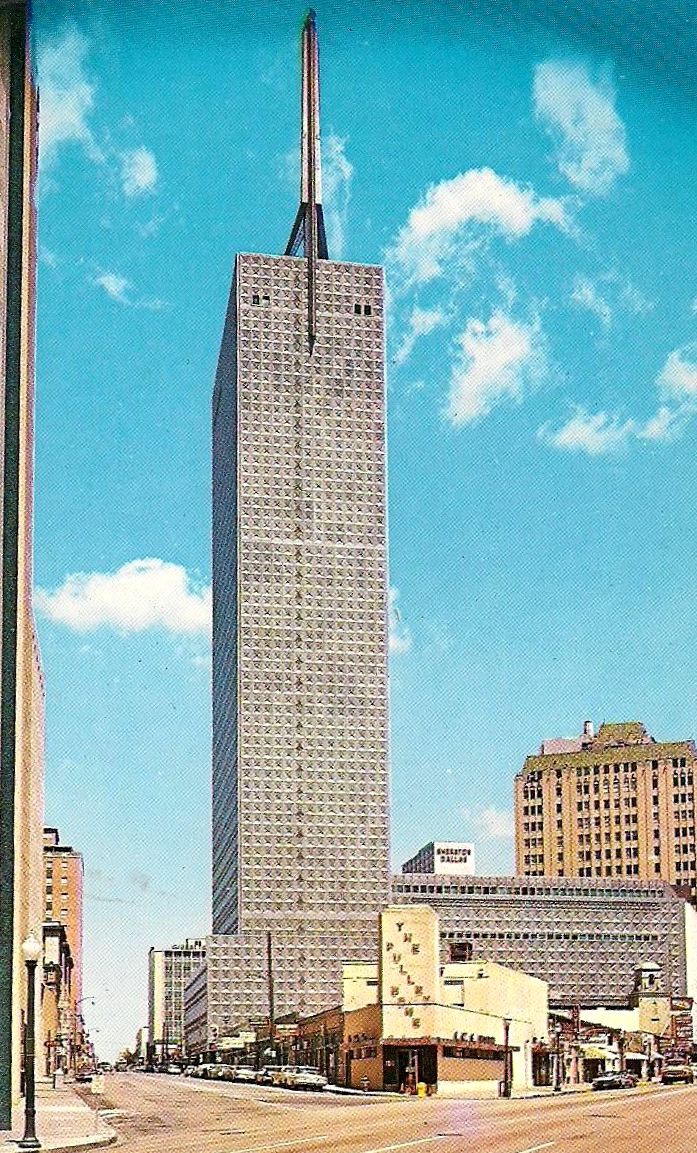
And then there was that rocket. I love that rocket. Sixty years later, it’s still one of the most recognizable buildings on the skyline.

republic-national-bank_S

republic-national-bank_postcard-sm

The missed-by-my-mother’s-generation Pulley Bone diner is in the foreground (click for larger image).

republic-national-bank_photo-post-sm

***

An absolutely fantastic collection of photographs apparently shot by Life magazine to accompany the article from their Feb. 28, 1955 article (linked below) but not used (and, seriously, check them out) are on an unassuming message board. Scroll down a little ways and you’ll see 13 large images of the interior and exterior — see them here. (UPDATE: These photos seem to have disappeared. I’ll keep the link in hopes that user “Dallas boi” will repost!)

Scroll through the 4-page spread “Dazzler for Dallas: Its New Bank is Huge, Handsome and Full of Gold” in Life magazine (Feb. 28, 1955) here.

And here are a couple of readers’ responses to the story, which appeared in a later issue (Mrs. Ward Derhammer is not amused):

republic-national-bank_life_032155

Republic National Bank Building info from the Republic Center website can be found here, from Wikipedia here, and from the Dallas Public Library here.

All postcard images (except the first one) are larger when clicked.

*

Copyright © 2014 Paula Bosse. All Rights Reserved.

One of the Earliest Homes Belonging to Original La Reunion Settlers Is Razed — 1925

frichon_house-dmn_030525aBryan & Harwood

by Paula Bosse

ONE OF EARLIEST DALLAS HOMES WILL BE RAZED TO MAKE WAY FOR NEW HOME OF KNIGHTS OF PYTHIAS
(Dallas Morning News, March 5, 1925)

An ancient Dallas landmark that obviously is entitled to the name, a modest little plaster cottage that serves as the sole surviving relic of the old French colony that figured in the early history of Dallas, is to be torn away in a few weeks to make room for a new home of the Knights of Pythias. The house now is numbered 2012 on Bryan street, near the corner of Harwood, but when it was built in 1874 by A. Frichot there was no need of street numbers to distinguish it from its neighbors. “About a mile and a half east of the courthouse” was the official designation of the house in those post-bellum days.

John Priot on May 4, 1874, sold the lot for $200 to A. Frichot and described it in the deed as beginning at “the west corner of a piece of land sold on Dec. 8, 1860, by P. P. Frichot to Mrs. Barbar[a] Frick, being a part of the original John Grigsby League.” This deed was recorded by A. Harwood, then County Clerk. There is a legend that the two Frichot brothers built homes near each other of the same type, one of which was torn down years ago to make room for a brick building on the southwest corner of Harwood and Bryan streets. The other is the modest dwelling that is to be razed to make room for the new Pythian building.

In 1876, after the house was built, A. Frichot deeded it to Mary L Frichot, his daughter, in consideration of the sum of $1,000, the records show. The next change made in the ownership of the place, according to the records, was in 1908 when deeds were signed conveying the property from “Mary L. J. Prine and J. A. Prine” to Colonel John M. McCoy for the sum of $4,600.

The Knights of Pythias bought the property from the estate of Colonel McCoy recently. This deal was made for the estate by Judge Wendel Spence, executor for the McCoy estate. For the last seventeen years the house has been occupied by Mrs. Pearl Miller as a residence.

A week or two ago a Dallas woman approached the agent of the Knights of Pythias with an offer to lease the place and transform it into an antique tea room. The offer was refused, as the building must come down shortly to make way for the new structure.

**

THE STORY OF OLD FRENCHTOWN (excerpt)
(Dallas Morning News, Nov. 23, 1919)

Jean Priot was a tailor. He was born in Nevers, Oct. 26, 1832, came to La Reunion in 1855, died in Dallas in 1908. He came to New Orleans with a tailor who held out false inducements, and from New Orleans joined this colony. M. Priot married Leontine Frichot, who came with her father, Philip Pierre Frichot, and his brother, Christophe Desire Frichot. From this union were born three daughters – now Mesdames, Beilharz and Petermann.

Philip Frichot was a contractor, and, upon disintegration of the colony, established a brickyard, from which he, with his son Achilles and M. Emil Remond built all the brick houses and concrete structures of that day in Dallas.

***

Sources & Notes

As cited in the articles above, the Frichot family was one of the original settlers of the French La Reunion utopian colony of Dallas in 1855, and the land — and later the house — stayed in the family from before 1860 until 1908, when the property was sold to John M. McCoy (who was, perhaps, appropriately, the son of one of the very first settlers of Dallas who arrived in the 1840s). Info about La Reunion is here and here.

The Knights of Pythias building referenced above is not to be confused with the substantially more “famous” one — the then-already standing and now-historic structure in Deep Ellum at 2551 Elm Street — less than a half a mile away. The building going in at Bryan and Harwood was, for want of more delicate language, the “white” one, and the one on Elm Street was the “black” one. Both were fraternal organizations dedicated to philanthropy and civic involvement, but apparently “fraternity” went only so far as race was concerned.

More Flashback Dallas posts on La Reunion can be found here.

Click photo for larger image.

*

Copyright © 2014 Paula Bosse. All Rights Reserved.

Back When Preston Royal Was “Exotic” and Had Its Very Own Elephant

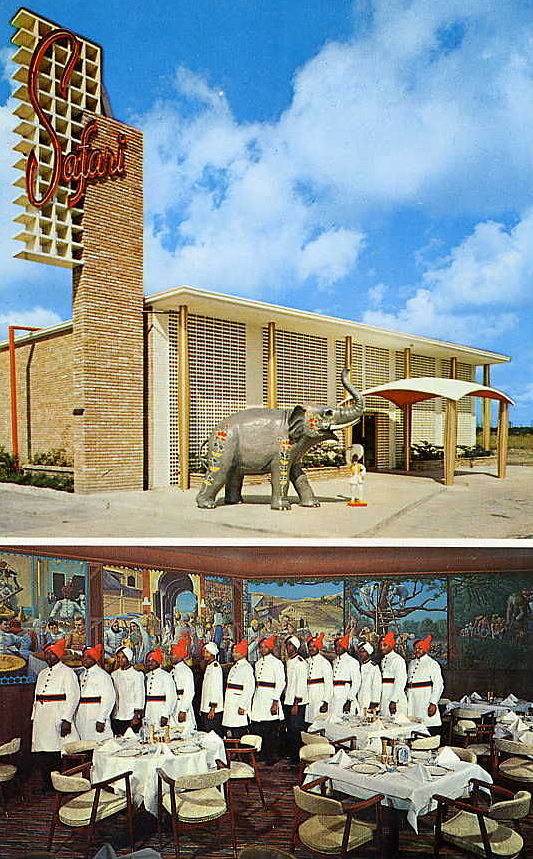
safari-preston-royal

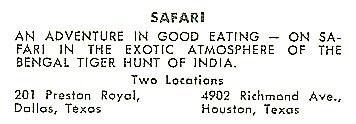
safari-preston-royal-back

by Paula Bosse

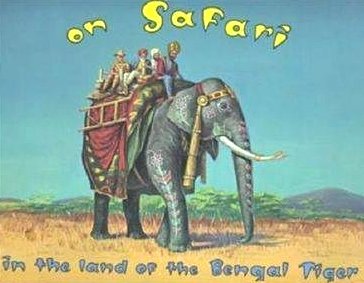
Dallas had a restaurant like this?! Yes, it did. (EDIT: It has been brought to my attention in the comments that the image above shows the *Houston* location. But I have been assured that the Dallas location had its very own elephant standing guard outside — so I will not have to ignominiously change the title of this post!)

The Safari Steak House was in the Preston Royal Shopping Center at the northeast corner of Preston & Royal (in the space now occupied by the venerable Royal China restaurant). The decor shown in the postcard above is something else — someone put their whole heart and soul into that, from the elephant and, um, elephant wrangler (“mahout“?) out front, to the ornate wood carving and the somewhat… busy murals inside. And the uniformed staff is pretty impressive, too.

Here are photos of the DALLAS Safari, taken in 1961 by Squire Haskins (photos from the UTA Libraries, Special Collections — click the links below the photos for full descriptions and large images). (Thanks, Tom Bowen, for sharing these links in the comments.)

safari_squire-haskins_1961_UTA_1via UTA Libraries, Special Collections

safari_squire-haskins_1961_UTA_2via UTA Libraries, Special Collections

Guy T. Jones opened the Safari in mid 1956 (I think the Houston location was opened later — it was open by at least 1959). I could find almost no early advertising for the place — perhaps Jones blew his advertising budget on elephants and murals. At this point, the shopping center was basically still under construction — the eastern-edge building (home of the Safari) opened about a year after the larger northern-edge building. There used to be a gap between the two buildings, which can be seen in the photo immediately above and can (sort of) be seen in the 1955 ad below, which shows a model of what the finished shopping center would look like.

preston-royal-shopping-center_032755-adAd detail, March 1955

In 1974, Royal China (which is a fantastic place, by the way) took over the space.

I really wish I’d seen that elephant, which — according to the comment below — “was highly visible and well lit at night.” I certainly hope so!

*

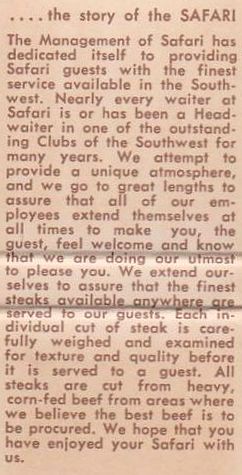
From the cover of the menu:

safari-matchbook-a

safari-matchbook

safari-matchbook_story

safari-preston-royal_menu-1969

*

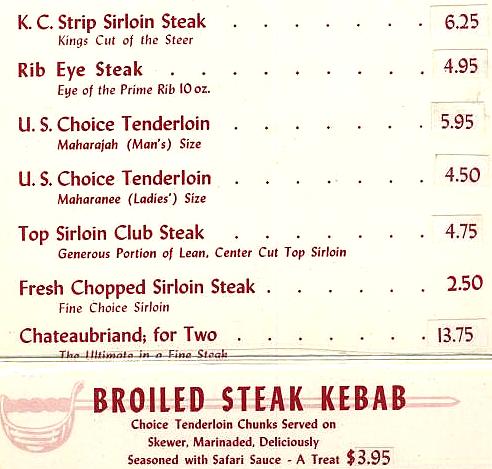
Below, the steak menu. One could choose between the “Maharajah (Man’s) Size” and the “Maharanee (Ladies’) Size.” Or get the kebabs of skewered beef “deliciously seasoned with Safari Sauce — A Treat.”

safari-menu

*

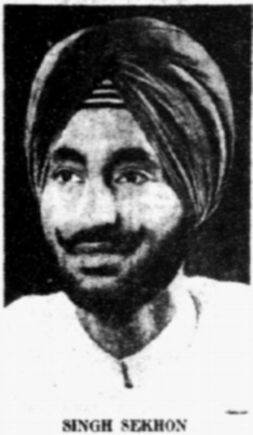
One of the stars of the restaurant was Iqbal “Ike” Singh Sekhon, who started working as the restaurant’s host while studying for his Master’s degree at SMU. He left a few years later to run the fabulous La Tunisia.

safari_dmn_062756-photo

safari-menu-logo

***

Sources & Notes

Edit (Sept. 2022): Wow. This post had a bunch of problems! All I can say is that this was one of my very earliest posts. I was so enamored of that elephant that I made a couple of very glaring errors.

First off, the original title of this post was “Back When Preston Royal Village Was ‘Exotic’ and Had Its Very Own Elephant.” The Safari Steak House was in the Preston Royal Shopping Center, located on the northeast corner of Preston and Royal; the Preston Royal Village shopping center, is on the northwest corner. I’ve (ignominiously) changed the title, but… yikes.

And, as mentioned in the first paragraph, the postcard at the top shows the Houston location, not the Dallas location. Incidentally, the Houston building is still there — it can be seen in a 2011 Google Street View capture here.

The two photos by Squire Haskins (linked below the images) are from the Squire Haskins Photography Inc. Collection, University of Texas at Arlington Libraries, Special Collections (thanks, Tom!). They are dated 1961, one year before a major fire at the restaurant. They reopened the following month, with what sounds like quite an update in decor. I’m not sure when the “gap” between the two shopping center buildings was filled in, but that would have been a good time to expand.

*

Copyright © 2014 Paula Bosse. All Rights Reserved.

The Lighthouse Church That Warned of Sin’s Penalty with a Beam of Blue Mercury Vapor Shot Into the Skies Above Oak Cliff — 1941

gospel-lighthouse-churchStill standing in Oak Cliff… (click for larger image)

by Paula Bosse

Sometimes an image just grips you. That’s what happened when I saw this postcard featuring The Gospel Lighthouse Church. The building was so odd-looking and cool. Who designed it? Where had it been? And what was that thing on top of it? I did a bit of research on the church and found out that it was organized in Dallas in 1940 by Pentecostal preacher J.C. Hibbard and his wife Nell, who was also a preacher. The two had been preaching at the Oak Cliff Assembly of God Church until J.C.’s divorce from his first wife (and subsequent second marriage to Nell) became such a point of controversy that the two felt compelled to leave (or were asked to leave) the Assemblies of God, and they formed their own church.

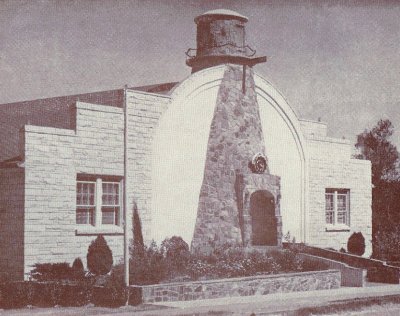
And that was the Gospel Lighthouse Church, located in the 1900 block of S. Ewing (at Georgia) in Oak Cliff. While their first church was being built, they held services in a large circus tent in the parking lot. The congregation helped with the physical labor of the construction, and progress on the building continued non-stop, 24 hours a day. In January of 1941, the church was completed, and an article appeared in The Dallas Morning News soon after with the grabber of a headline, “Lighthouse Church Warns Oak Cliff of Sin’s Penalty.” Sadly, the article has no byline, which is a shame, because I’d love to know who wrote the piece, because he or she pulled out all the purple-prose stops. The introduction is fantastically over-the-top:

A towering forty-foot lighthouse 300 miles from the sea was blinking out its warning signals across the dry land of South Ewing Sunday. At the front of a neat new white stone church house at 1914 South Ewing, near Louisiana, the white stone lighthouse reared far above the other buildings. Eventually, its big circular light tower will shoot a bluish mercury-vapor beam through the night to guide shaken mariners adrift on the sea of sin. Its semi-fog horns will broadcast a soft carillon of sacred music. This is the Gospel Lighthouse, built by a preacher with a new idea of church architecture and a dream of a denomination all his own. (DMN, Feb. 10, 1949)

gospel-lighthouse_first

Wow. A “bluish mercury-vapor beam” shooting through the Oak Cliff skies! (The full article is linked below.)

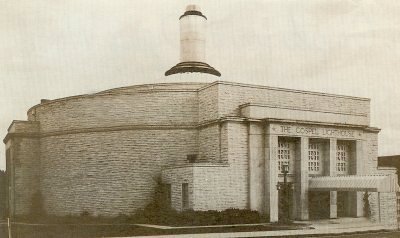
By 1948, J.C. Hibbard had become so popular (largely as a result of his daily radio sermons) that ground was broken on a larger church, designed by J.C. himself. It was right next to the first church. And it was pretty elaborate.

gospel_lighthouse_bw

Yeah, the lighthouse part of it looks a little cheesy, but with a name like “Gospel Lighthouse Church” you kind of have to have it.

*

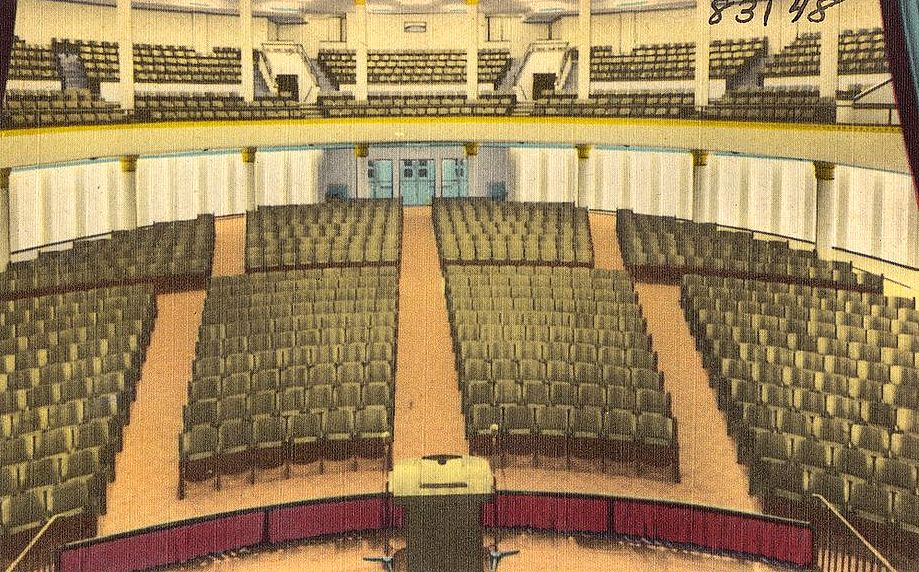
gospel-lighthouse-church_interior

The auditorium and its mezzanine.

*

gospel-lighthouse-nursery

The nursery, with elaborate murals.

*

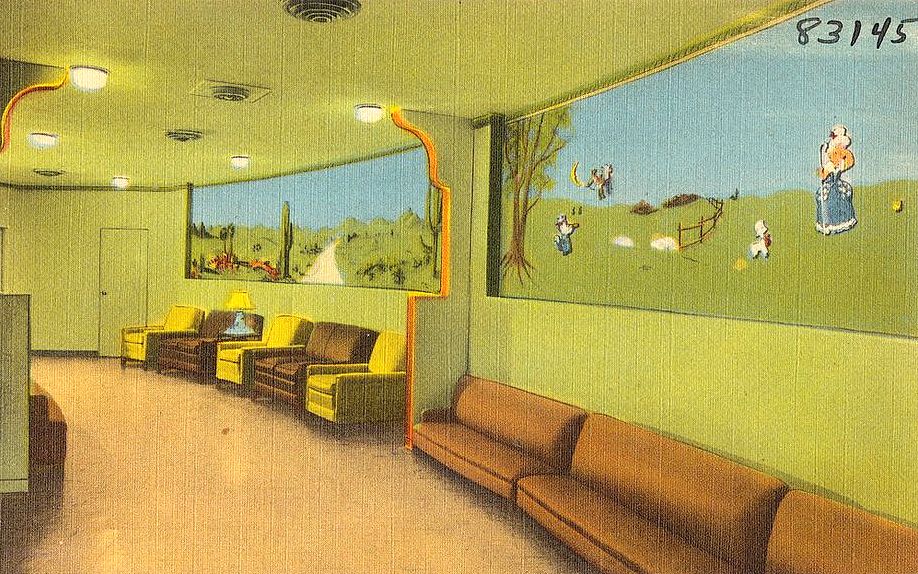
gospel-lighthouse-lounge

The lounge. Like the first church, this one had a nursery with a lounge — a “crying room” for mothers to tend to crying children without having to miss a single moment of the service. The crying was contained behind sound-proof glass while the sermon was piped in through speakers. The church had a lot of other amenities, but these were the only ones I’ve found deemed worthy enough to put on postcards.

*

I wondered if the church still stood, so I drove over to Oak Cliff yesterday and, amazingly, both churches are still there, and they are beautiful! (The original caretaker’s house is still there, too.) I’m not sure what religious group has possession of the buildings at the moment, but they are to be commended for maintaining the structures and the grounds — the 1900 block of S. Ewing really stands out from its fairly ragged surrounding neighborhood. Below are photos I took on April 19, 2014. (Click pictures for larger images.)

gospel-lighthouse_first-church_041914

Above, the first church — “a modern concrete and steel building, overlaid with white Austin stone” — which was built with help from the congregation in 1941. The beam of “bluish mercury-vapor” emanated (somehow) from the squat lighthouse above the foyer.

And, below, the later church, next door. I think the “mercury-vapor” was replaced by neon. But I could be wrong. Does either beacon light up anymore?

gospel-lighthouse_041914_sm

Aside from the “lighthouse,” the most distinctive feature of this building is those rounded walls. So beautiful!

gospel-lighthouse_side_041914-sm

The  building is actually pretty impressive to see up close. Next time you’re in the neighborhood, check it out!

***

Sources & Notes

Postcards from the Boston Public Library Tichnor Brothers Postcard Collection on Flickr, here.

Period black-and-white photos are from a page detailing the history of the Gospel Lighthouse Church, here. A biography of Rev. Hibbard from the same site can be found here.

Wander around the block on Google Street View, here.

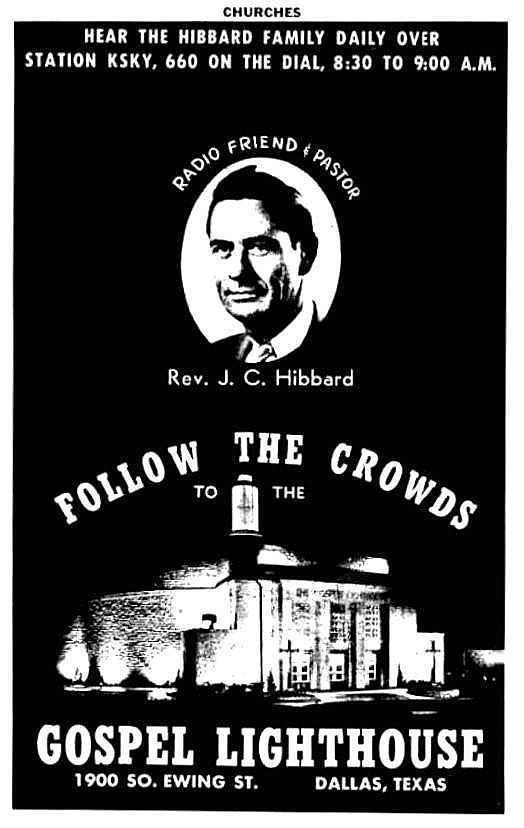
Stumbled across this ad in the 1957 Dallas directory:

gospel-lighthouse_1957-directory

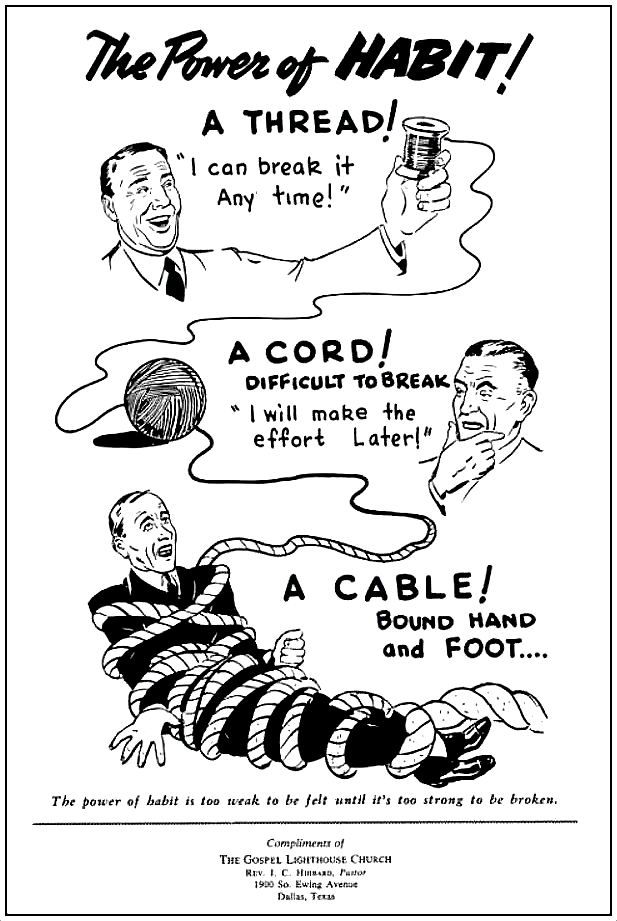
And I found this ad in, of all places, the 1967 Carter High School yearbook:

gospel-lighthouse_carter-high-school_1967-yrbk

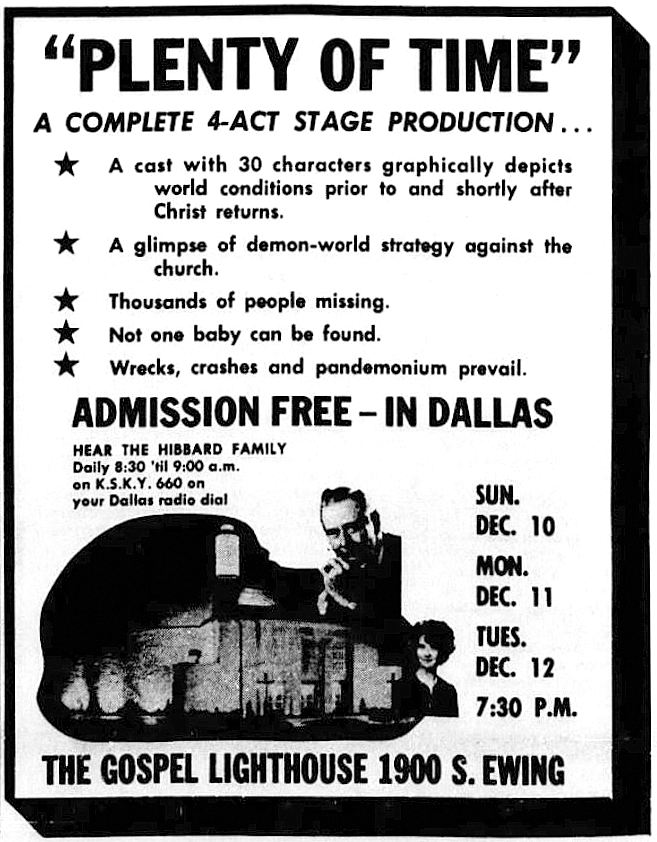
I also found this rather hair-raising ad for a 1967 Christmas-season production — an ad which somehow contains no exclamation marks:

gospel-lighthouse_mckinney-courier-gazette_120867Dec. 8, 1967

*

Copyright © 2014 Paula Bosse. All Rights Reserved.

The Stretch of “Theater Row” They Never Talk About

leo-theater
The “other end” of Film Row

by Paula Bosse

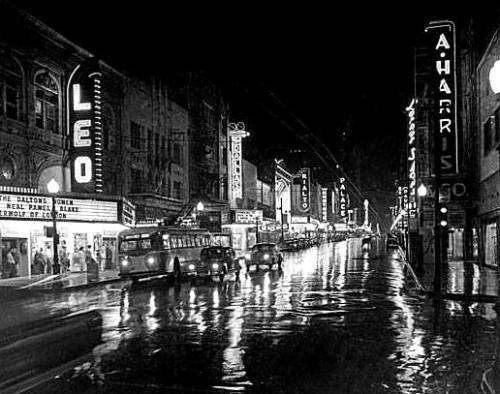
It’s April, 1952, and you’ve got a hot date Friday. Movies are good for date night. What to see? Why not catch a bold, frank, and true “adult” double-bill at the Leo? In the early-’50s, the Leo Theater, at 1501 Elm Street, was at the other end of “Theater Row” — on the metaphorical “other side of the tracks” from the classy Majestic and Palace — and it was one of those places that your mother probably wouldn’t approve of.

leo-theater_dmn-0405521952

The ad above shows a typical Leo double-feature: “Pin-Down Girl” (aka “Racket Girls”) from 1951, a searing look at lady wrestlers and prostitution (the trailer below has a moment that’s actually pretty shocking, and you’ll laugh at yourself immediately afterward for having been shocked), and “Honky Tonk Girl” (aka “Hitchhike to Hell”) from 1941 about teenagers and, well, prostitution. There were at least two exploitation movies titled “Honky Tonk Girl,” so I’m not sure which is the correct poster for the particular cinematic treasure on the Leo bill, but I really love the artwork of this one, so in it goes.

honky-tonk-girl_poster

Here’s the trailer for “Pin-Down Girl” (which is handy, because it gives you about all you really need to satisfy a piqued curiosity without wasting a lot of your time):

**∙*

***

Sources & Notes

I don’t have a source for the top photo, but I believe I have seen it attributed to the Dallas Public Library. If this is incorrect, please let me know.

A little background on the Leo Theater (1948-1953), originally the Queen (1913-1948), can be found in the comments section here.

But if you want to know just what was going on in these not-quite-but-fast-approaching seedy Dallas theaters, you owe it to yourself to read a great passage from Troy Sherrod’s Historic Dallas Theatres (Arcadia Press, 2014), here (scroll down to the caption).

*

Copyright © 2014 Paula Bosse. All Rights Reserved.

George Dahl’s Titche-Goettinger Building

titches

by Paula Bosse

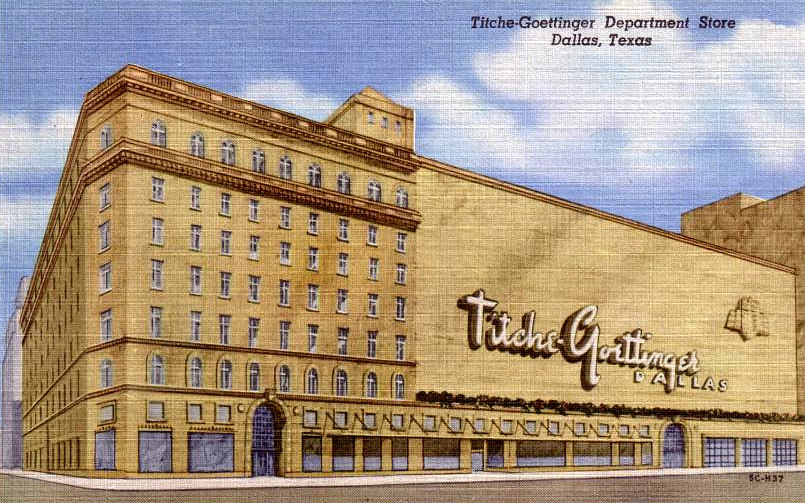
Such a beautiful building! Such a beautiful font!

George Dahl designed the original building (on the left) in the late-1920s, and Thomas, Jameson & Merrill designed the expansion (on the right) in the early ’50s.

titches_new-store_sunset-high-school-yrbk_1929
Ad from the 1929 yearbook of Sunset High School

***

Read about the building here.

Everything you could want to know about Titche-Goettinger/Titche’s is here.

UNT owns the building at 1900 Elm now, and it’s installed windows in that cool solid wall where the store’s name used to be. Check out photos of key renovations and read why they were made here.

More on the Titche’s building (including news on its expansion in 1952 and an architect’s drawing) can be found in the Flashback Dallas post “Main Street — ca. 1942,” here. See the expanded building here.

Click for larger image!

*

Copyright © 2014 Paula Bosse. All Rights Reserved.

The Hyperbolic Paraboloids of the Prairie

hyperbolic_paraboloidThe future is NOW! (click for larger image)

by Paula Bosse

In amongst things the things I’ve haphazardly collected (and I use the term loosely) over the years is this postcard. The image looks familiar to me, as if I remember actually seeing it — but I think that might just be because I’ve looked at this postcard so long. The first thing that popped into my head when I saw it was “turnpike,” but until I read up on the history of local highways (my days are fun-filled!), I wasn’t entirely sure where the turnpike had been other than “the other side of downtown, toward Fort Worth.” Did I ever see this sign and attendant weird looming structures when I was a child? Unless it was still up in the ’70s, I probably didn’t. So what is it?

Here’s the text from the back:

  • Concrete wings
  • THREE HYPERBOLIC PARABOLOIDS
  • GREAT SOUTHWEST INDUSTRIAL DISTRICT
  • Midway between Dallas and Fort Worth
  • “Located on U.S. 80, these hyperbolic paraboloids stand as insignia of the vast Great Southwest Industrial District in the center of the Dallas-Fort Worth metropolitan area. This thin shell ‘concrete umbrella’ construction form was pioneered in the Untied States by Great Southwest Corporation, developer of a 5500-acre planned industrial district.”

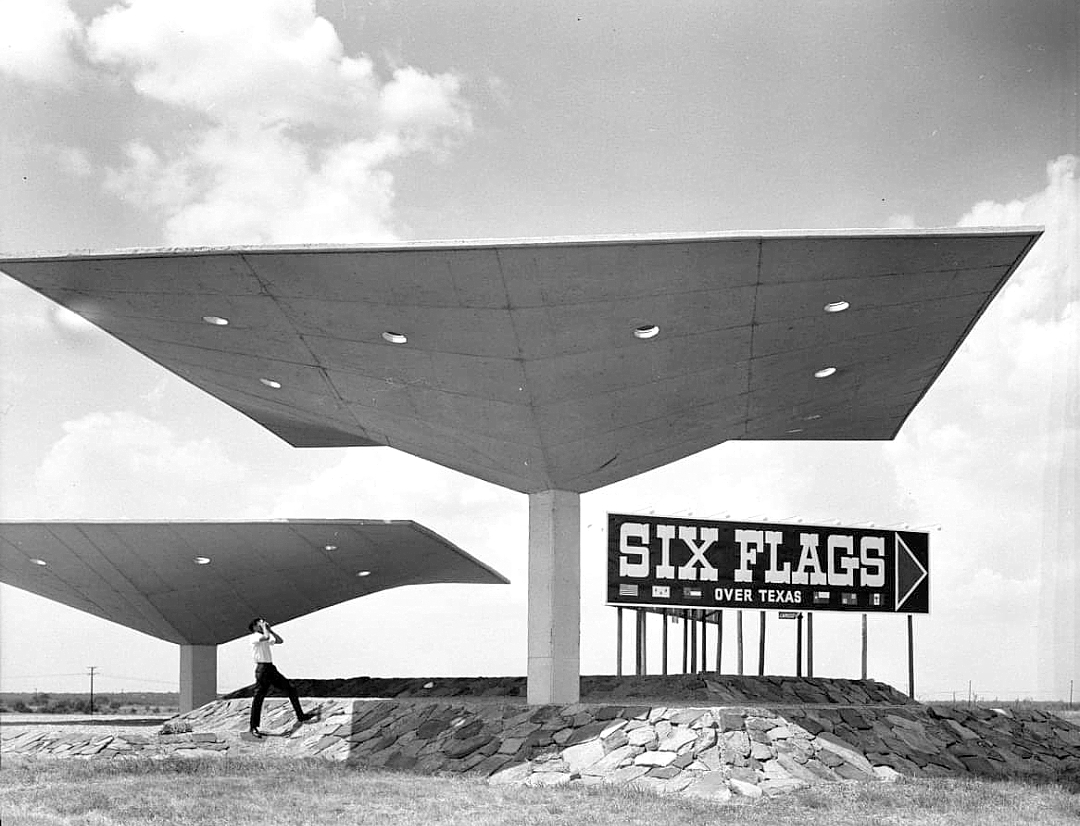
It was somewhere around Arlington and Grand Prairie, back when it was still a vast, undeveloped area being planned in the mid-1950s by Angus Wynne who would, a few years later, bring us Six Flags Over Texas. (US Hwy 80 no longer runs west of Dallas — that stretch is now, I think, Hwy 180 — it was shoved off its Great American Interstate Highway pedestal by the DFW Turnpike and the arrival of what is now Interstate 30.)

hyperbolic-parabola_six-flags_1961_tx-highways-mag_FB
1961 (Texas Highways photo by Willis Albarado)

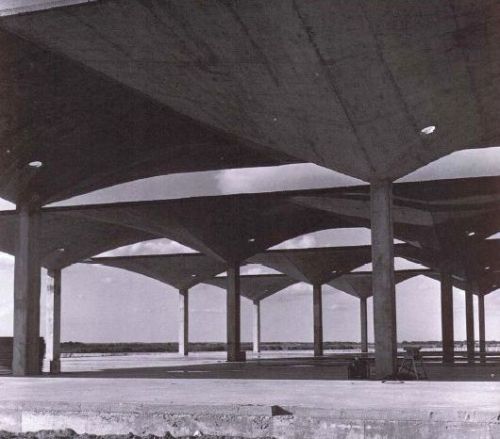
But … “hyperbolic paraboloids”? Those things are so cool. The “hyperbolic paraboloid” was developed by Mexico-based Spanish engineer-architect Felix Candela who worked in the Dallas area with the great architect O’Neil Ford (on, specifically, the Great Southwest Industrial District and the Texas Instruments Semiconductor Building). Candela is pretty interesting — look him up. Without Candela’s paraboloids and his contributions to engineering and architecture, Santiago Calatrava probably wouldn’t be doing the sort of thing that he’s doing.

Here’s another view of (other) paraboloids out on the Texas prairie. They’re like elegant, curved, inverted parasols. Kind of. Made from thin shells of concrete. (One source identified these paraboloids as being part of the Great Southwestern Industrial District and another source as being from the Texas Instruments campus. (See 1958 TI ad below.) Either way, it’s Felix Candela, all the way.)

paraboloid_texas-instruments

I’m still trying to figure out if I ever saw that fantastic sign and those three silent, looming paraboloids. It’s all pretty cool-looking, and it must have been an unexpected sight in the middle of what was, then, basically nothing.

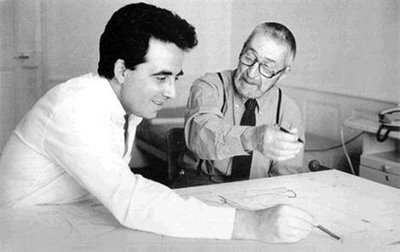
Speaking of Candela and Calatrava, here’s a photo of the two together:

calatrava-candela

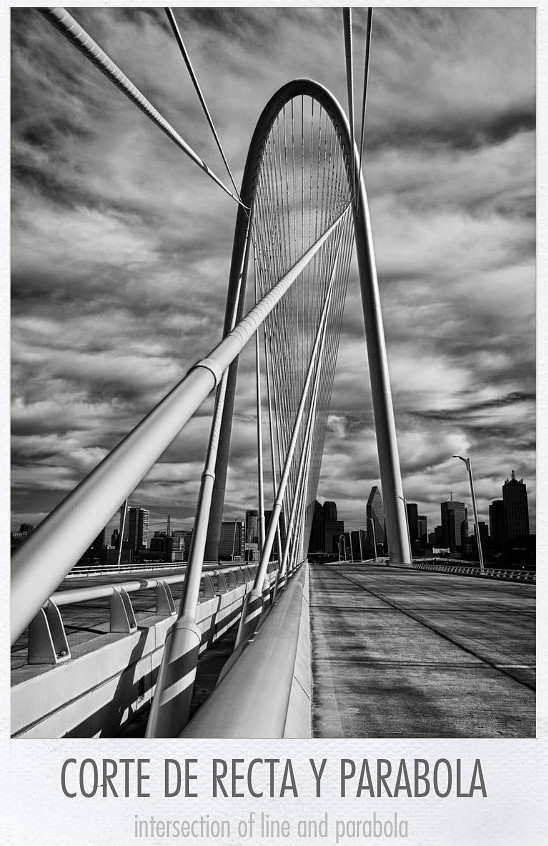
And here’s another paraboloid-y structure that stands out in the DFW area — you might have seen it:

calatrava_parabola

***

Sources & Notes

Photo of Calatrava and Candela from the blog An Engineer’s Aspect, here.

Photo of the Calatrava bridge from Pinterest, here.

A good overview of Felix Candela’s work, with photos and a video, is on the Columbia University website, here.

The Great Southwest Industrial District (Arlington and Grand Prairie) still exists, and their website has a history page which explains its creation and development by Angus Wynne, here.

Lastly, who could resist reading up on just what the heck a “hyperbolic paraboloid” is (warning: math) — Wikipedia’s on it, here.

A 1958 Texas Instruments ad wants you to know that “hyperbolic paraboloids form roof-ceiling” (click to see larger image):

texas-instruments_hyperbolic-paraboloid_1958_ebay1958

UPDATE: Thanks to comments below, I’m happy to present another photo of the paraboloids, this one from the cover of the 1960 Arlington High School yearbook, complete with Shetland pony! Click the image below to see a larger image of the photo inset. (Thanks to Brad McCorkle for alerting me to the photo — it was taken by his father, Lynn McCorkle, intrepid student photographer!)

paraboloid_arlington-high-school-yrbk_1960

ANOTHER UPDATE, from the comments: this still-standing building at 10830 Preston Road (Preston Royal Shopping Center) was one of many that utilized hyperbolic paraboloids in its design. The American Savings Association building (designed by Brock & Mabrey of Corpus Christi, with Braden & Jones of Dallas as associated architects) opened in March, 1966.

american-savings-association_hyperbolic-paraboloid_030166

*

Copyright © 2014 Paula Bosse. All Rights Reserved.

A Colorful Elm Street — 1920s

elm-st-color_1920s

by Paula Bosse

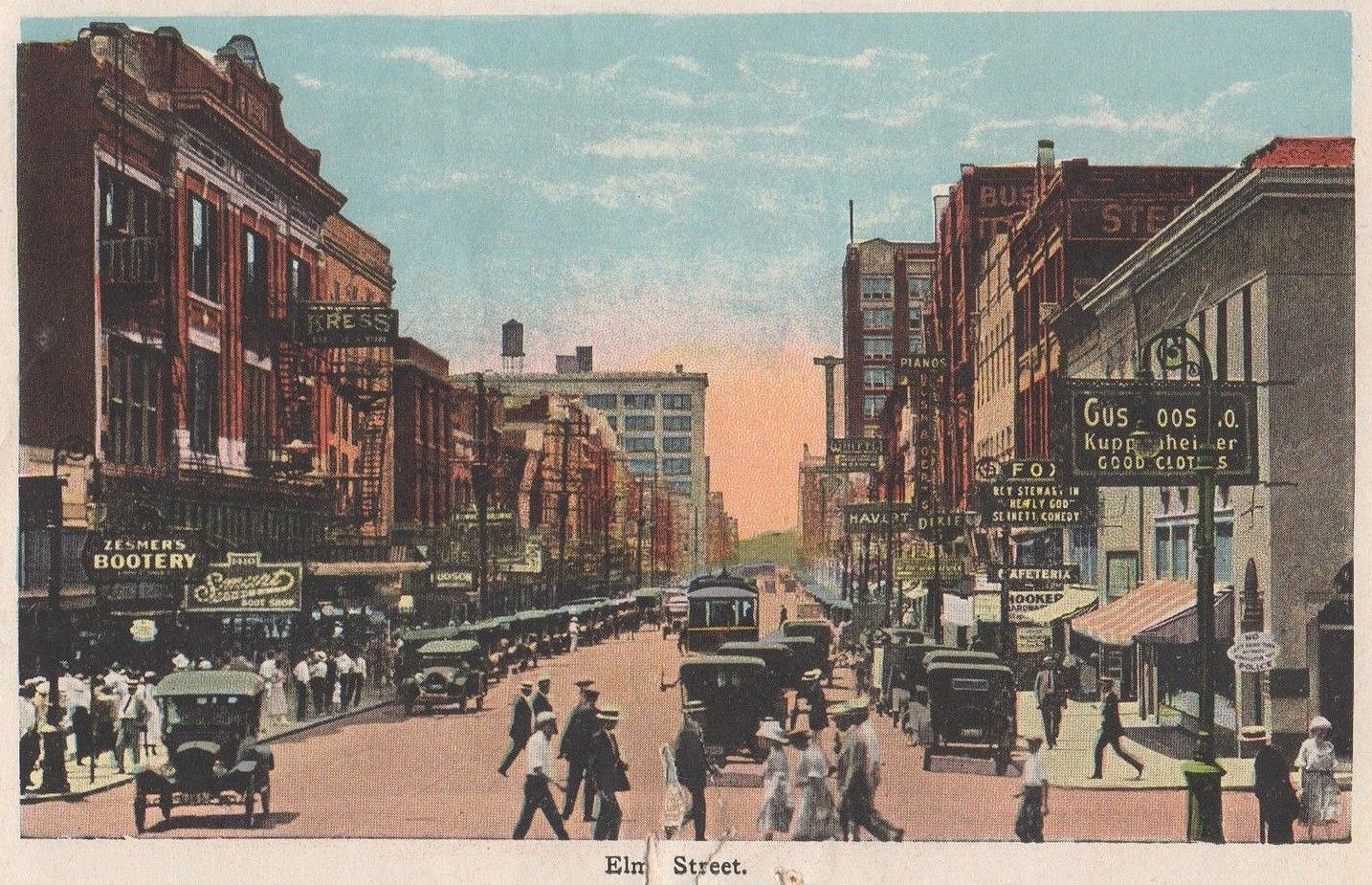
A bustling Elm St. — looking west from Akard — in “color,” in the early ’20s. I love this. You can practically walk down the street and window-shop.

Click for very large image.

*

Copyright © 2014 Paula Bosse. All Rights Reserved.

Oriental Oil Company: Fill ‘er Up Right There at the Curb

gas-pump_commerce_c1912An Oriental Oil Co. competitor, at 1805 Commerce

by Paula Bosse

I cropped this detail from a much larger view of Commerce Street because this incidental, everyday moment caught my attention. Was that man filling his automobile with gasoline? Was that square, boxy, hip-high thing full of gas, right there at the curb of one of the city’s busiest streets? The sign above the pump reads “PENNSYLVANIA AUTO OIL GASOLINE SUPPLY STATION.” I looked into it, and now I know more about early gas pumps and stations than I ever thought I would.

In the very early days of automobiles, one would have to seek out a supplier of gasoline (such as a hardware store or even a drugstore) where you would buy a gallon or two and carry it home with you in a bucket or something and then carefully pour it into your car’s gas tank using a trusty funnel. After a few years of this inconvenient way to gas up, these curbside pumps began to pop up in larger cities. The pump seen above was at 1805 Commerce St. and belonged to the Pennsylvania Oil Company. It opened in early 1912. That got me to wondering about other such fueling stations, and it seems the first in Dallas may have belonged to the Oriental Oil Company, just down the street from the one seen above, at 1611 Commerce. Here is a fuzzy image of it, from the same, larger photo the detail above was taken from. (Click for larger image.)
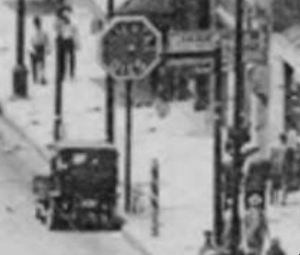
oriental-oil_1611-commerce_skyline-det

Could this photo have been taken there? It was listed on eBay merely as “Oriental Oil Company, Dallas, 1910-1920.”

oriental-oil-co_ebay

Oriental Oil’s first “auto station” opened in February, 1911, where “facilities have been arranged so as to fill the cars along the sidewalk.”

oriental-oil_dmn_022611(Dallas Morning News, Feb. 26, 1911)

Drive-up “stations” had begun to appear a few years before, on the West Coast.
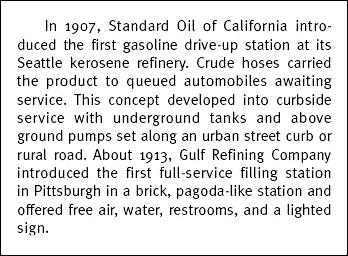
gas-stations_dot-pdf_p33(Texas Dept. of Transportation, 2003)

In a 1924 Dallas Morning News article (see below), the pump seen in the above photos was described thusly:

Dallas’ first gas filling station had a one-gallon blind pump on the curb which was then thought to be the last word in equipment. Now if a filling station is not equipped with a visible five-gallon pump it is thought to be behind the times and the gas now sold must be water white, when in the old days it was most any color.

This, I think, is what the Oriental and Pennsylvania rolling tanks looked like — the make and model may be different, but I think the general design is the same:

gas-pump-1913

When it was empty, it would be rolled away to be re-filled. I’m not sure about the payment system. Coupon books are mentioned in one of the ads, but I don’t know how (or with whom) one would redeem them as these pumps appear to be self-serve. Perhaps there was a slot for coins/coupons, and everyone worked on the honor system.

It seems that its placement would cause a lot of congestion on a major street like Commerce (which at the time was still shared with skittish horses), but Commerce was also a hotbed of automobile dealerships (Studebaker, Stutz, and Pierce-Arrow dealerships, for example, were within a couple of blocks of the Oriental and Pennsylvania filling stations).

The Oriental Oil Company — a forgotten, early oil company — had an interesting history. The Dallas-based company began business in 1903, starting their company “in a barn in the rear of the Loudermilk undertaking establishment.”

oriental-oil_mercury_123103(Southern-Mercury, Dec. 31, 1903)

They were a fast-growing oil company (“an independent concern which in spite of the strong opposition of the oil trust is now enjoying permanent and growing prosperity”Greater Dallas Illustrated, 1908), and they were one of the first to open a refinery in Texas (they eventually had two refineries in West Dallas). The company’s primary concern in its early years was the manufacture of various oils and greases for industrial use.
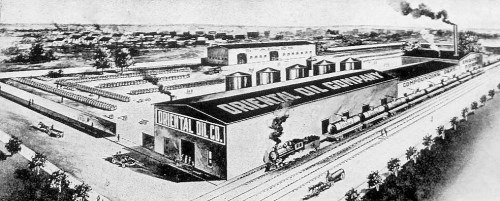
oriental-oil-factory-c1908Oriental Oil Company Factory, corner of Corinth St. and Santa Fe tracks, circa 1908

In 1911, understanding just how profitable the new world of retail gasoline sales could be, they installed their first pump at the curb of 1611 Commerce St., near Ervay (“right behind the Owl Drug Store”). A 1924 Dallas Morning News account of the company (see below) states that this was the first gas pump … not only in Dallas … but in the entire state of Texas. I’m not sure if that’s true, but the Smith Brothers who ran Oriental Oil were certainly go-getters — the Smiths were grandsons of Col. B. F. Terry, organizer of the famed Terry’s Texas Rangers, and one of the brothers, Frank, was an early mayor of Highland Park and a three-term president of the Dallas Chamber of Commerce.

ad-1911_oriental-oil_dmn_100811(DMN, Oct. 8, 1911)

ad-1912_oriental-oil_dmn_012812(DMN, Jan. 28, 1912)

Shortly after opening their first pump on Commerce, demand was such that a second pump was soon opened at 211 Lane St. (a mere half a block away!). The DMN reported on Oct. 19, 1911 that a competitor — Consumers’ Oil and Auto Company — was going to be right across the street: “Permission was given to the Consumers’ Oil and Auto Company to place a gasoline tank under the sidewalk at 214 Lane street.” And in March 1912 the Pennsylvania Oil Company was installing ITS underground tank for the pump seen in the photo at the top — again, less than a block away. And in 1916 Oriental opened its splashy new “‘Hurry Back’ Auto Station” right across the street from where that Pennsylvania tank had been. (That Commerce-Ervay area was certainly an early gas station hotbed!)

ad-1916_oriental-oil_dmn_082916(DMN, Aug. 29, 1916)

Newspaper reports also cite claims made by the company that the station mentioned in the ad above — at Commerce and Prather — was the first drive-in gas station in the United States. I’m sure this was good truth-stretching PR for Oriental more than anything, because this claim was not true (Seattle and Pittsburgh seem to be battling each other for that honor). It might not have been the first, but when this “auto station” opened in 1916 (assuming it was “new” as this ad states), it was still pretty early in the history of the drive-in filling station. Also, by 1916, “Hurry Back” had become the company’s slogan as well as the name of its gasoline.

ad-1918_oriental-oil_dmn_102218(DMN, Oct. 22, 1918)

ad-1920_oriental-oil_jewish-monitor_1920(Jewish Monitor, 1920; detail)

ad-oriental-oil_dmn_041121(DMN, Apr. 11, 1921)

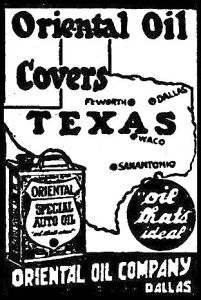
oriental-oil_ad_dmn_030522(DMN, Mar. 5, 1922)

I love these ads!

By 1927, the company boasted at least 18 filling stations, two refineries, and branches in Fort Worth and San Antonio. In 1927 they had moved into new offices in the “Oriental Building” at the nexus of Live Oak, St. Paul, and Pacific. A newspaper report described the building as being “finished in Oriental colors with Oriental decorations and is marked at night by very attractive lighting” (DMN, May 1, 1927).
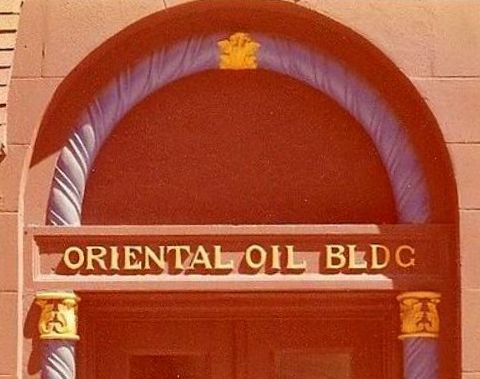
oriental-oil_bldg_1977_flickr

The Oriental Oil Company declared bankruptcy in 1934, selling off their property, refineries, and their name. No more Oroco gas. A lot of companies went bust during the Great Depression, but I’m not sure what precipitated Oriental Oil’s bankruptcy. Actually, I’m surprised by how little information about the Oriental Oil Company I’ve been able to find. Afterall, it and its “Hurry Back” gasoline played a major role in getting the residents of Dallas off their horses and behind the wheel, a major cultural and economic shift that changed the city forever. And it all started at that weird little curbside gas pump on Commerce Street.

***

Sources & Notes

The first two images are details of a photograph by Jno. J. Johnson (“New Skyline from YMCA”), 1912/1913, from the DeGolyer Library, Central University Libraries, Southern Methodist University, viewable here.

Snippet of text from A Field Guide to Gas Stations of Texas by Dwayne Jones (Texas Department of Transportation, 2003).

Illustration of the two 1913 Tokheim portable gas pumps from An Illustrated Guide to Gas Pumps, Identification and Price Guide, 2nd Edition by John H. Sim (Iola, WI: Krause Publications, 2008).

Drawing of the Oriental Oil Company Factory from Greater Dallas Illustrated (Dallas: American Illustrating Co., 1908 — reprinted by Friends of the Dallas Public Library in 1992).

All ads and articles, unless otherwise noted, from The Dallas Morning News.

Color photo of the pink, purple, and gold Oriental Oil Bldg. is a detail from a photo taken around 1977, on Flickr, here.

For an interesting (and mostly accurate) mini-history of the Oriental Oil Company, then in its 20th year of operation, see the Dallas Morning News article “First Dallas Filling Station on Commerce Had One-Gallon Pump” (June 22, 1924).

Some nifty info on early gas stations (yes, really) here.

More info with some really great illustrations and photos here.

Another surprisingly fun and informative article is here.

*

Copyright © 2014 Paula Bosse. All Rights Reserved.