by Paula Bosse
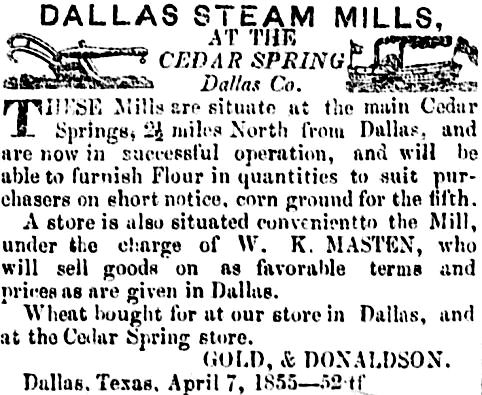
DALLAS STEAM MILLS, at The Cedar Spring, Dallas Co.
These Mills are situate at the main Cedar Springs, 2 1/2 miles North from Dallas, and are now in successful operation, and will be able to furnish Flour in quantities to suit purchasers on short notice, corn ground for the fifth. A store is also situated convenient to the Mill, under the charge of W. K. MASTEN, who will sell goods on as favorable terms prices as are given in Dallas. Wheat bought for our store in Dallas, and at the Cedar Spring store.
–GOLD, & DONALDSON. Dallas, Texas , April 7, 1855
*
In 1843, a trading post was established just outside the city of Dallas at the new settlement of Cedar Springs. There were few settlers at the time, so items traded were pretty much limited to only the essentials (groceries, ammo, buffalo hides). By 1850, though, sexier luxury goods like “hoopskirts, silk stockings, bridal bouquets, Bibles, accordions, Mustang liniment, snake-root and castor oil were listed in the inventory of a deceased merchant. This advance in merchandising may be attributed to the establishment by that time of a gristmill to which farmers from many miles around brought their grain. Naturally they visited the stores to trade” (WPA Dallas Guide and History). The Dallas Steam Mills was one of the first commercial mills in “the Cedar Spring,” and as it was affiliated with successful early Dallas retailers Gold and Donaldson, it must have also been one of the most profitable.
The community grew quickly. Until 1850. That was when Dallas County residents went to the polls and voted on which of the local communities would be the county seat. The choices were: the city of Dallas, Cedar Springs, and the ever-popular Hord’s Ridge. Cedar Springs came in dead last. The agony of defeat must have hit hard — the loss seems to have dampened civic enthusiasm and contributed to stagnant growth. It wasn’t until the turn of the century that the area — by then called Oak Lawn — had rebounded with a boom in population. By the 1940s, though, the area had been officially annexed by the city of Dallas. Oak Lawn (né Cedar Springs) had, at least, managed to hold onto a shred of independence a few decades longer than its former opponent had — Hord’s Ridge had changed its name to Oak Cliff, but it, too, had been swallowed up by the voracious, mammoth city surrounding it. No hard feelings, guys. You can run but you can’t hide. Resistance has always been futile. We’re all just one big happy kudzu-like sprawling sprawl now.
*
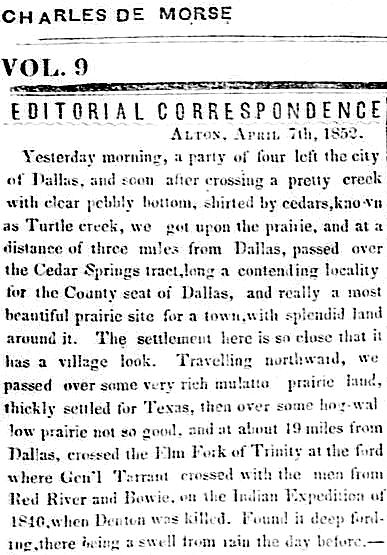
Below is an interesting account of traveling through Cedar Springs in 1852.

***
Dallas Steam Mills ad from the Dallas Herald, 1855.
Quote mentioning accordions and hoopskirts from The WPA Dallas Guide and History (Dallas Public Library Texas Center for the Book, University of North Texas Press, 1992). p.124
The account of passing though Cedar Springs, by Charles DeMorse, is the lead story in the July 17, 1852 issue of Clarksville’s Northern Standard newspaper; it can be found here on UNT’s invaluable Portal to Texas History site; from the collection of the Dolph Briscoe Center for American History.
A biography of Charles DeMorse, writer and editor of Clarksville’s Northern Standard can be found here.
The Handbook of Texas History entry for Cedar Springs is here.
*
Copyright © 2014 Paula Bosse. All Rights Reserved.
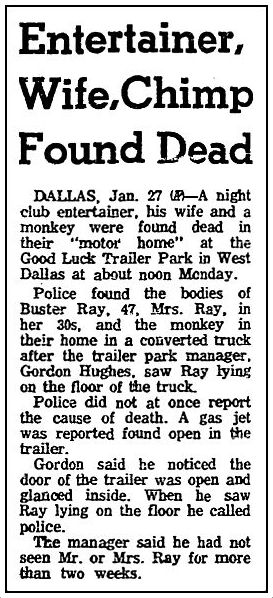
Fort Worth Star-Telegram, Jan. 28, 1964
by Paula Bosse
“Entertainer, Wife, Chimp Found Dead.” THAT is a headline.
Had I not known that the (ironically named) Good Luck Trailer Park on W. Commerce had been a favorite with visiting circus folk, I might have been a little more surprised by the weird circumstances reported in this article. As it was, I was only mildly surprised.
(I kind of think the chimp did it….)
***
Hats off to the Fort Worth Star-Telegram‘s headline writer. The story ran in the Star-Telegram on Jan. 28, 1964.
The victims — Harold Allen Ray and his wife Nadine (and unnamed monkey) — were later determined to have died of accidental carbon monoxide poisoning.
“Buster Raye” (stage name of Harold Ray) had been a comedian and master of ceremonies who seems to have played a lot of burlesque joints/strip clubs as the between-stripper entertainment. He was billed as “The Mighty Mite of Mirth.” In a Feb. 24, 1948 review of his act, The Bryan Eagle wrote:
Buster Raye, diminutive master of ceremonies, stole the show with a clever line of chatter punctuated with juggling, acrobatics, songs, imitations. His jokes were well handled with none of the vulgarity common to many floor shows.
I’m not sure where the monkey fits in.
Corpus Christi Caller-Times, April 29, 1948
*
Copyright © 2014 Paula Bosse. All Rights Reserved.
by Paula Bosse
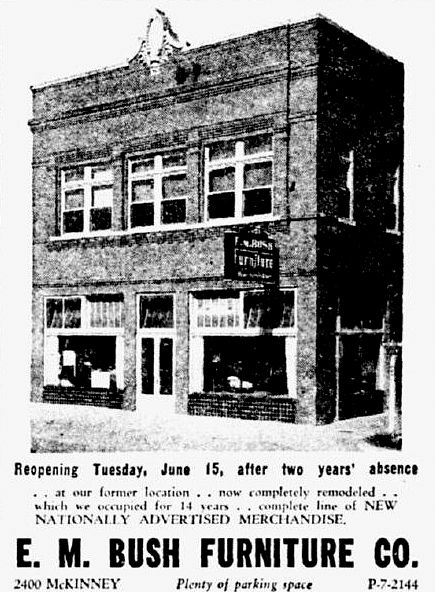
I came across this ad and wondered just where on McKinney Avenue this building had been. The ad was from 1948, but the building certainly looked older than that. I’m not sure when the building was built (update: it was built in 1909), but by at least 1929 the Hughes Auction Market was conducting furniture auctions there. An ad from 1929 invites the public to attend the regular auctions in which their two floors were packed to the gills with furniture and household goods that “positively must sell.” Prospective buyers were promised a large parking lot and a “comfortable, cool building.”
In the summer of 1933, a longtime Dallas furniture salesman, E. M. Bush, opened his retail business in the building and remained there for many years, perhaps until 1958 when he moved to Snider Plaza.
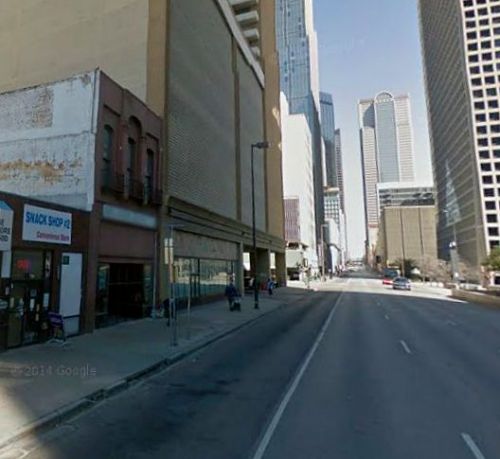
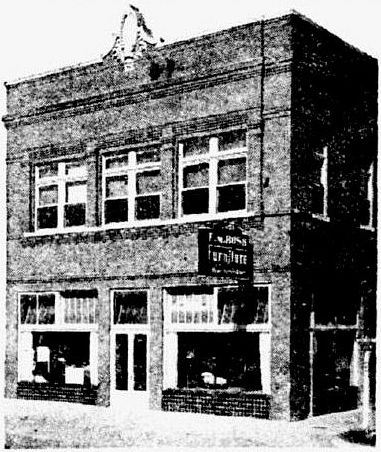
I wondered what’s at 2400 McKinney these days, and, I have to say … I’m shocked to find that the building is actually still there! On McKinney Avenue! And it looks very much the same as it does in the photo above (and, presumably, since it was built) — a little more elegant, perhaps, as it’s now part of the fabulous Hotel ZaZa — but the building looks pretty much the same. The building has survived! I feel like crying.
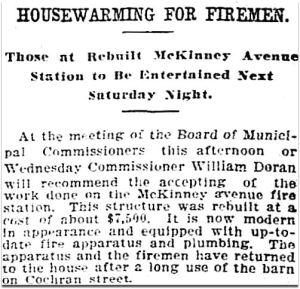
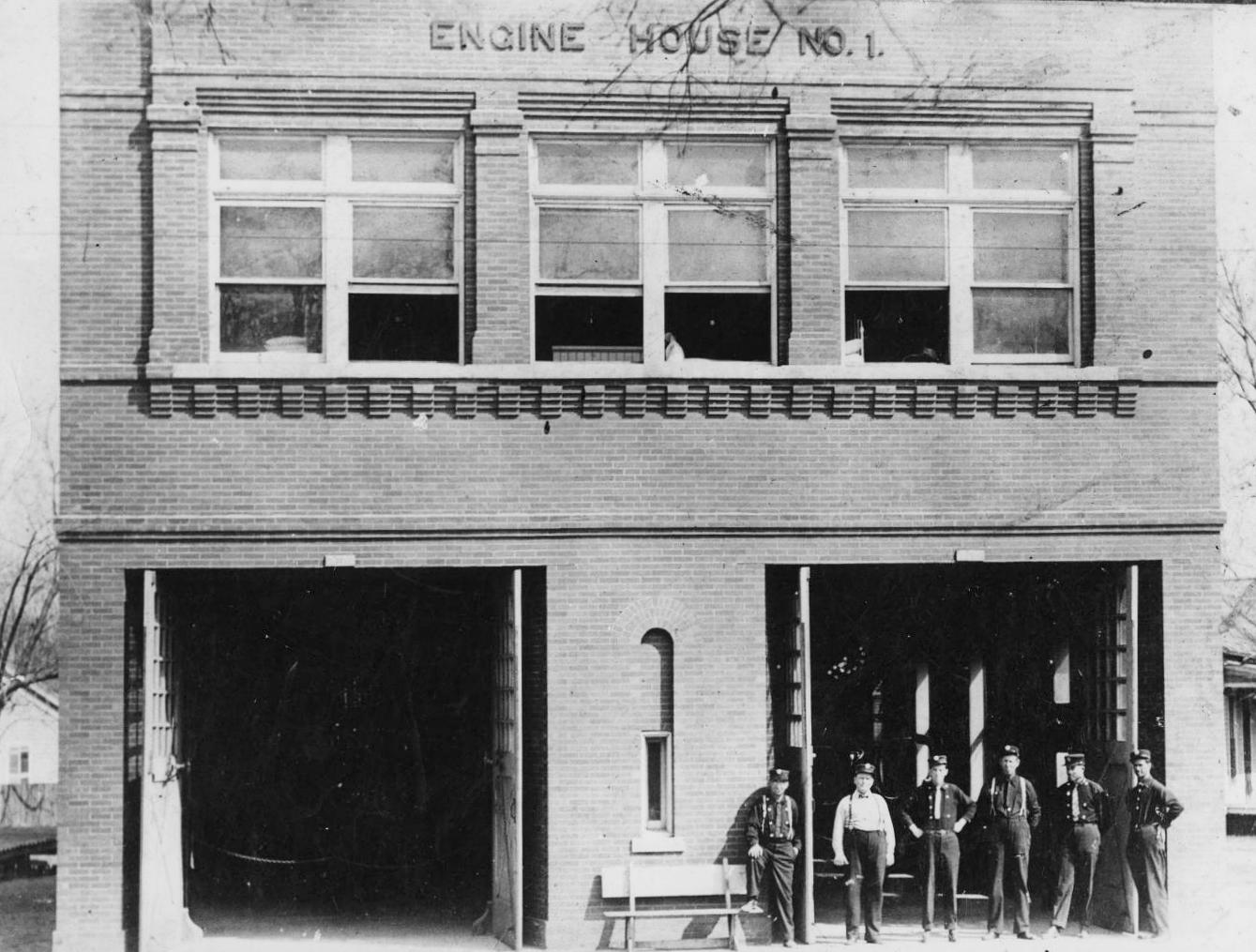
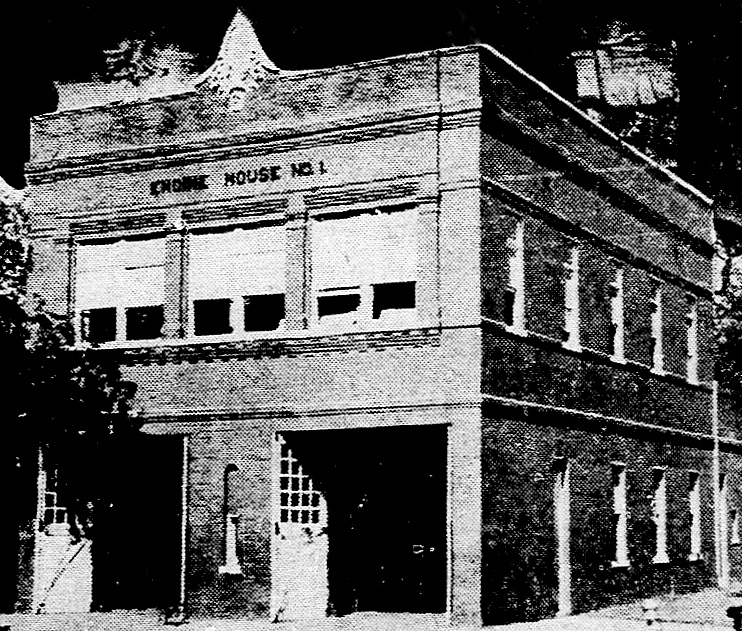
But wait, there’s more. What was this building originally? It was a firehouse! More specifically, it was Engine House No. 1, in use until 1928. The fire station that originally occupied this location was built in 1894 (see what it looked like in 1901 here, third photo down). By 1909, automobiles were placing horse-drawn fire engines, one of many reasons the station house needed to be modernized. Newspaper articles from 1909/1910 used the words “rebuilt” and “remodeled” almost interchangeably, so it’s unclear whether the original building was completely, or only partially demolished and then rebuilt, using materials from the original structure. The “new” engine house re-opened in January, 1910.

Dallas Morning News, Jan. 25, 1910
Here’s a photo from its early days:
And from the 1920s:
The city ordered the building sold in 1928 when plans had been made to move personnel and equipment from McKinney and Leonard to a new station at Ross and Leonard.
To have a 100-plus-year-old building still standing in “newer-is-better” Dallas — and in Uptown — is quite a feat!
***
E. M. Bush Furniture Co. ad from 1948.
Photo of Stay ZaZa Art House and Social Gallery from the Hotel ZaZa website.
Firehouse photo from The Dallas Firefighters Museum. More on this station here.
Most images are larger when clicked.
*
Copyright © 2014 Paula Bosse. All Rights Reserved.
by Paula Bosse
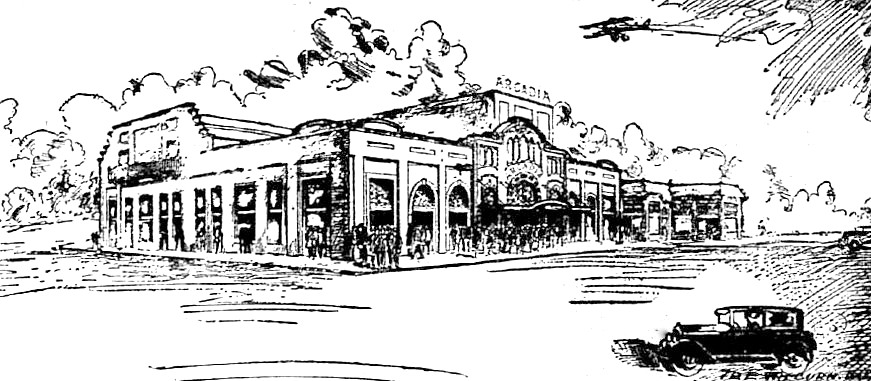
Above is a rendering of architect W. Scott Dunne’s design for the Arcadia Theater on Greenville Avenue, at Sears Street, between Ross Avenue and Belmont. (The low-flying bi-plane is a nice touch.) Among the many Dallas theaters designed by Dunne were the Esquire in Oak Lawn and the Texas Theatre in Oak Cliff (as well as another entertainment mecca, the Fair Park Band Shell).
The Dallas Morning News had this to say about Dunne’s concept for the new “suburban theater” in 1927:
W. Scott Dunne, architect of Arcadia, is working out an interior design that should prove in harmony with the theater’s name — an atmospheric design of as near rustic simplicity as is possible in a theater.
“Rustic”!
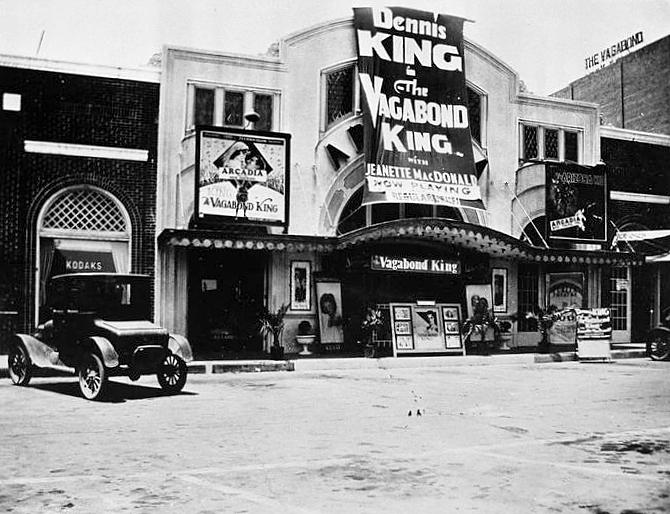
A photo of the not-particularly-rustic exterior in 1930:
The fabulous giant tree marquee, posted previously (link to post below), from about this time can be seen here.
All went well for many years until 1940 or ’41 when the original 1927 building was badly damaged in a fire; it had to be gutted and completely overhauled by architects Pettigrew & Worley. John A. Worley wrote an article for Box Office magazine about the rebuilding process (link below), including the hard-to-believe tidbit that the firm had been “vigorously instructed to studiously avoid any pretense of ‘super-colossal’ — or, more thoroughly defined, we were told to steer clear of that ‘regal’ air, which had been known to impel theater patrons to take off their shoes before daring to walk across the foyer.”
The article even has a photo of the lopped-off, now-sadly diminished tree sign. (The author — in something of a reach — explains that the “stump” was there as a symbol of the “Arcadian” nature of the theater.) (You just know that both Pettigrew and Worley were praying for the go-ahead to just get rid of it already.)
There was another bad fire in 1958, which led to further renovation. By then, that tree was loooooong gone and but a dim memory.
There sure were a lot of fires at the ol’ Arcadia. Including the final, fatal one, in 2006. R.I.P. And from the ashes sprang the present-day Trader Joe’s.
***
Photo showing “The Vagabond King” (1930), from the Hardin-Simmons University Library via the Portal to Texas History, here.
Photo showing “stump” is from the June 21, 1941 issue of Boxoffice.
An interesting article on the Arcadia — and life along Lowest Greenville — can be found in a Lakewood Advocate article “The Rise and Fall of the Arcadia,” here.
The original post that spurred a further look into the early days of the Arcadia — and the one with the crazy huge electric tree marquee — can be found in the Flashback Dallas post “The Arcadia Theater Sign You’ve Never Seen,” here.
*
Copyright © 2014 Paula Bosse. All Rights Reserved.
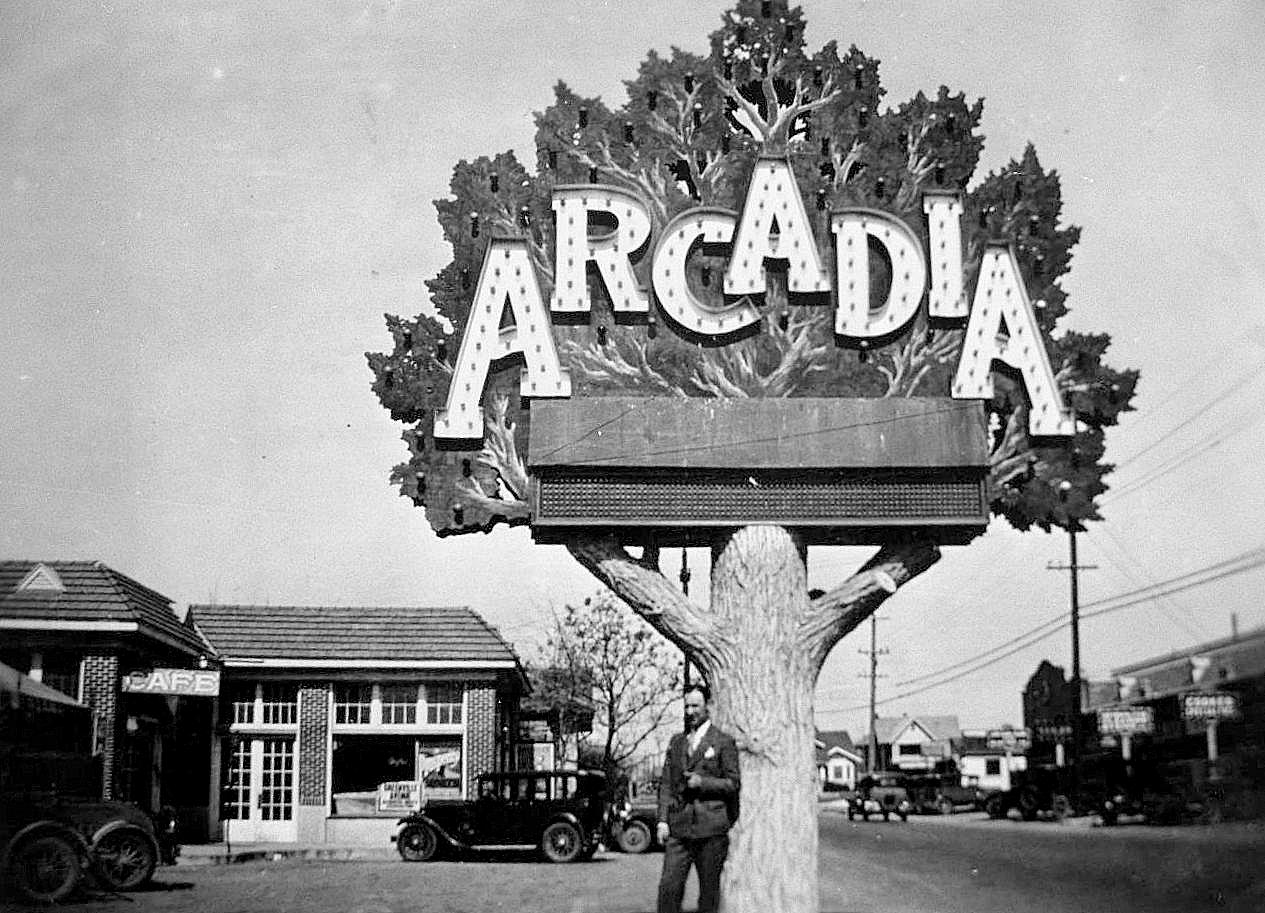
Best theater marquee EVER! Lower Greenville, late ’20s (click for larger image)
by Paula Bosse
I LOVE this photo! Forget the sign for a moment (difficult though that may be…) — take a look at Greenville Avenue in the late-1920s! That building at the top right, across the street from the (late, lamented) Arcadia, is still there. The car heading north is just about to pass where the 7-Eleven is now (at Richmond). As for that tree-shaped sign … wow. I’ve never seen anything like that. The photo was used in a promotional campaign for a new sort of electric marquee technology.

Here’s what Arcadia manager Wally Akin (pictured above) had to say about this new-fangled Vendope Changeable ‘Lectric Letter thing:

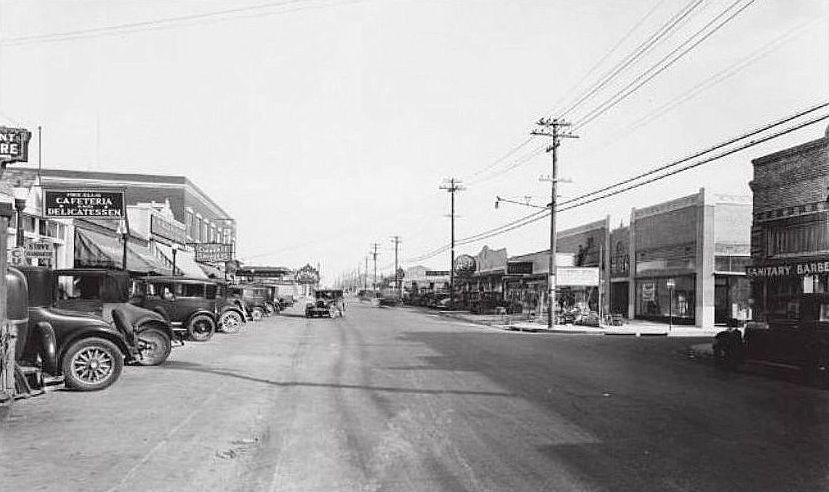
I’m not sure the Vendope Service System took off, but, damn, that sign is cool. Here’s a another view, from 1930, looking up Greenville from about Alta — you can see how close to the curb the sign was. Imagine driving up the street and seeing that lit up in front of you.
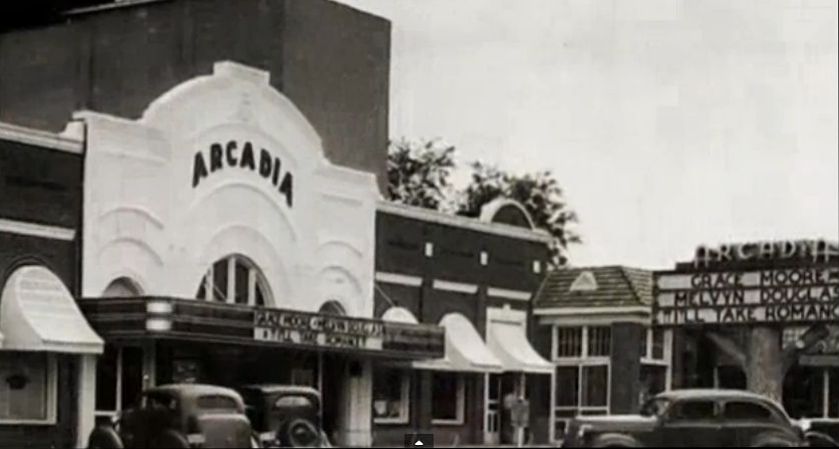
It was a little less cool, though, by 1937 when the “tree” had been pruned and tampered with almost beyond recognition, but, still, that is one weird eye-catcher of a marquee.
*
UPDATE: The following information comes from a comment to me from the estimable Angus Wynne, who took over the Arcadia in the 1980s (and 1990s?) and booked some great live shows there (several of which I paid to see): “The tree sign evolved from a lesser marquee that was installed in a real tree which grew in the original parkway formerly located adjacent to the street. A very unusual attraction, it remained there for many years until the tree died, upon which the owner had it concreted over and had the electric branches added, pictured here. It was torn down when the theater’s facade and interior were renovated during the 1940’s.”
What a shame that something so wonderful didn’t survive. All those lights! I’d have loved to have seen it lit up at night, back when this lowest stretch of Greenville Avenue was called a “northern” and “remote” part of the city.
***
First three images, including top photo, from the Hardin-Simmons University Library, via the Portal to Texas History — these and other Arcadia Theatre images from this collection can be viewed here. The main photo (MUCH larger when clicked) is undated, but it’s sometime between the Arcadia’s opening in 1927 and the Publix theater chain’s plummet into receivership around 1931. UPDATE: When I posted this photo back in February, 2014, I was excited to think I had stumbled across something that had been unseen for years. At almost the exact time I posted this, Troy Sherrod’s great book Historic Dallas Theatres was published … and this photo was in it. Troy beat me to it!
If you’re into patent-perusing, just google “Vendope” and you’ll see oodles — an example of one them is here. I’m not sure if this is part of the same system described above, but this patent is dated 1931. The inventor (apparently of Fort Worth) had the unlikely name of Vendope L. Pistocco. Or maybe Van Lawrence Vendope. …There’s a Vendope in there somewhere.
1930 view of Lowest Greenville, looking north from Alta, is from the archives of the Dallas Public Library.
For further exploration of the Arcadia (and another photo of the barely recognizable tree), see my follow-up post here.
*
Copyright © 2014 Paula Bosse. All Rights Reserved.
by Paula Bosse
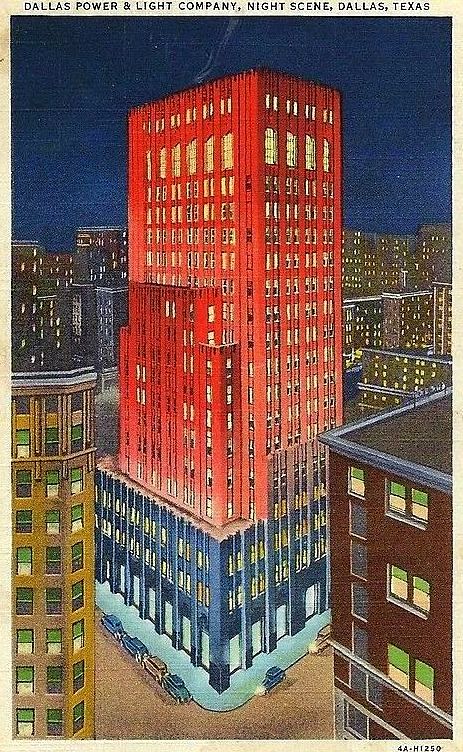
Such an incredible building, designed by architects Lang & Witchell in the zig-zag moderne/Art Deco style and built in 1931 to house the corporate offices of the Dallas Power & Light company. I wondered from that night scene whether the building was illuminated at night, and it was. From the city’s application to the National Register of Historic Places: “The building was spotlighted with revolving colors at night, emphasizing it as a downtown landmark; this was discontinued during the energy crisis in 1975.” Argh!
This is a building that is beautiful by night and beautiful by day.
***
A detailed description of the architectural elements of the DP&L building is in a PDF containing the city’s application of several buildings to be considered for the National Register of Historic Places. The section on the DP&L building begins at page 68 and can be found here.
A photo of one of the portrait busts on the facade of the building is a nod to Thomas A. Edison, King of Electricity, and it can be seen here in an almost Hitchcockian cameo.
*
Copyright © 2014 Paula Bosse. All Rights Reserved.