Flashback : Dallas

A Miscellany: History, Ads, Pop Culture

Category: Photographs

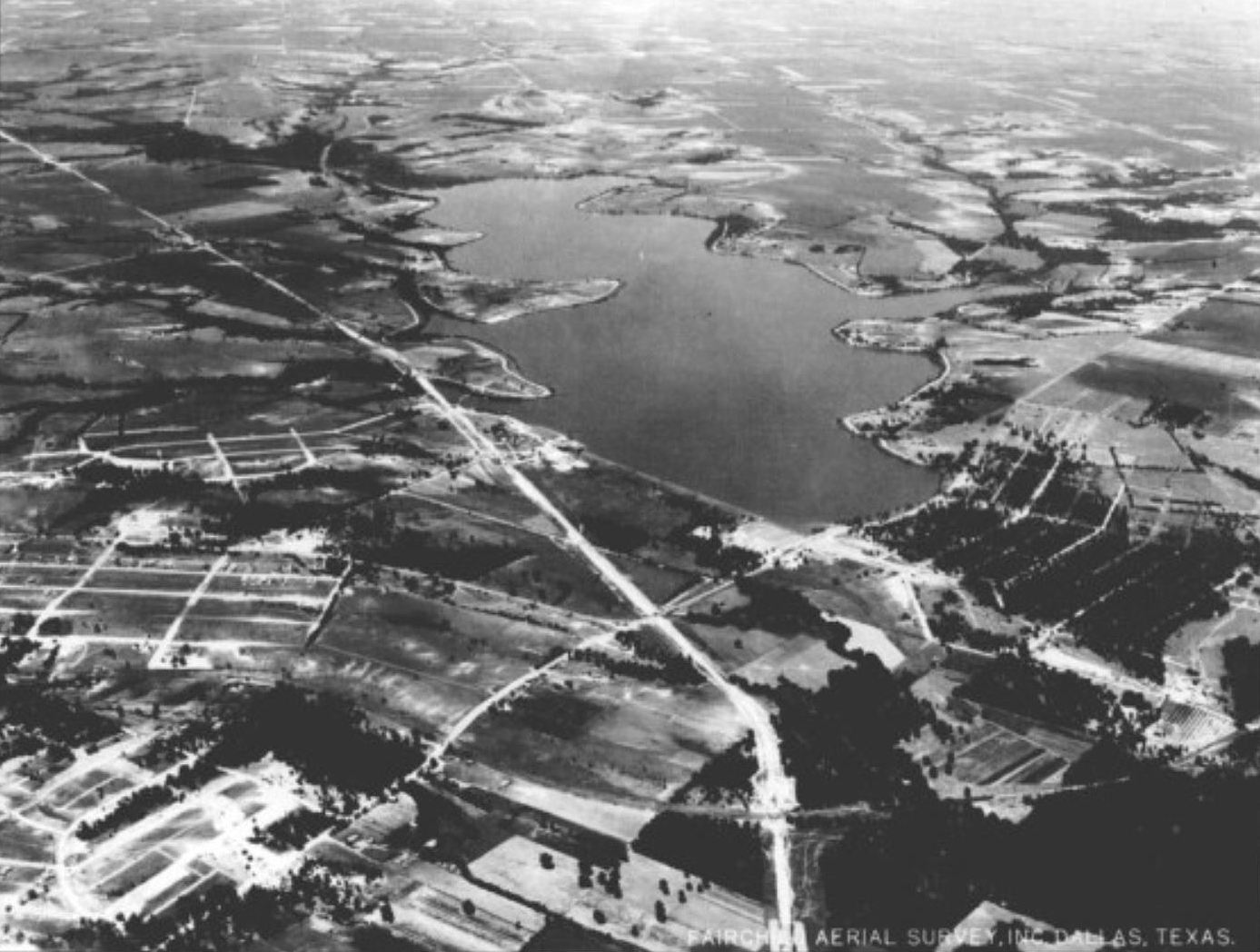
White Rock Lake From Above — 1925-1926

white-rock-lake_fairchild-aerial_1925_legacies_fall-2002Fairchild Aerial Survey photograph, 1925 (click for larger image)

by Paula Bosse

Above, a striking view of White Rock Lake, looking north, with Garland Road and the Houston & Texas Central Railroad tracks (becoming the Texas & New Orleans Railroad tracks in 1934) crossing at the lower center of the photograph, just southwest of the lake. Another Fairchild Aerial Survey photo is below — this one is from 1926, and its wider view shows just how undeveloped this area was at the time.

white-rock-lake_fairchild-aerial_degolyer_smu_1926Fairchild Aerial Survey photo, 1926 (DeGolyer Library, SMU)

*

Here’s a present day view. (Click the image below to see a huge Google Earth image.)

white-rock-lake_google-earth_sm

***

Sources & Notes

Top photo from the very interesting article “From Water Supply to Urban Oasis: A History of the Development of White Rock Lake Park” by Steven Butler (Legacies, Fall 2002), here.

Bottom photo, titled “White Rock Lake Aerial Overview (Unlabeled)” is from the DeGolyer Library, Central University Libraries, Southern Methodist University; it can be accessed (and magnified greatly) here. The “labeled” version — which identifies roads and landmarks — is here. From the SMU description: “This is one of 38 photographic prints taken by Fairchild Aerial Survey, Inc. of White Rock Lake for Dr. Samuel G. Geiser, SMU.” The full set of the White Rock Lake aerial photos is here. A map here shows where the grid maps are in relation to the lake as a whole.

Thanks to “Not Bob” for linking to the Google Earth image in the comments!

These photos are big. Click them!

*

Copyright © 2016 Paula Bosse. All Rights Reserved.


Bonnie Parker: “Buried In an Ice-Blue Negligee” — 1934

bonnie-parker_mortician-account_cook-colln_degolyer(George W. Cook Collection, DeGolyer Library, SMU)

by Paula Bosse

This amazing (and amazingly gruesome) first-hand account of an unnamed McKamy-Campbell Funeral Home undertaker details the incredible amount of work required to prepare the bullet-ridden body of celebrity outlaw Bonnie Parker for burial. This odd little historical document comes from the absolutely fantastic George W. Cook Dallas/Texas Image Collection housed in SMU’s DeGolyer Library. The four-page handwritten document can be viewed in its entirety on SMU’s Central University Libraries’ website here. Below is the full account, transcribed by SMU, with a few corrections/additions made by me.

*

Tear this up please? Tear this up please?

Heres [sic] first hand on Bonnie & Clyde as we had Bonnie. She was about the size of Rose Grace, weighing a 100 pounds. (a thousand pounds of dynamite though) She was very pretty of course her skin was somewhat tan. Her nails were beautiful. Likewise her toe nails. Her toes looked like fingers. The cuticles pushed back, the nails filed to a point, and a deep coral shade polish on them, the most beautiful toes I ever saw, just perfect. Her permanent just a month old we had it waved. Her face, right side was blown off. We fixed this and you could hardly tell it. Just one bullet went through her brain, however and number grazed her head as there were 3 big holes in her scalp, but not through skull. Her left eye terribly black, however I used eye shadow on other eye to match, so that was covered up. Now, her body was just mutilated and torn to pieces from shots. Her right hand nearly blown off (known as her trigger hand) her body besides being full of bullet holes was full of buckshot, pellets all over her

[Page 2] body. We received body ten minutes of nine. Joe and I sewed on her until three that afternoon. At that time they say 25,000 people were lined up outside. It took 2 hours picking dirt, rocks etc. from her hair then to wash it and have waved. A tattoo on right leg two hearts one read Roy, the other Bonnie. Roy you know was her Husband (Roy Thornton now in Pen) All fluid the undertaker in Arcadia La. used leaked out she was torn up so she was a a [sic] mass of blood, caked & dried. Several hours in bathing her. Had to scrape some of it off, and used gold dust to remove most of it. Had skin slip that night account Fluid leaking from it, began to smell the next morning, turning dark, smelling worse. The last day was rotten so to speak The odor was awful. Her Mother thought [sic] sat in room alone with her head over casket. How she stood it Lord knows. The other children couldn’t. Mother fainted 2:30 that night I asked if she wouldn’t like to go home, she went. By then the entire house smelt. We had to keep her so Sister Billy that was in jail in Ft Worth could get out & come to Funeral. She was buried in an all steel metal casket. Paper said $1000.00 wrong about $600 maybe less. Paper said $1000.00 vault Wrong there was no vault Page 2

[Page 3] Buried in an ice Blue Neglegee [sic] (is this spelled right) She was dressed in expensive clothes when killed. About 40,000 people came to view her. Paper said $1,500.00 damages done to Funeral Home. Wrong about the extent of $2.50. They did not tear windows etc as stated. The woman next door though turned Hose on Them to keep her flowers from being walked on. We had 38 officers stationed (3 shifts) all over house and front & back yard keeping crowd in order and all of us as well. 4 operators on the 4 phones. They rang every minute for two days & nights. More people came to see Bonnie then [sic] to see Clyde. Our new Porch Furniture was damaged. We had a Rubber mat about ½ inch in thickness all over Funeral House. Officers

[Page 4] stationed to keep people on it so as not to wear rug out (Big movie Star) my picture was shown in Movies. The paper stretched their stories. She was not to become a Mother as stated. She was diseased slightly though as stated. Now you have it first hand as I worked on her. Joes [sic] & My work was praised very highly in every other line in papers. And if I do say it, It was good. And she looked swell no trace of disfigures showing. The crowd did not steal anything to take home. All paper talk. Example crowd lined up as Far as Fair Park, now judge how it looked. They brought their Lunches. Such Fools.

*

Below, two photographs of the McKamy-Campbell Funeral Home, located at 1921 Forest Avenue in South Dallas, besieged by curious spectators.

mckamy-campbell

mckamy-campbell_dallas-municipal-archives

**

I’m unsure who the “Rose Grace” was who was mentioned on the first page.

The “gold dust” mentioned in the account as being used to remove caked blood from Bonnie’s body was actually Gold Dust Washing Powder or Gold Dust Scouring Soap, a popular, commercially-available “all-purpose cleaning agents” — Wikipedia article is here.

***

Sources & Notes

Top image of the handwritten account on Adolphus Hotel stationery is from the aforementioned George W. Cook Dallas/Texas Image Collection, DeGolyer Library, Central University Libraries, Southern Methodist University, viewable here.

First photo of the McKamy-Campbell Funeral Home is reproduced all over the internet; the second photo is from the files of the Dallas Police Dept., Dallas Municipal Archives, via the University of North Texas’ Portal to Texas History database, here.

Even though the identity of the person who wrote this account is not known, he (…it was probably a man) mentions that he was seen in newsreel footage of the funeral of Bonnie Parker. My wild guess is that he can be seen in this clip from a longer newsreel on the funerals and burials of Bonnie and Clyde at the 2:34 mark. I could never find who his co-worker “Joe” was.

*

Is this our man laying flowers on Bonnies casket?

bonnie-burial_newsreel-screengrab

If you really want to see the state of the bodies of Bonnie (and Clyde) — before and after their time with their undertakers — they’re easy to find via your favorite search engine.

More Flashback Dallas posts on Bonnie & Clyde here.

If you like what you’ve seen on Flashback Dallas, please consider supporting me on Patreon, where for as little as $5 a month, you can receive all-new updates several times a week (if not daily!). More information can be found at Patreon, here.

*

Copyright © 2016 Paula Bosse. All Rights Reserved.

Radio Mobile Units — ca. 1940

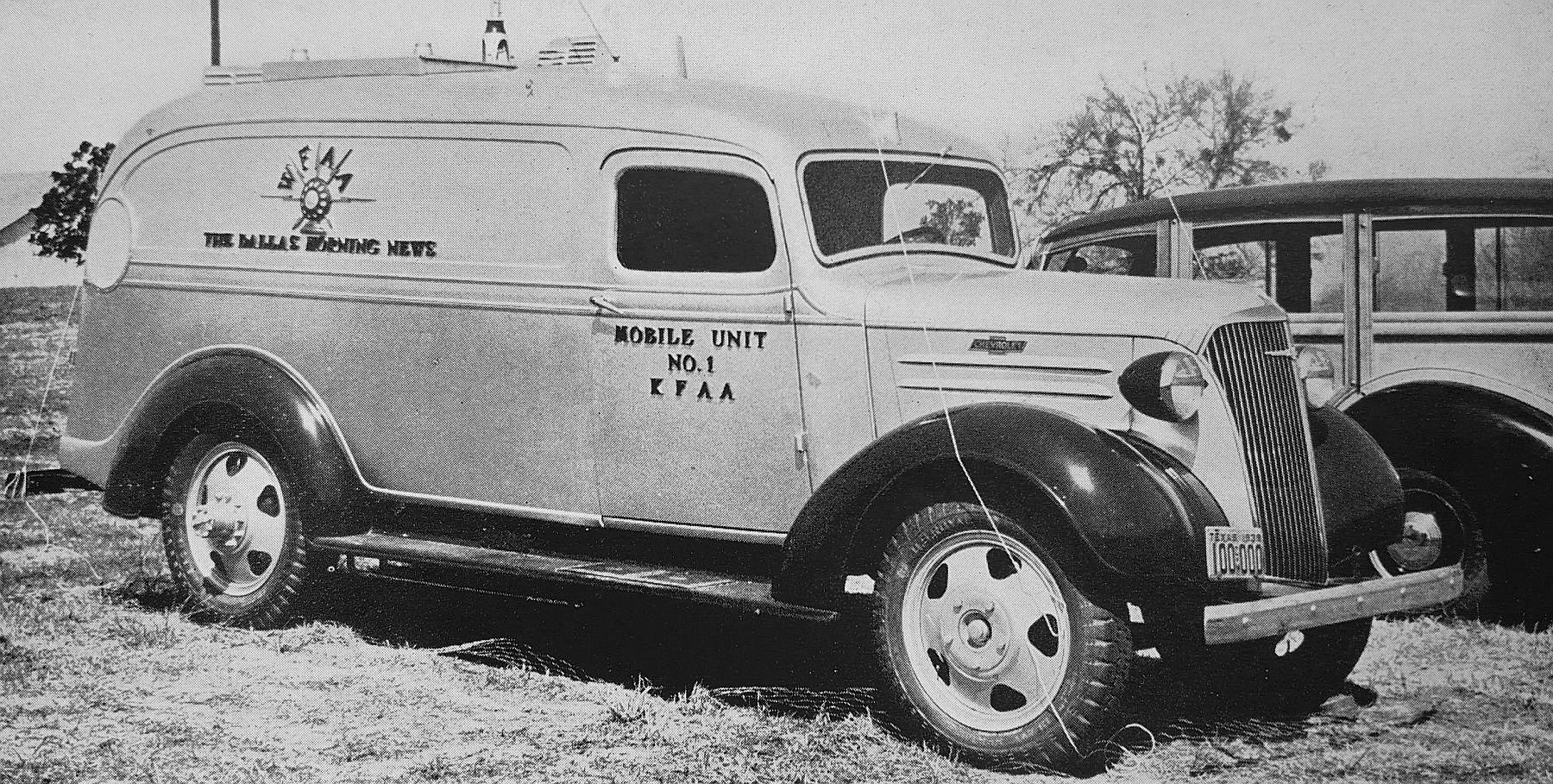
kfaa_mobile-unit_wfaa-fam-albumWhat? You’ve never heard of KFAA? (click for larger image)

by Paula Bosse

Check out these pre-war mobile units for radio stations WFAA and WBAP. The unit above actually had its own call letters — KFAA — and was licensed as a separate station. (That logo!) The caption, from a 1941 promotional booklet issued by stations WFAA (Dallas), WBAP (Fort Worth), and KGKO (Wichita Falls):

The WFAA Mobile Unit shown here is a complete short wave broadcasting station on wheels. The unit has its own call letters, KFAA, because it is a self-contained and separately licensed station. The amazing array of facilities contained in this one-and-one-half-ton truck includes a transmitter, generator, receiving equipment, public address system and pre–amplifiers. The transmitter tower on top of the truck can be raised to a height of 35 feet, making it possible to pick up the mobile unit’s signals for re-broadcast from a distance of 50 miles.

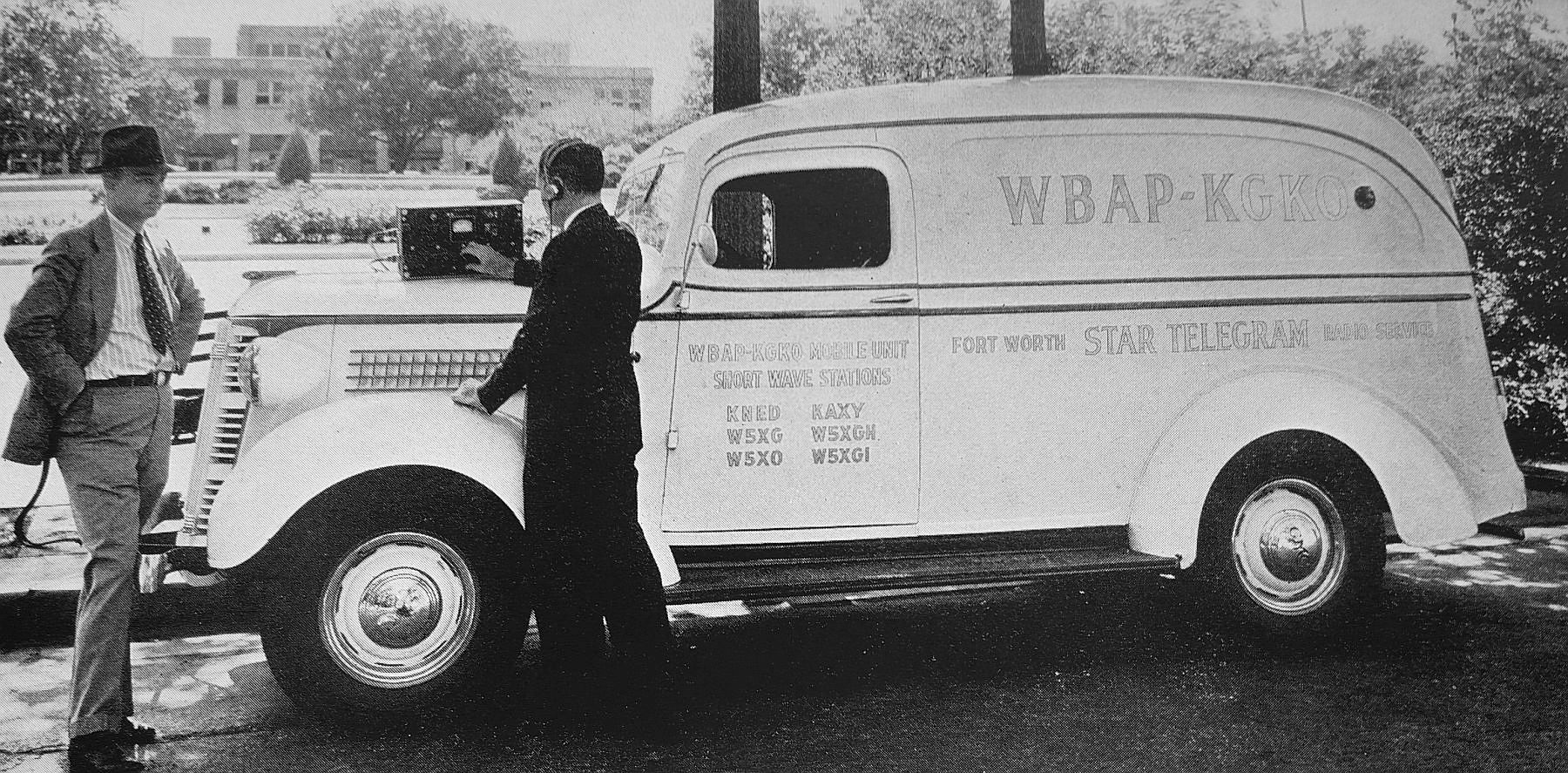
Here’s the WBAP/KGKO unit:

wbap-mobile-unit

Fort Worth Star-Telegram Mobile Radio Unit – with Chief Engineer R. C. “Super” Stinson, left, and A. M. Woodford, production man, handling a remote or “nemo” pickup from Burnett Park, Fort Worth. The WBAP-KGKO Mobile Unit carries six short wave transmitters and receivers besides a power plant capable of generating electricity for a small town of 500 people. This unit “swam” through a recent flood in Brady, Texas, established communication from the stricken area and received the congratulations of the Texas Highway Patrol. It also played a star role in the Amarillo storm.

***

Photos from the booklet WFAA, WBAP, KGKO Combined Family Album (Dallas-Fort Worth, 1941).

Why were arch-rivals WFAA (owned by The Dallas Morning News) and WBAP (owned by The Fort Worth Star-Telegram) co-publishing a promotional booklet? Because they shared the same transmitter and had an extremely odd broadcasting agreement. Read about it in my previous post “WFAA & WBAP’s Unusual Broadcasting Alliance,” here.

Click those photos!

*

Copyright © 2016 Paula Bosse. All Rights Reserved.

West Jefferson in the Truman Years

oak-cliff_w-jefferson_frontier-top-tierW. Jefferson & S. Bishop (click for very large image)

by Paula Bosse

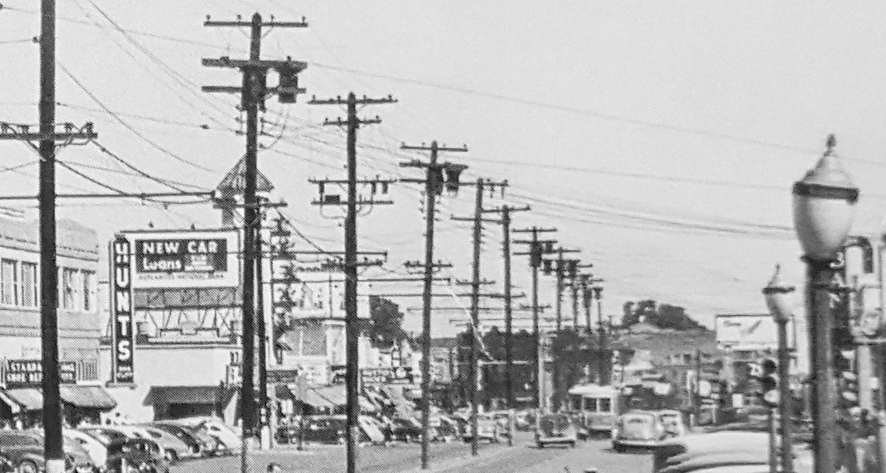
Here we see West Jefferson Blvd. in Oak Cliff, looking east from just west of the intersection with South Bishop. Not being proficient in dating automobiles, I’m unsure of the date, but the Hoffman Optical Co. (seen on the right) did not appear in the 1948 city directory, but was there by 1951. The current view from this intersection can be seen on Google Street View here. Even though the visual blight of those telephone poles is unappealing, I have to say, I prefer the livelier W. Jefferson of 60-something years ago.

If you squint, you can just see the Texas Theatre in the distance on the left — under the pointy roof, behind the “New Car” billboard. Here’s a magnified detail (click to see a larger image) — you can (barely) see “TEXAS” spelled out on the vertical sign.

oak-cliff_w-jefferson_tx-theatre_det

The first thing I noticed in this photo is this odd black vehicle driving away from the photographer — I keep seeing a bulky version of Harold’s customized hearse from the movie Harold and Maude. What is this?

oak-cliff_w-jefferson_vehicle

Here are the businesses that occupied the couple of blocks seen here (from S. Bishop to S. Zang) in 1951:

w-jefferson_1951a          w-jefferson_1951b
1951 city directory (click to read!)

*

Copyright © 2016 Paula Bosse. All Rights Reserved.


Goodbye, Merle

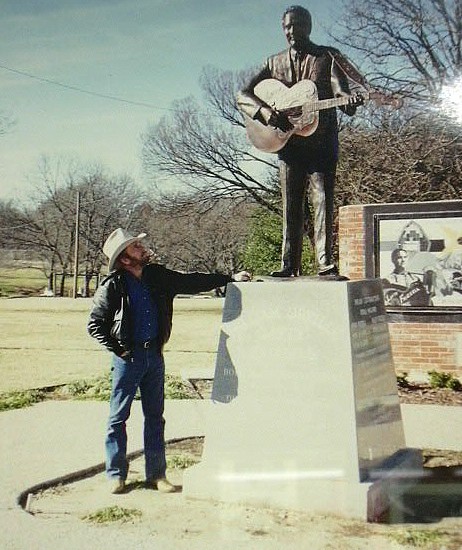
merle_lefty_corsicanaMerle and Lefty, in Corsicana

by Paula Bosse

The great Merle Haggard died today, on his 79th birthday. My earliest music memories are hearing his songs on the radio. Even people who don’t listen to country  music know who Merle Haggard is (and are probably fans).

One of his idols was Lefty Frizzell, the Corsicana-born legend whose first hits were recorded in Dallas. Merle helped raise the funds in the late ’80s and early ’90s for the wonderful statue of Lefty which now stands in Jester Park in Corsicana. The picture above shows Merle visiting the statue. (Whenever I’m in Corsicana, I always drop by Jester Park to spend some time with Lefty.)

As far as Merle and Dallas, the earliest mention I could find was from January, 1965. Country music was covered only sporadically in the pages of The Dallas Morning News back then, but his early-’65 stop at the Sportatorium may have been Merle’s first appearance in Dallas — appropriately enough, it was at the Big D Jamboree. “California country music team” Merle and Bonnie Owens were guest performers, along with Billy Grammer and James O’Gwynn of the Grand Ole Opry, and the regular Jamboree cast of thirty, for the Jan. 30, 1965 Saturday-night Big D Jamboree show.

RIP, Merle. Thanks for everything.

***

The top picture is a photo I took of an original photograph which is hanging in the Lefty Frizzell Museum, which is also in Corsicana’s Jester Park (as part of the Pioneer Village).

Merle’s obituary in Variety — which includes entertaining salty quotes from the man himself — is here.

*

Copyright © 2016 Paula Bosse. All Rights Reserved.


Home Sweet Home at Commerce & Harwood

municipal-bldg_houses_jeppson_flickr“Main Street Garden?”

by Paula Bosse

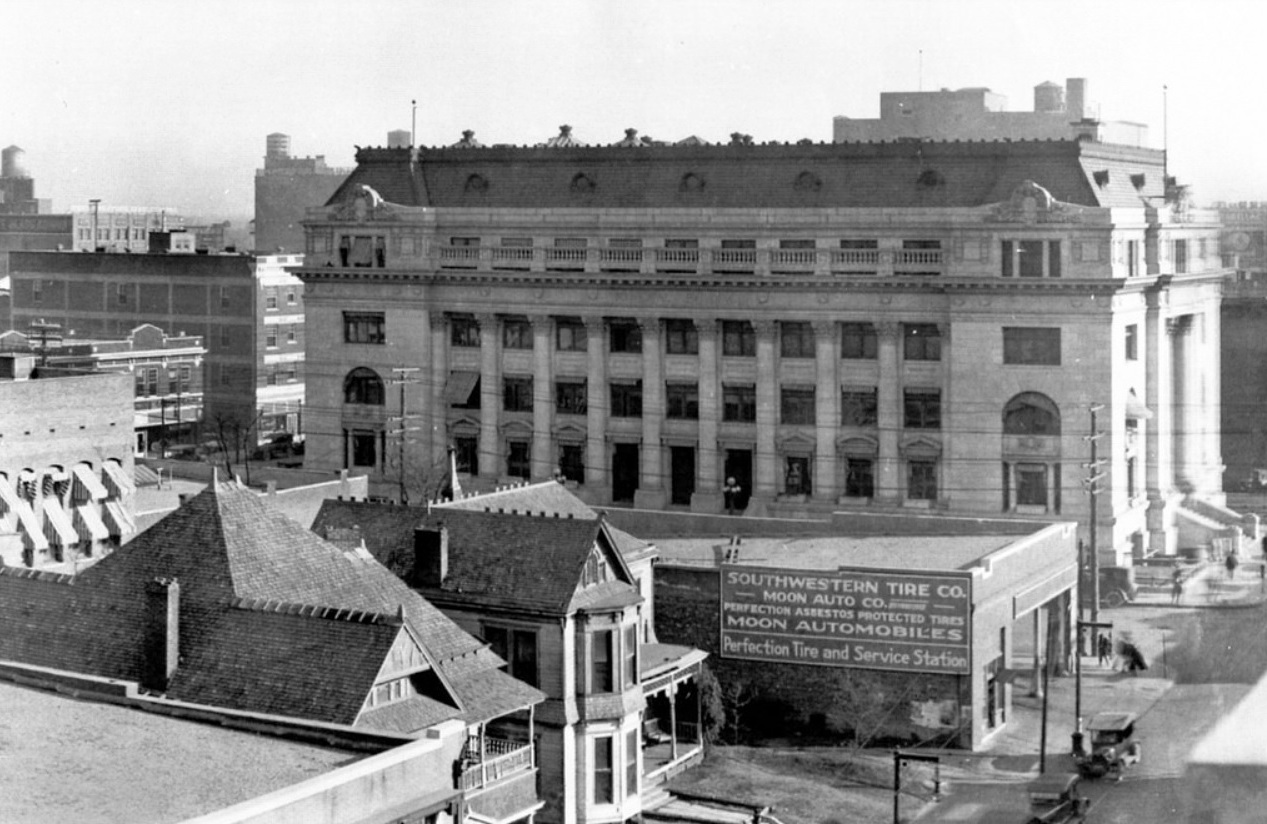
Quaint homes, mere steps from City Hall. Not sure of the exact date of this photo, but these homes and this service station were at the above location in 1920. Wonder when those homeowners finally decided to sell? Talk about your primo real estate!

Below is a similar photo, but this one shows more of Commerce looking east — I don’t come across a lot of photos of this era showing downtown past what was unofficially thought of as its eastern boundary.

municipal-bldg_cook-coll_degolyer_SMU

***

Sources & Notes

Photo from Noah Jeppson’s Flickr page, here.

Second photo, titled “Dallas City Hall,” is from the George W. Cook Dallas/Texas Image Collection, DeGolyer Library, Central University Libraries, Southern Methodist University; more info on this photo can be found here.

More on the building of the City Hall/Municipal Building in the Flashback Dallas post “The Elegant Municipal Building — 1914,” here.

*

Copyright © 2016 Paula Bosse. All Rights Reserved.

Signage Overload on Main Street — ca. 1925

main-street_east_hilton_ebayI hope the photographer has a red light behind him…

by Paula Bosse

This photo makes me feel anxious. There’s just too much going on here: too many signs, too many overhead wires, too garish a light.

This is the 1800 block of Main Street, looking east. The photographer’s shadow can be seen at the bottom of the photo. A large hotel of some sort (the name of which escapes me at the moment) can be seen in the distance (in the 1900 block) at Harwood.

The businesses in this block, from the 1925 city directory (click for larger image):

1800-block_main_1925-directory

I have no 1926 directory to reference, but the 1927 directory has the building at 1811 Main (occupied in the photo by the Rund-Humphrey Water Heater Co. and the Stevenson Printing Co.) listed as being vacant. And the Hilton opened in 1925, so the photo seems to have been taken in 1925 or 1926.

***

Sources & Notes

Photo from eBay.

See the Hilton (the first one, not the later Statler-Hilton on Commerce) from a different angle in the post “The Hilton Hotel, Main & Harwood,” here.

*

Copyright © 2016 Paula Bosse. All Rights Reserved.

Tennessee Williams in Dallas

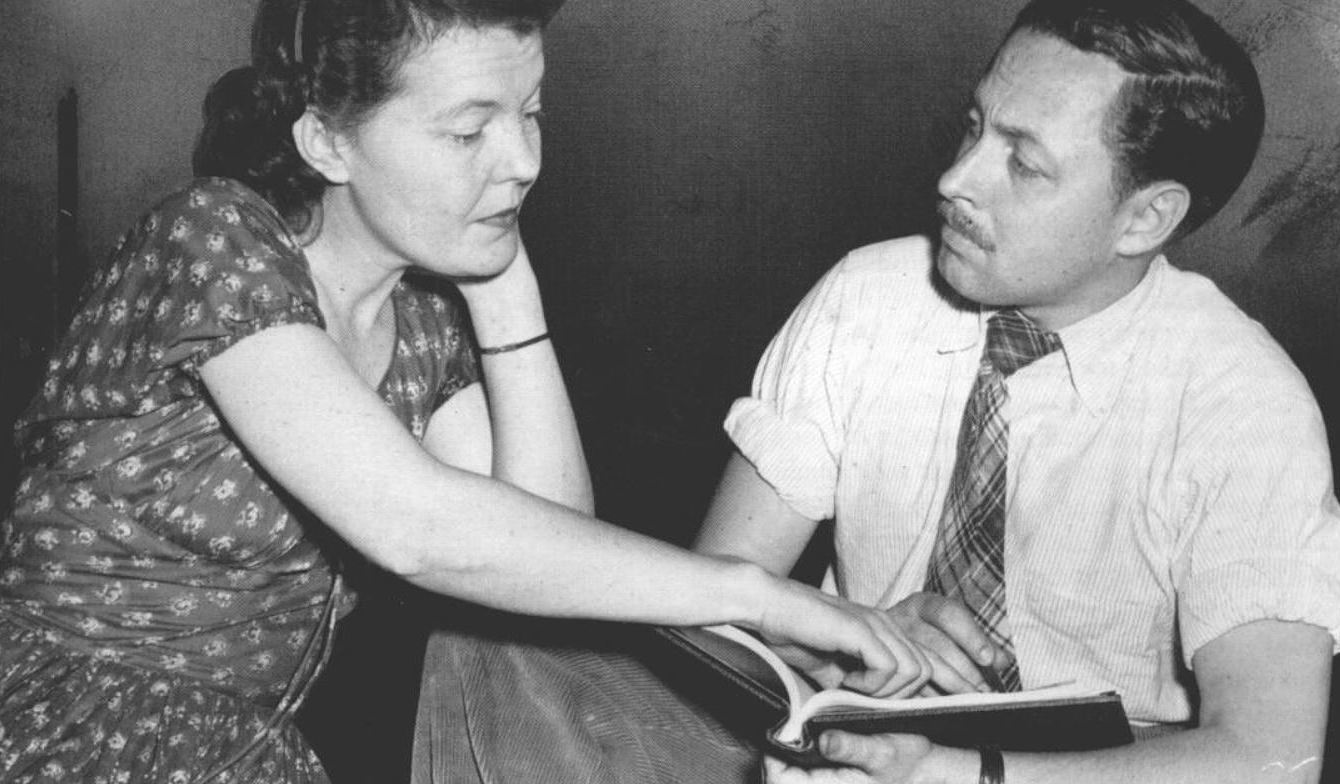
tennessee-williams_margo-jones_legacies_spring-2007Tennessee Williams with Margo Jones, 1948

by Paula Bosse

Today is Tennessee Williams’ birthday — he was born March 26, 1911. Thanks to his personal friendship and professional relationship with energetic Dallas theater pioneer Margo Jones (to whom he gave the nickname “The Texas Tornado”), playwright Tennessee Williams was a fairly frequent visitor to Dallas in the 1940s in the early years of his celebrity. Margo was a very early supporter of Williams, and their friendship led to her co-directing The Glass Menagerie on Broadway and her directing and producing the world premiere of his play Summer and Smoke at her Theater ’47 in Fair Park (a production which she took to Broadway the following year).

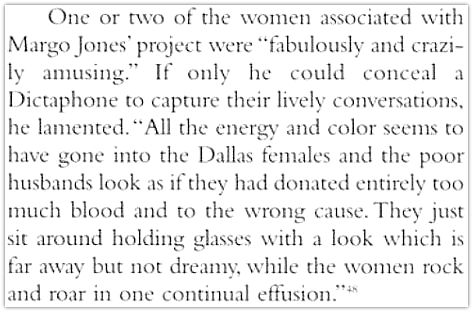
Dallas historian Darwin Payne wrote an interesting profile of Williams’ time in Dallas in the Spring 2007 issue of Legacies (read it here — it  begins at the bottom of the page). My favorite quote in the article is about Dallas women, from a letter Tennessee wrote to New York theater director and producer Guthrie McClintic on June 1, 1945:

tennessee-williams_legacies_spring-2007_darwin-payne_1945-quote

***

Sources & Notes

A comprehensive chronology of the friendship and professional partnership of Tennessee Williams and Margo Jones can be found in the article “An Alignment of Stars: Tennessee Williams, William Inge, and Margo Jones’s ‘Theatre ’47′” by Ralph F. Voss, here.

My previous post concerning Margo Jones’ early demise — “Margo Jones & Jim Beck: Both Legends in Their Fields, Both Victims of Carbon Tetrachloride” — is here.

*

Copyright © 2016 Paula Bosse. All Rights Reserved.


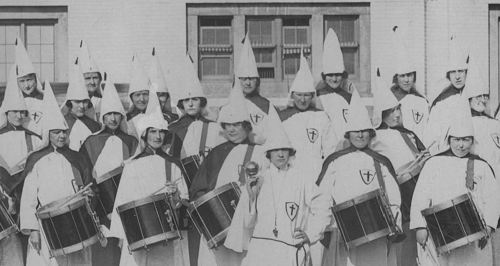
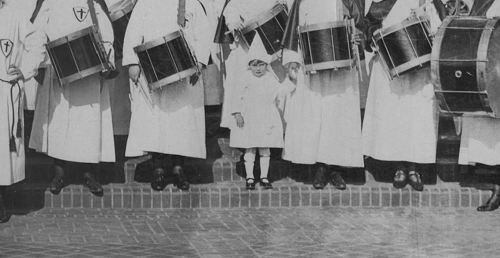
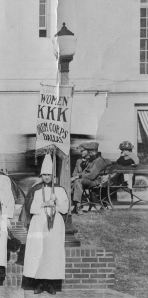
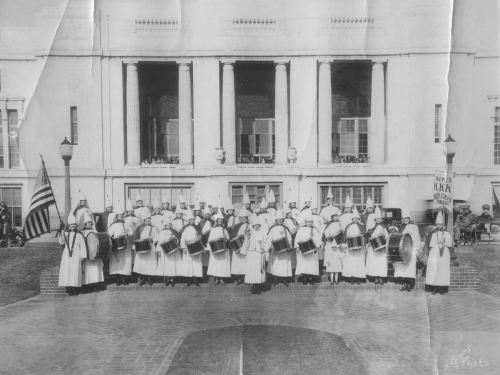
The Dallas Chapter of “The Women of the Ku Klux Klan” — 1920s

kkk-women_1920s_cook-degolyer

by Paula Bosse

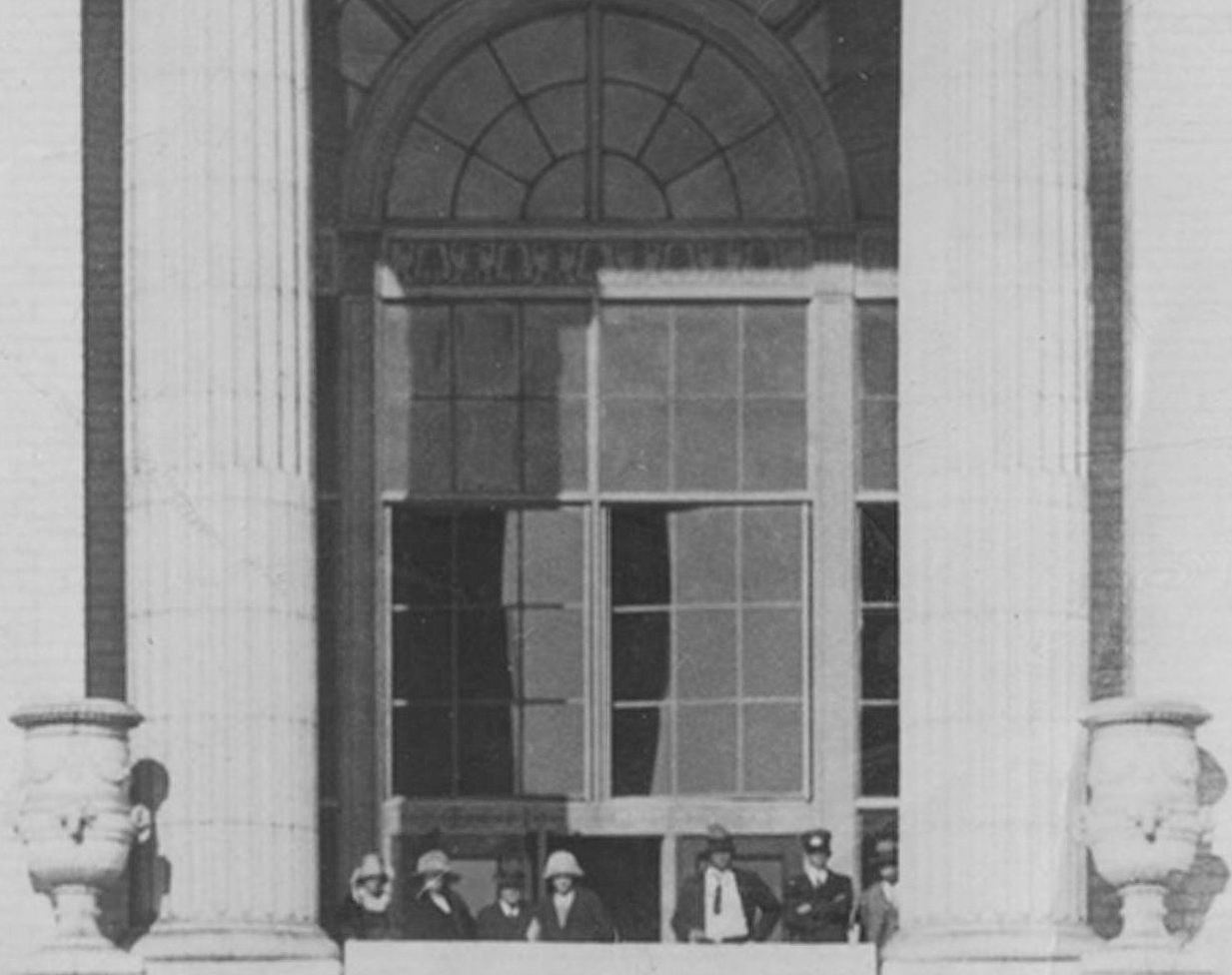
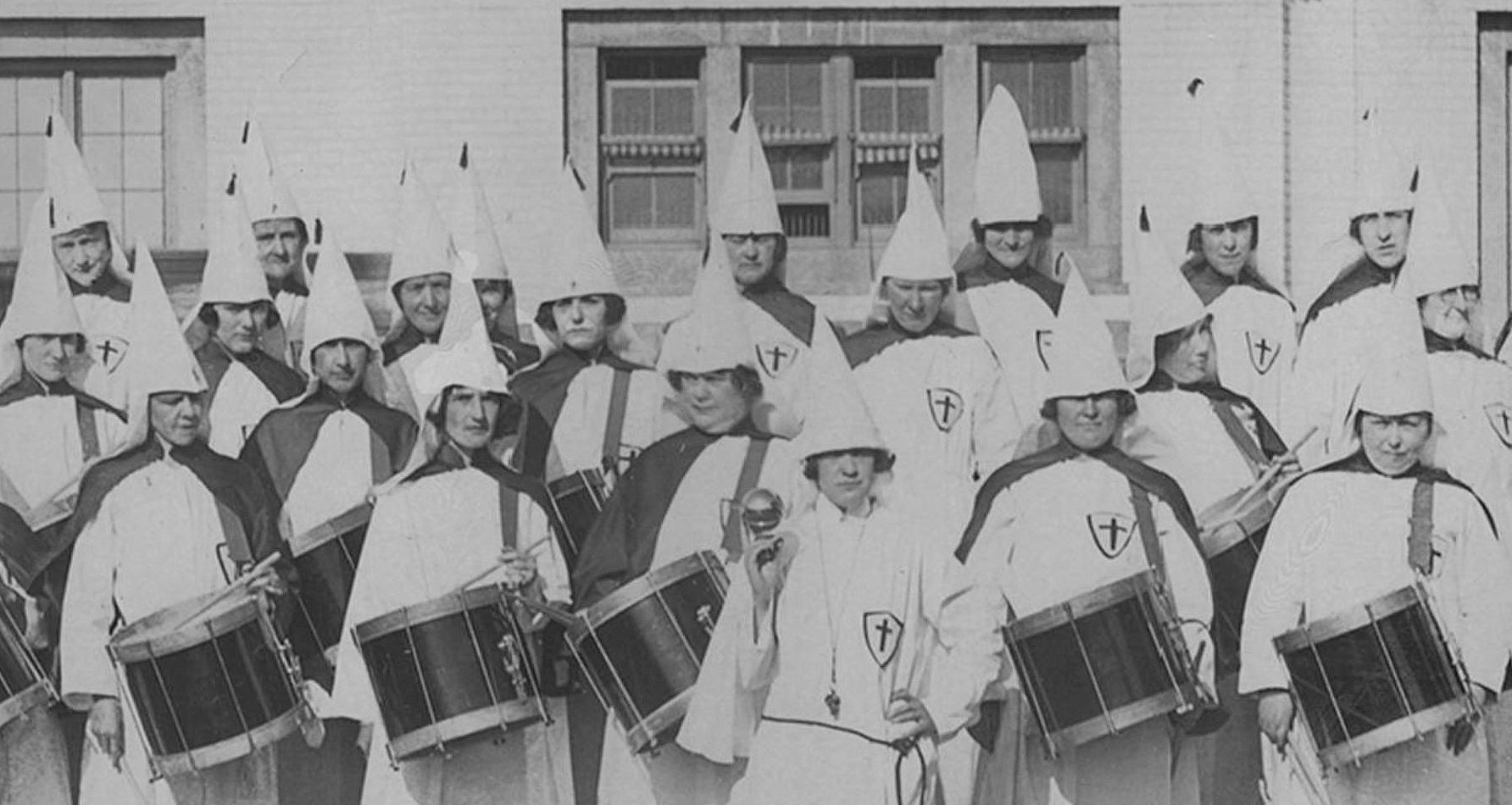
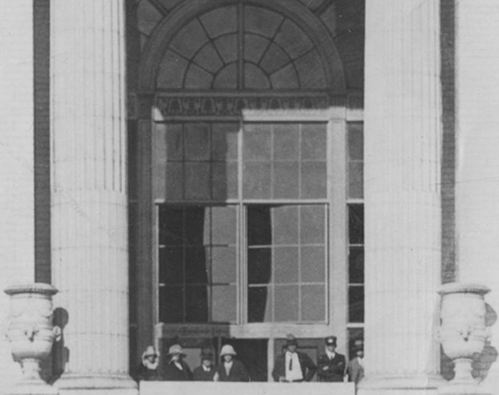
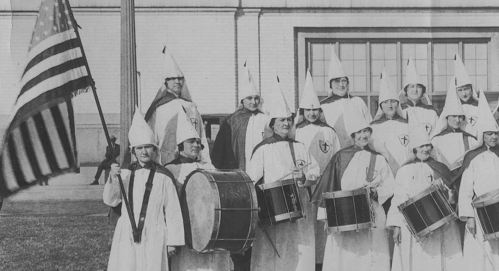
I’ve managed to avoid mention of the Ku Klux Klan since starting this blog a couple of years ago, which is saying something, because the KKK pretty much ruled this city for a good chunk of the 1920s. The Dallas chapter — Klan No. 66 — had more than 13,000 men as members; it was one of the largest chapters in the nation (by some accounts, THE largest chapter). Members included politicians, judges, and law enforcement officials. But what of the Klan-leaning ladies who were not allowed to join? Before I plunge into that, let’s look at what’s going on in this weird, be-robed group shot, a photo taken around 1924 in Ferris Plaza with poor Union Station as a backdrop. (Click these for much larger images.)
wkkk_det1

wkkk_det2

wkkk_det3

wkkk_det4

wkkk_det5

**

In the early 1920s, women — who had led the temperance movement and whom had recently been given the right to vote — began to form groups that tackled social issues. Some of these groups espoused the same general rhetoric as the KKK. One of these groups was formed in Dallas in 1922 — the “American Women” group was the brainchild of three women, including Alma B. Cloud, who appears to have been only 21 years old. One of the other founders was her partner in a short-lived ladies’ clothing boutique. Cloud immediately hit the lecture circuit, giving free lectures on “Americanism” to (white Protestant) women around Texas.
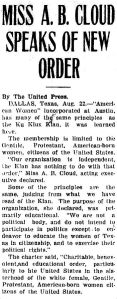
cloud_taylor-tx-daily-press-08222Taylor Daily Press, Aug. 22, 1922

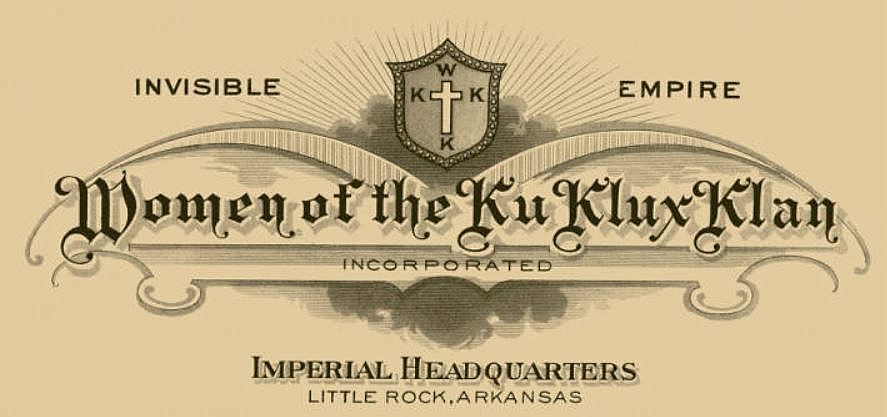
By the following summer, the male leadership of the Klan allowed a “Women of the Ku Klux Klan” to be created; its national headquarters was in Little Rock.
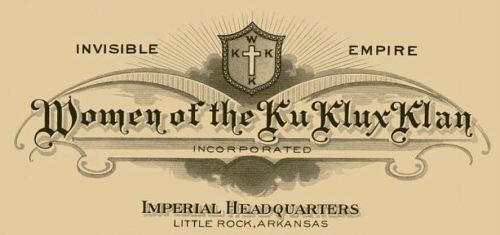
wkkk_letterhead_olemiss

They were not officially part of the KKK but were, in theory, a separate entity. While not, perhaps, as outwardly extreme as their male counterparts, they were certainly as virulently racist and intolerant. They might not have been lynching people and threatening violence, but they were busy pushing their exclusionary, white supremacy agenda. And both the men and the women liked to dress up in white robes and hoods. Here’s what the women looked like when they added masks to the ensemble (not Dallas — location of photo unknown).
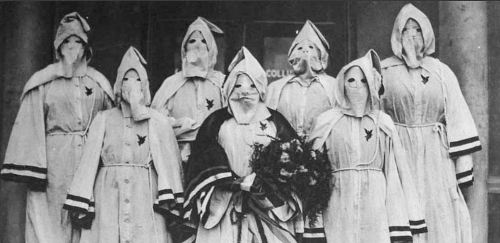
wkkk

Several of the independent women’s groups founded previously were happily absorbed by the WKKK — including Miss A. B. Cloud’s group. In fact, Miss Cloud became the leader of the Dallas chapter. The “Klaliff.” The headquarters for this group — which campaigned for “progressive morality”– was in a little space on North Harwood.

WKKK_1924-directory1924 Dallas directory

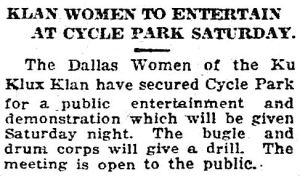
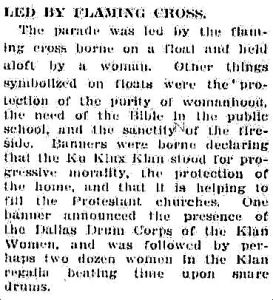
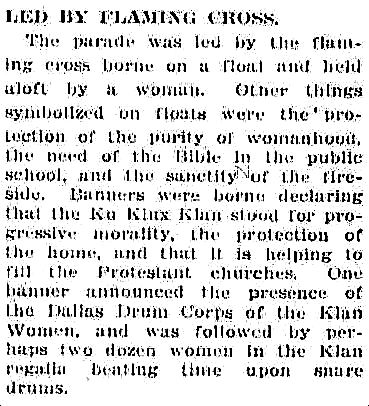
1924 seems to have been the big year for both the KKK and the WKKK. The women found themselves at lots of parades with burning crosses and other … “functions” — so why not form a drum corps? A few clippings. (Click for larger images.)
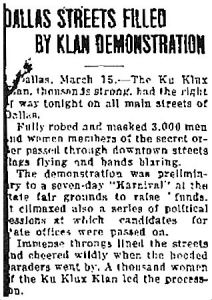
kkk-women_amarillo-globe-times_031624Amarillo Globe-Times, March 16, 1924

klan-women_dmn_073124Dallas News, July 31, 1924

kkk-women_mckinney-courier-gazette_111224McKinney Courier-Gazette, Nov. 12,1924

By 1926, the KKK was starting to lose its power, and the fear and intimidation they had instilled in much of the public began to wane. The (men’s) KKK had had to downsize and move into the women’s headquarters, and their candidates began losing elections. Even worse, you know things were getting bad if someone was suing the KKK for delinquent robe-payment!

KU KLUX KLAN WOMEN SUED FOR ROBES BILL: Suit for $4,463.80 was filed in the Forty-Fourth District Court on Friday afternoon by John F. Pruitt against the Women of the Ku Klux Klan, Inc. The petition alleges that the plaintiff sold the defendant, a corporation, 6,000 robes at $2.50 each during the two years preceding the filing of the suit, for which the defendant agreed to pay $15,000 to the plaintiff. It is alleged that $4,463.80 remains unpaid. (DMN, Nov. 28, 1925)

The power once exerted by the Ku Klux Klan had diminished greatly by the end of the 1920s, and while the Klan has never disappeared completely, it will never again reach the heights it had attained in the 1920s.

Whatever happened to Miss A. B. Cloud? After having been ousted from her “imperial” position (for reasons I don’t really care enough about to investigate), she had a few sales jobs and eventually began to present motivational sales talks. There was an Alma B. Cloud in California who was mentioned in several news stories from the 1930s — she presented motivational lectures to students on how best to plan their future adult lives. Um, yes. I’m not 100% sure this was the same A. B. Cloud who was the former WKKK gal from Big D, but it seems likely. I wonder what those students would have thought had they known of her pointy-hooded past?

***

Sources & Notes

Links-a-plenty.

Top photo is titled “Ku Klux Klan Women’s Drum Corps Dallas in Front of Union Station,” taken by Frank Rogers; it is from the George W. Cook Dallas/Texas Image Collection, DeGolyer Library, Central University Libraries, Southern Methodist University — it can be accessed here. I have manipulated the color.

Women of the Ku Klux Klan letterhead comes from the Women of the Ku Klux Klan Collection, Archives and Special Collections, University of Mississippi Libraries; the collection can be accessed here.

The photo of the masked WKKK women is all over the internet — I don’t know its original source or any details behind it, but it’s creepy.

“Women of the Ku Klux Klan” on Wikipedia, is here.

“Women of the Klan: Racism and Gender in the 1920s” by Kathleen M. Blee, is here.

“Charity by Day, Punishment by Night: The Ku Klux Klan in Fort Worth” — from the great FW history blog Hometown by Handlebar — is here.

And, probably best of all, the Dallas Morning News article “At Its Peak, Ku Klux Klan Gripped Dallas,” by the wonderful and much-missed Bryan Woolley, can be read here. This article contains facts and figures, describes the sort of “madness of crowds” atmosphere in the city at the time, and details some of the horrible atrocities committed by the KKK in Dallas. Woolley cites historian Darwin Payne’s assertion that if one considered every adult man in Dallas who would have been eligible to have joined the Klan (this excludes, of course, those of African-American, Hispanic, Asian, Catholic, or Jewish descent), one in three of them was a member of the Dallas chapter of the Ku Klux Klan. ONE IN THREE.

A few short mentions of the Dallas WKKK have been compiled here.

UPDATE: For a look at racism in modern Dallas, watch the half-hour film “Hate Mail,” made in 1992 by Mark Birnbaum and Bart Weiss, here. It includes interviews with several prominent Dallasites, as well as interviews with a couple of Klan leaders.

Click pictures and clippings to see larger images.

*

Copyright © 2016 Paula Bosse. All Rights Reserved.

Highland Park Village — The Original Model

hp-village_model_gallowayDallas’ most exclusive shopping destination

by Paula Bosse

The model of the Highland Park Shopping Village (“9 Acres of Property”) was, for many years, on display in the sales office of the Flippen-Prather Realty Co., the company that developed Highland Park and this beautiful shopping “village.” (I’m not sure where this photo was taken — it looks like a Flippen-Prather promotional table set up in an exhibition space of some sort.) Construction began on the shopping area in early 1930 and took several years to complete. The architects were Dallas’ Fooshee & Cheek.

Below, a slightly closer look at this cool model, complete with little cars (but no little people…).

hp-village-model_galloway-det

***

Sources & Notes

The photo (credited to the collection of Hugh Prather, Jr.) is from the really wonderful book The Park Cities, A Photohistory by Diane Galloway (Dallas: Diane Galloway, 1989). (This is an essential book for anyone interested in historic photos of Dallas and the Park Cities. If you come across a copy priced under $30.00, snap it up!)

More on the Highland Park Village of today can be found here.

*

Copyright © 2016 Paula Bosse. All Rights Reserved.