Flashback : Dallas

A Miscellany: History, Ads, Pop Culture

Category: Photographs

Up North in Denton: “Famous School and College County”

denton-co-courthouse-1928Denton County Courthouse, 1928 (click for larger image)

by Paula Bosse

Okay, so it’s not Dallas, but who in Big D doesn’t love Little D? Besides, this is just too great a photo to keep to myself.

And in case you need to bone up on your 1928 Denton County stats for “Jeopardy” or something, look no further (click for larger image):

denton-co-courthouse_1928b

“Kindergarten to College Degree —
Board at home and be educated free.”

Free!

*

Might as well see where the photo of the courthouse was taken from: the Wright Opera House (now Recycled Books). Here it is, about 1900:

denton-opera-house_1900_tx-historian_1982The Wright Opera House, built in 1899, shown here in 1900 (click for much larger image)

***

The photo of the courthouse and the ad are both from, where else, the program for the 52nd Annual Convention of the State Firemen’s Association of Texas, held in Denton in June of 1928. If you’re into firefighting ephemera or old Denton photos, you might want to peruse it yourself: click here. (From the collection of the Denton Public Library.)

Photo of the Opera House from the article “Faded Echoes: A History of the Wright Opera House in Denton” by Clare Adkins, featured in the September, 1982 issue of Texas Historian, accessible through the Portal to Texas History, here.

Click pictures for larger images.

*

Copyright © 2014 Paula Bosse. All Rights Reserved.

Interurban vs. Streetcar

interurban-vs-streetcarOh dear…

by Paula Bosse

I’m not sure what’s happened here, but it looks like the interurban has emerged victorious.

***

Sources & Notes

I don’t know the original source of this photo, but I came across it on the Northern Texas Traction History Group on Facebook. The electric-powered interurban car is the big red one on the left; the puny (but cute) electric-powered green streetcar is on the right. The view here is looking north on Record, from just south of Young Street, inside what would one day be called “Communications Center”: the Dallas Morning News Building is on the left, and the not-yet-built WFAA studios will later be to the immediate right (east). The long-gone Hotel Jefferson is north of Ferris Park (the hotel was catty-corner from Union Station, across Houston Street). In the distance you can see the tippy-top of the Old Red Courthouse, just above the green streetcar. Also, those now-gone smokestacks that were such a fixture on the skyline are straight ahead.

*

Copyright © 2014 Paula Bosse. All Rights Reserved.

Ernie Banks: From Booker T. Washington High School to the Baseball Hall of Fame to the Presidential Medal of Freedom

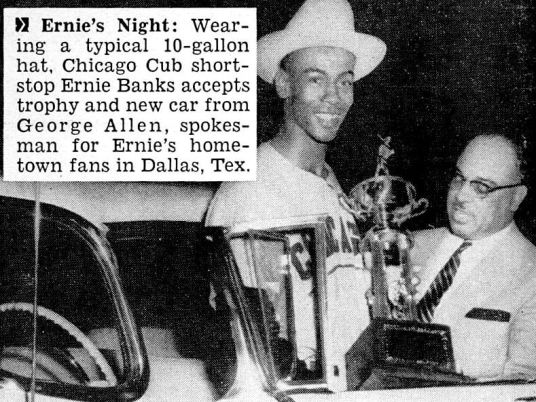
banks-ernie_jet_110355
Ernie Banks and George Allen, Oct. 1955 (Jet magazine)

by Paula Bosse

Ernie Banks, the baseball player so indelibly linked with Chicago that he is known as “Mr. Cub,” is a Dallas native whose professional career began when he was spotted by a Negro League scout while playing softball in a park near his high school, Booker T. Washington. He was recruited right away and made his mark almost immediately, and, in 1953, he and Gene Baker became the first African American players signed to the Chicago Cubs.

One of the sport’s most popular players, Banks, who began his career playing shortstop, routinely shattered home run records and was a perennial MVP and All-Star player. Even though his Cubs never made it to the World Series, Banks was a stand-out player, and his election to the Baseball Hall of Fame in 1977 came as no surprise. I have to admit, my knowledge of baseball is scant, but I love this man, and it’s a testament to “Mr. Cub” that he is as famous for his genuine nice-ness as he is for his undisputed skill as a player.
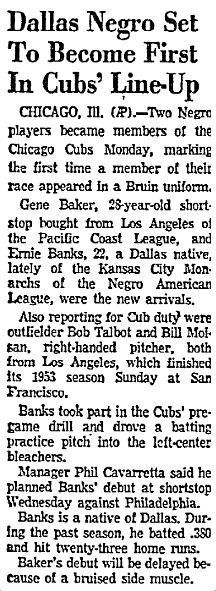
banks_dmn_091553AP, Sept. 15, 1953

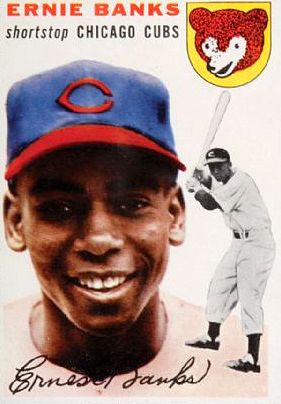
ernie-banks_rookieErnie Banks’ rookie card – Topps, 1954

ernie_banks

*

Oct. 11, 1955 was declared “Ernie Banks Day” in Dallas. Ernie was in town to play an exhibition game between the Major League Negro All Stars and the Negro American League All Stars (Ernie’s major leaguers won, 6-2) — while he was here, he enjoyed the hometown adulation and was lauded with gifts. The photo at the top of this post was from that day, as is the one below, in which he poses with his wife, Mollye Banks.

banks-ernie_wife-mollye-ector-banks_101155_patton-collection_DHSHometown hero, Oct. 11, 1955 (Dallas Historical Society)

***

Sources & Notes

Top photo from Jet magazine, Nov. 3, 1955; a version ran in The Dallas Morning News on Oct. 12, 1955 above the following caption: “Honors came thick and fast for Ernie Banks at Burnett Field Tuesday night. Appearing with a group of barnstorming Major League All Stars, Banks was presented a new Oldsmobile (background), a Texas style hat and scrolls and trophies. With Banks is George Allen, chairman of the citizens’ appreciation committee which presented the automobile. The mayor [R.L. Thornton] proclaimed Oct. 11 Ernie Banks Day in Dallas.”

The photo of Banks and his wife, Mollye Ector Banks, in Dallas is from the John Leslie Patton Jr. Papers, Dallas Historical Society (Object ID V.86.50.902).

Check out these articles from The Dallas Morning News archives:

  • “Banks to Tackle First — Reluctantly” by Bud Shrake (DMN, March 16, 1962) — with a few paragraphs on growing up in Dallas
  • “From Dallas to Cooperstown” by Randy Galloway (DMN, Jan. 20, 1977)

A nice overview of Ernie Banks’ career titled “Nice Guys Don’t Always Finish Last” by Steven Schmich (from his larger article titled “Five Dallas Athletes Who Made a Difference”) can be read in the Spring, 1994 issue of Legacies magazine here. (In fact, the entire issue of this Dallas history journal is devoted to sports and is available to read in its entirety, beginning here.)

Stats? I got yer stats, right here.

In November 2013, Ernie Banks was awarded the Presidential Medal of Freedom. A few short words from him after the ceremony say all that really needs to be said from this wonderful man — watch the short video here.

UPDATE: Sadly, Ernie Banks has died. He died Friday, January 23, 2015. He was 83. The New York Times obituary is here; the Chicago Tribune’s wonderful collection of tributes and photos is here.

*

Copyright © 2014 Paula Bosse. All Rights Reserved.

Skate Date!

skate-date_ebay-smSkating at Fair Park…

by Paula Bosse

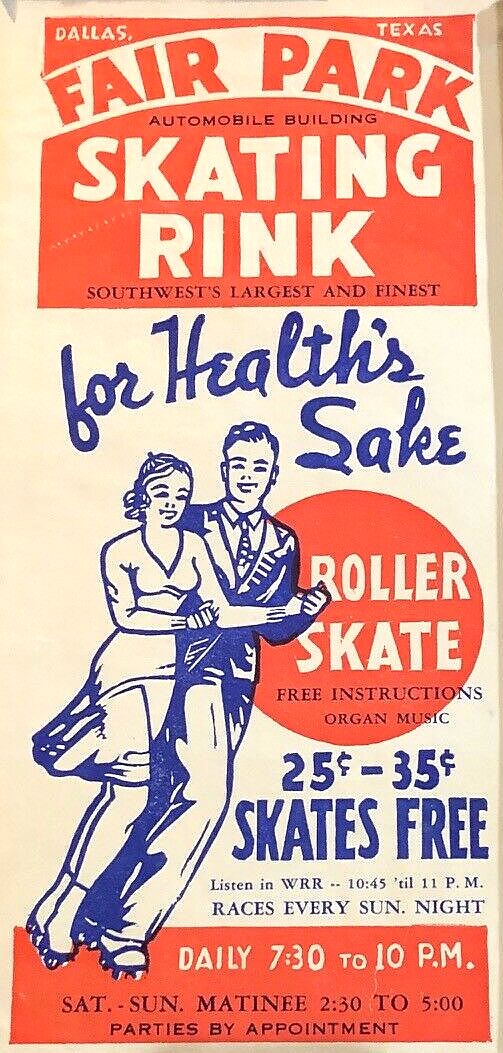
The Fair Grounds Skating Rink opened in the old Machinery Hall in 1906 at the height of the roller skating fad that was sweeping the nation. Over 1,000 people were “on the floor” on opening night, and the rink was an immediate hit with the city’s “roller-maniacs.” Though apparently very popular, it closed rather suddenly in 1907 when it was discovered that the concessionaires were selling more than cold drinks to patrons — they had also been operating a prostitution business right there on the (city-owned) premises.

It wasn’t until 1921 that the rink re-opened (managed by a man who may well have been one of the guys who operated the lucrative illicit side-business back in the aughts). It seems to have closed again for a while and then re-re-opened sometime in the ’30s, a time when business was steady and booming. But, sadly, the building burned down in 1942. BUT, a new, flashier rink was built right away, near (…next to? …in?) the Cotton Bowl (the ad below mentions the Automobile Building), and this one lasted a good long time, until at least 1957.

So, 1906-1957, give or take a few years — not a bad run for roller skating in Fair Park (…unless you count the bleacher bordello and the fiery conflagration). All skate!

fair-park_skating_watermelonkid

fair-park-skating-rink_matchbook_ebay

***

Sources & Notes

Top photo (of an attractive but unidentified couple) from eBay. Click it for a MUCH larger image (and check out the cool Fair Park Skating Rink logo to the right of the man’s head).

Postcard from the Watermelon Kid’s site, here. (It is also larger when clicked!)

Bottom image from eBay.

*

Copyright © 2014 Paula Bosse. All Rights Reserved.

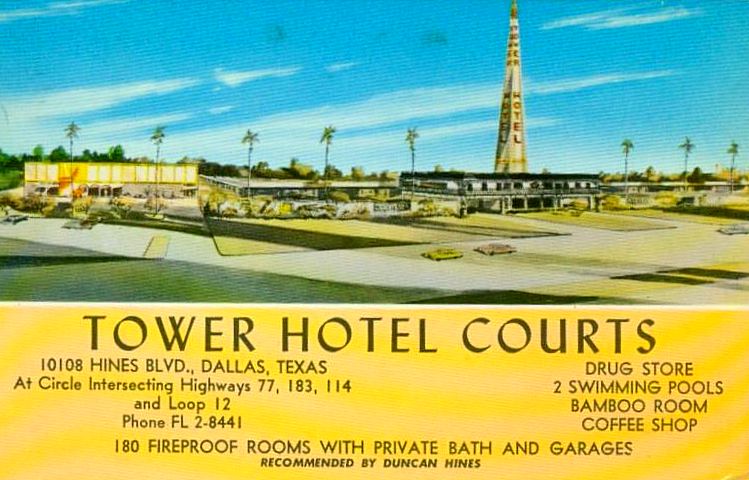
“The Riviera of the South” — On Harry Hines!

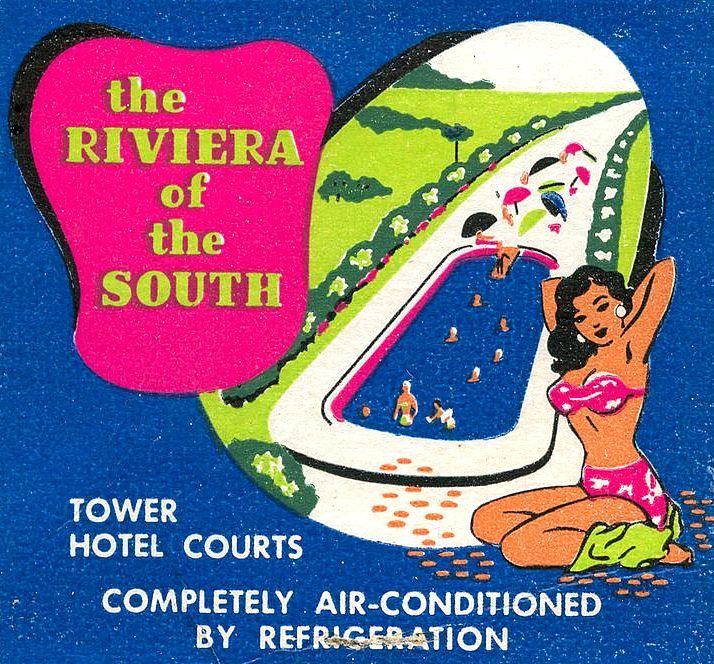
tower-hotel-courts_pool-match_flickr-smThe paradise of Harry Hines awaits…

by Paula Bosse

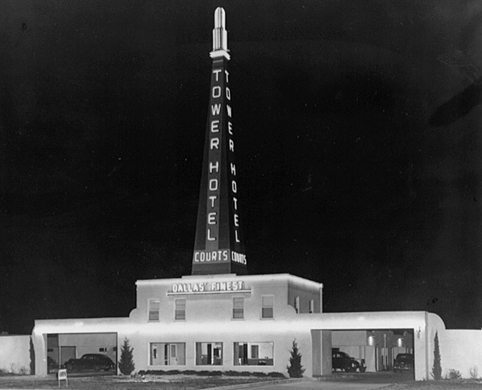
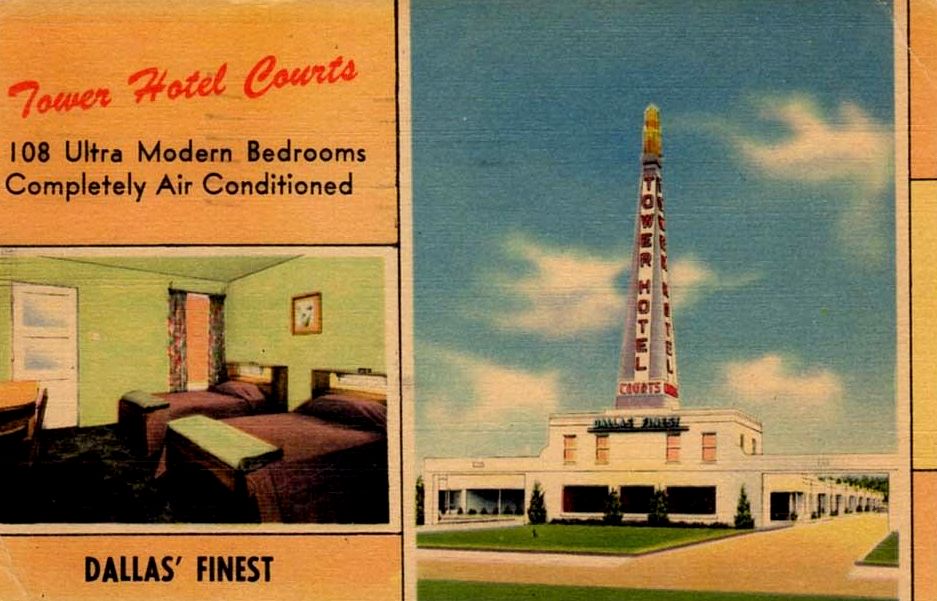
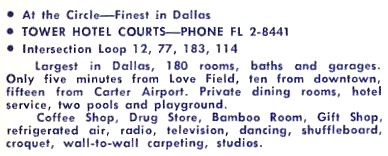
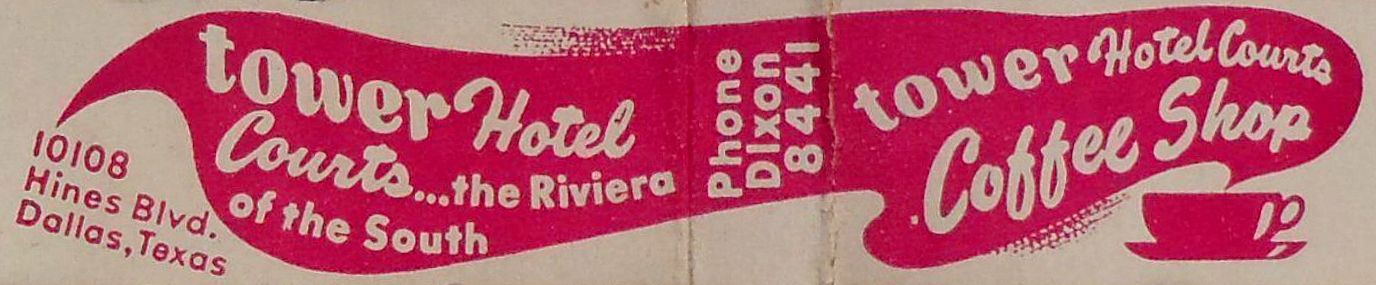
The Tower Hotel Courts opened in the fall of 1946. Their address makes my had spin: at “The Circle” where highways 77, 183, 114, and Loop 12 intersect. “10108 Harry Hines” would have been easier to fit on the stationery, but mention of all those highways just made everything more exciting. (It also gave some indication to prospective guests of what would be awaiting them, such as constant traffic noise and the ever-present whiff of exhaust in the air. “You can’t say we didn’t warn you, madam.”)

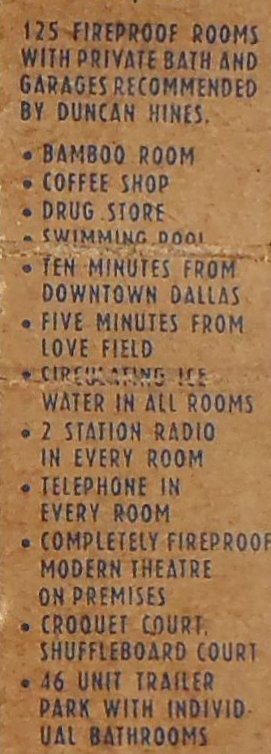
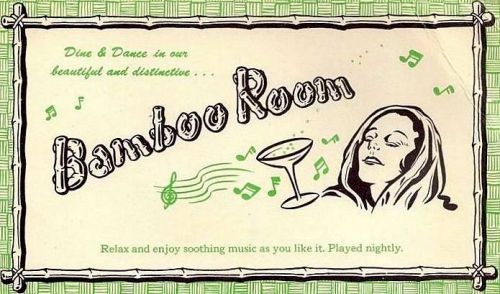
The fancy motel was five speedy minutes away from Love Field, which seems handy, because if you had an hour or seven to kill before your flight, wouldn’t you want to spend it there in the fabulous-looking Bamboo Room? I would! (Even though I’m pretty sure that matchbook cover is a little more glamorous than the actual Bamboo Room.)

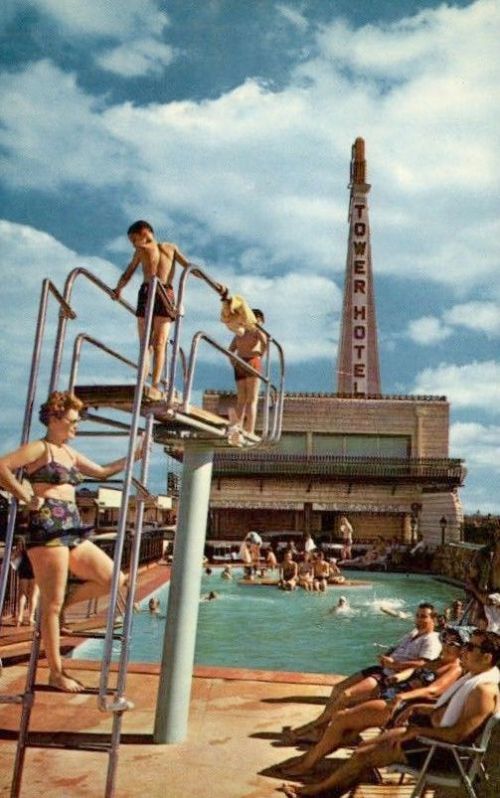
If you were going to stay for a day or two and not just a few drinks, there were all sorts of things waiting for you: two pools (one a very large children’s wading pool), a theater, a croquet court AND a shuffleboard court, “circulating ice water,” and … stand back … a 2-station radio in every room. Somewhere in amongst all of this was a 46-unit trailer park (“with individual bathrooms”).

It’s not hard to see why they called the Tower Hotel Courts The Riviera of the South.”

tower-hotel_bw

tower-hotel-courts_postcard2

tower-hotel-courts_postcardUltra Modern!

tower-hotel-courts_pool-smOwner’s wife and kids?

tower-hotel-courts_pool_back

tower-hotel-courts_riviera

tower-hotel-courts_riviera_inside

tower-court-hotel_bamboo-room_flickr

tower-hotel-courts_pool-match_flickr-sm

***

First and last images from Flickr; Bamboo Room image also from Flickr.

Several of these pictures are larger when clicked.

*

Copyright © 2014 Paula Bosse. All Rights Reserved.

Tietze Park

tietze_1946_c

by Paula Bosse

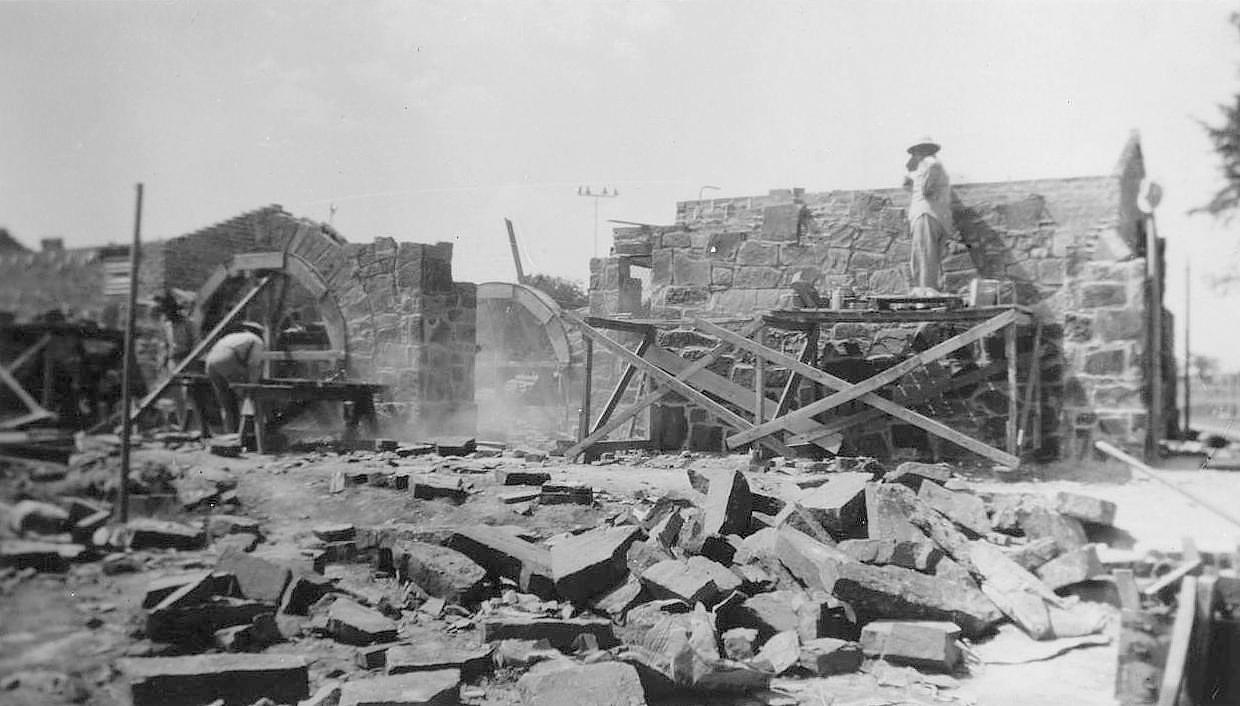
Tietze Park was my neighborhood park growing up — it’s where I learned to swim and got sunburned every summer because I stayed there so long. It straddles 75206 and 75214, in that area that’s not quite Lower Greenville, not quite M Streets, and not quite Lakewood. It’s on Skillman, bordered by Llano and Vanderbilt. You’ve probably seen the famous tree at the Vanderbilt corner. And you’ve probably jokingly referred to it as “Tsetse” Park while suppressing a power-of-suggestion sleeping-sickness-inspired yawn (like right now). It’s a cute little park, with wonderful WPA touches. Here are photos from 1946 of some repair work being done on the stone buildings and construction of a new pool. It looks pretty much the same today.

tietze_1946_b

tietze_1946_a

To see a photo of what the pavilion looks like today, check out a great photo by Sarah Whittaker from CultureMap, here.

***

Photos from the Dallas Municipal Archives, accessed through the Portal to Texas History site.

A history of the park — which started out as “Keith Park” in 1924 but was re-named in 1934 in honor of William R. Tietze, former Parks Department superintendent — can be found on the Friends of Tietze Park Foundation website here.

Here’s a nice drawing of the plan for the park (I came across this somewhere on Facebook, I think, but neglected to make note of the source):

tietze park_plan

A nostalgic look back at the park can be found in the Lakewood Advocate article “Memories of Tietze Park Pool” by Patti Vinson, here.

For a video that captures the laid-back feel of the neighborhood surrounding the park, check out the video of the catchy song “We’ll Go Walkin'” by local band The O’s. It’s great. The first line is “We’ll go walkin’ to Tietze Park.” And then they do. If you’re familiar with the neighborhood, you’ll recognize everything along their walk. And they end it in front of *that tree.* So it’s totally worth it. (The band’s website is here.)

*
Click photos for larger images.

*

Copyright © 2014 Paula Bosse. All Rights Reserved.

Always Have a Bucket of Water Nearby — 1890s

fire-dept_ervay-kelly_hose-co-2_1901Hose Co. No. 2, S. Ervay at Kelly, ca. 1901… (click for larger image.)

by Paula Bosse

fire-signals_souv-gd_1894

Dallas used to burn down a lot. Here is a handy tip sheet for residents and visitors printed in 1894, about the time the above photo was taken. I’m sure everyone in the city knew where the alarm boxes were and what the various signals meant. When to relax, and when to run. When to hold ’em, and when to fold ’em.

fire-boxes_fire-alarm-signals_souvenir-gd_18941894 (click for larger image.)

***

Sources & Notes

Top photo of Hose Co. #2/Fire Station #12 from The Dallas Firefighters Museum, found on the Portal to Texas History site.

List of fire alarm boxes from Souvenir Guide of Dallas. A Sketch of Dallas and Dallas County, their resources, business enterprises, manufacturing and agricultural advantages (Dallas: D.M. Anderson Directory Company, 1894).

*

Copyright © 2014 Paula Bosse. All Rights Reserved.


Anyone For Bowling? — 1908

bowling_women_dmn_051008-lg

by Paula Bosse

“WOMEN BOWLERS MAKE GOOD SCORES”
Teams contesting on the alleys of the Dallas Turnverein.

Sports and corsets just don’t seem like a good combo.

Now I know what a turnverein is.

***

Photo by Clogenson, from The Dallas Morning News, May 10, 1908.

Click photo for larger image.

*

Copyright © 2014 Paula Bosse. All Rights Reserved.

Building Collapse on Elm Street — 1955

elm-st-collapse_1955
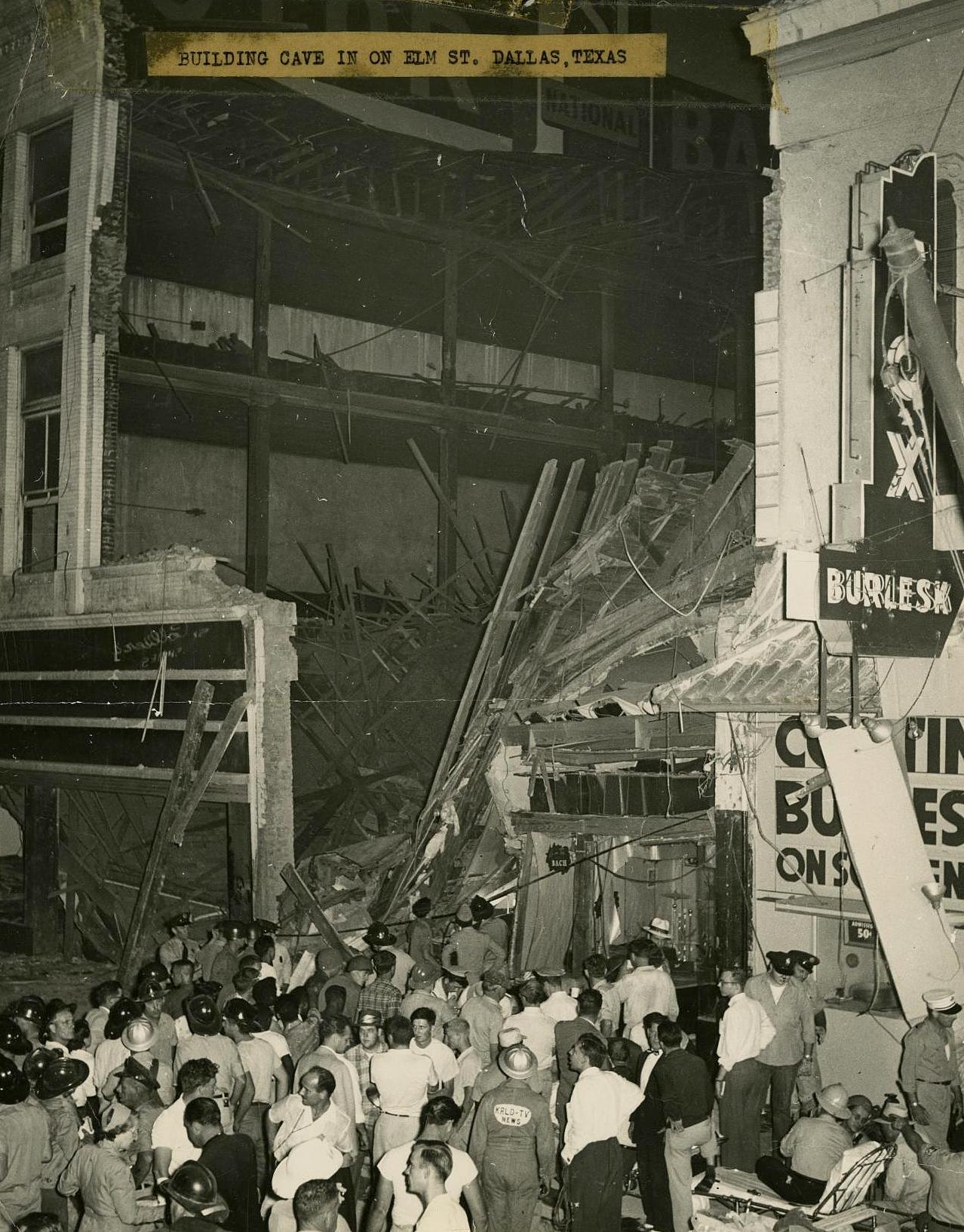
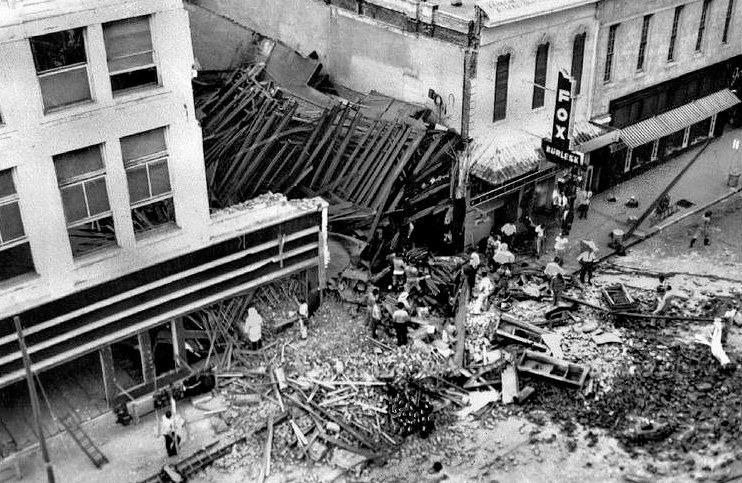
Aftermath… June 1, 1955 (photo by Gene Gauss)

by Paula Bosse

At 6:40 p.m. on June 1, 1955, a 3-story building in the process of being razed collapsed onto the smaller building next door at 1409 Elm St. The “story-and-a-half” building contained the Cline Music Company and Harry’s Fine Food, a bar and cafe. Four people were killed, and several people sustained major injuries; many were trapped for hours in the rubble.

The rousing report in The Dallas Morning News the next day described the scene as pandemonium. As emergency personnel arrived and rescue operations began, the street was roped off — there were fears a partially standing wall would topple at any moment. The Fox Burlesk house next door was quickly emptied of its 50-or-so patrons for safety concerns.

Witnesses said the building fell with a gigantic whoosh and spewed rubble about four feet deep across the sidewalk and into the street. Trolley wires were snapped and lay crackling sparks in the street for a while before the power was cut. A late-model station wagon parked at the curb was flattened under the rubble to a height of only about three feet. It belonged to [the owner of the music store]. (DMN, June 2, 1955)

Nine companies of firemen and several doctors — one of whom just happened to be passing by the scene — worked to rescue and treat the victims. A passing clergyman administered conditional last rites for those still trapped. A troop of Boy Scouts who had been nearby practicing civil defense drills, ran to help in the real-life emergency. And most cinematic of all, a Houston truck driver named Larry Ford — who just happened to be visiting Dallas and was standing in the crowd of spectators — was called in to help when someone noticed that he was wearing a truck drivers’ union insignia — authorities had obtained a winch truck to clear the heavy rubble but had been unable to find anyone to operate it. Ford sprang to action and worked through the night for 16 grueling hours. He was later hailed as a hero. Just like in the movies.

So what caused the collapse? The city manager was quick to say that the city was not to blame and, basically, had no responsibility to determine who WAS to blame.

City Mgr. Elgin Crull told The News an investigation by Chief Building Engineer Cecil A. Farrell has not been completed. “There won’t be anything on it for a long, long time — if ever at all,” Crull declared. “It’s not our responsibility to say why it fell or who was at fault. We’ll just seek to determine whether or not all the proper safety precautions were followed.” (DMN, June 3, 1955)

Well, all right, then.

As several people noted, had the collapse happened an hour earlier — in the midst of rush hour — many, many more people would have been killed and injured. I’m not sure if the cause was ever determined. The block (between Field and Akard) now contains the old First National Bank Building, built a decade later.

elm-st-collapse_060155

UPDATE: Just stumbled across this UPI photo, posted a few years ago by Robert Wilonsky on the Dallas Observer’s Unfair Park blog:

building-collapse_observer-090511

And below, a photo showing the 1400 block of Elm in the 1920s (looking west from Akard), with the “cafeteria” sign in front of the doomed building, to the left of the Fox Theater. The wall with what looks like the beginning of the word “Steinway” is the one that crushed its neighbor. (From Troy Sherrod’s Historic Dallas Theatres; photo from the Dallas Public Library.)

fox-theater_sherrod_dpl

***

Sources & Notes

The first two photos are from the collection of the Dallas Firefighters Museum, via the Portal to Texas History; they can be seen here and here.

The reports of the collapse that appeared in The Dallas Morning News are pretty exciting to read. You can find them in the newspaper’s archives.

  • “Three Killed, 10 Injured As Elm St. Building Falls” (DMN, June 2, 1955)
  • “Building Ruins Termed Clear Of All Victims” (DMN, June 3, 1955)
  • “Debris Yields Another Body” (DMN, June 4, 1955)

Click pictures for larger images (especially the first two, which are HUGE).

*

Copyright © 2014 Paula Bosse. All Rights Reserved.

A Decade of Spectacular Growth for the Dallas Skyline: 1929-1939

downtown_night_lloyd-long_smu_foscueA stunning view of the city at night… (click for larger image)

by Paula Bosse

Two photographs showing the same view: the top from about 1939, the bottom from 1928. This city has always been a show-stopper at night, but Dallas went from looking like a typical big, prosperous city to a glamorous and elegant, fantastically illuminated metropolis in the span of only ten years. The 1930s was a good time to be an architect in Dallas.

rotarian-magazine_jan-1929

***

Sources & Notes

Top photo by Lloyd M. Long, from the Edwin J. Foscue Map Library, Central University Libraries, Southern Methodist University; it is accessible here. To see this photo with major buildings identified, the labeled version is here. The view is from the Medical Arts Building. Elm and Ervay is the intersection at the lower left, and Pacific runs along the right.

Bottom photo from the January, 1929 issue of The Rotarian, showing its readers what was in store for them at their annual convention to be held in Dallas in May. The night-time skywriting is a nice touch. (It’s weird seeing the Magnolia Building before Pegasus was installed on top of it in 1934.)

Click photos for larger images.

*

Copyright © 2014 Paula Bosse. All Rights Reserved.