Flashback : Dallas

A Miscellany: History, Ads, Pop Culture

Category: Politics

Gay Activism in Dallas and the Fight for Equality

gay-pride-parade_062572_portal_smDallas’ first gay pride march, June 24, 1972 (click for larger image)

by Paula Bosse

Today’s historic ruling by the United States Supreme Court on the issue of marriage equality comes after decades of civil rights activism from the LGBT community. The push for acceptance and equality began for many after the historic Stonewall Riots in New York City, which happened 47 years ago this week. The political fight began in Dallas — as it did in most major US cities — in the early 1970s. Dallas’ first Gay Pride march was held downtown on June 24, 1972, at a time when “out” homosexuals and lesbians were often blacklisted or denied basic civil rights without legal recourse. Below, the coverage of that first march by The Fort Worth Star-Telegram.

gay-pride-parade-FWST_062572Fort Worth Star-Telegram, June 25, 1972
And now, a long, long 43 years later — almost to the day — the Supreme Court has ruled that same-sex marriage is now legal in every state in the union, a landmark victory not only for those early political and social activists who marched in the streets of Dallas and fought for their basic human rights, but also a victory for those of us who are their friends and family.

*

A wonderful history of the gay community in Dallas — from the days of secret “speak-easy”-type clubs to political organization to the AIDS fight — is contained in the KERA-produced documentary “Finding Our Voice: The Dallas Gay & Lesbian Community” (2000), which can be viewed in its entirety on YouTube, here.

finging-our-voice_title

***

Sources & Notes

Photograph of Dallas’ first Gay Pride march is from the LGBT Collection of the UNT Libraries; it and other photos of the parade can be found on UNT’s Portal to Texas History website, here.

Coverage of the first Dallas march can be found in the Dallas Morning News article “Gays March Proudly” by Marc Bernabo (June 25, 1972).

Other Flashback Dallas posts on LGBTQ issues can be found here.

*

Copyright © 2015 Paula Bosse. All Rights Reserved.


El Presidente y Su Sombrero — 1975

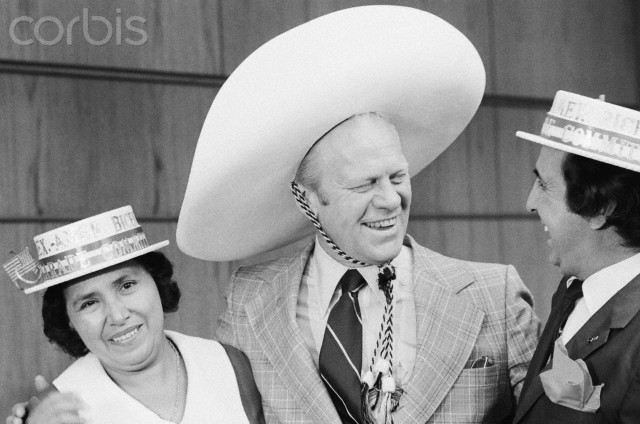
Pres. Ford In SombreroEl Prez at SMU, Sept. 13, 1975  /  ©Bettmann/CORBIS

by Paula Bosse

Politicians have to do a lot of silly things at public appearances, and some of them handle the baby-kissing and tedious chit-chat more gracefully than others. President Gerald R. Ford seems to have been pretty good-natured about this sort of thing, even in the wake of the Nixon impeachment and even while being incessantly lampooned by Chevy Chase on Saturday Night Live every week.

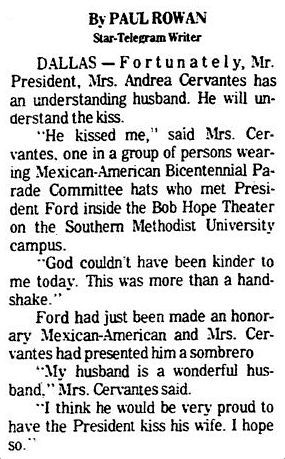
For reasons I’ve never understood, politicians and foreign dignitaries always seem to be presented with hats when they make an official visit somewhere, and when they come to Texas, they almost always get a cowboy hat. But on President Ford’s 1975 visit to Dallas and the SMU campus, he was made an “honorary Mexican-American” and was presented with a (very large) sombrero by Andrea Cervantes of the Mexican-American Bicentennial Parade Committee. He looks ridiculous, but it’s a fun ridiculous. I think he liked it — Mrs. Cervantes even got a kiss for her gift.

ford-sombrero_FWST_091475Fort Worth Star-Telegram, Sept. 14, 1975
The sombrero re-appeared a few months later, autographed and on display at Pike Park. It never left Dallas. What a shame. I would have liked to imagine the President and First Lady relaxing at Camp David, Jerry wearing his sombrero, smoking a pipe, and watching college football on TV, while Betty sat at the other end of the couch, chuckling to herself, and shaking her head.

***

Souces & Notes

Top photo from CorbisImages, here.

More on this in the Dallas Morning News article (with photo) “Ford Commends Group for ‘Feliz Cumpleanos'” (Dec. 15, 1975).

This sombrero-donning was just seven months before the now-legendary “Great Tamale Incident” in San Antonio. Read how NOT to eat a tamale here.

Ford took his gaffes in stride, even going so far as to appear on the show that made note of his every stumble, literal and figurative. Read a behind-the-scenes account of Ford’s 1976 Oval Office taping of one-liners for SNL — including his “Live from New York, it’s Saturday Night!” show opener (although I’m pretty sure he did it without the exclamation mark) — here.

*

Copyright © 2014 Paula Bosse. All Rights Reserved.

Dallas in 1879 — Not a Good Time to Be Mayor

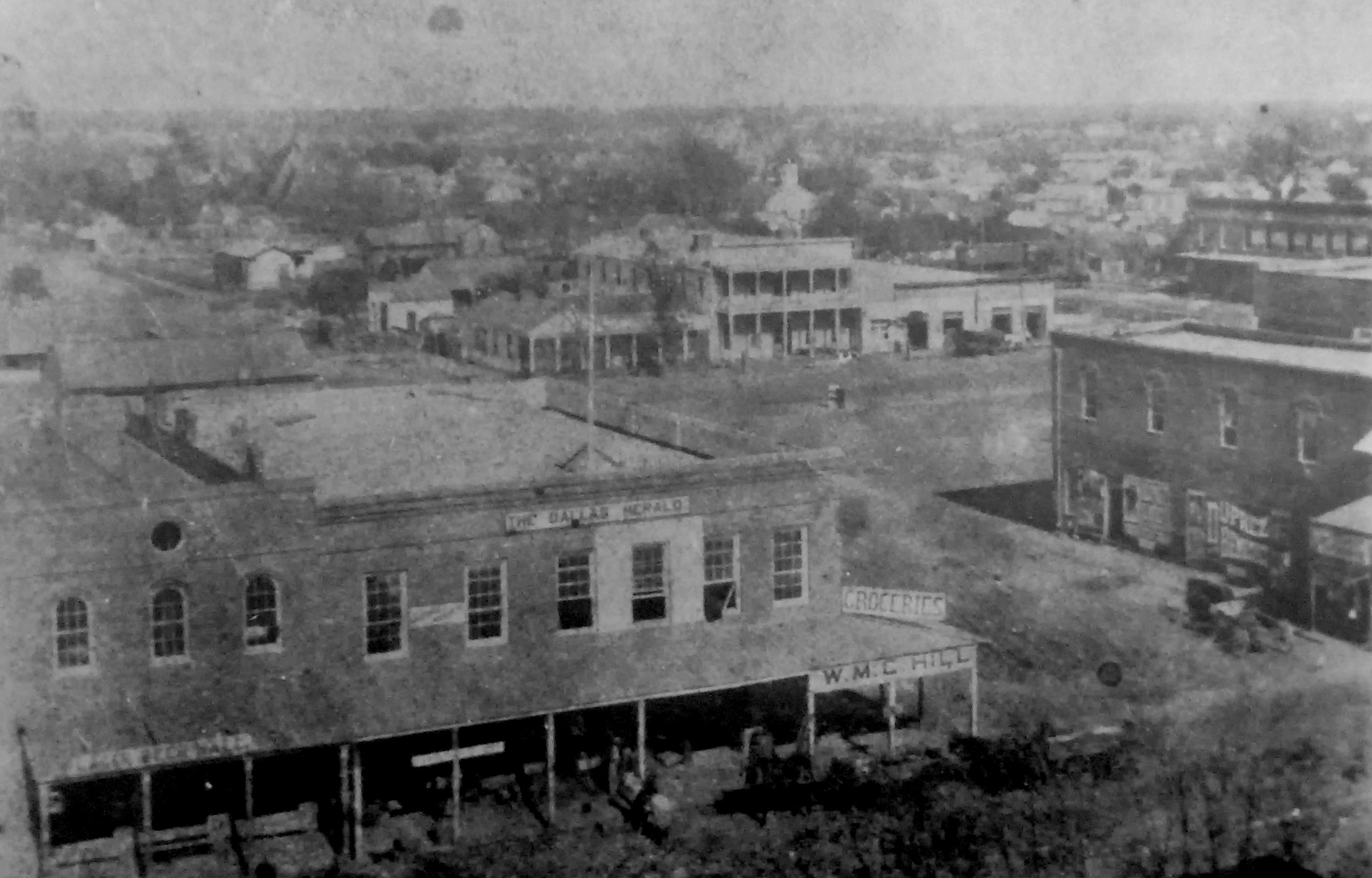
main-jefferson_1879_greeneA view from the courthouse, looking north (click for larger image)

by Paula Bosse

Above, a view of Dallas in 1879, looking north from the courthouse (one of many in the city’s past that eventually burned down); the intersection in the right foreground is Main and Jefferson (now Record Street).

This is such a cool photo that, on a whim, I checked to see what exciting things might have happened in Dallas in 1879. I found that the city’s voters had just elected a new mayor, James M. Thurmond, who had run on an “independent reform and morality ticket.” Yawn. On the surface, that hardly seemed very interesting — a  historical fact, yes, but not all that exciting. But, wait, there’s more to the story.

Thurmond’s post-election honeymoon was short-lived because, even though he had won a second (one-year) term, he had made some serious enemies in his first term. He was removed from office in 1880 by the city council in a lack-of-confidence vote, the result of a nasty trial and probably slanderous accusations by lawyer Robert E. Cowart.

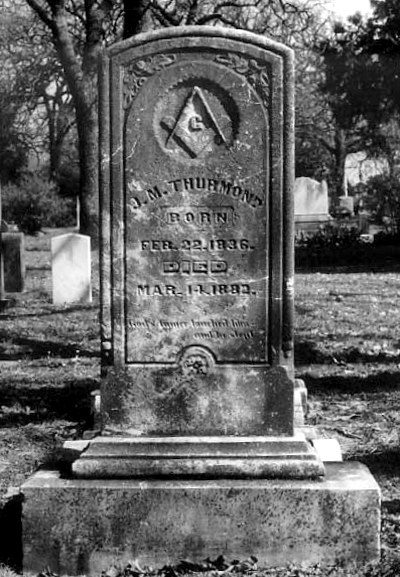
The feud between Thurmond and Cowart grew more and more bitter as time passed, and on March 14, 1882 — moments after the two men had exchanged angry words in Judge Thurmond’s courtroom — Cowart shot and killed Thurmond. Witnesses described the shooting as an act of self-defense. They said that Cowart shot when the judge reached for his pistol. (For an incredibly gruesome account of this incident, the contemporary newspaper report is linked below.)

The photograph above was taken from the courthouse where this shooting took place. When the photograph was taken in 1879, the animosity between the new mayor and an unhappy lawyer had already begun to percolate. I suppose men with “Esq.” after their names in the 1880s were predisposed to shoot-outs indoors in well-appointed courtrooms rather than out in the dusty streets at high noon. It’s classier.

thurmond_headstone_greenwood-cemetery_findagraveGreenwood Cemetery, Dallas (photo: David N. Lotz)

***

Top photo is from Dallas, The Deciding Years — A Historical Portrait by A. C. Greene. (Austin: The Encino Press for Sanger-Harris, 1973); photo is from the collection of the Dallas Public Library.

Photo of J. M. Thurmond’s headstone in Greenwood Cemetery is from Find A Grave, here. Cowart — who died in 1924 — is buried in a nearby plot in the same cemetery. (Incidentally, Cowart’s claim to fame — other than shooting a judge in his own courtroom — appears to be that he was the person who inadvertently came up with Fort Worth’s nickname, “Panther City” when he wrote a tongue-in-cheek newspaper article about Fort Worth in 1875. Read a great history of this amusing kerfuffle in Hometown by Handlebar’s post, here — scroll to the second story.)

For an interesting contemporary report of the shooting — including gruesome eyewitness accounts — check out the article from the March 15, 1882 edition of The Dallas Herald (under the headline “The Deadly Pistol”), here, via the Portal to Texas History.

A short background on the Thurmond-Cowart feud, from the WPA Dallas Guide and History (which includes the verdicts of Cowart’s two trials for murder), can be read here.

Click top photograph for HUGE image.

*

Copyright © 2014 Paula Bosse. All Rights Reserved.

How Lincoln’s Assassination Was Reported in Dallas — 1865

lincoln_harpers-engraving

by Paula Bosse

Abraham Lincoln was shot by John Wilkes Booth on April 14, 1865; he died the next morning. I wondered how the news had been reported in Dallas. I couldn’t find the first mention of the assassination in The Dallas Herald, but it seems there may have been a special “extra” edition published on or just after April 29th — a full two weeks after the fact! The one thing I kept encountering in general Google searches were mentions of the vicious, celebratory editorial that appeared in the pages of the Herald — these reports always quote the line “God Almighty ordered this event or it could never have taken place.” I found that editorial. It appeared in the two-page Dallas Herald on May 4, 1865, along with detailed reports of the assassination.

lincoln_dallas-herald_masthead_050465

lincoln_dallas-herald_houston-tel-050465

The image resolution here is pretty bad (it is transcribed below), but, yes, this eye-poppingly vitriolic editorial did appear in the pages of The Dallas Herald — but it did not originate with the Herald (which is not to say that the Dallas editor wasn’t in agreement with the sentiments expressed). The editorial was reprinted from the Houston Tri-Weekly Telegraph (which had run it ten days previously, on April 24); its appearance in the Dallas paper is even clearly prefaced with the following: “The Houston Telegraph, in speaking of the killing of Mr. Lincoln and Mr. Seward, says…” — so it’s unclear why so many historians and authors mention this editorial as being the product of The Dallas Herald.

The editorial was unsigned, but it was probably written by William Pitt Ballinger, whose previous flame-fanning tirades against the president in the pages of the Telegraph must have caused even hard-core Confederate-leaning brows to raise. I’ve transcribed the full editorial below. For whatever reasons, the Dallas Herald omitted the first and last paragraphs — probably because of space limitations, but one would like to think that even a pro-Confederacy newspaper would think it best to leave out a phrase such as “The killing of Mr. Lincoln and Mr. Seward may be more wonderful than the capitulation of armies.” Yikes. Imagine a mainstream newspaper printing something like that following the assassination of President Kennedy.

Below is the full astonishing text of the editorial that originally appeared in the Houston Tri-Weekly Telegraph on April 24, 1865. The stark reality of historical events and the contemporaneous tenor of the times can look a lot different when seen from a distance of 150 years.

*

We publish to-day the most astounding intelligence it has ever been our lot to place before our readers — intelligence of events which may decide the fate of empires, and change the complexion of an age. The killing of Mr. Lincoln and Mr. Seward may be more wonderful than the capitulation of armies.

With the perpetration of these deeds we can have no sympathy, nor for them can the Southern people be held any way responsible. While Mr. Lincoln and Mr. Seward had by their malignity created only feelings of detestation and horror for them in the minds of our people, and while in their death the finger of God’s providence is manifest, it is still impossible to look upon an assassin with complacency, even though he frees us from the threatened yoke of a tyrant. We look upon his as God’s instrument, and as such leave him with his maker, praying for infinite mercy to succor him in his hour of need.

God Almighty ordered this event or it could never have taken place. His purpose in it as His purpose in the surrender of Lee’s army, remains to be seen. The careful observer of the history of this war is struck with nothing more than with the fact that no great event has been foreseen by the actors, and that an Almighty hand has shaped the entire course of events. What this event will lead to no man can foresee. We are all instruments in His hands for the accomplishment of His purposes. The ways of Providence are inscrutable, utterly past finding out. It behooves us His creatures to look on in wonder and to act the part of duty according to the lights before us. That duty leads us to be true to our faith, true to our cause, and while it forbids our sanction to unlawful violence — to assassination — it commands us to accept all things as ordered by a Supreme Power, to bow to the exhibitions of that power, and to obey the manifest teachings of His will.

What will [be] the result of these tremendous events, no man can foresee. Theories will present themselves to every man’s mind. We have a dozen all equally probable, and all equally uncertain. Let us wait in patience for the next scene in this terrible drama.

***

Top image is an engraving of the assassination in Ford’s Theatre from Harper’s Weekly, April 29, 1865.

Editorial is from The Houston Tri-Weekly Telegraph, published April 24, 1865 (Vol. 31, No. 13). You can view a scan of the original newspaper via the indispensable Portal to Texas History, here (it is at the top right of the page, last column). Reprinted without the first and last paragraph by The Dallas Herald ten days later on May 4, 1865 (Vol. 12, No. 36).

Editorial is probably by William Pitt Ballinger, a Galveston attorney. His editorial screeds for the Telegraph are mentioned in the just-published Loathing Lincoln: An American Tradition from the Civil War to the Present, by John McKee Barr (LSU Press, 2014), p. 53 — read an excerpt here. Read more about Ballinger — the “brilliant attorney and political insider” — here.

An interesting article titled “The Last Newspaper to Report the Lincoln Assassination” is here. The article is about The Houston Tri-Weekly Telegraph, but it looks like The Dallas Herald was even SLOWER to report the news.

lincoln_dallas-herald_extra_050465

“We received on Saturday last [April 29] the dispatches containing the assassination of Mr. Lincoln and Mr. Seward, by a letter from Maj. Stackpole to his family at this place, and published them in an extra. There was some little discrtepancy and an omission in them as published then, which we find corrected in the Houston Telegraph’s dispatches which we publish to-day.” (Dallas Herald, May 5, 1865)

*

Copyright © 2014 Paula Bosse. All Rights Reserved.

Dear JFK: Welcome to Big “D” — Love, DP

Nov. 22, 1963

by Paula Bosse

Sorry, Dr Pepper, but this might be the most unfortunate, unintended instance of product placement ever.

***

Sources & Notes

AP photo, November 22, 1963.

*

Copyright © 2014 Paula Bosse. All Rights Reserved.

Where to Put That JFK Memorial? — 1964

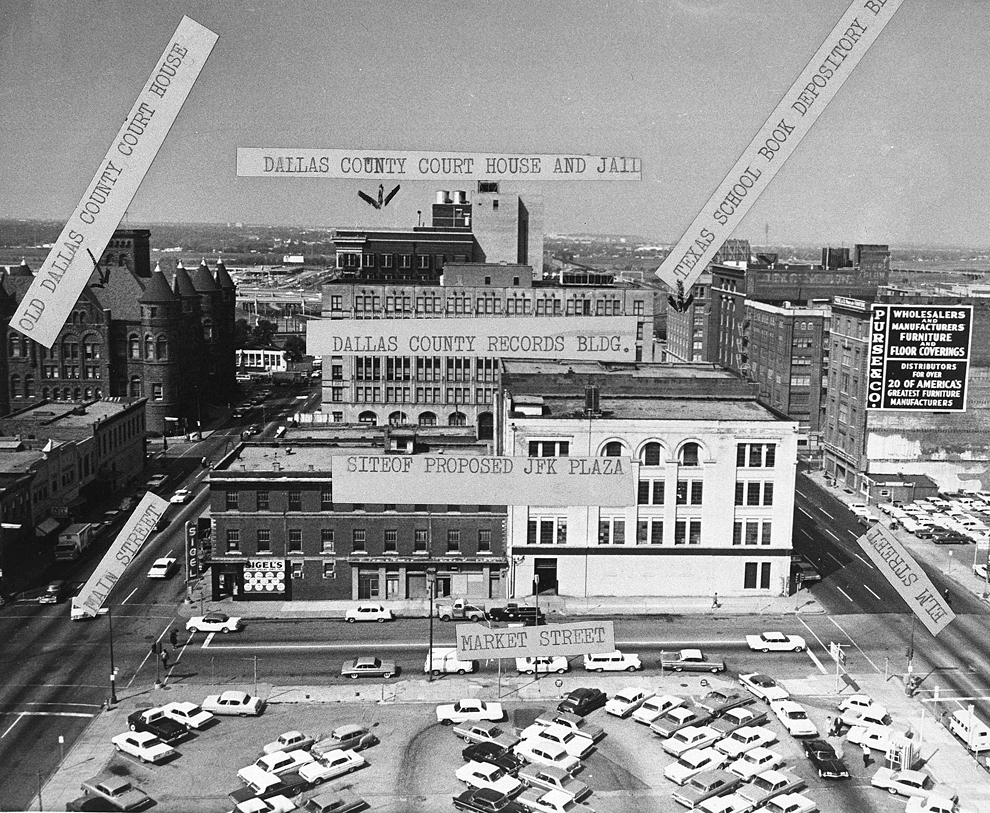
Looking west, 1964 (AP photo)

by Paula Bosse

I’m not really into the whole assassination thing, which may explain why I’ve never seen this 1964 Associated Press photo (with or without the labels). Despite the connections to “that dark day,” I think this is a really interesting view of the city, from an unusual vantage point.

Here’s another similar photo, from April 1964 — this one from United Press International. UPI’s caption:

DALLAS: Site of Memorial Park. The area outlined in white is the block where the John F. Kennedy Plaza will be created as a memorial to the late president. The outline traces buildings now on the site which will be removed on completion of the new county courthouse.

jfk-memorial_proposed_apr-1964_UPI_ebayApril 1964 (UPI Telephoto)

The original location for the memorial was in the block immediately to the east of the Records Building, not the Old Red Courthouse, where it eventually was placed. I’m not sure why the location changed, but by the time architect Philip Johnson, designer of the memorial, was on board, the site had moved one block south.

*

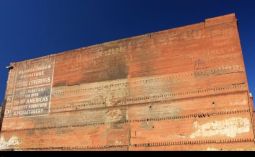
The Purse & Co. sign seen at the right side of the top photo is still visible today — it’s probably the largest and most familiar ghost sign downtown. Here’s a picture that was linked to Google maps. (I think I prefer it as a ghost sign.)

***

Sources & Notes

Top photo by Ferd Kaufman for the Associated Press, 1964.

Bottom UPI Telephoto found on eBay.

*

Copyright © 2014 Paula Bosse. All Rights Reserved.

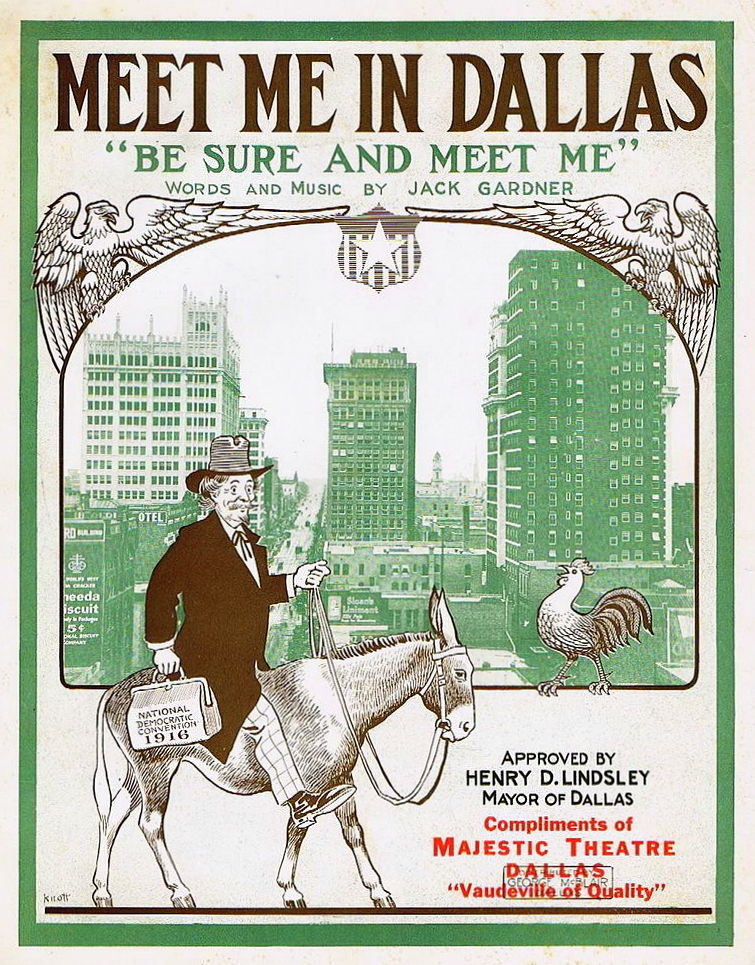
“Meet Me in Dallas” by Jack Gardner (1915)

meet-me-in-dallas_sheet_music_1915“Be sure and meet me…”

by Paula Bosse

“Tell your friends
You’ll meet them in Dallas,
In the town
Where there is no malice.”

Yes, those immortal lyrics are by Jack Gardner, a musician, bandleader, and an “entertainment manager” at the tony Adolphus Hotel. For some reason, he was chosen as the man to write a persuasive ditty which (it was hoped) would sweep the country and lure the 1916 Democratic National Convention to Dallas. Sadly, the song did not set the world (nor Democratic loins) on fire, and (spoiler!) St. Louis got the convention.

As we see above, the mayor-approved city-jingle was issued with sheet music cover art by Dallas Morning News cartoonist John Knott and a great background photo of downtown, with the Adolphus and Busch Building (now the Kirby Building) featured prominently.

If you’d like to wallow in the vamp-y march that IS “Meet Me in Dallas,” the sheet music has been scanned in its entirety by Baylor University here. You can play it and sing it in the privacy of your own home!

If you would like to read about how the Texas Democratic Party was hoping to snag the national convention with this song, you can read about it in this article by Paula Lupkin that appeared in the Fall 2012 issue of Legacies.

And, lastly, a little check-in with Jack, to see what he was doing years later in 1938. This blurblet from St. Petersburg’s Evening Independent has him in Florida, working as a traveling musician with his dance band, settling into a one-week gig at the Detroit Hotel. Not only has he persuaded the anonymous reporter that his name is “synonymous with good dance music in the Southwest,” but he still seems to be resting on his long-faded “Meet Me in Dallas” not-quite-brush-with-the-big-time laurels.

meet_me_in_dallas_gardner_interview_1938

gardner-jack_adolphus_crop

***

Sources & Notes

Top image from the Frances G. Spencer Collection of American Popular Sheet Music at Baylor University, here. (Click picture for larger image.)

Photo of Jack Gardner and His Orchestra is from the wilds of the internet.

I’m sure Mr. Gardner’s ditty was the bee’s knees, but it’s not to be confused with the wonderfully seedy 1969 country song of the same name by the fabulous Jeannie C. Riley (read about that song here).

*

Copyright © 2014 Paula Bosse. All Rights Reserved.