Flashback : Dallas

A Miscellany: History, Ads, Pop Culture

Category: Postcards

Nicholas J. Clayton’s Neo-Gothic Ursuline Academy

ursuline_postcard-color

by Paula Bosse

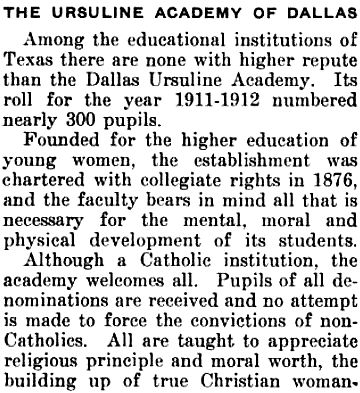
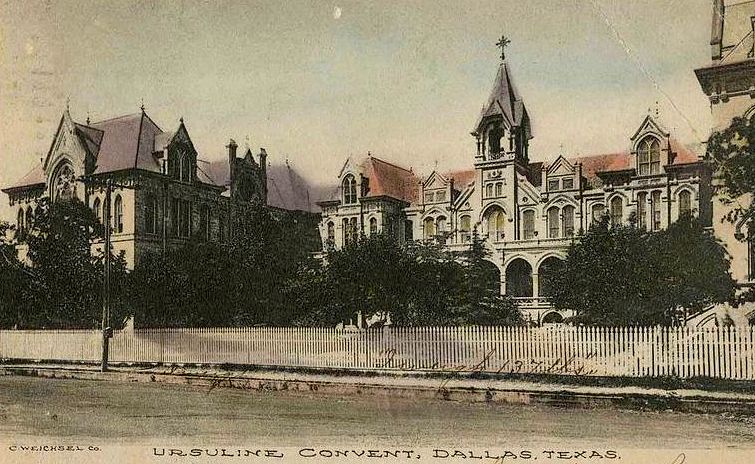
Over the years, Dallas has been the site of dozens and dozens of beautiful educational campuses, almost none of which still stand — such as the long-gone Victorian-era Ursuline Academy, at St. Joseph and Live Oak streets (near the current site of the Dallas Theological Seminary). The buildings, which began construction in 1882, were designed by the Catholic church’s favorite architect in Texas, Nicholas J. Clayton of Galveston. Such a beautiful building in Dallas? It must be demolished!
ursuline_first_bldg
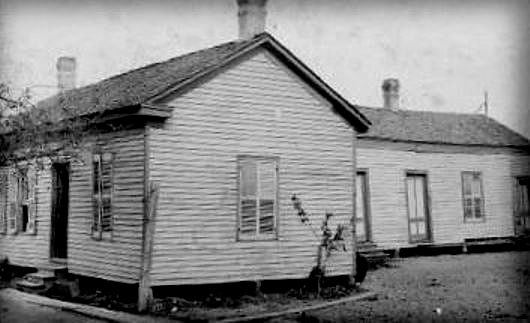
Six Ursuline Sisters, sent to Dallas from Galveston, established their academy in 1874 in this poorly insulated four-room building (which remained on the Ursuline grounds until its demolition in 1949). When they opened the school, under tremendous hardship, they had only seven students. But the school grew in size and reputation, and they were an academic fixture in East Dallas for 76 years. In 1950 the Sisters moved to their sprawling North Dallas location in Preston Hollow where it continues to be one of the state’s top girls’ prep schools. After 140 years of educating young women, Ursuline Academy is the oldest continuously operating school in the city of Dallas.

clifton-church_ursuline_1894Construction took a long time. (ca. 1894)
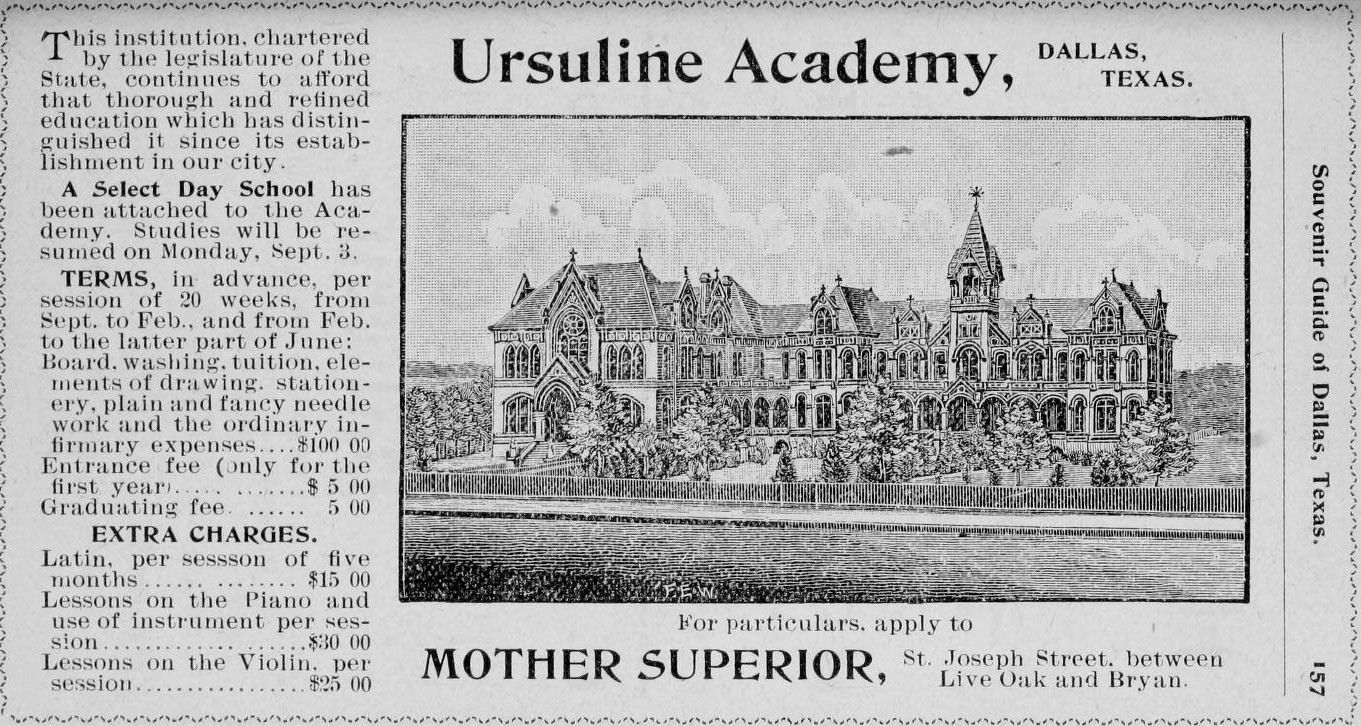
ad-ursuline_souv-gd_1894When Latin cost extra. (1894) (Click for larger image.)
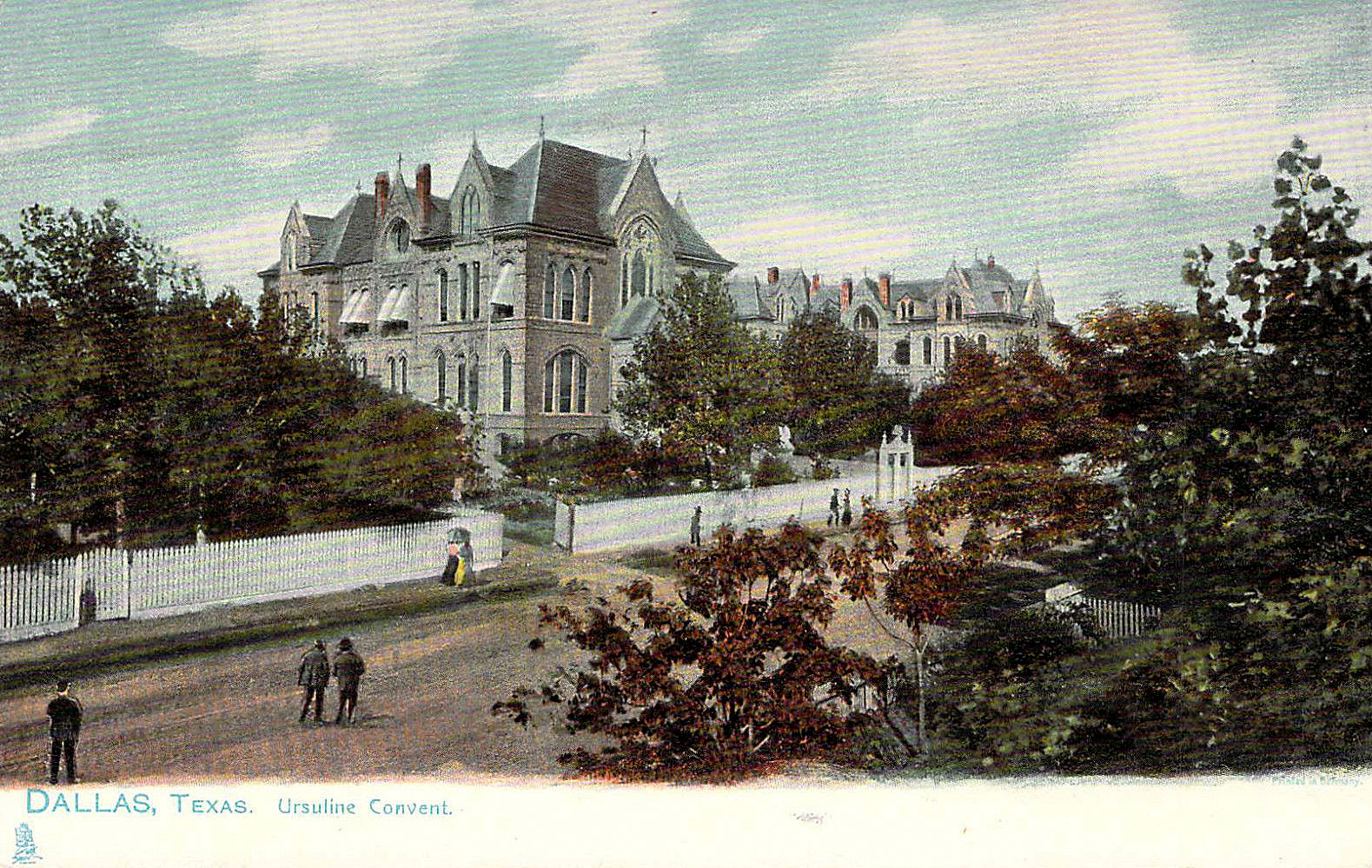
ursuline_1906_largeIt even had a white picket fence. (ca. 1906)
ursuline-flickr1908-ish

ursuline_worleys_1909_det_LARGE1909 city directory

ursuline-academy_tx-mag_1912b1912 (click for large image)

After a year and a half on the market, the land was sold in 1949 for approximately $500,000 to Beard & Stone Electric Company (a company that sold and serviced automotive electric equipment). The property was bounded by Live Oak, Haskell, Bryan, and St. Joseph — acreage that would certainly go for a lot more these days (according to the handy Inflation Calculator, half a million dollars in 1949 would be the equivalent in today’s money of about five million dollars). A small cemetery was on the grounds, in which the academy’s first chaplain and “more than 40 members of the Ursuline order” had been buried. I’m not sure how these things are done, but the cemetery was moved.

ursuline_aerial_cook-colln_degolyer_smu

From a November, 1949 Dallas Morning News article on the vacated buildings’ demolition:

A workman applied a crowbar to a high window casing of the old convent and remarked: “I sure hate to wreck this one. It’s like disposing of an old friend. My father was just a kid when this building was built in 1883.” (DMN, Nov. 13, 1949)

And one of East Dallas’ oldest and most spectacular landmarks was gone forever. Looking at these photographs, it’s hard to believe it ever existed at all.

ursuline_cook-colln_degolyer_smu

*

Where was it? In Old East Dallas, bounded by Live Oak, Haskell, Bryan, and St. Joseph. See the scale of the property in the 1922 Sanborn map, here (once there, click for full-size map). Want to know what the same view as above looks like today? If you must, click here.

ursuline_today_bing-map
Bing Maps

***

Sources & Notes

Photo of the school’s first building is from the Ursuline Academy of Dallas website here. A short description of the early days of hardship faced by the Sisters upon their arrival in Dallas is here.

The photograph, mid-construction, is by Clifton Church, from his book Dallas, Texas Through a Camera (Dallas, 1894).

1894 ad is from The Souvenir Guide of Dallas (Dallas, 1894).

1912 text is from an article by Lewis N. Hale on Texas schools which appeared in Texas Magazine (Houston, 1912).

Aerial photograph from the George W. Cook Dallas/Texas Image Collection, DeGolyer Library, Southern Methodist University, here. Bottom image also from the Cook Collection, here.

Examples of buildings designed by Nicholas J. Clayton can be seen here (be still my heart!).

DMN quote from the article “Crews Begin Wrecking Old Ursuline Academy” by William H. Smith (DMN, Nov. 13, 1949).

Another great photo of the building is in another Flashback Dallas post — “On the Grounds of the Ursuline Academy and Convent” — here.

Many of the images are larger when clicked.

*

Copyright © 2014 Paula Bosse. All Rights Reserved.
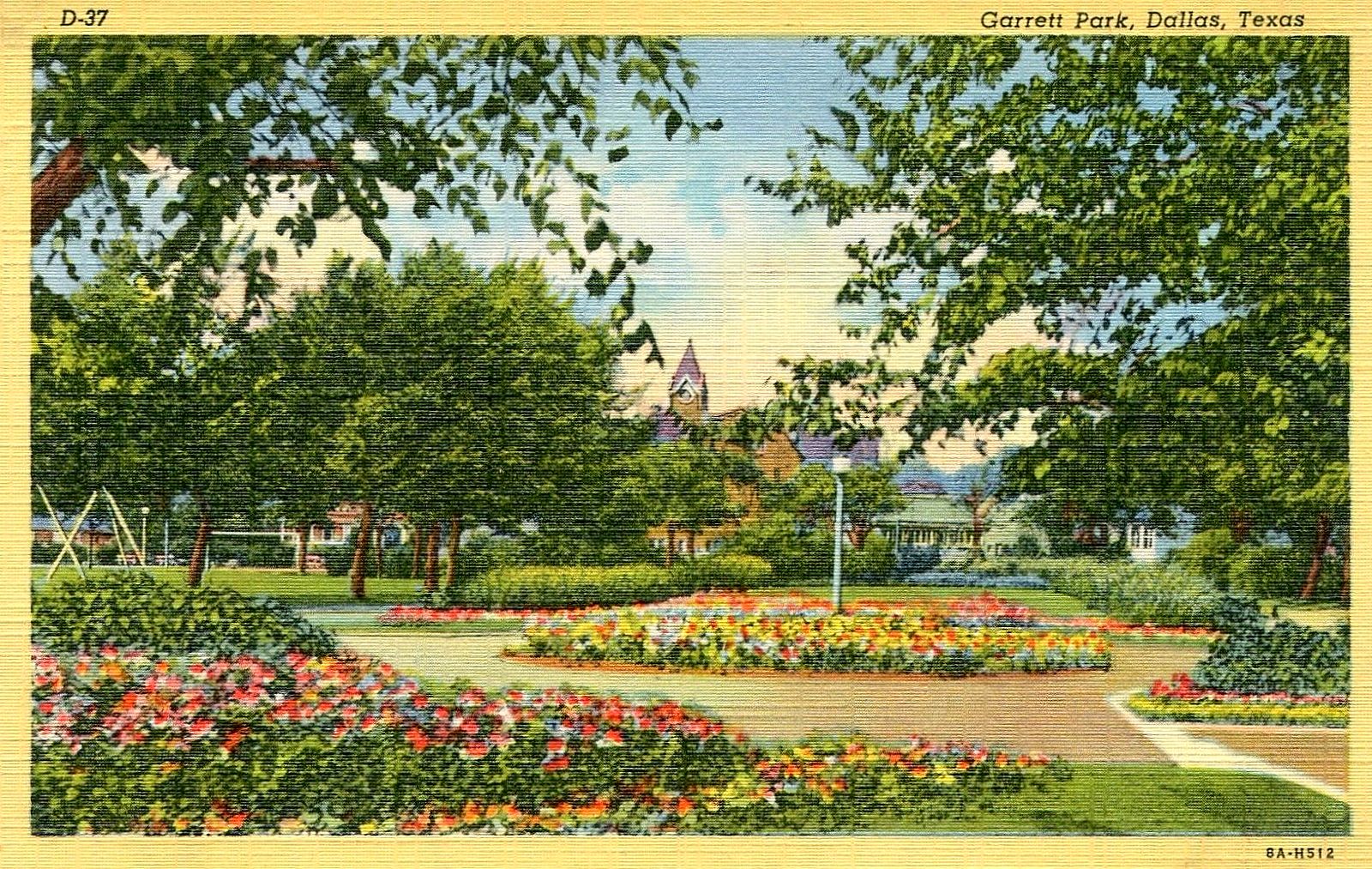
Garrett Park Aburst in Spring Flowers

by Paula Bosse

Garrett Park (at Munger and Bryan) was established in 1915. The postcard above shows it filled with leafy trees and bursting with brightly colored flowers. There is playground equipment at the left and, in the background, St. Mary’s College. The park is still there — just south of Ross Ave., past the lowest bit of Lowest Greenville — but the George Kessler-designed charm is almost entirely gone. The trees are sparser, and those flower beds? Below, a modern-day aerial view (click pictures to see larger images). Oh, how the mighty have fallen.

garrett-park_google-earth_sept-2017
Google Earth

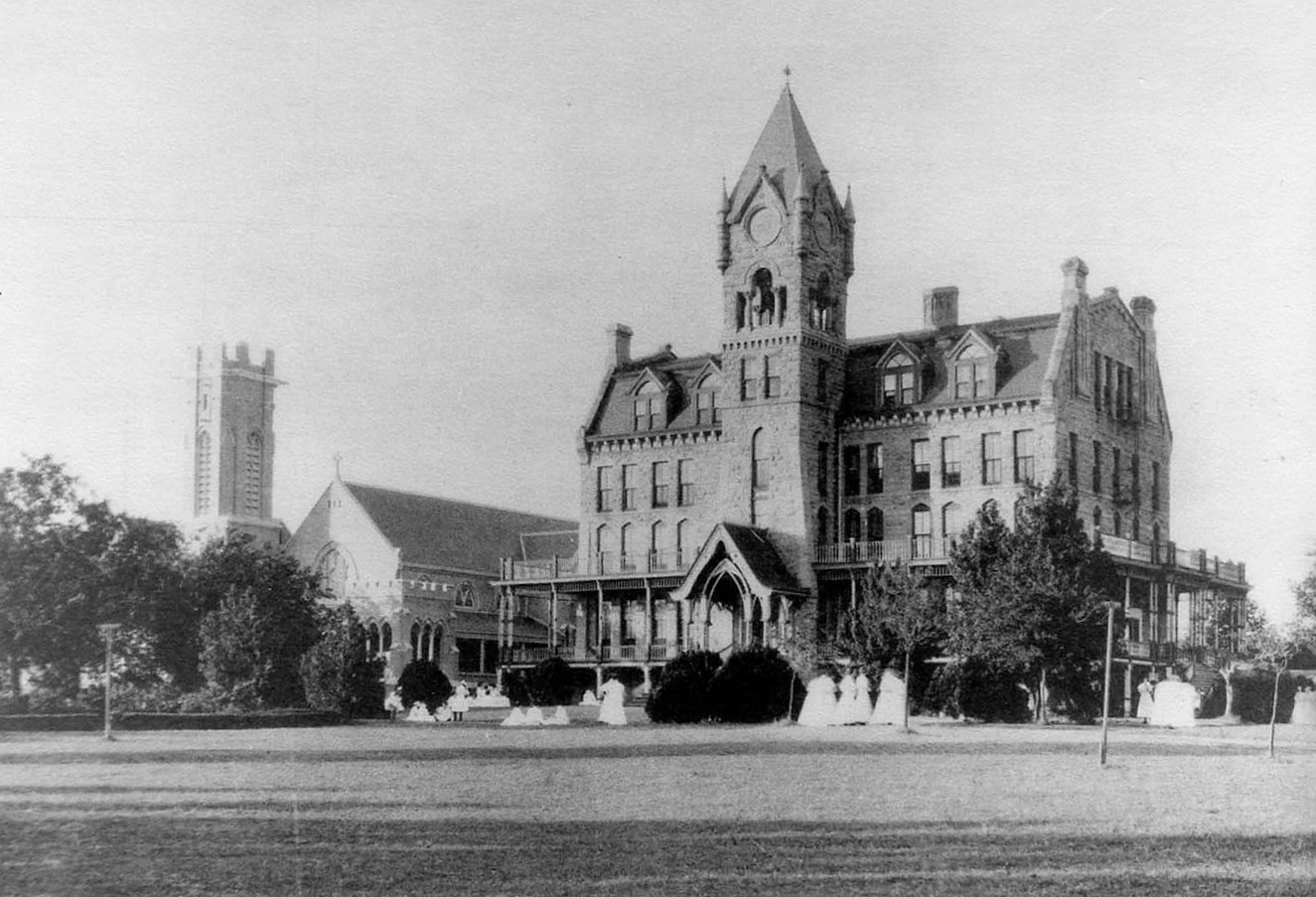
But back to more luxuriantly landscaped times. Before it became a city park, the land was once part of the sprawling campus of St. Mary’s College, a prestigious boarding school that prepared girls for college, run by the Episcopal Church since the 1880s. The school was on the far, far, FAR eastern edge of Dallas, and in the early days, the isolated area was so dominated by the school that it was referred to by everyone as “College Hill.” Below, a photo of St. Mary’s taken around 1908 — the land which later became Garrett Park was behind the school. (Note the tower of the school below which is seen in the postcard above. Also, note the tower of the next-door St. Matthew’s Cathedral — it is still standing at the corner of Ross and Henderson.)

st-marys-college_c1908St. Mary’s College, circa 1908

In September, 1914, St. Mary’s sold the adjoining five-and-a-half-acre parcel of land to the City of Dallas for $30,000 for use as a park.

garrett-park_dmn_091714_acquisitionDallas Morning News, Sept. 17, 1914

The park was officially named in honor of Bishop Alexander C. Garrett in February of 1915.

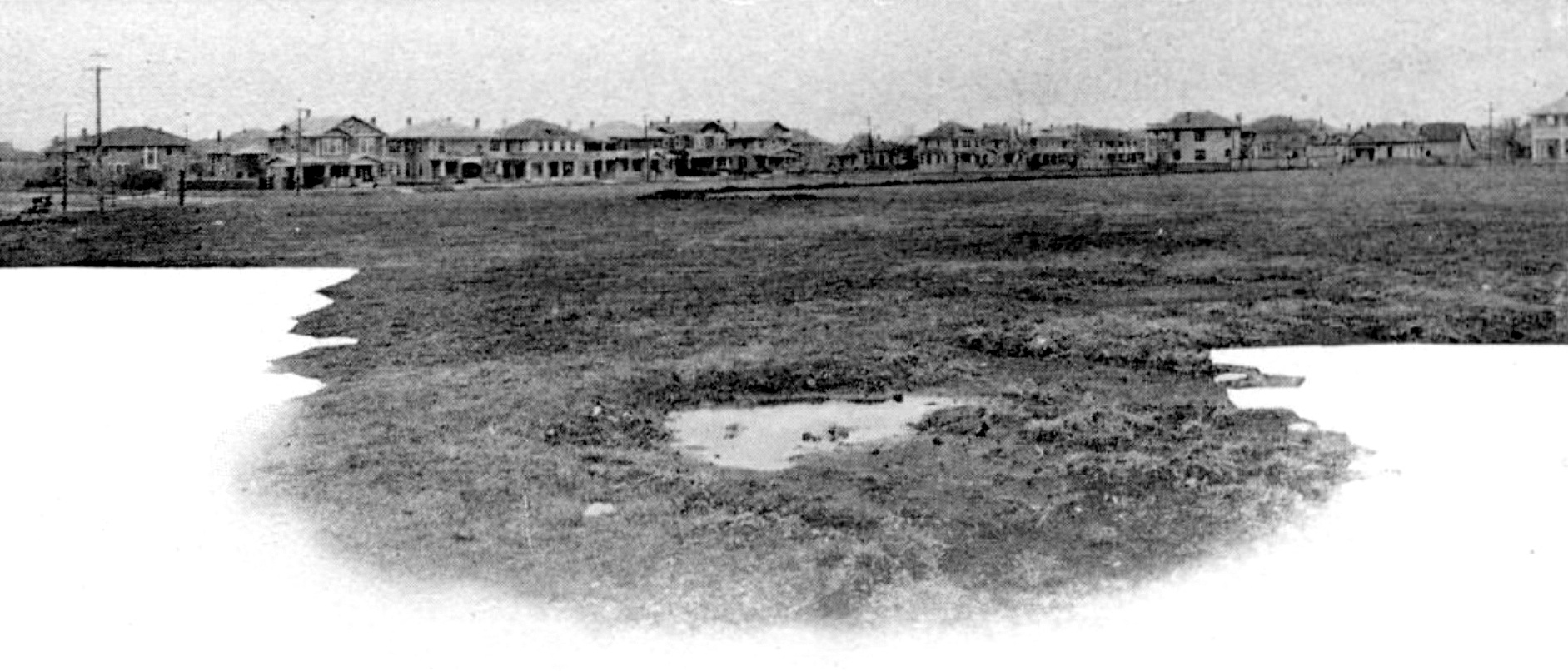
Below, a “before” photo showing “Garrett Park at Time of Purchase” (1914):

garrett-park-at-time-of-purchase_ca-1913

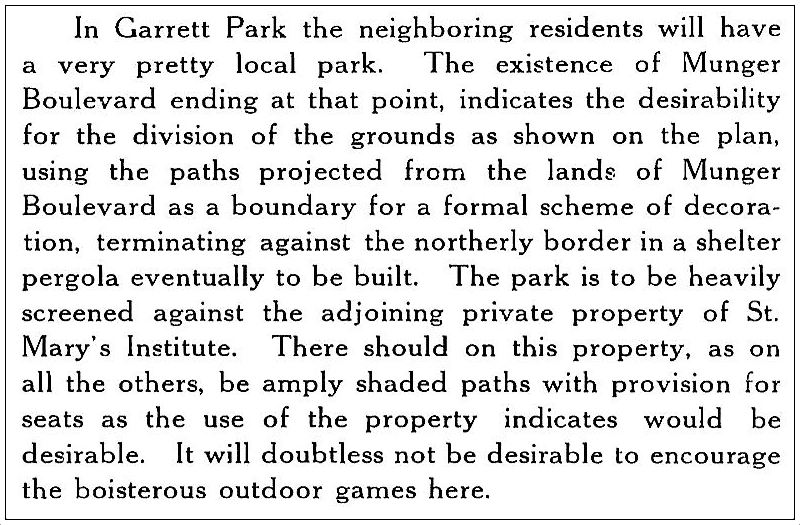
And descriptions of the new park from a 1914-1915 Park Board publication:

garrett-park_-park-board-report-1914-1915_portal

garrett-park_-park-board-report-1914-1915_p24_portal
1915

***

Sources & Notes

Top postcard is from the wilds of the internet.

Source of circa-1908 photo of St. Mary’s College is unknown.

Text and “before” photo of Garrett Park is from the Report for the Year 1914-15 of the Park Board of the City of Dallas; a scanned copy is available at the Portal to Texas History, here.

Map of Kessler’s plan of the park is from Jay Firsching’s article in the Spring, 2003 issue of Legacies; the Garrett Park passage begins on p. 12, here.

To get an idea of the size of the St. Mary campus and Garrett Park in 1922, the Sanborn map from that year is here.

See the location of Garrett Park on a current Google map, here.

Click pictures for larger images.

(This post was updated with additional text and new images on March 23, 2018.)

*

Copyright © 2014 Paula Bosse. All Rights Reserved.


Sheraton Dallas, Original Version — 1959

Sheraton Hotel front

sheraton_hotel_back

by Paula Bosse

I love this somewhat fauvist depiction of Dallas in 1959 — it’s exactly what I wish the city actually looked like, yellow sky and all. All those clean, sharp lines and wide-open sidewalks! The foreshortening is completely out of whack here, with enormous cars and ant-size people — perhaps it’s a metaphor for the dismissive Texan view on pedestrian transport. (What are the two flags to right of the Texas flag?)

***

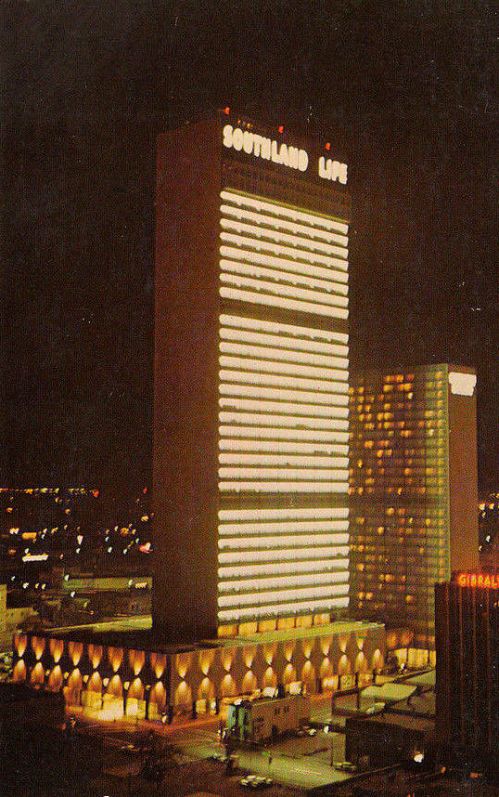
My knowledge of certain aspects of Dallas can be surprisingly spotty sometimes. I’ve seen the Sheraton building all my life, but I knew nothing of its history, or its connection to the Southland Life company (both were part of a complex of buildings, which, during construction, was being compared to Rockefeller Center). The inevitable Wikipedia page is here.

What the heck — here’s another angle: the mighty Southland Life building taking center stage this time, with the Sheraton standing in the wings, spear in hand, waiting to go back on.

southland-life_night

*

Copyright © 2014 Paula Bosse. All Rights Reserved.
George Dahl’s Sleek Downtown Library — 1955

1DPL_cover-sm

by Paula Bosse

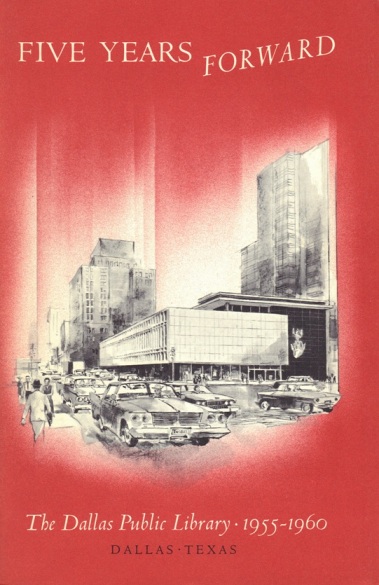
This little 31-page booklet was issued to commemorate the fifth anniversary of the Dallas Public Library. The library was built on the site of the old (beautiful!) Carnegie Library and was vacated when the current library (the J. Erik Jonssen Central Library) opened on Young St. in 1982. Unbelievably, the building has remained empty for over 30 years.

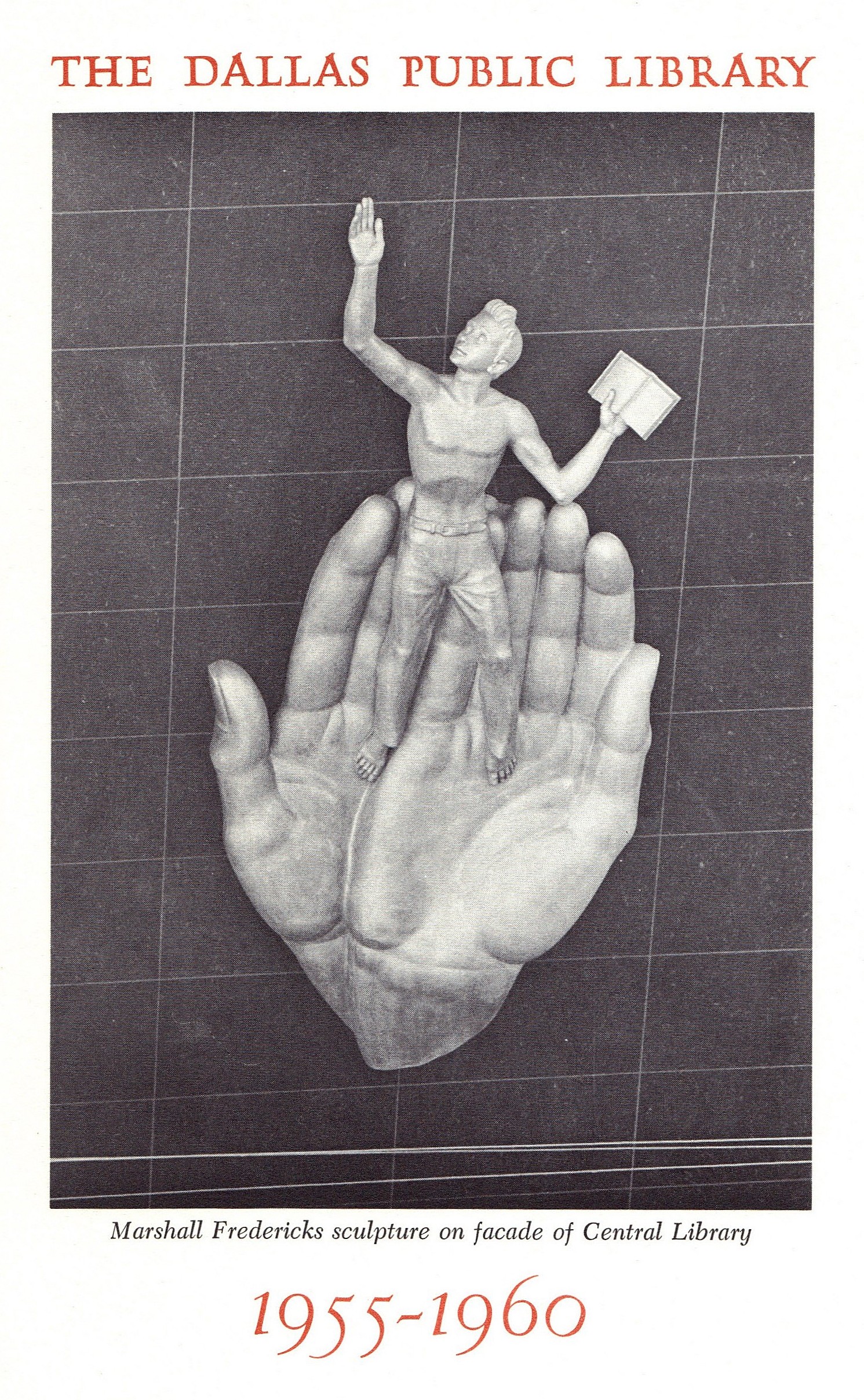
This is the only downtown building I have very distinct memories of from childhood. My mother took us to the library often, and I LOVED that place. I loved the building, the space, the books, the adventure of being downtown — I loved everything but that creepy sculpture of the kid standing in the hands that hung on the outside of the building!

This great library was designed by the legendary (and prolific!) Dallas architect, George Dahl. He moved easily from the streamlined grandeur of the Art Deco buildings of Fair Park to the sleek mid-century-modern-cool of this wonderful downtown library.

2DPL_hands-sculpture
I know there are fans of this sculpture (“Youth in the Hands of God” by Marshall Fredericks), but I’m afraid I am not one of them. I loved art as a child (in fact, I can remember checking out framed art reproductions from this very library), but, as I said, even as a kid, I strongly disliked that creepy sculpture. The kid was fine, it was those giant disembodied hands. When the library moved to its current location in 1982, this sculpture was left behind to languish for years inside the empty building. It was eventually sold, and the boy and the hands are now resting comfortably in retirement, somewhere in Michigan.

3DPL_lobbybertoiaThere was a huge controversy about the Harry Bertoia sculptural screen seen above, hanging over the circulation desk. (I LOVED this piece as a kid!) The mayor — R. L. Thornton — HATED it, and the brouhaha-loving newspapers launched themselves into the fray by running apoplectic editorials which, of course, only fanned the flames of outrage. After the “scandal” died down, the art was eventually given the okay to stay, but not before a lot of people made a lot of noise about how the city of Dallas had wasted the $8,500 it had spent on the commission. Unlike the discarded hands sculpture, the screen was moved to the new library, where it remains today.

4DPL_outdoorterrace

5DPL_familylivingThis is how I remember the library. Lots of space, cool furniture, and flooded with light.

6DPL_children

7DPL_av

8DPL_globe

9DPL_planningcomm

10DPL_checkingoutI LOVE this photo!

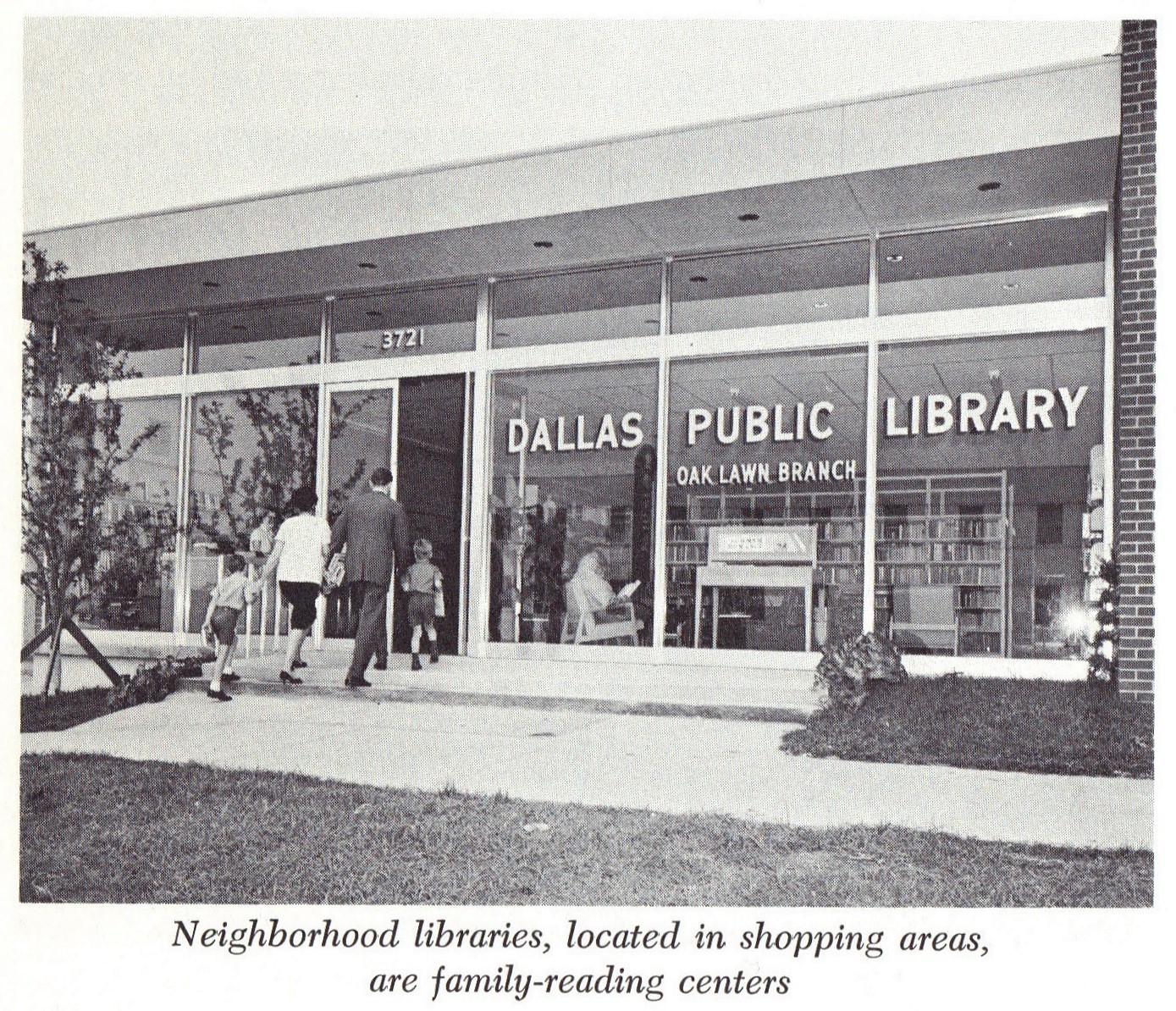
11DPL_oaklawnbranch

12DPL_teens

14DPL_schiwetzcropA detail of the front cover artwork, by Texas artist E. M. “Buck” Schiwetz. I love the driver in the cowboy hat (he must have been awfully small or that car must have been awfully big to accommodate that hat). The energetic frisson of downtown Dallas in the Mad Men era is dampened a bit by those damn hands on the building that seemed to follow you everywhere you went!

***

Sources & Notes

All images from the booklet Five Years Forward: The Dallas Public Library, 1955-1960, compiled and written by Lillian Moore Bradshaw and Marvin Stone. Drawings by E. M. (Buck) Schiwetz. Photographs by C. D. Bayne. (Dallas: Carl Hertzog for Friends of the Dallas Public Library, 1961). (Photos from the archives of the Dallas Public Library.)

More on the history and construction of the Old Dallas Central Library (as well as tidbits about the ridiculous controversy regarding the commissioned art) is here.

Even MORE on the artwork scandals (the hands, the hands, the HANDS!) as well as photos of the beautiful Carnegie Library that was razed to build the 1955 library can be found here.

And just because it’s weird, here’s a postcard showing an early, possibly even creepier depiction of the “hands” sculpture (if those are the “hands of God”…). I guess they wanted to get a postcard out before the sculpture was finished and installed.

dallas-public-library_dahl_postcard

I’ve posted one further image from this booklet — a drawing of the 1961 Dallas skyline by E. M. “Buck” Schiwetz  — here.

UPDATE — Dec., 2017: The Dallas Morning News has moved its operations to the long-vacant library, insuring this wonderful building’s continued existence for many more years! More here.

Click pictures for larger images (some are MUCH larger — click twice!).

*

Copyright © 2014 Paula Bosse. All Rights Reserved.


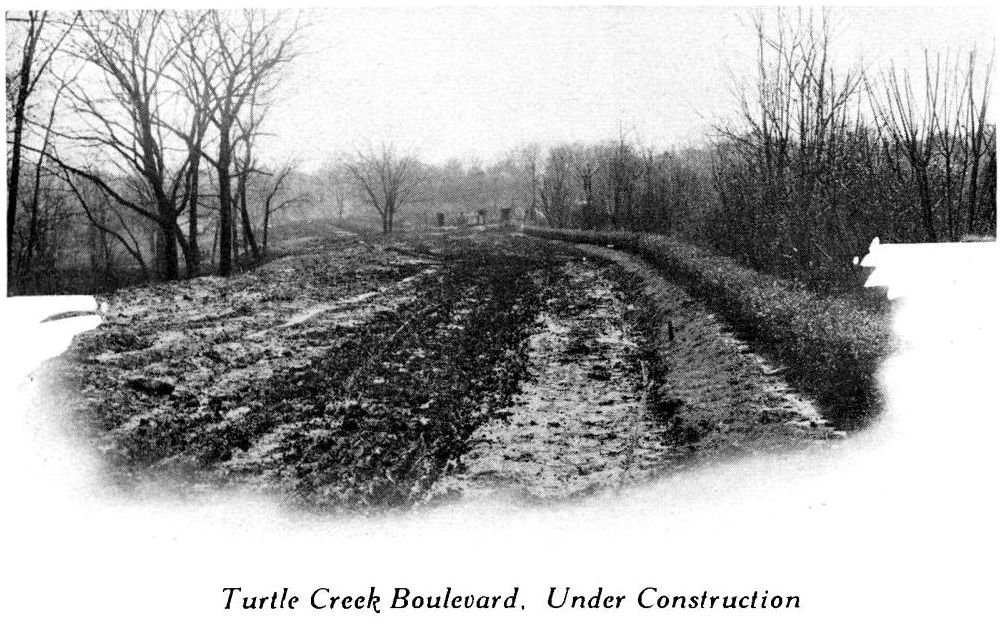
The Construction of Turtle Creek Boulevard: “Ascending & Descending Cliffs and Ravines” — 1915

turtle-creek-blvd-1

by Paula Bosse

What was going on a hundred years ago in Oak Lawn? Turtle Creek Boulevard was being constructed! Construction was overseen by the Park Board, which probably explains why it is one of the most beautifully landscaped roadways in Dallas.

turtle-creek-blvd-2

turtle-creek-blvd-3

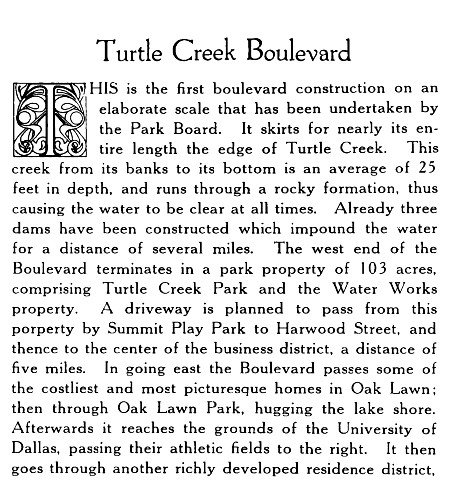
turtle-creek-blvd_text-1turtle-creek-blvd_text-2

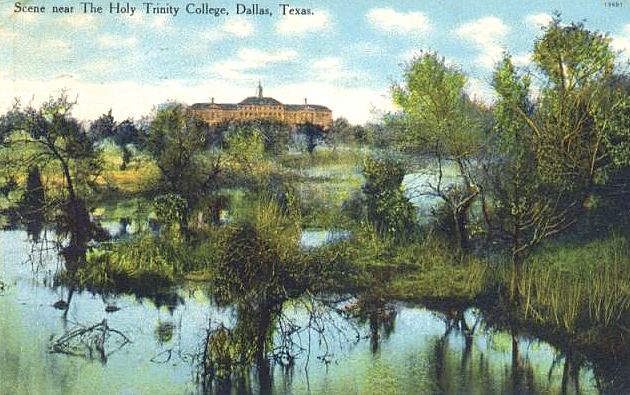
Incidentally, the “University of Dallas” mentioned above refers to the original location of the University of Dallas, first called Holy Trinity College. It moved northward in the 1940s, and Jesuit High School took over the building. I’m really surprised to learn that this huge building was located near Turtle Creek and Blackburn until Jesuit moved north to ITS new home in the early 1960s.

And here it is, snug on the banks of the turtle-infested creek, around 1909 (in a photograph that does not do the lushly beautiful area justice).

***

Sources & Notes

Photos and text from the Report for the Year 1914-15 of the Park Board of the City of Dallas (Dallas, 1915), pp. 63-64.

*

Copyright © 2014 Paula Bosse. All Rights Reserved.
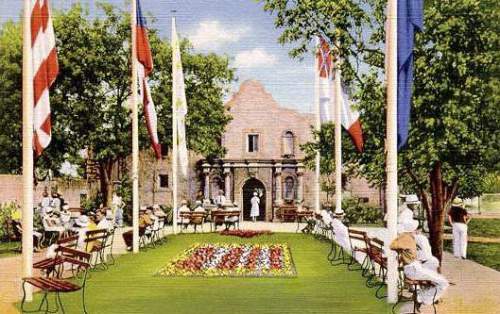
Remember the Alamo! …In Fair Park?

alamo_replica_fair-park_seewatermelonkidpage

by Paula Bosse

Today, on the anniversary of the fall of the Alamo, I bring you news that Dallas has outdone San Antonio by having hosted two Alamos. TWO! Both in Fair Park. The first one was a gift to the city by G. B. Dealey and the Dallas Morning News — it stood stoically at the entrance to the fairgrounds from 1909 until 1935 — and the second one was a rebuilding of the first which was torn down to make way for the the splendor of the Art Deco Centennial extravaganza and lasted from 1936 until 1951. And here I’d never heard mention of Dallas having had ANY Alamos.

The idea came from Dallas Morning News executive George Bannerman Dealey. He sent architect J. P. Hubbell (of Hubbell & Greene) to San Antonio to meticulously photograph, sketch, and measure the original structure — this included making note of every stain, every crack, every instance of broken plaster, etc. — in order to reproduce an exact replica of the historical landmark (at half the size of the original). The Morning News offered to pay for and build the replica (the cost was estimated at $5,000) and asked only that it be placed in a primo location (at the entrance!), that it be open to the public during the day but be available to the DMN people to use for private/company functions after hours, and that the Park Board maintain the building and its landscaping. The Park Board jumped at the gift, and the news of our very own “little Alamo” was met with giddy anticipation. Even the rival Dallas Times Herald was swept up in the excitement and suggested a “Meet Me at the Alamo at the Dallas State Fair” slogan in an editorial.

San Antonio and the Daughters of the Republic of Texas (who managed and maintained the historic shrine) were not terribly amused by this, but The News (in the expected torrent of its own self-congratulatory publicity about its magnanimous gift “not to Dallas, but to the State”) humbly insisted that the much, much, MUCH smaller Alamo would only drum up steady tourism of people who wanted to see the real thing. San Antonio and the Daughters seemed to get over it eventually. Dealey had made a good point, though, when he said that only a very small percentage of Texans had been able to see the Alamo in person, and this was an excellent way to bring history alive for North Texans.

The replica was dedicated on the opening day of the fair in 1909, and curious crowds lined up to see the startlingly realistic reproduction of the building which Mayor S. J. Hay described as being “sacred to every patriotic citizen of the State.” The brand new Alamo (made to look old and worn and battle-scarred) was a hit. In fact, it seems to  have been a very popular exhibit for the length of its stay — a total of 42 years. Other than being visited by thousands and thousands of fair-goers and families and schoolchildren, it was also used to house soldiers briefly during both World War I and World War II. It was visited by numerous people who claimed to be related to Alamo heroes like Crockett, Bowie, and Travis, and there were even a couple of instances of visits by 100-year-old men who said they had known Crockett and Bowie when they were children.

And, oddly, even Comanche Chief Quanah Parker stopped by to check the place out. I’ll end with his salient observations upon seeing the Alamo replica when visiting Dallas as a guest of the State Fair in 1909:

White men talk a great deal about their history. They don’t all play brave in making it. They don’t all care as much for getting it right as for getting it like they want it. Alamo fight was brave like Indians fight, don’t care for safety and for life. This Alamo house brings back to me thought of the ‘Dobe Walls’ fight a long time ago. It must make Texas people feel good to look at this and think of what it stands for. It was a fine thing for The News to put it here. (DMN, Oct. 27, 1909)

*

Above, opening day crowds. “Scene in front of the Replica of the Alamo Chapel During the Ceremony of Presentation.” Photo by Henry Clogenson. (DMN, Oct. 17, 1909)

Dallas’ second Alamo (which made its debut at the Texas Centennial in 1936) no longer had its primo location at the entrance to Fair Park, but it at least had a bit of room to breathe. As with the first replica, an architect was sent to San Antonio to bring back exact measurements — this time it was the incomparable George Dahl (if you’re not familiar with his work, you need to look him up). And this time, San Antonio and the Daughters of the Republic of Texas were not happy at ALL: there was a sternly worded petition from San Antonio to the governor and threats to legally force a halt to the construction. Guess they got over it. Again.

alamo_art-institute-of-chicago_1936

But eventually, the Alamo fell. It was razed in August of 1951, after years of neglect. Stalwart Texas demolition workers must have blanched a bit at being informed that their job was to destroy the very symbol of Texas heroism and independence.

***

Top postcard from a page on the Watermelon Kid’s great Dallas history site, here.

Photo of the “brand new” Alamo in 1936 from the Ryerson & Burnham Archives, Art Institute of Chicago, here.

*

Copyright © 2014 Paula Bosse. All Rights Reserved.


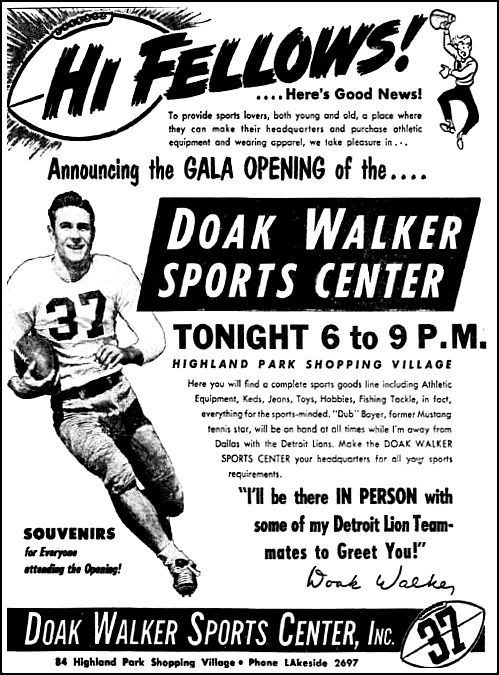
The Store That Doak Built

doak-walker-sport-center

by Paula Bosse

Doak Walker, the Heisman-winning superstar football player for SMU from 1945 to 1949, was, for a good forty-odd years, a partner in a successful sporting goods business that bore his name: the Doak Walker Sports Center. When it opened in Highland Park Village on August 23, 1951, the 24-year old — then playing pro ball with the Detroit Lions — was a bona fide celebrity, both locally and nationally. Predictably, the grand opening drew large crowds of sports fans eager to see their homegrown hero and check out the new place in town to get tennis balls and baseball bats (and, who knows, there might even have been some who showed up to see those unnamed Lions teammates the ads said he’d bring with him). The promise of “souvenirs for everyone!” was merely icing on the cake.

At the same time that the Sports Center was opening, Doak’s name was also on a Gulf station that he and former Mustangs teammate Raleigh Blakely owned on Hillcrest across from the SMU campus. And while both of those business concerns were chugging along, he was also appearing in local and national ads for everything from chewing gum to Vitalis (with a name like “Doak” you’re going to have instant name recognition). Oh, and he was also playing football. Doak Walker was a force to be reckoned with — on the field, on Madison Avenue, and in the dang Park Cities.

*

doak-walker_sports-ctr_opening_dmn_082351

***

Postcard of Doak Walker Sports Center from the Boston Public Library Tichnor Brothers Postcard Collection on Flickr, here.

Life magazine from Sept. 27, 1948. The cover story on Doak Walker and the SMU team can be accessed here.

Signed issued of Sport magazine is currently available for sale here.

Triangle Motors ad from a 1951 program for an SMU-Rice game at the Cotton Bowl.

Doak Walker bio on the Pro Football Hall of Fame website is here.

*

Copyright © 2014 Paula Bosse. All Rights Reserved.
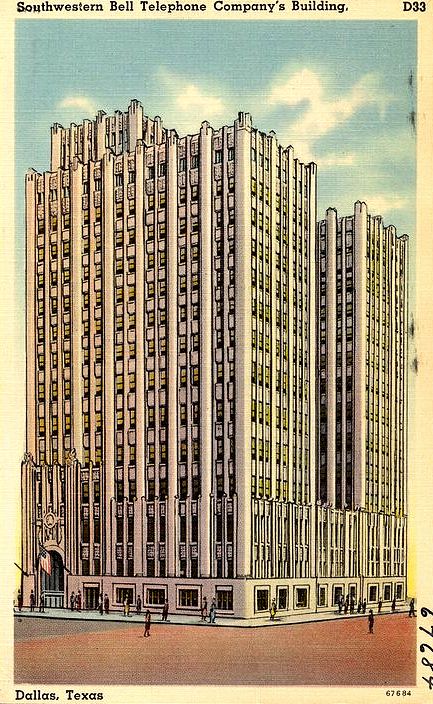
Southwestern Bell Telephone Goings-On, Circa 1928

by Paula Bosse

The beautiful Southwestern Bell Telephone Company building, designed by Lang & Witchell in 1929.

From the book Dallas Landmarks:

Dallas’ first telephone exchange opened on June 1, 1881, with 40 subscribers. There were several competing telephone companies before 1925 when Southwestern Bell became the sole provider. The number of telephones in used quickly soared from 30,000 in 1922 to 200,000 in 1949.

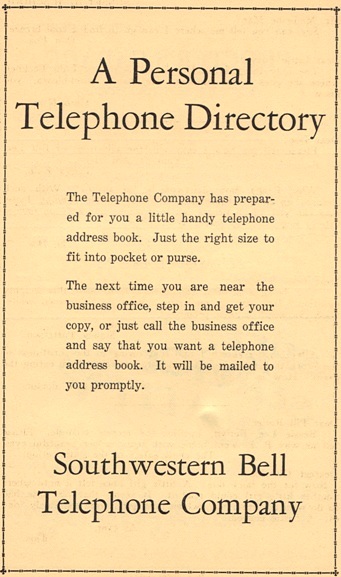
The relatively few telephone subscribers at the time the building was going up might explain this folksy little notice about a “personal telephone directory” that the fine folks at Southwestern Bell have been working on night and day, just for you. Next time you’re in the neighborhood, why don’t you just drop right on in and pick one up? Set a spell. Take your shoes off. Y’hear?

***

Sources & Notes

Postcard from the Boston Public Library Tichnor Brothers Postcard Collection on Flickr, here.

Quote from the book Dallas Landmarks, by Preservation Dallas and Dallas Heritage Village (Charleston: Arcadia Publishing, 2008). p. 31.

Quaint little ol’ phone book ad, from, of all places, the Nov. 1928 issue of “The Stampede,” the school magazine published by and for the students of Sunset High School in Oak Cliff.

*

Copyright © 2014 Paula Bosse. All Rights Reserved.


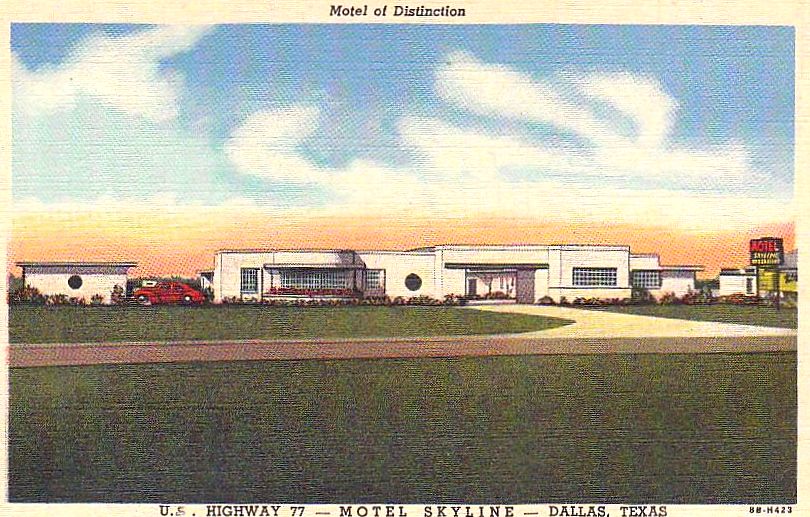
Motel Skyline / Skyline Motel — “The Motel of Distinction” (1947)

motel-skyline_postcard

by Paula Bosse

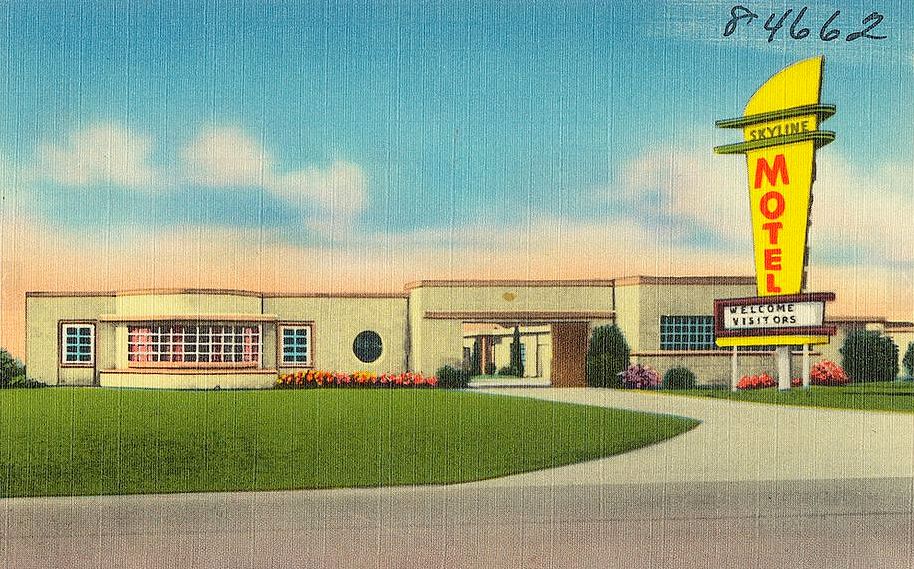
THIS is a great, great-looking motel. I only hope it looked half as sleek in real life. It was, rather surprisingly, designed in 1947 by the architect George Marble who was known for his large Tudor-revival homes in the pricier areas of Dallas (particularly Highland Park and Lakewood), so this is a major divergence in style. 1947 seems a little late for something this Deco-looking, but, no matter — this is just a fantastic building.

The “Motel Skyline” (or “Skyline Motel” as it was being referred to in ads not long after it opened in September, 1947) was located at 6833 Harry Hines, near West Mockingbird, just past Love Field. It’s not a great neighborhood these days, but perhaps it was better 60-some-odd years ago, when Harry Hines was the route that the old Hwy. 77 followed. The 30-unit “motor hotel” was built at a cost of $250,000 — it boasted year-round air conditioning and “mattresses of fiberglass.” 

I don’t know how long the place lasted — perhaps until the mid- or late-’60s, when advertising petered out and by which time the probably no-longer-so-sleek motel seems to have started catering to customers paying by the week and by the month. It might not have gotten as seedy as I fear it might have, as I saw only a couple of fairly run-of-the-mill appearances on the police blotter (cash stolen from a sleeping customer and a likely suicide in one of the rooms). Still, I shudder to think of that once-beautiful building ending its days cheek-by-jowl with modern-day Harry Hines.

It’s nice to know Dallas once had this wonderful building, if only for a little while. If anyone has photographs of the actual building, I’d love to see them, even though I know I would probably be disappointed.

*


1962 ad

***

Check out the kind of architectural design that George N. Marble is actually known for (residential, palatial), here.

Second postcard from the absolutely fantastic Boston Public Library Tichnor Brothers Postcard Collection on Flickr, here.

Matchbook from Flicker, here.

Click postcards for larger images. It’s worth it.

*

Copyright © 2014 Paula Bosse. All Rights Reserved.

Dallas Power & Light Building, Night and Day

by Paula Bosse

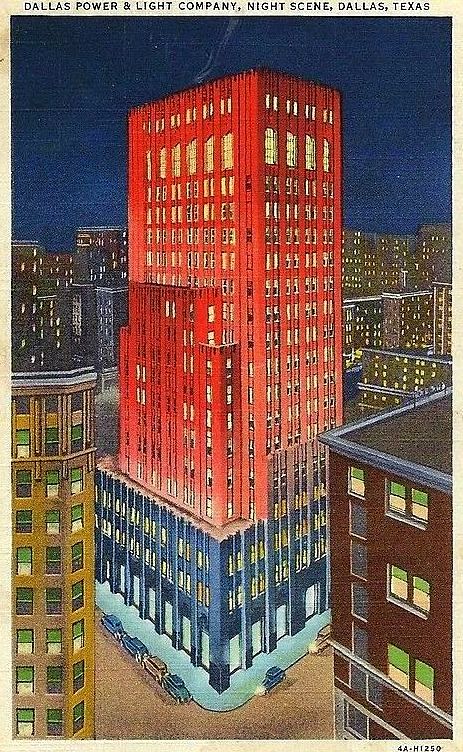
Such an incredible building, designed by architects Lang & Witchell in the zig-zag moderne/Art Deco style and built in 1931 to house the corporate offices of the Dallas Power & Light company. I wondered from that night scene whether the building was illuminated at night, and it was. From the city’s application to the National Register of Historic Places: “The building was spotlighted with revolving colors at night, emphasizing it as a downtown landmark; this was discontinued during the energy crisis in 1975.” Argh!

This is a building that is beautiful by night and beautiful by day.

***

Sources & Notes

A detailed description of the architectural elements of the DP&L building is in a PDF containing the city’s application of several buildings to be considered for the National Register of Historic Places. The section on the DP&L building begins at page 68 and can be found here.

A photo of one of the portrait busts on the facade of the building is a nod to Thomas A. Edison, King of Electricity, and it can be seen here in an almost Hitchcockian cameo.

*

Copyright © 2014 Paula Bosse. All Rights Reserved.