Flashback : Dallas

A Miscellany: History, Ads, Pop Culture

Category: SMU

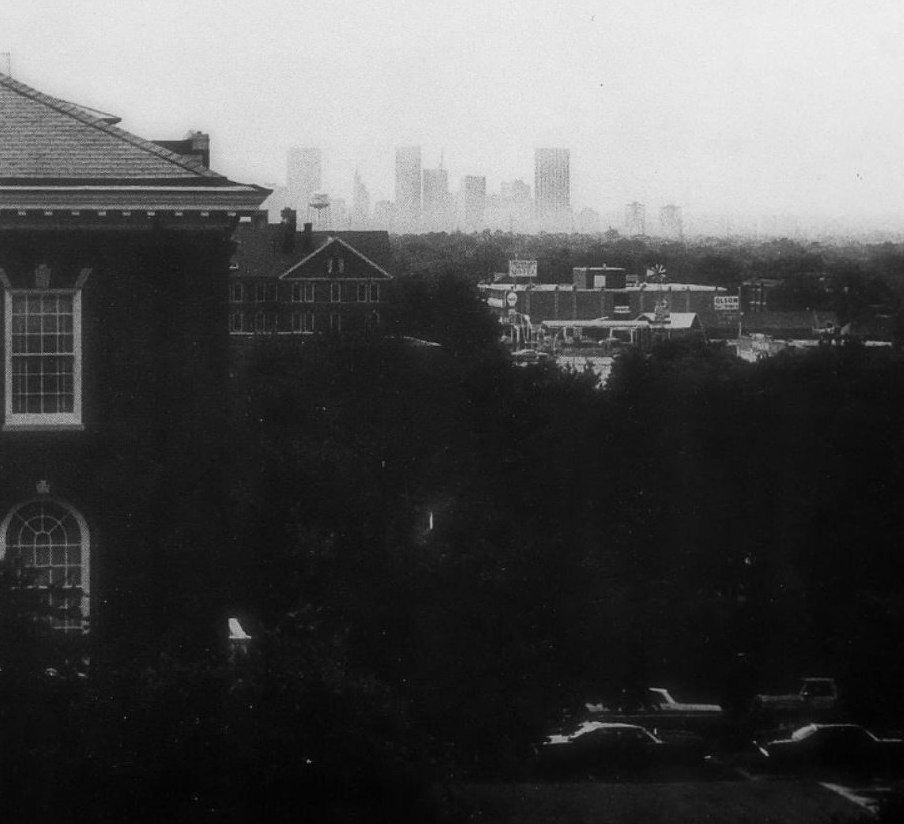
Looking South from the Hilltop — 1966

skyline_smu-law-school-yrbk_1966Downtown, as seen from the SMU campus… (click for larger image)

by Paula Bosse

Yeah, the photo is pretty dark, and the image quality leaves something to be desired, but I like this unusual view of a dreamlike downtown skyline, as seen from the SMU campus. Hillcrest Avenue — the SMU drag — can be seen in the upper center; the large building on the west side of Hillcrest is the University House Motel (still standing, but expanded and massively renovated as Hotel Lumen). Right next to the motel is the excessively quaint windmill of the Little Red Barn restaurant.

It all seems very calm.

***

Photo from the 1966 Southern Methodist University Law School yearbook.

*

Copyright © 2016 Paula Bosse. All Rights Reserved.

“How the News Got Made” — SMU’s WFAA Newsfilm Collection Spotlighted at the Dallas VideoFest

wfaa-newsfilm_thumbnails_hamon_cul_smu(G. William Jones Film and Video Collection, SMU)

by Paula Bosse

The Dallas VideoFest is in full swing this weekend, and one of the events on the schedule is How the News Got Made: A Rare Look at SMU’s WFAA Newsfilm and a Conversation with the People who Created It.” This screening and panel discussion will include WFAA news clips and B-roll footage on 16mm film from the 1960s and ’70s, selected from the large WFAA Newsfilm Collection (part of the moving image holdings of the G. William Jones Film and Video Collection, Hamon Arts Library, Southern Methodist University).

A few months ago I saw a screening at SMU of some of these clips — which had been selected by the collection’s curator, Jeremy Spracklen, who has also, I believe, compiled the clips for the VideoFest presentation — and I really enjoyed it. Being able to watch 45- or 50-year-old news clips — of subjects both newsworthy and not-so-newsworthy — is an interesting way to study moments in the history of Dallas. It’s certainly more immediate and “flavorful” than reading old black and white newspaper clippings. I mean … you can listen to people actually talking. (With actual ACCENTS!) And see them move! SMU is in the process of identifying people and places seen in these clips and may soon request crowdsourced assistance from the public. It’s a large undertaking, further complicated by the fact that much of the footage was received by SMU randomly spliced together, some of it raw footage without sound. The hope is to identify subjects and subject matter in order to assist researchers, historians, and documentarians.

At present, almost two decades’ worth of these film reels are slowly being digitized; when the transfers are complete, they are uploaded to SMU’s Central University Libraries site and are free to be viewed by the public. Check what’s up now, here, and watch a few yourself.

There is a great Dallas Observer article by Jamie Laughlin on this collection. You must make sure to scroll down and watch the clip of fresh-faced Channel 8 newsboy Bill O’Reilly (yes, that Bill O’Reilly) interview the only slightly younger-looking future superstar ventriloquist (…two words I’ve never typed one right after the other before…) Jeff Dunham, who, at 14, seems really excited to be talking about his craft on TV.

And, if only a sliver of what I saw of the hilariously bizarre and wonderfully entertaining footage from about 1969 of mini-skirt-and-sideburn-hating Texas Land Commissioner Jerry Sadler — who was reported to have grabbed and choked a political critic in a dispute over Spanish galleon treasure recovered off the Texas coast (…yes, that’s what I said…) —  is shown at the VideoFest, it will be WELL worth your time!

***

Sources & Notes

The top image is a collection of thumbnail images of WFAA digital files which have been uploaded to the Central University Libraries’ site, here.

Read about this WFAA Newsfilm Collection in the Hamon Arts Library digital collection here.

For more information on the collection, contact filmarchive@smu.edu.

The Dallas VideoFest program, “How the News Got Made: A Rare Look at SMU’s WFAA Newsfilm and a Conversation with the People who Created It,” takes place this weekend, Saturday, Oct. 22, 2016, 5:15-6:45 PM at the Angelika Film Center. More information on the event and the panel participants is here.

*

Copyright © 2016 Paula Bosse. All Rights Reserved.


The Digital Collections of SMU’s Central University Libraries: The Gold Standard

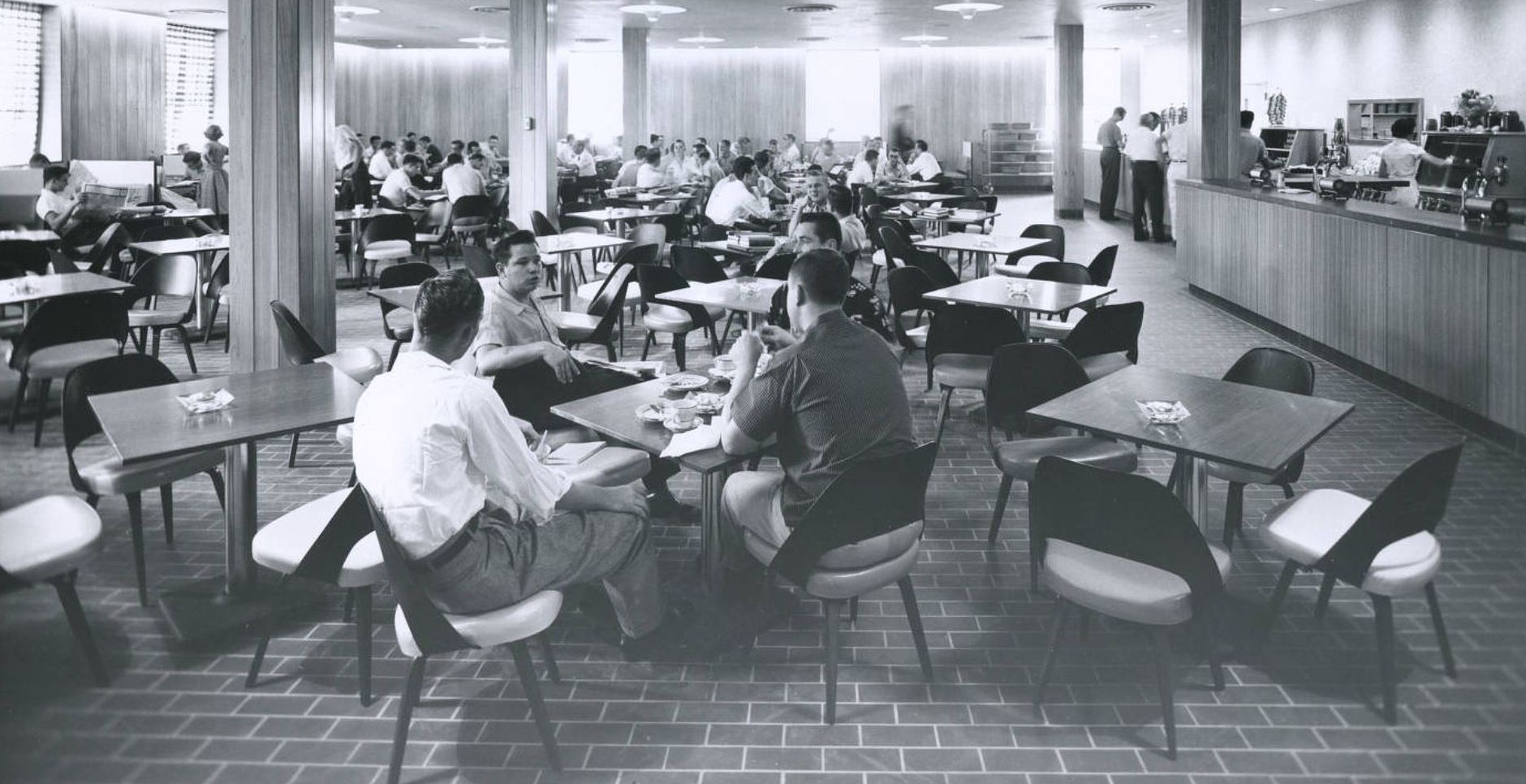
umphrey-lee-snack-bar_rotunda_1956My father in the Umphrey Lee snack bar?

by Paula Bosse

This past week I was invited by the Norwick Center for Digital Solutions at Southern Methodist University to tour several of SMU’s special collections libraries, which include the DeGolyer Library, the Hamon Arts Library (which includes the Bywaters Special Collections and the G. William Jones Film and Video Collection), the Edwin J. Foscue Map Library, and the SMU Archives. I had a behind-the-scenes look at the journey an item takes on its way to being digitized, beginning with the acquisition of the collection itself, the cataloging of the collection, and the research, annotation, and imaging of each item. Another important part of the process is the often mundane but necessary grant-writing which must be done to obtain funding to do much of the above. These collections at SMU are huge, but a remarkably efficient group of SMU library staff and students tackle the herculean task of getting everything cataloged and up online, accessible to everyone. At the end of February 2016, over 51,000 items have been published online. And there is a vast, exciting amount still to come!

For me, the online digitized database of SMU’s Central University Libraries is the absolute best for researching historical Dallas images. (I should note that Dallas history is only part of the wide-ranging collection of photographs, manuscripts, films, etc., concerning everything from Western Americana to the Mexican Revolution to trains and railroad history to artists’ sketchbooks, etc.) I’m most interested in Dallas photographs, and SMU really has no equal in what they provide online: large, high-resolution images without watermarks, accessible to anyone with a computer, tablet, or phone. It is an unbelievable treasure trove of historical images, and I’ve been lost in it for hours at a time.

I know this might come dangerously close to appearing to be some sort of paid promotion, but it’s not. We are very lucky here in Dallas to have these SMU collections available to us. I wish ALL institutions with historical holdings would also throw open the doors to their archives and share their collections online freely. (I would be remiss if I didn’t mention UNT’s wonderful Portal to Texas History site here, which, along with SMU, does just that.) We are living in a digital age, and to be unable to access some of Dallas’ other deep and varied collections of our own city’s history is incredibly frustrating, as I think it must also be for the institutions themselves — digitization of large collections takes time and money, both of which are often in short supply. SMU’s online presence is what all other libraries and institutions should model themselves after. Thank you, Norwick Center for Digital Services, for truly bringing SMU into the Digital Age.

**

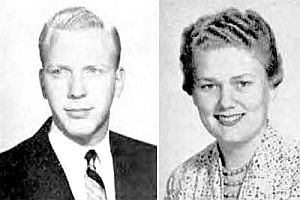
On a more personal note, even though I use the online digital catalog of SMU’s collections all the time for this blog, it can also be a great source to use to explore your family’s history, if family members have attended SMU. My mother and my father both attended SMU, and thanks to the digitization of EVERY SINGLE ROTUNDA YEARBOOK (!), I was able to find photos of my parents I’d never seen before.

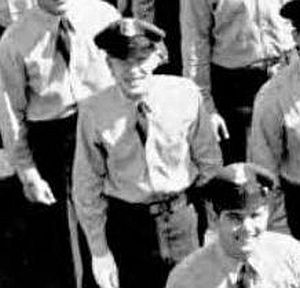
The photo at the top of this post shows the then-new Umphrey Lee Student Center snack bar and appeared in the 1956 Rotunda yearbook. I was browsing through the “Campus Memories” photos from the SMU Archives, and when I saw this photo, I immediately recognized the back of my father’s head! A KA fraternity brother of his doesn’t think it’s my father in this picture, but my mother, my brother, and I all think that that the student in the white shirt in the foreground with his back to the camera is almost certainly my father, who was a grad student in 1956. If it weren’t for the Campus Memories collection (which is FANTASTIC, by the way), I’d never have seen this photograph. And because the Rotunda database is searchable by names (see below for link), I was able to find a photo of my still-teenaged father in some sort of large, uniformed squadron (“Squadron A”) in 1953 — a zoomed-in detail of the photo is below:

PRB_squadron-A_rotunda-19531953

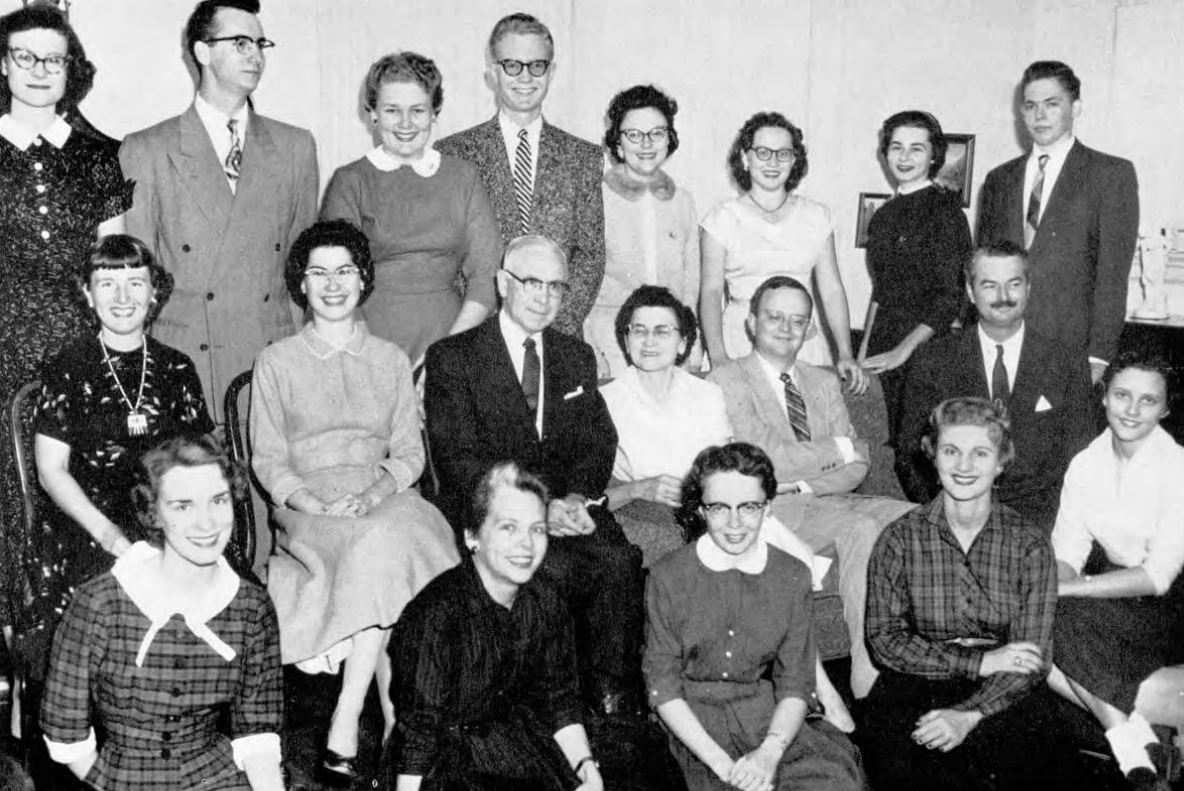
And I’m not sure I would have seen this photo of my mother taken a few years later, looking incredibly cute and perky as an officer of the honorary Comparative Literature fraternity, Beta Kappa Gamma. (My mother is on the back row, between the two tall men.)

beta-kappa-gamma_rotunda_19561956 (mustachioed professor Lon Tinkle is in middle row, far right)

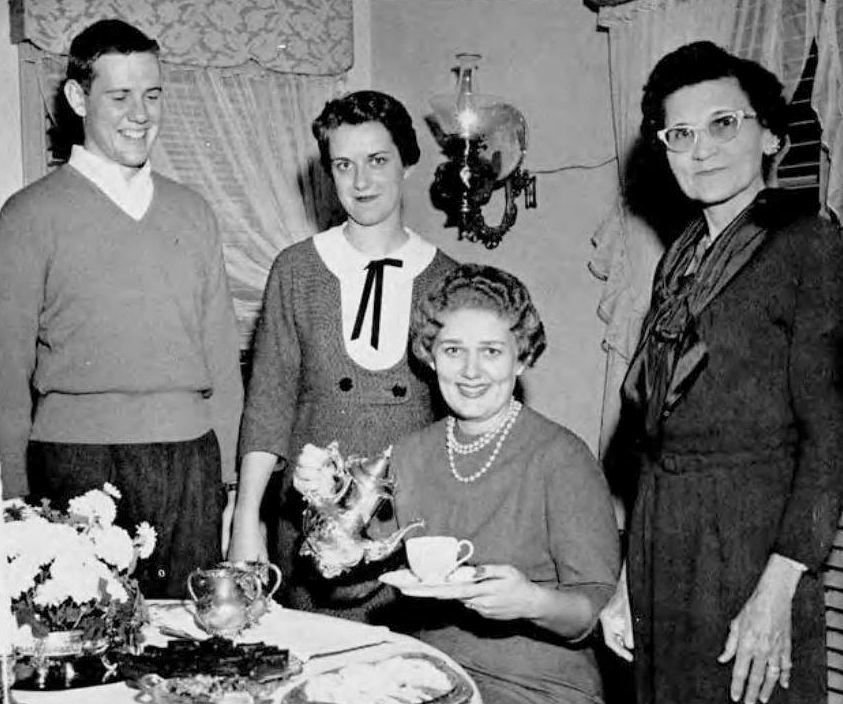
Or this photo a few years after that when she was the president of the group. She always laughs when she recalls how one of the rituals that came with the office was pouring tea from the group’s silver tea service.

mew_rotunda_19591959 (with sponsor Dr. Gusta Nance at right)

Again, thank you, SMU!

prb-mew-rotundaDick Bosse, Margaret Werry

***

Sources & Notes

Main search page for SMU Libraries’ digital collections is here. Pack a lunch. You might be here a while.

Norwick Center for Digital Solutions info is here.

Top photo is titled “Students in Umphrey Lee Student Center Snack Bar” — it was taken in 1955 and appeared in the 1956 Rotunda, SMU’s yearbook; it is from the SMU Archives, DeGolyer Library, Central University Libraries, Southern Methodist University, and it is accessible here. (I’ve cropped it a bit at the top and bottom.)

All other photos are from various editions of the Rotunda yearbook, all of which are online.

Every single edition of the Rotunda — from the very first yearbook for the inaugural 1915-1916 class — has been scanned in its entirety and is available online. This incredible resource is here. It takes a little while to figure how to navigate through the yearbooks, and it can be slow to load — but it’s worth the wait.

More from the SMU Archives (including the archived campus newspaper) is here.

Lastly, I would like to thank the Norwick Center for inviting me to visit. I’d also like to thank Anne Peterson of the DeGolyer Library; Jolene de Verges, Sam Ratcliffe, and Ellen Buie Niewyk of the Hamon Arts Library; SMU archivist Joan Gosnell; and all of the other students and Norwick staff members I met on my visit to the SMU campus. Keep up the great work!

*

Copyright © 2016 Paula Bosse. All Rights Reserved.

Early Aerial View of the SMU Campus

smu_early-aerial_ca1920s_degolyerWide open… (click for much larger view)

by Paula Bosse

Does anyone else fear the SMU campus is getting a little crowded these days? Here’s what it looked like back when there was still plenty of room to stretch out.

This photo is in the SMU archives, accompanied by this description:

Pictured is an aerial view of campus from the southeast. At the bottom is Mockingbird Lane; on the right is Airline Road; at the top is Daniel Avenue; and on the left is Hillcrest Avenue. Situated in the middle of fields is a water tower, Dallas Hall, Atkins Hall, Rankin Hall, North Hall, South Hall, the Women’s Gymnasium, Armstrong Field, and the Morrison-Bell Track.

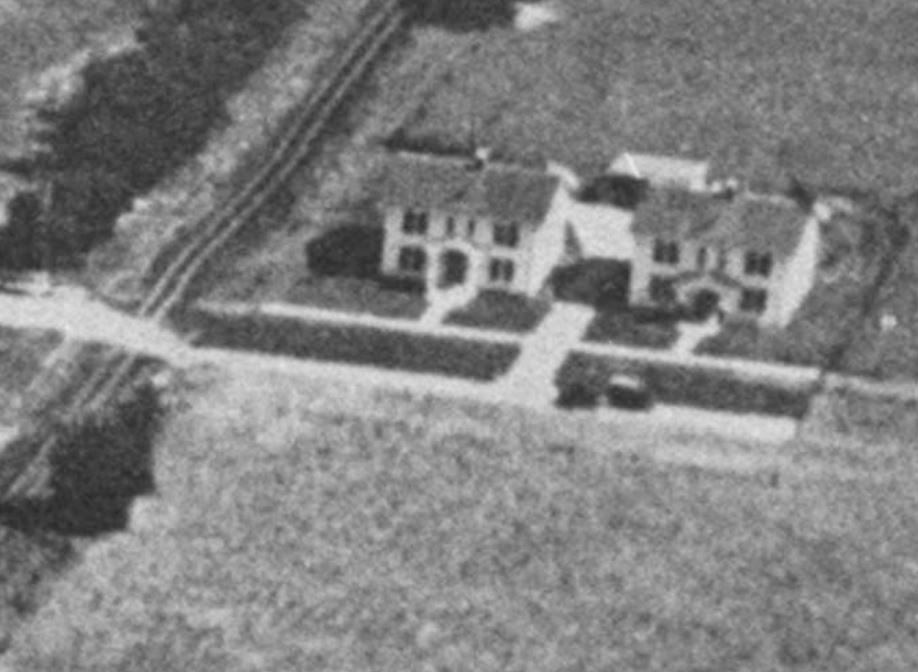
What is the huge hacienda at Hillcrest and Daniel (below)? Is that the Daniel family home?

smu_early-aerial_ca1920s_degolyer_a

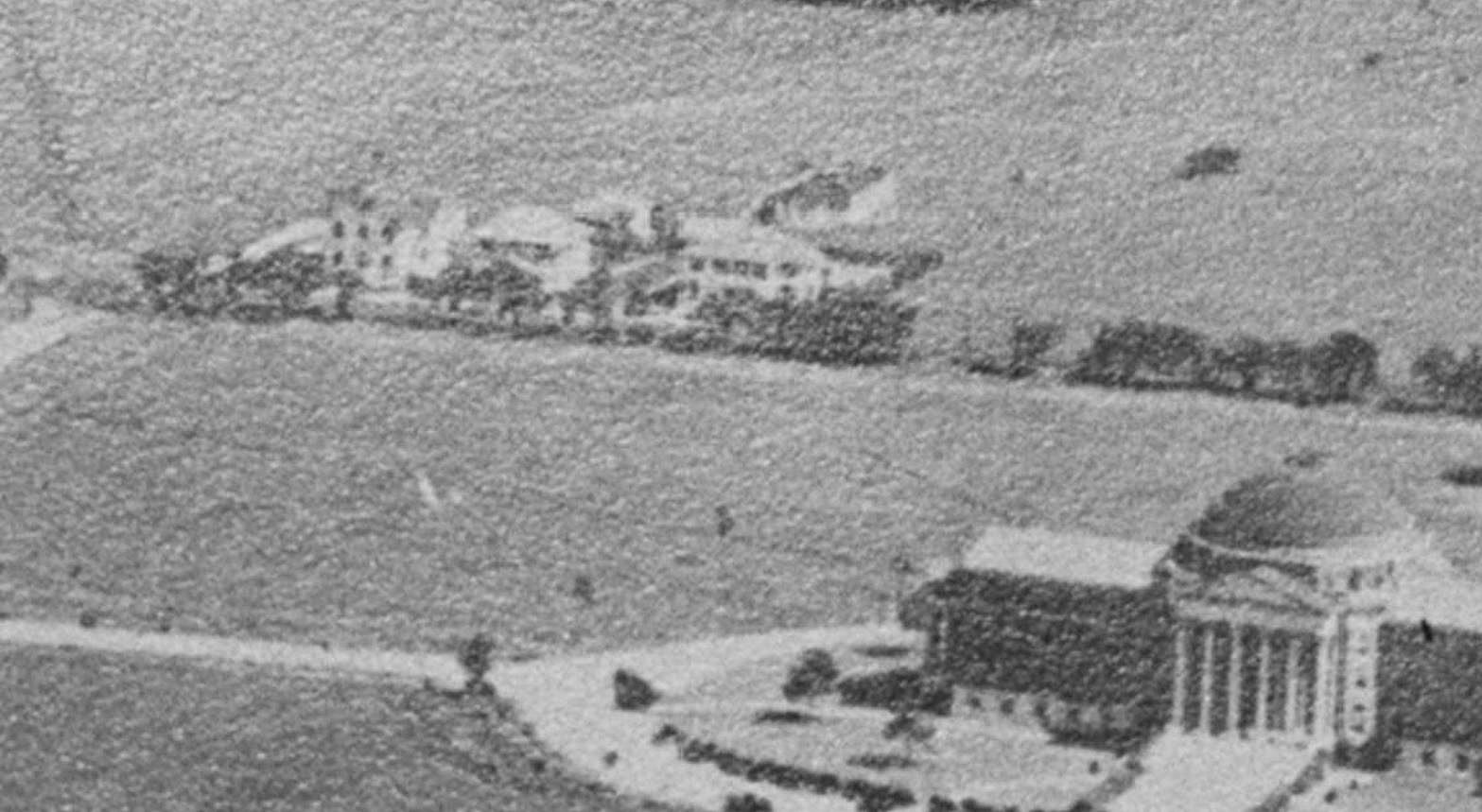
And what are the little houses next to the under-construction stadium? Faculty housing? Fraternity houses? Houses not even connected with the university?

smu_early-aerial_ca1920s_degolyer_b

I kinda wish the campus still looked like this.

***

Photo titled “Early aerial view of campus,” ca. 1920s, from the DeGolyer Library, Central University Libraries, Southern Methodist University; it is accessible here.

Zoom in on this photo as much as you can and wander around it — it’s pretty cool. Go here, then slide the magnification bar at the top all the way to the right.

Click pictures for larger images.

*

Copyright © 2016 Paula Bosse. All Rights Reserved.

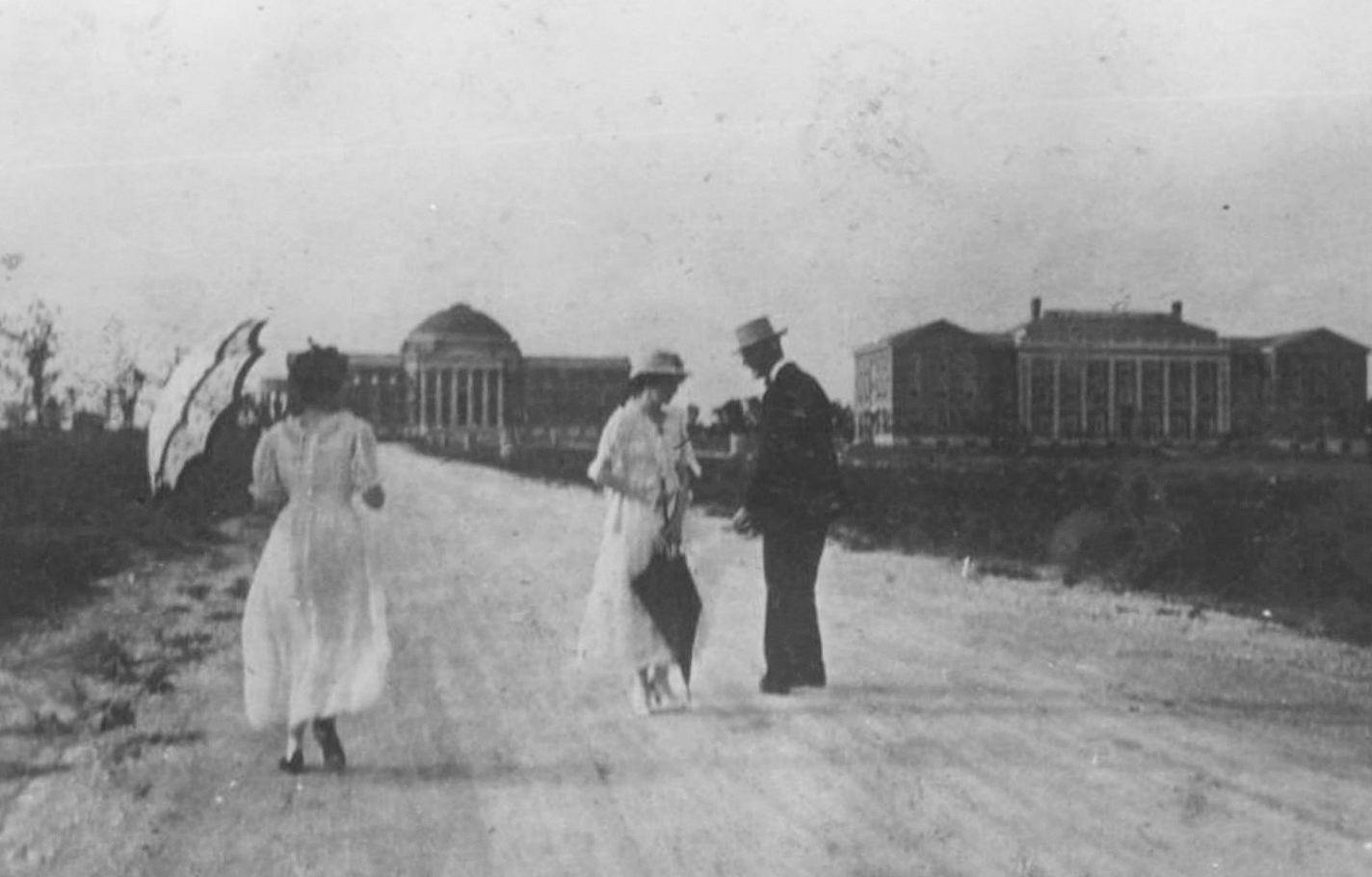
Parasols on the SMU Campus — 1917

smu_parasols_1917_degolyerSMU, sparsely populated

by Paula Bosse

I love this photo showing a man and two women with parasols walking up an unpaved Bishop Blvd. toward Dallas Hall. The women’s dormitory, Atkins Hall, is on the right. …And that’s it.

***

Sources & Notes

Photo titled “Dallas Hall and women’s dormitory in 1917” is from the DeGolyer Library, Central University Libraries, Southern Methodist University; more information is here. (I have straightened the image, and corrected the color somewhat.)

*

Copyright © 2016 Paula Bosse. All Rights Reserved.

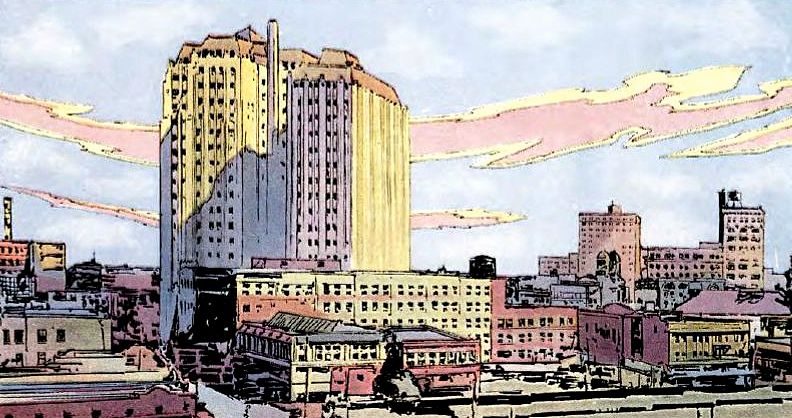
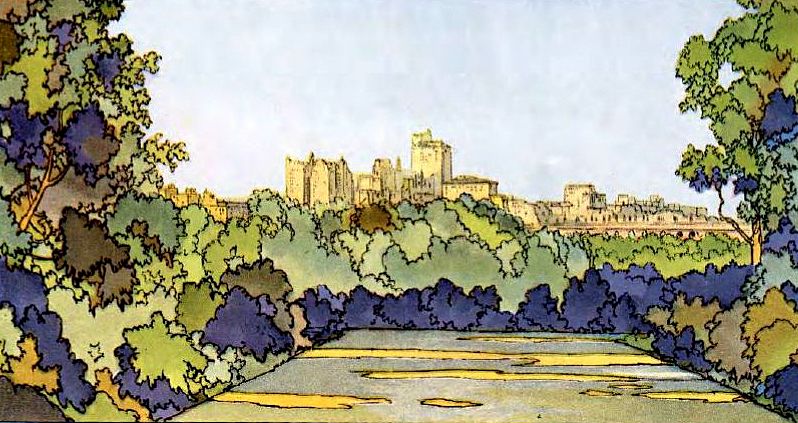
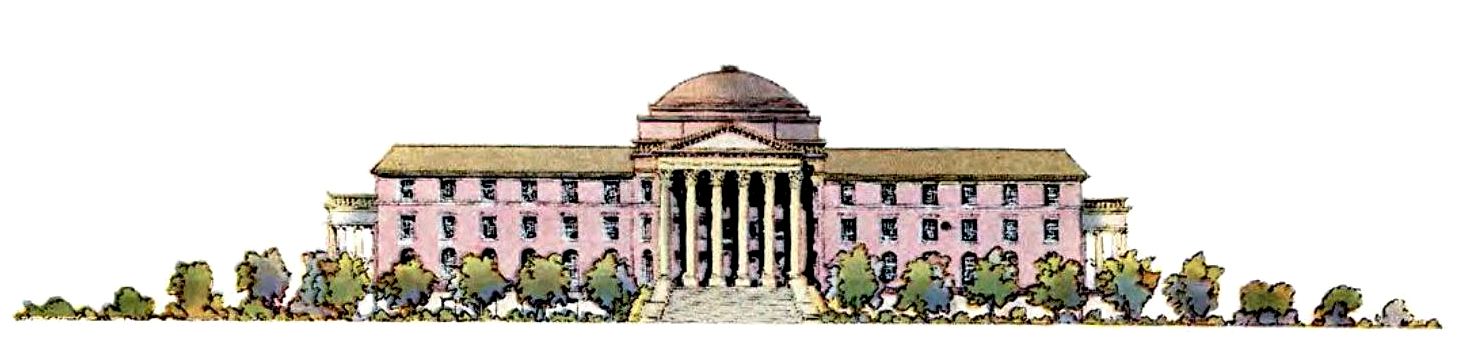
Views of Dallas by Bruno Lore — 1931

skyline_smu_1931Bruno Lore’s Dallas, in purples and pinks

by Paula Bosse

Bruno J. Lore (1890-1963) was a Fort Worth artist and illustrator who spent much of his career working for the Southwestern Engraving Company. Known as “the dean of Fort Worth commercial artists,” Lore had a long and successful career, counting among his many clients colleges and universities who commissioned him to create artwork for their yearbooks (and, perhaps as a friendly or persuasive perk, he was often asked to pick the campus beauties who would be featured in those same yearbooks). Even though information about Lore is scant, he seems to have had steady yearbook work, with his illustrations appearing in several Southern and Southwestern college annuals, primarily in the 1920s and ’30s. In Dallas, his artwork appeared in editions of SMU’s Rotunda.

Below are Lore’s vividly colorful views of the SMU campus and the Dallas skyline which appeared in the 1931 Rotunda and provided a lively, modern exuberance to an otherwise fairly standard college yearbook.

rotunda_1931_advertising-header

smu-rotunda_1931-intto

dallas-hall_smu-rotunda-1931

skyline_smu-rotunda-1931

skyline-3_smu-rotunda-1931

skyline-5_smu-rotunda-1931

skyline-2_smu-rotunda-1931

skyline-6_smu-rotunda-1931

skyline-4_smu-rotunda-1931

skyline-8_smu-rotunda-1931

skyline-7_smu-rotunda-1931

saddleburr_smu-rotunda-1931

students_smu-rotunda-1931

smu-1931rotunda_1931_title-page

*

Lore was doing yearbook work (along with his other commissions) into at least the ’40s. His later years seem to have been focused on Western art, and he produced several paintings. He seems to be most fondly remembered by collectors as the artist who was responsible for several decades’ worth of Western-themed cover art for souvenir annuals of the Fort Worth Rodeo and the Southwestern Exposition and Fat Stock Show.

lore_FWST_012173Fort Worth Star-Telegram, Jan. 21, 1973

***

Sources & Notes

All artwork is from the 1931 Rotunda, yearbook of Southern Methodist University. The above illustrations are unattributed, but it seems fairly certain that they are by Bruno J. Lore, who is mentioned in the school’s newspaper, The Daily Campus, as providing the artwork for the 1931 Rotunda. This edition of the yearbook also contains eight somewhat more staid views of campus scenes in pencil or ink and wash which are attributed to Lore. Lore’s yearbook work was apparently done remotely, and he often worked from photographs.

*

Copyright © 2015 Paula Bosse. All Rights Reserved.

An Afternoon Outing with SMU Frat Boys & Their Dates — 1917

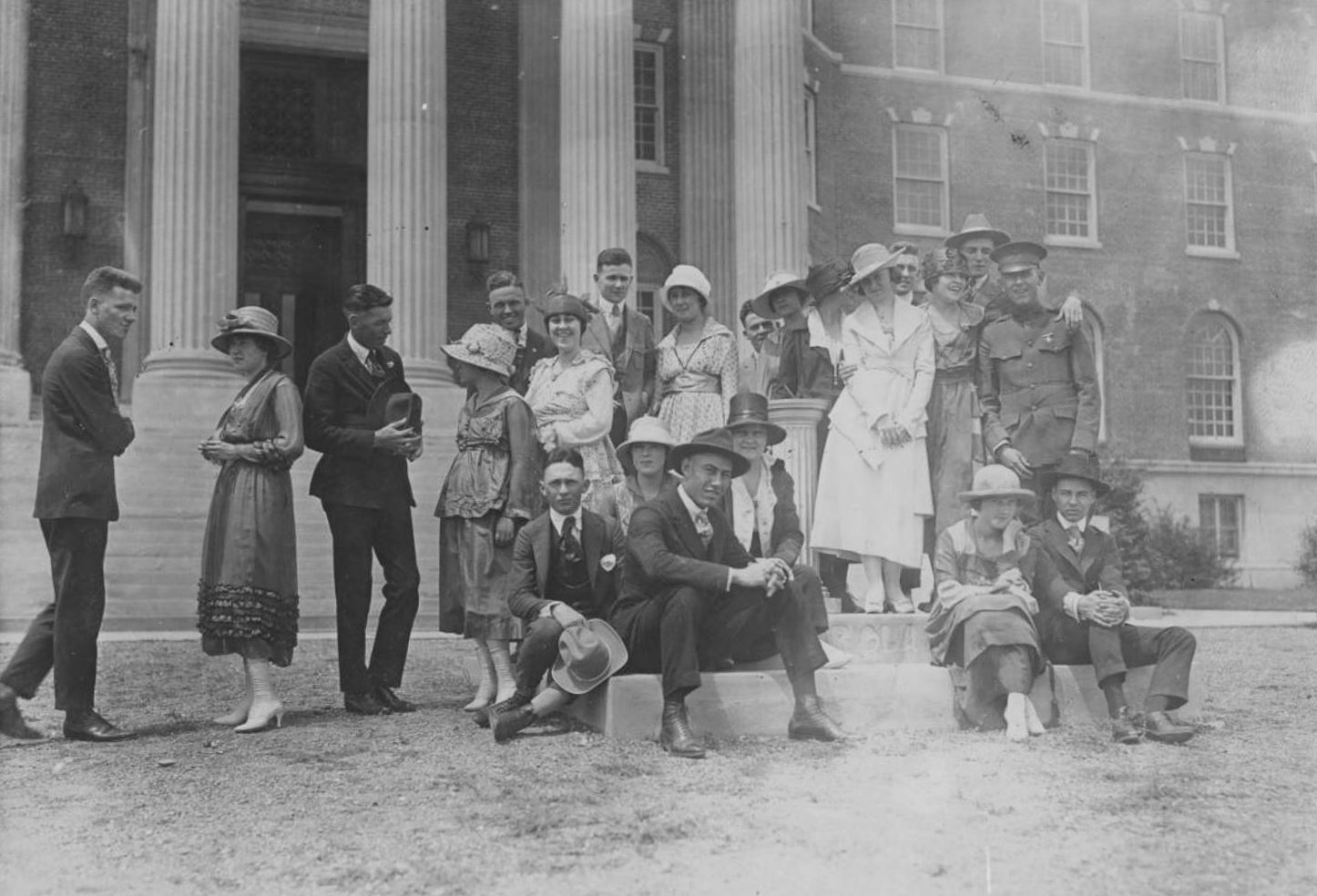
smu_omega-phi_dallas-hall_1917_degolyerCampus couples, 1917

by Paula Bosse

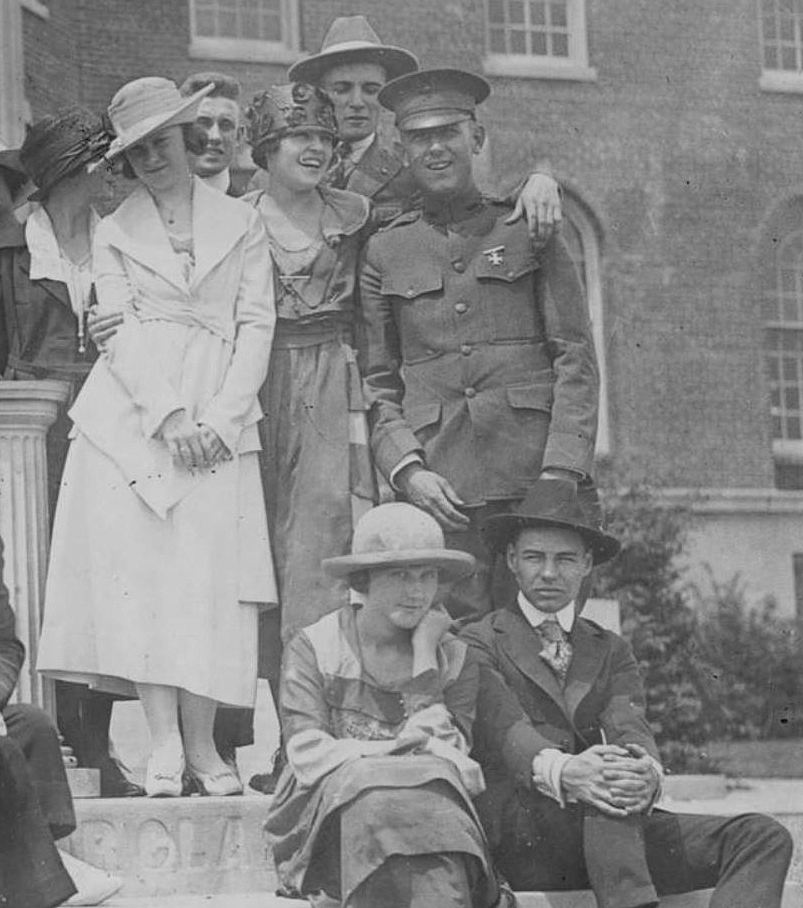
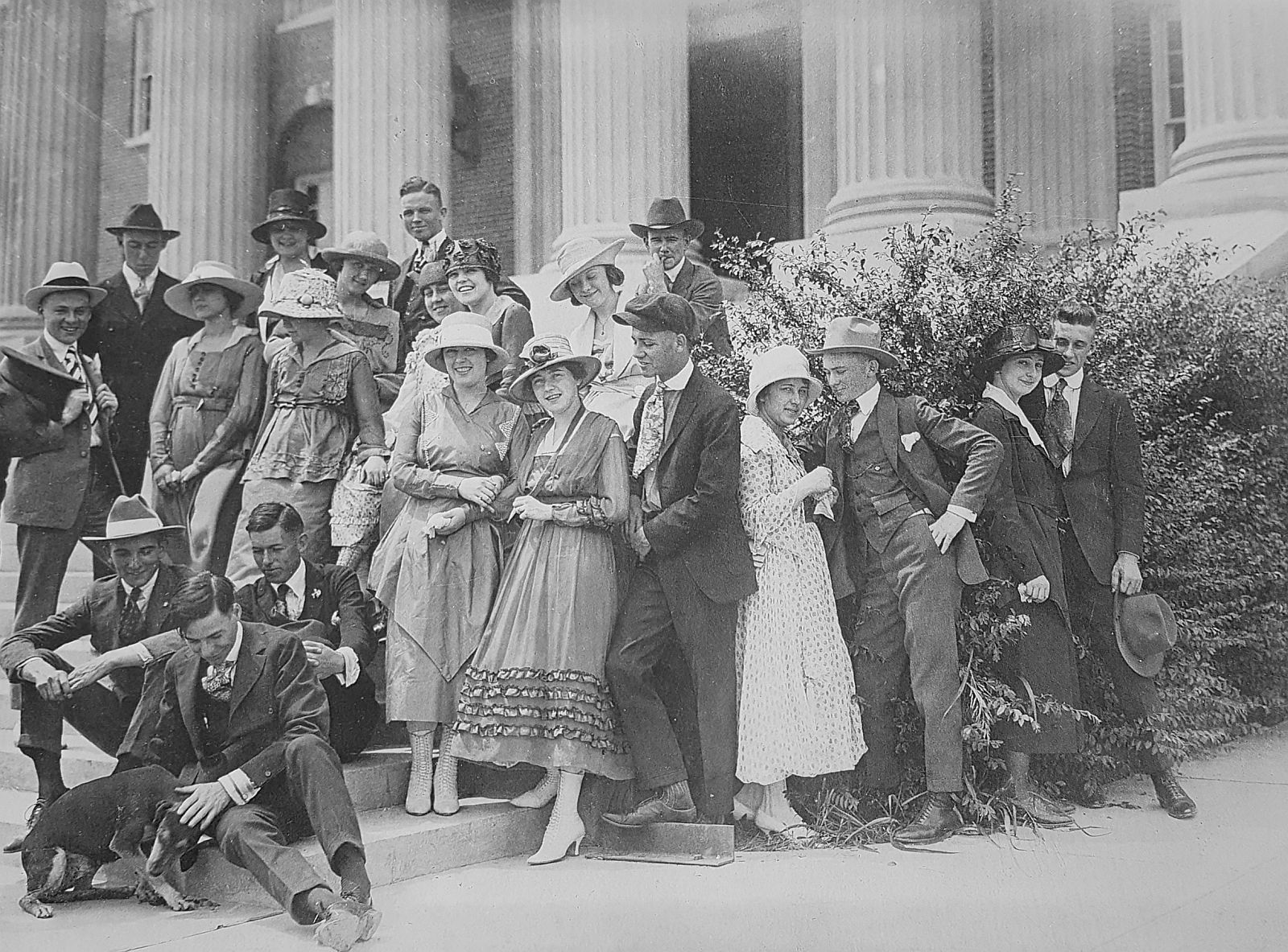
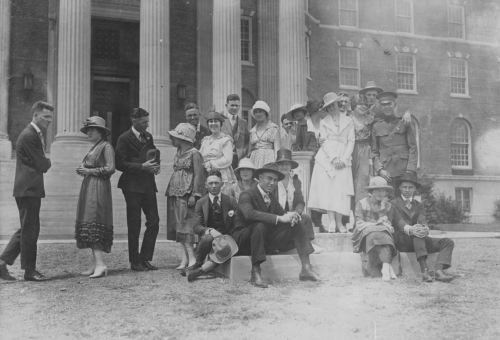
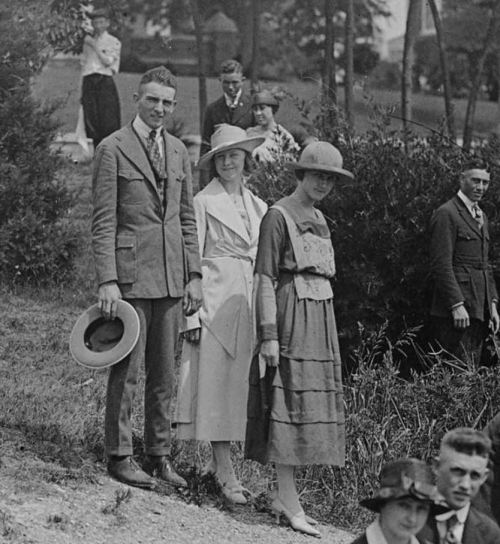
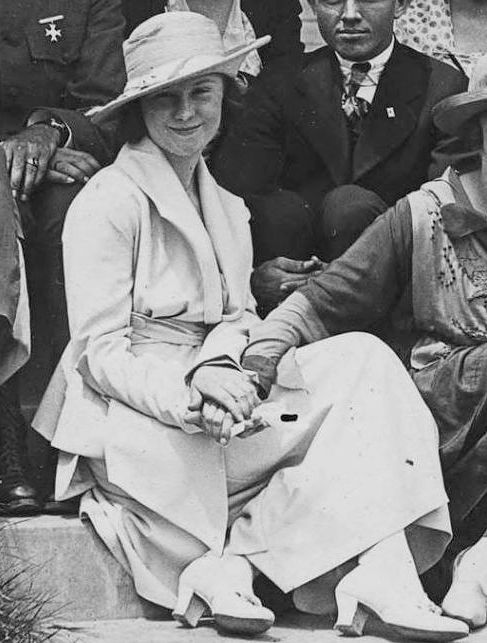
I came across three wonderful World War One-era photos in the SMU archives while I was looking for something else. You know how you can become enthralled by the charm of old photos and sit for long stretches of time staring at every little detail and wondering about the lives of the unidentified people who populate them? That happened to me with these. There is one particular young woman who stands out more than anyone else. Not only is she the best-dressed person in the photos, she also seems calm, collected, and serene. She looks friendly. She was probably very pleasant to have around.

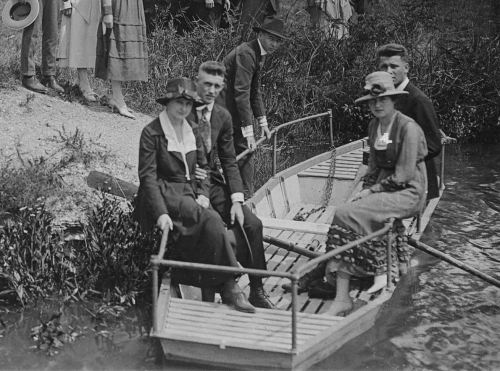
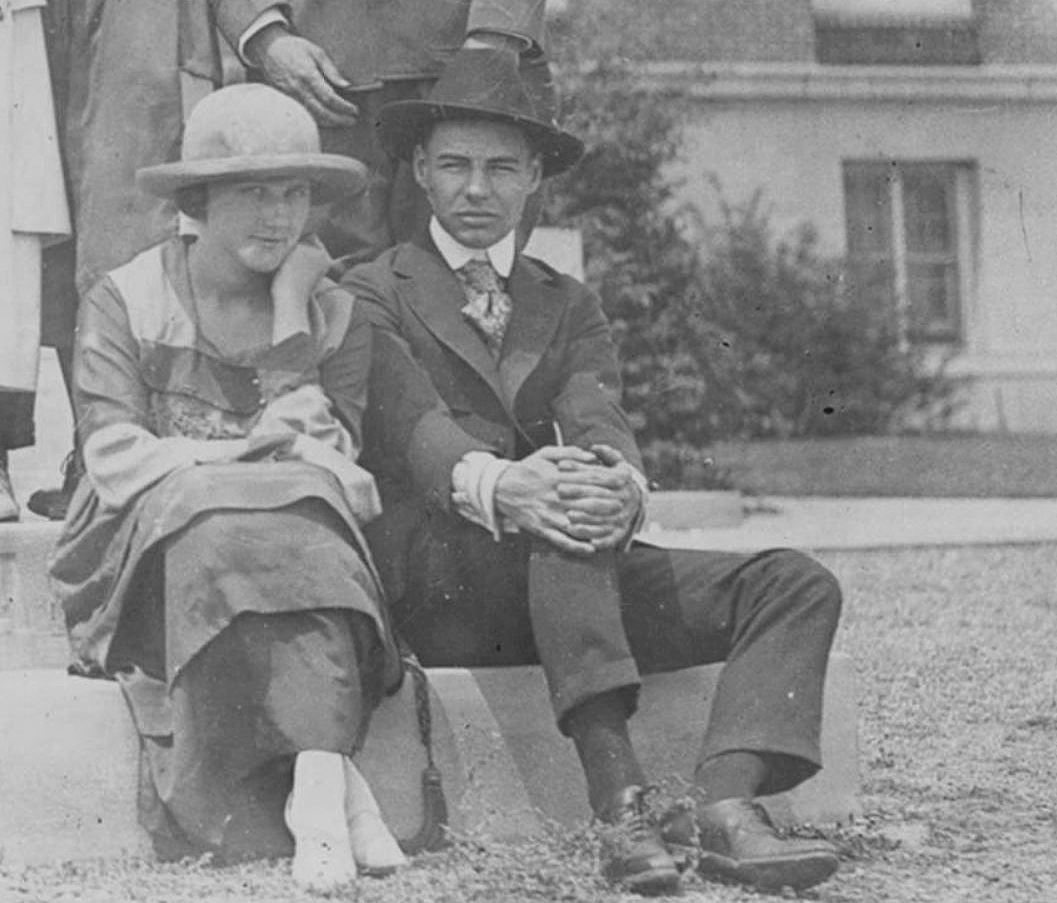
These three photographs show a group of ten young couples and a pair of chaperones spending a beautiful sunny day together, with the highlight of the day being a trip to Highland Park’s Exall Lake. The men are SMU students, identified only as members of the Omega Phi fraternity. The women are identified merely as “dates,” but I’m sure that some of them were also SMU students. The photograph above shows the crowd gathered on campus in front of Dallas Hall. The woman in white looks like she’s on a pedestal, glowing in a spotlight. Below, a closer look at her stylish outfit (as well as a look at the young be-medaled WWI soldier next to her).
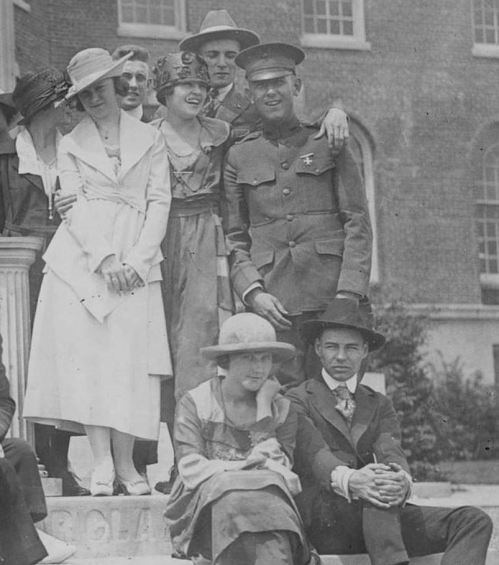
smu_omega-phi_dallas-hall_1917_degolyer-det1

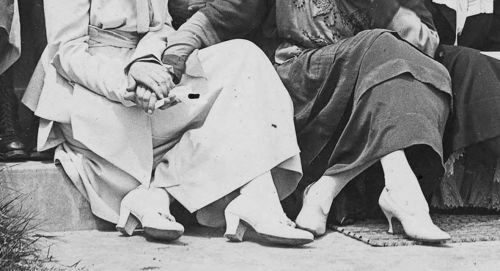
And, below, a similar detail, but this one showing the daintily crossed ankles of another pretty girl, seated beside a sour-looking companion.
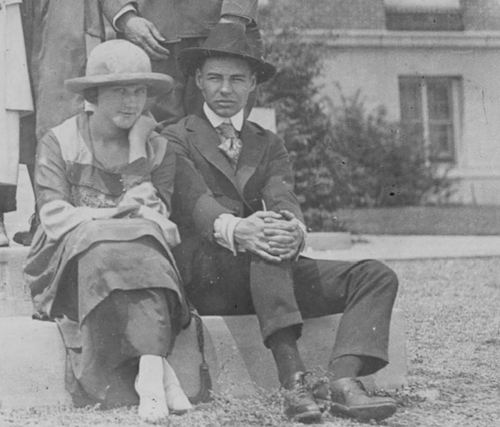
smu_omega-phi_dallas-hall_1917_degolyer-det2

And here’s the gang on the idyllic banks of Exall Lake. Diane Galloway included this photograph in her book The Park Cities, A Photohistory with this caption:

At one time a bridge crossed Exall Lake near the Cary house, shown in the distance. The photographer was standing on the bridge to capture this picture of well-dressed SMU students going boating on the lake. A trip to Lakeside Drive was one of the few off-campus excursions permitted in 1917.

I love this photo. If I didn’t know what the Turtle Creek area looked like, I’d be hard-pressed to identify this as Dallas!
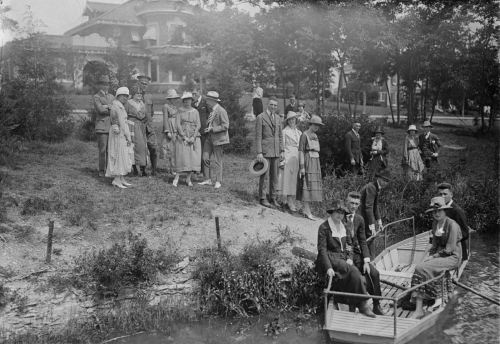
smu_omega-phi_exall-lake_1917_degolyer

Here’s a close-up of the beatific, smiling woman in white. I like the kid lurking in the background.
smu_omega-phi_exall-lake_1917_degolyer-det1

And the boat.

smu_omega-phi_exall-lake_1917_degolyer-det2

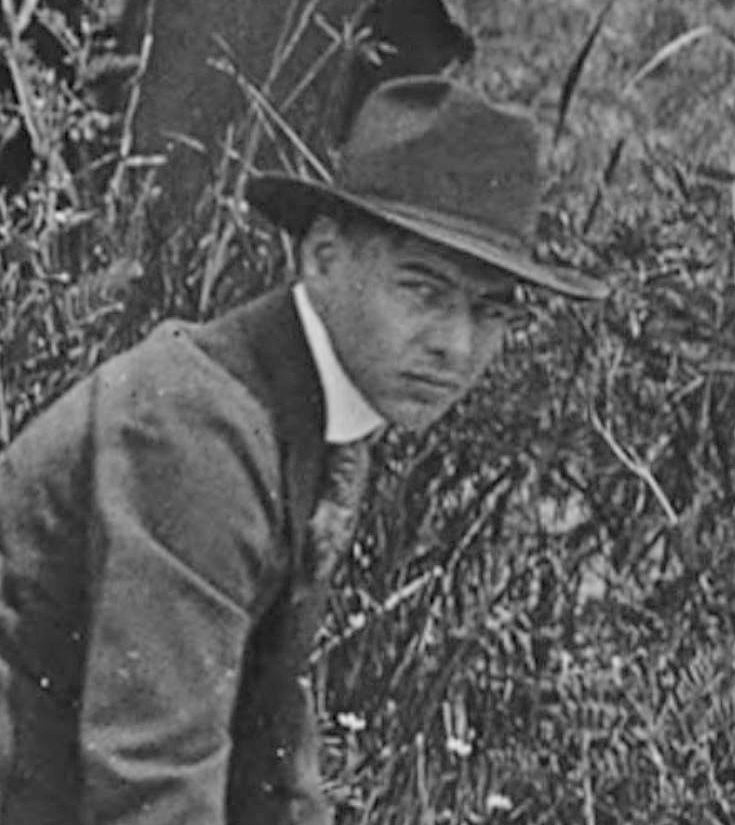
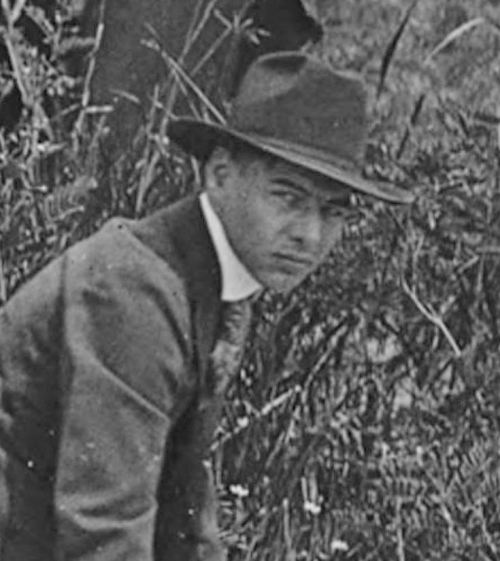
And the sour-looking guy again, looking even more annoyed than before.
smu_omega-phi_exall-lake_1917_degolyer-det3

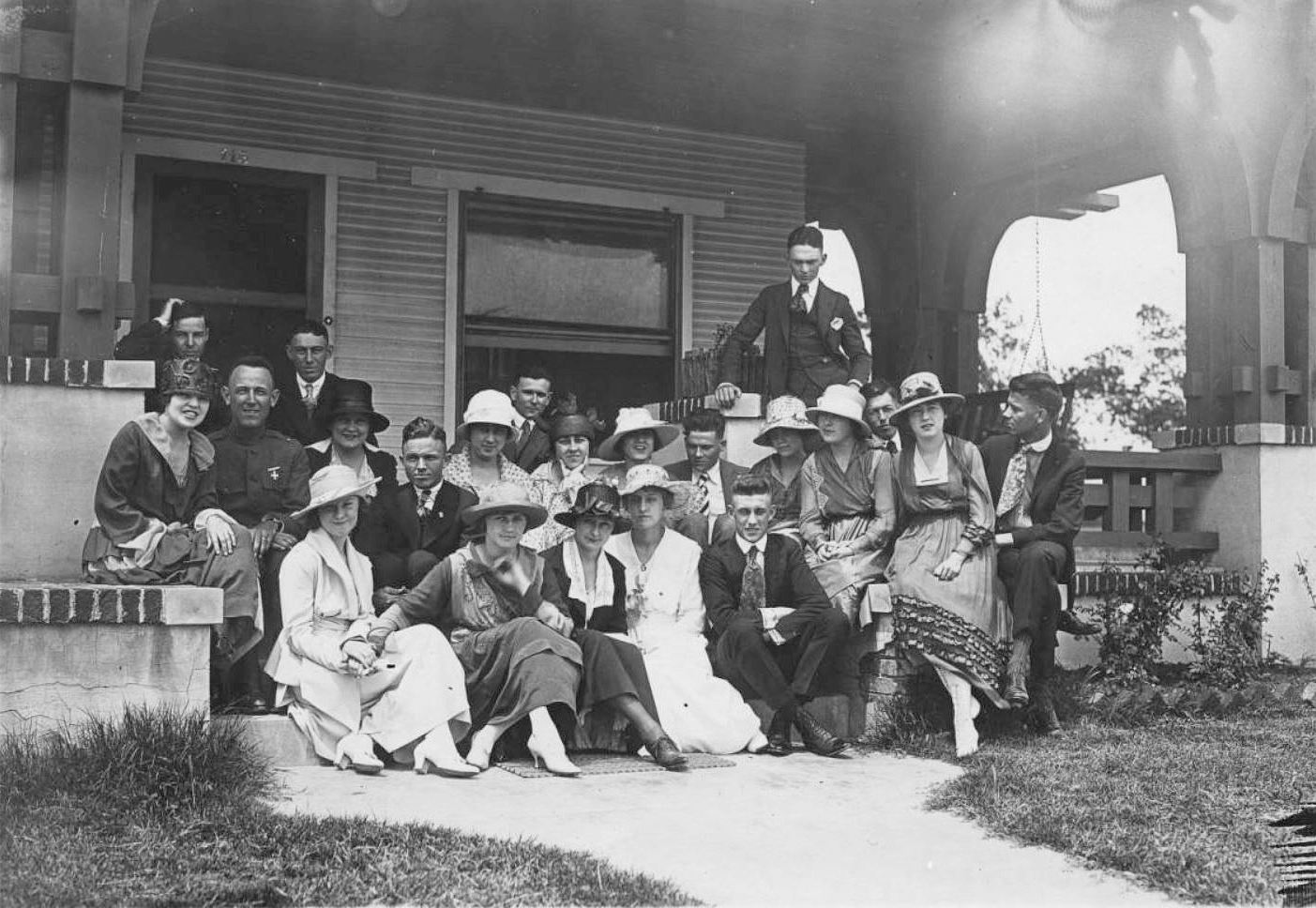
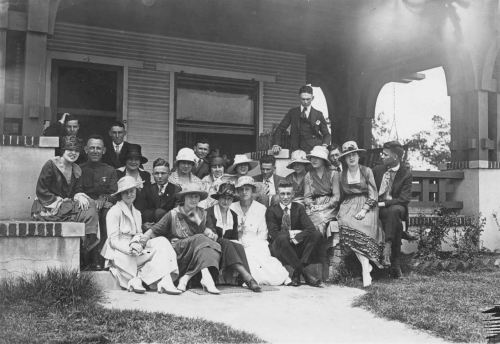
And here’s the crowd sitting on the steps of the frat house (which was located at Haynie and Hillcrest). The personnel has changed a little bit (they gained a woman and lost a man), but (almost) everyone seems pretty happy.
smu_omega-phi_porch_1917_degolyer

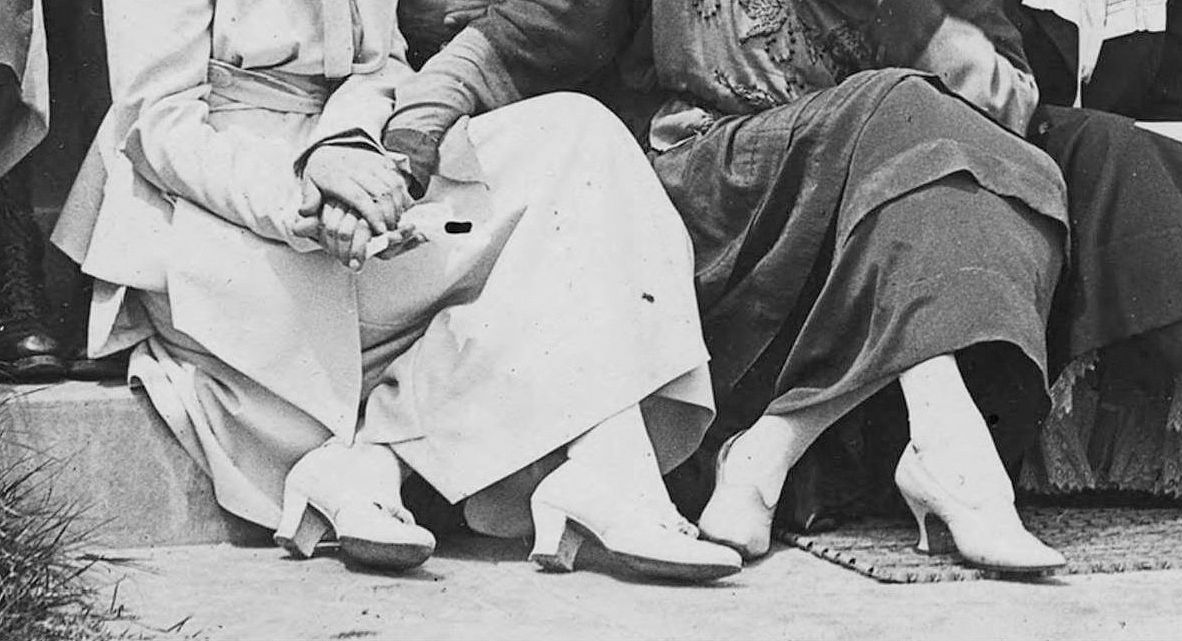
And, below, my very favorite detail from these three photos.
smu_omega-phi_porch_1917_degolyer-det1

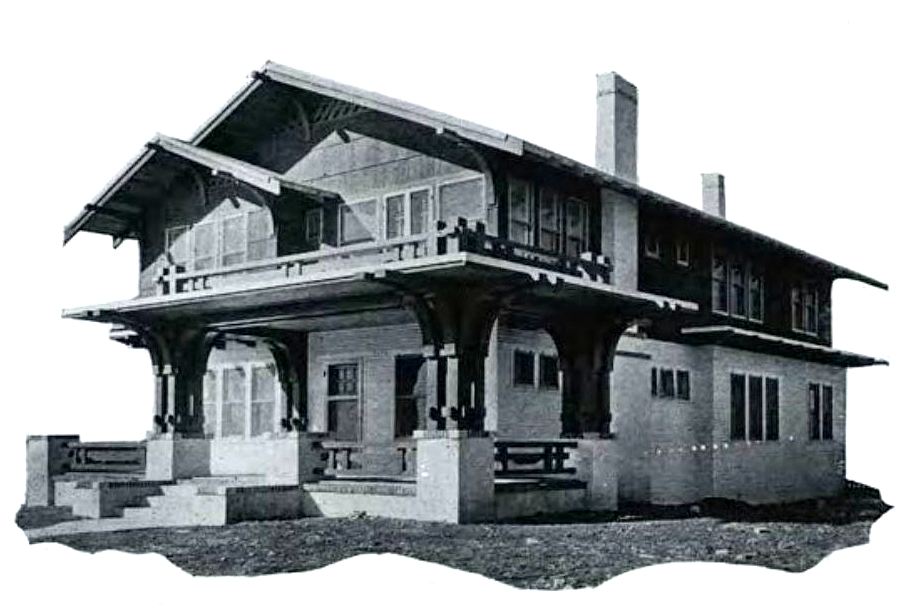
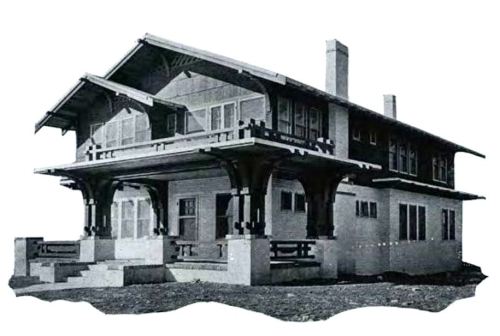
After a bit of sleuthing, I found a picture of the house at the time these photos were taken. It was actually a residence which was, I think, being rented out to the small group of Omega Phis. They had a proper fraternity house built several years later.
omega-phi-house_rotunda_1917

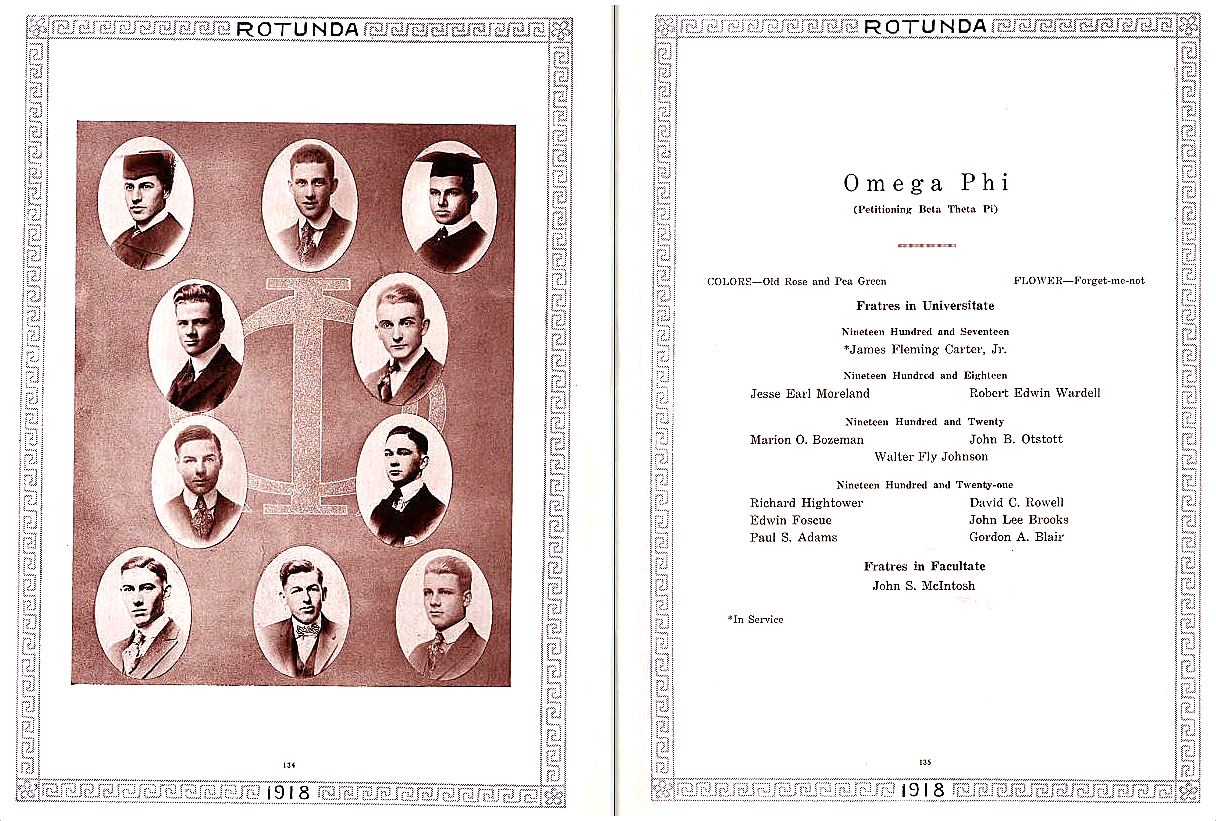
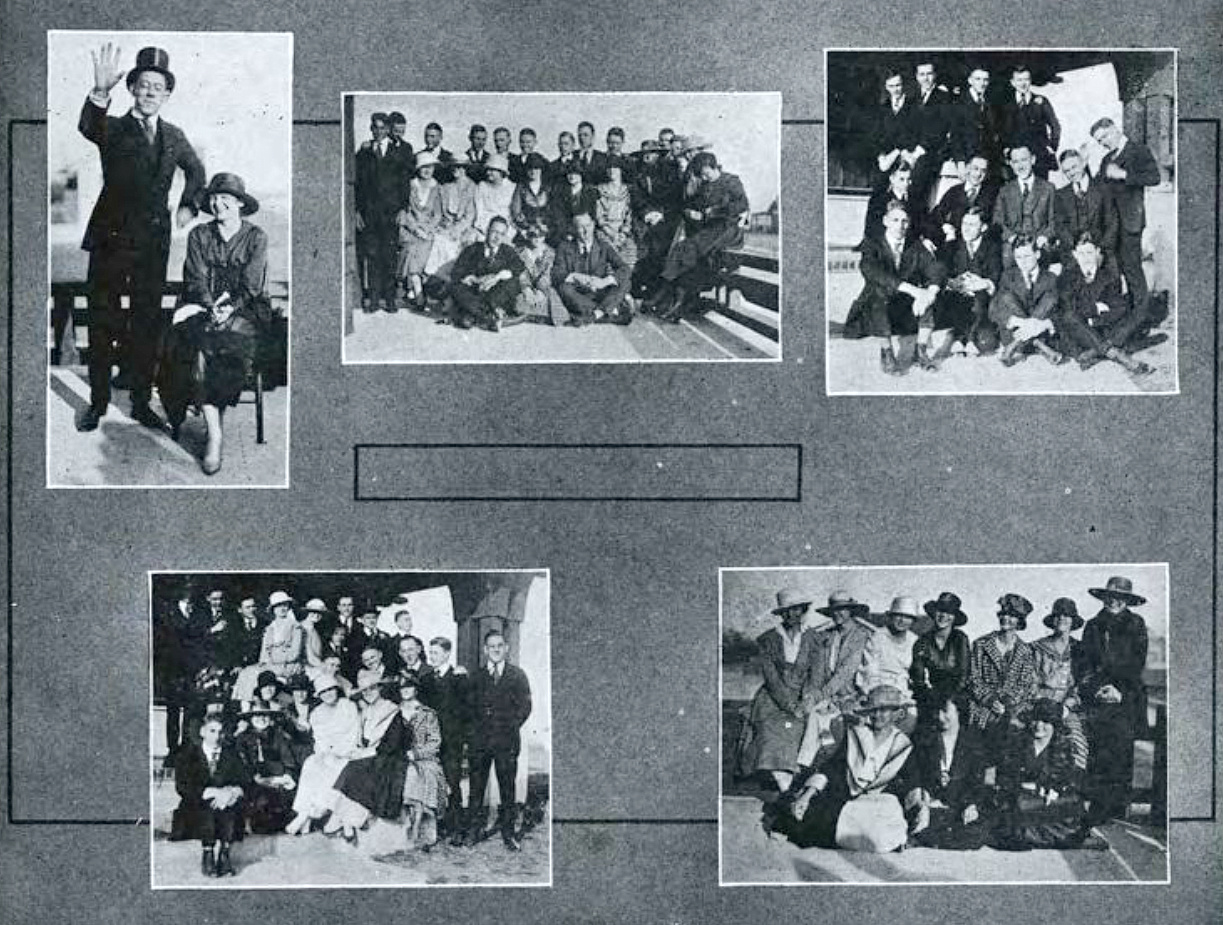
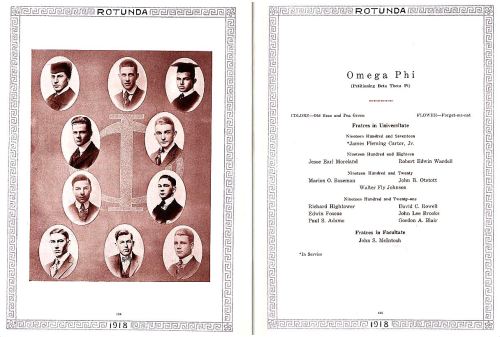
The top photo had “1917” written on the back, so I checked SMU’s Rotunda yearbooks from around that time. Here’s a look at the men who were members of Omega Phi in 1918. Several of these faces match the ones in the photos of the afternoon outing.
omega-phi_rotunda-1918

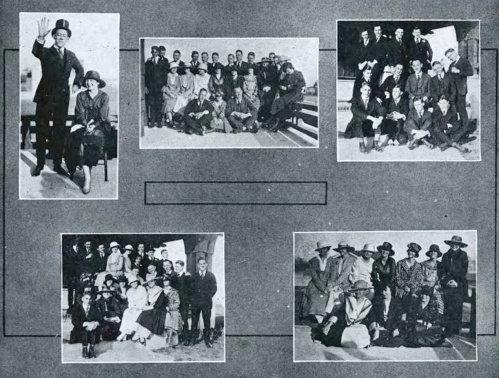
And, below, a photo collage from the Omega Phi page of the 1917 Rotunda. Several of the women look familiar. I see the Woman in White in at least one of these snapshots.
omega-phi_photos_rotunda_1917

And here she is, close up. I hope she was as happy, intelligent, and confident in her real life as she appears to be in these photos.
smu_omega-phi_porch_1917_degolyer-det2

***

Sources & Notes

The three photos of the afternoon outing all come from the collection of the DeGolyer Library, Central University Libraries, Southern Methodist University:

  • “Omega Phi Fraternity members and their dates in front of Dallas Hall” is here.
  • “Omega Phi Fraternity member outing to Exall Lake” is here.
  • “Omega Phi Fraternity members and their dates on porch” is here.

The quote from Diane Galloway comes from her FANTASTIC book, The Park Cities, A Photohistory (Dallas: Diane Galloway, 1989), p. 24.

The ersatz Omega Phi fraternity house was located at 115 Haynie Avenue, just west of Atkins (now Hillcrest). (The photo of the exterior of the house is from the 1917 SMU Rotunda yearbook.)
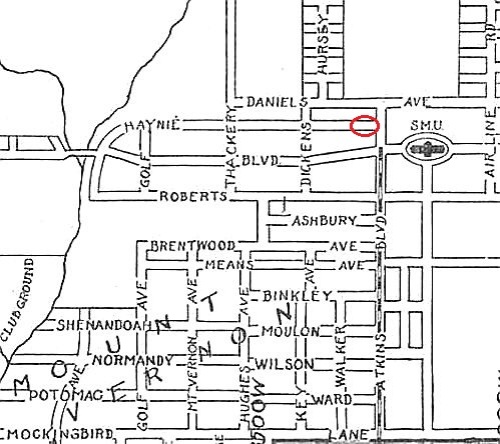
omega-phi_map_19191919 map (detail), Portal to Texas History

I have absolutely no idea how college fraternities work, but it seems that when they formed on the SMU campus in 1915, the Omega Phi group was not actually affiliated with a national fraternity. They “petitioned” to be chartered by national groups, but they finally stopped trying after 11 years of, I guess, being repeatedly turned down — in 1926 they declared themselves to be an “independent society.” But one year later, they were granted a charter by the national Kappa Sigma fraternity. In the Dallas Morning News article announcing the news, this sentence was included: “The local chapter will be known as Delta Pi chapter.” I have no idea what any of that means, but if you’re really into these things, read the DMN article “Kappa Sigmas Grant Charter” (Sept. 26, 1927), here.

As for the identities of the women in the photos, it’s a mystery. I would assume, though, that at least some of them were the women mentioned in this little article about a cozy winter get-together at the Haynie Ave. house:
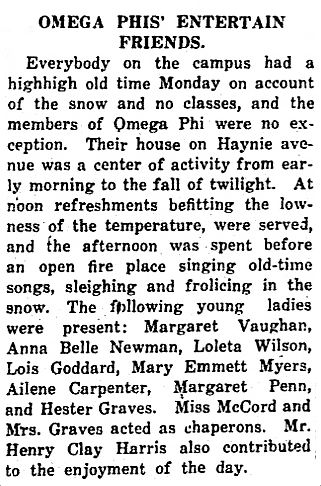
omega-phi_smu-campus_011917DMN, Jan. 19, 1917

If you’re not familiar with beautiful Exall Lake, you can watch a short, minute-long video of the lake’s history, produced to celebrate the 100th anniversary of Highland Park, here.

For other posts featuring photos I’ve zoomed in on to reveal interesting little vignettes, click here.

UPDATE: I stumbled across another photo of this group, from Diane Galloway’s book The Park Cities, A Photohistory:
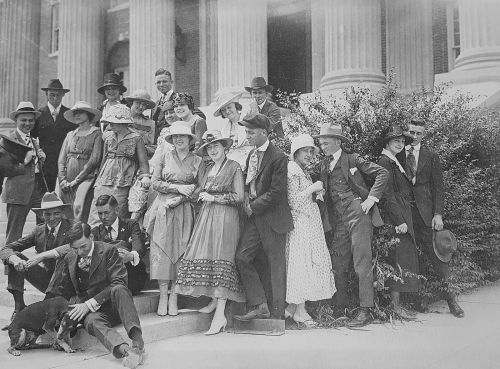
smu_group-date_park-cities-photohistory_galloway

*

Copyright © 2015 Paula Bosse. All Rights Reserved.

SMU Turns 100: A Look Back at Its Very First Days — 1915

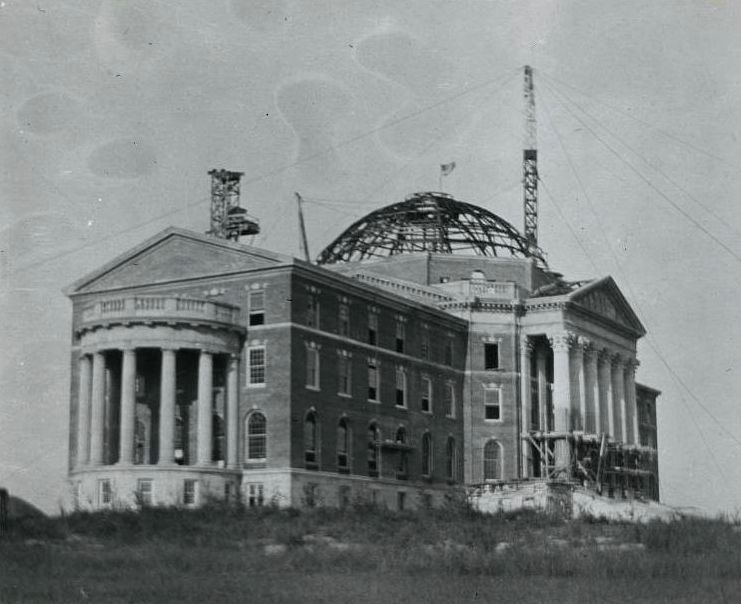
smu_dallas-hall-dome-under-construction_1914Dallas Hall’s dome under construction, 1914 (SMU Archives)

by Paula Bosse

Classes began for the very first time at brand new Southern Methodist University on September 28, 1915 — 100 years ago today! Where HAS the time gone? Below, a few photos from those early days (click pictures for larger images).

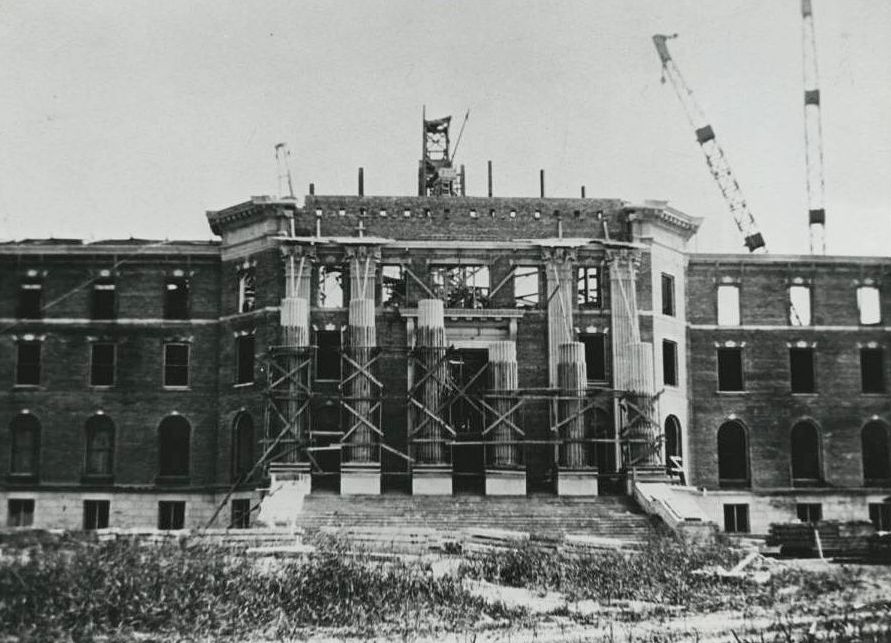
smu_dallas-hall-columns-under-construction_1914_degolyerDallas Hall’s columns going up, 1914, out in the middle of a mostly empty prairie, well beyond the Dallas city limits.

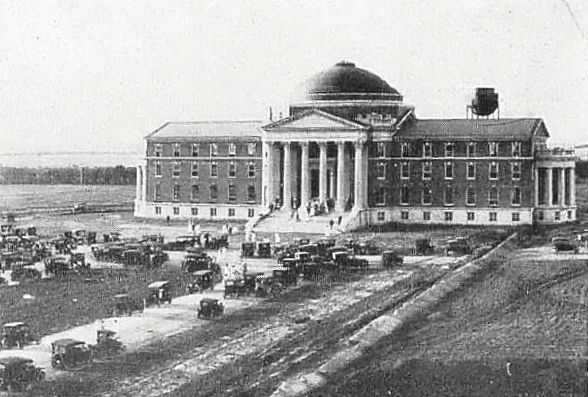
smu_week-before-opening_1935-rotundaVisitors checking out the new campus, a week before its opening.

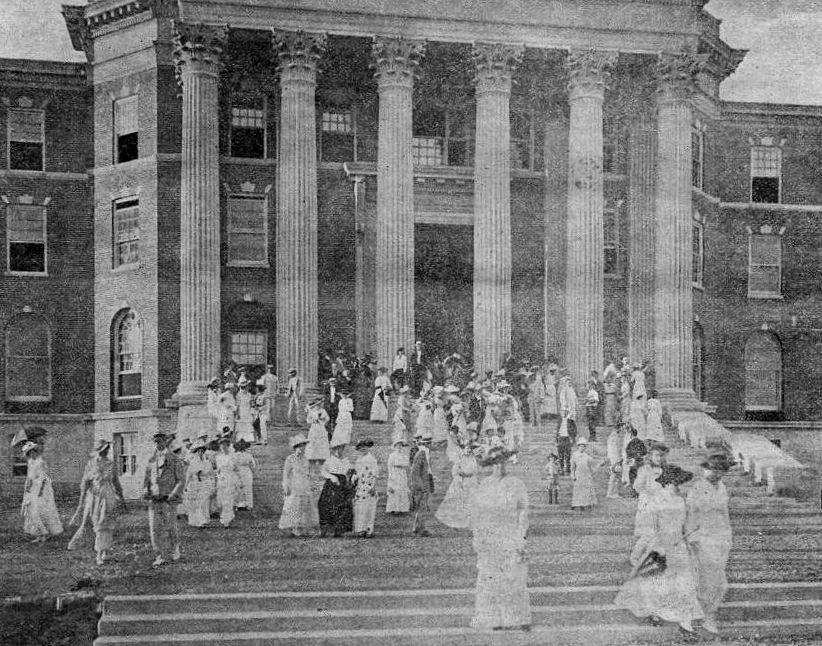
smu_visitors-before-opening_091115Genteel visitors on the steps of Dallas Hall, the only building on campus in which classes were actually held.

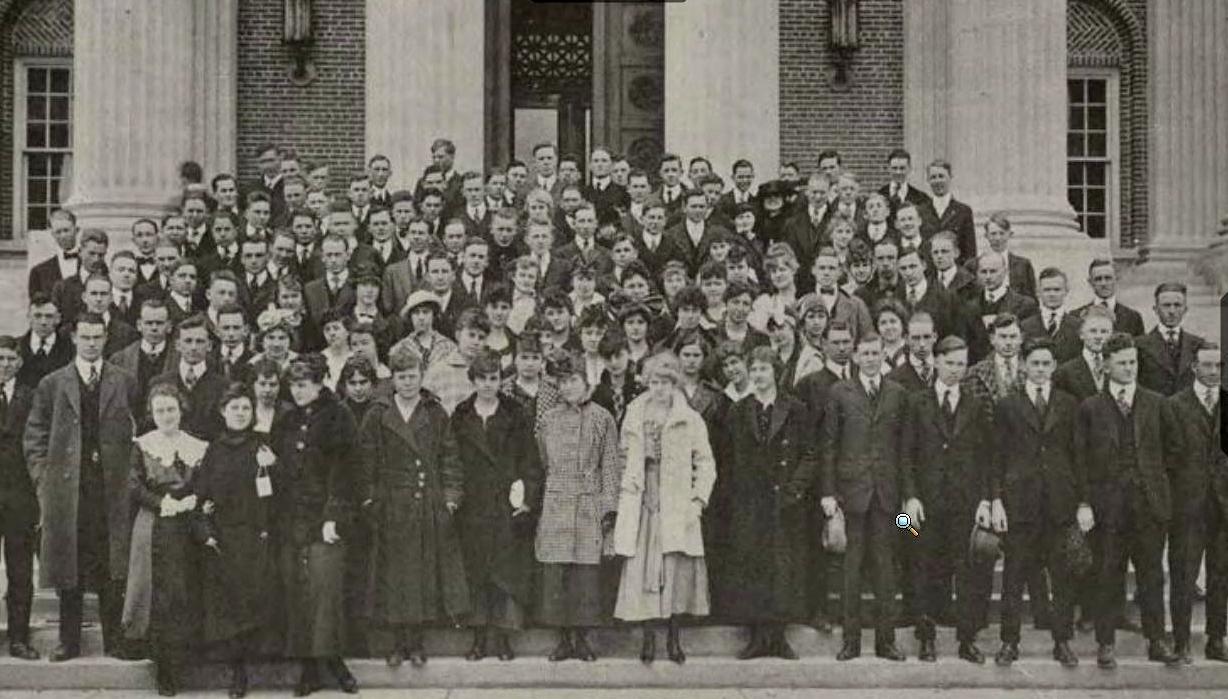
12smu-rotunda-1916_freshman-classSMU’s first freshman class.

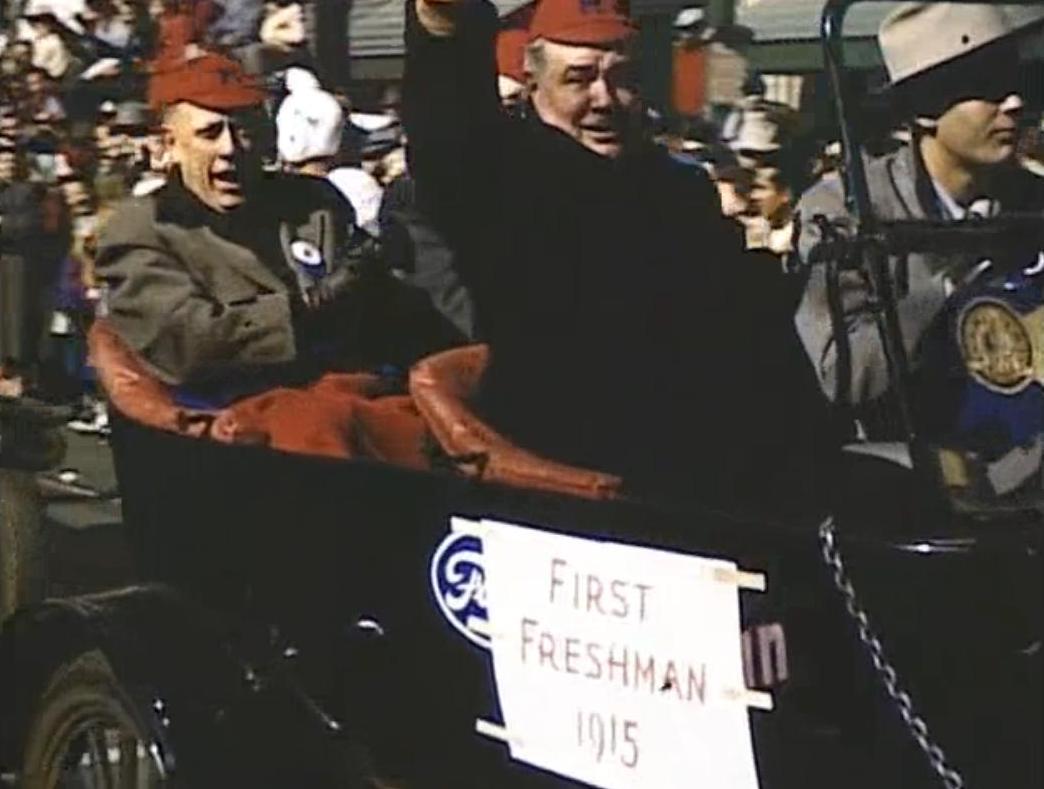
smu_first-freshmen_1950-homecoming-paradeAnd a couple of those freshmen, 35 years later, riding in a car in the 1950 Homecoming Parade downtown.

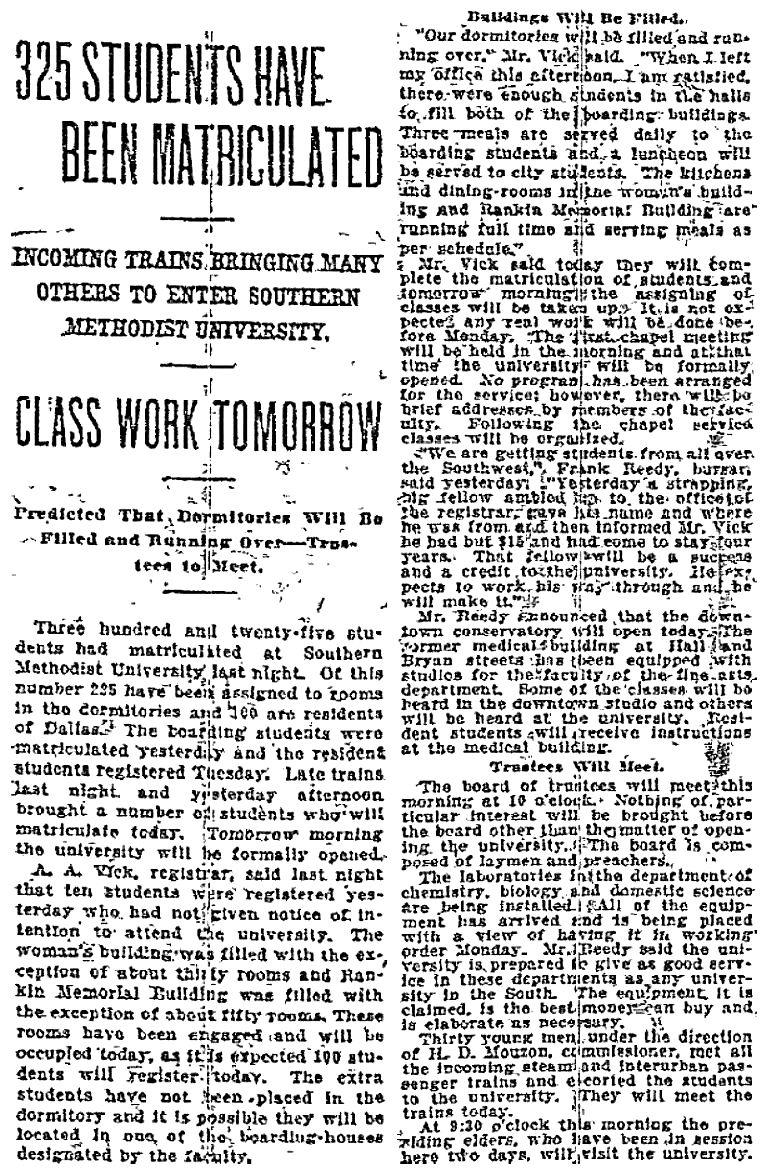
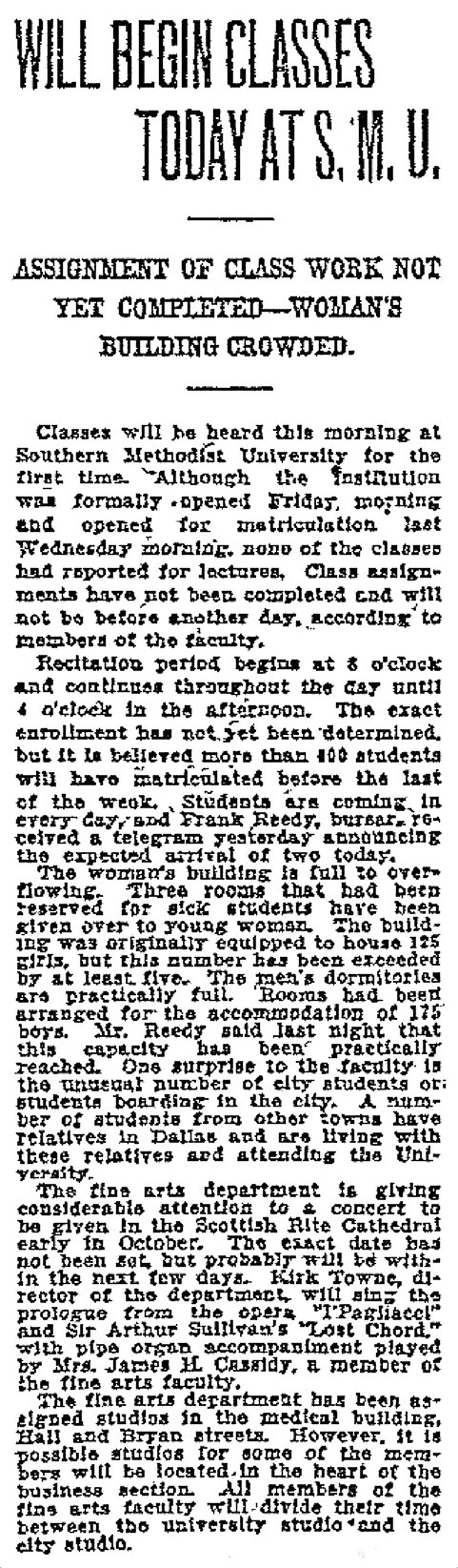
Below are a couple of logistical and progress-report articles from the week when students began arriving for that first year’s classes. Most interesting is that several classes were held off-campus, because of lack of space in an already crowded Dallas Hall. The fine arts department was housed at the “downtown conservatory” which was located in a former medical building at Hall and Bryan streets. The fine arts faculty had studios there and would move between downtown and the SMU campus. (Click articles for larger images.)

smu_first-day_dmn_092315Dallas Morning News, Sept. 23, 1915

smu_first-day-classes_dmn_092815DMN, Sept. 28, 1915

Happy Centennial, SMU!

***

Sources & Notes

The photos of Dallas Hall under construction are from the DeGolyer Library, Central University Libraries, Southern Methodist University. The photo of the dome under construction is here; the photo of the columns going up is here.

The photo of campus visitors and their cars lined up in front of Dallas Hall is from the 1935 edition of the SMU Rotunda yearbook; the caption: “Dallas Hall, a week before opening of SMU.”

The photo of visitors on the steps of Dallas Hall is from Bridwell Library, Special Collections, Perkins School of Theology, Southern Methodist University, and it can be accessed here. The photo was taken on Sept. 11, 1915 and was printed in the Sept. 23, 1915 edition of The Texas Christian Advocate above the caption “[Snapshot] of visitors at entrance to Dallas Hall on occasion of the reception given Saturday the 11th by the citizens of Dallas to the faculty.” (The article and another photo can be seen at the link above.)

The photo of SMU’s first freshman class is from the 1915-16 SMU Rotunda yearbook.

The image of the former SMU freshmen is a screen capture from a home movie of SMU’s 1950 Homecoming Parade which is part of the DeGolyer Library’s collection; the entire 17-minute silent color film can be watched on the SMU Central Libraries site, here. The very entertaining film contains the parade, a tour around campus, an elaborately decorated Fraternity Row, and the football game against Texas A & M at the Cotton Bowl.

These other Flashback Dallas posts related to SMU’s first year may also be of interest:

  • “SMU, ‘The School of the Future’ — 1915-16,” here
  • “SMU’s First Year: The Dinkey, Campus Hijinx, and The Basket Ball — 1915-16,” here
  • “University Park, Academic Metropolis — ca. 1915,” here
  • “Send Your Kids to Prep School ‘Under the Shadow of SMU’ — 1915,” here (Incidentally, the Powell University Training School opened on the same day as SMU as a sort of “sister school” — the building it occupied is still standing, on Binkley, just off Hillcrest — this building celebrates its Centenary, too!)

Click photos and clippings to see larger images.

*

Copyright © 2015 Paula Bosse. All Rights Reserved.
 

“The Only Motel Located In the Park Cities” — 1964

university-house-hotel_smu-rotunda_1965-detA palm tree, a palm tree, my kingdom for a palm tree… (click for large image)

by Paula Bosse

Behold, an architect’s rendering of University Park’s first motel (… motel?!). With palm trees! (The architects — Barron, Heinberg and Brocato  — were from Alexandria, Louisiana, where they might actually have palm trees. Perhaps they assumed they grew in Dallas. Or could be imported. Or just looked nice as a whimsical garnish.) Palm trees or not, look at that great mid-century design!
Plans for the University House Motel were announced in December, 1963 — it was to be built on Hillcrest at Binkley, right across the street from SMU by Edward T. Dicker, the man who built 3525 Turtle Creek. (Interestingly, according to a press release printed in The Dallas Morning News on Dec. 8, 1963, real estate transactions for the property involved a land lease from Shell Oil Co.) With 60 suites, it was the perfect location for hotel lodgings for parents visiting their children in college.
This was to be both a major commercial addition to University Park as well as something of an architectural departure. The closest hotel/motel alternative (according to the ad below, anyway) was farther away than might have been convenient for visiting families — the (also super-cool-looking) Holiday Inn was all the way down Central, just past Fitzhugh.

ad-holiday-inn_central-expwy_smu-rotunda_1965
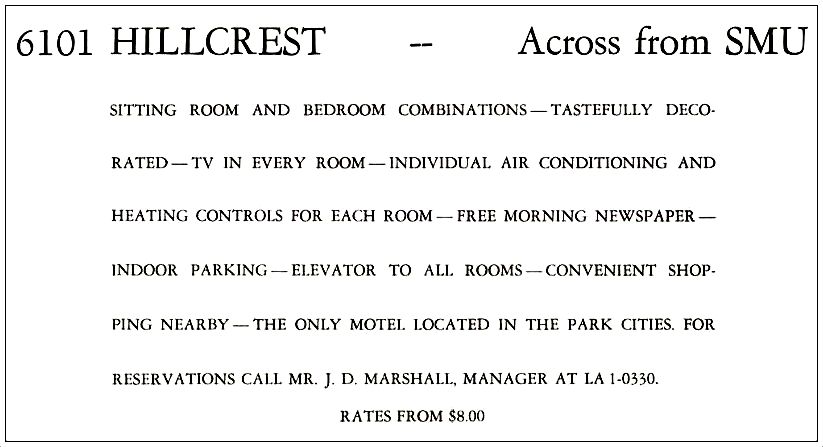
If I were a visiting parent, I’d probably choose the University House option because of its unbelievably close proximity to the campus. And if I saw the ad below, I’d definitely book a room — pronto!

university-house-hotel_smu-rotunda_1965(click to read text)

When construction was complete and the motel opened for business, the sans-palm-tree reality of the building had to have been a bit of a disappointment to anyone who had salivated over that sleek Mid-Century Modern drawing (even though I’m sure the interior decor was much nicer than most motels). Maybe it’s just me. It sort of looks like the drawing. …Sort of….

university-house_smu-rotunda_1965

The University House hung on for several years, then changed ownership and names several times. It is now the site of the much-expanded and certainly much-swankified Hotel Lumen. Interestingly, the skeleton of the original building is still in there somewhere. As Alan Peppard wrote in the Dallas Morning News on Oct. 16, 2006 soon after Hotel Lumen opened, “The old hotel was gutted back to nothing but the concrete frame and rebuilt as a hip University Park hotel.” (To see what things look like now, click here — the renovated original building is on the left, the expansion is on the right.)

In the 21st century, Hotel Lumen is exactly the kind of hotel that comfortably-well-off-but-still-tastefully-hip SMU parents want to stay in when they arrive in town to visit the progeny. All that’s missing are a few palm trees….

***

The University House Motel ad appeared in the 1965 Southern Methodist University Rotunda yearbook. That same yearbook also contained the Holiday Inn ad and the photograph of the University House Motel. (The photo appeared over the yearbook’s cheeky “Why be discreet?” caption and was featured in the previous Flashback Dallas post, “The SMU ‘Drag’ — 1965,” here.)

The 1965 ad has the nightly rate at the University House Motel at $8 — about $60 in today’s money, adjusted for inflation. Not bad for parents who could afford to send their children to SMU and who weren’t staying downtown at the Adolphus, the Baker, or the Hilton.

Photos of Hotel Lumen — inside and out — can be found on their website, here.

Click pictures for larger images.

*

Copyright © 2015 Paula Bosse. All Rights Reserved.


The SMU “Drag” — 1965

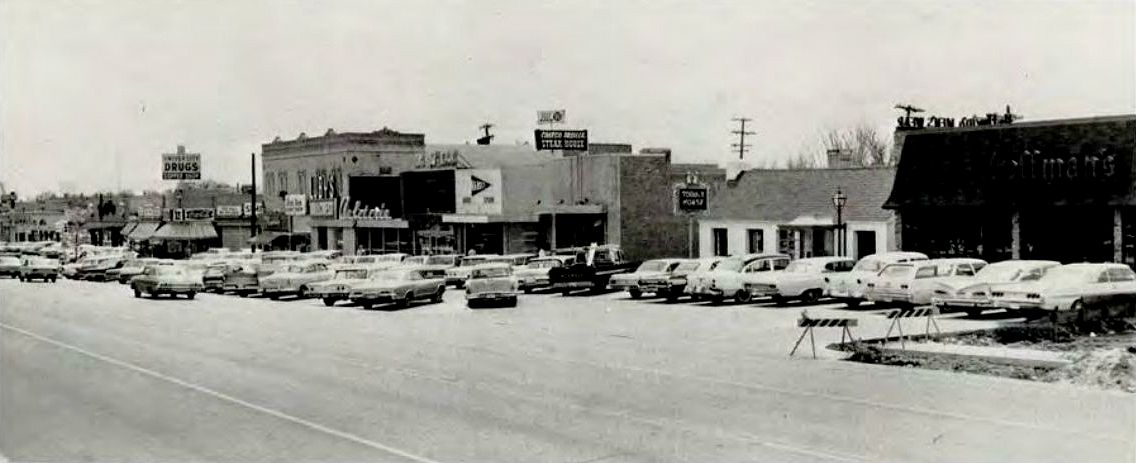
drag3_smu-rotunda_1965Hillcrest, looking south, just north of McFarlin (click for larger image)

by Paula Bosse

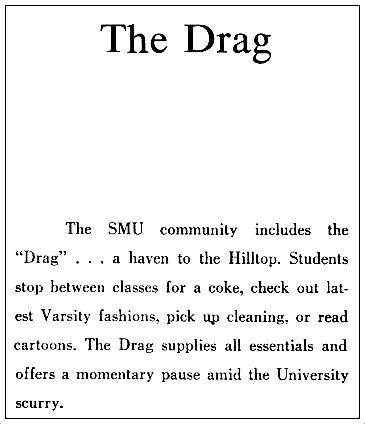
Hillcrest, north of Mockingbird, up to Snider Plaza, and maybe all the way up to Lovers Lane. The Drag. Might as well be an unofficial SMU annex. Over the past several decades, some students may have spent more time in the businesses across the street from the western edge of the campus than they did in some of their classes. The look of the area has changed quite a bit recently, but views from the 1965 SMU yearbook are not drastically different from what it looked like up until just a few years ago — and in some stretches, some of the same buildings seen in these photos still stand. Unless something has gone terribly wrong, businesses along the SMU drag that cater primarily to an ever-replenishing SMU student body should never have a lack of customers.

The yearbook caption for the photo above: “Give me your tired, your poor … just give me your money.” (See this view from recent months, with traffic cones, here.)

Below, a few more photos from the 1965 Rotunda tribute to The Drag.

drag_smu-rotunda_1965*

Looking north.

drag1_smu-rotunda_1965*

At Binkley, current site of Hotel Lumen.

drag4_smu-rotunda_1965-university-house*

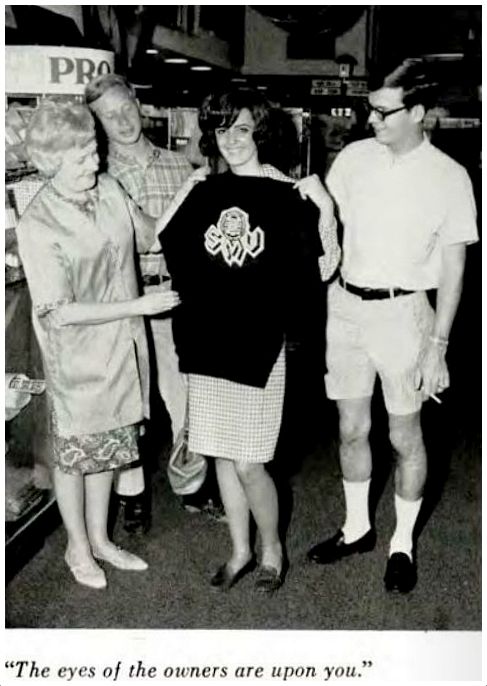
Smoking welcomed. Preppy look, circa 1965.

drag2_smu-rotunda_1965

***

All photos from the 1965 Southern Methodist University Rotunda yearbook.

To take a look at a map of the SMU campus from 1964, click here (DeGolyer Library collection, Southern Methodist University).

Click pictures for larger images.

*

Copyright © 2015 Paula Bosse. All Rights Reserved.