Flashback : Dallas

A Miscellany: History, Ads, Pop Culture

Category: Transportation

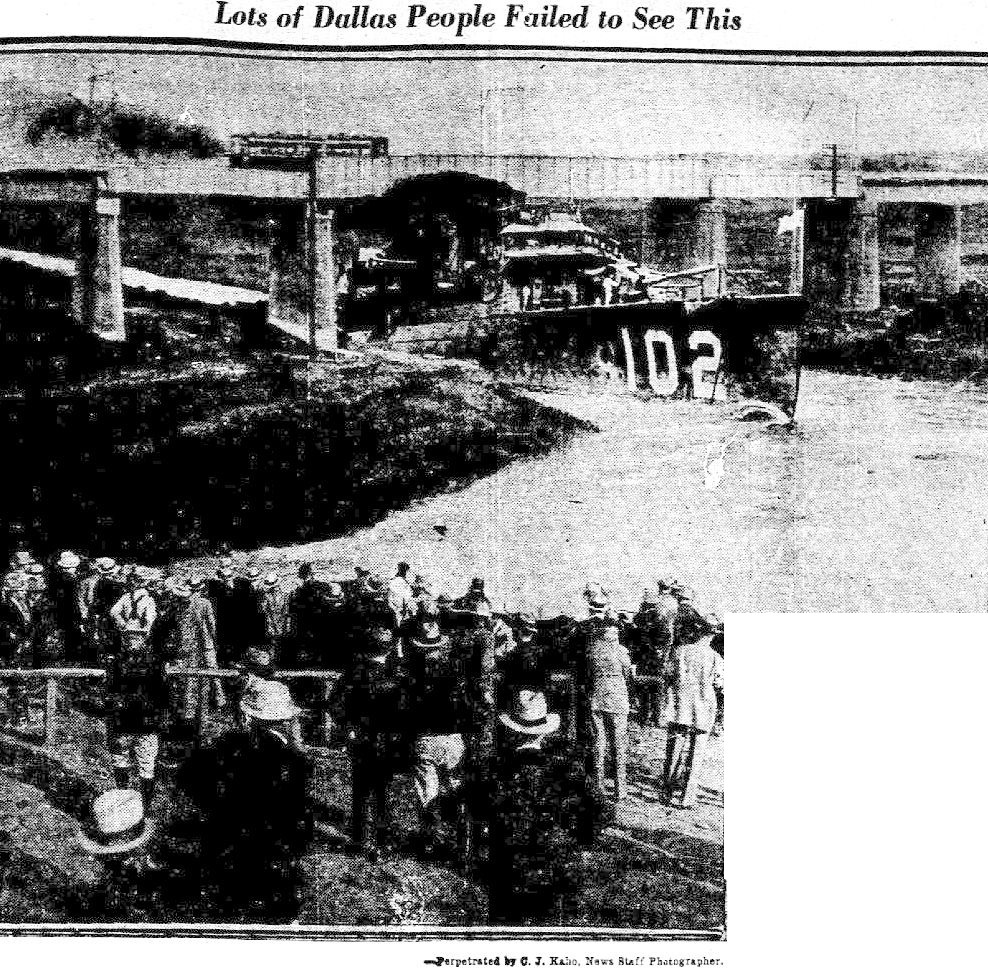
U.S. Revenue Cutter “Carrie Nation” Successfully Navigates the Trinity In Valiant Effort to Keep Dallas Dry! — 1931
april-fools_dmn_010131_carrie-nation
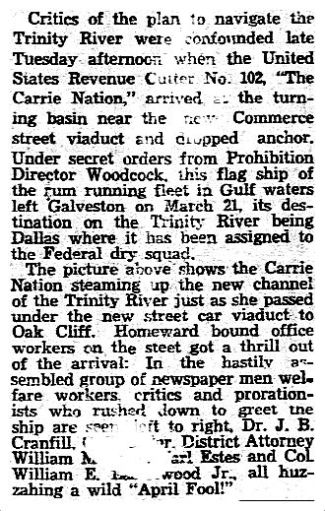
The ship’s arrival, passing under the streetcar viaduct…

by Paula Bosse

I spent a couple of hours looking through the archives of The Dallas Morning News this morning, hoping to find a nice juicy April Fools’ prank from the past. Everything was fairly run-of-mill. Until I came across this. THIS is great. I don’t know who wrote the story, but there is, at least, acknowledgement for the wonderfully weird photo above — the photo credit reads: “Perpetrated by C. J. Kaho, News Staff Photographer.”

Below is the accompanying story about the United States Revenue Cutter Carrie Nation and the news of its journey up a surprisingly navigable Trinity River in order to anchor itself beneath the Commerce Street viaduct and make sure that the rum-runners in the Gulf don’t gain a foothold in bone-dry Prohibition-era Dallas. The photo and report appeared in the pages of The Dallas Morning News on April 1, 1931, beneath the headline “Lots of Dallas People Failed to See This.”
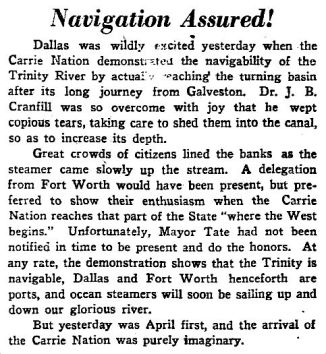
Unwilling to let such an important story fade away — and with a few more good lines left to get into print — this appeared the next day, on April 2, 1931: “Navigation Assured!”
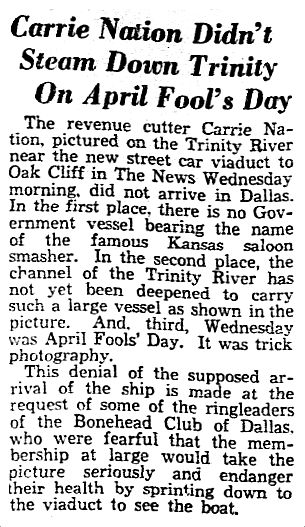
Then some killjoy editor probably insisted on this, which also appeared on April 2, 1931:
**

Rev. J. B. Cranfill was a Baptist leader and a noted Prohibitionist. I love the line “Dr. J. B. Cranfill was so overcome with joy that he wept copious tears, taking care to shed them into the canal, so as to increase its depth.”

And I laughed out loud at the “where the West begins” dig at Fort Worth.

But, seriously, that photo is great. The little streetcar chugging over the viaduct is just the perfect garnish.

Read about the famed, notorious Bonehead Club of Dallas in a 1991 Texas Monthly article by Helen Thompson, here. Thank you, Boneheads!

*

Copyright © 2014 Paula Bosse. All Rights Reserved.
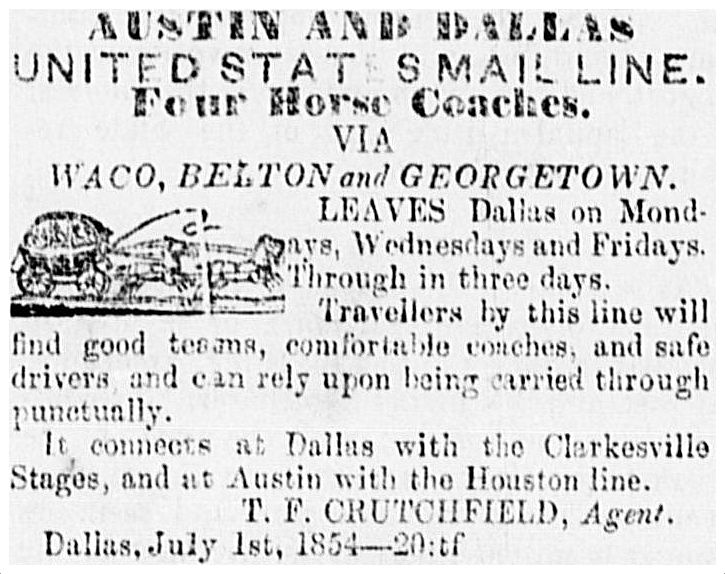
Dallas to Austin by Stagecoach: Only Three Days! (1854)

by Paula Bosse

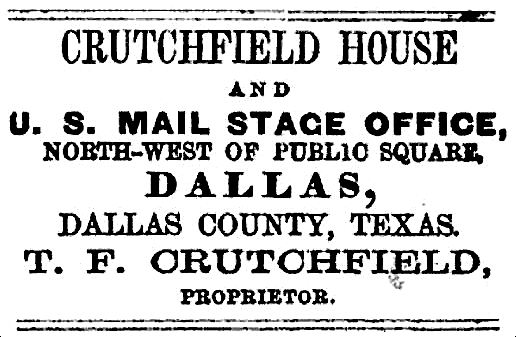
T. F. Crutchfield was a busy man who had his hands in a lot of pies in the very early days of Dallas. I’ll have to get back to him one day. Above, an ad of his, dated 1854, from an 1855 issue of the Dallas Herald. Below, an ad from the 1858 Texas Almanac.

crutchfield_tx-almanac_1858

***

Sources & Notes

An interesting article by Mike Cox on stagecoaching in Texas, from the Texas Almanac, is here.

*

Copyright © 2014 Paula Bosse. All Rights Reserved.
O, Fritatos, We Hardly Knew Ye — 1936

fritos_potato-chips_kaleta“Another Load of Pampered Potatoes”

by Paula Bosse

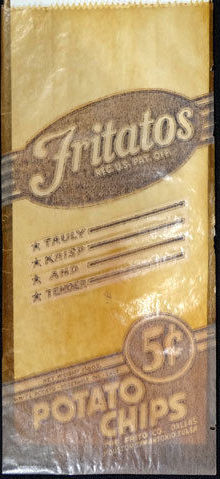
Hey! Did you know that the Frito Company also made potato chips for a while? They were called “Fritatos” and they were introduced in 1935. Here’s one of their snazzy-looking trucks making a much-appreciated snack delivery to Fair Park during the Centennial Exposition in 1936.

***

Sources & Notes

Photo of the “pampered potatoes” truck from Kaleta Doolin’s wonderful book about the family business, Fritos Pie: Stories, Recipes, and More (College Station: Texas A & M University Press, 2011).

*

Copyright © 2014 Paula Bosse. All Rights Reserved.

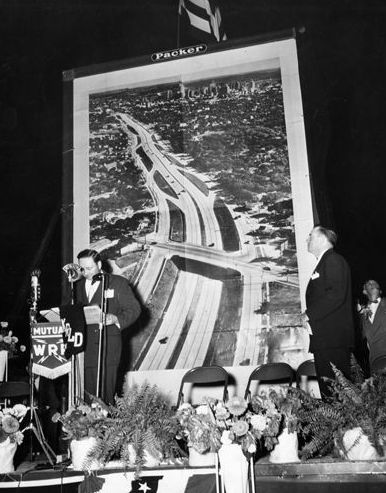
“How to Use Central Expressway” — 1949

by Paula Bosse

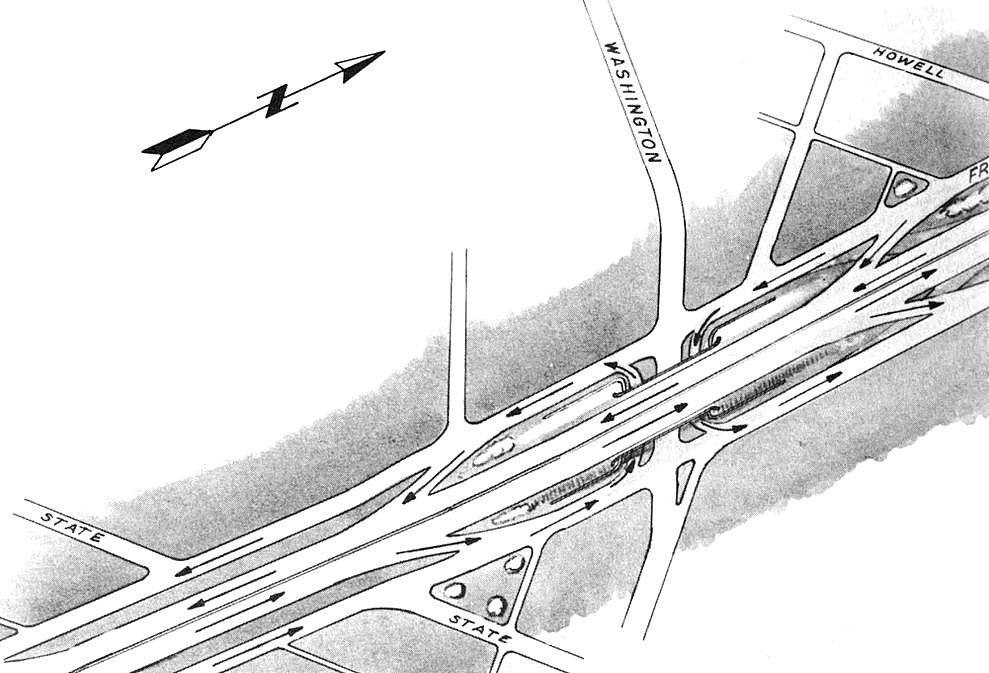
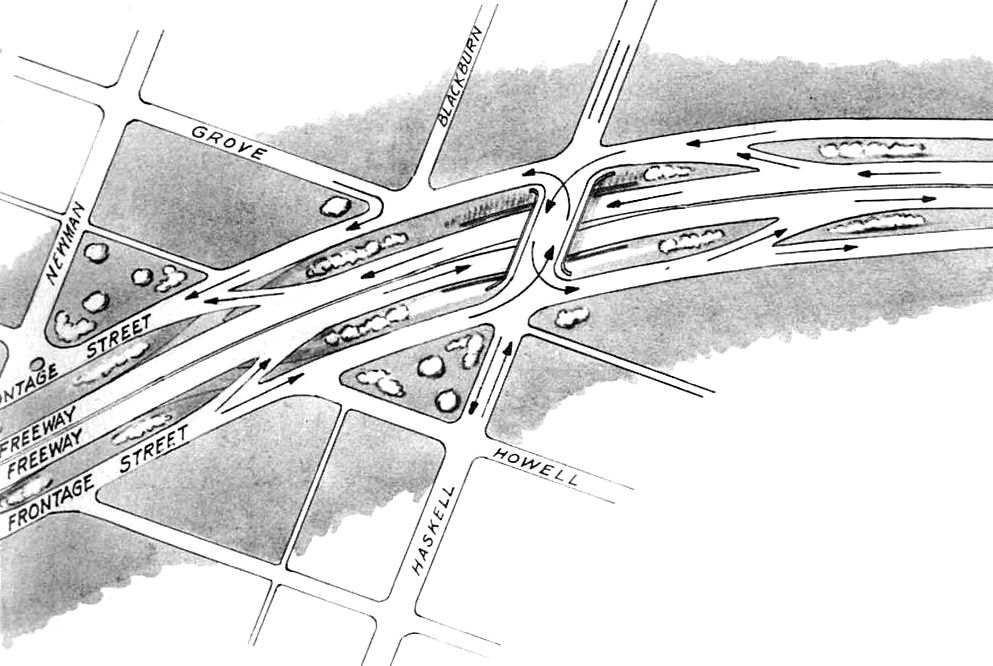
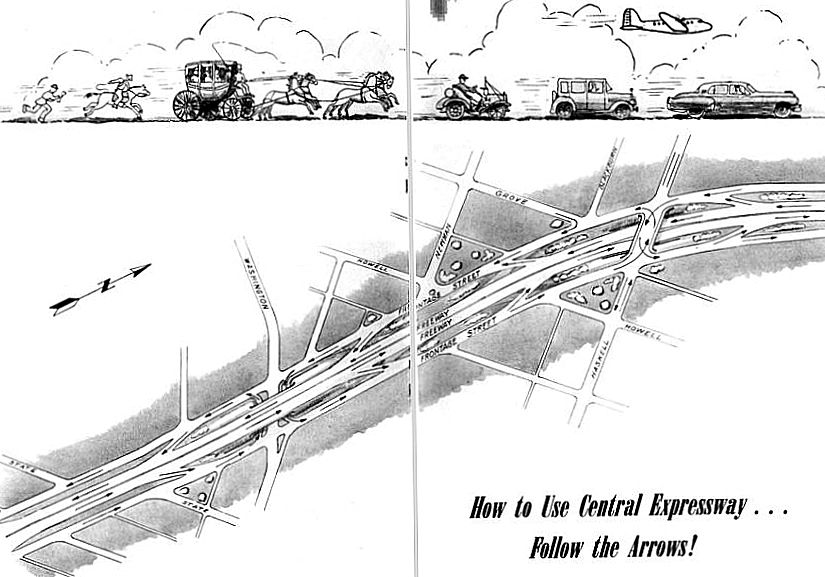
It got only to Fitzhugh from downtown at this point, but the freeway concept was new enough that Dallas drivers needed some instruction on how to use Central Expressway. Cute.

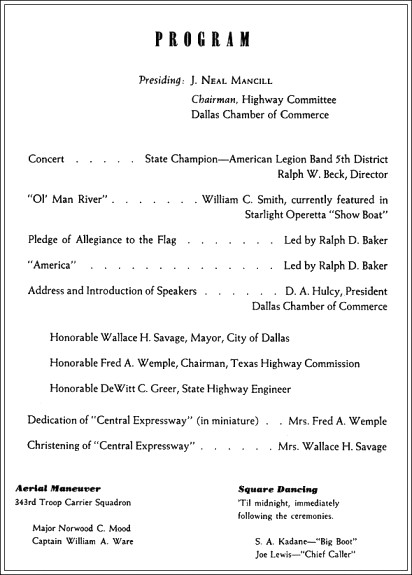
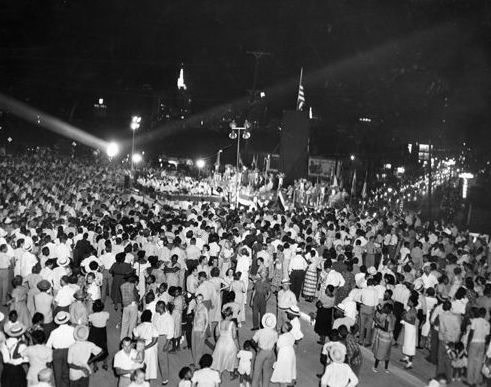
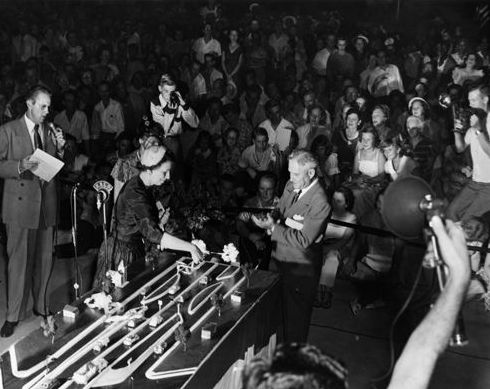
Cuter still, the dedication ceremony. It included the singing of — what else? — “Old Man River,” the Pledge of Allegiance, some sort of aerial fly-over, and, of course, square dancing (two square dances, one for white dancers, one for black). Oh, and the mayor’s wife christened the expressway with a bottle of cologne. (How much more Dallas can you get?) (Many of the images and articles below are larger when clicked.)

The opening ceremonies were covered extensively by the local papers. My favorite tidbit from the coverage was a quote by Mayor Wallace Savage on how the new highway will psychologically benefit the city’s drivers. His hope and expectation is that driving along Central Expressway will make drivers “more relaxed when they get home from the office, and in a better mood when they get to the office from home.” Again, cute.

*

central_opening_haskins_briscoe-ctr1

Above, Neal Mancill, Chairman of the Highway Committee of the Dallas Chamber of Commerce. Photo by Squire Haskins.

central_opening_haskins_briscoe-ctr2

The segregated celebration had black celebrants in one area and white celebrants in another. Photo by Squire Haskins.

central_opening_haskins_briscoe-ctr3

Mrs. Fred Wemple, wife of the Chairman of the Texas Highway Commission, cutting the ribbon on a miniature replica of Central Expressway. Photo by Squire Haskins.

*

But back to the lesson. THIS is how you use Central Expressway — just follow the arrows! The two halves of the larger map above are here magnified (click!) to more easily facilitate wistful inspection of an artifact from a simpler time when the city looked forward to experiencing a calm, restful, non-stop drive along the Central Expressway.

ht-use-central-1

ht-use-central-2

central-expressway

***

To peruse the entire pamphlet titled Central Expressway… San Jacinto to Fitzhugh, Dedication August 19, 1949 (Dallas: Dallas Chamber of Commerce, 1949), click here.

Photos by Squire Haskins from the Dolph Briscoe Center for American History.

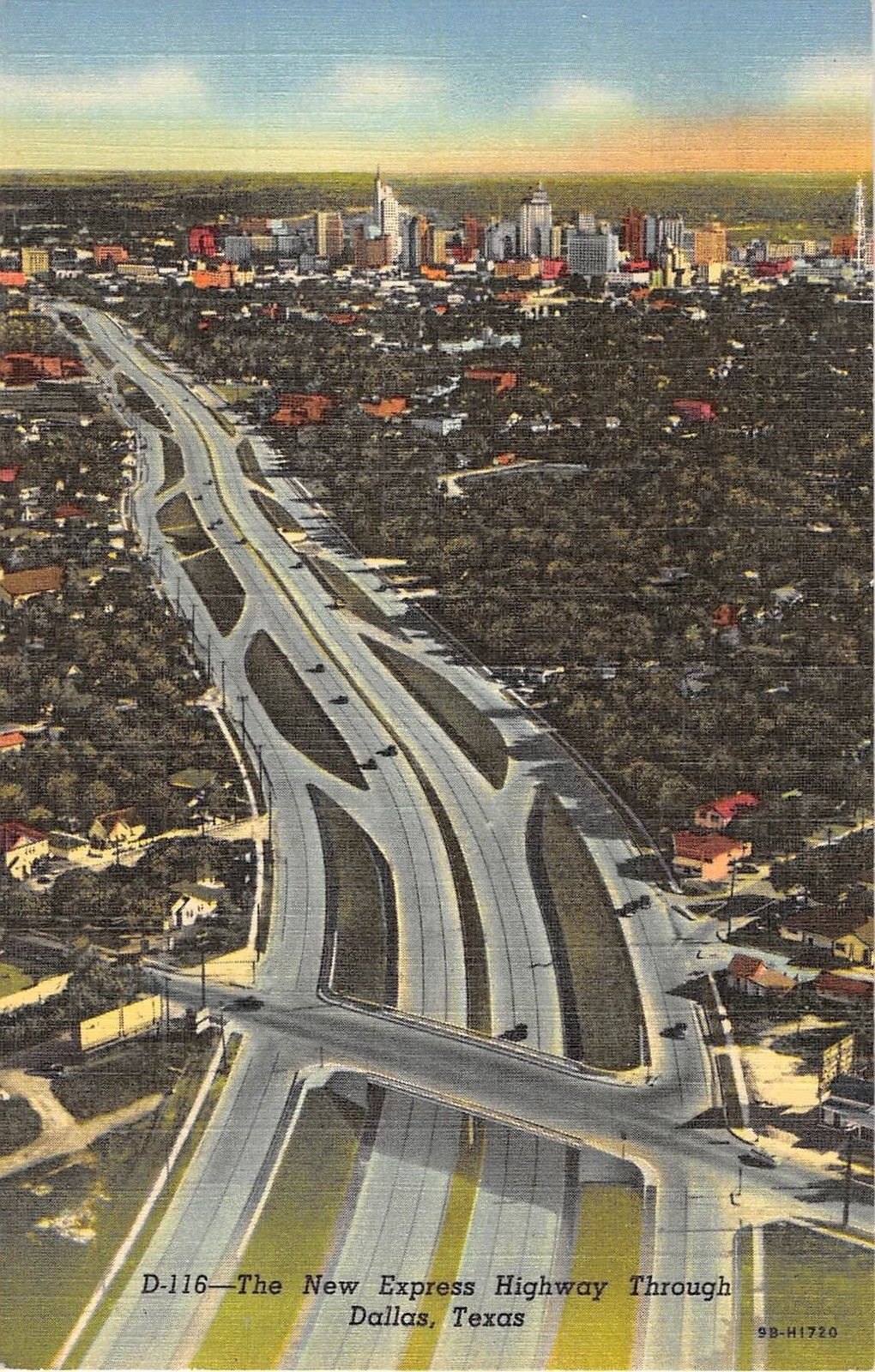
Postcard from a photo by Squire Haskins (click to see GIGANTIC image).

When in doubt, click pictures to see if images are larger.

*

Copyright © 2014 Paula Bosse. All Rights Reserved.
Cattle King C. C. Slaughter Really Knew How to Customize His Ride — 1912

ne

slaughter_car_1912_caption_greene

by Paula Bosse

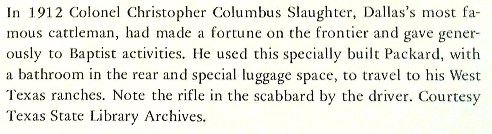
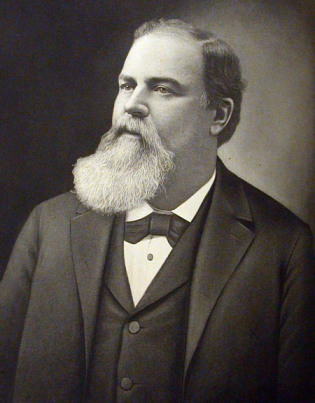
C. C. Slaughter (1837-1919) was known for being a rich cattleman, a rich Baptist, and one of Dallas’ richest pioneer businessmen. He was also pretty rich. He owned over a million acres of ranchland and more than 40,000 head of cattle. After health problems necessitated that he turn over management of his cattle interests to others, Slaughter moved his family to Dallas in 1873 and eased into the sweet life of a wealthy banker. Much of his money went to Baptist causes, including a contribution covering two-thirds of the cost of the construction of the First Baptist Church of Dallas. He was also a major investor in what became Baylor Hospital.

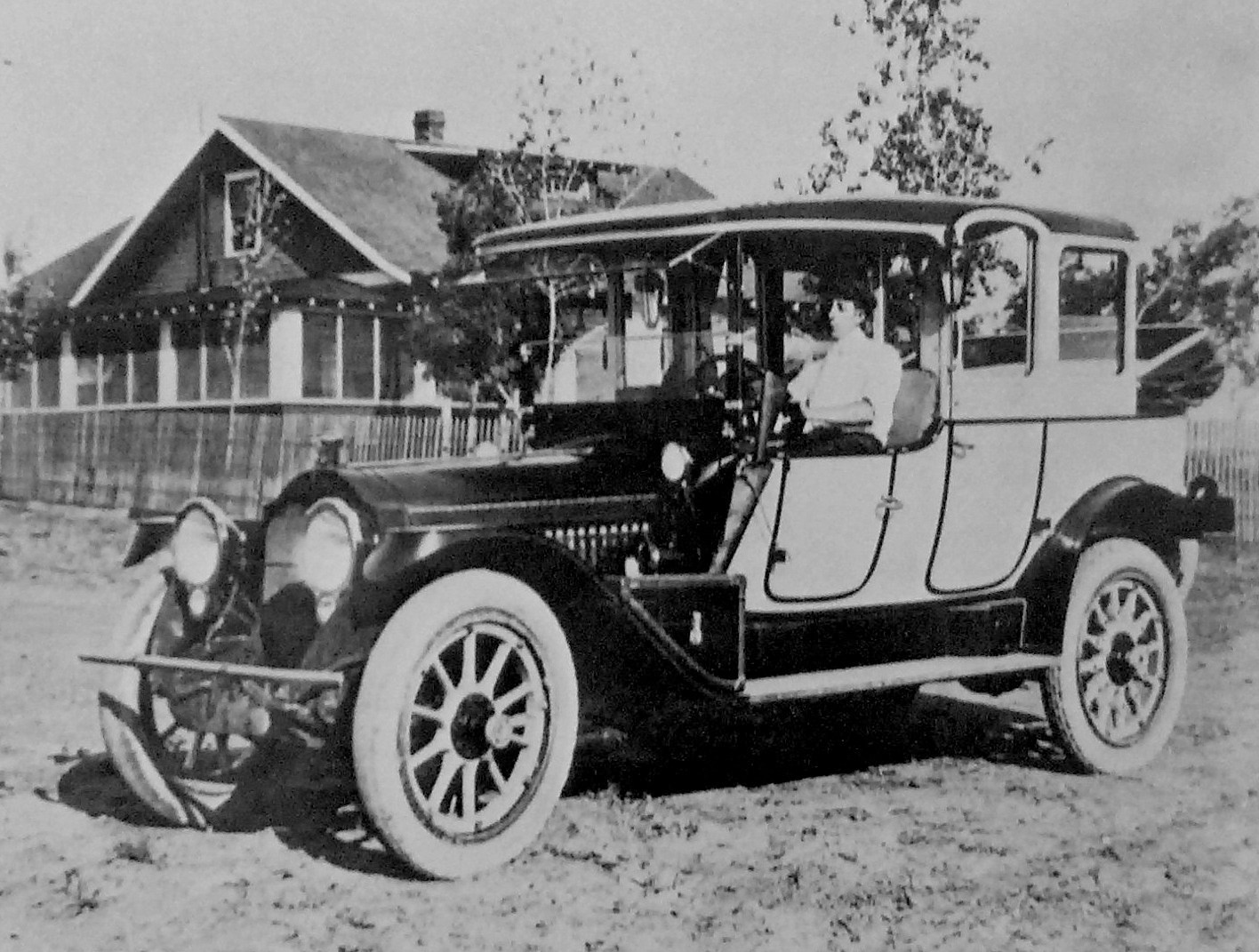
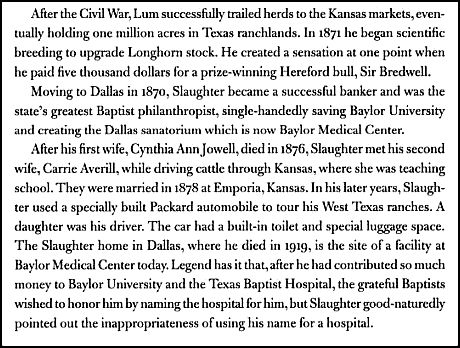
All of that accomplishment, and my favorite thing about Slaughter (“Lum” to his friends) is the tricked-out Packard with a built-in toilet. A. C. Greene — who wrote the caption to the photograph above — seems to have been fascinated by this as well, as he mentions it yet again, 25 years later in another book (with an added amusing tidbit about Slaughter’s response to the Baylor people on their wanting to name the hospital after him):

slaughter_portrait

***

Sources & Notes

Top photo and caption from Dallas, The Deciding Years by A. C. Greene (Austin: Encino Press, 1973).

Passage of text on Slaughter from Sketches from the Five States of Texas by A. C. Greene (College Stateion: Texas A&M University Press, 1998).

 The Handbook of Texas entry detailing the impressive life of Slaughter can be found here.

*

Copyright © 2014 Paula Bosse. All Rights Reserved.
Leaving Dallas on the Katy Flyer — ca. 1914

leaving-dallas-katy-flyer1

by Paula Bosse

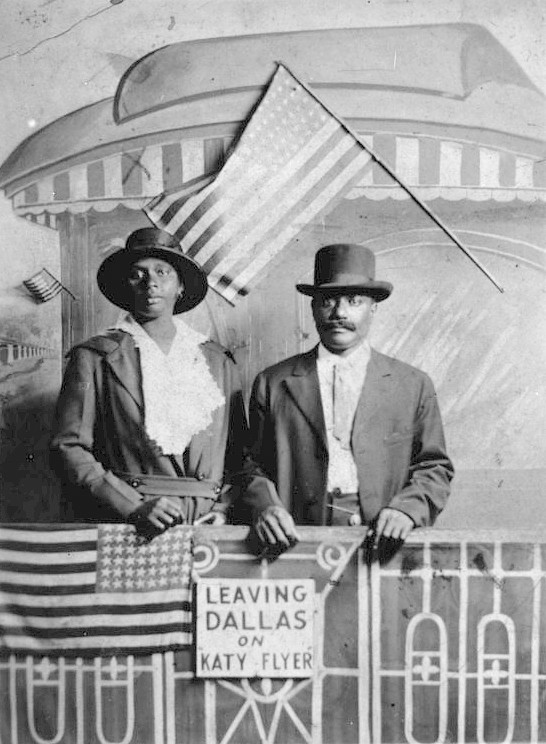
Who doesn’t love kitschy novelty photos? These “Leaving Dallas on the Katy Flyer” snapshots don’t disappoint with their cartoony backdrops — like something you’d see along a seaside boardwalk.

katy-flyer_three-men_1915_ebay
The people above are not identified, but, below, it’s a bunch of Order of Railroad Telegraphers union bigwigs. They probably had a wild time in Dallas. One or two of them look like they might be nursing a hangover.

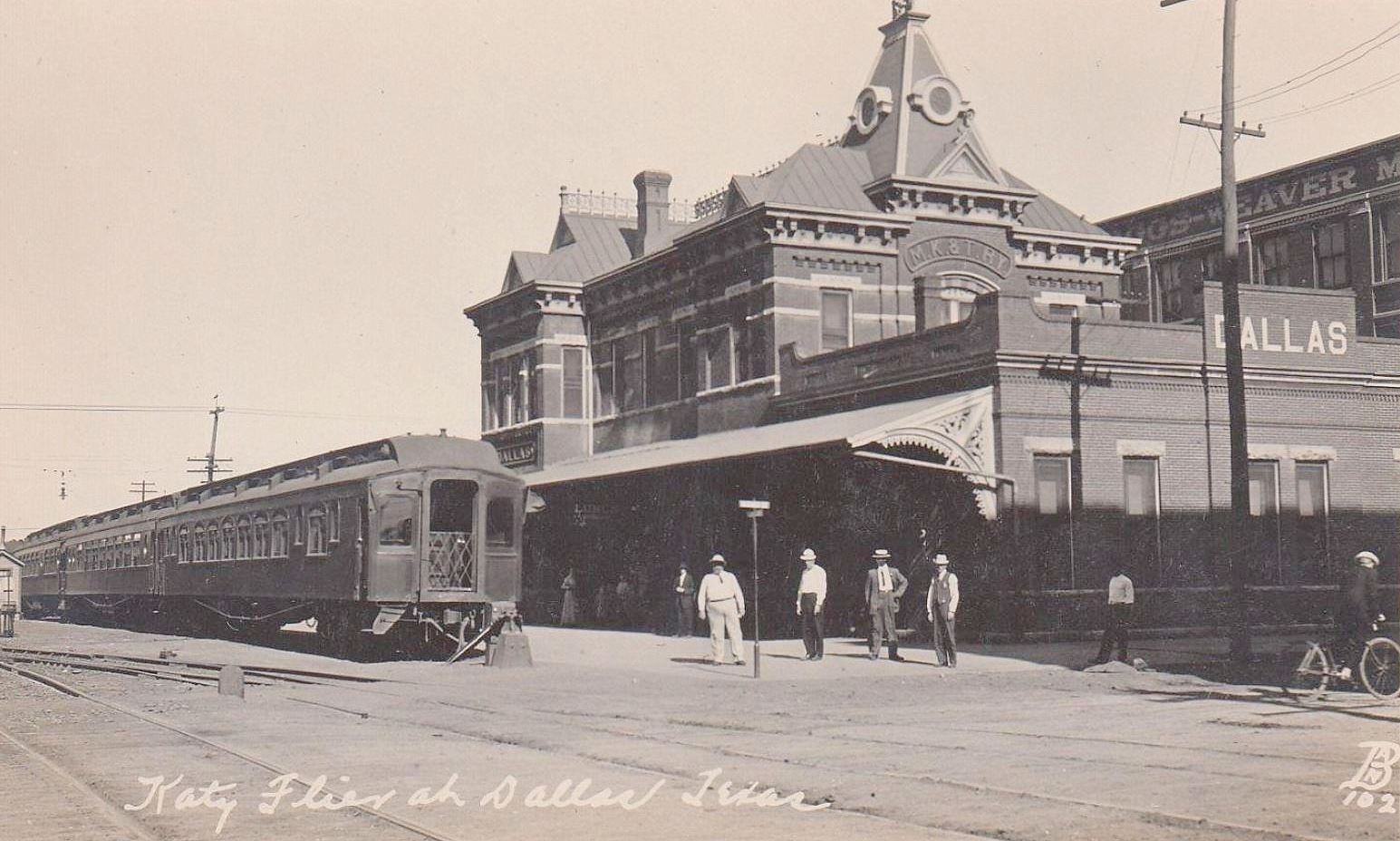
And just where was the point of departure from Big D for these Katy Flyer travelers? From the beautiful MKT passenger depot, formerly holding down the rails at Ross and Market.

katy-flyer_MKT_ebay_rppc

***

Sources & Notes

Top “real photo postcard” is from the J. L. Patton Collection, Dallas Historical Society.

Second photo was found on a postcard website.

Third photo is from eBay.

“O.R.T. General Committee” photo from — what else? — an issue of The Railroad Telegrapher (Feb. 1914).

Photo of the Missouri, Kansas & Texas depot is another real photo postcard, found on eBay.

See another Katy Flyer post — “M-K-T Railroad’s ‘Katy Flyer Route’ — 1902” — here.

*

Copyright © 2014 Paula Bosse. All Rights Reserved.
 

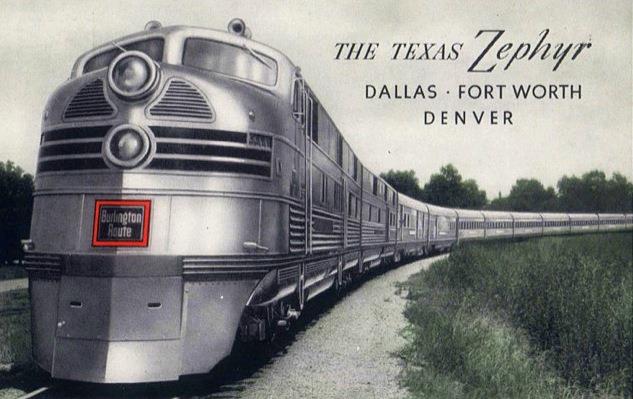
The Texas Zephyr — Streamlined Luxury Train Travel

Dallas — Fort Worth — Denver

by Paula Bosse

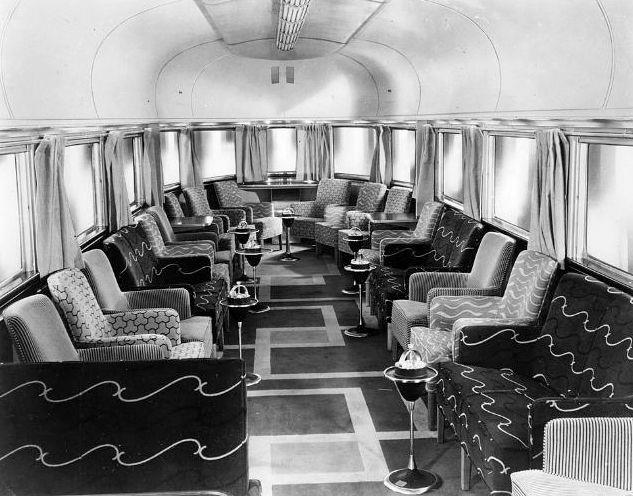
From the golden age of train travel. …I was born in the wrong era.

***

Sources & Notes

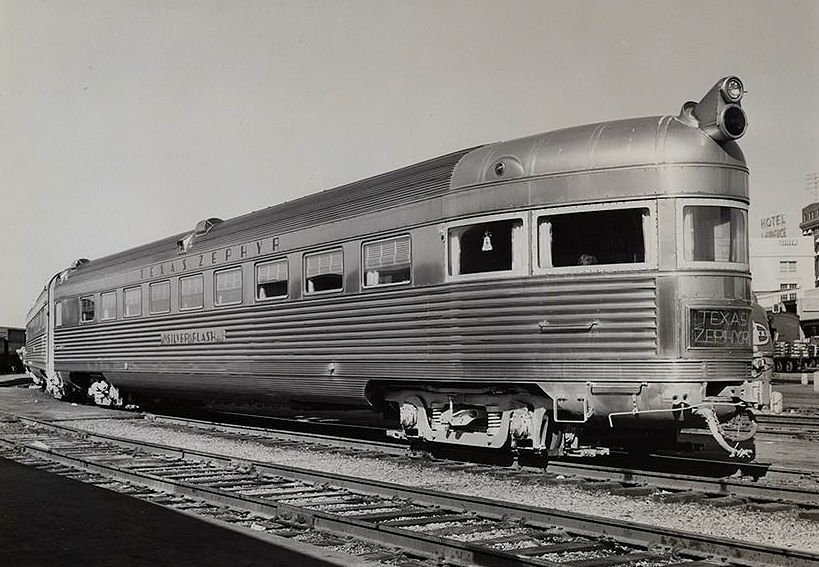
Second photo showing the exterior of the “Silver Flash” passenger car on the tracks at Union Station in Dallas is from the DeGolyer Library, Central University Libraries, Southern Methodist University; it was taken by Everett L. DeGolyer Jr. in 1960; more information on this photo is here.

Top and bottom images are from the wilds of the internet.

More on the Texas Zephyr here.

*

Copyright © 2014 Paula Bosse. All Rights Reserved.
Braniff Hangar, Love Field — 1940s

by Paula Bosse

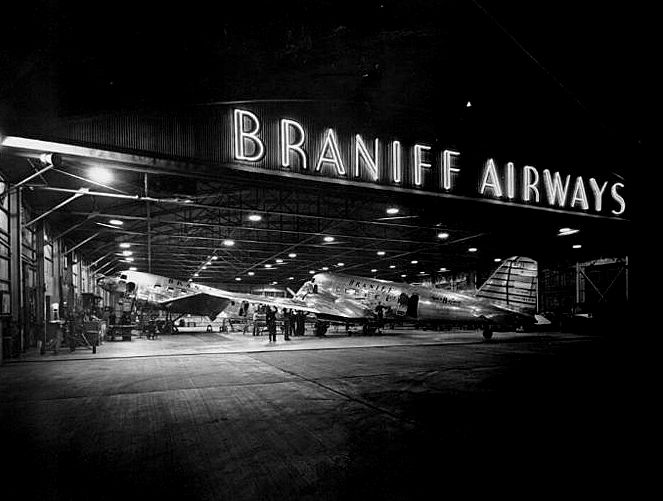
Overnight maintenance. Beautiful sign.

Photo caption:

Night maintenance at the Braniff hangar, main entrance on Roanoke Drive at Dallas Love Field, early 1940s.

Planes being serviced include a DC-2 and DC-3.

*

Copyright © 2014 Paula Bosse. All Rights Reserved.
“Dallas Motor Cycle Cops” — 1910

dallas-police_motorcycles_1910_bReady and on the job…

by Paula Bosse

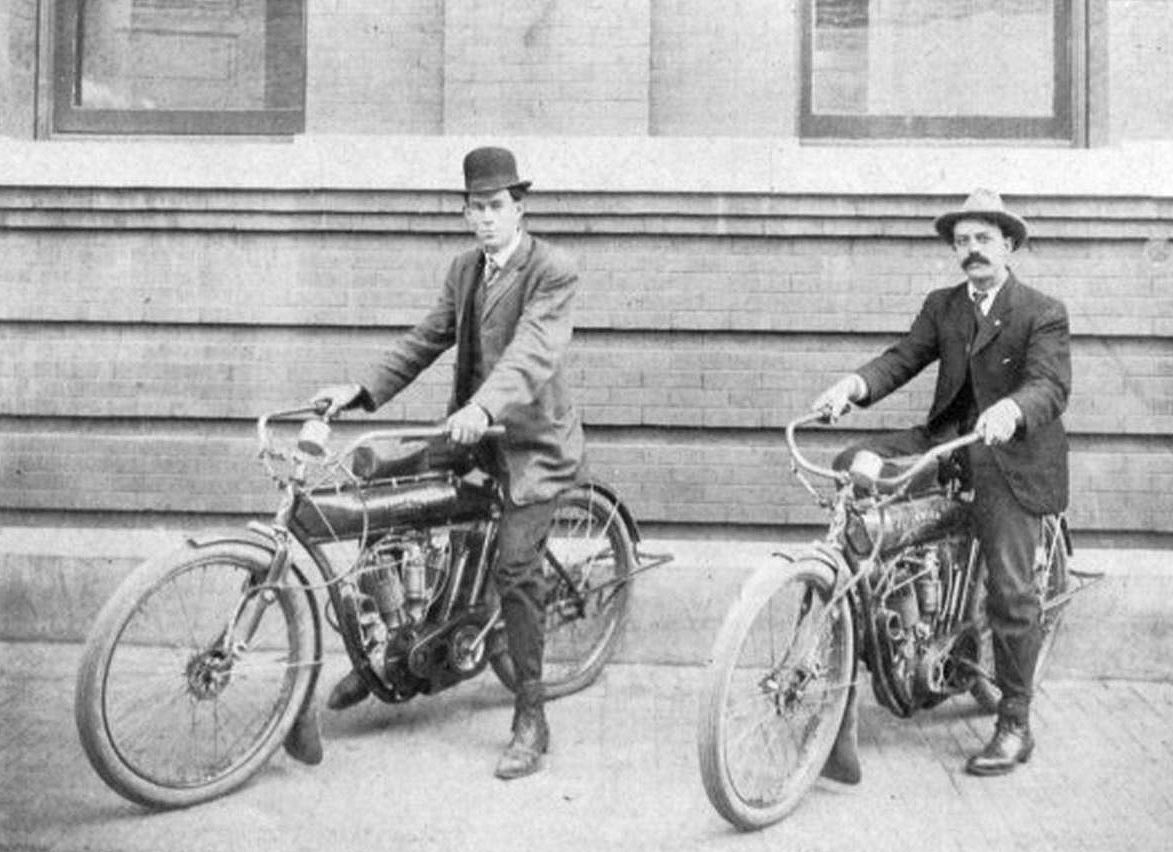
These photos of the Dallas Police Department’s “Motor Cycle Cops” appeared in a police publication from 1910.  We see them astride their machines, — one in a bowler hat — waiting for their call. Above, the “cops” are identified as B. G. Ford and A. W. Schulz; below, T. R. McSwain and S. R. Dean.

dallas-police_motorcycles_1910_a

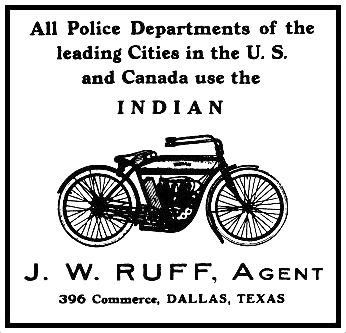
I can’t vouch for the models of the bikes, but this ad for Indian Motorcycles appeared just pages away.

ad-indian-motorcycles_1910

***

Sources & Notes

From a book with almost no publication info; it is presented simply as Dallas Police Department (Dallas, 1910). It’s got great photos and can be found on the Portal to Texas History site, here.

By 1951, the DPD’s allegiance had shifted to Harley-Davidson, as can be seen in the post “The Dallas Police Department & Their Fleet of Harleys — 1951.”

*

Copyright © 2014 Paula Bosse. All Rights Reserved.
From Deep in the Heart of Texas, I Give You Love Field — 1919

Love is in the air

by Paula Bosse

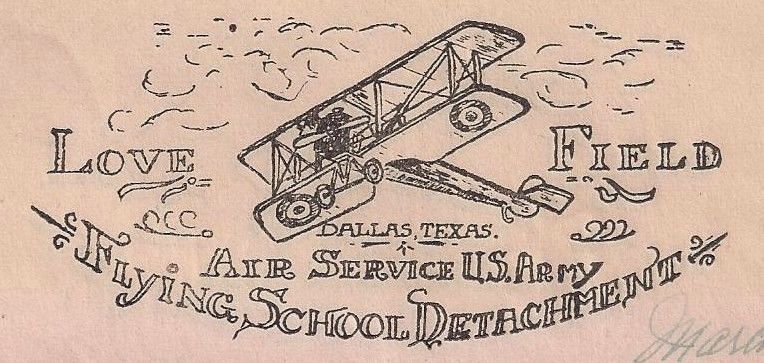
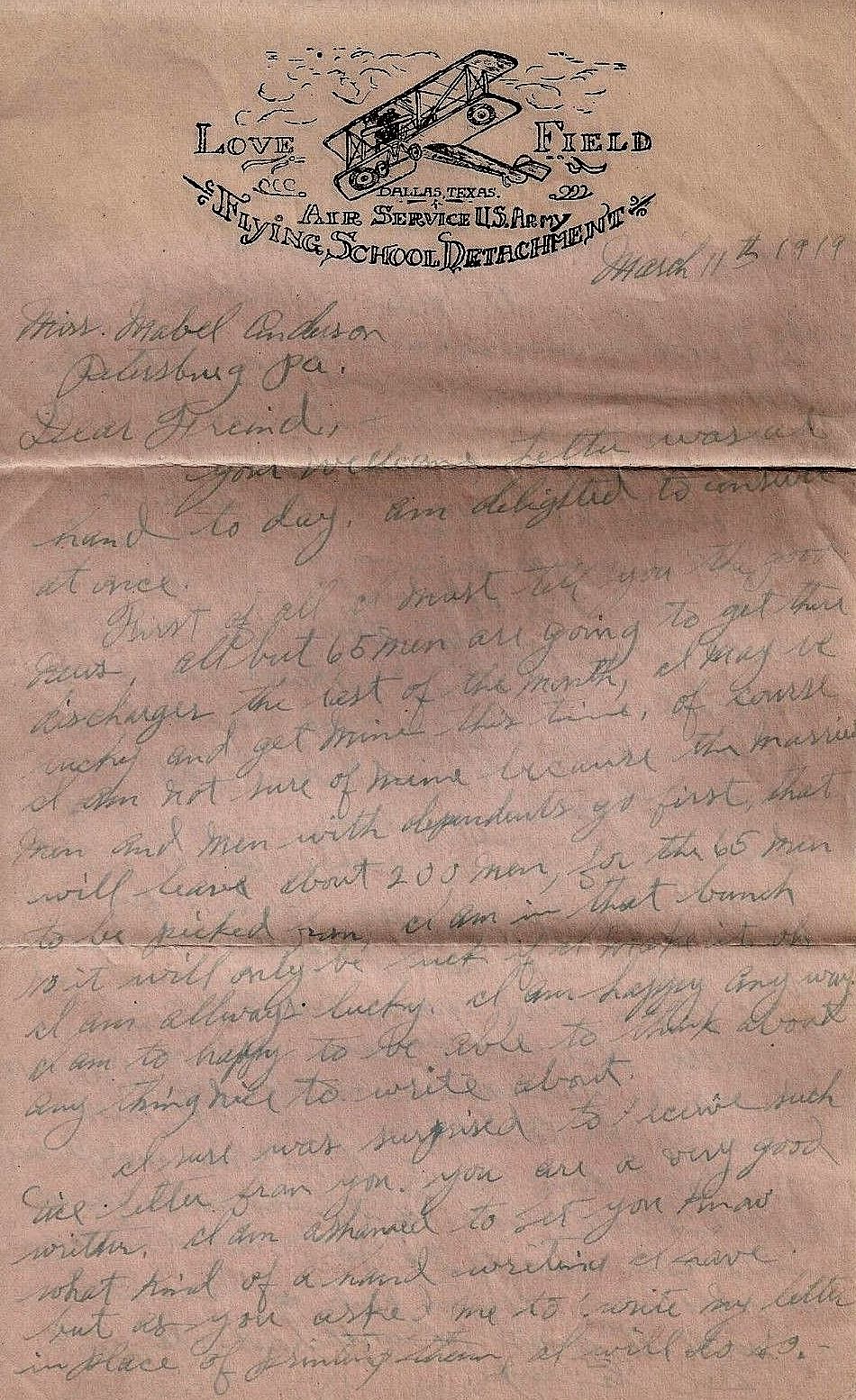
It’s Valentine’s Day — a perfect time to turn to Love Field (…which, like “Lovers Lane,” must sound a little cutesy to outsiders). The above image shows the letterhead of the U.S. Army Air Service Flying School Detachment, a consolidation of World War I squadrons based at Love Field from November 1918 to November 1919.

One of the young pilots stationed there wrote a four-page letter on this stationery. The letter, dated March 11, 1919, was addressed to Miss Mabel Anderson in Petersburg, Pennsylvania. They seem to have begun a sort of pen-pal correspondence, and he is certainly very happy to have received a letter from her. (“Your wellcome [sic] letter was at hand today. Am delighted to answer at once.”) He asks if she would send him a photograph and tells her he’d like to meet her. He says that he is hopeful that, the war finally over, he will be discharged at the end of the month — he thinks he will be because, “I am allways [sic] lucky.”

This is an item for sale on eBay, and only the first page is scanned, so the identity of the author of the letter will remain unknown to those of us merely browsing an auction listing, interested but unwilling to cough up the cash to buy it and read any further. I wonder what happened? If he wanted to meet her, then perhaps he, too, was from Pennsylvania — they might have met when he arrived back home. He certainly sounds excited and hopeful and flirtatious, and he should, because not only was he “allways lucky,” but the long war had finally ended and he was headed home with his whole life ahead of him. Where’s Paul Harvey to tell us the rest of the story?

Happy Valentine’s Day!

***

This four-page letter on Love Field letterhead was recently up for auction on eBay, with the following description: “Letter from airman to a young girl asking for her picture and wanting to meet her. Very early US Army Air Service stationery from Love Field in Dallas Texas. Just after the end of WWI. Scarce Item.”

Here is the first page, with a transcription (spelling corrected) below (click to see a larger image).

love-field_letter_1919

Miss Mabel Anderson
Petersburg, Pa.

Dear friend,

Your welcome letter was at hand today. Am delighted to answer at once.

First of all I must tell you the good news. All but 65 men are going to get their discharges the last of the month. I may be lucky and get mine this time. Of course I am not sure of mine because the married men and men with dependents go first. That will leave about 200 men, for the 65 men to be picked from. I am in that bunch, so it will only be luck if I make it ok. I am always lucky. I am happy anyway. I am too happy to be able to think about anything nice to write about.

I sure was surprised to receive such a nice letter from you. You are a very good writer. I am ashamed to let you know what kind of a handwriting I have, but as you asked me to write my letter in place of printing [it], I will do so.

*

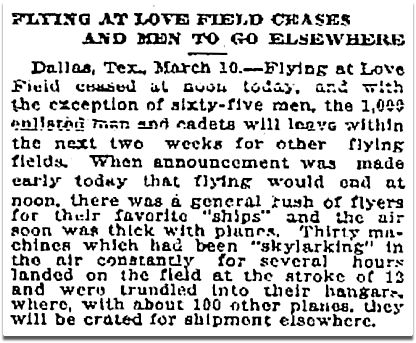
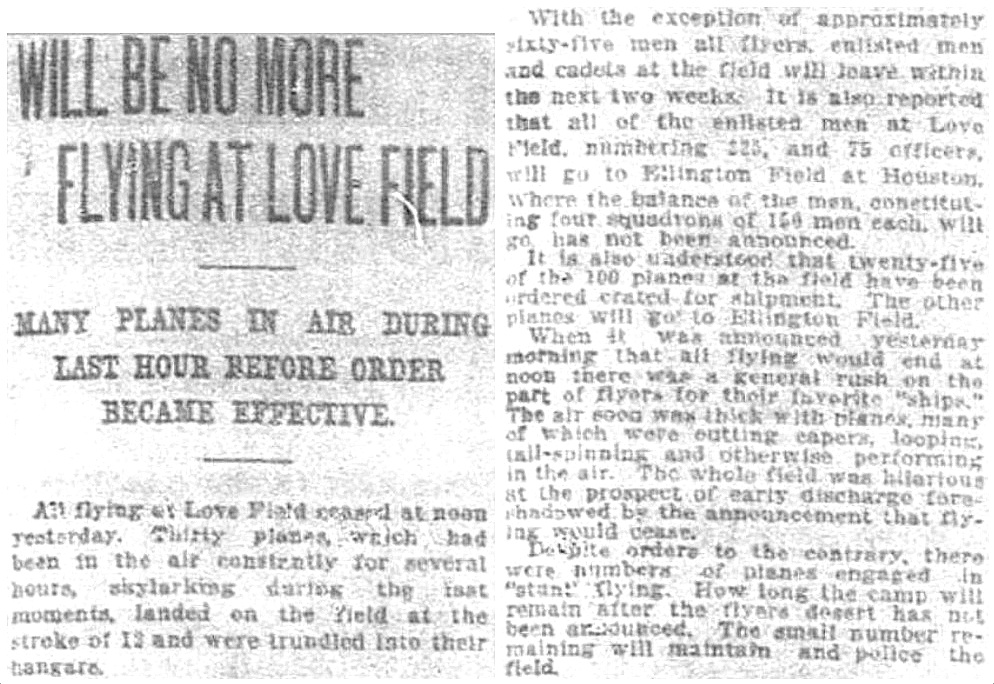
Here are two stories about how the airmen stationed at Love Field responded to the announcement that all flying would cease at noon on March 10, 1919 before demobilization began. It sounds like something from a movie: a sky full of something like 30 airplanes looping and “skylarking,” their pilots celebrating their fast-approaching military discharge by flying their favorite “machines” for the last time.

love-field_galveston-news_031119Galveston News, March 11, 1919

love-field_dmn_031119Dallas Morning News, March 11, 1919 (click for larger image)

*

Copyright © 2014 Paula Bosse. All Rights Reserved.