Flashback : Dallas

A Miscellany: History, Ads, Pop Culture

Category: Transportation

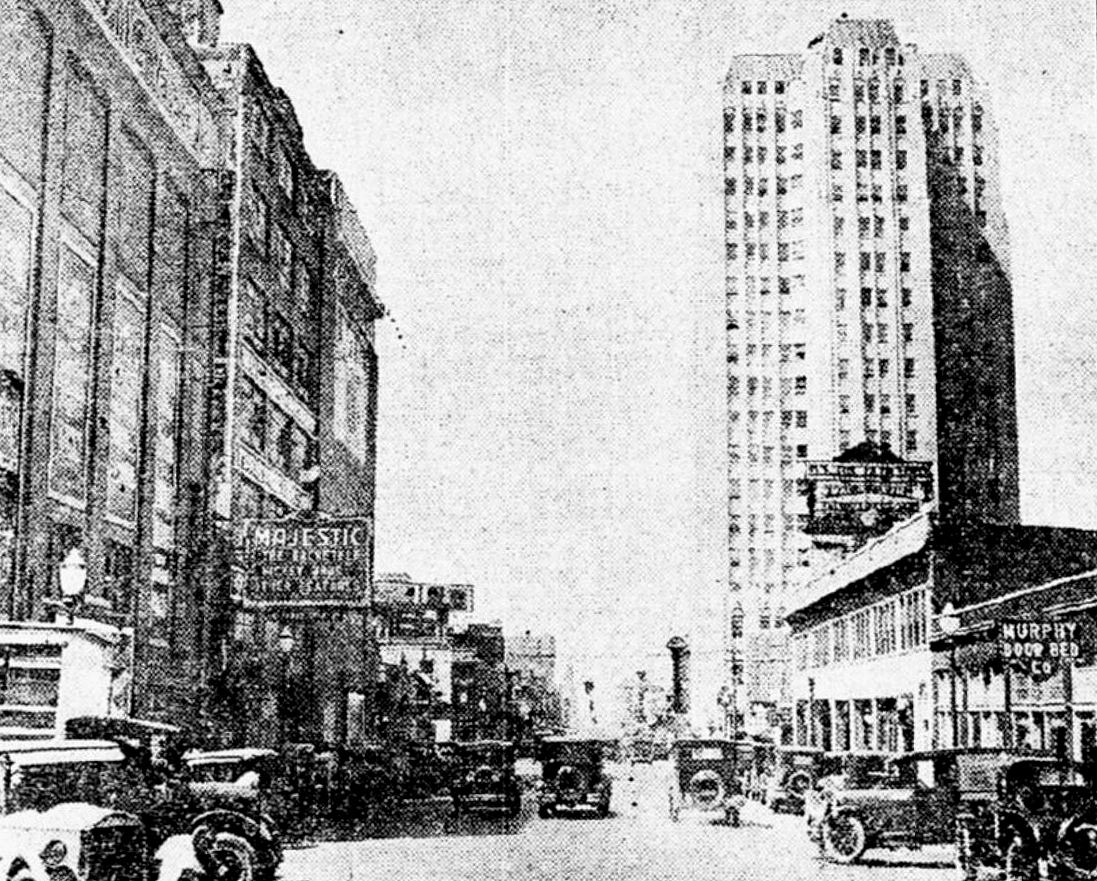
Pacific Avenue — 1925

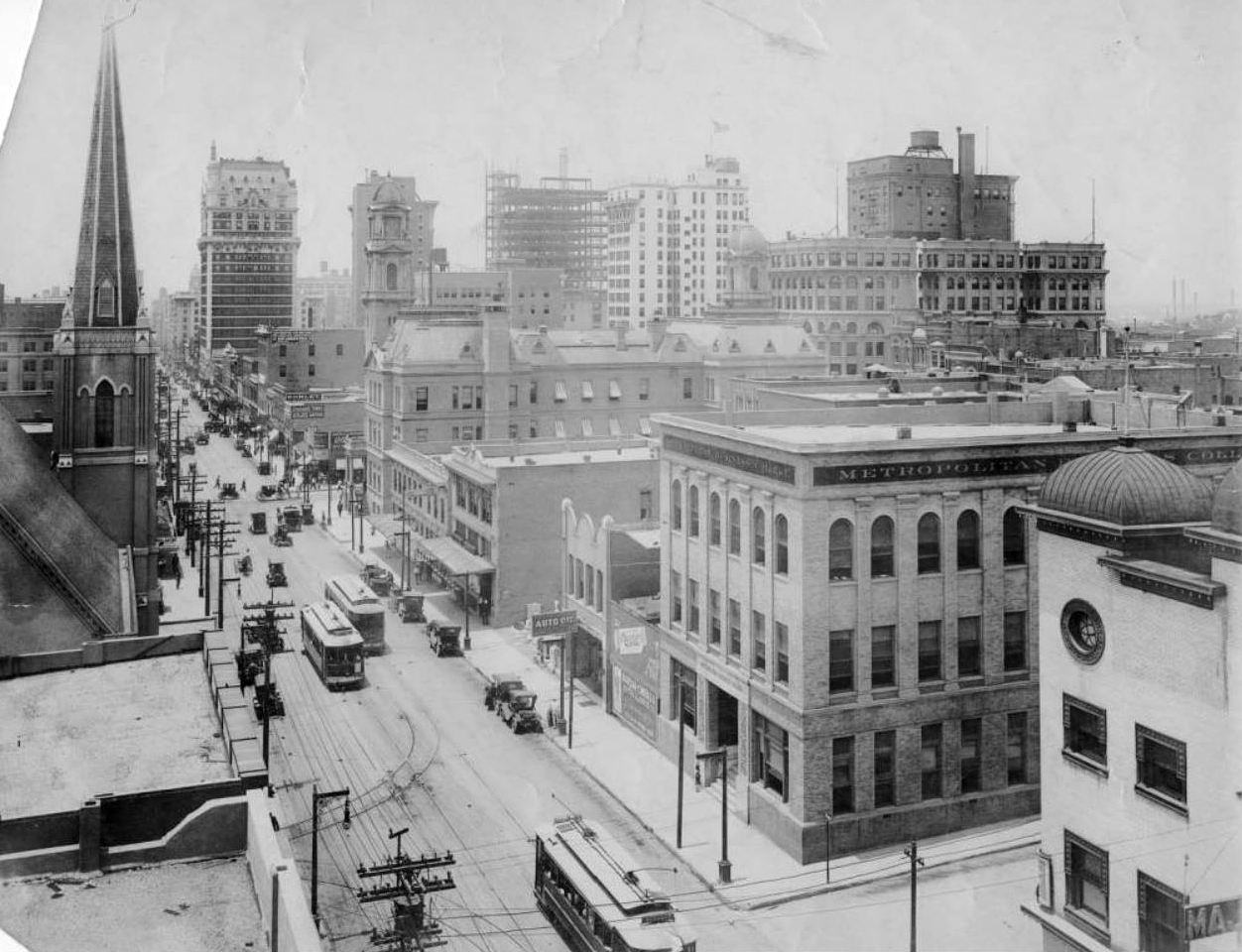
pacific_bryan_looking-east_lost-dallas_dotyThe back side of Elm, looking east…

by Paula Bosse

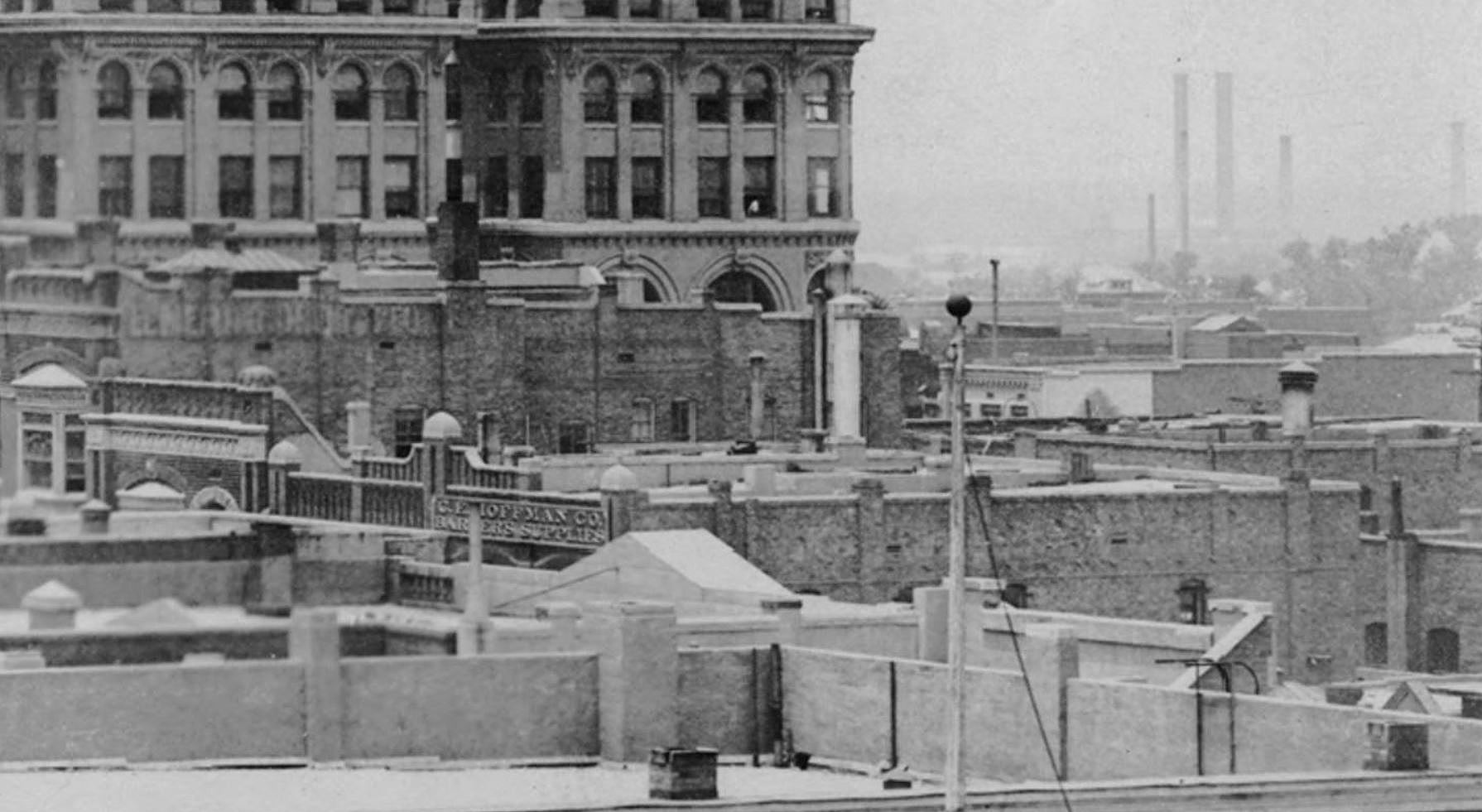
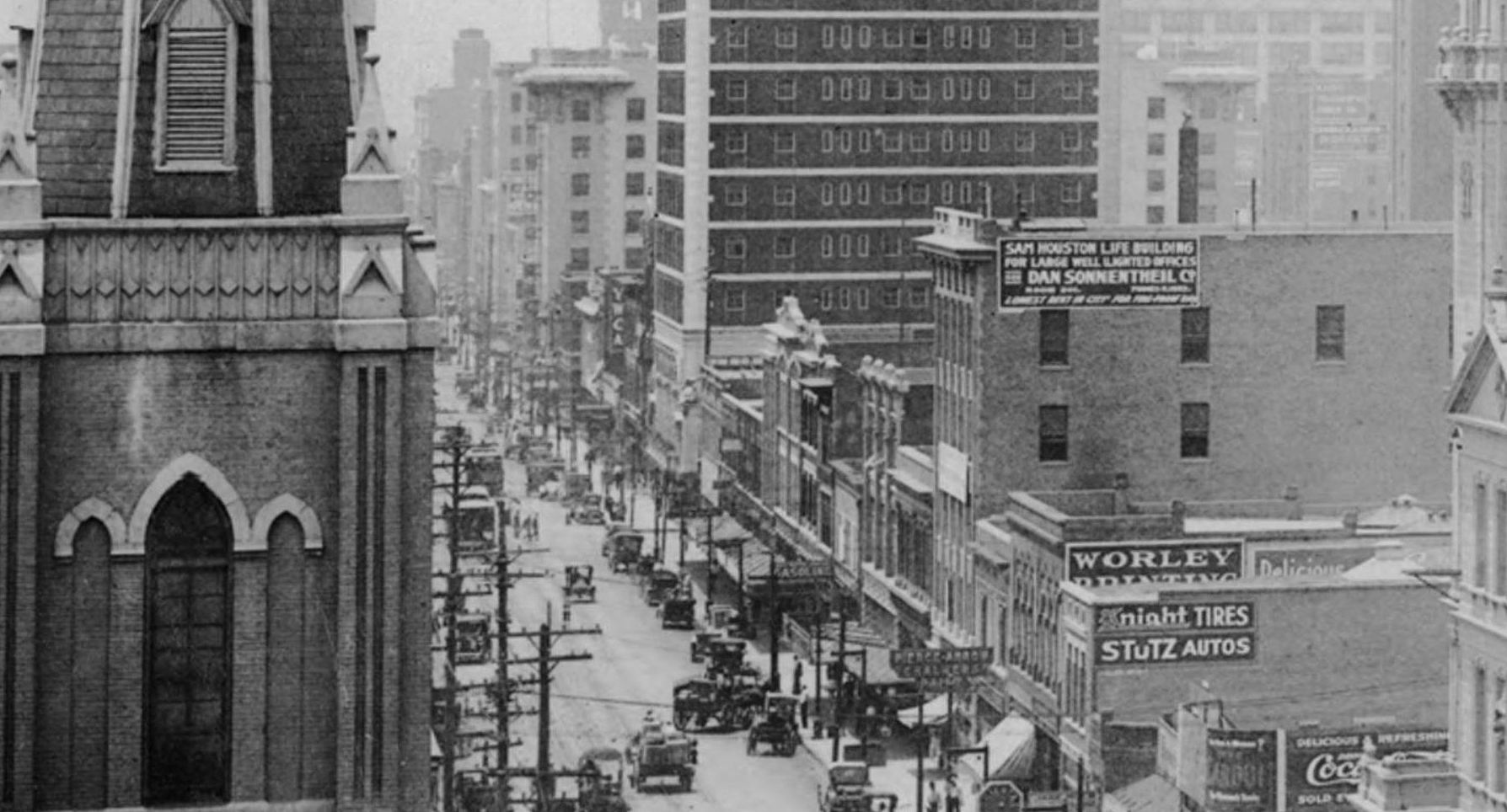
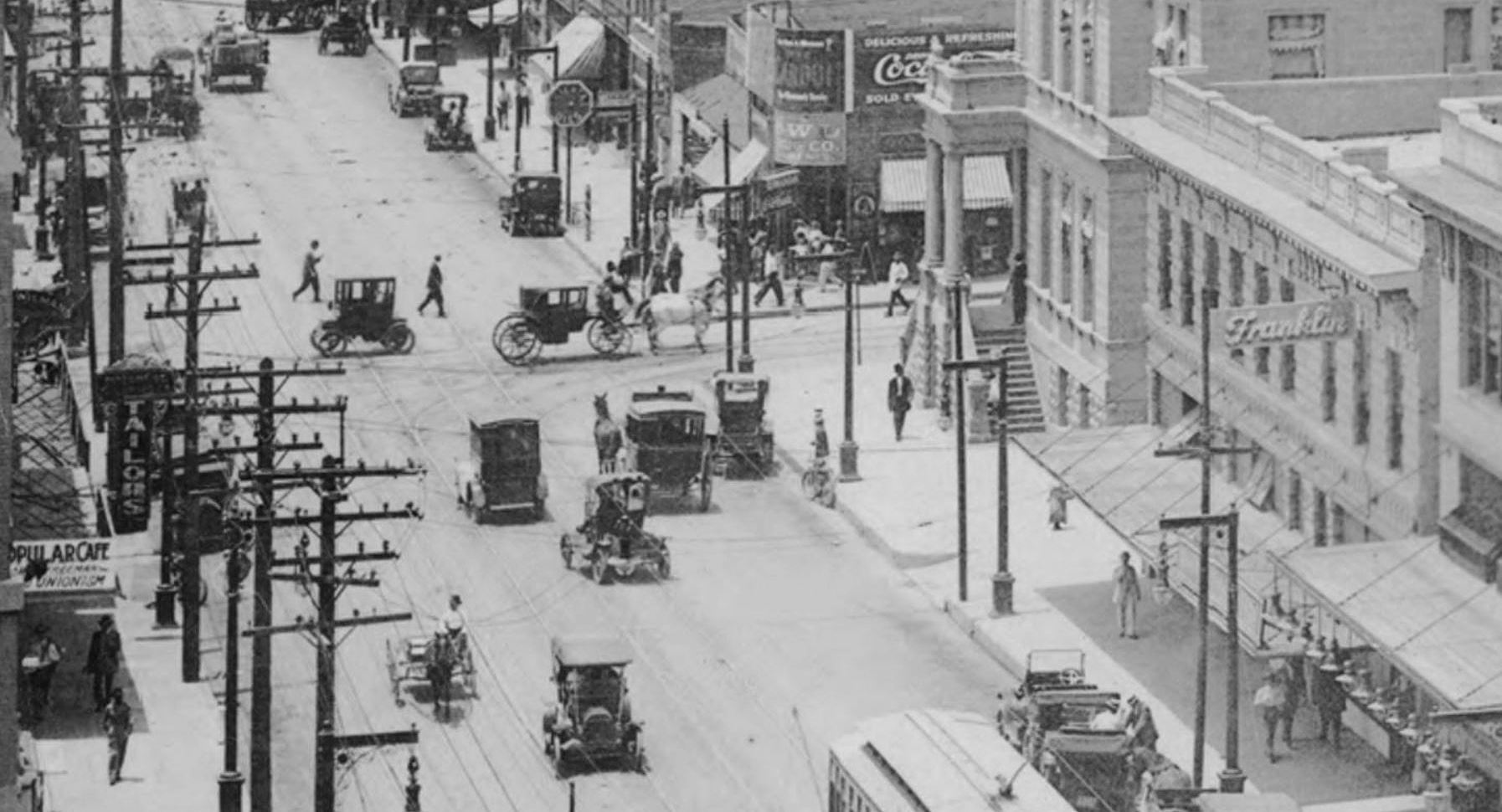
Elm Street gets all the glory as Theater Row, but what about Pacific? It had those very same theaters. …Sort of. Pacific gets overlooked a lot. When I see photos like this one — which shows Pacific Avenue looking east from Bryan — I always think of it as a photo showing the back side of Elm rather than as a photo showing Pacific. Always a bridesmaid, never the bride.

This photo was taken only a few short years after the Texas & Pacific railroad tracks were removed from Pacific, making it into an automobile and pedestrian thoroughfare only — no more frightening, smoke-belching trains rumbling right down the middle of the street. The city was hoping that Pacific would become a heavily commercial area like Elm, Main, and Commerce, but it never really reached those lofty heights.

I’ve always wondered if the theaters that lined Elm ever considered having entrances/box offices on both Elm and Pacific. I think that they were really only willing to slap a few posters and paint their names on their back, Pacific-facing walls. Elm Street was glitzy and glamorous. Pacific was not. Back in those early days when people were still trying to get used to Pacific Avenue being newly liberated from its railroad tracks, it might have been seen as something of an afterthought — as more of a very wide alley with traffic than as a contender for one of Dallas’ major streets.

But back to the theaters. In the photo above, we see the Old Mill at 1525-27 Elm (where “The Snob” was playing, featuring John Gilbert and Norma Shearer), the Capitol at 1521-23 Elm (which had Alla Nazimova in “The Redeeming Sin”), and the Jefferson Theater at 1517 Elm (featuring Harley Sadler’s repertory company appearing in “Honest Hypocrites and Saintly Sinners” between vaudeville acts). All of these were playing in May, 1925.

It’s interesting that the only business seen here on the south side of Pacific that had an address on both Elm and Pacific was Van Winkle’s Book Store (before it moved a couple of doors up Elm, it was at 1603 Elm/1614 Pacific). Note the sign advising “Free Passage to Elm Street” — several businesses allowed people to cut through their stores to get to the next street over because the blocks were incredibly long and would sometimes have necessitated pedestrians going three blocks out of their way just to get to their destination.

Other notable landmarks in the photo above: the Medical Arts Building (on the left) and the Dallas Athletic Club.

Here’s a view of Pacific from around the same time, looking west, from about Harwood.

pacific-looking-west_dmn_041430
1930

Most interesting detail in this photo? That Murphy Door Bed Co. sign!

***

Sources & Notes

Top photo from Lost Dallas by Mark Doty (Charleston: Arcadia Publishing, 2012).

*

Copyright © 2015 Paula Bosse. All Rights Reserved.

Selling Kidd Springs Heights, 1909-1910

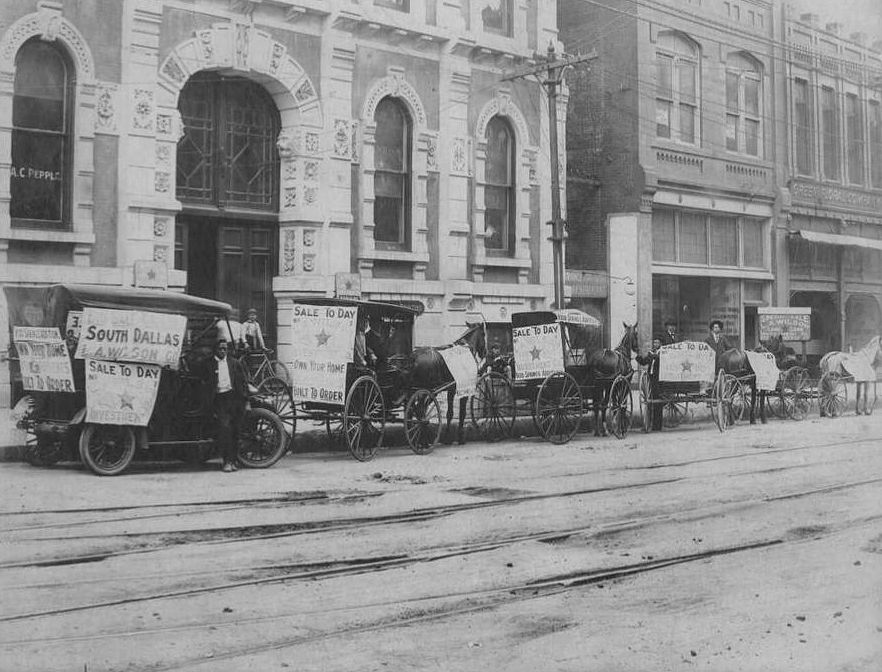
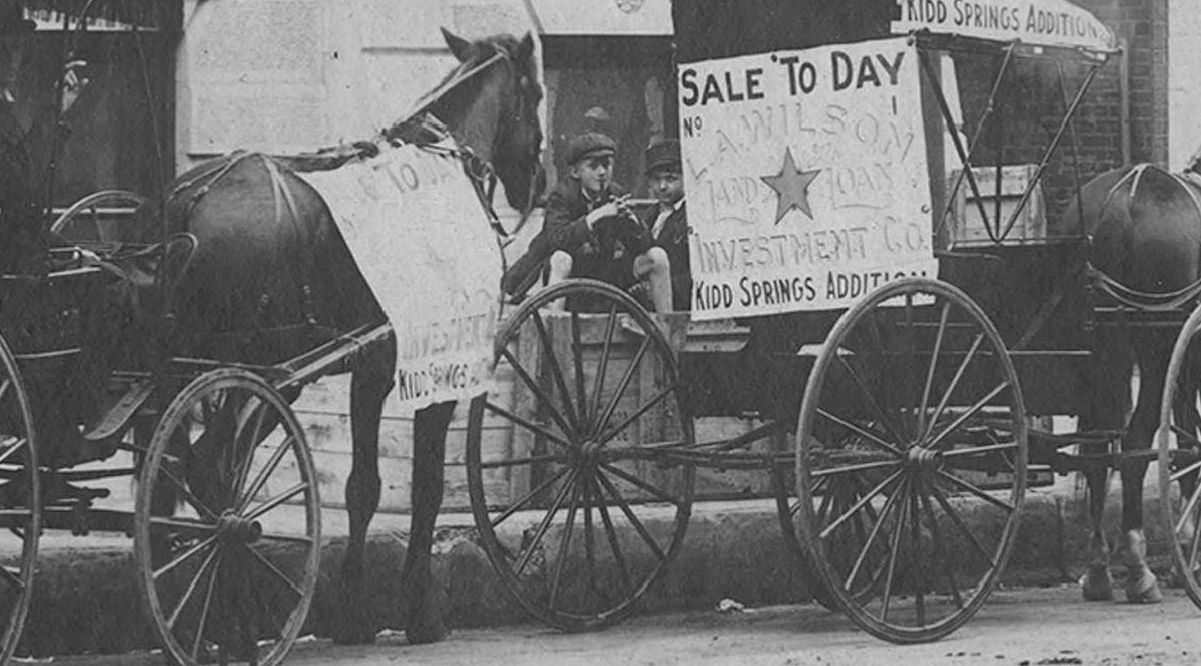
gaston-bldg_1910_cook-degolyerThe L. A. Wilson Co. is having a sale! (photo: SMU)

by Paula Bosse

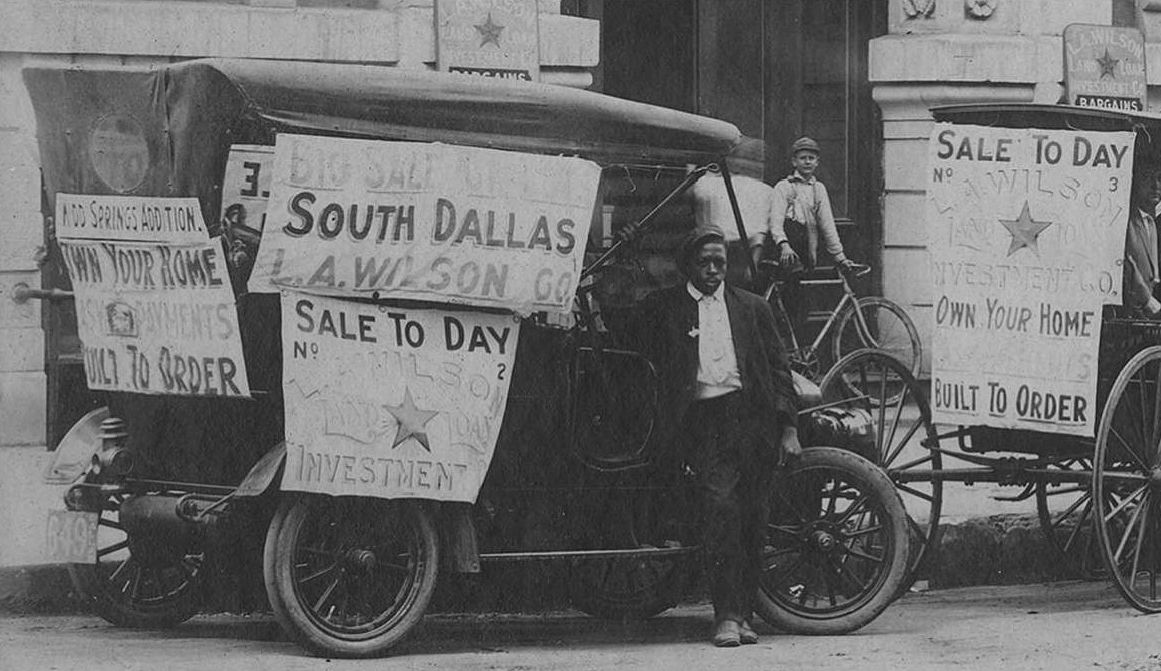
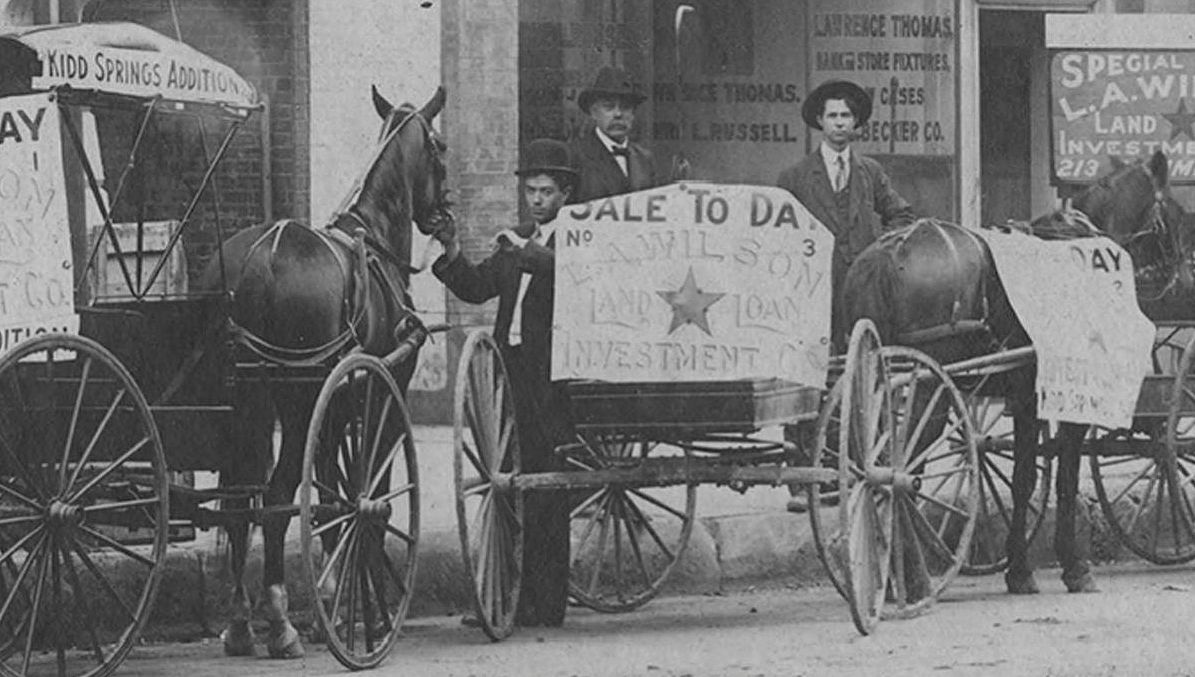
The above photo shows a car-and-buggy convoy belonging to the L. A. Wilson Land, Loan & Investment Company, stretched out in front of the Gaston Building at Commerce and S. Lamar. There’s a “Sale To Day” and they’re really pushing property in the Kidd Springs Addition in Oak Cliff. The date “April 20, 1910” is written on the back of the photo, and if that’s true, the big show here might be rooted more in desperation than in enthusiasm. The Wilson company began selling the 30-or-so lots in the new Kidd Springs Heights neighborhood in July of the previous year. An ad that appeared seven months before this photo was taken announced that there were only ten lots left. It looks like this was an impassioned display to make Kidd Springs seem more exciting and move that remaining property. People love parades.

(This is another great photo to zoom in on to see the details. All images are larger when clicked.)

gaston-bldg_1910_cook-degolyer-det1

gaston-bldg_1910_cook-degolyer-det4

gaston-bldg_1910_cook-degolyer-det5

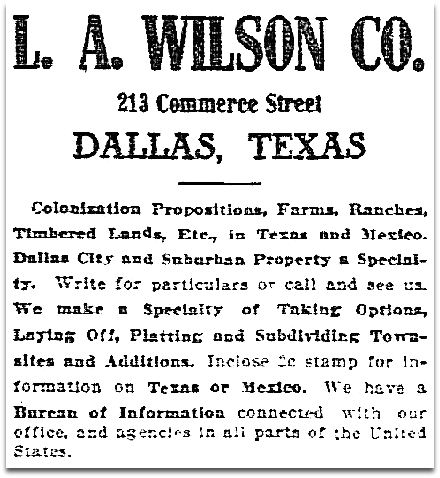
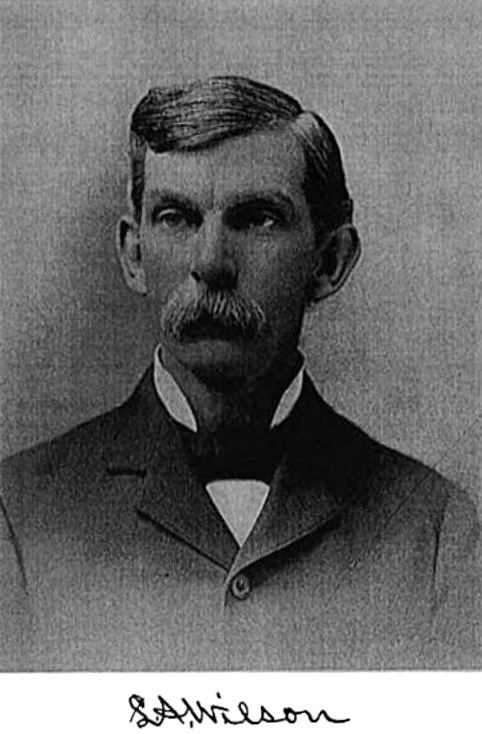
The L. A. Wilson Co. was a fairly large real estate company founded by Missouri-born Lewis A. Wilson (1851-1926); at the time of this photo, the company’s offices were in the Gaston Building at 213 Commerce. (In the photo immediately above, I think the man with the moustache is Mr. Wilson.)

wilson_dmn_070409-detDallas Morning News, July 4, 1909 (ad detail)

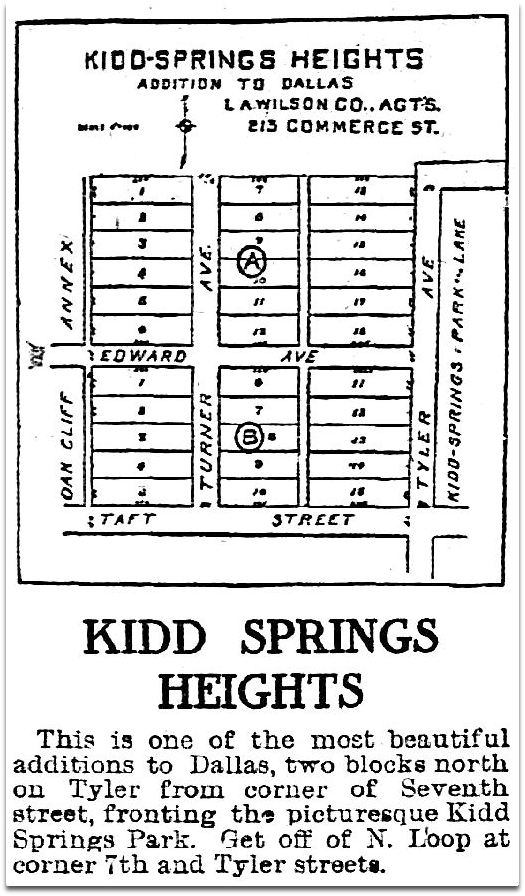
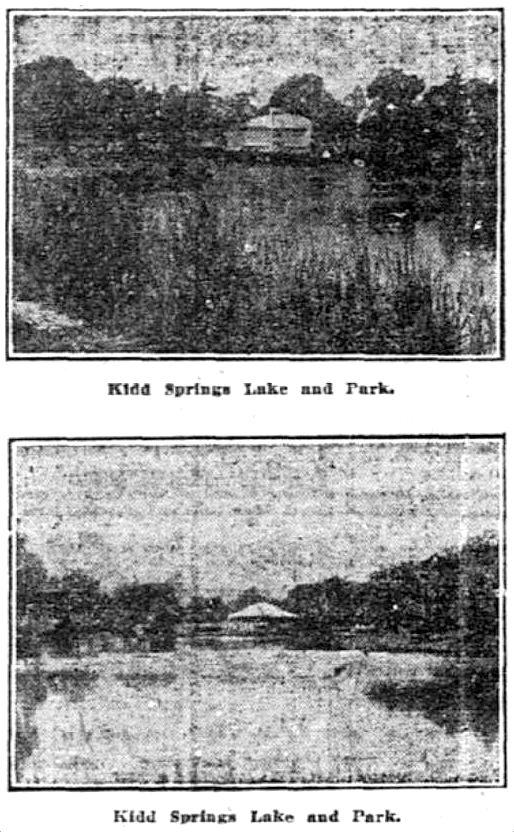
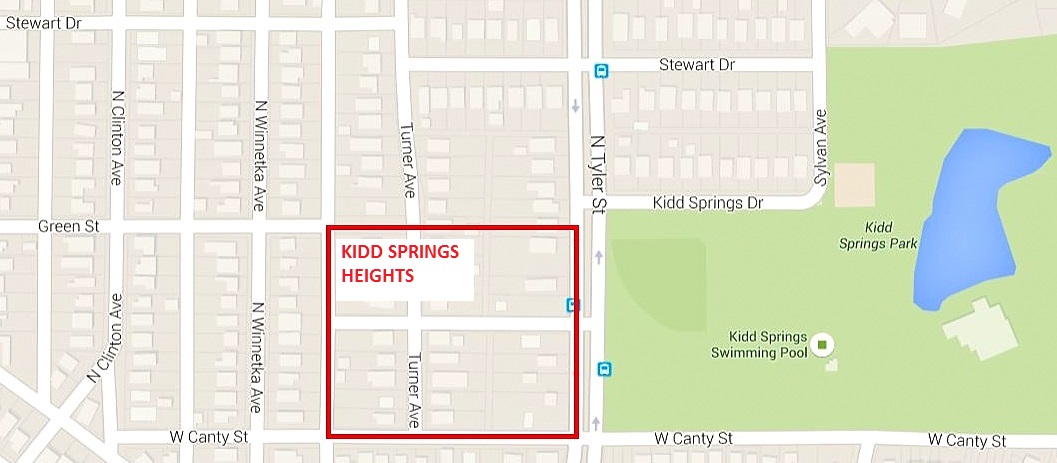
The first ad announcing the sale of lots in the Kidd Springs Heights area of Oak Cliff appeared on July 4, 1909. It included the two blocks north of what is now W. Canty, bounded by Turner Ave. on the west and N. Tyler (and Kidd Springs Park) on the east.

ad-wilson_dmn_070409-text

ad-wilson_dmn_070409-photosDMN, July 4, 1909

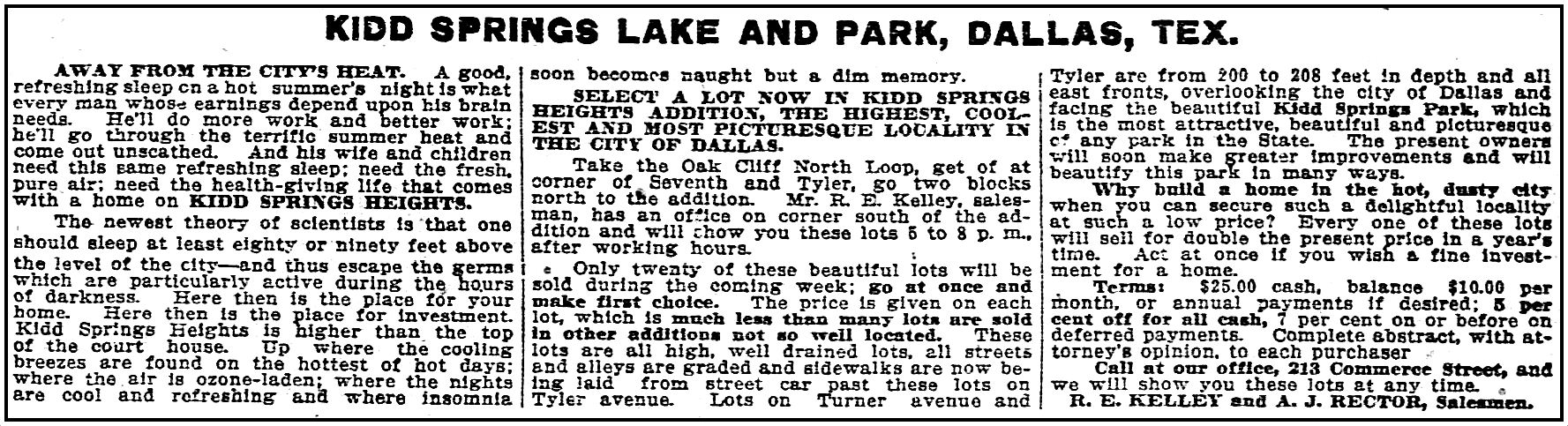
Four weeks later, a huge half-page ad ran in The Dallas Morning News, full of wonderful reasons why life would be better in Kidd Springs Heights:

The newest theory of scientists is that one should sleep at least eighty or ninety feet above the level of the city – and thus escape the germs which are particularly active during the hours of darkness. Here then is the place for your home. Here then is the place for investment. Kidd Springs Heights is higher than the top of the court house. Up where the cooling breezes are found on the hottest of hot days; where the air is ozone-laden; where the nights are cool and refreshing and where insomnia soon becomes naught but a dim memory.

The effusive sales copy is definitely worth a read (click ad below to read the full sales pitch).

wilson_kidd-springs-heights_dmnn_090109DMN, Aug. 1, 1909

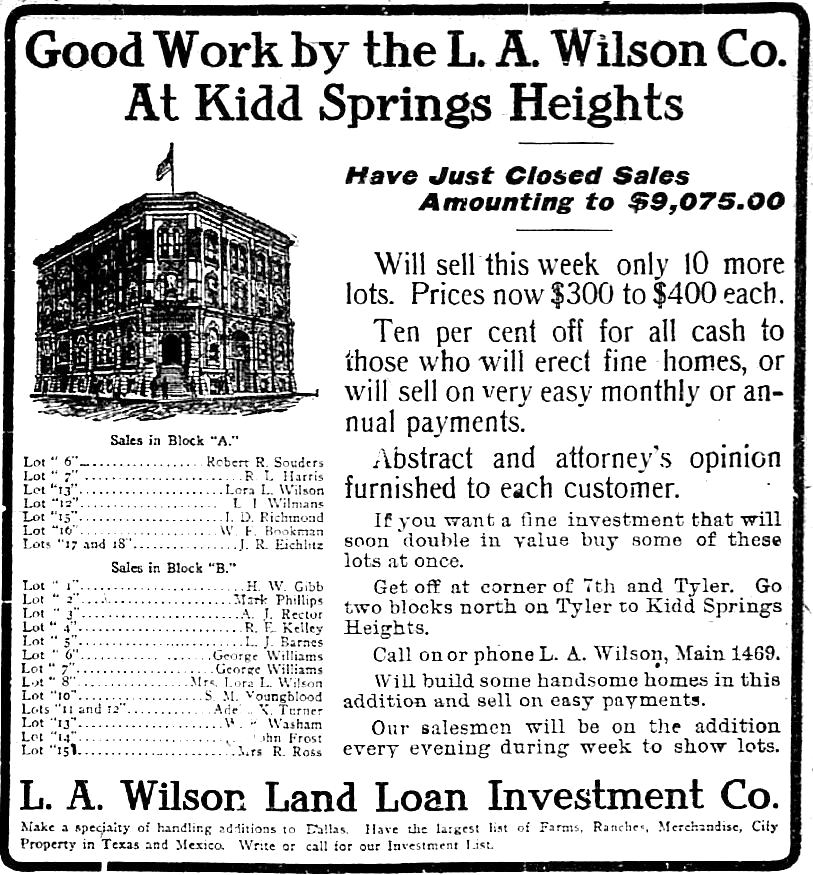
Six weeks later the following self-congratulatory ad appeared. (It’s interesting to note that of the twenty lots sold, two of them had been sold to Mrs. L. A. Wilson, and one each had been sold to the two salesmen. The next year’s telephone directory showed that the Wilsons lived on Live Oak, and the two salesmen lived in boarding houses.)

wilson-kidd-springs_dmn_091209DMN, Sept. 12, 1909

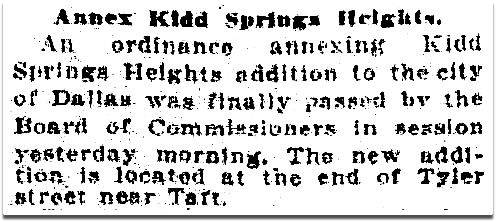
It wasn’t until 1921 that the tiny little Kidd Springs Heights was annexed to the city of Dallas.

annexed_dmn_051421DMN, May 14, 1921

Things may be different today, but in 1909, these were the boundaries of Kidd Springs Heights.

kidd-springs-heights_google_2015

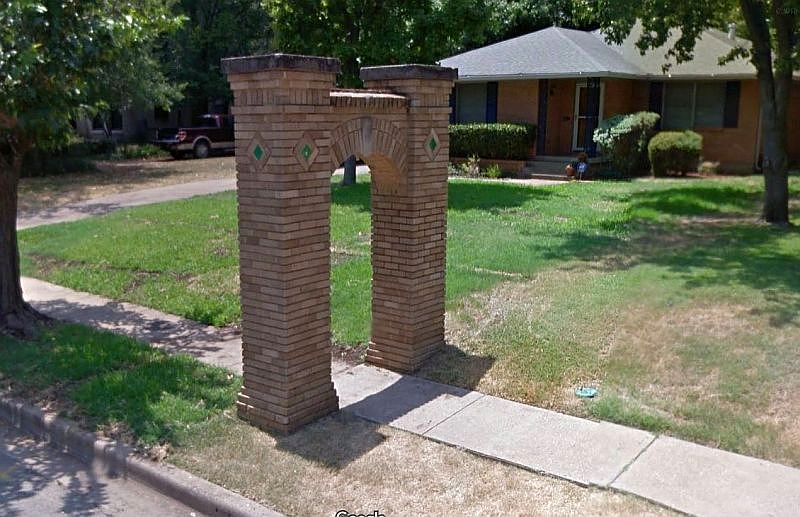
The most interesting odd thing about Kidd Springs Heights? There appear to be two brick archways placed (very awkwardly) across Turner Avenue from one another — each spanning the sidewalk. I can’t find any information about these, but it looks as if they were set right at the northern boundary of the Kidd Springs Heights Addition. Old maps (such as this one from 1919) show no development to the north of this boundary up into at least the ’20s (it doesn’t look as if this addition is even in Oak Cliff proper), so I guess they were there before those sidewalks and served as a welcoming gateway to a new development where germs did not dwell after nightfall.

arch_google
900 block of Turner Avenue (Google Street View)

(Check out both of these markers on Google Street View, here. It’s pretty strange-looking.)

If anyone has information on these markers, please pass it along!

***

Sources & Notes

Top photo is titled “L. A. Wilson Land Loan Investment Company, Gaston Building, Commerce Street” — the photographer’s name and the date are written on the back: W. R. Lindsay, April 20, 1910. It is from the George W. Cook Dallas/Texas Image Collection, DeGolyer Library, Central University Libraries, Southern Methodist University, and it can be viewed here. I have adjusted the color.

Lewis A. Wilson’s biography can be read in A History of Greater Dallas and Vicinity (1909), here. His photo:

wilson_hist-greater-dallas

The Kidd Springs Wikipedia entry is here.

The Sanborn map from 1922 showing this tiny neighborhood at about the middle of the page on the right can be found here. Note how few lots actually have houses built on them. (Taft is now W. Canty; Edwards is now Everts.)

The Murphy & Bolanz map can be seen here. (If the link doesn’t work, you may need to download the plug-in — information on how to do that is here.)

*

Copyright © 2015 Paula Bosse. All Rights Reserved.

Snag Boat Dallas — 1893

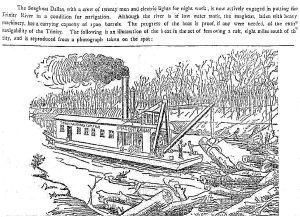
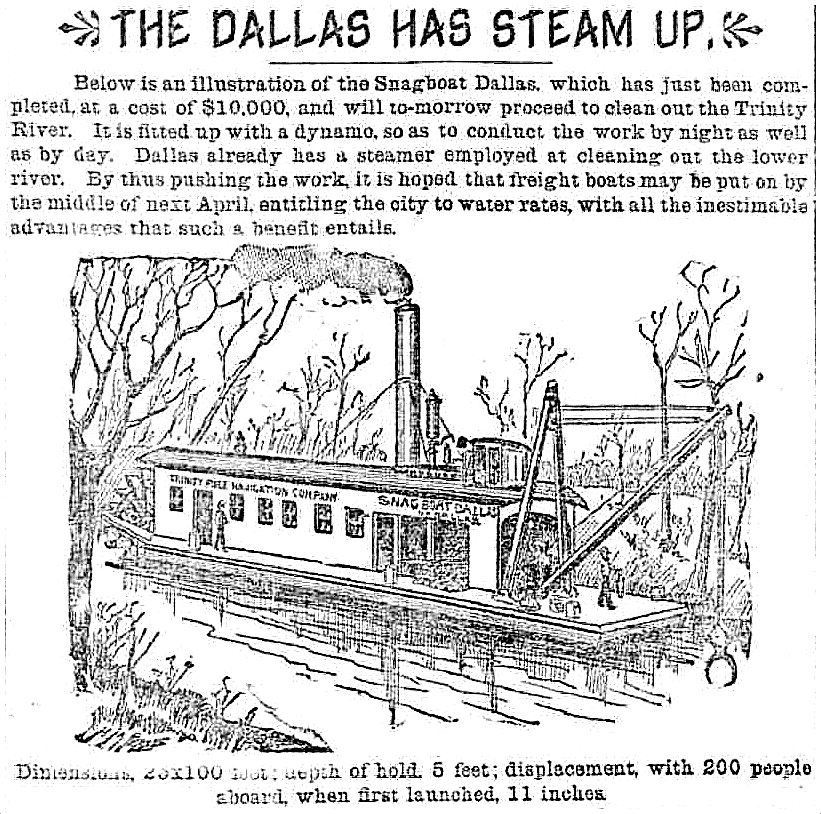
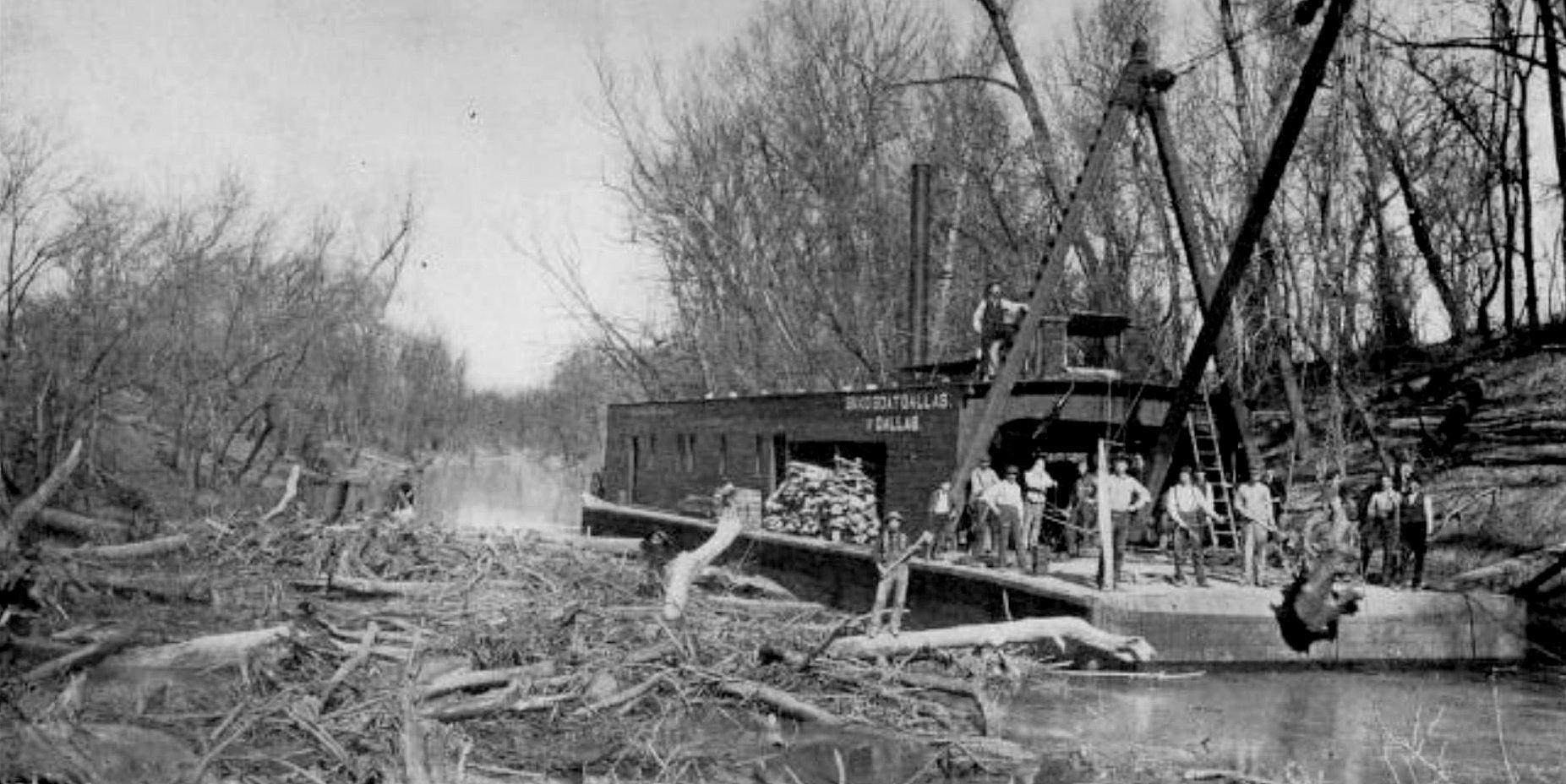
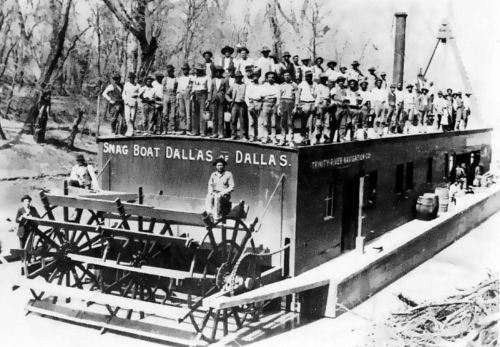
snagboat_dplSnag Boat Dallas of Dallas, Trinity River

by Paula Bosse

“Snagboat.” It’s a great word. And if you’ve taken even a glancing look into the history of the Trinity River, you’ve probably come across it. What is it? According to the Wikipedia entry, it is “a river boat, resembling a barge with superstructure for crew accommodations, and deck-mounted cranes and hoists for removing snags and other obstructions from rivers and other shallow waterways.” If you’re from Dallas, “shallow waterway” will immediately bring to mind our very own Trinity River, which, unless it’s flooding, you probably rarely even think of as being an actual river. But Dallas money-men have tried their damnedest for what seems like EVER to make the Trinity do what they wanted it to do.

In the late 19th century, a group of Dallas businessmen organized the Trinity River Navigation and Improvement Company and began to sink large sums of money into it. The goal was to make the Trinity navigable for large boats between the Gulf of Mexico and Dallas. They knew that if they could open this waterway to vessels carrying all manner of freight that they could make a lot of money. A lot.

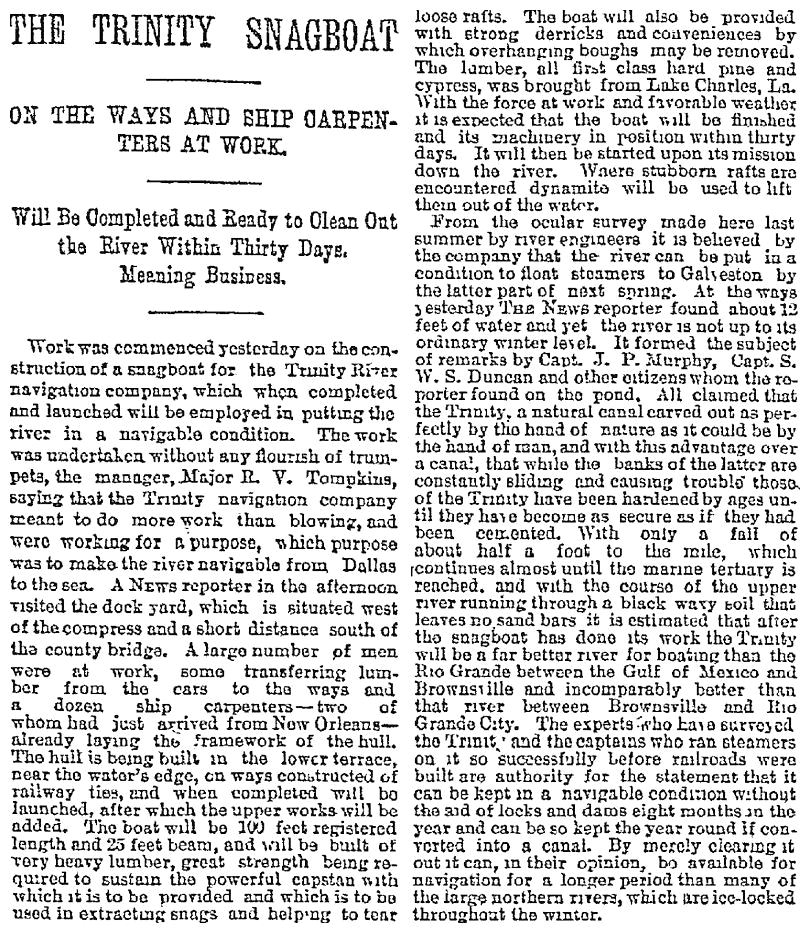
In order to make the Trinity navigable, it first had to be cleared of all sorts of impassable debris in it, on it, over it, and along it. The stretch of the river around the soon-to-be inland port of Dallas was particularly snarled with all sorts of things making passage of large boats through its waters impossible. A snagboat was needed, and construction on the Snag Boat Dallas of Dallas began in November of 1892.
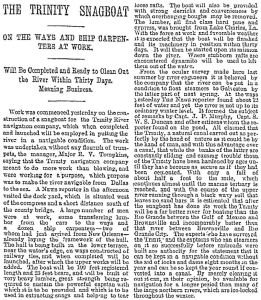
snagboat_dmn_112692Dallas Morning News, Nov. 26, 1892

The construction of the boat was followed closely in the Texas papers, and giddy ads/editorials like this one were filling the pages of Dallas newspapers.
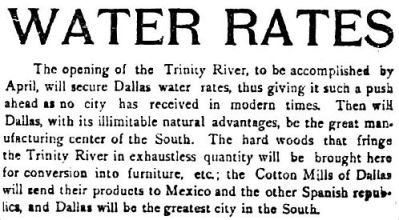
ad-water-rates_dmn_011593DMN, Jan. 15, 1893

“Water rates” — charges for freight shipped via boat — were lower than the rates charged by railroads. Were the Trinity able to support freight traffic, this new competition would mean that railroads would lower their rates, and the savings for manufacturers and builders would  be substantial. As a result, manufacturing and building in the city would boom, and before you knew it, Dallas would become “the greatest city on Earth in the South”!

A few days before the official launch of the boat, reporters, businessmen, and the public were invited to a preview. An interesting account in The Galveston Daily News described the boat’s machinery (which included a “liquid battering ram”) and took the reader on a tour of the crew’s quarters (which had separate sleeping and dining areas for black and white crew members, per the “Separate Coach Law” of 1891).
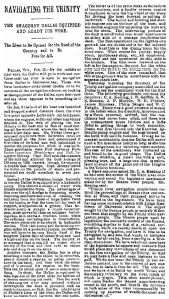
snagboat_galveston-daily-news-021993Galveston Daily News, Feb. 19, 1893

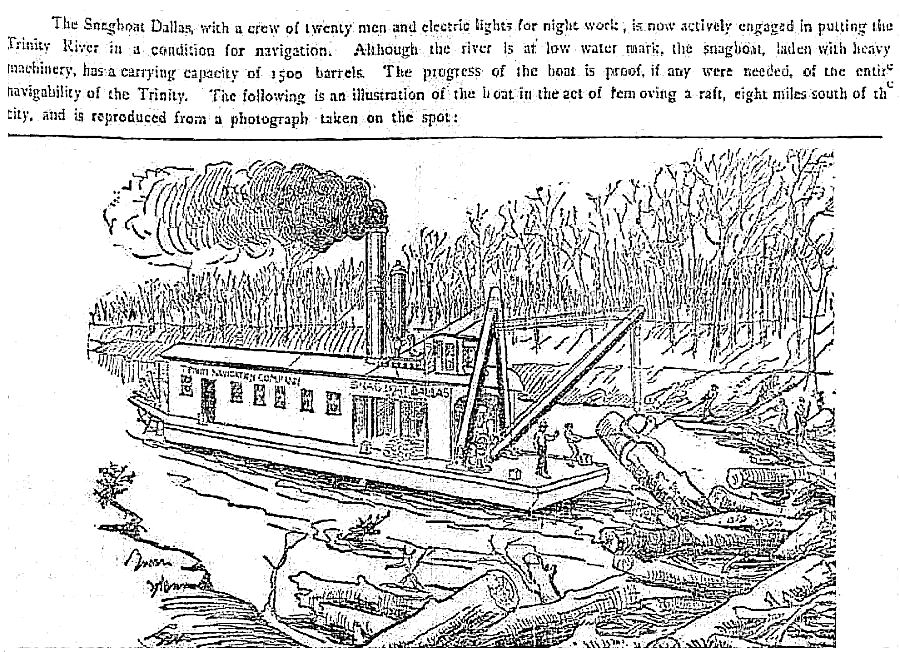
The boat began its snagging work in February, 1893, and, in order to keep readers abreast of all Snag Boat Dallas developments, there were almost daily updates on its progress in the newspapers, and (in lieu of photographs) Dallas Morning News illustrators provided scenes of the boat’s important work.
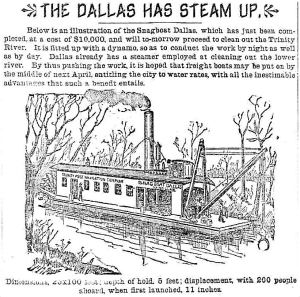
snagboat_dmn_021293DMN, Feb. 12, 1893

snagboat_dmn_022693DMN, Feb. 26, 1893

The celebrity snagboat succeeded in clearing the debris, and in May, 1893, the steamer H. A. Harvey, Jr. arrived in Dallas, having, yes, navigated the Trinity River from the Gulf, even though it had faced two months’ worth of difficulties along the way (problematic water levels, low bridges which had to be dismantled in order for it to pass under, underwater impediments which had to be dynamited into oblivion, etc.). When it finally pulled into Dallas — accompanied by the hard-working snagboat that had paved its way — the city shut down and had a massive celebration. The Dallas Morning News went so far as to print several of its pages in red ink (!). This proof that the Trinity River was, in fact, navigable, meant that the city was on the cusp on becoming “the greatest city in the South.” The DMN (which was not shy in its almost rabid boosterism of this project) published an editorial for those Dallasites who might “not fully comprehend” the significance of why they were celebrating.
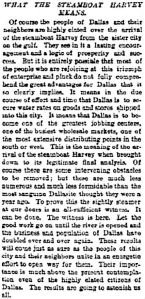
harvey-impact_dmn_052293DMN, May 22, 1893

Dallas would become an important inland port. “It can be done.”

Except that we know that it couldn’t be done. Too many other natural forces were working against the Trinity River entrepreneurs. The Harvey and the snagboat didn’t actually do much after that tumultuous reception in 1893. Sure, they moved some small loads back and forth along the Dallas stretch of the river, but that grand vision of taming the Trinity never came to pass. Even now, more than 120 years later, it still has yet to happen. Dallas has done pretty well without the Trinity River being truly navigable, but people can’t seem to stop trying to somehow monetize it. It’s probably time we just appreciated our little section of the Trinity River for what it is: a little trickle of a river that has (so far) survived everything we’ve tried to do to it in the name of “progress.”

*

For closure, snagboat fans: the hard-working little Dallas had an ignominious end. It was tied to an old pier and left to rot on the water before it was eventually cannibalized and slowly picked apart. Its end came in January of 1898 when it was finally “broken up.”
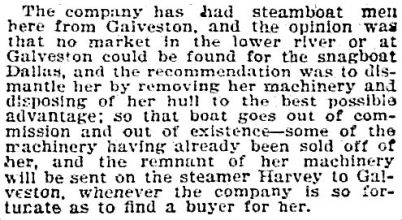
rip_dmn_052897DMN, May 28, 1897

RIP, Snag Boat Dallas of Dallas — we hardly knew ye.

*

The Harvey (which quietly left town when it was sold to a Louisiana company in 1898) has gotten the lion’s share of the historical attention, but the snagboat is the one that did all the work. Here are two more photos of the Dallas and its crew taking a break from snagging to pose for posterity.
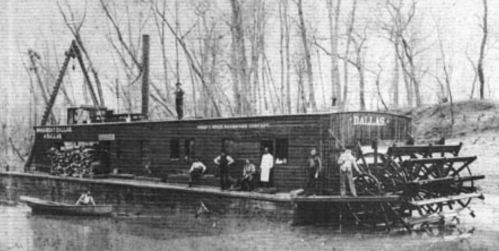
snagboat_dfwurbanwildlife

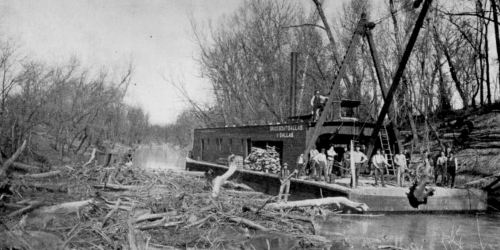
The photo below shows just what the crew of the snagboat was up against. The caption was written by C. A. Keating, president of the Trinity River Navigation Company.

snagboat_keating_1890s

snagboat-caption_keating

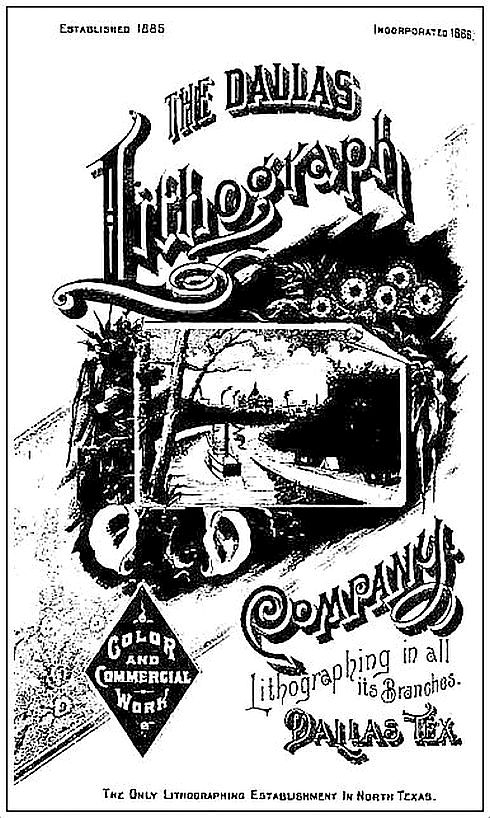
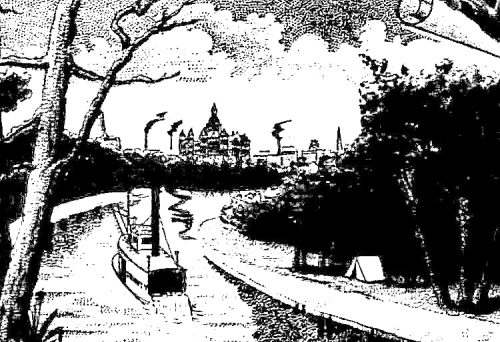
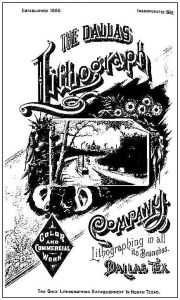
And, finally, what prompted me to find out more about the snagboat in the first place: this ad for the Dallas Lithograph Company from the 1893 city directory. It featured an illustration of a little boat chugging along on the idyllic (and blissfully snag-free) Trinity River, with the Old Red Courthouse in the background and a little tent pitched on the bank. I wasn’t all that familiar with snagboats, but that’s what I thought it looked like. I’m sure it’s supposed to be something grander, but I’ll think of it as a snagboat anyway.
ad-dallas-lithography-co_1893-directory-det

ad-dallas-lithograph-co_1893-dir1893 Dallas directory

***

Sources & Notes

I came across the top photo (which is from the archives of the Dallas Public Library) on the web page for the 99% Invisible podcast, here. I was so enthralled with the pictures on this page that I didn’t even realize until just now that there was a podcast to listen to, called “The Port of Dallas” — about this very topic! Listen to it at the top of the page — it’s very entertaining. I think Julia Barton and I were separated at birth!

There are lots of other photos on that page, including a photo of the H. A. Harvey, Jr. and a photo showing what the Dallas Morning News looked like printed in red.

Second photo of the Snag Boat Dallas is from the DFW Urban Wildlife blog, here. More great photos there!

The final photo of the Dallas and the photo’s caption are from C. A. Keating’s autobiography, Keating and Forbes Families and Reminiscences of C. A. Keating (Dallas: self-published, 1920).

All other clippings, as noted.

To read about how people have tried and tried and tried over the years to make the Trinity River do what they wanted it to do — and failed — read the article “Navigating the Trinity, A Dream That Endured for 130 Years” by Jackie McElhaney (Legacies, Spring 1991), here.

UPDATE: I swear I was completely unaware of Julia Barton’s podcast about the “Port of Dallas” when I wrote this post, but I’m happy to report there is ALSO a video, from a presentation she did at the TEDxSMU talks in October. Watch it here. (Thanks, for alerting me to that this, Julia — my “internet twin”!)

*

Copyright © 2015 Paula Bosse. All Rights Reserved.

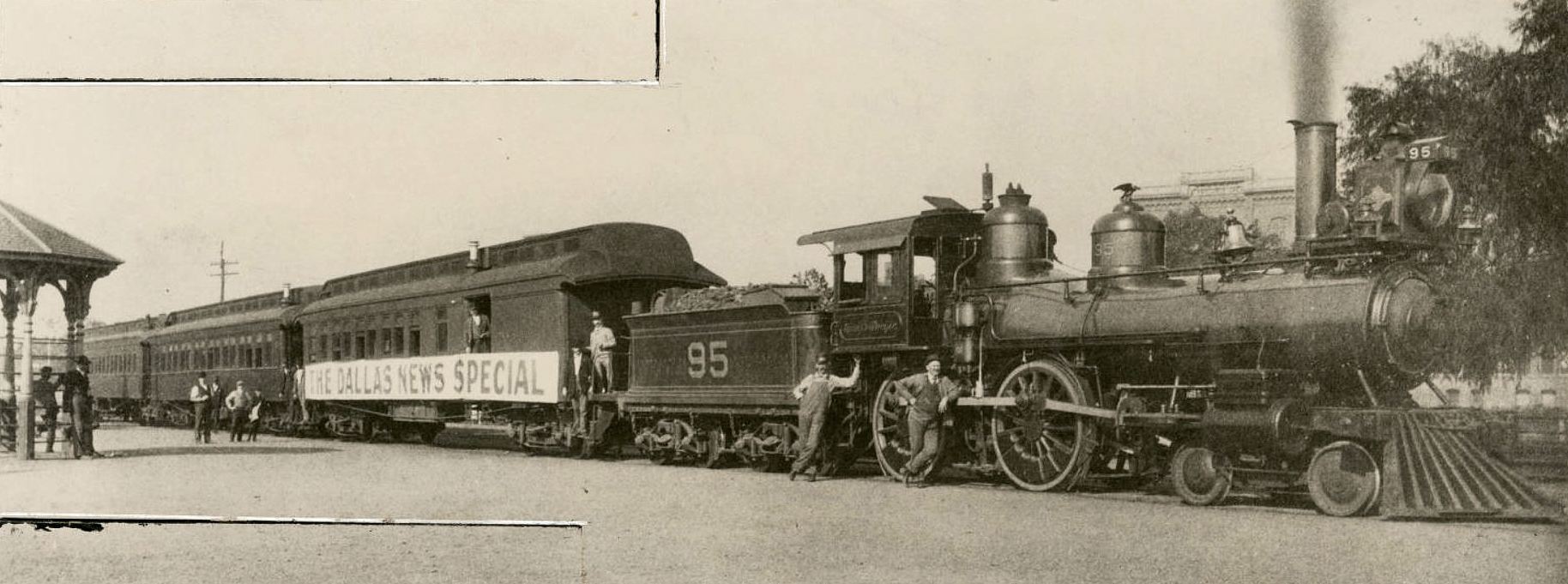
The Dallas News Special: Fast Train to Denison — 1887

dallas-news-special_belo-collection_smuThe Dallas Morning News, full speed ahead! (Belo Collection, SMU)

by Paula Bosse

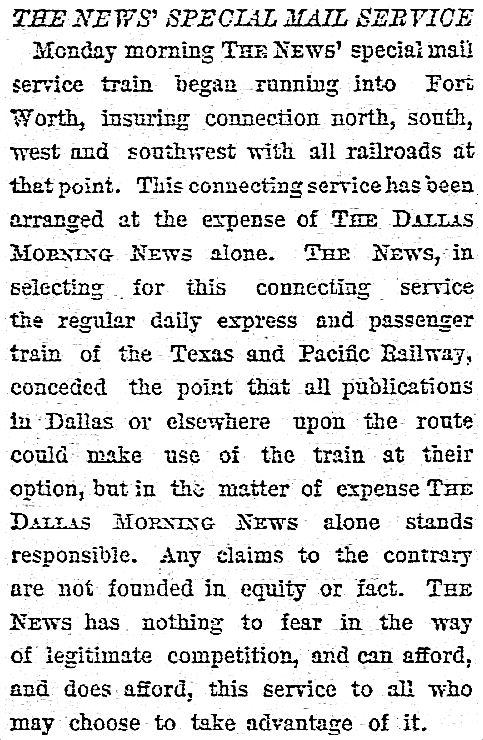
In October 1885, The Galveston News decided to launch a sister publication in Dallas, The Dallas Morning News. They sent 26-year-old George Bannerman Dealey to run it. Before that first month was up, go-getter Dealey had made a special arrangement with the Texas & Pacific railroad — “at considerable expense to The News” — to extend its route and pop into Dallas to pick up papers destined for its subscribers west of the city. (The photo at the top may or may not show that very first “Special Mail train.”)

news-train-fort-worth_dmn_102885DMN, Oct. 27, 1885 (click for larger image)

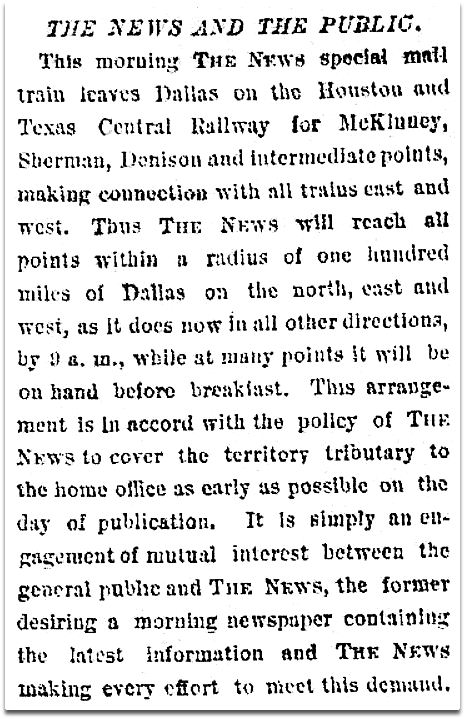
A year and a half later, The News one-upped itself and made the announcement that it would operate a special train to Denison — again, “at a vast expense.” This train would transport editions of the paper in the wee small hours in order to assure that The Dallas Morning News would actually BE a morning newspaper for as many of its subscribers as possible, whether they lived “within a block of the press” or a hundred miles away (DMN, Sept. 30, 1888). News-hungry Denisonians could read their papers over breakfast at the same time their Dallas counterparts did.

news-train_dmn_052287DMN, May 22, 1887

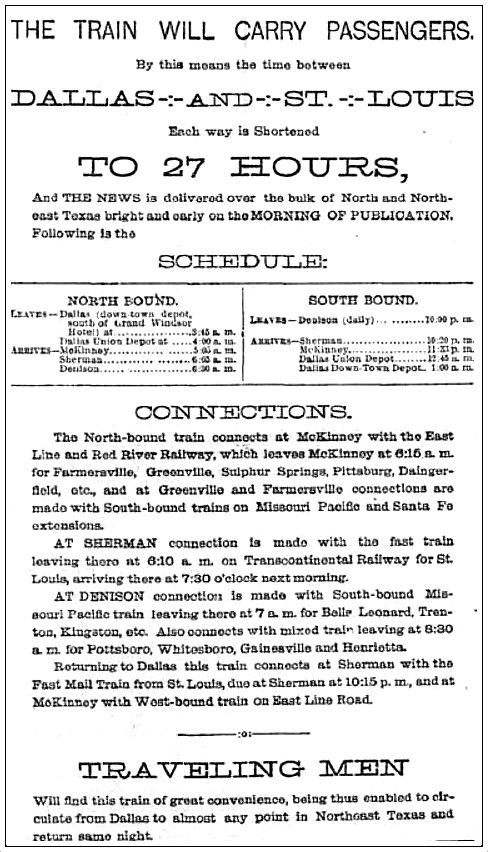
The train was dubbed by some “The Comet” (not to be confused with the MKT’s later Katy Komet). It was a “fast train” that carried passengers as well as newspapers along the Houston and Texas Central rails.

ad-special-news-train_dmn_052287-det

ad-special-news-train_dmn_052287-det2DMN, May 22, 1887

Not only was this a clever way to extend its reach and expand its circulation, but, as the Handbook of Texas notes, it also “enabled the paper to meet the threat of the St. Louis newspapers, which in 1885 had a larger circulation in North Texas than did any state paper.”

A rousing account of the first Dallas-to-Denison run appeared in the pages of both The Dallas News and The Galveston News (which often shared content). A link to that full story is below, but here are a few passages from an article written the next year, touting the wondrous success of the News Special, written as only a nineteenth-century newspaperman could write it (and the writer might well have been G. B. Dealey himself).

First, one encounters a mention of Plano in a more grandiose combination of words than one might expect, as the writer describes his pleasant pre-dawn train trip along the route.

Plano was reached before the drowsy god of day had wiped his eyes at the first yawn. He rolled over in his couch by the time it reached McKinney, and he was sitting on the side of it when the train was at Melissa. And here the mocking birds, with no ruddier iris upon their breast, but moved with the spirit that makes the burnished dove mourn out his love, made the air resonant with their chatter and their songs. Into Sherman and Denison the train plunged and the trip was done.

Um, yes. Then he breaks it down in a little more specifically. Actually, a LOT more specifically.

It starts. Two minutes are consumed at the Missouri Pacific crossing five miles out, two minutes at Caruth’s, five minutes for water, two minutes at Richardson, two minutes at the Cotton Belt crossing, three minutes at Plano, two minutes at Allen, three minutes at McKinney, two minutes at Melissa, fifteen minutes at Anna for a meeting point, three minutes at Van Alstyne, two minutes at Howe, five minutes at Sherman. Total forty-eight minutes. The distance between Sherman and Dallas is sixty-four miles. The time card calls for two hours and five minutes from Dallas to that point. Forty-eight minutes is consumed in stoppages. Anyone can make the calculations, sixty-four miles in seventy-seven minutes, and see the terrific speed that this train makes, has made for over a year, and made it without a single accident, and it is a good road — an awful good road — to make it over.

And then he congratulates his employer on giving even its most distant readers “an even whack.”

Is there anything like this in the history of newspapers? True, some of them in the north run special trains on special occasions, but THE NEWS stands without a rival in this sustained work of giving its remote patrons an even whack with its people of the city. (–The Dallas Morning News, Sept. 30, 1888)

Below, a train identified as this H&TC News Special to Denison, even though it looks remarkably similar to the T&P train (in the photo above) which may or may not have been that earlier 1885 mail train to Fort Worth. Dealey is identified as the man in the light-colored suit, standing on the steps (he also resembles the man in the top photo, but now with a full beard).

dallas-news-special_train-to-denison_1887_mcafee_degolyer_SMU

The train would slow down as it neared a small-town depot, and, without stopping, a man would toss bundles of papers from the train into the waiting arms of another man on the platform, who would then divide them up and hand them off to men and boys on horseback who would race to deliver them to stores and homes before breakfast.

The Dallas Morning News ran its hot-off-the-presses newspapers up to Denison for several decades on this train until, presumably, cheaper trucks were pulled into action. But did the rather less romantic trucks, rattling up to Grayson County, inspire the mockingbirds to “[make] the air resonant with their chatter and their songs” as had the noble locomotive speeding the news through the night? I think not.

*

dallas-news-train_degolyer-lib_SMU_ca-1885Dallas News offices, via DeGolyer Library, SMU

***

Sources & Notes

Top photo, titled “The Dallas Morning News special train,” is from the Belo Records, DeGolyer Library, Central University Libraries, Southern Methodist University; it can be viewed here. It’s a bit confusing, but this may show the inaugural run of the DMN’s special train to Fort Worth on May 22 ,1885, along the Texas & Pacific Railway. If anyone has suggestions on where this photo may have been taken, please let me know.

I came across a cropped version of the second photo in the March 1976 issue of Texas Historian, with the caption: “The Comet, Dallas News special train operated between Dallas and Denison in 1887. G. B. Dealey, then Dallas News business manager, stands on first car platform.” The version seen above is from the George A. McAfee photographs collection, DeGolyer Library, Southern Methodist University here; it is titled ”The Dallas News Special (H&T.C.).”

If you’re into trains (and even if you’re not), you might enjoy reading the following three stories from The Dallas Morning News:

  • “Special Mail Service, Observations of a Staff Correspondent Along the Route” (DMN, Oct. 27, 1885), describing the new Fort Worth route and how The News convinced (i.e. paid) the Texas & Pacific Railway to include a stop in Dallas to load up on newspapers and haul them westward, can be read here.
  • “The News in North Texas, The Special Mail Train Service” (DMN, May 23, 1887), a rousingly written ride-along narrative, is here. (I would advise more fragile readers to skip to the next paragraph when they come across mention of a cute little calf — nineteenth-century journalism is not for the overly sensitive.)
  • “News Special Train, Between Dallas and Denison Before Day, Remarkable Record, But the Following Cheerful Narrative Tells the Whole Story, Extending Over Sixteen Months, Over Fifty Miles An Hour” (DMN, Sept. 30, 1888), another genuinely exciting and poetic account of the special train and its crew, again, probably written by Dealey, can be read here. The few sentences that are illegible at the bottom of the first column: “He rang it with jerks in town, he rang it clangingly at crossings, but away out in the solitudes of the country, softly and gently he would peal it slowly, as if he had quit; softly as if his head had dropped upon his bosom. Lyerly is promoted now. Lasher is on the regular passenger train, and R. R. Roe has beautifully and [evenly?] taken his place. But Gentry still sits upon his old seat on the right hand side and watches growing into beefhood the….” 

*

Copyright © 2015 Paula Bosse. All Rights Reserved.

Horses, Carriages, Horseless Carriages: Commerce Street — 1913

new-skyline_c1912_degolyer_smuWest on Commerce, from about St. Paul (click for larger image) / SMU

by Paula Bosse

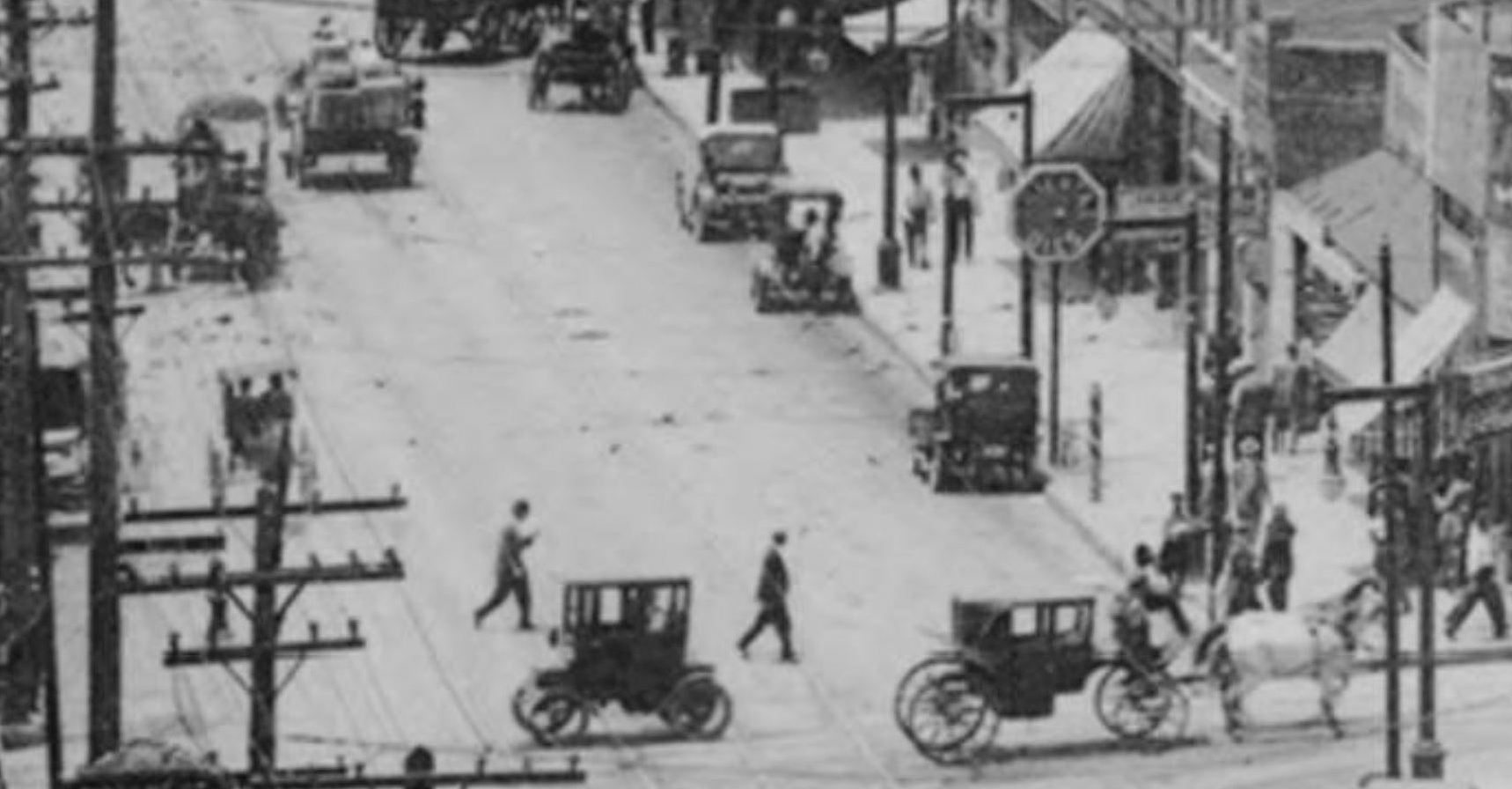
The photo above is from the indispensable collection at SMU’s DeGolyer Library. It shows a very busy Commerce Street in 1913, taken from the top of the YMCA building at St. Paul, looking west. The two landmarks at either end of Commerce are the first location of the Majestic Theatre at 1901 Commerce (northeast corner of Commerce and St. Paul), seen in the bottom right corner, and the Adolphus Hotel at the top left. I love this photo, mostly because it shows horse-drawn conveyances and automobiles sharing the streets in an already car-crazy Dallas, something that might not be that noticeable at first glance until you start zooming in to see magnified details. Let’s zoom in. Way in. (All images much larger when clicked.)

1-rooftops-skyline

2-traffic-skyline-1

Dallas has begun to look like a big city.

3-traffic-skyline-2

Below, the building on the right with the steep steps is the old Post Office/Federal Building at Ervay. The Mercantile Bank Building was built on that site in 1942.

4-traffic-skyline-3

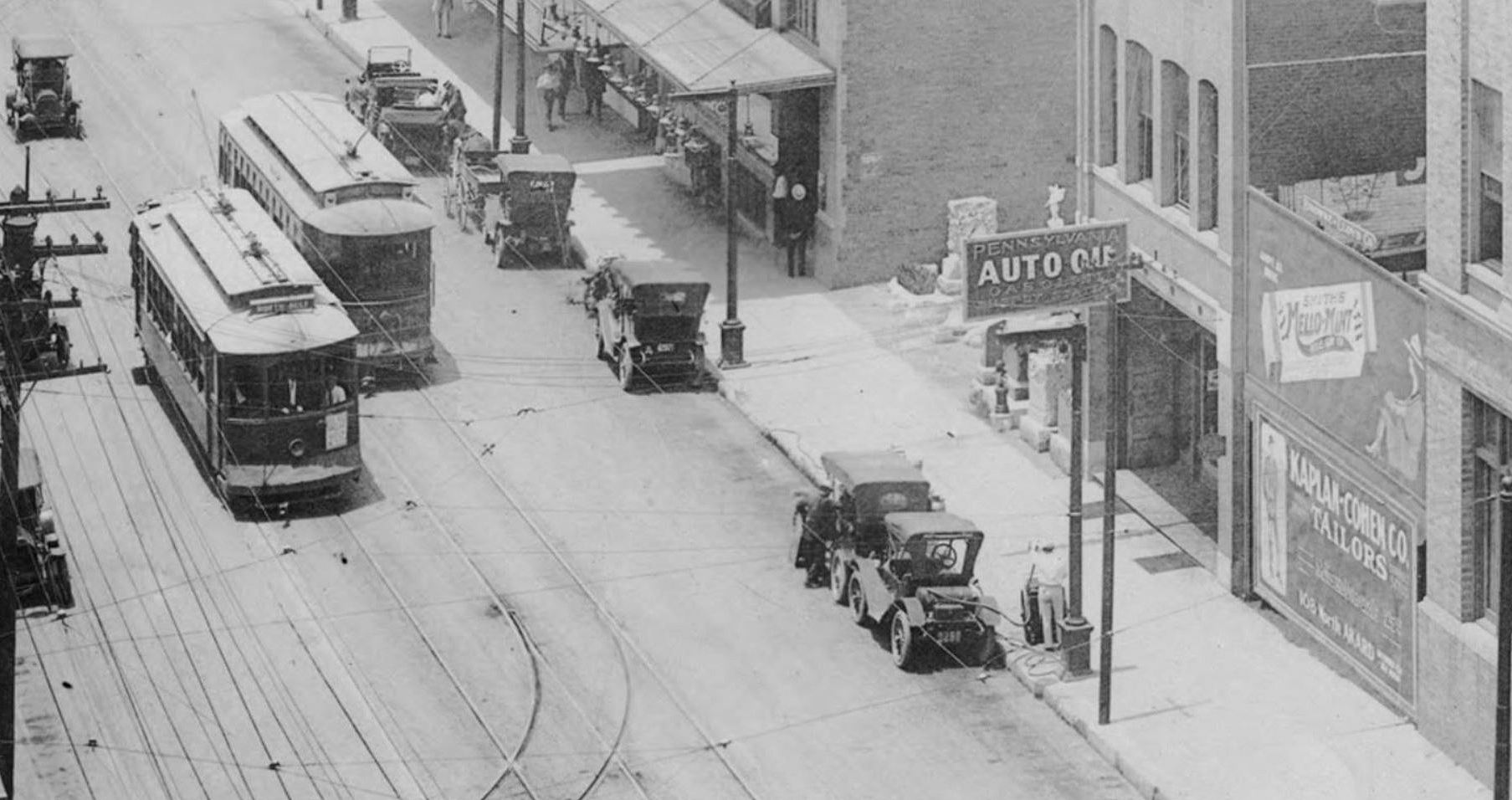
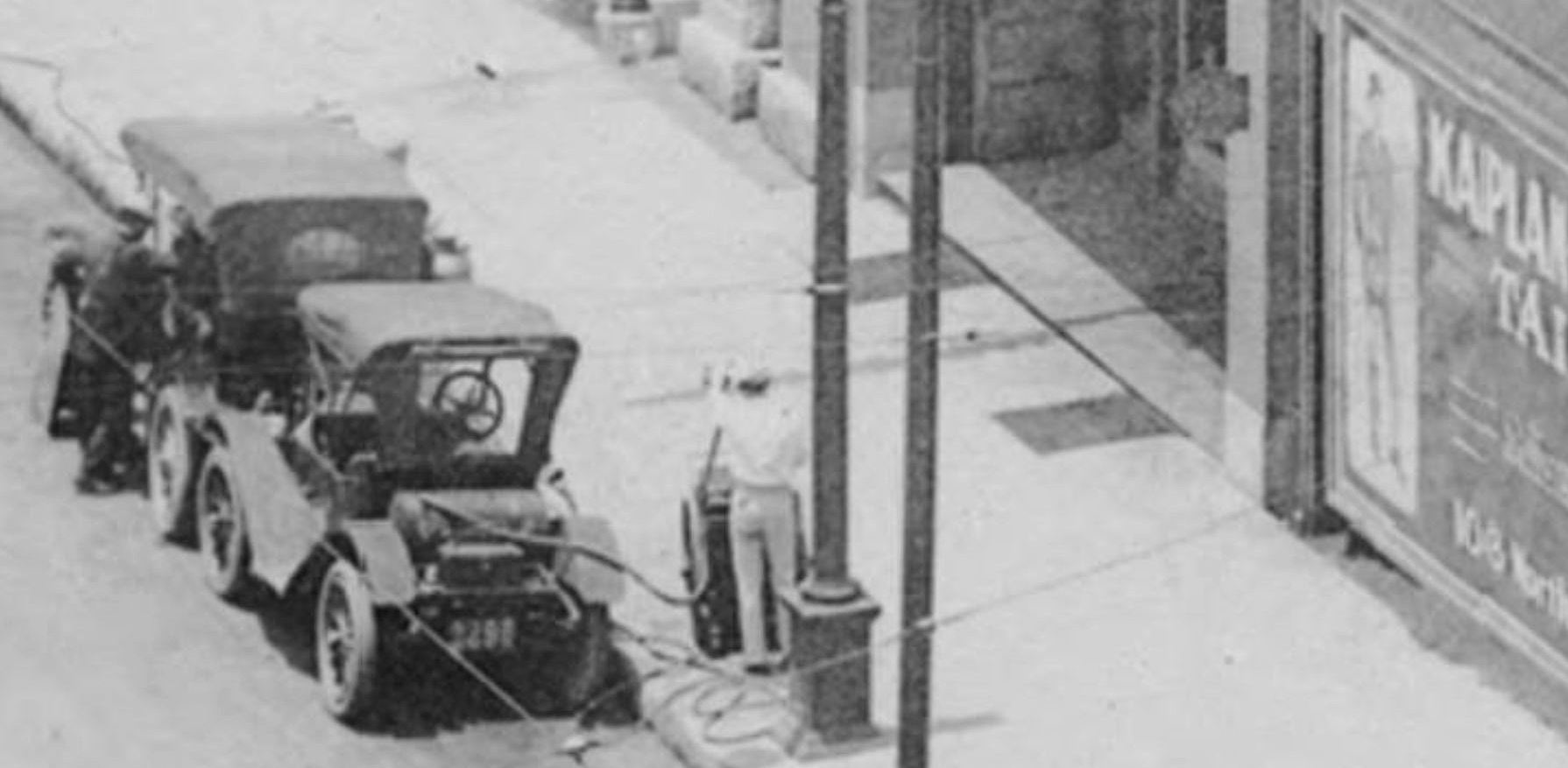
I love the detail below for a couple of reasons: first, the car at the curb at the lower right is parked next to what is purported to be the first gas pump in Dallas (the sign next to it that looks like a stop sign says “Oriental Oils” — more below); secondly, the ratio of cars to horses is pretty even.

5-traffic-skyline-4

A block east of the Oriental Oil gasoline feuling station is the Pennsylvania Oil Company feuling station, at 1805 Commerce. When I first saw this last year, I was so excited to discover this seemingly mundane little detail that I wrote an entire post about these early curbside gas pumps (read “Oriental Oil Company: Fill ‘er Up, Right There at the Curb” here).

7-gas-skyline-1

And a couple more close-ups of this exotic thing which I still find inexplicably fascinating.

8-gas-skyline-2

9-gas-skyline-3

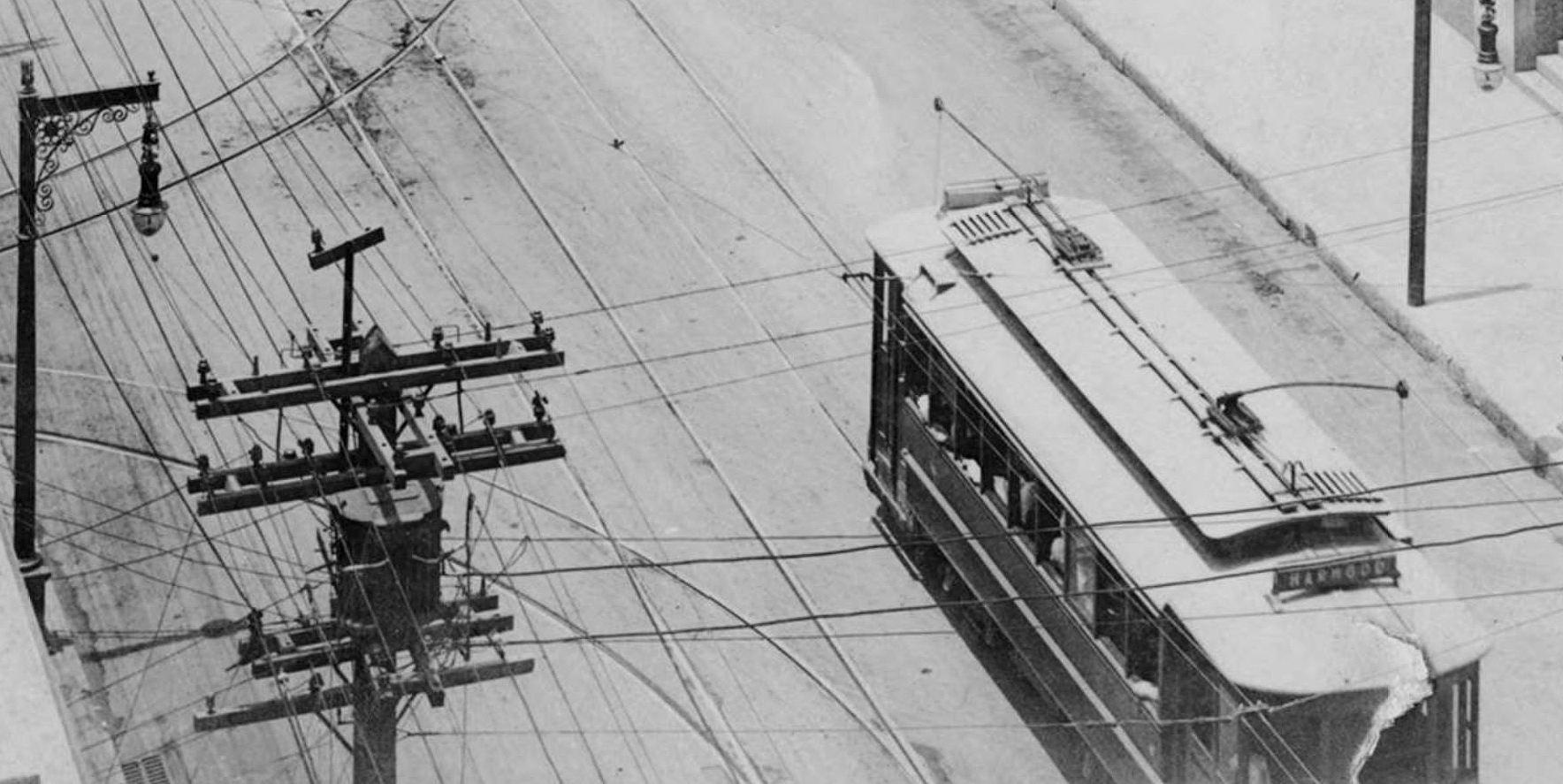
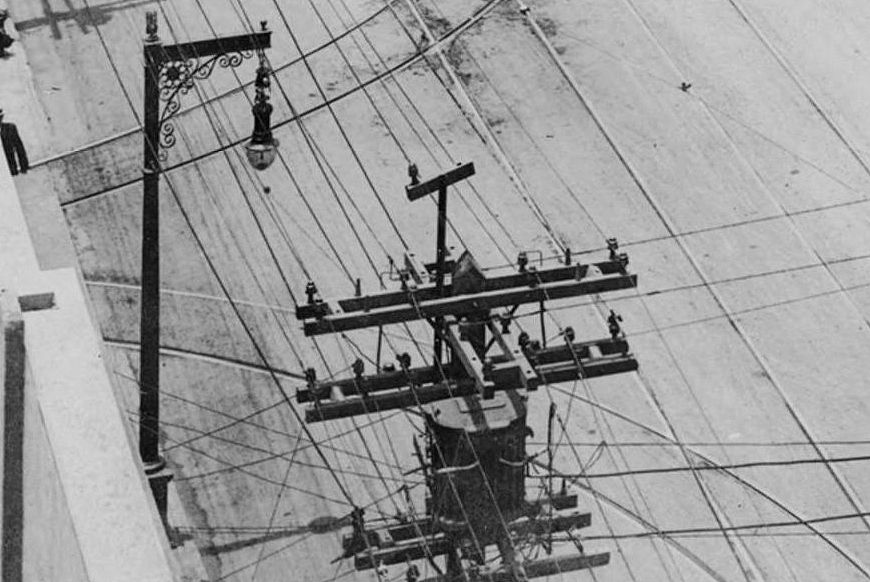
So many wires, and tracks. The Harwood streetcar is cool, but that streetlight is cooler.

10-lamp-skyline-1

11-lamp-skyline-2

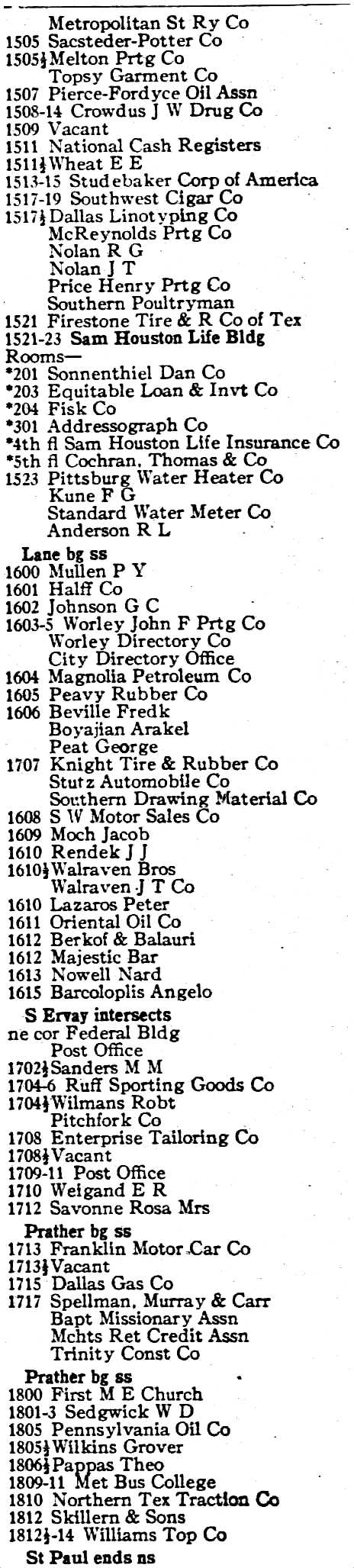
Below, a listing of most of the businesses seen along this stretch of Commerce, from the 1913 Dallas directory.

commerce-street_1913-directory***

Original photo is titled “New Skyline from Y.M.C.A., 1912 & 1913,” taken by Jno. J. Johnson, from the DeGolyer Library, Central University Libraries, Southern Methodist University; it can be viewed here. I have corrected the color.

The current Google Street View of Commerce looking west from St. Paul can be seen here. Very different.

UPDATE: This photograph is from 1913. The Busch Building (later the Kirby Building) began construction on the steel superstructure of the building at the end of December, 1912. The building had reached 13 stories by May, 1913 and was completed in November or December, 1913. I have updated the title from “ca. 1912” to “1913.”

All of these images are really big. Click them!

*

Copyright © 2015 Paula Bosse. All Rights Reserved.

Dallas Consolidated Electric Street Railway Co. Ad — 1902

streetcar_dce_worleys_1902-det

by Paula Bosse

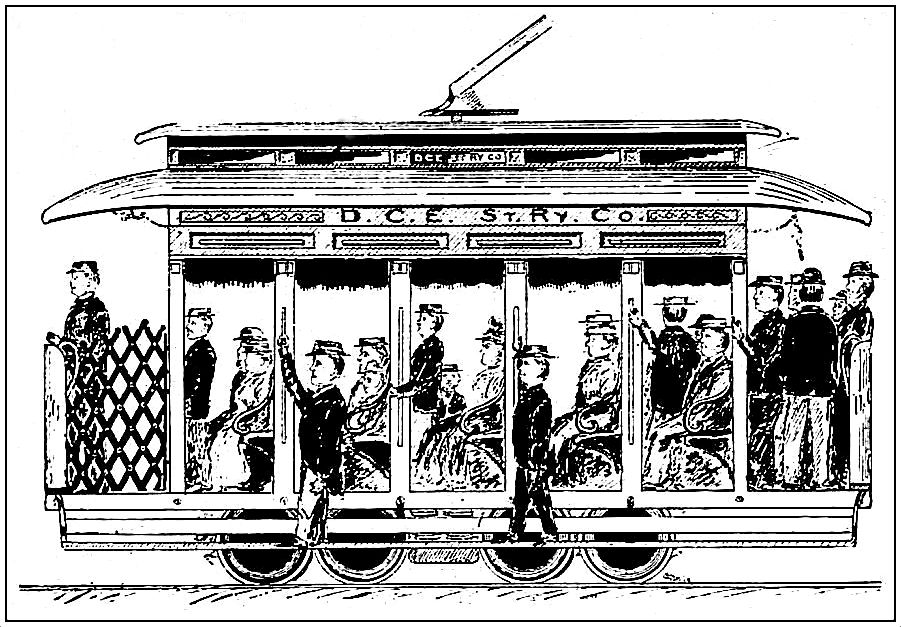
Why bother with a horse and buggy when you can take the streetcar?

streetcar_dce_worleys_1902-det1

streetcar_dce_worleys_1902(click me!)

streetcar_dce_worleys_1902-det2

***

D.C.E. St. Ry. Co. ad from the 1902 city directory.

Click for larger images.

*

Copyright © 2015 Paula Bosse. All Rights Reserved.

An Afternoon Outing with SMU Frat Boys & Their Dates — 1917

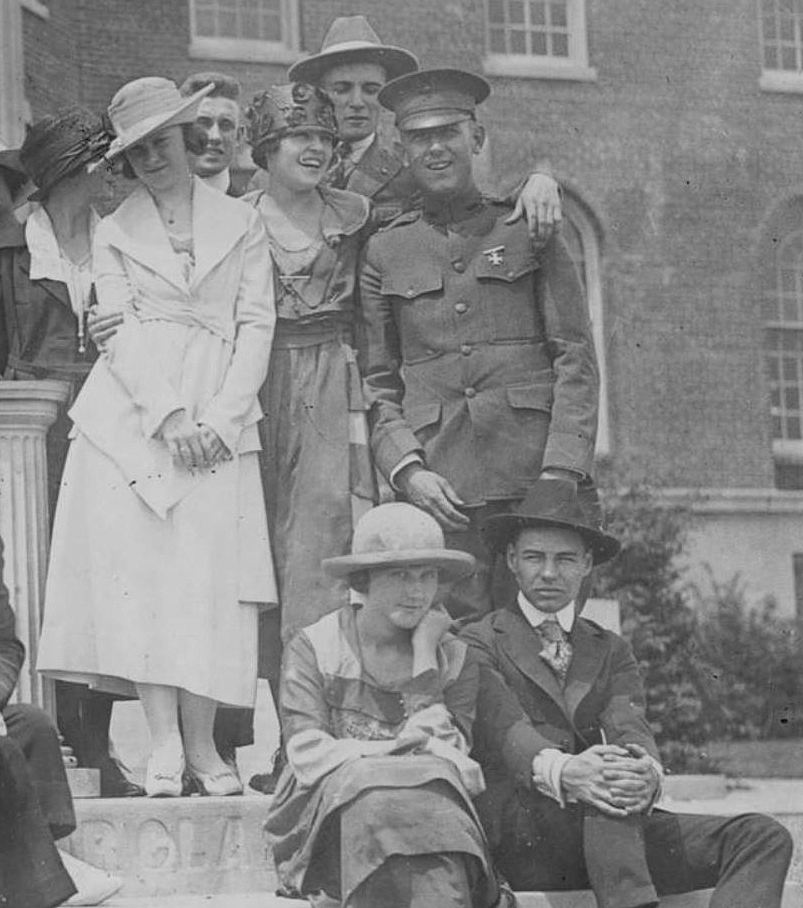
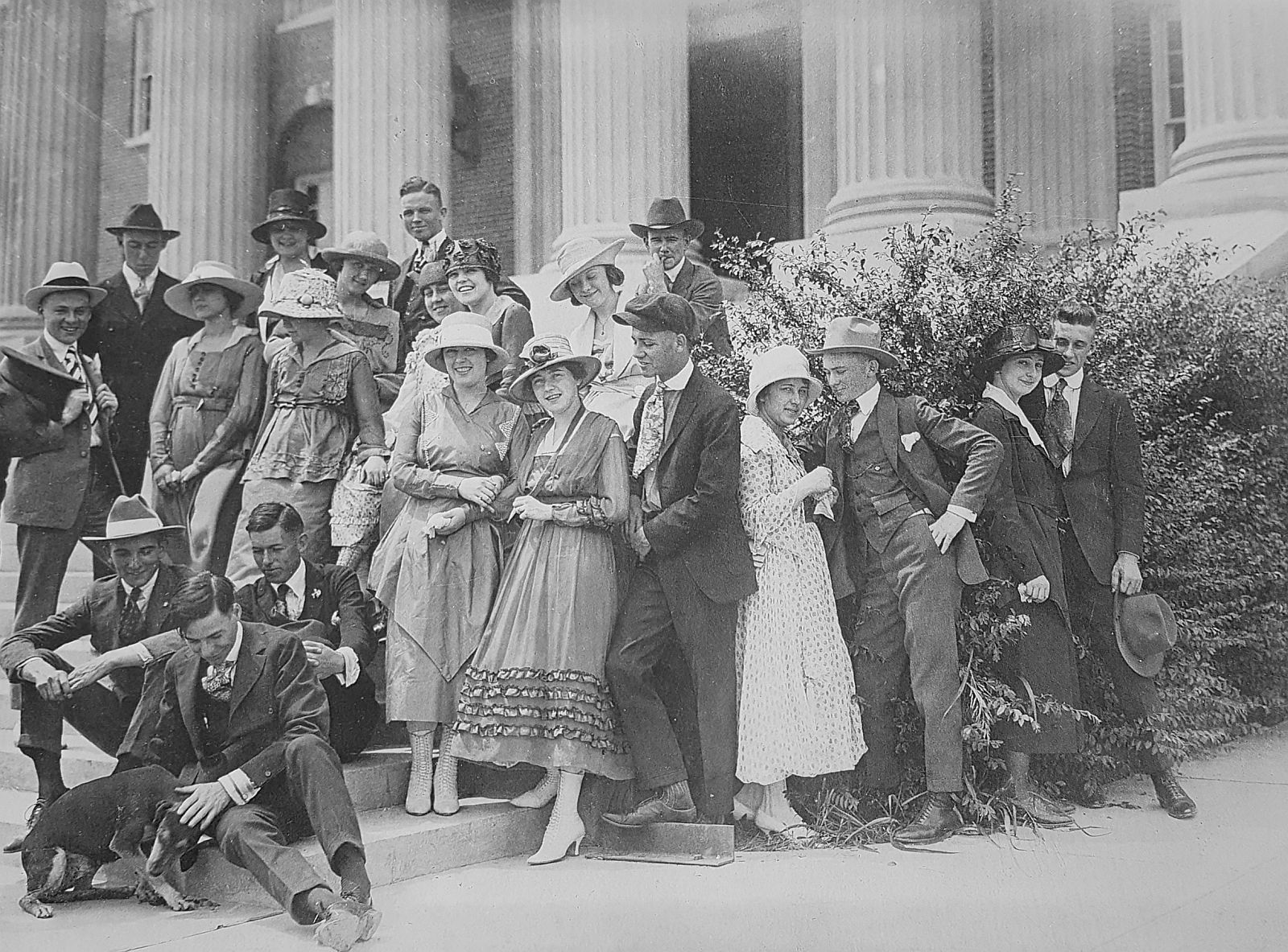
smu_omega-phi_dallas-hall_1917_degolyerCampus couples, 1917

by Paula Bosse

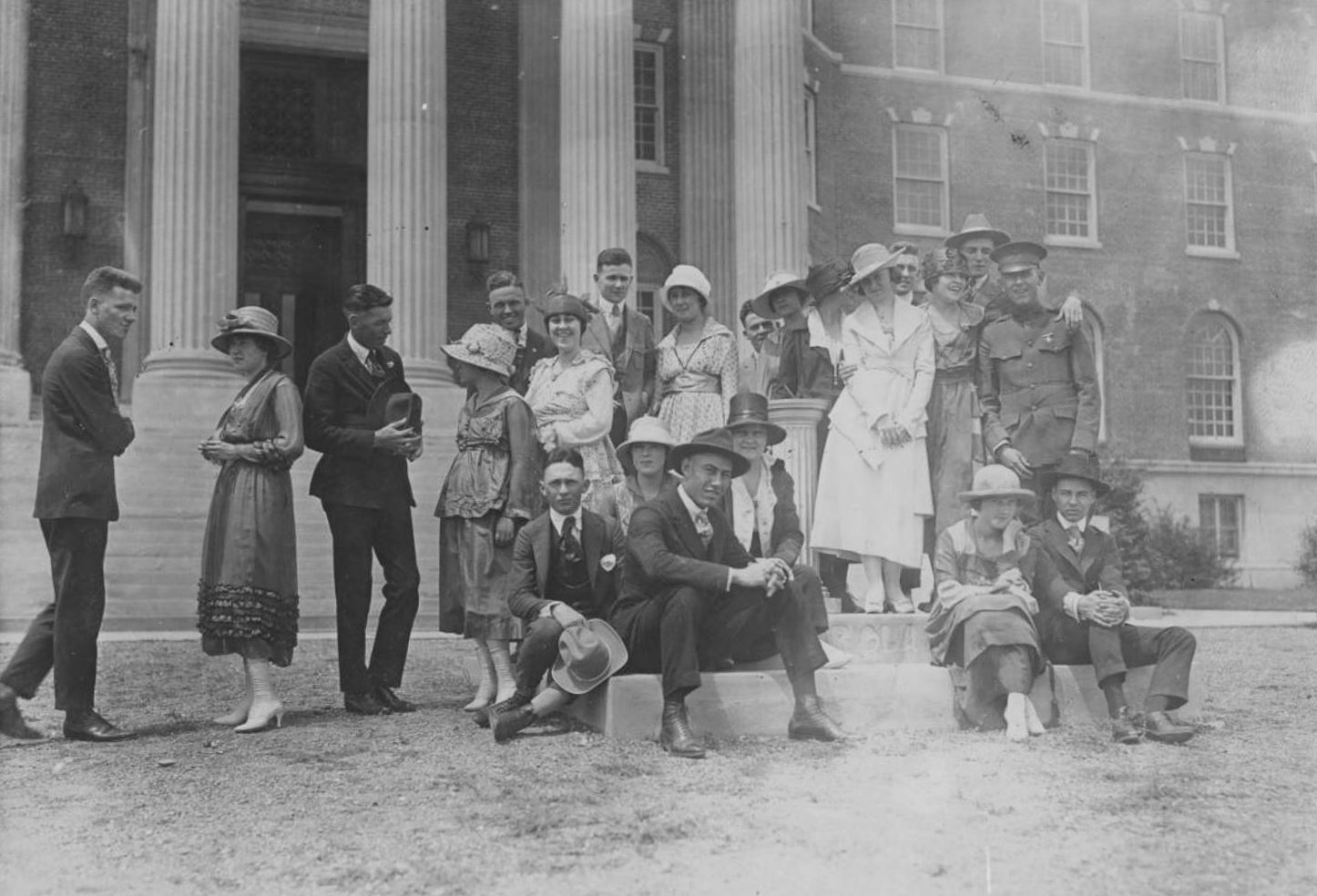
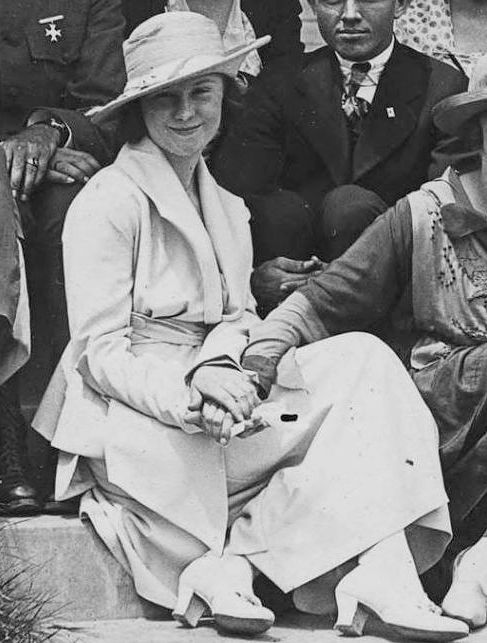
I came across three wonderful World War One-era photos in the SMU archives while I was looking for something else. You know how you can become enthralled by the charm of old photos and sit for long stretches of time staring at every little detail and wondering about the lives of the unidentified people who populate them? That happened to me with these. There is one particular young woman who stands out more than anyone else. Not only is she the best-dressed person in the photos, she also seems calm, collected, and serene. She looks friendly. She was probably very pleasant to have around.

These three photographs show a group of ten young couples and a pair of chaperones spending a beautiful sunny day together, with the highlight of the day being a trip to Highland Park’s Exall Lake. The men are SMU students, identified only as members of the Omega Phi fraternity. The women are identified merely as “dates,” but I’m sure that some of them were also SMU students. The photograph above shows the crowd gathered on campus in front of Dallas Hall. The woman in white looks like she’s on a pedestal, glowing in a spotlight. Below, a closer look at her stylish outfit (as well as a look at the young be-medaled WWI soldier next to her).

smu_omega-phi_dallas-hall_1917_degolyer-det1

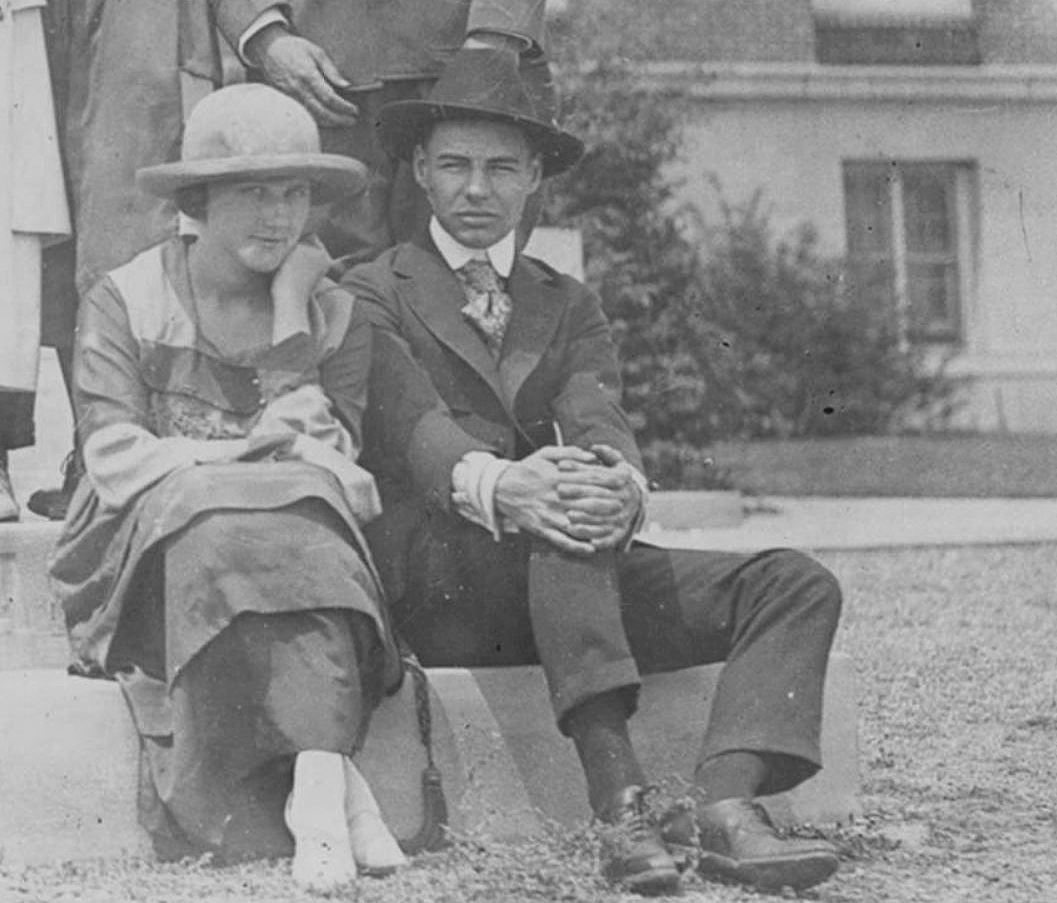
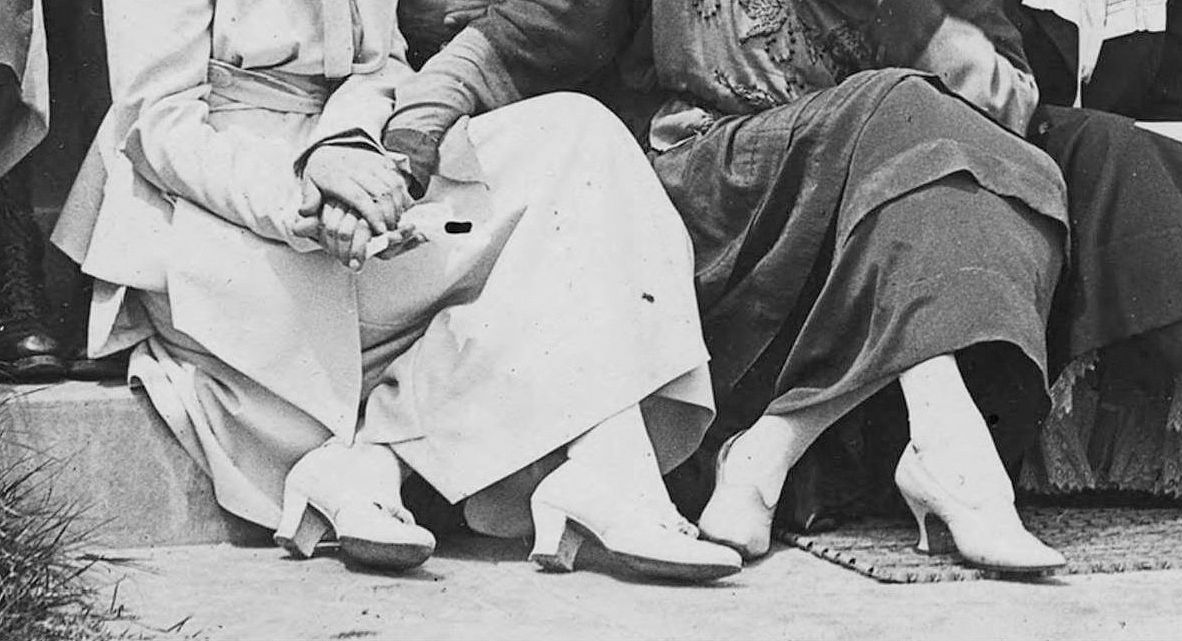
And, below, a similar detail, but this one showing the daintily crossed ankles of another pretty girl, seated beside a sour-looking companion.

smu_omega-phi_dallas-hall_1917_degolyer-det2

And here’s the gang on the idyllic banks of Exall Lake. Diane Galloway included this photograph in her book The Park Cities, A Photohistory with this caption:

At one time a bridge crossed Exall Lake near the Cary house, shown in the distance. The photographer was standing on the bridge to capture this picture of well-dressed SMU students going boating on the lake. A trip to Lakeside Drive was one of the few off-campus excursions permitted in 1917.

I love this photo. If I didn’t know what the Turtle Creek area looked like, I’d be hard-pressed to identify this as Dallas!

smu_omega-phi_exall-lake_1917_degolyer

Here’s a close-up of the beatific, smiling woman in white. I like the kid lurking in the background.

smu_omega-phi_exall-lake_1917_degolyer-det1

And the boat.

smu_omega-phi_exall-lake_1917_degolyer-det2

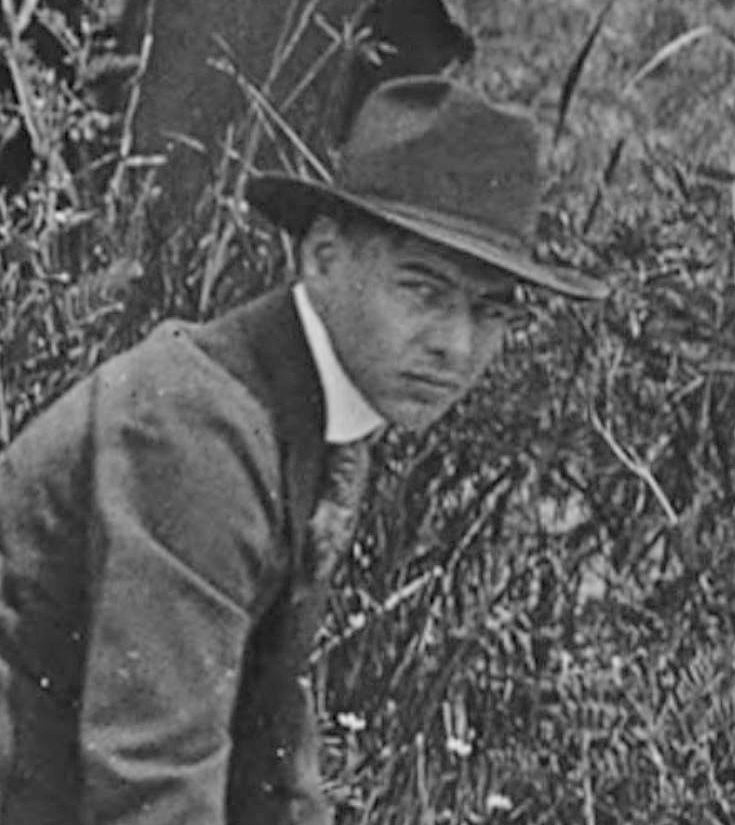
And the sour-looking guy again, looking even more annoyed than before.

smu_omega-phi_exall-lake_1917_degolyer-det3

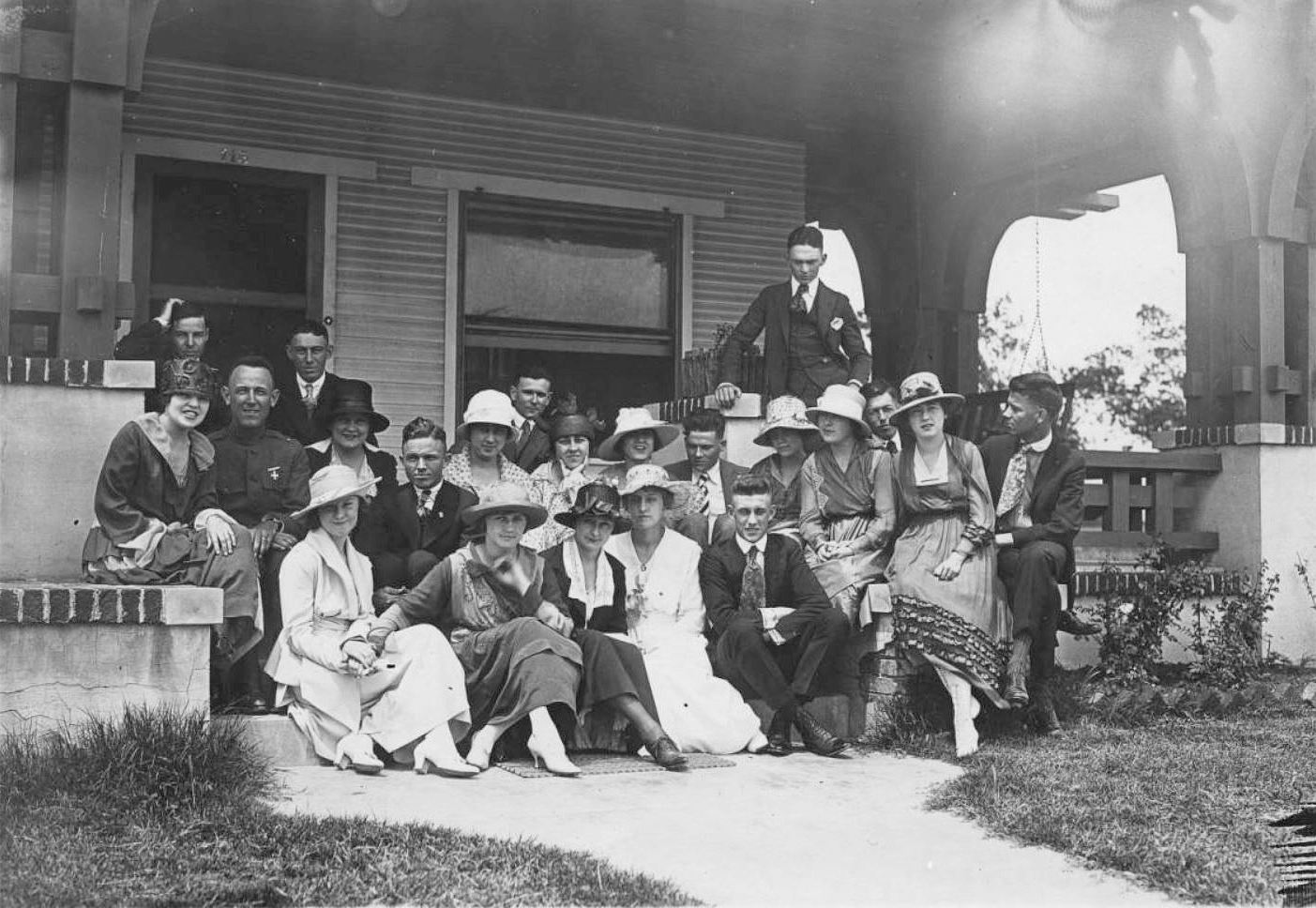
And here’s the crowd sitting on the steps of the frat house (which was located at Haynie and Hillcrest). The personnel has changed a little bit (they gained a woman and lost a man), but (almost) everyone seems pretty happy.

smu_omega-phi_porch_1917_degolyer

And, below, my very favorite detail from these three photos.

smu_omega-phi_porch_1917_degolyer-det1

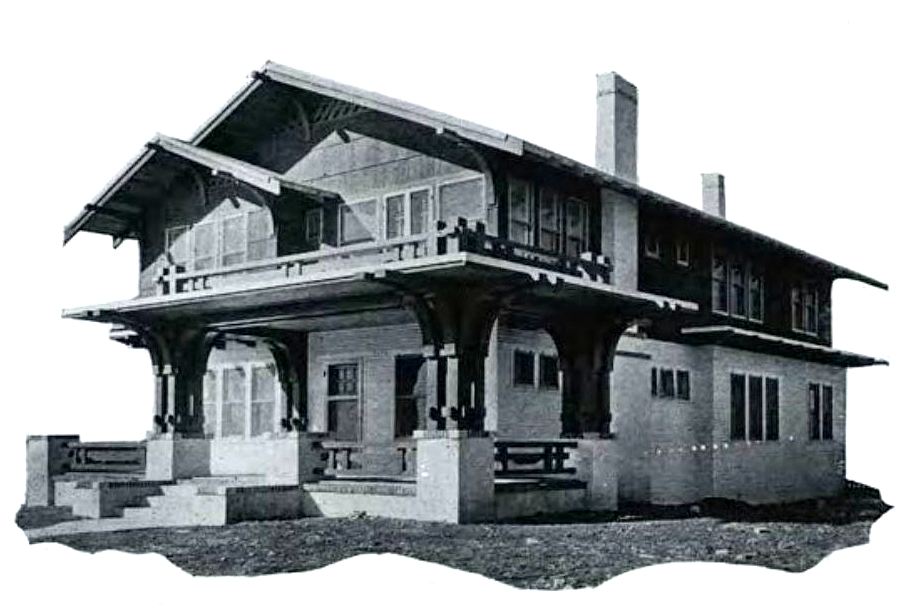
After a bit of sleuthing, I found a picture of the house at the time these photos were taken. It was actually a residence which was, I think, being rented out to the small group of Omega Phis. They had a proper fraternity house built several years later.

omega-phi-house_rotunda_1917

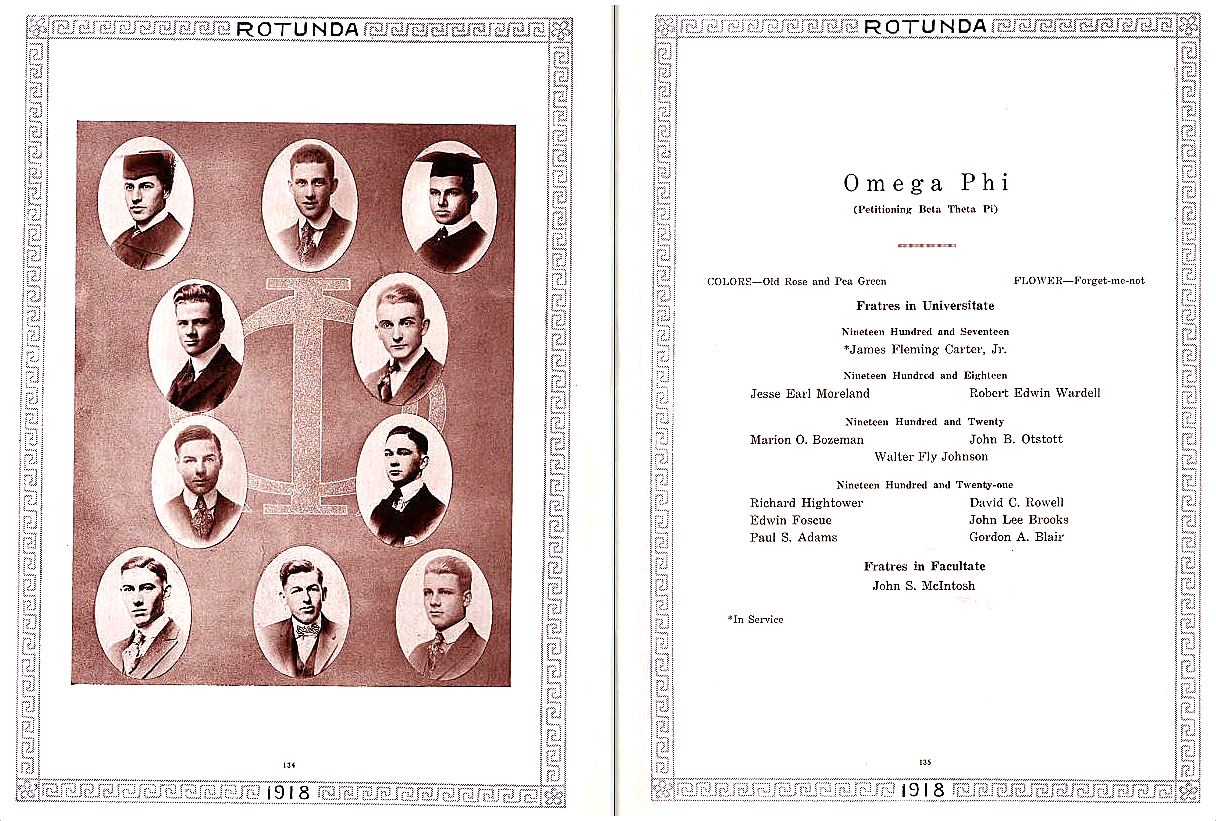
The top photo had “1917” written on the back, so I checked SMU’s Rotunda yearbooks from around that time. Here’s a look at the men who were members of Omega Phi in 1918. Several of these faces match the ones in the photos of the afternoon outing.

omega-phi_rotunda-1918

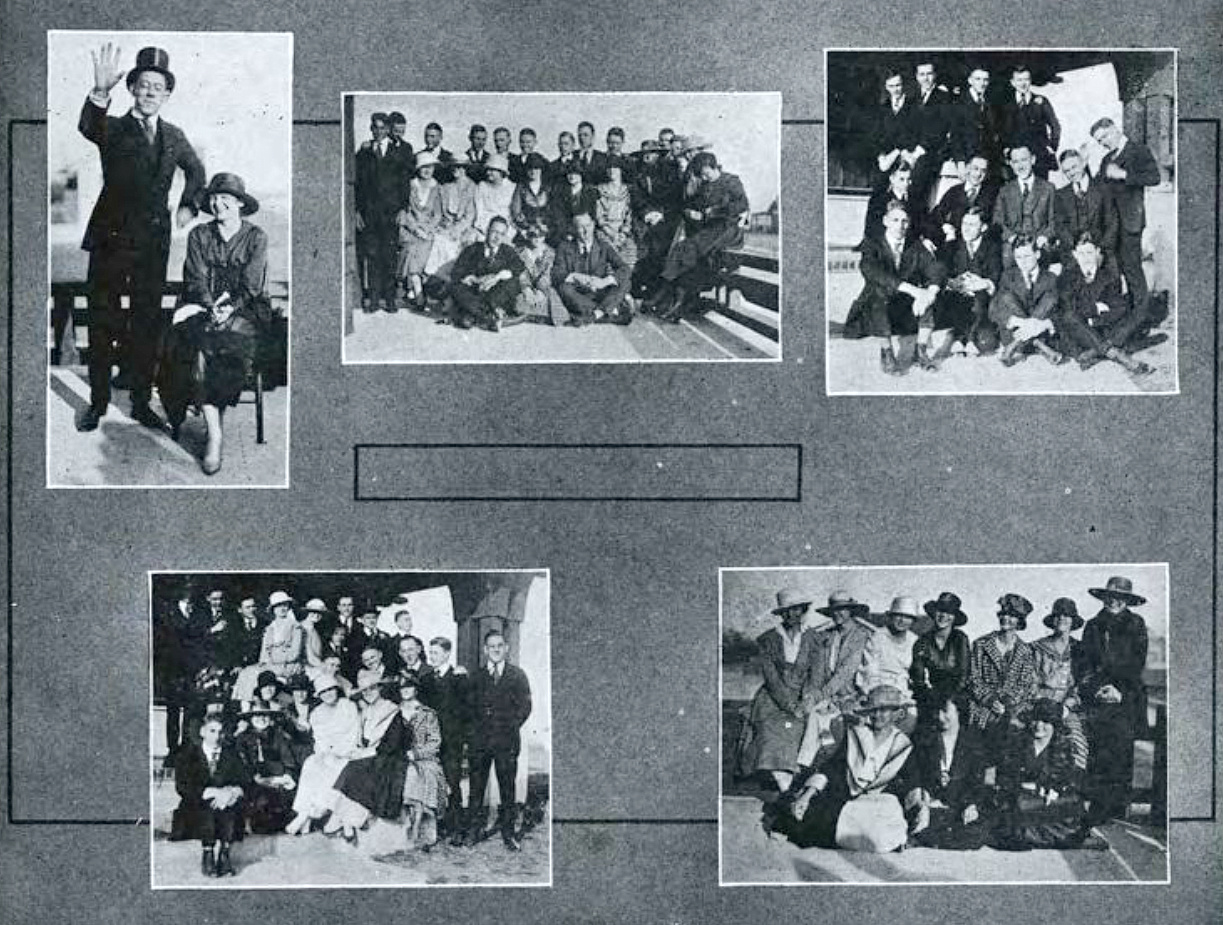
And, below, a photo collage from the Omega Phi page of the 1917 Rotunda. Several of the women look familiar. I see the Woman in White in at least one of these snapshots.

omega-phi_photos_rotunda_1917

And here she is, close up. I hope she was as happy, intelligent, and confident in her real life as she appears to be in these photos.

smu_omega-phi_porch_1917_degolyer-det2

***

Sources & Notes

The three photos of the afternoon outing all come from the collection of the DeGolyer Library, Central University Libraries, Southern Methodist University:

  • “Omega Phi Fraternity members and their dates in front of Dallas Hall” is here.
  • “Omega Phi Fraternity member outing to Exall Lake” is here.
  • “Omega Phi Fraternity members and their dates on porch” is here.

The quote from Diane Galloway comes from her FANTASTIC book, The Park Cities, A Photohistory (Dallas: Diane Galloway, 1989), p. 24.

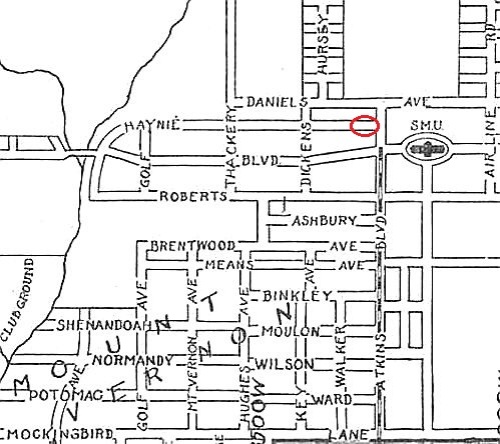
The ersatz Omega Phi fraternity house was located at 115 Haynie Avenue, just west of Atkins (now Hillcrest). (The photo of the exterior of the house is from the 1917 SMU Rotunda yearbook.)

omega-phi_map_19191919 map (detail), Portal to Texas History

I have absolutely no idea how college fraternities work, but it seems that when they formed on the SMU campus in 1915, the Omega Phi group was not actually affiliated with a national fraternity. They “petitioned” to be chartered by national groups, but they finally stopped trying after 11 years of, I guess, being repeatedly turned down — in 1926 they declared themselves to be an “independent society.” But one year later, they were granted a charter by the national Kappa Sigma fraternity. In the Dallas Morning News article announcing the news, this sentence was included: “The local chapter will be known as Delta Pi chapter.” I have no idea what any of that means, but if you’re really into these things, read the DMN article “Kappa Sigmas Grant Charter” (Sept. 26, 1927), here.

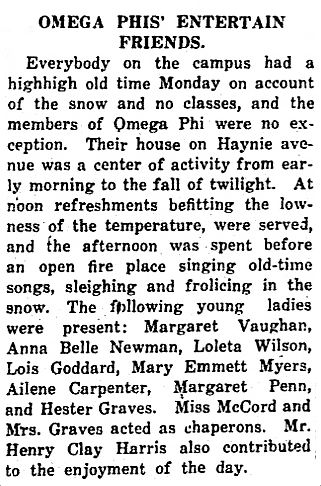
As for the identities of the women in the photos, it’s a mystery. I would assume, though, that at least some of them were the women mentioned in this little article about a cozy winter get-together at the Haynie Ave. house:

omega-phi_smu-campus_011917DMN, Jan. 19, 1917

If you’re not familiar with beautiful Exall Lake, you can watch a short, minute-long video of the lake’s history, produced to celebrate the 100th anniversary of Highland Park, here.

For other posts featuring photos I’ve zoomed in on to reveal interesting little vignettes, click here.

UPDATE: I stumbled across another photo of this group, from Diane Galloway’s book The Park Cities, A Photohistory:

smu_group-date_park-cities-photohistory_galloway

*

Copyright © 2015 Paula Bosse. All Rights Reserved.

“Male Fixings” and Horse Manure — Akard Street, ca. 1906

akard-looking-north_cook-colln_degolyer_smu_ca-1906George W. Cook Collection, SMU

by Paula Bosse

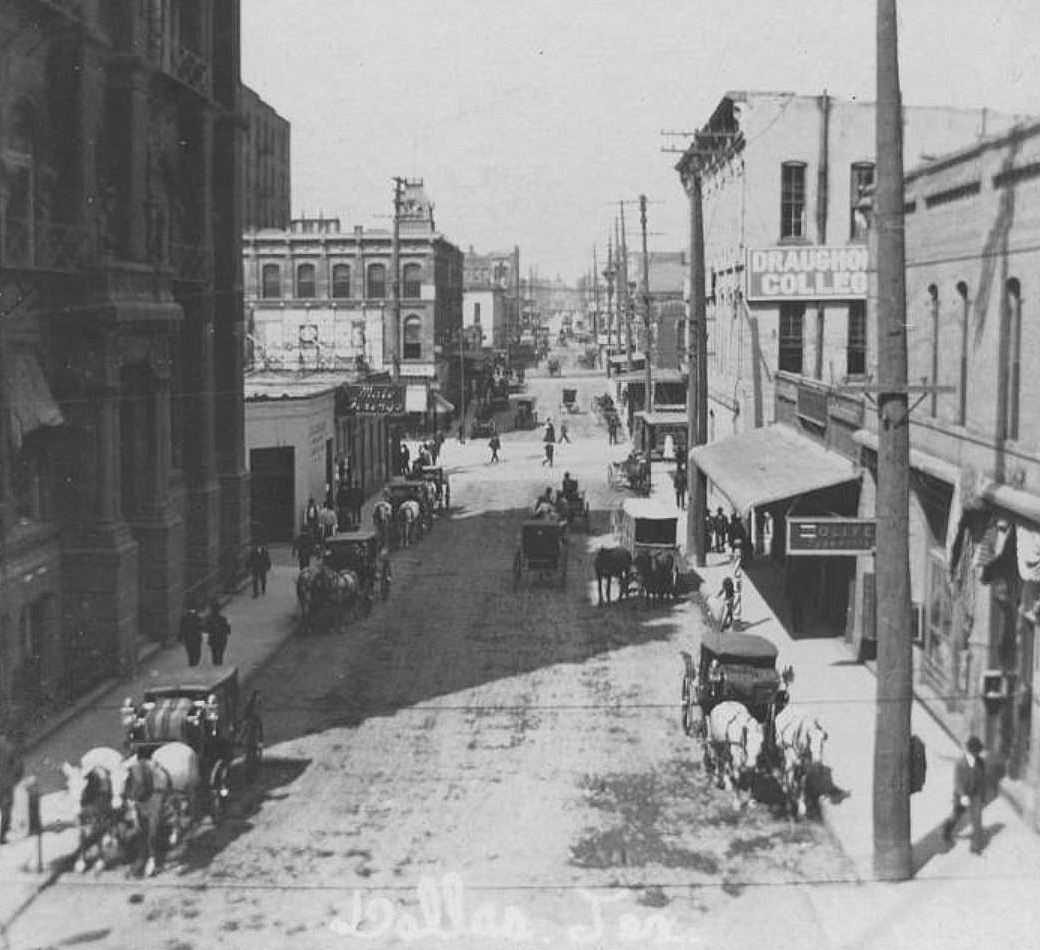
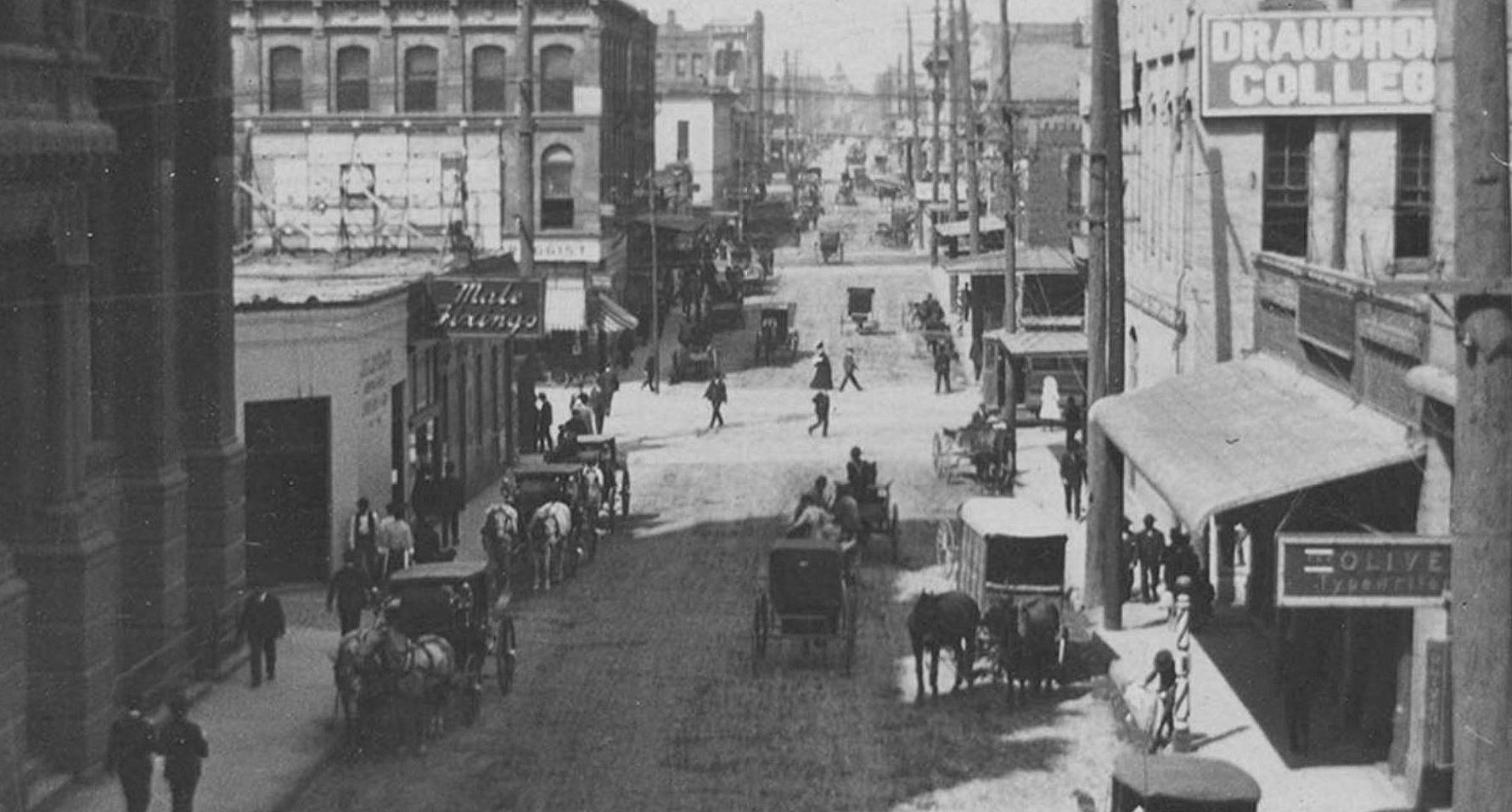
This great photograph shows Akard Street looking north from just south of Main. I especially like the sign for “Male Fixings” (a store selling men’s clothing accessories). Let’s zoom in to see that sign better (click photo to see a much larger image).

akard-looking-north_cook-colln_degolyer_smu_ca-1906-det

I also like the guy with the bicycle, next to the barber pole at the lower right, and the lone woman crossing the street. (There is a little girl in a white dress on the sidewalk on the right — about to cross Main — but everyone else in this photo is of the gender that might well patronize a business called “Male Fixings.”)

As indelicate as it may be to bring up the subject … I assume there were people employed to walk around the streets with shovels to clean up after all those horses? I’ve actually thought of this fairly often. It had to have been a major, major problem back then. I’ve just looked it up. The average horse pulling wagons and carriages produced, on average, 30+ pounds of manure and several gallons of urine daily, deposited willy-nilly whenever the need arose (which was often). Multiply that by hundreds. This article isn’t about Dallas, but I highly recommend “The Great Horse Manure Crisis of 1894” — you’ll learn way more about the subject than you may want to — read it here. That lady crossing the street? I bet she spent a good part of every day hiking her skirts and dodging dung.
*

UPDATE: I’ve updated the title to this post several times (you’ll notice that the URL of this post shows a different location and year). After spending time to pin down the date, it appears this photo was taken between 1906 and 1909, when the Draughon Practical Business College was located at the southeast corner of Main and Akard — and the Oliver Typewriter Agency was located at 114 South Akard. The original annotation of this photo says the view is Main Street, with Akard in the midground, but it appears this photo was taken just south of Main Street looking north on Akard. The photo is confusing because the Draughon’s sign is seen here on the Akard Street side, not the Main Street side. The main tip-off is the cupola seen atop the building standing at the northwest corner of Main and Akard — it is the Rowan Building, which housed the Marvin Drug Store, which I wrote about here.

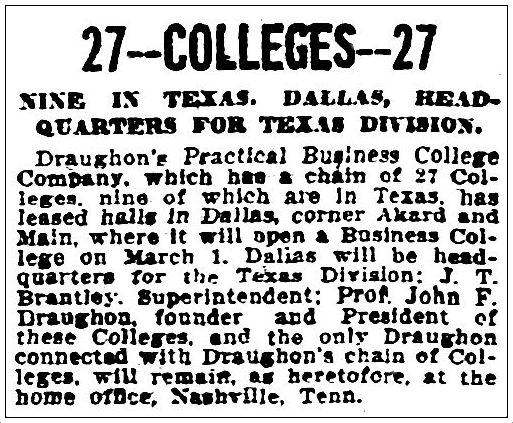
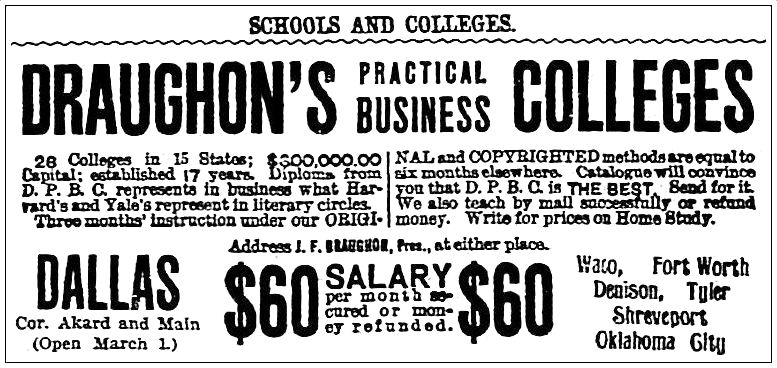
Draughon’s Practical Business College opened its first Dallas campus (but its 27th location across the major cities of the south) at the southeast corner of Main and Akard in March, 1906. By the time the 1910 city directory was printed, they had moved to another location (in fact, in their first ten years in Dallas they had moved five times!). I’m not sure how long the business college lasted in Dallas — at least through the 1970s, possibly longer — but the institution seems to still be in business after something like 130 years. (Click ads below to see larger images.)

draughon-business-school_dmn_0304061906

draughon-business-school_dmn_0315061906

***

This is another wonderful photo from the George W. Cook Dallas/Texas Image Collection, DeGolyer Library, Central University Libraries, Southern Methodist University; it can be accessed (and zoomed in on) here.

Another interesting article on the “manure problem” is “When Horses Posed a Public Health Hazard” — a blog post from The New York Times (which tantalizingly mentions herds of pigs roaming the streets of NYC) — read it here.

*

Copyright © 2015 Paula Bosse. All Rights Reserved.

Fly United to Chicago in Only Eight Hours!

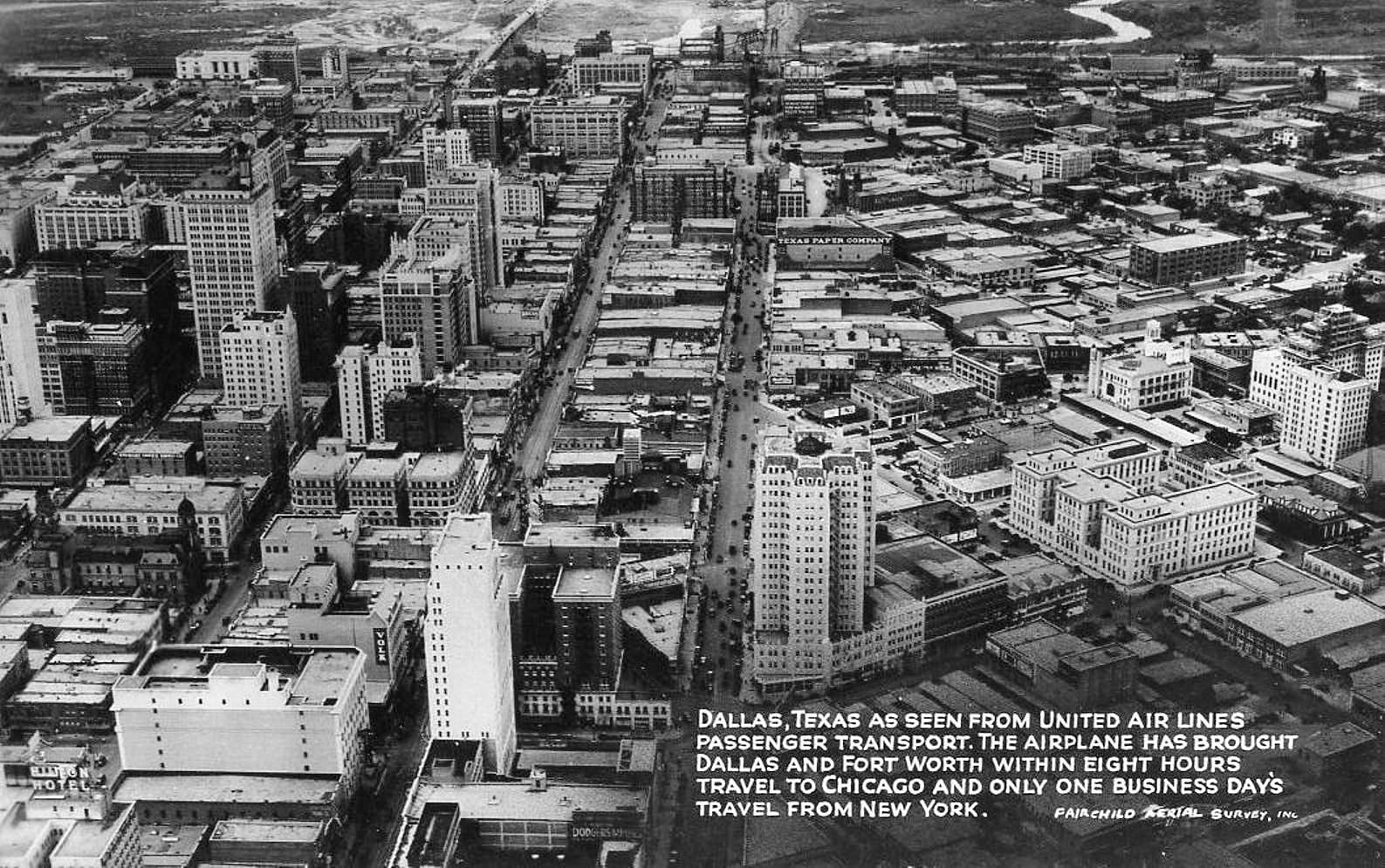
aeiral_united-air-lines_fairchild_ebay_rppcHow many buildings can you identify? (click for larger image)

by Paula Bosse

Dallas, Texas as seen from United Air Lines passenger transport. The airplane has brought Dallas and Forth Worth within eight hours travel to Chicago and only one business day’s travel from New York.

Back when it took all day to fly to New York from Dallas.

This is another great aerial photo by the Fairchild Aerial Survey company, probably taken by Lloyd M. Long. Date-wise? Late-1920s? Before the Trinity was straightened (beginning in 1928), with land being cleared in the area that would become Dealey Plaza? 1928-ish? Or could it have been the very early 1930s? The United Air Lines promotional postcard was issued around 1932 or 1933.

It wasn’t until 1933 that United introduced its new Boeing “twin motor airline transports” and boasted that they would finally “bring the city within eleven and a half hours of New York City” (Dallas Morning News, Aug, 16, 1933).

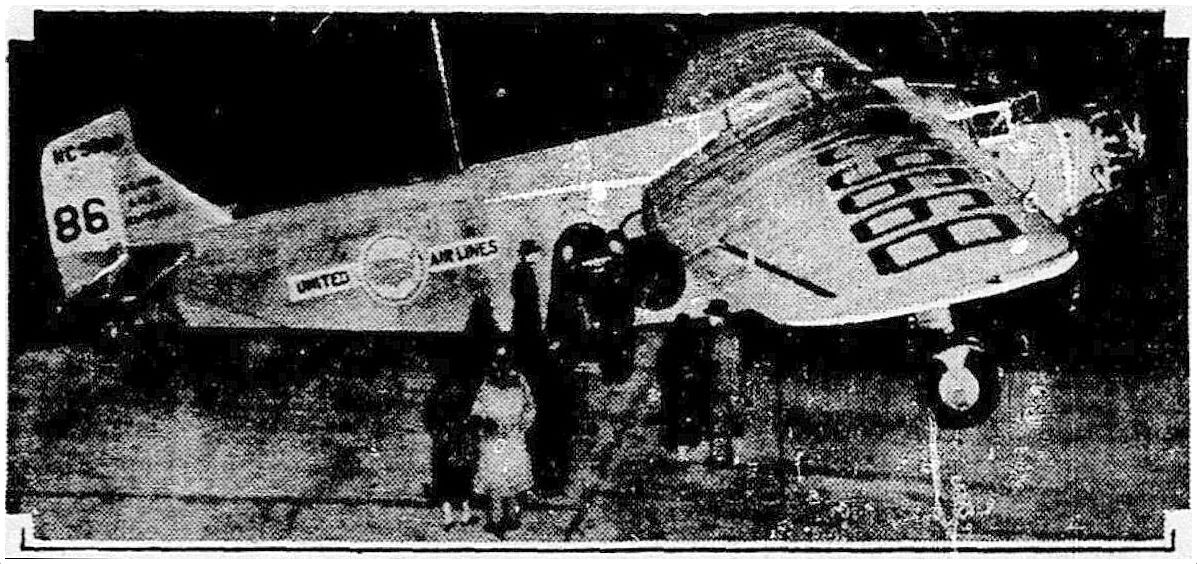
Below is a photo from a Dallas newspaper ad showing one of United’s planes from the earlier, more carefree days of 1932, when passengers were still trudging through the skies at a more leisurely pace.

united-air-lines_ad-det_dmn_110432United Air Lines ad, detail, 1932

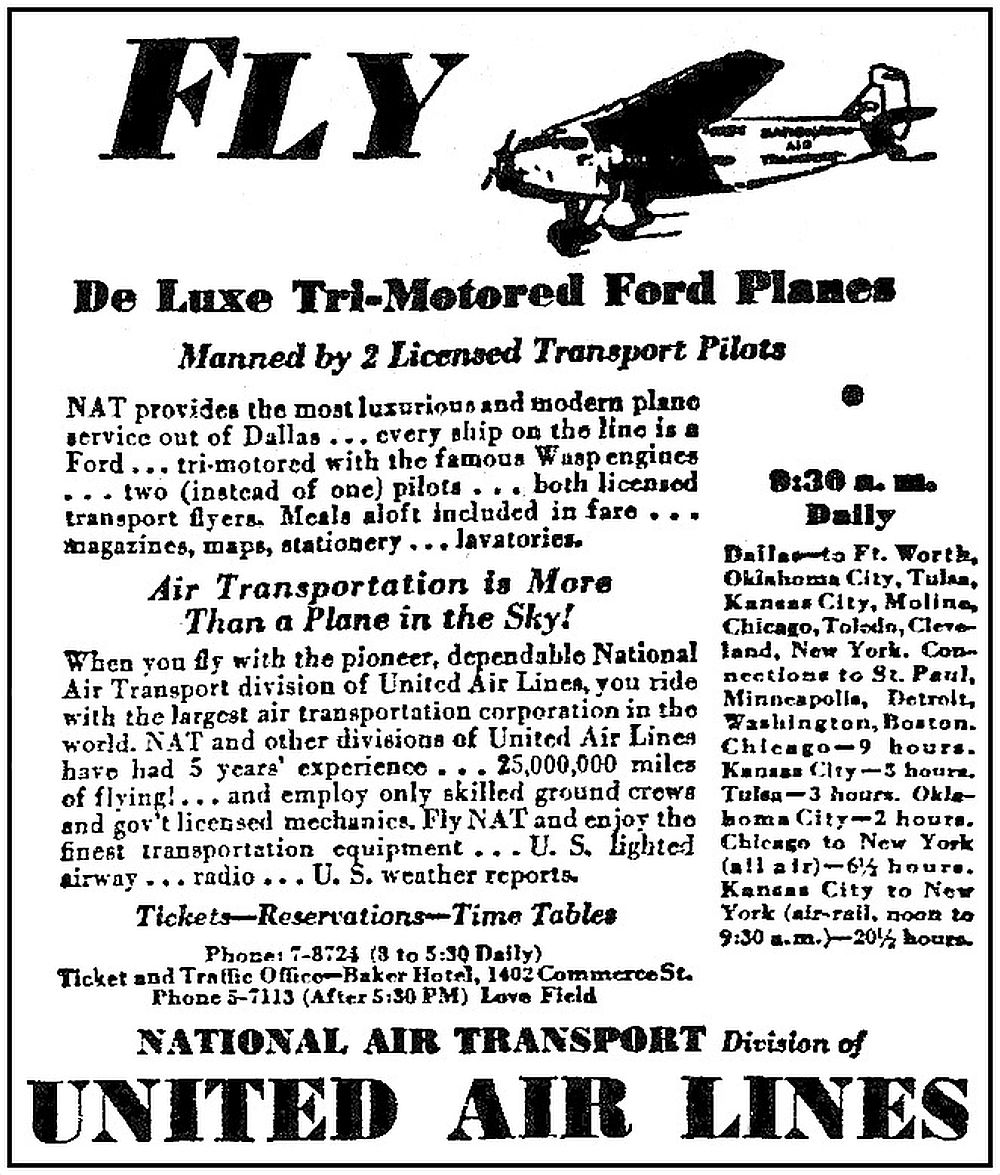
And an even earlier ad, from 1931, when a flight from Love Field to Chicago was nine hours long (today a direct flight from Love Field to Chicago takes about two hours and fifteen minutes). And if you wanted to continue to NYC, you had to board another plane and fly from Chicago to New York, adding another six and a half hours!

united-air-lines_dallas-to-nyc_1931
1931 ad

FLY

De Luxe Tri-Motored Ford Planes Manned by 2 Licensed Transport Pilots
 
NAT provides the most luxurious and modern plane service out of Dallas … every ship on the line is a Ford … tri-motored with the famous Wasp engines … two (instead of one) pilots … both licensed transport flyers. Meals aloft included in fare … magazines, maps, stationery … lavatories. 

Air Transportation is More Than a Plane in the Sky! 

When you fly with the pioneer, dependable National Air Transport division of United Air Lines, you ride with the largest air transportation corporation in the world. NAT and other divisions of United Air Lines have had 5 years’ experience … 25,000,000 miles of flying! … and employ only skilled ground crews and gov’t licensed mechanics. Fly NAT and enjoy the finest transportation equipment … U.S. lighted airway … radio … U.S. weather reports.

*

In an interesting side-note, the first pilot to fly a mail plane between Kansas City and Dallas (on May 12, 1926) was Richard Dobie, brother of Texas literary legend, J. Frank Dobie. In 1926 he flew a Curtiss Carrier Pigeon; in 1933, he’d worked his way up to the speedy and powerful Boeing. He flew for United for several years.

***

Sources & Notes

Top image is a promotional postcard, found on eBay.

Read more about the tri-motor airplane (manufactured by the Ford Motor Company and affectionately known as the “Tin Goose”) in the article “Ford’s Tri-Motor” by Edward J. Vinarcik (Advanced Materials and Processes, Oct. 2003) here.

All images larger when clicked.

*

Copyright © 2015 Paula Bosse. All Rights Reserved.


“Our First Joy Ride” — 1911

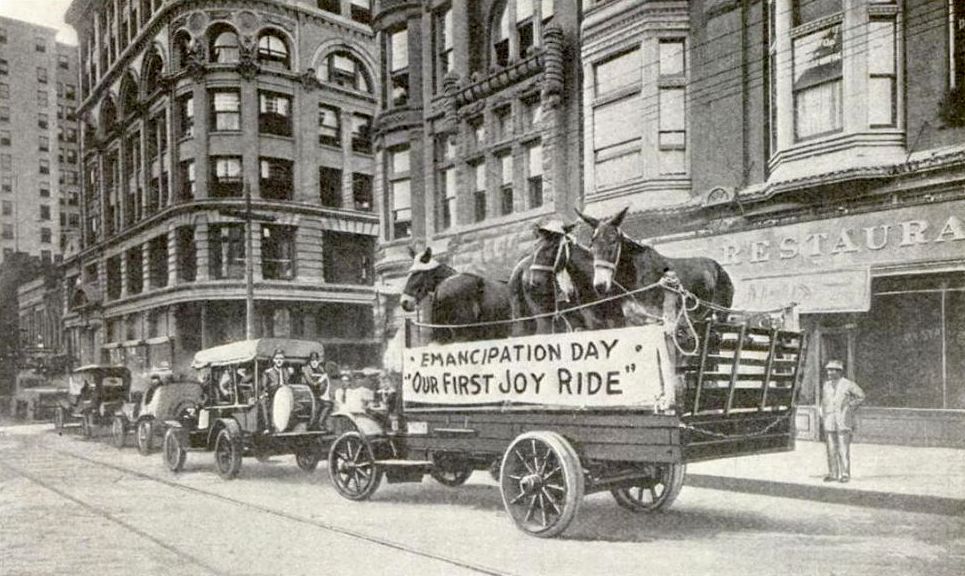
mule-joyride_pop-mechanics_jan-1912Mules taking a load off, Main & Ervay, 1911

by Paula Bosse

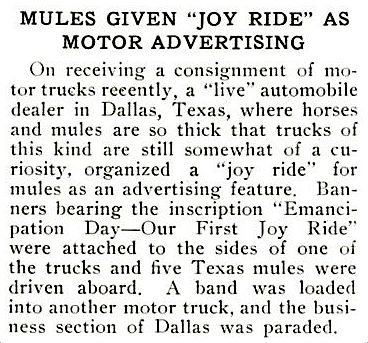
Flipping through the pages of a Jan. 1912 issue of Popular Mechanics — as one does — I came across a photo of a truckload of joyriding mules which was accompanied by this explanatory text:

mule-joyride_pop-mechanics_jan-1912-text

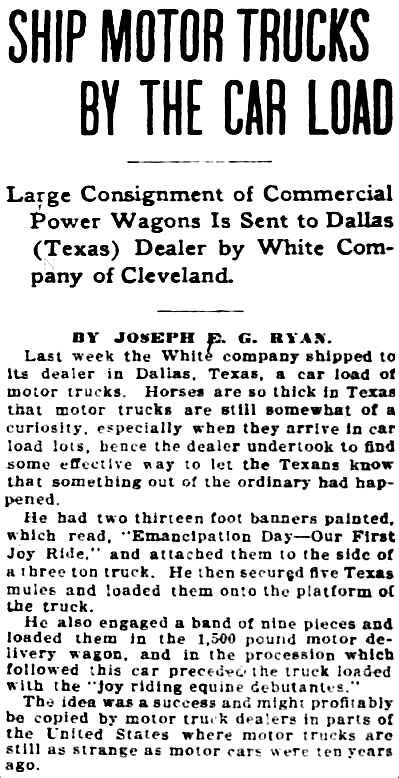
Ah, a publicity stunt. A Chicago newspaper offered a bit more background, and gave us the delightful phrase “joy-riding equine debutantes.”

mules_chicago-inter-ocean_102311Chicago Inter Ocean, Oct. 23, 1911

Another report added that the mules were “adorned with a collection of discarded women’s hats and bonnets elaborated with all the old ribbons, feathers and similar gee-gaws […] securely tied on with pink and red mosquito netting…. The procession was headed by Dallas’ most prominent business men in a brand new White 1912 ’30.'” (Automobile Topics magazine, Oct. 28, 1911)

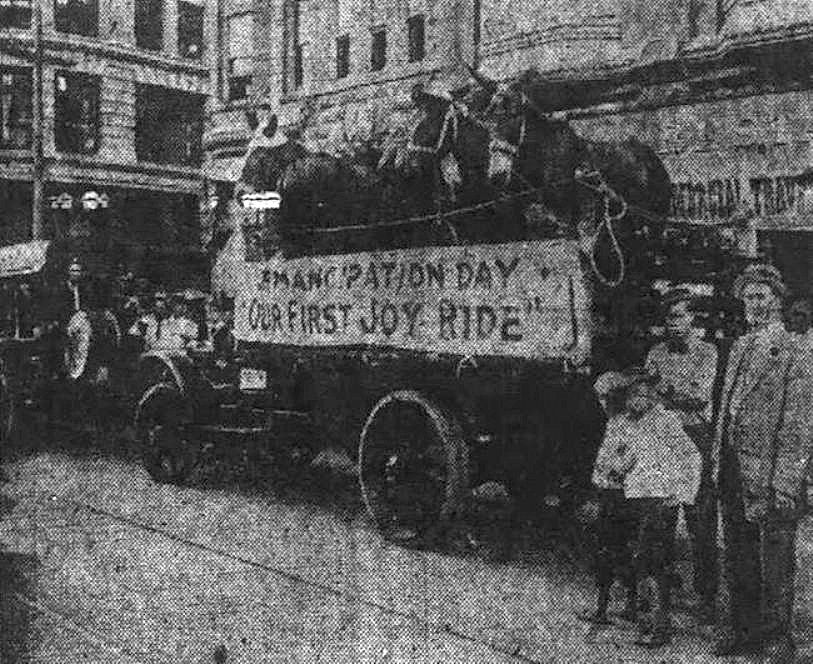
Despite the fact that this, let’s face it, pretty unusual “parade” happened on Main St., with apparent participation by “prominent businessmen,” I can find no mention of it in local newspapers. Maybe because it was a publicity stunt and there was no advertising fee collected by the papers. The story ran in a handful of newspapers (Chicago, San Francisco, Washington, DC), and the Washington Post ran the photo below under the headline “New Way to Advertise Motor Trucks.”

mules_washington-post_102211Washington Post, Oct. 22, 1911

The White Motor Company (makers of the mule-laden truck) must have been quite taken with the unnamed entrepreneur’s banner, because they used the exact same wording on a banner draped on one of their trucks which was a featured attraction on Transportation Day at the 1915 Panama-Pacific International Exposition in San Francisco.

Let’s hope the original Dallas guy got a little something out of all this.

*

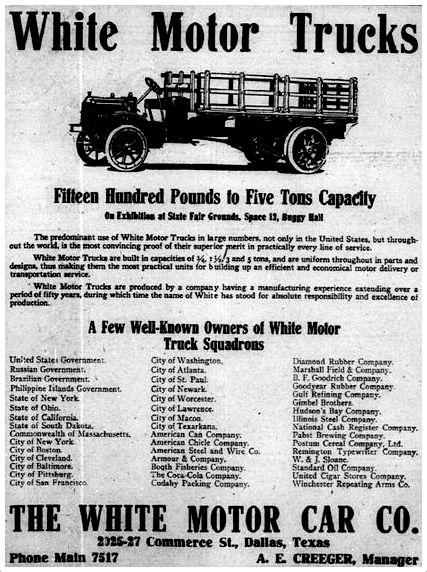
On further investigation into The Case of the Joyriding Mules, it appears that this was the brainchild of the General Manager of the White Motor Co., A. E. Creeger (or perhaps that of one of his gung-ho underlings). In a 1912 article in The Dallas Morning News, Creeger talks about the relatively soft truck market in Texas (!), and it’s easy to see why he was doing all he could to draw attention to his company’s line of trucks — even if it meant loading them up with “emancipated” livestock.

And here’s one of his ads from almost exactly one year after the mule stunt:

white-motor-co_dmn_101312Oct. 13, 1912

***

Sources & Notes

Top photo appeared in the January, 1912 issue of Popular Mechanics.

The “parade” (which took place sometime in the middle of October, 1911) is seen heading west on Main Street, just about to pass Ervay. The inescapable Wilson Building dominates the photo, with the tall, white Praetorian Building in the background. The restaurant at the right — at 1705 Main — was the California Restaurant, a Dallas eatery specializing in Chinese food since at least the 1890s.

*

Copyright © 2015 Paula Bosse. All Rights Reserved.