Flashback : Dallas

A Miscellany: History, Ads, Pop Culture

Category: Vault

When a Virgin Sacrifice at Fair Park Almost Caused an International Incident — 1937
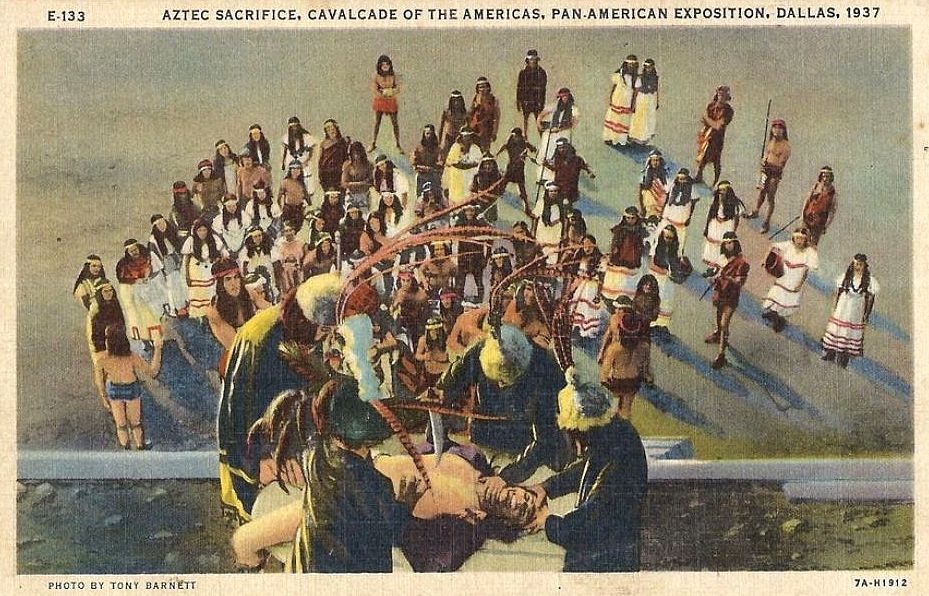
pan-american_aztec-sacrifice_colteraAztec sacrifice with a warrior, not a virgin, on the official postcard

by Paula Bosse

The Greater Texas and Pan-American Exposition at Fair Park was a four-and-a-half-month extravaganza which opened in June, 1937 as a follow-up of sorts to the previous year’s Texas Centennial Celebration. According to promotional material, its goal was to celebrate the Americas and “to promote the feeling of international goodwill between the twenty-one independent nations of the New World.” (It was also hoped that the city could rake in some more Centennial-sized cash.)

One of the biggest attractions of the Pan-American Expo was a huge production called Cavalcade of the Americas, which presented highlights from the history of Latin America and the United States. There were scenes from ancient Mexico, Columbus’ landing, the Revolutionary War, Stephen F. Austin’s arrival in Texas, the settling of the Old West, etc., right up to FDR’s participation in the Inter-American Peace Conference in Argentina in 1936. Utilizing much of the same infrastructure as the previous year’s Cavalcade of Texas, it was staged outdoors, in the old racetrack, with a 300-foot stage and elaborate scenery depicting an ocean, mountains, and a smoking volcano. Horses, wagons, “ships,” and a cast of hundreds took part in the production.
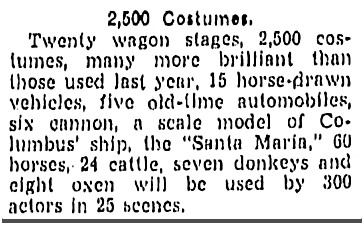
cavalcade-americas_FWST_060637Fort Worth Star-Telegram, June 6, 1937

It was quite elaborate. The postcard view below will give you an an idea of the scale of what was being billed as the world’s biggest stage.(I  believe the whole thing revolved — or at least part of it did — with another stage on the side facing away from the audience; the scenery, cast, and perhaps the donkeys, would change out before revolving to face the audience.)
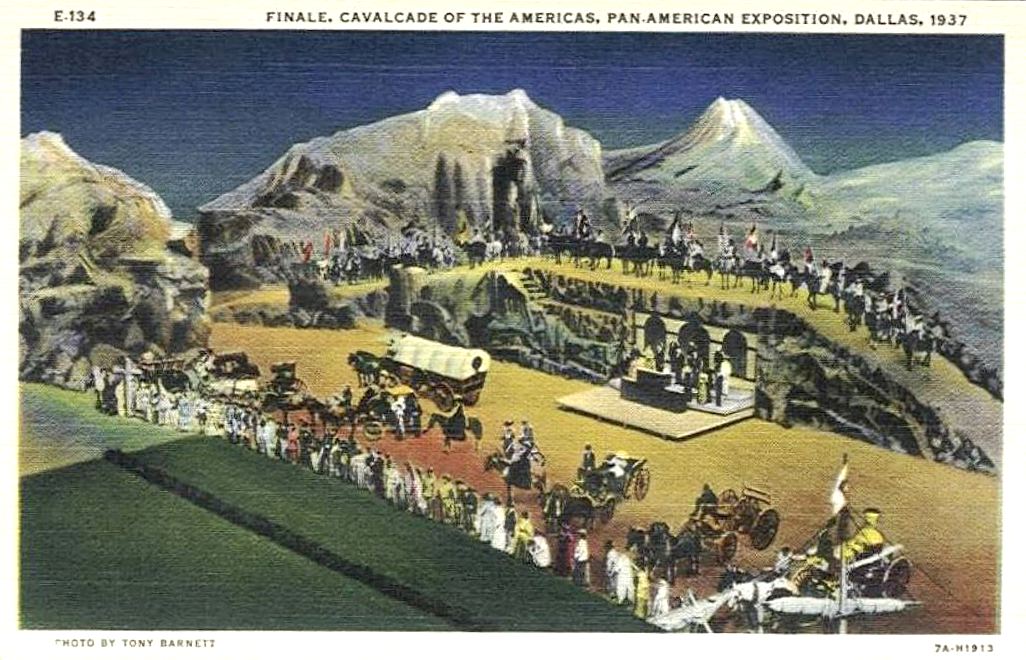
cavalcade_1937

The opening scene featured an Aztec sacrifice and an angry volcano. Start big! This relatively brief portion of the show caused a lot of headaches (and/or much-welcomed publicity) for the producers, State Fair organizers, and, probably, the image-conscious Dallas Chamber of Commerce. But why? As originally written (by the remarkably prolific Jan Isbelle Fortune), the Aztec sequence involved the sacrifice of a struggling young maiden atop a blood-stained pyramid. Two months before the opening of the Expo, a rather sensationalistic photo of this historical reenactment appeared in the pages of newspapers across the country, no doubt resulting in raised eyebrows and whetted appetites. (Click to enlarge!)
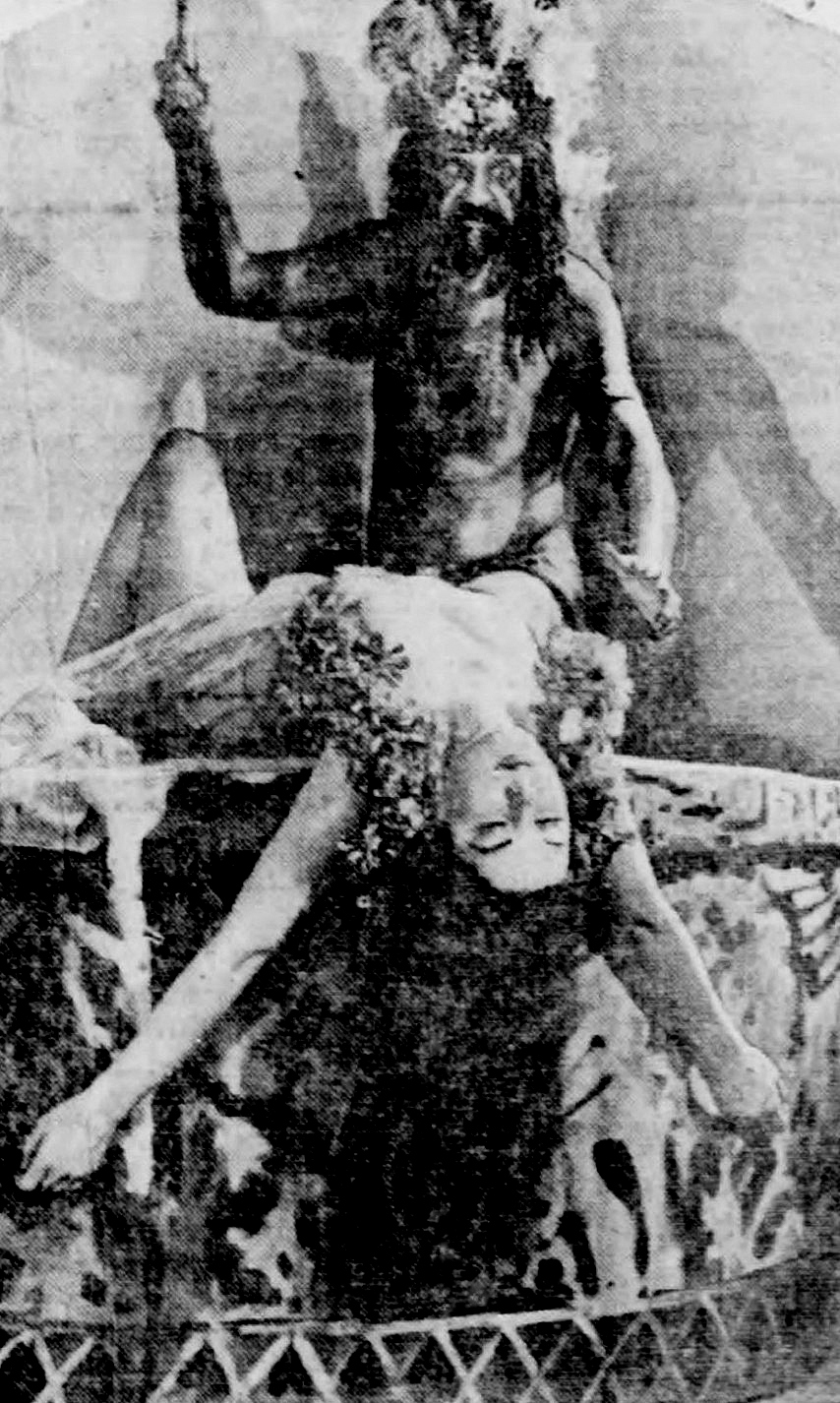
aztec_greencastle-indiana-daily-banner_080437Greencastle (Indiana) Daily Banner, 1937

The star of this scene was 17-year-old Geraldine Robertson, who had been crowned Queen of the Centennial the previous year and who played a multitude of roles in the current production, including Cortés’ “lover and interpreter,” a young woman in a Boston Massacre scene, Martha Washington, and the wife of Jim Bowie. Here she is in real life in 1936, with Jean Harlow platinum-blonde hair, posing for one of a seemingly endless number of publicity photos.

robertson-geraldine_queen-of-centennial_1936Geraldine Robertson, 1936

And the thing that caused so much trouble? Probably not what you would assume.

Before the Exposition opened, the Dallas-based Mexican Consul, Adolfo G. Dominguez, became aware of this casting choice. And that was when the mierda probably first hit the ventilador. Dominguez was adamant that the virgin be replaced with the more historically accurate male warrior. He probably said much the same thing to the Cavalcade producers when confronting them about his concerns before the Expo began as he did when he said this in a Dallas News article on the topic weeks later:

“We Mexicans feel that use of a girl in the role can bring nothing but racial prejudice and misconception of the true meaning of the Aztec human sacrifice as it was performed, not thousands of years ago, as has been wrongly represented, but as late as 1521.” (DMN, July 28, 1937)

The producers acquiesced, and when the Exposition began its run on June 12, 1937, the opening scene of the Cavalcade did, in fact, feature a sacrificial warrior. But on Sunday, July 25, the producer of the extravaganza brought the scantily-clad virgin back and nixed the warrior, hoping the added sex appeal and pizzazz would increase audience numbers. (Interestingly, when the Exposition opened, tickets to Cavalcade of the Americas cost 50⊄ — about $8.00 in today’s money — but on July 18, it was announced that, except for 600 reserved seats, admission to the show would be free. Promoters said this was being offered as a gesture of goodwill to Expo visitors, but one wonders if they weren’t having a hard time filling the 3100-seat grandstand.)

Señor Dominguez was not amused by this sexed-up revamping and protested. A. L. Vollman, the Cavalcade’s producer-director pooh-poohed the diplomat’s protestations and responded in true impresario fashion: “What history needs is more sex appeal.” That didn’t go over particularly well with the consul, who thought he’d already dealt with the problem weeks before. (Click to see larger image.)
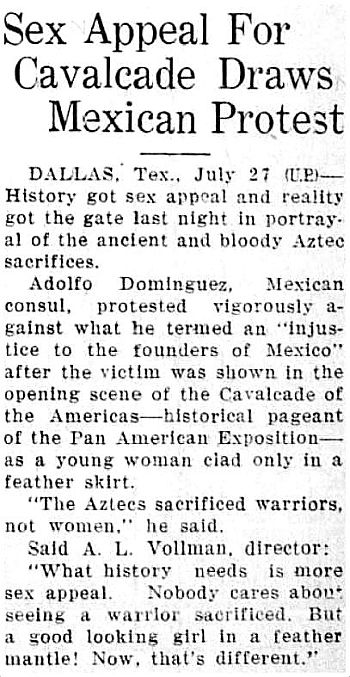
aztec_waxahachie-daily-light_072737Waxahachie Daily Light, July 27, 1937

Dominguez complained to Frank K. McNeny, Director General of the Exposition, saying that the scene was historically inaccurate and was an injustice to the founders of Mexico. McNeny disagreed, saying that the scene involving the plunging of a dagger into the breast of a sacrificial virgin was “a very lovely historic scene.” He declined to bring back the warrior, because, as Vollman noted, the revamping had increased attendance: “It’s packing them in the aisles.” An exasperated Dominguez said that if the change from maiden back to warrior was not made, he would take the matter to the Mexican government.
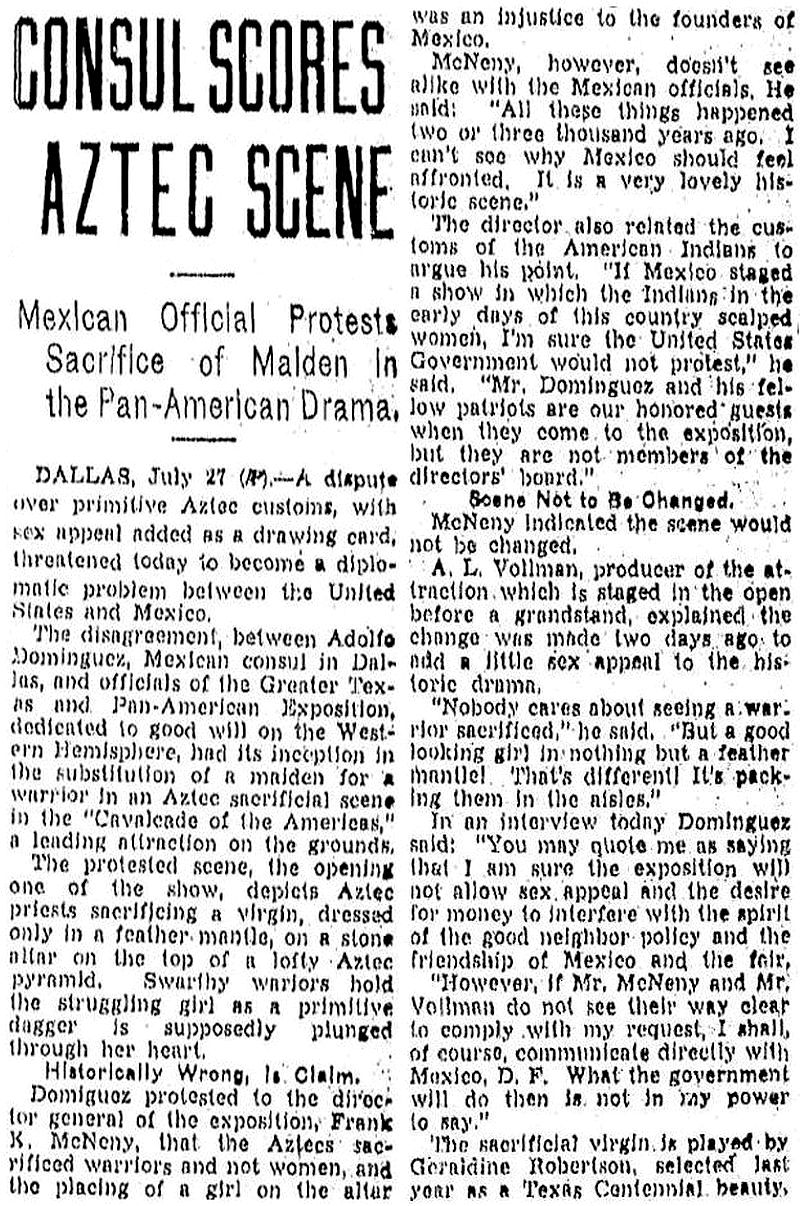
aztec_FWST_072837FWST, July 28, 1937

At this point, a disagreement over the gender of a character in what was, basically, an oversized school history pageant was dangerously close to setting off an international incident. It was also causing embarrassment for local civic leaders who were looking upon the Exposition as a major marketing tool for the city as well as a symbolic display of Pan-American solidarity and goodwill. Can’t we all just get along, amigo?

The refusal of the Cavalcade to UN-revamp the show did not deter the Mexican Consul who, by now, was probably more het-up than ever. Dominguez decided to go over McNeny’s head. He pulled out the written agreement he had made with fair officials back in the spring — which clearly stated that a male warrior and NOT a young woman would feature in the theatrical human sacrifice — and he took it to the top man, State Fair president Fred F. Florence. Florence discussed the matter with his board of directors who voted “to a man” to uphold the original agreement.

The warrior would be reinstated as the writhing victim on the bloody sacrificial stone. The sexy maiden would have to hand over the 30-foot-long robe, which had been made from 9,000 feathers and which had trailed behind her as she was carried up the great pyramid at Tenochtitlán. The actor playing the warrior was probably happy to get back in the spotlight. Geraldine Robertson, the virgin who had trailed that robe, was relegated to a role as a daughter of Montezuma.

Presumably the dagger kept plunging into the flailing warrior’s heart twice nightly for the remainder of the show’s run, and the memory of that short-lived international squabble was quickly forgotten (…until now).

And they all lived happily ever after. / Vieron felices por siempre.
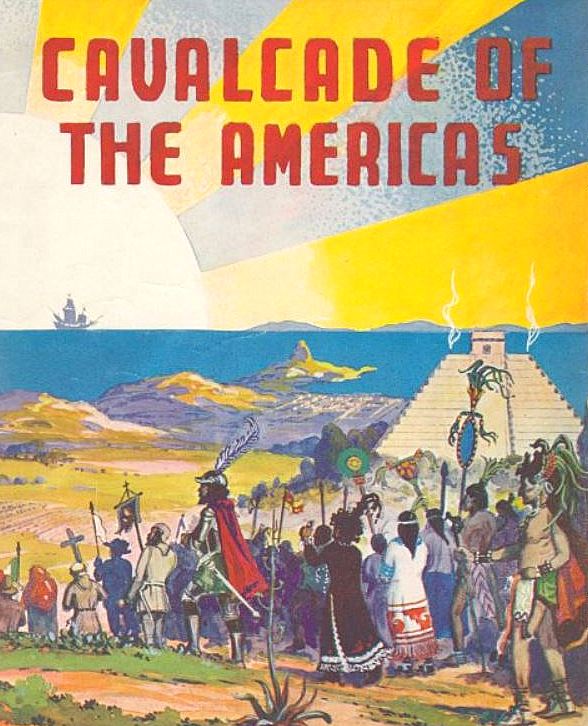
panamerican_cavalcade_watermelon-kid

*

Hey! If you’ve read this far, here’s a little reward. A Universal Newsreel titled “Pan-American Exposition Is Opened For 1937, Dallas, Tex.” — which contains 20 whole seconds of the Aztec (warrior) scene!  — can be viewed on the T.A.M.I. (Texas Archive of the Moving Image) site, HERE. The entire short newsreel is interesting (sadly, it has no sound), but if you want to jump to the sacrifice scene, it begins at the :49 mark. (If you’re watching on your desktop, make sure to click the little square just to the left of the speaker icon beneath the viewing area to watch it full-screen.
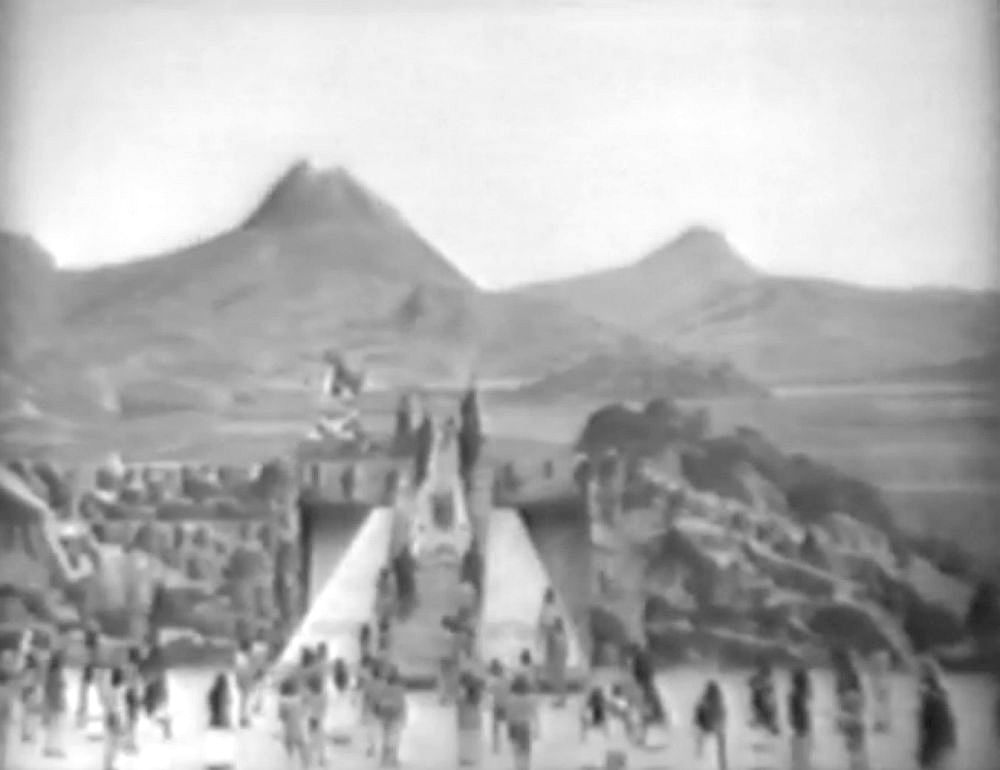
aztec_newsreelSuper-grainy screenshot from the Universal newsreel, 1937

***

Sources & Notes

Postcards of the Pan-American Exposition are from “the internet.”

Color souvenir program image from the Watermelon Kid site; background on the Pan-American Exposition can be found on the same site, here.

All other clippings as noted.

Related Dallas Morning News articles:

  • “As Sacrificial Virgin, Star of Cavalcade Put In Showy Opening Act” (DMN, July 26, 1937)
  • “Cavalcade Dispute Is Won by Consul As Virgin Is Replaced” (DMN, July 28, 1937)

Below, an interview with Jan Fortune on her Cavalcade of the Americas; it appeared in her hometown newspaper, The Wellington (Texas) Leader on March 18, 1937. She also wrote the Centennial’s big production, Cavalcade of Texas, the previous year, in 1936.
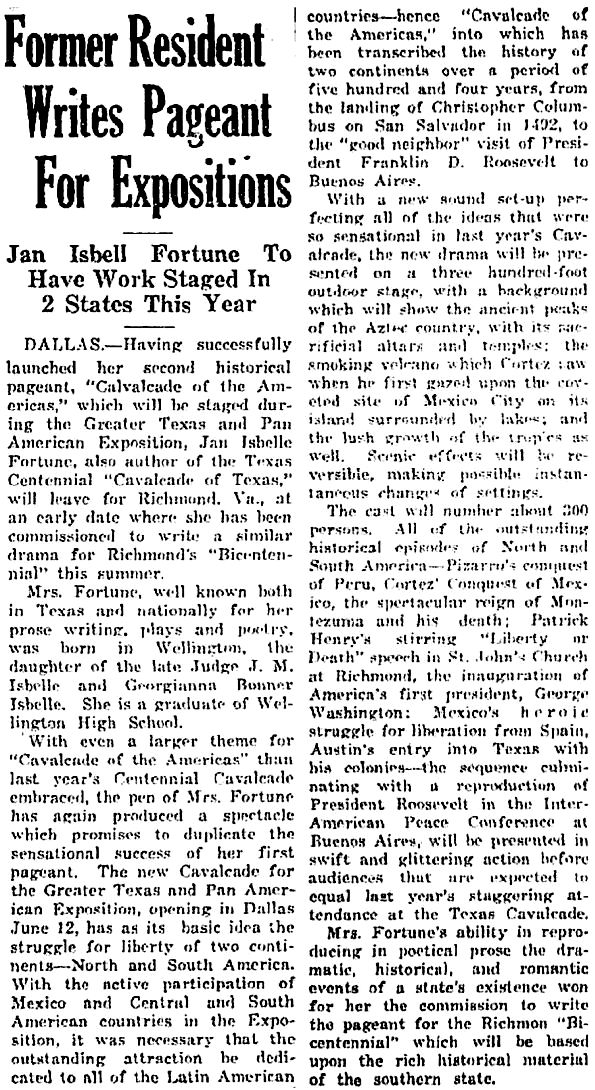
jan-isbell-fortune_wellington-tx-leader_031837

And, speaking of Aztec human sacrifices in DFW (a phrase I don’t believe I’ve ever written…), the following tidbit was contained in an article about Six Flags Over Texas’ 1970 season.
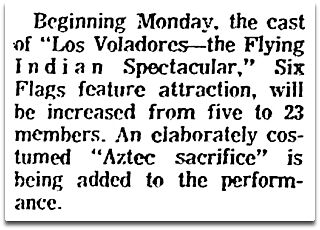
aztec_FWST_052170-six-flagsFWST, May 21, 1970

Promotional material about Los Voladores — a group of aerialists from Mexico — informs us that in their show “a beautiful maiden’s life is given as tribute to Tlaloc, the rain god.” Those beautiful maidens can’t catch a break. Sorry, Adolfo.

*

Copyright © 2015 Paula Bosse. All Rights Reserved.

From the Vault: The Ladies’ Reading Circle

ladies-reading-circle_negro-leg-brewer_1935The Ladies, circa 1935

by Paula Bosse

I’ve been researching civil rights issues in Dallas, and one name I keep coming across is Miss Callie Hicks (1894-1965), an African-American schoolteacher, civic leader, and officer of the local chapter of the NAACP. She was also a member of the Ladies’ Reading Circle, a Dallas group organized in 1892 by and for literary- and history-minded black women. She can be seen in the circa-1935 photo above, seated, second from the right. I enjoyed learning about this group of women, and the post I wrote, “The Ladies’ Reading Circle: An Influential Women’s Club Organized by Black Teachers in 1892,” can be read here.

I just added a picture of the charming house the group bought in the late-’30s and maintained for many years as a place which provided housing and career training for young women. Unbelievably, this State-Thomas-area house is still standing.

lrc-home_2616-hibernia_google2616 Hibernia (Google Street View)

*

Copyright © 2015 Paula Bosse. All Rights Reserved.


The Dallas News Special: Fast Train to Denison — 1887

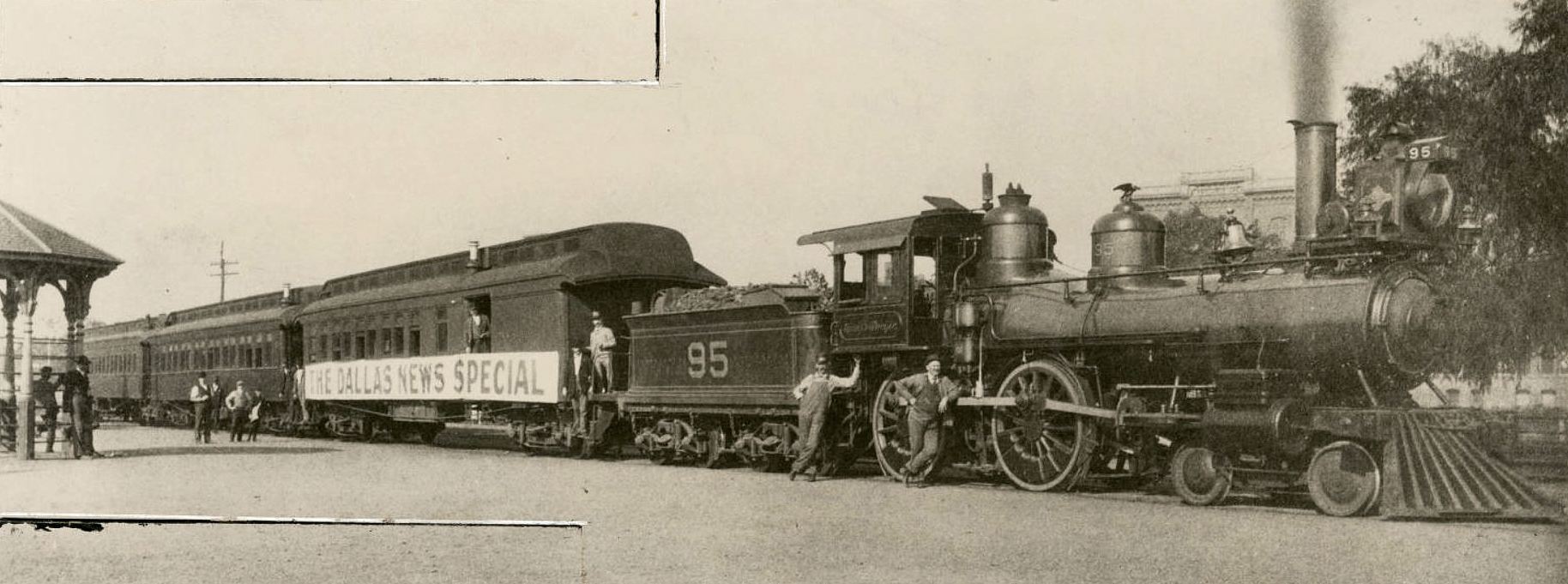
dallas-news-special_belo-collection_smuThe Dallas Morning News, full speed ahead! (Belo Collection, SMU)

by Paula Bosse

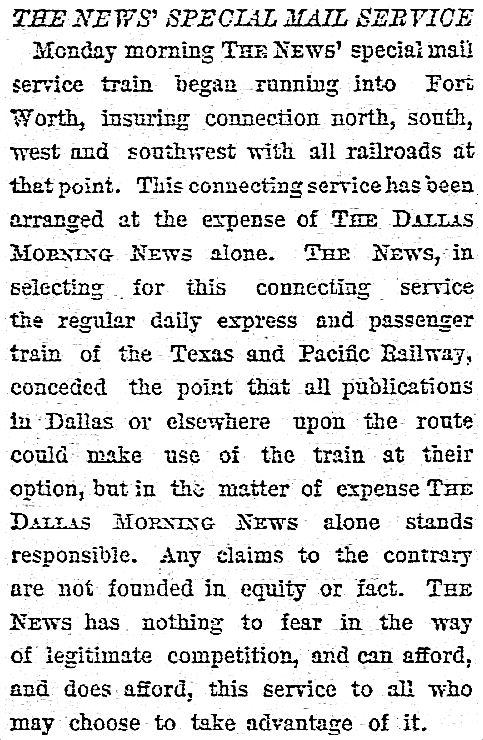
In October 1885, The Galveston News decided to launch a sister publication in Dallas, The Dallas Morning News. They sent 26-year-old George Bannerman Dealey to run it. Before that first month was up, go-getter Dealey had made a special arrangement with the Texas & Pacific railroad — “at considerable expense to The News” — to extend its route and pop into Dallas to pick up papers destined for its subscribers west of the city. (The photo at the top may or may not show that very first “Special Mail train.”)

news-train-fort-worth_dmn_102885DMN, Oct. 27, 1885 (click for larger image)

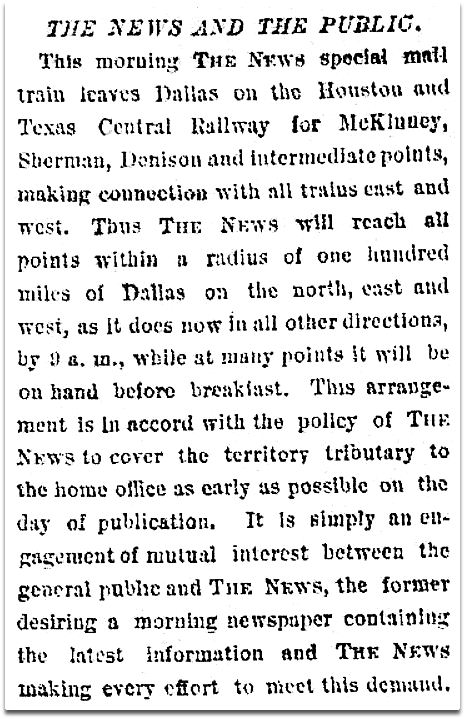
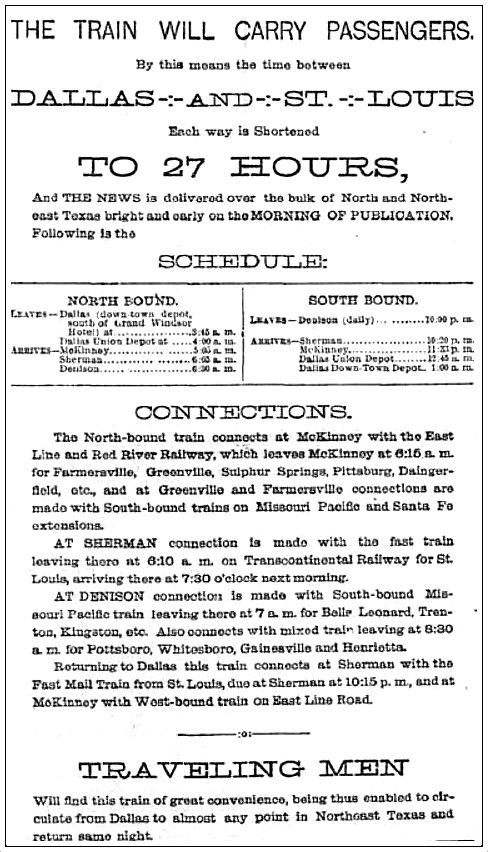
A year and a half later, The News one-upped itself and made the announcement that it would operate a special train to Denison — again, “at a vast expense.” This train would transport editions of the paper in the wee small hours in order to assure that The Dallas Morning News would actually BE a morning newspaper for as many of its subscribers as possible, whether they lived “within a block of the press” or a hundred miles away (DMN, Sept. 30, 1888). News-hungry Denisonians could read their papers over breakfast at the same time their Dallas counterparts did.

news-train_dmn_052287DMN, May 22, 1887

The train was dubbed by some “The Comet” (not to be confused with the MKT’s later Katy Komet). It was a “fast train” that carried passengers as well as newspapers along the Houston and Texas Central rails.

ad-special-news-train_dmn_052287-det

ad-special-news-train_dmn_052287-det2DMN, May 22, 1887

Not only was this a clever way to extend its reach and expand its circulation, but, as the Handbook of Texas notes, it also “enabled the paper to meet the threat of the St. Louis newspapers, which in 1885 had a larger circulation in North Texas than did any state paper.”

A rousing account of the first Dallas-to-Denison run appeared in the pages of both The Dallas News and The Galveston News (which often shared content). A link to that full story is below, but here are a few passages from an article written the next year, touting the wondrous success of the News Special, written as only a nineteenth-century newspaperman could write it (and the writer might well have been G. B. Dealey himself).

First, one encounters a mention of Plano in a more grandiose combination of words than one might expect, as the writer describes his pleasant pre-dawn train trip along the route.

Plano was reached before the drowsy god of day had wiped his eyes at the first yawn. He rolled over in his couch by the time it reached McKinney, and he was sitting on the side of it when the train was at Melissa. And here the mocking birds, with no ruddier iris upon their breast, but moved with the spirit that makes the burnished dove mourn out his love, made the air resonant with their chatter and their songs. Into Sherman and Denison the train plunged and the trip was done.

Um, yes. Then he breaks it down in a little more specifically. Actually, a LOT more specifically.

It starts. Two minutes are consumed at the Missouri Pacific crossing five miles out, two minutes at Caruth’s, five minutes for water, two minutes at Richardson, two minutes at the Cotton Belt crossing, three minutes at Plano, two minutes at Allen, three minutes at McKinney, two minutes at Melissa, fifteen minutes at Anna for a meeting point, three minutes at Van Alstyne, two minutes at Howe, five minutes at Sherman. Total forty-eight minutes. The distance between Sherman and Dallas is sixty-four miles. The time card calls for two hours and five minutes from Dallas to that point. Forty-eight minutes is consumed in stoppages. Anyone can make the calculations, sixty-four miles in seventy-seven minutes, and see the terrific speed that this train makes, has made for over a year, and made it without a single accident, and it is a good road — an awful good road — to make it over.

And then he congratulates his employer on giving even its most distant readers “an even whack.”

Is there anything like this in the history of newspapers? True, some of them in the north run special trains on special occasions, but THE NEWS stands without a rival in this sustained work of giving its remote patrons an even whack with its people of the city. (–The Dallas Morning News, Sept. 30, 1888)

Below, a train identified as this H&TC News Special to Denison, even though it looks remarkably similar to the T&P train (in the photo above) which may or may not have been that earlier 1885 mail train to Fort Worth. Dealey is identified as the man in the light-colored suit, standing on the steps (he also resembles the man in the top photo, but now with a full beard).

dallas-news-special_train-to-denison_1887_mcafee_degolyer_SMU

The train would slow down as it neared a small-town depot, and, without stopping, a man would toss bundles of papers from the train into the waiting arms of another man on the platform, who would then divide them up and hand them off to men and boys on horseback who would race to deliver them to stores and homes before breakfast.

The Dallas Morning News ran its hot-off-the-presses newspapers up to Denison for several decades on this train until, presumably, cheaper trucks were pulled into action. But did the rather less romantic trucks, rattling up to Grayson County, inspire the mockingbirds to “[make] the air resonant with their chatter and their songs” as had the noble locomotive speeding the news through the night? I think not.

*

dallas-news-train_degolyer-lib_SMU_ca-1885Dallas News offices, via DeGolyer Library, SMU

***

Sources & Notes

Top photo, titled “The Dallas Morning News special train,” is from the Belo Records, DeGolyer Library, Central University Libraries, Southern Methodist University; it can be viewed here. It’s a bit confusing, but this may show the inaugural run of the DMN’s special train to Fort Worth on May 22 ,1885, along the Texas & Pacific Railway. If anyone has suggestions on where this photo may have been taken, please let me know.

I came across a cropped version of the second photo in the March 1976 issue of Texas Historian, with the caption: “The Comet, Dallas News special train operated between Dallas and Denison in 1887. G. B. Dealey, then Dallas News business manager, stands on first car platform.” The version seen above is from the George A. McAfee photographs collection, DeGolyer Library, Southern Methodist University here; it is titled ”The Dallas News Special (H&T.C.).”

If you’re into trains (and even if you’re not), you might enjoy reading the following three stories from The Dallas Morning News:

  • “Special Mail Service, Observations of a Staff Correspondent Along the Route” (DMN, Oct. 27, 1885), describing the new Fort Worth route and how The News convinced (i.e. paid) the Texas & Pacific Railway to include a stop in Dallas to load up on newspapers and haul them westward, can be read here.
  • “The News in North Texas, The Special Mail Train Service” (DMN, May 23, 1887), a rousingly written ride-along narrative, is here. (I would advise more fragile readers to skip to the next paragraph when they come across mention of a cute little calf — nineteenth-century journalism is not for the overly sensitive.)
  • “News Special Train, Between Dallas and Denison Before Day, Remarkable Record, But the Following Cheerful Narrative Tells the Whole Story, Extending Over Sixteen Months, Over Fifty Miles An Hour” (DMN, Sept. 30, 1888), another genuinely exciting and poetic account of the special train and its crew, again, probably written by Dealey, can be read here. The few sentences that are illegible at the bottom of the first column: “He rang it with jerks in town, he rang it clangingly at crossings, but away out in the solitudes of the country, softly and gently he would peal it slowly, as if he had quit; softly as if his head had dropped upon his bosom. Lyerly is promoted now. Lasher is on the regular passenger train, and R. R. Roe has beautifully and [evenly?] taken his place. But Gentry still sits upon his old seat on the right hand side and watches growing into beefhood the….” 

*

Copyright © 2015 Paula Bosse. All Rights Reserved.
From the Vault: The Mayhem of Halloweens Past

halloween-trick-or-treatBoo!

by Paula Bosse

I enjoy researching and writing every single one of these Flashback Dallas posts. Some more than others. The one I wrote last year on the insane Halloweens that used to plague the city? I LOVED that one. Check it out here. It’s pretty entertaining, if I do say so myself!

*

Copyright © 2015 Paula Bosse. All Rights Reserved.
From the Vault: The Britling Cafeteria

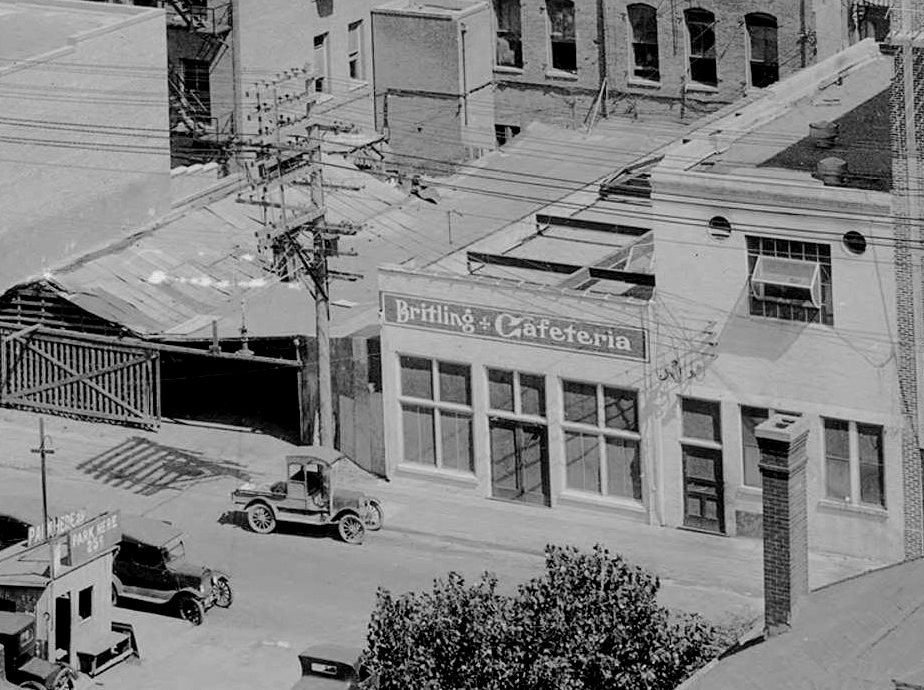
britling-cafeteria_rear-entrance_degolyerThe 1300 block of Jackson Street

by Paula Bosse

Last year I wrote about the Britling Cafeteria, an apparently well-known Southern restaurant chain, founded about a hundred years ago. Its first restaurant outside the Deep South was in Dallas, where it opened at 1316 Commerce Street at the end of 1922 (the rear entrance on Jackson Street is seen above). I’m a sucker for nostalgic restaurant articles, so I wrote one myself! Check out the post “The Britling Cafeteria Serves Those Who Serve Themselves,” here.

I would never have known about that swanky cafeteria had I not seen a fantastic George McAfee photo from the collection of SMU’s DeGolyer Library — the image above is a magnified detail of the original, much larger photograph. See that original photo, along with five zoomed-in details, in the post “Downtown Dallas, ca. 1923 — Zooming in on the Details,” here.

A “from the vault” two-fer.

*

Copyright © 2015 Paula Bosse. All Rights Reserved.
 

From the Vault: Gusher at Old Red! — 1890

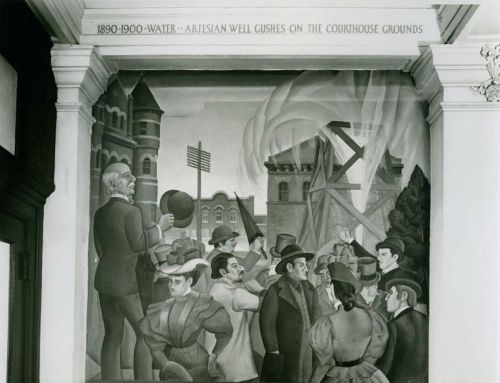
artesian_bywaters-hogue_bw-smu“Artesian Well Gushes on the Courthouse Grounds”
Mural by Jerry Bywaters & Alexandre Hogue (1934)

by Paula Bosse

I had meant to post this look back at a previous Flashback Dallas post last week! On October 9, 1890 — 125 years ago — a desperately-needed water source was discovered beneath the then-under-construction Dallas County Court House. Read how an artesian well came to be sunk on the grounds of the Old Red courthouse, the incredible gusher it produced, and the jubilant celebration that followed. This discovery was a hugely important moment in Dallas’ history — for one thing, it assured the city’s very survival — but I found almost nothing about it except in contemporary reports from the newspapers of the day. So I wrote about it, and it’s one of my favorite posts. You can read it here.

Happy belated 125th anniversary, old capped and forgotten well!

I never did receive any feedback on whether this odd structure on the courthouse lawn is, in fact, what remains of that well. It seems like it should be — it’s on the exact spot where the gusher gushed. …Is it?

Photo: Paula Bosse

***

Photo of mural by Harry Bennett from The Bywaters Special Collections, Hamon Arts Library, Central University Libraries, Southern Methodist University; more information is here.

*

Copyright © 2015 Paula Bosse. All Rights Reserved.

“A City Built On the Solid Rock of Service” — 1927

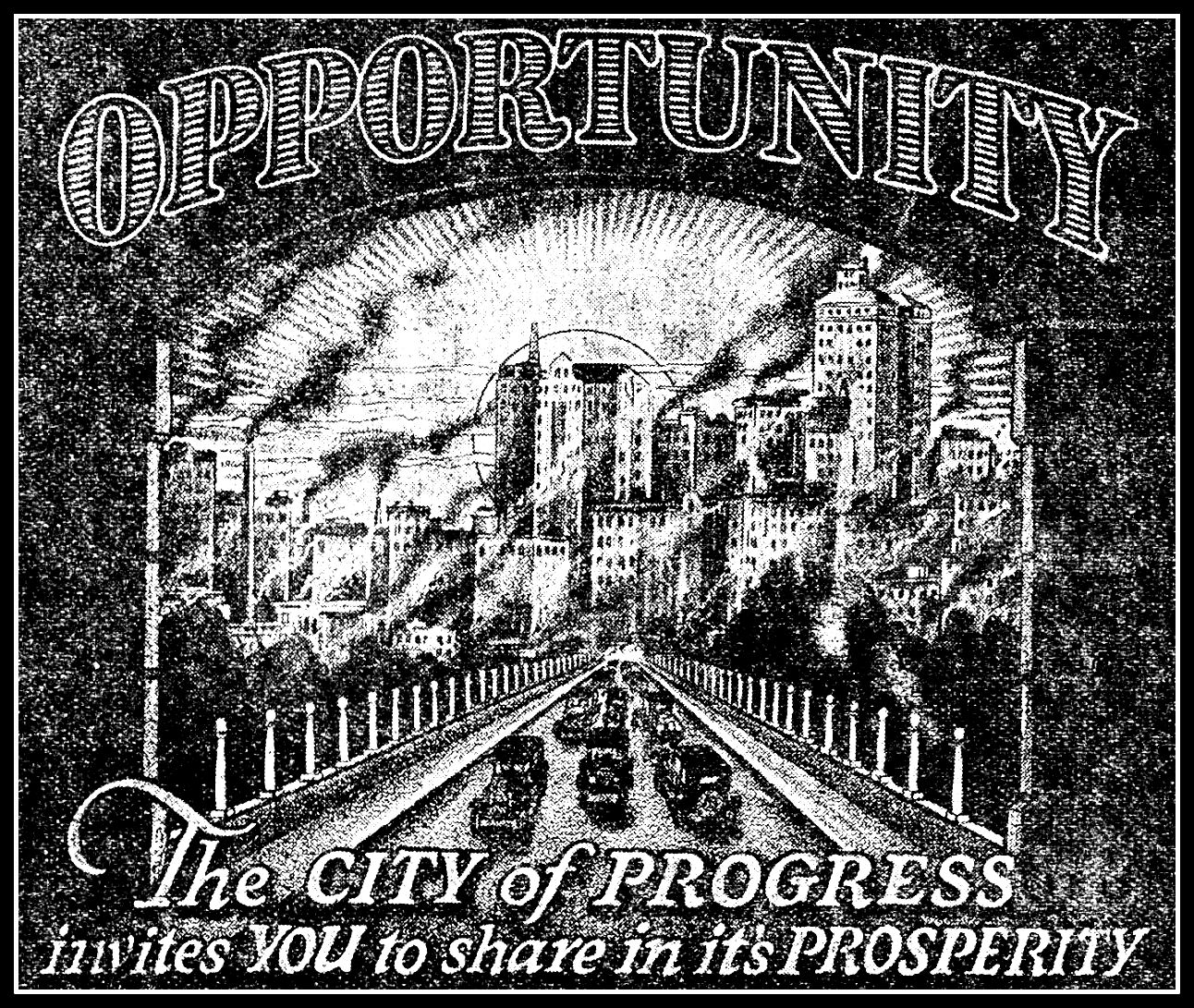
ad-dallas-chamber-of-commerce_tx-almanac_1927-det“Opportunity!”

by Paula Bosse

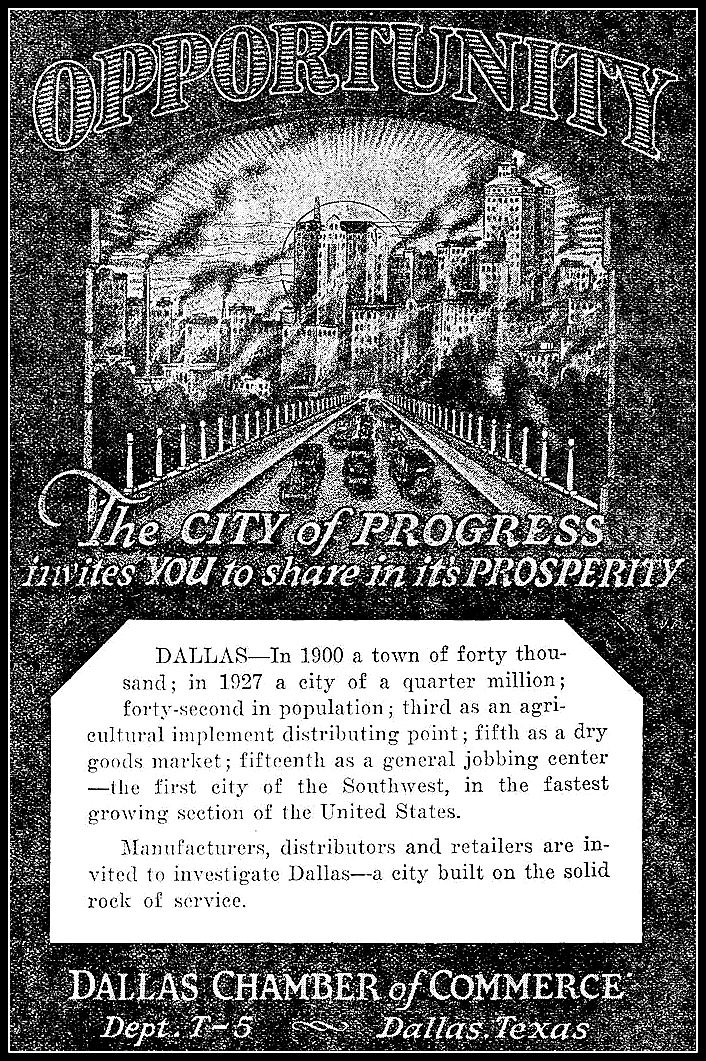
Below, a 1927 Dallas Chamber of Commerce ad with some interesting statistics.

ad-dallas-chamber-of-commerce_tx-almanac_1927

*

OPPORTUNITY

The CITY OF PROGRESS invites YOU to share in its PROSPERITY.

DALLAS–in 1900 a town of forty-thousand; in 1927 a city of a quarter million; forty-second in population; third as an agricultural implement distributing point; fifth as a dry goods market; fifteenth as a general jobbing center–the first city of the Southwest, in the fastest growing section of the United States.

Manufacturers, distributors and retailers are invited to investigate Dallas–a city built on the solid rock of service.

*

Pretty impressive. And the illustration of a dynamic city on the other side of that viaduct is all but throbbing with energy.

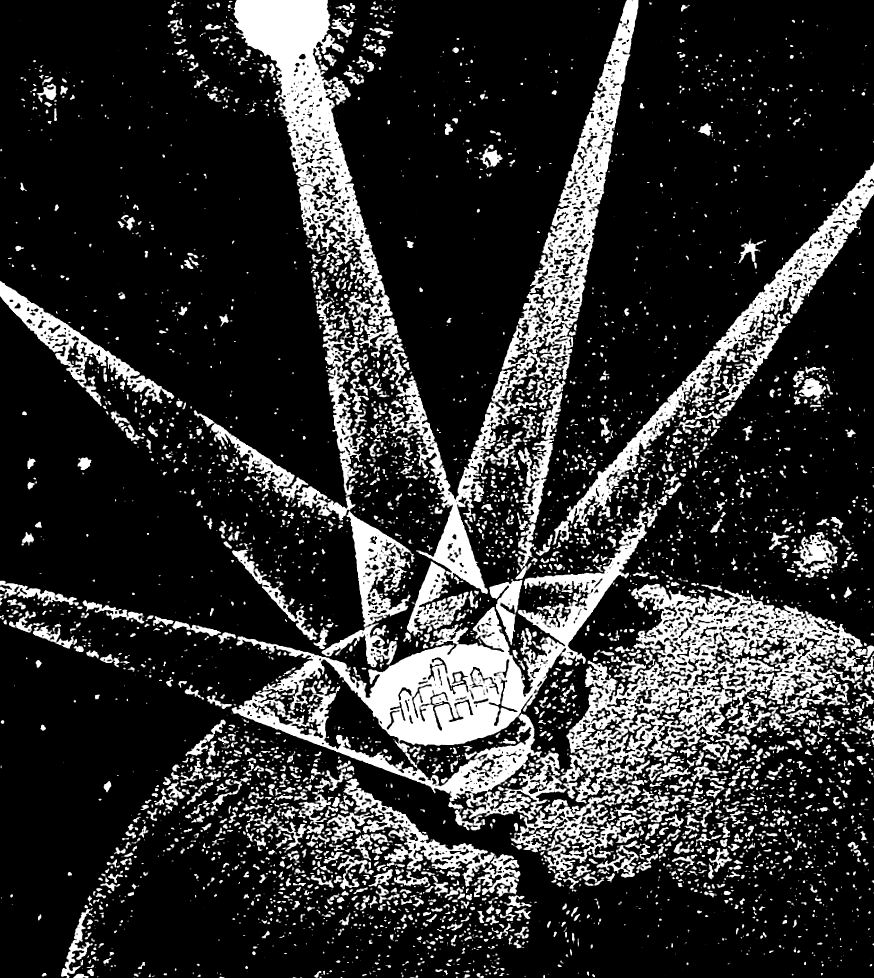
The illustration from a 1929 Chamber of Commerce ad is even less modest: it shows Dallas as the center of the universe, center stage on Planet Earth, lit up by the sun and the giant Klieg lights of space.

ad-dallas-chamber-of-commerce_tx-almanac_1929-det

I kind of think Dallas has pretty much always seen itself like this.

***

Sources & Notes

Ads from the 1927 and 1929 editions of The Texas Almanac and State Industrial Guide.

*

Copyright © 2015 Paula Bosse. All Rights Reserved.
From the Vault: The First Texas-OU Game in Dallas — 1912

tx-players_dmn_101912bThe guy on the right looks particularly intimidating….

by Paula Bosse

It’s that time again. Read my previous post, “The First Texas-OU Game in Dallas — 1912” (back when the game was held in Gaston Park), here.

***

Photo of three of the Texas players from The Dallas Morning News, Oct. 19, 1912 (the day of that first game). Check out the original post to see the much more collegiate-looking members of the Oklahoma team.

*

Copyright © 2015 Paula Bosse. All Rights Reserved.

From the Vault: University Park’s Monarch Butterfly Wrangler

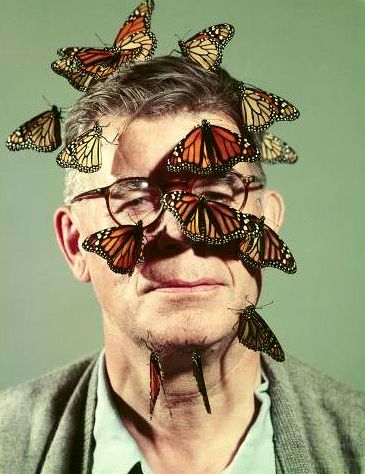
monarch_life_colorCarl Anderson & friends (John Dominis, Time-Life Pictures/Getty Image)

by Paula Bosse

One of my favorite Flashback Dallas posts was the one I wrote earlier this year about Carl Anderson, a man who was passionate about studying Monarch butterflies. He shared his love of these butterflies with everyone — from the neighbor kids on Centenary Avenue in University Park to the worldwide readership of Life magazine.

I wrote the original post — which you can read here — when the Monarchs were migrating up from Mexico. Now they are migrating back south. Check out the animated map of the Fall/Winter 2015 migration here.

Keep your eyes peeled for Monarchs! Do it for Carl!

*

Copyright © 2015 Paula Bosse. All Rights Reserved.


From the Vault: Oak Cliff Trolley — 1895


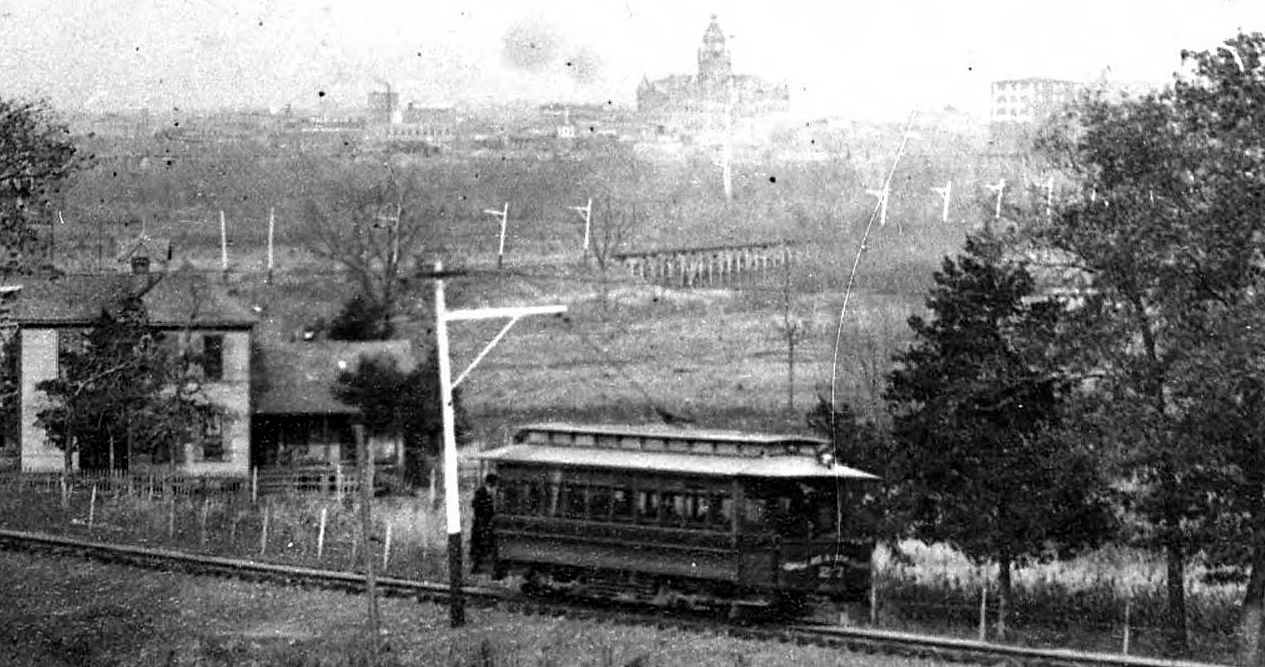
trolley_oak-cliff_det1“Dallas from Oak Cliff” (detail), Henry Stark (click for much larger image)

by Paula Bosse

This wonderful detail of a photograph by Henry Stark shows a trolley chugging through a rural and woody Oak Cliff in 1895: an example of 19th-century mass transit in Dallas. See the full post from last year — which includes the original photo and three other magnified details — here.

*

Copyright © 2015 Paula Bosse. All Rights Reserved.