Flashback : Dallas

A Miscellany: History, Ads, Pop Culture

Category: Vault

Mardi Gras: “Our First Attempt at a Carnival Fete” — 1876
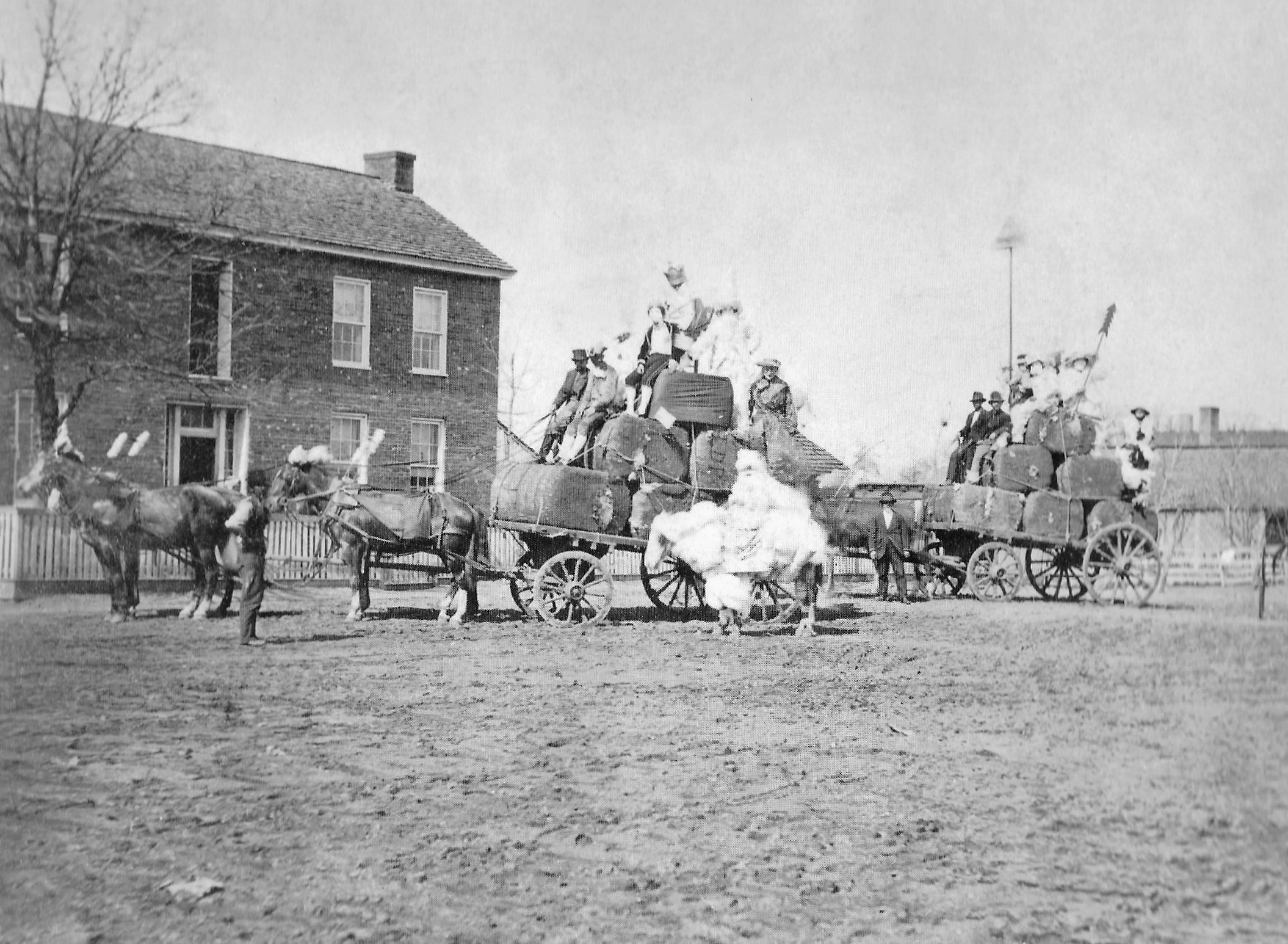
mardi-gras_dhs_1876When cotton was Rex (click for much larger image)

by Paula Bosse

In the 1870s, if a Dallas resident wanted to celebrate the glitzy revelry of Mardi Gras with a parade and balls and didn’t want to travel all the way to New Orleans, the place to go was Galveston. Galveston had a lock on Texas Mardi Gras galas. But Dallas being Dallas, there were soon plans to stage a massive Carnival right here. The day-long celebration debuted on February 24, 1876, which, oddly, was on a Thursday. (Mardi Gras that year was actually on Tuesday, Feb. 29, and it was probably celebrated early in Dallas so as not to interfere with the hey-we-got-here-first celebrations in New Orleans and Galveston.)

It was estimated that the festivities cost the city more than $20,000 (which, if the Inflation Calculator is to be believed, would be the equivalent of almost $450,000 in today’s money). The city was cleaned up in preparation for the anticipated onslaught of visitors and was decorated with flags and bunting along the lengthy parade route of Main, Elm, and Commerce streets. Revelers had elaborate costumes made for the processions and the grand masked balls, some with fabric imported for the occasion from France
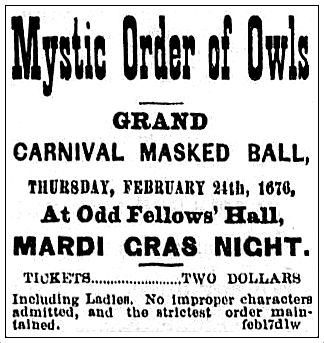
mardi-gras_dal-herald_021876Dallas Herald, Feb. 18, 1876 (not 1676!)

The Dallas Herald and The Dallas Commercial were incessant in their whipping up of excitement for the big day. And it worked. People streamed into town from all over Texas. Hotels were packed, and it was estimated that over 20,000 spectators watched one or both of the day’s parades.

The following day, The Dallas Herald apparently devoted their entire front page to coverage of the event, under this wordy headline:

A Day in Dallas, Our First Attempt at a Carnival Fete. The City Aglow with Enthusiasm and Wild with Rollicking Revelry. Visit of King Momus — His Cordial Reception by the People — The Procession in His Honor. The Season of Merry-Making Brought to a Happy Close with Balls and Bouts — Well Done, Dallas!

(Sadly, this issue is not available online, perhaps because there were none found to scan as it sold out more than five editions and was probably the paper’s best-selling edition to-date.)

Dallas’ first Mardi Gras had been an unqualified triumph, and newspaper editors and city leaders were beside themselves with joy. The parade — and the city — had been covered enthusiastically and favorably by newspapers around the country, and the success of the huge celebration was seen as having been better advertising for the exuberant and growing city than could ever have been hoped.

Galveston? Pffft!

**

A few tidbits from that first Mardi Gras.

There were very few “incidents” reported surrounding the festivities. That’s not to say there weren’t a lot of incidents that occurred that day, just that not a lot of them found their way into the newspapers (apparently whiskey was free-flowing all day long, and one suspects there were “incidents” aplenty connected with that). Among the very few non-“jolly” things that happened on Carnival Day and the day following included the following:

  • A small boy had been run over by a carriage (“but not dangerously hurt”)
  • A child and a horse had been burned severely when a can of gasoline was thrown into a bonfire “to increase the flame”
  • A member of the Stonewall Greys who had participated in the noontime parade had fallen whilst “foolishly scuffling” and had “received a slight but painful wound from a bayonet”

Also, there was some sort of “fireball discharged from a rocket” which caused some consternation:
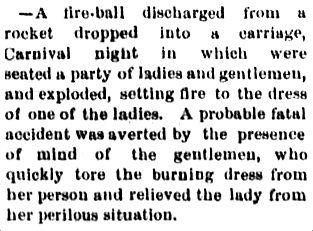
fireball_dal-herald_022676Dallas Herald, Feb. 26, 1876

*

All residences and businesses along the parade route during the evening procession were “commanded” to be illuminated. Even if gasoline-fueled bonfires were raging along the parade route, the elaborate procession was probably poorly lit.

*

My favorite “float” was the huge wagon of lumber meant to draw attention to East Texas timber and the thriving lumber industry in Dallas. One report said “the immense moving forest of pine” was drawn by “32 yoke of oxen” — another said “nearly 100 Texan steers.” Whatever it was, that must have been spectacular to see.
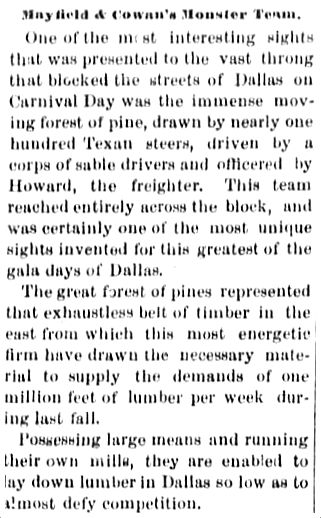
oxen-team_dal-herald_022676Dallas Herald, Feb. 26, 1876

*

The massive amount of publicity and praise that Dallas received quite clearly irked other cities. Austin seemed especially perturbed. There had been a small outbreak of smallpox in McKinney preceding the big day, and several digs at Dallas (like the one below) appeared in newspapers around Texas, accusing the city’s leaders of knowingly endangering the welfare of the entire state just so they could put on their little parade. The exaggerated furor passed fairly quickly, and the het-up schadenfreude expressed by rival cities was amusing.
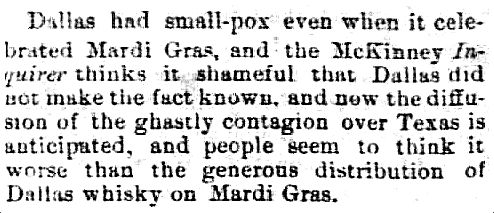
small-pox_austin-weekly-standard_031676Austin Weekly Standard, Mar. 16, 1876

*

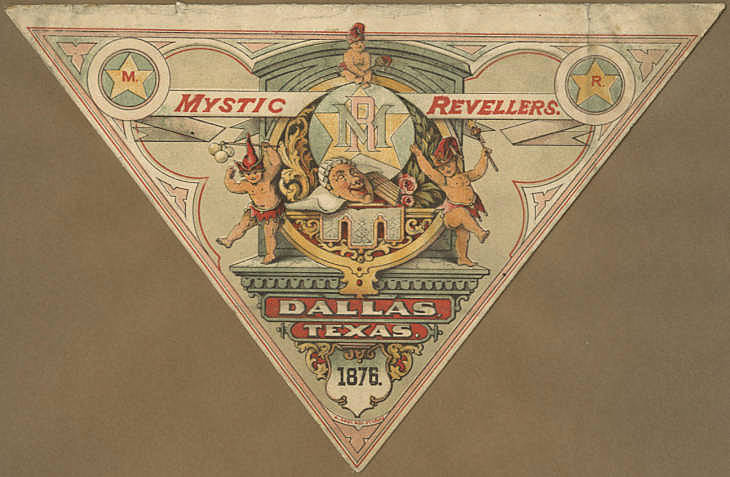
An invitation issued by the Mystic Revellers:
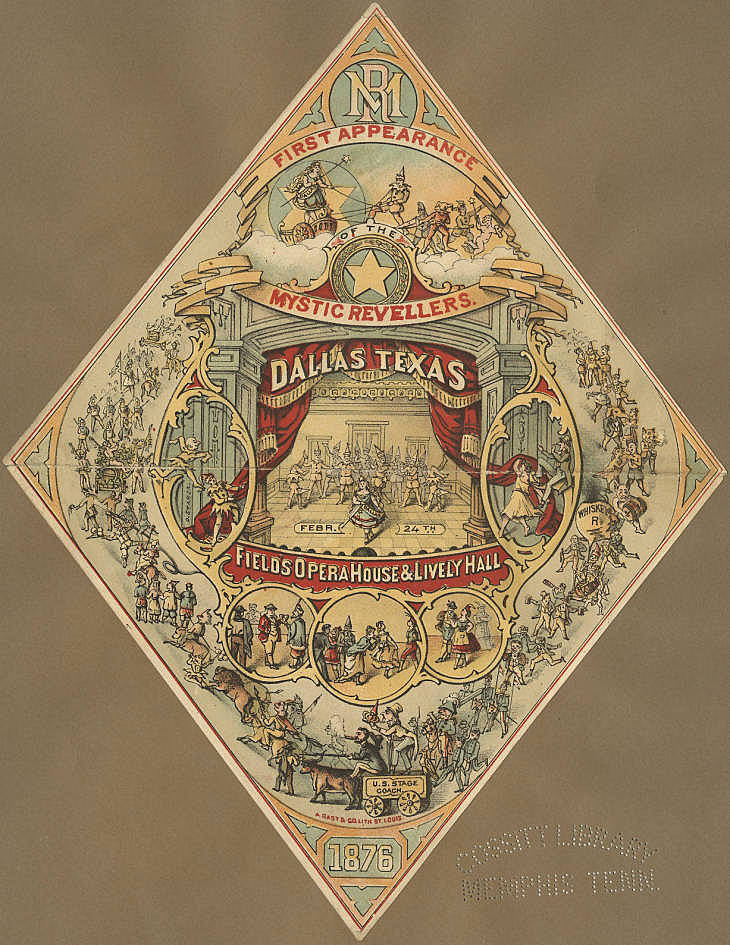
mardi-gras_mystic-revellers_invitation_1876_memphis-public-library

mardi-gras_mystic-revellers_1876_envelope_memphis-public-libraryColton Greene Collection, Memphis Public Libraries

*

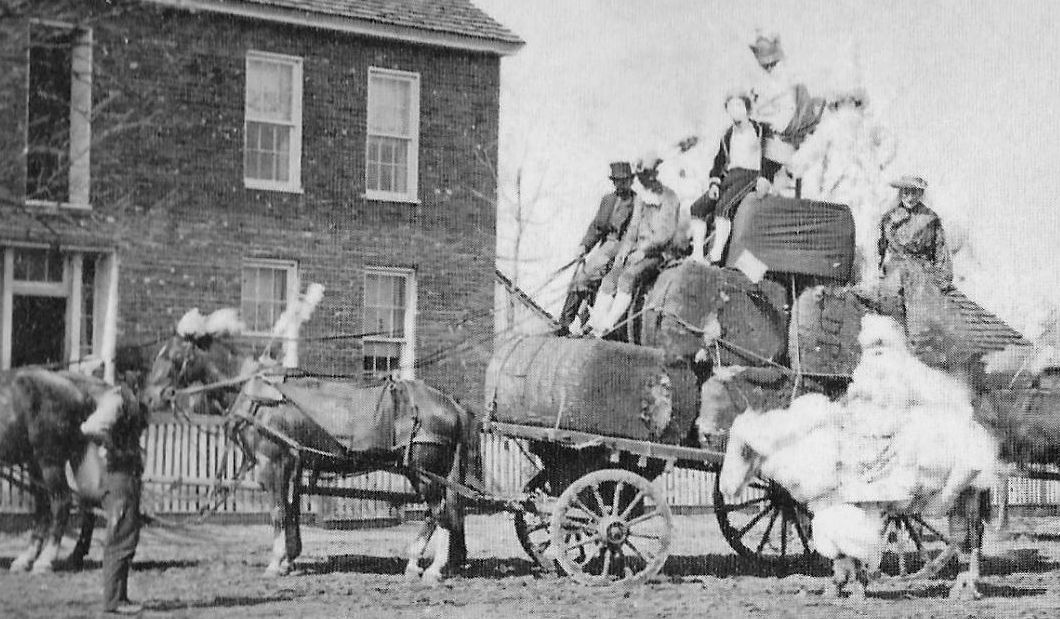
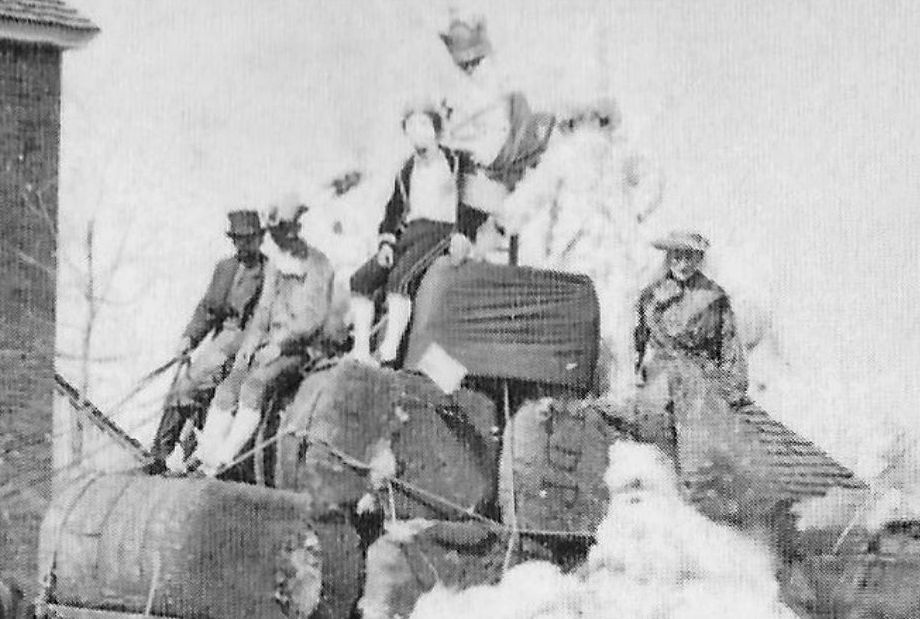
The photo at the top shows the parade wagons representing the brand new Dallas Cotton Exchange (which seems to have been organized the previous month). As described in The Galveston Daily News, the Cotton Exchange’s offering “represent[ed] King Cotton enthroned on six bales of cotton, with numerous subjects appropriately costumed, and occupying two cars” (Feb. 25, 1876). Below are a couple of magnified details of the photo. I’m not sure, but it looks as if the horse and rider in the foreground are covered with cotton. Like tarring and feathering … but fun … and with cotton. The King of Cotton is surrounded by what look like henchmen. The masked man on the right in the elaborate costume is both cool and kind of creepy. (Click both photos for larger images.)
mardi-gras_1876-det1

mardi-gras_1876-det2

***

Sources & Notes

Top photo appeared in the book Historic Photos of Dallas by Michael V. Hazel (Nashville: Turner Publishing Co., 2006); photo from the Dallas Historical Society.

Newspaper clippings as noted.

To read the coverage of Dallas’ Mardi Gras parades and balls —  “a grand pageant and general jollification” — see the front page of The Galveston Daily News (Feb. 25, 1876), here (third column, top of page — zoom controls are on the left side of page).

I wrote a previous post called “Mardi  Gras Parade in Dallas — ca. 1876” which features a photograph which might be from this first Mardi Gras. That post and photo can be seen here.

Happy Mardi Gras!
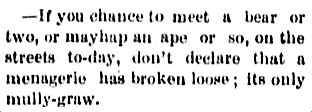
mully-graw_dal-herald_022476Dallas Herald, Feb. 24, 1876

Photos larger when clicked.

*

Copyright © 2015 Paula Bosse. All Rights Reserved.

Roseland — 1916

roseland_terrill-yrbk_1916The Roseland Theater, 1613 Main St. (click for larger image)

by Paula Bosse

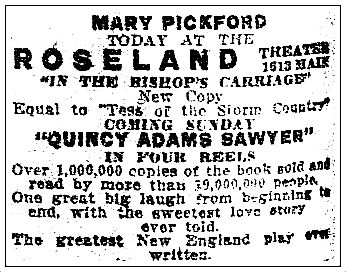
Despite its grainy quality, I really like this photo. It shows people walking past the Roseland Theater at 1613 Main Street, a theater I’d never heard of. I couldn’t find out much about it other than that it doesn’t seem to have lasted very long (from at least 1914 until at least 1916). It was owned/managed by P. G. Cameron, who ran several theaters and was in the general “amusements” business around town (he had run the Fair Grounds Skating Rink back in the aughts for a short while, until the place was shut down because of the discovery of a prostitution operation being conducted there … on city-owned property).

roseland_dmn_050914Dallas Morning News, May 9, 1914

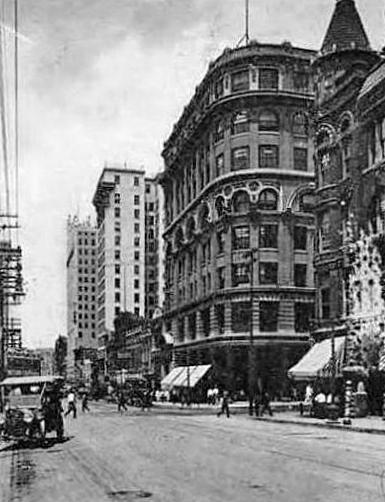
In 1916, the north side of Main Street contained three theaters: the Nickelodeon (1607 Main), the Roseland (1613 Main), and the Best (1615 Main). This is the much-beleaguered (and now mostly demolished) block of Main, which in 1916 was anchored by the dazzling Praetorian and Wilson buildings. The Roseland occupied part of what was once the Everts Jewelers building. Below, another view of this block in 1916, with the theater(s) on the right, about halfway between the tall white Praetorian Building and the stately rounded Wilson Building.

main-st_1916_smu-rotunda_sm Another grainy photo, Main looking west

I like this Roseland photo because it’s a candid shot taken by a teenager on the sidewalk of a lively downtown Dallas who had happened upon his teacher away from school. And the sign is cool. Too bad it’s so hard to see.

roseland_terrill-yrbk_1916_det

***

Sources & Notes

Photo from the 1916 Terrillian, the Terrill School yearbook. (The caption for the photo of one of the school’s teachers: “Passing by or coming out, Mr. F.?”)

Photo of Main Street, looking west, from the 1916 Rotunda, the yearbook of SMU.

See what the 1600 block of Main looked like in 1909, here. Much of the block has been demolished.

See the 1921 Sanborn map showing this block, here.

Below, a recent (2015) Google Street View of the building that housed the Roseland: the really lovely shorter white building. This building may already have been razed. What a shame. (UPDATE — 2018: Yep, demolished.) The current view (as I assume this block is ever-changing) can be seen on Google Street View here.

roseland_google2015, not long for this world….

*

Copyright © 2015 Paula Bosse. All Rights Reserved.
 

University Park’s Monarch Butterfly Wrangler

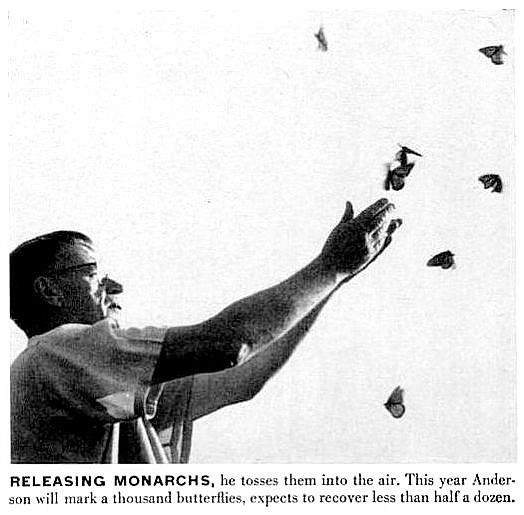
monarch_life_colorCarl Anderson & friends (John Dominis, Time-Life Pictures/Getty Image)

by Paula Bosse

Carl Axel Anderson (1892-1983) was a mild-mannered internal revenue executive by day and a mild-mannered Monarch butterfly expert by night (and weekend … and probably every waking second). Anderson had been interested in insects and butterflies from an early age, and he studied entomology at the University of Minnesota and Columbia. When he was away from the office, he was raising, tagging, tracking, and, perhaps, training Monarch butterflies at his University Park home on Centenary Avenue, which writer Frank X. Tolbert dubbed “the Butterfly Ranch.” Even the neighborhood children — who called themselves The Centenary Monarchs — joined in and learned all about Monarchs from Anderson, their butterfly mentor.

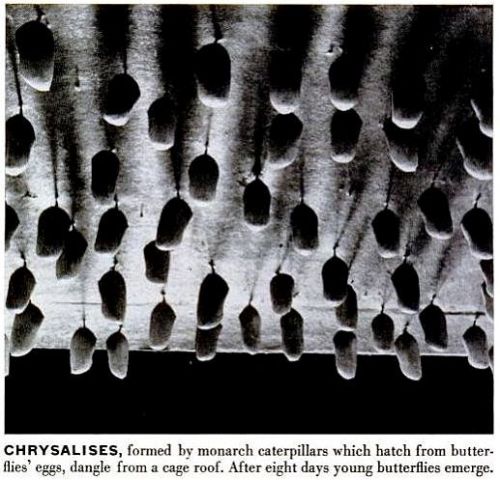
Anderson’s primary interest was studying the migration patterns of the Monarch butterfly, and, conveniently, Dallas was on their pathway, twice a year, so he had a front-row seat. Not only did he observe them passing overhead, he also raised them from eggs laid on the underside of his milkweed plants, enjoyed them as caterpillars, and when they became butterflies, he “branded” their wings painlessly (see below) and released them into the wild, hoping to be able to track their migration from fellow butterfly spotters around the country. He wrote letters to newspapers around the country and mailed hundreds of postcards to groups and individuals, hoping to get his message out. His message, in part:

Monarch butterflies raised from the egg are being released. A number is placed on their wings before they are released. Members of the public are invited to join the observers on the magic carpet of these wings to see where it will take us. Invite your friends and associates to come along, too…. Examine the wings of the Monarch…for numbers or other marks. Allow the butterfly to go on its way after your observation. Please report any observation where marked wings are found….”

In 1950, big news was made when one of his butterflies — one with the number “9” on its wing — was reported to have been seen in California by a 10-year old boy named Ben Harris in Santa Monica, California. That must have been one of the happiest moments of Anderson’s life.

Every year during Monarch migration over Texas, Mr. Anderson was a reliable go-to story for the local media. Particularly fascinated by Anderson and his “butterfly ranch” was Dallas Morning News writer Frank X Tolbert, who wrote about him numerous times. A very early profile by Tolbert rhapsodized about Anderson’s “pet” butterfly Pete which set the tone for all his very sweet subsequent articles about Anderson that appeared over the years. (Next time you’re wandering around in the Dallas News archives, check out Tolbert’s story “An Affectionate Fellow Was Pete the Butterfly” published on May 16, 1948 — but if you like happy endings, beware of the last two paragraphs of the story: personally, I’d advise readers to stop reading when Pete sets off on his journey.)

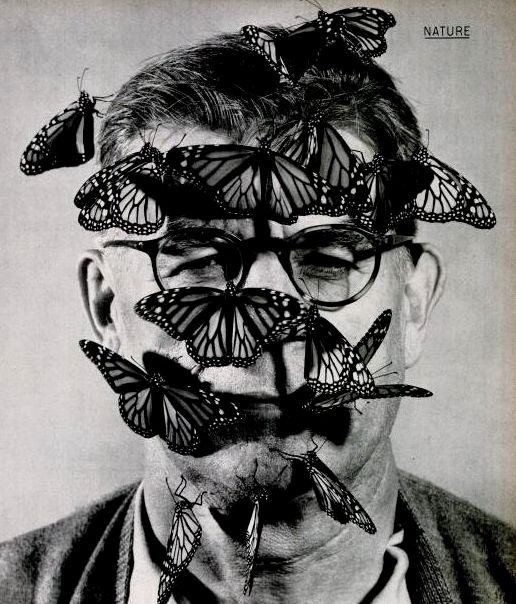
Anderson was the subject of newspaper and magazine articles all over the country, but the high point was, undoubtedly, his appearance in the pages of Life magazine in 1954, accompanied by the striking photo of him with several of his butterfly pals resting on his face.

monarch_life_052454-a

The caption for this photo reads: “Mottled with Monarchs, butterfly breeder Carl Anderson stares serenely ahead as the domesticated insects swarm all over his face.” (That is NOT a “swarm,” Life!)

The two-page photo spread was titled “Monarch Man: Texan Breeds Bushels of Them To Help Map Butterfly Migration.”

Each spring Mr. Anderson raises hundreds of Monarchs in cages. If released, they flutter about him, looking for a sip of sugar water. When the Monarchs mature, he brands them and turns them out, alerting friends across the U.S. to watch for them. One of Anderson’s butterflies turned up 1,200 miles away. But instead of clarifying the northward migration it added another enigma by flying cross-country and winding up almost directly west of Dallas. (Life, May 24, 1954)

monarch_life_052454-b

monarch_life_052454-c

monarch_life_052454_d

Anderson died at the age of 91, having spent the bulk of his long life engrossed in the study of his beloved Monarch butterflies. This excerpt from a 1955 interview shows a glimpse of the wonder and enthusiasm that kept him fascinated by the butterflies his entire life:

“Just at dusk on Oct. 26, the wind shifted to the north with a velocity of 15 MPH. It brought in a huge cloud of Monarchs riding ahead of the cool front. The cloud changed into the shape of a tremendous, brown, moving carpet of unusual surging design. A signal from some leader or leaders in the great flight designated a grove of our hackberry trees as the resting place for the night. Down came the flying carpet of thousands of butterflies. And in a few minutes every twig was bent by the weight of Monarchs. They took off in small groups the next morning, leaving our Dallas hackberries bare of leaves.” (DMN, May 3, 1955)

Thanks, Carl. I wish I’d known you.

**

Below, a short clip from Oct. 1973 featuring an interview with Carl Anderson by Arch Campbell of Channel 8 News (Campbell mistakenly refers to the park as being Tenison Park — it is Lake Cliff Park).

***

Sources & Notes

Color photo of Carl Anderson by John Dominis (Time & Life Pictures/Getty Image). It is from the same session that produced the slightly different black and white image featured in Life magazine.

The profile of Anderson (which includes the text and photos reproduced above) appeared in the May 24, 1954 issue of Life; it can be accessed here.

The Channel 8 film clip is from the WFAA Collection, G. William Jones Film & Video Collection, Hamon Arts Library, SMU; the direct YouTube link is here.

Read another profile of Anderson from the Bakersfield Californian, “Lepidopterist Traces Branded Butterflies” (July 11, 1949), here.

A bunch of Monarch butterfly sources:

  • “The Monarch Butterfly’s Annual Cycle” from the Monarch Butterfly Fund, is here.
  • “The Monarch Butterfly Journey North News,” a regularly updated blog on the current (overwintering/leading-up-to-Spring 2105) migration, is here.
  • A regularly updated map of Monarch sightings (currently at Winter 2015, showing Monarchs warming up in the bullpen along the Texas coast) is here.
  • An animated map of 2014’s Spring migration is here. UPDATE: An animated map of the Fall/Winter 2015 migration is here.
  • “Monarch Butterflies Could Gain Endangered Species Protection,” from the Scientific American blog, is here. (“Populations of the iconic and beloved Monarch butterfly (Danaus plexippus plexippus) have dropped an astonishing 96.5 percent over the past few decades, from an estimated 1 billion in the mid-1990s to just 35 million in early 2014.”)
  • Information on the Monarch butterfly conservation program — and some beautiful photographs — can be found on the World Wildlife Fund site, here.

Keep your eyes peeled — they’ll be on their way soon

*

Copyright © 2015 Paula Bosse. All Rights Reserved.

Back at the Ranch with Yves Saint Laurent — 1958

YSL_longhorn_josey-ranch_1958_eric-sweckerYSL & friend… (photo: Eric Swecker)

by Paula Bosse

Even if you had no idea who the man with the glasses was, this would be an attention-grabber of a photo. But if you do happen to recognize the man as international fashion icon Yves Saint Laurent, then it’s even more of an attention-grabber. Yes, that is 22-year-old Yves Saint Laurent, head of the legendary House of Dior.

…In a pasture with a longhorn steer.

…Wearing a Stetson (or something Stetson-like).

..In Carrollton, Texas! What could be more unexpectedly perfect?

The UPI/Telephoto caption:

9/5/58-DALLAS: Yves-Mathieu Saint Laurent, 22-year-old master of the House of Dior, got a taste of Texas tradition on his first trip to the US. Saint Laurent, in Dallas to receive an award from Neiman-Marcus, stopped off at a cattle ranch near here before departing for France and was presented a Texas-style hat and introduced to a real “Texas Longhorn” steer.

YSL (who had not yet jettisoned the “Mathieu”) was the wunderkind fashion designer who — at the unbelievable age of 21 — had succeeded Christian Dior as Dior’s head designer. His first collection was a hit, and he was 1958’s fashion superstar.

That was the year that YSL was invited to Dallas by Stanley Marcus to receive the 21st Annual Neiman-Marcus Fashion Exposition Award — known throughout the industry as the “Fashion Oscar.”

He has had many offers to come to America to accept awards but the Dallas honor was the only one he accepted. He had a sentimental reason. His late master, Christian Dior, came to Dallas to accept the Neiman-Marcus award in 1947 after he had created the New Look in his second collection. (Dallas Morning News, Sept. 4, 1958)

While in Dallas, the young Saint Laurent — whom the fashion editor of The Dallas Morning News described as looking “like a serious young man who might be coming to enroll at SMU” — soaked up a little local color: he was taken to the Orleans Room downtown to see the Dixieland jazz band The Chain Gang, and — apparently at his request — he was taken to a Texas ranch.

Saint Laurent had been quite keen to see a real Texas ranch, so Stanley Marcus’ son Richard took him out to the nearby Josey Rancho — the large ranch owned by Dallas oilmen brothers Clint and Don Josey in then-rural Carrollton. The fashionably dressed, Cartier-watch-wearing dudes took a bumpy ride in a pickup truck across the large ranch, and there was much gawking of longhorn cattle and herds of buffalo. YSL seems to have enjoyed himself and must have found the whole thing very “Texan”: he got closer to a longhorn than I’d ever get (and he squatted like a real cowboy!), he watched some calf roping, and he ate some barbecue. And he was probably the most stylishly-dressed visitor the ranch ever had (there aren’t a lot of tailored suits and French cuffs out on the lone prairie).

He headed back to Paris later that afternoon with, I’m sure, plenty of exotic stories to share with those back at the atelier. He also had a new hat. And maybe some indigestion.

*

ysl_090458_stanley-marcus-papers_SMUvia Stanley Marcus Papers, SMU

josey-rancho-longhorns_lufkin-line-mag_1956Josey Rancho

josey-rancho-buffalo_1950sJosey Rancho

josey-rancho_aerial_pointer-bkJosey Rancho

***

Sources & Notes

Top photo by UPI/Telephoto. This wire photo is from the collection of my old friend Eric Swecker. Thank you for use of this fantastic photo, Eric!

Photo of longhorns at the Josey Rancho from a trade magazine called The Lufkin Line (Jan./Feb., 1956). Photo of Josey Rancho buffalo and the aerial photo are from the book Carrollton by Toyia Pointer, with photo credit given to Linda Sollinger; more on the book here. More information on the ranch from the book is here.

More on YSL’s visit can be found in the Dallas Morning News article “N-M Awardees Get Glimpse of Texas” by Gay Simpson (DMN, Sept. 6, 1958).

YSL wiki, here.

“When Coco Chanel Came To Dallas — 1957” — my post about Mlle. Chanel’s visit to Dallas to accept the previous year’s Neiman-Marcus award — is here. (Let’s hope Saint Laurent liked the BBQ more than Coco did.)

*

Copyright © 2015 Paula Bosse. All Rights Reserved.

The Marietta Mask

marietta-mask_doak_boys-life_oct55SMU football star Doak Walker in an ad from Boys’ Life, Oct. 1955

by Paula Bosse

Dr. Thomas M. Marietta (1910-1995), a Dallas dentist, devised a startlingly new invention in 1947: a specially-made facemask. Initially, the mask was created to protect the face of a Dallas hockey player who had recently sustained a broken nose and would have been unable to play without a mask for fear of further injury. Marietta’s creation was a success — not only did the player get back on the ice, but tentative inquiries from other sports teams began to trickle in. But what changed everything were the masks he made for TCU’s star quarterback Lindy Berry, who had suffered a broken jaw, and Texas A&M’s fullback Bob Smith, who had a badly broken nose. Without the odd-looking masks that protected their entire faces, they would not have been able to play out the seasons. The masks were an unqualified success, and the doc went commercial.

marietta-face-mask_marion-OH-star_112251_wireDr. Marietta (Marion Ohio Star, Nov. 22, 1951 — full article is here)

In 1951, football players did not generally wear facemasks. It was commonplace for players to rack up a dizzyingly large number of injuries such as broken and dislocated jaws and noses, knocked-out teeth, facial lacerations, major bruising, concussions, etc. An article appeared in The Dallas Morning News on Aug. 31, 1951 describing what this whole facemask thing was about and how the Texas Aggies were about to try a revolutionary experiment by equipping “possibly half of the A&M team” with Dr. Marietta’s newfangled masks. Coach Ray George approved a trial test of the masks, saying that his primary concerns were reduction of facial injuries, elimination of head injuries, and improvement of athletic performance. A&M’s trainer, Bill Dayton, predicted that the wearing of facemasks would become universal among players in the coming years.

Many head injuries happen as the result of a player ducking his head. We believe that by the use of this face gear we can eliminate head ducking, and our players will see where they are going. When they watch their opponents, they are able, by reflective action, to keep their heads out of the way. (A&M trainer Bill Dayton, DMN, Aug. 31, 1951)

The various incarnations of the Marietta Mask over the next couple of decades were used in various sports by children, by college athletes, and by professionals. Dr. Marietta patented several designs for masks and helmets and had a lucrative manufacturing business for many years. In 1977 the business was sold, and the Marietta Corp. became Maxpro, a respected name in helmets.

Football and hockey will always be extremely physical sports with the very real possibility of injury, and though there’s need for further improvement, Dr. Marietta’s invention helped lower the danger-level quite a bit. Thanks to a mild-mannered dentist from Dallas, a lot of athletes over the years managed to avoid all sorts of nasty head and facial injuries. Thanks, doc.

*

marietta-mask_corbis_oct1954Oct. 1954 (©Bettmann/CORBIS)

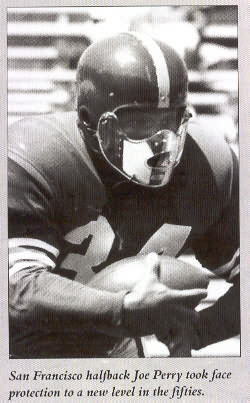
marietta_joe-perry

marietta-mask_envelope

***

Sources & Notes

Photo ©Bettmann/CORBIS; the original caption: “An outer-space look is given by this all-plastic mask lined with foam rubber. It was designed by Dr. M. T. Marietta, a Dallas, Texas dentist.”

Joe Perry photo from HelmetHut. To see some pretty wacky versions of early masks from a Marietta catalog, see images from HelmetHut.com, here.

Read the following newspaper articles:

  • “Mask Maker: Dentist Helped Wolves Win Title (Abilene Reporter-News, Nov. 29, 1950) — regarding the Colorado City (TX) Wolves and their injured player, Gerald Brasuell, the team’s tackle who wore Dr. Marietta’s mask and was able to play despite having a triple-fracture to his jaw, here
  • “Broken Jaw Protection: Doctor’s Face Mask Enables Injured Gridders To Play” (Marion, Ohio Star, Nov. 22, 1951), here

To see several of Marietta’s patents (including abstracts and drawings), see them on Google Patents, here.

And to read an interesting and entertaining history of the football facemask (and I say that as someone who isn’t really a sports person), check out Paul Lukas’ GREAT piece “The Rich History of Helmets,” here. (If nothing else, it’s worth it to see the cool-but-kind-of-weird-and-scary, crudely-fashioned, one-of-a-kind facemask made out of barbed wire wrapped in electrical tape!)

And because a day without Wikipedia is like a day without sunshine, the facemask/face mask wiki is here.

*

Copyright © 2015 Paula Bosse. All Rights Reserved.

F. J. Hengy: Junk Merchant, Litigant

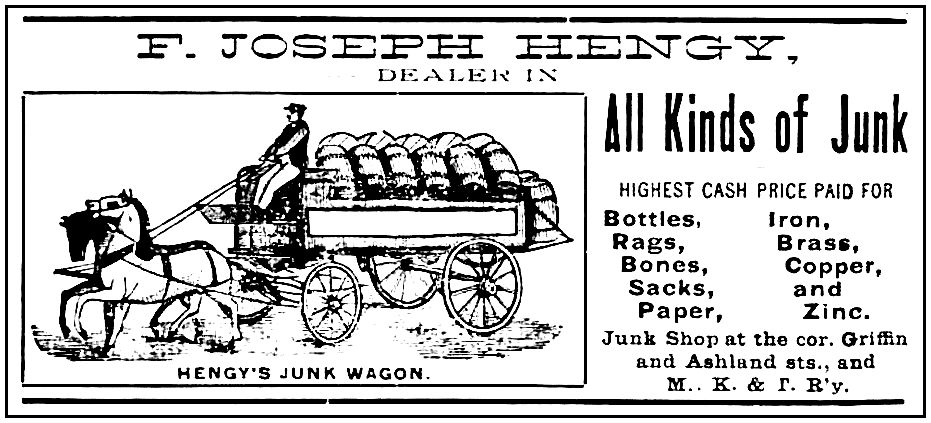
ad-hengy-junk_city-directory_1890-sm“All Kinds of Junk” — 1890 ad

by Paula Bosse

Frank Joseph Hengy was born in Germany in 1850. He immigrated to the United States in 1873, and in about 1880 he made his way to Dallas with a wife and children and established himself as a prosperous buyer and seller of scrap metal and other assorted “junk.” He also owned and operated a foundry, producing amongst other things, sash weights. In the 1894 city directory, there were exactly two “junk dealers” listed, which is surprising, seeing as Dallas was a sizable place in 1894 — there must have been a lot of bottles, rags, bones, sacks, paper, iron, brass, copper, and zinc lying around all over the place, just waiting to be hauled away.

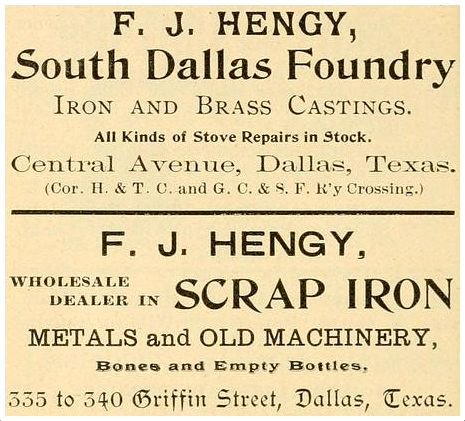
hengy_souv-gd_1984Souvenir Guide to Dallas, 1894

F. J. “Joe” Hengy’s junkyard (and adjacent residence) was at Griffin and Ashland, right next to the M K T Railway tracks. He advertised in the newspapers constantly and was apparently THE man to sell your junk to. His name even made its way into the minutes of an 1899 city council meeting, when, during the discussion on how the city was going to pay for the shipping of a Spanish cannon that had been captured in Cuba and had been given to the city as a war trophy, a councilman asked sarcastically, “What will Hengy give for it?” (Dallas Morning News, Aug. 5, 1899).

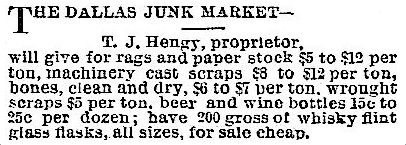
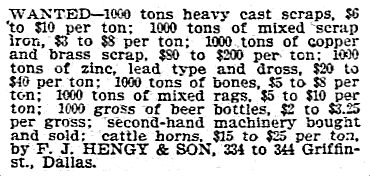
But, seriously, got junk? Call Hengy. Got tons of it? By god, he wants it. A couple of examples of the endless ads placed over the years — two ads, 12 years apart (the 1887 one getting his first initial wrong).

1887_hengy_dmn_082487DMN, Aug. 24, 1887

1899_hengy_dmn_102299DMN, Oct. 22, 1899

In the mid-1890s, Joe took his son Louis on as a partner, which, in retrospect, was probably not a good idea, because it wasn’t long before Joe found himself in the middle of years and years of lawsuits: father against son, son against father, father and associates against son, son and associates against father, etc. Not only was he constantly being sued by his son, he was also sued for divorce … twice … by the same woman. He turned around and sued her for custody of their youngest children (and won). She sued him for the business when he was threatening to sell it and retire. He sued her back for something or other. And on and on and on.

Not only was Joe spending all his non-junk-hauling time traipsing about courthouses, but he also found the time to suffer the occasional partial destruction of buildings on his property — twice by fire and once by the massive flood of 1908. The fires were suspicious (the flood was not).

Then there was the time he was charged with the crime of mailing an obscene letter (I’m gonna go out on a limb and guess that it was probably a letter sent to his wife — or maybe ex-wife by that point — who was in the midst of suing him and their son). Even though this was a potentially serious federal offense, he was ordered to pay only a small fine for “misuse of the mails.” He was also charged at one point with “receiving and concealing stolen property,” but I’m not sure that got past a grand jury investigation, and one might wonder if there wasn’t some sort of “set-up” by aggrieved relatives involved. It was something new anyway. Probably broke up the monotony a little bit.

But the thing that seems to have been Hengy’s biggest headache and was probably the root of most of the lawsuits filed BY him and AGAINST him concerned property he owned which had been condemned in the name of eminent domain by the M K T Railway. The condemnation was disputed, the appraisal of land value was disputed, the question of which Hengy actually owned the land was disputed, etc.

By the end of 1913, Joe Hengy had been engaged in at least 10 years of wall-to-wall litigation. He moved to Idaho at some point, remarried, started another business, and, finally, died there in 1930. Let’s hope his later years were lawsuit-free.

*

hengy_map_ca1900

Hengy’s business and residence (which was, surprisingly, right next door to his litigious son) was at 2317 Griffin, very close to the present-day site of the Perot Museum. (Full map circa 1900, here.) (Click for larger image.)

*

Lastly, two odd, interesting tidbits.

Joe Hengy took time out from junk and courtrooms to invent new and improved … suspenders! I’m not sure exactly what was so revolutionary about them, but a patent was granted in 1912 — you can read the abstract here, and see them in all their suspendery glory here. (With so much foundry and scrap metal know-how, you’d think he’d go in a more … I don’t know … anvil direction or something.)

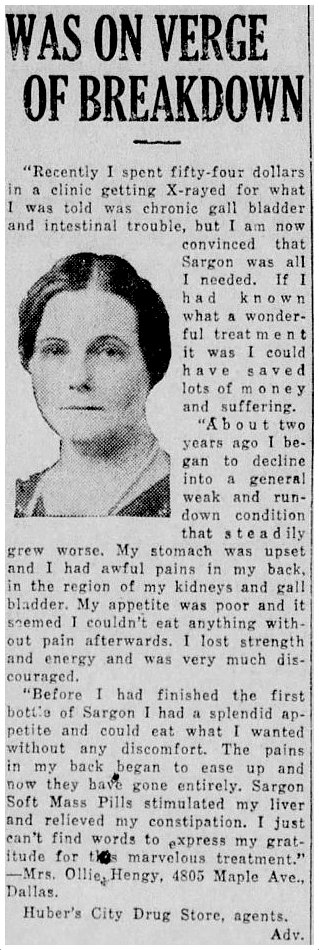
And, then there’s this — a kind of sad ad for a tonic called “Sargon” with a testimonial from Mrs. Ollie Hengy, the no doubt long-suffering wife of perennial plaintiff/defendant Louis Hengy. “Was On Verge of Breakdown.” I don’t doubt it! (Incidentally, Ollie and Louis divorced the same year this advertisement appeared in Texas newspapers. Maybe that stuff did work.)

ollie-hengy_vernon-daily-record_0906291929

***

Sources & Notes

Top ad from Dallas’ 1890 city directory.

Sargon ad appeared in The Vernon Daily Record, Sept. 6, 1929. More on the quack tonic Sargon here.

Sources for other clippings and images as noted.

Lastly, an interesting article that answers the questions “Why was the scrap metal game profitable?” and “Just where did all that metal GO, anyway?” can be found in the article “Many Uses for Junk: How Wornout and Discarded Metal is Utilized,” originally published in The Brooklyn Citizen in 1899; it can be read here. I’m nothing if not exhaustive.

*

Copyright © 2015 Paula Bosse. All Rights Reserved.

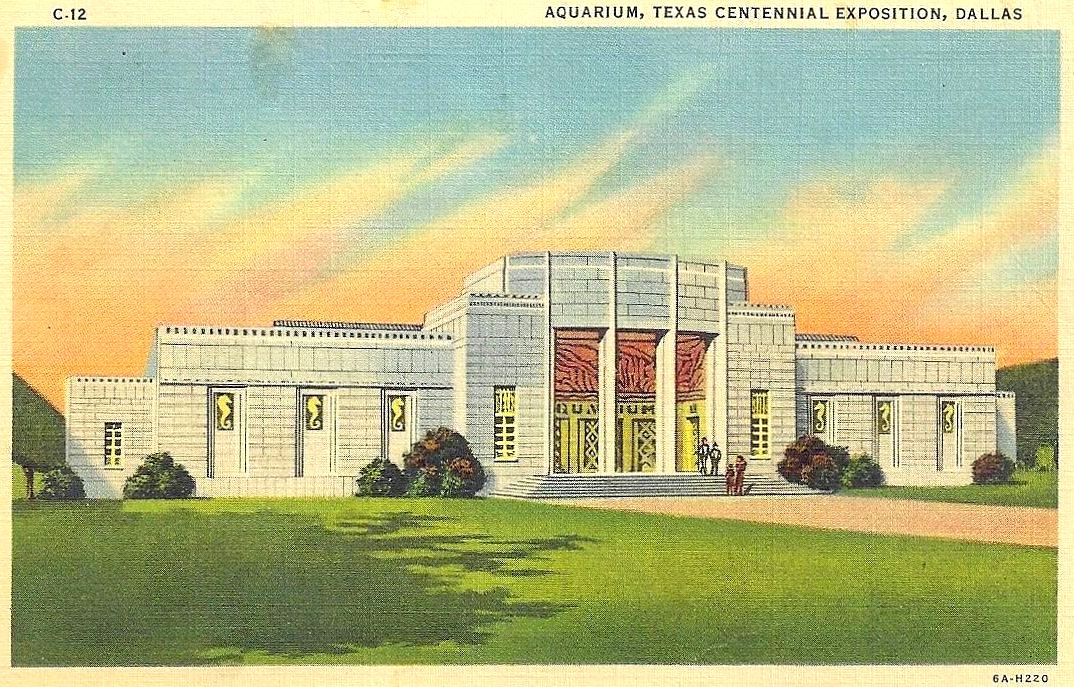
The Dallas Aquarium: The Building Emblazoned With Seahorses — 1936

tx-centennial_aquariumThe Dallas Aquarium at Fair Park, 1936… (click for larger image)

by Paula Bosse

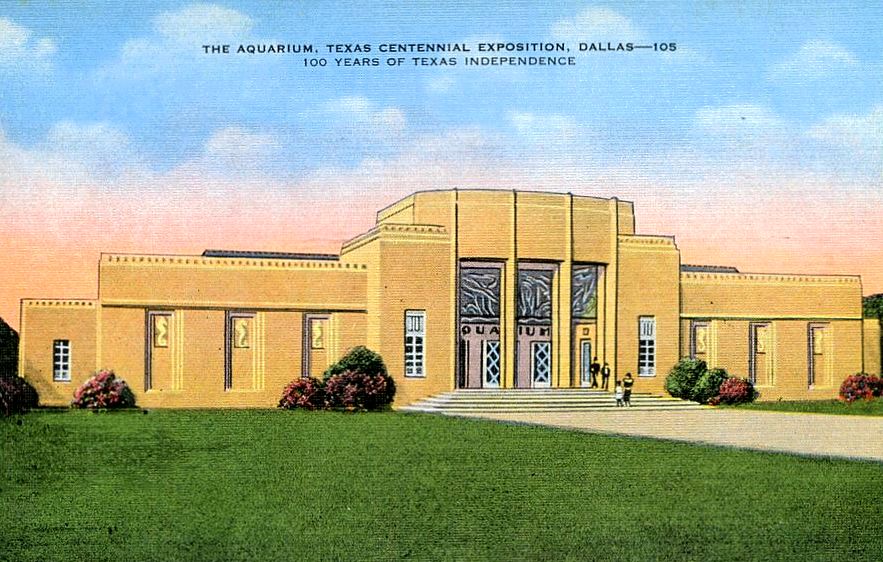
Out of all the buildings at Fair Park, the one I have the fondest memories of is the Dallas Aquarium, one of the buildings built in 1936 for the Texas Centennial Exposition which was specifically intended to be a permanent structure which would be available year-round to the citizens of Dallas, well after the Centennial had ended (some of these other “civic buildings” included the Museum of Fine Arts, the Museum of Natural History, the Hall of State, the bandshell, etc.). The Centennial buildings were designed by different architects, usually working in teams — the aquarium was designed by Fooshee & Cheek (best known for their previous triumph, Highland Park Village), Hal B. Thomson, and Flint & Broad. It ended up costing the city about $200,000 ($50,000 over the initial budget), and tussles with the Park Department and the City Council over its budget and space requirements meant that at various times it was suggested that the aquarium find a home at the Marsalis Park Zoo in Oak Cliff rather than at Fair Park, or that it just be shelved altogether.

fair-park-aquarium_1936

But everything worked itself out in the end, and its popularity at the Centennial was huge. HUGE. Most people in our part of the country had never been to an aquarium and had never seen fish outside of a lake or river or hatchery. According to reports in the newspapers during its construction in early 1936, not only was the Dallas Aquarium the first aquarium in Texas, it was also only the 12th aquarium in the entire United States — and it was the only one in the country in a “strictly inland city.” So unless visitors to the Centennial that year had traveled extensively, chances were slim that they’d ever seen anything like this.

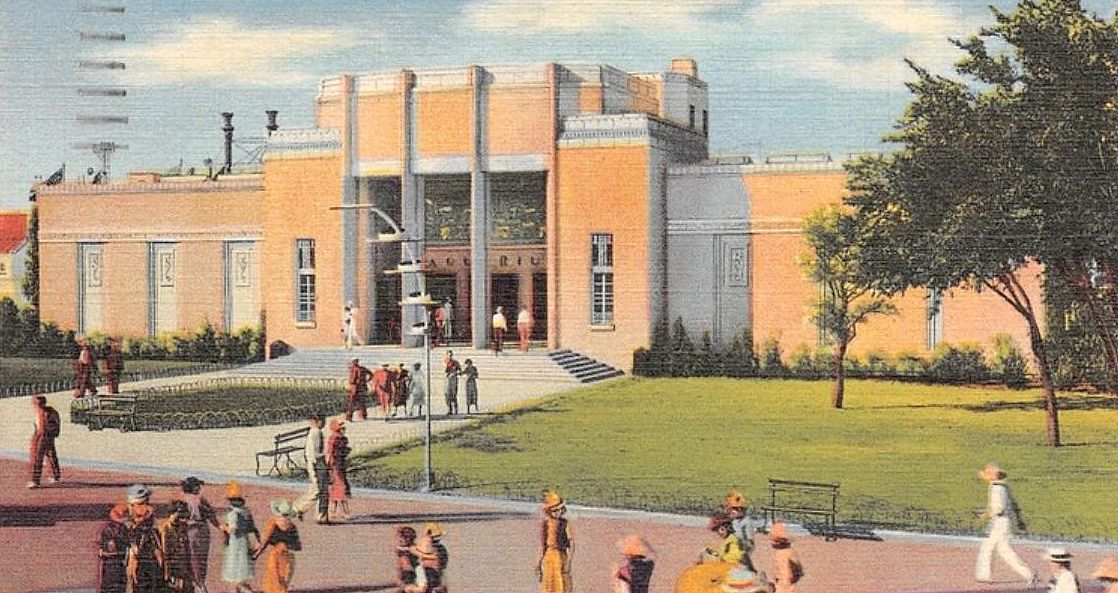
fair-park_aquarium_postcard

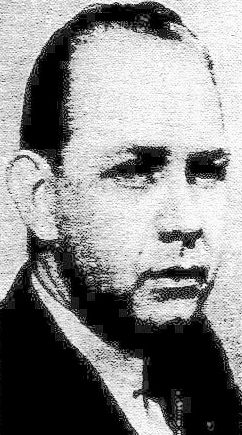
At the time that plans were being discussed for the Fair Park facility, there was something of a tropical fish fad going on around the country. The Dallas Aquarium Society — a small group of “tropical fish fanciers” — was organized in June, 1935, and in September of that year, they had enough pull to put on an exhibition of their personal collections in small tanks on an upper floor of the Dallas Gas Company. People who had never before seen anything but a goldfish in a fish bowl were fascinated, and there were several “gee-whiz” articles in the papers describing the fishy wonders that could be found that fall at the gas company. The president of the Dallas Aquarium Society was Pierre Fontaine — an advertising man and “authority on marine life” — and he must have made quite an impression with the Centennial board, because in February of 1936, he was chosen to be the head of the already-under-construction Dallas Aquarium. (Though apparently a hobbyist when appointed, Fontaine served for decades as the respected director of the Dallas Aquarium — and later the Dallas Zoo.)

aquarium_fontaine_1936
Pierre Fontaine, 1936

The fish on display during the Centennial were almost exclusively freshwater fish. Not only would it have been prohibitively expensive to ship the thousands and thousands of gallons of salt water that would have been needed, it would also have been extremely costly to purchase and maintain the special non-corroding equipment necessary to equip such tanks. But Fontaine must have pushed, because the city gave the go-ahead for a paltry 500 gallons of salt water from the Gulf to be shipped up for the opening of the Exposition, so at least a few exotic saltwater-dwelling creatures and plants were able to share their DeMille-moment in the Centennial spotlight with their freshwater brethren. (At the time, “artificial” salt water was not yet an option as it now is, and only natural salt water could be used.)

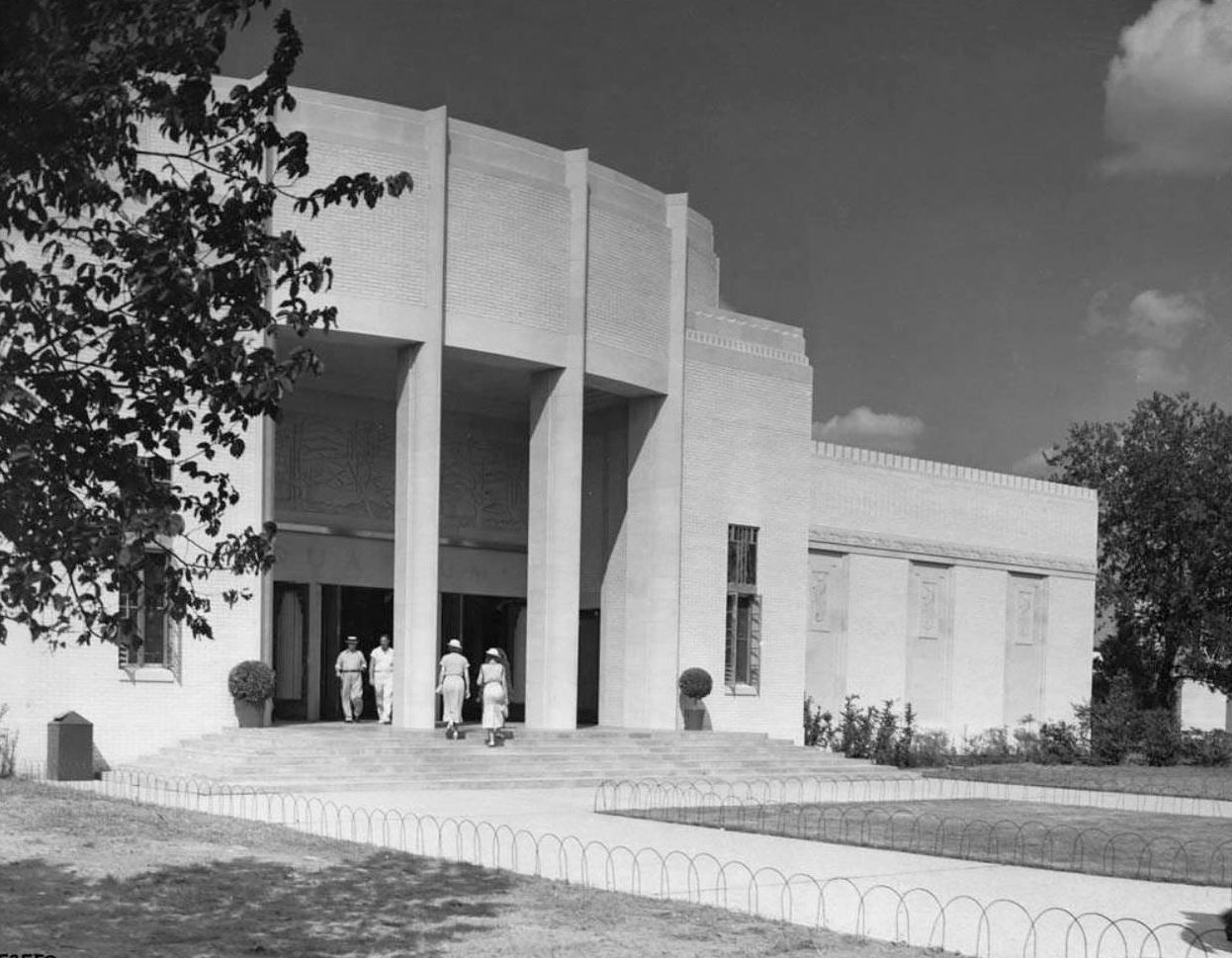
aquarium_art-institute-of-chicago_1936Art Institute of Chicago Collection

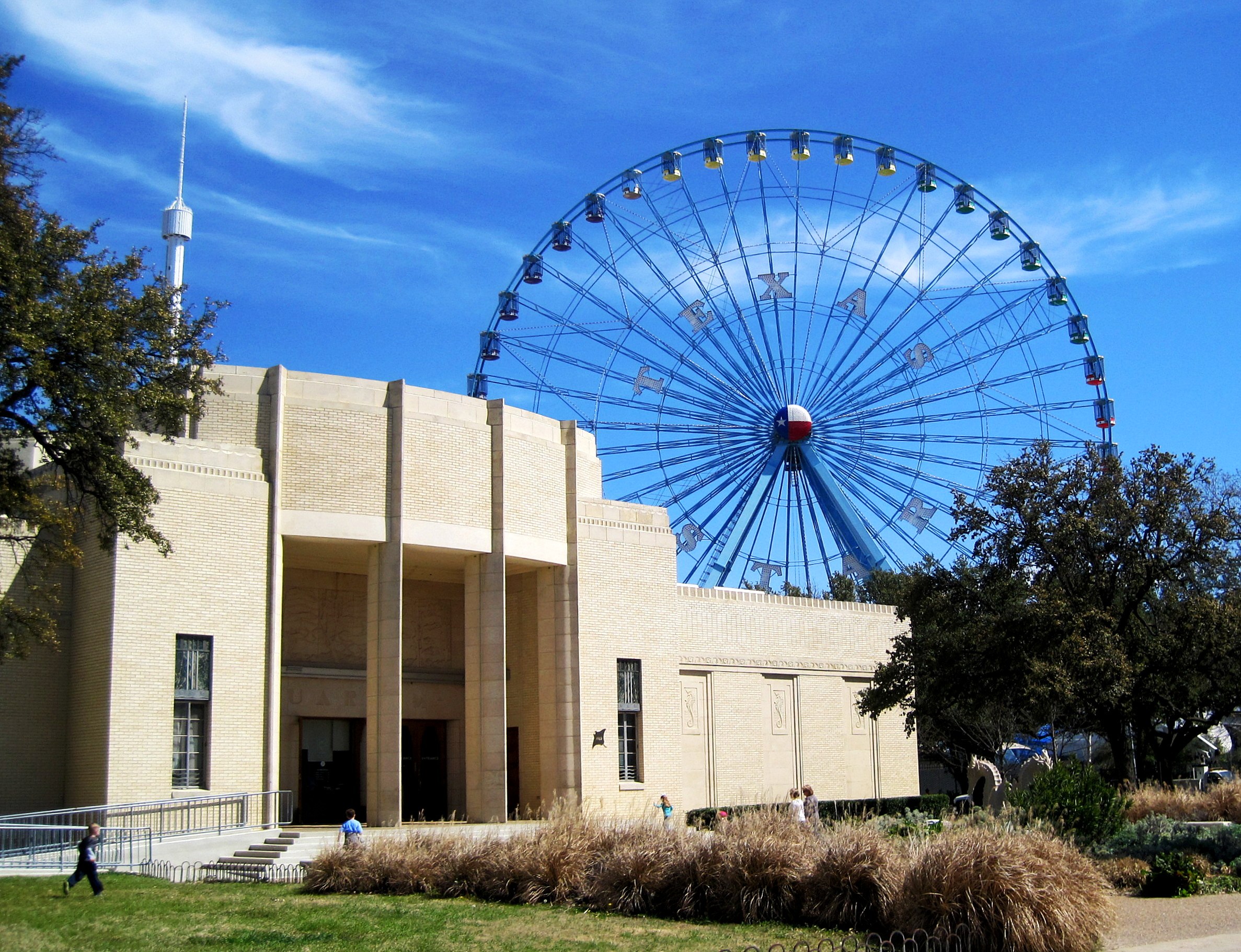
The 1936 Centennial aquarium building still stands. After extensive renovation, it now houses the “Children’s Aquarium,” which I haven’t visited, but which I’m confident is entertaining and educational. I’m pretty sure, though, that it is a completely different aquarium from the one of my childhood memories (when museums were basically designed for adults and were rarely “interactive”). I loved going to the aquarium. I remember it being dark and cool and kind of dreamy inside. Mysterious and exotic. I loved the little neon fish that playfully (or nervously) darted all around the tanks, the big, slow-moving fish that looked back at me like nonchalant cud-chewing cows in a field, the tiny skittering crabs, the turtles, the undulating plants … I loved all of it.

But what I really remember are the seahorses on the side of the building — whichever architect came up with that perfect little detail deserves a special place in heaven. I loved them as a child, and I love them now. The acres and acres of art deco fabulousness created for the Texas Centennial are absolutely thrilling, but those solemn and quietly elegant seahorses all in a row on the side of the Dallas Aquarium will always be my personal favorite little nostalgic detail in the whole of beautiful, beautiful Fair Park.

seahorses_pb-det

The Aquarium today (click to enlarge) / photo: Paula Bosse

*

UPDATE — Oct. 2020: It has been announced that the Children’s Aquarium will be closing permanently. This news is almost as upsetting as seeing Big Tex in flames.

UPDATE — Sept. 2021: Good news! It looks like the aquarium will be reopening in time for the 2021 State Fair of Texas. Read about it here.

***

Sources & Notes

Top two images are postcards based on the original architectural drawings, issued before the aquarium was built, found somewhere on the internet.

The third color image is a postcard from a photograph taken after the Centennial was underway.

Photo of the exterior of the present-day aquarium was taken by me in 2013.

The website for the Children’s Aquarium at Fair Park is here.

For an absolutely FANTASTIC well-illustrated article titled “The Metamorphosis of the Dallas Aquarium at Fair Park Into the Children’s Aquarium at Fair Park, With Historical Annotations” by Barrett L. Christie, Aquarium Supervisor, see p. 5 of the “Drum & Croaker” PDF, here. I really loved this article — especially the “Annotations of Historical Interest” at the end (p. 14). Seriously — this is a great read. I’m as layman as you’re gonna get regarding this topic, and I was fascinated by all of this. I’m going to have to write about that mysterious severed human leg found on the roof in 1954!

*

Copyright © 2015 Paula Bosse. All Rights Reserved.

George Cacas, The Terrill School’s Greek Ice Cream Man — 1916

terrill_ice-cream_yrbk_1916-cacasPrep-school boys & the ice cream man, 1916

by Paula Bosse

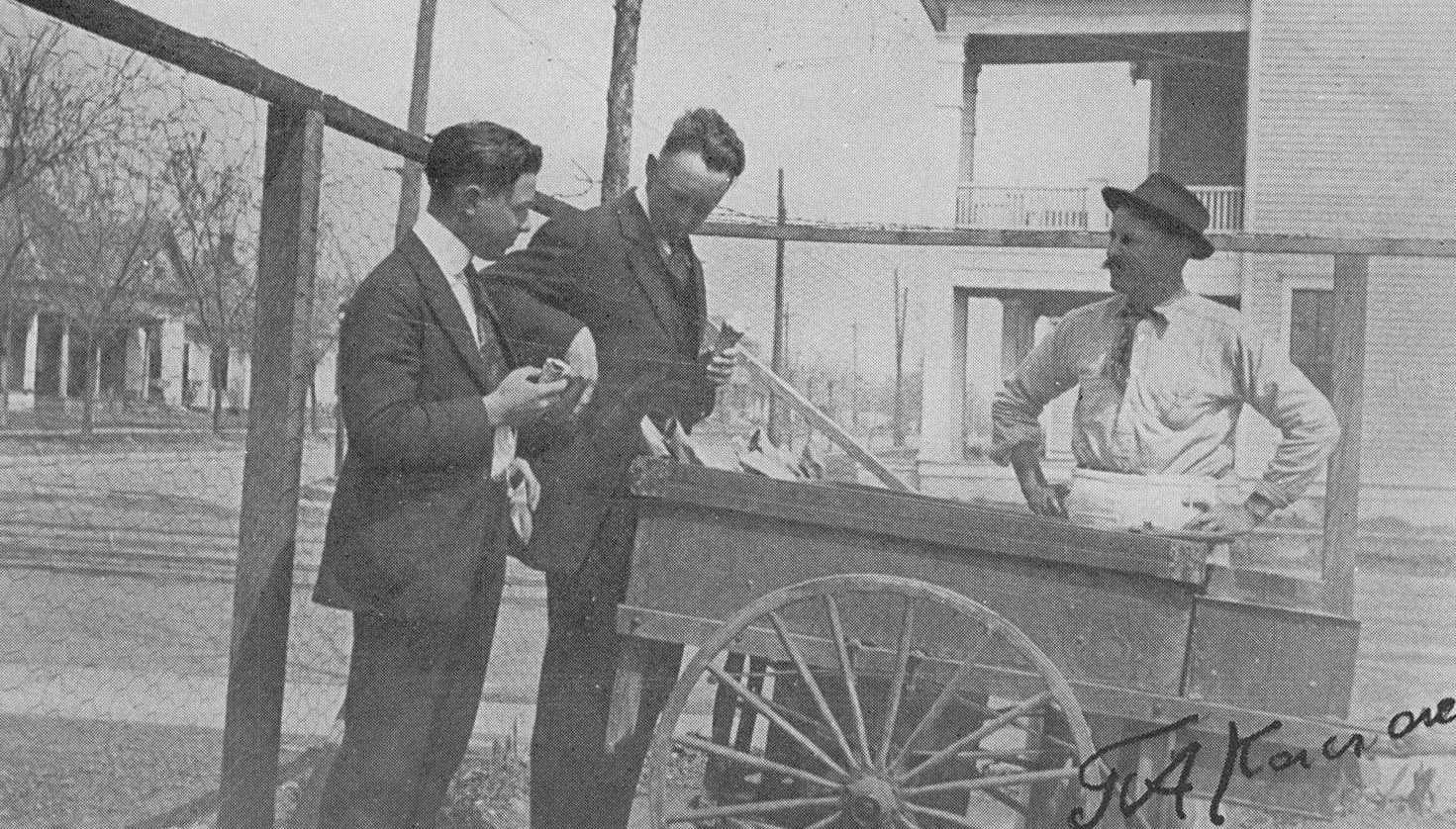
I love this photo. It shows two students from the Terrill School for Boys, buying ice cream from George Cacas, a Greek immigrant. I’m not sure of the exact location of the photo, but I would assume it is either in front of, next to, or very nearby the Terrill School, which was located at Swiss and Peak. It appeared in the school’s 1916 yearbook accompanying an “interview” with Mr. Cacas, whom the boys apparently (and one hopes affectionately) called “Spaghetti” (click for larger image):

terrill_ice-cream_cacas_1916-yrbk_text

Another photo of Mr. Cacas, from the previous year’s yearbook (click for larger image):

spaghetti_terrillian_1915

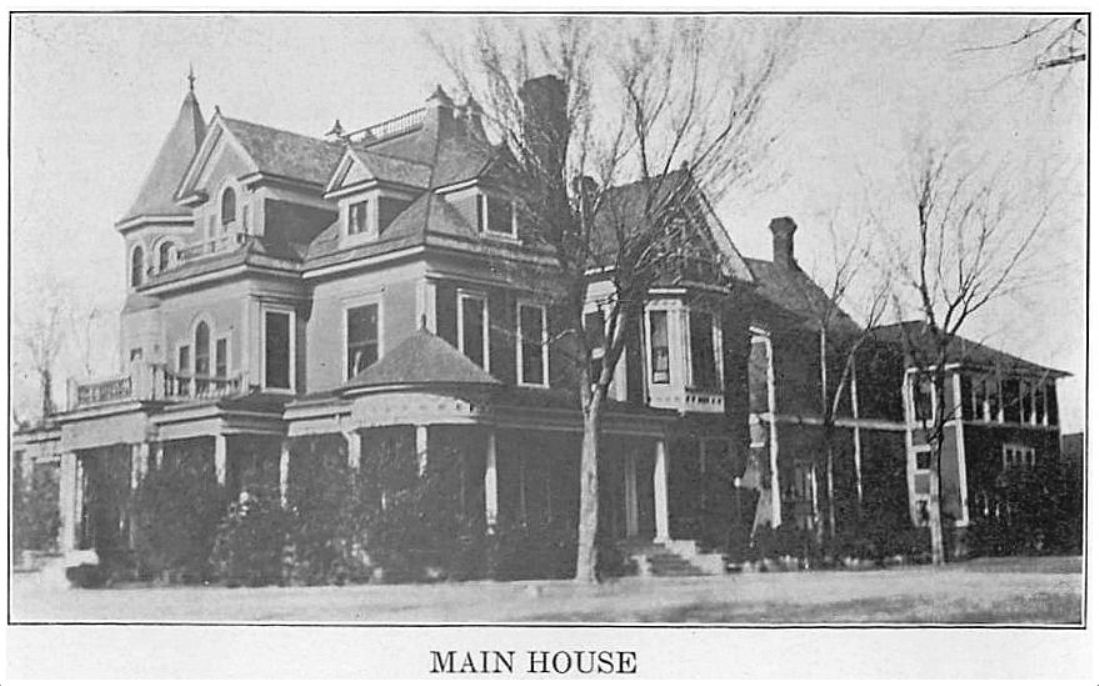
The Terrill School was established in 1906 and was one of the city’s early important prep schools for boys. (Incidentally, the Terrill School shared a fenceline with the prestigious Miss Hockaday’s School for Girls for many years — I’ll be writing more on this convenient arrangement in the future!) Below, two photos showing three of the campus’ many buildings, from about the same time as the one featuring Mr. Cacas.

terrill-school_main-house_yrbk_1919_lg

terrill-school_recitation-hall_phelps-hall_yrbk_1919Recitation Hall on the left; Phelps Hall, right — 1919

terrill-yrbk_19281928

***

Sources & Notes

Top photo and interview from the 1915-1916 Terrillian, the Terrill School yearbook; photos of the “Main House” and two campus buildings from the 1918-1919 Terrillian.

The Terrill School for Boys was located in Old East Dallas at 4217 Swiss Avenue, from 1906 to about 1930. It then moved to Ross Avenue for a few years and was eventually merged with a couple of other schools to form St. Mark’s School of Texas — more on that from the St. Mark’s website, here.

terrrill_school_bingLocation on present-day map (Bing)

The name “Cacas” didn’t seem right for a Greek surname — and the signature at the bottom of the photo looks like it might have been George’s, with his last name beginning with a “K.” But George’s family’s name was, in fact, spelled “Cacas,” as seen here in the city directory from 1915. I wonder if they spelled it “Cacas” back in Sparta?

cacas_directory_1915

*

Copyright © 2015 Paula Bosse. All Rights Reserved.

MLK in DFW — 1959

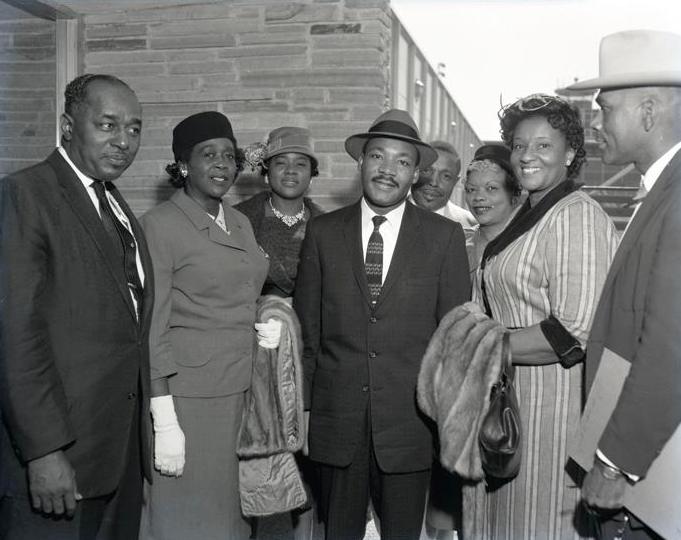
mlk-DFW-102259_calvin-littlejohn_briscoeDr. Martin Luther King, Jr. in DFW (photo © Calvin Littlejohn Estate)

by Paula Bosse

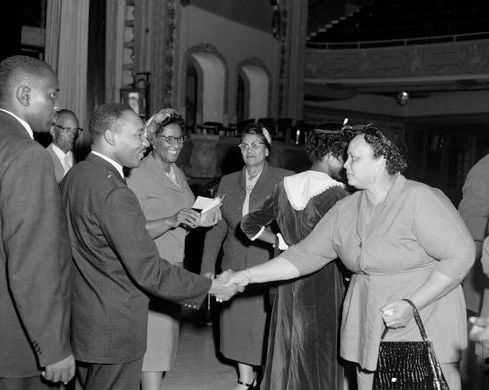
A couple of photos of Dr. Martin Luther King, Jr. on a quick trip to Dallas and Fort Worth in late October, 1959, taken by the wonderful Fort Worth photographer Calvin Littlejohn. The above photo is from Oct. 22, 1959 and was, I believe, taken after his speech at the Majestic Theatre in Fort Worth. Below, a photo of Dr. King taken at Love Field.

mlk_love-field_calvin-littlejohn_1959

***

Sources & Notes

Top photo by Calvin Littlejohn, from the Littlejohn Photographic Archive, Dolph Briscoe Center for American History. Mr. Littlejohn took several photos of Dr. King that visit, the locations of which are listed here — giving a good indication of the itinerary of the visit. I saw no mention or coverage of this visit in either The Dallas Morning News or The Fort Worth Star-Telegram.

Second photo from the TCU Press Facebook page.

A nice overview of Calvin Littlejohn’s career and a few of his photographs can be found here.

*

Copyright © 2015 Paula Bosse. All Rights Reserved.


Dallas’ “Courthouse Complex”

courthouse-complex_tinkle_key-to-dallas_1965-drawingEarly-’60s vision of the “courthouse complex”

by Paula Bosse

Let’s all be thankful that the Old Red Courthouse is still with us, because there was serious talk in the ’50s and ’60s of razing it to make way for a more modern downtown and a more efficient use of space. Lon Tinkle wrote the following in the mid-’60s:

courthouse-complex_tinkle_key-to-dallas_1965Excerpt from Lon Tinkle’s “The Key to Dallas” (1965)

Tinkle’s next paragraph: “It is not that Dallas doesn’t care. It does. But it has to grow into this experience of great cities, and it will.”

*

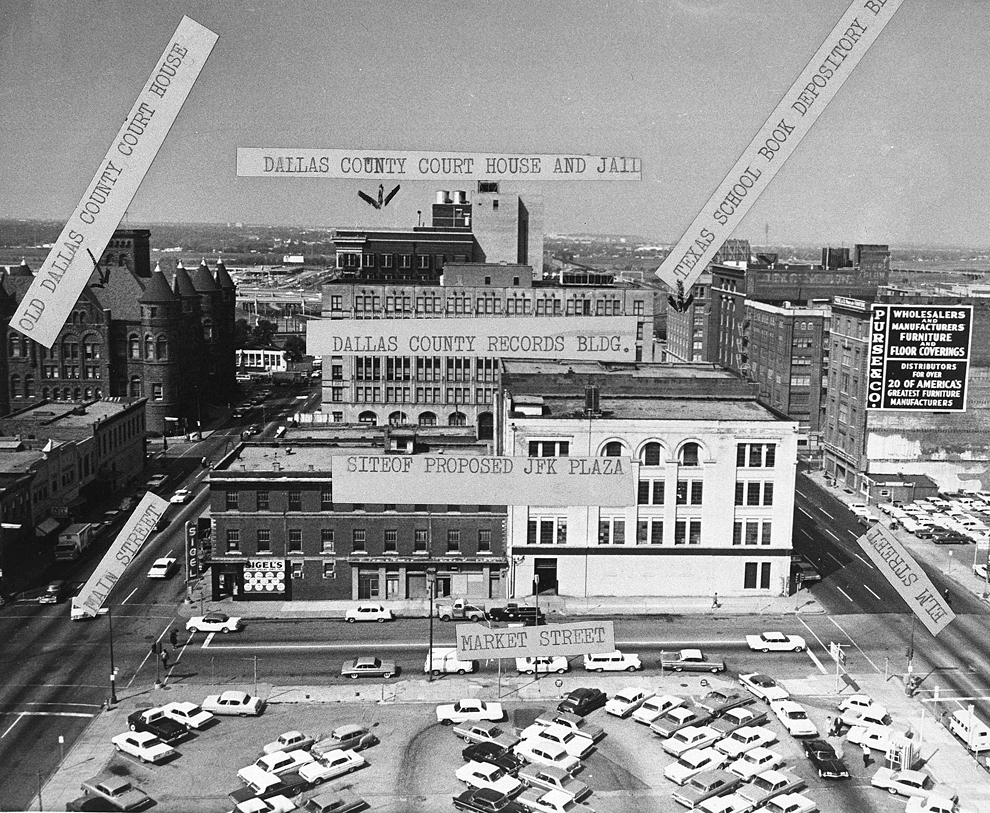
Here’s what the eastern boundary of the “courthouse complex” looked like in 1964. (Incidentally, the first Kennedy memorial site was chosen in April, 1964, and it was to be in the block immediately to the east of the Records Building, the one seen in the center of this photo. Sometime in the next few months, the location was changed to the block immediately east of the Old Red Courthouse.)

Ferd Kaufman, AP

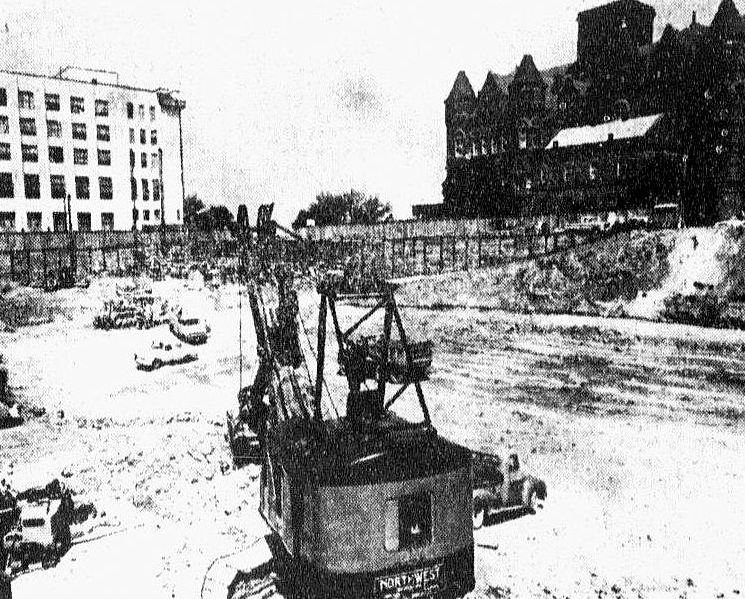
Here’s what the southern boundary looked like when construction of the new Dallas County Courthouse began in the spring of 1963:

courthouse-construction_early-1963

And here’s the “complex” today.

courthouse-complex_google

Old Red isn’t going anywhere!

**

UPDATE: After posting this on the Flashback Dallas Facebook page, a person commented about having worked across the street during the new courthouse’s construction.

On the night of June 19, 1964, a massive fire broke out on the upper floors of the new courts building, which was then under construction. There were 130 firefighters and more than 30 pieces of equipment on the scene according to newspaper accounts. The commenter wrote the following, in clipped sentences, telegram-style:

“I started to work 1963 at Terminal Annex. The Court House under construction, razed by fire shortly thereafter, heat from fire made us work away from windows. There was no thought of leaving building as mail had to make connections to railroads.”

First thing: Wow. The postal creed in action. Wonder if the workers got hazard pay? Or at least a W.C. Fields “hearty handclasp.”

Secondly: I had never seen the phrase “razed by fire” before. It’s not really accurate here, because only the upper floors were destroyed, but the cinematic quality of the phrase is pretty cool. I’ll have to file the phrase away to be used as the title for my memoirs, even if it doesn’t really apply to anything I’ve ever done or experienced. Can’t sacrifice a good title.

Thirdly: I continue to realize just how exceedingly dull my life is.

***

Sources &  Notes

Top image and text is from Lon Tinkle’s wonderful The Key to Dallas (Philadelphia/New York: J. B. Lippincott Co., 1965), an extremely informative book for young people. The drawing is by Dallas artist Bud Biggs (his signature is seen in the reproduction of this drawing in the Aug. 1961 issue of Dallas magazine).

Labeled image of the area in question, looking west, is an Associated Press photo by Ferd Kaufman, taken in 1964. I used this previously in the post “Where To Put That Kennedy Memorial? — 1964.”

Aerial view is a current one, from Google Maps.

*

Copyright © 2015 Paula Bosse. All Rights Reserved.