Flashback : Dallas

A Miscellany: History, Ads, Pop Culture

Clyde Barrow In a Sailor Suit

clyde-barrow_sister_1925_utsa_smClyde Barrow & his sister Nell

by Paula Bosse

Behold, a teenage Clyde Barrow in a sailor suit. Bonnie & Clyde lore has it that Clyde attempted to join the United States Navy but was rejected because of lingering problems from a childhood illness, but on a quick sprint across the internet, I’ve been unable to find any specifics about Clyde’s having tried to enlist in the Navy. But he was certainly pro-navy: not only does he appear to have enjoyed wearing the sailor’s outfit, but he apparently also had a “USN” tattoo.

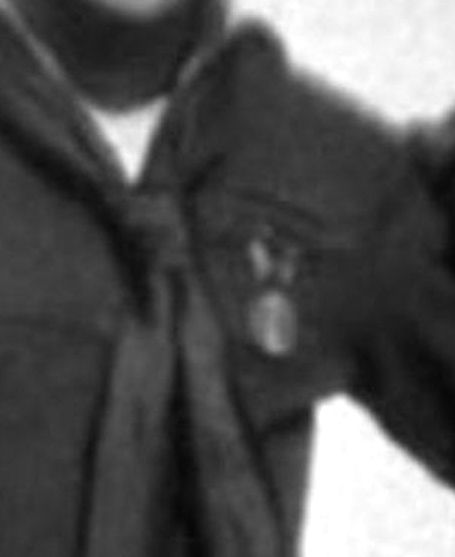
But what about this outfit? It certainly looks like a navy uniform. Is it an actual navy uniform? Maybe a relative’s? Is it a costume? Is it some sort of facsimile someone whipped up for him so he could slip into it whenever he felt like it? Is he play-acting? Dressing up for a party? And what about that “medal”?

clyde-barrow_sister_1925_utsa-det

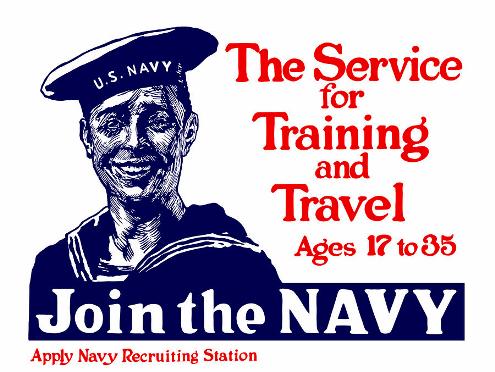
The back of this photo reads “Nell Barrow and Clyde / 1925.” Could it have been 1926 instead? On his birthday in 1925, Clyde (who was born on March 24, 1909) would have turned 16 years old. The minimum age for enlistment in the U.S. Navy jumped back and forth between 17 and 18 years old, but by the time his birthday rolled around in March of 1926, the enlistment age was 17. By the end of that year Clyde had been arrested for stealing a car, and even though charges were eventually dropped, this police record may have been enough to prevent him from enlisting even if he hadn’t failed a physical. Whatever the case, if he DID want to join the navy, he had a very limited window in which to do it: from his 17th birthday on March 24, 1926 to his first arrest on December 3, 1926.

Imagine how different things would have been if Clyde Barrow had joined the navy and sailed the Seven Seas instead of hooking up with Bonnie Parker and terrorizing the Southwest?

navy-recruiting-poster

***

Sources & Notes

Photo, titled “Clyde Barrow and sister Nell Barrow, Dallas, Texas,” is from the University of Texas at San Antonio Libraries Special Collections, and is accessible here. Photo loaned to UTSA by Henry J. Williams (other photos from Mr. Williams’ collection are dated 1926, some of which I used in my previous post “Babyface Barrow — 1926” here).

If anyone has more information about Clyde’s uniform in this photo, I’d love to hear from you. Similar uniforms can be seen here.

Just to be ruthlessly detailed, if Clyde Barrow visited the United States Navy recruiting office in Dallas, it was on the second floor at 206 ½ Browder Street, at Commerce, its new headquarters as of June, 1925; station physician was Lieut. Jack Terry. (Wonder if Lieut. Terry was the one who gave Clyde his walking papers? If so, I wonder if he ever knew?)

A list of requirements to join the U.S. Navy — published in The Scranton Republican on Feb. 10, 1927 — can be found here.

For previous Flashback Dallas posts on Bonnie and Clyde, click here.

*

Copyright © 2015 Paula Bosse. All Rights Reserved.

Orson Welles In Dallas — 1934-1940

orson-welles_cornell-tour_1934
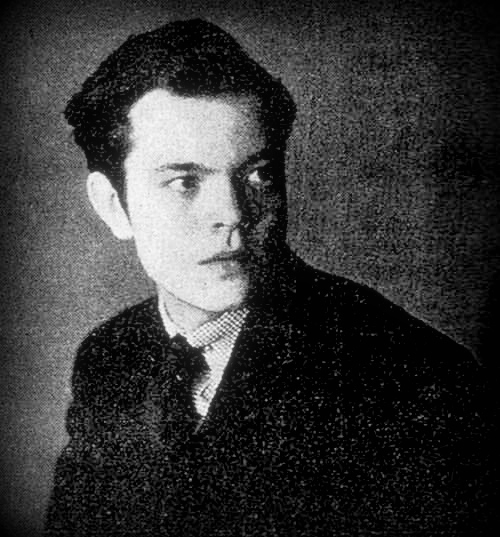
Orson at 18 — publicity photo used for the Cornell tour, 1934

by Paula Bosse

Today is the 100th anniversary of the birth of Orson Welles. Welles was one of the truly great, innovative theater and film directors, an actor with a commanding presence, and a delightfully entertaining raconteur. His frenetically creative work on the New York stage, on radio, and in film (he wrote, produced, directed, and acted in his first film, Citizen Kane, when he was only 25) earned him/saddled him with the hard-to-deny sobriquet “Boy Genius.” His rise up the show-biz ladder was a quick one.

Orson’s first professional acting gig was as an unknown 18-year old repertory player in the touring company of famed actress Katharine Cornell who, along with British actor Basil Rathbone, starred in the three plays performed on the tour, which stopped in Dallas for a two-night engagement at the Melba theater, in February, 1934. The three plays performed in Dallas on February 19 and 20 (one a matinee) were “Romeo and Juliet” (Orson played Mercutio), “The Barretts of Wimpole Street” (he played Octavius Moulton-Barrett), and “Candida” (he played Marchbanks). Cornell was a huge draw, and there was a rush for tickets. The Melba begged her to extend her stay and add performances, but she declined.

The young Welles had gotten reviews on the tour which ranged from a dismissive mention in Variety that he was unable to speak Shakespeare’s lines properly and audibly (!), to raves from Charles Collins of The Chicago Tribune:

The cast is brilliant, and many of the secondary characters are acted with consummate skill. This is particularly true of Orson Welles’ Mercutio, which is an astonishing achievement for a youth still new on the stage. In his duel with Tybalt and his death scene, this Mercutio is a complete realization of Shakespeare’s bravest blade.

The star of the show was the then-very-famous Katharine Cornell, around whom most of the articles and reviews centered (she was, for instance, breathlessly reported to be staying at the Melrose during her Dallas stay) (I wonder if the lowly company players — i.e. Orson Welles — stayed there as well?). The Dallas Morning News theater critic, John Rosenfield — who mentioned this 1934 Dallas appearance in almost every succeeding article he ever wrote about Orson Welles over the next several decades — wrote the following before he saw Orson’s performances in any of the three plays:

Orson Welles, 18-year-old actor, who is apparently bulky enough to hold his own with adults, will be Mercutio. (DMN, Feb. 19, 1934)

After he saw his Mercutio:

Orson Welles’ Mercutio was up to the best standards known for this role. (DMN, Feb. 20, 1934)

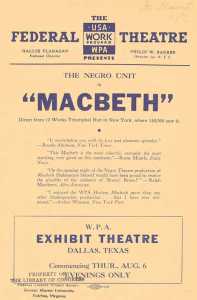
When the tour finished, Welles quickly became a presence in the New York theater world. One of his early successes as a producer and director was his production of the so-called “Black Macbeth”/”Negro Macbeth”/”Voodoo Macbeth” — a hugely popular staging of Shakespeare’s “Macbeth” with an all-black cast, done under the auspices of the Federal Theatre Project in 1936. In August of that year — just two and a half years after his appearance as an unknown at the Melba — he took the production to Dallas where it made a splash at the Texas Centennial in the brand new bandshell.
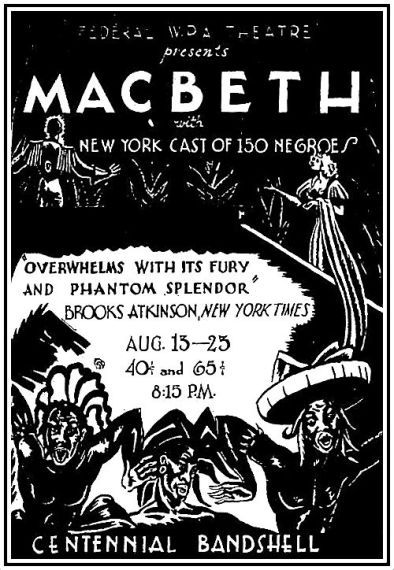
macbeth_texas-centennial_dmn_081336Aug., 1936

macbeth_playbill_dallas_LOC(click for larger image)

Rosenfield was impressed by the lush design and the electric and inventive spectacle, but he was not a fan of the performances. A few years later, on the eve of the release of Citizen Kane, he wrote the following (which was much harsher than his original 1936 review):

We saw this production in Dallas during the Texas Centennial and could marvel at the artistic futility of such ingenuity. The Negro Macbeth, however, was something to be seen if only to be despised. (DMN, Oct. 29, 1941)

Oh dear.

In 1940, Welles was working on his first film, the legendary Citizen Kane. As filming began to wind down, he decided to go out on a short lecture tour because he was in desperate need of money (an all-too-common circumstance he found himself in throughout the entirety of his career). His topic was a vague “anecdotes of the stage and theories on the drama” — and it sounds like his “performances” were largely unscripted and unrehearsed. 

On October 29, 1940 — only a week or two after wrapping production on Citizen Kane — 25-year old Orson Welles spoke at McFarlin Auditorium on the SMU campus as part of the Community Course series of lectures. His topic: The Actor’s Place in the Theater. It was another packed house of adoring and/or curious Dallasites. Rosenfield was both entertained and annoyed by the rambling “lecture,” but Orson was undoubtedly delighted to talk for two hours before an adoring crowd, answer their questions about his craft, and collect a $1,200 check.

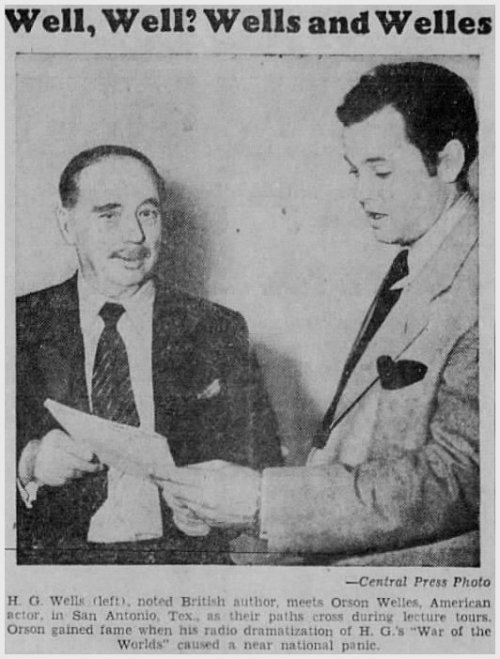
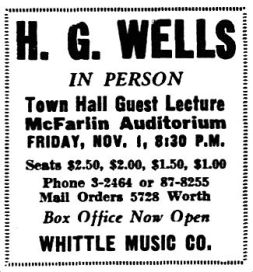
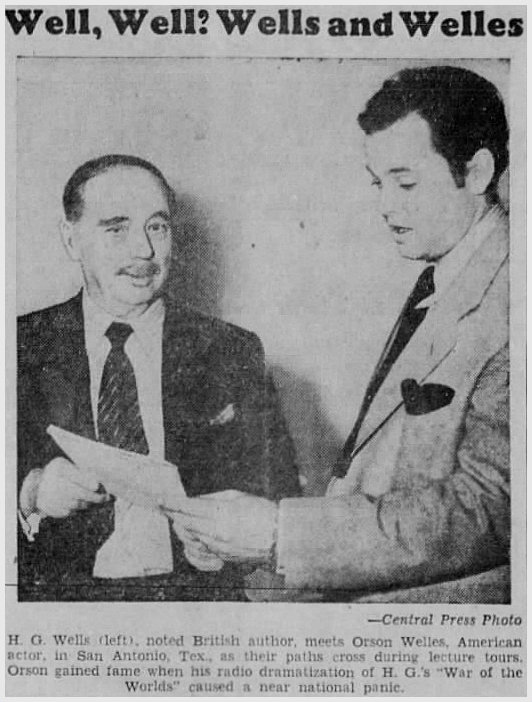
Orson’s appearance in Dallas was particularly noteworthy for the fact that the speaker scheduled to appear on the McFarlin stage just three days later was … H. G. Wells! At the time of this lecture tour, Orson was best known for his infamous 1938 radio adaption of H. G. Wells’ The War of the Worlds, the frighteningly realistic production that panicked the nation and led thousands to believe that the earth was being attacked by Martians. Rather surprisingly, Welles and Wells had never met.

According to a blurb in a Phoenix newspaper, Orson had cancelled a previously-scheduled meeting in Tucson in order to fly into Dallas earlier than planned. My guess is that he saw that H. G. Wells was also lecturing in Texas and realized that H. G.’s lecture in San Antonio the night before Orson’s own appearance in Dallas on the 29th was the only chance he had to meet the man who had provided the source-material for his (to-date) greatest career triumph.

A quick timeline:

  • Sun. Oct. 27, 1940: Orson arrives in Dallas, staying at the Baker Hotel.
  • Mon. Oct. 28: In the morning, Orson flies down to San Antonio to meet H. G. Wells and attend his lecture. The two meet, get along famously, have their photos taken, and give a short joint interview to San Antonio radio station KTSA (see below for link to recording). That evening, both fly to Dallas. Later that night, Orson (well known as an amateur magician) pops into The Mural Room in the Baker Hotel to catch the floor show featuring popular magician Russell Swann.
  • Tues. Oct. 29: H. G. Wells leaves Dallas for Denver, continuing his lecture tour. That morning Orson drives to Fort Worth to present a lecture and attend a luncheon at the River Crest Country Club. That night, he presents his lecture at McFarlin Auditorium at Southern Methodist University. After his lecture, he catches Russell Swann’s magic show for a second time. At 3:00 a.m. he flies to San Antonio for his lecture there.
  • Wed. Oct. 30: Orson lectures in San Antonio. It is the second anniversary of the broadcast of “The War of the Worlds.” Conveniently, newspapers around the country begin to run the photos of Welles and Wells taken on the 28th.
  • Thurs. Oct. 31: A Martian-free Halloween.
  • Fri. Nov. 1: H. G. Wells is back in Dallas for his lecture that night at McFarlin Auditorium.
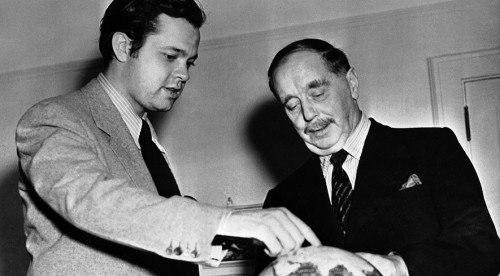
welles-wells_san-antonio_102840

welles-wells_pottstown-pa-mercury_103140Pottsdown (PA) Mercury, Oct. 31, 1940

h-g-wells_dmn_102940DMN, Oct. 29, 1940

Whew.

Happy 100th, Orson! And thanks for everything.

***

Sources & Notes

Dates and sources of newspaper clippings as noted.

“Macbeth” playbill from the Library of Congress, here.

The timeline for the Welles-Wells meeting and their Dallas-related activities were gleaned from a report in the Oct. 30, 1940 edition of The Dallas Morning News.

And now, links galore.

  • Watch an entertaining short clip in which Orson talks about mind-reading and fortune-telling — which he says he indulged in on the Cornell tour — here.
  • Read the profile of the 18-year-old phenom which appeared in newspapers during the run of the Katharine Cornell tour, here.
  • Read about the “Voodoo Macbeth” here (scroll to the bottom to see fantastic photos).
  • Listen to the interview with Orson Welles and H. G. Wells that aired on San Antonio station KTSA, the day they met for the first time, on Oct. 28, 1940 — here.
  • Read about that still-chilling Mercury Theatre radio broadcast of The War of the Worlds, here.

Finally, my favorite Orson Welles-related quote from the erudite and not-without-humor arts critic of The Dallas Morning News, John Rosenfield. He wrote the following in his review of the set-in-Haiti “Macbeth” — about the aesthetic viability of future Shakespeare productions tailored for specific audiences:

…Mr. Welles hasn’t started a movement. His Negro “Macbeth” does not inspire us to corroborate a fabled Texas lawyer and make Antonio “The Merchant of Ennis.” (DMN, Aug. 16, 1936)

“THE MERCHANT OF ENNIS”! Someone! Make this happen!

*

Copyright © 2015 Paula Bosse. All Rights Reserved.

A Proposed Trinity River Boulevard Connecting Dallas and Fort Worth — 1924

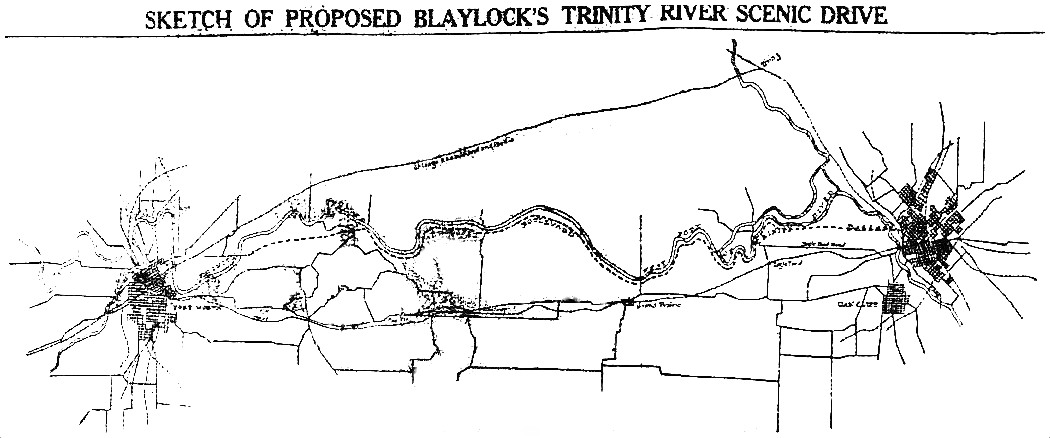
trinity-river-scenic-drive_dmn-110224The mayor’s plan for a scenic highway… (click for larger image)

by Paula Bosse

In 1924, Dallas Mayor Louis Blaylock proposed a new route between Dallas and Fort Worth which would closely follow the course of the Trinity River. Not only would this new road relieve congestion of the highway already in heavy use by trucks, business vehicles, and “speeding jitneys,” but it would also provide a more sedate and scenic thoroughfare, intended for use by the citizens of Dallas, Fort Worth, and the mid-cities who enjoyed taking their “pleasure vehicles” out for a stress-free Sunday drive.

The following text and the above chart appeared in The Dallas Morning News on Nov. 2, 1924:

Sketch of Proposed Blaylock’s Trinity River Scenic Drive

Mayor Louis Blaylock’s proposed scenic highway between Dallas and Fort Worth would follow the course of the West Fork of the Trinity River between the two cities. The above sketch was made in the office of E. A. Kingsley, city engineer of Dallas.

Last week the Dallas Mayor advanced the suggestion that the “necessary new road to Fort Worth” be planned along these lines. Both Mayor Blaylock and Mayor Willard Burton of Fort Worth have offered $5,000 each toward the new enterprise if nine other citizens in both places donate like sums.

Mayor Blaylock said Saturday that such a project would be impracticable without adequate flood control, and when the matter reaches the conference stage around Jan. 1 a system of locks, dams and levees will be discussed. A boat canal between Dallas and Fort Worth and an irrigation system for the intermediate farming country are among the possibilities, said Mayor Blaylock.

A few days earlier, a sarcastic editorial about the plan (in which the Dallas mayor’s name was misspelled throughout) appeared in The Fort Worth Star-Telegram (click for larger image):

trinity-highway_FWST_102924FWST, Oct. 29, 1924

Even though Dallas and Fort Worth had long engaged in a (mostly) friendly rivalry, it was Fort Worth’s mayor, Willard Burton, who, rather surprisingly, stepped up to offer financial support for the Dallas mayor’s plan. Saying that it was unfair to further burden the taxpayers, he chipped in $5,000 toward the funding of the new road and suggested that he could persuade nine other civic-minded Fort Worthians to do the same. Blaylock may have been forced by mayoral peer pressure to dig deep and follow suit, but he also pledged $5,000 and said he’d get nine flush Dallasites to fork over five thou, too.

trinity-highway_dmn_103124DMN, Oct. 31, 1924

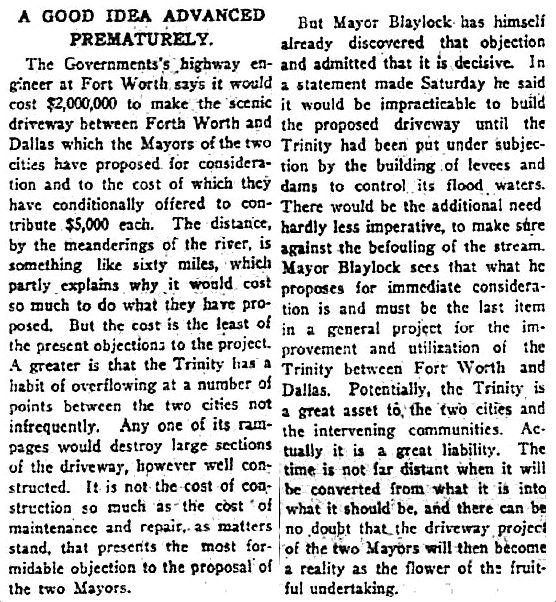
I’m not sure how either thought a 60-mile road could be built between Dallas and Fort Worth for only $100,000 (slightly less than 1.5 million dollars in today’s money). As it turned out, it couldn’t. An engineer with the U.S. Bureau of Roads estimated it would cost closer to $2,000,000 (about 27.5 million dollars in today’s money — a veritable BARGAIN!).

trinity-highway_dmn_110124-costDMN, Nov. 1, 1924

In less than a week of giddy conversations about the Trinity River fantasy boulevard, the plan was pretty much dead when everyone accepted the fact that it was not economically feasible.

trinity-highway_dmn_110424DMN, Nov. 4, 1924

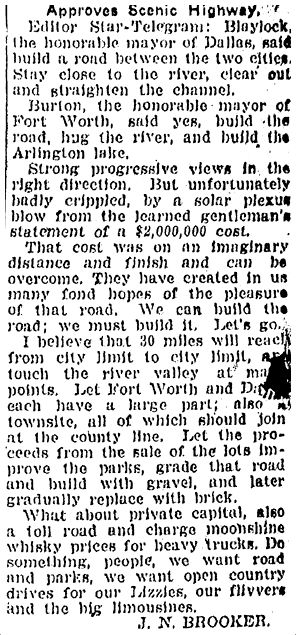
There must have been many sad souls in Dallas in the fall of 1924. But some still insisted it could be built and should be built. Prominent Fort Worth resident J. N. Brooker wrote an impassioned letter to the Star-Telegram, with a few helpful suggestions:

scenic-drive_FWST_112124FWST, Nov. 21, 1924

A toll road that charges “moonshine whiskey prices” — there you go!

***

Sources & Notes

Top image from The Dallas Morning News, Nov. 2, 1924 (apologies for the poor resolution!).

More on Mayor Louis Blaylock (1849-1932) from The Handbook of Texas, here.

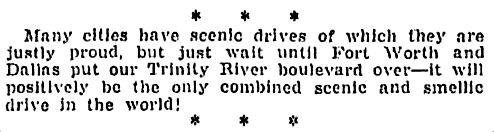
Lastly, a couple of amusing snide remarks from the pages of Amon Carter’s Fort Worth Star-Telegram:

scenic-drive_FWST_110324FWST, Nov. 3, 1924

scenic-drive_FWST_111124FWST, Nov. 11, 1924

Most images larger when clicked.

*

Copyright © 2015 Paula Bosse. All Rights Reserved.

Post Office, Sunbonnets — ca. 1890s

post-office_hist-photos-of-dallas

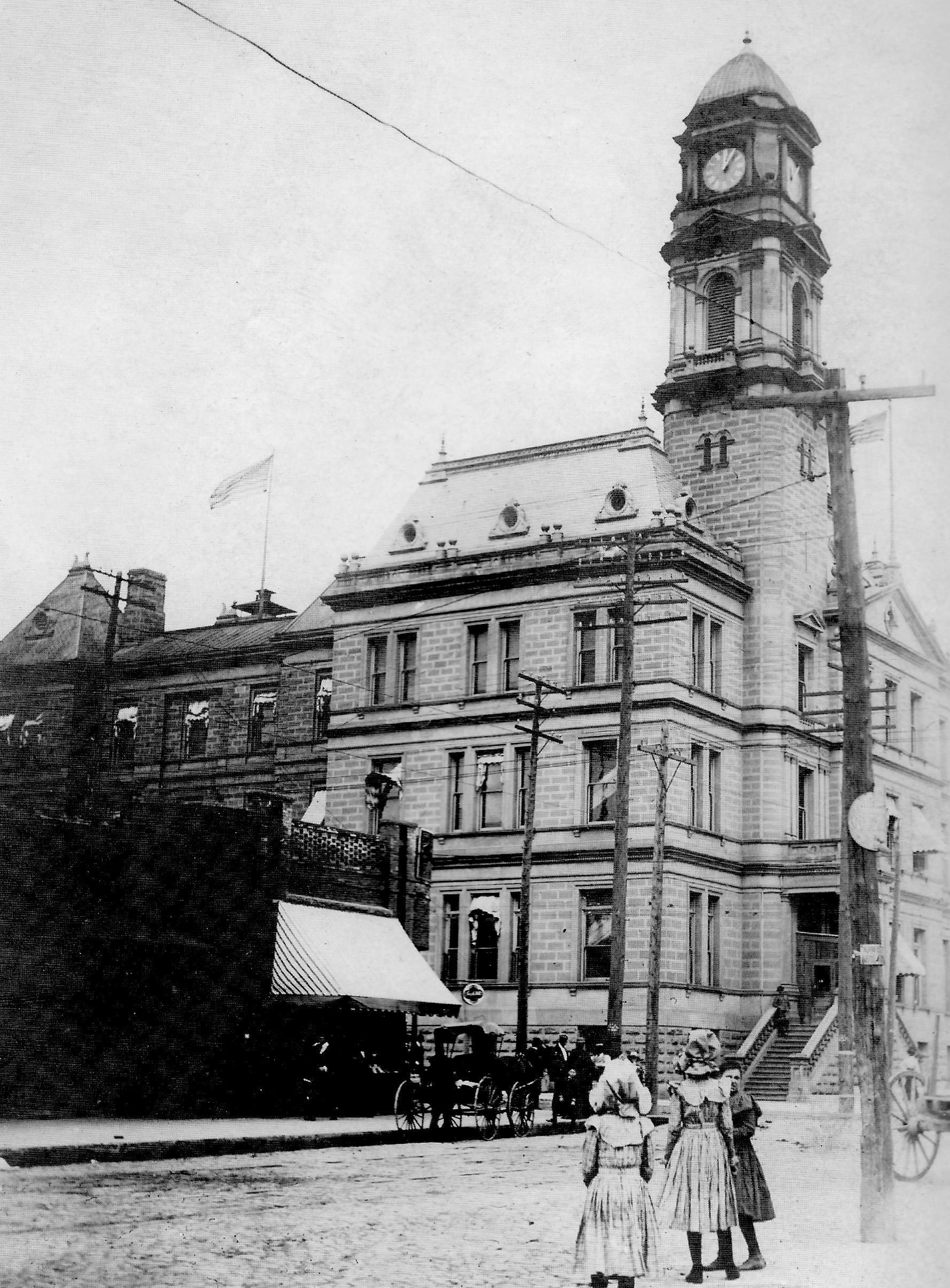
“Little Post Office on the Blackland Prairie” (click for larger image)

by Paula Bosse

Laura and Mary Ingalls and Nellie Oleson appear to have wandered into Dallas to take a look at the new Post Office clock tower, seen here at Commerce and Ervay, probably in the mid- to late-1890s.

***

Photo from the book Historic Photos of Dallas by Michael V. Hazel (Nashville: Turner Publishing Co., 2006).

For an incredible view of this same spot from 1894, see my previous post “Henry Stark’s ‘Bird’s Eye of Dallas’ — 1895/96” here (click pictures for larger images).

Click picture for very large image!

*

Copyright © 2015 Paula Bosse. All Rights Reserved.

DP&L’s Twin Smokestacks

downtown_color_1939
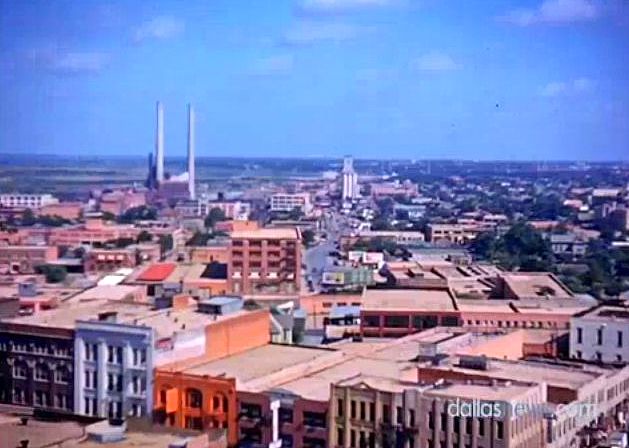
An unusual view of the smokestacks from 1939 — in color!

by Paula Bosse

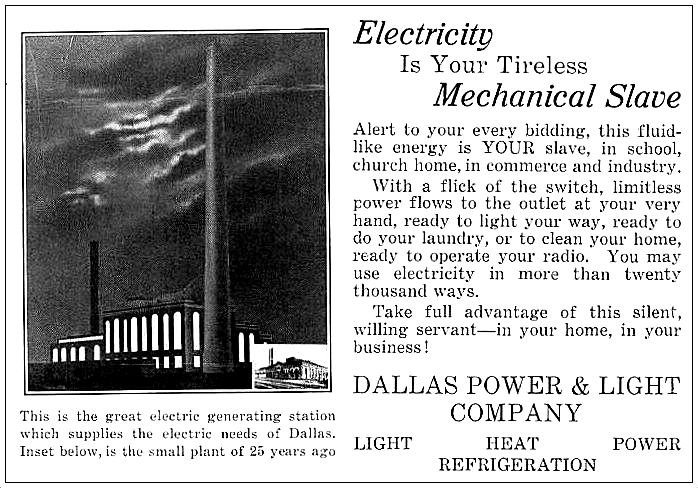
I got to thinking about those two smokestacks that used to be such an important part of the Dallas skyline when I came across this rather forceful 1928 Dallas Power & Light Company ad:

ad-dpl_terrill-yrbk-1928
(click for larger image)

“More than twenty thousand ways” to use electricity, “your tireless mechanical slave”! (To see a larger image of the ad’s illustrated inset, click here.)

According to The Dallas Morning News, the Dallas Power & Light Company power plant had been in use at the location at “at the foot of Griffin Street … since 1890, with additions in 1905, in 1912 and in 1914. In 1922 work started on the most recent addition, which when completed will cost over $2,000,000, and will provide additional generating capacity of furnishing 20,000 kilowatts” (DMN, Oct. 14, 1923).

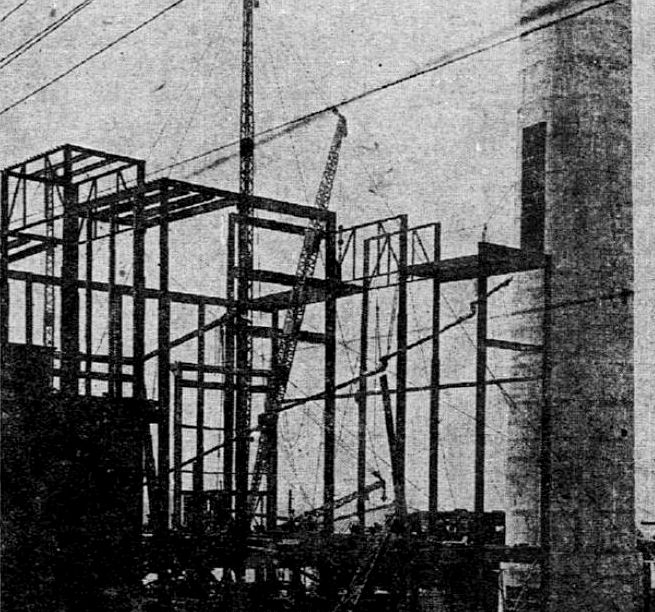
Construction on the new addition — including the first of the two new smokestacks — began in the summer of 1922.

dpl_dmn_FWST_072822Fort Worth Star-Telegram, July 28, 1922
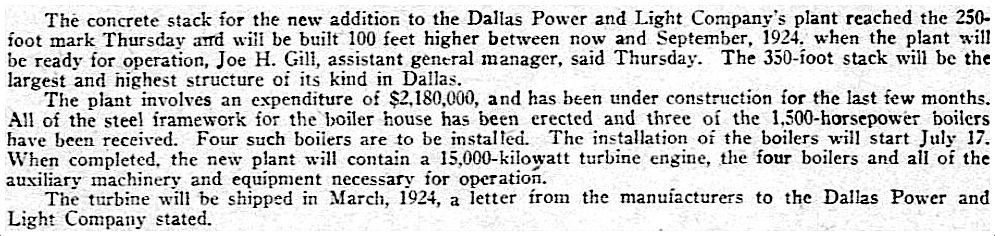
By the summer of 1923 the first smokestack was partially built.

smokestack_dmn_071323smokestack_dmn_071323-captionDMN, July 13, 1923 (click for larger images)

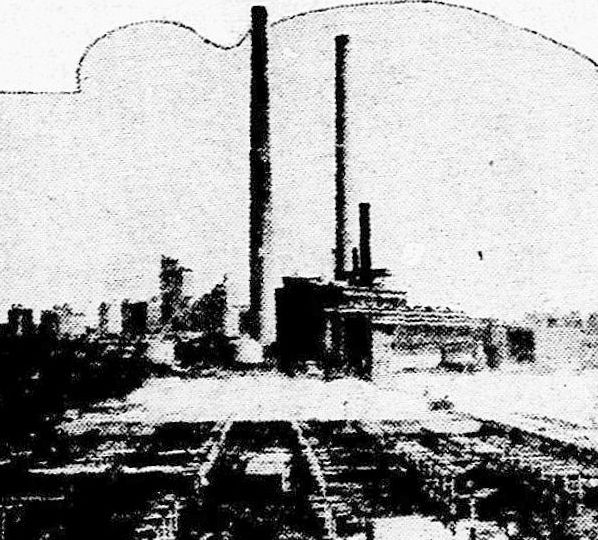
The new addition was completed in 1924 (although improvements and construction were constantly ongoing). The new giant smokestack can be seen in this photo, alongside the old and new parts of the generating plant:

dpl_dmn_101224_photo2DMN, Oct. 12, 1924

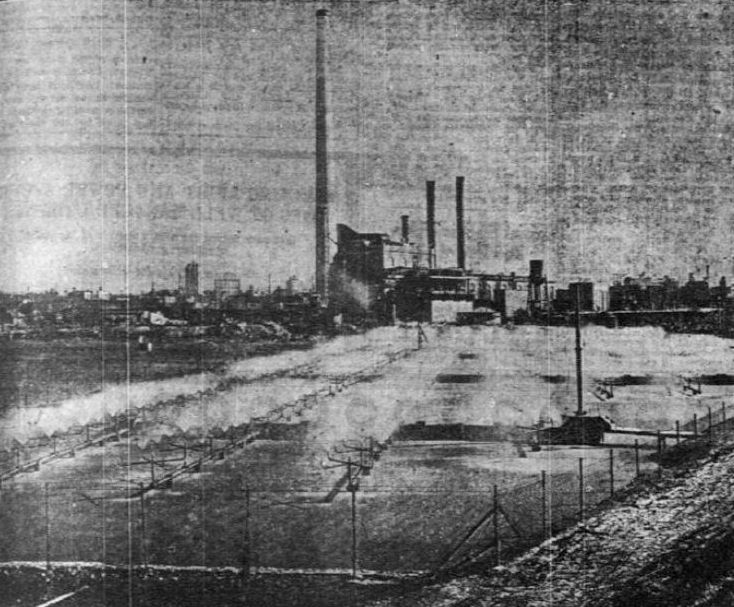
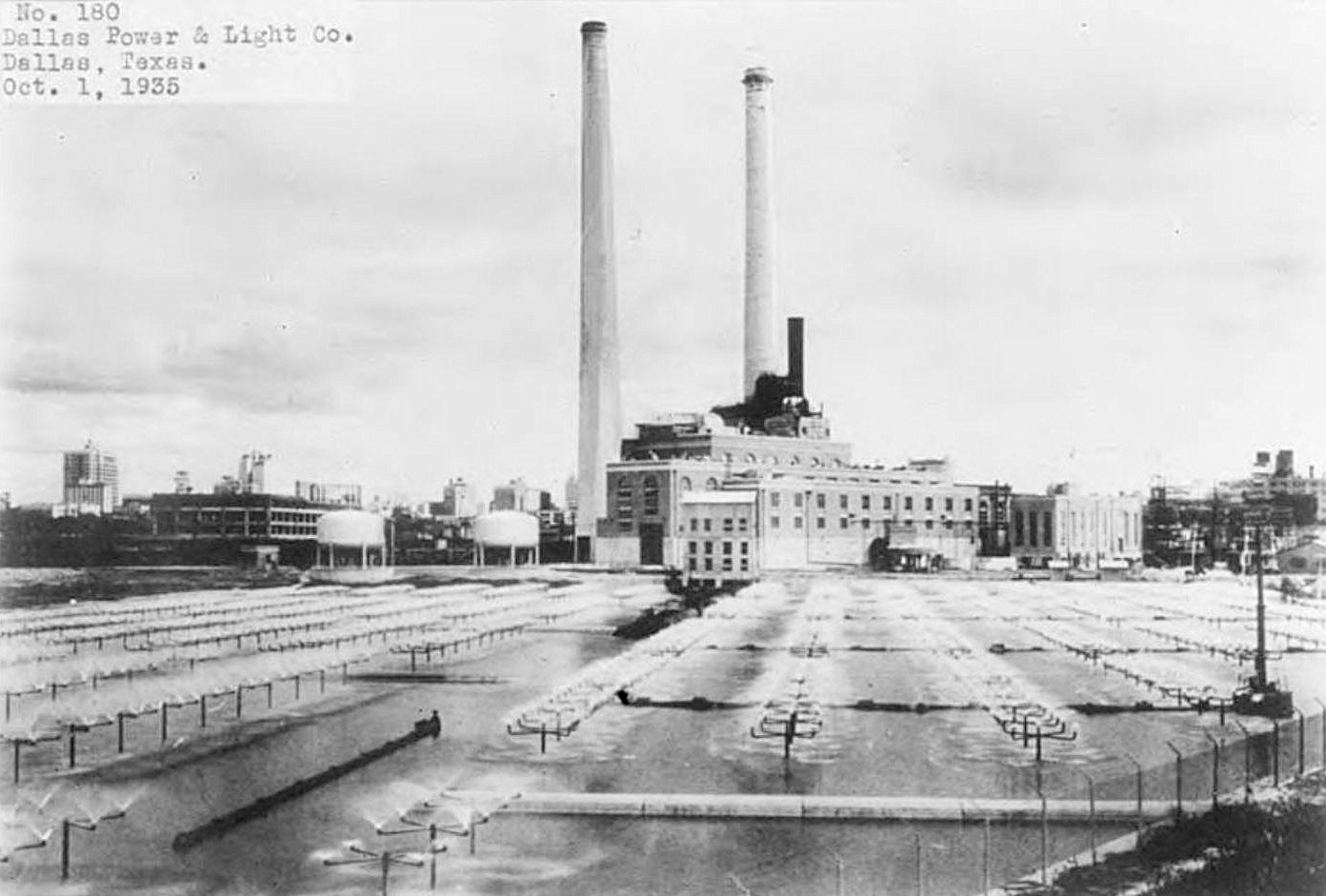
And, another view, this one with the 8-acre “spray pond” in the foreground:

dpl_dmn_101224_photoDMN, Oct. 12, 1924

In 1928 DP&L announced that it needed a further addition:

Another large chimney or smokestack, a new boiler room and other plant enlargements will be required in the North Dallas generation plant to house the new addition. (DMN, Oct. 20, 1928)

And in 1929 … voilà — the second smokestack!

dpl_steamstacks_1929
1929

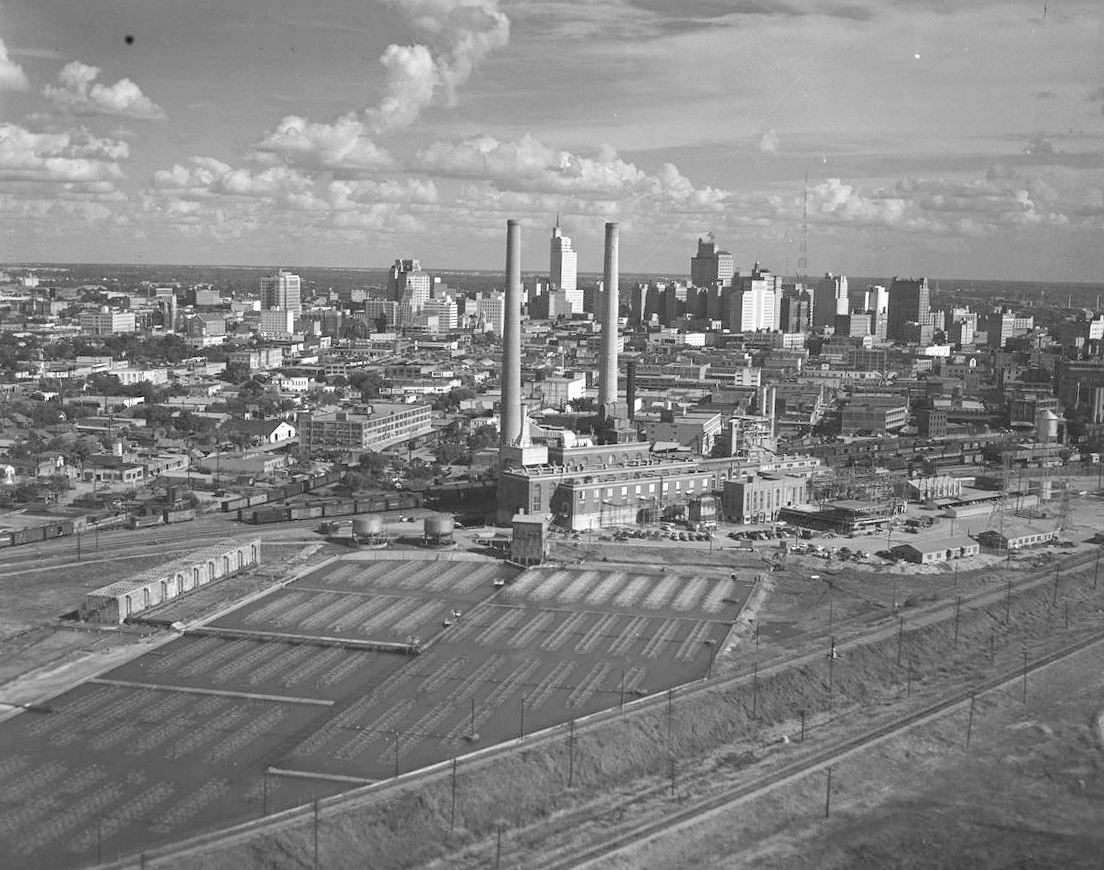
Those two smokestacks (which actually emitted steam rather than smoke) were almost as much a part of the iconic Dallas skyline as Pegasus. You’ll see them in any wide shot of the skyline taken between 1929 and the late 1990s, when the plant was demolished to make way for the American Airlines Center (the design of which actually is reminiscent of the building it replaced). You could see those smokestacks from miles away, and, even though they’ve been gone for more than 15 years, I still expect to see them standing there. RIP, smokestacks!

*

dallas-power-and-light_degolyer-lib_SMU1930s, via DeGolyer Library, Southern Methodist University

langley_skyline-horseback_c1945_LOCPhoto by William Langley, 1945 (with the twin stacks AND Pegasus)

dpl-plant_towers_squire-haskins_UTAvia Squire Haskins Collection, University of Texas at Arlington

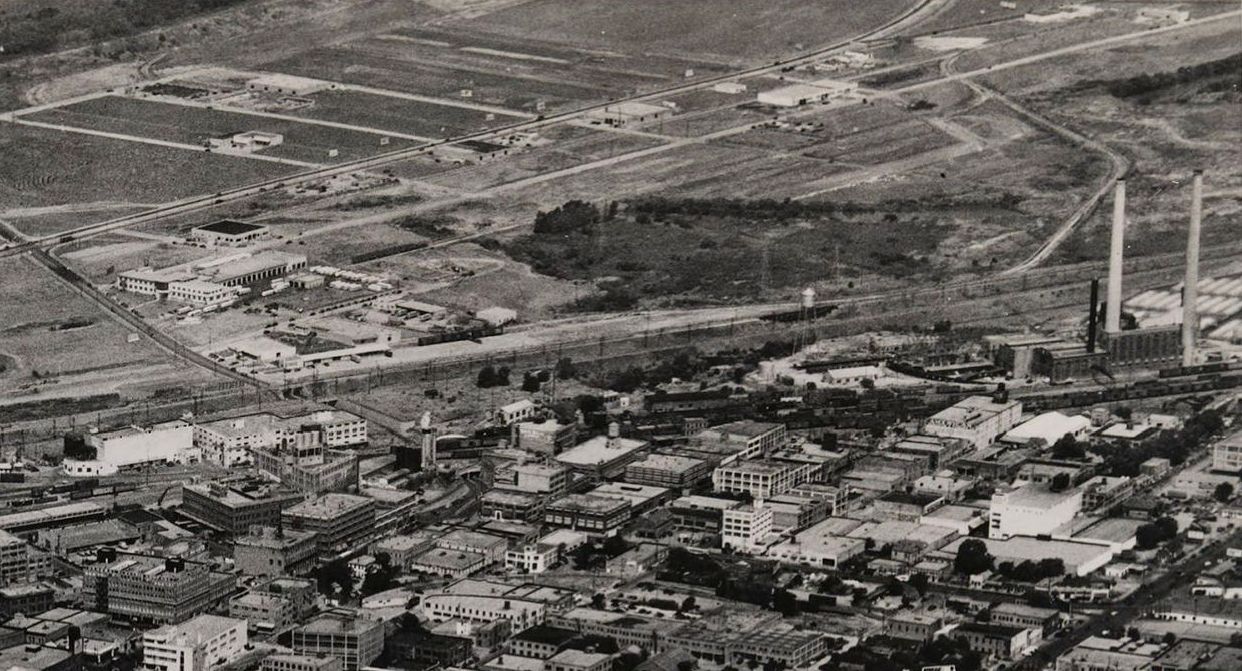
smokestacks_long_foscue_ca1948-detAerial photo by Lloyd M. Long, 1948 (detail)

dpl_steamstacks

***

Sources & Notes

Color image is a screengrab from the short 1939 color film of Dallas which you can watch in full, here.

Ad is from the 1928 Terrillian, the Terrill School yearbook.

William Langley photo of the cowboy on horseback is from the Library of Congress, used previously here.

Lloyd M. Long aerial photo is a detail of a photo cataloged as “Downtown Dallas — looking west,” from the Edwin J. Foscue Map Library, Central University Libraries, Southern Methodist University; the full photo and its details are accessible here.

For an unexpectedly enthusiastic essay about the design and cultural/aesthetic significance of the plant and its smokestacks, architecture critic David Dillon’s “Getting Up a Head of Steam: DP&L’s Power Station, Recalling an Urban Past, Is a Function of Triumph” (Dallas Morning News, Sept. 7, 1983) is well worth searching for in the Dallas Morning News archives. This is the first paragraph:

The Dallas Steam Electric Station on Stemmons is nearly a century old and for most of that time it has been a commanding presence on the downtown skyline, its soaring white smokestacks rivaling anything that modern skyscraper designers have come up with. In Pittsburgh or Detroit such a structure might pass unnoticed but in Dallas, never a factory town, it stands out as a romantic symbol of our earliest industrial aspirations.

(My favorite piece of trivia from Dillon’s article is the revelation that the “tapering white shafts and gold caps [were] touched up every few years by daredevil painters lowered from a helicopter…” (!)).

More about this plant (and how it lives on in the design of the American Airlines Center which now stands on the same land) can be found in the Flashback Dallas post “A New Turbine Power Station for Big D — 1907,” here.

As always, most images are larger when clicked. When in doubt … CLICK!

*

Copyright © 2015 Paula Bosse. All Rights Reserved.


A Distant Dallas Hall on the Horizon — 1914

dallas-hall_continental-gin_det_1914A clear line of sight, from Deep Ellum to SMU (click for larger image)

by Paula Bosse

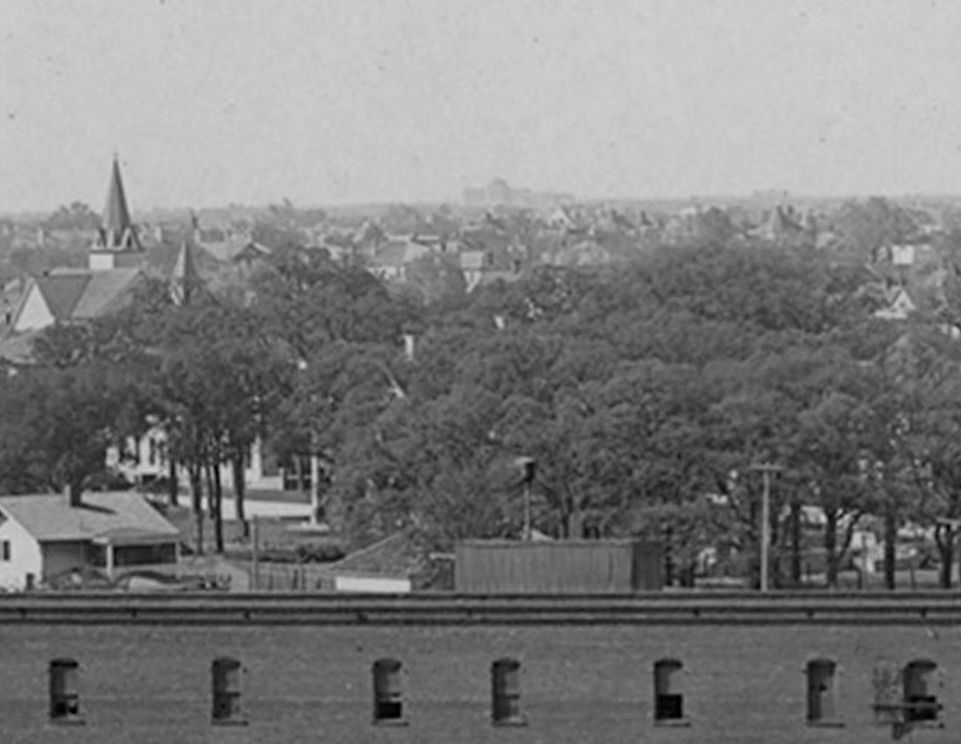
A quick “bonus” post: a detail of an incredible photo of the Continental Gin building which shows a ghostly Dallas Hall looming in the distance. Dallas Hall was the first building on the SMU campus, and in 1914 — a year before classes began — the far off building was way, way out in the country. SMU is a little over 5 miles from Deep Ellum. That’s quite a view.

***

This detail is from a photo featured in a previous Flashback Dallas post, “The Continental Gin Complex — 1914,” which can be seen here. I’ve just added this detail — and two other magnified details showing Baylor Hospital and the old Ursuline campus — to the post.

The original photograph, titled “Continental Gin Company on Elm Street, Facing North” by Charles Erwin Arnold, is from the George W. Cook Dallas/Texas Image Collection housed at the DeGolyer Library, Central University Libraries, Southern Methodist University. The photo and its details can be viewed here. It really is one of my favorite historical Dallas photos ever.

*

Copyright © 2015 Paula Bosse. All Rights Reserved.


“Mobile-Optimized,” Y’all!

howdy_postcard

by Paula Bosse

Howdy! For those of you who visit this blog while on a mobile device … good news! I’ve finally been able to start tweaking it so that reading it on a phone doesn’t cause a dull throbbing pain in your head. Perusing the site should now be a whole lot less annoying. As always, thanks for reading!

*

Copyright © 2015 Paula Bosse. All Rights Reserved.

Barges on the Trinity — 1906

barge_trinity_clogenson_1906-LOC-1A confident crew, a stoic Old Red, and a stubborn river (click for larger image)

by Paula Bosse

“A navigable Trinity.” For over 150 years, people have hoped against hope that the Trinity River might one day be made into a commercial waterway, navigable from the Gulf of Mexico to Dallas. For over a century, federal, state, and local funds were optimistically (misguidedly?) poured into various hopeless plans and projects — but not a one was successful.

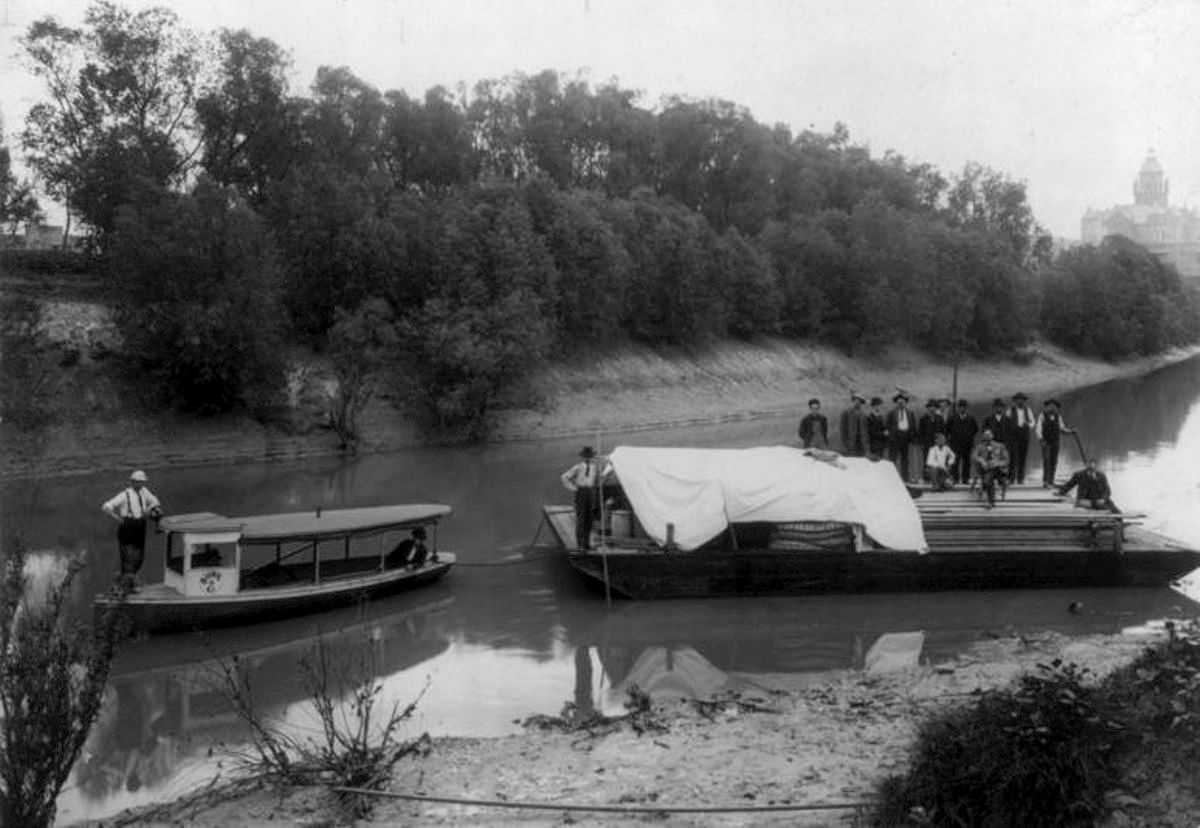
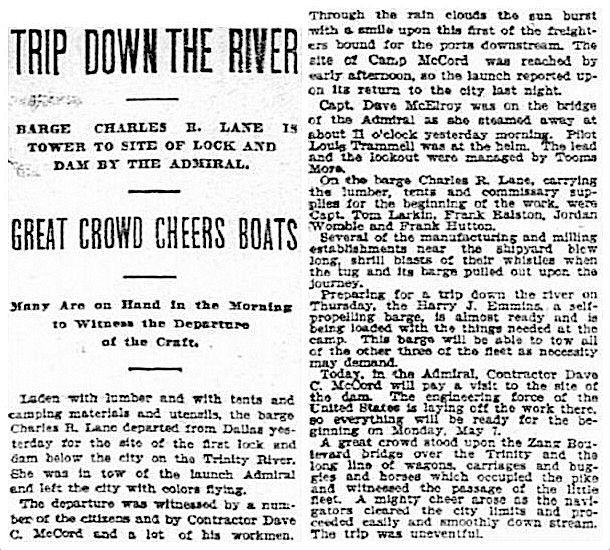
In 1906, construction was to begin on one of these projects — a series of locks and dams downriver of Dallas. Above and below are photographs showing the barge Charles R. Lane loaded with lumber and camp provisions, which were to be towed by the launch Admiral to McCommas Bluff, where the first lock was to be built. The above photo ran in the May 1, 1906 edition of The Dallas Morning News above the following caption:

Contractor’s barge, loaded with supplies, about to depart from Dallas for the site of the first lock and dam down the Trinity River.

Below, the story that accompanied the photo. (Click for larger image.)

barge_trinity_dmn_050106DMN, May 1, 1906

barge_trinity_clogenson_1906-LOC-2Dudes and fat-cats, with dollar signs in their eyes (click for larger image)

Later that month, a barge excursion to the site of the future lock was arranged for interested parties. This “merry crowd” of curious looky-loos was towed down the river to McCommas Bluff where they de-barged to tour the site and have a picnic lunch atop the picturesque bluff. They returned to Dallas happy and excited, convinced that maybe — just maybe — the Trinity would finally be tamed!

barge_trinity_dmn_052806DMN, May 28, 1906 (click for larger image)

Giddy enthusiasm about the project was all over the pages of The Dallas Morning News:

The time for doubter and pessimist has passed, and belief in the certainty of the practical navigation of the Trinity now appears unanimous. (DMN, May 2, 1906)

Well-intentioned though this wishful thinking might have been, “certainty” is probably not a word that should be tossed around so lightly. And certainly not in the case of anything having to do with the Trinity.

I bet that poor river just wishes people would leave it alone.

***

Sources & Notes

Both photographs taken by Henry Clogenson; from the collection of the Library of Congress, here and here.

“Trinity River Navigation Projects” entry from the Handbook of Texas is here.

History and photos of the McCommas Bluff Preserve and Trails area (including an interesting photo of Dam #1 from about 1910) can be found on the Dallas Trinity Trails blog, here.

An essential history of the various failed attempts over the years to open up a navigable Trinity between Dallas and the Gulf of Mexico can be found in “Navigating the Trinity: A Dream That Endured for 130 Years” by Jackie McElhaney; the article from the Spring 1991 issue of Legacies can be read here.

An interesting page from the American Canal Society Canal Index — with an illustration of the location of the locks — can be accessed here.

To watch a soothing video shot in the area of the abandoned Dam #1 at beautiful McCommas Bluff, click here.

A related Flashback Dallas post — “Snag Boat Dallas — 1893” — can be found here.

Click pictures for larger images.

*

Copyright © 2015 Paula Bosse. All Rights Reserved.


The Adolphus & Its Annex

adolphus_lang-witchell_arch-yrbk_1922The Adolphus Hotel and its annex, circa 1922 (click for larger image)

by Paula Bosse

Built in 1912, the ornate and luxurious Barnett, Haynes, and Barnett-designed Adolphus Hotel (which was modeled on/inspired by the Plaza Hotel in New York) quickly became THE hotel in Dallas. It was so successful that in only four years an expansion was already underway. The 12-story “Annex” (seen above, just to the left of the original building) was designed by preeminent Dallas architects Otto Lang and Frank Witchell. The so-called “Junior Adolphus” was built around 1916/17 and added 229 rooms to Dallas’ most glamorous hotel. A third addition (“Adolphus III”) came along in the 1920s.

Below, a few views of the Adolphus complex at different stages of its growth. (Click photos for larger images.)

*

adolphus-construction_dallas-then-and-nowBuilt at the northwest corner of Commerce and Akard streets, the Adolphus Hotel was built on the spot previously occupied by the City Hall. This photo, looking northeast, shows the site’s excavation by Vilbig Brothers Construction.

*

1913-pano-2In this detail from an April 1913 panoramic photograph of the city’s skyline, the Adolphus can be seen just six months after its opening at the end of 1912. (A previous post devoted to the full panoramic photo can be accessed here.) The Oriental Hotel, with its rounded topknot, can be seen across Commerce from its sister hotel (both were built by beer king Adolphus Busch). Seen in the background is the Praetorian Building — once the tallest structure in Dallas (it is the tall building, second from the right).

*

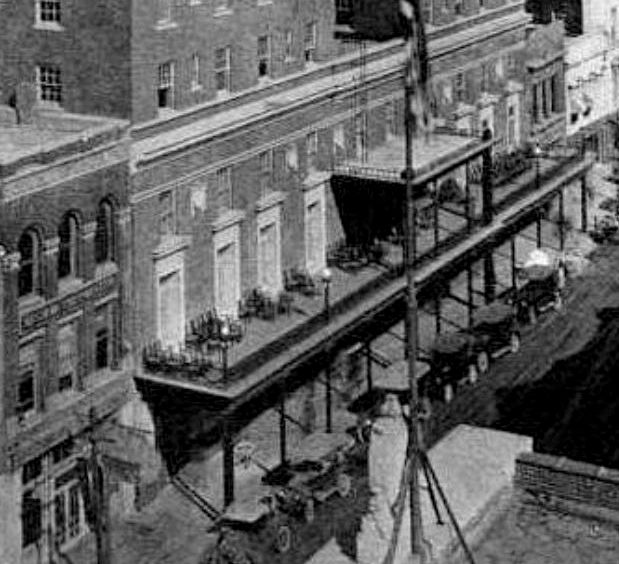
adolphus_lang-witchell_arch-yrbk_1922-detThe the Lang & Witchell-designed annex came along around 1916/17 (see top photo). My favorite detail is what looks like an open-air terrace, with tables and chairs, overlooking Commerce Street.

*

adolphus-annex_dallas-hotelsAnother view, showing the hotel and annex in 1924.

*

adolphus-annex_dallas-hotels-detA closer look shows that the terrace is now enclosed.

*

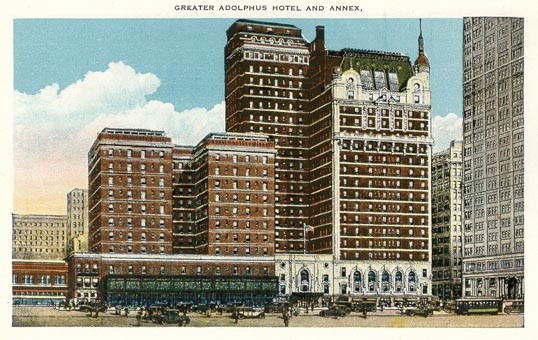
adolphus-hotelA few years later, a further, taller addition was built.

***

Top photo from the 1922 Yearbook of the Dallas Architectural Club.

Photo of the excavation from Dallas Then and Now by Ken Fitzgerald (San Diego: Thunder Bay Press, 2001); photograph from the Texas/Dallas History and Archive Division of the Dallas Public Library. A similar photo can be seen on the fascinating history page of the Vilbig & Associates website, here.

Detail of 1913 panoramic photo from the Jno. J. Johnson photo in the Library of Congress. (For more info, see previous post, “‘New Dallas Skyline’ — 1913,” here.)

Photo of the Adolphus with the Coca Cola sign in the lower left from Historic Dallas Hotels by Sam Childers (Charleston: Arcadia Publishing, 2010). The author’s extremely informative caption can be read here.

See a wonderful pictorial history of the Adolphus Hotel on the Dallas Morning News website here.

The official website for the Adolphus Hotel is here.

Click photos for larger images.

*

Copyright © 2015 Paula Bosse. All Rights Reserved.


Aerial View of the Centennial Fairgrounds — 1936

fair-park_1936_red-oak-kidThe Texas Centennial: a “World’s Fair” for Dallas

by Paula Bosse

This fantastic photo (by one of Dallas’ top aerial photographers, Lloyd M. Long) shows the impressive expanse of Fair Park’s new Art Deco splendor — most of the buildings seen here were built especially for the 1936 Texas Centennial Exposition, and most of those are, thankfully, still standing.

***

Sources & Notes

Lloyd M. Long photo, found on Red Oak Kid’s Flickr stream, here.

To see this photo REALLY big, click here.

*

Copyright © 2015 Paula Bosse. All Rights Reserved.